F. Morse Archer Sr.
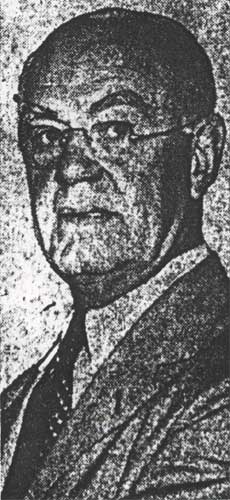
F. Morse Archer Sr.
F. Morse Archer Sr. was born in Camden November 27th, 1873. A graduate of Princeton University in 1894 and Harvard Law School in 1897, he passed the bar in New Jersey. After practicing law in Camden and serving as Camden County prosecutor, he was elected president of the National State Bank of Camden, which became the First Camden National Bank & Trust. He continued in that post until his retirement in 1947.
F. Morse Archer passed away in Florida on February 1, 1950. His son F. Morse Archer Jr. became a prominent lawyer in South Jersey, co-founding the Archer & Greiner law firm that bears his name today.
Committee of One Hundred
Philadelphia Inquirer —
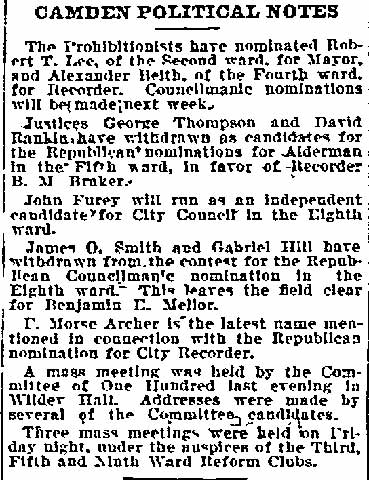
CAMDEN POLITICAL NOTES
The Prohibitionists have nominated Robert T. Lee, of the Second ward, for Mayor, and Alexander Heith, of the Fourth ward, for Recorder. Councilmanic nominations will be made next week.
Justices George Thompson and David Rankin have withdrawn as candidates for the Republican nominations for Alderman in the Fifth ward, in favor of Recorder B. M. Braker.
John Furey will run as an independent candidate for City Council in the Eighth ward.
James O. Smith and Gabriel Hill have withdrawn from the contest for the Republican Councilmanic nomination in the Eighth ward. This leaves the field clear for Benjamin E. Mellor.
F. Morse Archer is the latest name mentioned in connection with the Republican nomination for City Recorder.
A mass meeting was held by the Committee of One Hundred last evening in Wildey Hall. Addresses were made by several of the Committee’s candidates.
Three mass meetings were held on Friday night, under the auspices of the Third, Fifth and Ninth Ward Reform Clubs.
Carteret Club
Philadelphia Inquirer —
Named: William White, Al Lemmon, Carteret Club, Martin V. Bergen, Dr. Frederick Smith, and F. Morse Archer.
Engagement Announced
Philadelphia Inquirer —

Baxter Street
Camden Daily Courier —
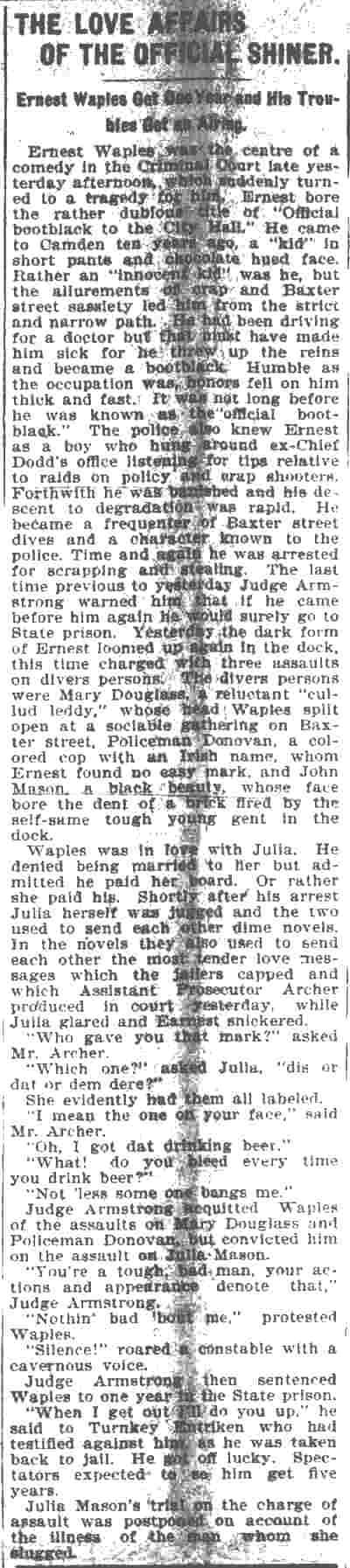
THE LOVE AFFAIRS OF THE OFFICIAL SHINER
Ernest Waples Gets One Year and His Troubles Get an Airing
Ernest Waples was the centre of a comedy in the Criminal Court late yesterday afternoon, which suddenly turned to a tragedy for him. Ernest bore the rather dubious title of “Official bootblack to the City Hall.” He came to Camden ten years ago, a “kid” in short pants and chocolate hued face. Rather an “innocent kid” was he, but the allurments of crap and Baxter street sassiety led him from the strict and narrow path. He had been driving for a doctor but that must have made him sick for he threw up the reins and became a bootblack. Humble as the occupation was, honors fell on him thick and fast. It was not long before he was known as the “official bootblack.” The police also knew Ernest as a boy who hung around ex-Chief Dodd’s office listening for tips relative to raids on policy and crap shooters. Forthwith he was banished and his descent to degradation was rapid. He became a frequenter of Baxter street dives and a character known to the police. Time and again he was arrested for scrapping and stealing. The last time previous to yesterday Judge Armstrong warned him that if he came before him again he would surely go to State prison. Yesterday the dark form of Ernest loomed up again in the dock, this time charged with three assaults on divers persons. The divers persons were Mary Douglass, a reluctant “cullud leddy,” whose head Waples split open at a sociable gathering on Baxter street, Policeman Donovan, a colored cop with an Irish name, whom Ernest found no easy mark, and John Mason, a black beauty, whose face bore the dent of a brick fired by the self-same tough young gent in the dock.
Waples was in love with Julia. He denied being married to her but admitted he paid her board. Or rather she paid his. Shortly after his arrest Julia herself was jugged and the two used to send each other dime novels. In the novels they also used to send each other the most tender love messages which the jailers capped and which Assistant Prosecutor Archer produced in court yesterday, while Julia glared and Ernest snickered.
“Who gave you that mark?” asked Mr. Archer.
“Which one?” asked Julia, “dis or dat or dem dere?”
She evidently had them all labeled.
“I mean the one on your face,” said Mr. Archer.
“Oh, I got dat drinking beer.”
“What! do you bleed every time you drink beer?”
“Not ’less some one bangs me.”
Judge Armstrong acquitted Waples of the assaults on Mary Douglass and Policeman Donovan, but convicted him on the assault on Julia Mason.
“You’re a tough, bad man, your actions and appearance denote that,” Judge Armstrong.
“Nothin’ bad ’bout me,” protested Waples.
“Silence!” roared a constable with a cavernous voice.
Judge Armstrong then sentenced Waples to one year in the State prison.
“When I get out I’ll do you up,” he said to Turnkey Entriken who had testified against him as he was taken back to jail. He got off lucky. Spectators expected to see him get five years.
Julia Mason’s trial on the charge of assault was postponed on account of the illness of the man whom she slugged.
Baxter Street
Camden Post-Telegram —
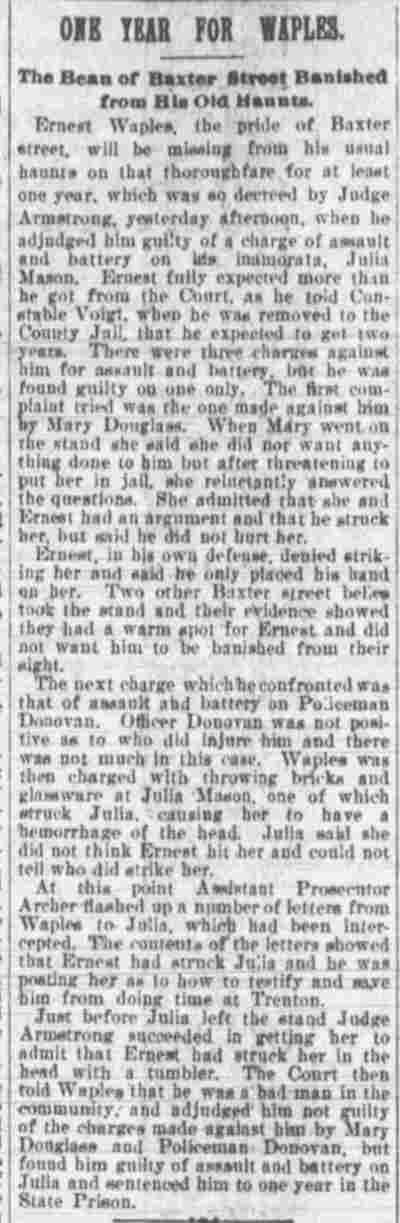
ONE YEAR FOR WAPLES
The Bean of Baxter Street Banished from His Old Haunts
Ernest Waples, the pride of Baxter street, will be missing from his usual haunts on that thoroughfare for at least one year, which was so decreed by Judge Armstrong, yesterday afternoon, when he adjudged him guilty of a charge of assault and battery on his inamorata, Julia Mason. Ernest fully expected more than he got from the Court, as he told Constable Voigt, when he was removed to the County Jail, that he expected to get two years. There were three charges against him for assault and battery, but he was found guilty on one only. The first complaint tried was the one made against him by Mary Douglass. When Mary went on the stand she said she did not want anything done to him but after threatening to put her in jail, she reluctantly answered the questions. She admitted that she and Ernest had an argument and that he struck her, but said he did not hurt her.
Ernest, in his own defense, denied striking her and said he only placed his hand on her. Two other Baxter street belles took the stand and their evidence showed they had a warm spot for Ernest and did not want him to be banished from their sight.
The next charge which he confronted was that of assault and battery on Policeman Donovan. Officer Donovan was not positive as to who did injure him and there was not much in this case. Waples was then charged with throwing bricks and glassware at Julia Mason, one of which struck Julia, causing her to have a hemorrhage of the head. Julia said she did not think Ernest hit her and could not tell who did strike her.
At this point Assistant Prosecutor Archer flashed up a number of letters from Waples to Julia, which had been intercepted. The contents of the letters showed that Ernest had struck Julia and he was posting her as to how to testify and save him from doing time at Trenton.
Just before Julia left the stand Judge Armstrong succeeded in getting her to admit that Ernest had struck her in the head with a tumbler. The Court then told Waples that he was a bad man in the community, and adjudged him not guilty of the charges made against him by Mary Douglass and Policeman Donovan, but found him guilty of assault and battery on Julia and sentenced him to one year in the State Prison.
Murder and Bloodshed in Camden Primary Elections
Philadelphia Inquirer —

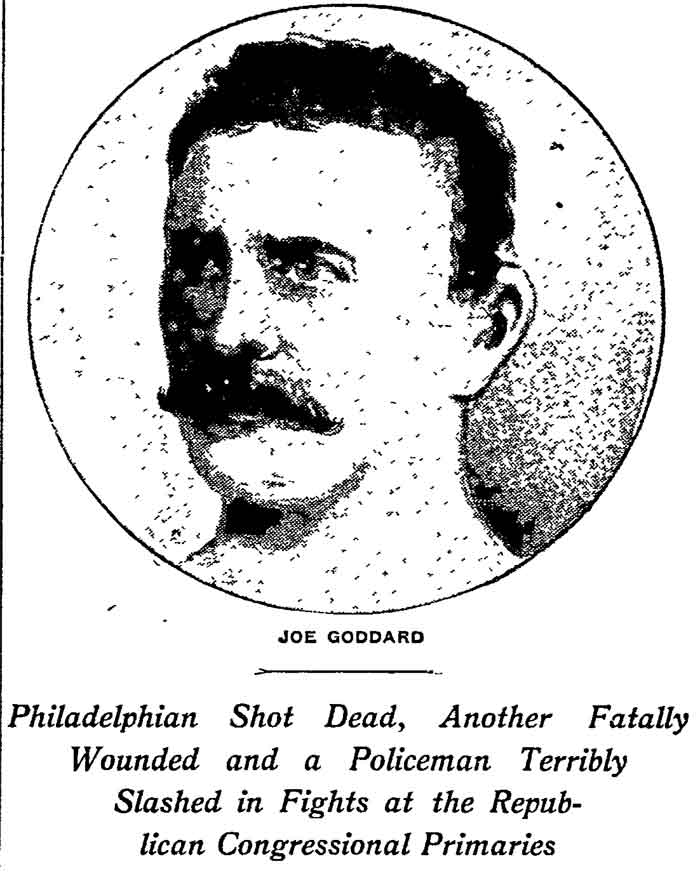
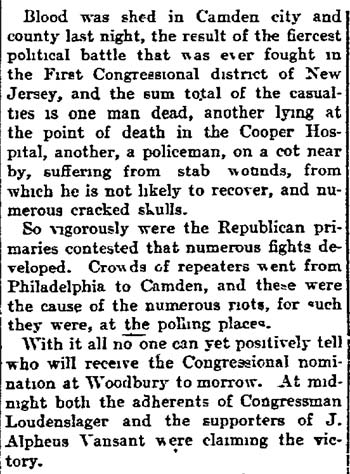
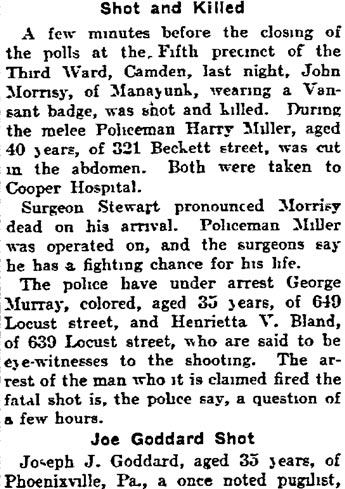
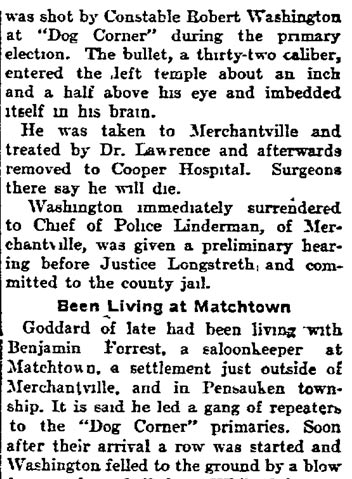
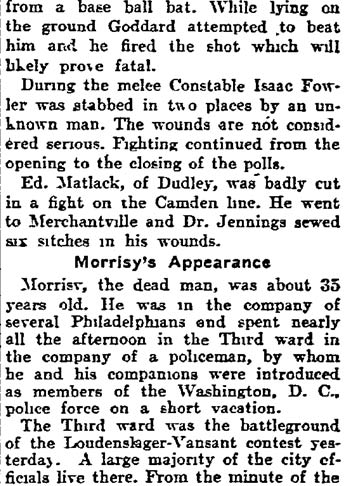
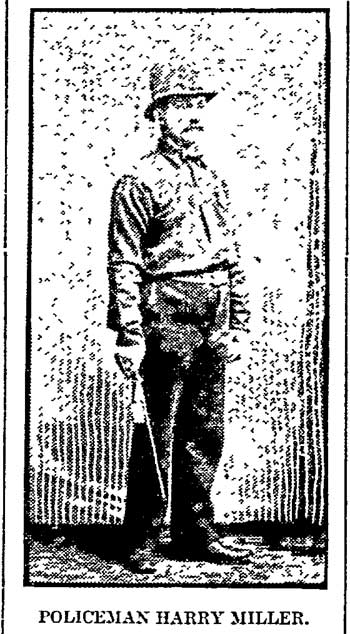
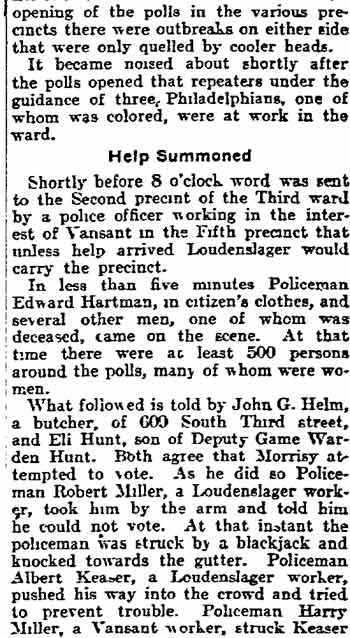
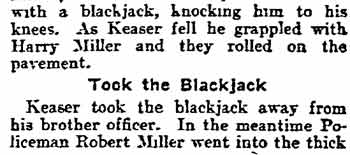
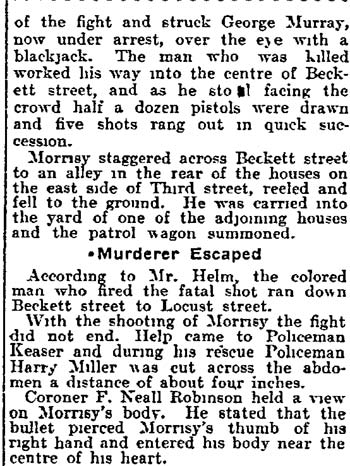
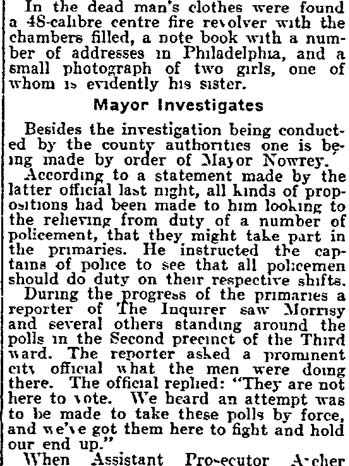
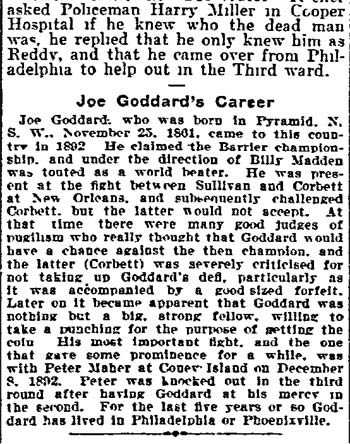
MURDER AND BLOODSHED IN CAMDEN PRIMARY ELECTIONS
The Paul Woodward Murder Case
On October 1, 1902 Paul Woodward murdered two young boys by giving them poison. Frank T. Lloyd, then Camden County prosecutor, was responsible for leading the investigation and prosecuting the case. F. Morse Archer was then serving as Assistant County Prosecutor and was involved in the investigation and the trial. Woodward was arrested on October 4, 1902. He was indicted, tried, convicted of murder in the first degree, and on January 7, 1903 executed at the Camden County Jail.
People involved in the case included: Joseph Jennings — Jennings’ Third Regiment Band — Frank T. Lloyd — Dr. William S. Jones — William D. Hart — Dr. Paul N. Litchfield — F. Morse Archer — John Foster — John Painter — John Cherry — Isaac Toone — Paul Woodward — George M. Beringer — Charles G. Garrison — J. Wesley Sell — Christopher J. Mines Jr. — Frederick A. Rex — J. Frederick Voigt — George F. Kappel — Isaac Toy — Harry S. Scovel — Francis Ford Patterson Jr. — John S. Smith — O. Glen Stackhouse — Hugh Boyle — Charles D. Ridgley — Francis Abbatto — Eli Shaw — Lafayette Gruff — Annie Irving Keeler — David Kaighn — George Leathwhite — George J. Pechin — Elmer E. Cox — T.L. Bear — Patrick Harding — Frank S. Albright — William J. Paul — Thomas Walton — David E. Barry — Edward Wilcox — Dr. William H. Iszard — Dr. J.F. Leavitt — Dr. William H. Knowlton — Dr. William Miles — Dr. George H. Chapman
Other people involved: John Coffin — W. Price Jennings — Mrs. Edith Barber — Rev. C.A. Adams — Rev. John Lyell — Rev. William H. Fishburn — Rev. Gilbert Underhill — Rev. John Warnock — Harry Bowen — Joseph Simpkins — Ann Somers — William May — Lillian Martin — James Sheiding — Harry H. Robinson — Edwin Hillman — William Robinson — George Asay — William Powell — William Anderson — Charles Eiley — Thomas J. Atkinson — Wilson English — Harry Avis — George H. Stineford Sr. — John M. Hyde — William Heggan — John St. Clair — Charles S. Hess — William Rex — Daniel J. Horgan — Isaac Siebert — W. Wilmer Collins, Druggist — Major Edward Coffin — William Coffin — William Coffin Jr. — Kingston Coffin — Fayetta Jennings — Charles May — Mary Eiler — William F. Smith — Lee Hubert — Maurice Daniels — Thomas Woodward — Bella Woodward — James Bland — James Morrisey — Samuel Paul — Fred George
Two Camden Boys Have Disappeared
Philadelphia Inquirer —
TWO CAMDEN BOYS HAVE DISAPPEARED
John Coffin, 11 years old, son of William Coffin, division freight agent of the Pennsylvania Railroad, and Price Jennings, 14 years old, son of Leader Joseph Jennings, of the Third Regiment Band, are missing from their homes and the Camden police have been asked to locate them.
They started for the Trenton fair Wednesday and failed to return. All intermediate points have been communicated with, but the lads have not been heard from.
Two Camden Boys Are Still Among Missing
Philadelphia Inquirer —
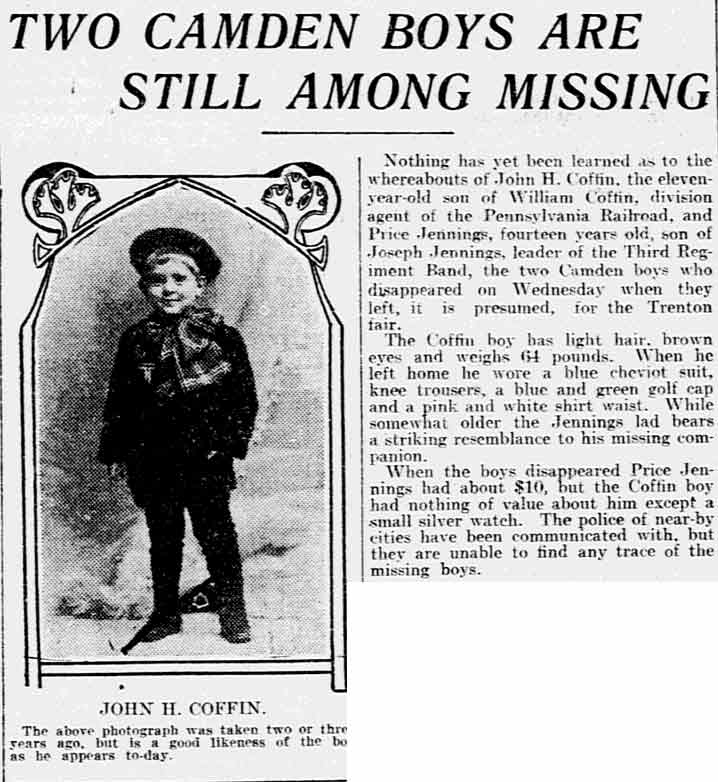
Two Camden Boys Are Still Among Missing
TWO CAMDEN BOYS ARE STILL AMONG MISSING
Nothing has yet been learned as to the whereabouts of John H. Coffin, the eleven-year-old son of William Coffin, division agent of the Pennsylvania Railroad, and Price Jennings, fourteen years old, son of Joseph Jennings, leader of the Third Regiment Band, the two Camden boys who disappeared on Wednesday when they left, it is presumed, for the Trenton fair.
The Coffin boy has light hair, brown eyes and weighs 64 pounds. When he left home he wore a blue cheviot suit, knee trousers, a blue and green golf cap and a pink and white shirt waist. While somewhat older the Jennings lad bears a striking resemblance to his missing companion.
When the boys disappeared Price Jennings had about $10, but the Coffin boy had nothing of value about him except a small silver watch. The police of near-by cities have been communicated with, but they are unable to find any trace of the missing boys.
[Photo caption: JOHN H. COFFIN. The above photograph was taken two or three years ago, but is a good likeness of the boy as he appears to-day.]
Missing Camden Boys Murdered in a Field
Philadelphia Inquirer —
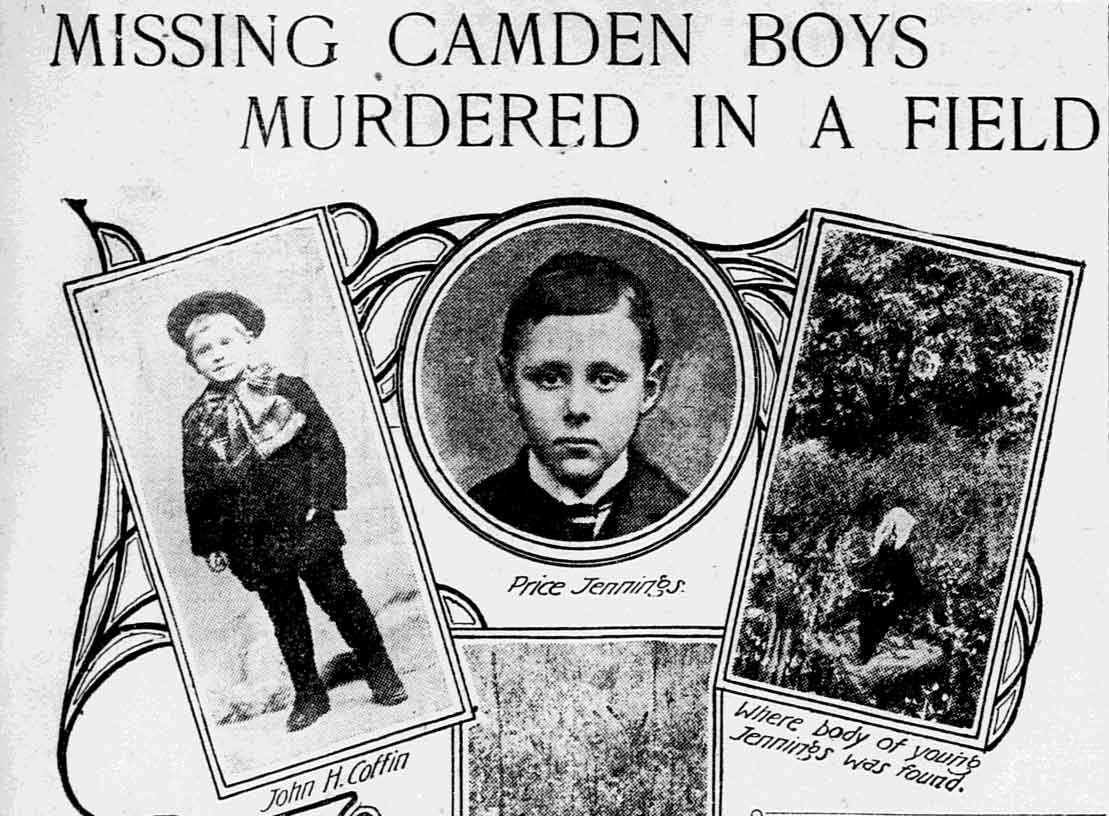
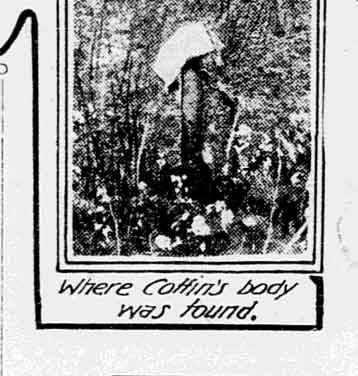
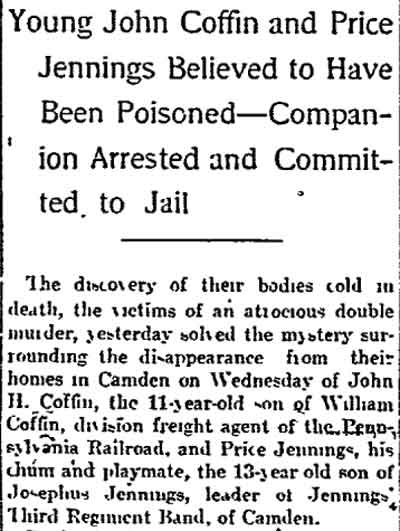
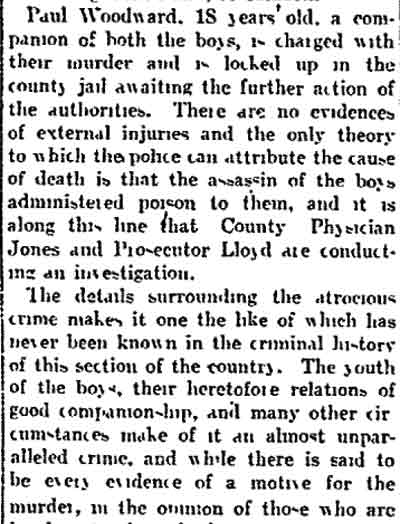
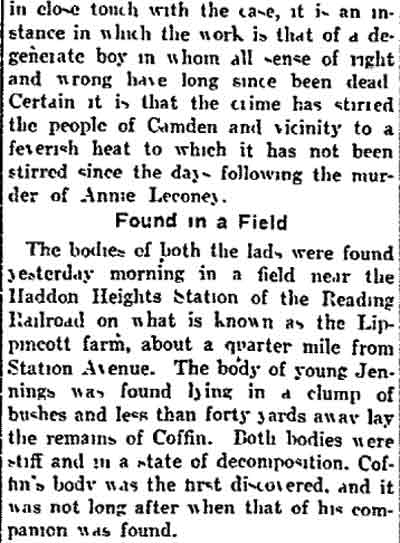
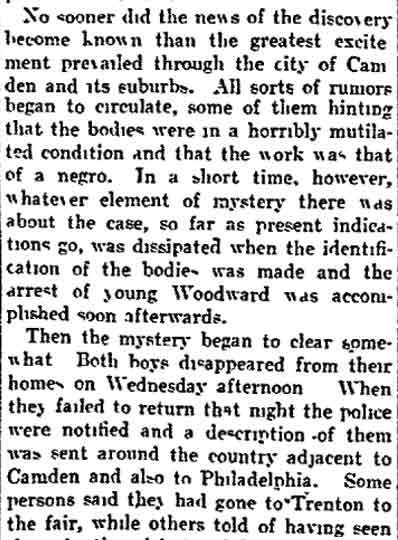
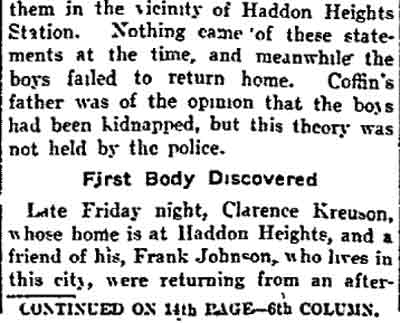
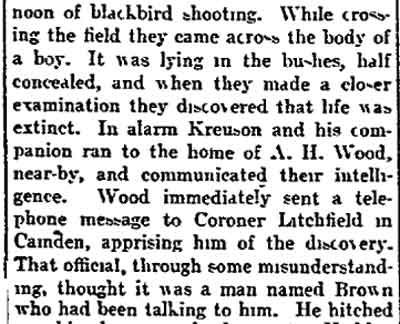
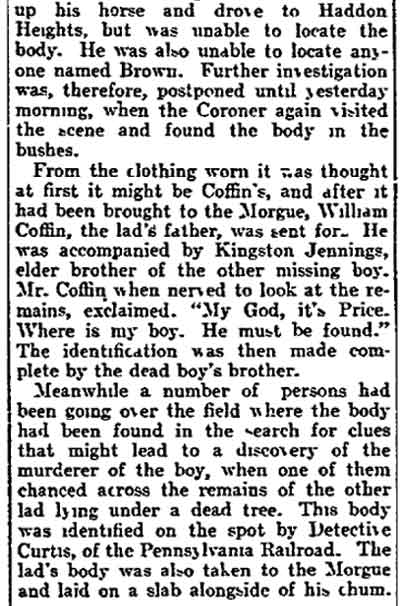
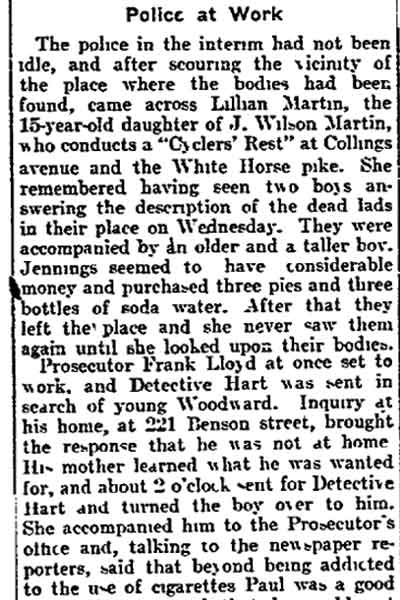
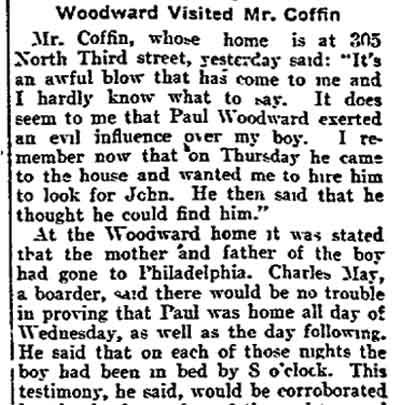
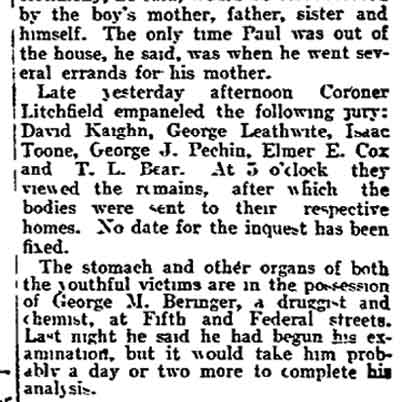
Named: Frank T. Lloyd, Dr. William S. Jones, William D. Hart, Dr. Paul N. Litchfield, F. Morse Archer, John Foster, John Painter, John Cherry, Charles May, David Kaighn, George Leathwhite, Isaac Toone, George J. Pechin, Elmer E. Cox, T.L. Bear, Paul Woodward, Joseph Jennings, Benson Street, North 3rd Street, and Kingston Coffin.
Deep Mystery Still Envelops Camden Tragedy
Philadelphia Inquirer —
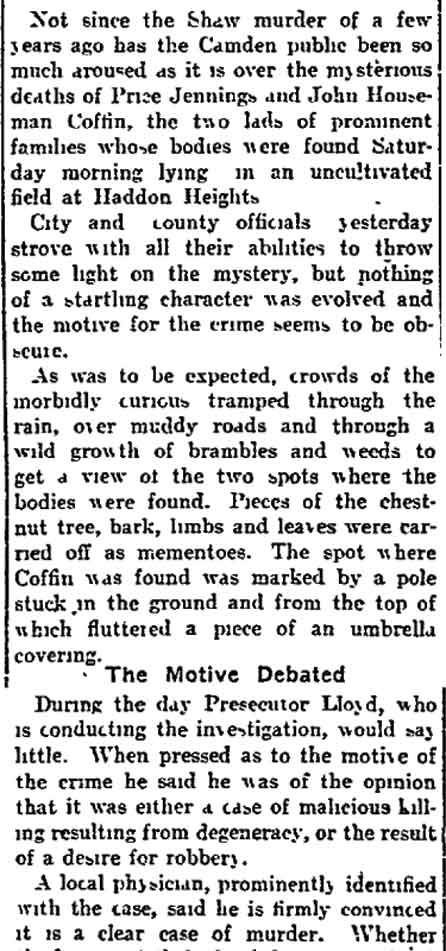
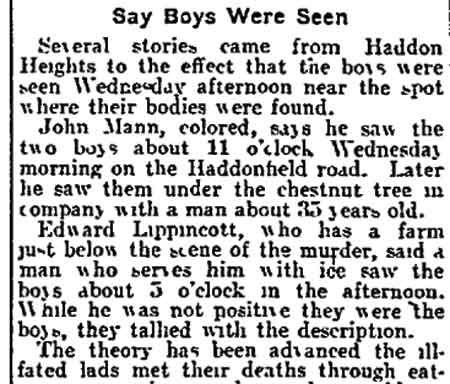
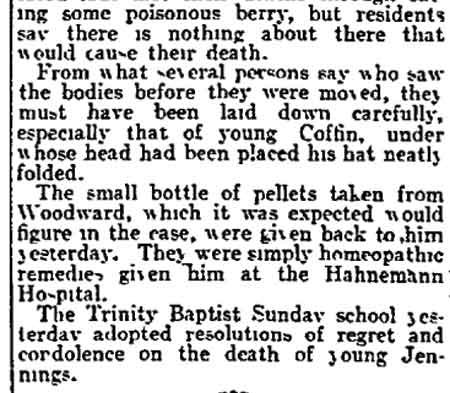
Named: Trinity Baptist Church, John S. Smith, and George M. Beringer.
Woman Involved in Camden Mystery
Philadelphia Inquirer —
WOMAN INVOLVED IN CAMDEN MYSTERY
After Being Questioned by the Prosecutor She Is Committed to the County Jail—Believed to Be an Important Arrest
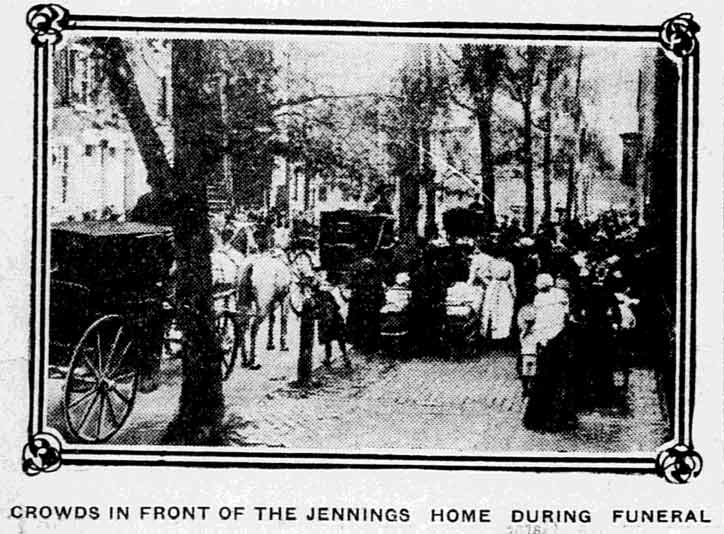
[Photo caption: Crowds in Front of the Jennings Home During Funeral]
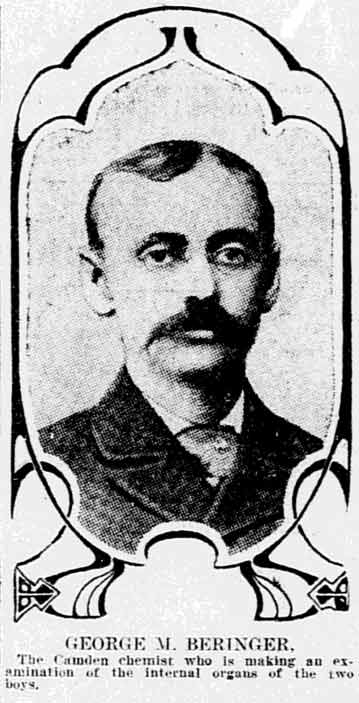
[Portrait caption: George M. Beringer — The Camden chemist who is making an examination of the internal organs of the two boys.]
While mystery apparently as absolute as ever still obscures the motive and the criminal in the case of John Houseman Coffin and W. Price Jennings, the unfortunate Camden lads whose trip to the country at Haddon Heights last Wednesday resulted so tragically, it is surmised from hints dropped now and again the matter may soon be cleared. However, those who are working so assiduously to bring the guilty person to justice are as close-mouthed as the proverbial clam, and but meagre information reaches the public.
Last night a woman, about 45 years old, was committed to the county jail by Recorder Stackhouse. On the commitment her name is given as Mrs. Barber. She was committed on complaint of County Detective John Cherry “as a material witness to prove certain allegations pending against one Paul Woodward, who is committed to the county jail charged with the murder of one John Coffin.”
The woman was placed under arrest after a long conference in the Prosecutor's office. Prosecutor Lloyd said last night that the woman lives on a farm at Marlton, and that she is a very important witness in the case, so important, in fact, that she cannot regain her freedom without a good round sum being put up for her security.
Woodward Again Examined
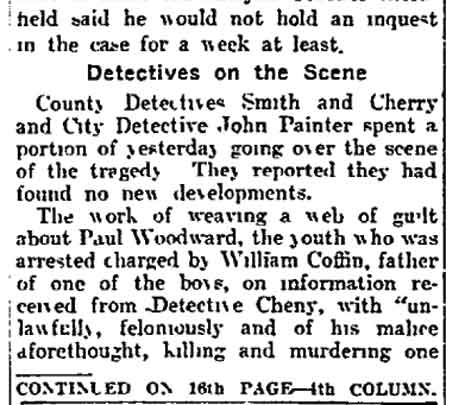
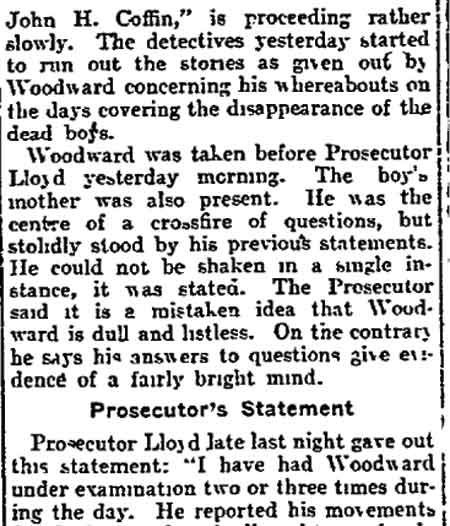
The investigation into the case was somewhat retarded yesterday owing to an attack of rheumatism that made Prosecutor Frank T. Lloyd remain at home. The day's responsibility rested on F. Morse Archer, the assistant pro-secutor. The latter yesterday morning had Woodward brought into his office, where he underwent for the sixth time a thorough cross-examination. Mr. Archer said Woodward had made no confession, as had been rumored. On the contrary, he still maintained his innocence.
In answer to a question Mr. Archer said: “We are doing our best and while we are in possession of information which we consider important and vital to the case, it is impossible at this time to make it public.”
On the other hand, County Physician Jones was very emphatic in this particular, saying the boys were murdered beyond a doubt.
Boys' Funerals
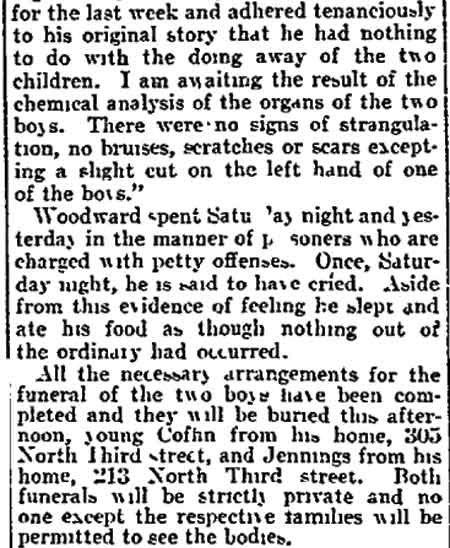
Yesterday afternoon the funeral of the boys took place at the same hour and within a square of one another's homes. Although the hour set for the obsequies, 2 o'clock in the afternoon, had been kept secret scores of persons stood about in knots discussing the tragedy and eager to get a glimpse of the caskets containing the remains of the boys.
Police Captain Boyle and Policemen Kappel, Toy and Ridgeley guarded the houses, and no one except relatives and intimate friends were permitted to enter. But when the caskets were carried from the houses the crowd could not be kept back. Many persons crowded about, and the mourners entered the carriages between two solid phalanxes of curiosity seekers.
The services over Jennings were conducted at his home, 219 North Third street, by Rev. C. A. Adams and Rev. John Lyell. At the Coffin home, 305 North Third street, Rev. William H. Fishburn had charge of the obsequies. Companions of the boys acted as pallbearers. Jennings was buried at Evergreen and Coffin at Harleigh Cemetery.
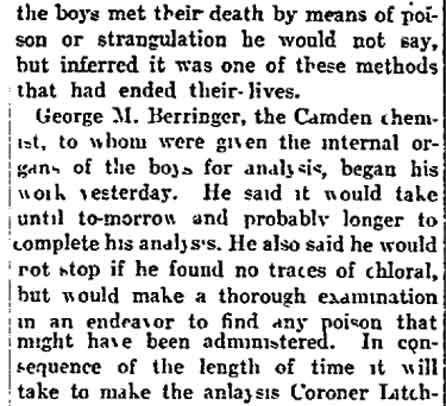
George M. Beringer, a Camden chemist, who has the important duty of discovering, if possible, traces of poison in the stomachs of the boys, said yesterday he is making a thorough chemical analysis and is of necessity proceeding slowly. He said he will not be able to report the result for some days to come.
A pathetic little incident occurred at the Cooper School during recess yesterday morning when the children, school mates of the lads, gathered about and listened to the muffled beats of a drum. The school flag was at half mast and in every room there was a flag draped with black crepe. The youngsters were visibly affected.
Woodward Has Knowledge of Camden Murder
Philadelphia Inquirer —
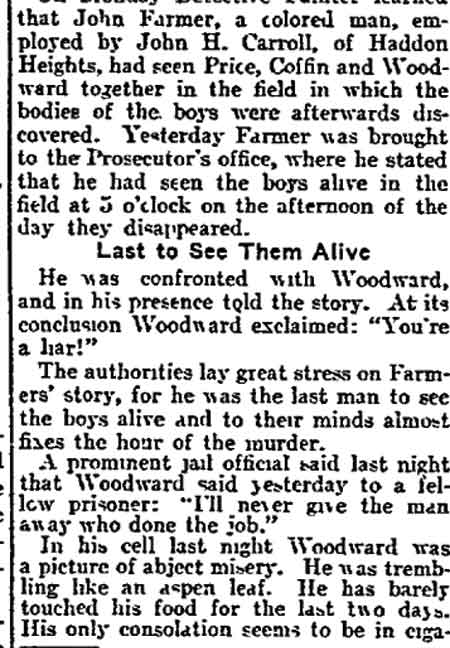
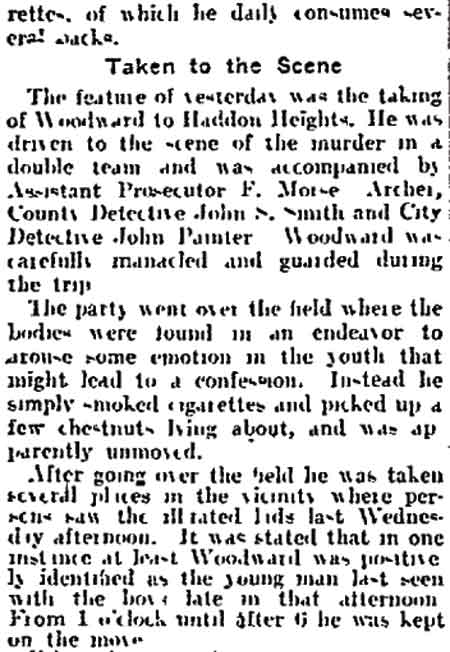
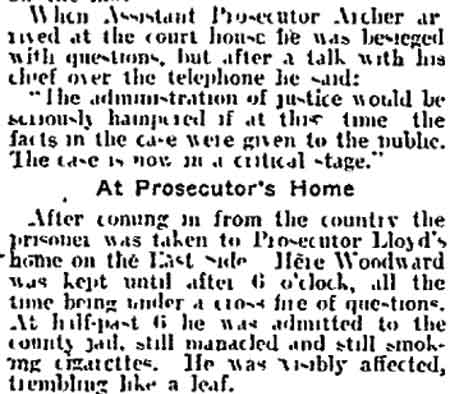
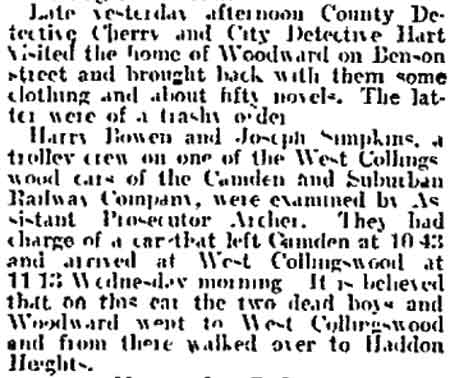
Named: Harry Bowen, Joseph Simpkins, Harry S. Scovel, Eli Shaw, and Mrs. Edith Baker.
Camden’s Mystery Is Still Unsolved
Philadelphia Inquirer —
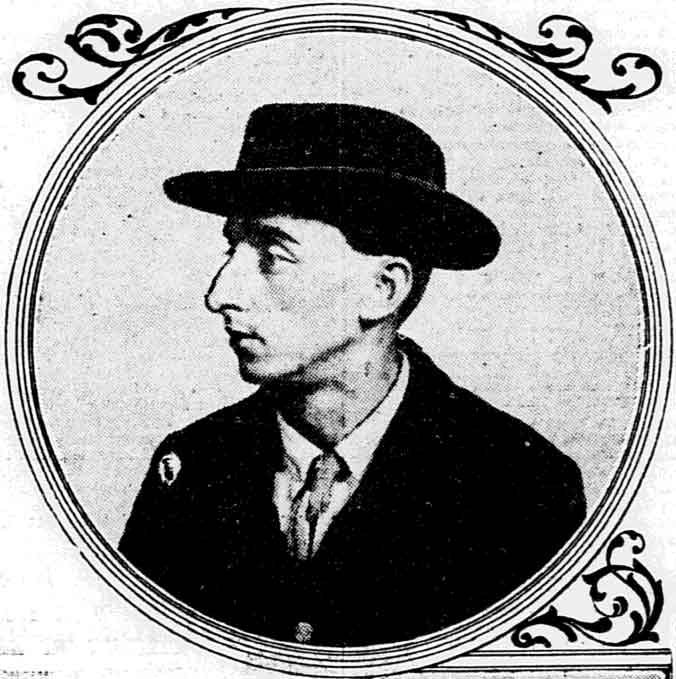
While Authorities Are at Work, Public Watch and Wait. Weaving a Net About Paul Woodward, the Young Suspect Now in Jail
It is now generally believed that the Camden county authorities have succeeded in establishing a clear case against young Paul Woodward, who is in the county jail, charged with the crime of taking away the lives of little John Coffin and Price Jennings. It was just a week ago yesterday when the boys went on their trip to Haddon Heights from which they were destined never to return alive.
Since the discovery of the bodies last Saturday partially hidden in rain soaked weeds, the Prosecutor’s office, assisted by County Detectives Smith and Cherry and City Detectives Painter and Hart, have left no stone unturned.
No Confession
Prosecutor Lloyd yesterday reiterated his statement that Woodward had made no confession, but it is generally conceded as true that the accused youth did tell a story in which he makes some one else the principal criminal in the case.
Several incidents transpired yesterday that threw off the monotony of waiting for developments. Joseph Jennings, brother of one of the murdered boys, was taken to the cell in which Woodward is confined. He had no difficulty in recognizing the prisoner before. But as to whether he ever saw him in company with the dead lads he was not permitted to say.
Wild Rumor
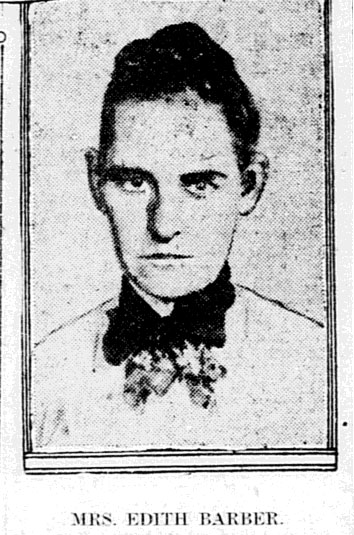
There was much excitement about the Court House when it became rumored that Mrs. Edith Barber, the woman detained as a material witness against Woodward, had the small pox. To allay the alarm County Physician Jones called in representatives of the Board of Health, who concluded she had no sign of the disease.
After matters quieted somewhat the woman was taken into the Prosecutor’s office and questioned. When taken back to her cell she was crying and appeared to be almost unable to walk.
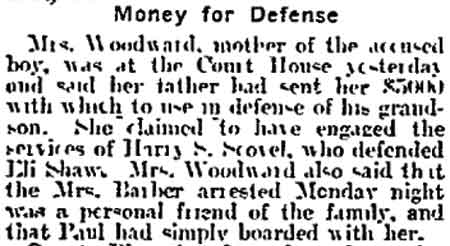
Woodward spent the day in his cell, smoking cigarettes as usual. He was visited in the morning by Lawyer Harry Scovel, who has not yet been engaged as counsel, as reported. Again in the afternoon Lawyer Scovel visited the youth in company with Woodward’s mother. At first Mrs. Woodward was denied admittance, but after waiting on the jail steps for nearly an hour she was permitted to go in and see her son. Lawyer Scovel and Mrs. Woodward were with the young man for a couple of hours.
Talked a Whole Lot
To all questions Lawyer Scovel said: “Woodward talked a whole lot, but I have nothing to say.”
He said he had not confessed to him. On the other hand Woodward had maintained his innocence.
When asked if Woodward could have a hearing if he demanded it Mr. Archer said he could. Asked if enough evidence was in hand to hold him, Mr. Archer said there was.
“On a simple assault charge?”
“No, sir, for the crime he is charged with—committing the murder of John Coffin,” replied Mr. Archer.
Coroner Litchfield said last night he would not set a date for the inquest before some time next week. Despite all reports to the contrary, Coroner Litchfield says Chemist George M. Beringer, who is analyzing the internal organs of the boys, will not complete the work before the end of the week.
Prosecutor Lloyd, who is still confined to his home with rheumatism, would make no statement last night, although admitting that the day’s work had not resulted in anything of material importance.
Unraveling the Camden Mystery
Philadelphia Inquirer —
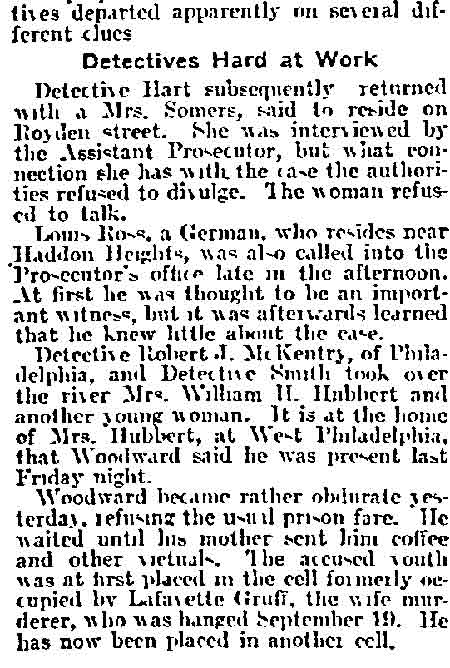
Prosecutor Lloyd Declares That Woodward Is the Guilty Man
NO MORE ARRESTS LIKELY
Weaving Web Around Alleged Slayer of the Murdered Boys
“Beyond all question the murderer of these little boys is now in jail and the public’s anxiety can now be allayed,” said Prosecutor Frank T. Lloyd last night in making the first important statement concerning the tragedy of last week, when John Coffin and W. Price Jennings, two Camden lads, were murdered in an uncultivated field near Haddon Heights. The mystery which has enshrouded the case since the discovery of the bodies last Friday has almost been cleared up with the exception of the report of Chemist George M. Beringer, who is making an analysis of the internal organs of the boys.
Prosecutor Lloyd gave out the following statement shortly before 8 o’clock at his home on the East Side:
“Because of a suspicion that more than one person was engaged in the murder of these little boys the State has been obliged to work with much secrecy and to withhold from the press the result of our work. That suspicion is now removed. Beyond all question the murderer is now in jail and the public’s anxiety can be allayed. Woodward was alone the perpetrator of this crime.
Case Nearly Complete
“It is my duty to say this much in view of the deep public concern and the apprehension of other parents having little ones, but it would be improper for me to state the character or the quantity of evidence upon which our conclusions are based. I will only say that with the exception of the report of the chemist, which has not yet been received, the State’s case is almost complete.
“Woodward himself has made a number of statements, which, while not confessions, will be materially helpful toward securing his conviction.”
This statement precludes the possibility of another arrest being made in connection with the case, as has been currently reported during the week.
There were several conferences held yesterday between Assistant Prosecutor Archer and Detectives Smith, Cherry, Painter and Hart and Chief of Police Linderman, of Merchantsville. During one of the conferences John Farmer, the colored man who recognized Woodward as having been seen with the boys last Wednesday afternoon, was called in and closely questioned. Following the detectives departed apparently on several different clues.
Detectives Hard at Work
Detective Hart subsequently returned with a Mrs. Somers, said to reside on Royden street. She was interviewed by the Assistant Prosecutor, but what connection she has with the case the authorities refused to divulge. The woman refused to talk.
Louis Ross, a German, who resides near Haddon Heights, was also called into the Prosecutor’s office late in the afternoon. At first he was thought to be an important witness, but it was afterwards learned that he knew little about the case.
Detective Robert J. McKentry, of Philadelphia, and Detective Smith took over the river Mrs. William H. Hubbert and another young woman. It is at the home of Mrs. Hubbert, at West Philadelphia, that Woodward said he was present last Friday night.
Woodward became rather obdurate yesterday, refusing the usual prison fare. He waited until his mother sent him coffee and other victuals. The accused youth was at first placed in the cell formerly occupied by Lafayette Gruff, the wife murderer, who was hanged September 19. He has now been placed in another cell.
More Arrests in Camden Mystery
Philadelphia Inquirer —
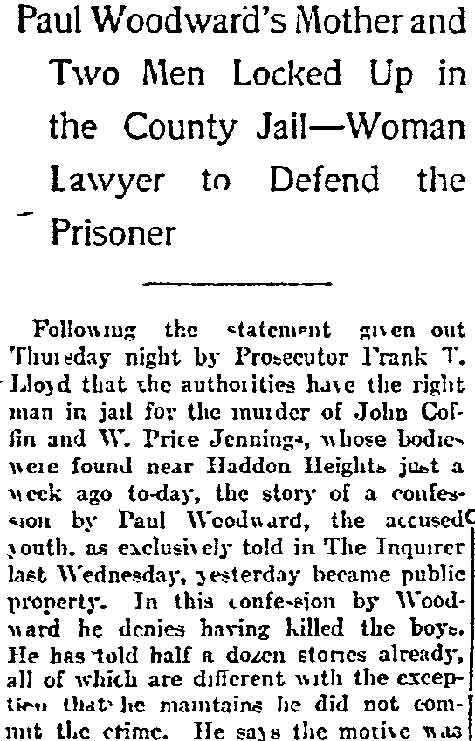
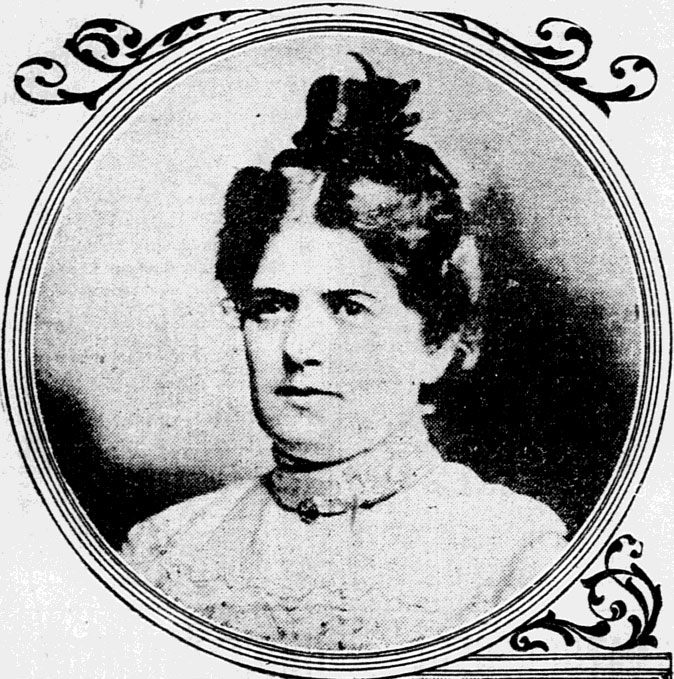
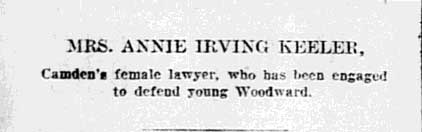
Named: Annie Irving Keeler, William May, and Charles May.
Officers Traced Woodward’s Steps
Philadelphia Inquirer —
OFFICERS TRACED WOODWARD’S STEPS
Camden Authorities Rest After Weaving What They Believe to Be Strong Chain of Evidence About the Alleged Youthful Murderer
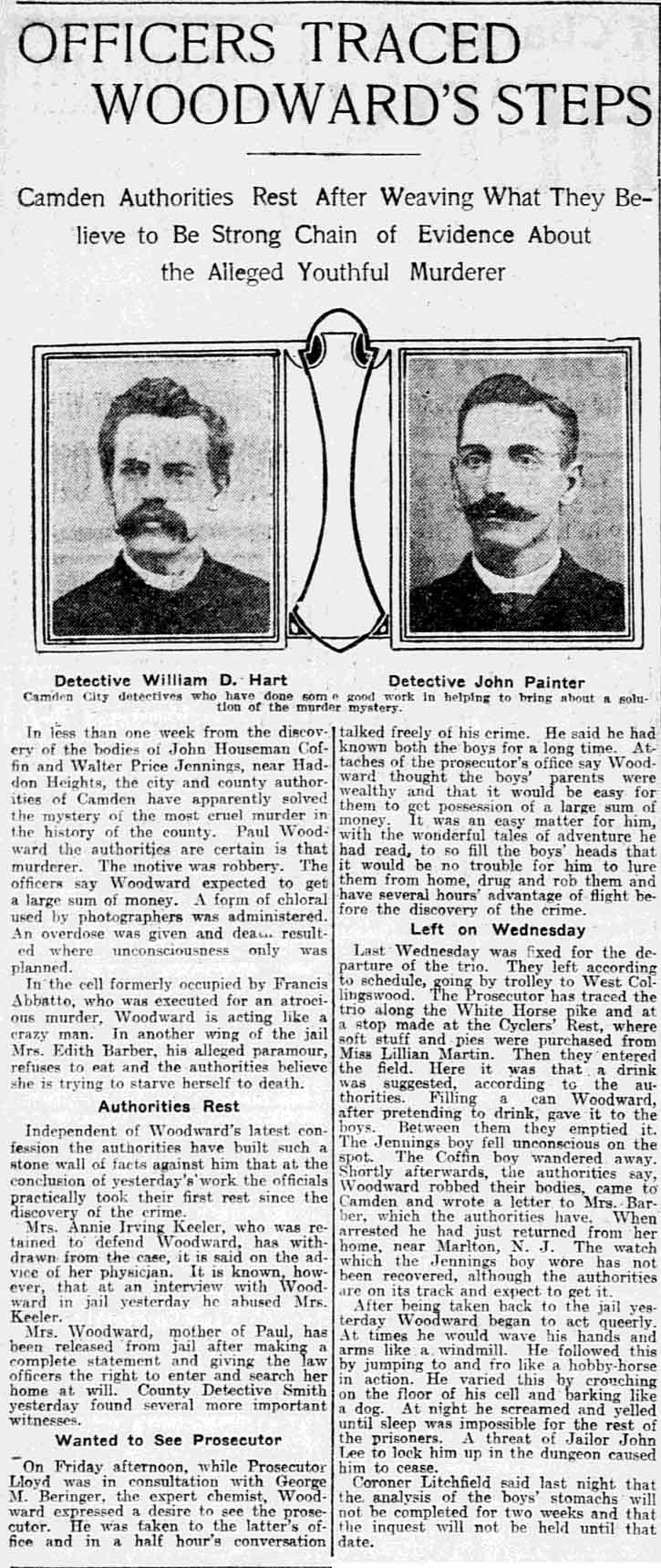
[Portraits: Detective William D. Hart | Detective John Painter — Camden City detectives who have done some good work in helping to bring about a solution of the murder mystery.]
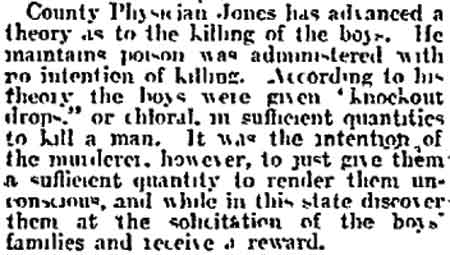
In less than one week from the discovery of the bodies of John Houseman Coffin and Walter Price Jennings, near Haddon Heights, the city and county authorities of Camden have apparently solved the mystery of the most cruel murder in the history of the county. Paul Woodward the authorities are certain is that murderer. The motive was robbery. The officers say Woodward expected to get a large sum of money. A form of chloral used by photographers was administered. An overdose was given and death resulted where unconsciousness only was planned.
In the cell formerly occupied by Francis Abbatto, who was executed for an atrocious murder, Woodward is acting like a crazy man. In another wing of the jail Mrs. Edith Barber, his alleged paramour, refuses to eat and the authorities believe she is trying to starve herself to death.
Authorities Rest
Independent of Woodward’s latest confession the authorities have built such a stone wall of facts against him that at the conclusion of yesterday’s work the officials practically took their first rest since the discovery of the crime.
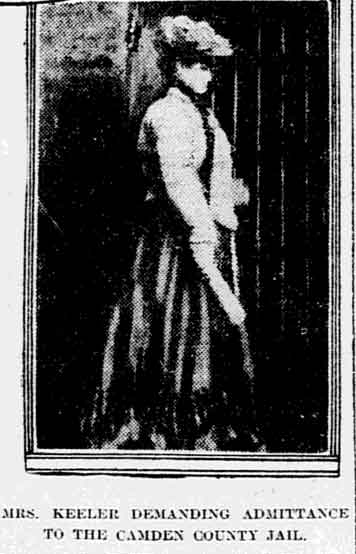
Mrs. Annie Irving Keeler, who was retained to defend Woodward, has withdrawn from the case, it is said on the advice of her physician. It is known, however, that at an interview with Woodward in jail yesterday he abused Mrs. Keeler.
Mrs. Woodward, mother of Paul, has been released from jail after making a complete statement and giving the law officers the right to enter and search her home at will. County Detective Smith yesterday found several more important witnesses.
Wanted to See Prosecutor
On Friday afternoon, while Prosecutor Lloyd was in consultation with George M. Beringer, the expert chemist, Woodward expressed a desire to see the prosecutor. He was taken to the latter’s office and in a half hour’s conversation talked freely of his crime. He said he had known both the boys for a long time. Attaches of the prosecutor’s office say Woodward thought the boys’ parents were wealthy and that it would be easy for them to get possession of a large sum of money. It was an easy matter for him, with the wonderful tales of adventure he had read, to so fill the boys’ heads that it would be no trouble for him to lure them from home, drug and rob them and have several hours’ advantage of flight before the discovery of the crime.
Left on Wednesday
Last Wednesday was fixed for the departure of the trio. They left according to schedule, going by trolley to West Collingswood. The Prosecutor has traced the trio along the White Horse pike and at a stop made at the Cyclers’ Rest, where soft stuff and pies were purchased from Miss Lillian Martin. Then they entered the field. Here it was that a drink was suggested, according to the authorities. Filling a can Woodward, after pretending to drink, gave it to the boys. Between them they emptied it. The Jennings boy fell unconscious on the spot. The Coffin boy wandered away. Shortly afterwards, the authorities say, Woodward robbed their bodies, came to Camden and wrote a letter to Mrs. Barber, which the authorities have. When arrested he had just returned from her home, near Marlton, N. J. The watch which the Jennings boy wore has not been recovered, although the authorities are on its track and expect to get it.
After being taken back to the jail yesterday Woodward began to act queerly. At times he would wave his hands and arms like a windmill. He followed this by jumping to and fro like a hobby-horse in action. He varied this by crouching on the floor of his cell and barking like a dog. At night he screamed and yelled until sleep was impossible for the rest of the prisoners. A threat of Jailor John Lee to lock him up in the dungeon caused him to cease.
Coroner Litchfield said last night that the analysis of the boys’ stomachs will not be completed for two weeks and that the inquest will not be held until that date.
Another Arrest in Murder Case
Philadelphia Inquirer —
West Philadelphian and a Supposed Companion of Young Paul Woodward Taken in Custody
There is but little remaining in the way of a mystery for the Camden county authorities to clear up in the murder case of little John Coffin and W. Price Jennings, of Camden. After working practically day and night during the past week Prosecutor Lloyd and his able assistants have brought to light such strong evidence against Paul Woodward, the young man in the county jail charged with the crime, that it will be next to impossible to refute it.
The sixth arrest in the case was made yesterday, when James Sheiding was taken into custody by County Detective Smith and committed to the county jail by Recorder Stackhouse as “a material witness.” Sheiding, who lives in West Philadelphia, was lured across the river to Camden, when Detective Smith at once took him in custody.
The prisoner is believed to be the companion of Woodward who, on the Friday night preceding the discovery of the murdered boys, was in the company of the accused murderer. On that occasion it is said Woodward had considerable money and that Sheiding assisted him in spending it.
Woodward did not give any evidence yesterday of being insane. On the other hand he was very quiet and evidently saw the futility of trying to make the Prosecutor believe him to be of unsound mind. He utterly refused to take part in the regular Sunday jail services. His whole concern seemed to be as to whether or not his mother would visit him to-day. He was of the opinion yesterday that his mother had gone to West Chester, where she is said to have relatives of means. Woodward thinks such a visit would result in him having sufficient funds with which to engage counsel.
Mrs. Edith Barker, the woman witness against Woodward, is very ill. Two of her children are ill with typhoid fever and the worry over this in connection with her important part in the case has made her one of the most wretched prisoners ever incarcerated at the county prison. Prosecutor Lloyd tried to have her admitted to a hospital, but his efforts were unavailing.
In all probability the case will come up before the present grand jury and be tried this month. Prosecutor Lloyd said last night that as soon as Chemist Beringer has made his report on his analysis of the viscera of the boys the Coroner’s inquest will be held. Immediately the court will be asked to take up the case.
Speedy Trial for Young Woodward
Philadelphia Inquirer —
But little developed in the murder case in Camden, for which Paul Woodward is incarcerated in the county jail. Prosecutor Lloyd has everything well in hand and his sole object is to have a speedy trial of the accused youth. He said yesterday his office would give out nothing further before the trial.
It is said Woodward has declared he gave John Coffin and W. Price Jennings, the murdered boys, bichloride of gold and not chloral. He is also reported to have said he did not intend giving such a large dose as would terminate fatally.
While as yet Woodward has no counsel it is probable he will be defended by Lawyer Edwin Hillman, who will be named by the court.
To Hurry Along Woodward Trial
Philadelphia Inquirer —
Paul Woodward, the youth accused of the murder of John Coffin and W. Price Jennings, the Camden boys whose bodies were found near Haddon Heights last Saturday week, may possibly be indicted for the crime to-day or to-morrow. Prosecutor Lloyd has the case so well in hand that he will present the facts before the grand jury this morning.
The State has practically concluded its investigation with the exception of making the necessary preparations for the trial. It is believed the grand jury will speedily find a bill of indictment against Woodward, and he may know his fate before the end of the present month.
Harry H. Robinson, a Philadelphia lawyer, was yesterday engaged to defend Woodward.
Woodward Indicted for Cruel Murder
Philadelphia Inquirer —
Woodward Indicted for Cruel Murder
WOODWARD INDICTED FOR CRUEL MURDER
The case of Paul Woodward, who is charged with the murder of John Coffin and W. Price Jennings, was considered by the Camden County Grand Jury yesterday. Among the witnesses were the father and aunt of the Jennings boy. The prisoner was promptly indicted.
There will be no inquest. Coroner Litchfield says the facts of the killing and that the boys met their death by violence being manifest to the authorities.
Morphia Killed Two Camden Boys
Philadelphia Inquirer —
Named: George M. Beringer, Frank T. Lloyd, and Paul Woodward.
Must Now Produce Woodward in Court
Philadelphia Inquirer —
MUST NOW PRODUCE WOODWARD IN COURT
Counsel for Paul Woodward, the young man accused of the murder of John Coffin and Price Jennings, two Camden boys, yesterday applied to Judge Garrison, at Mount Holly, for a writ of habeas corpus for their client. The application was granted and made returnable Friday next at Camden.
It is said the object of Woodward’s counsel is to make the State show its hand as to the evidence it has against the alleged youthful murderer. In all probability the indictments will be presented and the writ dismissed.
Woodward Writ to Be Argued To-Day
Philadelphia Inquirer —
WOODWARD WRIT TO BE ARGUED TO-DAY
The rule granted by Judge Garrison last Tuesday to show cause why Paul Woodward, the youthful Camden murderer, should not be released on habeas corpus proceedings will be argued in Camden to-day. The indictment against Woodward may be presented and the case hurried toward the trial which will take place this term.
Prosecutor Frank T. Lloyd was able to be at his desk again yesterday after an attack of rheumatism.
Young Woodward Indicted by Jury
Philadelphia Inquirer —
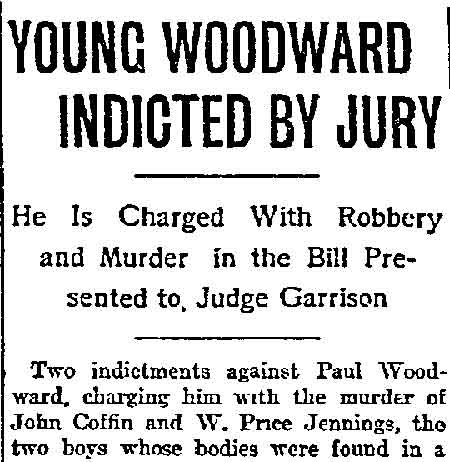
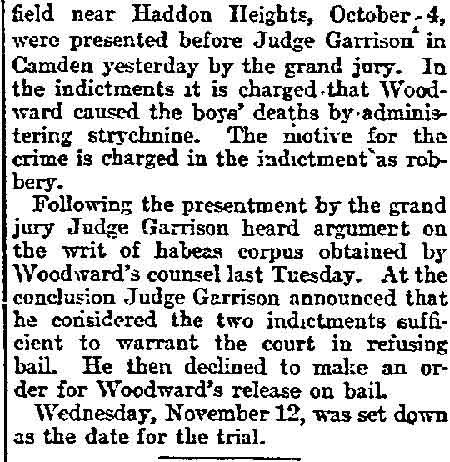
Named: Charles G. Garrison, Frank T. Lloyd, and Paul Woodward.
Jurors to Try Woodward
Philadelphia Inquirer —
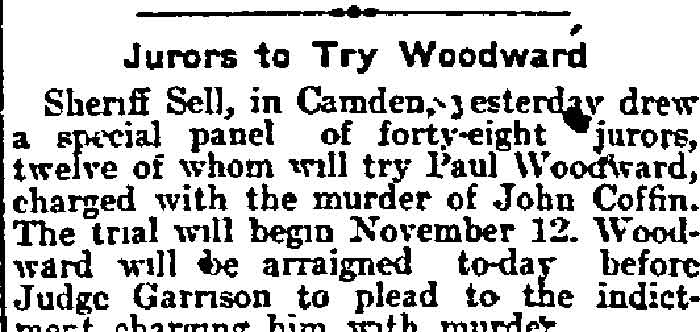
JURORS TO TRY WOODWARD
Sheriff Sell, in Camden, yesterday drew a special panel of forty-eight jurors, twelve of whom will try Paul Woodward, charged with the murder of John Coffin. The trial will begin November 12. Woodward will be arraigned to-day before Judge Garrison to plead to the indictment charging him with murder.
Woodward Says He Is Not Guilty
Philadelphia Inquirer —
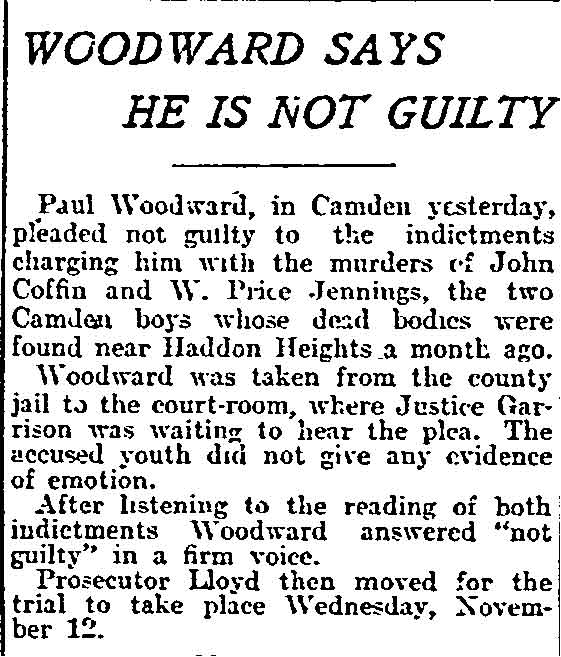
WOODWARD SAYS HE IS NOT GUILTY
Paul Woodward, in Camden yesterday, pleaded not guilty to the indictments charging him with the murders of John Coffin and W. Price Jennings, the two Camden boys whose dead bodies were found near Haddon Heights a month ago.
Woodward was taken from the county jail to the court-room, where Justice Garrison was waiting to hear the plea. The accused youth did not give any evidence of emotion.
After listening to the reading of both indictments Woodward answered “not guilty” in a firm voice.
Prosecutor Lloyd then moved for the trial to take place Wednesday, November 12.
Woodward’s Trial Today
Trenton Evening Times —
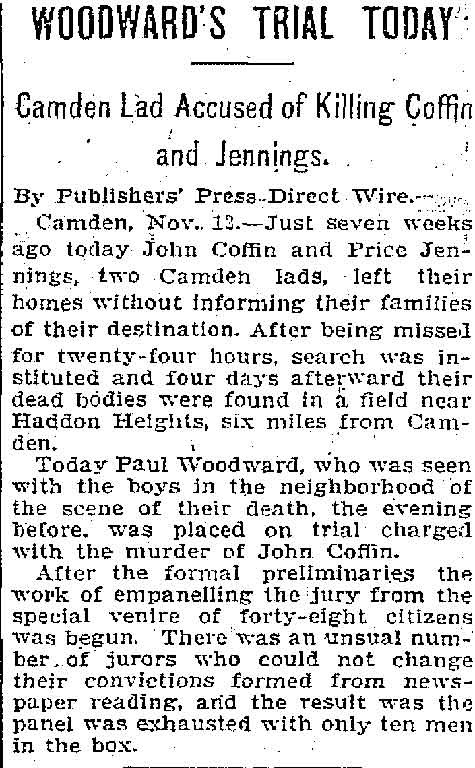
WOODWARD’S TRIAL TODAY
Camden Lad Accused of Killing Coffin and Jennings.
By Publishers’ Press Direct Wire.
Camden, Nov. 12.—Just seven weeks ago today John Coffin and Price Jennings, two Camden lads, left their homes without informing their families of their destination. After being missed for twenty-four hours, search was instituted and four days afterward their dead bodies were found in a field near Haddon Heights, six miles from Camden.
Today Paul Woodward, who was seen with the boys in the neighborhood of the scene of their death, the evening before, was placed on trial charged with the murder of John Coffin.
After the formal preliminaries the work of empanelling the jury from the special venire of forty-eight citizens was begun. There was an unusual number of jurors who could not change their convictions formed from newspaper reading, and the result was the panel was exhausted with only ten men in the box.
Woodward on Trial for Coffin Murder
Philadelphia Inquirer —
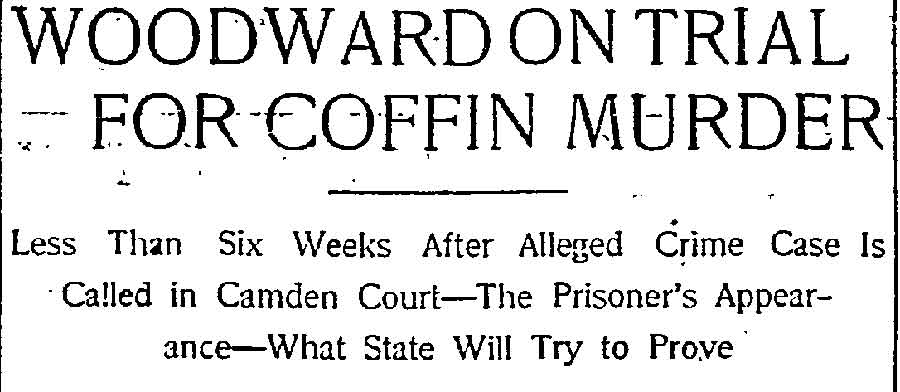
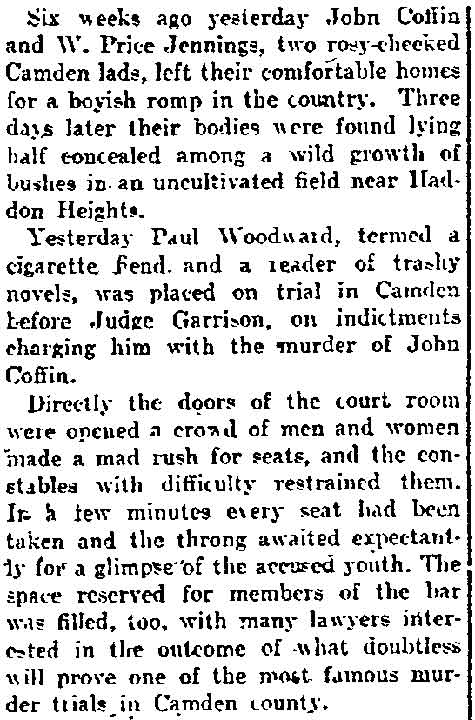
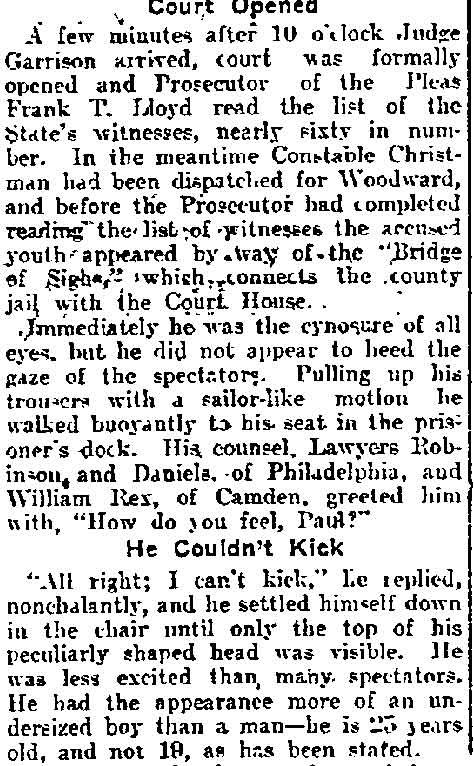
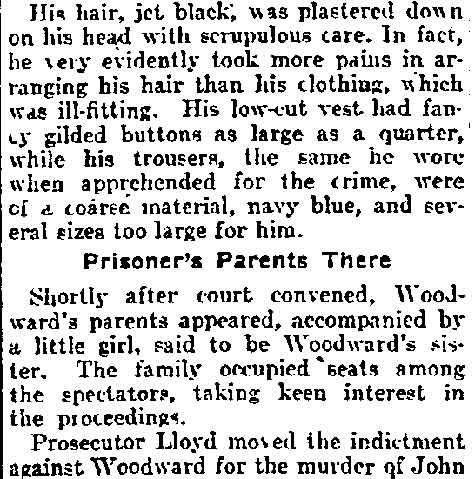
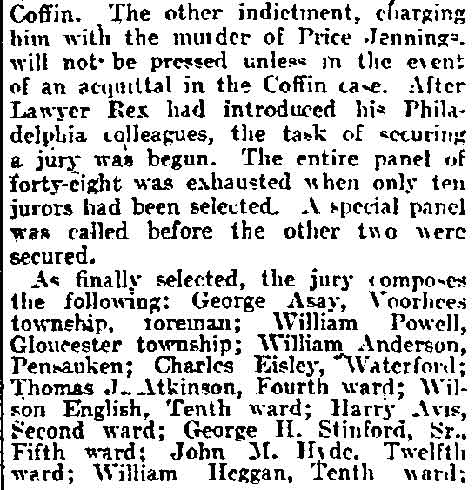
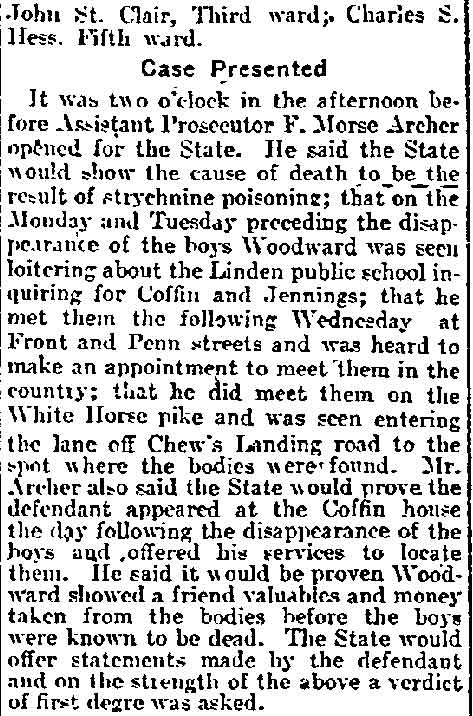
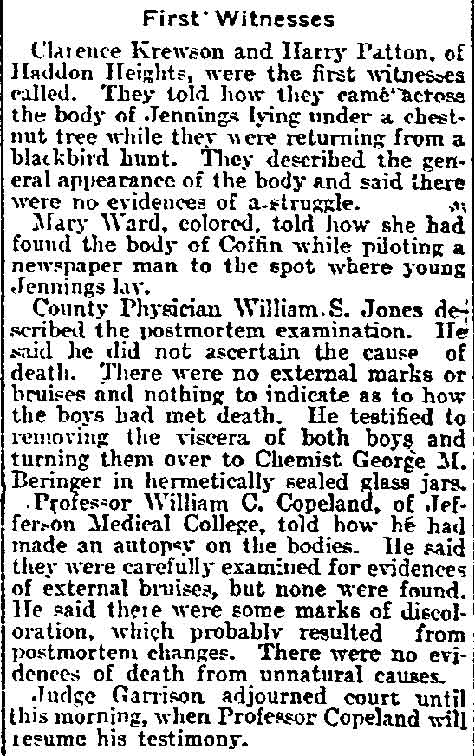
Named: William Robinson, George Asay, William Powell, William Anderson, Charles Eiley, Thomas J. Atkinson, Wilson English, Harry Avis, George H. Stineford Sr., John M. Hyde, William Heggan, John St. Clair, Charles S. Hess, William Rex, and Linden School.
Frog Killed in Jersey Court
Philadelphia Inquirer —
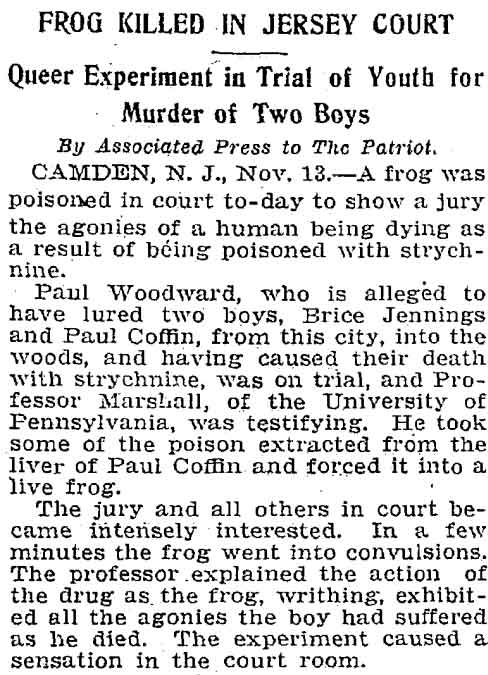
Frog Killed in Jersey Court
FROG KILLED IN JERSEY COURT
Queer Experiment in Trial of Youth for Murder of Two Boys
By Associated Press to The Patriot.
CAMDEN, N. J., Nov. 13.—A frog was poisoned in court to-day to show a jury the agonies of a human being dying as a result of being poisoned with strychnine.
Paul Woodward, who is alleged to have lured two boys, Brice Jennings and Paul Coffin, from this city, into the woods, and having caused their death with strychnine, was on trial, and Professor Marshall, of the University of Pennsylvania, was testifying. He took some of the poison extracted from the liver of Paul Coffin and forced it into a live frog.
The jury and all others in court became intensely interested. In a few minutes the frog went into convulsions. The professor explained the action of the drug as the frog, writhing, exhibited all the agonies the boy had suffered as he died. The experiment caused a sensation in the court room.
Woodward Bought Poison, Says Druggist
Philadelphia Inquirer —

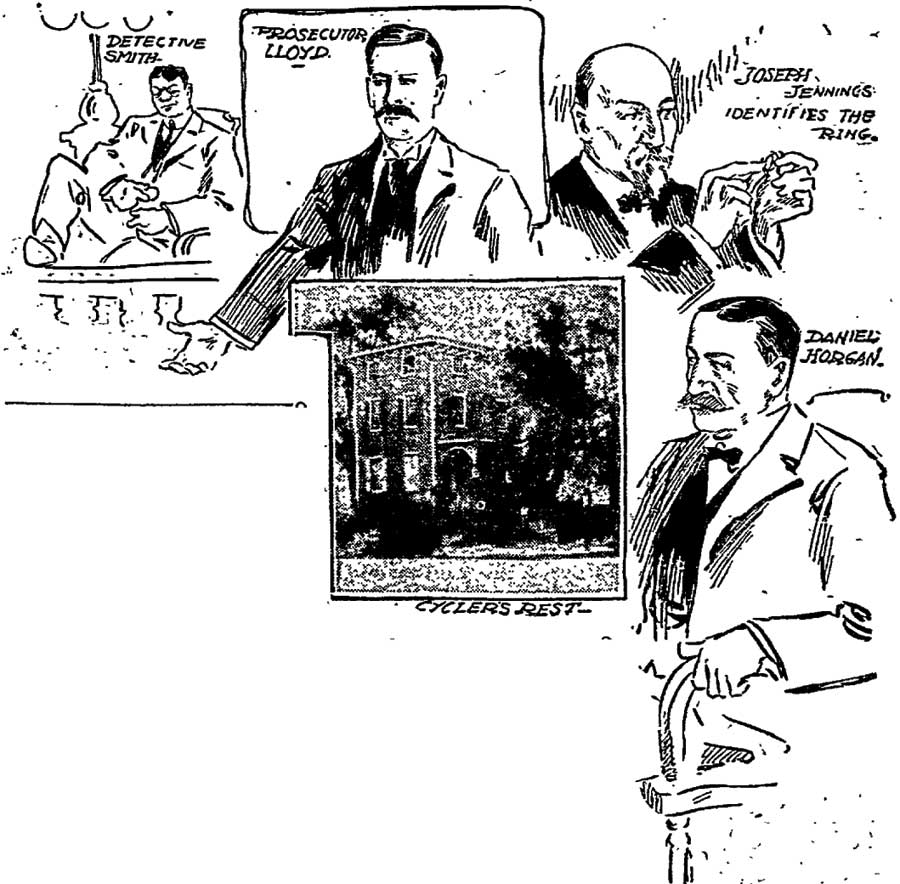
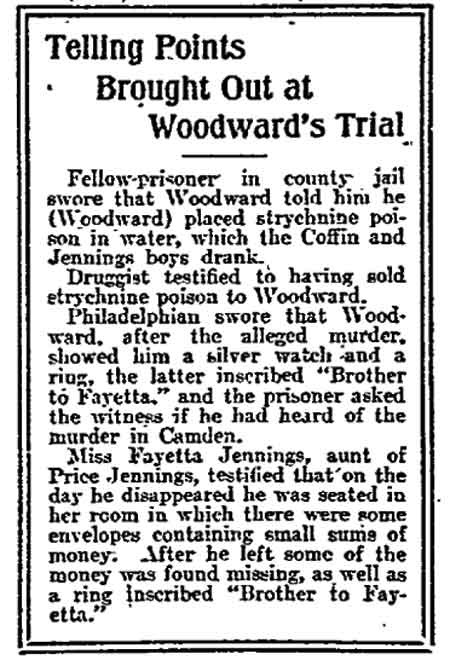
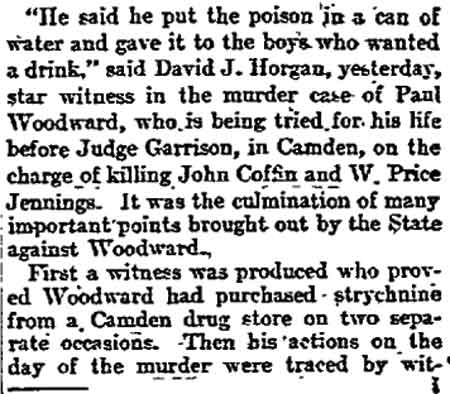
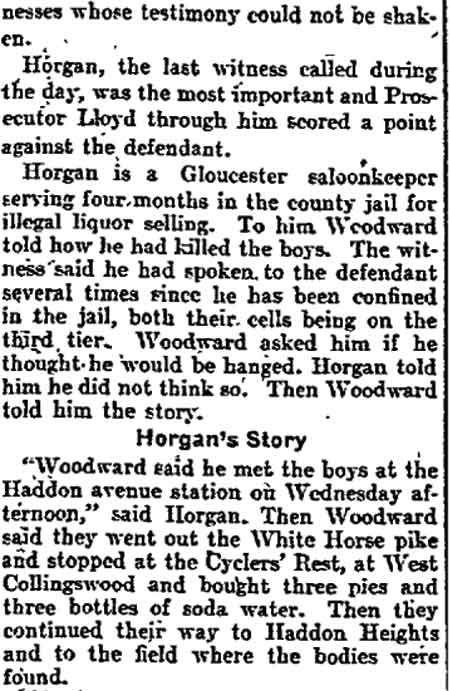
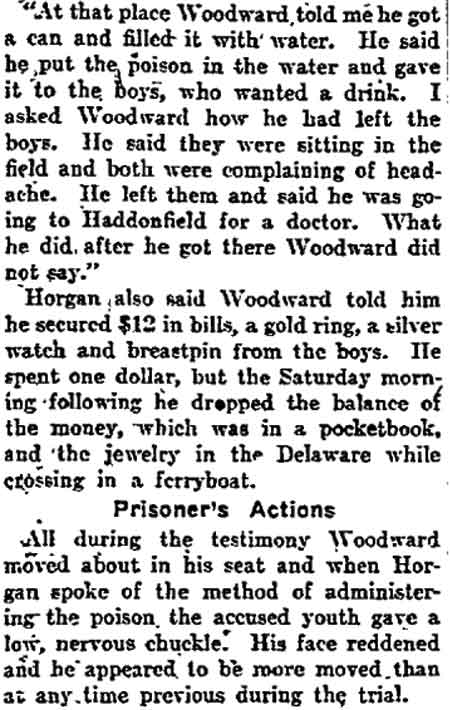
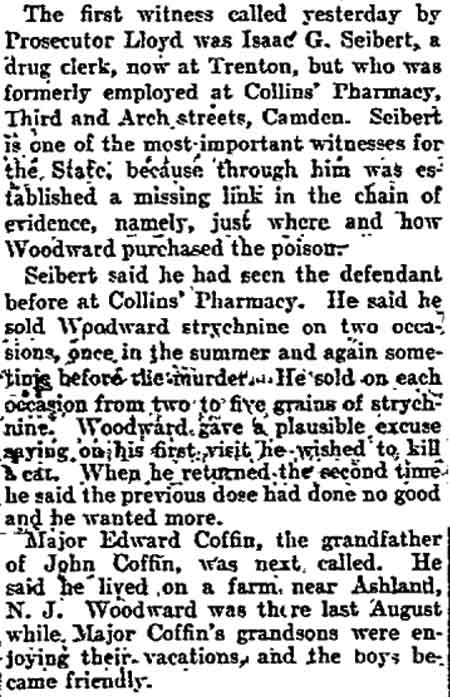
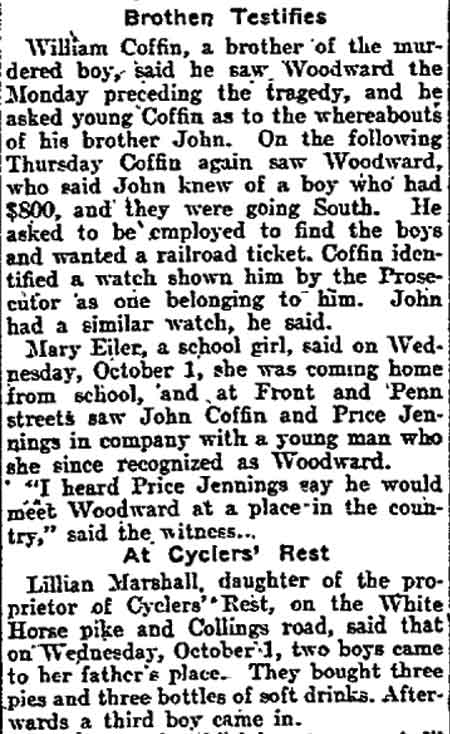
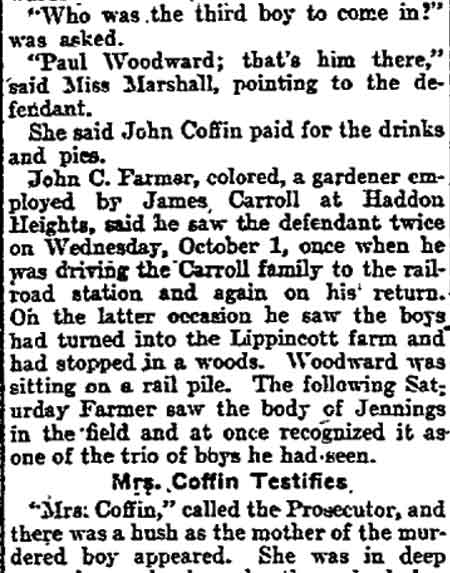
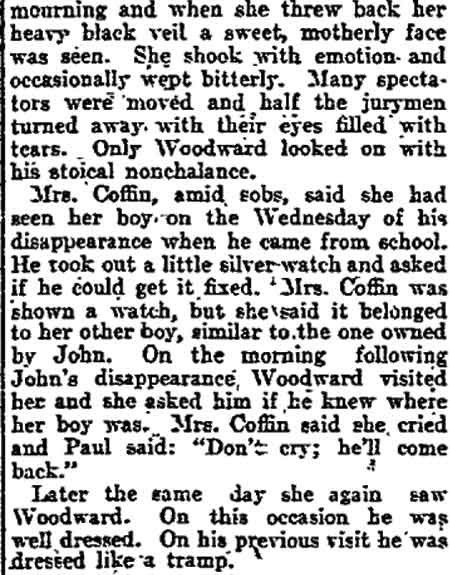
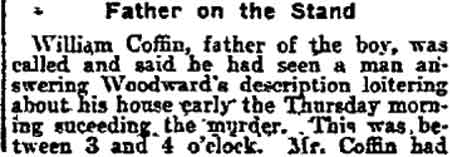
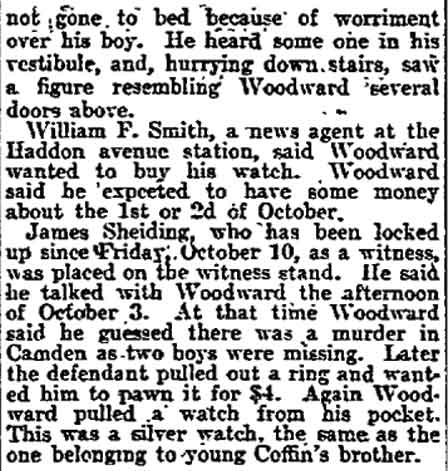
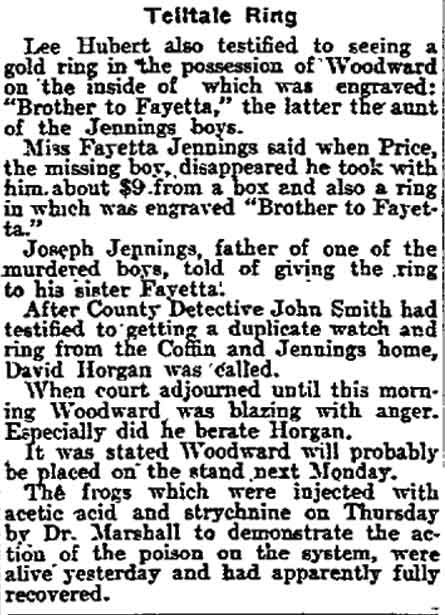
Named: Daniel J. Horgan, Isaac Siebert, W. Wilmer Collins, Druggist, Major Edward Coffin, Coffin’s Corner, Ashland, William Coffin, William Coffin Jr., Mary Eiler, William F. Smith, James Sheiding, Fayetta Jennings, and Lee Hubert.
Woodward’s Parents on Stand; Boy in a Rage
Philadelphia Inquirer —

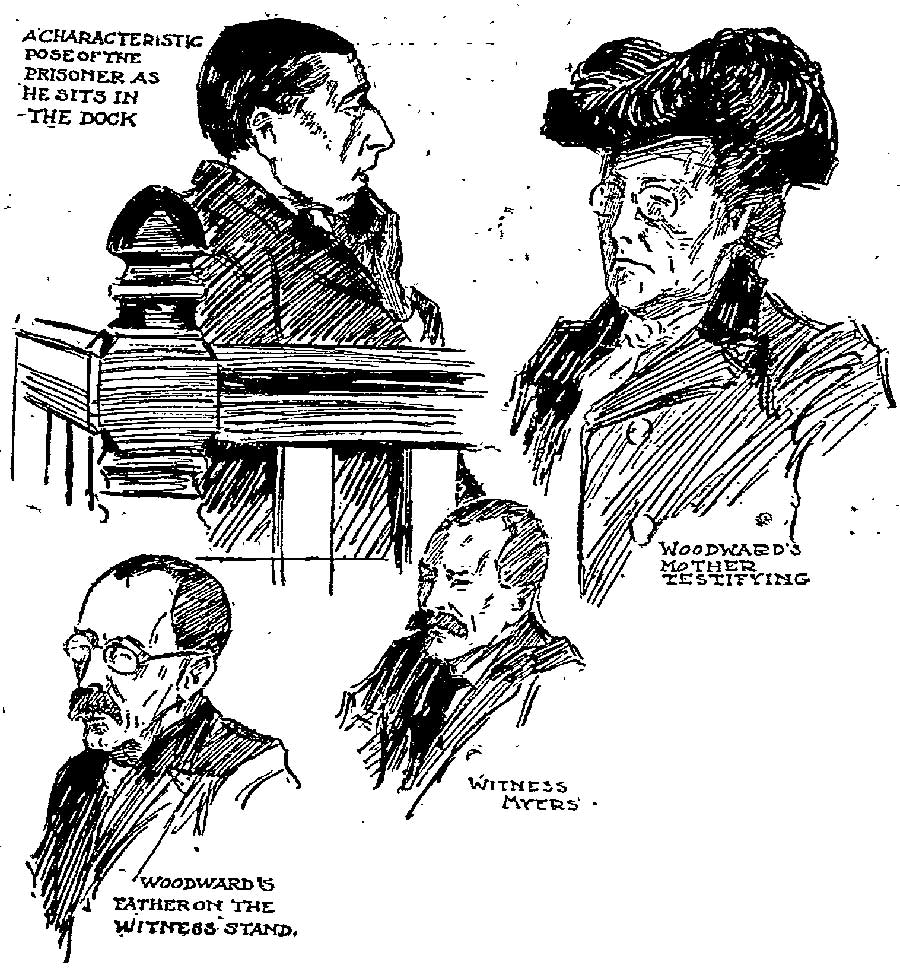
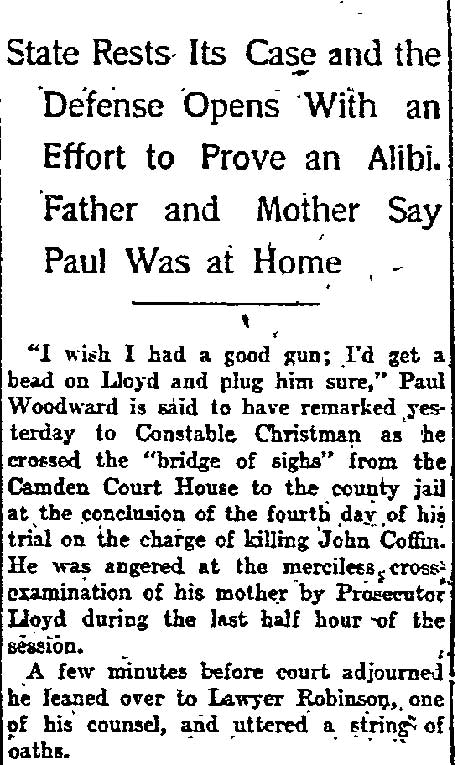
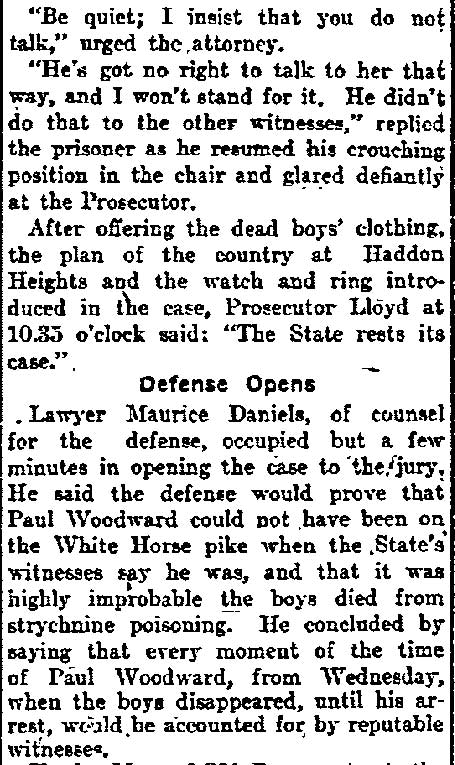
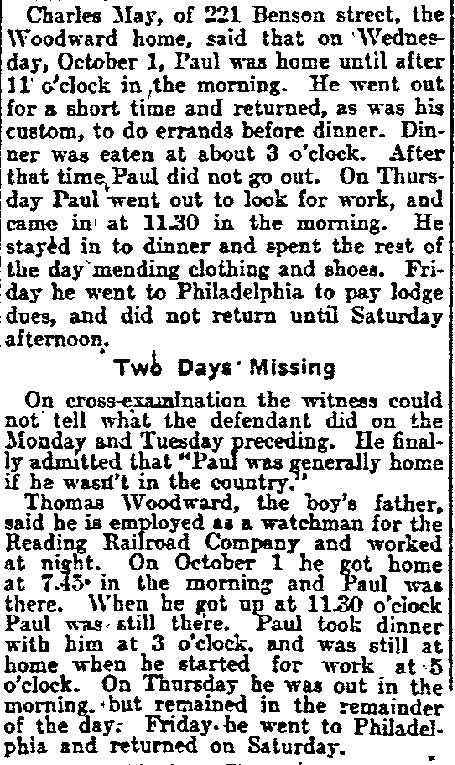

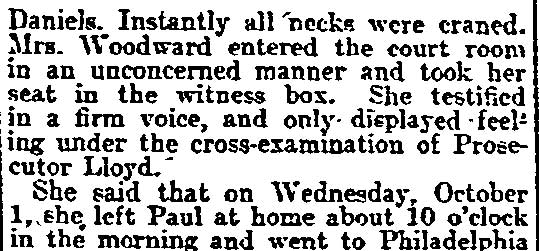
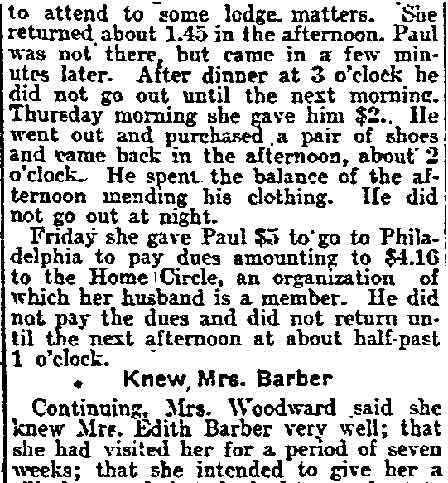
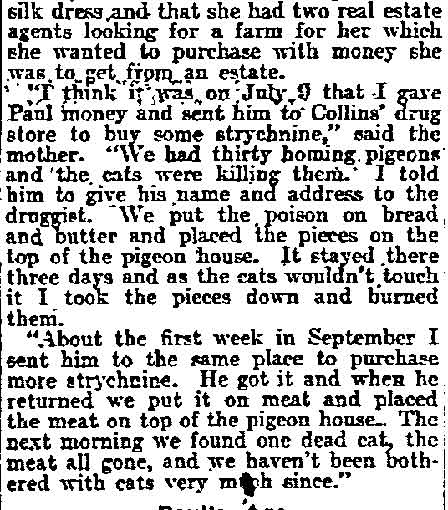
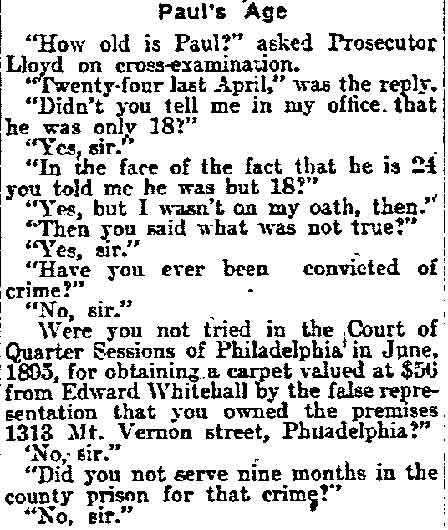
State Rests Its Case and the Defense Opens With an Effort to Prove an Alibi. Father and Mother Say Paul Was at Home.
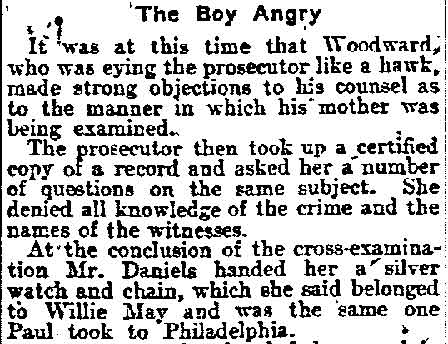
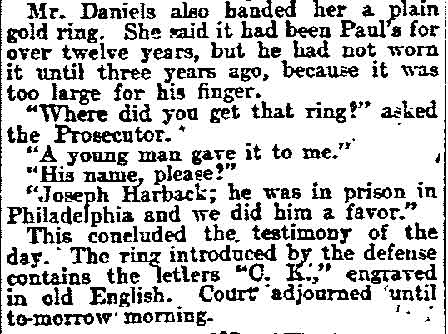
“I wish I had a good gun; I’d get a bead on Lloyd and plug him sure,” Paul Woodward is said to have remarked yesterday to Constable Christman as he crossed the “bridge of sighs” from the Camden Court House to the county jail at the conclusion of the fourth day of his trial on the charge of killing John Coffin. He was angered at the merciless cross-examination of his mother by Prosecutor Lloyd during the last half hour of the session.
A few minutes before court adjourned he leaned over to Lawyer Robinson, one of his counsel, and uttered a string of oaths.
Woodward Spent a Quiet Sunday
Philadelphia Inquirer —
Woodward Spent a Quiet Sunday
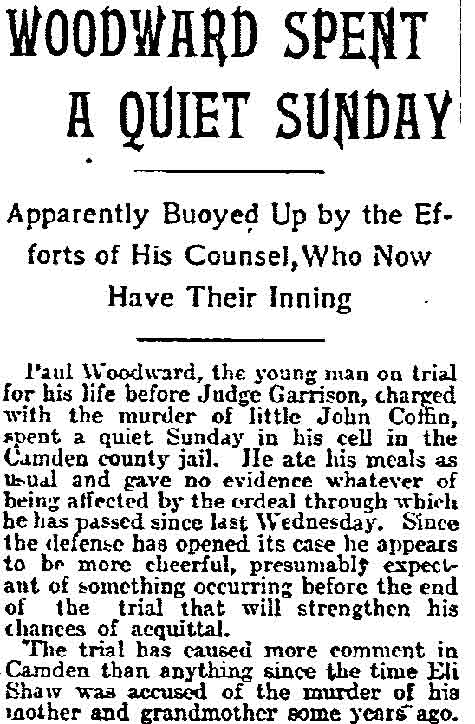
WOODWARD SPENT A QUIET SUNDAY
Apparently Buoyed Up by the Efforts of His Counsel, Who Now Have Their Inning
Paul Woodward, the young man on trial for his life before Judge Garrison, charged with the murder of little John Coffin, spent a quiet Sunday in his cell in the Camden county jail. He ate his meals as usual and gave no evidence whatever of being affected by the ordeal through which he has passed since last Wednesday. Since the defense has opened its case he appears to be more cheerful, presumably expectant of something occurring before the end of the trial that will strengthen his chances of acquittal.
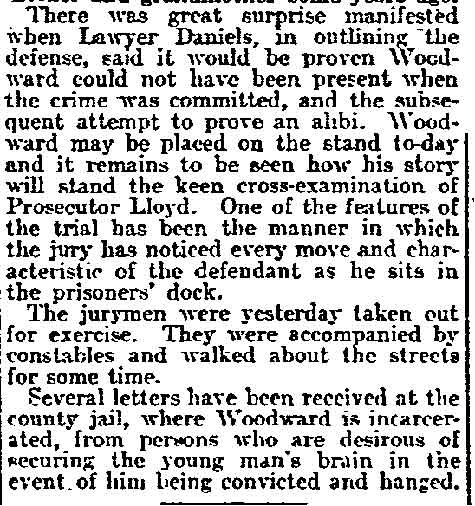
"The trial has caused more comment in Camden than anything since the time Eli Shaw was accused of the murder of his mother and grandmother some years ago."
There was great surprise manifested when Lawyer Daniels, in outlining the defense, said it would be proven Woodward could not have been present when the crime was committed, and the subsequent attempt to prove an alibi. Woodward may be placed on the stand to-day and it remains to be seen how his story will stand the keen cross-examination of Prosecutor Lloyd. One of the features of the trial has been the manner in which the jury has noticed every move and characteristic of the defendant as he sits in the prisoners' dock.
The jurymen were yesterday taken out for exercise. They were accompanied by constables and walked about the streets for some time.
Several letters have been received at the county jail, where Woodward is incarcerated, from persons who are desirous of securing the young man's brain in the event of him being convicted and hanged.
Woodward Smiled When He Heard Death Verdict
Philadelphia Inquirer —


WOODWARD SMILED WHEN HE HEARD DEATH VERDICT
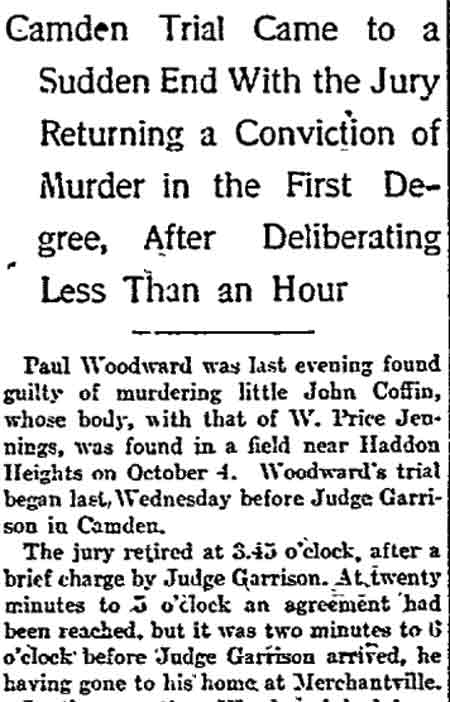
Camden Trial Came to a Sudden End With the Jury Returning a Conviction of Murder in the First Degree, After Deliberating Less Than an Hour
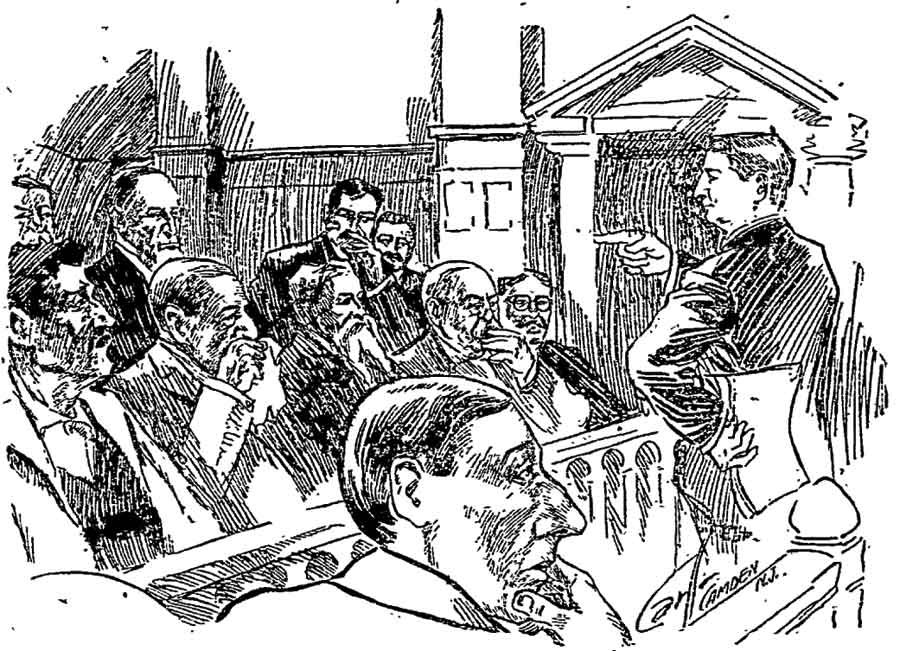
[Illustration caption: Attorney Robinson Making His Address to the Jury. Paul Woodward in Foreground.]
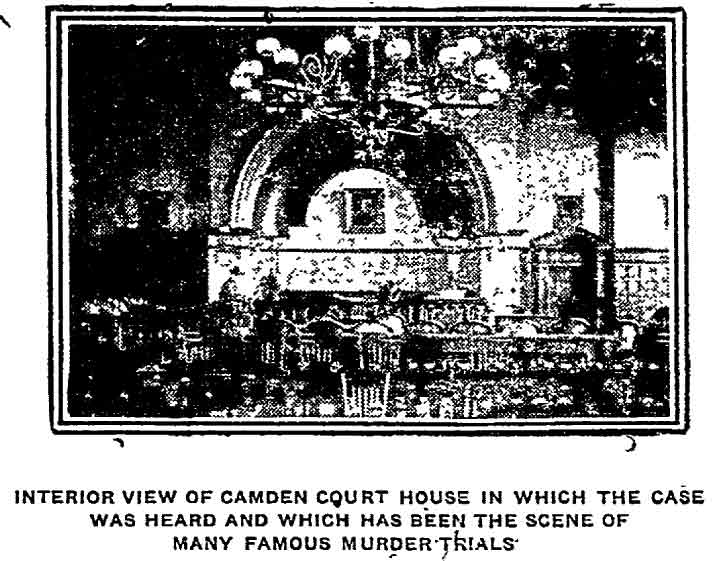
[Photo caption: Interior View of Camden Court House in Which the Case Was Heard and Which Has Been the Scene of Many Famous Murder Trials.]
Paul Woodward was last evening found guilty of murdering little John Coffin, whose body, with that of W. Price Jennings, was found in a field near Haddon Heights on October 4. Woodward’s trial began last Wednesday before Judge Garrison in Camden.
The jury retired at 3.45 o’clock, after a brief charge by Judge Garrison. At twenty minutes to 5 o’clock an agreement had been reached, but it was two minutes to 6 o’clock before Judge Garrison arrived, he having gone to his home at Merchantville.
In the meantime Woodward had been brought into the court room, and after the jury had filed in he was told to stand up. He arose without a tremor, looked at the ceiling, at the Judge and then turned to the twelve men who had his fate in their hands. His peculiar features lit up with a broad grin when the County Clerk said:
“Jury look upon the prisoner; prisoner look upon the jury.”
Guilty of Murder
Then when the jury was finally asked for its verdict and the foreman had solemnly announced “Guilty of murder in the first degree,” Woodward, apparently unmindful of the import of the words, turned to his counsel and laughed with a low chuckle. Each juror was polled and each man repeated “guilty of murder in the first degree.”
“The prisoner may retire,” said Judge Garrison, and with a sidelong glance at his counsel Woodward was led across the “bridge of sighs” to his cell in the county jail. He laughed loudly and slapped his custodian on the back in a playful mood, as if the whole proceedings had been a joke, but when he reached the jail he let go a tirade of profanity against the Prosecutor and those who appeared against him. He remarked that he did not care what became of him, all he cared for, he said, was his mother.
Motion for New Trial
Lawyer Rex immediately made a motion for a new trial, Judge Garrison stating he would hear argument on a date to be set. The jury was then discharged.
One of the features of the last day was the reappearance of Woodward’s mother, haggard, careworn and her eyes swollen with weeping. She was recalled to testify she had sworn falsely on Saturday when she denied even having been convicted of crime.
The climax in the defense’s case occurred in the morning, when Woodward, the defendant, was placed on the stand to testify. When he took his seat his eyes roamed about the room. He looked everywhere except in the direction of the jury. He admitted he was with the murdered boys, but denied absolutely having killed them. The alibi the defense tried to build about him during the period of the boys’ disappearance, was practically destroyed by contradictions made by Woodward concerning his movements. All the statements he made to Prosecutor Lloyd immediately following his arrest, he said, were false. He said he told the different stories because he was “scared.” The defense also tried to prove both boys were alive on Friday, October 3.
The defense called Dr. J. A. Leuf as an expert. He described the effects of strychnine on the human system. He said there were several other poisons that might have similar effects.
No Rebuttal Testimony
To the surprise of the assemblage no rebuttal testimony was given, Prosecutor Lloyd at once beginning his argument. He spoke for over an hour and at times was eloquent. He said the State asked for nothing but a first degree verdict, as the facts developed could have no other result consistent with the oath of the jury. It was a case of premeditation because there was first, an attempt at robbery, and second, because there was an attempt to do great bodily harm. The State, he said, had proved the crime against Woodward and followed him almost to the death bed of the boys.
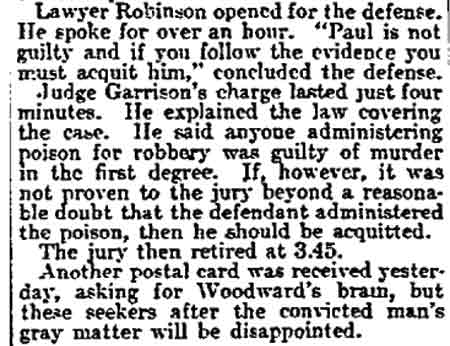
Lawyer Robinson opened for the defense. He spoke for over an hour. “Paul is not guilty and if you follow the evidence you must acquit him,” concluded the defense.
Judge Garrison’s charge lasted just four minutes. He explained the law covering the case. He said anyone administering poison for robbery was guilty of murder in the first degree. If, however, it was not proven to the jury beyond a reasonable doubt that the defendant administered the poison, then he should be acquitted.
The jury then retired at 3.45.
Another postal card was received yesterday, asking for Woodward’s brain, but these seekers after the convicted man’s gray matter will be disappointed.
Thinks Woodward Is Deficient
Philadelphia Inquirer —
That Paul Woodward, the Camden murderer of John Coffin and W. Price Jennings, is mentally deficient is likely to be made the basis of a plea by his counsel for commutation of the death penalty in his case before the Board of Pardons. That his conduct since conviction has been such as to furnish some ground for the appeal is believed by some of those with whom he has come in contact.
Far from being impressed by his terrible position Woodward laughs and jokes with his jailers.
He does not want ordinary prison fare. He asked a turnkey if a convicted murderer was not entitled to have his meals, including wine, brought from a restaurant. When he was jocularly told that he was, he exclaimed:
“Maybe I won’t live high! Then, I don’t care for myself; all I care for is my mother.”
During the day he saw James Bland, who is accused of the murder of James Morrisey. To Bland he said:
“Oh! don’t you get gay; you won’t eat your Christmas dinner either.”
Woodward Desires No Spiritual Advice
Philadelphia Inquirer —
Woodward Desires No Spiritual Advice
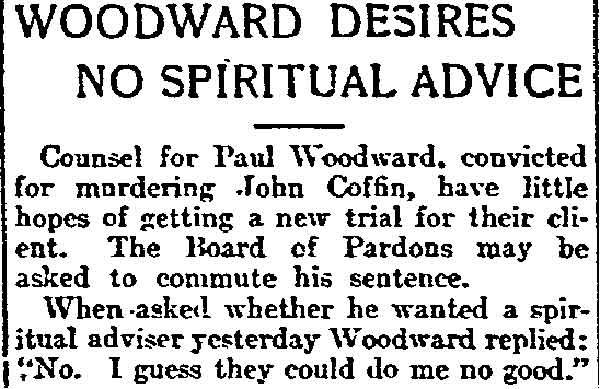
WOODWARD DESIRES NO SPIRITUAL ADVICE
Counsel for Paul Woodward, convicted for murdering John Coffin, have little hopes of getting a new trial for their client. The Board of Pardons may be asked to commute his sentence.
When asked whether he wanted a spiritual adviser yesterday Woodward replied: "No. I guess they could do me no good."
No New Trial for Murderer Woodward
Philadelphia Inquirer —
No New Trial for Murderer Woodward
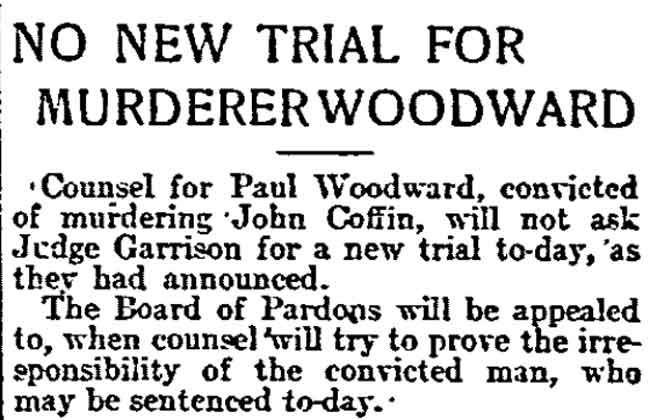
NO NEW TRIAL FOR MURDERER WOODWARD
Counsel for Paul Woodward, convicted of murdering John Coffin, will not ask Judge Garrison for a new trial to-day, as they had announced.
The Board of Pardons will be appealed to, when counsel will try to prove the irresponsibility of the convicted man, who may be sentenced to-day.
Woodward to Go to Gallows on January 7
Philadelphia Inquirer —
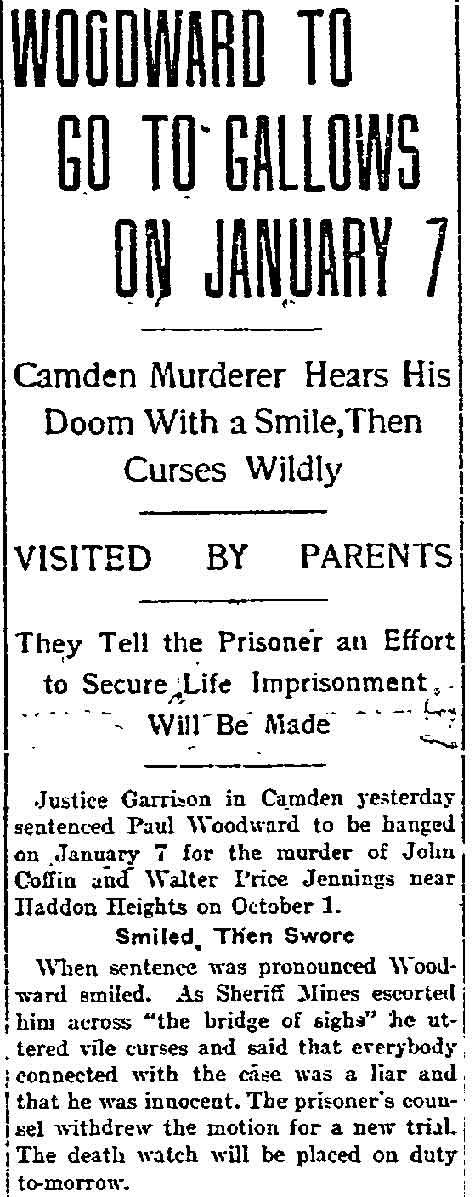
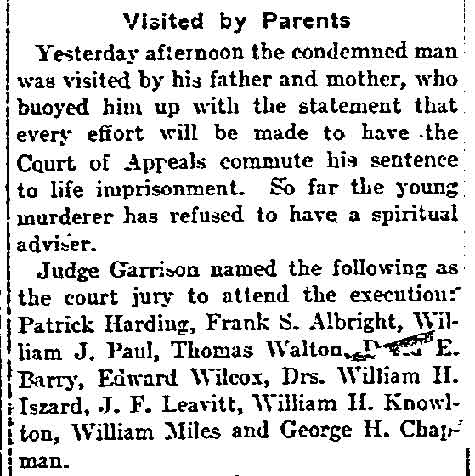
VISITED BY PARENTS
Yesterday afternoon the condemned man was visited by his father and mother, who buoyed him up with the statement that every effort will be made to have the Court of Appeals commute his sentence to life imprisonment. So far the young murderer has refused to have a spiritual adviser.
Judge Garrison named the following as the court jury to attend the execution: Patrick Harding, Frank S. Albright, William J. Paul, Thomas Walton, David E. Barry, Edward Wilcox, Drs. William H. Iszard, J. F. Leavitt, William H. Knowlton, William Miles and George H. Chapman.
Death Watch on Woodward
Philadelphia Inquirer —
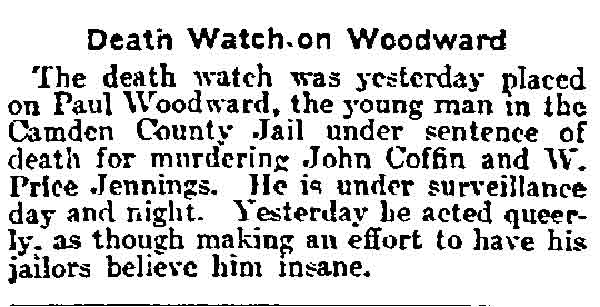
Death Watch on Woodward
Death Watch on Woodward
The death watch was yesterday placed on Paul Woodward, the young man in the Camden County Jail under sentence of death for murdering John Coffin and W. Price Jennings. He is under surveillance day and night. Yesterday he acted queerly, as though making an effort to have his jailors believe him insane.
Woodward Had Many Vices
Philadelphia Inquirer —
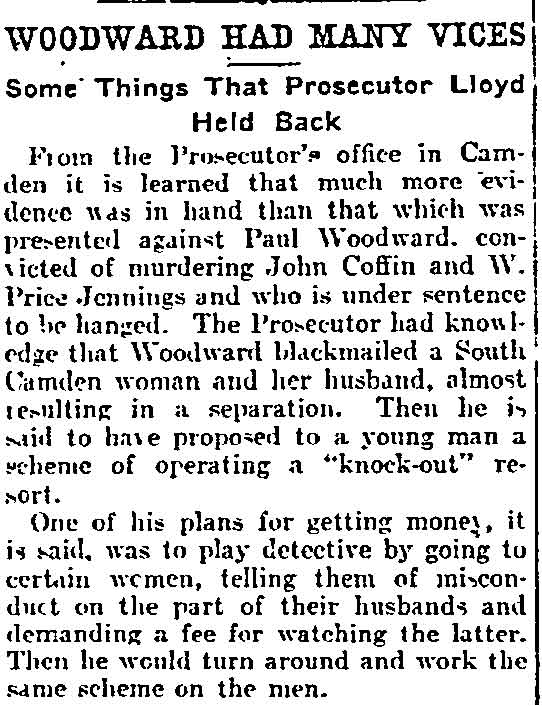
Woodward Had Many Vices
WOODWARD HAD MANY VICES
Some Things That Prosecutor Lloyd Held Back
From the Prosecutor's office in Camden it is learned that much more evidence was in hand than that which was presented against Paul Woodward, convicted of murdering John Coffin and W. Price Jennings and who is under sentence to be hanged. The Prosecutor had knowledge that Woodward blackmailed a South Camden woman and her husband, almost resulting in a separation. Then he is said to have proposed to a young man a scheme of operating a "knock-out" resort.
One of his plans for getting money, it is said, was to play detective by going to certain women, telling them of misconduct on the part of their husbands and demanding a fee for watching the latter. Then he would turn around and work the same scheme on the men.
Were His Ruin.
Kalamazoo Gazette —
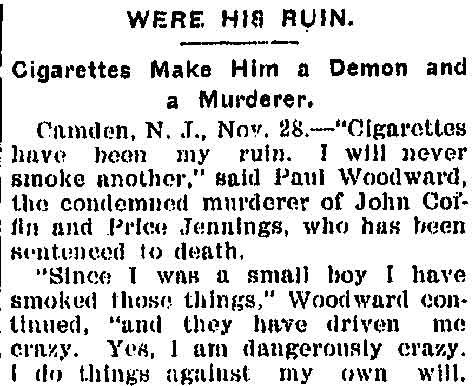
Cigarettes Make Him a Demon and a Murderer.
Camden, N. J., Nov. 28.—“Cigarettes have been my ruin. I will never smoke another,” said Paul Woodward, the condemned murderer of John Coffin and Price Jennings, who has been sentenced to death.
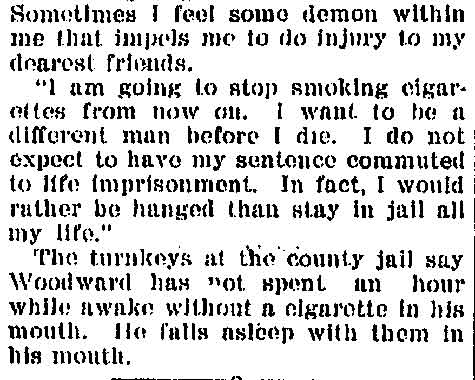
“Since I was a small boy I have smoked those things,” Woodward continued, “and they have driven me crazy. Yes, I am dangerously crazy. I do things against my own will.
“Cigarettes Made Me Dangerously Crazy”
Salt Lake Telegram —
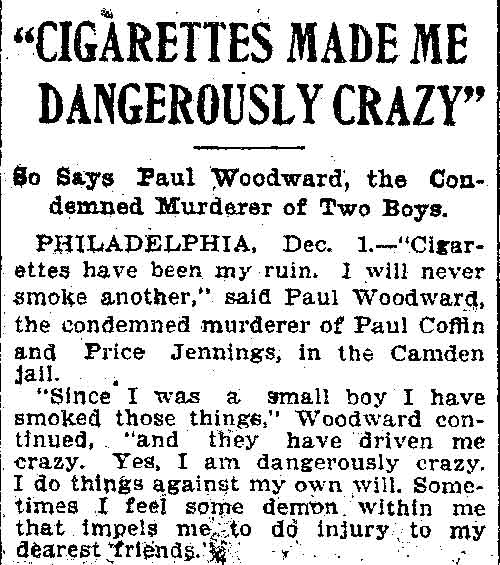
So Says Paul Woodward, the Condemned Murderer of Two Boys.
PHILADELPHIA, Dec. 1.—“Cigarettes have been my ruin. I will never smoke another,” said Paul Woodward, the condemned murderer of Paul Coffin and Price Jennings, in the Camden jail.
“Since I was a small boy I have smoked those things,” Woodward continued, “and they have driven me crazy. Yes, I am dangerously crazy. I do things against my own will. Sometimes I feel some demon within me that impels me to do injury to my dearest friends.”
Good Price for Expert Testimony
Philadelphia Inquirer —
Good Price for Expert Testimony
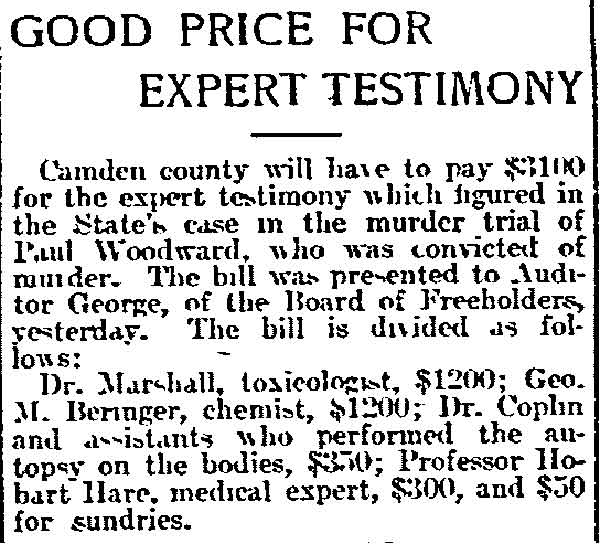
GOOD PRICE FOR EXPERT TESTIMONY
Camden county will have to pay $3100 for the expert testimony which figured in the State's case in the murder trial of Paul Woodward, who was convicted of murder. The bill was presented to Auditor George, of the Board of Freeholders, yesterday. The bill is divided as follows:
Dr. Marshall, toxicologist, $1200; Geo. M. Beringer, chemist, $1200; Dr. Cophn and assistants who performed the autopsy on the bodies, $350; Professor Hobart Hare, medical expert, $300, and $50 for sundries.
Murderer Woodward Visited by a Minister
Philadelphia Inquirer —
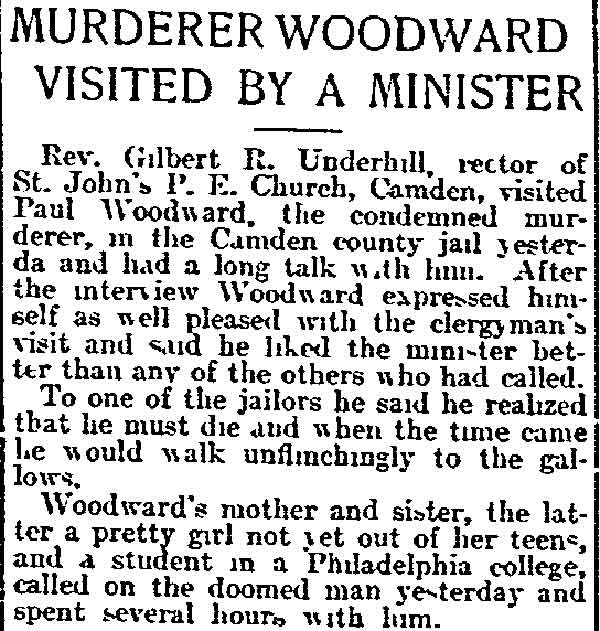
Rev. Gilbert R. Underhill, rector of St. John’s P. E. Church, Camden, visited Paul Woodward, the condemned murderer, in the Camden county jail yesterday and had a long talk with him. After the interview Woodward expressed himself as well pleased with the clergyman’s visit and said he liked the minister better than any of the others who had called.
To one of the jailors he said he realized that he must die and when the time came he would walk unflinchingly to the gallows.
Woodward’s mother and sister, the latter a pretty girl not yet out of her teens, and a student in a Philadelphia college, called on the doomed man yesterday and spent several hours with him.
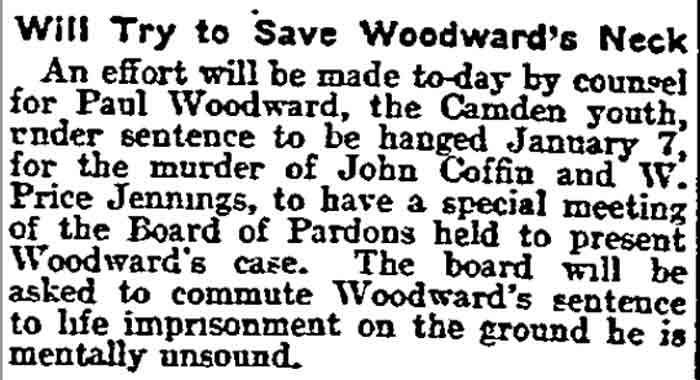
Will Try to Save Woodward’s Neck
Philadelphia Inquirer —
Will Try to Save Woodward's Neck
Will Try to Save Woodward's Neck
An effort will be made to-day by counsel for Paul Woodward, the Camden youth, under sentence to be hanged January 7, for the murder of John Coffin and W. Price Jennings, to have a special meeting of the Board of Pardons held to present Woodward's case. The board will be asked to commute Woodward's sentence to life imprisonment on the ground he is mentally unsound.
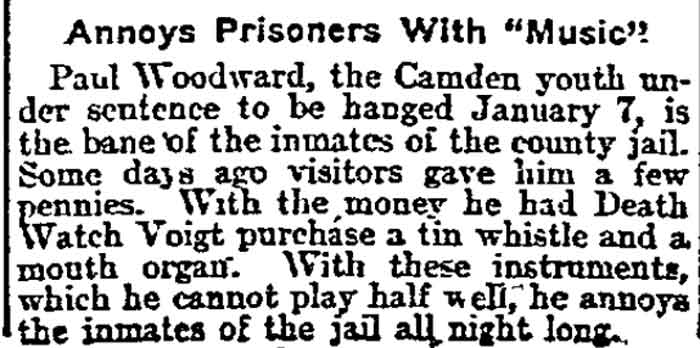
Annoys Prisoners With “Music”
Philadelphia Inquirer —
Murderer Given Talking Machine
Philadelphia Inquirer —
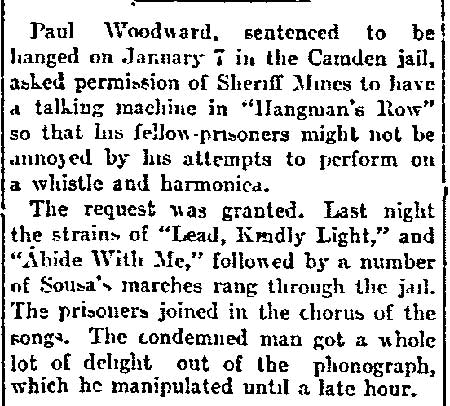
Murderer Given Talking Machine
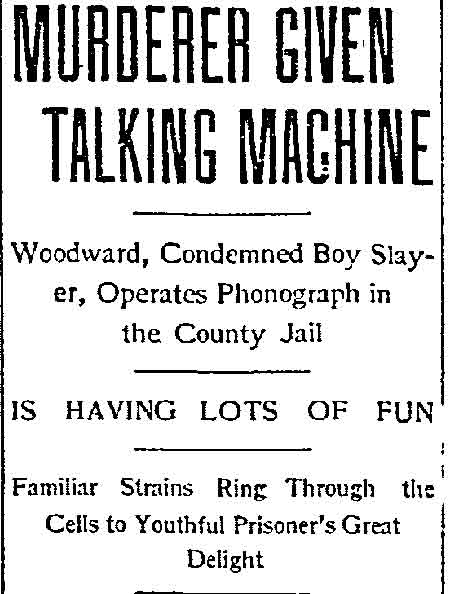
MURDERER GIVEN TALKING MACHINE
Woodward, Condemned Boy Slayer, Operates Phonograph in the County Jail
IS HAVING LOTS OF FUN
Familiar Strains Ring Through the Cells to Youthful Prisoner's Great Delight
Plenty of Amusement for Young Woodward
Philadelphia Inquirer —
Plenty of Amusement for Young Woodward
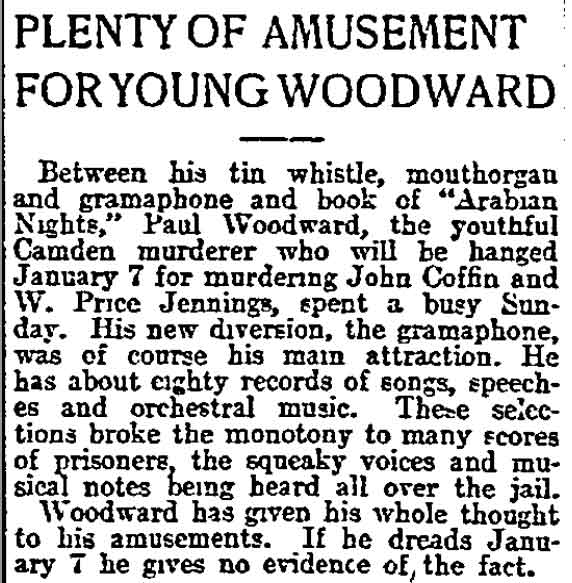
PLENTY OF AMUSEMENT FOR YOUNG WOODWARD
Between his tin whistle, mouthorgan and gramaphone and book of "Arabian Nights," Paul Woodward, the youthful Camden murderer who will be hanged January 7 for murdering John Coffin and W. Price Jennings, spent a busy Sunday. His new diversion, the gramaphone, was of course his main attraction. He has about eighty records of songs, speeches and orchestral music. These selections broke the monotony to many scores of prisoners, the squeaky voices and musical notes being heard all over the jail.
Woodward has given his whole thought to his amusements. If he dreads January 7 he gives no evidence of the fact.
Pardon Board on Woodward’s Case
Philadelphia Inquirer —
TRENTON, N. J., Dec. 16—The case of Paul Woodward, the condemned Camden murderer, is to be considered by the Court of Pardons. This was promised to-day by Governor Murphy to Lawyer Fred A. Rex. Governor Murphy says if the case has not been reached when the court adjourns, December 24, he will grant Woodward a reprieve until some action is taken.
Mr. Rex’s ground for appeal is that there was some intermarrying of relatives in Woodward’s family which might justify a degree of insanity that would warrant the commutation of the condemned man’s sentence.
In the jail at Camden Woodward continues to amuse himself with his gramophone. He is sanguine of getting his death sentence commuted. He eats and sleeps regularly and apparently does not worry in the least.
Knife Found in Woodward’s Cell
Philadelphia Inquirer —
Knife Found in Woodward's Cell
KNIFE FOUND IN WOODWARD'S CELL
Its Discovery Apparently Explains the Murderer's Declaration That He Would Never Be Hanged
The seeming confidence with which Paul Woodward, sentenced to be hanged January 7 in the Camden county jail for the murder of the Jennings and Coffin boys, expressed himself that he would not be executed was easily accounted for when in a search of his cell the other day a pocket knife with an edge as keen as a razor was found.
Several times had the officials searched the cell thoroughly as they supposed. Each time Wodward met their efforts with a mocking laugh. Convinced that there was something hidden one of the "watch" placed his fingers in a pipe in the cell and pulled forth the knife. Woodward has not done very much talking since—except to his favorite keeper.
Trying to Save Woodward’s Neck
Philadelphia Inquirer —
Trying to Save Woodward's Neck
TRYING TO SAVE WOODWARD'S NECK
The New Jersey Court of Pardons, in secret session, yesterday, gave a hearing to counsel for Paul Woodward, the Camden murderer, who is under sentence to be hanged on January 7. Counsel asked for a commutation of sentence on the ground of insanity.
The court postponed decision in the matter until next Tuesday, in order to give counsel an opportunity to present testimony.
Murderer Woodward Had Merry Christmas
Philadelphia Inquirer —
Murderer Woodward Had Merry Christmas
MURDERER WOODWARD HAD MERRY CHRISTMAS
Paul Woodward, the youthful murderer in the Camden County Jail under sentence of death for killing John Coffin and W. Price Jennings, spent a happy Christmas.
It was a happy one because he had plenty to eat—stewed chicken, mince pie, candy, etc.—and also because he has an idea he will not be hanged, at least on January 7.
Last Effort to Save Woodward
Philadelphia Inquirer —
Last Effort to Save Woodward
LAST EFFORT TO SAVE WOODWARD
Lawyer Frederick A. Rex, counsel for Paul Woodward, the youth under sentence to be hanged January 7 for the murder of John Coffin and W. Price Jennings, will go to Trenton to-day to ask that Woodward's sentence be commuted to life imprisonment.
Woodward's counsel has little prospect of getting anything favorable from the Board of Pardons, however.
Woodward’s Last Hope Vanished
Philadelphia Inquirer —
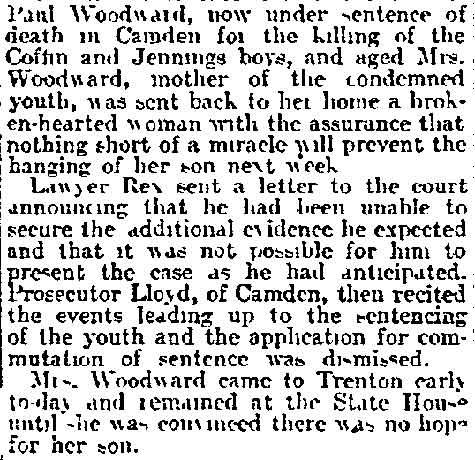
Woodward's Last Hope Vanished
WOODWARD'S LAST HOPE VANISHED
Court of Pardons Refuses to Interfere in Case of Camden's Condemned Murderer
Special to The Inquirer.
TRENTON, N. J., Dec. 30—The Court of Pardons in special session this afternoon refused to interfere in the case of—
Murderer Woodward Unconcerned
Philadelphia Inquirer —
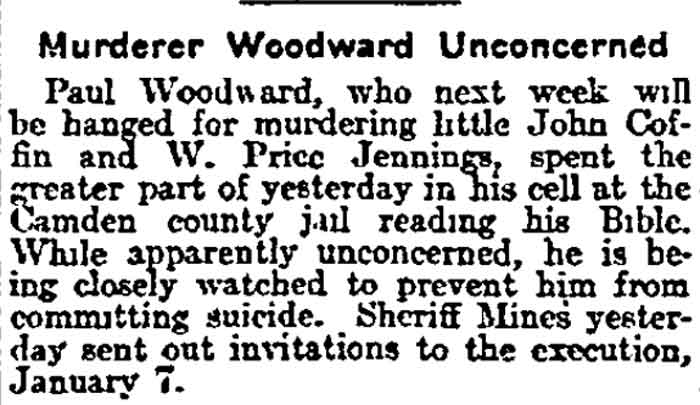
Murderer Woodward Unconcerned
Murderer Woodward Unconcerned
Paul Woodward, who next week will be hanged for murdering little John Coffin and W. Price Jennings, spent the greater part of yesterday in his cell at the Camden county jail reading his Bible. While apparently unconcerned, he is being closely watched to prevent him from committing suicide. Sheriff Mines yesterday sent out invitations to the execution, January 7.
Unconcerned at Death’s Approach
Philadelphia Inquirer —
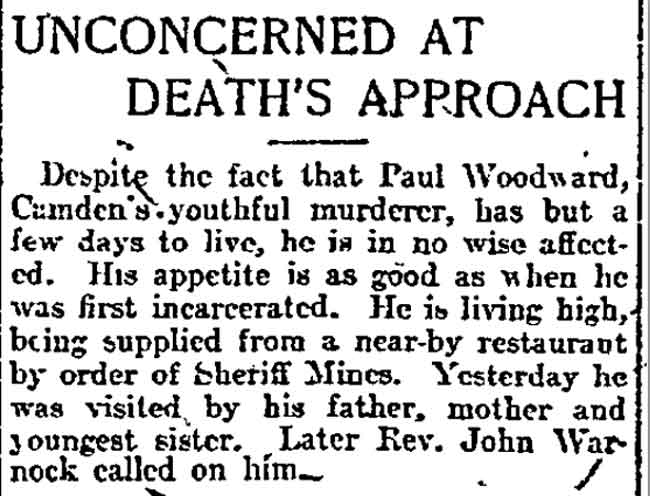
Christopher J. Mines Jr. — Rev. John Warnock
Woodward’s Last Sunday on Earth
Philadelphia Inquirer —
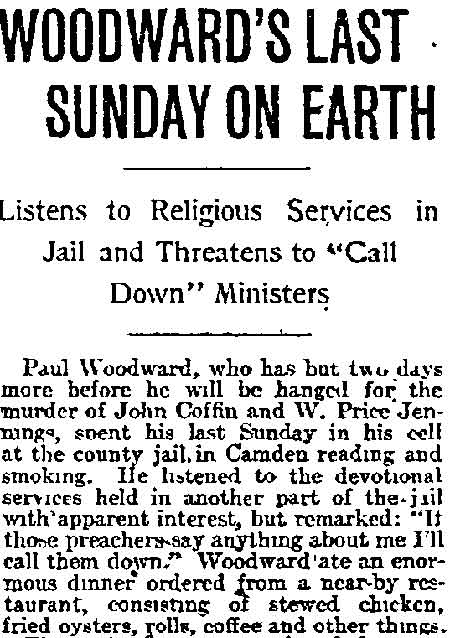
Woodward's Last Sunday on Earth
WOODWARD'S LAST SUNDAY ON EARTH
Listens to Religious Services in Jail and Threatens to "Call Down" Ministers
Paul Woodward, who has but two days more before he will be hanged for the murder of John Coffin and W. Price Jennings, spent his last Sunday in his cell at the county jail in Camden reading and smoking. He listened to the devotional services held in another part of the jail with apparent interest, but remarked: "If those preachers say anything about me I'll call them down." Woodward ate an enormous dinner ordered from a near-by restaurant, consisting of stewed chicken, fried oysters, rolls, coffee and other things.
“I’ll Be a Dead One”—Woodward
Philadelphia Inquirer —
\"I'll Be a Dead One\"—Woodward
"I'LL BE A DEAD ONE"—WOODWARD
Nearing Day of Doom, Camden Murderer Facetiously Addressed a Grand Juryman Yesterday
With a little over twenty-four hours between him and eternity, Paul Woodward, the youthful Camden murderer, who will be hanged to-morrow morning for the cruel murder of two boys, continues his nonchalant manner.
After a brief visit from his father and mother yesterday Woodward took out his harmonica. A few minutes later the jail was filled with the strains of "In the Good Old Summer Time." Then he took a turn at several marches. These selections were a prelude to his midday meal. This consisted of roast lamb, sweet potatoes, French peas, one-half dozen raw oysters, minced onions (raw), stewed fruit.
Woodward’s Nerve Fast Leaving Him
Philadelphia Inquirer —
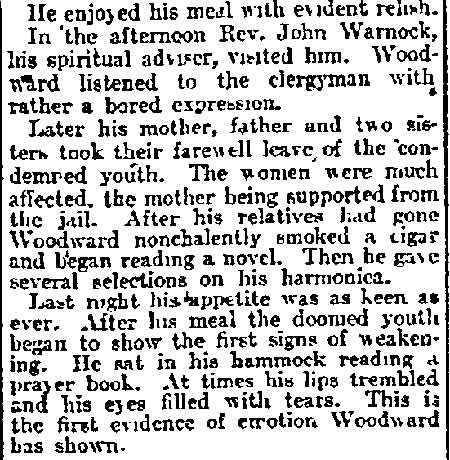
Woodward's Nerve Fast Leaving Him
WOODWARD'S NERVE FAST LEAVING HIM
Paul Woodward will be hanged at the Camden County Jail this morning, shortly after 10 o'clock, by Sheriff Mines, for the murder of two boys. Unless he regains his wonted nonchalance he will undoubtedly create a scene.
The condemned youth arose yesterday early, ate a hearty breakfast and read the newspapers. Then he whiled away the morning by playing popular airs on his harmonica.
When the dinner hour approached he said:
"Well, this will be my last dinner. It's up to me to eat and I want my favorite dish. It's rabbit."
Woodward Hanged To-Day
Wilkes Barre Times —
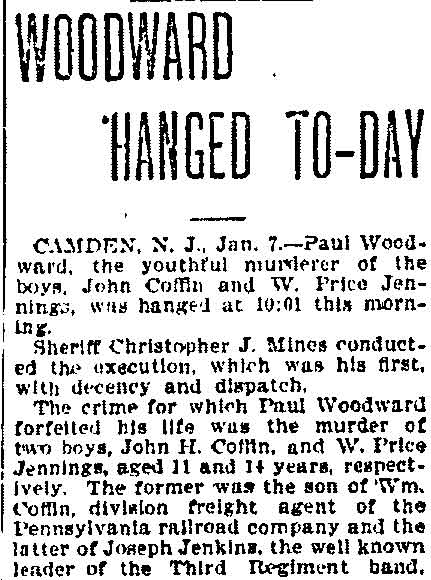
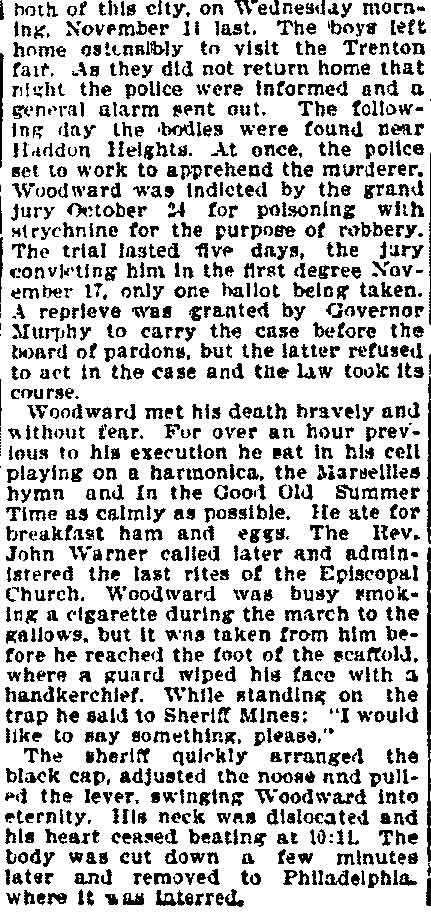
CAMDEN, N. J., Jan. 7.—Paul Woodward, the youthful murderer of the boys, John Coffin and W. Price Jennings, was hanged at 10:01 this morning.
Sheriff Christopher J. Mines conducted the execution, which was his first, with decency and dispatch.
The crime for which Paul Woodward forfeited his life was the murder of two boys, John H. Coffin and W. Price Jennings, aged 11 and 14 years, respectively. The former was the son of Wm. Coffin, division freight agent of the Pennsylvania railroad company and the latter of Joseph Jenkins, the well known leader of the Third Regiment band.
Paul Woodward Goes to Gallows
Philadelphia Inquirer —
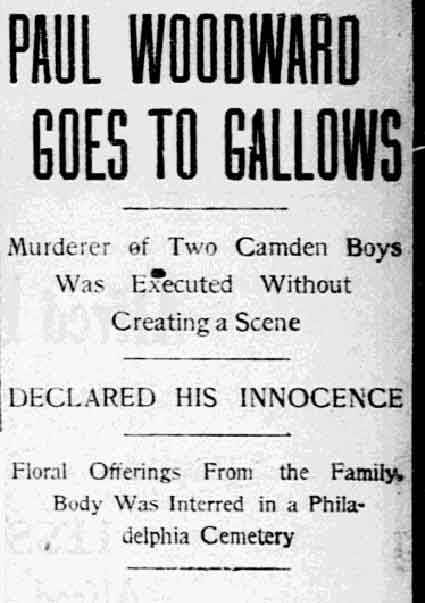
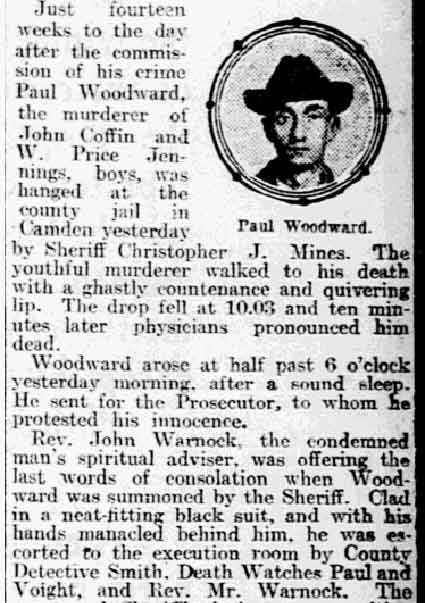
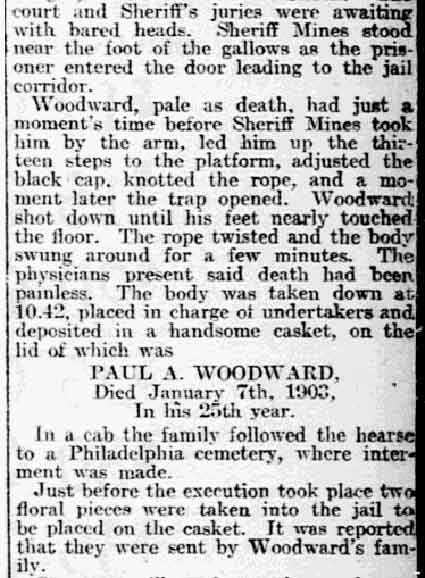
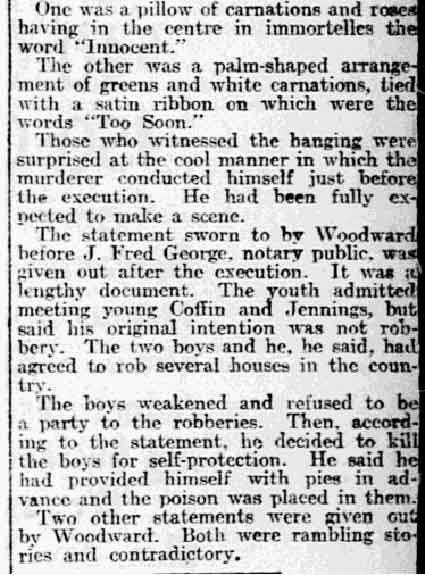
Murderer of Two Camden Boys Was Executed Without Creating a Scene
DECLARED HIS INNOCENCE
Floral Offerings From the Family, Body Was Interred in a Philadelphia Cemetery
Murder Case Finally Closed
Philadelphia Inquirer —
MURDER CASE FINALLY CLOSED
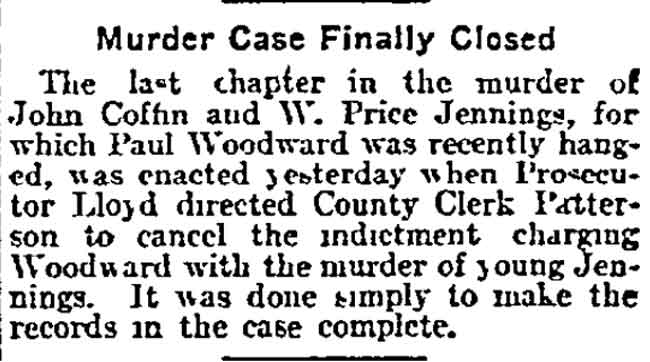
The last chapter in the murder of John Coffin and W. Price Jennings, for which Paul Woodward was recently hanged, was enacted yesterday when Prosecutor Lloyd directed County Clerk Patterson to cancel the indictment charging Woodward with the murder of young Jennings. It was done simply to make the records in the case complete.
"WAGNER'S TRIAL FOR STABBING MILLER"
Camden Daily Courier —

WAGNER'S TRIAL FOR STABBING MILLER
Witnesses Say Policeman Keaser Held Fellow Officer When He Was Knifed.
CUT DURING THIRD WARD RIOT
The main court room was crowded with interested Third warders this morning, when the first of the criminal complaints growing out of the riots at Third and Beckett streets, on the night of July 28, last, during the Congressional primary, was taken up. It charged Charles Wagner with assault and battery on Policeman Harry Miller. Judge Joline was on the bench. Prosecutor Lloyd appeared for the State and the defendant was represented by Lawyers Fred A. and William F. Rex. Some little trouble was experienced in getting a jury.
After Prosecutor Lloyd outlined the case, Policeman Miller was called to the stand. He said that on the night in question just before the close of the polls, a fight ensued between ex-Policeman “Bob” Miller and John Morrisey, the man who was killed. A general racket followed and “Bob” Miller, Policeman Keaser and others were brutally assaulting George Murray with a blackjack, when witness went to Murray's aid. Keaser, he said, turned on him and grappled.
MILLER STABBED.
“He had a hold of me and I of him,” said Miller, “and while we were standing in that position, this man Wagner came up in front of me, jabbed his knife in my stomach, turned it like that (giving his hand a twist) and pulled it out. Keaser still had a hold of me and I could not help myself. Wagner ran away after stabbing me.”
Miller said he was taken to Cooper Hospital and was there four weeks.
On cross-examination by Mr. Rex, Miller said he was positive that Wagner was his assailant and denied saying in the hospital the morning after the stabbing, that he did not know who cut him. He also denied hitting Keaser with his blackjack.
When questioned concerning Morrisey, the man who was killed, Miller said he only met him that day and did not know whether he was a voter or not.
DIDN'T WANT DETAILS.
Mr. Rex tried to get the witness to detail a talk he had with Morrisey, but Mr. Lloyd objected. Mr. Rex seemed so anxious to carry the point that Mr. Lloyd said he was willing to withdraw the objection, provided Mr. Rex would not object to detailed conversation responses to his questions. Mr. Rex promptly vetoed the proposition and withdrew his questions.
Harry Selby, son of former Policeman Selby, followed on the stand. He said he did not see the stabbing, but that a few moments before the polls closed he saw Wagner try to stab Miller at the window of the polling place. The two, it appears, had had some words.
Dr. Grimes, of the Cooper Hospital staff, said that he helped dress Miller's wound and that it was a dangerous one.
SAW WAGNER KNIFE MILLER.
William Laws, colored, corroborated Miller's testimony. He said he saw Policeman Keaser hold Policeman Miller while Wagner stabbed him. This happened he said about four minutes of 8 o'clock.
Policeman Edward Hartman told of seeing Wagner having an open knife in his hand, of seeing him jab at several people and that he grabbed at him.
“You saw all of that did you?” asked Mr. Rex.
“I certainly did,” replied the officer.
“Then why didn't you as a policeman arrest him?”
“I tried to, but his brother interfered.”
Mr. Rex had no more questions to ask.
George Murray, also told of seeing defendant have a knife in his hand.
Detectives Smith and Cherry told of making an unsuccessful search in this city for Wagner and finally locating him at Hammonton. He was wounded.
Detective Cherry said that Wagner told him that he had been at Hammonton.
“Hammonton is in Camden county, isn't it?” asked Mr. Rex.
“No, sir, Atlantic county.”
“My geography is twisted somewhat,” commented Mr. Rex.“ With these witnesses the State rested.
WAGNER DENIES CHARGE.
Addressing the jury Mr. Rex said the defense would be an alibi. Wagner then took the stand. He said he lived at 668 South Second street and that on the night of July 28 he was at the polling place about quarter of eight o'clock.
“Did you have a penknife in your hands at all?”
“No, sir.”
“Did you cut Harry Miller?”
“No, sir.”
In answer to questions by Mr. Rex, Wagner said he was with Constable Bates and nearly everybody knew him at Waterford.
When questioned by Mr. Lloyd Wagner said he went to Waterford on July 30 — two days after the stabbing. He went to see his sick wife at Mr. Archer's. His visit lasted until the middle of September, the time of his arrest. Previous to his wife's illness he was away over a week. He said he had no knowledge that he was wanted for any crime until his later arrest. It was news to him in papers that he was charged with stabbing Miller. He said he had no knife.
He further said that no trouble had occurred at all while he was at the polls.
Charles Cahill, a clerk at the Reading terminal, said he was at the polls and about a quarter past seven o'clock he went up Beckett street in company with Wagner and another man. About fifty feet away, he said he went into an alley and Wagner proceeded up the street. When Cahill returned to the polling place just as the trouble began. He did not see Wagner.
Questioned by the Prosecutor Cahill said he was present as a challenger.
“For which party?” “For the party that was holding the election?”
“We wanted the best man,” snapped Cahill in reply.
DIDN'T HAVE ANY POLITICS.
The Prosecutor repeated the question several times only to receive evasive answers, such as “I was a Republican for that night,” and “I'm for the best man,” until Judge Joline was compelled to sharply reprimand the witness to answer the question. Even then the spectators laughed. Cahill said he had no politics, as he said he guessed he didn't have any politics.
John McDonald testified to seeing Wagner and two other men pass up the street and despite the general excitement Mr. McDonald said he did not see Wagner until he got to Fourth street.
With the testimony of Butcher John Morrisey, who declared he did not see Wagner at all around the polls until after the trouble, was over court took a recess.
Policeman Albert Keaser was the first witness called after recess. He said he was present when the row started, that he took a blackjack from George Murray and also that he took a club from Policeman Harry Miller. The latter, he said, had hit him with the weapon. Witness said he was at the window of the polling place and at that time Miller was not cut.
“Did Mr. Archer, the Assistant Prosecutor, tell you that he had a talk with Miller and that Miller said he didn't know who cut him?”
Mr. Lloyd objected to the question because it showed a willingness to allow it. Mr. Rex would let him call witness and then attack him.
Mr. Rex would not do so and the Prosecutor pressed his objection. It was sustained.
On cross examination Keaser denied agreeing to a man named Ogden that Wagner was the fellow who did Miller.
BEAT FELLOW POLICEMAN.
Policeman John Wagner, another of the defendants, said his brother went away before the fight started. In detailing the fracas Wagner voluntarily said he hit Hartman (the policeman) with his jack and that he also hit Policeman Hartman.
Policeman Pruitt also said he saw Wagner leave the polling place just before the disturbance. When Mr. Lloyd was cross examining the witness Mr. Rex objected to the form of a question and remarked that he had objected to that several times and “I suppose I'll get the same ruling.”
Judge Joline rebuked Mr. Rex for making such a statement. Mr. Rex then made his objection but put it as an objection in regular form and it was sustained.
Anna Hutner, a sister of the defendant, said she saw him go away about quarter of 8 o'clock and that he did not have anything to do with the trouble. She explained her presence there by saying she had gone there to keep George Murray from shooting her brother.
William Ridgway said he was present during the trouble but did not see Wagner.
Constable “Bo” Bates said that Wagner was in his company nearly every day while he was visiting Waterford and that he made no attempt to escape.
SHIELDED WAGNER.
Prosecutor Lloyd's only question was:
“You as an officer of this court knew that this man was charged with cutting Harry Miller and you did not report it to the authorities, is that right?”
“I forgot it sir.”
When asked why, by Mr. Rex, the witness said the authorities could find out him at any time.
The defense rested and Mr. Lloyd replied with a brief but vigorous rebuttal. He testified that Keaser told him that Wagner did cut Miller and related the incident. Mr. Lloyd again rebuked Mr. Rex for his manner.
Argument commenced at 2.45 o'clock.
"ANOTHER CASE IN THIRD WARD RIOT"
Camden Daily Courier —

ANOTHER CASE IN THIRD WARD RIOT
Policeman Keaser and Ex-Policeman “Bob” Miller on Trial for Assault.
WAGNER JURY COULD NOT AGREE
In the Criminal Court this morning George V. Tucker, who was convicted of a charge of assault and battery, was sentenced by Judge Joline to pay a fine of $50 and costs and stand committed until the money is paid.
Henry J. Shuster pleaded guilty to a charge of embezzling $260.16 from King David Lodge, No. 155, of which he was treasurer. Shuster served three months in the County Jail last spring on a similar charge. At that time he said he used the money to care for his wife, who was ill. It appears that he did use part of the money for this purpose, but that he squandered a large sum in poker playing.
Rev. Q. C. Davis, pastor of the Emmanuel Baptist church, testified that since Shuster has been out of jail he has led a correct life, and at the present time has a good position.
Prosecutor Lloyd made an appeal for clemency.
Judge Joline announced that he was not ready to decide the case and it went over.
POLICEMEN ON TRIAL.
The indictment against Policeman Albert Keaser and ex-Policeman Robert Miller, on charges of assault and battery on George Murray, was then called. This is the second case to be tried as the outcome of the election riot at the Third Ward polling during the primary election last July. Considerable time was occupied in securing a jury.
At the afternoon session Assistant Prosecutor Archer outlined the case, in which he said the two defendants “lined with a polling system” and the alleged assault took place at the polling place at Third and Beckett streets, and during the row, Robert Miller, struck George Murray several times with a blackjack, and Keaser, it is alleged, assisted Miller in the assault.
The first witness called was George Murray, the alleged victim, who testified that while standing near the polling place with several other “Bob” Miller, without any provocation, beat him with a blackjack. He said that Policeman Keaser was present and came to Miller's assistance. During the row, Policemen Hartman and Harry Miller came to his aid.
BEATEN WITH A BLACKJACK.
On cross-examination witness said he had no pistol or blackjack, but that three days before the election Miller had struck witness with a blackjack. He further said that he had been told at the Third Ward Republican Club, in the presence of John Rodan, that if a certain man would come along, he would kill him.
William Laws, who testified next, gave further and corroborative testimony as to the blackjacking. He said that Murray did nothing to provoke the assault.
Spencer Moore, also gave corroborating testimony.
Policeman Harry Miller testified to seeing “Bob” Miller beating Murray while Policeman Keaser stood at the side of Beckett street. The witness said that he was not allowed to see Policeman Keaser at the same time explaining.
What are you trying to do, kill this man.
The witness said he was thrown down, and was pushed over by Keaser, and Miller grappled with him. He heard three or four pistol shots.
The witness identified the blackjack, in the possession of Lawyer Rex, which he used on the night of the primaries.
Edward Roberts, formerly Assembly man Roberts, also gave corroborative testimony.
DEFENSE OPENS.
At the afternoon session of the court the defense opened. Counsel said that the defendants were officers of the law, force to put the riot into subjection.
Policeman Toy testified that he saw two opponents quarreling, that Robert Miller, was acting as a peacemaker. He saw Murray shoot off a revolver.
Policeman Cunningham was also at the riot and heard Murray say that he would get some one before the night was over. He found the gunshot off a revolver under a tree.
On cross-examination Miller admitted that he struck Murray while attempting to arrest him. He also testified that he had a conversation with Murray; that some person had attempted to stab him. He exhibited his clothing which was cut with a knife.
Policeman Shaw testified that on July 23, visited George Murray's residence and found George Murray in his home, where he was under arrest by Detective Burke, who also found a revolver from the wife of Murray.
Mrs. Widener, who was a witness in the trial yesterday, is not the same piece of evidence in this case.
CHEESEMAN SENTENCED.
At the noon recess Judge Joline imposed sentence on O. U. Cheeseman, the former secretary of Thomas Jefferson Council, No. 155, Jr. O. U. A. M., who was convicted of a charge of false pretenses on Thursday last. Rev. Samuel Ellesworth, Rev. R. A. M. Mason, pastor of the Kaighn Avenue M. E. church, and Rev. Robert Wesley Johnson, pastor of the Second Presbyterian church, made appeals to the court for clemency in his case. Judge Joline sentenced Cheeseman to four months in the County Jail and a fine of $50 and costs.
After being out for seven hours without being able to agree on a verdict the jury in the case of Policeman Harry Miller tried yesterday on a charge of stabbing Policeman Harry Miller, at the time of the election riot last, were discharged at 10 o'clock last night.
Royal Welcome for Ex-Sheriff Baird
Philadelphia Inquirer —
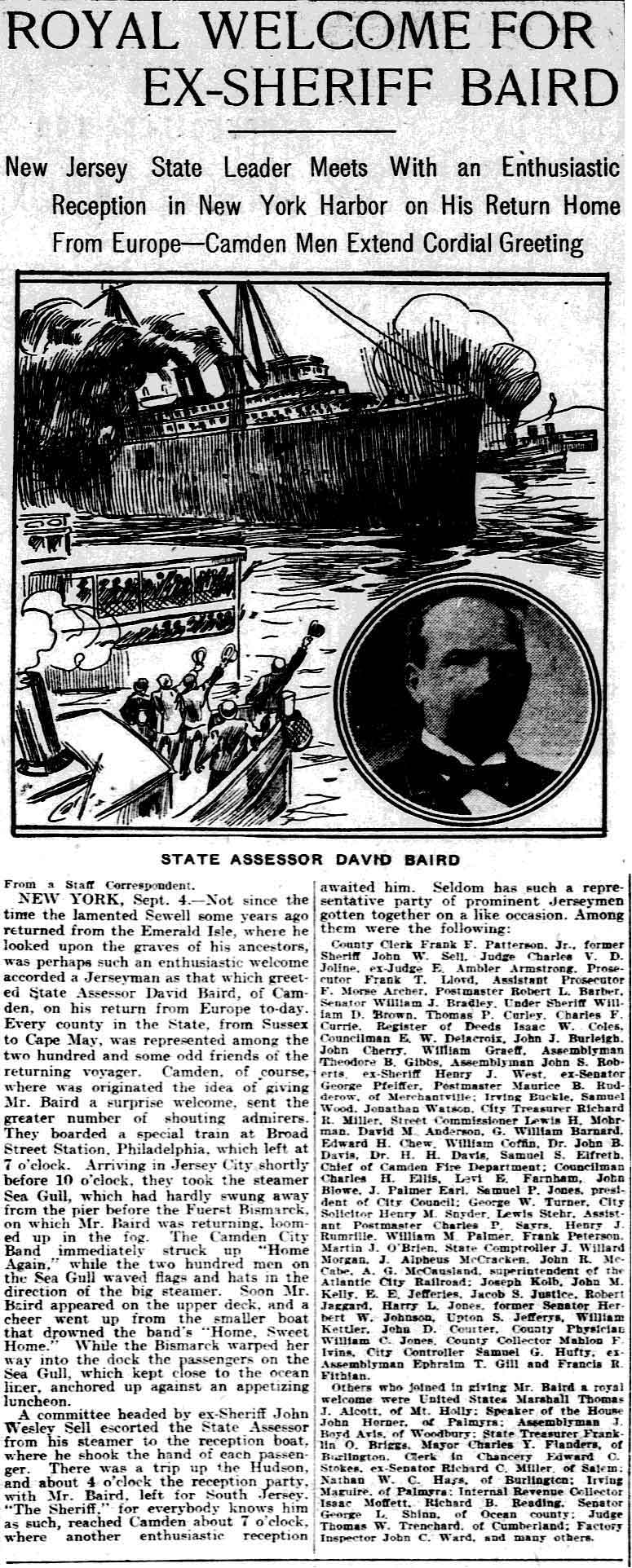
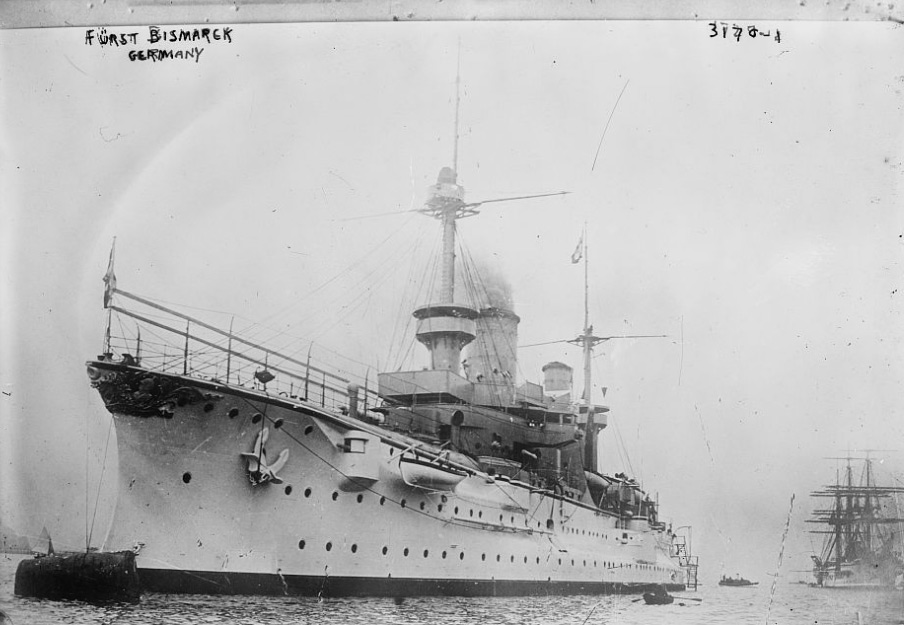
Named: David Baird Sr., J. Wesley Sell, Frank F. Patterson Jr., Charles V.D. Joline, E. Ambler Armstrong, Frank T. Lloyd, F. Morse Archer, Robert L. Barber, William J. Bradley, William D. Brown, Thomas P. Curley, Charles F. Currie, Isaac W. Coles, E.W. Delacroix, John J. Burleigh, John Cherry, William Graeff, Theodore Gibbs, John S. Roberts, Henry J. West, George Pfeiffer Jr., Irving Buckle, Samuel Wood, Jonathan Watson, Maurice Redrow, Richard R. Miller, Lewis H. Mohrman, David M. Anderson, G. William Harned, Edward H. Chew, William Coffin, Dr. John B. Davis, Dr. Henry H. Davis, Samuel S. Elfreth, Charles H. Ellis, Levi Farnham, John Blowe, J. Palmer Earl, Samuel P. Jones, George W. Turner, Henry M. Snyder, Lewis Stehr Sr., Charles P. Sayrs, Henry J. Rumrille, William M. Palmer, Frank Peterson, Martin J. O’Brien, J. Willard Morgan, J. Alpheus McCracken, John R. McCabe, A.G. McCausland, Joseph Kolb, John M. Kelly, E.E. Jefferies, Jacob S. Justice, Robert Jaggard, Harry L. Jones, Upton S. Jefferys, William Kettler, John D. Courter, Dr. William S. Jones, Mahlon F. Ivins Sr., Samuel G. Hufty, Ephraim T. Gill, and Francis Fithian.
Clerk Patterson on Second Term
Philadelphia Inquirer —
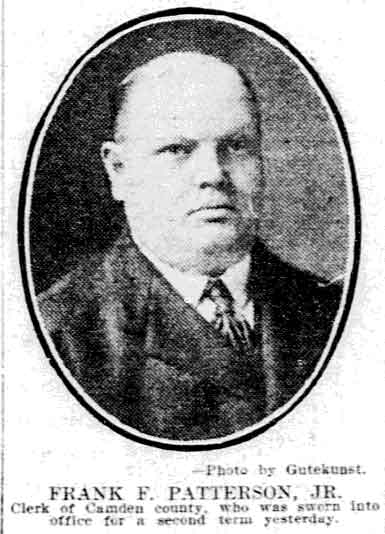
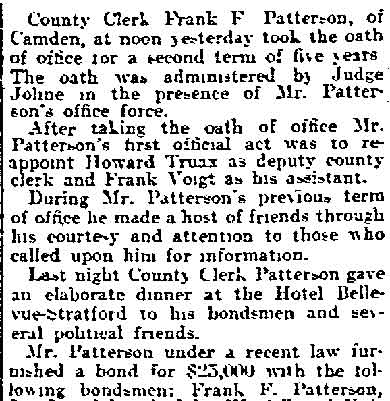
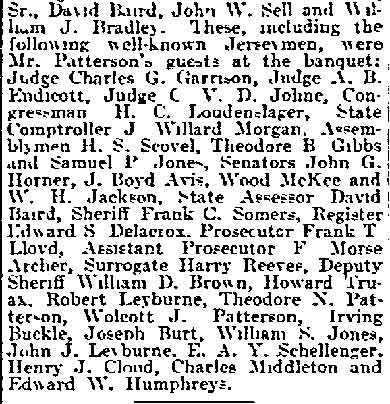
Named: Frank F. Patterson Jr., Edward Van Dyke Joline, Howard Truax, Frank Voight, David Baird Sr., J. Wesley Sell, William J. Bradley, Charles G. Garrison, A.B. Endicott, Harry C. Loudenslager, J. Willard Morgan, Henry S. Scovel, Theodore Gibbs, Samuel P. Jones, John G. Horner, J. Boyd Avis, Wood McKee, W.H. Jackson, Frank Somers, Frank T. Lloyd, Edward S. Delacroix, F. Morse Archer, Harry Reeves, William D. Brown, Robert Leyburne, Theodore N. Patterson, Wolcott J. Patterson, Irving Buckle, Joseph Burt, Dr. William S. Jones, Dr. E.A.Y. Schellenger, Henry J. Cloud, Charles Middleton, and Edward W. Humphreys.
More in the Net of Bar Committee
Philadelphia Inquirer —
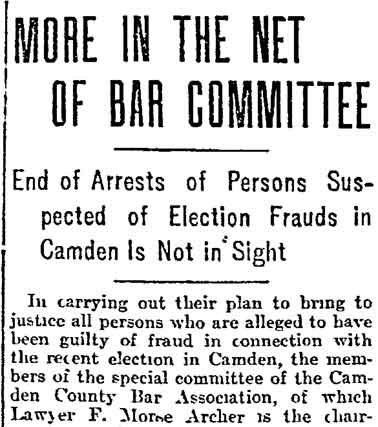
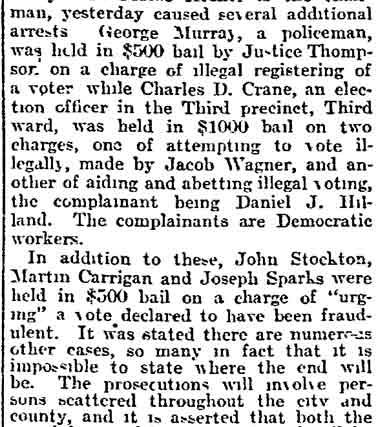
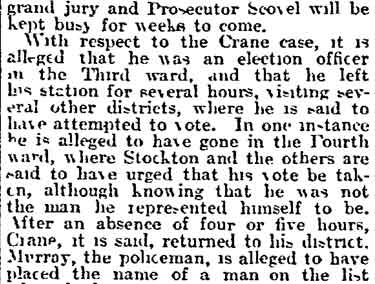
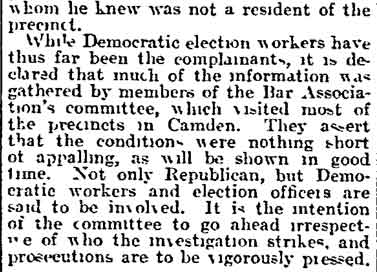
Named: F. Morse Archer, George V. Murry, Martin Carrigan, Joseph Sparks, John Stockton, Charles D. Crane, Joseph Wagner, and Daniel J. Hilland.
Nurses Receive Diplomas
Philadelphia Inquirer —
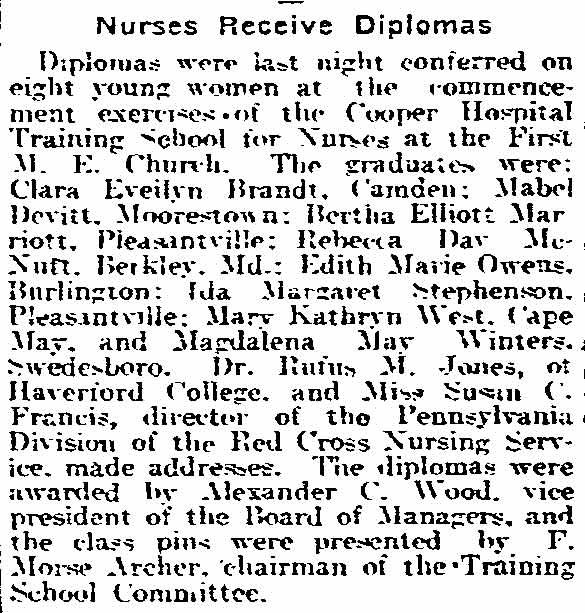
Named: Cooper Hospital, First Methodist Episcopal Church, F. Morse Archer, Clara E. Brandt, Mabel Devitt, Bertha E. Marriott, Rebecca Day McNutt, Edith M. Owens, Ida Stephenson, Mary Katherine West, Magdalena May Winters, Dr. Rufus M. Jones, Susan C. Francis, and Alexander C. Wood.
War Work Director Named
Philadelphia Inquirer —
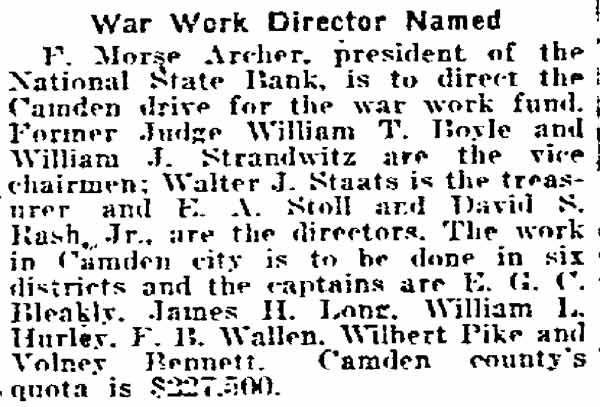
F. Morse Archer, president of the National State Bank, is to direct the Camden drive for the war work fund. Former Judge William T. Boyle and William J. Strandwitz are the vice chairmen; Walter J. Staats is the treasurer and E. A. Stoll and David S. Rush, Jr., are the directors. The work in Camden city is to be done in six districts and the captains are E. G. C. Bleakly, James H. Long, William L. Hurley, F. B. Wallen, Wilbert Pike and Volney Bennett. Camden county’s quota is $227,500.
The F. Morse Archer House, Haddonfield NJ, 1926
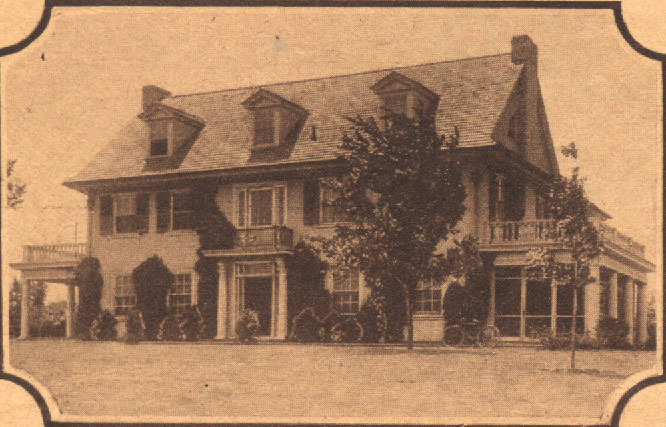
The F. Morse Archer House in Haddonfield NJ, 1926 — Built by the James W. Draper Co.
Choral Group of Organ Club Has New Name
Camden Courier-Post —
Singers Form Musical Art Society According to Plans Made at Founding
The Choral Association of the Camden Chapter, National Association of Organists, has become a separate organization. From now on it will be known as the Musical Art Society
The group, at its start here, was sponsored by the Camden Chapter with an aim to establish it as a separate group as soon as a successful working basis was reached.
Patronage has been forthcoming which has assured the society of a place in the musical activities of the community. The plan is to develop a sound choral group, capable of producing serious choral works in artistic manner.
The society’s membership list is still open. Voices, both male and female, are needed. Singers with ability at reading are especially urged to make themselves known. Applications, under the new society’s plan, should be sent to Edna M. Llewellyn, Fourth Avenue and Kings Highway, Haddon Heights.
Rehearsal will continue at the First Baptist Church here on the first, second and third Mondays of every month.
Present patrons are Wilfred W. Fry, Mrs. Fry, Charles K. Haddon, Mrs. Walter J. Staats, Hon. E.G.C. Bleakly, Mrs. Elwood A. Harrar, Mrs. F. Morse Archer, A. Wilbur Nash, Dr. Edward M. Sullivan, J. Walter Levering, Dr. Joseph E. Roberts, William G. Moore, Mrs. Mary L. Neer, Mrs. J. Harry Knerr, Mrs. Ada M. Eckenhoff, Mrs. Charles A. Reynolds, and Joseph D. Brisby.
The former choral association will retain its officers under the new title of the Musical Art Society, with the exception of the post of secretary. Miss Llewellyn will replace Walter M. Smith temporarily.
The officers are: Henry S. Fry, director; Miss Llewellyn, treasurer; Ada M. Eckenhoff, librarian; Robert M. Haley, president; Marion V. Taylor, Evelyn Lawrence, Stanley Nelson, Harry W. Schwartz, Marjorie Riggins Seybold, F. Marie Wesbroom-Dager and Howard S. Tussey, executive board.
The society will present at least two public concerts in the spring, one in April at the North Baptist Church and the spring concert, which has been tentatively scheduled for May and will probably take place in the First Baptist Church.
Moran Appointed to Traffic Board
Camden Courier-Post —
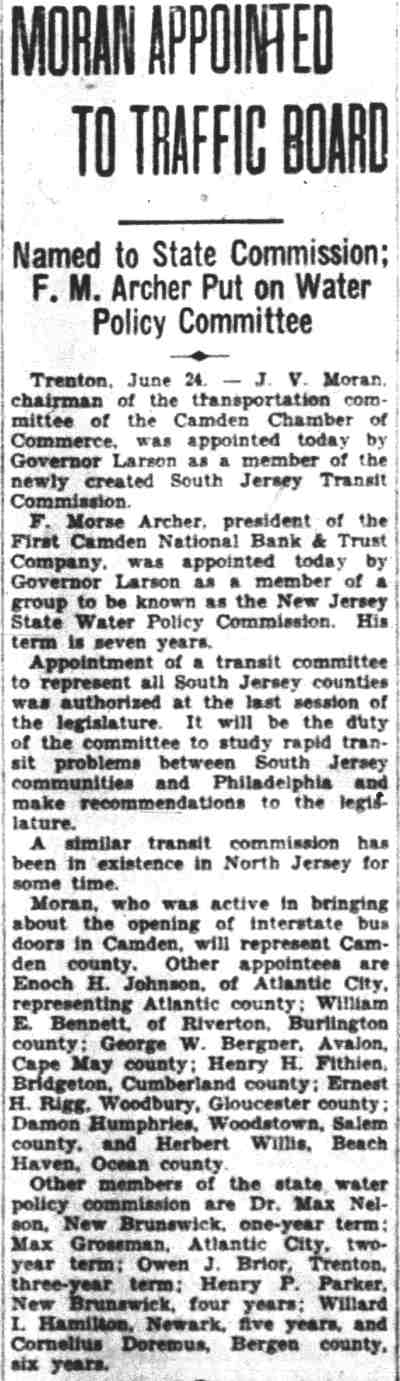
Named: James V. Moran, F. Morse Archer, and Enoch “Nucky” Johnson.
47 More Men Join League to Aid Baird
Camden Courier-Post —
Professional and Business Leaders Back Camden Man for Governor
Forty-seven more prominent professional and business men yesterday joined the Baird-for-Governor Business Men’s League and pledged themselves to work actively in interest of David Baird Jr., for governor, and add special impetus to his campaign.
The league was organized this week at an enthusiastic meeting of 18 outstanding Baird supporters in professional and business life at the Camden Club, 315 Cooper Street. The league membership is open only to business, professional and industrial leaders who are not holding public office and who are not politicians.
The latest enrollments among community leaders pledging themselves to devote themselves to the Baird cause are the following:
F. Morse Archer, president of the First Camden National Bank; Clinton. L. Bardo, president of the New York Shipbuilding Company and of the New Jersey Taxpayers’ Association; George C. Baker, of the BakerFlick Company; Watson Shallcross, president of the Camden County Chamber of Commerce; Howard J. Dudley, Broadway merchant; Thomas E. French, prominent attorney; J. David Stern, publisher of the Courier-Post newspapers and of the Philadelphia Record; Wellington K. Barto, of the West Jersey Trust Company; Dr. Joseph Roberts, Cooper Hospital; William Clement, of the Clement Coverall Paint Company; Robert Wright, of the Haddonfield National Bank; Arthur J. Podmore, of the Camden Pottery Company; Nathan Leopold, Haddonfield druggist; Dr. J. Edgar Howard, of Haddonfield.
Dr. Alfred N. Elwell, of this city; Edward Preisendanz, Clarence Peters, N. Franks, of Franks & Sweeney; U. G. Peters, Ralph D. Baker, prominent real estate man; Archibald Dingo, George Bachman, Sr., and George Bachman, Jr., Dr. O. W. Saunders, Henry Cooperson, Leon Cooperson, Herman Z. Cutler. Charles Bauman, Harry Rose, George Austermuhl, Walter Gulick, Albert Voeglin, Howard Fearn, John A. Schlorer, Ernest L. Bartelt.
William S. Casselman, George M. Carr, J. Price Myers, Carl R. Evered, former president of the Camden County Real Estate Board; Francis B. Wallen, former president of the Camden County Chamber of Commerce; William H. Alff, Edmund J. Alff, Harry Pelouze, Walter Campbell, Dr. Thomas R. Bunting, Joseph F. Kobus and Henry E. Kobus.
Enrollments, it was announced, may be made through the following committee of the league:
Ludwig A. Kind, Thomas Gordon Coulter, Charles H. Laird, Walter J. Staats, Frank C. Middleton, Jr., Frank J. Hineline, William T. Read, Charles S. Boyer, W. W. Robinson, George R. Pelouze, Paul A. Kind, Dr. Paul A. Mecray, Jerome Hurley, Harry A. Moran, James V. Moran, William J. Strandwitz, former Judge Lewis Starr and Frank C. Norcross.
First Camden National Bank & Trust Co.
Camden Courier-Post —
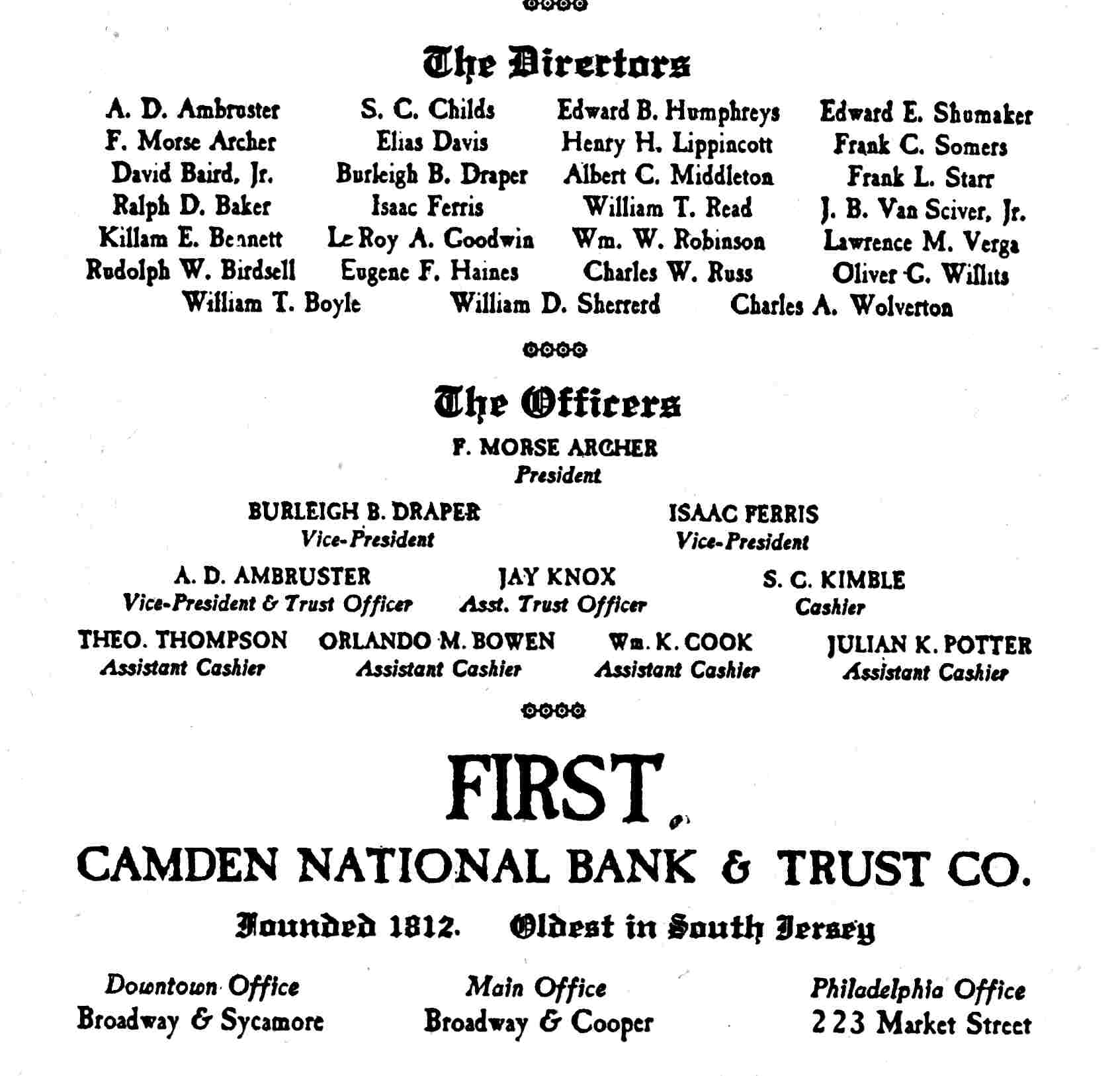
The Directors
A. D. Ambruster S. C. Childs Edward B. Humphreys Edward E. Shumaker F. Morse Archer Elias Davis Henry H. Lippincott Frank C. Somers David Baird, Jr. Burleigh B. Draper Albert C. Middleton Frank L. Starr Ralph D. Baker Isaac Ferris William T. Read J. B. Van Sciver, Jr. Killam E. Bennett Le Roy A. Goodwin Wm. W. Robinson Lawrence M. Verga Rudolph W. Birdsell Eugene F. Haines Charles W. Russ Oliver C. Willits William T. Boyle William D. Sherrerd Charles A. Wolverton
The Officers
F. MORSE ARCHER, President
BURLEIGH B. DRAPER, Vice-President ISAAC FERRIS, Vice-President
A. D. AMBRUSTER, Vice-President & Trust Officer JAY KNOX, Asst. Trust Officer S. C. KIMBLE, Cashier
THEO. THOMPSON, Assistant Cashier ORLANDO M. BOWEN, Assistant Cashier Wm. K. COOK, Assistant Cashier JULIAN K. POTTER, Assistant Cashier
FIRST CAMDEN NATIONAL BANK & TRUST CO.
Founded 1812. Oldest in South Jersey
Downtown Office, Broadway & Sycamore Main Office, Broadway & Cooper Philadelphia Office, 223 Market Street
Last Rites Arranged for W. H. Canning, Jr.
Camden Courier-Post —
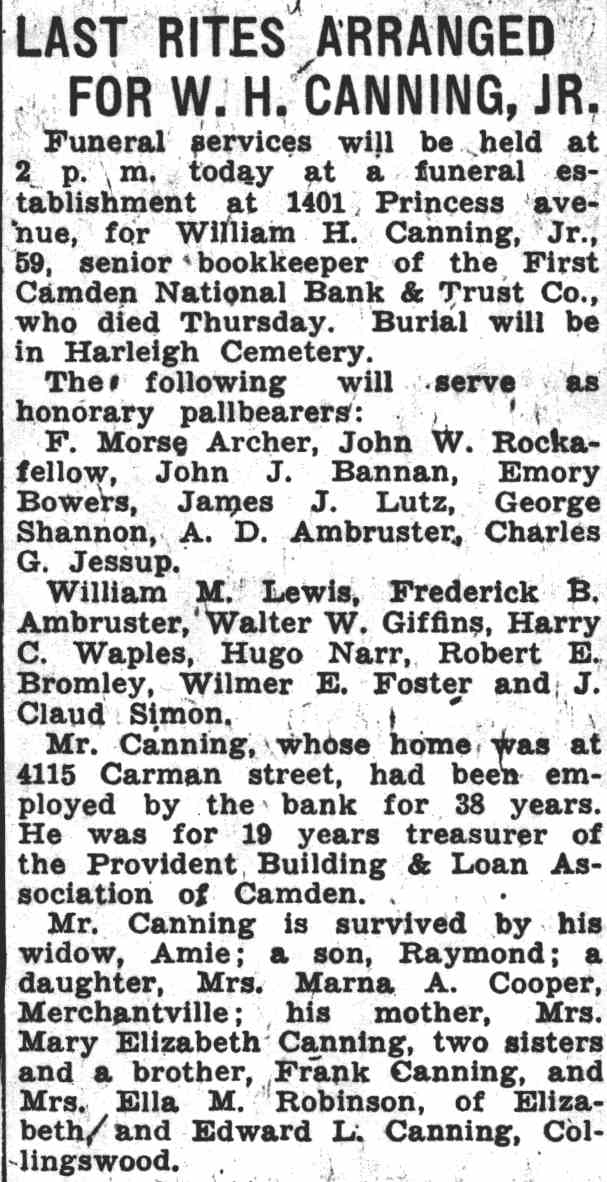
Funeral services will be held at 2 p.m. today at a funeral establishment at 1401 Princess avenue, for William H. Canning, Jr., 59, senior bookkeeper of the First Camden National Bank & Trust Co., who died Thursday. Burial will be in Harleigh Cemetery.
The following will serve as honorary pallbearers:
F. Morse Archer, John W. Rockafellow, John J. Bannan, Emory Bowers, James J. Lutz, George Shannon, A. D. Ambruster, Charles G. Jessup.
William M. Lewis, Frederick B. Ambruster, Walter W. Giffins, Harry C. Waples, Hugo Narr, Robert E. Bromley, Wilmer E. Foster and J. Claud Simon.
Mr. Canning, whose home was at 4115 Carman street, had been employed by the bank for 38 years. He was for 19 years treasurer of the Provident Building & Loan Association of Camden.
Mr. Canning is survived by his widow, Amie; a son, Raymond; a daughter, Mrs. Marna A. Cooper, Merchantville; his mother, Mrs. Mary Elizabeth Canning, two sisters and a brother, Frank Canning, and Mrs. Ella M. Robinson, of Elizabeth, and Edward L. Canning, Collingswood.
F.M. Archer Sr., Camden Banker, Dies in Florida
Camden Courier-Post —
Civic Leader, 76, Was Resident of Haddonfield
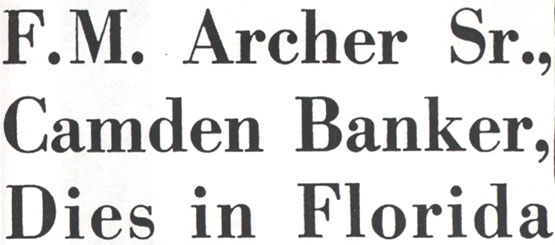
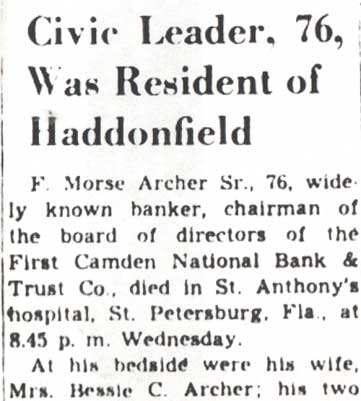
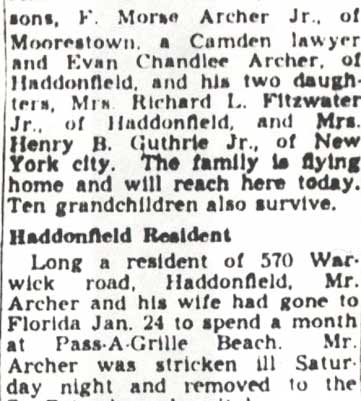
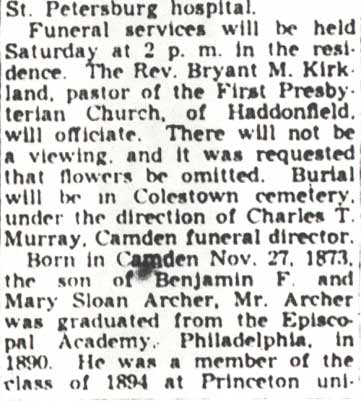
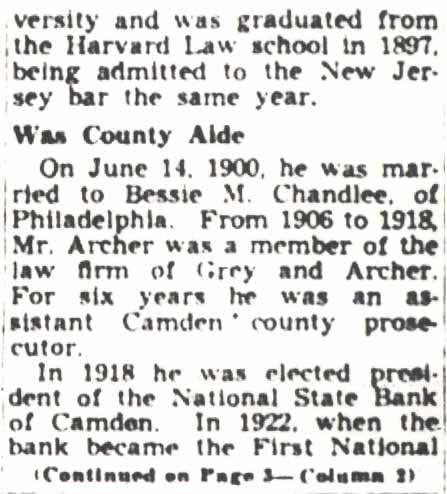
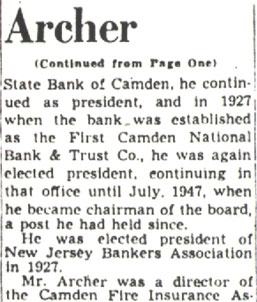
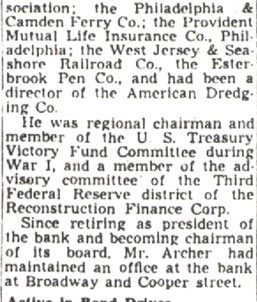
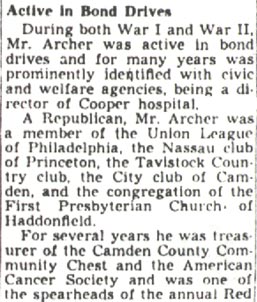
F. Morse Archer Sr., 76, widely known banker, chairman of the board of directors of the First Camden National Bank & Trust Co., died in St. Anthony’s hospital, St. Petersburg, Fla., at 8.45 p. m. Wednesday.
At his bedside were his wife, Mrs. Bessie C. Archer; his two sons, F. Morse Archer Jr., of Moorestown, a Camden lawyer and Evan Chandlee Archer, of Haddonfield, and his two daughters, Mrs. Richard L. Fitzwater Jr., of Haddonfield, and Mrs. Henry B. Guthrie Jr., of New York city. The family is flying home and will reach here today. Ten grandchildren also survive.
Long a resident of 570 Warwick road, Haddonfield, Mr. Archer and his wife had gone to Florida Jan. 24 to spend a month at Pass-A-Grille Beach. Mr. Archer was stricken ill Saturday night and removed to the St. Petersburg hospital.
Funeral services will be held Saturday at 2 p. m. in the residence. The Rev. Bryant M. Kirkland, pastor of the First Presbyterian Church, of Haddonfield, will officiate. There will not be a viewing, and it was requested that flowers be omitted. Burial will be in Colestown cemetery, under the direction of Charles T. Murray, Camden funeral director.
Born in Camden Nov. 27, 1873, the son of Benjamin F. and Mary Sloan Archer, Mr. Archer was graduated from the Episcopal Academy, Philadelphia, in 1890. He was a member of the class of 1894 at Princeton university and was graduated from the Harvard Law school in 1897, being admitted to the New Jersey bar the same year.
On June 14, 1900, he was married to Bessie M. Chandlee, of Philadelphia. From 1906 to 1918, Mr. Archer was a member of the law firm of Grey and Archer. For six years he was an assistant Camden county prosecutor.
In 1918 he was elected president of the National State Bank of Camden. In 1922, when the bank became the First National State Bank of Camden, he continued as president, and in 1927 when the bank was established as the First Camden National Bank & Trust Co., he was again elected president, continuing in that office until July, 1947, when he became chairman of the board, a post he had held since.
He was elected president of New Jersey Bankers Association in 1927.
Mr. Archer was a director of the Camden Fire Insurance Association; the Philadelphia & Camden Ferry Co.; the Provident Mutual Life Insurance Co., Philadelphia; the West Jersey & Seashore Railroad Co., the Esterbrook Pen Co., and had been a director of the American Dredging Co.
He was regional chairman and member of the U. S. Treasury Victory Fund Committee during War I, and a member of the advisory committee of the Third Federal Reserve district of the Reconstruction Finance Corp.
Since retiring as president of the bank and becoming chairman of its board, Mr. Archer had maintained an office at the bank at Broadway and Cooper street.
During both War I and War II, Mr. Archer was active in bond drives and for many years was prominently identified with civic and welfare agencies, being a director of Cooper hospital.
A Republican, Mr. Archer was a member of the Union League of Philadelphia, the Nassau club of Princeton, the Tavistock Country club, the City club of Camden, and the congregation of the First Presbyterian Church of Haddonfield.
For several years he was treasurer of the Camden County Community Chest and the American Cancer Society and was one of the spearheads of the annual Cross rollcall.
Honoring Mr. Archer’s service to both the community and his bank, a testimonial dinner was given Oct. 9, 1947, following his resignation as president of the bank, and his election as board chairman.
Dubbed by his classmates at Princeton as “Mud,” Mr. Archer later won the affectionate title of “chief” from his business associates, and at the testimonial dinner he was lauded this wise:
His sense of humor, his insight into the basic worth in men, his conviction that character heads all assets, and his unpublished moves of kindness and inspiration have been priceless contributions to those who have crossed his path. Our small group is daily favored by the warmth of his presence and friendship.
News of Mr. Archer’s death cast a shadow of sorrow over the bank as it opened today.
Henry Knepper, president of the bank, voiced the feelings of his fellow officers:
The loss of Morse Archer’s guiding influence will be deeply felt, not only by the directors, officers and employes of the bank, but by the whole community which so long knew and loved him for his fairness, justice, wide and self-sacrificing community service and his genuine friendliness.
Other civic and professional leaders of the city were equally affected by news of Mr. Archer’s death. It was agreed by all that Mr. Archer, as a symbol of integrity, had been largely responsible for Camden’s successful weathering of the chaotic days of the business and banking depression of the early 1930s.
It was Morse Archer who rallied the financial support and solidarity which saved Camden from the banking casualties suffered so widely elsewhere in that period.