St. Paul's Episcopal Church
St. Paul’s Episcopal Church was founded in Camden, NJ in 1830. Located at 422 Market Street, it remains in service in 2003.
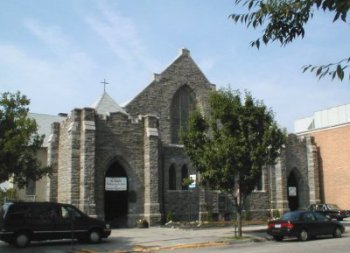
St. Paul’s Episcopal Church, 422 Market Street, Camden, NJ
A History of St. Paul's Episcopal Church to 1886
From 'Religious History of Camden' — George Reeser Prowell's History of Camden County, New Jersey
Compiled from an historical sermon by the Rev. Dr. Garrison, in 1880, the fiftieth anniversary of this parish.
March 12, 1830, a small company of gentlemen met to consult on the advisability of organizing an Episcopal Church in the town of Camden. There had been occasional services of the church held in Camden, in the second story of the building known as the City Hall, at the present site of Federal Street Market, for some time previous, by several clergymen of Philadelphia who had agreed among themselves “to preach” here in turn on Sunday afternoon, “so that it should have, if possible, one service of the church on every Sunday.” In the first report made from the parish after its organization, to the Diocesan Convention, the congregation gave acknowledgments for services to Rt. Rev. Bishop Onderdonk, Rev. Dr. De Lancey, Rev. Messrs. Bedell, Douglass, Mead, Rutlidge, Depuy, Hawks, Boyd, Van Pelt, Alien, Jaquette, Smith and Tyng. After due consultation among those assembled at this preliminary conference, it was “Resolved that the meeting do now institute a Protestant Episcopal Church in the city of Camden, under the name of Zion Church, the name subject to be changed if deemed advisable at the time of incorporation.”
On March 26, 1830, the parish was organized and incorporated under the name and title of “The Rector, Wardens and Vestrymen of St. Paul’s Church, Camden.” The first wardens of the new parish were Josiah Harrison and Isaac Welsh. The vestrymen were Dr. Bowman Hendry, Jeremiah H. Sloan, Richard W. Howell, Gideon V. Stivers, Abraham Browning Sr., Ebenezer Toole, John Browning, Auley McCalla, Dr. Samuel Harris and Morris Croxall. The deputies to ask admission to the convention were Josiah Harrison, Jeremiah H. Sloan and Richard W. Howell.
The first convention after the accession of Bishop Doane to the episcopate, in 1832, was held in Camden, and in the same unpretending “upper room of the City Hall,” which had been used for the services of the young congregation, and in which the meetings for its organization and incorporation had been held. In September, 1833, the Rev. Samuel Starr, of Connecticut, was appointed by Bishop Doane as a missionary to the church in Camden in connection with the old St. Mary’s (Colestown) Parish. The records of the Camden Parish, speaking of this missionary, say: “He was a man of singular energy, and by his exertions in the effort to erect a house of worship in this place, was an enterprise in which the boldness was only equaled by the success.” On February 3, 1884, the vestry, under his energetic influence, took steps toward the building of a church. The parish records state that “The lot marked No. 121 in the Map of Camden, and situated on the south side of Market Street, between Fourth and Fifth, was purchased for three hundred dollars, and the lot adjoining was obtained on a perpetual lease on payment of twenty-five dollars per annum ground-rent; February, 1884.” The corner-stone of the church building was laid by Bishop Doane on Tuesday, April 22, 1834. The venerable Bishop White assisted Bishop Doane in the ceremonies. The basement-room was ready for use and services held in it early in 1835. The entire church was completed the same year.
On June 1, 1835, the Rev. Mr. Starr, who, to this time, had been only a missionary to the parish, was elected to the rectorship, and on the same day the building was consecrated by Bishop Doane and the benediction pronounced by Bishop White. The congregation at the end of the first year had twenty-one communicants, and a Sunday school had been opened with one hundred children in attendance. In May, 1836, the Rev. Mr. Starr resigned, and on July 25th, Rev. Francis P. Lee became the second rector. The two churches of Camden and Colestown were, from the beginning of the former, a single charge. During the two years’ pastorate of Rev. Mr. Lee the number of communicants at St. Paul’s increased to forty-one and the Sunday school was in a prosperous condition. On his resignation, in 1838, Rev. Henry Burroughs was elected, and he entered on the joint charge of the two parishes of Camden and Moorestown on November 20, 1838. He retained this until March 7, 1840, when the church in Moorestown severed its connection with Camden, and Mr. Burroughs was left with the rectorship of St. Paul’s only. On July 9, 1843, he wrote to the vestry, “My constitution is not suited to this part of the country, and I find myself most reluctantly compelled to resign the charge of this parish.”
On August 23, 1843, the Rev. Joseph M. Lybrand was elected to the pastoral charge. Under his earnest labors the congregation grew steadily. The church was constructed of unhewn stone, and in 1846 a resolution was passed “that the unhewn stone of the church be covered with rough casting, after the manner of the State House, in Trenton, and squared, in imitation of stone.”
Among the earliest of the institutions for parish aid in this congregation, and one which did much good in pecuniary assistance to the church, was the “Ladies’ Sewing Society,” which was formed in 1835. The object of this organization was to assist in decreasing the debt of the church and render general aid. In 1836, according to a record, the vestry “thanked the society for a splendid service of communion plate and act of lamps for the pulpit.” The society ceased to exist in 1860. According to its last report, it had raised for the church over seven thousand dollars.
In 1844 the church had seventy-two communicants, and the contributions amounted to three hundred and eighty dollars. In 1847 the number was ninety, and the contributions eight hundred and thirty-eight dollars. Rev. Lybrand had served as rector nearly twelve years; during a large portion of that time he was an invalid, but his zeal and interest in his work did not abate. He died on February 14, 1855. Bishop Doane said: “I have known him long and well. I never knew a better man. He was modest, gentle and quiet, yet firm, fearless and indomitable. He said but little, but always what was wise and good and true. His character was beautiful and his services exemplary.”
The vacancy was filled on July 8, 1855, when it was “Resolved that Rev. Dr. Joseph F. Garrison be invited to become the rector of this parish.” He entered upon his duties in September of that year, having been ordained deacon on June 3, 1855. The church then numbered seventy-five communicants, a number having joined the St. John’s Mission. There were one hundred and fifty children in the Sunday school, and the number of families in the parish was about one hundred. In 1856 the church building, which was then sixty-five by forty-three feet, was enlarged by adding a crucial transverse, seventy by twenty-five feet, with a recess of ten feet behind for the chancel. On January 29, 1859, the church was reopened, Bishop Doane officiating, and the Rev. Dr. Joseph F. Garrison was instituted into the rectorship. The cost of the enlargement and repairs was ten thousand five hundred dollars; all, excepting five hundred dollars, was contributed by the congregation. One of the causes which called for the election of a rector at Chews Landing Mission was the necessity of Dr. Garrison giving some time to the Cooper Street Mission. A Sunday school had been taught there by lay members of the parish. In 1877 ground was bought and a neat Gothic building of brown stone was erected for this mission. In the new building this mission has been increasing under the lay reading of the superintendent, Charles Eldred, and later of Joseph Trimble Jr., Rev. Henry B. Bryand and a committee of lay readers from St. Paul’s Guild.
The history of St. Paul’s Parish as a whole is the record of a quiet growth, marked by no startling changes nor checkered by thrilling incidents. Almost the only thing remarkable about it is the general character of uniformity which has pervaded its modes of work from the beginning. The ministerial changes in St. Paul’s Parish have been few. It has had but five ministers in fifty years, and thirty-seven of these years are covered by the rectorship of Revs. Joseph M. Lybrand and Joseph F. Garrison.
The following summary from the parish register shows the most important changes from 1830 to 1880:
Church Wardens, Isaac Welsh and Josiah Harrison (1830), Thomas Chapman (1841), Richard W. Howell (1843), Edward W. Mumford (1845), Dr. O. H. Taylor (1847), Thomas P. Carpenter (1860), Philip J. Grey (1870), Alden O. Scovel (1875), Abraham Browning (1876), Marmaduke B. Taylor (1882).
Baptisms: From 1830 to 1855, 265; from 1855 to 1880, 562 — total, 825.
Confirmations: From 1830 to 1855, 168; from 1855 to 1880, 372 — total, 530. Marriages: From 1830 to 1855, 82; from 1855 to 1882, 202 — total, 284.
Funerals: From 1830 to 1855, 139; from 1855 to 1880, 294 — total, 431.
Communicants admitted: From 1830 to 1855, 321; from 1855 to 1880, 720 — total, 1041. Present number of communicants on the register, 375.
Total number of scholars in Sunday school, 450.
Total number of officers and teachers in same, 45.
The rectorship of Rev. Dr. Garrison continued until the end of August, 1884. He was elected in June of that year to the “Morehead Professorship of Liturgies, Canon Law, and Ecclesiastical Polity in the Divinity School in Philadelphia,” and having accepted the position, resigned the parish to enter on its duties in the September following.
In December of this same year Rev. Thomas A. Tidball, D.D., of Lexington, Ky., was elected as his successor, and on January 11, 1885, entered on his duties as the sixth rector of the parish.
On the accession of Dr. Tidball to the rectorship, a vigorous move was made to improve or increase the church property, which move resulted in the vestry authorizing (on July 22, 1885) the erection of parish buildings in the rear of the church, costing about ten thousand dollars, and the rebuilding of the church, at a cost of five thousand dollars, fitted with memorial furniture costing one thousand dollars. Since then the church building has been re-roofed and improved at an expense of above six or eight thousand dollars. This parish not only keeps up its missionary charge of the chapel at Twelfth and Cooper Streets, but is carrying on a vigorous mission at Cramer’s Hill, in the neighborhood of the city.
The officers of the parish for 1886 are: Rector, Rev. Thomas A. Tidball, D.D.; Wardens, Abraham Browning, Esq., Marmaduke B. Taylor; Vestrymen, Maurice Browning, William E. Lafferty, Samuel H. Grey, Edward R. Shubrick, Joseph Fearon, William Joyce Sewell, Dr. Henry Genet Taylor, James H. Carpenter, Henry C. Alexander, Robert F. S. Heath, Wilson H. Jenkins, Nathan F. Cowan, Harry Humphreys, Edward H. King; Treasurer, William E. Lafferty; Secretary, James H. Carpenter.
See also: Religious History of Camden — George Reeser Prowell’s History of Camden County, New Jersey, 1886.
St. Paul's Episcopal Church — Officers Elected
Philadelphia Inquirer —
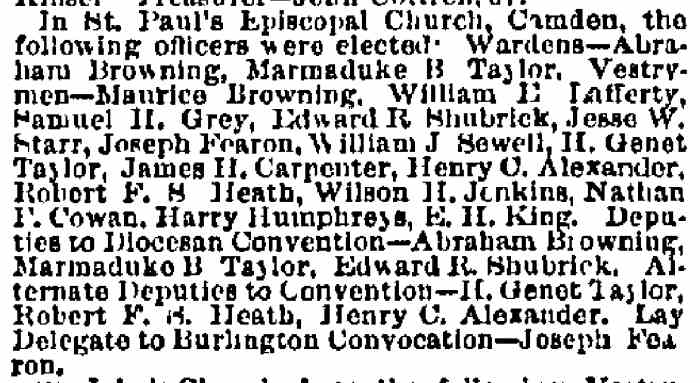
In St. Paul’s Episcopal Church, Camden, the following officers were elected: Wardens — Abraham Browning, Marmaduke B. Taylor. Vestrymen — Maurice Browning, William E. Lafferty, Samuel H. Grey, Edward R. Shubrick, Jesse W. Starr, Joseph Fearon, William Joyce Sewell, H. Genet Taylor, James H. Carpenter, Wilson H. Jenkins, Nathan F. Cowan, Harry Humphreys, E. H. King.
Deputies to Diocesan Convention — Abraham Browning, Marmaduke B. Taylor, Edward R. Shubrick. Alternate Deputies to Convention — H. Genet Taylor, Robert F. S. Heath, Henry C. Alexander. Lay Delegate to Burlington Convocation — Joseph Fearon.
David Griffiths Taken by Death
Camden Courier or Camden Post-Telegram —
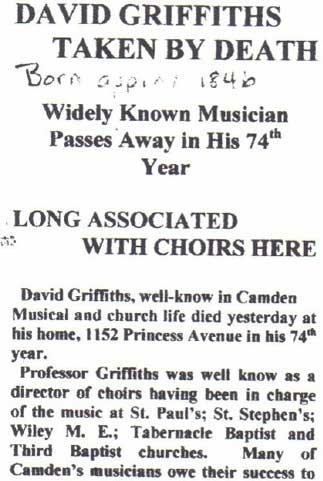
David Griffiths, well-know [sic] in Camden musical and church life died yesterday at his home, 1152 Princess Avenue in his 74th year.
Professor Griffiths was well know [sic] as a director of choirs having been in charge of the music at St. Paul’s; St. Stephen’s; Wiley M. E.; Tabernacle Baptist and Third Baptist churches. Many of Camden’s musicians owe their success to his careful teaching. He has taught music in Camden since 1890. He came to America in 1888, from England, where he graduated from the Wednesbury Conservatory of Music.
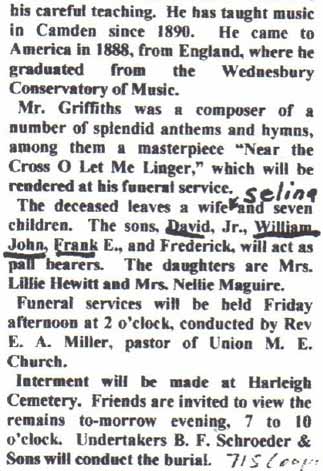
Mr. Griffiths was a composer of a number of splendid anthems and hymns, among them a masterpiece “Near the Cross O Let Me Linger,” which will be rendered at his funeral service.
The deceased leaves a wife and seven children. The sons, David, Jr., William, John, Frank E., and Frederick, will act as pall bearers. The daughters are Mrs. Lillie Hewitt and Mrs. Nellie Maguire. Funeral services will be held Friday afternoon at 2 o’clock, conducted by Rev E. A. Miller, pastor of Union M. E. Church. Interment will be made at Harleigh Cemetery. Friends are invited to view the remains to-morrow evening, 7 to 10 o’clock. Undertakers B. F. Schroeder & Sons will conduct the burial.
St. Paul's Church Guild Plans Strawberry Fete
Camden Courier-Post —
St. Lydia’s Guild of St. Paul’s Episcopal Church, Market above Fourth Street, will hold a strawberry festival tomorrow night in the parish house.
Dancing will be held from 8.30 until 10.30 o’clock in the parish house and there will be booths for the sale of cakes, peanuts, flowers, balloons and surprise packages.
Miss Elsie Garrison is general chairman of the committee in charge. Mrs. Lincoln Zane, Miss Elizabeth Rigby and Miss Mary Cathell will have charge of dancing; Miss Inez Garrison, Miss May Ayres and Miss Hannah Panser, ice cream; Mrs. Joseph Blizzard, Miss Margaret Browning, balloons; Miss Jeanette Blaxland, Miss Margaret Herring, Miss Anna McKeon, peanuts; Miss Mildred Birkby, Miss Martha Rockwell, Miss Rachel Clancey, Miss Sue White, cakes; and Miss Dorothy Evens, Miss Hattie Darnell and Miss Margaret Cathell, flowers.
Aides will be Miss Anna McKeown, Miss Reba Taylor, Miss Helen Spencer, Miss Leona Thompson, Miss Edna Allen, Miss Theodosia Wilson and Miss Ethel Freeman.
St. Paul's Episcopal To Mark 120th Year
Camden Courier-Post —
Also Will Celebrate 10th Year Under Present Rector
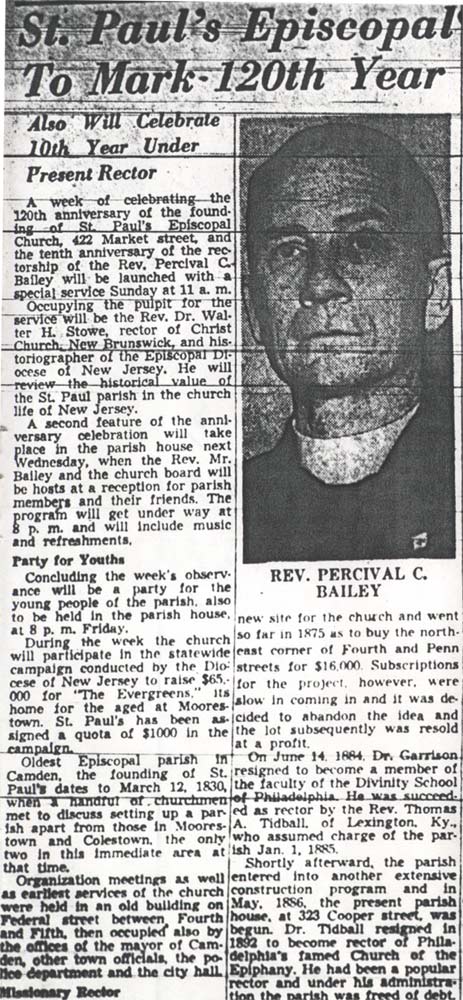
A week of celebrating the 120th anniversary of the founding of St. Paul’s Episcopal Church, 422 Market street, and the tenth year of the rectorship of the Rev. Percival C. Bailey will be observed with a special service Sunday at 11 a. m. Preaching at the service will be the Rev. Dr. Walter H. Gray of Christ Church, New Brunswick.
A second feature of the anniversary celebration will take place on Wednesday night. The Rev. Mr. Bailey and the church board will be hosts at a reception for parish members and their friends. Concluding the week’s observance will be a party for the young people of the parish on Friday evening.
During the week, the church will participate in the statewide campaign to raise funds for the American Church Home for the aged at Moorestown. The St. Paul parish has signed a quota of $1000 in this campaign.
Oldest Episcopal parish — St. Paul’s dates to March 12, 1830. Organization meetings as well as the first services of the parish were held in an old building on Market Street, between Fourth and Fifth, then occupied also by the borough authorities, wardens, other town officials, the police department, and the fire hall.
Vested Choir Formed
On June 14, 1884, Dr. Garrison resigned to become a member of the faculty of the Divinity School of Philadelphia. He was succeeded by the Rev. Thomas A. Tidball, of Lexington, Ky., who assumed charge of the parish Jan. 1, 1885. Shortly afterwards, the parish entered into another extensive construction program. The vested choir was introduced under a later rector around 1900.
Rev. Bailey Accepts Call
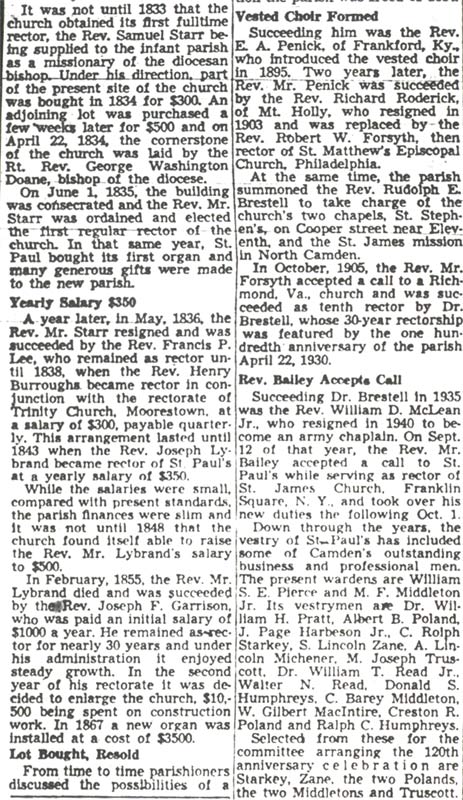
Succeeding Dr. Brestel in 1935 was the Rev. Percival C. Bailey, Jr., who resigned in 1946 to become Executive Secretary of the Church Army. Shortly after, the Rev. Thomas H. Holloway became the new rector of St. Paul’s. Selected for the 120th anniversary celebration committee are: Major J. S. E. Pierce and M. F. Middleton, Jr., co-chairmen; John H. Pratt, Albert B. Penn, Robin Michener, M. Joseph Truscott, Jr., Walter N. Read, Donald S. Middleton, Ralph N. Read, W. Gilbert MacIntire, Samuel Read, and John Read.