Introduction
THOMAS J. CUNNINGHAM was born in 1863 to Thomas and Elizabeth Cunningham. The family first appears in Camden City Directories in 1876, living at 1027 Kaighn’s Point Avenue, known in later years simply as Kaighn Avenue. The following year’s Directory has the family at 1023 Kaighn’s Point Avenue. The elder Cunningham’s occupation was given as laborer in 1876 and farmer in 1877; in all likelihood he worked as a hired hand on one of the many farms in the immediate area. Sadly, he died before the compilation of the 1878 City Directory, leaving Elizabeth Cunningham a widow, Thomas and his siblings Mary, James, and Annie fatherless. The family was able to remain at 1023 Kaighn’s Point Avenue and stayed at that house until 1893, the street having long since been renamed. The 1894 City Directory shows the Cunningham family at 1114 Kaighn Avenue, a home that they occupied for the next 80 years. The 1900 Census shows Thomas Cunningham living at that address with his brother James Cunningham, sisters Mary Cunningham and Mrs. Annie Marshall, and nephews Herbert and Louis Marshall.
Thomas J. Cunningham became active in local politics as a Democrat in the 1880s. He was appointed to the Camden Police Department in 1899 by Mayor Cooper B. Hatch. He had been working as a crane runner and as a laborer in the years leading up to his appointment.
Thomas J. Cunningham found his career as a policeman. He was promoted to Sergeant in 1914, and to Lieutenant in 1930, and had been leading the old Fourth Police District when he retired on pension on December 31, 1930.
Thomas J. Cunningham never married. He died at the age of 76 on May 20, 1938. Members of the family continued living at 1114 Kaighn Avenue until 1974, when nephew Louis Marshall passed away.
Mayor Will Be Chief
Camden Post —
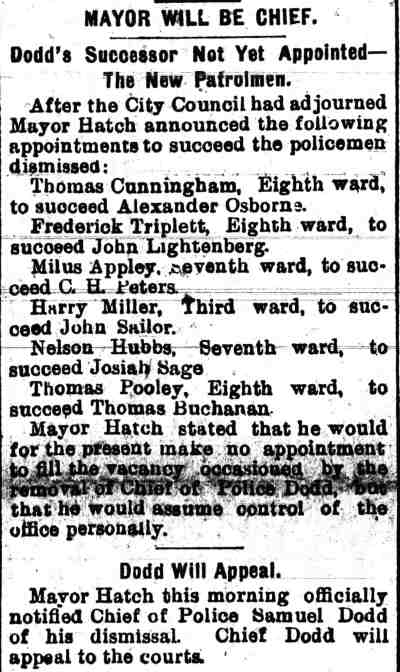
Dodd’s Successor Not Yet Appointed—The New Patrolmen.
After the City Council had adjourned Mayor Hatch announced the following appointments to succeed the policemen dismissed:
Thomas Cunningham, Eighth ward, to succeed Alexander Osborne.
Frederick Triplett, Eighth ward, to succeed John Lightenberg.
Milus Appley, Seventh ward, to succeed C. H. Peters.
Harry Miller, Third ward, to succeed John Sailor.
Nelson Hubbs, Seventh ward, to succeed Josiah Sage
Thomas Pooley, Eighth ward, to succeed Thomas Buchanan.
Mayor Hatch stated that he would for the present make no appointment to fill the vacancy occasioned by the removal of Chief of Police Dodd, but that he would assume control of the office personally.
Dodd Will Appeal.
Mayor Hatch this morning officially notified Chief of Police Samuel Dodd of his dismissal. Chief Dodd will appeal to the courts.
Reformers Lop Off Chief Dodd’s Head
Philadelphia Inquirer —
Six Republican Policemen Also Removed and Reformers Take Their Places
ADOPT ANNUAL BUDGET
Slight Reduction in Appropriations—Water Compromise Ratified by Council
Camden City Council last evening fixed the annual appropriations at $516,160, ratified the compromise with Contractor Pfeiffer by which pure water will be turned on to-morrow and dismissed Chief of Police Dodd and six Republican policemen. The appropriations as compared with last year are as follows:
| 1897. | 1898. | |
|---|---|---|
| Police . . . | $60,000 | $68,000 |
| Lighting . . . | 71,000 | 72,000 |
| Salaries . . . | 35,000 | 38,964 |
| Streets . . . | 42,000 | 38,000 |
| Culverts . . . | 12,000 | 12,000 |
| Water . . . | 56,000 | 60,000 |
| Liquidating Indebtedness . . . | 25,000 | 12,500 |
| Excise . . . | 2,500 | 2,500 |
| Dispensaries . . . | 4,000 | 4,000 |
| Parks . . . | 1,400 | 4,000 |
| Interest . . . | 115,000 | 105,946 |
| Building Commission . . . | 100 | 50 |
| Fire . . . | 47,000 | 44,000 |
| Property . . . | 8,000 | 6,500 |
| Elections . . . | 8,000 | 6,000 |
| District Court . . . | 4,000 | 4,000 |
| Printing . . . | 7,000 | 7,500 |
| Contingent . . . | 6,600 | 3,500 |
| Board of Health . . . | 4,000 | 3,500 |
| Poor . . . | 2,000 | 2,000 |
| G. A. R. . . . | 200 | 200 |
| Park Special Bonds . . . | 3,000 | |
| Sinking Fund . . . | 10,000 | 21,000 |
| Deficiency . . . | 10,000 | |
| Total . . . | $533,700 | $516,160 |
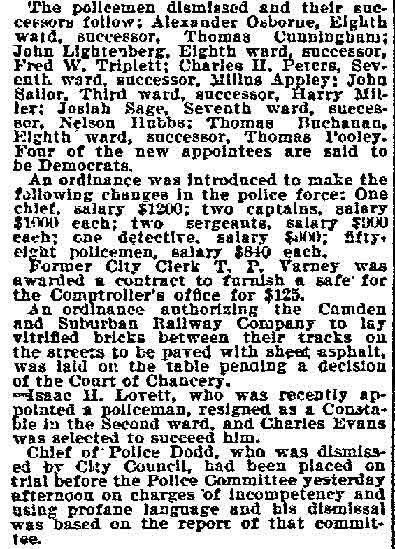
The policemen dismissed and their successors follow: Alexander Osborne, Eighth ward, successor, Thomas Cunningham; John Lightenberg, Eighth ward, successor, Fred W. Triplett; Charles H. Peters, Seventh ward, successor, Milins Appley; John Sailor, Third ward, successor, Harry Miller; Josiah Sage, Seventh ward, successor, Nelson Hubbs; Thomas Buchanan, Eighth ward, successor, Thomas Pooley. Four of the new appointees are said to be Democrats.
An ordinance was introduced to make the following changes in the police force: One chief, salary $1200; two captains, salary $1[?]00 each; two sergeants, salary $900 each; one detective, salary $[?]00; fifty-eight policemen, salary $840 each.
Former City Clerk T. P. Varney was awarded a contract to furnish a safe for the Comptroller’s office for $125.
An ordinance authorizing the Camden and Suburban Railway Company to lay vitrified bricks between their tracks on the streets to be paved with sheet asphalt, was laid on the table pending a decision of the Court of Chancery.
Isaac H. Lovett, who was recently appointed a policeman, resigned as a Constable in the Second ward, and Charles Evans was selected to succeed him.
Chief of Police Dodd, who was dismissed by City Council, had been placed on trial before the Police Committee yesterday afternoon on charges of incompetency and using profane language and his dismissal was based on the report of that committee.
Camden Policemen Raid a Sunday Liquor Seller
Philadelphia Inquirer —
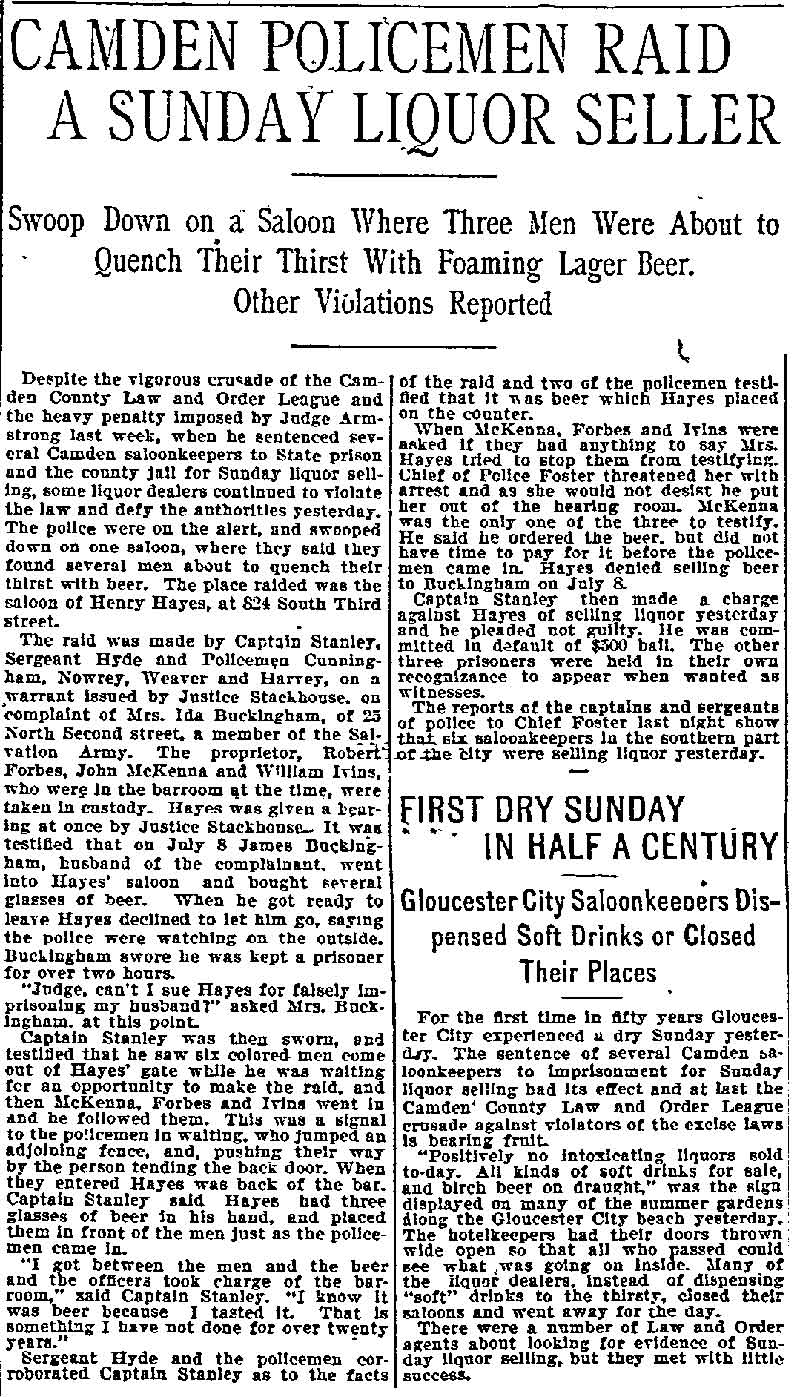
Swoop Down on a Saloon Where Three Men Were About to Quench Their Thirst With Foaming Lager Beer. Other Violations Reported
Despite the vigorous crusade of the Camden County Law and Order League and the heavy penalty imposed by Judge Armstrong last week, when he sentenced several Camden saloonkeepers to State prison and the county jail for Sunday liquor selling, some liquor dealers continued to violate the law and defy the authorities yesterday. The police were on the alert, and swooped down on one saloon, where they said they found several men about to quench their thirst with beer. The place raided was the saloon of Henry Hayes, at 824 South Third street.
The raid was made by Captain Stanley, Sergeant Hyde and Policemen Cunningham, Nowrey, Weaver and Harvey, on a warrant issued by Justice Stackhouse, on complaint of Mrs. Ida Buckingham, of 25 North Second street, a member of the Salvation Army. The proprietor, Robert Forbes, John McKenna and William Ivins, who were in the barroom at the time, were taken in custody. Hayes was given a hearing at once by Justice Stackhouse. It was testified that on July 8 James Buckingham, husband of the complainant, went into Hayes’ saloon and bought several glasses of beer. When he got ready to leave Hayes declined to let him go, saying the police were watching on the outside. Buckingham swore he was kept a prisoner for over two hours.
“Judge, can’t I sue Hayes for falsely imprisoning my husband?” asked Mrs. Buckingham, at this point.
Captain Stanley was then sworn, and testified that he saw six colored men come out of Hayes’ gate while he was waiting for an opportunity to make the raid, and then McKenna, Forbes and Ivins went in and he followed them. This was a signal to the policemen in waiting, who jumped an adjoining fence, and, pushing their way by the person tending the back door. When they entered Hayes was back of the bar. Captain Stanley said Hayes had three glasses of beer in his hand, and placed them in front of the men just as the policemen came in.
“I got between the men and the beer and the officers took charge of the barroom,” said Captain Stanley. “I know it was beer because I tasted it. That is something I have not done for over twenty years.”
Sergeant Hyde and the policemen corroborated Captain Stanley as to the facts of the raid and two of the policemen testified that it was beer which Hayes placed on the counter.
When McKenna, Forbes and Ivins were asked if they had anything to say Mrs. Hayes tried to stop them from testifying. Chief of Police Foster threatened her with arrest and as she would not desist he put her out of the hearing room. McKenna was the only one of the three to testify. He said he ordered the beer, but did not have time to pay for it before the policemen came in. Hayes denied selling beer to Buckingham on July 8.
Captain Stanley then made a charge against Hayes of selling liquor yesterday and he pleaded not guilty. He was committed in default of $500 bail. The other three prisoners were held in their own recognizance to appear when wanted as witnesses.
The reports of the captains and sergeants of police to Chief Foster last night show that six saloonkeepers in the southern part of the city were selling liquor yesterday.
First Dry Sunday in Half a Century
Gloucester City Saloonkeepers Dispensed Soft Drinks or Closed Their Places
For the first time in fifty years Gloucester City experienced a dry Sunday yesterday. The sentence of several Camden saloonkeepers to imprisonment for Sunday liquor selling had its effect and at last the Camden County Law and Order League crusade against violators of the excise laws is bearing fruit.
“Positively no intoxicating liquors sold to-day. All kinds of soft drinks for sale, and birch beer on draught,” was the sign displayed on many of the summer gardens along the Gloucester City beach yesterday. The hotelkeepers had their doors thrown wide open so that all who passed could see what was going on inside. Many of the liquor dealers, instead of dispensing “soft” drinks to the thirsty, closed their saloons and went away for the day.
There were a number of Law and Order agents about looking for evidence of Sunday liquor selling, but they met with little success.
Camden News Notes
Philadelphia Inquirer —
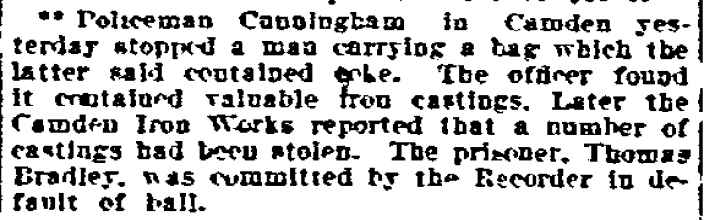
•• Policeman Cunningham in Camden yesterday stopped a man carrying a bag which the latter said contained coke. The officer found it contained valuable iron castings. Later the Camden Iron Works reported that a number of castings had been stolen. The prisoner, Thomas Bradley, was committed by the Recorder in default of bail.
Former Dog Catcher Said to Be Insane
Camden Post-Telegram —
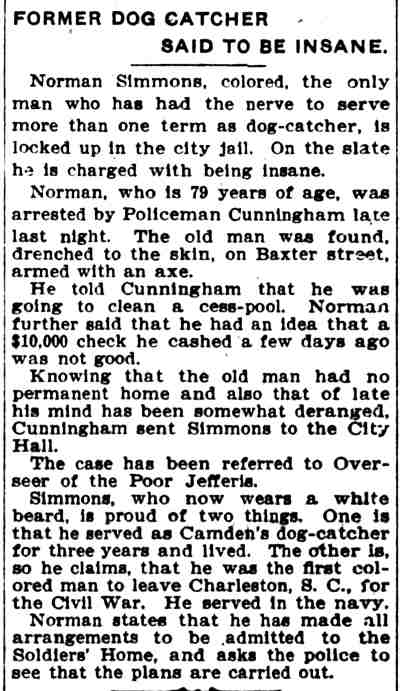
Norman Simmons, colored, the only man who has had the nerve to serve more than one term as dog-catcher, is locked up in the city jail. On the slate he is charged with being insane.
Norman, who is 79 years of age, was arrested by Policeman Cunningham late last night. The old man was found, drenched to the skin, on Baxter street, armed with an axe.
He told Cunningham that he was going to clean a cess-pool. Norman further said that he had an idea that a $10,000 check he cashed a few days ago was not good.
Knowing that the old man had no permanent home and also that of late his mind has been somewhat deranged, Cunningham sent Simmons to the City Hall.
The case has been referred to Overseer of the Poor Jefferis.
Simmons, who now wears a white beard, is proud of two things. One is that he served as Camden’s dog-catcher for three years and lived. The other is, so he claims, that he was the first colored man to leave Charleston, S. C., for the Civil War. He served in the navy.
Norman states that he has made all arrangements to be admitted to the Soldiers’ Home, and asks the police to see that the plans are carried out.
Camden News Notes
Philadelphia Inquirer —
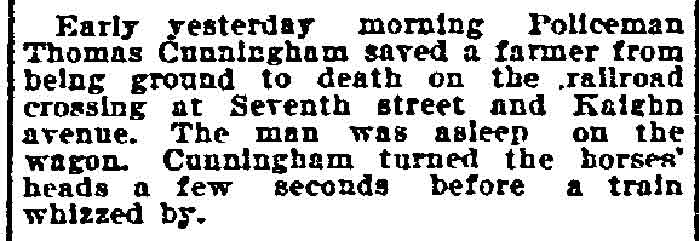
•• Early yesterday morning Policeman Thomas Cunningham saved a farmer from being ground to death on the railroad crossing at Seventh street and Kaighn avenue. The man was asleep on the wagon. Cunningham turned the horses’ heads a few seconds before a train whizzed by.
Mad Dog Shot by Policeman Cunningham
Philadelphia Inquirer —
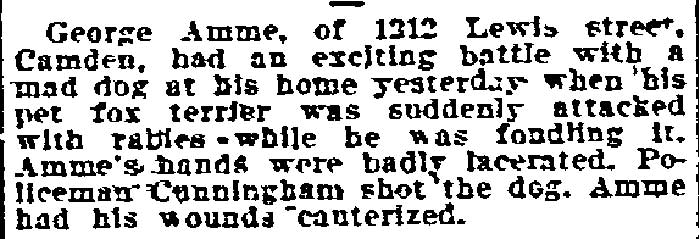
George Amme, of 1212 Lewis [sic] street, Camden, had an exciting battle with a mad dog at his home yesterday when his pet fox terrier was suddenly attacked with rabies while he was fondling it. Amme’s hands were badly lacerated. Policeman Cunningham shot the dog. Amme had his wounds cauterized.
Police Carnival Was a Gigantic Success
Philadelphia Inquirer —
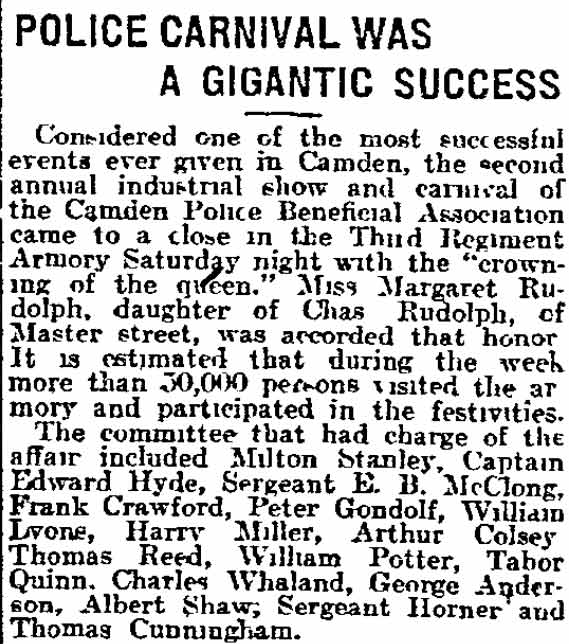
Considered one of the most successful events ever given in Camden, the second annual industrial show and carnival of the Camden Police Beneficial Association came to a close in the Third Regiment Armory Saturday night with the “crowning of the queen.” Miss Margaret Rudolph, daughter of Chas. Rudolph, of Master street, was accorded that honor. It is estimated that during the week more than 30,000 persons visited the armory and participated in the festivities.
The committee that had charge of the affair included Milton Stanley, Captain Edward Hyde, Sergeant E. B. McClong, Frank Crawford, Peter Gondolf, William Lvone [sic], Harry Miller, Arthur Colsey, Thomas Reed, William Potter, Tabor Quinn, Charles Whaland, George Anderson, Albert Shaw, Sergeant Horner and Thomas Cunningham.
2 Policemen Hurt by Tumbles on Ice
Camden Post-Telegram —
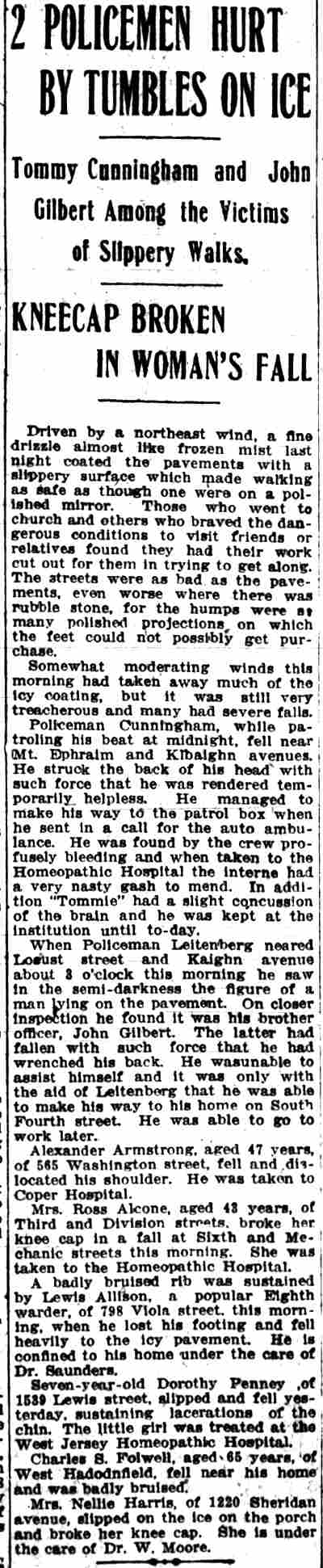
Tommy Cunningham and John Gilbert Among the Victims of Slippery Walks.
KNEECAP BROKEN IN WOMAN’S FALL
Driven by a northeast wind, a fine drizzle almost like frozen mist last night coated the pavements with a slippery surface which made walking as safe as though one were on a polished mirror. Those who went to church and others who braved the dangerous conditions to visit friends or relatives found they had their work cut out for them in trying to get along. The streets were as bad as the pavements, even worse where there was rubble stone, for the humps were as many polished projections on which the feet could not possibly get purchase.
Somewhat moderating winds this morning had taken away much of the icy coating, but it was still very treacherous and many had severe falls.
Policeman Cunningham, while patroling his beat at midnight, fell near Mt. Ephraim and Kibalghn [sic] avenues. He struck the back of his head with such force that he was rendered temporarily helpless. He managed to make his way to the patrol box when he sent in a call for the auto ambulance. He was found by the crew profusely bleeding and when taken to the Homeopathic Hospital the interne had a very nasty gash to mend. In addition “Tommie” had a slight concussion of the brain and he was kept at the institution until to-day.
When Policeman Leitenberg neared Locust street and Kaighn avenue about 8 o’clock this morning he saw in the semi-darkness the figure of a man lying on the pavement. On closer inspection he found it was his brother officer, John Gilbert. The latter had fallen with such force that he had wrenched his back. He was unable to assist himself and it was only with the aid of Leitenberg that he was able to make his way to his home on South Fourth street. He was able to go to work later.
Alexander Armstrong, aged 47 years, of 565 Washington street, fell and dislocated his shoulder. He was taken to Cooper Hospital.
Mrs. Ross Alcone, aged 43 years, of Third and Division streets, broke her knee cap in a fall at Sixth and Mechanic streets this morning. She was taken to the Homeopathic Hospital.
A badly bruised rib was sustained by Lewis Allison, a popular Eighth warder, of 798 Viola street, this morning, when he lost his footing and fell heavily to the icy pavement. He is confined to his home under the care of Dr. Saunders.
Seven-year-old Dorothy Penney, of 1539 Lewis street, slipped and fell yesterday, sustaining lacerations of the chin. The little girl was treated at the West Jersey Homeopathic Hospital.
Charles S. Folwell, aged 65 years, of West Haddonfield, fell near his home and was badly bruised.
Mrs. Nellie Harris, of 1220 Sheridan avenue, slipped on the ice on the porch and broke her knee cap. She is under the care of Dr. W. Moore.
Police Elect Officers
Philadelphia Inquirer —
Camden’s Police Beneficial Association yesterday at its annual session donated $25 each to the Camden Day Nursery, Camden Home for Friendless Children, West Jersey Orphanage, Mary J. Ball Nursery, Homeopathic Hospital, Y. M. C. A. War Fund, S. P. C. C., and the Associated Charities. They elected the following officers for the ensuing year: President, Arthur Colsey; vice president, Thomas Cunningham; financial secretary, Edward Hyde; recording secretary, James E. Tatem; treasurer, E. B. McClong; trustees, Charles Humes, Charles Whaland, Howard Smith, Ralph Bond and John Develin.
Police Elect Officers
Philadelphia Inquirer —
Camden’s Police Beneficial Association yesterday at its annual session donated $25 each to the Camden Day Nursery, Camden Home for Friendless Children, West Jersey Orphanage, Mary J. Ball Nursery, Homeopathic Hospital, Y. M. C. A. War Fund, S. P. C. C., and the Associated Charities. They elected the following officers for the ensuing year: President, Arthur Colsey; vice president, Thomas Cunningham; financial secretary, Edward Hyde; recording secretary, James E. Tatem; treasurer, E. B. McClong; trustees, Charles Humes, Charles Whaland, Howard Smith, Ralph Bond and John Develin.
Funeral of Sergeant Reader
Philadelphia Inquirer —
Six members of the force who served under him for years were pallbearers yesterday afternoon at the funeral of former Sergeant of Police John Reader. They were Thomas Cunningham, Harry Mines, Thomas Cheeseman, William Harvey, George Kleaver and Clarence Boyer. Services were held at the home of his son, Dr. Addison B. Reader, 1135 Haddon avenue, and were conducted by Rev. Charles I. Fitzgeorge, pastor of Union M. E. Church, and interment was made at Harleigh Cemetery. Among the floral offerings was a six-foot shield from the Police Department.
Police to Probe $200,000 Kaighn Ave. Fire
Camden Courier-Post —
FIRE CAPTAIN MAY DIE, FOUR OTHERS INJURED; DAMAGE IS $200,000
Economy Store and Other Buildings Near Broadway Swept by Flames Early This Morning
Falling Debris Carries Men Through Roof And Into Cellar
Sleeping Inmates of Apartments Roused and Invalid Carried to Safety—Mayor Sees Rescues
Mayor Ellis has ordered an investigation to determine the cause of the $200,000 fire which swept the properties at 427 and 429 Kaighn Avenue and caused injury to five firemen, one of whom may be fatally hurt.
The fire centered about the property occupied by the Economy Store, formerly Handle’s, and quickly spread to four adjoining buildings.
The fireman whose recovery is despaired of is Captain Martin B. Carrigan, of Engine Company No. 2, Fifth and Arch Streets. Carrigan, who lives at 618 West Street, is suffering from a fractured skull and severe burns and cuts of the face, legs, and body. He is unconscious at Cooper Hospital.
The firemen were injured when a wall, weakened by the intense heat, crumbled and crashed through a roof upon which they were standing, dragging them through the floor below, and into a cellar. Sensational rescues followed as police, firemen, and citizens with bare hands tore at the hot debris. The men were quickly extricated and carried to the street.
“We certainly shall investigate this fire,” the Mayor declared today. “Just what was the cause and who is to blame has not been determined but there will be a thorough investigation.”
“There have been too many of these fires during the past few weeks” continued the mayor. “Surely all of them did not just happen and I am sure there has been someone responsible in one or two of the fires.”
The conflagration was one of the most spectacular of a series of large fires that have visited the city in the past six weeks. The block in which it occurred—Kaighn Avenue between Broadway and Fourth Street—is one of the most prominent business squares in Camden.
Flames shot 200 feet in the air, giving the sky a fiery hue and attracted attention for miles before the firemen brought it under control. The flame-lit sky was clearly seen in Philadelphia, Merchantville, East Camden, Gloucester and other communities.
More than a score of families living in the vicinity were forced to flee from their homes in scant attire when the fire threatened them. They were cared for by neighbors.
Fireman George Boone, 46 years old, of Engine Company No. 2, also is in a serious condition. He is suffering from burns of the right hand, right thigh and foot and probable internal injuries. Boone lives at 607 Mount Vernon Street.
The other injured firemen are: John Voll, 22 years old, 509 Royden Street—both hands badly burned. C. J. Andrus, aged 31 years, 570 Mount Vernon Street—burns of hands and legs. Harold Lorang, 29 years old, 19 Hudson Street—burns of right hand and legs and sprained ankle.
Carrigan and Boone are in the hospital. The other firemen were discharged after their wounds were dressed. After being released from the hospital they returned to the scene of the fire and insisted upon continuing their duties. Chief Peter B. Carter, however, ordered them home.
Most of the loss was suffered by the Economy Store. A few charred walls remain of the large building. The interior was completely gutted. It was estimated today that the damage to that property will total $60,000. At least $50,000 damage, it was said, was done to the stock.
Morris Handle, local theatrical man, who owns the building, declared today that the property was insured for $30,000. “My loss will be quite heavy,” said Mr. Handle. “The insurance will not pay one-half the property damage.”
The adjoining building at 431 Kaighn Avenue is occupied by Dr. S.I. Yubas, optometrist, and L.R. Yubas, his father, a jeweler.
The rear and upper floors of the Yubas property were gutted and the stock sustained a heavy loss, due to water and smoke. The damage will total $40,000, Mr. Yubas estimated today.
Five persons who were asleep on the upper floors of the Yubas dwelling had narrow escapes. They were awakened by Samuel Goldstein, haberdasher, 417 Kaighn Avenue, who discovered the fire in the Economy Store and turned in the alarm. Mrs. L.R. Yubas, an invalid, was rescued with difficulty.
The property occupied by Mrs. Sadie Bodner, a widow, at 433 Kaighn Avenue, as a house furnishings store, was scorched and also damaged by water and smoke.
Adjoining the Economy Store on the west at 425 Kaighn Avenue is a vacant one-story structure, formerly occupied by the United Beef Company. Firemen were on the roof of that building when the west wall of the Economy Store collapsed. The wall tumbled down on the small roof and hurled the firemen through a hole in the roof, through the floor and then into the cellar.
Three policemen, Joseph Sparks, Thomas Cheeseman and George Hill, and several spectators braved the fire and smoke to rescue the trapped firemen.
The property at 423 Kaighn Avenue, occupied by the Charles Jamison Department Store, was damaged in the rear and the stock ruined by water and smoke. The Kresge Five-and-Ten-Cent Store, at 519–531 Kaighn Avenue, was also damaged by water.
Louis Richelson, who owns the properties from 519 to 525 Kaighn Avenue, was unable to estimate his loss today.
Hundreds of spectators, who were watching the fire from the opposite side of the street, shuddered as they saw a brick wall, weakened by the intense heat, totter and sway. Before the firemen on the smaller roof below could scurry to safety, it collapsed.
A groan escaped the crowd as they heard the cries of the entrapped firemen and the deafening thud of the bricks as they landed on the roof where the firemen were at work.
As the full weight of the bricks struck the roof, it caved in forming a gaping hole. The firemen were literally swept into the opening.
The bricks tumbled down, causing another hole in the floor between the first story and the cellar and dragging the imperiled firemen into the cellar with them.
Mayor Charles H. Ellis was among the spectators who witnessed the collapse of the wall. Other officials were Chief James H. Long, of the Water Department; Fire Chief Carter, Assistant Police Chief Edward S. Hyde, Captain Lewis Stehr of the Second Police District, and Street Commissioner Alfred L. Sayers.
Observing the peril of the trapped firemen, Policemen Sparks, Cheeseman and Hill, together with a dozen other spectators, rushed across the street to the vacant store. They rushed through the smoke and fire, leaped into the cellar and reached the struggling firemen.
Sparks, the first to leap into the cellar, reached Voll, who had been pinned beneath a pile of debris and was pleading to be rescued. The policeman feverishly extricated Voll from his precarious position and carried him out into the street to safety.
Policeman Cheeseman had accidentally fallen into the cellar and, though himself injured, groped about in the dark until he found Boone, whom he dragged outside.
Policeman Hill carried Carrigan out of the cellar in his arms.
The five firemen were carried to a waiting police ambulance and rushed to Cooper Hospital. Carrigan was unconscious. He has a slim fighting chance to recover.
Carrigan was promoted to a captaincy the first of the year. He is popular among his comrades and has the reputation of being a fearless fireman.
Mayor Ellis praised the work of the firemen and the bravery of the policemen who had risked their lives to effect the rescue.
“Never did I see such remarkable work,” said the Mayor. “When I arrived at the scene, it looked as if the whole block was doomed. The flames were shooting upward and the whole sky seemed lit up. The firemen tackled their job with dispatch and courage. I was proud of them. They knew their business and showed it by confining it to a comparatively small area. The work of the police also was commendable.”
Mr. Goldstein discovered the fire shortly before midnight. “I had just left my home at 417 Kaighn Avenue,” explained Mr. Goldstein, “intending to get a soda. As I passed the Economy Store I noticed strong odor of smoke. I peered into the glass doorway of the store. I immediately saw the place was afire.”
“Then I ran back to my store,” continued Mr. Goldstein, “and I telephoned police headquarters. I went out again and returned to the scene. I remembered that the Yubas family were asleep on the second and third floors and rapped on the doors. Mr. Yubas came down in a bathrobe. He was not aware of the fire.”
The six persons asleep in the Yubas home were Dr. Yubas, Mr. and Mrs. L.R. Yubas, Bernard Helfand, Miss Bertha Cuden and Anna Recowitz, a domestic.
Mrs. Yubas, who is recovering from an illness, was too weak to make her way outside through the smoke. Assisted by her husband, Policemen Becker and Cheeseman and Constable John Cunningham, Mrs. Yubas was half carried downstairs, and out through the rear of the building to safety.
“The fire had gained such rapid headway,” said Sergeant Thomas Cunningham, “that when the firemen arrived, smoke was actually issuing from cracks in the sidewalks and between the cobbles near the trolley tracks.”
The second and third floors of 419 to 423 Kaighn Avenue are occupied by private families as apartments. In the rear were a number of frame dwellings. More than a score of families were obliged to leave their homes in scant attire when the firemen began playing hose upon their properties as a precaution against the fire spreading.
Mrs. Catherine Fox, 410 Sycamore Street, and Mrs. E. Chambers, 412 Sycamore Street, whose homes are in the rear of the Economy Store property, had removed part of the furniture to the street. Even after firemen assured them the danger of their homes catching on fire was over, the women and children could hardly be persuaded to return.
Crumbling walls and cracking of glass hampered the firemen in their work and made their task hazardous. The firemen were further handicapped by the big start the fire had gained. Despite this, they stuck dangerously close to the flames.
To play hose upon the fire to advantage, several firemen scaled the outside walls of adjoining properties and reached cornices, from which they directed streams of water.
A high wind gave them great difficulty. A number of times, when the firemen seemed to have the fire under control, the flames burst out afresh and compelled them to retreat. Then the reflection would light up the sky overhead.
Water Chief Long gave the firemen great service in maintaining the water at a high pressure to ensure facility in getting the streams to play upon the flames.
Street is Ordered Closed by City to Save Woman’s Life
Camden Courier-Post —
Street is Ordered Closed by City to Save Woman’s Life
The City of Camden today officially joined with medical science in an attempt to save the life of a South Camden colored woman.
Mrs. Hattie Jones, 38 years old, is critically ill at her home, 954 South Ninth street. Two weeks ago, a son of Mrs. Jones was stillborn at the Cooper Hospital. A week ago she left the institution and returned to her home. Heart trouble developed. Dr. Clement T. Branch, 727 Walnut street, was called. He found her condition to be critical.
Today, Dr. Branch appeared at the office of Commissioner William D. Sayrs, director of streets and public improvements. He explained the case and asked that Ninth street between Walnut and Cherry streets—the block on which Mrs. Jones’ home is located—be roped off. Sayrs turned the request over to the department of public safety and Police Chief James E. Tatem transmitted an order to Acting Captain Thomas Cunningham of the Second Police District. A short time later the block was barred to all traffic.
The street is paved with cobblestones and, Dr. Branch explained, his patient was being disturbed by the noise of passing traffic to such an extent that her life was endangered.
Dr. Clement T. Branch – William D. Sayrs – James E. Tatem – Walnut Street – Thomas Cunningham – South 9th Street
5 New Lieutenants Appointed by Rhone Await Assignments
Camden Courier-Post —

Two More Patrolmen to be Promoted Under New Ordinance
ONE MADE SERGEANT
Pending official designation of their new posts, five members of the Camden police department who were appointed lieutenants yesterday and a sixth, who was named sergeant, continued in their former capacity when they went on duty today.
Director of Public Safety David S Rhone, who announced the promotions and swore in the officers late yesterday, stated this morning that he has not yet determined where he will station them. That will be done within a few days, the commissioner averred.
Two more lieutenants remain to be appointed apropos of a recent city ordinance which stipulated that the new stations will not be designated until all seven lieutenants are named. One will be placed in charge of each of the four police districts, and one each in the traffic and motorcycle squads, and one at headquarters.
Those who were elevated to lieutenancy are:
Sergeant George W. Frost, 956 Pine street; Sergeant Walter T. Welch, 518 Benson street; Acting Lieutenant Ralph W. Bakley, 602 Clinton street; Sergeant Charles Laib, 76 South Twenty-fourth street, who has been acting captain, and Acting Lieutenant George Ward, 1437 Kaighn avenue.
Patrolman Clarence Thorn was also sworn in as sergeant of the mounted squad of the department. He succeeds Welch.
The lieutenancies pay an annual salary of $2500, and one year from this date, each of the lieutenants will be eligible to take Civil Service examination for elevation to a captaincy, which carries a yearly stipend of $3200.
The five who were made lieutenants were among ten members of the department who recently took the Civil Service examinations for lieutenancy. Welsh [sic] and Laib were among the three having the highest ranking in the tests, being second and third respectively. Under Civil Service rules, the director had to select at least one of the three first in ranking in the examination, but he could select any other six.
The ten who took the examination and their grades as unofficially announced in Trenton follow:
Sergeant John T. Potter, 298 Burwood avenue, 89.64; Sergeant Walter T. Welch, 518 Benson street, 87.75; Sergeant Charles Laib, 76 South Twenty-fourth street; Acting Lieutenant Bakley, 602 Clinton street, 87.11; Sergeant George W. Frost, 956 Pine street, 86.31; Acting Lieutenant Ward, 1437 Kaighn avenue, 85.83; Sergeant Herbert Anderson, 496 Newton avenue, 84.79; Sergeant Samuel E. Johnson, 526 North Front street, 84.71; Sergeant Harry G. Newton, 118 North Twenty-fifth street, 83.18, and Acting Lieutenant Cunningham, 1114 Kaighn avenue, 81.78.
2 Police Officers Made Lieutenants
Camden Courier-Post —
Rhone Reported Ready to Make Five Patrolmen Sergeant
Reports that five members of the Camden police department will be promoted to sergeants tomorrow were circulated, today after announcement that two sergeants had been appointed lieutenant.
Those who, according to rumors, will be elevated to sergeant are Nathan Petit, of the second police district, to be assigned to the traffic squad; Gus Koerner, detective bureau; Walter Rowand, first district; Frank Truax, Second district, and Edward Hahn, third district.
The two new lieutenants who took oath of office yesterday are Samuel Johnson and Thomas Cunningham. The former was a sergeant of police attached to the detective bureau and will continue in that department, while Cunningham, while a sergeant, was acting lieutenant in day command at the fourth district. He remains in that district. The appointments were announced yesterday by Commissioner David S. Rhone, director of public safety.
Both were immediately administered oaths of office by Dr. Rhone’s secretary, Bayard M. Sullivan, at the director’s office. Lieutenant Cunningham is already eligible for retirement, having served more than 20 years on the city police force.
The two appointments complete the seven lieutenancies created by a city ordinance. Ten members of the police department passed civil service examinations for the post, which pays an annual salary of $2500. Each must serve one year as lieutenant before becoming eligible to take examination for captaincy.
The five previously appointed lieutenants are George Frost, now night commander of the fourth district; Walter Welch, third district; Charles Laib, a sub-commander of the traffic bureau under Captain Charles T. Humes, traffic Inspector; Ralph Bakley, second district; and George Ward, first district.
The other three candidates who passed the examination, Sergeants John T. Potter, Herbert Anderson and Harry I. Newton, did not receive lieutenancies, although Potter had the highest percentage in the tests.
Promoted Police Officers
Camden Courier-Post —
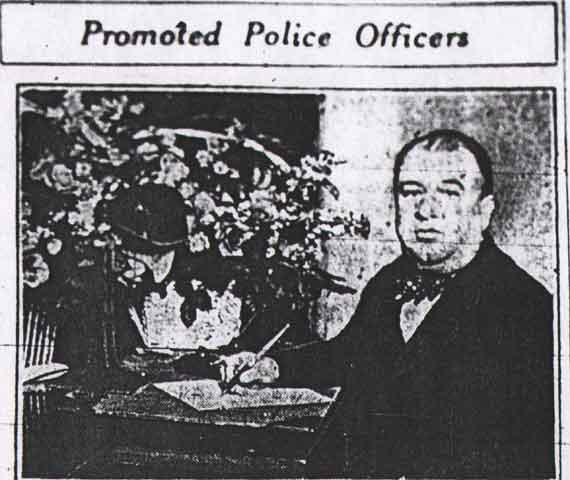
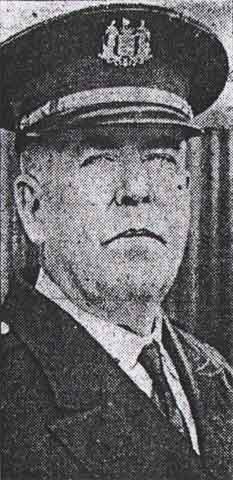
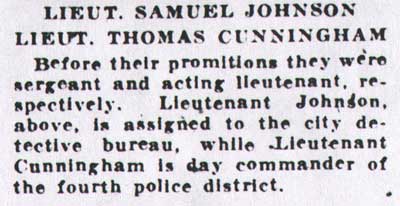
LIEUT. SAMUEL JOHNSON
LIEUT. THOMAS CUNNINGHAM
Before their promitions [sic] they were sergeant and acting lieutenant, respectively. Lieutenant Johnson, above, is assigned to the city detective bureau, while Lieutenant Cunningham is day commander of the fourth police district.
Job of Police Chief to Remain Vacant
Camden Evening Courier —
Appointment Will Be Delayed Until After Election; Anderson May Be Promoted
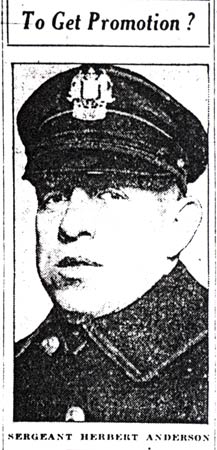
To Get Promotion?
Sergeant Herbert Anderson
By Mercury
No one will be appointed to succeed the late Lewis H. Stehr as chief of the Camden Police Department at least until after the commission government election next spring.
Deputy Director of Public Safety Charles V. Dickinson will assume complete control of the police department and a lieutenant will be assigned to headquarters as his assistant.
The above sums up reports Mercury received in his Christmas mail over the weekend. There is no particular authority for any of the rumors but they have come from most reliable sources.
Police Inspector Charles T. Humes and Lieutenants George Frost, Walter Welsh [sic] and George Ward all have been mentioned as possible successors to Chief Stehr. These reports had it that whoever got the post would receive the title as chief and the increase in pay that would go with the job.
Last week Mercury heard reliable reports that there would be no new chief but that an acting chief would be named temporarily. However, later reports have it that all thoughts of a chief or an acting chief have been dropped until after the election for commissioners next year.
In the meantime, it is planned to continue the operation of police headquarters by assigning a lieutenant to that office as an assistant to Deputy Director Dickinson. The latter, incidentally, under the new arrangement, will assume all the duties that would have been under the supervision of Chief Stehr had he lived.
Assignment of the lieutenant to headquarters will not take place until after the first of the New Year. At that time several veteran members of the department will go on pension. Among them will be Lieutenant Thomas Cunningham, of the Fourth District.
When word of Cunningham’s retirement was announced some weeks ago it was reported that Sergeant Herbert Anderson would be elevated to the rank of lieutenant.
And the reports today are to the effect that Anderson, who has had quite a bit of experience at headquarters during the past year, will be the man who will get the appointment as Dickinson’s assistant.
30 Cops Shifted Today in Opening of New District
Camden Courier-Post —

Shake-Up in Camden Force is Most Drastic in History
SMITH AT CITY HALL
Drastic shifts in the Camden police department, affecting more than 30 members of the force became effective at 8 a.m. today.
The shake-up, announced yesterday by Commissioner David S. Rhone, director of public safety, is the result of creation of a fourth police district.
The outstanding changes are the promotion of Sergeant of Detectives George Ward to acting lieutenant in the First district, supplanting Sergeant Samuel Nayler, who is sent to headquarters, and the return to the city detective bureau of Acting County Detective Howard Smith.
Smith was detailed to the second district today and was assigned to a robbery investigation in the thirteenth ward.
District Captaincies Abolished
With the shifts, the rank of district captain is abolished. Instead, lieutenants will be in charge of the districts. Captains will be in charge only of the traffic and detective bureaus and headquarters, Commissioner Rhone said.
The removal of Sergeant Naylor from the First District was not unexpected, since he had been “on the carpet” last October as a result of a speakeasy shooting in his district. Naylor, though holding the rank of sergeant, was acting captain of the district.
He was threatened with dismissal by Chief Stehr and Commissioner Rhone if the vice conditions in the First District were not cleaned up. The situation came to a climax with the wounding of Charles Arini and Louis Dei Duca in a speakeasy at Third and Mickle streets in October. It was reported Naylor was to be removed from the district several times since.
Ward Again Promoted
Ward was promoted to sergeant of detectives two months ago. Under the transfer, he is promoted again, remaining as acting lieutenant for a year, until he takes an examination for a lieutenancy.
Other police officers now acting-lieutenants will become lieutenants after examination.
Naylor, who was in charge of the First district for several years, will serve as desk sergeant under Capt. A. Lincoln James.
The return of Smith to the city detective bureau was requested by Prosecutor Clifford A. Baldwin, it is understood. Smith has been a county detective for more than eleven years. He first was transferred to the prosecutor’s office at the request of Prosecutor Charles A. Wolverton. Although a Republican, he was retained there under Prosecutor Ethan P. Wescott. Although some surprise was occasioned by the announcement of Smith’s return to the city force, inasmuch as the new prosecutor is a Republican, it was said that Baldwin wished to begin his term with an entire new force.
Worked For City Also
Although Smith acted for the county and was paid by the county, he received a salary of $1 a year to retain him in the city so that he could be recalled at any time.
Through the shift, Sergeant Charles Laib, serving under Traffic Inspector Charles T. Humes, is elevated to acting captain of the traffic department. In the future all motorcycle men with the exception of George Clayton will report direct to Humes and Laib instead of to headquarters.
Ralph Bakley, who has been acting sergeant of the First District, has been named acting lieutenant of the Second District, and Thomas Cunningham, who was acting captain of the Second District, becomes acting lieutenant of the new Fourth District. William Horner, who has been acting captain of the Third District, is elevated to the rank of acting lieutenant and remains in charge of that district.
Thos. Cunningham, Ex-Policeman, Dies
Camden Courier-Post —
Retired Lieutenant Served as Commander of Old Fourth District
Thomas Cunningham, 76, Camden police lieutenant who retired on pension eight years ago, died last night at his home, 1114 Kaighn avenue after an illness of one month.
Mr. Cunningham was commander of the old fourth district, created in 1929 but later discontinued.
Mr. Cunningham served 32 years in the police department before retirement. He was appointed a patrolman on July 1, 1898, during the administration of Mayor Cooper B. Hatch. He was assigned to the second district and served there until appointed commander of the new fourth district. He was made a sergeant in 1915 and a lieutenant in 1930, the year in which he retired.
He was a bachelor and lived at the Kaighn avenue address with his sister, Mrs. Anna Marshall.
Police Shakeups of Today Mild Compared to Years Ago
Camden Courier-Post —
Force Changed Every Time Political Regime of City Shifted; Larry Doran Fired for Crossing Street to Get Cinnamon Bun; Old Patrol Recalled
By BEN COURTER
(Another in a series of articles on municipal affairs and personalities of yesteryear.)
Ben Courter
In “the good old days” when Camden’s police department was just about getting under way in accordance with the amended charter of 1872, the men in the ranks were the football of politics. Even if the phrase “to the victor belongs the spoils” had not yet been coined, it was in active force. A change of administration always meant a violent shakeup in the personnel of the department.
It has been so many years since Camden has had a real political shakeup, aside from the nonpartisan movement of seven years ago, that the younger element can have no personal recollection of upheavals marking the aftermath of Democrats succeeding Republicans or vice versa. Many of the men resigned on principle, but others stood their ground and with the faithful hungry for place on the police force it was necessary to take drastic measures.
Sometimes it did not require a party turnover, for bitter factional scraps resulted in reprisals. It then fell the lot of the police committee of city council to conduct hearings. They were usually acrimonious affairs with partisans of the G. O. P. often showing more spleen than in a strict party fight. These hearings were as a rule public, attracting big crowds of opponents and advocates of the accused. The charges ranged from conduct unbecoming an officer to neglect of duty and everything between.
Sometimes the charges were altogether ridiculous, as for instance when Larry Doran, now chief of the county detectives, was accused of going out of his beat to buy a cinnamon bun. He happened to be an appointee of Mayor Joseph E. Mowrey and no one questioned Doran’s ability as a cop or of his sincerity in patrolling his beat. But the Republicans had come back into the fold some 25 years ago and it was determined Larry should get out. Thus came the charge based on someone’s discovery he had crossed the street early one morning to get a bun. No one imagined it a very heinous offense at best, but it was all in the game of politics and the finding of the police committee was a foregone conclusion.
Findings, Usually Sustained
In some instances appeals were made to higher courts, but very little came of it since the committee was considered within its power to dismiss an officer if it saw fit. All necessary was to have the report accepted by council and since that was overwhelmingly Republican the work of the committee was a mere formality. Politics continues to play an important part in the appointments of cops or firemen, but for the past six years they have been under civil service, thus affording at least a measure of protection unless there actually has been some dereliction of duty.
Even though there were the changes wrought by political and factional wars, many men withstood the storms through the years. As a matter of fact it is evident that most of the men who have been accepted as representative of the force have had little difficulty in holding down their beats.
Mention has occasionally been made of one of Camden’s most spectacular police chiefs, Samuel Dodd. When he was first appointed by Mayor Pratt in the 80’s he was in the prime of life and certainly not inclined to give quarter to anyone. But he met with his first difficulties in the race track regime with the dual police departments, when the Democratic commission appointed William A. Davis in his stead. He was reinstated in 1893 after the Republicans had gained control of the state and had abolished the commissions.
Dodd then went along without further trouble until the advent of Hatch who appointed John Foster in 1898. Dodd was born in Burlington in 1841, but came to Camden as a young shoemaker and made himself vitally important to his fellow workers. In the 80’s Camden was a shoemaking and leather center. There were over 100 factories and hundreds of persons were employed. Thus it became an important factor in politics. Dodd loomed as a mayoralty candidate. Everything was cut and dried for him to enter the field when Pratt ran in 1885, but Dodd was prevailed upon to get out of the fight with the promise of being made police chief. That was later carried into effect.
Many years Chief Dodd has been dead, but old-timers around the city hall still have a very vivid recollection of him and his long coal black whiskers, which he had a habit of yanking when under some excitement.
First Patrol Wagon
It was during Dodd’s regime Camden sported its first patrol wagon, in May of 1893. It was something of an epochal event for Camden. Men nearing middle life who then were boys vividly recall the sensation created by the appearance of the little red wagon with “Camden Patrol” painted in gold on the red sides, not forgetting the big gong near the driver’s seat. And as the high steppers speeded through the city streets with a drunk or victim of an accident that gong was everlastingly sounded until the whole populace was brought to the doors. Chief Stehr’s father, Lewis H. Stehr; Oscar Weaver, “Si” Sage and “Nitchie” Golden were the first in the department who operated that famous wagon. It was the forerunner of the automobile police patrol and ambulance put in service July 14, 19[?].
When the first patrol went into service Camden’s streets were veritable “rocky roads to Dublin.” They were paved with cobble, even Broadway, Federal street and Kaighn avenue. Only Cooper street and a part of Benson sported asphalt blocks. Hence it was the object of the driver to pick out the best route possible by using horse car or trolley tracks if possible.
It certainly was no pleasure trip to the hall for a drunk and a road of torture to any unfortunate being toted to the hospital. But even at that it was an improvement over the archaic method of taking prisoners to jail by way of a pushcart. I have already mentioned in these annals the Roman holiday such an incident furnished the kids of the generation. If John Painter or Charlie Fitzsimmons pushed a cussin’ drunk from Kaighn Point to the hall they were sure to have a yelling mob of kids at their heels. Unfortunates who were ill or injured were usually taken to the hospital in horse-drawn cabs. But of course the conveniences of today were not even dreamed about.
Lieutenant Tommie Cunningham is among the veterans on the force who recalls those days of long ago, for last Tuesday marked the thirty-sixth anniversary of his appointment to the department. Tommie has seen the department grow from less than half a hundred men to five times that number. In all that time he has pounded a beat in South Camden or had charge of a detail of men or a district as at present.
“Jake” Woodside
In recalling some of the old-timers mention must also be made of Jacob Woodside, who was appointed October 1, 1898. He hailed from the Sixth ward and was among the valiant crew who sported luxurious mustaches. He was in his later years a sergeant in the Third district. Woodside, who had many staunch friends throughout the city, died several years ago.
Then there is “Cul” Errickson who was made a cop September 15, 1898, by Mayor Hatch. He was for many years sergeant at headquarters; a big, good-natured cop, too. He has been enjoying life these several years as a pensioner up around New Egypt.
Certainly one of the most substantial members of the force was Capt. Arthur A. Stanley, who was in charge of the downtown district for many years. He was appointed by Mayor Hatch July 15, 1898. Captain Stanley was a Civil war veteran and prominently identified with the G. A. R. He has been dead for many years. His son, Milton Stanley, was a detective in the department and also at the prosecutor’s office, but for several years has been living on a farm in South Jersey.
There is another veteran of the force still in harness, George Nowrey, brother of former Mayor Nowrey, appointed by Mayor Hatch August 1, 1898. He has been a sergeant in the department for many years.
On the same day Nowrey was appointed, John Reader was made a member of the force. He, too, was a sergeant when he died several years ago. He was father of Dr. A. B. Reader and Attorney Lawrence Reader, the latter one of the most prominent young men of the city when he died during the flu epidemic in 1918. “Larry” also was a member of council from the Thirteenth ward.