Robert F. Miller
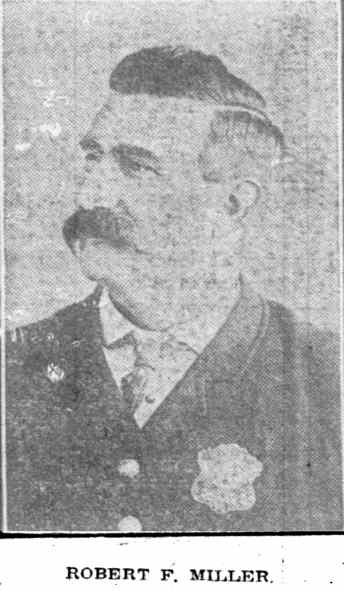
Robert F. Miller
ROBERT F. MILLER worked as a policeman and in elected office as a constable in Camden from the late 1880s until his untimely death in December of 1911. He was born in New Jersey in March of 1855. He appears in the 1878 City Directory at 418 South 2nd Street, working as an oysterman. The 1880 Census, living in Camden’s Third Ward and working as a “waterman,” i.e., on boats on the Delaware. The street name is obscured on the Census sheet’s microfilmed image, but is most certainly the 400 block of South 2nd Street, as his landlord, David Laughead, appears in city directories before and after the Census. Robert Miller appears at 428 South 2nd Street in the 1881, 1882 and 1883 Directories, and it is probable that he was boarding with David Laughead throughout the three years in question.
Robert F. Miller married Ottilia “Tillie” Shaffer around 1883. They were blessed with two children, Robert Franklin Miller in 1890 and Blanch Marie Miller in 1893.
Robert F. Miller was appointed to the Camden Police Department on November 22, 1886. He served until 1902, with a three year hiatus in between from 1895 to 1898 when political interests dictated who would be a policeman and who would not. The Millers had a milk and butter business and Tillie Miller made dresses in these years.
The 1887–1888 City Directory shows Robert Miller, working as a policeman, at 223 Benson Street. By the time the 1888–1889 Directory was compiled, he had moved to 234 Benson Street. The Millers stayed at that address into 1898. From 1899 to 1902 they were at 336 Stevens Street.
Long active in local politics as a Republican, Robert F. Miller lost his job as policeman over the assault on George V. Murry at the riot at a polling station on the day of the primary election, July 28, 1902. The police committee of Camden City Council met, heard evidence presented by Mayor Joseph Nowrey (a Democrat) and chose to dismiss Robert F. Miller from the police department. Robert F. Miller and Albert Keaser were indicted on charges of assault in October of 1902 and both were acquitted on January 27, 1903. Given what would be revealed in later years about Murry, it is small wonder that Miller was acquitted.
Robert F. Miller moved to 528 South 3rd Street in 1903 and stayed there into 1905. He worked in sales for a couple of years, then, in October of 1905, he was hired by the residents of the neighborhood between Cooper and Penn Streets and between South 2nd and South 4th Streets to serve as a night watchman. He appears in Camden’s City Directories at 302 South 5th Street in 1906 and 1907.
By 1908 he had moved to 315 Pearl Street. Still working as the “special officer” in the Cooper and Penn Street neighborhood, Robert F. Miller ran for constable in 1911 and was elected. His triumph was short-lived, unfortunately, as he died of a heart attack on December 21, 1911.
On Jersey’s Soil
Philadelphia Inquirer —
Notes of Interest from the City Across the Delaware.
Robert Miller, of the Third ward, has been appointed a patrolman in that ward, to take the place of Officer Griscom, whose resignation will take effect on the 1st of December.
Policeman Robert Miller Makes Arrest
Philadelphia Inquirer —
Policeman Robert Miller early yesterday morning captured Stephen Thomas with a set of harness in his possession. He acknowledged taking them from John Dungan’s livery stable at Front and Pearl streets, and was locked up for a hearing to-day.
A Camden Free Fight
Philadelphia Inquirer —
Too Many Original Packages at a Party. Other Cross River News.
A party at Joseph Flanigan’s house on Mickle street, above Second, on Thursday night, had a bad ending. It was a package party, and some brought “original packages” with them. As soon as the bad whisky in the latter commenced to work free fist fights followed.
It was while Policeman Harvey and Robert Miller were patrolling their beats that they heard the cry of murder. They traced the cries to the Flanigan house, where they found at least a dozen men in the back yard engaged in a free fist fight. At the sight of the officers the men all scampered, with the exception of Edward Bates, who lay on the ground with blood running freely from a wound in his head. The police went in the house and arrested Charles Bates and William Harris.
After Edward Bates had his wounds dressed at the Cooper Hospital, he and the others were locked up for a hearing, and yesterday Mayor Pratt compelled the two Bateses and James Lafferty to pay fines and costs, while Harris was dismissed.
Dennis Corbitt tried to “do up” Policeman Mullane on Kaighn avenue, near Fourth street, yesterday afternoon. He succeeded in throwing Mullane down, and was about to escape when Policeman Harvey appeared. Corbitt tried to escape from both, but was subdued by blackjacks. His wounds were dressed at the Cooper Hospital. He is locked up at the City Hall for a hearing to-day.
Winter Sport
Camden Post-Telegram —
The Camden base ball grounds have been leased by a company of Camden gentlemen who will turn it into a skating park. It will be commenced about December 2d and they hope to have it open by Christmas. There will be music on Wednesday and Saturday nights. It will be lit up and a series of contests in the form of fancy skating, hurdle skating and fast skating will be held every week for which there will be a handsome prize given to the winner of each contest. They have also made arrangements for perfect order. Ex-Policeman Robert Miller of the Third ward will be the chief of a body of special officers who will preserve order. The ice will be formed from the bottom up until it is about two feet thick and there will be no danger of breaking in, regardless of the crowd.
Swinging the Official Ax
Philadelphia Inquirer —
Camden Reformers Chop Off Heads of Policemen and Others
Eight policemen were discharged from the force by Camden’s City Council last night, and reform supporters named in their stead. The Republican employes of the Water Department must also make way for their reform successors, appointed at the same time.
The policemen discharged were: Lincoln James, Albert Stein, John Sinclair, William Selby, Caleb Williams, Abraham Jackson, Jacob Hicks and Frederick Laird. Their successors are: Isaac Lovett, Albert Keyser, Robert Miller, John Wagner, Isaac Brown, Thomas Moore, William Harrison and Albert Batten.
The appointments by Mayor Hatch of William L. Hurley as a member of the Commissioners of Appeal, and Charles Watson a member of the Board of Health, were confirmed.
Council voted unanimously for the ordinance to issue $85,000 thirty-year bonds to be used in building a high and manual training school.
When the ordinance providing a change in the terms of Water Department employes from two years to one year came up for second reading, Councilman Sayrs vigorously opposed it. His protests were ignored by the passage of the ordinance. An ordinance to appoint Water Department employes was then passed, and the following were named: Martin McNeil, resident engineer; John Wallace, Henry Taliafarro and Joseph Cline, engineers; Horace Huelings, George Riley and Owen Macey, foremen; Lee S. Mills, extra fireman; Albert Primrose, George Davis and Joseph Wagner, coal wheelers; Henry Schafer, engine wiper; Henry Hertline, foreman; Joseph Wilgus, caulker; John T. Rodan and James Melon, tappers, and John K. Esler, Jr., teamster.
In the report of the Finance Committee came the bill of City Clerk Kramer for $480 salary. Objection was made to the payment, and a tie vote decided against the bill.
In Police Dragnet
Philadelphia Inquirer —
IN POLICE DRAGNET
Successful Raid on an Alleged Pool Room in Camden
SEVEN MEN CAPTURED
Keefer, Who Says He Spent His Employers’ Money in the Place, Identifies the Prisoners
The Camden police yesterday raided the alleged poolroom at 25 South Third street, where Walter H. Keefer, former manager of the Merchantville Light and Power Company, claims he lost $254 belonging to his employers. Seven men were captured in the raid, including W. Harry Getty and Charles Metz, who were committed in default of $1500 bail each as principals. The others were James Boone, of Fourth and Benson streets; George Armstrong, Charles Loriaux, George Smith and Victor Thompson. Each furnished $300 bail except Thompson, who was unable to get surety up to a late hour.
The police for months past have been trying to get evidence against this alleged poolroom. The place was so closely guarded that the officers could not get direct evidence that the law was being violated. The details of the raid and the successful manner in which it was carried out were made known at the hearing before Recorder Nowrey last evening. The defendants were represented by Lawyer John J. Crandall. Mayor Hatch, City Counsel Bleakly and Councilman Silvers, of the Third ward, were interested spectators. Before the prisoners were brought in Deputy Sheriff Hartshorn appeared with Walter H. Keefer, who was brought over from the county jail to identify the proprietors and employes of the alleged poolroom. The prisoners scowled at Keefer as they were brought into the hearing room.
City Detective Hart was the first witness. He said he swore out the warrant for the raid from information obtained from Keefer.
Keefer, the star witness, was next called. He pointed out Metz as the man who operated the “ticker,” collected the bets and paid the winnings. Keefer said he had played the races there on Monday last and on several other occasions. He stated that W. Harry Getty guarded the door and scrutinized every one who applied for admission.
Police Captain Boyle testified that he made the raid, assisted by City Detective Hart and Officers Painter, Shaw, Robert Miller and George Anderson. When they knocked Getty opened the front door just enough to peer out at them. A chair prevented the door from being opened wide. The warrant was read, but Getty refused to admit them. They then broke the chair and forced an entrance. Rushing up stairs they found the door to the third-story back room barred. They forced the door and found themselves in what appeared to be a furnished bedroom. Wires ran through a rear window, but there was no telegraph instrument or other evidence of a poolroom.
The men in the room were placed under arrest and a search was instituted for evidence. They found a man hiding in a closet and took him into custody. A locked box was found on the mantelpiece in the front room. Mrs. Getty claimed that it contained her jewelry. The officers finally found a key that opened the lock. The “jewelry” consisted of the missing telegraph “ticker.” Several about the New Orleans races and betting were seized.
Policeman Shaw said that Loriaux told him the wires were cut and the “ticker” carried over into the front room while the police were coming up the stairs. Officers Painter and Anderson gave corroborative testimony.
Charles Loriaux swore that he had been in the place only eight minutes when the police swooped down on it. He admitted telling Officer Shaw that the “ticker” was hustled out of the room when they heard the police trying to get in.
George Armstrong admitted having been in the pool room before.
“What did you go there for?” asked Recorder Nowrey.
“Do you wish me to incriminate myself?” asked Armstrong, after hesitating some time.
The Recorder did not press the question.
James Boone, who said he had resided at Fourth and Benson streets for the past twelve years, claimed that he went to the alleged pool room to hear the result of a handicap race at Lexington. He admitted being there before to get similar news.
George Smith swore that he went there to hear the results of horse races. He admitted that he had bought pools there before.
For several terms of court there has been an indictment hanging over Getty’s head on a charge of conducting a pool room at Seventeenth and Federal streets with George W. Sterling, but for some reason it has never been moved. Chief of Police Foster stated last evening that one of the reasons for the dismissal of Police Captain H. Frank Pettitt was that Getty’s place on South Third street was in his district and he failed to suppress it or secure evidence on which a raid could be made.
That there is war to the death between the police and the policy dealers was shown yesterday by a bold retaliatory move of Washington Ketline, who brought suit for damages against Policemen Henry Miller and Isaac Brown. The officers furnished $1500 bail each. Ketline was arrested by the officers a few days ago on the charge of engaging in policy selling.
Ketline placed some pieces of paper in his mouth that the officers supposed were policy slips. Because he refused to open his mouth, Ketline says, the policemen used him roughly. Ketline has already served a sentence for policy writing.
Gilbert Now in Jail
Philadelphia Inquirer —
County Detective Cherry, of Camden, at an early hour yesterday morning arrested Charles Gilbert, for whom he had been searching since Thursday afternoon. Gilbert was committed by Justice Finley without bail on a charge of uttering a forged check, which he passed on Saloonkeeper Flood at Second and Stevens streets.
Gilbert was arrested at his home, at 227 Benson street. He was seen entering the house about 1o’clock yesterday morning by Policemen Harry and Robert Miller and they at once notified Detective Cherry.
County Detectives Smith and Cherry have been running out several clues in connection with the bogus checks that have turned up in Camden during the past fortnight. They believe that they[sic] the work of an organized gang of swindlers and arrests may follow shortly.
Quo Warranto Proceedings Issued Against Their Successors
Philadelphia Inquirer —
Trenton, N. J., Oct. 4.—Counsel for Henry S. Scovel, of Camden, to-day began quo-warranto proceedings in the supreme court on behalf of eight Camden policemen recently ousted from their positions by the common council of that city to require their eight successors to show by what warrant and authority they hold their respective offices and exercise the duties thereof.
The ousted officers are Abram Jackson, John Lighthouse, Josiah Sage, John Sinclair, William Selby, Thomas Buchanan, Albert F. Meyers and Caleb Brown, and their respective successors, Thomas Moore, Fred. Triplet, Allen Hubbs, Albert Geaser, Robert Miller, William Harris, Harry Hope and Isaac Brown. The cases will come up before the November term.
Last Call on Mayor Pratt
Camden Daily Courier —
Joseph Dougherty was found lying in the street by Policeman Robert Miller last night. Just as the policeman arrived some Italians were about to go through his clothes. This morning Dougherty said he had not been in Police Court since Mayor Pratt’s term. He was dismissed.
Police Court
Camden Post-Telegram —
Joseph Hennessy, Mary McCann and John Foster, (not the chief of police), were sentenced to ten days each by Acting Recorder Baldwin this morning for drunkenness.
Foster was arrested by Policeman Robert Miller and had in his possession a roll of new oil cloth which he said he bought in Philadelphia. The police believe the cloth was stolen.
Murder and Bloodshed in Camden Primary Elections
Philadelphia Inquirer —

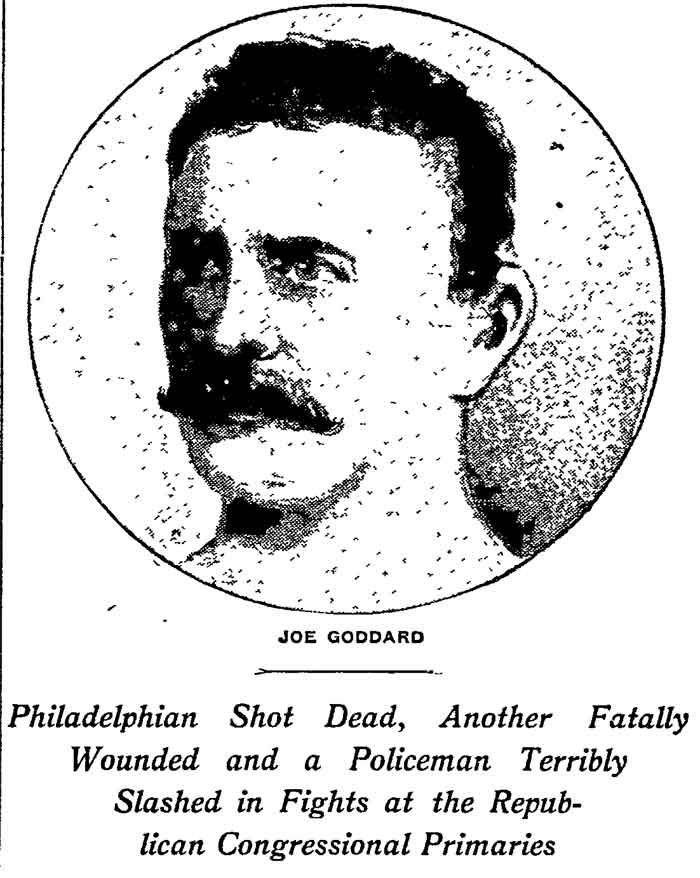
Philadelphian Shot Dead, Another Fatally Wounded and a Policeman Terribly Slashed in Fights at the Republican Congressional Primaries
JOE GODDARD
Blood was shed in Camden city and county last night, the result of the fiercest political battle that was ever fought in the First Congressional district of New Jersey, and the sum total of the casualties is one man dead, another lying at the point of death in the Cooper Hospital, another, a policeman, on a cot near by, suffering from stab wounds, from which he is not likely to recover, and numerous cracked skulls.
So vigorously were the Republican primaries contested that numerous fights developed. Crowds of repeaters went from Philadelphia to Camden, and these were the cause of the numerous riots, for such they were, at the polling places.
With it all no one can yet positively tell who will receive the Congressional nomination at Woodbury to morrow. At midnight both the adherents of Congressman Loudenslager and the supporters of J. Alpheus Vansant were claiming the victory.
Shot and Killed
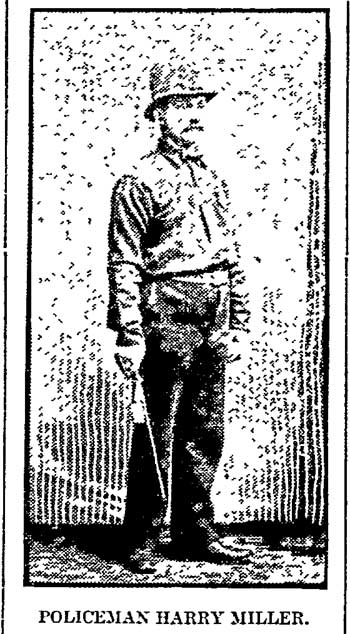
A few minutes before the closing of the polls at the Fifth precinct of the Third Ward, Camden, last night, John Morrisy, of Manayunk, wearing a Vansant badge, was shot and killed. During the melee Policeman Harry Miller, aged 40 years, of 321 Beckett street, was cut in the abdomen. Both were taken to Cooper Hospital.
Surgeon Stewart pronounced Morrisy dead on his arrival. Policeman Miller was operated on, and the surgeons say he has a fighting chance for his life.
The police have under arrest George Murray, colored, aged 35 years, of 649 Locust street, and Henrietta V. Bland, of 639 Locust street, who are said to be eye-witnesses to the shooting. The arrest of the man who it is claimed fired the fatal shot is, the police say, a question of a few hours.
Joe Goddard Shot
Joseph J. Goddard, aged 35 years, of Phoenixville, Pa., a once noted pugilist, was shot by Constable Robert Washington at “Dog Corner” during the primary election. The bullet, a thirty-two caliber, entered the left temple about an inch and a half above his eye and imbedded itself in his brain.
He was taken to Merchantville and treated by Dr. Lawrence and afterwards removed to Cooper Hospital. Surgeons there say he will die.
Washington immediately surrendered to Chief of Police Linderman, of Merchantville, was given a preliminary hearing before Justice Longstreth, and committed to the county jail.
Been Living at Matchtown
Goddard of late had been living with Benjamin Forrest, a saloonkeeper at Matchtown, a settlement just outside of Merchantville, and in Pensauken [sic] township. It is said he led a gang of repeaters to the “Dog Corner” primaries. Soon after their arrival a row was started and Washington felled to the ground by a blow from a base ball bat. While lying on the ground Goddard attempted to beat him and he fired the shot which will likely prove fatal.
During the melee Constable Isaac Fowler was stabbed in two places by an unknown man. The wounds are not considered serious. Fighting continued from the opening to the closing of the polls.
Ed. Matlack, of Dudley, was badly cut in a fight on the Camden line. He went to Merchantville and Dr. Jennings sewed six stitches in his wounds.
Morrisy’s Appearance
Morrisy, the dead man, was about 35 years old. He was in the company of several Philadelphians and spent nearly all the afternoon in the Third ward in the company of a policeman, by whom he and his companions were introduced as members of the Washington, D. C., police force on a short vacation.
The Third ward was the battleground of the Loudenslager-Vansant contest yesterday. A large majority of the city officials live there. From the minute of the opening of the polls in the various precincts there were outbreaks on either side that were only quelled by cooler heads.
It became noised about shortly after the polls opened that repeaters under the guidance of three Philadelphians, one of whom was colored, were at work in the ward.
Help Summoned
Shortly before 8 o’clock word was sent to the Second precinct of the Third ward by a police officer working in the interest of Vansant in the Fifth precinct that unless help arrived Loudenslager would carry the precinct.
In less than five minutes Policeman Edward Hartman, in citizen’s clothes, and several other men, one of whom was deceased, came on the scene. At that time there were at least 500 persons around the polls, many of whom were women.
What followed is told by John G. Helm, a butcher, of 600 South Third street, and Eli Hunt, son of Deputy Game Warden Hunt. Both agree that Morrisy attempted to vote. As he did so Policeman Robert Miller, a Loudenslager worker, took him by the arm and told him he could not vote. At that instant the policeman was struck by a blackjack and knocked towards the gutter. Policeman Albert Keaser, a Loudenslager worker, pushed his way into the crowd and tried to prevent trouble. Policeman Harry Miller, a Vansant worker, struck Keaser with a blackjack, knocking him to his knees. As Keaser fell he grappled with Harry Miller and they rolled on the pavement.
Took the Blackjack
Keaser took the blackjack away from his brother officer. In the meantime Policeman Robert Miller went into the thick of the fight and struck George Murray, now under arrest, over the eye with a blackjack. The man who was killed worked his way into the centre of Beckett street, and as he stood facing the crowd half a dozen pistols were drawn and five shots rang out in quick succession.
Morrisy staggered across Beckett street to an alley in the rear of the houses on the east side of Third street, reeled and fell to the ground. He was carried into the yard of one of the adjoining houses and the patrol wagon summoned.
Murderer Escaped
According to Mr. Helm, the colored man who fired the fatal shot ran down Beckett street to Locust street.
With the shooting of Morrisy the fight did not end. Help came to Policeman Keaser and during his rescue Policeman Harry Miller was cut across the abdomen a distance of about four inches.
Coroner F. Neall Robinson held a view on Morrisy’s body. He stated that the bullet pierced Morrisy’s thumb of his right hand and entered his body near the centre of his heart.
In the dead man’s clothes were found a 48-calibre centre fire revolver with the chambers filled, a note book with a number of addresses in Philadelphia, and a small photograph of two girls, one of whom is evidently his sister.
Mayor Investigates
Besides the investigation being conducted by the county authorities one is being made by order of Mayor Nowrey. According to a statement made by the latter official last night, all kinds of propositions had been made to him looking to the relieving from duty of a number of policemen, that they might take part in the primaries. He instructed the captains of police to see that all policemen should do duty on their respective shifts.
During the progress of the primaries a reporter of The Inquirer saw Morrisy and several others standing around the polls in the Second precinct of the Third ward. The reporter asked a prominent city official what the men were doing there. The official replied: “They are not here to vote. We heard an attempt was to be made to take these polls by force, and we’ve got them here to fight and hold our end up.”
When Assistant Prosecutor Archer asked Policeman Harry Miller in Cooper Hospital if he knew who the dead man was, he replied that he only knew him as Reddy, and that he came over from Philadelphia to help out in the Third ward.
Joe Goddard’s Career
Joe Goddard, who was born in Pyramid, N. S. W., November 25, 1861, came to this country in 1892. He claimed the Barrier championship, and under the direction of Billy Madden was touted as a world beater. He was present at the fight between Sullivan and Corbett at New Orleans, and subsequently challenged Corbett, but the latter would not accept. At that time there were many good judges of pugilism who really thought that Goddard would have a chance against the then champion, and the latter (Corbett) was severely criticised for not taking up Goddard’s defi, particularly as it was accompanied by a good sized forfeit. Later on it became apparent that Goddard was nothing but a big, strong fellow, willing to take a punching for the purpose of getting the coin. His most important fight, and the one that gave some prominence for a while, was with Peter Maher at Coney Island on December 8, 1892. Peter was knocked out in the third round after having Goddard at his mercy in the second. For the last five years or so Goddard has lived in Philadelphia or Phoenixville.
POLICEMAN HARRY MILLER.
Murder and Riot in Camden Primary;
Trenton Evening Times —
Besides One Man Killed, Joe Goddard, the Pugilist, Will Probably Die.
By Publishers’ Press Direct Wire.
Camden, July 29.—Joe Goddard, one time aspirant for the pugilistic championship, lies in Cooper Hospital with a bullet in his brain, from which the physicians say he will die; Harry Miller, a policeman, is in a cot near him, with a stab wound in his abdomen, and at the morgue is the body of John Morrissey, of Manayunk, Pa., all three the result of a bitter fight between Republicans at the primary elections held last night for delegates to the First District Congressional convention tomorrow at Woodbury.
It seems that nearly every voting place had its fistic encounters, and at a few places they assumed the proportions of riots in which from fifty to seventy-five men were engaged with blackjacks, knives and revolvers.
The fights were the bloodiest known in the political history of Camden county.
John Morrissey, known as “Brooklyn Red,” is said to be a professional repeater, ex-convict and pugilist. Joseph Goddard, the pugilist, shot by a negro constable, whom he assaulted at the Merchantville primaries, is momentarily expected to die. Morrissey’s murderer escaped, it is said, with the help of a policeman.
No one has been apprehended as Miller’s assailant. The constable who shot Goddard is held by the county authorities.
The fight was waged between the followers of J. Alpheus Van Sant, the candidate of the Camden Republican leaders, and Harry C. Loudenslager, present Congressman from the district. Each side had gangs of Philadelphia repeaters in their service.
Bad Blood for Weeks
There had been bad blood for weeks between the partisans, and when the polls opened at 5 o’clock yesterday rioting began at once. Many of the Loudenslager watchers did not have credentials, and the Van Sant adherents threw them out of the voting booths.
A score of fights were soon raging in Camden city at one time, and the police force was unable to cope with the rioting. The repeaters of both sides were armed with blackjacks and revolvers, and these were freely used.
The most serious disturbance was at Third and Beckett streets. The followers of Loudenslager had lined up outside of the voting booth and refused to allow any one not known to be friendly to their candidate to vote.
Pistols Were Drawn
Half a hundred voters were thus held at bay and intimidated by the display of weapons until ten minutes before 8 o’clock.
Harry Miller, a policeman, not in uniform, and a Van Sant man, then left the polling place, and in a short time returned with a crowd of Philadelphians, who boasted that they had been hired to come to Camden “to see that there was fair play.”
Miller went up to where the Loudenslager men stood with drawn revolvers and was quickly seized by a dozen men and felled to the pavement by a blow with a blackjack.
For a moment he was lost to the sight of his friends, and then he was thrown into the street, bleeding from two stab wounds in the head and a deep knife thrust in the left side.
Van Sant Men Charge
The Van Sant men, with revolvers and blackjacks, rushed at the other side. A dozen pistol shots were fired, but only two persons were injured. Morrissey was shot in the heart, and a stranger was shot in the fleshy part of the arm.
Morrissey had placed his left hand over his heart and the bullet pierced his thumb. He staggered into an alley, where he was afterward found dead.
Miller told F. Morse Archer, assistant prosecutor, that he had been cut by Charles Wagner.
Who Fired Fatal Shot?
Who did the fatal shooting is not known. The police arrested several witnesses to the fight, and Chief Foster last night detailed policemen to watch all the ferries for a negro who is suspected.
The rioting did not cease with the fatal shooting. Robert Miller, another policeman out of uniform, and a Loudenslager man, led a charge against the other side. George Murray was knocked unconscious and many others were injured.
Goddard was shot in the left temple at Dog’s Corner, a few miles from Camden, by Robert Washington, a constable. He cannot live.
Goddard was leading a gang of repeaters. When they presented themselves at the voting booth Washington refused to permit them to enter. Goddard held a baseball bat, and, advancing, raised it threateningly. “Get out of the way, nigger,” he said.
Washington pulled his revolver, and at the same time a dozen of his friends jumped upon Goddard, knocking him down.
Goddard was taken to the Cooper Hospital. Washington was soon after arrested by Chief of Police Linderman, of Merchantville, who went after him on a bicycle.
Voters Thrown Out
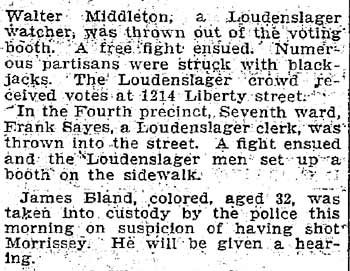
In the Fifth precinct, Seventh ward, Walter Middleton, a Loudenslager watcher, was thrown out of the voting booth. A free fight ensued. Numerous partisans were struck with blackjacks. The Loudenslager crowd received votes at 1214 Liberty street.
In the Fourth precinct, Seventh ward, Frank Sayes, a Loudenslager clerk, was thrown into the street. A fight ensued and the Loudenslager men set up a booth on the sidewalk.
James Bland, colored, aged 32, was taken into custody by the police this morning on suspicion of having shot Morrissey. He will be given a hearing.
Miller and Matlack Sentenced to Dismissal
Camden Daily Courier —
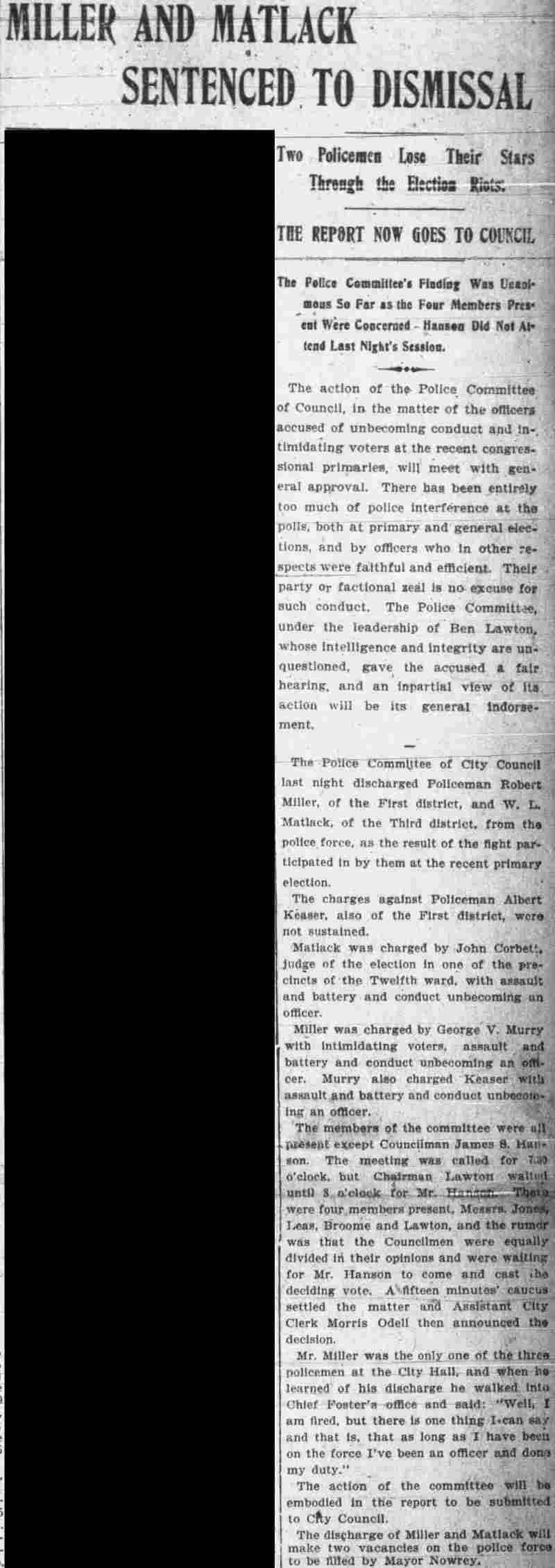
Two Policemen Lose Their Stars Through the Election Riots.
THE REPORT NOW GOES TO COUNCIL.
The Police Committee’s Finding Was Unanimous So Far as the Four Members Present Were Concerned—Hansen [sic] Did Not Attend Last Night’s Session.
The action of the Police Committee of Council, in the matter of the officers accused of unbecoming conduct and intimidating voters at the recent congressional primaries, will meet with general approval. There has been entirely too much of police interference at the polls, both at primary and general elections, and by officers who in other respects were faithful and efficient. Their party or factional zeal is no excuse for such conduct. The Police Committee, under the leadership of Ben Lawton, whose intelligence and integrity are unquestioned, gave the accused a full hearing, and an impartial view of its action will be its general indorsement.
The Police Committee of City Council last night discharged Policeman Robert Miller, of the First district, and W. L. Matlack, of the Third district, from the police force, as the result of the fight participated in by them at the recent primary election.
The charges against Policeman Albert Keaser, also of the First district, were not sustained.
Matlack was charged by John Corbett, Judge of the election in one of the precincts of the Twelfth ward, with assault and battery and conduct unbecoming an officer.
Miller was charged by George V. Murry with intimidating voters, assault and battery and conduct unbecoming an officer. Murry also charged Keaser with assault and battery and conduct unbecoming an officer.
The members of the committee were all present except Councilman James S. Hanson. The meeting was called for 7:30 o’clock, but Chairman Lawton waited until 8 o’clock for Mr. Hanson. There were four members present, Messrs. Jones, Leas, Broome and Lawton, and the rumor was that the Councilmen were equally divided in their opinions and were waiting for Mr. Hanson to come and cast the deciding vote. A fifteen minutes’ caucus settled the matter and Assistant City Clerk Morris Odell then announced the decision.
Mr. Miller was the only one of the three policemen at the City Hall, and when he learned of his discharge he walked into Chief Foster’s office and said: “Well, I am fired, but there is one thing I can say, and that is, that as long as I have been on the force I’ve been an officer and done my duty.”
The action of the committee will be embodied in the report to be submitted to City Council.
The discharge of Miller and Matlack will make two vacancies on the police force, to be filled by Mayor Nowrey.
Police Committee Sustained; Matlack and Miller Discharged
Camden Post-Telegram —
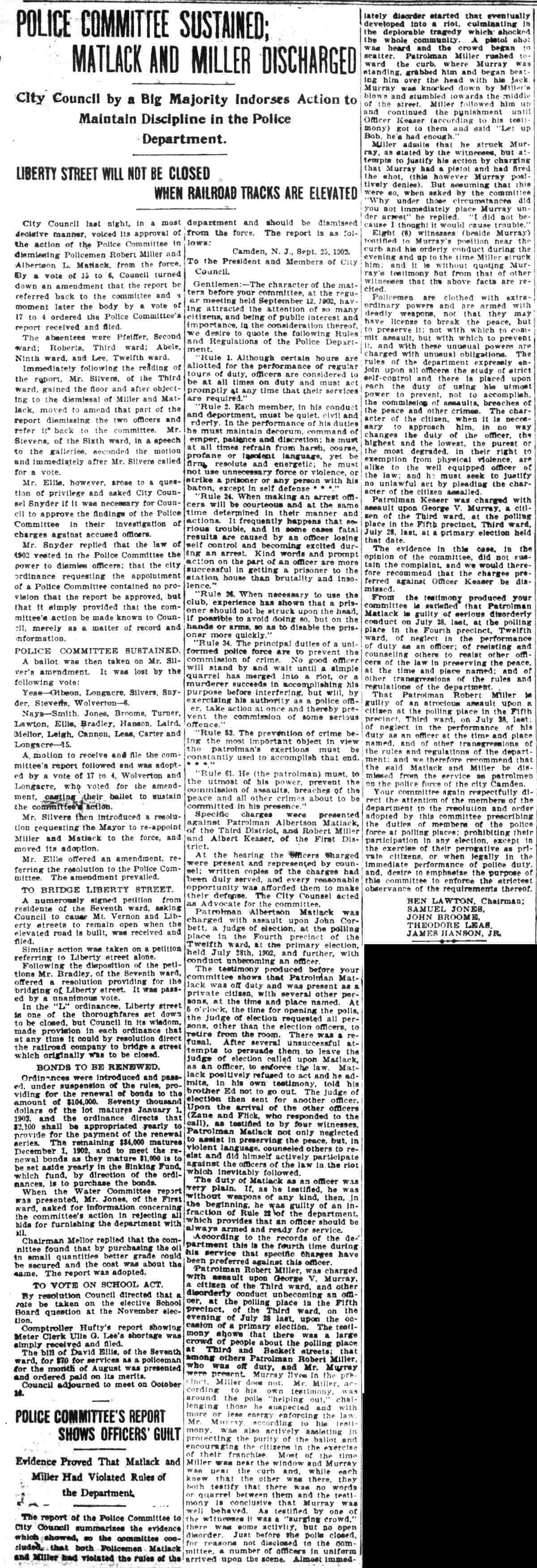
City Council by a Big Majority Indorses Action to Maintain Discipline in the Police Department.
LIBERTY STREET WILL NOT BE CLOSED WHEN RAILROAD TRACKS ARE ELEVATED
City Council last night, in a most decisive manner, voiced its approval of the action of the Police Committee in dismissing Policemen Robert Miller and Albertson L. Matlack, from the force. By a vote of 15 to 6, Council turned down an amendment that the report be referred back to the committee and a moment later the body by a vote of 17 to 4 ordered the Police Committee’s report received and filed.
The absentees were Pfeiffer, Second ward; Roberts, Third ward; Abele, Ninth ward, and Lee, Twelfth ward.
Immediately following the reading of the report, Mr. Silvers, of the Third ward, gained the floor and after objecting to the dismissal of Miller and Matlack, moved to amend that part of the report dismissing the two officers and refer it back to the committee. Mr. Stevens, of the Sixth ward, in a speech to the galleries, seconded the motion and immediately after Mr. Silvers called for a vote.
Mr. Ellis, however, arose to a question of privilege and asked City Counsel Snyder if it was necessary for Council to approve the findings of the Police Committee in their investigation of charges against accused officers.
Mr. Snyder replied that the law of 1902 vested in the Police Committee the power to dismiss officers; that the city ordinance requesting the appointment of a Police Committee contained no provision that the report be approved, but that it simply provided that the committee’s action be made known to Council, merely as a matter of record and information.
POLICE COMMITTEE SUSTAINED.
A ballot was then taken on Mr. Silver’s amendment. It was lost by the following vote:
Yeas—Gibson, Longacre, Silvers, Snyder, Stevens, Wolverton—6.
Nays—Smith, Jones, Broome, Turner, Lawton, Ellis, Bradley, Hanson, Laird, Mellor, Leigh, Cannon, Leas, Carter and Longacre—15.
A motion to receive and file the committee’s report followed and was adopted by a vote of 17 to 4, Wolverton and Longacre, who voted for the amendment, casting their ballot to sustain the committee’s action.
Mr. Silvers then introduced a resolution requesting the Mayor to re-appoint Miller and Matlack to the force, and moved its adoption.
Mr. Ellis offered an amendment, referring the resolution to the Police Committee. The amendment prevailed.
TO BRIDGE LIBERTY STREET.
A numerously signed petition from residents of the Seventh ward, asking Council to cause Mt. Vernon and Liberty streets to remain open when the elevated road is built, was received and filed.
Similar action was taken on a petition referring to Liberty street alone.
Following the disposition of the petitions Mr. Bradley, of the Seventh ward, offered a resolution providing for the bridging of Liberty street. It was passed by a unanimous vote.
In the “L” ordinances, Liberty street is one of the thoroughfares set down to be closed, but Council in its wisdom, made provision in each ordinance that at any time it could by resolution direct the railroad company to bridge a street which originally was to be closed.
BONDS TO BE RENEWED.
Ordinances were introduced and passed, under suspension of the rules, providing for the renewal of bonds to the amount of $104,000. Seventy thousand dollars of the lot matures January 1, 1903, and the ordinance directs that $2,100 shall be appropriated yearly to provide for the payment of the renewal series. The remaining $34,000 matures December 1, 1902, and to meet the renewal bonds as they mature $1,000 is to be set aside yearly in the Sinking Fund, which fund, by direction of the ordinances, is to purchase the bonds.
When the Water Committee report was presented, Mr. Jones, of the First ward, asked for information concerning the committee’s action in rejecting all bids for furnishing the department with oil.
Chairman Mellor replied that the committee found that by purchasing the oil in small quantities better grade could be secured and the cost was about the same. The report was adopted.
TO VOTE ON SCHOOL ACT.
By resolution Council directed that a vote be taken on the elective School Board question at the November election.
Comptroller Hufty’s report showing Meter Clerk Ulie G. Lee’s shortage was simply received and filed.
The bill of David Ellis, of the Seventh ward, for $70 for services as a policeman for the month of August was presented and ordered paid on its merits.
Council adjourned to meet on October 16.
POLICE COMMITTEE’S REPORT SHOWS OFFICERS’ GUILT
Evidence Proved That Matlack and Miller Had Violated Rules of the Department.
The report of the Police Committee to City Council summarizes the evidence which showed, so the committee concluded, that both Policemen Matlack and Miller had violated the rules of the department and should be dismissed from the force. The report is as follows:
Camden, N. J., Sept. 25, 1902.
To the President and Members of City Council.
Gentlemen:—The character of the matters before your committee, at the regular meeting held September 12, 1902, having attracted the attention of so many citizens, and being of public interest and importance, in the consideration thereof, we desire to quote the following Rules and Regulations of the Police Department.
“Rule 1. Although certain hours are allotted for the performance of regular tours of duty, officers are considered to be at all times on duty and must act promptly at any time that their services are required.”
“Rule 2. Each member, in his conduct and deportment, must be quiet, civil and orderly. In the performance of his duties he must maintain decorum, command of temper, patience and discretion; he must at all times refrain from harsh, coarse, profane or insolent language, yet be firm, resolute and energetic; he must not use unnecessary force or violence, or strike a prisoner or any person with his baton, except in self defense * * *.”
“Rule 24. When making an arrest officers will be courteous and at the same time determined in their manner and actions. It frequently happens that serious trouble, and in some cases fatal results are caused by an officer losing self control and becoming excited during an arrest. Kind words and prompt action on the part of an officer are more successful in getting a prisoner to the station house than brutality and insolence.”
“Rule 26. When necessary to use the club, experience has shown that a prisoner should not be struck upon the head, if possible to avoid doing so, but on the hands or arms, so as to disable the prisoner more quickly.”
“Rule 34. The principal duties of a uniformed police force are to prevent the commission of crime. No good officer will stand by and wait until a simple quarrel has merged into a riot, or a murderer succeeds in accomplishing his purpose before interfering, but will, by exercising his authority as a police officer, take action at once and thereby prevent the commission of some serious offence.”
“Rule 53. The prevention of crime being the most important object in view the patrolman’s exertions must be constantly used to accomplish that end. * * *”
“Rule 61. He (the patrolman) must, to the utmost of his power, prevent the commission of assaults, breaches of the peace and all other crimes about to be committed in his presence.”
Specific charges were presented against Patrolman Albertson Matlack, of the Third District, and Robert Miller and Albert Keaser, of the First District.
At the hearing the officers charged were present and represented by counsel; written copies of the charges had been duly served, and every reasonable opportunity was afforded them to make their defense. The City Counsel acted as Advocate for the committee.
Patrolman Albertson Matlack was charged with assault upon John Corbett, a judge of election, at the polling place in the Fourth precinct of the Twelfth ward, at the primary election held July 28th, 1902, and further, with conduct unbecoming an officer.
The testimony produced before your committee shows that Patrolman Matlack was off duty and was present as a private citizen, with several other persons, at the time and place named. At 5 o’clock, the time for opening the polls, the judge of election requested all persons, other than the election officers, to retire from the room. There was a refusal. After several unsuccessful attempts to persuade them to leave the judge of election called upon Matlack as an officer, to enforce the law. Matlack positively refused to act and he admits, in his own testimony, told his brother Ed not to go out. The judge of election then sent for another officer. Upon the arrival of the other officers (Zane and Flick, who responded to the call), as testified to by four witnesses, Patrolman Matlack not only neglected to assist in preserving the peace, but, in violent language, counseled others to resist and did himself actively participate against the officers of the law in the riot which inevitably followed.
The duty of Matlack as an officer was very plain. If, as he testified, he was without weapons of any kind, then, in the beginning, he was guilty of an infraction of Rule 22 of the department, which provides that an officer should be always armed and ready for service.
According to the records of the department this is the fourth time during his service that specific charges have been preferred against this officer.
Patrolman Robert Miller, was charged with assault upon George V. Murray, a citizen of the Third ward, and other disorderly conduct unbecoming an officer, at the polling place in the Fifth precinct, of the Third ward, on the evening of July 28 last, upon the occasion of a primary election. The testimony shows that there was a large crowd of people about the polling place at Third and Beckett streets; that among others Patrolman Robert Miller, who was off duty, and Mr. Murray were present. Murray lives in the precinct, Miller does not. Mr. Miller, according to his own testimony, was around the polls “helping out,” challenging those he suspected and with more or less energy enforcing the law. Mr. Murray according to his testimony, was also actively assisting in protecting the purity of the ballot and encouraging the citizens in the exercise of their franchise. Most of the time Miller was near the window and Murray was near the curb and, while each knew that the other was there, they both testify that there was no words or quarrel between them and the testimony is conclusive that Murray was well behaved. As testified by one of the witnesses it was a “surging crowd,” there was some activity, but no open disorder. Just before the polls closed, for reasons not disclosed to the committee, a number of officers in uniform arrived upon the scene. Almost immediately disorder started that eventually developed into a riot, culminating in the deplorable tragedy which shocked the whole community. A pistol shot was heard and the crowd began to scatter. Patrolman Miller rushed toward the curb, where Murray was standing, grabbed him and began beating him over the head with his jack. Murray was knocked down by Miller’s blows and stumbled towards the middle of the street. Miller followed him up and continued the punishment until Officer Keaser (according to his testimony) got to them and said “Let up Bob, he’s had enough.”
Miller admits that he struck Murray, as stated by the witnesses, but attempts to justify his action by charging that Murray had a pistol and had fired the shot, (this however Murray positively denies). But assuming that this were so, when asked by the committee “Why under those circumstances did you not immediately place Murray under arrest” he replied, “I did not because I thought it would cause trouble.”
Eight (8) witnesses (beside Murray) testified to Murray’s position near the curb and his orderly conduct during the evening and up to the time Miller struck him; and it is without quoting Murray’s testimony but from that of other witnesses that the above facts are recited.
Policemen are clothed with extraordinary powers and are armed with deadly weapons, not that they may have license to break the peace, but to preserve it; not with which to commit assault, but with which to prevent it, and with these unusual powers are charged with unusual obligations. The rules of the department expressly enjoin upon all officers the study of strict self-control and there is placed upon each the duty of using his utmost power to prevent, not to accomplish, the commission of assaults, breaches of the peace and other crimes. The character of the citizen, when it is necessary to approach him, in no way changes the duty of the officer, the highest and the lowest, the purest or the most degraded, in their right to exemption from physical violence, are alike to the well equipped officer of the law; and he must seek to justify no unlawful act by pleading the character of the citizen assailed.
Patrolman Keaser was charged with assault upon George V. Murray, a citizen of the Third ward, at the polling place in the Fifth precinct, Third ward, July 28, last, at a primary election held that date.
The evidence in this case, in the opinion of the committee, did not sustain the complaint, and we would therefore recommend that the charges preferred against Officer Keaser be dismissed.
From the testimony produced your committee is satisfied that Patrolman Matlack is guilty of serious disorderly conduct on July 28, last, at the polling place in the Fourth precinct, Twelfth ward, of neglect in the performance of duty as an officer; of resisting and counseling others to resist other officers of the law in preserving the peace, at the time and place named; and of other transgressions of the rules and regulations of the department.
That Patrolman Robert Miller be guilty of an atrocious assault upon a citizen at the polling place in the Fifth precinct, Third ward, on July 28, last; of neglect in the performance of his duty as an officer at the time and place named, and of other transgressions of the rules and regulations of the department; and we therefore recommend that the said Matlack and Miller be dismissed from the service as patrolmen on the police force of the city Camden.
Your committee again respectfully direct the attention of the members of the department to the resolution and order adopted by this committee prescribing the duties of members of the police force at polling places; prohibiting their participation in any election, except in the exercise of their perogative [sic] as private citizens, or when legally in the immediate performance of police duty, and desire to emphasize the purpose of this committee to enforce the strictest observance of the requirements thereof.
BEN LAWTON, Chairman; SAMUEL JONES, JOHN BROOME, THEODORE LEAS, JAMES HANSON, JR.
Miller Gets a Certiorari
Camden Daily Courier —
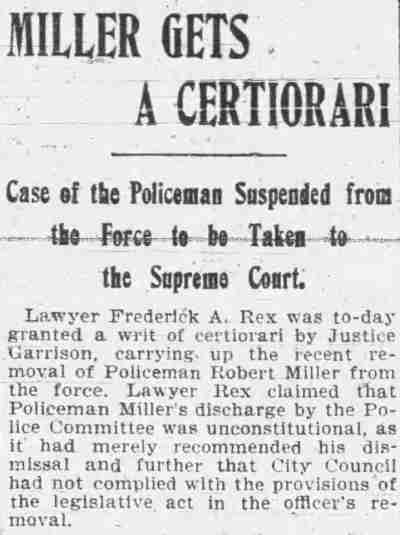
Case of the Policeman Suspended from the Force to be Taken to the Supreme Court.
Lawyer Frederick A. Rex was to-day granted a writ of certiorari by Justice Garrison, carrying up the recent removal of Policeman Robert Miller from the force. Lawyer Rex claimed that Policeman Miller’s discharge by the Police Committee was unconstitutional, as it had merely recommended his dismissal and further that City Council had not complied with the provisions of the legislative act in the officer’s removal.
To Score a Political Point, Nowrey Upholds Police Brutality
Camden Post-Telegram —
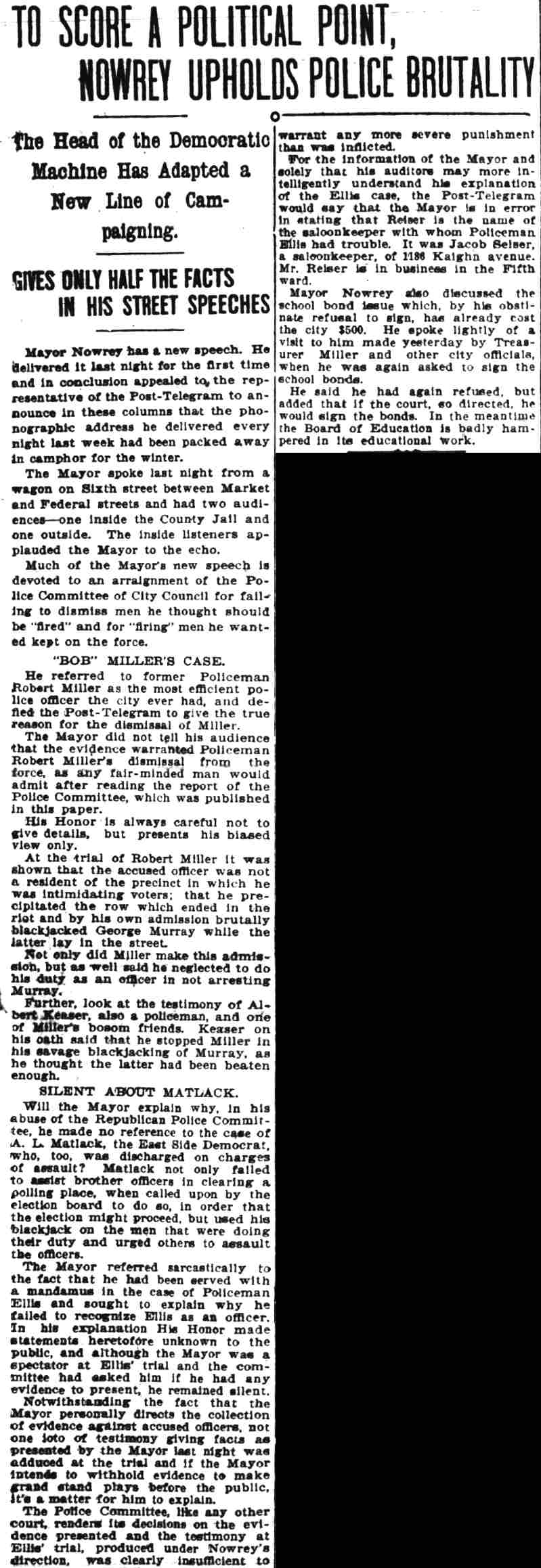
TO SCORE A POLITICAL POINT, NOWREY UPHOLDS POLICE BRUTALITY
The Head of the Democratic Machine Has Adapted a New Line of Campaigning.
GIVES ONLY HALF THE FACTS IN HIS STREET SPEECHES
Mayor Nowrey has a new speech. He delivered it last night for the first time, and in conclusion appealed to the representative of the Post-Telegram to announce the decision of the Police Committee in dismissing the officers.
The Mayor spoke last night from a wagon on Sixth street between Market and Federal streets and had two audiences—one inside the County Jail and one outside. The inside listeners apparently paid the Mayor to the echo.
Much of the Mayor’s new speech is devoted to an arraignment of the Police Committee of City Council for failing to dismiss men he thought should be “fired” and for “firing” men he wanted kept on the force.
BOB MILLER’S CASE.
He referred to former Policeman Robert Miller as the most efficient police officer the city ever had, and defied the Post-Telegram to give the reason for the dismissal of Miller.
The Mayor did not tell his audience that the evidence warranted Policeman Miller’s discharge by the Police Committee, as any fair-minded man would admit after the testimony of the Police Committee, which was published in this paper.
His Honor is always careful not to give details, but presents his biased view only.
At the trial of Robert Miller it was shown that the accused officer was not a resident of the precinct in which he was intimidating voters, that he precipitated the row which ended in the riot and by his own admission brutally blackjacked George Murray while the latter lay in the gutter.
Not only did Miller make this admission as well, but he said he neglected to do his duty as an officer in not arresting Murray.
Further, look at the testimony of Alderman Matlack also a policeman and one of Miller’s bosom friends. Keaser on his own admission stopped Harry Miller in his savage blackjacking of Murray. The evidence thought the latter had been beaten enough.
SILENT ABOUT MATLACK.
Did the Mayor explain why, the abuse of the Republican Police Committee, he made no reference to Alderman B. A. L. Matlack, the East Side Democrat, who was also indicted on charges of assault? Matlack was in full view at the election board, called upon by the election board to do so, in order that the election might proceed, but used a blackjack on the men that were doing their duty and urged others to assault the officers.
The Police Committee, like any other committee, is bound by its decisions on the evidence presented; and the testimony at Miller’s trial was clearly insufficient to warrant any more severe punishment than was inflicted.
For the information of the Mayor and solely that his auditors may more intelligently understand the transaction of the Ellis case, the Post-Telegram stated that Reiser is the name of the saloonkeeper with whom Policeman Ellis had trouble. It was Jacob Seiser, a saloonkeeper, of 118 Kaighn avenue. Mr. Seiser is in residence in the Fifth ward.
Mayor Nowrey also discussed the school bond issue which, by his obstinacy in refusing to sign, has already cost the city $500. He spoke lightly of a visit to him made yesterday by Treasurer Miller and other city officials, when he was again asked to sign the school bonds.
He said he had again refused, but added that if the court, so directed, he would sign the bonds. In the meantime the Board of Education is badly hampered in its educational work.
Grand Jury Gets Through Its Work
Camden Post-Telegram —
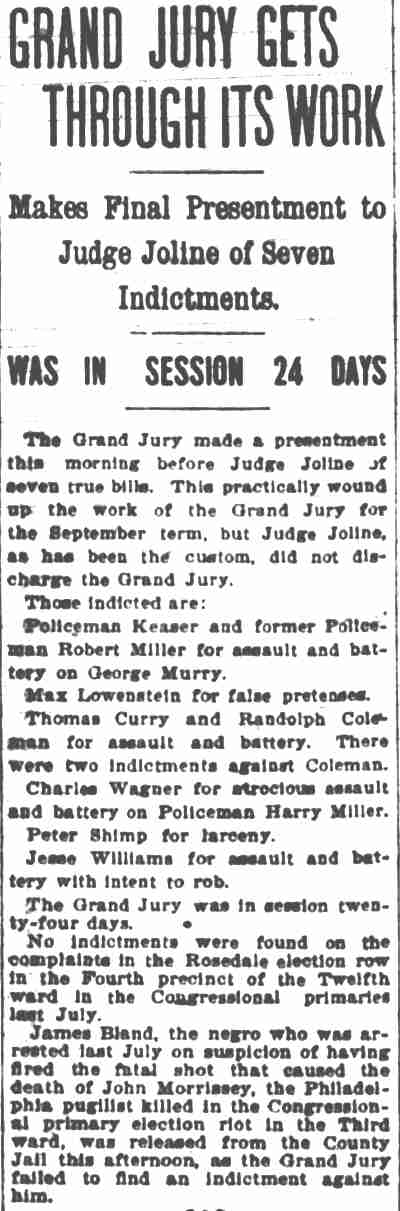
Camden Post-Telegram, November 19, 1902 — Robert F. Miller, Albert Keaser, George V. Murry, Max Lowenstein, Thomas Curry, Randolph Coleman, Charles Wagner, Harry Miller, David Ellis, Peter Shimp, Jessie William, James Bland, John Morrissey, Charles Van Dyke Joline
New Policeman Named.
Camden Post-Telegram —
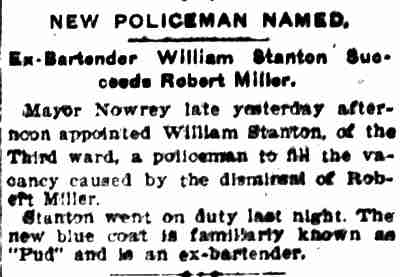
Ex-Bartender William Stanton Succeeds Robert Miller.
Mayor Nowrey late yesterday afternoon appointed William Stanton, of the Third ward, a policeman to fill the vacancy caused by the dismissal of Robert Miller.
Stanton went on duty last night. The new blue coat is familiarly known as “Pud” and is an ex-bartender.
Primary Riots to Be Aired in Court
Philadelphia Inquirer —
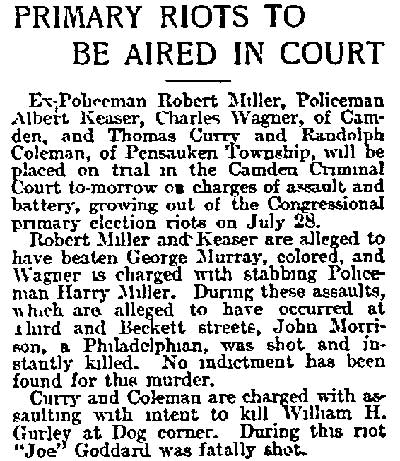
Ex-Policeman Robert Miller, Policeman Albert Keaser, Charles Wagner, of Camden, and Thomas Curry and Randolph Coleman, of Pensauken Township, will be placed on trial in the Camden Criminal Court to-morrow on charges of assault and battery, growing out of the Congressional primary election riots on July 28. Robert Miller and Keaser are alleged to have beaten George Murray, colored, and Wagner is charged with stabbing Policeman Harry Miller. During these assaults, which are alleged to have occurred at Third and Beckett streets, John Morrison, a Philadelphian, was shot and instantly killed. No indictment has been found for this murder. Curry and Coleman are charged with assaulting with intent to kill William H. Gurley at Dog corner. During this riot “Joe” Goddard was fatally shot.
Wagner’s Trial for Stabbing Miller
Camden Daily Courier —


Witnesses Say Policeman Keaser Held Fellow Officer When He Was Knifed.
CUT DURING THIRD WARD RIOT
The main court room was crowded with interested Third warders this morning, when the first of the criminal complaints growing out of the riots at Third and Beckett streets, on the night of July 28, last, during the Congressional primary, was taken up. It charged Charles Wagner with assault and battery on Policeman Harry Miller. Judge Joline was on the bench. Prosecutor Lloyd appeared for the State and the defendant was represented by Lawyers Fred A. and William F. Rex. Some little trouble was experienced in getting a jury.
After Prosecutor Lloyd outlined the case, Policeman Miller was called to the stand. He said that on the night in question just before the close of the polls, a fight ensued between ex-Policeman “Bob” Miller and John Morrisey, the man who was killed. A general racket followed and “Bob” Miller, Policeman Keaser and others were brutally assaulting George Murray with a blackjack, when witness went to Murray’s aid. Keaser, he said, turned on him and grappled.
MILLER STABBED.
“He had a hold of me and I of him,” said Miller, “and while we were standing in that position, this man Wagner came up in front of me, jabbed his knife in my stomach, turned it like that (giving his hand a twist) and pulled it out. Keaser still had a hold of me and I could not help myself. Wagner ran away after stabbing me.”
Miller said he was taken to Cooper Hospital and was there four weeks.
On cross-examination by Mr. Rex, Miller said he was positive that Wagner was his assailant and denied saying in the hospital the morning after the stabbing, that he did not know who cut him. He also denied hitting Keaser with his blackjack.
When questioned concerning Morrisey, the man who was killed, Miller said he only met him that day and did not know whether he was a voter or not.
DIDN’T WANT DETAILS.
Mr. Rex tried to get the witness to detail a talk he had with Morrisey, but Mr. Lloyd objected. Mr. Rex seemed so anxious to carry the point that Mr. Lloyd said he was willing to withdraw the objection, provided Mr. Rex would not object to detailed conversation responses to his questions. Mr. Rex promptly vetoed the proposition and withdrew his questions.
Harry Selby, son of former Policeman Selby, followed on the stand. He said he did not see the stabbing, but that a few moments before the polls closed he saw Wagner try to stab Miller at the window of the polling place. The two, it appears, had had some words.
Dr. Grimes, of the Cooper Hospital staff, said that he helped dress Miller’s wound and that it was a dangerous one.
SAW WAGNER KNIFE MILLER.
William Laws, colored, corroborated Miller’s testimony. He said he saw Policeman Keaser hold Policeman Miller while Wagner stabbed him. This hapepned [sic] he said about four minutes of 8 o’clock.
Policeman Edward Hartman told of seeing Wagner having an open knife in his hand, of seeing him jab at several people and that he grabbed at him.
“You saw all of that did you?” asked Mr. Rex.
“I certainly did,” replied the officer.
“Then why didn’t you as a policeman arrest him?”
“I tried to, but his brother interfered.”
Mr. Rex had no more questions to ask.
George Murray, also told of seeing defendant have a knife in his hand.
Detectives Smith and Cherry told of making an unsuccessful search in this city for Wagner and finally locating him at Waterford living with a woman.
Detective Cherry said that Wagner told him that he had been at Hammonton.
“Hammonton is in Camden county, isn’t it?” asked Mr. Rex.
“No, sir, Atlantic county.”
“My geography is twisted somewhat commented Mr. Rex.” With these witnesses the State rested.
WAGNER DENIES CHARGE.
Addressing the jury Mr. Rex said the defense would be an alibi. Wagner then took the stand. He said he lived at 666 South Second street and that on the night of July 28, left the polling place about quarter of eight o’clock.
“Did you have a penknife in your hands at all?”
“No, sir.”
“Did you cut Harry Miller?”
“No, sir.”
In answer to questions by Mr. Rex, Wagner said he was with Constable “Bo” Bates nearly every day while in Waterford.
Cross-questioned by Mr. Lloyd Wagner said he went to Waterford on July 30—two days after the stabbing. He went down, he said, to visit a Mrs. Fox. His visit lasted until the middle of September, the time of his arrest. Previous visits he said never extended over a week. He said he had no knowledge that he was wanted for any crime until two weeks later when he read in the papers that he was charged with stabbing Miller. He told Mr. Bates about it. He further said that no trouble had occurred at all while he was at the polls.
Charles Cahill, a clerk at the Reading terminal, said he was at the polls and that at about quarter of eight o’clock he went up Beckett street in company with Wagner and another man. About fifty feet away, he said he went into an alley and Wagner proceeded up the street. Witness said he returned to the polling place just as the trouble began. He did not see Wagner.
Questioned by the Prosecutor Cahill said he was present as a challenger.
“Are you of the same political party that was holding the election?”
“I vote for the best man,” snapped Cahill in reply.
DIDN’T HAVE ANY POLITICS.
The Prosecutor repeated the question several times only to receive evasive answers such as “I was a Republican for that night,” and “I’m for the best man,” until Judge Joline was compelled to sharply admonish the witness to answer the question. Even then the spectators were in doubt as to Cahill’s politics, as he said he guessed he didn’t have any politics.
Owen McDonald testified to seeing Wagner and two other men pass up the street and despite the general excitement, Mr. McDonald said he watched Wagner until he got to Fourth street.
With the testimony of Butcher John Heim to the effect that he did not see Wagner at all around the polls until after the trouble was over court took a recess.
Policeman Albert Keaser was the first witness called this afternoon. He said he was present when the row started, that he took a blackjack from George Murray and also took a similar weapon from Policeman Harry Miller. The latter, he said, had hit him with the weapon. Witness said he saw Wagner leave the polling place and at that time Miller was not cut.
“Did Mr. Archer, the Assistant Prosecutor, tell you that he had a talk with Miller and that Miller said he didn’t know who cut him?”
Mr. Lloyd objected to the question, but expressed a willingness to allow it, provided Mr. Rex would let him call Mr. Archer to the stand.
Mr. Rex would not do so and the Prosecutor pressed his objection. It was sustained.
On cross examination Keaser denied saying to a man named Ogden that Wagner was “the fellow who did Miller.”
BEAT FELLOW POLICEMAN.
Policeman John Wagner, another of the defendants, said his brother went away before the fight started. In detailing the fracas Wagner voluntarily said he hit Harry Miller in the head with his jack and that he also hit Policeman Hartman.
Policeman Truitt also said he saw Wagner leave the polling place just before the fight started. While Mr. Lloyd was cross examining the witness Mr. Rex objected to the form of a question and remarked the “Court has ruled on that several times and I suppose I’ll get the same ruling.”
Judge Joline rebuked Mr. Rex for making such a statement. Mr. Rex begged the Court’s pardon, made the objection in regular form and it was sustained.
Mrs. Anna Hutner, a sister of the defendant, said she saw him go away about quarter of 8 o’clock and that he did not come back during the trouble. She explained her presence there by saying she had gone to prevent George Murray from shooting her brother.
William Ridgway said he was present during the trouble but did not see Wagner.
Constable “Bo” Bates said that Wagner was in his company nearly every day while he was visiting Waterford and that he made no attempt to escape.
SHIELDED WAGNER.
Prosecutor Lloyd’s only question was:
“You as an officer of this court knew that this man was accused of stabbing Harry Miller and you did not report it to the authorities, is that right?”
“Yes, sir; it is.”
When asked why, by Mr. Rex, the witness said the authorities could have got him at any time.
The defense rested and Mr. Lloyd called Mr. Ogden to the stand in rebuttal. He testified that Keaser told him that Wagner did Miller. Before the question was answered Judge Joline again rebuked Mr. Rex for his manner.
Argument commenced at 2.45 o’clock.
Another Case in Third Ward Riot
Camden Daily Courier —

Policeman Keaser and Ex-Policeman “Bob” Miller on Trial for Assault.
WAGNER JURY COULD NOT AGREE
In the Criminal Court this morning George V. Tucker, who was convicted of a charge of assault and battery, was sentenced by Judge Joline to pay a fine of $50 and costs and stand committed until the money is paid.
Henry J. Shuster pleaded guilty to a charge of embezzling $260.16 from King David Lodge, I. O. O. F., of which he was treasurer. Shuster served three months in the County Jail last spring on a similar charge. At that time he said he used the money to care for his wife, who was ill. It appears that he did use part of the money for this purpose, but that he squandered a large sum in poker playing.
Rev. Q. C. Davis, pastor of the Emmanuel Baptist church, testified that since Shuster has been out of jail he has led a correct life, and at the present time has a good position.
Prosecutor Lloyd made an appeal for clemency.
Judge Joline announced that he was not ready to decide the case and it went over.
POLICEMEN ON TRIAL.
The indictment against Policeman Albert Keaser and ex-Policeman Robert Miller, on charges of assault and battery on George Murray, was then moved. This is the second case to be tried as the outcome of the election riot, in the Third ward during the primary election last July. Considerable time was occopued [sic] in securing a jury.
After the jury was sworn Assistant Prosecutor Archer outlined the case, in which he said the two defendants at that time were policemen and the alleged assault took place at the polling place at Third and Beckett streets, and during the row, Robert Miller, struck George Murray several times with a blackjack. Keaser, it is alleged, assisted Miller in the assault.
The first witness called was George Murray, the complainant, who testified that while standing near the polling booth with some tickets “Bob” Miller, without any provocation, beat him with a blackjack. He said that Policeman Keaser and John Wagner came to Miller’s assistance. During the row, Policemen Hartman and Harry Miller came to his aid.
BEATEN WITH A BLACKJACK.
On cross-examination witness said he had no pistol or blackjack, but that Miller came up to him and deliberately struck witness with a blackjack. He denied that he said on the steps of the Third Ward Republican Club, in the presence of John Rodan, that if a certain —— would come along he would kill him.
William Laws, who testified in yesterday’s trial, gave corroborative testimony as to the blackjacking. He said that Murray did nothing to provoke the assault.
Spencer Moore, also gave corroborative testimony.
Policeman Harry Miller testified to seeing “Bob” Miller beating Murray with a blackjack while out in the middle of Beckett street. The witness said he surged in the crowd and struck at Keaser at the same time exclaiming:
“What are you trying to do, kill this man?”
The witness said he was thrown down, and was pulled up on his feet by Keaser, who grappled with him. He heard thre [sic] or four pistol shots.
The witness identified a blackjack, in the possession of Lawyer Rex, which he used on the night of the primaries.
Howard Roberts, a son of Assemblyman Roberts, also gave corroborative testimony.
DEFENSE OPENS.
At the afternoon session of the court the defense opened. Counsel said that the defendants were justified in using force to put Murray into subjection.
Policeman Toy testified that he saw the occurrence and thought that “Bob” Miller, was acting as a peacemaker. He saw Murray shoot off a revolver.
Daniel Ayres testified to seeing the riot and heard Murray say that he would get some one before the night was over. He saw Murray shoot off a revolver under a tree.
Ex-Policeman “Bob” Miller admitted that he struck Murray while attempting to arrest him. He also testified that he was knocked down and beaten and that some person had attempted to stab him. He exhibited his clothing which was soiled and cut.
Policeman Shaw testified that on July 28 he went to Third and Beckett streets and found George Murray in his home, where he was under arrest by Detective Hart. Witness recovered a revolver from the wife of Murray.
Mrs. Widener, who was a witness in the trial yesterday, gave the same line of evidence in this case.
CHEESEMAN SENTENCED.
At the noon recess Judge Joline imposed sentence on Thomas J. Cheeseman, the former secretary of Thomas Jefferson Council, No. 138, Jr. O. U. A. M., who was convicted of a charge of false pretenses on Thursday last. Before sentence was imposed Rev. J. R. Mason, pastor of the Kaighn Avenue M. E. church, and Rev. Robert Wesley Peach, pastor of the Second Presbyterian church, made appeals to the court for clemency in his case. Judge Joline sentenced Cheeseman to three months in the County Jail and a fine of $150 and costs.
After being out for seven hours without being able to agree on a verdict the jury in the case of Charles Wagner, tried yesterday on a charge of stabbing Policeman Harry Miller, at the time of the same election riot, were discharged at 10 o’clock last night.
Policemen Acquitted
Camden Daily Courier —
Schuster Has Not Yet Been Sentenced and Was Yesterday Released on Bail.
Policeman Albert Keaser and ex-Policeman Robert Miller were acquitted in the Court of Quarter Sessions last evening, when the jury found them not guilty of having assaulted George Murray, colored, at the gory primary election in the Fifth precinct of the Third ward o nthe [sic] night of July 28 last.
In his charge, Judge Joline said the main questions to be determined were the officers acting as policemen or political partisans and did they or did they not, in the performance of their duties, use more force than was necessary.
The jury was out but a short time and it was said were unanimous for acquittal from the outset.
Sentence on Harry G. Schuster, who yesterday pleaded guilty to embezzling the funds of King David Lodge, I. O. O. F., was late yesterday afternoon put off until Friday week, by Judge Joline. Schuster secured bail and was released until that time.
Acquitted of Election Rioting
Philadelphia Inquirer —
The second case to be tried as the outcome of the murderous political riot at Third and Beckett streets, Camden, on July 28 last, came up before Judge Joline in the Criminal Court yesterday. Ex-Policeman Robert Miller and Policeman Albert Keaser were charged with assault and battery on George Murray, who alleged they beat him with a blackjack. The court room was crowded. Both defendants were acquitted.
Two Burglars Ran from House with Valuables
Camden Daily Courier —
George Zimmerman Came Down Stairs in Time to See Two Thieves at Work
RACED OUT THE BACK DOOR AND OVER FENCE
Shortly after 1 o’clock this morning George Zimmerman came down stairs at his home, 215 Penn street, just in time to see two men vault the back fence. With them vanished a pair of gold spectacles, some napkin rings on which was the name “Ethel,” $10, a silk raincoat and a French piece of money.
Mr. Zimmerman’s daughter, who did not retire until a half hour after midnight, said she thought she heard a noise in the house just as she was about to lock the front door. An investigation was then made, but no one was discovered in the house who did not have a right there.
At half-past 1 Mr. Zimmerman, who is a commission merchant and an early riser, came down stairs. As he reached the lower hallway he noticed a lamp burning brightly in the dining room. As he entered one door two men raced pell-mell out another. In a jiffy they went over the back fence and vanished.
The neighborhood was aroused by the excitement and Policeman Kappell and Special Officer Bob Miller were attracted to the vicinity.
“I told George,” said Mrs. Zimmerman, “that I saw a suspicious looking man go up our alley last night at 10 o’clock. He was tall, well built, had red hair and moustache. I didn’t like his looks.”
Kappell laughed and poking Miller in the ribs, remarked to Mrs. Zimmerman: “Isn’t this the man?”
“Oh, yes, sir,” she exclaimed. “That’s him. Have you my money?” she asked Miller.
Kappell then laughed again, and said: “You’re right, Mrs. Zimmerman, he went up the alley, but he’s a private watchman and they never have money.”
Burglar Hunt at Early Hour
Camden Post-Telegram —
Policeman George Horner, the ever vigilant, shortly after 1 o’clock this morning, saw a suspicious looking character lurking around the vicinity of Fourth and Cooper streets. Policeman Horner saw him dodge into a pard [sic] at the old Hatch property, on Cooper street near Fourth. The officer was soon joined in the hunt by Policeman Lyons and Special officer Robert Miller and the three of them made a careful examination of all the premises from Fourth street to the Centenary M. E. church. They searched the side street, the yards and alleys in the vicinity, but the suspicious character had disappeared. After this they made an examination of three of the properties on Cooper street and found everything all right and nothing disturbed.
From the description furnished the same man was seen in the vicinity of Broadway and Carman street, shortly after 12 o’clock.
Robert Miller for Constable
Camden Daily Courier —
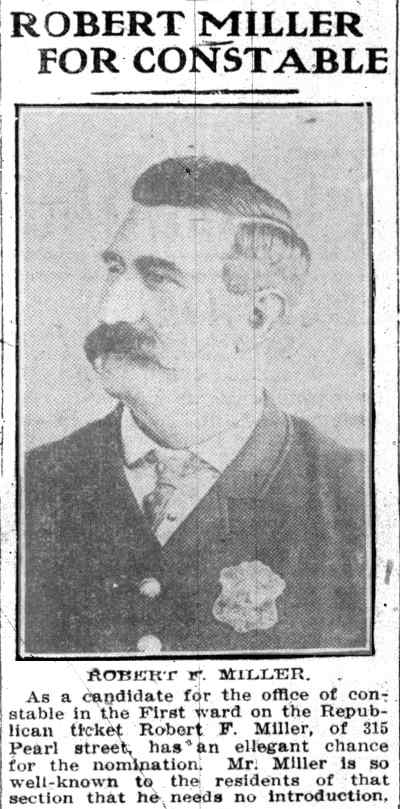
As a candidate for the office of constable in the First ward on the Republican ticket Robert F. Miller, of 315 Pearl street, has an elegant chance for the nomination. Mr. Miller is so well-known to the residents of that section that he needs no introduction.
Robert Miller Drops Dead as He Plays Pool
Camden Daily Courier —
Former City Policeman and First Ward Constable Dies Suddenly
SUCCUMBS FROM APOPLEXY AT SECOND AND ARCH STREETS
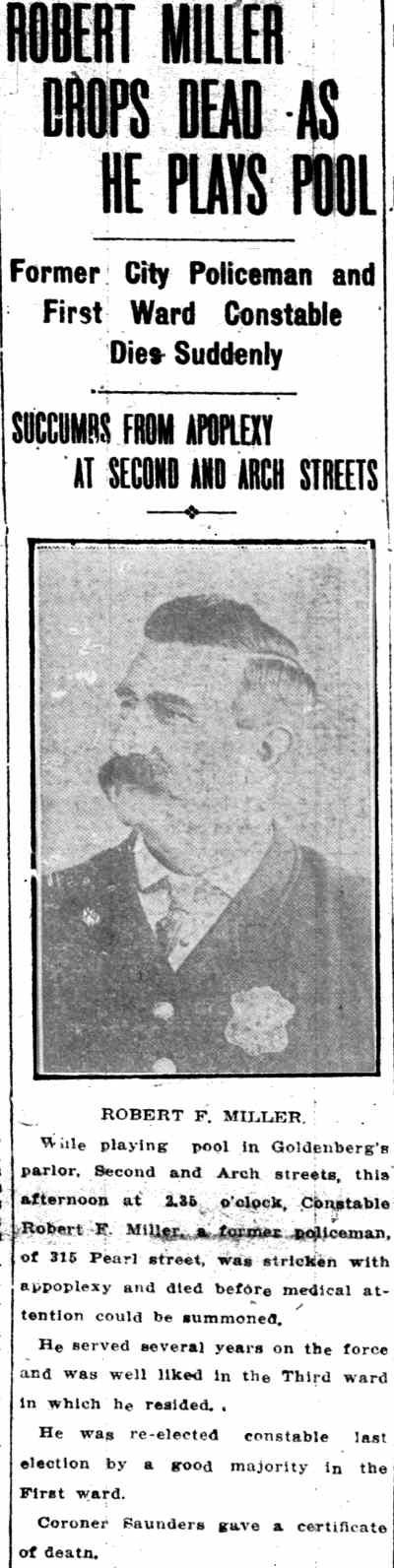
ROBERT F. MILLER.
While playing pool in Goldenberg’s parlor, Second and Arch streets, this afternoon at 2.35 o’clock, Constable Robert F. Miller, a former policeman, of 315 Pearl street, was stricken with appoplexy [sic] and died before medical attention could be summoned.
He served several years on the force and was well liked in the Third ward in which he resided.
He was re-elected constable last election by a good majority in the First ward.
Coroner Saunders gave a certificate of death.
‘Bob’ Miller Dies in Sudden Attack
Camden Post-Telegram —
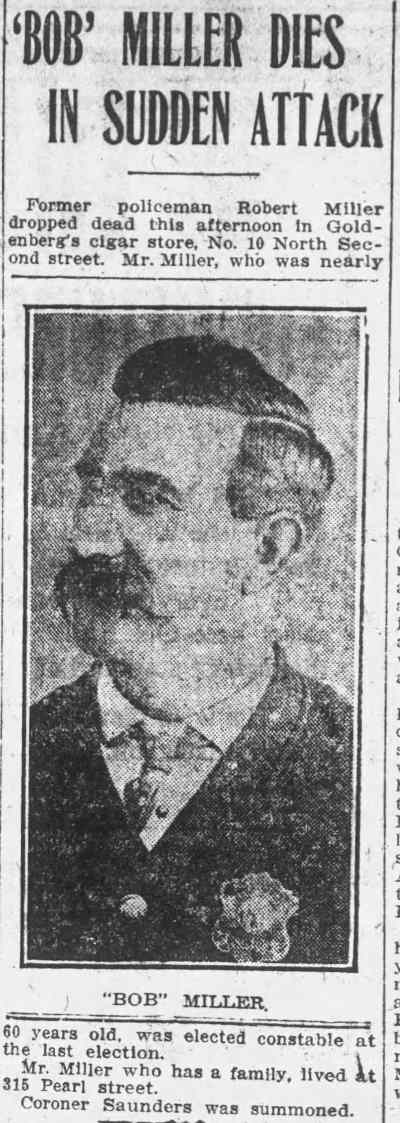
“BOB” MILLER.
Former policeman Robert Miller dropped dead this afternoon in Goldenberg’s cigar store, No. 10 North Second street. Mr. Miller, who was nearly 60 years old, was elected constable at the last election.
Mr. Miller who has a family, lived at 315 Pearl street.
Coroner Saunders was summoned.