Introduction
LOUIS SHAW was born in Camden, New Jersey on November 13, 1885. He was the son of Albert S. Shaw, who served 28 years as a Camden policeman, and the grandson of Edmund H. Shaw, one of Camden's first city marshals. His Uncle, also named Edmund Shaw, was a member of the Camden Fire Department in the 1870s. Another uncle, William H. Shaw, worked in the City Highway Department, cousin John P. Shaw worked a few years as a firefighter, and cousin Charles H. Elfreth had a 43-year-long career with the city, mostly in the tax office.
Louis Shaw appears in the 1910 Census, then working as a teamster for an oil company. In that year teamsters were not necessarily driving trucks — wagons were still very prevalent. Louis Shaw was then renting a room from a co-worker, George Stillwell, at 342 Sycamore Street, in South Camden.
At the age of 27 he married. He was working for the Camden Fire Department when the 1914 Camden City Directory was compiled. In 1917, with his father Albert Shaw retiring on pension, Louis Shaw joined the Camden Police Department. At that time he, wife Theresa, and daughter Theresa, then 12, were living at 239 Mt. Vernon Street, a block away from his previous lodgings.
Louis Shaw would make a career of law enforcement with Camden's police force. The 1924 City Directory shows Louis and Theresa Shaw at 1437 Kaighn Avenue in Camden's Parkside neighborhood. The April 1930 Census reveals that at that time he owned the home, then valued at $6,000. By April of 1930 he also had been promoted to Detective.
Detective Louis Shaw on September 9, 1932 arrested Louis Gueness of 209 Royden Street at his home for running an illegal lottery. He was then Lieutenant of Detectives, and held that post into May of 1934. He was shifted to other duties at some point thereafter, but returned to the Detective squad as a sergeant in August of 1935 when City Commissioner Mary W. Kobus appointed him assistant to Lieutenant Samuel Johnson, who was simultaneously appointed to serve as head of the detective squad, replacing Lieutenant George Ward. By January of 1938 Louis Shaw was serving as Acting Lieutenant of Detectives.
Louis and Theresa Shaw were still living at 1437 Kaighn Avenue in the fall of 1936. He appears to have separated from his wife by the spring of 1942. At that time he was living at 1421 Bradley Avenue, and still working for the police department. 1421 Bradley Avenue had been the home of veteran Camden detective Charles H. Fitzsimmons III, who had died in 1938. Louis Shaw's landlady was Anna Fitzsimmons, the late detective's daughter.
After 33 years combined service with the Camden Fire and Police Departments, Louis Shaw retired in the spring of 1944. He passed away on April 15, 1945. Louis Shaw was survived by his wife, who was still living at 1437 Kaighn Avenue when the 1947 Camden City Directory was compiled.
Photos
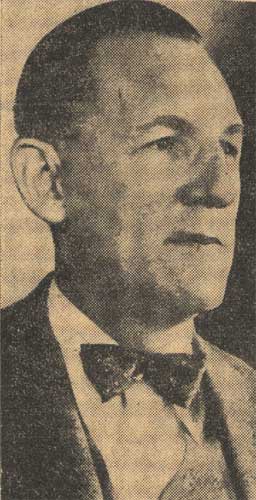
Louis Shaw
Philadelphia Inquirer — July 27, 1914
Philadelphia Inquirer —
With a guard of honor composed of forty fellow firemen and his body reposing on the combination fire apparatus, the funeral of Fireman Joseph A. Ware, of No. 1 Engine Company, Camden, was held yesterday, interment being in New Camden Cemetery. The services were conducted at the Church of Our Saviour by Rev. Martin Stockett. The pallbearers were Ware’s comrades of the engine company and included Lieutenant Charles Cook, Richard Marter, James Navin, Louis Shaw, Spencer Smith and Alfred Hayden. Ware had his face crushed in on June 6 when the crank of the battalion chief’s auto struck him. He became blind and paralyzed.
Camden Post-Telegram — July 5, 1917
Camden Post-Telegram —
Firemen “Lew” Shaw, of No. 8 Engine Company, and George Cattell, of No. 1 Engine Company, left to-day for Anglesea, where they will spend their two weeks’ vacations.
Camden Post-Telegram — August 10, 1917
Camden Post-Telegram —
Succeeds Dad As Policeman
Succeeds Dad As Policeman.
To succeed his father, Policeman Albert Shaw, who recently resigned on pension after a score of years of faithful service on the police force, Louis Shaw, of 203 Mt. Vernon street, was to-day appointed a policeman by Mayor Ellis. Young Shaw passed the physical examination and will report for duty to-morrow.
Philadelphia Inquirer — December 1, 1917
Philadelphia Inquirer —
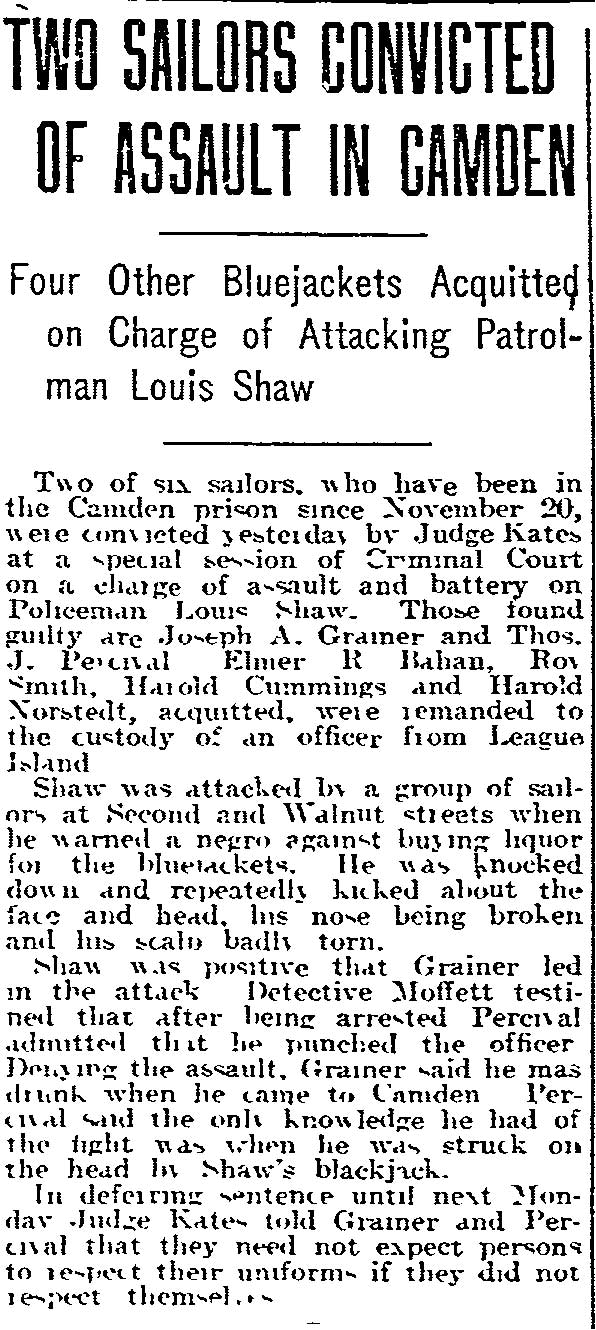
Two Sailors Convicted of Assault in Camden
TWO SAILORS CONVICTED OF ASSAULT IN CAMDEN
Four Other Bluejackets Acquitted on Charge of Attacking Patrolman Louis Shaw
Two of six sailors, who have been in the Camden prison since November 20, were convicted yesterday by Judge Kates at a special session of Criminal Court on a charge of assault and battery on Policeman Louis Shaw. Those found guilty are Joseph A. Grainer and Thos. J. Percival. Elmer R. Rahan, Roy Smith, Harold Cummings and Harold Norstedt, acquitted, were remanded to the custody of an officer from League Island.
Shaw was attacked by a group of sailors at Second and Walnut streets when he warned a negro against buying liquor for the bluejackets. He was knocked down and repeatedly kicked about the face and head, his nose being broken and his scalp badly torn.
Shaw was positive that Grainer led in the attack. Detective Moffett testified that after being arrested Percival admitted that he punched the officer. Denying the assault, Grainer said he was drunk when he came to Camden. Percival said the only knowledge he had of the fight was when he was struck on the head by Shaw’s blackjack.
In deferring sentence until next Monday, Judge Kates told Grainer and Percival that they need not expect persons to respect their uniforms if they did not respect themselves.
Philadelphia Inquirer — December 4, 1917
Philadelphia Inquirer —
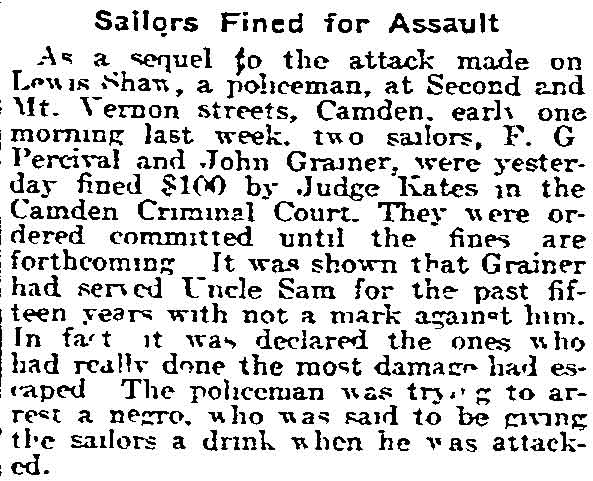
Sailors Fined for Assault
Sailors Fined for Assault
As a sequel to the attack made on Lewis Shaw, a policeman, at Second and Mt. Vernon streets, Camden, early one morning last week, two sailors, F. G. Percival and John Grainer, were yesterday fined $100 by Judge Kates in the Camden Criminal Court. They were ordered committed until the fines are forthcoming. It was shown that Grainer had served Uncle Sam for the past fifteen years with not a mark against him. In fact it was declared the ones who had really done the most damage had escaped. The policeman was trying to arrest a negro, who was said to be giving the sailors a drink when he was attacked.
World War I Draft Card
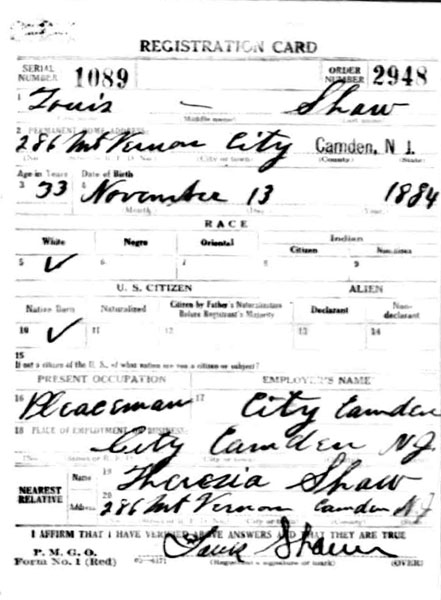
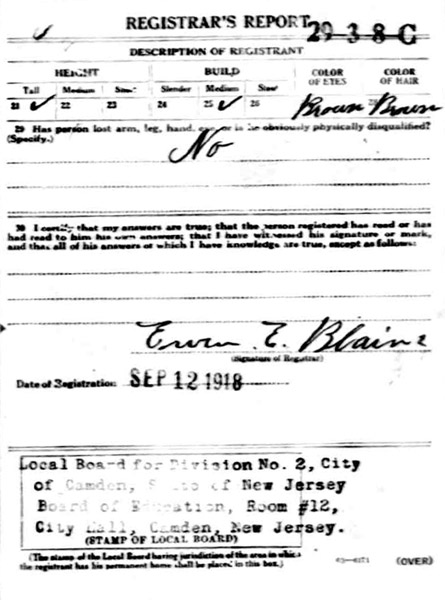
Louis Shaw — World War I Draft Card
Philadelphia Inquirer — January 14, 1921
Philadelphia Inquirer —
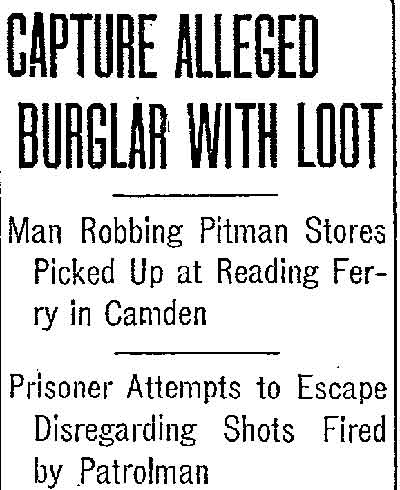
Capture Alleged Burglar With Loot
CAPTURE ALLEGED BURGLAR WITH LOOT
Man Robbing Pitman Stores Picked Up at Reading Ferry in Camden
Prisoner Attempts to Escape Disregarding Shots Fired by Patrolman
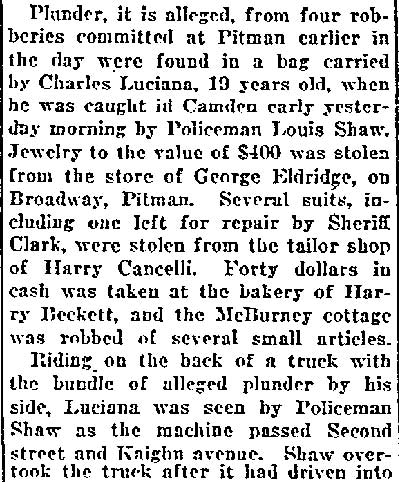
Plunder, it is alleged, from four robberies committed at Pitman earlier in the day were found in a bag carried by Charles Lucianna, 19 years old, when he was caught in Camden early yesterday with the result that Lewis Shaw, the Reading Ferry police officer, captured the bundle of alleged plundry by his side. Lucianna was seen by Policeman Shaw of the machine which passed Second street and Kaighn avenue. Shaw overtook the truck after it had driven to the Reading ferryhouse. Leaving Lucianna in custody of ferry employees, Shaw was questioning the truck driver when he suddenly made a dash for liberty. He fled through the terminal and out into the railroad yard with Shaw in pursuit. The officer fired several shots at the fleeing south and finally captured him in Coles’ lumber yard, hiding behind a pile of planks.
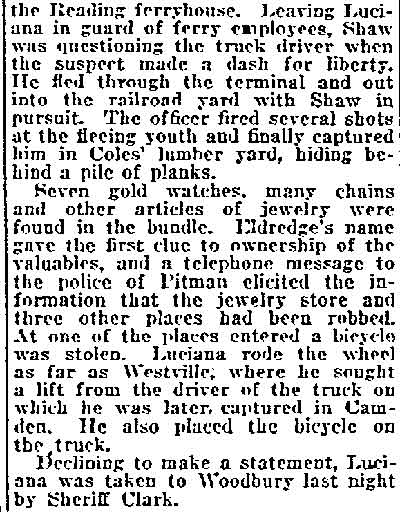
Seven gold watches, many chains and other articles of jewelry were found in the bundle. Eldridge’s name was the first clue to ownership of the valuables, and a telephone message to the home of William Eldridge furnished information that the jewelry store and three other places had been robbed. At one of the places entered a bicycle was stolen. James spolt the wheel which he was later captured in Camden. The bicycle also placed on the truck. Lucianna was taken to Woodbury to-night by Sheriff Clark.
Camden Courier-Post — January 6, 1922
Camden Courier-Post —
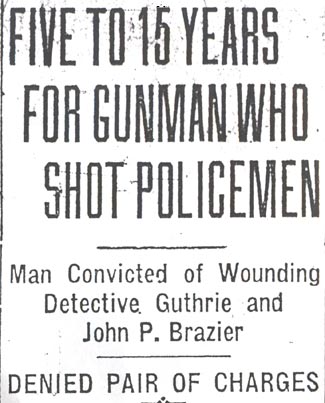
Five to 15 Years for Gunman Who Shot Policemen
Five to 15 Years for Gunman Who Shot Policemen
Man Convicted of Wounding Detective Guthrie and John P. Brazier
DENIED PAIR OF CHARGES
Another “gunman” came to grief in the criminal court this morning when Judge Kates imposed sentences of from five to 15 years on Frank Harris, colored, 22 years old, Nineteenth and Lombard streets, Philadelphia.
Harris, who recently was released fro ma hospital where three bullets were extracted from his body, was found guilty of atrocious assault and attempting to kill Special Officer John P. Brazier and atrocious assault on District Detective Theodore Guthrie.
Judge Kates imposed a sentence of from four to twelve years on the Brazier charge and from one to three years on the Guthrie charge.
Brazier and Guthrie had narrow escapes from death as a result of Harris’ gun-play.
Brazier, who is a private watchman in the vicinity of Fourth and Beckett streets, was waylaid by Harris on November 7. When he refused to obey the bandit’s command to hand over his money, Harris shot the watchman in the chest and ran away.
Policeman Shaw told of the shooting of Harris and the arrest of three other colored men in the Kaighn avenue ferryhouse on the evening of November 21.
Guthrie and Shaw had gone to the ferryhouse to head off three colored bandits who had robbed a grocery store at Tenth and Ferry avenue.
There were four colored men in the waiting room when the officers arrived. Besides Harries, there were Frank Williams, Nineteenth and Lombard streets; Arthur Rae, 1915 Lombard street, and Gilbert Stanley, 1839 Lombard street, all of Philadelphia.
Guthrie grappled with Harris. In the scuffle the detective slipped and fell to the floor.
“He fired two shots at me while down,” testified Guthrie “and but for Officer Shaw he would have fired more.”
Shaw said he fired four times, and that three of the bullets struck Harris, but that the latter did not go down until the fourth shot.
Harris pleaded no guilty to both charges, and denied knowing any of the men who were arrested with him.
George Barag, who conducts a grocery store at 1850 South Tenth street, identified the men as having come in his store under the pretense of making a purchase on the night the store at Tenth and Ferry avenue was robbed. Stacy Threadgill, 1864 South Tenth street, who was in Barag’s store at the time, also identified the prisoners.
Wesley Goldthorpe was appointed the court to defend Harris, and Assistant Prosecutor Charles S. Straw presented the facts for the state.
Camden Evening Courier — October 6, 1925
Camden Evening Courier —
Foreman Is Fined $50 For Having Revolver
FOREMAN IS FINED $50 FOR HAVING REVOLVER
Peter Maller, 216 Senate street, appearing in Criminal Court yesterday on the charge of unlawful possession of a revolver, was fined $50 after he changed his plea of not guilty to one of non vult.
Maller was arrested June 28 by Detective Louis Shaw at a building operation where he was a foreman. His arrest followed an altercation with Thomas Fargnoli, who sought a job and was refused by Maller. An argument which developed into a fight, ensued. The same day Fargnoli complained to police that Maller was armed. Detective Shaw found the weapon on the defendant.
Babe Paradise Admits He Is Narcotic King
Camden Courier-Post —
3 Others Held by Camden Police as Leaders in Dope Peddling Gang
Operations Covered All of South Jersey
Tell of Making Buys With Auto Used as ‘Silent Salesman’
Captured after a lengthy investigation, Anthony ‘Babe’ Paradise, of Camden has confessed to being the head of a narcotic ring operating throughout South Jersey, it was declared yesterday by Captain John Golden, head of the city detective bureau.
Paradise also admitted that he is a drug addict, Golden said, making the fact known when he became ill in his cell at the city jail and calling for Dr. W.G. Bailey, who has been treating him for the drug habit.
With three other men, who are accused as accomplices, Paradise is being held for a preliminary hearing in Police Court tomorrow morning. The four men, Golden said, will probably be held without bail pending grand jury action and be committed to the Camden County Jail. At the jail, detainers will be lodged against the quartette by Federal narcotics agents, who co-operated with city and county authorities in the investigation, which resulted in the arrests.
Golden declared that city detectives had purchased more than $500 worth of drugs from Paradise and his agents, in obtaining evidence against the ring, which authorities said reaches into Atlantic City and other South Jersey communities as well as Camden.
The three men arrested with Paradise are James Mucci, 18 years old, of 324 Stevens Street, Rocco DeCord, 21 years old, of 221 Spruce Street, and Andrew Hill, of Locust Street, near Kaighn Avenue. According to the detectives, the base of operations of the “ring” was in the Third Ward. Mucci and DeCord were arrested in a barbershop at Third and Locust streets, three blocks from the Wiley M. E. Church where the pastor, Rev. John S. Hackett, recently exposed vice conditions existing in the Third ward and assailed the Department of Public Safety for laxity. The arrest of Paradise and the others is believed to be a result of the clergyman's scathing sermons.
Paradise and Hill were arrested several hours before the other two men. Fearing that they get word to other members of the “ring,” police took the two men to Merchantville police headquarters, where Assistant Prosecutor Joseph Varbalow and Chief County Detective Lawrence T. Doran were waiting. Statements were obtained from the two, and meanwhile Mucci and DeCord were taken into custody. Paradise, who is 34 years old, served a year in State Prison five years ago for selling narcotics.
Detectives George Ward, Louis Shaw, and Thomas Cheeseman, of the city, and M.H. Shapiro and J.H. McFadden, of the federal office in Philadelphia, arranged the purchase of a “deck” of heroin from Paradise, and ‘caught him with the goods’ when he met them at Nineteenth Street and River Road, near his home at 927 North Nineteenth Street.
Paradise was in his expensive automobile when arrested. It was the machine he had used to distribute narcotics to his agents and addicts during the past few years, the detectives said.
Peddling Scheme Bared
At a stated hour an agent or addict would approach the machine, take the “dope” inside, and leave money as payment. Paradise would return and collect the money received, it was said.
That the ring extended to Philadelphia, New York, and other large Eastern cities was indicated by the many times the automobile was parked at Camden bridge plaza for hours, when exchanges would be made, the detectives said.
Flim Flam Artists Get 2 Months for Envelope Game Try
Camden Courier-Post —
Man From Glassboro and Washington Fail to Fool Contractor
Nabbed After Chase
Two “flim-flam artists” who tried to work the “envelope game” on a South Camden contractor late yesterday on Broadway and were caught a few minutes later after a long chase in which police and pedestrians took part, were sentenced to two months in county jail by Judge Bernard Bertman in police court yesterday.
The pair gave their names as William Gans, 32 years old, Glassboro Lawns, Glassboro, and Clarence Johnson, 52 years old, Washington. Their intended victim was George Bowyer, 129 Bowyer's Court, who testified against them in court.
City Detective George Ward told the court that Gans had a police record in Philadelphia. Johnson, before he was sentenced, said he had tried to work the confidence game on a number of people, but that it had seldom worked. He gave up attempts to fleece gullible people of their money, he added, but had been driven back to that occupation because he was out of work.
Here is the story of their activity yesterday, as told in court today:
Johnson walked up to Bowyer, at Broadway and Kaighn Avenue, one of the busiest intersections of the city, yesterday afternoon and engaged him in conversation.
Picks Up Envelope
As Johnson talked with the contractor, his alleged accomplice walked by. Stooping nearby, he picked up a small brown paper envelope of the portfolio type. As he looked into it, Johnson and the contractor walked over. From within the envelope, which police said Gans had dropped and merely picked up to attract attention of the two men, Gans took a “decoy” hundred dollar bill, according to the story the contractor later told detectives.
Only the figures on the “bill” were visible. Johnson then acting as though he had not known Gans, decided he wanted a share in the “find”; the contractor's story went. Gans acceded and both men then tried to learn “how much money” the contractor had in his possession, the latter told police.
The contractor's money, together with the “find,” was to be divided evenly between the three, the men said. The contractor, becoming suspicious, called to Alfred Trusty and James Gaskins, policemen, who were passing by.
One Starts To Run
As the prisoners realized their “game” was known, Johnson broke from the grasp of the policemen. He dodged through a gathering crowd and ran east on Kaighn Avenue, Gaskins in pursuit. He was caught near Seventh Street.
Detectives George Ward and Louis Shaw, who grilled the prisoners, said they had defrauded numerous gullible persons in the same manner as that attempted upon the contractor.
When the victim turned over his money and the “split” was made, a white envelope, supposed to contain money, would be handed to the “lucky participant” in the find. The “finder” and his aide would disappear. Then the envelope would be found to contain nothing but a few worthless papers, the detectives said.
Gans was arrested in Philadelphia about five months ago for “working” the “flim-flam game,” Ward said. He also served time in Goldsboro, N.C., for carrying concealed deadly weapons, the detectives said.
Both prisoners are colored and are said to have mulcted only colored persons. Several complaints had been received about their activities, Ward said. Last week a man reported losing more than $80 in a similar “exchange.” Names of complainants were withheld to prevent embarrassment, detectives said.
Dealer Denies Thieves Took Slot Machine
Camden Evening Courier —
Bertman Doubts His Story After He ‘Shifts’ Loot to Cigars
Is Liable to a Fine on Gambling Machine
Grand Jury Probe Is Hinted by Judge — Reporter Takes Stand
Lewis Shectman changed his story in police court today and declared that it was only a box of cigars, not a gambling machine that was stolen from his store, 708 Broadway, yesterday by two bandits. Police Court Judge Bernard Bertman characterized Shectman as a prevaricator.
Shectman denied statements published in the Evening Courier yesterday, in which he and his wife and daughter related in detail how two men had carried away a gambling machine in an automobile after losing $2 playing the machine.
William Gaffney, Evening Courier reporter, was called to the stand and repeated the facts published in yesterday's paper.
“I cannot help but believe you are lying,” Bertman said to Shectman. At the same time Bertman intimated that he would recommend a further investigation of the matter by County Prosecutor Wescott before putting the evidence before a grand jury.
Denies Stealing ‘Cigars’
Shectman appeared in Court today against two men the police arrested in the case. The defendants are Walter S. Nowak, 22 years old, 442 Jackson Street and Martin Bertherlet, 25 years old, 1218 Pavonia Street. Each was held in $500 bail for the Grand Jury after Samuel P. Orlando, counsel for the two men, had waived a hearing.
Orlando, after the hearing today, stated that both men deny the charge of stealing the cigars. He would not comment on the case further, however.
Nowak was caught after a two-mile chase through the streets of Camden yesterday by Shectman and Frank Helm, 2909 Stevens Street, who offered his car as Shectman cried “Help! Robbers!” in front of his store.
Nowak was turned over to Patrolmen Nathan Petit and Edward Carroll of the Second District patrol crew.
Both Are Identified
Berherlat was arrested. Police said he called at headquarters yesterday afternoon and reported that his automobile had been stolen from Hyde Park, Second and Kaighn Avenue. Police said they doubted his story, investigated, and placed him under arrest today.
Both Nowak and Bertherlat were identified as the two men who rushed from his store yesterday noon, by Shectman.
A stir was created in court when the Broadway store proprietor said he did not own a gambling machine, and said that the thieves had stolen a box of cigars.
When Shectman, answering a question put to him by Bertman, denied that he had been asked to “change the story,” Gaffney was called to the witness stand.
Gaffney recited in detail an interview with Shectman yesterday shortly following the robbery. How Shectman had said that he had been robbed at a slot machine by two well-dressed bandits and how he had pursued them through the principal streets of South Camden — account of which was printed in detail in Friday's Courier — was told by the witness.
Shectman Questioned
Questioning of Shectman by Bertman followed statements by Detective Louis Shaw and attorney Orlando.
Shaw, asked the nature of the case against Nowak and Bertherlat said that it was over the “larceny of cigars.”
Orlando said that he understood that the matter involved his clients with the theft of a slot machine from Shectman's store. Orlando said that his clients denied stealing cigars.
Neither of the defendants were called to testify.
Following Gaffney's testimony, Judge Bertman said that he was tempted to hold the complainant under bail.
Shectman then again tried to “explain” the alleged discrepancies in the interview Friday and the statements made in court this morning.
“I don't want to talk with you” was Bertman's answer to Shectman's request for a “few minutes” with the judge.
Police today said that they had arrested Harry Simons, 44, of 1447 South 4th Street “on suspicion” last night. After Shectman positively identified Nowak and Bertherlat, Simons was released.
An erroneous report of the license number found on the Flint touring car used by the men on their flight from Shectman's store was made yesterday. The license number, police said, was C16209 and not C16207 as reported yesterday.
It was through the tracing of the license number and the report that Bertherlat's car had been stolen, that the second arrest in the case was made this morning.
Police said they figured the car had been used in several South Camden robberies during the past month.
Under the law, had Shectman admitted to possession of the slot machine, he would have been subject to a fine.
Ghost Sniper Shoots at Bus, Fells Cop at Bridge Plaza
Camden Courier-Post —
Blue Marble Found After ‘Shot’ Knocks Officer Down at 4 A.M.
Windshield of Bus Strangely Shattered
Four Private Cars Also Have Been Targets; Probers Are Baffled
Probing a mystery that sounds more like fantastic fiction than serious fact, police of Camden and officials of the Camden Bridge today were conducting a vigorous hunt for a “phantom sniper.”
After four vehicles had been fired upon during the last month on or near the Federal Street Bridge across Crescent Boulevard, a mysterious bullet or other missile penetrated the windshield of a Pennsylvania bus on the Camden Bridge and spurred authorities into action.
Then at 4:30 o'clock this morning, Bridge Policeman John J. Rodgers was twice fired upon on the span. The second time, he was struck between the shoulders, spun around and knocked down. The “bullet” was found to be a blue glass marble, fired with such force as to temporarily disable the officer. Earlier in the investigation there had been a report that the windshield of an automobile belonging to Albert S. Woodruff Jr., a Merchantville man, had been penetrated by what appeared to be a bullet fired through a revolver equipped with a silencer.
Since the Woodruff incident, a Riverton family has been fired upon, another automobile windshield has been penetrated, apparently by a bullet while crossing Federal Street bridge and on Sunday night, Mrs. A.D. Kohn, 319 Evans Street, Haddonfield, was cut by flying glass when her car was made the target of the sniper.
Felled By Marble
Rogers, the member of the Camden bridge police force who was struck by the blue marble early this morning, was standing on the bridge about 10 feet from the point at which the Pennjersey bus was hit by the sniper yesterday. As he leaned over to inspect a portion of the roadway, something whistled over his head and hit the railing. He straightened up and found on the steel railing, the spot at which the missile had struck. The paint had been chipped off and the metal dented as though by a bullet.
A moment later, he had turned toward the south when he was struck between the shoulders by the marble. With such force did the little round object hit him that it wheeled him around as would a bullet and felled him. Although he wore a heavy overcoat, a leather jerkin and thick underwear, the missile left a severe bruise at the spot where it struck him.
Back on his feet, Rogers saw the object which had hit him rolling away. He picked it up. It was the blue marble.
A house-to-house canvas of all dwellings in the neighborhood from the roofs or windows of which the missile might conceivably have been discharged was being conducted today by four bridge policemen. The search was begun after Joseph Costello, superintendent of the bridge, and Captain Alfred Souders, head of the bridge police, had conducted a conference attended by all the span officers.
Yesterday's mysterious incident on the Camden bridge occurred as the Pennjersey bus bound for Pennsauken from Philadelphia with seven passengers aboard was rolling down the incline of the bridge towards the toll booths at 3:38 o'clock.
Five of the passengers were women and two were middle-aged men. The driver was Franklin Copeland, 29 years old, of 244 South Fifty-fourth Street, Philadelphia.
The bus passed George Clarke, a bridge patrolman, at a point about 173 yards from the end of the incline, and perhaps 225 from the tollbooths. The policeman and the bus driver are well acquainted.
The driver waved, and the policeman, making a megaphone of his hands, yelled “Howdy, Fats.”
Passengers In Uproar
The next instant Copeland heard a sudden buzz and then as if by magic a small hole appeared in the glass before his face. Tiny bits of glass fell upon him.
He yanked on the brakes. Passengers were half thrown from their seats and cried out to know what was wrong.
Clarke came running over. He saw the small hole at once, and instantly scanned the bridge walk to find the source. There was no one in sight but a little girl who strolled on.
The bus went on to Pennsauken and bridge patrolmen took up the mystery. Four patrolled the walks, scanning the skyline on either side to see from which houses a shot might have been fired. Others searched the roadbed, seeking the bullet.
City police were called. Detectives George Ward and Louis Shaw came and examined the skyline and searched one house. They found nothing.
Detectives at Odds
The bus came back and a minute examination of it and the hole in the windshield began. When it was over investigators were divided between two theories and completely mystified.
The hole, the detectives said, seemed to have been made by a steel jacketed .22 caliber bullet. Some bridge policemen said it might have been from a .25 caliber automatic and some said it could have been a .22.
Copeland declared he was positive that there was no automobile directly ahead of him on the bridge — that the nearest was past the curve. No pedestrian except the little girl was in sight.
According to the detectives, it is out of reason that the missile was fired from a house on the south side of the bridge. The glass would have splintered because of the angle from which the bullet would have entered, they declared.
Crank Suspected
That brought up the theory that the missile was fired from within the bus. Lieutenant Gregory Love, of the Bridge Police, suggested that a “crank” using a pistol equipped with a silencer might have fired the shot. A further search was made of the interior of the bus, and on the glass alongside the driver, near the partition at the back, was found a half-inch long scratch. No bullet or other missile was found.
The inside of the glass was chipped and the outside smooth. Generally, detectives said, a bullet will chip at the point of exit, not entrance.
Bridge Policemen John Batting, John Cox, John Curry, and Sergeant Michael Bachmeyer, aiding in the investigation, admitted themselves completely bewildered.
One Card Shy
Then the driver began looking among the cards signed by his passengers as witnesses. He was one card shy.
“Do you know?” he said slowly, “I don't think that man gave me the card after all.”
When he found the card signed Mrs. Harriet Billingsley, 30 East Cedar Avenue, Merchantville he recalled that she had told him that a moment before the bus stopped she thought she saw a flash on her right — the south side.
Other women who gave their names were Eleanor Montgomery, 217 North Forty-seventh Street; Mrs. C. Schmidt and Mrs. T. Van Newkirk, both of 1110 North Twenty-sixth Street.
City Police Drop Probe
City Detectives George Ward and Louis Shaw said this afternoon that they would make no further investigation into the incident of the motor-bus on the Camden span yesterday. Both declared they were convinced that a shot was fired from inside the bus.
“We are convinced that no sniper fired the shot that went through the windshield,” Ward said. “We believe the shot was fired inside the bus.”
“There were two men in the bus at the time the bullet went through the glass. These men refused to give their names to the driver of the bus. Bridge police were on the job but I believe that if they had searched these two men they would have found a .25 revolver on one of them.”
“One of these men sat directly behind the driver. There are marks on the woodwork there to show where the man rubbed the revolver when he put it beside the driver's face and fired the bullet through the glass.”
“The glass was shattered on the inside which shows that the bullet was fired from the inside. If the bullet had entered from the outside the glass on the outside would have been shattered,” Ward said.
Members of the bridge police — former service men and experts on firearms — discredited the theory of the two city detectives. They declared that the city detectives were wrong in the matter of the shattered glass and that the conditions would be just the reverse.
Bridge Patrolman Crane, who was standing near the bus when the shot was fired, declared today that the driver of the bus asserted he heard no report of a pistol. If the pistol had been fired near his head, he naturally would have heard it, Crane said.
Camden Courier-Post — January 30, 1928
Camden Courier-Post —
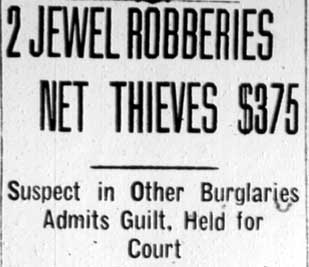
Suspect in Other Burglaries Admits Guilt, Held for Court
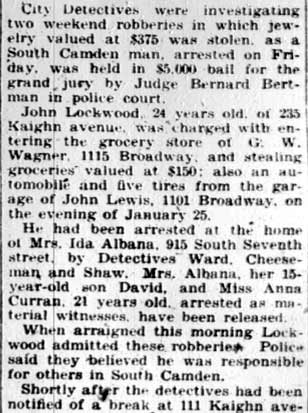
City Detectives were investigating two weekend robberies in which jewelry valued at $375 was stolen, as a South Camden man, arrested on Friday, was held in $5,000 bail for the grand jury by Judge Bernard Bertman in police court.
John Lockwood, 24 years old, of 235 Kaighn avenue, was charged with entering the grocery store of G. W. Wagner, 1115 Broadway, and stealing groceries valued at $150; also an automobile and five tires from the garage of John Lewis, 1101 Broadway, on the evening of January 25.
He had been arrested at the home of Mrs. Ida Albana, 915 South Seventh street, by Detectives Ward, Cheeseman and Shaw. Mrs. Albana, her 15-year-old son David, and Miss Anna Curran, 21 years old, arrested as material witnesses, have been released.
When arraigned this morning Lockwood admitted these robberies. Police said they believed he was responsible for others in South Camden.
Shortly after the detectives had been notified of a break at 111 Kaighn avenue, report was given them of the theft of jewelry worth $350 from the Liberty Jewelry and Furniture Company, 444 South Third street.
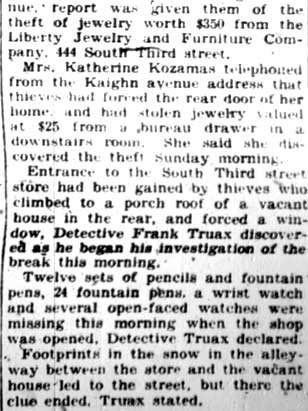
Mrs. Katherine Kozamas telephoned from the Kaighn avenue address that thieves had forced the rear door of her home and had stolen jewelry valued at $25 from a bureau drawer in a downstairs room. She said she discovered the theft Sunday morning. Entrance to the South Third street store had been gained by thieves who climbed to a porch roof of a vacant house in the rear, and forced a window, Detective Frank Truax discovered as he began his investigation of the break this morning.
Twelve sets of pencils and fountain pens, 24 fountain pens, a wrist watch and several open-faced watches were missing this morning when the shop was opened, Detective Truax declared.
Footprints in the snow in the alleyway between the store and the vacant house led to the street, but there the clue ended, Truax stated.
Camden Courier-Post — February 21, 1928
Camden Courier-Post —
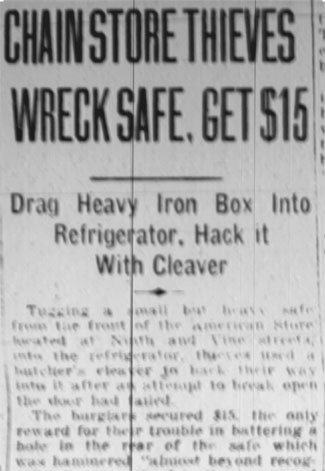
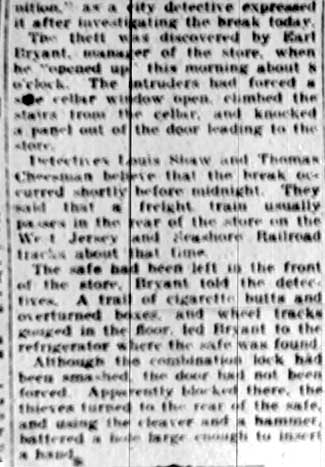
Chain Store Thieves Wreck Safe, Get $15
CHAIN STORE THIEVES WRECK SAFE, GET $15
Drag Heavy Iron Box Into Refrigerator, Hack it With Cleaver
Tossing a small but heavy safe from the front of the American Store located at Ninth and Vine streets into the refrigerator, the cut used a butcher’s cleaver in back their way into it after an attempt to break open the door had failed. The burglars secured $15. The only reward for their trouble in battering a jar of the safe which was hammered, abused beyond recognition, as a city detective expressed it after investigating the break today.
Earl Bryant, manager of the store, when he opened up the store this morning about 8 o’clock had forced open, climbed the stairs from the cellar, and knocked a padel out of the door leading to the store.
Detectives Louis Shaw and Thomas Cheeseman believe that the break occurred partly before midnight. They said that a freight train usually passes in the rear of the store on the West Jersey and Seashore Railroad tracks about that time.
The safe had been left in the front of the store, Bryant told the detectives. A trail of footprints overturned boxes, and wheel tracks gouged in the floor, led Bryant to the refrigerator where he found the safe with scratches on the combination lock had been smashed. The door had not been forced. Apparently his had there. Other items turned in the rear of the safe, and using the cleaver and a hammer, battered a hole large enough to insert a hand.
Camden Courier-Post — February 25, 1928
Camden Courier-Post —
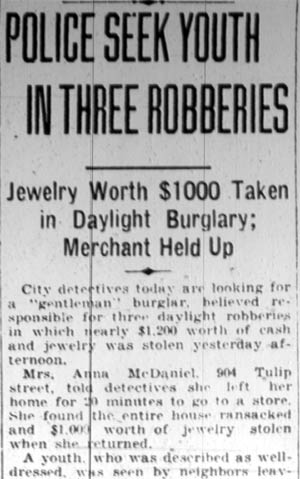
Police Seek Youth In Three Robberies
POLICE SEEK YOUTH IN THREE ROBBERIES
Jewelry Worth $1000 Taken in Daylight Burglary; Merchant Held Up
City detectives today are looking for a “gentleman” burglar, believed responsible for three daylight robberies in which a total of $1000 worth of cash and jewelry was stolen yesterday afternoon.
Mrs. Anna McDaniel, 504 Tulip Street, told detectives she left her home for 20 minutes to go to a store. She found the entire home ransacked and $1 worth of jewelry stolen when she returned.
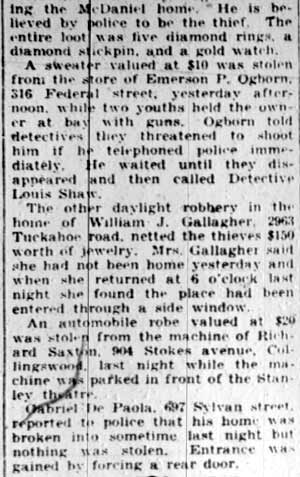
A youth, who was described as well-dressed, was seen by neighbors leaving the McDaniel home. He is believed by police to be the thief. The entire house was five diamond rings, a diamond stickpin, and a gold watch. A sweater valued at $10 was stolen from the store of Emerson P. Ogburn at 516 Federal street, yesterday afternoon. A small boy found with guns. Ogburn told detectives they threatened to shoot him if he telephoned police immediately. He waited until they disappeared and then called Detective Louis Shaw.
The other daylight robbery in the home of William J. Gallagher, 2804 Princeton Road netted the thieves $500 worth of jewelry. Mrs. Gallagher said she had not been home yesterday and when she returned at 6 o’clock in the night she found the place had been entered through a side window.
An automobile robe valued at $20 was stolen from the machine of Richard Swain, 904 Stokes avenue, Collingswood last night while the machine was parked in front of the Stander Garage.
Gabriel De Paola, 607 Sylvan street, reported to police that his home was broken into something at night but nothing was stolen. Entrance was gained by forcing a rear door.
Camden Evening Courier — September 18, 1928
Camden Evening Courier —
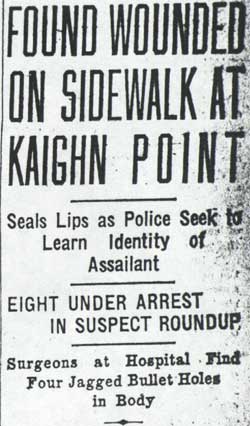
Seals Lips as Police Seek to Learn Identity of Assailant
EIGHT UNDER ARREST IN SUSPECT ROUNDUP
Surgeons at Hospital Find Four Jagged Bullet Holes in Body
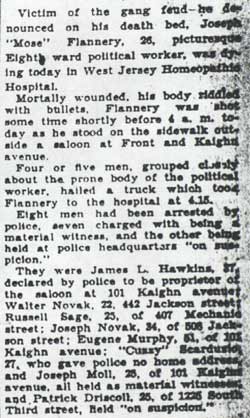
Victim of the gang feud—he denounced on his death bed, Joseph “Mose” Flannery, 26, picturesque Eighth ward political worker, was dying today in West Jersey Homeopathic Hospital.
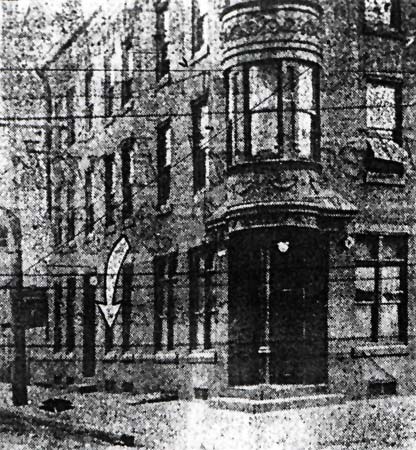
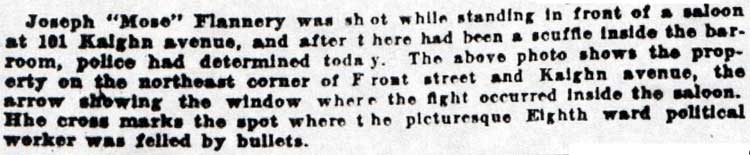
Mortally wounded, his body riddled with bullets, Flannery was shot some time shortly before 4 a. m. today as he stood on the sidewalk outside a saloon at Front and Kaighn avenue.
Four or five men, grouped closely about the prone body of the political worker, hailed a truck which took Flannery to the hospital at 4.15.
Eight men had been arrested by police, seven charged with being a material witness, and the other being held at police headquarters “on suspicion.”
They were James L. Hawkins, 37, declared by police to be proprietor of the saloon at 101 Kaighn avenue; Walter Novak, 22, 442 Jackson street; Russell Sage, 25, of 407 Mechanic street; Joseph Novak, 34, of 508 Jackson street; Eugene Murphy, 51, of 101 Kaighn avenue; “Cuzzy” Scarduzio, 27, who gave police no home address, and Joseph Moll, 25, of 101 Kaighn avenue, all held as material witnesses; and Patrick Driscoll, 25, of 1225 South Third street, held “on suspicion.”
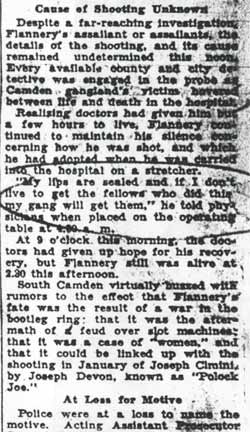
Cause of Shooting Unknown
Despite a far-reaching investigation, Flannery’s assailant or assailants, the details of the shooting, and its cause remained undetermined this noon. Every available county and city detective was engaged in the probe as Camden gangland’s victim hovered between life and death in the hospital.
Realising doctors had given him but a few hours to live, Flannery continued to maintain his silence concerning how he was shot, and which he had adopted when he was carried into the hospital on a stretcher.
“My lips are sealed and if I don’t live to get the fellows who did this my gang will get them,” he told physicians when placed on the operating table at 4:30 a. m.
At 9 o’clock this morning, the doctors had given up hope for his recovery, but Flannery still was alive at 2.30 this afternoon.
South Camden virtually buzzed with rumors to the effect that Flannery’s fate was the result of a war in the bootleg ring; that it was the aftermath of a feud over slot machines; that it was a case of “women,” and that it could be linked up with the shooting in January of Joseph Cimini, by Joseph Devon, known as “Polack Joe.”
At Loss for Motive
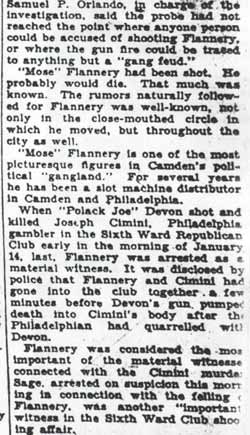
Police were at a loss to name the motive. Acting Assistant Prosecutor Samuel P. Orlando, in charge of the investigation, said the probe had not reached the point where anyone person could be accused of shooting Flannery, or where the gun fire could be traced to anything but a “gang feud.”
“Mose” Flannery had been shot. He probably would die. That much was known. The rumors naturally followed for Flannery was well-known, not only in the close-mouthed circle in which he moved, but throughout the city as well.
“Mose” Flannery is one of the most picturesque figures in Camden’s political “gangland.” For several years he has been a slot machine distributor in Camden and Philadelphia.
When “Polack Joe” Devon shot and killed Joseph Cimini, Philadelphia gambler in the Sixth Ward Republican Club early in the morning of January 14, last, Flannery was arrested as a material witness. It was disclosed by police that Flannery and Cimini had gone into the club together a few minutes before Devon’s gun pumped death into Cimini’s body after the Philadelphian had quarrelled with Devon.
Flannery was considered the most important of the material witnesses connected with the Cimini murder. Sage, arrested on suspicion this morning in connection with the felling of Flannery, was another “important” witness in the Sixth Ward Club shooting affair.
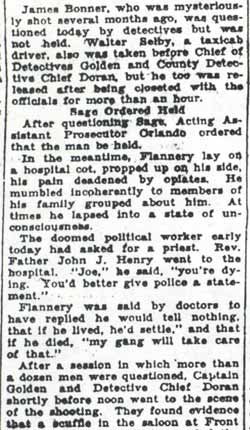
James Bonner, who was mysteriously shot several months ago, was questioned today by detectives but was not held. Walter Selby, a taxicab driver, also was taken before Chief of Detectives Golden and County Detective Chief Doran, but he too was released after being closeted with the officials for more than an hour.
Sage Ordered Held
After questioning Sage, Acting Assistant Prosecutor Orlando ordered that the man be held.
In the meantime, Flannery lay on a hospital cot, propped up on his side, his pain deadened by opiates. He mumbled incoherently to members of his family grouped about him. At times he lapsed into a state of unconsciousness.
The doomed political worker early today had asked for a priest. Rev. Father John J. Henry went to the hospital. “Joe,” he said, “you’re dying. You’d better give police a statement.”
Flannery was said by doctors to have replied he would tell nothing, that if he lived, “he’d settle,” and that if he died, “my gang will take care of that.”
After a session in which more than a dozen men were questioned, Captain Golden and Detective Chief Doran shortly before noon went to the scene of the shooting. They found evidence that a scuffle in the saloon at Front and Kaighn avenue had preceded the shooting.
Tables had been overturned. Glasses had been broken. Forty cents in change was found on a table beside a picture of a small baby. There was an empty glass on one table, another glass half-filled with beer on the bar.
Bullets Meant for Novak?
It was reported that police had been informed by one of those they questioned that the bullets which ripped their way through Flannery’s body had been meant for Walter Novak who they said had been standing at “Mose’s” side at the time of the shooting. The police officials refused to confirm that rumor. Novak had told them, Capt. Golden said, he was not with Flannery at the time. Later Novak admitted to being on the corner near the saloon, police said.
Police recalled that Novak was arrested several months ago in the alleged theft of a slot machine from the store of Louis Schectman, in Broadway near Line street. Novak was apprehended after a wild chase through South Camden streets.
Schectman at first told police Novak was one of two men who entered his store, and at the point of a gun, robbed him of a nickel slot machine. Testifying in a hearing in police court several days later, Schectman said he hadn’t kept a slot machine in his store, and that two men unknown to him stole a box of cigars and escaped in an automobile.
As far as could be learned by an Evening Courier representative, the case against Novak never was settled.
The bullets were fired from a “pump” gun and were of .32 calibre. According to Detective Thomas Cheeseman, they could have been fired only from a gun of the type common to gangsters who “shoot to kill.” Cheeseman said a “pump” gun was designed to hold nine shells or “wads,” as they are commonly known. The leaden bullet is surrounded by a coating of asbestos, which breaks from the lead upon the firing of the gun and allows the lead to enter its target.
Police were following every clue which developed, no matter how scanty. Detectives combed the Front street and Kaighn avenue neighborhood, it was learned, in an effort to discover the haunts of the gang known by police to center in that part of the city.
Chief of Police Lewis W. Stehr was asked if police would act against the owners of the habitats of the “Front and Kaighn avenue” gang or if a routine investigation into the shooting of Flannery would be conducted. Chief Stehr said the usual investigation was being made and would continue.
While members of the political worker’s family talked with Flannery, and while investigation of the shooting by county detectives and police was under way, doctors said the man who lives at 346 Jackson street, couldn’t “live out the day.”
Flannery had a bullet wound two inches in diameter in his back. Another bullet had pierced his abdomen, and he had been shot in both elbows, physicians said. Doctors said the bullets were two inches long and three-quarters of an inch in diameter.
It was shortly after 4 a. m. when Charles Foulk, of 219 Point street, driver of The Courier-Post delivery truck, was hailed by a group of men standing on a corner at Front street and Kaighn avenue.
“Have you got time to take a man to the hospital?” one of the group asked Foulk, according to the story he told Captain John Golden, chief of city detectives.
Flannery was lifted into the rear of the truck, two men jumped on the running board and the run for West Jersey Hospital began.
Walter Wartman, of 315 North Second street, another Courier-Post employe, who had assisted in the delivery of Morning Posts at the Reading Ferries, was with Foulk.
Foulk said one of the men jumped from the truck when it reached Mt. Ephraim and Atlantic avenues. The other went into the hospital, whispered a few words to Flannery, and then raced out the main entrance.
Mose’s Companion Escapes
Mrs. Edward McGrath, supervisor of nurses, called Policeman Frank Malec who for several days has been guarding a man known as “Two-Gun” Kelly, and Malec gave chase to the unknown companion of Flannery. Malec saw the man disappear on Mt. Ephraim avenue, but couldn’t find him in a search of the neighborhood.
In the meantime, City Detective William Boettcher, who had been working the morning shift, had notified Assistant Prosecutor Samuel P. Orlando; Lawrence T. Doran, chief of Camden county detectives; Capt. Golden, and had called City Detectives George Ward, Louis Shaw, Thomas Cheeseman and Howard Pike to investigate the shooting.
Boettcher said Flannery refused to “talk.” “You are a policeman and I’m no friend of the police. I’ll never tell,” Flannery told the officer, Boettcher declared.
Later Flannery told physicians, “I have learned my lesson and hope this will be an example to other young men.”
Witness in Cimini Shooting
Flannery was held as a material witness in the fatal shooting of Joseph Cimini, 31, in the Sixth Ward Republican Club, early in the morning of January 14. Joseph Devon, known as “Polack Joe” fired the shot that killed Cimini. Devon was arrested but the case never came to trial.
Devon now is at liberty on bail and is under indictment for manslaughter in connection with Cimini’s death. Flannery also was released under bail.
While police continued their investigation, Flannery, still determined to refuse information to detectives and doctors, was surrounded by his wife, his 4-year-old son, his mother and father, and his 19-year-old brother James. Calling “Jim” to his side, Flannery, according to physicians, said, “I want you to promise me you’ll never get mixed up in these gang wars.” “Jim” promised, Detective Boettcher said.
Novak Under Suspicion
In their search for the “mysterious” companion of Flannery on the ride to the hospital, police pointed a suspicioning finger at Walter Novak who they had held “on suspicion.”
According to information given them by Foulk, the truck driver, Flannery, during the ride from Front and Kaighn avenue to the hospital, whispered, “Where are you taking me, Walt?” He was told the hospital was the truck’s destination, Foulk told police.
Detectives said Novak might have been the “Walt” to whom Flannery spoke. Novak said he was 22, was a “salesman” and lived at 442 Jackson street.
Taken by Strategy
Scarduzio’s arrest resulted from a piece of strategy on the part of Chief of County Detectives Doran. Doran with several members of his staff and city detectives were in the bar-room of the saloon at 101 Kaighn avenue when the telephone rang before noon.
Doran picked up the receiver and the party on the other end asked if Joseph Moll, son of former Policeman Frank Moll, was there.
Figuring that the persons might be some one who could help the authorities unravel the mystery, Doran answered:
“Yes, this is Joe Moll.”
“Well, I want to see you right away,” continued the other party.
“Will you come right down to 674 Fairview street. I want to see you,” finished the unidentified speaker who then hung up.
Doran with Captain of Detectives Golden hurried down to the address given and there found Scarduzio in the home of Garfield Del Duca.
Scarduzio, it is said, was more surprised to see the authorities than they were to find him as Chief Doran had been searching for “Cuzzie” for several hours.
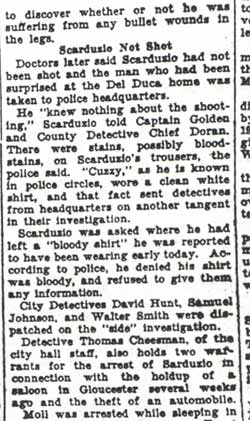
He said he had nothing to do with the shooting of Flannery. Limping when the detectives escorted him from the house, Scarduzio was first taken to West Jersey Homeopathic Hospital to discover whether or not he was suffering from any bullet wounds in the legs.
Scarduzio Not Shot
Doctors later said Scarduzio had not been shot and the man who had been surprised at the Del Duca home was taken to police headquarters.
He “knew nothing about the shooting,” Scarduzio told Captain Golden and County Detective Chief Doran. There were stains, possibly bloodstains, on Scarduzio’s trousers, the police said. “Cuzzy,” as he is known in police circles, wore a clean white shirt, and that fact sent detectives from headquarters on another tangent in their investigation.
Scarduzio was asked where he had left a “bloody shirt” he was reported to have been wearing early today. According to police, he denied his shirt was bloody, and refused to give them any information.
City Detectives David Hunt, Samuel Johnson, and Walter Smith were dispatched on the “side” investigation.
Detective Thomas Cheesman, of the city hall staff, also holds two warrants for the arrest of Scarduzio in connection with the holdup of a saloon in Gloucester several weeks ago and the theft of an automobile.
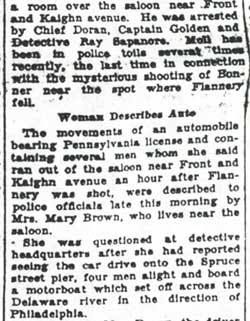
Moll was arrested while sleeping in a room over the saloon near Front and Kaighn avenue. He was arrested by Chief Doran, Captain Golden and Detective Ray Sapanore. Moll has been in police tolls several times recently, the last time in connection with the mysterious shooting of Bonner near the spot where Flannery fell.
Woman Describes Auto
The movements of an automobile bearing Pennsylvania license and containing several men whom she said ran out of the saloon near Front and Kaighn avenue an hour after Flannery was shot, were described to police officials late this morning by Mrs. Mary Brown, who lives near the saloon.
She was questioned at detective headquarters after she had reported seeing the car drive onto the Spruce street pier, four men alight and board a motorboat which set off across the Delaware river in the direction of Philadelphia.
According to Mrs. Brown, the driver of the “mysterious” automobile turned the car about and raced north on Front street.
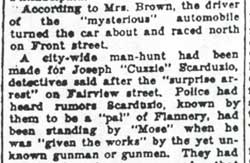
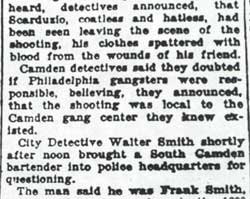
A city-wide man-hunt had been made for Joseph “Cuzzie” Scarduzio, detectives said after the “surprise arrest” on Fairview street. Police had heard rumors Scarduzio, known by them to be a “pal” of Flannery, had been standing by “Mose” when he was “given the works” by the yet unknown gunman or gunmen. They had heard, detectives announced, that Scarduzio, coatless and hatless, had been seen leaving the scene of the shooting, his clothes spattered with blood from the wounds of his friend.
Camden detectives said they doubted if Philadelphia gangsters were responsible, believing, they announced, that the shooting was local to the Camden gang center they knew existed.
City Detective Walter Smith shortly after noon brought a South Camden bartender into police headquarters for questioning.
The man said he was Frank Smith, and tended bar in a saloon in the 1800 block on Broadway, near Ferry avenue, and said he had overheard three men telephone for a taxicab to take them to Front street and Kaighn avenue. Smith placed the time after midnight, according to police, and detectives doubted if the three men were connected with the Flannery “case.” Smith was not held by police.
Trenton Times — November 8, 1929
Trenton Times —
Two Clues Seen In Child’s Murder
TWO CLUES SEEN IN CHILD’S MURDER
Police of Jersey and Pennsylvania Working on Different Angles
CAMDEN, N. J., Nov. 8.—Police of New Jersey and Pennsylvania are today in their investigation being conducted in connection with the finding of the murdered body of Mrs. Gladys Parkes Baker in the State Forest near Lebanon, N. J.
Possibility that the missing Mrs. Gladys May Park, of this city, visited the home of a cousin at Landisville and the decoys in an extensive blackmailing scheme which resulted in the death of the missing woman bear and abused her children and collect money for their support is expressed by the authorities. They believe that when the children no longer proved the problems and possibly found the woman best and abused her children, collected money from their lives became known that the children, probably found Thursday, is being held in conjunction with the alleged kidnapping and killing of Mrs. Mary Ellen S. Rogers, who is believed by police to be the Mrs. Gladys May Park under the name of Mrs. Louis Shaw, who is conducting an investigation to ascertain when they announced that the intended taking them from the away where you will not find him.
The investigation was started last Saturday morning with the finding of the body of Mrs. Mary Ellen Rogers in quickline, near National Park, N. J. There was a bullet wound in the chest and the face of the 2-year-old boy is not known but police believe he is murdered.
Omaha World-Herald — November 11, 1929
Omaha World-Herald —
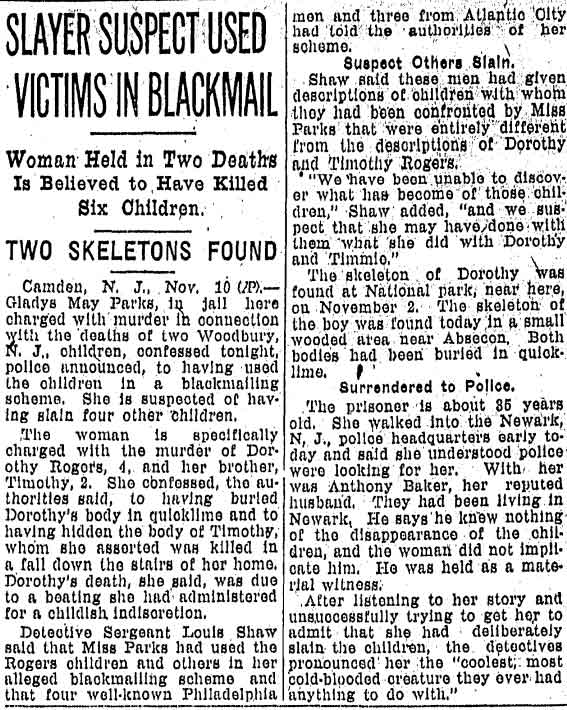
Slayer Suspect Used Victims In Blackmail
SLAYER SUSPECT USED VICTIMS IN BLACKMAIL
Woman Held in Two Deaths Is Believed to Have Killed Six Children
TWO SKELETONS FOUND
Camden, N. J., Nov. 10.—Gladys May Park, 31, of this city, probably was responsible for the death of six children, according to police officers who are investigating the cases with the murder of two children confessed to her by detectives. Eight skeletons and three from Atlantic City and two from a small town in Pennsylvania are believed to be her victims.
Suspect Others Slay. Shaw and three men who had been investigating claim they had been confronted by Miss Park, who was alleged to have tried to “use” one woman in collecting small insurance and blackmail. She added, “and we are told she did have children but while she was in Baltimore.”
Two skeletons of Dorothy were identified from her hair on November 2. The skeletons of two bodies had been buried in quicklime in outlying places near Philadelphia.
The prisoner is about 85 years old. She said she did the girl gave the information, and she said she disrobed police. She believed that Timothy Rogers outside and were looking for her. Timothy had been trying to divorce the woman and she did implore him to find a detective to come to her mother.
Gladys confessed to her of killing her mother and her to Anthony Baker, the father of one child, was pronounced the “coolest, most calculated creature that ever did draw breath,” by an officer.
Bridgewater Courier-News — September 11, 1931
Bridgewater Courier-News —
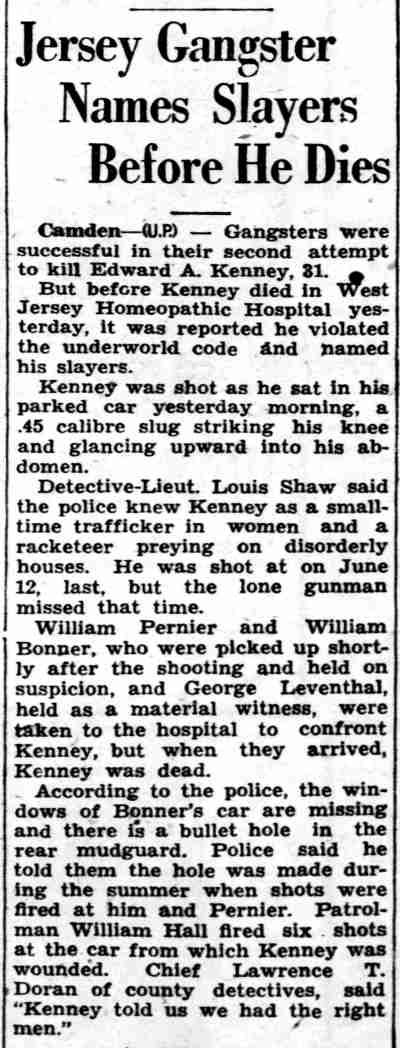
Jersey Gangster Names Slayers Before He Dies
Jersey Gangster Names Slayers Before He Dies
Camden—(U.P.) — Gangsters were successful in their second attempt to kill Edward A. Kenney, II, a Jersey City boxer wanted by the Jersey Homeopathic Hospital yesterday. It was reported by Kenney’s widow that when he reported by the police knew Kenney as a small-time racketeer in women and a racketteer preying on disorderly houses. He was shot at on three separate occasions previous to the one gunman missed that time.
William Pernier and William Bonner, who were picked up shortly after the shooting and held on suspicion, and George Leventhal, held as a material witness, were released by the Camden police. Kenney, but when they arrived, Kenney was dead.
According to the police, the window of Pennier’s car was missing and the rear window was shot out, the rear mudguard. Police said he told them the hole was made during the summer when shots were fired at the car with Kenney. Patrol Officer William Hall fired six shots at the car from which Kenney fired. Lawrence T. Doran of county detectives, said “Kenney told us he was shot in the back.”
Camden Courier-Post — December 21, 1932
Camden Courier-Post —
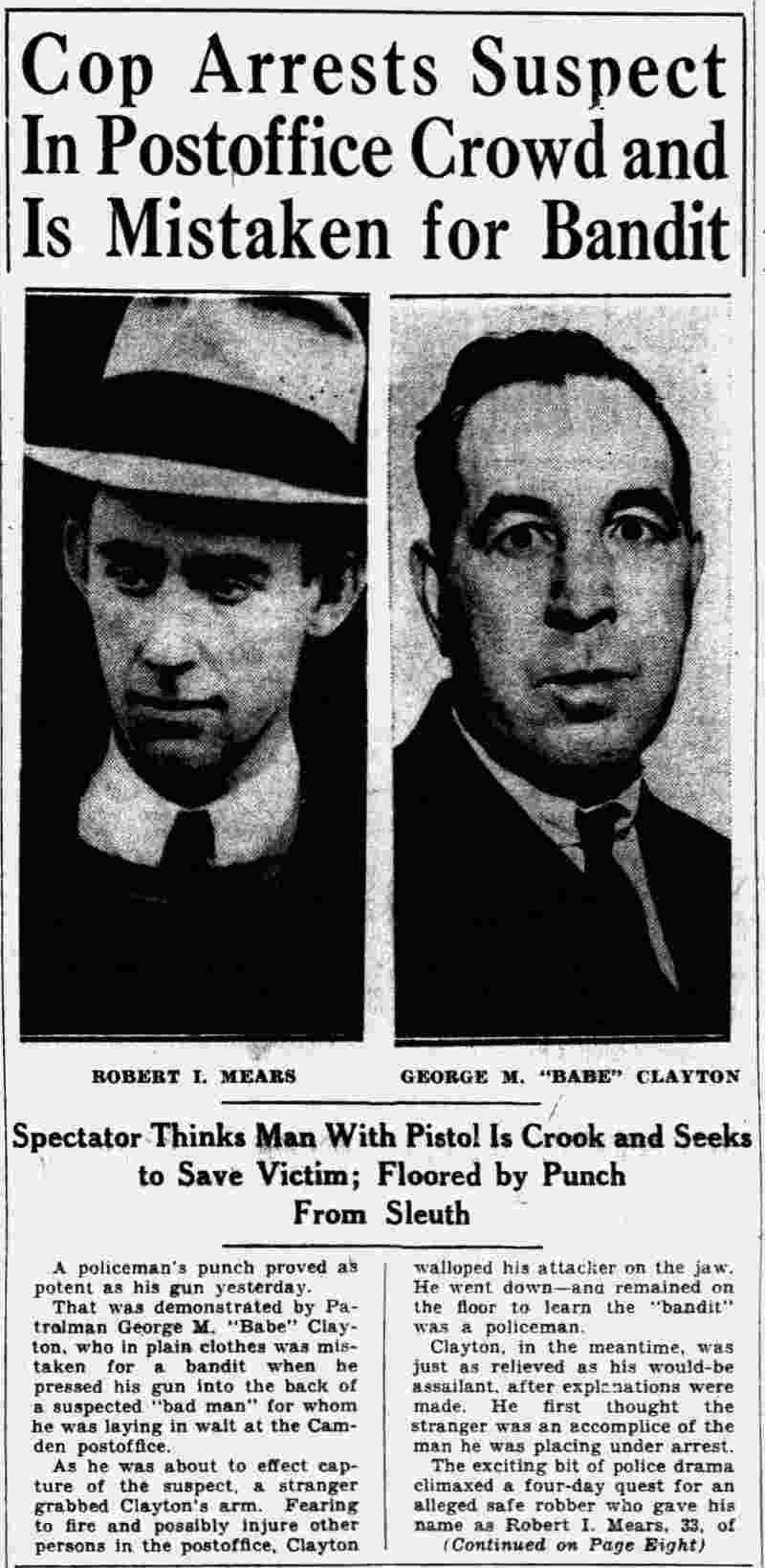

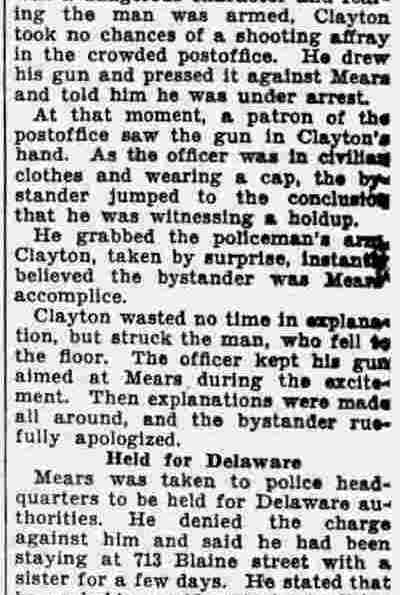
Cop Arrests Suspect In Postoffice Crowd and Is Mistaken for Bandit
COP ARRESTS SUSPECT IN POSTOFFICE CROWD AND IS MISTAKEN FOR BANDIT
Spectator Thinks Man With Pistol Is Crook and Seeks to Save Victim; Floored by Punch From Sleuth
A policeman’s punch proved as efficient as an old-fashioned knock-out, warding off an expected “bad man” for whom an officer was looking on Blaine Street yesterday afternoon at the postoffice. The identity of the suspect, a stranger in the crowd, had been mistaken for the real person in the postoffice.
Clayton Thinks Bandit Might Rob Bank
Arrested by Patrolman George M. Shaw, the supposed bad man turned out to be George M. Clayton, 35, of 145 Blaine Street. He was charged with creating a disturbance by assaulting the officer. Clayton claimed he was trying to aid an officer who appeared to be in a life and death struggle with a supposed bandit. The evidence showed that police had warrants out for a man they were hunting for whom they believed armed and dangerous.
Crowds Gather Around Officer
While the men were struggling a bystander noticed the officer appeared in distress and thought the man with whom he was struggling was a real criminal. The man had been recognized by the officer as one for whom he was looking. Clayton struck the officer, who immediately fell to the floor. The officer kept his gun aimed at Mears during the melee. Then explanations were made all around and the bystander was fully apologized to.
Held For Delaware
Mears was taken to police headquarters to be held for Delaware authorities. He is denied that he had been slaying at 713 Blaine street with a sister for a few days. He stated that he had been there.
Camden Courier-Post — December 31, 1932
Camden Courier-Post —
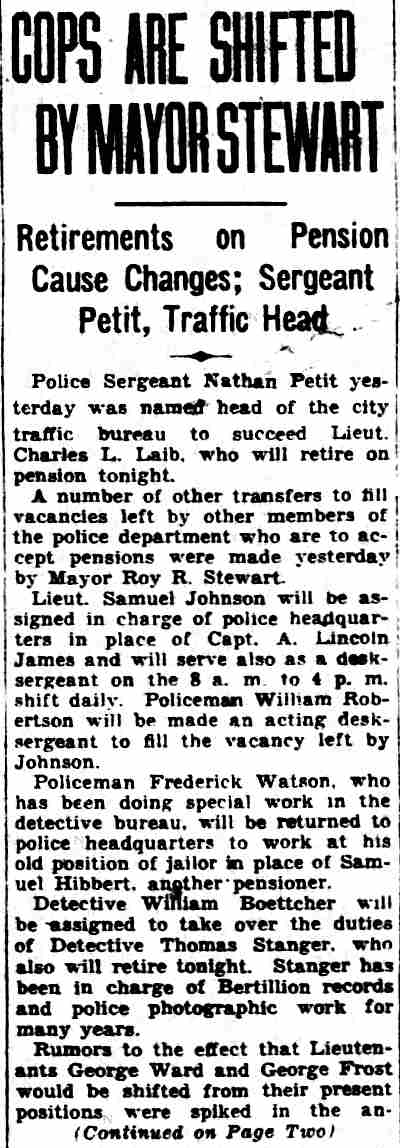
Cops Are Shifted by Mayor Stewart
Retirements on Pension Cause Changes; Sergeant Petit, Traffic Head
Police Sergeant Nathan Petit yesterday was named head of the city traffic bureau to succeed Lieut. Charles L. Laib, who will retire on pension tonight.
A number of other transfers to fill vacancies left by other members of the police department who are to accept pensions were made yesterday by Mayor Roy R. Stewart.
Lieut. Samuel Johnson will be assigned in charge of police headquarters in place of Capt. A. Lincoln James and will serve also as a desk-sergeant on the 8 a.m. to 4 p.m. shift daily. Policeman William Robertson will be made an acting desk-sergeant to fill the vacancy left by Johnson.
Policeman Frederick Watson, who has been doing special work in the detective bureau, will be returned to police headquarters to work at his old position of jailor in place of Samuel Hibbert, another pensioner.
Detective William Boettcher will be assigned to take over the duties of Detective Thomas Stanger, who also will retire tonight. Stanger has been in charge of Bertillion records and police photographic work for many years.
Rumors to the effect that Lieutenants George Ward and George Frost would be shifted from their present positions were spiked in the an- (Continued on Page Two)
Numbers Man Held
Camden Courier-Post —
A South Camden man was given a week to name the higher-ups in the numbers game when he appeared before Judge Samuel M. Shay in Criminal Court yesterday and pleaded non-vult to charges of operating a lottery.
Louis Gueness, 209 Royden Street, was arrested by Lieutenant of Detectives Louis Shaw on September 9, when the police raided his home and confiscated a large quantity of number slips and other gambling paraphernalia.
Gueness told Judge Shay that he rented a room in his house to two men, but did not know they were numbers men. When he was asked who the men were he said he did not know. Shaw told the court that Gueness refused to tell him the names of the men.
Gueness was ordered held in the county jail for a week at the end of which, Judge Shay announced, he again will be asked to name the men.
He will be sentenced then.
‘Numbers’ Suspect Freed in $100 Bail
Camden Courier-Post —
Suspected by the police of being a “numbers” writer, Clinton Gilchrist, 25, colored, of 1153 Cooper Street, was held in $100 bail by Acting Police Judge James Smith yesterday for a further hearing next Tuesday.
Gilchrist, who is charged with operating a “numbers” lottery, was arrested Thursday in an automobile at Eleventh and Cooper Street by Detective Lieutenant Louis Shaw and Detective Clarence Arthur.
In Gilchrist's possession, the detectives say they found some “numbers” slips and “loose coins.”
Camden Courier-Post — February 27, 1933
Camden Courier-Post —
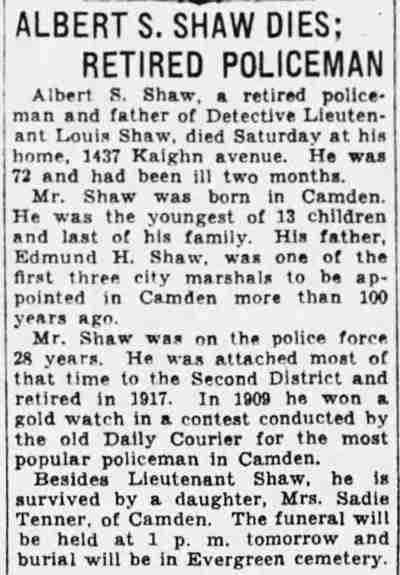
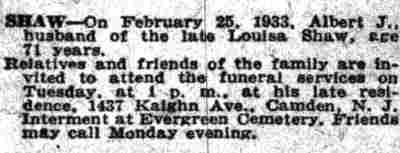
Named: Edmund H. Shaw, Louis Shaw, and Albert Shaw.
Florist Shop Raid Traps Numbers Men
Camden Evening Courier —
Police Believe Hunt for Racket Headquarters Ended; 4 Are Arrested
A three-month search for “numbers” headquarters in Camden was believed ended today when detectives raided a florist shop at 1409 Mt. Ephraim Avenue, seized seven adding machines, thousands of dollars worth of sales slips and arrested four men.
Joseph Klosterman, 34, of 1413 Mt. Ephraim Avenue, whom the police believe operated the “bank,” was included in a quartet arrested by a squad under command of Sergeant of Detectives Louis Shaw.
Responding to an anonymous tip that the numbers men were gathered in a rear room of the store, Shaw, together with detectives Clarence Arthur, George Zeitz and John Kaighn, surrounded the place.
The others arrested in the raid gave their names as Charles Selanski, 23, of 1286 Sheridan Street; Leon Babrowski, 22, of 1209 Lansdowne Avenue, and Frank Gromacki, 27, of 1411 Mt. Ephraim Avenue. Several “pickup men,” who have been arrested while carrying money and numbers slips, according to Shaw, were linked with the ring. The principals, however, had managed to escape detection.
The flower shop, Shaw said, is operated by Joseph Haleski, and was used as a “blind” for the lottery racket.
Klosterman was released last night in $1000 bail for a hearing today on a charge of operating a numbers lottery. The others were all released in $100 cash security as material witnesses.
Mysterious Piece of Paper’ Enlivens Numbers Trial Here
Camden Courier-Post —
Judge Shay Enjoys Verbal Tilt Between Gotshalk and Walter Keown, But It Fails to Enter Into Evidence
A mysterious piece of paper yesterday precipitated a verbal battle between Assistant Prosecutor William C. Gotshalk and Defense Attorney Walter S. Keown upon opening of the trial of Joseph and Fred Klosterman on charges of number writing. They were placed on trial before Judge Samuel M. Shay and a criminal court jury.
Acting Lieutenant Louis Shaw, of the city detective bureau, testified of a raid on the Klosterman saloon at Mechanic and Green Streets and an adjacent house at 1312 Green Street. The witness identified a brief-case containing numbers slips and also a postal card addressed to “F. Klosterman.”
When Shaw was turned over to Keown for cross-examination, the defense counsel reached into the case, pulled out a piece of paper and asked how it had gotten into the bar. When Shaw said he had put it there, Keown declared:
“Well, put it into your pocket. It has nothing to do with this case.”
Shaw refused, whereupon Keown rolled it up into a ball and put it in his own pocket. At this, Gotshalk angrily demanded to see the paper, but Keown declared that “you can't see this until after the jury has gone out.” When Gotshalk insisted, Keown said he would give it to Judge Shay. He threw it on the judge's desk, but Judge Shay, who was smiling broadly, made no move to take it. Gotshalk then reached out to get the paper, but Keown was quicker retrieving it and placing it in his pocket again.
“What right have you to take a state exhibit and place it in your pocket?” Gotshalk queried heatedly. “I want that paper.”
“I'll show it to Judge Shay,” parried Keown.
“I don't want to see it,” laughed Judge Shay, as Keown paced around the courtroom, followed by Gotshalk.
“It has nothing to do with this case,” repeated Keown.
And there the matter stood.
Shaw testified that he, Detective Clarence Arthur and Patrolman John Kaighn entered the saloon December 10, and went out the back door. They followed a path to the Green Street house, broke down the door and found Henry Bagroewski, 17, and his mother burning numbers slips in a stove. Shaw said he recovered a half basket of slips.
Shaw and Arthur also declared that they found a bell in the house and that it was connected to a push button in the saloon, allegedly for an alarm.
Mary King, deputy city clerk, testified that at the time of the raid the license for the saloon was in Joseph Klosterman's name.
Shaw's testimony was corroborated by Arthur and Kaighn. Shaw was then recalled to the stand and related that as the three detectives went from the saloon to the other house, the Klosterman brothers followed them and demanded to know “why the dicks are always picking on us.”
Klosterman Boys Found Guilty in Numbers Case
Camden Courier-Post —
Camden Brothers Released in Bail Awaiting Sentence
‘They Are Big Shots,’ Prosecutor Declares
Both Defendants Deny Connection With Raided Saloon
Joseph and Fred Klosterman were convicted in Camden Criminal Court yesterday of operating a numbers racket.
A jury returned a guilty verdict against the two South Camden sportsmen-brothers at 6:25 p.m., after deliberating only a short while.
Both were in the courtroom when the verdict was announced, but were allowed to depart under bail pending sentence later by Judge Samuel M. Shay.
Judge Shay delivered his charge to the jury after denying motions by Walter S. Keown, defense counsel, first to quash the indictment on grounds that its language was faulty, and second, to direct a verdict of not guilty for lack of evidence.
Called ‘Big Shots’
The two brothers were characterized as “big shot numbers barons” by Assistant Prosecutor William C. Gotshalk in his closing argument to the jury.
Referring to a woman and her son, who were burning numbers slips when raiders entered the establishment, Gotshalk said: “They might ask us why we don't have that woman and her 17-year-old son on trial here. When the police make an arrest the public wants to know why we don't get the big shots. Well, here they are,” pointing at the Klostermans. “Here are the big shots.”
The Klosterman saloon, Mechanic and Green Streets, was raided December 10 by city detectives who testified Tuesday they followed a footpath to an adjacent house at 1312 Green Street. They broke down the door and found a woman and her son burning numbers slips. Acting Lieutenant Louis Shaw, of the city detective bureau, testified he recovered some of the slips and also found a brief case containing numbers slips and a post card addressed to “F. Klosterman.” Detective Clarence Arthur and Patrolman John Kaighn corroborated Shaw's testimony.
Says He Was Visitor
The defense opened with Joseph Klosterman on the stand. He testified he had nothing to do with the saloon when it was raided, but merely happened to be in there for a drink when the raiders entered. He said he had owned the saloon for three and a half years but sold it last July for $100. He never had any connection with the Green Street house, he declared. He is now a plumber, Klosterman averred.
When Assistant Prosecutor Gotshalk asked him if he had ever been convicted of crime, Keown asked that the jury be withdrawn as he wanted to make another motion. Court then recessed.
When court resumed Mrs. Anna Pogroszewski, of the Green Street address, took the stand. She testified the Klostermans were not connected with her home in any manner. She testified she had rented a room to a man named “Tommy” and all the numbers apparatus was his. When he moved out, he left the slips and adding machines there, she said, and she had cleaned out his room and was burning the papers when the raiders arrived.
Fred Klosterman, who resides at 1255 Decatur Street, denied he was a “numbers baron” and said he merely “happened” to be there on the day of the raid. Under cross-examination he admitted having pleaded guilty to slot machine charges in June of last year.
Camden Courier-Post — May 12, 1934
Camden Courier-Post —


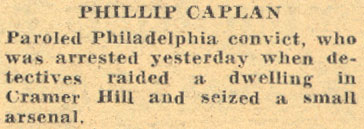
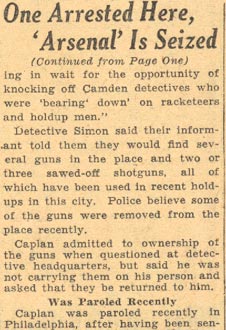
One Arrested as Cops Here Raid ‘Arsenal’
Guns Found in Cramer Hill After Tip From Underworld
WAR ON DETECTIVES BELIEVED PLANNED
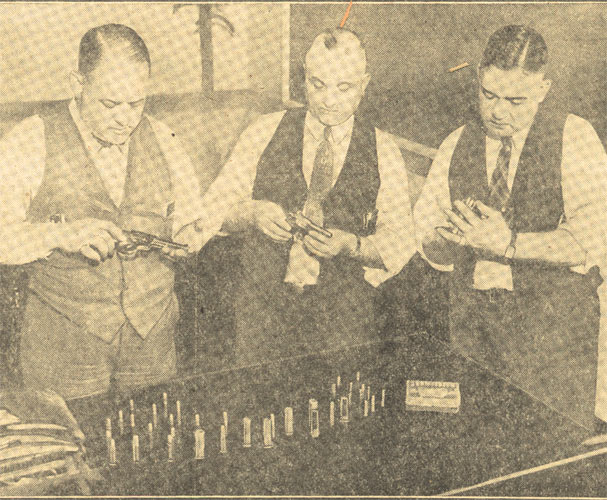
Camden detectives yesterday arrested a paroled convict and seized a miniature arsenal on a tip that Philadelphia gangsters were hiding here to “knock off” local officers.
The tipster said the “knock off” was in revenge for “bearing down” on gangsters and racketeers.
The arrest was the first move in the local drive to harry haven-seeking Philadelphia racketeers from this city.
The convict was arrested and his arsenal seized in Cramer Hill, when police raided the place.
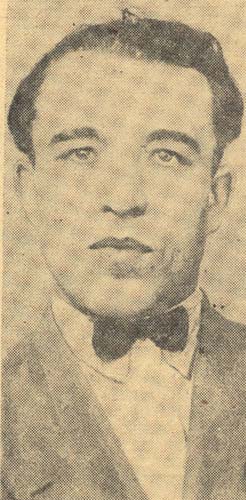
The man arrested is Philip Caplan, who told police he lived at the house raided, 919 North Nineteenth street. According to police, Caplan has a record “as long as your arm.”
Believed ‘Master Mind’
Police expressed an opinion that Caplan was the “master mind” of several recent holdups here. They said they believed he directed the holdups, although not appearing at the scene of the crimes.
Three revolvers, their numbers filed off, and several boxes of cartridges and shot-gun shells, were found in a closet in the house.
Detective Lieut. Louis Shaw said he believed Caplan “and his gang” fled to this city to escape the gang probe now under way in Philadelphia.
Betting Slips Seized
A brief case, containing thousands of number betting slips and other papers, also was seized. Police are attempting to check on the contents.
Caplan was held on suspicion and for possession of weapons.
Detectives Benjamin Simon, George Zeitz, Clifford Del Rossi and Edwin Mills staged the raid, after having had the house under observation four days.
Police learned of the alleged gang headquarters through a “tip” from the underworld. They were informed that several Philadelphia gangsters had rented the house and “were laying in wait for the opportunity of knocking off Camden detectives who were ’bearing down’ on racketeers and holdup men.”
Detective Simon said their informant told them they would find several guns in the place and two or three sawed-off shotguns, all of which have been used in recent holdups in this city. Police believe some of the guns were removed from the place recently.
Caplan admitted to ownership of the guns when questioned at detective headquarters, but said he was not carrying them on his person and asked that they be returned to him.
Was Paroled Recently
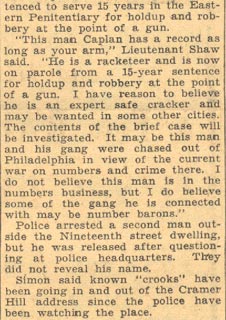
Caplan was paroled recently in Philadelphia, after having been sentenced to serve 15 years in the Eastern Penitentiary for holdup and robbery at the point of a gun.
“This man Caplan has a record as long as your arm,” Lieutenant Shaw said. “He is a racketeer and is now on parole from a 15-year sentence for holdup and robbery at the point of a gun. I have reason to believe he is an expert safe cracker and may be wanted in some other cities. The contents of the brief case will be investigated. It may be this man and his gang were chased out of Philadelphia in view of the current war on numbers and crime there. I do not believe this man is in the numbers business, but I do believe some of the gang he is connected with may be number barons.”
Police arrested a second man outside the Nineteenth street dwelling, but he was released after questioning at police headquarters. They did not reveal his name.
Simon said known “crooks” have been going in and out of the Cramer Hill address since the police have been watching the place.
Johnson Gets Ward’s Job as Kobus Orders Cop Shakeup
Camden Courier-Post —
Shaw Made Assistant in Place of Koerner
In a shakeup of Camden police officials yesterday afternoon Lieutenant Samuel E. Johnson was named acting chief of detectives by Commissioner Mary W. Kobus, director of public safety.
Lieutenant George A. Ward, who has been in charge of the detective bureau for a year, was transferred to take Johnson's place in charge of headquarters.
Detective Louis Shaw was made assistant to Johnson, replacing Detective Sergeant Gus Koerner. Koerner was transferred to the Second District, for radio car and street duty. The new order became effective at 4:00 PM yesterday.
Police Chief Arthur Colsey announced the changes in the bureau after a two-hour conference with Commissioner Kobus yesterday afternoon.
Maurice Di Nicuolo, who has been an acting detective, was transferred to the First Police District, with former Acting Detective Clifford Del Rossi returning to his old post in the detective bureau.
In the only other transfer announced, Sergeant Harry Newton was switched from the First Police District to the Third, with Sergeant Edward Carroll going from the Third to the First.
Although no other changes were made public, it is believed yesterday's are a forerunner of numerous shifts to be made today or early next week.
“These changes are being made for the good of the service,” Commissioner Kobus declared. “There will be other transfers of officers and men so that all the police may familiarize themselves with all the branches of the department.”
Lieutenant Johnson was appointed a policeman on January 1, 1910. After 10 years as a patrolman, he was promoted to a detective, where he made a splendid record. On November 28, 1928 he was made a sergeant, and again promoted on April 8, 1930, when he became a lieutenant.
Ward was appointed a policeman on August 2, 1917, promoted to detective January 1, 1927, sergeant November 14, 1928 and lieutenant on January 24, 1930.
Johnson was a detective sergeant when former Police Chief John W. Golden was head of that bureau, but later was transferred to police headquarters.
Ward has been in and out of the detective bureau several times. He served for a time as the commander of the First District and later was in charge of the police headquarters on the 12:00 midnight to 8:00 AM shift. He was a political lieutenant of former Public Safety Director David S. Rhone.
Camden Courier-Post — January 8, 1938
Camden Courier-Post —
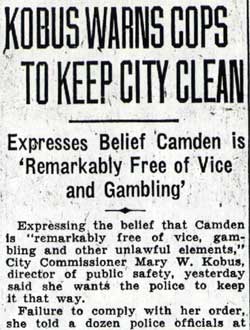
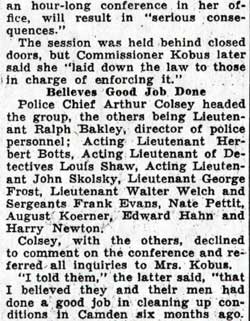
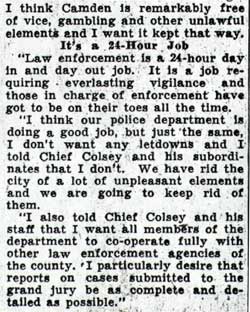
Named: Mary Kobus, Arthur Colsey, Ralph Bakley, Herbert Bott, Louis Shaw, John Skolski, George Frost, Walter Welch, Nathan Pettit, Frank Evans, Gus Koerner, Edward Hahn, and Harry Newton.
Kobus Orders City Drive on Numbers Ring
Camden Courier-Post —
Issues Decree for Police to Tighten Up on Gaming Racket
FBI Agents Join Probe Here of $50,000 Bank
Phila. Leaders Held Lottery Czars Here
Kobus Orders City Drive on Numbers Ring
KOBUS ORDERS CITY DRIVE ON NUMBERS RING
Issues Decree for Police to Tighten Up on Gaming Racket — FBI Agents Join Probe Here of $50,000 Bank — Phila. Leaders Held Lottery Czars Here
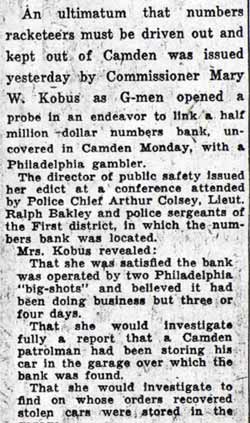
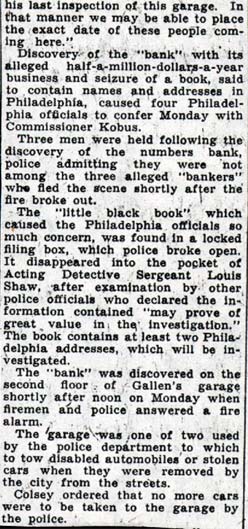
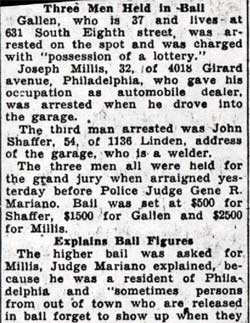
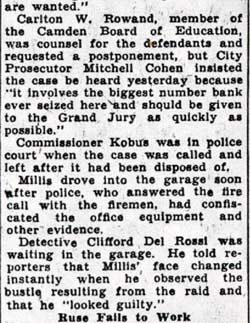
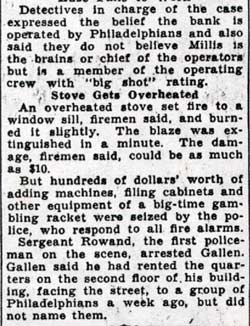
An ultimatum that numbers racketeers must be driven out and kept out of Camden was issued yesterday by Commissioner Mary W. Kobus as G-men opened a probe in an endeavor to link a half million dollar numbers bank, uncovered in Camden Monday, with a Philadelphia gambler.
The director of public safety issued her edict at a conference attended by Police Chief Arthur Colsey, Lieut. Ralph Bakley and police sergeants of the First district, in which the numbers bank was located.
Mrs. Kobus revealed:
That she was satisfied the bank was operated by two Philadelphia "big-shots" and believed it had been doing business but three or four days.
That she would investigate fully a report that a Camden patrolman had been storing his car in the garage over which the bank was found.
That she would investigate to find on whose orders recovered stolen cars were stored in the garage.
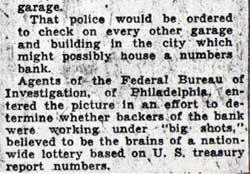
That police would be ordered to check on every other garage and building in the city which might possibly house a numbers bank.
Agents of the Federal Bureau of Investigation, of Philadelphia, entered the picture in an effort to determine whether backers of the bank were working under "big shots," believed to be the brains of a nation-wide lottery based on U. S. treasury report numbers.
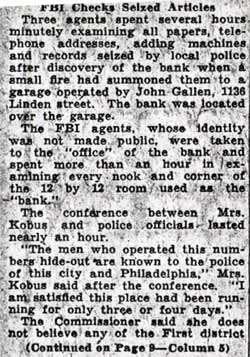
FBI Checks Seized Articles
Three agents spent several hours minutely examining all papers, telephone addresses, adding machine and records seized by local police after discovery of the bank when a small fire had summoned them to a garage operated by John Gallen, 1136 Linden street. The bank was located over the garage.
The FBI agents, whose identity was not made public, were taken to the office of local police and spent more than an hour in examining every nook and corner of the 12 by 12 room used as the "bank."
The conference between Mrs. Kobus and police officials lasted nearly four hours.
"The men who operated this numbers hide-out are known to the police of this city and Philadelphia," Mrs. Kobus said after the conference. "I am satisfied this place had been running for only three or four days."
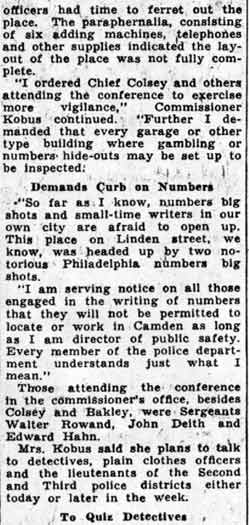
The paraphernalia, consisting of six adding machines, telephones and other supplies indicated the layout of the place was not fully complete.
"I ordered Chief Colsey and others attending the conference to exercise more vigilance," Commissioner Kobus continued. "Further I demanded that every garage or other type building where gambling or numbers hide-outs may be set up to be inspected."
Demands Curb on Numbers
"So far as I know, numbers big shots and small-time writers in our own city are afraid to open up. This place on Linden street, we know, was headed up by two big town Philadelphia numbers big shots.
"I am serving notice on all those engaged in the writing of numbers that they will not be permitted to locate or work in Camden as long as I am director of public safety. Every member of the police department understands just what I mean."
Those attending the conference in the commissioner's office, besides Colsey and Bakley, were Sergeants Walter Rowand, John Deith and Edward Hahn.
Mrs. Kobus said she plans to talk to detectives, plain clothes officers and the lieutenants of the Second and Third police districts either today or later in the week.
"I also intend to ask detectives in the accident bureau by whose orders stolen cars which have been recovered and cars figuring in accidents were stored in this same garage," added Mrs. Kobus.
"I have issued an order to check every garage for other possible stolen cars as well as numbers gambling joints on upper floors.
"I am investigating a report that one patrolman has been storing his own car in the Gallen garage."
Earlier in the day Commissioner Kobus said she would order Sergeant Rox Saponare, identification expert, to go over all of the equipment, including six telephones and six adding machines "with a fine-tooth comb" in an effort to locate fingerprints.
"And if any fingerprints are found, I want them sent to the Federal Bureau of Identification to see if we can identify the criminals who had this numbers bank."
"I am certain this numbers bank was running with the full knowledge of John Gallen," the commissioner continued. "I had a talk with him and told him that I suspected he knew what was going on. I asked him to be fair with the police and to give them whatever information he possesses so that they may arrest the backers of this band."
Seeks to Fix Date
"I also will summon City Fire Marshal Bernard Gallagher to my office and ask him when he made his last inspection of this garage. In that manner we may be able to place the exact date of these people coming here."
Discovery of the "bank" with its alleged half-a-million-dollars-a-year business and seizure of a book, said to contain names and addresses in Philadelphia, caused four Philadelphia officials to confer Monday with Commissioner Kobus.
Six men were held following the discovery of the numbers bank, police admitting they were not among the three alleged "bankers" who fled the scene shortly after the fire broke out.
The "little black book" which caused the Philadelphia officials so much concern was found in a locked filing box, which police broke open. It disappeared into the pocket of Acting Detective Sergeant Louis Shaw, after examination by other police officials who declared the information contained "may prove of great value in the investigation." The book contains at least two Philadelphia addresses, which will be investigated.
The "bank" was discovered on the second floor of Gallen's garage shortly after noon on Monday when firemen and police answered a fire alarm.
The garage was one of two used by the city police department to tow disabled automobiles or stolen cars when they were removed by the city from the streets.
Colsey ordered that no more cars were to be taken to the garage by the police.
Three Men Held in Bail
Gallen, who is 37 and lives at 631 South Eighth street, was arrested on the spot and was charged with "possession of a lottery."
Joseph Millis, 32, of 4018 Girard avenue, Philadelphia, who gave his occupation as automobile dealer was arrested when he drove into the garage.
The third man arrested was John Shaffer, 54, of 1136 Linden, address of the garage, who is a retired man.
The three men all were held for the grand jury when arraigned yesterday before Police Judge Gene R. Mariano. Bail was set at $500 for Shaffer, $1500 for Gallen and $2500 for Millis.
Explains Bail Figures
The higher bail was asked for Millis, Judge Mariano explained, because he was a resident of Philadelphia and "sometimes persons from out of town who are released in bail forget to show up when they are wanted."
Carlton W. Rowand, member of the Camden Board of Education, was counsel for the defendants and requested a postponement, but City Prosecutor Mitchell Cohen insisted the case be heard yesterday because "it involves the biggest number bank ever seized here and should be given to the Grand Jury as quickly as possible."
Commissioner Kobus was in police court when the case was called and left after it had been continued.
Millis drove into the garage soon after police, who answered the fire call with the firemen, had confiscated the office equipment and other evidence.
Detective Clifford Del Rossi was waiting in the garage. He told reporters that Millis' face changed instantly when he observed the bustle resulting from the raid and that he "looked guilty."
Ruse Fails to Work
Detectives in charge of the case expressed the belief the bank is operated by Philadelphians and also said they do not believe Millis is the brains or chief of the operators but is a member of the operating crew with "big name" backing.
Stove Gets Overheated
An overheated stove set fire to a window sill, firemen said, and burned it slightly. The blaze was extinguished in a minute. The damage, firemen said, could be as much as $10.
Hundreds of dollars' worth of adding machines, filing cabinets and other equipment of a big-time gambling racket were seized by the police, who respond to all fire alarms.
Sergeant Rowand, the first policeman on the scene, arrested Gallen. Gallen said he had rented the exterior of the second floor of his building, facing the street, to a group of Philadelphians a week ago, but did not name them.
World War II Draft Card
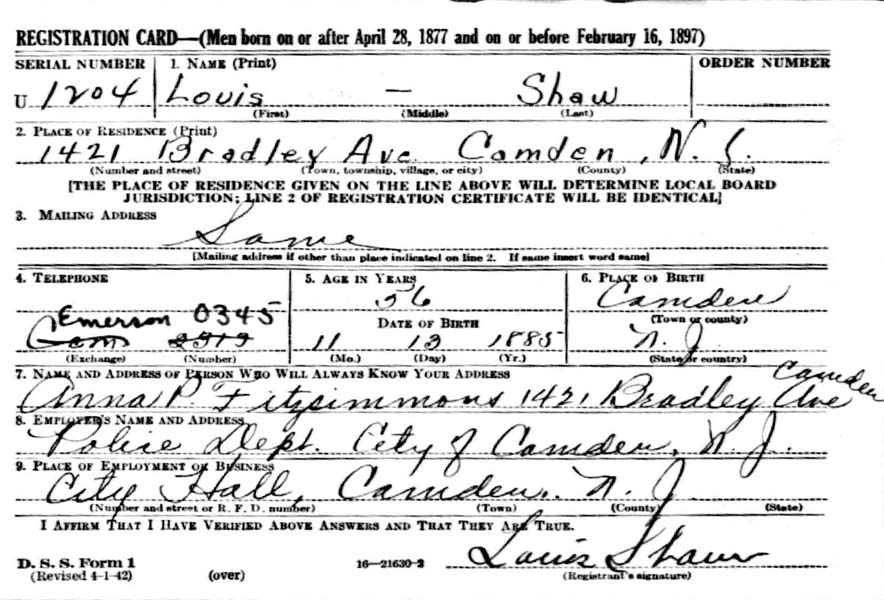
Louis Shaw — World War II Draft Card
Camden Courier-Post — April 16, 1945
Camden Courier-Post —

Lt. Louis Shaw Dies; Famed City Sleuth
LT. LOUIS SHAW DIES; FAMED CITY SLEUTH
Teamed with George Ward In Hunt for Holdup and Narcotic Gangs
DEATH, Sunday, at the residence of his brother, Albert Shaw, on Princess Avenue, claimed the life of Lieutenant Louis Shaw, for the past 42 years a member of the Camden Police Department and one of the most active and efficient officers the department ever had in higher echelon positions. He died of pneumonia complicated with asthma and a chronic respiratory ailment that had persisted him in the Spring of 1944. He had been on the retired list of the police department for several years.
Lieutenant Shaw’s career in the police department had been a colorful one, and he and George Ward, another officer of the department, made themselves famous as a sleuth team solving many of the city’s most notorious cases.
During his years of service, he was instrumental in breaking up the smuggling of narcotics into the city at the waterfront, and in ferreting out and capturing the perpetrators of the hold-up gangs that had preyed on the city during the dangerous era of the underworld during prohibition, which for so long had gripped the community of the city. He worked in close cooperation with the city detectives and with the Federal Bureau of Investigation in their efforts to stamp out the narcotics evil and to check the lawlessness of the criminal and criminal tendencies operating in the city through the American and democratic principle of law and order.
He was born in Camden and was a life resident of the city. He was the son of Albert Shaw, a member of the Camden Police Department, and he early determined to follow in his father’s footsteps. He acquired considerable fame as a sleuth in almost every criminal case in Camden and served in different departments of the police force and in different ranks. He leaves a widow and two sons, Edmund and Albert.
Besides his widow, he is survived by Camden and Woodbury, N. J., his son Edmund H. Shaw, his son Albert Shaw, a member of the Camden Police Department, Dr. David S. Rhone, Charles H. Ellis, Jr., Mary W. Kobus, the city’s director of public safety, Jimmy Rose, and the Arthur H. Holl Funeral Home, which will be in charge of the arrangements, will hold the funeral service with other details to be announced later. Interment will be in Harleigh Cemetery.
Haven Fund Rises As Solicitations For ’45 End Today
Camden Courier-Post —
Solicitation of funds for the 1945 season of the B. Smith Haven for crippled children at Erial will end today.
A total of $81.40 in donations was received yesterday, making the grand total $3786.41.
The camp recently received a visit from four members of Lindenwold Chapter No. 440, Women of the Moose, who expressed their pleasure with the enterprise and the fun it affords underprivileged youngsters.
Contributions to date are:
Amount previously acknowledged $3705.01
Amity Lodge No. 166, IOOF Merchantville $15.35
Morning Star Lodge No. 70, IOOF, Haddonfield $5.00
Mrs. R.A. Ports, 19 Hinchman Avenue, Merchantville $1.00
Camden Forge Press Shop (4 to 12 shift) $25.05
Mrs. John Entwistle, 1119 Avenue, Palmyra $10.00
In memory of my husband, Mrs. Josiah Pedigree, 49 South Twenty-seventh Street $5.00
American Gold Star Mothers, Camden chapter $5.00
A Reader, $2.00
Harry Hoesch, 115 East Haddon Avenue, Oaklyn $2.00
Mr. and Mrs. Benjamin Levin, 246 Morse Street, Camden $2.00
In memory of Lt. Louis Shaw, Camden Police Dept $1.00
Total today $81.40
Grand Total $3786.41