Introduction
JAMES E. TATEM was born in Camden in May of 1876 to William A. and Anna Emley Tatem. There were at least two older siblings, a sister, Mary, and a brother, Edward, and two younger brothers, George and William H. Tatem. In 1880 the Tatem family lived at 101 North 7th Street. William Tatem was then a produce dealer. Sadly, he had passed away by 1887. The family was then living at 422 Henry Street in South Camden. The 1890–1891 Directory shows the Tatems at 619 South 5th Street, where older brother Edward Tatem also conducted a milk business. At the age of 24 James Tatem had married Ella Lummis. The couple resided with her parents, at 435 Beckett Street at the time of the 1900 Census. He had by this time already joined Camden's police force.
James Tatem joined Camden's police department in 1899, an appointee of Mayor Cooper B. Hatch. He managed to avoid being discharged when Democrat mayor Joseph Nowrey was elected. When the Republicans returned to City Hall in 1905, new Mayor Charles Ellis saw “Smilin’ Jimmy’s” ability to calm a troubled situation, and by 1910 he was promoted to sergeant and by 1920 to captain. For much of Ellis’ term James Tatem served as an aide to the Mayor. He also served as a Justice of the Peace in the early 1920s.
James Tatem remained on with the Camden police department when Mayor Ellis retired to become Postmaster in 1922. The following year Victor King was elected mayor. King also took a liking to the ever-diplomatic Tatem, and saw that he was appointed Captain of the newly created traffic bureau. When Commissioner Frank Hitchner, then the director of public safety, fired Chief Edward S. Hyde, Tatem was chosen to be the new Chief.
James Tatem faced a daunting challenge in his new post, one that in retrospect he may not have been prepared for— not that many police officers of his generation were. He was an officer who came up in the 1890s and 1900s faced with the new organized crime model that took hold in America when Prohibition was instituted in 1919. That and his dalliance with the Democratic Mayor King foretold Chief Tatem’s replacement. After a shooting in a downtown bar, the Bluebird Cafe, in late 1927, Commissioner David S. Rhone, the new director of public safety, took a more active role in the affairs of the department. Finally, on March 2, 1928 Mayor Winfield S. Price replaced Chief Tatem, appointing Captain Lewis H. Stehr Jr. as acting Chief of Police. This was a surprise to many, who had assumed that the popular Chief Charles T. Humes would get the post. James Tatem then retired on a full pension. It is worth noting, however, that his service to the city was recognized in that he had been granted a raise on March 1, 1928 which had the effect of locking in his pension at a higher amount.
The marriage between James and Ella Tatem appears to have been a stormy one. By 1910 the couple had separated, and he appears to never have remarried. He then lived with his mother, grandmother Elizabeth Emley, widowed sister Mary Gahan, and nephew Edward at 535 South 5th Street. James Tatem would remain at this address into the 1920s. He moved to 615 South 5th Street by 1924. James Tatem was still living there with his sister as late as April of 1930. The Census shows them living at 615 South 5th Street, next door to Camden firefighter Leonard Megee, and on the same block where he had resided as a boy.
James Tatem’s younger brother, William Howell Tatem, served as a member of the Camden Fire Department from the late 1900s into the 1930s.
“Persons Unknown” Held Responsible
Philadelphia Inquirer —
Coroner’s Jury Does Not Connect Eli Shaw With the Camden Murders.
DEARTH OF NEW FACTS
At the Inquest the Prosecution Fails to Bring Out Any Evidence, That Is Particularly New.
There was positively nothing in the testimony adduced at the inquest on the death of Mrs. Zane, in Camden, yesterday, to add any weight to the theory of the prosecution, backed up by circumstantial evidence, that Eli Shaw murdered his mother and grandmother.
The verdict was rendered in accordance with the evidence. In other words, the responsibility for the killing of the two women, as stated in the verdict in the case of Mrs. Zane, was not placed upon Eli Shaw, but upon “a person or persons unknown” to the jury.
If Prosecutor Jenkins has any strong evidence aside from the facts already brought out at his disposal he did not see fit to show his hand. There was a general belief that such was the case. If it is not, then, in the opinion of many a Camden wiseacre, Eli Shaw has more than a good chance of having his forehead remain clear of the brand of Cain.
That it is the intention of the prosecution to lay considerable stress upon the contradictory nature of young Shaw’s statements subsequent to the double tragedy seemed apparent from the nature of the testimony at the inquest. That Prosecutor Jenkins, who conducted the inquest and examined the witnesses, made this phase of the investigation so prominent leads to the belief that he intends to emphasize it later on.
SHAW’S STATUS UNALTERED.
In the meantime Eli Shaw remains in jail on the original commitment, based upon the charge of the Chief of Police. Lawyer Scovel, however, proposes to apply for a writ of habeas corpus, to secure, if possible, his client’s release. Scovel was quietly elated at the verdict of the Coroner’s jury, although he did not have much to say.
“We are not complaining,” he remarked, with a smile of satisfaction, when questioned concerning the verdict. “The result of the inquest certainly does not weaken Eli Shaw’s defense.”
Shaw himself offered to make a statement for use in the Coroner’s investigation, but his counsel did not desire it. He was not at all nervous, according to Mr. Scovel, over the inquest, but bore himself with a calm air, which caused Mr. Scovel to exclaim more emphatically than before: “I tell you, Shaw is an innocent man.”
And now the attorney will try to secure a ruling that there is not sufficient evidence to hold Shaw. He is confident that his client will be released from prison, or at least admitted to bail.
COURT ROOM CROWDED.
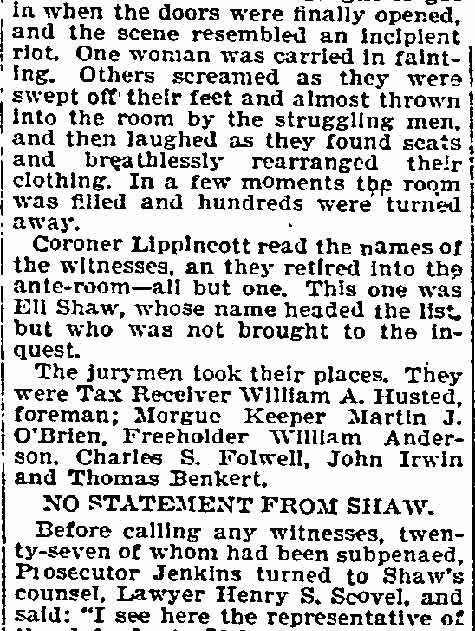
An immense crowd surged about the doors of the Camden Court House at the time set for the opening of the inquest. Men and women fought to get in when the doors were finally opened, and the scene resembled an incipient riot. One woman was carried in fainting. Others screamed as they were swept off their feet and almost thrown into the room by the struggling men, and then laughed as they found seats and breathlessly rearranged their clothing. In a few moments the room was filled and hundreds were turned away.
Coroner Lippincott read the names of the witnesses, an [sic] they retired into the ante-room—all but one. This one was Eli Shaw, whose name headed the list, but who was not brought to the inquest.
The jurymen took their places. They were Tax Receiver William A. Husted, foreman; Morgue Keeper Martin J. O’Brien, Freeholder William Anderson, Charles S. Folwell, John Irwin and Thomas Benkert.
NO STATEMENT FROM SHAW.
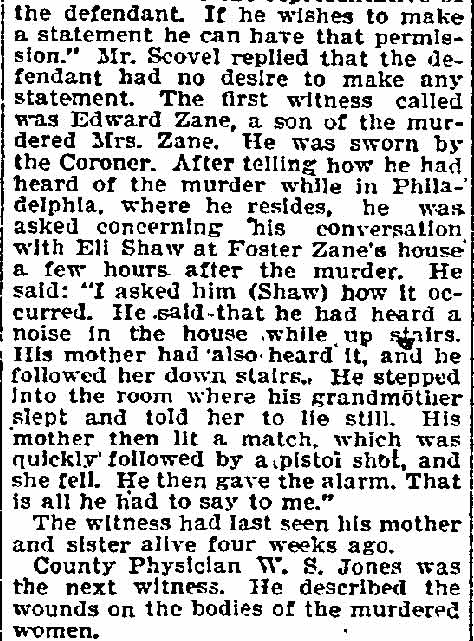
Before calling any witnesses, twenty-seven of whom had been subpenaed, Prosecutor Jenkins turned to Shaw’s counsel, Lawyer Henry S. Scovel, and said: “I see here the representative of the defendant. If he wishes to make a statement he can have that permission.” Mr. Scovel replied that the defendant had no desire to make any statement. The first witness called was Edward Zane, a son of the murdered Mrs. Zane. He was sworn by the Coroner. After telling how he had heard of the murder while in Philadelphia, where he resides, he was asked concerning his conversation with Eli Shaw at Foster Zane’s house a few hours after the murder. He said: “I asked him (Shaw) how it occurred. He said that he had heard a noise in the house while up stairs. His mother had also heard it, and he followed her down stairs. He stepped into the room where his grandmother slept and told her to lie still. His mother then lit a match, which was quickly followed by a pistol shot, and she fell. He then gave the alarm. That is all he had to say to me.”
The witness had last seen his mother and sister alive four weeks ago.
County Physician W. S. Jones was the next witness. He described the wounds on the bodies of the murdered women.
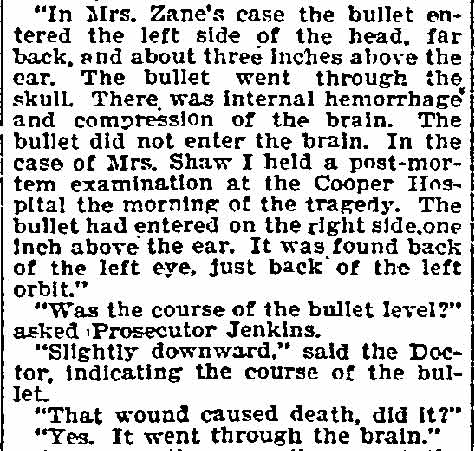
“In Mrs. Zane’s case the bullet entered the left side of the head, far back, and about three inches above the ear. The bullet went through the skull. There was internal hemorrhage and compression of the brain. The bullet did not enter the brain. In the case of Mrs. Shaw I held a post-mortem examination at the Cooper Hospital the morning of the tragedy. The bullet had entered on the right side, one inch above the ear. It was found back of the left eye, just back of the left orbit.”
“Was the course of the bullet level?” asked Prosecutor Jenkins.
“Slightly downward,” said the Doctor, indicating the course of the bullet.
“That wound caused death, did it?”
“Yes. It went through the brain.”
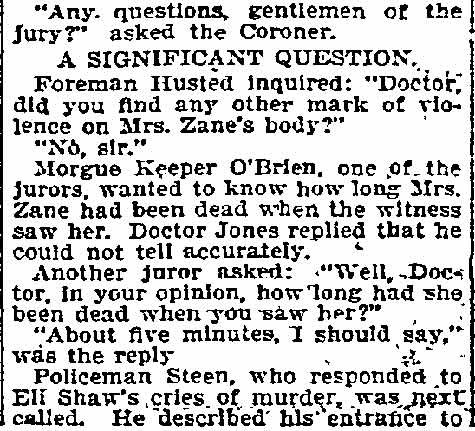
“Any questions, gentlemen of the jury?” asked the Coroner.
A SIGNIFICANT QUESTION.
Foreman Husted inquired: “Doctor, did you find any other mark of violence on Mrs. Zane’s body?”
“No, sir.”
Morgue Keeper O’Brien, one of the jurors, wanted to know how long Mrs. Zane had been dead when the witness saw her. Doctor Jones replied that he could not tell accurately.
Another juror asked: “Well, Doctor, in your opinion, how long had she been dead when you saw her?”
“About five minutes, I should say,” was the reply
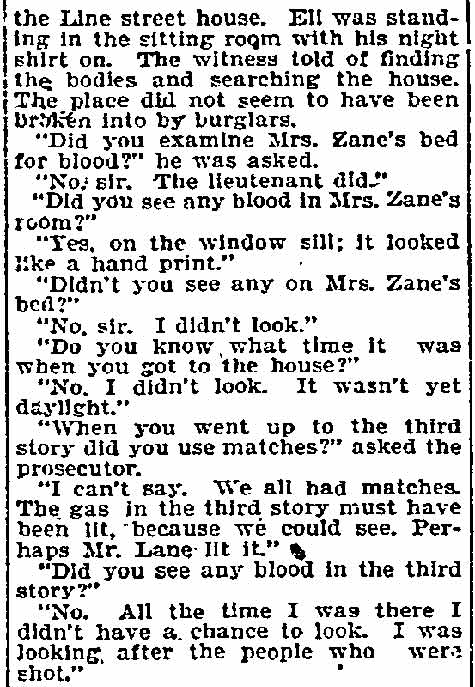
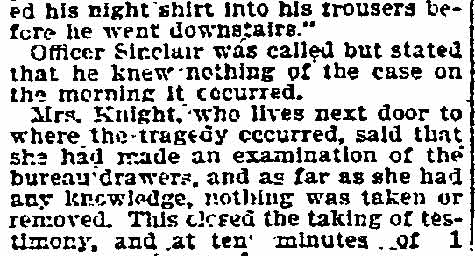
Policeman Steen, who responded to Eli Shaw’s cries of murder, was next called. He described his entrance to the Line street house. Eli was standing in the sitting room with his night shirt on. The witness told of finding the bodies and searching the house. The place did not seem to have been broken into by burglars.
“Did you examine Mrs. Zane’s bed for blood?” he was asked.
“No, sir. The lieutenant did.”
“Did you see any blood in Mrs. Zane’s room?”
“Yes, on the window sill; it looked like a hand print.”
“Didn’t you see any on Mrs. Zane’s bed?”
“No, sir. I didn’t look.”
“Do you know what time it was when you got to the house?”
“No. I didn’t look. It wasn’t yet daylight.”
“When you went up to the third story did you use matches?” asked the prosecutor.
“I can’t say. We all had matches. The gas in the third story must have been lit, because we could see. Perhaps Mr. Lane lit it.”
“Did you see any blood in the third story?”
“No. All the time I was there I didn’t have a chance to look. I was looking after the people who were shot.”
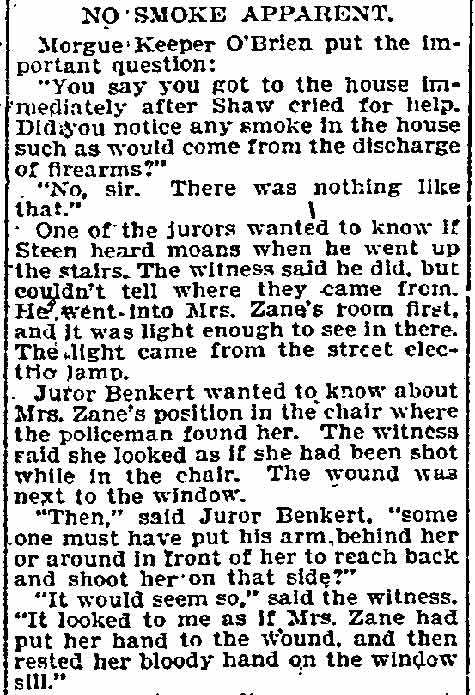
NO SMOKE APPARENT.
Morgue Keeper O’Brien put the important question:
“You say you got to the house immediately after Shaw cried for help. Did you notice any smoke in the house such as would come from the discharge of firearms?”
“No, sir. There was nothing like that.”
One of the jurors wanted to know if Steen heard moans when he went up the stairs. The witness said he did, but couldn’t tell where they came from. He went into Mrs. Zane’s room first, and it was light enough to see in there. The light came from the street electric lamp.
Juror Benkert wanted to know about Mrs. Zane’s position in the chair where the policeman found her. The witness said she looked as if she had been shot while in the chair. The wound was next to the window.
“Then,” said Juror Benkert, “some one must have put his arm behind her or around in front of her to reach back and shoot her on that side?”
“It would seem so,” said the witness. “It looked to me as if Mrs. Zane had put her hand to the wound, and then rested her bloody hand on the window sill.”
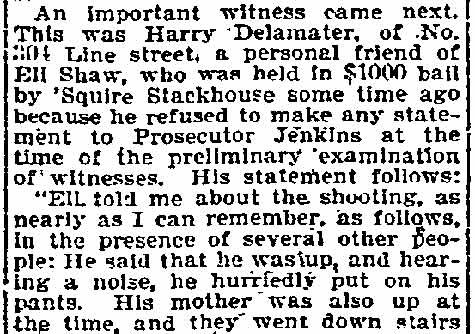
An important witness came next. This was Harry Delamater, of No. 30[?] Line street, a personal friend of Eli Shaw, who was held in $1000 bail by ‘Squire Stackhouse some time ago because he refused to make any statement to Prosecutor Jenkins at the time of the preliminary examination of witnesses. His statement follows:
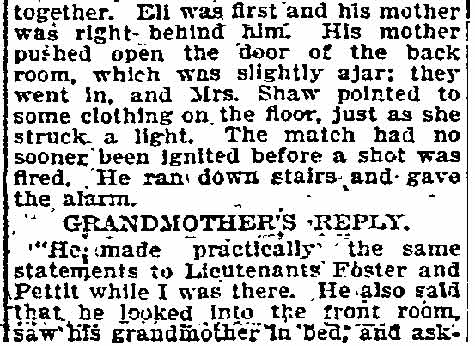
“Eli told me about the shooting, as nearly as I can remember, as follows, in the presence of several other people: He said that he was up, and hearing a noise, he hurriedly put on his pants. His mother was also up at the time, and they went down stairs together. Eli was first and his mother was right behind him. His mother pushed open the door of the back room, which was slightly ajar; they went in, and Mrs. Shaw pointed to some clothing on the floor, just as she struck a light. The match had no sooner been ignited before a shot was fired. He ran down stairs and gave the alarm.
GRANDMOTHER’S REPLY.
“He made practically the same statements to Lieutenants Foster and Pettit while I was there. He also said that he looked into the front room, saw his grandmother in bed, and asked his mother not to disturb her, as she was asleep. He ran up stairs, got a pistol, and rushed down and tried to fire it to attract attention, but it would not go off. He also said that when he heard the shot fired he ran into his grandmother’s room and said, ‘My God, some one is in the house and is shooting.’ He got a sort of sleepy groan, as some one awakening, for a reply.”
As Mrs. Zane was dead or dying by the time Eli said he called her and received a reply, this statement was received with particular interest.
James E. Tatem, of 619 South Fifth street; Frank B. Haines, of 561 Washington street, and Albert Fogg, of 615 South Fifth street, who were also in Foster Zane’s house on the evening after the tragedy when Eli Shaw told his story of the tragedy, were next called in rapid succession. Their testimony was for the most part a repetition of Delamater’s statement.
Albert Fogg testified that Shaw said he rushed into his grandmother’s room immediately after his mother was shot and cried:
“Get up, grandma; for God’s sake, get up; ther’s [sic] some one in the house.”
“Did he say his grandmother made any response?” asked the Prosecutor.
“No, sir.”
Albert Hollingshead was called, but had nothing to testify to.
Policeman John Painter, who found the revolver in the chimney, gave his testimony concerning his find. The revolver was brought in and, after wrestling with it for a few minutes, to the consternation of everyone else in the court room, Hall Officer Beard succeeded in unloading it. Painter identified the weapon. He also said:
“We made an examination of the chimneys. We found that there was a stove hole in Mrs. Zane’s room, but it was not opened. We found one in Eli’s room on the third floor, which was or had been recently opened. We also found a spot of blood on the door leading into Eli’s room, which looked as though it had been a large drop.”
Police Lieutenant Pettit was called to corroborate Painter’s story. He examined the pistol thoroughly when it was found. It looked as though it had been discharged recently. There was fresh oil about the hammer, some burnt powder could be seen at the muzzle, and it had an odor of burnt powder about it.
NO TRACE OF BURGLARS.
Lieutenant Pettit said he examined Mrs. Zane’s bed. There was no blood on the pillows or bolsters. The only blood he saw was one little spot on the under sheet, near the foot. In the third story he saw one spot of blood on the doorsill of Eli Shaw’s room. The Lieutenant said he found a hammer in Mrs. Shaw’s room in the third story. There were stains on it that might have been blood stains. An examination was made for traces of a burglar’s work. The witness described the position of the windows and said that in his opinion no burglar had ever gone through those windows.
Policeman Shaw identified the hammer, and Officer Beard told how he tried to get the weapon identified in Philadelphia pawnshops. It exploded while being examined in one of those establishments.
William Stein, a gunsmith, told that the bullets found in the bodies of the women were 32-calibre, the same as those used in the revolver found in the house. Guy Viskinski corroborated the story of the accidental discharge of the weapon in a pawnshop.
LANE TESTIFIES.
One of the most important witnesses was Charles Lane, who lives at 646 South Third street, and who was next called. He is the neighbor who first heard Eli Shaw’s cries for help and responded. He was in bed when he heard cries of “Help! Help! Murder!” The cries were repeated three or four times. He got up and dressed hurriedly. He ran around and found Eli Shaw in his night shirt on the front step. Shaw cried:
“Oh, Mr. Lane, mom and grandmom are shot!”
Just at this moment the witness’ son came running up, and they went in the hallway.
“My son asked for a light,” said the witness. “Shaw brought us two matches. He said: ‘Don’t go upstairs yet; they may be up there yet.’ Then Officer Stein came in. I said to Shaw: ‘Haven’t you got anything to defend yourself with?’ and Shaw handed me a revolver. I cocked it and he said: ‘There’s nothing in it.’ Then we struck some matches and went upstairs.”
“Was Eli Shaw’s night shirt outside his pantaloons when you first saw him on the steps?” asked the Prosecutor.
“Yes; it hung down almost to his feet.”
Continuing his story of the search, Mr. Lane said they went first to the second story front, and there found Mrs. Zane sitting in a chair near the window.
She was in her night clothes, her head was sunk on her chest, her eyes were closed, and blood trickled down her face. She was gasping for breath, “just like this,” said the witness, drawing in his cheeks like a person almost suffocated. He was describing Mrs. Zane’s dying agonies.
Mr. Lane said he called to Mrs. Zane. “Em! Em!” but she made no response. “I had known her for forty years,” said the witness to the jury in explanation of his familiar manner of addressing the woman. Then he said they went into the next room and found Mrs. Shaw on the floor moaning and weltering in her own gore. He spoke to her, but she could not answer. He described the position in which Mrs. Shaw lay. Then, he said, the searchers went up to the third floor. The Prosecutor asked if they found any lights. The witness said no; they had to light the gas in the third story front room. They found the gas lit in the dining room on the first floor when they first entered the house.
NIGHT SHIRT EXHIBITED.
Coroner Lippincott took the stand next and showed the jury Shaw’s night shirt, on which there were many spots of blood. Some were very small, others approached the size of a pea. When he had finished making this gruesome exhibit, he returned to the stand and detailed what he had heard of the conversation between Eli Shaw and Prosecutor Jenkins.
“He said that he did not see any one when his mother was shot, did not see her fall, and did not see the flash of the pistol. He also said that he had tucked his night shirt into his trousers before he went downstairs.”
Officer Sinclair was called but stated that he knew nothing of the case on the morning it occurred.
Mrs. Knight, who lives next door to where the tragedy occurred, said that she had made an examination of the bureau drawers, and as far as she had any knowledge, nothing was taken or removed. This closed the taking of testimony, and at ten minutes of 1 o’clock, the jury retired to deliberate.
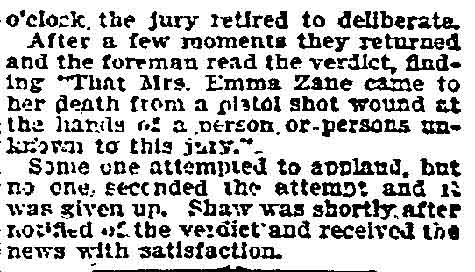
After a few moments they returned and the foreman read the verdict, finding “That Mrs. Emma Zane came to her death from a pistol shot wound at the hands of a person or persons unknown to this jury.”
Some one attempted to applaud, but no one seconded the attempt and it was given up. Shaw was shortly after notified of the verdict and received the news with satisfaction.
Added to the “Finest.”
Camden Daily Courier —
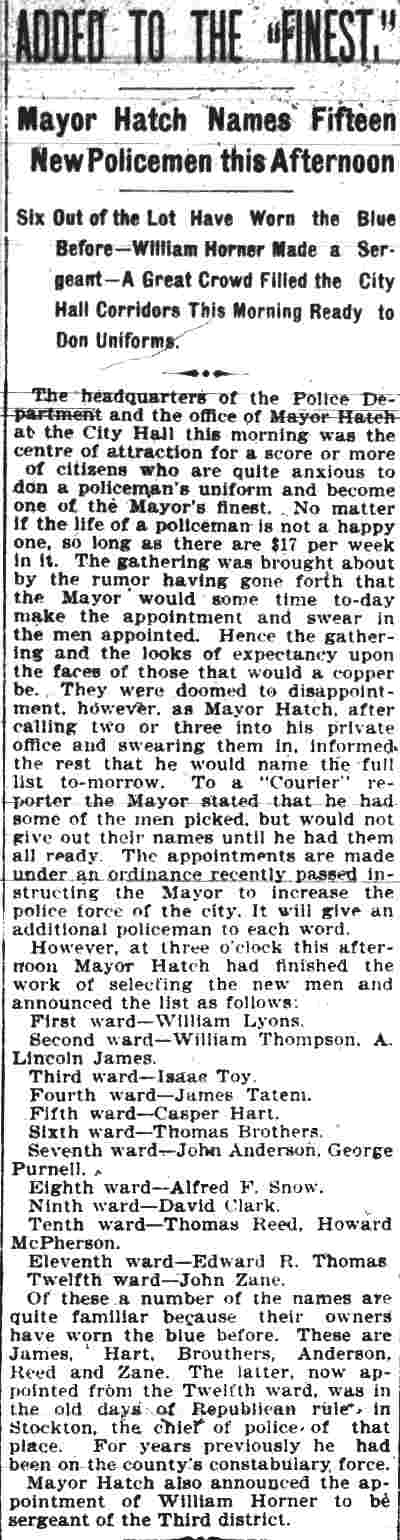
Mayor Hatch Names Fifteen New Policemen this Afternoon
Six Out of the Lot Have Worn the Blue Before—William Horner Made a Sergeant—A Great Crowd Filled the City Hall Corridors This Morning Ready to Don Uniforms.
The headquarters of the Police Department and the office of Mayor Hatch at the City Hall this morning was the centre of attraction for a score or more of citizens who are quite anxious to don a policeman’s uniform and become one of the Mayor’s finest. No matter if the life of a policeman is not a happy one, so long as there are $17 per week in it. The gathering was brought about by the rumor having gone forth that the Mayor would some time to-day make the appointment and swear in the men appointed. Hence the gathering and the looks of expectancy upon the faces of those that would a copper be. They were doomed to disappointment, however, as Mayor Hatch, after calling two or three into his private office and swearing them in, informed the rest that he would name the full list to-morrow. To a “Courier” reporter the Mayor stated that he had some of the men picked, but would not give out their names until he had them all ready. The appointments are made under an ordinance recently passed instructing the Mayor to increase the police force of the city. It will give an additional policeman to each word [sic].
However, at three o’clock this afternoon Mayor Hatch had finished the work of selecting the new men and announced the list as follows:
First ward—William Lyons.
Second ward—William Thompson. A. Lincoln James.
Third ward—Isaac Toy.
Fourth ward—James Tatem.
Fifth ward—Casper Hart.
Sixth ward—Thomas Brothers.
Seventh ward—John Anderson. George Purnell.
Eighth ward—Alfred F. Snow.
Ninth ward—David Clark.
Tenth ward—Thomas Reed. Howard McPherson.
Eleventh ward—Edward R. Thomas
Twelfth ward—John Zane.
Of these a number of the names are quite familiar because their owners have worn the blue before. These are James, Hart, Brouthers, Anderson, Reed and Zane. The latter, now appointed from the Twelfth ward, was in the old days of Republican rule, in Stockton, the chief of police of that place. For years previously he had been on the county’s constabulary force.
Mayor Hatch also announced the appointment of William Horner to be sergeant of the Third district.
Camden’s Police Force Increased
Philadelphia Inquirer —
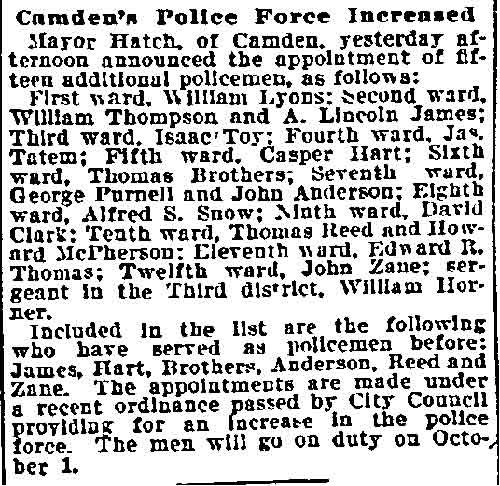
Mayor Hatch, of Camden, yesterday afternoon announced the appointment of fifteen additional policemen, as follows:
First ward, William Lyons; Second ward, William Thompson and A. Lincoln James; Third ward, Isaac Toy; Fourth ward, Jas. Tatem; Fifth ward, Casper Hart; Sixth ward, Thomas Brothers; Seventh ward, George Purnell and John Anderson; Eighth ward, Alfred S. Snow; Ninth ward, David Clark; Tenth ward, Thomas Reed and Howard McPherson; Eleventh ward, Edward R. Thomas; Twelfth ward, John Zane; sergeant in the Third district, William Horner.
Included in the list are the following who have served as policemen before: James, Hart, Brothers, Anderson, Reed and Zane. The appointments are made under a recent ordinance passed by City Council providing for an increase in the police force. The men will go on duty on October 1.
Philadelphia Inquirer – December 13, 1903


ARMED DESPERADOES SWOOP DOWN ON EAST CAMDEN
First Hold Up Bridge Watchman, Compelling Him to Place Mask on Face of One of the Bandits
Battle With Policeman After Blowing Up Safe in Pavonia Station—Shoot at Tower Operator Who Telegraphs for Help
In true Wild West fashion five heavily armed desperadoes swooped down upon East Camden yesterday morning, and within two hours they had emptied their revolvers several times over, held up a bridge tender, cut telephone wires, blew up a safe, ordered a train crew to move on, perforated a tower house with bullets and finally made their escape. It was all done between 12.15 o’clock, when the bandits began operations at the State street bridge over Cooper Creek, and 1.50, when they gave final battle to policemen and citizens out Federal street, and disappeared in the darkness.
Never in Camden county’s history was there such a bold intrusion. The bandits are supposed to be a part of the gang which murdered Operator Clendenen, near Jersey Shore, Pa., and which has been terrorizing railroad operators and tower men in all parts of Pennsylvania and New Jersey recently.
First Appearance
It was shortly after 12 o’clock when the bandits appeared at the State street bridge at Cooper’s Creek. David Loughead and Oscar Till, bridge tenders, had just prepared to retire for the night. Loughead left Till to go to a boat house nearby. He had been gone but a short time when Till heard voices in the rear of the bridge house.
Bridgeman Till observed several men standing at the end of the bridge, and believing that they anticipated attacking him he locked the doors and laid his revolver on the bunk. Suddenly the door was forced open and in tumbled five men. Four of the bandits were masked. Instantly the frightened bridge tender was looking into the barrels of five revolvers.
“I surrender,” said Till.
“That’s all right, old pal,” replied one of the robbers, “but we want your money. You see we are a little short of funds, and it’s getting along about Christmas time.”
Masked by Their Victim
The men were about to go through Till’s pockets when the unmasked bandit said: “Hold up, I want my face covered and I want Mr. Bridgetender to do it.” Till complied. While a revolver was held at each temple Till took out his handkerchief and attempted to tie it about the robber’s face. He got the handkerchief over the fellow’s eyes. When ordered to try again he adjusted it to the satisfaction of the bandit, who expressed regret that the visit was causing the bridgetender so much trouble. The man Till masked went through his pockets. He failed to find any money, as Till had hidden what bills he had early in the night.
Ordered to Bed
Till was ordered to bed, and after he lay down on his back the bandits covered him over completely and cautioned him not to move under penalty of death. The desperadoes then disappeared. Fearing that one of the gang had remained behind to keep him from sounding an alarm, Till remained in bed until he heard a car approaching. Then he ventured out and summoned his partner, David Longhead [sic], from the boat house.
When an effort was made to use the telephone the bridgetenders found that the bandits had cut the wires.
The men hurried on State street, passed around the old Cox farm, struck into the river road, then headed for Pavonia.
Blew Up Safe
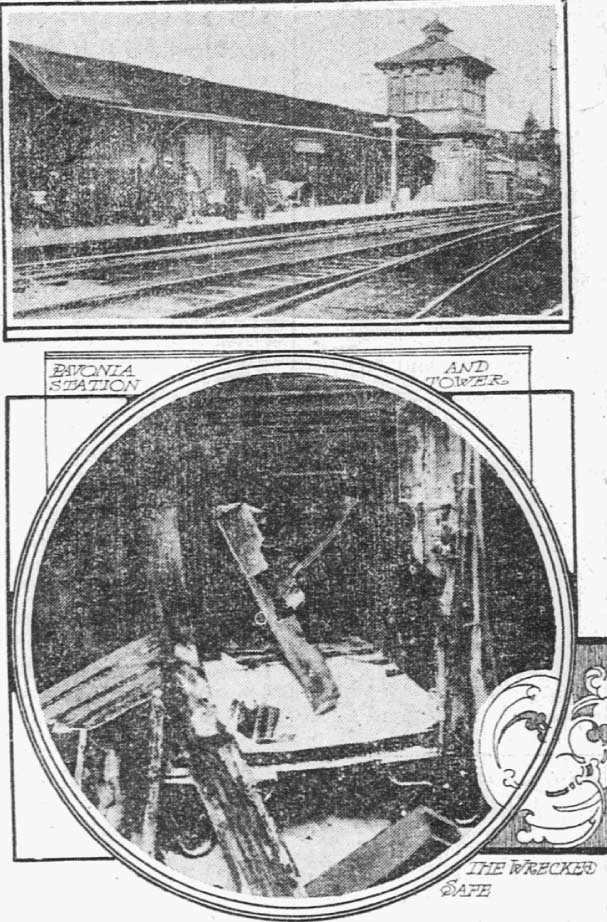
After passing guardedly through the freight yards of the Pennsylvania Railroad the bandits came up to the Pavonia Station. The thieves entered the little office by removing a heavy wire screen from a window in the rear of the ticket compartment, which is a room 8x10 feet in size. Three men had just about entered the station when two, who were left on guard, saw a train approaching. When Engineer Truax stopped the drill engine near the tower house the two men who were watching on the outside approached Engineer Truax and his fireman, Allen Stewart, with drawn revolvers and commanded them to uncouple the engine and proceed on up the road.
Truax lost no time in obeying. He opened the throttle of his locomotive and did not stop until he reached Fish House.
In the meantime the trio in the station had inserted a charge of nitro-glycerine in the safe, attached a fuse and climbed out the window to await the explosion. It came in a few minutes.
Shot at Operator
Operator Ralph Haines, of Eighth and Line streets, Camden, heard the noise and raised the window of the tower house. He had hardly placed his head out when, with an oath, he was ordered to put his head in. The operator hesitated, until several shots were fired, followed by a general bombardment on the tower. One bullet whizzed by Haines’ head and buried itself in the window frame. Another lodged in the overhanging roof of the station waiting room.
This was too much for Haines and he fell back on the floor. Evidently believing they had murdered the tower man, the robbers discontinued bombarding the tower house with bullets and walked to the wrecked office. Operator Haines crawled on his knees to the ticker and sent word to the main office that he was being attacked by a gang of desperadoes, who were bombarding the tower in an effort to kill him. The two bandits who were on guard were noticed to run to the station office and the five suddenly left together.
Duel With Bandits
In the meantime all was activity at police headquarters. The railroad officials had communicated Operator Haines’ message to the City Hall and Sergeant Schregler and Officer Tatem sent word to a dozen officers, who started for the scene under the direction of Sergeant Reeder.
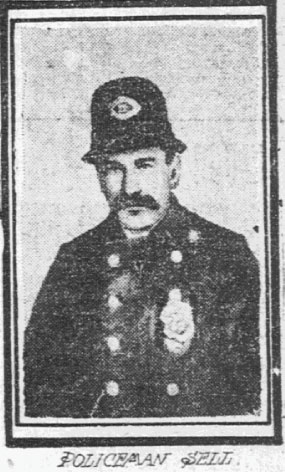
The detail was divided up to cover the various roads. Policemen Thomas Reed and Errickson were assigned to State street and at the bridge met Policemen Sell and Schmidt and Bridgeman Till. After a wait with no developments Sell and Schmidt decided to go to River road. They had only been gone a few minutes when they came upon the bandits hurrying in State street, near Cox’s farm.
When fifty yards away Sell ordered the robbers to throw up their hands. They did so, but each man flashed a pistol in his hand and opened fire on the officers. The latter returned the fire, but were compelled to retreat, as the odds were largely against them.
Bullet Through Officer’s Coat
Reed, Errickson and Till could see the flash of the pistols and hurried up the road, guns in hand. Then the shooting ceased and a minute later Sell and Schmidt came up. Neither man was hurt, but one of the bullets fired by the robbers had passed through the shoulder of Sell’s coat. An effort was made to catch up with the men again. They ran out State street to the railroad, back towards Cooper’s Creek, where they broke open the bridge tender’s house, then struck into Federal street and headed for the open country. Out Federal street they met more policemen and several armed citizens. The bandits were some distance away, but there was another lively exchange of shots. No one was injured. The bandits kept on the run and were soon lost in the darkness.
About $10 at the Pavonia station was secured by the robbers. They left more than a dollar in change in a drawer in the ticket office.
Tatem Made House Sergeant
Philadelphia Inquirer —
In accordance with the ordinance adopted by Camden City Council, the Police Department was increased by an additional house sergeant at headquarters yesterday. Mayor Ellis appointed James Tatem, one of the most popular members of the force. He has been assigned as a hall officer and the vacancy caused by his elevation will be filled by George Cooper.
Camden News Notes
Philadelphia Inquirer —
The annual sham battle and dance under the auspices of Battery B, N. G. N. J., will be held in the Camden Armory tomorrow evening.
Dr. H. H. Sherk will give an illustrated lecture on the Yellowstone Park in the East Camden Library tomorrow night.
One of the largest funerals that has taken place in Camden for some time was that of George Bird, who was buried from his home, 801 Haddon avenue. The services were in charge of Rev. Isaac Bagley and interment was made in the Evergreen Cemetery.
These officers have been nominated by the Camden Police Pension Fund: President, Robert Colkett; vice president, Albert Snow; financial secretary, James Tatem; recording secretary, Edward Hyde; treasurer, E. B. McClong; trustees, James Ware, George Anderson, George Cooper, Allan Palmer and Thomas Reed.
Daniel Clifford, a Civil War veteran, 70 years old, of New York, reported to the police yesterday that after he had drawn his pension he had been decoyed to Camden, where he was relieved of $69.
In a twenty five foot fall at Mathis’ Shipyard yesterday, Lysander Burton, of 904 North Second street, was seriously injured internally besides having many lacerations and bruises.
Attacked with asthma, William Baldwin, 77 years old, of 510 Kaighn avenue, died yesterday before a physician could be summoned.
From shock due to a broken leg, John Spiegel, 45 years old, died in the Cooper Hospital last night. At one time Spiegel was a transcribing clerk in the Register of Deeds office.
Handing Out Gunning Licenses in Camden
Philadelphia Inquirer —
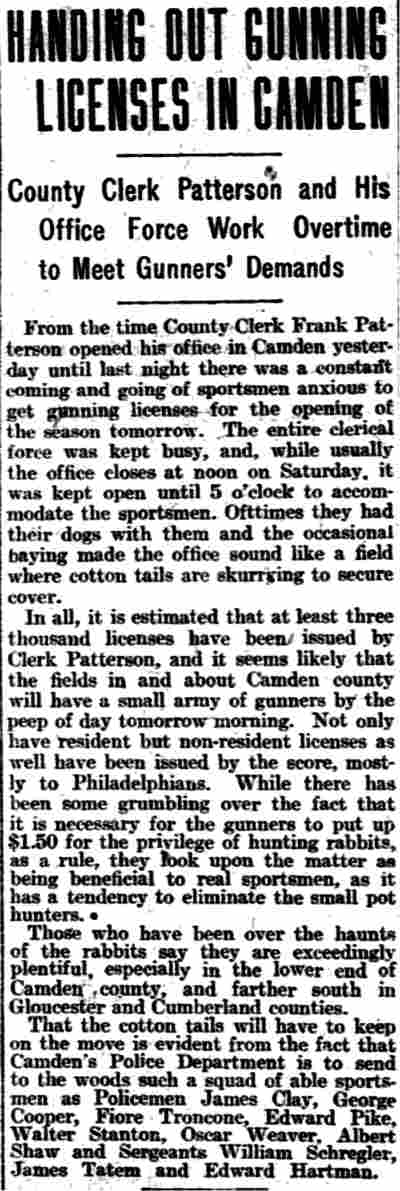
County Clerk Patterson and His Office Force Work Overtime to Meet Gunners’ Demands
From the time County Clerk Frank Patterson opened his office in Camden yesterday until last night there was a constant coming and going of sportsmen anxious to get gunning licenses for the opening of the season tomorrow. The entire clerical force was kept busy, and, while usually the office closes at noon on Saturday, it was kept open until 5 o’clock to accommodate the sportsmen. Ofttimes they had their dogs with them and the occasional baying made the office sound like a field where cotton tails are skurrying to secure cover.
In all, it is estimated that at least three thousand licenses have been issued by Clerk Patterson, and it seems likely that the fields in and about Camden county will have a small army of gunners by the peep of day tomorrow morning. Not only have resident but non-resident licenses as well have been issued by the score, mostly to Philadelphians. While there has been some grumbling over the fact that it is necessary for the gunners to put up $1.50 for the privilege of hunting rabbits, as a rule, they look upon the matter as being beneficial to real sportsmen, as it has a tendency to eliminate the small pot hunters.
Those who have been over the haunts of the rabbits say they are exceedingly plentiful, especially in the lower end of Camden county, and farther south in Gloucester and Cumberland counties.
That the cotton tails will have to keep on the move is evident from the fact that Camden’s Police Department is to send to the woods such a squad of able sportsmen as Policemen James Clay, George Cooper, Fiore Troncone, Edward Pike, Walter Stanton, Oscar Weaver, Albert Shaw and Sergeants William Schregler, James Tatem and Edward Hartman.
Police Pension Fund Election
Philadelphia Inquirer —
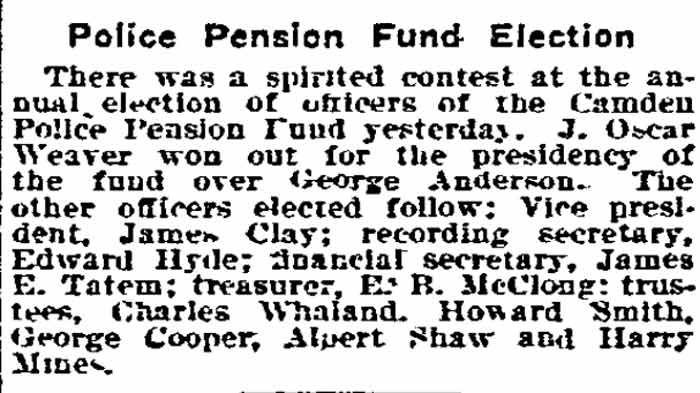
There was a spirited contest at the annual election of officers of the Camden Police Pension Fund yesterday. J. Oscar Weaver won out for the presidency of the fund over George Anderson. The other officers elected follow: Vice president, James Clay; recording secretary, Edward Hyde; financial secretary, James E. Tatem; treasurer, E. B. McClong; trustees, Charles Whaland, Howard Smith, George Cooper, Albert Shaw and Harry Mines.
Conscience Forces Confession
Philadelphia Inquirer —
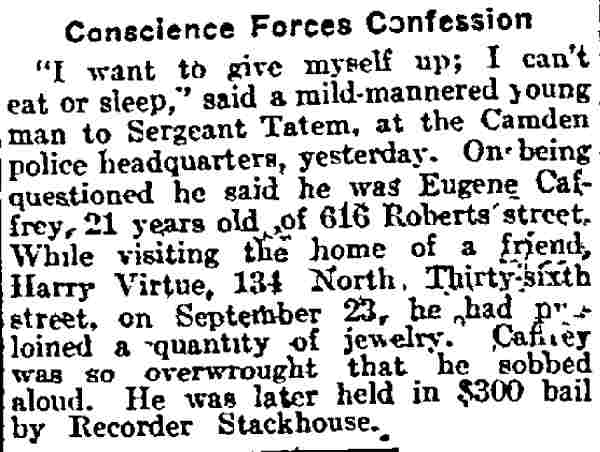
“I want to give myself up; I can’t eat or sleep,” said a mild-mannered young man to Sergeant Tatem, at the Camden police headquarters, yesterday. On being questioned he said he was Eugene Caffrey, 21 years old, of 616 Roberts street. While visiting the home of a friend, Harry Virtue, 134 North, Thirty-sixth street, on September 23, he had purloined a quantity of jewelry. Caffrey was so overwrought that he sobbed aloud. He was later held in $300 bail by Recorder Stackhouse.
Many at Williams’ Funeral
Philadelphia Inquirer —
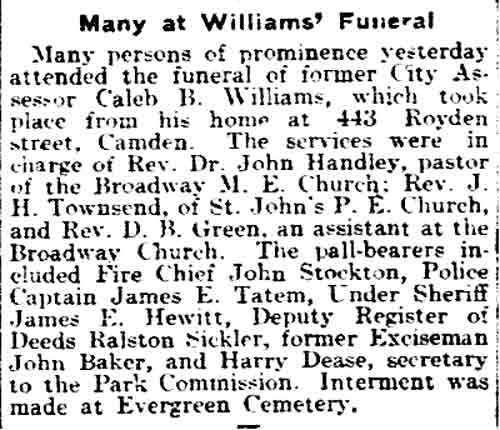
Many persons of prominence yesterday attended the funeral of former City Assessor Caleb B. Williams, which took place from his home at 443 Royden street, Camden. The services were in charge of Rev. Dr. John Handley, pastor of the Broadway M. E. Church; Rev. J. H. Townsend, of St. John’s P. E. Church, and Rev. D. B. Green, an assistant at the Broadway Church. The pall-bearers included Fire Chief John Stockton, Police Captain James E. Tatem, Under Sheriff James E. Hewitt, Deputy Register of Deeds Ralston Sickler, former Exciseman John Baker, and Harry Dease, secretary to the Park Commission. Interment was made at Evergreen Cemetery.
Police Elect Officers
Philadelphia Inquirer —
Camden’s Police Beneficial Association yesterday at its annual session donated $25 each to the Camden Day Nursery, Camden Home for Friendless Children, West Jersey Orphanage, Mary J. Ball Nursery, Homeopathic Hospital, Y. M. C. A. War Fund, S. P. C. C., and the Associated Charities. They elected the following officers for the ensuing year: President, Arthur Colsey; vice president, Thomas Cunningham; financial secretary, Edward Hyde; recording secretary, James E. Tatem; treasurer, E. B. McClong; trustees, Charles Humes, Charles Whaland, Howard Smith, Ralph Bond and John Develin.
Police Elect Officers
Philadelphia Inquirer —
Camden’s Police Beneficial Association yesterday at its annual session donated $25 each to the Camden Day Nursery, Camden Home for Friendless Children, West Jersey Orphanage, Mary J. Ball Nursery, Homeopathic Hospital, Y. M. C. A. War Fund, S. P. C. C., and the Associated Charities. They elected the following officers for the ensuing year: President, Arthur Colsey; vice president, Thomas Cunningham; financial secretary, Edward Hyde; recording secretary, James E. Tatem; treasurer, E. B. McClong; trustees, Charles Humes, Charles Whaland, Howard Smith, Ralph Bond and John Develin.
Camden Daily Courier – January 4, 1922
Camden Daily Courier —
Charge Detective Murry Protected Vice

THREE OTHER POLICEMEN ARE ACCUSED BY BLEAKLY IN PROBE OF GRAFTING
Draper, Latorre and Hall, of First District Named by Council Solicitor to Council Committee—Murry is Alleged to Have Taken More Than $6000 From Woman of Underworld at Rate of $15 a Week—First Payment Made When Girl Was Fourteen Years Old, is Allegation—Hearing on January 11.
Charges that City Detective George Murry accepted money from prostitutes and dope vendors for protection were laid before the police committee of Council today by City Solicitor Bleakly.
Serious charges against three other members of the police department in connection with the investigation of vice conditions in the Third and Fifth Wards also were preferred by Mr. Bleakly, in the accusations presented to the councilmanic committee.
Hearings on the charges, which were declared by the city solicitor to be the most degrading and serious ever preferred against Camden policemen, will be conducted by the members of the police committee on the evening of January 11 at City Hall.
Investigation into accusations brought by Federal agents that Murry and other members of the police department were guilty of using their positions to protect denizens of the underworld was made by Mr. Bleakly with the assistance of Prosecutor Wolverton and Chief of Police Gravenor.
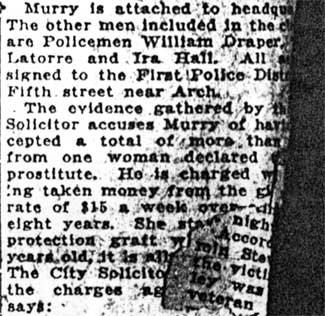
Murry is attached to headquarters. The other men included in the charges are Policemen William Draper, Latorre and Ira Hall, all assigned to the First Police District, Fifth street near Arch.
The evidence gathered by the Solicitor accuses Murry of having accepted a total of more than $6,000 from one woman declared to have become a prostitute. He is charged with having taken money from her at the rate of $15 a week over an eight-year period. [Remainder of this paragraph illegible — the scan is smudged at this point on crop -03.]
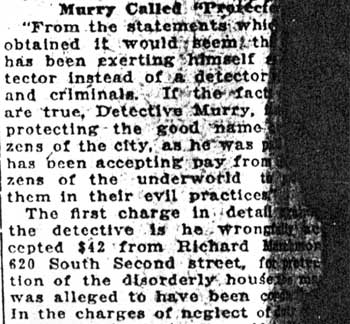
Murry Called “Protector”
“From the statements which obtained it would seem that he has been exerting himself as a protector instead of a detector of criminals. If the facts are true, Detective Murry, instead of protecting the good names of the city, as he was paid, has been accepting pay from denizens of the underworld to help them in their evil practices.
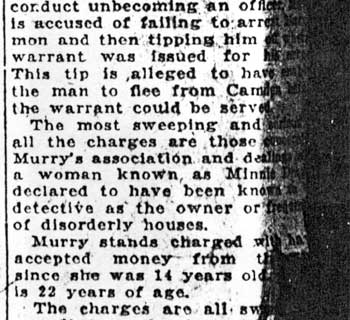
The first charge in detail is that the detective is he wrongly accepted $42.50 from Richard Marchmon, 620 South Second street, for protection of the disorderly house it was alleged to have been conducted. In the charges of neglect of duty conduct unbecoming an officer, he is accused of failing to arrest Marchmon and then tipping him a warrant was issued for him. This tip is alleged to have given the man to flee from Camden before the warrant could be served.
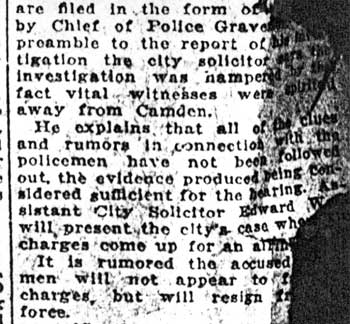
The most sweeping and all the charges are those of Murry’s association and dealings with a woman known as Minnie Draper, declared to have been known to the detective as the owner or keeper of disorderly houses. Murry stands charged with having accepted money from her since she was 14 years old; she is 22 years of age. The charges are all sworn to and filed in the form of affidavits by Chief of Police Gravenor.
In a preamble to the report of investigation the city solicitor said the investigation was hampered by the fact vital witnesses were kept away from Camden. He explains that all of the charges and rumors in connection with policemen have not been followed out, the evidence produced being considered sufficient for the hearing. Assistant City Solicitor Edward Wolverton will present the city’s case when charges come up for a hearing. It is rumored the accused policemen will not appear to fight the charges, but will resign from the force.
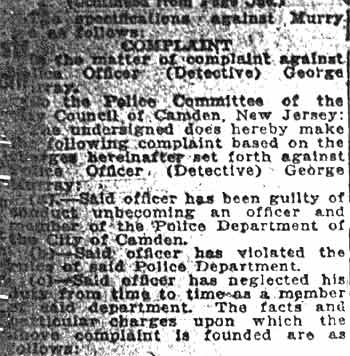
The specifications against Murry are as follows:
COMPLAINT
In the matter of complaint against Police Officer (Detective) George Murry:
To the Police Committee of the City Council of Camden, New Jersey:
The undersigned does hereby make the following complaint based on the charges hereinafter set forth against Police Officer (Detective) George Murry:
(a) Said officer has been guilty of conduct unbecoming an officer and member of the Police Department of the City of Camden.
(b) Said officer has violated the rules of said Police Department.
(c) Said officer has neglected his duties from time to time as a member of said department. The facts and particular charges upon which the above complaint is founded are as follows:
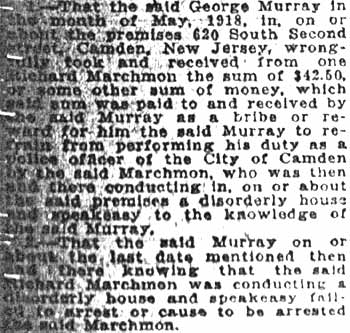
That the said George Murry in the month of May, 1918, in, on or about the premises 620 South Second St., Camden, New Jersey, wrongfully took and received from one Richard Marchmon the sum of $42.50, or some other sum of money, which sum was paid to and received by the said Murry as a bribe or reward for him the said Murry to refrain from performing his duty as a police officer of the City of Camden by the said Marchmon, who was then and there conducting in, on or about said premises a disorderly house and speakeasy to the knowledge of the said Murry.
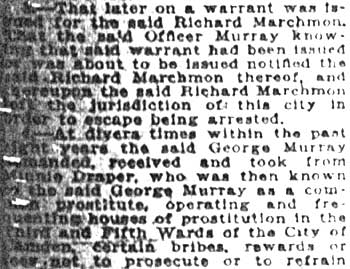
That the said Murry on or about the last date mentioned then and there knowing that the said Richard Marchmon was conducting a disorderly house and speakeasy failed to arrest or cause to be arrested said Marchmon. That later on a warrant was issued for the said Richard Marchmon. That the said Officer Murry knowing that said warrant had been issued or was about to be issued notified the said Richard Marchmon thereof, and thereupon the said Richard Marchmon left the jurisdiction of this city in order to escape being arrested.
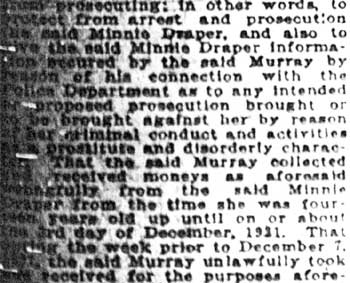
At divers times within the past three years the said George Murry demanded, received and took from Minnie Draper, who was then known to the said George Murry as a common prostitute, operating and frequenting houses of prostitution in the Third and Fifth Wards of the City of Camden, certain bribes, rewards or payments not to prosecute or refrain from prosecuting; in other words, to protect from arrest and prosecution the said Minnie Draper, and also to give the said Minnie Draper information procured by the said Murry by reason of his connection with the Police Department as to any intended or proposed prosecution brought or to be brought against her by reason of her criminal conduct and activities as a prostitute and disorderly character.
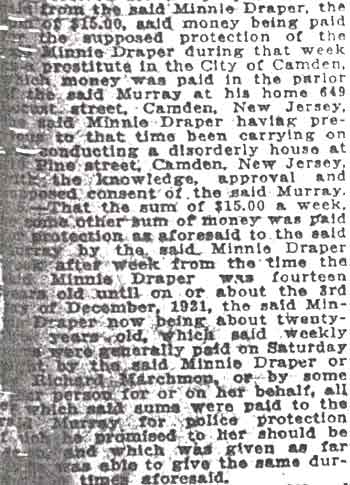
That the said Murry collected and received moneys as aforesaid wrongfully from the said Minnie Draper from the time she was fourteen years old up until on or about the 3rd day of December, 1921. That during the week prior to December 7, 1921, the said Murry unlawfully took and received for the purposes aforesaid from the said Minnie Draper, the sum of $15.00, said money being paid for the supposed protection of the said Minnie Draper during that week as a prostitute in the City of Camden, which money was paid in the parlor of the said Murry at his home 649 Scott street, Camden, New Jersey, the said Minnie Draper having previous to that time been carrying on and conducting a disorderly house at Pine street, Camden, New Jersey, with the knowledge, approval and supposed consent of the said Murry.
That the sum of $15.00 a week, or some other sum of money was paid for protection as aforesaid to the said Murry by the said Minnie Draper each and every week from the time the said Minnie Draper was fourteen years old until on or about the 3rd day of December, 1921, the said Minnie Draper now being about twenty-two years old, which said weekly sums were generally paid on Saturday night by the said Minnie Draper or by Richard Marchmon, or by some other person for or on her behalf, all of which said sums were paid to said Murry for police protection which he promised to her should be given and which was given as far as he was able to give the same during the times aforesaid.
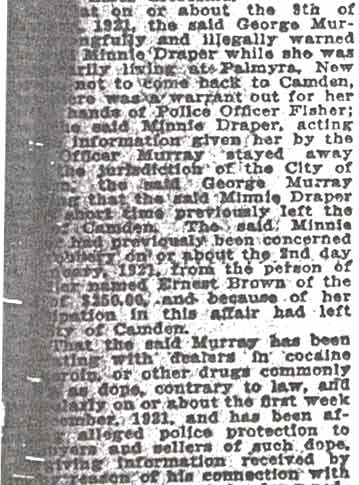
That on or about the 8th of January 1921, the said George Murry wrongfully and illegally warned the said Minnie Draper while she was temporarily living at Palmyra, New Jersey that there was a warrant out for her in the hands of Police Officer Fisher; and the said Minnie Draper, acting upon information given her by the said Officer Murry stayed away from the jurisdiction of the City of Camden, since the said George Murry knowing that the said Minnie Draper had a short time previously left the City of Camden. The said Minnie Draper had previously been concerned in a robbery on or about the 2nd day of January, 1921, from the person of a man named Ernest Brown of the sum of $250.00, and because of her participation in this affair had left the City of Camden.
That the said Murry has been dealing with dealers in cocaine, heroin or other drugs commonly known as dope, contrary to law, and particularly on or about the first week of December, 1921, and has been affording alleged police protection to buyers and sellers of such dope, receiving information received by him by reason of his connection with the Police Department to dope peddlers and buyers contrary to law.
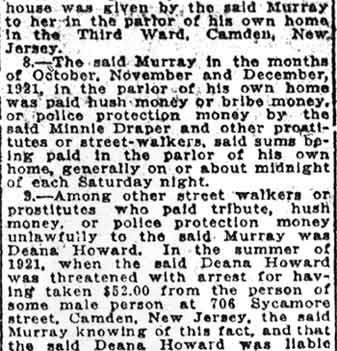
That in this connection one Joe Pollack, early in December or the latter part of November, 1921, had been engaged in the business of dope or selling coke at 210 Pine street, Camden, New Jersey; that the next morning after raids the said Murry sent for Joe Pollack’s girl, Maude Jordan, and told her to get the stuff, meaning the dope or coke, out of Pollack’s house. That the direction to the said Jordan girl to take said dope away from the Pollack house was given by the said Murry to her in the parlor of his own home in the Third Ward, Camden, New Jersey.
8.—The said Murry in the months of October, November and December, 1921, in the parlor of his own home was paid hush money or bribe money, or police protection money by the said Minnie Draper and other prostitutes or street-walkers, said sums being paid in the parlor of his own home, generally on or about midnight of each Saturday night.
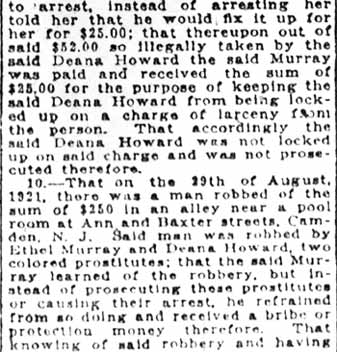
9.—Among other street walkers or prostitutes who paid tribute, hush money, or police protection money unlawfully to the said Murry was Deana Howard. In the summer of 1921, when the said Deana Howard was threatened with arrest for having taken $52.00 from the person of some male person at 706 Sycamore street, Camden, New Jersey, the said Murry knowing of this fact, and that the said Deana Howard was liable to arrest, instead of arresting her told her that he would fix it up for her for $25.00; that thereupon out of said $52.00 so illegally taken by the said Deana Howard the said Murry was paid and received the sum of $25.00 for the purpose of keeping the said Deana Howard from being locked up on a charge of larceny from the person. That accordingly the said Deana Howard was not locked up on said charge and was not prosecuted therefore.
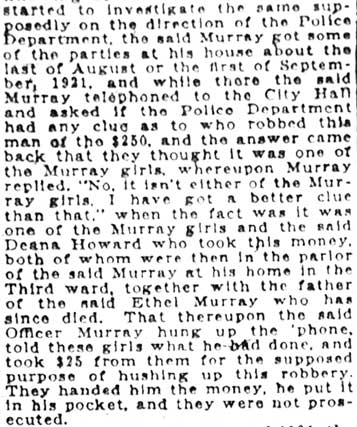
10.—That on the 29th of August, 1921, there was a man robbed of the sum of $250 in an alley near a pool room at Ann and Baxter streets, Camden, N. J. Said man was robbed by Ethel Murray and Deana Howard, two colored prostitutes; that the said Murry learned of the robbery, but instead of prosecuting those prostitutes or causing their arrest, he refrained from so doing and received a bribe or protection money therefore. That knowing of said robbery and having started to investigate the same supposedly on the direction of the Police Department, the said Murry got some of the parties at his house about the last of August or the first of September, 1921, and while there the said Murry telephoned to the City Hall and asked if the Police Department had any clue as to who robbed this man of the $250, and the answer came back that they thought it was one of the Murray girls, whereupon he replied, “No, it isn’t either of the Murray girls, I have got a better clue than that,” when the fact was it was one of the Murray girls and the said Deana Howard who took this money, both of whom were then in the parlor of the said Murry at his home in the Third ward, together with the father of the said Ethel Murray who has since died. That thereupon the said Officer Murry hung up the ’phone, told these girls what he had done, and took $25 from them for the supposed purpose of hushing up this robbery. They handed him the money, he put it in his pocket, and they were not prosecuted.
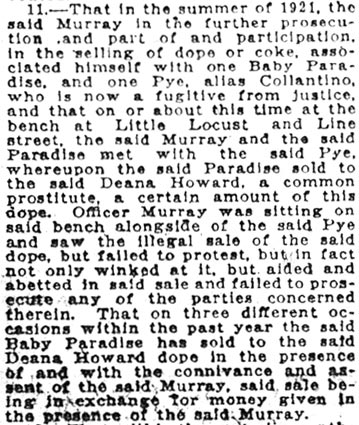
11.—That in the summer of 1921, the said Murry in the further prosecution and part of and participation in the selling of dope or coke, associated himself with one Baby Paradise, and one Pye, alias Collantino, who is now a fugitive from justice, and that on or about this time at the bench at Little Locust and Line street, the said Murry and the said Paradise met with the said Pye, whereupon the said Paradise sold to the said Deana Howard, a common prostitute, a certain amount of this dope. Officer Murry was sitting on said bench alongside of the said Pye and saw the illegal sale of the said dope, but failed to protest, but in fact not only winked at it, but aided and abetted in said sale and failed to prosecute any of the parties concerned therein. On three different occasions within the past year the said Baby Paradise has sold to the said Deana Howard dope in the presence of and with the connivance and assent of the said Murry, said sale being in exchange for money given in the presence of the said Murry.
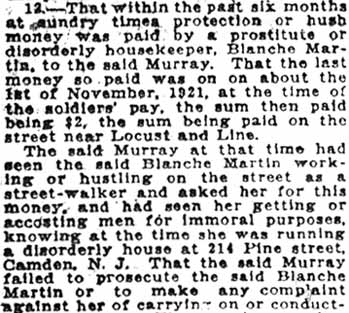
12.—That within the past six months at sundry times protection or hush money was paid by a prostitute or disorderly housekeeper, Blanche Martin, to the said Murry. The last money so paid was on or about the 1st of November, 1921, at the time of the soldiers’ pay, the sum then paid being $2, the sum being paid on the street near Locust and Line.
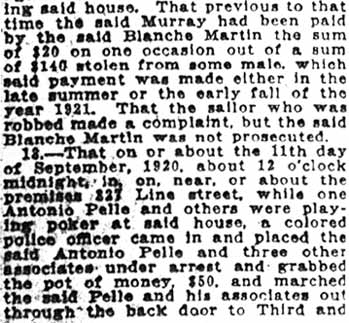
The said Murry at that time had seen the said Blanche Martin working or hustling on the street as a street-walker and asked her for this money, and had seen her getting or accosting men for immoral purposes, knowing at the time she was running a disorderly house at 214 Pine street, Camden, N. J. That the said Murry failed to prosecute the said Blanche Martin or to make any complaint against her of carrying on or conducting said house. That previous to that time the said Murry had been paid by the said Blanche Martin the sum of $20 on one occasion out of a sum of $140 stolen from some male, which said payment was made either in the late summer or the early fall of the year 1921. That the sailor who was robbed made a complaint, but the said Blanche Martin was not prosecuted.
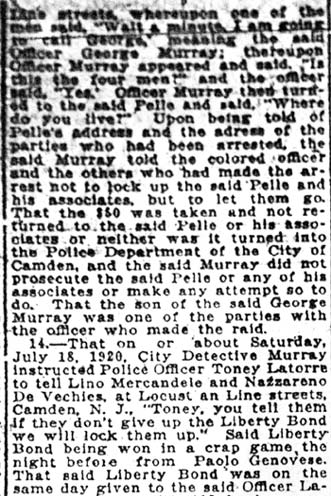
13.—That on or about the 11th day of September, 1920, about 12 o’clock midnight, in, on, near, or about the premises 327 Line street, while one Antonio Pelle and others were playing poker at said house, a colored police officer came in and placed the said Antonio Pelle and three other associates under arrest and grabbed the pot of money, $50, and marched the said Pelle and his associates out through the back door to Third and Line streets, whereupon one of the policemen said, “Wait a minute, I am going to call George,” meaning the said Officer George Murry; thereupon Officer Murry appeared and said, “Is this the four men?” and the officer said, “Yes.” Officer Murry then turned to the said Pelle and said, “Where do you live?” Upon being told of Pelle’s address and the address of the parties who had been arrested, the said Murry told the colored officer and the others who had made the arrest not to lock up the said Pelle and his associates, but to let them go. That the $50 was taken and not returned to the said Pelle or his associates or neither was it turned into the Police Department of the City of Camden, and the said Murry did not prosecute the said Pelle or any of his associates or make any attempt so to do. That the son of the said George Murry was one of the parties with the officer who made the raid.
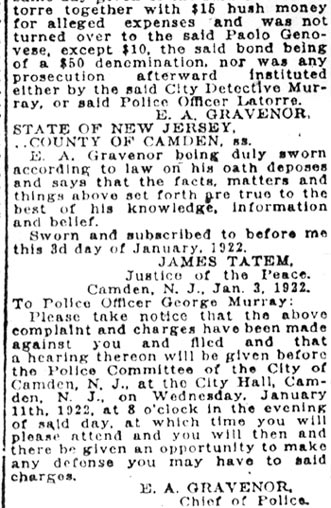
14.—That on or about Saturday, July 18, 1920, City Detective Murry instructed Police Officer Toney Latorre and Nazzareno De Vechies, at Locust and Line streets, Camden, N. J., “Toney, you tell them if they don’t give up the Liberty Bond we will lock them up.” Said Liberty Bond being won in a crap game, the night before from Paolo Genovese. That said Liberty Bond was on the same day given to the said Officer Latorre together with $15 hush money for alleged expenses and was not turned over to the said Paolo Genovese, except $10, the said bond being of a $50 denomination, nor was any prosecution afterward instituted either by the said City Detective Murry, or said Police Officer Latorre.
E. A. GRAVENOR.
STATE OF NEW JERSEY, COUNTY OF CAMDEN, ss.
E. A. Gravenor being duly sworn according to law on his oath deposes and says that the facts, matters and things above set forth are true to the best of his knowledge, information and belief.
Sworn and subscribed before me this 3d day of January, 1922.
JAMES TATEM
Justice of the Peace.
Camden, N. J., Jan. 3, 1922.
To Police Officer George Murry:
Please take notice that the above complaint and charges have been made against you and filed and that a hearing thereon will be given before the Police Committee of the City of Camden, N. J., at the City Hall, Camden, N. J., on Wednesday, January 11th, 1922, at 8 o’clock in the evening of said day, at which time you will please attend and you will then and there be given an opportunity to make any defense you may have to said charges.
E. A. GRAVENOR,
Chief of Police.
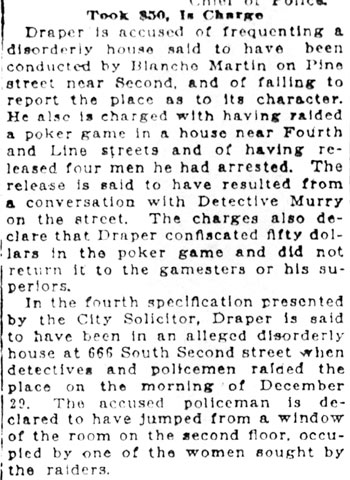
Took $50, Is Charge
Draper is accused of frequenting a disorderly house said to have been conducted by Blanche Martin on Pine street near Second, and of failing to report the place as to its character. He also is charged with having raided a poker game in a house near Fourth and Line streets and of having released four men he had arrested. The release is said to have resulted from a conversation with Detective Murry on the street. The charges also declare that Draper confiscated fifty dollars in the poker game and did not return it to the gamesters or his superiors.
In the fourth specification presented by the City Solicitor, Draper is said to have been in an alleged disorderly house at 666 South Second street when detectives and policemen raided the place on the morning of December 29. The accused policeman is declared to have jumped from a window of the room on the second floor, occupied by one of the women sought by the raiders.
Says He Concealed Woman
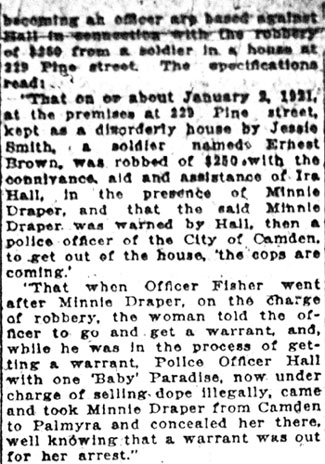
Charges of neglect and conduct unbecoming an officer are based against Hall in connection with the robbery of $250 from a soldier in a house at 229 Pine street. The specifications read:
“That on or about January 2, 1921, at the premises at 229 Pine street, kept as a disorderly house by Jessie Smith, a soldier named Ernest Brown, was robbed of $250 with the connivance, aid and assistance of Ira Hall, in the presence of Minnie Draper, and that the said Minnie Draper was warned by Hall, then a police officer of the City of Camden, to get out of the house, ‘the cops are coming.’
“That when Officer Fisher went after Minnie Draper, on the charge of robbery, the woman told the officer to go and get a warrant, and, while he was in the process of getting a warrant, Police Officer Hall with one ‘Baby’ Paradise, now under charge of selling dope illegally, came and took Minnie Draper from Camden to Palmyra and concealed her there, well knowing that a warrant was out for her arrest.”
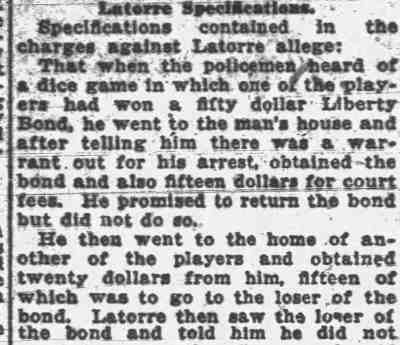
Latorre Specifications.
Specifications contained in the charges against Latorre allege:
That when the policemen heard of a dice game in which one of the players had won a fifty dollar Liberty Bond, he went to the man’s house and after telling him there was a warrant out for his arrest, obtained the bond and also fifteen dollars for court fees. He promised to return the bond but did not do so.
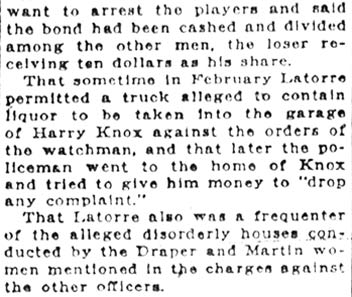
He then went to the home of another of the players and obtained twenty dollars from him, fifteen of which was to go to the loser of the bond. Latorre then saw the loser of the bond and told him he did not want to arrest the players and said the bond had been cashed and divided among the other men, the loser receiving ten dollars as his share.
That sometime in February Latorre permitted a truck alleged to contain liquor to be taken into the garage of Harry Knox against the orders of the watchman, and that later the policeman went to the home of Knox and tried to give him money to “drop any complaint.”
That Latorre also was a frequenter of the alleged disorderly houses conducted by the Draper and Martin women mentioned in the charges against the other officers.
Note: This story erred in reporting, as retirement at age 65 was NOT mandatory at the time. William E. Albert, Richard Golden, Frank Matlack, and Edwin Thomas did retire. John Golden, John Painter, Charles Fitzsimmons, Thomas Brothers, and William Lyons continued to work in the Police Department. John Golden was eventually promoted to Chief of Police.
Changes Ordered in Camden Police
Philadelphia Inquirer —
Council Body Directs Solicitor Bleakly to Plan Re-organization of Department
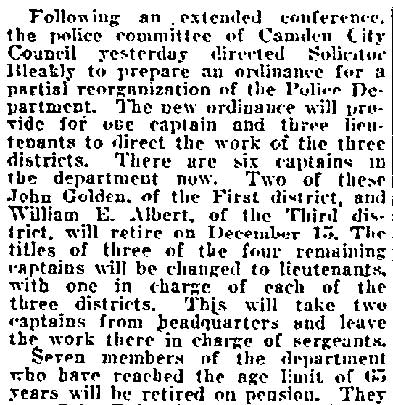
Following an extended conference, the police committee of Camden City Council yesterday directed Solicitor Bleakly to prepare an ordinance for a partial reorganization of the Police Department. The new ordinance will provide for one captain and three lieutenants to direct the work of the three districts. There are six captains in the department now. Two of these John Golden, of the First district, and William E. Albert, of the Third district, will retire on December 15. The titles of three of the four remaining captains will be changed to lieutenants, with one in charge of each of the three districts. This will take two captains from headquarters and leave the work there in charge of sergeants.
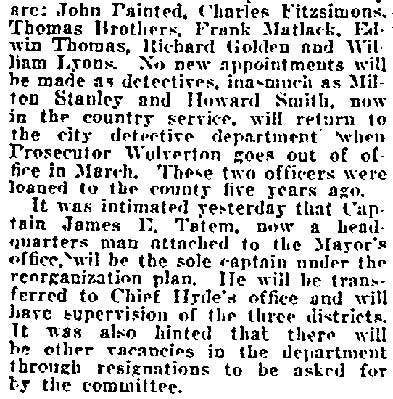
Seven members of the department who have reached the age limit of 65 years will be retired on pension. They are: John Painted [sic], Charles Fitzsimons, Thomas Brothers, Frank Matlack, Edwin Thomas, Richard Golden and William Lyons. No new appointments will be made as detectives, inasmuch as Milton Stanley and Howard Smith, now in the country [sic] service, will return to the city detective department when Prosecutor Wolverton goes out of office in March. These two officers were loaned to the county five years ago.
It was intimated yesterday that Captain James E. Tatem, now a headquarters man attached to the Mayor’s office, will be the sole captain under the reorganization plan. He will be transferred to Chief Hyde’s office and will have supervision of the three districts. It was also hinted that there will be other vacancies in the department through resignations to be asked for by the committee.
Chief of Camden Police Is Retired
Trenton Evening Times —
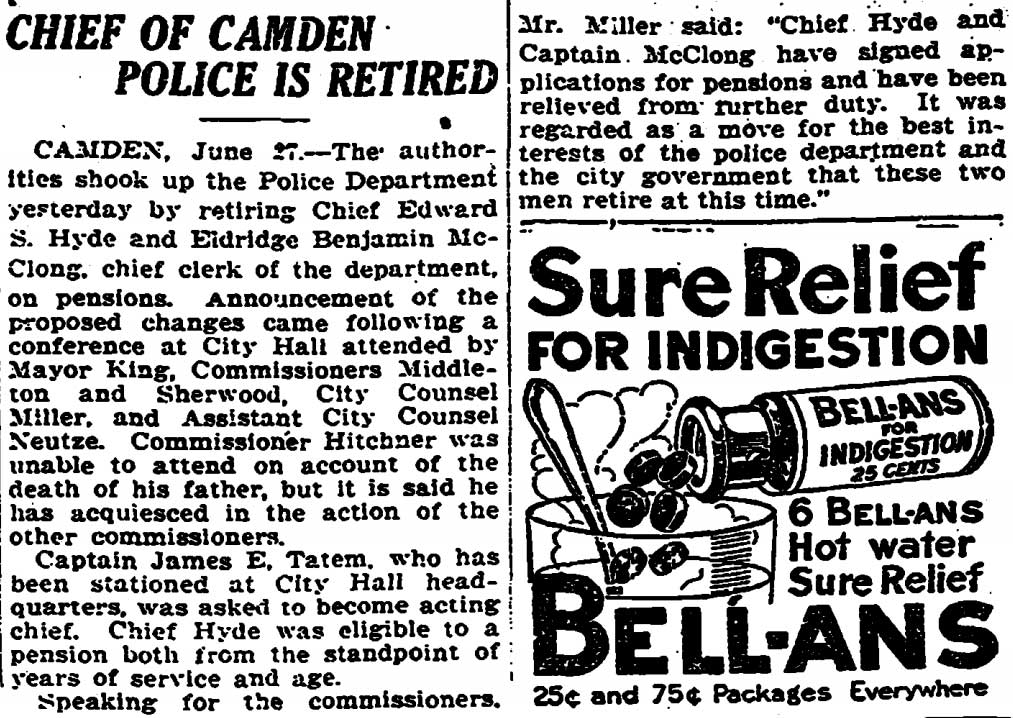
CAMDEN, June 27.—The authorities shook up the Police Department yesterday by retiring Chief Edward S. Hyde and Eldridge Benjamin McClong, chief clerk of the department, on pensions. Announcement of the proposed changes came following a conference at City Hall attended by Mayor King, Commissioners Middleton and Sherwood, City Counsel Miller, and Assistant City Counsel Neutze. Commissioner Hitchner was unable to attend on account of the death of his father, but it is said he has acquiesced in the action of the other commissioners.
Captain James E. Tatem, who has been stationed at City Hall headquarters, was asked to become acting chief. Chief Hyde was eligible to a pension both from the standpoint of years of service and age.
Speaking for the commissioners, Mr. Miller said: “Chief Hyde and Captain McClong have signed applications for pensions and have been relieved from further duty. It was regarded as a move for the best interests of the police department and the city government that these two men retire at this time.”
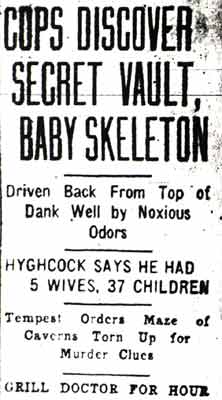
Cops Discover Secret Vault, Baby Skeleton
Camden Courier —
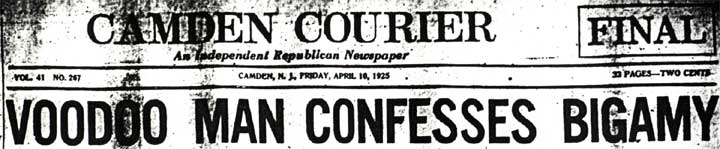
Voodoo Man Confesses Bigamy
Driven Back From Top of Dank Well by Noxious Odors
Hyghcock Says He Had 5 Wives, 37 Children
Tempest Orders Maze of Caverns Torn Up for Murder Clues
Grill Doctor for Hour
Camden Courier — An Independent Republican Newspaper — Final — Vol. 41, No. 267 — Camden, N. J., Friday, April 10, 1925 — 32 Pages—Two Cents
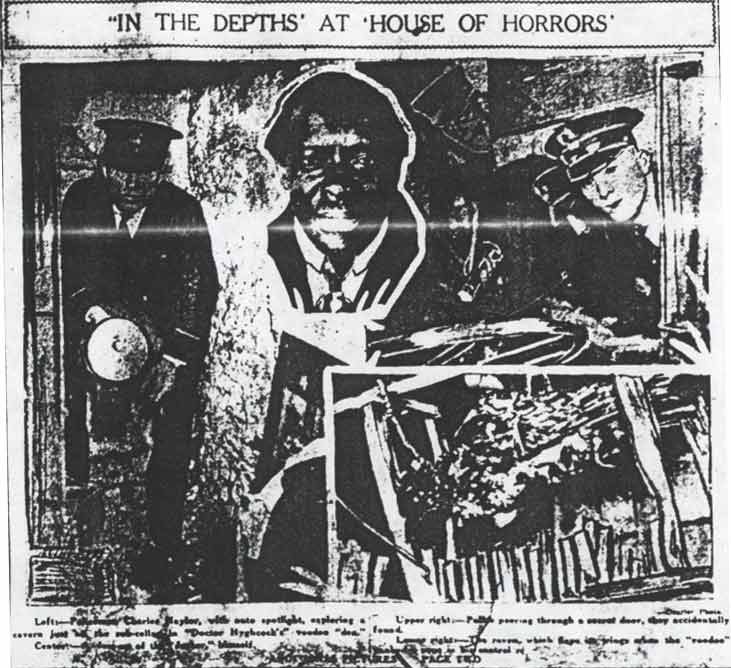
“In the Depths” at “House of Horrors”
Left:—Policeman Charles Naylor, with auto spotlight, exploring a cavern just [illegible] the sub-cellar in “Doctor Hyghcock’s” voodoo “den.” Center:—[illegible] of the “doctor” himself.
Upper right:—Police peering through a secret door, they accidentally found.
Lower right:—The room, which [illegible] the “voodoo” [illegible].
—Courier Photo
Additional Pictures Page Two
Police investigating the “voodoo den” of H.H. Hyghcock, 413–15 Liberty Street, whose arrest on suspicion of murder made several important discoveries today.
They are:
1 — The finding of a bloodstained hatchet buried under the floor of one of the underground rooms.
2 — Discovery of a hidden vault, the entrance freshly cemented and covered with wall-papered boards.
3 — Discovery of what is believed to be a well under the “sacrifice room.” When the police tore off the lid of the well today, they were driven from the underground passage by the odor that emanated from the large hole.
4 — A blood-stained mattress cover, hidden in a second story rear room, was found.
5 — Police digging in the underground den this afternoon unearthed the skeleton of a baby, the fourth infant’s body found in the “voodoo den.”
6 — Lastly, police say Hyghcock is the biggest liar they have ever seen.
When informed of the finding of the supposed vault Director Tempest instructed Captain Gordon to “tear it out if you have to tear down the house.”
The police questioned the “voodoo medicine man” for an hour this morning during which he admitted he is a bigamist. He confessed that he had five wives and is the father of 37 children.
Hyghcock Questioned For Hour
After spending the night in a prison cell, Hyghcock was taken before Deputy Director Tempest. In the room at the same time was Chief Tatem, Captains Colsey, Golden, Humes, and Sieh.
Hyghcock was visibly serious as he sat in a chair facing the police officials. He clasped and unclasped his hands and stroked his goatee as his eyes shifted around the room.
Director Tempest started the first shot of a barrage of questions that swept over the voodoo man before he was allowed to leave the room.
For nearly an hour the medicine man matched his wits with those of the police. Several times he seemed about to crack and reveal something startling but caught himself just as he was to fall into a trap.
As each question was asked him Hyghcock repeated it slowly and after thinking a few seconds made answer.
“Hyghcock,” Director Tempest began, “how many children have you?”
“Newspaper reporters printed stories that I have thirty-two children” the prisoner answered. “That is all wrong. I have thirty-seven children.”
Five Wives, Says Hyghcock
“How many wives have you had?”
“Five” he answered.
“All living?”
“Two are living.”
“Are you a bigamist?”
“Yes, I guess you would call me that. I don’t know where my fourth wife is now.”
“How long have you been married to this wife?”
“Thirty-two years.”
“All your children living?”
“All but two.”
“Where are the other thirty five?”
“Scattered all over.”
“How many women have you killed in your time?”
During the questioning of his married life Hyghcock smiled continuously as he answered the questions.
The last question had the effect of an electric shock upon the prisoner.
“Come on, come on,” Director Tempest said. “How many women have you killed?” This was one question that Hyghcock did not repeat.
Says He Bought Dead Bodies
“I never killed any women” he answered as he looked at the faces of those gathered around him.
“How many operations have you performed in that den of yours?”
“I didn’t perform any operations.”
“How do you account for the finding of those bodies of these infants in the cellar?”
“I bought those babies from Dr. White on South Street in Philadelphia.”
“You are lying, aren’t you?”
“No sir” Hyghcock said, as he toyed with his hat.
“Tell the truth now. How many women died in that house of yours?”
“Who said I killed anybody?”
“We have the goods on you, so you might as well come clean. Your daughter has told us she saw you kill that light skinned colored woman when your wife was away. What did you kill that woman for?”
“My daughter say that? She must be wrong.”
“Why should your daughter say you killed a woman if you did not? We know you shot that woman and your daughter saw you do it. Why should your daughter say such a thing if it were not true?”
Stumped by Daughter’s Tale
Beads of perspiration broke out on the prisoner’s face.
“I don’t know” he answered.
“Didn’t you take a woman’s body out of that house not so long ago?”
“No.”
“How many women have died in that house?”
“Only my daughter.”
“Are you a physician?”
“Sorta of a physician.”
“Why do you have the stethoscope in your home?”
“What kind of thing is that?”
“Are you a physician and well acquainted with surgical instruments?”
“Yes, sorta,” Hyghcock said. The stress was beginning to tell on him.
“And you don’t know what a stethoscope is? You are not a doctor, Hyghcock. You are a liar.”
“Yes sir” he answered.
“Are you a regular minister?”
“Sorta. I’m an evangelist.”
“Ordained?”
“What do you mean? I’ve been an evangelist since I was a child.”
“Ever been arrested before?”
“Yes, in Philadelphia. Man I was with shot a woman with a baby in her arms.”
“You did the shooting, didn’t you?”
“No sir.”
“But you shot the woman in your house on Liberty Street, didn’t you?”
“No sir.”
Women Boarders
“How many women do you keep at your house at one time?”
“Four or Five.”
“What for?”
“Boarders.”
“You are lying now, aren’t you?”
“No sir.”
“How many women have you killed?”
“None.”
“What do you know about the bloody hatchet we found in your cellar?”
“I don’t know anything about it. Where did you find it?”
“We are asking the questions, you just answer them.”
“Did you ever have a hatchet?”
“Yes, I lost it six months ago.”
“How did the blood get on it?”
“I don’t know.”
“Why did you cement that vault?”
“What vault?”
“The vault in your cellar that you just cemented a short time ago. You might as well come clean and tell us about what is hidden behind that cement wall because we are going to find it out.”
Hyghcock shifted in his chair and the perspiration flowed in a stream from his forehead. He bit his lips.
“There is nothing much there” he said after thinking for fully a minute.
Walls Against Water
“What did you build it for?”
“To keep the water out.”
“Why didn’t you cement up the rest of the cellar?”
“I don’t know.”
“You know that we know you are lying, don’t you?”
Hyghcock did not answer that question.
“Why did you dig out all those rooms in the cellar?”
“For church services.”
“Did you use about 65 small rooms underground for church services?”
“Yes.”
[TEXT illegible]
[TEXT illegible]
[TEXT illegible]
[TEXT illegible]
“In the room way back under the yard. That was the main church?”
“How can you take nine people and put them in 35 rooms?”
“I don’t know.”
“Then why did you have so many rooms?”
“The people wanted them.”
“What people?”
“My congregation.”
“Are you a regular minister?”
“Mr. Johnson in Newport News told me I could be a minister.”
“What was that room where the crow was swinging on the board supposed to be?”
Noah’s Ark Room
“That was the Noah’s ark room. The bird was on the ark.”
“What was the idea of having ropes to make the stuffed bird flap his wings?”
“That was part of the church service.”
“How many women are you in love with?”
“I don’t know. A lot are in love with me.”
“Hyghcock, you have been performing illegal operations in that house of yours, and we have more than 100 letters from women that were sent to you. Those letters contain evidence that will be used against you. What have you to say about them? You read the letters, because they were open when we found them.”
“Just what particular letters are you talking about?”
Director Tempest then went through some letters and mentioned the names and addresses of the senders. Many of them were from white women. To each letter called to his attention Hyghcock said:
“I just can’t recall reading that letter.”
“How about this letter from Ann Miller of Philadelphia telling you that she was thorough with you because you killed the man next door?”
“I don’t remember seeing that letter.”
“You are lying Hyghcock, and you had better come clean and tell the truth.”
“Women Stuck on Me”
Then letters containing endearing terms were read to him. Asked what he had to say about them, he answered:
“They are some of the women who are stuck on me.”
“How many women are stuck on you? Are there as many as 100?”
“I don’t think there are that many. I know women all over the country and they write to me.”
“What do women all over the country write to you for?”
“I guess they like me.”
“I guess they do,” Director Tempest said as he gazed at the prisoner, who averted his glances.
“Ever perform any operations on any of these women?”
“No sir.”
“Then what do they write to you about?”
“I don’t know.”
“What is in that well under the board in the cellar?”
“What well?”
“Did you throw any bodies down there?”
“No sir, I ain’t hid no bodies.”
“Where did you bury the women who died in your house?”
“Nobody died there.”
“Why did you go out late at night in your automobile with a shovel?”
“Who said so?”
“You did, didn’t you?”
“I can’t recall.”
Says He Took Women Into Tunnels
“Just think for a minute.”
“Nope, I can’t recall.”
“Did you take women into those underground rooms?”
“Yes, I took them down to church services.”
“Didn’t take any men down there, did you?”
“No sir.”
“How did you come to dig all those rooms?”
“I was looking for money.”
“What do you mean?”
“When I first moved into the house I dug in the cellar one day and found $25.00.”
“What has that got to do with the rooms?”
“Well, I kept on digging and found $300.00 more.”
“Yes, go on.”
“Go on where?”
“What gave you the idea for all of the rooms?”
“Well, when I moved into the house there were rooms directly under the [XXXXX] and I dug [XXXX] the back yard [XXXXX XXXX XXXXXXXX].”
“For how long have you been live there?”
“Eight or ten years.”
“Who dug that cellar with you?”
“A man by the name of ______ (Name withheld at the request of the police).”
“What did he do?”
Becomes Badly Mixed
“He helped me to make the room — the chapel.”
“Did he help you get rid of the bodies?”
“No sir.”
“Who did help you get rid of them?”
“Nobody.”
“Did it all yourself?”
“Did I do it all myself — yes, sir — no, sir.”
“Well, what do you mean?”
“I mean I didn’t do anything. I hid no bodies.”
“What did you bury the hatchet for?”
“I didn’t bury any hatchet.”
“How did it happen the hatchet was covered with blood?”
“I don’t know.”
“What did you have those shovels and picks down in the cellar for?”
“To dig with.”
“Dig what?”
“What is this religious college you have up by Willow Grove?”
“Who told you about that?”
“You tell me about it now.”
“I started a church up there.”
“You built shacks and rented them to colored people for $30.00 a month and then charged them $10.00 a month extra. What was the extra $10.00 for?”
“It was for the Lord.”
“What do you mean Lord Hyghcock?”
“No, for the church.”
Sold Willow Grove Settlement
“Do you still have the church settlement?”
“No, I sold it.”
“Sold the church too?”
“Yes.”
“Why did you tell your wife you would kill her if she went into the cellar of the house where all those rooms were?”
“Who said so?”
“You did, didn’t you?”
“I can’t recall.”
“When you would have a crowd of women in the rooms you would send your wife away, wouldn’t you?”
“Not exactly.”
“Speaking of illegal operations, do you know Miss…”
“Who ain’t one of the women I operated on.”
“Who are some of these women, then?”
“I ain’t operated on any women.”
“Did you tell women to keep away from you?”
“Yes.”
“Tell us about how you shot that woman and buried her body.”
“I ain’t shot nobody.”
“How did you kill her, with that hatchet?”
“No sir.”
“Come on, tell us how you killed her.”
“I didn’t kill any women.”
“The woman just died in the house, oh?”
“No sir.”
“How about the man who lived next door whom you said you killed?”
“I didn’t kill anybody.”
When Tempest finished, each of the police captains fired a barrage of questions at Hyghcock.
Several times under severe questioning by Captain Golden, Hyghcock became confused and gave evasive answers.
Turning to Captain Schregler, Director Tempest said:
“He’s a liar, take him upstairs.”
Mrs. Hyghcock Quizzed
Hyghcock was then taken up to the bureau for further questioning by detectives. His wife was quizzed in an adjoining room and when she was taken back to her cell, their seven year-old daughter, who told the police her father killed a woman in the house when she was questioned again repeated her version of the killing.
During the questioning of Hyghcock in the Detective Bureau, Commissioner Middleton came into the room. He sat with the detectives as they questioned the 71 year-old medicine man.
Where the Ropes Came From
A Broadway hardware merchant called at police headquarters today and told the police that he had been selling rope to Hyghcock for the past two years.
“He would come into the store and buy the rope in six foot lengths. He would also buy barn lanterns by the dozen. I often wondered what he intended to use them for but I never asked him.”
The ceiling of the underground den was a cobweb of ropes, which operated through pulling and rang bells, opened doors, and made the raven in “Noah’s Ark” flap his wings.
That Hyghcock contemplated more cement work, when discovered, was evident yesterday when the police found a load of sand in the front part of the cellar. In the afternoon a truck with fifteen bags of cement came to the Hyghcock house.
The driver, seeing the crowd, drove away, taking the cement with him.
Director Tempest sent a detail of police and firemen to destroy the maze of underground tunnels and “torture chambers” under the “voodoo” houses. The entire cellar of the two houses will be dug up to a depth of six feet in an effort to learn if any human bodies are buried there.
The “voodoo palace” was raided early yesterday morning by a detail of police who arrested “Dr.” H.H. Hyghcock, a 71 year-old “medicine man.” When the police searched the house yesterday they discovered the bodies of two small infants hidden in one of the underground rooms.
County detectives who went on the case yesterday and city police are endeavoring to learn if any women were murdered in the house. The decision to tear out the thirty-five underground rooms came at a conference at police headquarters last night between Prosecutor Wescott, City Prosecutor Bernard Bertman, Director Tempest, and Chief Tatem.
Each of the officials declared that he believed a digging up of the cellar would reveal the finding of human bodies.
Will Do It Monday
“I am going to order a detail of firemen and policemen to the cellar of the two houses” Director Tempest said, “with instructions to tear out every one of those rooms in the cellar. After the cellar is cleared the policemen and firemen will dig up every foot of the cellar. I have some information which I cannot divulge that leads one to believe that our search will not be unsuccessful. It is not probable, however, that the work of clearing up that underground ‘hotel’ will be started before Monday.”
“In my police experience I have never seen anything that compares with that underground voodoo den.”
Hyghcock was questioned for several hours last night by detectives. He refused to make any statements, even when he was shown incriminating letters that were found in his home. The police seized more than 100 of the letters which were mailed from every state in the Union. Many will be used against the “physician” when he is placed on trial as they reveal he practiced medicine without a license.
The police place great stress upon the statement of Hyghcock’s seven year-old daughter who told them that her father killed a woman in the house a week ago and buried her body. The child is being held in custody as a material witness as is the wife of the “medicine man.”
Last night more than 5,000 morbid curious people gathered at the Hyghcock house and stormed the doors seeking admittance to the underground passages. A detail of police inside the house fought back the crowd. A riot call was sounded at 9:00 o’clock and two details of police were rushed to the scene. The crowd was driven back and the street roped off. During the excitement the front door was smashed in by the crowd.
Today detectives are reading the large bale of letters found in the house. They also seized the prisoner’s set of books, which show he received large sums of money from superstitious persons for “love and enemy” charms. The books contain the names and addresses of more than 1,000 of Hyghcock’s customers.
Police said that although Hyghcock has only been a resident of this city for three years, he has amassed a small fortune and owns considerable property here and in Pennsylvania. They said that several years ago Hyghcock built a small chapel near Willow Grove. Around this chapel he erected 20 small frame houses. He rented them to colored folks who joined his religious sect and in addition to the rent paid him an assessment of $10 a month which he said he turned over to the Lord.
Three Years of Work
When Hyghcock was taken from his cell in police headquarters last night to be questioned he smiled as the cell doors clanged open. He was taken to detective headquarters and questioned, but refused to make any statement. He will be questioned again today.
The police said he must have spent nearly three years building the underground “chamber of horrors.” So quietly did he work that none of his neighbors knew the spooky subway rooms existed. Most of the excavating was done between midnight and 3 o’clock in the morning.
Entering the house at 413 Liberty Street, a visitor sees a small counter and a candy show case. Arrayed on shelves behind the counter are bottles of pop and packages of cigarettes. Three feet away from the counter toward the kitchen is a door leading into a hallway three feet square. A winding flight of steps lead to the upper floors and a door in the hallway opens onto a narrow winding stairway into the cellar.
Secret Winding Passages
Once in the cellar the visitor finds himself in a small alley running toward the front of the house. In this alley are shelves filled with roots and herbs. The aisle turns at right angles to the right and one sees a large door upon which is printed “Noxvill.” A heavy spring slams the door to. The visitor is then in complete darkness. In front of him is a winding, twisting passageway, barely three feet wide. Directly over his head are ropes running along the ceiling which control the opening and closing of doors and the ringing of bells.
To the right is a dark room. The rays of a flashlight thrown into the room reveals a stuffed bird resting on a swinging shelf. A pull on one of the many ropes causes the crow to flap his wings. Just ahead in the passageway, and to the right and left are three doors. Sleigh bells are fastened to each of the doors. The door to the right leads to a tunnel connecting with the house at 415 Liberty Street, next door. The other doors lead into other rooms and in the rooms are other doors leading into still other rooms.
Rooms Poorly Furnished
And so on down the entire length of the cellar.
In the rooms which are not more than four feet square there is very little furniture. The walls and partitions are made of packing box lumber covered with various pieces of wall paper, one shade bordering on the other. In each “den” a kerosene lantern, or lamp hung on a hook. The air is stifling.
In the room known to the police as the “Graveyard” are three lanterns and several spades and picks lying on the dirt floor. The soil shows that it has recently been dug up.
Still following the dark passages the visitor finds himself confronted with a door, with a glass panel in the bottom. A heavy spring makes the door hard to open, but a pull on one of the many strands of rope running along the ceiling and the door swings slowly open without the least effort. It is controlled in some mysterious manner by weights.
Hyghcock has undermined his entire back yard. Back under the yard runs the passageway with the dens turning off to the right or left. In one of the underground rooms a large clock instead of being placed high on the wall is fastened down near the ground. The clock was functioning yesterday but was four hours fast.
Tunnels Become Confusing
Now the passageways get narrower and darker and the odor is sickening. Towards the extreme rear of the room is the “Sacrifice Chapel.” This contains a baptismal bath, a large Bible, a [XXXXX] and a carriage wheel with various colored spokes. The wheel spins from an iron peg driven into the wall. Everywhere is seen patchwork carpenter work. A birds-eye view of the underground rooms reminds one of the futurist, or cubist, paintings. In one of the rooms the floors are covered with freshly laid cement. The police will endeavor to find if anything is buried underneath the flooring.
Just ahead is daylight. One finds a small hole in the roof where a chimney or an uphill coal stove extrudes into the yard. This follows another maze of doors. In several parts of the tunnel thick doors can be opened at the same time to form a triangle. Not twenty more feet down this dark passageway and a ladder leading upward is seen. It is a hastily constructed affair and the top rungs are covered with grips made of automobile tires.
A walk through the upper story of the two houses show that bedrooms have been partitioned off to make three rooms.
He Doted On Bells
Overhead is the network of ropes operating on pulleys the [XXXXX XX XXXX XXXX]. In the underground rooms and tunnels, [XXXX XXXXX] and a door [XXXX XXXX. XXXX XXXX] will open or a bell will ring. Hyghcock just doted on bells. The largest bell is fastened to a door on the third floor. This one can be sounded from the rear room in the tunnel by means of the rope. Bells are everywhere. They range from baby bell rattles to large cow bells.
The rooms on the upper floors each contain beds. Yesterday they were in disorder. The bed clothing was scattered on the floor and the floors were strewn with papers, letters, books, and clothing. In a closet in a third story room was found two new dolls in a basin, glassware, phonograph records — everything imaginable. The rooms resembled “junk shops.”
Yesterday the police spent most of their time searching for bloodstains on the floors and walls of the buildings. Trunks were forced open and those were found to contain soiled linens. The police questioned Hyghcock’s seven year-old daughter.
“How many men did your father kill in here?” Patrolman Charley Naylor asked the girl.
Says “Pop” Killed Woman
“My Pop did not kill any men” the child answered, “but when my mother was in Washington to see my sister not long ago, a woman came to the house and started to fight with Pop. It was late at night. They fought terrible and they were in the big room in the front of the house. I saw them fighting and my Pop got a gun and shot the woman. Pop took her out in the automobile and buried her. He told me to keep quiet and said the woman was sick and died and he buried her in a cemetery.”
The child was taken to police headquarters when she was again questioned by Director Tempest and Chief Tatem. The police tried to get her to change her story but she refused to do so and stuck to the narrative she first told in her home. Her mother was then arrested and detained as a material witness.
Persons living in the neighborhood said today that on two occasions they had seen Hyghcock place large bundles in the back of his car at night, place a shovel in the rear of the car and drive away.
The police have been unable to learn much so far about Hyghcock prior to coming to this city. They do know that he came here from Norfolk, VA where he still claims to be in the undertaking business.
Strange Powders Sold
Hyghcock, the police said, manufactured powders and sold them to colored people as good luck charms. If a woman was unfriendly with another woman she went to Hyghcock and for $12 she received a small bottle of powder. This she sprinkled in front of her enemy and from then on “everything will suffer for the enemy because she would be pursued by evil spirits and her luck would be something terrible.”
If a superstitious young man who “rolled the bones” as a pastime wanted to stage a winning streak, he would visit the medicine man. For $40.00 he would give the man with the gambling instinct a blue powder that he was supposed to rub on his hands just before it was his time to “roll.” Powder to keep another woman from stealing one’s husband went for $30.09, Hyghcock’s records show. What the 9 cents was for is not known. In one day, the police said, Hyghcock sold more than $190 worth of powder that originally cost about twenty cents.
The more serious charge against the prisoner is that he used the building for immoral purposes and for performing illegal operations.
Letter from Captain of Detectives Edward S. King – January 17, 1927
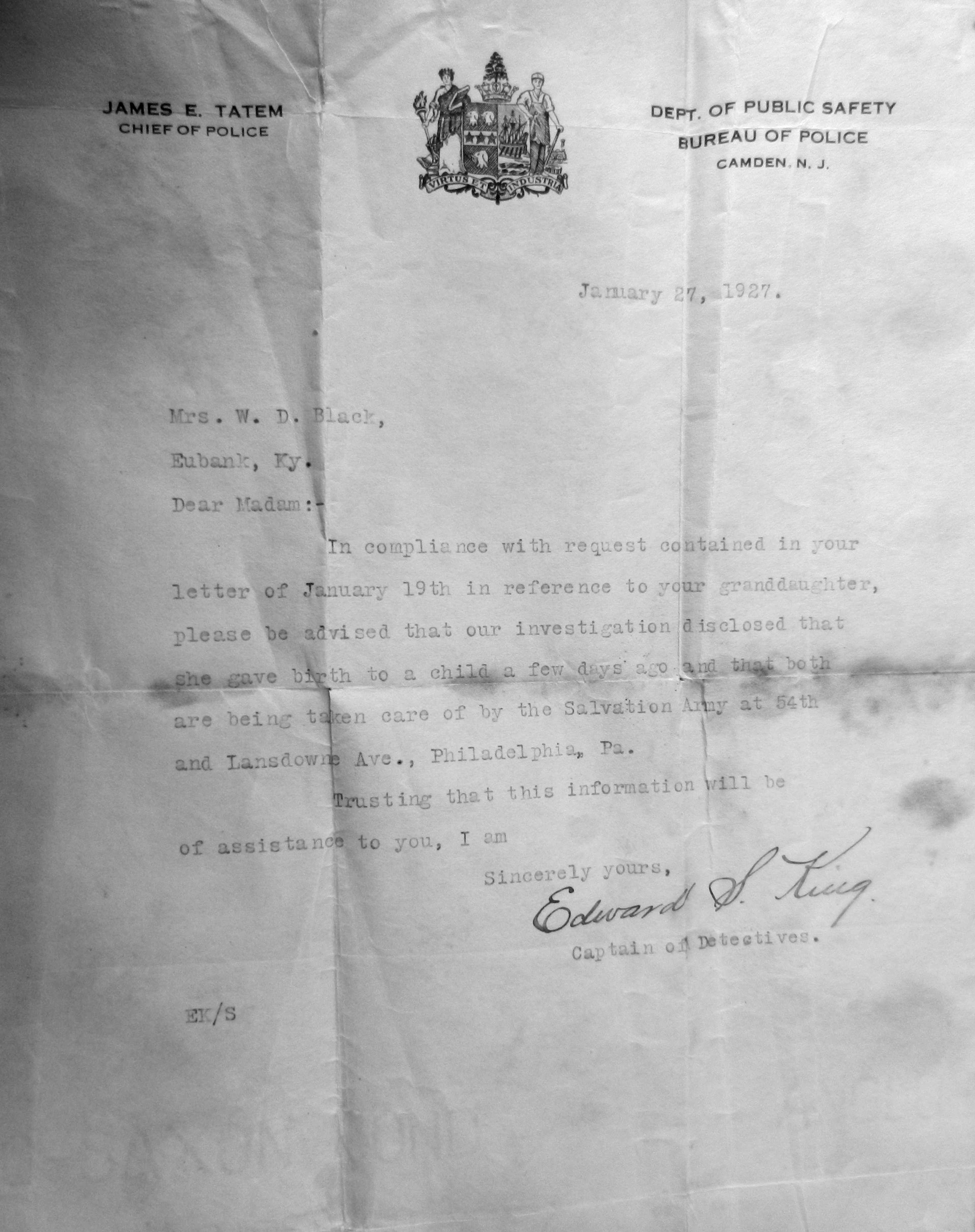
Letter written to Mrs. W.D. Black of Eubank, Kentucky by Captain of Detectives Edward S. King, January 17, 1927. Edward S. King — James E. Tatem
Captains Shifted
Camden Courier-Post —
Sergeant William Horner, First District, North Camden, to become captain of the Third District, where he lives.
Captain Arthur Colsey, now deputy to Chief Tatem, to go to Second District as captain in command.
Captain William Schregler, captain of detectives until two years ago, to return to that post;
Captain of Detectives Edward King, who replaced Schregler, to return to his former rating as a detective;
Chief Tatem to remain as chief;
Captain John Golden, remaining in command at First District.
Other developments at City Hall today were:
Policeman Harry Kreher Plays Role of Kipling Character
Camden Courier —
ICE WATER WAGON MAKES THE ROUNDS
Replaces ‘Quick Drink in Alley Back of a Saloon’
“Ye may talk o’ gin an’ beer / While ye’re quartered safely here—”
Back in the grammar school days, when the day came around for the pupils to “speak pieces,” Harry Kreher used to hear about “Gunga Din,” that widely known colored gentleman of Mr. Kipling’s who was a sort of early prohibitionist in the rough.
But in those days, Harry Kreher never thought that he’d be called upon to play “Gunga Din” to the huskies of Camden’s finest.
At the present time, however, that’s the role he is taking in these humid days of steaming pavements and thirsty cops. He is, in fact, the official “Gunga Din” of the Camden police force.
Mr. Din, you will remember was water boy to that particular portion of the British army which did its stuff somewhere in India and his light refreshments—though, according to Mr. Kipling they were far from sanitary—were widely welcomed.
And now Mr. Kreher—or, more properly Motorcycle Officer Kreher—is being greeted whenever he appears in the neighborhood of a fellow policeman. Realizing that traffic officers and patrolmen frequently get thirsty in this hot weather, and that times have changed since the days when a cop could knock on a back door and have a foaming glass thrust out to him, Chief Tatem has appointed Kreher to the official management of the police force refreshment wagon.
Kreher, on his motorcycle, rides about town, bearing in his sidecar a large tank of ice-water which he distributes to those thirsty policemen he meets.
“It saves time,” says Chief Tatem, “and is appreciated by the men. Heretofore they’ve had to walk several blocks, sometimes, to get a drink—of water. This way, they watch out for Kreher and there you are.”
Officer Kreher guarantees that his ice-water is far superior to that of Gunga Din.
“And there are lots of people who have become so that they enjoy ice-water as a drink these days,” he comments.
Camden Courier-Post – January 7, 1928
Camden Courier-Post —
Jewelry Clerk Held in Robbery of Store
Loot Valued at $2000 Taken From Broadway Shop; Second Visit of Thieves
Climbing to the roof of a shed in the rear of the Greenetz & Pellicoff jewelry store, 833 Broadway, burglars entered the shop early today and carried away $2,000 in loot.
At noon today, Joseph Shapiro, 29 years old, 215 South Fifth Street, a clerk in the store, was being grilled by Detectives George Ward and Thomas Cheeseman, after being booked at police headquarters as having been arrested “on suspicion.”
August 29 four suspected robbers were captured by police only a few minutes after they had smashed the plate glass window and snatched a tray of jewels at the same store.
Policeman John McTaggart reported the burglary this morning. He is the brother of Policeman James McTaggart, who participated in the capture of the four suspects last August.
Included in the loot of the burglars this morning were 35 watches left at the shop by their owners for repairs. At the shop it was said the owners of the watches would be reimbursed. Other articles stolen included 26 bracelets, 12 diamond bar pins, 15 pair of earrings, three fountain pen sets, and six strings of beads.
At 7:30 this morning, Patrolman McTaggert noticed several men standing in front of the jewelry store. He learned that they had just discovered an open window and, investigating, found the shop had been robbed.
The watches and other articles of jewelry were taken from trays and showcases. A safe in the store was left untouched.
The building next to the jewelry store at 831 Broadway is unoccupied and it was through this structure that the burglars entered. They climbed to the roof of a shed at the rear, entered a second story window and followed a corridor to an inner door of the jewelry store, forced open the door, and entered.
The capture of the four men at the store more than four months ago resulted in commendation from Chief James E. Tatem for the three officers who participated. With Policeman Edward Smith and Frank Truax, Patrolman James McTaggert took the four men at revolver’s point. The men arrested at that time, still awaiting trial, are James Toner, 54 years old, 1204 Vine Street, Philadelphia; Mervin Campbell, 24 years old, 2309 Carlisle Street; James J. Kelly, 25 years old, 2121 Brandywine Street; and Frank MacCrossan, 33 years old, of 1328 Pearl Street.
The proprietors of the store are Joseph and Michael Greenetz, 1468 Haddon Avenue, and Abraham Pellicoff, 1417 Haddon Avenue.
Camden Courier-Post – February 4, 1928
Camden Courier-Post —
Police Invite Bandits to Nice Shooting Party
But Yeggs Must Leave Gats at Home While Cops Practice With Camden’s New Desperado Eliminators
Wanted: Targets for Camden’s new desperado eliminators. Bandits, burglars, snipers and their ilk are requested by Chief of Police James E. Tatem to apply at police headquarters Monday morning at 10 o’clock, when a practice shooting party will be held.
Chief Tatem said today Camden’s bandit-chasing squad is “just rarin’ to go” with six new automatic rifles guaranteed to shoot full of holes the toughest bandit in less time than it takes to say “Aligoop.”
For the further enlightenment of the bandit fraternity, Chief Tatem announced detailed instructions on how to use the new carbines will be given this afternoon at 3 o’clock to bandit chasing police by Captain Arthur Colsey and Herman Engle, a representative of Stein Brothers, this city.
The rifles arrived at police headquarters yesterday afternoon. They will be distributed in each of the city’s three police districts in the campaign to rid the city of desperadoes.
The weapons can fire a magazine of 20 shots in a few seconds. They will be mounted in the three red bandit chasing coupes used by the district squad members. One of the coupes is now being used by Archie Reiss and Vernon Jones in South Camden, while two others are expected to be delivered within a few days, according to Chief of Police James E. Tatem. They will be assigned to Walter Smith and Joseph Carpani, First district detectives and Louis Schlam and Richard Donnelly in the East Camden district.
Swivel attachments make it possible to fire the guns from a fixed point in an automobile. Detached they may be fired from the shoulder. Besides firing a magazine of 20 shots without stopping, they can be adjusted to single fire, using .45 caliber cartridges.
Instruction in the adjustment and use of the weapons will be given today by a representative of the company that sold them— at $175 each— to the city.
Acting Detective Suspended by Chief
Camden Courier-Post — (Photo)
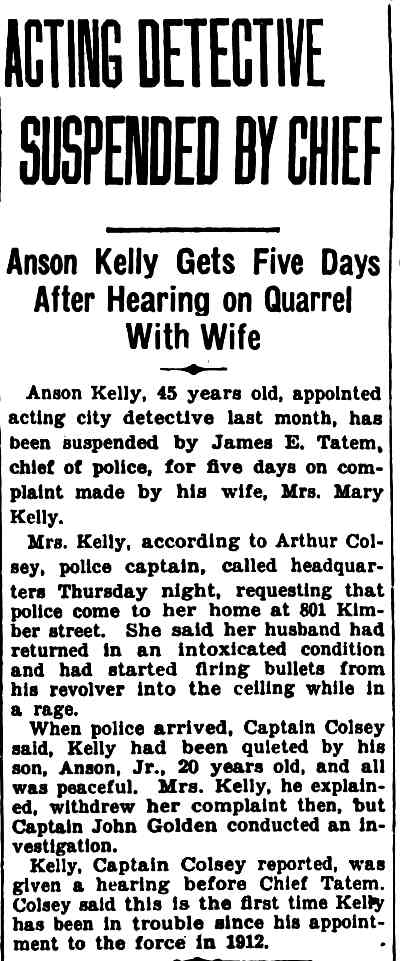
Anson Kelly Gets Five Days After Hearing on Quarrel With Wife
Anson Kelly, 45 years old, appointed acting city detective last month, has been suspended by James E. Tatem, chief of police, for five days on complaint made by his wife, Mrs. Mary Kelly.
Mrs. Kelly, according to Arthur Colsey, police captain, called headquarters Thursday night, requesting that police come to her home at 801 Kimber street. She said her husband had returned in an intoxicated condition and had started firing bullets from his revolver into the ceiling while in a rage.
When police arrived, Captain Colsey said, Kelly had been quieted by his son, Anson, Jr., 20 years old, and all was peaceful. Mrs. Kelly, he explained, withdrew her complaint then, but Captain John Golden conducted an investigation.
Kelly, Captain Colsey reported, was given a hearing before Chief Tatem. Colsey said this is the first time Kelly has been in trouble since his appointment to the force in 1912.
Police Axes Play Dirge on Slot Machines
Camden Courier-Post —
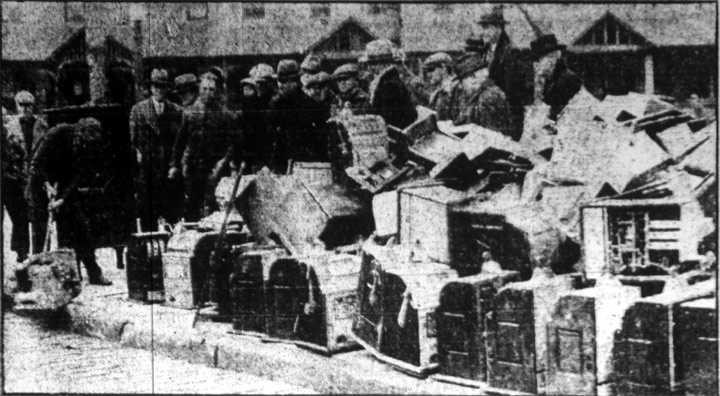
Confiscated slot machines being stacked in front of police headquarters, preparatory to being carted to Civic Center and destroyed.
Lewis Stehr – James Tatem – Charles Laib
Ruin 105 Slot Machines
Camden Courier-Post —
Camden Police Use Axes To Destroy Devices Seized In Raids During Past Six Months
Armed with axes, hatchets and crowbars, city police this morning destroyed 105 slot machines which were seized from storekeepers in Camden during the past six months.
The scene of the wrecking of the mechanical gambling contrivances was at Civic center. Money, which police say, will amount to more than $1,500, was taken from the tubes. This will be turned over to the Police and Firemen’s Beneficial Association.
Nearly all of the machines were of the “nickel” type, but a few refunded pennies and some 25-cent pieces. The demolishing was under the supervision of Police Inspector Lewis Stehr, Chief Tatem and Captain Charles Laib.
The metal parts of the machinery will be sold to junk dealers. Captain Stehr said this morning that after everything has been sold at least $2,000 should be turned over to the beneficial association.
Camden Courier-Post – February 22, 1928
Camden Courier-Post —
$225,000 Fire Ruins 5 Uptown Plants
How Flames Gutted Big Industrial Building
$225,000 Fire Ruins 5 Uptown Plants
Camden Courier-Post —

How Flames Gutted Big Industrial Building
Residents Flee as Flames Rage in Big Building
Factory of Evans Leather Co. Saved by Valiant Work of Firemen
Apparatus Is Disabled; Debris Buried Fire Plug
Metal Stamping Firm, Textile Concern Heavy Losers; Pattern Shop Saved
Taken shortly after daylight today, this photograph shows firemen still pouring water on the ruins of the Varoma building on Erie street from the roof of the Evans Leather Company building adjoining. Five industries were wiped out in the blaze which caused damage estimated at $225,000.
Sweeping through the Varoma Building on Erie street and driving 80 persons from their homes, a spectacular fire early today wrecked the quarters of five industrial concerns and caused damage estimated at $225,000.
Responding to three alarms, every piece of fire apparatus in the city, with the exception of the “cover-up” companies, fought the blaze for hours.
Handicapped by the location of fire-plugs and the breakdown of several pieces of apparatus, the firemen prevented the flames from spreading to the huge building of the Evans Leather Company, which forms an “L” on two sides of the burned structure.
Twenty dwellings on the east side of Segal street, separated from the Varoma building only by a narrow alley, were also saved after their occupants had fled to the street.
Fire Chief Thomas Nicholas announced later today, after the flames had been brought under control, that he would begin a rigid investigation into the blocking of Segal street by a high board fence and the piling of refuse around a fireplug at the head of the street.
The wrecked building is owned by the Varoma Corporation of which Thomas Van Osten, of Palmyra, is president; William MacIntosh, 3[?]7 Vine street, vice president; Alfred Van Osten, of Palmyra, secretary, and David B. Robinson, of West Collingswood.
Building Loss $50,000
MacIntosh today estimated the damage to the building alone at $50,000. He is also president of the MacIntosh Printing and Lithographing Company, of which James J. Stinson, of Merchantville is secretary. Damage estimated at $10,000 resulted from the fire in the quarters of that concern.
The other industries, all located in the big brick building, which suffered in the blaze, with official estimate of the damage to each, are as follows:
Blue and Gray Textile Company, of which T. A. Carr, of 302 Porter road, Fairview, is president, $30,000.
Allied Metal Stamping Company, of which Joseph A. Skublicki, of 115 State street, is president, and William Daugherty, vice president, $75,000.
James A. MacMillan & Co., manufacturing chemists, headed by James MacMillan, of 809 North Third street, $10,000.
Philadelphia Metal Stamping Company, of which firm Clement A. and Mrs. Florence Perrin, of Collingswood, and Edwin L. Seabrook, of 566 Benson street, are members, $50,000.
Other Concerns Escape
The fire was discovered at 5.35 o’clock by a watchman who sounded the first alarm. The flames had started, from causes as yet undetermined, in that portion of the building occupied by the Blue & Gray Textile Company. The building, which housed nine separate industries, covered an area 100 by 300 feet. Part of it was one story in height and another part two stories. Four of the industries in the two-story section of the building escaped serious damage. They are Kruse & Slattery, tool-makers; the Camden Hardware Manufacturing Company, the Wolf Company, manufacturers of advertising novelties; the Thomas C. Van Osten pattern-makers, headed b[illegible]dent of the concern w[illegible] building.
The structure, at 105-107 Erie street, extends back almost to Segal street and has a frontage covering most of the block on Erie street between Second and Burns streets.
Arrivnig [sic] in response to the watchman’s alarm, Chief Nicholas visioned the danger of repetition of the fire nine years ago when buildings at the same location were wiped out by flames. He immediately sounded the second and third alarms, bringing almost every piece of apparatus in the city to the scene.
Carr, president of the textile company, estimated the loss there at $30,000, stating that a large shipment of intricate machinery from Germany had arrived only a few days ago. The concern was anticipating removal, in a short time, to larger quarters at Ninth and State streets, Carr added.
From the two large rooms occupied by the Blue & Gray textile firm, the flames swung over to the quarters of the Allied Metal Stamping Company. Daugherty, the vice-president of this concern, said his company was filling a large order for electric switch-boxes and had been working at capacity for several weeks. Switch-boxes valued at $40,000 were destroyed by the fire, with machinery and other equipment valued by Daugherty at an additional $35,000.
Blasts Add to Perils
Moving northward, the flames next struck the MacMillan plant, where chemicals are manufactured for paints and drug companies. Here the flames reached a number of containers of chemicals and, for a time, the blaze was punctuated by a series of explosions. Here, firemen risked imminent peril to their lives by carrying other containers of chemicals out of reach of the flames.
Still continuing northward; the fire next reached the MacIntosh lithographing plant and spread through the cutting and shipping rooms, causing damage estimated at $10,000 before firemen succeeded in dragging two lines of hose into this section of the building and driving back the flames.
The Philadelphia Metal Supply Company went next as the fire swept eastward. In this plant, metal cornices and valuable hand-made dies were destroyed at a loss estimated by Perrin, a member of the firm, at $50,000. Arriving at the scene, apparatus from Engine Companies No. 1 and No. 7 developed boiler trouble and were unable to work. Firemen were further handicapped by the fact that the Evans Leather Company has blocked off Segal street at the north end by a high board fence. A fireplug at this point was also blocked by a pile of chemical containers, declared to have been placed there by the leather company.
Declaring that he could have attached at least four more hose lines had this plug not been blocked, Chief Nicholas announced that he would conduct an investigation. He said also that the leather company had failed to place gates in the Segal street fence, as city officials required them to do when permission was given for erection of the barrier.
Hose lines were taken to the flat roof of the Evans company, high above the burning building, and water poured onto the flames from this altitude. Hundreds of persons were attracted to the scene by the spectacular nature of the fire, which was visible from the Camden bridge and for miles around. A police detail led by Chief James E. Tatem and Inspector Lewis Etehr [sic] kept the crowds in check.
Firemen escaped injury while fighting the flames at their height, but while they were still pouring streams of water onto the ruins shortly before noon today, the first casualty occurred. Emanuel Kane, of 703 North Third street, a fireman attached to Engine Company No. 6, was struck on the head and knocked down by a 12-foot length of steel bar, six inches thick, which pinned him under it as he fell. Companions ran to his aid, lifted the bar from him and revived him. Hospital treatment was not necessary.
Eight other firemen narrowly escaped serious injury a few minutes later when a section of the east wall fell. The eight men were standing under the wall when one of them saw it totter. They dashed from the spot just in time to avoid being buried by the falling debris. Three of these firemen were from Engine Company No. 1 at Fifth and Arch streets; three from No. 4, Fourth and Vine streets, and two from No. 2 Company, Front and Linden streets.
Jack Sperry, an Evening Courier photographer, was walking along the roof of a part of the burned building when he fell through a portion of it which had been burned from beneath. Pinned at his arm-pits, he was dragged out. He got his picture.
While carrying a hose line into the [illegible] structure, Firemen Harry Lee [illegible] David Ellis were knocked down when a [illegible]pling blew off the hose but [illegible] hurt.
[illegible] wild confusion was [illegible] street when members [illegible] whose homes were threatened by the flames, rushed to the street, many of them clad only in night clothing. Carrying screaming children with them, occupants of the dwellings also dashed out with furniture and personal belongings which they piled in the street. Cellars of the score of houses on Segal street were flooded by water from the firehoses, which was knee-deep amid the ruins.
Families whose homes were menaced and who were driven from the dwellings were those of Paul Warner, 1002 Segal street; Frank Bosco, 1004; Giles Beebe, 1006; Howard Pratt, 1008; Mrs. Mary Sweeten, 1010; Charles Randall, 1012; Harry Burr, 1014; John Sweeten, 1016; Leona Moore, 1018; Dora Annastasio, 1020; John Hamilton, 1024; Abe Granis, 1026; George Stewart, 1028; Arthur Wilkins, 1032; Charles Stutzenburg, 1034; George Wilson, 1036; George Bowers, 1040, and A. W. Dickinson, 1042 Segal street.
The fire today was the fourth big blaze that has occurred on the site. The first was in 1867, when a roller mill and nail factory were destroyed.
In the second, in 1908, flames destroyed the morocco plant of R. H. Evans Company.
In 1919, with the temperature at the zero point, firemen were again called out to fight another disastrous blaze in the Evans plant that had been rebuilt.
Street is Ordered Closed by City to Save Woman’s Life
Camden Courier-Post —
Street is Ordered Closed by City to Save Woman’s Life
The City of Camden today officially joined with medical science in an attempt to save the life of a South Camden colored woman.
Mrs. Hattie Jones, 38 years old, is critically ill at her home, 954 South Ninth street. Two weeks ago, a son of Mrs. Jones was stillborn at the Cooper Hospital. A week ago she left the institution and returned to her home. Heart trouble developed. Dr. Clement T. Branch, 727 Walnut street, was called. He found her condition to be critical.
Today, Dr. Branch appeared at the office of Commissioner William D. Sayrs, director of streets and public improvements. He explained the case and asked that Ninth street between Walnut and Cherry streets—the block on which Mrs. Jones’ home is located—be roped off. Sayrs turned the request over to the department of public safety and Police Chief James E. Tatem transmitted an order to Acting Captain Thomas Cunningham of the Second Police District. A short time later the block was barred to all traffic.
The street is paved with cobblestones and, Dr. Branch explained, his patient was being disturbed by the noise of passing traffic to such an extent that her life was endangered.
City Policeman Drowns in Lake at Blackwood
Camden Courier-Post —
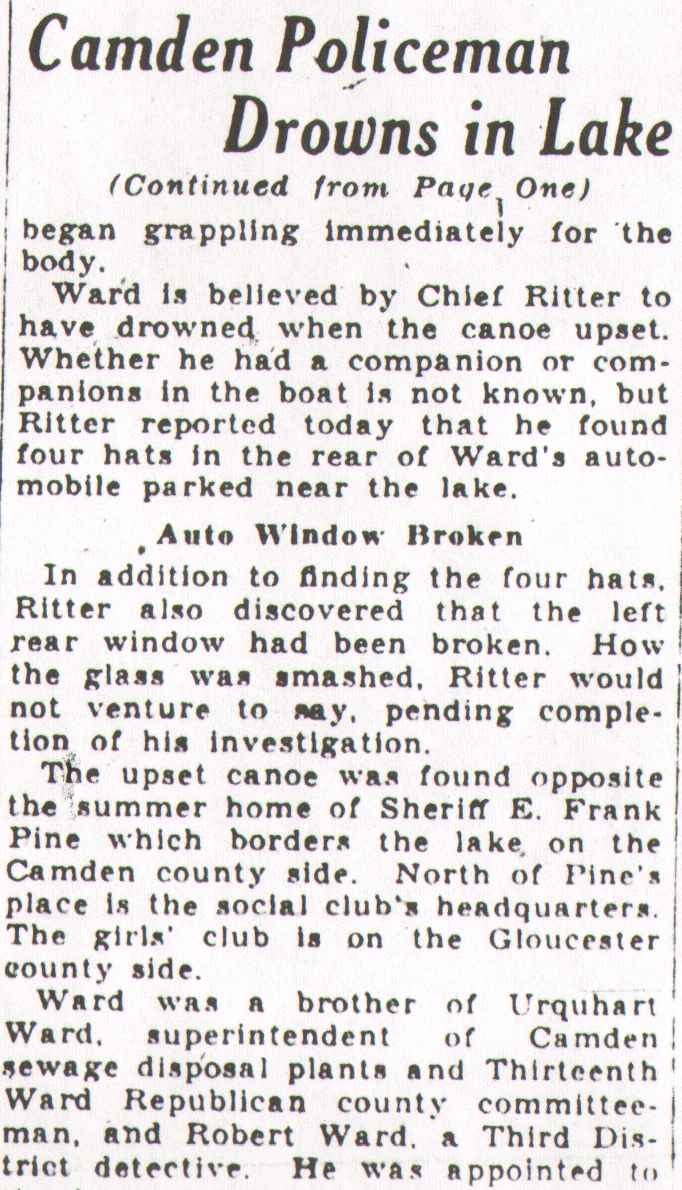
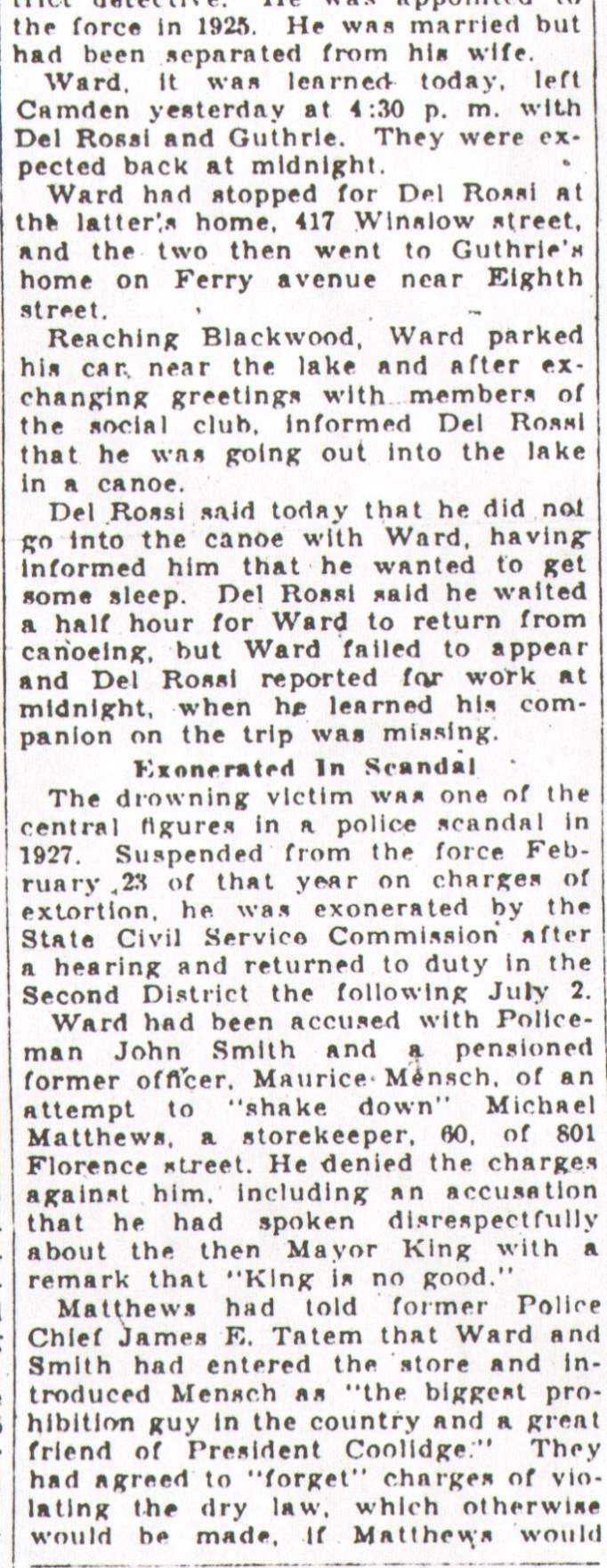
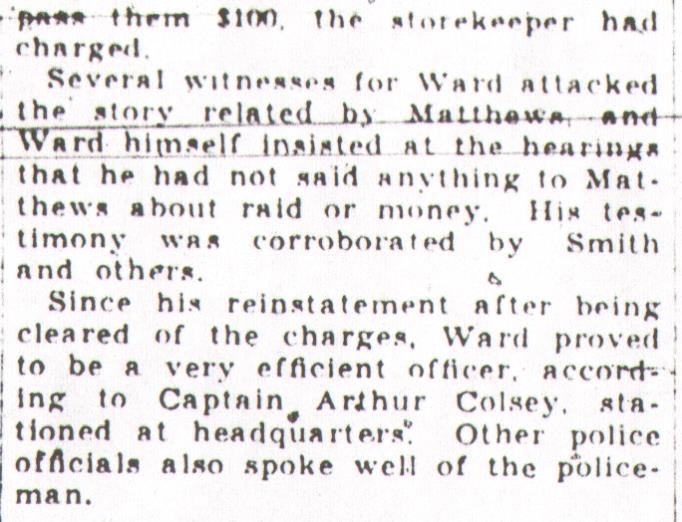
Body of Joseph S. [sic] Ward Found Near Upset Canoe
OFFICIALS START PROBE IN DEATH MYSTERY
Tragedy Comes as Climax to Outing by Social Club
JOSEPH G. WARD
An intensive investigation into the mysterious drowning of Joseph G. Ward, a Camden motorcycle policeman, was opened today by Police Chief William Ritter, of Gloucester township, following the recovery of Ward’s body in Blackwood lake.
Ward drowned when a canoe he occupied overturned. He was 34, attached to the Second Police District, and lived at 1572 Louis street. The body was found by searchers led by Chief Ritter and Lieutenant Ralph Bakley, of the Camden police, after an all-night search.
Ward’s father, Joseph Ward, Sr., who has been seriously ill, collapsed when informed of his son’s death. He operates a cafe on Mt. Ephraim avenue near Decatur street. The drowning victim’s mother also is reported to be ill. The tragedy has aggravated her condition.
The drowning is a tragic aftermath of an outing yesterday of the Moonlight Social Club, which rented a clubhouse at Blackwood two months ago. With Ward on the outing were Clifford Del Rossi, a driver of the Second District police patrol; Theodore “Dorie” Guthrie, Second District detective, and other members of the Camden police department whose names have not been learned.
Chief Ritter reported today having only meager clues as to the circumstances of the drowning. Ward is believed to have been in the canoe alone. Coroner Melvin Cain is expected to conduct an autopsy today or tomorrow.
Chief Ritter said there is no suspicion of foul play, as Ward’s body was unmarked. It was recovered at [?]:30 a. m. by William [sic] McGrath, a city detective, who had been diving for it with George Hess, near the clubhouse of the Moonlight Social Club.
The overturned canoe was found last night in the lake by girls who also have a clubhouse at Blackwood. Police Chief Ritter, with Peter English and Walter Wilkie, all of Blackwood, began grappling immediately for the body.
Ward is believed by Chief Ritter to have drowned when the canoe upset. Whether he had a companion or companions in the boat is not known, but Ritter reported today that he found four hats in the rear of Ward’s automobile parked near the lake.
Auto Window Broken
In addition to finding the four hats, Ritter also discovered that the left rear window had been broken. How the glass was smashed, Ritter would not venture to say, pending completion of his investigation.
The upset canoe was found opposite the summer home of Sheriff E. Frank Pine which borders the lake on the Camden county side. North of Pine’s place is the social club’s headquarters. The girls’ club is on the Gloucester county side.
Ward was a brother of Urquhart Ward, superintendent of Camden sewage disposal plants and Thirteenth Ward Republican county committeeman, and Robert Ward, a Third District detective. He was appointed to the force in 1925. He was married but had been separated from his wife.
Ward, it was learned today, left Camden yesterday at 4:30 p. m. with Del Rossi and Guthrie. They were expected back at midnight.
Ward had stopped for Del Rossi at the latter’s home, 417 Winslow street, and the two then went to Guthrie’s home on Ferry avenue near Eighth street.
Reaching Blackwood, Ward parked his car near the lake and after exchanging greetings with members of the social club, informed Del Rossi that he was going out into the lake in a canoe.
Del Rossi said today that he did not go into the canoe with Ward, having informed him that he wanted to get some sleep. Del Rossi said he waited a half hour for Ward to return from canoeing, but Ward failed to appear and Del Rossi reported for work at midnight, when he learned his companion on the trip was missing.
Exonerated In Scandal
The drowning victim was one of the central figures in a police scandal in 1927. Suspended from the force February 23 of that year on charges of extortion, he was exonerated by the State Civil Service Commission after a hearing and returned to duty in the Second District the following July 2.
Ward had been accused with Policeman John Smith and a pensioned former officer, Maurice Mensch, of an attempt to “shake down” Michael Matthews, a storekeeper, 60, of 801 Florence street. He denied the charges against him, including an accusation that he had spoken disrespectfully about the then Mayor King with a remark that “King is no good.”
Matthews had told former Police Chief James E. Tatem that Ward and Smith had entered the store and introduced Mensch as “the biggest prohibition guy in the country and a great friend of President Coolidge.” They had agreed to “forget” charges of violating the dry law, which otherwise would be made, if Matthews would pass them $100, the storekeeper had charged.
Several witnesses for Ward attacked the story related by Matthews, and Ward himself insisted at the hearings that he had not said anything to Matthews about raid or money. His testimony was corroborated by Smith and others.
Since his reinstatement after being cleared of the charges, Ward proved to be a very efficient officer, according to Captain Arthur Colsey, stationed at headquarters. Other police officials also spoke well of the policeman.
Haines and Reinert Head G.O.P.; Madden To Lead Democrats
Camden Courier-Post —
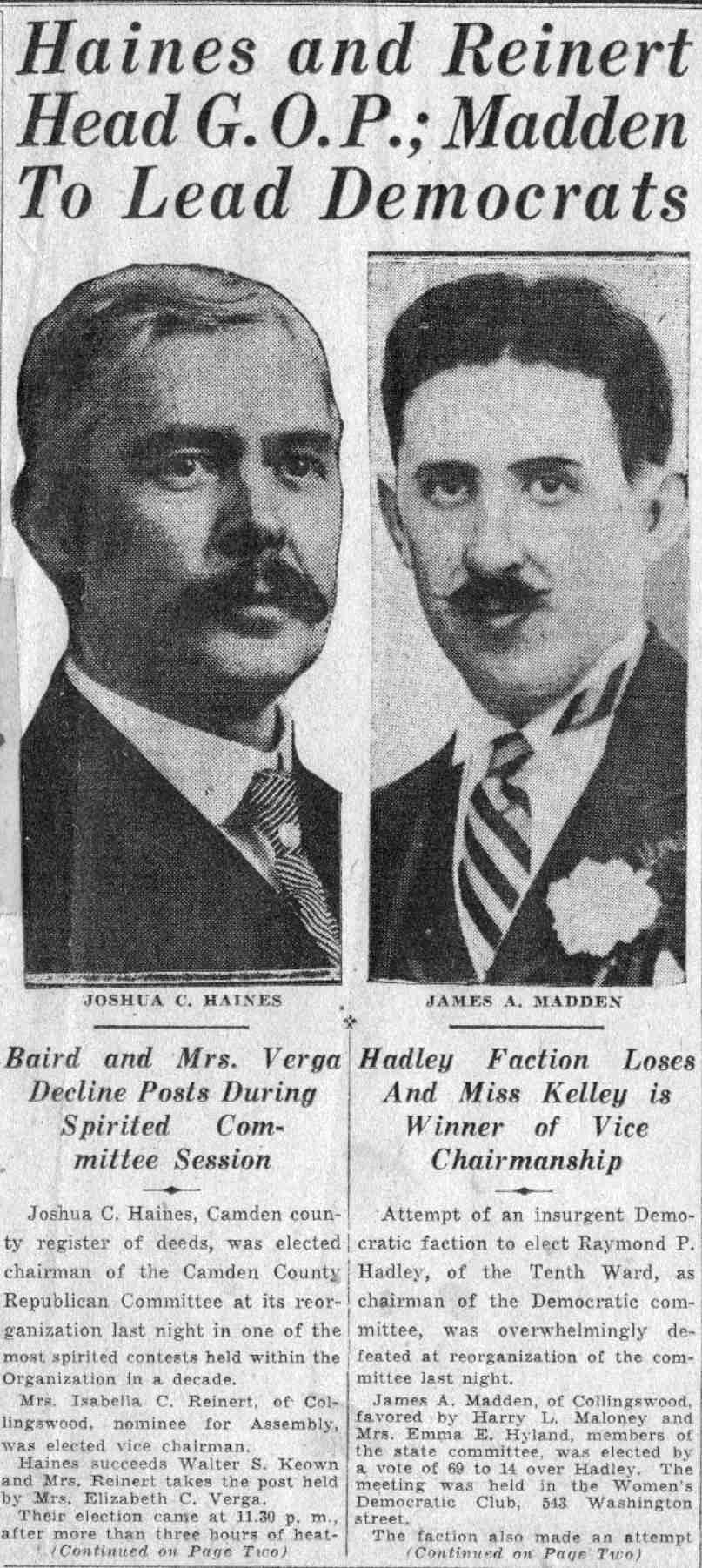

JOSHUA C. HAINES
Baird and Mrs. Verga Decline Posts During Spirited Committee Session
Joshua C. Haines, Camden county register of deeds, was elected chairman of the Camden County Republican Committee at its reorganization last night in one of the most spirited contests held within the Organization in a decade.
Mrs. Isabella C. Reinert, of Collingswood, nominee for Assembly, was elected vice chairman.
Haines succeeds Walter S. Keown and Mrs. Reinert takes the post held by Mrs. Elizabeth C. Verga.
Their election came at 11.30 p. m., after more than three hours of heated argument behind closed doors, and after former U. S. Senator David Baird and Mrs. Verga had declined to accept the offices.
Keown, Hanna Mentioned
Others nominated were Keown and Camden City Commissioner Frank B. Hanna, for chairman, and Mrs. Etta C. Pfrommer, of the Eleventh Ward. Mrs. Pfrommer twice declined.
In previous years reorganization of the county committee had been effected without dispute, and with unanimous action by the members. Last night, however, the discussion waged long and loud.
Though newspapermen were excluded from the meeting, the voices of the debating members coming through the locked doors left no doubt as to the progress of the election.
Other officers were re-elected as follows: Howard B. Dyer, secretary; William D. Sayrs, Jr., treasurer, and Mrs. Lottie B. Stinson, assistant secretary. Mrs. Anna G. Holl, of Collingswood, was elected assistant treasurer to succeed Mrs. Reinert.
Keown opened the meeting and then Baird spoke.
The former Senator presented the recommendation of the Republican executive conference committee that the members elect Haines and Mrs. Reinert in view of the fact that Keown and Mrs. Verga had resisted all requests to continue.
Then Mrs. Margaret Wermuth, of Delaware township, and Carlton M. “Cy” Harris, of the Twelfth Ward, presented a petition signed by virtually all the committee, asking Baird and Mrs. Verga to accept the chairmanship and vice chairmanship.
Baird Declines
Baird then declared that he was unable to take over any additional work.
“I must not be chosen, but must work with and for you, and I ask that you respect my wishes.”
He then proposed that Haines and Mrs. Reinert be chosen unanimously.
Despite his proposal, Mrs. Wermuth moved the election of Baird and Mrs. Verga. The vote was virtually unanimous. Immediately J. C. Remington, Jr., of Haddonfield, moved to adjourn. The chair refused to recognize the motion.
Several members threatened to resign from the committee unless Baird and Mrs. Verga accepted. To this Baird answered:
“I’m still fighting for the party, no matter who quits. If you quit, you’re not worthy to be members.” His remarks were greeted with applause.
In announcing her decision not to accept renomination Mrs. Verga said her duties as state vice chairman, taking her into all the 21 counties, made it impossible for her to continue to devote the time to the county committee which it deserved. She explained that her term as state vice chairman still has two years to run.
Haines Finally Elected
Then Baird announced his resignation from the chairmanship and Mrs. Verga from the vice chairmanship.
Keown was nominated for re-election and Haines and Hanna for election. Baird was renominated by Remington. Keown reiterated his insistence, announced several weeks ago, not to stand for re-election. Baird again declined.
Then Keown moved the election of Haines and Mrs. Reinert. The discussion which followed continued for three hours. Finally the vote was taken at 11.30 and Haines and Mrs. Reinert were declared elected.
Mrs. Reinert, however, declined the office, stating her candidacy for assembly would consume all her time. Then Mrs. Pfrommer was nominated, but she turned it down twice. After much persuasion Mrs. Reinert agreed to accept with the provision that she serve through the summer and that she be permitted to resign later, if she wished.
In a telegram to the committee, Congressman Charles A. Wolverton urged the election of Baird and Mrs. Verga.
The committee elected the following solicitors: Carl Kisselman, Edward R. Deibert, L. Scott Cherchesky, William E. A. King, J. Claud Simon, T. Philips Brown, J. H. Reiners, Jr., Rocco Palese and Morris Praissman.
The conference committee, which suggested Haines and Mrs. Reinert, comprises Baird, Keown, George R. Pelouze, Albert S. Woodruff, Mrs. Verga, Remington, Commissioners Hanna and Clay W. Reesman, Sayrs, William Wimer, Horace G. Githens, J. Wesley Sell and A. C. Middleton.
Members of the Republican County Committee, which organized last night, follow:
Camden City
(*-Indicates New Member)
First Ward—Robert Brennan and Marie Mackintosh.
Second—*William H. Heiser and Mary McCready.
Third—James Corea and *Susie Marchiano.
Fourth—James E. Tatem and *Mary A. Ivins.
Fifth—*Martin A. McNulty and Madeline Salvatore.
Sixth—Howard B. Dyer and Mary S. Hartung.
Seventh—Edward A. Kemble and Mary D. Guthridge.
Eighth—*Edmund A. Walsh and Mamie F. Piraine.
Ninth—Edward Holloway and Deborah Schuck.
Tenth—*Henry I. Haines and Lillian M. Walker.
Eleventh—Horace B. Beideman and Etta C. Pfrommer.
Twelfth—Carlton M. Harris and Mary E. Hamel.
Thirteenth—*Henry Knauer and Louella I. Whaland.
Fourteenth—*Jesse M. Donaghy and Lottie B. Stinson.
Gloucester City
First Ward—Walter H. Craig and E. C. Moffet.
Second—James A. Lewis and *Nellie Keebler.
Third—*James M. Officer and *Margaret P. Powell.
Suburban Districts
Audubon—*Marshall N. Hammon, Jr., and Laura Williams.
Barrington—Harry J. Stone and Margaret Taylor.
Bellmawr—*William C. Stillwill and Katherine Dyer.
Berlin Borough—Leslie M. Ewing and Esther B. Jaggard.
Berlin Township—Frank M. Tyson and Lydia M. Eckstein.
Brooklawn—Morton S. Broomall and C. Mae Marsh.
Chesilhurst—*William Wiegand, Sr., and Mary L. Lyons.
Clementon—J. Palmer Earl and Mabel Rogers.
Collingswood—Edward B. Rogers and Isabella C. Reinert.
Delaware Township—Leonard Hoffman, Sr., and Margaret E. Wermuth.
Gibbsboro—*P. Richard Cummings and *Ethel H. Bone.
Gloucester Township—*William E. Cozens and Mary W. Frazer.
Haddon Township—*Milton E. Hanson and *Eve W. Hannum.
Haddonfield—J. C. Remington, Jr., and Anna G. Holl.
Haddon Heights—Robert E. Bromley and Mary H. Tegge.
Hi-Nella—Samuel D. Mansfield and Elsie H. Castor.
Laurel Springs—Charles V. Osborne and Anna M. Hess.
Lawnside—Horace J. Bryant and Maidie M. Gibson.
Lindenwold—George T. Neely and Irene A. Haney.
Magnolia—*Charles T. Wood and *Lillian Shoemaker.
Merchantville—E. Durell Parker and Ruth K. Yarnall.
Mt. Ephraim—Harvey L. Jacoby and *Theresa Osler.
Oaklyn—John Beasley and *Mae Walker.
Pennsauken Township—*Andrew Stewart and Catherine Brooks.
Pine Hill—*Conrad Schmidt and Mary J. Smith.
Pine Valley—Clinton L. Bardo and Anna E. Howe.
Runnemede—*John S. Adams and *Mrs. John Gaunt.
Somerdale—Edward Arentzen and Louise Brusius.
Stratford—John T. Matthews and L. Mae Titus.
Voorhees Township—*George Ziesch and *Elizabeth Ebert.
Waterford Township—Thomas A. Fanelli and Catherine Zoppel.
Tavistock—Frank B. Middleton, Jr., and no committeewoman.
Winslow Township—Samuel Withers and Kathryn Wuertz.
Woodlynne—Thomas W. Leeson and Edna M. Fritsche.
Mrs. G. A. Tatem Dies; Final Rites Today
Camden Courier-Post —
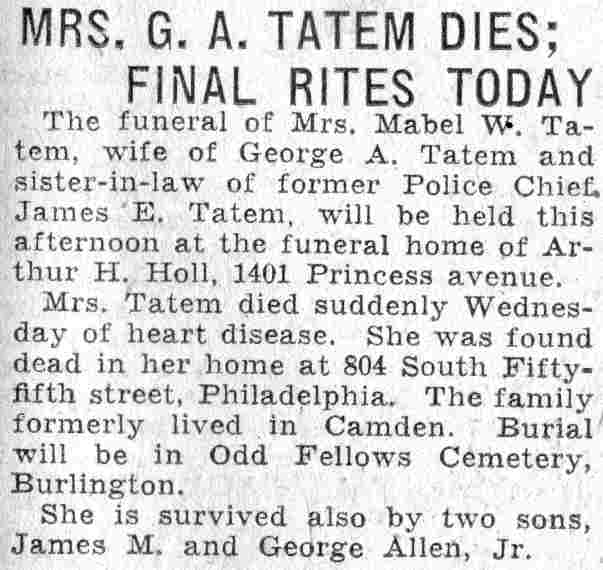
The funeral of Mrs. Mabel W. Tatem, wife of George A. Tatem and sister-in-law of former Police Chief James E. Tatem, will be held this afternoon at the funeral home of Arthur H. Holl, 1401 Princess Avenue.
Mrs. Tatem died suddenly Wednesday of heart disease. She was found dead in her home at 804 South Fifty-fifth street, Philadelphia. The family formerly lived in Camden. Burial will be in Odd Fellows Cemetery, Burlington.
She is survived also by two sons, James M. and George Allen, Jr.
Camden Courier-Post – May 14, 1934
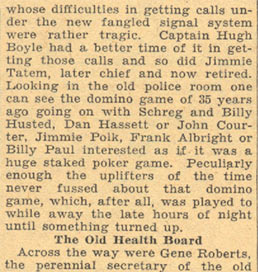
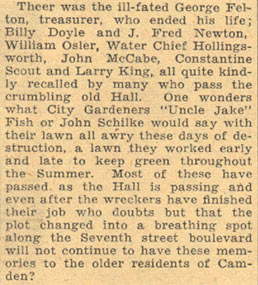
Some Old Hall Familiars
Crumbling City Building Brings to Mind Many Who Once Took Active Part in Affairs of Camden and Spirited Political Scraps
By BEN COURTER
Walk along Haddon avenue these days of old City Hall destruction with veterans in politics like Fred W. George or Charlie Elfreth or Frank Fithian and they will tell you they can see in memory’s eye a veritable host who once trod the corridor, rapidly crumbling away. One doesn’t need to be a sentimentalist to stop for a space in the midst of hat [sic] is left of the once proud municipal pile to bring to mind for the moment some who once took an active part in the city’s affairs, who had their partisan fights and who were as a rule, “good fellows.”
Of course, those who composed Camden’s official family back in ‘74 when the corner stone was laid have passed on. Boys like Joe Kobus or Dr. D. Louis Ireton who saw the corner stone laying are now men well along life’s journey and they too have memories of the Hall through the many years. Mayor John H. Jones, as related in a previous article, died the year the Hall was started. He was succeeded by John Morgan who served a year. Then came James W. Ayres, Claudius W. Bradshaw, Jesse W. Pratt, J. Leighton Wescott and Cooper B. Hatch, all of whom have died. The surviving mayors who once held forth in the office at the southwest corner are Joseph E. Nowrey, Charles H. Ellis, Frank H. Vanhart, Victor King, General Winfield S. Price. With the advent of Mayor Roy Stewart quarters were taken in the great stone pile at Sixth and Market.
The City Clerks
Joseph C. Nicholls was city clerk when the Hall was started, succeeded by Joseph Bontemps, Fred W. Tarr, Frank F. Michellon, Richard C. Thompson, D. Cooper Carman, Thad P. Varney, Morris Odell and William D. Brown, all of whom have died. The survivors are Colonel Harry C. Kramer, now at Washington, Isaac V. Bradley, “Al” White and Frank S. Albright, the last of the clerks in the old building and now happily with us in the new structure.
But there were scores more who were familiar figures in the nearly two generations that have passed. One expects to see, for instance, Levi Farnham, city engineer for nearly two score years, come tramping out of the wrecked corridor to make his way to see how Farnham Park is progressing. There is sure to be memories of the hearty laugh of “Pete” Young, who was Varney’s assistant, and like as not there will be heard the gruff note from “old” Colonel Sam Hufty, “watchdog of the treasury for many a year and a job his father held before him. One can see, too, George A. Frey, long city treasurer who was quite rightfully proud when the experts, who made the survey in 1923, reported that of the more than $18,000,000 he handled every penny was accounted for.
And surely passing what is left of what used to be the police department one can hear the hearty laughs of “Bill” Schregler or Jules Bosch or the pestering gasps of poor old Cale Williams who had the asthma and whose difficulties in getting calls under the new fangled signal system were rather tragic. Captain Hugh Boyle had a better time of it in getting those calls and so did Jimmie Tatem, later chief and now retired. Looking in the old police room one can see the domino game of 35 years ago going on with Schreg and Billy Husted, Dan Hassett or John Courter, Jimmie Polk, Frank Albright or Billy Paul interested as if it was a huge staked poker game. Peculiarly enough the uplifters of the time never fussed about that domino game, which, after all, was played to while away the late hours of night until something turned up.
The Old Health Board
Across the way were Gene Roberts, the perennial secretary of the old Board of Health; Henry B. Francis, the “admiral” who fought with Farragut, or Joe Starr, who did his part in rounding up the property owners to get the Line Ditch swamp filled in and graded. Of all that board only Reuben Gaskill survives. Dr. John F. Leavitt, many years health physician, is living in retirement.
Up in the Council Chamber, now virtually gone, old-timers will tell you they can yet hear Fred Finkelday in a brush with Joe Potter, the later of the councilman-at-large, or the booming voice of John Broome bringing order out of chaos. John’s brother, Howard, by the way, was for a time an efficient water engineer who died at the early age of 35 of pneumonia. His son is now secretary to Mayor Stewart.
Theer [sic] was the ill-fated George Felton, treasurer, who ended his life; Billy Doyle and J. Fred Newton, William Osler, Water Chief Hollingsworth, John McCabe, Constantine Scout and Larry King, all quite kindly recalled by many who pass the crumbling old Hall. One wonders what City Gardeners “Uncle Jake” Fish or John Schilke would say with their lawn all awry these days of destruction, a lawn they worked early and late to keep green throughout the Summer. Most of these have passed as the Hall is passing and even after the wreckers have finished their job who doubts but that the plot changed into a breathing spot along the Seventh street boulevard will not continue to have these memories to the older residents of Camden?
Camden Courier-Post, May 14, 1934 — Ben Corter column mentioning James E. Tatem
Zuni A. A. to Hold Annual Ball Jan. 25
Camden Courier-Post —
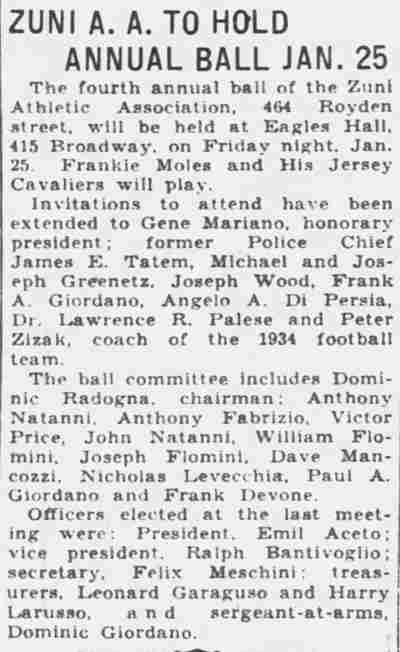
The fourth annual ball of the Zuni Athletic Association, 464 Royden street, will be held at Eagles Hall, 415 Broadway, on Friday night, Jan. 25. Frankie Moles and His Jersey Cavaliers will play.
Invitations to attend have been extended to Gene Mariano, honorary president; former Police Chief James E. Tatem, Michael and Joseph Greenetz, Joseph Wood, Frank A. Giordano, Angelo A. Di Persia, Dr. Lawrence R. Palese and Peter Zizak, coach of the 1934 football team.
The ball committee includes Dominic Radogna, chairman; Anthony Natanni, Anthony Fabrizio, Victor Price, John Natanni, William Flomini, Joseph Flomini, Dave Mancozzi, Nicholas Levecchia, Paul A. Giordano and Frank Devone.
Officers elected at the last meeting were: President, Emil Aceto; vice president, Ralph Bantivoglio; secretary, Felix Meschini; treasurers, Leonard Garaguso and Harry Larusso, and sergeant-at-arms, Dominic Giordano.