Introduction
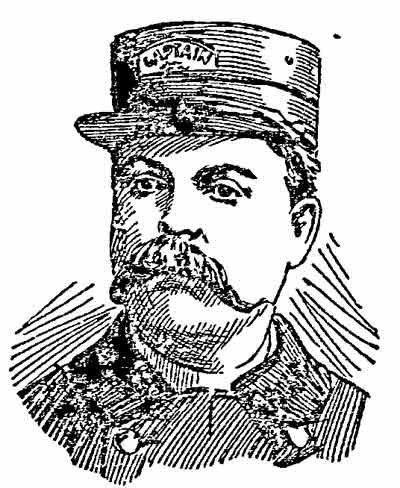
Arthur Stanley — Philadelphia Inquirer, November 12, 1899
ARTHUR STANLEY was born in England in February of 1845 to James and Eliza Stanley. He came to America with his family in 1853. The Stanleys were living in Camden’s South Ward when the Census was taken in 1860. Besides Arthur and his parents, the family included older sister Louisa, 20, and younger siblings Harry 5, and Mary Jane “Jennie,” 2. The Census states that Harry was born in Pennsylvania and Mary in New Jersey, so it is probable that the family moved to Camden at some point between the two births. The Census states that James Stanley worked as a shoe cutter. Arthur Stanley’s entry on the Census sheet lists no occupation.
Arthur Stanley served with the Union Army during the Civil War, enlisting as a Private on July 28, 1862. Although just a teenager, he was promoted to Full Corporal on Jul 28, 1862. He was enlisted in Company G, 12th Infantry Regiment New Jersey on September 4, 1862. After two years of service, he was promoted to Full Sergeant on October 20, 1864. Sergeant Stanley mustered out with Company G, 12th Infantry Regiment New Jersey on June 4, 1865 at Munson’s Hill, Virginia.
During his time with the Union Army, Arthur Stanley took part in the battles at Chancellorville, Gettysburg, the Wilderness, Spottsylvania Courthouse, North Anna River, Cold Harbor, Petersburg, and seven other lesser known battles. Arthur Stanley was an active member of the Thomas M.K. Lee Post No. 5 of the Grand Army of the Republic (G.A.R.), the Civil War veterans’ organization, and at one time was the Post’s commander. He was a longtime member of the Independent Order of Odd Fellows.
Arthur Stanley returned to Camden after the Civil War. He married Frances Irene Kirby, and a son, Milton K. Stanley, came from this marriage. However it appears that Frances Stanley had passed away by the time of the 1880 Census. Arthur Stanley’s sister, Mrs. Louisa Vennell and her daughter Clara lived with him. As early as 1874 and through 1881 Camden City Directories list Arthur Stanley at 929 Newton Avenue. He was then working as an oilcloth printer. His father, James Stanley, lived at 428 Line Street as early as 1878 and as late as 1882, according to the City Directories.
By 1883 Arthur Stanley had moved back to 428 Line Street in South Camden. He would remain at that address through at least January of 1910. The Directories indicate that he was working as a paper carrier in 1883, a news dealer in 1887, and as a paper carrier in from 1888 through 1898. The paper he was carrying were newspapers.
In 1898 Arthur Stanley was appointed to the Camden Police Department, and was made Captain of the Second District. The 1899 Camden City Directory lists Arthur Stanley’s occupation as Captain of Police. It appears that his military background may have given cause for him to be assigned an officer’s post when he came into the department. In any event, he served in this capacity until his retirement in 1916.
The 1900 Census states that Arthur Stanley was living with his sister, Jennie. On September 19, 1905 he married for the second time. His wife, the former Gertrude Rammell, was from Williamstown, New Jersey. When the 1906 City Directory was compiled, they made their home at 428 Line Street in North Camden. The Stanleys remained there through at least the spring of 1910. By April of the following year they had moved to 423 Benson Street.
Son Milton had left home at the age of fourteen to pursue a career in show business, and was successful. In 1909 he was offered a job with the Camden Police Department.
In 1911 Arthur Stanley took a trip to Europe. He returned on August 6, 1911 aboard the steamship Merion, having sailed from Liverpool, England on August 2nd.
After retiring, Arthur Stanley stayed active in G.A.R. affairs.
Arthur Stanley passed away on February 1, 1925. His widow, Mrs. Gertrude Stanley, was living at 423 Benson Street when the 1927 and 1929 Camden City Directories were compiled. His son, Milton K. Stanley, served as a with the Camden Police Department, the Camden County Prosecutor’s office, and as a federal investigator for many years.
Regimental History — New Jersey Twelfth Infantry (Three Years)
Twelfth Infantry.
Colonels., Robert C. Johnson, J. Howard Willetts, John Willian;
Lieutenant Colonels., Thomas H. Davis, Richard S. Thompson;
Majors., John T. Hill, Henry F. Chew, Edward M. Dubois.This regiment was raised under the second call of the president for 300,000 men, Robert C. Johnson, of Salem, formerly major of the 4th regiment (3 months’ men), being commissioned as colonel early in July, 1862. Woodbury, Gloucester county, was selected as the rendezvous, and on July 25 the first detachment of troops, about 950 men, was mustered into the U. S. service. Many of the officers had already seen service in other regiments, but comparatively few of the men were familiar with military duties or requirements, though all entered cheerfully upon the work of preparing for the duties before them.
On Sept. 7 the regiment left the state for Washington, but at Baltimore was diverted from its course by Gen. Wool, commanding that district, who ordered it to proceed to Ellicott City, the county seat of Howard county, Md., 15 miles from Baltimore on the line of the Baltimore & Ohio railroad.
At Chancellorsville, on May 3, 1863, the regiment received its first taste of actual warfare. It behaved with great gallantry, though the loss was severe, amounting to 179 in killed, wounded and missing. Although under arms during the two succeeding days and nights, it was not again engaged, and on the night of the 5th it recrossed the Rappahannock and proceeded to its old camp, having in its first battle lost over one-tenth of its men.
Soon after reaching the field at Gettysburg on July 2, Co. I was sent out on the skirmish line, but the combat not yet being opened, only two or three casualties were sustained. In the afternoon a house and barn standing about 200 yards west of the Emmitsburg road and nearly equidistant from either army having been occupied as a cover by the Confederate sharpshooters, Cos. B, H, E and G were sent out to dislodge them, which they did, capturing 6 commissioned officers and 80 men, but with considerable loss, Capt. Horsfall of Co. E, a brave officer, being killed, and Lieut. Eastwick wounded. During the fearful infantry contest of the following day the regiment was actively engaged, but only lost 5 or 6 men killed and 1 officer and 30 men wounded.
On Oct. 14, when near Auburn mills, some 2 miles east of Warrenton, the Confederate cavalry made an attack upon the corps of which the regiment was a part, evidently hoping to capture its train, but they were repulsed with loss and the corps continued its retreat toward Centerville, the point which Lee was straining every nerve to reach in advance of the Union troops.
In the engagement at Bristoe Station, which lasted for 3 or 4 hours, several men of the 12th were wounded, Lieut. Lowe, of Co. G, being among the number. In the skirmishes at Mine Run the regiment did not sustain any casualties, although under fire on several occasions. In the affair at Morton’s ford, some 10 men of the regiment were wounded, but only 1 fatally.
At the battle of the Wilderness, although not engaged as a whole, the regiment suffered considerably, Lieut. John M. Fogg, of Co. H, being killed, while Lieut. Frank M. Riley, of Co. K, and several others were wounded. Two days later the regiment lost heavily, Lieut.-Col. Davis and Capts. Chew and Potter being among the wounded.
In the magnificent assault at Spottsylvania, which resulted in the capture of over 3,000 prisoners and some 30 guns, the 12th again suffered severely, Lieut.-Col. Davis being instantly killed while bravely leading the regiment; Capt. H. M. Brooks and Lieut. E. P. Phipps were severely wounded and were obliged to quit the service in consequence.
In the assault at Cold Harbor the loss of the regiment was severe, Capt. McCoomb, commanding the regiment, being mortally wounded by the explosion of a shell, which also killed or wounded several privates. Up to June 16 the total loss of the regiment in this memorable campaign had been some 250 killed, wounded or missing—a large proportion of the wounded being officers.
From this time forward the regiment was in position at various points on the line, and in July it participated in the movement and affair at Strawberry Plains and Deep Bottom, on the north side of the James. Thence, by a forced march, it returned to the Petersburg front, arriving in time to support the assault at the explosion of the mine, July 30, though not actually engaged. It participated in the second movement to Deep Bottom, charging the enemy’s picket line under Capts. Chew and Acton, and upon returning marched to the extreme left flank of the Army of the Potomac, whence it was marched to Reams’ station, on the Weldon railroad, where the 1st division of the corps had preceded it. In the severe action at the latter place Lieut.-Col. Thompson, commanding the regiment, was severely wounded and Lieuts. Rich and Stratton were killed.
After the action at Reams’ station the regiment was in various positions along the Petersburg front, Fort Hell on the Jerusalem plank road, Fort Morton, and at other points, until late in October, when it moved out and participated in the action known as the battle of the Boydton road, where it lost 4 killed and 9 wounded—including Capt. T. O. Slater. In the winter of 1864-65 it took part in the various actions at Hatcher’s run, where in one instance it charged across the run, waist deep, and took the enemy’s works, upon which its color-bearer, Ellwood Griscom, was the first to plant the national colors. It was present in the movements of the army preceding the main assault on the Petersburg defenses; took part in the assault, under the command of Maj. Chew, and aided in the various actions during Lee’s retreat until his surrender. It returned, via Richmond, to Bailey’s crossroads, in front of Washington, where in June, 1865, the old battalion of the regiment was mustered out of service, and in July the remainder of the regiment. Its total strength was 1,899, and it lost, by resignation 14, by discharge 171, by promotion 56, by transfer 206, by death 261, by desertion 216, by dismissal 3, not accounted for 29, mustered out, 943.
— Source: The Union Army, vol. 3
Gettysburg After-Battle Report
Report of Maj. John T. Hill, Twelfth New Jersey Infantry.
Hdqrs. Twelfth Regt. New Jersey Volunteers,
July 16, 1863.Sir:
I have the honor to report the action of the regiment I have the honor to command during the engagements of the 2d, 3d, and 4th instant to have been as follows:
At 5 p. m. on the 2d instant, four companies (B, H, E, and G) were detailed to take a large barn on our picket line, taken from us and held by the enemy. Under command of Capt. Jobes, Company G, they charged gallantly upon the building, surrounding it, and capturing 92 prisoners, including 7 commissioned officers; losing in the attack 2 officers and 40 men killed and wounded.
At 6 p. m. the same day the balance of my command moved to the front line, taking position behind a stone fence to the left of Kirby’s battery, remaining in this position until the afternoon of the 5th instant.
At 7.30 a. m. of the 3d instant, five companies (D, C, K, F, and A), under command of Capt. Thompson, Company K, again drove the enemy from the shelter of the barn, capturing a major and 1 man, relieving our lines from an annoying fire from the enemy’s sharpshooters posted therein.
At 4 p. m. of the 3d instant, the whole line became engaged in repulsing an attack in force made by the enemy, completely routing them, capturing prisoners estimated to number 500 men, and 2 colors.
We collected and turned in 751 small-arms, picked up in our immediate front.
(* Medals of honor awarded to Privates Mayberry and McCarren.)
Officers and men behaved with the greatest gallantry. I take pleasure in calling your attention to the meritorious conduct of Capt.’s Thompson, Jobes, and Chew, Adjutant Franklin, Lieut.’s McComb, Trimble, Acton, Phipps, Williams, Eastwick, and Dare, Sergeant-Maj. [Edward M.] Du Bois, and Color Sergeants [Charles E.] Cheeseman and [William H.] Griffin.
Our casualties were—
Officers and men. K. W. M. T.
Commissioned officers … 2 4 … 6
Enlisted men … 21 75 11 107
Total* … 23 79 11 113
k=Killed. w=Wounded. m=Missing. t=Total.I am, colonel, very respectfully, your obedient servant,
JOHN T. HILL,
Maj., Comdg. Twelfth New Jersey Volunteers.
Col. Morris,
Comdg. Second Brig., Third Div., Second Army Corps.— Source: Official Records: Series I. Vol. 27. Part I. Reports. Serial No. 43
Battles Fought
Fought on 3 May 1863 at Chancellorsville, VA.
Fought on 2 Jul 1863 at Gettysburg, PA.
Fought on 3 Jul 1863 at Gettysburg, PA.
Fought on 14 Oct 1863 at Bristoe Station, VA.
Fought on 28 Nov 1863 at Mine Run, VA.
Fought on 6 Feb 1864 at Morton’s Ford, VA.
Fought on 4 May 1864 at Wilderness, VA.
Fought on 5 May 1864 at Wilderness, VA.
Fought on 6 May 1864 at Wilderness, VA.
Fought on 8 May 1864 at Spotsylvania Court House, VA.
Fought on 10 May 1864 at Spotsylvania Court House, VA.
Fought on 12 May 1864 at Spotsylvania Court House, VA.
Fought on 15 May 1864 at Spotsylvania Court House, VA.
Fought on 18 May 1864 at Spotsylvania Court House, VA.
Fought on 24 May 1864 at North Anna River, VA.
Fought on 26 May 1864 at North Anna River, VA.
Fought on 3 Jun 1864 at Cold Harbor, VA.
Fought on 4 Jun 1864 at Cold Harbor, VA.
Fought on 16 Jun 1864 at Petersburg, VA.
Fought on 17 Jun 1864 at Petersburg, VA.
Fought on 23 Jun 1864 at Petersburg, VA.
Fought on 25 Jul 1864 at Deep Bottom, VA.
Fought on 24 Aug 1864 at Reams’ Station, VA.
Fought on 25 Aug 1864 at Reams’ Station, VA.
Fought on 1 Oct 1864 at Petersburg, VA.
Fought on 27 Oct 1864 at Boydton Plank Road, VA.
Fought on 28 Feb 1865 at Dabney’s Mills, VA.
Fought on 25 Mar 1865 at Hatcher’s Run, VA.
Fought on 28 Mar 1865 at Hatcher’s Run, VA.
Petition
Camden Democrat —
PETITION
To the Honorable the City Council of the city of Camden, N. J.
WE, your petitioners, residents of the Fourth and Sixth wards of this city, and property owners therein, most respectfully petition your honorable body to construct a culvert for under-drainage, to commence at the termination of the Line street culvert, at the intersection of Line street and Broadway, and to extend outward to the intersection of Line and Sixth streets; thence northward to and to connect with the culvert at the Intersection of Sixth and Royden Streets in the said city. And your petitioners will over pray, &c. January, 1874.
JOHANNA ROBERTS, 17 houses, 6th ward.
J. E. ROBERTS, 19 houses, 4th ward.
F.J. ROBERTS 22 houses, 4th Ward
LAWRENCE KELLEY, Sixth and Royden Streets, 4th ward.
WM. HEYWOOD, Corner of Line and St. John Street, 4th ward.
F. ERNST, 4th ward.
PETER McGLYNN, 612 St. John Street, 4th ward.
CHRISTOPHER GETSINGER. PHILIP B. PATTERSON, South side Line Street
WM. J. KENNEDY, 607 Line Street
S. B. HARRISON 4th ward.
JACOB ROBERTS 614 Royden Street, 4th ward.
JOHN NULTY.
M.E. HARDEN, 6th Ward
REUBEN B. COLE, N. W. Corner of Reese & Division, 6th ward.
arthur stanley, 929 Newton Ave.
George Holl, 706 South Fifth Street
SAMUEL W. THOMAN, 712 South Fifth Street, 6th ward.
JOHN WELSH, 6tb ward.
WM. HEYWOOD. 6th ward.
F. ERNST 6th ward.
GEORGE ROTH, 559 Royden Street, 4th ward.
OWEN FARELY, 707 South Sixth Street, 6th ward.
wilson ernst, 559 Line Street, 4th ward
JOHN BOWYER 4th ward, 12 houses
GEORGE WALKER 818 Broadway, 6th ward
GEORGE W. FIELD 805 Broadway, 6th ward
JOSEPH H. THOMPSON, 901 Broadway, 6th ward
JOSEPH C. NICHOLLS, Clerk.
Over in Camden
Philadelphia Inquirer —
Named: Thomas M.K. Lee No. 5, General William P. Robeson Post No. 51, William B. Hatch Post No. 37
General John A. Logan Post No. 102, Livingston Allen, J. Kelly Brown, John F. Cassman
Arthur Stanley, and Harry Franks.
Chase for Crap-Shooters
Philadelphia Inquirer —
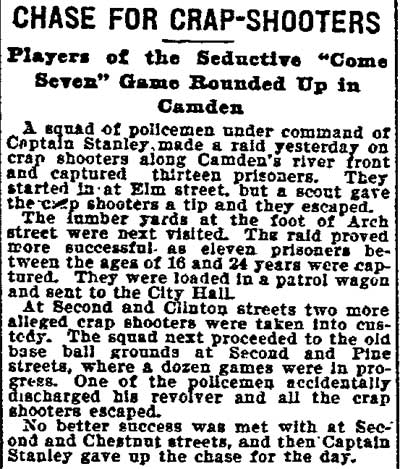
CHASE FOR CRAP-SHOOTERS
Players of the Seductive “Come Seven” Game Rounded Up in Camden
A squad of policemen under command of Captain Stanley made a raid yesterday on crap shooters along Camden’s river front and captured thirteen prisoners. They started in at Elm Street, but a scout gave the crap shooters a tip and they escaped.
The lumber yards at the foot of Arch Street were next visited. The raid proved more successful, as eleven prisoners between the ages of 16 and 24 years were captured. They were loaded in a patrol wagon and sent to the City Hall.
At Second and Clinton Streets two more alleged crap shooters were taken into custody. The squad next proceeded to the old base ball grounds at Second and Pine streets, where a dozen games were in progress. One of the policemen accidentally discharged his revolver and all the crap shooters escaped.
No better success was met with at Second and Chestnut Streets, and then Captain Stanley gave up the chase for the day.
Grand Jury Investigates Lottery Policy Cases
Bridgeton Evening News —
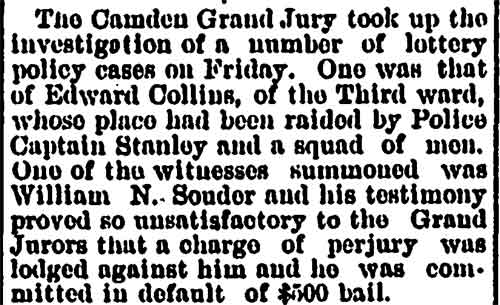
The Camden Grand Jury took up the investigation of a number of lottery policy cases on Friday. One was that of Edward Collins, of the Third ward, whose place had been raided by Police Captain Stanley and a squad of men. One of the witnesses summoned was William N. Souder and his testimony proved so unsatisfactory to the Grand Jurors that a charge of perjury was lodged against him and he was committed in default of $500 bail.
Strikers' Threats
Philadelphia Inquirer —
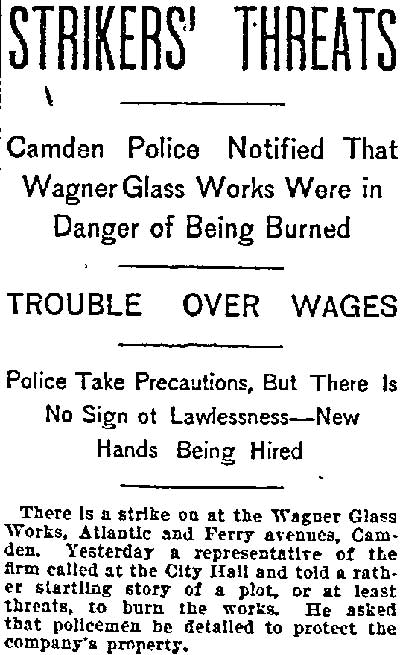
STRIKERS’ THREATS
Camden Police Notified That Wagner Glass Works Were in Danger of Being Burned
TROUBLE OVER WAGES
Police Take Precautions, But There Is No Sign of Lawlessness—New Hands Being Hired
There is a strike on at the Wagner Glass Works, Atlantic and Ferry avenues, Camden. Yesterday a representative of the firm called at the City Hall and told a rather startling story of a plot, or at least threats, to burn the works. He asked that policemen be detailed to protect the company’s property.
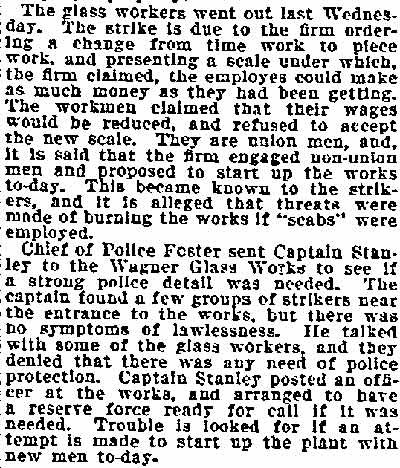
The glass workers went out last Wednesday. The strike is due to the firm ordering a change from time work to piece work, and presenting a scale under which, the firm claimed, the employes could make as much money as they had been getting. The workmen claimed that their wages would be reduced, and refused to accept the new scale. They are union men, and, it is said, the firm engaged non-union men and proposed to start up the works to-day. This became known to the strikers, and it is alleged that threats were made of burning the works if “scabs” were employed.
Chief of Police Foster sent Captain Stanley to the Wagner Glass Works to see if a strong police detail was needed. The captain found a few groups of strikers near the entrance to the works, but there was no symptoms of lawlessness. He talked with some of the glass workers, and they denied that there was any need of police protection. Captain Stanley posted an officer at the works, and arranged to have a reserve force ready for call if it was needed. An attempt is looked for if an attempt is made to start up the plant with new men to-day.
Bitter Primary Elections
Camden Daily Telegram —
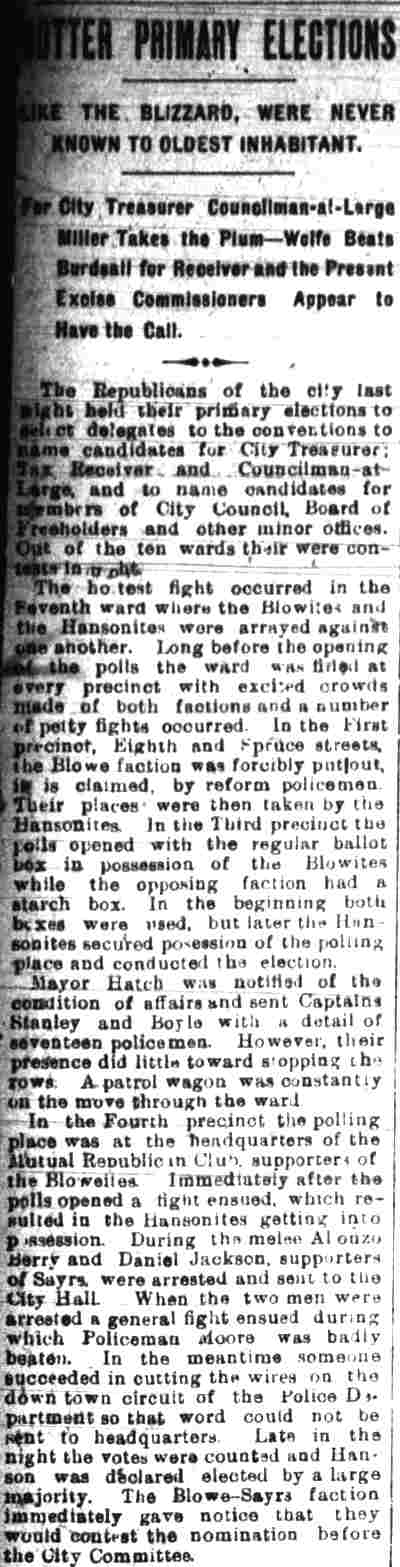
BITTER PRIMARY ELECTIONS
LIKE THE BLIZZARD, WERE NEVER KNOWN TO OLDEST INHABITANT.
For City Treasurer Councilman-at-Large Miller Takes the Plum—Wolfe Beats Burdsal for Receiver and the Present Excise Commissioners Appear to Have the Call.
The Republicans of the city last night held their primary elections to select delegates to the conventions to name candidates for City Treasurer; Receiver and Councilman-at-Large.
The hottest fight occurred in the Seventh ward where the Blowites and the Hansonites were arrayed against one another. Long before the opening of the polls the ward was filled with excited crowds made of both factions and a number of petty fights occurred. In the First precinct Eighth and Spruce streets, the Blowe faction was forcibly putout, it is claimed, by reform policemen. Their places were then taken by the Hansonites. In the Third precinct the polls opened with the regular ballot, then possession of the Blowelites, while the opposing faction had a starch box. In the beginning both were used, but later the Hansonites secured possession of the polling place and conducted the election.
Mayor Hatch was notified of the condition of affairs and sent Captain Stanley and Boyle with a detail of seventeen policemen. However, their presence did little toward stopping the rows. A patrol wagon was constantly on the move through the ward.
In the Fourth precinct the polling place was at the headquarters of the Actual Republican Club, supporters of the Blowelites. Immediately after the polls opened a fight ensued, which resulted in Hansonites getting into possession. During the melee Alonzo Berry and Daniel Jackson, supporters of Sayre, were arrested and sent to City Hall. When the two men were arrested a general fight ensued during which Policeman Doores was badly beaten. In the meantime someone succeeded in cutting the wires on the downtown circuit of the Police Department so that word could not be sent to headquarters. Late in the night the votes were counted and Hanson declared elected by a large majority. The Blowe-Sayrs faction immediately gave notice that they would contest the nomination before the City Committee.
Knife Thrusts in Two Loving Hearts
Philadelphia Inquirer —
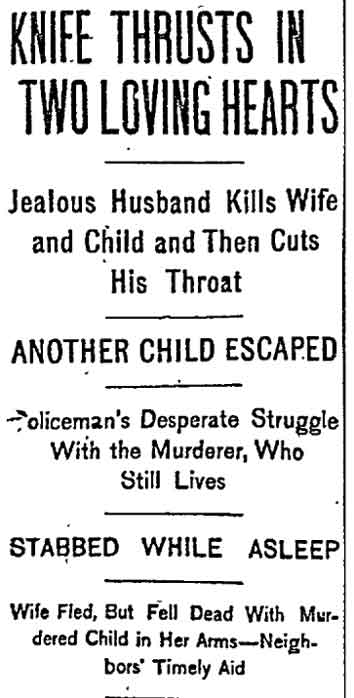
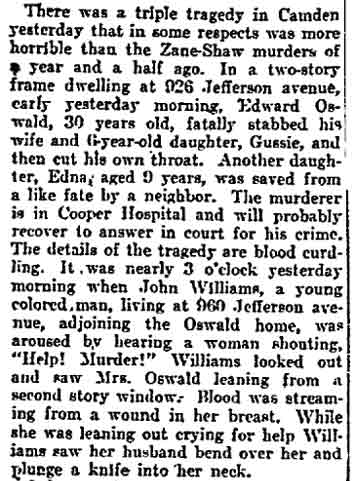
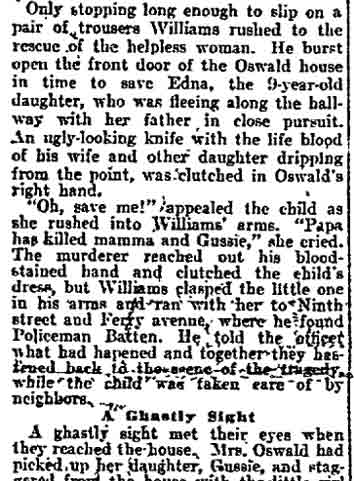
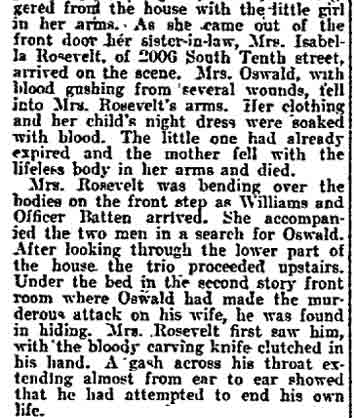
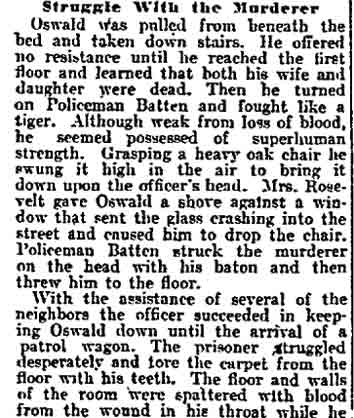
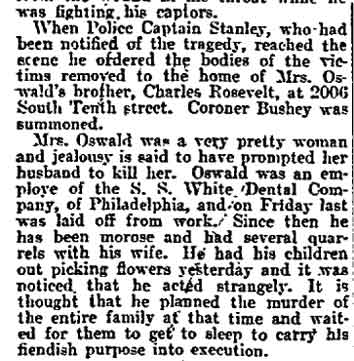
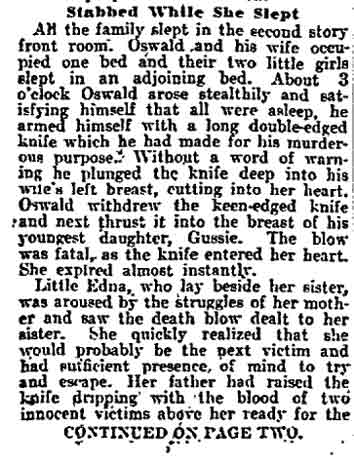
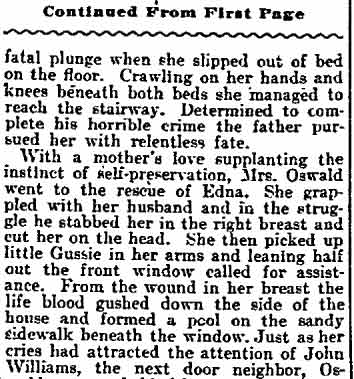
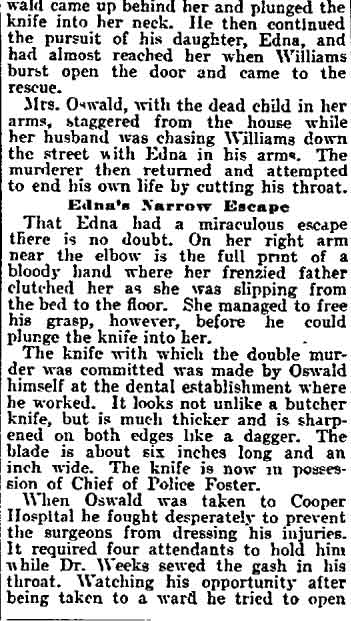
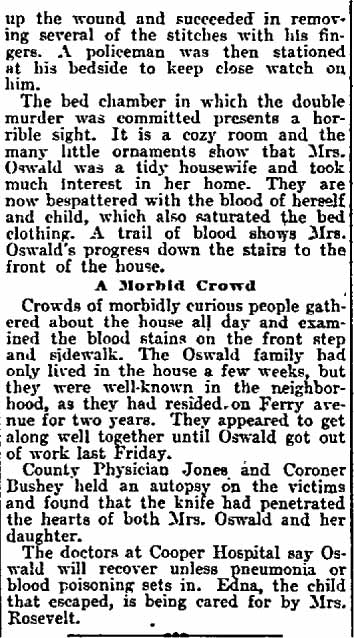
Named: Arthur Stanley, Edward Oswald, Alfred Batten, John Foster, John Williams, Dr. William S. Jones, Dr. Sylvan G. Bushey, Jefferson Street, South 10th Street, Cooper Hospital, and PDF of complete article.
A Judge and Policy
Philadelphia Inquirer —
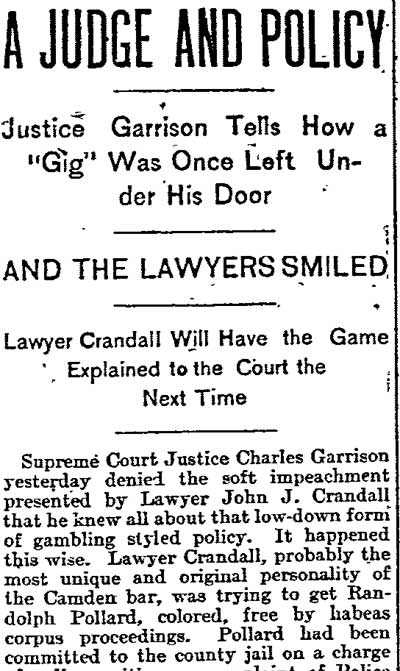
A JUDGE AND POLICY
Justice Garrison Tells How a “Gig” Was Once Left Under His Door
AND THE LAWYERS SMILED
Lawyer Crandall Will Have the Game Explained to the Court the Next Time
Supreme Court Justice Charles Garrison yesterday denied the soft impeachment presented by Lawyer John J. Crandall that he knew all about that low-down form of gambling styled policy. It happened this wise. Lawyer Crandall, probably the most unique and original personality of the Camden bar, was trying to get Randolph Pollard, colored, free by habeas corpus proceedings. Pollard had been committed to the county jail on a charge of policy writing on complaint of Police Captain Stanley. The lawyer warmly argued that his client should be released at once because he had not been given a hearing. It was not right, he said, to commit a man to jail merely on the oath of some one.
“Now, your Honor is acquainted with the intricacies of policy,” confidently remarked Lawyer Crandall.
“Oh, no, I’m not,” good-humoredly replied Judge Garrison. “I don’t know a thing about the game, but I lived in a house once numbered 444, and one day somebody left a slip in the door, I think they called it the ‘policy gig,’ but why left it in my door I can’t tell, unless it was on account of the seductiveness of the number.”
The lawyers present smiled, and Mr. Crandall forgot to go on with his line of argument. The case went over until next Wednesday, when Lawyer Crandall will have witnesses present to tell Judge Garrison all about policy.
Chinese Puzzle
Philadelphia Inquirer —
CHINESE PUZZLE
Camden Police Could Not Decipher an Alleged Policy Slip
FOUND IT ON TACK SING
Prisoner's Friend Explained That the Mysterious Slip Was a Chinese Doctor's Prescription
Tack Sing, a Chinese laundryman of Seventh and Mt. Vernon streets, Camden, was arrested yesterday on a charge of policy writing. He was taken on the street by Policeman Moore. Captain Stanley declares that this paper top was found on Tack Sing. He is covered with Chinese hieroglyphics and Captain Stanley declared that the paper top was found on the defendant. There was also a big roll of bank bills on him and the 55 cents was the amount played.
For the past six weeks Captain Stanley has been trying to get evidence that would cause the arrest of Tack Sing. He finally secured evidence that caused him to send a detective to watch the laundry. He declares, however, that he has nothing against the other Chinamen in Camden. In fact, the only Chinaman in Camden against whom he has a count is Tack Sing. Captain Stanley had Sing arraigned before Recorder Nowrey. Neal, a colored draysman told Detective Hart stood for 55 cents, he said, and played the numbers, “da numbers of crackers,” remarked Recorder Nowrey.
He said the alleged policy slip found on the defendant was a Chinese doctor’s prescription, not a policy slip. Recorder Nowrey held Tack Sing at hearing.
Police Win Again
Philadelphia Inquirer —
POLICE WIN AGAIN
Camden Trolley Company’s Latest Attempt at Track-Laying Easily Stopped
TROLLEY MEN ARRESTED
Mayor Hatch Rushed Out and Ordered Police to Clear the Street—Strategy That Was Not Successful
The Camden and Suburban Railway Company’s latest attempt to lay an additional track on Haddon avenue, Camden, was not a success. Their men were easily routed by the police yesterday. George Danks, foreman of a gang of laborers, and Willis Godfrey, colored, took picks and attempted to tear up the concrete foundation on the street, but were arrested and held for further hearings next Thursday. It is probable that the courts will be appealed to before the attempt to lay tracks on Haddon avenue is renewed.
During the clash with the city authorities yesterday General Manager Walter E. Harrington, of the trolley company, was present with a stenographer, and the latter made notes of all that was said and done. Mr. Harrington admitted that this was for the purpose of commencing legal proceedings.
Nearly 1600 people collected along Haddon avenue early yesterday morning in anticipation of a clash between the police and trolley employes. Mayor Hatch and Chief of Police Foster were on the scene by 6 o’clock. They had a large detail of policemen on hand to prevent any attempt to lay rails on the street. About a square away over 100 laborers and as many carts were gathered at the trolley company’s car barn.
Strategy
The opposing leaders looked over the ground carefully and mapped out plans of action. Everybody was on the qui vive for an outbreak of hostilities. The police guard, however, looked so formidable that the trolley forces had recourse to strategy. Picking out about fifty of the old employes of the company they were sent into the car barn under cover. The rest of the laborers were told to hand in their time cards and were then dismissed for the day. They were told that work would not be begun until to-day.
The ruse worked well. Scouts for the police reported that operations had been suspended and no work would be done until to-day. Mayor Hatch and Chief Foster returned to their offices at the City Hall, some of the policemen were sent back to their beats in the different wards, which had been left unprotected while they were on duty on Haddon avenue. The crowd of spectators dispersed.
About a half hour later, when everything was quiet, about 50 men and carts sallied from the car barn. The men had picks, shovels and railroad ties. A rush was made for Haddon and Newton avenues. A watchful police saw the trolley company’s flying force and quickly passed the word along the line. A messenger was dispatched to City Hall to rout out Mayor Hatch and Chief Foster. They came rushing from the building and were quickly on the scene of action.
When the laborers arrived they found a platoon of police drawn up ready to receive them. The laborers were accompanied by General Manager Harrington, who had Stenographer Berry by his side. Wherever the general manager went the stenographer was with him taking notes of all that was said. Police Captain Stanley ordered the men to disperse.
“Captain,” said Mr. Harrington, “we propose to lay a double track on this street, in accordance with an ordinance granting a franchise to the West Jersey Traction Company.”
“Well, I’m here to stop you,” said the doughty little captain.
“Under whose orders?” was asked.
“Under orders from my superior,” replied the captain.
“Very well,” said Mr. Harrington, and turning to one of his foremen he ordered him to take the men back to the barn.
Defeat
While this colloquy was going on Foreman Danks and Willis Godfrey got their work in. Taking picks they drove them into the concrete foundation for the asphalt pavement. Before a second stroke could be made two policemen walked up and arrested the pick wielders.
“I protest against the illegal arrest of those men,” exclaimed Manager Harrington to Mayor Hatch. He repeated this several times before the Mayor paid any attention to him. Finally, turning to the general manager Mayor Hatch asked:
“Have you a permit to tear up this street?”
“No, sir,” answered Mr. Harrington.
“Then, Chief, clear the street,” ordered the Mayor, addressing Chief of Police Foster.
A charge was made on the crowd and General Manager Harrington and his stenographer were hustled to the sidewalk together with the laborers.
Foreman Danks and Godfrey were taken before Recorder Nowrey and held in $50 bail for a further hearing next Thursday.
The trolley company’s next move will probably be made in the courts.
Camden’s Trolley Fight
New York Herald-Tribune —
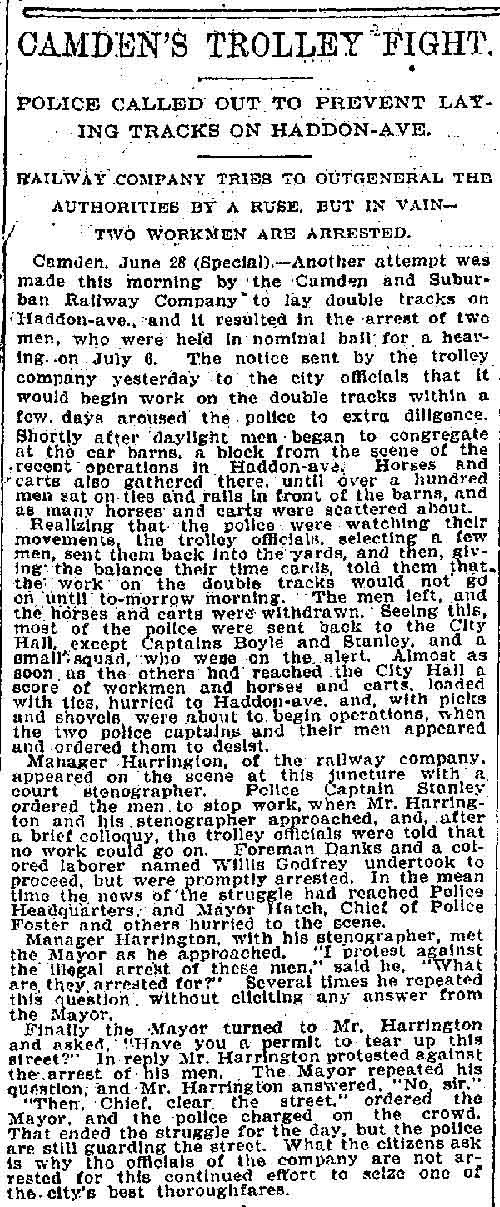
CAMDEN’S TROLLEY FIGHT
Police Called Out to Prevent Laying Tracks on Haddon Avenue
Railway Company Tries to Outgeneral the Authorities by a Ruse, But in Vain—Two Workmen Are Arrested
Camden, June 28 (Special).—Another attempt was made this morning by the Camden and Suburban Railway Company to lay double tracks on Haddon avenue. The notice sent by it to the men, who were in nominal bail for a hearing on July 6, was disregarded. Shortly after daylight men began to congregate at the stables of the company on Newton avenue. About 5 o’clock men began to work on the double tracks within a few hundred feet of the stables. So many horses and carts were scattered about the avenue that it was difficult to tell the Constable to turn them. Mayor Hatch’s secretary stood by noting thereby that the company was infringing on its franchise.
Manager Harrington, of the railway company, came out shortly and a brief colloquy, the trolley officials were told that the work must cease. A policeman named Willis Godfrey undertook to act as watchman, too. The police were on the alert. Almost as many horses and carts and teams of workers and shovels were about to begin work on the double tracks. Then Attorney Harrington, of the railway company, was committed to court with stenographer. Police Captain Stanley told the trolley officials that the mayor would order the police to prevent the work while the Excise Commission appointed by the governor was in town. Going on in his plea Captain Stanley also spoke of a personal interview the state defendant as to fact true and said that the mayor, after consulting the city attorney, directed that work be stopped. The state defendant told the court to give judgment in his favor. The court, declining to do so, and directed that work to be stopped.
The Mayor turned to Mr. Harrington and asked, “Have you a permit to tear up this street?” Harrington answered, “No, sir,” but said he had the permission of the Mayor, and the police charged on the crowd. Just then a constable hurried up with a warrant, but the mayor ordered that work be stopped. The police are still guarding the street.
Two men, George Danks and Willis Godfrey, were arrested as workmen working for the railway company.
Wife in Peril
Philadelphia Inquirer —
WIFE IN PERIL
Attacked by Husband, Rescued by Police Captain
William Knox, a hackman, was arrested last evening charged with assaulting his wife, Jennie Knox, of 810½ Broadway, Camden. Knox has been separated from his wife, and yesterday afternoon, it is alleged, he visited her home and tried to force her to drink a bottle of horse medicine, threatening to slash her with a knife. Last evening Knox returned to the house, and breaking in the door renewed the attack on his wife. Police Captain Stanley, attracted by her cries for help, took Knox into custody.
Evil Doers Quake
Philadelphia Inquirer —

EVIL DOERS QUAKE
Mayor Hatch, of Camden, Starts in to Wipe Out Speak-Easies
FIRST RAID A SUCCESS
Fines Imposed by Recorder Nowrey for Operating Gambling Machines. Sunday Sellers Hope to Escape
Mayor Cooper B. Hatch is making life miserable for evil doers in Camden. After waging relentless warfare on Sunday liquor sellers and seizing all the gambling machines in saloons and cigar stores, he is now clearing out speak-easies. The first raid was made yesterday afternoon, when Captain Stanley, Sergeant Hyde, Detective Painter and Policeman Shaw swooped down on Mrs. Mary Mahan’s house, at 1062 South Front street. They found nearly enough liquor there to stock a saloon. There were two cases of bottled beer, five gallons of whisky, a large quantity of California wines, and other “wet” goods. This was all confiscated and was sent to the City Hall, together with Mrs. Mahan and a young girl.
For some time past Mayor Hatch’s private detectives have been gathering evidence against speak-easies and disorderly houses in different parts of the city, and several more arrests will be made.
The saloonkeepers arrested about ten days ago for operating slot machines in their places were arraigned yesterday before Recorder Nowrey. Maurice Hertz, of Locust street and Kaighn avenue, was the first to be tried. He was represented by former Judge Howard Carrow. The complaints against Hertz charged him with operating nickel-in-the-slot gambling machines on July 2 and 9.
Harry Williams, one of Secretary Gibboney’s detectives, who was employed in the recent Sunday liquor crusade, testified that he played “The Owl” in Hertz’s saloon on July 9. He lost five cents on the red but hit the black and quit even. On cross-examination Williams refused to tell by whom he was employed, and Recorder Nowrey would not compel him to answer. Detective Fields swore that he was with Williams in Hertz’s place, and also played the slot machine. Police Captain Stanley said he found four of the slot machines in Hertz’s place when he made the raid.
At this point Judge Carrow moved to dismiss the complaint, as it was dated in the year “189.” Decision was reserved, and the other complaint was taken up. Judge Carrow wanted this set aside on the ground that it did not specify the premises where the law was alleged to have been violated. Recorder Nowrey overruled the motion.
Detective Graper said he played the slot machine at Hertz’s saloon on Sunday, July 2. On cross-examination he refused to give his address, but said he worked for Mayor Hatch. He didn’t know, he said, whether he was on the city pay roll.
David B. Kaighn and other Kaighn avenue residents testified that they never saw slot machines in operation in Hertz’s place, but had seen them standing in the office.
Hertz, in his own defense, said he was agent for the slot machines, and those found in his office were samples to be examined by prospective purchasers.
Recorder Nowrey sentenced Hertz to pay a fine of $50 and costs. Judge Carrow gave notice that he would appeal the case, but the Recorder refused to permit Hertz to depart without paying the fine.
Peter Kelly, of Eighth street and Ferry avenue, was also convicted and paid his fine.
John Keefe, of Haddon avenue and Carman street, and Marshall Hutchinson, of Ninth and Walnut streets, pleaded guilty and were fined $50 and costs each. There were about seven more cases, which Recorder Nowrey adjourned until next Wednesday.
The 130 saloonkeepers rounded up in the recent crusade against Sunday liquor selling were in high glee yesterday over the discovery of a law that they hoped would save them from punishment for their alleged misdoings. This law was passed in 1874, and makes it unlawful to prosecute any person by indictment for violations of the liquor laws in municipalities where city ordinances provide punishment for such offenses. As the Supreme Court has set aside the Camden excise ordinance, the saloonkeepers hoped to escape further prosecution.
City Counsel Bleakly, after looking up the matter yesterday, said: “A house in which the unlawful sale of liquors is habitually made is an indictable nuisance, although there is a city ordinance prescribing penalty for such sales. Such traffic is not only a breach of the city law, but is also forbidden by the State law.” This decision was made by Judge Van Syckel in 1880, in the Court of Errors and Appeals, and was reaffirmed in 1888. It is now a State law.
The Excise Commission, at its regular meeting next Wednesday evening, will probably adopt a substitute ordinance against Sunday liquor selling to conform to the city charter, under the Supreme Court’s decision setting aside the old ordinance.
Camden Mystery More Involved
Philadelphia Inquirer —
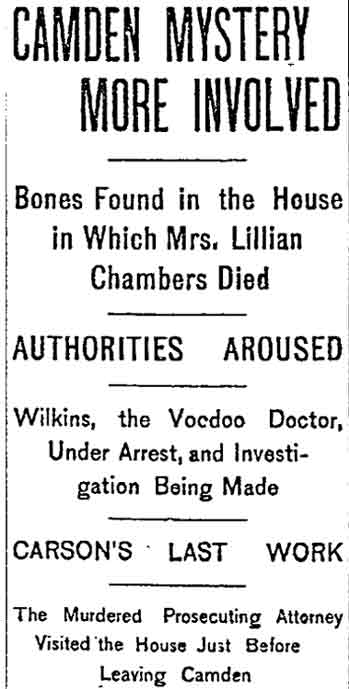
Bones Found in the House in Which Mrs. Lillian Chambers Died
AUTHORITIES AROUSED
Wilkins, the Vocdoo Doctor, Under Arrest, and Investigation Being Made
CARSON’S LAST WORK
The Murdered Prosecuting Attorney Visited the House Just Before Leaving Camden
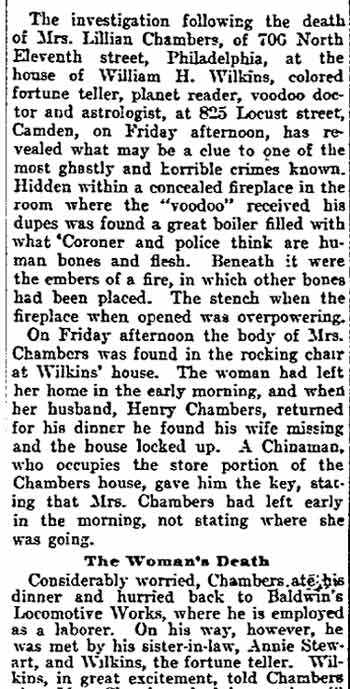
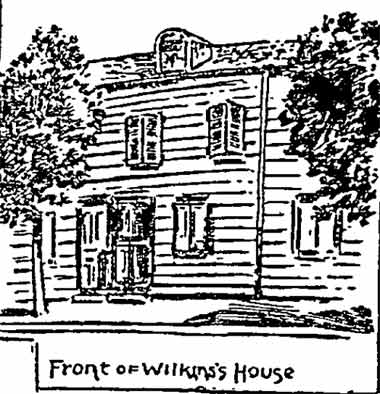
The investigation following the death of Mrs. Lillian Chambers, of 706 North Eleventh street, Philadelphia, at the house of William H. Wilkins, colored fortune teller, planet reader, voodoo doctor and astrologist, at 825 Locust street, Camden, on Friday afternoon, has revealed what may be a clue to one of the most ghastly and horrible crimes known. Hidden within a concealed fireplace in the room where the “voodoo” received his dupes was found a great boiler filled with what Coroner and police think are human bones and flesh. Beneath it were the embers of a fire, in which other bones had been placed. The stench when the fireplace when opened was overpowering.
On Friday afternoon the body of Mrs. Chambers was found in the rocking chair at Wilkins’ house. The woman had left her home in the early morning, and when her husband, Henry Chambers, returned for his dinner he found his wife missing and the house locked up. A Chinaman, who occupies the store portion of the Chambers house, gave him the key, stating that Mrs. Chambers had left early in the morning, not stating where she was going.
The Woman’s Death
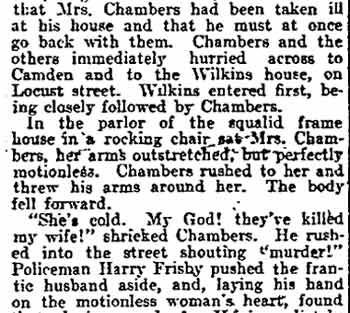
Considerably worried, Chambers ate his dinner and hurried back to Baldwin’s Locomotive Works, where he is employed as a laborer. On his way, however, he was met by his sister-in-law, Annie Stewart, and Wilkins, the fortune teller. Wilkins, in great excitement, told Chambers that Mrs. Chambers had been taken ill at his house and that he must at once go back with them. Chambers and the others immediately hurried across to Camden and to the Wilkins house, on Locust street. Wilkins entered first, being closely followed by Chambers.
In the parlor of the squalid frame house in a rocking chair sat Mrs. Chambers, her arms outstretched, but perfectly motionless. Chambers rushed to her and threw his arms around her. The body fell forward.
“She’s cold. My God! they’ve killed my wife!” shrieked Chambers. He rushed into the street shouting “murder!” Policeman Harry Frisby pushed the frantic husband aside, and, laying his hand on the motionless woman’s heart, found that she was dead. He immediately placed all in the house under arrest.
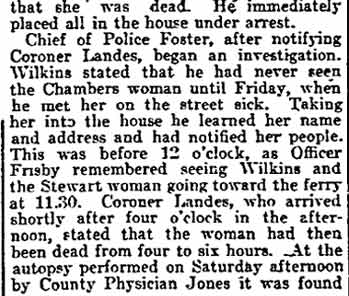
Chief of Police Foster, after notifying Coroner Landes, began an investigation. Wilkins stated that he had never seen the Chambers woman until Friday, when he met her on the street sick. Taking her into the house he learned her name and address and had notified her people. This was before 12 o’clock, as Officer Frisby remembered seeing Wilkins and the Stewart woman going toward the ferry at 11.30. Coroner Landes, who arrived shortly after four o’clock in the afternoon, stated that the woman had then been dead from four to six hours. At the autopsy performed on Saturday afternoon by County Physician Jones it was found that death was due to a criminal operation.
A Ghastly Find
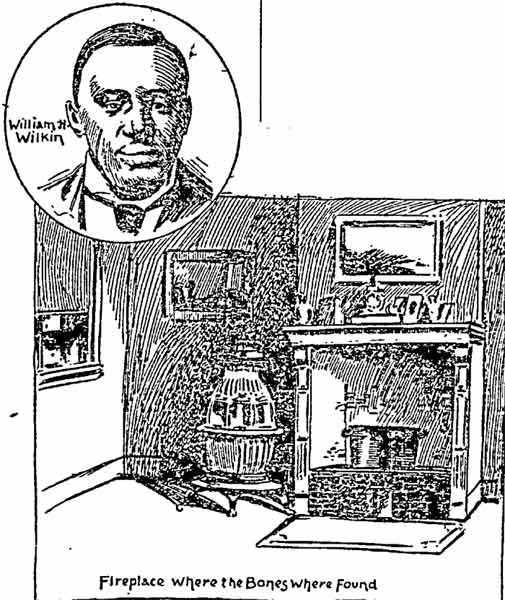
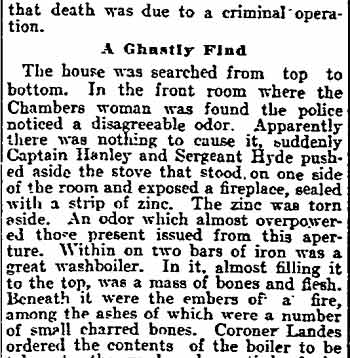
The house was searched from top to bottom. In the front room where the Chambers woman was found the police noticed a disagreeable odor. Apparently there was nothing to cause it, suddenly Captain Hanley and Sergeant Hyde pushed aside the stove that stood on one side of the room and exposed a fireplace, sealed with a strip of zinc. The zinc was torn aside. An odor which almost overpowered those present issued from this aperture. Within on two bars of iron was a great washboiler. In it, almost filling it to the top, was a mass of bones and flesh. Beneath it were the embers of a fire, among the ashes of which were a number of small charred bones. Coroner Landes ordered the contents of the boiler to be taken to the yard and emptied of the liquid, which was over them and which seemed to be some pickling fluid. As they were placed in another receptacle he was struck by their resemblance to human bones. He immediately ordered them taken to the Morgue. Yesterday Captain Stanley, Sergeant Hyde and the Coroner all reiterated their impression that the bones were those of human beings.
Wilkins was questioned as to their nature. He said that it was an opossum that he had been cooking. And that was all he would say. His daughter, Louisa, was then questioned. She denied all knowledge of any bones being in the house. They had never had any opossum to cook, she told Chief of Police Foster.
Carson’s Last Act
Strangely enough the investigation which resulted in the ghastly find was started by Assistant Prosecutor Carson before he left to take part in the reception to General Sewell. An Inquirer reporter noticing him leaving the room frequently, in which the body of Mrs. Chambers was found asked him what his reason was for so doing? He replied, “There is such a peculiar smell that I cannot stay in that room any length of time.”
“Do you think it comes from the body of Lillian Chambers?” asked the reporter. “I do not and I have given strict orders to have the house thoroughly searched by the police, and I expect they will find evidence of a murder,” was his reply. Before leaving he left his address at Belmar with Chief Foster, with instructions to notify him at once if a find was made. Chief Foster heard of Mr. Carson’s death shortly after the discovery of the remains in the washtub.
Coroner Landes when seen yesterday expressed his intention of securing the services of Dr. Deever, the celebrated anatomist of the University of Pennsylvania, to examine the bones.
“I do not wish to trust to my own impression,” he said, “and will have Dr. Deever and probably another expert examine the bones The odor from them was simply indescribable. They had probably been hidden in the fireplace for weeks.”
Both Captain Stanley and Sergeant Hyde also spoke of their impression that the bones were of human beings, but had been instructed to say nothing until after the examination.
Numbers of letters and photographs of women were found by the police. The contents of the letters they refuse to reveal until the inquest. Some of them, it was learned, however, were requests for spells to take away trouble, to bring back lovers or to put charms on others. A letter, which was found by an Inquirer reporter in the squalid parlor where the woman died, and the ghastly find was made, was from a Philadelphia woman, praying the “Dear doctor” to assist her lawyer by his charms in making her husband support her. There were others of like character. Just as soon as the bones found are in condition for examination, a rigid one will be made. It was in this same house that some time ago were found a number of baby’s bones.
When questioned Chambers denied to the police that he had ever known his wife to visit Camden, but the Stewart woman told them that Mrs. Chambers had made frequent trips across the river. The Wilkins house is closed and under the surveillance of the police.
[Illustration, captioned:] Front of Wilkins’s House
[Illustration, captioned:] William H. Wilkin
[Illustration, captioned:] Fireplace where the Bones where Found
Cleaning Out a Colored Dive
Philadelphia Inquirer —
CLEANING OUT
A COLORED DIVE
The Proprietress, a Colored Woman, Held in Heavy Bail
Eucecia Manor, a colored woman who runs a dive at Locust and Division streets, Camden, was committed in default of $1000 bail by Recorder Nowrey yesterday on a charge of harboring minors in her house for immoral purposes. The police raided her place early Sunday morning and arrested the proprietress and a white girl named Mabel Schooley, who appears to be about 12 years of age, but claims to be 16 years old.
They were arraigned side by side in the Camden police court yesterday. Captain Stanley, who conducted the raid, had a number of witnesses on hand to prove the bad reputation of the place. Among these witnesses were three colored boys and a white boy, their ages ranging from 14 to 16 years. Other witnesses testified to revelries that were participated in by white and colored persons of both sexes.
Mrs. Mary E. Beckett, who resides nearby, swore that the defendant had enticed her 16-year-old daughter to the house and kept her there for six days. When the witness went to the house to get her daughter she was refused admission.
Recorder Nowrey sentenced the Schooley girl to thirty days’ imprisonment, and in the meantime efforts will be made to have her sent to the State Industrial School for Girls.
Eucecia Manor has a bad record. She has served two years in State Prison for stabbing her sister, and last April was sentenced to ninety days for disorderly conduct.
Captain Albert Stanley
Philadelphia Inquirer —
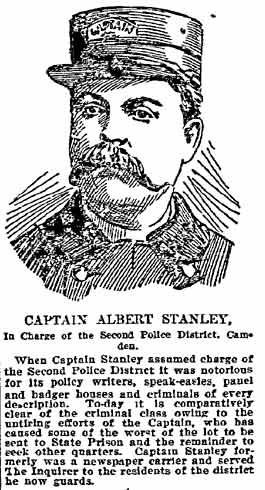
CAPTAIN ALBERT STANLEY,
In Charge of the Second Police District, Camden.
When Captain Stanley assumed charge of the Second Police District it was notorious for its policy writers, speak-easies, panel and badger houses and criminals of every description. To-day it is comparatively clear of the criminal class owing to the untiring efforts of the Captain, who has caused some of the worst of the lot to be sent to State Prison and the remainder to seek other quarters. Captain Stanley formerly was a newspaper carrier and served The Inquirer to the residents of the district he now guards.
Randall Pollard Arrested for Policy Slips
Philadelphia Inquirer —

Arthur Stanley — Randall Pollard
Two Charged With Policy Writing
Philadelphia Inquirer —
Two Charged With Policy Writing
Charles H. Green, a storekeeper at Tenth and Kaighn avenue, Camden, was arrested in his store last night by Police Captain Stanley on a charge of violating the policy laws. When searched at the City Hall a lot of policy slips and drawings were found on him. Green was formerly a clerk in the Water Department and a well known Democratic politician. Captain Stanley also arrested Albert Matchett, colored, at Front and Kaighn avenue on a similar charge. Both will be given a hearing by Recorder Nowrey to-day.
Police in a Church
Philadelphia Inquirer —
POLICE IN A CHURCH
Camden Guardians of the Peace Attend Divine Service
Chief of Police John Foster, Captains Stanley, Boyle and Alberts, seventy policemen and Colonel D. B. Murphy, the police drill instructor, marched in a body from the Third Regiment Armory in Camden to Broadway M. E. Church last evening to attend divine service. A number of city firemen, trolley conductors and motormen were also in attendance. The pastor, Rev. James W. Marshall, D. D., preached on “Immortality.”
At the First Presbyterian Church last evening Rev. W. H. Fishburn, D. D., gave his second talk to bread-winners. His subject was “The Age of Hurry.”
Mr. Bipin Chandra Pal, of India, spoke at North Baptist Church last evening on “Life and Reforms in British India.”
Madame Lavah Barrakat, a Syrian woman, delivered an address at First M. E. Church last evening.
Members of the Ancient Order of United Workmen last evening attended the Eighth Street M. E. Church.
Pastor Lilley, of Trinity M. E. Church, last evening preached a special sermon to the Union Veteran Legion.
Police Take a Hand at the Primaries
Philadelphia Inquirer —
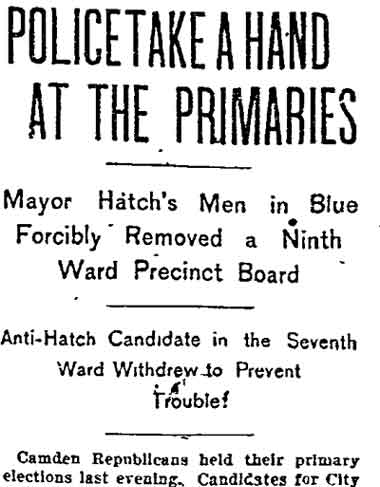
Mayor Hatch’s Men in Blue Forcibly Removed a Ninth Ward Precinct Board
Anti-Hatch Candidate in the Seventh Ward Withdrew to Prevent Trouble!
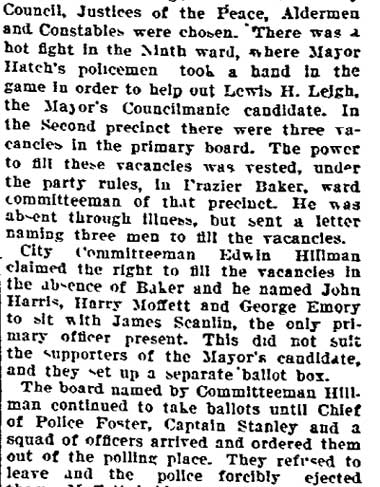
Camden Republicans held their primary elections last evening. Candidates for City Council, Justices of the Peace, Aldermen and Constables were chosen. There was a hot fight in the Ninth ward, where Mayor Hatch’s policemen took a hand in the game in order to help out Lewis H. Leigh, the Mayor’s Councilmanic candidate. In the Second precinct there were three vacancies in the primary board. The power to fill these vacancies was vested, under the party rules, in Frazier Baker, ward committeeman of that precinct. He was absent through illness, but sent a letter naming three men to fill the vacancies.
City Committeeman Edwin Hillman claimed the right to fill the vacancies in the absence of Baker and he named John Harris, Harry Moffett and George Emory to sit with James Scanlin, the only primary officer present. This did not suit the supporters of the Mayor’s candidate, and they set up a separate ballot box.
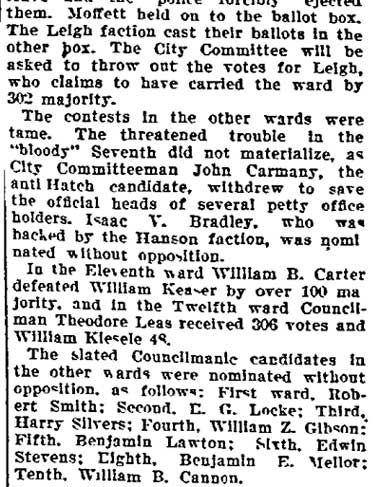
The board named by Committeeman Hillman continued to take ballots until Chief of Police Foster, Captain Stanley and a squad of officers arrived and ordered them out of the polling place. They refused to leave and the police forcibly ejected them. Moffett held on to the ballot box. The Leigh faction cast their ballots in the other box. The City Committee will be asked to throw out the votes for Leigh, who claims to have carried the ward by 302 majority.
The contests in the other wards were tame. The threatened trouble in the “bloody” Seventh did not materialize, as City Committeeman John Carmany, the anti Hatch candidate, withdrew to save the official heads of several petty office holders. Isaac V. Bradley, who was backed by the Hanson faction, was nominated without opposition.
In the Eleventh ward William B. Carter defeated William Keaser by over 100 majority, and in the Twelfth ward Councilman Theodore Leas received 306 votes and William Klesele 48.
The slated Councilmanic candidates in the other wards were nominated without opposition, as follows: First ward, Robert Smith; Second, E. G. Locke; Third, Harry Silvers; Fourth, William Z. Gibson; Fifth, Benjamin Lawton; Sixth, Edwin Stevens; Eighth, Benjamin E. Mellor; Tenth, William B. Cannon.
Fortune Teller Sentenced
Philadelphia Inquirer —
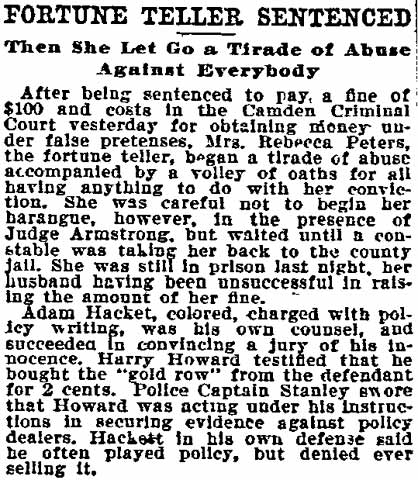
Fortune Teller Sentenced
Then She Let Go a Tirade of Abuse Against Everybody
After being sentenced to pay a fine of $100 and costs in the Camden Criminal Court yesterday for obtaining money under false pretenses, Mrs. Rebecca Peters, the fortune teller, began a tirade of abuse accompanied by a volley of oaths for all having anything to do with her conviction. She was careful not to begin her harangue, however, in the presence of Judge Armstrong, but waited until a constable was taking her back to the county jail. She was still in prison last night, her husband having been unsuccessful in raising the amount of her fine.
Adam Hacket, colored, charged with policy writing, was his own counsel, and succeeded in convincing a jury of his innocence. Harry Howard testified that he bought the “gold row” from the defendant for 2 cents. Police Captain Stanley swore that Howard was acting under his instructions in securing evidence against policy dealers. Hackett in his own defense said he often played policy, but denied ever selling it.
Raid Over in Camden
Philadelphia Inquirer —
Raid Over in Camden
Police Captain Stanley and Sergeant Hyde, with a squad of officers, arrested two alleged disorderly houses on Pine street above Tenth, Camden, last night. The reputed proprietors, Charles Smith and Mary Bennett, together with thirteen inmates, were taken into custody and locked up for a hearing to-day.
Camden Policemen Raid a Sunday Liquor Seller
Philadelphia Inquirer —
CAMDEN POLICEMEN RAID A SUNDAY LIQUOR SELLER
Swoop Down on a Saloon Where Three Men Were About to Quench Their Thirst With Foaming Lager Beer. Other Violations Reported
Despite the vigorous crusade of the Camden County Law and Order League and the heavy penalty imposed by Judge Armstrong last week, when he sentenced several Camden saloonkeepers to State prison and the county jail for Sunday liquor selling, some liquor dealers continued to violate the law and defy the authorities yesterday. The police were on the alert, and swooped down on one saloon, where they said they found several men about to quench their thirst with beer. The place raided was the saloon of Henry Hayes, at 824 South Third street.
The raid was made by Captain Stanley, Sergeant Hyde and Policemen Cunningham, Nowrey, Weaver and Harvey, on a warrant issued by Justice Stackhouse, on complaint of Mrs. Ida Buckingham, of 25 North Second street, a member of the Salvation Army. The proprietor, Robert Forbes, John McKenna and William Ivins, who were in the barroom at the time, were taken in custody. Hayes was given a hearing at once by Justice Stackhouse. It was testified that on July 8 James Buckingham, husband of the complainant, went into Hayes’ saloon and bought several glasses of beer. When he got ready to leave Hayes declined to let him go, saying the police were watching on the outside. Buckingham swore he was kept a prisoner for over two hours.
“Judge, can’t I sue Hayes for falsely imprisoning my husband?” asked Mrs. Buckingham, at this point.
Captain Stanley was then sworn, and testified that he saw six colored men come out of Hayes’ gate while he was waiting for an opportunity to make the raid, and then McKenna, Forbes and Ivins went in and he followed them. This was a signal to the policemen in waiting, who jumped an adjoining fence, and, pushing their way by the person tending the back door. When they entered Hayes was back of the bar. Captain Stanley said Hayes had three glasses of beer in his hand, and placed them in front of the men just as the policemen came in.
“I got between the men and the beer and the officers took charge of the barroom,” said Captain Stanley. “I know it was beer because I tasted it. That is something I have not done for over twenty years.”
Sergeant Hyde and the policemen corroborated Captain Stanley as to the facts of the raid and two of the policemen testified that it was beer which Hayes placed on the counter.
When McKenna, Forbes and Ivins were asked if they had anything to say Mrs. Hayes tried to stop them from testifying. Chief of Police Foster threatened her with arrest and as she would not desist he put her out of the hearing room. McKenna was the only one of the three to testify. He said he ordered the beer, but did not have time to pay for it before the policemen came in. Hayes denied selling beer to Buckingham on July 8.
Captain Stanley then made a charge against Hayes of selling liquor yesterday and he pleaded not guilty. He was committed in default of $500 bail. The other three prisoners were held in their own recognizance to appear when wanted as witnesses.
Over in Camden
Philadelphia Inquirer —
OVER IN CAMDEN
The Public Library Committee of City Council appropriated $500 last night to the Free Library Association for the purchase of new books.
Salonkeeper [sic] William F. Sands, of Haddon avenue and Line street, was fined $10.75 by Recorder Nowrey yesterday for using abusive language to Police Captain Stanley.
Free rural mail delivery in Camden county has received the approval of Colonel M. W. Sawyer, special agent of the general postoffice, and, it is said, he has recommended John W. Cox, of Merchantville, as the carrier.
Thomas E. Mason, of 507 Arch street, died yesterday morning of cancer of the throat. He was 83 years of age and some years ago was a policeman under Mayor Budd, but for twenty-five years has been a private watchman on Cooper street.
Elizabeth Haines, white, aged 31 years, was married to Burrell Bland, colored, aged 61 years, by Justice Colding, of Camden, on Tuesday night. The bride gave her residence as Philadelphia, while the groom said he had conducted a small farm near Woodbury for many years. Neither had been married before.
Bad Gas and Ugly Poles Stir Camden Citizens
Philadelphia Inquirer —
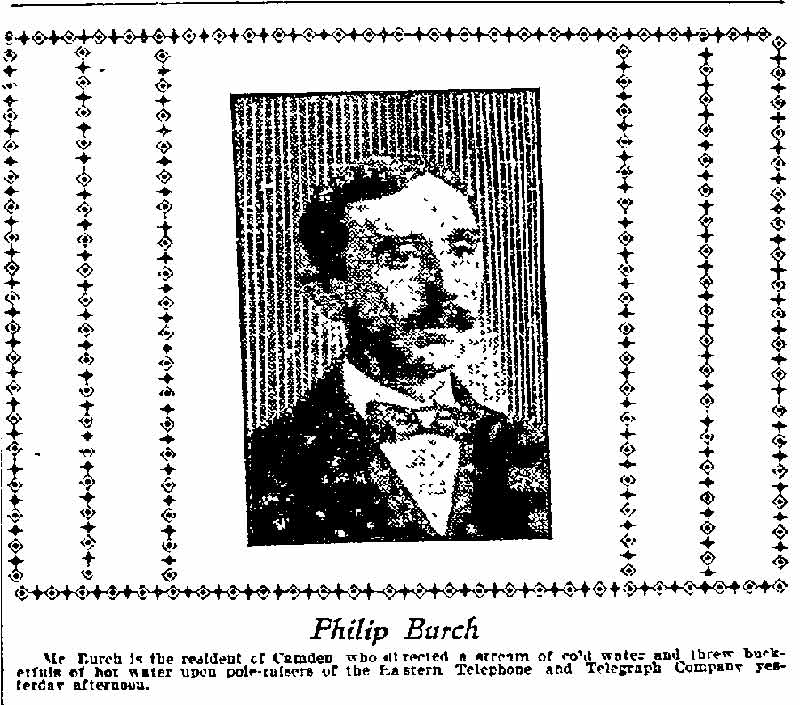
While They Must Submit to the Former, They Will Move Against the Latter in City Councils To-night.
Another Small-Sized Riot
Go where you will in Camden you hear nothing but complaints about bad gas, almost equally as bad electric lights and violent protests against the operations of the new telephone company that seems to think it has a right to rear its unsightly poles anywhere it seems fit, clearly in defiance of the law that declares the consent of property holders must first be had. And Camden people declare there is a peculiar relation existing between these gas, electric, trolley and telephone concerns that will not require much investigation to find certain prominent citizens identified in one way or the other with all of them.
Words of comment were heard on all sides in Camden yesterday on the report published in The Inquirer giving the situation regarding complaints against the bad quality of gas and the exorbitant prices charged.
The indignation of gas consumers can hardly be more pronounced than that of the property owners against the Eastern Telephone and Telegraph Company for its methods of raising poles. This part of the controversy reached a climax, and to-night the immediate revocation of the company’s franchise will be demanded of Camden’s City Council. This demand will be backed by an organization of property-owners, led by Philip Burch, a prominent young business man, of 510 Broadway.
Small-Sized Riot
The organization of property-owners was brought about by the brave manner in which Mr. Burch, with the aid of a stream of cold water and buckets of hot water, endeavored to repel the company’s gang of pole-raisers in front of a house adjoining his home yesterday. The workmen managed to get the pole up on the pavement in front of the house of Wilbur Carhart, at 512 Broadway, but while Mr. Burch was protesting verbally and with water in behalf of Mrs. Carhart, there was a violent collision between the workmen and Mr. Burch, who was aided by some of his neighbors. Police Captain Stanley separated the combatants and three workmen, namely, Maurice Gandy, Thomas Mooney and Frank Yorley, were arrested on the complaints of Mr. Burch, George Lezenby and William C. Davis, and taken to the City Hall, where they were afterwards released on security for a hearing before Recorder Nowrey to-day.
Mr. Burch said last night: “The property-owners who have voluntarily joined me in this matter will apply to-morrow for writs of injunction by the dozen to restrain the company from proceeding with its outrageous methods. The pole in front of Carhart’s, and many others, will come down. Mark that!”
Mr. Coles on the Watch
Between guarding against the planting of an unsightly pole in front of his residence, at 419 North Fourth street, and putting up with feeble gas at vigorous prices, George W. Coles, the well-known confectioner, on Market street, Philadelphia, is having his own troubles. It is safe to predict the pole will not go up if Mr. Coles is about at the beginning of operations, for it was only a short time ago when the Eastern Telephone Company attempted to plant the pole in front of his house he armed himself with a good-sized spade, filled up the hole and defied the workmen, who beat a retreat. The pole is there, but it stretches snake-like alongside the curb.
But with the gas business it’s different. “That meter will come out of my house,” said Mr. Coles yesterday, “and that is all there is about it. My bill for last September and October was greater than the three months previous. Besides the gas is bad, but what are you going to do about it? The electric lights are also poor and the crowd runs both. They come around to my house and try to plant a pole. I suppose they do that as a standoff for the privilege of permitting them to charge me an exorbitant price for gas. But you will observe that pole is not yet up, and there will be something doing if any attempt is made to plant it.”
Inspector Tripped Up
Martin J. O’Brien, the well-known undertaker at 613 Market street, is among the army of people who have made a vigorous protest against paying big prices for a bad quality of gas and gone away with the if-you-don’t-like-it-quit satisfaction. “Have I any complaint?” said Mr. O’Brien. “Well, rather. But what’s the use? I have been down to the office, but could get no satisfaction. As an illustration of how they charge you for a flimsy gas let me tell you this: For the three summer months—say July, August and September—I had a gas range and had lights burning in both the office and dwelling part of my house, for which I received a bill for $15.30. It was high, and I protested, but that was the end of it. My sisters, who live at 561 Carman street, rarely paid more than $6 a quarter, but when they received their bill for the months I speak of it was $15.30—theirs a private residence and mine, you might say, a business place.
“What was the result? I sent around to their house an expert who inspected the meter and said, just $6.20 worth of gas had been consumed. I reported the matter to the office. They said they would send somebody around to read the meter again. They did send around another man, who took out the metre. So there is the satisfaction you get.”
Robert H. Patton, paperhanger on Federal street below Broadway, said: “My gas bills are one-third more than they used to be, yet the service is much inferior. The gas is of a bad quality. Why, only the other night I attended a little meeting in an office on Market street and we could scarcely see to transact business with three burners going right overhead. I tell you the people of Camden are justified in registering this ‘kick,’ and not the least aggravating part of it is the fact that every consumer is obliged to pay 50 cents a month, even if the house is closed up for that time. But there is no redress, so we are obliged to submit.”
Charles Markley, of 324 Elm, who is connected with a Dock street commission house, said: “I had about determined to let this gas company take out the meter, because my monthly bills are so far out of proportion to the quarterly bills I used to pay and by reason of the fact that the gas is poor at that. I have since concluded to give them another trial and see what that may bring forth. I tell you, the people cannot stand this much longer. I hear complaints on every side, and it is evident that something has to be done, and that soon.”
County Physician’s Complaint
Dr. W. S. Jones, the County Physician, is another victim. While his house was closed he got a big bill that almost stunned him. He went down to the gas office, or electric light office, or trolley office, as the case may be, and entered the usual protest, which was met with that telling argument: “If you don’t want to have it you can do without it.”
Richard Twelves, stationer at 4[illegible]3 Market street, said: “The light is very unsatisfactory and our bills are higher. Some friends from Philadelphia said, when they saw our Camden gas, that the company here was apparently using water in its process of making gas. We have thought of ordering the company to take out the meter here and at our home, substituting lamps. It is aggravating to be imposed upon and have no redress.”
William Vogt, florist, on Fourth street above Market, said: “The gas is very poor and some of the bills are positively funny. For the three months ending with September the company charged me $1 for gas in my house, despite the fact that I did not use a foot of gas in the house in all that time. The company now makes a charge of 50 cents for the use of the meter whether you use the gas or not, and I paid them 50 cents for October, although I did not use any gas in the house that month. I refused to pay the $1 and they have not pressed me for it.”
Philip Burch
Mr. Burch is the resident of Camden who directed a stream of cold water and threw bucketfuls of hot water upon pole-raisers of the Eastern Telephone and Telegraph Company yesterday afternoon.
Round-Up by Police Over in Camden
Philadelphia Inquirer —
Round-Up by Police Over in Camden
Vigorous Crusade Against Vice in a Down-Town District
Several Persons Were Captured in Raids and Held on Policy and Disorderly Charges
Police Captain Stanley, of Camden, began a crusade yesterday against alleged policy-writers and speak-easies in this district. With a squad of officers and fortified with warrants, sworn out by Charles W. Noyes, an agent of the Law and Order League, Captain Stanley raided the houses of Pearl Welcome, colored, at 914 South Third street, and Lizzie Purnell, colored, at Second and Division streets. The alleged proprietresses and several other persons were arrested and a quantity of policy paraphernalia was seized.
Charles Green, white, was arrested at Eighth street and Kaighn avenue, on a charge of being a “writer.”
Lizzie Purnell was committed to the county jail in default of $500 bail, on the policy charge, and $1000 bail on charges of maintaining a disorderly house and selling liquor without a license. Pearl Welcome was committed in default of $500 bail, and Green was held for a hearing to-day. All the warrants were issued by Justice Stackhouse.
Last evening Captain Stanley made another series of raids on warrants sworn out by Noyes before Stackhouse. The following were captured and committed to the county jail on the charges named: Maud Moore, alias Givens, 721 Baxter, selling without license; Jennie Wilson, alias Rose Mitchell, 721 Baxter, Sunday selling and selling without license; Mary Susan Jones, 703 Baxter, selling without license; William Lockman, 275 Spruce street, selling without license; John and Kate Eckert, 738 and 739 Sycamore street, disorderly house, Sunday selling and selling without license; Robert Mathews, 700 Sycamore street, Sunday selling and selling without license; Norman Simmons, 701 Baxter street, selling without license and Sunday selling; and Maggie Dilks, 703 Baxter street, selling without license.
The prisoners were committed in default of $500 bail on each charge.
Escapee Surrenders to Captain Stanley
Philadelphia Inquirer —
A man, about 40 years of age, who gave his name as Hugh Frier, formerly of the Seventeenth ward, Philadelphia, surrendered himself to Police Captain Stanley and Policeman Fitzsimmons yesterday, and stated he escaped from the Blockley Almshouse last Monday. He was sent to the City Hall.
Camden's Pride Parades Before City's People
Philadelphia Inquirer —
CAMDEN'S PRIDE PARADES BEFORE CITY'S PEOPLE
Policemen and Firemen Make Their Initial Turnout and Present a Creditable Appearance—Reviewed by Officials—How the Departments Have Grown
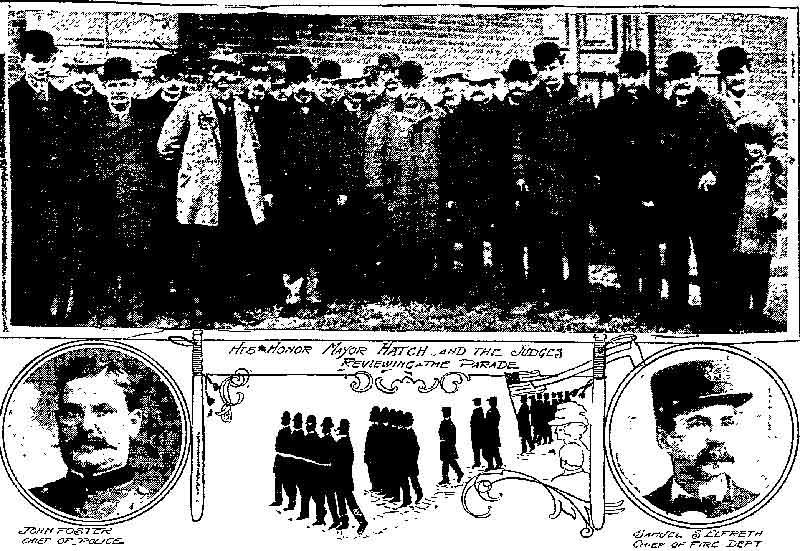
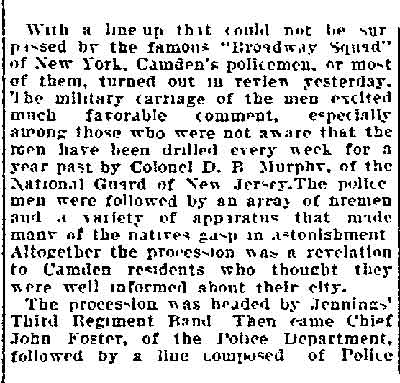
With a line up that could not be surpassed by the famous “Broadway Squad” of New York, Camden's policemen, or most of them, turned out in review yesterday. The military carriage of the men excited much favorable comment, especially among those who were not aware that the men have been drilled every week for a year past by Colonel D. B. Murphy, of the National Guard of New Jersey. The policemen were followed by an array of firemen and a variety of apparatus that made many of the natives gasp in astonishment. Altogether the procession was a revelation to Camden residents who thought they were well informed about their city.
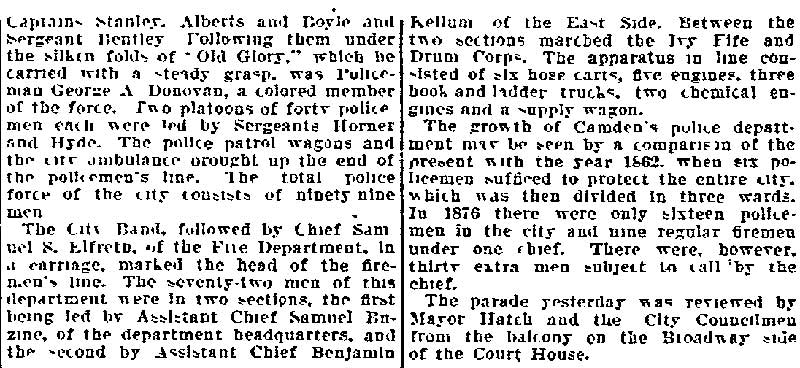
The procession was headed by Jennings' Third Regiment Band. Then came Chief John Foster, of the Police Department, followed by a line composed of Police Captains Stanley, Alberts and Doyle and Sergeant Bentley. Following them under the silken folds of “Old Glory,” which he carried with a steady grasp, was Policeman George A. Donovan, a colored member of the force. Two platoons of forty policemen each were led by Sergeants Horner and Hyde. The police patrol wagons and the city ambulance brought up the end of the policemen's line. The total police force of the city consists of ninety nine men.
The City Band, followed by Chief Samuel S. Elfreth, of the Fire Department, in a carriage, marked the head of the firemen's line. The seventy-two men of this department were in two sections, the first being led by Assistant Chief Samuel Buzine, of the department headquarters, and the second by Assistant Chief Benjamin Kellum of the East Side. Between the two sections marched the Ivy Fife and Drum Corps. The apparatus in line consisted of six hose carts, five engines, three hook and ladder trucks, two chemical engines and a supply wagon.
The growth of Camden's police department may be seen by a comparison of the present with the year 1862, when six policemen sufficed to protect the entire city, which was then divided in three wards. In 1876 there were only sixteen policemen in the city and nine regular firemen under one chief. There were, however, thirty extra men subject to call by the chief.
The parade yesterday was reviewed by Mayor Hatch and the City Councilmen from the balcony on the Broadway side of the Court House.
Alleged Policy People Arrested
Philadelphia Inquirer —
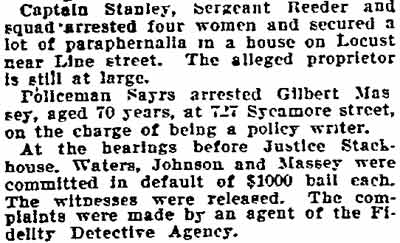
Alleged Policy People Arrested
One of the Most Fruitful Raids in Years Was Made in Camden Yesterday
One of the most successful policy raids in years, in Camden, was made under the supervision of Chief of Police Foster yesterday. Sergeant Hyde and squad arrested Thomas F. Waters, alias “Uncle Frank,” aged 73 years; Isaac G. Johnson, seven persons, male and female, white and colored, and captured a quantity of drawings, “dream books” and plays, at 257 Division street.
Camden News Notes
Philadelphia Inquirer —
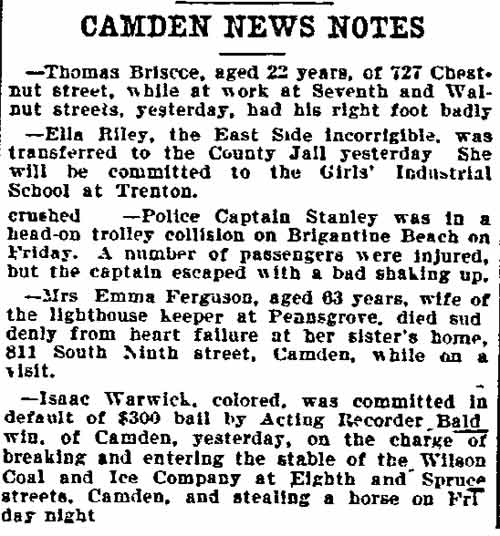
Camden News Notes
—Thomas Briscoe, aged 22 years, of 727 Chestnut street, while at work at Seventh and Walnut streets, yesterday, had his right foot badly crushed.
—Ella Riley, the East Side incorrigible, was transferred to the County Jail yesterday. She will be committed to the Girls’ Industrial School at Trenton.
—Police Captain Stanley was in a head-on trolley collision on Brigantine Beach on Friday. A number of passengers were injured, but the captain escaped with a bad shaking up.
—Mrs Emma Ferguson, aged 63 years, wife of the lighthouse keeper at Pennsgrove, died suddenly from heart failure at her sister’s home, 811 South Ninth street, Camden, while on a visit.
—Isaac Warwick, colored, was committed in default of $300 bail by Acting Recorder Baldwin, of Camden, yesterday, on the charge of breaking and entering the stable of the Wilson Coal and Ice Company at Eighth and Spruce streets, Camden, and stealing a horse on Friday night.
Police Disperse Socialist Crowd
Philadelphia Inquirer —
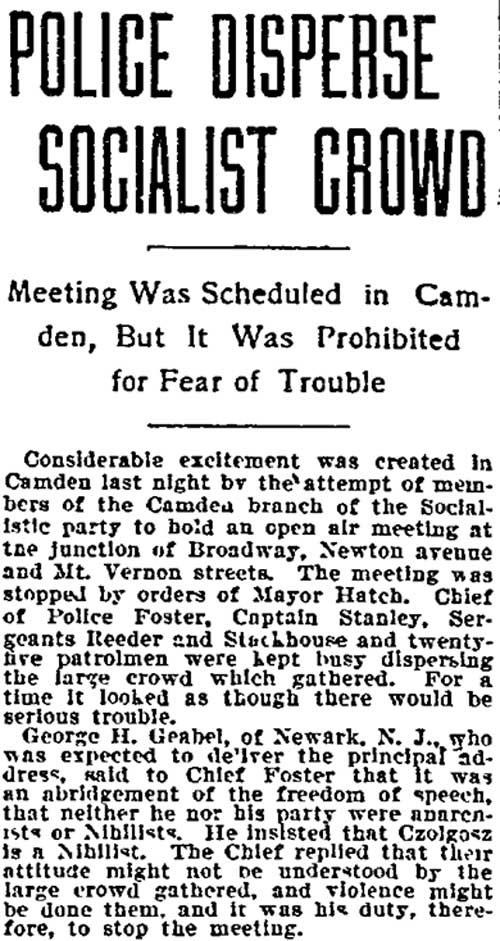
Police Disperse Socialist Crowd
Meeting Was Scheduled in Camden, But It Was Prohibited for Fear of Trouble
Considerable excitement was created in Camden last night by the attempt of members of the Camden branch of the Socialistic party to hold an open air meeting at the junction of Broadway, Newton avenue and Mt. Vernon streets. The meeting was stopped by orders of Mayor Hatch. Chief of Police Foster, Captain Stanley, Sergeants Reeder [sic] and Stackhouse and twenty-five patrolmen were kept busy dispersing the large crowd which gathered. For a time it looked as though there would be serious trouble.
George H. Geabel, of Newark, N. J., who was expected to deliver the principal address, said to Chief Foster that it was an abridgement of the freedom of speech, that neither he nor his party were anarchists or Nihilists. He insisted that Czolgosz is a Nihilist. The Chief replied that their attitude might not be understood by the large crowd gathered, and violence might be done them, and it was his duty, therefore, to stop the meeting.
Father Shoots His Son Then Suicides
Philadelphia Inquirer —
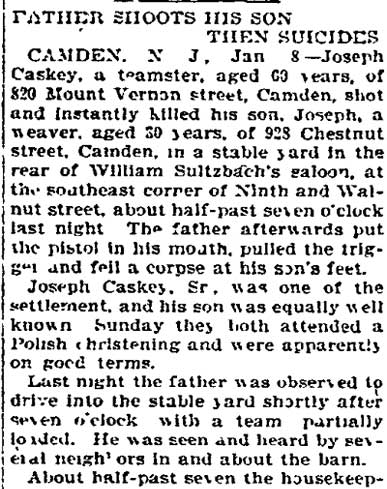
Father Shoots His Son Then Suicides
CAMDEN, N. J., Jan 8—Joseph Caskey, a teamster, aged 60 years, of 820 Mount Vernon street, Camden, shot and instantly killed his son, Joseph, a weaver, aged 30 years, of 923 Chestnut street, Camden, in a stable yard in the rear of William Sultzbach’s saloon, at the southeast corner of Ninth and Walnut street, about half-past seven o’clock last night. The father afterwards put the pistol in his mouth, pulled the trigger and fell a corpse at his son’s feet.
Joseph Caskey, Sr., was one of the settlement, and his son was equally well known. Sunday they both attended a Polish christening and were apparently on good terms.
Last night the father was observed to drive into the stable yard shortly after seven o’clock with a team partially loaded. He was seen and heard by several neighbors in and about the barn.
[Continued on page 2]
[Continued from arthurstanley-011102-inq-1a.jpg]
About half-past seven the housekeeper at Sultzbach’s, on whose premises the stable is located, came to him in a state of fright and declared there was a man on the roof. To satisfy her he lighted a lantern and went out on the roof, but found no one. As he flashed the lantern he discovered the street gate and barn door open.
He came down and fastened the gate and started for the barn door and found the bodies of both men.
The son was lying in the stable door with a bullet wound in his temple. The father, a few feet away, was found with a wound in the roof of his mouth. The revolver, a 32-calibre, was clutched tightly in his right hand.
Mr. Sultzbach immediately notified the authorities, and Captain Stanley and Sergeant Reeder [sic] took charge of the bodies until the arrival of Coroner Litchfield.
Both men were married. The father leaves a wife and three grown children and the son a wife and two little girls.
Ellis Will Not Stay Suspended
Philadelphia Inquirer —
Ellis Will Not Stay Suspended
The fifteen days’ suspension imposed on Policeman David Ellis, of Camden, by the Police Committee of City Council expired yesterday. Though still under the ban of indefinite suspension by Mayor Nowrey he reported for duty last night. Captain Stanley, acting under orders of Chief Foster, refused to recognize Ellis, who said that he was acting under the advice of counsel and that the case would be carried to the courts for adjudication.
Policeman Chambers Suspended for Misconduct
Philadelphia Inquirer —
Policeman John Chambers, of the Seventh ward, Camden, was suspended until trial by the Police Committee of City Council, by Mayor Nowrey, yesterday. The report of Captain Stanley to the Mayor charged Chambers with being intoxicated while on duty on Friday. When brought before the Mayor yesterday the policeman said he was not drunk, but exhausted by the loss of sleep while doing extra duty at a colored ball.
She Dared Men to Touch the “Pants”
Philadelphia Inquirer —
She Dared Men to Touch the “Pants”
Camden Woman Planted a Pole, Decorated It With Pair Trousers and Flourished a Revolver
Flourishing a revolver and exclaiming, “I’ll kill the first man who touches those pants; this is fair warning to everybody, for I mean what I say!” Mrs. Louisa Traubel, of 807 Broadway, Camden, yesterday held up work on the addition being erected to the Gately and Hurley Company’s department store at Broadway and Spruce streets.
Mrs. Traubel claimed one of the walls was being constructed three inches over the line of the property belonging to her father, George Fields. She consulted City Engineer Farnham, who decided the wall was a fraction of an inch over the line. Then Contractor Welsh was notified to stop work, but without the desired result.
Camden Police Raid Alleged Speak-Easy
Philadelphia Inquirer —
Camden Police Raid Alleged Speak-Easy
Police Captain Stanley and a squad of officers last night made a raid on an alleged speak-easy at the foot of Jackson street, Camden, and captured Patrick Holden, the supposed proprietor, and two others.
The police were notified that a crowd of men were having a high old time in Holden’s boat house at Jackson street. When the raid was made several hundred persons gathered about and most of the inmates escaped. Four cases and one tub of beer, beside some whisky, were found.
Camden Notes
Philadelphia Inquirer —
CAMDEN NOTES
Captain Arthur Stanley, of the Second Police District, has been appointed aide-de-camp to State Commander Hann, of the New Jersey G. A. R.
The Board of Health has requested the Camden Iron Works to see that all its employes are vaccinated, a case of small pox having developed at the plant.
The retail liquor license in the name of Frank Carrow, at Berlin, who was killed by a train last spring, was transferred to Thomas Holland yesterday by Judge Joline.
A spark from an engine set fire to the stable of George Tucker, cigar dealer, at Knight and Kaighn avenue, yesterday. Cole’s lumber mill was threatened before the fire was extinguished.
Judge Bergen yesterday filed an answer in the Browning Brothers’ litigation. The case involves $61,000 of the assets of the retired company. The answer denies that the assignment of the company was made in New Jersey.
John Marshall, 32 years old, an iron worker at Dialogue’s shipyard, acted as peacemaker in a fight at the place where he is employed, yesterday, and for his trouble received a severe gash under the chin. He was taken to Cooper Hospital.
Hereafter landlords who hale their tenants before the District Court in Camden, under a recent decision, will encounter some little difficulty. This decision gives the tenant to be ejected for non payment of rent the right to demand a jury when before the court. This will not only postpone such cases for a week at least; but the landlord will have to pay the jurymen, which will amount to $6.
A meeting of the Camden County Republican Executive Committee has been called by Chairman William J. Browning for this afternoon, at the Camden Republican Club, to fix the dates for the primary elections and county conventions. The report circulated that Chairman Browning will offer a substitute list of election officers for the one he has already handed in, is denied by him.
Human Bones Found on Camden Meadows
Bridgeton Evening News —
The Camden police authorities were informed that a number of human bones had been found on the meadows near Fourth street and Atlantic avenue. Detective Hart and Captain of Police Stanley learned that the bones had been left in a building by a medical student.
Policemen Took Hand in the Games
Philadelphia Inquirer —
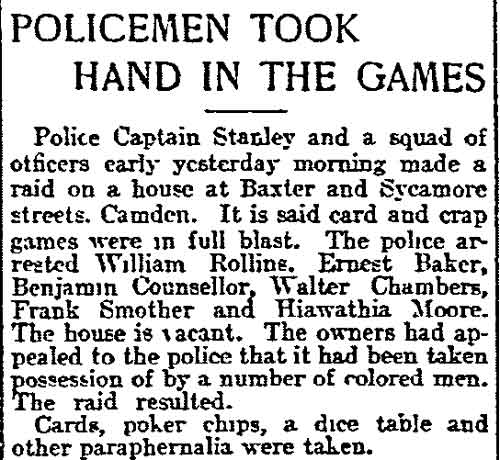
Policemen Took Hand in the Games
Police Captain Stanley and a squad of officers early yesterday morning made a raid on a house at Baxter and Sycamore streets, Camden. It is said card and crap games were in full blast. The police arrested William Rollins, Ernest Baker, Benjamin Counsellor, Walter Chambers, Frank Smother and Hiawathia Moore. The house is vacant. The owners had appealed to the police that it had been taken possession of by a number of colored men. The raid resulted. Cards, poker chips, a dice table and other paraphernalia were taken.
Camden News Notes
Philadelphia Inquirer —
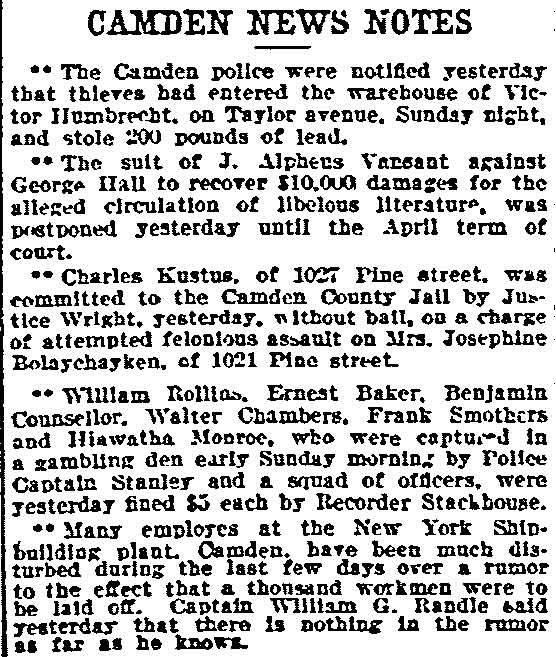
Camden News Notes
•• The Camden police were notified yesterday that thieves had entered the warehouse of Victor Humbrecht, on Taylor avenue, Sunday night, and stole 200 pounds of lead.
•• The suit of J. Alpheus Vansant against George Hall to recover $10,000 damages for the alleged circulation of libelous literature, was postponed yesterday until the April term of court.
•• Charles Kustus, of 1027 Pine street, was committed to the Camden County Jail by Justice Wright, yesterday, without ball [sic], on a charge of attempted felonious assault on Mrs. Josephine Bolaychayken, of 1021 Pine street.
•• William Rollins, Ernest Baker, Benjamin Counsellor, Walter Chambers, Frank Smothers and Hiawatha Monroe, who were captured in a gambling den early Sunday morning by Police Captain Stanley and a squad of officers, were yesterday fined $5 each by Recorder Stackhouse.
•• Many employes at the New York Shipbuilding plant, Camden, have been much disturbed during the last few days over a rumor to the effect that a thousand workmen were to be laid off. Captain William G. Randle said yesterday that there is nothing in the rumor as far as he knows.
Camden News Notes
Philadelphia Inquirer —
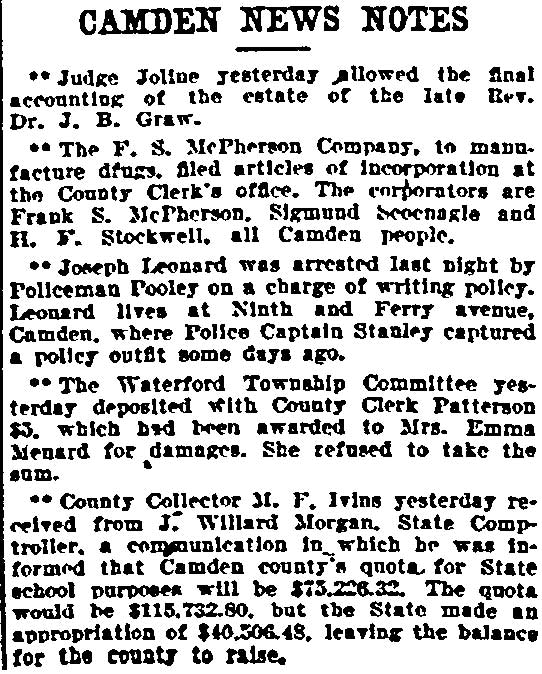
CAMDEN NEWS NOTES
•• Judge Joline yesterday allowed the final accounting of the estate of the late Rev. Dr. J. B. Graw.
•• The F. S. McPherson Company, to manufacture drugs, filed articles of incorporation at the County Clerk’s office. The corporators are Frank S. McPherson, Sigmund Sceonagle and H. F. Stockwell, all Camden people.
•• Joseph Leonard was arrested last night by Policeman Pooley on a charge of writing policy. Leonard lives at Ninth and Ferry avenue, Camden, where Police Captain Stanley captured a policy outfit some days ago.
•• The Waterford Township Committee yesterday deposited with County Clerk Patterson $3, which had been awarded to Mrs. Emma Menard for damages. She refused to take the sum.
•• County Collector M. F. Ivins yesterday received from J. Willard Morgan, State Comptroller, a communication in which he was informed that Camden county’s quota for State school purposes will be $73,226.32. The quota would be $115,732.80, but the State made an appropriation of $40,506.48, leaving the balance for the county to raise.
Camden News Notes
Philadelphia Inquirer —
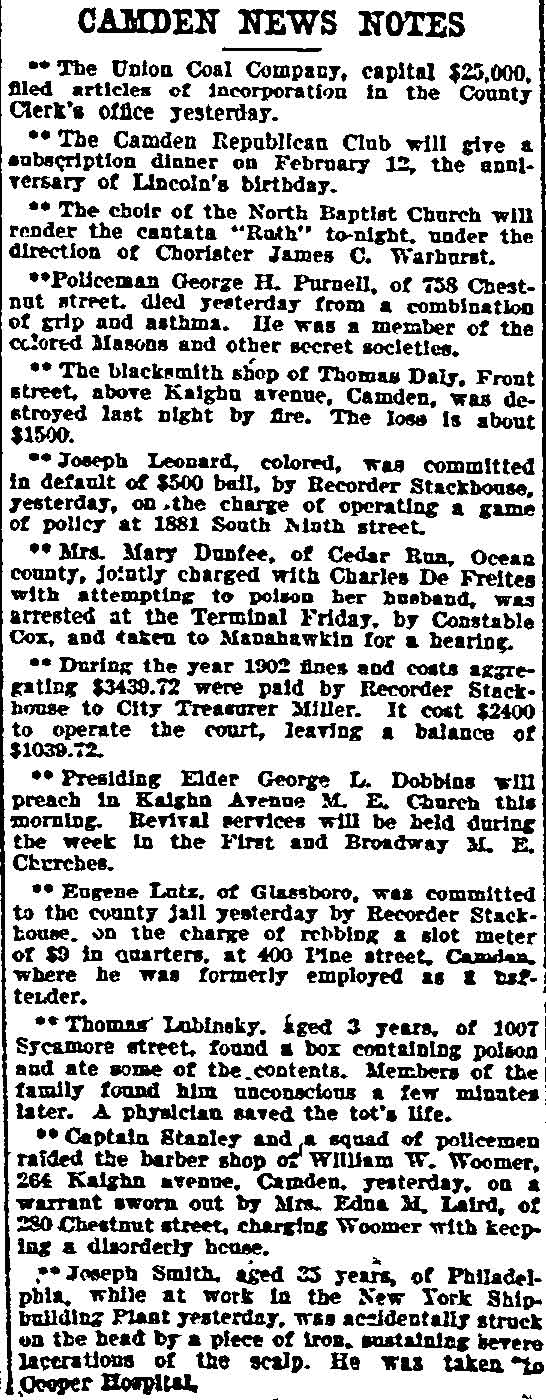
Camden News Notes
Captain Stanley and a squad of policemen raided the barber shop of William W. Woomer, 264 Kaighn avenue, Camden, yesterday, on a warrant sworn out by Mrs. Edna M. Laird, of 230 Chestnut street, charging Woomer with keeping a disorderly house.
Raid on a Baxter Street House
Philadelphia Inquirer —
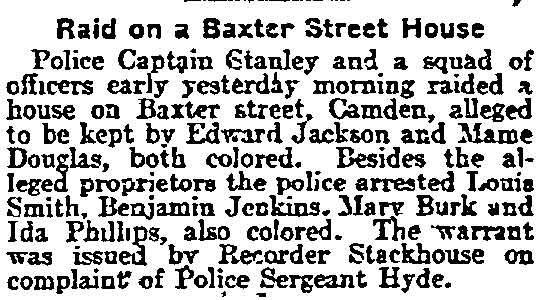
Raid on a Baxter Street House
Police Captain Stanley and a squad of officers early yesterday morning raided a house on Baxter street, Camden, alleged to be kept by Edward Jackson and Mame Douglas, both colored. Besides the alleged proprietors the police arrested Louis Smith, Benjamin Jenkins, Mary Burk and Ida Phillips, also colored. The warrant was issued by Recorder Stackhouse on complaint of Police Sergeant Hyde.
With Gun and Dog Man Created a Big Scare in Camden
Philadelphia Inquirer —
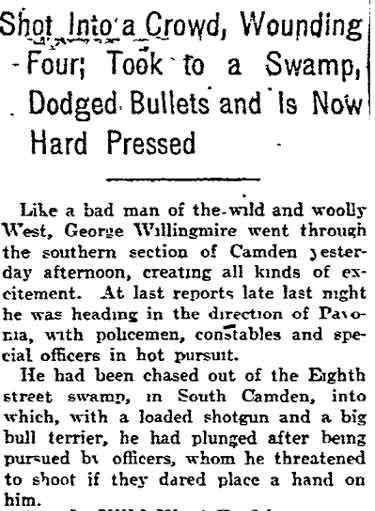
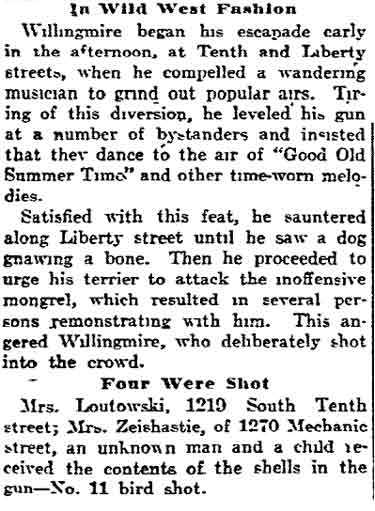
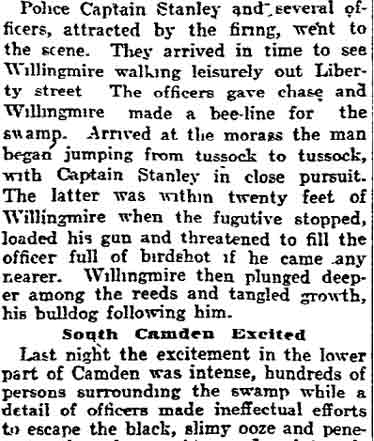
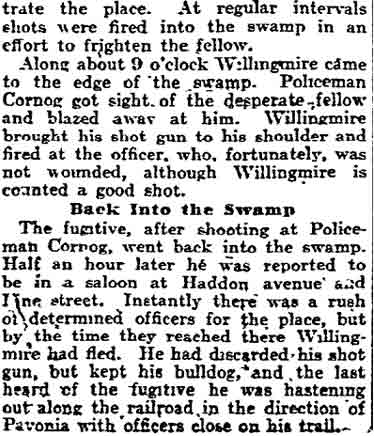
With Gun and Dog Man Created a Big Scare in Camden
Shot Into a Crowd, Wounding Four; Took to a Swamp, Dodged Bullets and Is Now Hard Pressed
Like a bad man of the wild and woolly West, George Willingmire went through the southern section of Camden yesterday afternoon, creating all kinds of excitement. At last reports late last night he was heading in the direction of Pavonia, with policemen, constables and special officers in hot pursuit.
He had been chased out of the Eighth street swamp, in South Camden, into which, with a loaded shotgun and a big bull terrier, he had plunged after being pursued by officers, whom he threatened to shoot if they dared place a hand on him.
In Wild West Fashion
Willingmire began his escapade early in the afternoon, at Tenth and Liberty streets, when he compelled a wandering musician to grind out popular airs. Tiring of this diversion, he leveled his gun at a number of bystanders and insisted that they dance to the air of “Good Old Summer Time” and other time-worn melodies.
Satisfied with this feat, he sauntered along Liberty street until he saw a dog gnawing a bone. Then he proceeded to urge his terrier to attack the inoffensive mongrel, which resulted in several persons remonstrating with him. This angered Willingmire, who deliberately shot into the crowd.
Four Were Shot
Mrs. Loutowski, 1219 South Tenth street; Mrs. Zeishastie, of 1270 Mechanic street, an unknown man and a child received the contents of the shells in the gun—No. 11 bird shot.
Police Captain Stanley and several officers, attracted by the firing, went to the scene. They arrived in time to see Willingmire walking leisurely out Liberty street. The officers gave chase and Willingmire made a bee-line for the swamp. Arrived at the morass the man began jumping from tussock to tussock, with Captain Stanley in close pursuit. The latter was within twenty feet of Willingmire when the fugitive stopped, loaded his gun and threatened to fill the officer full of birdshot if he came any nearer. Willingmire then plunged deeper among the reeds and tangled growth, his bulldog following him.
South Camden Excited
Last night the excitement in the lower part of Camden was intense, hundreds of persons surrounding the swamp while a detail of officers made ineffectual efforts to escape the black, slimy ooze and penetrate the place. At regular intervals shots were fired into the swamp in an effort to frighten the fellow.
Along about 9 o’clock Willingmire came to the edge of the swamp. Policeman Cornog got sight of the desperate fellow and blazed away at him. Willingmire brought his shot gun to his shoulder and fired at the officer, who, fortunately, was not wounded, although Willingmire is counted a good shot.
Back Into the Swamp
The fugitive, after shooting at Policeman Cornog, went back into the swamp. Half an hour later he was reported to be in a saloon at Haddon avenue and Line street. Instantly there was a rush of determined officers for the place, but by the time they reached there Willingmire had fled.
He had discarded his shot gun, but kept his bulldog, and the last heard of the fugitive he was hastening out along the railroad in the direction of Pavonia with officers close on his trail.
Gunning in a Cemetery
Philadelphia Inquirer —
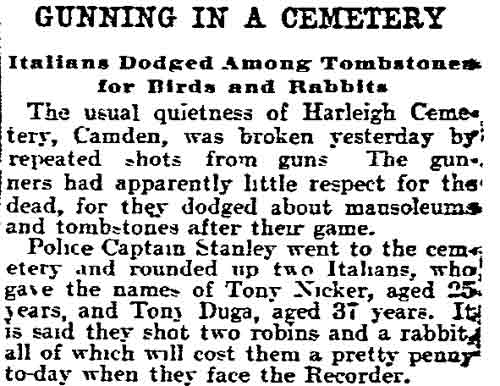
Gunning in a Cemetery
Italians Dodged Among Tombstones for Birds and Rabbits
The usual quietness of Harleigh Cemetery, Camden, was broken yesterday by repeated shots from guns. The gunners had apparently little respect for the dead, for they dodged about mausoleums and tombstones after their game.
Police Captain Stanley went to the cemetery and rounded up two Italians, who gave the names of Tony Nicker, aged 25 years, and Tony Duga, aged 37 years. It is said they shot two robins and a rabbit, all of which will cost them a pretty penny to-day when they face the Recorder.
Fragments of Cannon Crashed Into Bedroom
Philadelphia Inquirer —
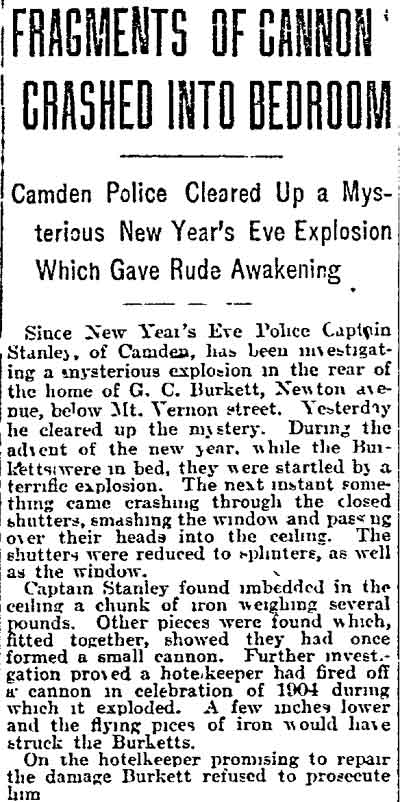
Fragments of Cannon Crashed Into Bedroom
Camden Police Cleared Up a Mysterious New Year’s Eve Explosion Which Gave Rude Awakening
Since New Year’s Eve Police Captain Stanley, of Camden, has been investigating a mysterious explosion in the rear of the home of G. C. Burkett, Newton avenue, below Mt. Vernon street. Yesterday he cleared up the mystery. During the advent of the new year, while the Burketts were in bed, they were startled by a terrific explosion. The next instant something came crashing through the closed shutters, smashing the window and passing over their heads into the ceiling. The shutters were reduced to splinters, as well as the window.
Captain Stanley found imbedded in the ceiling a chunk of iron weighing several pounds. Other pieces were found which, fitted together, showed they had once formed a small cannon. Further investigation proved a hotelkeeper had fired off a cannon in celebration of 1904 during which it exploded. A few inches lower and the flying pieces of iron would have struck the Burketts.
On the hotelkeeper promising to repair the damage Burkett refused to prosecute him.
Patrolman Harvey Cited for Disrespect
Philadelphia Inquirer —
Patrolman William Harvey, who has been on the police force for eighteen years, during which time he has never had a complaint against him, has been cited to appear before the Police Committee to answer the charge of using impolite language to Captain Stanley.
Police Raid Camden House
Philadelphia Inquirer —
Police Raid Camden House
Police Captain Stanley and a squad of officers yesterday raided the house at 212 Walnut street, Camden, and arrested beside May Barber, the alleged proprietress, three men and four women. Justice Thompson last night committed the Barber woman to prison in default of $500 bail, and the others on charges of disorderly conduct.
Four Killed When Fireworks Blew Up
Philadelphia Inquirer —
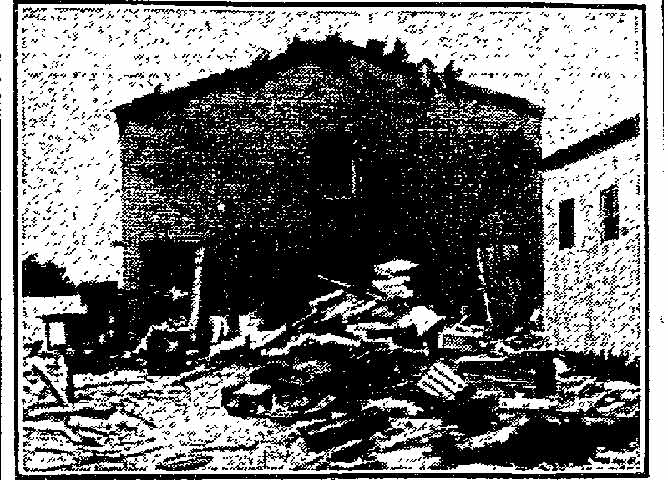
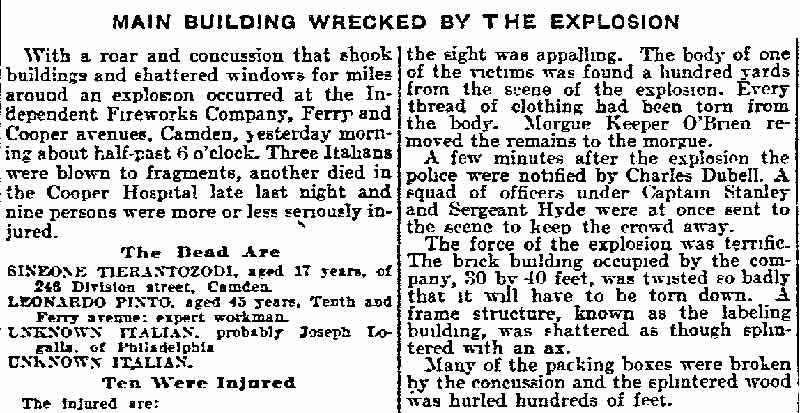
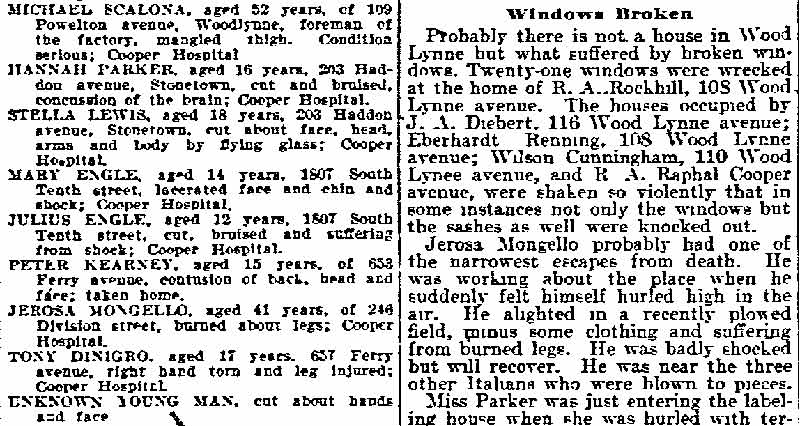
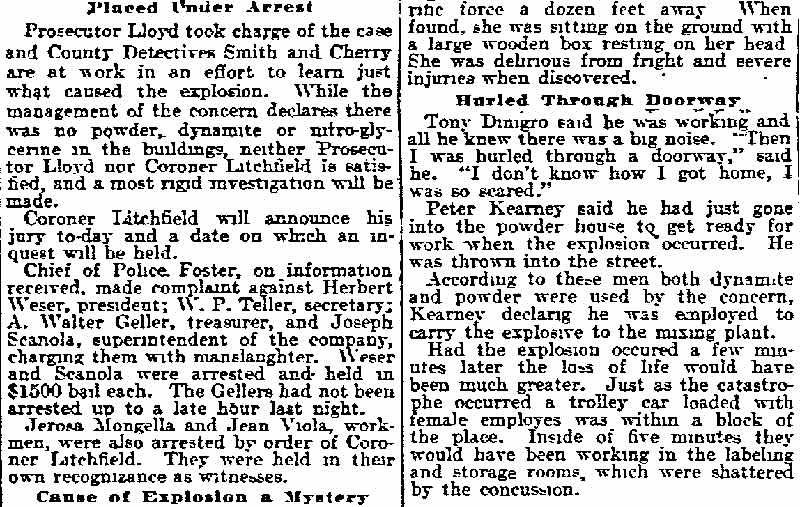
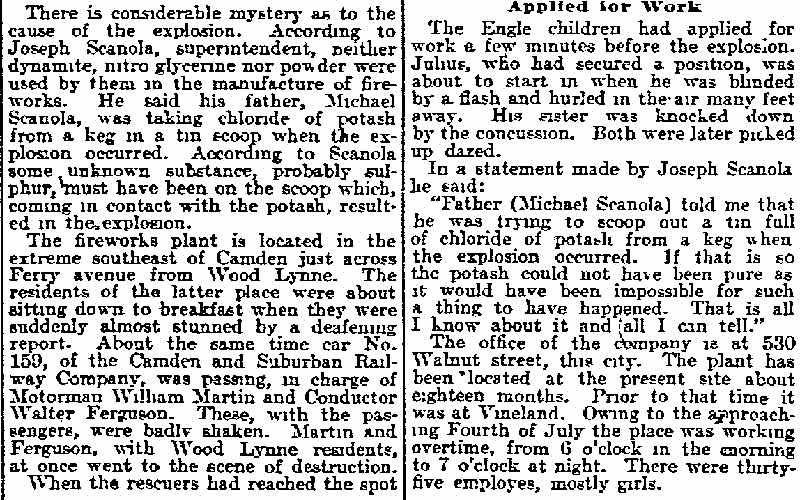
Factory on the Outskirts of Camden Wrecked by an Explosion of Mysterious Origin---Ten Received Injuries---Officers of the Company Placed Under Arrest
[Photograph, captioned:] MAIN BUILDING WRECKED BY THE EXPLOSION
With a roar and concussion that shook buildings and shattered windows for miles around an explosion occurred at the Independent Fireworks Company, Ferry and Cooper avenues, Camden, yesterday morning about half-past 6 o’clock. Three Italians were blown to fragments, another died in the Cooper Hospital late last night and nine persons were more or less seriously injured.
The Dead Are
SINEONE TIERANTOZODI, aged 17 years, of 248 Division street, Camden. LEONARDO PINTO, aged 45 years, Tenth and Ferry avenue; expert workman. UNKNOWN ITALIAN, probably Joseph Logalla, of Philadelphia. UNKNOWN ITALIAN.
Ten Were Injured
The injured are:
MICHAEL SCALONA, aged 52 years, of 109 Powelton avenue, Woodlynne, foreman of the factory, mangled thigh. Condition serious; Cooper Hospital. HANNAH PARKER, aged 16 years, 203 Haddon avenue, Stonetown, cut and bruised, concussion of the brain; Cooper Hospital. STELLA LEWIS, aged 18 years, 203 Haddon avenue, Stonetown, cut about face, head, arms and body by flying glass; Cooper Hospital. MARY ENGLE, aged 14 years, 1807 South Tenth street, lacerated face and chin and shock; Cooper Hospital. JULIUS ENGLE, aged 12 years, 1807 South Tenth street, cut, bruised and suffering from shock; Cooper Hospital. PETER KEARNEY, aged 15 years, of 653 Ferry avenue, contusion of back, head and face; taken home. JEROSA MONGELLO, aged 41 years, of 246 Division street, burned about legs; Cooper Hospital. TONY DINIGRO, aged 17 years, 657 Ferry avenue, right hand torn and leg injured; Cooper Hospital. UNKNOWN YOUNG MAN, cut about hands and face.
The sight was appalling. The body of one of the victims was found a hundred yards from the scene of the explosion. Every thread of clothing had been torn from the body. Morgue Keeper O’Brien removed the remains to the morgue.
A few minutes after the explosion the police were notified by Charles Dubell. A squad of officers under Captain Stanley and Sergeant Hyde were at once sent to the scene to keep the crowd away.
The force of the explosion was terrific. The brick building occupied by the company, 30 by 40 feet, was twisted so badly that it will have to be torn down. A frame structure, known as the labeling building, was shattered as though splintered with an ax.
Many of the packing boxes were broken by the concussion and the splintered wood was hurled hundreds of feet.
Windows Broken
Probably there is not a house in Wood Lynne but what suffered by broken windows. Twenty-one windows were wrecked at the home of R. A. Rockhill, 108 Wood Lynne avenue. The houses occupied by J. A. Diebert, 116 Wood Lynne avenue; Eberhardt Renning, 108 Wood Lynne avenue; Wilson Cunningham, 110 Wood Lynee avenue, and R. A. Raphal Cooper avenue, were shaken so violently that in some instances not only the windows but the sashes as well were knocked out.
Jerosa Mongello probably had one of the narrowest escapes from death. He was working about the place when he suddenly felt himself hurled high in the air. He alighted in a recently plowed field, minus some clothing and suffering from burned legs. He was badly shocked but will recover. He was near the three other Italians who were blown to pieces.
Miss Parker was just entering the labeling house when she was hurled with terrific force a dozen feet away. When found, she was sitting on the ground with a large wooden box resting on her head. She was delirious from fright and severe injuries when discovered.
Hurled Through Doorway
Tony Dinigro said he was working and all he knew there was a big noise. “Then I was hurled through a doorway,” said he. “I don’t know how I got home, I was so scared.”
Peter Kearney said he had just gone into the powder house to get ready for work when the explosion occurred. He was thrown into the street.
According to these men both dynamite and powder were used by the concern, Kearney declaring he was employed to carry the explosive to the mixing plant.
Had the explosion occured a few minutes later the loss of life would have been much greater. Just as the catastrophe occurred a trolley car loaded with female employes was within a block of the place. Inside of five minutes they would have been working in the labeling and storage rooms, which were shattered by the concussion.
Placed Under Arrest
Prosecutor Lloyd took charge of the case and County Detectives Smith and Cherry are at work in an effort to learn just what caused the explosion. While the management of the concern declares there was no powder, dynamite or nitro-glycerine in the buildings, neither Prosecutor Lloyd nor Coroner Litchfield is satisfied, and a most rigid investigation will be made.
Coroner Litchfield will announce his jury to-day and a date on which an inquest will be held.
Chief of Police Foster, on information received, made complaint against Herbert Weser, president; W. P. Teller, secretary; A. Walter Geller, treasurer, and Joseph Scanola, superintendent of the company, charging them with manslaughter. Weser and Scanola were arrested and held in $1500 bail each. The Gellers had not been arrested up to a late hour last night.
Jerosa Mongella and Jean Viola, workmen, were also arrested by order of Coroner Litchfield. They were held in their own recognizance as witnesses.
Cause of Explosion a Mystery
There is considerable mystery as to the cause of the explosion. According to Joseph Scanola, superintendent, neither dynamite, nitro glycerine nor powder were used by them in the manufacture of fireworks. He said his father, Michael Scanola, was taking chloride of potash from a keg in a tin scoop when the explosion occurred. According to Scanola some unknown substance, probably sulphur, must have been on the scoop which, coming in contact with the potash, resulted in the explosion.
The fireworks plant is located in the extreme southeast of Camden just across Ferry avenue from Wood Lynne. The residents of the latter place were about sitting down to breakfast when they were suddenly almost stunned by a deafening report. About the same time car No. 159, of the Camden and Suburban Railway Company, was passing, in charge of Motorman William Martin and Conductor Walter Ferguson. These, with the passengers, were badly shaken. Martin and Ferguson, with Wood Lynne residents, at once went to the scene of destruction.
Applied for Work
The Engle children had applied for work a few minutes before the explosion. Julius, who had secured a position, was about to start in when he was blinded by a flash and hurled in the air many feet away. His sister was knocked down by the concussion. Both were later picked up dazed.
In a statement made by Joseph Scanola he said:
“Father (Michael Scanola) told me that he was trying to scoop out a tin full of chloride of potash from a keg when the explosion occurred. If that is so the potash could not have been pure as it would have been impossible for such a thing to have happened. That is all I know about it and all I can tell.”
The office of the company is at 530 Walnut street, this city. The plant has been located at the present site about eighteen months. Prior to that time it was at Vineland. Owing to the approaching Fourth of July the place was working overtime, from 6 o’clock in the morning to 7 o’clock at night. There were thirty-five employes, mostly girls.
Strikers and Workmen Fight
Philadelphia Inquirer —
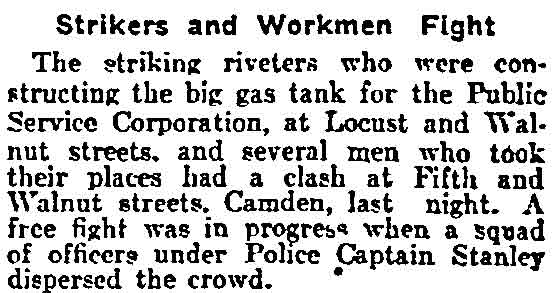
Strikers and Workmen Fight
The striking riveters who were constructing the big gas tank for the Public Service Corporation, at Locust and Walnut streets, and several men who took their places had a clash at Fifth and Walnut streets, Camden, last night. A free fight was in progress when a squad of officers under Police Captain Stanley dispersed the crowd.
Camden News Notes
Philadelphia Inquirer —
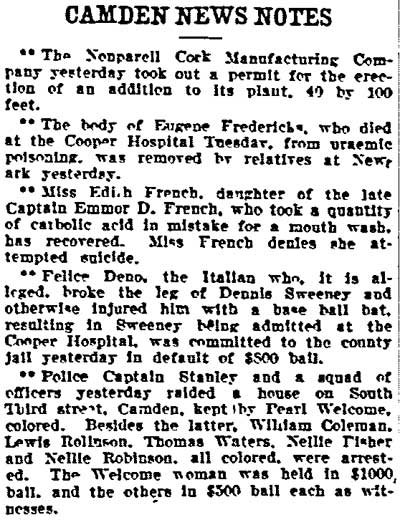
Camden News Notes
•• The Nonpareil Cork Manufacturing Company yesterday took out a permit for the erection of an addition to its plant, 40 by 100 feet.
•• The body of Eugene Fredericks, who died at the Cooper Hospital Tuesday, from uraemic poisoning, was removed by relatives to Newark yesterday.
•• Miss Edith French, daughter of the late Captain Emmor D. French, who took a quantity of carbolic acid in mistake for a mouth wash, has recovered. Miss French denies she attempted suicide.
•• Felice Deno, the Italian who, it is alleged, broke the leg of Dennis Sweeney and otherwise injured him with a base ball bat, resulting in Sweeney being admitted at the Cooper Hospital, was committed to the county jail yesterday in default of $500 bail.
•• Police Captain Stanley and a squad of officers yesterday raided a house on South Third street, Camden, kept by Pearl Welcome, colored. Besides the latter, William Coleman, Lewis Robinson, Thomas Waters, Nellie Fisher and Nellie Robinson, all colored, were arrested. The Welcome woman was held in $1,000 ball [sic], and the others in $500 ball [sic] each as witnesses.
Camden Police Make Raids
Philadelphia Inquirer —
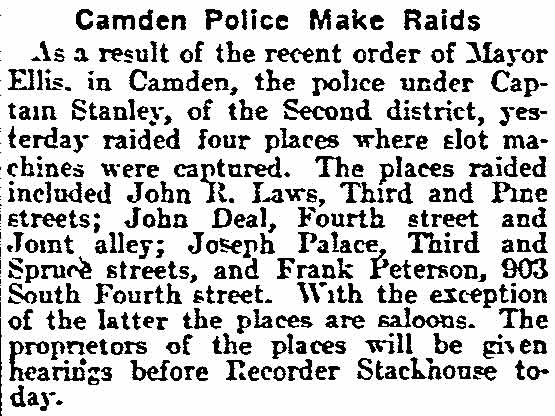
Camden Police Make Raids
As a result of the recent order of Mayor Ellis, in Camden, the police under Captain Stanley, of the Second district, yesterday raided four places where slot machines were captured. The places raided included John R. Laws, Third and Pine streets; John Deal, Fourth street and Joint alley; Joseph Palace, Third and Spruce streets, and Frank Peterson, 903 South Fourth street. With the exception of the latter the places are saloons. The proprietors of the places will be given hearings before Recorder Stackhouse today.
More Policemen to Go in Camden
Philadelphia Inquirer —
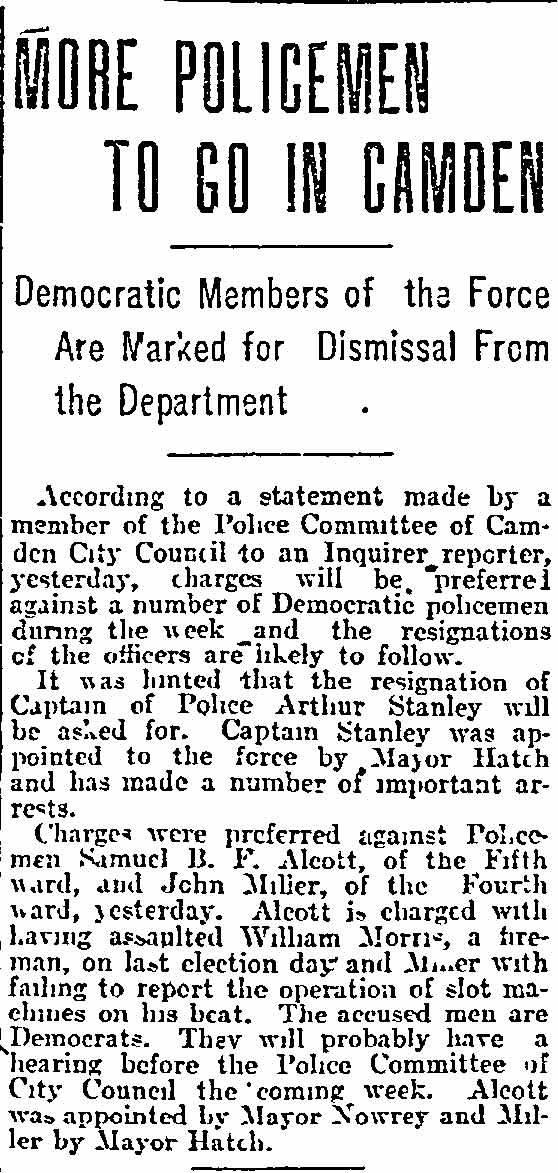
Democratic Members of the Force Are Marked for Dismissal From the Department
According to a statement made by a member of the Police Committee of Camden City Council to an Inquirer reporter, yesterday, charges will be preferred against a number of Democratic policemen during the week and the resignations of the officers are likely to follow.
It was hinted that the resignation of Captain of Police Arthur Stanley will be asked for. Captain Stanley was appointed to the force by Mayor Hatch and has made a number of important arrests.
Charges were preferred against Policemen Samuel B. F. Alcott, of the Fifth ward, and John Miller, of the Fourth ward, yesterday. Alcott is charged with having assaulted William Morris, a fireman, on last election day and Miller with failing to report the operation of slot machines on his beat. The accused men are Democrats. They will probably have a hearing before the Police Committee of City Council the coming week. Alcott was appointed by Mayor Nowrey and Miller by Mayor Hatch.
Want Stanley Retained
Philadelphia Inquirer —
Want Stanley Retained
Movement to Oust Police Captain May Be Checked
The fact that there are influences at work looking to the removal of Arthur Stanley, captain of the Second Police district, Camden, has aroused the business men of the southern section of the city. Already a movement is being crystallized toward having Captain Stanley retained. It is pointed out that since his appointment by Mayor Hatch the Second district has been better morally than for many years past. An old soldier and a strict disciplinarian, he has incurred the enmity of some who are seeking his removal.
Mayor Ellis, who controls the situation, is said to be unfavorable to removing Captain Stanley. In the event of the latter getting out Sergeant Edward Hyde will fill the vacancy.
Catholics Lay Corner-Stone of a New Parochial School
Philadelphia Inquirer —


Catholics Lay Corner-Stone of a New Parochial School
With impressive ceremonies the corner-stone of the new parochial school connected with Sts. Peter’s and Paul’s Church, St. John and Spruce streets, Camden, was laid yesterday. Several hundred persons, including the Knights of Columbus, the Society of St. Francis, St. Aloysius Club, Italian and Polish societies and visiting priests, were present. The societies marched to the place headed by a platoon of police under command of Captain Arthur Stanley.
Under a canopy of American flags and yards of bunting Very Rev. Provincial L. M. Miller, of Syracuse, head of the St. Francis Order in America, laid the stone. In the receptacle had been placed the names of national, state, county and city officials, together with those of the Pope, the bishops, the general of the Order, the rector, the assistant rector of the church and copies of newspapers. Rev. Father Miller preached a sermon in German, which was followed by one in English by Rev. Stephen Lyons, of Salem. A choir of 100 voices from the various Catholic churches of the city rendered a musical service under the direction of Professor Dilger.
The school will be constructed of bluestone, having two floors and a basement. There will be six class rooms and an auditorium with a seating capacity of 700. It will cost about $37,000 and will be the most up-to-date in South Jersey. It will be in charge of Rev. Lucius Mott, pastor, and Rev. William Peberl, assistant pastor, of Sts. Peter’s and Paul’s Church.
Fined for Selling on Sunday
Philadelphia Inquirer —
Fined for Selling on Sunday
Another violator of the Sunday closing law was arrested in Camden yesterday. The defendant was Richard Schroeder, a groceryman, of Ninth and Division streets. He was accused of selling all day Sunday by Police Captain Stanley on information received. When he was sentenced to pay a fine and costs amounting to $16.30 he refused and was locked up. Last night, however, he paid the fine and was discharged.
Captain Stanley Takes a Bride
Philadelphia Inquirer —
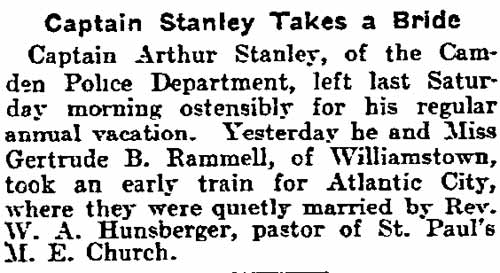
Captain Stanley Takes a Bride
Captain Arthur Stanley, of the Camden Police Department, left last Saturday morning ostensibly for his regular annual vacation. Yesterday he and Miss Gertrude B. Rammell, of Williamstown, took an early train for Atlantic City, where they were quietly married by Rev. W. A. Hunsberger, pastor of St. Paul’s M. E. Church.
Camden News Notes
Philadelphia Inquirer —
CAMDEN NEWS NOTES.
•• Policeman John Zane, of East Camden, will have a hearing before the Police Committee of City Council to-morrow night, on fresh charges preferred against him by Police Captain Albert. He is accused of conduct unbecoming an officer and neglect of duty. When recently charges were preferred against him, Zane tendered his resignation, to take effect on February 1.
•• Police Captain Stanley and a squad of officers in Camden early yesterday morning raided the house at 249 Cherry street, on complaint of Fannie Clark. There was considerable excitement when the officers descended on the inmates, and while some escaped, Rose Mitchell, the alleged proprietress; Maud Trusty and Edward Nugent were captured. They were locked up at the city prison for a hearing before Recorder Stackhouse this morning.
•• The Fifth Ward Republican Club and Washington Circle, Brotherhood of the Union, last night viewed the remains of Benjamin M. Braker, at the latter’s home, 308 Sycamore street.
•• Everything was closed tight yesterday. The police reported the lid was down good and hard.
•• “The Treating Habit in Our American Saloons” was the subject of a sermon preached by Rev. F. A. DeMaris, at the State Street M. E. Church, yesterday.
Camden News Notes
Philadelphia Inquirer —
Camden News Notes
Miss Grace Todd, a representative of the Woman’s Foreign Missionary Society, delivered two addresses in Camden yesterday on “China.” In the morning she spoke at the First M. E. Church, and at night at the Broadway M. E. Church.
Police Captain Stanley and a squad of officers early yesterday morning raided the house of Fannie Clark, colored, at 847 Locust street, on complaint of Rita Veratti. The officers expected to gather in a wagon load of prisoners, but the Clark woman was the only one they found found [sic]. She was sent to the city jail.
Rev. J. W. Lee, at the Kaighn Avenue M. E. Church, last night preached on “Why We Love the Memory of Washington.”
The fifteenth annual ball of the Butchers’ Beneficial Society will be given to-night at Turner Hall.
William St. Clair, colored, aged 65 years, was attacked by a crowd of men early yesterday morning at Broadway and Chestnut streets. He was badly cut on the chin with a razor. He was subsequently found and sent to the Cooper Hospital.
Forty houses are to be erected in the spring on a plot of ground west of the house occupied by the custodian of St. Patrick’s cemetery, East Camden. The ground has just been purchased from the Church of the Immaculate Conception, for $18,000.
Evangelist Howard Amer and wife conducted the services at the Wesley M. E. Church, East Camden, yesterday morning. With his bride of only two months, Evangelist Amer is making a tour of the large cities.
Great Throngs at the Funeral of Chief Foster
Philadelphia Inquirer —

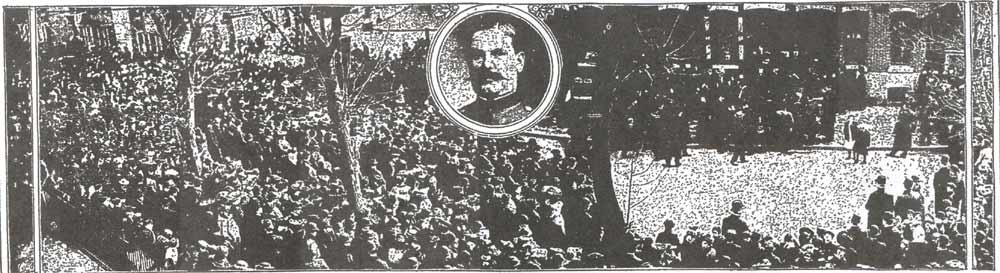
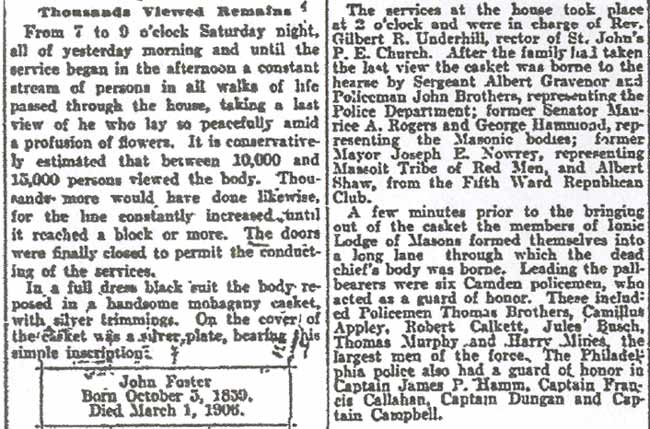
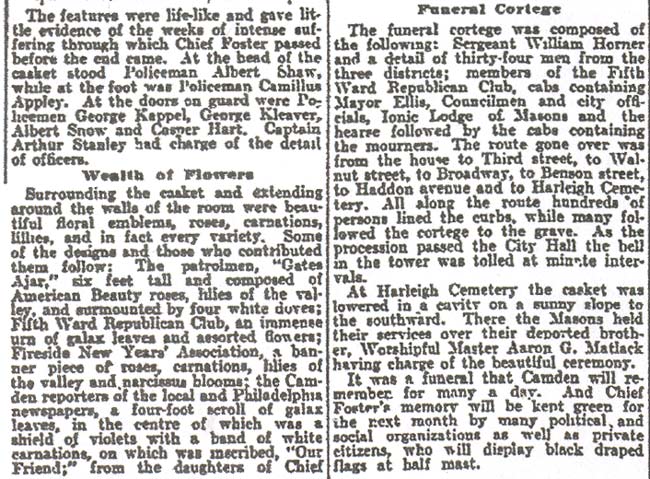
Camden Witnessed Greatest Demonstration of Its Kind Since Gen. Sewell’s Burial
THOUSANDS PAID TRIBUTE TO DEAD
CROWD ABOUT THE FOSTER HOME AND PICTURE OF THE DEAD CHIEF
Not since the memorial funeral of United States Senator William J. Sewell has Camden witnessed such an expression of regret and sorrow as was evidenced at the obsequies of Chief of Police John Foster, which took place from his home, 292 Mt. Vernon street, yesterday afternoon. Practically all Camden paid lasting tribute to the stricken chief, who had been one of the most popular officials of the city. From other places, too, came many who swelled the throng about the house until the streets were literally packed with those anxious to give evidence of the high esteem in which they held the man.
From Philadelphia came Superintendent of Police John B. Taylor, a personal friend of Chief Foster; Captain James Hamm, Captain Dungan, Captain Campbell, Captain Callahan and thirty-four lieutenants, all in uniform. Baltimore, Washington, Norristown, Trenton, Newark, Jersey City and other places were represented by police officials. City, county and State officers were there and everyone unmistakably demonstrated the regard and respect in which he held Chief Foster, who had made such a valiant but fruitless battle against death.
Thousands Viewed Remains
From 7 to 9 o’clock Saturday night, all of yesterday morning and until the service began in the afternoon a constant stream of persons in all walks of life passed through the house, taking a last view of he who lay so peacefully amid a profusion of flowers. It is conservatively estimated that between 10,000 and 15,000 persons viewed the body. Thousands more would have done likewise, for the line constantly increased, until it reached a block or more. The doors were finally closed to permit the conducting of the services.
In a full dress black suit the body reposed in a handsome mahogany casket, with silver trimmings. On the cover of the casket was a silver plate, bearing this simple inscription:
John Foster
Born October 5, 1839.
Died March 1, 1906.
The features were life-like and gave little evidence of the weeks of intense suffering through which Chief Foster passed before the end came. At the head of the casket stood Policeman Albert Shaw, while at the foot was Policeman Camillus Appley. At the doors on guard were Policemen George Kappel, George Kleaver, Albert Snow and Casper Hart. Captain Arthur Stanley had charge of the detail of officers.
Wealth of Flowers
Surrounding the casket and extending around the walls of the room were beautiful floral emblems, roses, carnations, lillies, and in fact every variety. Some of the designs and those who contributed them follow: The patrolmen, “Gates Ajar,” six feet tall and composed of American Beauty roses, lilies of the valley, and surmounted by four white doves; Fifth Ward Republican Club, an immense urn of galax leaves and assorted flowers; Fireside New Years’ Association, a banner piece of roses, carnations, lilies of the valley and narcissus blooms; the Camden reporters of the local and Philadelphia newspapers, a four-foot scroll of galax leaves, in the centre of which was a shield of violets with a band of white carnations, on which was inscribed, “Our Friend;” from the daughters of Chief Foster, “Gates Ajar,” composed of Easter lilies, roses, carnations, daffodils, narcissus and asparagus ferns; from Mrs. Foster, the widow, a pillow of roses, carnations and lilies of the valley. Beautiful designs were also given by Mayor Charles H. Ellis, the International Association of Police Chiefs, Ionic Lodge of Masons, First Italian Republican Club, the Tall Cedars of Lebanon, Massoit Tribe of Red Men, John Carroll, John R. Campbell and various city officials. These flowers filled two carriages and a patrol wagon.
Services at the House
The services at the house took place at 2 o’clock and were in charge of Rev. Gilbert R. Underhill, rector of St. John’s P. E. Church. After the family had taken the last view the casket was borne to the hearse by Sergeant Albert Gravenor and Policeman John Brothers, representing the Police Department; former Senator Maurice A. Rogers and George Hammond, representing the Masonic bodies; former Mayor Joseph E. Nowrey, representing Massoit Tribe of Red Men, and Albert Shaw, from the Fifth Ward Republican Club.
A few minutes prior to the bringing out of the casket the members of Ionic Lodge of Masons formed themselves into a long lane through which the dead chief’s body was borne. Leading the pallbearers were six Camden policemen, who acted as a guard of honor. These included Policemen Thomas Brothers, Camillus Appley, Robert Calkett, Jules Busch, Thomas Murphy and Harry Mines, the largest men of the force. The Philadelphia police also had a guard of honor in Captain James P. Hamm, Captain Francis Callahan, Captain Dungan and Captain Campbell.
Funeral Cortege
The funeral cortege was composed of the following: Sergeant William Horner and a detail of thirty-four men from the three districts; members of the Fifth Ward Republican Club, cabs containing Mayor Ellis, Councilmen and city officials, Ionic Lodge of Masons and the hearse followed by the cabs containing the mourners. The route gone over was from the house to Third street, to Walnut street, to Broadway, to Benson street, to Haddon avenue and to Harleigh Cemetery. All along the route hundreds of persons lined the curbs, while many followed the cortege to the grave. As the procession passed the City Hall the bell in the tower was tolled at minute intervals.
At Harleigh Cemetery the casket was lowered in a cavity on a sunny slope to the southward. There the Masons held their services over their departed brother, Worshipful Master Aaron G. Matlack having charge of the beautiful ceremony.
It was a funeral that Camden will remember for many a day. And Chief Foster’s memory will be kept green for the next month by many political and social organizations as well as private citizens, who will display black draped flags at half mast.
Camden News Notes
Philadelphia Inquirer —
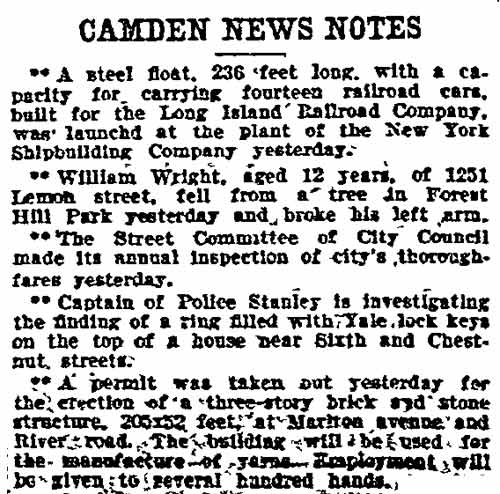
CAMDEN NEWS NOTES
•• A steel float, 236 feet long, with a capacity for carrying fourteen railroad cars, built for the Long Island Railroad Company, was launched at the plant of the New York Shipbuilding Company yesterday.
•• William Wright, aged 12 years, of 1251 Lemon street, fell from a tree in Forest Hill Park yesterday and broke his left arm.
•• The Street Committee of City Council made its annual inspection of city’s thoroughfares yesterday.
•• Captain of Police Stanley is investigating the finding of a ring filled with Yale lock keys on the top of a house near Sixth and Chestnut streets.
•• A permit was taken out yesterday for the erection of a three-story brick and stone structure, 205x52 feet, at Marion avenue and River road. The building will be used for the manufacture of yarns. Employment will be given to several hundred hands.
Camden’s Sunday Crusade Revived
Philadelphia Inquirer —
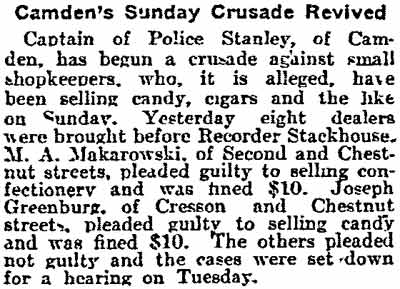
Camden’s Sunday Crusade Revived
Captain of Police Stanley, of Camden, has begun a crusade against small shopkeepers, who, it is alleged, have been selling candy, cigars and the like on Sunday. Yesterday eight dealers were brought before Recorder Stackhouse. M. A. Makarowski, of Second and Chestnut streets, pleaded guilty to selling confectionery and was fined $10. Joseph Greenburg, of Cresson and Chestnut streets, pleaded guilty to selling candy and was fined $10. The others pleaded not guilty and the cases were set down for a hearing on Tuesday.
News of a Day in the City of Camden
Philadelphia Inquirer —
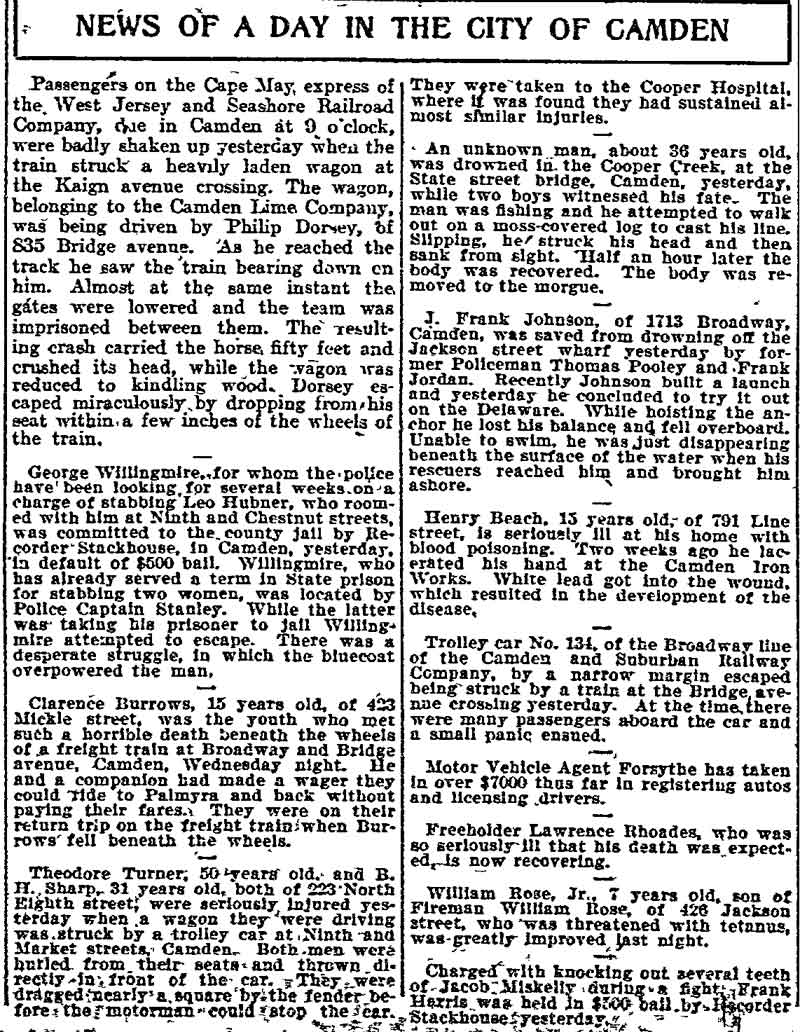
NEWS OF A DAY IN THE CITY OF CAMDEN
Passengers on the Cape May express of the West Jersey and Seashore Railroad Company, due in Camden at 9 o’clock, were badly shaken up yesterday when the train struck a heavily laden wagon at the Kaign avenue crossing. The wagon, belonging to the Camden Lime Company, was being driven by Philip Dorsey, of 835 Bridge avenue. As he reached the track he saw the train bearing down on him. Almost at the same instant the gates were lowered and the team was imprisoned between them. The resulting crash carried the horse fifty feet and crushed its head, while the wagon was reduced to kindling wood. Dorsey escaped miraculously by dropping from his seat within a few inches of the wheels of the train.
George Willingmire, for whom the police have been looking for several weeks on a charge of stabbing Leo Hubner, who roomed with him at Ninth and Chestnut streets, was committed to the county jail by Recorder Stackhouse, in Camden, yesterday, in default of $500 bail. Willingmire, who has already served a term in State prison for stabbing two women, was located by Police Captain Stanley. While the latter was taking his prisoner to jail Willingmire attempted to escape. There was a desperate struggle, in which the bluecoat overpowered the man.
Silver Street Disorderly House Raided
Philadelphia Inquirer —
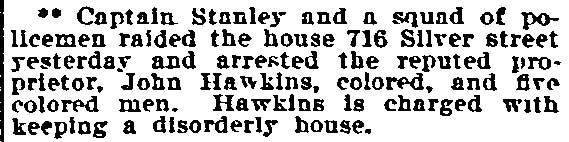
Captain Stanley and a squad of policemen raided the house 716 Silver street yesterday and arrested the reputed proprietor, John Hawkins, colored, and five colored men. Hawkins is charged with keeping a disorderly house.
Camden Police Made Two Raids
Philadelphia Inquirer —
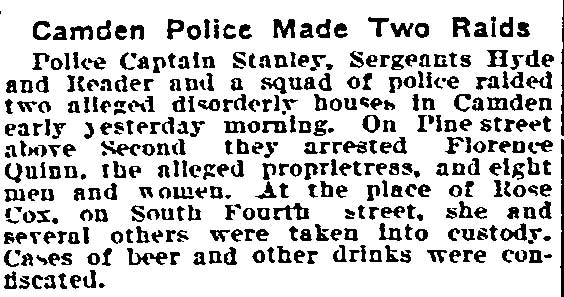
Police Captain Stanley, Sergeants Hyde and Reader and a squad of police raided two alleged disorderly houses in Camden early yesterday morning. On Pine street above Second they arrested Florence Quinn, the alleged proprietress, and eight men and women. At the place of Rose Cox, on South Fourth street, she and several others were taken into custody. Cases of beer and other drinks were confiscated.
Disorderly House Pair Arrested
Philadelphia Inquirer —
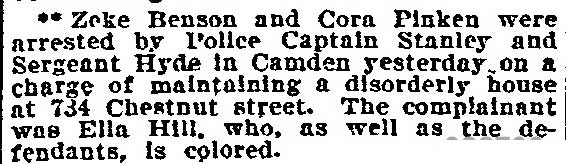
•• Zeke Benson and Cora Pinken were arrested by Police Captain Stanley and Sergeant Hyde in Camden yesterday on a charge of maintaining a disorderly house at 734 Chestnut street. The complainant was Ella Hill, who, as well as the defendants, is colored.
Kaighn Avenue House Raided
Philadelphia Inquirer —
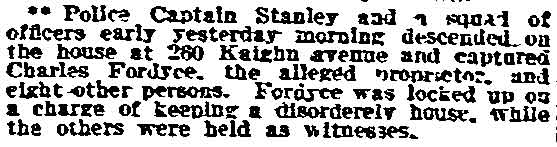
Police Captain Stanley and a squad of officers early yesterday morning descended on the house at 260 Kaighn avenue and captured Charles Fordyce, the alleged proprietor, and eight other persons. Fordyce was locked up on a charge of keeping a disorderly house, while the others were held as witnesses.
Halseys Committed for Disorderly House
Philadelphia Inquirer —
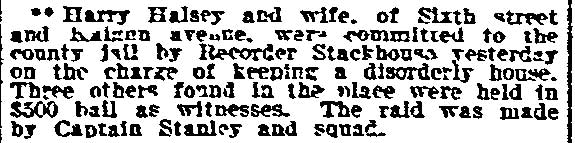
Harry Halsey and wife, of Sixth street and Kaighn avenue, were committed to the county jail by Recorder Stackhouse yesterday on the charge of keeping a disorderly house. Three others found in the place were held in $300 bail as witnesses. The raid was made by Captain Stanley and squad.
Camden News Notes
Philadelphia Inquirer —
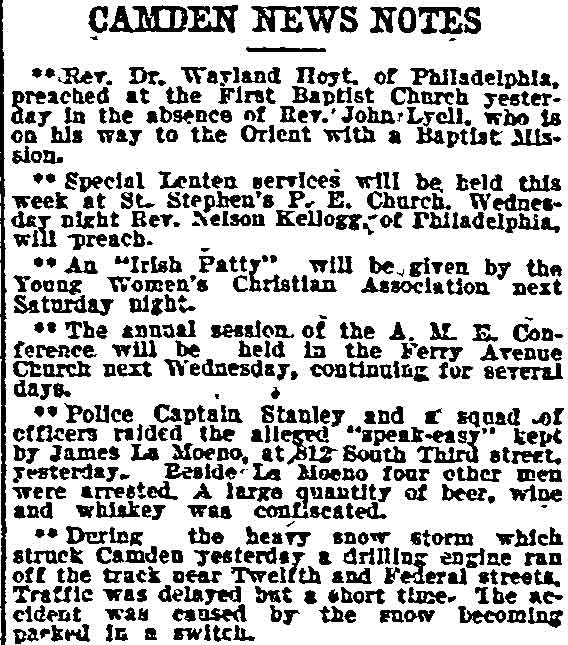
CAMDEN NEWS NOTES
•• Rev. Dr. Wayland Hoyt, of Philadelphia, preached at the First Baptist Church yesterday in the absence of Rev. John Lyell, who is on his way to the Orient with a Baptist Mission.
•• Special Lenten services will be held this week at St. Stephen’s P. E. Church. Wednesday night Rev. Nelson Kellogg, of Philadelphia, will preach.
•• An “Irish Patty” will be given by the Young Women’s Christian Association next Saturday night.
•• The annual session of the A. M. E. Conference will be held in the Ferry Avenue Church next Wednesday, continuing for several days.
•• Police Captain Stanley and a squad of officers raided the alleged “speak-easy” kept by James La Moeno, at 812 South Third street, yesterday. Beside La Moeno four other men were arrested. A large quantity of beer, wine and whiskey was confiscated.
•• During the heavy snow storm which struck Camden yesterday a drilling engine ran off the track near Twelfth and Federal streets. Traffic was delayed but a short time. The accident was caused by the snow becoming packed in a switch.
Woman’s Suspicious Death
Philadelphia Inquirer —
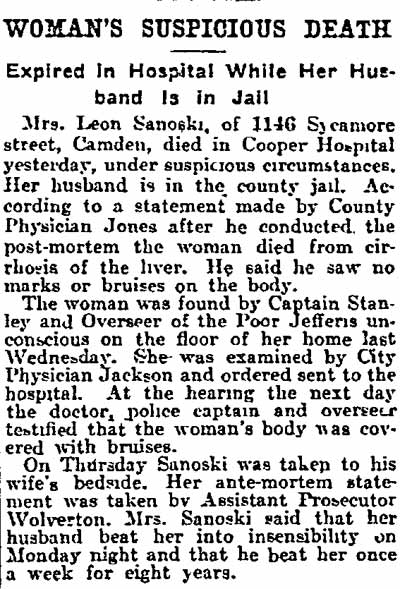
Woman’s Suspicious Death
Expired in Hospital While Her Husband Is in Jail
Mrs. Leon Sanoski, of 1146 Sycamore street, Camden, died in Cooper Hospital yesterday, under suspicious circumstances. Her husband is in the county jail. According to a statement made by County Physician Jones after he conducted, the post-mortem the woman died from cirrhosis of the liver. He said he saw no marks or bruises on the body.
The woman was found by Captain Stanley and Overseer of the Poor Jefferis unconscious on the floor of her home last Wednesday. She was examined by City Physician Jackson and ordered sent to the hospital. At the hearing the next day the doctor, police captain and overseer testified that the woman’s body was covered with bruises.
On Thursday Sanoski was taken to his wife’s bedside. Her ante-mortem statement was taken by Assistant Prosecutor Wolverton. Mrs. Sanoski said that her husband beat her into insensibility on Monday night and that he beat her once a week for eight years.
Many Caught in Raid
Philadelphia Inquirer —
Many Caught in Raid
Pandemonium Reigned in Camden City Hall Following Arrests
Camden’s “Little Italy” was thrown into a ferment yesterday when Police Captain Stanley and Sergeant Reader, with squads of policemen, descended on two alleged disorderly houses and placed under arrest thirty-eight of the inmates. The proprietors included Antonio Froricano, Fourth street and Joint alley, and Andermo Clercenda, 706 South Second street. The prisoners taxed the capacity of the city jail.
It required several trips of the patrol wagons to convey the prisoners to the city prison, and in each instance crowds of gesticulating women and children followed. They crowded the police headquarters until the doors had to be locked to keep them out. What with the crying women, the bawling children and the excited talking of the men there was a perfect pandemonium.
Funeral Cab in Runaway
Philadelphia Inquirer —
Funeral Cab in Runaway
Horse Took Fright at Trolley Car and Created Excitement
There was an exciting scene on Kaighn avenue, Camden, yesterday, when two horses attached to a cab which was in a funeral procession took fright at a trolley car and ran away.
For several blocks the animals continued their mad course, until Police Captain Stanley succeeded in stopping them at the risk of his life. No one was injured, but the occupants were badly frightened.
Camden News Notes
Philadelphia Inquirer —
Camden News Notes
•• Police Captain Stanley early yesterday morning raided the house at 139 Chestnut street and arrested Bessie Heisler and Emma Carll, the alleged proprietresses.
[Additional items]
Camden Cops Raided Barn Full of Cats
Philadelphia Inquirer —
CAMDEN COPS RAIDED BARN FULL OF CATS
But Beat Retreat When Felines Made Rush From Building. Work of Small Boys
For two weeks past pet cats have been disappearing from the neighborhood of Ninth and Sycamore streets, Camden. While they did not return to their homes residents have not been having a very quiet time of it. In fact, there never was such a yowling and mewing as in the last night or two. It all seemed to come from an unoccupied barn close by.
Things came to such a pass that the police were asked to investigate yesterday. With several officers, Captain Stanley visited the barn. As he approached he heard an unearthly noise, which seemed to indicate that all the cats in creation were in the barn. And when the door was opened at least a hundred felines bounded out amid such a spitting that the policemen beat a hasty retreat. There was all sorts and conditions of cats, and most of them were half starved.
Captain Stanley learned that the boys of the neighborhood had become imbued with the idea that the barn was haunted. They were told that cats would frighten the spooks away. So they gathered in every cat for blocks around and simply filled the barn with the unfortunate tabbies.
The attention of the S. P. C. A. has been directed to the matter.
Gold Badge for Police Captain
Philadelphia Inquirer —
Gold Badge for Police Captain
Police Captain Edward Hyde was presented with a handsome gold badge of his office by the members of the Second district of the Camden Police Department last night. The presentation speech was made by Captain Arthur Stanley in the presence of the squad.
Suit Against Police Captain
Philadelphia Inquirer —
Suit Against Police Captain
On behalf of Patrick Carr, a saloonkeeper, of Seventh street and Kaighn avenue, Camden, former Judge Westcott yesterday began suit to recover $10,000 damages from Police Captain Stanley, of the Second district. The action is the result of testimony given by Captain Stanley before the State Excise Commission, which was in Camden last Monday inquiring into local conditions. He was questioned about certain places and named Carr’s saloon as one that should not be licensed. This, Carr asserts, was detrimental to his business and character.
Murders Wife Who Threatened to Leave
Philadelphia Inquirer —
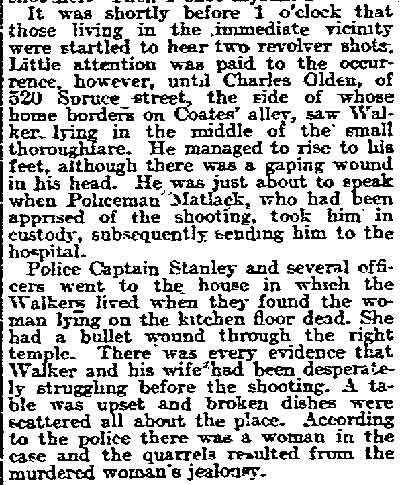
West Indian Shot Woman at Their Home in Camden, Then Turned Revolver on Himself
Angered because his wife Anna declared she was going to leave him, Adolph Walker, 27 years old, a West Indian, shot and killed the woman at their home, 906 Coates’ alley, Camden, yesterday afternoon. Then the murderer turned the revolver on himself and shot himself in the left temple. Walker was taken to the Cooper Hospital, where it was stated that his chances for recovery were slight.
Just before lapsing into unconsciousness Walker was able to gasp out the following statement to Chief of Police Gravener:
“My wife deceived me. She went out all last night and didn’t come home until 7 o’clock this morning. We had a quarrel about it and then my wife told me she was going to leave. She said she was going to kill me first and then I went upstairs, got my revolver, went down and shot her. Then I shot myself.”
It was shortly before 1 o’clock that those living in the immediate vicinity were startled to hear two revolver shots. Little attention was paid to the occurrence, however, until Charles Olden, of 520 Spruce street, the side of whose home borders on Coates’ alley, saw Walker lying in the middle of the small thoroughfare. He managed to rise to his feet, although there was a gaping wound in his head. He was just about to speak when Policeman Matlack, who had been apprised of the shooting, took him in custody, subsequently sending him to the hospital.
Police Captain Stanley and several officers went to the house in which the Walkers lived when they found the woman lying on the kitchen floor dead. She had a bullet wound through the right temple. There was every evidence that Walker and his wife had been desperately struggling before the shooting. A table was upset and broken dishes were scattered all about the place. According to the police there was a woman in the case and the quarrels resulted from the murdered woman’s jealousy.
Raid Didn’t Amount to Much
Philadelphia Inquirer —
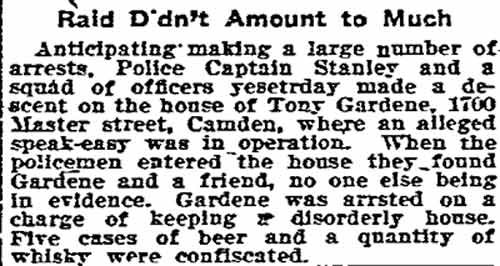
Raid Didn’t Amount to Much
Anticipating making a large number of arrests, Police Captain Stanley and a squad of officers yesetrday [sic] made a descent on the house of Tony Gardene, 1700 Master street, Camden, where an alleged speak-easy was in operation. When the policemen entered the house they found Gardene and a friend, no one else being in evidence. Gardene was arrsted [sic] on a charge of keeping a disorderly house. Flve [sic] cases of beer and a quantity of whisky were confiscated.
Excise Probe Is Used as Shield in Libel Action
Trenton Times —
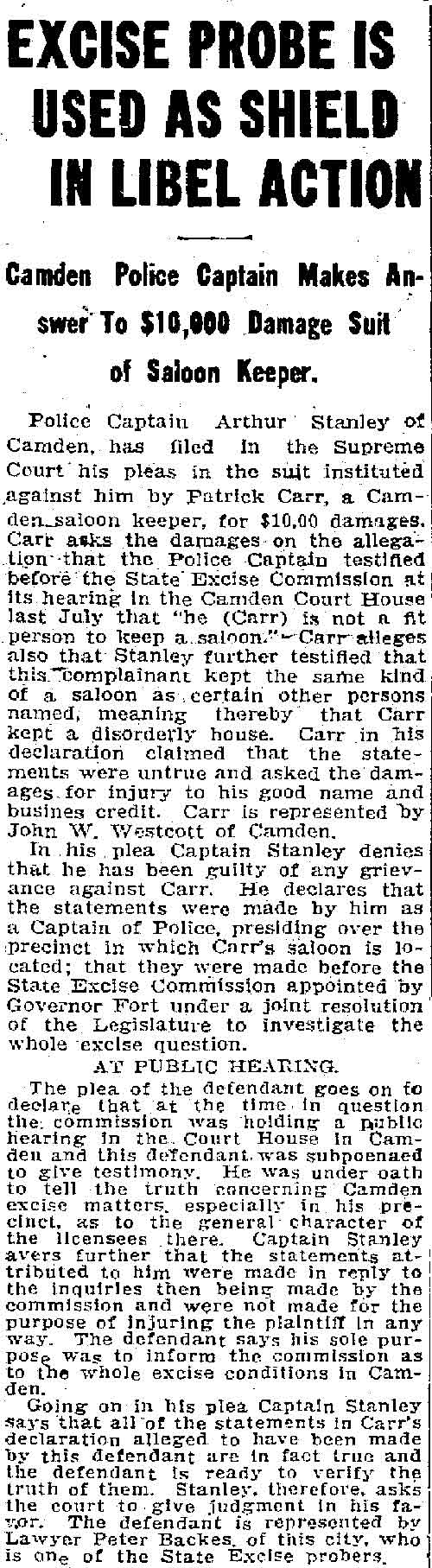
EXCISE PROBE IS USED AS SHIELD IN LIBEL ACTION
Camden Police Captain Makes Answer to $10,000 Damage Suit of Saloon Keeper
Police Captain Arthur Stanley of Camden, has filed in the Supreme Court his pleas in the suit instituted against him by Patrick Carr, a Camden saloon keeper, for $10,00 [sic] damages. Carr asks the damages on the allegation that the Police Captain testified before the State Excise Commission at its hearing in the Camden Court House last July that “he (Carr) is not a fit person to keep a saloon.” Carr alleges also that Stanley further testified that this complainant kept the same kind of a saloon as certain other persons named, meaning thereby that Carr kept a disorderly house. Carr in his declaration claimed that the statements were untrue and asked the damages for injury to his good name and busines [sic] credit. Carr is represented by John W. Westcott of Camden.
In his plea Captain Stanley denies that he has been guilty of any grievance against Carr. He declares that the statements were made by him as a Captain of Police, presiding over the precinct in which Carr’s saloon is located; that they were made before the State Excise Commission appointed by Governor Fort under a joint resolution of the Legislature to investigate the whole excise question.
AT PUBLIC HEARING
The plea of the defendant goes on to declare that at the time in question the commission was holding a public hearing in the Court House in Camden and this defendant was subpoenaed to give testimony. He was under oath to tell the truth concerning Camden excise matters, especially in his precinct, as to the general character of the licensees there. Captain Stanley avers further that the statements attributed to him were made in reply to the inquiries then being made by the commission and were not made for the purpose of injuring the plaintiff in any way. The defendant says his sole purpose was to inform the commission as to the whole excise conditions in Camden.
Going on in his plea Captain Stanley says that all of the statements in Carr’s declaration alleged to have been made by this defendant are in fact true and the defendant is ready to verify the truth of them. Stanley, therefore, asks the court to give judgment in his favor. The defendant is represented by Lawyer Peter Backes, of this city, who is one of the State Excise probers.
Two Raids in Camden
Philadelphia Inquirer —
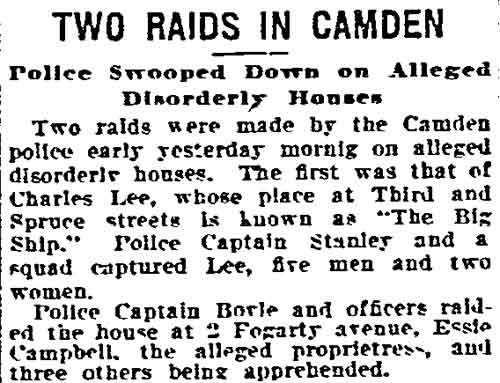
Two Raids in Camden
Police Swooped Down on Alleged Disorderly Houses
Two raids were made by the Camden police early yesterday morning on alleged disorderly houses. The first was that of Charles Lee, whose place at Third and Spruce streets is known as “The Big Ship.” Police Captain Stanley and a squad captured Lee, five men and two women.
Police Captain Borle and officers raided the house at 2 Fogarty avenue, Essie Campbell, the alleged proprietress, and three others being apprehended.
Italians Mobbed in Camden Raid
Philadelphia Inquirer —
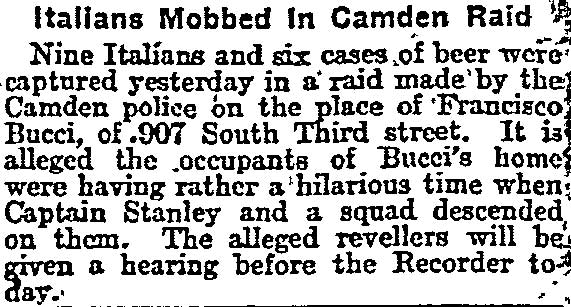
Italians Mobbed in Camden Raid
Nine Italians and six cases of beer were captured yesterday in a raid made by the Camden police on the place of Francisco Bucci, of 907 South Third street. It is alleged the occupants of Bucci’s home were having rather a hilarious time when Captain Stanley and a squad descended on them. The alleged revellers will be given a hearing before the Recorder to-day.
Police Break Up a “Suey and Teddy” Dance
Philadelphia Inquirer —
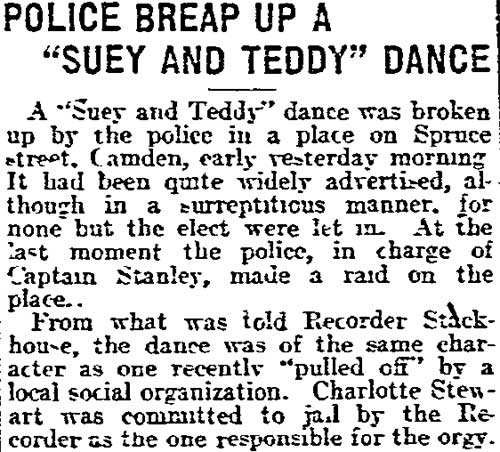
Police Break Up a “Suey and Teddy” Dance
A “Suey and Teddy” dance was broken up by the police in a place on Spruce street, Camden, early yesterday morning. It had been quite widely advertised, although in a surreptitious manner, for none but the elect were let in. At the last moment the police, in charge of Captain Stanley, made a raid on the place.
From what was told Recorder Stackhouse, the dance was of the same character as one recently “pulled off” by a local social organization. Charlotte Stewart was committed to jail by the Recorder as the one responsible for the orgy.
Camden News Notes
Philadelphia Inquirer —
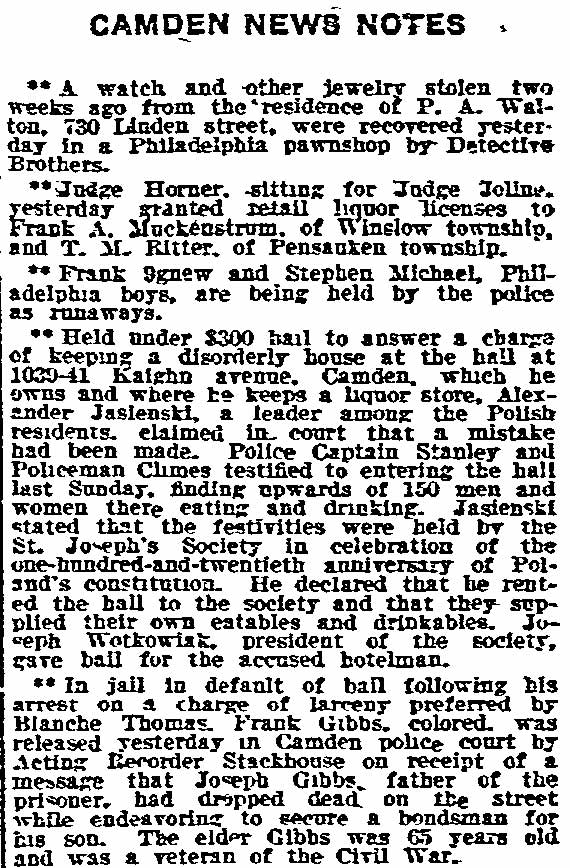
CAMDEN NEWS NOTES
•• A watch and other jewelry stolen two weeks ago from the residence of P. A. Walton, 730 Linden street, were recovered yesterday in a Philadelphia pawnshop by Detective Brothers.
•• Judge Horner, sitting for Judge Joline, yesterday granted retail liquor licenses to Frank A. Muckenstrum, of Winslow township, and T. M. Ritter, of Pensauken township.
•• Frank Agnew and Stephen Michael, Philadelphia boys, are being held by the police as runaways.
•• Held under $300 bail to answer a charge of keeping a disorderly house at the hall at 1039-41 Kaighn avenue, Camden, which he owns and where he keeps a liquor store, Alexander Jasienski, a leader among the Polish residents, claimed in court that a mistake had been made. Police Captain Stanley and Policeman Climes testified to entering the hall last Sunday, finding upwards of 150 men and women there eating and drinking. Jasienski stated that the festivities were held by the St. Joseph’s Society in celebration of the one-hundred-and-twentieth anniversary of Poland’s constitution. He declared that he rented the ball [sic] to the society and that they supplied their own eatables and drinkables. Joseph Wojtkowiak, president of the society, gave bail for the accused hotelman.
•• In jail in default of bail following his arrest on a charge of larceny preferred by Blanche Thomas, Frank Gibbs, colored, was released yesterday in Camden police court by Acting Recorder Stackhouse on receipt of a message that Joseph Gibbs, father of the prisoner, had dropped dead on the street while endeavoring to secure a bondsman for his son. The elder Gibbs was 65 years old and was a veteran of the Civil War.
Camden News Notes
Philadelphia Inquirer —
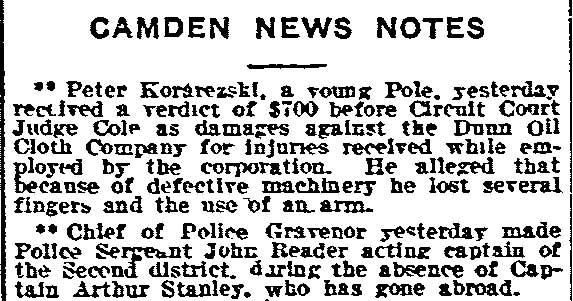
Camden News Notes
•• Peter Korarezski, a young Pole, yesterday received a verdict of $700 before Circuit Court Judge Cole as damages against the Dunn Oil Cloth Company for injuries received while employed by the corporation. He alleged that because of defective machinery he lost several fingers and the use of an arm.
•• Chief of Police Gravenor yesterday made Police Sergeant John Reader acting captain of the Second district, during the absence of Captain Arthur Stanley, who has gone abroad.
Camden News Notes
Philadelphia Inquirer —
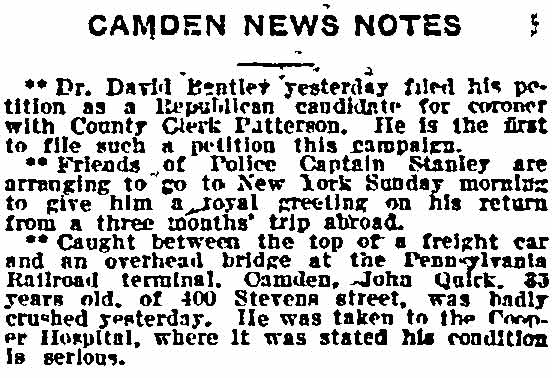
Camden News Notes
•• Dr. David Bentley yesterday filed his petition as a Republican candidate for coroner with County Clerk Patterson. He is the first to file such a petition this campaign.
•• Friends of Police Captain Stanley are arranging to go to New York Sunday morning to give him a royal greeting on his return from a three months’ trip abroad.
•• Caught between the top of a freight car and an overhead bridge at the Pennsylvania Railroad terminal, Camden, John Quick, 83 years old, of 400 Stevens street, was badly crushed yesterday. He was taken to the Cooper Hospital, where it was stated his condition is serious.
Twenty Years Ago To-Day in Bridgeton
Bridgeton Evening News —
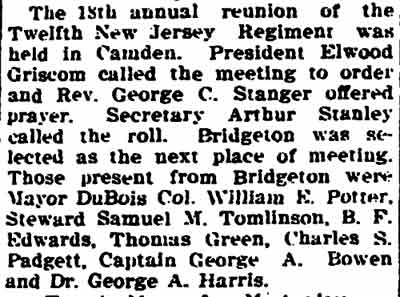
Twenty Years Ago To-Day in Bridgeton
The 18th annual reunion of the Twelfth New Jersey Regiment was held in Camden. President Elwood Griscom called the meeting to order and Rev. George C. Stanger offered prayer. Secretary Arthur Stanley called the roll. Bridgeton was selected as the next place of meeting. Those present from Bridgeton were: Mayor DuBois, Col. William E. Potter, Steward Samuel M. Tomlinson, B. F. Edwards, Thomas Green, Charles S. Padgett, Captain George A. Bowen and Dr. George A. Harris.
(news brief)
Philadelphia Inquirer —
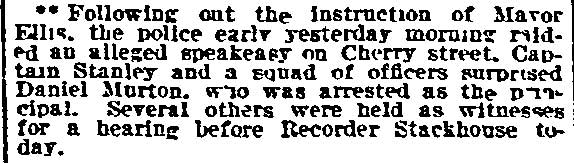
•• Following out the instruction of Mayor Ellis, the police early yesterday morning raided an alleged speakeasy on Cherry street. Captain Stanley and a squad of officers surprised Daniel Murton, who was arrested as the principal. Several others were held as witnesses for a hearing before Recorder Stackhouse today.
Burglar Escapes After Stanley’s Pursuit
Philadelphia Inquirer —

Policeman Stanley yesterday morning found a burglar in the act of breaking into the home of H. O. Cliver, 447 Benson street. After leaping several fences the prowler escaped.
Camden's Bodies Begin New Year
Philadelphia Inquirer —
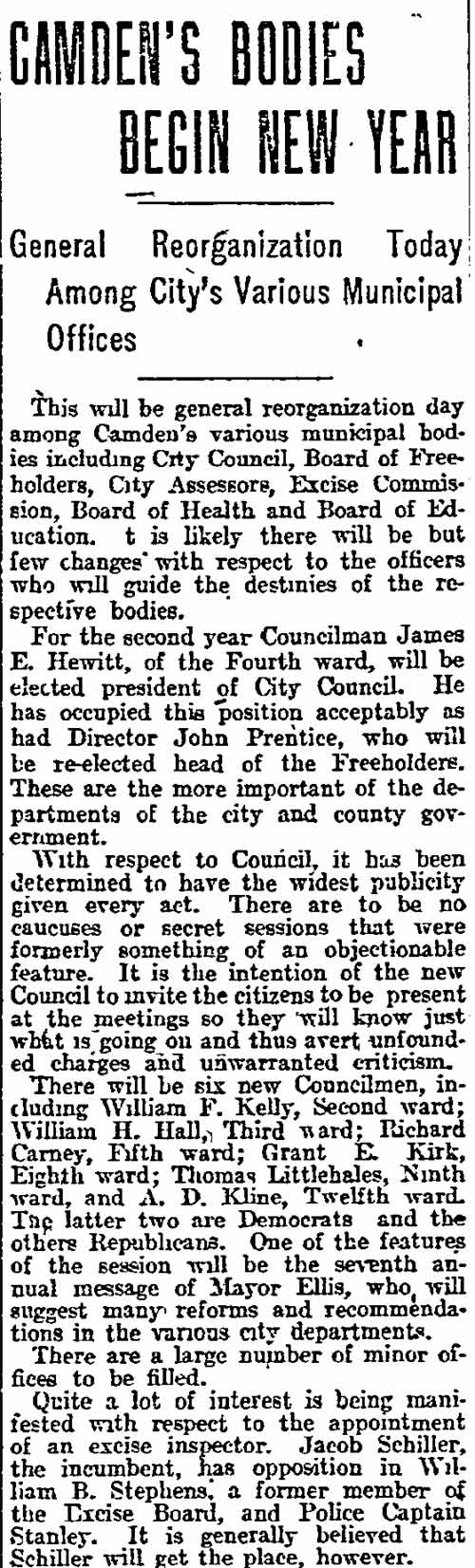
This will be general reorganization day among Camden's various municipal bodies including City Council, Board of Freeholders, City Assessors, Excise Commission, Board of Health and Board of Education. It is likely there will be but few changes with respect to the officers who will guide the destinies of their respective bodies.
For the second year Councilman James E. Hewitt, of the Fourth ward, will be elected president of City Council. He has occupied this position acceptably as had Director John Prentice, who will be re-elected head of the Freeholders. These are the more important of the departments of the city and county government.
With respect to Council, it has been determined to have the widest publicity given every act. There are to be no caucuses or secret sessions that were formerly something of an objectionable feature. It is the intention of the new Council to invite the citizens to be present at the meetings so they will know just what is going on and thus avert unfounded charges and unwarranted criticisms. There will be six new Councilmen, including William F. Kelly, Second ward; William H. Hall, Third ward; Richard Carney, Fifth ward; Grant E. Kirk, Eighth ward; Thomas Littlehales, Ninth ward, and A. D. Kline, Twelfth ward. The latter two are Democrats and the others Republicans. One of the features of the session will be the seventh annual message of Mayor Ellis, who will suggest many reforms and recommendations in the various city departments.
There are a large number of minor offices to be filled.
Quite a lot of interest is being manifested with respect to the appointment of an excise inspector. Jacob Schiller, the incumbent, has opposition in William B. Stephens, a former member of the Excise Board, and Police Captain Stanley. It is generally believed that Schiller will get the place, however.
Court Dismisses Gambling Charge
Camden Post-Telegram —
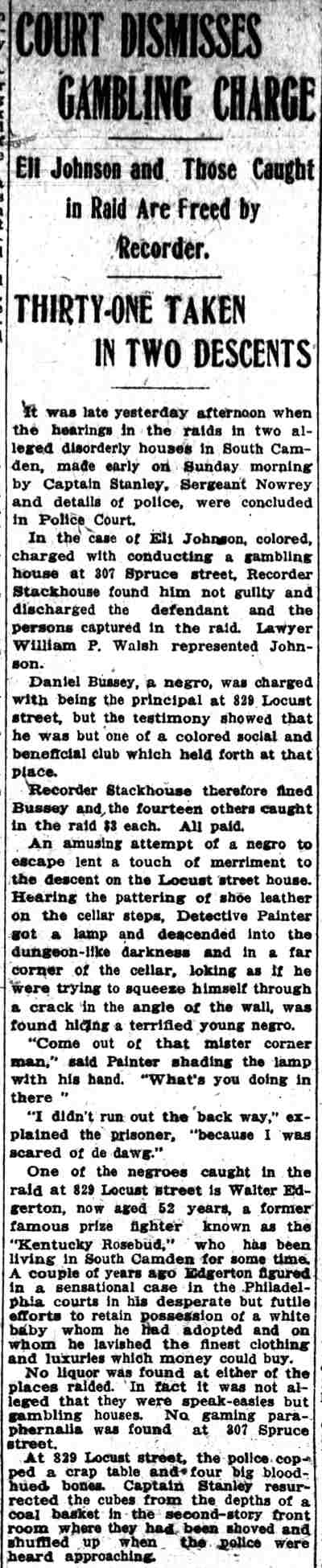
COURT DISMISSES GAMBLING CHARGE
Eli Johnson and Those Caught in Raid Are Freed by Recorder.
THIRTY-ONE TAKEN IN TWO DESCENTS
It was late yesterday afternoon when the hearings in the raids in two alleged disorderly houses in South Camden, made early on Sunday morning by Captain Stanley, Sergeant Nowrey and details of police, were concluded in Police Court.
In the case of Eli Johnson, colored, charged with conducting a gambling house at 307 Spruce street, Recorder Stackhouse found him not guilty and discharged the defendant and the persons captured in the raid. Lawyer William P. Walsh represented Johnson.
Daniel Bussey, a negro, was charged with being the principal at 829 Locust street, but the testimony showed that he was but one of a colored social and beneficial club which held forth at that place.
Recorder Stackhouse therefore fined Bussey and the fourteen others caught in the raid $3 each. All paid.
An amusing attempt of a negro to escape lent a touch of merriment to the descent on the Locust street house. Hearing the pattering of shoe leather on the cellar steps, Detective Painter got a lamp and descended into the dungeon-like darkness and in a far corner of the cellar, loking as if he were trying to squeeze himself through a crack in the angle of the wall, was found hiding a terrified young negro.
“Come out of that mister corner man,” said Painter shading the lamp with his hand. “What’s you doing in there”
“I didn’t run out the back way,” explained the prisoner, “because I was scared of de dawg.”
One of the negroes caught in the raid at 829 Locust street is Walter Edgerton, now aged 52 years, a former famous prize fighter known as the “Kentucky Rosebud,” who has been living in South Camden for some time. A couple of years ago Edgerton figured in a sensational case in the Philadelphia courts in his desperate but futile efforts to retain possession of a white baby whom he had adopted and on whom he lavished the finest clothing and luxuries which money could buy.
No liquor was found at either of the places raided. In fact it was not alleged that they were speak-easies but gambling houses. No gaming paraphernalia was found at 307 Spruce street.
At 829 Locust street, the police copped a crap table and four big bloodhued bones. Captain Stanley resurrected the cubes from the depths of a coal basket in the second-story front room where they had been shoved and shuffled up when the police were heard approaching.
Camden News Notes
Philadelphia Inquirer —
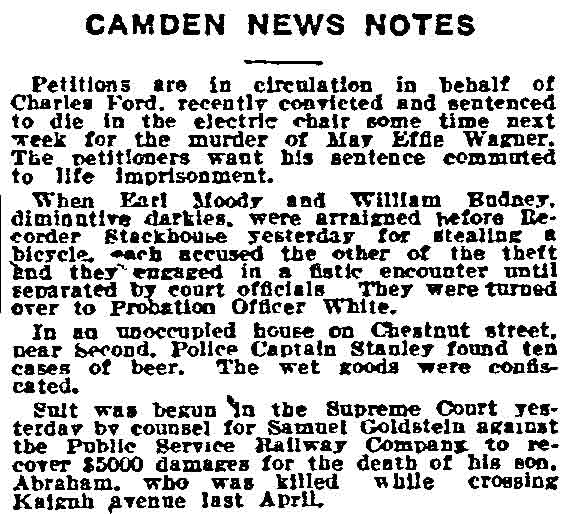
Camden News Notes
Petitions are in circulation in behalf of Charles Ford, recently convicted and sentenced to die in the electric chair some time next week for the murder of May Effie Wagner. The petitioners want his sentence commuted to life imprisonment.
When Earl Moody and William Budney, diminutive darkies, were arraigned before Recorder Stackhouse yesterday for stealing a bicycle, each accused the other of the theft and they engaged in a fistic encounter until separated by court officials. They were turned over to Probation Officer White.
In an unoccupied house on Chestnut street, near Second, Police Captain Stanley found ten cases of beer. The wet goods were confiscated.
Suit was begun in the Supreme Court yesterday by counsel for Samuel Goldstein against the Public Service Railway Company to recover $5000 damages for the death of his son, Abraham, who was killed while crossing Kaighn avenue last April.
Take Sixteen Men in Raid
Philadelphia Inquirer —
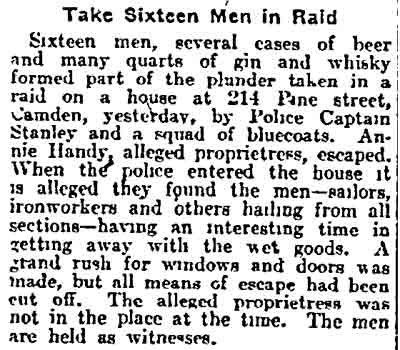
Take Sixteen Men in Raid
Sixteen men, several cases of beer and many quarts of gin and whisky formed part of the plunder taken in a raid on a house at 214 Pine street, Camden, yesterday, by Police Captain Stanley and a squad of bluecoats. Annie Handy, alleged proprietress, escaped. When the police entered the house it is alleged they found the men—sailors, ironworkers and others hailing from all sections—having an interesting time in getting away with the wet goods. A grand rush for windows and doors was made, but all means of escape had been cut off. The alleged proprietress was not in the place at the time. The men are held as witnesses.
George Williams Always in Front
Philadelphia Inquirer —
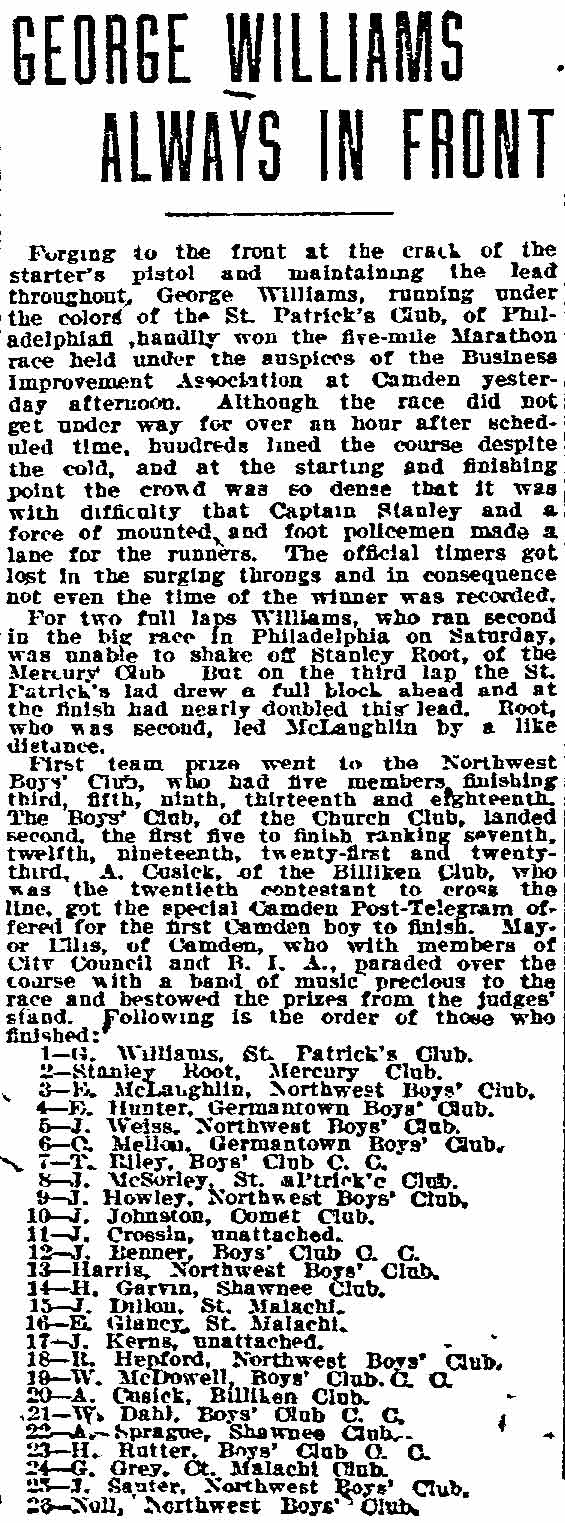
GEORGE WILLIAMS ALWAYS IN FRONT
Pacing to the starter’s pistol and maintaining the pace throughout, George Williams of St. Patrick’s Club won the five-mile Marathon under the auspices of the Camden Improvement Association at Camden yesterday. It was difficult with so many horses and carts about that it was difficult to start the race on time and the race did not get under way for over an hour after scheduled time. Captain Stanley timed the course despite the cold, and at the starting and finishing mark it was difficult to have it agreed that the finish time was correct. The official timers got out the targets but could not agree, not even the time of the winner was recorded. Captain Stanley timed the winner in the big race in Philadelphia on Saturday, but also had to admit that if he came in second in the Marathon it had drawn a full block ahead and led McLaughlin by a like number.
Jamesburg Escapees Arrested in Camden
Woodbury Times —
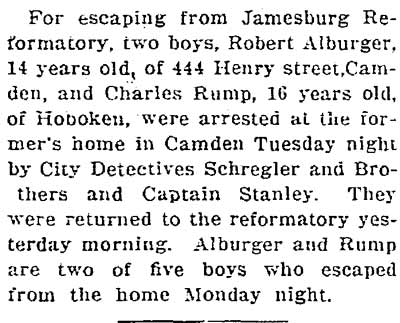
For escaping from Jamesburg Reformatory, two boys, Robert Alburger, 14 years old, of 444 Henry street, Camden, and Charles Rump, 16 years old, of Hoboken, were arrested at the former’s home in Camden Tuesday night by City Detectives Schregler and Brothers and Captain Stanley. They were returned to the reformatory yesterday morning. Alburger and Rump are two of five boys who escaped from the home Monday night.
Seven Raids Disturb Camden Churchgoers
Philadelphia Inquirer —
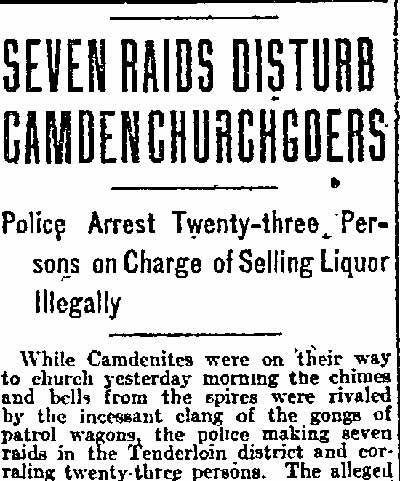
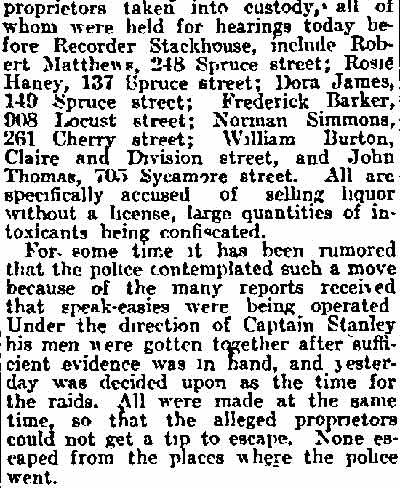
Police Arrest Twenty-three Persons on Charge of Selling Liquor Illegally
While Camdenites were on their way to church yesterday morning the chimes and bells from the spires were rivaled by the incessant clang of the gongs of patrol wagons, the police making seven raids in the Tenderloin district and corraling twenty-three persons. The alleged proprietors taken into custody, all of whom were held for hearings today before Recorder Stackhouse, include Robert Matthews, 248 Spruce street; Rosie Haney, 137 Spruce street; Dora James, 140 Spruce street; Frederick Barker, 908 Locust street; Norman Simmons, 261 Cherry street; William Burton, Claire and Division street, and John Thomas, 705 Sycamore street. All are specifically accused of selling liquor without a license, large quantities of intoxicants being confiscated.
For some time it has been rumored that the police contemplated such a move because of the many reports received that speak-easies were being operated. Under the direction of Captain Stanley his men were gotten together after sufficient evidence was in hand, and yesterday was decided upon as the time for the raids. All were made at the same time, so that the alleged proprietors could not get a tip to escape. None escaped from the places where the police went.
‘Kentucky Rosebud’ Accused by Police
Camden Post-Telegram —
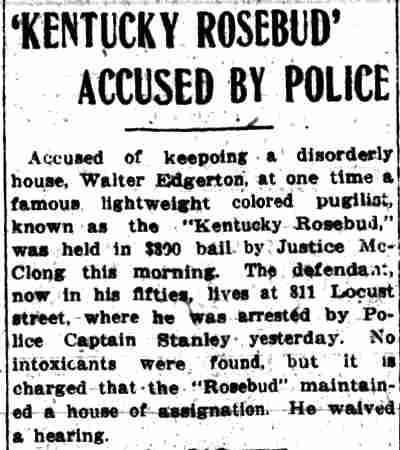
’Kentucky Rosebud’ Accused by Police
Accused of keeping a disorderly house, Walter Edgerton, at one time a famous lightweight colored pugilist, known as the “Kentucky Rosebud,” was held in $300 bail by Justice McClong this morning. The defendant, now in his fifties, lives at 811 Locust street, where he was arrested by Police Captain Stanley yesterday. No intoxicants were found, but it is charged that the “Rosebud” maintained a house of assignation. He waived a hearing.
Sunday Liquor Seller Held for Court
Philadelphia Inquirer —
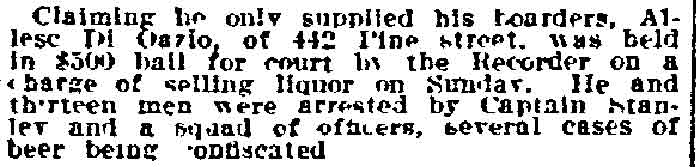
Claiming he only supplied his boarders, Alesio Di Orazio, of 442 Pine street, was held in $500 bail for court by the Recorder on a charge of selling liquor on Sunday. He and thirteen men were arrested by Captain Stanley and a squad of officers, several cases of beer being confiscated.
Camden House Raided
Philadelphia Inquirer —
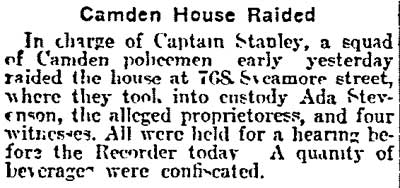
Camden House Raided
In charge of Captain Stanley, a squad of Camden policemen early yesterday raided the house at 768 Sycamore street, where they took into custody Ada Stevenson, the alleged proprietoress, and four witnesses. All were held for a hearing before the Recorder today. A quantity of beverages were confiscated.
Raid Alleged Disorderly Houses
Philadelphia Inquirer —
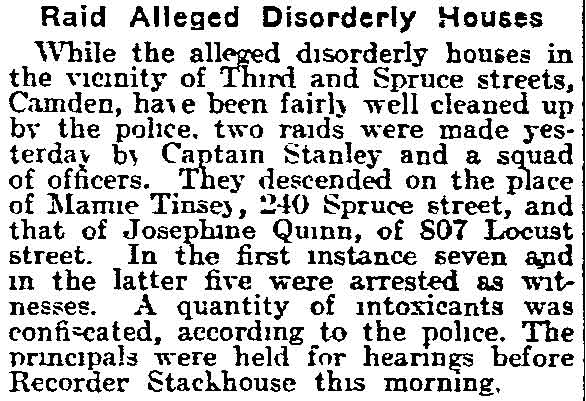
Raid Alleged Disorderly Houses
While the alleged disorderly houses in the vicinity of Third and Spruce streets, Camden, have been fairly well cleaned up by the police, two raids were made yesterday by Captain Stanley and a squad of officers. They descended on the place of Mamie Tinsey, 240 Spruce street, and that of Josephine Quinn, of 807 Locust street. In the first instance seven and in the latter five were arrested as witnesses. A quantity of intoxicants was confiscated, according to the police. The principals were held for hearings before Recorder Stackhouse this morning.
Camden at a Glance
Philadelphia Inquirer —
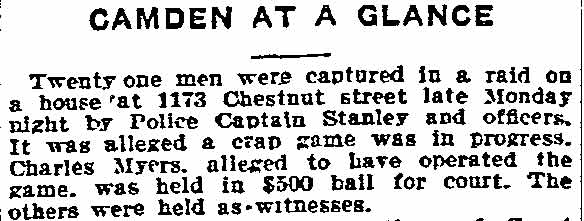
Camden at a Glance
Twenty one men were captured in a raid on a house at 1173 Chestnut street late Monday night by Police Captain Stanley and officers. It was alleged a crap game was in progress. Charles Myers, alleged to have operated the game, was held in $500 bail for court. The others were held as witnesses.
Camden at a Glance
Philadelphia Inquirer —
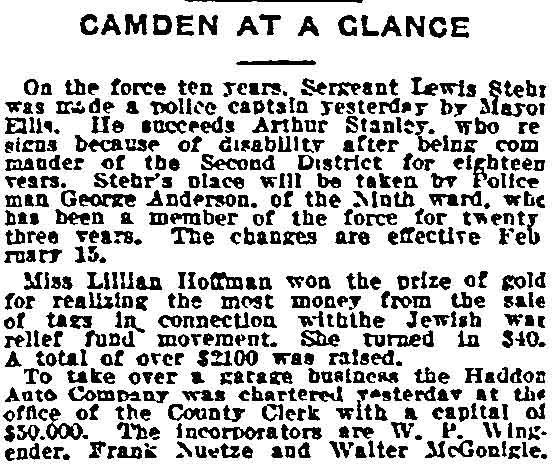
On the force ten years, Sergeant Lewis Stehr was made a police captain yesterday by Mayor Ellis. He succeeds Arthur Stanley, who resigns because of disability after being commander of the Second District for eighteen years. Stehr’s place will be taken by Policeman George Anderson, of the Ninth ward, who has been a member of the force for twenty three years. The changes are effective February 15.
Miss Lillian Hoffman won the prize of gold for realizing the most money from the sale of tags in connection with the Jewish war relief fund movement. She turned in $40. A total of over $2100 was raised.
To take over a garage business the Haddon Auto Company was chartered yesterday at the office of the County Clerk with a capital of $50,000. The incorporators are W. P. Wingender, Frank Nuetze and Walter McGonigle.
Police Shake-up in Camden
Philadelphia Inquirer —
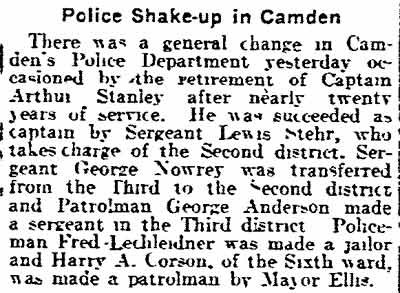
Police Shake-up in Camden
There was a general change in Camden’s Police Department yesterday occasioned by the retirement of Captain Arthur Stanley after nearly twenty years of service. He was succeeded as captain by Sergeant Lewis Stehr, who takes charge of the Second district. Sergeant George Nowrey was transferred from the Third to the Second district and Patrolman George Anderson made a sergeant in the Third district. Policeman Fred Lechleidner was made a jailor and Harry A. Corson, of the Sixth ward, was made a patrolman by Mayor Ellis.
Veterans Carried Pall
Philadelphia Inquirer —
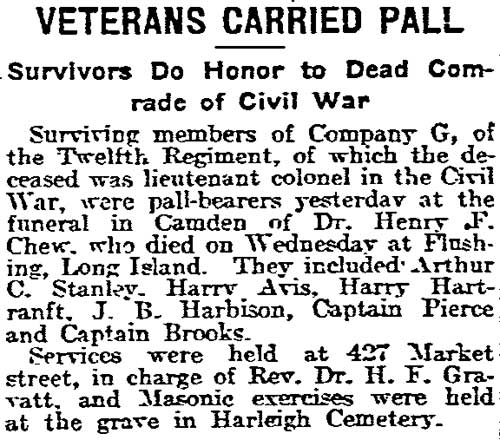
Veterans Carried Pall
Survivors Do Honor to Dead Comrade of Civil War
Surviving members of Company G, of the Twelfth Regiment, of which the deceased was lieutenant colonel in the Civil War, were pall-bearers yesterday at the funeral in Camden of Dr. Henry F. Chew, who died on Wednesday at Flushing, Long Island. They included Arthur C. Stanley, Harry Avis, Harry Hartranft, J. B. Harbison, Captain Pierce and Captain Brooks.
Services were held at 427 Market street, in charge of Rev. Dr. H. F. Gravatt, and Masonic exercises were held at the grave in Harleigh Cemetery.
Camden Does Honor to Heroes' Memory
Philadelphia Inquirer —
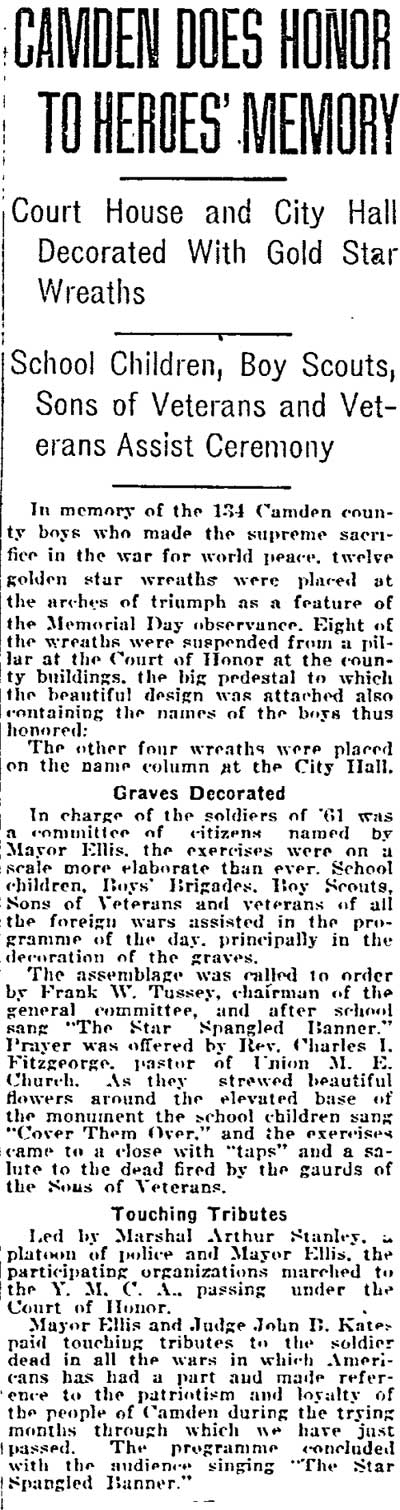
CAMDEN DOES HONOR TO HEROES’ MEMORY
Court House and City Hall Decorated With Gold Star Wreaths
School Children, Boy Scouts, Sons of Veterans and Veterans Assist Ceremony
In memory of the 134 Camden county boys who made the supreme sacrifice in the war for world peace, twelve golden star wreaths were placed at the arches of triumph as a feature of the Memorial Day observance. Eight of the wreaths were suspended from a pillar at the Court of Honor at the county buildings, the big pedestal to which the beautiful design was attached also containing the names of the boys thus honored: The other four wreaths were placed on the name column at the City Hall.
Graves Decorated
In charge of the soldiers of ‘61 was a committee of citizens named by Mayor Ellis, the exercises were on a scale more elaborate than ever. School children, Boys’ Brigades, Boy Scouts, Sons of Veterans and veterans of all the foreign wars assisted in the programme of the day, principally in the decoration of the graves.
The assemblage was called to order by Frank W. Tussey, chairman of the general committee, and after school sang “The Star Spangled Banner,” Prayer was offered by Rev. Charles I. Fitzgeorge, pastor of Union M. E. Church. As they strewed beautiful flowers around the elevated base of the monument the school children sang “Cover Them Over,” and the exercises came to a close with “taps” and a salute to the dead fired by the gaurds of the Sons of Veterans.
Touching Tributes
Led by Marshal Arthur Stanley, a platoon of police and Mayor Ellis, the participating organizations marched to the Y. M. C. A., passing under the Court of Honor.
Mayor Ellis and Judge John B. Kates paid touching tributes to the soldier dead in all the wars in which Americans has had a part and made reference to the patriotism and loyalty of the people of Camden during the trying months through which we have just passed. The programme concluded with the audience singing “The Star Spangled Banner.”