Introduction
CHARLES GRANT GARRISON was born in Swedesboro, New Jersey on August 3, 1849. He was the son of Rev. Joseph Fithian Garrison. He had three younger brothers, Lindley, William, and Joseph. Lindley Garrison was Secretary of War under President Wilson from 1913 until his resignation in 1916.
The Garrison family came to Camden in 1855, when Rev. Garrison was appointed rector of St. Paul’s Episcopal Church, a post he held until August of 1884.
Charles G. Garrison was educated in Edgehill School, Princeton, at the Episcopal Academy, Philadelphia, and, entering the University of Pennsylvania with a view to the study of medicine, graduated from there in 1872. He had practiced that profession at Swedesboro but four years when he resolved to become a lawyer, and entered the office of Samuel H. Grey of Camden, who at the time of his death was Attorney General of the State. He was admitted to the Bar in 1878, and established a partnership with Thomas French. Thomas French and Charles Garrison became counselors-at-law in 1881, and remained partners until 1888, when Garrison was appointed to the New Jersey State Supreme Court.
In 1884 Charles Garrison became Judge Advocate General of New Jersey. Governor Green in 1888 nominated him to the State Senate as an Associate Justice of the Supreme Court, to succeed Justice Joel Parker who, previously to his service on the bench, had been New Jersey’s war Governor and who subsequently served a second term in that office. Confirmation from the Senate came promptly. Governors Werts, Murphy, Fort and Fielder re-nominated him for successive seven year terms, in 1895, 1902, 1909, 1916. He retired due to ill health around 1920.
Justice Garrison became Chancellor of the Southern Diocese of the Protestant Episcopal Church of New Jersey in 1882 and was still in that position as late as 1917.
Judge Garrison resided in Merchantville for many years, and was there at the time of his death on April 22, 1924, which was noted in the New York Times the following day.
The New York Times reported from Camden on May 3, 1924:
JERSEY JUDGE LEFT ALL TO HOUSEKEEPER;
Widow, Son and Two Daughters Cut Off by Ex-Justice Garrison.
“Ex-Justice Charles Grant Garrison of the Supreme Court of New Jersey, who died at Merchantville, N.J., on April 22, left his entire estate to his housekeeper, Miss Winifred Dallin, of Wildwood, N.J. Miss Dallin filed the will before Surrogate Brewer here today for probate. The personal estate was estimated at $30,000 and the value of the real estate was not set forth.”
Abbatto Hanged in Camden Jail
Philadelphia Inquirer —
Quick Work by Sheriff Sell in Executing the Murderer of Genaro De Feo
Condemned Man Died Without a Struggle, and Was Buried in Potters’ Field
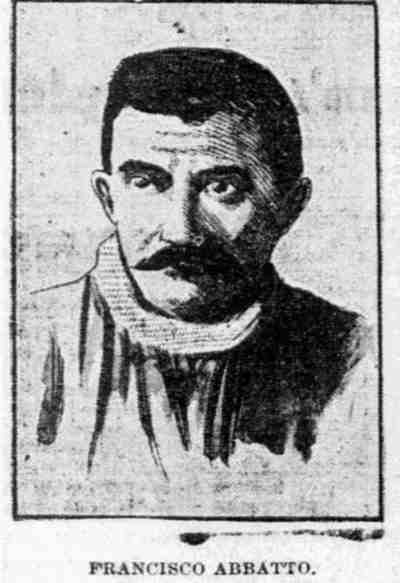
FRANCISCO ABBATTO.
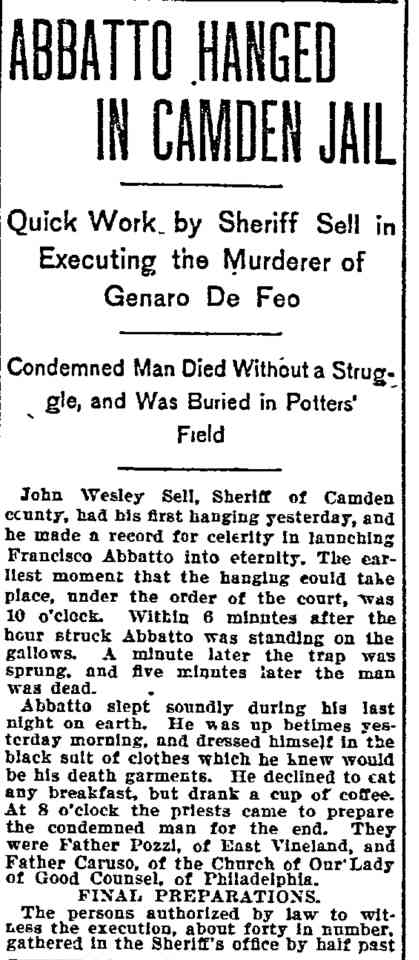
John Wesley Sell, Sheriff of Camden county, had his first hanging yesterday, and he made a record for celerity in launching Francisco Abbatto into eternity. The earliest moment that the hanging could take place, under the order of the court, was 10 o’clock. Within 6 minutes after the hour struck Abbatto was standing on the gallows. A minute later the trap was sprung, and five minutes later the man was dead.
Abbatto slept soundly during his last night on earth. He was up betimes yesterday morning, and dressed himself in the black suit of clothes which he knew would be his death garments. He declined to eat any breakfast, but drank a cup of coffee. At 8 o’clock the priests came to prepare the condemned man for the end. They were Father Pozzi, of East Vineland, and Father Caruso, of the Church of Our Lady of Good Counsel, of Philadelphia.
FINAL PREPARATIONS.
The persons authorized by law to witness the execution, about forty in number, gathered in the Sheriff’s office by half past 9 o’clock. County Clerk Barber administered the oath to the twelve citizens appointed by Judge Garrison to see that the sentence of death was carried out. They were County Physician W. S. Jones, Dr. Alexander McAlister, Dr. S. Ramsdell, Dr. E. A. Y. Schellinger, Dr. A. H. Lippincott, Dr. Joseph Nicholson, Dr. Paul N. Mecray, Upton S. Jeffreys, Harry B. Paul, Charles R. Bacon, William H. Cole and County Detective John S. Smith.
The death jury were taken through the jail to the loft at the Broadway and Federal streets corner of the building, where the gallows awaited its victim.
A few minutes before 10 o’clock the Sheriff led his deputies and the newspaper men across the “Bridge of Sighs” to the jail, and they joined the group in the death chamber. The clock struck 10, and all was ready to execute the mandate of the law. Five minutes later a door at the foot of the gallows, leading into the jail opened, and the condemned man was seen walking to his doom.
QUICK EXECUTION.
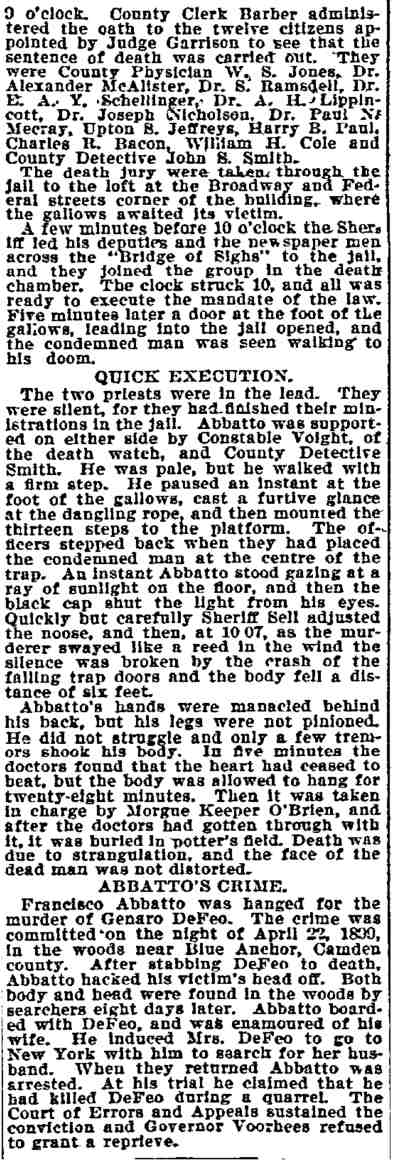
The two priests were in the lead. They were silent, for they had finished their ministrations in the jail. Abbatto was supported on either side by Constable Voight, of the death watch, and County Detective Smith. He was pale, but he walked with a firm step. He paused an instant at the foot of the gallows, cast a furtive glance at the dangling rope, and then mounted the thirteen steps to the platform. The officers stepped back when they had placed the condemned man at the centre of the trap. An instant Abbatto stood gazing at a ray of sunlight on the floor, and then the black cap shut the light from his eyes. Quickly but carefully Sheriff Sell adjusted the noose, and then, at 10 07, as the murderer swayed like a reed in the wind the silence was broken by the crash of the falling trap doors and the body fell a distance of six feet.
Abbatto’s hands were manacled behind his back, but his legs were not pinioned. He did not struggle and only a few tremors shook his body. In five minutes the doctors found that the heart had ceased to beat, but the body was allowed to hang for twenty-eight minutes. Then it was taken in charge by Morgue Keeper O’Brien, and after the doctors had gotten through with it, it was buried in potter’s field. Death was due to strangulation, and the face of the dead man was not distorted.
ABBATTO’S CRIME.
Francisco Abbatto was hanged for the murder of Genaro DeFeo. The crime was committed on the night of April 22, 1899, in the woods near Blue Anchor, Camden county. After stabbing DeFeo to death, Abbatto hacked his victim’s head off. Both body and head were found in the woods by searchers eight days later. Abbatto boarded with DeFeo, and was enamoured of his wife. He induced Mrs. DeFeo to go to New York with him to search for her husband. When they returned Abbatto was arrested. At his trial he claimed that he had killed DeFeo during a quarrel. The Court of Errors and Appeals sustained the conviction and Governor Voorhees refused to grant a reprieve.
Serious Charges by Defeated Candidate
Philadelphia Inquirer —
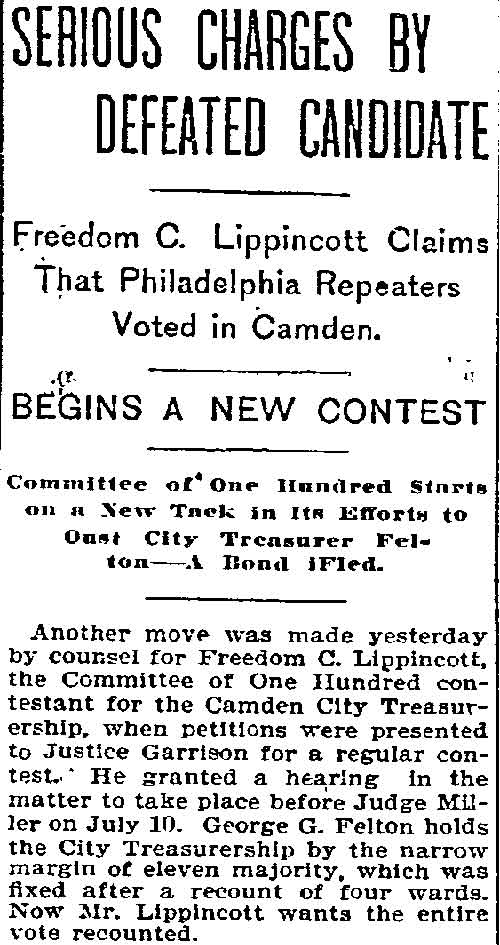
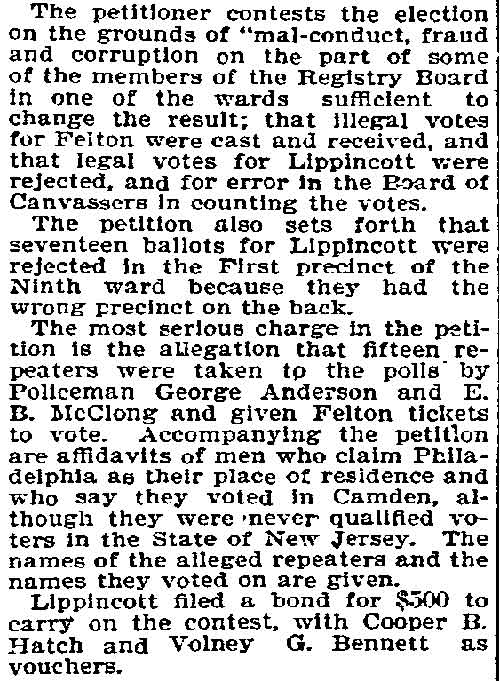
Freedom C. Lippincott Claims That Philadelphia Repeaters Voted in Camden.
BEGINS A NEW CONTEST
Committee of One Hundred Starts on a New Tack in Its Efforts to Oust City Treasurer Felton—A Bond Filed.
Another move was made yesterday by counsel for Freedom C. Lippincott, the Committee of One Hundred contestant for the Camden City Treasurership, when petitions were presented to Justice Garrison for a regular contest. He granted a hearing in the matter to take place before Judge Miller on July 10. George G. Felton holds the City Treasurership by the narrow margin of eleven majority, which was fixed after a recount of four wards. Now Mr. Lippincott wants the entire vote recounted.
The petitioner contests the election on the grounds of “mal-conduct, fraud and corruption on the part of some of the members of the Registry Board in one of the wards sufficient to change the result; that illegal votes for Felton were cast and received, and that legal votes for Lippincott were rejected, and for error in the Board of Canvassers in counting the votes.
The petition also sets forth that seventeen ballots for Lippincott were rejected in the First precinct of the Ninth ward because they had the wrong precinct on the back.
The most serious charge in the petition is the allegation that fifteen repeaters were taken to the polls by Policeman George Anderson and E. B. McClong and given Felton tickets to vote. Accompanying the petition are affidavits of men who claim Philadelphia as their place of residence and who say they voted in Camden, although they were never qualified voters in the State of New Jersey. The names of the alleged repeaters and the names they voted on are given.
Lippincott filed a bond for $500 to carry on the contest, with Cooper B. Hatch and Volney G. Bennett as vouchers.
Coursey in Dread of Electric Chair
Camden Post-Telegram —
Brutal Murderer of Carl Kellmann on Verge of Complete Collapse.
HARRY DUFFIELD, TOO, IS NEAR BREAK DOWN
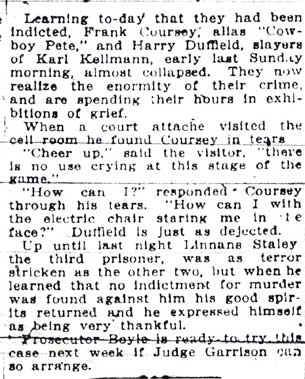
Learning to-day that they had been indicted, Frank Coursey, alias “Cowboy Pete,” and Harry Duffield, slayers of Karl Kellmann, early last Sunday morning, almost collapsed. They now realize the enormity of their crime, and are spending their hours in exhibitions of grief.
When a court attache visited the cell room he found Coursey in tears.
“Cheer up,” said the visitor, “there is no use crying at this stage of the game.”
“How can I?” responded Coursey through his tears. “How can I with the electric chair staring me in the face?” Duffield is just as dejected.
Up until last night Linnans Staley the third prisoner, was as terror stricken as the other two, but when he learned that no indictment for murder was found against him his good spirits returned and he expressed himself as being very thankful.
Prosecutor Boyle is ready to try this case next week if Judge Garrison can so arrange.
Testimonial Dinner to Dr. Fishburn
Philadelphia Inquirer —
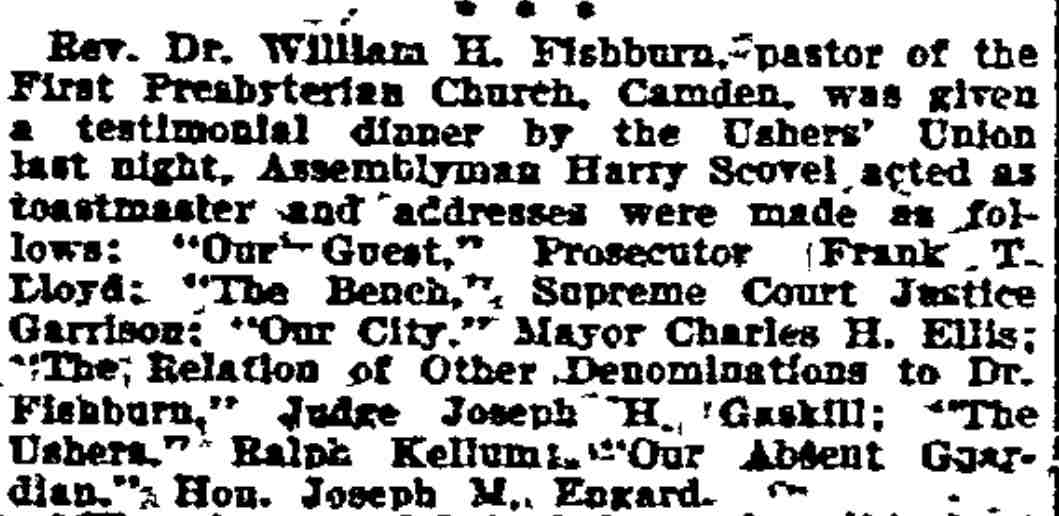
Rev. Dr. William H. Fishburn, pastor of the First Presbyterian Church, Camden, was given a testimonial dinner by the Ushers’ Union last night. Assemblyman Harry Scovel acted as toastmaster and addresses were made as follows: “Our Guest,” Prosecutor Frank T. Lloyd; “The Bench,” Supreme Court Justice Garrison; “Our City,” Mayor Charles H. Ellis; “The Relation of Other Denominations to Dr. Fishburn,” Judge Joseph H. Gaskill; “The Ushers,” Ralph Kellum; “Our Absent Guardian,” Hon. Joseph M. Engard. [cut off at the crop edge]
Charles Grant Garrison.
New York Times —
Was Supreme Court Justice in Jersey for 35 Years.
MERCHANTVILLE, N. J., April 22.—Charles Grant Garrison, for more than thirty-five years Justice of the Supreme Court of New Jersey, died at his home here today. He retired about four years ago because of ill health. He was 74 years old.
Mr. Garrison was a brother of Lindley M. Garrison, Secretary of War under President Wilson, and receiver of the Brooklyn Rapid Transit Company.
Portraits
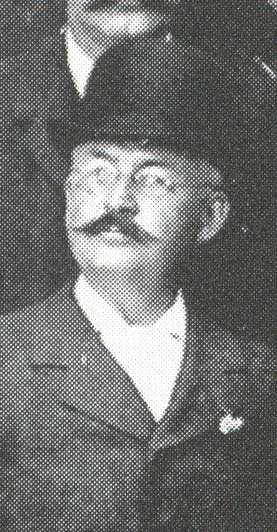
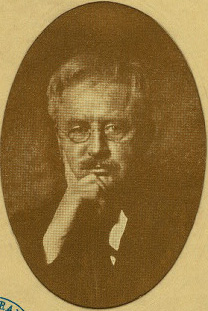
Charles Grant Garrison, circa 1894 (left); from the 1908 South Jersey Bar dinner program (right)
George R. Prowell’s History of Camden County, New Jersey
1886
Charles G. Garrison, M.D., is a native of Swedesboro, N. J. His education was received at the Edge Hill School, Princeton, at the Episcopal Academy, Philadelphia, and at the University of Pennsylvania. He graduated in 1872 from the Medical Department of that institution, and until 1876 practiced medicine in Swedesboro, N. J. He then entered the office of Samuel H. Grey, of Camden, and was admitted to the bar in 1878. He began practice in Camden as a member of the firm of Garrison & French.
Mr. Garrison was made judge advocate-general of the National Guard of New Jersey in 1884 and chancellor of the Southern Diocese of the Protestant Episcopal Church of New Jersey in 1882.
Democratic Mass Meeting at Third and Market Streets
Philadelphia Inquirer —

A Democratic mass meeting will be held at Third and Market streets this evening. Addresses will be made by John W. Wescott, Howard Carrow, C.G. Garrison and others.
Throughout the State
Trenton Evening Times —
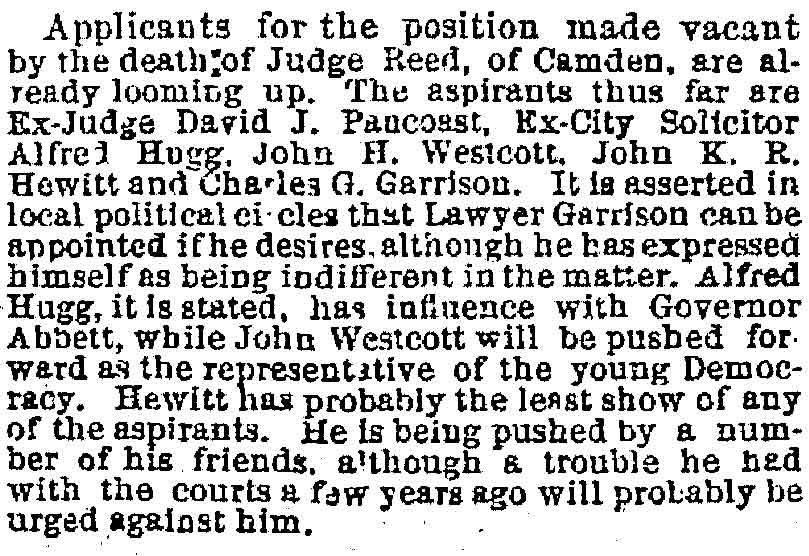
Judge Charles T. Reed, of Camden, died on Saturday night. He will be buried on Wednesday. The Camden courts will adjourn to-day and the Bar Association will take proper action.
Applicants for the position made vacant by the death of Judge Reed, of Camden, are already looming up. The aspirants thus far are Ex-Judge David J. Pancoast, Ex-City Solicitor Alfred Hugg, John H. Westcott [sic], John K. R. Hewitt and Charles G. Garrison. It is asserted in local political circles that Lawyer Garrison can be appointed if he desires, although he has expressed himself as being indifferent in the matter. Alfred Hugg, it is stated, has influence with Governor Abbett, while John Westcott will be pushed forward as the representative of the young Democracy. Hewitt has probably the least show of any of the aspirants. He is being pushed by a number of his friends, although a trouble he had with the courts a few years ago will probably be urged against him.
Governor Green to Appoint Charles G. Garrison
Philadelphia Inquirer —
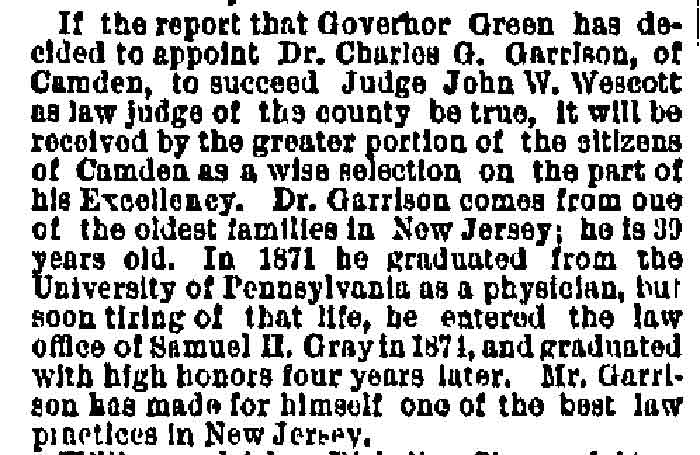
If the report that Governor Green has decided to appoint Dr. Charles G. Garrison, of Camden, to succeed Judge John W. Wescott as law judge of the county be true, it will be received by the greater portion of the citizens of Camden as a wise selection on the part of his Excellency. Dr. Garrison comes from one of the oldest families in New Jersey; he is 39 years old. In 1871 he graduated from the University of Pennsylvania as a physician, but soon tiring of that life, he entered the law office of Samuel H. Gray in 1874, and graduated with high honors four years later. Mr. Garrison has made for himself one of the best law practices in New Jersey.
Le Coney Notified
Philadelphia Inquirer —
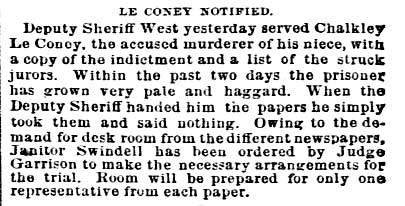
Deputy Sheriff West yesterday served Chalkley Le Coney, the accused murderer of his niece, with a copy of the indictment and a list of the struck jurors. Within the past two days the prisoner has grown very pale and haggard. When the Deputy Sheriff handed him the papers he simply took them and said nothing. Owing to the demand for desk room from the different newspapers, Janitor Swindell has been ordered by Judge Garrison to make arrangements for the trial. Room will be prepared for only one representative from each paper.
A Painter’s Claim for Wages Against the ex-Plunger.
Philadelphia Inquirer —
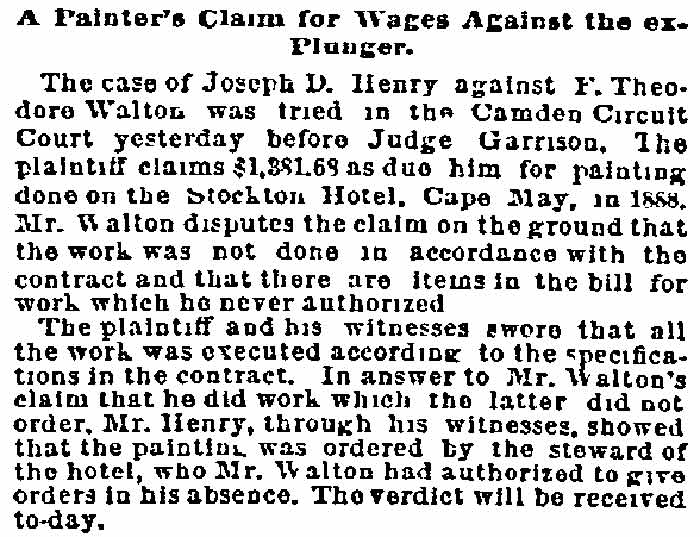
The case of Joseph D. Henry against F. Theodore Walton was tried in the Camden Circuit Court yesterday before Judge Garrison. The plaintiff claims $1,381.68 as due him for painting done on the Stockton Hotel, Cape May, in 1888. Mr. Walton disputes the claim on the ground that the work was not done in accordance with the contract and that there are items in the bill for work which he never authorized
The plaintiff and his witnesses swore that all the work was executed according to the specifications in the contract. In answer to Mr. Walton’s claim that he did work which the latter did not order, Mr. Henry, through his witnesses, showed that the painting was ordered by the steward of the hotel, who Mr. Walton had authorized to give orders in his absence. The verdict will be received to-day.
Judge Garrison Confined to Bed at Merchantville Home
Philadelphia Inquirer —

Supreme Court Judge Garrison is confined to his bed at his Merchantville home. He was taken with a chill while on his way from Mount Holly on Friday night.
Lingo's Chances for a New Trial
Philadelphia Inquirer —
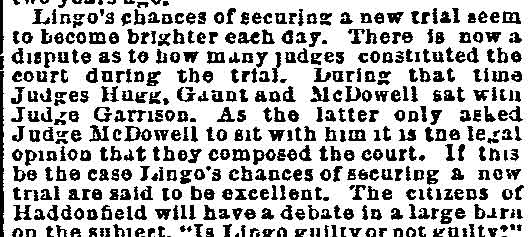
Lingo’s chances of securing a new trial seem to become brighter each day. There is now a dispute as to how many judges constituted the court during the trial. During that time Judges Hugg, Gaunt and McDowell sat with Judge Garrison. As the latter only asked Judge McDowell to sit with him it is the legal opinion that they composed the court. If this be the case Lingo’s chances of securing a new trial are said to be excellent. The citizens of Haddonfield will have a debate in a large barn on the subject. “Is Lingo guilty or not guilty?”
Judge Garrison Reprimands Tardy Jurors
Philadelphia Inquirer —
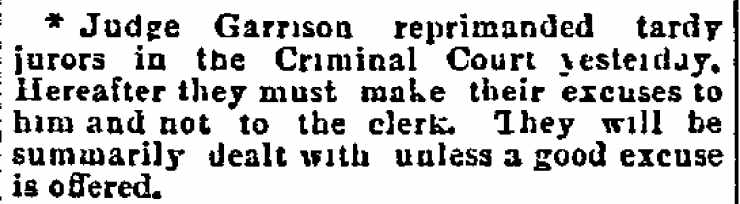
Judge Garrison reprimanded tardy jurors in the Criminal Court yesterday. Hereafter they must make their excuses to him and not to the clerk. They will be summarily dealt with unless a good excuse is offered.
Hill Hired to Murder Dodson
Philadelphia Inquirer —

A Youthful Slayer’s Story of a Cold-Blooded Crime.
Plied With Liquor and Urged on by Reed and Derrickson.
Remarkable Defense in a Camden Murder Trial—The Prisoner Unconcerned—His Counsel Endeavoring to Secure a Second Degree Verdict.
Lolling in a big arm chair in the Camden Criminal Court yesterday John Hill, a diminutive specimen of colored humanity, listened with baffling unconcern to evidence which is likely to consign him to the gallows. He was on trial for the murder of Joseph Dodson, on October 16 last.
Hill is barely four feet and a half high, 18 years old and an orphan. If his story is true, he was hired to kill Dodson by Alfred Reed and Marwood Derrickson, proprietors of a colored saloon and “free-and-easy” at Seventh and Sycamore streets, where he was employed. Reed and Derrickson are under indictment as accomplices, and their trial will follow Hill’s.
POLITICS, WHISKY AND MURDER.
There seems to have been a combination of politics, hatred and whisky back of the Dodson murder. The parties concerned represent an element of Camden’s colored population which keeps the criminal court busy.
Besides keeping a saloon and dance hall Reed and Derrickson are Democratic “workers.” As a large majority of the colored voters of their ward are Republicans, political disputes and rows in their place are of frequent occurrence.
Dodson was just coming of age and had announced his intention of voting the Republican ticket. This put him in ill favor with Reed and Derrickson, as well as with young Hill, who was employed by them as floor manager of their dance hall.
Dodson was shot about 1 o’clock on Sunday morning, October 6. On the preceding Thursday night he raised a row in the dance hall and beat young Hill when the latter tried to eject him. On the following night Hill claims that Dodson chased him down the street with a revolver and threatened to kill him.
THE PRISONER’S STORY.
Hill’s story of the murder as told by himself on the witness stand in his own defense is as follows:
“On Saturday ‘Sweeney’ (Marwood) Derrickson came to me and said, ‘Hilly, if you’ll do something for me and let no one know it, I’ll give you $2.50. I want you to kill Dodson. No one can hurt you, as we stand in with the Democrats.’ I didn’t want to do it, and told them so.
“That night I took a drink Derrickson gave me, and it made me feel funny; it went to my head. He poured something out of a bottle with a seal on it into my blackberry brandy and made me drink it. He gave me the revolver and told me to go out. When I got out someone said ‘shoot,’ and I shot and hit somebody. Then I went into the saloon and got $1.50 from Reed. That’s all I remember until the next morning, when I was arrested.”
THE STATE’S EVIDENCE.
Supreme Court Justice Garrison and Lay Judge Gaunts sat on the bench when the case was opened by Prosecutor Jenkins. Hill, who was defended by Lawyers F. A. Rex and Harry S. Scovel, pleaded not guilty. After twenty-two challenges a jury was secured.
Dr. Edward S. Schellinger, former resident physician at the Cooper Hospital, testified that Dodson died in half an hour after his admission to the hospital. County Physician Iszard exhibited the murdered man’s skull, showing the hole made by the bullet, just above the left eye.
George Hinson, who was with Dodson when he was shot, said he saw a flash about 30 feet away and Dodson fell. They had just stepped out of Reed & Derrickson’s place and were on their way home.
Alexander Matthews testified that a few minutes before the shooting, while he was sitting on Reed & Derrickson’s step, Hill said to him that Dodson and another fellow were after him, and if they did anything to him he would shoot Dodson.
THREATENED TO KILL DODSON.
Moses Hanson and Charles Monroe told of threats Hill made on Saturday, that he was going to buy a “gun” and shoot Dodson. Monroe said that after the shooting Hill ran into the saloon and cried, “I shot Joe Dodson, but he shot at me first.” Hill asked Reed and Derrickson what he should do, and they said he would have to fix that for himself.
Prosecutor Jenkins tried to have the stenographic report of the evidence at the Coroner’s inquest introduced, but it was ruled out. Then he called Constable Beckett to testify that Hill had admitted at the inquest that he had killed Dodson.
DRUNK AND DRUGGED.
This closed the State’s case, and in opening for the defense Lawyer Scovel said they would show that Reed and Derrickson urged Hill on to do the shooting and plied him with liquor, and drugged him until he didn’t know what he was doing.
The youthful murderer was put on the stand and told his story as given above.
County Detective Gallagher testified to finding the revolver in a drawer in Reed and Derrickson’s saloon. It belonged to the latter. It is a self-cocking weapon of the “English bull-dog” pattern. Five chambers were loaded and two empty.
Several witnesses, all colored, testified that Hill was under the influence of liquor the night of the shooting.
DRUGGING DENIED.
Albert Reed and Marwood Derrickson were called in rebuttal by the State and both denied that they had drugged Hill’s liquor. Their criminal record was brought up against them by the defense on cross-examination.
All the evidence was in when court adjourned, and the case will be argued this morning. Hill’s lawyers’ hope, to secure a verdict of murder in the second degree.
Hill Convicted of Murder.
Philadelphia Inquirer —
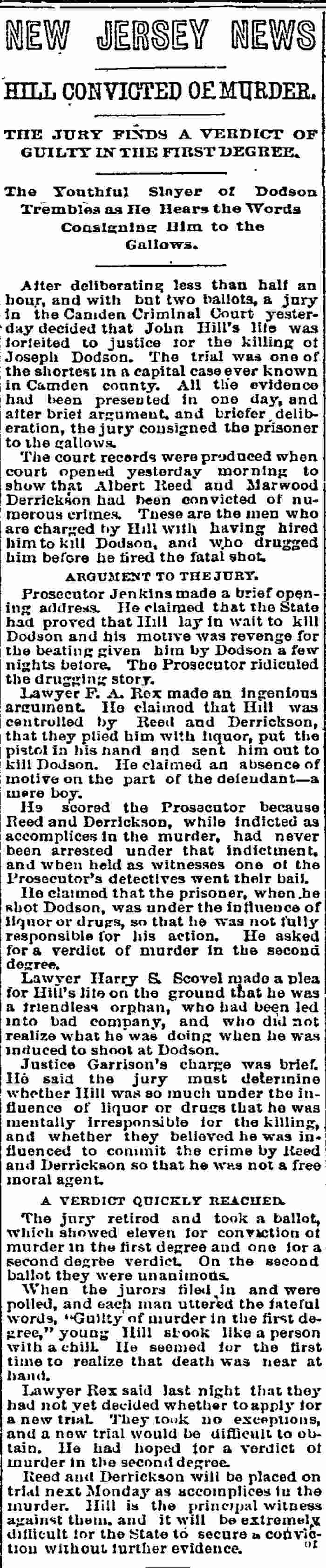
The Jury Finds a Verdict of Guilty in the First Degree.
The Youthful Slayer of Dodson Trembles as He Hears the Words Consigning Him to the Gallows.
After deliberating less than half an hour, and with but two ballots, a jury in the Camden Criminal Court yesterday decided that John Hill’s life was forfeited to justice for the killing of Joseph Dodson. The trial was one of the shortest in a capital case ever known in Camden county. All the evidence had been presented in one day, and after brief argument, and briefer deliberation, the jury consigned the prisoner to the gallows.
The court records were produced when court opened yesterday morning to show that Albert Reed and Marwood Derrickson had been convicted of numerous crimes. These are the men who are charged by Hill with having hired him to kill Dodson, and who drugged him before he fired the fatal shot.
ARGUMENT TO THE JURY.
Prosecutor Jenkins made a brief opening address. He claimed that the State had proved that Hill lay in wait to kill Dodson and his motive was revenge for the beating given him by Dodson a few nights before. The Prosecutor ridiculed the drugging story.
Lawyer F. A. Rex made an ingenious argument. He claimed that Hill was controlled by Reed and Derrickson, that they plied him with liquor, put the pistol in his hand and sent him out to kill Dodson. He claimed an absence of motive on the part of the defendant—a mere boy.
He scored the Prosecutor because Reed and Derrickson, while indicted as accomplices in the murder, had never been arrested under that indictment, and when held as witnesses one of the Prosecutor’s detectives went their bail.
He claimed that the prisoner, when he shot Dodson, was under the influence of liquor or drugs, so that he was not fully responsible for his action. He asked for a verdict of murder in the second degree.
Lawyer Harry S. Scovel made a plea for Hill’s life on the ground that he was a friendless orphan, who had been led into bad company, and who did not realize what he was doing when he was induced to shoot at Dodson.
Justice Garrison’s charge was brief. He said the jury must determine whether Hill was so much under the influence of liquor or drugs that he was mentally irresponsible for the killing, and whether they believed he was influenced to commit the crime by Reed and Derrickson so that he was not a free moral agent.
A VERDICT QUICKLY REACHED.
The jury retired and took a ballot, which showed eleven for conviction of murder in the first degree and one for a second degree verdict. On the second ballot they were unanimous.
When the jurors filed in and were polled, and each man uttered the fateful words, “Guilty of murder in the first degree,” young Hill shook like a person with a chill. He seemed for the first time to realize that death was near at hand.
Lawyer Rex said last night that they had not yet decided whether to apply for a new trial. They took no exceptions, and a new trial would be difficult to obtain. He had hoped for a verdict of murder in the second degree.
Reed and Derrickson will be placed on trial next Monday as accomplices in the murder. Hill is the principal witness against them, and it will be extremely difficult for the State to secure a conviction without further evidence.
But Two Months to Live
Philadelphia Inquirer —
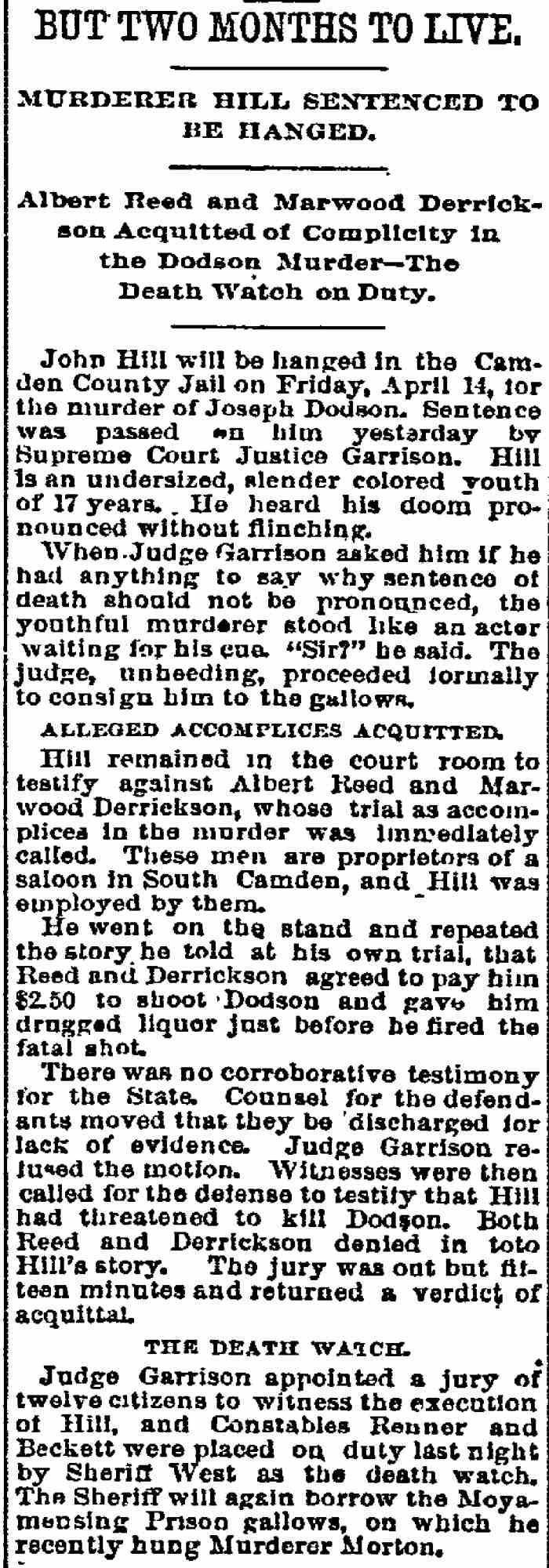
Murderer Hill Sentenced to Be Hanged.
Albert Reed and Marwood Derrickson Acquitted of Complicity in the Dodson Murder—The Death Watch on Duty.
John Hill will be hanged in the Camden County Jail on Friday, April 14, for the murder of Joseph Dodson. Sentence was passed on him yesterday by Supreme Court Justice Garrison. Hill is an undersized, slender colored youth of 17 years. He heard his doom pronounced without flinching.
When Judge Garrison asked him if he had anything to say why sentence of death should not be pronounced, the youthful murderer stood like an actor waiting for his cue. “Sir?” he said. The judge, unheeding, proceeded formally to consign him to the gallows.
Alleged Accomplices Acquitted.
Hill remained in the court room to testify against Albert Reed and Marwood Derrickson, whose trial as accomplices in the murder was immediately called. These men are proprietors of a saloon in South Camden, and Hill was employed by them.
He went on the stand and repeated the story he told at his own trial, that Reed and Derrickson agreed to pay him $2.50 to shoot Dodson and gave him drugged liquor just before he fired the fatal shot.
There was no corroborative testimony for the State. Counsel for the defendants moved that they be discharged for lack of evidence. Judge Garrison refused the motion. Witnesses were then called for the defense to testify that Hill had threatened to kill Dodson. Both Reed and Derrickson denied in toto Hill’s story. The jury was out but fifteen minutes and returned a verdict of acquittal.
The Death Watch.
Judge Garrison appointed a jury of twelve citizens to witness the execution of Hill, and Constables Renner and Beckett were placed on duty last night by Sheriff West as the death watch. The Sheriff will again borrow the Moyamensing Prison gallows, on which he recently hung Murderer Morton.
Hill Is to Be Hanged
Philadelphia Inquirer —
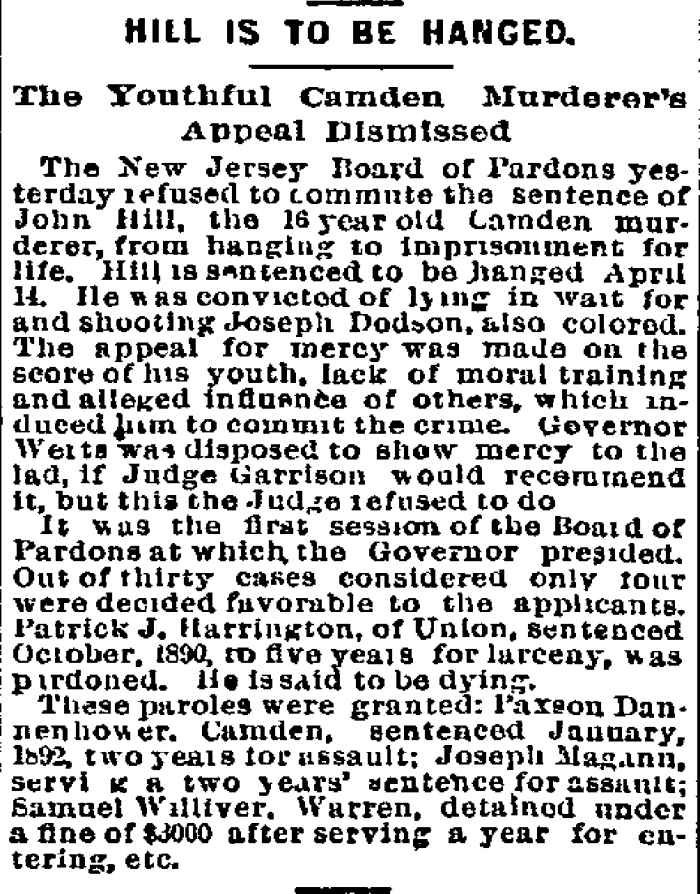
The Youthful Camden Murderer’s Appeal Dismissed
The New Jersey Board of Pardons yesterday refused to commute the sentence of John Hill, the 16 year old Camden murderer, from hanging to imprisonment for life. Hill is sentenced to be hanged April 14. He was convicted of lying in wait for and shooting Joseph Dodson, also colored. The appeal for mercy was made on the score of his youth, lack of moral training and alleged influence of others, which induced him to commit the crime. Governor Werts was disposed to show mercy to the lad, if Judge Garrison would recommend it, but this the Judge refused to do.
It was the first session of the Board of Pardons at which the Governor presided. Out of thirty cases considered only four were decided favorable to the applicants.
Patrick J. Harrington, of Union, sentenced October, 1890, to five years for larceny, was pardoned. He is said to be dying.
These paroles were granted: Paxson Dannenhower, Camden, sentenced January, 1892, two years for assault; Joseph Magann, serving a two years’ sentence for assault; Samuel Williver, Warren, detained under a fine of $3000 after serving a year for entering, etc.
Hill Is Prepared to Die.
Harrisburg Patriot —

Pictured: Henry J. West, J. Wesley Sell, Joseph Porter, John Hill, Albert Reed, Frederick A. Rex, Charles G. Garrison, Joseph Dodson, Marwood Derrickson, and George W. Beckett.
Rival Lawyers Want to Defend Jordan
Philadelphia Inquirer —
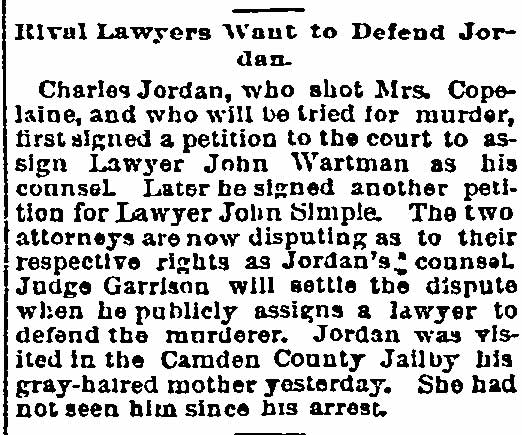
Charles Jordan, who shot Mrs. Copelaine, and who will be tried for murder, first signed a petition to the court to assign Lawyer John Wartman as his counsel. Later he signed another petition for Lawyer John Simple [sic]. The two attorneys are now disputing as to their respective rights as Jordan’s counsel. Judge Garrison will settle the dispute when he publicly assigns a lawyer to defend the murderer. Jordan was visited in the Camden County Jail by his gray-haired mother yesterday. She had not seen him since his arrest.
A Judge's Sharp Talk
Philadelphia Inquirer —
Acquitted of Murder
Philadelphia Inquirer —
Camden County Bar Association
c. 1894
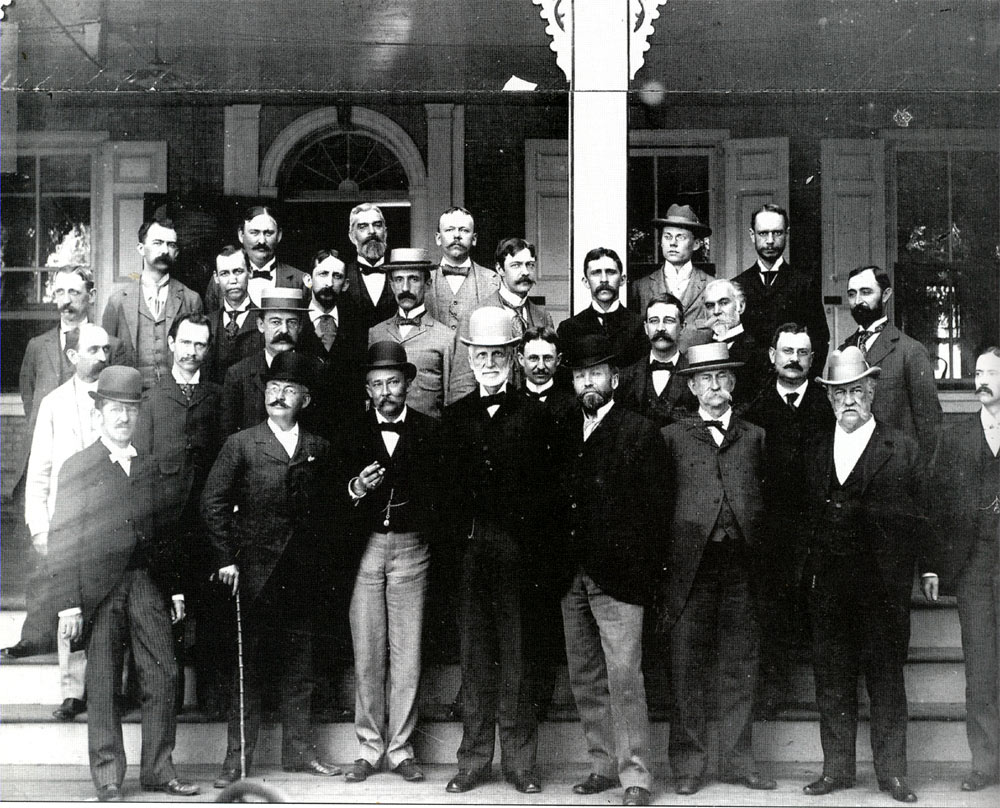
Members of the Camden County Bar Association pose for a photograph during their annual shad dinner, around 1894.
From left (first row) Judge Charles Joline, Supreme Court Justice Charles Garrison, Judge Richard R. Miller, vice chancellor Henry C. Pitney, Supreme Court Justice Alfred Reed, Benjamin Shreeve, Caleb Shreeve, George H. Pierce; (second row) William Casselman, Edwin Bleakly, J. Willard Morgan, Peter Voorhees, Samuel Beldon, Frank Shreeve, Scuyler Woodhull, Lewis Starr, h. s. scovel, George Vroom, Charles Wooster, and howard carrow; (third row) Samuel Robbins, E. A. Armstrong, Thomas Curley, unknown Philadelphia lawyer, Charles Stevenson, H. F. Nixon, Henry I. Budd, Israel Roberts.
Camden’s Murder Trial
Trenton Evening Times —
In the Camden County Court of Oyer and Terminer yesterday, with Judge Garrison presiding, Josiah Stevens, colored, who was indicted by the Grand Jury at the January term as an accomplice of Theodore Lambert in the killing of William Kairer, was placed on trial, Lambert having already been tried and convicted of murder in the first degree.
Theodore Lambert, who has already been convicted, testified that he and Josiah Stevens were together from Sunday, December 3d, until Monday, December 4th. He then told how he and Stevens started from the house of Lavina Moore, shortly after midnight, on December 4th, to rob a house in North Camden.
He then recited the story as told to Prosecutor Jenkins in his office after his arrest, which was to the effect that Stevens was with him at the time he entered the Kairer residence. At the conclusion of Lambert’s testimony the Court took a recess until this morning. The State will close to-day, and it is expected that the case will reach the jury to-morrow.
Lawyer Semple Allowed Fee
Philadelphia Inquirer —

Lawyer John L. Semple has been allowed $550 by Judge Garrison for defending Murderers Theodore Lambert and Thomas Delbridge.
A Legal Peculiarity.
Harrisburg Patriot —
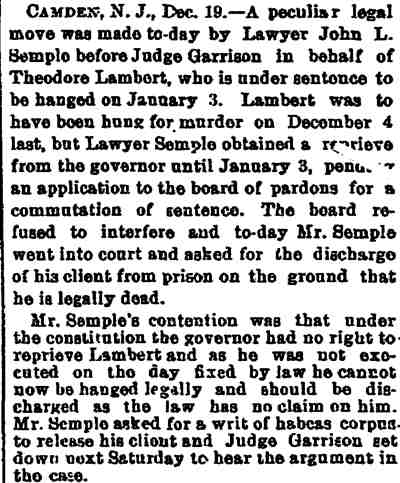
A LEGAL PECULIARITY.
Lawyer Semple Claims Murderer Lambert Should be Discharged on the Ground That He is Legally Dead.
TO BE ARGUED SATURDAY.
Attorney’s Reasons For His Novel Plea—Bland’s Substitute For the Carlisle Currency Plan—Thinks It Will Solve the Finance Problem—A Vote on It Will be a Fair Test of the Silver Question.
By Telegraph to The Patriot.
Camden, N.J., Dec. 19.—A peculiar legal move was made to-day by Lawyer John L. Semple before Judge Garrison in behalf of Theodore Lambert, who is under sentence to be hanged on January 3. Lambert was to have been hung for murder on December 4 last, but Lawyer Semple obtained a reprieve from the governor until January 3, pending an application to the board of pardons for a commutation of sentence. The board refused to interfere and to-day Mr. Semple went into court and asked for the discharge of his client from prison on the ground that he is legally dead.
Mr. Semple’s contention was that under the constitution the governor had no right to reprieve Lambert and as he was not executed on the day fixed by law he cannot now be hanged legally and should be discharged as the law has no claim on him. Mr. Semple asked for a writ of habeas corpus to release his client and Judge Garrison set down next Saturday to hear the argument in the case.
Garrison Allows Judgment Against Camden County
Philadelphia Inquirer —
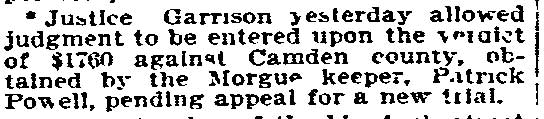
• Justice Garrison yesterday allowed judgment to be entered upon the verdict of $1760 against Camden county, obtained by the Morgue keeper, Patrick Powell, pending appeal for a new trial.
Lambert Must Die
New York Times —
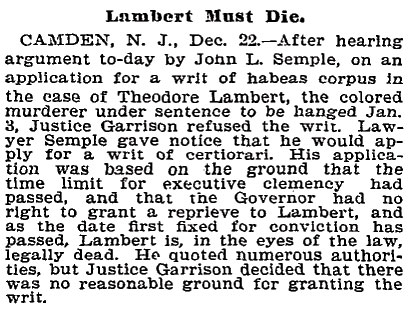
CAMDEN, N. J., Dec. 22.—After hearing argument to-day by John L. Semple, on an application for a writ of habeas corpus in the case of Theodore Lambert, the colored murderer under sentence to be hanged Jan. 3, Justice Garrison refused the writ. Lawyer Semple gave notice that he would apply for a writ of certiorari. His application was based on the ground that the time limit for executive clemency had passed, and that the Governor had no right to grant a reprieve to Lambert, and as the date first fixed for conviction has passed, Lambert is, in the eyes of the law, legally dead. He quoted numerous authorities, but Justice Garrison decided that there was no reasonable ground for granting the writ.
Legal Tender Defined
Philadelphia Inquirer —
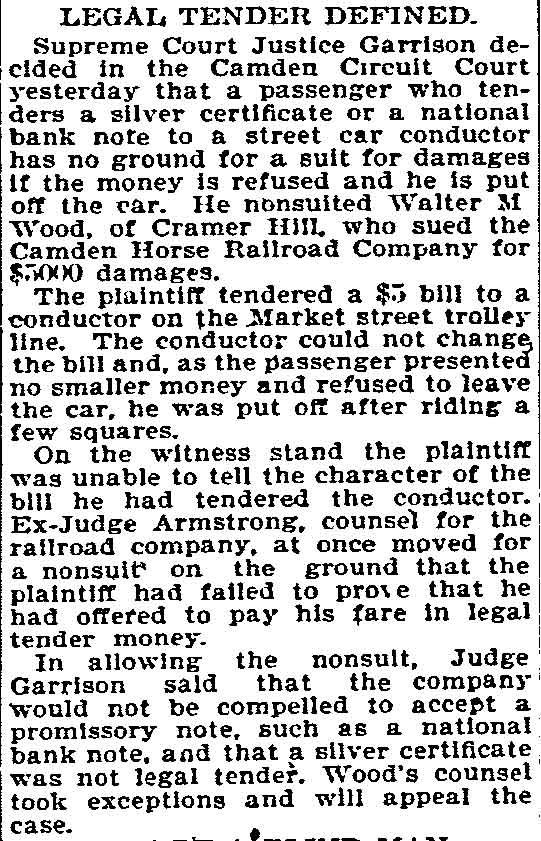
Supreme Court Justice Garrison decided in the Camden Circuit Court yesterday that a passenger who tenders a silver certificate or a national bank note to a street car conductor has no ground for a suit for damages if the money is refused and he is put off the car. He nonsuited Walter M. Wood, of Cramer Hill, who sued the Camden Horse Railroad Company for $5000 damages.
The plaintiff tendered a $5 bill to a conductor on the Market street trolley line. The conductor could not change the bill and, as the passenger presented no smaller money and refused to leave the car, he was put off after riding a few squares.
On the witness stand the plaintiff was unable to tell the character of the bill he had tendered the conductor. Ex-Judge Armstrong, counsel for the railroad company, at once moved for a nonsuit on the ground that the plaintiff had failed to prove that he had offered to pay his fare in legal tender money.
In allowing the nonsuit, Judge Garrison said that the company would not be compelled to accept a promissory note, such as a national bank note, and that a silver certificate was not legal tender. Wood’s counsel took exceptions and will appeal the case.
Lambert at Last Pays the Penalty
Philadelphia Inquirer —
THE MURDERER OF BAKER KAIRER HANGED IN THE CAMDEN COUNTY JAIL
PROTESTED INNOCENCE TO THE END
HE SAID STEVENS FIRED THE FATAL SHOT
The Execution Devoid of Sensational Features—Lambert Walked Firmly to the Gallows—History of His Remarkable Case.
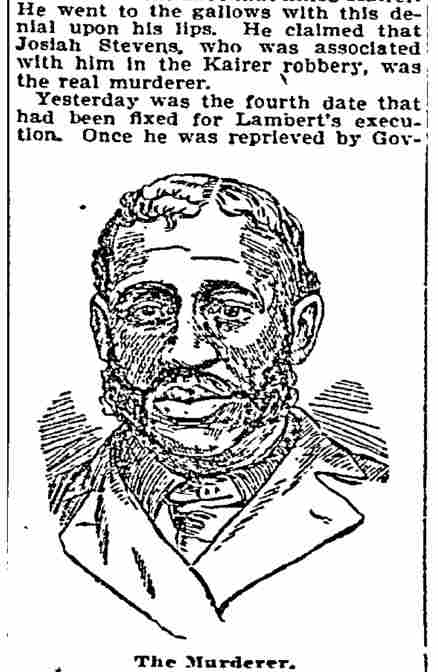
The Murderer.
Nicholas Theodore Lambert died on the gallows in the Camden county jail yesterday. He was hanged for the murder of William G. Kairer, a well-to-do cracker baker, of Camden. His death closes a case that was remarkable chiefly for the extraordinary efforts to save the condemned man from the gallows. Lambert was a bad man. From his youth up he had been a criminal. He had served time in prison for burglary and admitted while awaiting trial for murder that he had robbed a score or more of houses in and around Camden. But he denied that he had fired the shot that killed Kairer. He went to the gallows with this denial upon his lips. He claimed that Josiah Stevens, who was associated with him in the Kairer robbery, was the real murderer.
Yesterday was the fourth date that had been fixed for Lambert’s execution. Once he was reprieved by Governor Werts. Twice the United States Supreme Court interfered and postponed the hanging. The law finally claimed its victim after every ordinary and several extraordinary procedures had been resorted to to avert the death penalty.
Firm in the Face of Death.
Lambert’s death was devoid of sensation, as executions go. He walked to the scaffold without assistance. He did not flunk in the face of death. There was barely time for a whispered good-bye to the Sheriff and he was launched into eternity. He was hanged on the gallows that ended John Hill’s life about three years ago. It was erected in an unused and half-finished room on the top floor of the county jail building at the northwest corner of Broadway and Federal streets. The death chamber is directly over a part of the jail that is being fitted up for the use of female prisoners.
The scaffold stood over against a blank wall. On the other side windows let a flood of light into the bare room. Overhead were the gaunt rafters supporting the roof.
The heart-rending farewells between the condemned man and his mother and other relatives and friends had been uttered the night before. As the time drew on toward midnight the condemned seemed to realize for the first time that there was no further hope of escaping the death penalty.
“I can’t sleep,” he said to Constable Hunter, one of his death watch. “I feel oppressed, as if there was a heavy weight inside. I hope I will be able to walk to the gallows.”
At 1 o’clock Lambert sat down at a little table in his cell and for three hours he was busy with his pen writing farewell letters. There were six of these missives. The longest one was to his counsel, Lawyer John G. [sic] Semple, who had made such a gallant fight to save him. He thanked his lawyer and reiterated his assertion that he did not fire the shot that killed Kairer. One of the letters was to Mrs. Isabella Shipley, a resident of South Camden, who had displayed great interest in his case. The others were to personal friends. In all these missives Lambert gave expression to his religious faith and the belief that he had divine forgiveness of his sins.
Ready for the Rope.
About 6 o’clock the spiritual advisers of the condemned man entered his cell. They were colored ministers, Revs. W. H. Yocum, Thomas Als and H. C. Ashley. Under the soothing influence of prayer Lambert grew calmer, and when his breakfast, which consisted of half a dozen fried eggs, potatoes and coffee, was sent in from a restaurant opposite the jail, he ate heartily.
At 9 o’clock the suit of black clothing that had been ordered for his execution a year ago, was brought in and he dressed himself for the gallows. A barber had shaved him and trimmed his hair the previous night. He did not put on a collar.
The persons who were to witness the execution, in all less than forty, gathered in the sheriff’s office shortly before 10 o’clock. There was a jury of twelve appointed by the court, a similar number of special deputies, the sheriff’s regular assistants, Sheriffs Wriggins, of Salem county, and Townsend, of Burlington county, and a few newspaper men. At 10 o’clock Sheriff Barrett led the way into the jail and piloted the witnesses to the death chamber. They walked through an iron-lined passageway in the jail proper, then through a door into the corridor on the Federal street side, and up three flights of stairs to the place of execution.
This was the route that Lambert took a few minutes later when he walked to his doom. Chairs had been placed at each landing and there was one on the scaffold, for use in case the condemned man collapsed, but they were not needed. At five minutes after 10 Sheriff Barrett started down the stairs to fetch the victim, and the audience in the death chamber talked in whispers while they waited.
Lambert was awaiting the summons. His hands were manacled behind his back, and with the ministers in front, the Sheriff at his side and Constables Hunter and Gardner, of the death watch at his back, he started on the walk to the gallows.
On the Scaffold.
It was but a step from the doorway of the execution room to the foot of the flight of steps leading to the platform of the gallows. Lambert did not halt or look up. He and the Sheriff walked with firm tread up the steps. The Sheriff had declined assistance. He was cool and knew just what to do, although it was his first execution.
Lambert took his station on the trap-doors directly under the cross-beam. His gaze was fixed on the blank wall directly in front and his back was toward the spectators. He wavered slightly as the Sheriff slipped the noose over his neck. Then, just as the black cap was drawn over his face, he whispered:
“Good-bye, Sheriff. God bless you.”
“Good-bye, Dory,” was the response, and the next instant the Sheriff took a step to one side, pulled a lever, the big trap-doors fell with a crash, and the colored murderer was dangling in midair.
The fall was about eight feet. It is not probable that Lambert’s neck was broken, but the convulsions were slight. His legs had not been pinioned, but they were not drawn up in the death agony. It was 10.13 when the drop fell. Five minutes later Under Sheriff Sell unlocked the handcuffs and the arms hung listless at the side of the dangling body. At intervals a convulsive tremor shook the body, but these soon ceased, and at 10.27¾ physicians pronounced life extinct.
Borne to the Grave.
The body was allowed to hang for ten minutes longer before it was taken down. In an adjoining room an undertaker was waiting with the casket that, like the death suit, had been ordered a year ago. On the lid was a silver plate bearing the inscription, “Nicholas T. Lambert. Died December 19, 1895. Aged 24 years, 2 months, 19 days.”
Lambert had requested that the doctors should not mutilate his body, and Sheriff Barrett saw that his wishes in that respect were carried out. In the afternoon the corpse was taken to the Johnson Colored Burying Ground, on the road to Merchantville, and interred in a grave that had been prepared for it.
The crowd of several hundred people that had gathered about the jail melted away soon after it became known that Lambert had paid the penalty of his crime. None of the relatives of the murderer or his victim were present at the execution.
LAMBERT’S CRIME
A Remarkable Fight to Stave Off the Death Penalty.
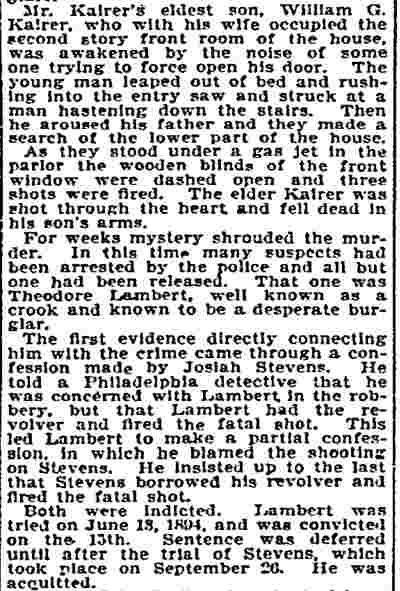
William G. Kairer was murdered about 5 o’clock on the morning of December 5, 1893, at his residence, 429 Beckett street, Camden. Previous to this there had been a score or more of burglaries in Camden and vicinity; and the police seemed unable to catch the bold burglars.
Mr. Kairer’s eldest son, William G. Kairer, who with his wife occupied the second story front room of the house, was awakened by the noise of some one trying to force open his door. The young man leaped out of bed and rushing into the entry saw and struck at a man hastening down the stairs. Then he aroused his father and they made a search of the lower part of the house.
As they stood under a gas jet in the parlor the wooden blinds of the front window were dashed open and three shots were fired. The elder Kairer was shot through the heart and fell dead in his son’s arms.
For weeks mystery shrouded the murder. In this time many suspects had been arrested by the police and all but one had been released. That one was Theodore Lambert, well known as a crook and known to be a desperate burglar.
The first evidence directly connecting him with the crime came through a confession made by Josiah Stevens. He told a Philadelphia detective that he was concerned with Lambert in the robbery, but that Lambert had the revolver and fired the fatal shot. This led Lambert to make a partial confession, in which he blamed the shooting on Stevens. He insisted up to the last that Stevens borrowed his revolver and fired the fatal shot.
Both were indicted. Lambert was tried on June 1[?], 1894, and was convicted on the 13th. Sentence was deferred until after the trial of Stevens, which took place on September 26. He was acquitted.
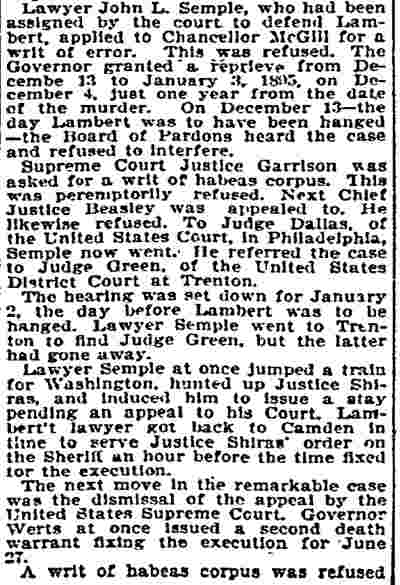
Lawyer John L. Semple, who had been assigned by the court to defend Lambert, applied to Chancellor McGill for a writ of error. This was refused. The Governor granted a reprieve from Decembe [sic] 13 to January 3, 1895, on December 4, just one year from the date of the murder. On December 13—the day Lambert was to have been hanged—the Board of Pardons heard the case and refused to interfere.
Supreme Court Justice Garrison was asked for a writ of habeas corpus. This was peremptorily refused. Next Chief Justice Beasley was appealed to. He likewise refused. To Judge Dallas, of the United States Court, in Philadelphia, Semple now went. He referred the case to Judge Green, of the United States District Court at Trenton.
The hearing was set down for January 2, the day before Lambert was to be hanged. Lawyer Semple went to Trenton to find Judge Green, but the latter had gone away.
Lawyer Semple at once jumped a train for Washington, hunted up Justice Shiras, and induced him to issue a stay pending an appeal to his Court. Lambert’t [sic] lawyer got back to Camden in time to serve Justice Shiras’ order on the Sheriff an hour before the time fixed for the execution.
The next move in the remarkable case was the dismissal of the appeal by the United States Supreme Court. Governor Werts at once issued a second death warrant fixing the execution for June 27.
A writ of habeas corpus was refused [cut off at the crop edge]
Garrison Orders Estate Accounting Filed
Philadelphia Inquirer —
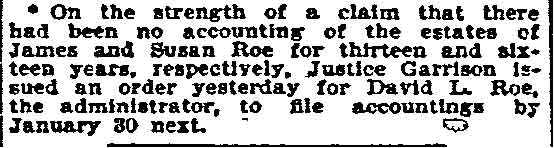
On the strength of a claim that there had been no accounting of the estates of James and Susan Roe for thirteen and sixteen years, respectively, Justice Garrison issued an order yesterday for David L. Roe, the administrator, to file accountings by January 30 next.
Rule to Show Cause in Sensfelder vs. Stokes
Philadelphia Inquirer —
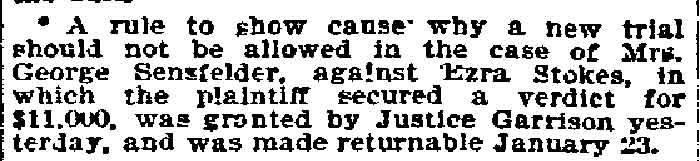
A rule to show cause why a new trial should not be allowed in the case of Mrs. George Sensfelder, against Ezra Stokes, in which the plaintiff secured a verdict for $11,000, was granted by Justice Garrison yesterday, and was made returnable January 23.
Roundabout the State
Trenton Evening Times —
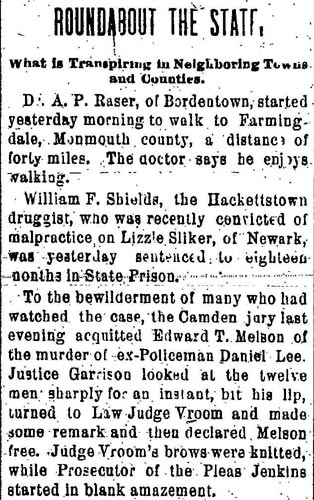
What is Transpiring in Neighboring Towns and Counties.
Dr. A. P. Raser, of Bordentown, started yesterday morning to walk to Farmingdale, Monmouth county, a distance of forty miles. The doctor says he enjoys walking.
William F. Shields, the Hackettstown druggist, who was recently convicted of malpractice on Lizzie Sliker, of Newark, was yesterday sentenced to eighteen months in State Prison.
To the bewilderment of many who had watched the case, the Camden jury last evening acquitted Edward T. Melson of the murder of ex-Policeman Daniel Lee. Justice Garrison looked at the twelve men sharply for an instant, bit his lip, turned to Law Judge Vroom and made some remark and then declared Melson free. Judge Vroom’s brows were knitted, while Prosecutor of the Pleas Jenkins started in blank amazement.
Jordan Acquitted in Coplein Murder
Philadelphia Inquirer —
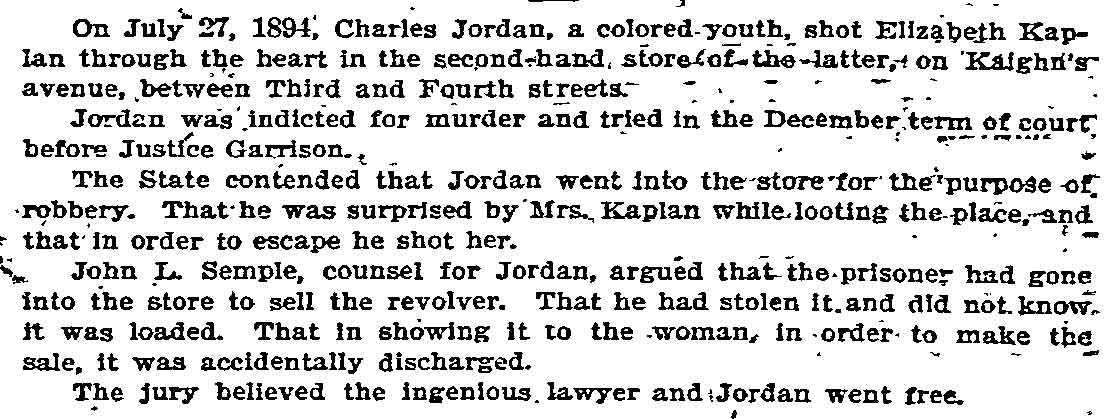
Charles Jordan, Elizabeth Coplein, and John L. Semple, near Kaighn Avenue and South 3rd Street.
Garrison Sets Date for Eli Shaw Murder Trial
Philadelphia Inquirer —
Justice Garrison had a consultation with Assistant Prosecutor Carson and Lawyer H. S. Scovel yesterday in reference to fixing an early date for the trial of Eli Shaw for the murder of his mother. The date will be decided upon at the opening of court on Tuesday next.
Over in Camden
Philadelphia Inquirer —
Justice Garrison yesterday refused to allow a writ of certiorari in the case of Police Captain H. Frank Pettit until the Police Committee of City Council renders judgment on the charges made against him. Pettit is suspended from duty.
A Judge and Policy
Philadelphia Inquirer —
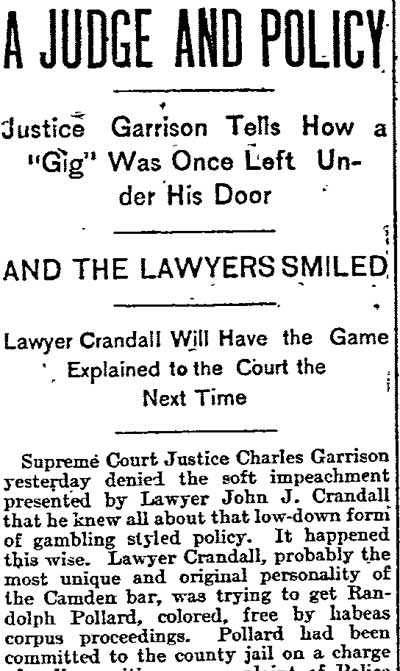
A JUDGE AND POLICY
Justice Garrison Tells How a “Gig” Was Once Left Under His Door
AND THE LAWYERS SMILED
Lawyer Crandall Will Have the Game Explained to the Court the Next Time
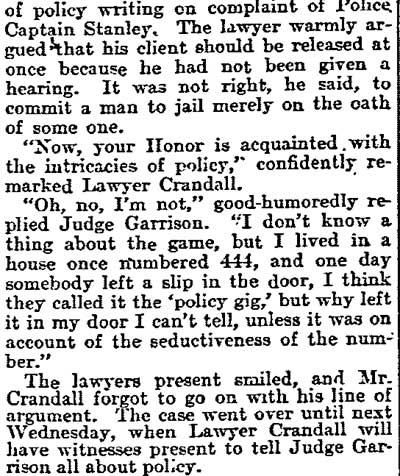
Supreme Court Justice Charles Garrison yesterday denied the soft impeachment presented by Lawyer John J. Crandall that he knew all about that low-down form of gambling styled policy. It happened this wise. Lawyer Crandall, probably the most unique and original personality of the Camden bar, was trying to get Randolph Pollard, colored, free by habeas corpus proceedings. Pollard had been committed to the county jail on a charge of policy writing on complaint of Police Captain Stanley. The lawyer warmly argued that his client should be released at once because he had not been given a hearing. It was not right, he said, to commit a man to jail merely on the oath of some one.
“Now, your Honor is acquainted with the intricacies of policy,” confidently remarked Lawyer Crandall.
“Oh, no, I’m not,” good-humoredly replied Judge Garrison. “I don’t know a thing about the game, but I lived in a house once numbered 444, and one day somebody left a slip in the door, I think they called it the ‘policy gig,’ but why left it in my door I can’t tell, unless it was on account of the seductiveness of the number.”
The lawyers present smiled, and Mr. Crandall forgot to go on with his line of argument. The case went over until next Wednesday, when Lawyer Crandall will have witnesses present to tell Judge Garrison all about policy.
PDF of complete article
Hallinger Seeks New Trial Before Garrison
Philadelphia Inquirer —

Counsel for Captain David B. Hallinger, against whom a verdict of $1000 damages was obtained by Mrs. Anna Ruebeck, yesterday applied to Justice Garrison for a new trial. No date for argument was fixed.
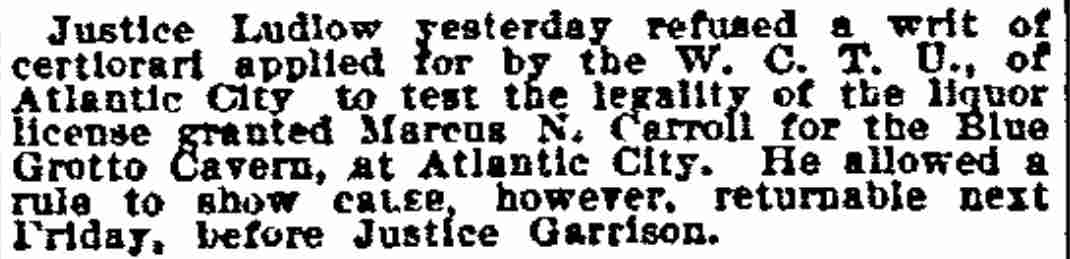
Justice Ludlow yesterday refused a writ of certiorari applied for by the W. C. T. U., of Atlantic City to test the legality of the liquor license granted Marcus N. Carroll for the Blue Grotto Cavern, at Atlantic City. He allowed a rule to show cause, however, returnable next Friday, before Justice Garrison.
Still Probing Sunday Liquor Selling Cases
Philadelphia Inquirer —
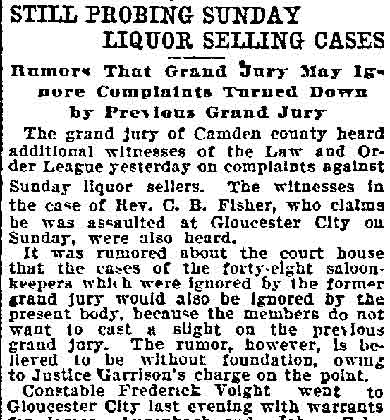
Rumors That Grand Jury May Ignore Complaints Turned Down by Previous Grand Jury
The grand jury of Camden county heard additional witnesses of the Law and Order League yesterday on complaints against Sunday liquor sellers. The witnesses in the case of Rev. C. B. Fisher, who claims he was assaulted at Gloucester City on Sunday, were also heard.
It was rumored about the court house that the cases of the forty-eight saloon-keepers which were ignored by the former grand jury would also be ignored by the present body, because the members do not want to cast a slight on the previous grand jury. The rumor, however, is believed to be without foundation, owing to Justice Garrison’s charge on the point.
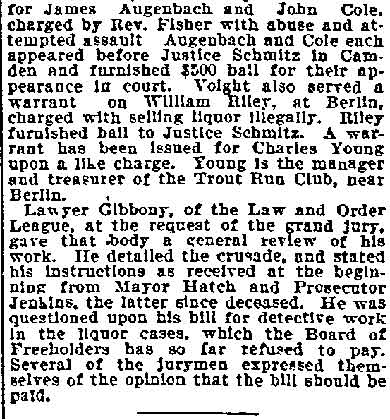
Constable Frederick Voight went to Gloucester City last evening with warrants for James Augenbach and John Cole, charged by Rev. Fisher with abuse and attempted assault. Augenbach and Cole each appeared before Justice Schmitz in Camden and furnished $[?]00 bail for their appearance in court. Voight also served a warrant on William Riley, at Berlin, charged with selling liquor illegally. Riley furnished bail to Justice Schmitz. A warrant has been issued for Charles Young upon a like charge. Young is the manager and treasurer of the Trout Run Club, near Berlin.
Lawyer Gibbony, of the Law and Order League, at the request of the grand jury, gave that body a general review of his work. He detailed the crusade, and stated his instructions as received at the beginning from Mayor Hatch and Prosecutor Jenkins, the latter since deceased. He was questioned upon his bill for detective work in the liquor cases, which the Board of Freeholders has so far refused to pay. Several of the jurymen expressed themselves of the opinion that the bill should be paid.
Hill Meets Death Without a Shudder
Philadelphia Inquirer —
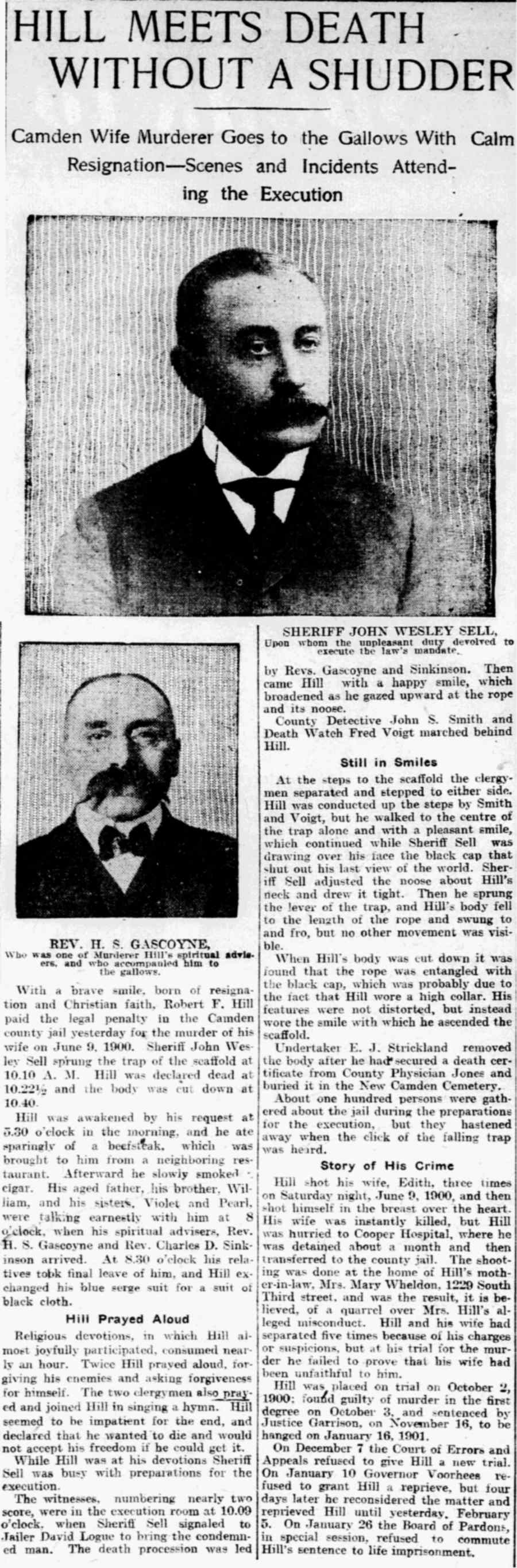
Camden Wife Murderer Goes to the Gallows With Calm Resignation—Scenes and Incidents Attending the Execution
Sheriff John Wesley Sell, Upon whom the unpleasant duty devolved to execute the law’s mandate.
Rev. H. S. Gascoyne, Who was one of Murderer Hill’s spiritual advisers, and who accompanied him to the gallows.
With a brave smile, born of resignation and Christian faith, Robert F. Hill paid the legal penalty in the Camden county jail yesterday for the murder of his wife on June 9, 1900. Sheriff John Wesley Sell sprung the trap of the scaffold at 10.10 A. M. Hill was declared dead at 10.22½ and the body was cut down at 10.40.
Hill was awakened by his request at 5.30 o’clock in the morning, and he ate sparingly of a beefsteak, which was brought to him from a neighboring restaurant. Afterward he slowly smoked a cigar. His aged father, his brother, William, and his sisters, Violet and Pearl, were talking earnestly with him at 8 o’clock, when his spiritual advisers, Rev. H. S. Gascoyne and Rev. Charles D. Sinkinson arrived. At 8.30 o’clock his relatives took final leave of him, and Hill exchanged his blue serge suit for a suit of black cloth.
Hill Prayed Aloud
Religious devotions, in which Hill almost joyfully participated, consumed nearly an hour. Twice Hill prayed aloud, forgiving his enemies and asking forgiveness for himself. The two clergymen also prayed and joined Hill in singing a hymn. Hill seemed to be impatient for the end, and declared that he wanted to die and would not accept his freedom if he could get it.
While Hill was at his devotions Sheriff Sell was busy with preparations for the execution.
The witnesses, numbering nearly two score, were in the execution room at 10.09 o’clock, when Sheriff Sell signaled to Jailer David Logue to bring the condemned man. The death procession was led by Revs. Gascoyne and Sinkinson. Then came Hill with a happy smile, which broadened as he gazed upward at the rope and its noose.
County Detective John S. Smith and Death Watch Fred Voigt marched behind Hill.
Still in Smiles
At the steps to the scaffold the clergymen separated and stepped to either side. Hill was conducted up the steps by Smith and Voigt, but he walked to the centre of the trap alone and with a pleasant smile, which continued while Sheriff Sell was drawing over his face the black cap that shut out his last view of the world. Sheriff Sell adjusted the noose about Hill’s neck and drew it tight. Then he sprung the lever of the trap, and Hill’s body fell to the length of the rope and swung to and fro, but no other movement was visible.
When Hill’s body was cut down it was found that the rope was entangled with the black cap, which was probably due to the fact that Hill wore a high collar. His features were not distorted, but instead wore the smile with which he ascended the scaffold.
Undertaker E. J. Strickland removed the body after he had secured a death certificate from County Physician Jones and buried it in the New Camden Cemetery.
About one hundred persons were gathered about the jail during the preparations for the execution, but they hastened away when the click of the falling trap was heard.
Story of His Crime
Hill shot his wife, Edith, three times on Saturday night, June 9, 1900, and then shot himself in the breast over the heart. His wife was instantly killed, but Hill was hurried to Cooper Hospital, where he was detained about a month and then transferred to the county jail. The shooting was done at the home of Hill’s mother-in-law, Mrs. Mary Wheldon, 1229 South Third street, and was the result, it is believed, of a quarrel over Mrs. Hill’s alleged misconduct. Hill and his wife had separated five times because of his charges or suspicions, but at his trial for the murder he failed to prove that his wife had been unfaithful to him.
Hill was placed on trial on October 2, 1900; found guilty of murder in the first degree on October 3, and sentenced by Justice Garrison, on November 16, to be hanged on January 16, 1901.
On December 7 the Court of Errors and Appeals refused to give Hill a new trial. On January 10 Governor Voorhees refused to grant Hill a reprieve, but four days later he reconsidered the matter and reprieved Hill until yesterday, February 5. On January 26 the Board of Pardons, in special session, refused to commute Hill’s sentence to life imprisonment.
Mourning President McKinley, September 1901
It is interesting to note that by September of 1901, the local Jewish community had been so much a part of American life that its participation in the mourning of the late President William McKinley was noted alongside that of the Christian churches in the city.
Camden Mourns McKinley
Philadelphia Inquirer —
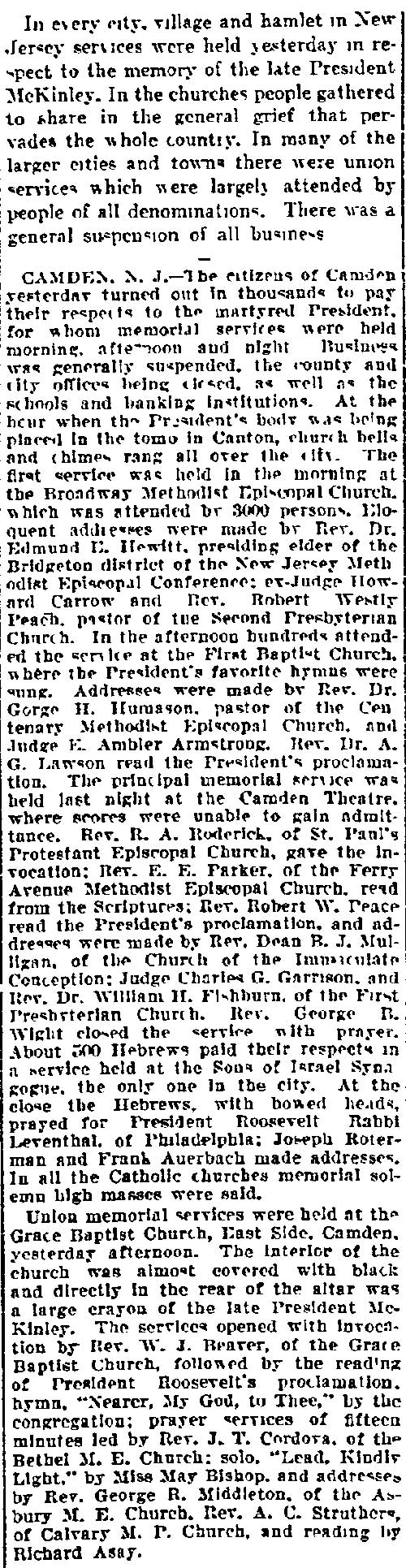
In every city, village and hamlet in New Jersey services were held yesterday in respect to the memory of the late President McKinley. In the churches people gathered to share in the general grief that pervades the whole country. In many of the larger cities and towns there were union services which were largely attended by people of all denominations. There was a general suspension of all business
CAMDEN, N. J.—The citizens of Camden yesterday turned out in thousands to pay their respects to the martyred President, for whom memorial services were held morning, afternoon and night. Business was generally suspended, the county and city offices being closed, as well as the schools and banking institutions. At the hour when the President’s body was being placed in the tomb in Canton, church bells and chimes rang all over the city. The first service was held in the morning at the Broadway Methodist Episcopal Church, which was attended by 3000 persons. Eloquent addresses were made by Rev. Dr. Edmund E. Hewitt, presiding elder of the Bridgeton district of the New Jersey Methodist Episcopal Conference; ex-Judge Howard Carrow and Rev. Robert Westly Peach, pastor of the Second Presbyterian Church. In the afternoon hundreds attended the service at the First Baptist Church, where the President’s favorite hymns were sung. Addresses were made by Rev. Dr. Gorge [sic] H. Humason, pastor of the Centenary Methodist Episcopal Church, and Judge E. Ambler Armstrong. Rev. Dr. A. G. Lawson read the President’s proclamation. The principal memorial service was held last night at the Camden Theatre, where scores were unable to gain admittance. Rev. R. A. Roderick, of St. Paul’s Protestant Episcopal Church, gave the invocation; Rev. E. E. Parker, of the Ferry Avenue Methodist Episcopal Church, read from the Scriptures; Rev. Robert W. Peace read the President’s proclamation, and addresses were made by Rev. Dean B. J. Mulligan, of the Church of the Immaculate Conception; Judge Charles G. Garrison, and Rev. Dr. William H. Fishburn, of the First Presbyterian Church. Rev. George R. Wight closed the service with prayer. About 500 Hebrews paid their respects in a service held at the Sons of Israel Synagogue, the only one in the city. At the close the Hebrews, with bowed heads, prayed for President Roosevelt. Rabbi Leventhal, of Philadelphia; Joseph Roterman and Frank Auerbach made addresses. In all the Catholic churches memorial solemn high masses were said.
Union memorial services were held at the Grace Baptist Church, East Side, Camden, yesterday afternoon. The interior of the church was almost covered with black and directly in the rear of the altar was a large crayon of the late President McKinley. The services opened with invocation by Rev. W. J. Reaver, of the Grace Baptist Church, followed by the reading of President Roosevelt’s proclamation; hymn, “Nearer, My God, to Thee,” by the congregation; prayer services of fifteen minutes led by Rev. J. T. Cordova, of the Bethel M. E. Church; solo, “Lead, Kindly Light,” by Miss May Bishop, and addresses by Rev. George R. Middleton, of the Asbury M. E. Church, Rev. A. C. Struthers, of Calvary M. P. Church, and reading by Richard Asay.
The Paul Woodward Murder Case
to
On October 1, 1902 Paul Woodward murdered two young boys by giving them poison. Frank T. Lloyd, then Camden County prosecutor, was responsible for leading the investigation and prosecuting the case. Woodward was arrested on October 4, 1902, and was quickly indicted on murder charges. Judge Charles G. Garrison tried the case in November of 1902. After Woodward had been found guilty of murder in the first degree, Judge Garrison sentenced him to death by hanging. Paul Woodward was executed on January 7, 1903 at the Camden County Jail.
Links to pages about people mentioned in this case: joseph jennings – jennings’ third regiment band – frank t. lloyd – Dr. William S. Jones – william d. hart – dr. paul n. litchfield – F. Morse Archer – john foster – john painter – john cherry – isaac toone – Paul Woodward – george m. beringer – Charles G. Garrison – J. Wesley Sell – Christopher J. Mines Jr. – frederick a. rex – J. Frederick Voigt – george f. kappel – Isaac Toy – harry s. scovel – Francis Ford Patterson Jr. – John S. Smith – O. Glen Stackhouse – Hugh Boyle – Charles D. Ridgley – Frank S. Albright – Thomas Walton – Dr. WIlliam H. Iszard – George H. Stineford Sr.
Deep Mystery Still Envelops Camden Tragedy
Philadelphia Inquirer —
Trinity Baptist Church, with John S. Smith and George M. Beringer.
Must Now Produce Woodward in Court
Philadelphia Inquirer —
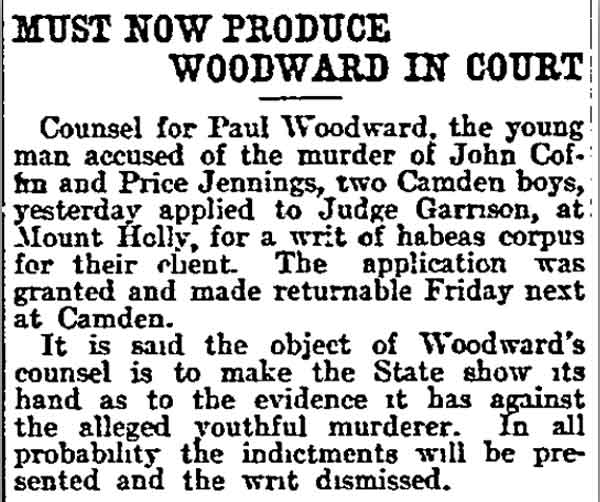
Counsel for Paul Woodward, the young man accused of the murder of John Coffin and Price Jennings, two Camden boys, yesterday applied to Judge Garrison, at Mount Holly, for a writ of habeas corpus for their client. The application was granted and made returnable Friday next at Camden.
It is said the object of Woodward’s counsel is to make the State show its hand as to the evidence it has against the alleged youthful murderer. In all probability the indictments will be presented and the writ dismissed.
Woodward Writ to Be Argued To-day
Philadelphia Inquirer —
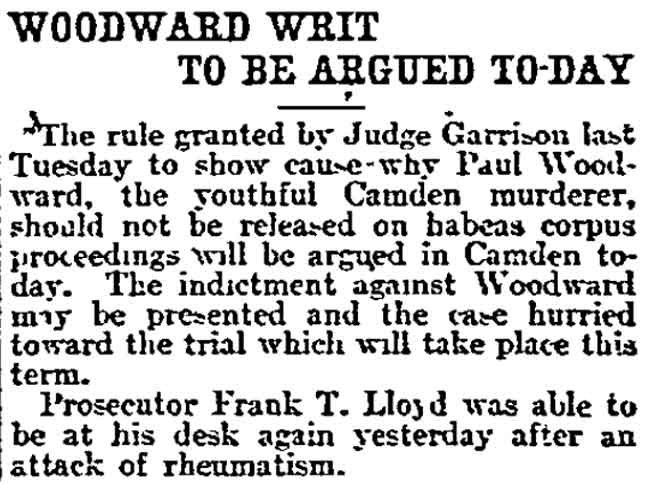
The rule granted by Judge Garrison last Tuesday to show cause why Paul Woodward, the youthful Camden murderer, should not be released on habeas corpus proceedings will be argued in Camden to-day. The indictment against Woodward may be presented and the case hurried toward the trial which will take place this term.
Prosecutor Frank T. Lloyd was able to be at his desk again yesterday after an attack of rheumatism.
Young Woodward Indicted by Jury
Philadelphia Inquirer —
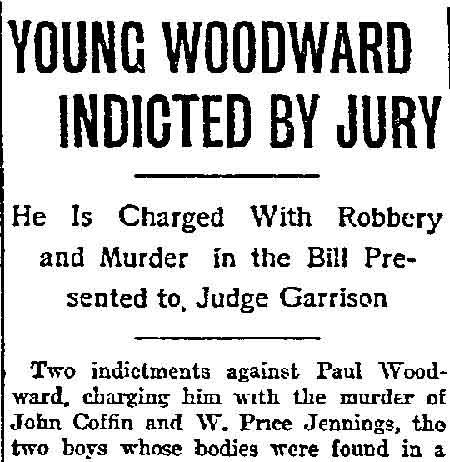
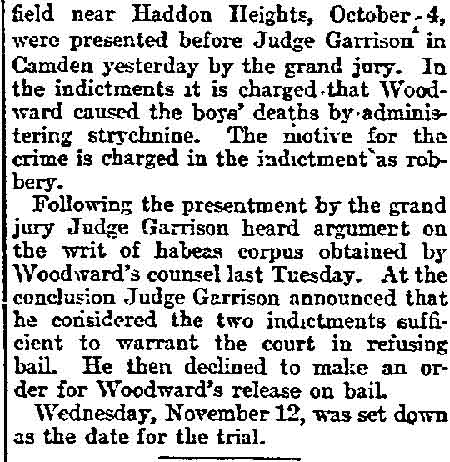
He Is Charged With Robbery and Murder in the Bill Presented to Judge Garrison
Two indictments against Paul Woodward, charging him with the murder of John Coffin and W. Price Jennings, the two boys whose bodies were found in a field near Haddon Heights, October 4, were presented before Judge Garrison in Camden yesterday by the grand jury. In the indictments it is charged that Woodward caused the boys’ deaths by administering strychnine. The motive for the crime is charged in the indictment as robbery.
Following the presentment by the grand jury Judge Garrison heard argument on the writ of habeas corpus obtained by Woodward’s counsel last Tuesday. At the conclusion Judge Garrison announced that he considered the two indictments sufficient to warrant the court in refusing bail. He then declined to make an order for Woodward’s release on bail.
Wednesday, November 12, was set down as the date for the trial.
Jurors to Try Woodward
Philadelphia Inquirer —
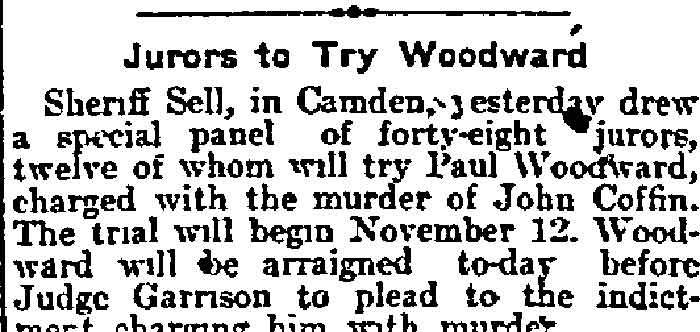
Sheriff Sell, in Camden, yesterday drew a special panel of forty-eight jurors, twelve of whom will try Paul Woodward, charged with the murder of John Coffin. The trial will begin November 12. Woodward will be arraigned to-day before Judge Garrison to plead to the indictment charging him with murder.
Woodward Says He Is Not Guilty
Philadelphia Inquirer —
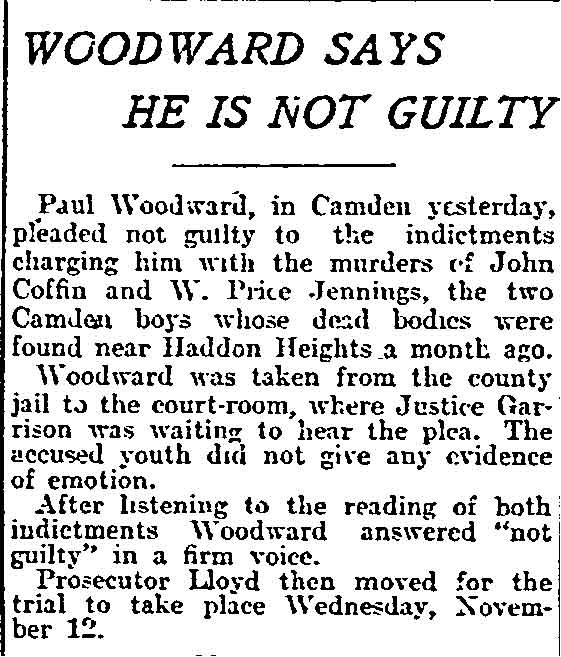
Paul Woodward, in Camden yesterday, pleaded not guilty to the indictments charging him with the murders of John Coffin and W. Price Jennings, the two Camden boys whose dead bodies were found near Haddon Heights a month ago.
Woodward was taken from the county jail to the court-room, where Justice Garrison was waiting to hear the plea. The accused youth did not give any evidence of emotion.
After listening to the reading of both indictments Woodward answered “not guilty” in a firm voice.
Prosecutor Lloyd then moved for the trial to take place Wednesday, November 12.
Woodward Placed on Trial To-Morrow
Philadelphia Inquirer —
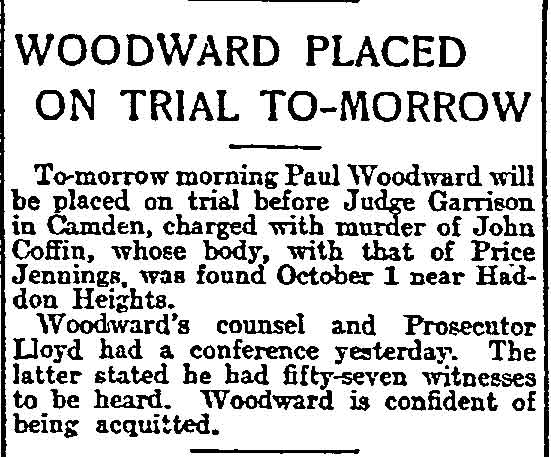
To-morrow morning Paul Woodward will be placed on trial before Judge Garrison in Camden, charged with murder of John Coffin, whose body, with that of Price Jennings, was found October 1 near Haddon Heights.
Woodward’s counsel and Prosecutor Lloyd had a conference yesterday. The latter stated he had fifty-seven witnesses to be heard. Woodward is confident of being acquitted.
Woodward on Trial for Coffin Murder
Philadelphia Inquirer —
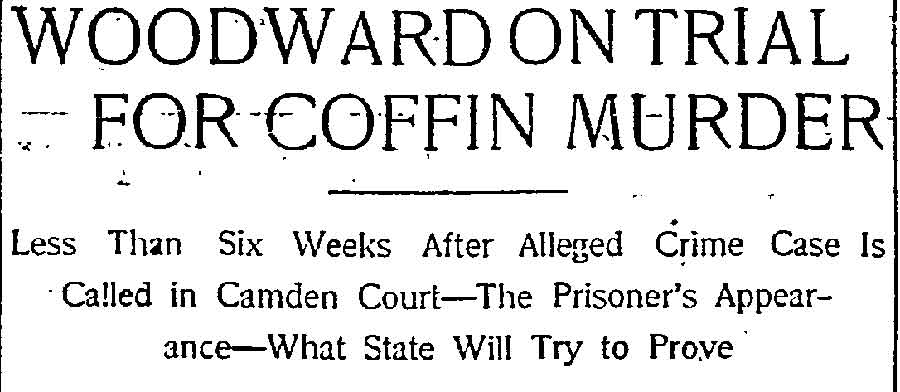
Less Than Six Weeks After Alleged Crime Case Is Called in Camden Court — The Prisoner’s Appearance — What State Will Try to Prove
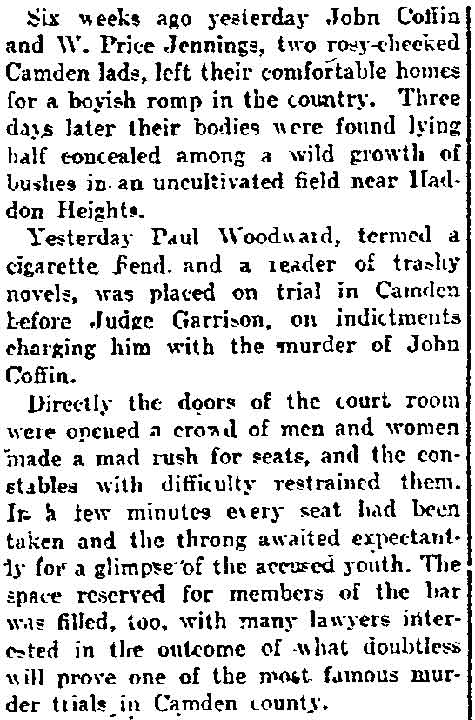
Six weeks ago yesterday John Coffin and W. Price Jennings, two rosy-cheeked Camden lads, left their comfortable homes for a boyish romp in the country. Three days later their bodies were found lying half concealed among a wild growth of bushes in an uncultivated field near Haddon Heights.
Yesterday Paul Woodward, termed a cigarette fiend and a reader of trashy novels, was placed on trial in Camden before Judge Garrison, on indictments charging him with the murder of John Coffin.
Directly the doors of the court room were opened a crowd of men and women made a mad rush for seats, and the constables with difficulty restrained them. In a few minutes every seat had been taken and the throng awaited expectantly for a glimpse of the accused youth. The space reserved for members of the bar was filled, too, with many lawyers interested in the outcome of what doubtless will prove one of the most famous murder trials in Camden county.
Court Opened
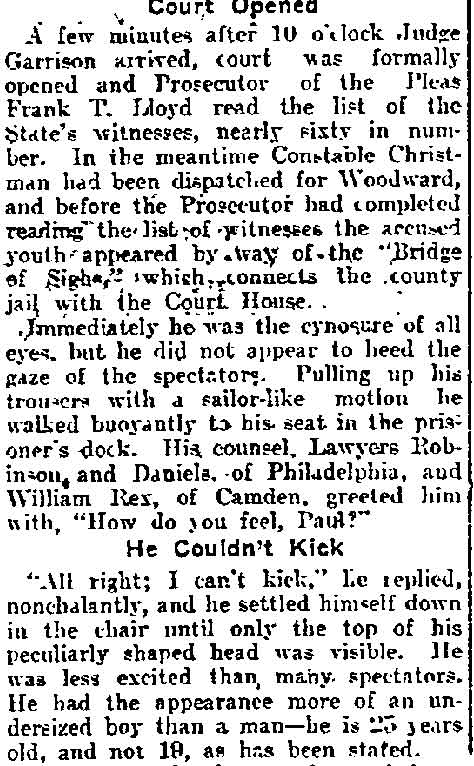
A few minutes after 10 o’clock Judge Garrison arrived, court was formally opened and Prosecutor of the Pleas Frank T. Lloyd read the list of the State’s witnesses, nearly sixty in number. In the meantime Constable Christman had been dispatched for Woodward, and before the Prosecutor had completed reading the list of witnesses the accused youth appeared by way of the “Bridge of Sighs,” which connects the county jail with the Court House.
Immediately he was the cynosure of all eyes, but he did not appear to heed the gaze of the spectators. Pulling up his trousers with a sailor-like motion he walked buoyantly to his seat in the prisoner’s dock. His counsel, Lawyers Robinson and Daniels, of Philadelphia, and William Rex, of Camden, greeted him with, “How do you feel, Paul?”
He Couldn’t Kick
“All right; I can’t kick,” he replied, nonchalantly, and he settled himself down in the chair until only the top of his peculiarly shaped head was visible. He was less excited than many spectators. He had the appearance more of an undersized boy than a man—he is 25[?] years old, and not 19[?], as has been stated.
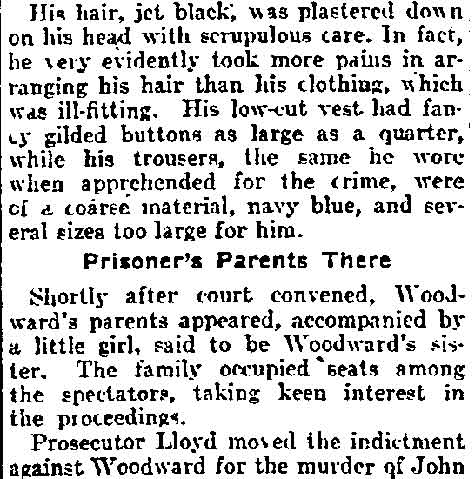
His hair, jet black, was plastered down on his head with scrupulous care. In fact, he very evidently took more pains in arranging his hair than his clothing, which was ill-fitting. His low-cut vest had fancy gilded buttons as large as a quarter, while his trousers, the same he wore when apprehended for the crime, were of a coarse material, navy blue, and several sizes too large for him.
Prisoner’s Parents There
Shortly after court convened, Woodward’s parents appeared, accompanied by a little girl, said to be Woodward’s sister. The family occupied seats among the spectators, taking keen interest in the proceedings.
Prosecutor Lloyd moved the indictment against Woodward for the murder of John Coffin. The other indictment, charging him with the murder of Price Jennings, will not be pressed unless in the event of an acquittal in the Coffin case. After Lawyer Rex had introduced his Philadelphia colleagues, the task of securing a jury was begun. The entire panel of forty-eight was exhausted when only ten jurors had been selected. A special panel was called before the other two were secured.
As finally selected, the jury composes the following: George Asay, Voorhees township, foreman; William Powell, Gloucester township; William Anderson, Pensauken; Charles Eisley, Waterford; Thomas J. Atkinson, Fourth ward; Wilson English, Tenth ward; Harry Avis, Second ward; George H. Stinford, Sr., Fifth ward; John M. Hyde, Twelfth ward; William Heggan, Tenth ward; John St. Clair, Third ward; Charles S. Hess, Fifth ward.
Case Presented
It was two o’clock in the afternoon before Assistant Prosecutor F. Morse Archer opened for the State. He said the State would show the cause of death to be the result of strychnine poisoning; that on the Monday and Tuesday preceding the disappearance of the boys Woodward was seen loitering about the Linden public school inquiring for Coffin and Jennings; that he met them the following Wednesday at Front and Penn streets and was heard to make an appointment to meet them in the country; that he did meet them on the White Horse pike and was seen entering the lane off Chew’s Landing road to the spot where the bodies were found. Mr. Archer also said the State would prove the defendant appeared at the Coffin house the day following the disappearance of the boys and offered his services to locate them. He said it would be proven Woodward showed a friend valuables and money taken from the bodies before the boys were known to be dead. The State would offer statements made by the defendant and on the strength of the above a verdict of first degree was asked.
First Witnesses
Clarence Krewson and Harry Patton, of Haddon Heights, were the first witnesses called. They told how they came across the body of Jennings lying under a chestnut tree while they were returning from a blackbird hunt. They described the general appearance of the body and said there were no evidences of a struggle.
Mary Ward, colored, told how she had found the body of Coffin while piloting a newspaper man to the spot where young Jennings lay.
County Physician William S. Jones described the postmortem examination. He said he did not ascertain the cause of death. There were no external marks or bruises and nothing to indicate as to how the boys had met death. He testified to removing the viscera of both boys and turning them over to Chemist George M. Beringer in hermetically sealed glass jars.
Professor William C. Copeland, of Jefferson Medical College, told how he had made an autopsy on the bodies. He said they were carefully examined for evidences of external bruises, but none were found. He said there were some marks of discoloration, which probably resulted from postmortem changes. There were no evidences of death from unnatural causes.
Judge Garrison adjourned court until this morning, when Professor Copeland will resume his testimony.
Woodward Bought Poison, Says Druggist
Philadelphia Inquirer —

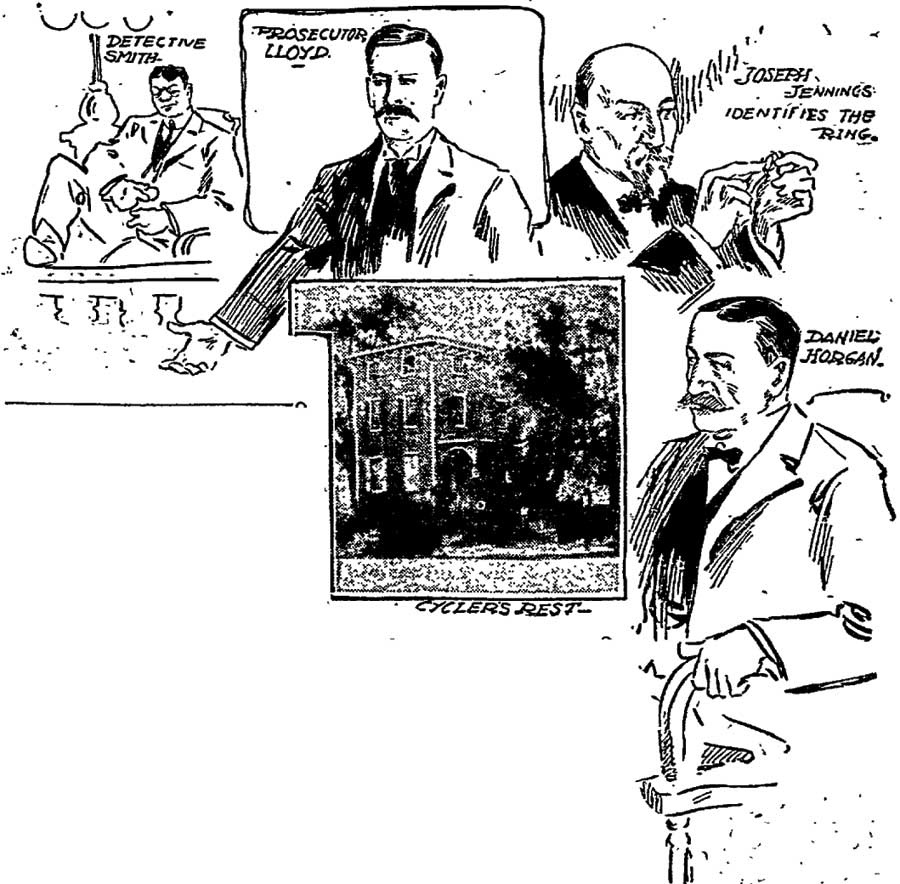
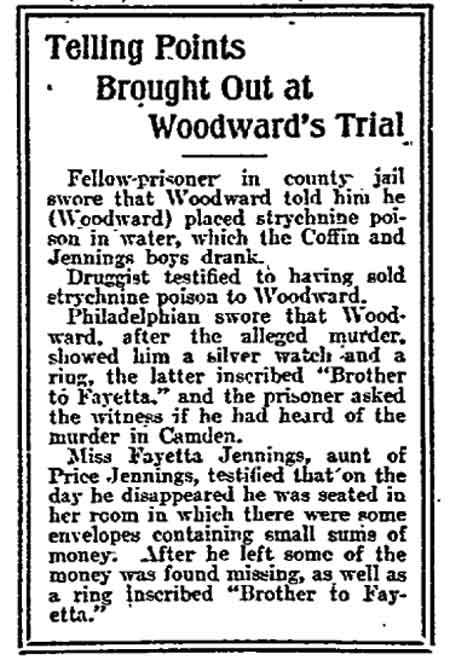
Telling Points Brought Out at Woodward’s Trial
Fellow-prisoner in county jail swore that Woodward told him he (Woodward) placed strychnine poison in water, which the Coffin and Jennings boys drank.
Druggist testified to having sold strychnine poison to Woodward.
Philadelphian swore that Woodward, after the alleged murder, showed him a silver watch and a ring, the latter inscribed “Brother to Fayetta,” and the prisoner asked the witness if he had heard of the murder in Camden.
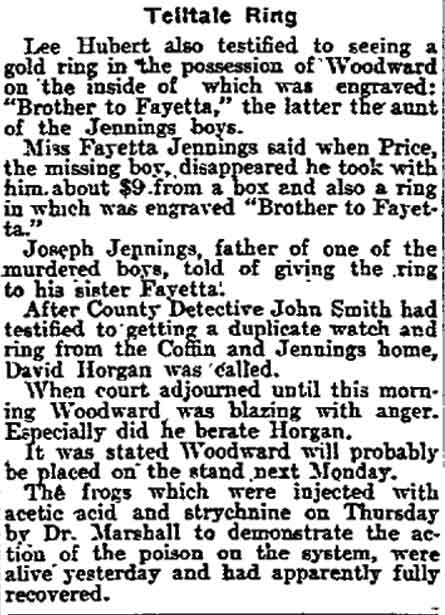
Miss Fayetta Jennings, aunt of Price Jennings, testified that on the day he disappeared he was seated in her room in which there were some envelopes containing small sums of money. After he left some of the money was found missing, as well as a ring inscribed “Brother to Fayetta.”
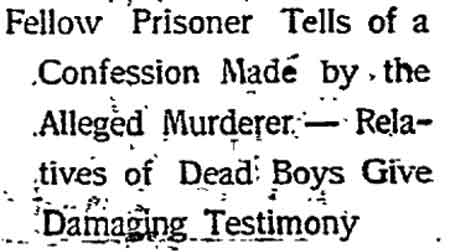
Fellow Prisoner Tells of a Confession Made by the Alleged Murderer — Relatives of Dead Boys Give Damaging Testimony
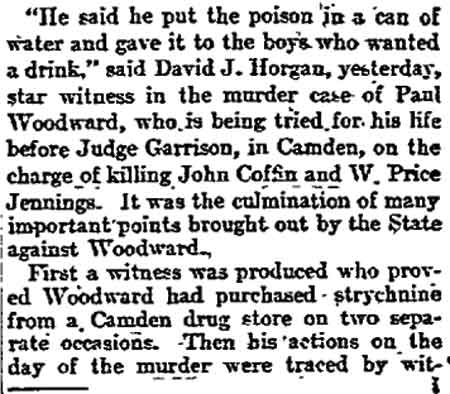
“He said he put the poison in a can of water and gave it to the boys who wanted a drink,” said David J. Horgan, yesterday, star witness in the murder case of Paul Woodward, who is being tried for his life before Judge Garrison, in Camden, on the charge of killing John Coffin and W. Price Jennings. It was the culmination of many important points brought out by the State against Woodward.
First a witness was produced who proved Woodward had purchased strychnine from a Camden drug store on two separate occasions. Then his actions on the day of the murder were traced by witnesses whose testimony could not be shaken.
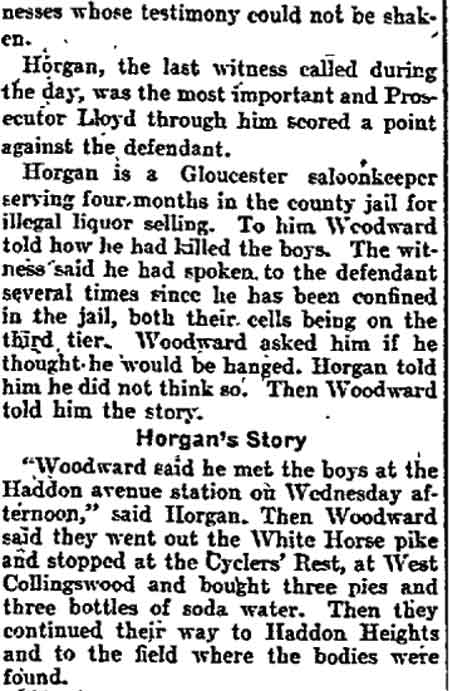
Horgan, the last witness called during the day, was the most important and Prosecutor Lloyd through him scored a point against the defendant.
Horgan is a Gloucester saloonkeeper serving four months in the county jail for illegal liquor selling. To him Woodward told how he had killed the boys. The witness said he had spoken to the defendant several times since he has been confined in the jail, both their cells being on the third tier. Woodward asked him if he thought he would be hanged. Horgan told him he did not think so. Then Woodward told him the story.
Horgan’s Story
“Woodward said he met the boys at the Haddon avenue station on Wednesday afternoon,” said Horgan. Then Woodward said they went out the White Horse pike and stopped at the Cyclers’ Rest, at West Collingswood and bought three pies and three bottles of soda water. Then they continued their way to Haddon Heights and to the field where the bodies were found.
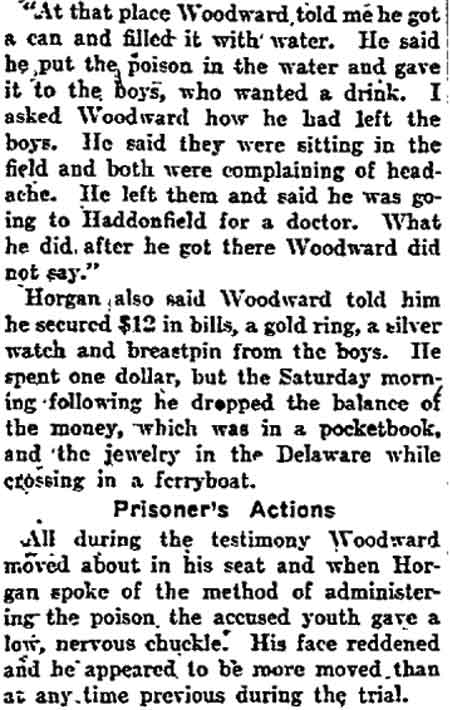
“At that place Woodward told me he got a can and filled it with water. He said he put the poison in the water and gave it to the boys, who wanted a drink. I asked Woodward how he had left the boys. He said they were sitting in the field and both were complaining of headache. He left them and said he was going to Haddonfield for a doctor. What he did after he got there Woodward did not say.”
Horgan also said Woodward told him he secured $12 in bills, a gold ring, a silver watch and breastpin from the boys. He spent one dollar, but the Saturday morning following he dropped the balance of the money, which was in a pocketbook, and the jewelry in the Delaware while crossing in a ferryboat.
Prisoner’s Actions
All during the testimony Woodward moved about in his seat and when Horgan spoke of the method of administering the poison, the accused youth gave a low, nervous chuckle. His face reddened and he appeared to be more moved than at any time previous during the trial.
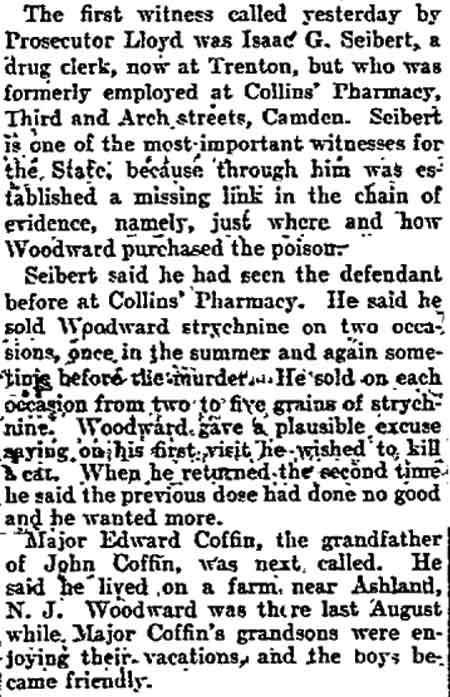
The first witness called yesterday by Prosecutor Lloyd was Isaac G. Seibert, a drug clerk, now at Trenton, but who was formerly employed at Collins’ Pharmacy, Third and Arch streets, Camden. Seibert is one of the most important witnesses for the State, because through him was established a missing link in the chain of evidence, namely, just where and how Woodward purchased the poison.
Seibert said he had seen the defendant before at Collins’ Pharmacy. He said he sold Woodward strychnine on two occasions, once in the summer and again sometime before the murder. He sold on each occasion from two to five grains of strychnine. Woodward gave a plausible excuse saying, on his first visit he wished to kill a cat. When he returned the second time he said the previous dose had done no good and he wanted more.
Major Edward Coffin, the grandfather of John Coffin, was next called. He said he lived on a farm near Ashland, N. J. Woodward was there last August while Major Coffin’s grandsons were enjoying their vacations, and the boys became friendly.
Brother Testifies
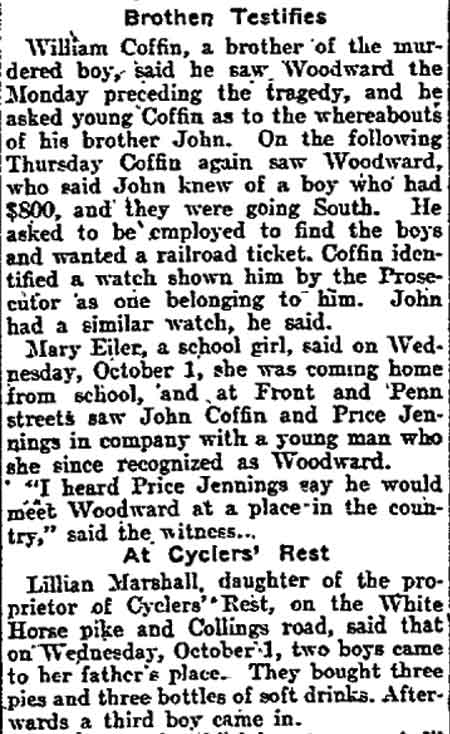
William Coffin, a brother of the murdered boy, said he saw Woodward the Monday preceding the tragedy, and he asked young Coffin as to the whereabouts of his brother John. On the following Thursday Coffin again saw Woodward, who said John knew of a boy who had $800, and they were going South. He asked to be employed to find the boys and wanted a railroad ticket. Coffin identified a watch shown him by the Prosecutor as one belonging to him. John had a similar watch, he said.
Mary Eiler, a school girl, said on Wednesday, October 1, she was coming home from school, and at Front and Penn streets saw John Coffin and Price Jennings in company with a young man who she since recognized as Woodward.
“I heard Price Jennings say he would meet Woodward at a place in the country,” said the witness.
At Cyclers’ Rest
Lillian Marshall, daughter of the proprietor of Cyclers’ Rest, on the White Horse pike and Collings road, said that on Wednesday, October 1, two boys came to her father’s place. They bought three pies and three bottles of soft drinks. Afterwards a third boy came in.
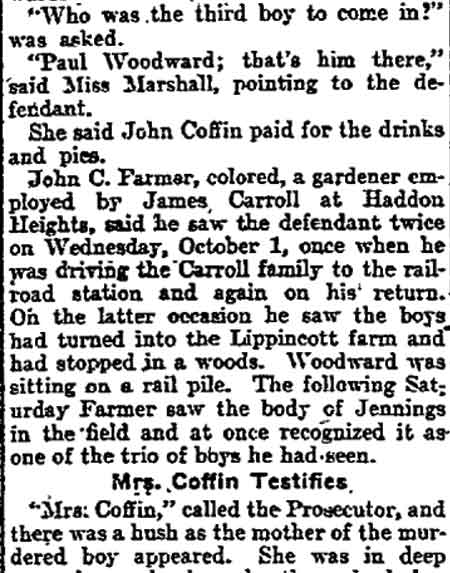
“Who was the third boy to come in?” was asked.
“Paul Woodward; that’s him there,” said Miss Marshall, pointing to the defendant.
She said John Coffin paid for the drinks and pies.
John C. Farmer, colored, a gardener employed by James Carroll at Haddon Heights, said he saw the defendant twice on Wednesday, October 1, once when he was driving the Carroll family to the railroad station and again on his return. On the latter occasion he saw the boys had turned into the Lippincott farm and had stopped in a woods. Woodward was sitting on a rail pile. The following Saturday Farmer saw the body of Jennings in the field and at once recognized it as one of the trio of boys he had seen.
Mrs. Coffin Testifies
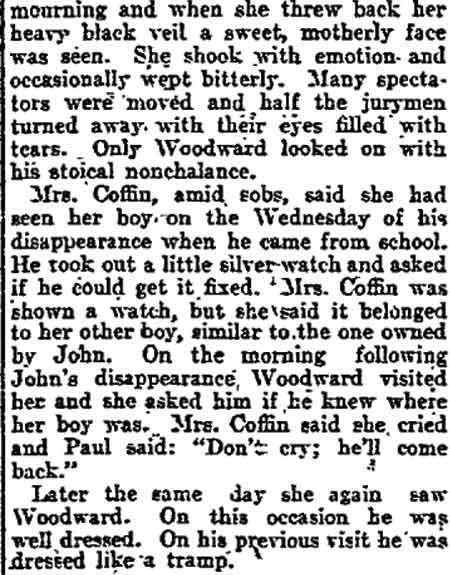
“Mrs. Coffin,” called the Prosecutor, and there was a hush as the mother of the murdered boy appeared. She was in deep mourning and when she threw back her heavy black veil a sweet, motherly face was seen. She shook with emotion and occasionally wept bitterly. Many spectators were moved and half the jurymen turned away with their eyes filled with tears. Only Woodward looked on with his stoical nonchalance.
Mrs. Coffin, amid sobs, said she had seen her boy on the Wednesday of his disappearance when he came from school. He took out a little silver watch and asked if he could get it fixed. Mrs. Coffin was shown a watch, but she said it belonged to her other boy, similar to the one owned by John. On the morning following John’s disappearance, Woodward visited her and she asked him if he knew where her boy was. Mrs. Coffin said she cried and Paul said: “Don’t cry; he’ll come back.”
Later the same day she again saw Woodward. On this occasion he was well dressed. On his previous visit he was dressed like a tramp.
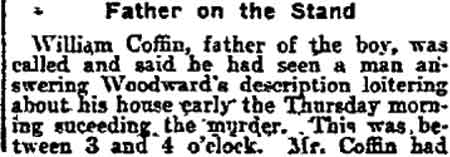
Father on the Stand
William Coffin, father of the boy, was called and said he had seen a man answering Woodward’s description loitering about his house early the Thursday morning suceeding [sic] the murder. This was between 3 and 4 o’clock. Mr. Coffin had not gone to bed because of worriment over his boy. He heard some one in his vestibule, and, hurrying down stairs, saw a figure resembling Woodward several doors above.
William F. Smith, a news agent at the Haddon avenue station, said Woodward wanted to buy his watch. Woodward said he expected to have some money about the 1st or 2d of October.
James Sheiding, who has been locked up since Friday, October 10, as a witness, was placed on the witness stand. He said he talked with Woodward the afternoon of October 3. At that time Woodward said he guessed there was a murder in Camden as two boys were missing. Later the defendant pulled out a ring and wanted him to pawn it for $4. Again Woodward pulled a watch from his pocket. This was a silver watch, the same as the one belonging to young Coffin’s brother.
Telltale Ring
Lee Hubert also testified to seeing a gold ring in the possession of Woodward on the inside of which was engraved: “Brother to Fayetta,” the latter the aunt of the Jennings boys.
Miss Fayetta Jennings said when Price, the missing boy, disappeared he took with him about $9 from a box and also a ring in which was engraved “Brother to Fayetta.”
Joseph Jennings, father of one of the murdered boys, told of giving the ring to his sister Fayetta.
After County Detective John Smith had testified to getting a duplicate watch and ring from the Coffin and Jennings home, David Horgan was called.
When court adjourned until this morning Woodward was blazing with anger. Especially did he berate Horgan.
It was stated Woodward will probably be placed on the stand next Monday.
The frogs which were injected with acetic acid and strychnine on Thursday by Dr. Marshall to demonstrate the action of the poison on the system, were alive yesterday and had apparently fully recovered.
Detective Smith.
Prosecutor Lloyd.
Joseph Jennings Identifies the Ring.
Daniel Horgan.
Cycler’s Rest.
Woodward Spent a Quiet Sunday
Philadelphia Inquirer —
Apparently Buoyed Up by the Efforts of His Counsel, Who Now Have Their Inning
Paul Woodward, the young man on trial for his life before Judge Garrison, charged with the murder of little John Coffin, spent a quiet Sunday in his cell in the Camden county jail. He ate his meals as usual and gave no evidence whatever of being affected by the ordeal through which he has passed since last Wednesday. Since the defense has opened its case he appears to be more cheerful, presumably expectant of something occurring before the end of the trial that will strengthen his chances of acquittal.
The trial has caused more comment in Camden than anything since the time Eli Shaw was accused of the murder of his mother and grandmother some years ago.
There was great surprise manifested when Lawyer Daniels, in outlining the defense, said it would be proven Woodward could not have been present when the crime was committed, and the subsequent attempt to prove an alibi. Woodward may be placed on the stand to-day and it remains to be seen how his story will stand the keen cross-examination of Prosecutor Lloyd. One of the features of the trial has been the manner in which the jury has noticed every move and characteristic of the defendant as he sits in the prisoners’ dock.
The jurymen were yesterday taken out for exercise. They were accompanied by constables and walked about the streets for some time.
Several letters have been received at the county jail, where Woodward is incarcerated, from persons who are desirous of securing the young man’s brain in the event of him being convicted and hanged.
Woodward Smiled When He Heard Death Verdict
Philadelphia Inquirer —

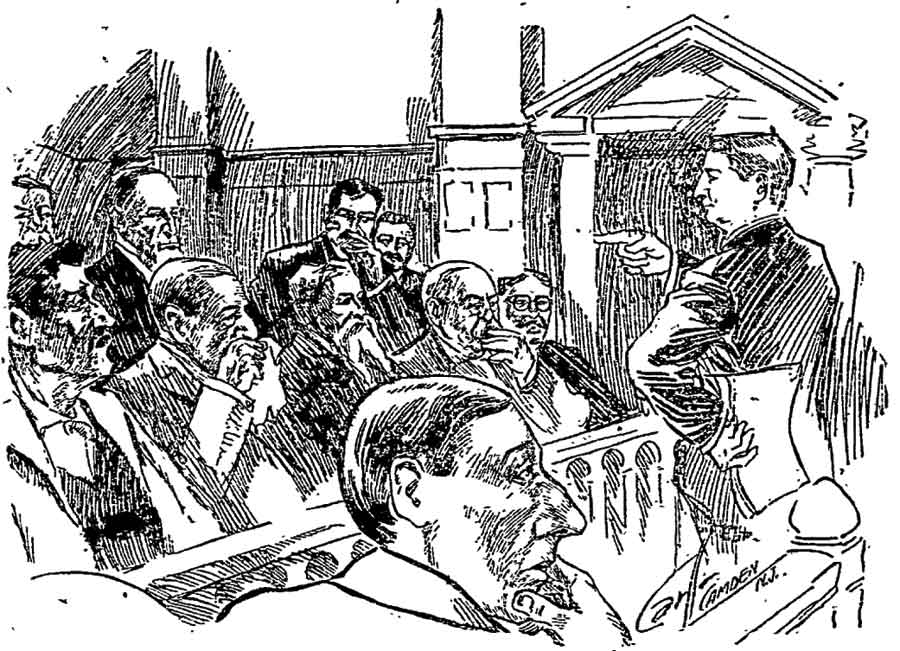

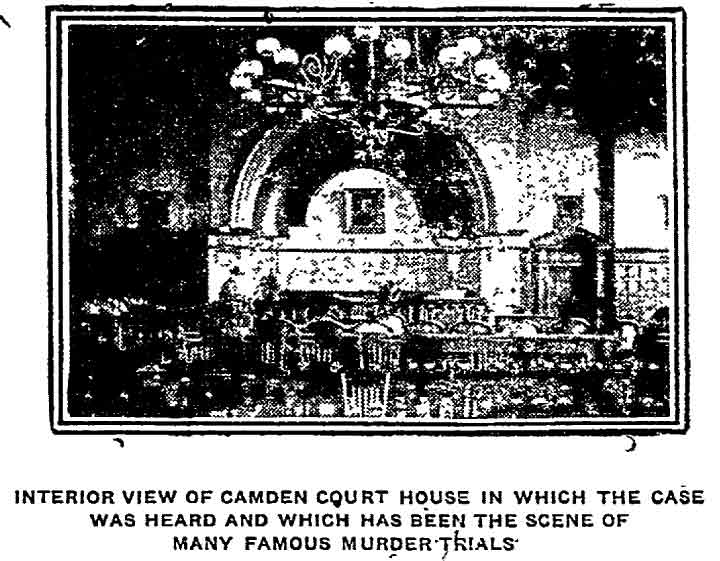
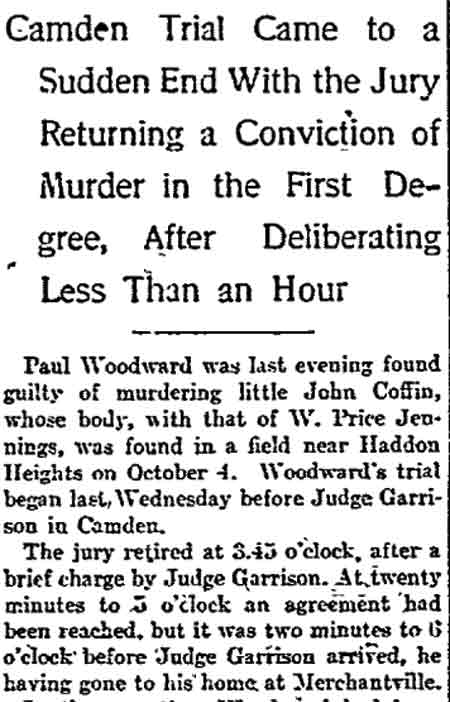
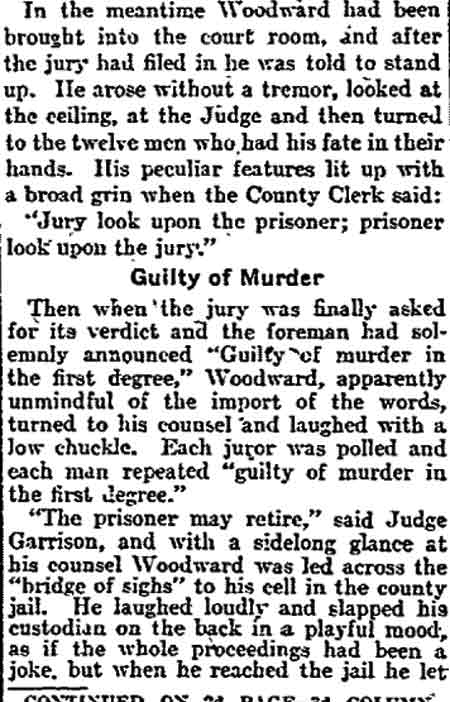
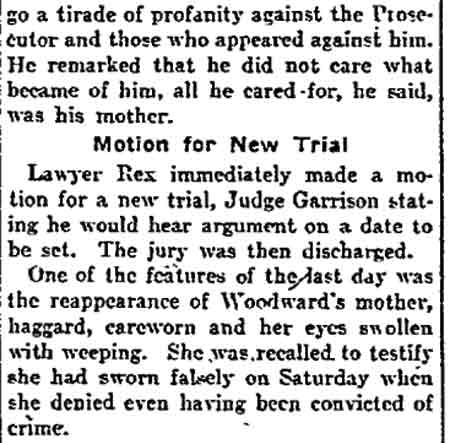
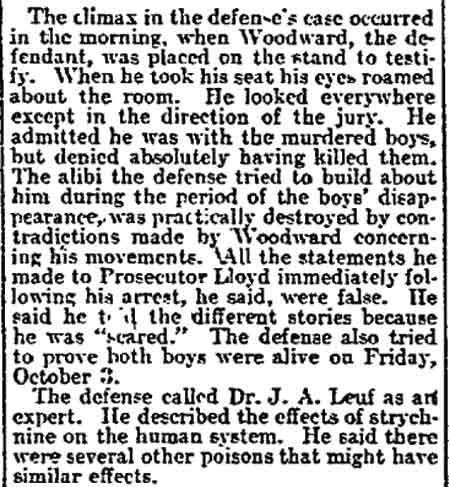
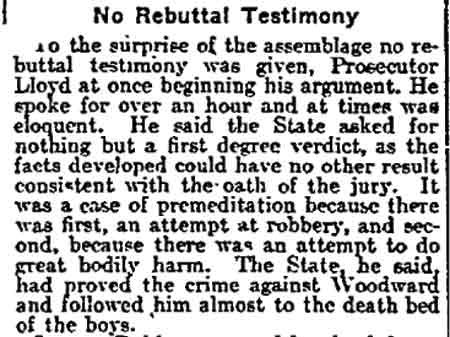
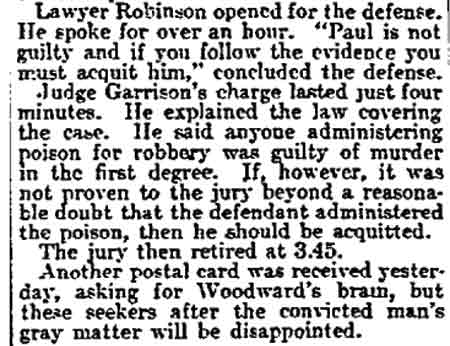
Camden Trial Came to a Sudden End With the Jury Returning a Conviction of Murder in the First Degree, After Deliberating Less Than an Hour
Attorney Robinson Making His Address to the Jury. Paul Woodward in Foreground.
Interior View of Camden Court House in Which the Case Was Heard and Which Has Been the Scene of Many Famous Murder Trials.
Paul Woodward was last evening found guilty of murdering little John Coffin, whose body, with that of W. Price Jennings, was found in a field near Haddon Heights on October 4. Woodward’s trial began last Wednesday before Judge Garrison in Camden.
The jury retired at 3.45 o’clock, after a brief charge by Judge Garrison. At twenty minutes to 5 o’clock an agreement had been reached, but it was two minutes to 6 o’clock before Judge Garrison arrived, he having gone to his home at Merchantville.
In the meantime Woodward had been brought into the court room, and after the jury had filed in he was told to stand up. He arose without a tremor, looked at the ceiling, at the Judge and then turned to the twelve men who had his fate in their hands. His peculiar features lit up with a broad grin when the County Clerk said:
“Jury look upon the prisoner; prisoner look upon the jury.”
Guilty of Murder
Then when the jury was finally asked for its verdict and the foreman had solemnly announced “Guilty of murder in the first degree,” Woodward, apparently unmindful of the import of the words, turned to his counsel and laughed with a low chuckle. Each juror was polled and each man repeated “guilty of murder in the first degree.”
“The prisoner may retire,” said Judge Garrison, and with a sidelong glance at his counsel Woodward was led across the “bridge of sighs” to his cell in the county jail. He laughed loudly and slapped his custodian on the back in a playful mood, as if the whole proceedings had been a joke, but when he reached the jail he let go a tirade of profanity against the Prosecutor and those who appeared against him. He remarked that he did not care what became of him, all he cared for, he said, was his mother.
Motion for New Trial
Lawyer Rex immediately made a motion for a new trial, Judge Garrison stating he would hear argument on a date to be set. The jury was then discharged.
One of the features of the last day was the reappearance of Woodward’s mother, haggard, careworn and her eyes swollen with weeping. She was recalled to testify she had sworn falsely on Saturday when she denied even having been convicted of crime.
The climax in the defense’s case occurred in the morning, when Woodward, the defendant, was placed on the stand to testify. When he took his seat his eyes roamed about the room. He looked everywhere except in the direction of the jury. He admitted he was with the murdered boys, but denied absolutely having killed them. The alibi the defense tried to build about him during the period of the boys’ disappearance, was practically destroyed by contradictions made by Woodward concerning his movements. All the statements he made to Prosecutor Lloyd immediately following his arrest, he said, were false. He said he told the different stories because he was “scared.” The defense also tried to prove both boys were alive on Friday, October 3.
The defense called Dr. J. A. Leuf as an expert. He described the effects of strychnine on the human system. He said there were several other poisons that might have similar effects.
No Rebuttal Testimony
To the surprise of the assemblage no rebuttal testimony was given, Prosecutor Lloyd at once beginning his argument. He spoke for over an hour and at times was eloquent. He said the State asked for nothing but a first degree verdict, as the facts developed could have no other result consistent with the oath of the jury. It was a case of premeditation because there was first, an attempt at robbery, and second, because there was an attempt to do great bodily harm. The State, he said, had proved the crime against Woodward and followed him almost to the death bed of the boys.
Lawyer Robinson opened for the defense. He spoke for over an hour. “Paul is not guilty and if you follow the evidence you must acquit him,” concluded the defense.
Judge Garrison’s charge lasted just four minutes. He explained the law covering the case. He said anyone administering poison for robbery was guilty of murder in the first degree. If, however, it was not proven to the jury beyond a reasonable doubt that the defendant administered the poison, then he should be acquitted.
The jury then retired at 3.45.
Another postal card was received yesterday, asking for Woodward’s brain, but these seekers after the convicted man’s gray matter will be disappointed.
No New Trial for Murderer Woodward
Philadelphia Inquirer —
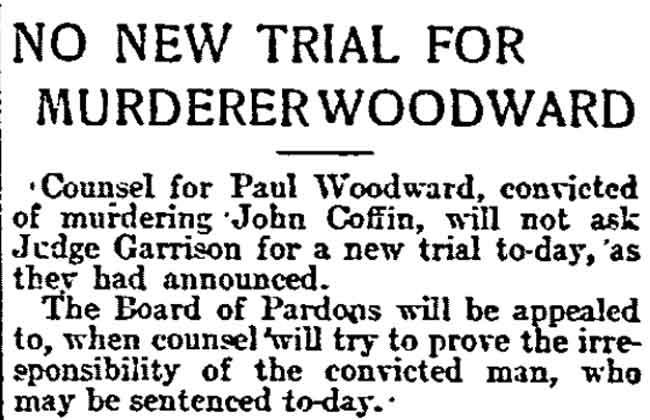
Counsel for Paul Woodward, convicted of murdering John Coffin, will not ask Judge Garrison for a new trial to-day, as they had announced.
The Board of Pardons will be appealed to, when counsel will try to prove the irresponsibility of the convicted man, who may be sentenced to-day.
Woodward to Go to Gallows on January 7
Philadelphia Inquirer —
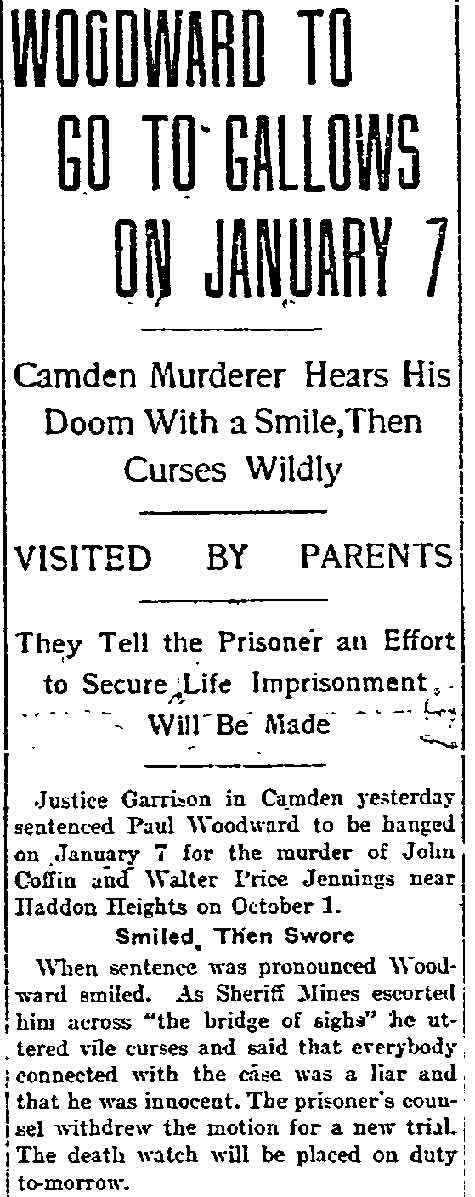
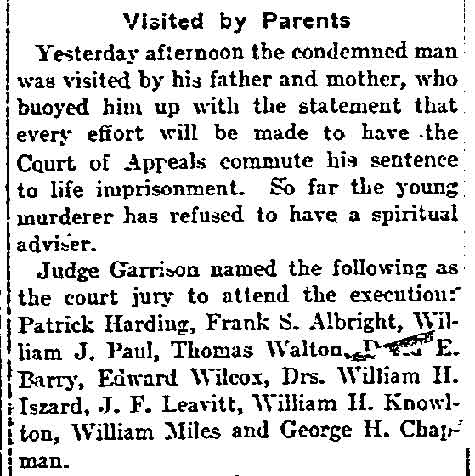
Camden Murderer Hears His Doom With a Smile, Then Curses Wildly
VISITED BY PARENTS
They Tell the Prisoner an Effort to Secure Life Imprisonment Will Be Made
Justice Garrison in Camden yesterday sentenced Paul Woodward to be hanged on January 7 for the murder of John Coffin and Walter Price Jennings near Haddon Heights on October 1.
Smiled, Then Swore
When sentence was pronounced Woodward smiled. As Sheriff Mines escorted him across “the bridge of sighs” he uttered vile curses and said that everybody connected with the case was a liar and that he was innocent. The prisoner’s counsel withdrew the motion for a new trial. The death watch will be placed on duty to-morrow.
Visited by Parents
Yesterday afternoon the condemned man was visited by his father and mother, who buoyed him up with the statement that every effort will be made to have the Court of Appeals commute his sentence to life imprisonment. So far the young murderer has refused to have a spiritual adviser.
Judge Garrison named the following as the court jury to attend the execution: Patrick Harding, Frank S. Albright, William J. Paul, Thomas Walton, D[avid] E. Barry, Edward Wilcox, Drs. William H. Iszard, J. F. Leavitt, William H. Knowlton, William Miles and George H. Chapman.
Miller Gets a Certiorari
Camden Daily Courier —
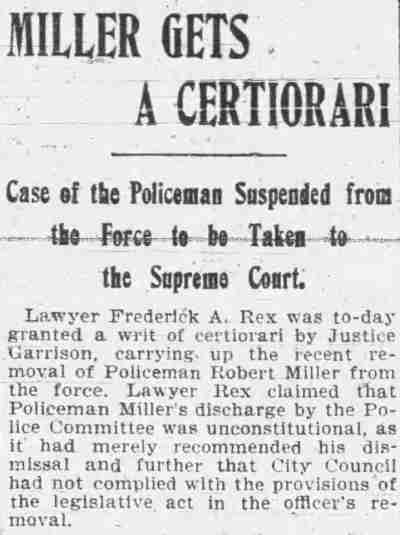
Case of the Policeman Suspended from the Force to be Taken to the Supreme Court.
Lawyer Frederick A. Rex was to-day granted a writ of certiorari by Justice Garrison, carrying up the recent removal of Policeman Robert Miller from the force. Lawyer Rex claimed that Policeman Miller’s discharge by the Police Committee was unconstitutional, as it had merely recommended his dismissal and further that City Council had not complied with the provisions of the legislative act in the officer’s removal.
Camden Court Opens
Philadelphia Inquirer —
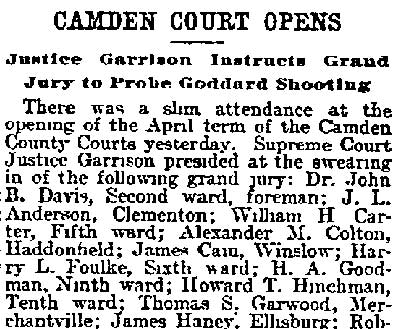
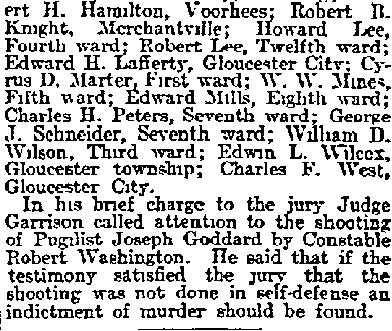
Justice Garrison Instructs Grand Jury to Probe Goddard Shooting
There was a slim attendance at the opening of the April term of the Camden County Courts yesterday. Supreme Court Justice Garrison presided at the swearing in of the following grand jury: Dr. John B. Davis, Second ward, foreman; J. L. Anderson, Clementon; William H. Carter, Fifth ward; Alexander M. Colton, Haddonfield; James Cain, Winslow; Harry L. Foulke, Sixth ward; H. A. Goodman, Ninth ward; Howard T. Hinchman, Tenth ward; Thomas S. Garwood, Merchantville; James Haney, Ellsburg; Robert H. Hamilton, Voorhees; Robert B. Knight, Merchantville; Howard Lee, Fourth ward; Robert Lee, Twelfth ward; Edward H. Lafferty, Gloucester City; Cyrus D. Marter, First ward; W. W. Mines, Fifth ward; Edward Mills, Eighth ward; Charles H. Peters, Seventh ward; George J. Schneider, Seventh ward; William D. Wilson, Third ward; Edwin L. Wilcox, Gloucester township; Charles F. West, Gloucester City.
In his brief charge to the jury Judge Garrison called attention to the shooting of Pugilist Joseph Goddard by Constable Robert Washington. He said that if the testimony satisfied the jury that the shooting was not done in self-defense an indictment of murder should be found.
Garrison Appoints Laird to Sewer Commission
Philadelphia Inquirer —
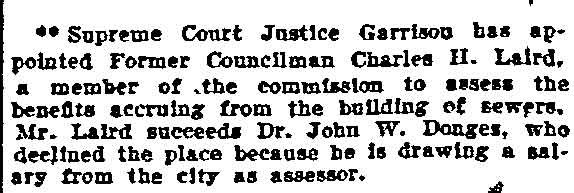
•• Supreme Court Justice Garrison has appointed Former Councilman Charles H. Laird, a member of the commission to assess the benefits accruing from the building of sewers. Mr. Laird succeeds Dr. John W. Donges, who declined the place because he is drawing a salary from the city as assessor.
Homicide Case January 4
Philadelphia Inquirer —
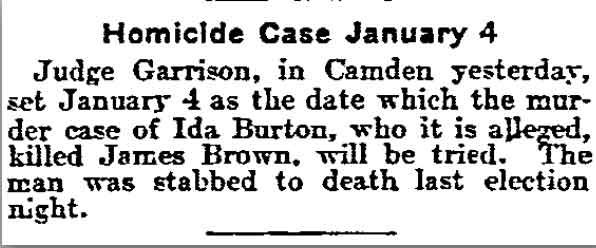
Judge Garrison, in Camden yesterday, set January 4 as the date which the murder case of Ida Burton, who it is alleged, killed James Brown, will be tried. The man was stabbed to death last election night.
Camden News Notes
Philadelphia Inquirer —
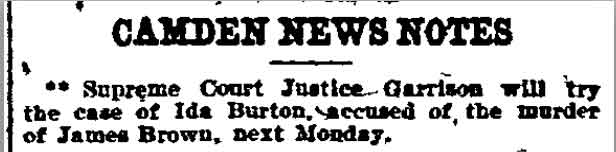
•• Supreme Court Justice Garrison will try the case of Ida Burton, accused of the murder of James Brown, next Monday.
Ida Burton Convicted
Philadelphia Inquirer —
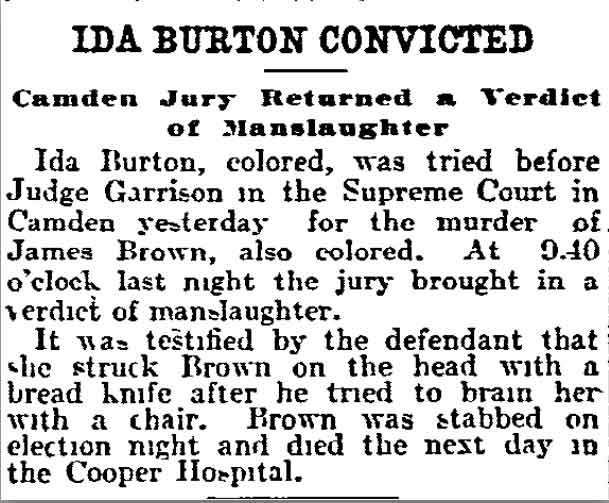
Camden Jury Returned a Verdict of Manslaughter
Ida Burton, colored, was tried before Judge Garrison in the Supreme Court in Camden yesterday for the murder of James Brown, also colored. At 9.40 o’clock last night the jury brought in a verdict of manslaughter.
It was testified by the defendant that she struck Brown on the head with a bread knife after he tried to brain her with a chair. Brown was stabbed on election night and died the next day in the Cooper Hospital.
Ida Burton Gets Five Years
Philadelphia Inquirer —
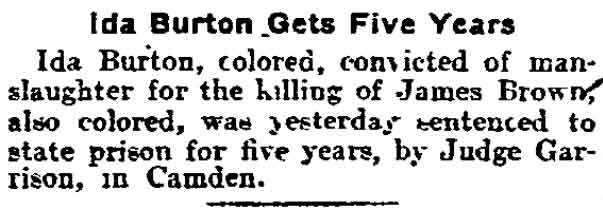
Ida Burton, colored, convicted of manslaughter for the killing of James Brown, also colored, was yesterday sentenced to state prison for five years, by Judge Garrison, in Camden.
Ida Burton Taken to State Prison
Philadelphia Inquirer —
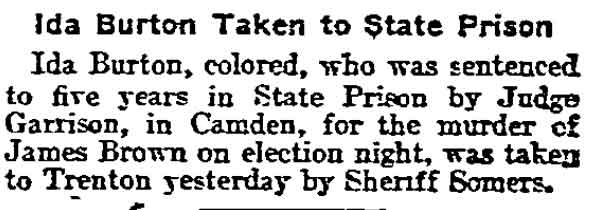
Ida Burton, colored, who was sentenced to five years in State Prison by Judge Garrison, in Camden, for the murder of James Brown on election night, was taken to Trenton yesterday by Sheriff Somers.
Clerk Patterson on Second Term
Philadelphia Inquirer —
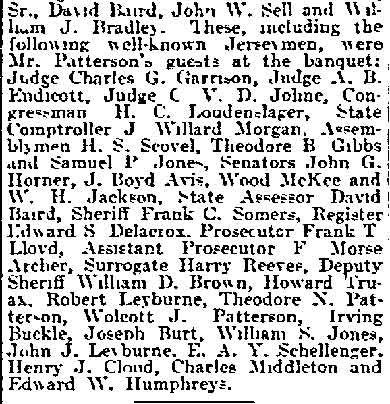
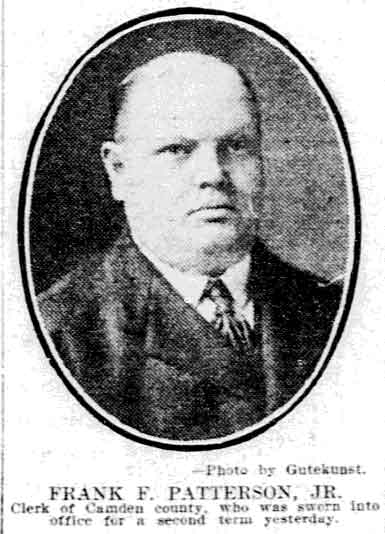
Popular Camden County Official Takes Oath of Office and Entertains Bondsmen and Others
County Clerk Frank F. Patterson, of Camden, at noon yesterday took the oath of office for a second term of five years. The oath was administered by Judge Joline in the presence of Mr. Patterson’s office force.
After taking the oath of office Mr. Patterson’s first official act was to reappoint Howard Truax as deputy county clerk and Frank Voigt as his assistant.
During Mr. Patterson’s previous term of office he made a host of friends through his courtesy and attention to those who called upon him for information.
Last night County Clerk Patterson gave an elaborate dinner at the Hotel Bellevue-Stratford to his bondsmen and several political friends.
Mr. Patterson under a recent law furnished a bond for $25,000 with the following bondsmen: Frank F. Patterson, Sr., David Baird, John W. Sell and William J. Bradley. These, including the following well-known Jerseymen, were Mr. Patterson’s guests at the banquet: Judge Charles G. Garrison, Judge A. B. Endicott, Judge C. V. D. Joline, Congressman H. C. Loudenslager, State Comptroller J. Willard Morgan, Assemblymen H. S. Scovel, Theodore B. Gibbs and Samuel P. Jones, Senators John G. Horner, J. Boyd Avis, Wood McKee and W. H. Jackson, State Assessor David Baird, Sheriff Frank C. Somers, Register Edward S. Delacroix, Prosecutor Frank T. Lloyd, Assistant Prosecutor F. Morse Archer, Surrogate Harry Reeves, Deputy Sheriff William D. Brown, Howard Truax, Robert Leyburne, Theodore N. Patterson, Wolcott J. Patterson, Irving Buckle, Joseph Burt, William S. Jones, John J. Leyburne, E. A. Y. Schellenger, Henry J. Cloud, Charles Middleton and Edward W. Humphreys.
—Photo by Gutekunst
FRANK F. PATTERSON, JR.
Clerk of Camden county, who was sworn into office for a second term yesterday.
Court of Errors and Appeals Congested
Philadelphia Inquirer —
From what Supreme Court Justice Garrison said yesterday at the opening of court in Camden the Court of Errors and Appeals has so much business to dispose of that the work of the Supreme Court may have to be given to the Circuit Court Judges. There seems to be a veritable congestion for causes dating back as far as last November that have yet to be considered. In all probability Judge Endicott will try the Circuit Court list of cases this term.
Judges to Revise Registry Lists
Philadelphia Inquirer —
•• Judge Joline will sit at the Court House next Monday to revise the registry lists. He, with Judge Garrison, will also sit on election day to straighten possible tangles.
Cancelli to Plead Manslaughter
Philadelphia Inquirer —
•• Counsel for Giovanni Cancelli, the Italian who shot a fellow-countryman at Fish House last April, announced to Judge Garrison yesterday the defendant would enter a plea of manslaughter.
Cancelli Case Reopened by Garrison
Philadelphia Inquirer —

Friends of Giovanni Cancelli, the Italian sentenced to twenty-five years in State Prison for shooting to death Dominic Mercurio, have retained counsel to have the case reopened by Judge Garrison.
Camden Police Sure They Have the Right Men
Philadelphia Inquirer —

CAMDEN POLICE SURE THEY HAVE THE RIGHT MEN
Detectives Find Plenty of Evidence Connecting Two Negroes
Camden officials are convinced that there is now no question but what Charles Gibson and Stephen Dorsey, the negroes arrested in connection with the double murder on the Horner farm, located on the Browning road, about a mile south of Camden, are the right men. They have been formally charged with killing Mrs. Frances Horner, 63 years old, wife of Edward Horner, the farmer, and Victoria Natoli, 22 years old, the Italian domestic, on Tuesday morning, shortly after 4 o’clock. As an evidence that Prosecutor Scovel is sure of his case against them, he issued the following statement late yesterday afternoon from his office in Camden:
“The Prosecutor’s office has finished its investigation in the case of the Horner murder. Any further investigation will simply be as to minor details. Charles Gibson and Stephen Dorsey have been formally charged with the murder and committed to the county jail, together with several witnesses. No mistakes have been made. Justice will be done, and the public can rest assured that the guilty parties will be punished.”
Getting the Evidence
County Detective John S. Smith, who arrested the men a few hours after the horrible deed was committed, made the complaint against them before Justice Schmitz on information received. He has worked on the case in connection with County Detective John Cherry since the discovery of the slain victims, and in consequence a skein of circumstantial evidence has been woven so completely that it is believed the defendants cannot escape. They have traced the men from a few hours prior to the murder until a short time before they were arrested.
Since Tuesday night the police and the detectives have taken into custody over a score of negroes, who have been locked up in the county jail. Most of these are said to be very important witnesses, who will be used at the trial in order to demolish the effort of the accused negroes to establish an alibi. In fact, it is stated with good authority that Prosecutor Scovel has already torn their conflicting stories to shreds. They have given fairly connected statements as to their whereabouts on the morning of the murder when questioned separately, but these are said to have been found untrue by the production of a number of the witnesses. Speaking of the witnesses, Prosecutor Scovel said:
“By these witnesses we have not only succeeded in breaking down the entire foundation of the alibis, but have traced Gibson and Dorsey until 2 o’clock yesterday morning. They were together at that hour in the lower section of the city. The next we hear of them is in the Philadelphia pawnshop. They were still in one another’s company, and they had the watches that were stolen from the Horner farmhouse. This was within a few hours after the murder had been committed.”
There was a persistent rumor that one of the negroes had broken down under the “third degree,” which was applied yesterday morning. While Prosecutor Scovel refused to either affirm or deny that such a confession had been made, the statement he issued later indicates that he has some conclusive evidence against them at least. In short, it was stated that when the time for the trial comes the evidence presented will not all be of a circumstantial character. While Gibson retains his stolid indifference, protesting his innocence with vehemence, Dorsey is of quite a different type and it is believed that he has broken under the strain.
Little credence is placed in the report that another negro is being sought after. His name is said to be Walter Scott and that he was discharged as was Gibson by Farmer Horner several weeks ago because of his shiftless manner. He is reported to have threatened the farmer, and Gibson told Prosecutor Scovel that it was Scott who gave him the watches to pawn. It is believed, however, that this is simply an attempt on the part of Gibson to throw the officials off the track. It is thought likely that he heard of Scott’s threat, and used that in an effort to throw suspicion from himself. Aside from this, one of the farm hands employed by Horner declares he distinctly heard Gibson’s voice a short time before the barn was discovered ablaze.
For a Speedy Trial
It was announced by Prosecutor Scovel that no time will be lost in bringing the prisoners to trial. Supreme Court Justice Garrison, before whom the case will be tried, is now away on his vacation. He was apprised of the crime by telegraph yesterday. It will remain with him as to when the case will go to court. Prosecutor Scovel can call the grand jury together in a short time, and an indictment can be speedily found against both the negroes. The trial may take place early in September.
County Physician Jones said yesterday that in view of the fact that there is little question but what the right men have been apprehended, he did not see the necessity for holding an inquest. This he characterized as a mere waste of time, and in consequence there will be no formal inquiry.
Mrs. Horner will be buried tomorrow from the old home where she lived for nearly two score years. The funeral will be strictly of a private nature, but it is anticipated that many farmers from the surrounding places who knew the Horners well will be in attendance.
Pictured near Mulford Street: Charles Gibson, Stephen Dorsey, Edward Horner, Frances Horner, Victoria Natoli, John S. Smith, John Cherry, Charles G. Garrison, Dr. William S. Jones, J.W. Fithian, and Henry S. Scovel.
Funeral of Constable Charles H. Peters
Bridgeton Evening News —
There were many persons in attendance at the funeral of Constable Charles H. Peters, which took place yesterday at his home at 816 Chestnut street. Delegations were present from Sioux Tribe of Red Men, Pottowottomie Degree Council, Liberty Park Beneficial Society, the Mutual Association and the Seventh Ward Republican Club. The services were in charge of Rev. Daniel F. Clair, pastor of the Eighth Street M. E. Church, and interment was made in the Harleigh Cemetery.
South Jersey Bar Dinner in Honor of Justice Garrison
1908
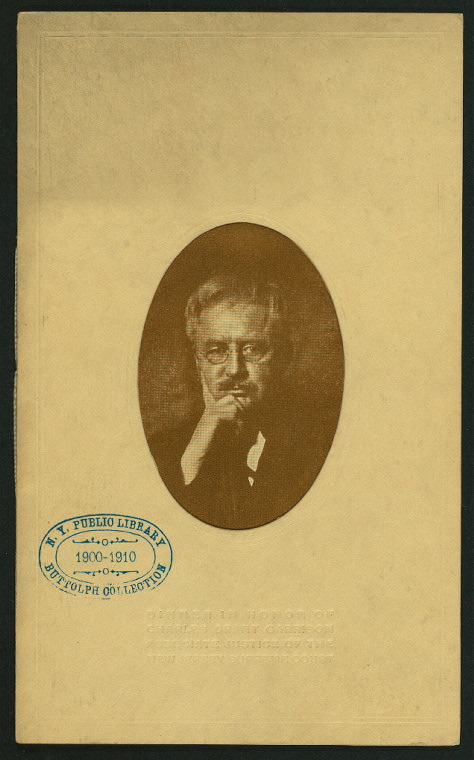
Program from Dinner in Honor of Supreme Court Justice Charles Grant Garrison, held by the South Jersey Bar at the Philadelphia Bourse (1908)
Camden News Notes
Philadelphia Inquirer —
Camden News Notes
•• The Board of Education has appointed Drs. Marcus K. Mines, Frederick Jones Jr., W. P. Wingender and W. K. Browning as assistant medical inspectors at salaries of $400 each. This is in compliance with a recent law of the State.
•• In a fall from a scaffold at the New York Shipbuilding plant yesterday, John Wagner, 24 years old, of 1038 Mechanic street, received a bad shaking up beside a sprained back. He was taken to the Cooper Hospital.
•• It is reported that a number of industrial concerns where girls are employed are not adequately protected by fire escapes, a subject that will probably be investigated.
•• Members of the class of 1908 have been given the privilege of placing a memorial marble in the High School, a custom that is likely to be followed by other classes.
•• The fact that Supreme Court Justice Garrison has taken such a decided stand in the election fraud probe has caused considerable uneasiness in certain quarters.
•• Policeman Lewis Hamel, who was suspended from the force pending a trial on charges of dereliction of duty, yesterday resigned. Policeman George West, who is accused of conduct unbecoming an officer, was suspended by Mayor Ellis yesterday.
•• Because he knocked out several of his wife’s teeth in a domestic row, Clarence Governs, of 817 Clare street, was committed to jail by the Recorder yesterday for action by the grand jury.
•• After a lingering illness, Michael Kirby, father of Mrs. W. Leonard Burley [sic], died yesterday at his son-in-law’s country home, “Dungarven,” West Collingswood. He was 70 years old and a native of Woodstown.
•• The funeral of Mrs. Amelia C. Roub, who died suddenly last Friday from acute indigestion, took place yesterday from her home, at Broadway and Ferry avenue. Interment was made in Evergreen Cemetery.
•• At the annual meeting of the Tammany Club, a well known South Camden social organization, these officers were elected: President, William Black; vice presidents, Redmond Pierson and Charles Redmond; secretary, Joseph Byrie; treasurer, James Croker.
•• Under the direction of the Women’s Home Missionary Society an all-day meeting will be held tomorrow in the State Street M. E. Church.
•• Children playing with matches is supposed to have been the cause of a fire that partly burned the home of Archer D. Norris, at 930 Elm street, Monday night.
Many Accused of Election Frauds
Philadelphia Inquirer —
Camden County Grand Jury Returns Fifty-five True Bills of Indictment
Most of Them Are Impounded by Order of Court, While Constables Get Busy
In a partial presentment made before Supreme Court Justice Garrison, in Camden, yesterday, the grand jury returned fifty-five true bills as a result of its probe into alleged election irregularities. Judge Garrison at once ordered County Clerk Patterson to impound most of the true bills until the defendants are apprehended and held in sufficient security to guarantee their appearance at court for trial. Bench warrants were issued and the force of constables was busy last night trying to locate those indicted.
As an evidence of how grave the accusations are in the eyes of the law, Common Pleas Court Judge Joline demanded $6000 bail when Policeman Samuel Flick, of the Twelfth ward, was arrested by County Detective Doran in the court room. Flick is under six indictments, two for perjury and four for false registration. He was at once taken before Judge Joline when security was furnished by Isaac Shreeve, a fellow policeman of the accused officer.
Other Indictments
Among those indicted was Francis J. McAdams, a Democrat and secretary of the County Board of Elections. He is specifically accused of larceny. His offense involved the removal from the county clerk’s office of the poll book of the Sixth precinct, Fifth ward, over which there was more or less trouble. Its whereabouts was not known until McAdams was summoned before the jurors.
Most of the others are indicted under the general offense of “violating the election law.” The most important of those whose names were made public is John Broome, a Republican Councilman from the Second ward. With James Smith, Thomas Noland and A. L. James, the latter a police captain. Councilman Broome is supposed to know something about a missing bail bond which was given for Noland’s appearance at court. He was charged with repeating, and Broome went his bail.
Indicted on Five Counts
Martin Carrigan, a fireman, and Albert Shaw and James Lewis, policemen, are indicted for violations. Police Sergeant John Golden has five counts against him, while William C. Parker, an election officer, has two. Other defendants include Daniel Woods and Joseph Sparks, who, with Carrigan, are charged with conspiracy. John H. Carroll, Charles B. Crane and Harris D. Stow are accused of violations also.
There are about forty additional indictments against persons whose names were not divulged. It was stated, however, that in most instances these include alleged “phantoms,” whose names appear on the registry list as living in places occupied by other persons. They are charged with false registration, but the chances are that but comparatively few arrests will be made in this phase of the matter.
Probe Still Deeper
The fact that it was announced that the presentment was but partial indicates that the probe is not ended. It is asserted that it has just begun and that the finding of indictments presented yesterday is merely the opening wedge for even more searching investigation. When the jurors will be summoned again is not known, Prosecutor Scovel desiring to clean up the calendder [sic], which is greatly overburdened at present, before conducting any further investigation.
Many men prominent in professional and political life were in the court room when the presentment was made, quite a few being on the anxious bench themselves.
Among the seventy-eight true bills found by the grand jury yesterday in connection with the ordinary Criminal Court business and aside from the election cases were indictments against the officers of the Young Republican Club of the Second ward and the Camden Aerie, No. 65, Fraternal Order of Eagles. They are specifically charged with giving indecent exhibitions, and in addition the organizations are accused of keeping disorderly houses.
These cases resulted from reports made by the Law and Order League, whose agents attended “innocent amusements” given by the organizations. The class of entertainment is declared to have had the Seeley dinner and other such events beaten a mile. Not only the officers are indicated [sic], but also Lottie Fayette, of Philadelphia, and a male companion, who assisted materially in the festivities.
Killed by Bullet Sent Through Fence
Philadelphia Inquirer —
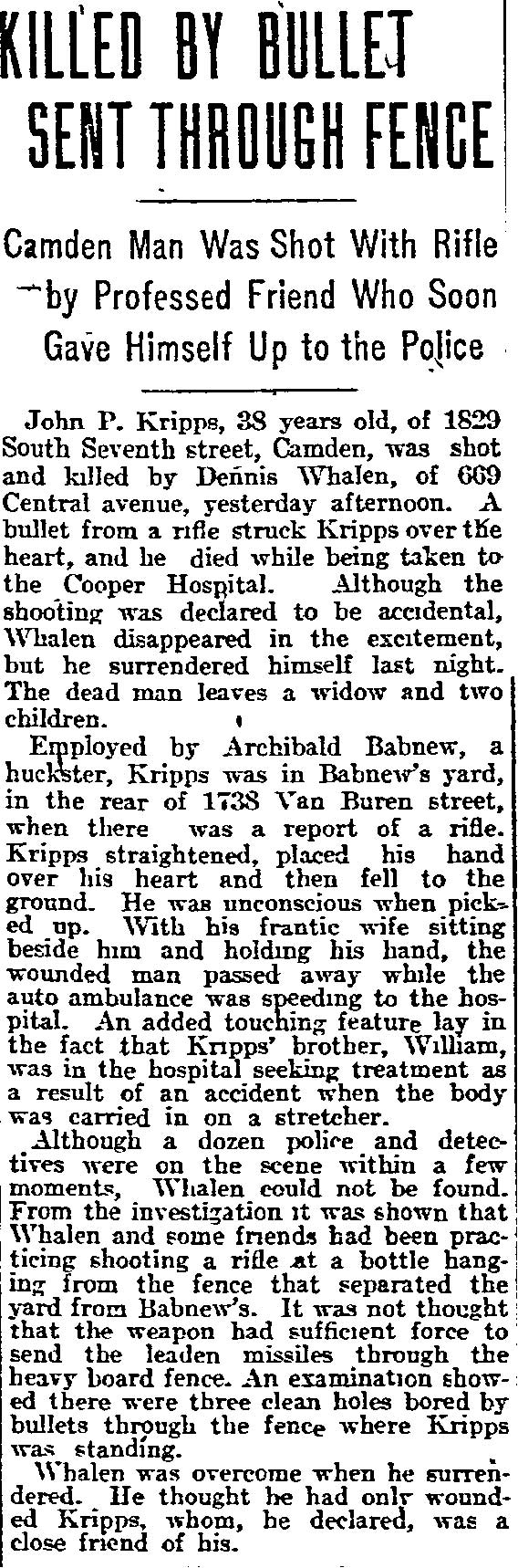
Camden Man Was Shot With Rifle by Professed Friend Who Soon Gave Himself Up to the Police
John P. Kripps, 38 years old, of 1829 South Seventh street, Camden, was shot and killed by Dennis Whalen, of 669 Central avenue, yesterday afternoon. A bullet from a rifle struck Kripps over the heart, and he died while being taken to the Cooper Hospital. Although the shooting was declared to be accidental, Whalen disappeared in the excitement, but he surrendered himself last night. The dead man leaves a widow and two children.
Employed by Archibald Babnew, a huckster, Kripps was in Babnew’s yard, in the rear of 1738 Van Buren street, when there was a report of a rifle. Kripps straightened, placed his hand over his heart and then fell to the ground. He was unconscious when picked up. With his frantic wife sitting beside him and holding his hand, the wounded man passed away while the auto ambulance was speeding to the hospital. An added touching feature lay in the fact that Kripps’ brother, William, was in the hospital seeking treatment as a result of an accident when the body was carried in on a stretcher.
Although a dozen police and detectives were on the scene within a few moments, Whalen could not be found. From the investigation it was shown that Whalen and some friends had been practicing shooting a rifle at a bottle hanging from the fence that separated the yard from Babnew’s. It was not thought that the weapon had sufficient force to send the leaden missiles through the heavy board fence. An examination showed there were three clean holes bored by bullets through the fence where Kripps was standing.
Whalen was overcome when he surrendered. He thought he had only wounded Kripps, whom, he declared, was a close friend of his.
Killed by Stray Bullet
Philadelphia Inquirer —
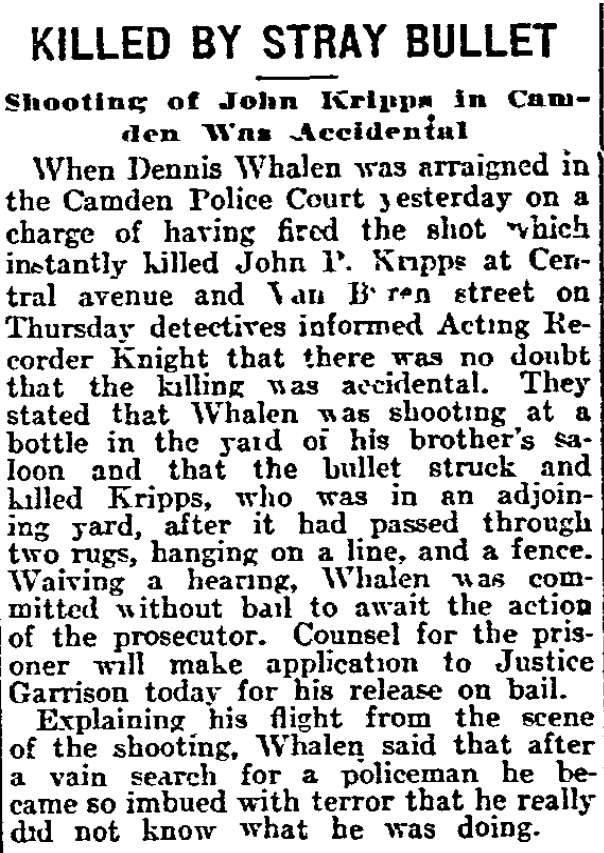
Shooting of John Kripps in Camden Was Accidental
When Dennis Whalen was arraigned in the Camden Police Court yesterday on a charge of having fired the shot which instantly killed John P. Kripps at Central avenue and Van Buren street on Thursday detectives informed Acting Recorder Knight that there was no doubt that the killing was accidental. They stated that Whalen was shooting at a bottle in the yard of his brother’s saloon and that the bullet struck and killed Kripps, who was in an adjoining yard, after it had passed through two rugs, hanging on a line, and a fence. Waiving a hearing, Whalen was committed without bail to await the action of the prosecutor. Counsel for the prisoner will make application to Justice Garrison today for his release on bail.
Explaining his flight from the scene of the shooting, Whalen said that after a vain search for a policeman he became so imbued with terror that he really did not know what he was doing.
Hatch’s Next Camden Grand Jury Is Puzzler
Philadelphia Inquirer —
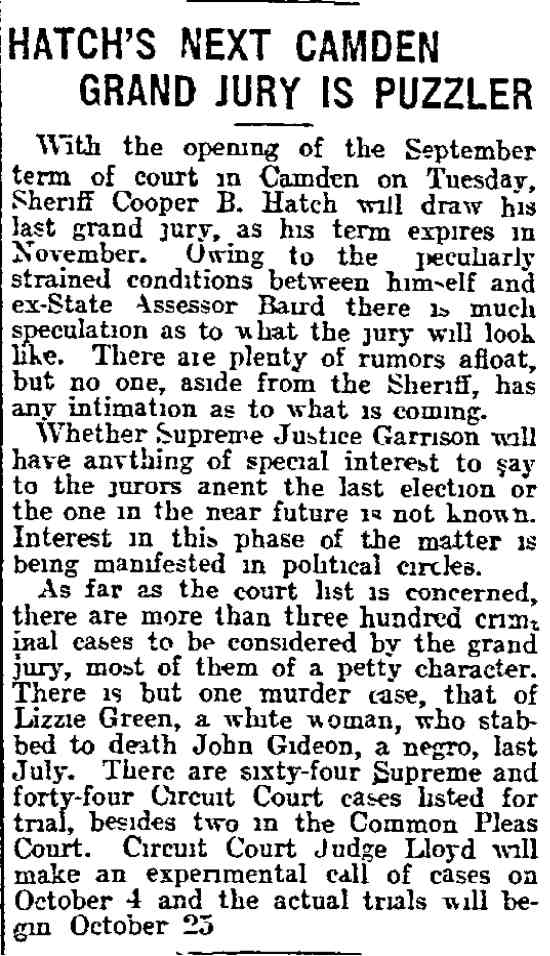
With the opening of the September term of court in Camden on Tuesday, Sheriff Cooper B. Hatch will draw his last grand jury, as his term expires in November. Owing to the peculiarly strained conditions between himself and ex-State Assessor Baird there is much speculation as to what the jury will look like. There are plenty of rumors afloat, but no one, aside from the Sheriff, has any intimation as to what is coming.
Whether Supreme Justice Garrison will have anything of special interest to say to the jurors anent the last election or the one in the near future is not known. Interest in this phase of the matter is being manifested in political circles.
As far as the court list is concerned, there are more than three hundred criminal cases to be considered by the grand jury, most of them of a petty character. There is but one murder case, that of Lizzie Green, a white woman, who stabbed to death John Gideon, a negro, last July. There are sixty-four Supreme and forty-four Circuit Court cases listed for trial, besides two in the Common Pleas Court. Circuit Court Judge Lloyd will make an experimental call of cases on October 4 and the actual trials will begin October 25.
Judge Made This Grand Jury Sit Up
Philadelphia Inquirer —
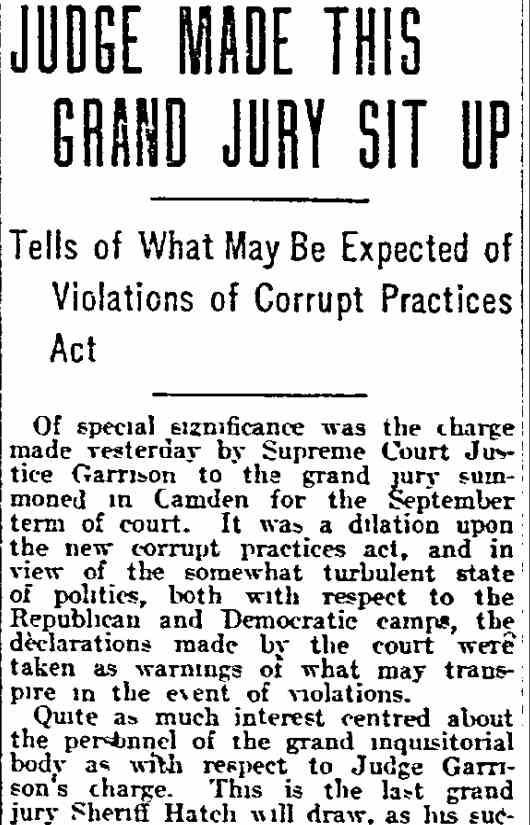
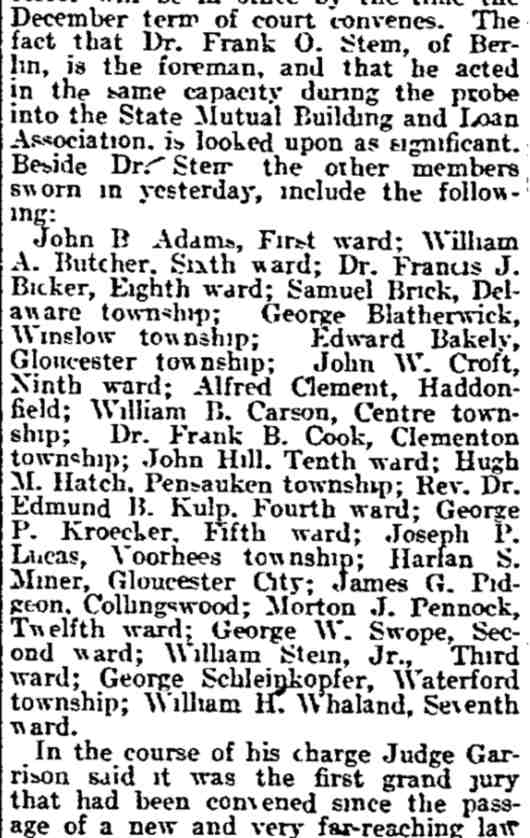
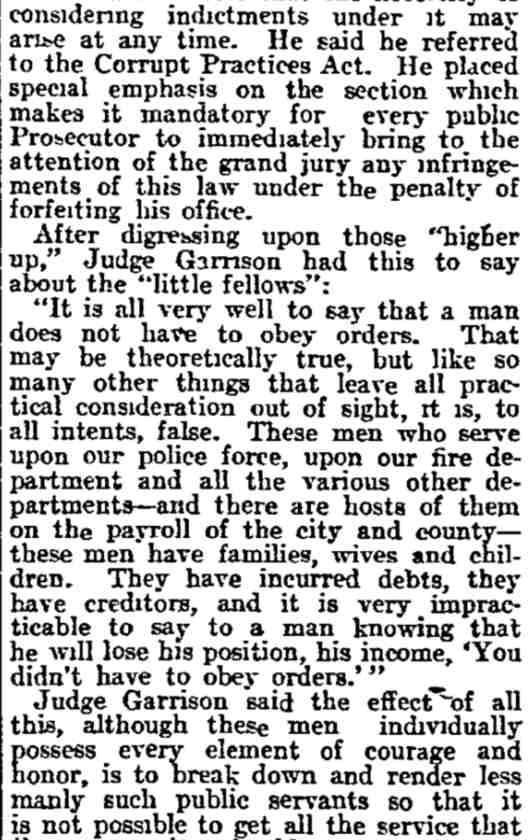
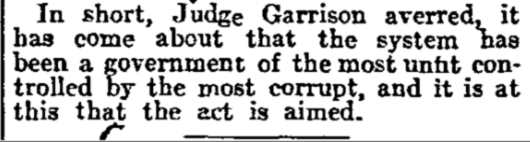
Tells of What May Be Expected of Violations of Corrupt Practices Act
Of special significance was the charge made yesterday by Supreme Court Justice Garrison to the grand jury summoned in Camden for the September term of court. It was a dilation upon the new corrupt practices act, and in view of the somewhat turbulent state of politics, both with respect to the Republican and Democratic camps, the declarations made by the court were taken as warnings of what may transpire in the event of violations.
Quite as much interest centred about the personnel of the grand inquisitorial body as with respect to Judge Garrison’s charge. This is the last grand jury Sheriff Hatch will draw, as his successor will be in place by the time the December term of court convenes. The fact that Dr. Frank O. Stem, of Berlin, is the foreman, and that he acted in the same capacity during the probe into the State Mutual Building and Loan Association, is looked upon as significant. Beside Dr. Stem the other members sworn in yesterday, include the following:
John B. Adams, First ward; William A. Butcher, Sixth ward; Dr. Francis J. Bicker, Eighth ward; Samuel Brick, Delaware township; George Blatherwick, Winslow township; Edward Bakely, Gloucester township; John W. Croft, Ninth ward; Alfred Clement, Haddonfield; William B. Carson, Centre township; Dr. Frank B. Cook, Clementon township; John Hill, Tenth ward; Hugh M. Hatch, Pennsauken township; Rev. Dr. Edmund B. Kulp, Fourth ward; George P. Kroecker, Fifth ward; Joseph P. Lucas, Voorhees township; Harlan S. Miner, Gloucester City; James G. Pidgeon, Collingswood; Morton J. Pennock, Twelfth ward; George W. Swope, Second ward; William Stein, Jr., Third ward; George Schleinkopfer, Waterford township; William H. Whaland, Seventh ward.
In the course of his charge Judge Garrison said it was the first grand jury that had been convened since the passage of a new and very far-reaching law considering indictments under it may arise at any time. He said he referred to the Corrupt Practices Act. He placed special emphasis on the section which makes it mandatory for every public Prosecutor to immediately bring to the attention of the grand jury any infringements of this law under the penalty of forfeiting his office.
After digressing upon those “higher up,” Judge Garrison had this to say about the “little fellows”:
“It is all very well to say that a man does not have to obey orders. That may be theoretically true, but like so many other things that leave all practical consideration out of sight, it is, to all intents, false. These men who serve upon our police force, upon our fire department and all the various other departments—and there are hosts of them on the payroll of the city and county—these men have families, wives and children. They have incurred debts, they have creditors, and it is very impracticable to say to a man knowing that he will lose his position, his income, ‘You didn’t have to obey orders.’”
Judge Garrison said the effect of all this, although these men individually possess every element of courage and honor, is to break down and render less manly such public servants so that it is not possible to get all the service that [the next line or lines are cut off between crops 03b and 04b]
In short, Judge Garrison averred, it has come about that the system has been a government of the most unfit controlled by the most corrupt, and it is at this that the act is aimed.
Starts Panic on Trolley
Philadelphia Inquirer —
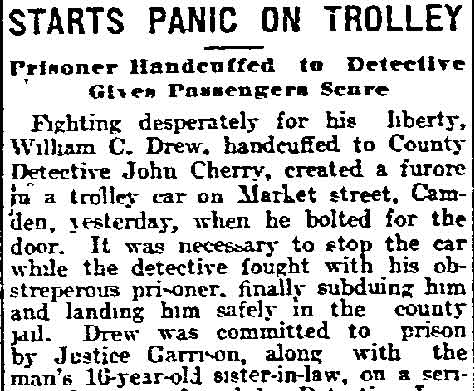
Prisoner Handcuffed to Detective Gives Passengers Scare
Fighting desperately for his liberty, William C. Drew, handcuffed to County Detective John Cherry, created a furore in a trolley car on Market street, Camden, yesterday, when he bolted for the door. It was necessary to stop the car while the detective fought with his obstreperous prisoner, finally subduing him and landing him safely in the county jail. Drew was committed to prison by Justice Garrison, along with the man’s 16-year-old sister-in-law, on a serious charge preferred by Detective Lawrence Doran.
When Cherry and Doran went to Drew’s house at Twenty-third and Federal streets they captured the man as he was about to enter the house. Knowing he had a desperate man to deal with, Detective Cherry chained himself to his prisoner when they boarded the trolley car for the jail, a mile and a half distant. The car was filled with passengers. Drew bolted, dragging the detective with him. When he reached the step he tried to throw himself off the car, but Cherry held on to him. Then the car stopped and he became docile after the chains had been twisted until Drew yelled with pain.
Jury Gave Her Liberty
Philadelphia Inquirer —
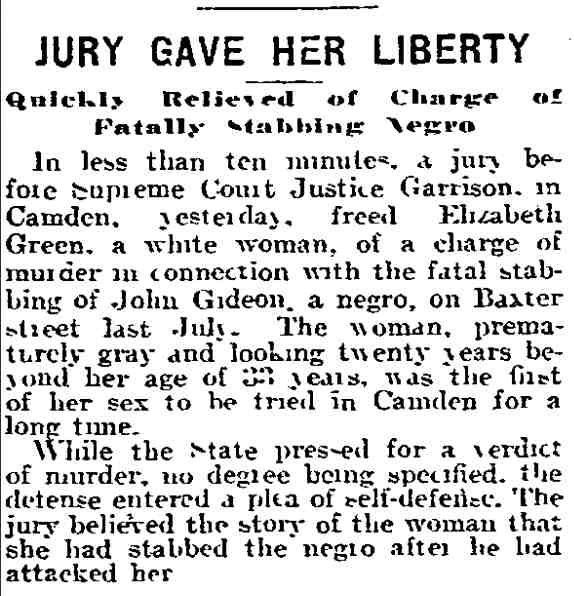
In less than ten minutes, a jury before Supreme Court Justice Garrison, in Camden, yesterday, freed Elizabeth Green, a white woman, of a charge of murder in connection with the fatal stabbing of John Gideon, a negro, on Baxter street last July. The woman, prematurely gray and looking twenty years beyond her age of 33 years, was the first of her sex to be tried in Camden for a long time.
While the State pressed for a verdict of murder, no degree being specified, the defense entered a plea of self-defense. The jury believed the story of the woman that she had stabbed the negro after he had attacked her.
Charles G. Garrison – Lizzie Green
Alleged Murderers to the Camden Bar
Philadelphia Inquirer —
Three Prisoners Will Appear for Trial at the April Term of Court Beginning Next Tuesday
With the opening of the Camden courts for the April term on Tuesday, arrangements will be made for the trials of three alleged murderers. The most important will be that of Charles Ford, who shot and killed Mrs. May Effie Wagner, at Laurel Springs, about a month ago, besides badly wounding Robert Wilson. Ford is still in the Cooper Hospital suffering from self-inflicted wounds of the head.
William Graedwell will be tried for braining Mrs. Martha Gillian, his boarding mistress, in her home on Cooper street, several weeks ago, while Stefano Torcesso will have to take his chances with a jury for the fatal stabbing of Nunzioto Imperato in a quarrel over an Italian damsel.
In view of the many lines of work taken up by the grand jury, whose labors have just ended and which was summoned by Sheriff Nowrey, there is much interest in the personnel of the second panel of grand inquisitors which will be selected with the opening of court. It is not believed that Judge Garrison will have anything of importance on which to charge them.
Murder Cases on in Camden Court
Philadelphia Inquirer —
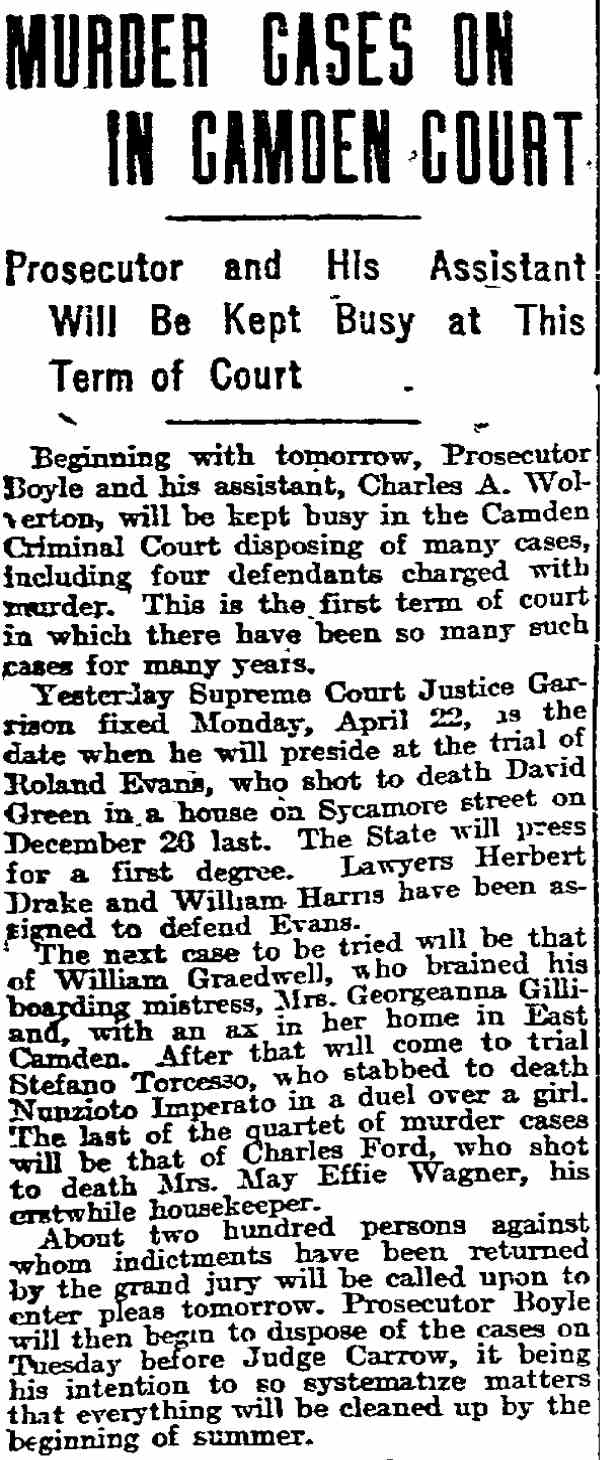
Prosecutor and His Assistant Will Be Kept Busy at This Term of Court
Beginning with tomorrow, Prosecutor Boyle and his assistant, Charles A. Wolverton, will be kept busy in the Camden Criminal Court disposing of many cases, including four defendants charged with murder. This is the first term of court in which there have been so many such cases for many years.
Yesterday Supreme Court Justice Garrison fixed Monday, April 22, as the date when he will preside at the trial of Roland Evans, who shot to death David Green in a house on Sycamore street on December 26 last. The State will press for a first degree. Lawyers Herbert Drake and William Harris have been assigned to defend Evans.
The next case to be tried will be that of William Graedwell, who brained his boarding mistress, Mrs. Georgeanna Gilliand, with an ax in her home in East Camden. After that will come to trial Stefano Torcesso, who stabbed to death Nunzioto Imperato in a duel over a girl. The last of the quartet of murder cases will be that of Charles Ford, who shot to death Mrs. May Effie Wagner, his erstwhile housekeeper.
About two hundred persons against whom indictments have been returned by the grand jury will be called upon to enter pleas tomorrow. Prosecutor Boyle will then begin to dispose of the cases on Tuesday before Judge Carrow, it being his intention to so systematize matters that everything will be cleaned up by the beginning of summer.
Camden’s Court Docket Is Brief
Philadelphia Inquirer —
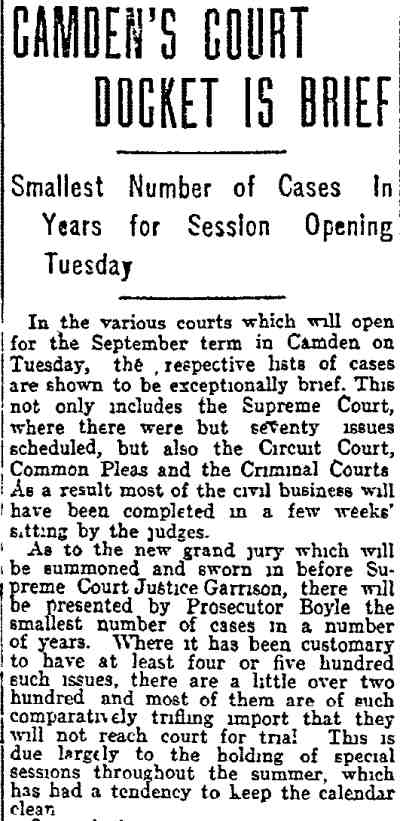
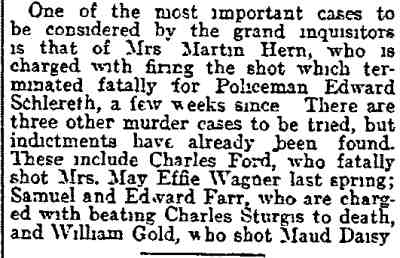
Smallest Number of Cases In Years for Session Opening Tuesday
In the various courts which will open for the September term in Camden on Tuesday, the respective lists of cases are shown to be exceptionally brief. This not only includes the Supreme Court, where there were but seventy issues scheduled, but also the Circuit Court, Common Pleas and the Criminal Courts. As a result most of the civil business will have been completed in a few weeks’ sitting by the judges.
As to the new grand jury which will be summoned and sworn in before Supreme Court Justice Garrison, there will be presented by Prosecutor Boyle the smallest number of cases in a number of years. Where it has been customary to have at least four or five hundred such issues, there are a little over two hundred and most of them are of such comparatively trifling import that they will not reach court for trial. This is due largely to the holding of special sessions throughout the summer, which has had a tendency to keep the calendar clean.
One of the most important cases to be considered by the grand inquisitors is that of Mrs. Martin Hern, who is charged with firing the shot which terminated fatally for Policeman Edward Schlereth, a few weeks since. There are three other murder cases to be tried, but indictments have already been found. These include Charles Ford, who fatally shot Mrs. May Effie Wagner last spring; Samuel and Edward Farr, who are charged with beating Charles Sturgis to death, and William Gold, who shot Maud Daisy
Ford Claims Drink Prompted Murder
Philadelphia Inquirer —
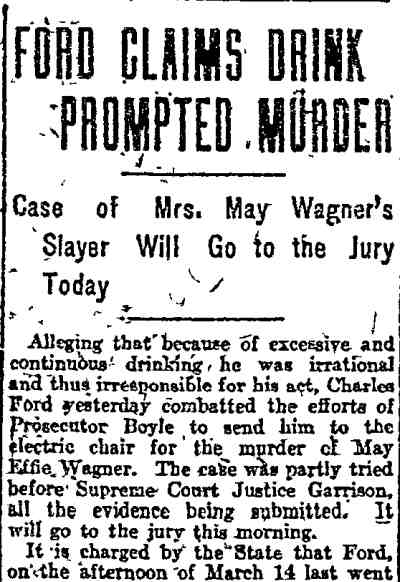
Case of Mrs. May Wagner’s Slayer Will Go to the Jury Today
Alleging that because of excessive and continuous drinking he was irrational and thus irresponsible for his act, Charles Ford yesterday combatted the efforts of Prosecutor Boyle to send him to the electric chair for the murder of May Effie Wagner. The case was partly tried before Supreme Court Justice Garrison, all the evidence being submitted. It will go to the jury this morning.
It is charged by the State that Ford, on the afternoon of March 14 last went to Laurel Springs and visited the home of Mrs. Wagner, with whom he had lived for eighteen years and who had left him because of his abuse. Failing in his efforts to persuade her to return home with him on a previous occasion, he had repeated the call and hunted for Robert Wilson, whom he accused of being responsible for Mrs. Wagner’s obduracy. After shooting Wilson he broke into the home of Mrs. Wagner and shot her to death, sending two bullets into his own head but recovering in the Cooper Hospital. Prosecutor Boyle had a number of witnesses who traced Ford’s movement and who testified as to his declarations to “do” Wilson and the woman.
In the defense presented through Lawyers Frank B. Jess and Adam R. Sloan, it was shown by witnesses that Ford had been a heavy drinker all his life and that because of the woman’s going away from him he drank more than ever. As a result it was asserted his mind was so affected that he did not know what he was doing.
Slayer of Woman Sentenced to Die
Philadelphia Inquirer —
Charles Ford to Meet Death in Electric Chair Week Beginning November 24
Charles Ford, who shot and killed Mrs. Mary Effie Wagner at Laurel Springs on March 14 last, must expiate his crime in the electric chair at Trenton during the week of November 24, that sentence being passed upon him yesterday by Supreme Court Justice Garrison in Camden after a verdict of guilty of murder in the first degree was submitted. The jury deliberated exactly one hour. When the verdict was announced and the sentence imposed Ford did not give any indication that he cared. He appeared to be dazed.
For eighteen years Ford had lived with the woman and during that time she had left him fourteen times because of his abuse. On the last occasion she sought to escape him by going to Laurel Springs, Ford claiming she had gone with Robert Wilson. In vengeful mood and, the State alleged, after planning and deliberating, he visited her home, shot Wilson, dangerously wounding him, killed the woman and then sent two bullets into his own head.
Lawyers Frank B. Jess and Adam R. Sloan, who were assigned to defend him, sought to have him escape on a second degree verdict, they declaring that because of his excessive drinking his mind was not such as could plan a crime of that character. Prosecutor Boyle was able to produce witnesses which showed beyond any doubt that the man was rational and had planned for the tragedy weeks before.
Ford's Attorney Sees Little Hope of Pardon
Philadelphia Inquirer —
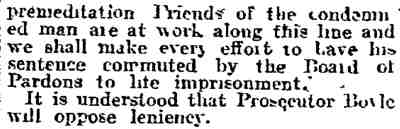
Special to The Inquirer. TRENTON, N. J., Nov. 22.—From his cell in the death house here, Charles Ford yesterday sent a fervent note of thanks to Lawyers Jess and Sloan, who have renewed their efforts to save his life. Acting Governor Prince on Thursday granted a reprieve to Ford until January 6. He was to be put to death next week.
“To be frank I do not see much ground for hope,” said Attorney Sloan yesterday. “In order to accomplish anything it will be necessary to secure considerable evidence that Ford was not only drunk for a long period of time before he killed Mrs. Effie Wagner, but also that his faculties were so prostrated by intoxicants that he could not possibly have committed the murder after premeditation. Friends of the condemned man are at work along this line and we shall make every effort to have his sentence commuted by the Board of Pardons to life imprisonment.”
It is understood that Prosecutor Boyle will oppose leniency.
Must Resentence Murderer to Die
Philadelphia Inquirer —
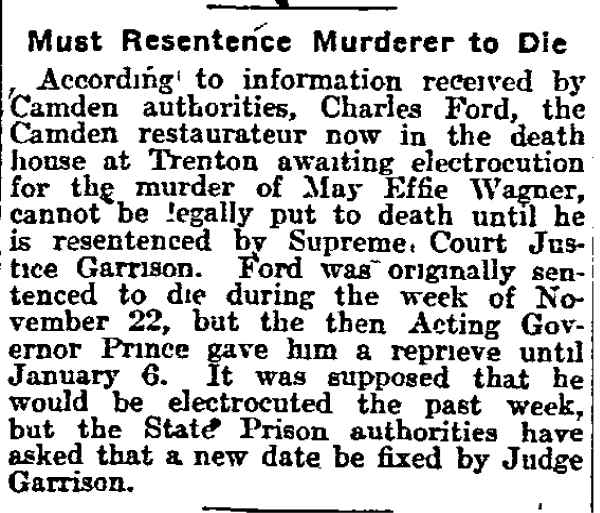
According to information received by Camden authorities, Charles Ford, the Camden restaurateur now in the death house at Trenton awaiting electrocution for the murder of May Effie Wagner, cannot be legally put to death until he is resentenced by Supreme Court Justice Garrison. Ford was originally sentenced to die during the week of November 22, but the then Acting Governor Prince gave him a reprieve until January 6. It was supposed that he would be electrocuted the past week, but the State Prison authorities have asked that a new date be fixed by Judge Garrison.
Ford to Die February 16
Philadelphia Inquirer —
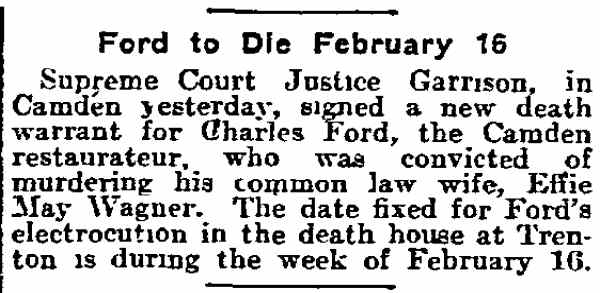
Supreme Court Justice Garrison, in Camden yesterday, signed a new death warrant for Charles Ford, the Camden restaurateur, who was convicted of murdering his common law wife, Effie May Wagner. The date fixed for Ford’s electrocution in the death house at Trenton is during the week of February 16.
Camden News Notes
Philadelphia Inquirer —
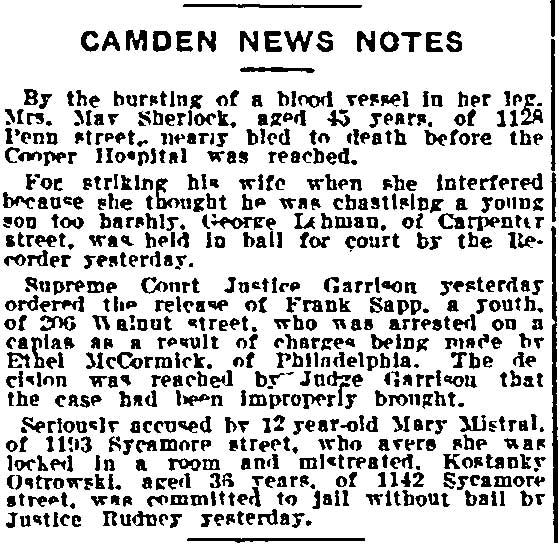
By the bursting of a blood vessel in her leg, Mrs. May Sherlock, aged 45 years, of 1128 Penn street, nearly bled to death before the Cooper Hospital was reached.
For striking his wife when she interfered because she thought he was chastising a young son too harshly, George Lehman, of Carpenter street, was held in ball [sic] for court by the Recorder yesterday.
Supreme Court Justice Garrison yesterday ordered the release of Frank Sapp, a youth, of 206 Walnut street, who was arrested on a capias as a result of charges being made by Ethel McCormick, of Philadelphia. The decision was reached by Judge Garrison that the case had been improperly brought.
Seriously accused by 12 year-old Mary Mistral, of 1193 Sycamore street, who avers she was locked in a room and mistreated, Kostanky Ostrowski, aged 36 years, of 1142 Sycamore street, was committed to jail without bail by Justice Rudney yesterday.
Camden at a Glance
Philadelphia Inquirer —
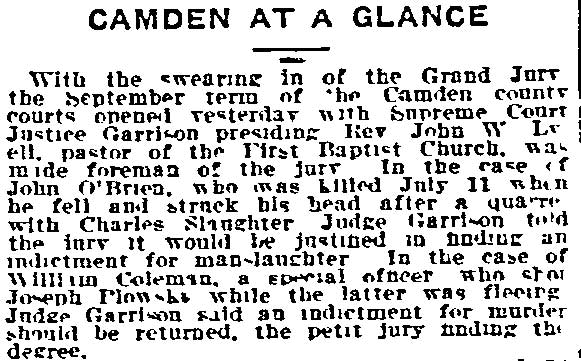
With the swearing in of the Grand Jury the September term of the Camden county courts opened yesterday with Supreme Court Justice Garrison presiding. Rev. John W. Lyell, pastor of the First Baptist Church, was made foreman of the jury. In the case of John O’Brien, who was killed July 11 when he fell and struck his head after a quarrel with Charles Slaughter, Judge Garrison told the jury it would be justified in finding an indictment for man-slaughter. In the case of William Coleman, a special officer who shot Joseph Plowski while the latter was fleeing, Judge Garrison said an indictment for murder should be returned, the petit jury finding the degree.
Camden Jury Is Named
Philadelphia Inquirer —
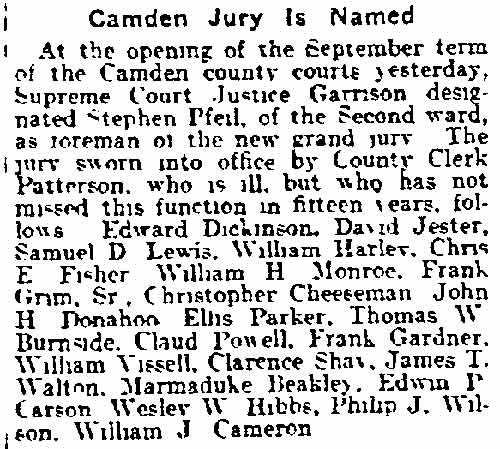
At the opening of the September term of the Camden county courts yesterday, Supreme Court Justice Garrison designated Stephen Pfeil, of the Second ward, as foreman of the new grand jury. The jury sworn into office by County Clerk Patterson, who is ill, but who has not missed this function in fifteen years, follows: Edward Dickinson, David Jester, Samuel D. Lewis, William Harley, Chris E. Fisher, William H. Monroe, Frank Grim, Sr., Christopher Cheeseman, John H. Donahoo, Ellis Parker, Thomas W. Burnside, Claud Powell, Frank Gardner, William Vissell, Clarence Shay, James T. Walton, Marmaduke Beakley, Edwin P. Carson, Wesley W. Hibbs, Philip J. Wilson, William J. Cameron
Garrison Denies Certiorari in Liquor License Case
Philadelphia Inquirer —

Supreme Court Justice Garrison yesterday denied the application for a certiorari to review the action of the Excise Board in refusing to revoke the license of John Bodie as asked by Mrs. Antonia Hanscomb
Grand Jury Drawn
Philadelphia Inquirer —
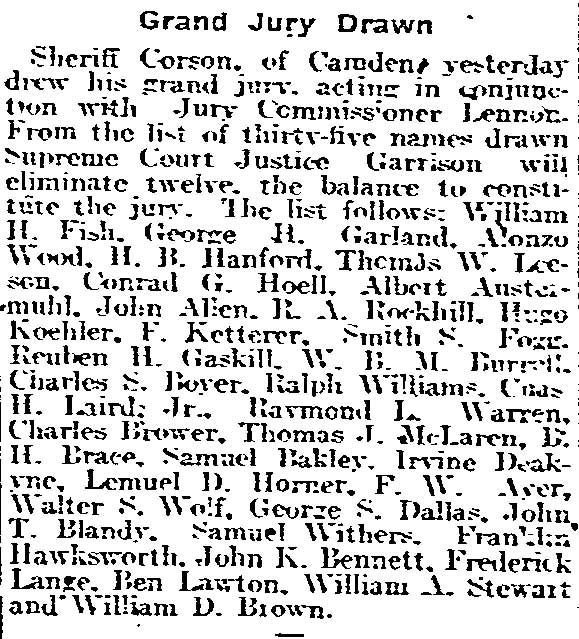
Sheriff Corson, of Camden, yesterday drew his grand jury, acting in conjunction with Jury Commissioner Lennox. From the list of thirty-five names drawn Supreme Court Justice Garrison will eliminate twelve, the balance to constitute the jury. The list follows: William H. Fish, George H. Garland, Alonzo Wood, H. B. Hanford, Thomas W. Leeson, Conrad G. Hoell, Albert Austermuhl, John Allen, R. A. Rockhill, Hugo Koehler, F. Ketterer, Smith S. Fogg, Reuben H. Gaskill, W. B. M. Burrell, Charles S. Boyer, Ralph Williams, Chas. H. Laird, Jr., Raymond L. Warren, Charles Brower, Thomas J. McLaren, B. H. Brace, Samuel Bakley, Irvine Deakyne, Lemuel D. Horner, F. W. Ayer, Walter S. Wolf, George S. Dallas, John T. Blandy, Samuel Withers, Franklin Hawksworth, John K. Bennett, Frederick Lange, Ben Lawton, William A. Stewart and William D. Brown.
Scannell’s New Jersey First Citizens
1917
CHARLES G. GARRISON—Merchantville.—Jurist. Born in Swedesboro, Gloucester County, August 3, 1849; son of Rev. Joseph Fithian Garrison.
Charles G. Garrison has been a Justice of the Supreme Court of the state of New Jersey since 1888. He was named to succeed Joel Parker who, previously to his service, on the bench, had been New Jersey’s war Governor and who subsequently served a second term in that office. Justice Garrison is a brother of Lindley M. Garrison, who was Secretary of War under President Wilson; their father was a professor in a Philadelphia College for many years and a widely known minister of the Protestant Episcopal Church.
Justice Garrison was educated in Edgehill School, Princeton, at the Episcopal Academy, Philadelphia, and, entering the University of Pennsylvania with a view to the study of medicine, graduated from there in 1872. He had practiced that profession at Swedesboro but four years when he resolved to become a lawyer, and entered the office of Samuel H. Grey of Camden, who at the time of his death was Attorney General of the State. He was admitted to the Bar in 1878. Six years later he became Judge Advocate General of New Jersey. Governor Green in 1888 nominated him to the State Senate as an Associate Justice of the Supreme Court, and the confirmation came promptly. Governors Werts, Murphy, Fort and Fielder re-nominated him for successive seven year terms, in 1895, 1902, 1909, 1916. Since 1882 Justice Garrison has been Chancellor of the Southern Diocese of the Protestant Episcopal Church of New Jersey.
Justice Garrison is a democrat in politics. His circuit covers Atlantic and Gloucester.
William Edgar Sackett and John James Scannell, Scannell’s New Jersey First Citizens: Biographies and Portraits of the Notable Living Men and Women of New Jersey with Informing Glimpses Into the State’s History and Affairs. Published by J.J. Scannell, 1917.
Veteran Court Clerk Honored
Philadelphia Inquirer —
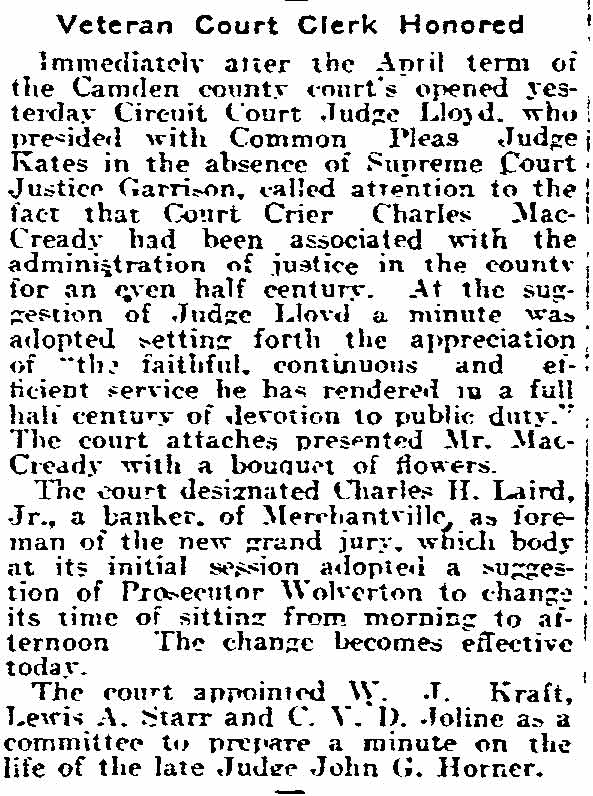
Immediately after the April term of the Camden county court’s opened yesterday, Circuit Court Judge Lloyd, who presided with Common Pleas Judge Kates in the absence of Supreme Court Justice Garrison, called attention to the fact that Court Crier Charles MacCready had been associated with the administration of justice in the county for an even half century. At the suggestion of Judge Lloyd a minute was adopted setting forth the appreciation of “the faithful, continuous and efficient service he has rendered in a full half century of devotion to public duty.” The court attaches presented Mr. MacCready with a bouquet of flowers.
The court designated Charles H. Laird, Jr., a banker, of Merchantville, as foreman of the new grand jury, which body at its initial session adopted a suggestion of Prosecutor Wolverton to change its time of sitting from morning to afternoon. The change becomes effective today.
The court appointed W. J. Kraft, Lewis A. Starr and C. V. D. Joline as a committee to prepare a minute on the life of the late Judge John G. Horner.
Prepare. Memorial Resolutions
Philadelphia Inquirer —
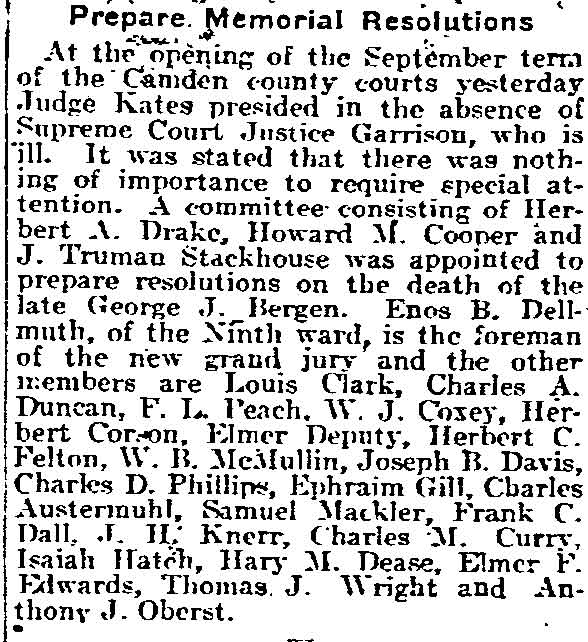
Prepare. Memorial Resolutions
At the opening of the September term of the Camden county courts yesterday Judge Kates presided in the absence of Supreme Court Justice Garrison, who is ill. It was stated that there was nothing of importance to require special attention. A committee consisting of Herbert A. Drake, Howard M. Cooper and J. Truman Stackhouse was appointed to prepare resolutions on the death of the late George J. Bergen. Enos B. Dellmuth, of the Ninth ward, is the foreman of the new grand jury and the other members are Louis Clark, Charles A. Duncan, F. L. Peach, W. J. Coxey, Herbert Corson, Elmer Deputy, Herbert C. Felton, W. B. McMullin, Joseph B. Davis, Charles D. Phillips, Ephraim Gill, Charles Austermuhl, Samuel Mackler, Frank C. Dall, J. H. Knerr, Charles M. Curry, Isaiah Hatch, Hary [sic] M. Dease, Elmer F. Edwards, Thomas J. Wright and Anthony J. Oberst.
Camden News Budget.
Philadelphia Inquirer —
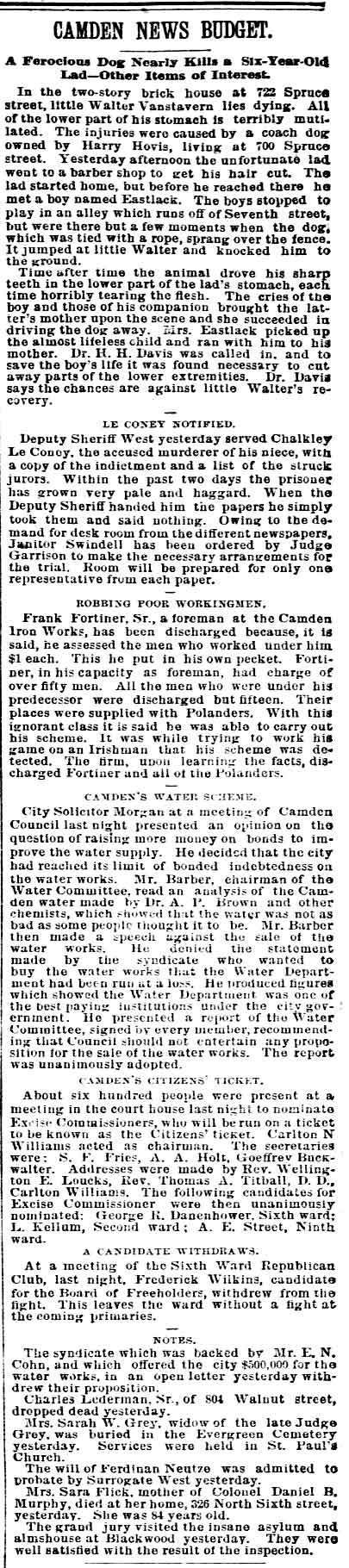
A Ferocious Dog Nearly Kills a Six-Year-Old Lad—Other Items of Interest.
In the two-story brick house at 722 Spruce street, little Walter Vanstavern lies dying. All of the lower part of his stomach is terribly mutilated. The injuries were caused by a coach dog owned by Harry Hovis, living at 700 Spruce street. Yesterday afternoon the unfortunate lad went to a barber shop to get his hair cut. The lad started home, but before he reached there he met a boy named Eastlack. The boys stopped to play in an alley which runs off of Seventh street, but were there but a few moments when the dog, which was tied with a rope, sprang over the fence. It jumped at little Walter and knocked him to the ground.
Time after time the animal drove his sharp teeth in the lower part of the lad’s stomach, each time horribly tearing the flesh. The cries of the boy and those of his companion brought the latter’s mother upon the scene and she succeeded in driving the dog away. Mrs. Eastlack picked up the almost lifeless child and ran with him to his mother. Dr. H. H. Davis was called in, and to save the boy’s life it was found necessary to cut away parts of the lower extremities. Dr. Davis says the chances are against little Walter’s recovery.
LE CONEY NOTIFIED.
Deputy Sheriff West yesterday served Chalkley Le Conoy, the accused murderer of his niece, with a copy of the indictment and a list of the struck jurors. Within the past two days the prisoner has grown very pale and haggard. When the Deputy Sheriff handed him the papers he simply took them and said nothing. Owing to the demand for desk room from the different newspapers, Janitor Swindell has been ordered by Judge Garrison to make the necessary arrangements for the trial. Room will be prepared for only one representative from each paper.
ROBBING POOR WORKINGMEN.
Frank Fortiner, Sr., a foreman at the Camden Iron Works, has been discharged because, it is said, he assessed the men who worked under him $1 each. This he put in his own pocket. Fortiner, in his capacity as foreman, had charge of over fifty men. All the men who were under his predecessor were discharged but fifteen. Their places were supplied with Polanders. With this ignorant class it is said he was able to carry out his scheme. It was while trying to work his game on an Irishman that his scheme was detected. The firm, upon learning the facts, discharged Fortiner and all of the Polanders.
CAMDEN’S WATER SCHEME.
City Solicitor Morgan at a meeting of Camden Council last night presented an opinion on the question of raising more money on bonds to improve the water supply. He decided that the city had reached its limit of bonded indebtedness on the water works. Mr. Barber, chairman of the Water Committee, read an analysis of the Camden water made by Dr. A. P. Brown and other chemists, which showed that the water was not as bad as some people thought it to be. Mr. Barber then made a speech against the sale of the water works. He denied the statement made by the syndicate who wanted to buy the water works that the Water Department had been run at a loss. He produced figures which showed the Water Department was one of the best paying institutions under the city government. He presented a report of the Water Committee, signed by every member, recommending that Council should not entertain any proposition for the sale of the water works. The report was unanimously adopted.
CAMDEN’S CITIZENS’ TICKET.
About six hundred people were present at a meeting in the court house last night to nominate Excise Commissioners, who will be run on a ticket to be known as the Citizens’ ticket. Carlton N. Williams acted as chairman. The secretaries were: S. F. Fries, A. A. Holt, Goeffrey Buckwalter. Addresses were made by Rev. Wellington E. Loucks, Rev. Thomas A. Titball, D. D., Carlton Williams. The following candidates for Excise Commissioner were then unanimously nominated: George R. Danenhower, Sixth ward; L. Kellum, Second ward; A. E. Street, Ninth ward.
A CANDIDATE WITHDRAWS.
At a meeting of the Sixth Ward Republican Club, last night, Frederick Wilkins, candidate for the Board of Freeholders, withdrew from the fight. This leaves the ward without a fight at the coming primaries.
NOTES.
The syndicate which was backed by Mr. E. N. Cohn, and which offered the city $500,000 for the water works, in an open letter yesterday withdrew their proposition.
Charles Lederman, Sr., of 804 Walnut street, dropped dead yesterday.
Mrs. Sarah W. Grey, widow of the late Judge Grey, was buried in the Evergreen Cemetery yesterday. Services were held in St. Paul’s Church.
The will of Ferdinand Neutze was admitted to probate by Surrogate West yesterday.
Mrs. Sara Flick, mother of Colonel Daniel B. Murphy, died at her home, 326 North Sixth street, yesterday. She was 84 years old.
The grand jury visited the insane asylum and almshouse at Blackwood yesterday. They were well satisfied with the result of the inspection.
Lawyer Ott Grand Jury Clerk
Philadelphia Inquirer —
S. Conrad Ott, one of the younger attorneys-at-law in Camden and a well-known newspaper man, was yesterday appointed clerk of the Camden county grand jury by Justice Garrison to succeed John Gaunt, of Gloucester City.