Ira Hall
IRA ALBERT HALL was a Camden police officer active in the early 1920s, active in Camden's Third and Fifth Wards. He was born in Providence, Rhode Island on June 25, 1889 to Henry S. and Elizabeth Hall. The family had come to New Jersey by 1894. By 1900 the family had moved to Camden. When the Census was taken in the summer of 1910, the Hall family, which included step-brother Eugene Edwards and younger brother Joseph, resided at 1810 Mulford Street in Camden's Centerville neighborhood.
When he registered for the draft on June 5, 1917 Ira Hall was living at and working as a steward at the Riverton Country Club in Riverton, New Jersey. He had returned to Camden by January of 1920. The census shows that he was living on Berkley Street in South Camden, and that his occupation was “real estate.” His next door neighbor was a carpenter, Clarence Arthur. On September 2, 1920 Ira A. Hall was appointed to the Camden police department, possibly through the influence of Detective George V. Murry.
Late in 1921 drug trafficking and police corruption in Camden's Third and Fifth Wards had become so flagrant that an investigation was launched. Officer Hall along with Camden police officers William Draper, Tony Latorre, and Detective George V. Murry were summoned to City Hall to answer charges placed by City Council's police committee, Murry being the main target of the investigation. By January 21, 1922 Murry, Draper, and Latorre had resigned, and Hall was fired after a hearing.
George Murry apparently died under “mysterious circumstances” on January 29, 1922, shortly before he was to go on trial for graft. George Murry's political empire was taken over in part by Polack Joe Deven, who held sway through most of the 1920s until sent to jail as a result of a shooting at the Sixth Ward Republican Club on Broadway.
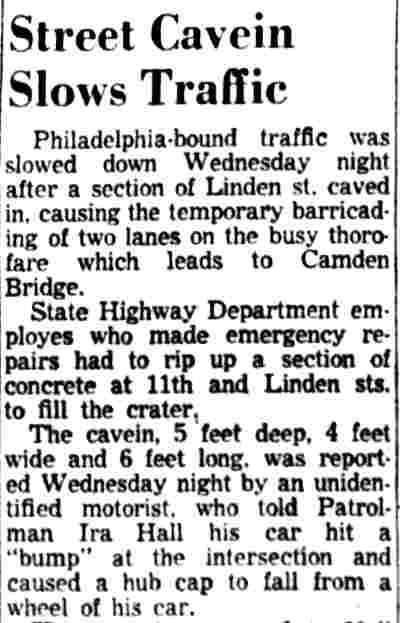
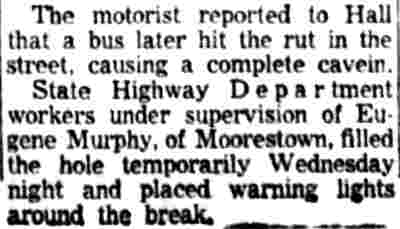
With Murry's death, the investigation collapsed. No criminal charges were brought against Ira Hall. The 1924 Camden City Directory shows that he was working as a “steward,” possibly having returned to his job at the golf course. He was then living at 1016 Newton Avenue. Ira Hall does not show up in the 1927 Camden City Directory, but by 1929 he had returned to the city and had been reinstated into the police department. Ira Hall was still active as a police officer as late as 1949. He retired on pension in the mid-1950s.
Ira Hall and his wife Elizabeth were living at 1132 Mount Ephraim Avenue when the 1929 Camden City Directory was compiled, and remained at that address through the spring of 1942. This also for a time was the home of Camden firefighter Charles W. Cooke and his wife Esther. The Census indicates that Ira and Elizabeth Hall were their brother- and sister-in-law. The 1947 Directory shows him at 220 North 11th Street. He later moved to 1146 Kenwood Avenue.
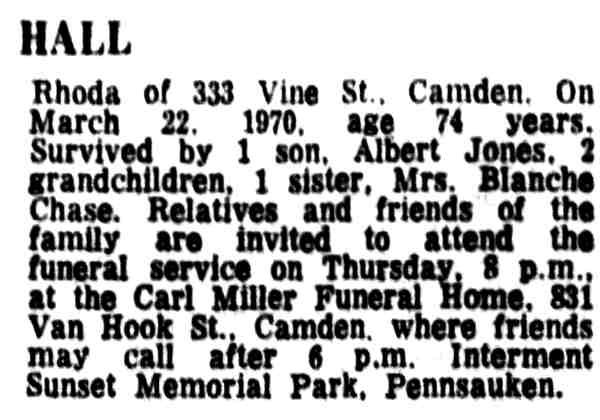
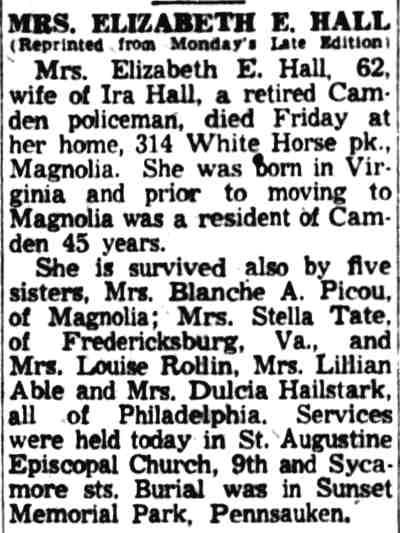
Ira Hall retired in the mid-1950s. His wife Elizabeth E. Hall passed away in July of 1958. Ira Hall married again. His wife Rhoda Johnson had one son, Albert Jones, who, after serving in the United States Army, became a member of the Camden Fire Department.
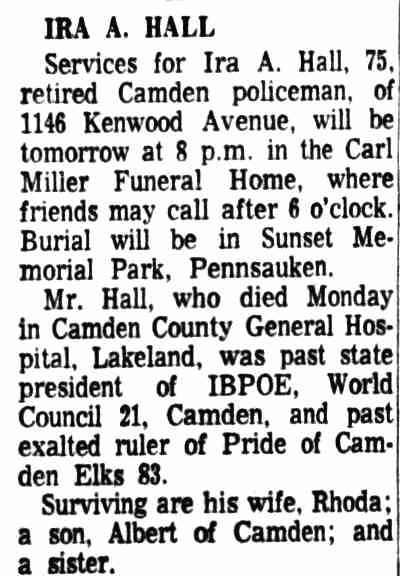
Ira Hall was active with the Pride of Camden Lodge 83, I.B.P.O. of Elks, who for many years had a lodge at 711 Kaighn Avenue. By 1933 he had already served as state president of that organization.
Ira Hall's last days were at the Camden County General Hospital at Lakeland, near Blackwood, NJ. He died on June 13, 1966.
Three Other Policemen Are Accused By Bleakly In Probe Of Grafting
Camden Daily Courier —

THREE OTHER POLICEMEN ARE ACCUSED BY BLEAKLY IN PROBE OF GRAFTING
Draper, Latorre and Hall, of First District Named by Council Solicitor to Council Committee—Murry is Alleged to Have Taken More Than $6000 From Woman of Underworld at Rate of $15 a Week—First Payment Made When Girl Was Fourteen Years Old, is Allegation—Hearing on January 11.
Charges that City Detective George Murry accepted money from prostitutes and dope vendors for protection were laid before the police committee of Council today by City Solicitor Bleakly.
Serious charges against three other members of the police department in connection with the investigation of vice conditions in the Third and Fifth Wards also were preferred by Mr. Bleakly, in the accusations presented to the councilmanic committee.
Hearings on the charges, which were declared by the city solicitor to be the most degrading and serious ever preferred against Camden policemen, will be conducted by the members of the police committee on the evening of January 11 at City Hall.
Investigation into accusations brought by Federal agents that Murry and other members of the police department were guilty of using their positions to protect denizens of the underworld was made by Mr. Bleakly with the assistance of Prosecutor Wolverton and Chief of Police Gravenor.
Murry is attached to headquarters. The other men included in the charges are Policemen William Draper, Latorre and Ira Hall, all assigned to the First Police District, Fifth street near Arch.
The evidence gathered by the Solicitor accuses Murry of having accepted a total of more than $6,000 from one woman declared to have become a prostitute. He is charged with having taken money from her at the rate of $15 a week over an eight-year period. [Remainder of this paragraph illegible — the scan is smudged at this point on crop -03.]
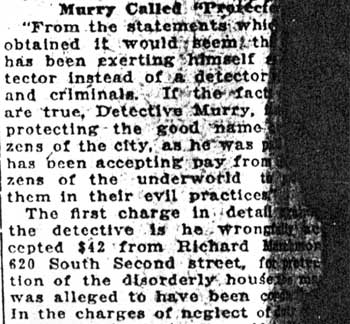
Murry Called “Protector”
“From the statements which obtained it would seem that he has been exerting himself as a protector instead of a detector of criminals. If the facts are true, Detective Murry, instead of protecting the good names of the city, as he was paid, has been accepting pay from denizens of the underworld to help them in their evil practices.
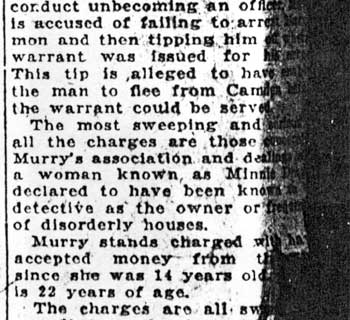
The first charge in detail is that the detective is he wrongly accepted $42.50 from Richard Marchmon, 620 South Second street, for protection of the disorderly house it was alleged to have been conducted. In the charges of neglect of duty conduct unbecoming an officer, he is accused of failing to arrest Marchmon and then tipping him a warrant was issued for him. This tip is alleged to have given the man to flee from Camden before the warrant could be served.
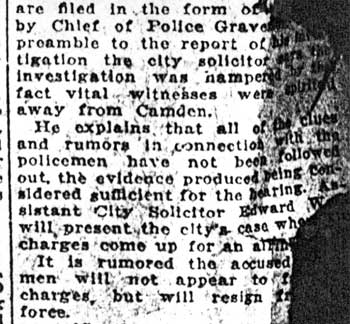
The most sweeping and all the charges are those of Murry’s association and dealings with a woman known as Minnie Draper, declared to have been known to the detective as the owner or keeper of disorderly houses. Murry stands charged with having accepted money from her since she was 14 years old; she is 22 years of age. The charges are all sworn to and filed in the form of affidavits by Chief of Police Gravenor.
In a preamble to the report of investigation the city solicitor said the investigation was hampered by the fact vital witnesses were kept away from Camden. He explains that all of the charges and rumors in connection with policemen have not been followed out, the evidence produced being considered sufficient for the hearing. Assistant City Solicitor Edward Wolverton will present the city’s case when charges come up for a hearing. It is rumored the accused policemen will not appear to fight the charges, but will resign from the force.
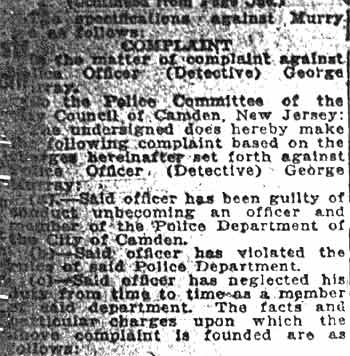
The specifications against Murry are as follows:
COMPLAINT
In the matter of complaint against Police Officer (Detective) George Murry:
To the Police Committee of the City Council of Camden, New Jersey:
The undersigned does hereby make the following complaint based on the charges hereinafter set forth against Police Officer (Detective) George Murry:
(a) Said officer has been guilty of conduct unbecoming an officer and member of the Police Department of the City of Camden.
(b) Said officer has violated the rules of said Police Department.
(c) Said officer has neglected his duties from time to time as a member of said department. The facts and particular charges upon which the above complaint is founded are as follows:
That the said George Murry in the month of May, 1918, in, on or about the premises 620 South Second St., Camden, New Jersey, wrongfully took and received from one Richard Marchmon the sum of $42.50, or some other sum of money, which sum was paid to and received by the said Murry as a bribe or reward for him the said Murry to refrain from performing his duty as a police officer of the City of Camden by the said Marchmon, who was then and there conducting in, on or about said premises a disorderly house and speakeasy to the knowledge of the said Murry.
That the said Murry on or about the last date mentioned then and there knowing that the said Richard Marchmon was conducting a disorderly house and speakeasy failed to arrest or cause to be arrested said Marchmon. That later on a warrant was issued for the said Richard Marchmon. That the said Officer Murry knowing that said warrant had been issued or was about to be issued notified the said Richard Marchmon thereof, and thereupon the said Richard Marchmon left the jurisdiction of this city in order to escape being arrested.
At divers times within the past three years the said George Murry demanded, received and took from Minnie Draper, who was then known to the said George Murry as a common prostitute, operating and frequenting houses of prostitution in the Third and Fifth Wards of the City of Camden, certain bribes, rewards or payments not to prosecute or refrain from prosecuting; in other words, to protect from arrest and prosecution the said Minnie Draper, and also to give the said Minnie Draper information procured by the said Murry by reason of his connection with the Police Department as to any intended or proposed prosecution brought or to be brought against her by reason of her criminal conduct and activities as a prostitute and disorderly character.
That the said Murry collected and received moneys as aforesaid wrongfully from the said Minnie Draper from the time she was fourteen years old up until on or about the 3rd day of December, 1921. That during the week prior to December 7, 1921, the said Murry unlawfully took and received for the purposes aforesaid from the said Minnie Draper, the sum of $15.00, said money being paid for the supposed protection of the said Minnie Draper during that week as a prostitute in the City of Camden, which money was paid in the parlor of the said Murry at his home 649 Scott street, Camden, New Jersey, the said Minnie Draper having previous to that time been carrying on and conducting a disorderly house at Pine street, Camden, New Jersey, with the knowledge, approval and supposed consent of the said Murry.
That the sum of $15.00 a week, or some other sum of money was paid for protection as aforesaid to the said Murry by the said Minnie Draper each and every week from the time the said Minnie Draper was fourteen years old until on or about the 3rd day of December, 1921, the said Minnie Draper now being about twenty-two years old, which said weekly sums were generally paid on Saturday night by the said Minnie Draper or by Richard Marchmon, or by some other person for or on her behalf, all of which said sums were paid to said Murry for police protection which he promised to her should be given and which was given as far as he was able to give the same during the times aforesaid.
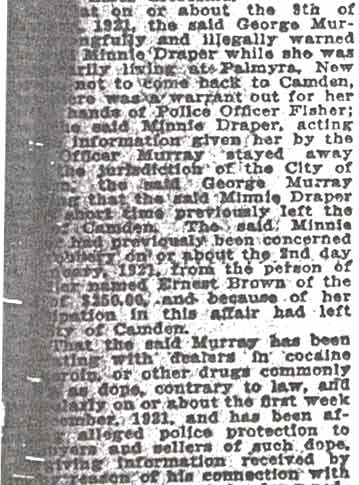
That on or about the 8th of January 1921, the said George Murry wrongfully and illegally warned the said Minnie Draper while she was temporarily living at Palmyra, New Jersey that there was a warrant out for her in the hands of Police Officer Fisher; and the said Minnie Draper, acting upon information given her by the said Officer Murry stayed away from the jurisdiction of the City of Camden, since the said George Murry knowing that the said Minnie Draper had a short time previously left the City of Camden. The said Minnie Draper had previously been concerned in a robbery on or about the 2nd day of January, 1921, from the person of a man named Ernest Brown of the sum of $250.00, and because of her participation in this affair had left the City of Camden.
That the said Murry has been dealing with dealers in cocaine, heroin or other drugs commonly known as dope, contrary to law, and particularly on or about the first week of December, 1921, and has been affording alleged police protection to buyers and sellers of such dope, receiving information received by him by reason of his connection with the Police Department to dope peddlers and buyers contrary to law.
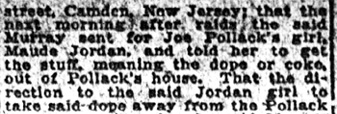
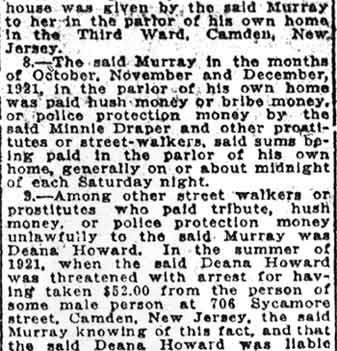
That in this connection one Joe Pollack, early in December or the latter part of November, 1921, had been engaged in the business of dope or selling coke at 210 Pine street, Camden, New Jersey; that the next morning after raids the said Murry sent for Joe Pollack’s girl, Maude Jordan, and told her to get the stuff, meaning the dope or coke, out of Pollack’s house. That the direction to the said Jordan girl to take said dope away from the Pollack house was given by the said Murry to her in the parlor of his own home in the Third Ward, Camden, New Jersey.
8.—The said Murry in the months of October, November and December, 1921, in the parlor of his own home was paid hush money or bribe money, or police protection money by the said Minnie Draper and other prostitutes or street-walkers, said sums being paid in the parlor of his own home, generally on or about midnight of each Saturday night.
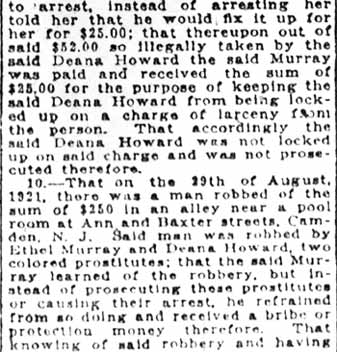
9.—Among other street walkers or prostitutes who paid tribute, hush money, or police protection money unlawfully to the said Murry was Deana Howard. In the summer of 1921, when the said Deana Howard was threatened with arrest for having taken $52.00 from the person of some male person at 706 Sycamore street, Camden, New Jersey, the said Murry knowing of this fact, and that the said Deana Howard was liable to arrest, instead of arresting her told her that he would fix it up for her for $25.00; that thereupon out of said $52.00 so illegally taken by the said Deana Howard the said Murry was paid and received the sum of $25.00 for the purpose of keeping the said Deana Howard from being locked up on a charge of larceny from the person. That accordingly the said Deana Howard was not locked up on said charge and was not prosecuted therefore.
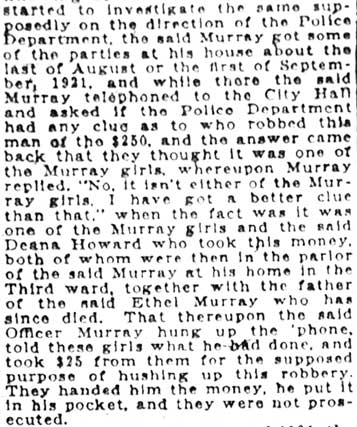
10.—That on the 29th of August, 1921, there was a man robbed of the sum of $250 in an alley near a pool room at Ann and Baxter streets, Camden, N. J. Said man was robbed by Ethel Murray and Deana Howard, two colored prostitutes; that the said Murry learned of the robbery, but instead of prosecuting those prostitutes or causing their arrest, he refrained from so doing and received a bribe or protection money therefore. That knowing of said robbery and having started to investigate the same supposedly on the direction of the Police Department, the said Murry got some of the parties at his house about the last of August or the first of September, 1921, and while there the said Murry telephoned to the City Hall and asked if the Police Department had any clue as to who robbed this man of the $250, and the answer came back that they thought it was one of the Murray girls, whereupon he replied, “No, it isn’t either of the Murray girls, I have got a better clue than that,” when the fact was it was one of the Murray girls and the said Deana Howard who took this money, both of whom were then in the parlor of the said Murry at his home in the Third ward, together with the father of the said Ethel Murray who has since died. That thereupon the said Officer Murry hung up the ’phone, told these girls what he had done, and took $25 from them for the supposed purpose of hushing up this robbery. They handed him the money, he put it in his pocket, and they were not prosecuted.
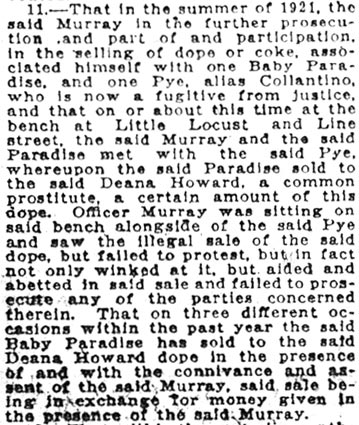
11.—That in the summer of 1921, the said Murry in the further prosecution and part of and participation in the selling of dope or coke, associated himself with one Baby Paradise, and one Pye, alias Collantino, who is now a fugitive from justice, and that on or about this time at the bench at Little Locust and Line street, the said Murry and the said Paradise met with the said Pye, whereupon the said Paradise sold to the said Deana Howard, a common prostitute, a certain amount of this dope. Officer Murry was sitting on said bench alongside of the said Pye and saw the illegal sale of the said dope, but failed to protest, but in fact not only winked at it, but aided and abetted in said sale and failed to prosecute any of the parties concerned therein. On three different occasions within the past year the said Baby Paradise has sold to the said Deana Howard dope in the presence of and with the connivance and assent of the said Murry, said sale being in exchange for money given in the presence of the said Murry.
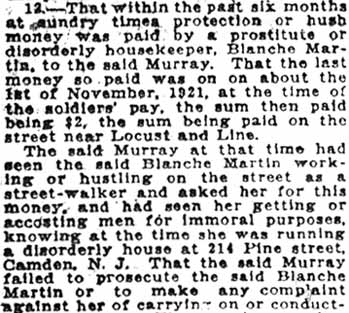
12.—That within the past six months at sundry times protection or hush money was paid by a prostitute or disorderly housekeeper, Blanche Martin, to the said Murry. The last money so paid was on or about the 1st of November, 1921, at the time of the soldiers’ pay, the sum then paid being $2, the sum being paid on the street near Locust and Line.
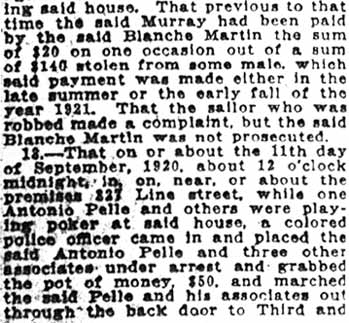
The said Murry at that time had seen the said Blanche Martin working or hustling on the street as a street-walker and asked her for this money, and had seen her getting or accosting men for immoral purposes, knowing at the time she was running a disorderly house at 214 Pine street, Camden, N. J. That the said Murry failed to prosecute the said Blanche Martin or to make any complaint against her of carrying on or conducting said house. That previous to that time the said Murry had been paid by the said Blanche Martin the sum of $20 on one occasion out of a sum of $140 stolen from some male, which said payment was made either in the late summer or the early fall of the year 1921. That the sailor who was robbed made a complaint, but the said Blanche Martin was not prosecuted.
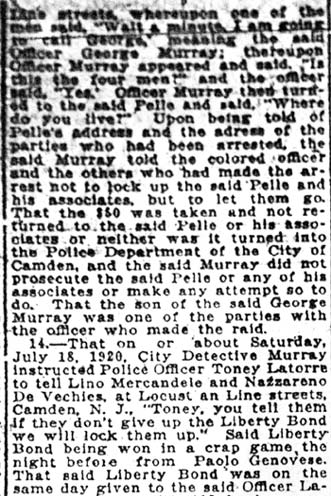
13.—That on or about the 11th day of September, 1920, about 12 o’clock midnight, in, on, near, or about the premises 327 Line street, while one Antonio Pelle and others were playing poker at said house, a colored police officer came in and placed the said Antonio Pelle and three other associates under arrest and grabbed the pot of money, $50, and marched the said Pelle and his associates out through the back door to Third and Line streets, whereupon one of the policemen said, “Wait a minute, I am going to call George,” meaning the said Officer George Murry; thereupon Officer Murry appeared and said, “Is this the four men?” and the officer said, “Yes.” Officer Murry then turned to the said Pelle and said, “Where do you live?” Upon being told of Pelle’s address and the address of the parties who had been arrested, the said Murry told the colored officer and the others who had made the arrest not to lock up the said Pelle and his associates, but to let them go. That the $50 was taken and not returned to the said Pelle or his associates or neither was it turned into the Police Department of the City of Camden, and the said Murry did not prosecute the said Pelle or any of his associates or make any attempt so to do. That the son of the said George Murry was one of the parties with the officer who made the raid.
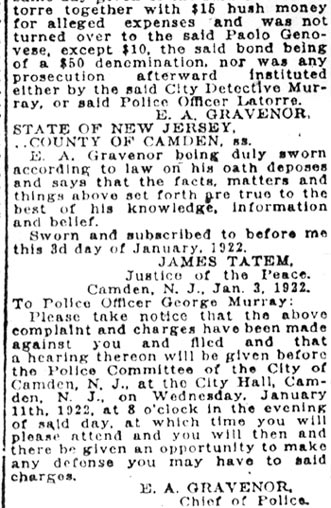
14.—That on or about Saturday, July 18, 1920, City Detective Murry instructed Police Officer Toney Latorre and Nazzareno De Vechies, at Locust and Line streets, Camden, N. J., “Toney, you tell them if they don’t give up the Liberty Bond we will lock them up.” Said Liberty Bond being won in a crap game, the night before from Paolo Genovese. That said Liberty Bond was on the same day given to the said Officer Latorre together with $15 hush money for alleged expenses and was not turned over to the said Paolo Genovese, except $10, the said bond being of a $50 denomination, nor was any prosecution afterward instituted either by the said City Detective Murry, or said Police Officer Latorre.
E. A. GRAVENOR.
STATE OF NEW JERSEY, COUNTY OF CAMDEN, ss.
E. A. Gravenor being duly sworn according to law on his oath deposes and says that the facts, matters and things above set forth are true to the best of his knowledge, information and belief.
Sworn and subscribed before me this 3d day of January, 1922.
JAMES TATEM
Justice of the Peace.
Camden, N. J., Jan. 3, 1922.
To Police Officer George Murry:
Please take notice that the above complaint and charges have been made against you and filed and that a hearing thereon will be given before the Police Committee of the City of Camden, N. J., at the City Hall, Camden, N. J., on Wednesday, January 11th, 1922, at 8 o’clock in the evening of said day, at which time you will please attend and you will then and there be given an opportunity to make any defense you may have to said charges.
E. A. GRAVENOR,
Chief of Police.
Took $50, Is Charge
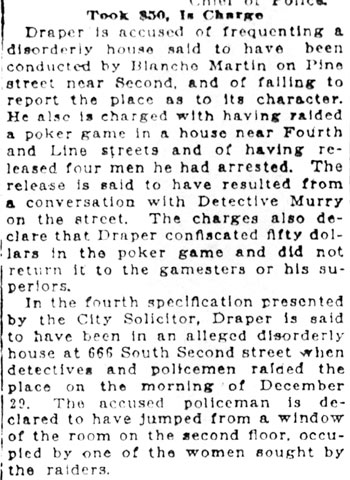
Draper is accused of frequenting a disorderly house said to have been conducted by Blanche Martin on Pine street near Second, and of failing to report the place as to its character. He also is charged with having raided a poker game in a house near Fourth and Line streets and of having released four men he had arrested. The release is said to have resulted from a conversation with Detective Murry on the street. The charges also declare that Draper confiscated fifty dollars in the poker game and did not return it to the gamesters or his superiors.
In the fourth specification presented by the City Solicitor, Draper is said to have been in an alleged disorderly house at 666 South Second street when detectives and policemen raided the place on the morning of December 29. The accused policeman is declared to have jumped from a window of the room on the second floor, occupied by one of the women sought by the raiders.
Says He Concealed Woman
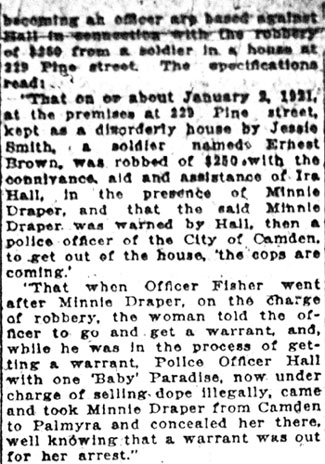
Charges of neglect and conduct unbecoming an officer are based against Hall in connection with the robbery of $250 from a soldier in a house at 229 Pine street. The specifications read:
“That on or about January 2, 1921, at the premises at 229 Pine street, kept as a disorderly house by Jessie Smith, a soldier named Ernest Brown, was robbed of $250 with the connivance, aid and assistance of Ira Hall, in the presence of Minnie Draper, and that the said Minnie Draper was warned by Hall, then a police officer of the City of Camden, to get out of the house, ‘the cops are coming.’
“That when Officer Fisher went after Minnie Draper, on the charge of robbery, the woman told the officer to go and get a warrant, and, while he was in the process of getting a warrant, Police Officer Hall with one ‘Baby’ Paradise, now under charge of selling dope illegally, came and took Minnie Draper from Camden to Palmyra and concealed her there, well knowing that a warrant was out for her arrest.”
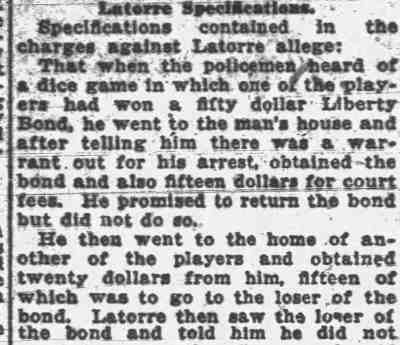
Latorre Specifications.
Specifications contained in the charges against Latorre allege:
That when the policemen heard of a dice game in which one of the players had won a fifty dollar Liberty Bond, he went to the man’s house and after telling him there was a warrant out for his arrest, obtained the bond and also fifteen dollars for court fees. He promised to return the bond but did not do so.
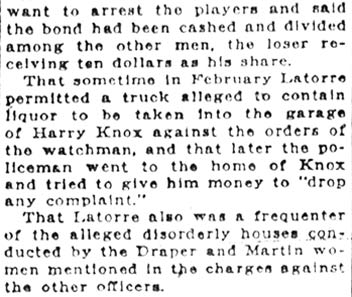
He then went to the home of another of the players and obtained twenty dollars from him, fifteen of which was to go to the loser of the bond. Latorre then saw the loser of the bond and told him he did not want to arrest the players and said the bond had been cashed and divided among the other men, the loser receiving ten dollars as his share.
That sometime in February Latorre permitted a truck alleged to contain liquor to be taken into the garage of Harry Knox against the orders of the watchman, and that later the policeman went to the home of Knox and tried to give him money to “drop any complaint.”
That Latorre also was a frequenter of the alleged disorderly houses conducted by the Draper and Martin women mentioned in the charges against the other officers.
Chief Accuses Four Officers in Vice Probe
Camden Post-Telegram —
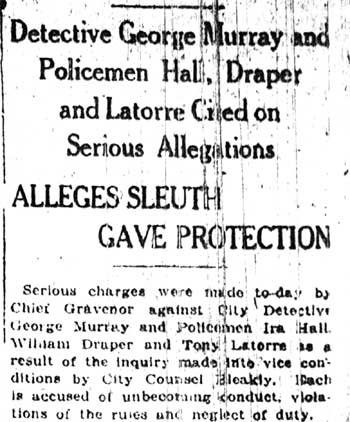
Detective George Murray and Policemen Hall, Draper and Latorre Cited on Serious Allegations
Alleges Sleuth Gave Protection
Serious charges were made to-day by Chief Gravenor against City Detective George Murray and Policemen Ira Hall, William Draper and Tony Latorre as a result of the inquiry made into vice conditions by City Counsel Bleakly. Each is accused of unbecoming conduct, violations of the rules and neglect of duty.
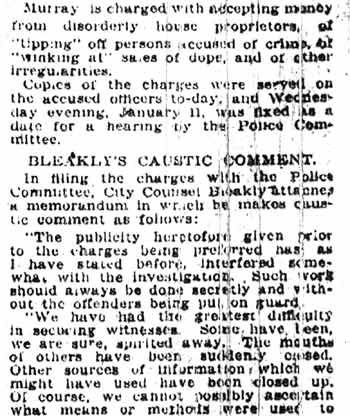
Murray is charged with accepting money from disorderly house proprietors, of “tipping” off persons accused of crime, of “winking at” sales of dope, and of other irregularities.
Copies of the charges were served on the accused officers to-day, and Wednesday evening, January 11, was fixed as a date for a hearing by the Police Committee.
Bleakly’s Caustic Comment
In filing the charges with the Police Committee, City Counsel Bleakly attaches a memorandum in which he makes caustic comment as follows:
“The publicity heretofore given prior to the charges being preferred has, as I have stated before, interfered somewhat with the investigation. Such work should always be done secretly and without the offenders being put on guard.
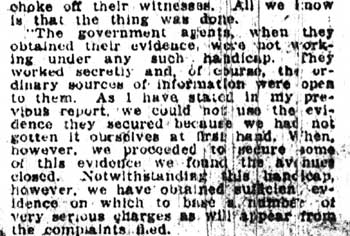
“We have had the greatest difficulty in securing witnesses. Some have been, we are sure, spirited away. The mouths of others have been suddenly closed. Other sources of information which we might have used have been closed up. Of course, we cannot possibly ascertain what means or methods were used to choke off their witnesses. All we know is that the thing was done.
“The government agents, when they obtained their evidence, were not working under any such handicap. They worked secretly and, of course, the ordinary sources of information were open to them. As I have stated in my previous report, we could not use the evidence they secured because we had not gotten it ourselves at first hand. When, however, we proceeded to secure some of this evidence we found the avenues closed. Notwithstanding this handicap, however, we have obtained sufficient evidence on which to base a number of very serious charges as will appear from the complaints filed.
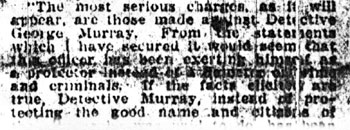
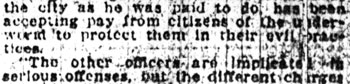
“The most serious charges, as it will appear, are those made against Detective George Murray. From the statements which I have secured it would seem that this officer has been exerting himself as a protector instead of a [?] and criminals. If the facts elicited are true, Detective Murray, instead of protecting the good name and citizens of [?] the city as he was paid to do has been accepting pay from citizens of the underworld to protect them in their evil practices.
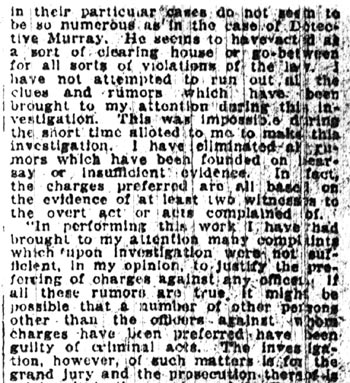
“The other officers are implicated in serious offenses, but the different charges in their particular cases do not seem to be so numerous as in the case of Detective Murray. He seems to have acted as a sort of clearing house or go-between for all sorts of violations of the law. I have not attempted to run out all the clues and rumors which have been brought to my attention during this investigation. This was impossible during the short time alloted to me to make this investigation. I have eliminated all rumors which have been founded on hearsay or insufficient evidence. In fact, the charges preferred are all based on the evidence of at least two witnesses to the overt act or acts complained of.
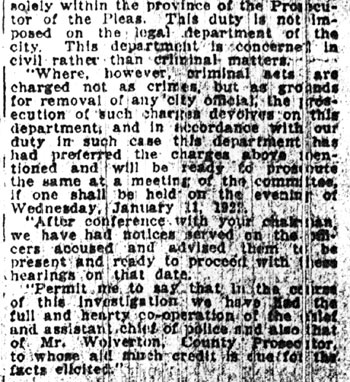
“In performing this work I have had brought to my attention many complaints which upon investigation were not sufficient, in my opinion, to justify the preferring of charges against any officer. If all these rumors are true, it might be possible that a number of other persons other than the officers against whom charges have been preferred have been guilty of criminal acts. The investigation, however, of such matters is for the grand jury and the prosecution thereof is solely within the province of the Prosecutor of the Pleas. This duty is not imposed on the legal department of the city. This department is concerned in civil rather than criminal matters.
“Where, however, criminal acts are charged not as crimes, but as grounds for removal of any city official, the prosecution of such charges devolves on this department, and in accordance with our duty in such case this department has had preferred the charges above mentioned and will be ready to prosecute the same at a meeting of the committee, if one shall be held on the evening of Wednesday, January 11, 1922.
“After conference with your chairman, we have had notices served on the officers accused and advised them to be present and ready to proceed with these hearings on that date.
“Permit me to say that in the course of this investigation we have had the full and hearty co-operation of the chief and assistant chief of police and also that of Mr. Wolverton, County Prosecutor, to whose aid much credit is due for the facts elicited.”
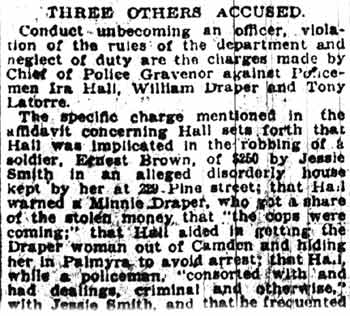
Three Others Accused.
Conduct unbecoming an officer, violation of the rules of the department and neglect of duty are the charges made by Chief of Police Gravenor against Policemen Ira Hall, William Draper and Tony Latorre.
The specific charge mentioned in the affidavit concerning Hall sets forth that Hall was implicated in the robbing of a soldier, Ernest Brown, of $250 by Jessie Smith in an alleged disorderly house kept by her at 229 Pine street; that Hall warned a Minnie Draper, who got a share of the stolen money, that “the cops were coming;” that Hall aided in getting the Draper woman out of Camden and hiding her in Palmyra to avoid arrest; that Hall, while a policeman, “consorted with and had dealings, criminal and otherwise,” with Jessie Smith, and that he frequented disorderly houses.
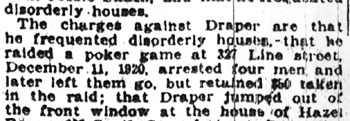
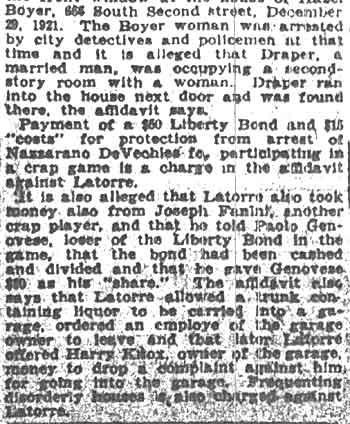
The charges against Draper are that he frequented disorderly houses, that he raided a poker game at 327 Line street, December 11, 1920, arrested four men and later left them go, but retained $50 taken in the raid; that Draper jumped out of the front window at the house of Hazel Boyer, 66[?] South Second street, December 29, 1921. The Boyer woman was arrested by city detectives and policemen at that time and it is alleged that Draper, a married man, was occupying a second-story room with a woman. Draper ran into the house next door and was found there, the affidavit says.
Payment of a $50 Liberty Bond and $15 “costs” for protection from arrest of Nazzarano DeVechies fo[?], participating in a crap game is a charge in the affidavit against Latorre.
It is also alleged that Latorre also took money also from Joseph Fanin[?], another crap player, and that he told Paolo Genovese, loser of the Liberty Bond in the game, that the bond had been cashed and divided and that he gave Genovese $[?]0 as his “share.” The affidavit also says that Latorre allowed a trunk containing liquor to be carried into a garage, ordered an employe of the garage owner to leave and that later Latorre offered Harry K[?]ox, owner of the garage, money to drop a complaint against him for going into the garage. Frequenting disorderly houses is also charged against Latorre.
Vice Graft Probe Brings Suspensions for 4 Policemen
Camden Courier —
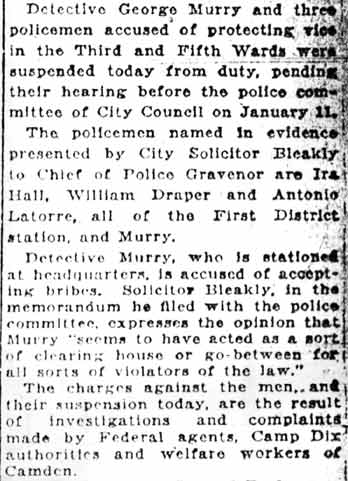

Detective George Murry and three policemen accused of protecting vice in the Third and Fifth Wards were suspended today from duty, pending their hearing before the police committee of City Council on January 11.
The policemen named in evidence presented by City Solicitor Bleakly to Chief of Police Gravenor are Ira Hall, William Draper and Antonio Latorre, all of the First District station, and Murry.
Detective Murry, who is stationed at headquarters, is accused of accepting bribes. Solicitor Bleakly, in the memorandum he filed with the police committee, expresses the opinion that Murry “seems to have acted as a sort of clearing house or go-between for all sorts of violators of the law.”
The charges against the men, and their suspension today, are the result of investigations and complaints made by Federal agents, Camp Dix authorities and welfare workers of Camden.
U. S. Agents Started Probe
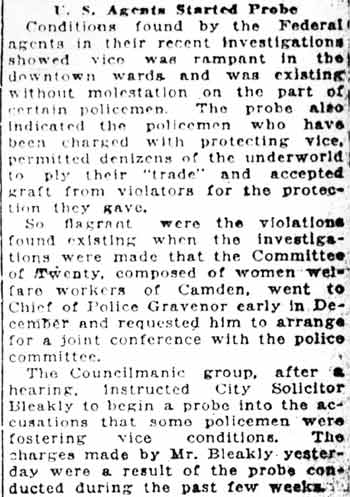
Conditions found by the Federal agents in their recent investigations showed vice was rampant in the downtown wards and was existing without molestation on the part of certain policemen. The probe also indicated the policemen who have been charged with protecting vice, permitted denizens of the underworld to ply their “trade” and accepted graft from violators for the protection they gave.
So flagrant were the violations found existing when the investigations were made that the Committee of Twenty, composed of women welfare workers of Camden, went to Chief of Police Gravenor early in December and requested him to arrange for a joint conference with the police committee.
The Councilmanic group, after a hearing, instructed City Solicitor Bleakly to begin a probe into the accusations that some policemen were fostering vice conditions. The charges made by Mr. Bleakly yesterday were a result of the probe conducted during the past few weeks.
Men May Resign
It has been intimated that the four men suspended today will shortly resign from the police department.
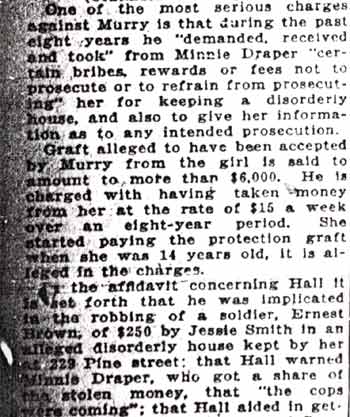
One of the most serious charges against Murry is that during the past eight years he “demanded, received and took” from Minnie Draper “certain bribes, rewards or fees not to prosecute or to refrain from prosecuting” her for keeping a disorderly house, and also to give her information as to any intended prosecution.
Graft alleged to have been accepted by Murry from the girl is said to amount to more than $6,000. He is charged with having taken money from her at the rate of $15 a week over an eight-year period. She started paying the protection graft when she was 14 years old, it is alleged in the charges.
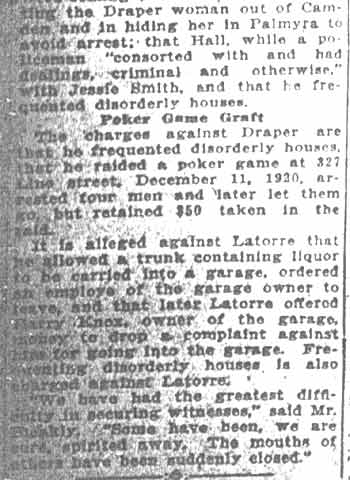
In the affidavit concerning Hall it is set forth that he was implicated in the robbing of a soldier, Ernest Brown, of $250 by Jessie Smith in an alleged disorderly house kept by her at 229 Pine street; that Hall warned Minnie Draper, who got a share of the stolen money, that “the cops were coming”; that Hall aided in getting the Draper woman out of Camden and in hiding her in Palmyra to avoid arrest; that Hall, while a policeman “consorted with and had dealings, criminal and otherwise,” with Jessie Smith, and that he frequented disorderly houses.
Poker Game Graft
The charges against Draper are that he frequented disorderly houses, that he raided a poker game at 327 Line street, December 11, 1920, arrested four men and later let them go, but retained $50 taken in the raid.
It is alleged against Latorre that he allowed a trunk containing liquor to be carried into a garage, ordered an employe of the garage owner to leave and that later Latorre offered Harry Knox, owner of the garage, money to drop a complaint against him for going into the garage. Frequenting disorderly houses is also charged against Latorre.
“We have had the greatest difficulty in securing witnesses,” said Mr. Bleakly. “Some have been ... spirited away. The mouths of ... have been suddenly closed.”
Detective George Murry Resigns, Will Not Fight Witnesses of Underworld
Camden Courier —
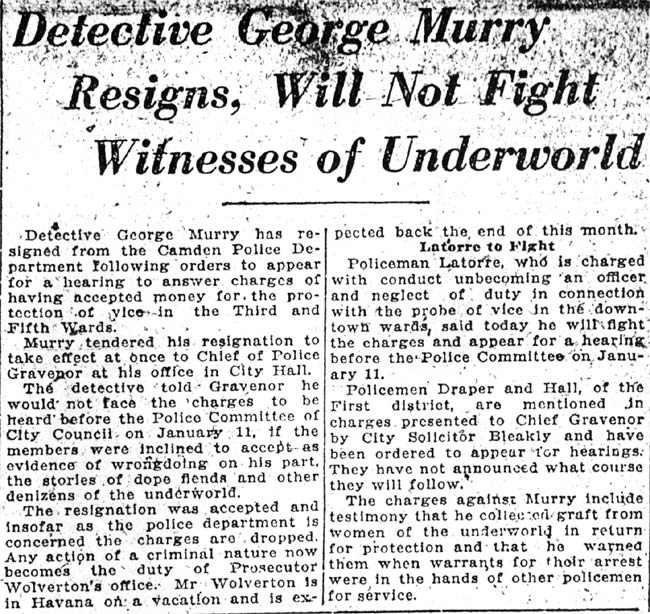
Detective George Murry has resigned from the Camden Police Department following orders to appear for a hearing to answer charges of having accepted money for the protection of vice in the Third and Fifth Wards.
Murry tendered his resignation to take effect at once to Chief of Police Gravenor at his office in City Hall.
The detective told Gravenor he would not face the charges to be heard before the Police Committee of City Council on January 11, if the members were inclined to accept as evidence of wrongdoing on his part, the stories of dope fiends and other denizens of the underworld.
The resignation was accepted and insofar as the police department is concerned the charges are dropped. Any action of a criminal nature now becomes the duty of Prosecutor Wolverton’s office. Mr. Wolverton is in Havana on a vacation and is expected back the end of this month.
Latorre to Fight
Policeman Latorre, who is charged with conduct unbecoming an officer and neglect of duty in connection with the probe of vice in the downtown wards, said today he will fight the charges and appear for a hearing before the Police Committee on January 11.
Policemen Draper and Hall, of the First district, are mentioned in charges presented to Chief Gravenor by City Solicitor Bleakly and have been ordered to appear for hearings. They have not announced what course they will follow.
The charges against Murry include testimony that he collected graft from women of the underworld in return for protection and that he warned them when warrants for their arrest were in the hands of other policemen for service.
Two More Policemen Resign Under Fire in Downtown Vice Probe
Camden Courier —
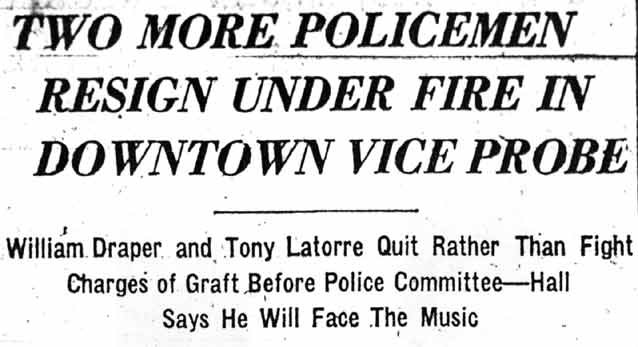
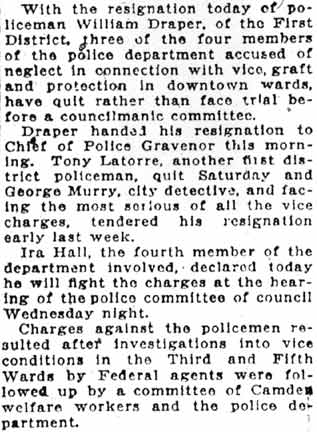
William Draper and Tony Latorre Quit Rather Than Fight Charges of Graft Before Police Committee—Hall Says He Will Face The Music
With the resignation today of policeman William Draper, of the First District, three of the four members of the police department accused of neglect in connection with vice, graft and protection in downtown wards, have quit rather than face trial before a councilmanic committee.
Draper handed his resignation to Chief of Police Gravenor this morning. Tony Latorre, another first district policeman, quit Saturday and George Murry, city detective, and facing the most serious of all the vice charges, tendered his resignation early last week.
Ira Hall, the fourth member of the department involved, declared today he will fight the charges at the hearing of the police committee of council Wednesday night.
Charges against the policemen resulted after investigations into vice conditions in the Third and Fifth Wards by Federal agents were followed up by a committee of Camden welfare workers and the police department.
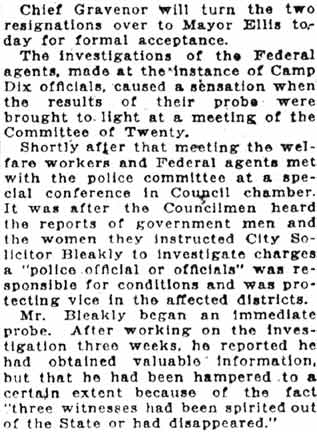
Chief Gravenor will turn the two resignations over to Mayor Ellis today for formal acceptance.
The investigations of the Federal agents, made at the instance of Camp Dix officials, caused a sensation when the results of their probe were brought to light at a meeting of the Committee of Twenty.
Shortly after that meeting the welfare workers and Federal agents met with the police committee at a special conference in Council chamber. It was after the Councilmen heard the reports of government men and the women they instructed City Solicitor Bleakly to investigate charges a “police official or officials” was responsible for conditions and was protecting vice in the affected districts.
Mr. Bleakly began an immediate probe. After working on the investigation three weeks, he reported he had obtained valuable information, but that he had been hampered to a certain extent because of the fact “three witnesses had been spirited out of the State or had disappeared.”
Council’s Police Hearing Tonight
Camden Courier —
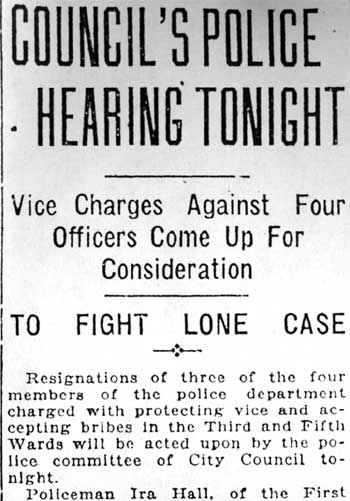
Vice Charges Against Four Officers Come Up For Consideration
TO FIGHT LONE CASE
Resignations of three of the four members of the police department charged with protecting vice and accepting bribes in the Third and Fifth Wards will be acted upon by the police committee of City Council tonight.
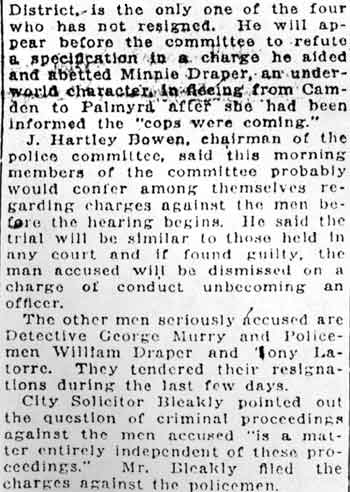
Policeman Ira Hall, of the First District, is the only one of the four who has not resigned. He will appear before the committee to refute a specification in a charge he aided and abetted Minnie Draper, an underworld character, in fleeing from Camden to Palmyra after she had been informed the “cops were coming.”
J. Hartley Bowen, chairman of the police committee, said this morning members of the committee probably would confer among themselves regarding charges against the men before the hearing begins. He said the trial will be similar to those held in any court and if found guilty, the man accused will be dismissed on a charge of conduct unbecoming an officer.
The other men seriously accused are Detective George Murry and Policemen William Draper and Tony Latorre. They tendered their resignations during the last few days.
City Solicitor Bleakly pointed out the question of criminal proceedings against the men accused “is a matter entirely independent of these proceedings.” Mr. Bleakly filed the charges against the policemen.
“This is a proceeding to remove these men from office,” continued Mr. Bleakly. “It is simply to bring charges against them under the State laws as they are under the civil service and cannot be discharged unless charges are proven against them.
“When members of the police department are accused, if they resign, everything to be accomplished by the findings at a trial is realized by accepting their resignations. There would be no further purpose in proceeding with the trials because the end would be just the same—namely, their discharge.
“It has been suggested that if instead of accepting the resignations the men be discharged to prevent them from ever applying again. But there is nothing in that point because the accused men, as I understand, are all past the age for reappointment. Besides, I am sure the present or a succeeding mayor would not reappoint them on the force.
“Whether these men are discharged or whether their resignations are accepted will not affect in any manner the question of any criminal complaint being based on any of these charges, because that is a matter entirely independent of these proceedings.”
Ira Hall Is Dismissed, Evidence Against Four Men Given Prosecutor
Camden Courier —
Criminal Prosecution of Murry, Latorre, Draper and Hall Looms as Result of Sensational Hearing by Police Committee— ‘Dope’ Sellers Linked With Detective and Policemen in Lurid Testimony at Crowded Session— Predict Speedy Action
Policeman as Own Attorney Given Grilling
Criminal prosecution of Detective George Murry and Policemen Tony Latorre, William Draper and Ira Hall for their alleged “protection” of vice in the downtown underworld loomed today. At a sensational hearing before the police committee of City Council last night it was unanimously decided to turn the mass of evidence against the four men, gathered by City Solicitor Bleakly, over to Prosecutor Wolverton’s office.
At the hearing, Policeman Hall was summarily dismissed from the department, classed as a “moral degenerate” and roundly flayed when, after he acted as his own attorney, he was cross-questioned by every member of the police committee.
Hall was the only one of the quartette of accused officers who made any attempt to defend himself. Murry, Latorre and Draper resigned several days ago. At the police committee session last night it was the sense of the members that their resignations was a tacit admission of guilt and that their mere removal from the police department is not sufficient punishment for their underworld activities.
The grand jury convened on Tuesday of this week. The next step will be the presentation of evidence gathered by Mr. Bleakly against the four men to the prosecutor’s office who, in turn, will turn it over to the grand jury. Quick action may be expected, it was predicted today in official circles.
Policeman Hall’s friendship for Anthony Paradise, charged with peddling “dope,” was brought out at last night’s hearing.
Burling Promises To Act at Once in Probe of 4 Police
Camden Courier —
Assistant Prosecutor Albert E. Burling, in charge of the prosecutor’s office in the absence of Prosecutor Wolverton, conferred today with City Solicitor Bleakly. The latter turned over to him the mass of evidence he had gathered against Detective Murry and Policemen Latorre, Hall and Draper.
With the grand jury already in session, it was generally believed the evidence will be presented to that body within a short time.
Assistant Prosecutor Burling promised the complete co-operation of the Prosecutor’s office in the investigation, which is expected to link other men and women with the so-called “vice combine” which has existed for many years in the downtown section of the city.
Wolverton in South
“I want to go over the evidence presented by Mr. Bleakly thoroughly from a criminal standpoint,” said Mr. Burling. “I can’t say exactly when it will be turned over to the grand jury, but little time will be lost.”
Prosecutor Wolverton is touring the southern states, Panama, Cuba and central American points. He is expected to return to the states soon after January 20. He will return in ample time to take active charge of any prosecutions that may follow the investigation of the charges against the policemen by the grand jury.
Gossip was rife about the court house and city hall throughout the day. The impending criminal prosecution of the former members of the police department was the sole subject of conversation.
Doubt as to when the grand jury will act and speculation as to the nature of the charges the men will face was heard on all sides.
Underworld Life Exposed as Hall Is Given Grilling
Camden Courier —
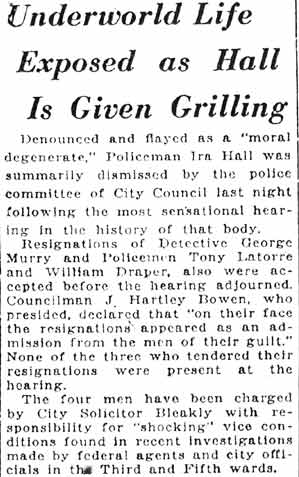
Denounced and flayed as a “moral degenerate,” Policeman Ira Hall was summarily dismissed by the police committee of City Council last night following the most sensational hearing in the history of that body.
Resignations of Detective George Murry and Policemen Tony Latorre and William Draper, also were accepted before the hearing adjourned. Councilman J. Hartley Bowen, who presided, declared that “on their face the resignations appeared as an admission from the men of their guilt.” None of the three who tendered their resignations were present at the hearing.
The four men have been charged by City Solicitor Bleakly with responsibility for “shocking” vice conditions found in recent investigations made by federal agents and city officials in the Third and Fifth wards.
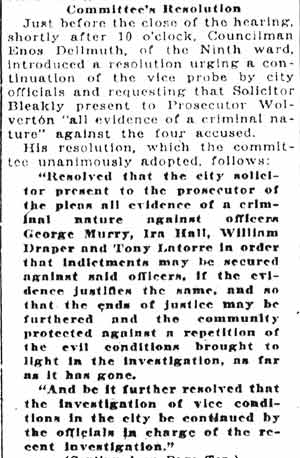
Committee’s Resolution
Just before the close of the hearing, shortly after 10 o’clock, Councilman Enos Dellmuth, of the Ninth ward, introduced a resolution urging a continuation of the vice probe by city officials and requesting that Solicitor Bleakly present to Prosecutor Wolverton “all evidence of a criminal nature” against the four accused.
His resolution, which the committee unanimously adopted, follows:
“Resolved that the city solicitor present to the prosecutor of the pleas all evidence of a criminal nature against officers George Murry, Ira Hall, William Draper and Tony Latorre in order that indictments may be secured against said officers, if the evidence justifies the same, and so that the ends of justice may be furthered and the community protected against a repetition of the evil conditions brought to light in the investigation, as far as it has gone.
“And be it further resolved that the investigation of vice conditions in the city be continued by the officials in charge of the recent investigation.”
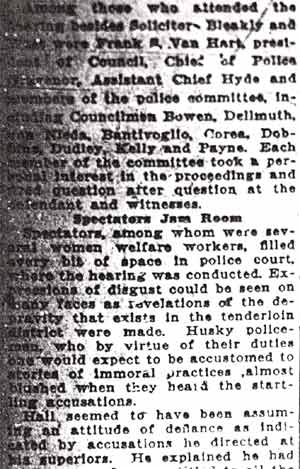
Among those who attended the hearing besides Solicitor Bleakly and [?] were Frank S. Van Hart, president of Council, Chief of Police Gravenor, Assistant Chief Hyde and members of the police committee, including Councilmen Bowen, Dellmuth, Von Nieda, Bantivoglio, Corea, Dobbins, Dudley, Kelly and Payne. Each member of the committee took a personal interest in the proceedings and [?] question after question at the defendant and witnesses.
Spectators Jam Room
Spectators, among whom were several women welfare workers, filled every bit of space in police court, where the hearing was conducted. Expressions of disgust could be seen on many faces as revelations of the depravity that exists in the tenderloin district were made. Husky policemen, who by virtue of their duties one would expect to be accustomed to stories of immoral practices, almost blushed when they heard the startling accusations.
Hall seemed to have been assuming an attitude of defiance as indicated by accusations he directed at his superiors. He explained he had no lawyer and was entitled to all the privileges of a witness under such circumstances. He sat most of the time in a chair opposite the witness stand.
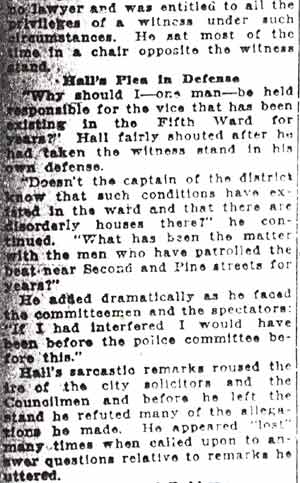
Hall’s Plea in Defense
“Why should I—one man—be held responsible for the vice that has been existing in the Fifth Ward for years?” Hall fairly shouted after he had taken the witness stand in his own defense.
“Doesn’t the captain of the district know that such conditions have existed in the ward and that there are disorderly houses there?” he continued. “What has been the matter with the men who have patrolled the beat near Second and Pine streets for years?”
He added dramatically as he faced the committeemen and the spectators: “If I had interfered I would have been before the police committee before this.”
Hall’s sarcastic remarks roused the ire of the city solicitors and the Councilmen and before he left the stand he refuted many of the allegations he made. He appeared “lost” many times when called upon to answer questions relative to remarks he uttered.
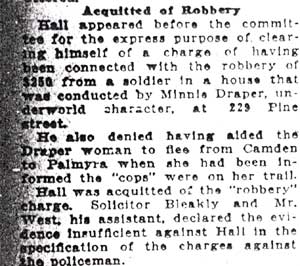
Acquitted of Robbery
Hall appeared before the committee for the express purpose of clearing himself of a charge of having been connected with the robbery of $250 from a soldier in a house that was conducted by Minnie Draper, underworld character, at 229 Pine street.
He also denied having aided the Draper woman to flee from Camden to Palmyra when she had been informed the “cops” were on her trail.
Hall was acquitted of the “robbery” charge. Solicitor Bleakly and Mr. West, his assistant, declared the evidence insufficient against Hall in the specification of the charges against the policeman.
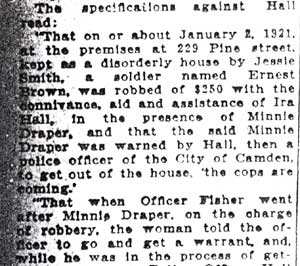
The specifications against Hall read:
“That on or about January 2, 1921, at the premises at 229 Pine street, kept as a disorderly house by Jessie Smith, a soldier named Ernest Brown, was robbed of $250 with the connivance, aid and assistance of Ira Hall, in the presence of Minnie Draper, and that the said Minnie Draper was warned by Hall, then a police officer of the City of Camden, to get out of the house, ‘the cops are coming.’
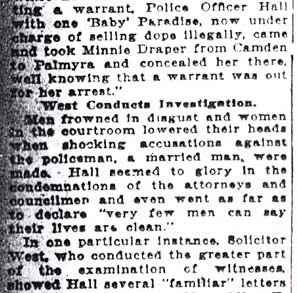
“That when Officer Fisher went after Minnie Draper, on the charge of robbery, the woman told the officer to go and get a warrant, and, while he was in the process of getting a warrant, Police Officer Hall with one ‘Baby’ Paradise, now under charge of selling dope illegally, came and took Minnie Draper from Camden to Palmyra and concealed her there, well knowing that a warrant was out for her arrest.”
West Conducts Investigation.
Men frowned in disgust and women in the courtroom lowered their heads when shocking accusations against the policeman, a married man, were made. Hall seemed to glory in the condemnations of the attorneys and councilmen and even went as far as to declare “very few men can say their lives are clean.”
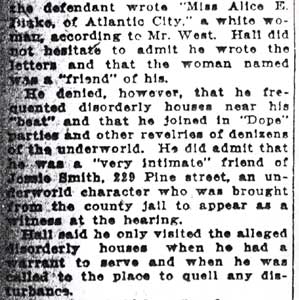
In one particular instance, Solicitor West, who conducted the greater part of the examination of witnesses, showed Hall several “familiar” letters the defendant wrote “Miss Alice E. [?]iske, of Atlantic City,” a white woman, according to Mr. West. Hall did not hesitate to admit he wrote the letters and that the woman named was a “friend” of his.
He denied, however, that he frequented disorderly houses near his “beat” and that he joined in “Dope” parties and other revelries of denizens of the underworld. He did admit that he was a “very intimate” friend of Jessie Smith, 229 Pine street, an underworld character who was brought from the county jail to appear as a witness at the hearing.
Hall said he only visited the alleged disorderly houses when he had a warrant to serve and when he was called to the place to quell any disturbance.
Smith Girl on Stand.
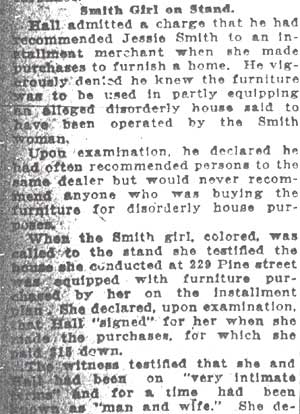
Hall admitted a charge that he had recommended Jessie Smith to an installment merchant when she made purchases to furnish a home. He vigorously denied he knew the furniture was to be used in partly equipping an alleged disorderly house said to have been operated by the Smith woman.
Upon examination, he declared he had often recommended persons to the same dealer but would never recommend anyone who was buying the furniture for disorderly house purposes.
When the Smith girl, colored, was called to the stand she testified the house she conducted at 229 Pine street was equipped with furniture purchased by her on the installment plan. She declared, upon examination, that Hall “signed” for her when she made the purchases, for which she paid $1[?] down.
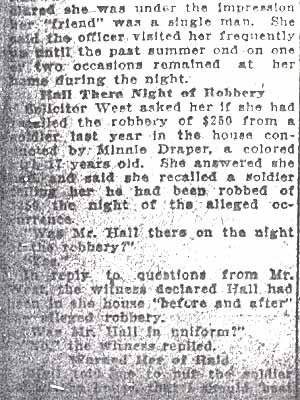
The witness testified that she and Hall had been on “very intimate terms” and for a time had been known as “man and wife.” She declared she was under the impression her “friend” was a single man. She said the officer visited her frequently up until the past summer and on one or two occasions remained at her home during the night.
Hall There Night of Robbery
Solicitor West asked her if she had [?]ailed the robbery of $250 from a soldier last year in the house conducted by Minnie Draper, a colored girl 17 years old. She answered she [?] and said she recalled a soldier telling her he had been robbed of $250 the night of the alleged occurrence.
“Was Mr. Hall there on the night of the robbery?”
“Yes.”
In reply to questions from Mr. West, the witness declared Hall had been in the house “before and after” the alleged robbery.
“Was Mr. Hall in uniform?”
“No,” the witness replied.
Warned Her of Raid
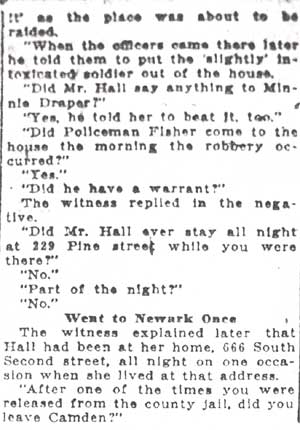
[?] told [?] to put the soldier [?] that I should beat it” as the place was about to be raided.
“When the officers came there later he told them to put the ‘slightly’ intoxicated soldier out of the house.
“Did Mr. Hall say anything to Minnie Draper?”
“Yes, he told her to beat it, too.”
“Did Policeman Fisher come to the house the morning the robbery occurred?”
“Yes.”
“Did he have a warrant?”
The witness replied in the negative.
“Did Mr. Hall ever stay all night at 229 Pine street while you were there?”
“No.”
“Part of the night?”
“No.”
Went to Newark Once
The witness explained later that Hall had been at her home, 666 South Second street, all night on one occasion when she lived at that address.
“After one of the times you were released from the county jail, did you leave Camden?”
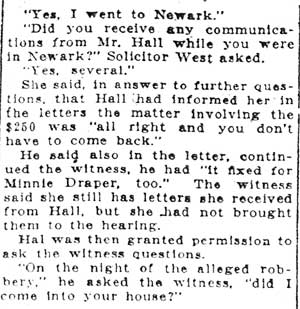
“Yes, I went to Newark.”
“Did you receive any communications from Mr. Hall while you were in Newark?” Solicitor West asked.
“Yes, several.”
She said, in answer to further questions, that Hall had informed her in the letters the matter involving the $250 was “all right and you don’t have to come back.”
He said also in the letter, continued the witness, he had “it fixed for Minnie Draper, too.” The witness said she still has letters she received from Hall, but she had not brought them to the hearing.
Hal [sic] was then granted permission to ask the witness questions.
“On the night of the alleged robbery,” he asked the witness, “did I come into your house?”
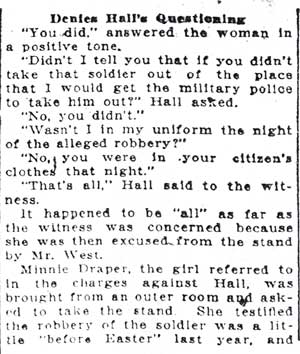
Denies Hall’s Questioning
“You did,” answered the woman in a positive tone.
“Didn’t I tell you that if you didn’t take that soldier out of the place that I would get the military police to take him out?” Hall asked.
“No, you didn’t.”
“Wasn’t I in my uniform the night of the alleged robbery?”
“No, you were in your citizen’s clothes that night.”
“That’s all,” Hall said to the witness.
It happened to be “all” as far as the witness was concerned because she was then excused from the stand by Mr. West.
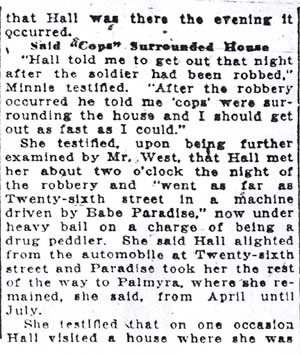
Minnie Draper, the girl referred to in the charges against Hall, was brought from an outer room and asked to take the stand. She testified the robbery of the soldier was a little “before Easter” last year, and that Hall was there the evening it occurred.
Said “Cops” Surrounded House
“Hall told me to get out that night after the soldier had been robbed,” Minnie testified. “After the robbery occurred he told me ‘cops’ were surrounding the house and I should get out as fast as I could.”
She testified, upon being further examined by Mr. West, that Hall met her about two o’clock the night of the robbery and “went as far as Twenty-sixth street in a machine driven by Babe Paradise,” now under heavy bail on a charge of being a drug peddler. She said Hall alighted from the automobile at Twenty-sixth street and Paradise took her the rest of the way to Palmyra, where she remained, she said, from April until July.
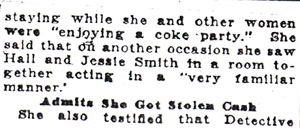
She testified that on one occasion Hall visited a house where she was staying while she and other women were “enjoying a coke party.” She said that on another occasion she saw Hall and Jessie Smith in a room together acting in a “very familiar manner.”
Admits She Got Stolen Cash
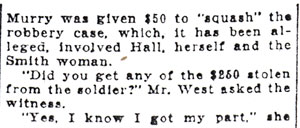
She also testified that Detective Murry was given $50 to “squash” the robbery case, which, it has been alleged, involved Hall, herself and the Smith woman.
“Did you get any of the $250 stolen from the soldier?” Mr. West asked the witness.
“Yes. I know I got my part,” she answered. “The remainder went to Jessie Smith, but I suppose Mr. Hall got his share.”
“Was Mr. Hall in uniform when he gave you the caution to get out of the house the night of the robbery?”
“No,” the woman answered.
New City Police Must Be ‘Clean’ Is Order of Mayor
Camden Courier —
Expose of Cops’ Connection With Vice Protection Causes Sweeping Move
THREE VACANCIES EXIST
The clean-up of the personnel of the Police Department is the next move following the expose of graft and vice protection in the so-called tenderloin section of the downtown wards.
Three nominations have been made of men to fill the vacancies created by the separation of three policemen from their positions as guardians of citizens’ life and property. Before these men are named to the force they must be proven to have clean personal records which will stand the closest scrutiny.
Mayor Ellis today said that every precaution will be taken to ensure the appointment of men who are beyond reproach. Recommendations of friends of former employers or political backers will not be sufficient to obtain police jobs for applicants.
City detectives today are investigating the past lives of the three men who have been nominated from the Third Ward to fill the places made vacant by the resignations of William Draper and Tony Latorre and the discharge of Ira Hall, all First District policemen, accused of complicity in underworld affairs. Detective George Murry also resigned rather than fight the charges preferred against him by City Solicitor Bleakly and presented to the police committee of Council.
The question of a successor to the place of Murry on the detective force is now under consideration.
The evidence against the accused men is in the form of lengthy sworn statements gathered in an investigation fostered by City Solicitor Bleakly and joined in by Chief of Police Gravenor and county detectives.
Prosecutor Gets Evidence
This has been turned over to Assistant Prosecutor Burling in the absence of Prosecutor Wolverton. It has not been decided when the evidence will be given to the Grand Jury.
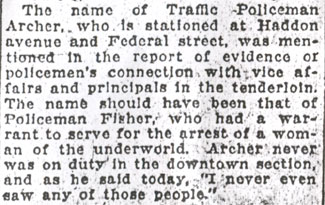
The name of Traffic Policeman Archer, who is stationed at Haddon avenue and Federal street, was mentioned in the report of evidence or policemen’s connection with vice affairs and principals in the tenderloin. The name should have been that of Policeman Fisher, who had a warrant to serve for the arrest of a woman of the underworld. Archer never was on duty in the downtown section, and as he said today, “I never even saw any of those people.”
Residents Asked to Give Evidence of Police Graft
Camden Courier —
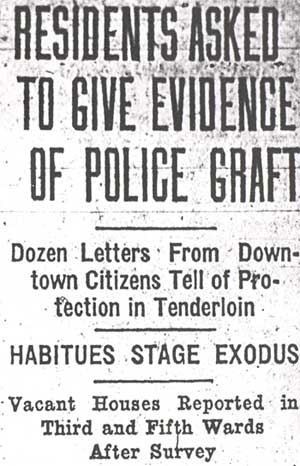
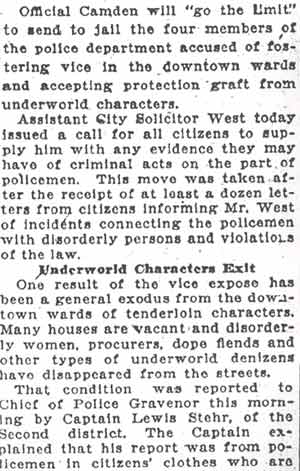
Dozen Letters From Downtown Citizens Tell of Protection in Tenderloin
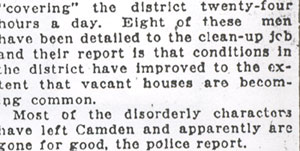
Habitues Stage Exodus
Vacant Houses Reported in Third and Fifth Wards After Survey.
Sellers of Dope in Keen Rivalry Slashed Prices
Camden Daily Courier —
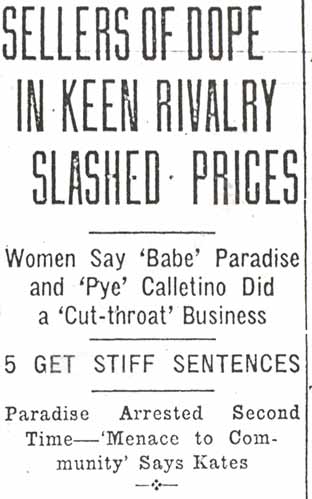
SELLERS OF DOPE IN KEEN RIVALRY SLASHED PRICES
Women Say ‘Babe’ Paradise and ‘Pye’ Calletino Did a ‘Cut-throat’ Business
5 GET STIFF SENTENCES
Paradise Arrested Second Time—‘Menace to Community’ Says Kates
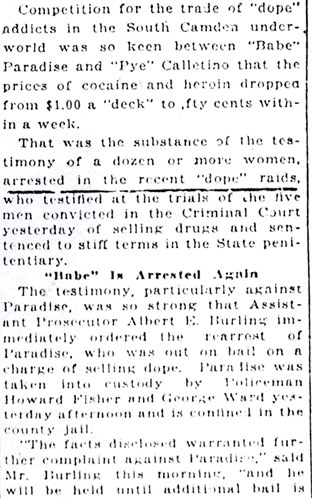
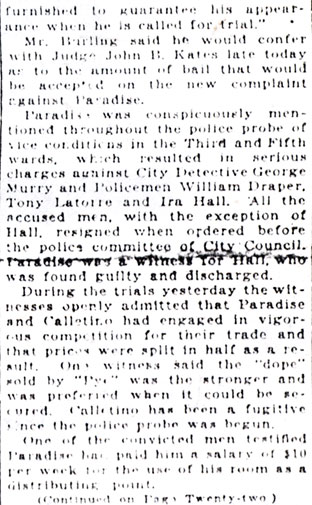
Competition for the trade of “dope” addicts in the South Camden underworld was so keen between “Babe” Paradise and “Pye” Calletino that the prices of cocaine and heroin dropped from $1.00 a “deck” to fifty cents within a week.
That was the substance of the testimony of a dozen or more women, arrested in the recent “dope” raids, who testified at the trials of the five men convicted in the Criminal Court yesterday of selling drugs and sentenced to stiff terms in the State penitentiary.
“Babe” Is Arrested Again
The testimony, particularly against Paradise, was so strong that Assistant Prosecutor Albert E. Burling immediately ordered the rearrest of Paradise, who was out on bail on a charge of selling dope. Paradise was taken into custody by Policeman Howard Fisher and George Ward yesterday afternoon and is confined in the county jail.
“The facts disclosed warranted further complaint against Paradise,” said Mr. Burling this morning, “and he will be held until additional bail is furnished to guarantee his appearance when he is called for trial.”
Mr. Burling said he would confer with Judge John B. Kates late today as to the amount of bail that would be accepted on the new complaint against Paradise.
Paradise was conspicuously mentioned throughout the police probe of vice conditions in the Third and Fifth wards, which resulted in serious charges against City Detective George Murry and Policemen William Draper, Tony Latorre and Ira Hall. All the accused men, with the exception of Hall, resigned when ordered before the police committee of City Council. Paradise was a witness for Hall, who was found guilty and discharged.
During the trials yesterday the witnesses openly admitted that Paradise and Calletino had engaged in vigorous competition for their trade and that prices were split in half as a result. One witness said the “dope” sold by “Pye” was the stronger and was preferred when it could be secured. Calletino has been a fugitive since the police probe was begun.
One of the convicted men testified Paradise had paid him a salary of $10 per week for the use of his room as a distributing point.
(Continued on Page Twenty-two)
(Continued from Page One.)
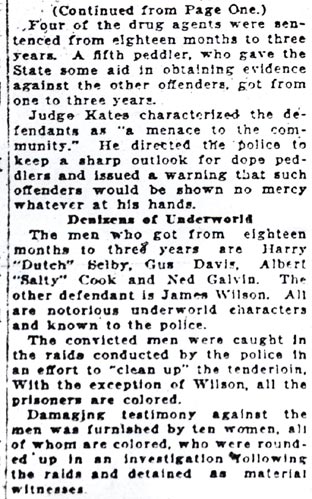
Four of the drug agents were sentenced from eighteen months to three years. A fifth peddler, who gave the State some aid in obtaining evidence against the other offenders, got from one to three years.
Judge Kates characterized the defendants as “a menace to the community.” He directed the police to keep a sharp outlook for dope peddlers and issued a warning that such offenders would be shown no mercy whatever at his hands.
Denizens of Underworld
The men who got from eighteen months to three years are Harry “Dutch” Selby, Gus Davis, Albert “Salty” Cook and Ned Galvin. The other defendant is James Wilson. All are notorious underworld characters and known to the police.
The convicted men were caught in the raids conducted by the police in an effort to “clean up” the tenderloin. With the exception of Wilson, all the prisoners are colored.
Damaging testimony against the men was furnished by ten women, all of whom are colored, who were rounded up in an investigation following the raids and detained as material witnesses.
Asks Stiff Sentences
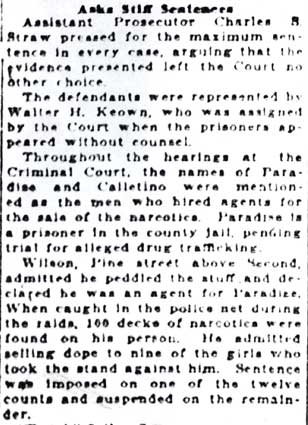
Assistant Prosecutor Charles S. Straw pressed for the maximum sentence in every case, arguing that the evidence presented left the Court no other choice.
The defendants were represented by Walter H. Keown, who was assigned by the Court when the prisoners appeared without counsel.
Throughout the hearings at the Criminal Court, the names of Paradise and Calletino were mentioned as the men who hired agents for the sale of the narcotics. Paradise is a prisoner in the county jail, pending trial for alleged drug trafficking.
Wilson, Pine street above Second, admitted he peddled the stuff and declared he was an agent for Paradise. When caught in the police net during the raids, 100 decks of narcotics were found on his person. He admitted selling dope to nine of the girls who took the stand against him. Sentence was imposed on one of the twelve counts and suspended on the remainder.
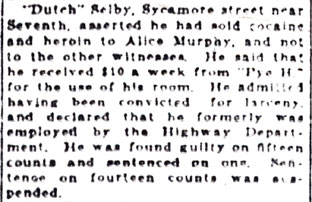
“Dutch” Selby, Sycamore street near Seventh, asserted he had sold cocaine and heroin to Alice Murphy, and not to the other witnesses. He said that he received $10 a week from “Pye H” for the use of his room. He admitted having been convicted for larceny, and declared that he formerly was employed by the Highway Department. He was found guilty on fifteen counts and sentenced on one. Sentence on fourteen counts was suspended.
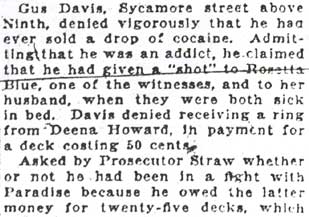
Gus Davis, Sycamore street above Ninth, denied vigorously that he had ever sold a drop of cocaine. Admitting that he was an addict, he claimed that he had given a “shot” to Rosetta Blue, one of the witnesses, and to her husband, when they were both sick in bed. Davis denied receiving a ring from Deena Howard, in payment for a deck costing 50 cents.
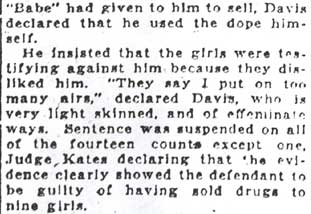
Asked by Prosecutor Straw whether or not he had been in a fight with Paradise because he owed the latter money for twenty-five decks, which “Babe” had given to him to sell, Davis declared that he used the dope himself.
He insisted that the girls were testifying against him because they disliked him. “They say I put on too many airs,” declared Davis, who is very light skinned, and of effeminate ways. Sentence was suspended on all of the fourteen counts except one, Judge Kates declaring that the evidence clearly showed the defendant to be guilty of having sold drugs to nine girls.
$750 Worth Each Month
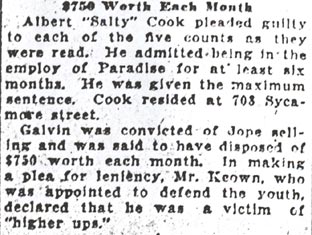
Albert “Salty” Cook pleaded guilty to each of the five counts as they were read. He admitted being in the employ of Paradise for at least six months. He was given the maximum sentence. Cook resided at 708 Sycamore street.
Galvin was convicted of dope selling and was said to have disposed of $750 worth each month. In making a plea for leniency, Mr. Keown, who was appointed to defend the youth, declared that he was a victim of “higher ups.”
Grand Jury Gets Graft Evidence in Murry Probe
Camden Courier —
Wolverton Promises Investigation of Vice Protection ‘From Very Bottom’
FOUR EX-POLICE ON BILL
Prosecutor Says Charges Not a Reflection Upon Entire Department
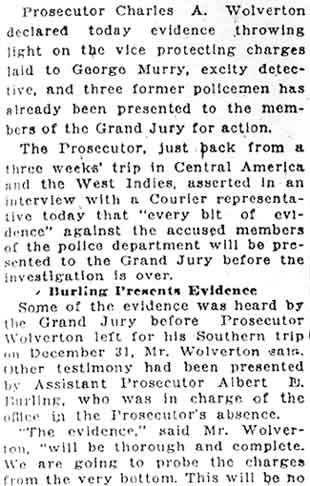
Prosecutor Charles A. Wolverton declared today evidence throwing light on the vice protecting charges laid to George Murry, ex-city detective, and three former policemen has already been presented to the members of the Grand Jury for action.
The Prosecutor, just back from a three weeks’ trip in Central America and the West Indies, asserted in an interview with a Courier representative today that “every bit of evidence” against the accused members of the police department will be presented to the Grand Jury before the investigation is over.
Burling Presents Evidence
Some of the evidence was heard by the Grand Jury before Prosecutor Wolverton left for his Southern trip on December 31. Mr. Wolverton said other testimony had been presented by Assistant Prosecutor Albert B. Burling, who was in charge of the office in the Prosecutor’s absence.
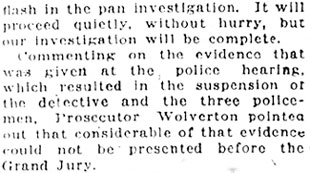
“The evidence,” said Mr. Wolverton, “will be thorough and complete. We are going to probe the charges from the very bottom. This will be no flash in the pan investigation. It will proceed quietly, without hurry, but our investigation will be complete.
“Commenting on the evidence that was given at the police hearing, which resulted in the suspension of the detective and the three policemen, Prosecutor Wolverton pointed out that considerable of that evidence could not be presented before the Grand Jury.
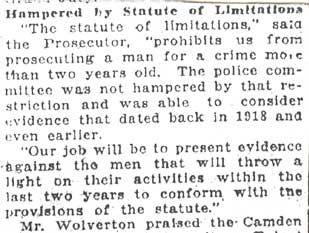
Hampered by Statute of Limitations
“The statute of limitations,” said the Prosecutor, “prohibits us from prosecuting a man for a crime more than two years old. The police committee was not hampered by that restriction and was able to consider evidence that dated back in 1918 and even earlier.
“Our job will be to present evidence against the men that will throw a light on their activities within the last two years to conform with the provisions of the statute.”
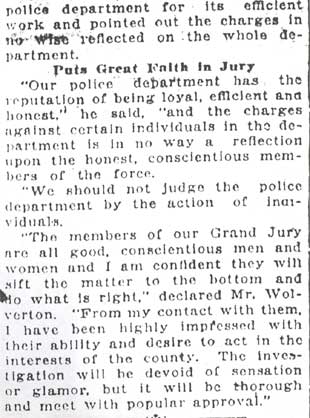
Mr. Wolverton praised the Camden police department for its efficient work and pointed out the charges in no wise reflected on the whole department.
Puts Great Faith in Jury
“Our police department has the reputation of being loyal, efficient and honest,” he said, “and the charges against certain individuals in the department is in no way a reflection upon the honest, conscientious members of the force.
“We should not judge the police department by the action of individuals.
“The members of our Grand Jury are all good, conscientious men and women and I am confident they will sift the matter to the bottom and do what is right,” declared Mr. Wolverton. “From my contact with them, I have been highly impressed with their ability and desire to act in the interests of the county. The investigation will be devoid of sensation or glamor, but it will be thorough and meet with popular approval.”
Former Detective Murry Drops Dead in Street
Camden Courier —
Sleuth Accused of Graft Found Dead Near Home
Tragic End Automatically Halts Probe of His Vice Activities
Neighbors Find Body
George Murry, ex-city detective, who resigned from the police department after being charged with promoting vice in the Third and Fifth Wards, was found dead on a doorstep near Locust and Line Streets shortly after nine o'clock last night.
A death certificate issued by Coroner Holl ascribes Murry's death as due to apoplexy, superinduced by acute indigestion.
Grand Jury Probe Starts
Murry's death came as a tragic aftermath of his exposure as a protector of prostitution and dope selling in the downtown tenderloin, in the role of which he is said to have amassed a snug fortune.
His death automatically puts to an end the proceedings that were begun to present his activities in the tenderloin before the Grand Jury with a view of bringing criminal prosecution.
Murry will be buried Thursday afternoon at Mt. Peace Cemetery, of which he was part owner. Funeral services will be conducted at the home and in the Macedonia Church, 3rd and Spruce Street, at noon.
Neighbors Find Body
Murry was 50 years old. According to his wife, Mrs. Cora J. Murry, former city detective had been suffering for several days with indigestion.
After supper last night, Mrs. Murry said, her husband complained of feeling ill and she gave him a tablespoon of baking soda. He shortly after decided to take a walk in the belief the air might benefit him.
Half an hour later, neighbors came upon his lifeless body across a doorstep on Locust street, between Beckett and Line Streets.
The body was carried to the Murry home, at 649 Locust Street, a few doors away. Two physicians were called. Owing to the storm, the doctors were delayed in reaching the house. Dr. Clement T. Branch, of 721 Walnut Street, the first physician to arrive, said he believed Murry had died as he fell.
Mother Died 2 Years Ago, Same Hour
Besides his widow, Murry is survived by eight children, ranging in age from two months to 18 years. Curiously, Murry's mother died exactly two years ago, to the very hour. Murry was colored, although many persons were unaware of his race because of his light complexion. He was a tall, powerful man. He was more than six feet in height and weighed about 230 pounds. His complexion was ruddy and his hair iron gray.
Murry's death was a passing incident in the tenderloin today. Before he was shorn of his power, which he wielded proudly and with great vigor, his decease might have caused a great flurry.
Murry, in the height of his power, was formidable, and a man whose favor the denizens and habitués of the underworld crave; stripped of that power, he was ignored and deserted as rats would desert a sinking ship.
Boss For Many Years
His loss of power probably worried Murry more than the outcome over the exposure of the criminal phase of the exposure. Murry had been the undisputed political “boss” of the Third and Fifth wards for years. The transition was too great; his fall too disgraceful.
Prosecutor Charles A. Wolverton pointed out today that with Murry dead, the presentation of evidence of vice conditions in the Fifth Ward to the Grand Jury would be dropped for the present and in all probability for good.
The reason is obvious, said Mr. Wolverton. “There's nobody to convict.”
United States Started Probe
Murry's downfall was due largely to the activities of attaches of the United States Interdepartmental Social Hygiene Bureau, who investigated vice conditions here at the request of the Camp Dix military authorities.
Officers of the camp complained many of the men had contracted contagious diseases during visits to the tenderloin in South Camden.
A series of meetings was held under the auspices of the bureau and a number of women prominent in social welfare work in the city.
With the co-operation of the Federal authorities, the local police began a “cleanup” of the tenderloin. No one was spared. Dope peddlers, prostitutes, bootleggers and gamblers fell in the clutches of the authorities. Questioned, their stories seemed to coincide on one fact—that Murry was the “invisible government” which sanctioned or frowned upon their industry and who had to be “greased” if they wished to ply their trade without molestation or criminal prosecution.
Three Other Members Accused
Three other members of the police department were accused of malfeasance along with Murry. They are Policemen William Draper, Tony Latorre and Ira Hall. The three men were dismissed by the police committee of City Council. Hall, who opposed his dismissal and demanded a trial, was excoriated by the committee and summarily dropped from the department.
Murry resigned from the force declaring that the evidence against him was untrustworthy, having been obtained from dope fiends and “other irresponsible people.” It was understood, however, that he resigned, believing it would put an end to the proceedings. He seemed to worry over the contemplated action by the Grand Jury.
Said He Amassed Wealth
Murry, however, boasted openly he had amassed wealth while he reigned as the “tenderloin boss.”
“I've got mine,” he declared only recently. “I've got enough to keep me and my family in clover for the rest of our lives. If they let up on me and don't push this jail thing, I'm willing to lay down.”
In addition, Murry was specifically charged with accepting graft from dope peddlers and with “tipping off” criminals against whom warrants were issued in City Hall.
City Solicitor E.G.C. Bleakly drew up the complaint and charges against the detective. Commenting on the charges when they were first made public, Mr. Bleakly said:
“From the statements I have obtained it would seem this officer has been exerting himself as a protector instead of a detector of crime and criminals. If the facts elicited are true, Detective Murry, instead of protecting the good name and citizens of our city, as he was paid to do, has been accepting pay from the citizens of the underworld to protect them in their evil practices.”
In Department 16 Years
Murry was a member of the police department for 16 years, having been appointed in 1905. He was made a detective in 1913.
Camden Courier-Post – November 4, 1954
Camden Courier-Post – July 1958
Camden Courier-Post – June 16, 1966
Camden Courier-Post – March 24, 1970