Introduction
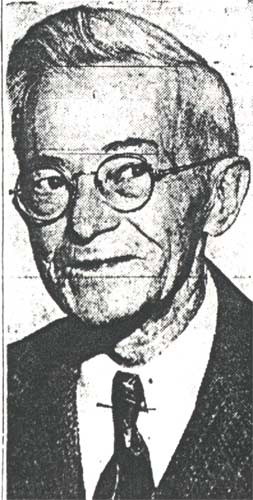
Frederick von Nieda
FREDERICK VON NIEDA was born in Bavaria in 1868. After graduating from a seminary in 1885, he intended to join the ministry. Illness changed his plans, and he emigrated to America in 1885. He worked at different jobs, including that as the first professor of German at Temple University in Philadelphia. He moved to the Cramer Hill section of Camden NJ in 1902. A civic minded individual, he began his involvement in politics shortly after moving to Camden.
One of his earliest civic involvements came through his love of boating, fishing, and hunting. He was a founding member of the Farragut Sportsmen’s Association in 1907, and was instrumental in the organization of the Delaware River Yachtsmen’s League. With Dr. C.F. Hadley and John Schimpf among others, he co-founded the East End Trust Company in 1905.
A lifetime Republican, Frederick von Nieda became Mayor of Camden in 1935, and served until 1936 when he lost a bitter political battle to Commissioner George H. Brunner. City finances at the time were troubled, and Camden in April of 1936 was paying its bills through the issuance of scrip.
The defeat of Mayor Von Nieda marked the end of Republican dominance in Camden politics. He remained involved in local politics and civic affairs for most of the rest of his life.
Frederick Von Nieda’s greatest accomplishment was the filling in of Baldwin’s Run, a creek that ran from the area near Beideman and Westfield Avenues down to the Delaware River. In the area around River Road, Baldwin’s Run became “a mosquito-filled swamp” and a “public health menace.” Frederick von Nieda campaigned ceaselessly for 40 years until the swamplands were filled in and the land turned into a park. This park was named Von Nieda Park shortly after his death on February 17, 1950. Since Frederick von Nieda’s passing, the Delaware River Yachtsmen’s League has held an annual picnic in his name, which is attended by hundreds of boaters up and down the Delaware River.
Von Nieda Park
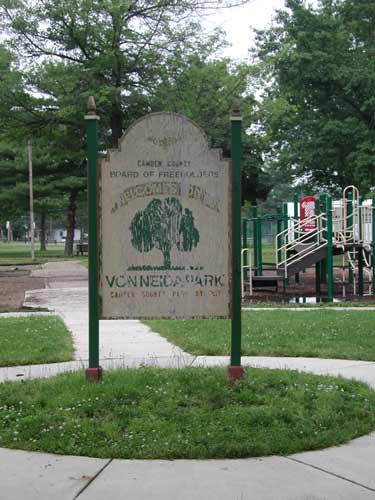
Von Nieda Park — June 19, 2003
Assembly Approval Assured on Housing
Camden Courier-Post —
Further Delay Held Endangering Chance of Obtaining Federal Funds
Assembly approval of the long-delayed housing bills is expected tonight, Assemblyman Rocco Palese declared yesterday in announcing all difficulties confronting the measures have been “ironed out.”
Senate action also is expected, Palese reported.
Horace R. Dixon, secretary of the Camden Municipal Low-Cost Housing Committee has warned repeatedly, as have other members of the committee, that further delay will endanger the chances of obtaining Federal housing funds. Camden expects to apply for $8,000,000, Dixon said.
It has been estimated New Jersey will be allotted about $30,000,000 for slum clearance and low cost housing.
Felix Pitett, a Paterson banker, who is named in one of the bills as State housing administrator, told the members of the Assembly Housing Committee that if the job carries a salary he “would not be interested,” Palese said.
Paid Administrator Opposed
The local committee, which was instrumental in the formation of the New Jersey Conference of Municipal Low-Cost Housing Committees, opposed the naming of an administrator in the bill. Opposition was based on the creation of a high salary position.
Assemblyman Oscar R. Wilensky, of Passaic, drew the bills and named Pitett as administrator, but did not fix his salary. The bill named a deputy director at $4000 annually. The Camden group and members of other State committees withdrew their opposition when Wilensky agreed to drop his plan to set up county regional housing authorities.
“Pitett’s surprise statement changed the complexion of the bill,” Palese said. “I think Pitett’s action is almost without precedent. He is to be commended for his action. He told the committee he cannot give full time to the job but is willing to serve on a part time basis without compensation.”
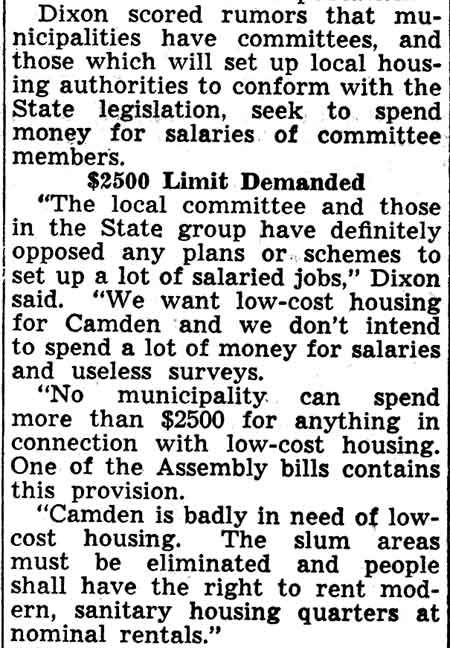
Dixon scored rumors that municipalities have committees, and those which will set up local housing authorities to conform with the State legislation, seek to spend money for salaries of committee members.
$2500 Limit Demanded
“The local committee and those in the State group have definitely opposed any plans or schemes to set up a lot of salaried jobs,” Dixon said. “We want low-cost housing for Camden and we don’t intend to spend a lot of money for salaries and useless surveys.
“No municipality can spend more than $2500 for anything in connection with low-cost housing. One of the Assembly bills contains this provision.
“Camden is badly in need of low-cost housing. The slum areas must be eliminated and people shall have the right to rent modern, sanitary housing quarters at nominal rentals.”
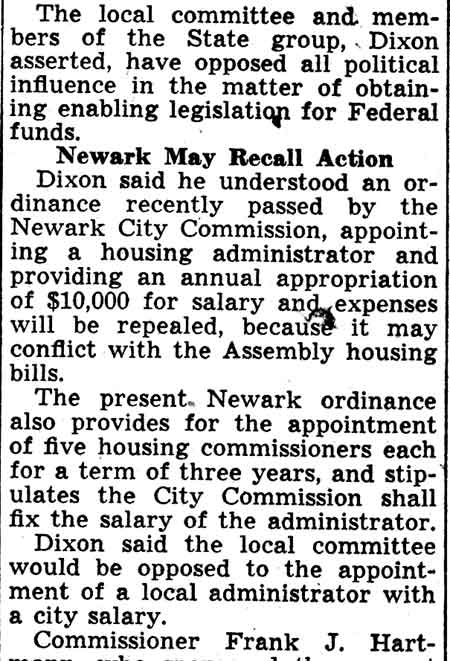
The local committee and members of the State group, Dixon asserted, have opposed all political influence in the matter of obtaining enabling legislation for Federal funds.
Newark May Recall Action
Dixon said he understood an ordinance recently passed by the Newark City Commission, appointing a housing administrator and providing an annual appropriation of $10,000 for salary and expenses will be repealed, because it may conflict with the Assembly housing bills.
The present Newark ordinance also provides for the appointment of five housing commissioners each for a term of three years, and stipulates the City Commission shall fix the salary of the administrator.
Dixon said the local committee would be opposed to the appointment of a local administrator with a city salary.
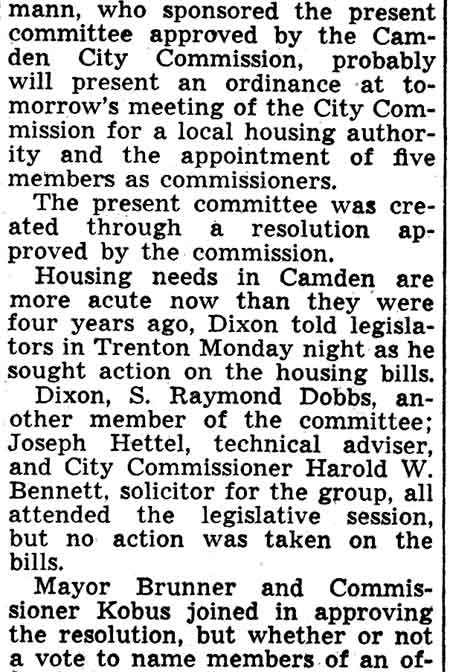
Commissioner Frank J. Hartmann, who sponsored the present committee approved by the Camden City Commission, probably will present an ordinance at tomorrow’s meeting of the City Commission for a local housing authority and the appointment of five members as commissioners.
The present committee was created through a resolution approved by the commission.
Housing needs in Camden are more acute now than they were four years ago, Dixon told legislators in Trenton Monday night as he sought action on the housing bills.
Dixon, S. Raymond Dobbs, another member of the committee; Joseph Hettel, technical adviser, and City Commissioner Harold W. Bennett, solicitor for the group, all attended the legislative session, but no action was taken on the bills.
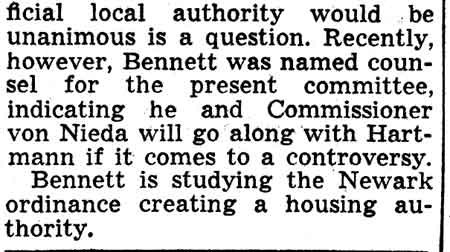
Mayor Brunner and Commissioner Kobus joined in approving the resolution, but whether or not a vote to name members of an official local authority would be unanimous is a question. Recently, however, Bennett was named counsel for the present committee, indicating he and Commissioner von Nieda will go along with Hartmann if it comes to a controversy.
Bennett is studying the Newark ordinance creating a housing authority.
Camden Mayor Advises Saving in City Budget
Philadelphia Inquirer —
Only Expenditures for Actual Needs of Municipality Recommended to Council
Mayor Ellis, of Camden, in presenting his annual message to City Council yesterday at its reorganization for the ensuing year, stated that in accordance with the government’s plea for the conservation of our resources, he refrained from offering suggestions that would mean the expenditure of large sums of money. His recommendations were therefore along lines of what he termed the city’s actual needs.
Pointing out that labor scarcity and war restrictions on materials had hampered street construction by the Highway Department, the Mayor stated since the establishment of the city-owned plant 161,[?] square yards of asphalt have been laid, in addition to an almost equal amount of resurfacing and patching, at a cost of much less than charged by private contract. He advocated the purchase of a boat to patrol the river front during the war, and called attention to the need of more men in both the Police and Fire Departments.
In discussing the proposed bridge connecting Camden and Philadelphia, Mayor Ellis stated New Jersey is in readiness to enact the need [sic] legislation, and that all that is necessary to give the project the impetus that will mean its construction is the taking of the necessary steps by the Pennsylvania Legislature.
Mayor Ellis spoke of the wisdom of the establishing of the auxiliary pumping station of the municipal water plant, and stated that during the year it is planned to bore more artesian wells. He urged that a special committee be appointed to supervise and lend financial aid to the summer war gardens. In connection with the library, the Mayor advocated the purchase of such books as will fit the youth of the city for the changed conditions brought about by the war.
Council confirmed a number of appointments recommended by Mayor Ellis. William H. Davis was reappointed a member of the City Board of Assessors, and Howard M. Cooper and Thomas French were made members of the Board of Library Trustees, the first succeeding himself, and the latter Wilbur F. Rose, resigned. Dr. A. Haines Lippincott was appointed police and fire surgeon, succeeding the late Dr. E. A. Y. Schellenger. Herbert A. Munger was reappointed a member of the Sinking Fund Commission for three years.
A City Plan Commission for one year was appointed as follows: T. Gordon Coulter, F. A. Finkeldey, George Kappell, William C. Davis, Theodore T. Kausel, Allen Jarvis, Frank S. Vanhart, Frederick von Nieda and Joseph Forsyth, the last three being members of City Council. Dr. Charles P. Tuttle, Dr. H. F. Bushey, Chief of Police Gravenor and Policeman Charles Whaland were appointed the Police Pension Fund Commission.
There are but two new members of City Council, William J. Kelly, of the Eighth ward, and Clifford K. Deacon, of the Tenth ward.
Underworld Life Exposed as Hall Is Given Grilling
Camden Courier —
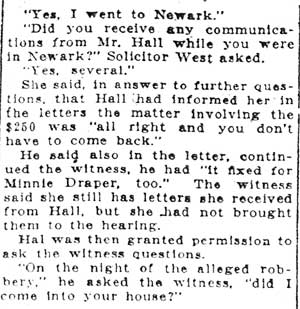
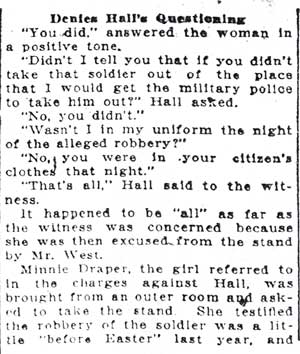
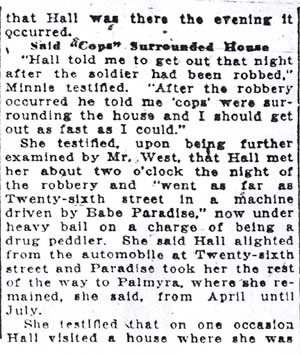
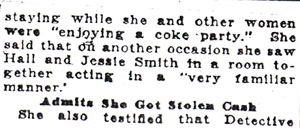
Denounced and flayed as a “moral degenerate,” Policeman Ira Hall was summarily dismissed by the police committee of City Council last night following the most sensational hearing in the history of that body.
Resignations of Detective George Murry and Policemen Tony Latorre and William Draper, also were accepted before the hearing adjourned. Councilman J. Hartley Bowen, who presided, declared that “on their face the resignations appeared as an admission from the men of their guilt.” None of the three who tendered their resignations were present at the hearing.
The four men have been charged by City Solicitor Bleakly with responsibility for “shocking” vice conditions found in recent investigations made by federal agents and city officials in the Third and Fifth wards.
Committee’s Resolution
Just before the close of the hearing, shortly after 10 o’clock, Councilman Enos Dellmuth, of the Ninth ward, introduced a resolution urging a continuation of the vice probe by city officials and requesting that Solicitor Bleakly present to Prosecutor Wolverton “all evidence of a criminal nature” against the four accused.
His resolution, which the committee unanimously adopted, follows:
“Resolved that the city solicitor present to the prosecutor of the pleas all evidence of a criminal nature against officers George Murry, Ira Hall, William Draper and Tony Latorre in order that indictments may be secured against said officers, if the evidence justifies the same, and so that the ends of justice may be furthered and the community protected against a repetition of the evil conditions brought to light in the investigation, as far as it has gone.
“And be it further resolved that the investigation of vice conditions in the city be continued by the officials in charge of the recent investigation.”
Among those who attended the hearing besides Solicitor Bleakly and [?] were Frank S. Van Hart, president of Council, Chief of Police Gravenor, Assistant Chief Hyde and members of the police committee, including Councilmen Bowen, Dellmuth, Von Nieda, Bantivoglio, Corea, Dobbins, Dudley, Kelly and Payne. Each member of the committee took a personal interest in the proceedings and [?] question after question at the defendant and witnesses.
Spectators Jam Room
Spectators, among whom were several women welfare workers, filled every bit of space in police court, where the hearing was conducted. Expressions of disgust could be seen on many faces as revelations of the depravity that exists in the tenderloin district were made. Husky policemen, who by virtue of their duties one would expect to be accustomed to stories of immoral practices, almost blushed when they heard the startling accusations.
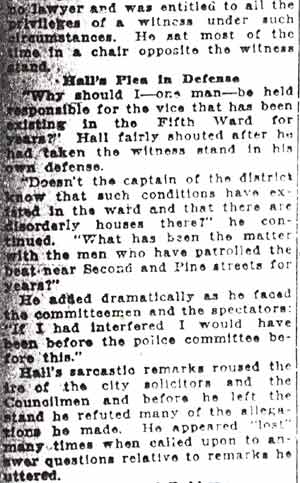
Hall seemed to have been assuming an attitude of defiance as indicated by accusations he directed at his superiors. He explained he had no lawyer and was entitled to all the privileges of a witness under such circumstances. He sat most of the time in a chair opposite the witness stand.
Hall’s Plea in Defense
“Why should I—one man—be held responsible for the vice that has been existing in the Fifth Ward for years?” Hall fairly shouted after he had taken the witness stand in his own defense.
“Doesn’t the captain of the district know that such conditions have existed in the ward and that there are disorderly houses there?” he continued. “What has been the matter with the men who have patrolled the beat near Second and Pine streets for years?”
He added dramatically as he faced the committeemen and the spectators: “If I had interfered I would have been before the police committee before this.”
Hall’s sarcastic remarks roused the ire of the city solicitors and the Councilmen and before he left the stand he refuted many of the allegations he made. He appeared “lost” many times when called upon to answer questions relative to remarks he uttered.
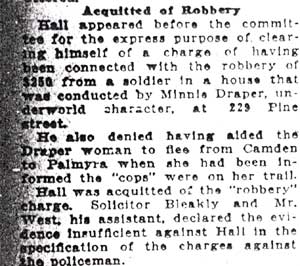
Acquitted of Robbery
Hall appeared before the committee for the express purpose of clearing himself of a charge of having been connected with the robbery of $250 from a soldier in a house that was conducted by Minnie Draper, underworld character, at 229 Pine street.
He also denied having aided the Draper woman to flee from Camden to Palmyra when she had been informed the “cops” were on her trail.
Hall was acquitted of the “robbery” charge. Solicitor Bleakly and Mr. West, his assistant, declared the evidence insufficient against Hall in the specification of the charges against the policeman.
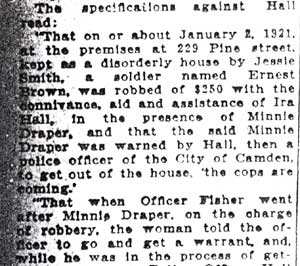
The specifications against Hall read:
“That on or about January 2, 1921, at the premises at 229 Pine street, kept as a disorderly house by Jessie Smith, a soldier named Ernest Brown, was robbed of $250 with the connivance, aid and assistance of Ira Hall, in the presence of Minnie Draper, and that the said Minnie Draper was warned by Hall, then a police officer of the City of Camden, to get out of the house, ‘the cops are coming.’
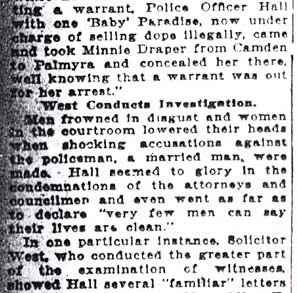
“That when Officer Fisher went after Minnie Draper, on the charge of robbery, the woman told the officer to go and get a warrant, and, while he was in the process of getting a warrant, Police Officer Hall with one ‘Baby’ Paradise, now under charge of selling dope illegally, came and took Minnie Draper from Camden to Palmyra and concealed her there, well knowing that a warrant was out for her arrest.”
West Conducts Investigation.
Men frowned in disgust and women in the courtroom lowered their heads when shocking accusations against the policeman, a married man, were made. Hall seemed to glory in the condemnations of the attorneys and councilmen and even went as far as to declare “very few men can say their lives are clean.”
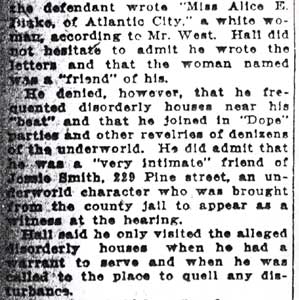
In one particular instance, Solicitor West, who conducted the greater part of the examination of witnesses, showed Hall several “familiar” letters the defendant wrote “Miss Alice E. [?]iske, of Atlantic City,” a white woman, according to Mr. West. Hall did not hesitate to admit he wrote the letters and that the woman named was a “friend” of his.
He denied, however, that he frequented disorderly houses near his “beat” and that he joined in “Dope” parties and other revelries of denizens of the underworld. He did admit that he was a “very intimate” friend of Jessie Smith, 229 Pine street, an underworld character who was brought from the county jail to appear as a witness at the hearing.
Hall said he only visited the alleged disorderly houses when he had a warrant to serve and when he was called to the place to quell any disturbance.
Smith Girl on Stand.
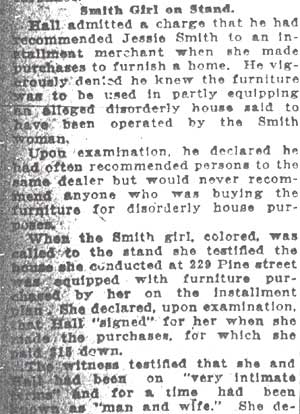
Hall admitted a charge that he had recommended Jessie Smith to an installment merchant when she made purchases to furnish a home. He vigorously denied he knew the furniture was to be used in partly equipping an alleged disorderly house said to have been operated by the Smith woman.
Upon examination, he declared he had often recommended persons to the same dealer but would never recommend anyone who was buying the furniture for disorderly house purposes.
When the Smith girl, colored, was called to the stand she testified the house she conducted at 229 Pine street was equipped with furniture purchased by her on the installment plan. She declared, upon examination, that Hall “signed” for her when she made the purchases, for which she paid $1[?] down.
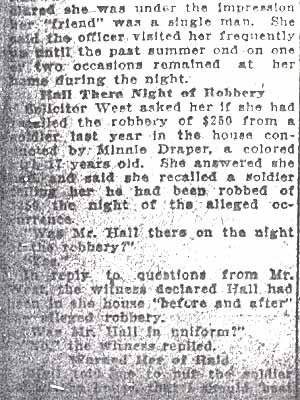
The witness testified that she and Hall had been on “very intimate terms” and for a time had been known as “man and wife.” She declared she was under the impression her “friend” was a single man. She said the officer visited her frequently up until the past summer and on one or two occasions remained at her home during the night.
Hall There Night of Robbery
Solicitor West asked her if she had [?]ailed the robbery of $250 from a soldier last year in the house conducted by Minnie Draper, a colored girl 17 years old. She answered she [?] and said she recalled a soldier telling her he had been robbed of $250 the night of the alleged occurrence.
“Was Mr. Hall there on the night of the robbery?”
“Yes.”
In reply to questions from Mr. West, the witness declared Hall had been in the house “before and after” the alleged robbery.
“Was Mr. Hall in uniform?”
“No,” the witness replied.
Warned Her of Raid
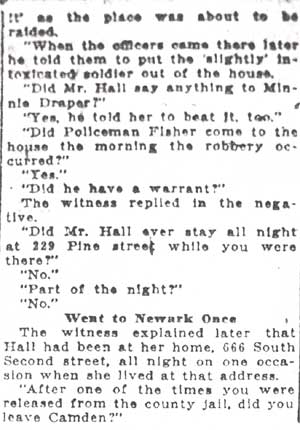
[?] told [?] to put the soldier [?] that I should beat it” as the place was about to be raided.
“When the officers came there later he told them to put the ‘slightly’ intoxicated soldier out of the house.
“Did Mr. Hall say anything to Minnie Draper?”
“Yes, he told her to beat it, too.”
“Did Policeman Fisher come to the house the morning the robbery occurred?”
“Yes.”
“Did he have a warrant?”
The witness replied in the negative.
“Did Mr. Hall ever stay all night at 229 Pine street while you were there?”
“No.”
“Part of the night?”
“No.”
Went to Newark Once
The witness explained later that Hall had been at her home, 666 South Second street, all night on one occasion when she lived at that address.
“After one of the times you were released from the county jail, did you leave Camden?”
“Yes, I went to Newark.”
“Did you receive any communications from Mr. Hall while you were in Newark?” Solicitor West asked.
“Yes, several.”
She said, in answer to further questions, that Hall had informed her in the letters the matter involving the $250 was “all right and you don’t have to come back.”
He said also in the letter, continued the witness, he had “it fixed for Minnie Draper, too.” The witness said she still has letters she received from Hall, but she had not brought them to the hearing.
Hal [sic] was then granted permission to ask the witness questions.
“On the night of the alleged robbery,” he asked the witness, “did I come into your house?”
Denies Hall’s Questioning
“You did,” answered the woman in a positive tone.
“Didn’t I tell you that if you didn’t take that soldier out of the place that I would get the military police to take him out?” Hall asked.
“No, you didn’t.”
“Wasn’t I in my uniform the night of the alleged robbery?”
“No, you were in your citizen’s clothes that night.”
“That’s all,” Hall said to the witness.
It happened to be “all” as far as the witness was concerned because she was then excused from the stand by Mr. West.
Minnie Draper, the girl referred to in the charges against Hall, was brought from an outer room and asked to take the stand. She testified the robbery of the soldier was a little “before Easter” last year, and that Hall was there the evening it occurred.
Said “Cops” Surrounded House
“Hall told me to get out that night after the soldier had been robbed,” Minnie testified. “After the robbery occurred he told me ‘cops’ were surrounding the house and I should get out as fast as I could.”
She testified, upon being further examined by Mr. West, that Hall met her about two o’clock the night of the robbery and “went as far as Twenty-sixth street in a machine driven by Babe Paradise,” now under heavy bail on a charge of being a drug peddler. She said Hall alighted from the automobile at Twenty-sixth street and Paradise took her the rest of the way to Palmyra, where she remained, she said, from April until July.
She testified that on one occasion Hall visited a house where she was staying while she and other women were “enjoying a coke party.” She said that on another occasion she saw Hall and Jessie Smith in a room together acting in a “very familiar manner.”
Admits She Got Stolen Cash
She also testified that Detective Murry was given $50 to “squash” the robbery case, which, it has been alleged, involved Hall, herself and the Smith woman.
“Did you get any of the $250 stolen from the soldier?” Mr. West asked the witness.
“Yes. I know I got my part,” she answered. “The remainder went to Jessie Smith, but I suppose Mr. Hall got his share.”
“Was Mr. Hall in uniform when he gave you the caution to get out of the house the night of the robbery?”
“No,” the woman answered.
Schoolyard Playgrounds
Camden Courier-Post —
To the Editor:
At this time I would like to thank former Mayor Von Nieda for his very interesting letter and for interest he has taken in helping me obtain playgrounds in our City schoolyards. It is impossible for me to name everyone who has come to my aid for this campaign for playgrounds. Therefore, I suggest that everyone who is interested in his campaign send their letters to Commissioner Mary W. Kobus or to the members of the Camden Board of Education so that they make take [sic] our playground campaign under advisement.
I am sure the members of the Board of Education will go along with Commissioner Kobus and help to obtain these schoolyards for playgrounds.
Yes, a number of property owners who are next to the schoolyards may object to these playgrounds.
But these children must have a place to play other than the city streets.
In these playgrounds they would be off the streets and have a contented mind and their mothers would not have to worry about the safety of their children.
HARRY A. BEACH. 943 St. John street.
Von Nieda-Kobus Rulings Explained by Justice Lloyd
Camden Courier-Post —
Jurist Cites Precedents and Walsh Act as Basis for Decisions
FILES FORMAL OPINION
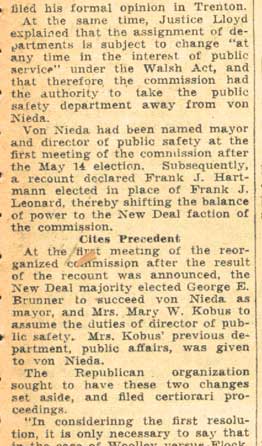
The decision of Supreme Court Justice Frank T. Lloyd, allowing a writ of certiorari to review the action of the Camden city commission in attempting to displace Frederick von Nieda as mayor, was based on a previous case in Long Branch, it was revealed yesterday when the Justice filed his formal opinion in Trenton.
At the same time, Justice Lloyd explained that the assignment of departments is subject to change “at any time in the interest of public service” under the Walsh Act, and that therefore the commission had the authority to take the public safety department away from von Nieda.
Von Nieda had been named mayor and director of public safety at the first meeting of the commission after the May 14 election. Subsequently, a recount declared Frank J. Hartmann elected in place of Frank J. Leonard, thereby shifting the balance of power to the New Deal faction of the commission.
Cites Precedent
At the first meeting of the reorganized commission after the result of the recount was announced, the New Deal majority elected George E. Brunner to succeed von Nieda as mayor, and Mrs. Mary W. Kobus to assume the duties of director of public safety. Mrs. Kobus’ previous department, public affairs, was given to von Nieda.
The Republican organization sought to have these two changes set aside, and filed certiorari proceedings.
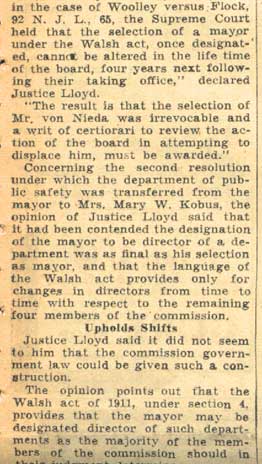
“In considerinng [sic] the first resolution, it is only necessary to say that in the case of Woolley versus Flock, 92 N. J. L., 65, the Supreme Court held that the selection of a mayor under the Walsh act, once designated, cannot be altered in the life time of the board, four years next following their taking office,” declared Justice Lloyd.
“The result is that the selection of Mr. von Nieda was irrevocable and a writ of certiorari to review the action of the board in attempting to displace him, must be awarded.”
Concerning the second resolution under which the department of public safety was transferred from the mayor to Mrs. Mary W. Kobus, the opinion of Justice Lloyd said that it had been contended the designation of the mayor to be director of a department was as final as his selection as mayor, and that the language of the Walsh act provides only for changes in directors from time to time with respect to the remaining four members of the commission.
Upholds Shifts
Justice Lloyd said it did not seem to him that the commission government law could be given such a construction.
The opinion points out that the Walsh act of 1911, under section 4, provides that the mayor may be designated director of such departments as the majority of the members of the commission should in [cut off at the crop edge]
3 G.O.P. Rulers in Secret Session
Camden Courier-Post —
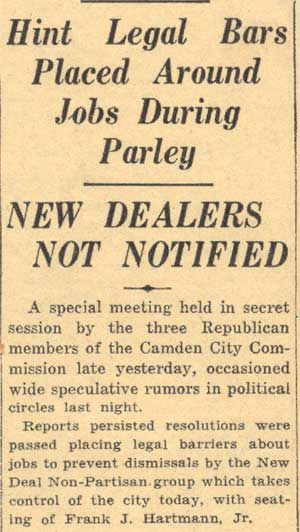
Hint Legal Bars Placed Around Jobs During Parley
NEW DEALERS NOT NOTIFIED
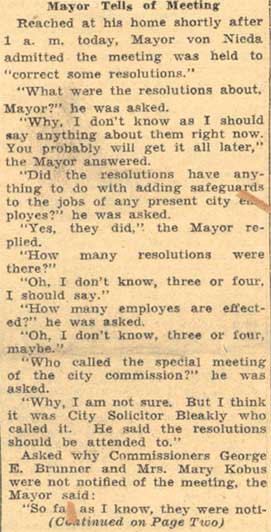
A special meeting held in secret session by the three Republican members of the Camden City Commission late yesterday, occasioned wide speculative rumors in political circles last night.
Reports persisted resolutions were passed placing legal barriers about jobs to prevent dismissals by the New Deal Non-Partisan group which takes control of the city today, with seating of Frank J. Hartmann, Jr.
Mayor Tells of Meeting
Reached at his home shortly after 1 a. m. today, Mayor von Nieda admitted the meeting was held to “correct some resolutions.”
“What were the resolutions about, Mayor?” he was asked.
“Why, I don’t know as I should say anything about them right now. You probably will get it all later,” the Mayor answered.
“Did the resolutions have anything to do with adding safeguards to the jobs of any present city employees?” he was asked.
“Yes, they did,” the Mayor replied.
“How many resolutions were there?”
“Oh, I don’t know, three or four, I should say.”
“How many employes are effected [sic]?” he was asked.
“Oh, I don’t know, three or four, maybe.”
“Who called the special meeting of the city commission?” he was asked.
“Why, I am not sure. But I think it was City Solicitor Bleakly who called it. He said the resolutions should be attended to.”
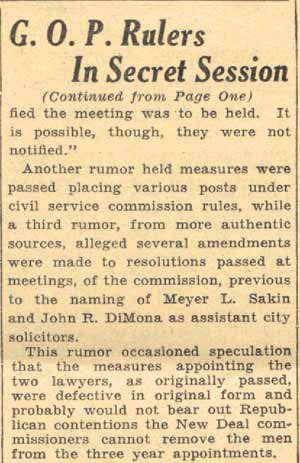
Asked why Commissioners George E. Brunner and Mrs. Mary Kobus were not notified of the meeting, the Mayor said: “So far as I know, they were not notified the meeting was to be held. It is possible, though, they were not notified.”
Another rumor held measures were passed placing various posts under civil service commission rules, while a third rumor, from more authentic sources, alleged several amendments were made to resolutions passed at meetings, of the commission, previous to the naming of Meyer L. Sakin and John R. DiMona as assistant city solicitors.
This rumor occasioned speculation that the measures appointing the two lawyers, as originally passed, were defective in original form and probably would not bear out Republican contentions the New Deal commissioners cannot remove the men from the three year appointments.
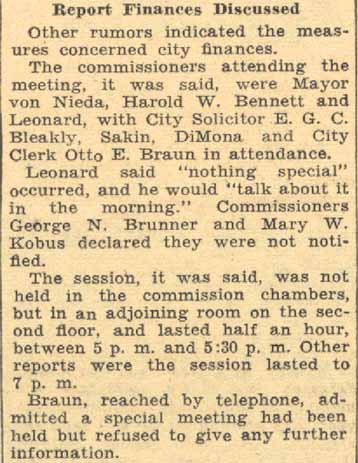
Report Finances Discussed
Other rumors indicated the measures concerned city finances.
The commissioners attending the meeting, it was said, were Mayor von Nieda, Harold W. Bennett and Leonard, with City Solicitor E. G. C. Bleakly, Sakin, DiMona and City Clerk Otto E. Braun in attendance.
Leonard said “nothing special” occurred, and he would “talk about it in the morning.” Commissioners George N. Brunner and Mary W. Kobus declared they were not notified.
The session, it was said, was not held in the commission chambers, but in an adjoining room on the second floor, and lasted half an hour, between 5 p. m. and 5:30 p. m. Other reports were the session lasted to 7 p. m.
Braun, reached by telephone, admitted a special meeting had been held but refused to give any further information.
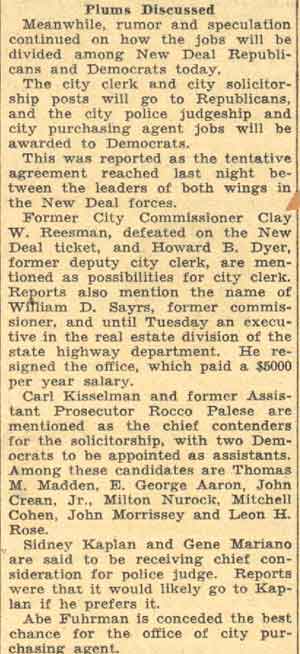
Plums Discussed
Meanwhile, rumor and speculation continued on how the jobs will be divided among New Deal Republicans and Democrats today. The city clerk and city solicitorship posts will go to Republicans, and the city police judgeship and city purchasing agent jobs will be awarded to Democrats.
This was reported as the tentative agreement reached last night between the leaders of both wings in the New Deal forces.
Former City Commissioner Clay W. Reesman, defeated on the New Deal ticket, and Howard B. Dyer, former deputy city clerk, are mentioned as possibilities for city clerk. Reports also mention the name of William D. Sayrs, former commissioner, and until Tuesday an executive in the real estate division of the state highway department. He resigned the office, which paid a $5000 per year salary.
Carl Kisselman and former Assistant Prosecutor Rocco Palese are mentioned as the chief contenders for the solicitorship, with two Democrats to be appointed as assistants. Among these candidates are Thomas M. Madden, E. George Aaron, John Crean, Jr., Milton Nurock, Mitchell Cohen, John Morrissey and Leon H. Rose.
Sidney Kaplan and Gene Mariano are said to be receiving chief consideration for police judge. Reports were that it would likely go to Kaplan if he prefers it.
Abe Fuhrman is conceded the best chance for the office of city purchasing agent.
Richman Supported
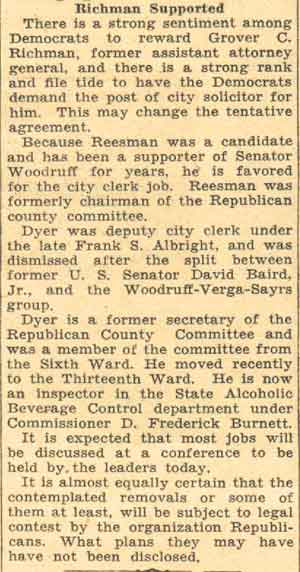
There is a strong sentiment among Democrats to reward Grover C. Richman, former assistant attorney general, and there is a strong rank and file tide to have the Democrats demand the post of city solicitor for him. This may change the tentative agreement.
Because Reesman was a candidate and has been a supporter of Senator Woodruff for years, he is favored for the city clerk job. Reesman was formerly chairman of the Republican county committee.
Dyer was deputy city clerk under the late Frank S. Albright, and was dismissed after the split between former U. S. Senator David Baird, Jr., and the Woodruff-Verga-Sayrs group.
Dyer is a former secretary of the Republican County Committee and was a member of the committee from the Sixth Ward. He moved recently to the Thirteenth Ward. He is now an inspector in the State Alcoholic Beverage Control department under Commissioner D. Frederick Burnett.
It is expected that most jobs will be discussed at a conference to be held by the leaders today.
It is almost equally certain that the contemplated removals or some of them at least, will be subject to legal contest by the organization Republicans. What plans they may have have not been disclosed.
3 Hydrant Showers Dedicated; Segal Street Youngsters Happy
Camden Courier-Post —
North Camden Garden Club Sponsors Move to Give Children Relief on Sultry Days; Mayor Turns Key for First Spray
More Heat Waves—Who Cares—Not These!
Courier-Post Photo.
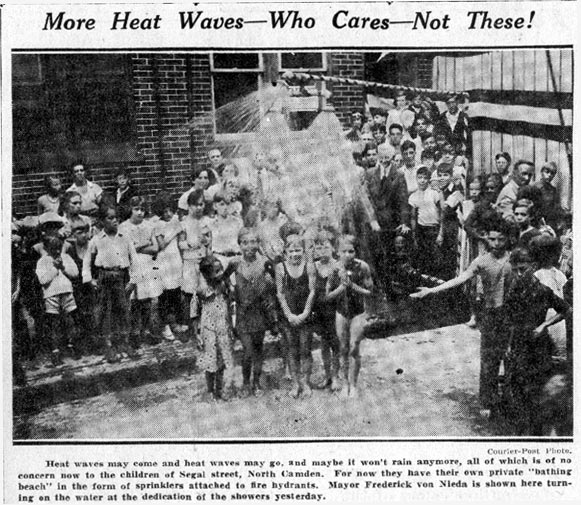
Heat waves may come and heat waves may go, and maybe it won’t rain anymore, all of which is of no concern now to the children of Segal street, North Camden. For now they have their own private “bathing beach” in the form of sprinklers attached to fire hydrants. Mayor Frederick von Nieda is shown here turning on the water at the dedication of the showers yesterday.
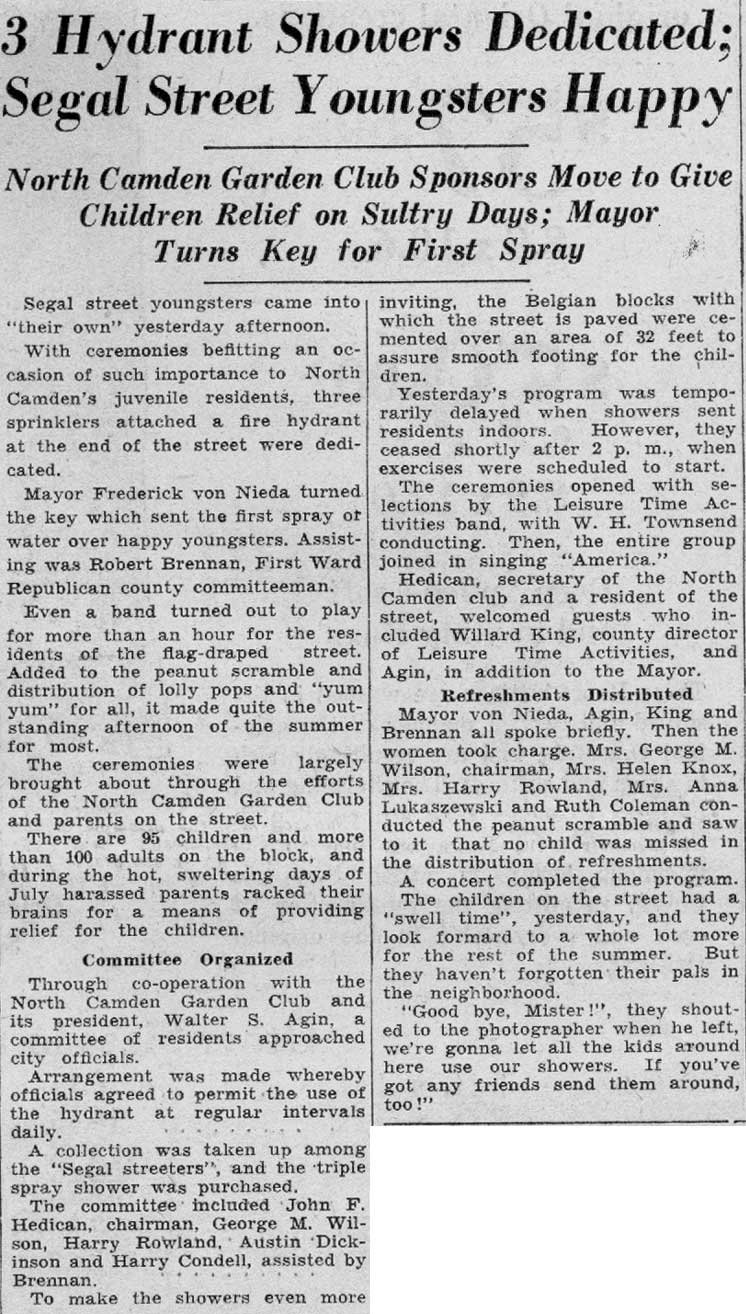
Segal street youngsters came into “their own” yesterday afternoon.
With ceremonies befitting an occasion of such importance to North Camden’s juvenile residents, three sprinklers attached a fire hydrant at the end of the street were dedicated.
Mayor Frederick von Nieda turned the key which sent the first spray of water over happy youngsters. Assisting was Robert Brennan, First Ward Republican county committeeman.
Even a band turned out to play for more than an hour for the residents of the flag-draped street. Added to the peanut scramble and distribution of lolly pops and “yum yum” for all, it made quite the outstanding afternoon of the summer for most.
The ceremonies were largely brought about through the efforts of the North Camden Garden Club and parents on the street.
There are 95 children and more than 100 adults on the block, and during the hot, sweltering days of July harassed parents racked their brains for a means of providing relief for the children.
Committee Organized
Through co-operation with the North Camden Garden Club and its president, Walter S. Agin, a committee of residents approached city officials.
Arrangement was made whereby officials agreed to permit the use of the hydrant at regular intervals daily.
A collection was taken up among the “Segal streeters”, and the triple spray shower was purchased.
The committee included John F. Hedican, chairman, George M. Wilson, Harry Rowland, Austin Dickinson and Harry Condell, assisted by Brennan.
To make the showers even more inviting, the Belgian blocks with which the street is paved were cemented over an area of 32 feet to assure smooth footing for the children.
Yesterday’s program was temporarily delayed when showers sent residents indoors. However, they ceased shortly after 2 p. m., when exercises were scheduled to start.
The ceremonies opened with selections by the Leisure Time Activities band, with W. H. Townsend conducting. Then, the entire group joined in singing “America.”
Hedican, secretary of the North Camden club and a resident of the street, welcomed guests who included Willard King, county director of Leisure Time Activities, and Agin, in addition to the Mayor.
Refreshments Distributed
Mayor von Nieda, Agin, King and Brennan all spoke briefly. Then the women took charge. Mrs. George M. Wilson, chairman, Mrs. Helen Knox, Mrs. Harry Rowland, Mrs. Anna Lukaszewski and Ruth Coleman conducted the peanut scramble and saw to it that no child was missed in the distribution of refreshments.
A concert completed the program.
The children on the street had a “swell time”, yesterday, and they look forward to a whole lot more for the rest of the summer. But they haven’t forgotten their pals in the neighborhood.
“Good bye, Mister!”, they shouted to the photographer when he left, we’re gonna let all the kids around here use our showers. If you’ve got any friends send them around, too!”
3309 River Road, Camden NJ
Home of Frederick von Nieda –
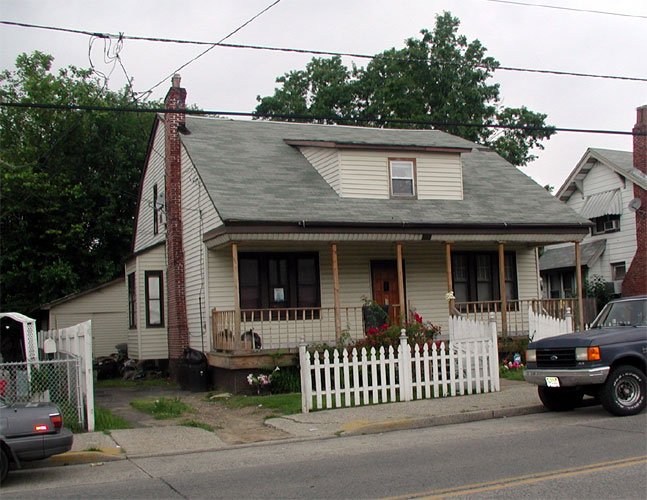
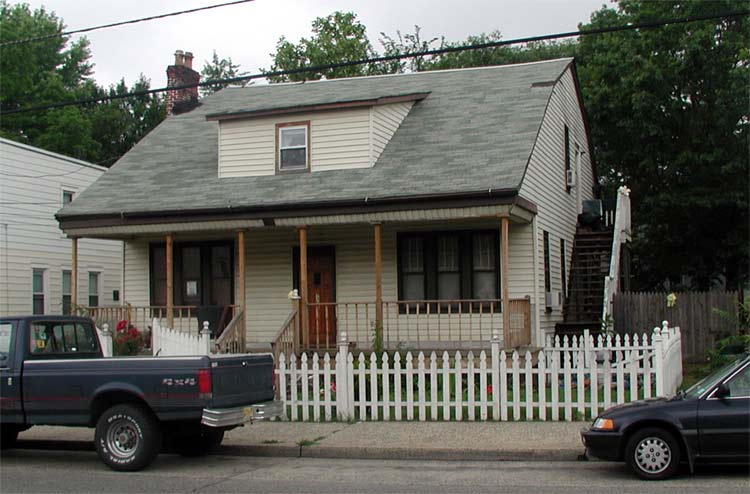
3309 River Road, Camden NJ — Home of Frederick von Nieda, June 19, 2003
Stockton Annexed Against Protest Of Democrats.
Camden Courier-Post —
Fifty years ago, the old town of Stockton was annexed to the City of Camden over the protests of Democratic members of the town council.
But a Republican Legislature approved a bill introduced by former Justice Frank T. Lloyd on March 24, 1899. He was a member of the Assembly at the time. He resided then in the structure now occupied by the Sheltering Arms Home at Eighteenth street and River avenue.
The town of Stockton had been in existence five years when the annexation took place. Merchantville and Pennsauken township were part of the original Stockton Township with the present East Camden area. Merchantville received its charter as a borough 75 years ago this month. In 1892. Pennsauken township withdrew, from the township to become a separate municipality.
For two years East Camden remained in the township. In 1894 Alfred Cramer, founder of Cramer Hill, launched a movement to create the town of Stockton and the first governing body was elected. Edward Dudley, then a leading lawyer, was elected councilman-at-large, which entitled him to preside as mayor. William S. Abbott, a lifelong resident, became became clerk.
The town was divided into three wards. fred voigt and Justice Lloyd also served with Cramer and Dudley in the town council. The town hall was on the triangle, at Twenty-seventh and Federal Streets.
Albert Plum and William C. Reeves were justices of the peace. Samuel M. Jaquillard served on the Board of Freeholders as did W.O. Buck and Joseph Funfer. Charles E. Allen was a member of the Board of Education.
After the annexation Abbott was elected to Camden City Council. Others elected were Dr. William H. Kensinger, now a resident of Florida; Frederick S. von Nieda, Frederick H. Finkeldey, president of the first Playground Commission; Arthur R, Gemberling, now of Woodstown.
Other active citizens were Lemuel D. Horner, undertaker; Dr. H. F. Hadley, Jacob Bendinger, proprietor of the Rosedale Inn, and Walter L. Tushingham, former vice-president and general manager of the Courier-Post Newspapers.
Camden’s Mayor Has Field to Himself
Philadelphia Inquirer —
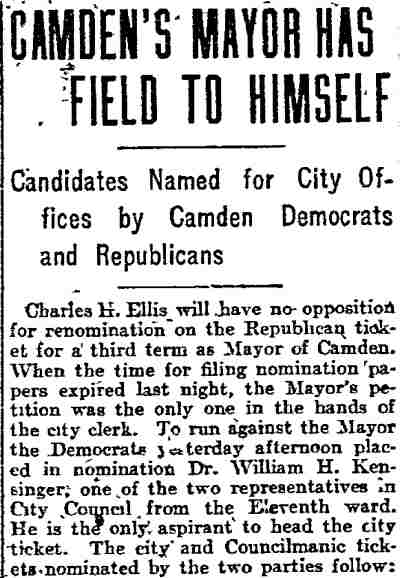
Candidates Named for City Offices by Camden Democrats and Republicans
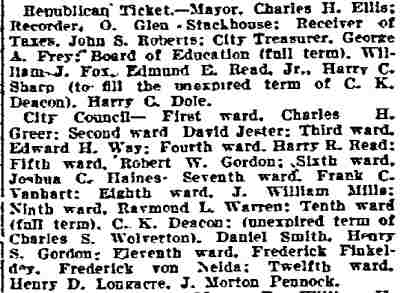
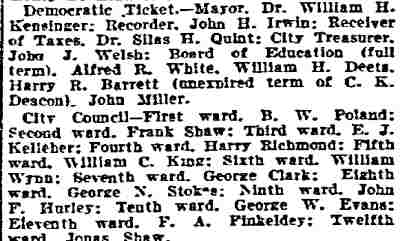
Charles H. Ellis will have no opposition for renomination on the Republican ticket for a third term as Mayor of Camden. When the time for filing nomination papers expired last night, the Mayor’s petition was the only one in the hands of the city clerk. To run against the Mayor the Democrats yesterday afternoon placed in nomination Dr. William H. Kensinger; one of the two representatives in City Council from the Eleventh ward. He is the only aspirant to head the city ticket. The city and Councilmanic tickets nominated by the two parties follow:
Republican Ticket.—Mayor, Charles H. Ellis; Recorder, O. Glen Stackhouse; Receiver of Taxes, John S. Roberts; City Treasurer, George A. Frey; Board of Education (full term), William J. Fox, Edmund E. Read, Jr., Harry C. Sharp (to fill the unexpired term of C. K. Deacon), Harry C. Dole.
City Council—First ward, Charles H. Greer; Second ward David Jester; Third ward, Edward H. Way; Fourth ward, Harry R. Read; Fifth ward, Robert W. Gordon; Sixth ward, Joshua C. Haines; Seventh ward, Frank C. Vanhart; Eighth ward, J. William Mills; Ninth ward, Raymond L. Warren; Tenth ward (full term), C. K. Deacon; (unexpired term of Charles S. Wolverton), Daniel Smith, Henry S. Gordon; Eleventh ward, Frederick Finkeldey; Frederick von Neida; Twelfth ward, Henry D. Longacre, J. Morton Pennock.
Democratic Ticket.—Mayor, Dr. William H. Kensinger; Recorder, John H. Irwin; Receiver of Taxes, Dr. Silas H. Quint; City Treasurer, John J. Welsh; Board of Education (full term), Alfred R. White, William H. Deets, Harry R. Barrett (unexpired term of C. K. Deacon), John Miller.
City Council—First ward, B. W. Poland; Second ward, Frank Shaw; Third ward, E. J. Kelleher; Fourth ward, Harry Richmond; Fifth ward, William C. King; Sixth ward, William Wynn; Seventh ward, George Clark; Eighth ward, George N. Stokes; Ninth ward, John F. Hurley; Tenth ward, George W. Evans; Eleventh ward, F. A. Finkeldey; Twelfth ward, Jonas Shaw.
The Republicans have Councilmanic contests in Tenth, Eleventh and Twelfth wards. In the Eleventh, Mr. Finkeldey is after the nomination on both tickets. He is the lone candidate of the Democrats, but has opposition on the Republican ticket.
City Plan Commission Appointed
Philadelphia Inquirer —
A City Plan Commission for one year was appointed as follows: T. Gordon Coulter, F. A. Finkeldey, George Kappell, William C. Davis, Theodore T. Kausel, Allen Jarvis, Frank S. Vanhart, Frederick von Nieda and Joseph Forsyth, the last three being members of City Council. Dr. Charles P. Tuttle, Dr. H. F. Bushey, Chief of Police Gravenor and Policeman Charles Whaland were appointed the Police Pension Fund Commission.
City Farm Gardens
Camden County in the Great War
Another weapon to defeat the enemy was the establishment of City Farm Gardens in the country. They were urged by the Government and not only provided food for city residents, but abolished unsightly vacant lots. Mayor Ellis named the first City Gardens Committee on April 19, 1917, as follows: e. g. c. bleakly, Judge Frank T. Lloyd, Zed H. Copp, William Derham, L. E. Farnham, B. M. Hedrick, David Jester, O. B. Kern, M. F. Middleton, Dr. H. L. Rose, Asa L. Roberts, W. D. Sayrs, Jr., Charles A. Wolverton, Earl T. Jackson, H. R. Kuehner, Herbert N. Moffett and Hubert H. Pfeil. At the initial meeting of the above date B. M. Hedrick was elected chairman; Zed H. Copp secretary and M. F. Middleton treasurer. Brandin W. Wright, a farming expert, was employed as general superintendent on May 3, 1917. At a meeting on May 18, 1918, the names of frank sheridan and Daniel P. McConnell were added to the publicity committee in the place of Messrs. Pfeil and Jackson.
In his annual report to City Council on January 1, 1918, Mayor Ellis urged the appointment of a committee by City Council on City Gardens and Councilman Frederick Von Neida was named as chairman. This committee with a committee of representative citizens met in the City Hall in February, 19 18, to organize for the ensuing summer. The members of the Councilmanic committee were: Frederick Von Neida, frank s. van hart, William J. Kelly and John J. Robinson.
The committee planned an exposition of farm garden products for the fall of 1918, but this plan was frustrated by the Spanish influenza epidemic.
The war gardens became victory gardens in the year 1919 when the committee met on January 29, 1919. Meyers Baker was elected secretary and William D. Sayrs, Jr., treasurer. At the meeting on March 25 committees were appointed for the Victory War Gardens Exposition held in Third Regiment Armory from September 15 to 20. Benjamin Abrams was elected general manager and Frank Sheridan publicity agent.
Helmets and Vests of Steel Urged for Camden Policemen
Camden Courier —
Camden police will be “bullet-proof” if recommendations of Councilman Frederick Von Nieda made to the police committee last night are carried out.
Mr. Von Nieda, a member of the committee, asked that the members investigate the use of bullet-proof helmets and vests now being worn by policemen in various cities.
The steel “clothing” is used to protect vital parts of the body from bullets of assassins and other types of vicious crook.
The recommendation is believed to have resulted from threats made recently against members of the police department.
City Adopts Cut Budget After Clash
Camden Courier-Post —
Slash of $702,890 Is Revealed in Totals Passed at Session of Rulers
LEASE ANNOUNCED OF RADIO STATION
Commissioners Debate With Von Nieda as He Charges Gross Extravagance
By WALT BATEZEL
The Camden City Commission yesterday approved the 1933 city budget after hearing and rejecting economy recommendations of several civic and labor organizations.
Eight speakers representing five organizations urged budget reductions and protested the total of $3,353,124.60. Verbal clashes over opinions were frequent between Commissioner harold w. bennett, director of finance and revenue, and former Councilman Frederick von Nieda and Thomas B. Hall, representatives of the Congress of Civic Associations of New Jersey.
Nearly 300 persons attended the hearing, in marked contrast to the 5000 who marched on city hall last year to demand budget reductions. The hearing lasted three hours. The departmental budget appropriations of $3,353,124.60 with the local school appropriation of $1,250,000 and other appropriations, totaling $960,060.55 to be added in the tax ordinance yet to be adopted, will give the city a total expense of $5,563,185.15 for 1933.
Tax Bill About Same
The tax rate will not be known until the tax ordinance is adopted. After the hearing Commissioner Bennett declared that due to equalization of assessments, the bills of some taxpayers will be a few dollars higher than last year, and a few dollars lower in other cases. The commission, after approving the budget on a motion by Commissioner Bennett, adopted a resolution leasing WCAM to the Broadcast Advertising Company for $1000 per year and a percentage of all receipts over $24,000. All maintenance costs will be born by the company, of which Rudolph Preisendanz, Jr., is head.
After the budget was adopted Bennett declared the City Commission would take into consideration an allegation of Frank J. Hartmann, Jr., secretary of the Civic Congress, that the $125,400 appropriation for street lighting was $26,450 higher than it should be according to figures obtained by him concerning the city’s lighting equipment. “If there has been an error the budget can be amended at any time,” Commissioner Bennett said.
Commissioner Clay W. Reesman, under whose department street lighting comes, declared that figures in his office concerning street lighting were different from those quoted by Hartmann. The figures he used, Hartmann said, were obtained by him from City Comptroller Sidney P. McCord.
Von Nieda Case
Von Nieda was the first citizen to address the commission. Shifting papers in his hands, he faced the commissioners and said: “We have here $40,000 for your Recorder’s Court in 1932, and $25,000 for 1933.”
Commissioner Bennett jumped to his feet.
“Those 1932 figures,” Bennett said, “were merely an estimate of the receipts to be taken in, but that amount did not come in. This year we anticipate only $25,000, which we consider a fair estimate.”
“That’s fine” said von nieda, “but we have never had a chance to sit in with you on these figures.”
“You can sit in with us at any time,” responded Bennett, “We’re glad to have you.”
“I see here,” said von nieda, “that the transportation inspector is paid from fees, but you show no fees and the inspector should be paid by the Public Service. I also suggest that you turn Convention Hall over to the poor. Now in dealing with Station WCAM, I see you show a profit for the last three months of $1000, while in 1932, you show no records of receipts, and we are just wondering.’
Worried by WCAM
“Do you want that answered now?” asked Bennett. “WCAM has given myself and the other commissioners some concern during the past year. It is our duty to see that we receive as much income as possible. Different methods have been used in the radio station to make it pay during the past three months, and during this time that station has been in the black. We figure that in 1933 there will be no deficit in this station, and we look for a profit of more than $1000.”
“Now in this matter of eliminating deputy directors,” von nieda said.
He was interrupted by Commissioner Reesman.
“I’ll tell you,” said Reesman, “about my deputy director Carlton Harris. My deputy receives $1750 a year. He has charge of all labor in the Department of Parks and Public Property. He is on the job every morning at 7:00 AM, and often works until 10 p. m., with the labor outside.”
“In speaking of the assessors,” von nieda continued, “we should have assessors who are not influenced by politicians or political dictators.”
“You know I won’t stand for that,” answered Bennett. “The readjustment of ratables is only a small part of the work we are doing. Each property is assessed on a basic principal. Any time you have a suggestion that will help us in our work we will be glad to hear from you but I firmly believe that real state must be relieved of its heavy tax burden by an income and sales tax, and this tax must come sooner or later.”
Seeking Relief
“As far as the city commissioners are concerned, we are studying it from day to day, in efforts to get out of the wilderness.”
“In speaking of the purchasing department,” von nieda continued, “we know what happened there last year. You fired your purchasing agent, and if you had not fired him it probably would have afforded the public some interesting reading about this purchasing department.”
“All of my men are working overtime,’ replied Bennett. “It is true the purchasing agent is out and his work is being done by an assistant (William Dilmore) at half his salary. We have got rid of as many people in these departments as we can. I had to let one girl go in the purchasing department and one girl in Controller McCord’s department. One man went on pension in the tax office and two were let out in efforts to balance the budget.
“In one of my departments where there were three girls I had, to make a $900 cut by leaving one girl out. called the three girls into my office and told them that one had to go and asked them what their home responsibilities were. One had to take care of her family, including a 77-year-old aunt; another a family with a 66-year-old aunt, and the third was supporting three or four brothers with the help of another brother, who is a barber working for practically what tips he could get.
“But I had to make a $900 cut. The girls asked me not to dismiss any of them, as they each would take a $300 cut in addition to cuts already applied. Another man took an extra $260 cut so that he would not be out of work. But I had the budget to take care of, and I am ready to challenge any city the size of Camden to show so nearly a balanced budget. Our plan is to pay as we go.”
“You cite two or three instances,” protested von nieda. “But I want to show you scores of families which have no money and they are taxpayers. You say you have cut to the bone, but you should cut through the bone. This is no grandstand play by us. Maybe we can give you some help. Then, too, the debt interest must be paid on this tragedy,” he shouted, pointing to walls of the commission chamber.
“Maybe you can tell me how to get rid of the bonds,” suggested Bennett. “You must remember this year we have cut $900,000 from the budget.”
Offers Recommendation
Von nieda said the Civic Congress recommended that work now being done by two city solicitors should be done by one, that when more policemen and firemen are needed “little fellows” be restored first wherever possible; that the city incinerating plant be closed; that the personnel of the city’s two’ sewage disposal plants be reduced; that the city’s lighting bill be cut $40,000; that inspectors of lighting be abolished and their work done by policemen and the city’s engineer’s department. Personally he favored an income tax, he said, to relieve the burden on real estate.
“I realize,” von nieda said, “that the city commission has done a fair job, but of the congress, with conservatively 15,000 members, think you can do even better.”
Commissioner Frank B. Hanna, director of public works, interrupted von nieda on the subject of the incinerating plant, which von nieda declared could be abandoned because it did not burn garbage, but only rubbish.
“Can you see me at 9:00 AM tomorrow and go through my department with me?” asked Hanna.
“Any time,” replied von nieda.
Warns of Tax Strike
“However,” von nieda continued, “we are wondering what the figures in the right hand corner of the tax bill will be. Assessments may be lower and the tax rate higher, and that does not give a true picture. I fear the bills will be more for 1933 and for one am willing now to take the 1932 assessment on my home.
“The congress vigorously opposes this personality tax. You expect to tax the homeowner for everything he has. I warn YOU gentlemen that if this tax is imposed in Camden there will be a run on banks and building and loan associations. If that happens homeowners and renters will leave this unfortunate city. There will be a tax strike here, and so help me God, I’m helping it!”
Von nieda was followed by William Hughes of 578 Mickle street, who spoke for the Unemployed Council of New Jersey.
Hughes reiterated demands of the union for increased relief payments to unemployed, urged a municipally-owned lighting plant, operated at a profit, the same as the city’s water department; a municipal lodging house; use of hand labor instead of machinery in all city contracts and the employment of labor to “tear down the slums in Camden.”
Hartmann was the next speaker. He read from a prepared statement which he declared was an analysis of the city’s 1932 lighting expenses, and which, he said, could be lowered “had we used larger lamps.”
Reesman Contradicts
After enumerating the individual costs of lamps of various candle power, and contending a change in the lamps would effect a saving this year, Hartmann charged the city has overpaid for electric energy in street lighting.
Commissioner Reesman declared that figures used by Hartmann were in error and that therefore, his computations as to possible savings were wrong. He announced, however, he would study the situation to discover if there was any error in the budget concerning street lighting, as alleged by Hartmann.
“The Civic Congress is now circulating petitions for a referendum on a municipal lighting plant,” Hartmann said. “We now have 10,000 of the required 11,000 signatures, and we do not intend to stop until we have 25,000. You commissioners can stop these petitions by adopting a resolution declaring a referendum on the question.”
He then asked that the work of the city electrical inspector be taken over by the National Board of Fire Underwriters, and that “when the next tax sale is held, all properties be advertised, including banks, garages and to whomever the property belongs.”
Commissioner Bennett then arose and said: “I’ve used discretion on that. There are some who are paying as low as $5 per month, and I think these people should be helped. We commissioners do not want to sell the home of anyone. That is what we are trying to stop. We are in perfect agreement on that.”
Debt Moratorium Asked
“How about the Bridge Garage?” some one in the audience shouted.
“The Bridge Garage has just paid $1500,” Bennett said, “and promises to pay something every month. We are trying to make the tax bills lower by getting in all the monies we can, and where possible to take in delinquent payments no matter how small.
Clarence Moullette, secretary of the Unemployed Union of New Jersey, then arose. He asked for a moratorium on the city debt service for five years, and urged the commission to adopt such a resolution memorializing the Legislature for that relief. He announced opposition to the personality tax.
“We are not questioning the actions of the commissioners,” Moullette said. “Spending less money will not help the situation. Commissioner Hanna told me if he had $51,000 additional in his department six closed garbage trucks could purchased. This will help give work. By cutting down salaries you decrease purchasing power. Work must be had. Eventually you will pay in scrip. Why not pay in scrip now and give out work.”
Hall asked that Convention Hall be abandoned and the building used for hospitalization work for the needy, and urged the city commission to “meet in the evenings so that citizens will know and see what is going on.” He asked for abolition of the positions of plumbing, building, sewer and heating inspectors.
‘Close High Schools’
“The commission should face conditions as they are,” he said. “I speak for myself, and not the Civic Congress. I ask that the high schools be closed. I heartily approve closing of the Vocational School, but if choice was to be made between high schools and the Vocational School, I would say close the high schools. Before selling the home of anyone to meet impossible taxes, I say cut to the bone by getting rid of everything that is not absolutely necessary.
“You commissioners must be made to realize that increased taxation is what has destroyed purchasing power in America. Meet this condition!
Commissioner Bennett challenged the statement of Hall that government costs were responsible for conditions of today.
“There are numerous causes,” Bennett said.
“I would rejoice in debating it with you or anyone you select,” Hall replied, “including United States senators, and convince them in 20 minutes.”
“I’ll debate that with him,” shouted Morris Stempa of Audubon from the audience. Stempa later addressed the commission, speaking for the Socialist party, and urged the moratorium advocated by Moullette, also a Socialist.
Eugene Wasilewski, speaking for the South Camden Civic Association, denounced the commission for failing to call in civic association representatives in their preparation of the Budget.
Bennett Gives Reply
“You called in the bankers, but not those others of us who also are interested in city costs,” Wasilewski said. “You tell us now there is a reduction in assessments and then come along and wallop us with a higher tax rate. That is not fair. You were elected to look after our interests and that you have failed to do. You are making us eat red herring, and we want you to eat red herring with us.”
The last citizen to address the commission was Salvadore Guadelli, president of the Citizens-Taxpayers’ League. He made a general indictment of conditions, and asked that the city commission “do not let sectionalism creep into city affairs.”
Commissioner Bennett then arose and addressed his fellow commissioners and the audience.
“All these things suggested here today have been considered,” he said. “We five men came into office with the idea of serving the people. I know the business of financing the city is a serious problem. We have endeavored to move the budget into that realm of ‘pay-as-you-go!’ We appreciate everything presented here. Every taxpayer we look upon as an employer.
“Looking at it from every angle, this budget cannot be delayed any longer. You’ll find we were severe in preparing this budget; you’ll find we were severe last year. Last year we cut a half million. This year we cut $702,890.74, and to that the board of education, we hope, will add a cut of $250,000. That is a total cut of $952,890.74. Other cities in New Jersey show nothing to compare with it.
Budget Adopted
“I hesitate in making more cuts. I speak from experience when I say I’m a taxpayer. In the past two weeks I’ve been trying to raise money to pay taxes. I want all of you to know we commissioners can sympathize. It is not easy being at the head of a government in times like these. I hope that municipalities will receive federal relief in payment of debt service. There has been a tremendous cut in our budget, including the board of education figures. I feel the commissioners are to be commended for the work they’ve done this year.
“If we pass the budget we won’t stop at that particular point, but will see what else we can do all along the line. I feel the essential thing is to pass the budget. I’m proud of the fact we came through 1932, and are started in 1933 the same way, although I make no promise for the future. I wish for a moratorium for interest on bonds. There are the bondholders on one side and the taxpayers on the other, and the man out of work to be considered.
We are in sympathy with the man out of work. I say let the federal or government put some money into to the interest rate. We must pass this budget this afternoon. Do not delay longer. This is not an arbitrary stand on my part. I make a motion the budget now be passed.”
City Clerk Frank S. Albright called the roll and all five commissioners voting unanimously. No demonstration followed passage of the measure.
*Eugene Wasilewski referred to in this story was Eugene Waleskiewicz, who was later known as Eugene Wales.
400 Friends Pay Homage To ‘Good Gray Poet’
Camden Courier-Post —
Men and Women From Many Sections Visit Walt Whitman’s Tomb and Old Mickle Street Home on His 114th Anniversary
“It’s just a little street where old friends meet”
That’s Mickle Street where Walt Whitman, the “Good Gray Poet,” once lived, and old friends came back here from near and far yesterday to mingle under the portals of the house in which he wrote his famous works, on the 114th anniversary of his birth.
Among them was Mrs. Augusta K. Dole, 71, of Metuchen, whose husband has been a sports writer on New York newspapers for 45 years.
“They call it a dingy street and some are ashamed to return and say they lived there,” Mrs. Dole said. And with a gesture of the hand she pointed out the homes of some of neighbors, who became famous.
Among them was Button; famous artist [architect]. Another was the grandmother of J. B. Van Sciver.
“I lived at 319 Mickle Street when I was a young lady,” she said. “I was one year old when we moved into the house right across the street from Whitman. I remember when he lived on Stevens Street before he moved to Mickle Street.
Knew Whitman Well
“We lived at the Mickle Street address about 15 or 16 or 20 years; I knew Whitman well. He always stopped and exchanged greetings with me. I frequently saw him on the ferryboats crossing the rivers.
“I want to take issue right here with those who have questioned his chastity. He was more like Christ than anyone else. I saw him admiring me as a young woman one day on a ferryboat.”
“Years later I read a description of myself in one of his works. I did not begin to read his work until 30 years ago. He wrote of the true things in life. He wrote of life as it is and as we see it. I am glad to come here today at the invitation of the committee,”
Mrs. Dole sat in the last chair in which the poet rested before his last illness. She was introduced to Dr. Alexander MacAlister, who was his personal physician in his last illness and who is a member of the Walt Whitman foundation.
Then she posed with an etching by Lewis Daniel, New York artist, at the Walt Whitman art gallery, 641 Market Street. It is one of 14 the young artist drew on “The Song of the Open Road.” Two lines taken from the book are sketched under the etching as follows:
“The earth is crude and incomprehensible at first— Nature is rude and incomprehensible at first.”
400 Visit Home
More than 400 guests visited the home of the poet during the day to be welcomed by members of the foundation. Mrs. Charles A. Wolverton, wife of Congressman Wolverton, was chairman of the reception committee.
Many of the guests visited the tomb of the poet in Harleigh Cemetery where the door is ajar at his request “that his spirit may come and go as I choose.’” But no flowers were placed there as he requested none.
Born on May 31, 1819, near Huntingdon, Long Island, he had a varied career as a writer, war correspondent and poet. During the Civil War he ministered the wounded of both the North and South at Washington. He spent the last 19 years of his life in Camden, where he died in 1892.
Under the bed in his second story front bed room today is a huge metal bathtub, which he designed for use in his invalid days. His library, horsehair furniture, his favorite rocking chair and a cane with which he knocked on the floor to call his housekeeper.
Some of his writings, manuscripts and other works are the property of Miss Ann Harned and Madge Barton Feurer. They are now at the New Jerseyanna Exhibition at the State House at Trenton.
New Painting Viewed
A new painting of Walt Whitman has been completed by Byron T. Connor, of 4320 Manor Avenue, Merchantville, and is now on display at the Hotel Walt Whitman. The painting was completed in three weeks, so as to be ready for the birthday ceremonies.
Later it will be moved from the hotel and placed either in the Whitman home or hung in the lobby of the Walt Whitman Theatre.
Miss Harned, daughter of the late Thomas B. Harned, one of Whitman’s literary executors; Joseph Praissman and Mrs. Martha Davis curator of the Whitman home, were members of the anniversary committee headed by Mrs. Wolverton.
With few exceptions, members of the Walt Whitman Foundation attended yesterday’s program, including Dr. Macalister, chairman; Dr. Cornelius Weygandt, vice chairman; Mrs. Juliet Lit Stern, Joseph M. Conover, Mrs. Helen Taft Manning, Mrs. Allen Drew Cook, Mrs. Nicholas Douty, Dr. Herbert Spencer Harned, J. Frederick Harned, Roy Helton, William T. Innes, Eldridge R. Johnson, William H. Ketler, Dr. Rufus M. Jones, former Mayor Victor King, Oscar Wolf, John Frederick Lewis, Jr., Dr. Bliss Perry, Harrison S. Morris, Agnes Repplier, former Mayor Winfield S. Price, Vernon Whitman Rich, Dr. J. Duncan Spaeth, Dr. Felix E. Schelling, Dr. Robert E. Spiller, Mrs. David Abeel Storer, Frederick Von Nieda and Ralph W. Wescott.
Among the visitors was former Assemblyman William H. Iszard, who is secretary of the committee, which acquired the home as a national shrine. Iszard sponsored legislation in the Assembly for its upkeep.
Suit to End Relief Secrecy Planned by Civic Congress; Irregularities Are Charged
Camden Courier-Post —
North Camden Association Told Affidavits Are Being Taken; Cramer and Howard Accused Of Evasion; Protest Rally Called
Court action to force the Camden County Emergency Relief Administration to reveal its books for public inspection is planned by the Congress of Civic Associations of South Jersey.
This was announced last night at a meeting of the North Camden Civic Association in the headquarters of the Pyne Poynt Social Club, 939 North Fifth street. Frank J. Hartmann, Jr., secretary of both organizations, disclosed the proposed step.
Affidavits charging irregularities in the relief administration are being gathered, Hartmann asserted.
Wayland P. Cramer, director of the county relief board and Captain Albert S. Howard, deputy director, were charged with evading public inquiries.
‘Fathers Fired—Girls Hired’
“They’ve given us a grand run-a-round,” Hartmann said in relating his efforts in behalf of a destitute family.
The Congress of Civic Associations, headed by Fred von Nieda, is determined to force inspection of the relief records by applying for a court writ, Hartmann said.
Vince Marinelli, member of the North Camden association and active in the Civic Congress, declared a number of married men were discharged from positions in the relief administration and single women engaged for their posts.
Protest Rally June 11
The association agreed to join with the Unemployed Union of New Jersey in staging a public mass meeting to protest against the relief board.
The meeting is scheduled for June 11, at the Convention Hall.
Clarence E. Moullette, executive secretary of the unemployed group, addressed last night’s session, which two score persons attended.
‘Only 8 In 25,600 Rejected’
Hartmann declared that of Camden’s 117,000 persons, 25,600 are receiving emergency relief. The figure in the county is comparable, he said.
Quoting Dr. Arthur L. Stone, who recently resigned as city director of emergency relief, Hartmann asserted 6828 of the 11,400 city’s colored are in the relief line.
“In all these cases the great Emergency Relief Administration has found only eight this year that were not worthy of receiving aid,” Hartmann said he was informed.
“The taxpayers are paying the bills and they have every right to know how the money is being spent.
“If Director Cramer and Captain Howard can be out of their office all day without anyone knowing where they are I think there is ground for investigation,” he insisted.
Cites Backyard Fires
Hartmann reviewed the plight of 11 families on State Street who were forced to cook meals over a backyard fire last Saturday after gas and electric service had been suspended for non-payment of bills. Thirty-five children were affected.
Hartmann estimated that Public Service could produce electricity to supply the apartment house for one month at a cost of $2. The charge is $22, he said.
Hartmann described advantages of a municipal electric plant, for which more than 11,000 persons have signed petitions circulated by the association and civic congress. He compared this city’s tax rate and assessments with those of Jacksonville, Fla., and said the southern city earned $2,000,000 profit from its municipal light and power plant in 1932.
A campaign to further sentiment in favor of the municipal plant idea is being advanced daily, Hartmann reported. A staff of speakers is being enrolled.
Dr. Stone’s Work Reviewed
Moullette, in appealing for support of the civic association for the mass meeting next week, said that the resignation of Dr. Stone was a political move, designed to create a position with pay for some Republican organization favorite.
“Dr. Stone spent $25,000 for emergency relief in Camden.
“As a result of the efforts of Dr. Stone in his office as municipal relief director there are children in more than 500 families who obtained milk that was not given them be-fore he took the position,” Moullette said. “The purpose of the mass meeting is to bring forcibly to the attention of the authorities here and in the state that there is need for an investigation of the Camden County Emergency Relief Administration.”
New Fire Alarms Protested
Joseph Munger, of East Camden, asked the association to protest against proposed expenditure of more than $50,000 for a new fire alarm system in Camden.
He charged that the project is needless, and said that transfer of the present system from the old city hall to the new courthouse annex could be made for $2500.
“The present system is sufficient for this city,” Munger said. “The cost of removing it to the new building would be less than what the city might pay in interest for one year on $50,000.”
Hartmann said that a new system in the fire department would require employment of additional employees and thereby add more expense to the taxpayers.
Mrs. Stephen Pfeil, William Coughlin and Miss Elsie Stein were named by Harry Walton, president, to a committee with instructions to ask Mayor Roy R. Stewart to move against alleged vandalism. They charged that young boys are destroying vacant properties throughout the city.
But the Greatest of These is Charity
Camden Courier-Post —
The Mail Bag — Where Is the ‘Charity’ in Relief Methods — Who Founded Church of England — Reforestation and Economic Recovery
To the Editor:
Sir—Beautiful words, well spoken.
Especially when Charity means, in a general sense, love, benevolence, goodwill, that disposition of heart which inclines men to think favorably of their fellow men, and do them good.
We read where Dr. Stone was asked to resign because his heart ruled his head. In your editorial, Mr. Editor, something seems wrong somewhere. There seems that Mr. Cramer is unaware of the meaning of charity. Dr. Stone may or may not be the man for the job. When one has a comfortable job at the taxpayers’ expense one can easily dispense charity, especially if he uses somebody else’s money. Dr. Stone has a comfortable job, and, perhaps, he was better suited for the job because he was sure of where the next meal was coming from but Mr. Cramer evidently was of another opinion. To him Charity is a business. Since the taxpayer and the philanthropist both practice charity, the former directly or indirectly through taxation, the latter of his own free will and accord. The latter knows where his money is going or he does not give it; the former has a right to know if he so desires, Because whether it be salaries or relief, he is the one paying the bill.
The present way the relief is being run is, perhaps, the most autocratic thing ever done in the city of Camden. The ones in charge think they are above question or reproach. But one thing is certain, and that is the citizens do not think that way about it. If these in the seats of the mighty refuse to give interviews without long waits, then the citizens should inquire from someone who will give them satisfaction. We want to know who is working for the relief, where they live, how long they have lived there, their salaries, where they came from and their qualifications. Also who is getting relief and where they live. There is little to fear for those who need relief, who are, either getting it or not getting it, it is the people who do not need it that causes those who do need it not to get it.
Imagine, if you can, 6828 people of one race out of a total of 11,400 getting relief; imagine, if you can, 25,600 people getting relief in the city of Camden alone and, perhaps more than that number in the county and only eight of these were found to get relief who did not deserve it. And then they say it is none of your business, go to the Courier and get it.
When information is desired. Mr. Editor, we have to believe somebody. Do you have the information and are you holding out on us? Or is it a case of passing the buck? There is hardly a person in this city who knows somebody that needs relief and there are few people who don’t know somebody who is getting relief and does not need it. Increasing pay of investigators, employing college girls and laying off married men, cutting allowance of those who need relief, makes undeveloped minds run around in circles. When no satisfaction is given to those who pay the bills and are told that it is none of their business, then one must feel as if there is no justice, and the very fact that of all virtues the greatest of them is charity, then the words charity and relief, such as shown and practiced in the city of Camden, should never be used in the same sentence.
FREDERICK VON NIEDA
President of Congress of Civic Associations
Garden Receipts Here Total $1400, Cost $811
Camden Courier-Post —
A total of $1400 has been received from the 2800 gardens in Camden under supervision of the Emergency Relief Administration, against a cost of $811.80, according to Frederick von Nieda, chairman of the food show committee planning for the convention of the Camden City Home Garden Clubs at Convention Hall September 14, 15 and 16.
Von Nieda summarized the work of the new gardeners at a meeting of the clubs Tuesday night in Woodrow Wilson Junior High School, presided over by Arthur Y. Taylor, of the relief administration.
Representatives attended from these gardens: Cramer Hill, Taylor, Harrison, Garden City, Cox, Pyne Poynt, Princess Pat, Forest Hill, Tracy, Parkside, North East, and Clinton. Roy Adams, chief of the garden police, and Charles F. Hettinger, supervisor of gardens, were among those attending.
Mothers Hysterical In Boy Vandal Trial
Camden Courier-Post —
Pancoast Refuses Leniency to Sons, Blames Hartmann, Who Hits Back, Charges Inconsistency and Reveals Threat
Hysterics among three mothers, one of whom fainted, as their young sons were held for court yesterday inspired another attack on Police Judge Garfield Pancoast by Frank J. Hartmann, Jr., secretary of the North Camden Civic Association.
The three women shouted frantically as their sons, each 15, were led from the court to be taken to the Juvenile Detention Home on charges of incorrigibility. They had been accused of vandalism in North Camden. It was brought out, however, that Hartmann did not make the complaints against the boys, who will be detained until the next session of juvenile court is held by Judge Samuel M. Shay.
Hartmann in a statement last night disclosed that a threat had been made against him by the father of one of the boys who allegedly declared he “had a gun and was going to use it.”
Led from the courtroom after screaming and after one had fainted, the women cried so bitterly in the corridor that court attendants ordered them to leave.
The episode was one of the most turbulent in the history of the Camden police court, according to veteran attendants. So great was the turmoil there was question whether Pancoast would not have to recess other hearings.
Pancoast remained adamant in his decision despite the shrill protests of the mothers; the plea of one of the boys, who begged for release with arms outstretched, and of the complainant, who urged leniency.
Criticizes Hartmann
Pancoast criticized Hartmann for “condemning him for showing leniency in such cases, yet never making formal complaint himself against youthful vandals in a specific case.
Pancoast added that he “was compelled to act as he did because of the facts in the case and general complaints against vandalism in North Camden and other parts of the city.
The boys are: Lester Jamison, of 326 North Second Street; Frank Smith, of 521 Elm Street, and Henry Egerton, 15, of 212 Bailey Street.
Complaint against the youths was made by G.T. Moore, of 313 State Street, who charged that he had found the boys destroying a property at the northeast corner of Third and State Streets.
Value $25,000, Now 25 cents
“That property once was worth about $25,000,” Moore testified, “Today it could be bought for 25 cents because of vandalism.”
The youths admitted they had been on the premises, but denied they had caused any damage.
The court then directed that a disorderly conduct charge against them be changed to incorrigibility, the complaint for which was signed by Moore.
Moore testified that the defendants and other boys had been warned to keep off the property, but they would cross the street and ridicule him. He urged leniency, however, when the court revealed that the boys would be sent to the detention home. He said he did not want to see the youths placed in confinement and their reputations blemished.
Calls Him Liar
“I can’t be lenient in his case,” Pancoast replied. “I’ve been charged by Mr. Hartmann, of the North Camden Civic Association, with taking care of criminals and politicians who come to this court, and that is a lie. Also there has been a great deal of publicity about vandalism in North Camden, columns and columns of it, yet Hartmann has never made a single formal complaint against any boy in my court. As a citizen, if he knows such things are going on, it is his duty, as well as that of other citizens, to make a complaint to us.
“This occurrence by these boys is undoubtedly a part of the vandalism going on in North Camden and I’m going to send these boys to the detention home.”
Moore again pleaded for leniency for the boys, but Pancoast said he had no other alternative than to sentence them under the circumstances.
The arrests on complaint of Moore were made by Gus Reihm and Wilbur Prentiss, motorcycle policemen.
Civic Clubs Protest
Apprehension of youthful vandals has been urged repeatedly by the North Camden Civic Association officers, including Hartmann, who said recently that damage by the vandals in the city has reached more than $500,000 and the city officials and police have “done little or nothing about it.”
Hartmann and other officers of the association appeared before the city commission last week, urging prompt remedial measures by the city officials, and charging that too much leniency is shown in such cases. Mayor Stewart replied that the city had taken steps to eliminate the evil and was doing all that could be done to end it. The civic association’s officers protested nevertheless that this was not so, and that the police could minimize the damage if they were on the job.
Hartmann, in company with Frederick von Nieda, president of the Congress of Civic Associations, to which the North Camden association is allied, and George I. Shaw, vice president of the uptown group, conferred with Captain Arthur Colsey, at police headquarters. Captain Colsey promised further co-operation of the police in stamping out the practice of wrecking vacant dwellings and invited all citizens to report such instances to the police.
Hartmann’s Reply
In replying to Pancoast’s criticism Hartmann said:
“I learned from the father of one of the boys committed to jail by Judge Pancoast that the three boys could not be released unless I gave the word. This parent was quite alarmed, and I am told made threats against me. He declared that he had a gun and was going to use it. I can appreciate this man’s feelings, because I understand that when he returned he found his wife in a terribly excited condition, and because of the fact that their son was arrested for playing tag with some chums. But I can’t go to the detention home and order release of the boys. That’s impossible. Only the judge can do that.
“The attitude of Judge Pancoast in criticizing me indirectly as the complainant not only is uncalled for but is the direct cause of this threat, as well as the distracted state of the boy’s mother.
“Judge Pancoast is trying to throw a cloud over the real state of affairs in Camden.
“As a member of the North Camden Civic Association I have helped to point out conditions here that have existed for a long time without the police taking any notice of them, conditions which should not have been tolerated and which have caused considerable expense to property owners.
“This needless expense could have been prevented by the police and Judge Pancoast, in a quiet, yet determined manner.
‘Children Victims of Anger’
“Simply because we have criticized him and the police is not reason for Judge Pancoast to vent his anger at us upon innocent children, such as he has done in this particular case.
“He states that because we have complained it is necessary for him to hold the three young boys for court.
“On top of this he said that we never made any complaints.
“The latter is true, for we have not accused any child and do not intend to do so. It is the job of the police department to stop the wave of vandalism, not our task.
“Judge Pancoast’s attempt to blame me in this situation is ridiculous. As I look at it he seems to be trying to evade the real issues.
‘Reprimand Sufficient’
“He made a disgraceful example of three boys, to whom a reprimand would have been sufficient had they been brought before him for merely playing tag, but if they were accused of vandalism then I think his action in committing them to the detention home was justified. But, since the charge against them was changed from vandalism to incorrigibility it is apparent that there is some doubt in the judge’s mind.
“Even with this reasonable doubt I cannot reconcile a case with the disposition of two others, immediately prior to the hearing of the three boys. I understand that two defendants on charges of stealing pipe from a vacant dwelling were dismissed.
“The difference in these two instances, certainly does not give evidence of Judge Pancoast’s sincerity in dealing with vandalism, or convince me that he is co-operating with the mayor in correcting the evils of which the Citizens and taxpayers have rightfully complained.”
Parents Seek Child’s Return But Liberman Can’t Decide
Camden Courier-Post —
Police Court Judge Admits Having No Jurisdiction in Case Where Friend of Family Wants to Continue as Girl’s Guardian
Police Judge Lewis Liberman declined the role of King Solomon yesterday when he refused to decide the custody of a 10-year-old girl.
The court room was thrown into an uproar after the hearing, when the parents broke away from the sergeant-at-arms and rushed to the side of their child, weeping and pressing her to them.
Throughout the hearing and during the demonstration afterward, the child impassively held the hand of the woman who has cared for her during the past five and one-half years, and seemed to take no interest one way or the other in the proceedings.
Complaint in the case was made by Fred Lesnikoff, of 2 Ann street, Elizabeth, against Mrs. Clyde Heidelbough, of 216 South Thirty-second street. The daughter, Mary, is one of three children. The other two are with their parents.
Jurisdiction Questioned
State Senator S. Rusling Leap, of Salem county, represented Mrs. Heidelbough at the hearing. He opened by saying he did not believe police court had jurisdiction in such cases but was willing to proceed in the hope that Judge Liberman could settle the case informally.
Lesnikoff testified he is an automobile mechanic who has worked without interruption through the depression at a salary never less than $25 a week and is financially able to take care of his daughter.
In 1928, he testified, after his wife had come out of a sanitarium, Mary was burned while playing with matches and was in the hospital six weeks. When she was released, she had to be returned two or three times a week for clinical treatment.
Working, caring for his ill wife and the other two children made it difficult for him to take the girl to the hospital, he continued, and Mrs. Heidelbough, then a neighbor in Paterson, offered to do it for him.
The father said he not only consented to the plan but agreed further to pay Mrs. Heidelbough for keeping the child. This he did, until a year ago, when he asked that his daughter be returned to him.
Question Mother’s Health
Now, he said, he has been told by doctors that he must go to California for his wife’s health. He has saved his money and is ready to move as soon as he can have Mary. She has never been legally adopted by Mrs. Heidelbough.
Mrs. Heidelbough testified that she did not think the Lesnikoffs “are fit” to take care of Mary because of Mrs. Lesnikoff’s mental condition.
Leap told the court he twice has had the case before the state board of children’s guardians and, according to their investigation, the Lesnikoff’s [sic] have a reputation for causing disturbances in their neighborhood. Mrs. Heidelbough can better care for Mary, he said, than her mother, “who should be in some institution.”
He suggested that Judge Liberman attempt to persuade the father accordingly, but Lesnikoff insisted he is the father and has a right to the custody of the child.
“Senator Leap is correct,” concluded Judge Liberman, “when he says this court has no jurisdiction. The only suggestion I can give to the Lesnikoffs is that the Court of Chancery holds the proper remedy in such cases. I must dismiss the action before me.”
The Lesnikoffs began to weep. Sergeant-At-Arms Charles Hose began leading them away when they ran to the side of their daughter. Finally they were persuaded to leave. As they went out the door they said they would take the matter before Mayor Frederick von Nieda today.
Camden Courier-Post – August 28, 1935
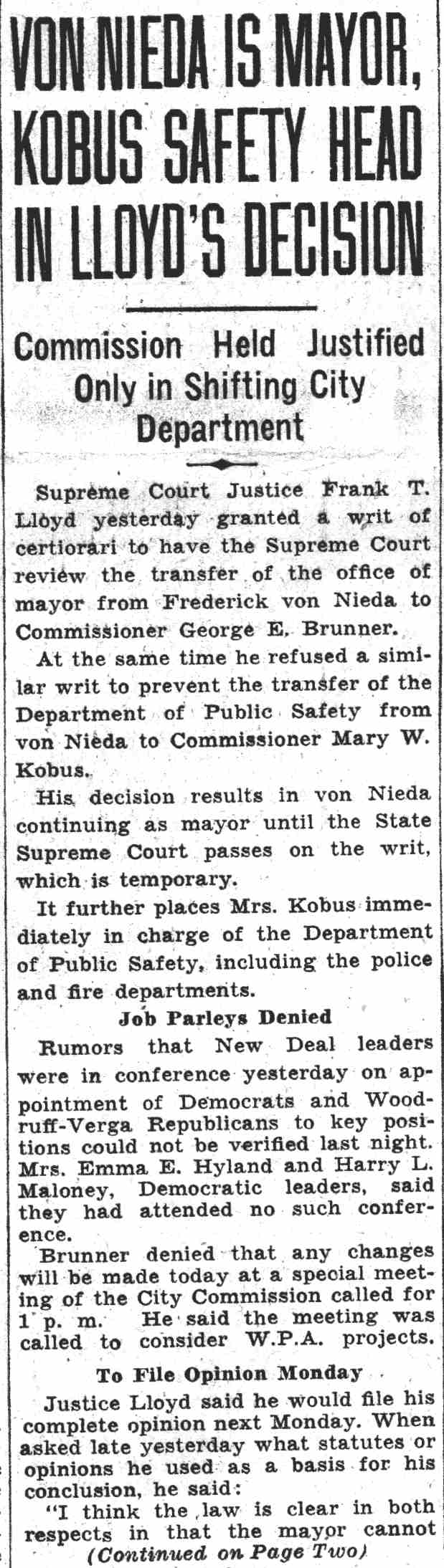
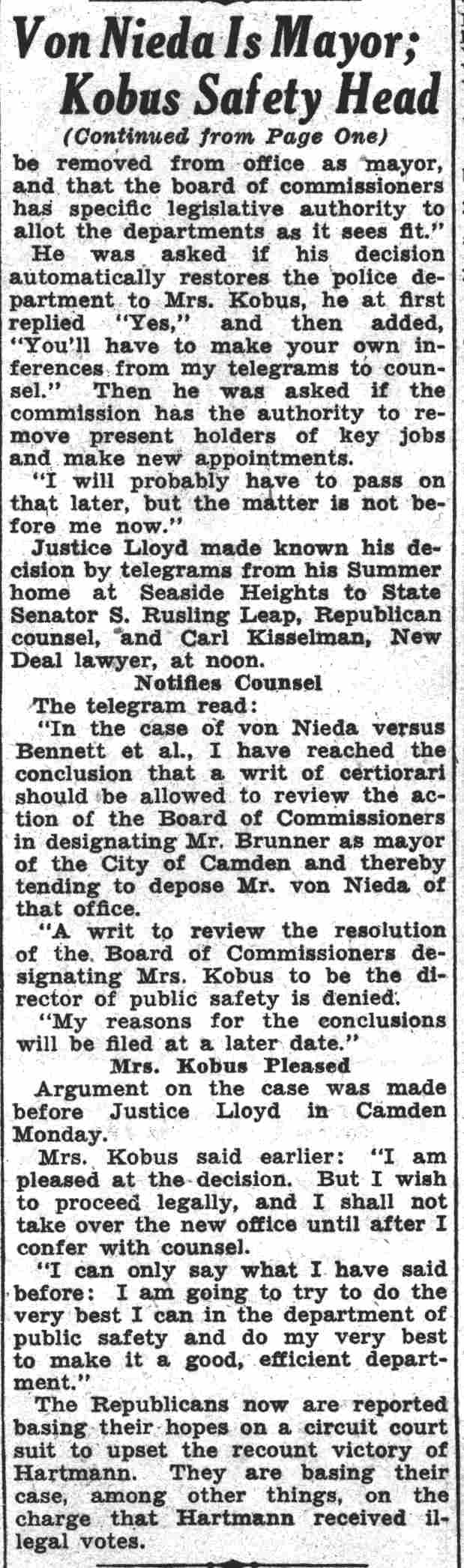
Named: Frank T. Lloyd, Frederick von Nieda, George E. Brunner, mary kobus, Emma Hyland, Harry L. Maloney, Carl Kisselman, and Frank J. Hartmann Jr..
City Votes $116,924 For 3 Departments
Camden Courier-Post —
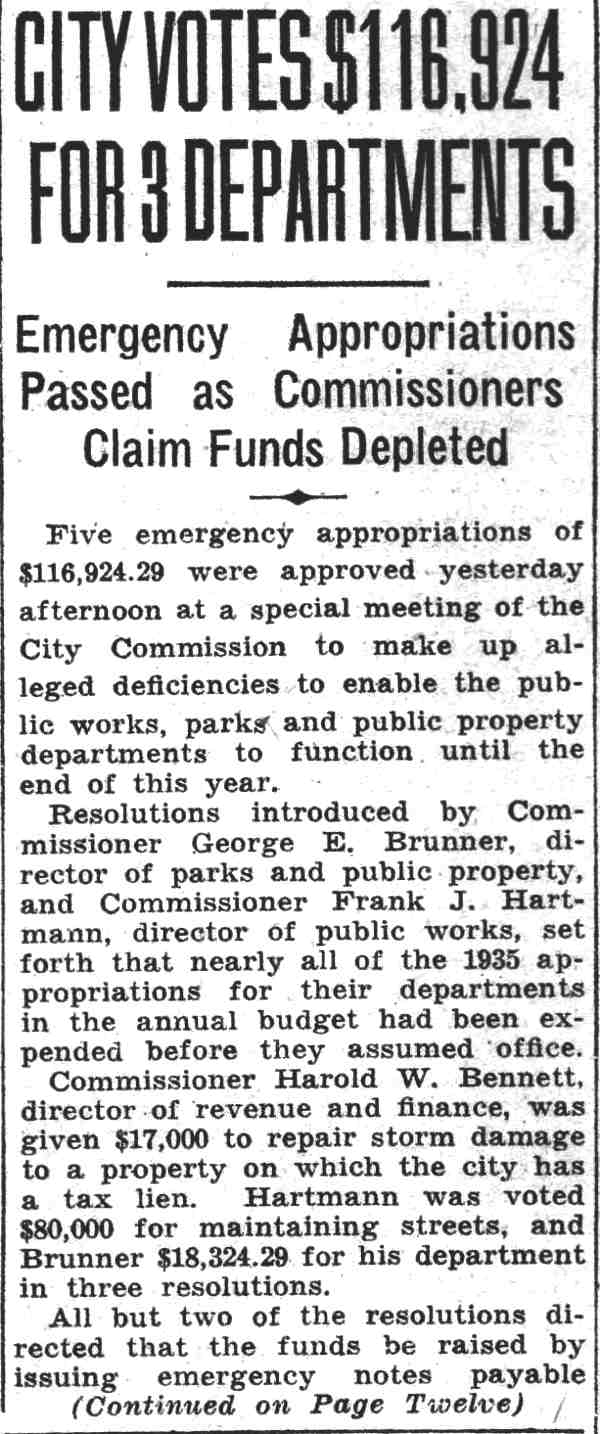

Emergency Appropriations Passed as Commissioners Claim Funds Depleted
Five emergency appropriations of $116,924.29 were approved yesterday afternoon at a special meeting of the City Commission to make up alleged deficiencies to enable the public works, parks and public property departments to function until the end of this year.
Resolutions introduced by Commissioner George E. Brunner, director of parks and public property, and Commissioner Frank J. Hartmann, director of public works, set forth that nearly all of the 1935 appropriations for their departments in the annual budget had been expended before they assumed office.
Commissioner Harold W. Bennett, director of revenue and finance, was given $17,000 to repair storm damage to a property on which the city has a tax lien. Hartmann was voted $80,000 for maintaining streets, and Brunner $18,324.29 for his department in three resolutions.
All but two of the resolutions directed that the funds be raised by issuing emergency notes payable within one year of the date of issue and bearing a rate of interest not exceeding 6 percent. They further directed Bennett to issue and sell the notes.
Spirited Debate Started
Reading of the Bennett resolution, which characterized damage done by a tornado to a property as an “act of God,” was the signal for spirited debate and was finally passed conditionally, with the understanding that City Solicitor E. G. C. Bleakly was to file a written legal opinion setting forth that the appropriation was necessary as an emergency.
Bennett was stricken by illness and left the meeting before any of the resolutions were introduced. All of the measures were passed unanimously by the three New Dealers and Mayor Frederick von Nieda.
One of Brunner’s resolutions, calling for $2629, directed that the amount be paid as a tax levy.
Bennett’s measure at one stage said the $17,000 he sought was to be raised by tax levy, and later specified the issuance of notes. The apparently conflicting situation was not clarified in subsequent argument, and the resolution was passed finally with the method of raising the sum left in doubt.
“Unforeseen Contingencies”
The resolution said the amount of $17,000 was needed because of “unforeseen contingencies” which included, it set forth, tax appeals and overdue collections.
Commissioner Kobus criticised the manner in which the measure was presented. Bennett was not present, and City Clerk Otto E. Braun had difficulty in reading it.
“This resolution is very vague,” Mrs. Kobus protested. “Passages are crossed out and others written in. What is the nature of this emergency?”
Bleakly said part of it was a property in South Camden on which the city holds a tax lein [sic] for $700, and which was damaged when struck by a tornado. He did not know the amount required to repair the damage.
Mrs. Kobus finally said she would vote in favor of the measure on condition Bleakly would file a legal opinion, and it was so passed.
Sets Minimum Amount
Hartmann introduced a resolution which set forth the city budget had appropriated $141,296.10 to the department of public works for use by the highway department. Up to July 31, he said, $128,316.49 had been expended, leaving a balance of $12,979.61 which he called insufficient to properly maintain and carry on the work in the department. He set $80,000 as the minimum amount required to carry on the work for the rest of the year.
Brunner, in his first resolution, said the budget had appropriated $43,200 for the city property department under parks and public property. Of this amount, he said, $36,296.73 has been spent already, leaving a balance of $6903.27 and requiring the addition of $10,759.29.
Brunner next introduced a resolution citing the amount appropriated for the division of cemeteries at $6082.83, all of which was expended by July 31, he said, leaving the department without funds to carry on its functions for the balance of the year.
As a result, he said, unless the sum of $4936 were appropriated, the department would be “unable to light, heat, maintain and repair the public properties under its control and will be unable to feed a horse owned by the city of Camden and used by it in the performance of its services.”
Even “Diamond” Mentioned
Mention of the famed “Diamond,” now serving his third boss, caused Mrs. Kobus to laughingly interpose:
“Was it necessary to mention the horse? What is this, a publicity stunt?”
Brunner’s third resolution called for an emergency appropriation of $2629 to finance a study of drainage areas, sewage disposal, slum elimination, revision of the building code, water facilities and proper city planning.
The commissioner recommended that this amount be raised by taxation, but his other resolutions called for the issuance of bonds at a rate of interest “not exceeding 6 percent.”
“I think they can be sold at less,” he said, “but I would set 6 percent as the top.”
Fund Transfer Ruled Out
Commissioner Kobus asked Mayor von Nieda if it were not possible to transfer funds from one department to another to prevent the issuance of further notes or adding additional taxes to next year’s levy.
The mayor replied that that could only be done at the end of the year to balance accounts.
The commission recessed to attend a conference with Works Progress Administration officials. After the recess a resolution was approved to appropriate $900 for Commissioner Hartmann’s department for the repair of water well pumps. The resolution declared an emergency.
Another resolution by Hartmann asked W. Gentry Hodgson, county director of emergency relief, to permit the City Commissioners to examine the entire relief list of the city. Brunner seconded the motion and Mrs. Kobus and von Nieda joined in voting for it.
New Dealers Prepare To Shift Key Officials
Camden Courier-Post —
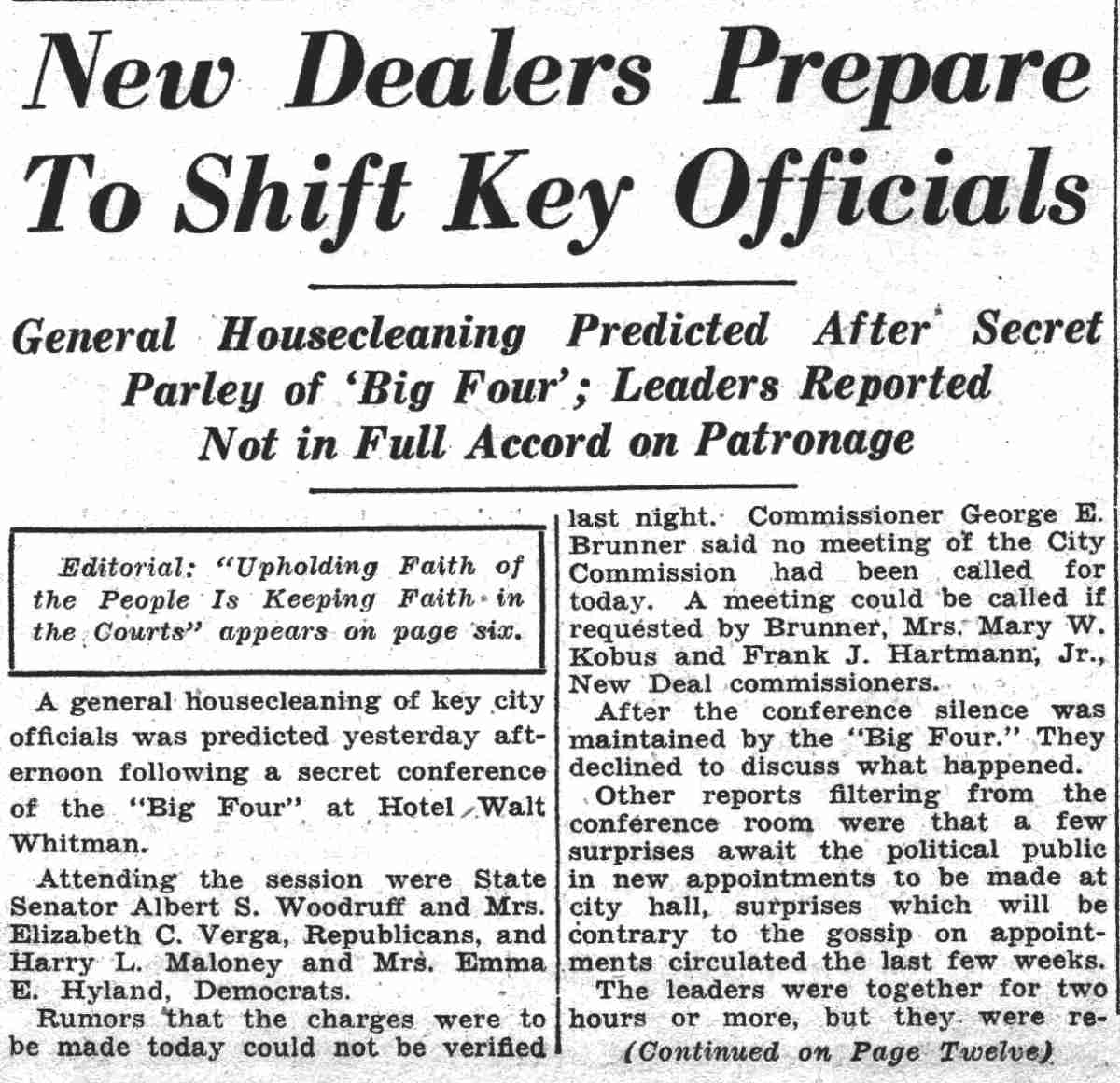

General Housecleaning Predicted After Secret Parley of ‘Big Four’; Leaders Reported Not in Full Accord on Patronage
Editorial: “Upholding Faith of the People Is Keeping Faith in the Courts” appears on page six.
A general housecleaning of key city officials was predicted yesterday afternoon following a secret conference of the “Big Four” at Hotel Walt Whitman.
Attending the session were State Senator Albert S. Woodruff and Mrs. Elizabeth C. Verga, Republicans, and Harry L. Maloney and Mrs. Emma E. Hyland, Democrats.
Rumors that the charges were to be made today could not be verified last night. Commissioner George E. Brunner said no meeting of the City Commission had been called for today. A meeting could be called if requested by Brunner, Mrs. Mary W. Kobus and Frank J. Hartmann, Jr., New Deal commissioners.
After the conference silence was maintained by the “Big Four.” They declined to discuss what happened.
Other reports filtering from the conference room were that a few surprises await the political public in new appointments to be made at city hall, surprises which will be contrary to the gossip on appointments circulated the last few weeks.
The leaders were together for two hours or more, but they were reported not in entire agreement about the patronage setup when their conference concluded.
Indications were that, with perhaps but one or two changes, the rumored lineup of appointees of the New Deal, as forecast in recent reports, will hold when the appointments are made by the city commission.
Favored for Jobs
Under the arrangements which has [sic] been conjectured by New Deal observers the last few days, the leaders are said to have agreed on these appointments:
For police judge—Firmin Michel, Democrat.
For city solicitor—Carl Kisselman, Republican.
For city prosecutor—Mitchell H. Cohen, Republican.
For assistant city solicitors—Edward V. Martino, Republican, and John Crean, Democrat.
For city clerk—Clay W. Reesman, Republican, former city commissioner, and for assistant city clerk, former Commissioner William D. Sayrs, Jr., Republican.
For director of charities—Pauline Caperoon.
For purchasing agent—Abe Fuhrman, Democrat. In the event Commissioner Harold W. Bennett resigns, as rumored, Fuhrman would be named by the New Deal commissioners to fill that vacancy.
The three New Deal commissioners who are to vote the appointments are Brunner, Mrs. Kobus and Hartmann.
Kobus Assumes Duties
Mrs. Kobus yesterday took over the directorship of public safety after a 15-minute conference with Mayor Frederick von Nieda.
“We spoke of routine matters in the department,” she said. “I wanted to know his ideas that he had started working on so I could continue them.”
Asked whether she intended to confer with police heads soon, Mrs. Kobus answered in the negative.
“I talked to them before the injunction proceedings were started,” she said, referring to von Nieda’s action which restrained her from taking over the duties of the department for several weeks.
“I hope for the co-operation of all members of the police and fire departments,” the city’s first elected woman commissioner added.
In addition to the police and firemen, Mrs. Kobus now has charge of the electrical bureau, bureau of charities, police court, traffic court, municipal motors, transportation department and city clerk.
The appointments may be expedited as a result of the ruling by Supreme Court Justice Frank T. Lloyd Tuesday that the board of commissioners has specific legislative authority to allot the municipal departments as it sees fit. The decision validated the action of the city commission assigning Commissioner Kobus as director of public safety in charge of the police and fire departments, and included the ruling that von Nieda cannot be removed as mayor.
When asked whether the commission could remove present holders of key jobs and make new appointments Justice Lloyd said that it is a question he may have to pass on later. In view of his decision, however, pointing out that the commission has special legislative authority to transfer the directorships among the city commissioners, it is believed by observers that he also will permit ousters and reappointments in the key municipal jobs.
December 5, 1935
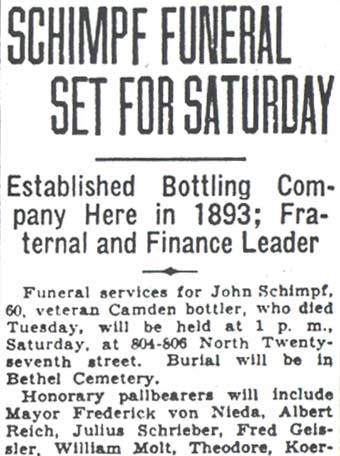
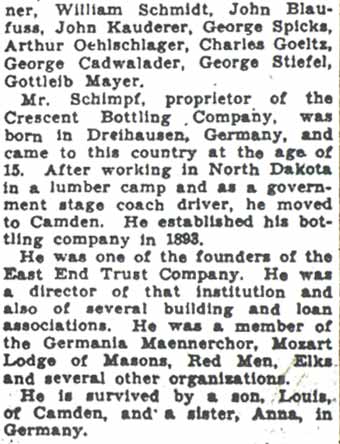
Established Bottling Company Here in 1893; Fraternal and Finance Leader
Funeral services for John Schimpf, 60, veteran Camden bottler, who died Tuesday, will be held at 1 p. m., Saturday, at 804–806 North Twenty-seventh street. Burial will be in Bethel Cemetery.
Honorary pallbearers will include Mayor Frederick von Nieda, Albert Reich, Julius Schrieber, Fred Geissler, William Molt, Theodore Koerner, William Schmidt, John Blaufuss, John Kauderer, George Spicks, Arthur Oehlschlager, Charles Goeltz, George Cadwalader, George Stiefel, Gottlieb Mayer.
Mr. Schimpf, proprietor of the Crescent Bottling Company, was born in Dreihausen, Germany, and came to this country at the age of 15. After working in North Dakota in a lumber camp and as a government stage coach driver, he moved to Camden. He established his bottling company in 1893.
He was one of the founders of the East End Trust Company. He was a director of that institution and also of several building and loan associations. He was a member of the Germania Maennerchor, Mozart Lodge of Masons, Red Men, Elks and several other organizations.
He is survived by a son, Louis, of Camden, and a sister, Anna, in Germany.
Ickes Accused of About Face in Halting Aid to Light Plant
Camden Courier-Post —

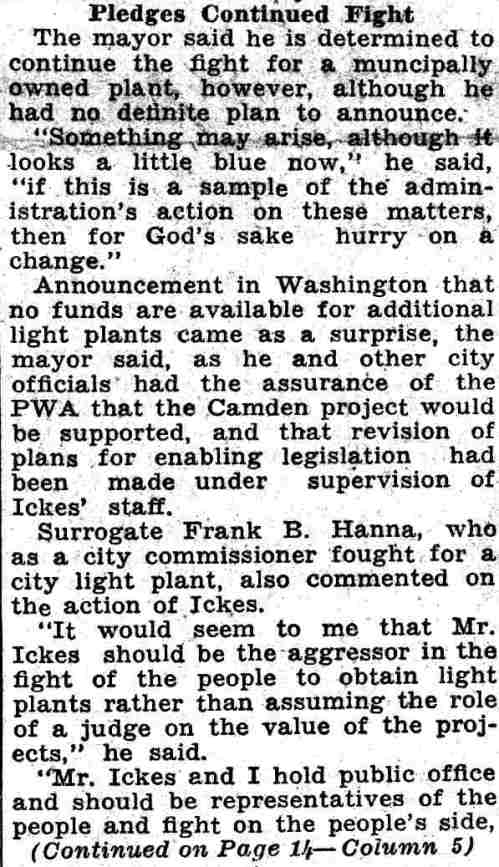
ICKES ACCUSED OF ABOUT FACE IN HALTING AID TO LIGHT PLANT
Von Nieda Promises to Continue Fight Despite Ruling on PWA Funds
HANNA RAPS OFFICIAL ON ’ARBITRARY’ STAND
Administration Seeks High Court Decision on Plans for Municipal Power
Secretary of the Interior Harold L. Ickes is making an about face if the statement he issued yesterday that no PWA cash is available for the Camden light plant is true.
That charge was made last night by Mayor Frederick von Nieda in response to a reported press conference announcement at Washington.
“But don’t let the Public Service kid itself. This thing is not dead yet,” the mayor declared.
“If this statement is true, then a lot of stuff told in pre-election campaigns was a lot of hooey, when reference was made to federal aid on public utilities for municipalities,” he said.
“We were led to believe the money for the Camden light plant was earmarked and awaited only enabling legislation. This latest action is abominal and arbitary.”
Pledges Continued Fight
The mayor said he is determined to continue the fight for a municipally owned plant, however, although he had no definite plan to announce.
“Something may arise, although it looks a little blue now,” he said, “if this is a sample of the administration’s action on these matters, then for God’s sake hurry on a change.”
Announcement in Washington that no funds are available for additional light plants came as a surprise, the mayor said, as he and other city officials had the assurance of the PWA that the Camden project would be supported, and that revision of plans for enabling legislation had been made under supervision of Ickes’ staff.
Surrogate Frank B. Hanna, who as a city commissioner fought for a city light plant, also commented on the action of Ickes.
“It would seem to me that Mr. Ickes should be the aggressor in the fight of the people to obtain light plants rather than assuming the role of a judge on the value of the projects,” he said.
“Mr. Ickes and I hold public office and should be representatives of the people and fight on the people’s side, (Continued on Page 14—Column 5)
Photos – 1936
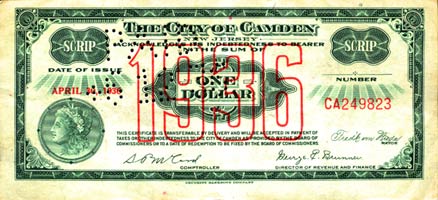
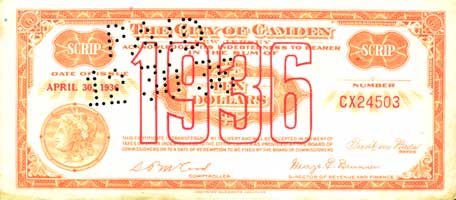
Camden city scrip, 1936 — Camden was paying its bills through scrip during the Von Nieda administration
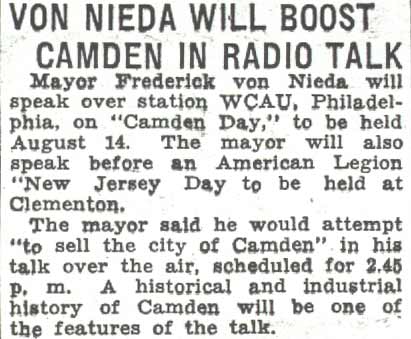
Frederick von Nieda — August 1, 1936
Diamond in Dutch—So Is City Over Bill for Treating Horse
Camden Courier-Post —

Question—Can Municipal Employe Collect for Coming to Aid of Fellow ‘Worker’? Then, Too, Is Animal Worth Fee of $3?
Diamond, Camden’s famous white cemetery horse, has eye trouble.
And so has Camden, or so it seems.
Anyhow, Diamond has the city legal department in a quandary, Commissioner Hartmann’s office in a turmoil and Dr. David D. Helm in—or out—a $3 bill for services rendered.
It all started when the eyes of the big work horse started to water. Dr. Helm, who also is sanitary inspector, was summoned and treated the animal, after which he turned in a bill for $3 to Commission [sic] Frank J. Hartmann, Jr., in whose department “Diamond” now works.
There is where the city got it’s [sic] eye trouble. The commissioners thought they would put the bill on Dr. Helm’s “eye”—and for that matter they may still do so.
That Dr. Helm saved Diamond’s life in [sic] unquestioned. That the veterinarian paid a visit to Diamond in his stall and gave him an eye wash to keep him from [sic] blind, also is not contested.
Diamond a City Employe
But, and here Raymond Dobbs, assistant to Commissioner Hartmann, entered the picture. Is it right for a city employe, working on city time, to treat another city employe—to wit, Diamond—and to bill the city for services rendered?
Dobbs didn’t know. He didn’t want to do anything illegal, and neither did Dr. Helm, so a legal opinion was requested from City Solicitor E. G. C. Bleakly.
Then Bleakly began raising a few question [sic] of his own.
Is Diamond worth the amount of the bill? If so, then the city should not be too tight to pay the bill.
Does a veterinary surgeon have to perform services free of charge for the City if he is employed as a clerk and paid clerk’s wages?
To put it in other words, if the city employs some person in a clerical capacity is it entitled to his expert knowledge and expert service in an entirely different capacity?
Letter To Pay Bill?
It was too hot for the city solicitor to argue, so he advised that Dr. Helm be asked if he would cancel his bill if the city would send him a letter of thanks for saving the life of the famous horse.
Bleakly promised to advise further in the event that Dr. Helm did not agree to this compromise.
At any rate, it was the consensus of opinion that Diamond should be taken care of by all means—if only to have him around to give to Mayor von Nieda when and if the New Deal commissioners decide to shift any departments now under the mayor.
For, if you remember, Diamond is the consolation prize of all “forgotten commissioner” when they are being punished by their fellow rulers.
The only reason he is in Commissioner Hartmann’s department is that the New Dealers saw his vote-getting abilities and decided to keep him away from the Organization Republicans.
Camden Courier-Post – August 8, 1936
Frederick von Nieda — August 8, 1936
Elimination of 20 City Blocks Urged by Housing Committee
Camden Courier-Post —
Advisory Board Suggests Razing 895 Dwellings In 2 Areas, Classified as Sub-Standard; Mayor Favors Plan For Parking Spaces
Elimination of 20 blocks of what were characterized as sub-standard properties in Camden was recommended to the city yesterday by the Camden Housing Advisory Committee.
Although it was urged that the city clear out two large areas as an economy measure, no plan was suggested whereby the city could obtain money to finance the clearance project.
The two areas that would be affected if such a proposal were carried out are as follows:
Area A: Tenth street to Twelfth street, between Market and Linden streets, embracing Linden, Penn, Lawrence and Cooper streets between Tenth and Twelfth.
Area B: Line to Stevens streets, between Second and Third streets, embracing Stevens, Benson, Washington, Berkley, Senate, Clinton, Royden, Beckett and Line streets, between Second and Third.
Made by Burnison
The recommendation was made in the office of Mayor Frederick von Nieda, by James W. Burnison, head of the housing advisory committee. Burnison termed the two areas of ten blocks each definitely sub-standard and said that the city should consider them for condemnation proceedings to effect an appreciable saving to Camden of municipal service costs.
The recommendation was made on the basis of a survey completed by the State Housing Authority. Conditions in the 20 blocks were pictured as causing an annual total loss to the city of $156,791.04. In the two areas are 895 dwellings.
It was estimated in the state survey that the city’s annual operating costs in the first area, Area A, are $95,335.30. The annual income to the city in the same area was put at $27,061.63. The annual loss to the city was fixed by the survey as $68,273.67.
Operating costs in Area B were estimated at $106,178.88 per year with an income of $17,661.51. The loss was placed at $88,517.37.
The costs were said to embrace fire protection, police protection, education, relief and health expenditures. The income is from taxes and municipal liens.
Burnison said that by tearing out the affected areas, free parking districts could be established there, bringing considerable trade and money to the city. Operating costs would be eliminated, he pointed out, and tax rates would go down generally with the removal of a costly burden.
Joseph N. Hettel, also a member of the committee, pointed out that both areas would be ripe for use as industrial sites or for a new housing project. Hettel said that if a city housing authority were established, such an agency could obtain its own bonds and be established as an independent venture, divorced from the municipal government but perhaps subsidized by the federal government.
Mayor von Nieda, expressing himself in harmony with plans for eliminating sub-standard areas, declared that he was opposed to the city’s spending any money until the city could receive assurance that the income would be as much as the loss.
The committee also considered the project on which the government is spending $3,000,000 at Westfield Acres in the construction of a low-cost housing venture. George V. Walsh, Camden district manager of the PWA housing division, said the superstructure bid of Anthony P. Miller, of Atlantic City, had been accepted.
Jobs for 500 Men
The Miller contract figure was $2,489,000. The contract has not been awarded as yet. Walsh said that foundation work would be finished Sept. 10 and that superstructure work would start Sept. 15. Completion in one year is provided by contract.
Walsh said 500 men would be employed on the superstructure work and that 800 men would be given jobs at the peak of the work. The housing plan is for three-story apartments of three, four and five rooms each. There will be 598 apartments in all, with central heating and fireproof construction. The Westfield Acres project will cover 25 acres.
Mayor von Nieda criticized the estimates of the state survey group when he said that the figures given for relief and school costs were high. These are the city’s main operating expenses, he said, and they would go on though persons living in the two areas went elsewhere.
Abe Rosenfeld, a real estate man, and James V. Moran also attended the meeting.
Von Nieda Opposes ‘Parking Lot’ Plan
Camden Courier-Post —
Mayor Calls Razing of 20 Blocks ‘Destruction,’ Denies Slums Exists [sic]
Mayor Frederick von Nieda last night denied that he approved the recommendations of the Camden Housing Advisory Committee to remove 20 blocks of houses to provide public parking places for motorists in North and South Camden.
The mayor particularly stressed his opposition to the razing of properties in the area designated by the committee as Section A, embracing Tenth to Twelfth streets between Market and Linden streets, taking in Linden, Penn, Lawrence, Cooper and Carpenter streets between Tenth and Twelfth strets [sic].
“If some people in Camden have gone crazy you can tell them the mayor has not,” Mayor Von Nieda declared.
“If you move these people then you only place them somewhere else. I am emphatically against any Zioncheck plan like that. I believe in construction, not destruction.”
‘No Slums in District’
“This plan was proposed to me by Joseph N. Hettel, a member of the committee, as a slum district elimination. I want to say here and now there are no slums in that district and the people who live there resent that statement.
“I said I would favor the plan if it meant slum elimination, but it does not. If there were actual slums in the area I would say ‘Amen.’ The residents are poor people in modest homes. Here and there is a dilapidated property. But to take them all down, I say ‘No!’
“There are 825 families living in that section. The advisory committee says a survey shows the city’s annual operating expenses in the area is $95,335.30. The income to the city is placed at $27,061.63, causing a loss to the city of $68,273.67.
“I want to say the cost of operation is $141,000 a year. We spend $66,000 yearly to educate children in that area. If we moved them we would not save anything. We would have to educate them wherever we moved them. The relief administration spends $75,000 yearly in that area. That would have to be paid wherever we move them. If the costs of operation were $180,000 that sum would be insignificant.
Wants to Help City Grow
“I want to help Camden grow if I tread on my own political toes. That progress must come slowly and not takes [sic] away wage-earners’ homes. That survey is an overstatement of facts. I have lived with figures all of my life.
“If it is a question of slums then that is a matter for police to clear up. I know there is no slum district in Section A. As far as ratables are concerned, there are lots of good ratables in the area.
“When the government proposed constructing Westfield Acres apartments it was said it would aid slum clearance. It will not. It will provide only cheaper housing for wage-earners who do not get enough to live in higher-priced houses.
“The project will house less than 600 families. If they take large families of children with them we will have to provide another school, more teachers. It will cost $75 per child a year for education. Say there will be 500 children housed there, that will mean an additional $37,500 piled on the taxes for education. The city will get a gross take of five percent on the rentals and I dread the tax rate when another year comes around.
Would Keep Veterans’ Homes
“I also am opposed to razing the two veterans’ homes at Broadway and Benson street. They are substantial. To tear them down would be an absolute crime. If they were a menace I would say yes. But not to lease the site for a parking lot. If anything should be done it would be to convert them into stores to give revenue to the city.”
James W. Burnison, chairman of the housing advisory committee, recommended the plan for the elimination of the two areas. He said the recommendation was being made on the basis of a survey made by the State Housing Authority.
Burnison declared the parking areas would bring additional business to the city and remove a costly burden.
Camden Courier-Post – August 31, 1936
Frederick von Nieda — August 31, 1936
Future of WCAM Awaits City Action
Camden Courier-Post —
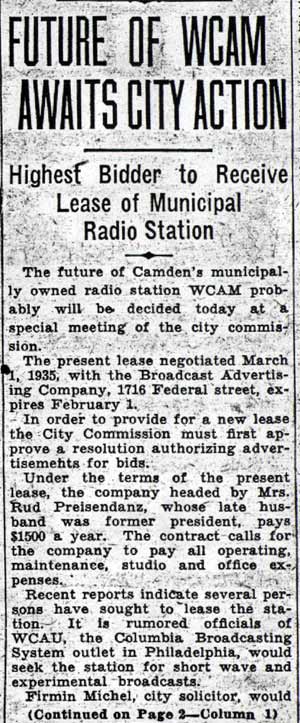
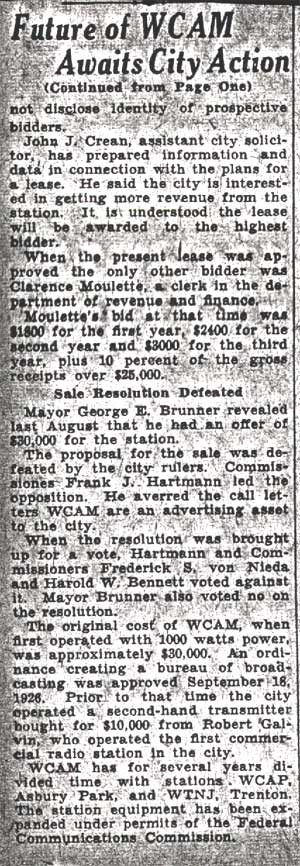
Highest Bidder to Receive Lease of Municipal Radio Station
The future of Camden’s municipally owned radio station WCAM probably will be decided today at a special meeting of the city commission.
The present lease negotiated March 1, 1935, with the Broadcast Advertising Company, 1716 Federal street, expires February 1.
In order to provide for a new lease the City Commission must first approve a resolution authorizing advertisements for bids.
Under the terms of the present lease, the company headed by Mrs. Rud Preisendanz, whose late husband was former president, pays $1500 a year. The contract calls for the company to pay all operating, maintenance, studio and office expenses.
Recent reports indicate several persons have sought to lease the station. It is rumored officials of WCAU, the Columbia Broadcasting System outlet in Philadelphia, would seek the station for short wave and experimental broadcasts.
Firmin Michel, city solicitor, would not disclose identity of prospective bidders.
John J. Crean, assistant city solicitor, has prepared information and data in connection with the plans for a lease. He said the city is interested in getting more revenue from the station. It is understood the lease will be awarded to the highest bidder.
When the present lease was approved the only other bidder was Clarence Moulette, a clerk in the department of revenue and finance.
Moulette’s bid at that time was $1800 for the first year, $2400 for the second year and $3000 for the third year, plus 10 percent of the gross receipts over $25,000.
Sale Resolution Defeated
Mayor George E. Brunner revealed last August that he had an offer of $30,000 for the station.
The proposal for the sale was defeated by the city rulers. Commissiones [sic] Frank J. Hartmann led the opposition. He averred the call letters WCAM are an advertising asset to the city.
When the resolution was brought up for a vote, Hartmann and Commissioners Frederick S. von Nieda and Harold W. Bennett voted against it. Mayor Brunner also voted no on the resolution.
The original cost of WCAM, when first operated with 1000 watts power, was approximately $30,000. An ordinance creating a bureau of broadcasting was approved September 18, 1926. Prior to that time the city operated a second-hand transmitter bought for $10,000 from Robert Galvin, who operated the first commercial radio station in the city.
WCAM has for several years divided time with stations WCAP, Asbury Park, and WTNJ, Trenton. The station equipment has been expanded under permits of the Federal Communications Commission.
Is Zat So!
Camden Courier-Post —
May we not at this time proffer a suggestion to Mayor Brunner, Eddie Kelleher and the other party sachems that should be a sure-fire plan to make Camden county safe for Democracy? We advise that the Democrats gather a fund of $4000, the money to be expended in giving testimonial dinners to Republican leaders, near-leaders and persons who figure themselves to be both.
Engage tables enough to accommodate about 350 persons. Invite representatives of all the various G. O. P. factions in the county, give a half dozen tickets to boisterous Democrats, so that the latter can sit back in their seats and enjoy the subsequent dogfight on a full stomach.
This idea that I am advancing to register about 5000 more Democrats in the county and paralyze the remnants of the once-powerful county G.O.P., was born when I attended the recent testimonial dinner to Louis Bantivoglio, freeholder from the Fifth ward.
Naturally my attendance was purely in a professional capacity. Speeches were made by divers and sundry spokesmen, the high-light being the sales talk for Bantivoglio and Baird by David Baird, Jr. The latter waxed wrathfully but warily in castigating the “half-breeds,” as he once sarcastically termed the Republicans of the ilk and stature and political leanings of Commissioner Mary W. Kobus.
Rarely, too, have we ever attended a banquet, either in the capacity of guest or reporter that ever awakened so many echoes of the past as did the dinner to the Fifth ward freeholder.
Mrs. Kobus Elected Louis
First came the information from friends of Commissioner Kobus that she was responsible for the election of Bantivoglio from the Fifth ward as freeholder. In view of the fact that Squire Baird seemed to feel that the freeholder’s election was a personal triumph, this appeared strange to yours truly.
We moseyed about, however, and discovered that whether the squire likes it or not Mary W. Kobus and her minions did elect Bantivoglio. The leaders of the Kobus faction who put the thing across were headed by a woman named Madeline Salvatore and a gentleman named “Bucky” Branch.
Bantivoglio was elected by something less than 40 votes. These votes could easily have been given to his opponent but there were strategic reasons why the Kobus faction didn’t want a Democrat chosen from the Fifth ward.
So Branch, who is a policeman, I believe, and who was not working on election day, it being his regular day off, went into his precinct and put over the votes that elected Bantivoglio.
And Mr. “Bucky” Branch, I have been informed, has been so sore at the fact that he did elect Louis Bantivoglio that he moans and cries and berates himself ever since the trick was turned.
Politicos who told me the story about the Kobus support for Bantivoglio gave a rather sensible reason for the step that was taken by the anti-Baird folk. The New Dealers among the Republicans sensed that the division between the Republicans and Democrats in the 1938 Board of Freeholders was going to be exceedingly close.
Too close, in fact, to take any chances. So it was decided to support Bantivoglio in the Fifth ward, because he was a regular Baird Republican and couldn’t be won to the coalition. The reasoning of the Kobusitees was clear and correct.
Had Bantivoglio been beaten by a Democrat, the board would have been divided equally. The Democrats would then have been able to deal with an individual rather than a faction. One vote would have given either side control. Thus by putting Bantivoglio across the Kobus faction made it imperative for the Democrats to deal with that clique; in fact Brunner and his minions had to do that little thing.
In view of this analysis I’m content to believe that the Kobus claim that the New Dealers elected Louis Bantivoglio is absolutely okay.
Lady “Copper” Not Trade Party
Now don’t get the information askew. Mrs. Kobus had no official or personal hand in this matter. It was the keen thought of some of her lieutenants, whose judgment appears to have been excellent, that fashioned this plan and executed it.
Meanwhile numerous politicos have been jibing Baird’s statement that he would “rather have one Louis Bantivoglio than 1000 ingrates.” These political seers and soothsayers declared that such a declaration proved that its author was all wet in his political judgment and short sighted in his political history.
These politicos ambushed Mackay the other day, crammed him into a corner and told him that if it “hadn’t been for Bantivoglio Baird would have control of the city commission today.”
These chuckling anti-Bairdites not only bearded me in my den, but dared me to disprove their statements by taking a look at the record. A stranger to politics in Camden, I didn’t know the import of this statement until I squinted at the ward returns for the 1935 city commission election.
There in black and white is the proof that Baird lost the city commission fight because of the Bantivoglio-Leo Rea alliance in the Fifth ward. Just to take a look at the record again and to refresh jaded memories, the regular Baird slate received the following votes in the Fifth ward:
Bennett, 1016; Leonard, 1001; Lummis, 962; Rhone, 963; von Nieda, 1081. The New Deal ticket, then supported by the Messrs. Bantivoglio and Rea, polled these votes: Baker, 1032; Brunner, 1022; Hartmann, 1001; Kobus, 1024, and Reesman, 930.
We would call your attention particularly to the Leonard-Hartmann vote. Louis and Leo supported candidates Brunner, Kobus and Hartmann, of the New Deal.
Leonard and Hartmann polled exactly the same vote, 1001. And the recount revealed Hartmann a winner by SEVEN votes, the box score showing Hartmann, 17,338, and Leonard, 17,331. And the Fifth ward turned the trick, for it would have been easy for Louis and Leo to have given Hartmann the same vote that Reesman received, or 71 less, and elected Leonard. There would have been no recount then.
Which scrutiny of the returns would seem to show that Bantivoglio as a friend of the squire proved his valor and vigilance in the cause by seating a New Deal commissioner and owing his seat in the Board of Freeholders to the Kobus clan.
In connection with this fund which the Democrats should raise to give testimonial dinners to G.O.P. leaders et cetera we might suggest that on each occasion they have, David Baird Jr., named for a new office. In order, that my friend, Florence Baker, can show her loyalty and friendship to the Old Guard Field Marshal by asking his election to the said office.
This suggestion to the Messrs. Brunner, Kelleher and the others is made tax-free, and no charge for usage. If that scheme doesn’t make Camden county safe for Democracy, nothing will.
Florence Winters, 1938
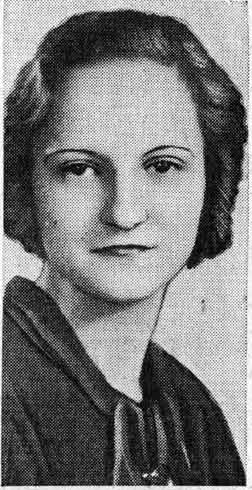
Florence Winters, who was to lead the grand march at the Beauticians and Barbers Association ball in February 1938.
Gloucester Group to Give Ball Here
Camden Courier-Post —
Camden Officials to Attend Barbers’ and Beauticians’ Fete Monday
To Lead March — Florence Winters. She will lead the grand march of the first annual ball of the Beauticians and Barbers Association of Gloucester, to be held Monday night in the Moose ballroom, 808 Market street.
More than 700 persons, including Camden city and county officials, will attend the first annual ball of the Beauticians and Barbers Association to be given Monday night at the Moose ballroom, 808 Market street, Camden.
The group, a Gloucester city organization headed by Peter A. Sessa, president of the Gloucester Master Barbers, and Miss Florence Winters, president of the Beauticians, voted to hold the event in Camden because ample quarters are not available in Gloucester due to condemnation of the old city hall.
Guests at the ball will include City Commissioners Mary W. Kobus, Frank J. Hartmann, Jr., Harold W. Bennett, Frederick von Nieda and Mayor George Brunner. Other guests will be Postmaster Emma E. Hyland, Prosecutor Samuel P. Orlando, Judges Joseph Varbalow and Gene Mariano, Mary Soistmann, Democratic state committeewoman, and Frank B. Hanna and Mrs. Florence Baker, members of the Republican State Committee; City Solicitor Firmin Michel; Mayor John F. Gorman, of Gloucester; A. L. Kuhn, of Trenton, and Charles E. Paglucia, of Plainfield, members of the State Board of Barber Examiners; Lewis Waldman, of Trenton, president of the State Master Barbers’ Association, and Vincent Ferrante, president of the Camden Master Barbers’ Association.
Music will be furnished by Bob Horton and his orchestra, and dancing will be supervised by Prof. Edward Daisey.
The committee in charge includes Lewis Kelly, chairman; Johanna Fox, secretary; Peter Pellegrino, treasurer; Verna Casey, Margaret Shuster, Catherine Moran, Effie Jones, Anna Caldwell, Florence Winters, Jean Gorman, Arthur Kinch, Nicholas Casto, Dominick La Bascio, Rocco Burgo, Peter Sessa and William Cheeseman.
Allen Feted at Birthday Party; Joins G.O.P. Tribute to Forrest
Camden Courier-Post —
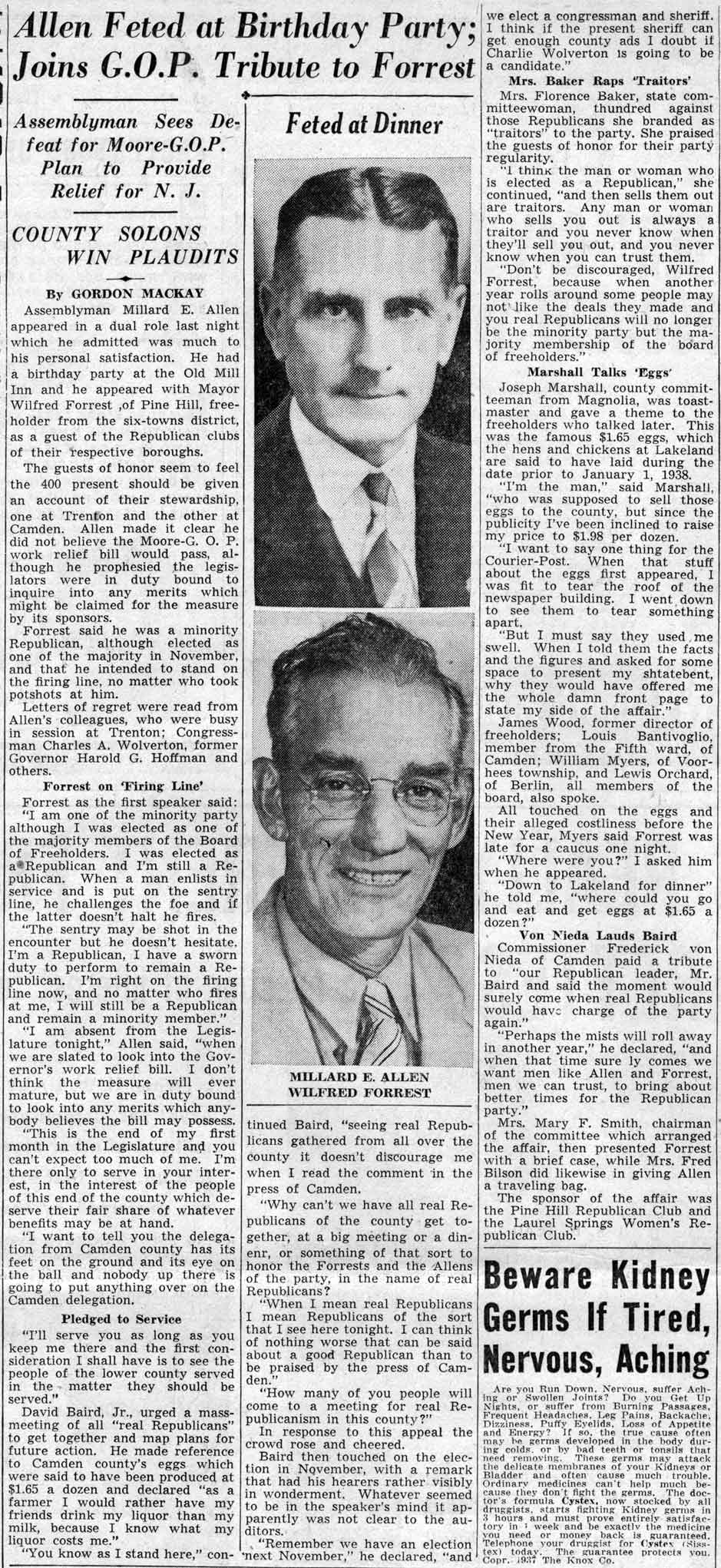
Assemblyman Sees Defeat for Moore-G.O.P. Plan to Provide Relief for N. J.
COUNTY SOLONS WIN PLAUDITS
Feted at Dinner
MILLARD E. ALLEN
WILFRED FORREST
Assemblyman Millard E. Allen appeared in a dual role last night which he admitted was much to his personal satisfaction. He had a birthday party at the Old Mill Inn and he appeared with Mayor Wilfred Forrest of Pine Hill, freeholder from the six-towns district, as a guest of the Republican clubs of their respective boroughs.
The guests of honor seem to feel the 400 present should be given an account of their stewardship, one at Trenton and the other at Camden. Allen made it clear he did not believe the Moore-G.O.P. work relief bill would pass, although he prophesied the legislators were in duty bound to inquire into any merits which might be claimed for the measure by its sponsors.
Forrest said he was a minority Republican, although elected as one of the majority in November, and that he intended to stand on the firing line, no matter who took potshots at him.
Letters of regret were read from Allen’s colleagues, who were busy in session at Trenton; Congressman Charles A. Wolverton, former Governor Harold G. Hoffman and others.
Forrest on ‘Firing Line’
Forrest as the first speaker said: “I am one of the minority party although I was elected as one of the majority members of the Board of Freeholders. I was elected as a Republican and I’m still a Republican. When a man enlists in service and is put on the sentry line, he challenges the foe and if the latter doesn’t halt he fires.
“The sentry may be shot in the encounter but he doesn’t hesitate. I’m a Republican, I have a sworn duty to perform to remain a Republican. I’m right on the firing line now, and no matter who fires at me, I will still be a Republican and remain a minority member.”
“I am absent from the Legislature tonight,” Allen said, “when we are slated to look into the Governor’s work relief bill. I don’t think the measure will ever mature, but we are in duty bound to look into any merits which anybody believes the bill may possess.
“This is the end of my first month in the Legislature and you can’t expect too much of me. I’m there only to serve in your interest, in the interest of the people of this end of the county which deserve their fair share of whatever benefits may be at hand.
“I want to tell you the delegation from Camden county has its feet on the ground and its eye on the ball and nobody up there is going to put anything over on the Camden delegation.
Pledged to Service
“I’ll serve you as long as you keep me there and the first consideration I shall have is to see the people of the lower county served in the manner they should be served.”
David Baird, Jr., urged a mass meeting of all “real Republicans” to get together and map plans for future action. He made reference to Camden county’s eggs which were said to have been produced at $1.65 a dozen and declared “as a farmer I would rather have my friends drink my liquor than my milk, because I know what my liquor costs me.”
“You know as I stand here,” continued Baird, “seeing real Republicans gathered from all over the county it doesn’t discourage me when I read the comment in the press of Camden.
“Why can’t we have all real Republicans of the county get together, at a big meeting or a dinner, or something of that sort to honor the Forrests and the Allens of the party, in the name of real Republicans?
“When I mean real Republicans I mean Republicans of the sort that I see here tonight. I can think of nothing worse that can be said about a good Republican than to be praised by the press of Camden.”
“How many of you people will come to a meeting for real Republicanism in this county?”
In response to this appeal the crowd rose and cheered.
Baird then touched on the election in November, with a remark that had his hearers rather visibly in wonderment. Whatever seemed to be in the speaker’s mind it apparently was not clear to the auditors.
“Remember we have an election next November,” he declared, “and we elect a congressman and sheriff. I think if the present sheriff can get enough county ads I doubt if Charlie Wolverton is going to be a candidate.”
Mrs. Baker Raps ‘Traitors’
Mrs. Florence Baker, state committeewoman, thundered against those Republicans she branded as “traitors” to the party. She praised the guests of honor for their party regularity.
“I think the man or woman who is elected as a Republican,” she continued, “and then sells them out are traitors. Any man or woman who sells you out is always a traitor and you never know when they’ll sell you out, and you never know when you can trust them.
“Don’t be discouraged, Wilfred Forrest, because when another year rolls around some people may not like the deals they made and you real Republicans will no longer be the minority party but the majority membership of the board of freeholders.”
Marshall Talks ‘Eggs’
Joseph Marshall, county committeeman from Magnolia, was toastmaster and gave a theme to the freeholders who talked later. This was the famous $1.65 eggs, which the hens and chickens at Lakeland are said to have laid during the date prior to January 1, 1938.
“I’m the man,” said Marshall, “who was supposed to sell those eggs to the county, but since the publicity I’ve been inclined to raise my price to $1.98 per dozen.
“I want to say one thing for the Courier-Post. When that stuff about the eggs first appeared, I was fit to tear the roof off the newspaper building. I went down to see them to tear something apart.
“But I must say they used me swell. When I told them the facts and the figures and asked for some space to present my shtatebent [sic], why they would have offered me the whole damn front page to state my side of the affair.”
James Wood, former director of freeholders; Louis Bantivoglio, member from the Fifth ward, of Camden; William Myers, of Voorhees township, and Lewis Orchard, of Berlin, all members of the board, also spoke.
All touched on the eggs and their alleged costliness before the New Year, Myers said Forrest was late for a caucus one night.
“Where were you?” I asked him when he appeared.
“Down to Lakeland for dinner” he told me, “where could you go and eat and get eggs at $1.65 a dozen?”
Von Nieda Lauds Baird
Commissioner Frederick von Nieda of Camden paid a tribute to “our Republican leader, Mr. Baird and said the moment would surely come when real Republicans would have charge of the party again.”
“Perhaps the mists will roll away in another year,” he declared, “and when that time sure ly [sic] comes we want men like Allen and Forrest, men we can trust, to bring about better times for the Republican party.”
Mrs. Mary F. Smith, chairman of the committee which arranged the affair, then presented Forrest with a brief case, while Mrs. Fred Bilson did likewise in giving Allen a traveling bag.
The sponsor of the affair was the Pine Hill Republican Club and the Laurel Springs Women’s Republican Club.
Garbage Ordinance for Camden Passed on Initial Reading
Camden Courier-Post —

Licensing of Scavengers Provided in Effort to Keep Streets Clean
CIRCULARS ACT DELAYED
An ordinance to regulate the collection and removal of ashes, rubbish and garbage was passed on first reading yesterday by the Camden City Commission.
A companion ordinance to regulate distribution of circulars, hand bills, samples and advertising matter was laid on the table.
Both were introduced by Commissioner Frank J. Hartmann, director of the department of public works, to further his campaign to “clean-up” the city.
The proposal to regulate rubbish and garbage collection was opposed by Commissioner Frederick von Nieda who declared it would be harmful to “a lot of poor people.”
The measure provides that scavengers and others must pay a license fee, wear a badge and further stipulates conveyances used to haul rubbish and other articles must carry the city license number in numerals not less than six inches high.
Heavy Fine Provided
A fine of not more than $200, a county jail sentence of not more than 90 days or both are prescribed as penalties for violations of the many regulations in the ordinance.
It provides stringent regulations affecting all householders and a penalty for dumping materials in streets, alleys and on lots.
Garbage must be separated from rubbish and the former placed in a metal container weighing not more than 50 pounds. Waterproof paper bags are permitted. Rubbish must be tightly wrapped and tied in paper and waste paper must be placed in separate bundles.
Waste materials including bricks, stone, garbage and similar substances cannot be deposited on lots or dumps without written permission of the director of public works.
It will be unlawful to break open any packages placed on sidewalks for collection as refuse or rubbish. This section is directed toward scavengers who rip open tied packages and permit the contents to litter the streets, Hartmann stated.
The annual license fee, including the identification badge, is 50 cents.
Hartmann said Camden citizens have displayed and expressed a willingness to co-operate in keeping city streets clean. He said more than eight million pounds of rubbish and garbage has been destroyed in the city incinerating plant in the last eight days.
The circular ordinance was laid over after von Nieda asked that copies be given each member of the commission. City Clerk Clay W. Reesman previously read a protest contained in a telegram from Benjamin Shatz, secretary of the South Jersey Grocers Association.
Hartmann said the smaller merchant would be benefitted by the ordinance.
It provides a license must be taken out by the distributing company or agency and fixes a charge for badges to be supplied by the city and to be worn by employes engaged in distribution of advertising matter and samples.
Stamps to Be Sold
Each piece of advertising matter and all samples must carry a stamp which will be cancelled by imprints of the licensee number. Stamps will be sold at the rate of 25 cents per hundred.
Other regulations prohibit placing of advertising matter on parked automobiles, makes it an offense to cross lawns or hedges, provides that advertising and samples shall be tightly bound with rubber bands and that same must be fastened to doorways or placed in receptacles for that purpose.
A section permits any householder, resident or business concern to obtain an official card reading “No Circulars,” to be posted on their premises. The cost is 25 cents. It will be unlawful to leave advertising materials at places displaying the signs.
No person under 14 years of age will be permitted to engage in distribution work. The maximum penalty for violations is a fine up to $200, a county jail sentence up to 90 days or both.
Cost of a license and distributors badges are not fixed. City Solicitor Firmin Michel said the fees will be decided on at a later date.
Camden Courier-Post – July 24, 1941
G.O.P. Old Guard Names ‘Committee of 11’ Empowered to Promote Harmony in Party by Compromise with Any Faction
Camden County’s G.O.P. Old Guard, adherents of former U. S. Senator David Baird, made a bid last night to regain political prestige lost in last year’s Democratic landslide.
Baird did not attend the meeting.
Meeting in the Overbrook Villa at Lindenwold under leadership of former Freeholder James W. Wood, president of the Camden County Republican Club, the more than 100 in attendance voted to name a committee of 11 “with power to nominate and make compromises they see fit toward selection of candidates for sheriff, state senator, assemblymen and freeholders.”
With the date for filing petitions two weeks away representatives of the 36 county municipalities met with a professed keynote of “harmony,” as expressed by John R. (Continued on Page 6—Column 4)
Di Mona, former assistant Camden City solicitor.
“We have a better chance for harmony in Camden this year if we all rise above petty jealousies and work wholeheartedly for the party,” Di Mona declared.
‘Beat Brunner’ Plea
“Beat Brunner in his control of the Freeholders,” was the plea offered by William Myers, former Voorhees township freeholder.
Inspirational talks were given also by former Assemblymen F. Stanley Bleakly and Edwin G. Scovel, both of whom were named to the steering committee.
Myers urged the group to forego further consideration of the recently adopted railroad tax compromise bill in the Legislature, which he asserted “is a state affair,” and urged the gathering to look to county questions.
Others named to the committee are former Freeholder Frank C. Schramm, of Atco; Benjamin H. Slemmer, of Haddon Heights; former Commissioner Frederick von Neida, of Camden.
Also Louis Bantivoglio, of Camden’s Fifth ward; William H. Heiser, Second ward; Samuel C. Berry, of Clementon, who offered the resolution; Mrs. May Rich, of Pennsauken; Mrs. Lillian Shoemaker, of Magnolia; Charles Wilhelm, of Gloucester, and Mrs. Laura B. Bilson of Laurel Springs.
May Effect Compromises
Indication the group plans a county-wide harmony effort was seen in specific declaration in the committee resolution that the group be authorized to effect compromises with the Camden County League for Good Government “or any other facion [sic].”
Reservation was made, however, for the Old Guard to have its say. The resolution provided the committee must report back for approval of any contemplated compromise.
Albert E. Pugh, county committeeman of Lindenwold, who also is chairman of the county Republican group harmony committee, was asked by Wood for a report on the progress of that unit.
Pugh said the grup [sic] had met twice, once in Gloucester and again at the home of George H. Walton, Camden county Republican chairman, in Haddonfield. He declared the group planned no further meetings.
Center on Freeholders
The concensus [sic] of the meeting was that the fight at this Fall’s polls should be centered on the choice of freeholders. A review was given of the recent court action on unseating freeholders Stanley Ciechanowski and Ventorino Francesconi, following a Republican inspired recount.
Removal of the tw [sic] freeholders by Judge V. Claude Palmer was halted by a State Supreme Court ruling. However, two three-year-term freeholders are to be elected in November.
Among others attending the session were former Freeholder Raymond G. Price, of the Eleventh ward; James D. Kershaw, former Mt. Ephraim freeholder; Arthur H. Holl, former undersheriff, and Alfred and Elsie Geister, active in Republican circles of Pennsauken township.
Community Center Plans Youth Outing
Camden Courier-Post —
Community Center Plans Youth Outing
Boys and girls who attend the Community Center at 2818 River road will be guests of the Center next Wednesday at a picnic at Garrison’s Lake.
The children will be transported in buses from the Center. The boys will be in charge of former Mayor Frederick von Nieda, and the girls in charge of Mrs. Noel Magnus.
Camden Detective Dies While Fishing
Camden Courier-Post —

Heart Attack Kills Louis Schlamm; Thrown into Water as Boat Capsizes
Avalon, Aug. 14 — Louis J. Schlamm, 55, veteran Camden city detective, died of a heart attack while fishing in Townsend’s Inlet near here today.
The outboard boat capsized when Schlamm toppled over and tossed him and Billy Schlamm, a 14-year-old nephew, into the Inlet waters. The boy swam about until a nearby coast guard boat of the Inlet station reached him.
The coast guardsmen recovered the body within a few minutes. Dr. Frank Dealy, a local physician, examined the body and reported no water in the lungs.
Richard Donnelly, a Camden patrolman, and who had been Schlamm’s “partner” as a district detective for several years, was vacationing here also. He said Schlamm had difficulty getting the motor of the boat started to go on the trip, and expressed belief the exertion may have induced the attack.
Schlamm was here with his wife, Mary, in a cottage on Fourth avenue.
Yesterday Schlamm fished at Green Creek with former Mayor Fred von Nieda, and other Camden friends. He had organized many fishing parties for Camden patrolmen during the Summer months.
In addition to his widow, the veteran detective is survived by two daughters and two sons, one of whom was at Pearl Harbor with the Navy when the Japanese made their Dec. 7 attack. Several brothers and sisters also survive.
Schlamm had been a member of the police department for 25 years. He was appointed Aug. 27, 1917 by the late Mayor Charles H. Ellis.
He was promoted to detective in 1924 during the term of Mayor Victor King and in March, 1932, was awarded a merit badge for his part in foiling a chain store robbery at Thirty-second street and Pierce avenue which resulted in a gun fight with armed men. Detective Robert Ashenfelter was seriously wounded in the battle.
Schlamm had been a resident of East Camden for 40 years. His home was at 804 North Thirtieth street.
Funeral services will be held at 2 p.m. Tuesday at funeral parlors, 804 North Twenty-seventh street, Camden. Burial will be in Arlington cemetery.
Von Nieda, 81, Dies In Phila. Hospital After Long Illness
Camden Courier-Post —
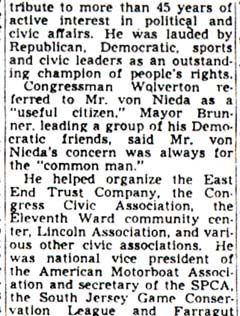
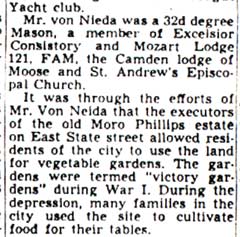
Ex-Mayor Active For Many Years In Civic Affairs
By Oscar W. Magnuson
Frederick von Nieda, former mayor of Camden, is dead. The man who came to the United States as an immigrant from Germany and who rose to the highest office within the gift of the electorate in his adopted city, died in St. Luke’s hospital, Philadelphia, today at 1:30 a.m. He would have been 82 on July 7.
The outstanding civic leader and Republican stalwart in political affairs had been in the hospital since Jan. 4.
Through the weeks as his condition worsened, Mr. von Nieda battled to stay alive for one thing—he wanted to live until the eleventh anniversary of the death of his wife, Carrie, and this wish was granted to him. His wife died Feb. 15, 1939. She was well known throughout Camden for her social and welfare work. Mr. von Nieda resided at 3309 River avenue.
Admired at Hospital
Mr. von Nieda, through his long illness at the hospital, won the admiration of his doctors and nurses for his cheerfulness and courage.
Two of the three nurses who attended him reside in Camden. They are Miss Selma Trout, Hahnemann hospital graduate, and Mrs. Emily Wack, from Woman’s hospital. The other is Miss Betty Uber, Cooper hospital graduate and resident of Coatesville.
Mayor Brunner ordered flags on public buildings at half staff until after the funeral for Mr. von Nieda.
Funeral Tuesday
Services will be held Tuesday at 1 p.m. in the funeral home at 804-06 North Twenty-seventh street, where friends may call Monday night. Lodge services will be held Monday night. Burial will be in Mt. Peace cemetery, Philadelphia, beside his wife.
Mayor Brunner announced he and the other four city commissioners will serve as pallbearers, along with others who have been Mr. von Nieda’s friends for many years.
The only survivors are a niece, Mrs. Walter Reese, and a nephew, Frederick von Nieda, both of Philadelphia.
Mr. von Nieda will be remembered in the Eleventh ward and through the city for his many activities in the nearly 48 years he was a resident of Camden, his friends point out. An outstanding interest was on the removal of unsanitary conditions in Baldwin’s Run. His friends call him “the father of the Baldwin’s Run cleanup.”
Backed Power Plant
Mr. von Nieda was one of the leaders in the fight for a municipal light plant in Camden in 1934, which was approved by the voters on two occasions. Later as a member of the Assembly, Mr. von Nieda introduced a bill which would permit Camden to appropriate money to pay for construction of a light and power plant. The measure was blocked in the Senate.
All through the years in which he lived in the Eleventh ward, Mr. von Nieda was a champion for improvements in the ward. He fought for paved streets to replace cobblestone and dirt highways, and wherever he thought improvements could be made, Mr. von Nieda was spearheading the fight. Often he was referred to as “Mr. Eleventh Ward” because of his activities.
Last March Mr. von Nieda was named by Mayor Brunner to represent Camden city at the National Rivers and Harbors Congress session.
Eighth Death
The death of Mr. von Nieda is the eighth of a member who has served on the Camden city commission since that form of government was adopted in May, 1923, to replace the councilmanic form of government which had been in effect since the city was incorporated in 1828.
The others who have died were H. Raymond “Pat” Staley, member of the first city commission; T. Yorke Smith, Henry Magin, Frank B. Hanna, who was Camden county surrogate when he died; William D. Sayrs, who was deputy city clerk when he died; Roy R. Stewart, who, like Mr. von Nieda, served as mayor, and also had been an assemblyman and state senator from Camden county, and Clay W. Reesman, who was city clerk when he died.
Native of Bavaria
Mr. von Nieda was born in Bavaria in 1868. Educated in Germany, he was graduated from a seminary there in 1885 and intended to enter the ministry. He suffered a nervous disorder, induced by overwork, and was temporarily blinded following his graduation. His doctors ordered him to give up study and get away.
His dreamed-of career ruined, Mr. von Nieda came to America that same year. He settled in Philadelphia and worked at various occupations. While studying at the Peirce Business college, now the Peirce School of Business Administration, he met the late Dr. Russell H. Conwell, founder of Baptist Temple and Temple University.
University Instructor
With the opening of the university, Mr. von Nieda became its first German instructor. At that time, the university consisted of only two converted houses at Broad and Norris streets.
He aided Dr. Conwell in translating the latter’s world-renowned “Acres of Diamonds” lecture into German.
In 1893 Mr. von Nieda started with the Philadelphia and Reading Coal and Iron Co., in its accounting department. He was promoted until he became the company’s chief accountant. He retired in that capacity in 1928 and entered the real estate business in the Eleventh ward, where he had lived since 1902.
Formed ‘Mosquito’ Fleet
An ardent yachtsman, Mr. von Nieda in 1910 founded the Farragut Yacht club, and in 1914 the Delaware River Yacht League. During War I he was called upon by the government and organized the Home Guard Marine fleet here, known as the “mosquito” fleet.
Prior to the start of War II, he was again called upon by the government, and with the assistance of the Coast Guard organized a unit of all persons owning yachts and motored craft in the area.
An active political campaigner, Mr. von Nieda’s activities were a tribute to more than 45 years of active interest in political and civic affairs. He was lauded by Republican, Democratic, sports and civic leaders as an outstanding champion of people’s rights.
Congressman Wolverton referred to Mr. von Nieda as a “useful citizen.” Mayor Brunner, leading a group of his Democratic friends, said Mr. von Nieda’s concern was always for the “common man.”
He helped organize the East End Trust Company, the Congress Civic Association, the Eleventh Ward community center, Lincoln Association, and various other civic associations. He was national vice president of the American Motorboat Association and secretary of the SPCA, the South Jersey Game Conservation League, and Farragut Yacht club.
Mr. von Nieda was a 32d degree Mason, a member of Excelsior Consistory and Mozart Lodge 121, F.A.M., the Camden lodge of Moose and St. Andrew’s Episcopal Church.
It was through the efforts of Mr. Von Nieda that the executors of the old Moro Phillips estate on East State street allowed residents of the city to use the land for vegetable gardens. The gardens were termed “victory gardens” during War I. During the depression, many families in the city used the site to cultivate food for their tables.
Von Nieda Rites Set for Monday Night, Tuesday
Camden Courier-Post —
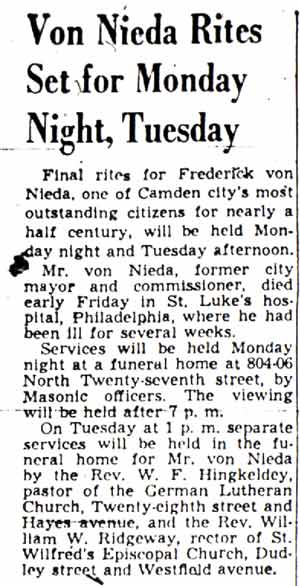
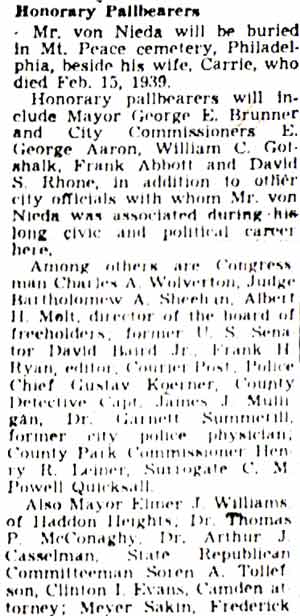
Final rites for Frederick von Nieda, one of Camden city’s most outstanding citizens for nearly a half century, will be held Monday night and Tuesday afternoon. Mr. von Nieda, former city mayor and commissioner, died early Friday in St. Luke’s hospital, Philadelphia, where he had been ill for several weeks.
Services will be held Monday night at a funeral home at 804-06 North Twenty-seventh street, by Masonic officers. The viewing will be held after 7 p. m.
On Tuesday at 1 p. m. separate services will be held in the funeral home for Mr. von Nieda by the Rev. W. F. Hingkeldey, pastor of the German Lutheran Church, Twenty-eighth street and Hayes avenue, and the Rev. William W. Ridgeway, rector of St. Wilfred’s Episcopal Church, Dudley street and Westfield avenue.
Honorary Pallbearers
Mr. von Nieda will be buried in Mt. Peace cemetery, Philadelphia, beside his wife, Carrie, who died Feb. 15, 1939.
Honorary pallbearers will include Mayor George E. Brunner and City Commissioners E. George Aaron, William C. Gotshalk, Frank Abbott and David S. Rhone, in addition to other city officials with whom Mr. von Nieda was associated during his long civic and political career here.
Among others are Congressman Charles A. Wolverton, Judge Bartholomew A. Sheehan, Albert H. Molt, director of the board of freeholders, former U. S. Senator David Baird Jr., Frank H. Ryan, editor, Courier Post, Police Chief Gustav Koerner, County Detective Capt. James J. Mulligan, Dr. Garnett Summerill, former city police physician; County Park Commissioner Henry R. Leiner, Surrogate C. M. Powell Quicksall.
Also Mayor Elmer J. Williams of Haddon Heights, Dr. Thomas P. McConaghy, Dr. Arthur J. Casselman, State Republican Committeeman Soren A. Tollefson, Clinton I. Evans, Camden attorney; Meyer Sakin, Frederick L. Strang, attorneys; Edward V. Hummell, Albert M. Ulmer, Frederick Pfrommer; Frank Hartmann, H. C. Walls, A. J. Christian, Franklin Bates, George Collar, Dana Wilcox, Charles Medyard, Curt Butz and Nowell Parker.
Active pallbearers will be members of Mozart lodge, 121, FAM, of which the former mayor was a member.
Flags At Half Staff
Mr. von Nieda also was a 32nd degree Mason and a member of Excelsior Consistory; the Camden Lodge of Moose and St. Andrew’s Episcopal Church.
Mayor Brunner, on learning of Mr. von Nieda’s death, Friday, ordered all flags on public buildings at half staff until after the funeral.
Mayor Brunner praised highly Mr. von Nieda’s worth to Camden city.
“It is with deep regret that I have learned of Mayor von Nieda’s death,” Brunner said. “The community has lost one of its outstanding citizens and civic leaders. I have served with Mayor von Nieda on the city commission and always found him honorable, decent and honest, always interested in the welfare and building up of our community.
“During the past year, I had the honor of appointing him as chairman of a civic committee to bring about something in which he was interested in all the years he lived in East Camden, the elimination of the Baldwin’s Run swamp area.
Devoted Much Time
“I am happy to see that progress has been made to bring about a solution to this problem to which Mr. von Nieda had devoted so much of his time. I know it made Fred very happy to know this project was nearing completion.
“I also had the honor to appoint him as the Camden city representative at the National Rivers and Harbors Congress session, which he also was vitally interested in. He represented the city in a very able manner at the conference because of his familiarity with the problem.
“His passing leaves a great loss to Camden city. He was well liked by everyone who knew him and it will be hard to replace this loss suffered by our community.”
Mr. von Nieda, who lived at 3309 River avenue, is survived by a niece, Mrs. Walter Reese, and a nephew, Frederick von Nieda, both of Philadelphia.
Off-Duty Police To Attend Rites For Von Nieda
Camden Courier-Post —
City Commissioner E. George Aaron, director of public safety, announced today that all members of the police department off duty will meet in uniform at Fire Company 11, Twenty-seventh street and Hayes avenue, at 7.30 o’clock tonight to attend the viewing of former Mayor Frederick von Nieda in the funeral home at 804-06 North Twenty-seventh street.
Commissioner Aaron, Deputy Director Willard Schriver, Chief Gustav Koerner and all the official personnel of the police department will lead the group in a march to the funeral home. All city detectives off duty will be in the group. Mr. von Nieda, while mayor, headed the police department as director.
GOP to Attend
Members of the Eleventh Ward Men’s and Women’s GOP clubs will meet at 7.45 o’clock tonight in the club-house, Twenty-eighth street and Concord avenue, to attend the viewing in a body.
The Singing Society of the Germania Maennerchor will sing at the viewing tonight, directed by August Knor. Mr. von Nieda was a member of the Maennerchor.
Services also will be held by Excelsior Consistory and Mozart lodge 121, FAM, of which Mr. von Nieda was a member.
The burial services will be held Tuesday at 1 p.m. in the funeral home. Separate services will be conducted by the Rev. William F. Hingkeldey, pastor of the German Christus Lutheran Church, and the Rev. William W. Ridgeway, rector of St. Wilfred’s Episcopal Church. Burial will be in Mt. Peace cemetery, Twenty-second street and Lehigh avenue, Philadelphia, beside Mr. von Nieda’s wife, Carrie E., who died 11 years ago. Mr. von Nieda died Friday at 1.30 a.m. in St. Luke’s hospital, Philadelphia, where he had been a patient since Jan. 4. He would have been 82 on July 7.
Police Escort
Led by a Camden police motorcycle escort, the funeral cortege will move north on Twenty-seventh street to River avenue, east on River avenue and pause for a moment in front of Mr. von Nieda’s home, 3309 River avenue, where he lived for many years, thence south on Beideman avenue, right into Hayes avenue, after which it will move west. There will be a brief pause at Baldwin’s Run, which is now being filled in and for the improvement of which Mr. von Nieda worked for more than 40 years. Then the procession will move to Twenty-seventh street, to River avenue, to State street, south on Tenth street to Linden street to the Camden bridge. Bridge police will escort the cortege across Camden bridge, after which a motorcycle detail of Philadelphia police will act as escort to the cemetery.
Von Nieda Buried Beside His Wife in Phila. Cemetery
Camden Courier-Post —
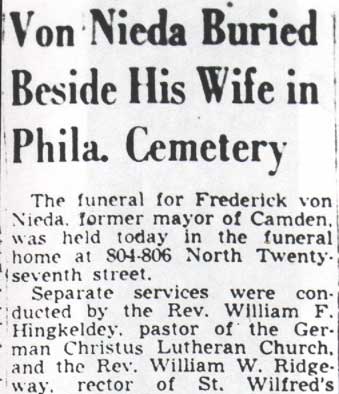
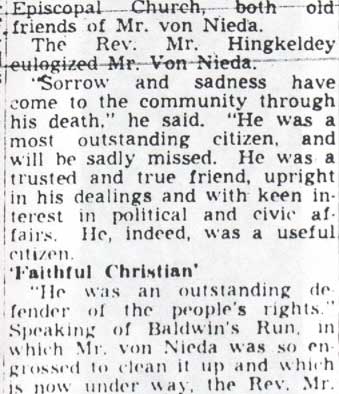
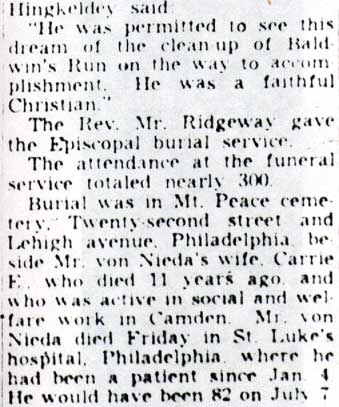
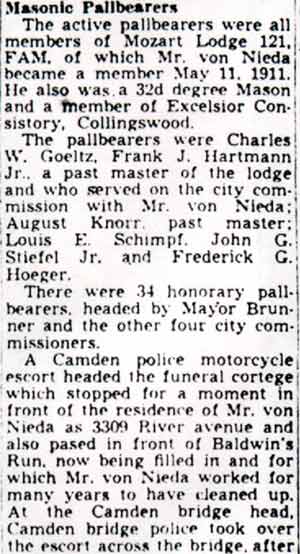
The funeral for Frederick von Nieda, former mayor of Camden, was held today in the funeral home at 804-806 North Twenty-seventh street.
Separate services were conducted by the Rev. William F. Hingkeldey, pastor of the German Christus Lutheran Church, and the Rev. William W. Ridgeway, rector of St. Wilfred’s Episcopal Church, old friends of Mr. von Nieda.
The Rev. Mr. Hingkeldey eulogized Mr. von Nieda.
“Sorrow and sadness have come to the community through his death,” he said. “He was a most outstanding citizen, and will be sadly missed. He was a trusted and true friend, upright in his dealings and with keen interest in political and civic affairs. He, indeed, was a useful citizen.
‘Faithful Christian’
“He was an outstanding defender of the people’s rights.” Speaking of Baldwin’s Run, in which Mr. von Nieda was so engrossed to clean it up and which is now under way, the Rev. Mr. Hingkeldey said.
“He was permitted to see this dream of the clean-up of Baldwin’s Run on the way to accomplishment. He was a faithful Christian.”
The Rev. Mr. Ridgeway gave the Episcopal burial service.
The attendance at the funeral service totaled nearly 300. Burial was in Mt. Peace cemetery, Twenty-second street and Lehigh avenue, Philadelphia, beside Mr. von Nieda’s wife, Carrie E., who died 11 years ago and who was active in social and welfare work in Camden. Mr. von Nieda died Friday in St. Luke’s hospital, Philadelphia, where he had been a patient since Jan. 4. He would have been 82 on July 7.
Masonic Pallbearers
The active pallbearers were all members of Mozart Lodge 121, FAM, of which Mr. von Nieda became a member May 11, 1911. He also was a 32d degree Mason and a member of Excelsior Consistory, Collingswood.
The pallbearers were Charles W. Goeltz, Frank J. Hartmann Jr., a past master of the lodge and who served on the city commission with Mr. von Nieda; August Knorr, past master; Louis E. Schimpf, John G. Stiefel Jr. and Frederick G. Hoeger.
There were 34 honorary pallbearers, headed by Mayor Brunner and the other four city commissioners.
A Camden police motorcycle escort headed the funeral cortege, which stopped for a moment in front of the residence of Mr. von Nieda at 3309 River avenue and also passed in front of Baldwin’s Run, now being filled in and for which Mr. von Nieda worked for many years to have cleaned up. At the Camden bridge head, Camden bridge police took over the escort across the bridge, after which Philadelphia police escorted to the cemetery.
More than 1,100 persons called to pay their respects to Mr. von Nieda, in the funeral home Monday night.
For more than three hours, old friends—those with whom Mr. von Nieda had been associated in the Eleventh ward for nearly 48 years—passed by the bier to say a last farewell to the man and friend they had fondly known as “Mr. Eleventh Ward” because of Mr. von Nieda’s constant efforts in a civic way for the betterment of the ward.
Many Floral Offerings
There were also those who had associated with Mr. von Nieda in politics, in which he was a Republican stalwart—and there were those, too, who had associated with Mr. von Nieda in civic affairs, at fishing and in shoots. Mr. von Nieda was a crack shot with a rifle.
Members of the Camden police department who were off duty, led by Commissioner E. George Aaron, director of public safety, called in a body after they had met at Fire Company 11, Twenty-seventh street and Hayes avenue. In the group were Deputy Director Willard Schriver, Chief of Police Gustav Koerner and other police officials. Mr. von Nieda had been director of the department of public safety.
Members of the Eleventh Ward Men’s and Women’s GOP clubs also attended in a body, as did members of the Germania Maennerchor, of which Mr. von Nieda was a member.
Masonic Service
The Singing Society of the Maennerchor, directed by August Knorr, sang several selections.
Services were held by Mozart lodge 121, FAM.
The Camden lodge of Moose, of which Mr. von Nieda also was a member, held services.
Among those who came to say farewell were Congressman Charles A. Wolverton, former Mayor Winfield S. Price, former Mayor Victor King, who was mayor in the first city commission; David B. Robinson, former Camden county treasurer; Frank H. Ryan, editor of the Courier-Post; Mrs. Etta Pfrommer, Camden county welfare director; Henry Leiner, Camden county park commissioner; W. N. Williamson, Republican county committeeman of the Eleventh ward, Frank J. Hartmann Jr., Mrs. Noel Magnus.
Others Pay Tribute
Also, former City Commissioner Mary Walsh Kobus, who also was a former director of the department of public safety; Henry Aitken, S. Raymond Dobbs, Samuel Garrett, Mr. and Mrs. George Jaquillard, Mrs. W. Penn Corson, Carl Martin, and Noel Parker, Walter Weisman, Henry Robins and George C. Helker, former motor vehicle agent in East Camden and Frederick Pfrommer, all of whom went fishing with Mr. von Nieda.
Also, William Messenger, Meyers Sakin, Mrs. Louise Walsh, Mr. and Mrs. William Bartmaier, of Stratford, Conn.; Mrs. Joseph Lichenberg, Stratford, Conn.; Fred Strang, Mr. and Mrs. Homer Walls, of Haddonfield; Mr. and Mrs. Arthur J. Crispen, of Columbus; Mr. and Mrs. Thomas McDermott, of Audubon; Mrs. Henry Leiner, Mrs. Simone Anderson and son, John; Miss Charlotte Anderson; George Collar, treasurer of the Lincoln club, of which Mr. von Nieda was a member; Charles Ledyard, Dr. Garnett Summerill, Mr. and Mrs. Leonard Whittendale, Mr. and Mrs. William Campbell and family, Curtis Sangtinette. Also Mr. and Mrs. Joseph Munger, Mrs. Hazel Gutherman, Republican county committeewoman of the Eleventh ward; William Eichle, Bernard Schlam, Henry Hartman, Gustav Saccamono, George Shields, of the sheriff’s office.
Would Name Baldwin Run Von Nieda Park
Camden Courier-Post —
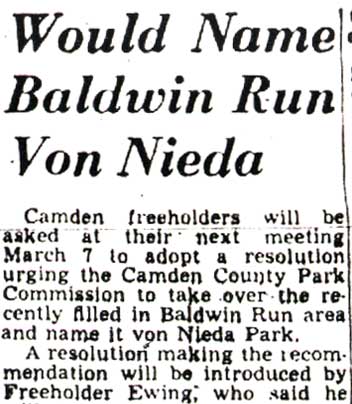
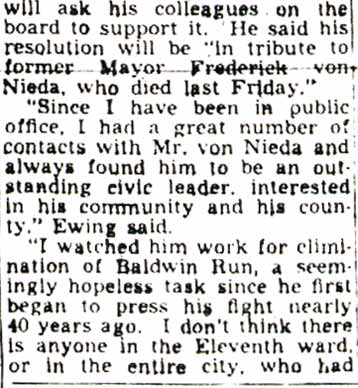
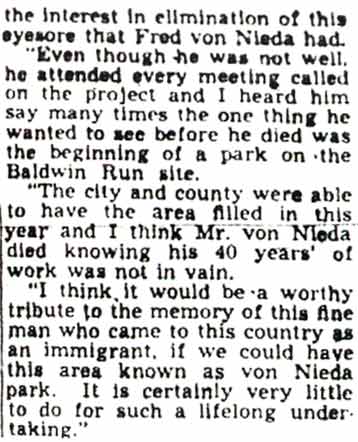
Camden freeholders will be asked at their next meeting March 7 to adopt a resolution urging the Camden County Park Commission to take over the recently filled-in Baldwin Run area and name it von Nieda Park.
A resolution making the recommendation will be introduced by Freeholder Ewing, who said he will ask his colleagues on the board to support it. He said his resolution will be “in tribute to Former Mayor Frederick von Nieda, who died last Friday.”
“Since I have been in public office, I had a great number of contacts with Mr. von Nieda and always found him to be an outstanding civic leader interested in his community and his county,” Ewing said.
“I watched his work for climination [sic] of Baldwin Run, a seemingly hopeless task since he first began to press his fight nearly 40 years ago. I don’t think there is anyone in the Eleventh ward, or in the entire city, who had the interest in elimination of this eyesore that Fred von Nieda had.
“Even though he was not well, he attended every meeting called on the project and I heard him say many times the one thing he wanted to see before he died was the beginning of a park on the Baldwin Run site.
“The city and county were able to have the area filled in this year and I think Mr. von Nieda died knowing his 40 years of work was not in vain.
“I think it would be a worthy tribute to the memory of this fine man who came to this country as an immigrant. If we could have this area known as von Nieda Park, it is certainly very little to do for such a lifelong undertaking.”
Von Nieda Park Honors An All-Time Camden Great
Camden Courier-Post – Spring 1950
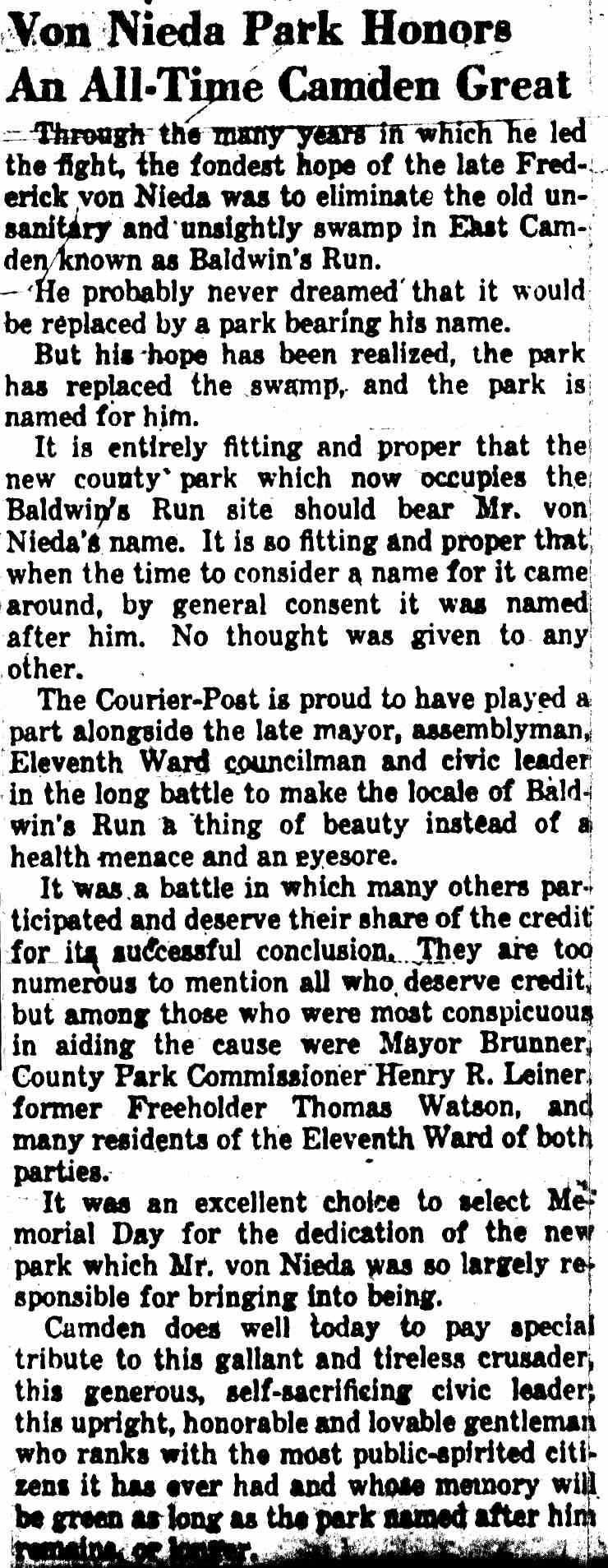
Through the many years in which he led the fight, the fondest hope of the late Frederick von Nieda was to eliminate the old unsanitary and unsightly swamp in East Camden known as Baldwin’s Run.
He probably never dreamed that it would be replaced by a park bearing his name.
But his hope has been realized, the park has replaced the swamp, and the park is named for him.
It is entirely fitting and proper that the new county park which now occupies the Baldwin’s Run site should bear Mr. von Nieda’s name. It is so fitting and proper that when the time to consider a name for it came around, by general consent it was named after him. No thought was given to any other.
The Courier-Post is proud to have played a part alongside the late mayor, assemblyman, Eleventh Ward councilman and civic leader in the long battle to make the locale of Baldwin’s Run a thing of beauty instead of a health menace and an eyesore.
It was a battle in which many others participated and deserve their share of the credit for its successful conclusion. They are too numerous to mention all who deserve credit, but among those who were most conspicuous in aiding the cause were Mayor Brunner, County Park Commissioner Henry R. Leiner, former Freeholder Thomas Watson, and many residents of the Eleventh Ward of both parties.
It was an excellent choice to select Memorial Day for the dedication of the new park which Mr. von Nieda was so largely responsible for bringing into being.
Camden does well today to pay special tribute to this gallant and tireless crusader, this generous, self-sacrificing civic leader; this upright, honorable and lovable gentleman who ranks with the most public-spirited citizens it has ever had and whose memory will be green as long as the park named after him [remainder illegible at the edge of both crops]
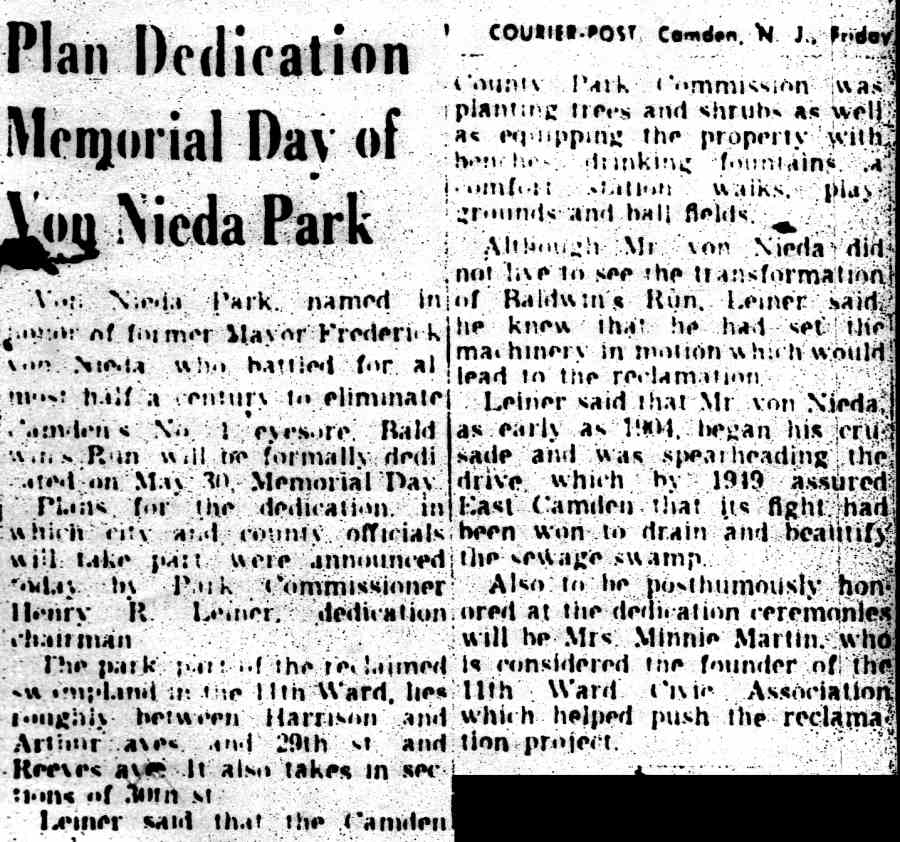
Plan Dedication Memorial Day of Von Nieda Park
Von Nieda Park, named in honor of former Mayor Frederick von Nieda who battled for almost half a century to eliminate Camden’s No. 1 eyesore, Baldwin’s Run, will be formally dedicated on May 30, Memorial Day.
Plans for the dedication, in which city and county officials will take part, were announced today by Park Commissioner Henry R. Leiner, dedication chairman.
The park, part of the reclaimed swampland in the 11th Ward, lies roughly between Harrison and Arthur aves. and 29th st. and Reeves ave. It also takes in sections of 30th st.
County Park Commission was planting trees and shrubs as well as equipping the property with benches, drinking fountains, a comfort station, walks, playgrounds and ball fields.
Although Mr. von Nieda did not live to see the transformation of Baldwin’s Run, Leiner said he knew that he had set the machinery in motion which would lead to the reclamation.
Leiner said that Mr. von Nieda, as early as 1904, began his crusade and was spearheading the drive which by 1919 assured East Camden that its fight had been won to drain and beautify the sewage swamp.
Also to be posthumously honored at the dedication ceremonies will be Mrs. Minnie Martin, who is considered the founder of the 11th Ward Civic Association which helped push the reclamation project.