Introduction
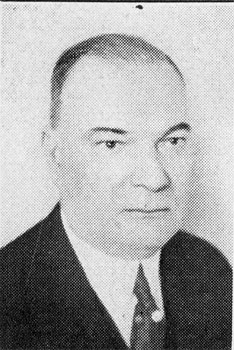
Alfred L. Sayers was born in Blackwood NJ, June 9, 1869 to Thornton and Mary Emma Sayers. His family came to Camden when he was a small boy, and lived at 561 Pine Street at the time of the 1880 Census. The Sayers family was living at 745 Walnut in the middle 1880s, and are listed at 806 Walnut in the 1888–1889 and 1890–1891 Camden City Directories.
Alfred L. Sayers was educated in the E.A. Stevens School at 430 South 4th Street, Camden, and Abrahamson’s Business College, in that city. He entered the Camden Police department April 14, 1894, and while in that department became a steam and hot water contractor, in which he was very successful. He married Clara V. DeBarth around 1896. The first appear in Camden City Directories in 1897, at 821 Spruce Street. By 1898 they had moved to 820 South 8th Street. The Sayers stayed at that address through 1924.
In 1904 Alfred Sayers resigned from the Police Department to become a member of the Board of Freeholders, and in 1906 he was made a director and president of that body, and served until 1910, when he resigned to become street commissioner of Camden. Up to this time he had been carrying on his heating and hot water contracting work, but now he sold out and devoted all his time to his position as street commissioner, this service running from 1910 to 1923, under Mayors Charles H. Ellis and Frank S. Van Hart. The city was in the midst of its great expansion both in overall geography, population, and the sheer number of streets and roads that had to be dealt with during his tenure bears recognition.
Alfred L. Sayers was a committee clerk in the New Jersey Legislature, associated with William J. Bradley in the Senate 1904-05.
On November 6, 1917 the Parkside Trust received its charter. Alfred L. Sayers was among the founders of the new bank. On January 12, 1918 he was made a director of the Parkside Trust. He was active in its organization, which was consummated January 12, 1918, the date of his election, and served as its president from its inception through its May 1927 merger with the West Jersey Trust Company. The new bank was known as the West Jersey-Parkside Trust Company, its first president being newspaper publisher and congressman Francis Ford Patterson Jr. Alfred L. Sayers remained Camden’s Streets Commissioner through at least January of 1922.
Alfred L. Sayers was living at 1188 Everett Street in Camden when the 1929 Camden City Directory was compiled.
Both the 1930 and 1940 Census shows Alfred L. Sayers and his wife, the former Clara DeBarth, living at 815 White Horse Pike in Haddon Township, New Jersey.
E.A. Stevens School
E.A. Stevens School – 430 South 4th Street
The Mayor Names
Camden Post —
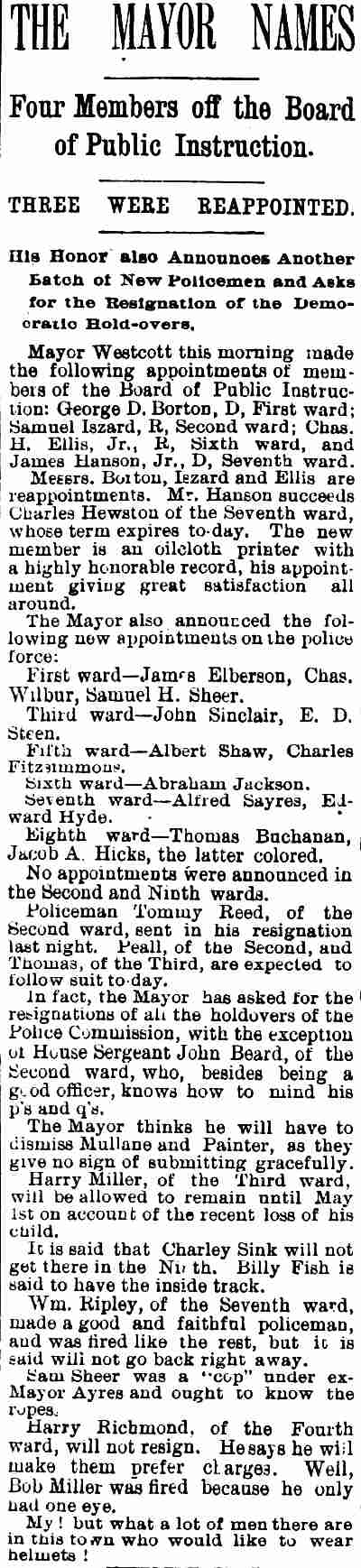
Four Members off the Board of Public Instruction.
THREE WERE REAPPOINTED.
His Honor also Announces Another Batch of New Policemen and Asks for the Resignation of the Democratic Hold-overs.
Mayor Westcott this morning made the following appointments of members of the Board of Public Instruction: George D. Borton, D, First ward; Samuel Iszard, R, Second ward; Chas. H. Ellis, Jr., R, Sixth ward, and James Hanson, Jr., D, Seventh ward. Messrs. Borton, Iezard [sic] and Ellis are reappointments. Mr. Hanson succeeds Charles Hewston of the Seventh ward, whose term expires to-day. The new member is an oilcloth printer with a highly honorable record, his appointment giving great satisfaction all around.
The Mayor also announced the following new appointments on the police force:
First ward—James Elberson, Chas. Wilbur, Samuel H. Sheer.
Third ward—John Sinclair, E. D. Steen.
Fifth ward—Albert Shaw, Charles Fitzsimmons.
Sixth ward—Abraham Jackson.
Seventh ward—Alfred Sayres, Edward Hyde.
Eighth ward—Thomas Buchanan, Jacob A. Hicks, the latter colored.
No appointments were announced in the Second and Ninth wards.
Policeman Tommy Reed, of the Second ward, sent in his resignation last night. Peall, of the Second, and Thomas, of the Third, are expected to follow suit to-day.
In fact, the Mayor has asked for the resignations of all the holdovers of the Police Commission, with the exception of House Sergeant John Beard, of the Second ward, who, besides being a good officer, knows how to mind his p’s and q’s.
The Mayor thinks he will have to dismiss Mullane and Painter, as they give no sign of submitting gracefully.
Harry Miller, of the Third ward, will be allowed to remain until May 1st on account of the recent loss of his child.
It is said that Charley Sink will not get there in the Ninth. Billy Fish is said to have the inside track.
Wm. Ripley, of the Seventh ward, made a good and faithful policeman, and was fired like the rest, but it is said will not go back right away.
Sam Sheer was a “cop” under ex-Mayor Ayres and ought to know the ropes.
Harry Richmond, of the Fourth ward, will not resign. He says he will make them prefer charges. Well, Bob Miller was fired because he only had one eye.
My! but what a lot of men there are in this town who would like to wear helmets!
The Mayor’s Appointments
Camden Daily Telegram —

He Announced Several This Noon.
COMMISSIONERS OF INSTRUCTION.
The Old Members Re-named With the Exception of the Member From the Seventh Ward—Police Appointments and Resignations.
Mayor Westcott this noon made the following appointments as Commissioners of Public instruction:
Messrs. George D. Borton, of the First ward; Samuel Iszard, of the Second ward; Charles H. Ellis, Jr., of the Sixth ward, and James Hanson, to succeed Charles Hewston, of the Seventh ward.
The officers of the Commission hold over another year.
The following appointments were made on the police force:
First Ward—James Elberson, Charles Wilbur, Samuel H. Sheer.
Second Ward—No appointments.
Third Ward—John Sinclair, E. D. Stein.
Fourth Ward—No appointments.
Fifth Ward—Albert Shaw, Charles Fitzsimmons.
Sixth Ward—Abraham Jackson.
Seventh Ward—Alfred Sayres, Edward Hyde.
Eighth Ward—Thomas Buchanan, Jacob A. Hicks (colored).
Ninth Ward—No appointments.
Mayor Westcott has requested the resignation of all the members of the police force who served under the Police Commission, to take effect May 1. They are Policemen Peall, Horner, Painter, Mullane, Miller and Reed.
POLITICAL POINTERS.
Who will be the postmaster?
Who will be the next prosecutor?
Many of the ward workers are suffering from election colds.
The name of Harry Moffitt was left out of the columns of honorable mention with the other hustlers of election day.
Senator Rogers and Messrs. Stafford and Watson, of the House are fully coming up to the expectations of their constituents.
If the Mayor could arrange it to hold his hearings a trifle earlier it would be a great source of satisfaction to the Camden afternoon papers.
There is still great anxiety on the part of the public as to the outcome of the present session of the legislature. Thus far their public acts have been highly commendable.
The abolishment of the Police Justice act restores to office the City Recorder, Benjamin M. Braker, who would be qualified to act in place of the Mayor should the Chief Executive be taken sick.
Jos. Potter, the new member of Council from the First ward is a man of wide business experience and will prove much advantage to the many large financial interests that will come under his care.
Owing to the satisfactory working of the present school commission in the two second-class counties up the State, the legislature made no change in the mode of placing the members as was anticipated.
Jos. B. Fox, of the Fourth ward, is what might be termed an old reliable, having had a long and varied experience in public affairs. He is always conservative in the expenditure of city money. He is always safe to trust.
Charles Sayrs, of the Seventh ward, who had a short experience in the present Council, but enough to make him feel at home among public affairs, is neck and ears in work between his real estate business and Councilmanic duties.
The colored people of the lower section of the city are anxious to see Squire Drake, the ex-Republican and ex-member of the School Board, come out of the Court House, where he holds a position under the Thompson Freeholders.
“Father” Figner is a proud sire. He was a member and president of Council in his days, and now sees his son treading in his footsteps. Mr. Figner, Jr., having been sent to Council from the Sixth ward on Tuesday by a large majority.
A special election will not be necessary for the new Board of Freeholders, as the City Council and Township Committees will appoint Freeholders who will serve until the Spring of 1895. The appointments will be made about the middle of May.
Arthur Bedell is spoken of as a candidate for the presidency of the new City Council. He is a stalwart and is never afraid to define his position on all public questions. He is one of those men who makes strong, warm friends and also creates an opposition of like force.
William D. Brown, the Secretary of the Board of Education, and Fred A. Rex, Treasurer, are quite pleased over the report of the committee on accounts and Expert O’Shaughnessy, they having examined the books of Messrs. Rex and Brown and found them correctly kept.
The library of the Camden public schools is one to be highly appreciated and much is due to the care with Miss Blowe the librarian has attended to her duties. She will hold over another year and should be allowed to retain the office as long as she merits it, and she surely does now.
J. R. Carson, the retiring member of Council from the First ward, is highly spoken of by his associates on committees and by Clerk Varney for the mature judgment displayed in the management of city affairs. It is with a general expression of regret that the city is to lose his service.
The reform in the Board of Freeholders can’t come too soon. If the public is to judge of the care of property given by the Democrats in the county, by the “hog combine” in this city, an inventory of the public property when turned over will make interesting reading. Ex-officials guarantee to save enough in the Board, if returned to their offices, to pay the expense of a special election, if one was necessary.
W. J. Bradley has been asked if he was a candidate for president of the new City Council. His reply was that he had not sought it in the first place, and would not seek it now, but whether he became president or remained merely a member on the floor, he would endeavor to discharge his duties in the interests of the city. He is commended by all who came in contact with him during the past year as one who had a new Camden at heart.
Two Men Shot in a Race Riot in Camden
Philadelphia Inquirer —
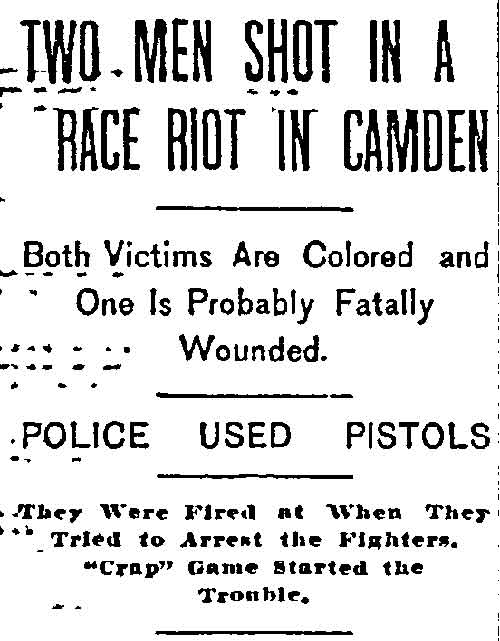
Both Victims Are Colored and One Is Probably Fatally Wounded.
POLICE USED PISTOLS
They Were Fired at When They Tried to Arrest the Fighters. “Crap” Game Started the Trouble.
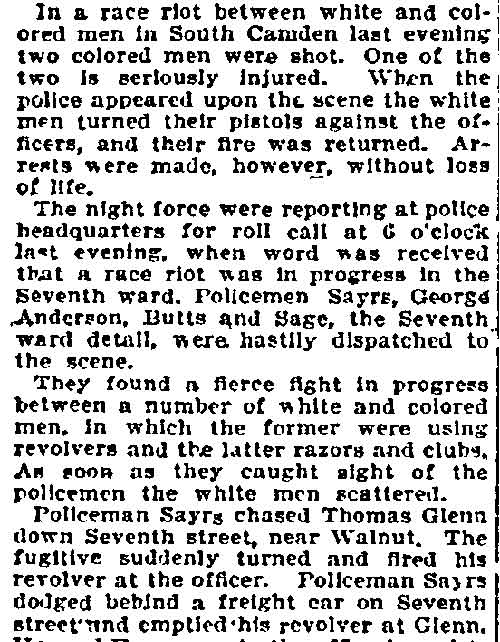
In a race riot between white and colored men in South Camden last evening two colored men were shot. One of the two is seriously injured. When the police appeared upon the scene the white men turned their pistols against the officers, and their fire was returned. Arrests were made, however, without loss of life.
The night force were reporting at police headquarters for roll call at 6 o’clock last evening, when word was received that a race riot was in progress in the Seventh ward. Policemen Sayrs, George Anderson, Butts and Sage, the Seventh ward detail, were hastily dispatched to the scene.
They found a fierce fight in progress between a number of white and colored men, in which the former were using revolvers and the latter razors and clubs. As soon as they caught sight of the policemen the white men scattered.
Policeman Sayrs chased Thomas Glenn down Seventh street, near Walnut. The fugitive suddenly turned and fired his revolver at the officer. Policeman Sayrs dodged behind a freight car on Seventh street and emptied his revolver at Glenn. Howard Ever came to the officer’s assistance and Policemen Hyde and McClung joined in the chase. Glenn was finally captured in a house in which he had taken refuge.
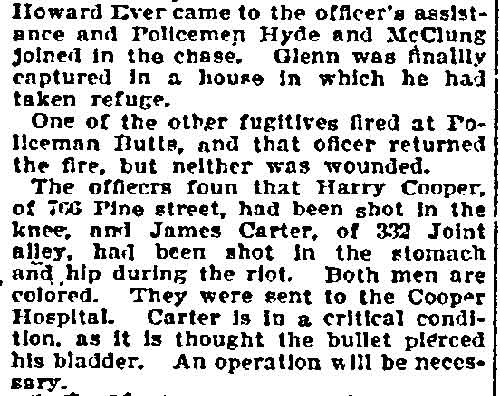
One of the other fugitives fired at Policeman Butts, and that officer returned the fire, but neither was wounded.
The officers foun [sic] that Harry Cooper, of 706 Pine street, had been shot in the knee, and James Carter, of 332 Joint alley, had been shot in the stomach and hip during the riot. Both men are colored. They were sent to the Cooper Hospital. Carter is in a critical condition, as it is thought the bullet pierced his bladder. An operation will be necessary.
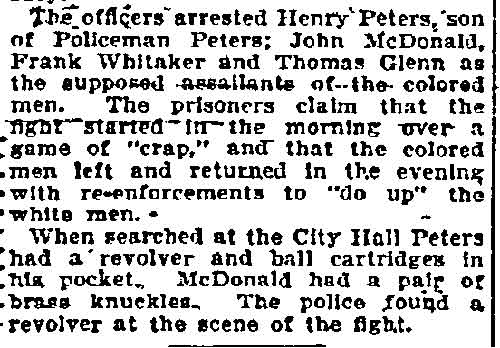
The officers arrested Henry Peters, son of Policeman Peters; John McDonald, Frank Whitaker and Thomas Glenn as the supposed assailants of the colored men. The prisoners claim that the fight started in the morning over a game of “crap,” and that the colored men left and returned in the evening with re-enforcements to “do up” the white men.
When searched at the City Hall Peters had a revolver and ball cartridges in his pocket. McDonald had a pair of brass knuckles. The police found a revolver at the scene of the fight.
Hot Time in the Flats
Camden Daily Telegram —
A Colored Joint on Kaighn Avenue Raided by the Police.
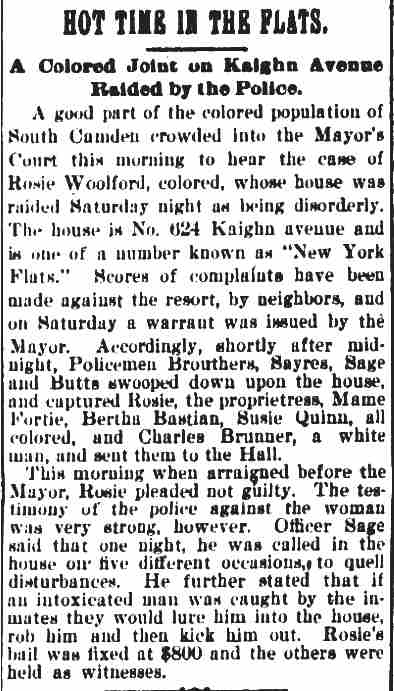
A good part of the colored population of South Camden crowded into the Mayor’s Court this morning to hear the case of Rosie Woolford, colored, whose house was raided Saturday night as being disorderly. The house is No. 624 Kaighn avenue and is one of a number known as “New York Flats.” Scores of complaints have been made against the resort, by neighbors, and on Saturday a warrant was issued by the Mayor. Accordingly, shortly after midnight, Policemen Brouthers, Sayres, Sage and Butts swooped down upon the house, and captured Rosie, the proprietress, Mame Fortie, Bertha Bastian, Susie Quinn, all colored, and Charles Brunner, a white man, and sent them to the Hall.
This morning when arraigned before the Mayor, Rosie pleaded not guilty. The testimony of the police against the woman was very strong, however. Officer Sage said that one night, he was called in the house on five different occasions, to quell disturbances. He further stated that if an intoxicated man was caught by the inmates they would lure him into the house, rob him and then kick him out. Rosie’s bail was fixed at $800 and the others were held as witnesses.
Here’s Camden’s Finest, With Whiskers, in 1898
Camden Courier-Post —
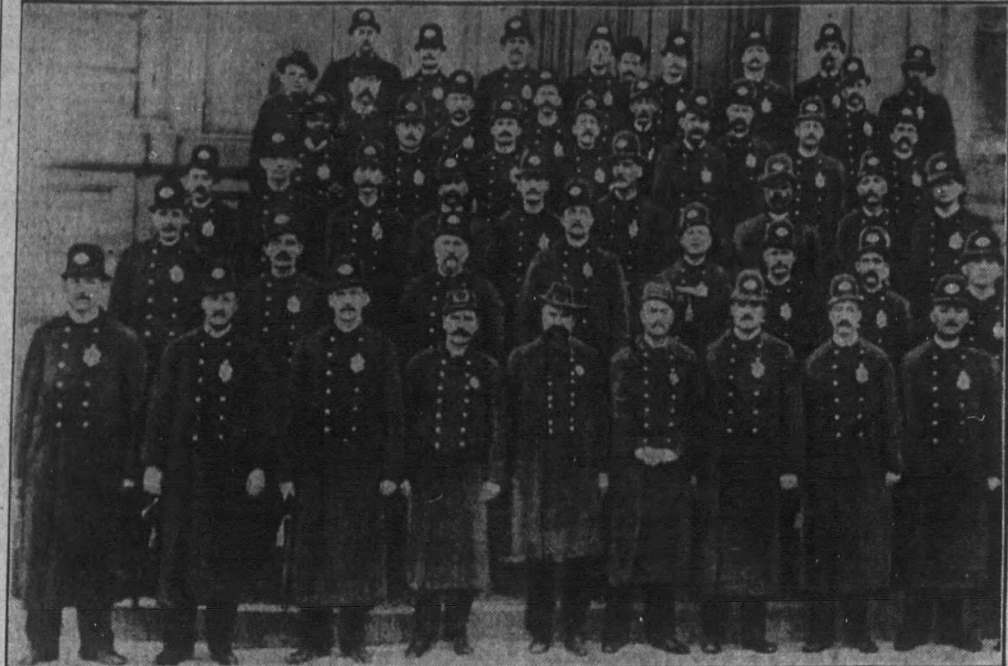
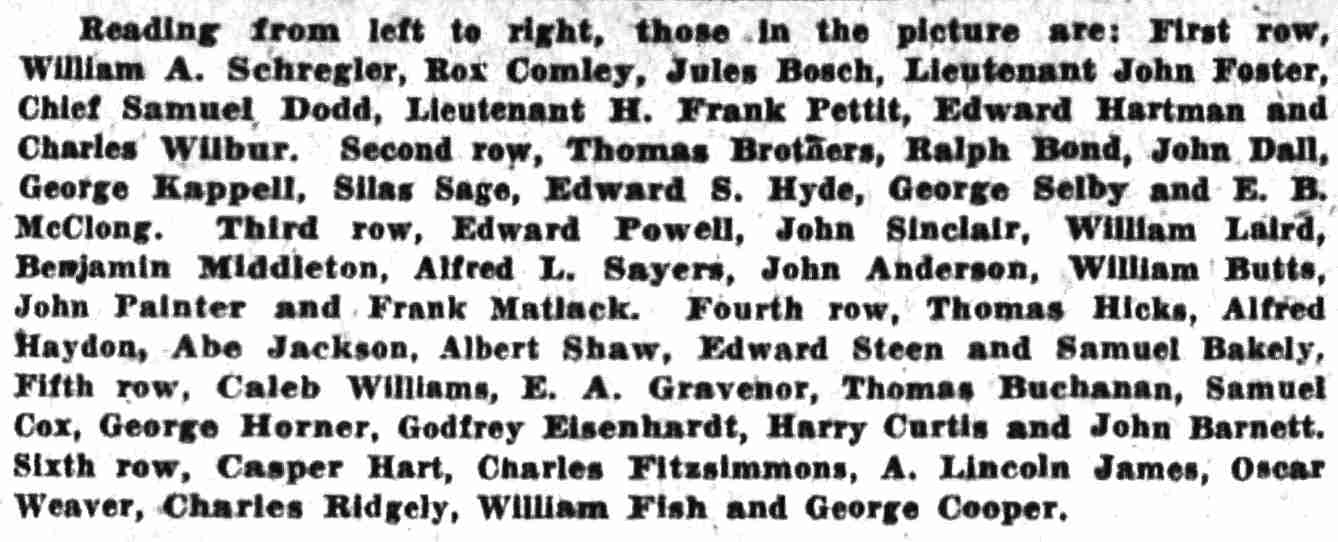
Reading from left to right, those in the picture are: First row, William A. Schregler, Rox Comley, Jules Bosch, Lieutenant John Foster, Chief Samuel Dodd, Lieutenant H. Frank Pettit, Edward Hartman and Charles Wilbur. Second row, Thomas Brothers, Ralph Bond, John Dall, George Kappell, Silas Sage, Edward S. Hyde, George Selby and E. B. McClong. Third row, Edward Powell, John Sinclair, William Laird, Benjamin Middleton, Alfred L. Sayers, John Anderson, William Butts, John Painter and Frank Matlack. Fourth row, Thomas Hicks, Alfred Haydon, Abe Jackson, Albert Shaw, Edward Steen and Samuel Bakely. Fifth row, Caleb Williams, E. A. Gravenor, Thomas Buchanan, Samuel Cox, George Horner, Godfrey Eisenhardt, Harry Curtis and John Barnett. Sixth row, Casper Hart, Charles Fitzsimmons, A. Lincoln James, Oscar Weaver, Charles Ridgely, William Fish and George Cooper.
Alleged Policy People Arrested
Philadelphia Inquirer —
One of the Most Fruitful Raids in Years Was Made in Camden Yesterday
One of the most successful policy raids in years, in Camden, was made under the supervision of Chief of Police Foster yesterday. Sergeant Hyde and squad arrested Thomas F. Waters, alias “Uncle Frank,” aged 73 years; Isaac G. Johnson, seven persons, male and female, white and colored, and captured a quantity of drawings, “dream books” and plays, at 2[?]7 Division street.
Captain Stanley, Sergeant Reeder [sic] and squad arrested four women and secured a lot of paraphernalia in a house on Locust near Line street. The alleged proprietor is still at large.
Policeman Sayrs arrested Gilbert Massey, aged 70 years, at 727 Sycamore street, on the charge of being a policy writer.
At the hearings before Justice Stackhouse, Waters, Johnson and Massey were committed in default of $1000 bail each. The witnesses were released. The complaints were made by an agent of the Fidelity Detective Agency.
Valuable Gold Rings Found
Philadelphia Inquirer —
Two valuable gold rings with precious stones and another ring of lesser value were found by a prisoner at the municipal paper pickery in a bundle of waste paper yesterday. They were turned over to Street Commissioner Sayres.
New System of Street Cleaning Planned
Philadelphia Inquirer —
•• It is probable that Street Commissioner Alfred Sayrs will inaugurate a new system of street cleaning in the near future. This will be by night, a matter that has been advocated by Mayor Ellis ever since he has been in office. The Board of Health is also favorable to the plan.
Alfred L. Sayers – Charles H. Ellis
Night Street Cleaning to Begin
Philadelphia Inquirer —
•• Following his policy to do the work of his department at night, Street Commissioner Sayrs yesterday announced that the local “white wings” will begin cleaning the streets on Saturday night.
Camden News Notes
Philadelphia Inquirer —
•• It is estimated that the various reforms instituted since the incumbency of Street Commissioner Sayre will save the city at least $5000.
Portrait of Street Commissioner Sayrs at Engine Company 7
Philadelphia Inquirer —
•• A handsome portrait of Street Commissioner Sayrs was yesterday suspended from the wall at the headquarters of recently installed Engine Company No 7. It is the gift of the Seventh Ward Republican Club.
Street Cleanliness Praised at Carnival
Philadelphia Inquirer —
•• One of the features of the recent carnival was the cleanliness of the streets, and Street Commissioner Sayrs came in for considerable congratulation for his work in that direction.
Thanksgiving No Holiday for Street Crews
Philadelphia Inquirer —

•• Thanksgiving will not be a holiday for the ash and garbage gathering forces of the Highway Department. Street Commissioner Sayers yesterday ordered the men to make their usual collections tonight.
Birthday Bulletin
Philadelphia Inquirer —
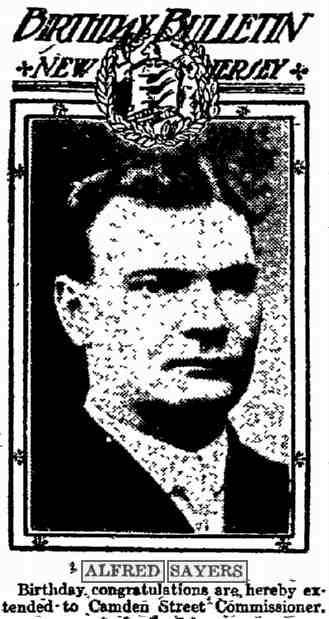
NEW JERSEY
ALFRED SAYERS
Birthday congratulations are hereby extended to Camden Street Commissioner, [cut off at the crop edge]
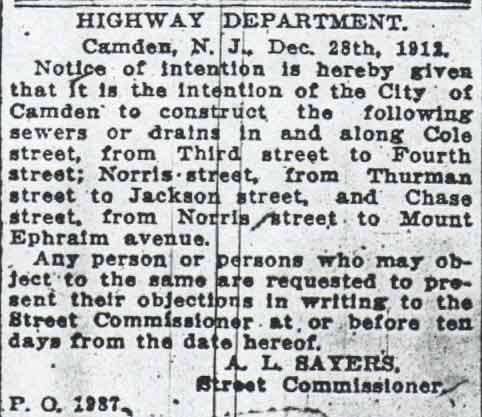
Highway Department.
Camden Courier —
Camden Woman Martyr for Sake of Husband
Philadelphia Inquirer —
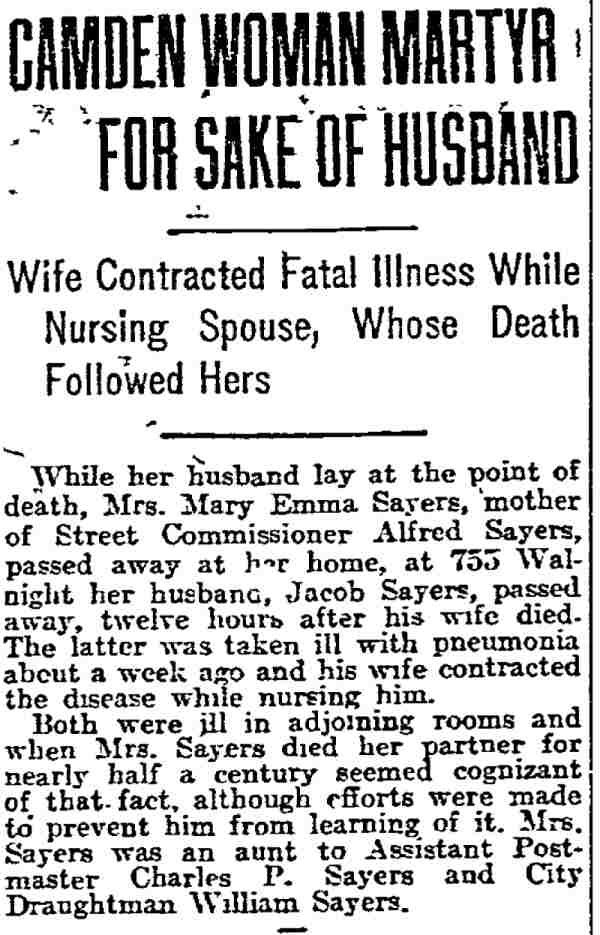
Named: Alfred L. Sayers, Jacob Sayers, Emma Sayers, Charles P. Sayers, William Sayers, and Walnut Street.
Street Improvements Started
Philadelphia Inquirer —
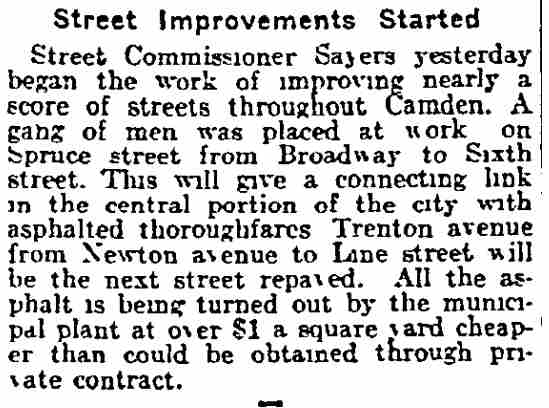
Street Commissioner Sayers yesterday began the work of improving nearly a score of streets throughout Camden. A gang of men was placed at work on Spruce street from Broadway to Sixth street. This will give a connecting link in the central portion of the city with asphalted thoroughfares. Trenton avenue from Newton avenue to Line street will be the next street repaved. All the asphalt is being turned out by the municipal plant at over $1 a square yard cheaper than could be obtained through private contract.
To Improve Sewerage Disposal
Philadelphia Inquirer —
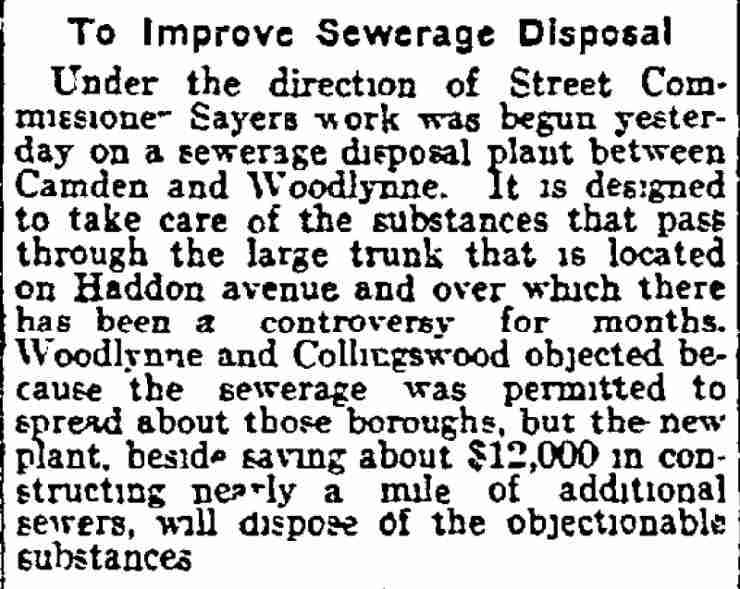
Under the direction of Street Commissioner Sayers work was begun yesterday on a sewerage disposal plant between Camden and Woodlynne. It is designed to take care of the substances that pass through the large trunk that is located on Haddon avenue and over which there has been a controversy for months. Woodlynne and Collingswood objected because the sewerage was permitted to spread about those boroughs, but the new plant, beside saving about $12,000 in constructing nearly a mile of additional sewers, will dispose of the objectionable substances
Less Paving to Be Laid
Philadelphia Inquirer —
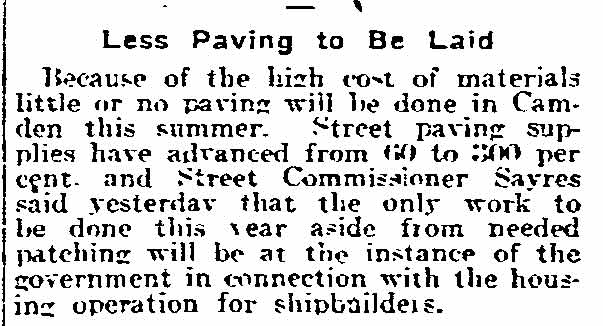
Because of the high cost of materials little or no paving will be done in Camden this summer. Street paving supplies have advanced from [?]0 to [?]00 per cent. and Street Commissioner Sayres said yesterday that the only work to be done this year aside from needed patching will be at the instance of the government in connection with the housing operation for shipbuilders.
Police to Probe $200,000 Kaighn Ave. Fire
Camden Courier-Post —
Mayor Ellis has ordered an investigation to determine the cause of the $200,000 fire which swept the properties at 427 and 429 Kaighn Avenue and caused injury to five firemen, one of whom may be fatally hurt.
The fire centered about the property occupied by the Economy Store, formerly Handle’s, and quickly spread to four adjoining buildings.
The fireman whose recovery is despaired of is Captain Martin B. Carrigan, of Engine Company No. 2, Fifth and Arch Streets. Carrigan, who lives at 618 West Street, is suffering from a fractured skull and severe burns and cuts of the face, legs, and body. He is unconscious at Cooper Hospital.
The firemen were injured when a wall, weakened by the intense heat, crumbled and crashed through a roof upon which they were standing, dragging them through the floor below, and into a cellar. Sensational rescues followed as police, firemen, and citizens with bare hands tore at the hot debris. The men were quickly extricated and carried to the street.
“We certainly shall investigate this fire,” the Mayor declared today. “Just what was the cause and who is to blame has not been determined but there will be a thorough investigation.”
“There have been too many of these fires during the past few weeks” continued the mayor. “Surely all of them did not just happen and I am sure there has been someone responsible in one or two of the fires.”
The conflagration was one of the most spectacular of a series of large fires that have visited the city in the past six weeks. The block in which it occurred—Kaighn Avenue between Broadway and Fourth Street—is one of the most prominent business squares in Camden.
Flames shot 200 feet in the air, giving the sky a fiery hue and attracted attention for miles before the firemen brought it under control. The flame-lit sky was clearly seen in Philadelphia, Merchantville, East Camden, Gloucester and other communities.
More than a score of families living in the vicinity were forced to flee from their homes in scant attire when the fire threatened them. They were cared for by neighbors.
Fireman George Boone, 46 years old, of Engine Company No. 2, also is in a serious condition. He is suffering from burns of the right hand, right thigh and foot and probable internal injuries. Boone lives at 607 Mount Vernon Street.
The other injured firemen are:
John Voll, 22 years old, 509 Royden Street: both hands badly burned.
C.J. Andrus, aged 31 years, 570 Mount Vernon Street: burns of hands and legs.
Harold Lorang, 29 years old, 19 Hudson Street: burns of right hand and legs and sprained ankle.
Firemen Prove Heroes
Carrigan and Boone are in the hospital. The other firemen were discharged after their wounds were dressed. After being released from the hospital they returned to the scene of the fire and insisted upon continuing their duties. Chief Peter B. Carter, however, ordered them home.
Most of the loss was suffered by the Economy Store. A few charred walls remain of the large building. The interior was completely gutted. It was estimated today that the damage to that property will total $60,000. At least $50,000 damage, it was said, was done to the stock.
Morris Handle, local theatrical man, who owns the building, declared today that the property was insured for $30,000. “My loss will be quite heavy,” said Mr. Handle. “The insurance will not pay one-half the property damage.”
The adjoining building at 431 Kaighn Avenue is occupied by Dr. S.I. Yubas, optometrist, and L.R. Yubas, his father, a jeweler.
Invalid is Rescued
The rear and upper floors of the Yubas property were gutted and the stock sustained a heavy loss, due to water and smoke. The damage will total $40,000, Mr. Yubas estimated today.
Five persons who were asleep on the upper floors of the Yubas dwelling had narrow escapes. They were awakened by Samuel Goldstein, haberdasher, 417 Kaighn Avenue, who discovered the fire in the Economy Store and turned in the alarm. Mrs. L.R. Yubas, an invalid, was rescued with difficulty.
The property occupied by Mrs. Sadie Bodner, a widow, at 433 Kaighn Avenue, as a house furnishings store, was scorched and also damaged by water and smoke.
Adjoining the Economy Store on the west at 425 Kaighn Avenue is a vacant one-story structure, formerly occupied by the United Beef Company. Firemen were on the roof of that building when the west wall of the Economy Store collapsed. The wall tumbled down on the small roof and hurled the firemen through a hole in the roof, through the floor and then into the cellar.
Several Stores Damaged
Three policemen, Joseph Sparks, Thomas Cheeseman, and George Hill—and several spectators braved the fire and smoke to rescue the trapped firemen.
The property at 423 Kaighn Avenue, occupied by the Charles Jamison Department Store, was damaged in the rear and the stock ruined by water and smoke. The Kresge Five-and-Ten-Cent Store, at 519-531 Kaighn Avenue, was also damaged by water.
Louis Richelson, who owns the properties from 519 to 525 Kaighn Avenue, was unable to estimate his loss today.
Collapse of Wall
Hundreds of spectators, who were watching the fire from the opposite side of the street, shuddered as they saw a brick wall, weakened by the intense heat, totter and sway. Before the firemen on the smaller roof below could scurry to safety, it collapsed.
A groan escaped the crowd as they heard the cries of the entrapped firemen and the deafening thud of the bricks as they landed on the roof where the firemen were at work.
As the full weight of the bricks struck the roof, it caved in forming a gaping hole. The firemen were literally swept into the opening.
The bricks tumbled down, causing another hole in the floor between the first story and the cellar and dragging the imperiled firemen into the cellar with them.
Mayor Charles H. Ellis was among the spectators who witnessed the collapse of the wall. Other officials were Chief James H. Long, of the Water Department; Fire Chief Carter, Assistant Police Chief Edward S. Hyde, Captain Lewis Stehr of the Second Police District, and Street Commissioner Alfred L. Sayers.
Firemen Under Debris
Observing the peril of the trapped firemen, Policemen Sparks, Cheeseman and Hill, together with a dozen other spectators, rushed across the street to the vacant store. They rushed through the smoke and fire, leaped into the cellar and reached the struggling firemen.
Sparks, the first to leap into the cellar, reached Voll, who had been pinned beneath a pile of debris and was pleading to be rescued. The policeman feverishly extricated Voll from his precarious position and carried him out into the street to safety.
Policeman Cheeseman had accidentally fallen into the cellar and, though himself injured, groped about in the dark until he found Boone, whom he dragged outside.
Policeman Hill carried Carrigan out of the cellar in his arms.
The five firemen were carried to a waiting police ambulance and rushed to Cooper Hospital. Carrigan was unconscious. He has a slim fighting chance to recover.
Carrigan was promoted to a captaincy the first of the year. He is popular among his comrades and has the reputation of being a fearless fireman.
Mayor Praises Firemen
Mayor Ellis praised the work of the firemen and the bravery of the policemen who had risked their lives to effect the rescue.
“Never did I see such remarkable work” said the Mayor. “When I arrived at the scene, it looked as if the whole block was doomed. The flames were shooting upward and the whole sky seemed lit up. The firemen tackled their job with dispatch and courage. I was proud of them. They knew their business and showed it by confining it to a comparatively small area. The work of the police also was commendable.”
Mr. Goldstein discovered the fire shortly before midnight.
“I had just left my home at 417 Kaighn Avenue,” explained Mr. Goldstein, “intending to get a soda. As I passed the Economy Store I noticed strong odor of smoke. I peered into the glass doorway of the store. I immediately saw the place was afire.”
Rescues Sleeping Family
“Then I ran back to my store” continued Mr. Goldstein, “and I telephoned police headquarters. I went out again and returned to the scene. I remembered that the Yubas family were asleep on the second and third floors and rapped on the doors. Mr. Yubas came down in a bathrobe. He was not aware of the fire.”
The six persons asleep in the Yubas home were Dr. Yubas, Mr. and Mrs. L.R. Yubas, Bernard Helfand, Miss Bertha Cuden and Anna Recowitz, a domestic.
Mrs. Yubas, who is recovering from an illness, was too weak to make her way outside through the smoke. Assisted by her husband, Policemen Becker and Cheeseman and Constable John Cunningham, Mrs. Yubas was half carried downstairs, and out through the rear of the building to safety.
Blaze Had Big Start
“The fire had gained such rapid headway,” said Sergeant Thomas Cunningham, “that when the firemen arrived, smoke was actually issuing from cracks in the sidewalks and between the cobbles near the trolley tracks.”
The second and third floors of 419 to 423 Kaighn Avenue are occupied by private families as apartments. In the rear were a number of frame dwellings. More than a score of families were obliged to leave their homes in scant attire when the firemen began playing hose upon their properties as a precaution against the fire spreading.
Mrs. Catherine Fox, 410 Sycamore Street, and Mrs. E. Chambers, 412 Sycamore Street, whose homes are in the rear of the Economy Store property, had removed part of the furniture to the street. Even after firemen assured them the danger of their homes catching on fire was over, the women and children could hardly be persuaded to return.
Crumbling walls and cracking of glass hampered the firemen in their work and made their task hazardous. The firemen were further handicapped by the big start the fire had gained. Despite this, they stuck dangerously close to the flames.
To play hose upon the fire to advantage, several firemen scaled the outside walls of adjoining properties and reached cornices, from which they directed streams of water.
High Wind Fanned Flames
A high wind gave them great difficulty. A number of times, when the firemen seemed to have the fire under control, the flames burst out afresh and compelled them to retreat. Then the reflection would light up the sky overhead.
Water Chief Long gave the firemen great service in maintaining the water at a high pressure to ensure facility in getting the streams to play upon the flames.
Kaighn Avenue, between Broadway and Fourth Street, was literally alive with residents and passers-by attracted by the flames. Included among the spectators were scores of persons who came from Philadelphia and distant points, in the belief the blaze was much more serious.
According to the estimate of the loss made today, the insurance on the property and stock damaged by the fire will not pay for one-half the loss sustained.
Chief Carter was determined to take no chances with the fire because of the high wind and the fire was attacked on all sides. While firemen were fighting the flames from Kaighn Avenue several companies of firemen had worked their way into the yard in the rear, from whence they played streams of hose.
An effort is being made today to determine the origin of the blaze.
Thomas Shanahan, Engine Company 6, was a spectator when the wall crashed in. Hearing the cries of the buried men, he immediately dashed into the dirt. Six men, including Harry Seeley, formed a human chain and pulled four of the men from the heap of rubbish.
Someone had the presence of mind to turn off the nozzle of a hose, which was playing directly on the mound. When found, the water was trickling through to the pinned men.
Frelinghuysen Majority Seen in Camden County
Philadelphia Inquirer —
Aside from the United States Senatorial contest interest in the primary election in Camden today centres on one fight on the county ticket, two on the city ticket and several ward contests. Camden county is expected to give a big majority for Senator Frelinghuysen, who is opposed for renomination by George L. Record.
Justice of the Peace Simon Wilkinsky, of the Sixth ward, is contesting with Congressman F. F. Patterson for the nomination for Congress in the First New Jersey District, which comprises Camden, Gloucester and Salem counties. Wilkinsky is little known and the renomination of the Congressman by a large majority is predicted.
The contest for the Republican nomination for Surrogate is the only ripple on the county ticket. Harry Reeves, the incumbent, is opposed by Irving Buckle, former Freeholder and for a score of years active in the Republican organization. He resigned as county committeeman from the Fourth ward to make the fight against Reeves, who has the backing of the regulars. An odd twist to the campaign was taken yesterday when Leon Buckle, son of the candidate, filed a petition as an independent candidate for Surrogate at the general election. The law requires that such petitions be filed previous to the primary. Should the elder Buckle happen to win the nomination the son would, of course, withdraw his petition as an independent.
The contest on the city ticket is for the office of Recorder, which is the title held by the police magistrate. O. S. Stackhouse, the incumbent, is opposed by David Rankins, former Freeholder and former Overseer of the Poor. Mayor Frank S. Van Hart, City Treasurer George A. Frey and Receiver of Taxes A. B. Sparks are without opposition for nomination on the Republican ticket.
On the Democrat side Robert A. Irving is not opposed for the nomination for Surrogate. Nor is there any fight on the city ticket, the lone candidates being: For Mayor, Victor King; for Recorder, George W. Tash; for Receiver of Taxes, Benjamin S. Moloney; for City Treasurer, Isaac Albertson.
Assemblymen T. Harry Rowland, J. Heulings Coles and Willard T. Gibbs will be renominated by the Republicans without opposition. Their Democratic opponents, also unopposed, will be C. Lawrence Gregorio, John J. Tischner and Frank B. Hambleton. Frank J. Leonard and Dr. William H. Pratt are unopposed for the Republican nomination for Coroner. The Democrats have no candidates on their ballot for these places. Two nominees will be chosen by the voters writing their names on the ballots.
Much interest is being manifest in the contest for the two places on the Democratic State Committee. One man and one woman are to be named. Mrs. Katherine M. Donges, now a member of the committee, is opposed by Mrs. Mae Hawkins. Mrs. Donges was in the limelight some weeks ago when she is alleged to have said at a Democratic gathering that Senator Runyon, who is to be the Republican candidate for Governor, was drunk at a meeting in Camden. Senator Runyon is a pronounced dry and Mrs. Donges was severely criticized by members of both parties for her alleged remarks. Although Senator Runyon demanded an apology Mrs. Donges has neither affirmed or denied making such remarks. She is paired with State Committeeman Edward Kelleher, whose opponent is Albert Neutze.
The Republicans have Councilmanic contests in four of the fourteen wards. In the Fifth Ward Councilman Louis Bantivoglio is opposed by J. H. Williams, negro. The latter’s name appears on the primary ballot, but yesterday he announced he had withdrawn from the race. This leaves the field free to the present Councilman. John H. Carroll and John P. Shaw are rival candidates for the County Committee.
There is a lively contest in the Seventh ward for the nomination to succeed Mayor Van Hart in Council. The aspirants are Joseph B. Davis and William Frost. The latter has the backing of Patrick Carr, who seeks to wrest the county committeemanship from Street Commissioner Alfred L. Sayers. Carr has also filed a petition as an independent candidate for Council at the general election. The petition is defective and was sent back to Carr by County Clerk William D. Brown with instructions to amend it to comply with the law. Carr will withdraw as an independent candidate in the event of Frost winning at the primary today.
Councilman John Rogers and Charles E. Hill are rival contestants in the Tenth ward. In the same bailiwick Charles S. Wolverton and Samuel Edwards are fighting for the County Committee place, which is now held by Wolverton. There is also a contest for the female place on the County Committee.
In the Twelfth ward Councilman John Dobbins is being opposed for renomination by Mrs. Lizzie P. Abbott.
The Democrats have three Councilmanic contests. In the Thirteenth ward the opposing candidates are Edwin L. Aument and Frederick Stanton. Walter J. Farrell and John B. Dean are rivals in the Third ward, and S. Raymond Dobbs and Harry McCloskey are contests in the Fourteenth ward.
Camden county Socialists yesterday named a city and county ticket by petition as follows: Surrogate, Herman Neissner; Coroners, Francis Stratton, Clara K. Stamm; Assembly, Morris Steppa, Thomas Heil, Albert Bardsley; Mayor, Albert H. Starr, Stratton; Recorder, George A. Harkins; City Treasurer, John McAlack; Receiver of Taxes, Richard Davies. A petition as a Socialist candidate for Council in the Eleventh ward was filed by Leo M. Harkins. Independent petitions for Council were filed by William Smith, Eighth ward, and Joseph Wood, Fifth ward.
Parkside Trust
Camden Daily Courier —
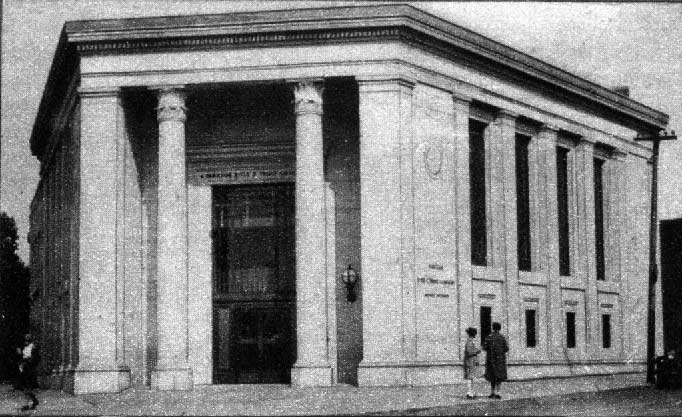
Parkside Trust – Haddon and Kaighn Avenues
Biography
South Jersey A History — 1664–1924
Few men can be successful in both politics and business, but Alfred Leon Sayers has a proud record in both fields. He was born in Blackwood NJ, June 9, 1869, and was educated in the Stevens School, of Camden, and Abrahamson’s Business College, in that city. He entered the Camden Police department April 14, 1894, and while in that department became a steam and hot water contractor, in which he was very successful. In 1904 he resigned from the Police Department to become a member of the Board of Freeholders, and in 1906 he was made a director and president of that body, and served until 1910, when he resigned to become street commissioner of Camden. Up to this time he had been carrying on his heating and hot water contracting work, but now he sold out and devoted all his time to his position as street commissioner, this service running from 1910 to 1923. He was a committee clerk in the New Jersey Legislature, associated with William J. Bradley in the Senate 1904-05. On January 12, 1918 he was made a Director of the Parkside Trust Company. He was active in its organization, which was consummated January 12, 1918, the date of his election, and is still its President. Mr. Sayers is President of the Seventh Ward Republican Club, of Camden. In religion he adheres to the Methodist faith.
Mr. Sayers was married, February 9, 1897, to Clara V. DeBarth, in Camden. His father, deceased, a cloth finisher, served in the Civil War, enlisting from Camden. His mother was Mary E. (Munyon) Sayers. Both died on the same day, in 1915, from pneumonia.
When They Talk of Old Times
Camden Courier-Post —
Waning of the old bike days came with the advent of the “gas buggy,” even though many wedded to the silent steed refused to call quits with that invigorating, healthy sport.
Just who sported the first auto hereabouts I do not recall, since several were mentioned by the late Charles Leo McKeone who “ran” The Courier’s Peppery Pot for several years. I do remember Dr. Roland [sic] I. Haines and Dr. Wilson G. Bailey, so far as the downtown area is concerned, as among the first, with William Leonard Hurley, who died Monday, in the running. These first cars were small red runabouts which clattered along with enough noise to make every horse within a mile rear and plunge. Thick volumes of blue smoke came from the exhaust and when Doc Bailey or Doc Haines went along Broadway the street was filled with a cloud. The runabouts were dubbed “devil wagons” and considered by the old timers as nothing less than an abomination.
But it was Hurley who recognized the gas buggy had come to stay, as he had visioned many other things, in a civic and business way, that his contemporaries often regarded as passing crazes or whims. Asphalted streets were slowly developing as a method of paving over the cobble and asphalt block paving, but there was little to offer the autoist of that day, far as the outlets to the city were concerned.
It was Hurley, just twenty-five years ago next month, who called together the comparatively few auto owners at a conference in his office at the Broadway store to discuss that question of developing needed arteries leading out of the city. It didn’t cut any great figure in the news of the day, but from it eventually grew the movement that crystalized into the street and road building that has meant the expenditure of vast sums.
Federal street was paved and so was Haddon avenue, while Mt. Ephraim avenue was laid in Belgian blocks on a foundation that even yet defies the heavy traffic. Part of that has been covered with amiesite, but the lower section remains pretty much as “Allie” Sayrs paved it nearly a score of years ago. From that little gathering a quarter of a century ago has grown the street improvement program which is even today being extended through the Centerville section.
When comparatively smooth streets were laid there bobbed up the problem of curbing the “speed fiends.” For many a year the limit had been fixed at 12 miles an hour. It was the limit when John and Mary took a sulky ride in the ’80s; it was the same with the biking days, although the scorchers paid little heed to it. Many who had the temerity to go 20 miles an hour were heavily fined as public menaces.
That 12-mile limit seemed good enough for several years after the small buzz wagons made their advent and is even yet conspicuously displayed in country towns who warn the driver to “go slow and sed [sic] our town or go fast and see our jail.” But the speed boys came along and 20 miles an hour was nothing at all.
I recall a story I wrote for The Courier of a young couple “speeding” to their death over the “s” bridge at Atco by plunging through the railing and falling on the track below. It was charged the young driver was a speed fiend, that he was going fully 20 miles an hour when the accident occurred. A demand was made to curb such recklessness, and constables were assigned along the White Horse to shoot the tires of those who thus took fate in their hands.
By the time Hurley had developed his beautiful property, “Dungarvan,” along the White Horse, the 20-mile-an-hour drivers were becoming somewhat of a nuisance and when the concrete roadway was finished in 1922 the real speed fiends were going a mile a minute and were thick as fleas. It was indeed a far, far cry from that little gathering in his office so long ago, marking the development of the auto from the very crude one-cylinder affairs to the truly wondrous cars of today.
Camden Cops of 32 Years Ago Valiant Crew Under ‘Sam’ Dodd
Camden Courier-Post —
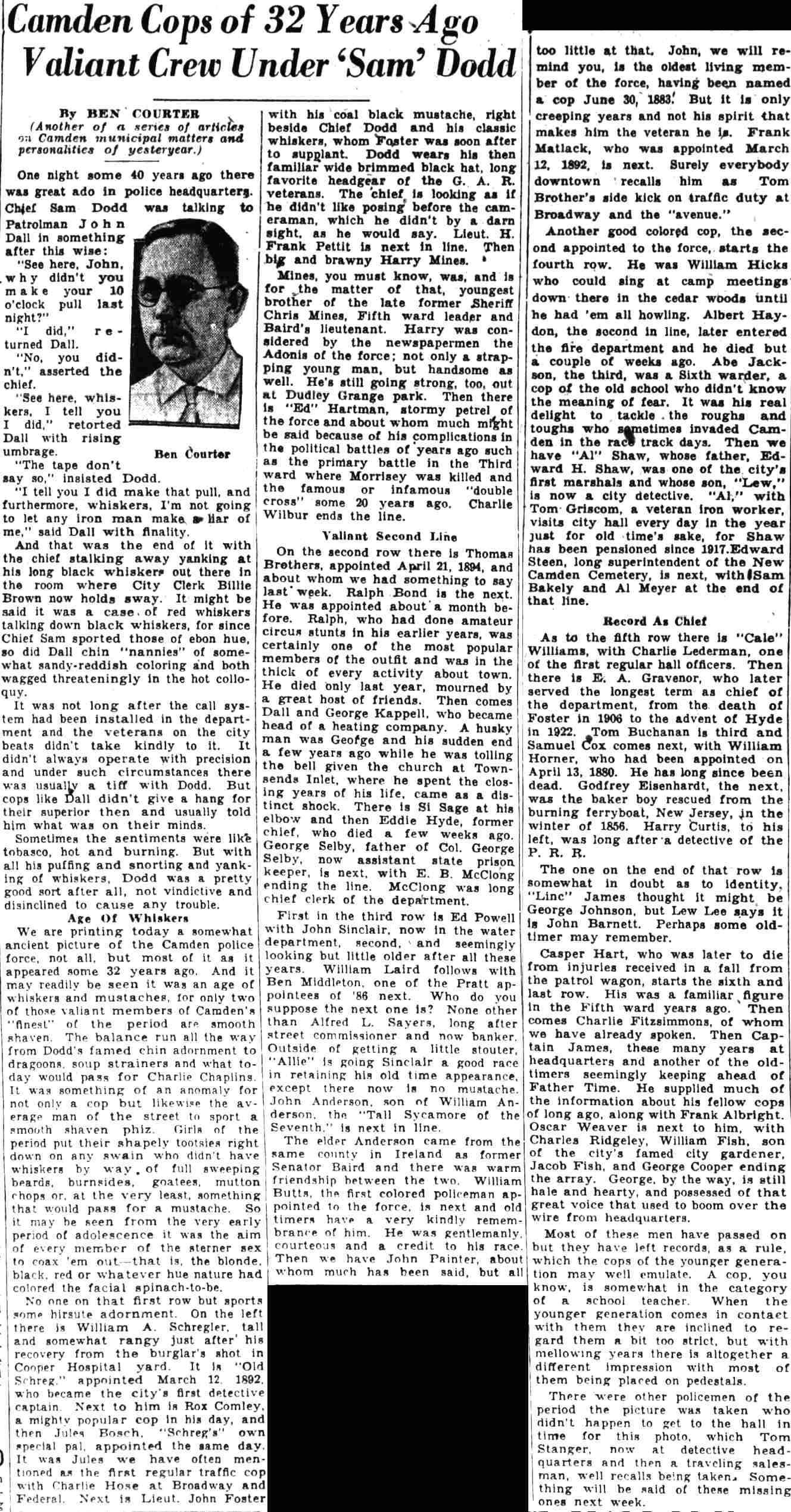
By BEN COURTER
(Another of a series of articles on Camden municipal matters and personalities of yesteryear.)
One night some 40 years ago there was great ado in police headquarters. Chief Sam Dodd was talking to Patrolman John Dall in something after this wise:
“See here, John, why didn’t you make your 10 o’clock pull last night?”
“I did,” returned Dall.
“No, you didn’t,” asserted the chief.
“See here, whiskers, I tell you I did,” retorted Dall with rising umbrage.
“The tape don’t say so,” insisted Dodd.
“I tell you I did make that pull, and furthermore, whiskers, I’m not going to let any iron man make a liar of me,” said Dall with finality.
And that was the end of it with the chief stalking away yanking at his long black whiskers out there in the room where City Clerk Billie Brown now holds sway. It might be said it was a case of red whiskers talking down black whiskers, for since Chief Sam sported those of ebon hue, so did Dall chin “nannies” of somewhat sandy-reddish coloring and both wagged threateningly in the hot colloquy.
It was not long after the call system had been installed in the department and the veterans on the city beats didn’t take kindly to it. It didn’t always operate with precision and under such circumstances there was usually a tiff with Dodd. But cops like Dall didn’t give a hang for their superior then and usually told him what was on their minds.
Sometimes the sentiments were like tobasco, hot and burning. But with all his puffing and snorting and yanking of whiskers, Dodd was a pretty good sort after all, not vindictive and disinclined to cause any trouble.
Age Of Whiskers
We are printing today a somewhat ancient picture of the Camden police force, not all, but most of it as it appeared some 32 years ago. And it may readily be seen it was an age of whiskers and mustaches, for only two of those valiant members of Camden’s “finest” of the period are smooth shaven. The balance run all the way from Dodd’s famed chin adornment to dragoons, soup strainers and what today would pass for Charlie Chaplins. It was something of an anomaly for not only a cop but likewise the average man of the street to sport a smooth shaven phiz. Girls of the period put their shapely tootsies right down on any swain who didn’t have whiskers by way of full sweeping beards, burnsides, goatees, mutton chops or, at the very least, something that would pass for a mustache. So it may be seen from the very early period of adolescence it was the aim of every member of the sterner sex to coax ‘em out—that is, the blonde, black, red or whatever hue nature had colored the facial spinach-to-be.
No one on that first row but sports some hirsute adornment. On the left there is William A. Schregler, tall and somewhat rangy just after his recovery from the burglar’s shot in Cooper Hospital yard. It is “Old Schreg,” appointed March 12, 1892, who became the city’s first detective captain. Next to him is Rox Comley, a mighty popular cop in his day, and then Jules Bosch, “Schreg’s” own special pal, appointed the same day. It was Jules we have often mentioned as the first regular traffic cop with Charlie Hose at Broadway and Federal. Next is Lieut. John Foster with his coal black mustache, right beside Chief Dodd and his classic whiskers, whom Foster was soon after to supplant. Dodd wears his then familiar wide brimmed black hat, long favorite headgear of the G. A. R. veterans. The chief is looking as if he didn’t like posing before the cameraman, which he didn’t by a darn sight, as he would say. Lieut. H. Frank Pettit is next in line. Then big and brawny Harry Mines.
Mines, you must know, was, and is for the matter of that, youngest brother of the late former Sheriff Chris Mines, Fifth ward leader and Baird’s lieutenant. Harry was considered by the newspapermen the Adonis of the force; not only a strapping young man, but handsome as well. He’s still going strong, too, out at Dudley Grange park. Then there is “Ed” Hartman, stormy petrel of the force and about whom much might be said because of his complications in the political battles of years ago such as the primary battle in the Third ward where Morrisey was killed and the famous or infamous “double cross” some 20 years ago. Charlie Wilbur ends the line.
Valiant Second Line
On the second row there is Thomas Brothers, appointed April 21, 1894, and about whom we had something to say last week. Ralph Bond is the next. He was appointed about a month before. Ralph, who had done amateur circus stunts in his earlier years, was certainly one of the most popular members of the outfit and was in the thick of every activity about town. He died only last year, mourned by a great host of friends. Then comes Dall and George Kappell, who became head of a heating company. A husky man was George and his sudden end a few years ago while he was tolling the bell given the church at Townsends Inlet, where he spent the closing years of his life, came as a distinct shock. There is Si Sage at his elbow and then Eddie Hyde, former chief, who died a few weeks ago. George Selby, father of Col. George Selby, now assistant state prison keeper, is next, with E. B. McClong ending the line. McClong was long chief clerk of the department.
First in the third row is Ed Powell with John Sinclair, now in the water department, second, and seemingly looking but little older after all these years. William Laird follows with Ben Middleton, one of the Pratt appointees of ‘86 next. Who do you suppose the next one is? None other than Alfred L. Sayers, long after street commissioner and now banker. Outside of getting a little stouter, “Allie” is going Sinclair a good race in retaining his old time appearance, except there now is no mustache. John Anderson, son of William Anderson, the “Tall Sycamore of the Seventh,” is next in line.
The elder Anderson came from the same county in Ireland as former Senator Baird and there was warm friendship between the two. William Butts, the first colored policeman appointed to the force, is next and old timers have a very kindly remembrance of him. He was gentlemanly, courteous and a credit to his race. Then we have John Painter, about whom much has been said, but all too little at that. John, we will remind you, is the oldest living member of the force, having been named a cop June 30, 1883. But it is only creeping years and not his spirit that makes him the veteran he is. Frank Matlack, who was appointed March 12, 1892, is next. Surely everybody downtown recalls him as Tom Brother’s side kick on traffic duty at Broadway and the “avenue.”
Another good colored cop, the second appointed to the force, starts the fourth row. He was William Hicks who could sing at camp meetings down there in the cedar woods until he had ‘em all howling. Albert Haydon, the second in line, later entered the fire department and he died but a couple of weeks ago. Abe Jackson, the third, was a Sixth warder, a cop of the old school who didn’t know the meaning of fear. It was his real delight to tackle the roughs and toughs who sometimes invaded Camden in the race track days. Then we have “Al” Shaw, whose father, Edward H. Shaw, was one of the city’s first marshals and whose son, “Lew,” is now a city detective. “Al,” with Tom Griscom, a veteran iron worker, visits city hall every day in the year just for old time’s sake, for Shaw has been pensioned since 1917. Edward Steen, long superintendent of the New Camden Cemetery, is next, with Sam Bakely and Al Meyer at the end of that line.
Record As Chief
As to the fifth row there is “Cale” Williams, with Charlie Lederman, one of the first regular hall officers. Then there is E. A. Gravenor, who later served the longest term as chief of the department, from the death of Foster in 1906 to the advent of Hyde in 1922. Tom Buchanan is third and Samuel Cox comes next, with William Horner, who had been appointed on April 13, 1880. He has long since been dead. Godfrey Eisenhardt, the next, was the baker boy rescued from the burning ferryboat, New Jersey, in the winter of 1856. Harry Curtis, to his left, was long after a detective of the P. R. R.
The one on the end of that row is somewhat in doubt as to identity. “Linc” James thought it might be George Johnson, but Lew Lee says it is John Barnett. Perhaps some old-timer may remember.
Casper Hart, who was later to die from injuries received in a fall from the patrol wagon, starts the sixth and last row. His was a familiar figure in the Fifth ward years ago. Then comes Charlie Fitzsimmons, of whom we have already spoken. Then Captain James, these many years at headquarters and another of the old-timers seemingly keeping ahead of Father Time. He supplied much of the information about his fellow cops of long ago, along with Frank Albright. Oscar Weaver is next to him, with Charles Ridgeley, William Fish, son of the city’s famed city gardener, Jacob Fish, and George Cooper ending the array. George, by the way, is still hale and hearty, and possessed of that great voice that used to boom over the wire from headquarters.
Most of these men have passed on but they have left records, as a rule, which the cops of the younger generation may well emulate. A cop, you know, is somewhat in the category of a school teacher. When the younger generation comes in contact with them they are inclined to regard them a bit too strict, but with mellowing years there is altogether a different impression with most of them being placed on pedestals.
There were other policemen of the period the picture was taken who didn’t happen to get to the hall in time for this photo, which Tom Stanger, now at detective headquarters and then a traveling salesman, well recalls being taken. Something will be said of these missing ones next week.
Hartmann Charge Denied by Sayers
Camden Courier-Post —
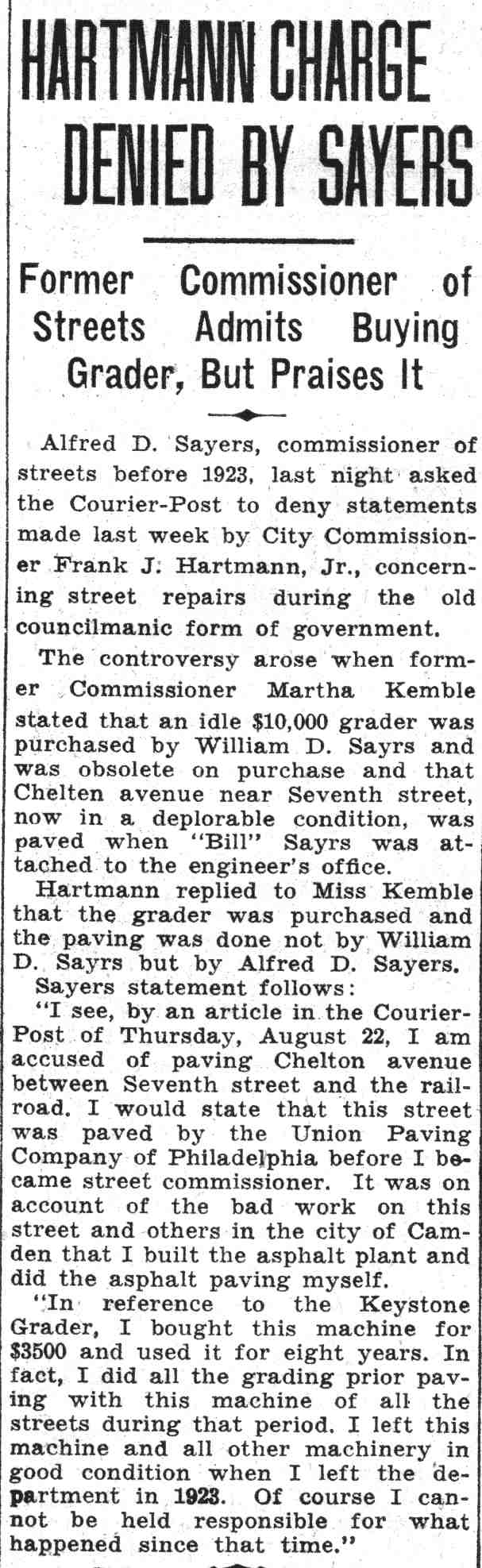
Hartmann Charge Denied by Sayers
HARTMANN CHARGE DENIED BY SAYERS
Former Commissioner of Streets Admits Buying Grader, But Praises It
Alfred D. Sayers, commissioner of streets before 1923, last night asked the Courier-Post to deny statements made last week by City Commissioner Frank J. Hartmann, Jr., concerning street repairs during the old councilmanic form of government.
The controversy arose when former Commissioner Martha Kemble stated that an idle $10,000 grader was purchased by William D. Sayrs and was obsolete on purchase and that Chelten avenue near Seventh street, now in a deplorable condition, was paved when “Bill” Sayrs was attached to the engineer’s office.
Hartmann replied to Miss Kemble that the grader was purchased and the paving was done not by William D. Sayrs but by Alfred D. Sayers.
Sayers statement follows:
“I see, by an article in the Courier-Post of Thursday, August 22, I am accused of paving Chelten avenue between Seventh street and the railroad. I would state that this street was paved by the Union Paving Company of Philadelphia before I became street commissioner. It was on account of the bad work on this street and others in the city of Camden that I built the asphalt plant and did the asphalt paving myself.
“In reference to the Keystone Grader, I bought this machine for $3500 and used it for eight years. In fact, I did all the grading prior paving with this machine of all the streets during that period. I left this machine and all other machinery in good condition when I left the department in 1923. Of course I can not be held responsible for what happened since that time.”
Alfred L. Sayres, Banker, Stricken; Condition Critical
Camden Courier-Post —
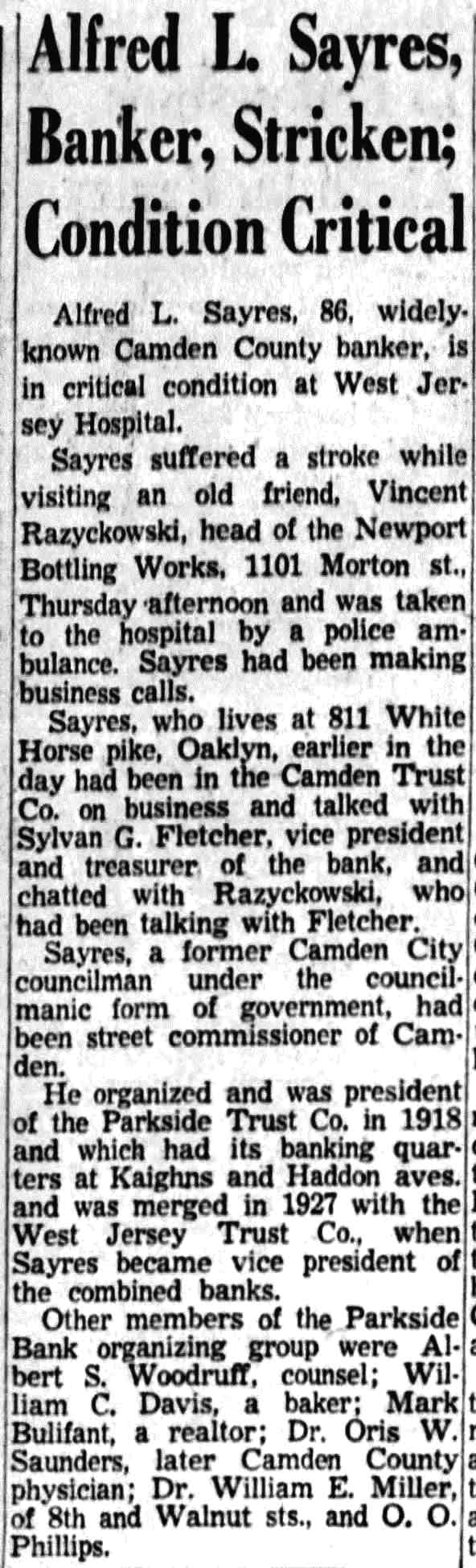
Alfred L. Sayres, 86, widely-known Camden County banker, is in critical condition at West Jersey Hospital.
Sayres suffered a stroke while visiting an old friend, Vincent Razyckowski [sic], head of the Newport Bottling Works, 1101 Morton st., Thursday afternoon and was taken to the hospital by a police ambulance. Sayres had been making business calls.
Sayres, who lives at 811 White Horse pike, Oaklyn, earlier in the day had been in the Camden Trust Co. on business and talked with Sylvan G. Fletcher, vice president and treasurer of the bank, and chatted with Razyckowski [sic], who had been talking with Fletcher.
Sayres, a former Camden City councilman under the councilmanic form of government, had been street commissioner of Camden.
He organized and was president of the Parkside Trust Co. in 1918 and which had its banking quarters at Kaighns and Haddon aves. and was merged in 1927 with the West Jersey Trust Co., when Sayres became vice president of the combined banks.
Other members of the Parkside Bank organizing group were Albert S. Woodruff, counsel; William C. Davis, a baker; Mark Bulifant, a realtor; Dr. Oris [sic] W. Saunders, later Camden County physician; Dr. William E. Miller, of 8th and Walnut sts., and O. O. Phillips.