Introduction
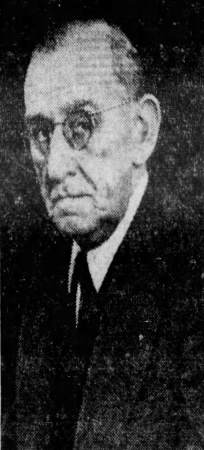
Frank Sheridan
Frank Sheridan was born in Mt. Holly, New Jersey on June 10, 1887 to James F. Sheridan and his wife, the former Lydia Willets. He was baptized at St. Andrews Episcopal Church in Mt. Holly on August 9, 1895. His father, who worked as a machinist, brought the family to Philadelphia not long afterwards. The 1900 Census shows Frank Sheridan and his parents living at 1709 McClellan Street in South Philadelphia. At some point in the 1900s Frank Sheridan came to Camden and found work as a reporter.
Aside from his marriage, not much is known to this writer of Frank Sheridan’s early life and activities during the 1900s. He is not one of the Frank Sheridans listed in city directories prior to 1910. He is said to have begun as a reporter for the Camden-Post Telegram, but had moved over to the Camden Daily Courier by the end of 1909. The 1910 Census indicates that he married early in 1908. He was working for the Camden Daily Courier in 1909. By April of 1910 he and his wife Anna were living at 530 North 7th Street. Anna B. Sheridan gave birth to a daughter, also named Anna, on January 17, 1910. A son, David F. Sheridan, was born on November 22, 1910, and another son Edward, arrived on January 7, 1912. The family lived at 530 North 7th Street as late as 1912. The 1913 and 1914 City Directories show the Sheridans at 524 North 7th Street. In 1914 the family moved to a relatively new house 941 Elm Street. The previous resident, Howard Padgett, had lost his arm in an accident at the Pavonia railroad yards in December of 1913.
What is known of Frank Sheridan’s activities in the early 1910s and beyond is that he became quite active in civic, fraternal, and political affairs in North Camden and beyond. Besides working as a reporter, he conducted a cigar store at North 7th Street and Birch Street. Best known of course for his many years as a reporter for the Courier-Post newspapers, Frank Sheridan’s activities involved him far beyond mere journalism. An unswerving Republican, in 1914 he was elected Justice of the Peace for Camden’s Tenth Ward and was reelected five times thereafter, and came to be known as “Squire” Sheridan. By October of 1921 his reporting was rewarded with a promotion to City Editor of the Camden Daily Courier.
He was active in the Lions Club, the Pyne Poynt Athletic Association, the North Camden Square Club, and many other community groups. Fraternally, he was affiliated with Trimble Lodge No. 117, Free and & Associated Masons; Camden Forest No. 5, Tall Cedars of Lebanon; and the Junior Order of American Mechanics.
Perhaps Frank Sheridan’s most lasting legacy is his work as the editor of the book History of Camden County In The Great War 1917–1918, a complete accounting of Camden County’s involvement overseas and on the home front. The book was authorized by a group of Camden’s leading citizens, the Victory Jubilee and Memorial Committee and published by the Publicity and Historical Committee. The Publicity and Historical Committee was comprised of Camden newspapermen, was chaired by Frank Sheridan, and included Frank H. Ryan, Benjamin W. Courter, Frank S. Albright, Charles J. Haaga, James L. Polk, Charles H. Schuck, William B. Wells, Richard B. Ridgway, Daniel P. McConnell, Alvah M. Smith, Daniel M. Stevens, John D. Courter, William H. Jefferys, and William Rothman.
Frank Sheridan wrote a number of other multi-part features covering historical events in Camden, including a six-part feature about the Camden Fire Department, published in October of 1936; and a five-part feature covering the early history of East Camden and Cramer from colonial times until the 1899 annexation of Stockton by Camden, published in May of 1949.
Frank Sheridan passed away at Cooper Hospital on May 30, 1954. He was survived by his wife, children, and a host of grandchildren and great-grandchildren.
January 18, 1910
Camden Post-Telegram —
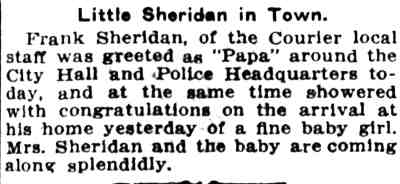
Frank Sheridan
December 30, 1910
Camden Post-Telegram —
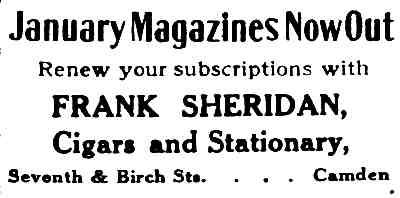
Frank Sheridan
August 23, 1912
Camden Post —
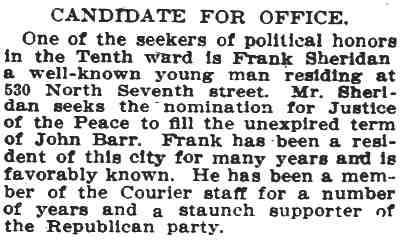
Frank Sheridan – North 7th Street
November 24, 1915
Camden Daily Courier —
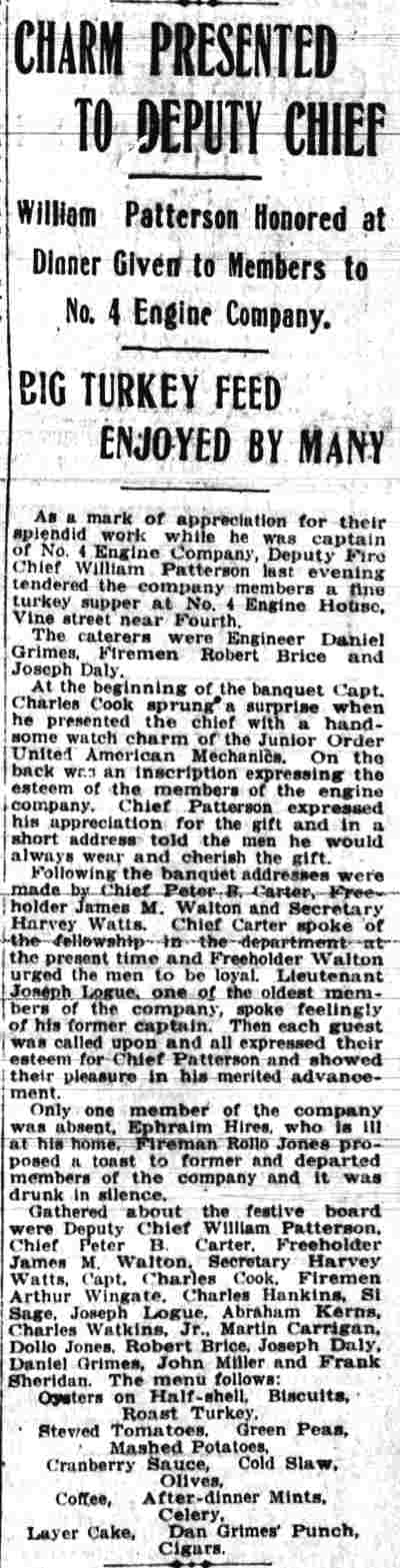
CHARM PRESENTED TO DEPUTY CHIEF
William Patterson Honored at Dinner Given to Members to No. 4 Engine Company.
BIG TURKEY FEED ENJOYED BY MANY
As a mark of appreciation for their splendid work while he was captain of No. 4 Engine Company, Deputy Fire Chief William Patterson last evening tendered the company members a fine turkey supper at No. 4 Engine House, Vine street near Fourth.
The caterers were Engineer Daniel Grimes, Firemen Robert Brice and Joseph Daly.
At the beginning of the banquet Capt. Charles Cook sprung a surprise when he presented the chief with a handsome watch charm of the Junior Order United American Mechanics. On the back was an inscription expressing the esteem of the members of the engine company. Chief Patterson expressed his appreciation for the gift and in a short address told the men he would always wear and cherish the gift.
Following the banquet addresses were made by Chief Peter B. Carter, Freeholder James M. Walton and Secretary Harvey Watts. Chief Carter spoke of the fellowship in the department at the present time and Freeholder Walton urged the men to be loyal. Lieutenant Joseph Logue, one of the oldest members of the company, spoke feelingly of his former captain. Then each guest was called upon and all expressed their esteem for Chief Patterson and showed their pleasure in his merited advancement.
Only one member of the company was absent, Ephraim Hires, who is ill at his home. Fireman Rollo Jones proposed a toast to former and departed members of the company and it was drunk in silence.
Gathered about the festive board were Deputy Chief William Patterson, Chief Peter B. Carter, Freeholder James M. Walton, Secretary Harvey Watts, Capt. Charles Cook, Firemen Arthur Wingate, Charles Hankins, Si Sage, Joseph Logue, Abraham Kerns, Charles Watkins, Jr., Martin Carrigan, Dollo Jones, Robert Brice, Joseph Daly, Daniel Grimes, John Miller and Frank Sheridan. The menu follows:
Oysters on Half-shell, Biscuits, Roast Turkey, Stewed Tomatoes, Green Peas, Mashed Potatoes, Cranberry Sauce, Cold Slaw, Olives, Coffee, After-dinner Mints, Celery, Layer Cake, Dan Grimes’ Punch, Cigars.
October 16, 1916
Camden Post —
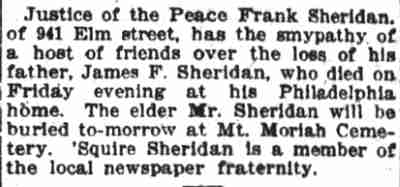
Justice of the Peace Frank Sheridan of 941 Elm street, has the sympathy of a host of friends over the loss of his father, James F. Sheridan, who died on Friday evening at his Philadelphia home. The elder Mr. Sheridan will be buried to-morrow at Mt. Moriah Cemetery. ’Squire Sheridan is a member of the local newspaper fraternity.
March 17, 1917
Philadelphia Inquirer —
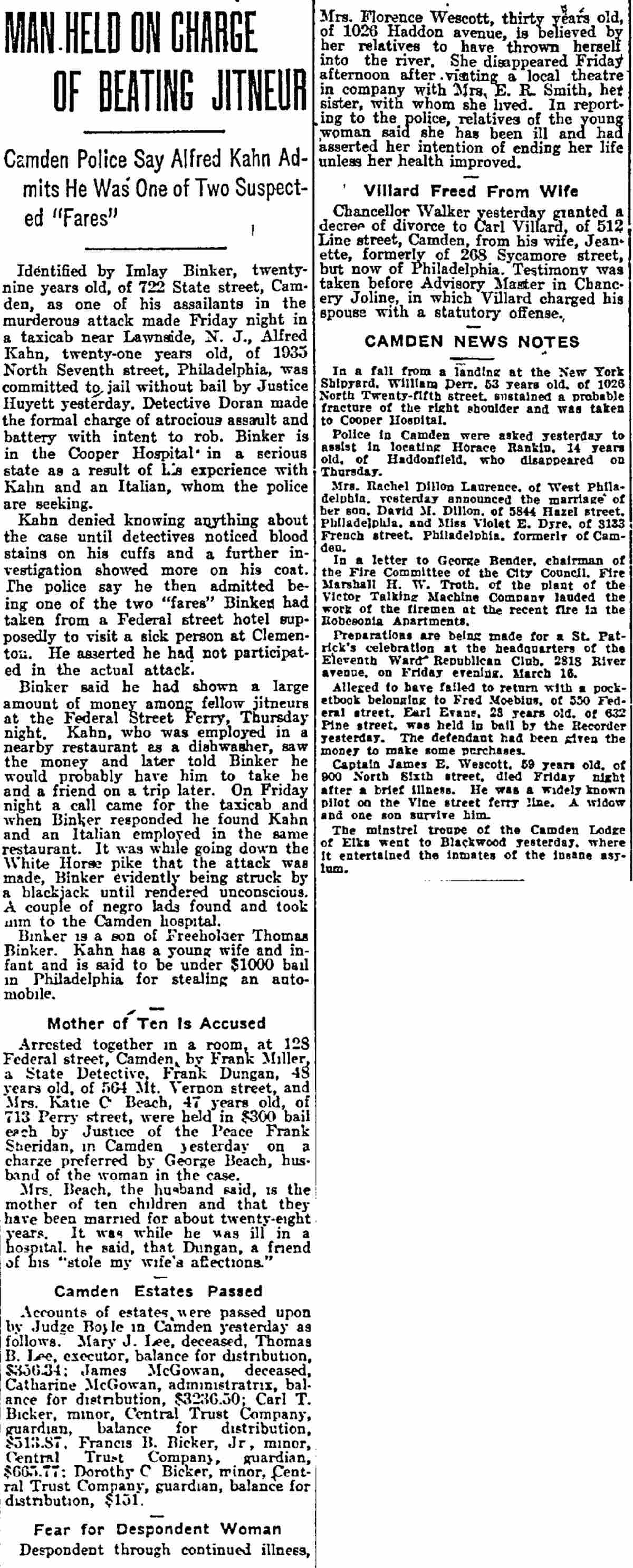
Mother of Ten Is Accused
Arrested together in a room, at 123 Federal street, Camden, by Miles Miller, a State Detective, Frank Dungan, 48 years old, of 504 Vernon street, and Miss Katie C. Beach, 41 years old, of 713 Perry street, were held in $300 bail each by Justice of the Peace Frank Sheridan, in Camden yesterday on a charge preferred by George Beach, husband by the woman of the party. Mrs. Beach, the husband said, is the mother of ten children and that they have been unable to find her for several years. It was while he was ill in a hospital, he added, that a supposed friend of his “stole my wife’s affections.”
World War I Draft Card
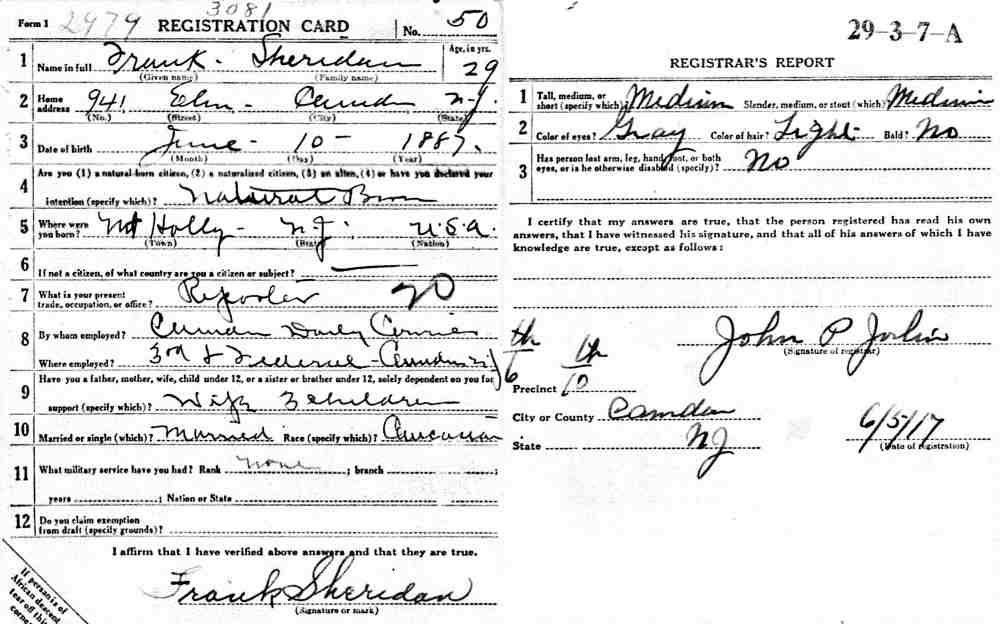
Frank Sheridan — World War I Draft Card
Camden County in the Great War
City Farm Gardens
Another weapon to defeat the enemy was the establishment of City Farm Gardens in the country. They were urged by the Government and not only provided food for city residents, but abolished unsightly vacant lots. Mayor Ellis named the first City Gardens Committee on April 19, 1917, as follows: E. G. C. Bleakly, Judge Frank T. Lloyd, Zed H. Copp, William Derham, L. E. Farnham, B. M. Hedrick, David Jester, O. B. Kern, M. F. Middleton, Dr. H. L. Rose, Asa L. Roberts, W. D. Sayrs, Jr., Charles A. Wolverton, Earl T. Jackson, H. R. Kuehner, Herbert N. Moffett and Hubert H. Pfeil. At the initial meeting of the above date B. M. Hedrick was elected chairman; Zed H. Copp secretary and M. F. Middleton treasurer. Brandin W. Wright, a farming expert, was employed as general superintendent on May 3, 1917. At a meeting on May 18, 1918, the names of Frank Sheridan and Daniel P. McConnell were added to the publicity committee in the place of Messrs. Pfeil and Jackson.
In his annual report to City Council on January 1, 1918, Mayor Ellis urged the appointment of a committee by City Council on City Gardens and Councilman Frederick Von Neida was named as chairman. This committee with a committee of representative citizens met in the City Hall in February, 1918, to organize for the ensuing summer. The members of the Councilmanic committee were: Frederick Von Neida, Frank S. Van Hart, William J. Kelly and John J. Robinson.
The committee planned an exposition of farm garden products for the fall of 1918, but this plan was frustrated by the Spanish influenza epidemic.
The war gardens became victory gardens in the year 1919 when the committee met on January 29, 1919. Meyers Baker was elected secretary and William D. Sayrs, Jr., treasurer. At the meeting on March 25 committees were appointed for the Victory War Gardens Exposition held in Third Regiment Armory from September 15 to 20. Benjamin Abrams was elected general manager and Frank Sheridan publicity agent.
April 26, 1920
Camden Daily Courier-Post —
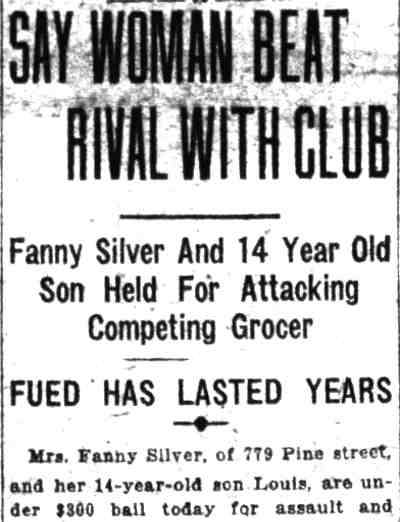
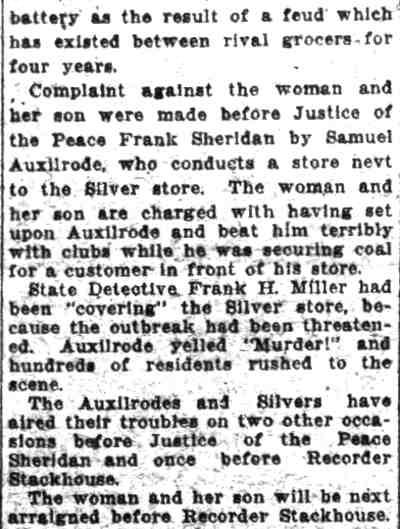
Named: Fannie Silver, Louis Silver, Frank Sheridan, Samuel Axelrod, Frank H. Miller, O. Glen Stackhouse, and Pine Street.
November 9, 1925
Camden Daily Courier —
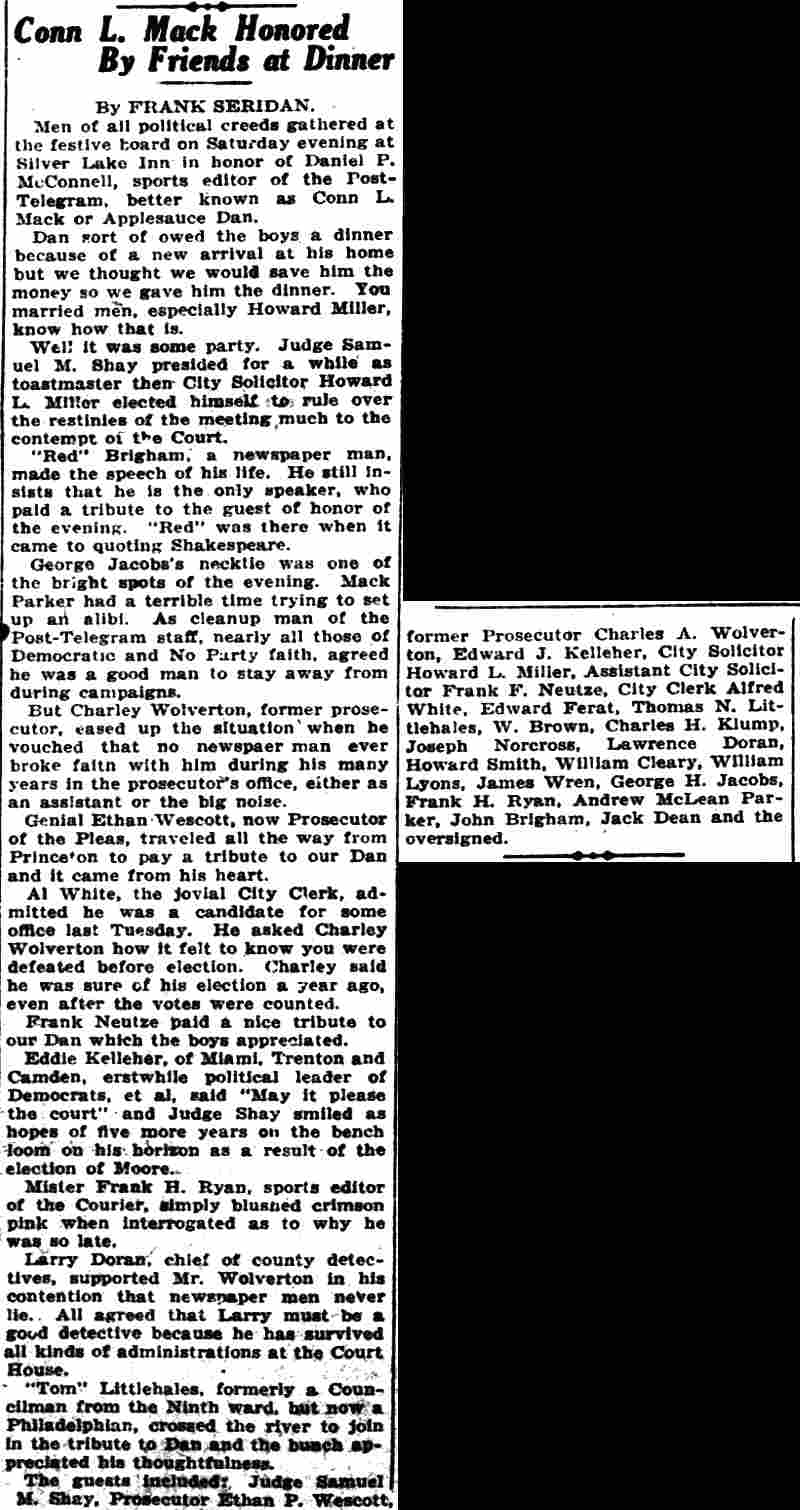
By FRANK SERIDAN.
Men of all political creeds gathered at the festive board on Saturday evening at Silver Lake Inn in honor of Daniel P. McConnell, sports editor of the Post-Telegram, better known as Conn L. Mack or Applesauce Dan.
Dan sort of owed the boys a dinner because of a new arrival at his home but we thought we would save him the money so we gave him the dinner. You married men, especially Howard Miller, know how that is.
Well it was some party. Judge Samuel M. Shay presided for a while as toastmaster then City Solicitor Howard L. Miller elected himself to rule over the destinies of the meeting much to the contempt of the Court.
“Red” Brigham, a newspaper man, made the speech of his life. He still insists that he is the only speaker, who paid a tribute to the guest of honor of the evening. “Red” was there when it came to quoting Shakespeare.
George Jacobs’s necktie was one of the bright spots of the evening. Mack Parker had a terrible time trying to set up an alibi. As cleanup man of the Post-Telegram staff, nearly all those of Democratic and No Party faith, agreed he was a good man to stay away from during campaigns.
But Charley Wolverton, former prosecutor, eased up the situation when he vouched that no newspaper man ever broke faith with him during his many years in the prosecutor’s office, either as an assistant or the big noise.
Genial Ethan Wescott, now Prosecutor of the Pleas, traveled all the way from Princeton to pay a tribute to our Dan and it came from his heart.
Al White, the jovial City Clerk, admitted he was a candidate for some office last Tuesday. He asked Charley Wolverton how it felt to know you were defeated before election. Charley said he was sure of his election a year ago, even after the votes were counted.
Frank Neutze paid a nice tribute to our Dan which the boys appreciated.
Eddie Kelleher, of Miami, Trenton and Camden, erstwhile political leader of Democrats, et al, said “May it please the court” and Judge Shay smiled as hopes of five more years on the bench loom on his horizon as a result of the election of Moore.
Mister Frank H. Ryan, sports editor of the Courier, simply blushed crimson pink when interrogated as to why he was so late.
Larry Doran, chief of county detectives, supported Mr. Wolverton in his contention that newspaper men never lie. All agreed that Larry must be a good detective because he has survived all kinds of administrations at the Court House.
“Tom” Littlehales, formerly a Councilman from the Ninth ward, but now a Philadelphian, crossed the river to join in the tribute to Dan and the bunch appreciated his thoughtfulness.
The guests included: Judge Samuel M. Shay, Prosecutor Ethan P. Wescott, former Prosecutor Charles A. Wolverton, Edward J. Kelleher, City Solicitor Howard L. Miller, Assistant City Solicitor Frank F. Neutze, City Clerk Alfred White, Edward Ferat, Thomas N. Littlehales, W. Brown, Charles H. Klump, Joseph Norcross, Lawrence Doran, Howard Smith, William Cleary, William Lyons, James Wren, George H. Jacobs, Frank H. Ryan, Andrew McLean Parker, John Brigham, Jack Dean and the oversigned.
December 19, 1927
Camden Courier-Post —
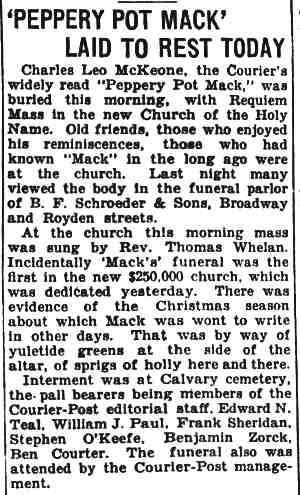
’Peppery Pot Mack’ Laid to Rest Today
Charles Leo McKeone, the Courier’s widely read “Peppery Pot Mack,” was buried this morning, with Requiem Mass in the new Church of the Holy Name. Old friends, those who enjoyed his reminiscences, those who had known “Mack” in the long ago were at the church. Last night many viewed the body in the funeral parlor of B. F. Schroeder & Sons, Broadway and Royden streets.
At the church this morning mass was sung by Rev. Thomas Whelan. Incidentally “Mack’s” funeral was the first in the new $250,000 church, which was dedicated yesterday. There was evidence of the Christmas season about which Mack was wont to write in other days. That was by way of yuletide greens at the side of the altar, of sprigs of holly here and there.
Interment was at Calvary cemetery, the pall bearers being members of the Courier-Post editorial staff. Edward N. Teal, William J. Paul, Frank Sheridan, Stephen O’Keefe, Benjamin Zorck, Ben Courter. The funeral also was attended by the Courier-Post management.
400 Friends Pay Homage To ‘Good Gray Poet’
Camden Courier-Post —
Men and Women From Many Sections Visit Walt Whitman’s Tomb and Old Mickle Street Home on His 114th Anniversary
By FRANK SHERIDAN
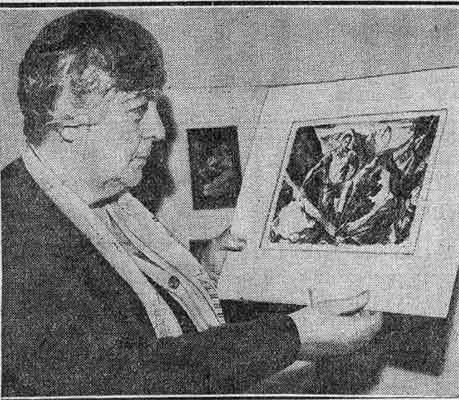
“It’s just a little street where old friends meet”
That’s Mickle Street where Walt Whitman, the “Good Gray Poet,” once lived, and old friends came back here from near and far yesterday to mingle under the portals of the house in which he wrote his famous works, on the 114th anniversary of his birth.
Among them was Mrs. Augusta K. Dole, 71, of Metuchen, whose husband has been a sports writer on New York newspapers for 45 years.
“They call it a dingy street and some are ashamed to return and say they lived there,” Mrs. Dole said. And with a gesture of the hand she pointed out the homes of some of neighbors, who became famous.
Among them was Button; famous artist [architect]. Another was the grandmother of J. B. Van Sciver.
“I lived at 319 Mickle Street when I was a young lady,” she said. “I was one year old when we moved into the house right across the street from Whitman. I remember when he lived on Stevens Street before he moved to Mickle Street.
Knew Whitman Well
“We lived at the Mickle Street address about 15 or 16 or 20 years; I knew Whitman well. He always stopped and exchanged greetings with me. I frequently saw him on the ferryboats crossing the rivers.
“I want to take issue right here with those who have questioned his chastity. He was more like Christ than anyone else. I saw him admiring me as a young woman one day on a ferryboat.”
“Years later I read a description of myself in one of his works. I did not begin to read his work until 30 years ago. He wrote of the true things in life. He wrote of life as it is and as we see it. I am glad to come here today at the invitation of the committee,”
Mrs. Dole sat in the last chair in which the poet rested before his last illness. She was introduced to Dr. Alexander MacAlister, who was his personal physician in his last illness and who is a member of the Walt Whitman foundation.
Then she posed with an etching by Lewis Daniel, New York artist, at the Walt Whitman art gallery, 641 Market Street. It is one of 14 the young artist drew on “The Song of the Open Road.” Two lines taken from the book are sketched under the etching as follows:
“The earth is crude and incomprehensible at first— Nature is rude and incomprehensible at first.”
400 Visit Home
More than 400 guests visited the home of the poet during the day to be welcomed by members of the foundation. Mrs. Charles A. Wolverton, wife of Congressman Wolverton, was chairman of the reception committee.
Many of the guests visited the tomb of the poet in Harleigh Cemetery where the door is ajar at his request “that his spirit may come and go as I choose.’” But no flowers were placed there as he requested none.
Born on May 31, 1819, near Huntingdon, Long Island, he had a varied career as a writer, war correspondent and poet. During the Civil War he ministered the wounded of both the North and South at Washington. He spent the last 19 years of his life in Camden, where he died in 1892.
Under the bed in his second story front bed room today is a huge metal bathtub, which he designed for use in his invalid days. His library, horsehair furniture, his favorite rocking chair and a cane with which he knocked on the floor to call his housekeeper.
Some of his writings, manuscripts and other works are the property of Miss Ann Harned and Madge Barton Feurer. They are now at the New Jerseyanna Exhibition at the State House at Trenton.
New Painting Viewed
A new painting of Walt Whitman has been completed by Byron T. Connor, of 4320 Manor Avenue, Merchantville, and is now on display at the Hotel Walt Whitman. The painting was completed in three weeks, so as to be ready for the birthday ceremonies.
Later it will be moved from the hotel and placed either in the Whitman home or hung in the lobby of the Walt Whitman Theatre.
Miss Harned, daughter of the late Thomas B. Harned, one of Whitman’s literary executors; Joseph Praissman and Mrs. Martha Davis curator of the Whitman home, were members of the anniversary committee headed by Mrs. Wolverton.
With few exceptions, members of the Walt Whitman Foundation attended yesterday’s program, including Dr. Macalister, chairman; Dr. Cornelius Weygandt, vice chairman; Mrs. Juliet Lit Stern, Joseph M. Conover, Mrs. Helen Taft Manning, Mrs. Allen Drew Cook, Mrs. Nicholas Douty, Dr. Herbert Spencer Harned, J. Frederick Harned, Roy Helton, William T. Innes, Eldridge R. Johnson, William H. Ketler, Dr. Rufus M. Jones, former Mayor Victor King, Oscar Wolf, John Frederick Lewis, Jr., Dr. Bliss Perry, Harrison S. Morris, Agnes Repplier, former Mayor Winfield S. Price, Vernon Whitman Rich, Dr. J. Duncan Spaeth, Dr. Felix E. Schelling, Dr. Robert E. Spiller, Mrs. David Abeel Storer, Frederick Von Nieda and Ralph W. Wescott.
Among the visitors was former Assemblyman William H. Iszard, who is secretary of the committee, which acquired the home as a national shrine. Iszard sponsored legislation in the Assembly for its upkeep.
High Schools Here Revised; Junior-Senior Plan Cut Out
Camden Courier-Post —
New System Gives Choice of Academic or Commercial and Arts Courses
Saves $500,000 Annex, Relieves Crowding
Hours Reduced; Study Programs Rebuilt; Omit Spanish; Music Optional
By FRANK SHERIDAN
Reorganization of Camden junior and senior high schools has been effected with the approval of the local and state boards of education.
By establishing the Camden Academic High School and Camden Commercial and Practical Arts High School the school population of the present Camden High School will be reduced 50 percent when the September terms begin, according to Dr. Leon N. Neulen, superintendent of schools.
It also will reduce the student roster of all junior high schools even with the promotions of this month added.
Saves $500,000
“This plan will give Camden room for expansion for years to come in high school education and preclude the necessity of building the $500,000 annex to the senior high school, plans for which have been drawn at the cost of thousands of dollars,” Dr. Neulen declares.
“It will eliminate a number of studies and give the students more education in the more essential subjects. The hours of instruction will be reduced from 30 hours per week to 23. The state law’s minimum is 19 hours.”
Dr. Neulen points out that 2400 students are now registered in Camden High School and promotions from junior school this month would have added 700 more. Under the new plan 1500 will attend the Academic High School and 1300 the Commercial school.
The balance will be redistributed back into the junior and seventh grade grammar schools.
Wilson High Commercial
The new plan will cause a general redistribution of pupils in East Camden because the Woodrow Wilson Junior High School will become the Commercial high. The present junior high pupils will be sent back to Cramer school, from which they originally were transferred. Students in the Garfield and Dudley Schools will take their seventh grade in those institutions instead of junior high.
Camden Junior High School No. 1, which now has 849 pupils, will have 730 next term. Hatch Junior High School has 1106 pupils now and will have 1127 next term. Woodrow Wilson Junior High School now has 970 pupils and will have 643 at the Cramer school.
Four Courses at Academic High
Dr. Neulen explained that the new Academic High School will teach four courses: College preparatory, college technical, normal preparatory and general. Students will be given four-year courses, in the first three mentioned courses and three years in the latter. Camden High is now a three-year school.
That will mean the ninth, tenth, eleventh and twelfth grades will be taught in the college preparatory, college technical and normal preparatory and the tenth, eleventh and twelfth in the general course.
The Commercial and Practical Arts High School will teach commercial and practical arts courses in three-year courses in the tenth, eleventh and twelfth.
Practical arts will be taught exclusively to boys in the school because only 27 girls elected to take that course this year and they will be transferred to Academic in the Fall, Dr. Neulen explained.
Four Years Latin; No Spanish
The new plan provides for the teaching of general foreign languages but eliminates Spanish because of so few taking the subject. Latin will be taught four years, French three and German two.
A general business course is included in the plan known as introductory business to be taught at the Commercial High. Students will start this course in the last junior high year. The practical arts course to be taught at Commercial will enable a student to continue manual training and shop begun in the junior years. The student may elect from automobile mechanics and electrical, print shop or woodworking.
Art and Music Optional
Art and music no longer will be compulsory under the new plan. Students in Academic will be taught music and art appreciation during the first two years and may discontinue those studies in their last two years.
A complete business course has been mapped out for Commercial.
The students are given elementary business practice in their ninth year. During their first year at Commercial High bookkeeping, typewriting and shorthand is added.
During the third and fourth year they will elect from three sequences to fit them for secretarial positions and general business. Sequence A provides for the continuation of shorthand and typewriting in the third year and office practice is added in the fourth. Sequence B in the third year teaches bookkeeping, business organization and marketing. Common law, bookkeeping and practice is added in the fourth year. Sequence C provides business organization, marketing, exchange and selling. Commercial art and advertising is included in the fourth year.
As students advance through the Commercial course they may be transferred from one sequence to another. This will be guided by their adaptability or whether they desire to follow a secretarial or business career.
If students elect Sequence A they may have the option of bookkeeping or world history in the third year. Business organization may be taken instead of American history in the fourth year.
Committees Named for Tenth Ward Ball
Camden Courier-Post —
Republican Club Will Be Hosts at Eagles Hall February 28
The tenth annual ball of the Tenth Ward Republican Organization Club, Fifth and Pearl streets, will be held February 28 at Eagle’s auditorium, 415 Broadway.
William Dolan, Jr. is chairman; William B. Sullender, treasurer, and Fred Becker, secretary of the general committee.
The members of the other committees are as follows: Hall, Louis Kahnweiler, chairman, Harry Everhart, James Flaherty; advertising, Henry W. Aitken, chairman, John Stringer, Frank Sheridan and Andrew Robinson; door, Alonzo Hires, chairman, Andrew Robinson, Jacob Strecker; music, Becker, chairman, William B. Chain, William Robinson and Andrew Robinson; printing, Stringer, chairman, Dolan and Harry Harwood; refreshment, George Morgan, Ralph Shill, Charles Bowen, Harry Harold, Edward Stafford, Henry Clevenger and Frank Turner; program, Stafford, chairman, Charles Marsh, John Hedegan, Otto E. Braun, George Zietz, William Hughes, Earl Wright, Albert C. Raeuber, Charles Schultz, Stringer and Dolan; floor, Becker, chairman, Garwood, Judson Solley, Howard E. Baird, William Lafferty, James F. Lovett, Henry I. Haines, William Robinson, Braun and Samuel J. Edwards; audit, Dolan, Garwood, William Robinson, and Aitken; wardrobe, Marsh, chairman, Benjamin Harvey and George Cox; tickets, John Winstanley, chairman; executive, Dolan, chairman, Stringer, William Robinson, Sullender and Haines. The Penn Troubadors will play for dancing.
A History of Fire Fighting in Camden 1810–1936
Camden Courier-Post — October 7 to
December 11, 1937
Camden Courier-Post —

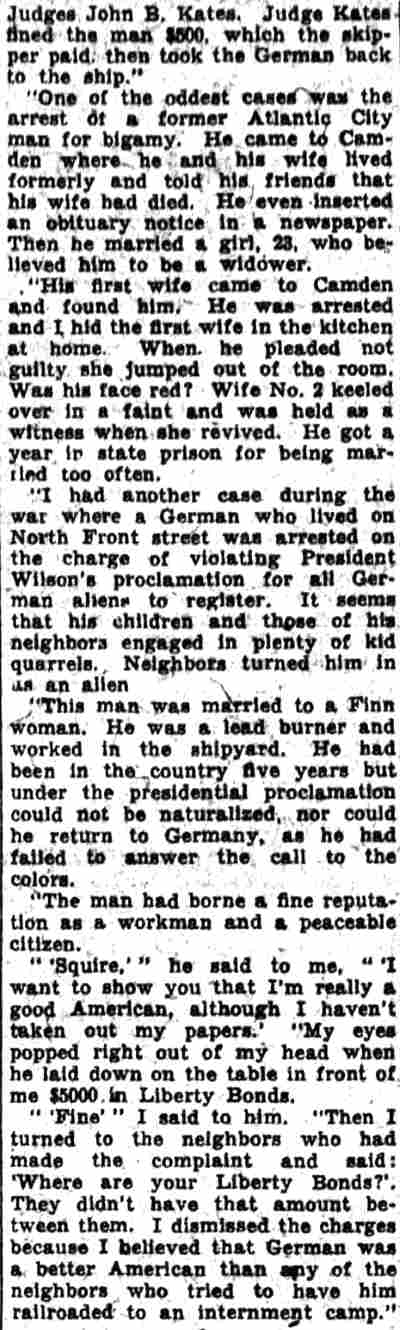
Named: Gordon Mackay, Frank Sheridan, John B. Kates, Dan McConnell, Oliver Stetser, and Frank Stetser.
Lloyd Reveals He Declined Offer From Governor for Another Term
Camden Courier-Post —
Justice Declares Pace of Court Work Calls for Toil Unsuited to Man of 78
Sails Next Week on Ocean Cruise
By FRANK SHERIDAN
Back to Practice After 30 Years
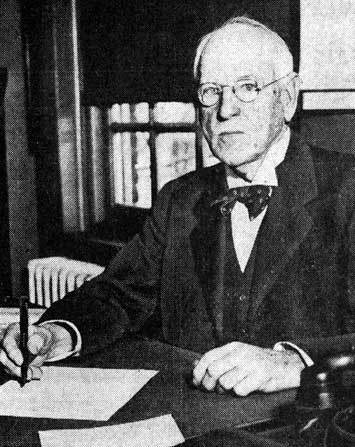
Resuming law practice after 30 years on the bench, former Supreme Court Justice Frank T. Lloyd yesterday revealed that Governor Moore offered to reappoint him for another term but he declined.
“The work in the Supreme Court in these days is terrific,” Judge Lloyd said at his desk at the law offices of Starr, Summerill and Lloyd, of which his son, Frank T. Lloyd, Jr., is a partner. Justice Lloyd retired from the bench on Saturday.
“My physical and mental faculties are good, but the endurance of the pace is too much,” the former jurist, who is 78, said with a kindly smile. “You are required to read 2000 law books in a year. You read them in the daytime and lay awake at nights thinking about them.
“I am leaving on February 11 for an ocean cruise to and from Venezuela. I have made these trips before, but took about 25 briefs with me to write opinions on Court of Errors and Appeals cases. This time I will have no opinions to write, but will enjoy a complete rest, returning on the last day of the month.”
Reminiscing he recalled a number of circumstances, which led him into public life and eventually to the dream of every attorney, the Supreme Court bench.
Native of Delaware
Born at Middletown, Delaware, on October 29, 1859, he was graduated from the Middletown Academy. In 1875 he moved to Camden and became a compositor. While serving his apprenticeship he studied law in the office of Judge James Otterson, of Philadelphia. He was admitted to the bar of Pennsylvania in 1882 and practiced in the Philadelphia courts 15 years.
“Here is where the series of coincidents come in,” Justice Lloyd said. “I was elected to the Assembly from Camden county in 1896, a year before I was admitted to the New Jersey bar.
“The chairman of the State Examining Board asked why I did not apply for admission to the New Jersey bar. It was only through his persuasion that I was admitted in 1897, and that year I was re-elected to the Assembly.
“Three years later I became a counselor-at-law. That was in 1900. That year I was named prosecutor of Camden County. One of the requirements to qualify as a prosecutor is that an attorney must be a counselor-at-law.
“Wilson Jenkins was prosecutor and William Carson his assistant. Then came another series of coincidents. Mr. Jenkins fell dead. Mr. Carson was slated for prosecutor. But before the appointment could be made he was shot and killed by a relative in North Jersey.
Named as Prosecutor
“I was named prosecutor to succeed Mr. Jenkins at a time when lawlessness was rampant in Camden county. The county had not recovered from the racetrack days. Legislature had passed drastic laws to wipe out the evils of the racetrack days but they had not been effectively enforced as yet. That lot fell to me.
This conversation led up to the recent criticism of the jurist in enforcing laws against lotteries of churches and lodges.
“I have quite a little feeling about gambling,” Justice Lloyd declared. “I had nothing to do with making the laws restricting gambling and putting an end to racetracks in the state. They were made before I went to the Legislature.
“As judge I had to recognize them and bring them to the attention of the grand juries from time to time. The rigid enforcement of these laws sometimes was not so easy.
Views on Gambling
“There is a great difference in gambling. If I had the laws to make, I would not make them so drastic. There is a difference between the games conducted in churches and lodges and those of the commercial and professional gambler. The trouble is the law does not raise the distinction.
“And perhaps after all if the people would stop to think the development of the gambling spirit can be created among youth, with pinball machines and bingo games in churches and lodges. I hate to see so many thousands of dollars taken out of Camden County by professional gambling syndicates. I am speaking of horse race betting and the numbers racket. The income taxes some of these people pay gives you an idea what honest people are losing by playing either of them.
“When little children spend their lunch pennies to play the numbers, as they have done in South Camden, then it is alarming. If the people knew how many wives came to me and complained that their husbands were playing all of their wages on the numbers and horse race betting. This habit grows on the player as the dope habit grows on an addict. I think he can never get rid of it,”
Here and there Justice Lloyd mentioned some celebrated cases he participated in as presiding jurist.
Praises Courier-Post
“The Gladys May Parks case was the outstanding trial I ever presided at on the Supreme bench,” he declared. “I mean that also from a psychological standpoint.”
Then he inquired about the health of the Sphinx woman, who was convicted in his court of slaying two children—second cousins. He was informed she is alive and at the State Hospital for Insane.
Then Justice Lloyd commended the Courier-Post Newspapers for their enterprise in reporting the woman’s trial, recalling a camera smuggled into the room and a photograph taken without the use of a flashlight bulb. At the time the photo was taken, Justice Lloyd was asking the woman 13 questions as to why she even wanted the children in her custody.
“We had considerable difficulty to get sugar as the supplies were limited,” he declared. “At one time none of the small dealers had sugar in stock and appealed to the American Stores Company and the Atlantic and Pacific Tea Company to divide their stocks with the small storekeepers, which they did handsomely.”
Speaks of His Career
In summing up his career of distinguished service he said:
“Any mistakes I have made have been of the head and not the heart. No matter whether they agreed with me politically or not the people will have to agree with me on that.”
And in conclusion he said:
“Have said this before and wish to reiterate it. I want to thank the Courier-Post Newspapers for their kindly and courteous treatment. Of course, they have not always agreed with me. I did not expect them to. And I am grateful for the manifestation of confidence on the part of the people.” During his second term in the Assembly, Justice Lloyd served as chairman of the judiciary committee and sponsored new marriage laws, few of which have since been revised. He was appointed to the Circuit bench in 1906 by former Gov. Edward C. Stokes. He was re-appointed by Gov. George S. Fielder in 1914 and Gov. Edward I. Edwards in 1921. He was named to the Supreme Court in 1924 and re-appointed in 1931.
“If we had had that same enterprise while I was prosecutor I would not have had so much trouble in solving the Charles Woodward murder case,” he said. “Woodward coaxed two boys into robbing their parents’ homes. Then he lured them to the woods and murdered them by giving them pie filled with deadly poison just to get the few trinkets they had stolen from home.”
Refers to Noted Trial
Speaking of his career on the Circuit Court bench Justice Lloyd said one of the outstanding cases tried before him was an alienation suit in which former Gov. George S. Silzer was one of the attorneys.
“A boarder alienated the affections of the wife of his landlord,” he said. “After breaking up the landlord’s home, he deserted the new-found wife and then alienated the affections of her daughter from her husband.”
Speaking of his experiences as food administrator during the war he commended the people on their loyalty to the Government.
Frank Sheridan
Camden Courier-Post —
Excerpt from Dan McConnell’s Scrapbook column
Frank Sheridan
Those of us who have tolled through the years with him affectionately call Frank Sheridan, dean of the local newspapermen, “Squire.” A burning ambition was realized by Sheridan when he was elected president of the Pyne Poynt Athletic Association. For more than 25 years “Squire” has been affiliated with the North Camden association.
For more than a quarter of a century Sheridan has been a Tenth ward justice of the peace, a position which he has filled with dignity and honesty. The authentic history of the World War was recorded for posterity by Frank Sheridan, newspaperman and author. His tome, “Camden County in The Great War” is his war monument.
Through the years this reporter has treasured the friendship of Frank Sheridan. One Monday back in 1911 we met Frank at No. 6 firehouse. That was our first job of reporting for the old Camden Daily Courier, although as a schoolboy we contributed news bits to Billy Wells’ Pyne Poynt column. The Pyne Poynt Athletic Association should have its most successful year with Frank Sheridan as its president.
November 10, 1939
Camden Courier-Post —
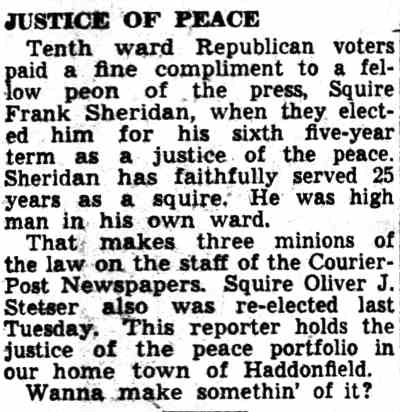
Frank Sheridan — Camden Courier-Post, November 10, 1939
Justice of Peace
Camden Courier-Post —
Excerpt from Dan McConnell’s Scrapbook column
Justice of Peace
Just make a mistake, or leave some guy’s name out of a pillar like this and the phone will ring or mail will arrive.
This reporter has erred and will continue to do so. Right here we would like to add that Frank Stetser, ace Gloucester county reporter, like his eminent daddy, Oliver J. Stetser, is a justice of the peace.
Also acknowledging a grunt from the business office. We neglected to mention that Hyman Weiss is also a judge of the small cause court. It already has been mentioned that our own Frank Sheridan has been a squire more than 25 years and has been reelected to his for another five-year term. Sheridan is just a youngster compared to Squire Oliver Stetser who recently was elected to his eight five-year hitch.
The gentleman who is believed to be the dean of all of the J.P.’s is Squire Frank Schneider, who many years ago conducted a photography studio on Kaighn Avenue in Our Town, has served more than 50 years. A salute to you, sir.
In those good old days of Washington Park and Gloucester beach, Squire Schneider was a formidable arm of the law. Justices of the peace in those days wielded potent judicial powers, including the legal right to marry folks.
Through all these years, Squire Schneider has had his sign outside his home in Gloucester, but business is not what it used to be, says Frank.
We are the law, Squires Schneider, Stetser, Sheridan, Stetser, Weiss, and McConnell.
World War II Draft Card
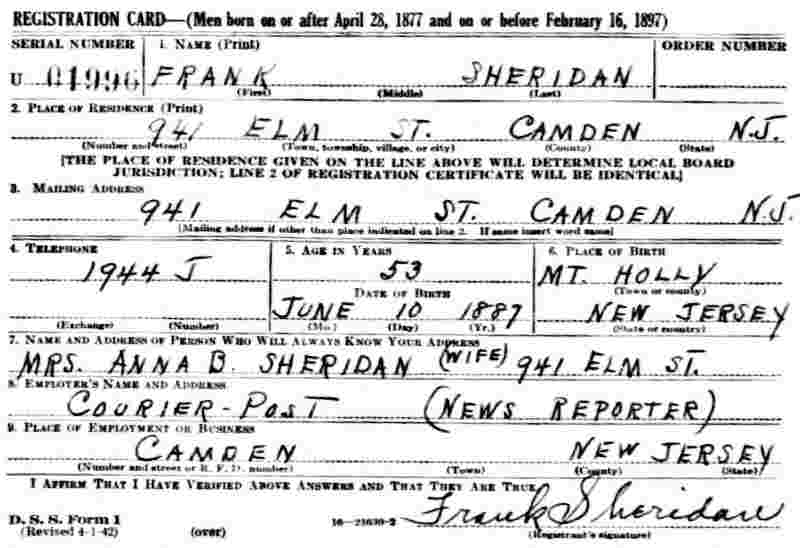
Frank Sheridan — World War II Draft Card
Golden Jubilee of the Stockton Annexation
Camden Courier-Post — May 16 to
May 31, 1954
Camden Courier-Post —
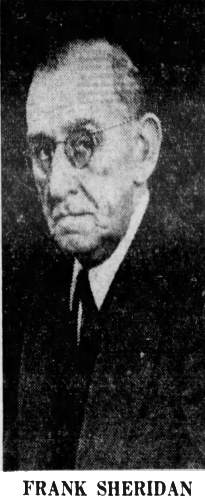


Frank Sheridan — Camden Courier-Post, May 31, 1954