Harry C. Kramer
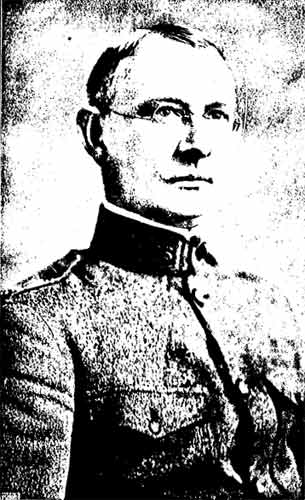
Lieutenant Colonel Harry C. Kramer
LIEUTENANT COLONEL HARRY C. KRAMER was serving as the adjutant general of the Second Brigade of the New Jersey National Guard when the United States entered World War I. He was detached from his unit to administer the then-new Selective Service Act in New Jersey. This task he accomplished so efficiently that he was sent to Washington DC to become a part of a committee tasked with promulgating new regulations regarding the draft. He completed his wartime service in Washington serving with the Provost Marshal General’s office. Under his command another New Jersey National Guard Officer served, Major Winfield Scott Price, who would go on to become the Mayor of Camden and commander of the New Jersey National Guard in the 1920s and 1930s.
Camden’s Council Guarded by Police
Philadelphia Inquirer —
Their Services Were Not Needed, However, as the Crowd Was Orderly
A BRIEF SESSION HELD
President Taylor Names Four Committees—Roberts and Shafer Were Absent
When Camden’s City Council was called together in adjourned meeting last night the gallery was crowded with interested citizens and another large throng filled the space between the members’ desks and the walls of the chamber. A detail of twenty police, under Chief Dodd and Lieutenants Pettit and Foster, were scattered about the chamber to preserve order, but their presence was not needed.
Neither John S. Roberts nor Dr. William Shafer, the contestants for a seat as representative from the Third ward was present. Mr. Roberts was absent by advice of his counsel, it was stated. It could not be learned why Dr. Shafer did not appear. Another absentee was Charles E. Day, one of the Committee of One Hundred Councilmen from the Fifth ward, who was taken suddenly ill on Wednesday. Mr. Day is rapidly improving and will probably be out in a day or two.
There was no roll call. President Taylor announced the following committees:
Finance—Jessup, Burrough, Devinney, Silvers and Ellis.
Streets—Gibson, Maloney, Bond, Jessup and George.
Police—Burrough, Silvers and Gibson.
Fire—Southard, Burrough, Day, Devinney and Mills.
Council then adjourned until next Thursday evening, when the remainder of the standing committees will possibly be announced.
Chairman Jessup, of the Finance Committee, said, after the Council meeting, that he was unable to say just when the Finance Committee would get together and arrange to sell the bonds for paving the city’s six principal streets with asphalt. Mayor Hatch yesterday signed the ordinance authorizing the paving of the streets.
Counsel for the Committee of One Hundred were busy last night securing witnesses for the hearing before Supreme Court Commissioner Joline to-day, relative to the assault upon City Clerk Varrey [sic] last Friday, and the failure to obey the Supreme Court’s writ of certiorari. About thirty witnesses have been subpenaed by the Republicans.
City Clerk Varney got out of bed yesterday, but his physician states that he may not be able to leave his room for a week. Assistant City Clerk Young is improving rapidly and was about his home yesterday, but several days must elapse before he can resume his duties.
City Clerk Kramer will pay off all election officers to-morrow.
The papers in City Clerk Varney’s quo warranto proceedings against Harry C. Kramer were filed in the Supreme Court at Trenton yesterday.
Side-Splitting Farce Goes On
Camden Daily Telegram —
Chairman Burrough Did Not Sit With the Committee.
HE IS SAID TO BE DISGUSTED
Additional Charges Against Policemen, But the Witnesses Fail to Substantiate the Specifications Made by Office Seekers.
The Police Committee of City Council, last night, resumed the hearings of the charges against the policemen. The Council chamber was again crowded with prospective policemen and office seekers of all descriptions. Chairman Burroughs of the committee was absent and it was stated that he was disgusted at the manner in which the farce is being carried on. The other two members of the committee were present and Mr. Silvers, the Third ward statesman, acted as chairman. He was flanked on the right by His Honor, the Mayor. Previous to the hearings the Mayor heard some suggestions from his new adviser, who is William H. Sparks, of kidney cure fame, and a Democrat who had been an office seeker in the Democratic party for a number of years. Dr. “Mark Hanna” Davis for some reason or other is not participating in the deliberation of the Reformers. It is said that he is disgusted and was heard to make the remark that there are but two political parties, the Republican and Democratic, and he did not believe in Reform.
E. G. C. Bleakley, after some delay, moved the charges against Policeman Bond. Officer Bond was charged by ex-Policeman “Ikey” Shreeve with being asleep in the post office building on March 15, and also with leaving his post of duty.
The first witness called was the complainant, and he testified that on the morning in question he found Policeman Bond asleep in the post office building, about 4 o’clock. The witness fixed the time by a man on the street asking him the hour. He knew he was asleep from the fact that he heard him snoring.
Policeman Bond, in his own defense, admitted going into the post office to light his pipe, but denied being asleep. He stated that he did not see Mr. Shreeve, but saw Constable Voight.
John Hefferan was called, and testified that on the morning in question he was with Policeman Bond about 6 o’clock on Federal street.
Irving L. Buckle, a newspaper carrier, testified that he saw Bond on Federal street between half-past 3 and 4 o’clock.
Thomas A. Stockham also testified that he saw Officer Bond on the morning in question about 3 o’clock.
Joseph Robinson, night watchman at the post office, said that he never saw Mr. Bond asleep in the building.
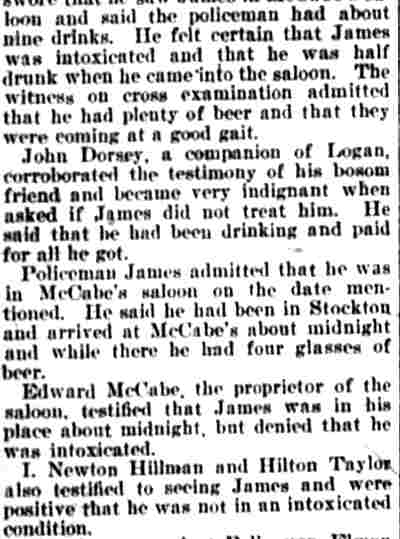
The next case that was moved was the charges against Policeman A. Lincoln James. The charge in the case was made by a young man named John J. Browning, of Cedar street, near Fifth. He charged James with being in an intoxicated condition on the morning of April 13, in the saloon of Edward McCabe, No. 900 Market street. The first witness called in this case was the complainant. He testified that he was in McCabe’s saloon and saw James there about midnight and believed him to be intoxicated. On cross-examination he said he had been drinking and that James treated him. He said that he was not an applicant for a position on the police force.
The next witness in this case was a gem. He is known as John J., alias “Limpy,” Logan, and is a familiar figure on Market street between Fourth and Sixth at all hours of the day and night. He was recently appointed as a watchman in the Water Department, by the Reform Water Committee, but his appointment was one of those which was held up by a writ of certiorari. Logan swore that he saw James in McCabe’s saloon and said the policeman had about nine drinks. He felt certain that James was intoxicated and that he was half drunk when he came into the saloon. The witness on cross examination admitted that he had plenty of beer and that they were coming at a good gait.
John Dorsey, a companion of Logan, corroborated the testimony of his bosom friend and became very indignant when asked if James did not treat him. He said that he had been drinking and paid for all he got.
Policeman James admitted that he was in McCabe’s saloon on the date mentioned. He said he had been in Stockton and arrived at McCabe’s about midnight and while there he had four glasses of beer.
Edward McCabe, the proprietor of the saloon, testified that James was in his place about midnight, but denied that he was intoxicated.
I. Newton Hillman and Hilton Taylor also testified to seeing James and were positive that he was not in an intoxicated condition.
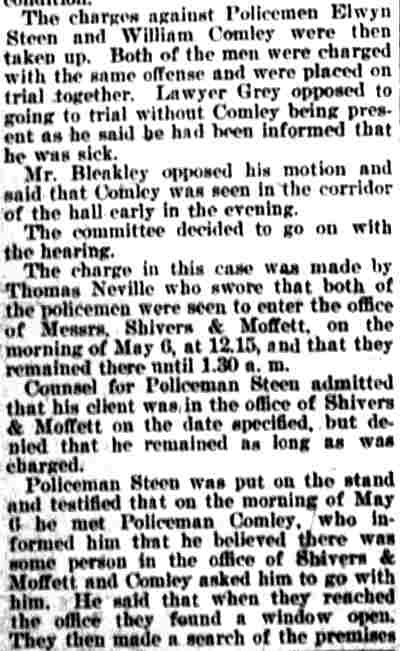
The charges against Policemen Elwyn Steen and William Comley were then taken up. Both of the men were charged with the same offense and were placed on trial together. Lawyer Grey opposed to going to trial without Comley being present as he said he had been informed that he was sick.
Mr. Bleakley opposed his motion and said that Comley was seen in the corridor of the hall early in the evening.
The committee decided to go on with the hearing.
The charge in this case was made by Thomas Neville who swore that both of the policemen were seen to enter the office of Messrs. Shivers & Moffett, on the morning of May 6, at 12.15, and that they remained there until 1.30 a. m.
Counsel for Policeman Steen admitted that his client was in the office of Shivers & Moffett on the date specified, but denied that he remained as long as was charged.
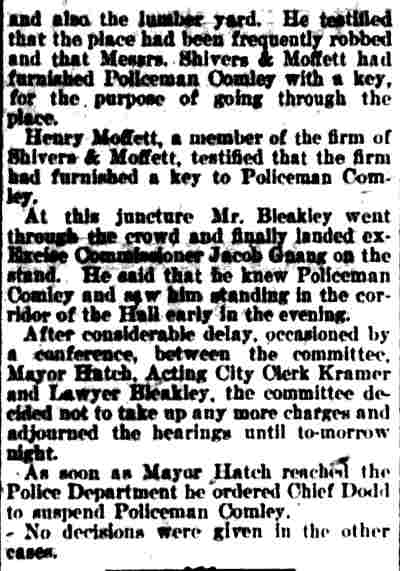
Policeman Steen was put on the stand and testified that on the morning of May 6 he met Policeman Comley, who informed him that he believed there was some person in the office of Shivers & Moffett and Comley asked him to go with him. He said that when they reached the office they found a window open. They then made a search of the premises and also the lumber yard. He testified that the place had been frequently robbed and that Messrs. Shivers & Moffett had furnished Policeman Comley with a key, for the purpose of going through the place.
Henry Moffett, a member of the firm of Shivers & Moffett, testified that the firm had furnished a key to Policeman Comley.
At this juncture Mr. Bleakley went through the crowd and finally landed ex-Excise Commissioner Jacob Gnang on the stand. He said that he knew Policeman Comley and saw him standing in the corridor of the Hall early in the evening.
After considerable delay, occasioned by a conference, between the committee, Mayor Hatch, Acting City Clerk Kramer and Lawyer Bleakley, the committee decided not to take up any more charges and adjourned the hearings until to-morrow night.
As soon as Mayor Hatch reached the Police Department he ordered Chief Dodd to suspend Policeman Comley.
No decisions were given in the other cases.
Swinging the Official Ax
Philadelphia Inquirer —
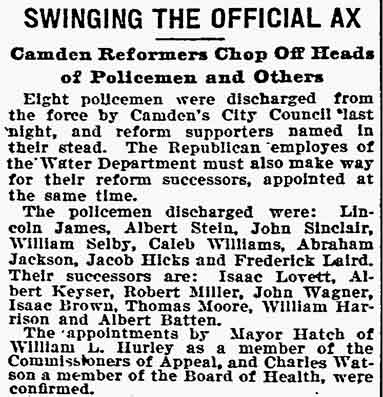
Camden Reformers Chop Off Heads of Policemen and Others
Eight policemen were discharged from the force by Camden’s City Council last night, and reform supporters named in their stead. The Republican employes of the Water Department must also make way for their reform successors, appointed at the same time.
The policemen discharged were: Lincoln James, Albert Stein, John Sinclair, William Selby, Caleb Williams, Abraham Jackson, Jacob Hicks and Frederick Laird. Their successors are: Isaac Lovett, Albert Keyser, Robert Miller, John Wagner, Isaac Brown, Thomas Moore, William Harrison and Albert Batten.
The appointments by Mayor Hatch of William L. Hurley as a member of the Commissioners of Appeal, and Charles Watson a member of the Board of Health, were confirmed.
Council voted unanimously for the ordinance to issue $85,000 thirty-year bonds to be used in building a high and manual training school.
When the ordinance providing a change in the terms of Water Department employes from two years to one year came up for second reading, Councilman Sayrs vigorously opposed it. His protests were ignored by the passage of the ordinance. An ordinance to appoint Water Department employes was then passed, and the following were named: Martin McNeil, resident engineer; John Wallace, Henry Taliafarro and Joseph Cline, engineers; Horace Huelings, George Riley and Owen Macey, foremen; Lee S. Mills, extra fireman; Albert Primrose, George Davis and Joseph Wagner, coal wheelers; Henry Schafer, engine wiper; Henry Hertline, foreman; Joseph Wilgus, caulker; John T. Rodan and James Melon, tappers, and John K. Esler, Jr., teamster.
In the report of the Finance Committee came the bill of City Clerk Kramer for $480 salary. Objection was made to the payment, and a tie vote decided against the bill.
“L” Bubble Bursts
Philadelphia Inquirer —
Prospectors of the Chestnut Street Railroad Scheme Withdraw Their Ordinance
BOW TO PUBLIC OPINION
City Councils Overrides Comptroller Huffy—Street Commissioner Mohrman Attacks the Committee
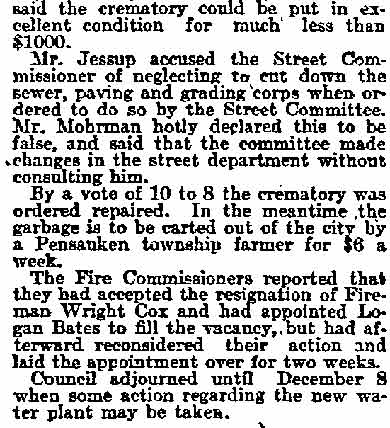
That public sentiment was opposed to an elevated railroad on Chestnut street, South Camden, was so strongly expressed at the hearing before City Council on Monday evening last that the four Philadelphia promoters of the scheme sent a communication to Council last evening withdrawing their application for a franchise. The request was granted, and that ends the matter.
Councilman Sayrs, leader of the Republican minority, was able to attend the Council meeting last evening after a prolonged illness.
City Comptroller Hufty returned to Council the bill of $156.72 for costs in certiorari proceedings in the contest over the street paving contract. He said that half of the amount should be paid by Aaron Ward & Company, the contractors, as they were co-defendants in the suit, and had paid but $24.80. Council ordered the Comptroller to approve a warrant for the full amount.
Tax Receiver Burdsall reported that since June last the tax receipts had amounted to $519,135.76, of which $47,581 was for delinquent taxes. He said there was still $83,173 of this year’s taxes unpaid.
City Comptroller Hufty sent in a communication disapproving a bill of City Clerk Kramer, for $333.32 for the time he acted as city clerk, when T. P. Varney was the legal city clerk, but was kept out of office by the reformers. The bill was ordered paid by a vote of 17 to 1. Mr. Jessup voted against it.
There was a lively tilt between Street Commissioner Mohrman and Councilman Jessup when the Street Committee’s report was presented. Mr. Mohrman was granted the privilege of the floor, and severely criticised the Street Committee for holding private meetings and changing the disposal of the city garbage without consulting with him. He said the city contractor was being paid $5 a day to cart garbage outside of the city limits, and in five months this would cost $650, while the expenses of burning the garbage in the city crematory would be but $277.44. He said the crematory could be put in excellent condition for much less than $1000.
Mr. Jessup accused the Street Commissioner of neglecting to cut down the sewer, paving and grading corps when ordered to do so by the Street Committee. Mr. Mohrman hotly declared this to be false, and said that the committee made changes in the street department without consulting him.
By a vote of 10 to 8 the crematory was ordered repaired. In the meantime the garbage is to be carted out of the city by a Pensauken township farmer for $6 a week.
The Fire Commissioners reported that they had accepted the resignation of Fireman Wright Cox and had appointed Logan Bates to fill the vacancy, but had afterward reconsidered their action and laid the appointment over for two weeks.
Council adjourned until December 8 when some action regarding the new water plant may be taken.
Over in Camden.
Philadelphia Inquirer —
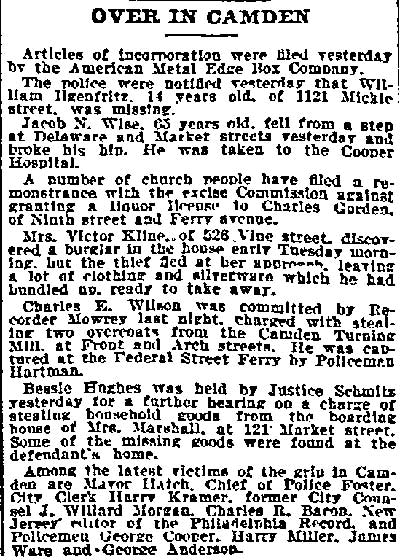
Articles of incorporation were filed yesterday by the American Metal Edge Box Company.
The police were notified yesterday that William Ilgenfritz, 14 years old, of 1121 Mickle street, was missing.
Jacob N. Wise, 65 years old, fell from a step at Delaware and Market streets yesterday and broke his hip. He was taken to the Cooper Hospital.
A number of church people have filed a remonstrance with the excise Commission against granting a liquor license to Charles Gorden, of Ninth street and Ferry avenue.
Mrs. Victor Kline, of 526 Vine street, discovered a burglar in the house early Tuesday morning, but the thief fled at her approach, leaving a lot of clothing and silverware which he had bundled up, ready to take away.
Charles E. Wilson was committed by Recorder Mowrey [sic] last night, charged with stealing two overcoats from the Camden Turning Mill, at Front and Arch streets. He was captured at the Federal Street Ferry by Policemen [sic] Hartman.
Bessie Hughes was held by Justice Schmitz yesterday for a further hearing on a charge of stealing household goods from the boarding house of Mrs. Marshall, at 121 Market street. Some of the missing goods were found at the defendant’s home.
Among the latest victims of the grip in Camden are Mayor Hatch, Chief of Police Foster, City Clerk Harry Kramer, former City Counsel J. Willard Morgan, Charles R. Baron, New Jersey editor of the Philadelphia Record, and Policemen George Cooper, Harry Miller, James Ware and George Anderson.
East Camden Firehouse Cornerstone Plaque
1899
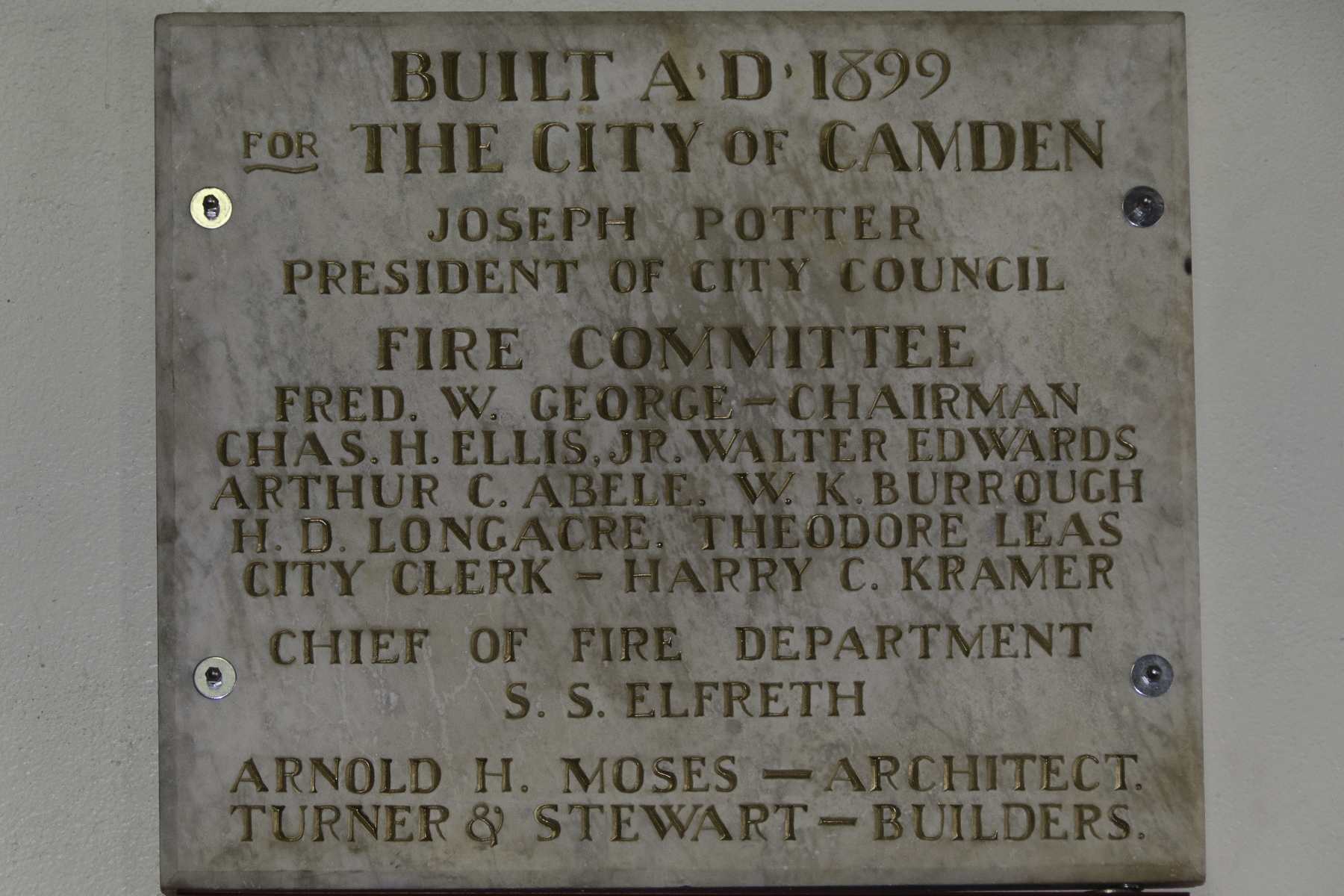
Built A.D. 1899 for the City of Camden
Joseph Potter
President of City Council
Fire Committee
Fred. W. George—Chairman
Chas. H. Ellis, Jr. Walter Edwards
Arthur C. Abele W. K. Burrough
H. D. Longacre Theodore Leas
City Clerk—Harry C. Kramer
Chief of Fire Department
Arnold H. Moses—Architect. Turner & Stewart—Builders.
Yacht Run Down, Woman Drowned
Philadelphia Inquirer —
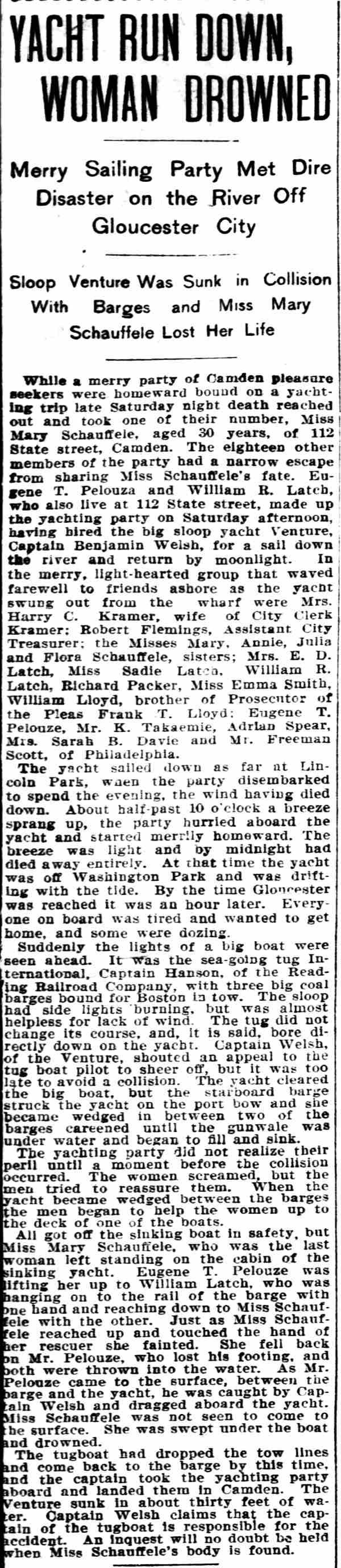
Merry Sailing Party Met Dire Disaster on the River Off Gloucester City
Sloop Venture Was Sunk in Collision With Barges and Miss Mary Schauffele Lost Her Life
While a merry party of Camden pleasure seekers were homeward bound on a yachting trip late Saturday night death reached out and took one of their number, Miss Mary Schauffele, aged 30 years, of 112 State street, Camden. The eighteen other members of the party had a narrow escape from sharing Miss Schauffele’s fate. Eugene T. Pelouza and William R. Latch, who also live at 112 State street, made up the yachting party on Saturday afternoon, having hired the big sloop yacht Venture, Captain Benjamin Welsh, for a sail down the river and return by moonlight. In the merry, light-hearted group that waved farewell to friends ashore as the yacht swung out from the wharf were Mrs. Harry C. Kramer, wife of City Clerk Kramer; Robert Flemings, Assistant City Treasurer; the Misses Mary, Annie, Julia and Flora Schauffele, sisters; Mrs. E. D. Latch, Miss Sadie Latch, William R. Latch, Richard Packer, Miss Emma Smith, William Lloyd, brother of Prosecutor of the Pleas Frank T. Lloyd; Eugene T. Pelouze, Mr. K. Takaemie, Adrian Spear, Mrs. Sarah B. Davie and Mr. Freeman Scott, of Philadelphia.
The yacht sailed down as far as Lincoln Park, when the party disembarked to spend the evening, the wind having died down. About half-past 10 o’clock a breeze sprang up, the party hurried aboard the yacht and started merrily homeward. The breeze was light and by midnight had died away entirely. At that time the yacht was off Washington Park and was drifting with the tide. By the time Gloucester was reached it was an hour later. Everyone on board was tired and wanted to get home, and some were dozing.
Suddenly the lights of a big boat were seen ahead. It was the sea-going tug International, Captain Hanson, of the Reading Railroad Company, with three big coal barges bound for Boston in tow. The sloop had side lights burning, but was almost helpless for lack of headway. The tug did not change its course, and, it is said, bore directly down on the yacht. Captain Welsh, of the Venture, shouted an appeal to the tug boat pilot to sheer off, but it was too late to avoid a collision. The yacht cleared the big boat, but the starboard barge struck the yacht on the port bow and she became wedged in between two of the barges careened until the gunwale was under water and began to fill and sink.
The yachting party did not realize their peril until a moment before the collision occurred. The women screamed, but the men tried to reassure them. When the yacht became wedged between the barges the men began to help the women up to the deck of one of the boats.
All got off the sinking boat in safety, but Miss Mary Schauffele, who was the last woman left standing on the cabin of the sinking yacht. Eugene T. Pelouze was lifting her up to William Latch, who was hanging on to the rail of the barge with one hand and reaching down to Miss Schauffele with the other. Just as Miss Schauffele reached up and touched the hand of her rescuer she fainted. She fell back on Mr. Pelouze, who lost his footing, and both were thrown into the water. As Mr. Pelouze came to the surface, between the barge and the yacht, he was caught by Captain Welsh and dragged aboard the yacht. Miss Schauffele was not seen to come to the surface. She was swept under the boat and drowned.
The tugboat had dropped the tow lines and come back to the barge by this time, and the captain took the yachting party aboard and landed them in Camden. The Venture sunk in about thirty feet of water. Captain Welsh claims that the captain of the tugboat is responsible for the accident. An inquest will no doubt be held when Miss Schauffele’s body is found.
Camden News Notes
Philadelphia Inquirer —
** City Clerk Kramer yesterday issued a permit to the Standard Oil Company for the erection of a brick building 20x28 feet, to be located on River road.
Wm. Morgenweck Is Accused of Fraud in Basketball Sale
Trenton Times —
Camden Men Want Him Restrained From Foreclosing Chattel Mortgage.
GROSS CROOKEDNESS IS ALLEGED IN CHANCERY
Charged by Complainants That Morgenweck Misrepresented Condition of Camden Basketball Association in not Disclosing Mortgage.
Proceedings have been commenced in the Court of Chancery to enjoin William E. Morgenweck of Camden from prosecuting the foreclosure of a chattel mortgage covering the property of the Camden Basketball Association.
The complainants in the case are Siegmund Schoenagle, Frank E. Gardner and Adolph Schoenagle, and they charge Morgenweck with gross fraud and misrepresentation in inducing them to buy the stock of the Basketball Association without disclosing the existence of the chattel mortgage for $2,500, which he now is seeking to foreclose.
The suit is the outgrowth of the rise and fall of the popularity of the game of basketball. Morgenweck was the promoter of the game in Camden and through his instrumentality the Camden Basketball Association was organized.
CHARGES OF BILL
The bill charges that in March, 1904, when the game had ceased to be popular, Morgenweck, John R. McCabe, Richard Miller, Harry C. Kramer and Adolph Schoenagle decided to abandon the association and form a new organization for the carrying on of bowling alleys in the old Sixth Regiment armory, West and Mickle streets, Camden, which had formerly been used by the basketball association.
The new organization retained the old name and it is charged that he induced the complainants to acquire the stock of the old concern by representing that its property was clear of incumbrance. The complainants state that they have spent about $5,000 in adapting the armory to its new use of bowling alleys and in getting the equipment.
Camden News Note
Philadelphia Inquirer —
** Since it has been rumored that Harry Kramer, the present City Clerk, is not to succeed himself, there has been much wire-pulling by would-be successors.
Sensation Sprung in Camden’s Council
Philadelphia Inquirer —
Attempt Made to Have Committee Appointed to Investigate Affairs of Street Commissioner’s Office
Something of a sensation was occasioned at the reorganization of Camden City Council yesterday when Councilman Frederick Finkeldey endeavored to have adopted a resolution providing for the appointment of a committee of five to investigate the affairs of the office of Street Commissioner Louis Mohrman. He offered the resolution when the latter came up for reappointment. In seconding Councilman Finkeldey’s motion Councilman Wilson declared he had data in his possession which showed there were irregularities. The resolution was defeated by a vote of 19 to 2. Mohrman was reappointed.
Aside from this the reorganization was the usual cut and dried affair. All the old officers were reappointed with the exception of City Clerk Harry C. Kramer, who was succeeded by Isaac Bradley, the retiring Councilman from the Seventh ward. William H. Day was made building inspector to fill the vacancy caused by the suicide of William Steinmetz.
In his annual message Mayor Charles H. Ellis urged among other things that provision be made for mounted police in East Camden, the erection of an additional jail building, the installation of the Bertillon system for the identification of criminals, the increase of the present fire service by two additional companies, the necessity of establishing an auxiliary pumping plant.
It was general reorganization day among the civic bodies of Camden yesterday. The Excise Commission re-elected John Baker president, while Jacob Schiller was made inspector. Dr. Marcus K. Mines was elected president of the Board of Health, and at the reorganization of the Board of Education Edmund E. Read was elected president and Harry Sharp vice president.
Greater Camden the Slogan at Board of Trade Banquet
Philadelphia Inquirer —
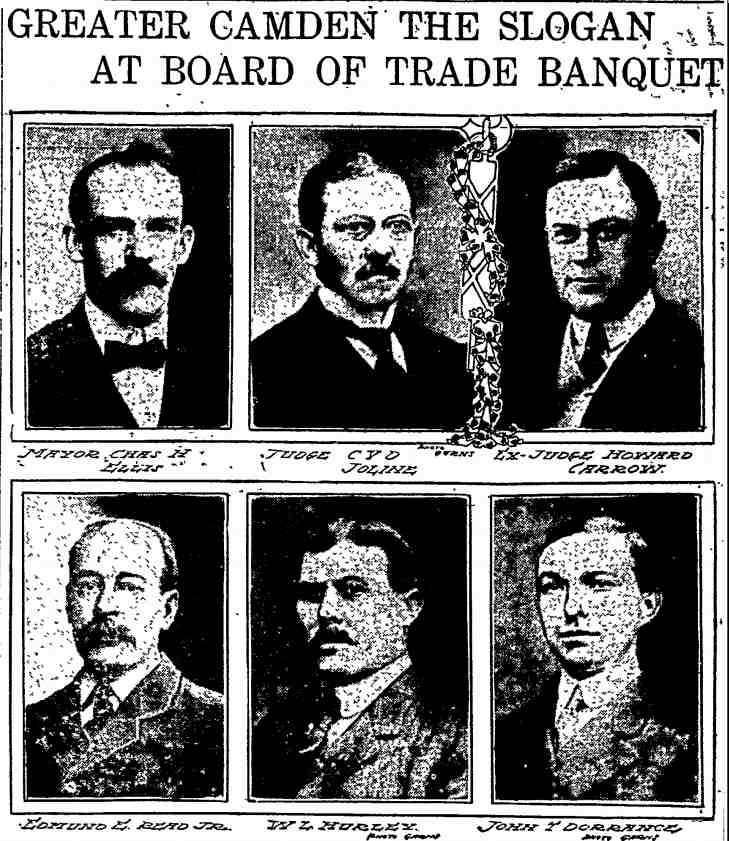
MAYOR CHAS H. ELLIS
JUDGE C V D JOLINE
EX-JUDGE HOWARD CARROW
EDMUND E. READ JR.
Men Prominent in Business Affairs Sound Praises of Growing City at Annual Feast
A greater, more progressive Camden was the watchword at he [sic] annual banquet given by Camden’s Board of Trade last night. And that this means something is evident from the fact that it came from the city’s “Captains of Industry” to the number of two hundred.
It was Camden’s rejuvenated Board of Trade that gave the banquet and the interest taken was manifested by the presence of representatives from every business concern of any prominence in the city.
All Represented
There were bankers besides just ordinary business men, professional men of every character, and all were imbued with the spirit to make of Camden a place that will be known on the map throughout the country. William L. Hurley, president of the board, presided at the banquet.
“Generally speaking, we are satisfied with our city,” said Mayor Charles H. Ellis in responding to the toast, “Camden as it is,” “but, of course, there is room for improvement in many respects, and it rests with you gentlemen, you members of the Board of Trade to largely aid in solving our municipal problems.”
Former Judge Howard Carrow acted as toastmaster and, beside Mayor Ellis, those who responded to toasts were Congressman James H. Davidson, of Wisconsin, who spoke on “Boards of Trades;” Judge of the Court of Common Pleas C. V. D. Joline, “Camden’s Eighty Years;” Lawyer Edmund E. Read, president of the Board of Education, “Camden’s Future.”
One of the features of the occasion was the presentation of a life-size oil painting of President William Leonard Hurley. [sic] to the board, by Lawyer Harry C. Kramer. This came as a complete surprise to President Hurley, but he expressed his thorough appreciation of the honor.
Senator Philander C. Knox, of Pennsylvania, was among the specially invited guests and a warm welcome awaited him, but he was unavoidably detained.. [sic]
Some good points to Camden’s credit were enumerated in the menu cards as follows:
“Camden has within its borders a population of nearly 100,000 and shipbuilding firms that can either supply a launch or the greatest battleship; the largest lace curtain manufacturers in America; a talking machine that speaks every known language; iron works that make enough pipe to girdle the earth; leather manufacturers who tan skins from all parts of the globe; the largest furniture house, whose products reach the Philippines; banks and trust companies whose resources are not affected by panics; artesian water that can be taken without adding anything.”
The committee in charge of the occasion included John T. Dorrance, chairman; Edwin G. C. Bleakly, Harry C. Kramer, David A. Henderson and Samuel W. Sparks.
Among the Guests
Among the participants were Congressman Harry C. Loudenslager, Francis Howell, Walter Wood, Elmer E. Long, George W. Jessup, former Judge Joseph Gaskill, Volney G. Bennett, Wilbur F. Rose, Alexander C. Wood, George A. Frey, Charles A. Reynolds, Vice Chancellor E. B. Leaming, Heulings Lippincott, Charles K. Haddon, Fithian S. Simmons, Joseph B. Van Sciver, David Jester, Frank B. Sitley, Alpheus McCracken, Thomas S. Nekervis, DeCourcy May, Watson Depuy, Lionel C. Simpson, John M. Kelly, G. George Browning, William J. Browning, Isaac Ferris, John C. Danenhower, John R. McFeeley, Elias Davis, Anthony Kobus, Captain John B. Adams.
Camden Memorial Day Committee
Philadelphia Inquirer —
In order that Camden veterans may have an elaborate celebration on Memorial Day, Mayor Ellis yesterday appointed the following committee of citizens to act in conjunction with them: William D. Vanaman, William Sangtinette, Frank W. Tussey, William Fox, Dr. J.W. Martindale, Walter L Tushingham, Ira E. Lutte, Harry C. Kramer, john w. coleman, Bernhard Schroeder, Edward H. Nieland, Daniel M. Stevens, W.F. Powell, Abe Fuhrman, Jacob Neutze, Francis B. Wallen, Charles A. Ackley, Louis T. Derousse, James M. Bentley, John K. Newkirk, William Schmid, John Larsen, Sigismund Schoenagle, Charles M. Baldwin, and Harry A Whaland.
Social Notes
Philadelphia Inquirer —

** Mr and Mrs. Harry C. Kramer anticipate sailing for Germany the first of August.
Camden Will Observe Decoration Day
Philadelphia Inquirer —
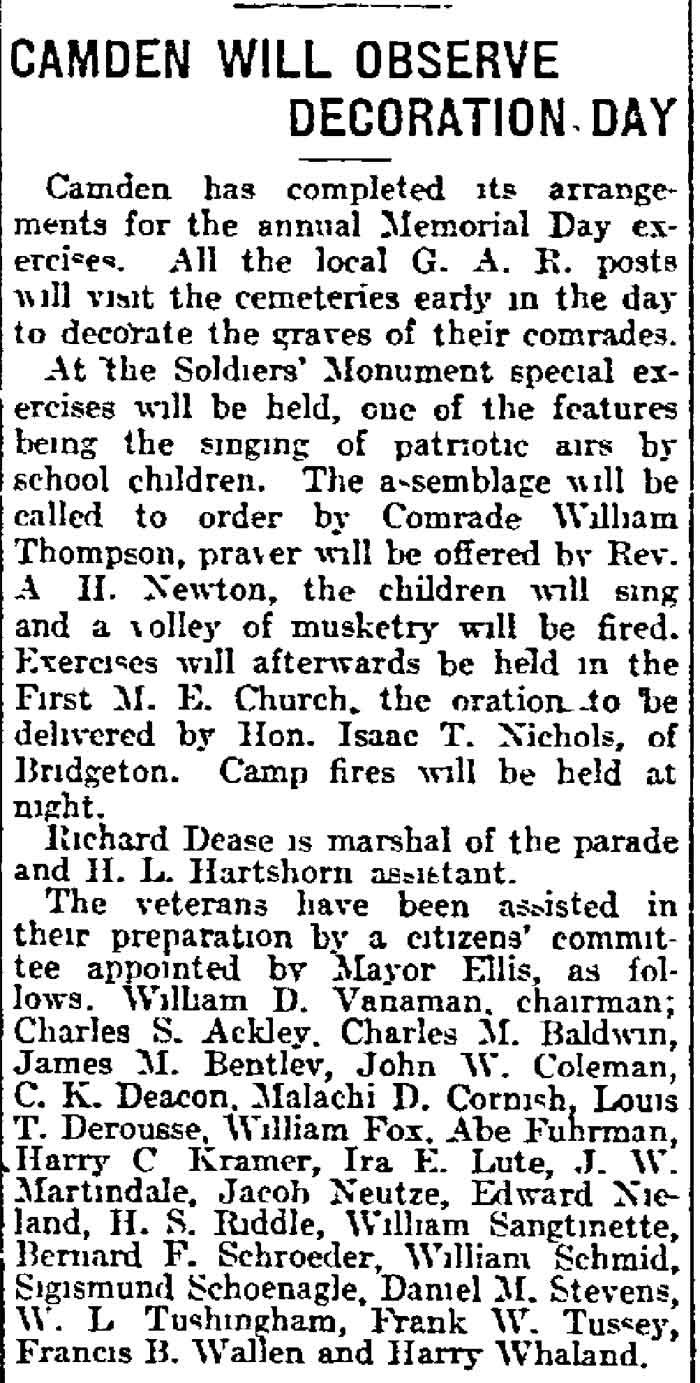
Camden has completed its arrangements for the annual Memorial Day exercises. All the local G. A. R. posts will visit the cemeteries early in the day to decorate the graves of their comrades.
At the Soldiers’ Monument special exercises will be held, one of the features being the singing of patriotic airs by school children. The assemblage will be called to order by Comrade William Thompson, prayer will be offered by Rev. A. H. Newton, the children will sing and a volley of musketry will be fired. Exercises will afterwards be held in the First M. E. Church, the oration to be delivered by Hon. Isaac T. Nichols, of Bridgeton. Camp fires will be held at night.
Richard Dease is marshal of the parade and H. L. Hartshorn assistant.
The veterans have been assisted in their preparation by a citizens’ committee appointed by Mayor Ellis, as follows. William D. Vanaman, chairman; Charles S. Ackley, Charles M. Baldwin, James M. Bentley, John W. Coleman, C. K. Deacon, Malachi D. Cornish, Louis T. Derousse, William Fox, Abe Fuhrman, Harry C. Kramer, Ira E. Lute, J. W. Martindale, Jacob Neutze, Edward Nieland, H. S. Riddle, William Sangtinette, Bernard F. Schroeder, William Schmid, Sigismund Schoenagle, Daniel M. Stevens, W. L. Tushingham, Frank W. Tussey, Francis B. Wallen and Harry Whaland.
3000 Ask Mercy in Camden Election Frauds
Philadelphia Inquirer —
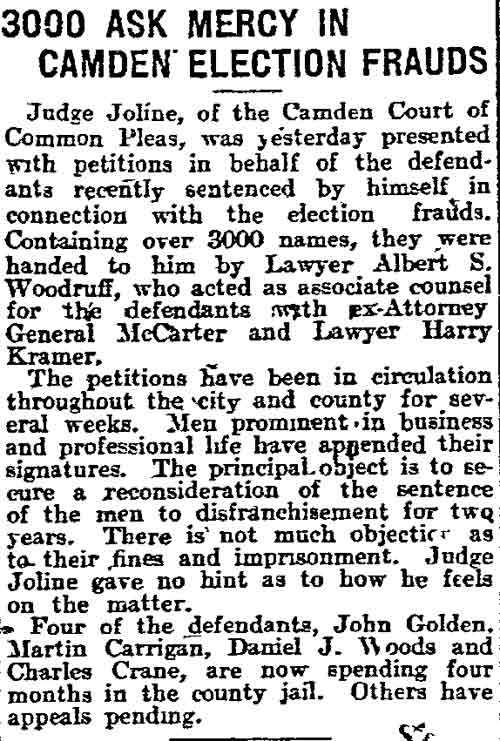
Judge Joline, of the Camden Court of Common Pleas, was yesterday presented with petitions in behalf of the defendants recently sentenced by himself in connection with the election frauds. Containing over 3000 names, they were handed to him by Lawyer Albert S. Woodruff, who acted as associate counsel for the defendants with ex-Attorney General McCarter and Lawyer Harry Kramer.
The petitions have been in circulation throughout the city and county for several weeks. Men prominent in business and professional life have appended their signatures. The principal object is to secure a reconsideration of the sentence of the men to disfranchisement for two years. There is not much objection as to their fines and imprisonment. Judge Joline gave no hint as to how he feels on the matter.
Four of the defendants, John Golden, Martin Carrigan, Daniel J. Woods and Charles Crane, are now spending four months in the county jail. Others have appeals pending.
Sunday Ordinance to Be Tested in Higher Court
Camden Courier-Post —
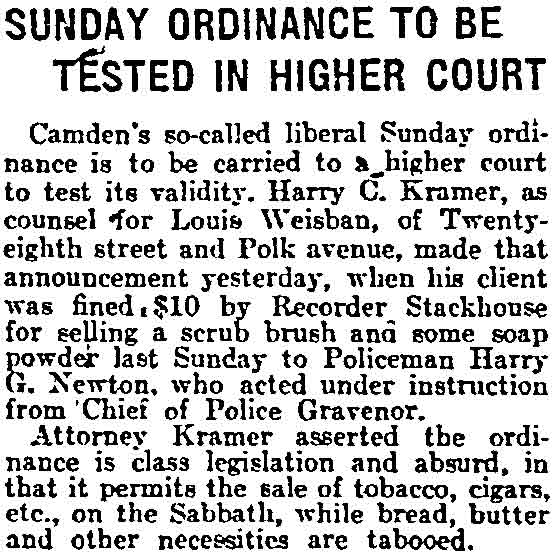
Camden’s so-called liberal Sunday ordinance is to be carried to a higher court to test its validity. Harry C. Kramer, as counsel for Louis Weisban, of Twenty-eighth street and Polk avenue, made that announcement yesterday, when his client was fined $10 by Recorder Stackhouse for selling a scrub brush and some soap powder last Sunday to Policeman Harry G. Newton, who acted under instruction from Chief of Police Gravenor.
Attorney Kramer asserted the ordinance is class legislation and absurd, in that it permits the sale of tobacco, cigars, etc., on the Sabbath, while bread, butter and other necessities are tabooed.
Recruiting “Drive” in Camden Churches
Philadelphia Inquirer —
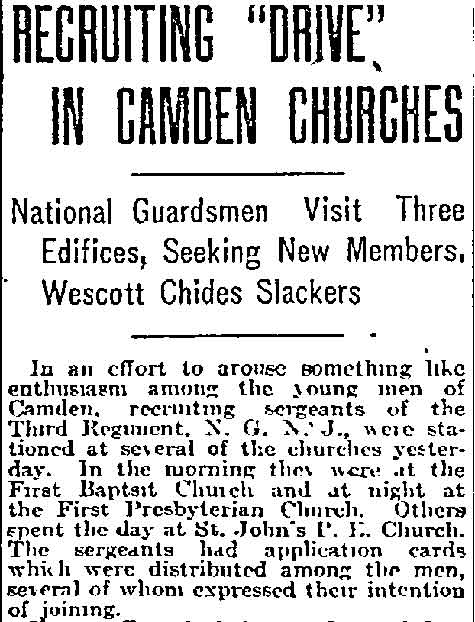
National Guardsmen Visit Three Edifices, Seeking New Members. Wescott Chides Slackers
In an effort to arouse something like enthusiasm among the young men of Camden, recruiting sergeants of the Third Regiment, N. G. N. J., were stationed at several of the churches yesterday. In the morning they were at the First Baptist Church and at night at the First Presbyterian Church. Others spent the day at St. John’s P. E. Church. The sergeants had application cards which were distributed among the men, several of whom expressed their intention of joining.
Every effort is being made to infuse something akin to war time enthusiasm in the young men of the city, but the recruiting has been very slow, both for the Guardsmen and the regular army service. At the big rally held in the Third Regiment Armory, Saturday afternoon, Attorney General John W. Wescott chided the young men, who he declared, would apparently sooner have a good time than respond to their country’s call.
Major Harry G. Kramer, who is trying to get together enough men to compose an engineering corps, has obtained the names of about eighty from Camden county. As soon as he has a sufficient number he will organize them. His campaign has been the most energetic of any and yet he has experienced the greatest difficulty in getting responses to his appeals.
Lieutenant Colonel Harry C. Kramer
History of Camden County in the Great War, 1917–1918

While Camden performed every obligation imposed upon her by the nation in the raising of troops, the sale of Liberty Bonds, the contributions to the many organizations which were each carrying its burden in the war, she had another and a peculiar part in the country’s defense, which probably is not equalled by any other city in the United States, and that was the prominence which her sons took in the administration of the work of the Provost Marshal General’s office during the war.
It is historical that the volunteer system of the United States failed the country when it called for men to fill its armies, and on May 18, 1917, Congress passed a law known as the Selective Service Act, the administration of which was to prove one of the greatest triumphs of the struggle. This law provided for the making of regulations by the President which were to set in motion the selection of men for the battle line. Its success was doubted by even the optimistic; its failure was gloomily foreboded by men whose judgment was deemed sound; it was almost revolutionary in its character.
One of the first men to be chosen in the United States to place this great law in operation was Harry C. Kramer, of Camden. At that time he was the adjutant general of the Second Brigade of New Jersey, with the rank of major. His brigade was not a complete unit and he was on the unassigned list and therefore not subject to call. He was ordered to report to Trenton by Adjutant General Charles Barber and at once closed up his affairs and went into the service. He immediately made a careful study of the law and regulations and organized the State so successfully that it was among the first in the entire Union to report “ready” with the quota assigned to it of 20,665 soldiers. As soon as this work was completed he was ordered to Washington by Major General Enoch H. Crowder, Provost Marshal General, and was there appointed as one of a committee of three officers who were charged with the preparation of an entire new set of regulations, for the purpose of perfecting the selective service principles. This committee labored day and night for six weeks and the result of its work was the creation of the questionaire system and the selective service regulations, which undoubtedly presented to the world the most scientific method of raising armies which has ever been produced. In speaking of this system, General Crowder, in his report to the Secretary of War, said: “It is not too much to say that the present classification systems offers possibilities that have never been attained by any other nation in the history of war.”
General Crowder’s words were almost a prophecy. The great American army seemed to grow by magic. From a beginning of 60,000 men it rose to the enormous number of four million men within one year from the time the selective service principle was enforced, and the system was so complete that the American army could have been extended to the almost inconceivable number of twenty-five million men without much more effort.
Major Kramer accepted a reduction in rank when he was ordered to Washington, and began his career in the nation’s capital as a captain. Within a few weeks he was promoted to a major and shortly after the splendid successes which attended his work were observed, he was made a lieutenant colonel, and it is now learned that he would have been made a full colonel in a few weeks had the war not been abruptly ended.
During the period of his connection with the Provost Marshal General’s office, he was the chief disbursing officer, executive officer and chief of the division of inspection and investigations, which latter division had greatly to do with the department’s efficiency throughout the country.
Prior to being called by Adjutant General Barber to Trenton, Colonel Kramer organized the Camden company of engineers, which later became Company B, 104th Engineers and became famous in France during the Argonne Forest battle. After the armistice was signed Colonel Kramer was sent on a tour of inspection duty in Porto Rico, and upon completion of this task was appointed to the General Clemency Board of the army which equalized court martial sentences, and reduced them to a peace time basis.
‘One-Man’ Fight for Draft Revision
Camden Courier-Post —
Action pending in Congress to reduce the draft age is the outcome of official recommendations by a former Camden soldier-lawyer, Colonel Harry C. Kramer, whose “shingle” once hung from 503 Market street and served as assistant City clerk.
A National Guard officer at the beginning of the World War, Kramer became executive director for the draft in New Jersey and established such a model system that after the armistice General Pershing assigned him to a new job in Washington—to prepare and keep up-to-date a selective service system for use in any emergency. For 13 years this was Kramer’s part in the Army War College.
When the 1940 draft act went into effect, Kramer protested that the high age limit of 35 years was wholly unfitted for peace-time conscription. His interview with a Courier-Post representative was republished all over the country.
Kramer insisted the draft age should be lowered or millions spent on training older men would be wasted and only men in their early 20’s would be valuable as a 10-year reserve.
That was six months ago. Congress didn’t pay much attention; preferred its draft scheme to that worked out by the Army. Finally, after a “one-man” campaign for revision of the act, Kramer’s warning against a conscript army of “proud fathers” began to tally with the facts. Then he was called in by Draft Director Dykstra and the President—and now Congress is, in effect, cutting the maximum age limit down to 28, with a possibility of cutting it lower. The bill specifically authorizes the President to make deferments by age groups.
It is interesting to note that the reasons Congressional leaders give for this action are the very reasons the ex-Camden lawyer, Colonel Kramer, gave in two interviews published in his home-town Courier-Post Newspapers months ago.