Introduction
ISAAC S. “IKE” TOY was born in New Jersey in April of 1871 to Joshua and Rachel Toy. The Toys were living in Stockton at the time of the 1870 Census, Stockton then comprising of present-day Merchantville, East Camden, and Cramer Hill. When the Census was taken Joshua Toy was working as a farm laborer, and there were four children, Margaret, Lemuel, Henrietta, and Elizabeth “Lizzie” Toy.
Joshua Toy brought his family to Camden during the 1870s, taking a job as a railroad flagman. The 1878 City Directory shows Joshua Toy at 527 Bridge Avenue, a street, no longer in evidence, that ran between Mickle Street and Federal Street, from South 2nd Street east to South 8th Street. By the time the 1880 Census was taken, Ike Toy’s mother had passed away, and oldest sister Margaret was not living at home. Ike Toy lived with his father and older siblings Lemuel, Henrietta, and Lizzie, at 527 Bridge Avenue. Older brother Lemuel found work as a tin can maker and moved out in the early 1880s. Joshua Toy lived at 527 Bridge Avenue as late as 1883. He last appears in City Directories in 1885, at 531 South 6th Street. By this time Lemuel Toy had been living at 314 Taylor Avenue, and Ike Toy may have gone to live with his older brother. Lemuel Toy lived at the Taylor Avenue address into the 1890s, working as a tin can maker for the Anderson Preserving Company.
Ike Toy grew up playing baseball, and was quite good at it. He was already a “well-known semi-professional base ball player” by the end of the 1889 season, and stayed in the game all through the 1890s as a player, manager, and umpire.
Little is known at present of Ike Toy’s involvement in professional baseball. It is known that he played in the Pennsylvania State League in 1892, starting the season, appearing in 16 games as a pitcher and outfielder with the Lebanon Pretzel Eaters. He started 14 games and had a record of 8–7 with a 1.17 ERA before being sent to the Allentown-Bethlehem Colts where he started 12 games, winning 8, losing 4, with a microscopic 0.67 ERA.
Staying close to home Ike Toy played for the Camden club, a semi-pro team that more or less was in existence in one form or another from the early 1890s into the 1930s. Ike Toy appeared in games for Camden in 1893, 1894, and 1895. He appears to have played in 23 games for the Philadelphia Colts of the Pennsylvania State League in July and August of 1894, and was associated with the Salem club of the South Jersey League in 1895. Ike Toy was slated to play for Camden in 1896. News articles of the day state that he instead became the manager of the Salem team in the South Jersey League. He was also doing some umpiring by the end of the 1896 season. He also is thought to have played for the Sunbury Pirates in the Central Pennsylvania League in 1897.
Ike Toy first appears in Camden’s City Directories in the 1894–1895 edition as a wallpaper hanger living at 321 Washington Street. He was still at that address and following that trade in 1896. That year’s Directory states that he worked for J. Edward Way, who had a paperhanging business operating out of his home at 449 South 3rd Street. A spring 1896 newspaper also gives an address of 313 Washington Street.
Ike Toy had become politically active in the 1890s as a member of the Third Ward Republican Club. He was elected to an officer’s position with the Third Ward Marching Club of the Young Republicans in 1896. In time his political activity paid off.
In 1897 Isaac Toy married Emily B. Elliott and moved to 529 South 3rd Street, by the end of 1897. Isaac and Emily B. Toy briefly lived at and operated the saloon at 451 South 3rd Street in 1898 and into 1899.
On September 25, 1899 Mayor Cooper B. Hatch appointed Ike Toy and fourteen other men, including future Chief of Police James Tatem, to the Camden Police Department. Isaac Toy’s father-in-law, John W. Elliott, took over the saloon and was licensed at 451 South 3rd Street in December of 1899. He operated the bar into at least the middle of 1900.
When the census was taken in June of 1900 Ike Toy and his wife were living at 320 Berkley Street. Next door at 322 Berkley Street was fellow police officer Albert Keaser; at 324 Berkley Street lived plumber Tenny G. Hutchison and family, their baby boy Tenny G. Jr., would later serve as a member of the Camden Fire Department. Ike and Emily Toy moved to 604 South 3rd Street after the census was taken.
Ike Toy became ill in 1905. He returned to work with the police department, and was on duty when the Sixth Regiment Armory was destroyed by fire on March 18, 1906 taking the lives of three Camden firefighters.
Ike Toy’s health declined rapidly after this fire. Diagnosed with tuberculosis, Ike Toy passed away on Christmas Day, 1906. Prior to his death, many of his former teammates and contemporaries from the baseball world staged a number of benefit baseball games to assist him and his family. Ike Toy was buried at Harleigh Cemetery.
Ike Toy had been a member of the Massasoit Tribe No. 121, Improved Order of Red Men; Camden Aerie No. 65, Fraternal Order of Eagles; and the Third Ward Republican Club.
Ike Toy’s nephew, William Earl Toy, served as a member of the Camden Fire Department for 17 years. He was killed in the line of duty on April 23, 1948.
Ike Toy's Known Minor League Record
Source: Baseball Reference
| Year | Team | League | W | L | W-L% | ERA | G | GS | CG | IP | H | R | ER | BB | SO |
|---|---|---|---|---|---|---|---|---|---|---|---|---|---|---|---|
| 1892 | Lebanon Pretzel Eaters, PASL | Pennsylvania State League | 8 | 7 | .533 | 1.17 | 16 | 14 | 12 | 138.0 | 119 | 176 | 18 | 38 | 95 |
| 1892 | Allentown-Bethlehem Colts, PASL | Pennsylvania State League | 8 | 4 | .667 | 0.76 | 12 | 12 | 12 | 106.0 | 64 | 43 | 9 | 24 | 84 |
| 1892 Total | 2 Teams | 16 | 11 | .593 | 1.00 | 28 | 26 | 24 | 244.0 | 183 | 219 | 27 | 62 | 179 |
Camden’s News Budget
Philadelphia Inquirer —
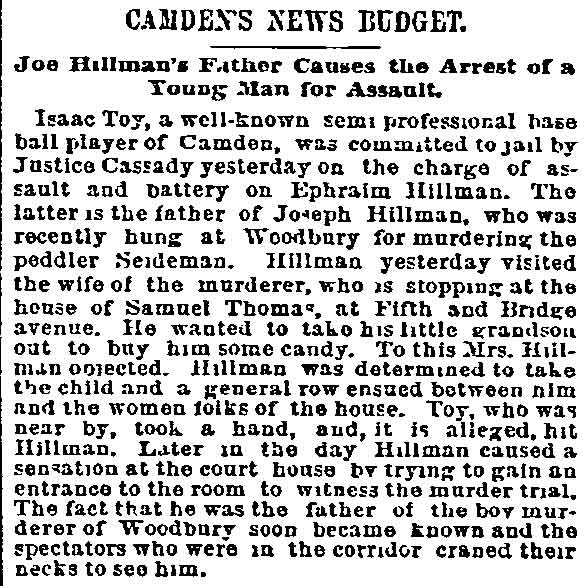
Joe Hillman’s Father Causes the Arrest of a Young Man for Assault.
Isaac Toy, a well-known semi professional base ball player of Camden, was committed to jail by Justice Cassady yesterday on the charge of assault and battery on Ephraim Hillman. The latter is the father of Joseph Hillman, who was recently hung at Woodbury for murdering the peddler Seideman. Hillman yesterday visited the wife of the murderer, who is stopping at the house of Samuel Thomas, at Fifth and Bridge avenue. He wanted to take his little grandson out to buy him some candy. To this Mrs. Hillman objected. Hillman was determined to take the child and a general row ensued between him and the women folks of the house. Toy, who was near by, took a hand, and, it is alleged, hit Hillman. Later in the day Hillman caused a sensation at the court house by trying to gain an entrance to the room to witness the murder trial. The fact that he was the father of the boy murderer of Woodbury soon became known and the spectators who were in the corridor craned their necks to see him.
Base Ball in Camden
Philadelphia Inquirer —
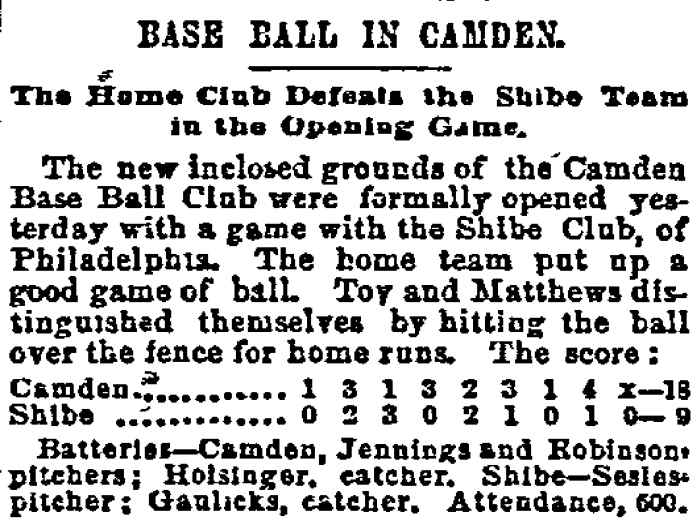
The Home Club Defeats the Shibe Team in the Opening Game.
The new inclosed grounds of the Camden Base Ball Club were formally opened yesterday with a game with the Shibe Club, of Philadelphia. The home team put up a good game of ball. Toy and Matthews distinguished themselves by hitting the ball over the fence for home runs. The score:
Camden………… 1 3 1 3 2 3 1 4 x–18
Shibe………… 0 2 3 0 2 1 0 1 0–9
Batteries—Camden, Jennings and Robinson, pitchers; Holsinger, catcher. Shibe—Sasles, pitcher; Gaulicks, catcher. Attendance, 600.
The Athletes Victorious
Philadelphia Inquirer —
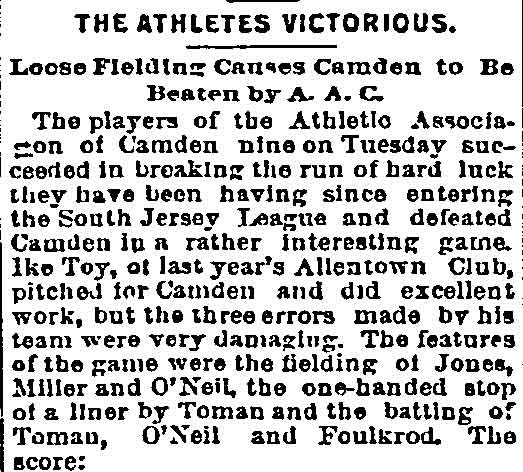
Loose Fielding Causes Camden to Be Beaten by A. A. C.
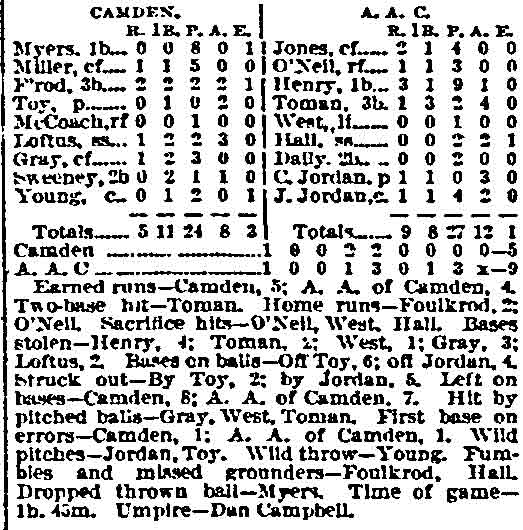
The players of the Athletic Association of Camden nine on Tuesday succeeded in breaking the run of hard luck they have been having since entering the South Jersey League and defeated Camden in a rather interesting game. Ike Toy, of last year’s Allentown Club, pitched for Camden and did excellent work, but the three errors made by his team were very damaging. The features of the game were the fielding of Jones, Miller and O’Neil, the one-handed stop of a liner by Toman and the batting of Toman, O’Neil and Foulkrod.
Earned runs—Camden, 5; A. A. of Camden, 4. Two-base hit—Toman. Home runs—Foulkrod, 2; O’Neil. Sacrifice hits—O’Neil, West, Hall. Bases stolen—Henry, 4; Toman, 2; West, 1; Gray, 3; Loftus, 2. Bases on balls—Off Toy, 6; off Jordan, 4. Struck out—By Toy, 2; by Jordan, 8. Left on bases—Camden, 8; A. A. of Camden, 7. Hit by pitched balls—Gray, West, Toman. First base on errors—Camden, 1; A. A. of Camden, 1. Wild pitches—Jordan, Toy. Wild throw—Young. Fumbles and missed grounders—Foulkrod, Hall. Dropped thrown ball—Myers. Time of game—1h. 45m. Umpire—Dan Campbell.
Camden Ball Tossers
Philadelphia Inquirer —
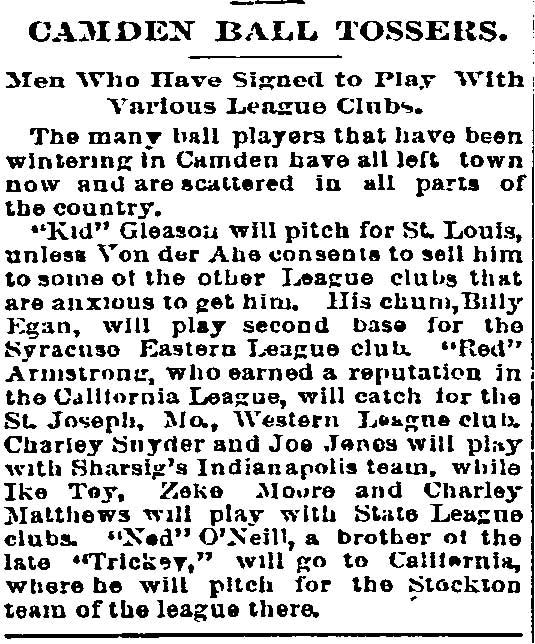
Men Who Have Signed to Play With Various League Clubs.
The many ball players that have been wintering in Camden have all left town now and are scattered in all parts of the country.
“Kid” Gleason will pitch for St. Louis, unless Von der Ahe consents to sell him to some of the other League clubs that are anxious to get him. His chum, Billy Egan, will play second base for the Syracuse Eastern League club. “Red” Armstrong, who earned a reputation in the California League, will catch for the St. Joseph, Mo., Western League club. Charley Snyder and Joe Jones will play with Sharsig’s Indianapolis team, while Ike Toy, Zeke Moore and Charley Matthews will play with State League clubs. “Ned” O’Neill, a brother of the late “Trickey,” will go to California, where he will pitch for the Stockton team of the league there.
Camden Club Reorganized
Philadelphia Inquirer —
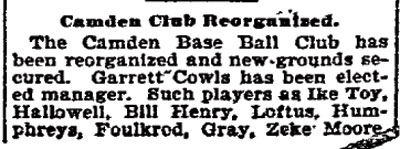
The Camden Base Ball Club has been reorganized and new grounds secured. Garrett Cowls has been elected manager. Such players as Ike Toy, Hallowell, Bill Henry, Loftus, Humphreys, Foulkrod, Gray, Zeke Moore-Matthews and Stanton have been signed, and the first game will be played on July 4.
Camden's Nine Wants Games
Philadelphia Inquirer —
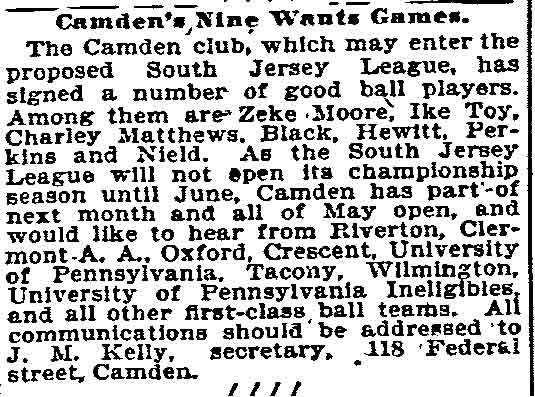
Camden’s Nine Wants Games. The Camden club, which may enter the proposed South Jersey League, has signed a number of good ball players. Among them are Zeke Moore, Ike Toy, Charley Matthews, Black, Hewitt, Perkins and Nield. As the South Jersey League will not open its championship season until June, Camden has part of next month and all of May open, and would like to hear from Riverton, Clermont A. A., Oxford, Crescent, University of Pennsylvania, Tacony, Wilmington, University of Pennsylvania Ineligibles, and all other first-class ball teams. All communications should be addressed to J. M. Kelly, secretary, 118 Federal street, Camden.
Fight at a Ball Game
Philadelphia Inquirer —
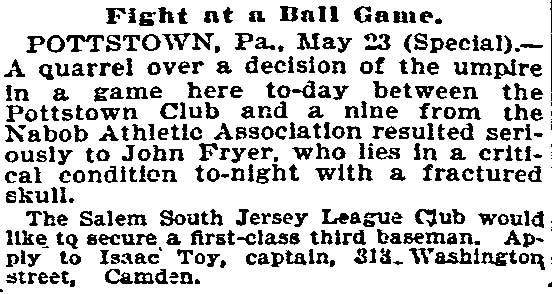
POTTSTOWN, Pa., May 23 (Special).—A quarrel over a decision of the umpire in a game here to-day between the Pottstown Club and a nine from the Nabob Athletic Association resulted seriously to John Fryer, who lies in a critical condition to-night with a fractured skull.
The Salem South Jersey League Club would like to secure a first-class third baseman. Apply to Isaac Toy, captain, 313 Washington street, Camden.
Third Ward Marching Club Officers
Philadelphia Inquirer —
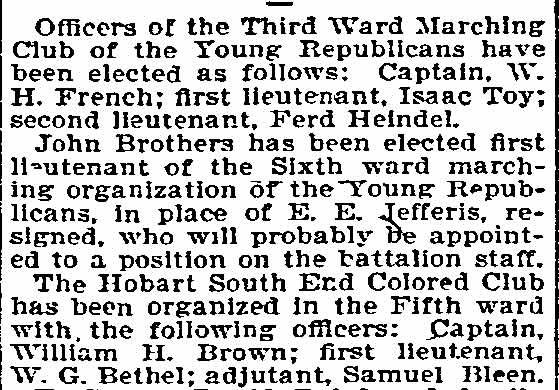
Officers of the Third Ward Marching Club of the Young Republicans have been elected as follows: Captain, W. H. French; first lieutenant, Isaac Toy; second lieutenant, Ferd Heindel.
John Brothers has been elected first lieutenant of the Sixth ward marching organization of the Young Republicans, in place of E. E. Jefferis, resigned, who will probably be appointed to a position on the battalion staff.
Championship Ball Across the Delaware
Philadelphia Inquirer —
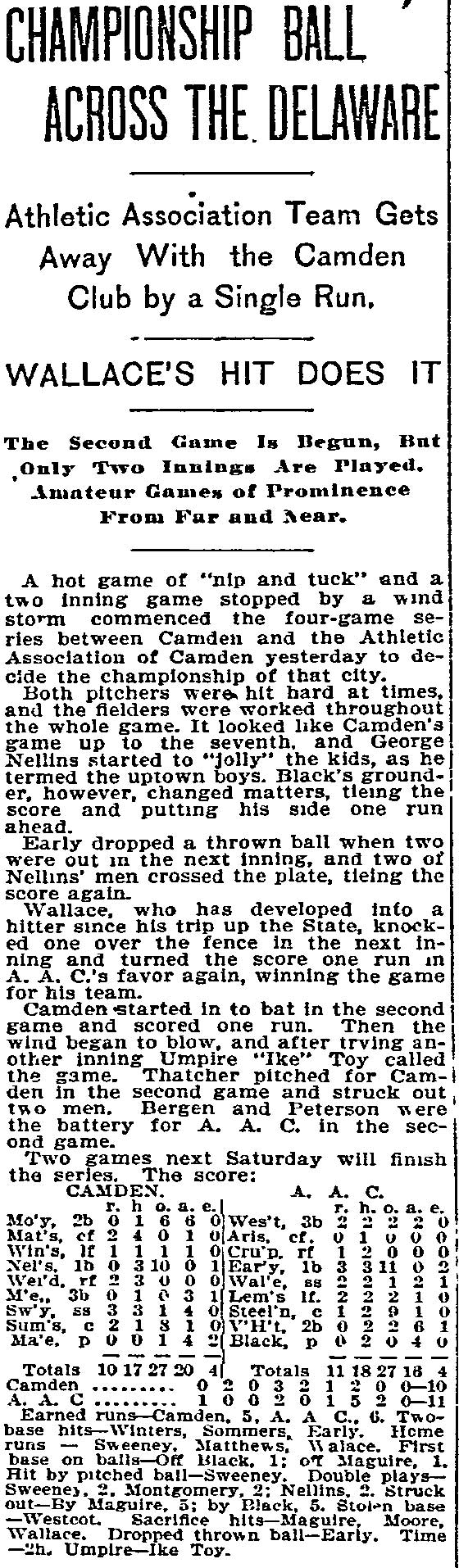
Athletic Association Team Gets Away With the Camden Club by a Single Run.
WALLACE’S HIT DOES IT
The Second Game Is Begun, But Only Two Innings Are Played. Amateur Games of Prominence From Far and Near.
A hot game of “nip and tuck” and a two inning game stopped by a wind storm commenced the four-game series between Camden and the Athletic Association of Camden yesterday to decide the championship of that city. Both pitchers were hit hard at times, and the fielders were worked throughout the whole game. It looked like Camden’s game up to the seventh, and George Nellins started to “jolly” the kids, as he termed the uptown boys. Black’s grounder, however, changed matters, tieing the score and putting his side one run ahead.
Early dropped a thrown ball when two were out in the next inning, and two of Nellins’ men crossed the plate, tieing the score again.
Wallace, who has developed into a hitter since his trip up the State, knocked one over in the next inning and turned the score one run in A. C.’s favor again, winning the game for his team.
Camden started in to bat in the second game and scored one run. Then the wind began to blow, and after trying an inning longer, Umpire “Ike” Toy called the game. In the second game Nellins were in Camden’s favor when the wind stopped. A. C. was last up. They had two men on bases and it looked like their game, but McFetridge was equal to the emergency and struck the third man out. Sweeney’s two-bagger brought in two runs and won Camden the game.
Two Hot Ball Games Over the Delaware
Philadelphia Inquirer —
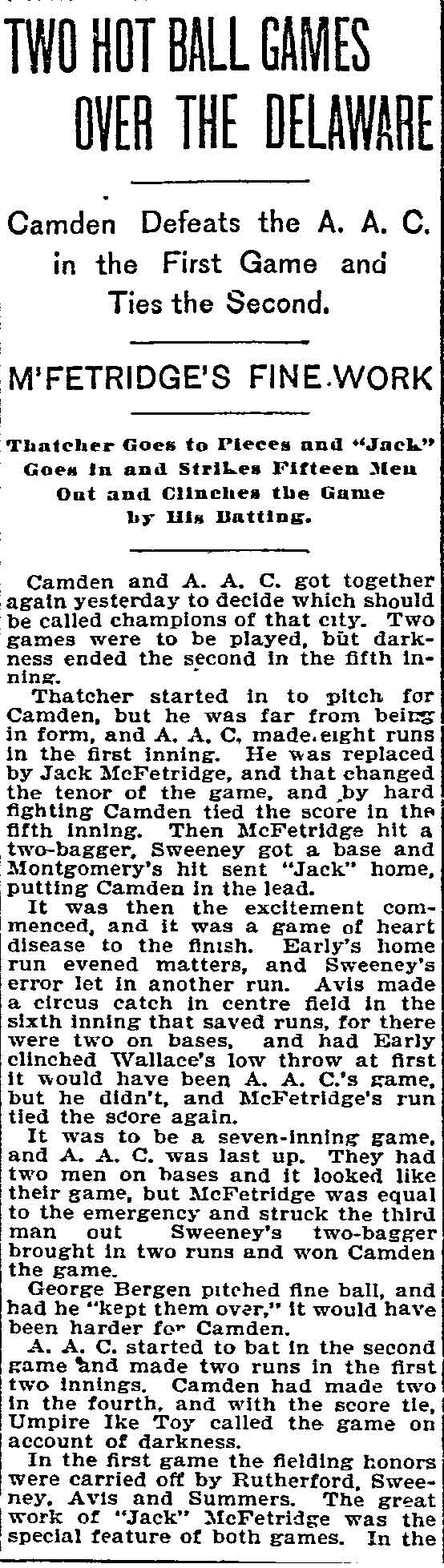
Camden Defeats the A. A. C. in the First Game and Ties the Second.
M’FETRIDGE’S FINE WORK
Thatcher Goes to Pieces and “Jack” Goes in and Strikes Fifteen Men Out and Clinches the Game by His Batting.
Camden and A. A. C. got together again yesterday to decide which should be called champions of that city. Two games were to be played, but darkness ended the second in the fifth inning.
Thatcher started in to pitch for Camden, but he was far from being in form, and A. A. C. made eight runs in the first inning. He was replaced by Jack McFetridge, and that changed the tenor of the game, and by hard fighting Camden tied the score in the fifth inning. Then McFetridge hit a two-bagger, Sweeney got a base and Montgomery’s hit sent “Jack” home, putting Camden in the lead.
It was then the excitement commenced and it was a game of heart disease to the finish. Early’s home run evened matters, and Sweeney’s error let in another run. Avis made a circus catch in centre field in the sixth inning that saved runs, for there were two men on bases, and had Early clinched Wallace’s low throw at first it would have been A. A. C.’s game, but he didn’t, and McFetridge’s run tied the score again.
It was to be a seven-inning game, and A. A. C. was last up. They had two men on bases and it looked like their game, but McFetridge was equal to the emergency and struck the third man out Sweeney’s two-bagger brought in two runs and won Camden the game.
George Bergen pitched fine ball, and had he “kept them over,” it would have been harder for Camden.
A. A. C. started to bat in the second game and made two runs in the first two innings. Camden had made two in the fourth, and with the score tie [sic], Umpire Ike Toy called the game on account of darkness.
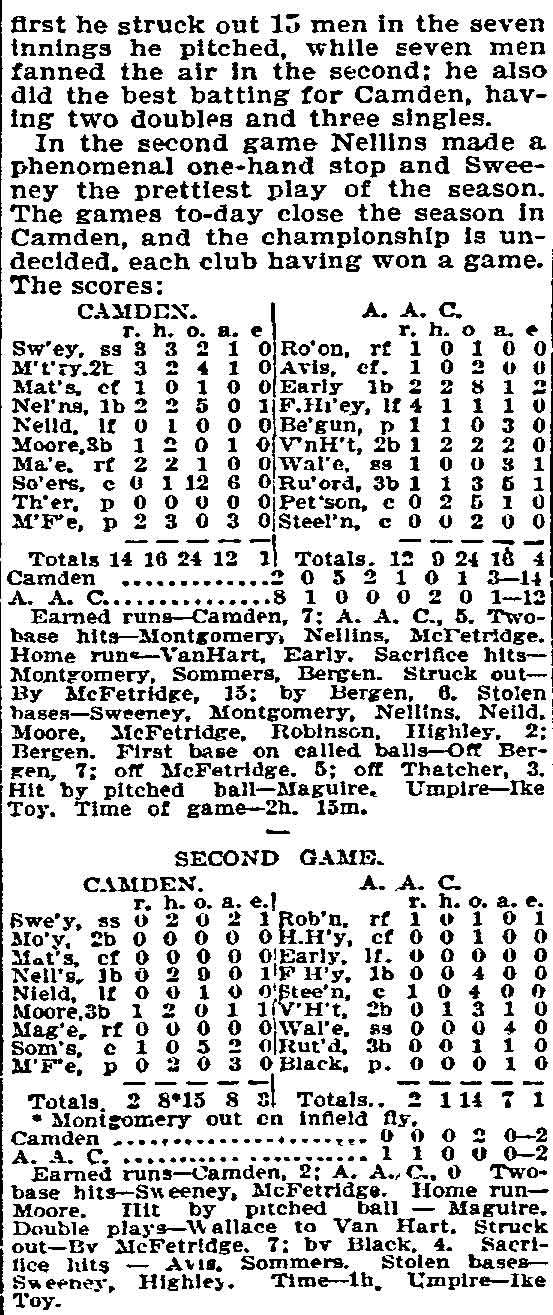
In the first game the fielding honors were carried off by Rutherford, Sweeney, Avis and Summers. The great work of “Jack” McFetridge was the special feature of both games. In the first he struck out 15 men in the seven innings he pitched, while seven men fanned the air in the second; he also did the best batting for Camden, having two doubles and three singles.
In the second game Nellins made a phenomenal one-hand stop and Sweeney the prettiest play of the season. The games to-day close the season in Camden, and the championship is undecided, each club having won a game.
The scores:
CAMDEN. / A. A. C.
r. h. o. a. e.
Sw’ey, ss 3 3 2 1 0 / Ro’on, rf 1 0 1 0 0
M’t’ry, 2b 3 2 4 1 0 / Avis, cf 1 0 2 0 0
Mat’s, cf 1 0 1 0 0 / Early, 1b 2 2 8 1 2
Nel’ns, 1b 2 2 5 0 1 / F. Hi’ey, lf 4 1 1 1 0
Neild, lf 0 1 0 0 0 / Be’gun, p 1 1 0 3 0
Moore, 3b 1 2 0 1 0 / V’nH’t, 2b 1 2 2 2 0
Ma’e, rf 2 2 1 0 0 / Wal’e, ss 1 0 0 3 1
So’ers, c 0 1 12 6 0 / Ru’ord, 3b 1 1 3 6 1
Th’er, p 0 0 0 0 0 / Pet’son, c 0 2 5 1 0
M’F’e, p 2 3 0 3 0 / Steel’n, c 0 0 2 0 0
Totals 14 16 24 12 1 / Totals 12 9 24 18 4
Camden 2 0 5 2 1 0 1 3—14
A. A. C. 8 1 0 0 0 2 0 1—12
Earned runs—Camden, 7; A. A. C., 5. Two-base hits—Montgomery, Nellins, McFetridge. Home runs—VanHart, Early. Sacrifice hits—Montgomery, Sommers, Bergen. Struck out—By McFetridge, 15; by Bergen, 6. Stolen bases—Sweeney, Montgomery, Nellins, Neild, Moore, McFetridge, Robinson, Highley, 2; Bergen. First base on called balls—Off Bergen, 7; off McFetridge, 5; off Thatcher, 3. Hit by pitched ball—Maguire. Umpire—Ike Toy. Time of game—2h. 15m.
SECOND GAME.
CAMDEN. / A. A. C.
r. h. o. a. e.
Swe’y, ss 0 2 0 2 1 / Rob’n, rf 1 0 1 0 1
Mo’y, 2b 0 0 0 0 0 / H. H’y, cf 0 0 1 0 0
Mat’s, cf 0 0 0 0 0 / Early, lf 0 0 0 0 0
Nell’s, 1b 0 2 9 0 1 / F. H’y, 1b 0 0 4 0 0
Nield, lf 0 0 1 0 0 / Stee’n, c 1 0 4 0 0
Moore, 3b 1 2 0 1 1 / V’H’t, 2b 0 1 3 1 0
Mag’e, rf 0 0 0 0 0 / Wal’e, ss 0 0 0 4 0
Som’s, c 1 0 5 2 0 / Rut’d, 3b 0 0 1 1 0
M’F’e, p 0 2 0 3 0 / Black, p. 0 0 0 1 0
Totals 2 8*15 8 3 / Totals 2 1 14 7 1
*Montgomery out on infield fly.
Camden 0 0 0 2 0—2
A. A. C. 1 1 0 0 0—2
Earned runs—Camden, 2; A. A. C., 0 Two-base hits—Sweeney, McFetridge. Home run—Moore. Hit by pitched ball—Maguire. Double plays—Wallace to Van Hart. Struck out—By McFetridge, 7; by Black, 4. Sacrifice hits—Avis, Sommers. Stolen bases—Sweeney, Highley. Time—1h. Umpire—Ike Toy.
Added to the “Finest.”
Camden Daily Courier —
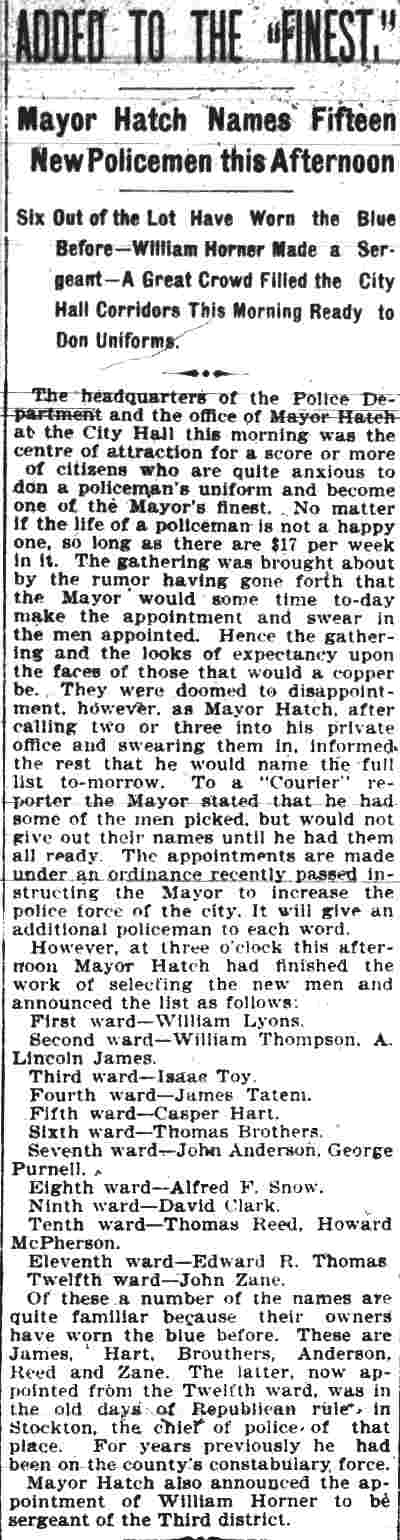
Mayor Hatch Names Fifteen New Policemen this Afternoon
Six Out of the Lot Have Worn the Blue Before—William Horner Made a Sergeant—A Great Crowd Filled the City Hall Corridors This Morning Ready to Don Uniforms.
The headquarters of the Police Department and the office of Mayor Hatch at the City Hall this morning was the centre of attraction for a score or more of citizens who are quite anxious to don a policeman’s uniform and become one of the Mayor’s finest. No matter if the life of a policeman is not a happy one, so long as there are $17 per week in it. The gathering was brought about by the rumor having gone forth that the Mayor would some time to-day make the appointment and swear in the men appointed. Hence the gathering and the looks of expectancy upon the faces of those that would a copper be. They were doomed to disappointment, however, as Mayor Hatch, after calling two or three into his private office and swearing them in, informed the rest that he would name the full list to-morrow. To a “Courier” reporter the Mayor stated that he had some of the men picked, but would not give out their names until he had them all ready. The appointments are made under an ordinance recently passed instructing the Mayor to increase the police force of the city. It will give an additional policeman to each word [sic].
However, at three o’clock this afternoon Mayor Hatch had finished the work of selecting the new men and announced the list as follows:
First ward—William Lyons.
Second ward—William Thompson. A. Lincoln James.
Third ward—Isaac Toy.
Fourth ward—James Tatem.
Fifth ward—Casper Hart.
Sixth ward—Thomas Brothers.
Seventh ward—John Anderson. George Purnell.
Eighth ward—Alfred F. Snow.
Ninth ward—David Clark.
Tenth ward—Thomas Reed. Howard McPherson.
Eleventh ward—Edward R. Thomas
Twelfth ward—John Zane.
Of these a number of the names are quite familiar because their owners have worn the blue before. These are James, Hart, Brouthers, Anderson, Reed and Zane. The latter, now appointed from the Twelfth ward, was in the old days of Republican rule, in Stockton, the chief of police of that place. For years previously he had been on the county’s constabulary force.
Mayor Hatch also announced the appointment of William Horner to be sergeant of the Third district.
Camden’s Police Force Increased
Philadelphia Inquirer —
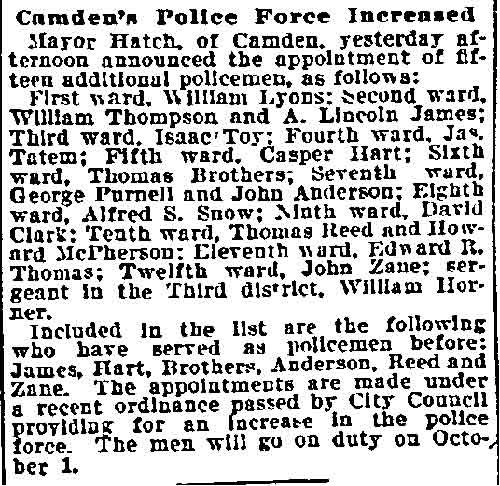
Mayor Hatch, of Camden, yesterday afternoon announced the appointment of fifteen additional policemen, as follows:
First ward, William Lyons; Second ward, William Thompson and A. Lincoln James; Third ward, Isaac Toy; Fourth ward, Jas. Tatem; Fifth ward, Casper Hart; Sixth ward, Thomas Brothers; Seventh ward, George Purnell and John Anderson; Eighth ward, Alfred S. Snow; Ninth ward, David Clark; Tenth ward, Thomas Reed and Howard McPherson; Eleventh ward, Edward R. Thomas; Twelfth ward, John Zane; sergeant in the Third district, William Horner.
Included in the list are the following who have served as policemen before: James, Hart, Brothers, Anderson, Reed and Zane. The appointments are made under a recent ordinance passed by City Council providing for an increase in the police force. The men will go on duty on October 1.
Boys Playing With Matches Started a Big Fire
Philadelphia Inquirer —

FLAMES’ WILD LEAP
Three Blocks Were Burning, When Aid Was Summoned From Philadelphia
4 ENGINES RESPONDED
Quaker City Fire Fighters Mastered the Foe and Were Heartily Cheered
ESTIMATED LOSS $225,000
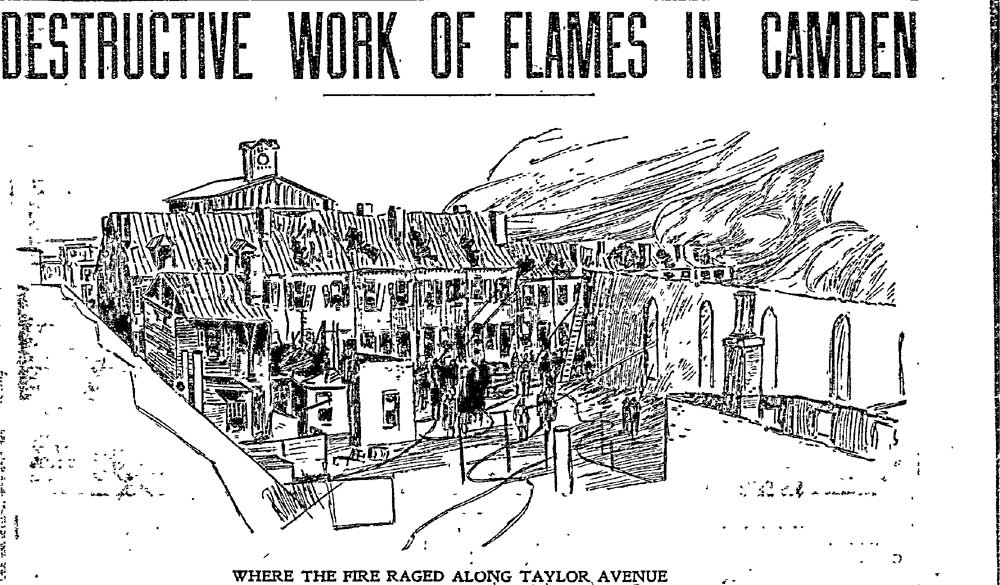
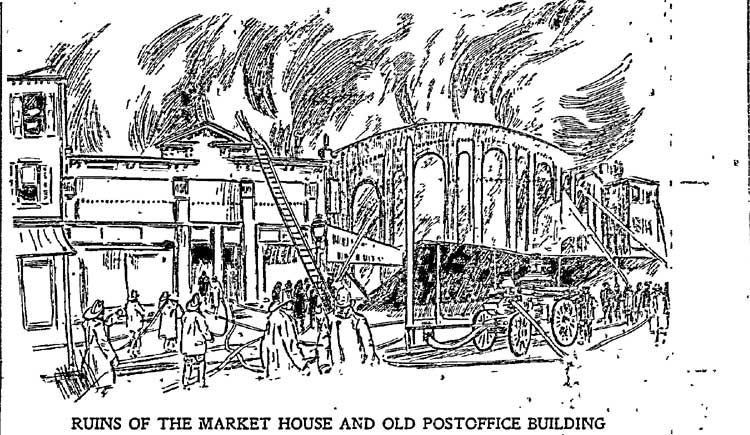
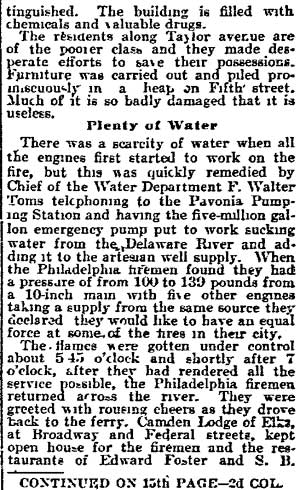
Children playing with matches started a conflagration in Camden yesterday afternoon that destroyed nearly half a hundred buildings, rendered about forty families homeless and caused the destruction of $225,000 worth of property. It was the biggest fire in the history of the city and for a time threatened the destruction of several blocks of buildings in the heart of the city. So rapidly did the fire spread that the local Fire Department was unable to cope with the flames and called on Philadelphia for aid. Chief Baxter sent four engine companies across the river and it was due to their valiant efforts that the fire was mastered, and the block bounded by Federal and Fifth streets and Broadway and Hudson street was saved from destruction.
The flames started about 3 o’clock in the rear of the Market House, the south side of Federal street, between Fourth and Fifth streets. Arthur Rose, 6 years old, of 325 Taylor avenue, and Thomas Pinkerton, 3 years old, of 408 Taylor avenue, were playing in the rear of the market house, which extended through to Taylor avenue. The Delaware and Atlantic Telegraph and Telephone Company used the rear half of the building as a storage house for valuable electrical appliances, telephones, batteries, etc. Just outside the building were piled up 300 wooden cross arms for electric poles.
Fun for the Boys
The lads had some matches and set fire to a string hanging out of a barrel filled with excelsior. Then they stepped back and clapped their hands in childish glee as they saw the fire creep slowly up the string. In a moment the excelsior had caught fire and the barrel burst into flame setting fire to the pile of cross arms and some equally inflammable material inside the market house.
The children, trembling with fear when they saw the result of their playful deed, ran to their homes. Young Pinkerton rushed into his house, directly across the street, and told his father, William Pinkerton, that the market house was on fire. But a square away, at Fifth and Arch streets, is the headquarters of the Camden Fire Department. It took Pinkerton but a minute or two to run there and give the alarm. This was at 3:05 o’clock.
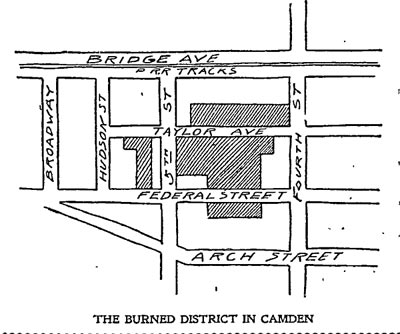
As quickly as possible the firemen responded. So rapidly did the flames spread that by the time the firemen reached the burning building the market house, with a frontage of about 100 feet on Federal street and extending through to Taylor avenue, was like a roaring furnace. The building had a high, oval roof. Fanned by a strong westerly breeze, the flames rushed through the shell like building and began to spread on both sides. The flames also leaped across Taylor avenue, a fifteen-foot thoroughfare, and began to gut a row of fifteen two-story brick and frame buildings on the south side.
As soon as Chief Elfreth arrived on the scene he saw that he had a desperate battle before him. Alarm after alarm was sent in quick succession, until every piece of fire apparatus and every fireman in the city was summoned to the scene. This force included four combined engine and hose companies, three additional hose companies from the East Side and South Camden, two chemical engine companies and two hook-and-ladder truck companies. Then the big extra engine kept at fire headquarters for emergency purposes was brought out and pressed into service. Scores of old volunteer firemen lent a hand with the hose, and the entire police force was called out.
Still the flames could not be gotten under control, and continued to spread. Within fifteen minutes after the firemen arrived on the scene the roof of the market house fell with a roar that could be heard for squares.
Now the fire took a great leap and assumed the proportions of a conflagration. The westerly breeze had carried a shower of sparks up Taylor avenue, and, jumping Fifth street and Samuel Davis’ livery stable, on the west side, they set fire to the roof of Joseph Swing’s house, at 509 Taylor avenue. The dwelling was soon in a fierce blaze and the flames extended to the rear of the wholesale drug and patent medicine store of William Cowgill, at 518 Federal street.
By this time it was seen that the entire block of business houses and dwellings on Federal street east of Fifth was in danger. The local firemen had all they could do to cope with the flames in the lower block, as the fire had leaped across Federal street to the roofs and fronts of several buildings on the north side. Aid was needed, and Chief of Police Foster, at 4:20 o’clock, telephoned to the Electrical Bureau in Philadelphia. Word was telegraphed to Chief Baxter, of the Fire Department, and although he had just subdued a big blaze in his own city and many of his men were still at work, the Chief promptly dispatched Engine Companies Nos. 6, 21, 22 and 43 to Camden, in charge of Assistant Chief Edward A. Waters.
Philadelphia to the Rescue
Too much credit cannot be given the Philadelphia firemen for the work they did, as it was due entirely to their efforts that the block above Fifth street was saved. As the Quaker City fire companies dashed up Federal street they were greeted with cheers from the crowd of spectators that drowned the roar of the flames. The engines were quickly put in service and streams were turned on the blazing Cowgill store, which was then nothing but a shell. The fire in the rear had destroyed the dwelling houses, Nos. 509-11-13-15-17-19-21-23 Taylor avenue, and Nos. 516 and 520-22 Federal street were gutted.
Foreman George Hood, of Engine Company No. 6, of Philadelphia, in trying to escape from a falling roof while fighting the flames in William Grosscup’s house, at 510 Federal street, ran outside and collided with a hitching post with such force as to break one of his ribs. Twelve members of the Camden Emergency Medical and Surgical Corps, with Doctor H. H. Davis at their head, were present. After examining Foreman Hood, they sent him to Cooper Hospital. The Emergency Corps also rendered aid to a man who went into convulsions over the excitement of seeing his house burning and to Mrs. James Morris, of No. 1 South Fifth street, who ran a nail through her foot.
Fire’s Wild Sweep
With the addition of the Philadelphia fire fighters to their force the Camden firemen tackled the fire with renewed energy and soon the streams from the nine engines got the mastery of the flames. Then it was merely a matter of drowning out the blazes in detail. The wide swath cut by the flames may be judged from the fact that 47 buildings were destroyed or badly damaged, and the fire’s ravages extended to four blocks.
The market house, on Federal street, above Fourth, was burned to the ground only the front wall being left standing. The old postoffice building on the east was gutted and M. S. Irvin’s grocery store and dwelling adjoining was badly damaged. On the west of the market house B. F. Sutton & Sons jewelry store and dwelling and Barber Charles Williams’ residence, at 412 and 410 Federal street, were damaged in the upper stories. The flames burned the fronts and roofs of Nos. 415 to 423 Federal street, on the north side. On Taylor avenue a row of thirteen brick and two frame houses on the south side and Nos. 403 and 427-29 on the north side were gutted. Houses Nos. 1 to 15, on the west side of South Fifth street, burned out in the rear and the roofs were destroyed. Cowgill’s drug store, at 518 Federal street, was burned to the ground, and Nos. 514, 516, 520 and 522 were gutted. On Taylor avenue, above Fifth street, Nos. 519-11-13 were destroyed, nothing but the brick chimneys being left standing. The fire gutted Nos. 515 to 523. The roof of the wholesale and retail drug store of George M. Beringer, northeast corner of Fifth and Arch streets, caught fire, but the flames were quickly extinguished. The building is filled with chemicals and valuable drugs.
The residents along Taylor avenue are of the poorer class and they made desperate efforts to save their possessions. Furniture was carried out and piled promiscuously in a heap on Fifth street. Much of it is so badly damaged that it is useless.
Plenty of Water
There was a scarcity of water when all the engines first started to work on the fire, but this was quickly remedied by Chief of the Water Department F. Walter Toms telephoning to the Pavonia Pumping Station and having the five-million gallon emergency pump put to work sucking water from the Delaware River and adding it to the artesian well supply. When the Philadelphia firemen found they had a pressure of from 100 to 139 pounds from a 10-inch main with five other engines taking a supply from the same source they declared they would like to have an equal force at some of the fires in their city.
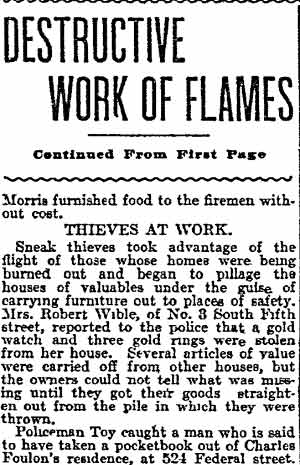
The flames were gotten under control about 5:45 o’clock and shortly after 7 o’clock, after they had rendered all the service possible, the Philadelphia firemen returned across the river. They were greeted with rousing cheers as they drove back to the ferry. Camden Lodge of Elks, at Broadway and Federal streets, kept open house for the firemen and the restaurants of Edward Foster and S. B. Morris furnished food to the firemen without cost.
THIEVES AT WORK.
Sneak thieves took advantage of the flight of those whose homes were being burned out and began to pillage the houses of valuables under the guise of carrying furniture out to places of safety. Mrs. Robert Wible, of No. 3 South Fifth street, reported to the police that a gold watch and three gold rings were stolen from her house. Several articles of value were carried off from other houses, but the owners could not tell what was missing until they got their goods straighten out from the pile in which they were thrown.
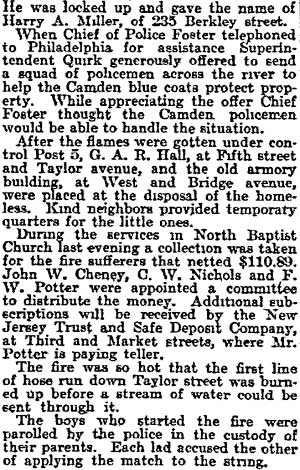
Policeman Toy caught a man who is said to have taken a pocketbook out of Charles Foulon’s residence, at 524 Federal street. He was locked up and gave the name of Harry A. Miller, of 235 Berkley street.
When Chief of Police Foster telephoned to Philadelphia for assistance Superintendent Quirk generously offered to send a squad of policemen across the river to help the Camden blue coats protect property. While appreciating the offer Chief Foster thought the Camden policemen would be able to handle the situation.
After the flames were gotten under control Post 5, G. A. R. Hall, at Fifth street and Taylor avenue, and the old armory building, at West and Bridge avenue, were placed at the disposal of the homeless. Kind neighbors provided temporary quarters for the little ones.
During the services in North Baptist Church last evening a collection was taken for the fire sufferers that netted $110.89. John W. Cheney, C. W. Nichols and F. W. Potter were appointed a committee to distribute the money. Additional subscriptions will be received by the New Jersey Trust and Safe Deposit Company, at Third and Market streets, where Mr. Potter is paying teller.
The fire was so hot that the first line of hose run down Taylor street was burned up before a stream of water could be sent through it. The boys who started the fire were parolled by the police in the custody of their parents. Each lad accused the other of applying the match to the string.
Camden News Notes
Philadelphia Inquirer —
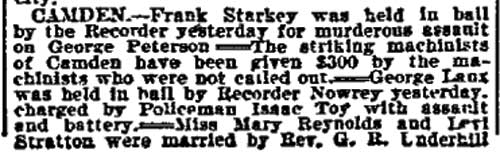
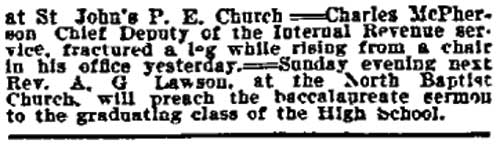
CAMDEN.—Frank Starkey was held in bail by the Recorder yesterday for murderous assault on George Peterson—The striking machinists of Camden have been given $300 by the machinists who were not called out.—George Laux was held in bail by Recorder Nowrey yesterday, charged by Policeman Isaac Toy with assault and battery.—Miss Mary Reynolds and Levi Stratton were married by Rev. G. R. Underhill at St John’s P. E. Church—Charles McPherson Chief Deputy of the Internal Revenue service, fractured a leg while rising from a chair in his office yesterday.—Sunday evening next Rev. A. G. Lawson, at the North Baptist Church, will preach the baccalaureate sermon to the graduating class of the High School.
Dog Led Way to Drowned Child
Philadelphia Inquirer —
DOG LED WAY TO DROWNED CHILD
Four-Year-Old Boy Became Fastened in Mud at the Bottom of a Pond and Perished
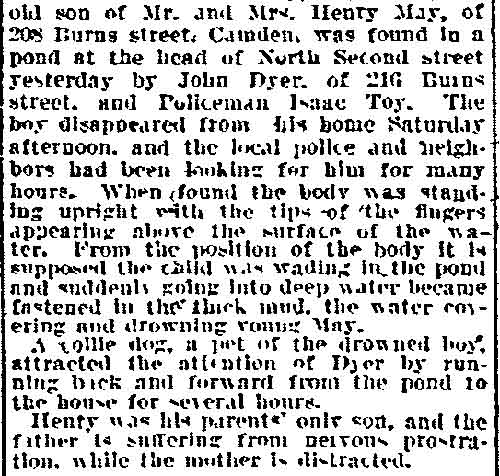
The body of Henry May, Jr., the 4-year-old son of Mr. and Mrs. Henry May, of 208 Burns street, Camden, was found in a pond at the head of North Second street yesterday by John Dyer, of 216 Burns street, and Policeman Isaac Toy. The boy disappeared from his home Saturday afternoon, and the local police and neighbors had been looking for him for many hours. When found the body was standing upright with the tips of the fingers appearing above the surface of the water. From the position of the body it is supposed the child was wading in the pond and suddenly going into deep water became fastened in the thick mud, the water covering and drowning young May.
A collie dog, a pet of the drowned boy, attracted the attention of Dyer by running back and forward from the pond to the house for several hours.
Henry was his parents’ only son, and the father is suffering from nervous prostration, while the mother is distracted.
Woman Involved in Camden Mystery
Philadelphia Inquirer —
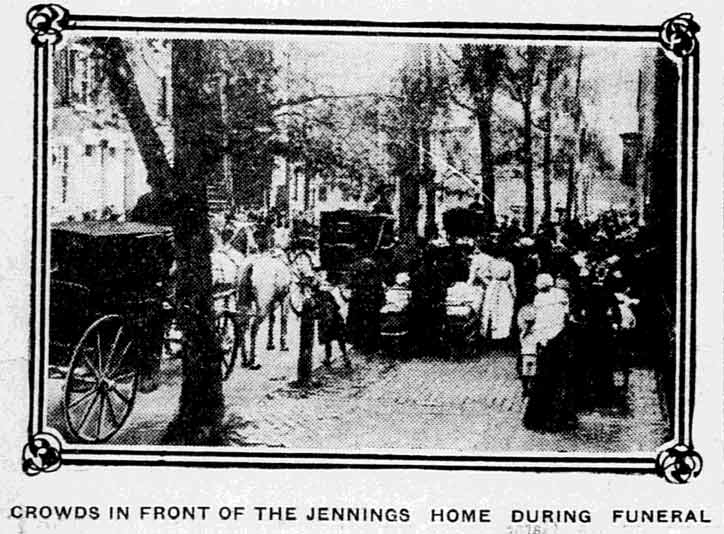
After Being Questioned by the Prosecutor She Is Committed to the County Jail—Believed to Be an Important Arrest
Crowds in Front of the Jennings Home During Funeral
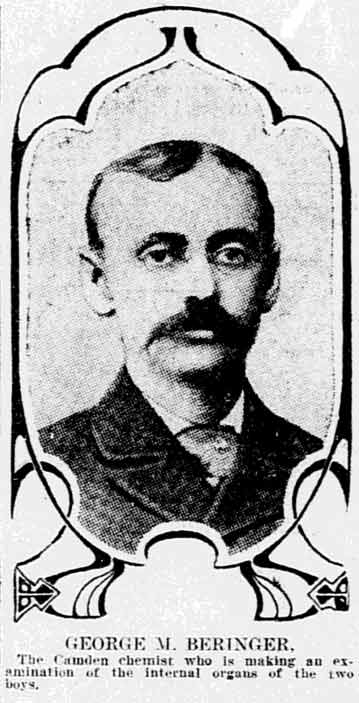
George M. Beringer.
The Camden chemist who is making an examination of the internal organs of the two boys.
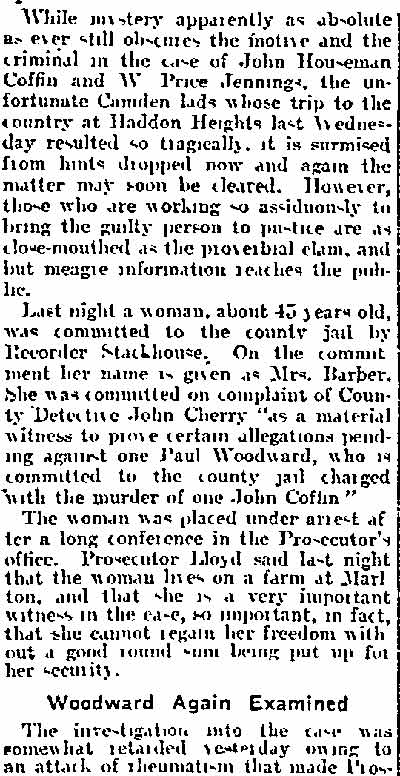
While mystery apparently as absolute as ever still obscures the motive and the criminal in the case of John Houseman Coffin and W. Price Jennings, the unfortunate Camden lads whose trip to the country at Haddon Heights last Wednesday resulted so tragically, it is surmised from hints dropped now and again the matter may soon be cleared. However, those who are working so assiduously to bring the guilty person to justice are as close-mouthed as the proverbial clam, and but meagre information reaches the public.
Last night a woman, about 45 years old, was committed to the county jail by Recorder Stackhouse. On the commitment her name is given as Mrs. Barber. She was committed on complaint of County Detective John Cherry “as a material witness to prove certain allegations pending against one Paul Woodward, who is committed to the county jail charged with the murder of one John Coffin.”
The woman was placed under arrest after a long conference in the Prosecutor’s office. Prosecutor Lloyd said last night that the woman lives on a farm at Marlton, and that she is a very important witness in the case, so important, in fact, that she cannot regain her freedom without a good round sum being put up for her security.
Woodward Again Examined
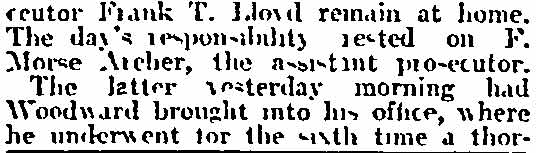
The investigation into the case was somewhat retarded yesterday owing to an attack of rheumatism that made Prosecutor Frank T. Lloyd remain at home. The day’s responsibility rested on F. Morse Archer, the assistant prosecutor. The latter yesterday morning had Woodward brought into his office, where he underwent for the sixth time a thorough cross-examination. Mr. Archer said Woodward had made no confession, as had been rumored. On the contrary, he still maintained his innocence.
In answer to a question Mr. Archer said: “We are doing our best and while we are in possession of information which we consider important and vital to the case, it is impossible at this time to make it public.”
On the other hand, County Physician Jones was very emphatic in this particular, saying the boys were murdered beyond a doubt.
Boys’ Funerals
Yesterday afternoon the funeral of the boys took place at the same hour and within a square of one another’s homes. Although the hour set for the obsequies, 2 o’clock in the afternoon, had been kept secret scores of persons stood about in knots discussing the tragedy and eager to get a glimpse of the caskets containing the remains of the boys.
Police Captain Boyle and Policemen Kappel, Toy and Ridgeley guarded the houses, and no one except relatives and intimate friends were permitted to enter. But when the caskets were carried from the houses the crowd could not be kept back. Many persons crowded about, and the mourners entered the carriages between two solid phalanxes of curiosity seekers.
The services over Jennings were conducted at his home, 219 North Third street, by Rev. C. A. Adams and Rev. John Lyell. At the Coffin home, 305 North Third street, Rev. William H. Fishburn had charge of the obsequies. Companions of the boys acted as pallbearers. Jennings was buried at Evergreen and Coffin at Harleigh Cemetery.
George M. Beringer, a Camden chemist, who has the important duty of discovering, if possible, traces of poison in the stomachs of the boys, said yesterday he is making a thorough chemical analysis and is of necessity proceeding slowly. He said he will not be able to report the result for some days to come.
A pathetic little incident occurred at the Cooper School during recess yesterday morning when the children, school mates of the lads, gathered about and listened to the muffled beats of a drum. The school flag was at half mast and in every room there was a flag draped with black crepe. The youngsters were visibly affected.
Landed His Man After a Struggle
Philadelphia Inquirer —
Harry Livermore and John Mares were arrested in Camden yesterday charged with breaking into the Pennsylvania Bottling and Supply Company’s place at 14 Market street. The complaint was made by Henry E. Nunnich, manager of the company. Policeman Kappel says he found the men in the place. He succeeded in arresting Mares, but Livermore got away. Later in the day Policemen Harry Miller and Isaac Toy visited Livermore’s home at Third and Clinton streets with a warrant for his arrest issued by Recorder Stackhouse. Livermore eluded the officers and, amid much excitement, scurried away over fences. He was once more found by Miller, but put up such a stout resistance that the officer pulled his revolver. Officer and prisoner rolled about in each other’s embrace until the former finally succeeded in mastering the man. Policeman Miller was seriously cut, during the primary election fight July 28 last and yesterday was his second day of duty.
Another Case in Third Ward Riot
Camden Daily Courier —

Policeman Keaser and Ex-Policeman “Bob” Miller on Trial for Assault.
WAGNER JURY COULD NOT AGREE
In the Criminal Court this morning George V. Tucker, who was convicted of a charge of assault and battery, was sentenced by Judge Joline to pay a fine of $50 and costs and stand committed until the money is paid.
Henry J. Shuster pleaded guilty to a charge of embezzling $260.16 from King David Lodge, I. O. O. F., of which he was treasurer. Shuster served three months in the County Jail last spring on a similar charge. At that time he said he used the money to care for his wife, who was ill. It appears that he did use part of the money for this purpose, but that he squandered a large sum in poker playing.
Rev. Q. C. Davis, pastor of the Emmanuel Baptist church, testified that since Shuster has been out of jail he has led a correct life, and at the present time has a good position.
Prosecutor Lloyd made an appeal for clemency.
Judge Joline announced that he was not ready to decide the case and it went over.
POLICEMEN ON TRIAL.
The indictment against Policeman Albert Keaser and ex-Policeman Robert Miller, on charges of assault and battery on George Murray, was then moved. This is the second case to be tried as the outcome of the election riot, in the Third ward during the primary election last July. Considerable time was occopued [sic] in securing a jury.
After the jury was sworn Assistant Prosecutor Archer outlined the case, in which he said the two defendants at that time were policemen and the alleged assault took place at the polling place at Third and Beckett streets, and during the row, Robert Miller, struck George Murray several times with a blackjack. Keaser, it is alleged, assisted Miller in the assault.
The first witness called was George Murray, the complainant, who testified that while standing near the polling booth with some tickets “Bob” Miller, without any provocation, beat him with a blackjack. He said that Policeman Keaser and John Wagner came to Miller’s assistance. During the row, Policemen Hartman and Harry Miller came to his aid.
BEATEN WITH A BLACKJACK.
On cross-examination witness said he had no pistol or blackjack, but that Miller came up to him and deliberately struck witness with a blackjack. He denied that he said on the steps of the Third Ward Republican Club, in the presence of John Rodan, that if a certain —— would come along he would kill him.
William Laws, who testified in yesterday’s trial, gave corroborative testimony as to the blackjacking. He said that Murray did nothing to provoke the assault.
Spencer Moore, also gave corroborative testimony.
Policeman Harry Miller testified to seeing “Bob” Miller beating Murray with a blackjack while out in the middle of Beckett street. The witness said he surged in the crowd and struck at Keaser at the same time exclaiming:
“What are you trying to do, kill this man?”
The witness said he was thrown down, and was pulled up on his feet by Keaser, who grappled with him. He heard thre [sic] or four pistol shots.
The witness identified a blackjack, in the possession of Lawyer Rex, which he used on the night of the primaries.
Howard Roberts, a son of Assemblyman Roberts, also gave corroborative testimony.
DEFENSE OPENS.
At the afternoon session of the court the defense opened. Counsel said that the defendants were justified in using force to put Murray into subjection.
Policeman Toy testified that he saw the occurrence and thought that “Bob” Miller, was acting as a peacemaker. He saw Murray shoot off a revolver.
Daniel Ayres testified to seeing the riot and heard Murray say that he would get some one before the night was over. He saw Murray shoot off a revolver under a tree.
Ex-Policeman “Bob” Miller admitted that he struck Murray while attempting to arrest him. He also testified that he was knocked down and beaten and that some person had attempted to stab him. He exhibited his clothing which was soiled and cut.
Policeman Shaw testified that on July 28 he went to Third and Beckett streets and found George Murray in his home, where he was under arrest by Detective Hart. Witness recovered a revolver from the wife of Murray.
Mrs. Widener, who was a witness in the trial yesterday, gave the same line of evidence in this case.
CHEESEMAN SENTENCED.
At the noon recess Judge Joline imposed sentence on Thomas J. Cheeseman, the former secretary of Thomas Jefferson Council, No. 138, Jr. O. U. A. M., who was convicted of a charge of false pretenses on Thursday last. Before sentence was imposed Rev. J. R. Mason, pastor of the Kaighn Avenue M. E. church, and Rev. Robert Wesley Peach, pastor of the Second Presbyterian church, made appeals to the court for clemency in his case. Judge Joline sentenced Cheeseman to three months in the County Jail and a fine of $150 and costs.
After being out for seven hours without being able to agree on a verdict the jury in the case of Charles Wagner, tried yesterday on a charge of stabbing Policeman Harry Miller, at the time of the same election riot, were discharged at 10 o’clock last night.
Camden Policemen Transferred
Philadelphia Inquirer —
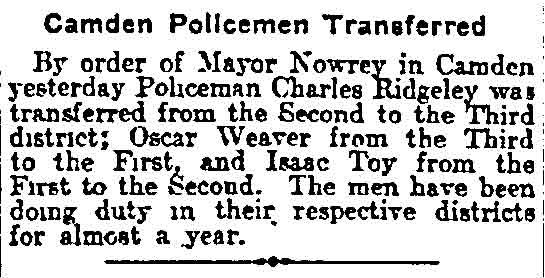
Camden Policemen Transferred. By order of Mayor Nowrey in Camden yesterday Policeman Charles Ridgeley was transferred from the Second to the Third district; Oscar Weaver from the Third to the First, and Isaac Toy from the First to the Second. The men have been doing duty in their respective districts for almost a year.
Ike Toy Recovering
Bridgeton Evening News —

The many friends of Ike Toy, a former Camden player, who is now on the Camden police force, will be pleased to learn that he is recovering from an attack of illness.
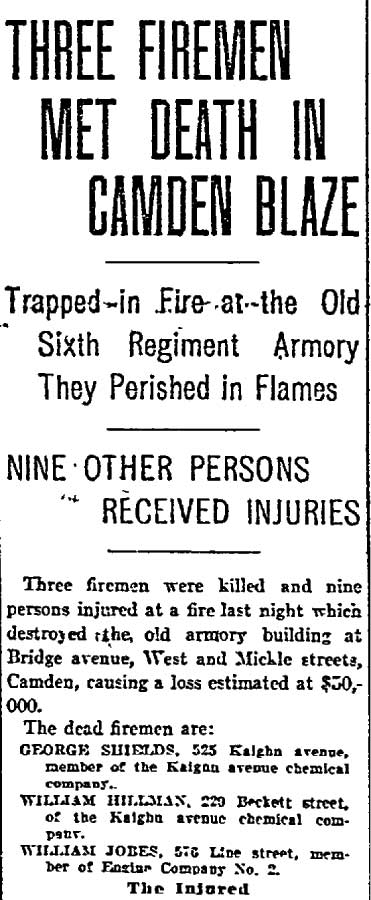
Three Firemen Met Death in Camden Blaze
Philadelphia Inquirer —
Trapped in Fire at the Old Sixth Regiment Armory They Perished in Flames
NINE OTHER PERSONS RECEIVED INJURIES
Three firemen were killed and nine persons injured at a fire last night which destroyed the old armory building at Bridge avenue, West and Mickle streets, Camden, causing a loss estimated at $50,000.
The dead firemen are: GEORGE SHIELDS, 525 Kaighn avenue, member of the Kaighn avenue chemical company. WILLIAM HILLMAN, 229 Beckett street, of the Kaighn avenue chemical company. WILLIAM JOBES, 57[?] Line street, member of Engine Company No. 2.
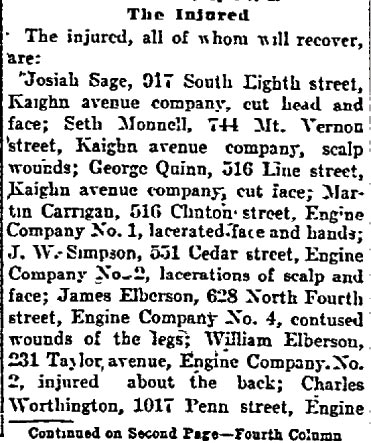
The Injured
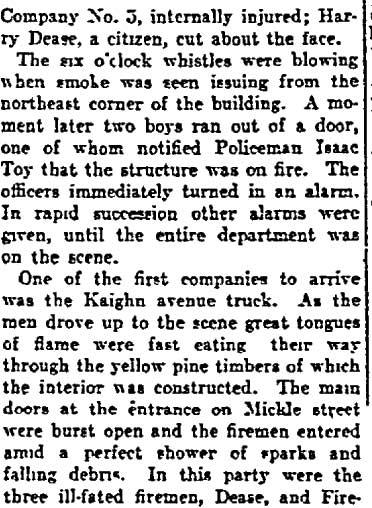
The injured, all of whom will recover, are: Josiah Sage, 917 South Eighth street, Kaighn avenue company, cut head and face; Seth Monnell, 744 Mt. Vernon street, Kaighn avenue company, scalp wounds; George Quinn, 516 Line street, Kaighn avenue company, cut face; Martin Carrigan, 516 Clinton street, Engine Company No. 1, lacerated face and hands; J. W. Simpson, 551 Cedar street, Engine Company No. 2, lacerations of scalp and face; James Elberson, 628 North Fourth street, Engine Company No. 4, contused wounds of the legs; William Elberson, 231 Taylor avenue, Engine Company No. 2, injured about the back; Charles Worthington, 1017 Penn street, Engine Company No. 3, internally injured; Harry Dease, a citizen, cut about the face.
The six o’clock whistles were blowing when smoke was seen issuing from the northeast corner of the building. A moment later two boys ran out of a door, one of whom notified Policeman Isaac Toy that the structure was on fire. The officers immediately turned in an alarm. In rapid succession other alarms were given, until the entire department was on the scene.
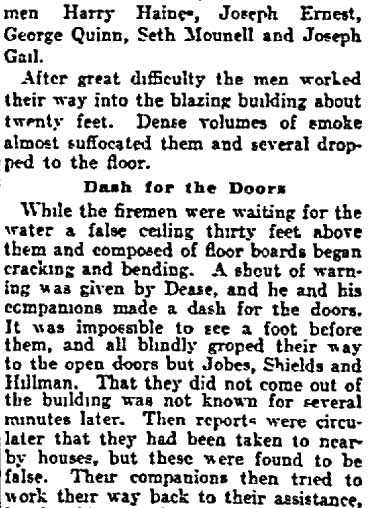
One of the first companies to arrive was the Kaighn avenue truck. As the men drove up to the scene great tongues of flame were fast eating their way through the yellow pine timbers of which the interior was constructed. The main doors at the entrance on Mickle street were burst open and the firemen entered amid a perfect shower of sparks and falling debris. In this party were the three ill-fated firemen, Dease, and Firemen Harry Haines, Joseph Ernest, George Quinn, Seth Mounell and Joseph Gail.
After great difficulty the men worked their way into the blazing building about twenty feet. Dense volumes of smoke almost suffocated them and several dropped to the floor.
Dash for the Doors
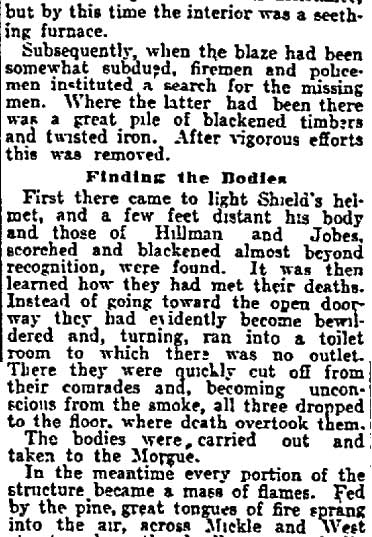
While the firemen were waiting for the water a false ceiling thirty feet above them and composed of floor boards began cracking and bending. A shout of warning was given by Dease, and he and his companions made a dash for the doors. It was impossible to see a foot before them, and all blindly groped their way to the open doors but Jobes, Shields and Hillman. That they did not come out of the building was not known for several minutes later. Then reports were circulated that they had been taken to nearby houses, but these were found to be false. Their companions then tried to work their way back to their assistance, but by this time the interior was a seething furnace.
Subsequently, when the blaze had been somewhat subdued, firemen and policemen instituted a search for the missing men. Where the latter had been there was a great pile of blackened timbers and twisted iron. After vigorous efforts this was removed.
Finding the Bodies
First there came to light Shield’s helmet, and a few feet distant his body and those of Hillman and Jobes, scorched and blackened almost beyond recognition, were found. It was then learned how they had met their deaths. Instead of going toward the open doorway they had evidently become bewildered and, turning, ran into a toilet room to which there was no outlet. There they were quickly cut off from their comrades and, becoming unconscious from the smoke, all three dropped to the floor, where death overtook them.
The bodies were carried out and taken to the Morgue.
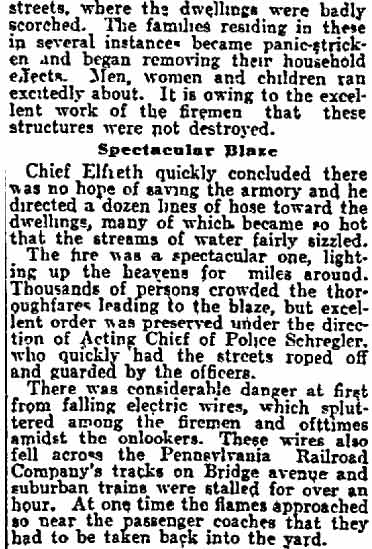
In the meantime every portion of the structure became a mass of flames. Fed by the pine, great tongues of fire sprang into the air, across Mickle and West streets, where the dwellings were badly scorched. The families residing in these in several instances became panic-stricken and began removing their household effects. Men, women and children ran excitedly about. It is owing to the excellent work of the firemen that these structures were not destroyed.
Spectacular Blaze
Chief Elfieth quickly concluded there was no hope of saving the armory and he directed a dozen lines of hose toward the dwellings, many of which became so hot that the streams of water fairly sizzled.
The fire was a spectacular one, lighting up the heavens for miles around. Thousands of persons crowded the thoroughfares leading to the blaze, but excellent order was preserved under the direction of Acting Chief of Police Schregler, who quickly had the streets roped off and guarded by the officers.
There was considerable danger at first from falling electric wires, which spluttered among the firemen and ofttimes amidst the onlookers. These wires also fell across the Pennsylvania Railroad Company’s tracks on Bridge avenue and suburban trains were stalled for over an hour. At one time the flames approached so near the passenger coaches that they had to be taken back into the yard.
Stubborn Blaze
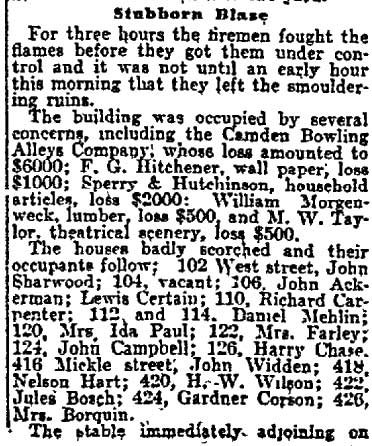
For three hours the firemen fought the flames before they got them under control and it was not until an early hour this morning that they left the smouldering ruins.
The building was occupied by several concerns, including the Camden Bowling Alleys Company; whose loss amounted to $6000; F. G. Hitchener, wall paper; loss $1000; Sperry & Hutchinson, household articles, loss $2000; William Morgenweck, lumber, loss $500, and M. W. Taylor, theatrical scenery, loss $500.
The houses badly scorched and their occupants follow; 102 West street, John Sharwood; 104, vacant; 106, John Ackerman; Lewis Certain; 110, Richard Carpenter; 112, and 114. Daniel Mehlin; 120, Mrs. Ida Paul; 122, Mrs. Farley; 124, John Campbell; 126, Harry Chase. 416 Mickle street, John Widden; 418, Nelson Hart; 420, H.-W. Wilson; 422, Jules Bosch; 424, Gardner Corson; 426, Mrs. Borquin.
The stable immediately adjoining on the west side of the armory, and belonging to C. M. Alcott, was flooded with water. At this place there were forty horses, all of which were rescued.
Formerly a Market
The destroyed building was erected in 1873, by a number of well-known Camden men, as the Farmers’ and Merchants’ Market. From the first it was not a success, and subsequently became known as the Camden Opera House. After a more or less successful season the promoters of this scheme closed the doors. In 1886 the building was purchased by the State as an armory for the old Sixth Regiment, N. G. N. J. For ten years Camden’s citizen soldiers drilled and gave balls and receptions in the building. When the regiment moved to the new armory on Haddon avenue the old structure was cut up into several rooms and had been used by many different concerns. Recently it was purchased by the Pennsylvania Railroad Company to make way for the elevated railroad. All the tenants had been ordered to vacate.
The origin of the fire is unknown. Incendiarism is hinted at and Mayor Ellis declared he will detail the detectives on the case to-day to make a rigid investigation.
Speaking of the matter, he said it is very peculiar that most of Camden’s fires occur about the time the firemen are at their meals. This has been the case in most every blaze if [sic] any importance in the city. The Mayor also highly commended the excellent work of the men in preventing a spread of the flames.
Camden to Play Benefit Game
Philadelphia Inquirer —
Camden will wind up its season next Saturday with a benefit game, the receipts of which are to go toward a fund being raised for Ike Toy, one of Camden’s most popular ball players of the early ‘90’s, who is at present very sick and most [sic] seek another climate. The Camden players have volunteered their services, and they will be opposed by a team composed of Wid Conroy, Kid Gleason, Harry Gleason, Danny Green, “Farmer” Steelman, George Clayton, Billy Fischman, Perry Verga and Eggie Lennox all local men playing in the various leagues. The police have the game in charge, and another big crowd is looked for.
Benefit Game for Ike Toy in Camden
Philadelphia Inquirer —
Weather permitting, another large crowd will overflow the Camden grounds tomorrow when the benefit game for Ike Toy will be played. The regular Camden team will line up against a picked team of all the “prides of Camden” who are now playing ball in the big leagues. Conroy, the Gleasons, Green, Lennox, Steelman, Verga, Fischman, Bob Black, and possibly Harry Davis and Rube Waddell.
Still Playing Ball in Camden
Philadelphia Inquirer —
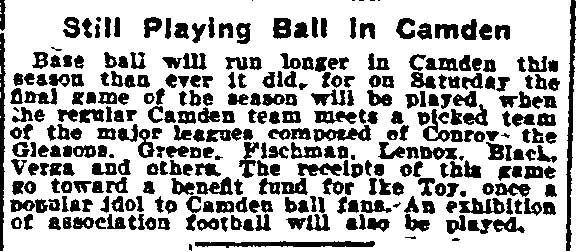
Base ball will run longer in Camden this season than ever it did, for on Saturday the final game of the season will be played, when the regular Camden team meets a picked team of the major leagues composed of Conroy, the Gleasons, Greene, Fischman, Lennox, Black, Verga and others. The receipts of this game go toward a benefit fund for Ike Toy, once a popular idol to Camden ball fans. An exhibition of association football will also be played.
Camden Beats All Stars
Philadelphia Inquirer —
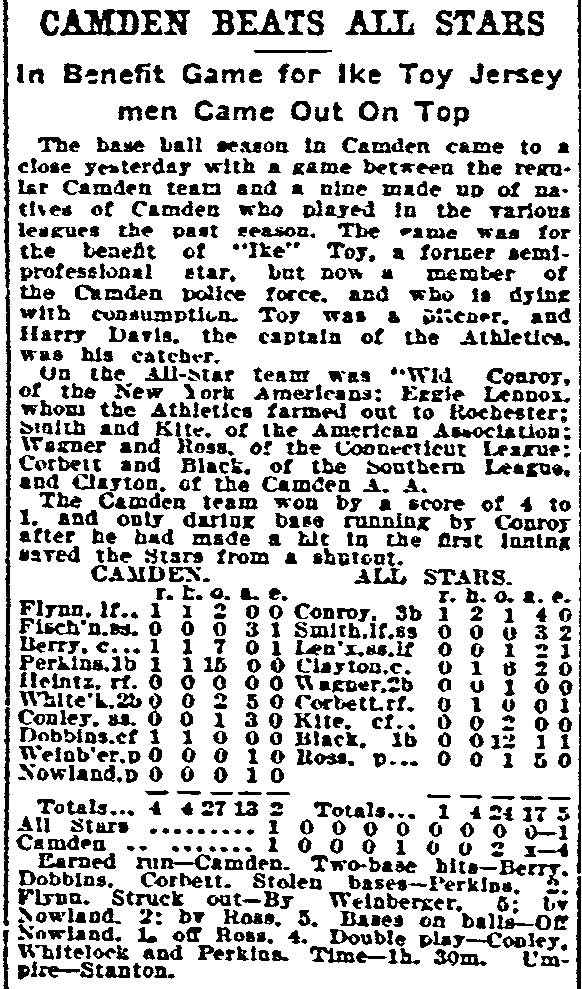
In Benefit Game for Ike Toy Jersey Men Came Out On Top
The base ball season in Camden came to a close yesterday with a game between the regular Camden team and a nine made up of natives of Camden who played in the various leagues the past season. The game was for the benefit of “Ike” Toy, a former semi-professional star, but now a member of the Camden police force, and who is dying with consumption. Toy was a pitcher, and Harry Davis, the captain of the Athletics, was his catcher.
On the All-Star team was “Wild” Conroy, of the New York Americans; Eggie Lennox, whom the Athletics farmed out to Rochester; Smith and Kite, of the American Association; Wagner and Ross, of the Connecticut League; Corbett and Black, of the Southern League, and Clayton, of the Camden A. A.
The Camden team won by a score of 4 to 1, and only during base running by Conroy after he had made a hit in the first inning saved the Stars from a shutout.
CAMDEN.
r. h. o. a. e.
Flynn, lf. 1 1 2 0 0
Fisch’n, ss. 0 0 0 3 1
Berry, c. 1 1 7 0 1
Perkins, 1b 1 1 15 0 0
Heintz, rf. 0 0 0 0 0
White’k, 2b 0 0 2 5 0
Conley, ss. 0 0 1 3 0
Dobbins, cf 1 1 0 0 0
Weinb’er, p 0 0 0 1 0
Nowland, p 0 0 0 1 0
Totals 4 4 27 13 2
ALL STARS.
r. h. o. a. e.
Conroy, 3b 1 2 1 4 0
Smith, lf,ss 0 0 0 3 2
Len’x, ss,lf 0 0 1 2 1
Clayton, c 0 1 6 2 0
Wagner, 2b 0 0 1 0 0
Corbett, rf 0 1 0 0 1
Kite, cf 0 0 2 0 0
Black, 1b 0 0 12 1 1
Ross, p 0 0 1 5 0
Totals 1 4 24 17 5
All Stars 1 0 0 0 0 0 0 0 0–1
Camden 1 0 0 0 1 0 0 2 x–4
Earned run—Camden. Two-base hits—Berry, Dobbins, Corbett. Stolen bases—Perkins, [?] Flynn. Struck out—By Weinberger, 5; by Nowland, 2; by Ross, 5. Bases on balls—Off Nowland, 1; off Ross, 4. Double play—Conley, Whitelock and Perkins. Time—1h. 30m. Umpire—Stanton.
Isaac S. Toy Death Notice
Philadelphia Inquirer —
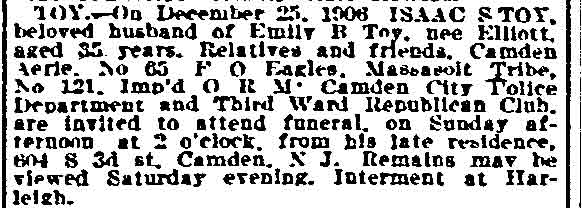
TOY.—On December 25, 1906 ISAAC S. TOY, beloved husband of Emily B. Toy, nee Elliott, aged 35 years. Relatives and friends, Camden Aerie, No 65 F. O. Eagles, Massasoit Tribe, No 121, Imp’d O. R. M., Camden City Police Department and Third Ward Republican Club, are invited to attend funeral, on Sunday afternoon at 2 o’clock, from his late residence, 604 S. 3d st., Camden, N. J. Remains may be viewed Saturday evening. Interment at Harleigh.
Funeral of “Ike” Toy
Bridgeton Evening News —
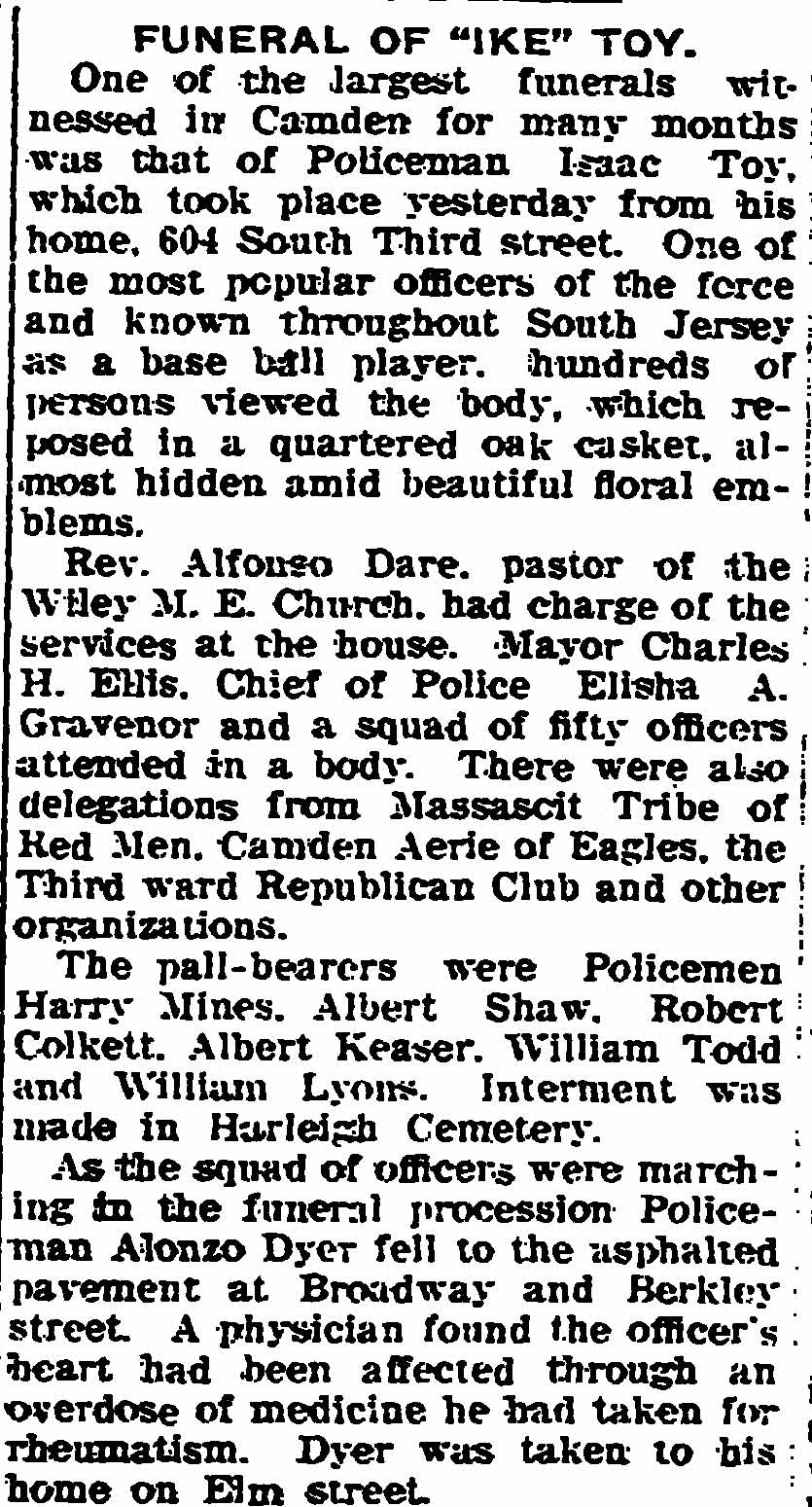
One of the largest funerals witnessed in Camden for many months was that of Policeman Isaac Toy, which took place yesterday from his home, 604 South Third street. One of the most popular officers of the force and known throughout South Jersey as a base ball player, hundreds of persons viewed the body, which reposed in a quartered oak casket, almost hidden amid beautiful floral emblems.
Rev. Alfonso Dare, pastor of the Wiley M. E. Church, had charge of the services at the house. Mayor Charles H. Ellis, Chief of Police Elisha A. Gravenor and a squad of fifty officers attended in a body. There were also delegations from Massascit Tribe of Red Men, Camden Aerie of Eagles, the Third ward Republican Club and other organizations.
The pall-bearers were Policemen Harry Mines, Albert Shaw, Robert Colkett, Albert Keaser, William Todd and William Lyons. Interment was made in Harleigh Cemetery.
As the squad of officers were marching in the funeral procession Policeman Alonzo Dyer fell to the asphalted pavement at Broadway and Berkley street. A physician found the officer’s heart had been affected through an overdose of medicine he had taken for rheumatism. Dyer was taken to his home on Elm street.
Camden News Notes
Philadelphia Inquirer —
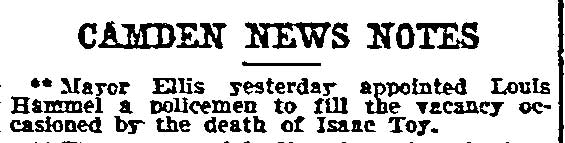
CAMDEN NEWS NOTES. • Mayor Ellis yesterday appointed Louis Hammel a policeman to fill the vacancy occasioned by the death of Isaac Toy.
Eagles Mourned for Dead Members
Camden Post-Telegram —

Annual Memorial Services Held Yesterday at the Camden Theatre
RENDER ELABORATE PROGRAM
The annual memorial service of Camden Aerie, No. 65, Fraternal Order of Eagles, were held in the Camden Theatre yesterday afternoon. They were of the usual impressive character and the several hundred persons were at times very visibly affected.
The feature of the occasion was in the reading of the roll of the dead by Worthy Secretary Charles F. Sattler. In the rear of the stage there was a large painting representing the setting of the sun. The frame was draped in black crepe, incandescent lights being arranged about it at intervals. As the names of the departed were announced the lights were extinguished.
The oration was given by Grand Trustee Thomas C. Hayes, of Nevada. [sic] His address was a splendid, eloquent effort and was in thorough keeping with the occasion.
The balance of the program, replete with interesting features, included the following:
Orchestra—
(a) March-Coronation....Meyerbeer
(b) Overture—Morning, Noon and Night....Suppe
(c) Intermezzo-Traumerei....Schumann
Opening address....Worthy President Frank S. Devereaux.
Quartet, “Come Gracious Spirit”....Marzo
La Favorita Quartet.
Miss Julia Robinson, soprano; Miss Katharine Rosenkranz, contralto; A. D. McNichol, tenor; Henry Hotz, basso; W. Silvano Thunder, accompanist.
Prayer....Worthy Chaplain John L. Jarvis.
Tenor solo, “The Lord is my Light”....Allittson
A. D. McNichol.
Contralto solo, “From the Depths”....Campana
Miss Katharine Rosenkranz.
Remarks....Past Worthy President William M. Petzelt.
Duet, from “The Crucifixion”....Stainer
Misses Robinson and Rosenkranz.
Recitation, “The Last Hymn”....M. Farningham
Miss Marjorie R. Durgin.
Orchestra, “Serenade”....A. Emil Titl
Flute solo by Wm. A. Joseph.
Roll Call of Our Honored Dead....Worthy Secretary Chas. F. Sattler
Soprano solo, “Show Me Thy Ways”....Flotow
Miss Julia Robinson.
Memorial Address—Grand Trustee Thos. C. Hayes, of Newark, N. J.
Trio, “Protect Us Through the night,”....Nicolai
Misses Robinson and Rosenkranz and Mr. McNichol.
Orchestra, Inflamatus from “Stabat Mater”....Rossini
Bass solo, “Through the Darkness”....Rossini
Henry Hotz.
Quartet, “Incline Thine Ear”....Himmel
La Favorita Quartet.
Hymn, “Nearer My God, to Thee”....Mason
Sung by entire audience.
Benediction....Worthy Chaplain John L. Jarvis.
Orchestra, “Stars and Stripes”....Sousa
Brother Anthony J. Oberst, Musical Director.
Those in whose memory the services were held included the following:
Alfred Kemble, died June 16, 1901.
William Denneller, died October 4, 1902.
Conrad Brill, Jr., died July 8, 1903.
Charles Beale, died October 29, 1903.
Frank Burt, died March 10, 1904.
Dr. P. W. Beale, died June 7, 1904.
Jacob Hess, died August 16, 1904.
Daniel W. Broomley, died September 1, 1904.
Frederick Johnson, died December 3, 1904.
William H. Cole, died December 21, 1904.
J. S. B. Candler, died January 15, 1905.
Harry B. Middleton, died April 7, 1905.
George D. Strain, died July 9, 1905.
Martin MacNeil, died July 30, 1905.
Adolph Peschlow, died January 28, 1906.
H. J. McNermy, died March 2, 1906.
L. L. McClennan, died March 15, 1906.
Henry Price, died June 6, 1906.
Nathaniel Myers, died October 7, 1906.
Isaac Toy, died December 25, 1906.
Thomas J. Farnan, died March 12, 1907.
George Griffin, died March 18, 1907.
George W. Haman, died April 5, 1907.
Michael Raidon, died May 23, 1907.
Thomas Flatley, died August 8, 1907.
John F. Berton, died November 1, 1907.
Joseph E. Healy, died December 29, 1907.
Thomas Dwyler, died February 10, 1908.
Michael J. Lynch, died March 19, 1908.
Otto Heydrich, died March 24, 1908.
The officers of the local aerie include these:
Past Worthy Presidents, John H. Riddle, John A. Furey, James F. Cleary, Wm. H. Cole (deceased), Julius R. Schaaf, Wm. F. Jann, John J. Cleary, William M. Petzelt; Worthy President, Frank S. Devereaux; Worthy Vice President, Theodore B. Rambo; Worthy Secretary, Chas. F. Sattler; Worthy Treasurer, George S. Dilmore; Worthy Chaplain, John J. Jarvis; Worthy Conductor, Harry A. Durgin; Inside Guard, Robert M. Hartman; Outside Guard, B. Tierney; Worthy Trustees, Anthony J. Oberst, Harry C. Halbert, Charles E. Cullen; Worthy Physicians, Dr. W. P. Wingender, Dr. J. L. Mahaffey.
House Committee—A. J. Docherty, chairman; Edward Hagerty, Frank Applegate, Wm. Vander-Straeten, Wm. J. Lawler.
Memorial Committee—Anthony J. Oberst, chairman; William M. Petzelt, Julius R. Schaaf, William F. Jahn, Chas. F. Sattler, James F. Cleary, Theodore B. Rambo, George Fisher, George S. Dilmore, Harry A. Durgin, John L. Jarvis.
Ushers—John J. Burk, chairman; Frank Moncreif, Louis Bennett, Robert C. Barr, Wm. A. Atkin, Jr., John Lloyd, Joseph Taylor, Charles Mulner, Chas. Blank, Geo. W. Johnson, Arthur Colsey, Wm. D. Hoover, Fay La Fayette, Howard A. Fern.