Introduction
FIORE TRONCONE was born in Italy around 1874 to Antonio and Rafaella Troncone. The family came to America in 1885. After living in Pennsylvania, where sons Anthony and William were born, the Troncone family came to Camden NJ shortly after 1900. By 1910 Fiore Troncone and his wife Carmela lived at 815 South Fourth Street, next door to the influential Italian-American funeral director, Antonio Mecca. The family would reside at that address through the late 1940s.
Fiore Troncone had joined the Camden Police Department by the fall of 1906. The Department recognized that with a large immigrant population it would be important to have detectives on the police force who were fluent in the languages of Camden’s newer citizens in order to conduct investigations. On August 1, 1913 Fiore Troncone, along with Charles Fitzsimmons and George V. Murry were promoted to the detective squad, then led by Captain William Schregler. All had been working in plainclothes for several months prior to the official promotion.
Detective Troncone was often mentioned in the local newspapers of the 1920s and 1930s, as he often was the assigned detective when cases involved Italian-speaking people. Fiore Troncone passed away on December 10, 1936. His wife was then still living at the South 4th Street address. Carmela Troncone died in January of 1971 at the age of 92.
Fiore and Carmela Troncone had at least five children, Anthony, William, Raphaelina, Richard, and Theresa. William Troncone had followed his father on to the Camden Police Department by 1930. Richard Troncone had by that time gone to work for neighbor Antonio Mecca. He would succeed Mecca in the funeral business after his death.
Detective Moffett Begins His Duties
Camden Post-Telegram —
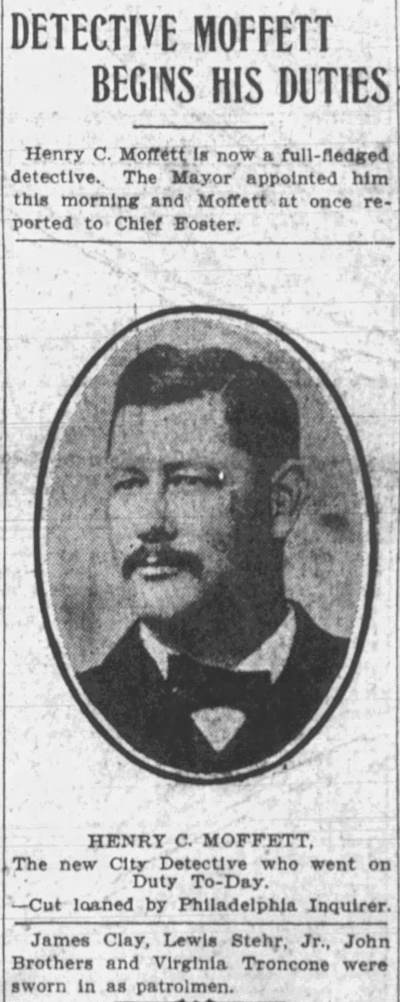
Henry C. Moffett is now a full-fledged detective. The Mayor appointed him this morning and Moffett at once reported to Chief Foster.
HENRY C. MOFFETT, The new City Detective who went on Duty To-Day. —Cut loaned by Philadelphia Inquirer.
James Clay, Lewis Stehr, Jr., John Brothers and Virginia Troncone were sworn in as patrolmen.
Will Be Mayor’s Private Secretary
Philadelphia Inquirer —
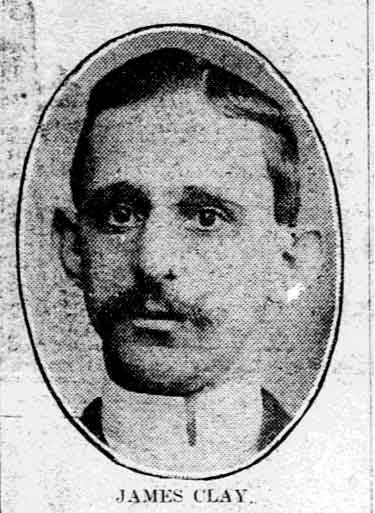
Named: Charles H. Ellis, James Clay, Henry Moffett, Fiore Troncone, Lewis Stehr Jr., and John Brothers.
New Officers Sworn In
Philadelphia Inquirer —
New Officers Sworn In
Henry C. Moffett, of the Fifth ward, Camden, was appointed a city detective by Mayor Charles H. Ellis yesterday. Moffett was immediately detailed for duty by Chief Foster. John Brothers, James Clay, Lewis Stehr and Virginia Troncone were sworn in as patrolmen. Brothers was deputy keeper at the State Prison, Trenton, for a number of years.
Pistol Shot Nearly Precipitated a Riot
Philadelphia Inquirer —
PISTOL SHOT NEARLY PRECIPITATED A RIOT
Negroes Turned on White Man Who Discharged Weapon on Crowded South Camden Street
A race riot was narrowly averted at Broadway and Mt. Vernon street, Camden, last night while the streets were thronged, when Harry Gedling, a young man, discharged a pistol at several negroes as they were passing down the street. The negroes turned after the shot was fired, and Gedling fled. Policeman Fiore Troncone gave chase and caught Gedling after running several blocks. Several citizens went to Troncone’s assistance and kept the crowd off while he took the prisoner to the nearest patrol box. Afterward he was locked up in the city jail. Gelding [sic] told Acting Chief Schregler that he shot at the negroes because he was afraid they intended to attack him.
On account of the feeling in the southern section of the city between white and colored residents Acting Chief Schregler has instructed the policeman to prevent crowds assembling, and on the slightest breach of the peace to arrest all violators.
Giuseppe Discito Arrested for Murder
Philadelphia Inquirer —
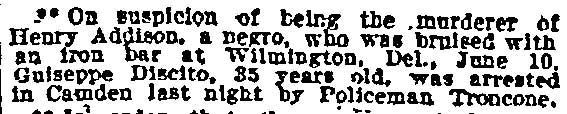
On suspicion of being the murderer of Henry Addison, a negro, who was bruised with an iron bar at Wilmington, Del., June 10, Guiseppe Discito, 35 years old, was arrested in Camden last night by Policeman Troncone.
Wife’s Murder Screams Brought Assistance
Camden Post-Telegram —
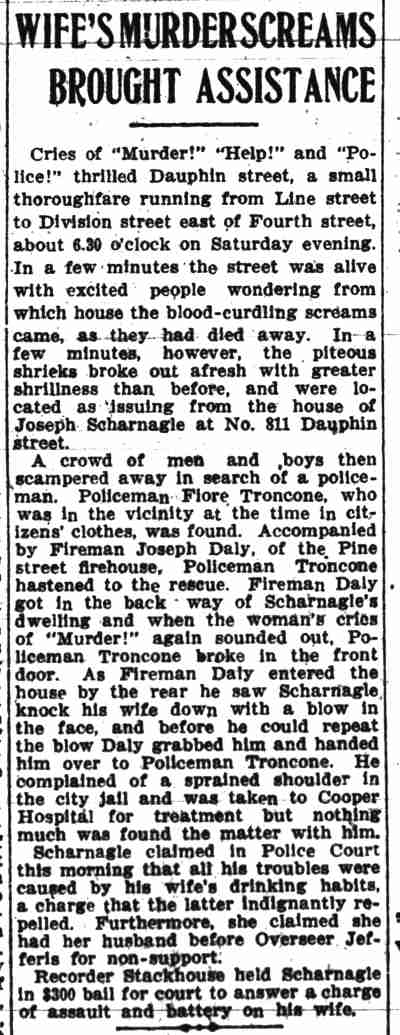
Cries of “Murder!” “Help!” and “Police!” thrilled Dauphin street, a small thoroughfare running from Line street to Division street east of Fourth street, about 6.30 o’clock on Saturday evening. In a few minutes the street was alive with excited people wondering from which house the blood-curdling screams came, as they had died away. In a few minutes, however, the piteous shrieks broke out afresh with greater shrillness than before, and were located as issuing from the house of Joseph Scharnagle at No. 811 Dauphin street.
A crowd of men and boys then scampered away in search of a policeman. Policeman Fiore Troncone, who was in the vicinity at the time in citizens’ clothes, was found. Accompanied by Fireman Joseph Daly, of the Pine street firehouse, Policeman Troncone hastened to the rescue. Fireman Daly got in the back way of Scharnagle’s dwelling and when the woman’s cries of “Murder!” again sounded out, Policeman Troncone broke in the front door. As Fireman Daly entered the house by the rear he saw Scharnagle knock his wife down with a blow in the face, and before he could repeat the blow Daly grabbed him and handed him over to Policeman Troncone. He complained of a sprained shoulder in the city jail and was taken to Cooper Hospital for treatment but nothing much was found the matter with him.
Scharnagle claimed in Police Court this morning that all his troubles were caused by his wife’s drinking habits, a charge that the latter indignantly repelled. Furthermore, she claimed she had her husband before Overseer Jefferis for non-support.
Recorder Stackhouse held Scharnagle in $300 bail for court to answer a charge of assault and battery on his wife.
Lee Carter Sentenced to County Jail
Philadelphia Inquirer —

Lee Carter, the negro who attacked Policeman Troncone several days ago, was sent to the county jail for six months by Judge Joline in the Criminal Court yesterday.
Back From Italy, Jailed
Philadelphia Inquirer —
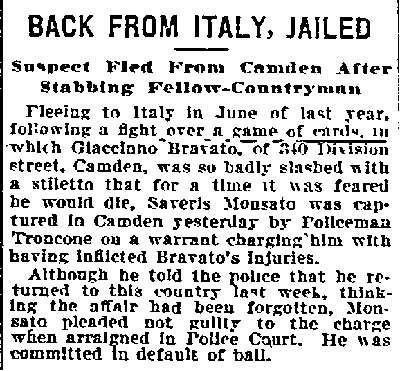
Suspect Fled From Camden After Stabbing Fellow-Countryman
Fleeing to Italy in June of last year, following a fight over a game of cards, in which Giaccinno Bravato, of 340 Division Street, Camden, was so badly slashed with a stiletto that for a time it was feared he would die, Saverio Monsato was captured in Camden yesterday by Policeman Troncone on a warrant charging him with having inflicted Bravato’s injuries.
Although he told the police that he returned to this country last week, thinking the affair had been forgotten, Monsato pleaded not guilty to the charge when arraigned in Police Court. He was committed in default of bail.
“Handing Out Gunning Licenses in Camden”
Philadelphia Inquirer —
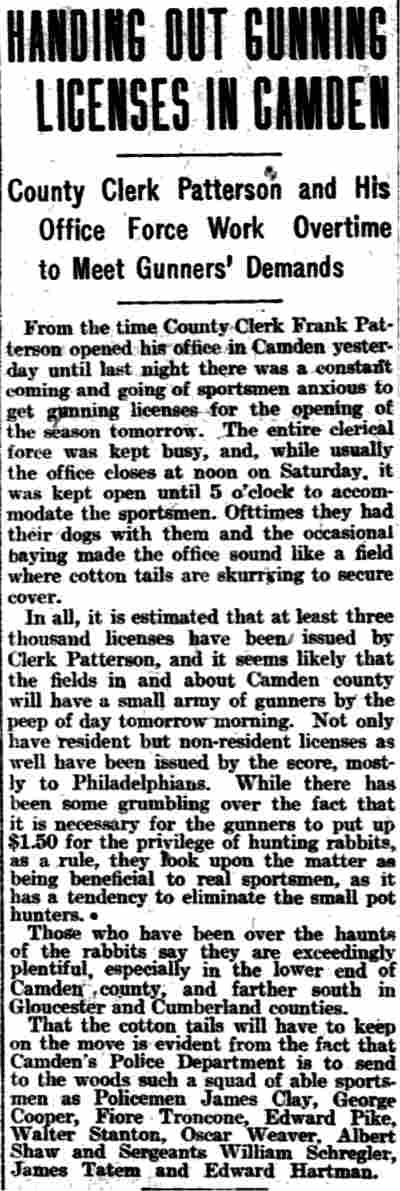
HANDING OUT GUNNING LICENSES IN CAMDEN
County Clerk Patterson and His Office Force Work Overtime to Meet Gunners' Demands
From the time County Clerk Frank Patterson opened his office in Camden yesterday until last night there was a constant coming and going of sportsmen anxious to get gunning licenses for the opening of the season tomorrow. The entire clerical force was kept busy, and, while usually the office closes at noon on Saturday, it was kept open until 5 o'clock to accommodate the sportsmen. Ofttimes they had their dogs with them and the occasional baying made the office sound like a field where cotton tails are skurrying to secure cover.
In all, it is estimated that at least three thousand licenses have been issued by Clerk Patterson, and it seems likely that the fields in and about Camden county will have a small army of gunners by the peep of day tomorrow morning. Not only have resident but non-resident licenses as well have been issued by the score, mostly to Philadelphians. While there has been some grumbling over the fact that it is necessary for the gunners to put up $1.50 for the privilege of hunting rabbits, as a rule, they look upon the matter as being beneficial to real sportsmen, as it has a tendency to eliminate the small pot hunters.
Those who have been over the haunts of the rabbits say they are exceedingly plentiful, especially in the lower end of Camden county, and farther south in Gloucester and Cumberland counties.
That the cotton tails will have to keep on the move is evident from the fact that Camden's Police Department is to send to the woods such a squad of able sportsmen as Policemen James Clay, George Cooper, Fiore Troncone, Edward Pike, Walter Stanton, Oscar Weaver, Albert Shaw and Sergeants William Schregler, James Tatem and Edward Hartman.
Irene Traveligna and Children Found
Philadelphia Inquirer —
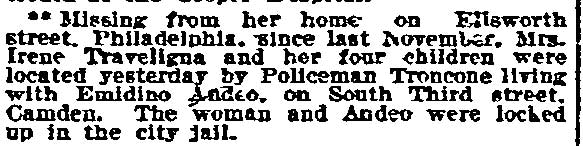
Missing from her home on Ellsworth street, Philadelphia, since last November, Mrs. Irene Traveligna and her four children were located yesterday by Policeman Troncone living with Emidino Andeo, on South Third street, Camden. The woman and Andeo were locked up in the city jail.
Camden Holds Four as Counterfeiters
Philadelphia Inquirer —
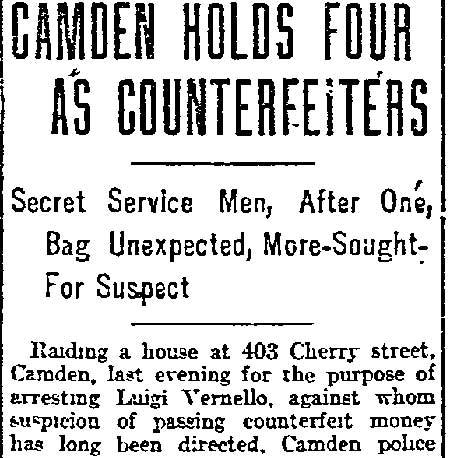
Secret Service Men, After One, Bag Unexpected, More-Sought-For Suspect
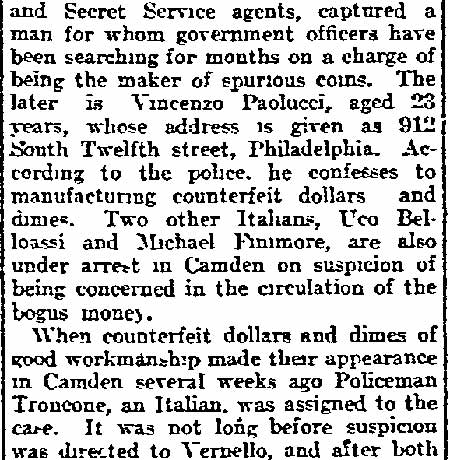
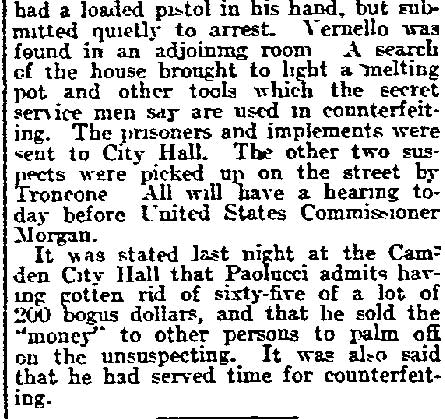
Raiding a house at 403 Cherry Street, Camden, last evening for the purpose of arresting Luigi Vernello, against whom suspicion of passing counterfeit money has long been directed, Camden police and Secret Service agents, captured a man for whom government officers have been searching for months on a charge of being the maker of spurious coins. The later is Vincenzo Paolucci, aged 23 years, whose address is given as 912 South Twelfth street, Philadelphia. According to the police, he confesses to manufacturing counterfeit dollars and dimes. Two other Italians, Uco Belloassi and Michael Finnamore, are also under arrest in Camden on suspicion of being concerned in the circulation of the bogus money.
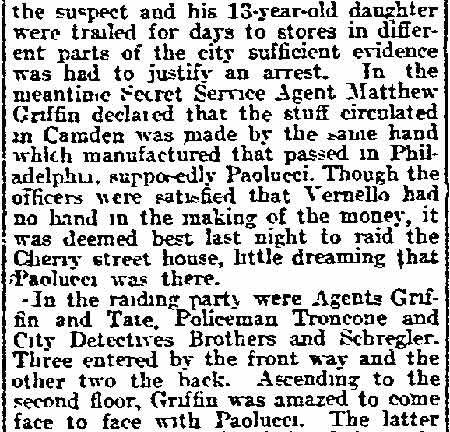
When counterfeit dollars and dimes of good workmanship made their appearance in Camden several weeks ago Policeman Troncone, an Italian, was assigned to the case. It was not long before suspicion was directed to Vernello, and after both the suspect and his 13-year-old daughter were trailed for days to stores in different parts of the city sufficient evidence was had to justify an arrest. In the meantime Secret Service Agent Matthew Griffin declared that the stuff circulated in Camden was made by the same hand which manufactured that passed in Philadelphia, supposedly Paolucci. Though the officers were satisfied that Vernello had no hand in the making of the money, it was deemed best last night to raid the Cherry Street house, little dreaming that Paolucci was there.
In the raiding party were Agents Griffin and Tate, Policeman Troncone and City Detectives Brothers and Schregler. Three entered by the front way and the other two the back. Ascending to the second floor, Griffin was amazed to come face to face with Paolucci. The latter had a loaded pistol in his hand, but submitted quietly to arrest. Vernello was found in an adjoining room. A search of the house brought to light a melting pot and other tools which the secret service men say are used in counterfeiting. The prisoners and implements were sent to City Hall. The other two suspects were picked up on the street by Troncone. All will have a hearing today before United States Commissioner Morgan.
It was stated last night at the Camden City Hall that Paolucci admits having gotten rid of sixty-five of a lot of 200 bogus dollars, and that he sold the “money” to other persons to palm off on the unsuspecting. It was also said that he had served time for counterfeiting.
Camden’s Reputed Counterfeiters Held
Philadelphia Inquirer —
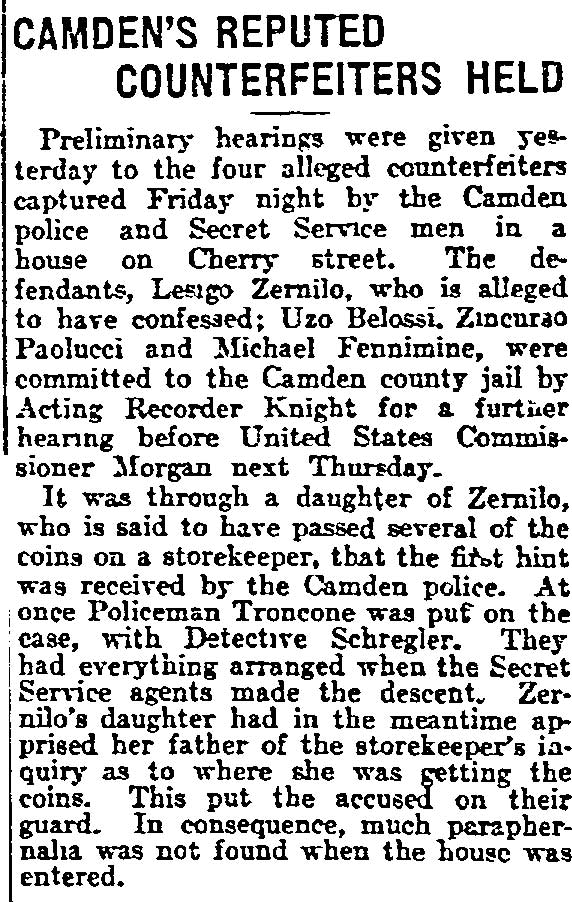
Preliminary hearings were given yesterday to the four alleged counterfeiters captured Friday night by the Camden police and Secret Service men in a house on Cherry Street. The defendants, Lesigo Zernilo, who is alleged to have confessed; Uzo Belossi, Zincurao Paolucci and Michael Fennimine, were committed to the Camden county jail by Acting Recorder Knight for a further hearing before United States Commissioner Morgan next Thursday.
It was through a daughter of Zernilo, who is said to have passed several of the coins on a storekeeper, that the first hint was received by the Camden police. At once Policeman Troncone was put on the case, with Detective Schregler. They had everything arranged when the Secret Service agents made the descent. Zernilo’s daughter had in the meantime apprised her father of the storekeeper’s inquiry as to where she was getting the coins. This put the accused on their guard. In consequence, much paraphernalia was not found when the house was entered.
Alleged Slayer Taken in Camden
Philadelphia Inquirer —
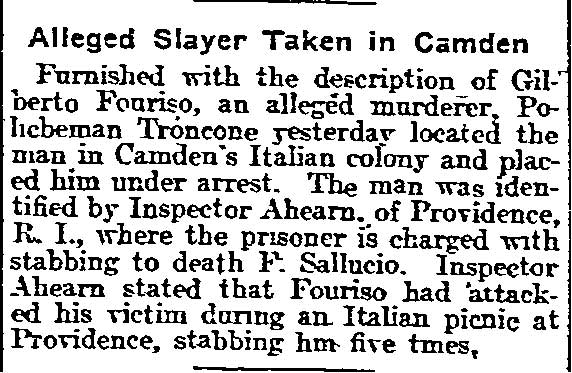
Fiore Troncone — Gilberto Fouriso
Gabriel Fuorosso Charged With Murder
Philadelphia Inquirer —
Gabriel Fuorosso, the Italian captured in Camden last Monday by Policeman Troncone, was taken to Providence, R. I., yesterday by Inspector Hearn to answer a charge of murder. His victim was a fellow-countryman whom he is said to have stabbed five times.
Italian Is Held on Grave Charge
Camden Post-Telegram —
On suspicion of abusing and maltreating Elsie Staley, a girl under 16 years of age, who lives with her stepfather on Federal street above Eighteenth, Nicholas Small, an Italian, was taken into custody yesterday afternoon by Special Troncone. Small will be given a hearing in police court tomorrow.
Elsie Staley is the plump and pretty girl who so enamored William May, a young Sioux Indian living in East Camden, that on last Thanksgiving Day when she refused to marry him he attempted suicide by stabbing himself in the left breast with a pair of scissors.
Dominic Dragone Captured in Jamesburg
Philadelphia Inquirer —
Stefano Torcosso Arrested in West Virginia
Philadelphia Inquirer —
Word was received by the Camden police last night that Policeman Troncone had located and arrested, at Northfork, W. Va., Stefano Torcosso, the Italian who, it is alleged, shot to death Nunzioto Imparato at Locust and Sycamore Streets, last Tuesday night. Torcosso was heading for the South when the Camden officer who had been on his trail several days, came up with him. He will be brought back to Camden.
Brought Back His Man
Philadelphia Inquirer —
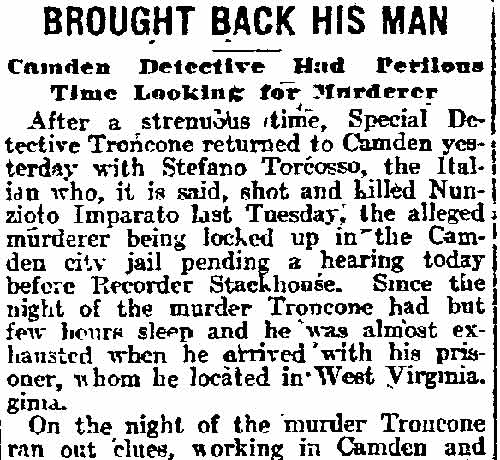
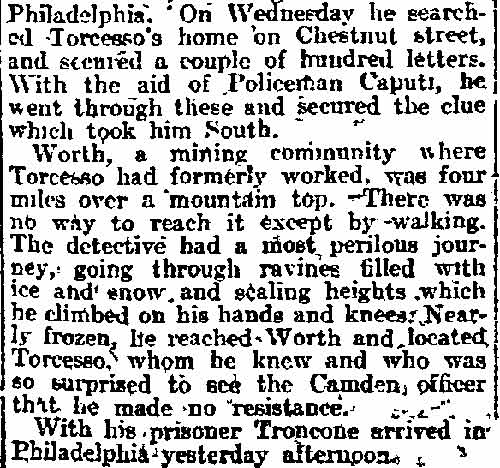
Named: Fiore Troncone, Joseph Caputi, O. Glen Stackhouse, Stefano Torcosso, and Nunzio Imparato.
Charge, Murder to Italian Now on Sea
Philadelphia Inquirer —
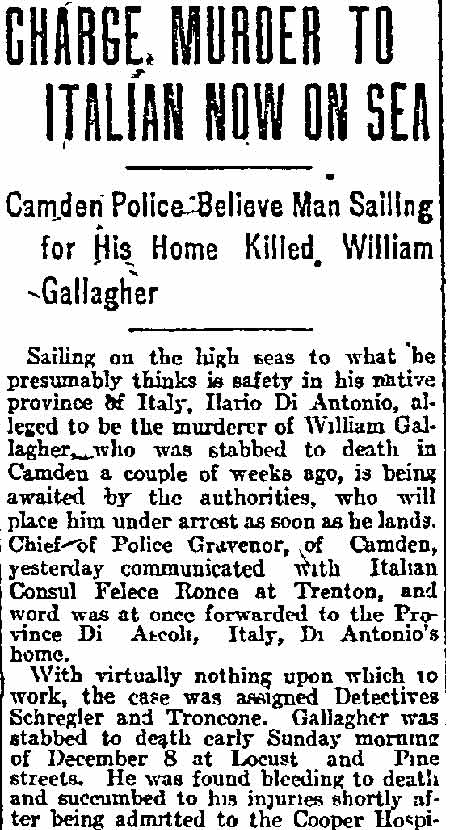
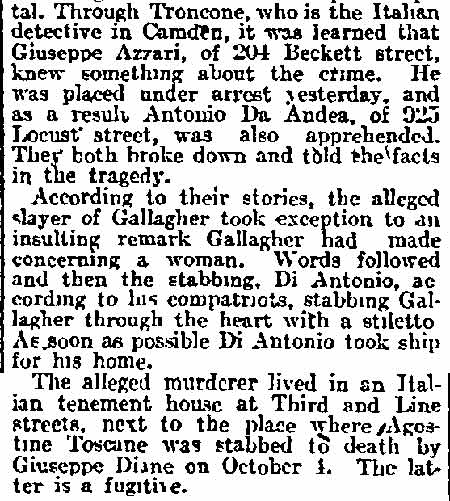
Named: Ilario DiAntonio, William Gallagher, Elisha Gravenor, Fiore Troncone, Felice Ronca, Giuseppe Azzari, Antonio DaAndea, Beckett Street, Locust Street, South 3rd Street, Line Street, Agostine Toscane, and Giuseppe Diane.
John Lonerio Arrested for Embezzlement
Philadelphia Inquirer —
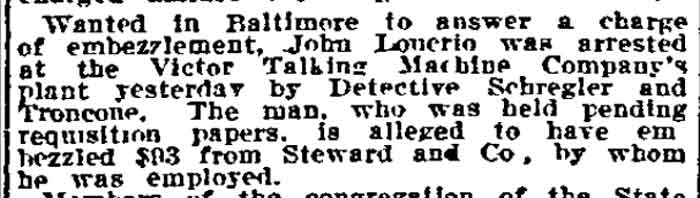
Wanted in Baltimore to answer a charge of embezzlement, John Lonerio was arrested at the Victor Talking Machine Company’s plant yesterday by Detective Schregler and Troncone. The man, who was held pending requisition papers, is alleged to have embezzled $93 from Steward and Co., by whom he was employed.
Girl Victim’s Brother Accuses Man
Philadelphia Inquirer —
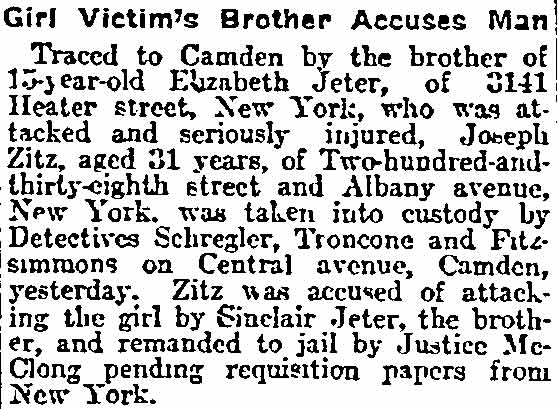
Girl Victim’s Brother Accuses Man
Traced to Camden by the brother of 15-year-old Elizabeth Jeter, of 3141 Heater street, New York, who was attacked and seriously injured, Joseph Zitz, aged 31 years, of Two-hundred-and-thirty-eighth street and Albany avenue, New York, was taken into custody by Detectives Schregler, Troncone and Fitzsimmons on Central avenue, Camden, yesterday. Zitz was accused of attacking the girl by Sinclair Jeter, the brother, and remanded to jail by Justice McClong pending requisition papers from New York.
Says He Shot Himself, But Police Arrest Four
Philadelphia Inquirer —
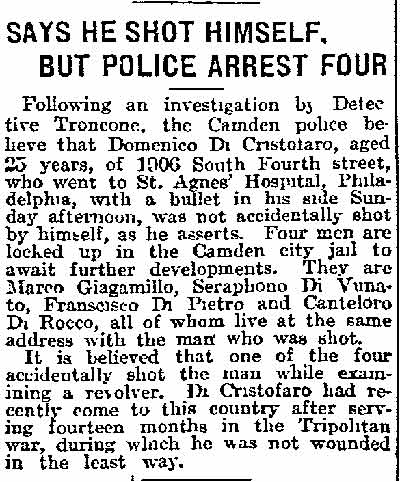
Following an investigation by Detective Troncone, the Camden police believe that Domenico Di Cristolaro, aged 23 years, of 1108 South 4th Street, who went to St. Agnes Hospital, Philadelphia, with a bullet in his left side yesterday afternoon, was not accidentally shot by himself, as he asserts. Four men are looked up in the Camden city jail awaiting further developments. They are Marko Giagamillo, Seraphino Di Vita to, Francesco Di Pietro and Canteloro Di Rocco, all of whom live at the same address with the man who was shot. It is believed that one of the four accidentally shot the man while examining a revolver. Di Cristolaro had recently come to this country after serving eighteen months in the Trocdian war, during which he was not wounded in the least way.
Wife Badly Beaten, Husband Arrested
Philadelphia Inquirer —
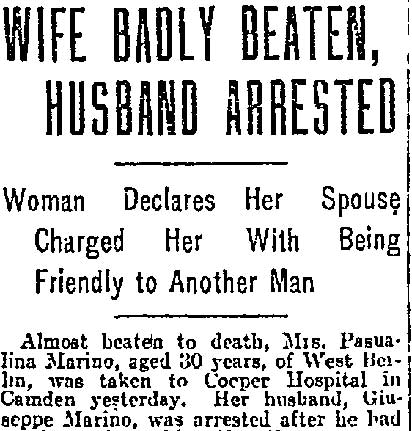
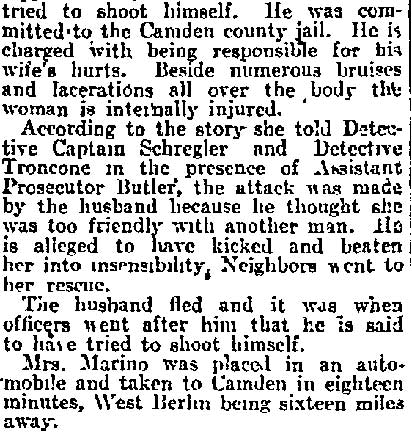
Named: Fiore Troncone, William Schregler, Pasqualina Marino, Giuseppe Marino, and Wellington B. Butler.
Antonio Di Giacomo Arrested for Stabbing
Philadelphia Inquirer —
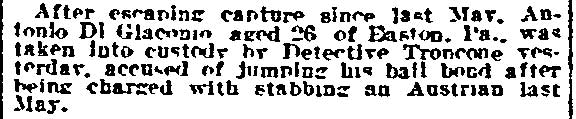
After escaping capture since last May, Antonio Di Giacomo, aged 26, of Easton, Pa., was taken into custody by Detective Troncone yesterday, accused of jumping his bail bond after being charged with stabbing an Austrian last May.
Wife’s Death Affects His Mind
Philadelphia Inquirer —
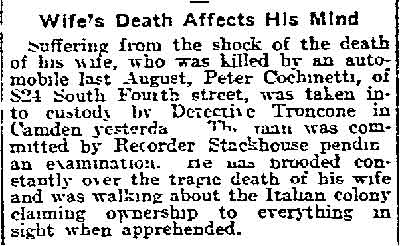
Named: Fiore Troncone, Peter Coccinetti, O. Glen Stackhouse, and South 4th Street.
Freed in Italy for Gallagher Murder
Camden Post-Telegram —
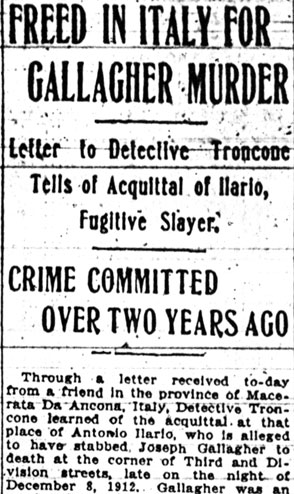
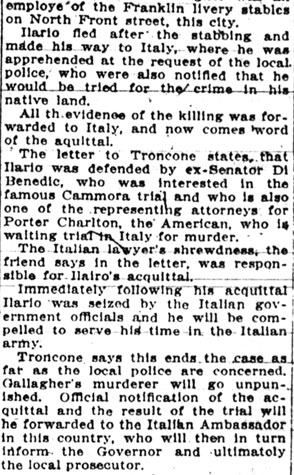
Letter to Detective Troncone Tells of Acquittal of Ilario, Fugitive Slayer
CRIME COMMITTED OVER TWO YEARS AGO
Through a letter received to-day from a friend in the province of Avellino, Italy, Detective Troncone learned of the acquittal of Antonio Ilario, of that city, whom the Italian authorities believe to have stabbed Joseph Gallagher to death at the corner of Division streets, late on the night of December 11, 1914. Gallagher was in the vicinity of the Franklin Livery.
Leaves Bed to Arrest Man
Philadelphia Inquirer —
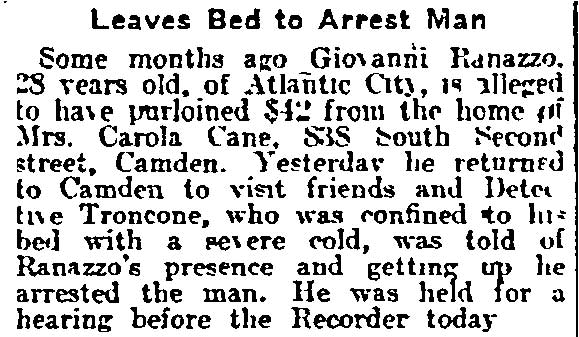
Some months ago Giovanni Ranazzo, 23 years old, of Atlantic City, is alleged to have purloined $42 from the home of Mrs. Carola Cane, 843 South 2nd Street, Camden. Yesterday he returned to Camden to visit friends and Detective Troncone, who was confined to his bed with a severe cold, was told of Ranazzo’s presence and getting up he arrested the man. He was held for a hearing before the Recorder today.
Committed to Jail on Blackmail Charge
Philadelphia Inquirer —
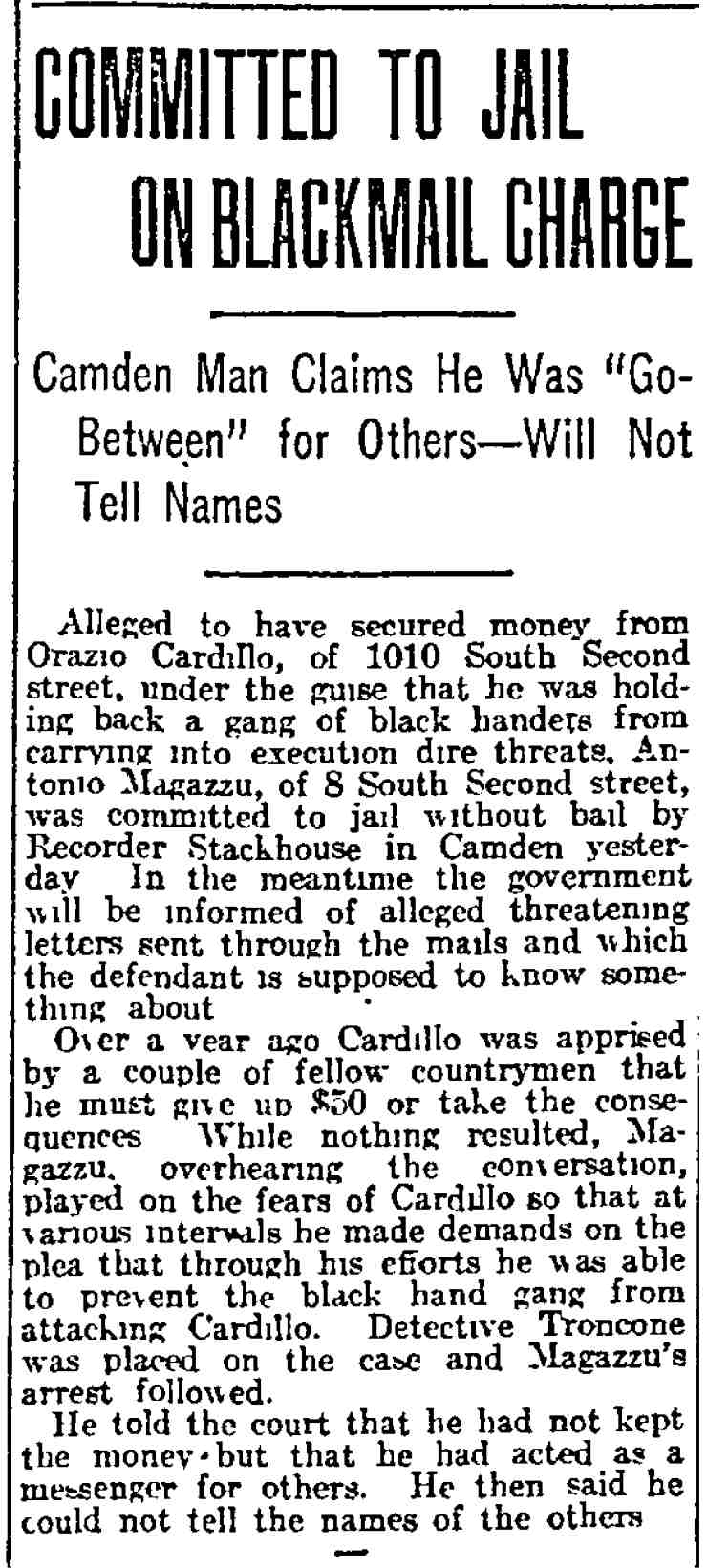
Named: Fiore Troncone, Orazio Cardillo, Antonio Magazzu, O. Glen Stackhouse, and South 2nd Street.
Youth in Court Many Times
Philadelphia Inquirer —
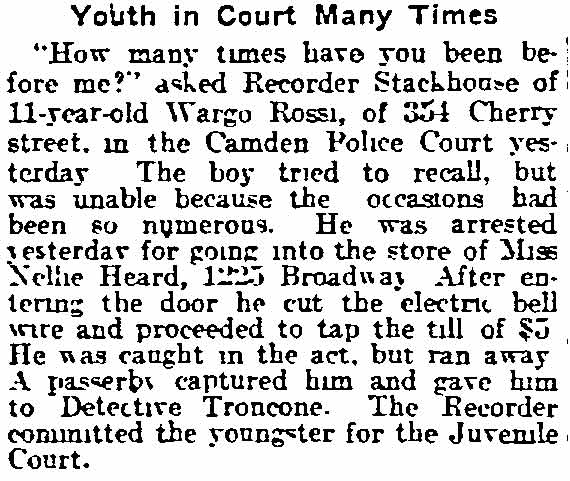

Named: Fiore Troncone, Wargo Rossi, Nellie Heard, Broadway, Cherry Street, Mamie Burns, O. Glen Stackhouse, and Spruce Street.
Entered U. S. Disguised as Workmen, They Say
Philadelphia Inquirer —
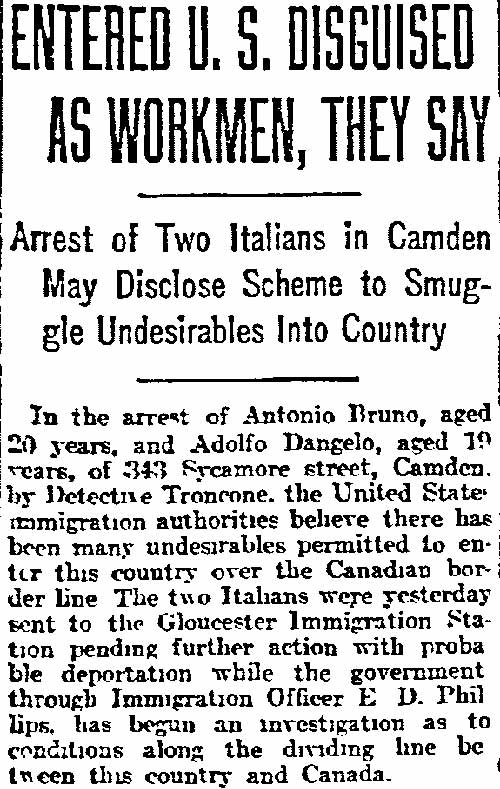
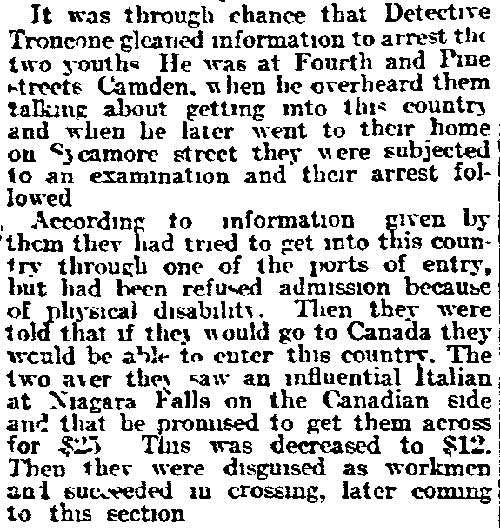
Arrest of Two Italians in Camden May Disclose Scheme to Smuggle Undesirables Into Country
In the arrest of Antonio Ilario, aged 20 years, and Adolfo Danegio, aged 19 years, of 343 Sycamore Street, Camden, by Detective Troncone, the United States immigration authorities believe there has been many undesirables permitted to enter this country over the Canadian border. The files of deportation sent yesterday to the Gloucester Immigration Station pending further action with the deportation and the government immigration Undesired Immigration Officer E. D. Dial has begun an investigation regarding conditions along the dividing line between this country and Canada.
Couple Held as Elopers
Philadelphia Inquirer —
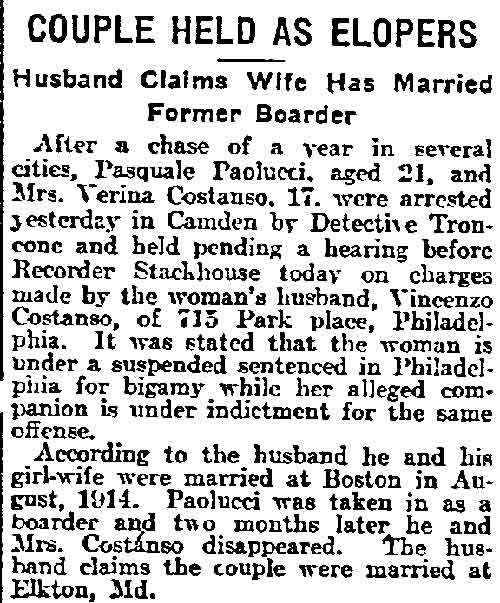
Named: Fiore Troncone, Pasquale Paolucci, Vincenzo Costanzo, Verina Constanzo, and O. Glen Stackhouse.
Three Held Following Fight
Philadelphia Inquirer —
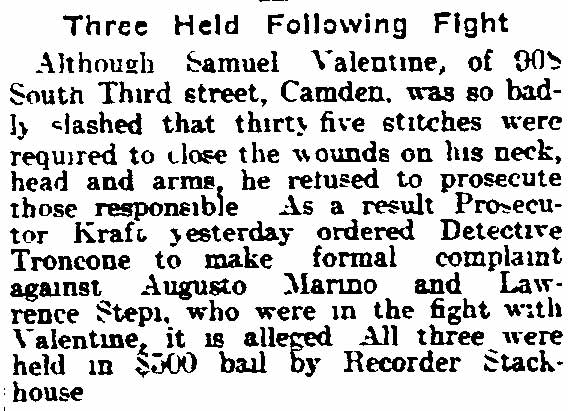
Named: Fiore Troncone, Samuel Valentine, South 3rd Street, Augusto Marino, Lawrence Stepi, O. Glen Stackhouse, and William Kraft.
Camden at a Glance
Philadelphia Inquirer —
CAMDEN AT A GLANCE
When Detective Troncone went to the home of Angelo di Lorenzo at 219 Benson street he found him lying on a couch beneath which was $80 worth of brass that had been stolen. It is charged that it was stolen from the Pennsylvania Railroad. Recorder Stackhouse sentenced the man to two months in jail.
Kisses and Hugs Deserter
Fort Worth Star-Telegram —
There was a kissing and hugging exhibition in the open during the progress of the hearings in the Camden police court. Angelo Marino was arrested at Trenton by City Detective Troncone on a charge of deserting his wife, Marie. The couple greeted each other with smiles as the husband stood in the prisoners’ dock and the wife among the witnesses. Mrs. Marino said it would break her heart to see her husband go to jail, and the case was dismissed. After the kissing and hugging exhibition the couple left the courtroom arm in arm. They had been separated since last May.—Philadelphia Record.
Alfredo Guglielmo Arrested for Fraud
Philadelphia Inquirer —
Declared to have swindled grocers of this city and Camden out of several thousand dollars, Alfredo Guglielmo, alias Alfred Williams, 29 years old, who says he is from Port Reading, N. J., was arrested by Detective Troncone in Camden yesterday. Guglielmo represented himself to be an agent of “Rome Importing & Supply Company” and took orders with the understanding that 25 per cent must be paid in advance. He then disappeared, it is charged. He is said to have confessed.
Second Bomb Found in Camden Lumber Yard
Philadelphia Inquirer —
Explosives May Have Been Made by “Black Hand” Gang Which Threatened Rich Italian
Within a short distance of the spot where a crude bomb was found about a week ago, another one was uncovered yesterday by Alfred Suders, at the lumber yard of the Volney-Bennett Company, Second and Spruce streets, Camden. It was turned over to Detective Troncone, who fearlessly examined the contrivance. He found it was a discarded paint can containing about a quart of powder and other material, to which was attached a fuse. There was sufficient explosive to blow up a substantial structure. The police kept the bomb pending further investigation.
It is not believed that any attempt was made to damage the lumber yard, but that the improvised bombs were hidden for other work. The police believe the bombs may have something to do with a “black hand” letter which was sent to Innocenzo Barano, a wealthy junk dealer, of 707 Locust Street, some days ago. The police have made several arrests in that case, but there has not been enough evidence to hold the prisoners. The ones who sent the letter demanded $500, with the alternative of blowing him and his home up. He lives within two blocks of where the bomb was found and in the midst of the Italian colony.
Murderer and Forger Escape Jail After Shooting Keepers, Killing One
Camden Post Telegram —
Wilson Ashbridge, Who Shot and Killed Mrs. Elizabeth Dunbar and George E. Thompson, Check Swindler, Trap Jailor Hibbs by a Ruse and After Slaying Him, Shoot Joe Ellis Who Intercepted Them in Flight. Used Revolver Smuggled Into Prison by Confederates and Leave Jail Wide Open in Their Flight, a General Delivery Being Averted by Police Who Were Summoned by the Wounded Men.
Murdering one jailor and wounding another with a revolver that had been smuggled into them by outside confederates, Wilson T. Ashbridge, slayer of Mrs. Elizabeth Dunbar, and Francis Murphy, alias George E. Thompson, a check forger, made their escape from the county jail a few minutes before seven o’clock last night.
Ashbridge with his wife was caught at noon in the Keystone Hotel in Chester PA where they registered at one o’clock this morning.
Thompson is still at liberty but from the confident manner of Prosecutor Kraft his early arrest seems assured.
The murdered jailor was Isaac Hibbs, aged 65 years of 913 South 8th Street. The wounded keeper is Joseph Ellis, aged 45 years, of 416 Carteret Street. Shot twice, he is in Cooper Hospital. His condition today is very satisfactory.
Thompson, who is 41 years old, forged a check for $650 which he gave to V.M. Fulton as part of the purchase price of an automobile. The forgery was discovered before the deal was completed and his arrest followed on June 8. he also passed a forged check for $15 on State Motor Vehicle Agent Kraft. He, too, was awaiting trial. In spite of the positive evidence against him Thompson had spurned all efforts to have him plead guilty and it is now believed that he was sparring for time while hatching a plan to escape. He s no doubt the master mind.
R.L. Hunter, a farmer of Bensalem Township, Bucks County PA, about four miles above Torres dale, reported to the Philadelphia police the morning that he had seen a man answering Ashbridge’s description on the Bucks Road at daylight. The man asked the way to Riegelsville.
According to Hunter, the man was dressed in a dark suit, and had no hat. His clothing was wet. Hunter did not see anything suspicious in his actions, and after giving him directions, they parted.
Upon seeing the paper with a picture of Ashbridge, the farmer was struck by its resemblance to the man with whom he had talked. He hurried to Tacony and notified the police.
The State police, who patrol that section of the county, and who have an office at Langhorne, were immediately notified as were the surrounding towns.
The shootings took place in different parts of the jail. Hibbs was murdered in the exercise room just outside the cell room on the Sixth and Arch corner of the building. Ellis was shot down in the corridor just outside the Market Street end of the building when he heroically grappled with Ashbridge after the latter had pointed a gun at his head. In spite of his wounds Ellis dragged himself to a telephone and after notifying Police Headquarters of what had happened he collapsed.
Only one of the two bullets is still in Ellis. It entered the groin on the right side and is buried in the muscles of the leg, having taken a downward course for seven or eight inches. The other bullet struck Ellis in the right breast and came out in the left breast, traversing the upper fleshy parts of the body.
Hibbs was almost instantaneously killed by a bullet that went within an inch of his heart, producing a hemorrhage. The bullet was extracted this morning from the body early this morning in an autopsy performed at the morgue by County Physician Stem. In spite of the fact that it is pretty well established that three shots were fires in the attack on Hibbs, only one of the bullets took effect.
“But it makes little difference which of the two men handled the gun” said Prosecutor Kraft this morning. “Both are equally guilty of this murder and what we are concerned about now is the recapture of the gunmen.” Mr. Kraft added that it his purpose to examine all of the prisoners in that part of the jail where Hibbs was murdered to determine fully who fired the fatal shot.
The escape had been carefully planned and timed to the minute. Of course the desperate prisoners were aided by confederates on the outside and it is the general belief that a high powered motor car was in waiting for them not far from the jail. They are known to have been in possession of money and openly boasted yesterday that it was their intention to leave the prison last night. These boasts were made to two young ladies connected with a religious organization who called on the tom men yesterday to offer spiritual reconciliation. The girls are frequent visitors to the jail and naturally their efforts at evangelization were directed in the main toward Ashbridge, because of the fact that he was accused of murder. These girls, whose identity officials will not disclose, were closeted with Prosecutor Kraft until one o’clock this morning. Both declared that on their visit yesterday they were told by Ashbridge and Thompson that it was the last day they expected to spend in jail.
“We are going to get away from here tonight and we’ve got money to help us after we are out” said Ashbridge, who further told the girls he had considerable cash sewed up in the waistband of his trousers. The girls begged the prisoners not to do anything that would cause them more trouble and they told the Prosecutor that Ashbridge and Thompson promised them that they would not make any effort to escape. In their talks with the girls neither of the prisoners said a word that would indicate that they would kill if necessary to escape. The full force of their boast did not dawn on the religious workers and for this reason it never occurred tot hem to inform the Sheriff of what the prisoners had in said.
A general jail delivery of at least all the men confined in hat is known as the untried department, where the two were held, was only averted by the prompt arrival of the police on their beat, which was made easy by means of the keys taken from the prostrate body of Hibbs. Ashbridge and Thompson left all of the doors open and the vanguard of the inrushing police found the prisoners swarming all over the corridors on the east side of the prison. In the wild excitement following the double shooting and escape none else thought of freedom and a checking up of the inmates after they had been herded in the exercise room of the untried department accounted accounted for all but the fugitive slayers.
The department, in which the two men were confined is the same one which William Brown and Charles Berger made their sensational escape several years ago by sawing away the bars on the Federal Street front of the jail. Thrilling as it was, the former escape was insignificant in comparison with last night’s tragic event.
With the full force of the keepers out of the way— one dead and the other suffering from gunshot wounds at first supposed to have been fatal— Ashbridge and Thompson had nothing between them and freedom but the door entering from the spiral stairway leading to the narrow entrance of the Sixth and Market Streets end of the Court House. With the keys taken from Hibbs they opened the door and in a few seconds were breathing the free air. It was still daylight when the daring murderers walked from the building and although they were no doubt seen by some of the scores of persons passing it is certain that they managed to control themselves to such an extent as not to arouse any undue suspicion. The exit they used to escape is that used by the general public and therefore persons passing calmly in and out of the door would not in any manner be thought to have been connected with a jail delivery. However the shots which had laid low the keepers had been plainly heard on all four sides of the building and it is strange that no one has yet been found who can give positive information as to what course the fleeing men took and whether they were aided in their flight by an automobile.
While the police and detectives of Camden and all other cities in the East are watching railroad terminals, steamship lines, and all other avenues of travel in response t the general alarm sent out last night, Prosecutor Kraft is bending all his energies to learn who smuggled in the revolver which the fugitives used. Thus far this feature of the case is as complete a mystery as it was last night. Mr. Kraft and Sheriff Haines are satisfied, however, that only one gun was used for both shootings. It was at first thought that each man had a pistol when they left the jail; that one of them armed himself with the gun that Hibbs was supposed to have carried, but it was determined that Hibbs was not armed when he went into the jail last night. There was no occasion for him to come in contact with any of the prisoners and for that reason he left his revolver in his desk in the office. even had he carried it he would have little chance to use it, so cold-bloodedly was he slain as he unsuspectingly fell into the trap laid for him by the desperate gunmen. There is also some conflict as to how at least on of the fugitives was dressed. Alfred Williams, who witnessed the murder of Hibbs, said that Ashbridge was without coat or ha when he dashed out of the cell-room, and that Thompson carried his coat and hat under his arm. However in a description of the two men given at the Prosecutor’s office it was set forth that Ashbridge wore a bue serge suit and a checkered cap. The coat that he is supposed to have taken bore the mark of “Tull— the Tailor,” of Jacksonville, Florida. ad had been borrowed by him from another prisoner. He wore tan shoes. Ashbridge is 27 years old, 5 feet 7-1/2 inches in height and weighs 137 pounds. He has brown hair, smooth face and is of light complexion.
Thompson wore a brown suit and a Panama hat. He is 41 years old 5 feet seven inches in height, and weighs 175 pounds. He has brown bushy hair, is minus one of the fingers on his left hand, and is light complexioned.
The tan shoes worn by Ashbridge were also borrowed from one of the prisoners. He got them on Saturday and remarked that he wanted to look neat.
Keepers Ellis and Hibbs were reading in the prison office last evening when Hibbs glanced up at the clock and noticed that it was a few minutes of seven. “Joe, I’m going back and out the boys in their cells,” he said to Ellis and with his keys in his hand he started for the cell room in the untried department. A thirty foot long corridor runs from the office to the barred and grated door opening into the department in which the cells are situated. This department is about the size of three ordinary school rooms and in the southeastern corner of the jail are the cells, in two tiers.
Around the cells is a three foot corridor into which all the cells doors open and in which all the prisoners are permitted to walk when they are not allowed out in the main room. When the inmates are ordered into their cells and their doors closed the doors are locked from the outside of the steel cage by means of a lever worked by the jailor. Thus every cell door can be made secure without the keepers coming into actual contact with the prisoners. In addition to the bars around the corridor fronting on the double tier of cells there is a fine mesh heavy wire screening.
As Hibbs approached the lever which is operated to shut the cell doors after the prisoners have retired from the corridors, Ashbridge was leaning against the grating of his cell, Number 18. Thompson was lounging a few feet away.
“Daddy, open the door, I want you to see this note,” said Ashbridge to the keeper, at the same time displaying a piece of paper which he had in his hand. Never giving a thought that he was about to perform an act that which was absolutely necessary for the carrying-out of the well laid plot, or that he was going to his doom, or was even in danger, “Daddy,” as the aged keeper was known to all the prisoners, opened the door without hesitation.
As he swung wide the big steel frame, Ashbridge quickly stepped out and the next instant was pressing a gun against the abdomen of the jailor.
“Throw up your hands, you ___ ___ ___” he commanded.
“What are you up to, what’s this mean, asked the keeper, apparently not realizing he had been trapped.
For reply Thompson jumped out the door, wrenched the gun from Ashbridge’s grasp and with an oath began firing at Hibbs, who sank to the floor at the first shot. Only a few feet away and the only other person in the exercise room, although the shooting could have been seen by any other prisoners who had not retired to their cells, Alfred Williams, trusty, is emphatic in his assertion that Thompson fired the shot that killed Hibbs and that he fired three times.
“It’s a wonder they did not get me,” said Williams. “Ashbridge and I could not hit it and in his desperate mood I am surprised he didn’t kill me, too.” Williams, who has just completed a six months’ sentence for obtaining money from Italian grocers by falsely representing himself as an agent for a wholesale house in Chicago and who is wanted in the Windy City for the same offense, says the whole transaction took less than a minute and that the moves came so fast he and the other prisoners were powerless to aid.
“It was like a flash of lightning” said Williams, “and before I could fully understand what had happened Ashbridge had grabbed Daddy’s keys’ which had fallen to the floor, and was off like a deer for the barred door. Ashbridge had taken the smoking gun from Thompson, who had his hat and coat under his arm and who was right behind the other one.
“As they hurried through the door after Ashbridge had opened it with Daddy’s keys Daddy called to me to raise him. I put my arm under his head and lifted him slightly from the floor. ‘Hold my hands’ he sad to me. I took hold of his hands and the next minute he died in my arms. Then I heard two more shots and I knew they got Joe Ellis.”
Startled by the shots, and he is emphatic there were three in rapid succession, Ellis leaped to his feet and without taking the time to arm himself ran from the office and turned into the corridor just as Ashbridge, wild-eyed and gun in his hand, came running toward him. Halting three yards away Ashbridge pointed the revolver at Ellis’ head and ordered him to throw up his hands.
For reply and without fear of himself the keeper dashed at the murderer and the next instant they wee locked in each others embrace. Working loose the hand which held the gun, Ashbridge pulled the trigger. The bullet struck Ellis in the breast, but the wound was not sufficient to render him helpless. However, before he could grip the pistol arm, Ashbridge fired again and the keeper fell back with a bullet in his groin.
“The second shot got me,” said Ellis to Prosecutor Kraft and Assistant Prosecutor Butler at the hospital. “The first one wasn’t bad but my strength left me when the second bullet struck. Ashbridge was the only one I saw. I did not see Thompson.”
“Dragging himself to the office Ellis managed to reach a telephone and called up the police.
“This is Ellis at the county jail; come quick. Ashbridge has shot me” he weakly said over the phone to Captain Hyde. Then the receiver fell from his hand and he dropped to the floor, but after a minute or two managed to climb into chair.
While patrol loads of policemen where being hurried to the Court House from the First and Second District station houses, Reserve Officer Charles Hose, on duty at Broadway and Federal Street, who had heard the shots, ran to the Court House and from the office of Assistant Custodian John Lack phoned up to the jail. Ellis managed to answer and in a few word told what had happened. They ran up to the jail and were admitted by Ellis, who was rapidly growing weaker from loss of blood, the trail of which plainly showed just where the injured keeper had moved.
“I guess Ashbridge got away and the jail is all open, you had better take care of the rest of the prisoners,” said Ellis to Hose and Lack. The fugitive-murderers had left all doors open and the other occupants of the untried department were swarming through the corridors. Their curses and yells and the shrieks and cries of the female prisoners had turned the place into a perfect bedlam. With the aid of other policemen who swarmed into the Court House like bees, the prisoners were soon herded into the exercise room, where Trusty Williams checked the up and accounted for all but Ashbridge and Thompson.
With the faint hope that the missing pair had not risked leaving the building but had secreted themselves in the structure, the courthouse was searched from pit to dome, but no trace of the men were found.
Detective Doran was the first of the Prosecutor’s staff to reach the scene. Mr. Kraft and the balance of the staff soon followed. In the lower end of the county, on official business, Sheriff Haines was reached by phone and Under Sheriff Hewitt was summoned from Pitman and until an early hour this morning the officials were is conference and examining numerous prisoners.
State Detective Walter Le Torneau furnished Prosecutor Kraft with a promising “tip” this morning when he learned that Thompson gave a letter to Freeholder Howard Marshall, of the Eighth Ward, to mail on Sunday. Mr. Marshall states that the letter was addressed to a woman by the name or Mrs. Shelton, in Baltimore MD.
Marshall was attending religious service in the jail when Thompson approached him.
“Put this is your pocket and mail it it for me when you go out,” said Thompson to Mr. Marshall, who agreed to carry out the request. Dropping the letter in the mail box Marshall allowed the incident to pass without further notice.
Detective Le Torneau learned this morning that Marshall had spoken to the incident to a friend and the sleuth notified the Prosecutor. The tip will be run down the Prosecutor stated.
Funeral services for Hibbs will be held on Thursday from his late residence. The body will be taken to Langhorne PA where interment will be made in the Friends’ Cemetery under the direction of the Schroeder-Kephart Company. Services will be conducted Wednesday evening by Reverend Henry Bradway, pastor of the Eighth Street Methodist Episcopal Church.
POLICE QUICKLY AT WORK
Although the murderous prisoners made their escape, it was no fault of the local police department, which threw out a “dragnet system” that covered practically every outlet fropm the city. as soon as the call reached headquarters the red lights were flashing and every officer and detective who could be reached was sent out on the “man hunt” which was pursued with vigor.
Passing automobiles were pressed into service by the detectives and officers and all haste was made for the ferries, railroad yards, terminals, and trolley points. Citizens cooperated with the police in their efforts to run down the escaping prisoners.
Assistant Chief Hyde received the call from Jailor Ellis, who though wounded himself summoned strength enough to reach the phone.
“This is Jailor Ellis. Hibbs and me have been shot by that man Ashbridge and help quick!” was the startling message which came over the phone to Chief Hyde about one minute past seven.
It was just at the time the shifts were going on and off at the local station houses. Chief Hyde lost no time. He called to Machine Operator “Eddie” King to send the message to the station houses and flash the red lights. This was done and as fast as the men could run they covered the various points.
The auto patrols were dispatched with all hands to the Court House and the wounded men hurried to the hospital. Coroner Robert G. Schroeder reached the hospital as Hibbs and Ellis were being admitted and he tool charge of the situation and got in touch with Prosecutor Kraft and County Physician Stem.
Detective Captain Schregler was hurriedly summoned, and his men were sent in all directions. Detective Brothers boarded a waiting automobile and a record run was made for the Federal Street ferry. Sergeant Humes was picked up and in four minutes after the call was received from Ellis Detective Brothers had the ferry covered.
Detectives Troncone, Painter and Murray and Captain Schregler covered the Kaighn Avenue, Vine Street, and Cramer Hill ferry lines.
Detective Brothers got in touch with the Pennsylvania Railroad officials who put their detective force to work searching freight and passenger cars. The orders were sent out from the railroad office to stop and search every fright train. Dispatches were also sent to Trenton, Mount Holly, and Burlington and it was not long before the news of the atrocious deed had spread throughout the country and many distant places.
Trolley cars were stopped and searched by the police, but not the slightest trace could be found of the escaped prisoners. The police left nothing undone in the “man-hunt.”
When news of the affair spread through the city phone calls began to come in to headquarters. Over fifty persons called up to tell the police that they had seen the two men at various places. The “tips” were all run down but none materialized.
Officers Arthur Colsey and Theodore Guthrie, who were on their vacations, lent their aid to Chief Hyde. Policeman Colsey pressed his automobile into service and carried the police to various parts of the city.
Co-operating closely with Prosecutor Kraft’s detectives the city officials formed a combination which in nine times out of ten would have been successful, but the escaped men cleverly eluded their pursuers.
Assisted by Coroner Schroeder, County Physician Stem held a post mortem examination on Hibbs’ body. The bullet which caused the death was located in the region of the heart. It passed through the victim’s lung, causing a hemorrhage, which resulted in death. Following the examination the body was taken by the Schroeder-Kephart Company at the family’s orders to be prepared for burial.
ASHBRIDGE’S FIRST CRIME
The brutal crime for which Ashbridge stood indicted but untried was committed on the night of January 22 at Ninth and Market Streets. It developed that the murderer had followed his intended victim from the morning hours. He trailed her to the home of her sister, a Mrs. Meredith, of 911 Market Street, and laid in wait in the darkness of a building that fatal Saturday night.
Mrs. Dunbar came out of the house and stood on the northeast corner while waiting for a ferry-bound trolley car. She intended going to Sicklerville that night to visit her relatives. With her at the time was her 7-year-old daughter, Eleanor, and her father, Charles Dunbar. Ashbridge advanced toward the woman, who was startled when she saw him. She called to her father that she “didn’t want anything to do with Ashbridge.”
Before the father could interfere the young murderer whipped out a revolver and covered the father and the woman. He then struck the woman violently in the face with his fist and as she was reeling under the force of the brutal blow Ashbridge fired, the first bullet taking effect in the woman’s chest. The brutal murderer then stood over his prostrate victim and holding the revolver less than five inched from his victim’s body he pumped four more shots into her.
Policeman Howard Smith and Policeman Taylor were a square distant. Smith saw the entire proceedings and screamed at Ashbridge to stop shooting. A crowd quickly gathered and Dr. Maldeis, who lives nearby, came running to the scene to aid the stricken woman.
Officer Taylor espied Ashbridge in the crowd. The murderer made no effort to run, but stood his ground. Detecting the murderer trying to slip something up his sleeve, Taylor pounced upon him and bore him to the ground, at the same time taking the gun away from him and slipping the handcuffs over the murderer’s wrists. Policeman Taylor had to draw his revolver to keep back the large crowd that was threatening. Showing no concern whatever, Ashbridge calmly waited until the police auto arrived. In the meantime the murdered woman’s still warm body was placed in a “jitney” and with Officer Smith and Dr. Maldeis a hurry run was made for Cooper Hospital but when the institution was reached, Mrs. Dunbar was pronounced dead.
Ashbridge was taken to the hospital by Policeman Taylor in the police auto. He asked “how she is.” Informed that he had accomplished his purpose, the young murderer asked to see the woman. When the white sheet covering the still form of the murdered woman was drawn from the face Ashbridge leaned over and kissed the forehead of the woman. He was then taken to the County jail and locked up. Before Recorder Stackhouse on the following Monday Ashbridge pleaded guilty.
Ashbridge was infatuated with the woman, who was a member of the Temple Theater chorus. Because of Ashbridge’s persistent attentions she was compelled to give up her position. Mrs. Dunbar had previously accepted Ashbridge’s attentions, thinking that he was unmarried, but upon learning that he had a wife and child she informed him that it would be best for them not to see each other, but the young man refused to discontinue his attentions.
On the day of the shooting Ashbridge was seen in various places. He is said to have followed the woman to the Federal Street ferry, but lost track of her. Around noon he was seen at Front and Pearl Streets by Policeman Boyd, who ordered him to move on. Boyd was about to arrest him as a suspicious character, but Ashbridge pleaded that he was looking for a friend. All that day Ashbridge followed the woman until night, when he cruelly murdered her.
The murderer came from a respectable family. Dissipation is thought to have caused the young man to lose his sense of reasoning. Rather good-looking, Ashbridge had tender baby-like eyes and his case excited sympathy among the more tender-hearted people.
Sweetmeats, tasty sandwiches, and other small luxuries were said to have been given the young murderer while he languished in his cell. He had many visitors. Recently Ashbridge was taken violently ill after eating some crabs which were given him by a friend. He and Jailor Hibbs were very friendly.
THOMPSON A CLEVER FORGER
Thompson, or Murphy, was a self-styled lawyer and was committed by Recorder Stackhouse in June3 for forging checks to the amount of $1,055. The worthless checks were “worked” on the McClelland-Fulton Auto Company and Motor Vehicle Agent A.C. Kraft.
When a check for $150 presented to the automobile company by Thompson and drawn to the order of “G.E. Thompson” on the Harrisonburg, Virginia National Bank came back from the home office of the Studebaker Company as worthless, Mr. Fulton called in the police.
Thompson had previously presented a check for $890 as payment on an automobile. This check was drawn on Thompson’s favor on the Coatesville National Bank and was purported to have been signed by Louis L. Gibney, a hotel man of Downington PA. This check was still in the possession of Mr. Fulton when Thompson was arrested after the first check was returned marked “no funds.”
The clever swindler also presented a bad check to Agent Kraft for $15 for which he received the license to operate the automobile which he proposed buying.
Detective Troncone arrested Thompson at Fifth and Market Streets on June 2. The defendant had been living in a room at 220 North Fifth Street.
Giving his home address as Daytona, Florida, Thompson represented himself as a lawyer. well dressed and wearing nose glasses, Thompson was an intelligent appearing man, he had a bushy pompadour which was streaked with gray and talked in a persuasive manner. His forgeries on Mr. Gibney’s signature were so clever that Gibney himself could not tell the difference.
After Thompson’s arrest Detective Captain Schregler sent out notices to several southern cities. He received responses from Harrisonburg, Norfolk, and Petersburg Virginia and that Thompson was wanted in all three cities for check forgeries.
Bert Hibbs, a city foreman and a son of the slain jailor, was murdered early Sunday morning, December 25, 1910 when his throat was cut by Charles Ridgway, a negro, aged 22 years, of Seventh and Sycamore Streets. It was about 12:20 on Christmas morning that Hibbs while crossing the lots at Seventh and Sycamore was accosted by Ridgeway, who wanted to shake hands with Hibbs. The latter refused, a quarrel ensued and Ridgeway whipped out a razor and slashed Hibbs across the throat with such violence that his head was nearly severed. Hibbs died while on the way to the hospital. Ridgway was arrested after a battle by Detectives Schregler, Painter and Brothers and several officers at his home, 1207 Lilly Row.
Indicted for murder Ridgway pleaded non vult. On April 24, 1911, to a charge of murder in the second degree, he was sentenced to 25 years in state Prison at hard labor.
SECOND MURDER IN JAIL
This is the second murder and second escape from the present jail. The first murder took place in November, 1907, when George Stewart, a young negro, stabbed to death John Snell, who was awaiting trial for carrying in the business of fortune telling. Stewart was in jail on a charge of dealing in opium and cocaine. He had a complete opium layout in his cell. He and Snell had a quarrel and he stabbed Snell to death in his cell. He was tried and convicted and sentenced to be electrocuted during the week of February 8, 1908. He was electrocuted on February 4, being the first man to suffer the death penalty by electrocution.
On July 13, 1910 William T. Brown, alias Gillespie, who had been sentenced to seven years on a charge of forgery, and Charles Berger, who was under sentence for picking pockets, made their escape from jail after sawing the bars on the Federal Street front. They climbed over the balustrade to the roof, descended through a trapdoor, climbed down stairs and walked leisurely through the Court House building and out into the street unnoticed. They entered an automobile and were driven away. They crossed to Philadelphia on a North Cramer Hill Ferry boat.
Several weeks later Brown was arrested in New York City and was sentenced to Auburn Prison on an old charge. His term will expire shortly and he has also applied to the Court of Pardons of this State for a parole. A detainer has been lodged against him at the State prison where he his located and he will be brought back and resentenced. Berger was captured in Chicago and was brought back and served a term at Trenton.
Negro Who Shot Woman Caught
Philadelphia Inquirer —
Arrested on a charge of firing three shots Friday night into the side of Annibel Williams, colored, 27 years old, 208 Spruce Street, Ebenezer Phipps, a negro, 35 years old, 620 Locust Street, was arrested in Camden yesterday by Detectives Brothers and Troncone. The police say they will make an example of Phipps to stop reckless use of firearms.
Camden Youths Seriously Accused
Philadelphia Inquirer —
Named: Thomas Schneider, The Majestic Theatre, James Gimello, Charles R. Norris, Broadway, Line Street, Cherry Street, and Fiore Troncone.
Vallariani Di Giaconi Treated for Stab Wound
Philadelphia Inquirer —
Vallariani Di Giaconi, 33 years old, of Paulsboro, Gloucester county, was taken to Cooper Hospital, Camden, yesterday, suffering from a serious stab wound of the abdomen. To detective Troncone he said he had been stabbed in a fight over a bottle of rum.
Felonious Assault Charged
Philadelphia Inquirer —
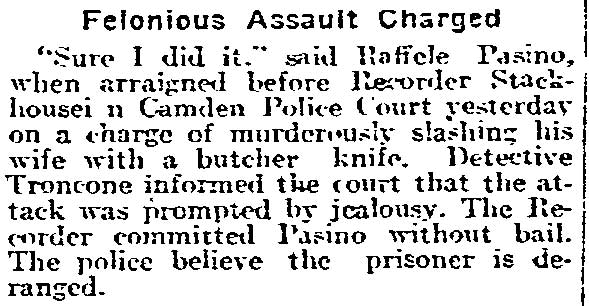
Named: Fiore Troncone, O. Glen Stackhouse, and Raffaele Pasino.
Plan Italy-American Day
Philadelphia Inquirer —
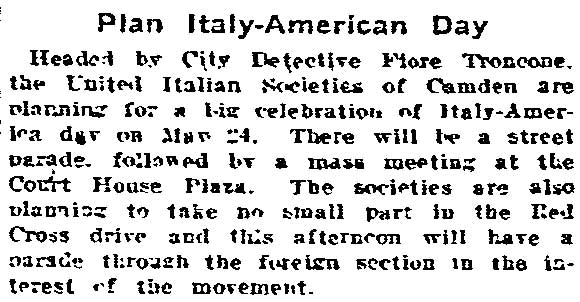
Fiore Troncone — Gilberto Fouriso
Private Troncone Wounded
Philadelphia Inquirer —
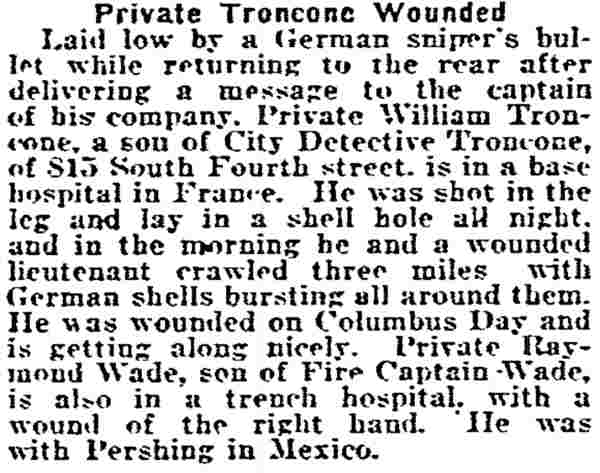
Named: Fiore Troncone, George B. Wade, Raymond Wade, and South 4th Street.
Widow and Brother Held in Camden
Philadelphia Inquirer —
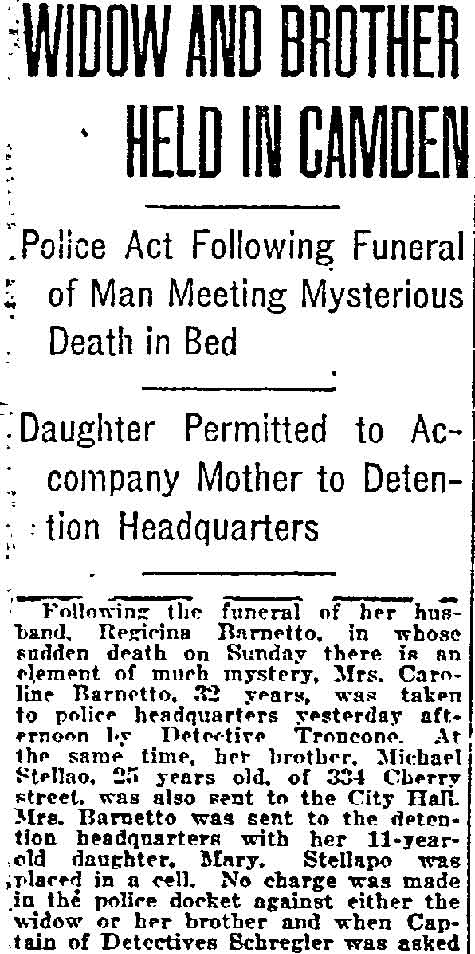
WIDOW AND BROTHER HELD IN CAMDEN
Police Act Following Funeral of Man Meeting Mysterious Death in Bed
Daughter Permitted to Accompany Mother to Detention Headquarters
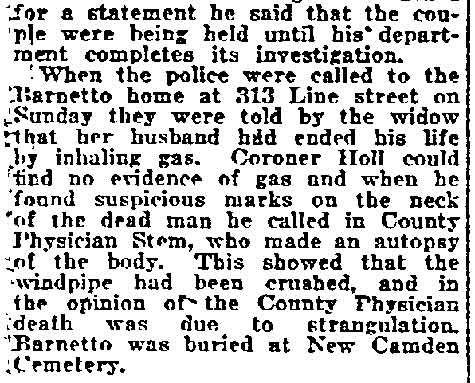
Following the funeral of her husband, Regicina Barnetto, in whose sudden death on Sunday there is an element of much mystery, Mrs. Caroline Barnetto, 32 years, was taken to police headquarters yesterday afternoon by Detective Troncone. At the same time, her brother, Michael Stellao, 25 years old, of 334 Cherry street, was also sent to the City Hall. Mrs. Barnetto was sent to the detention headquarters with her 11-year-old daughter, Mary. Stellapo was placed in a cell. No charge was made in the police docket against either the widow or her brother and when Captain of Detectives Schregler was asked
for a statement he said that the couple were being held until his department completes its investigation.
When the police were called to the Barnetto home at 313 Line street on Sunday they were told by the widow that her husband had ended his life by inhaling gas. Coroner Holl could find no evidence of gas and when he found suspicious marks on the neck of the dead man he called in County Physician Stem, who made an autopsy of the body. This showed that the windpipe had been crushed, and in the opinion of the County Physician death was due to strangulation. Barnetto was buried at New Camden Cemetery.
Constable Cramer Dies of Wounds; Batchelder Caught
Camden Daily Courier —
Actor Held for Murder Says Camden Officer Drew Gun While Serving Attachment Writ at Tuckahoe but Eye Witnesses Testify Cramer Never Had Chance for Life— Tragedy Followed Long Disagreement Over Payment on Automobile
Cape May Sheriff Prefers Charge of Murder
Constable William Cramer, of 647 Willard Street, died at 9:00 this morning in the City Hospital, Atlantic City, from wounds sustained when he was shot three times yesterday afternoon by Harry Batchelder, vaudeville actor, 45 years old, of 419 Haddon Avenue.
Cramer was serving a writ of attachment from the Camden County District Court when shot by Batchelder. The latter was arrested at midnight by Captain of Detectives William Schregler and City Detective Fiore Troncone at Audubon. He will be taken to Cape May Court House late today for a preliminary hearing on a charge of murder preferred by Sheriff Tomlin, of Cape May County.
Joseph and James Albright, of 455 South 6th Street, were with Cramer when he was shot. They are proprietors of a tire store at 431 Federal Street, and the Corson Garage, 6th and Line Streets.
Batchelder says he shot Cramer when the constable pulled a revolver on him. The Albrights say Cramer did not show a revolver and never had a chance for his life.
A forerunner of the shooting occurred Friday night when Batchelder caused the arrest of Joseph Albright for stealing his car. He was taken to police headquarters with Constable Cramer.
It was then learned that James Albright had secured a writ of attachment from the District Court Friday, and Cramer was sent out to serve it. The writ charged Batchelder owed Albright $20.00 for a tire and repairs on his machine.
Gave Check, Left Headquarters
Batchelder later told Captain Schregler he did not know Cramer was a constable. He offered to settle the claim to get his car. Cramer told him the bill was $20.00 and $20.00 for costs. They agreed to settle for $30.00. Batchelder gave Cramer a check for the amount and left police headquarters with his car.
Captain Schregler learned today that Batchelder went to see a lawyer Saturday morning. The lawyer advised him to stoop payment on the check. Captain Schregler was informed Batchelder took the attorney’s advice.
After he learned payment had been stopped, Cramer started out again Sunday to serve the writ. He was accompanied by the Albright brothers. The three men went to Batchelder’s home and learned he had gone to his bungalow at Tuckahoe with his wife in an automobile. Cramer and the Albright brothers went to Tuckahoe.
Fired Five Times
“We located Batchelder in a field in his automobile about a half mile from his home” said Joseph Albright this morning.
“As we approached the machine Batchelder yelled ‘Don’t come near me!’.”
“He yelled that twice, but Cramer paid no attention to the man’s warning. Then Batchelder pulled out a revolver and fired five times at Cramer. Cramer dropped in his tracks, moaning with pain.”
Runs Away With Wife
“Batchelder started his car and ran full speed across the field. I ran after him and traced him to his bungalow on the Cape May County side of the Tuckahoe River. He and his wife jumped into a truck and drove away as I approached.”
“I ran back to my brother and Cramer and we started for Tuckahoe with the wounded man. We notified a constable in Tuckahoe about the shooting, but he said he did not want to have anything to do with the case.”
“We took Cramer to a drug store and the druggist told us he did not want to treat him. Then we drove as fast as our car could take us to ocean City. Cramer was growing weaker every minute. We took him to the office of Dr. Allen Corson. He advised us to take Cramer to the hospital in Atlantic City. We then drove to that city.”
Cramer was operated on last night at the City Hospital. He failed to regain consciousness until he died at 9:00 this morning. Two bullets were taken from his abdomen, and one from his right wrist. Two of the bullets fired by Batchelder evidently went wild.
The Atlantic City police notified Camden and Cape May County authorities. Every Roadway in South Jersey was watched throughout Sunday afternoon and night.
Captain Schregler and Detective Troncone learned that Batchelder had friends in Audubon. They went to the home of Harry Grow, 315 Chestnut Avenue. They found Batchelder and his wife at that address. Batchelder was immediately arrested and taken to police headquarters. Sheriff Tomlin, at Cape May Court House, was notified today and started for Camden to take the slayer to Cape May for trial.
Cramer, 65 Years Old, In Poor Health
Cramer was 65 years old and had long been a sufferer from asthma. He leaves a wife, one son and one daughter. His wife was told about the shooting last night and hurried to Atlantic City. She was with him when he died.
The slain man had been attached to the District Court three years. He was appointed constable three years ago and elected last fall for a term of five years from the Tenth Ward on the Republican ticket.
Cramer had gained a reputation for fearlessness in the performance of his duty. He figured in a duel with Constable Zinger in the Highland section a year ago over the serving of a writ.
He later was charged with assault and battery on a woman, whose piano he seized on a District Court writ. Cramer said the woman tried to stop him from taking the piano by sitting on top of it. He ordered the moving men, whom he employed to take the instrument, to push it out of her parlor into the doorway. As they did she was knocked from the top of the piano. The case never went to court.
Batchelder Had Good Reputation
Batchelder bore an excellent reputation up until the time of the shooting. He was widely known as a musician. He performed on bells and xylophone and appeared frequently in vaudeville comedy sketches. He staged a number of theatrical enterprises of his own in this and other cities.
Brothers Refute Batchelder Plea of Self Defense
Camden Daily Courier —
Actor-Slayer Taken to Jail In Cape May County, Where He Will Be Tried
No Revolver On Cramer
Harry Batchelder, vaudeville actor, of this city, charged with murdering Constable William T. Cramer, while the constable was attempting to attach Batchelder’s automobile.
Batchelder was taken to Cape May Court House late yesterday by Sheriff Tomlin and Constable Newkirk.
The accused man will plead self-defense, it was learned today.
“Yes I shot him, but to protect my life,” said the prisoner to Captain of Detectives Schregler and Detective Troncone, when he was arrested in Audubon. He declined to discuss the case further. Samuel M. Shay has been engaged as his counsel.
No Revolver On Cramer
Though Batchelder insists Cramer pointed a revolver at him, the fact is refuted by John and Joseph Albright, Camden garage owners, who accompanied Cramer n his visit to Tuckahoe, and by the fact that no revolver was found on his body.
The brothers, who had obtained a judgment against Batchelder for repairs to his car, declare as Cramer approached, Batchelder cried:
“Don’t come near me!”
Cramer, however, ignored the warning and Batchelder at once began firing.
According to an autopsy performed by County Physician Souder, of Atlantic County, the bullets perforated Cramer’s lungs, heart, and abdomen.
Belated Medical Aid
Three hours elapsed before Cramer, bleeding profusely from the bullet wounds, received medical attention. This was due to the remoteness of hospitals from the scene of the shooting. Cramer was finally brought to the Atlantic City Hospital at 7:00, although the shooting occurred about 4:00.
The shooting was the result of a dispute over a claim of $20.00 for repairs to the automobile of Batchelder.
It was reported Batchelder had been advised he was immune from attachment proceedings because he was in a county other than the one in which judgment had been obtained against him.
Cramer, however, was proceeding under the garage lien act, which would enable him to seize the car in any part of the State.
Batchelder will be tried in Cape May County, as the shooting occurred there. Cape May officials said today they will press for a verdict of murder in the first degree in his case. They pointed out that the Statutes hold that a person killing an officer in pursuance of his duty is guilty of first degree murder.
Couple Preparing to Marry Arrested
Philadelphia Inquirer —
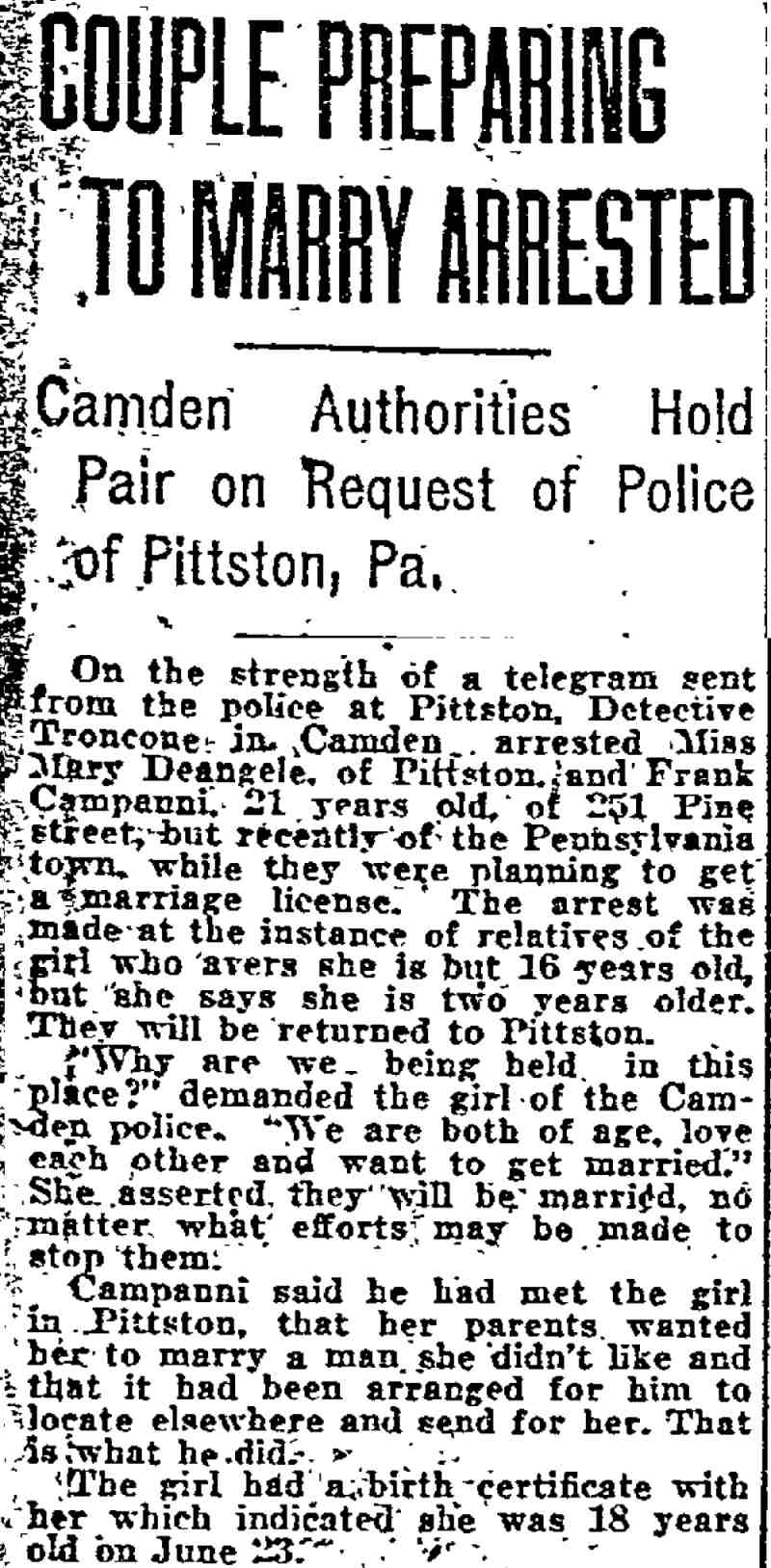
Camden Authorities Hold Pair on Request of Police of Pittston, Pa.
On the strength of a telegram sent from the police at Pittston, Pennsylvania, Mary Deangle, of Dittston and Frank Campanni, of a city near Pittston, were arrested by Fiore Troncone while they were at a marriage license bureau. Authorities at Pittston desired to know whether the couple had fled in his direction. They will be returned to Pittston on the assurance of marriage license officials in this jurisdiction. If they are both of age, love each other and are not already married the matter what efforts may be made to return them to Pittston, that the parents wanted to marry man didn’t to Pittston, while they were on their way to celebrate with her which indicated she was 18 on June 19.
Love Campaign Fails, Man Seeks $300 Back
Camden Courier-Post —
South Camden Wooer, 55, Father of 6, His Bank Roll Depleted, Seeks to Recover Money He Spent in Futile Search for a Bride
He thought he could get a bride if he flashed a large enough bank roll, but although he gave nearly $300 to various women to manage his “love campaign,” he is still without anyone to be a mother to his six children.
That is the story Joseph Mangini, 56 years old, 529 South Third Street, told detectives when he asked the arrest of Mrs. Elizabeth Burns, 22 years old, 286 Kaighn Avenue.
Today the aspiring Romeo, who looks much younger than his actual age, in spite of a shining bald head, appeared in police court, where Mrs. Burns was arraigned on a charge of obtaining money under false pretenses.
Case Continued Week
“He came often to my house, always early in the morning, and gave me money, but I never promised to get him a wife,” the defendant testified. “I’m no match maker and a whole stack of his money wouldn’t induce me to arrange his love affairs for him.”
The case was continued for one week so the police can check up on the conflicting stories told by the two principals.
Mrs. Burns’ grandmother was his first choice, Mangini told detectives. After he had spent money to persuade her to marry him, she died, he said. Then he turned his attentions to courting Mrs. Burns’ mother. This suit cost him $200, but he didn’t mind that, for a marriage seemed certain this time, he told detectives.
After the marriage license had been obtained and all preparations had been made for the wedding, he discovered that his second choice was already married, Mangini said.
Says Mother Is Married
Mrs. Burns has another story to tell. When questioned by City Detective Fiore Troncone, she insisted her mother and Mangini had been married. She denied she had promised to man-age the man’s amorial adventures and declared that, although he gave her considerable money, she did not agree to get him a wife in return.
“I have known Mangini for about three or four months.” Mrs. Burns said. “I met him through a woman I know only as Matilda, who lives at 529 South Third Street. He said he wanted to get married and told me he was interested in my grandmother, Mrs. Rose Capella. She was 62 years old, but he said the age didn’t matter.”
“I arranged a meeting and the two of us went over to 3547 North Warnock Street, Philadelphia, and brought my grandmother over to the Third Street house. They talked the matter of marriage over and then we went to my house, where they talked some more. That was Saturday.”
Visits Children In Home
“The next day Mangini gave her some money. I don’t know how much. Then the three of us went out to the Home for Friendless Children on Haddon Avenue, where we visited his six children. Grandmother went home early Monday after a marriage pact had been agreed upon.”
“Then on New Year’s Day she died. We told Mangini about it and he said he was going to look for another woman to be his wife. He never asked me to persuade my mother, Mrs. Mary Capella, to marry him, but he did tell me one day when I met him that he had decided to court her.”
“While he was engaged to my mother he gave her three or four $20 hills, and then one day he gave me $100 to give to her. She lived in Atlantic City and I wrote to her about the money. She told me to keep it. A little later, Mangini gave me $40 or $50, but I made no promises. My mother did all that.. I know that this woman Matilda got $50, too, but I don’t don’t know what for.”
Got Marriage License
“On January 4 I went with my mother and Mangini to Camden city hall, where they got a marriage license. A few days later they were married. I know that for a fact.”
Mrs. Burns admitted to Troncone that her father was still living. She said he and her mother had been separated for sixteen years, but added that they had never been married.
Questioned about her own marital state, Mrs. Burns admitted she had lived for nine years with a man she called Frank Caparale. She said the last time she saw him was four months ago. She denied she had ever been married to him. She has been married to Leo Burns for several years.
Police To Probe Stories
It was this part of the woman’s story that resulted in the trial before Judge Bernard Bertman this morning being continued for a week. Detectives wish to check on the present marital state of both Mrs. Burns and her mother. Furthermore they are anxious to know whether Mangini and the mother are now married.
Mrs. Burns has changed twice her story twice on this point. She told detectives she was positive they were married and she told Judge Bertman she wasn’t sure whether they were.
Police also revealed today that Mrs. Burns appeared in police court five weeks ago as complaining witness against Mrs. Irene Aspello, 405 Stevens Street, who has since moved 19 South Fifth Street. Mrs. Burns charged Mrs. Aspello with running a disorderly house and selling liquor. The defendant accused Mrs. Burns of stealing her bedclothes while she was living with her. Because neither story was substantiated, the case was dismissed, after Mrs. Burns had charged that policemen were aware of Mrs. Aspello’s law violations.
Cops Unable to Find Razor Fight Motive
Camden Courier-Post —
Woman Witness Kidnapped, Belief
Camden Courier-Post —
Blonde, Accusing Three Men Disappears as Time for Trial Nears — Cops Are Unable to Find Any Trace — Husband Reports 2-Year Old Daughter Also Has Vanished
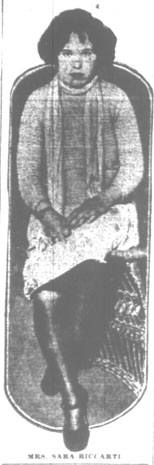
Vanishing from her home on the day she was to have appeared as complaining witness at the trial of three men accused of attacking her, Mrs. Sara Riccarti, 19-year-old blonde, of 118 Pearl street, is the subject of a wide police search today.
Declaring his belief that she had been kidnaped, Michael Riccarti, husband, reported her disappearance this morning to City Detective Fiore Troncone. The couple’s 2-year-old daughter has also disappeared.
Troncone said this afternoon that he would question the three men who were to be tried for attacking the young woman, who has been missing since Friday. Trial of the trio was set for Friday before Judge Samuel M. Shay in Camden Criminal Court. When Mrs. Riccarti failed to appear, the case was postponed until today, and another postponement was taken when Judge Shay learned of the young woman’s disappearance.
Mrs. Riccarti is 5 feet 4 inches tall, has blonde hair and blue eyes. When last seen she wore a black hat, a dark brown coat, a black dress and white stockings.
It was on the night of January 11 that Mrs. Riccarti, according to her story to police at the time, was taken in a taxicab to a house at Second and Benson streets, where she was attacked. She had feared to leave the restaurant on North Third street where she was employed, she said, because of a group of men who had been loitering in the vicinity. She summoned the taxicab, she declared, and when it arrived one of the men slipped into the seat beside her and ordered the driver to go to Fourth and Washington streets, where two other men joined them. Then the cab went to Second and Benson streets, where she was attacked, she declared.
Detective Troncone arrested Fiore Dalesandro, 20 years old, of 415 South Third street; Louis Derenzo, 26 years old, of 232 Pine street, and James Abbonzio, 23 years old, of 435 South Fourth street. Later, Thomas O’Neill, of Stevens near Second street, was also arrested. The four men were arraigned before Judge Bernard Bertman in Police Court and held under bail of $5000 each. They obtained bail and were released. Indicted by the grand jury, they were to have gone on trial on Friday.
Derenzo was the driver of the taxicab in which she was taken to the place of the attack, Mrs. Riccarti declared. Abbonzio, known as “Jimmy Al,” provided the bail bonds for himself and his companions.
Two Held Here for Blackhand Murder Threat
Camden Courier-Post —
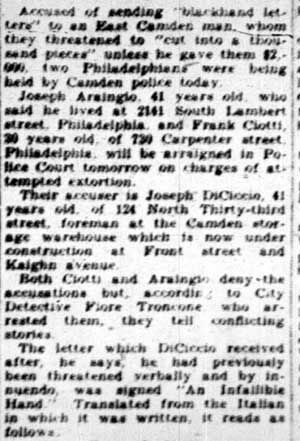
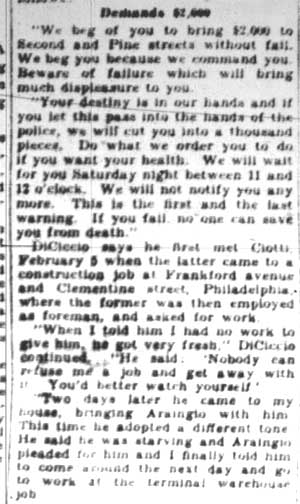
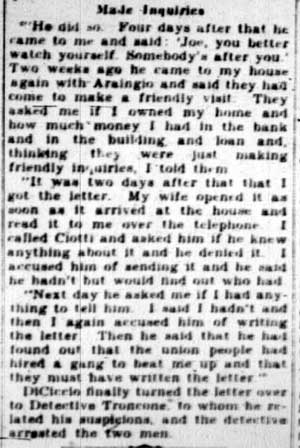
East Camden Man Ordered to Pay $2000 or be Cut in 1000 Pieces
SUSPECTS INQUIRED ON FINANCIAL STANDING
Both Deny Sending Letters But Police Say Stories Conflict
An East Camden man whose identity is being withheld pending further developments, reported to Detective Fiore Troncone today that he received a “black hand” letter threatening him with murder unless he paid $2,000. The letter declared that if the money was not forthcoming, the writer would cut him into 1,000 pieces.
Jealousy Seen as Motive for Bombing Dairy
Camden Evening Courier (Courier-Post) —
Police Seeking Mysterious Stranger in Terrific Downtown Blast
Milk Plant Damaged; Nearby Homes Rocked
Crudely Made Explosive Placed in Trench Beneath Steps
With the owners and the police attributing jealously of business success as the only plausible motive for the bombing last night of the plant of the Sanitary Milk Dairies Company, at 311 Division Street, Search was started today for a tall, heavyset man, with mixed blue suit, as the bomber.
City detectives mingled among the throngs of men, woman and children who today viewed the damage caused by the bomb — a crude, home-made time device — which, in exploding, rocked the neighborhood, shattered window panes, doors, fences and the exteriors of nearby properties. Machinery in the Coccia plant was damaged by the concussion and by parts of bomb shrapnel, which pierced or bent it.
Mrs. Angelina Coccia, mother of the Coccia brothers, her daughter, Theresa Coccia, 14, and Mrs. Mary De Luzzio, 59, of 317 Division Street, were in the kitchen of the Coccia home when the bomb exploded. The dairy is at the rear of the home of Primo Coccia, one of the owners. His brothers —partners in the business are Paul Coccia, 242 Pine Street; Adam Coccia, 346 Cherry Street, and Matthew Coccia, 941 South Third Street.
Saw Mysterious Stranger
Mrs. Coccia cannot speak English, but through her son, Matthew Coccia, it was learned today that, before the explosion, she had seen a man passing the kitchen window.
“The man walked down the alley at the side of the house,” Mrs. Coccia told her son in Italian. “He was a heavy-set man and tall; I thought he was a customer who had come for milk. People often come at night to buy milk, and I did not think it strange about the man.
“But then I waited for hi to knock at the back door, as customers usually do,” she continued.
“When he did not knock, I wondered what he might be up to, and I was just ready to leave the kitchen to see where he went when I heard the explosion. I did not know what happened after that, I was so nervous, I didn’t even see the man leave the way he came. But he was the one who set the bomb. Of that I am sure.”
Dog Vainly Warns
The Coccia’s have a big Italian Bulldog chained to a gasoline tank at the rear of their home. The dog barked continually last night to warn the Coccias, they were so used to his barks, they said today, that they thought he had been growling at a customer, as he sometimes does late at night.
Mrs. Coccia said she was unable to give a detailed description of the man she saw last night because an electric bulb in the alleyway was not lit. It was the first time the alley was in darkness at night. Matthew Coccia said, and this the bomber apparently took into consideration in seeking to go about his diabolical tasks without possible detection.
Coccia said boys living in the neighborhood saw the man enter an automobile, with lights out, immediately after the explosion shook the neighborhood. The car, they said, had been parked near the Coccia home with its front and rear lights out.
Detective Fiore Troncone, who is investigating the bombing, informed Coccia today that he had received a description of the automobile from Coccia’s neighbors. They said they had seen the driver put on the lights of Fourth and Division Street as he turned the corner to go north in his escape.
Rev. John S. Hackett, pastor of the Wiley M.E. Church, Third and Berkley Streets, who was among those viewing the damage done by the bomb, said he saw the man acting nervously at Third and Pine Street last night, immediately after the explosion. His description of the man tallied with that given by Mrs. Coccia.
“I was waiting for the first edition of the Morning Post to arrive at the store at that comer.” Mr. Hackett said today, “when my attention was attracted to this man. He seemed to be very nervous about something. He was fairly tall and heavy-set and wore a mixed blue suit, with light coloring.
“When the papers arrived and I bought a copy, he seemed to be very anxious to see what was on the front page. I did not know about the bomb until I read the paper, but it occurred t me later that perhaps this man was acting suspiciously and was eager to see what damage had been caused. I’m sorry now I didn’t question him. But I can give police a good description of him.”
The Coccias said the only reason they could see for the bombing was jealousy of their business success by a person with a deranged mind.
“We had no enemies,” Matthew Coccia said, “and we never fought with anybody. I cannot understand it. It must have been jealousy at the way we were getting along.”
Coccia said no threatening letters had been received. He insisted that there was no reason why the “Blackhand” should desire to ruin Primo Coccia’s home or their business.
Neighbors called police and fireman.
Detectives found a firemen’s shovel near where the stone steps to the dairy had been. They believed it had been used to dig a trench under the steps in which to insert the bomb.
Primo Coccia, who had been to the theatre, came home five minutes after the explosion. He found a throng in front and dazedly pushed through until his mother hysterically screamed the news to him.
The bomb burst in the dairy door and sprayed big pieces of the iron pipe along the side of the house and into the room, where it caused most of the damage to the machinery.
Fifteen windows of the Coccia house were shattered and police believe the foundations at the rear may have been weakened.
The worst damage to neighboring buildings was to the rear of the Seven Brothers Bakery, owned by the Canzanese Brothers, 318–22 Pine Street, which backs against the dairy. Twenty windows of the bakery were crushed in, the door was riddles with small pieces of the pipe and the rear was peppered with the “shrapnel.”
Mario Manarefi, 912 South Fourth street, a bookkeeper in the bakery, was at his home nearby. He ran to the street and looked several minutes for the bombers before he joined the crowd.
Joseph Scotthouse, 317 Division Street, ran to the yard at the rear of his home to find the fence had been peppered with tiny pieces of the pipe, some of which had tom into his kitchen through windows and doors.
Six windows of the home of Sabatino Di Paolo, 321 Division Street, were broken. Fragments of the pipe were found on the floor of rooms on the second floor of his house, he told police.
A police cordon was thrown around the neighborhood by Chief of Police Stehr, who took personal charge of the investigation.
Where Bomb Rocked Neighborhood — Chief of Police Stehr is shown pointing to the spot under the back steps of the Camden Sanitary Dairy Company at 311 Division Street, where a time bomb exploded last night. The bomb was placed under the steps.
Police from every district in the city were rushed to the scene and patrols were dispatched to be prepared for any eventuality.
The neighborhood was searched carefully and every resident was questioned, but no one was able to give any clue which might lead police to the bombers.
Squads of detectives and police patrolled the neighborhood for hours after the explosion, seeking objects, which might have been dropped by the bombers.
Gangster Shot as Racketeers Open War Here
Camden Courier-Post —
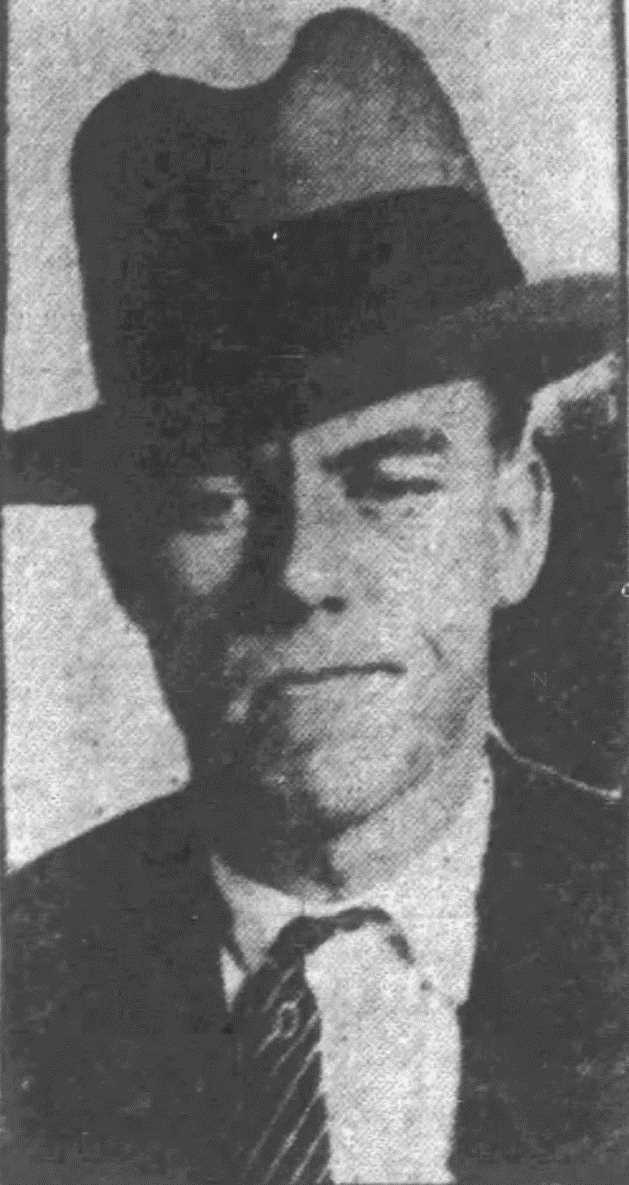
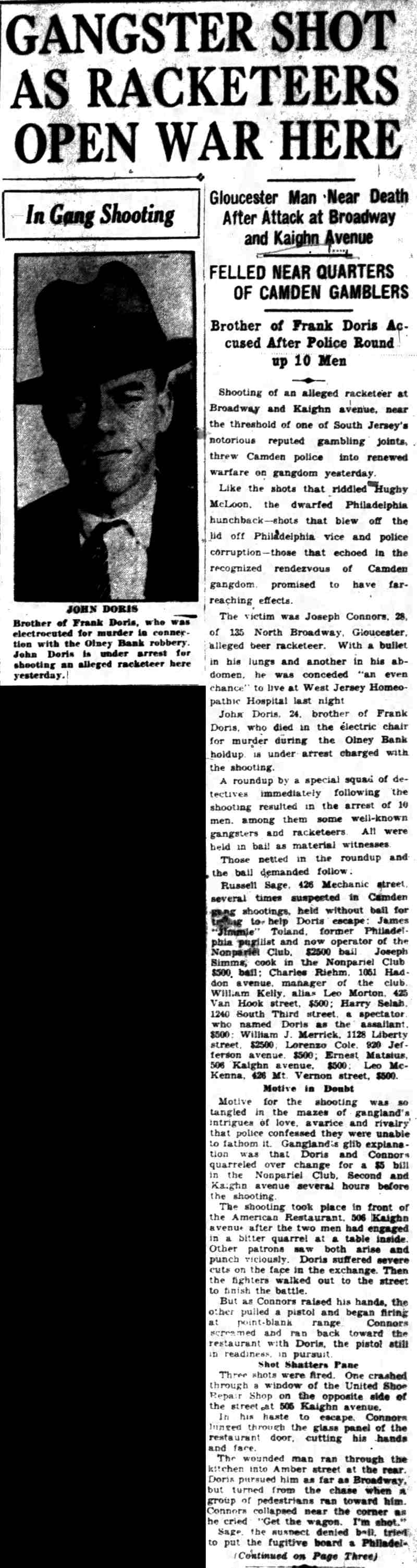

Named: John Doris, Joseph O’Connor, Frank Doris, Kaighn Avenue, Broadway, Joseph Leonhardt, Samuel Johnson, Gustav Koerner, Joseph Carpani, Thomas Cheeseman, Sylvester McGrath, Fiore Troncone, Joseph “Mose” Flannery, Lewis Stehr, Frank T. Lloyd Sr., David S. Rhone, Rocco Palese, Lawrence T. Doran, Raymond O’Connor, and Hughy McLoon.
Youth Is Killed as Three ‘Skip’ School to Hunt
Camden Courier-Post —

YOUTH IS KILLED AS THREE ’SKIP’ SCHOOL TO HUNT
Boy Shot in Head When Companion Fires at Quail
GUN TRAGEDY OCCURS IN PENNSAUKEN TWP.
Three South Camden Lads Quizzed By Cops and Prosecutor
A hunting expedition by three Camden boys ended tragically today when one, in firing a shotgun at a rising quail, killed a second who suddenly placed himself between the muzzle of the weapon and the target.
The dead boy was Theodore Jakucki, 14, of 1207 Whitman avenue.
The youth said by the police to have fired the shot that killed the Jakucki boy is Meyer Albert, 16, of 1186 Kaighn avenue. With him was Leon Grenkwicz, 15, of 1469 Louis street.
According to the story told the Pennsauken police, the three “hookeyed” school today and left early on a shooting trip. They made their way out Mariton pike to the old Welch farm.
Borrowed Gun Used
The youth said he had borrowed a shotgun belonging to his brother, Constant, 19. Albert was carrying the gun and Jakucki was walking in the lead when the quail suddenly took to the air with a whirr of wings. Jakucki stooped suddenly either to pick up something or to tie his shoe. With the discharge of the gun he straightened up and received the full charge in his head, which was partly blown away.
Another gunner, whose name was not obtained, appeared as Jakucki fell to the ground. The boys asked him to send somebody to get the youth to a hospital.
The Pennsauken township police were summoned and the body was removed to police headquarters. The body was examined by Coroner Melvin Cain.
The two boys with Constant Grenkwicz were taken to the office of Prosecutor Baldwin by Detective Fiore Troncone, who questioned them. They told the same story they had told the Pennsauken police.
Word to Family Delayed
Although the tragedy occurred before 10 a. m. and although Albert and the Grenkwicz brothers were taken to the prosecutor’s office before 11 o’clock the family of the dead boy had not been informed of what had happened until shortly before noon.
Then, a reporter, seeking a picture of Jakucki, sought out the correct address which until then had not been obtained, and found the family ignorant of Theodore’s death.
The reporter asked if the home was that of Theodore. “Yes, but don’t worry,” said Mrs. Jakucki, “he’s in school all right.” The woman thought the reporter was a truant officer.
Members of the family, who had been awaiting the preparation of the noon-day meal, had been laughing and singing and listening to the radio. When the reporter asked for the picture the others crowded about to know what had happened.
The reporter said merely that the boy had been hurt and that someone ought to go to the office of the prosecutor.
The dead boy’s family includes his mother and father, three sisters, Viola, 19, Lucy, 5, and Helen, 4, and two brothers, Joseph, 13, and Sigmund, 12. Theodore was a first-year student in the Camden Vocational School, where he was studying to be an automobile mechanic.
Albert and the Grenkwiczs boys were released by the prosecutor after statements had been obtained from them.
Suspected Bandit Trapped by Letters to Camden Friends
Camden Courier-Post —
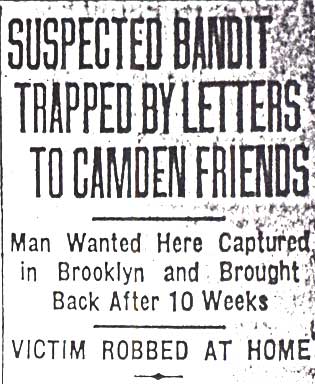
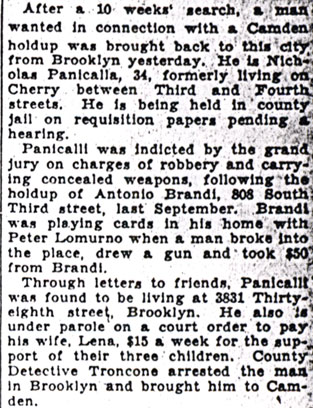
Fiore Troncone, November 29, 1930
Italian Women Republicans Stage Second Annual Ball
Camden Courier-Post —
Prominent Republicans gathered last night at the First Italian Republican League hall, 813 South Fourth Street, for the second annual ball of the Camden County Italian Women’s Republican Club.
The grand march was led by Mr. and Mrs. Antonio Mecca, followed by Mr. and Mrs. Anthony Laviano, Mr. and Mrs. Cascini, Mrs. Mamie Piraine, president of the club, with Anthony Di Marino, and Mrs. Anna Larusso with Harry Larusso.
Mrs. Mecca was chairman of the ball, assisted by Mrs. Laviano, secretary; Mrs. John Gargano, treasurer; Mrs. Frank Valeriano and Miss Mary Lario.
In addition to Mrs. Piraine, officers of the club are Mrs. Larusso, secretary; Mrs. Margaret Viggiano, secretary; Mrs. Josephine Tamru, financial secretary, and Mrs. Madeline Salvatore, treasurer.
Among the guests were Walter S. Keown, chairman of the Republican county committee; Assemblymen Frank M. Traveline, Jr., and George D. Rothermel, Postmaster Charles H. Ellis, County Detective Fiore Troncone, Miss Marie Doyle and Mrs. Pauline Caperoon, of Republican headquarters, and Walter Sekula, candidate for freeholder from the Eighth Ward.
Political Paragraphs
Camden Courier-Post —
Gloucester Republicans concluded their final Baird rally of the campaign last night at their headquarters, 101 North King Street.
Polls throughout the slate will open for the general election Tuesday at 7 a.m. and close at 8 p.m. All voters in the polling place at 8 p.m. or in the room where the election is taking place, or in line, shall be permitted to vote, under the law. Election officers have been instructed to place a police officer at the end of the line at 8 p.m.
Black Horse pike Republican factions have united in a combined front to further the candidacy of David Baird, Jr., for governor. There are no local fights in the party during the current campaign. There were intense local primary battles, principally in Runnemede and Gloucester Township, but all factions in those municipalities are now working for Baird.
A bitter contest for justice of the peace in the Eighth Ward will be waged at the election on Tuesday. William Lane, of 1634 Broadway, is one of the seven seeking one of three vacancies. Lane is the nephew of James M. Lane, who was prominent politically several years ago. He is a captain in the Moose Lodge bugle corps. He is also secretary and treasurer of the Regular Eighth Ward Republican Club. Of the seven men running for justice of the peace, four are Democrats.
Mrs. Emma E. Hyland, Democratic state committee woman, and Assemblyman George D. Rothermel are wagering each other a hat on the outcome of the gubernatorial race between Baird and Moore. Rothermel, however, will have to pay more for a hat for Mrs. Hyland, should Baird pay for a fedora for Rothermel, should Moore be defeated.
A revival of the old-time political parade was staged last night by the First Italian Republican League when more than 200 automobiles and several hundred marchers passed through Camden streets to the accompaniment of stirring music.
Led by former Coroner Antonio Mecca and County Detective Fiore Troncone, the parade passed from the league’s clubhouse, 813 South Fourth Street, to West Street, to Benson Street, to Broadway, past the Republican headquarters, to Mickle Street, to Third to Chestnut and back to the clubhouse. Meetings held on various floors of the clubhouse drew several thousand voters.
Bandit Suspect Leaves Bermuda for Camden
Camden Courier-Post —
Charles “Jack” Kelly, wanted as one of the bandits who held up and robbed the Pennsauken Township National Bank December 11, sailed from Bermuda yesterday handcuffed to County Detective Fiore Troncone.
Kelly was arrested last month after detectives intercepted his letters to friends near Third and Mt. Vernon Streets. Extradition procedure followed.
Michael Spingotti and Anthony Tate were said to be Kelly’s partners in the holdup. Tate pleaded guilty before Judge Samuel M. Shay and was given 15 years in state prison. Spingotti is awaiting trial.
5 Camden Police Granted Pensions
Camden Courier-Post —
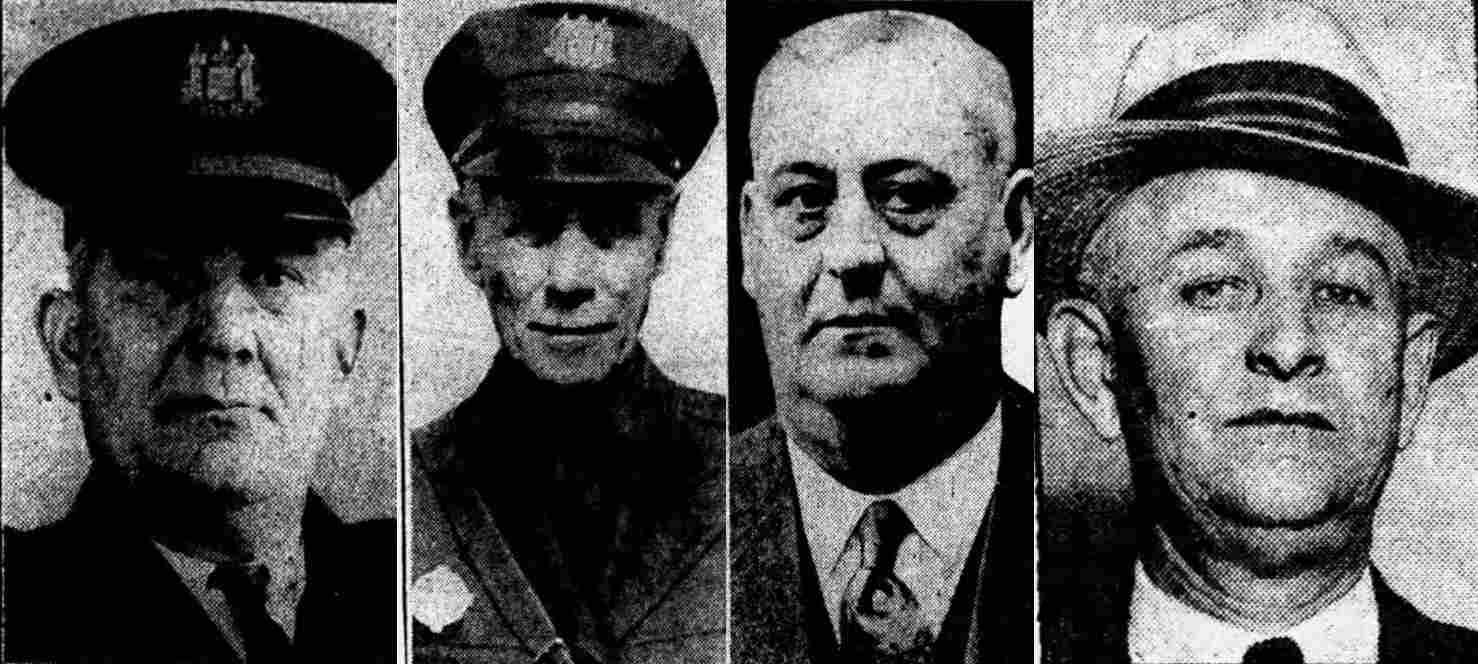

Named: Charles Laib, Charles J. “Jeff” Kay, Theodore Guthrie, Howard Smith, J. Oscar Till, Louise F. Walsh, John W. Golden, Charles H. Ellis, Charles Humes, South 24th Street, North 25th Street, North 4th Street, Penn Street, Fiore Troncone, Chestnut Street, Sheltering Arms Home, Newton Ash, William Michalak, John J. Robinson, and Roy R. Stewart.
Meinster Seeks Release on Writ
Camden Courier-Post —
Suspect in Triple Murder Held in ‘Cold Storage’; Girl Victim Buried
Benjamin “Benny” Meinster, held in connection with the triple Philadelphia vice den killings last Thursday, has obtained a writ of habeas corpus, returnable today, to show why he should be held.
Meinster, latest so-called “sweetie” of Sue Ricci, Camden girl and one of the victims, was arrested Tuesday and has been held in “cold storage” since that time while detectives have attempted to learn if he had any connection with the killings.
The Ricci woman, 22 and redheaded, was shot to death by a jealous gunman who invaded a North Ninth street house in Philadelphia, armed with two guns. Mrs. Yetta Cohen, 40, the proprietress, was killed when she interfered and Patrolman Frederick Dolan was murdered when he tried to arrest the slayer.
Meinster, who lives at Sixth and South streets, was said by the police to be the man who stole Sue away from the gunman who did the shooting. He denied any knowledge of the case.
Meanwhile, they released Joseph Burgo, 20, of 304 Cherry street, Camden, who was questioned Tuesday. Burgo satisfied the police he was innocent of any connection with the case. He was under suspicion, detectives said, because he shot and wounded Joseph Mazzare. Another of Sue’s sweethearts, now in jail for carrying concealed weapons.
Services for Mrs. Ricci, mother of a 5-year-old son, Albert, Jr., were held from the home of her parents, Mr. and Mrs. Michael Marino, 1917 South Fourth Street. Rev. Martin S. Stockett, rector of the Episcopal Church of Our Savior, Broadway and Viola street, officiated. Burial was in New Camden Cemetery.
The body of the dead girl lay on a white couch-casket. The room was banked with flowers. Members of the family sobbed as the minister read the brief services of the church. Outside, the idle curious and friends lined both sides of Fourth street. One hundred automobiles were strung along the curb to take those who cared to go to the cemetery.
Policemen in uniform and Camden and Philadelphia detectives who mingled with the crowd in the hope of picking up some clue, estimated that at least 700 persons were in attendance. The Camden detectives were George Zeitz and Clifford Del Rossi, and County Detective Fiore Troncone.
‘Blackie’ Battino Gets 3 to 5 Years
Camden Courier-Post —
Sentenced by Judge Shay After Pleading Guilty to Holdup Charge
Pleading guilty in criminal court to holding up two South Camden men last February, and to a gun toting charge Louis “Blackie” Battino, 23, of 805 South Fifth street, was sentenced to three to five years in state prison by Judge Samuel M. Shay yesterday.
Bottino, who was captured in a New York “love nest” on a fugitive warrant after he jumped a $5000 bail bond here, was first arrested by Detective Thomas Cheeseman on the night of the holdup. He was identified by Marvin Johnson, of 926 South Ninth Street, and Louis Puggsley, of 312 Benson Street, who said the man stuck a revolver in a car in which they were seated and robbed them of $28.
County Detective Fiore Troncone and New York detectives surprised Bottino in an apartment at Ninth Avenue and Fifty-fourth Street, New York, with a woman. Patsy Costagno, 23, of 2412 South Watts Street, Philadelphia, an alleged accomplice of Bottino, was sentenced April 19, 1932, to serve 13 years in jail on three indictments for participation in the crime and carrying concealed deadly weapons.
C. Lawrence Gregorio, counsel for Battino, pleaded for another chance for his client, pointing out the youth of the prisoner. Judge Shay, however, remained unmoved and imposed sentence.
Joe Montana Wed to Miss Palladino
Camden Courier-Post —
Camden Wrestler and Bride Are Given Dinner Attended by Notables
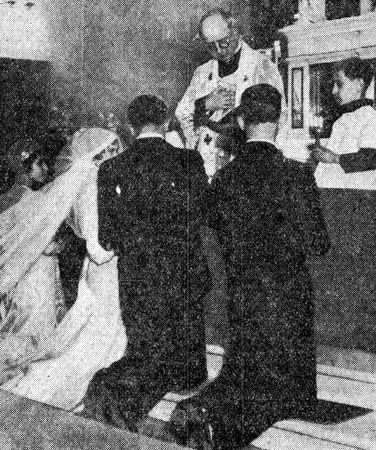
Miss Emma Palladino, one of the fairest daughters of Camden’s “Little Italy” yesterday became the bride of Joseph Montana, heavyweight wrestler, at Our Lady of Mt. Carmel Church, Fourth and Division streets.
Idol of Italian youth in this city Montana was hailed by hundreds of them outside the church. A number of relatives and friends, including prominent figures in the legal and professional life of the city, attended a dinner in honor of the couple at Overbrook Villa, Lindenwold, following the ceremony.
The bride, 20, is the daughter of Joseph Palladino, commercial photographer of 1115 South Fourth street. She graduated from Camden High school in 1928. Montana is 26 and a contender for the world’s heavy-weight wrestling diadem. Following a wedding tour through the West the couple plan to reside in Camden.
Miss Emenia D’ Alesio, of Audubon, and Miss Rose Marini and Miss Cecelia Szymanski, of Camden, served as bridesmaids. Attending the groom were Gene Mariano, Michel D’Ilesia and William Palladino. The bride carried a bouquet of lillies of the valley and white roses while her attendants held tulips and roses. The church was beautifully decorated with varied floral designs, gold ribbons, silks and satins.
The guest list at the bridal dinner included: Assemblyman Frank M. Travaline, Jr., City Commissioner Clay W. Reesman, director of parks and public property; Acting Chief of Police of John W. Golden, former Prosecutor and Mrs. Ethan P. Wescott, Samuel P. Orlando, Guido Laurini, Detective Fiore Troncone, Antonio Mecca, Mr. and Mrs. William Denof, Mr. and Mrs. Pasquale Ianuzzi, Frank H. Ryan, Thomas H. Ryan, Dr. and Mrs. Robert Principato, Mr. and Mrs. William AveraIl, Luke McKenna, Mr. and Mrs. Gene Mariani, Mr. and Mrs. Frank Abbott, Frank P. Cocchiaraley and Miss Regina Cocchiaraley, all of Camden; Miss Mary Montana, and Mr. and Mrs. Ettore Montana, of Columbus OH., and Aristadino D’Guilia and sons, Albert and Peter, of Buffalo, NY.
Fleecing Patient Charged to Doctor
Camden Courier-Post —
Woodlynne Woman Says She Was Swindled Out of $63
A self-styled naturalist was held in $5000 bail yesterday in Philadelphia on a warrant from Camden on a charge of fleecing a Woodlynne woman patient out of $63. He is alleged to have promised to cure her of rheumatism.
The defendant, Dominico Mattioni, 38, of 1229 South Fifteenth street, Philadelphia, was arrested after an extensive investigation by Fiore Troncone, Camden County detective, who was assisted by Detectives Harry Neill and Charles Amorosi, of the Twentieth and Federal Streets police station, Philadelphia.
The detectives said Mattioni has been posing as “Dr. Mattioni,” and was arrested on a Camden warrant, issued at Troncone’s, instance, charging the obtaining of money under false pretenses.
Mattioni was held in bail for extradition, to Camden, where his case will be presented to the Camden County Grand Jury. Troncone testified that the woman alleged to have been victimized by Mattioni is Mrs. Mary Onoranto, of 337 Evergreen Avenue, Woodlynne. The detective said Mattioni told Nick Onoranto, the woman’s husband, that he could cure her of rheumatism and that he wanted $260. The “doctor,” however, received only $63, Troncone related. The woman was not cured, he added.
Troncone told the magistrate that he is investigating several other similar cases in which Mattloni may be involved.
Wife Slain by Jagged Glass, Husband Held
Camden Courier-Post —
Accident Hoax Broken by Cops After Grilling Family; Friend — On Deathbed, She Orders 4 Children to Say She Fell on Stairs
Command Arouses Concealed Detectives
Woman Slashed by Broken Decanter; Man Faces Murder Charge Today
A death-bed command of a South Camden mother to her four children to stick to their story failed of its motive last night and the woman’s husband was arrested on suspicion of murder.
The charge will be changed today, police said, to one of murder.
“Say only what I say, that I fell down the steps.”
Mrs. Philomena Marcozzi, 41, died in West Jersey Homeopathic Hospital shortly after she made that remark; at 4 p.m. yesterday. She bled to death from a severe cut on her left arm.
At her bedside were her children, Josephine, 15; Ida, 13; Louise, 17, and David, 19.
Cops’ Suspicions Aroused Nearby
Out of sight of the dying woman, stood Detectives Clifford Del Rossi and Fiore Troncone.
Their suspicions aroused, the sleuths renewed their investigation. As a result the woman’s husband, Guilio Marcozzi, 55, of 321 Line Street was put in the city jail last night, charged with the death of his wife.
Mrs. Marcozzi was cut with the jagged edge of a broken wine decanter, during an argument with her husband over the cleaning of some hardshelled crabs.
But it wasn’t the children who said that.
A neighbor, Mrs. Ida Lupini, 31, of 311 Line Street, was in the Marcozzi home when the children returned Sunday night from a crabbing trip to Sea Side Heights. She told police, they declared, that she saw the children jubilantly deposit their catch on the kitchen table.
Then she watched, alarmed and afraid to leave, as Marcozzi told his wife to “throw them out.”
The wife refused.
The husband insisted, and when his wife told him he should clean the crabs, he grasped the wine decanter and struck the mother over the temple, Mrs. Lupini said.
Cut by Jagged ‘Glass’
The decanter broke. Grasping the long, neck of the bottle, Marcozzi continued to attack his wife. He swung the jagged edge towards her breast, and to protect herself she raised her arm.
The broken bottle cut deeply into her skin. An artery was severed.
Then the children rushed the mother to West Jersey Homeopathic Hospital.
That is the story Mrs. Lupini told: according to Acting Chief of Police John W. Golden and Assistant Prosecutor Rocco Palese.
The mother told hospital attaches she fell down the steps of her home, cutting her arm on the broken bits of a bottle she was carrying at the time.
The children, hearing this story, corroborated her.
Wife Dying— Man at Work
The father failed to appear at the hospital. Police were forced to get him at his work yesterday, according to Detective Joseph Carpani, when his wife was dying.
Last night he denied the crime. He said he was not at home when his wife suffered the fatal injury.
But his children, confronted with Mrs. Lupini’s tale, broke down and confessed, according to police.
Eighteen hours of almost constant questioning of the Lupini woman by Detectives Carpani, Del Rossi and Troncone solved the tragedy. All three were complimented last night by Acting Police Chief John W. Golden.
Boy Shot, Many People Hurt in Eighth Ward Riot
Camden Courier-Post —
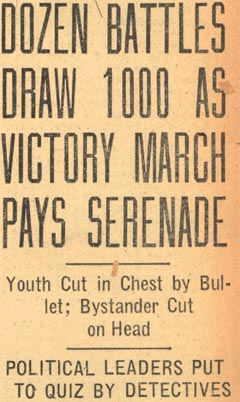
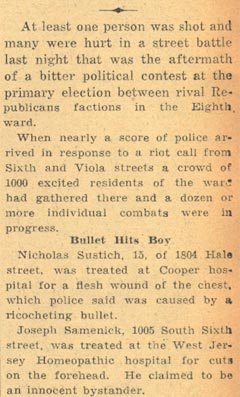
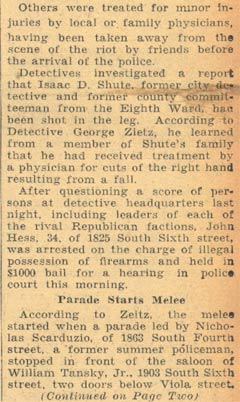
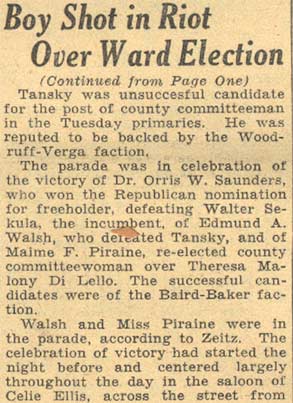
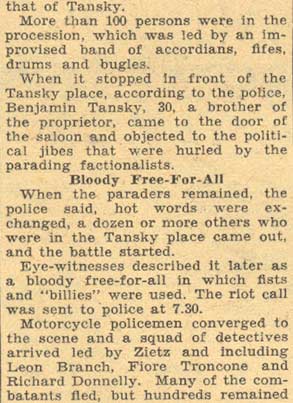
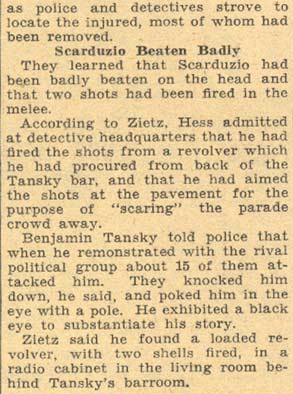
Youth Cut in Chest by Bullet; Bystander Cut on Head
POLITICAL LEADERS PUT TO QUIZ BY DETECTIVES
At least one person was shot and many were hurt in a street battle last night that was the aftermath of a bitter political contest at the primary election between rival Republicans factions in the Eighth ward.
When nearly a score of police arrived in response to a riot call from Sixth and Viola streets a crowd of 1000 excited residents of the ward had gathered there and a dozen or more individual combats were in progress.
Bullet Hits Boy
Nicholas Sustich, 15, of 1804 Hale street, was treated at Cooper hospital for a flesh wound of the chest, which police said was caused by a ricocheting bullet.
Joseph Samenick, 1005 South Sixth street, was treated at the West Jersey Homeopathic hospital for cuts on the forehead. He claimed to be an innocent bystander.
Others were treated for minor injuries by local or family physicians, having been taken away from the scene of the riot by friends before the arrival of the police.
Detectives investigated a report that Isaac D. Shute, former city detective and former county committeeman from the Eighth Ward, had been shot in the leg. According to Detective George Zietz, he learned from a member of Shute’s family that he had received treatment by a physician for cuts of the right hand resulting from a fall.
After questioning a score of persons at detective headquarters last night, including leaders of each of the rival Republican factions, John Hess, 34, of 1825 South Sixth street, was arrested on a charge of illegal possession of firearms and held in $1000 bail for a hearing in police court this morning.
Parade Starts Melee
According to Zeitz, the melee started when a parade led by Nicholas Scarduzio, of 1863 South Fourth street, former summer policeman, stopped in front of the saloon of William Tansky, Jr., 1903 South Sixth street, two doors below Viola street.
(Continued on Page Two)
(Continued from Page One)
Tansky was unsuccessful candidate for the post of county committeeman in the Tuesday primaries. He was reputed to be backed by the Woodruff-Verga faction.
The parade was in celebration of the victory of Dr. Orris W. Saunders, who won the Republican nomination for freeholder, defeating Walter Sekula, the incumbent, of Edmund A. Walsh, who defeated Tansky, and of Maime F. Piraine, re-elected county committeewoman over Theresa Malony Di Lello. The successful candidates were of the Baird-Baker faction.
Walsh and Miss Piraine were in the parade, according to Zeitz. The celebration of victory had started the night before and centered largely throughout the day in the saloon of Celie Ellis, across the street from
that of Tansky.
More than 100 persons were in the procession, which was led by an improvised band of accordians, fifes, drums and bugles.
When it stopped in front of the Tansky place, according to the police, Benjamin Tansky, 30, a brother of the proprietor, came to the door of the saloon and objected to the political jibes that were hurled by the parading factionalists.
Bloody Free-For-All
When the paraders remained, the police said, hot words were exchanged, a dozen or more others who were in the Tansky place came out, and the battle started.
Eye-witnesses described it later as a bloody free-for-all in which fists and “billies” were used. The riot call was sent to police at 7.30.
Motorcycle policemen converged to the scene and a squad of detectives arrived led by Zeitz and including Leon Branch, Fiore Troncone and Richard Donnelly. Many of the combatants fled, but hundreds remained
as police and detectives strove to locate the injured, most of whom had been removed.
Scarduzio Beaten Badly
They learned that Scarduzio had been badly beaten on the head and that two shots had been fired in the melee.
According to Zietz, Hess admitted at detective headquarters that he had fired the shots from a revolver which he had procured from back of the Tansky bar, and that he had aimed the shots at the pavement for the purpose of “scaring” the parade crowd away.
Benjamin Tansky told police that when he remonstrated with the rival political group about 15 of them attacked him. They knocked him down, he said, and poked him in the eye with a pole. He exhibited a black eye to substantiate his story.
Zietz said he found a loaded revolver, with two shells fired, in a radio cabinet in the living room behind Tansky’s barroom.
F. Troncone Dies, Veteran Detective
Camden Evening Courier —
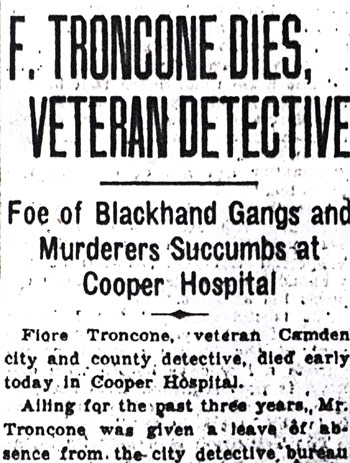
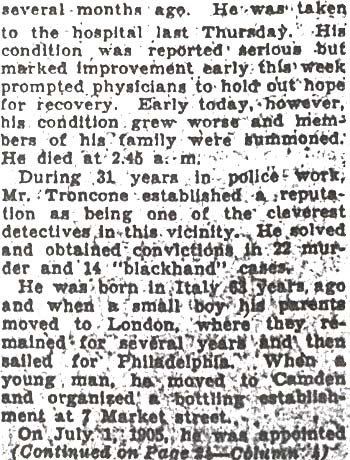
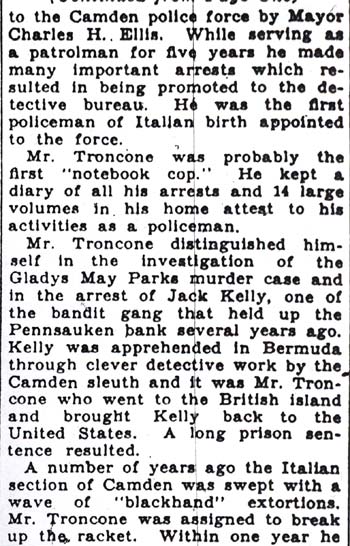
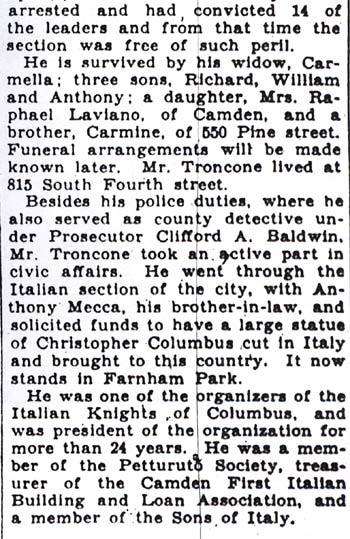
Named: Charles H. Ellis, Antonio Mecca, Fiore Troncone, Clifford Baldwin, Richard Troncone, Anthony Troncone, William Troncone, Mrs. Raphael Laviano, Farnham Park, Christopher Columbus statue, Gladys May Parks, Jack Kelly, Market Street, Pine Street, and South 4th Street.
Troncone Funeral to Be Held Monday
Camden Evening Courier —
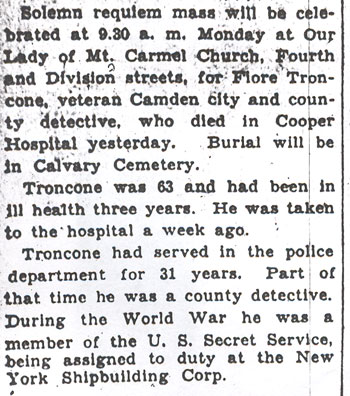
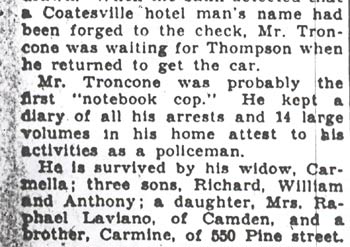
Named: Elisha A. Gravenor, William J. Kraft, Fiore Troncone, Wilson Ashbridge, Richard Troncone, Anthony Troncone, William Troncone, Mrs. Raphael Laviano, Our Lady of Mt. Carmel Church, Kaighn’s Point Ferry, Cooper Hospital, South 4th Street, Market Street, Pine Street, and Division Street.