James H. Long
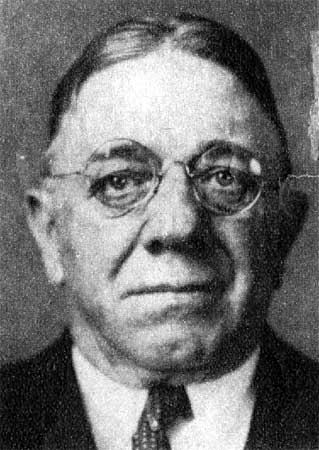
James H. Long, c. 1931
JAMES H. LONG was born in Virginia in 1865, his family was from Pennsylvania. By 1880 he was living in Camden, with his older sister Mary, the second wife of Rueben Parvin, a ship’s carpenter. Parvin, originally from Salem, was already living in Camden by 1870. James and Mary Long are not listed in the 1870 Census in Camden, however.
When the census was taken in 1880 James Long had already gone to work in one of Camden’s shipyards. By 1887 Rueben Parvin had died. James Long remained with his sister, and worked as a machinist. He lived at 310 Birch Street from 1887 to 1890, when he moved to 319 Cole Street, a few blocks south. Cole Street, which no longer exists, ran for one block between North 3rd and North 4th Streets below Pearl Street.
In 1911 James H. Long served as the first Exalted Ruler of Camden Lodge 293 of the Benevolent Protective Order of Elks. On September 7, 1919 he served as Marshal for Camden’s Victory Jubilee parade, celebrating the return of the city’s soldiers, sailors, marines, and airmen from World War I.
By January of 1920 James H. Long had risen to the position of Chief of the Water Department of the City of Camden. He worked alongside Frank S. Fithian, Chief Clerk of the Water Department. He lived at the home of his sister, Mary Long Parvin, at 702 North 4th Street in North Camden. His nephew Robert also lived there, and worked as a helper in one of Camden’s many shipyards.
Mr. Long was still Chief of the Water Department in April of 1930. Also employed there at that time was James Long’s nephew, Robert Parvin, a stationary engineer. Mr. Long, then 64 and a bachelor, was still residing at 702 North 4th Street in North Camden with his nephew, his sister having passed away.
James H. Long lived at 702 North 4th Street until he passed away, on September 1, 1940. His nephew apparently pre-deceased him.
Camden Elks Moving on City of Baltimore
Philadelphia Inquirer —
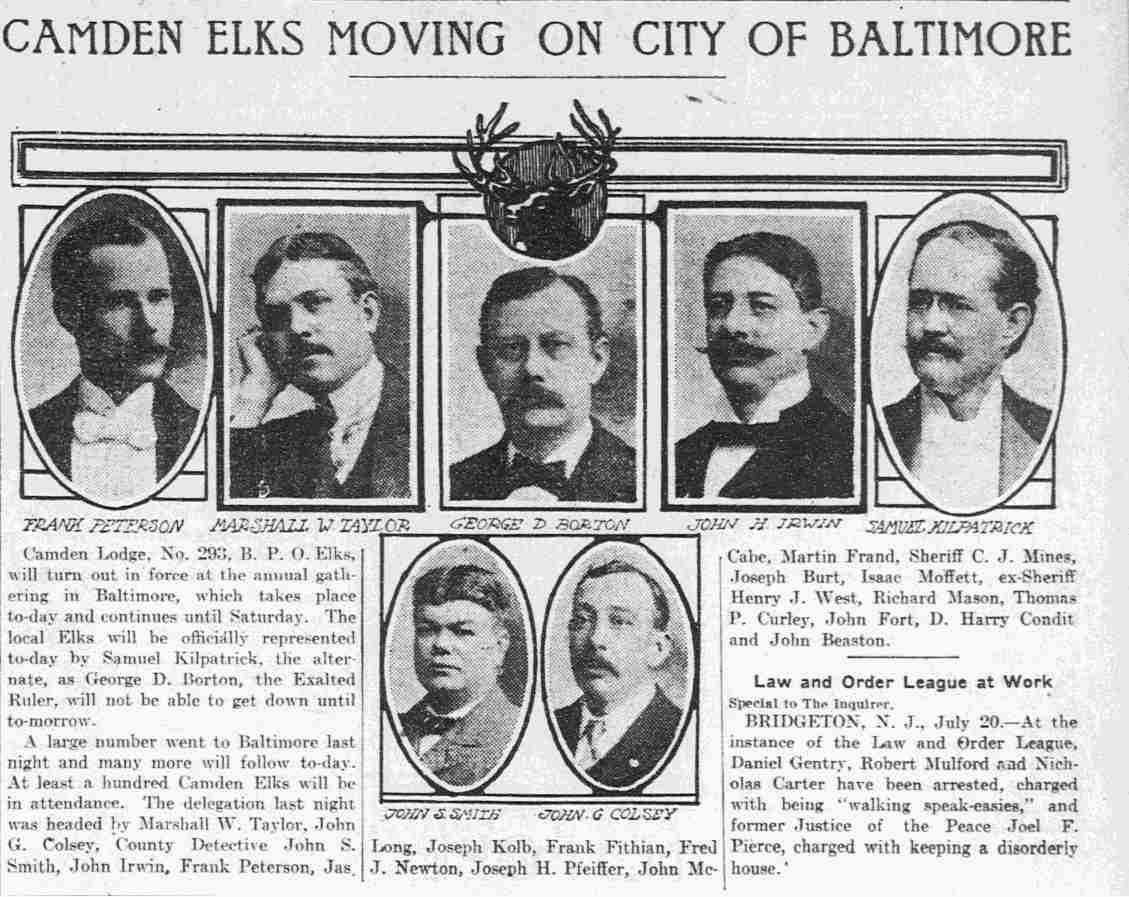
CAMDEN ELKS MOVING ON CITY OF BALTIMORE
Camden Lodge, No. 293, B. P. O. Elks, will turn out in force at the annual gathering in Baltimore, which takes place to-day and continues until Saturday. The local Elks will be officially represented to-day by Samuel Kilpatrick, the alternate, as George D. Borton, the Exalted Ruler, will not be able to get down until to-morrow.
A large number went to Baltimore last night and many more will follow to-day. At least a hundred Camden Elks will be in attendance. The delegation last night was headed by Marshall W. Taylor, John G. Colsey, County Detective John S. Smith, John Irwin, Frank Peterson, Jas. Long, Joseph Kolb, Frank Fithian, Fred J. Newton, Joseph H. Pfeiffer, John McCabe, Martin Frand, Sheriff C. J. Mines, Joseph Burt, Isaac Moffett, ex-Sheriff Henry J. West, Richard Mason, Thomas P. Curley, John Fort, D. Harry Condit and John Beaston.
War Work Director Named
Philadelphia Inquirer —
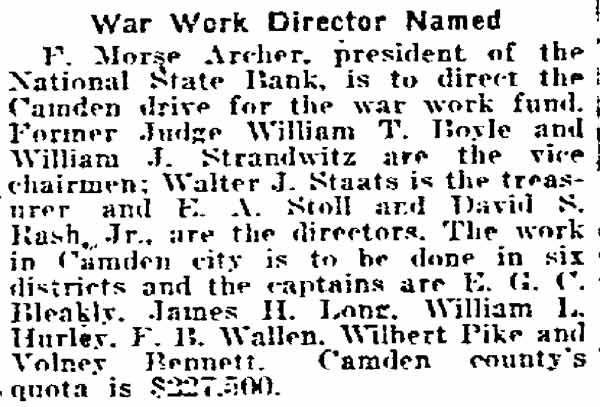
F. Morse Archer, president of the National State Bank, is to direct the Camden drive for the war work fund. Former Judge William T. Boyle and William J. Strandwitz are the vice chairmen; Walter J. Staats is the treasurer and E. A. Stoll and David S. Rush, Jr., are the directors. The work in Camden city is to be done in six districts and the captains are E. G. C. Bleakly, James H. Long, William L. Hurley, F. B. Wallen, Wilbert Pike and Volney Bennett. Camden county’s quota is $227,500.
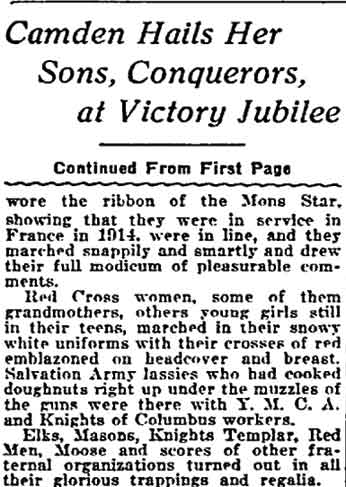
Camden Hails Her Sons, Conquerors, at Victory Jubilee
Philadelphia Inquirer —
Battle Flags Wave in Triumph O’er Parade Reviewed by Admiral
Gray Veterans of G. A. R. and Wounded Ride; Centopath Passes in Reverential Hush
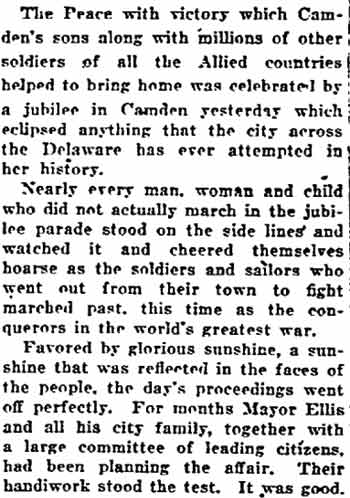
The Peace with victory which Camden’s sons along with millions of other soldiers of all the Allied countries helped to bring home was celebrated by a jubilee in Camden yesterday which eclipsed anything that the city across the Delaware has ever attempted in her history.
Nearly every man, woman and child who did not actually march in the jubilee parade stood on the side lines and watched it and cheered themselves hoarse as the soldiers and sailors who went out from their town to fight marched past, this time as the conquerors in the world’s greatest war.
Favored by glorious sunshine, a sunshine that was reflected in the faces of the people, the day’s proceedings went off perfectly. For months Mayor Ellis and all his city family, together with a large committee of leading citizens, had been planning the affair. Their handiwork stood the test. It was good.
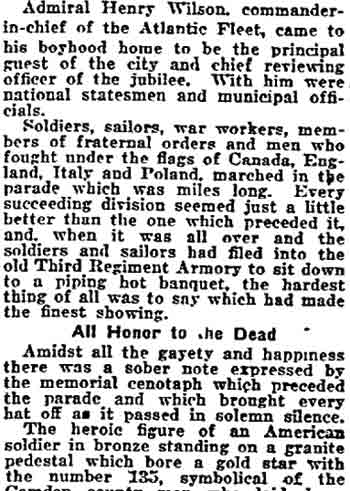
Admiral Henry Wilson, commander-in-chief of the Atlantic Fleet, came to his boyhood home to be the principal guest of the city and chief reviewing officer of the jubilee. With him were national statesmen and municipal officials.
Soldiers, sailors, war workers, members of fraternal orders and men who fought under the flags of Canada, England, Italy and Poland, marched in the parade which was miles long. Every succeeding division seemed just a little better than the one which preceded it, and, when it was all over and the soldiers and sailors had filed into the old Third Regiment Armory to sit down to a piping hot banquet, the hardest thing of all was to say which had made the finest showing.
All Honor to the Dead
Amidst all the gayety and happiness there was a sober note expressed by the memorial cenotaph which preceded the parade and which brought every hat off as it passed in solemn silence.
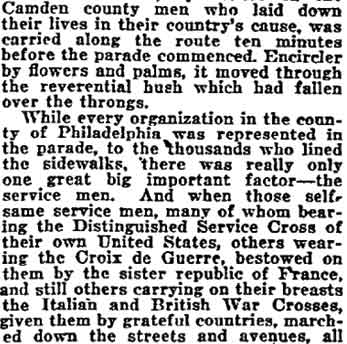
The heroic figure of an American soldier in bronze standing on a granite pedestal which bore a gold star with the number 135, symbolical of the Camden county men who laid down their lives in their country’s cause, was carried along the route ten minutes before the parade commenced. Encircler [sic] by flowers and palms, it moved through the reverential hush which had fallen over the throngs.
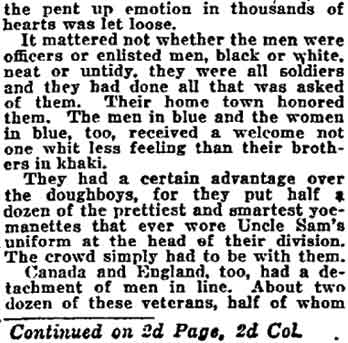
While every organization in the county of Philadelphia was represented in the parade, to the thousands who lined the sidewalks, there was really only one great big important factor—the service men. And when those self-same service men, many of whom bearing the Distinguished Service Cross of their own United States, others wearing the Croix de Guerre, bestowed on them by the sister republic of France, and still others carrying on their breasts the Italian and British War Crosses, given them by grateful countries, marched down the streets and avenues, all the pent up emotion in thousands of hearts was let loose.
It mattered not whether the men were officers or enlisted men, black or white, neat or untidy, they were all soldiers and they had done all that was asked of them. Their home town honored them. The men in blue and the women in blue, too, received a welcome not one whit less feeling than their brothers in khaki.
They had a certain advantage over the doughboys, for they put half a dozen of the prettiest and smartest yoemanettes that ever wore Uncle Sam’s uniform at the head of their division. The crowd simply had to be with them.
Canada and England, too, had a detachment of men in line. About two dozen of these veterans, half of whom wore the ribbon of the Mons Star, showing that they were in service in France in 1914, were in line, and they marched snappily and smartly and drew their full modicum of pleasurable comments.
Red Cross women, some of them grandmothers, others young girls still in their teens, marched in their snowy white uniforms with their crosses of red emblazoned on headcover and breast. Salvation Army lassies who had cooked doughnuts right up under the muzzles of the guns were there with Y. M. C. A. and Knights of Columbus workers.
Elks, Masons, Knights Templar, Red Men, Moose and scores of other fraternal organizations turned out in all their glorious trappings and regalia.
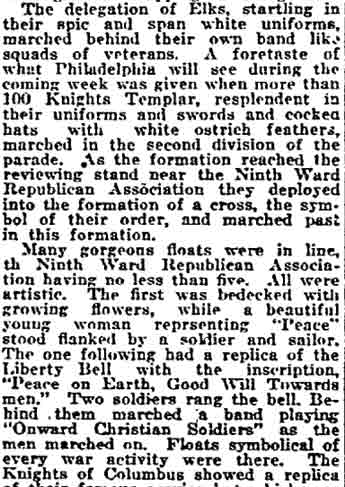
The delegation of Elks, startling in their spic and span white uniforms, marched behind their own band like squads of veterans. A foretaste of what Philadelphia will see during the coming week was given when more than 100 Knights Templar, resplendent in their uniforms and swords and cocked hats with white ostrich feathers, marched in the second division of the parade. As the formation reached the reviewing stand near the Ninth Ward Republican Association they deployed into the formation of a cross, the symbol of their order, and marched past in this formation.
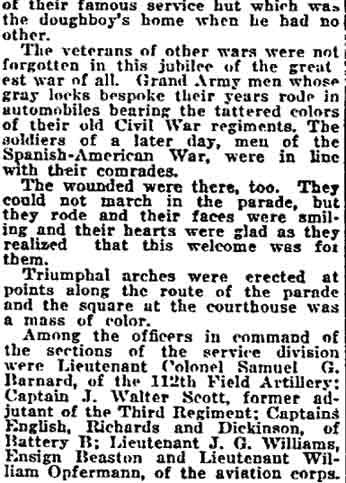
Many gorgeous floats were in line, th Ninth Ward Republican Association having no less than five. All were artistic. The first was bedecked with growing flowers, while a beautiful young woman reprsenting “Peace” stood flanked by a soldier and sailor. The one following had a replica of the Liberty Bell with the inscription, “Peace on Earth, Good Will Towards men.” Two soldiers rang the bell. Behind them marched a band playing “Onward Christian Soldiers” as the men marched on. Floats symbolical of every war activity were there. The Knights of Columbus showed a replica of their famous service hut which was the doughboy’s home when he had no other.
The veterans of other wars were not forgotten in this jubilee of the greatest war of all. Grand Army men whose gray locks bespoke their years rode in automobiles bearing the tattered colors of their old Civil War regiments. The soldiers of a later day, men of the Spanish-American War, were in line with their comrades.
The wounded were there, too. They could not march in the parade, but they rode and their faces were smiling and their hearts were glad as they realized that this welcome was for them.
Triumphal arches were erected at points along the route of the parade and the square at the courthouse was a mass of color.
Among the officers in command of the sections of the service division were Lieutenant Colonel Samuel G. Barnard, of the 112th Field Artillery; Captain J. Walter Scott, former adjutant of the Third Regiment; Captains English, Richards and Dickinson, of Battery B; Lieutenant J. G. Williams, Ensign Beaston and Lieutenant William Opfermann, of the aviation corps.
Battle Flags Wave Triumphant
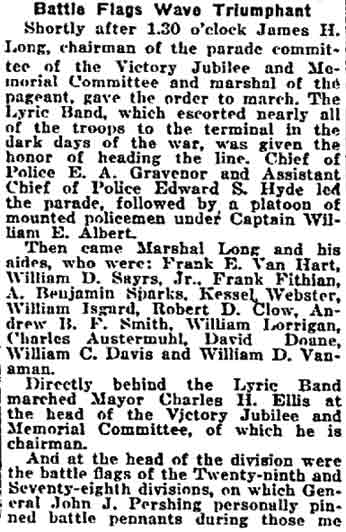
Shortly after 1.30 o’clock James H. Long, chairman of the parade committee of the Victory Jubilee and Memorial Committee and marshal of the pageant, gave the order to march. The Lyric Band, which escorted nearly all of the troops to the terminal in the dark days of the war, was given the honor of heading the line. Chief of Police E. A. Gravenor and Assistant Chief of Police Edward S. Hyde led the parade, followed by a platoon of mounted policemen under Captain William E. Albert.
Then came Marshal Long and his aides, who were: Frank E. Van Hart, William D. Sayrs, Jr., Frank Fithian, A. Benjamin Sparks, Kessel Webster, William Isgard, Robert D. Clow, Andrew B. F. Smith, William Lorrigan, Charles Austermuhl, David Doane, William C. Davis and William D. Vanaman.
Directly behind the Lyric Band marched Mayor Charles H. Ellis at the head of the Victory Jubilee and Memorial Committee, of which he is chairman.
And at the head of the division were the battle flags of the Twenty-ninth and Seventy-eighth divisions, on which General John J. Pershing personally pinned battle pennants during those memorable days back in October in the Argonne forest. Behind the 4th marched the famous engineers, headed by Captain Keasby and Captain Beals Smuck. Three battle pennants were pinned to their flags, which never touched the ground while they were bridging the rivers in the Argonne under hellish shell fire for the doughboys to advance. Then came the 112th Field Artillery, Battery B’s heroes of the border and of France, headed by Captain Charles Richards and Captain Dickinson. In the same section marched the Eleventh Machine Gun Battalion with its battle flags and pennants fluttering.
There was another great cheer as the Seventy-eighth Division, New Jersey’s Lightning boys, loomed into view. The heroes of the 311th Infantry, 303d Engineers, 307th, 308th and 309th Field Artillery and other regiments of that famous command were given a mighty ovation behind their battle flags, which led them in their assault on St. Mihiel and the day they attacked and captured Grand-Pre in the terrible conflict in the Argonne.
Behind them marched the Marines, headed by Lieutenant Monitor Watchman, of the Fifth Regiment, Second Division. With the Marines marched the regular army units, men who had served in as many as five battles and wore three and four gold service stripes on their sleeves.
Then followed the naval contingent. They were commanded by Commander Francis W. Hoffman and Commander W. G. Hodgson.
The order “eyes left” flashed along the line as each platoon drew near the reviewing stand and Admiral Wilson with his band to his cap returned the salute. With the admiral on the stand were former United States Senator David Baird, Congressman William J. Browning, County Collector John S. Well, City Clerk W. D. Brown and others.
At the armory a splendid banquet was served to the soldiers and sailors. For days past corps Red Cross workers had been preparing the good things to eat and the men did full justice to them. They marched in the armory where the food was spread on the tables and enjoyed themselves while bands played. After dinner there were speeches. Mayor Ellis in welcoming the men said:
“This is one of the happiest moments of my life. I have waited patiently through months of trial for the glad day when I could bid you welcome to the City of Camden once again.
“We are planning to erect a lasting memorial in memory of those heroes who gave their lives and in memory of the valiant deeds you performed on land and sea.
“Camden will always cherish the memory of this day, rever the memory of your dead comrades and will inscribe your valiant deeds on that memorial. I bid you welcome in the name of the most patriotic little city in America. I thank you.”
Prosecutor Charles A. Wolverton welcomed the men on behalf of the county and paid a tribute to their valor recalling their wonderful victories of the Argonne and other battlefields of France.
Police to Probe $200,000 Kaighn Ave. Fire
Camden Courier-Post —
Fire Captain May Die, Four Others Injured; Damage Is $200,000
Economy Store and Other Buildings Near Broadway Swept by Flames Early This Morning — Falling Debris Carries Men Through Roof And Into Cellar — Sleeping Inmates of Apartments Roused and Invalid Carried to Safety — Mayor Sees Rescues
Mayor Ellis has ordered an investigation to determine the cause of the $2000,000 fire which swept the properties at 427 and 429 Kaighn Avenue and caused injury to five firemen, one of whom may be fatally hurt.
The fire centered about the property occupied by the Economy Store, formerly Handle’s, and quickly spread to four adjoining buildings.
The fireman whose recovery is despaired of is Captain Martin B. Carrigan, of Engine Company No. 2, Fifth and Arch Streets. Carrigan, who lives at 618 West Street, is suffering from a fractured skull and severe burns and cuts of the face, legs, and body. He is unconscious at Cooper Hospital.
The firemen were injured when a wall, weakened by the intense heat, crumbled and crashed through a roof upon which they were standing, dragging them through the floor below, and into a cellar. Sensational rescues followed as police, firemen, and citizens with bare hands tore at the hot debris. The men were quickly extricated and carried to the street.
“We certainly shall investigate this fire,” the Mayor declared today. “Just what was the cause and who is to blame has not been determined but there will be a thorough investigation.”
“There have been too many of these fires during the past few weeks” continued the mayor. “Surely all of them did not just happen and I am sure there has been someone responsible in one or two of the fires.”
The conflagration was one of the most spectacular of a series of large fires that have visited the city in the past six weeks. The block in which it occurred — Kaighn Avenue between Broadway and Fourth Street is one of the most prominent business squares in Camden.
Flames shot 200 feet in the air, giving the sky a fiery hue and attracted attention for miles before the firemen brought it under control. The flame-lit sky was clearly seen in Philadelphia, Merchantville, East Camden, Gloucester and other communities.
More than a score of families living in the vicinity were forced to flee from their homes in scant attire when the fire threatened them. They were cared for by neighbors.
Fireman George Boone, 46 years old, of Engine Company No. 2, also is in a serious condition. He is suffering from burns of the right hand, right thigh and foot and probable internal injuries. Boone lives at 607 Mount Vernon Street.
The other injured foremen are:
John Voll, 22 years old, 509 Royden Street: both hands badly burned.
C.J. Andrus, aged 31 years, 570 Mount Vernon Street: burns of hands and legs.
Harold Lorang, 29 years old, 19 Hudson Street: burns of right hand and legs and sprained ankle.
Firemen Prove Heroes
Carrigan and Boone are in the hospital. The other firemen were discharged after their wounds were dressed. After being released from the hospital they returned to the scene of the fire and insisted upon continuing their duties. Chief Peter B. Carter, however, ordered them home.
Most of the loss was suffered by the Economy Store. A few charred walls remain of the large building. The interior was completely gutted. It was estimated today that the damage to that property will total $60,000 At least $50,000 damage, it was said, was done to the stock.
Morris Handle, local theatrical man, who owns the building, declared today that the property was insured for $30,000. “My loss will be quite heavy,” said Mr. Handle. “The insurance will not pay one-half the property damage.”
The adjoining building at 431 Kaighn Avenue is occupied by Dr. S.I. Yubas, optometrist, and L.R. Yubas, his father, a jeweler.
Invalid is Rescued
The rear and upper floors of the Yubas property were gutted and the stock sustained a heavy loss, due to water and smoke. The damage will total $40,000, Mr. Yubas estimated today.
Five persons who were asleep on the upper floors of the Yubas dwelling had narrow escapes. They were awakened by Samuel Goldstein, haberdasher, 417 Kaighn Avenue, who discovered the fire in the Economy Store and turned in the alarm. Mrs. L.R. Yubas, an invalid, was rescued with difficulty.
The property occupied by Mrs. Sadie Bodner, a widow, at 433 Kaighn Avenue, as a house furnishings store, was scorched and also damaged by water and smoke.
Adjoining the Economy Store on the west at 425 Kaighn Avenue is a vacant one-story structure, formerly occupy by the United Beef Company. Firemen were on the roof of that building when the west wall of the Economy Store collapsed. The wall tumbled down on the small roof and hurled the firemen through a hole in the roof, through the floor and then into the cellar.
Several Stores Damaged
Three policemen, Joseph Sparks, Thomas Cheeseman, and George Hill — and several spectators braved the fire and smoke to rescue the trapped firemen.
The property at 423 Kaighn Avenue, occupied by the Charles Jamison Department Store, was damaged in the rear and the stock ruined by water and smoke. The Kresge Five-and-Ten-Cent Store, at 519-531 Kaighn Avenue, was also damaged by water.
Louis Richelson, who owns the properties from 519 to 525 Kaighn Avenue, was unable to estimate his loss today.
Collapse of Wall
Hundreds of spectators, who were watching the fire from the opposite side of the street, shuddered as they saw a brick wall, weakened by the intense heat, totter and sway. Before the firemen on the smaller roof below could scurry to safety, it collapsed.
A groan escaped the crowd as they heard the cries of the entrapped firemen and the deafening thud of the brocks as they landed on the roof where the firemen were at work.
As the full weight of the brocks struck the roof, it caved in forming a gaping hole. The firemen were literally swept into the opening.
The bricks tumbled down, causing another hole in the floor between the firs story and the cellar and dragging the imperiled firemen into the cellar with them.
Mayor Charles H. Ellis was among the spectators who witnessed the collapse of the wall. Other officials were Chief James H. Long, of the Water Department; Fire Chief Carter, Assistant Police Chief Edward S. Hyde, Captain Lewis Stehr of the Second Police District, and Street Commissioner Alfred L. Sayers.
Firemen Under Debris
Observing the peril of the trapped firemen, Policemen Sparks, Cheeseman and Hill, together with a dozen other spectators, rushed across the street to the vacant store. They rushed through the smoke and fire, leaped into the cellar and reached the struggling firemen.
Sparks, the first to leap into the cellar, reached Voll, who had been pinned beneath a pile of debris and was pleading to be rescued. The policeman feverishly extricated Voll from his precarious position and carried him out into the street to safety.
Policeman Cheeseman had accidentally fallen into the cellar and, though himself injured, groped about in the dark until he found Boone, whom he dragged outside.
Policeman Hill carried Carrigan out of the cellar in his arms.
The five firemen were carried to a waiting police ambulance and rushed to Cooper Hospital. Carrigan was unconscious. He haws a slim fighting chance to recover.
Carrigan was promoted to a captaincy the first of the year. He is popular among his comrades and has the reputation of being a fearless fireman.
Mayor Praises Firemen
Mayor Ellis praised the work of the firemen and the bravery of the policemen who had risked their lives to effect the rescue.
“Never did I see such remarkable work” said the Mayor. “When I arrived at the scene, it looked as if the whole block was doomed. The flames were shooting upward and the whole sky seemed lit up. The firemen tackled their job with dispatch and courage. I was proud of them. They knew their business and showed it by confining it to a comparatively small area. The work of the police also was commendable.”
Mr. Goldstein discovered the fire shortly before midnight.
“I had just left my home at 417 Kaighn Avenue,” explained Mr. Goldstein, “intending to get a soda. As I passed the Economy Store I noticed strong odor of smoke. I peered into the glass doorway of the store. I immediately saw the place was afire.”
Rescues Sleeping Family
“Then I ran back to my store” continued Mr. Goldstein, “and I telephoned police headquarters. I went out again and returned to the scene. I remembered that the Yubas family were asleep on the second and third floors and rapped on the doors. Mr. Yubas came down in a bathrobe. He was not aware of the fire.”
The six persons asleep in the Yubas home were Dr. Yubas, Mr. And Mrs. L.R. Yubas, Bernard Helfand, Miss Bertha Cuden and Anna Recowitz, a domestic.
Mrs. Yubas, who is recovering from an illness, was too weak to make her way outside through the smoke. Assisted by her husband, Policemen Becker and Cheeseman and Constable John Cunningham, Mrs. Yubas was half carried downstairs, and out through the rear of the building to safety.
Blaze Had Big Start
“The fire had gained such rapid headway,” said Sergeant Thomas Cunningham, “that when the firemen arrived, smoke was actually issuing from cracks in the sidewalks and between the cobbles near the trolley tracks.”
Kaighn Avenue, between Broadway and Fourth Street, was literally alive with residents and passers-by attracted by the flames. Included among the spectators were scores of persons who came from Philadelphia and distant points, in the belief the blaze was much more serious.
According to the estimate of the loss made today, the insurance on the property and stock damaged by the fore will not pay for one-half the loss sustained.
Chief Carter was determined to take no chances with the fire because of the high wind and the fire was attacked on all sides. While firemen were fighting the flames from Kaighn Avenue several companies of firemen had worked their way into the yard in the rear, from whence they played streams of hose.
An effort is being made today to determine the origin of the blaze.
Thomas Shanahan, Engine Company 6, was a spectator when the wall crashed in. Hearing the cries of the buried men, he immediately dashed into the dirt. Six men, including Harry Seeley, formed a human chain and pulled four of the men from the heap of rubbish.
Someone had the presence of min to turn off the nozzle of a hose, which was playing directly o the mound. When found, the water was trickling through to the pinned men.
High Wind Fanned Flames
A high wind gave them great difficulty. A number of times, when the firemen seemed to have the fire under control, the flames burst out afresh and compelled them to retreat. Then the reflection would light up the sky overhead.
Water Chief Long gave the firemen great service in maintaining the water at a high pressure to ensure facility in getting the streams to play upon the flames.
Patrons, Patronesses Announced Today for First Military Ball
Camden Courier-Post —
Patrons and patronesses for the first military ball of the Camden Post No. 960, Veterans of Foreign Wars, to be held on Friday evening February 3 in the Elks auditorium, Seventh and Cooper Streets, are announced today.
The following prominent men and women are listed: Mrs. J.W. Connor, Miss C.M. Day, Mrs. J.H. Forsyth, Mrs. H.J. Goodyear, Miss B. Graham, Mrs. R.E. Green, Mrs. E.F. Haines, Mrs. J. Hood Jr., Mrs. W. Hurley, Mrs. J. Jarrell, Mrs. T. Keefe, Mrs. J.F. Kobus, Mrs. L. Liberman, Mrs. F.L. Lloyd, Mrs. M.A. Logan, Mrs. T.P. McConaghy, Mrs. F.F. Neutze, Mrs. L.K. Marr, Mrs. J.A. Pennington, Mrs. M.E. Ramsey, Mrs. E. Truax, Mrs. S.M. Shay, Mrs. W.J. Staats, Mrs. B.G. Tarburton, Mrs. R.W. Waddell, Mrs. E. Watson, Mrs. E.P. Wescott, Mrs. C.A. Wolverton.
David Baird Jr., William T. Boyle, Isaac Ferris, William Hurley, John Hood Jr., John Jarrell, Victor King, William J. Kraft, Thomas Keefe, Joseph F. Kobus, Hon. Edmund B. Leaming, Dr. A. Haines Lippincott, James H. Long, L.K. Marr, Dr. Thomas P. McConaghy, Hon. Frank F. Neutze, Samuel P. Orlando, Albert E. Simmons, Edwin Watson, Ethan P. Wescott.
Elks Install Stewart as New Ruler Tonight
Camden Courier-Post —
ELKS INSTALL STEWART AS NEW RULER TONIGHT
With two Assemblymen taking the highest stations, Camden Lodge of Elks will tonight install recently elected officers at the home, Seventh and Cooper streets. The ceremony will be presided over by Past Exalted Ruler James H. Long.
Roy R. Stewart, thrice elected to the Assembly, will become the lodge’s exalted ruler, while Assemblyman William B. Knight will take the esteemed leading knight’s station, the next in line for the higher office.
Other officers to be installed include: William Hopkins Iszard, a former Assemblyman, esteemed loyal knight; William F. Lehman, esteemed lecturing knight; Albert Austermuhl, secretary; Homer F. Lotier, treasurer; Samuel A. Kilpatrick, tyler; George Fisher, trustee; Rud Preisendanz, representative to grand lodge; William L. Sauerhoff, alternate; Preisendanz, delegate to state association.
A social session will follow the installation.
‘Good Will’ Auto Arrives Here Today
Camden Courier-Post —
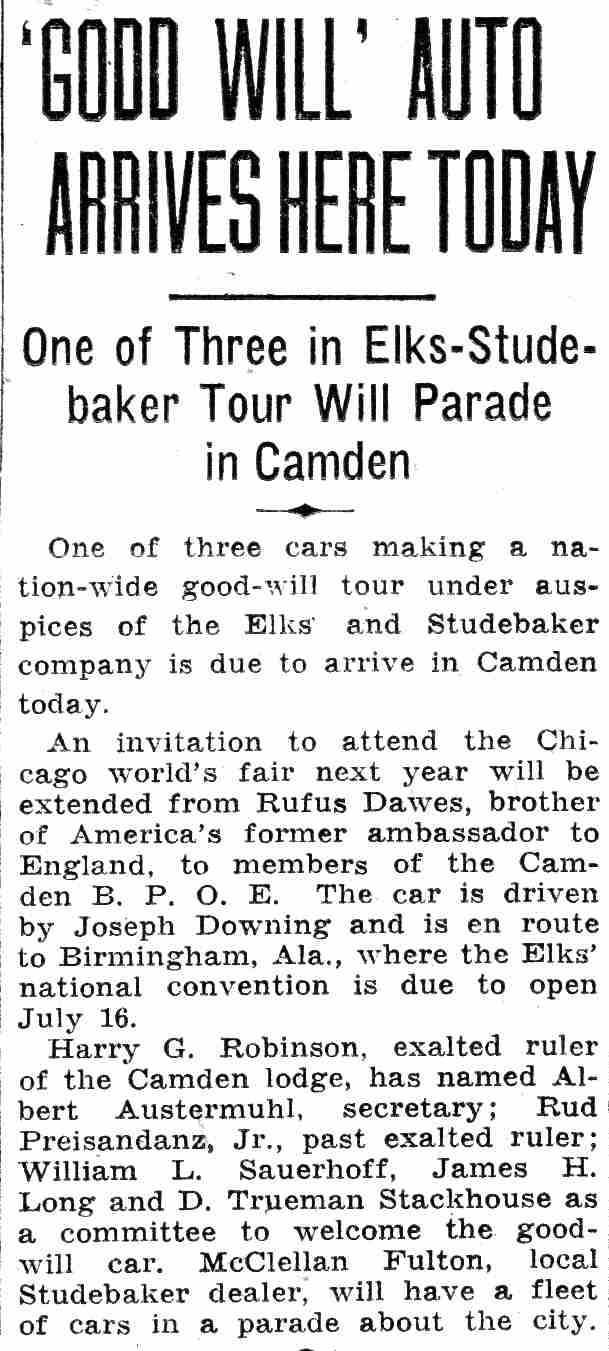
‘GOOD WILL’ AUTO ARRIVES HERE TODAY
One of Three in Elks-Studebaker Tour Will Parade in Camden
One of three cars making a nation-wide good-will tour under auspices of the Elks’ and Studebaker company is due to arrive in Camden today.
An invitation to attend the Chicago world’s fair next year will be extended from Rufus Dawes, brother of America’s former ambassador to England, to members of the Camden B. P. O. E. The car is driven by Joseph Downing and is en route to Birmingham, Ala., where the Elks’ national convention is due to open July 16.
Harry G. Robinson, exalted ruler of the Camden lodge, has named Albert Austermuhl, secretary; Rud Preisandanz, Jr., past exalted ruler; William L. Sauerhoff, James H. Long and D. Trueman Stackhouse as a committee to welcome the good-will car. McClellan Fulton, local Studebaker dealer, will have a fleet of cars in a parade about the city.
Camden Elks to Honor Past Exalted Rulers
Camden Courier-Post —
CAMDEN ELKS TO HONOR PAST EXALTED RULERS
Past exalted rulers will be honored tonight by Camden Lodge of Elks with a dinner, ceremonial and entertainment.
The program will be nation-wide. A dinner will be served at 6:00 PM, followed by a business session. Harry G. Robinson, present exalted ruler, will open the ceremonial and turn the lodge over to the past officers.
The past exalted rulers expected are Samuel Kilpatrick, who served in 1900 and 1921; Dr. A. Haines Lippincott, Alexander J. Milliette, J. Harry Switzer, James H. Long, Marian Moriarity, Allen Jarvis, Albert Austermuhl, William L. Sauerhoff, former Mayor Frank S. Van Hart, D. Trueman Stackhouse, Harry Ellis, William G. Ferat, Judge Garfield Pancoast, Rudolph Preisendanz, Jr., Theodore T. Kausel, Edward J. Kelley, Mayor Roy R. Stewart, William H. Iszard, William S. Lehman and J. Harry Todd.
Camden Elks Hope to Get Convention
Camden Courier-Post —
Advisory Committee Will Present Formal Invitation for State Meet
CAMDEN ELKS HOPE TO GET CONVENTION
The twenty-first annual reunion and the convention of the New Jersey State Elks Association will be held in Camden next June if efforts of the advisory board of Camden Lodge of Elks are successful at the state meeting in Newark on June 15, 16 and 17.
Members of the advisory board for the local lodge, who are past exalted rulers of the Camden lodge, will present the invitation to hold the 1934 meeting in Camden, at the twentieth reunion and convention in Newark.
Members of the lodge have adopted a resolution confirming the action of the advisory board and plans were made to set the necessary machinery in motion to bring the 1934 convention to Camden. It was pointed out that Camden Elks have the largest home in the state.
Samuel Kilpatrick, the oldest past exalted ruler of the lodge, is head of the advisory board, and Harry G. Robinson, youngest past exalted ruler, is delegate to the state association, which is composed of past exalted rulers of all Elks lodges in New Jersey.
Although the state association was formed in Camden, there has never been a reunion or convention of the association held here, it was pointed out.
The outstanding feature of each annual convention is the mammoth sessions, with thousands of Elks in line. It is estimated the parade would draw more than 50,000 persons to Camden, if the local lodge’s invitation is accepted.
The Camden lodge is sending the band and patrol to Newark for the parade, which will start at 7 p. m. on June 17. Arrangements are being made to have the largest delegation in the parade represent Camden.
Past exalted rulers who comprise the advisory board, and the year they took office, follow: Samuel Kirkpatrick, 1900; Dr. A. Haines Lippincott, 1901; Alex J. Milliette, 1906; J. Harry Switzer, 1908; James H. Long, 1911; Marion Moriarty, 1113; Allen Jarvis, 1914; Albert Austermuhl, 1915; William L. Sauerhoff, 1917; Theodore T. Kausel, 1918; Garfield Pancoast, 1919; William G. Ferat, 1920; Harry Ellis, 1921; Samuel A. Dobbins, 1923; D. Trueman Stackhouse, 1924; Frank S. Van Hart, 1925; Edward J. Kelly, 1926; Rud Preisendanz, Jr., 1927; Roy R. Stewart, 1928; William H. Iszard, 1929; William Lehman, 1930; J. Harry Todd, 1931, and Harry G. Robinson, 1932.
Deceased past exalted rulers and the year they took office are: John H. Foster, 1895; W. E. B. Miller, 1896; Philip Burch, 1897; D. Harry Condit, 1898; H. L. Hartshorn, 1891; George D. Borton, 1902; Maurice Rogers, 1904; Francis Warren, 1907; E. Wilmer Collins, 1909; Lewis H. Leigh, 1910; Morris Odell, 1912, and W. Wallace Balcom, 1922.
Camden Protected During Big Blaze
Camden Courier-Post —
See also: C.B. Coles & Sons Lumber Co. Fire, July 11, 1933

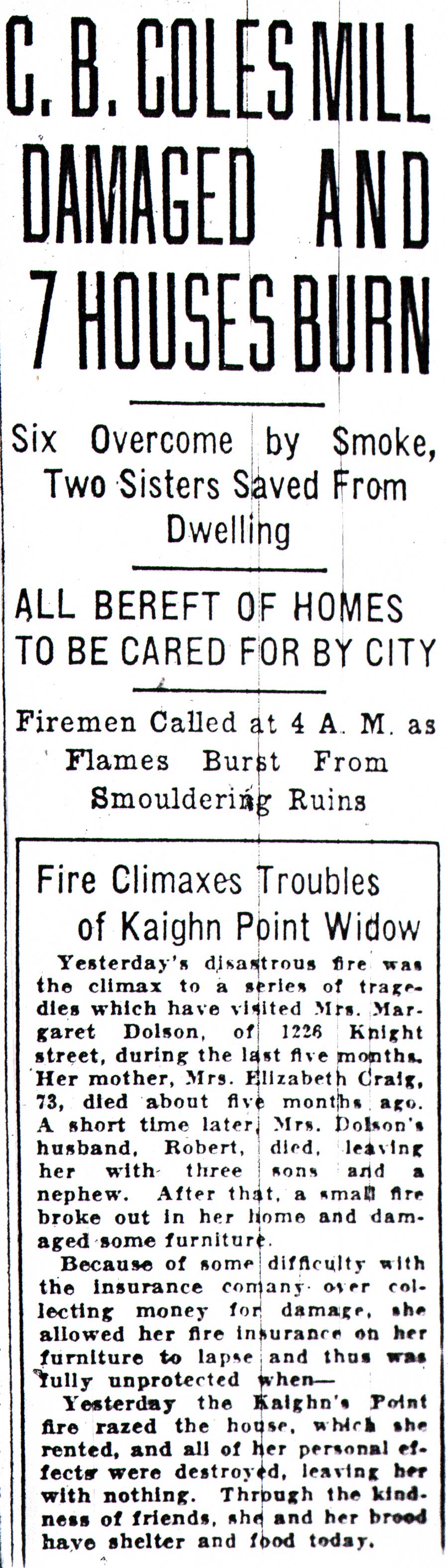
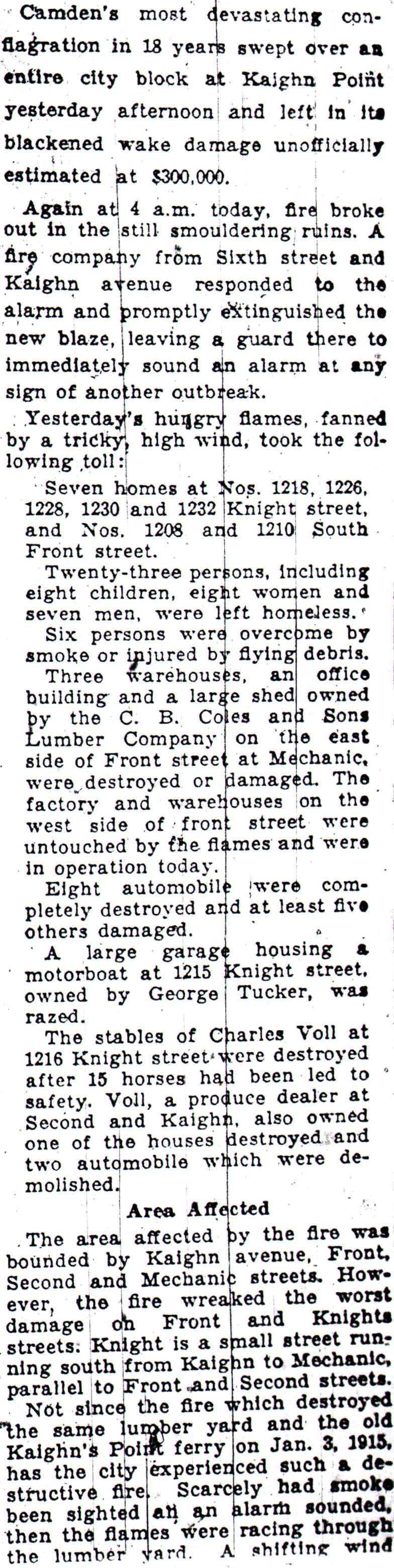
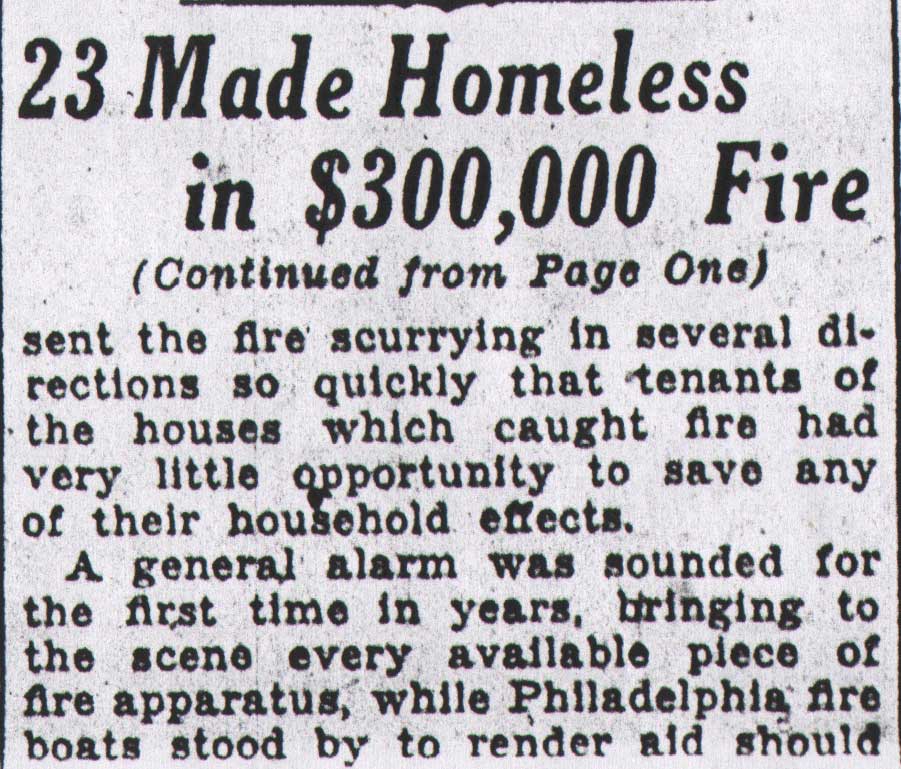
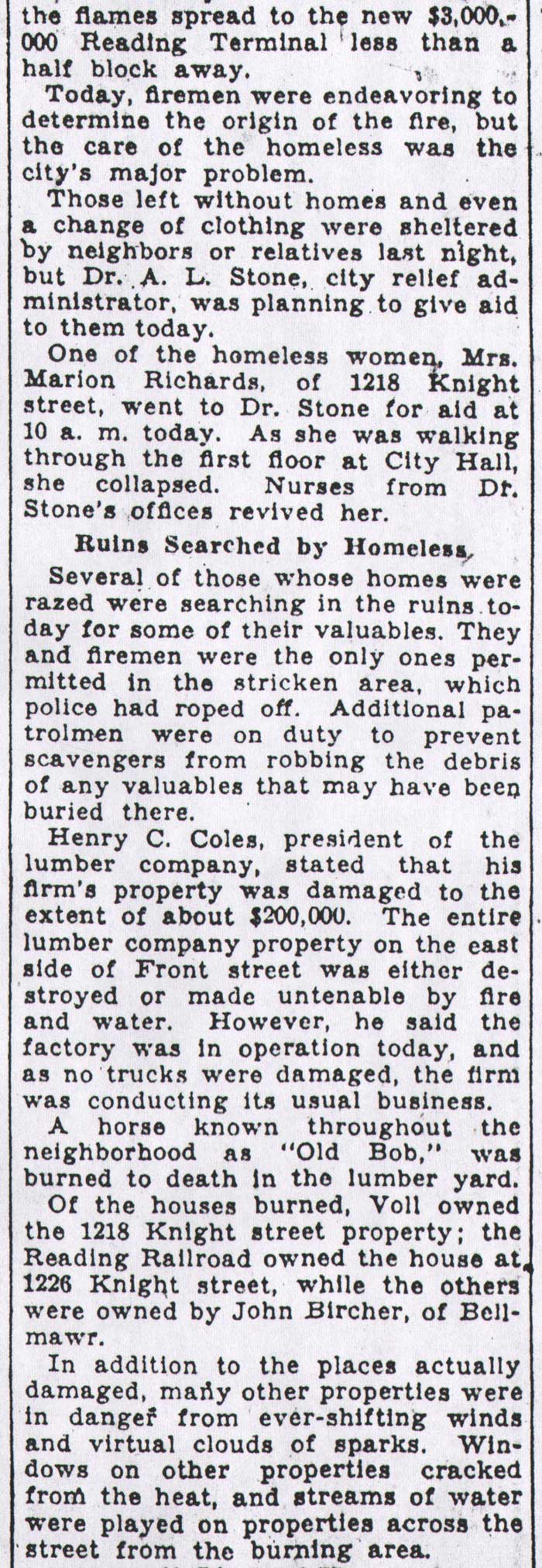
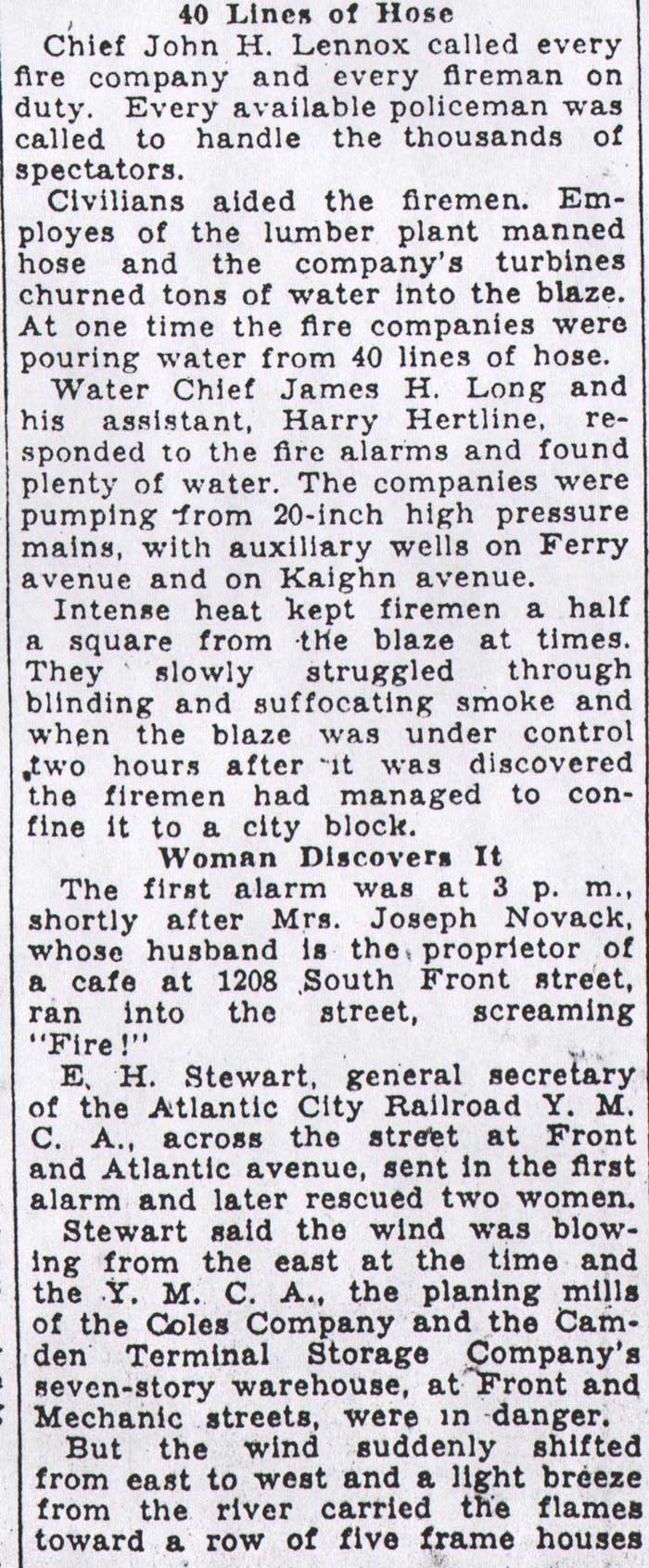
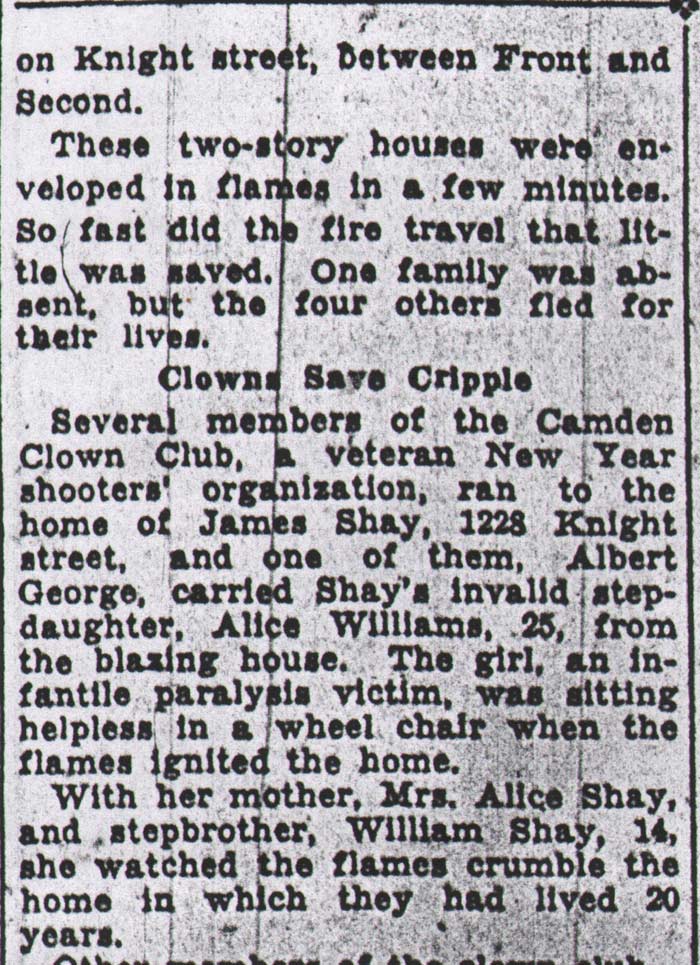
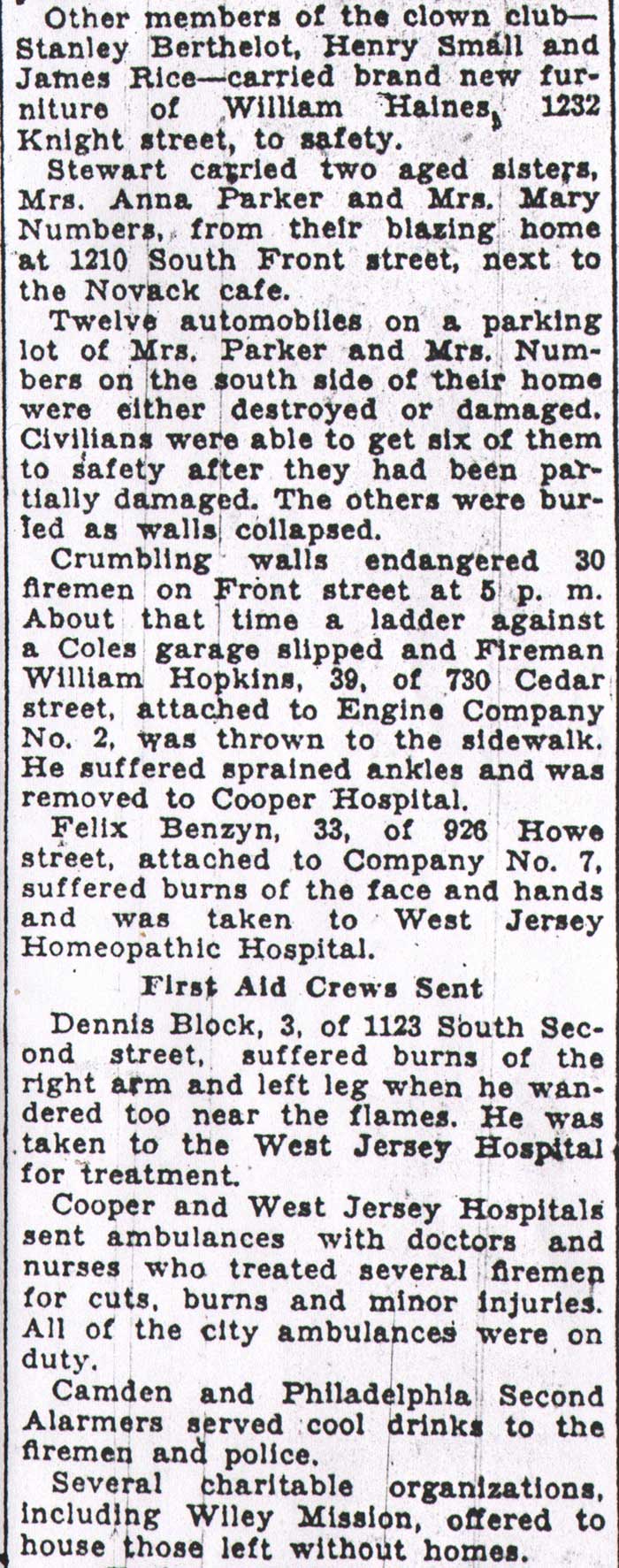
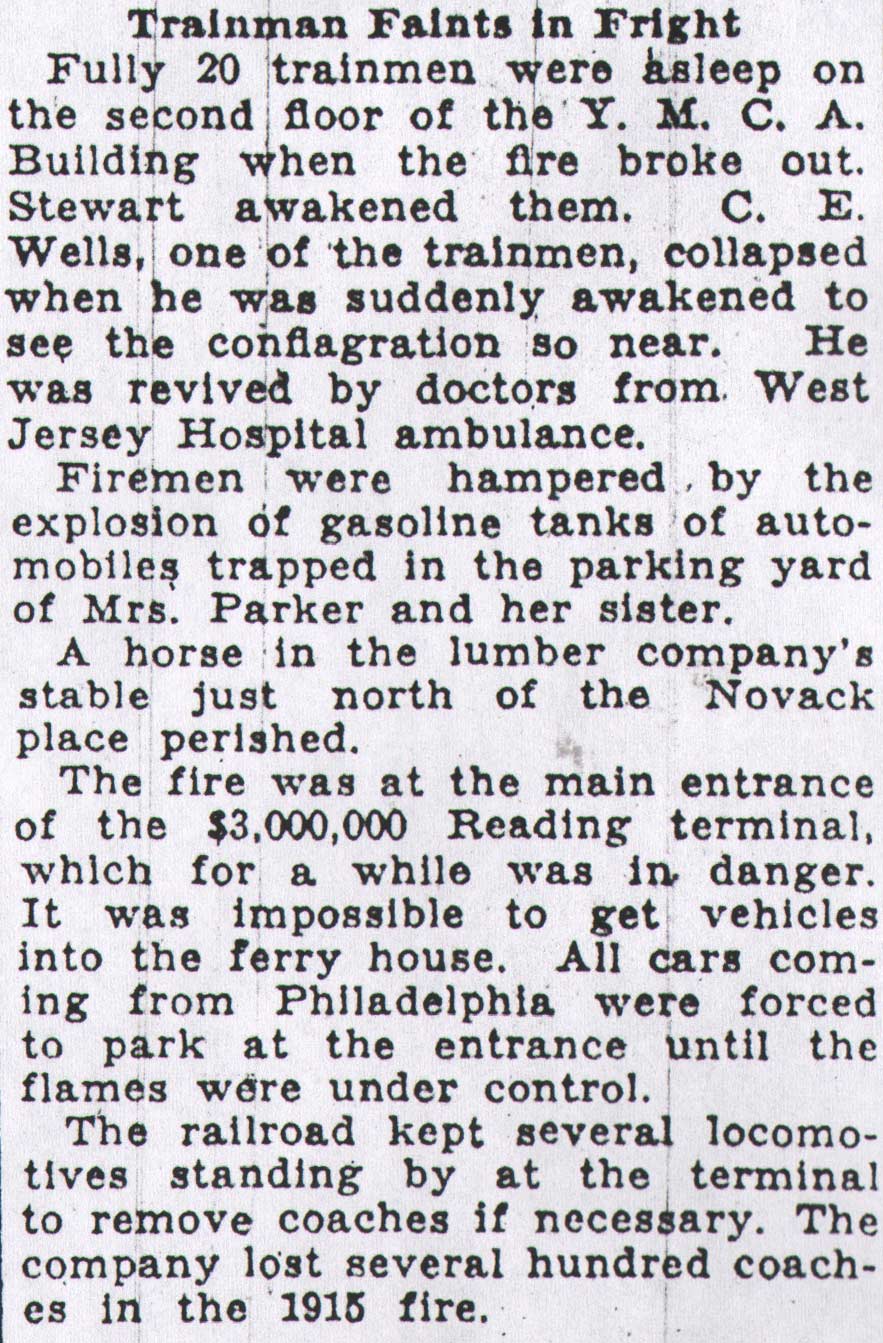
CAMDEN PROTECTED DURING BIG BLAZE
3 Firemen Off Duty Commandeer Truck and Wait for Any Emergency
With all available fire-fighting apparatus at the Kaighn’s Point conflagration, three members of the city fire department who were off duty nevertheless provided Camden with its only protection against other fires by breaking into an abandoned firehouse and manning a fire truck.
Also noted in the caption: Engine Company 2 – Engine Company 7 – William Hopkins – Felix Bendzyn – Dennis Block – C.E. Wells – Howe Street – Cedar Street – Wiley Mission
City Water Profits Set Record in Year
Camden Courier-Post —
Hartmann Reveals Earnings at Rate of $1000 a Day; Equals 27c Tax Cut
Camden’s water bureau operated at an unprecedented profit of $365,804.24 last year, Commissioner Frank J. Hartmann announced yesterday. The figure is equivalent to 27 cents on the tax rate.
Actual collections — current and delinquent — totaled $651,456.08, or $43,299.11 in excess of the total assessment of $608,156.97. Expenditures were listed in Hartmann’s report at $367,823.24.
City’s Water Bureau
The actual cash surplus turned over to the city’s treasury reached the record figure of $253,804.24, according to the commissioner. This figure compares with $181,000 for 1936.
To the cash balance Hartmann adds $17,000 paid out of water receipts to the New Jersey Water Company for fire-hydrant rental in the Eleventh and Twelfth wards, $85,000 in free hydrant service in the other 12 wards, and $10,000 for water supplied free to public schools, hospitals, all public buildings, street sprinklers and municipal wading and swimming pools.
Demand Nearly Up to 1936
Despite the increase in revenues and profit the daily average pumpage for the year was 16,256,139 gallons, compared with 17,780,167 in 1936, Hartmann revealed. The biggest single day m 1937 was Aug. 19 when 29,870,000 gallons were pumped; the smallest was Nov. 21 with 10,805,000. In 1936, the maximum was reached Aug. 25 with 28,644,000. The minimum was on Nov. 15 with 11,362,000.
The municipal water bureau has 24,866 customers, exclusive of 6000 served in the two East Camden wards by the private company, Hartmann’s report discloses. Flat rate services number 23,444; meters, 1442. Camden has 140 miles of mains and 1500 fire hydrants.
The 1937 assessment was made up of $382,506.67 for flat rates and $225,650.30, meters.
Actual ash collections were $325,966.92 and $206,431.53, respectively.
In addition, miscellaneous water revenue produced $15,195.95, one-year delinquent flat rates $52,262.36, one-year meters $19,586.02, outstanding flats $26,792.28 and outstanding meters $5221.02.
Against this total revenue of $651,456.08, expenses were $367,823.24, made up as follows:
Debt service, $122,054.75, or 33.2 percent (interest, $71,104.97; maturing bonds, $46,475; sinking fund, $4474.78). Payroll, $104,538.77, or 28.41 percent. Light and power $92,395.72, or 25.1 percent. Fire hydrant rentals $17,064.01, or 4.65 percent. Miscellaneous $11,751.09, or 3.2 percent. Pipes and mains $5088.52, or 1.38 percent. Wells and stations $14,930.38, or 4.06 percent; taxes and insurance, $2172.16; meters, $1720.96; building maintenance, $1329.92; machinery, $1167.71; gas and oil, $1125.41; auto maintenance, $1100.05; telephone charges, $795.55; coal, $728.66; street repairs, $529.29; oil, waste and packing, $278.53.
Staff Praised by Hartmann
In his report, Hartmann praises the work of James H. Long, Edward Sheehan and James W. Connor, respectively superintendent of water distribution, assistant superintendent and chief clerk.
“The water bureau last year rendered service to 24,866 customers with complaints that were negligible in nature and few in number,” Hartmann said.
“Water supplied to Camden comes from 10 sources within the city limits and three outside, Morris, Puchack and Delair. Each wellhouse was repaired and painted during the year.
“An example of what is being done is the reconditioning of well No. 5, in the rear of Convention Hall, which was damaged by electrolysis. This well was pulled, cleaned and had a new silicon-bronze screen installed and repacked, with the result that where the well formerly produced 900 gallons of water a minute, it now regularly produces more than 1100.
“The well crew is systematically and continually overhauling and cleaning all wells in our system, with the result that today we find the production of our water supply in better condition and more adequate than at any other time in the history of Camden.
“No new wells were installed during the last year at any location. While our water mains still contain a little foreign matter which was accumulated during the days when Camden received its supply from other sources, this situation is gradually being remedied by flushing mains and opening fireplugs.
“Because the temperature of Camden’s water is so low (between 52 and 56 degrees) and because it is relatively free from chemicals and foreign matter, air conditioning is bound to make great strides in the city.
“Food and beverage companies are discovering that Camden water is valuable for their business, and a combination of all these is definitely sure to result in a greater demand for the product.”
Listing operations, Hartmann said service was turned off Jan. 1, 1937 at 492 properties; 33 new meters were installed, 54 new permits granted, 180 fixture installations made, 383 fire hydrants repaired, 13 new hydrants set, one hydrant removed, mains and valves repaired, meters tested and repaired, 370 ferrules replaced and 44 ferrules taken out.
“Inspectors’ reports show 2930 inspections, 1340 complaints found, 529 shutoffs, 11,389 bills delivered, 6888 meters read, 336 fire hydrants examined, 988 leaks found, 8432 notices served and 295 turn-ons,” Hartmann said.
“In line with our policy of cooperation among bureaus, our inspectors made 553 reports to the building bureau, 49 to the board of health, 167 to the highway bureau and four to the electrical bureau.
“The office force comprising five clerks worked daily from 8.30 a.m. to 5 p. m. except on those days at the end of each tax quarter, when the office remained open until 9 p. m. The bureau has 62 men on the payroll in all.”
James H. Long Dies, Retired as Chief of City Water Bureau
Camden Courier-Post —
Veteran City Aide Worked to Assure Camden of Adequate Supply
James H. Long, “Chief” to thousands of Camdenites, and veteran of the Camden water bureau, died yesterday in West Jersey Hospital where he was taken last Tuesday.
Mr. Long, who was 75, lived alone at 702 North Fourth Street.
After seeing the water department system built from a nine-well plant capable of pumping only 14,000,000 gallons of water a day to a 27-well system pumping 45,000,000 gallons, Mr. Long was retired last February 1, with more than 27 years of active service to his record.
Learned Trade Here
Mr. Long joined the city department in 1912. He was born at Norfolk, Virginia, and learned the machinist trade in Camden. He became superintendent of the Dodge Coal Conveyor Company at Port Richmond, Philadelphia; and worked for 19 years as a gauger in the U. S. Department of Internal Revenue before coming to Camden.
In Camden, Mr. Long and the municipal water plant were synonymous. When he took charge on January 1, 1912. the supply was insufficient to meet even normal conditions, let alone peak loads. He fought for and put over the idea of developing the Delair plant and had new type air wells installed. His activities were credited with helping attract industry to Camden and encouraging expansion of existing plants, including Campbell Soup Company.
One of Mr. Long’s successful fights was to have the city’s water system constructed to such a point there would be no interruption in service in the event the main feeder main from the principal artesian wells of the city at Morris and Delair stations was broken. He had a sub-feeder main installed and the foresight of this was illustrated about two years ago when the feeder main at Twelfth and Federal streets broke beneath the bridge of the Amboy division of the Pennsylvania Railroad.
3 Days of Repairs
If it had not been for the sub-feeder Mr. Long had installed, the city water supply would have been materially reduced and the northern part of the city would have been without water for the three days it took to fix the break. Mr. Long worked night and day, to repair the damage.
Mr. Long was active in civic and social affairs. He was a member many years of the Camden Lodge 293, B. P. O. E and a past exalted ruler of that organization. He was a 33rd Degree member of Ionic Lodge, F. and A. M., and a member of North Baptist Church.
The only surviving relative of Mr. Long is a cousin, Mrs. Clara Hann, of 307 Twenty-third Street, Wildwood.