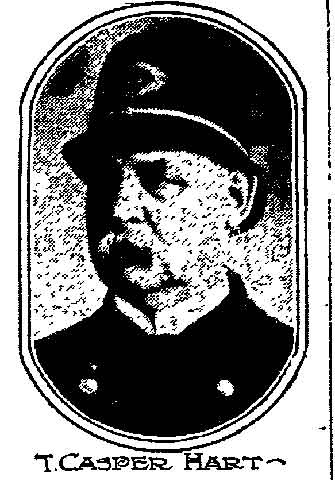
T. Casper Hart
T. Casper Hart
THOMAS CASSEN HART, who was known popularly in his time as Casper Hart, was a member of the Camden Police Department from 1886 through 1893 and again from 1899 until his death in March of 1910. He was appointed from and served in Camden’s Fifth Ward, which was from Line Street to Liney Ditch (just below Everett Street) and from the Delaware River to Fourth Street, and included the Kaighn’s Point Ferry and the then very busy Kaighn Avenue business district. This area in more recent times was known as Foggy Bottom.
Casper Hart was born in Pennsylvania in January of 1848 to John and Elizabeth Hart. He wed in the early 1870s, and his wife Sarah bore two children, Elise, and Fred J. Hart in Pennsylvania. The family moved to Camden in the late 1870s. A daughter, Kate, was born in New Jersey around 1878. The 1880 Census shows the family living at 1142 South Front Street in Camden’s Fifth Ward. Casper Hart’s occupation was given as fisherman. The family then included Casper (listed as “Thos. C. Hart”), Sarah, Elise, Fred J., Kate, and Casper Hart’s widowed mother, Elizabeth Hart, then 70, as well as a boarder, James Laage. By the spring of 1884 Casper Hart had moved to 109 Kaighn Avenue and opened an oyster restaurant with his wife Sarah. By the spring of 1885 he was back to working on the Delaware, this time as a pilot, while his wife tended to the restaurant. By the time the 1887 City Directory was compiled, the Harts had moved to 1102 South 3rd Street. The family had moved to 1132 South Front Street by 1890. During this time he became active in local politics in the Fifth Ward as a Republican.
On August 25, 1886 T. Casper Hart was appointed to the Camden Police Department by then Mayor Jesse Pratt. He served until June of 1893, when he was let go as part of a mass purge of Republican-affiliated policemen by the Democrat party. During this time he was involved in two well-publicized murder cases, one, when he apprehended Dominico Cocco, who had murdered his sister-in-law at Cedar Brook, and another, when he discovered the body of Ella Ford in a cellar in the 800 block of Locust Street.
T. Casper Hart was still living at 1132 South Front Street as late as the spring of 1892. By the end of 1893 he had moved to 1219 Hyde Park, a small street that ran south for one block from Kaighn Avenue between South 2nd and South 3rd Streets. He worked as a boxman for J.F. Dalrymple and by the spring of 1894 and into 1895 was making his home at 123 Kaighn Avenue. By the end of 1898 he had moved to 229 Kaighn Avenue, and was working as a salesman. He was still at that address in 1899, but moved by the following spring.
In January of 1898, T. Casper Hart served as a member of the jury in the trial of Mrs. Florence McCusker, who was accused of shooting her husband to death in November of the previous year.
In September of 1899 T. Casper Hart was re-appointed to the Camden Police Department. The 1900 Census shows that T. Casper and Sarah Hart had separated. He and his son Edward, then 16, were boarding at 273 Kaighn Avenue, the home of John Osborne and family.
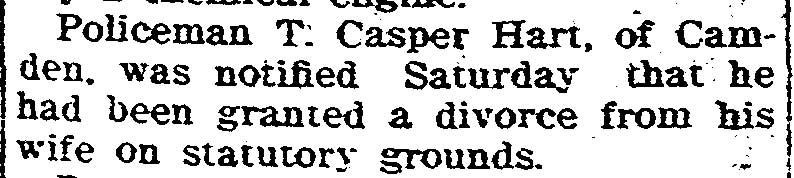
In 1904 T. Casper Hart was granted a divorce from his wife. In 1905 he fell and was injured while on duty. He was then living on Newton Avenue. Before the decade ended, Casper Hart had remarried, and bought a house at 278 Mount Vernon Street.
On March 31, 1910 T. Casper Hart died as a result of injuries sustained while in the performance of his duties as a Camden police officer. On March 26, 1910 he was riding in the rear of the patrol wagon, taking a prisoner to jail, when the wagon was struck in the rear by a streetcar at Broadway and Benson Street. Officer Hart was thrown 20 feet. He sustained a punctured lung and a skull fracture, which took his life five days later. This appears to be the first line of duty fatality sustained by the Camden Police Department.
T. Casper Hart was survived by his wife, Emma V. Hart. He was buried at Harleigh Cemetery in Camden.
Philadelphia Inquirer — August 26, 1886
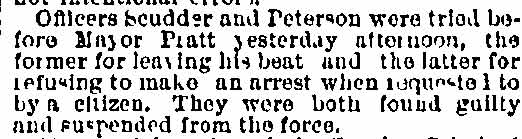

Officers Scudder and Peterson were tried before Mayor Pratt yesterday afternoon, the former for leaving his beat and the latter for refusing to make an arrest when requested to by a citizen. They were both found guilty and suspended from the force.
Thomas Casper Hart was sworn in by Mayor Pratt yesterday as an officer to take the place of Officer Peterson, suspended.
Philadelphia Inquirer — January 16, 1888
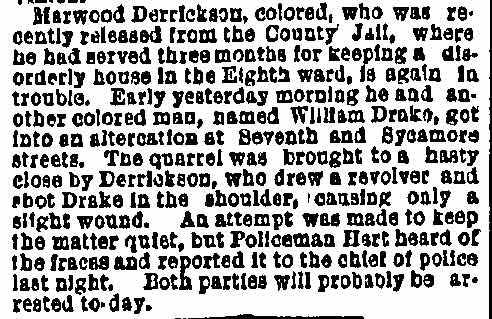
Marwood Derrickson, colored, who was recently released from the County Jail, where he had served three months for keeping a disorderly house in the Eighth ward, is again in trouble. Early yesterday morning he and another colored man, named William Drake, got into an altercation at Seventh and Sycamore streets. The quarrel was brought to a hasty close by Derrickson, who drew a revolver and shot Drake in the shoulder, causing only a slight wound. An attempt was made to keep the matter quiet, but Policeman Hart heard of the fracas and reported it to the chief of police last night. Both parties will probably be arrested to-day.
Philadelphia Inquirer — May 31, 1890
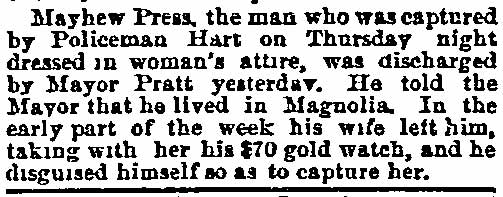
Mayhew Press, the man who was captured by Policeman Hart on Thursday night dressed in woman’s attire, was discharged by Mayor Pratt yesterday. He told the Mayor that he lived in Magnolia. In the early part of the week his wife left him, taking with her his $70 gold watch, and he disguised himself so as to capture her.
Cocco Safely Jailed
Philadelphia Inquirer —
The Italian Murderer Captured on His Return to Camden.
HIDING ALL NIGHT IN THE WOODS
After Thrusting the Stiletto Into the Heart of His Sister-in-Law
He Coolly Changes His Clothes to Escape Identification
After spending a night in the woods between Camden and Atlantic counties, Dominico Fellippo Cocco, who murdered his sister-in-law at Cedar Brook, about eighteen miles from Camden, on Saturday night, as told in yesterday’s Inquirer, was arrested yesterday morning.
Cocco is 29 years of age and lived in Italy until last December, when he came here with his young bride and a babe. With his scanty earnings as a street sweep the young couple lived happily in the Italian quarter on Carpenter Street, until the last January, when the couple had a quarrel, which ended in their separation.
Mrs. Cocco, with her babe, then took refuge with her parents and sister, who live at Cedar Brook, which is near the Winslow Junction, on the Camden and Atlantic Railroad. Here she remained until Saturday night, when she was removed to the Camden City Hall as a witness to the tragedy in which her sister Giovanna Torra was the victim and her husband the murderer.
MURDER EVIDENTLY PREMEDITATED
Saturday evening Cocco, with a bundle on his arm, went to Cedar Brook. Leaving the bundle in the station he proceeded to the home of his mother-in-law, Rosalia Torra. Words with his wife precipitated a family row, during which he threatened to kill his father-in-law. The latter went for an officer in company with Carlos Santarlio, who had met Cocco at the railroad station.
Cocco then turned to his wife and in his native language shouted, “I am going to cut your head off and send it to the King of Italy.” He was about to strike her, when Giovanna stepped in to protect her sister. By this time the trio had got on the outside of the house. When about forty yards away Cocco made another grab for his wife. Giovanna again came to the rescue of her sister. She grappled with him and was struggling with him about the little garden patch, when suddenly Cocco placed the hand around the girl’s shoulders and with his right hand drew a keen-edged stiletto from his pocket. With all the force he sent the instrument into the girl’s side.
This blow failed to do its work and Cocco then plunged the stiletto again into her body, this time through her heart. With a shriek and a groan the girl dropped dead at his feet. The murderer then fled to the railroad station, where he secured the bundle which he had secreted. Out of this he took a pair of overalls, a jumper, and a slouch hat. The overalls and jumper he placed over his other clothing. The cap which he wore when he committed the murder he discarded. After disguising himself he ran to the next station below Cedar Brook, where he took a train for Ellwood.
HIDING IN THE WOODS
The balance of the night he spent hiding in the woods at that place. Yesterday morning he took a train at Ellwood and came to the Camden station of the Philadelphia and Atlantic City Railroad, where he was captured by Policeman Casper Hart. Cocco offered no resistance. He was taken to the City Hall, where he was brought before his wife in the private apartments of Superintendent Moffet.
“Do you know that man?” asked Mr. Moffett of the woman. She threw up both her hands and commenced to weep. Between her sobs she would mutter the name of Dominico. She almost went frantic with fear that he would injure her.
The murderer, cool and collected, was taken before Mayor Pratt, to whom he admitted the murder, but claimed it was committed in self defense, at the same time displaying a cut on the head, which he claimed was inflicted by the girl with an axe. He was then about to demonstrate the manner in which he stabbed Giovanna when his wife became hysterical and rushed into the Mayor’s private office, where on her knees she appealed for protection from the man who had taken her sister’s life. All of the witnesses discounted the claim of Cocco that he committed the deed in self-defense.
The remain of the murdered girl were placed in an ice box in the Camden Morgue yesterday. She was 17 years of age and strikingly handsome. There are no marks of violence on her face or body. The fatal stab wound on the surface of the skin looked to be only about an inch and a quarter long. County Physician Iszard says the stiletto must have plunged into the breast at least six or eight inches. All of the witnesses have been held in $1,000 bail to appear at court. Coroner Jefferis has charge of the case and will hold an inquest the latter part of the week.
Philadelphia Inquirer — January 27, 1893
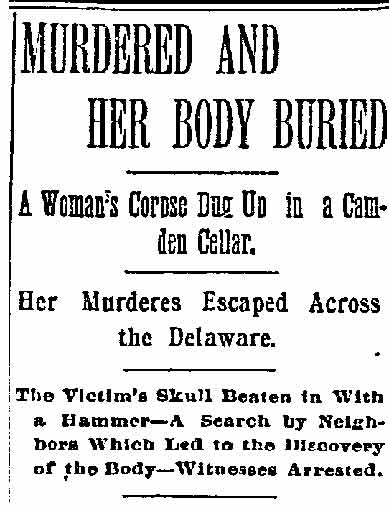
Murdered and Her Body Buried
A Woman’s Corpse Dug Up in a Camden Cellar.
Her Murderer Escaped Across the Delaware.
The Victim’s Skull Beaten in With a Hammer—A Search by Neighbors Which Led to the Discovery of the Body—Witnesses Arrested.
Ella Ford, a twenty-two-year-old colored woman, of 809 Locust street, Camden, was found murdered at 3:20 o’clock last evening. Her skull was badly fractured about two inches over the nose, and five ghastly, gaping hammer wounds were found about the head.
The supposed murderer is George Morris, a 65-year-old colored man, for whom the dead girl has kept house for three months. He has not yet been arrested.
Charles Wesley Law, of 807 Locust street; Rebecca Price, of 108 Pine street; Ella Price, a sister of Rebecca, doing housework in Philadelphia, and William Johnson are all under arrest as witnesses and possible accessories to the crime. All the prisoners are colored.
The Search for the Body.
Officer Casper Hart was notified on Cherry street at 9 o’clock by one of the Price girls, who was accompanied by several neighbors, that Ella Ford was missing. Ella Price said she had come over from Philadelphia to visit Miss Ford, and finding the house shut up, she, with others, forced the door. In the cellar-way a small hammer, shaped like a blacksmith’s sledge, and the handle of a tin bucket were found, both smeared in blood.
Officer Hart at once went to the house. In the corner of the back kitchen he found some bloody skirts. Charles Law led the way down into the cellar, where there was evidence that the earth had been disturbed in one corner.
After digging with a shovel only a few inches beneath the surface the officer came upon the torn portion of a dress, and a few seconds later excavated the dead body of the missing girl.
Officials at the Scene.
Coroner Jeffries, Chief of Police Dodd, Lieutenant Foster, Assistant Prosecutor Ridgway and County Physician Iszard were soon on the scene. Their questioning led to the arrest of the witnesses. But little could be learned of the whereabouts of the murderer or of the history of his victim. The Price girls and Law seemed to know more about the crime than they cared to tell. They claimed that the house had been shut up since Wednesday, and that Morris had been seen leaving the place yesterday.
Escaped Across the River.
William Johnson, one of the witnesses under arrest at the City Hall, says he wheeled a trunk down to the Federal street ferry in a push-cart for George Morris yesterday afternoon, and Morris took it across the river. The Philadelphia authorities were notified, but only a meagre description of the murderer could be furnished.
After the body had been excavated it was carried up stairs and examined by County Physician Iszard. Death was evidently due to the hammer wounds on the head. There were no other marks of violence on the body, which was removed to the Morgue.
The theory of the police is that Morris killed the woman in a quarrel prompted, probably, by jealousy. The county detectives were hunting for him last night in this city.
Philadelphia Inquirer — June 2, 1893
Police Guillotine at Work
Police Guillotine at Work.
The Democratic Police Commissioners of Camden yesterday suspended eight Republican policemen, discharged one and appointed four Democrats. The changes were as follows: Suspended, Benjamin Middleton, Samuel Bakeley, Edward F. Cooper, Harry Mines, Casper Hart, William Whalen and William H. Butts; discharged, George Cooper; appointed, Louis Heffer, Rufus Bright, Thomas Smith, William Lightcap. A number of new Democratic policemen went on duty yesterday.
Philadelphia Inquirer — June 7, 1893
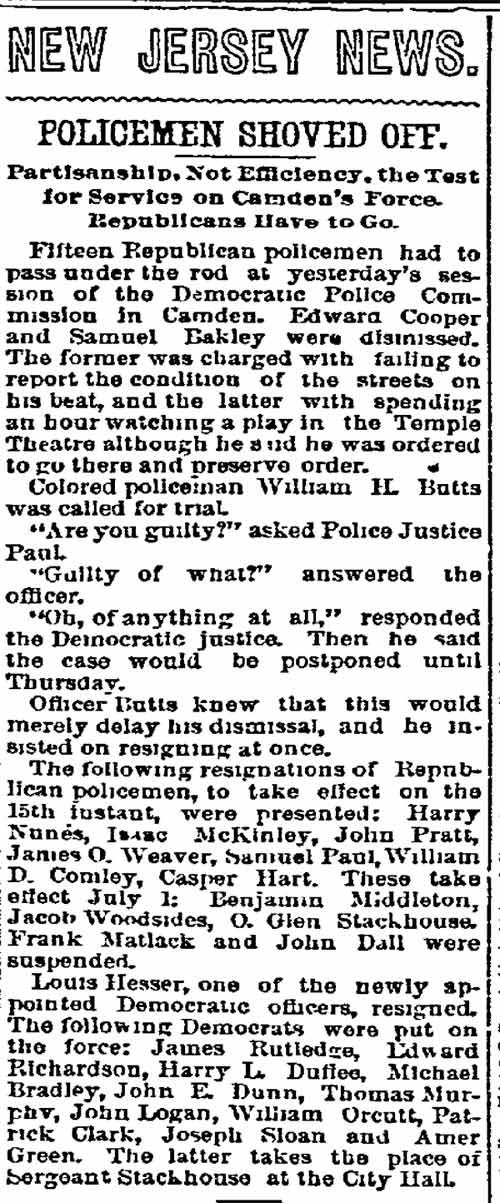
NEW JERSEY NEWS.
POLICEMEN SHOVED OFF.
Partisanship, Not Efficiency, the Test for Service on Camden’s Force. Republicans Have to Go.
Fifteen Republican policemen had to pass under the rod at yesterday’s session of the Democratic Police Commission in Camden. Edward Cooper and Samuel Bakley were dismissed. The former was charged with failing to report the condition of the streets on his beat, and the latter with spending an hour watching a play in the Temple Theatre although he said he was ordered to go there and preserve order.
Colored policeman William H. Butts was called for trial.
“Are you guilty?” asked Police Justice Paul.
“Guilty of what?” answered the officer.
“Oh, of anything at all,” responded the Democratic justice. Then he said the case would be postponed until Thursday.
Officer Butts knew that this would merely delay his dismissal, and he insisted on resigning at once.
The following resignations of Republican policemen, to take effect on the 15th instant, were presented: Harry Nunes, Isaac McKinley, John Pratt, James O. Weaver, Samuel Paul, William D. Comley, Casper Hart. These take effect July 1: Benjamin Middleton, Jacob Woodsides, O. Glen Stackhouse. Frank Matlack and John Dall were suspended.
Louis Hesser, one of the newly appointed Democratic officers, resigned. The following Democrats were put on the force: James Rutledge, Edward Richardson, Harry L. Duffee, Michael Bradley, John E. Dunn, Thomas Murphy, John Logan, William Orcutt, Patrick Clark, Joseph Sloan and Amer Green. The latter takes the place of Sergeant Stackhouse at the City Hall.
Here's Camden's Finest, With Whiskers, in 1898
Camden Courier-Post —
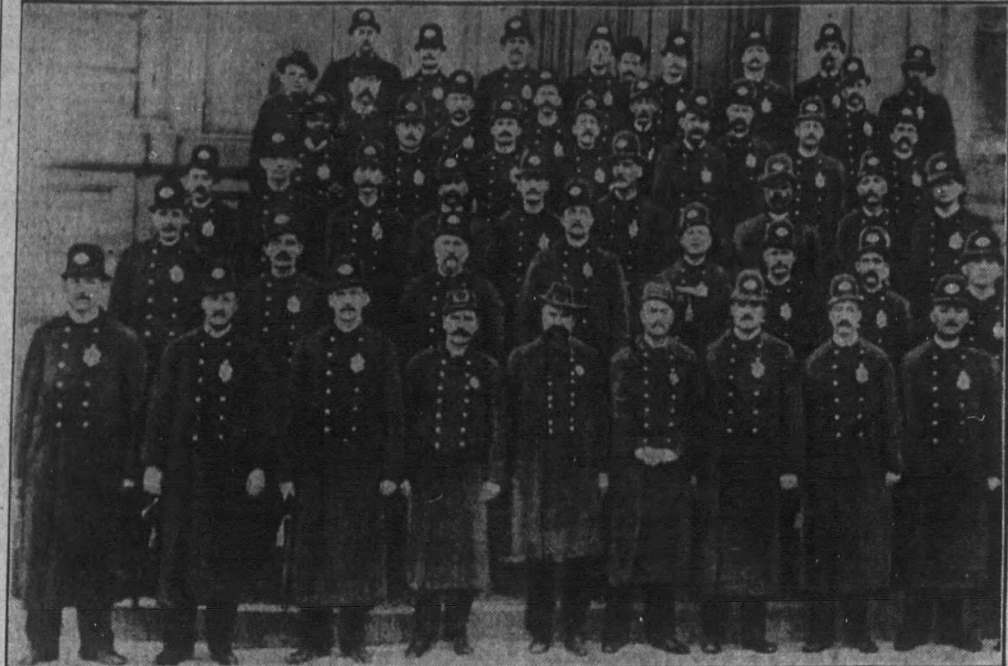
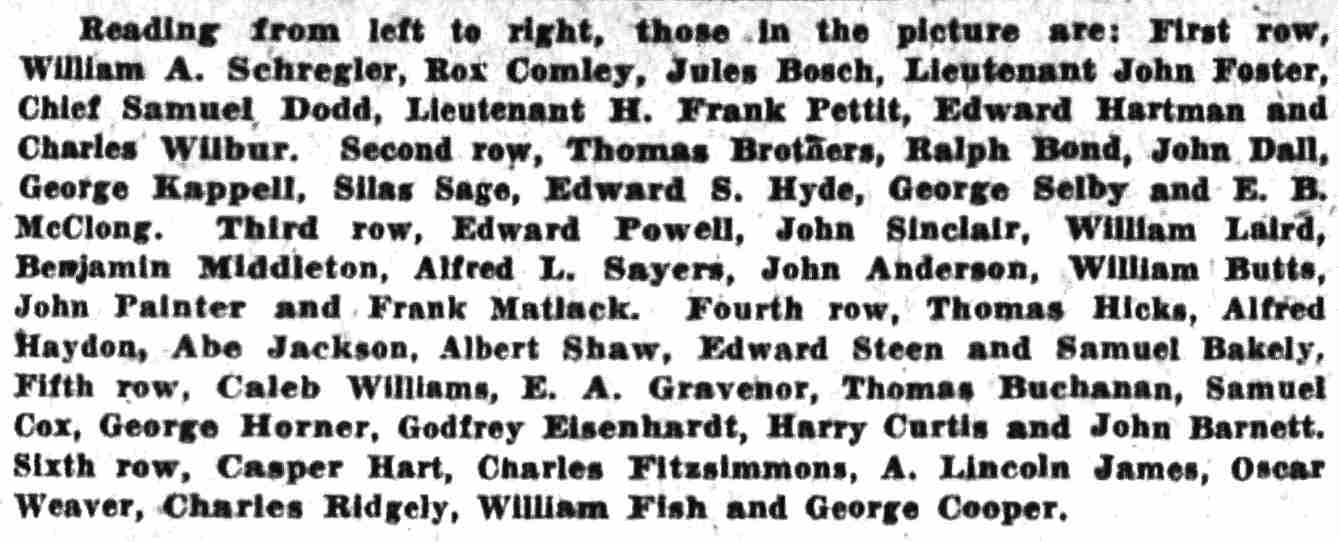
Harry Mines, not named above, is in the first row between H. Frank Pettit and Edward Hartman. In the fifth row, at the far right, “John Barnett” was a guess on the part of A. Lincoln James. Another person guessed George Johnson. Both were wrong and it is not known who that policeman is.
Camden Daily Courier — September 25, 1899
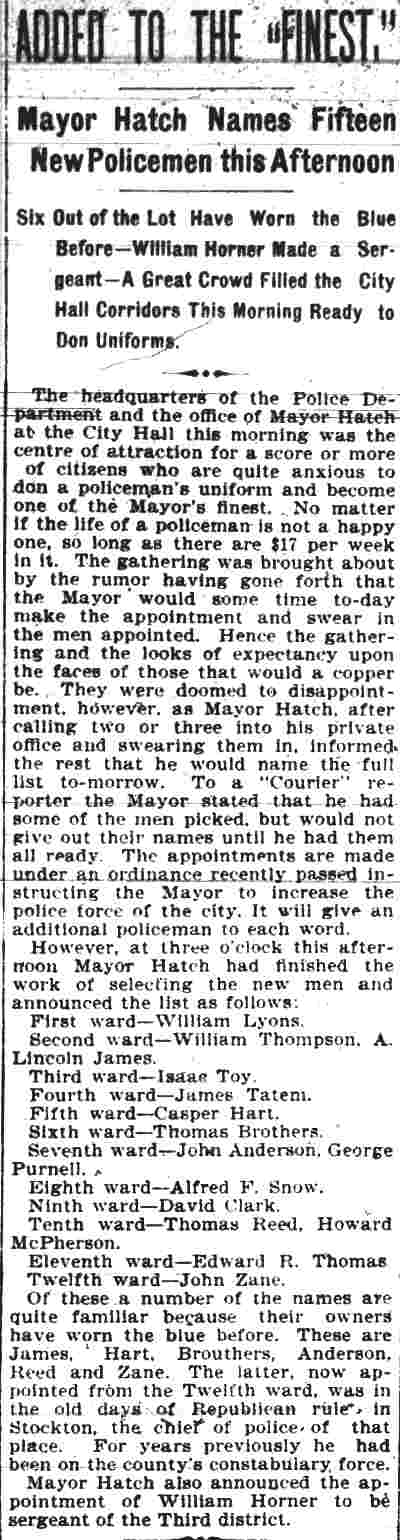
Added to the “Finest.”
Mayor Hatch Names Fifteen New Policemen This Afternoon.
Six Out of the Lot Have Worn the Blue Before — William Horner Made a Sergeant — A Great Crowd Filled the City Hall Corridors This Morning Ready to Don Uniforms.
The headquarters of the Police Department and the office of Mayor Hatch at the City Hall this morning was the centre of attraction for a score or more of citizens who are quite anxious to don a policeman’s uniform and become one of the Mayor’s finest. No matter if the life of a policeman is not a happy one, so long as there are $17 per week in it. The gathering was brought about by the rumor having gone forth that the Mayor would some time to-day make the appointment and swear in the men appointed. Hence the gathering and the looks of expectancy upon the faces of those that would a copper be. They were doomed to disappointment, however, as Mayor Hatch, after calling two or three into his private office and swearing them in, informed the rest that he would name the full list to-morrow.
However, at three o’clock this afternoon Mayor Hatch had finished the work of selecting the new men and announced the list as follows: First ward—William Lyons. Second ward—William Thompson, A. Lincoln James. Third ward—Isaac Toy. Fourth ward—James Tatem. Fifth ward—Casper Hart. Sixth ward—Thomas Brothers. Seventh ward—John Anderson, George Purnell. Eighth ward—Alfred F. Snow. Ninth ward—David Clark. Tenth ward—Thomas Reed, Howard McPherson. Eleventh ward—Edward R. Thomas. Twelfth ward—John Zane.
Of these a number of the names are quite familiar because their owners have worn the blue before. These are James, Hart, Brothers, Anderson, Reed and Zane. Mayor Hatch also announced the appointment of William Horner to be sergeant of the Third district.
Philadelphia Inquirer — September 26, 1899
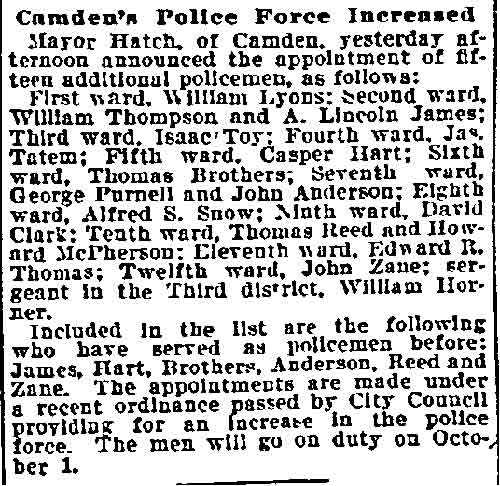
Camden’s Police Force Increased.
Mayor Hatch, of Camden, yesterday afternoon announced the appointment of fifteen additional policemen, as follows:
First ward, William Lyons; Second ward, William Thompson and A. Lincoln James; Third ward, Isaac Toy; Fourth ward, Jas. Tatem; Fifth ward, Casper Hart; Sixth ward, Thomas Brothers; Seventh ward, George Purnell and John Anderson; Eighth ward, Alfred S. Snow; Ninth ward, David Clark; Tenth ward, Thomas Reed and Howard McPherson; Eleventh ward, Edward R. Thomas; Twelfth ward, John Zane; sergeant in the Third district, William Horner.
Included in the list are the following who have served as policemen before: James, Hart, Brothers, Anderson, Reed and Zane. The appointments are made under a recent ordinance passed by City Council providing for an increase in the police force. The men will go on duty on October 1.
Philadelphia Inquirer — February 3, 1904
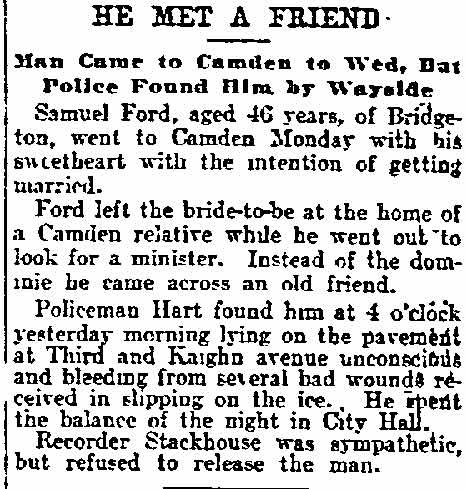
He Met a Friend
Man Came to Camden to Wed, But Police Found Him by Wayside
Samuel Ford, aged 46 years, of Bridgeton, went to Camden Monday with his sweetheart with the intention of getting married.
Ford left the bride-to-be at the home of a Camden relative while he went out to look for a minister. Instead of the dominie he came across an old friend.
Policeman Hart found him at 4 o’clock yesterday morning lying on the pavement at Third and Kaighn avenue unconscious and bleeding from several bad wounds received in slipping on the ice. He spent the balance of the night in City Hall.
Recorder Stackhouse was sympathetic, but refused to release the man.
Bridgeton Evening News — November 21, 1904
Bridgeton Evening News — November 21, 1904
Philadelphia Inquirer — February 13, 1905
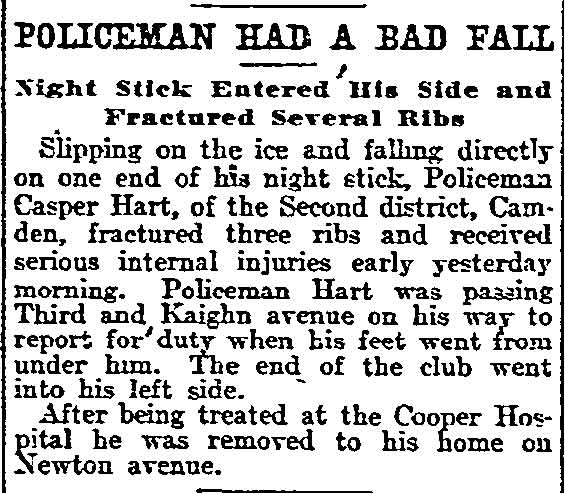
Policeman Had a Bad Fall
Night Stick Entered His Side and Fractured Several Ribs
Slipping on the ice and falling directly on one end of his night stick, Policeman Casper Hart, of the Second district, Camden, fractured three ribs and received serious internal injuries early yesterday morning. Policeman Hart was passing Third and Kaighn avenue on his way to report for duty when his feet went from under him. The end of the club went into his left side.
After being treated at the Cooper Hospital he was removed to his home on Newton avenue.
Philadelphia Inquirer — August 30, 1905
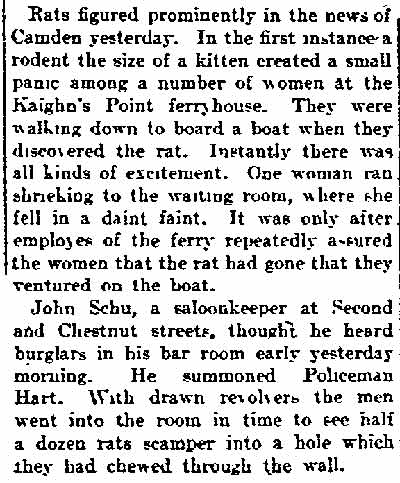
Rats figured prominently in the news of Camden yesterday. In the first instance a rodent the size of a kitten created a small panic among a number of women at the Kaighn’s Point ferryhouse. They were walking down to board a boat when they discovered the rat. Instantly there was all kinds of excitement. One woman ran shrieking to the waiting room, where she fell in a dead faint. It was only after employes of the ferry repeatedly assured the women that the rat had gone that they ventured on the boat.
John Schu, a saloonkeeper at Second and Chestnut streets, thought he heard burglars in his bar room early yesterday morning. He summoned Policeman Hart. With drawn revolvers the men went into the room in time to see half a dozen rats scamper into a hole which they had chewed through the wall.
Philadelphia Inquirer — September 24, 1905
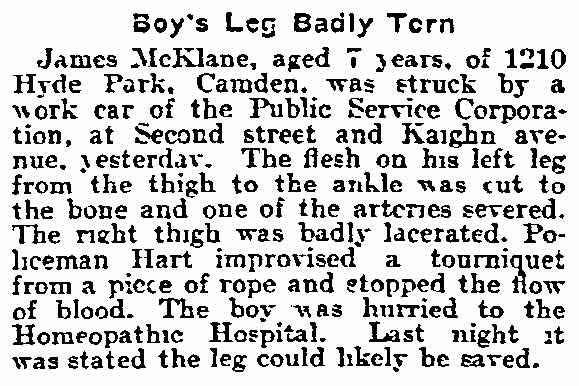
Boy’s Leg Badly Torn
James McKlane, aged 7 years, of 1210 Hyde Park, Camden, was struck by a work car of the Public Service Corporation, at Second street and Kaighn avenue, yesterday. The flesh on his left leg from the thigh to the ankle was cut to the bone and one of the arteries severed. The right thigh was badly lacerated. Policeman Hart improvised a tourniquet from a piece of rope and stopped the flow of blood. The boy was hurried to the Homeopathic Hospital. Last night it was stated the leg could likely be saved.
Philadelphia Inquirer — March 5, 1906

Camden Witnessed Greatest Demonstration of Its Kind Since Gen. Sewell’s Burial
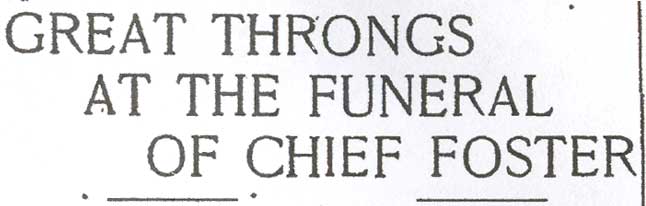
THOUSANDS PAID TRIBUTE TO DEAD
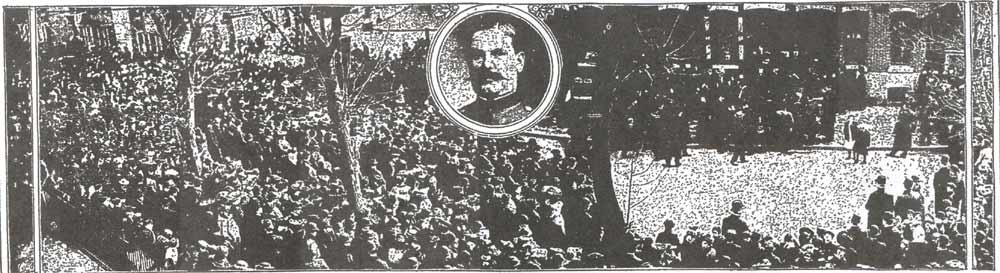
CROWD ABOUT THE FOSTER HOME AND PICTURE OF THE DEAD CHIEF
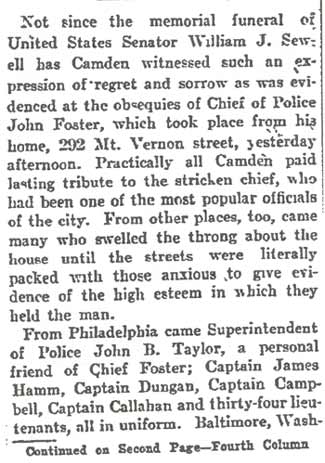
Not since the memorial funeral of United States Senator William J. Sewell has Camden witnessed such an expression of regret and sorrow as was evidenced at the obsequies of Chief of Police John Foster, which took place from his home, 292 Mt. Vernon street, yesterday afternoon. Practically all Camden paid lasting tribute to the stricken chief, who had been one of the most popular officials of the city. From other places, too, came many who swelled the throng about the house until the streets were literally packed with those anxious to give evidence of the high esteem in which they held the man.
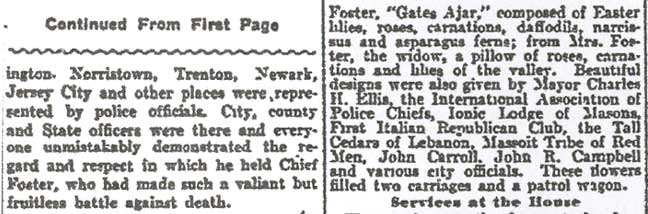
From Philadelphia came Superintendent of Police John B. Taylor, a personal friend of Chief Foster; Captain James Hamm, Captain Dungan, Captain Campbell, Captain Callahan and thirty-four lieutenants, all in uniform. Baltimore, Washington, Norristown, Trenton, Newark, Jersey City and other places were represented by police officials. City, county and State officers were there and everyone unmistakably demonstrated the regard and respect in which he held Chief Foster, who had made such a valiant but fruitless battle against death.
Thousands Viewed Remains
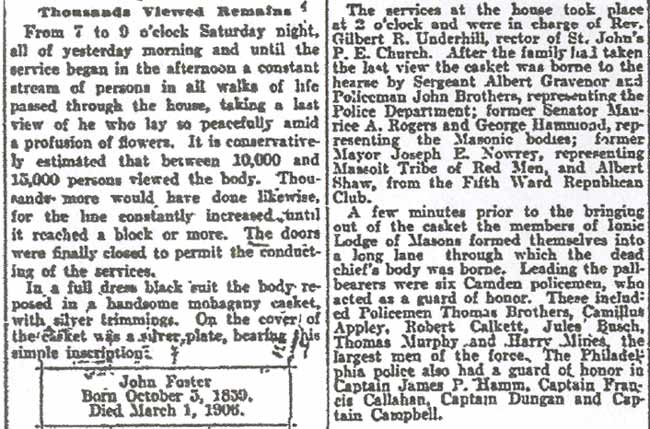
From 7 to 9 o’clock Saturday night, all of yesterday morning and until the service began in the afternoon a constant stream of persons in all walks of life passed through the house, taking a last view of he who lay so peacefully amid a profusion of flowers. It is conservatively estimated that between 10,000 and 15,000 persons viewed the body. Thousands more would have done likewise, for the line constantly increased, until it reached a block or more. The doors were finally closed to permit the conducting of the services.
In a full dress black suit the body reposed in a handsome mahogany casket, with silver trimmings. On the cover of the casket was a silver plate, bearing this simple inscription:
John Foster
Born October 5, 1839.
Died March 1, 1906.
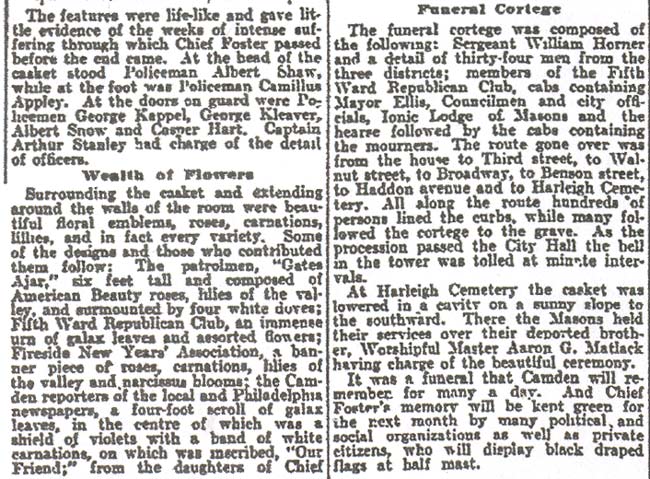
The features were life-like and gave little evidence of the weeks of intense suffering through which Chief Foster passed before the end came. At the head of the casket stood Policeman Albert Shaw, while at the foot was Policeman Camillus Appley. At the doors on guard were Policemen George Kappel, George Kleaver, Albert Snow and Casper Hart. Captain Arthur Stanley had charge of the detail of officers.
Wealth of Flowers
Surrounding the casket and extending around the walls of the room were beautiful floral emblems, roses, carnations, lillies, and in fact every variety. Some of the designs and those who contributed them follow: The patrolmen, “Gates Ajar,” six feet tall and composed of American Beauty roses, lilies of the valley, and surmounted by four white doves; Fifth Ward Republican Club, an immense urn of galax leaves and assorted flowers; Fireside New Years’ Association, a banner piece of roses, carnations, lilies of the valley and narcissus blooms; the Camden reporters of the local and Philadelphia newspapers, a four-foot scroll of galax leaves, in the centre of which was a shield of violets with a band of white carnations, on which was inscribed, “Our Friend;” from the daughters of Chief Foster, “Gates Ajar,” composed of Easter lilies, roses, carnations, daffodils, narcissus and asparagus ferns; from Mrs. Foster, the widow, a pillow of roses, carnations and lilies of the valley. Beautiful designs were also given by Mayor Charles H. Ellis, the International Association of Police Chiefs, Ionic Lodge of Masons, First Italian Republican Club, the Tall Cedars of Lebanon, Massoit Tribe of Red Men, John Carroll, John R. Campbell and various city officials. These flowers filled two carriages and a patrol wagon.
Services at the House
The services at the house took place at 2 o’clock and were in charge of Rev. Gilbert R. Underhill, rector of St. John’s P. E. Church. After the family had taken the last view the casket was borne to the hearse by Sergeant Albert Gravenor and Policeman John Brothers, representing the Police Department; former Senator Maurice A. Rogers and George Hammond, representing the Masonic bodies; former Mayor Joseph E. Nowrey, representing Massoit Tribe of Red Men, and Albert Shaw, from the Fifth Ward Republican Club.
A few minutes prior to the bringing out of the casket the members of Ionic Lodge of Masons formed themselves into a long lane through which the dead chief’s body was borne. Leading the pallbearers were six Camden policemen, who acted as a guard of honor. These included Policemen Thomas Brothers, Camillus Appley, Robert Calkett, Jules Busch, Thomas Murphy and Harry Mines, the largest men of the force. The Philadelphia police also had a guard of honor in Captain James P. Hamm, Captain Francis Callahan, Captain Dungan and Captain Campbell.
Funeral Cortege
The funeral cortege was composed of the following: Sergeant William Horner and a detail of thirty-four men from the three districts; members of the Fifth Ward Republican Club, cabs containing Mayor Ellis, Councilmen and city officials, Ionic Lodge of Masons and the hearse followed by the cabs containing the mourners. The route gone over was from the house to Third street, to Walnut street, to Broadway, to Benson street, to Haddon avenue and to Harleigh Cemetery. All along the route hundreds of persons lined the curbs, while many followed the cortege to the grave. As the procession passed the City Hall the bell in the tower was tolled at minute intervals.
At Harleigh Cemetery the casket was lowered in a cavity on a sunny slope to the southward. There the Masons held their services over their departed brother, Worshipful Master Aaron G. Matlack having charge of the beautiful ceremony.
It was a funeral that Camden will remember for many a day. And Chief Foster’s memory will be kept green for the next month by many political and social organizations as well as private citizens, who will display black draped flags at half mast.
Philadelphia Inquirer — March 27, 1910
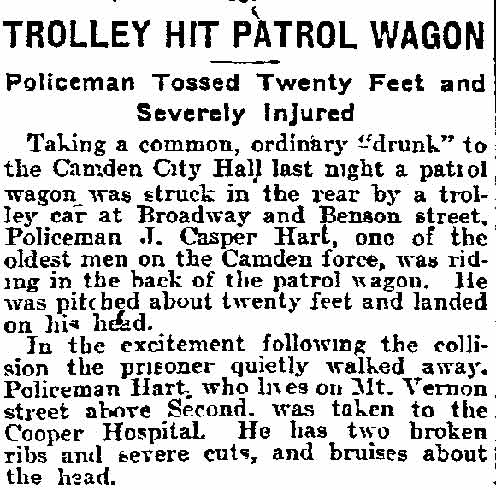
Trolley Hit Patrol Wagon
Policeman Tossed Twenty Feet and Severely Injured
Taking a common, ordinary “drunk” to the Camden City Hall last night a patrol wagon was struck in the rear by a trolley car at Broadway and Benson street. Policeman J. Casper Hart, one of the oldest men on the Camden force, was riding in the back of the patrol wagon. He was pitched about twenty feet and landed on his head.
In the excitement following the collision the prisoner quietly walked away. Policeman Hart, who lives on Mt. Vernon street above Second, was taken to the Cooper Hospital. He has two broken ribs and severe cuts, and bruises about the head.
Philadelphia Inquirer — March 31, 1910

It has developed that Patrolman Casper Hart, who was thrown from the patrol wagon last Saturday night in Camden, has a fractured skull and a punctured lung. His condition is critical.
Philadelphia Inquirer — April 1, 1910
Policeman T. Casper Hart, who was hurled from the patrol wagon last Saturday night in a collision with a trolley car, died in the Cooper Hospital at 7 o’clock last night. He was 62 years old and lived at 278 Mount Vernon street.
Philadelphia Inquirer — April 2, 1910
Camden News Notes
•• In memory of Policeman Casper Hart, who was fatally injured in a collision between a trolley car and the Second District patrol wagon at Broadway and Benson streets, flags at all the station houses were placed at half mast yesterday and the headquarters of the second district police draped in mourning.
Philadelphia Inquirer — April 2 & April 3, 1910
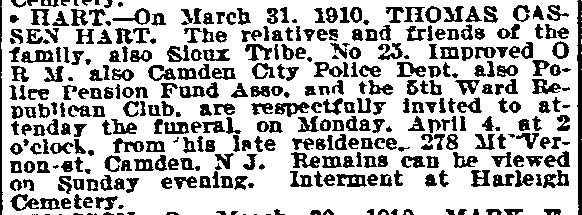
HART.—On March 31, 1910, THOMAS CASSEN HART. The relatives and friends of the family, also Sioux Tribe, No. 23, Improved O. R. M., also Camden City Police Dept., also Police Pension Fund Asso., and the 5th Ward Republican Club, are respectfully invited to attend the funeral, on Monday, April 4, at 2 o’clock, from his late residence, 278 Mt. Vernon-st., Camden, N. J. Remains can be viewed on Sunday evening. Interment at Harleigh Cemetery.
Philadelphia Inquirer — April 4, 1910

(news brief)
•• Mayor Ellis has announced the appointment of James Lewis, of the Fifth ward, as a sub-policeman, who fills the vacancy occasioned by the death of Policeman T. Casper Hart.
Philadelphia Inquirer — April 5, 1910
POLICEMAN HART IS LAID TO REST
Many Members of Camden Department Pay Last Respects to One Who Was Killed.
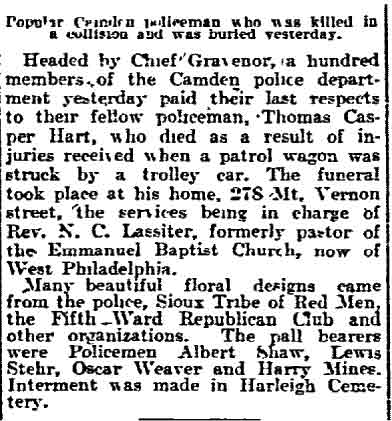
Headed by Chief Gravenor, a hundred members of the Camden police department yesterday paid their last respects to their fellow policeman, Thomas Casper Hart, who died as a result of injuries received when a patrol wagon was struck by a trolley car. The funeral took place at his home, 278 Mt. Vernon street, the services being in charge of Rev. N. C. Lassiter, formerly pastor of the Emmanuel Baptist Church, now of West Philadelphia.
Many beautiful floral designs came from the police, Sioux Tribe of Red Men, the Fifth Ward Republican Club and other organizations. The pall bearers were Policemen Albert Shaw, Lewis Stehr, Oscar Weaver and Harry Mines. Interment was made in Harleigh Cemetery.