Introduction
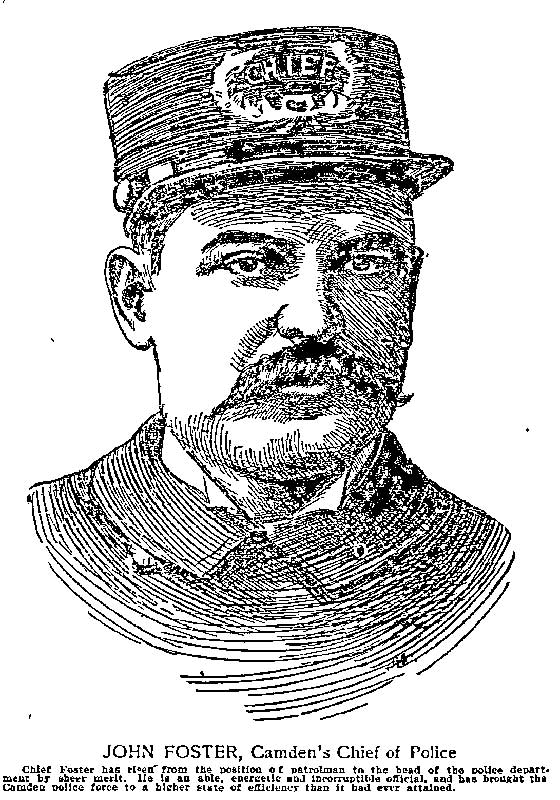
John Foster, Camden’s Chief of Police — Philadelphia Inquirer, November 5, 1899
JOHN FOSTER was a noted policeman in Camden in the 1890s. Born in Bloomfield NJ in 1859, his parents moved to Camden in 1861. He attended school in Camden, before going to work as a hatter at the age of 17. When the Census was taken in 1880 John Foster had married Mary Hanle. The couple lived at 702 South 3rd Street, and were the parents of a daughter, Louisa, not quite a year old. At least three more children would follow before Mrs. Foster passed in the spring of 1894.
John Foster continued working as a hatter until 1888. Active in local Republican politics, he became a member of the Camden police force when the Republicans swept into office in a landslide that year. The Foster family by then was living at 345 Pine Street. John Foster was promoted to the rank of Lieutenant on March 12, 1892, and was put in charge of the southern part of Camden, solving many notable cases and making numerous arrests. Like most other Republicans, he was dismissed by the thoroughly partisan Police Commission in March of 1893, but was returned to the Department at his rank the following year, when the Commission was, in its second year of existence, disbanded.
John Foster was appointed Chief of Police in 1899, succeeding long-time Chief Samuel Dodd. That year’s City Directory shows him residing at 247 Pine Street.
In 1895 John Foster served as the first Exalted Ruler of Camden Lodge 293 of the Benevolent Protective Order of Elks. Other charter members included Frank A. Ward, Charles L. Bowman, Dr. A. Haines Lippincott, Dr. J. F. Leavitt, Fred W. George, T. L. Bear, William M. Fithian, Everett Ackley, Fithian S. Simmons, Philip Wilson, Paul E. Quinn, John N. Kadel, William G. Maguire, Frank B. Sweeten and Maurice Hertz.
Chief Foster oversaw the expansion of Camden’s police department at the same time as Camden expanded with the annexation of Stockton Township, which brought what is now known as East Camden and Cramer Hill within the city limits. Chief Foster served under both Republican and Democrat mayors. Last a resident of 292 Mount Vernon Street, he was still serving as Chief of Police when he died on March 1, 1906 at Jefferson Hospital.
John Foster was succeeded as Chief of Police by Elisha A. Gravenor.
Biographical Review — 1897
LIEUTENANT JOHN FOSTER is a very popular officer of the Camden city police force. A son of James and Ann (Leach) Foster, both of English birth, he was born in Bloomfield, N. J., October 18, 1859. His grandfather, John Foster, was overseer in a large mill in England. He lived to be fourscore. James Foster, Lieutenant Foster’s father, came to America when a young man, and worked as a hatter in Newark and Philadelphia for half a century or more. He has been a resident of Camden since 1861, and is now in the employ of the city government. He is seventy-six years old. He and his wife attend the Episcopal church. They are the parents of ten children, six of whom are living: Benjamin; James; John; Frank; Alice, wife of Fred Kelterer, of Camden; and Joseph, a merchant in this city.
Lieutenant John Foster was a child when his parents removed to Camden, and he acquired his education in the common schools of this city. When he was seventeen years old he began to learn the hatter’s trade, and was employed thereat in Newark until he attained his majority. He then followed his trade in Camden and Philadelphia until 1888, being appointed patrolman in that year. In March, 1893, he was promoted to the rank of Lieutenant, and is now senior in command, with office at the No. 2 Patrol House, Chestnut Street. He has charge of the southern district, his control extending through half the city and including the southern wards. As a shrewd detective and a competent and active police officer he has distinguished himself so that his name is respected throughout this section of the country, and he has been detailed for work on nearly all the important criminal cases. One of his recent captures was George Moness, the murderer of Ella Ford. This man he, in company with another officer, followed to Philadelphia, and brought to bay in a cellar. Moness died in prison. The first murderer captured by Lieutenant Foster was John Hill, who killed Joseph Dodson. Hill was hanged, as was William Moulton, the murderer of Lydia Hoyt, Moulton also being captured by Mr. Foster, with the aid of Coroner Jeffries. A famous capture was that of two Italian murderers, whom he took unassisted. They are now serving a twenty-year sentence in State prison. William Robinson, who killed James Gould on Sixth Street, was also taken by Lieutenant Foster. Robinson was sentenced in January, 1896, to twenty years in prison. Lieutenant Foster’s captures of thieves and minor offenders have been too numerous to mention. In his present position he has twenty-five men under his command. He has two valuable tokens of esteem received from his men — a gold badge and a beautiful revolver. But it is not in police circles alone that he is esteemed, for he has a host of friends in other walks of life; and, as a guardian of the public safety, always on the alert and ready to meet danger face to face, he has the respect and esteem of the community.
Lieutenant Foster was married in 1879 to Mary Hanle, a native of Holmesburg, Pa., and daughter of Joseph Hanle, a prominent citizen of Camden. Mrs. Foster died in April, 1894, aged thirty-five years. She left four children — Louie, Lilly, Alice, and Abbie.
Lieutenant Foster is a member of various Republican clubs of this city. He belongs to the Order of the Shield of Honor and the American Mechanics. He attends worship at the Episcopal church, of which his wife was a member.
End of the Turn Fest
Philadelphia Inquirer —
END OF THE TURN FEST
German Athletes Paraded and Some of the Prizes Were Awarded.
The three days’ session of the seventeenth turnfest of the Philadelphia District Turn Verein came to a close last evening in Camden. The various societies formed in line at 10 o’clock in front of Turner Hall and marched over the principal streets. A platoon of police under command of Lieutenant Foster, headed the line. Mayor Westcott and invited guests in carriages followed. Then came the City Band, the rifle section of the Philadelphia Turngemeine, the Active Turners of the visiting societies, a cavalcade of Turners, ladies classes in carriages and coaches and the boys and girls classes.
The contests at Stockton Park included individual bar exercises, horse work, rope climbing, jumping, running, putting the shot, pole vaulting, dumb bells, bicycle races and wrestling.
At a late hour last night the judges had not finished awarding the prizes. Emil Lingerman and H. Doerschner, of the Camden Turn Verein, secured the first and second prizes respectively for wrestling. Emil Doerschner, of the same society, was awarded first prize for field sports. J. Scharf, of the Camden Turn Verein, won the mile bicycle race in 3.10 3-5.
The Philadelphia Turngemeine took the first prize for team work. The Camden Turn Verein made more points, but were handicapped by having but fourteen men in the team against the winning society’s thirty-six men.
Philadelphia Inquirer — April 4, 1894
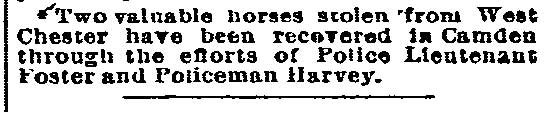
Philadelphia Inquirer, April 4, 1894 — William Harvey
Philadelphia Inquirer — April 22, 1894
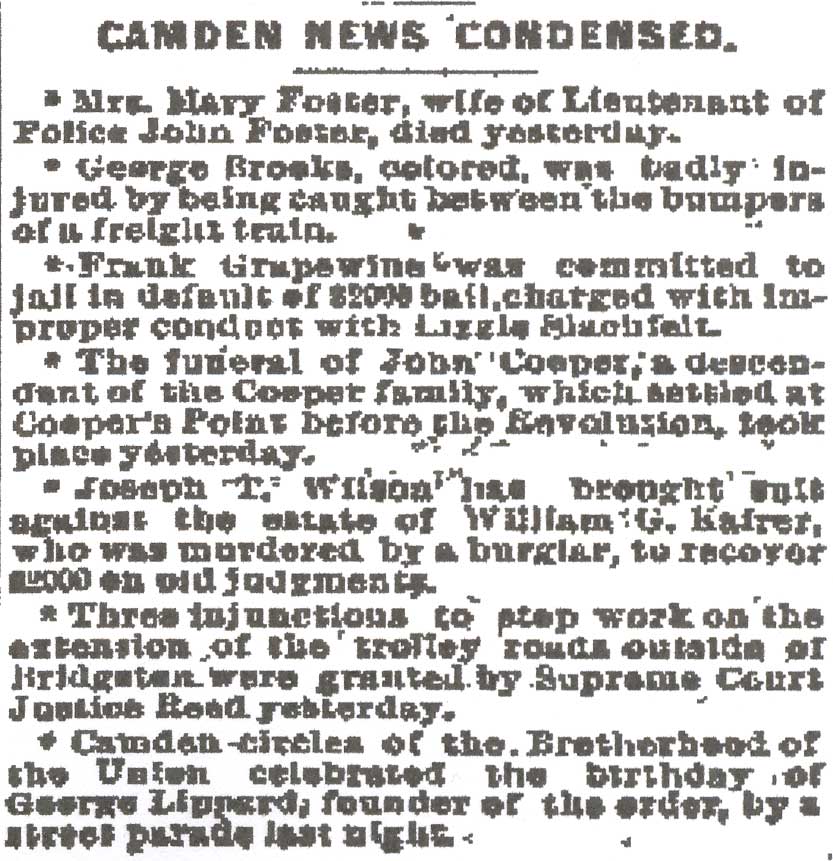
Philadelphia Inquirer, April 22, 1894 — George Brooks — Frank Grapewine — Lizzie Slachfelt — John Cooper — Joseph T. Wilson — William G. Kairer — George Lippard — Brotherhood of the Union
Over in Camden
Philadelphia Inquirer —
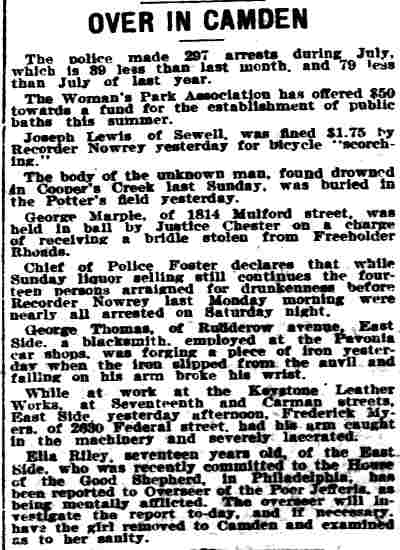
OVER IN CAMDEN
The police made 297 arrests during July, which is 38 less than last month and 79 less than July of last year.
Chief of Police Foster declares that while Sunday liquor selling still continues the fourteen persons arraigned for drunkenness before Recorder Nowrey last Monday morning were nearly all arrested on Saturday night.
Joseph Nowrey — Mulford Street — Federal Street — Rudderow Avenue — North 32nd Street
Gift to Colonel Murphy
Philadelphia Inquirer —
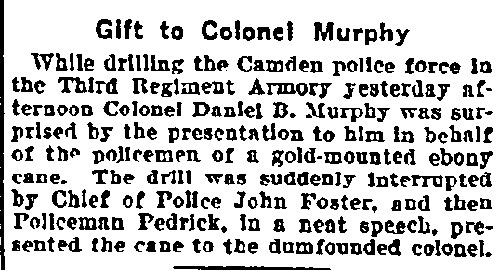
Gift to Colonel Murphy
While drilling the Camden police force in the Third Regiment Armory yesterday afternoon Colonel Daniel B. Murphy was surprised by the presentation to him in behalf of the policemen of a gold-mounted ebony cane. The drill was suddenly interrupted by Chief of Police John Foster, and then Policeman Pedrick, in a neat speech, presented the cane to the dumfounded colonel.
Camden Policemen Must Pay Debts
Camden Post-Telegram —
CAMDEN POLICEMEN MUST PAY DEBTS
The Police Committee of Camden City Council has decided to compel policemen to pay their debts. Chief Foster has been instructed to notify all officers to settle claims against them within ten days.
If this order is not complied with, or some satisfactory arrangement is not made with the creditors, delinquents will be summarily dealt with. This action was taken at the instance of numerous tradesmen and professional men.
Police Guard Gas Tank
Philadelphia Inquirer —
POLICE GUARD GAS TANK
More Men Put to Work and No Trouble Occurs
Thirty men were put at work yesterday on the big gas holder being constructed at Locust and Walnut streets, Camden, in place of the striking riveters. Eighty men from the Camden Iron Works assisted them in lowering the base of the tank.
It was expected trouble would ensue between the workmen and the strikers, but Chief of Police John Foster had a large squad of officers at the scene all day preventing any disturbance.
Camden Police Form Organization
Philadelphia Inquirer —
Camden Police Form Organization
A branch of the State Police Beneficial Association was formed in Camden yesterday by the election of Sergeant Edward Hyde president; Sergeant C. O. Pedrick, vice president; Sergeant Albert Gravenor, financial secretary; Sergeant David Bentley, recording secretary; Sergeant John Reeder, treasurer, and Chief John Foster, Sergeant William Schregler and Sergeant George Nowrey, trustees.
Philadelphia Inquirer — February 12, 1905
William Jansen, of Schemeron street, Brooklyn, has written to Chief of Police Foster asking him to locate his wife, Grace Annie Jansen, who has been missing from home since December 17.
Beggar Made Threats When Refused Alms
Camden Post-Telegram —
BEGGAR MADE THREATS WHEN REFUSED ALMS
The first arrest in conformity with Chief of Police Foster’s strict orders to abate the tramp nuisance, that of worthless hoboes harassing housewives at back doors, was made by Policeman Charles Fitzsimmons yesterday afternoon. The prisoner is a Fishtowner named Edward Lynch, who, although 41 years of age and able-bodied, is apparently too light for heavy work, for he has been begging about South Camden for several weeks.
Yesterday afternoon Policeman Fitzsimmons detected Lynch begging at back gates and then followed him to Fourth street and Kaighn avenue, where he accosted a man for a nickel and because refused threatened to “paste him one on the snout.”
It did not take “Fits” long to nab the abusive hoodlum by the coat collar and hustle him to the patrol box.
In Police Court this morning, Detective Harry Moffett said that Lynch was a pal of Mike McGurk, the thieving tramp sent to jail for three months by Recorder Stackhouse yesterday, for helping himself to an overcoat from Leaven’s clothing store on Kaighn avenue above Third, and had served time before.
Lynch had nothing to say and was given thirty days in the county jail.
Foster (death notice)
Philadelphia Inquirer —
FOSTER.—On March 1, 1906, JOHN, son of James and the late Ann Foster, aged 46 years. Relatives and friends, also Ionic Lodge, No 94, F and A.M., Mercantile Lodge, No 4, Shield of Honor; Fifth Ward Republican Club, Police Department and Camden Republican Club and city officials, are invited to attend the funeral, on Sunday, March 4, at 1 P.M., from his late residence, 292 Mount Vernon st., Camden, N.J. Interment at Harleigh Cemetery. Remains can be seen Saturday, from 7 to 9 P.M.
John Foster — James Foster — Ionic Lodge No. 94. F & A. M. — Fifth Ward Republican Club — Mount Vernon Street
Chief Foster to Be Buried To-morrow
Philadelphia Inquirer —
Chief Foster to Be Buried To-morrow
Acting Chief of Police William Schregler in Camden yesterday received many letters from persons all over the country expressing regret over the death of Chief of Police John Foster. Among them was a letter from Richard Sylvester, of Washington, D. C., president of the National Association of Police Chiefs and a warm personal friend of Chief Foster. The funeral, which will take place to-morrow from the home at 292 Mt. Vernon street, promises to be one of the largest the city has witnessed for many months. Captains, lieutenants and sergeants of the Philadelphia force and delegations from near-by cities will attend.
Great Throngs at the Funeral of Chief Foster
Philadelphia Inquirer —

Camden Witnessed Greatest Demonstration of Its Kind Since Gen. Sewell’s Burial
THOUSANDS PAID TRIBUTE TO DEAD
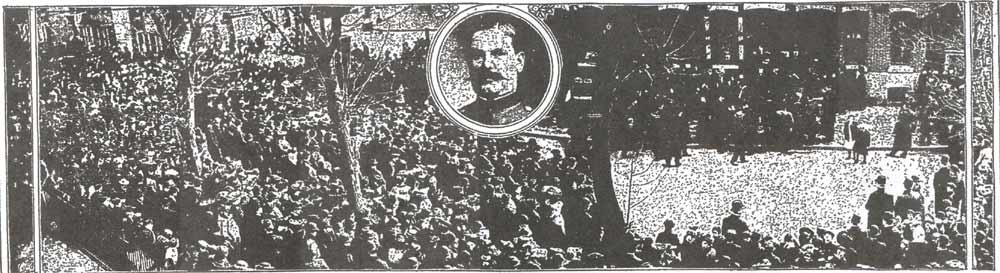
CROWD ABOUT THE FOSTER HOME AND PICTURE OF THE DEAD CHIEF
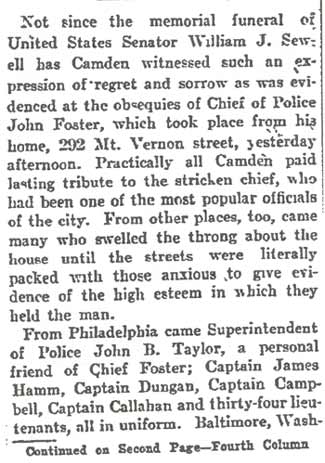
Not since the memorial funeral of United States Senator William J. Sewell has Camden witnessed such an expression of regret and sorrow as was evidenced at the obsequies of Chief of Police John Foster, which took place from his home, 292 Mt. Vernon street, yesterday afternoon. Practically all Camden paid lasting tribute to the stricken chief, who had been one of the most popular officials of the city. From other places, too, came many who swelled the throng about the house until the streets were literally packed with those anxious to give evidence of the high esteem in which they held the man.
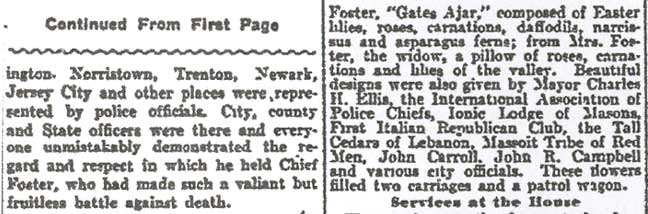
From Philadelphia came Superintendent of Police John B. Taylor, a personal friend of Chief Foster; Captain James Hamm, Captain Dungan, Captain Campbell, Captain Callahan and thirty-four lieutenants, all in uniform. Baltimore, Washington, Norristown, Trenton, Newark, Jersey City and other places were represented by police officials. City, county and State officers were there and everyone unmistakably demonstrated the regard and respect in which he held Chief Foster, who had made such a valiant but fruitless battle against death.
Thousands Viewed Remains
From 7 to 9 o’clock Saturday night, all of yesterday morning and until the service began in the afternoon a constant stream of persons in all walks of life passed through the house, taking a last view of he who lay so peacefully amid a profusion of flowers. It is conservatively estimated that between 10,000 and 15,000 persons viewed the body. Thousands more would have done likewise, for the line constantly increased, until it reached a block or more. The doors were finally closed to permit the conducting of the services.
In a full dress black suit the body reposed in a handsome mahogany casket, with silver trimmings. On the cover of the casket was a silver plate, bearing this simple inscription:
John Foster
Born October 5, 1839.
Died March 1, 1906.
The features were life-like and gave little evidence of the weeks of intense suffering through which Chief Foster passed before the end came. At the head of the casket stood Policeman Albert Shaw, while at the foot was Policeman Camillus Appley. At the doors on guard were Policemen George Kappel, George Kleaver, Albert Snow and Casper Hart. Captain Arthur Stanley had charge of the detail of officers.
Wealth of Flowers
Surrounding the casket and extending around the walls of the room were beautiful floral emblems, roses, carnations, lillies, and in fact every variety. Some of the designs and those who contributed them follow: The patrolmen, “Gates Ajar,” six feet tall and composed of American Beauty roses, lilies of the valley, and surmounted by four white doves; Fifth Ward Republican Club, an immense urn of galax leaves and assorted flowers; Fireside New Years’ Association, a banner piece of roses, carnations, lilies of the valley and narcissus blooms; the Camden reporters of the local and Philadelphia newspapers, a four-foot scroll of galax leaves, in the centre of which was a shield of violets with a band of white carnations, on which was inscribed, “Our Friend;” from the daughters of Chief Foster, “Gates Ajar,” composed of Easter lilies, roses, carnations, daffodils, narcissus and asparagus ferns; from Mrs. Foster, the widow, a pillow of roses, carnations and lilies of the valley. Beautiful designs were also given by Mayor Charles H. Ellis, the International Association of Police Chiefs, Ionic Lodge of Masons, First Italian Republican Club, the Tall Cedars of Lebanon, Massoit Tribe of Red Men, John Carroll, John R. Campbell and various city officials. These flowers filled two carriages and a patrol wagon.
Services at the House
The services at the house took place at 2 o’clock and were in charge of Rev. Gilbert R. Underhill, rector of St. John’s P. E. Church. After the family had taken the last view the casket was borne to the hearse by Sergeant Albert Gravenor and Policeman John Brothers, representing the Police Department; former Senator Maurice A. Rogers and George Hammond, representing the Masonic bodies; former Mayor Joseph E. Nowrey, representing Massoit Tribe of Red Men, and Albert Shaw, from the Fifth Ward Republican Club.
A few minutes prior to the bringing out of the casket the members of Ionic Lodge of Masons formed themselves into a long lane through which the dead chief’s body was borne. Leading the pallbearers were six Camden policemen, who acted as a guard of honor. These included Policemen Thomas Brothers, Camillus Appley, Robert Calkett, Jules Busch, Thomas Murphy and Harry Mines, the largest men of the force. The Philadelphia police also had a guard of honor in Captain James P. Hamm, Captain Francis Callahan, Captain Dungan and Captain Campbell.
Funeral Cortege
The funeral cortege was composed of the following: Sergeant William Horner and a detail of thirty-four men from the three districts; members of the Fifth Ward Republican Club, cabs containing Mayor Ellis, Councilmen and city officials, Ionic Lodge of Masons and the hearse followed by the cabs containing the mourners. The route gone over was from the house to Third street, to Walnut street, to Broadway, to Benson street, to Haddon avenue and to Harleigh Cemetery. All along the route hundreds of persons lined the curbs, while many followed the cortege to the grave. As the procession passed the City Hall the bell in the tower was tolled at minute intervals.
At Harleigh Cemetery the casket was lowered in a cavity on a sunny slope to the southward. There the Masons held their services over their departed brother, Worshipful Master Aaron G. Matlack having charge of the beautiful ceremony.
It was a funeral that Camden will remember for many a day. And Chief Foster’s memory will be kept green for the next month by many political and social organizations as well as private citizens, who will display black draped flags at half mast.
Philadelphia Inquirer — March 5, 1906
Philadelphia Inquirer, March 5, 1906 — Dr. William Shaffer — Haddon Avenue — Wright Avenue
Philadelphia Inquirer — March 21, 1906
Camden's New Police Chief
CAMDEN'S NEW POLICE CHIEF.
Mayor Promotes Sergeant Gravenor to Vacant Post.
Camden, March 21.—In appointing Elisha A. Gravenor chief of police of Camden yesterday, Mayor Ellis, addressing him, said: “I will not say that the department is not up-to-date, but I want you to exert your every energy to improve the service and make it thoroughly up-to-date to the satisfaction of the people and myself.”
The new chief is from the Tenth ward and was house sergeant. He succeeds the late Chief of Police John Foster. Patrolman Jacob Woodside, of the Second district, was appointed sergeant. He is from the Sixth ward, Mayor Ellis’s bailiwick.
Philadelphia Inquirer — March 13, 1909
Philadelphia Inquirer, March 13, 1909 — James Foster — Broadway
Photos
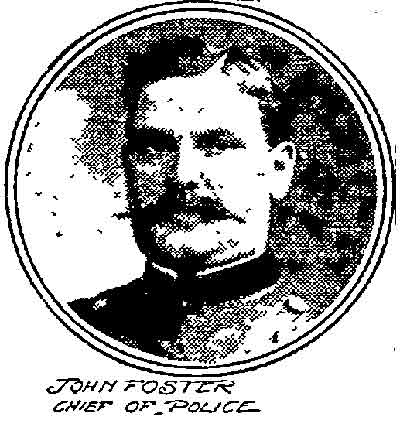
John Foster, Chief of Police — Philadelphia Inquirer, February 23, 1901