Harry Albert Haines Sr.
HARRY ALBERT HAINES SR. was born in New Jersey in April of 1866 to Eliza and Henry Haines. He was one of at least six children; the others, according to the 1880 Census, were Jacob, Sarah, Mary, Anna, and Nettie. The family then lived at 1214 South 4th Street. Henry Haines was a glassblower by trade, and may well have worked at the glass factory that operated a short walk away on Kaighn Avenue. When the census was taken Harry Haines’s occupation was “works in a glass house,” which probably refers to the same factory. When that factory burned down, Henry Haines found work in Philadelphia. The family remained at 1214 South 4th Street until late 1885 or early 1886, when they relocated to 349 Liberty Street.
Harry Haines moved around his South Camden neighborhood quite a bit in the late 1880s. He married Mary J. Hickman in 1886, a son William was born in January of 1887. The 1887 Directory shows the Harry Haines family at 349 Liberty Street, and the 1888 Directory at 249 Sycamore Street. Daughter Ethel was born in December of 1889. By the end of 1890 the Harry Haines family had moved to 276 Sycamore Street. A son, Harry Albert Haines Jr., was born on May 8, 1892.
The family lived at 276 Sycamore Street until the compilation of the 1898 City Directory, when they moved to 294 Sycamore Street, near the corner of South 3rd Street and Sycamore in South Camden. Also living at the Sycamore Street address was Mrs. Haines’ brother, William Hickman. Camden policeman Charles H. Fitzsimmons lived a few doors away at 1135 South 3rd Street in 1900, City Assessor Lewis Stehr Sr. was at 1131 in 1910. Lewis Stehr Jr. served as Camden’s Chief of Police from 1928 until his death in 1930.
Harry Haines Sr. worked as a glassblower, as his father did before him, from the time of the 1880 Census through 1896, according to the City Directories. He and his father were both working in Philadelphia in that trade as late as 1896. About this time Harry Haines Sr. secured an appointment to the Camden Fire Department. He served with the Camden Fire Department as a ladderman with Ladder Company 1 in 1897, 1898 and 1899. The 1900 Census indicates that he returned to glassblowing, but by 1904 he was once again a member of the Camden Fire Department, where he served until the 1930s.
In June of 1912, Hook & Ladder 2 and the Chemical Engine [Engine Company 8 — pmc] were responding first due to an alarm at Third and Liberty Streets, South Camden. Both companies turned west on Kaighn Avenue, their horses at a full gallop. At the corner of Broadway, a traffic cop attempted to stop a motorized truck to clear the street for responding apparatus. At the last moment, the commercial truck’s brakes failed to halt the vehicle as it rolled across the intersection. Ladder 2’s driver pulled hard on the reins and stopped short to avoid a collision. A terrific crash was heard as the Chemical Engine ran into the rear of the ladder company. Fireman Fred Hall, the driver of Chemical Company 2 sustained leg injuries while pinned under the crushed dashboard. Fireman Harry Haines, the ladder company tillerman was also injured in the jarring collision. Both horses of the Chemical Engine were seriously hurt, Ellis with a large gaping hole torn in its flank when the end of a ladder was shoved into the animal requiring seven big stitches to close. The mate was skinned and cut along its entire side. Both steeds were removed to the veterinary hospital for treatment.
Harry A. Haines Sr. was single and was still living at 294 Sycamore Street in South Camden when his son Henry registered for the draft on June 5, 1917. Not long afterward Harry and Mary Haines, along with Harry Jr. moved to 1175 Kenwood Avenue in Parkside, the home of daughter Ethel and her husband Charles King who had married in 1909. The move may have been sparked by the failing health of Mary Haines. Mary Haines died of diabetes in March of 1918.
Harry Haines lived with Ethel and Charles King at 1175 Kenwood Avenue through at least 1924, according to that year’s City Directory. Harry Haines Sr., still with the Camden Fire Department, was by this time Captain of Engine Company 2.
Harry A. Haines Jr. married Anna Miller around 1926. He was appointed to the Camden Fire Department on July 1, 1926 and reported for duty the same day. He was assigned to Ladder Company 1 and served with that unit until December 24, 1926 when he was temporarily re-assigned to Engine Company 2, both units located at the old Fire Headquarters on North 5th and Arch Streets. On March 16, of 1927 Harry Haines Jr. returned to duty with Ladder Company 1.
The 1927 Directory states that Harry Haines Sr. had moved to 1244 Mechanic Street. Harry Haines Sr. was Captain at Engine Company 7 on Kaighn Avenue by 1929. Harry Haines Sr. remained active with the Fire Department for a few years thereafter, finally retiring on December 31, 1932. In 1938 he moved to 126 Maple Avenue in Woodlynne, New Jersey. Harry Haines Sr. died on July 4, 1941 at the age of 75.
Was Covered By Blazing Varnish
Philadelphia Inquirer —
Henry Upjohns’ Injuries May Be Fatal
Horribly Burned Over His Entire Body
A Very Disastrous Fire in Camden
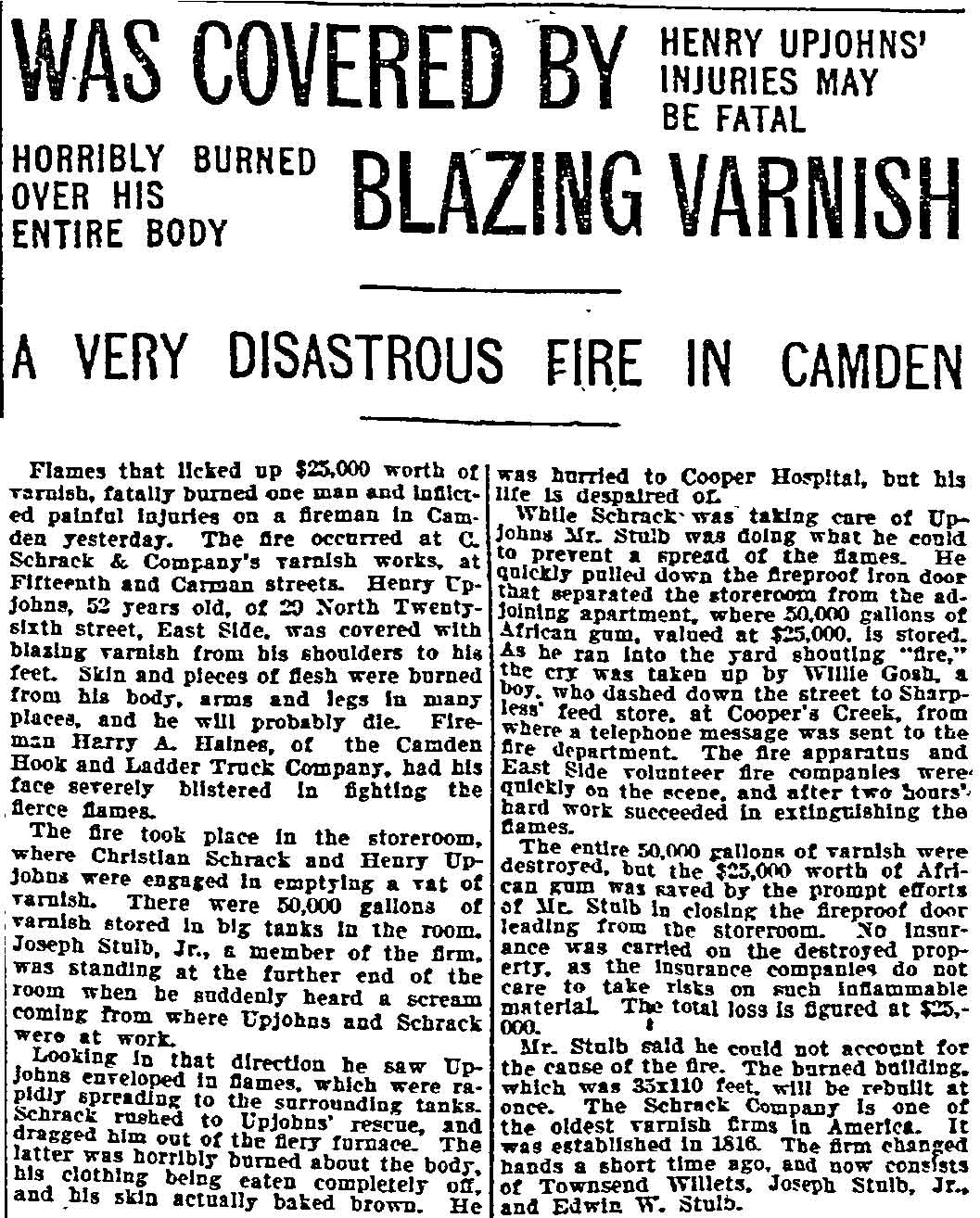
Flames that licked up $25,000 worth of varnish, fatally burned one man and killed a horse, swept through a South Camden building yesterday. The fire occurred at C. Schrack & Company’s factory corner of Fifteenth and Carman streets. Henry Upjohn, a factory clerk, of 20 North Twenty-sixth street, East Side, was covered with blazing varnish and fatally burned. The flames almost stripped the clothing from his body, arms and legs in many places, and he was badly burned. Fireman Harry A. Haines, of the Camden Hook and Ladder Company No. 3, was also severely blistered in fighting the fierce flames.
Josiah Sage, of No. 203 North Twenty-sixth street, one of the members of the firm, was slightly injured. He was talking with John M. Carroll, a director of the company, when the fire occurred. John Stulb, Jr., a member of the firm, was standing at the further end of the room when he suddenly heard a scream coming from where Upjohn had been at work.
Looking in that direction he saw Upjohn enveloped in flames and the fire rapidly spreading to the surrounding tanks, when the whole of the varnish became ablaze. In the mad rush to escape Stulb fell over a man and the latter was horribly burned about the body. Edwin W. Stulb, brother of John Stulb, Jr., was actually baked brown. He was hurried to Cooper Hospital, but his injuries may prove fatal.
The entire 50,000 gallons of varnish were destroyed, and the $25,000 worth of damage was caused by the prompt efforts of the North Camden companies. The total loss is figured at $25,000.
Big Blaze in Camden Entailed Nearly Half a Million Loss
Philadelphia Inquirer —
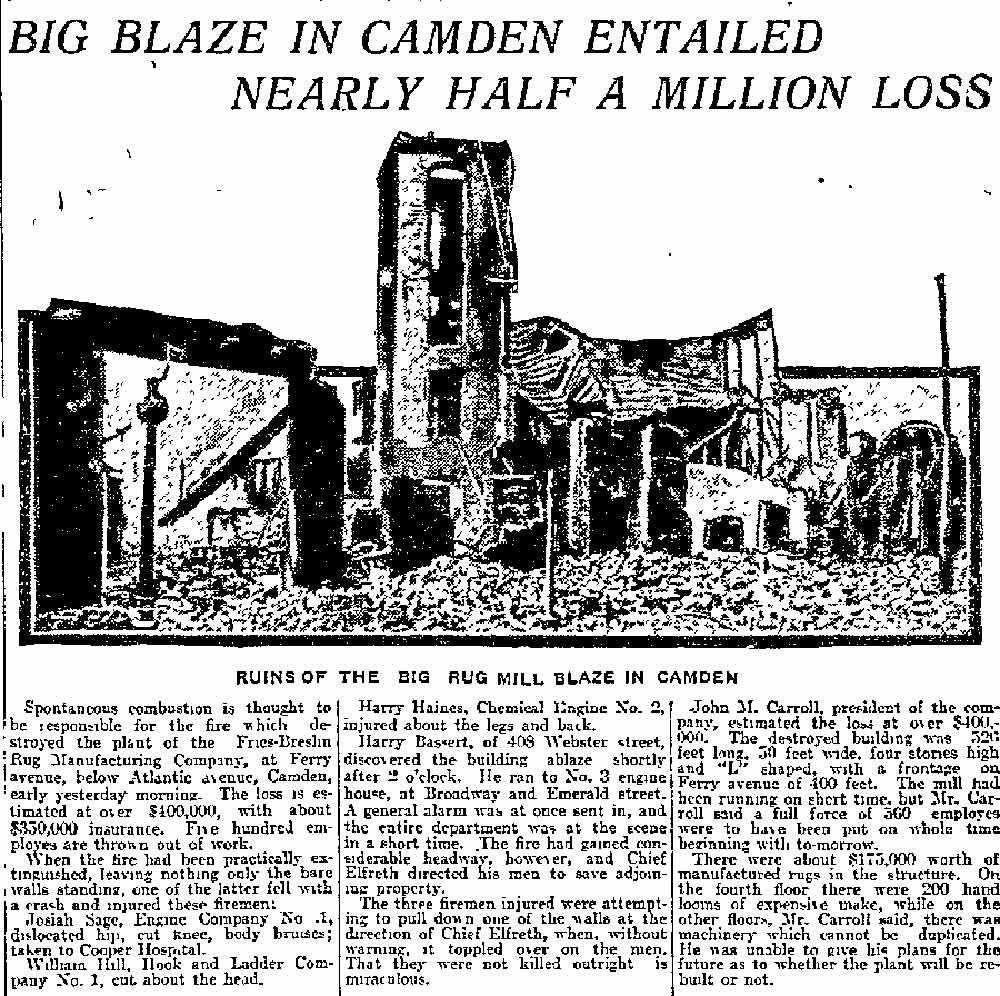
Spontaneous combustion is thought to be responsible for the fire which destroyed the plant of the Fries-Breslin Rug Manufacturing Company, at Ferry avenue, below Atlantic avenue, Camden, early yesterday morning. The loss is estimated at over $400,000, with about $350,000 insurance. Five hundred employees are thrown out of work.
William Hill, Hook and Ladder Company No. 1, cut about the head; Harry Haines, Chemical Engine No. 2, injured about the legs and back.
Harry Bassert, of 408 Webster street, discovered the building ablaze shortly after 2 o’clock. He ran to No. 2 engine house, at Broadway and Emerald street. The department was at once sent in, and the entire department was at the scene in a short time. The fire had gained considerable headway, however, and Chief Elfreth directed his men to save adjoining property.
The three firemen injured were attempting to pull down one of the walls at the direction of Chief Elfreth, when, without warning, it toppled over on the men. That they were not killed outright is miraculous.
John M. Carroll, president of the company, estimated the loss at over $400,000. The destroyed building was 700 feet long, 50 feet wide, four stories high and “L” shaped, with a frontage on Ferry avenue of 400 feet. The mill had been running on short time, but Mr. Carroll said a full force of 300 employees were to have been put on whole time beginning with to-morrow.
There were about $175,000 worth of manufactured rugs in the structure. On the fourth floor there were 400 to 500 dozens of expensive china, while on the other floors, Mr. Carroll said, there was machinery which cannot be duplicated.
Three Firemen Met Death in Camden Blaze
Philadelphia Inquirer —
Trapped in Fire at the Old Sixth Regiment Armory They Perished in Flames
Nine Other Persons Received Injuries
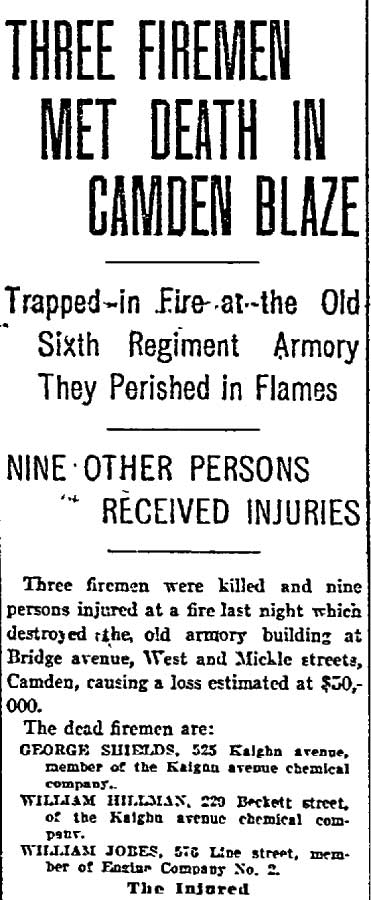
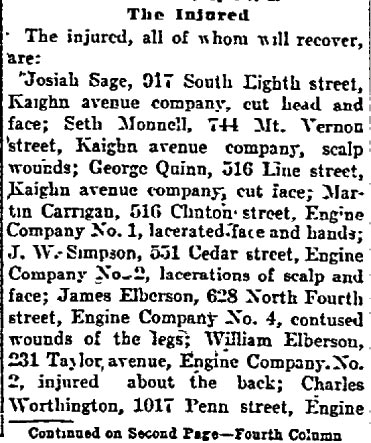
Three firemen were killed and nine persons injured at a fire last night which destroyed the old armory building at Bridge avenue, West and Mickle streets, Camden, causing a loss estimated at $50,000.
The dead firemen are:
GEORGE SHIELDS, 525 Kaighn avenue, member of the Kaighn avenue chemical company.
WILLIAM HILLMAN, 229 Beckett street, of the Kaighn avenue chemical company.
WILLIAM JOBES, 576 Line street, member of Engine Company No. 2.
The injured, all of whom will recover, are: Josiah Sage, 917 South Eighth street, Kaighn avenue company, cut head and face; Seth Monnell, 744 Mt. Vernon street, Kaighn avenue company, scalp wounds; George Quinn, 516 Line street, Kaighn avenue company, cut face; Martin Carrigan, 516 Clinton street, Engine Company No. 1, lacerated face and hands; J. W. Simpson, 551 Cedar street, Engine Company No. 2, lacerations of scalp and face; James Elberson, 628 North Fourth street, Engine Company No. 4, contused wounds of the legs; William Elberson, 231 Taylor avenue, Engine Company No. 2, injured about the back; Charles Worthington, 1017 Penn street, Engine Company No. 3, internally injured; Harry Dease, a citizen, cut about the face.
The six o’clock whistles were blowing when smoke was seen issuing from the northeast corner of the building. A moment later two boys ran out of a door, one of whom notified Policeman Isaac Toy that the structure was on fire. The officers immediately turned in an alarm. In rapid succession other alarms were given, until the entire department was on the scene.
One of the first companies to arrive was the Kaighn avenue truck. As the men drove up to the scene great tongues of flame were fast eating their way through the yellow pine timbers of which the interior was constructed. The main doors at the entrance on Mickle street were burst open and the firemen entered amid a perfect shower of sparks and falling debris. In this party were the three ill-fated firemen, Dease, and Firemen Harry Haines, Joseph Ernest, George Quinn, Seth Mounell and Joseph Gail.
After great difficulty the men worked their way into the blazing building about twenty feet. Dense volumes of smoke almost suffocated them and several dropped to the floor.
While the firemen were waiting for the water a false ceiling thirty feet above them and composed of floor boards began cracking and bending. A shout of warning was given by Dease, and he and his companions made a dash for the doors. It was impossible to see a foot before them, and all blindly groped their way to the open doors but Jobes, Shields and Hillman. That they did not come out of the building was not known for several minutes later. Then reports were circulated that they had been taken to nearby houses, but these were found to be false. Their companions then tried to work their way back to their assistance, but by this time the interior was a seething furnace.
Subsequently, when the blaze had been somewhat subdued, firemen and policemen instituted a search for the missing men. Where the latter had been there was a great pile of blackened timbers and twisted iron. After vigorous efforts this was removed.
First there came to light Shield’s helmet, and a few feet distant his body and those of Hillman and Jobes, scorched and blackened almost beyond recognition, were found. It was then learned how they had met their deaths. Instead of going toward the open doorway they had evidently become bewildered and, turning, ran into a toilet room to which there was no outlet. There they were quickly cut off from their comrades and, becoming unconscious from the smoke, all three dropped to the floor, where death overtook them.
The bodies were carried out and taken to the Morgue.
In the meantime every portion of the structure became a mass of flames. Fed by the pine, great tongues of fire sprang into the air, across Mickle and West streets, where the dwellings were badly scorched. The families residing in these in several instances became panic-stricken and began removing their household effects. Men, women and children ran excitedly about. It is owing to the excellent work of the firemen that these structures were not destroyed.
Chief Elfreth quickly concluded there was no hope of saving the armory and he directed a dozen lines of hose toward the dwellings, many of which became so hot that the streams of water fairly sizzled.
The fire was a spectacular one, lighting up the heavens for miles around. Thousands of persons crowded the thoroughfares leading to the blaze, but excellent order was preserved under the direction of Acting Chief of Police Schregler, who quickly had the streets roped off and guarded by the officers.
There was considerable danger at first from falling electric wires, which spluttered among the firemen and ofttimes amidst the onlookers. These wires also fell across the Pennsylvania Railroad Company’s tracks on Bridge avenue and suburban trains were stalled for over an hour. At one time the flames approached so near the passenger coaches that they had to be taken back into the yard.
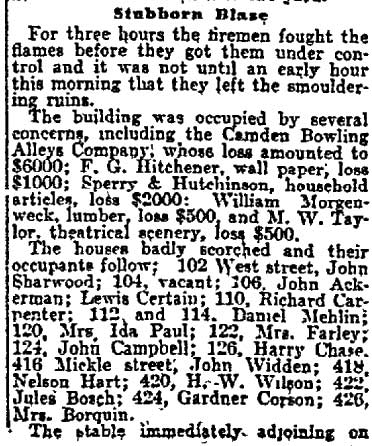
For three hours the firemen fought the flames before they got them under control and it was not until an early hour this morning that they left the smouldering ruins.
The building was occupied by several concerns, including the Camden Bowling Alleys Company, whose loss amounted to $6000; F. G. Hitchener, wall paper, loss $1000; Sperry & Hutchinson, household articles, loss $2000; William Morgenweck, lumber, loss $500, and M. W. Taylor, theatrical scenery, loss $500.
The houses badly scorched and their occupants follow: 102 West street, John Sharwood; 104, vacant; 106, John Ackerman; Lewis Certain; 110, Richard Carpenter; 112, and 114, Daniel Mehlin; 120, Mrs. Ida Paul; 122, Mrs. Farley; 124, John Campbell; 126, Harry Chase; 416 Mickle street: John Widden; 418, Nelson Hart; 420, H. W. Wilson; 422, Jules Bosch; 424, Gardner Corson; 426, Mrs. Borquin.
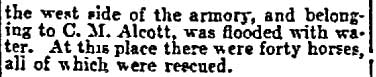
The stable immediately adjoining on the west side of the armory, and belonging to C. M. Alcott, was flooded with water. At this place there were forty horses, all of which were rescued.
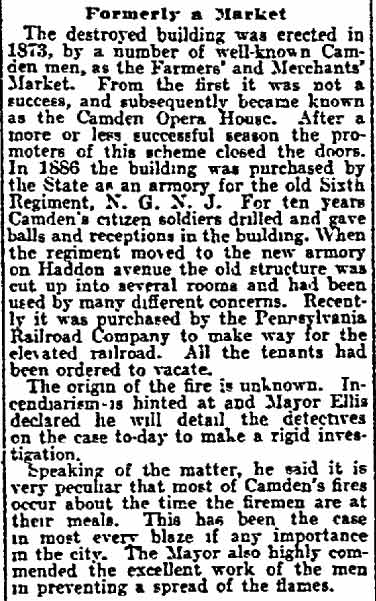
The destroyed building was erected in 1873, by a number of well-known Camden men, as the Farmers’ and Merchants’ Market. From the first it was not a success, and subsequently became known as the Camden Opera House. After a more or less successful season the promoters of this scheme closed the doors. In 1886 the building was purchased by the State as an armory for the old Sixth Regiment, N. G. N. J. For ten years Camden’s citizen soldiers drilled and gave balls and receptions in the building. When the regiment moved to the new armory on Haddon avenue the old structure was cut up into several rooms and had been used by many different concerns. Recently it was purchased by the Pennsylvania Railroad Company to make way for the elevated railroad. All the tenants had been ordered to vacate.
The origin of the fire is unknown. Incendiarism is hinted at and Mayor Ellis declared he will detail the detectives on the case to-day to make a rigid investigation.
Speaking of the matter, he said it is very peculiar that most of Camden’s fires occur about the time the firemen are at their meals. This has been the case in most every blaze of any importance in the city. The Mayor also highly commended the excellent work of the men in preventing a spread of the flames.
Plenty of Mix Ups Caused by Blaze
Philadelphia Inquirer —
Fire Chief’s Horse Ran Away, Store Was Wrecked and Two Victims Went to Hospital
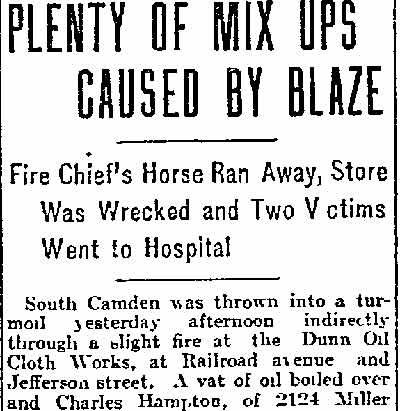
South Camden was thrown into a turmoil yesterday afternoon indirectly through a slight fire at the Dunn Oil Cloth Works, at Railroad avenue and Jefferson street. A vat of oil boiled over and Charles Hampton, of 2124 Miller street, was terribly burned. He was removed to the Cooper Hospital. When the blazing oil set fire to the place an alarm was turned in.
On the way to the fire the carriage containing Chief Elfreth dashed into the moving van of John Schmidt, at Broadway and Chestnut street. The horse ran away and collided with the awning pole of the Story Furniture Company, at Sycamore street, the structure being partly wrecked.
Beneath the awning Harry Haines, a blind man, of 232 Kaighn avenue, was playing a fife for alms. The noise startled him, and when he attempted to get out of the way the frenzied horse dashed over him. Haines was taken to the Cooper Hospital, suffering from lacerations and contusions pretty much all over the body.
The fire at the oil cloth factory did less than $25 worth of damage.
Firemen Trapped in Burning Store
Camden Post-Telegram —
Seven Fight Their Way Out After Being Surrounded by Flames.
Blazing Children Peril Whole Block

Caught like rats in a trap in a fire that threatened the entire business block on the east side of Broadway between Chestnut street and Kaighn avenue, yesterday morning, seven firemen, back to back, fought their way through flames and smoke escaping with singed hair and eyebrows and slight burns of the face, head and hands.
And while these brave men were battling against great odds, the father and mother of two pretty little girls, aged eighteen and thirty months, were alternately laughing and crying, or praising a plucky little woman who saved their tots from being burned to death.
Six of the firemen—Captain Charles Robinson, Captain Samuel Price, Lieutenant Harry Haines, Morton Clark, James McDermott, John McTaggart—were from the Kaighn avenue house. The other was Roy Smith, of the Chemical Company from House No. 7.
The children who were saved from an awful fate are: Florence Erlick and Martha Erlick, and their rescuer is Mrs. Tillie Sackett, of 1122 Broadway.
Three stores, 1118, 1120, 1122 Broadway, were practically gutted and the upper stories in the rear badly damaged, the whole entailing a loss estimated at $6,500 of which the major portion is covered by insurance. The police arrangements were perfect, the entire block being roped off within a few minutes after the fire alarm was turned in at Broadway and Kaighn avenue by Reserve Policeman Matlack.
Harry Erlick conducts a dry goods, notion and gents’ furnishing store at 1120 Broadway. About 10.45 o’clock he left the front of the store to go to the kitchen, leaving the little girls, Florence, aged 30 months, and Martha, aged 18 months, at play in the store, his wife being out on an errand. Only a short time elapsed when he was startled by the screams of Florence and rushing into the kitchen saw her standing near the coal stove trying to beat out the fire in a paper belt that she had around her body.
As Mr. Erlick entered she ran towards him, the blaze from the belt setting fire to some of the goods on the counter. Thinking only of his children, Mr. Erlick beat out the fire on the little one’s clothing but by this time the flames were rapidly spreading over the rear of the store.
Believing that the little ones were all right he took them into the store 1122 occupied by Edward T. Sackett, manager of a branch office of the Singer Sewing Machine Co. Calling to Mrs. Sackett to care for them, he started for the door to turn in an alarm. As Mrs. Sackett rose to go to the little ones she discovered that Martha’s dress was on fire and before she reached the child the dress of Martha was ablaze.
With great presence of mind Mrs. Sackett threw both children to the floor and covered them with a big rug, instantly smothering the flames, and she then tore off the children’s garments to be sure that there was no further danger. In the meantime the firemen had been summoned and by the time the companies from Kaighn Avenue arrived the flames were blazing above the roof of 1120. The children were then taken to the home of friends where it was found they were only slightly burned.
Assistant Chief Cox, of the southern district, immediately ordered a general alarm and it was undoubtedly due to this that the block was saved, for the frame buildings were rapidly going in the rear when powerful streams from nearly every engine in the Camden district checked the rapid spread of the flames and in less than thirty minutes the fire was out.
The seven firemen who had a close call went into the front of Mr. Erlick’s store with hose from two chemical engines to hold the blaze in check until water could be forced by the engines, and although they were fighting fiercely they were making but little progress owing to the inflammable nature of the stock and the fact that the building was frame and very old.
They were there only a few minutes when they were startled by the crashing of glass and in turning they saw the backs of the store ablaze on fire and that a sheet of flame was extending across the front of the building.
“Back to back and fight both ways” shouted Captain Robinson and the men obeyed, two streams being directed against the front of the store and two in the rear. In what seemed like an age, according to a statement made by Captain Robinson, after returning to the house, but in reality only a short space of time, the men had quenched the fire in the front part of the store and then attacked the rear body.
The flames rapidly communicated to the provision store of Mrs. Mary Palosky, 1118 Broadway. When it looked as if H. Nurock’s store at 1124 Broadway would be licked up, ladders were brought into play and extra streams were run in from the upper stories from Broadway, and from that instant all danger of a big conflagration was over.
Peter Gray and Harvey Watts, stationed at headquarters, were off duty at the time, but hearing of the fire returned to the house and went to the scene with the supply wagon. After the fire a chorus of praise went their way though Gray had a rib cracked he remained on duty until the fire was out and when Chief Elfreth wanted to send him to a hospital Gray drove the team back and then went home.
Inmates Rescued as Nursery Burns
Camden Post-Telegram —
Firemen Save Dozen Sick Children Who Were in Quarantine Ward.
Carried to Safety Down the Ladders
Twenty-three children, fourteen of whom were ill and confined in the quarantine ward, were rescued this morning when flames damaged the Mary J. Ball Home and Day Nursery at 1743 Master street. The fire was caused by a defective flue. The building, a three-story frame structure, was damaged to the extent of about $800.
The fire was discovered by the matron, Mrs. Mary McKeown, as she was passing along the second-story hall. Grabbing two small children in her arms she ran to the street yelling “Fire.” Two men were passing at the time but paid no attention to her cry. She handed the two children to a neighbor after telling him to send in the fire alarm.
Re-entering the house Mrs. McKeown called to the other children to rush into the rooms and each seized a younger person, as they are taught in the fire drill.
By this means nine of the children had been rescued when the firemen arrived.
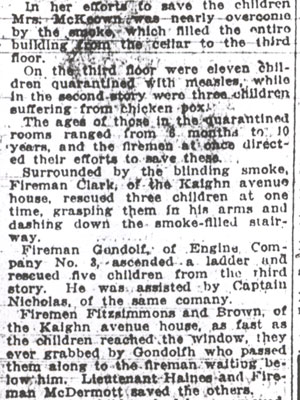
In her efforts to save the children Mrs. McKeown was nearly overcome by the smoke, which filled the entire building from the cellar to the third floor.
On the third floor were eleven children quarantined with measles, while in the second story were three children suffering from chicken pox. The ages of those in the quarantined rooms ranged from 8 months to 10 years, and the firemen at once directed their efforts to save these.
Surrounded by the blinding smoke, Fireman Clark, of the Kaighn avenue house, rescued three children at one time, grasping them in his arms and dashing down the smoke-filled stairway.
Fireman Gondolf, of Engine Company No. 3, ascended a ladder and rescued five children from the third story. He was assisted by Captain Nicholas, of the same company. Firemen Fitzsimmons and Brown, of the Kaighn avenue house, as fast as the children reached the window, they were grabbed by Gondolf who passed them along to the fireman waiting below him. Lieutenant Haines and Fireman McDermott saved the others.
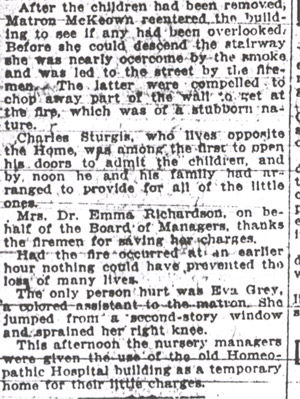
After the children had been removed, Matron McKeown reentered the building to see if any had been overlooked. Before she could descend the stairway she was nearly overcome by the smoke and was led to the street by the firemen. The latter were compelled to chop away part of the wall to get at the fire, which was of a stubborn nature.
Charles Sturgis, who lives opposite the Home, was among the first to open his doors to admit the children, and, by noon he and his family had arranged to provide for all of the little ones.
Mrs. Dr. Emma Richardson, on behalf of the Board of Managers, thanks the firemen for saving her charges.
Had the fire occurred at an earlier hour nothing could have prevented the loss of many lives.
The only person hurt was Eva Grey, a pupil-assistant to the matron. She jumped from a second-story window and sprained her right knee.
This afternoon the nursery managers were given the use of the old Homeopathic Hospital building as a temporary home for their little charges.
Heavy Pay Cut Fear Cause of Rush to Retire
Camden Courier-Post —
Inspector Humes Highest Officer on List; Three Captains Are Included
Protective Forces Lose Their Oldest Veterans
Sixteen Vacant Places Will Be Filled Without New Appointments

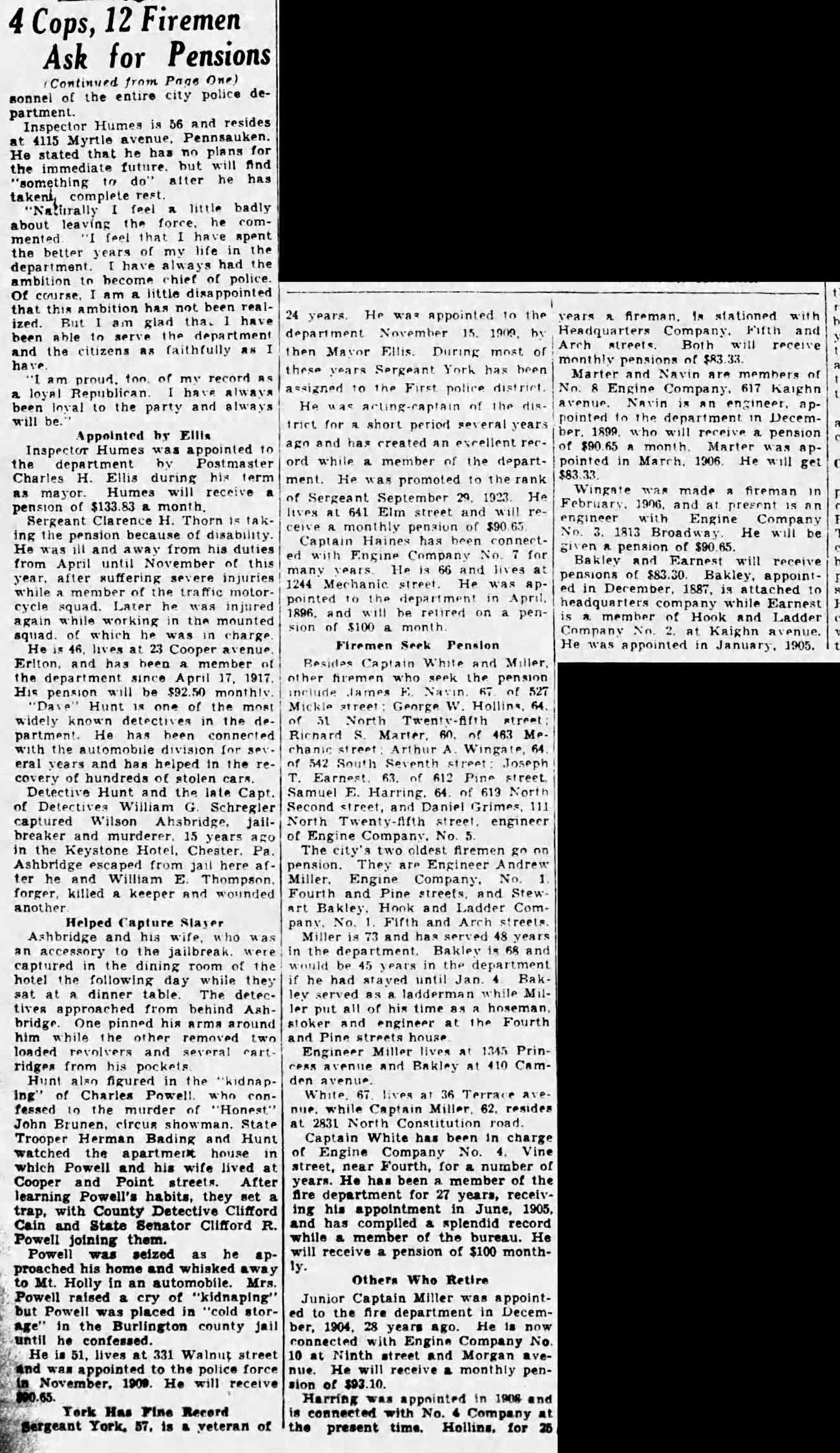
Four policemen and 12 city firemen yesterday applied for pensions effective at midnight tonight. In the interests of economy, no successors will be named by the city commission.
Sudden decision of the applicants was inspired by the fact that city employes may be given a 30 percent reduction in pay equal to that of county employes. Police and firemen accepted a 10 percent reduction this year. If given an additional 20 percent their salaries would be on a pre-war basis.
They also face a possibility of further reductions in pensions if existing mandatory legislation is repealed by the Legislature, which fixes salaries of police and firemen according to the class of cities and towns. By applying now they will receive pensions on basic 1931 salaries.
The big surprise was announcement that Inspector Charles T. Humes, in charge of personnel of the police department, had applied for a pension. Inspector Humes receives a salary of $3000 yearly. By applying at this time he is eligible to a pension of one-half that amount. The $1500 yearly would be within a few hundred dollars of what he would receive if he remained on the force and accepted a 30 percent reduction in salary.
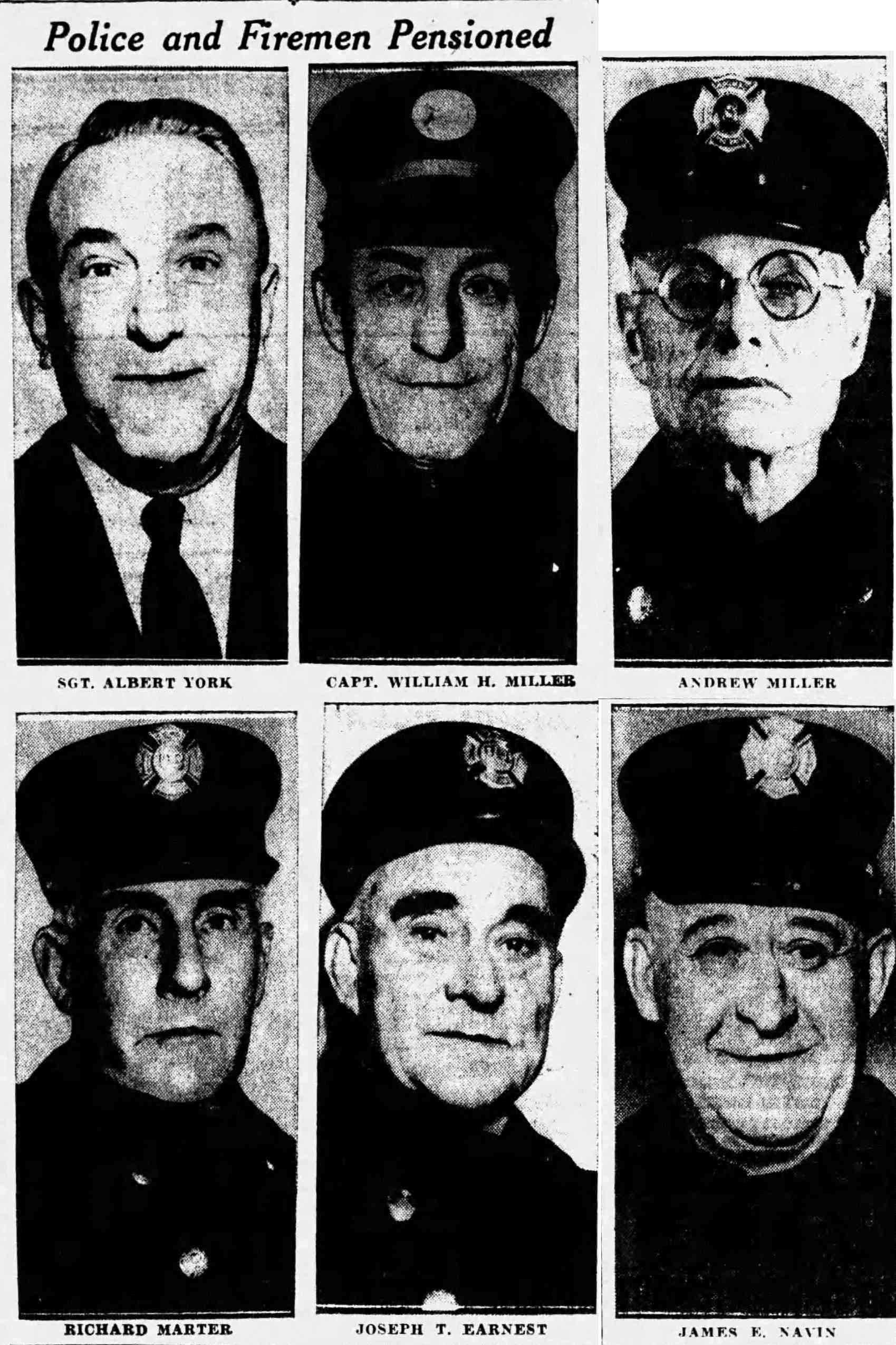
Other policemen to ask for pensions are Sergeants Albert York and Clarence Thorn and Detective David Hunt.
Three fire captains applying for pensions are James R. White, Harry A. Haines and William H. Miller, Jr.
The applications were filed with Mrs. Louise F. Walsh, secretary of the Police and Firemen’s Pension Fund. The pension fund commission will act on the applications today.
Inspector Humes’ retirement comes at the conclusion of a quarter century of service in the police department. He was appointed as a patrolman on Jan. 1, 1908, and six years later, on Jan. 1, 1914, was elevated to a sergeancy. He was promoted to captaincy on July 1, 1918. Then, by act of the city commission, he was made an inspector on June 23, 1927.
While a captain, he was in command of the First District and later of the Third. As an inspector, he was head of the traffic bureau for several years. He was a nationally recognized authority on traffic problems, having been requested for advice by various automobile clubs and traffic commissions. He played a leading role in a traffic convention at Chicago and once was called in by the federal traffic commission at Washington for advice.
Junior Captain William Miller was appointed to the fire department in December, 1897. He receives a pension of $93.33 a month.
The applications of Captain John Lutts, of Engine Company No. 6, Front and Linden streets, and Elmer Burkett, engineer of the No. 4 Company, were filed shortly before noon. Captain Lutts, 62, lives at 456 Royden street, and will receive a pension of $100 monthly. He was appointed 33 years ago. Burkett, 66, lives at 330 North Ninth street. He was appointed to the fire department in 1907 and will be pensioned at $90.65 monthly.
Pensions Awarded 6 Cops, 17 Firemen
Camden Courier-Post —
Inspector Humes Refuses to Withdraw Application in Spite of Requests

Pensions for six policemen and 17 firemen took effect with the dawn of the New Year yesterday.
Proposed salary reductions from five to 30 percent prompted the wholesale requests for pensions which were approved Saturday at noon by the Police and Firemen’s Pension Commission, of which Mayor Roy R. Stewart is chairman.
The proceedings were delayed one hour while efforts were being made by political leaders and friends to have Inspector Charles T. Humes reconsider his application. But he refused to withdraw his application and it was approved.
Two sergeants, a city detective and four captains of the fire department were included in the list of applicants.
Sergeants Albert York and Clarence Thorn, Detective David Hunt and Fire Captains Harry Haines, John Lutts, James R. White and William H. Miller, Jr., were included among the pensioners.
Major W. Greenwood and Adrian Bateman, two patrolmen, completed the list from the police department, while the others receiving pension awards who are members of the fire department were: Elmer Burkett, 66; Robert M. Coffman, 57; Howard E. Currie, 52; James E. Navin, 67; George W. Hollins, 64; Richard S. Marter, 60; Arthur A. Wingate, 64; Joseph T. Earnest, 63; Samuel E. Harring, 64; Andrew Miller, 73; Stewart Bakley, William K. Buzine, 63, and Daniel Grimes.
Mayor Stewart and Commissioner Bennett, both members of the commission, said they regretted so many “young men” were asking to be pensioned at this time.
Buzine is a veteran of nearly 28 years’ service. He is 63, lives at 856 Haddon avenue and will be pensioned at $90.65. He was classed as an engineer in the fire department.
The applications of Captain John Lutts, of Engine Company No. 6, Front and Linden streets, and Elmer Burkett, engineer of the No. 4 Company, were filed shortly before noon. Captain Lutts, 62, lives at 456 Royden street, and will receive a pension of $100 monthly. He was appointed 33 years ago. Burkett, 66, lives at 330 North Ninth street. He was appointed to the fire department in 1907 and will be pensioned at $90.65 monthly.
Harry A. Haines Dies, Retired Fire Captain
Camden Courier-Post —
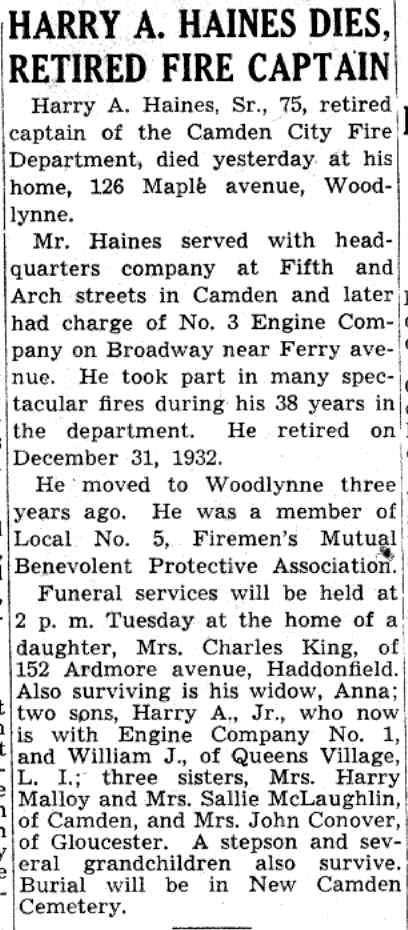
Harry A. Haines, Sr., 75, retired captain of the Camden City Fire Department, died yesterday at his home, 126 Maple avenue, Woodlynne.
Mr. Haines served with headquarters company at Fifth and Arch streets in Camden and later had charge of No. 3 Engine Company on Broadway near Ferry avenue. He took part in many spectacular fires during his 38 years in the department. He retired on December 31, 1932.
He moved to Woodlynne three years ago. He was a member of Local No. 5, Firemen’s Mutual Benevolent Protective Association.
Funeral services will be held at 2 p.m. Tuesday at the home of a daughter, Mrs. Charles King, of 152 Ardmore avenue, Haddonfield. Also surviving is his widow, Anna; two sons, Harry A., Jr., who now is with Engine Company No. 1, and William J., of Queens Village, L. I.; three sisters, Mrs. Harry Malloy and Mrs. Sallie McLaughlin, of Camden, and Mrs. John Conover, of Gloucester. A stepson and several grandchildren also survive. Burial will be in New Camden Cemetery.
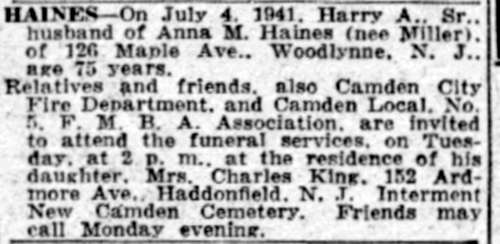
HAINES—On July 4, 1941, Harry A., Sr., husband of Anna M. Haines (nee Miller), of 126 Maple Ave., Woodlynne, N. J., age 75 years. Relatives and friends, also Camden City Fire Department, and Camden Local No. 5, F. M. B. A. Association, are invited to attend the funeral services, on Tuesday, at 2 p. m., at the residence of his daughter, Mrs. Charles King, 152 Ardmore Ave., Haddonfield, N. J. Interment New Camden Cemetery. Friends may call Monday evening.