Introduction
Dr. Clement T. Branch was a prominent physician and civil rights leader in Camden’s Black community from 1902 until his death on November 29, 1933.
Born in Farmville VA on January 21, 1869, Clement Branch was educated in the public schools of Farmville, and received his college training at Virginia Normal and Collegiate Institute, later called Virginia State College. He studied medicine at Shaw University, Cornell University, and Howard University, where he graduated in 1900. He married Miss Bessie D. Avery, a schoolteacher of Petersburg VA in 1903.
Dr. Branch first practiced medicine in Jersey City NJ, coming to Camden in 1902. He soon was prominent not only as a doctor but in the civic and educational affairs of the city. He was the first Black member of the Camden Board of Education, and also was instrumental in effecting the hiring of Black firemen and policemen.
Dr. Branch was selected to be a delegate to the “negro Young People’s Congress” in Washington DC, which ran from July 31 to August 6, 1906, as reported in the Trenton Times on July 30, 1906. Other delegates from Camden were attorney Powell K. Martin, the Rev. Dr J.H. White, and the Rev. Dr. R.F. Hurley.
In 1912 Dr. Branch served as a delegate from New Jersey to the “Bull Moose” party’s national convention, which nominated ex-president Theodore Roosevelt for President. Roosevelt would be defeated by Woodrow Wilson.
By 1930 Dr. and Mrs. Branch had purchased a home at 727 Walnut Street. He also owned real estate in Centerville, between 9th and 10th Streets. A few doors down at 735 Walnut was businessman Robert Bumbrey, who would become well known in the 1930s for various activities.
Dr. Branch was responsible for organizing the Hunton Branch Y.M.C.A. which in later years had buildings at 6th and Mechanic Streets and 6th and Liberty Streets. He was chairman of the Hunton Branch until his death. Dr. Branch was always interested in efforts to aid children and to advance civil rights. For many years memorial services were held on the anniversary of his death in Camden.
On May 4, 1940 ground-breaking ceremonies attended by City Commissioners, State and Camden Housing Authorities, A.P. Miller, general contractor, and Mrs. Bessie A. Branch, widow of Dr. Branch, were held for the government-built public housing project, the “Village” named after Clement T. Branch, built in part on land which Dr. Branch had owned in his lifetime.
By the 1940s 727 Walnut Street had become the home of Dr. Marcus F. Wheatland Jr., a protégé of Dr. Branch.
The Clement T. Branch Village housing project was formally dedicated on September 27, 1941.
Negro on Camden Education Board
Trenton Evening Times —
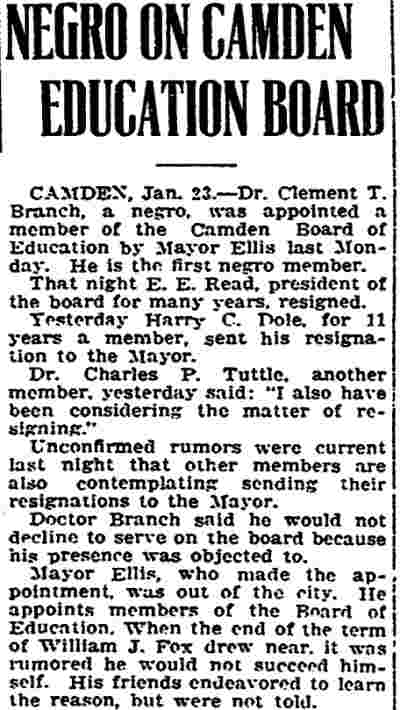
CAMDEN, Jan. 23.—Dr. Clement T. Branch, a negro, was appointed a member of the Camden Board of Education by Mayor Ellis last Monday. He is the first negro member.
That night E. E. Read, president of the board for many years, resigned.
Yesterday Harry C. Dole, for 11 years a member, sent his resignation to the Mayor.
Dr. Charles P. Tuttle, another member, yesterday said: “I also have been considering the matter of resigning.”
Unconfirmed rumors were current last night that other members are also contemplating sending their resignations to the Mayor.
Doctor Branch said he would not decline to serve on the board because his presence was objected to.
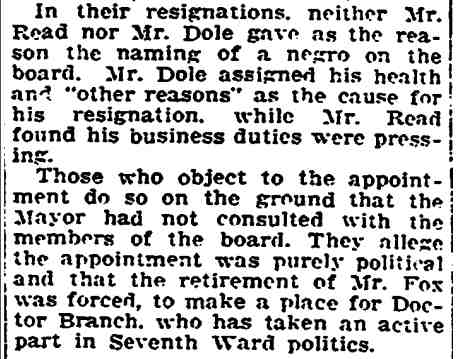
Mayor Ellis, who made the appointment, was out of the city. He appoints members of the Board of Education. When the end of the term of William J. Fox drew near, it was rumored he would not succeed himself. His friends endeavored to learn the reason, but were not told.
Former Detective Murry Drops Dead In Street
Camden Courier —
SLEUTH ACCUSED OF GRAFT FOUND DEAD NEAR HOME
Tragic End Automatically Halts Probe of His Vice Activities
NEIGHBORS FIND BODY
Leaves Wife and Eight Children — Once Powerful Leader in Third Ward
FUNERAL ON THURSDAY
George Murry, ex-city detective, who resigned from the police department after being charged with promoting vice in the Third and Fifth Wards, was found dead on a doorstep near Locust and Line Streets shortly after nine o’clock last night.
A death certificate issued by Coroner Holl ascribes Murry’s death as due to apoplexy, superinduced by acute indigestion.
Grand Jury Probe Starts
Murry’s death came as a tragic aftermath of his exposure as a protector of prostitution and dope selling in the downtown tenderloin, in the role of which he is said to have amassed a snug fortune.
His death automatically puts to an end the proceedings that were begun to present his activities in the tenderloin before the Grand Jury with a view of bringing criminal prosecution.
Murry will be buried Thursday afternoon at Mt. Peace Cemetery, of which he was part owner. Funeral services will be conducted at the home and in the Macedonia Church, 3rd and Spruce Street, at noon.
Neighbors Find Body
Murry was 50 years old. According to his wife, Mrs. Cora J. Murry, the former city detective had been suffering for several days with indigestion.
After supper last night, Mrs. Murry said, her husband complained of feeling ill and she gave him a tablespoon of baking soda. He shortly after decided to take a walk in the belief the air might benefit him.
Half an hour later, neighbors came upon his lifeless body across a doorstep on Locust Street, between Beckett and Line Streets.
The body was carried to the Murry home, at 649 Locust Street, a few doors away. Two physicians were called. Owing to the storm, the doctors were delayed in reaching the house. Dr. Clement T. Branch, of 721 Walnut Street, the first physician to arrive, said he believed Murry had died as he fell.
Mother Died 2 Years Ago, Same Hour
Besides his widow, Murry is survived by eight children, ranging in age from two months to 18 years. Curiously, Murry’s mother died exactly two years ago, to the very hour. Murry was colored, although many persons were unaware of his race because of his light complexion. He was a tall, powerful man. He was more than six feet in height and weighed about 230 pounds. His complexion was ruddy and his hair iron gray.
Murry’s death was a passing incident in the tenderloin today. Before he was shorn of his power, which he wielded proudly and with great vigor, his decease might have caused a great flurry.
Murry, in the height of his power, was formidable, and a man whose favor the denizens and habitués of the underworld craved; stripped of that power, he was ignored and deserted as rats would desert a sinking ship.
Boss For Many Years
His loss of power probably worried Murry more than the outcome over the exposure of the criminal phase of the exposure. Murry had been the undisputed political “boss” of the Third and Fifth wards for years. The transition was too great; his fall too disgraceful.
Prosecutor Charles A. Wolverton pointed out today that with Murry dead, the presentation of evidence of vice conditions in the Fifth Ward to the Grand Jury would be dropped for the present and in all probability for good.
The reason is obvious, said Mr. Wolverton. “There’s nobody to convict.”
United States Started Probe
Murry’s downfall was due largely to the activities of attaches of the United States Interdepartmental Social Hygiene Bureau, who investigated vice conditions here at the request of the Camp Dix military authorities.
Officers of the camp complained many of the men had contracted contagious diseases during visits to the tenderloin in South Camden.
A series of meetings was held under the auspices of the bureau and a number of women prominent in social welfare work in the city.
With the co-operation of the Federal authorities, the local police began a “cleanup” of the tenderloin. No one was spared. Dope peddlers, prostitutes, bootleggers and gamblers fell in the clutches of the authorities. Questioned, their stories seemed to coincide on one fact — that Murry was the “invisible government” which sanctioned or frowned upon their industry and who had to be “greased” if they wished to ply their trade without molestation or criminal prosecution.
Three Other Members Accused
Three other members of the police department were accused of malfeasance along with Murry. They are Policemen William Draper, Tony Latorre and Ira Hall. The three men were dismissed by the police committee of City Council. Hall, who opposed his dismissal and demanded a trial, was excoriated by the committee and summarily dropped from the department.
Murry resigned from the force declaring that the evidence against him was untrustworthy, having been obtained from dope fiends and “other irresponsible people.” It was understood, however, that he resigned, believing it would put an end to the proceedings. He seemed to worry over the contemplated action by the Grand Jury.
Said He Amassed Wealth
Murry, however, boasted openly he had amassed wealth while he reigned as the “tenderloin boss.”
“I’ve got mine,” he declared only recently. “I’ve got enough to keep me and my family in clover for the rest of our lives. If they let up on me and don’t push this jail thing, I’m willing to lay down.”
In addition, Murry was specifically charged with accepting graft from dope peddlers and with “tipping off” criminals against whom warrants were issued in City Hall.
City Solicitor E.G.C. Bleakly drew up the complaint and charges against the detective. Commenting on the charges when they were first made public, Mr. Bleakly said:
“From the statements I have obtained it would seem this officer has been exerting himself as a protector instead of a detector of crime and criminals. If the facts elicited are true, Detective Murry, instead of protecting the good name and citizens of our city, as he was paid to do, has been accepting pay from the citizens of the underworld to protect them in their evil practices.”
In Department 16 Years
Murry was a member of the police department for 16 years, having been appointed in 1905. He was made a detective in 1913.
Street is Ordered Closed by City to Save Woman’s Life
Camden Courier-Post —
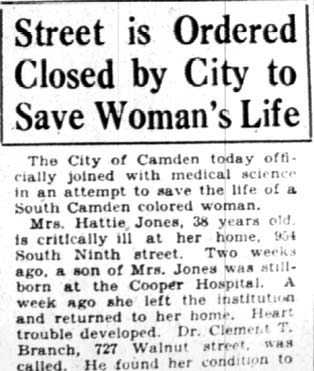
The City of Camden today officially joined with medical science in an attempt to save the life of a South Camden colored woman.
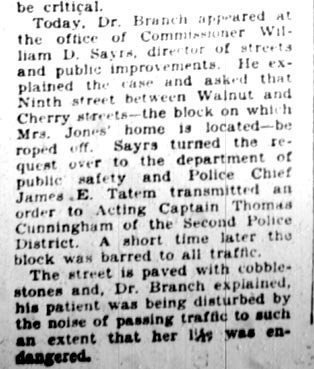
Mrs. Hattie Jones, 38 years old, is critically ill at her home, 954 South Ninth street. Two weeks ago, a son of Mrs. Jones was stillborn at the Cooper Hospital. A week ago she left the institution and returned to her home. Heart trouble developed. Dr. Clement T. Branch, 727 Walnut street, was called.
7 Democrats Rallies in County Tonight
Camden Courier-Post —
Democratic speakers, urging suffrage in the interest of A. Harry Moore, gubernatorial candidate, and the local Democratic ticket, will invade seven political clubs in the city and county tonight.
County meetings, all at 8 p. m. and speakers are as follows:
First Ward Democratic Club, Gloucester, Mercer and Burlington streets, E. George Aaron, Firman Michel and Marie V. Kelly.
Pennsauken Colored A. Harry Moore Club, Magnolia and Scovel avenues, Merchantville, Dr. Clement T. Branch, Eugene Aumaitre and Albert Melnik.
Lindenwold A. Harry Moore Club, Garden Lake fire hall, C. Lawrence Gregorio, Leon Rose, Joseph Varbalow and Mrs. Florence Melnik.
Glendora A. Harry Moore Club, fire hall, Mrs. Bertha Shippen Irving, Gene Mariano, Samuel P. Orlando and John Crean.
Somerdale Democratic Club, fire hall, Mrs. Emma E. Hyland, Edward L. Canning, Thomas Madden and John Delaney.
Fifth Ward Democratic Club, Fifth and Pine Streets, Samuel T. French, Rev. Robert A. Jackson, David L. Visor and Sabba Verdiglione.
Eighth Ward Democratic Club, 509 Ferry Avenue, Isaac Eason, Francis Homan, Charles Degnan and Judge Frank F. Neutze.
DEMOCRATS TO HOLD MEETINGS TONIGHT
Camden Courier-Post —
Candidacy of Moore to Be Expounded at Meetings in City and Suburbs
The campaign for A. Harry Moore, gubernatorial candidate, and local Democratic candidates, will be carried into six wards of the city and in seven communities of the county tonight.
All meetings and speakers are as follows:
Second Ward Democratic Club, 841 Market Street; Eugene Aumetre, John Crean, Vincent Gallagher, Leon H. Rose and Charles Woods.
Fourth Ward A. Harry Moore Club, 455 Berkley Street; Samuel T. French, Victor King, Thomas Madden, Leon H. Rose, Gene Mariano, Samuel P. Orlando and Rev. Robert H. Jackson.
Sixth Ward Democratic Club, Fourth and Walnut Street; Frank Connor, Albert Melnik and Thomas Madden.
Tenth Ward Democratic Club, Fifth and Vine Streets; Boyd Morrison, Joseph E. Nowrey, Charles Degnan and David L. Visor.
Seventh Ward A. Harry Moore Club, Seventh Street and Kaighn Avenue; Dr. Leroy Baxter, of Jersey City; Isaac Eason, Dr. Clement Branch, Rev. Robert H. Jackson, Mrs. Bertha Shippen Irving and Frank Suttill.
Eleventh Ward Democratic Club, 927 North Twenty-seventh Street; Boyd Morrison, Firmin Michel, Victor King, Mrs. Bertha Shippen Irving.
Gloucester City Democratic Club, 308 Monmouth Street; Boyd Morrison, Gene Mariano, Joseph Varbalow.
Magnolia A. Harry Moore Club, Evesham and Gloucester avenues; Firmin Michel, Edward L. Canning, John Delaney, Marie V. Kelley and Francis Homan.
Lindenwold Colored Voters’ Club, Blackstone Hall, Lindenwold, Eugene Aumetre, William Williams and Oliver Bond.
Somerdale Club, Whelen home, Somerdale Road and Oggs Avenue; Marie V. Kelly, David L. Visor and Mrs. Emma E. Hyland.
Somerdale Democratic Club, Leone Hall, Warwick Road and Helena Avenue; Samuel P. Orlando, Aaron Heine, Lawrence Gregorio and E. George Aaron.
East Haddonfield Democrat Club, Crescent and Berlin Road; Edward L. Canning, Albert Melnik and Judge Frank F. Neutze.
East Haddonfield Improvement Association, Batesville, Delaware Township; Ralph Wescott, Judge Frank F. Neutze and Mrs. Florence Melnik.
More than five speakers from North Jersey will appear at as many meetings as possible.
Memorial to Honor Birthday of Branch
Camden Courier-Post —
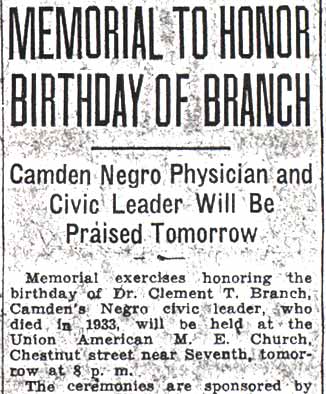
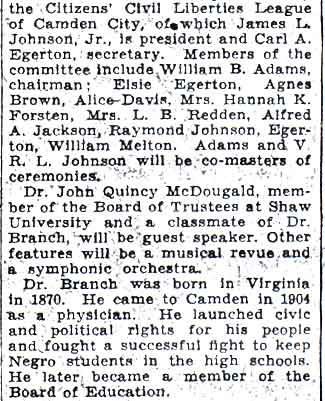
Camden Negro Physician and Civic Leader Will Be Praised Tomorrow
Memorial exercises honoring the birthday of Dr. Clement T. Branch, Camden’s Negro civic leader, who died in 1933, will be held at the Union American M. E. Church, Chestnut street near Seventh, tomorrow at 8 p. m.
WOMEN — AND WHAT THEY ARE DOING
Camden Courier-Post —
Race Relations Committee of Camden Y. W. C. A. Plans Extensive Program for Week; Mrs. Harold Bennett to Broadcast
By M. IRENE FROST
THE committee on race relations of the Camden Young Women’s Christian Association, whose endeavor it is to promote greater understanding between the races, is participating in the nation-wide celebration of Negro History Week now in progress.
The committee is sponsoring an extensive program covering both the youth and adult membership and including three broadcasts. Today, Mrs. Harold W. Bennett, of this city, will speak over Station WCAM at 2.15 on “Race Relations and Good Neighbors.” On Wednesday, Mrs. Wilda Townsend will broadcast over the same station at 2.30 on “Contributions of the Negro to the Culture of America.” A recital will be given over WCAM at 2.30 on Friday by James Marshall Wheeler, pianist, and Lawrence Lawson, tenor.
Following a short business meeting of the board of directors of the Camden Association tonight in the headquarters, Miss Marjorie Penney, executive secretary of the Young People’s Interracial Fellowship of Philadelphia, will speak.
Girl Reserves have been invited en masse to a meeting on Thursday night in the headquarters, to hear Allan Freelon, one of the nation’s leading artists, and supervisor of art in the Negro schools, of Philadelphia. Mr. Freelon, who will speak at eight o’clock, will also exhibit some of his work.
The Frances Harper Branch committee of management will be piloted by the following new officers for 1938: Mrs. C. T. Branch, chairman; Mrs. Sadie Wright, vice chairman; Mrs. Howard Primas, secretary; Mrs. Louis Smith, assistant secretary. Dr. M. O. Lee will speak on “The Makers of Negro History” next week before the Phyllis Wheatly Club of the branch.
Mrs. Bean Names Committees Heads For ‘Y’ Activities
Camden Courier-Post —
Mrs. Albert M. Bean, president of the board of directors of the Camden Young Women’s Christian Association has named the chairmen of standing committees for this year. Mrs. Lester Dickinsheets will direct activities of Girl Reserves; Mrs. Arthur J. Casselman, health education; Mrs. Frank Tunstall, membership; Mrs. Alford Naus, world fellowship; Mrs. A. Haines Lippincott, public affairs; Miss Helen M. Eastlack, race relations; Mrs. Joseph Leaming, building and maintenance; Mrs. D. Trueman Stackhouse, personnel; Mrs. Joseph Walton, education; Mrs. John Kerrigan, business and industrial; Mrs. Wm. Tipper, finance; Miss Ruth Danford, publicity; Mrs. Charles Chase, social service; Mrs. Oswald Carlander, volunteer personnel; Mrs. C. T. Branch, committee of management Frances Harper Branch.
Joseph Sickler postmaster at Salem, will be the speaker at the “Fireside Group” on Friday, March 4, at 8 p. m. “Old Homes of Salem County,” is one of the books authored by Mr. Sickler, who is well versed on the historic points of interest in South Jersey. The public is cordially invited to attend.
The health education department will hold its monthly meeting on Tuesday, March 1 at Central Association, with Mrs. Arthur J. Casselman presiding. Plans will be formulated for the annual health education dinner to be held in April.
Biographical Sketch
Clement T. Branch Village Dedication Program —
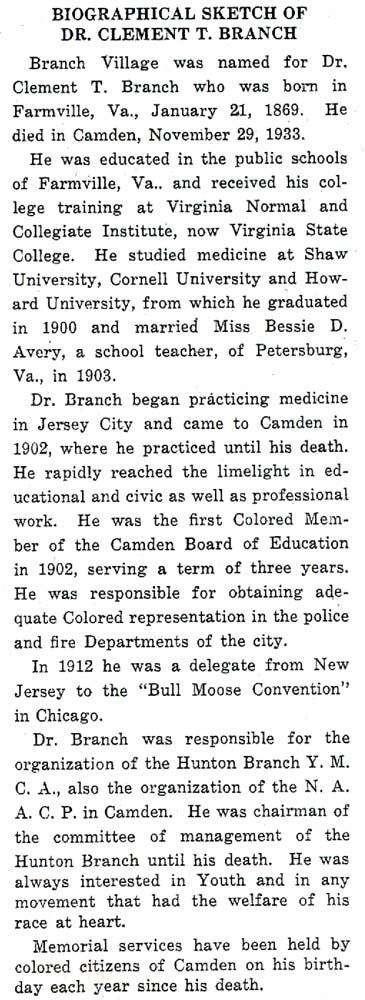
Biographical Sketch from the Clement T. Branch Village Dedication Program, September 27, 1941
Clement T. Branch Village
Clement T. Branch Village — public housing project named in honor of Dr. Branch, dedicated September 27, 1941.