Introduction
George W. Kleaver Sr. was born in Pennsylvania around 1863 to Charles and Elizabeth Kleaver. The family had moved to Camden by the time the Census was taken in 1870. Charles Kleaver then worked as a harness maker. Sadly, he passed away during the 1870s. When the census was again taken, in 1880, Lizzie Kleaver and her family were living at 327 Pine Street. Young George was working in a machine shop. He remained in that line of work through the 1880s, 1890s, and early 1900s. He married around 1887, and lived with wife Anna first at 206 Royden Street. They moved shortly thereafter to 232 and again to 222 Royden Street by 1890. A son, George Jr, was born in 1888. The Kleavers lived at 712 South 4th Street in 1900. They would move to 515 Pine Street by 1910.
George Kleaver obtained an appointment to the Camden Police Department around 1902, and would serve on Camden’s police department for 26 years. He was a member of the honor guard at funeral services for Camden Chief of Police John Foster in 1904. He was leaving his house for his post as Acting Desk Sergeant at Camden’s Police Headquarters when he suffered a massive heart attack and died on New Years Day, 1928.
Chief John Foster Funeral Services
Philadelphia Inquirer —

Camden Witnessed Greatest Demonstration of Its Kind Since Gen. Sewell’s Burial
THOUSANDS PAID TRIBUTE TO DEAD
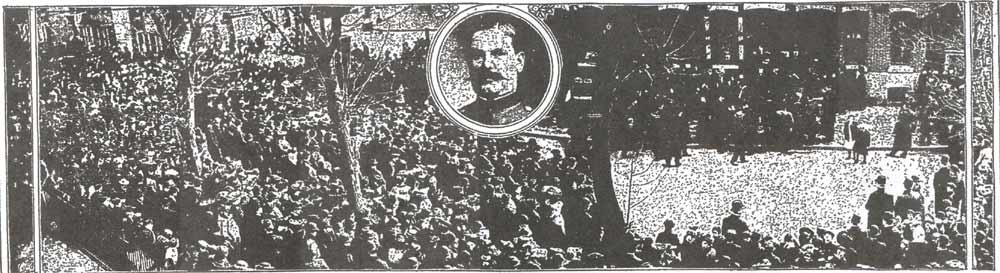
CROWD ABOUT THE FOSTER HOME AND PICTURE OF THE DEAD CHIEF
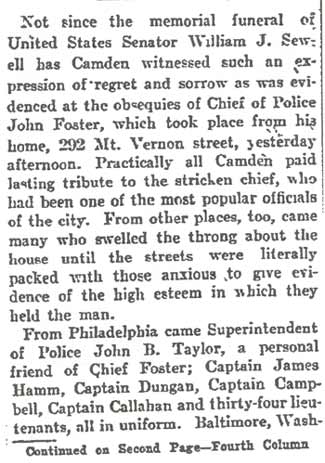
Not since the memorial funeral of United States Senator William J. Sewell has Camden witnessed such an expression of regret and sorrow as was evidenced at the obsequies of Chief of Police John Foster, which took place from his home, 292 Mt. Vernon street, yesterday afternoon. Practically all Camden paid lasting tribute to the stricken chief, who had been one of the most popular officials of the city. From other places, too, came many who swelled the throng about the house until the streets were literally packed with those anxious to give evidence of the high esteem in which they held the man.
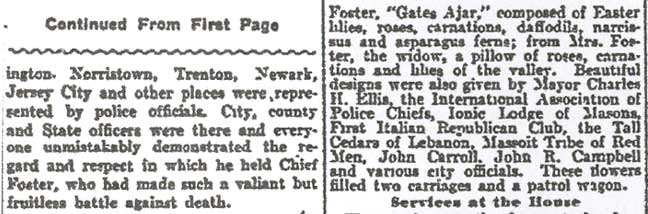
From Philadelphia came Superintendent of Police John B. Taylor, a personal friend of Chief Foster; Captain James Hamm, Captain Dungan, Captain Campbell, Captain Callahan and thirty-four lieutenants, all in uniform. Baltimore, Washington, Norristown, Trenton, Newark, Jersey City and other places were represented by police officials. City, county and State officers were there and everyone unmistakably demonstrated the regard and respect in which he held Chief Foster, who had made such a valiant but fruitless battle against death.
Thousands Viewed Remains
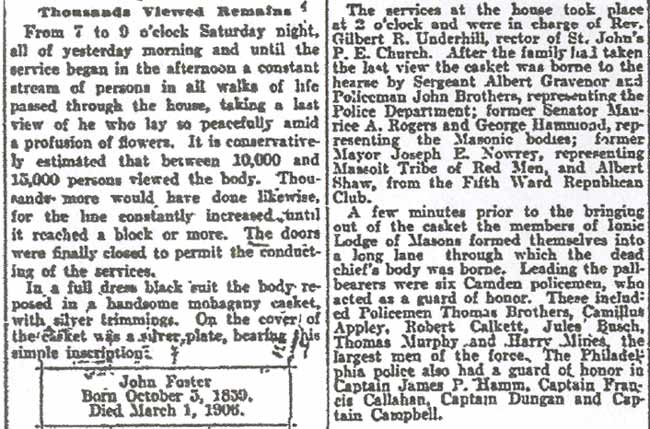
From 7 to 9 o’clock Saturday night, all of yesterday morning and until the service began in the afternoon a constant stream of persons in all walks of life passed through the house, taking a last view of he who lay so peacefully amid a profusion of flowers. It is conservatively estimated that between 10,000 and 15,000 persons viewed the body. Thousands more would have done likewise, for the line constantly increased, until it reached a block or more. The doors were finally closed to permit the conducting of the services.
In a full dress black suit the body reposed in a handsome mahogany casket, with silver trimmings. On the cover of the casket was a silver plate, bearing this simple inscription:
John Foster
Born October 5, 1839.
Died March 1, 1906.
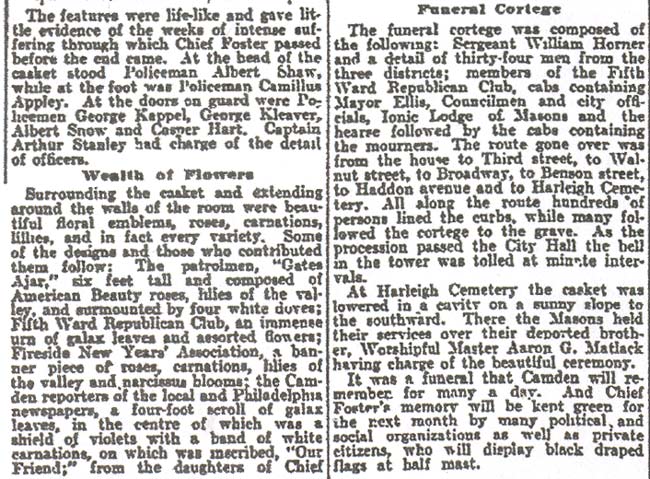
The features were life-like and gave little evidence of the weeks of intense suffering through which Chief Foster passed before the end came. At the head of the casket stood Policeman Albert Shaw, while at the foot was Policeman Camillus Appley. At the doors on guard were Policemen George Kappel, George Kleaver, Albert Snow and Casper Hart. Captain Arthur Stanley had charge of the detail of officers.
Wealth of Flowers
Surrounding the casket and extending around the walls of the room were beautiful floral emblems, roses, carnations, lillies, and in fact every variety. Some of the designs and those who contributed them follow: The patrolmen, “Gates Ajar,” six feet tall and composed of American Beauty roses, lilies of the valley, and surmounted by four white doves; Fifth Ward Republican Club, an immense urn of galax leaves and assorted flowers; Fireside New Years’ Association, a banner piece of roses, carnations, lilies of the valley and narcissus blooms; the Camden reporters of the local and Philadelphia newspapers, a four-foot scroll of galax leaves, in the centre of which was a shield of violets with a band of white carnations, on which was inscribed, “Our Friend;” from the daughters of Chief Foster, “Gates Ajar,” composed of Easter lilies, roses, carnations, daffodils, narcissus and asparagus ferns; from Mrs. Foster, the widow, a pillow of roses, carnations and lilies of the valley. Beautiful designs were also given by Mayor Charles H. Ellis, the International Association of Police Chiefs, Ionic Lodge of Masons, First Italian Republican Club, the Tall Cedars of Lebanon, Massoit Tribe of Red Men, John Carroll, John R. Campbell and various city officials. These flowers filled two carriages and a patrol wagon.
Services at the House
The services at the house took place at 2 o’clock and were in charge of Rev. Gilbert R. Underhill, rector of St. John’s P. E. Church. After the family had taken the last view the casket was borne to the hearse by Sergeant Albert Gravenor and Policeman John Brothers, representing the Police Department; former Senator Maurice A. Rogers and George Hammond, representing the Masonic bodies; former Mayor Joseph E. Nowrey, representing Massoit Tribe of Red Men, and Albert Shaw, from the Fifth Ward Republican Club.
A few minutes prior to the bringing out of the casket the members of Ionic Lodge of Masons formed themselves into a long lane through which the dead chief’s body was borne. Leading the pallbearers were six Camden policemen, who acted as a guard of honor. These included Policemen Thomas Brothers, Camillus Appley, Robert Calkett, Jules Busch, Thomas Murphy and Harry Mines, the largest men of the force. The Philadelphia police also had a guard of honor in Captain James P. Hamm, Captain Francis Callahan, Captain Dungan and Captain Campbell.
Funeral Cortege
The funeral cortege was composed of the following: Sergeant William Horner and a detail of thirty-four men from the three districts; members of the Fifth Ward Republican Club, cabs containing Mayor Ellis, Councilmen and city officials, Ionic Lodge of Masons and the hearse followed by the cabs containing the mourners. The route gone over was from the house to Third street, to Walnut street, to Broadway, to Benson street, to Haddon avenue and to Harleigh Cemetery. All along the route hundreds of persons lined the curbs, while many followed the cortege to the grave. As the procession passed the City Hall the bell in the tower was tolled at minute intervals.
At Harleigh Cemetery the casket was lowered in a cavity on a sunny slope to the southward. There the Masons held their services over their departed brother, Worshipful Master Aaron G. Matlack having charge of the beautiful ceremony.
It was a funeral that Camden will remember for many a day. And Chief Foster’s memory will be kept green for the next month by many political and social organizations as well as private citizens, who will display black draped flags at half mast.
Assault on Police Officers
Philadelphia Inquirer —
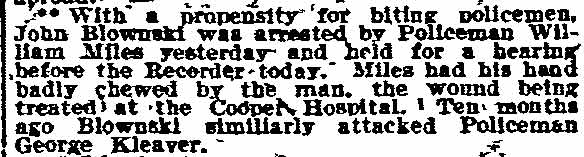
With a propensity for biting policemen, John Blownski was arrested by Policeman William Miles yesterday forenoon. Miles had his hand badly chewed by the man, the wound being dressed at a Pine Street hospital. Ten months ago Blownski similarly attacked Policeman George Kleaver.
Patrolman John Reader Funeral
Philadelphia Inquirer —
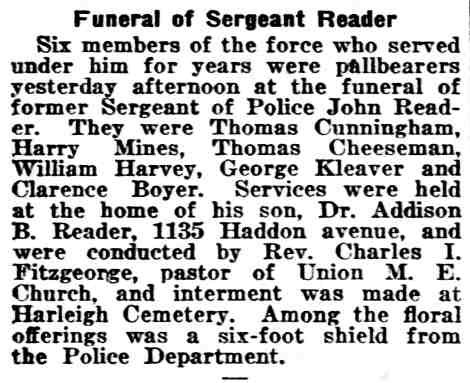
Funeral of Sergeant Reader
Six members of the force who served under him for years were pallbearers yesterday afternoon at the funeral of former Sergeant of Police John Reader. They were Thomas Cunningham, Harry Mines, Thomas Cheeseman, William Harvey, George Kleaver and Clarence Boyer. Services were held at the home of his son, Dr. Addison B. Reader, 1135 Haddon avenue, and were conducted by Rev. Charles I. Fitzgeorge, pastor of Union M. E. Church, and interment was made at Harleigh Cemetery. Among the floral offerings was a six-foot shield from the Police Department.
GEORGE KLEAVER DIES, VET CAMDEN POLICEMAN
Camden Courier-Post —
Suffering a sudden heart attack as he left his home to report for duty, George W. Kleaver, 50 years old, 515 Pine Street, acting desk sergeant at police headquarters, dropped dead last night.
Kleaver had been a member of Camden’s police force for twenty-six years. As a patrolman he was connected to the Second District and enjoyed a wide acquaintance in South Camden.
He suffered a heart attack several weeks ago, but recovered sufficiently to attend to his duties. Last night Kleaver collapsed on the pavement outside his home. When members of his family were summoned and carried him into the house he was dead.
The deceased leaves his widow Mrs. Annie Kleaver and one son, George W. Kleaver Jr.