Theodore F. Guthrie
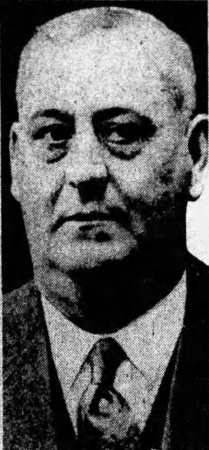
Theodore F. “Dorrie” Guthrie, c. 1932
THEODORE FREED “DORRIE” GUTHRIE, who served as a member of the Camden Fire and Police Departments for over twenty years, was born on October 29th of 1877 to Oliver S. Guthrie and his wife, the former Mary Matilda “Tillie” Bennett. He was the second of five children, coming after Oliver S. Guthrie Jr., and before Mary D. Guthrie, Frank F. Guthrie, and Samuel F.B. Guthrie.
The 1878 City Directory states that Oliver Guthrie lived at 536 Liberty Street. The 1880 Census shows the family living at 512 Kaighn Avenue, with elder Guthrie employed as a “shoe worker,” probably for John Baker, the proprietor of a shoe business who lived next door. The 1881 and 1883 City Directory has the family at 1134 Newton Avenue. In the early 1880s Oliver Guthrie was partners in a shoemaking business known as Grau & Guthrie, located at 600 Mount Vernon Street.
Oliver Guthrie Sr. built a shoe factory in the 500 block of Kaighn avenue in 1886. By 1888 the Guthries had moved across the street to 511 Chestnut Street, where they stayed through 1893. The 1894 Directory shows the family at 524 Kaighn Avenue. Oliver Guthrie Sr. was working as a carpenter. Oliver S. Guthrie Jr. is listed as a stone cutter, while Theodore shows up as a laborer. When the 1896 Directory was compiled the Guthries were at 1156 Baring Street. Another move in 1897 took the family to 1029 South 5th Street. Between 1897 and 1911 Theodore and Oliver S. Guthrie Jr. worked at different trades, including Oliver Jr.’s enlistment in the United States Army during the Spanish-American War. The 1900 Census shows the Guthrie Family at 1117 Baring Street. Oliver Jr. was at that time still serving in the United States Army.
Theodore Guthrie was then working as a cattle driver. In those times beef cattle were unloaded near Front and Kaighn and driven up Kaighn Avenue to butcher shops such as that owned by Adam Schlorer at South 8th and Chestnut Streets.
The Guthrie family spent time at 1819 South 8th Street, then a move to 934 South 6th Street from 1901 to 1903. The Guthrie family was living at 935 St. John Street when the 1906 City Directory was compiled.
Oliver Guthrie Sr. had been politically active as a Republican in the Sixth Ward, and Theodore also took an active interest in politics, which eventually saw his efforts rewarded with city employment. On January 1, 1911 Theodore F. Guthrie was appointed to Camden’s Water Department. He was transferred to the Fire Department on November 1, 1911. Oliver Guthrie Sr., still working as a carpenter, was badly injured when he fell from a shed from at the home of Dr. Wesley J. Barrett, 510 Broadway, on April 24, 1911. Oliver Guthrie Sr. sued, but the suit was dismissed in November 17 by Judge Frank T. Lloyd. Oliver Guthrie passed away on December 16, 1911. Not long afterwards, Oliver S. Guthrie Jr. was hired as a special officer by the Pennsylvania Railroad. In this capacity he worked closely with the Camden Police Department, and his name began appearing in local newspapers. After two years of fire fighting, on December 24, 1913, Theodore F. “Dorrie” Guthrie also went into law enforcement, taking an appointment to the Camden Police Department, where he served until 1932.
When he registered for the draft in September of 1918, Theodore F. “Dorrie” Guthrie was living with his sister Mary at 1023 South 6th Street in Camden. Even though he was just 40 years old, Theodore Guthrie served with America’s armed forces during World War I.
When the Census was taken in January of 1920, the family still lived at 1023 South 6th Street. He was apparently the sole support at that time of his sister and two younger brothers, none of whom were working at the time of the census enumeration.
In 1923 Theodore Guthrie was promoted to detective. The 1924 and 1927 City Directories both list Theodore Guthrie at 1117 Marion Street. The 1929 City Directory and the 1930 Census shows Theodore Guthrie at 570 Chestnut Street. He was granted a pension on December 20, 1932.
In October of 1926, Oliver S. Guthrie Jr. died of a heart ailment. In 1945, nephew Theodore Norman “Norm” Guthrie, the son of Oliver S. Guthrie Jr., was appointed to the Camden Fire Department. Tragically, he died of injuries suffered when struck by a motor vehicle while waiting to board a bus in March of 1946.
Theodore Guthrie retired on January 1, 1933 after having served the City for 21 years, most of the time with the Police and Fire Departments. He had remained politically active, and was instrumental in helping the Sixth Ward Republican Club move from 906 Broadway to 506 Chestnut Street.
Theodore Guthrie was still living at 570 Chestnut Street when the 1947 Directory was compiled. His younger brothers were also living with him at that time. Frank Guthrie died as a result of a stroke on January 8, 1948. Theodore Guthrie passed away on October 15, 1948 and was buried at New Camden Cemetery.
Both of the younger Guthrie brothers, Frank and Samuel, were also well known in Camden, for somewhat different reasons than those that made Oliver Jr. and Theodore notable. Both had numerous minor scrapes with the law, generally involving gambling. The last of the Guthrie brothers, Samuel, was arrested during a series of raids that took in 31 other suspects in November of 1959. Still residing at 570 Chestnut Street, Samuel Guthrie committed suicide by shooting himself in his own kitchen on December 6, 1959.
Murderer and Forger Escape Jail After Shooting Keepers, Killing One
Camden Post Telegram —
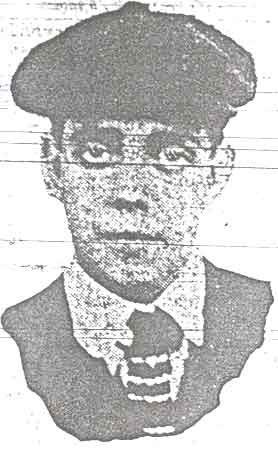
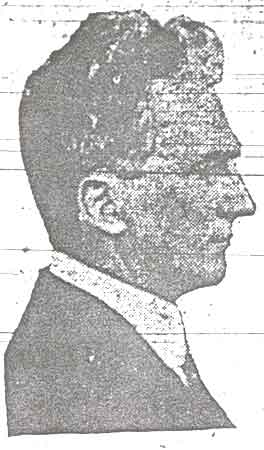
Wilson Ashbridge, Who Shot and Killed Mrs. Elizabeth Dunbar and George E. Thompson, Check Swindler, Trap Jailor Hibbs by a Ruse and After Slaying Him Shoot Joe Ellis Who Intercepted Them in Flight. Used Revolver Smuggled Into Prison by Confederates and Leave Jail Wide Open in Their Flight, a General Delivery Being Averted by Police Who Were Summoned by the Wounded Men.
Murdering one jailor and wounding another with a revolver that had been smuggled into them by outside confederates, Wilson T. Ashbridge, slayer of Mrs. Elizabeth Dunbar, and Francis Murphy, alias George E. Thompson, a check forger, made their escape from the county jail a few minutes before seven o’clock last night.
Ashbridge with his wife was caught at noon in the Keystone Hotel in Chester PA where they registered at one o’clock this morning.
Thompson is still at liberty but from the confident manner of Prosecutor Kraft his early arrest seems assured.
The murdered jailor was Isaac Hibbs, aged 65 years of 913 South 8th Street. The wounded keeper is Joseph Ellis, aged 45 years, of 416 Carteret Street. Shot twice, he is in Cooper Hospital. His condition today is very satisfactory.
Thompson, who is 41 years old, forged a check for $650 which he gave to V.M. Fulton as part of the purchase price of an automobile. The forgery was discovered before the deal was completed and his arrest followed on June 8. he also passed a forged check for $15 on State Motor Vehicle Agent Kraft. He, too, was awaiting trial. In spite of the positive evidence against him Thompson had spurned all efforts to have him plead guilty and it is now believed that he was sparring for time while hatching a plan to escape. He is no doubt the master mind.
R.L. Hunter, a farmer of Bensalem Township, Bucks County PA, about four miles above Torres dale, reported to the Philadelphia police the morning that he had seen a man answering Ashbridge’s description on the Bucks Road at daylight. The man asked the way to Riegelsville.
According to Hunter, the man was dressed in a dark suit, and had no hat. His clothing was wet. Hunter did not see anything suspicious in his actions, and after giving him directions, they parted.
Upon seeing the paper with a picture of Ashbridge, the farmer was struck by its resemblance to the man with whom he had talked. He hurried to Tacony and notified the police.
The State police, who patrol that section of the county, and who have an office at Langhorne, were immediately notified as were the surrounding towns.
The shootings took place in different parts of the jail. Hibbs was murdered in the exercise room just outside the cell room on the Sixth and Arch corner of the building. Ellis was shot down in the corridor just outside the Market Street end of the building when he heroically grappled with Ashbridge after the latter had pointed a gun at his head. In spite of his wounds Ellis dragged himself to a telephone and after notifying Police Headquarters of what had happened he collapsed.
Only one of the two bullets is still in Ellis. It entered the groin on the right side and is buried in the muscles of the leg, having taken a downward course for seven or eight inches. The other bullet struck Ellis in the right breast and came out in the left breast, traversing the upper fleshy parts of the body.
Hibbs was almost instantaneously killed by a bullet that went within an inch of his heart, producing a hemorrhage. The bullet was extracted this morning from the body early this morning in an autopsy performed at the morgue by County Physician Stem. In spite of the fact that it is pretty well established that three shots were fires in the attack on Hibbs, only one of the bullets took effect.
“But it makes little difference which of the two men handled the gun” said Prosecutor Kraft this morning. “Both are equally guilty of this murder and what we are concerned about now is the recapture of the gunmen.” Mr. Kraft added that it his purpose to examine all of the prisoners in that part of the jail where Hibbs was murdered to determine fully who fired the fatal shot.
The escape had been carefully planned and timed to the minute. Of course the desperate prisoners were aided by confederates on the outside and it is the general belief that a high powered motor car was in waiting for them not far from the jail. They are known to have been in possession of money and openly boasted yesterday that it was their intention to leave the prison last night. These boasts were made to two young ladies connected with a religious organization who called on the two men yesterday to offer spiritual reconciliation. The girls are frequent visitors to the jail and naturally their efforts at evangelization were directed in the main toward Ashbridge, because of the fact that he was accused of murder. These girls, whose identity officials will not disclose, were closeted with Prosecutor Kraft until one o’clock this morning. Both declared that on their visit yesterday they were told by Ashbridge and Thompson that it was the last day they expected to spend in jail.
“We are going to get away from here tonight and we’ve got money to help us after we are out ” said Ashbridge, who further told the girls he had considerable cash sewed up in the waistband of his trousers. The girls begged the prisoners not to do anything that would cause them more trouble and they told the Prosecutor that Ashbridge and Thompson promised them that they would not make any effort to escape. In their talks with the girls neither of the prisoners said a word that would indicate that they would kill if necessary to escape. The full force of their boast did not dawn on the religious workers and for this reason it never occurred to them to inform the Sheriff of what the prisoners had said.
A general jail delivery of at least all the men confined in what is known as the untried department, where the two were held, was only averted by the prompt arrival of the police on their beat, which was made easy by means of the keys taken from the prostrate body of Hibbs. Ashbridge and Thompson left all of the doors open and the vanguard of the inrushing police found the prisoners swarming all over the corridors on the east side of the prison. In the wild excitement following the double shooting and escape none else thought of freedom and a checking up of the inmates after they had been herded in the exercise room of the untried department accounted for all but the fugitive slayers.
The department, in which the two men were confined is the same one which William Brown and Charles Berger made their sensational escape several years ago by sawing away the bars on the Federal Street front of the jail. Thrilling as it was, the former escape was insignificant in comparison with last night’s tragic event.
With the full force of the keepers out of the way—one dead and the other suffering from gunshot wounds at first supposed to have been fatal—Ashbridge and Thompson had nothing between them and freedom but the door entering from the spiral stairway leading to the narrow entrance of the Sixth and Market Streets end of the Court House. With the keys taken from Hibbs they opened the door and in a few seconds were breathing the free air. It was still daylight when the daring murderers walked from the building and although they were no doubt seen by some of the scores of persons passing it is certain that they managed to control themselves to such an extent as not to arouse any undue suspicion. The exit they used to escape is that used by the general public and therefore persons passing calmly in and out of the door would not in any manner be thought to have been connected with a jail delivery. However the shots which had laid low the keepers had been plainly heard on all four sides of the building and it is strange that no one has yet been found who can give positive information as to what course the fleeing men took and whether they were aided in their flight by an automobile.
While the police and detectives of Camden and all other cities in the East are watching railroad terminals, steamship lines, and all other avenues of travel in response to the general alarm sent out last night, Prosecutor Kraft is bending all his energies to learn who smuggled in the revolver which the fugitives used. Thus far this feature of the case is as complete a mystery as it was last night. Mr. Kraft and Sheriff Haines are satisfied, however, that only one gun was used for both shootings. It was at first thought that each man had a pistol when they left the jail; that one of them armed himself with the gun that Hibbs was supposed to have carried, but it was determined that Hibbs was not armed when he went into the jail last night. There was no occasion for him to come in contact with any of the prisoners and for that reason he left his revolver in his desk in the office. Even had he carried it he would have little chance to use it, so cold-bloodedly was he slain as he unsuspectingly fell into the trap laid for him by the desperate gunmen. There is also some conflict as to how at least one of the fugitives was dressed. Alfred Williams, who witnessed the murder of Hibbs, said that Ashbridge was without coat or hat when he dashed out of the cell-room, and that Thompson carried his coat and hat under his arm. However in a description of the two men given at the Prosecutor’s office it was set forth that Ashbridge wore a blue serge suit and a checkered cap. The coat that he is supposed to have taken bore the mark of “Tull—the Tailor,” of Jacksonville, Florida, and had been borrowed by him from another prisoner. He wore tan shoes. Ashbridge is 27 years old, 5 feet 7-1/2 inches in height and weighs 137 pounds. He has brown hair, smooth face and is of light complexion.
Thompson wore a brown suit and a Panama hat. He is 41 years old 5 feet seven inches in height, and weighs 175 pounds. He has brown bushy hair, is minus one of the fingers on his left hand, and is light complexioned.
The tan shoes worn by Ashbridge were also borrowed from one of the prisoners. He got them on Saturday and remarked that he wanted to look neat.
Keepers Ellis and Hibbs were reading in the prison office last evening when Hibbs glanced up at the clock and noticed that it was a few minutes of seven. “Joe, I’m going back and put the boys in their cells,” he said to Ellis and with his keys in his hand he started for the cell room in the untried department. A thirty foot long corridor runs from the office to the barred and grated door opening into the department in which the cells are situated. This department is about the size of three ordinary school rooms and in the southeastern corner of the jail are the cells, in two tiers.
Around the cells is a three foot corridor into which all the cells doors open and in which all the prisoners are permitted to walk when they are not allowed out in the main room. When the inmates are ordered into their cells and their doors closed the doors are locked from the outside of the steel cage by means of a lever worked by the jailor. Thus every cell door can be made secure without the keepers coming into actual contact with the prisoners. In addition to the bars around the corridor fronting on the double tier of cells there is a fine mesh heavy wire screening.
As Hibbs approached the lever which is operated to shut the cell doors after the prisoners have retired from the corridors, Ashbridge was leaning against the grating of his cell, Number 18. Thompson was lounging a few feet away.
“Daddy, open the door, I want you to see this note,” said Ashbridge to the keeper, at the same time displaying a piece of paper which he had in his hand. Never giving a thought that he was about to perform an act which was absolutely necessary for the carrying-out of the well laid plot, or that he was going to his doom, or was even in danger, “Daddy,” as the aged keeper was known to all the prisoners, opened the door without hesitation.
As he swung wide the big steel frame, Ashbridge quickly stepped out and the next instant was pressing a gun against the abdomen of the jailor.
“Throw up your hands, you ___ ___ ___” he commanded.
“What are you up to, what’s this mean,” asked the keeper, apparently not realizing he had been trapped.
For reply Thompson jumped out the door, wrenched the gun from Ashbridge’s grasp and with an oath began firing at Hibbs, who sank to the floor at the first shot. Only a few feet away and the only other person in the exercise room, although the shooting could have been seen by any other prisoners who had not retired to their cells, Alfred Williams, trusty, is emphatic in his assertion that Thompson fired the shot that killed Hibbs and that he fired three times.
“It’s a wonder they did not get me,” said Williams. “Ashbridge and I could not hit it and in his desperate mood I am surprised he didn’t kill me, too.” Williams, who has just completed a six months’ sentence for obtaining money from Italian grocers by falsely representing himself as an agent for a wholesale house in Chicago and who is wanted in the Windy City for the same offense, says the whole transaction took less than a minute and that the moves came so fast he and the other prisoners were powerless to aid.
“It was like a flash of lightning” said Williams, “and before I could fully understand what had happened Ashbridge had grabbed Daddy’s keys which had fallen to the floor, and was off like a deer for the barred door. Ashbridge had taken the smoking gun from Thompson, who had his hat and coat under his arm and who was right behind the other one.”
“As they hurried through the door after Ashbridge had opened it with Daddy’s keys Daddy called to me to raise him. I put my arm under his head and lifted him slightly from the floor. ‘Hold my hands’ he said to me. I took hold of his hands and the next minute he died in my arms. Then I heard two more shots and I knew they got Joe Ellis.”
Startled by the shots, and he is emphatic there were three in rapid succession, Ellis leaped to his feet and without taking the time to arm himself ran from the office and turned into the corridor just as Ashbridge, wild-eyed and gun in his hand, came running toward him. Halting three yards away Ashbridge pointed the revolver at Ellis’ head and ordered him to throw up his hands.
For reply and without fear for himself the keeper dashed at the murderer and the next instant they were locked in each other’s embrace. Working loose the hand which held the gun, Ashbridge pulled the trigger. The bullet struck Ellis in the breast, but the wound was not sufficient to render him helpless. However, before he could grip the pistol arm, Ashbridge fired again and the keeper fell back with a bullet in his groin.
“The second shot got me,” said Ellis to Prosecutor Kraft and Assistant Prosecutor Butler at the hospital. “The first one wasn’t bad but my strength left me when the second bullet struck. Ashbridge was the only one I saw. I did not see Thompson.”
Dragging himself to the office Ellis managed to reach a telephone and called up the police.
“This is Ellis at the county jail; come quick. Ashbridge has shot me” he weakly said over the phone to Captain Hyde. Then the receiver fell from his hand and he dropped to the floor, but after a minute or two managed to climb into a chair.
While patrol loads of policemen were being hurried to the Court House from the First and Second District station houses, Reserve Officer Charles Hose, on duty at Broadway and Federal Street, who had heard the shots, ran to the Court House and from the office of Assistant Custodian John Lack phoned up to the jail. Ellis managed to answer and in a few words told what had happened. They ran up to the jail and were admitted by Ellis, who was rapidly growing weaker from loss of blood, the trail of which plainly showed just where the injured keeper had moved.
“I guess Ashbridge got away and the jail is all open, you had better take care of the rest of the prisoners,” said Ellis to Hose and Lack. The fugitive-murderers had left all doors open and the other occupants of the untried department were swarming through the corridors. Their curses and yells and the shrieks and cries of the female prisoners had turned the place into a perfect bedlam. With the aid of other policemen who swarmed into the Court House like bees, the prisoners were soon herded into the exercise room, where Trusty Williams checked them up and accounted for all but Ashbridge and Thompson.
With the faint hope that the missing pair had not risked leaving the building but had secreted themselves in the structure, the courthouse was searched from pit to dome, but no trace of the men were found.
Detective Doran was the first of the Prosecutor’s staff to reach the scene. Mr. Kraft and the balance of the staff soon followed. In the lower end of the county, on official business, Sheriff Haines was reached by phone and Under Sheriff Hewitt was summoned from Pitman and until an early hour this morning the officials were in conference and examining numerous prisoners.
State Detective Walter Le Torneau furnished Prosecutor Kraft with a promising “tip” this morning when he learned that Thompson gave a letter to Freeholder Howard Marshall, of the Eighth Ward, to mail on Sunday. Mr. Marshall states that the letter was addressed to a woman by the name of Mrs. Shelton, in Baltimore MD.
Marshall was attending religious service in the jail when Thompson approached him.
“Put this in your pocket and mail it for me when you go out,” said Thompson to Mr. Marshall, who agreed to carry out the request. Dropping the letter in the mail box Marshall allowed the incident to pass without further notice.
Detective Le Torneau learned this morning that Marshall had spoken to the incident to a friend and the sleuth notified the Prosecutor. The tip will be run down the Prosecutor stated.
Funeral services for Hibbs will be held on Thursday from his late residence. The body will be taken to Langhorne PA where interment will be made in the Friends’ Cemetery under the direction of the Schroeder-Kephart Company. Services will be conducted Wednesday evening by Reverend Henry Bradway, pastor of the Eighth Street Methodist Episcopal Church.
POLICE QUICKLY AT WORK
Although the murderous prisoners made their escape, it was no fault of the local police department, which threw out a “dragnet system” that covered practically every outlet from the city. As soon as the call reached headquarters the red lights were flashing and every officer and detective who could be reached was sent out on the “man hunt” which was pursued with vigor.
Passing automobiles were pressed into service by the detectives and officers and all haste was made for the ferries, railroad yards, terminals, and trolley points. Citizens cooperated with the police in their efforts to run down the escaping prisoners.
Assistant Chief Hyde received the call from Jailor Ellis, who though wounded himself summoned strength enough to reach the phone.
“This is Jailor Ellis. Hibbs and me have been shot by that man Ashbridge and help quick!” was the startling message which came over the phone to Chief Hyde about one minute past seven.
It was just at the time the shifts were going on and off at the local station houses. Chief Hyde lost no time. He called to machine operator “Eddie” King to send the message to the station houses and flash the red lights. This was done and as fast as the men could run they covered the various points.
The auto patrols were dispatched with all hands to the Court House and the wounded men hurried to the hospital. Coroner Robert G. Schroeder reached the hospital as Hibbs and Ellis were being admitted and he took charge of the situation and got in touch with Prosecutor Kraft and County Physician Stem.
Detective Captain Schregler was hurriedly summoned, and his men were sent in all directions. Detective Brothers boarded a waiting automobile and a record run was made for the Federal Street ferry. Sergeant Humes was picked up and in four minutes after the call was received from Ellis, Detective Brothers had the ferry covered.
Detectives Troncone, Painter and Murry and Captain Schregler covered the Kaighn Avenue, Vine Street, and Cramer Hill ferry lines.
Detective Brothers got in touch with the Pennsylvania Railroad officials who put their detective force to work searching freight and passenger cars. The orders were sent out from the railroad office to stop and search every freight train. Dispatches were also sent to Trenton, Mount Holly, and Burlington and it was not long before the news of the atrocious deed had spread throughout the country and many distant places.
Trolley cars were stopped and searched by the police, but not the slightest trace could be found of the escaped prisoners. The police left nothing undone in the “man-hunt.”
When news of the affair spread through the city phone calls began to come in to headquarters. Over fifty persons called up to tell the police that they had seen the two men at various places. The “tips” were all run down but none materialized.
Officers Arthur Colsey and Theodore Guthrie, who were on their vacations, lent their aid to Chief Hyde. Policeman Colsey pressed his automobile into service and carried the police to various parts of the city.
Co-operating closely with Prosecutor Kraft’s detectives the city officials formed a combination which in nine times out of ten would have been successful, but the escaped men cleverly eluded their pursuers.
Assisted by Coroner Schroeder, County Physician Stem held a post mortem examination on Hibbs’ body. The bullet which caused the death was located in the region of the heart. It passed through the victim’s lung, causing a hemorrhage, which resulted in death. Following the examination the body was taken by the Schroeder-Kephart Company at the family’s orders to be prepared for burial.
ASHBRIDGE’S FIRST CRIME
The brutal crime for which Ashbridge stood indicted but untried was committed on the night of January 22 at Ninth and Market Streets. It developed that the murderer had followed his intended victim from the morning hours. He trailed her to the home of her sister, a Mrs. Meredith, of 911 Market Street, and laid in wait in the darkness of a building that fatal Saturday night.
Mrs. Dunbar came out of the house and stood on the northeast corner while waiting for a ferry-bound trolley car. She intended going to Sicklerville that night to visit her relatives. With her at the time was her 7-year-old daughter, Eleanor, and her father, Charles Dunbar. Ashbridge advanced toward the woman, who was startled when she saw him. She called to her father that she “didn’t want anything to do with Ashbridge.”
Before the father could interfere the young murderer whipped out a revolver and covered the father and the woman. He then struck the woman violently in the face with his fist and as she was reeling under the force of the brutal blow Ashbridge fired, the first bullet taking effect in the woman’s chest. The brutal murderer then stood over his prostrate victim and holding the revolver less than five inches from his victim’s body he pumped four more shots into her.
Policeman Howard Smith and Policeman Taylor were a square distant. Smith saw the entire proceedings and screamed at Ashbridge to stop shooting. A crowd quickly gathered and Dr. Maldeis, who lives nearby, came running to the scene to aid the stricken woman.
Officer Taylor espied Ashbridge in the crowd. The murderer made no effort to run, but stood his ground. Detecting the murderer trying to slip something up his sleeve, Taylor pounced upon him and bore him to the ground, at the same time taking the gun away from him and slipping the handcuffs over the murderer’s wrists. Policeman Taylor had to draw his revolver to keep back the large crowd that was threatening. Showing no concern whatever, Ashbridge calmly waited until the police auto arrived. In the meantime the murdered woman’s still warm body was placed in a “jitney” and with Officer Smith and Dr. Maldeis a hurry run was made for Cooper Hospital but when the institution was reached, Mrs. Dunbar was pronounced dead.
Ashbridge was taken to the hospital by Policeman Taylor in the police auto. He asked “how she is.” Informed that he had accomplished his purpose, the young murderer asked to see the woman. When the white sheet covering the still form of the murdered woman was drawn from the face Ashbridge leaned over and kissed the forehead of the woman. He was then taken to the County jail and locked up. Before Recorder Stackhouse on the following Monday Ashbridge pleaded guilty.
Ashbridge was infatuated with the woman, who was a member of the Temple Theater chorus. Because of Ashbridge’s persistent attentions she was compelled to give up her position. Mrs. Dunbar had previously accepted Ashbridge’s attentions, thinking that he was unmarried, but upon learning that he had a wife and child she informed him that it would be best for them not to see each other, but the young man refused to discontinue his attentions.
On the day of the shooting Ashbridge was seen in various places. He is said to have followed the woman to the Federal Street ferry, but lost track of her. Around noon he was seen at Front and Pearl Streets by Policeman Boyd, who ordered him to move on. Boyd was about to arrest him as a suspicious character, but Ashbridge pleaded that he was looking for a friend. All that day Ashbridge followed the woman until night, when he cruelly murdered her.
The murderer came from a respectable family. Dissipation is thought to have caused the young man to lose his sense of reasoning. Rather good-looking, Ashbridge had tender baby-like eyes and his case excited sympathy among the more tender-hearted people.
Sweetmeats, tasty sandwiches, and other small luxuries were said to have been given the young murderer while he languished in his cell. He had many visitors. Recently Ashbridge was taken violently ill after eating some crabs which were given him by a friend. He and Jailor Hibbs were very friendly.
THOMPSON A CLEVER FORGER
Thompson, or Murphy, was a self-styled lawyer and was committed by Recorder Stackhouse in June for forging checks to the amount of $1,055. The worthless checks were “worked” on the McClelland-Fulton Auto Company and Motor Vehicle Agent A.C. Kraft.
When a check for $150 presented to the automobile company by Thompson and drawn to the order of “G.E. Thompson” on the Harrisonburg, Virginia National Bank came back from the home office of the Studebaker Company as worthless, Mr. Fulton called in the police.
Thompson had previously presented a check for $890 as payment on an automobile. This check was drawn on Thompson’s favor on the Coatesville National Bank and was purported to have been signed by Louis L. Gibney, a hotel man of Downington PA. This check was still in the possession of Mr. Fulton when Thompson was arrested after the first check was returned marked “no funds.”
The clever swindler also presented a bad check to Agent Kraft for $15 for which he received the license to operate the automobile which he proposed buying.
Detective Troncone arrested Thompson at Fifth and Market Streets on June 2. The defendant had been living in a room at 220 North Fifth Street.
Giving his home address as Daytona, Florida, Thompson represented himself as a lawyer. Well dressed and wearing nose glasses, Thompson was an intelligent appearing man; he had a bushy pompadour which was streaked with gray and talked in a persuasive manner. His forgeries on Mr. Gibney’s signature were so clever that Gibney himself could not tell the difference.
After Thompson’s arrest Detective Captain Schregler sent out notices to several southern cities. He received responses from Harrisonburg, Norfolk, and Petersburg Virginia and that Thompson was wanted in all three cities for check forgeries.
SECOND MURDER IN JAIL
This is the second murder and second escape from the present jail. The first murder took place in November, 1907, when George Stewart, a young negro, stabbed to death John Snell, who was awaiting trial for carrying in the business of fortune telling. Stewart was in jail on a charge of dealing in opium and cocaine. He had a complete opium layout in his cell. He and Snell had a quarrel and he stabbed Snell to death in his cell. He was tried and convicted and sentenced to be electrocuted during the week of February 8, 1908. He was electrocuted on February 4, being the first man to suffer the death penalty by electrocution.
On July 13, 1910 William T. Brown, alias Gillespie, who had been sentenced to seven years on a charge of forgery, and Charles Berger, who was under sentence for picking pockets, made their escape from jail after sawing the bars on the Federal Street front. They climbed over the balustrade to the roof, descended through a trapdoor, climbed down stairs and walked leisurely through the Court House building and out into the street unnoticed. They entered an automobile and were driven away. They crossed to Philadelphia on a North Cramer Hill Ferry boat.
Several weeks later Brown was arrested in New York City and was sentenced to Auburn Prison on an old charge. His term will expire shortly and he has also applied to the Court of Pardons of this State for a parole. A detainer has been lodged against him at the State prison where he is located and he will be brought back and resentenced. Berger was captured in Chicago and was brought back and served a term at Trenton.
Five to 15 Years for Gunman Who Shot Policemen
Camden Courier-Post —
Man Convicted of Wounding Detective Guthrie and John P. Brazier
DENIED PAIR OF CHARGES
Another “gunman” came to grief in the criminal court this morning when Judge Kates imposed sentences of from five to 15 years on Frank Harris, colored, 22 years old, Nineteenth and Lombard streets, Philadelphia.
Harris, who recently was released from a hospital where three bullets were extracted from his body, was found guilty of atrocious assault and attempting to kill Special Officer John P. Brazier and atrocious assault on District Detective Theodore Guthrie.
Judge Kates imposed a sentence of from four to twelve years on the Brazier charge and from one to three years on the Guthrie charge.
Brazier and Guthrie had narrow escapes from death as a result of Harris’ gun-play.
Brazier, who is a private watchman in the vicinity of Fourth and Beckett streets, was waylaid by Harris on November 7. When he refused to obey the bandit’s command to hand over his money, Harris shot the watchman in the chest and ran away.
Policeman Shaw told of the shooting of Harris and the arrest of three other colored men in the Kaighn avenue ferryhouse on the evening of November 21.
Guthrie and Shaw had gone to the ferryhouse to head off three colored bandits who had robbed a grocery store at Tenth and Ferry avenue.
There were four colored men in the waiting room when the officers arrived. Besides Harries, there were Frank Williams, Nineteenth and Lombard streets; Arthur Rae, 1915 Lombard street, and Gilbert Stanley, 1839 Lombard street, all of Philadelphia.
Guthrie grappled with Harris. In the scuffle the detective slipped and fell to the floor.
“He fired two shots at me while down,” testified Guthrie “and but for Officer Shaw he would have fired more.”
Shaw said he fired four times, and that three of the bullets struck Harris, but that the latter did not go down until the fourth shot.
Harris pleaded not guilty to both charges, and denied knowing any of the men who were arrested with him.
George Barag, who conducts a grocery store at 1850 South Tenth street, identified the men as having come in his store under the pretense of making a purchase on the night the store at Tenth and Ferry avenue was robbed. Stacy Threadgill, 1864 South Tenth street, who was in Barag’s store at the time, also identified the prisoners.
Wesley Goldthorpe was appointed the court to defend Harris, and Assistant Prosecutor Charles S. Straw presented the facts for the state.
Youth, 16, Nabbed as Drug Peddler
Camden Courier —
Held In $1000 Bail After Witnesses Tell of Buying Heroin Downtown
Two alleged drug peddlers one a boy, 16 years old, were held in $1000 bail each by Recorder Stackhouse today.
The youth is William Lovern, 210 Washington Street. With Harry Bolt, 24 years old, 420 Beckett street, he was arrested early today after they are alleged to have sold decks of heroin at Second and Beckett streets.
David Hunt and “Dorie” Guthrie said two packages of heroin and cocaine were found on the suspect. Both denied their guilt.
Youths, who acted as amateur detectives to gather evidence accused young Lovern as the “little fellow” who sold them each a deck of heroin for one dollar. They said Lovern refused to take 75 cents for the drug and asked for the larger amount.
Ask Route to New York, 2 Held as Car Thieves
Camden Courier-Post —
Arrested last night for the larceny of an automobile when they asked two plain-clothes policemen how to get to New York, two 20-year-old boys were taken back to Pennsgrove this morning by Robert W. Kidd, chief of police.
They gave their names as Francis Riley and Joseph Nelsen, both of 70 Poplar street, Pennsgrove. They admitted to Captain John Golden they had stolen the car of John S. Taylor, Pennsgrove, yesterday afternoon.
The youths were arrested by Policemen Guthrie and Paradise. The two officers had been standing at Broadway and Spruce street when the young men pulled up to them and asked directions to New York. Suspecting the car to be stolen, Guthrie asked for their owner’s card. As he did the car started up but Paradise jumped on the running board and succeeded in bringing the car to a halt.
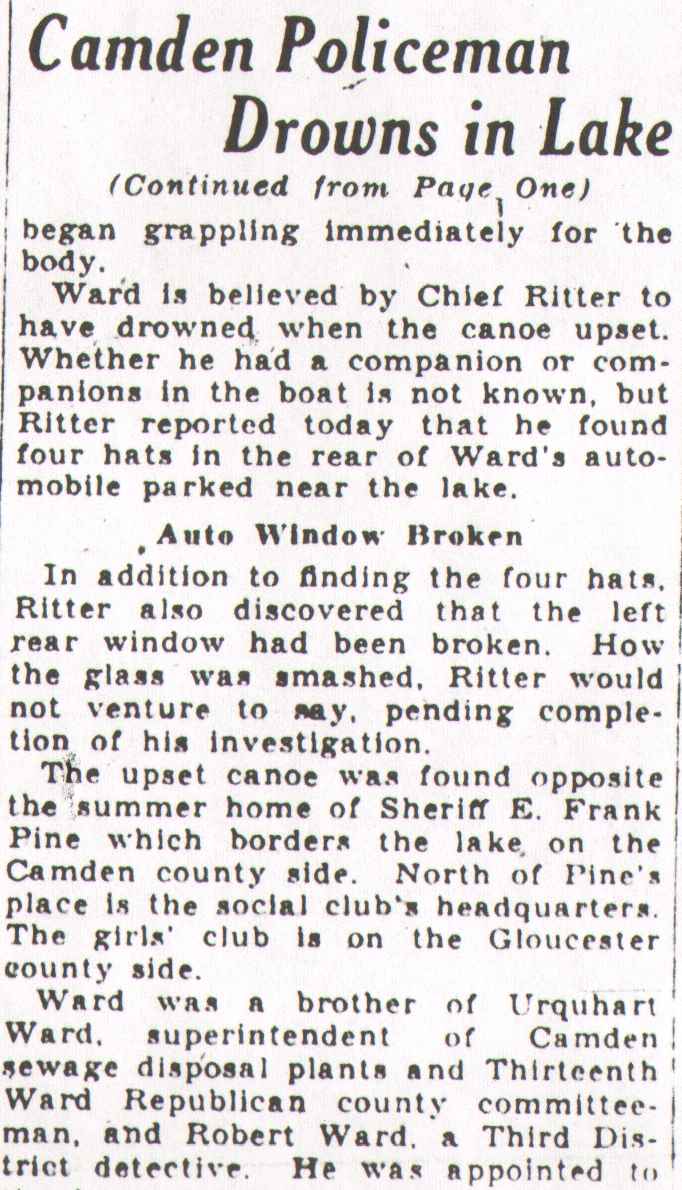
City Policeman Drowns in Lake at Blackwood
Camden Courier-Post —
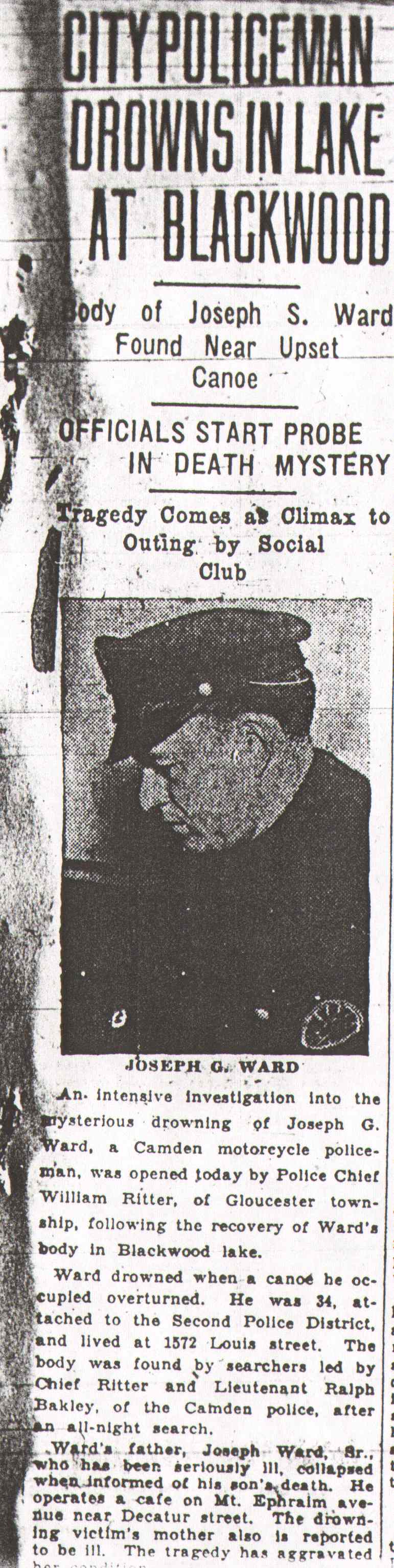
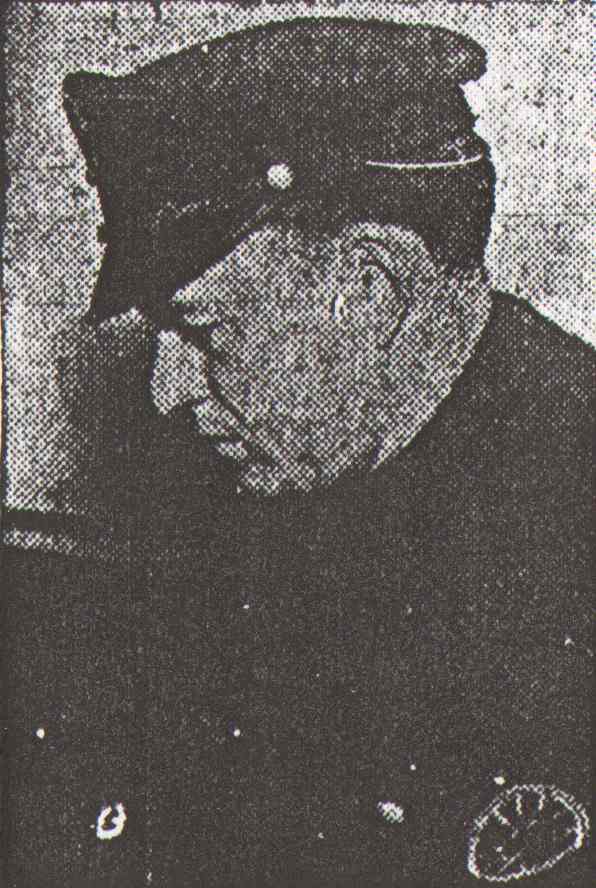
Body of Joseph S. Ward Found Near Upset Canoe
OFFICIALS START PROBE IN DEATH MYSTERY
Tragedy Comes as Climax to Outing by Social Club
An intensive investigation into the mysterious drowning of Joseph G. Ward, a Camden motorcycle policeman, was opened today by Police Chief William Ritter, of Gloucester township, following the recovery of Ward’s body in Blackwood lake.
Ward drowned when a canoe he occupied overturned. He was 34, attached to the Second Police District, and lived at 1572 Louis street. The body was found by searchers led by Chief Ritter and Lieutenant Ralph Bakley, of the Camden police, after an all-night search.
Ward’s father, Joseph Ward, Sr., who has been seriously ill, collapsed when informed of his son’s death. He operates a cafe on Mt. Ephraim avenue near Decatur street. The drowning victim’s mother also is reported to be ill. The tragedy has aggravated her condition.
The drowning is a tragic aftermath of an outing yesterday of the Moonlight Social Club, which rented a clubhouse at Blackwood two months ago. With Ward on the outing were Clifford Del Rossi, a driver of the Second District police patrol; Theodore “Dorie” Guthrie, Second District detective, and other members of the Camden police department whose names have not been learned.
Chief Ritter reported today having only meager clues as to the circumstances of the drowning. Ward is believed to have been in the canoe alone. Coroner Melvin Cain is expected to conduct an autopsy today or tomorrow.
Chief Ritter said there is no suspicion of foul play, as Ward’s body was unmarked. It was recovered at 3:30 a.m. by William McGrath, a city detective, who had been diving for it with George Hess, near the clubhouse of the Moonlight Social Club.
The overturned canoe was found last night in the lake by girls who also have a clubhouse at Blackwood. Police Chief Ritter, with Peter English and Walter Wilkie, all of Blackwood, began grappling immediately for the body.
Ward is believed by Chief Ritter to have drowned when the canoe upset. Whether he had a companion or companions in the boat is not known, but Ritter reported today that he found four hats in the rear of Ward’s automobile parked near the lake.
Auto Window Broken
In addition to finding the four hats, Ritter also discovered that the left rear window had been broken. How the glass was smashed, Ritter would not venture to say, pending completion of his investigation.
The upset canoe was found opposite the summer home of Sheriff E. Frank Pine which borders the lake on the Camden county side. North of Pine’s place is the social club’s headquarters. The girls’ club is on the Gloucester county side.
Ward was a brother of Urquhart Ward, superintendent of Camden sewage disposal plants and Thirteenth Ward Republican county committeeman, and Robert Ward, a Third District detective. He was appointed to the force in 1925. He was married but had been separated from his wife.
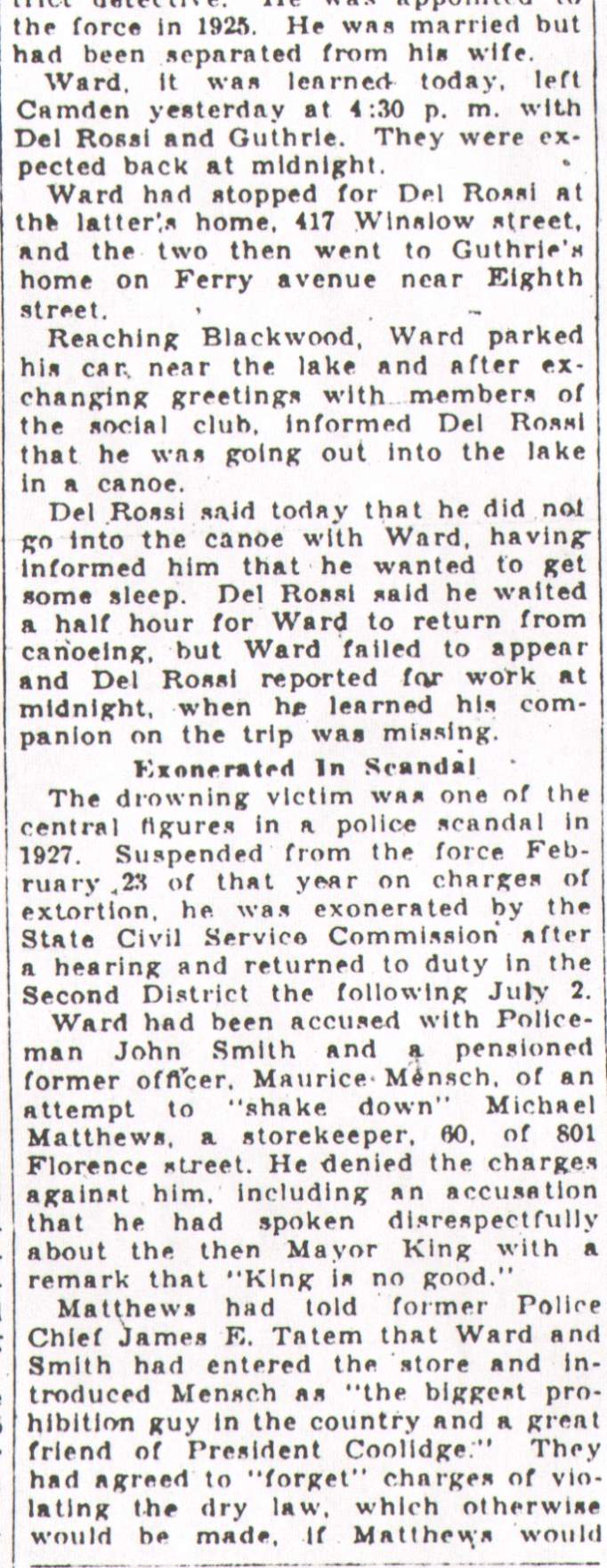
Ward, it was learned today, left Camden yesterday at 4:30 p.m. with Del Rossi and Guthrie. They were expected back at midnight.
Ward had stopped for Del Rossi at the latter’s home, 417 Winslow street, and the two then went to Guthrie’s home on Ferry avenue near Eighth street.
Reaching Blackwood, Ward parked his car near the lake and after exchanging greetings with members of the social club, informed Del Rossi that he was going out into the lake in a canoe.
Del Rossi said today that he did not go into the canoe with Ward, having informed him that he wanted to get some sleep. Del Rossi said he waited a half hour for Ward to return from canoeing, but Ward failed to appear and Del Rossi reported for work at midnight, when he learned his companion on the trip was missing.
Exonerated In Scandal
The drowning victim was one of the central figures in a police scandal in 1927. Suspended from the force February 23 of that year on charges of extortion, he was exonerated by the State Civil Service Commission after a hearing and returned to duty in the Second District the following July 2.
Ward had been accused with Policeman John Smith and a pensioned former officer, Maurice Mensch, of an attempt to “shake down” Michael Matthews, a storekeeper, 60, of 801 Florence street. He denied the charges against him, including an accusation that he had spoken disrespectfully about the then Mayor King with a remark that “King is no good.”
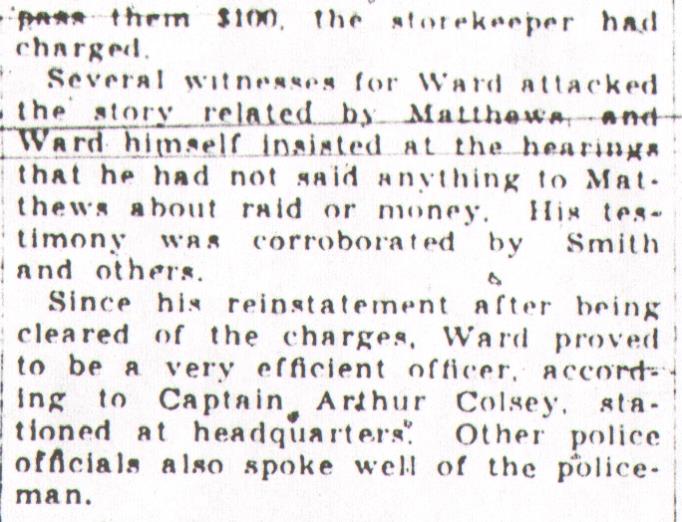
Matthews had told former Police Chief James E. Tatem that Ward and Smith had entered the store and introduced Mensch as “the biggest prohibition guy in the country and a great friend of President Coolidge.” They had agreed to “forget” charges of violating the dry law, which otherwise would be made, if Matthews would pass them $100, the storekeeper had charged.
Several witnesses for Ward attacked the story related by Matthews, and Ward himself insisted at the hearings that he had not said anything to Matthews about raid or money. His testimony was corroborated by Smith and others.
Since his reinstatement after being cleared of the charges, Ward proved to be a very efficient officer, according to Captain Arthur Colsey, stationed at headquarters. Other police officials also spoke well of the policeman.
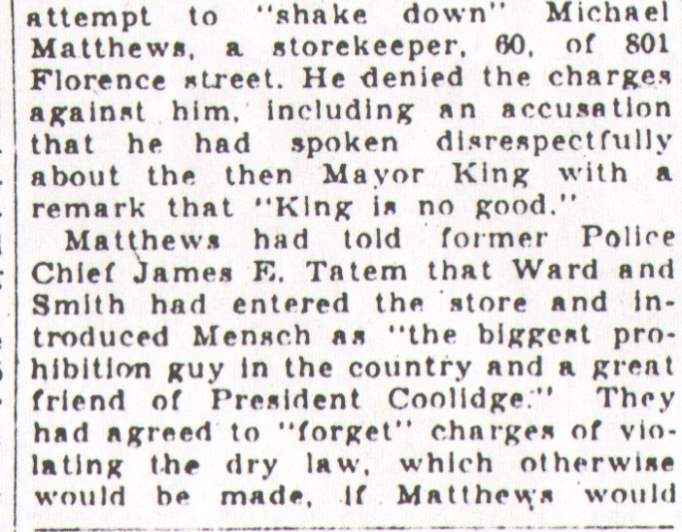
attempt to “shake down” Michael Matthews, a storekeeper, 60, of 801 Florence street. He denied the charges against him, including an accusation that he had spoken disrespectfully about the then Mayor King with a remark that “King is no good.”
Matthews had told former Police Chief James E. Tatem that Ward and Smith had entered the store and introduced Mensch as “the biggest prohibition guy in the country and a great friend of President Coolidge.” They had agreed to “forget” charges of violating the dry law, which otherwise would be made, if Matthews would
New Vice Squad in 3 Raids Nabs 6 as Suspects in Bandit Gang
Camden Courier-Post —
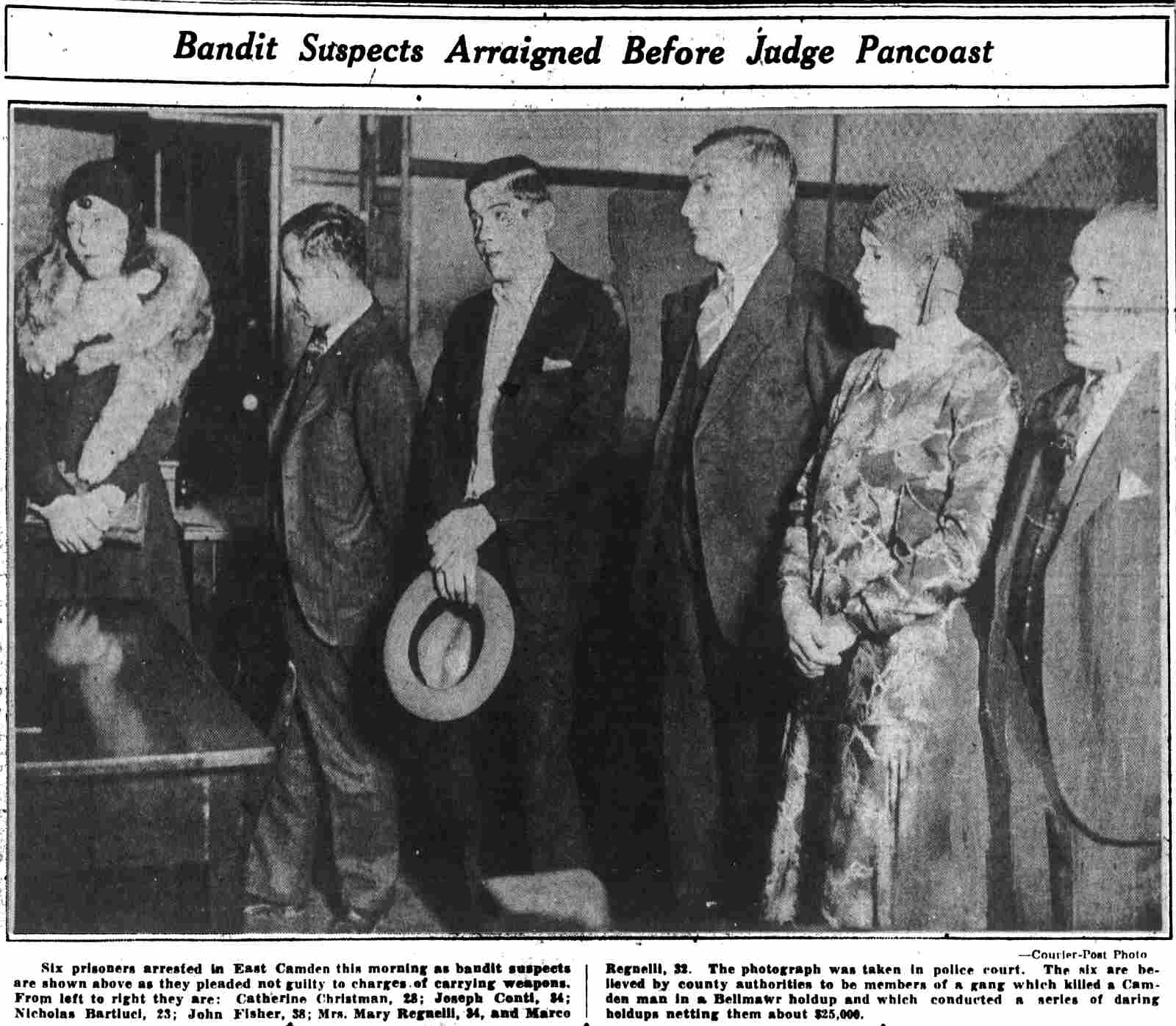
Police Believe Prisoners Know Something of Wierman Murder
PROSECUTOR BALDWIN SEEKS SPEEDY TRIAL
Indications Point to Sextet Staging Recent Holdups Netting $25,000
Arrested by the new Camden police squad today in three East Camden dwellings, four men and two women are believed by county authorities to be members of a bandit gang which collected $25,000 and murdered a Camden man in a series of eight holdups during the past two months.
Prosecutor Baldwin expressed belief that the suspects were either implicated in, or know who executed the shooting of William “Bel” Wierman, alleged Camden beer runner, during a holdup April 28 at the Bellmawr County Club. He announced he would ask the grand jury this afternoon to indict them on charges made against them this morning made by the city police, and would probably place them on trial here next week.
Meanwhile, all victims and witnesses to the daring holdups in and near the city will be summoned to the courthouse to attempt to identify the prisoners.
He highly complimented the newly created vice squad on its efficient raids made after a week of painstaking investigation.
Firearms Seized
In each residence police seized a sizable arsenal of revolvers, sawed-off shotguns, repeating rifles, and hundreds of ammunition, all hidden in walls or secreted under floors. An opium “layout,” hacksaw, pairs of colored eyeglasses and tear-ware were also confiscated. The discovery of the tinted eyeglasses in the residence was of significance to Police Lieutenant Ralph Bakley, who pointed out that one of the armed bandits who held up a man at Front and Kaighn avenue two nights before the Wierman slaying wore glasses to escape identification.
Detectives aided by state troopers raided the three residences, which prevented any of the suspects from resisting or escaping. Two attempted to slip through the ring, but one surrendered after a single shot was fired at him, and one was captured while trying to scale a rear fence.
The suspects gave their names as: John Fisher, 38, of 41 South Thirty-third street, Camden; Nicholas Bartluci, 23, of 784 South Wick street, Philadelphia; Joseph Conti, 34 of 708 South Eighth st., Philadelphia; Catherine Christman, 28, of 2202 Perth street, Philadelphia; Mary Reginelli, 32, of Apartment 2, at 143 North Thirty-fourth street, Camden; Marco Reginelli, 24, his wife’s address.
Committed Without Bail
Six were arraigned before Judge in the city police court this morning. As they were arraigned in a joint session, a blanket charge with carrying concealed deadly weapons was lodged against them by Detective Leonard Pancoast of the vice squad. An additional complaint charging possession of narcotics placed against Conti and Catherine Christman.
All of the suspects pleaded not guilty. They were immediately committed to the county jail without bail. Prosecutor Baldwin stated he would hold them for further investigation. They will be finger-printed and “mugged” so that county authorities can obtain their police records.
Each suspect has been arrested from one to four times since 1926. Each was released or exonerated. The most recent cases were inciting a riot in 1925.

Conti is a familiar figure in the Philadelphia underworld, according to police, and it is believed that he may be the same Joseph Conti who was arrested as a witness in a recent gang murder in that city.
All of the prisoners treated their arrest with levity. Conti, while being led from the courtroom after his hearing jocularly remarked to Patrolman Everett Joslin: “Wait, and I’ll get a machine gun out of my shoe for you.”
All the men were handcuffed when arrested in police court.
Conti and the Christman woman were arrested when police broke down the door of a house at 3719 Highland avenue, Camden. Fisher and Bartluci were seized at the South Thirty-third street address, while the Reginellis were captured in their apartment.
Conti made a desperate bid for freedom when he saw the detectives, armed with shotguns, repeating rifles, revolvers and tear bombs. The suspect dashed through the rear door, but came to an abrupt standstill when a member of the vice squad, Detective James Paradise, fired one shot at him.
Bartluci also attempted to escape and was clambering over a rear fence when he fell into the arms of Detectives Walter Smith and Vernon Jones.
All were arrested “on information received,” the only explanation the police would give. It was revealed that the special vice squad, organized by police heads a few days after a Camden bank messenger was robbed of $6700 in broad daylight May 23, has had the three dwellings under surveillance for the past week.
The raiders first visited the Highland avenue place at 5:15 a. m. An automobile was in front of the house, and Conti and the Christman woman were in it, according to detectives. When the suspects saw the police, they leaped from the car and ran into the house, locking the door after them.
Batter Down Door
Under the leadership of Detective Theodore Guthrie, the vice squad members quickly surrounded the place, and Detectives Smith and Jones knocked at the front door. There was no response, and the detectives then battered the door down, rushing into the dark interior with drawn revolvers.
They found Catherine Christman, but Conti had fled out the rear. Detective Paradise’s shot changed his mind about escaping.
Then a thorough search was made of the premises for weapons or possible loot. In closets, under beds, the detectives found weapons of all description. Baseboards and the floors were hammered, and several traps were found to contain weapons when floor boards were ripped up.
The raiders took their prisoners to City Hall, and then descended upon the South Thirty-third street house, at 6:30 a. m. There they had to force open the front door when their demands for entrance met no response. They arrested Fisher, who made no attempt to resist when he saw it was futile. Bartluci, however, dashed into the rear yard, but was captured.
Here, another thorough search uncovered weapons, and when the prisoners and confiscated material had been disposed of, the raiders sped to the North Thirty-fourth street apartment, forcing the front door open at 7:30 a. m. after surrounding the place.
Those who participated in the raids were the following members of the vice squad, headed by Detective Guthrie: Paradise, Jones, Walter Smith, Clarence Bunker, Louis Schlam, Clarence Arthur, Howard Smith and Joseph Mardini. With them were Sergeant Wilfred L. Dube and Detective Andrew Zopesky, of the state police.
Batter Down Door
Under the leadership of Detective Theodore Guthrie, the vice squad members quickly surrounded the place, and Detectives Smith and Jones knocked at the front door. There was no response, and the detectives then battered the door down, rushing into the dark interior with drawn revolvers.
They found Catherine Christman, but Conti had fled out the rear. Detective Paradise’s shot changed his mind about escaping.
Then a thorough search was made of the premises for weapons or possible loot. In closets, under beds, the detectives found weapons of all description. Baseboards and the floors were hammered, and several traps were found to contain weapons when floor boards were ripped up.
The raiders took their prisoners to City Hall, and then descended upon the South Thirty-third street house, at 6:30 a. m. There they had to force open the front door when their demands for entrance met no response. They arrested Fisher, who made no attempt to resist when he saw it was futile. Bartluci, however, dashed into the rear yard, but was captured.
Here, another thorough search uncovered weapons, and when the prisoners and confiscated material had been disposed of, the raiders sped to the North Thirty-fourth street apartment, forcing the front door open at 7:30 a. m. after surrounding the place.
Those who participated in the raids were the following members of the vice squad, headed by Detective Guthrie: Paradise, Jones, Walter Smith, Clarence Bunker, Louis Schlam, Clarence Arthur, Howard Smith and Joseph Mardini. With them were Sergeant Wilfred L. Dube and Detective Andrew Zopesky, of the state police.
Seized in Raid
The following is a list of what was seized in each place:
At 3719 Highland avenue: One automatic 12-gauge shotgun, serial numbers filed off to prevent tracing to the buyer; one bolt action high-powered .38-calibre rifle; one .38-calibre short-barrelled revolver, loaded; one .38-calibre long-barrelled ravolver, loaded; one hacksaw and blade; one box of 50 12-gauge buckshot cartridges, one pair of green glasses, three dozen silver spoons, 10 rifle bullets, 33 .38-calibre bullets, two bunches of keys, one handbag and a complete opium layout, including an extra pipe and a quantity of opium.
At 41 South Thirty-third street: One .45-calibre Colt automatic, loaded; one .45-calibre side-break revolver, loaded; one extra clip of 20 bullets, one 12-gauge sawed-off shotgun, two barrels; four dozen 12-gauge shells, four dozen rifle bullets, 32 .38-calibre bullets and three .45-calibre long rifle bullets.
At 143 North Thirty-fourth street: One automatic .12-gauge shotgun, Remington, Model 11, serial number 324870; one sawed-off shotgun, serial number filed off; one .32-calibre Savage automatic, six dozen 12-gauge shells, 13 .38-calibre bullets for a Luger revolver, eight dozen .32-calibre bullets, one dozen .25-calibre bullets and a pair of amber-colored glasses.
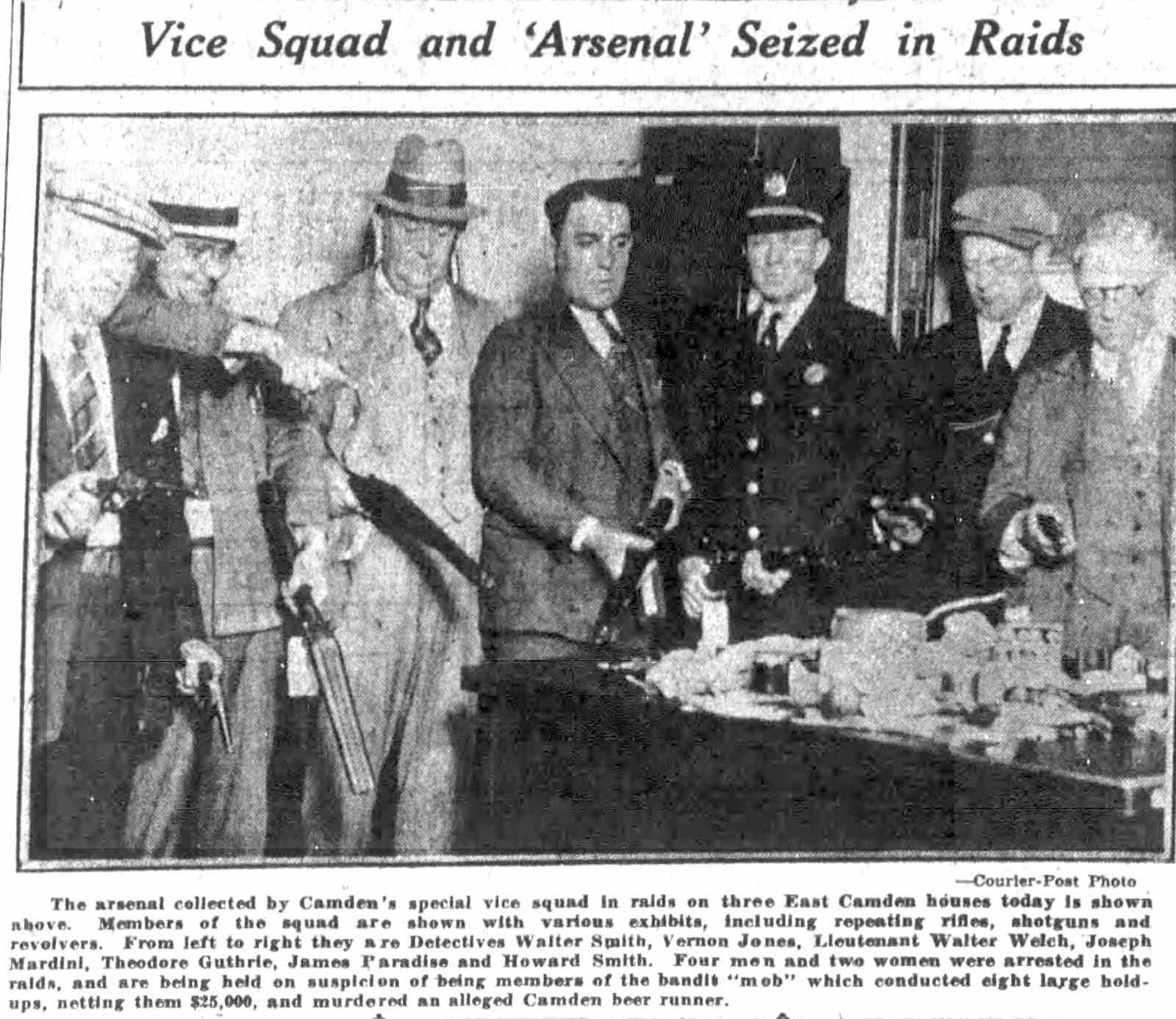

The arsenal collected by Camden’s special vice squad in raids on three East Camden houses today is shown above. Members of the squad are shown with various exhibits, including repeating rifles, shotguns and revolvers. Four men and two women were arrested in the raids, and are being held on suspicion of being members of the bandit “mob” which conducted eight large holdups, netting them $25,000, and murdered an alleged Camden beer runner.
Seized in Raid
The following is a list of what was seized in each place:
At 3719 Highland avenue: One automatic 12-gauge shotgun, serial numbers filed off to prevent tracing to the buyer; one bolt action high-powered .38-calibre rifle; one .38-calibre short-barrelled revolver, loaded; one .38-calibre long-barrelled revolver, loaded; one hacksaw and blade; one box of 50 12-gauge buckshot cartridges, one pair of green glasses, three dozen silver spoons, 10 rifle bullets, 33 .38-calibre bullets, two bunches of keys, one handbag and a complete opium layout, including an extra pipe and a quantity of opium.
At 41 South Thirty-third street: One .45-calibre Colt automatic, loaded; one .45-calibre side-break revolver, loaded; one extra clip of 20 bullets, one 12-gauge sawed-off shotgun, two barrels; four dozen 12-gauge shells, four dozen rifle bullets, 32 .38-calibre bullets and three .45-calibre long rifle bullets.
At 143 North Thirty-fourth street: One automatic .12-gauge shotgun, Remington, Model 11, serial number 324870; one sawed-off shotgun, serial number filed off; one .32-calibre Savage automatic, six dozen 12-gauge shells, 13 .38-calibre bullets for a Luger revolver, eight dozen .32-calibre bullets, one dozen .25-calibre bullets and a pair of amber-colored glasses.
Military System Adopted for Cops
Camden Evening Courier —
Dickinson Makes District Heads Responsible for Men; Vice Squad Disbanded
Following closely upon the heels of disbanding the special vice squad, Major C. V. Dickinson, deputy director of public safety, today announced that the commander of each of the four police districts will be responsible for the conduct of the men under him.
The same system of burden of responsibility existing in military services will be in effect in the Camden police department, the major averred. Each patrolman will be responsible to his sergeant, each sergeant to his lieutenant and the lieutenants to the deputy director.
Major Dickinson, Camden’s new “police czar,” also reiterated that he is demanding strict adherence to the police regulations and rules. One rule requires that no member of the police department, whether he is in uniform or plainclothes, on duty or off, may enter a soft-drink parlor or other drinking resorts “except in the strict commission of duty.” He has also informed the police heads to instruct their men to faithfully observe all other rules, including those requiring salutes to superior officers and those regulating neat appearance.
Major Dickinson completely abolished the special vice squad last night, reassigning the remaining five members to other units in the department.
Three of the squad were assigned to special duty and will work directly under Major Dickinson. They will be stationed in his offices at city hall and will take orders from him alone.
They are Detectives Theodore Guthrie, former head of the squad; James Paradise and Clarence Bunker. Guthrie and Paradise both live in the Sixth ward, the home bailliwick of Major Dickinson, while Bunker lives in the Thirteenth ward, within a few blocks of the residence of Dr. Rhone.
Of the two remaining members, Howard Smith is assigned to detective headquarters and Clarence Arthur was ordered to report to the Fourth Police District today in uniform. Smith, a resident of the Second ward, will take up his new position at 4 p. m. today. Arthur was appointed to the police department from the Third ward.
Other Changes Made
Two other changes in the department were announced yesterday by Major Dickinson. Henry Lutz, a patrolman in the Second district, was appointed a member of the mounted squad under Sergt. Clarence Thorn. John Kowal, who was an acting district detective in the Fourth district, was shifted to police headquarters as a member of the bandit chaser crew stationed there.
The vice squad was formed by Police Chief Lewis H. Stehr on May 26 after a series of holdups had been perpetrated. The squad originally consisted of nine men, but gradually became smaller as the members were reassigned to the various districts.
An order was sent to all district commanders compelling members of the department on patrol duty to remain in their district until relieved. In order that this may be carried out all policemen must report at their various station houses 15 minutes earlier than previously. Instead of each shift leaving the station houses on the hour they will leave ten minutes sooner thus reaching their districts before the man they are relieving has reported off for the day.
Police rules and regulation books have been issued to all men and they will be expected to “learn the contents by heart,” according to Major Dickinson.
New Cafe Applications
Dr. Rhone, director of Public Safety, announced yesterday that new application forms for 1931 soft drink permits will be made. A drastic change will be made in the forms.
They will delve extensively into the personal character and integrity of the applicant. He will be asked if he is naturalized, and if so when he obtained his final papers. He must tell if he has ever been arrested and the disposition made of his case. He will be asked if any place of a like nature operated by him has ever been raided or padlocked.
If the applicant can satisfactorily answer all questions on the form and his permit granted a $100 fee is charged. The permits will probably be granted the latter part of January, Director Rhone said. He will endeavor to keep the number below 100.
Roxie Allen Held As One of Gang in Dice Game Holdup
Camden Morning Post —
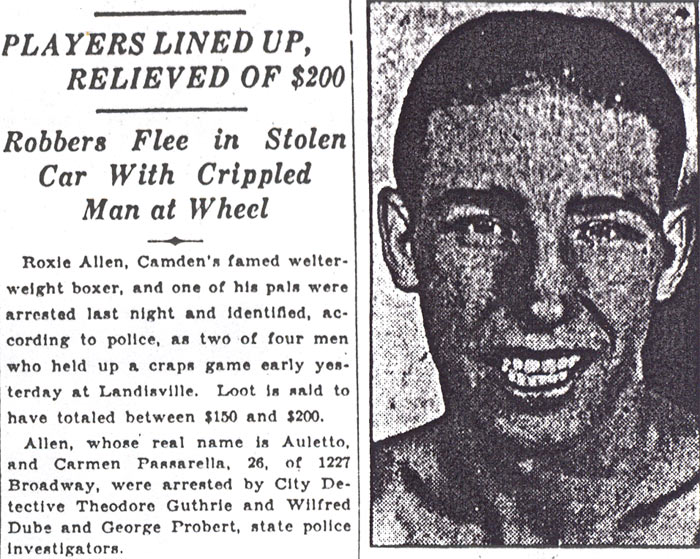
Pugilist and Pal Identified As 2 of 4 Bandits in Landisville Robbery
PLAYERS LINED UP, RELIEVED OF $200
Robbers Flee in Stolen Car With Crippled Man at Wheel
Roxie Allen, Camden’s famed welterweight boxer, and one of his pals were arrested last night and identified, according to police, as two of four men who held up a craps game early yesterday at Landisville. Loot is said to have totaled between $150 and $200.
Allen, whose real name is Auletto, and Carmen Passarella, 26, of 1227 Broadway, were arrested by City Detective Theodore Guthrie and Wilfred Dube and George Probert, state police investigators.
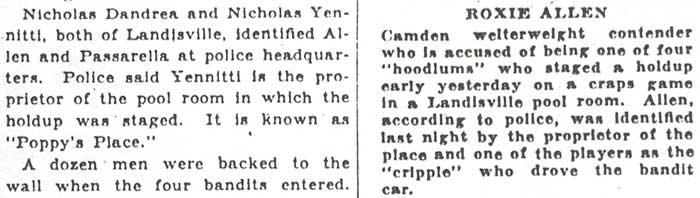
Nicholas Dandrea and Nicholas Yennitti, both of Landisville, identified Allen and Passarella at police headquarters. Police said Yennitti is the proprietor of the pool room in which the holdup was staged. It is known as “Poppy’s Place.”
A dozen men were backed to the wall when the four bandits entered.
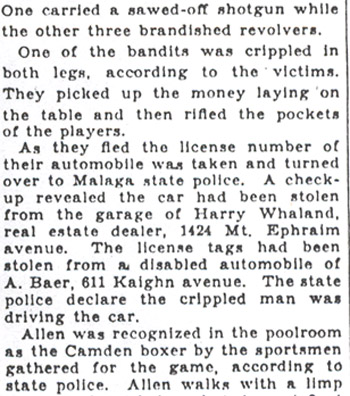
One carried a sawed-off shotgun while the other three brandished revolvers.
One of the bandits was crippled in both legs, according to the victims. They picked up the money laying on the table and then rifled the pockets of the players.
As they fled the license number of their automobile was taken and turned over to Malaga state police. A check-up revealed the car had been stolen from the garage of Harry Whaland, real estate dealer, 1424 Mt. Ephraim avenue. The license tags had been stolen from a disabled automobile of A. Baer, 611 Kaighn avenue. The state police declare the crippled man was driving the car.
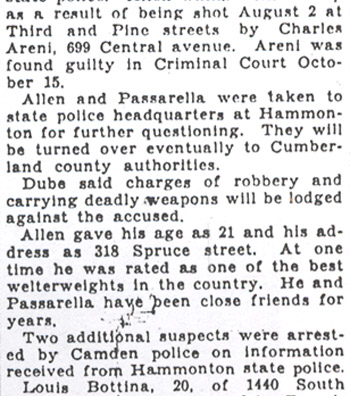
Allen was recognized in the poolroom as the Camden boxer by the sportsmen gathered for the game, according to state police. Allen walks with a limp as a result of being shot August 2 at Third and Pine streets by Charles Areni, 699 Central avenue. Areni was found guilty in Criminal Court October 15.
Allen and Passarella were taken to state police headquarters at Hammonton for further questioning. They will be turned over eventually to Cumberland county authorities.
Dube said charges of robbery and carrying deadly weapons will be lodged against the accused.
Allen gave his age as 21 and his address as 318 Spruce street. At one time he was rated as one of the best welterweights in the country. He and Passarella have been close friends for years.
Two additional suspects were arrested by Camden police on information received from Hammonton state police. Louis Bottina, 20, of 1440 South Fourth street, was arrested by Patrolman Joseph Lack at Broadway and Kaighn avenue.
Salvatore Passalacqua, 20, of 339 Clinton street, was arrested at his home by Detective Sergeant Rox Saponare.
Both men were arrested on suspicion and are being detained until today when an attempt will be made to identify them as the second pair of the four bandits.
When Newspapermen asked Guthrie what Allen said when he was arrested, Guthrie declared Allen had made no statement. A similar question at Hammonton state police headquarters brought forth a reply from Trooper Dube that “I am not making any statements right now, I am still working on the investigation. Don’t bother me for a couple of hours.”
Bail Is Denied Roxie Allen in Robbery of 15 in Craps Game
Camden Evening Courier —
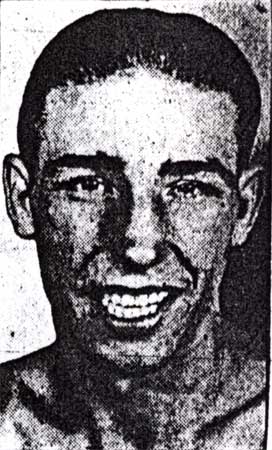
Three Pals of Camden Boxer Also Jailed at Shore for Grand Jury
QUARTET IDENTIFIED BY POOLROOM OWNER
Limp Betrays Fighter at Landisville—Says He Did Not Aid Holdup
Identified as four of the five bandits who held up and robbed 15 men at a craps game in a Landisville poolroom yesterday, Roxie Allen, well-known South Jersey boxer, and three other South Camden youths are under arrest today.
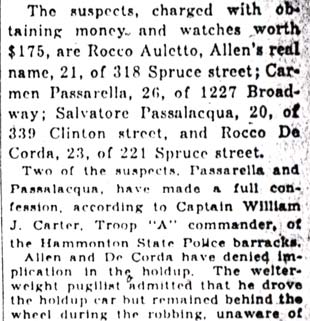
The suspects, charged with obtaining money and watches worth $175, are Rocco Auletto, Allen’s real name, 21, of 318 Spruce street; Carmen Passarella, 26, of 1227 Broadway; Salvatore Passalacqua, 20, of 339 Clinton street, and Rocco De Corda, 23, of 221 Spruce street.
Two of the suspects, Passarella and Passalacqua, have made a full confession, according to Captain William J. Carter, Troop “A” commander, of the Hammonton State Police barracks.
Allen and De Corda have denied implication in the holdup. The welterweight pugilist admitted that he drove the holdup car but remained behind the wheel during the robbing, unaware of the intentions of his companions.
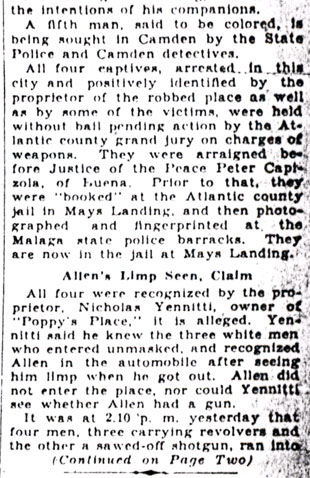
A fifth man, said to be colored, is being sought in Camden by the State Police and Camden detectives.
All four captives, arrested in this city and positively identified by the proprietor of the robbed place as well as by some of the victims, were held without bail pending action by the Atlantic county grand jury on charges of weapons. They were arraigned before Justice of the Peace Peter Capizola, of Luena. Prior to that, they were “booked” at the Atlantic county jail in Mays Landing, and then photographed and fingerprinted at the Malaga state police barracks. They are now in the jail at Mays Landing.
Allen’s Limp Seen, Claim
All four were recognized by the proprietor, Nicholas Yennitti, owner of “Poppy’s Place,” it is alleged. Yennitti said he knew the three white men who entered unmasked, and recognized Allen in the automobile after seeing him limp when he got out. Allen did not enter the place, nor could Yennitti see whether Allen had a gun.
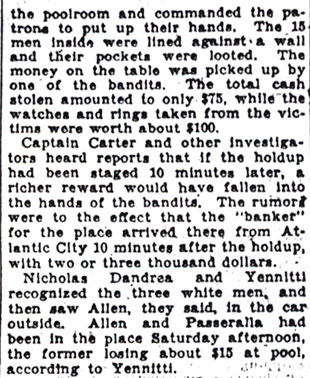
It was at 2:10 p. m. yesterday that four men, three carrying revolvers and the other a sawed-off shotgun, ran into the poolroom and commanded the patrons to put up their hands. The 15 men inside were lined against a wall and their pockets were looted. The money on the table was picked up by one of the bandits. The total cash stolen amounted to only $75, while the watches and rings taken from the victims were worth about $100.
Captain Carter and other investigators heard reports that if the holdup had been staged 10 minutes later, a richer reward would have fallen into the hands of the bandits. The rumors were to the effect that the “banker” for the place arrived there from Atlantic City 10 minutes after the holdup, with two or three thousand dollars.
Nicholas Dandrea and Yennitti recognized the three white men, and then saw Allen, they said, in the car outside. Allen and Passarella had been in the place Saturday afternoon, the former losing about $15 at pool, according to Yennitti.
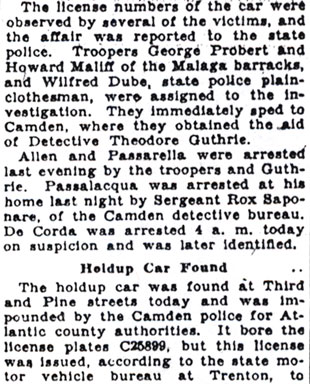
The license numbers of the car were observed by several of the victims, and the affair was reported to the state police. Troopers George Probert and Howard Maliff of the Malaga barracks, and Wilfred Dube, state police plainclothesman, were assigned to the investigation. They immediately sped to Camden, where they obtained the aid of Detective Theodore Guthrie.
Allen and Passarella were arrested last evening by the troopers and Guthrie. Passalacqua was arrested at his home last night by Sergeant Rox Saponare, of the Camden detective bureau. De Corda was arrested 4 a. m. today on suspicion and was later identified.
Holdup Car Found
The holdup car was found at Third and Pine streets today and was impounded by the Camden police for Atlantic county authorities. It bore the license plates C25899, but this license was issued, according to the state motor vehicle bureau at Trenton, to Harry Whaland, 1424 Mt. Ephraim avenue, Camden. An investigation proved that the tags had been stolen from Whaland’s car yesterday. Moreover, Whaland had a car different in make than the one impounded.
In his confession, Passarella declared that the seized car was his and that it was used in the holdup. The plates, he is said to have confessed, were stolen from Whaland.
However, a checkup at the Trenton bureau revealed that the license number C22859, issued for the car claimed by Passarella, had been issued to a Frank Passarella, of 327 Washington street, Camden.
Passarella, the man under arrest, is a nephew of Frank Passarella, also known as Passeralli, 31, of 212 Catherine street, Philadelphia, one of the two Atco National Bank bandits who were convicted here last month and received heavy jail sentences.
Louis Bottina, 20, of 1440 South Fourth street, was also arrested last night on suspicion, but was released when he proved an alibi and when the victims could not identify him.
The limp which betrayed Allen was the result of a bullet wound inflicted on him August 2 by Charles Areni, 699 Central avenue, who later was convicted and sent to state’s prison.
Suspect Is Nabbed at Fairview Home in Shooting of Cop
Camden Evening Courier —
Collingswood Man Held on Charge Made By Police at Springfield, Mass.—Accused of Having Gun When Caught Crawling From Cellar
A two-week search for a Collingswood man wanted in Springfield, Mass., on a charge of shooting and beating a patrolman, ended in Fairview this morning when George Fingerhut, 26, was captured by three Camden district detectives as he was attempting to flee from the home of his sister.
Fingerhut, who said he lived at 68 Collings avenue, Collingswood, was caught by Detective Howard Smith as he attempted to crawl through a cellar window, gun in hand. Fingerhut had been trailed from Collingswood by Patrolman George Smith, of the Collingswood police, a son of Detective Smith.
According to the Springfield police, Fingerhut was one of three men who shot Patrolman Joseph Gauderau two weeks ago when the patrolman surprised them in the act of stealing a car. After shooting the patrolman, one of the men beat him over the head with a revolver. Gauderau is not expected to live.
Jailed 60 Days
The suspect was arraigned before Police Judge Pancoast on a charge of carrying deadly weapons and being a fugitive from justice. He entered pleas of not guilty to both charges and was sentenced to 60 days on the deadly weapon charge. He was ordered held 30 days pending extradition proceedings.
Fingerhut, after the three detectives testified he had a loaded revolver in his hand when he attempted to flee from a house at 953 Monitor road, Fairview, asked Pancoast to set bail on the fugitive charge. Bail was set at $15,000. He said he reached Camden last night.
The residence at 953 Monitor road is occupied by Raymond Gondolf and family, according to the police. Raymond Gondolf is a son of Peter Gondolf, a Fairview contractor, Republican committeeman from the Fourteenth Ward. Mrs. Raymond Gondolf is Fingerhut’s sister.
The Gondolfs were away from their home last night. Fingerhut, finding the house unoccupied, used it as a hiding place, according to a report filed by Detective Smith.
Fingerhut’s brother, Hugh, and a man known to the police only as “Pete” have been arrested in New England and are being held in Springfield. George Fingerhut, according to the Springfield police, has a long criminal record.
Home Surrounded
The police received a tip yesterday that Fingerhut would try to visit Fairview last night. Detectives Theodore Guthrie, Clarence Bunker and Smith watched the house during the night, and this morning when no sign of Fingerhut was seen Bunker, [sic] went to the rear of the house, Smith to the side and Guthrie to the front door.
Guthrie knocked several times, but his knock was not answered. Then it was that Smith saw a man crawling through a cellar window with a revolver in one hand. Stepping behind some shrubbery, Smith waited until Fingerhut emerged from the cellar window and then covered him with a revolver.
At police headquarters Fingerhut refused to make any statements. His photographs and Bertillion measurements will be broadcast by the Camden police to ascertain if he is wanted in any other cities.
5 Camden Police Granted Pensions
Camden Courier-Post —
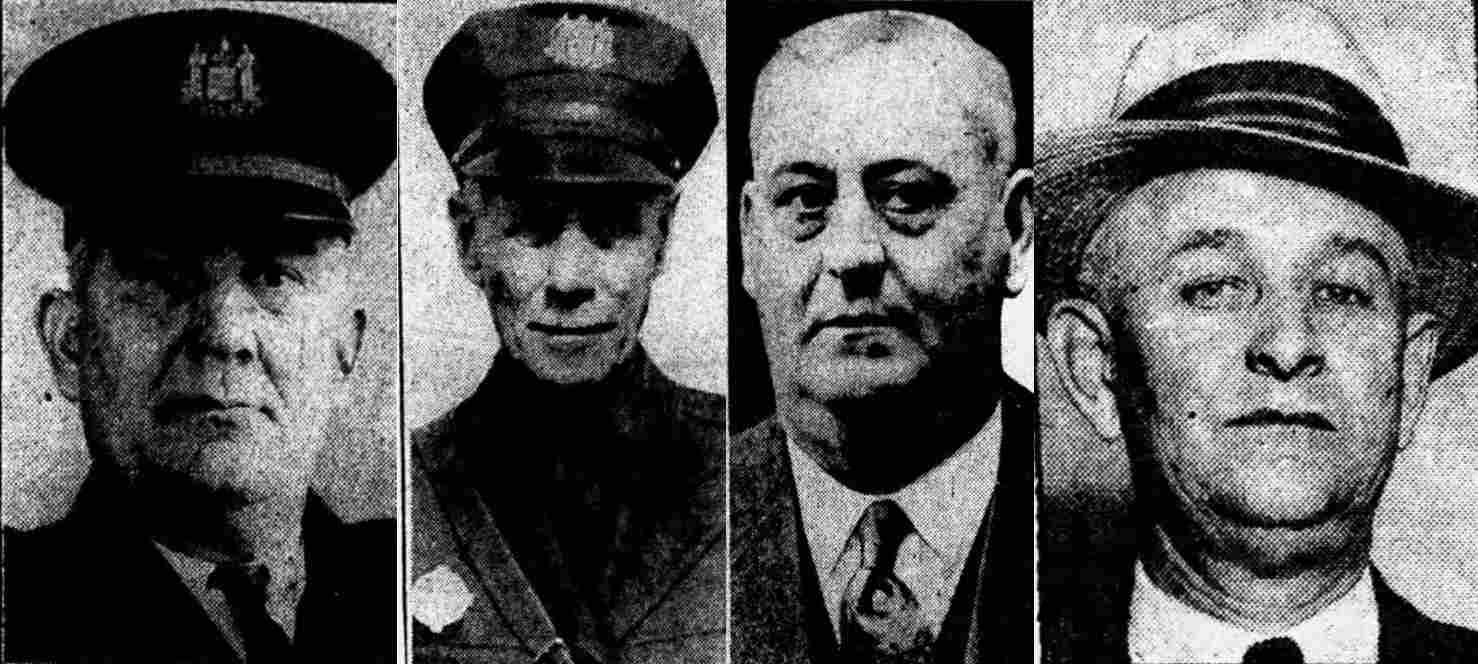
Named: Charles Laib, Charles J. “Jeff” Kay, Theodore Guthrie, and Howard Smith.

Laib, Kay, Guthrie, Smith and Till to Be Retired Next Month
Petitions for pensions were granted yesterday to five members of the Camden police department.
The retiring men are: Lieutenant Charles Laib, in charge of the traffic bureau; Sergeant Charles J. “Jeff” Kay, City Detectives Theodore “Dory” Guthrie and Howard Smith, and Patrolman J. Oscar Till.
The retirements are to become effective Jan. 1, it was announced after a special meeting of the pension committee in city hall. Mrs. Louise F. Walsh, secretary of the board, presented the five applications.
Eventual retirement of Lieut. Laib has been rumored in the department for several months, but it was not until recently that the report was regarded seriously. It is understood that his associates as late as yesterday had requested him to remain on duty. He is recognized as one of the most competent officers in the department. Failing health, however, is said to have prompted the pension committee to approve his application.
Successor Not Named
No announcement as to Lieut. Laib’s successor was made by Acting Chief John W. Golden.
Lieutenant Laib was appointed to the police force on January 12, 1912, by former Mayor Charles H. Ellis. He was promoted to sergeant in 1916 and became a lieutenant in 1929. He has been in charge of the traffic detail for a year, succeeding Captain Charles L. Humes, who has been named inspector of personnel.
Laib is but 51 years of age and is one of the youngest men in the department to apply for pension. If his pension is approved he will receive a monthly salary of $102.05. His home is with his wife at 76 South Twenty-fourth street.
For many years, Laib has been conducting a “one-man” relief organization and is recognized by charitable organizations throughout the city for his generosity among the destitute. At Thanksgiving and Christmas, he personally collects funds for dinners for the children of the Sheltering Arms Home, Seventeenth street and River avenue, and has also been responsible for the home getting a daily supply of bread from a Camden bakery for several years.
Kay Served 38 Years
Sergeant Kay is a veteran member of the police department and has been an officer for 38 years. He is 72 and lives at 606 North Fourth street. He will receive $90.65 monthly. He has been on the sick list for several months, recovering from injuries received in an accident.
Detective Smith is 58 and lives at 933 Penn street. For several years he was loaned to the county as a detective and helped in the discovery of Camden county murders. He was recently returned to the police department and Detective Fiore Troncone turned over to the county in his place. He will receive $90.65 a month. He was appointed June 20, 1905.
Detective Guthrie served 19 years as a policeman and two as a fireman. He resides at 570 Chestnut street. He will receive $92.50 per month, the additional $2 being added because he will not have the usual two per cent deducted for the pension fund.
Patrolman Till, who is 56, resides at North Twenty-fifth street. He served 19 years as a policeman and two and one-half years as a fireman. He is attached to the Second district. Till will receive $83.60 monthly.
The members of the pension committee who passed on the applications is headed by Mayor Roy R. Stewart and includes, Newton W. Ash, fire department representative; William Michalak, police department representative; John J. Robinson, a citizen member, and Mrs. Walsh.
Guthrie's Condition Called Critical
Camden Courier-Post —
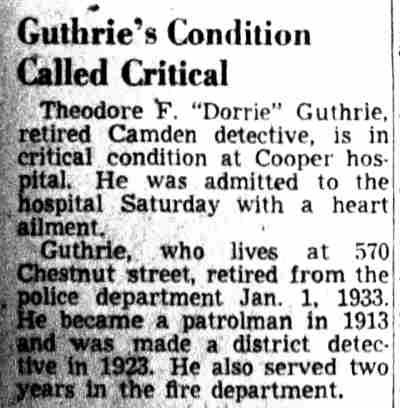
Theodore F. “Dorrie” Guthrie, retired Camden detective, is in critical condition at Cooper hospital. He was admitted to the hospital Saturday with a heart ailment.
Guthrie, who lives at 570 Chestnut street, retired from the police department Jan. 1, 1933. He became a patrolman in 1913 and was made a district detective in 1923. He also served two years in the fire department.
'Dorrie' Guthrie Dies of Heart Ailment at 70
Camden Courier-Post —
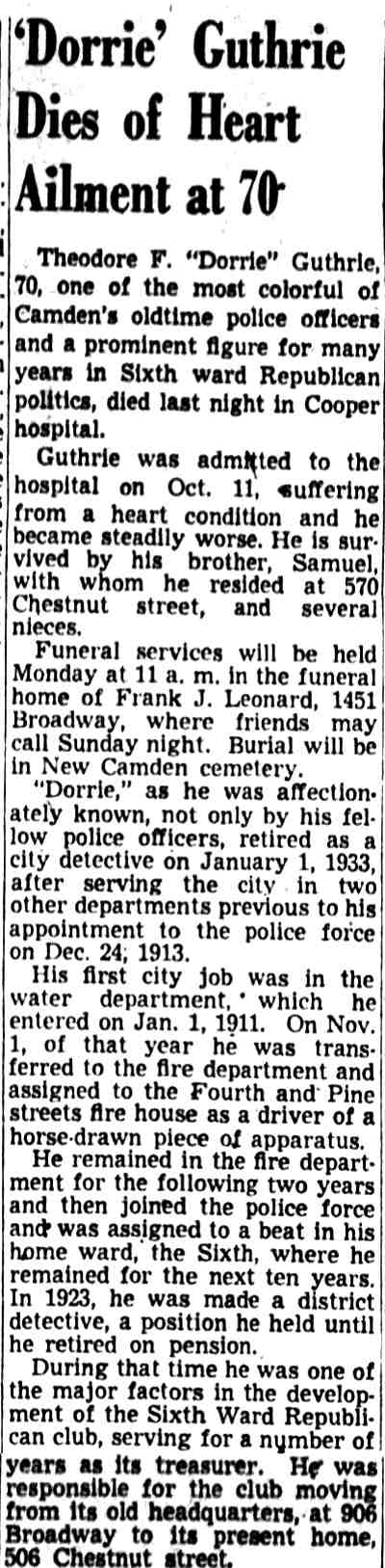
Theodore F. “Dorrie” Guthrie, 70, one of the most colorful of Camden’s oldtime police officers and a prominent figure for many years in Sixth ward Republican politics, died last night in Cooper hospital.
Guthrie was admitted to the hospital on Oct. 11, suffering from a heart condition and he became steadily worse. He is survived by his brother, Samuel, with whom he resided at 570 Chestnut street, and several nieces.
Funeral services will be held Monday at 11 a. m. in the funeral home of Frank J. Leonard, 1451 Broadway, where friends may call Sunday night. Burial will be in New Camden cemetery.
“Dorrie,” as he was affectionately known, not only by his fellow police officers, retired as a city detective on January 1, 1933, after serving the city in two other departments previous to his appointment to the police force on Dec. 24, 1913.
His first city job was in the water department, which he entered on Jan. 1, 1911. On Nov. 1, of that year he was transferred to the fire department and assigned to the Fourth and Pine streets fire house as a driver of a horse-drawn piece of apparatus.
He remained in the fire department for the following two years and then joined the police force and was assigned to a beat in his home ward, the Sixth, where he remained for the next ten years. In 1923, he was made a district detective, a position he held until he retired on pension.
During that time he was one of the major factors in the development of the Sixth Ward Republican club, serving for a number of years as its treasurer. He was responsible for the club moving from its old headquarters, at 906 Broadway to its present home, 506 Chestnut street.
Final Rites Are Held For T. F. Guthrie
Camden Courier-Post —
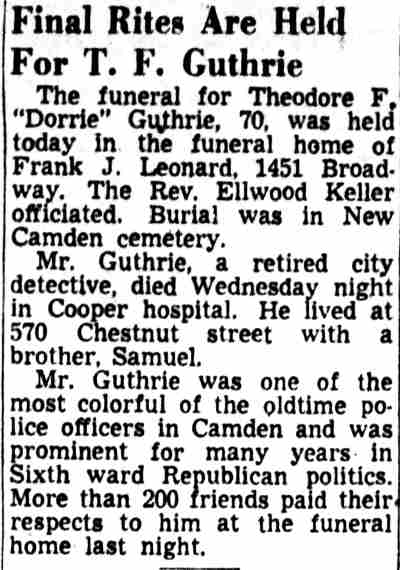
The funeral for Theodore F. “Dorrie” Guthrie, 70, was held today in the funeral home of Frank J. Leonard, 1451 Broadway. The Rev. Ellwood Keller officiated. Burial was in New Camden cemetery.
Mr. Guthrie, a retired city detective, died Wednesday night in Cooper hospital. He lived at 570 Chestnut street with a brother, Samuel.
Mr. Guthrie was one of the most colorful of the oldtime police officers in Camden and was prominent for many years in Sixth ward Republican politics. More than 200 friends paid their respects to him at the funeral home last night.