Introduction
SAMUEL E. HARRING was born in Pennsylvania in August of 1869 to Samuel and Rosa Harring. He married Josephine Black at the age of 24. A son, Samuel B. Harring was born shortly thereafter. The 1895–1896 City Directory shows the family at 619 North Front Street. Samuel Harring’s brother Walter, his wife Lottie and son William Harring lived at 605 North Front Street. Sister-in-law Lottie appears to have passed away around 1900. When the Census was taken in 1900, Samuel and Josephine Harring were living at 308 North Front Street with their children, Samuel and Lottie. Samuel E. Harring’s parents, brother Walter and nephew William Harring were then living in Philadelphia. By the time he turned 16, nephew William Harring had returned to Camden.
Samuel E. Harring, was a bricklayer by trade, on January 16, 1909 he traded in his mason’s trowel to become a Camden fire fighter. Replacing Rollo Jones, who had been sent to Engine Company 6, Samuel Harring served with Ladder Company 1 prior to September 22, 1909 when he was assigned to Engine Company 6 at Front and Linden Streets. On the same date Harvey Watts was transferred from Engine 6 to Ladder 1.
When the Census was taken in 1910 he was living with his Uncle Samuel at 125 Linden Street in North Camden, a short walk from the Engine Company 6 firehouse. William Harring joined the Camden Fire Department by mid-January 1920. He eventually rose to the rank of Deputy Chief. His son William Harring Jr., joined the Camden Fire Department in 1948, serving over 23 years. Between the three, there was a Harring fighting fires in Camden for over 60 years.
The 1914 City Directory shows Samuel and Josephine Harring at 210 York Street. The family had moved to 732 North Front Street by June of 1917, when son Samuel Harring Jr. registered for the draft. The family was still at that address in 1918.
The 1924 and 1927 City Directories show Samuel and Josephine Harring at 619 North 2nd Street. The 1929 edition states that he had moved to 912 North Front Street. The 1930 Census, taken in April of that year, states that Samuel Harring, wife Josephine, and daughter Lottie were living in the Colonial Manor section of West Deptford, New Jersey. Samuel Harring was still a city fire fighter at that time. Fire Department records from 1931 show him living at 619 North 2nd Street. Samuel Harring retired in the 1930s. The family was still living in Colonial Manor when Josephine Harring died on March 11, 1935. Samuel Harring passed away at some point after April 2, 1940.
Over in Camden
Philadelphia Inquirer —
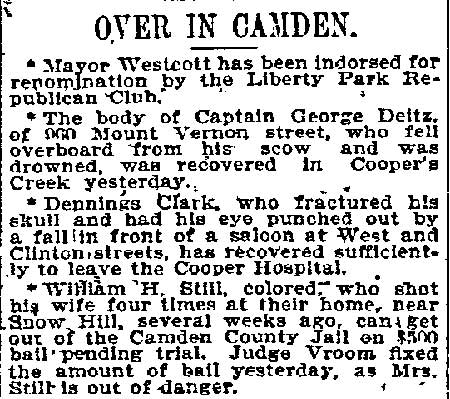
OVER IN CAMDEN.
* Mayor Westcott has been indorsed for renomination by the Liberty Park Republican Club.
* The body of Captain George Deitz, of 960 Mount Vernon street, who fell overboard from his scow and was drowned, was recovered in Cooper’s Creek yesterday.
* Dennings Clark, who fractured his skull and had his eye punched out by a fall in front of a saloon at West and Clinton streets, has recovered sufficiently to leave the Cooper Hospital.
* William H. Still, colored, who shot his wife four times at their home, near Snow Hill, several weeks ago, can get out of the Camden County Jail on $500 bail pending trial. Judge Vroom fixed the amount of bail yesterday, as Mrs. Still is out of danger.
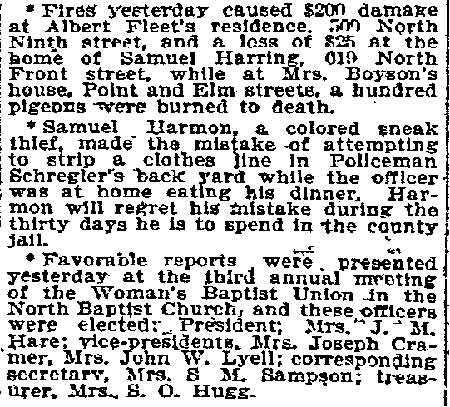
Fires yesterday caused $200 damage at Albert Fleet’s residence, 300 North Ninth street, and a loss of $25 at the home of Samuel Harring, 619 North Front street, while at Mrs. Boyson’s house, Point and Elm streets, a hundred pigeons were burned to death.
Samuel Harmon, a colored sneak thief, made the mistake of attempting to strip a clothes line in Policeman Schregler’s back yard while the officer was at home eating his dinner. Harmon will regret his mistake during the thirty days he is to spend in the county jail.
Favorable reports were presented yesterday at the third annual meeting of the Woman’s Baptist Union in the North Baptist Church, and these officers were elected: President, Mrs. J. M. Hare; vice-presidents, Mrs. Joseph Cramer, Mrs. John W. Lyell; corresponding secretary, Mrs. S. M. Sampson; treasurer, Mrs. S. O. Hugg.
Thousands View Chief’s Remains
Camden Post-Telegram —
Throngs Jam Court House While Body Lies in State for Two Hours.
LAST SAD RITES THIS AFTERNOON
Not since the memorable funeral of Chief of Police Foster ten years ago, has there been such a genuine public tribute paid an official of Camden as was in evidence last night at the bier of the lamented Fire Chief Worthington, and today at his funeral. It is hard to estimate the number of persons in a crowd, but from 7 until 9 o’clock last night there was a steady stream of men, women and children, two abreast, who passed from the main entrance, through the center corridor and beneath the illuminated rotunda, where the body lay, and thence out by the west corridor. There was never a stop, and it is estimated that at least 10,000 persons were there, perhaps more.
There could not have been a more ideal location for the repose of the casket containing the honored dead, and the great array of beautiful flowers than beneath the rotunda. It seemed to be a sacred shrine in itself where the citizenry dropped a tear for the lamented departed. The effulgence of the soft lights from above specially installed by Electrical Chief Kelly but lent to the scene and as the dark garbed escort of firemen, the active pall bearers, stood, on guard, the scene was unusually impressive.
Chief Worthington, aside from the pallor that comes to the dead, looked as he did in life, for the thread had been snapped so quickly that it was while he was in his full vigor that the vital spark had taken its flight. There were some marks on his face that indicated the intense though momentary suffering through which he passed on his fateful plunge from the roof of the burning building to his quick death, and the passing crowd remarked this. But withal there was that calmness and repose feature which seemed to indicate that the gallant leader of Camden’s fire fighters but lay sleeping rather than that his soul had taken its eternal flight.
Public grief may be a mere ephemeral emotion, born of the moment and only to be succeeded by the acclaim of the newly arisen public idol, but last night’s encomiums seemed to come from hearts that overflowed with genuine and permanent sorrow over the untimely passing of so excellent a public servant. Many tear-suffused eyes indicated this, many expressions of grief, of sorrow, of condolence of those left showed this. The sentiment in evidence everywhere can only be likened to the sweetness of the wonderful flowers whose odor spread thorough all the corridors and in all the rooms of the great marble building.
High in the clock tower of the City Hall the bell began tolling at 6:30 o’clock. At half-minute intervals its doleful strains went forth on the cold blustery east wind which had succeeded at day of spring sunshine. The bell and the screeching wind seemed to combine as a knell indicating the passing grief of the city. It was the preliminaries to the marching of the funeral cortege from the stricken Chief’s home on Penn Street to the resting place at the Court House.
There were forty policemen in dress uniform with Chief Gravenor at their head. There were twenty-six fire heads from Philadelphia, with Chief William Murphy in the van, a tribute in itself of more than passing moment. There was the caisson on which was the black draped casket containing the body of he who all honored. There was the little red car in which Chief Worthington was wont to speed through the city at every alarm and there was his helmet and coat. There was Acting Chief Stockton and forty of the men who fought flames under the direction of he who lay so still. There as the family in cabs with curtains drawn, the members of City Council and the active pall bearers— Daniel Leach, Peter B. Carter, James White, William Patterson, Elmer Burkett, Samuel Harring.
When the cortege reached the Court House the Camden boys took up their position on the inside beneath rotunda while the Philadelphia visitors made an imposing array on the granite steps outside. And then came the public in its steady and unending stream.
Later the Philadelphia delegation was escorted to the Board of Freeholders room where tribute was paid to the dead and where a mingling of the two cities took place. Besides Chief Murphy the visitors included Battalion Chiefs William T. Barrett and George P. McConaghy, Captains L. F. Bunting, William Lindsey; H. Dinlocker, J. Higginson, J. E. Talbot, D. Campbell, T. O’Brien, F. Hughes, E. Basenfelder; H. Hutt, William McCusker, G. Rheim, R. Wilsey, J. Webb, H. Goers, H. Haines, Insurance Patrol Captain Joseph H. Shermer William Hickman, William Rodgers, John Wyatt, David Phillip, John Clyde, H. Wilkinson.
President of City Council James E. Hewitt spoke of the work Chief Worthington had already accomplished, of his plans, of his value and worth to Camden. Chief Murphy responded in a fitting way and this incident in itself was one to be remembered.
An affecting sight was witnessed by the handful of spectators, among them being other firemen, city and county officials and policemen who remained after the big doors on Sixth Street had been closed. The last to view the Chief’s remains were a delegation of about twenty firemen. Solemnly the men passed by the bier and gazed upon the features of their departed brother.
As the last of the line approached Deputy Chief John A. Stockton was seen. He stopped and with his cap laid across his breast be looked down into the casket. For almost a minute Chief Stockton stood as though glued to the spot. Then he glanced about him and the sympathetic look upon his face thrilled all.
He heaved a sigh and perhaps the teardrops refused to come, but Chief Stockton, as the lines upon his face showed, was struggling with the inner man. His emotions were tugging at his heart, but a fire laddie cannot give way to his feelings although his brother superior officer and dear friend had answered his last alarm.
The floral pieces surrounding the bier bespoke the love, admiration and respect the donors held for the dead chief. One design particularly beautiful was a mammoth loving cup made of blossoms, flowers and roses. This was the token sent by members of City Council and other city officials.
Another was the design sent by the Electrical Bureau through Chief Kelly. The original fire box, No. 134, which was pulled on the night of the fire by Chief Worthington was enshrouded by roses, carnations and lilies.
A maltese cross standing several feet high and bearing the initials of the organization was the tribute sent by the Firemen’s Mutual Benevolent Association. Chief Worthington was president of this association.
The Camden police sent a large shield of flowers and Council members offered a vacant chair of roses. The New Jersey Auto Supply Company, No. 2 Engine Company and No. 1 Truck sent beautiful broken circles and a wreath was the offering from the employees of the Victor Talking Machine Company.
A broken circle from member of the Sixth Ward Republican Club and a wreath from his friends in the sixth precinct of the Second Ward were other beautiful pieces. West Collingswood and Collingswood firemen sent two beautiful floral circles and from the Loyal Order Legion a wreath was received.
Other offerings were from the Camden Liquor Dealers league, a beautiful circle from No. 6 Engine Company, in which house Chief Worthington was captain previous to his elevation to the office of chief; sprays from the Bethany M.E. Church, Ladies Auxiliary of the Loyal Order of Moose; a wreath from the pupils of the eighth grade Sewell school, and a spray from North Baptist Church. There also were designs from members of the family and friends, all of which bespoke the great love held for the departed fire chief.
The impressive services of the P.E. Church marked the last sad rites this afternoon at St. Paul’s Church. The guard of honor and city officials left Fire Headquarters at 1:20 and proceeded to the Worthington home and escorted the remains to the church, where services were conducted by the rector, Rev. R.E. Brestell, and Rev. H.O. Jones, rector of St. Stephen’s P.E. Church. Interment was made at Arlington.
The honorary pallbearers were Mayor Ellis, Hon. David Baird, Frank F. Patterson, John W. Bell, General John A. Mather, Melbourne F. Middleton Jr., Harry R. Reed, Arthur L. Jones, Robert Gordon, David Jester, George Schneider, William Mills, J.O. Grear, William Hall, George L. Bender, and James E. Hewitt.
Funeral of James McDade
Philadelphia Inquirer —
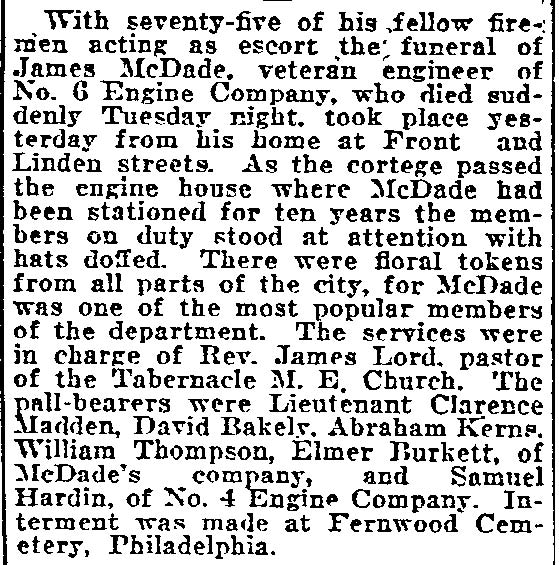
With seventy-five of his fellow firemen acting as escort the funeral of James McDade, veteran engineer of No. 6 Engine Company, who died suddenly Tuesday night, took place yesterday from his home at Front and Linden streets. As the cortege passed the engine house where McDade had been stationed for ten years the members on duty stood at attention with hats doffed. There were floral tokens from all parts of the city, for McDade was one of the most popular members of the department. The services were in charge of Rev. James Lord, pastor of the Tabernacle M. E. Church. The pall-bearers were Lieutenant Clarence Madden, David Bakely, Abraham Kerns, William Thompson, Elmer Burkett, of McDade’s company, and Samuel Hardin, of No. 4 Engine Company. Interment was made at Fernwood Cemetery, Philadelphia.
Fireman Dies in Explosion of Chemicals
Camden Courier —
Companion Hurt As Extinguisher Explodes at Second Street Fire
CAUSE OF BLAST MYSTERY TO FIREMEN
Injured Fireman Finds Self Lying on Comrade’s Dead Body
WAS FIREMAN EIGHT MONTHS
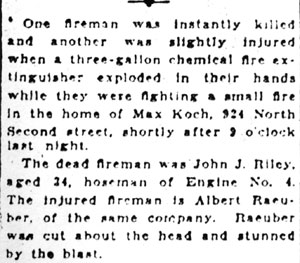
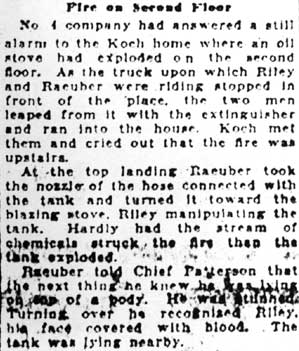
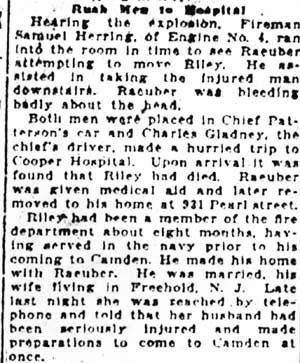
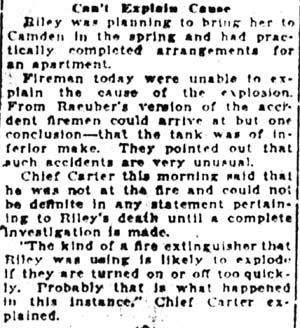
Named: John J. Reilly, Peter B. Carter, Charles Gladney, Samuel Harring, William W. Patterson, Albert Raeuber, Max Koch, North 2nd Street, Pearl Street, and Engine Company 4.
Voter Registrations Challenged
Camden Courier-Post —
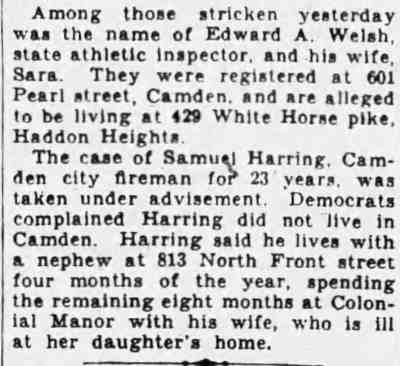
Among those stricken yesterday was the name of Edward A. Welsh, state athletic inspector, and his wife, Sara. They were registered at 601 Pearl street, Camden, and are alleged to be living at 429 White Horse pike, Haddon Heights.
The case of Samuel Harring, Camden city fireman for 23 years, was taken under advisement. Democrats complained Harring did not live in Camden. Harring said he lives with a nephew at 813 North Front street four months of the year, spending the remaining eight months at Colonial Manor with his wife, who is ill at her daughter’s home.
Heavy Pay Cut Fear Cause of Rush to Retire
Camden Courier-Post —

HEAVY PAY CUT FEAR CAUSE OF RUSH TO RETIRE
Inspector Humes Highest Officer on List; Three Captains Are Included
PROTECTIVE FORCES LOSE THEIR OLDEST VETERANS
Sixteen Vacant Places Will Be Filled Without New Appointments
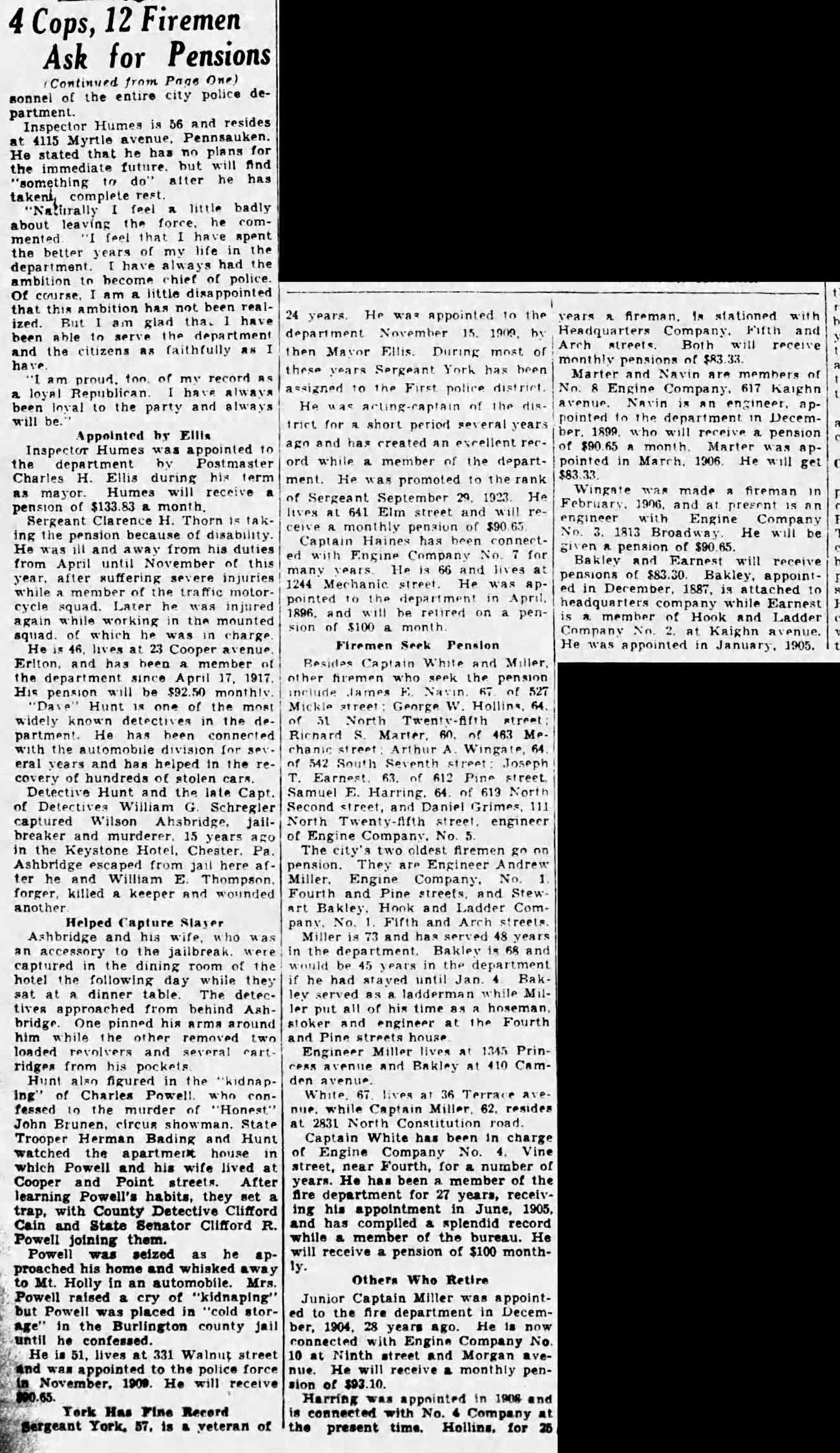
Four policemen and 12 city firemen yesterday applied for pensions effective at midnight tonight. In the interests of economy, no successors will be named by the city commission.
Sudden decision of the applicants was inspired by the fact that city employes may be given a 30 percent reduction in pay equal to that of county employes. Police and firemen accepted a 10 percent reduction this year. If given an additional 20 percent their salaries would be on a pre-war basis.
They also face a possibility of further reductions in pensions if existing mandatory legislation is repealed by the Legislature, which fixes salaries of police and firemen according to the class of cities and towns. By applying now they will receive pensions on basic 1931 salaries.
The big surprise was announcement that Inspector Charles T. Humes, in charge of personnel of the police department, had applied for a pension. Inspector Humes receives a salary of $3000 yearly. By applying at this time he is eligible to a pension of one-half that amount. The $1500 yearly would be within a few hundred dollars of what he would receive if he remained on the force and accepted a 30 percent reduction in salary.
Consider Requests Today
Other policemen to ask for pensions are Sergeants Albert York and Clarence Thorn and Detective David Hunt.
Three fire captains applying for pensions are James R. White, Harry A. Haines and William H. Miller, Jr.
The applications were filed with Mrs. Louise F. Walsh, secretary of the Police and Firemen’s Pension Fund. The pension fund commission will act on the applications today.
Inspector Humes’ retirement comes at the conclusion of a quarter century of service in the police department. He was appointed as a patrolman on Jan. 1, 1908, and six years later, on Jan. 1, 1914, was elevated to a sergeancy. He was promoted to captaincy on July 1, 1918. Then, by act of the city commission, he was made an inspector on June 23, 1927.
Recognized as Authority
While a captain, he was in command of the First District and later of the Third. As an inspector, he was head of the traffic bureau for several years. He was a nationally recognized authority on traffic problems, having been requested for advice by various automobile clubs and traffic commissions. He played a leading role in a traffic convention at Chicago and once was called in by the federal traffic commission at Washington for advice. At the present time, he is in charge of the pen—
(Continued on Page Two)
4 COPS, 12 FIREMEN ASK FOR PENSIONS
(Continued from Page One)
Inspector Humes is 56 and resides at one of the sister cities in Pennsylvania. He stated that he has no plans for an immediate future, but that he intends to rest and, when completely relaxed, complete rest.
Callously, and a little badly about leaving the force, he commented on the force, he commented on the promotions in his department. “I have always had the discipline I have been able to maintain in my department. Of course, I am a little disappointed in the promotions which I did not get. I have always had good times and I have been able to serve the department as well in my way as faithfully as I have.”
“I am proud too, of my record as a member, and have tried to do my best, loyal to the party and always to Camden.”
Inspector Humes was appointed to the police force under Mayor Charles H. Ellis during his term as mayor. Humes will always be remembered as the officer who, while a member of the traffic motorcycle squad, twice saved persons from drowning while working in the mounted detail. He was formerly a member of the detective squad under Sergeant Nelson, and has been a member of the department since January 1, 1908. His pension will be $82.50 monthly.
Sergeant York Was a Pioneer
Sergeant York, a 30 year veteran of the police department, has been connected with the department in many interesting matters. A detective in the department along with Detective-Captain James [Golden] and County Detective Chief Doran, who aided in capturing Ashbridge and his wife in the Chester [Keystone] hotel at Chester, Pa., at the time Ashbridge had fled following his murder of a jailor in the Camden County jail.
Sergeant York was then patrol trooper with Captain [Schregler]. After the events Trooper Herman, Rac[?]ing and York were the three men, with Trooper Henry Powell and his wife who were in Powell’s automobile to effect the chase, in which Powell was placed in “cold storage” near the Pennsylvania border.
Police followed York’s car from near the Pennsyl[van]ia border. His pension will be $92.50 a month.
Besides Captain White, 61, and Haines, Jr., he takes the pension. White [and Haines] retire after 34 years’ service, complete, complete records of the department.
Sergeant Navin was appointed to the police department 21 years ago and during nearly all of this time has been attached to the First district. He lives in the First ward, at 220 York street, and will receive a pension of $83.30 monthly.
Others Who Retire
Junior Captain William Miller was appointed to the fire department in December, 1897, at 961 Mechanic street, and later to Nineteenth and Market [streets], and then to Company No. 2 at 201 [Kaighn] avenue. He receives a pension of $93.33 a month.
Barnard and Navin are members of E Engine Company, 401 [Kaighn] avenue. Navin is an engineer, appointed in September, 1904, who receives a pension of $90 a month. Master was appointed in March, 1903. He will get a pension of $100 a month.
Harring was made a fireman in December, 1896, and lives at 201 Second street, and Daniel Grimes 111 years of service, and was in charge of Engine Company No. 5.
The applications of Captain John Lutts, of Engine Company No. 6, Front and Linden streets, and Elmer Burkett, engineer of the No. 4 Company, were filed shortly before noon.
Captain Lutts, 62, lives at 456 Royden street, and will receive a pension of $100 monthly. He was appointed 33 years ago.
Burkett, 66, lives at 330 North Ninth street. He was appointed to the fire department in 1907 and spent a great portion of his service at the fire station at Front and Linden streets, recently being transferred to the Vine street house. He will be pensioned at $90.65 monthly.
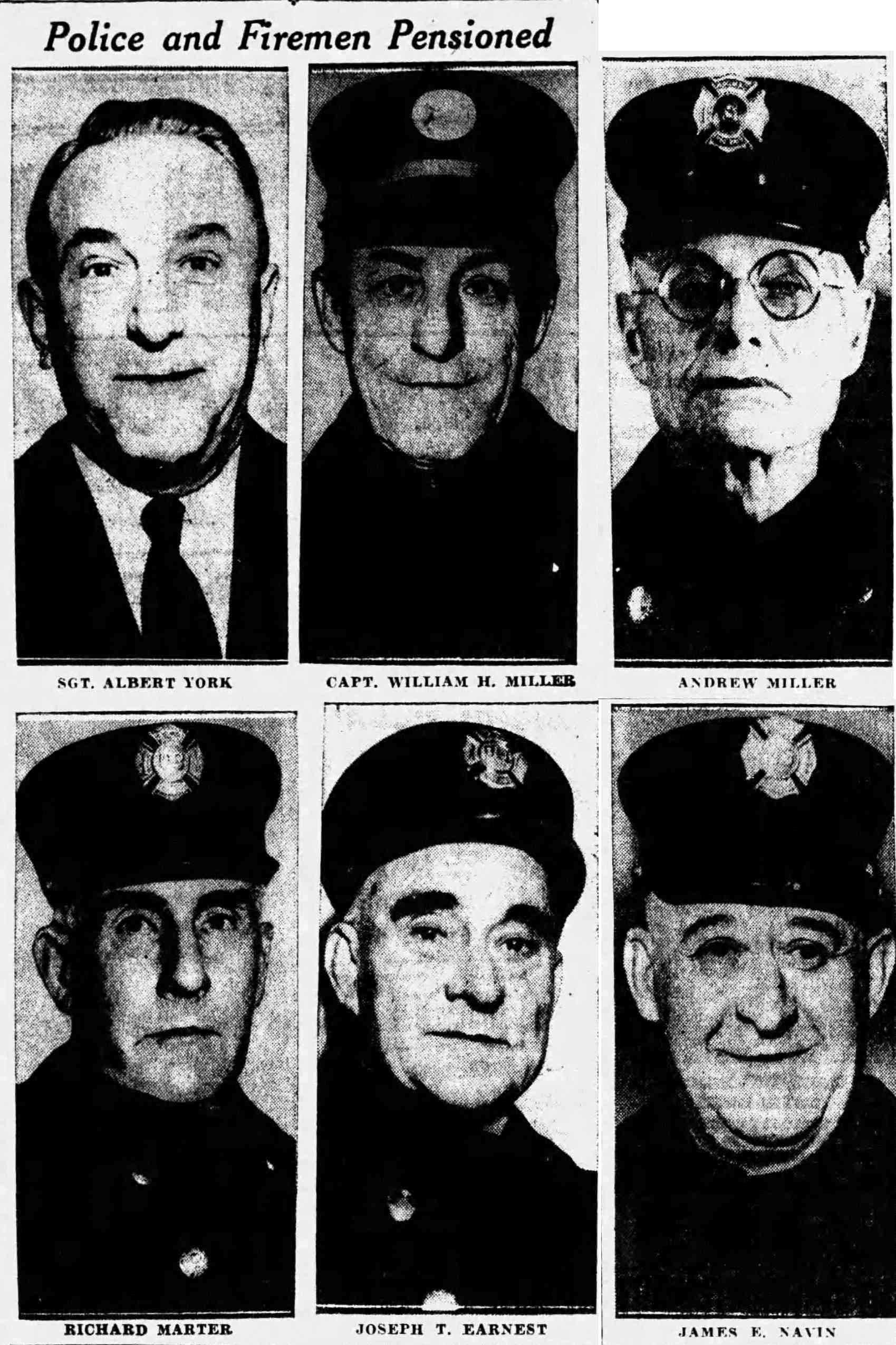
Police and Firemen Pensioned
[Top row:] SGT. ALBERT YORK — CAPT. WILLIAM H. MILLER — ANDREW MILLER
[Bottom row:] RICHARD MARTER — JOSEPH T. EARNEST — JAMES E. NAVIN
Pensions Awarded 6 Cops, 17 Firemen
Camden Courier-Post —

PENSIONS AWARDED 6 COPS, 17 FIREMEN
Inspector Humes Refuses to Withdraw Application in Spite of Requests
Pensions for six policemen and 17 firemen took effect with the dawn of the New Year yesterday.
Proposed Salary reductions from five to 30 percent prompted the wholesale requests for pensions which were approved Saturday at noon by the Police and Firemen’s Pension Commission, of which Mayor Roy R. Stewart is chairman.
The proceedings were delayed one hour while efforts were being made by political leaders and friends to have Inspector Charles T. Humes reconsider his application. But he refused to withdraw his application and it was approved.
Two sergeants, a city detective and four captains of the fire department were included in the list of applicants.
Sergeants Albert York and Clarence Thorn, Detective David Hunt and Fire Captains Harry Haines, John Lutts, James R. White and William H. Miller, Jr., were included among the pensioners.
Major W. Greenwood and Adrian Bateman, two patrolmen, completed the list from the police department, while the others receiving pension awards who are member of the fire department were:
Elmer Burkett, 66; Robert M. Coffman, 57; Howard E. Currie, 52; James E. Navin, 67; George W. Hollins, 64; Richard S. Marter, 60; Arthur A. Wingate, 64; Joseph T. Earnest, 63; Samuel E. Harring, 64; Andrew Miller, 73; Stewart Bakley, William K. Buzine, 63, and Daniel Grimes.
The application of Marter’s was passed, but an improviso was made by the commission which gave him the opportunity of recalling his decision but he failed to take advantage of it.
It was explained that the city commission’s resolution passed at noon, providing that members of the police and fire departments could continue in their employment under the 1933 wage scale, but that their pensions would not be affected by the cut and they could retire under the 1931 basic pay, might cause Marter to want to rescind his action.
Mayor Stewart and Commissioner Bennett, both members of the commission, said they regretted so many “young men” were asking to be pensioned at this time.
Greenwood, 54, was appointed to the police department 21 years ago and during nearly all of this time has been attached to the First district. He lives in the First ward, at 220 York street, and will receive a pension of $83.30 monthly.
Buzine is a veteran of nearly 28 years’ service. He is 63, lives at 856 Haddon avenue and will be pensioned at $90.65. He was classed as an engineer in the fire department.
The applications of Captain John Lutts, of Engine Company No. 6, Front and Linden streets, and Elmer Burkett, engineer of the No. 4 Company, were filed shortly before noon.
Captain Lutts, 62, lives at 456 Royden street, and will receive a pension of $100 monthly. He was appointed 33 years ago.
Burkett, 66, lives at 330 North Ninth street. He was appointed to the fire department in 1907 and spent a great portion of his service at the fire station at Front and Linden streets, recently being transferred to the Vine street house. He will be pensioned at $90.65 monthly.
Group Disbanded 25 Years Ago; Old Members to Meet at Dinner
Camden Courier-Post —
A reunion-dinner of members of the old Aquinas Club, disbanded nearly 25 years ago, will be held during the latter part of June, Pasquale Iarossi, committee chairman, announced.
With Iarossi, widely-known North Camden barber, as the active worker in plans for the reunion, nearly 40 of the old members have signified their intentions of attending.
The dinner reunion will be held at Tom Kenney’s restaurant at 531 Market Street. Other members who expect to join in the reunion, are asked to communicate with Iarossi at Third and Elm streets.
Some of the charter members who have been reached and are expected to attend the reunion dinner are:
Tom Kenney, former Freeholder Samuel D. Payne, Police Sergeant Herbert Bott, William H. White, former secretary-treasurer of the Camden Housing Authority Charles (Homo) Marion.
Deputy Fire Chief William Harring, Freeholder John Daly, Pat and Louis Iarossi, Edward Bihn, Frank Cavallo, Joseph German, William Easterbrook, Walter Stevens, Carl Glendening, Herbert Schaefer, Bert Morris, Phillip Gorman, Joseph Loeffler, Pete Walker, Joseph Wells, Joseph Jones, Benjamin Taylor.
William (Chick) Simon, James Daly, Frank Bott, Hartley Pike, William Sayres, William Floagus, Dan McConnell, Walter McEntee, Sam Molineaux, William McCormick, Samuel Harring, Dan Market, Gerald Garner, John Molineaux, William Kistner, Alex Urban, William Brandt, H. Hambach, Roy Breitenstein, John Plum, Charles Berry, George Demellion, and L. Harter.