Introduction
GEORGE FREDERICK KAPPEL aka George Cable, was born in Camden around 1866 to Frederick and Lizzie Kappel. The family name appears spelled “Cable” in City Directories and newspapers into the early 1890s.
George F. Kappel’s father, Frederick Kappel, came to Camden from Germany, and in his young manhood fought in the Civil War. He later worked in a lumber yard. The Frederick Kappel family made its home on 530 North Front Street from the 1870s through the 1890s, except for a brief period around 1880. The family was at 530 North Front Street in 1878. The 1880 Census shows the family, which included younger sisters Lizzie and Amelia, living at 538 French’s Court, a short street that was in the 400 block of Sycamore Street in South Camden. The family moved back to 530 North Front Street by the middle of 1882. By 1884 they had settled in at 538 North Front Street.
The 1879–1880 City Directory states that George Kappel had gone to work as a spinner in one of Camden’s textile mills. He was listed in the 1884–1885 and 1885 City Directories at 538 North Front Street, living with his parents. George Kappel married early in 1887. The 1887–1888 City Directory states that George F. Kappel was living at 5 England Place in Camden and working as a bleacher in 1887. His son, George W.A. Kappel was born that September, daughter Anna and son Elwoood came soon after.
George F. Kappel was worked as an extra man with the Engine Company 2 of the Camden Fire Department in 1887. By the middle of 1887 the Kappel family had moved to 523 North Front Street, and George F. Kappel had secured an appointment to the Camden Police Department. He would remain connected with the Camden Police Department for twenty-three years. The family had moved to 108 Birch Street in North Camden by the middle of 1890. The 1892–1893 and 1893–1894 Directories shows George Cable residing at 609 North Front Street. He is not listed in the 1894–1895 City Directory, but was still being referred to as “George Cable” in the press as late as December of 1894.
In 1895 George F. Kappel appears to have stopped using the “Cable” spelling once and for all. The 1895–1896 City Directory shows that he had moved to 102 Pearl Street, next door to the saloon owned by John Dugan and family. The Kappel family was still at that address when the census was taken in 1910. George F. Kappel retired from the Camden Police Department on May 14, 1910.
After Mr. Kappel’s son George W.A. Kappel mastered the steamfitter’s and heating trade, father and son formed The Camden Heating Company in May, 1905, and the concern was incorporated in 1907. The firm became well known as specialists in heating and ventilating of all sorts, and were located at 8 Market Street, in Camden. With the family business well in hand, George F. Kappel retired from the Camden Police Department on May 14, 1910.
Wife Emma having died in the 1910s, George F. Kappel was a widower by January of 1920. His later years were spent at 311 Penn Street in Camden. He passed away on July 6, 1924.
Joseph J. Hubb Arrested
Philadelphia Inquirer —

Joseph J. Hubb, driver of an ice wagon, was arrested by Policeman Cable yesterday for obstructing the highway.
By His Victim's Bedside
Philadelphia Inquirer —
A Dying Man Identifies Andrew Eckert as His Murderer.
Camden is likely to have three murder trials at the next term of court. The third and last victim is Thomas McDonough, of Eighth and Mountain streets, this city, who was stabbed at Beideman’s station, which is on the outskirts of Camden, on Monday evening last. The man who is accused of having done the cutting is Andrew Eckert, of Port Richmond.
About 8 o’clock last night word was received at the City Hall, Camden, that the injured man, who had been removed from his home to the Pennsylvania Hospital, would die before morning. The police of this city also suggested that the prisoner be brought across the river at once and taken before the dying man to see if he could identify his assailant. This suggestion was communicated to Sheriff Baird, who at once went before Judge Hugg and sought his advice about taking the man out of the State.
Judge Hugg informed the Sheriff that as the prisoner was in the custody of the Camden county authorities he would take him to Philadelphia.
Acting under the judge’s instructions the Sheriff procured a cab, and with Mayor Pratt, Policeman Cable, of the Camden police force, and Magistrate Kerswell, drove to the County Jail.
The prisoner was then handcuffed and driven on board a ferryboat. After crossing the river the cab drove to the Central Station. There the officers and prisoner disembarked and the accused man was taken before Chief of Detectives Wood.
Detective Hulfish was detailed to assist the Camden officers. The officers and prisoner then went to the Pennsylvania Hospital.
They were met at the hospital by Magistrate Eisenbrown. They then proceeded to the bedside of the dying man, when the latter made the following dying declaration:
Thomas McDonough, who being sworn according to law, doth depose and say that on or about August 5, 1889, at Beideman’s station, State of New Jersey, deponent was cut and stabbed in the abdomen with a knife or sharp instrument by one Andrew Eckert, and deponent verily believes he will die from the effects of said cuts or stabs.
Magistrate Eisenbrown swore him to this statement and he made his mark over his signature. The witness to the statement was Detective Hulfish. The dying man’s wife and his sister were at his bedside most of the night. The prisoner never spoke a word throughout his journey.
A Policy Den Raided
Camden Post —
Hall Officer Stackhouse and Policeman Cable Catch Harriet Smith Selling Slips. A Companion Captured Also.
A raid was made by Hall Officer Stackhouse and Policeman Cable this morning on the policy den on Tenth street below Federal. They captured Harriet Smith, the widow of “Policy Bill” Smith, and James Brown.
The visit of the officers of the law was sudden and entirely unexpected upon the part of the inmates of the house. A panic ensued and a wild dash was made to hide the tell-tale articles used by policy sellers. It was useless, however, and the officers gathered in the books, slips, writings, drawings and a quantity of the other paraphernalia of the business.
The prisoners and the goods were carried off to the city hall. The accused waived a hearing and entered bail in $500 each for trial.
Lost His Prisoner
Philadelphia Inquirer —
A Philadelphia Burglar Was Too Much for a Camden Policeman.
Among a crowd of passengers who stepped from a ferry-boat at Market street, Camden, at a late hour last night, was a man who was immediately recognized by Officer Cable as Harry Hugson, a well-known burglar. The officer promptly nabbed his man and started with him to the City Hall. They had gone but a short distance when the prisoner threw away some burglar tools and a candle which he had been carrying in his pocket.
Officer Cable was unwilling to allow such valuable bits of evidence to be lost and stooped to pick them up. At the same time Hugson suddenly remembered that he had important business in another section of Jersey and promptly shot out Market street. Officer Cable was dazed for an instant and then drew his revolver and fired six shots after the flying burglar, one of which he believes took effect. But the man escaped.
Mania for Assaulting Women
Philadelphia Inquirer —
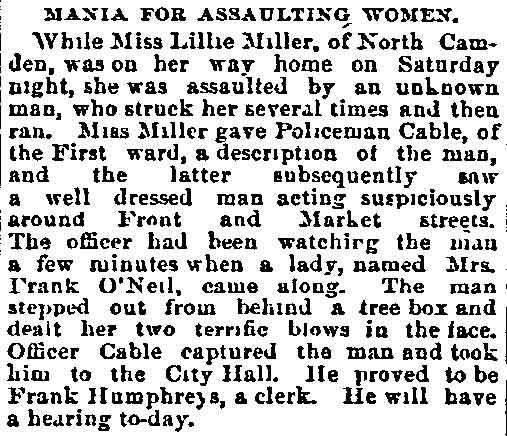
While Miss Lillie Miller, of North Camden, was on her way home on Saturday night, she was assaulted by an unknown man, who struck her several times and then ran. Miss Miller gave Policeman Cable, of the First ward, a description of the man, and the latter subsequently saw a well dressed man acting suspiciously around Front and Market streets. The officer had been watching the man a few minutes when a lady, named Mrs. Frank O’Neil, came along. The man stepped out from behind a tree box and dealt her two terrific blows in the face. Officer Cable captured the man and took him to the City Hall. He proved to be Frank Humphreys, a clerk. He will have a hearing to-day.
Camden's Latest Murder Mystery
Philadelphia Inquirer —
Carrie Humphreys’ Body Found in the River.
A Scream, a Splash and Two Men Are Seen Running.
Police Officials Puzzled as to the Cause and Busy Running Out Clues—Sketch of the Early Life of the Woman.
The body of a handsome young woman, believed to be Carrie Humphreys, of Wood street, above Eighth, was found in the mud alongside the dock at Morris & Mathis’ shipyard, at Cooper’s Point, early yesterday morning, and certain circumstances connected with the case indicate that the police authorities across the river have a good-sized mystery to wrestle with.
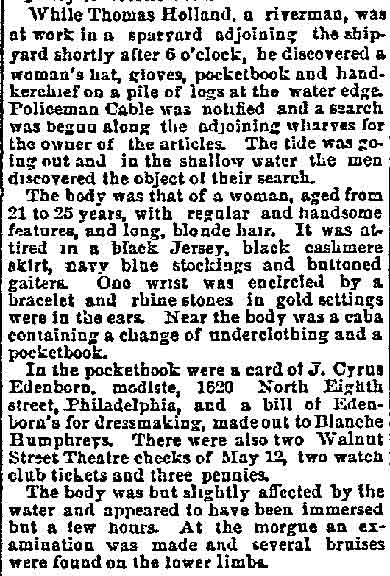
While Thomas Holland, a riverman, was at work in a spar yard adjoining the shipyard shortly after 6 o’clock, he discovered a woman’s hat, gloves, pocketbook and handkerchief on a pile of logs at the water edge. Policeman Cable was notified and a search was begun along the adjoining wharves for the owner of the articles. The tide was going out and in the shallow water the men discovered the object of their search.
The body was that of a woman, aged from 21 to 25 years, with regular and handsome features, and long, blonde hair. It was attired in a black Jersey, black cashmere skirt, navy blue stockings and buttoned gaiters. One wrist was encircled by a bracelet and rhine stones in gold settings were in the ears. Near the body was a caba containing a change of underclothing and a pocketbook.
In the pocketbook were a card of J. Cyrus Edenborn, modiste, 1620 North Eighth street, Philadelphia, and a bill of Edenborn’s for dressmaking, made out to Blanche Humphreys. There were also two Walnut Street Theatre checks of May 12, two watch club tickets and three pennies.
The body was but slightly affected by the water and appeared to have been immersed but a few hours. At the morgue an examination was made and several bruises were found on the lower limbs.
A NEIGHBOR’S STORY.
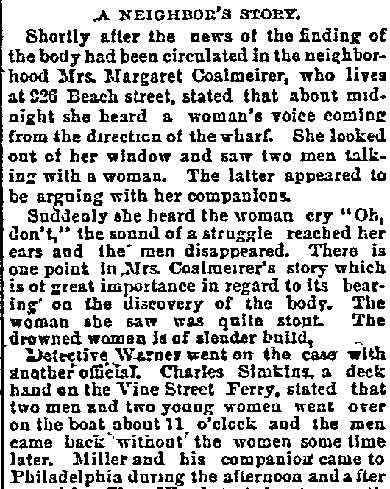
Shortly after the news of the finding of the body had been circulated in the neighborhood Mrs. Margaret Coalmeirer, who lives at 826 Beach street, stated that about midnight she heard a woman’s voice coming from the direction of the wharf. She looked out of her window and saw two men talking with a woman. The latter appeared to be arguing with her companions.
Suddenly she heard the woman cry “Oh, don’t,” the sound of a struggle reached her ears and the men disappeared. There is one point in Mrs. Coalmeirer’s story which is of great importance in regard to its bearing on the discovery of the body. The woman she saw was quite stout. The drowned woman is of slender build.
Detective Warner went on the case with another official. Charles Simkins, a deck hand on the Vine Street Ferry, stated that two men and two young women went over on the boat about 11 o’clock and the men came back without the women some time later. Miller and his companion came to Philadelphia during the afternoon and after consulting Chief Wood started uptown with Detective Donaghty to investigate the circumstances of the girl’s departure from this city. They found that she had been learning the trade of dressmaking at Edenborn’s establishment, and that she had been frequently seen with a young man known as Harry Sparkle, who boarded at the Hotel Plunkett, Eighth and Spring Garden streets. At the hotel they were informed that Sparkle no longer boarded there.
Later in the day the detectives found their man. He said that he last saw the girl at Franklin and Vine streets on Monday night. She was accompanied by two men. He conversed with her for a short time and left her. He stated that the girl had frequently threatened to commit suicide and that he had once taken poison from her which she was going to swallow.
There is no charge against the man, and he agreed to go to Camden for the purpose of identifying the girl. Information obtained by the police later in the day was to the effect that the girl’s real name was Carrie, and that she came from Shamokin. No arrests have been made.
Odds and Ends of News
Philadelphia Inquirer —
William Sturer, a lad living at Front and Wharton streets, this city, was picked up by Policeman Cable in Camden yesterday, while pretending to have a fit. The lad said he was to have appeared before the grand jury, of this city, and that he was advised by friends to go to Camden and feign sickness.
He Announces the Names
Camden Daily Telegram —
The Mayor Appoints the New Force To-day.
MANY OLD OFFICERS TAKEN BACK.
Some Surprise Manifested at the Mayor’s Appointment of Dodd Instead of Jones—This Afternoon All the Names Will be Announced.
The Mayor stated this morning to the newspaper fraternity that he would not announce his nominations for the police department until four o’clock this afternoon. It was expected that these would be announced this morning and in consequence there were a number of applicants for appointment on the force early this morning at the City Hall, hoping that the lightning would strike them.
Yesterday afternoon the mayor in addition to his nomination of Chief Dodd and Lieutenants Foster and Pettit appointed Frank Matlack, Jacob Woodsides, Alfred Hayden and John Dall, all of the Sixth ward. The above were policemen under Mayor Westcott, before the Democratic Police Commission took charge of the Department.
Patrolman Griffin, Democrat, tendered his resignation yesterday to Mayor Westcott, to take effect to-day.
The appointment of Chief Dodd was quite a surprise to the public in general, as it was thought that Captain Jones would be named for the position. Many believed such an appointment would be in very good form, as Captain Jones’ knowledge of men and his military training would have made him a chief par excellence. The Mayor, however, probably thought that as Mr. Dodd had been so unceremoniously kicked out by the Democrats, it was nothing more than justice to again offer him the position which he had filled in a creditable manner for a number of years.
APPOINTED ON THE FORCE.
Mayor Westcott this afternoon made the following appointments:
First Ward—William E Cromly, George Cable, Henry R. Curtis, O. Glen Stackhouse.
Second Ward—Lincoln James, John Pratt, Samuel Bakley, Benj Middleton.
Third Ward—William Selby, Albert Myers, Edward Hartman.
Fourth Ward—Caleb Williams, Richard Golden, William Schregler, Ralph Bond.
Fifth Ward—William Harvey, Harry Mines and O-car Weaver.
Sixth Ward—Jacob Woodsides, Frank Matlack, Albert Hayden and John Dall.
Seventh Ward—Josiah Sage, Henry Peters, Charles Lederman, Wm. Butts.
Eighth Ward—Alexander Alcorn, Chas. Leightenberg, Ferdinand Laird.
There was no appointments made for the Ninth ward.
Market Street Businessmen Honor Officer Cable
Philadelphia Inquirer —

* Market street business men presented Policeman George Cable with a gold-headed cane in recognition of his bravery in rescuing horses at the recent Market street ferry stable’s fire.
Taylor Shot to Kill Him
Camden Daily Telegram —
Sumner Derrickson Dangerously Wounded During a Row.
THEY FOUGHT OVER A WOMAN.
The Participants All Had Their Guns and Knives Ready to Murder.
CAPTURED AFTER A HARD CHASE.
The Man Who Did the Shooting Ran from Seventh and Sycamore Streets to the Federal Street Ferry With an Excited, Yelling Mob at His Heels—A Ferryboat Held Until the Police Arrived and Took the Fleeing Man Into Custody—The Wounded Man and His Brother Known as Bad Men.

Robert, alias Charles Taylor, colored, made a desperate attempt last night to murder Sumner Derrickson. Taylor is locked up at the City Hall and Derrickson is at the Cooper Hospital with a bullet wound in his abdomen. The doctors there say that Derrickson is resting easily to-day and that he is in no immediate danger of dying. Taylor claims that he shot Derrickson in self defense.
ROW OVER A WOMAN.
The shooting was the outcome of jealousy. Taylor and Charles Derrickson and the latter’s brother, Sweeney Derrickson, were gambling in a house on Baxter street, between Ann and Seventh streets. A dispute arose and Taylor says that the Derricksons, who are known as bad men, chased him from the house. Sumner Derrickson, Taylor says, had a gun, and Sweeney Derrickson had a knife. At Seventh and Sycamore streets Taylor states that he found his pursuers were pressing him too closely. He turned as he ran and drawing his pistol fired at the two men. The bullet struck Sumner Derrickson in the abdomen and he fell to the ground with a groan. Sweeney stopped to look after his wounded brother and Taylor continued his flight.
SURGEONS FOUND THE BALL.
The wounded man was taken to the Cooper Hospital where the surgeons found the bullet had taken an upward course and lodged beneath the skin in Derrickson’s chest. The ball was extracted and Derrickson was made as comfortable as possible for the night.
The news of the attempted murder spread rapidly and the police were notified at once. An alarm was sent throughout the city and every effort was exerted to capture Taylor who had fled from the scene of the shooting as fast as his legs would carry him. He ran down to Kaighn avenue with the evident intention of taking a ferryboat to Philadelphia where he lives. The crowd that followed him, however, prevented Taylor making his escape in that direction. Like a hunted animal he turned up Second street toward the northern section of the city. The crowd increased each moment and the excitement of the chase became intense.
EXCITEMENT WAS INTENSE.
Policeman Fitzsimmons joined the throng which by this time was yelling “Catch the murderer” and “Lynch him.” People who were retiring threw up their windows in alarm thinking that the police and the crowd were in pursuit of another man suspected of the double murder of Mrs. Zane and Mrs. Shaw of week ago. The chase grew hot along Second street, but Taylor proved himself fleet of foot and reached the Federal street ferry in time to catch the 10.45 p. m. boat.
POLICE CAPTURE TAYLOR.
Collector Andrew Frazee had been notified of the attempted murder and recognized Taylor as the man wanted. He instructed Gateman William Barnard to hold the boat while he sent word to the police that Taylor was at the ferry. The patrol wagon was sent there in a hurry.
In the meantime Policemen Al. Myers and George Cable had arrived and Policeman Fitzsimmons arrived a second later almost winded by his long run. Two respectable colored porters were taken into custody at first, but the policemen soon discovered their mistake and found Taylor crouched up in one corner of the boat. Policeman Fitzsimmons recognized Taylor by a scar on his neck and quickly grabbed him by the throat. The fellow made no resistance and was taken to the waiting patrol wagon by the three officers. Here he was hustled into the vehicle and sent to the City Hall. When arrested the revolver with which the shooting was done was found in Taylor’s pocket, but that individual had cutely reloaded the empty chambers as he ran so as to destroy what evidence there was against him.
Derrickson, brother of Sumner, was formerly of the firm of Reed & Derrickson who several years ago ran the notorious negro resort known as Olive Park where John Hill, a colored youth, shot Joseph Dodson, also colored. Hill afterwards was hanged for his crime and the police broke up the den where the tragedy occurred.
TAYLOR GIVEN A HEARING.
Taylor was given a hearing this morning by Mayor Westcott. The complaint was made by Lieutenant John Foster and accused Taylor of assaulting, shooting and attempting to kill Derrickson. Lawyer Jackson appeared for the defendant.
Edward Fortie, one of the men who was with Derrickson when the shooting occurred, stated that he did not see the first shot, but when the second and third shots were fired Taylor was starting down Kaighn avenue. Fortie and Jordon, with Derrickson, then started to run.
Ida Burton said she saw Taylor and Lawrence Anderson talking at Seventh and Baxter streets. Taylor went slowly toward Derrickson and suddenly pulled a revolver from his pocket and fired point blank at his victim. When questioned by the Mayor she said she saw all of the shots, but when cross-examined by Lawyer Jackson she denied having seen the firing of the first shot.
Aubrey Thompson, who was about fifteen yards distant, said he saw the first shot fired at some one setting back of the station at Seventh and Kaighn avenue. He then saw Taylor go down Kaighn avenue.
Several other witnesses were heard who said they saw the shots fired, but who were not positive as to whom they were directed at.
Policemen Al Myers and George Cable, who made the arrest, said they found the man on a Federal street ferryboat hiding behind an ash cart. Taylor said he had no revolver, but on the way to the City Hall Patrolman Golden found a 32-calibre revolver with three loaded chambers.
Mayor Westcott held Taylor to await the result of Derrickson’s injuries.
Taylor hails from Washington, D. C., and it was stated on good authority that he is wanted in Philadelphia and his native city for misdemeanors.
Here's Camden's Finest, With Whiskers, in 1898
Camden Courier-Post —
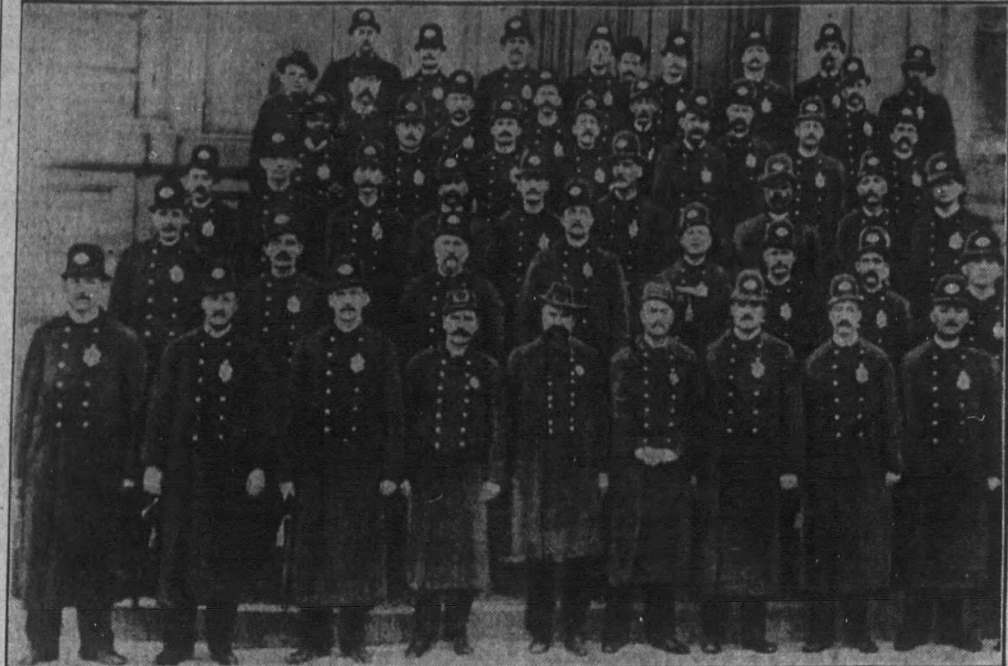
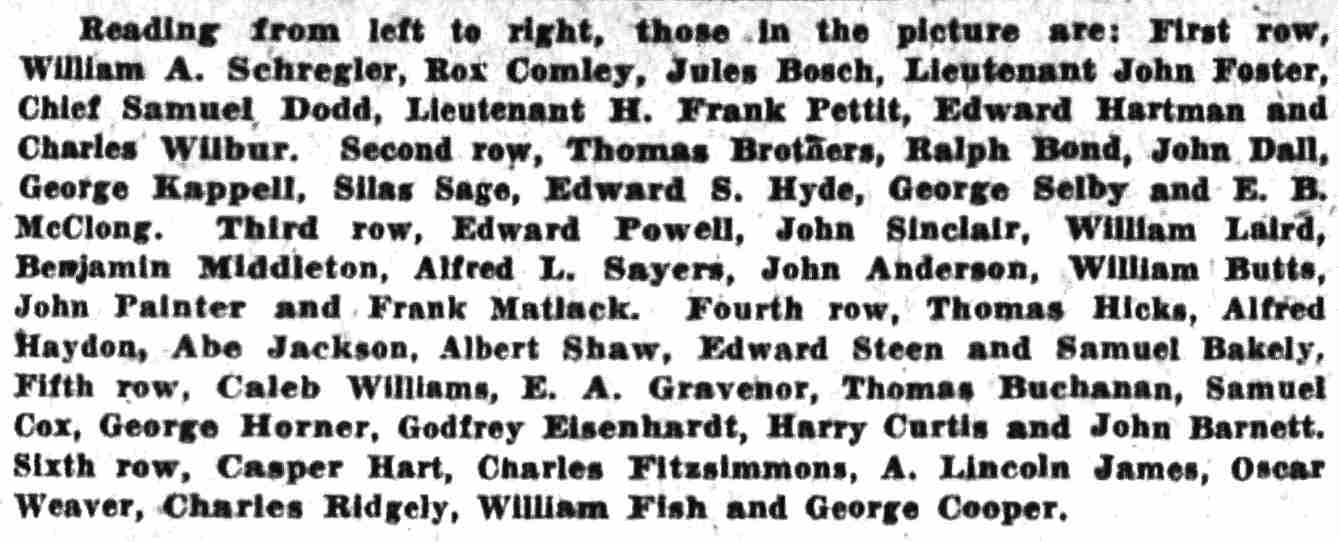
Reading from left to right, those in the picture are: First row, William A. Schregler, Rox Comley, Jules Bosch, Lieutenant John Foster, Chief Samuel Dodd, Lieutenant H. Frank Pettit, Edward Hartman and Charles Wilbur. Second row, Thomas Brothers, Ralph Bond, John Dall, George Kappell, Silas Sage, Edward S. Hyde, George Selby and E. B. McClong. Third row, Edward Powell, John Sinclair, William Laird, Benjamin Middleton, Alfred L. Sayers, John Anderson, William Butts, John Painter and Frank Matlack. Fourth row, Thomas Hicks, Alfred Haydon, Abe Jackson, Albert Shaw, Edward Steen and Samuel Bakely. Fifth row, Caleb Williams, E. A. Gravenor, Thomas Buchanan, Samuel Cox, George Horner, Godfrey Eisenhardt, Harry Curtis and John Barnett. Sixth row, Casper Hart, Charles Fitzsimmons, A. Lincoln James, Oscar Weaver, Charles Ridgely, William Fish and George Cooper.
Harry Mines, not named above, is in the first row between H. Frank Pettit and Edward Hartman. In the fifth row, at the far right, “John Barnett” was a guess on the part of A. Lincoln James. Another person guessed George Johnson. Both were wrong and it is not known who that policeman is.
Col. Felton Committed Suicide in His Office
Camden Daily Courier —

COL. FELTON COMMITTED SUICIDE IN HIS OFFICE
Notable Growth of Labor Unions
Membership of the Telegraphers Union Increasing in the West.
(body text — crowd photo caption: Crowds in Front of the Jennings Home During Funeral)
Florist Fish Dies Suddenly
Expired Yesterday Morning at Pianottville Where He Was Visiting Friends.
Walter C. Fish, a well known florist of this city and a son of Abel Fish of this city, died suddenly early yesterday morning at Pianottville, N. J. He had been visiting friends since the spring. He was noted as having a great variety of roses. He was buried at the place of nature in New Jersey.
[George M. Beringer portrait caption: George M. Beringer — The Camden chemist who is making an examination of the internal organs of the two boys.]
While mystery apparently as absolute as ever still obscures the motive and the criminal in the case of John Houseman Coffin and W. Price Jennings, the unfortunate Camden lads whose trip to the country at Haddon Heights last Wednesday resulted so tragically, it is surmised from hints dropped now and again the matter may soon be cleared. However, those who are working so assiduously to bring the guilty person to justice are as close-mouthed as the proverbial clam, and but meagre information reaches the public.
Last night a woman, about 45 years old, was committed to the county jail by Recorder Stackhouse. On the commitment her name is given as Mrs. Barber. She was committed on complaint of County Detective John Cherry “as a material witness to prove certain allegations pending against one Paul Woodward, who is committed to the county jail charged with the murder of one John Coffin.”
The woman was placed under arrest after a long conference in the Prosecutor's office. Prosecutor Lloyd said last night that the woman lives on a farm at Marlton, and that she is a very important witness in the case, so important, in fact, that she cannot regain her freedom without a good round sum being put up for her security.
Woodward Again Examined
The investigation into the case was somewhat retarded yesterday owing to an attack of rheumatism that made Prosecutor Frank T. Lloyd remain at home. The day's responsibility rested on F. Morse Archer, the assistant pro-secutor. The latter yesterday morning had Woodward brought into his office, where he underwent for the sixth time a thorough cross-examination. Mr. Archer said Woodward had made no confession, as had been rumored. On the contrary, he still maintained his innocence.
In answer to a question Mr. Archer said: “We are doing our best and while we are in possession of information which we consider important and vital to the case, it is impossible at this time to make it public.”
On the other hand, County Physician Jones was very emphatic in this particular, saying the boys were murdered beyond a doubt.
Boys' Funerals
Yesterday afternoon the funeral of the boys took place at the same hour and within a square of one another's homes. Although the hour set for the obsequies, 2 o'clock in the afternoon, had been kept secret scores of persons stood about in knots discussing the tragedy and eager to get a glimpse of the caskets containing the remains of the boys.
Police Captain Boyle and Policemen Kappel, Toy and Ridgeley guarded the houses, and no one except relatives and intimate friends were permitted to enter. But when the caskets were carried from the houses the crowd could not be kept back. Many persons crowded about, and the mourners entered the carriages between two solid phalanxes of curiosity seekers.
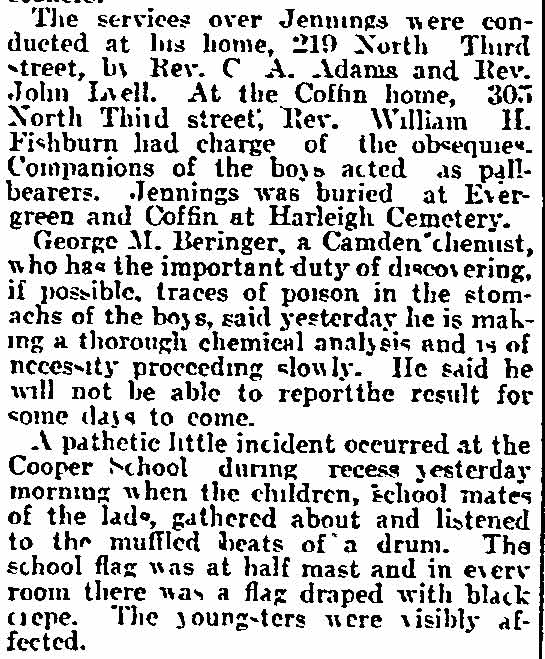
The services over Jennings were conducted at his home, 219 North Third street, by Rev. C. A. Adams and Rev. John Lyell. At the Coffin home, 305 North Third street, Rev. William H. Fishburn had charge of the obsequies. Companions of the boys acted as pallbearers. Jennings was buried at Evergreen and Coffin at Harleigh Cemetery.
George M. Beringer, a Camden chemist, who has the important duty of discovering, if possible, traces of poison in the stomachs of the boys, said yesterday he is making a thorough chemical analysis and is of necessity proceeding slowly. He said he will not be able to report the result for some days to come.
A pathetic little incident occurred at the Cooper School during recess yesterday morning when the children, school mates of the lads, gathered about and listened to the muffled beats of a drum. The school flag was at half mast and in every room there was a flag draped with black crepe. The youngsters were visibly affected.
Col. George G. Felton Ends His Life by Inhaling Illuminating Gas
Camden Post-Telegram —
COL. GEORGE G. FELTON ENDS HIS LIFE BY INHALING ILLUMINATING GAS
Body of the Former City Treasurer Found This Morning Cold in Death in His Real Estate Office With Gas Jets Turned On.
RUMORS OF FINANCIAL TROUBLE GIVEN AS CAUSE OF SUICIDE
Colonel George G. Felton, former City Treasurer, Deputy Quartermaster General of the National Guard of New Jersey, real estate broker and prominent in the building and loan association world, was found dead in the U. S. Pension office, in the Felton building, northeast corner of Second and Federal streets, shortly before 8 o'clock this morning. Death was due to inhaling gas, two jets in the office being turned on full head, and a cap having been removed from a pipe formerly used to supply gas to a radiator.
Colonel Felton occupied the front offices of the Felton building. When Thomas Smith, head bookkeeper for Mr. Felton, arrived at the office a few minutes before 8 o'clock this morning, a strong odor of gas was present.
Surmising that something was wrong, Mr. Smith at once notified Mahlon Ivins, whose paint office is directly across Federal street. Mr. Ivins in turn communicated with the Police Department, and Policemen Harry Miller and George Kappell were ordered to make an investigation.
FOUND DEAD ON THE COUCH.
Passing through Mr. Felton's offices, the officers went into the long hallway, from which the other offices on the first floor open. The escaping gas was found to come from the pension office, the last room back, and on pushing open the unlocked door the searchers were horrified to see Colonel Felton dead on the couch.
The strong flow of gas almost knocked the officers down, and after turning off the two jets, they raised the windows. The hissing of escaping gas was still heard, and the officers found it pouring in volumes from a pipe, which formerly fed a radiator and from which the cap had been removed. The cap was found on the floor and was placed back on the pipe.
DISROBED BEFORE DEATH.
The Colonel lay on his back and appeared to have died peacefully. He had taken off his outer clothing and had placed his clothes on a chair.
In the meantime Councilman Henry D. Longacre, who was associated with Colonel Felton, reached the office, and closed it temporarily.
Coroner Litchfield was notified, and after viewing the body, gave a certificate of death from suicide. In the opinion of the Coroner, Colonel Felton had been dead about eight hours.
Mrs. Felton who with an adopted daughter is spending a few days at Stone Harbor, was notified by telegraph. Funeral Director Simmons removed the body to Colonel Felton's late home at 413 Washington street.
RUMORS OF FINANCIAL TROUBLE.
While no one cares to assign a direct cause for his suicide, it is rumored that a tangle in Colonel Felton's accounts in the building associations, of which he was secretary, have preyed on his mind and made him despondent. It is reported that not long ago he was hard pushed to settle his accounts with the People's Association, after which he was succeeded in the secretaryship by Frank C. Sayrs.
For awhile the police were of the opinion that Colonel Felton was in the building since Saturday night as he was seen in the vicinity of his office late on Saturday acting strangely. This belief, however, was dispelled at noon through information given to the police by a business man to the effect that Colonel Felton was seen to enter the building by the side door at ten minutes past 12 o'clock this morning.
County Collector Ivins telegraphed Quartermaster General Richard A. Donnelly, of the death of Colonel Felton.
COLONEL FELTON'S CAREER.
Colonel George G. Felton was born in Winchedon [sic], Mass., in 1845, where he resided until he was fourteen years of age. After receiving a common school education he went to Northfield, Mass., where on September 1, 1862, he enlisted as a private in Company F, Fifty-second Massachusetts Infantry Volunteers, serving until the close of the war. He then came to New Jersey in which state he took up his residence. He lived for a short time in Burlington, after which he came to this city.
In 1887 he associated himself with Charles H. Felton & Co., in the real estate business. In 1893 he entered the real estate business for himself and continued in it at Second and Federal streets until the time of his death.
Colonel Felton was for a number of years connected with the National Guard of this state. He entered the Guard on August 29, 1883, by appointment as First Lieutenant and Quartermaster of the Sixth Regiment. He attained the rank of captain, August 19, 1888, and was appointed to the staff of the Quartermaster-General with the rank of Lieutenant-Colonel on May 21, 1890. He was advanced to the rank of Colonel and Deputy Quartermaster-General April 26, 1894, which rank he held up to the time of his death.
Colonel Felton was one of the most popular officers of the National Guard. His energy and executive ability made him an invaluable assistant to Quartermaster-General Donnelly and every summer he practically had charge of the Quartermaster's department at the state camping ground at Sea Girt.
Mr. Felton was appointed by City Council in 1896 to fill the vacancy caused by the resignation of City Treasurer Frank Michelon and in the spring of the same year was elected to fill the unexpired term of one year of Mr. Michelon's term of office. On Tuesday, April 13, 1897, Mr. Felton was elected City Treasurer on the Republican ticket, by 45 majority over Freedom C. Lippincott, the candidate of the Democrats and Committee of One Hundred. He was appointed a member of the Board of Public Works in 1892 by Mayor Westcott.
He was well-known in building association circles, being secretary of the Mechanics and the Homestead Building and Loan Associations until his demise. Mr. Felton was also a director of the Central Trust Company for several years, but some weeks ago disposed of his stock and ceased to be an officer of that company.
He was a director in the Security Trust Company at the time of his death. He was a member of the Masonic Order, and the A. O. U. W., and was also treasurer of the Camden Republican Club.
Colonel George G. Felton Obituary
Philadelphia Inquirer —
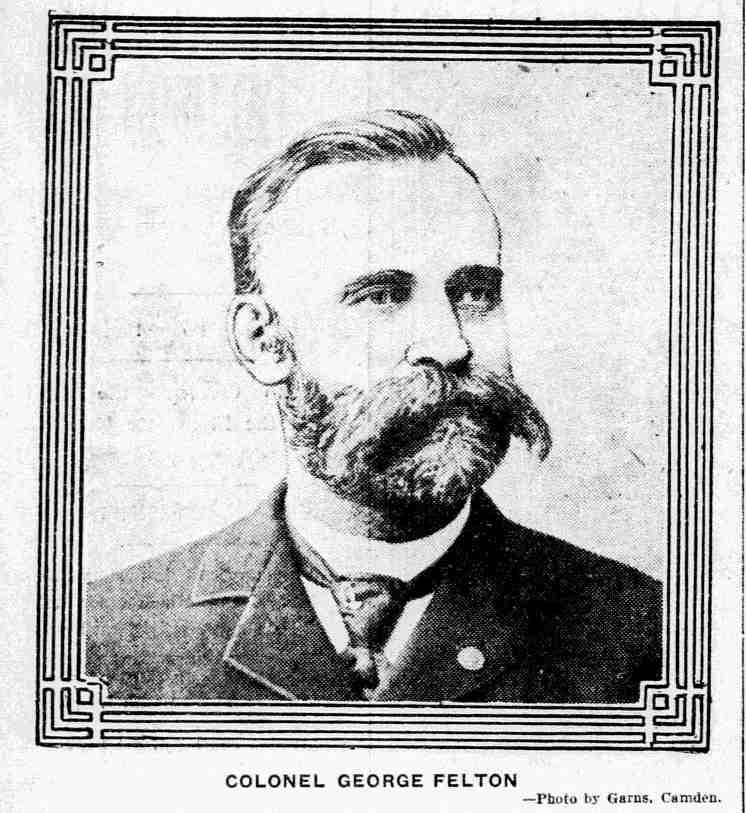
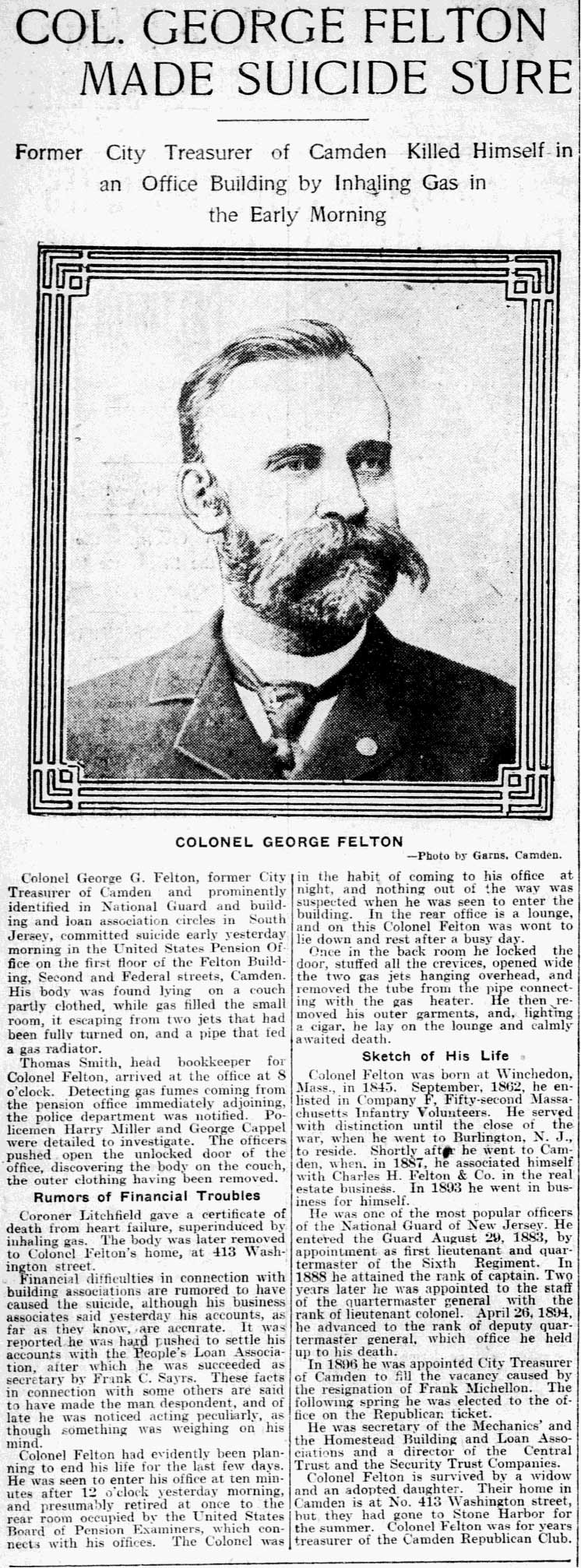
Named: George G. Felton, Dr. Paul N. Litchfield, George F. Kappel, Harry Miller, Thomas Smith, Charles H. Felton, Frank F. Michellon, Washington Street, Frank C. Sayrs, and Camden Republican Club.
Woman Involved in Camden Mystery
Philadelphia Inquirer —
WOMAN INVOLVED IN CAMDEN MYSTERY
After Being Questioned by the Prosecutor She Is Committed to the County Jail—Believed to Be an Important Arrest
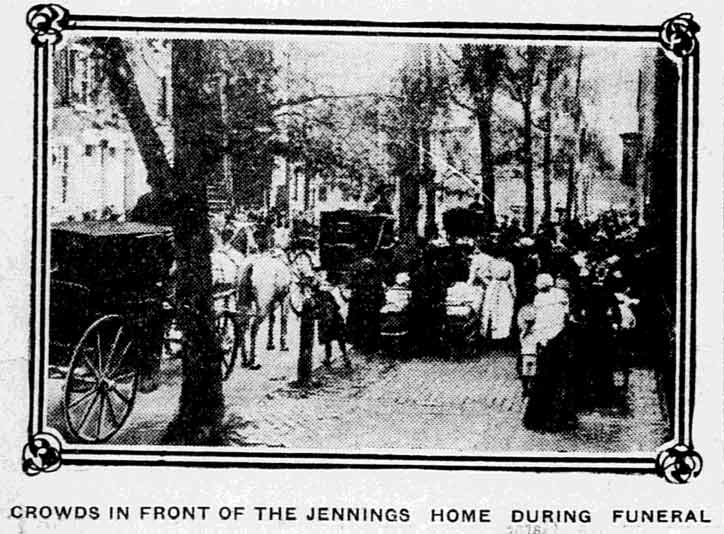
[Photo caption: Crowds in Front of the Jennings Home During Funeral]
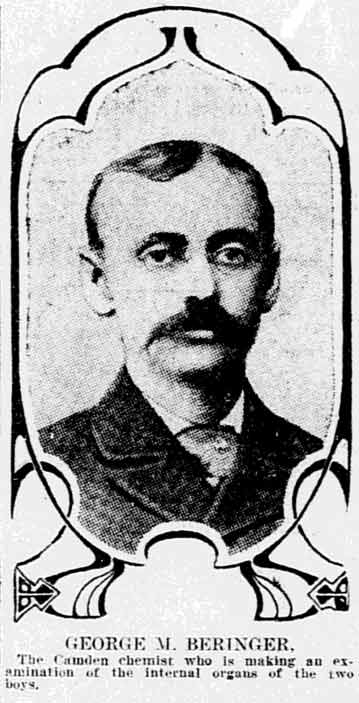
[Portrait caption: George M. Beringer — The Camden chemist who is making an examination of the internal organs of the two boys.]
While mystery apparently as absolute as ever still obscures the motive and the criminal in the case of John Houseman Coffin and W. Price Jennings, the unfortunate Camden lads whose trip to the country at Haddon Heights last Wednesday resulted so tragically, it is surmised from hints dropped now and again the matter may soon be cleared. However, those who are working so assiduously to bring the guilty person to justice are as close-mouthed as the proverbial clam, and but meagre information reaches the public.
Last night a woman, about 45 years old, was committed to the county jail by Recorder Stackhouse. On the commitment her name is given as Mrs. Barber. She was committed on complaint of County Detective John Cherry “as a material witness to prove certain allegations pending against one Paul Woodward, who is committed to the county jail charged with the murder of one John Coffin.”
The woman was placed under arrest after a long conference in the Prosecutor's office. Prosecutor Lloyd said last night that the woman lives on a farm at Marlton, and that she is a very important witness in the case, so important, in fact, that she cannot regain her freedom without a good round sum being put up for her security.
Woodward Again Examined
The investigation into the case was somewhat retarded yesterday owing to an attack of rheumatism that made Prosecutor Frank T. Lloyd remain at home. The day's responsibility rested on F. Morse Archer, the assistant pro-secutor. The latter yesterday morning had Woodward brought into his office, where he underwent for the sixth time a thorough cross-examination. Mr. Archer said Woodward had made no confession, as had been rumored. On the contrary, he still maintained his innocence.
In answer to a question Mr. Archer said: “We are doing our best and while we are in possession of information which we consider important and vital to the case, it is impossible at this time to make it public.”
On the other hand, County Physician Jones was very emphatic in this particular, saying the boys were murdered beyond a doubt.
Boys' Funerals
Yesterday afternoon the funeral of the boys took place at the same hour and within a square of one another's homes. Although the hour set for the obsequies, 2 o'clock in the afternoon, had been kept secret scores of persons stood about in knots discussing the tragedy and eager to get a glimpse of the caskets containing the remains of the boys.
Police Captain Boyle and Policemen Kappel, Toy and Ridgeley guarded the houses, and no one except relatives and intimate friends were permitted to enter. But when the caskets were carried from the houses the crowd could not be kept back. Many persons crowded about, and the mourners entered the carriages between two solid phalanxes of curiosity seekers.
The services over Jennings were conducted at his home, 219 North Third street, by Rev. C. A. Adams and Rev. John Lyell. At the Coffin home, 305 North Third street, Rev. William H. Fishburn had charge of the obsequies. Companions of the boys acted as pallbearers. Jennings was buried at Evergreen and Coffin at Harleigh Cemetery.
George M. Beringer, a Camden chemist, who has the important duty of discovering, if possible, traces of poison in the stomachs of the boys, said yesterday he is making a thorough chemical analysis and is of necessity proceeding slowly. He said he will not be able to report the result for some days to come.
A pathetic little incident occurred at the Cooper School during recess yesterday morning when the children, school mates of the lads, gathered about and listened to the muffled beats of a drum. The school flag was at half mast and in every room there was a flag draped with black crepe. The youngsters were visibly affected.
Landed His Man After a Struggle
Philadelphia Inquirer —
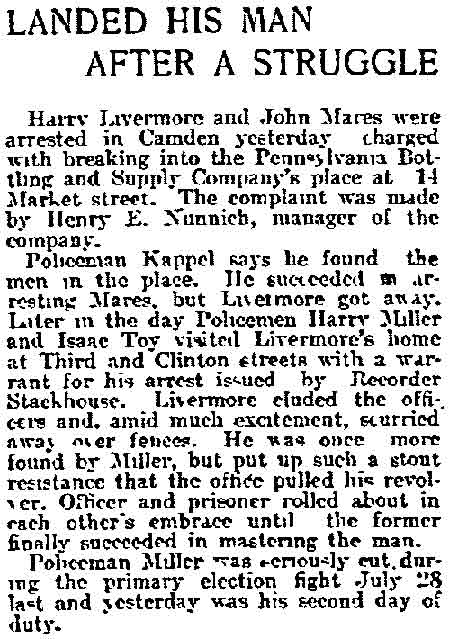
LANDED HIS MAN AFTER A STRUGGLE
Harry Livermore and John Mares were arrested in Camden yesterday charged with breaking into the Pennsylvania Bottling and Supply Company's place at 14 Market street. The complaint was made by Henry E. Nunnich, manager of the company.
Policeman Kappel says he found the men in the place. He succeeded in arresting Mares, but Livermore got away. Later in the day Policemen Harry Miller and Isaac Toy visited Livermore's home at Third and Clinton streets with a warrant for his arrest issued by Recorder Stackhouse. Livermore eluded the officers and, amid much excitement, scurried away over fences. He was once more found by Miller, but put up such a stout resistance that the officer pulled his revolver. Officer and prisoner rolled about in each other's embrace until the former finally succeeded in mastering the man.
Policeman Miller was seriously cut during the primary election fight July 28 last and yesterday was his second day of duty.
First Ward Club Had a Jolly Time
Camden Daily Courier —
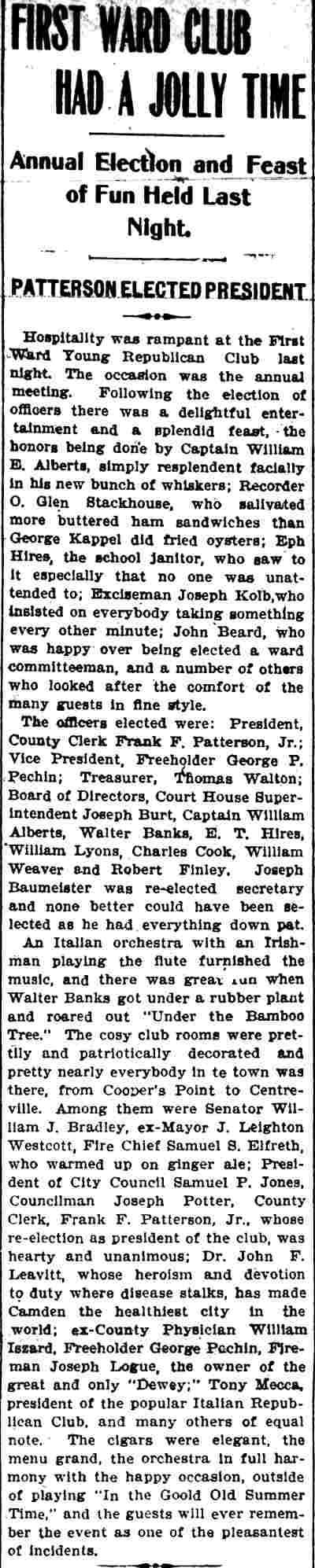
FIRST WARD CLUB HAD A JOLLY TIME
Annual Election and Feast of Fun Held Last Night.
PATTERSON ELECTED PRESIDENT
Hospitality was rampant at the First Ward Young Republican Club last night. The occasion was the annual meeting. Following the election of officers there was a delightful entertainment and a splendid feast, the honors being done by Captain William E. Alberts, simply resplendent facially in his new bunch of whiskers; Recorder O. Glen Stackhouse, who salivated more buttered ham sandwiches than George Kappel did fried oysters; Eph Hires, the school janitor, who saw to it especially that no one was unattended to; Exciseman Joseph Kolb, who insisted on everybody taking something every other minute; John Beard, who was happy over being elected a ward committeeman, and a number of others who looked after the comfort of the many guests in fine style.
The officers elected were: President, County Clerk Frank F. Patterson, Jr.; Vice President, Freeholder George P. Pechin; Treasurer, Thomas Walton; Board of Directors, Court House Superintendent Joseph Burt, Captain William E. Alberts, Walter Banks, E. T. Hires, William Lyons, Charles Cook, William Weaver and Robert Finley. Joseph Baumeister was re-elected secretary and none better could have been selected as he had everything down pat.
An Italian orchestra with an Irishman playing the flute furnished the music, and there was great fun when Walter Banks got under a rubber plant and roared out “Under the Bamboo Tree.” The cosy club rooms were prettily and patriotically decorated and pretty nearly everybody in the town was there, from Cooper's Point to Centreville. Among them were Senator William J. Bradley, ex-Mayor J. Leighton Westcott, Fire Chief Samuel S. Elfreth, who warmed up on ginger ale; President of City Council Samuel P. Jones, Councilman Joseph Potter, County Clerk Frank F. Patterson, Jr., whose re-election as president of the club was hearty and unanimous; Dr. John F. Leavitt, whose heroism and devotion to duty where disease stalks, has made Camden the healthiest city in the world; ex-County Physician William Iszard, Freeholder George Pechin, Fireman Joseph Logue, the owner of the great and only “Dewey;” Tony Mecca, president of the popular Italian Republican Club, and many others of equal note. The cigars were elegant, the menu grand, the orchestra in full harmony with the happy occasion, outside of playing “In the Good Old Summer Time,” and the guests will ever remember the event as one of the pleasantest of incidents.
Funeral of Thomas A. Walton
Philadelphia Inquirer —
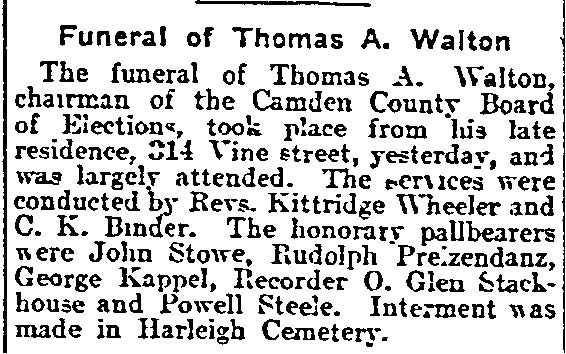
Funeral of Thomas A. Walton
The funeral of Thomas A. Walton, chairman of the Camden County Board of Elections, took place from his late residence, 314 Vine street, yesterday, and was largely attended. The services were conducted by Revs. Kittridge Wheeler and C. K. Binder. The honorary pallbearers were John Stowe, Rudolph Preizendanz, George Kappel, Recorder O. Glen Stackhouse and Powell Steele. Interment was made in Harleigh Cemetery.
Great Throngs at the Funeral of Chief Foster
Philadelphia Inquirer —

Camden Witnessed Greatest Demonstration of Its Kind Since Gen. Sewell’s Burial
THOUSANDS PAID TRIBUTE TO DEAD
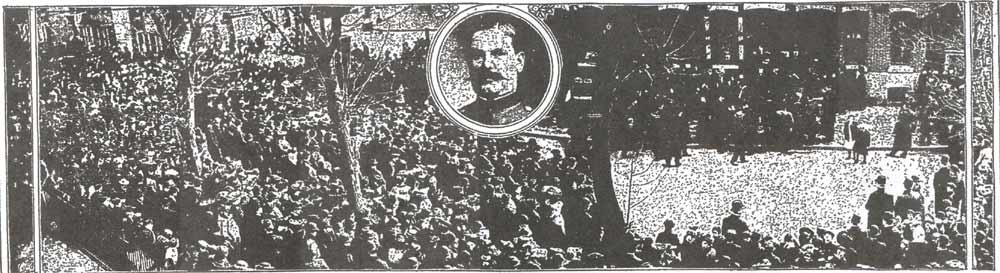
CROWD ABOUT THE FOSTER HOME AND PICTURE OF THE DEAD CHIEF
Not since the memorial funeral of United States Senator William J. Sewell has Camden witnessed such an expression of regret and sorrow as was evidenced at the obsequies of Chief of Police John Foster, which took place from his home, 292 Mt. Vernon street, yesterday afternoon. Practically all Camden paid lasting tribute to the stricken chief, who had been one of the most popular officials of the city. From other places, too, came many who swelled the throng about the house until the streets were literally packed with those anxious to give evidence of the high esteem in which they held the man.
From Philadelphia came Superintendent of Police John B. Taylor, a personal friend of Chief Foster; Captain James Hamm, Captain Dungan, Captain Campbell, Captain Callahan and thirty-four lieutenants, all in uniform. Baltimore, Washington, Norristown, Trenton, Newark, Jersey City and other places were represented by police officials. City, county and State officers were there and everyone unmistakably demonstrated the regard and respect in which he held Chief Foster, who had made such a valiant but fruitless battle against death.
Thousands Viewed Remains
From 7 to 9 o’clock Saturday night, all of yesterday morning and until the service began in the afternoon a constant stream of persons in all walks of life passed through the house, taking a last view of he who lay so peacefully amid a profusion of flowers. It is conservatively estimated that between 10,000 and 15,000 persons viewed the body. Thousands more would have done likewise, for the line constantly increased, until it reached a block or more. The doors were finally closed to permit the conducting of the services.
In a full dress black suit the body reposed in a handsome mahogany casket, with silver trimmings. On the cover of the casket was a silver plate, bearing this simple inscription:
John Foster
Born October 5, 1839.
Died March 1, 1906.
The features were life-like and gave little evidence of the weeks of intense suffering through which Chief Foster passed before the end came. At the head of the casket stood Policeman Albert Shaw, while at the foot was Policeman Camillus Appley. At the doors on guard were Policemen George Kappel, George Kleaver, Albert Snow and Casper Hart. Captain Arthur Stanley had charge of the detail of officers.
Wealth of Flowers
Surrounding the casket and extending around the walls of the room were beautiful floral emblems, roses, carnations, lillies, and in fact every variety. Some of the designs and those who contributed them follow: The patrolmen, “Gates Ajar,” six feet tall and composed of American Beauty roses, lilies of the valley, and surmounted by four white doves; Fifth Ward Republican Club, an immense urn of galax leaves and assorted flowers; Fireside New Years’ Association, a banner piece of roses, carnations, lilies of the valley and narcissus blooms; the Camden reporters of the local and Philadelphia newspapers, a four-foot scroll of galax leaves, in the centre of which was a shield of violets with a band of white carnations, on which was inscribed, “Our Friend;” from the daughters of Chief Foster, “Gates Ajar,” composed of Easter lilies, roses, carnations, daffodils, narcissus and asparagus ferns; from Mrs. Foster, the widow, a pillow of roses, carnations and lilies of the valley. Beautiful designs were also given by Mayor Charles H. Ellis, the International Association of Police Chiefs, Ionic Lodge of Masons, First Italian Republican Club, the Tall Cedars of Lebanon, Massoit Tribe of Red Men, John Carroll, John R. Campbell and various city officials. These flowers filled two carriages and a patrol wagon.
Services at the House
The services at the house took place at 2 o’clock and were in charge of Rev. Gilbert R. Underhill, rector of St. John’s P. E. Church. After the family had taken the last view the casket was borne to the hearse by Sergeant Albert Gravenor and Policeman John Brothers, representing the Police Department; former Senator Maurice A. Rogers and George Hammond, representing the Masonic bodies; former Mayor Joseph E. Nowrey, representing Massoit Tribe of Red Men, and Albert Shaw, from the Fifth Ward Republican Club.
A few minutes prior to the bringing out of the casket the members of Ionic Lodge of Masons formed themselves into a long lane through which the dead chief’s body was borne. Leading the pallbearers were six Camden policemen, who acted as a guard of honor. These included Policemen Thomas Brothers, Camillus Appley, Robert Calkett, Jules Busch, Thomas Murphy and Harry Mines, the largest men of the force. The Philadelphia police also had a guard of honor in Captain James P. Hamm, Captain Francis Callahan, Captain Dungan and Captain Campbell.
Funeral Cortege
The funeral cortege was composed of the following: Sergeant William Horner and a detail of thirty-four men from the three districts; members of the Fifth Ward Republican Club, cabs containing Mayor Ellis, Councilmen and city officials, Ionic Lodge of Masons and the hearse followed by the cabs containing the mourners. The route gone over was from the house to Third street, to Walnut street, to Broadway, to Benson street, to Haddon avenue and to Harleigh Cemetery. All along the route hundreds of persons lined the curbs, while many followed the cortege to the grave. As the procession passed the City Hall the bell in the tower was tolled at minute intervals.
At Harleigh Cemetery the casket was lowered in a cavity on a sunny slope to the southward. There the Masons held their services over their departed brother, Worshipful Master Aaron G. Matlack having charge of the beautiful ceremony.
It was a funeral that Camden will remember for many a day. And Chief Foster’s memory will be kept green for the next month by many political and social organizations as well as private citizens, who will display black draped flags at half mast.
Two Burglars Ran from House with Valuables
Camden Daily Courier —
TWO BURGLARS RAN FROM HOUSE WITH VALUABLES
George Zimmerman Came Down Stairs in Time to See Two Thieves at Work
RACED OUT THE BACK DOOR AND OVER FENCE
Shortly after 1 o'clock this morning George Zimmerman came down stairs at his home, 215 Penn street, just in time to see two men vault the back fence. With them vanished a pair of gold spectacles, some napkin rings on which was the name “Ethel,” $10, a silk raincoat and a French piece of money.
Mr. Zimmerman's daughter, who did not retire until a half hour after midnight, said she thought she heard a noise in the house just as she was about to lock the front door. An investigation was then made, but no one was discovered in the house who did not have a right there.
At half-past 1 Mr. Zimmerman, who is a commission merchant and an early riser, came down stairs. As he reached the lower hallway he noticed a lamp burning brightly in the dining room. As he entered one door two men raced pell-mell out another. In a jiffy they went over the back fence and vanished.
The neighborhood was aroused by the excitement and Policeman Kappell and Special Officer Bob Miller were attracted to the vicinity.
“I told George,” said Mrs. Zimmerman, “that I saw a suspicious looking man go up our alley last night at 10 o'clock. He was tall, well built, had red hair and moustache. I didn't like his looks.”
Kappell laughed and poking Miller in the ribs, remarked to Mrs. Zimmerman: “Isn't this the man?”
“Oh, yes, sir,” she exclaimed. “That's him. Have you my money?” she asked Miller.
Kappell then laughed again, and said: “You're right, Mrs. Zimmerman, he went up the alley, but he's a private watchman and they never have money.”
Camden News Notes
Philadelphia Inquirer —
CAMDEN NEWS NOTES
** In a runaway accident at Haddon and Kaighn avenues, yesterday, Benjamin Stant, of 1155 Haddon avenue, was hurled across the street. He struck his head on the curbstone, resulting in him receiving a number of severe gashes.
** The Camden Heating, Ventilating and Power Company was incorporated yesterday, with a capital of $1000, the incorporators being Policeman George Kappel, George W. A. Kappel and G. Edward Bull.
** M. W. Brommer, of Landingville, Pa., who was injured in the auto crash of a week ago last Friday, was discharged from the Cooper Hospital yesterday.
** During the past month there were only two cases of typhoid fever in Camden.
** On Thursday afternoon, at 1 o'clock, a delegation of Camden and Philadelphia Elks will leave Broad Street Station for Newark, where they will participate in the dedication of the $60,000 building at that city.
** With the object of having trolley service resumed on South Fifth and Second streets, Mayor Ellis, in Camden, yesterday conferred with the officials of the Public Service Corporation and the West Jersey and Seashore Railroad. Another conference will be held this morning, when it is declared that steps will be taken looking to the early resumption of traffic over those two lines.
Blue Jackets Fight Flames in Lumber Yard
Philadelphia Inquirer —
BLUE JACKETS FIGHT FLAMES IN LUMBER YARD
Fully Equipped They Push Off From Cruiser Etruria to the Jersey Shore
BATTLED WITH BLAZE IN THEIR BARE FEET
Mayor Sends Letter to Commander David—Baird's Big Plant Scene of Disastrous Conflagration
One hundred sailors from the Italian cruiser Etruria, now lying in the Delaware river, off Race street, materially assisted the Camden firemen yesterday afternoon in preventing a fire from destroying the plant of David Baird & Co., foot of Pearl street. While the flames did damage to the extent of $50,000, there would have been a much heavier loss but for the excellent work of the bluejackets.
It was shortly after 1 o'clock when the flames were discovered in the engine room by Howard Mulford. His efforts to extinguish the tiny blaze proved futile. In a few minutes the fire had eaten its way through the inflammable wooden structure and the long, red tongues had communicated with the spar shed. From this they leaped about twenty feet into the saw and planing mill. All these structures were blazing fiercely when the Camden firemen responded to a general alarm.
Italian Jackies Busy
It was at this juncture that a hundred white-capped sailors in command of Lieutenant Alyjgina Guardsumarsina made their landing at the Pearl street wharf in Camden. They were assembled by a bugler and with hand axes, hose and other apparatus they sallied forth to combat the flames which were fast eating their way through the extensive yard of the plant.
Many of the bluejackets were barefooted, but none of these stopped when burning timbers were encountered. They rushed through flame and smoke with all the vim and ardor that characterize the sailor when in action.
Attacked Blazing Planks
There was a huge lumber pile that stood near a shed that contained several hundred thousand feet of valuable timber. When the flames communicated with this the sailors, summoned by the bugler, made an attack on the great long blazing planks. Like veritable trojans they worked, running up to the flames with their axes and knocking the timbers in all directions.
The smoke was dense enough to make even the professional fire fighters seek cover, but the men from the Etruria stood their ground and managed to save much of the timber.
Hands and Feet Scorched
For over two hours they continued in service. Surgeon De Silvestor, with an assistant, had a busy time attending the burned feet and hands and scorched faces of his compatriots. They had a typical Red Cross outfit with them and when they had ended their work there was little left of the tape and liniments.
It was only after the fire was practically extinguished that Lieutenant Guardsumarsina gathered his men about him and returned to the Etruria. There were several thousand persons on the surrounding wharves and buildings and these gave three lusty cheers when the valiant sons of Italy left for the cruiser.
Fire a Scorcher
The fire was an extremely fierce one, fed as it was by thousands of feet of choice timber. Firemen Harry Green and Rollo Jones, of No. 1 Truck Company, were overcome by the intense heat, but they were quickly revived, the former by the Italian surgeon. Fireman John Lutz and Policeman George Kappel had severely burned hands treated by Surgeon De Silvestor also.
David Baird, Jr., a member of the firm, said he approximated the damage done at about $50,000. All the buildings and machinery were insured. The structures burned included a spar shed, 60 by 100 feet; planing mill, 40x100 feet, and a large lumber shed. About 4,000,000 feet of timber was in the yard, but much of this was saved through the good work of the sailors and the Camden firemen.
The Philadelphia tugboat Stokley also rendered excellent service when the fire was at its height.
It is not definitely known how the fire originated, but it is believed to have been caused by a spark generated by the engine.
Mayor Charles H. Ellis and many city and county officials were interested witnesses of the fire and the manner in which the Italian sailors and the firemen fought the flames. Mayor Ellis said the bluejackets were deserving of much praise for their aid, which came unsolicited but nevertheless at an opportune moment.
Mayor Thanks Sailors
Directly after the fire Mayor Ellis sent the following letter of appreciation to Captain Pericoli, of the Etruria:
Mayor's Office, Camden, N. J., June 17, 1907. Captain Riccard Pericoli, Commander Italian Cruiser Etruria, Philadelphia, Pa.
Dear Sir: On behalf of the people of Camden I express to you my hearty and sincere thanks for the efficient and heroic service rendered today by members of your crew at the disastrous fire on the river front of Camden.
I was on the scene within a few minutes after the alarm was sounded and personally observed the splendid work performed by your men. Although from a faraway country and total strangers to the city their show of bravery and zeal was equally as commendatory as that exhibited by those whose duty it is to protect life and property, and I was thrilled by their fearlessness and daring.
The thousands of people attracted to the scene of the fire was a unit in their praise for the assistance rendered by your crew, and I request that you convey to the brave boys of the Etruria my sincere appreciation and thanks for their magnificent work.
Very respectfully, CHARLES H. ELLIS, Mayor.
“That's My Place”
While the fire was at its height a ferryboat was making its way to Philadelphia. Both the forward and stern rails were crowded with passengers watching the flames, which made a brilliant picture, mirrored as they were in the water.
“I wonder whose place is burning?” remarked a man in the crowd, addressing the man standing by his side.
“That's my place” was the quiet rejoinder of the person asked, as he walked away. That man was David Baird, the owner of the saw mill in which the fire started.
Veteran Camden Policeman Quits
Philadelphia Inquirer —
Policeman George Kappell, of Camden, resigned yesterday, after being a member of the force since 1888. He has a lucrative business. Howard Pike, of the First ward, was appointed by Mayor Ellis to fill the vacancy.