Introduction
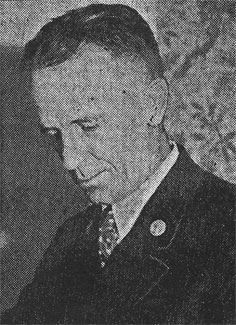
Charles H. Errickson
CHARLES HERMAN ERRICKSON was born in Vineland, New Jersey around 1888 to Herman and Kate Errickson. The family lived in Vineland through the spring of 1900. By the time the 1906 City Directory was being compiled, the Errickson family had moved to Camden, where they took up residence at 279 Walnut Street. Herman Errickson was then working as a shoemaker in a shoe factory. The Erricksons lived at the Walnut Street address into the 1920s. Besides Charles, known as “Charlie,” there was younger brother George and four sisters, Lillie, Anna, Mary, and Sadie. The 1910 Census shows Charlie Errickson working as a bartender in a saloon. He married shortly thereafter. The 1914 City Directory shows him and wife Nellie living at 225 Senate Street. When he registered for the draft in June of 1917 Charles Errickson was married and the father of two children. He was then working as a restaurant manager and living at 40 Newkirk Place, a small street that ran east from North 3rd Street between Federal and Market Street. When America entered World War I, he was among those who served.
Charles Errickson was living apart from his wife when the 1919 City Directory was compiled and at the time of the January 1919 Census. Mrs. Nellie Errickson and daughter Catherine were then living at 206 Berkley Street. Charles Errickson was serving in the United States Army. Charles Errickson apparently never reunited with his wife.
By 1924 Charles Errickson had been appointed to the Camden Fire Department. He had returned to 279 Walnut Street and was still at that address in 1927. That year he was promoted to junior captain. The 1929 Camden City Directory shows him living at 327 Chestnut Street. In March of 1932 he was promoted to senior captain.
At the time of the Census, in April of that year, he was still married, but at that time was renting a room at 574 Royden Street, where a widow, Emma Socwill, let rooms. By 1931 he moved to 579 Line Street, where the New Jersey Bell Telephone Directory shows him residing in 1936.
In September of 1932, Charles Errickson was promoted to Battalion Chief. On January 1, 1945 Charles Errickson was promoted to Deputy Chief.
Just after 10 P.M. on February 20, 1946, a major fire occurred in the S.S. Kresge Department Store at 29–33 Broadway near Federal Street. First arriving units found heavy smoke billowing from the building as second and third alarms were transmitted in quick succession.
Shortly after midnight, a backdraft injured five members as flames raced through the building. Firemen William Reed, Thomas Winstanley, Theodore Guthrie, Thomas McParland and Captain Howell Needham were removed to Cooper Hospital for facial burns; whereupon each member insisted on returning to the fire following treatment. At 12:30 A.M. Deputy Chief Charles Erickson directed the Fire Dispatcher to recall a platoon of off duty members and summon them to the fire. By 2 A.M. the flames had broken through the roof and were visible ten blocks away. As the first floor began to collapse Engine Company 8 was forced into the street as a roaring column of tin vented outward some thirty-five feet over Hudson Street. While the Department was making a major effort on Broadway, another fire broke out at the Camden Foundry Company, Front and Elm Streets, North Camden. Engine Company 11 assisted by off duty members staffing reserve apparatus confined this fire to a section of the building.
The 1947 City Directory indicates he still resided at 579 Line Street.
In July of 1947 Chief Erickson was badly injured fighting a warehouse fire on Kaighn Avenue. He was out of work for 207 days. His retirement began June 3, 1949. After his retirement he moved to Haddon Heights, New Jersey. Chief Erickson passed away on November 17, 1960 and was buried at Beverly National Cemetery in Beverly, New Jersey.
‘Georgia Magnet’ Gives Marvelous Exhibition
Camden Post-Telegram —
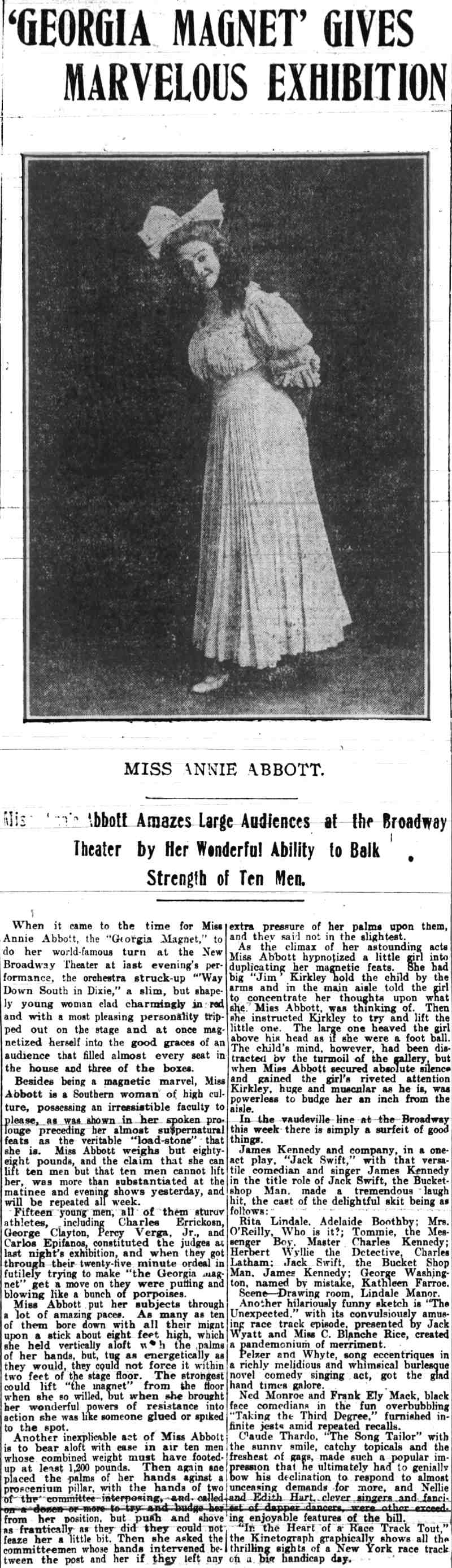
Miss Annie Abbott Amazes Large Audiences at the Broadway Theater by Her Wonderful Ability to Balk Strength of Ten Men
Miss Annie Abbott.
When it came to the time for Miss Annie Abbott, the “Georgia Magnet,” to do her world-famous turn at the New Broadway Theater at last evening’s performance, the orchestra struck-up “Way Down South in Dixie,” a slim, but shapely young woman clad charmingly in red and with a most pleasing personality tripped out on the stage and at once magnetized herself into the good graces of an audience that filled almost every seat in the house and three of the boxes.
Besides being a magnetic marvel, Miss Abbott is a Southern woman of high culture, possessing an irresistible faculty to please, as was shown in her spoken prologue preceding her almost supernatural feats as the veritable “load-stone” that she is. Miss Abbott weighs but eighty-eight pounds, and the claim that she can lift ten men but that ten men cannot lift her, was more than substantiated at the matinee and evening shows yesterday, and will be repeated all week.
Fifteen young men, all of them sturdy athletes, including Charles Errickosn [sic], George Clayton, Percy Verga, Jr., and Carlos Epifanos, constituted the judges at last night’s exhibition, and when they got through their twenty-five minute ordeal in futilely trying to make “the Georgia Magnet” get a move on they were puffing and blowing like a bunch of porpoises.
Miss Abbott put her subjects through a lot of amazing paces. As many as ten of them bore down with all their might upon a stick about eight feet high, which she held vertically aloft with the palms of her hands, but, tug as energetically as they would, they could not force it within two feet of the stage floor. The strongest could lift “the magnet” from the floor when she so willed, but when she brought her wonderful powers of resistance into action she was like someone glued or spiked to the spot.
Another inexplicable act of Miss Abbott is to bear aloft with ease in air ten men whose combined weight must have footed-up at least 1,200 pounds. Then again she placed the palms of her hands against a proscenium pillar, with the hands of two of the committee interposing, and called on a dozen or more to try and budge her from her position, but push and shove as frantically as they did they could not feaze her a little bit. Then she asked the committeemen whose hands intervened between the post and her if they left any extra pressure of her palms upon them, and they said not in the slightest.
As the climax of her astounding acts Miss Abbott hypnotized a little girl into duplicating her magnetic feats. She had big “Jim” Kirkley hold the child by the arms and in the main aisle told the girl to concentrate her thoughts upon what she, Miss Abbott, was thinking of. Then she instructed Kirkley to try and lift the little one. The large one heaved the girl above his head as if she were a foot ball. The child’s mind, however, had been distracted by the turmoil of the gallery, but when Miss Abbott secured absolute silence and gained the girl’s riveted attention Kirkley, huge and muscular as he is, was powerless to budge her an inch from the aisle.
In the vaudeville line at the Broadway this week there is simply a surfeit of good things.
James Kennedy and company, in a one-act play, “Jack Swift,” with that versatile comedian and singer James Kennedy in the title role of Jack Swift, the Bucket-shop Man, made a tremendous laugh hit, the cast of the delightful skit being as follows:
Rita Lindale, Adelaide Boothby; Mrs. O’Reilly, Who is it?; Tommie, the Messenger Boy, Master Charles Kennedy; Herbert Wyllie the Detective, Charles Latham; Jack Swift, the Bucket Shop Man, James Kennedy; George Washington, named by mistake, Kathleen Farroe.
Scene—Drawing room, Lindale Manor.
Another hilariously funny sketch is “The Unexpected,” with its convulsively amusing race track episode, presented by Jack Wyatt and Miss C. Blanche Rice, created a pandemonium of merriment.
Pelzer and Whyte, song eccentriques in a richly melodious and whimsical burlesque novel comedy singing act, got the glad hand times galore.
Ned Monroe and Frank Ely Mack, black face comedians in the fun overbubbling “Taking the Third Degree,” furnished infinite jests amid repeated recalls.
Claude Thardo, “The Song Tailor” with the sunny smile, catchy topicals and the freshest of gags, made such a popular impression that he ultimately had to genially bow his declination to respond to almost unceasing demands for more, and Nellie and Edith Hart, clever singers and fanciest of dapper dancers, were other exceeding enjoyable features of the bill.
“In the Heart of a Race Track Tout,” the Kinetograph graphically shows all the thrilling sights of a New York race track on a big handicap day.
Third Ward Club Holds Fine Ball
Camden Post-Telegram —
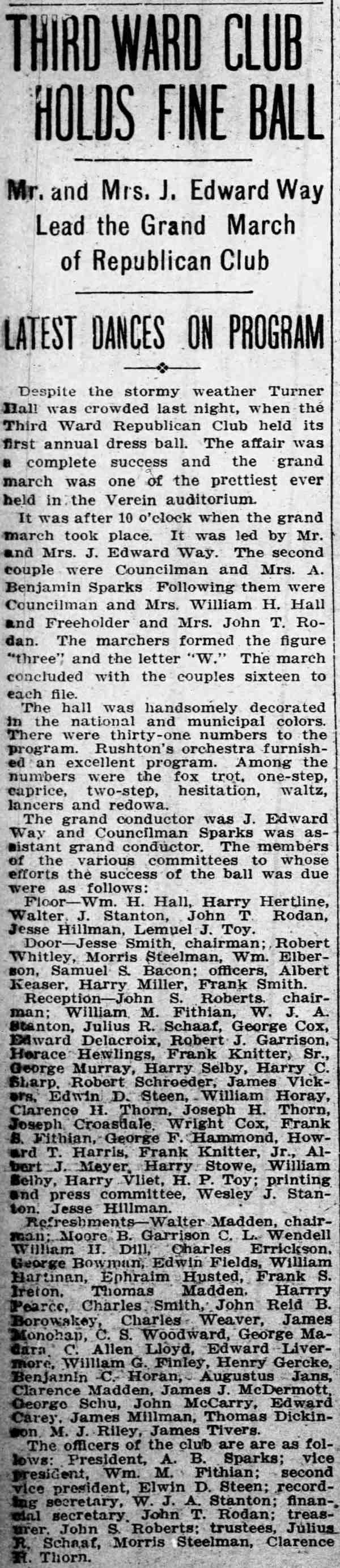
Mr. and Mrs. J. Edward Way Lead the Grand March of Republican Club
Latest Dances on Program
Despite the stormy weather Turner Hall was crowded last night, when the Third Ward Republican Club held its first annual dress ball. The affair was a complete success and the grand march was one of the prettiest ever held in the Verein auditorium.
It was after 10 o’clock when the grand march took place. It was led by Mr. and Mrs. J. Edward Way. The second couple were Councilman and Mrs. A. Benjamin Sparks. Following them were Councilman and Mrs. William H. Hall and Freeholder and Mrs. John T. Rodan. The marchers formed the figure “three” and the letter “W.” The march concluded with the couples sixteen to each file.
The hall was handsomely decorated in the national and municipal colors. There were thirty-one numbers to the program. Rushton’s orchestra furnished an excellent program. Among the numbers were the fox trot, one-step, caprice, two-step, hesitation, waltz, lancers and redowa.
The grand conductor was J. Edward Way and Councilman Sparks was assistant grand conductor. The members of the various committees to whose efforts the success of the ball was due were as follows:
Floor—Wm. H. Hall, Harry Hertline, Walter J. Stanton, John T. Rodan, Jesse Hillman, Lemuel J. Toy.
Door—Jesse Smith, chairman; Robert Whitley, Morris Steelman, Wm. Elberson, Samuel S. Bacon; officers, Albert Keaser, Harry Miller, Frank Smith.
Reception—John S. Roberts, chairman; William M. Fithian, W. J. A. Stanton, Julius R. Schaaf, George Cox, Edward Delacroix, Robert J. Garrison, Horace Hewlings, Frank Knitter, Sr., George Murray, Harry Selby, Harry C. Sharp, Robert Schroeder, James Vickers, Edwin D. Steen, William Horay, Clarence H. Thorn, Joseph H. Thorn, Joseph Croasdale, Wright Cox, Frank S. Fithian, George F. Hammond, Howard T. Harris, Frank Knitter, Jr., Albert J. Meyer, Harry Stowe, William Selby, Harry Vliet, H. P. Toy; printing and press committee, Wesley J. Stanton, Jesse Hillman.
Refreshments—Walter Madden, chairman; Moore B. Garrison, C. L. Wendell, William H. Dill, Charles Errickson, George Bowman, Edwin Fields, William Hartman, Ephraim Husted, Frank S. Ireton, Thomas Madden, Harrry [sic] Pearce, Charles Smith, John Reid B. Borowskey, Charles Weaver, James Monohan, C. S. Woodward, George Madura, C. Allen Lloyd, Edward Livermore, William G. Finley, Henry Gercke, Benjamin C. Horan, Augustus Jans, Clarence Madden, James J. McDermott, George Schu, John McCarry, Edward Carey, James Millman, Thomas Dickinson, M. J. Riley, James Tivers.
The officers of the club are are [sic] as follows: President, A. B. Sparks; vice president, Wm. M. Fithian; second vice president, Elwin D. Steen; recording secretary, W. J. A. Stanton; financial secretary, John T. Rodan; treasurer, John S. Roberts; trustees, Julius R. Schaaf, Morris Steelman, Clarence [?]. Thorn.
World War I Draft Registration Card
1917
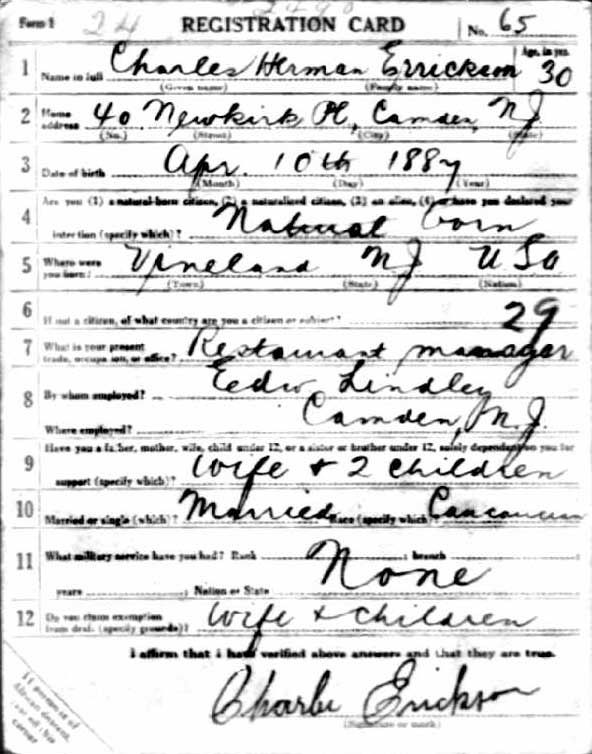
REGISTRATION CARD — Form 1, No. 65
1. Name in full: Charles Herman Errickson, Age in yrs.: 30
2. Home address: 40 Newkirk Pl., Camden, N.J.
3. Date of birth: Apr. 10th, 1887
4. Are you (1) a natural-born citizen, (2) a naturalized citizen, (3) an alien, (4) or have you declared your intention (specify which)?: Natural born
5. Where were you born?: Vineland, N.J., U.S.A.
6. If not a citizen, of what country are you a citizen or subject?: 29
7. What is your present trade, occupation, or office?: Restaurant manager
8. By whom employed?: Edw. Lindley, Camden, N.J.
9. Have you a father, mother, wife, child under 12, or a sister or brother under 12, solely dependent on you for support (specify which)?: Wife & 2 Children
10. Married or single (which)?: Married, Race (specify which): Caucasian
11. What military service have you had?: None
12. Do you claim exemption from draft (specify grounds)?: Wife & Children
I affirm that I have verified above answers and that they are true.
Signature or mark: Charlie Erickson
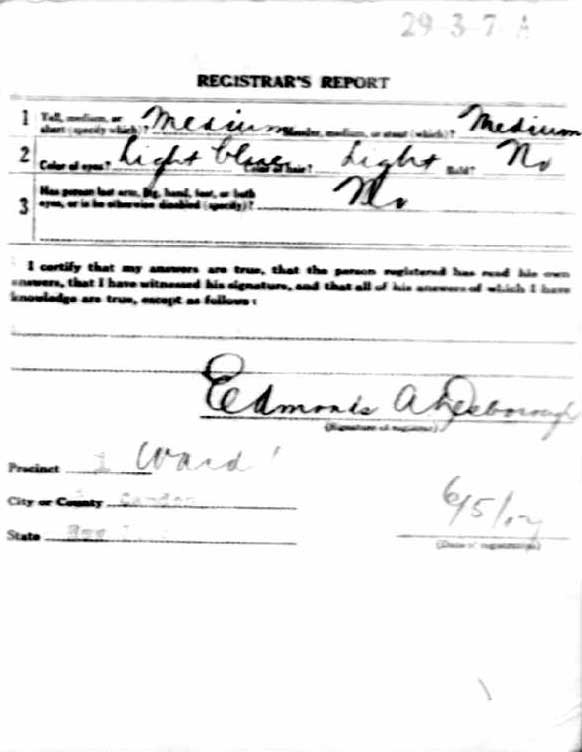
REGISTRAR’S REPORT
1. Tall, medium, or short (specify which)?: Medium. Slender, medium, or stout (which)?: Medium
2. Color of eyes?: Light blue. Color of hair?: Light. Bald?: No
3. Has person lost arm, leg, hand, foot, or both eyes, or is he otherwise disabled (specify)?: No
I certify that my answers are true, that the person registered has read his own answers, that I have witnessed his signature, and that all of his answers of which I have knowledge are true, except as follows:
Signature of registrar: Edmonds A. Deb[?]
Precinct: [?] Ward. City or County: Camden. State: New J[?]. Date of registration: 6/5/1[?]
New Firemen Assigned for Two Platoons
Camden Post-Telegram —
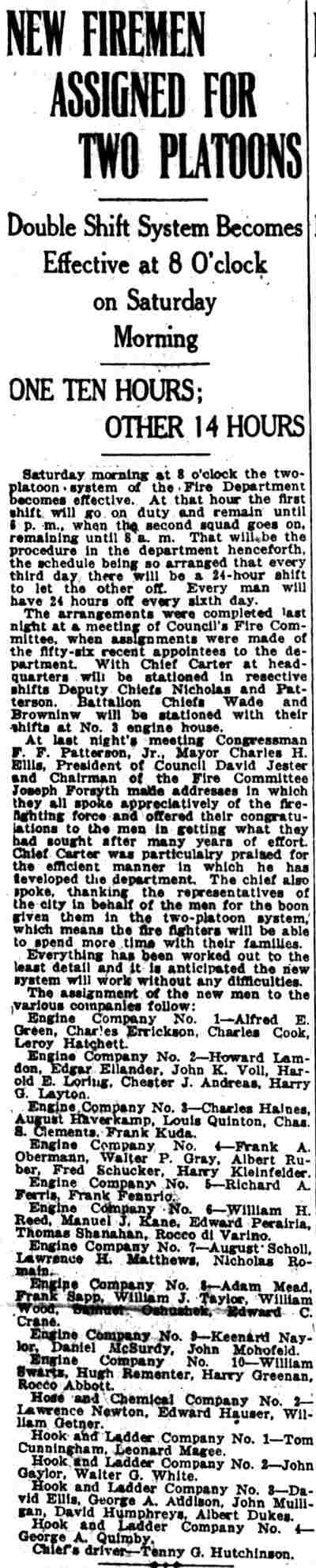
Double Shift System Becomes Effective at 8 O’clock on Saturday Morning
ONE TEN HOURS; OTHER 14 HOURS
Saturday morning at 8 o’clock the two-platoon system of the Fire Department becomes effective. At that hour the first shift will go on duty and remain until 8 p. m., when the second squad goes on, remaining until 8 a. m. That will be the procedure in the department henceforth, the schedule being so arranged that every third day there will be a 24-hour shift to let the other off. Every man will have 24 hours off every sixth day.
The arrangements were completed last night at a meeting of Council’s Fire Committee, when assignments were made of the fifty-six recent appointees to the department. With Chief Carter at headquarters will be stationed in resective [sic] shifts Deputy Chiefs Nicholas and Patterson. Battalion Chiefs Wade and Browninw [sic] will be stationed with their shifts at No. 3 engine house.
At last night’s meeting Congressman F. F. Patterson, Jr., Mayor Charles H. Ellis, President of Council David Jester and Chairman of the Fire Committee Joseph Forsyth made addresses in which they all spoke appreciatively of the fire-fighting force and offered their congratulations to the men in getting what they had sought after many years of effort. Chief Carter was particularly praised for the efficient manner in which he has developed the department. The chief also spoke, thanking the representatives of the city in behalf of the men for the boon given them in the two-platoon system, which means the fire fighters will be able to spend more time with their families.
Everything has been worked out to the least detail and it is anticipated the new system will work without any difficulties.
The assignment of the new men to the various companies follow:
Engine Company No. 1—Alfred E. Green, Charles Errickson, Charles Cook, Leroy Hatchett.
Engine Company No. 2—Howard Lamdon, Edgar Ellander, John K. Voll, Harold E. Loring, Chester J. Andreas, Harry G. Layton.
Engine Company No. 3—Charles Haines, August Haverkamp, Louis Quinton, Chas. S. Clements, Frank Kuda.
Engine Company No. 4—Frank A. Obermann, Walter P. Gray, Albert Ruber, Fred Schucker, Harry Kleinfelder.
Engine Company No. 5—Richard A. Ferris, Frank Fennrio.
Engine Company No. 6—William H. Reed, Manuel J. Kane, Edward Perairia, Thomas Shanahan, Rocco di Varino.
Engine Company No. 7—August Scholl, Lawrence H. Matthews, Nicholas Romain.
Engine Company No. 8—Adam Mead, Frank Sapp, William J. Taylor, William Wood, Samuel Oshushek, Edward C. Crane.
Engine Company No. 9—Keenard Naylor, Daniel McSurdy, John Mohofeld.
Engine Company No. 10—William Swarts, Hugh Rementer, Harry Greenan, Rocco Abbott.
Hose and Chemical Company No. 2—Lawrence Newton, Edward Hauser, William Getner.
Hook and Ladder Company No. 1—Tom Cunningham, Leonard Magee.
Hook and Ladder Company No. 2—John Gaylor, Walter G. White.
Hook and Ladder Company No. 3—David Ellis, George A. Addison, John Mulligan, David Humphreys, Albert Dukes.
Hook and Ladder Company No. 4—George A. Quimby.
Chief’s driver—Tenny G. Hutchinson.
5 Firemen Hurt in Traffic Crash
Camden Courier-Post —
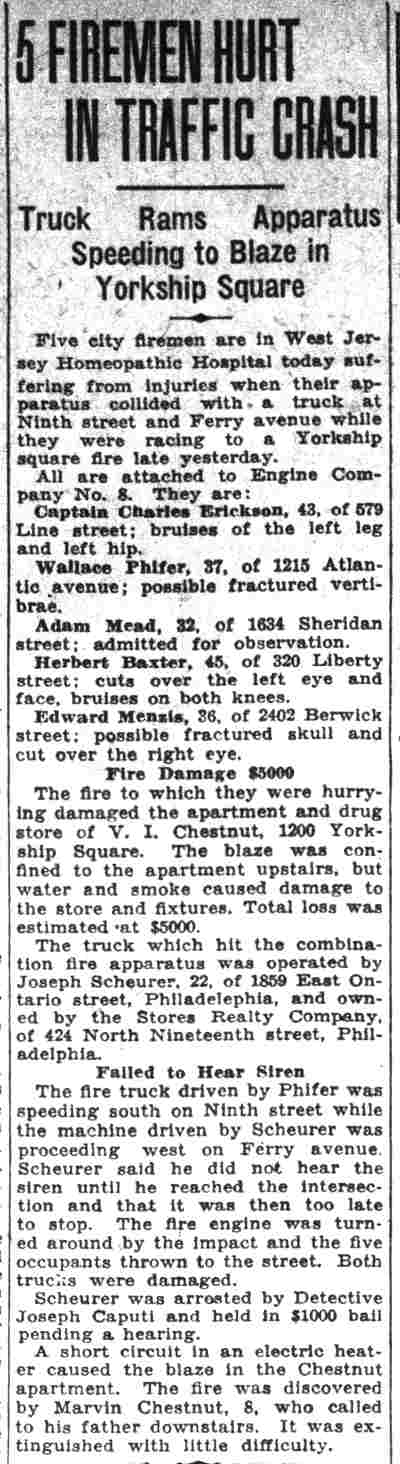
Truck Rams Apparatus Speeding to Blaze in Yorkship Square
Five city firemen are in West Jersey Homeopathic Hospital today suffering from injuries when their apparatus collided with a truck at Ninth street and Ferry avenue while they were racing to a Yorkship square fire late yesterday.
All are attached to Engine Company No. 8. They are:
Captain Charles Erickson, 43, of 579 Line street; bruises of the left leg and left hip.
Wallace Phifer, 37, of 1215 Atlantic avenue; possible fractured vertebrae.
Adam Mead, 32, of 1634 Sheridan street; admitted for observation.
Herbert Baxter, 45, of 320 Liberty street; cuts over the left eye and face, bruises on both knees.
Edward Menzis, 36, of 2402 Berwick street; possible fractured skull and cut over the right eye.
Fire Damage $5000
The fire to which they were hurrying damaged the apartment and drug store of V. I. Chestnut, 1200 Yorkship Square. The blaze was confined to the apartment upstairs, but water and smoke caused damage to the store and fixtures. Total loss was estimated at $5000.
The truck which hit the combination fire apparatus was operated by Joseph Scheurer, 22, of 1859 East Ontario street, Philadelphia, and owned by the Stores Realty Company, of 424 North Nineteenth street, Philadelphia.
Failed to Hear Siren
The fire truck driven by Phifer was speeding south on Ninth street while the machine driven by Scheurer was proceeding west on Ferry avenue. Scheurer said he did not hear the siren until he reached the intersection and that it was then too late to stop. The fire engine was turned around by the impact and the five occupants thrown to the street. Both trucks were damaged.
Scheurer was arrested by Detective Joseph Caputi and held in $1000 bail pending a hearing.
A short circuit in an electric heater caused the blaze in the Chestnut apartment. The fire was discovered by Marvin Chestnut, 8, who called to his father downstairs. It was extinguished with little difficulty.
Fire Chief Guest at Honor Dinner
Camden Courier-Post —
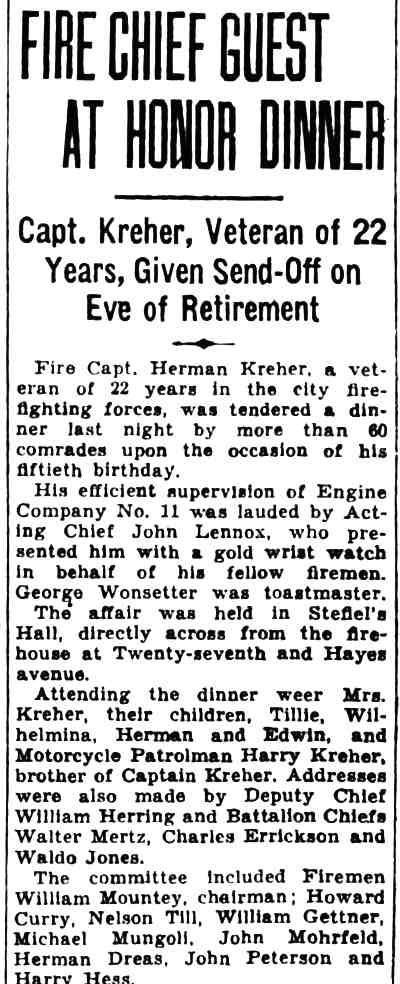
Capt. Kreher, Veteran of 22 Years, Given Send-Off on Eve of Retirement
Fire Capt. Herman Kreher, a veteran of 22 years in the city fire-fighting forces, was tendered a dinner last night by more than 60 comrades upon the occasion of his fiftieth birthday.
His efficient supervision of Engine Company No. 11 was lauded by Acting Chief John Lennox, who presented him with a gold wrist watch in behalf of his fellow firemen. George Wonsetter was toastmaster.
The affair was held in Stefiel’s Hall, directly across from the firehouse at Twenty-seventh and Hayes avenue.
Attending the dinner weer [sic] Mrs. Kreher, their children, Tillie, Wilhelmina, Herman and Edwin, and Motorcycle Patrolman Harry Kreher, brother of Captain Kreher. Addresses were also made by Deputy Chief William Herring and Battalion Chiefs Walter Mertz, Charles Errickson and Waldo Jones.
The committee included Firemen William Mountey [sic], chairman; Howard Curry, Nelson Till, William Gettner, Michael Mungoli, John Mohrfeld, Herman Dreas, John Peterson and Harry Hess.
Fire Chief Rescues Savings of Woman
Camden Courier-Post —
Son’s Photographic Equipment Destroyed on Eve of Starting Work
The savings of a widow were saved last night by Battalion Chief Charles Errickson as flames destroyed a photographic studio in her home at 939 Newton Avenue.
Erickson worked his way through dense smoke at the home of Mrs. Carrie C. Perkinpine to get her savings in a small box in a second story bedroom.
Mrs. Perkinpine lived with her son, Leonard J. Farrar, who has been unemployed two years. He was to have started work as a photographer next Monday but all of his equipment, including a camera, were lost in the fire.
“I had banked the furnace in the cellar for the night and was reading in the dining room when I heard a crackling noise,” Mrs. Perkinpine said. “I opened the cellar door and was nearly overcome by a gust of smoke.”
She ran to the home of neighbors across the street and they called the fire department. Four companies responded under Errickson. The fire spread to the photographic studio set up in the cellar by Farrar and destroyed his developing and enlarging equipment as well as the camera. Firemen were unable to account for the origin of the blaze unless sparks from the furnace ignited a pile of rubbish in the cellar. The fire was confined to the cellar although the upper rooms were damaged by smoke.
Three other families were forced to flee their homes because of smoke from the Perkinpine home.
Mrs. Kobus Signs Fire Prevention Proclamation
Camden Courier-Post —
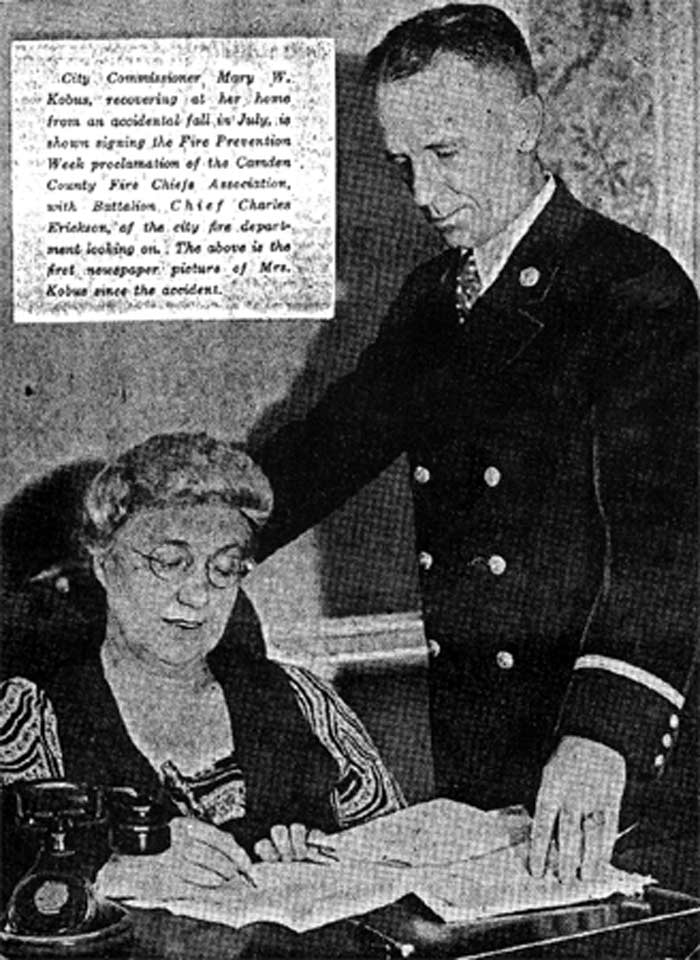
City Commissioner Mary W. Kobus, recovering at her home from an accidental fall in July, is shown signing the Fire Prevention Week proclamation of the Camden County Fire Chiefs Association, with Battalion Chief Charles Erickson, of the city fire department looking on. The above is the first newspaper picture of Mrs. Kobus since the accident.
Fire Prevention Broadcast in Polish in South Camden
Camden Courier-Post —
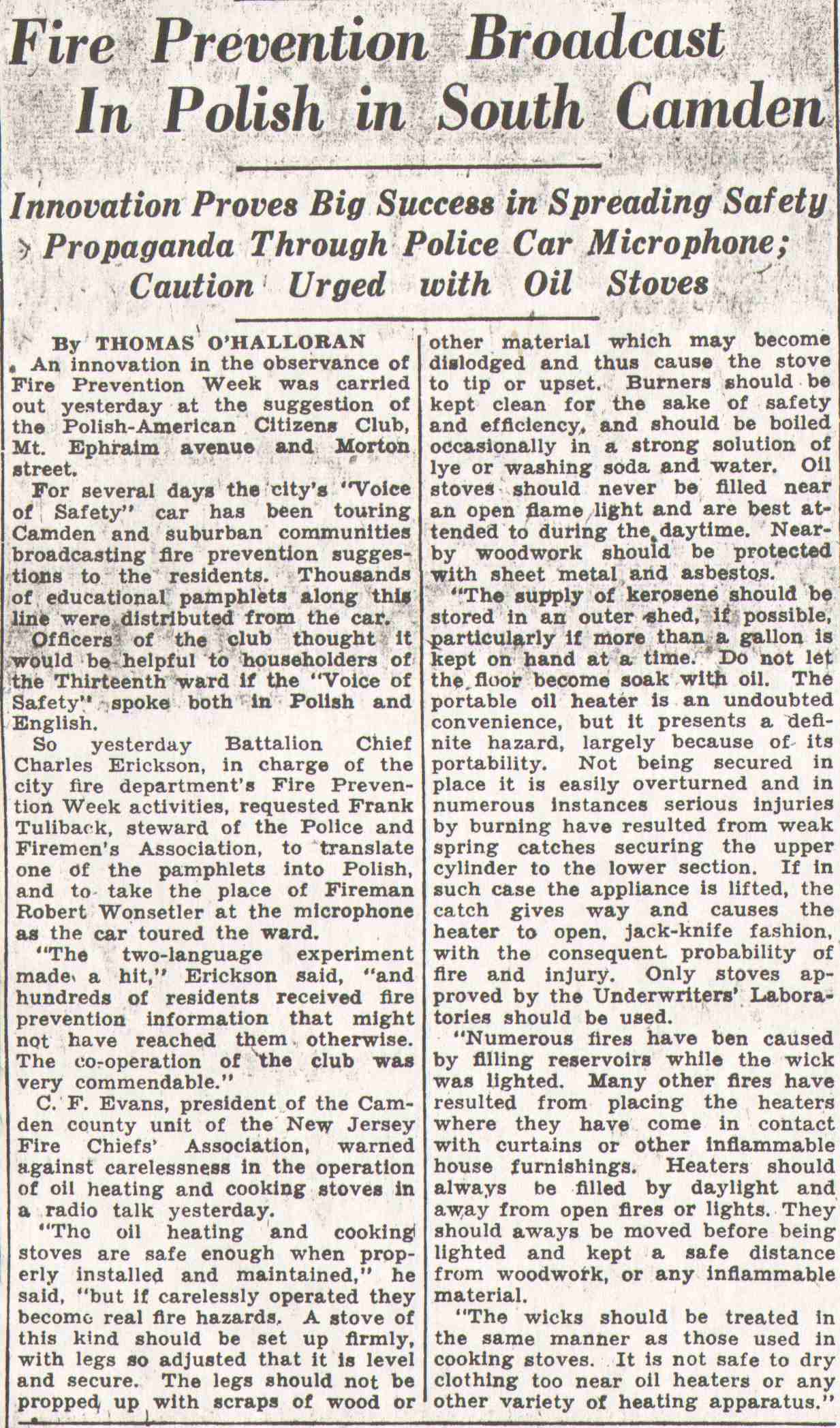
Fire Prevention Broadcast In Polish in South Camden
Innovation Proves Big Success in Spreading Safety Propaganda Through Police Car Microphone; Caution Urged with Oil Stoves
By THOMAS O’HALLORAN
An innovation in the observance of Fire Prevention Week was carried out yesterday at the suggestion of the Polish-American Citizens Club, Mt. Ephraim avenue and Morton street.
For several days the city’s “Voice of Safety” car has been touring Camden and suburban communities broadcasting fire prevention suggestions to the residents. Thousands of educational pamphlets along this line were distributed from the car.
Officers of the club thought it would be helpful to householders of the Thirteenth ward if the “Voice of Safety” spoke both in Polish and English.
So yesterday Battalion Chief Charles Erickson, in charge of the city fire department’s Fire Prevention Week activities, requested Frank Tuliback, steward of the Police and Firemen’s Association, to translate one of the pamphlets into Polish, and to take the place of Fireman Robert Wonsetler at the microphone as the car toured the ward.
“The two-language experiment made a hit,” Erickson said, “and hundreds of residents received fire prevention information that might not have reached them otherwise. The co-operation of the club was very commendable.”
C. F. Evans, president of the Camden county unit of the New Jersey Fire Chiefs’ Association, warned against carelessness in the operation of oil heating and cooking stoves in a radio talk yesterday.
“The oil heating and cooking stoves are safe enough when properly installed and maintained,” he said, “but if carelessly operated they become real fire hazards. A stove of this kind should be set up firmly, with legs so adjusted that it is level and secure. The legs should not be propped up with scraps of wood or other material which may become dislodged and thus cause the stove to tip or upset. Burners should be kept clean for the sake of safety and efficiency, and should be boiled occasionally in a strong solution of lye or washing soda and water. Oil stoves should never be filled near an open flame light and are best attended to during the daytime. Nearby woodwork should be protected with sheet metal and asbestos.
“The supply of kerosene should be stored in an outer shed, if possible, particularly if more than a gallon is kept on hand at a time. Do not let the floor become soak with oil. The portable oil heater is an undoubted convenience, but it presents a definite hazard, largely because of its portability. Not being secured in place it is easily overturned and in numerous instances serious injuries by burning have resulted from weak spring catches securing the upper cylinder to the lower section. If in such case the appliance is lifted, the catch gives way and causes the heater to open, jack-knife fashion, with the consequent probability of fire and injury. Only stoves approved by the Underwriters’ Laboratories should be used.
“Numerous fires have ben [sic] caused by filling reservoirs while the wick was lighted. Many other fires have resulted from placing the heaters where they have come in contact with curtains or other inflammable house furnishings. Heaters should always be filled by daylight and away from open fires or lights. They should aways [sic] be moved before being lighted and kept a safe distance from woodwork, or any inflammable material.
“The wicks should be treated in the same manner as those used in cooking stoves. It is not safe to dry clothing too near oil heaters or any other variety of heating apparatus.”
Veteran Fire Captain Honored At Retirement Ceremonies
Camden Courier-Post —

Eli Hunt Bids Farewell to Fellow Members of City Force
Officials Laud Term of Service
Quits Chasing Fires
Capt. Eli Hunt
The sound of a fire alarm means nothing except fond memories to Junior Capt. Eli Hunt, now, as he sits in his chair at home and lives over the many experiences he has gone through while a fireman with Engine Company No. 3, 1813 Broadway.
Captain Hunt took formal leave Saturday from his comrades, the smoke-eaters of one of the busiest fire houses in the city. The 55-year-old veteran was retired March 1 for disability, and the lads he led in many a fierce battle with flames, decided to show their old skipper that their hearts were with him now that he would respond to no more alarms.
Captain Hunt, his face seamed and lined with years of activity as a fire-fighter, sat silent while Battalion Chief Charles Erickson [sic] told the old smoke-eater that he was only retired, but that in spirit he was still a member of the Camden fire department.
The captain smiled with satisfaction as Commissioner Mary W. Kobus, director of public safety, told Captain Hunt that he was a gallant old fire-fighter, and had fought along the traditions that had made the Camden department one of the best.
Flowers Presented
Satisfaction and smiles still rode the captain’s face as Acting Capt. Edward MacDowell presented him with a bouquet of flowers. He was still grinning in glee when Acting Captain Rich gave him another gift. He still retained that smiling face as Commissioner Kobus presented him with a beautiful smoking set, the gift of his old comrades.
Then, as he sat silently in his chair, the fact that he was no longer a fire-fighter of Camden save in memory and spirit, rolled down upon him and the pent emotion gave way, it could not longer be dammed.
Tears ran like rivulets down the grizzled face of the retired captain, and he didn’t attempt to stop them either, as one handkerchief against that torrent of weeping would have been as effective as trying to stop a hole in a levee with a toothpick.
Standing in formation, too, were his old boys, and everyone of them had a suspicious moisture in his eye, as they gazed upon the old skipper, now ready to retire to a merited if not entirely welcome retirement.
It was 8 a. m. when the ceremonies started down in the ancient camp of the firefighters on Broadway. Battalion Chief Erickson [sic] made a neat and effective speech.
Remains In Spirit
“You are not retiring from the department,” he said, “you are still a member though no longer active. Don’t figure that you are done as a fireman because you are not.
“You’ve earned your rest and you can feel assured now that you have retired that you owe the city of Camden nothing, you have given her the best that was in you, the finest ability you commanded and the loyalty which you know.
“Your boys are sorry to see you depart, but when you go they know that you go to a rest you have merited and an ease that rightfully belongs to you.”
Commissioner Kobus followed in like strain, expressing her delight as being able to have a part in the ceremonies.
“We have to hurry this up,” said the commissioner laughingly, “for I never come down to this firehouse that an alarm does not sound.”
“You are not retiring from the department,” said the director, “you have come up from the ranks and will remain an inspiration to these young firemen, even if you be away from them.
Set Good Example
“You have given them a splendid example to follow by your own loyal, splendid service to Camden. You are something of an ideal for these men to follow, and so long as they stand by the ideals of yourself and the gallant old firefighters of the department, Camden will still have the best department of any city in the United States.
“You are getting a rest period and you earned it. You don’t want to feel that you have retired, you just want to remember that the boys in the department will be with you as you take the rest that you have earned.
“You retire with the respect of everybody in the department, and no higher honor could be paid to any member of the fire department than to merit and hold such respect.”
Captain Hunt was compelled to retire as the result of injuries received in an automobile accident on Oct. 20, 1935. He had been to National Park where he has a kennel of hounds, the captain having been an ardent hunter when physically sound.
Hurt Severely
It was his usual 24-hours off day and as he drove through Woodbury on the way to Camden his car was struck by another at Thorofare. Captain Hunt was injured so badly that he was in the hospital for two months, with concussion of the brain, his injuries leaving a lesion that has made locomotion a mite difficult, although Captain Hunt is able to stand without the aid of his cane.
“I’m going to take life easy,” he said, after he had gathered his presents and been photographed numerous times.” [sic] I have many relatives living around whom I haven’t seen for some time, so I guess I spend a good bit of leisure going around and getting acquainted with them.
“But don’t forget, retired or not, I’m still a fireman and will probably jump out of bed as usual when I hear the alarm.”
Junior Captain Hunt joined the department on August 1, 1918, as a hoseman in Engine 3, where he was honored today. He was promoted to junior captain and assigned to Engine 9, Twenty-seventh and Federal streets in April, 1928. He returned to his old company, however, as a junior captain in March, 1932, and retired on a pension last Monday.
Captain Hunt battled against some of the worst fires in Camden’s history.
For five and one-half hours he was on duty when flames attacked the plant of the Eavenson Soap Works on Delaware avenue and Penn street on Jan. 21, 1919. He worked straight through for 28 hours when Sitley & Sons’ grain and feed plant, burned at Chelten avenue and the Pennsylvania railroad.
In connection with the latter fire it started on Hunt’s day off, and he was compelled to forego his leisure, as the department had but a single platoon in those days. He was in the fight against the fire at the U. S. Naval aircraft factory in Gloucester, June 8, 1920, the Baker-Flick blaze on Dec. 21, 1921 and another fire in the Eavenson Soap Works on Oct. 20, 1922.
Gloucester County Graduates Firemen
Camden Courier-Post —
Demonstration of Work Will Be Given at Woodbury High School
Paulsboro, Feb. 8.—Examinations were held recently by the Gloucester County Firemen’s School. The graduates will give a public demonstration of their prowess February 19 in the Woodbury High School gymnasium.
The following passed their examinations:
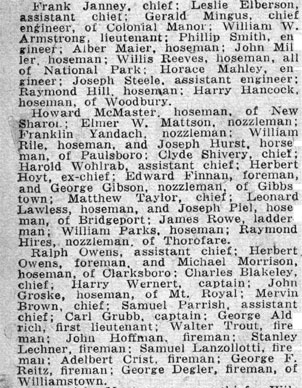
Frank Janney, chief; Leslie Elberson, assistant chief; Gerald Mingus, chief engineer, of Colonial Manor; William W. Armstrong, lieutenant; Phillip Smith, engineer; Alber Maier, hoseman; John Miller, hoseman; Willis Reeves, hoseman, all of National Park; Horace Mahley, engineer; Joseph Steele, assistant engineer; Raymond Hill, hoseman; Harry Hancock, hoseman, of Woodbury.
Howard McMaster, hoseman, of New Sharon; Elmer W. Mattson, nozzleman; Franklin Yandach, nozzleman; William Rile, hoseman, and Joseph Hurst, horseman, of Paulsboro; Clyde Shivery, chief; Harold Wohlrab, assistant chief; Herbert Hoyt, ex-chief; Edward Finnan, foreman, and George Gibson, nozzleman, of Gibbstown; Matthew Taylor, chief; Leonard Lawless, hoseman, and Joseph Piel, hoseman, of Bridgeport; James Rowe, ladderman; William Parks, hoseman; Raymond Hires, nozzleman, of Thorofare.
Ralph Owens, assistant chief; Herbert Owens, foreman, and Michael Morrison, hoseman, of Clarksboro; Charles Blakeley, chief; Harry Wernert, captain; John Groske, hoseman, of Mt. Royal; Mervin Brown, chief; Samuel Parrish, assistant chief; Carl Grubb, captain; George Aldrich, first lieutenant; Walter Trout, fireman; John Hoffman, fireman; Stanley Lechner, fireman; Samuel Lanzollotti, fireman; Adelbert Crist, fireman; George F. Reitz, fireman; George Degler, fireman, of Williamstown.
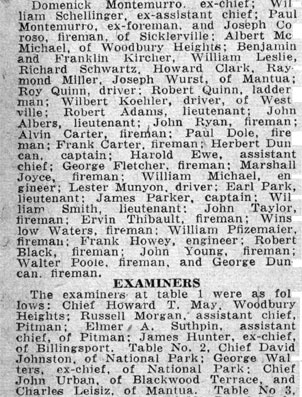
Domenick Montemurro, ex-chief; William Schellinger, ex-assistant chief; Paul Montemurro, ex-foreman, and Joseph Coroso, fireman, of Sicklerville; Albert McMichael, of Woodbury Heights; Benjamin and Franklin Kircher, William Leslie, Richard Schwartz, Howard Clark, Raymond Miller, Joseph Wurst, of Mantua; Roy Quinn, driver; Robert Quinn, ladder man; Wilbert Koehler, driver, of Westville; Robert Adams, lieutenant; John Albers, lieutenant; John Ryan, fireman; Alvin Carter, fireman; Paul Dole, fireman; Frank Carter, fireman; Herbert Duncan, captain; Harold Ewe, assistant chief; George Fletcher, fireman; Marshall Joyce, fireman; William Michael, engineer; Lester Munyon, driver; Earl Park, lieutenant; James Parker, captain; William Smith, lieutenant; John Taylor, fireman; Ervin Thibault, fireman; Winslow Waters, fireman; William Pfizemaier, fireman; Frank Howey, engineer; Robert Black, fireman; John Young, fireman; Walter Poole, fireman, and George Duncan, fireman.
EXAMINERS
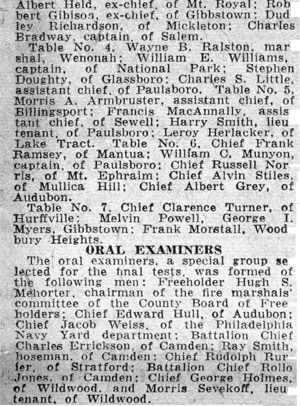
The examiners at table 1 were as follows: Chief Howard T. May, Woodbury Heights; Russell Morgan, assistant chief, Pitman; Elmer A. Suthpin, assistant chief, of Pitman; James Hunter, ex-chief, of Billingsport. Table No. 2, Chief David Johnston, of National Park; George Walters, ex-chief, of National Park; Chief John Urban, of Blackwood Terrace, and Charles Leisiz, of Mantua. Table No. 3, Albert Held, ex-chief, of Mt. Royal; Robert Gibison, ex-chief, of Gibbstown; Dudley Richardson, of Mickleton; Charles Bradway, captain, of Salem.
Table No. 4, Wayne B. Ralston, marshal, Wenonah; William E. Williams, captain, of National Park; Stephen Doughty, of Glassboro; Charles S. Little, assistant chief, of Paulsboro. Table No. 5, Morris A. Armbruster, assistant chief, of Billingsport; Francis MacAnnally, assistant chief, of Sewell; Harry Smith, lieutenant, of Paulsboro; Leroy Herlacker, of Lake Tract. Table No. 6. Chief Frank Ramsey, of Mantua; William C. Munyon, captain, of Paulsboro; Chief Russell Norris, of Mt. Ephraim; Chief Alvin Stiles, of Mullica Hill; Chief Albert Grey, of Audubon.
Table No. 7. Chief Clarence Turner, of Hurffville; Melvin Powell, George I. Myers, Gibbstown; Frank Morstall, Woodbury Heights.
ORAL EXAMINERS
The oral examiners, a special group selected for the final tests, was formed of the following men: Freeholder Hugh S. Mehorter, chairman of the fire marshals’ committee of the County Board of Freeholders; Chief Edward Hull, of Audubon; Chief Jacob Weiss, of the Philadelphia Navy Yard department; Battalion Chief Charles Errickson, of Camden; Ray Smith, hoseman, of Camden; Chief Rudolph Rurfer, of Stratford; Battalion Chief Rollo Jones, of Camden; Chief George Holmes, of Wildwood, and Morris Sevekoff, lieutenant, of Wildwood.
Fire Fighter Hurt as 2-Alarm Blaze Damages Junk Shop
Camden Courier-Post —
A fireman was injured slightly last night when a two-alarm fire damaged the Penn Junk Shop at 1190 Chestnut street.
Hoseman Adam Meade, 41, of 1446 South Fourth Street, attached to Engine Company No. 3, suffered an injured ankle when a fence fell on it while he was fighting the blaze. He was taken to West Jersey Hospital where he was treated and released.
The fire, of undetermined origin, started in the single-story frame building owned by Chester Szalanski and had gained good headway in piles of papers and rags before firemen arrived.
The first alarm was turned in at 10:36 p. m. by Alice Saduski, 16, of 1169 Chestnut street, who ran across the snow-covered street in bare feet to pull the fire alarm box.
When Battalion Chief Charles Errickson arrived he ordered the second alarm turned in. No estimate of the loss could be obtained last night.
10-Cent Fire Costs City $100 in Trouble
Camden Courier-Post —
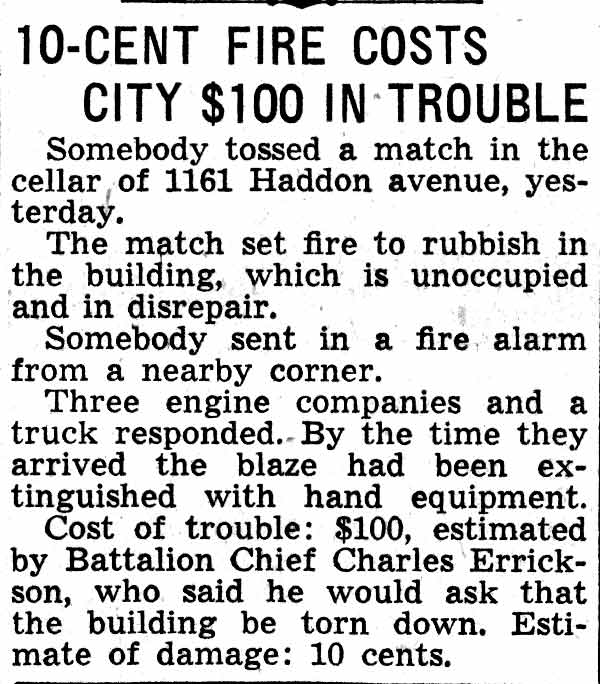
Somebody tossed a match in the cellar of 1161 Haddon avenue, yesterday.
The match set fire to rubbish in the building, which is unoccupied and in disrepair.
Somebody sent in a fire alarm from a nearby corner.
Three engine companies and a truck responded. By the time they arrived the blaze had been extinguished with hand equipment.
Cost of trouble: $100, estimated by Battalion Chief Charles Errickson, who said he would ask that the building be torn down. Estimate of damage: 10 cents.
Safety Council Reorganized Here
Camden Courier-Post —
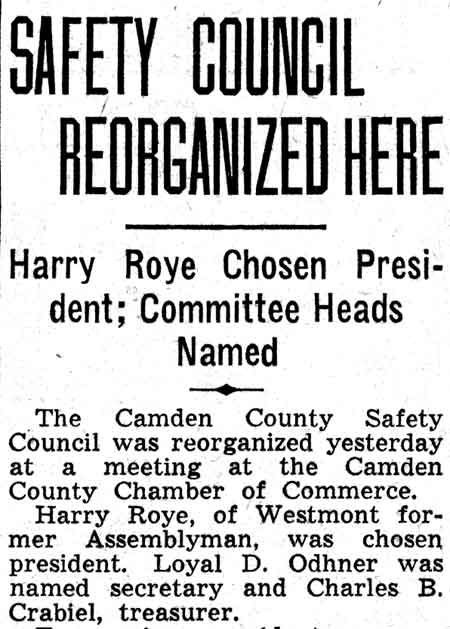
Harry Roye Chosen President; Committee Heads Named
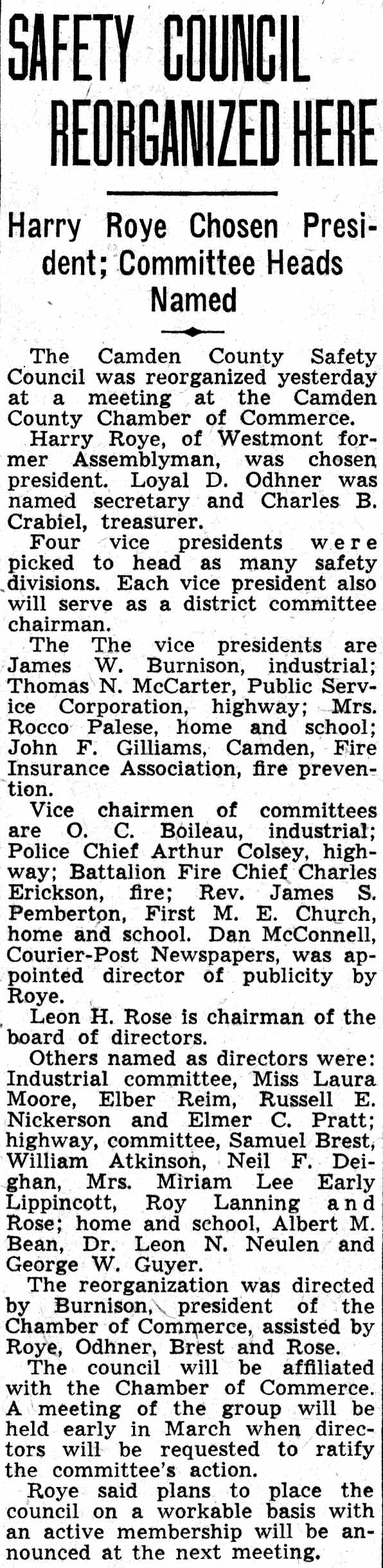
The Camden County Safety Council was reorganized yesterday at a meeting at the Camden County Chamber of Commerce.
Harry Roye, of Westmont former Assemblyman, was chosen president. Loyal D. Odhner was named secretary and Charles B. Crabiel, treasurer.
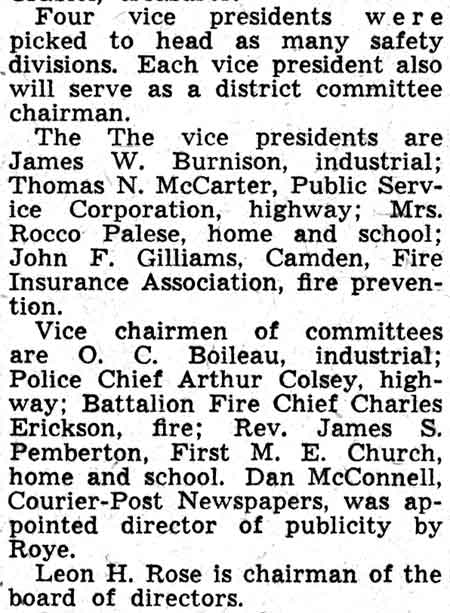
Four vice presidents were picked to head as many safety divisions. Each vice president also will serve as a district committee chairman.
The The [sic] vice presidents are James W. Burnison, industrial; Thomas N. McCarter, Public Service Corporation, highway; Mrs. Rocco Palese, home and school; John F. Gilliams, Camden, Fire Insurance Association, fire prevention.
Vice chairmen of committees are O. C. Boileau, industrial; Police Chief Arthur Colsey, highway; Battalion Fire Chief Charles Erickson, fire; Rev. James S. Pemberton, First M. E. Church, home and school. Dan McConnell, Courier-Post Newspapers, was appointed director of publicity by Roye.
Leon H. Rose is chairman of the board of directors.
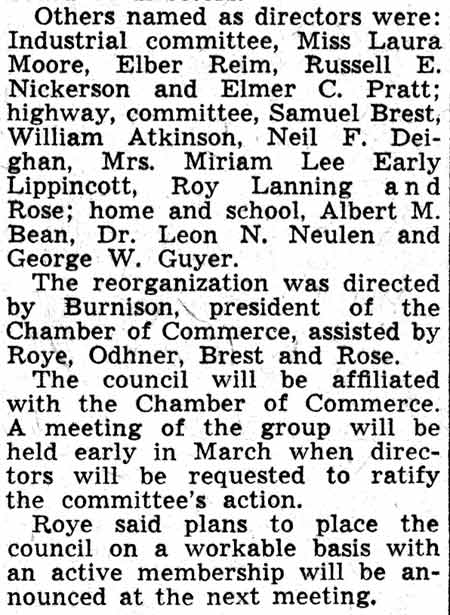
Others named as directors were: Industrial committee, Miss Laura Moore, Elber Reim, Russell E. Nickerson and Elmer C. Pratt; highway, committee, Samuel Brest, William Atkinson, Neil F. Deighan, Mrs. Miriam Lee Early Lippincott, Roy Lanning and Rose; home and school, Albert M. Bean, Dr. Leon N. Neulen and George W. Guyer.
The reorganization was directed by Burnison, president of the Chamber of Commerce, assisted by Roye, Odhner, Brest and Rose.
The council will be affiliated with the Chamber of Commerce. A meeting of the group will be held early in March when directors will be requested to ratify the committee’s action.
Roye said plans to place the council on a workable basis with an active membership will be announced at the next meeting.
Erickson Reports Fire Loss in City Is Lowest in 15 Years
Camden Courier-Post —
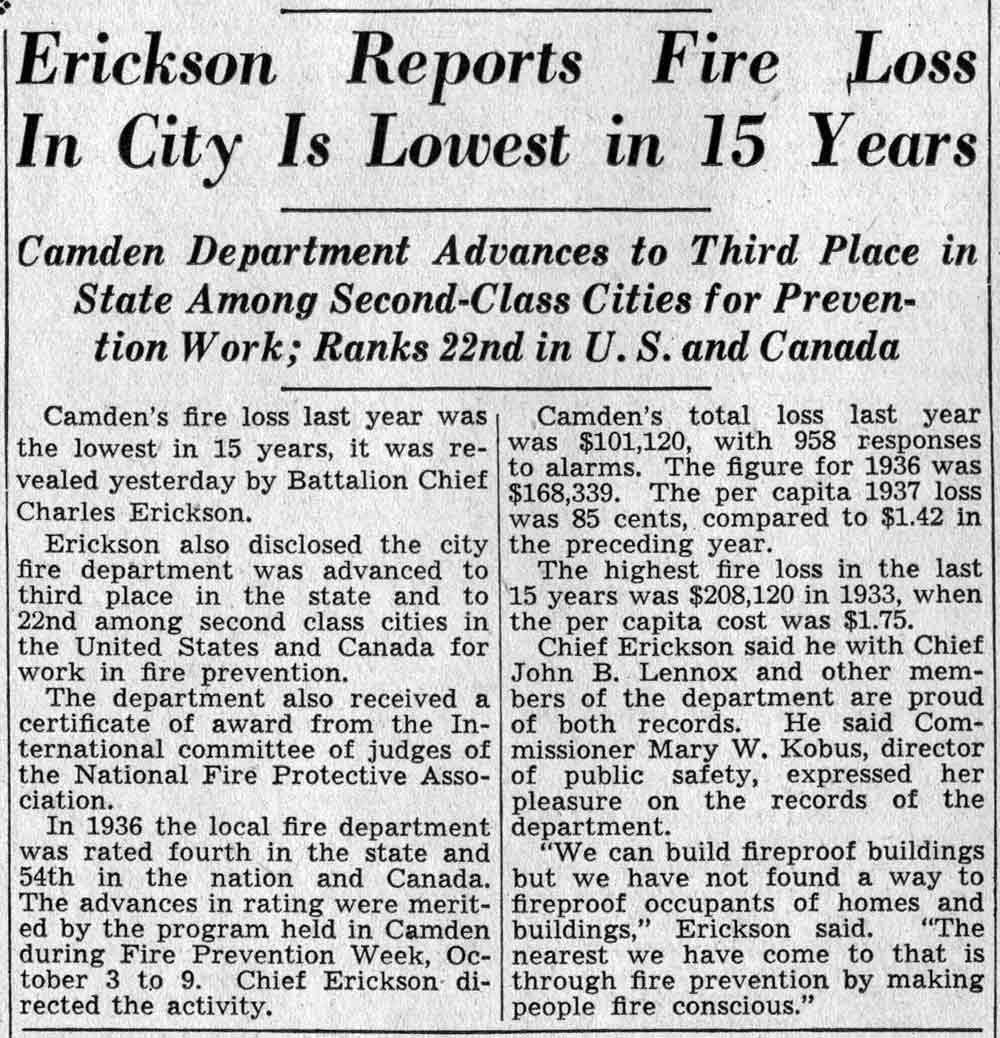
Camden Department Advances to Third Place in State Among Second-Class Cities for Prevention Work; Ranks 22nd in U.S. and Canada
Camden’s fire loss last year was the lowest in 15 years, it was revealed yesterday by Battalion Chief Charles Erickson.
Erickson also disclosed the city fire department was advanced to third place in the state and to 22nd among second class cities in the United States and Canada for work in fire prevention.
The department also received a certificate of award from the International committee of judges of the National Fire Protective Association.
In 1936 the local fire department was rated fourth in the state and 54th in the nation and Canada. The advances in rating were merited by the program held in Camden during Fire Prevention Week, October 3 to 9. Chief Erickson directed the activity.
Camden’s total loss last year was $101,120, with 958 responses to alarms. The figure for 1936 was $168,339. The per capita 1937 loss was 85 cents, compared to $1.42 in the preceding year.
The highest fire loss in the last 15 years was $208,120 in 1933, when the per capita cost was $1.75.
Chief Erickson said he with Chief John B. Lennox and other members of the department are proud of both records. He said Commissioner Mary W. Kobus, director of public safety, expressed her pleasure on the records of the department.
“We can build fireproof buildings but we have not found a way to fireproof occupants of homes and buildings,” Erickson said. “The nearest we have come to that is through fire prevention by making people fire conscious.”
Certificate Won by Camden Fire Department
Camden Courier-Post —
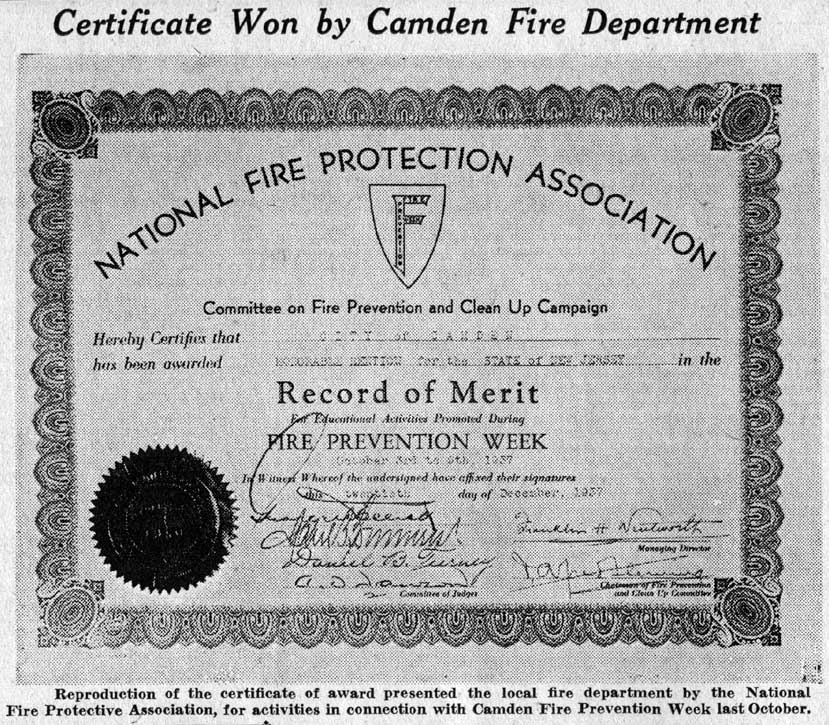
National Fire Protection Association. Committee on Fire Prevention and Clean Up Campaign. Hereby Certifies that City of Camden has been awarded Honorable Mention for the State of New Jersey in the Record of Merit For Educational Activities Promoted During Fire Prevention Week, October 3rd to 9th, 1937. In Witness Whereof the undersigned have affixed their signatures this twentieth day of December, 1937. Managing Director. Committee of Judges. Chairman of Fire Prevention and Clean Up Committee.
Reproduction of the certificate of award presented the local fire department by the National Fire Protective Association, for activities in connection with Camden Fire Prevention Week last October.
Mrs. Kobus Names 3 Cops, 4 Firemen
Camden Courier-Post —
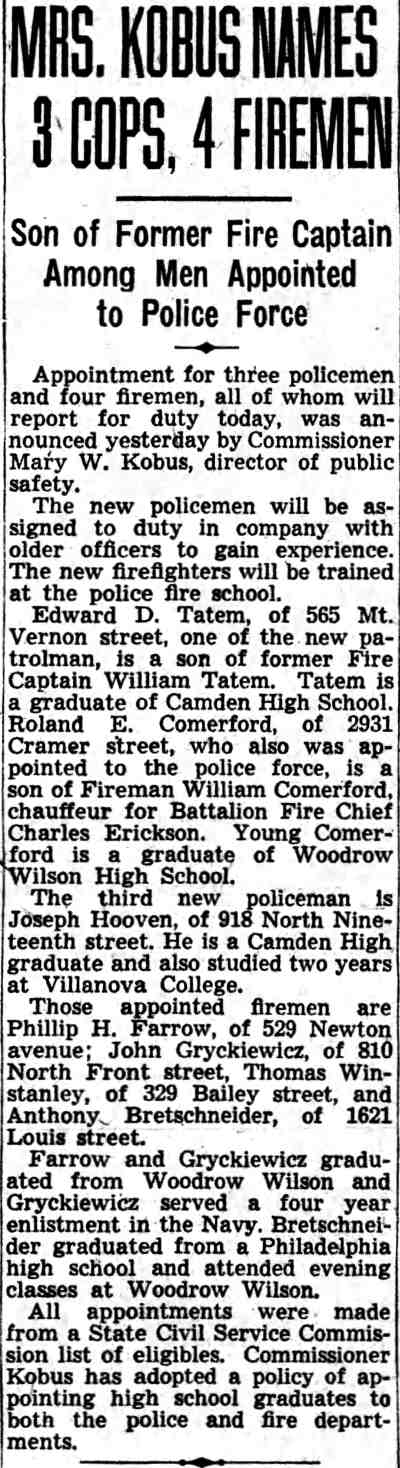
Son of Former Fire Captain Among Men Appointed to Police Force
Appointment for three policemen and four firemen, all of whom will report for duty today, was announced yesterday by Commissioner Mary W. Kobus, director of public safety.
The new policemen will be assigned to duty in company with older officers to gain experience. The new firefighters will be trained at the police fire school.
Edward D. Tatem, of 565 Mt. Vernon street, one of the new patrolmen, is a son of former Fire Captain William Tatem. Tatem is a graduate of Camden High School. Roland E. Comerford, of 2931 Cramer street, who also was appointed to the police force, is a son of Fireman William Comerford, chauffeur for Battalion Fire Chief Charles Erickson. Young Comerford is a graduate of Woodrow Wilson High School.
The third new policeman is Joseph Hooven, of 918 North Nineteenth street. He is a Camden High graduate and also studied two years at Villanova College.
Those appointed firemen are Phillip H. Farrow, of 529 Newton avenue; John Gryckiewicz, of 810 North Front street, Thomas Winstanley, of 329 Bailey street, and Anthony Bretschneider, of 1621 Louis street.
Farrow and Gryckiewicz graduated from Woodrow Wilson and Gryckiewicz served a four year enlistment in the Navy. Bretschneider graduated from a Philadelphia high school and attended evening classes at Woodrow Wilson.
All appointments were made from a State Civil Service Commission list of eligibles. Commissioner Kobus has adopted a policy of appointing high school graduates to both the police and fire departments.
Shipyard Fire Mars Tender Launching
Camden Courier-Post —
560 Attending Ceremony at John A. Mathis Plant Startled by Blaze
Five hundred persons attending the launching of a net tender at the John H. Mathis Shipbuilding Corporation were startled Saturday when the cry of “fire” was sounded.
The blaze, although slight, was only a few yards from the crowds of employees, their relatives, and yard and Navy officials watching the launching.
The fire was caused when a large crane dumped hot coals on the railroad tracks, setting fire to the ties and a quantity of oil soaked rags. Employees of the yard watching the ceremonies, rushed to the danger spot and extinguished the flames within a few minutes.
However, due to the proximity of the fire to the ships and its possible danger if it gained headway, the Camden fire department was called.
Battalion Chief Charles Errickson, answering the call, collapsed from the heat a few minutes after returning to the fire house. His condition was not considered serious and he declined hospital treatment.
The ship sent down the ways was the net tender, U.S.S. Teak. It was launched three months ahead of schedule and Navy officials had attempted to keep the ship’s launching a secret until the fire disclosed the story.
Mrs. E. L. Patch, wife of Captain E. L. Patch, supervising naval construction at the New York Shipbuilding Corporation, christened the 160-foot vessel. Later, the hull was towed to Port Richmond where Diesel engines will be installed, before it is commissioned into the Navy. The ship cost $471,000 and is the second tender launched at the yard in recent months.
Two others of similar design are under construction on the ways. The yard also holds contracts for three minesweepers and 10 submarine chasers.
The net tenders are used for laying and repairing nets in harbors as a defense against submarines. The nets also are placed around anchored ships to protect them against torpedoes.
Shipyard employees, as a reward for finishing the ship ahead of schedule, were taken yesterday on a picnic to Seaside Heights, sponsored by the company. Ten chartered buses were provided for transportation.
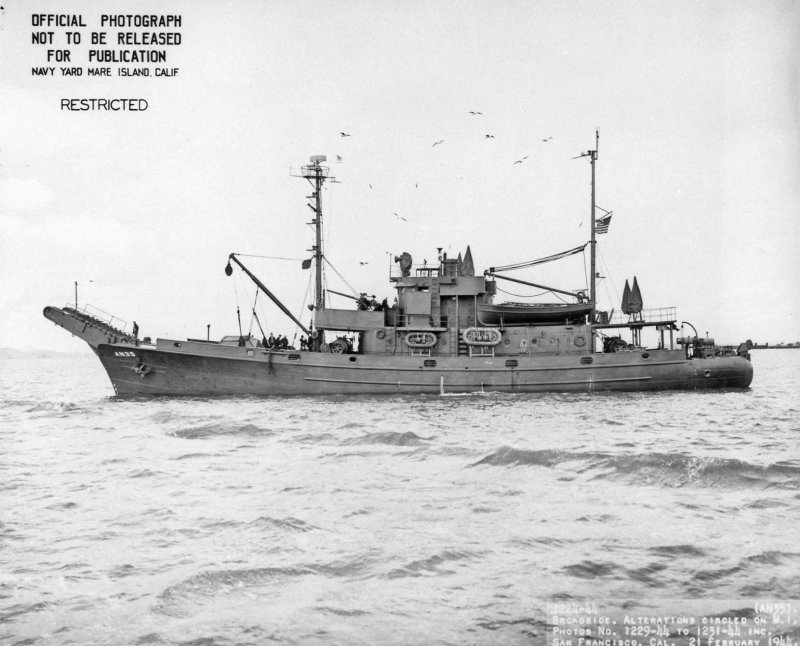
USS Teak AN-35
World War II Draft Card
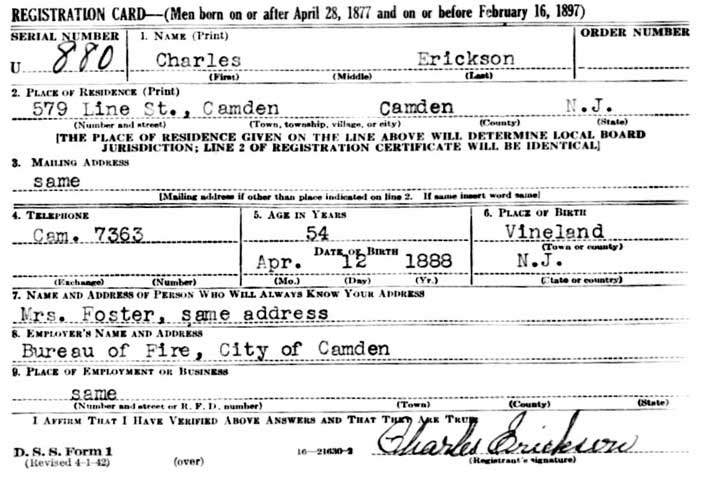
Charles H. Errickson — World War II Draft Registration Card
Injured as Fire Destroys Kresge Building
Camden Courier-Post —

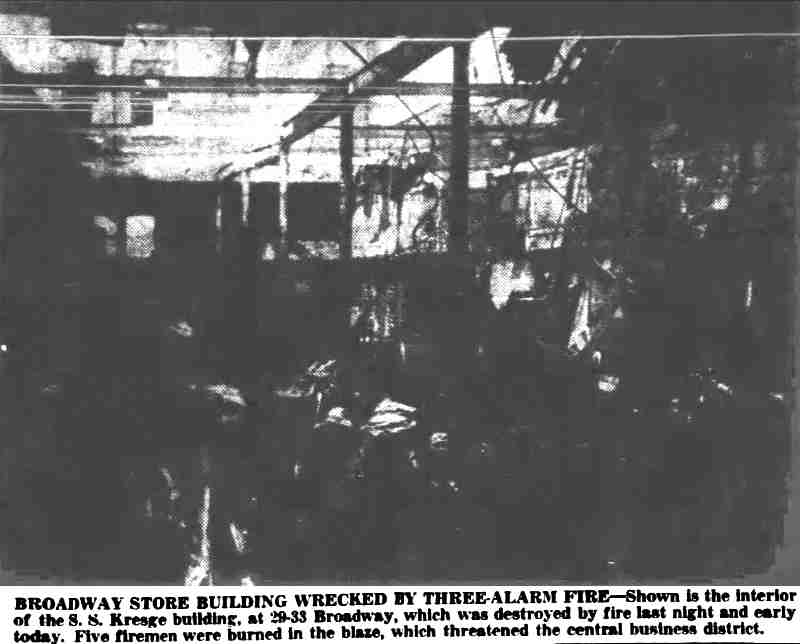

BROADWAY STORE BUILDING WRECKED BY THREE-ALARM FIRE—Shown is the interior of the S. S. Kresge building, at 29-33 Broadway, which was destroyed by fire last night and early today. Five firemen were burned in the blaze, which threatened the central business district.
2nd Blaze Calls Out All Men
Camden’s entire fire-fighting facilities were called on during the night to battle two blazes, one a three-alarm in which five firemen were injured.
The three-alarm fire swept the S. S. Kresge building at 29-33 Broadway, threatening the central business district until brought under control.
Discovered at 10.17 p. m., the Kresge fire brought all except three of the city’s 12 companies to the scene. At 1.52 a. m. fire broke out at the Camden Foundry Co., Front and Elm streets, requiring the three remaining companies.
The North Camden blaze was confined to a small section of the building. Firemen said it was caused by an overheated stove which set moulding afire. Firemen returned from this blaze at 2.15 a. m.
With five firemen temporarily unavailable for service because of face and hand burns, Deputy Chief Erickson appealed to the city electrical bureau at 12.30 to summon all available off-duty firemen.
Firemen were forced to lie flat on the slush-covered pavements to play hoses into the Kresge building because of the dense smoke billowing from doorways and windows. After two hours, many were at the point of exhaustion.
Smoke Fills Building
The fire was believed to have started in the basement and the building was filled with smoke when firemen arrived. They were unable to enter the building.
At 2 a.m. the flames broke through the roof and were visible for 10 blocks. The first floor was sagging at the ends of the building after the fire broke through the center.
Forcing a corrugated iron receiving door in the rear, firemen of Engine Company No. 8 were forced to drop to the street as flames shot 35 feet into Hudson street.
Lines Through Terminal
Hose lines were run through the highspeed line terminal, which adjoins the fired building. A line was played into the building from the roof of the terminal.
Several times firemen were forced to crawl backward from the building as back-lashes of flames roared from the interior.
Taken to Cooper hospital with burns of the face were Firemen William Reed, Thomas Winstanley and Thomas McParland. All returned to the fire for duty.
Treated at the scene were Acting Captain Howell Needham and Fireman Theodore Guthrie. They were burned about the hands and face.
Water Bureau Helps
Shortly after arrival Acting Chief Walter Mertz announced the city water pressure was low and water barely trickled from a plug on Hudson street near the rear of the building.
Water Superintendent Edward Sheehan was notified and upon an inspection of the plug, found the control system had been broken as firemen attempted to open it. This reduced the ordinary flow by about two-thirds, Sheehan said.
Before he arrived at the fire, Sheehan ordered five extra pumps put into operation at various city pumping stations to increase pressure. When the fire broke out, the city pumps
C. Erickson, 72, Dies; Retired Fire Chief
Camden Courier-Post —
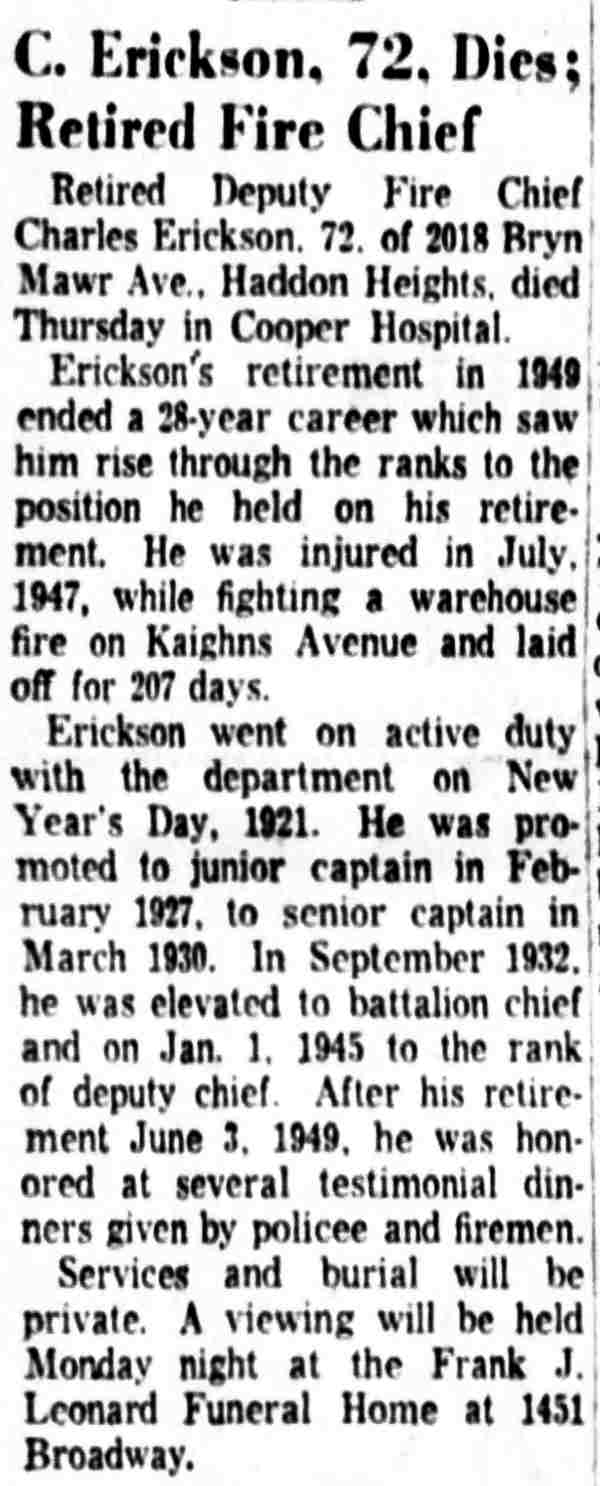
Retired Deputy Fire Chief Charles Erickson, 72, of 2018 Bryn Mawr Ave., Haddon Heights, died Thursday in Cooper Hospital.
Erickson's retirement in 1949 ended a 28-year career which saw him rise through the ranks to the position he held on his retirement. He was injured in July, 1947, while fighting a warehouse fire on Kaighns Avenue and laid off for 207 days.
Erickson went on active duty with the department on New Year's Day, 1921. He was promoted to junior captain in February 1927, to senior captain in March 1930. In September 1932, he was elevated to battalion chief and on Jan. 1, 1945 to the rank of deputy chief. After his retirement June 3, 1949, he was honored at several testimonial dinners given by policee [sic] and firemen.
Services and burial will be private. A viewing will be held Monday night at the Frank J. Leonard Funeral Home at 1451 Broadway.
Interment Record
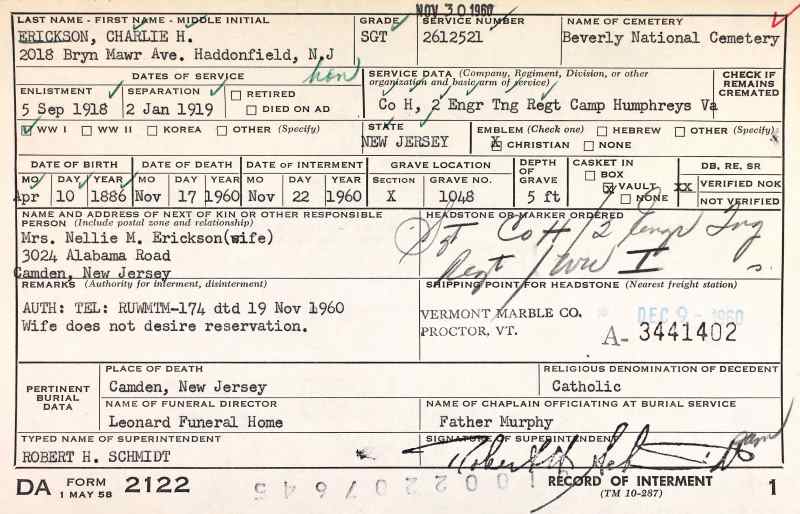
Interment record — Beverly National Cemetery, Beverly, New Jersey
Grave Marker
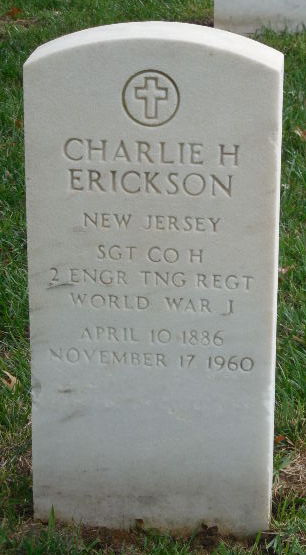
Beverly National Cemetery, Beverly, New Jersey