Introduction
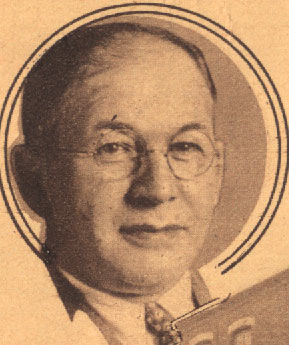
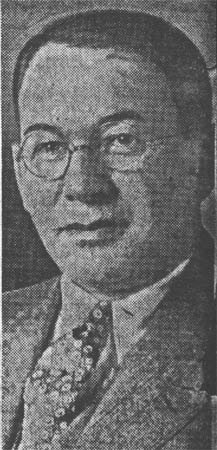
Sigmund “Sig” Schoenagle, 1928 (left) and 1938 (right)
SIGMUND “SIG” SCHOENAGLE was born in Vienna, Austria around 1875. He came to America as a young man, and settled in Camden NJ. In 1894 he established a haberdashery at the southwest corner of 3rd and Federal Streets. He then moved to 538 Federal Street, the corner of Hudson Street and Federal Street, where he conducted business for many years. He also became active in the political and civic life of Camden.
In December of 1904 Sig Schoenagle was a founder and trustee of the Merchants Republican League along with fellow Camden businessmen Joseph H. Pfeiffer, Nathan Fuhrman, Jacob Z. Blank, Louis Cades, and William Fox. The League had its offices at 808 Broadway.
Sigmund Schoenagle had been an investor in the Camden Basketball Association, the parent company of the Camden Electrics in the National Basketball Association, the first professional basketball league. In June of 1905 he sued William “Billy” Morgenweck, who had organized and coached the team. Sig Schoenagle was then involved in promoting bowling in Camden.
In February of 1906 Sig Schoenagle took a trip to visit Washington DC, the purpose of which is not known at this time.
Sig Schoenagle was a charter member of the Rotary Club of Camden. The first regular monthly dinner meeting was held on January 7, 1913, at the Hotel Ridgeway in Camden.
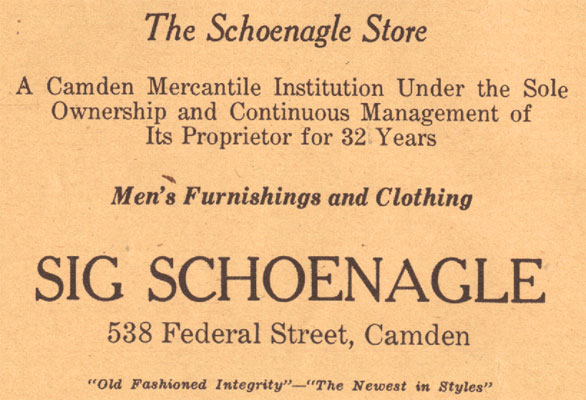
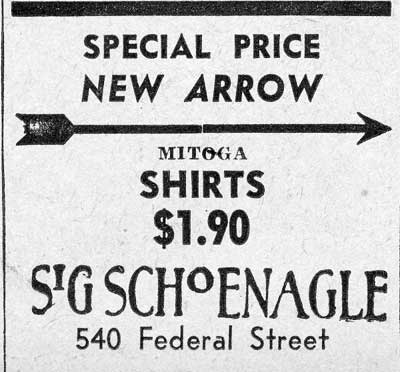
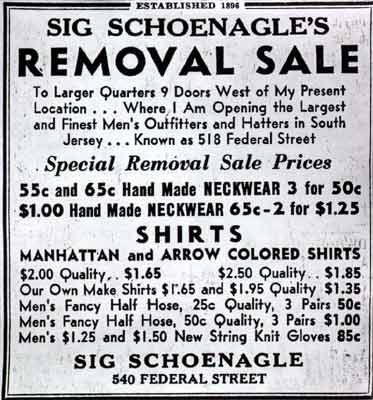
In the early 1920s Sig Schoenagle and his brother William Schoenagle were active participants in the Community Hotel fund raising drive that culminated in the erection of the Walt Whitman Hotel. He placed the advertisement below in the Camden Courier-Post special edition commemorating the opening of the Delaware River Bridge.
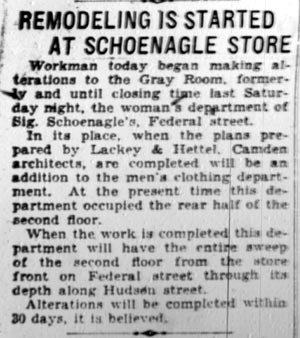
By 1927 he had a building erected at 544–546 Federal Street. Designed by the Camden architectural firm of Lackey & Hettel, the building was known, appropriately enough, as the Schoenagle building. Sig Schoenagle apparently never operated a shop in this building, which was for many years home to the W.T. Grant department store. This building was demolished in the summer of 2003. In 1928 he again employed Lackey & Hettel in the design of alterations to his retail establishment.
Sig Schoenagle was still living and working at 538 Federal Street at the time of the 1930 Census. He moved to 540 Federal Street in 1932, and in early 1938 moved his business once again, this time to 518 Federal Street.
Tragically, Sig Schoenagle took his own life in May of 1940, when he was found hanging in his store at 518 Federal Street. He had been living at 2118 Spring Garden Street in Philadelphia at the time of his death.
The business and building at 518 Federal Street operated as Kline and Gallimore through 1950, and was known as Brait’s Men’s Store in 1959. Sig Schoenagle’s brother, William Schoenagle was in business in Camden for many years, manufacturing store curtains and valances. William Schoenagle passed away in January of 1950.
Camden News Notes
Philadelphia Inquirer —
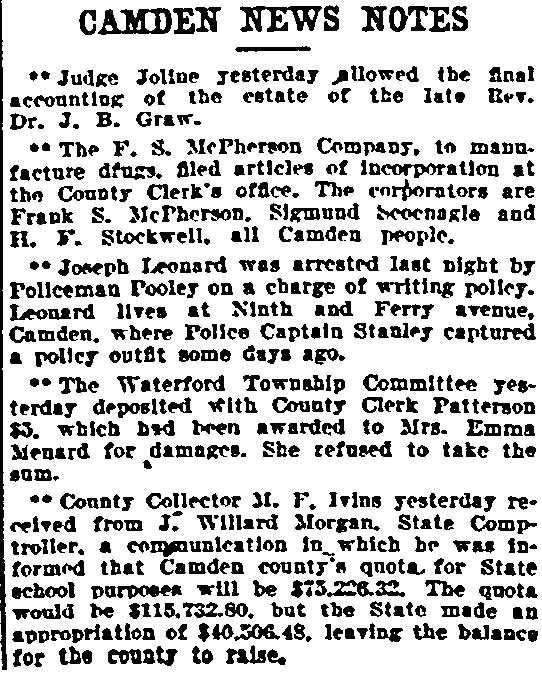
Judge Joline yesterday allowed the final accounting of the estate of the late Rev. Dr. J. B. Graw.
The F. S. McPherson Company, to manufacture drugs, filed articles of incorporation at the County Clerk’s office. The corporators are Frank S. McPherson, Sigmund Sceonagle [sic] and H. F. Stockwell, all Camden people.
Joseph Leonard was arrested last night by Policeman Pooley on a charge of writing policy. Leonard lives at Ninth and Ferry avenue, Camden, where Police Captain Stanley captured a policy outfit some days ago.
The Waterford Township Committee yesterday deposited with County Clerk Patterson $3, which had been awarded to Mrs. Emma Menard for damages. She refused to take the sum.
County Collector M. F. Ivins yesterday received from J. Willard Morgan, State Comptroller, a communication in which he was informed that Camden county’s quota for State school purposes will be $75,226.32. The quota would be $115,732.80, but the State made an appropriation of $40,506.48, leaving the balance for the county to raise.
The Merchants’ Republican League
Trenton Times —
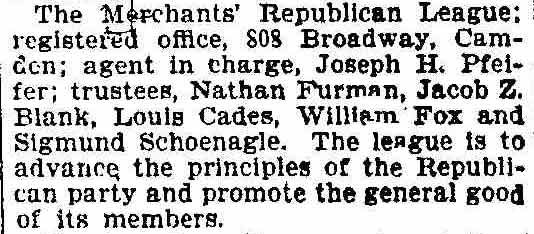
Trenton Times, December 20, 1904. Merchants Republican League, founded December 1904.
Wm. Morgenweck Is Accused of Fraud in Basketball Sale
Trenton Times —
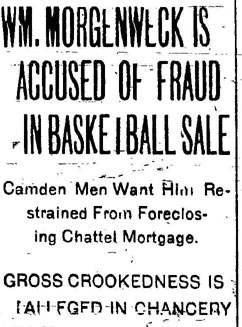
Camden Men Want Him Restrained From Foreclosing Chattel Mortgage.
GROSS CROOKEDNESS IS ALLEGED IN CHANCERY
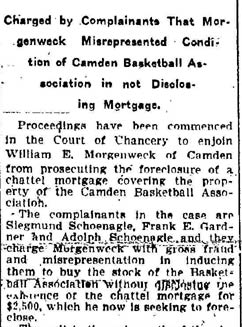
Charged by Complainants That Morgenweck Misrepresented Condition of Camden Basketball Association in not Disclosing Mortgage.
Proceedings have been commenced in the Court of Chancery to enjoin William E. Morgenweck of Camden from prosecuting the foreclosure of a chattel mortgage covering the property of the Camden Basketball Association.
The complainants in the case are Siegmund Schoenagle, Frank E. Gardner and Adolph Schoenagle, and they charge Morgenweck with gross fraud and misrepresentation in inducing them to buy the stock of the Basketball Association without disclosing the existence of the chattel mortgage for $2,500, which he now is seeking to foreclose.
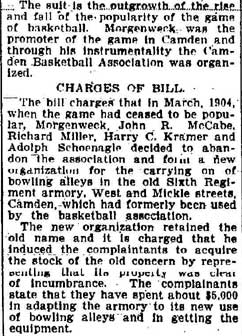
The suit is the outgrowth of the rise and fall of the popularity of the game of basketball. Morgenweck was the promoter of the game in Camden and through his instrumentality the Camden Basketball Association was organized.
CHARGES OF BILL
The bill charges that in March, 1904, when the game had ceased to be popular, Morgenweck, John R. McCabe, Richard Miller, Harry C. Kramer and Adolph Schoenagle decided to abandon the association and form a new organization for the carrying on of bowling alleys in the old Sixth Regiment armory, West and Mickle streets, Camden, which had formerly been used by the basketball association.
The new organization retained the old name and it is charged that he induced the complainants to acquire the stock of the old concern by representing that its property was clear of incumbrance. The complainants state that they have spent about $5,000 in adapting the armory to its new use of bowling alleys and in getting the equipment.
Camden Memorial Day Committee
Philadelphia Inquirer —
In order that Camden veterans may have an elaborate celebration on Memorial Day, Mayor Ellis yesterday appointed the following committee of citizens to act in conjunction with them: William D. Vanaman, William Sangtinette, Frank W. Tussey, William Fox, Dr. J.W. Martindale, Walter L Tushingham, Ira E. Lutte, Harry C. Kramer, John W. Coleman, Bernhard Schroeder, Edward H. Nieland, Daniel M. Stevens, W.F. Powell, Abe Fuhrman, Jacob Neutze, Francis B. Wallen, Charles A. Ackley, Louis T. Derousse, James M. Bentley, John K. Newkirk, William Schmid, John Larsen, Sigismund Schoenagle, Charles M. Baldwin, and Harry A Whaland.
Camden Will Observe Decoration Day
Philadelphia Inquirer —
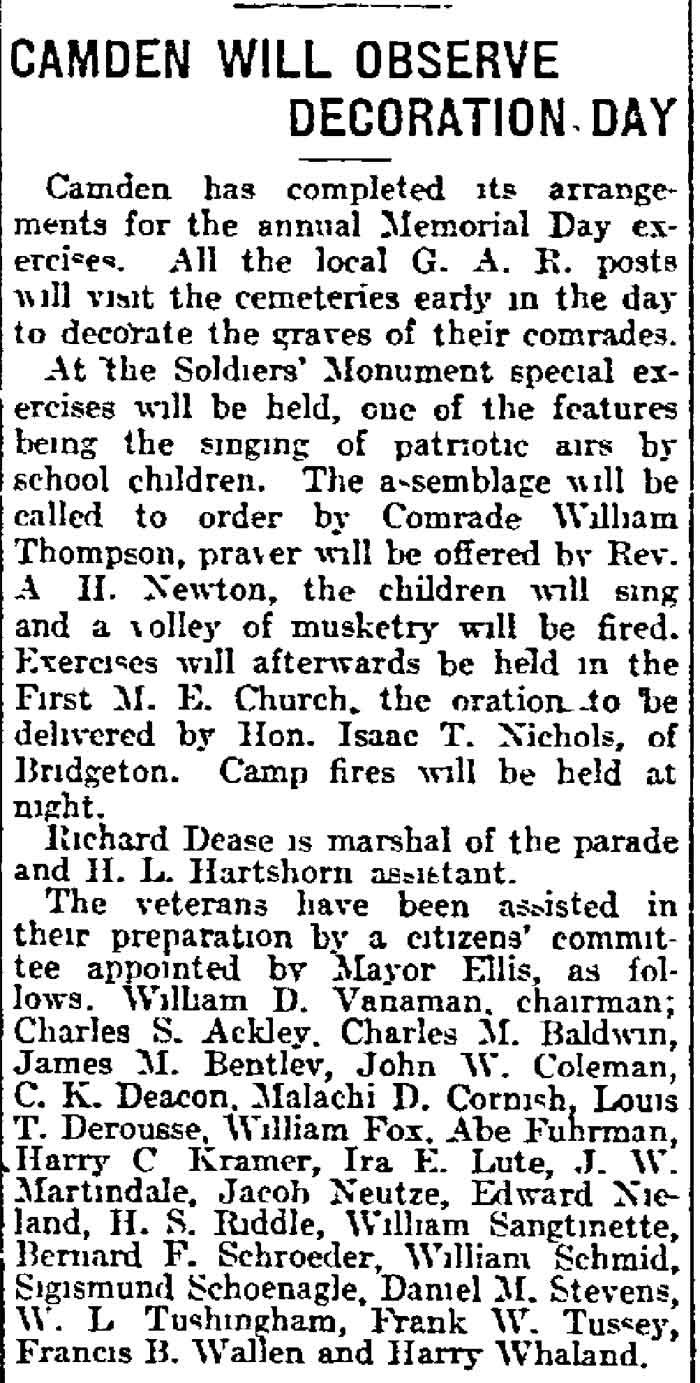
Camden has completed its arrangements for the annual Memorial Day exercises. All the local G. A. R. posts will visit the cemeteries early in the day to decorate the graves of their comrades.
At the Soldiers’ Monument special exercises will be held, one of the features being the singing of patriotic airs by school children. The assemblage will be called to order by Comrade William Thompson, prayer will be offered by Rev. A. H. Newton, the children will sing and a volley of musketry will be fired. Exercises will afterwards be held in the First M. E. Church, the oration to be delivered by Hon. Isaac T. Nichols, of Bridgeton. Camp fires will be held at night.
Richard Dease is marshal of the parade and H. L. Hartshorn assistant.
The veterans have been assisted in their preparation by a citizens’ committee appointed by Mayor Ellis, as follows. William D. Vanaman, chairman; Charles S. Ackley, Charles M. Baldwin, James M. Bentley, John W. Coleman, C. K. Deacon, Malachi D. Cornish, Louis T. Derousse, William Fox, Abe Fuhrman, Harry C. Kramer, Ira E. Lute, J. W. Martindale, Jacob Neutze, Edward Nieland, H. S. Riddle, William Sangtinette, Bernard F. Schroeder, William Schmid, Sigismund Schoenagle, Daniel M. Stevens, W. L. Tushingham, Frank W. Tussey, Francis B. Wallen and Harry Whaland.
Camden Hebrews Desire Building
Philadelphia Inquirer —
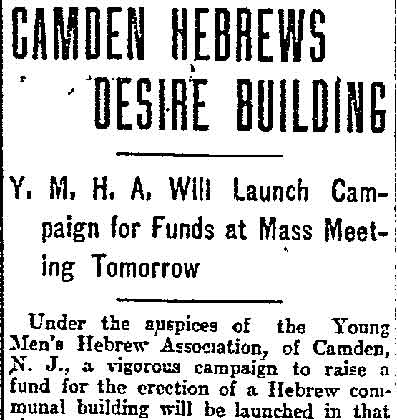
Y. M. H. A. Will Launch Campaign for Funds at Mass Meeting Tomorrow
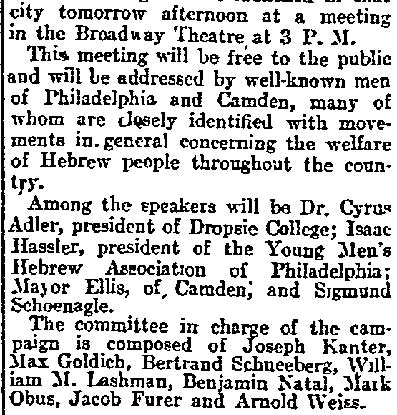
Under the auspices of the Young Men’s Hebrew Association, of Camden, N. J., a vigorous campaign to raise a fund for the erection of a Hebrew communal building will be launched in that city tomorrow afternoon at a meeting in the Broadway Theatre at 3 P. M. This meeting will be free to the public and will be addressed by well-known men of Philadelphia and Camden, many of whom are closely identified with movements in general concerning the welfare of Hebrew people throughout the country.
Among the speakers will be Dr. Cyrus Adler, president of Dropsie College; Isaac Hassler, president of the Young Men’s Hebrew Association of Philadelphia; Mayor Ellis, of Camden; and Sigmund Schoenagle.
The committee in charge of the campaign is composed of Joseph Kanter, Max Goldich, Bertrand Schneeberg, William M. Lashman, Benjamin Natal, Mark Obus, Jacob Furer and Arnold Weiss.
Burglar Sentenced for Schoenagle Store Break-In
Philadelphia Inquirer —
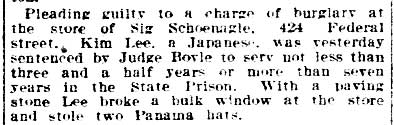
Philadelphia Inquirer, June 27, 1914. Sig Schoenagle – Federal Street – William T. Boyle
Camden at a Glance
Philadelphia Inquirer —
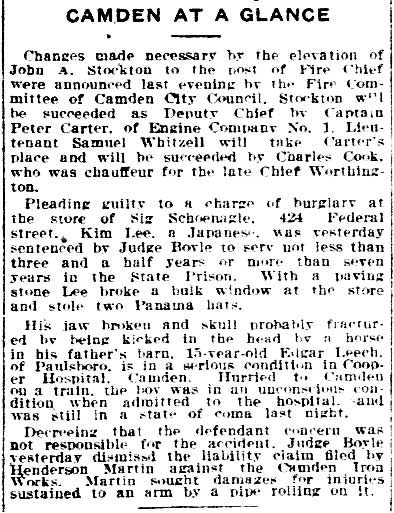
Changes made necessary by the elevation of John A. Stockton to the post of Fire Chief were announced last evening by the Fire Committee of Camden City Council. Stockton will be succeeded as Deputy Chief by Captain Peter Carter, of Engine Company No. 1. Lieutenant Samuel Whitzell will take Carter’s place and will be succeeded by Charles Cook, who was chauffeur for the late Chief Worthington.
Pleading guilty to a charge of burglary at the store of Sig Schoenagle, 424 Federal street, Kim Lee, a Japanese, was yesterday sentenced by Judge Boyle to serve not less than three and a half years or more than seven years in the State Prison. With a paving stone Lee broke a bulk window at the store and stole two Panama hats.
His jaw broken and skull probably fractured by being kicked in the head by a horse in his father’s barn, 15-year-old Edgar Leech, of Paulsboro, is in a serious condition in Cooper Hospital, Camden. Hurried to Camden on a train, the boy was in an unconscious condition when admitted to the hospital, and was still in a state of coma last night.
Decreeing that the defendant concern was not responsible for the accident, Judge Boyle yesterday dismissed the liability claim filed by Henderson Martin against the Camden Iron Works. Martin sought damages for injuries sustained to an arm by a pipe rolling on it.
Communal Building Planned
Philadelphia Inquirer —
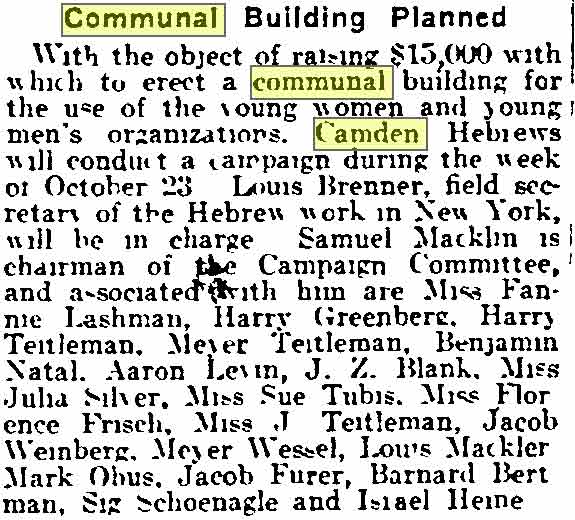
With the object of raising $15,000 with which to erect a communal building for the use of the young women and young men’s organizations, Camden Hebrews will conduct a campaign during the week of October 23. Louis Brenner, field secretary of the Hebrew work in New York, will be in charge. Samuel Macklin is chairman of the Campaign Committee, and associated with him are Miss Fannie Lashman, Harry Greenberg, Harry Teitelman, Meyer Teitelman, Benjamin Natal, Aaron Levin, J. Z. Blank, Miss Julia Silver, Miss Sue Tubis, Miss Florence Frisch, Miss J. Teitelman, Jacob Weinberg, Meyer Wessel, Louis Mackler, Mark Obus, Jacob Furer, Barnard Bertman, Sig Schoenagle and Israel Heine.
Camden Trade Expo
1918
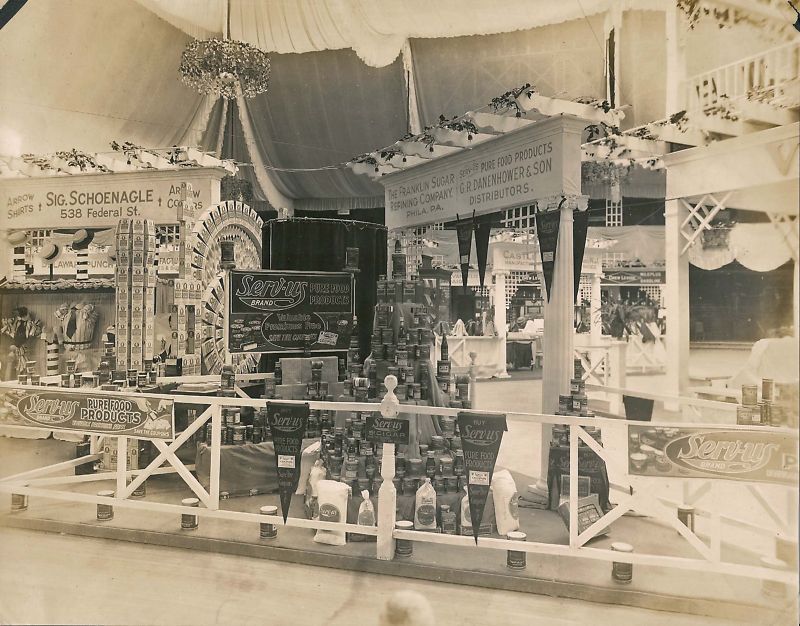
Camden Trade Expo, 1918. Sig Schoenagle – George R. Danenhower
Camden Hebrews Form B’nai B’rith Lodge
Philadelphia Inquirer —
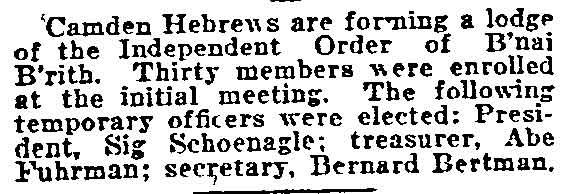
Camden Hebrews are forming a lodge of the Independent Order of B'nai B'rith. Thirty members were enrolled at the initial meeting. The following temporary officers were elected: President, Sig Schoenagle; treasurer, Abe Fuhrman; secretary, Bernard Bertman.
Advertisement
Camden Courier-Post —
Remodeling Is Started at Schoenagle Store
Camden Courier-Post —
Phila. Rabbi Urges Freedom for Youth
Camden Courier-Post —
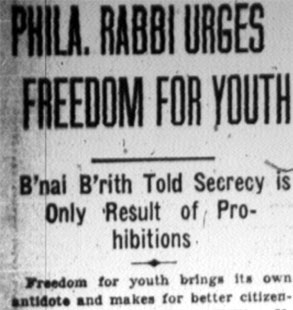
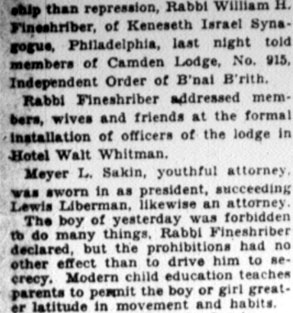
B’nai B’rith Told Secrecy is Only Result of Prohibitions
Freedom for youth brings its own antidote and makes for better citizenship than repression, Rabbi William H. Fineshriber, of Keneseth Israel Synagogue, Philadelphia, last night told members of Camden Lodge, No. 915, Independent Order of B’nai B’rith.
Rabbi Fineshriber addressed members, wives and friends at the formal installation of officers of the lodge in Hotel Walt Whitman.
Meyer L. Sakin, youthful attorney, was sworn in as president, succeeding Lewis Liberman, likewise an attorney.
The boy of yesterday was forbidden to do many things, Rabbi Fineshriber declared, but the prohibitions had no other effect than to drive him to secrecy. Modern child education teaches parents to permit the boy or girl greater latitude in movement and habits.
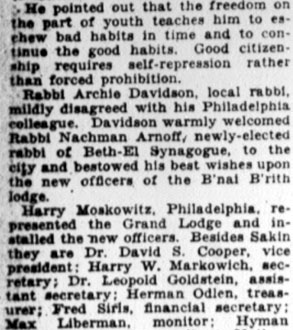
He pointed out that the freedom on the part of youth teaches him to eschew bad habits in time and to continue the good habits. Good citizenship requires self-repression rather than forced prohibition.
Rabbi Archie Davidson, local rabbi, mildly disagreed with his Philadelphia colleague. Davidson warmly welcomed Rabbi Nachman Arnoff, newly-elected rabbi of Beth-El Synagogue, to the city and bestowed his best wishes upon the new officers of the B’nai B’rith lodge.
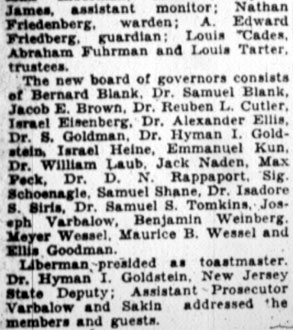
Harry Moskowitz, Philadelphia, represented the Grand Lodge and installed the new officers. Besides Sakin they are Dr. David S. Cooper, vice president; Harry W. Markowich, secretary; Dr. Leopold Goldstein, assistant secretary; Herman Odlen, treasurer; Fred Siris, financial secretary; Max Liberman, monitor; Hyman James, assistant monitor; Nathan Friedenberg, warden; A. Edward Friedberg, guardian; Louis Cades, Abraham Fuhrman and Louis Tarter, trustees.
The new board of governors consists of Bernard Blank, Dr. Samuel Blank, Jacob E. Brown, Dr. Reuben L. Cutler, Israel Eisenberg, Dr. Alexander Ellis, Dr. S. Goldman, Dr. Hyman I. Goldstein, Israel Heine, Emmanuel Kun, Dr. William Laub, Jack Naden, Max Peck, Dr. D. N. Rappaport, Sig. Schoenagle, Samuel Shane, Dr. Isadore S. Siris, Dr. Samuel S. Tomkins, Joseph Varbalow, Benjamin Weinberg, Meyer Wessel, Maurice B. Wessel and Ellis Goodman.
Liberman presided as toastmaster. Dr. Hyman I. Goldstein, New Jersey State Deputy; Assistant Prosecutor Varbalow and Sakin addressed the members and guests.
BAIRD TO ADDRESS HEBREW LEAGUE
Camden Courier-Post —
David Baird, Jr., Republican nominee for governor, will make his final appearance in the current election campaign Monday night, in his “own home town,” when he will address a monster rally at the Hebrew Republican League, at the Talmud Torah, 621 Kaighn avenue.
The Hebrew league reorganized formally at a luncheon in the Hotel Walt Whitman. Lewis Liberman, assistant city solicitor, was elected president; Sig Schoenagle, Samuel Shaner, Israel Weitzman, vice-presidents; L. Scott Cherchesky, secretary, and Samuel Label, treasurer.
Trustees of the league include Hyman Bloom, Mitchell E. Cohen, Benjamin Friedman, Jacob L. Furer, Isadore H. Hermann, Carl Kisselman, Edward Markowitz, Louis L. Markowitz, Harry Obus, Maurice L. Praissman, Samuel Richelson, Meyer L. Sakin, Julius Rosenberg, Jacob Rosenkrantz and Jack Weinberg.
In addition to former Senator Baird, speakers at the Jewish rally will include Mrs. Elizabeth C. Verga, Republican state committeewoman and vice chairman of the county committee; Congressman Charles A. Wolverton, Congressman Benjamin Golder, of Pennsylvania, and State Senator Samuel Salus, of Pennsylvania.
538 Federal Bought for Linton Restaurant
Camden Courier-Post —
538 FEDERAL BOUGHT FOR LINTON RESTAURANT
Purchase of the three-story building at 538 Federal street for $40,000 was announced yesterday by Lionel Freeman. Inc., representing Linton’s Lunch. The purchase was made from William M. Flinn Realty Co., Inc., agents for the Prudential Insurance Company of America.
Linton’s has engaged Israel Demchick, architect, to make plans for a restaurant there, it was said. The building formerly was occupied by Sig Schoenagle.
BARDO TO APPOINT N.R.A. COMMITTEES
Camden Courier-Post —
Drive in Camden County Forges Ahead as More Firms Sign
The N.R.A. recovery drive in the Camden area forged ahead on three fronts yesterday.
Clinton L. Bardo, president of the New York Shipbuilding Company, was appointed chairman of the N.R.A. campaign committee for Camden city and county.
Two hundred and eight additional employers in Camden and vicinity pledged their aid to the drive yesterday by signing N.R.A. certificates of compliance at Camden post office.
Thirty Camden merchants met at Hotel Walt Whitman to organize a retail division of the Camden County Chamber of Commerce with the hope that a united front will better enable retailers to protest non-cooperation of N.R.A. merchants or any situation created whereby specific codes might harm one or more businesses in the city.
The total number of N.R.A. employers in the Camden area is now 1342. Among the firms signing the recovery pledge yesterday were the Progressive Garment Company, 60 employees; S. J. Huntzinger Company, 20; Sinnickson Chew and Sons Company, 16; American National Health and Accident Association, 15, and New Sanitary Laundry, 14.
Bardo Is Named
Other members of the N.R.A. campaign committee will be named by Bardo, he announced, in time to participate in their first meeting Friday at 3 p. m. in the offices of the Camden County Chamber of Commerce in Broadway-Stevens Building.
The committee of public, civic and industrial officials was requested to be formed by Gen. Hugh S. Johnson, National Recovery Act administrator, in a telegram to Loyal D. Odhner, chamber executive secretary, several weeks ago.
The purpose of the committee, Odhner explained, is to make a city, and county-wide canvass of all industries and stores to discover whether they have signed the pledge. Furthermore they will also canvass the neighborhoods to determine if possible whether re-employment of men and women out of work is going on as rapidly as expected by N.R.A. officials.
The offer of the merchants to organize a retail division for the local Chamber of Commerce was made in a resolution which will be presented immediately to the board of directors of the chamber for action. Sig Schoenagle, president of the Central Association of Merchants of Camden, presided at the meeting.
Merchants Explain Hours
Considerable discussion developed over the limitation of retail store hours as provided in the President’s recovery agreement. S. Lester and Joseph Fuhrman, Broadway merchants, declared some smaller stores were under the impression they could not remain open beyond the 52 hours prescribed as minimum and at the same time justify display of the “Blue Eagle” symbol.
Both of these merchants said there were no restrictions under the recovery act other than a statement that a store must not operate less than 52 hours and further provided any store did not work its employees more than 40 hours a week.
Opening for longer than the minimum number of hours set forth in the recovery act, in their opinion, was thoroughly in harmony with the President’s drive since it would create work for more people to complete all store service over and above the minimum of 52 hours.
“Many of the smaller stores,” said Lester, “have for years extended service beyond the minimum of 52 hours. Many of their customers live outside the city and are used to these long-established hours of service. It would be not only a hardship to reduce suddenly these hours of service, but it would also keep out of employment extra help that will be needed for the extra hours.”
Retail Code Outlined
Odhner in response to several Camden merchants as to the statement he would make covering the N.R.A. regulations, said:
“A merchant in order to display a ‘Blue Eagle’ must pay his employees not less than the minimum wage prescribed by the code.
“Nor must he keep his store open less than the minimum hours prescribed by the code.
“All agreements between merchants of various communities regarding opening and closing hours are purely voluntary and are not required by the code.
“If those agreements on opening and closing hours are designed either to cut down the number of workers in the stores or to avoid taking on additional employees, then these agreements are a direct violation of the spirit of the code.
“If on the other hand these agreements are made to eliminate a chaotic condition in the trade and will result in the hiring of additional employees and in increased wages, they are within the spirit of the act and should be supported.”
Advertisement
Camden Courier-Post —
Advertisement
Camden Courier-Post —
Schoenagle Opens New Store After 42 Years in Business
Camden Courier-Post —
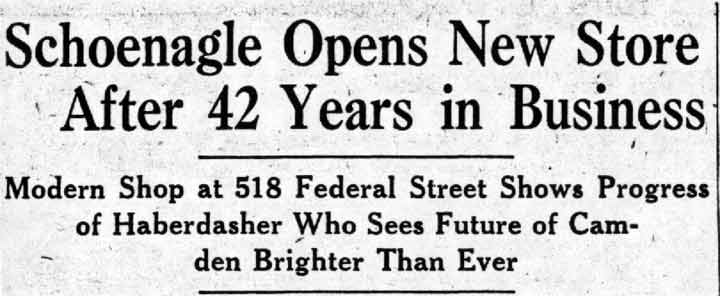
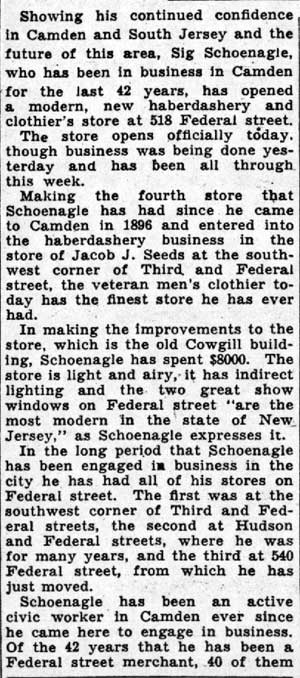
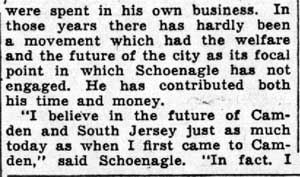
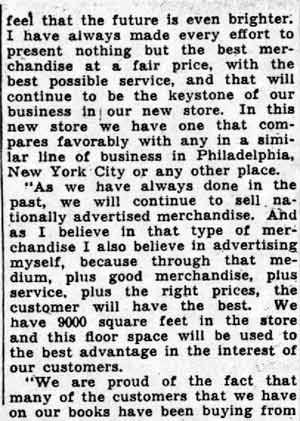
Camden Courier-Post, January 28, 1938. Sig Schoenagle – Walt Whitman Hotel. “…community effort for the erection of the Hotel Walt Whitman 14 years ago, Schoenagle took a leading part.”
Schoenagle Opens New Clothing Store
Camden Courier-Post —
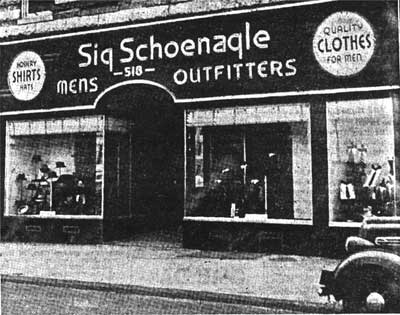
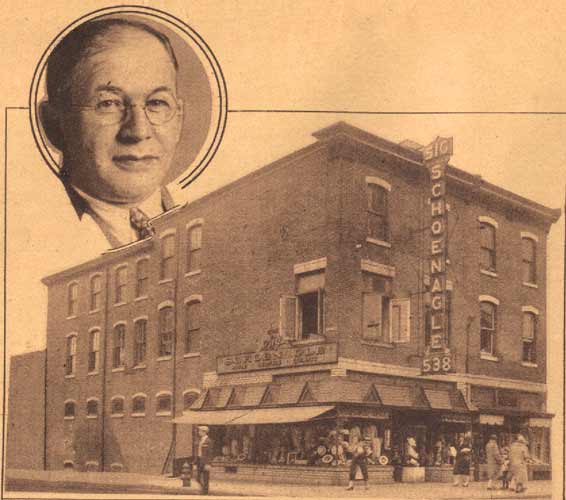
Photo above shows the new haberdashery and clothing store of Sig Schoenagle at 518 Federal Street, which opened officially yesterday. Schoenagle, who has been in business in Camden for 42 years, all of the business years spent on Federal Street, is shown on the right. “I believe in the future of Camden and South Jersey just as much today as when I first came to Camden.” observed the veteran merchant and civic worker, who has been in the forefront of every movement designed to help Camden and South Jersey. “In fact, I feel that the future is even brighter,” he added. The new store, which compares favorably with any store in any larger city, has 9000 square feet of floor space.
INQUEST SET TODAY IN GAMBLING DEATH
Camden Courier-Post —
Jury List Prepared for Coroner’s Action in Holdup Fatality
The coroner’s inquest to decide the cause of death to Angelos Magalas, Greek chef, who was shot during a card game holdup at 725 Penn Street on January 11, will be held today at 10 a. m.
Coroner Franklin P. Jackson III, of Collingswood, will conduct the inquest and will select his jury of 12 from a list of 15 persons prepared by the office of County Prosecutor Samuel P. Orlando.
Detectives already have subpoenaed 20 witnesses for questioning at the inquest, including players who were the victims in the holdup and three Camden physicians who attended Magalas prior to his death.
The witnesses will include Samuel and Mabel Ermilios, tenants of the Penn Street house where the holdup occurred; George and Annette Mastros, who room at the house; Samuel Bosco, Broadway barber; George Summers, Ross Pantel, Michael D’Andrea, and William Caras, who according to police were participants in the card game.
All of the men were held as material witnesses in the shooting when arraigned today before Police Judge Gene R. Mariano.
Doctors to Testify
Other witnesses will include Dr. Paul Mecray, Dr. A. S. Ross and Dr. Edwin R. Ristine and Miss Sophia MacAfee, a Cooper Hospital nurse. Police who will testify include Detectives Thomas Murphy, Harry Kyler and William Boettcher and Patrolmen Richard Powers, Frank Clements, George Nicktern and Sergeant Jack Deith.
The jury will be selected from Guy Clokey, Collingswood; Lawrence Ball, Haddonfield; Howard Friant, Collingswood; Harry Chew, Collingswood; Sig Schoenagle, Camden merchant; Raymond Hanly, real estate broker; Benjamin Brest, Raymond Worrel, John Eby, all of Camden; William H. Lorigan, Merchantville; David B. Robinson, Collingswood; Rev. James Pemberton and John McGowan, of Camden, Earl Jackson, of Collingswood and Morris B. Clark, of Haddonfield.
Coroner Jackson refused to give a certificate of death until the chemical test of Magalas’ brain was made by Philadelphia experts. The result will not be revealed until the inquest.
Assistant Prosecutor Isaac Eason and County Physician David S. Rhone gave it as their opinion that Malagas died of natural causes rather than the bullet wound. Coroner Jackson then ordered an inquest to be held.
Police are searching for Frank Luggi, 21, of 322 Penn Street, who they say was one of the holdup bandits and the one who fired the bullet that struck Magalas.
The last coroner’s inquest held in Camden county was in 1933, in the death of Thomas Timothy Sullivan, and previous to that none had been held here in 25 years.
Sullivan was 57 years old and lived at 401 State Street. He was employed as a detective by the Pennsylvania Railroad. He was found shot to death in a shack in the rail road yards on August 28, 1933.
At that time, County Physician Edward B. Rogers issued a certificate of death that Sullivan had committed suicide. The decision of the county physician enraged members of Sullivan’s family and they demanded an inquest.
The inquest was ordered by then Coroner Arthur H. Holl, who presided. All the evidence in the case was presented to the jury of 12 men, and after deliberating for less than an hour, they returned a verdict that Sullivan had been murdered by persons unknown.
Under state law, the county physician may order an inquest; with 12 persons on the jury of the coroner’s choosing. The jurymen may be taken from the present panel of the petit jury or be picked at random. The Grand Jury does not have to indict on the basis of the inquest. At the inquest Coroner Jackson will be assisted by attaches of the prosecutor’s office.
Malagas, the father of three children, lived at 1110 Langham Avenue. He was shot when several armed bandits held up a card game and he died several days later.
Is Zat So!
Camden Courier-Post —
Two substantial and thoughtful citizens of Camden were discussing the peculiarities and oddities of circumstantial evidence in the presence of the writer the other day. One of them was Sig Schoenagle, the other Pat Harding, assistant county prosecutor.
Neither rejected circumstantial evidence as holeproof, nor did they accept it as inconsequential. There was much to be said on both sides, they agreed.
Finally to point a moral and adorn a tale, Merchant Schoenagle related the story which follows, which is good enough to pass on to others who may read this column.
“When I was a young fellow in Philadelphia,” said Sig, “I was interested in a certain young woman who lived in the neighborhood where I worked. Her father had a leather finding store on the ground floor of the building while the family resided in the rooms upstairs.
“Several blocks away was another store, the rooms above, being rented to boarders and lodgers. One night while I was calling on the young woman and we were sitting, in the parlor the rear of the second floor was visited by a burglar.
“He escaped with considerable loot including all the young woman’s jewelry. We didn’t hear a sound yet the burglary must have been committed while we were sitting in the parlor. It wasn’t discovered, either, until the next day.
“The young woman informed me of the burglary. I suggested that she give me a list of the articles stolen. I knew the pawnbrokers in the neighborhood and I told her I would give each of them a list for them to be on the watch for the goods and learn who pawned them.
LOCATED LOOT IN ODD MANNER
“I did this. The pawnbrokers agreed, to watch for any disposition of the stuff that might come to their attention. Months passed, not a sign of the gems could be found, nor the least intimation as to any disposition that might have been made of them.
“One of the boarders in the other building to which I have referred, was a young fellow, good looking; who appeared to have no business, yet acted in no way suspicious. He seemed to be modest in his manner of living, made no splurge and appeared to have enough money to live according to tastes that appeared simple.
“August 4 is my birthday. On that day I was standing in front of the store beneath the boarding house, talking to the proprietor and this nice-looking young fellow to whom I have already referred.
‘Today is my birthday,’ I told the shopkeeper, ‘and tonight you and I will celebrate.’ The good looking fellow said then: ‘You seem to be a pretty good sort of fellow. I think I should make you a present on your birthday; I’ve got some stuff upstairs,’ come ahead up and I’ll give you a present.’
“I went along,” narrated Schoenagle; “and we went into his room. He went to a trunk he had there and opened it. He took out a handkerchief all knotted together and when he untied the knots he showed me a bunch of jewelry. It was my girl’s gems. I almost keeled over when I saw them but I managed to keep my head. ‘Go ahead,’ the good-looking fellow said to me: ‘pick out anything you like for a present.’ I made the usual pretense of not wanting any gift, just to keep him from being suspicious. He insisted, though, that I take something. Finally I chose a little ring and put it in my pocket.
“When I left the fellow I went straight to my girl’s house. I showed her the ring and asked her if she recognized it.
SHE RECOGNIZES OWN JEWEL
“‘Why,’ she said, ‘that’s my ring!’ I told her I was sure she was right, then up and gave her the whole story. She suggested that we notify the police at once. Right away I considered the situation. Suppose the police should believe that I was in on the job, had really ‘fingered’ the job for the thief? Wouldn’t that put me in a nice jam, especially if the good looking fellow should name me as an accomplice?
“I explained this plight of mine to my girl. She had the good sense to see my point. ‘I’ll tell you what we will do,’ I suggested. ‘I’ll go to the fellow, tell him he has your jewels and say to him that if he will return the stuff we’ll keep quiet about the whole business. After all, the main thing is to get back the jewels, isn’t it?’
“That’s right,’ my girl said, ‘you do just that very thing.’ I went back to the good-looking fellow and told him the whole circumstances. ‘That stuff belongs to my girl,’ I said. ‘I don’t know how you got it, or why you have it, or anything else. I don’t care. I don’t want to appear in any false light, and suspicious persons might put me in just that position if a call is made to the police. Put back the stuff and get yourself out of a jam that you certainly are in, and get me out of one that I might innocently find myself in.’
“He was a pretty good scout, at that. ‘I see your point,’ he said, ‘and I don’t want to put you in any jam, whatsoever. I’ll give the stuff to you and you return it to the girl.’ He rolled up every article in that handkerchief again and I brought it back to my girl and nobody ever was the wiser.”
“I found out later that he was a notorious fence for all the thieves who frequented the Tenderloin. The police believed sometimes he went on such jobs himself. I don’t know whether he stole the stuff or whether he was holding it to sell in some other place, after the heat had died down. A friend of mine in the police department told me sometime afterward that the good-looking fellow was killed while robbing a hotel in Pittsburgh.”
“And so, Pat,” smiled Sig, “you can see one case where circumstantial evidence might have been pretty tough on a fellow named Sig Schoenagle.”