Introduction
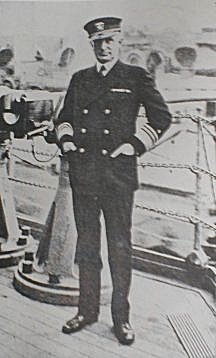
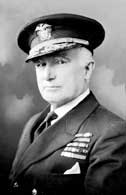
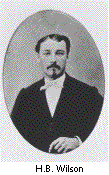
Henry Braid Wilson Jr. was born on Mount Vernon Street in Camden, New Jersey on February 23, 1861 to Henry Braid Wilson Sr. and his wife Mary Ann. His father was a prominent citizen in Camden, a successful businessman who served on City Council, on the Commission of Public Instruction, the precursor of the city Board of Education, and as Postmaster for Camden at different times.
Henry Wilson Jr. enrolled at the United States Naval Academy at the age of 15, and graduated in 1881. He soon began his illustrious Navy career, first as a training officer for apprentices, then serving in the West Indies, Bering Sea, Pacific Ocean and the Great Lakes. Wilson saw action in the Spanish-American War as a lieutenant, and was “highly commended for coolness and bravery,” says a newspaper account.
In 1916, he was assigned to the command of the USS Pennsylvania, flagship of the commander-in-chief of the Atlantic Fleet.
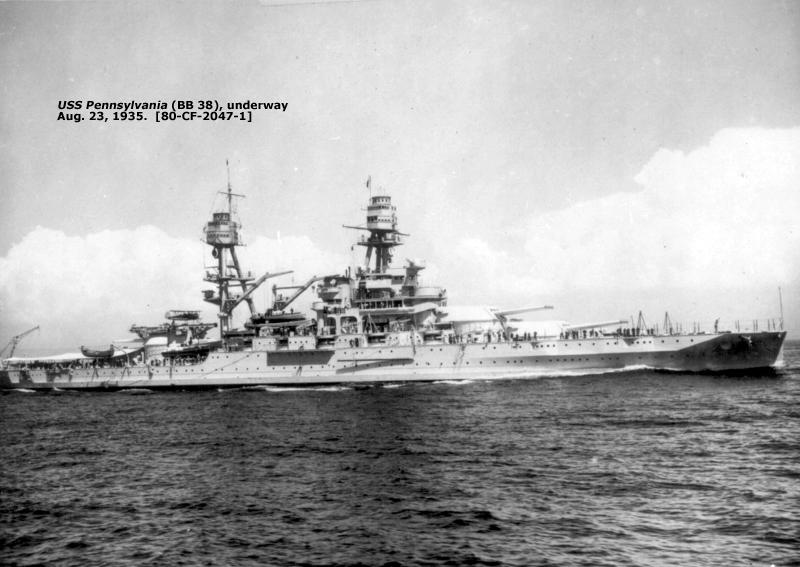
USS Pennsylvania BB-38
In April of 1917, when America entered World War I, he was made commander of the American fleet in French waters. Admiral Wilson convoyed troops and supplies to France during the war without the loss of a single life.
For his “outstanding wartime services, Admiral Wilson was awarded the Distinguished Service Medal, the Grand Officer of the Legion of Honor of France, Commander of the Order of St. Maurice and St. Lazarus of Italy and the Grand Official of the Military Order of Avia of Portugal,” the newspaper account says. In 1919, Wilson was given command of the Atlantic Fleet.
In April 1919, Camden welcomed Admiral Henry B. Wilson to the city with receptions, motorcades, planked shad dinner, and a reception at the Third Regiment Armory. Prosecutor Charles A. Wolverton, later a 16-term Congressman from Camden, addressed the banquet gathering. “It was a Camden officer, in the person of Admiral Wilson, who taught the Kaiser and his war lords that there is no such word as ‘impossible’ to be found in all the historic records of the American Navy.”
Admiral Wilson served as the commandant of the United States Naval Academy from 1921 through 1925. His final rank was that of Rear Admiral. He retired, first to California, and then to New York.
In November of 1929 he again returned to Camden, for the Armistice Day celebration. It was then when the newly constructed Bridge Boulevard, which ran from the Delaware River Bridge to the Airport Circle in Pennsauken, was renamed the Admiral Wilson Boulevard.
Admiral Wilson and his wife Ada were living in Philadelphia at the time of the 1930 Census. He passed away on January 30, 1954.
Admiral Wilson’s brother, Phillip Wilson, became president of the Central Trust Bank, and was later a vice-president at Camden Trust. Phillip’s wife, the former Emma Foulon, was the daughter of Charles Foulon who founded a bakery in the 1880s at 524 Federal Street. After her father’s death in 1905, Emma’s brother, also named Charles Foulon, operated the business, which also included an ice cream parlor, for many years.
Lieutenant Wilson on Leave
Philadelphia Inquirer —
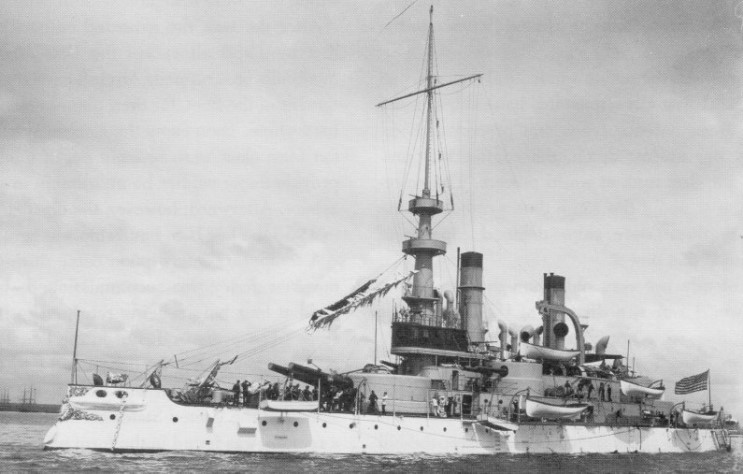
Lieutenant Henry B. Wilson, of the battleship Indiana, is home on a brief leave of absence.
Admiral Wilson During World War I
History of Camden County in the Great War, 1917-1918
Navy Department, Washington, D.C.
1919
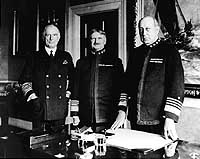
Admiral Henry B. Wilson, USN, Commander in Chief, Atlantic Fleet; Admiral Robert E. Coontz, USN, Chief of Naval Operations; & Admiral Hugh Rodman, USN, Commander in Chief, Pacific Fleet (listed from left to right).
Camden Hails Her Sons, Conquerors, at Victory Jubilee
Philadelphia Inquirer —
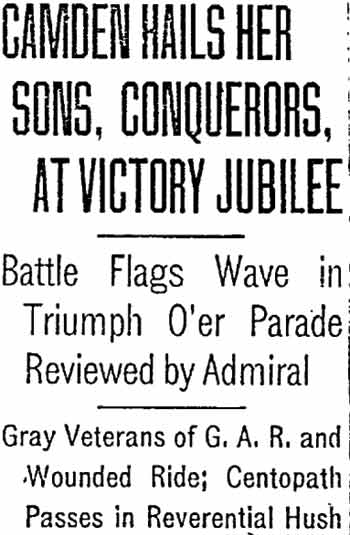
Battle Flags Wave in Triumph O’er Parade Reviewed by Admiral
Gray Veterans of G. A. R. and Wounded Ride; Centopath Passes in Reverential Hush
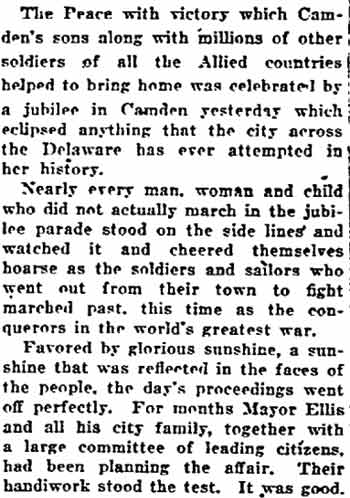
The Peace with victory which Camden’s sons along with millions of other soldiers of all the Allied countries helped to bring home was celebrated by a jubilee in Camden yesterday which eclipsed anything that the city across the Delaware has ever attempted in her history.
Nearly every man, woman and child who did not actually march in the jubilee parade stood on the side lines and watched it and cheered themselves hoarse as the soldiers and sailors who went out from their town to fight marched past, this time as the conquerors in the world’s greatest war.
Favored by glorious sunshine, a sunshine that was reflected in the faces of the people, the day’s proceedings went off perfectly. For months Mayor Ellis and all his city family, together with a large committee of leading citizens, had been planning the affair. Their handiwork stood the test. It was good.
Admiral Henry Wilson, commander-in-chief of the Atlantic Fleet, came to his boyhood home to be the principal guest of the city and chief reviewing officer of the jubilee. With him were national statesmen and municipal officials.
Soldiers, sailors, war workers, members of fraternal orders and men who fought under the flags of Canada, England, Italy and Poland, marched in the parade which was miles long. Every succeeding division seemed just a little better than the one which preceded it, and, when it was all over and the soldiers and sailors had filed into the old Third Regiment Armory to sit down to a piping hot banquet, the hardest thing of all was to say which had made the finest showing.
All Honor to the Dead
Amidst all the gayety and happiness there was a sober note expressed by the memorial cenotaph which preceded the parade and which brought every hat off as it passed in solemn silence.
The heroic figure of an American soldier in bronze standing on a granite pedestal which bore a gold star with the number 135, symbolical of the Camden county men who laid down their lives in their country’s cause, was carried along the route ten minutes before the parade commenced. Encircler [sic] by flowers and palms, it moved through the reverential hush which had fallen over the throngs.
While every organization in the county of Philadelphia was represented in the parade, to the thousands who lined the sidewalks, there was really only one great big important factor—the service men. And when those self-same service men, many of whom bearing the Distinguished Service Cross of their own United States, others wearing the Croix de Guerre, bestowed on them by the sister republic of France, and still others carrying on their breasts the Italian and British War Crosses, given them by grateful countries, marched down the streets and avenues, all the pent up emotion in thousands of hearts was let loose.
It mattered not whether the men were officers or enlisted men, black or white, neat or untidy, they were all soldiers and they had done all that was asked of them. Their home town honored them. The men in blue and the women in blue, too, received a welcome not one whit less feeling than their brothers in khaki.
They had a certain advantage over the doughboys, for they put half a dozen of the prettiest and smartest yoemanettes that ever wore Uncle Sam’s uniform at the head of their division. The crowd simply had to be with them.
Canada and England, too, had a detachment of men in line. About two dozen of these veterans, half of whom wore the ribbon of the Mons Star, showing that they were in service in France in 1914, were in line, and they marched snappily and smartly and drew their full modicum of pleasurable comments.
Red Cross women, some of them grandmothers, others young girls still in their teens, marched in their snowy white uniforms with their crosses of red emblazoned on headcover and breast. Salvation Army lassies who had cooked doughnuts right up under the muzzles of the guns were there with Y. M. C. A. and Knights of Columbus workers.
Elks, Masons, Knights Templar, Red Men, Moose and scores of other fraternal organizations turned out in all their glorious trappings and regalia.
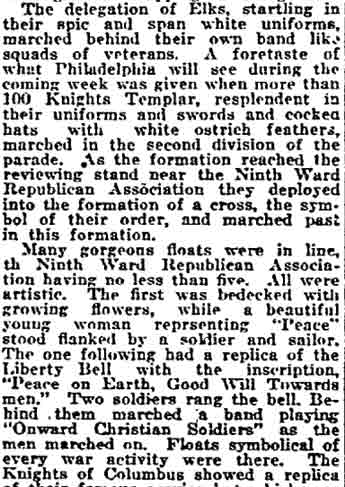
The delegation of Elks, startling in their spic and span white uniforms, marched behind their own band like squads of veterans. A foretaste of what Philadelphia will see during the coming week was given when more than 100 Knights Templar, resplendent in their uniforms and swords and cocked hats with white ostrich feathers, marched in the second division of the parade. As the formation reached the reviewing stand near the Ninth Ward Republican Association they deployed into the formation of a cross, the symbol of their order, and marched past in this formation.
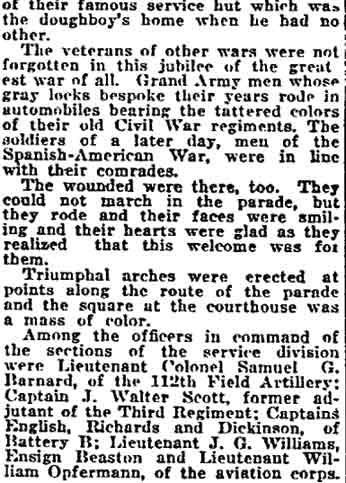
Many gorgeous floats were in line, th Ninth Ward Republican Association having no less than five. All were artistic. The first was bedecked with growing flowers, while a beautiful young woman reprsenting “Peace” stood flanked by a soldier and sailor. The one following had a replica of the Liberty Bell with the inscription, “Peace on Earth, Good Will Towards men.” Two soldiers rang the bell. Behind them marched a band playing “Onward Christian Soldiers” as the men marched on. Floats symbolical of every war activity were there. The Knights of Columbus showed a replica of their famous service hut which was the doughboy’s home when he had no other.
The veterans of other wars were not forgotten in this jubilee of the greatest war of all. Grand Army men whose gray locks bespoke their years rode in automobiles bearing the tattered colors of their old Civil War regiments. The soldiers of a later day, men of the Spanish-American War, were in line with their comrades.
The wounded were there, too. They could not march in the parade, but they rode and their faces were smiling and their hearts were glad as they realized that this welcome was for them.
Triumphal arches were erected at points along the route of the parade and the square at the courthouse was a mass of color.
Among the officers in command of the sections of the service division were Lieutenant Colonel Samuel G. Barnard, of the 112th Field Artillery; Captain J. Walter Scott, former adjutant of the Third Regiment; Captains English, Richards and Dickinson, of Battery B; Lieutenant J. G. Williams, Ensign Beaston and Lieutenant William Opfermann, of the aviation corps.
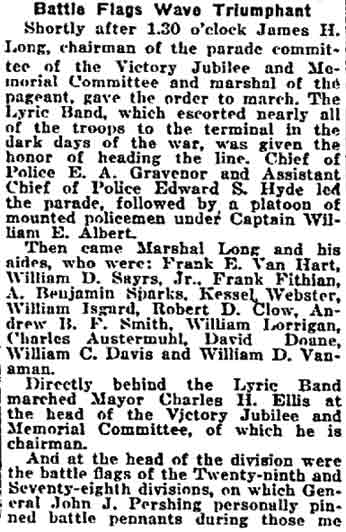
Battle Flags Wave Triumphant
Shortly after 1.30 o’clock James H. Long, chairman of the parade committee of the Victory Jubilee and Memorial Committee and marshal of the pageant, gave the order to march. The Lyric Band, which escorted nearly all of the troops to the terminal in the dark days of the war, was given the honor of heading the line. Chief of Police E. A. Gravenor and Assistant Chief of Police Edward S. Hyde led the parade, followed by a platoon of mounted policemen under Captain William E. Albert.
Then came Marshal Long and his aides, who were: Frank E. Van Hart, William D. Sayrs, Jr., Frank Fithian, A. Benjamin Sparks, Kessel Webster, William Isgard, Robert D. Clow, Andrew B. F. Smith, William Lorrigan, Charles Austermuhl, David Doane, William C. Davis and William D. Vanaman.
Directly behind the Lyric Band marched Mayor Charles H. Ellis at the head of the Victory Jubilee and Memorial Committee, of which he is chairman.
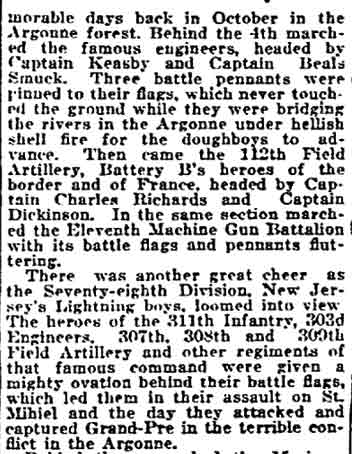
And at the head of the division were the battle flags of the Twenty-ninth and Seventy-eighth divisions, on which General John J. Pershing personally pinned battle pennants during those memorable days back in October in the Argonne forest. Behind the 4th marched the famous engineers, headed by Captain Keasby and Captain Beals Smuck. Three battle pennants were pinned to their flags, which never touched the ground while they were bridging the rivers in the Argonne under hellish shell fire for the doughboys to advance. Then came the 112th Field Artillery, Battery B’s heroes of the border and of France, headed by Captain Charles Richards and Captain Dickinson. In the same section marched the Eleventh Machine Gun Battalion with its battle flags and pennants fluttering.
There was another great cheer as the Seventy-eighth Division, New Jersey’s Lightning boys, loomed into view. The heroes of the 311th Infantry, 303d Engineers, 307th, 308th and 309th Field Artillery and other regiments of that famous command were given a mighty ovation behind their battle flags, which led them in their assault on St. Mihiel and the day they attacked and captured Grand-Pre in the terrible conflict in the Argonne.
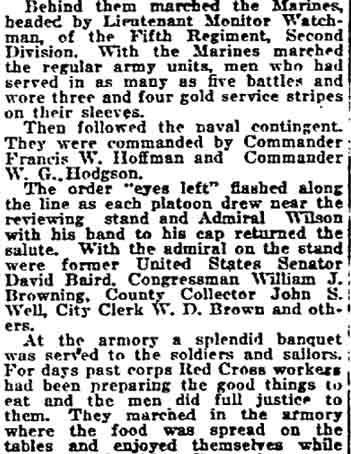
Behind them marched the Marines, headed by Lieutenant Monitor Watchman, of the Fifth Regiment, Second Division. With the Marines marched the regular army units, men who had served in as many as five battles and wore three and four gold service stripes on their sleeves.
Then followed the naval contingent. They were commanded by Commander Francis W. Hoffman and Commander W. G. Hodgson.
The order “eyes left” flashed along the line as each platoon drew near the reviewing stand and Admiral Wilson with his band to his cap returned the salute. With the admiral on the stand were former United States Senator David Baird, Congressman William J. Browning, County Collector John S. Well, City Clerk W. D. Brown and others.
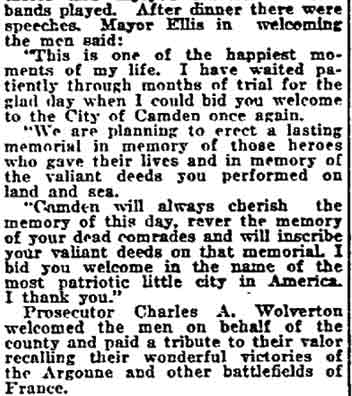
At the armory a splendid banquet was served to the soldiers and sailors. For days past corps Red Cross workers had been preparing the good things to eat and the men did full justice to them. They marched in the armory where the food was spread on the tables and enjoyed themselves while bands played. After dinner there were speeches. Mayor Ellis in welcoming the men said:
“This is one of the happiest moments of my life. I have waited patiently through months of trial for the glad day when I could bid you welcome to the City of Camden once again.
“We are planning to erect a lasting memorial in memory of those heroes who gave their lives and in memory of the valiant deeds you performed on land and sea.
“Camden will always cherish the memory of this day, rever the memory of your dead comrades and will inscribe your valiant deeds on that memorial. I bid you welcome in the name of the most patriotic little city in America. I thank you.”
Prosecutor Charles A. Wolverton welcomed the men on behalf of the county and paid a tribute to their valor recalling their wonderful victories of the Argonne and other battlefields of France.
Admiral Wilson at the Naval Academy
1921-1925
Rear Admiral Henry B. Wilson ’81 (1921–1925), the twenty-sixth superintendent, reported to the Naval Academy having just completed a tour as Commander in Chief, Atlantic Fleet, reverting from a four-star billet to that of a Rear Admiral upon acceptance of his new orders. An imposing figure, Wilson, ultimately referred to by midshipmen as “Uncle Harry,” believed strongly that the Academy’s crucial task was the development of character, with truth as the cornerstone. Launching a campaign to make the academy “more humane,” Wilson revised Christmas leave and inaugurated an Easter leave, as well. He had no tolerance for hazing and in its place instituted a system of “rates,” or privileges, incorporating many traditional but unofficial practices into academy regulations. He created the first USNA department of physical training in 1923 and introduced one of the Academy’s most romantic traditions, the Ring Dance, in 1925. It is said that Admiral Wilson’s administration constituted the transition between the cloistered academy of the nineteenth century and the open academy of the twentieth.
In 1921 evidence of continuing difficulty with hazing was apparent with the publication of a letter to the Brigade by Rear Admiral Henry B. Wilson, Superintendent. Wilson reminded the students that they were not empowered to punish any other midshipmen by denial of such things as food and rest. He also made clear in the following remarks that classmate loyalty was not to be confused with honor. Wilson stated:
Tradition never did and never will require one on duty to assume responsibility for the derelictions of a classmate or shipmate. Worthwhile friends will not place a midshipman on duty in a position where he must either report them or himself or assume the responsibility for an offence more serious—neglect of duty—which may carry with it distrust and possible dismissal. Class spirit is commendable…But it is indefensible through a mistaken idea of “class honor” to shield another who has knowingly failed to accord to the regiment that honorable position which generations of midshipmen have earned for it.
Boulevard Was Named for Decorated World War I Admiral
Camden Courier-Post
By Laurie Stuart, Courier-Post
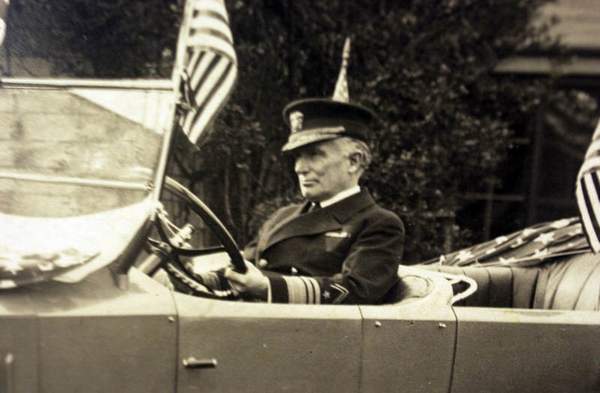
Admiral Wilson.
Motorists who have driven through Camden instantly recognize the name, but most don’t know who he is.
Henry Braid Wilson was born in Camden in 1861. At the age of 15, he went to the U.S. Naval Academy in Annapolis, Md., where he graduated in 1881. He soon began his illustrious Navy career, first as a training officer for apprentices, then serving in the West Indies, Bering Sea, Pacific Ocean and the Great Lakes.
Wilson saw action in the Spanish-American War as a lieutenant, and was “highly commended for coolness and bravery,” says a newspaper account.
In 1916, he was assigned to the command of the USS Pennsylvania, flagship of the commander-in-chief of the Atlantic Fleet. The following year…when the United States entered World War I…he was assigned commander of the U.S. Naval Forces in France. For his “outstanding wartime services, Admiral Wilson was awarded the Distinguished Service Medal, the Grand Officer of the Legion of Honor of France, Commander of the Order of St. Maurice and St. Lazarus of Italy and the Grand Official of the Military Order of Avia of Portugal,” the newspaper account says. In 1919, Wilson became commander-in-chief of the Atlantic Fleet. Two years later, he was appointed superintendent of the U.S. Naval Academy. In 1923, he retired with the rank of Rear Admiral. In accordance with a Congressional Act, he was later given the rank of Admiral.
Although Wilson retired to California, then to New York, his parents still lived in Camden, where his father, also Henry B. Wilson, was a member of the Camden Board of Education. In fact, the H.B. Wilson School at 9th and Florence Streets is named for his father.
So when do Admiral Wilson and the boulevard cross paths? While some people think that was on Armistice Day in 1929, that’s not altogether true.
Bridge Entrance Road or Bridge Boulevard opened in 1925 as the main highway to the Ben Franklin Bridge. Four years later, Wilson returned as an honored guest of Camden and during Armistice Day ceremonies, officials decided to rename the highway “in honor of Camden’s great native son.”
So South Jerseyans came to know the highway as Admiral Wilson Boulevard. What they thought, however, didn’t ring true. While everyone was under the impression that the boulevard…which goes through Camden and Pennsauken…had been renamed in 1929, there was a slight wrinkle. In 1937, it was discovered that the name change had not been made official.
“When the Forest Hills development was made, Camden approved a change of name honoring one of Camden’s most renowned citizens, and later, during the administration of Mayor Winfield S. Price, a resolution was passed to make the name, as the then commissioners thought, official,” says a Nov. 18, 1937 Courier-Post article.
“But an ordinance to approve the change was necessary, and no ordinance was ever passed…So next Wednesday, when commissioners meet a day early on account of the Thanksgiving holiday, Commissioner Frank J. Hartmann will sponsor an ordinance which will make Bridge Boulevard Admiral Wilson Boulevard once and for all. Pennsauken Township is expected to do the same.”
Admiral Wilson in Camden
1926
USS Henry B. Wilson DDG-7
On April 22, 1959 the guided missile-firing destroyer USS Henry B. Wilson DDG-7 was launched at Bay City, Michigan, with Mrs. Patrick Hurley, Admiral Wilson’s daughter, attending. The Wilson served in the Pacific and off the coast of Vietnam during that conflict. After a long and distinguished career she was converted into a power barge in 1996, and sunk as a target off the coast of California on August 15, 2003.
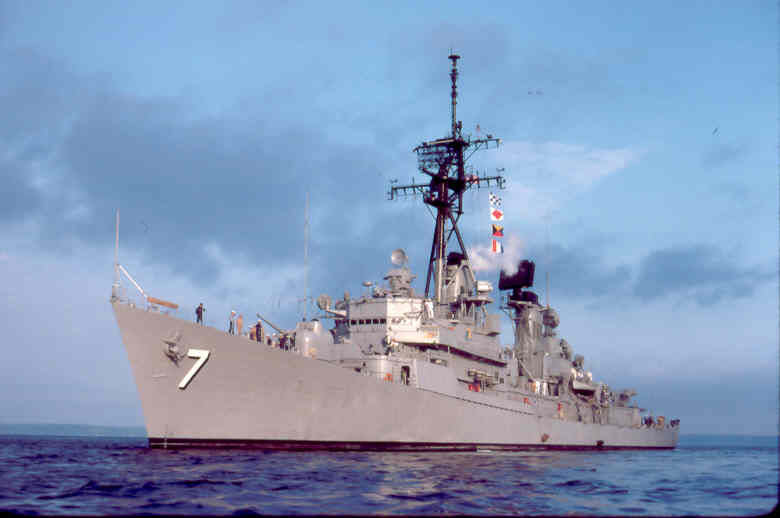
Disposition: Sunk as a target, August 15, 2003. Location: 031° 33’ 00.0” North, 119° 53’ 00.0” West. Depth: 1,336 fathoms.
Sources
Sources include: Camden County, New Jersey, 1616–1976: A Narrative, by Jeffrey M. Dorwart and Philip English Mackey. Camden County, NJ: Camden County Cultural & Heritage Commission, 1976. Also thanks to Camden’s own Joe Gambardello, staff writer for the Philadelphia Inquirer.