Introduction
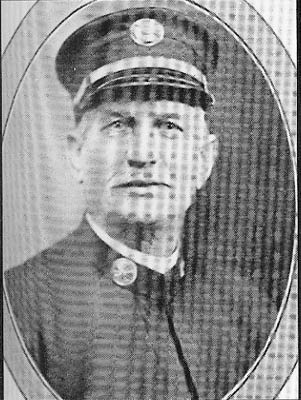
John A. Stockton
JOHN A. STOCKTON was born in New Jersey around 1853 to Richard and Deborah Stockton. The family was living in Camden’s Middle Ward in 1870. Richard Stockton earned his living as a carpenter. Also at home were older sister Sarah Frances and older brother Arthur Stockton.
John A. Stockton appears in the 1880 Census living with his wife Ruth, sister Sarah, and brother Arthur at the home of his widowed father, 538 South 5th Street in South Camden. This would be his home until his passing in 1927. John Stockton and his brother worked as milk dealers. Ruth Stockton bore a son, Frank, in November of 1882.
At a special meeting of the City’s Fire Committee held on July 7, 1885 the fire department was reorganized. Each engine company added a permanent foreman and two hosemen; the ladder company added two laddermen for a total of eight new full-time firemen. The new foremen were John Stockton, Engine Company 1 and Henry Grosscup, Engine Company 2. The reorganization became effective on August 1st and the foremen were given charge of their respective units at an annual salary of $720.
In 1886 the Camden Steam Fire Engine Company Number 1 was located at 409 Pine Street in a three story 20 by 90 foot brick building (the old Independence Fire Company No. 3 engine house). The company’s apparatus was an Amoskeag second class steamer (maker’s plate 6318) drawn by two horses and one Silsby two wheel hose cart drawn by a single horse. The company was equipped with 1000 feet of good hose, axes, lamps, etc. The company roster included John Stockton, Foreman; G. Rudolph Tenner, Engineer; William Deno, driver; William W. Laird, stoker; Wilson Bromley and Jacob F. Nessen, hosemen. Call Men were William Deith, Andrew Miller and William Bogia. Bromley and Bogia would later suffer line of duty deaths.
John A. Stockton appears in Camden city directories as living at 538 South 5th Street, the corner of South 5th and Royden Streets, in 1887. In the mid-1890s he also partnered with Harry Frebe in a cigar store at 539 South 5th Street. Sometime between 1906 and April of 1910 his son, Frank Stockton, had joined him as a member of the Camden Fire Department. It appears, however, that Frank Stockton had passed away prior to the compilation of the 1914 Camden City Directory.
John A. Stockton was serving as Deputy Chief of the Camden Fire Department in May of 1914 after Chief Charles Worthington was killed in the line of duty while fighting a fire at the Camden Electroplating Company at Delaware Avenue and George Street, near the Pennsylvania Railroad Ferry in the center of Camden. Chief of Department Worthington was one of the first units to arrive at the scene and observed heavy fire conditions on the top floor of the two-story building. Chief Worthington ordered an exterior attack from the roof area through large skylight openings. This operation was made particularly arduous by heavy smoke. The fire extended from the plating company at 12 George Street, to involve the New Jersey Automobile Supply Company car dealership at 38 Delaware Avenue.
On the roof, Chief Worthington conversed with Deputy Chief John A. Stockton and Captain Madison of Engine Company 5. Chief Worthington directed Stockton to go down to the street, transmit a second alarm, and also have an engine company stretch a line up the alley. Chief Worthington then left the men and proceeded along the roof to the south side of the building where he was last seen. When Stockton brought the hose team up the alleyway, he found the unconscious Chief laying next to the building. Chief Worthington had apparently stepped back on the roof to avoid a skylight and fell into a shaft between two buildings. The Chief had landed on a pile of scrap iron which inflicted serious wounds including a deep gash on his neck. Deputy Chief Stockton and Police Chief Elias Gravenor assisted firemen in removing Chief Worthington from the alley where he was rushed to Cooper Hospital. He was pronounced dead on arrival with a broken neck and fractured skull.
In the wake of Chief Worthington’s death, John A. Stockton was appointed Chief of the Camden Fire Department in May of 1914. While serving in this capacity, there was one major conflagration in the city of Camden.
The Munger & Bennett Mill fire was discovered shortly before 6:00 PM on November 12, 1914, in the big planing mill near the pier at Delaware Avenue and Clinton Streets, South Camden. This incident was one of the most spectacular fires in years, destroying a large section of the lumber yard extending to three warehouses of the West Jersey Paper Company and the tramway of the Philadelphia steel and wire plant. High winds from the river fanned the fire and quickly drove the flames into the big lumber piles in the yard. A telephone alarm was received at Fire Headquarters and upon his arrival, Chief Stockton transmitted four alarms in rapid succession, plus additional calls for mutual aid. Companies arriving on Greater Alarms were hampered by the closing of Delaware Avenue for repaving. Apparatus had to be placed two and three blocks from the fire necessitating long and arduous stretches of hoseline. At the height of the blaze it appeared that several big factory complexes in the area were doomed, as over one million board feet of finished lumber produced a roaring inferno. Industrial fire brigades from the nearby Victor Talking Machine, Camden Lace, and David Baird Spar Yards were pressed into service to assist the Department in conjunction with at least four tug boats that fought the fire from the river anchorage. The tugs were credited in saving thousands of dollars of property. The estimated loss exceeded $150,000 and resulted in injuries to one civilian and seven firemen.
On July 29th of 1915, after a career that spanned four decades, Chief John A. Stockton announced his retirement, effective October 1st. He was succeeded as Chief by Peter B. Carter.
John and Ruth Stockton were both still living at 538 South 5th Street in January of 1920. Chief Stockton died in 1927. His wife continued to reside at the home on South 5th Street until her passing in February of 1938.
John Stockton Appointed Fire Foreman
Philadelphia Inquirer —

John Stockton, of the Fourth ward, has been appointed foreman of engine house No. 1, of Camden, in place of Samuel Buzine, appointed Assistant Engineer.
Fourth Ward Republican Club
Philadelphia Inquirer —

The Fourth Ward Republican Club met at the house of John Stockton, Fifth street, below Clinton, last night, and made preparations for the coming fall campaign.
Camden’s Fire Laddies Parade
Philadelphia Inquirer —
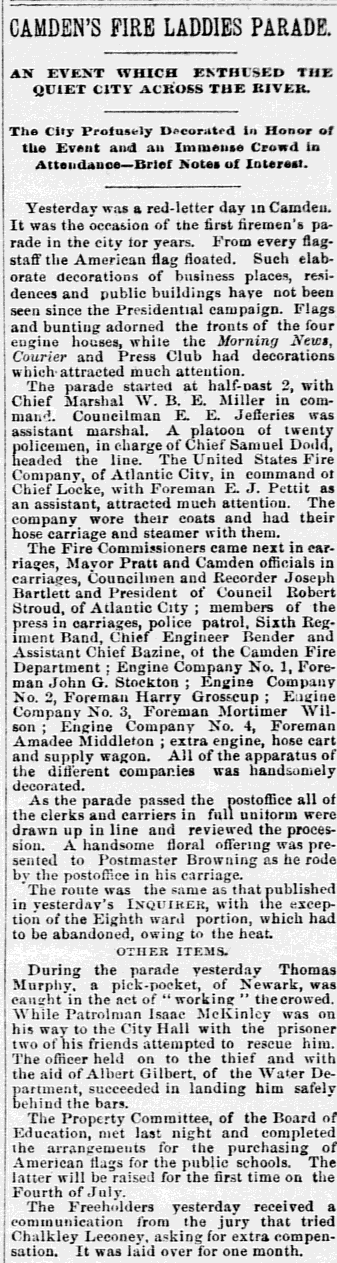
CAMDEN’S FIRE LADDIES PARADE.
An Event Which Enthused the Quiet City Across the River.
The City Profusely Decorated in Honor of the Event and an Immense Crowd in Attendance—Brief Notes of Interest.
Yesterday was a red-letter day in Camden. It was the occasion of the first firemen’s parade in the city for years. From every flagstaff the American flag floated. Such elaborate decorations of business places, residences and public buildings have not been seen since the Presidential campaign. Flags and bunting adorned the fronts of the four engine houses, while the Morning News, Courier and Press Club had decorations which attracted much attention.
The parade started at half-past 2, with Chief Marshal W. B. E. Miller in command. Councilman E. E. Jefferies was assistant marshal. A platoon of twenty policemen, in charge of Chief Samuel Dodd, headed the line. The United States Fire Company, of Atlantic City, in command of Chief Locke, with Foreman E. J. Pettit as an assistant, attracted much attention. The company wore their coats and had their hose carriage and steamer with them.
The Fire Commissioners came next in carriages, Mayor Pratt and Camden officials in carriages, Councilmen and Recorder Joseph Bartlett and President of Council Robert Stroud, of Atlantic City; members of the press in carriages, police patrol, Sixth Regiment Band, Chief Engineer Bender and Assistant Chief Bazine, of the Camden Fire Department; Engine Company No. 1, Foreman John G. Stockton; Engine Company No. 2, Foreman Harry Grosscup; Engine Company No. 3, Foreman Mortimer Wilson; Engine Company No. 4, Foreman Amadee Middleton; extra engine, hose cart and supply wagon. All of the apparatus of the different companies was handsomely decorated.
As the parade passed the postoffice all of the clerks and carriers in full uniform were drawn up in line and reviewed the procession. A handsome floral offering was presented to Postmaster Browning as he rode by the postoffice in his carriage.
The route was the same as that published in yesterday’s Inquirer, with the exception of the Eighth ward portion, which had to be abandoned, owing to the heat.
OTHER ITEMS.
During the parade yesterday Thomas Murphy, a pick-pocket, of Newark, was caught in the act of “working” the crowd. While Patrolman Isaac McKinley was on his way to the City Hall with the prisoner two of his friends attempted to rescue him. The officer held on to the thief and with the aid of Albert Gilbert, of the Water Department, succeeded in landing him safely behind the bars.
The Property Committee, of the Board of Education, met last night and completed the arrangements for the purchasing of American flags for the public schools. The latter will be raised for the first time on the Fourth of July.
The Freeholders yesterday received a communication from the jury that tried Chalkley Leconey, asking for extra compensation. It was laid over for one month.
Frank Stockton Assaulted
Philadelphia Inquirer —
Justice Schmitz, in Camden, last night, committed Robert Wieshing and Harry Martin to the county jail in default of bail, charged with assault and battery on Frank Stockton, son of Fireman John Stockton. Stockton was attacked at Third street and Kaighn avenue, Saturday night, and terribly beaten.
Fireman Stockton Injured
Philadelphia Inquirer —

During a slight fire at the home of Joseph Benny, 253 Pine street, Camden, yesterday Fireman John Stockton was injured about the head while groping in a dark room.
Camden Fire Department Pension Fund
Philadelphia Inquirer —
Articles incorporating the Camden City Fire Department Pension Fund were filed in the county clerk’s office yesterday. The trustees named are Henry C. Grosscup, George P. Cox, Walter Browning, John A. Stockton and Samuel S. Elfreth. The latter is chief of the Camden Fire Department.
More in the Net of Bar Committee
Philadelphia Inquirer —
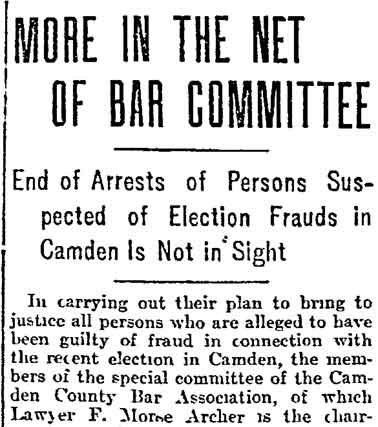
End of Arrests of Persons Suspected of Election Frauds in Camden Is Not in Sight
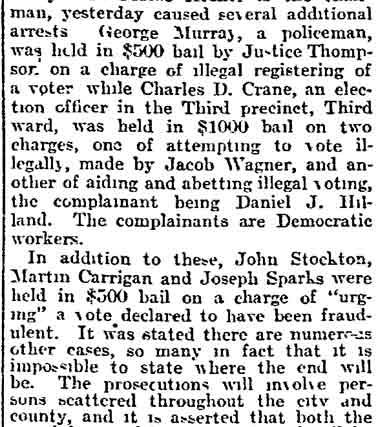
In carrying out their plan to bring to justice all persons who are alleged to have been guilty of fraud in connection with the recent election in Camden, the members of the special committee of the Camden County Bar Association, of which Lawyer F. Morse Archer is the chairman, yesterday caused several additional arrests. George Murray, a policeman, was held in $500 bail by Justice Thompson on a charge of illegal registering of a voter while Charles D. Crane, an election officer in the Third precinct, Third ward, was held in $1000 bail on two charges, one of attempting to vote illegally, made by Jacob Wagner, and another of aiding and abetting illegal voting, the complainant being Daniel J. Hiland. The complainants are Democratic workers.
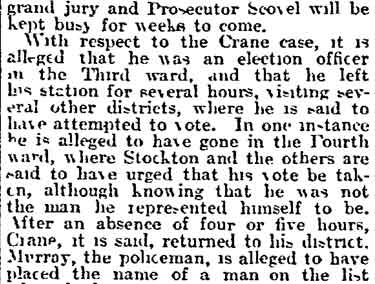
In addition to these, John Stockton, Martin Carrigan and Joseph Sparks were held in $500 bail on a charge of “urging” a vote declared to have been fraudulent. It was stated there are numerous other cases, so many in fact that it is impossible to state where the end will be. The prosecutions will involve persons scattered throughout the city and county, and it is asserted that both the grand jury and Prosecutor Scovel will be kept busy for weeks to come.
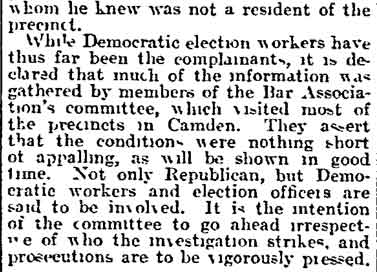
With respect to the Crane case, it is alleged that he was an election officer in the Third ward, and that he left his station for several hours, visiting several other districts, where he is said to have attempted to vote. In one instance he is alleged to have gone in the Fourth ward, where Stockton and the others are said to have urged that his vote be taken, although knowing that he was not the man he represented himself to be. After an absence of four or five hours, Crane, it is said, returned to his district. Murray, the policeman, is alleged to have placed the name of a man on the list whom he knew was not a resident of the precinct.
While Democratic election workers have thus far been the complainants, it is declared that much of the information was gathered by members of the Bar Association’s committee, which visited most of the precincts in Camden. They assert that the conditions were nothing short of appalling, as will be shown in good time. Not only Republican, but Democratic workers and election officers are said to be involved. It is the intention of the committee to go ahead irrespective of who the investigation strikes, and prosecutions are to be vigorously pressed.
Camden Firemen Have Narrow Escape
Philadelphia Inquirer —
Three Camden firemen had a narrow escape from suffocation yesterday afternoon when they entered the drug store of Edward Fryer, Sixth and Berkley streets, to extinguish a blaze that burned out the cellar. About $500 damage was done to a stock of drugs and chemicals. Assistant Chief John Stockton, William Laird and Harvey Watts went into the place. They lost their way and became penned in a compartment filled with bottles. Fellow firemen cut them out. Stockton and Laird were badly cut by glass and all three were nearly strangled by the smoke. The fire is supposed to have been caused by spontaneous combustion.
Celebrations by 3 Fire Companies
Camden Post-Telegram —
No. 7, Headquarters and No. 1 Truck Make Merry at Respective Homes.
CHIEF ELFRETH MAKES ADDRESS
Engine Company No. 7 is the baby company of the fire department, that is, in years of service, but in up-to-date completeness in every respect, harmony and quick response to duty, the men in blue out Kaighn avenue, under Captain Charles Todd, are right there on the tap of the gong. Captain Todd is a stickler for good feeling among his men for the good of the service, and at a New Year’s Eve banquet this unanimity of good fellowship was strongly manifested.
It was the first New Year’s blowout given by Company 7 and the guests had as grand a time as if they were gathered about their own firesides at home. From door to roof, the firehouse was ablaze with a glow of the holiday and patriotic spirit. Flags, festoons of green, Christmas bells, and lights gladdened all hearts and a Christmas tree glistening with tinsel and topped with an electric bulb gave the banquet hall a homelike air. Over the tree was the gladsome greeting, “Merry Christmas and Happy New Year.”
Fifteen guests sat down to the festive board. In the centre of the table glowed in a big fireman’s horn a big bunch of electric lit American Beauties and from one end of the board to the other it was one sweep of delicacies, turkey, raw and fried oysters, stuffing chicken salad, cake, pie and a lot of other luxuries that make life happier as far as the inner man is concerned.
Chief Kelly presided at the head of the table and made a genial toastmaster. Chief Kelly supplied the electrical effects with his usual aptness. “Brother” Lutz said a short and timely prayer and then the guests sat down and for two hours were regaled with all the palatable good things of the season of good cheer. Cigars of pungent aroma being passed around, “Jim” Nevins and George Boone entertained delightfully with grapophone selections, including “Has Anyone Here Seen Kelly?” He was there.
With the midnight hour came the blowing of factory whistles and the tolling of bells. And from below in the firehouse came a terrific clangor and clash and gongs and bells. The firemen instinctively made for the sliding pole, but soon came back a-laughing. It was only Chief Kelly and Chief Chef Lutz ringing in the first alarm of the New Year, No. 1-9-1-3.
Those who had the great pleasure to participate in this most happy affair are as follows: City Electrician John W. Kelly, Jr., Captain Charles Todd, Lieutenant John Lutz, Engineer William Busine, Stoker James Nevins, Drivers Richard Marter and Joseph Sparks, Hoseman George Boone, Roy Smith and Edward Simpson, and as welcome guests, Richard Saeur, John Watson, Albert Glanders, William Robinson and Harry Knowles, the faithful houseman of No. 7.
Chief Elfreth and Assistant Chiefs Cox, Stockton, Wade and Browning, were to have been there, but business on a holiday kept them at Headquarters awaiting alarms.
AT HEADQUARTERS.
Under the auspices of the Wishbone Club, firemen at headquarters, Fifth and Arch streets, held their annual dinner on Tuesday evening. Cheer and good-fellowship was the by word and the fire laddies and their friends made the evening one long to be remembered.
A short address was given by Chief Elfreth and Assistant Chief Stockton. John Dold offered prayer before the guests partook of the tasty dishes as prepared by Arthur Wingate and William Laud. The table presented an attractive appearance and the laddies and guests greatly enjoyed the fine spread. The menu follows: Roast Sweet Potatoes, Peas, Cranberry Sauce, Mince Pie, Coffee, Cigars, Aqua De Lair, Olives, Beets, Celery, Roast Turkey, Oyster Filling, Giblet Sauce, Mashed White Potatoes.
Those participating were as follows: S. S. Elfreth, John S. Stockton, Captain George B. Wade, Lieutenant Jos. Ernest, John A. Dold, Josiah Sage, Daniel Smith, Arthur Wingate, Joseph Johnson, Harry Hankins, William Laird, William Elberson, John Lennox, Martin Carrigan, Charles Cook, Harry Belby, Harry Khrier, Charles Menke, Edward S. Gahan, D. P. McConnell.
With a fine feed, a grand graphophone concert, songs and speeches of a happy and humorous order, “the Jolly Nine” saw the old year out and the New Year in, at the house of Hook and Ladder Truck No. 1, on Fifth street above Arch street. Accoutred in their uniforms of blue, ready at a second’s tap of the gong to jump on the truck, the brave laddies and friends formed a happy picture of congeniality.
The menu was most appetizing. Beginning with oysters on the shell and winding up with a delicious dish designated “Creme-a-la-Truck,” the guests were kept busy munching their molars, as the sedate and genial waiters, togged out in linen of spotless white. William Howell Tatem and “Chief” Harry Anderson did the elegant. Stewart Bakely, a slick Cooper river boat house cook from away back, was the popular chef of the feast, and that grand old fire hero, Captain “Joe” Maxwell, the Commander-in-Chief of festivities, who saw to it that no one got left as the plates passed around.
Chimney Fire at 210 Cooper Street
Camden Post-Telegram —

In answer to a ‘phone call, Assistant Chief Stockton and Chauffeur Harry Selby hastened to a dwelling at 210 Cooper street, and found that a soot-filled chimney was causing the family great alarm. As there was really no blaze the companies were not summoned and after a little work Stockton and Selby soon remedied the trouble by cleaning out the smoke receptacle.
Harry Selby Joins Engine Company 1
Camden Post-Telegram —
After serving faithfully for a long time as chauffeur to Assistant Chief Stockton, Harry Selby will to-day take up his duties at No. 1 Engine Company to-day. Harry will drive the Robinson combination apparatus at the downtown house. The change was sanctioned by Chief Worthington at the request of Selby. His fellow firemen regret to see Harry leave and their best wishes for success go with him.
William McCauley, who was recently appointed a member of the department, filled the vacancy left by the transfer of Selby.
North Camden News
Camden Post-Telegram —
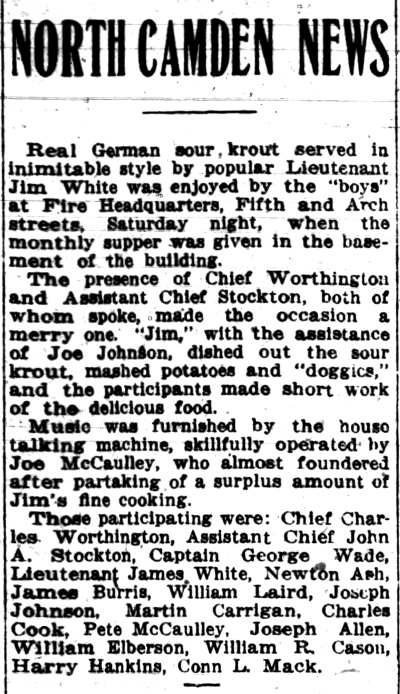
Real German sour krout served in inimitable style by popular Lieutenant Jim White was enjoyed by the “boys” at Fire Headquarters, Fifth and Arch streets, Saturday night, when the monthly supper was given in the basement of the building. The presence of Chief Worthington and Assistant Chief Stockton, both of whom spoke, made the occasion a merry one. “Jim,” with the assistance of Joe Johnson, dished out the sour krout, mashed potatoes and “doggies,” and the participants made short work of the delicious food. Music was furnished by the house talking machine, skillfully operated by Joe McCauley, who almost foundered after partaking of a surplus amount of Jim’s fine cooking. Those participating were: Chief Charles Worthington, Assistant Chief John A. Stockton, Captain George Wade, Lieutenant James White, Newton Ash, James Burris, William Laird, Joseph Johnson, Martin Carrigan, Charles Cook, Pete McCauley, Joseph Allen, William Elberson, William R. Cason, Harry Hankins, Conn L. Mack.
Fire Headquarters Weekly Supper
Camden Post-Telegram —
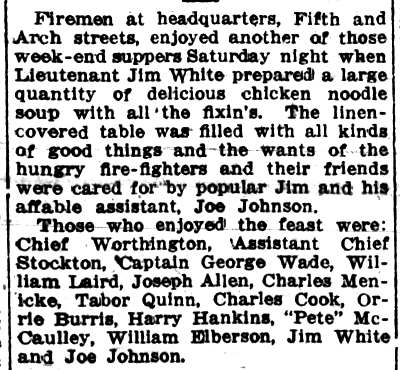
Firemen at headquarters, Fifth and Arch streets, enjoyed another of those week-end suppers Saturday night when Lieutenant Jim White prepared a large quantity of delicious chicken noodle soup with all the fixin’s. The linen-covered table was filled with all kinds of good things and the wants of the hungry fire-fighters and their friends were cared for by popular Jim and his affable assistant, Joe Johnson. Those who enjoyed the feast were: Chief Worthington, Assistant Chief Stockton, Captain George Wade, William Laird, Joseph Allen, Charles Menicke, Tabor Quinn, Charles Cook, Orrie Burris, Harry Hankins, “Pete” McCaulley, William Elberson, Jim White and Joe Johnson.
Snapper Soup at Fire Headquarters
Camden Post-Telegram —
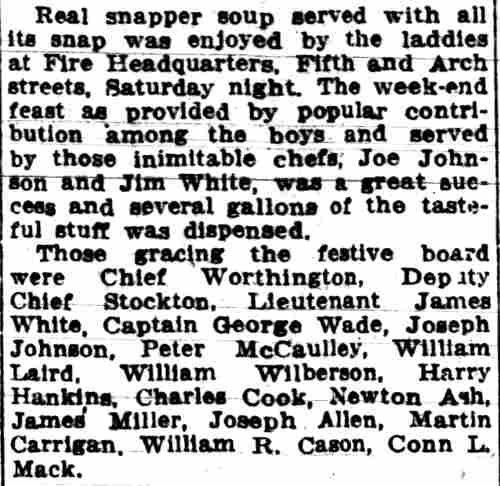
Real snapper soup served with all its snap was enjoyed by the laddies at Fire Headquarters, Fifth and Arch streets, Saturday night. The week-end feast as provided by popular contribution among the boys and served by those inimitable chefs, Joe Johnson and Jim White, was a great success and several gallons of the tasteful stuff was dispensed. Those gracing the festive board were Chief Worthington, Deputy Chief Stockton, Lieutenant James White, Captain George Wade, Joseph Johnson, Peter McCaulley, William Laird, William Wilberson, Harry Hankins, Charles Cook, Newton Ash, James Miller, Joseph Allen, Martin Carrigan, William R. Cason, Conn L. Mack.
Thousands View Chief’s Remains
Camden Post-Telegram —
Throngs Jam Court House While Body Lies in State for Two Hours.
LAST SAD RITES THIS AFTERNOON
Not since the memorable funeral of Chief of Police Foster ten years ago, has there been such a genuine public tribute paid an official of Camden as was in evidence last night at the bier of the lamented Fire Chief Worthington, and today at his funeral. It is hard to estimate the number of persons in a crowd, but from 7 until 9 o’clock last night there was a steady stream of men, women and children, two abreast, who passed from the main entrance, through the center corridor and beneath the illuminated rotunda, where the body lay, and thence out by the west corridor. There was never a stop, and it is estimated that at least 10,000 persons were there, perhaps more.
There could not have been a more ideal location for the repose of the casket containing the honored dead, and the great array of beautiful flowers than beneath the rotunda. It seemed to be a sacred shrine in itself where the citizenry dropped a tear for the lamented departed. The effulgence of the soft lights from above specially installed by Electrical Chief Kelly but lent to the scene and as the dark garbed escort of firemen, the active pall bearers, stood, on guard, the scene was unusually impressive.
Chief Worthington, aside from the pallor that comes to the dead, looked as he did in life, for the thread had been snapped so quickly that it was while he was in his full vigor that the vital spark had taken its flight. There were some marks on his face that indicated the intense though momentary suffering through which he passed on his fateful plunge from the roof of the burning building to his quick death, and the passing crowd remarked this. But withal there was that calmness and repose feature which seemed to indicate that the gallant leader of Camden’s fire fighters but lay sleeping rather than that his soul had taken its eternal flight.
Public grief may be a mere ephemeral emotion, born of the moment and only to be succeeded by the acclaim of the newly arisen public idol, but last night’s encomiums seemed to come from hearts that overflowed with genuine and permanent sorrow over the untimely passing of so excellent a public servant. Many tear-suffused eyes indicated this, many expressions of grief, of sorrow, of condolence of those left showed this. The sentiment in evidence everywhere can only be likened to the sweetness of the wonderful flowers whose odor spread thorough all the corridors and in all the rooms of the great marble building.
High in the clock tower of the City Hall the bell began tolling at 6:30 o’clock. At half-minute intervals its doleful strains went forth on the cold blustery east wind which had succeeded at day of spring sunshine. The bell and the screeching wind seemed to combine as a knell indicating the passing grief of the city. It was the preliminaries to the marching of the funeral cortege from the stricken Chief’s home on Penn Street to the resting place at the Court House.
There were forty policemen in dress uniform with Chief Gravenor at their head. There were twenty-six fire heads from Philadelphia, with Chief William Murphy in the van, a tribute in itself of more than passing moment. There was the caisson on which was the black draped casket containing the body of he who all honored. There was the little red car in which Chief Worthington was wont to speed through the city at every alarm and there was his helmet and coat. There was Acting Chief Stockton and forty of the men who fought flames under the direction of he who lay so still. There was the family in cabs with curtains drawn, the members of City Council and the active pall bearers—Daniel Leach, Peter B. Carter, James White, William Patterson, Elmer Burkett, Samuel Harring.
When the cortege reached the Court House the Camden boys took up their position on the inside beneath rotunda while the Philadelphia visitors made an imposing array on the granite steps outside. And then came the public in its steady and unending stream.
Later the Philadelphia delegation was escorted to the Board of Freeholders room where tribute was paid to the dead and where a mingling of the two cities took place. Besides Chief Murphy the visitors included Battalion Chiefs William T. Barrett and George P. McConaghy, Captains L. F. Bunting, William Lindsey; H. Dinlocker, J. Higginson, J. E. Talbot, D. Campbell, T. O’Brien, F. Hughes, E. Basenfelder; H. Hutt, William McCusker, G. Rheim, R. Wilsey, J. Webb, H. Goers, H. Haines, Insurance Patrol Captain Joseph H. Shermer William Hickman, William Rodgers, John Wyatt, David Phillip, John Clyde, H. Wilkinson.
President of City Council James E. Hewitt spoke of the work Chief Worthington had already accomplished, of his plans, of his value and worth to Camden. Chief Murphy responded in a fitting way and this incident in itself was one to be remembered.
An affecting sight was witnessed by the handful of spectators, among them being other firemen, city and county officials and policemen who remained after the big doors on Sixth Street had been closed. The last to view the Chief’s remains were a delegation of about twenty firemen. Solemnly the men passed by the bier and gazed upon the features of their departed brother.
As the last of the line approached Deputy Chief John A. Stockton was seen. He stopped and with his cap laid across his breast be looked down into the casket. For almost a minute Chief Stockton stood as though glued to the spot. Then he glanced about him and the sympathetic look upon his face thrilled all.
He heaved a sigh and perhaps the teardrops refused to come, but Stockton, as the lines upon his face showed, was struggling with the inner man. His emotions were tugging at his heart, but a fire laddie cannot give way to his feelings although his brother superior officer and dear friend had answered his last alarm.
The floral pieces surrounding the bier bespoke the love, admiration and respect the donors held for the dead chief. One design particularly beautiful was a mammoth loving cup made of blossoms, flowers and roses. This was the token sent by members of City Council and other city officials.
Another was the design sent by the Electrical Bureau through Chief Kelly. The original fire box, No. 134, which was pulled on the night of the fire by Chief Worthington was enshrouded by roses, carnations and lilies.
A maltese cross standing several feet high and bearing the initials of the organization was the tribute sent by the Firemen’s Mutual Benevolent Association. Chief Worthington was president of this association.
The Camden police sent a large shield of flowers and Council members offered a vacant chair of roses. The New Jersey Auto Supply Company, No. 2 Engine Company and No. 1 Truck sent beautiful broken circles and a wreath was the offering from the employees of the Victor Talking Machine Company.
A broken circle from member of the Sixth Ward Republican Club and a wreath from his friends in the sixth precinct of the Second Ward were other beautiful pieces. West Collingswood and Collingswood firemen sent two beautiful floral circles and from the Loyal Order Legion a wreath was received.
Other offerings were from the Camden Liquor Dealers league, a beautiful circle from No. 6 Engine Company, in which house Chief Worthington was captain previous to his elevation to the office of chief; sprays from the Bethany M.E. Church, Ladies Auxiliary of the Loyal Order of Moose; a wreath from the pupils of the eighth grade Sewell school, and a spray from North Baptist Church. There also were designs from members of the family and friends, all of which bespoke the great love held for the departed fire chief.
The impressive services of the P.E. Church marked the last sad rites this afternoon at St. Paul’s Church. The guard of honor and city officials left Fire Headquarters at 1:20 and proceeded to the Worthington home and escorted the remains to the church, where services were conducted by the rector, Rev. R.E. Brestell, and Rev. H.O. Jones, rector of St. Stephen’s P.E. Church. Interment was made at Arlington.
The honorary pallbearers were Mayor Ellis, Hon. David Baird, Frank F. Patterson, John W. Bell, General John A. Mather, Melbourne F. Middleton Jr., Harry R. Reed, Arthur L. Jones, Robert Gordon, David Jester, George Schneider, William Mills, J.O. Grear, William Hall, George L. Bender, and James E. Hewitt.
Naming Fire Chief to Be Long Delayed
Philadelphia Inquirer —
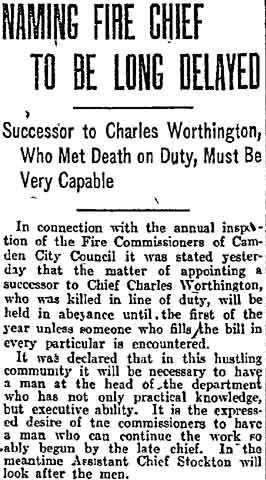
Successor to Charles Worthington, Who Met Death on Duty, Must Be Very Capable
In connection with the annual inspection of the Fire Commissioners of Camden City Council it was stated yesterday that the matter of appointing a successor to Chief Charles Worthington, who was killed in line of duty, will be held in abeyance until the first of the year unless someone who fills the bill in every particular is encountered. It was declared that in this hustling community it will be necessary to have a man at the head of the department who has not only practical knowledge, but executive ability. It is the expressed desire of the commissioners to have a man who can continue the work so ably begun by the late chief. In the meantime Assistant Chief Stockton will look after the men.
John A. Stockton Named Fire Chief of Camden
Philadelphia Inquirer —
Camden City Council yesterday settled the contest among the candidates who aspired to become chief of the Fire Department to succeed the late Charles Worthington, who was killed in the line of duty, by appointing John A. Stockton. He has been the acting head of the department since Chief Worthington’s death. For the past thirty years he has been an active fire fighter.
1913 — Aide Fireman Martin Carrigan and Chief John A. Stockton
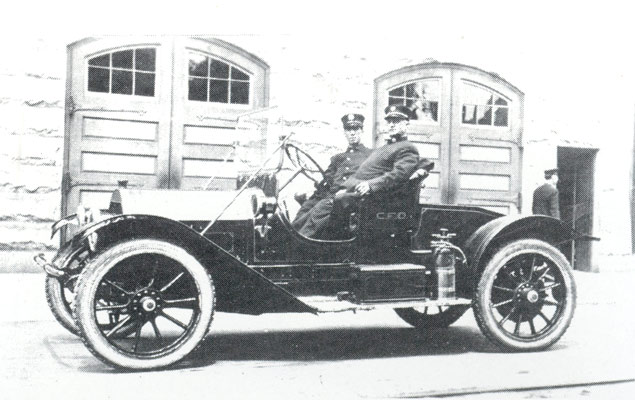
Aide Fireman Martin Carrigan with Chief of Department John A. Stockton in 1913 Cadillac at Fire Headquarters, Fifth and Arch Streets.
Camden at a Glance
Philadelphia Inquirer —
Changes made necessary by the elevation of John A. Stockton to the post of Fire Chief were announced last evening by the Fire Committee of Camden City Council. Stockton will be succeeded as Deputy Chief by Captain Peter Carter, of Engine Company No. 1. Lieutenant Samuel Whitzell will take Carter’s place and will be succeeded by Charles Cook, who was chauffeur for the late Chief Worthington.
100 Girls in Fire Scare; Chief’s Auto Overturns
Philadelphia Inquirer —
Responding to an alarm of fire from the plant of the General Gas Mantle Company, at Fourth street and Jefferson avenue, Camden, yesterday afternoon, Fire Chief Stockton and his chauffeur, Martin Carrigan, had a close call from injury at Broadway and Kaighn avenue. The car skidded in turning the corner and crashed into a beer truck. The chief and his driver jumped as the machine turned over. Neither was hurt.
The fire was in the dip room of the plant. The loss was trifling, but the hundred or more girls employed there were nearly in a panic making their escape. None was hurt.
Firemen Escort Steer’s Remains
Camden Post-Telegram —
Chief Stockton Heads Big Delegation at Funeral of Lamented Colleague.
QUARTER CENTURY IN CITY’S SERVICE
With an honorary escort of sixty firemen and Fire Chiefs John A. Stockton, Peter B. Carter and Walter Browning attending his funeral, Fireman Robert B. Steer, for twenty-five years a member of the local fire department, and who died on Wednesday, was laid to rest yesterday afternoon in Arlington Cemetery.
Services were conducted at the Steer residence, 310 Howard street, by Rev. J. L. Surtees, pastor of State Street M. E. Church, and Rev. Isaac W. Bagley, chaplain of the department.
The pall-bearers were members of No. 4 Engine Company. They follow: Captain William W. Patterson, Robert Brice, Ephraim Hires, James Elberson, Daniel Grimes, Charles Watkins, Jr., Joseph Daly and David Logue.
The escort of firemen marched beside the hearse as far as No. 5 Engine Company. Chief John A. Stockton led the delegation. The flower designs completely enshrouded the bier. They came from people in all walks of life, who also came to pay their last respects to the lamented fire fighter.
Mr. Steer served as a fireman for almost twenty-five years, and he was one of the most popular men in the department. He was known to hundreds of people and his death has caused wide and genuine sorrow in North Camden. He is survived by his wife, one son, Robert Steer, Jr., and a daughter, Miss Carrie Steer.
Camden to Motorize Five Fire Companies
Philadelphia Inquirer —
City Council to Refit Apparatus Now in Use Rather Than Purchase New Engines
After mature consideration of the numerous proposals presented, the Fire Committee of Camden City Council yesterday decided that instead of buying new auto engines for the five companies being refited, it would motorize the five engines and five combination wagons.
The contract for this work was given to the Commercial Truck Company of Philadelphia, which will place tractors on the ten pieces of apparatus for $15,000. The Federal Motor Truck Company was awarded the contract for motorizing the supply wagon at $2443. James Boyd & Co., of Philadelphia, was given the contract for an 85-foot aerial truck for $10,632.86 and the old Babcock aerial in exchange, and a city service truck for $5592.86 and an old truck in exchange. The same company is to supply a combination engine and hose wagon for $7542.86 and an old steamer in exchange.
All the apparatus will represent the very latest in fire fighting appliance, driven by electric power. The committee has saved upwards of $20,000 by deciding to motorize the present apparatus instead of buying entirely new machines.
Firemen of Long Service Receive Good Promotion
Camden Daily Courier —
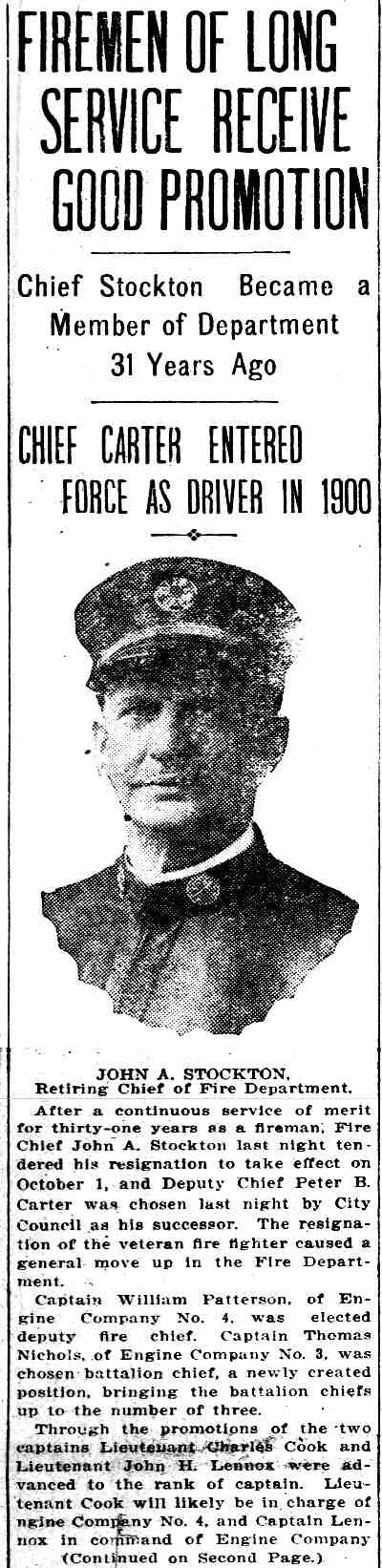
Chief Stockton Became a Member of Department 31 Years Ago
CHIEF CARTER ENTERED FORCE AS DRIVER IN 1900
After a continuous service of merit for thirty-one years as a fireman, Fire Chief John A. Stockton last night tendered his resignation to take effect on October 1, and Deputy Chief Peter B. Carter was chosen last night by City Council as his successor. The resignation of the veteran fire fighter caused a general move up in the Fire Department.
Captain William Patterson, of Engine Company No. 4, was elected deputy fire chief. Captain Thomas Nichols, of Engine Company No. 3, was chosen battalion chief, a newly created position, bringing the battalion chiefs up to the number of three.
Through the promotions of the two captains Lieutenant Charles Cook and Lieutenant John H. Lennox were advanced to the rank of captain. Lieutenant Cook will likely be in charge of Engine Company No. 4, and Captain Lennox in command of Engine Company No. 1 on the promotion of Chief Stockton in 1911 and he was promoted deputy chief July 1 last year when Deputy Chief Stockton succeeded late Chief Worthington. In the new chief the department has a capable leader.
Captain Patterson is a fireman of twenty years standing. During all that time he has been connected with Engine Company No. 4 at Fourth and Vine streets. He entered the service as a hoseman and ten years ago he was advanced to the rank of captain on the death of Captain Samuel Peoples.
Fifteen years of service are accredited to Captain Thomas Nichols, of Engine Company No. 1. He entered the service as a hoseman in 1900 at the Centerville fire house. When Captain William Deno was transferred to Engine Company No. 7, at the opening of that new house five years ago, Nichols was advanced to the rank of captain. He receives the rank of Battalion chief under the new order of things and will likely have charge of the Centerville companies.
Lieutenant Charles Cook entered the department in 1905 as a driver and was driver for Chief Samuel S. Elfreth and Chief Worthington. He was made lieutenant of Engine Company No. 1 a year ago and will likely be in charge of Engine Company No. 4 as captain.
Lieutenant Lennox has been in the service for ten years, entering as a hoseman with Engine Company No. 2 at headquarters. He was promoted lieutenant of Engine Company No. 3 five years ago and will likely be in charge as captain at the same engine house. “Chappie,” as the firemen all call him, is one of the most popular men in the department.
Firemen Walter Mertz and William Cassen were promoted lieutenants and two new firemen appointed were John S. Hunt, of the Sixth ward, and George L. Cattell, of 427 Line street, Fourth ward. Hunt was a chauffeur for the Child’s Grocery Company and will make a competent driver. Robert Whitley was made an engineer.
Chief Stockton entered the service as a fire captain thirty-one years ago and he remained at Engine Company No. 1 until four years ago, when he was made deputy chief. On the death of Fire Chief Charles Worthington a year ago he was made chief of the department. During that time he has rendered capable and efficient service and had the good will of the entire fire fighting force. Chief Carter became a member of the department March 1, 1900, as a driver of Chemical Company No. 1, Sixth street and Kaighn avenue. He was made captain of Truck Company No. 1 at Fire Headquarters, Fifth and Arch streets, in 1907.
Fire Department Promotions — Portraits
Camden Daily Courier —
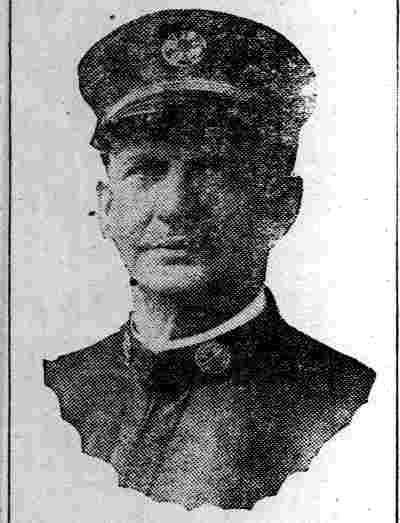
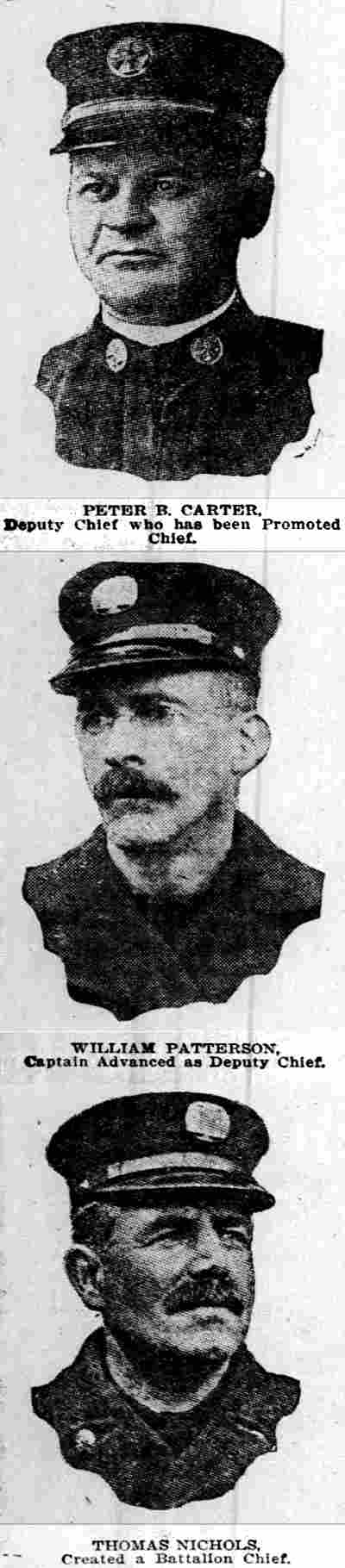
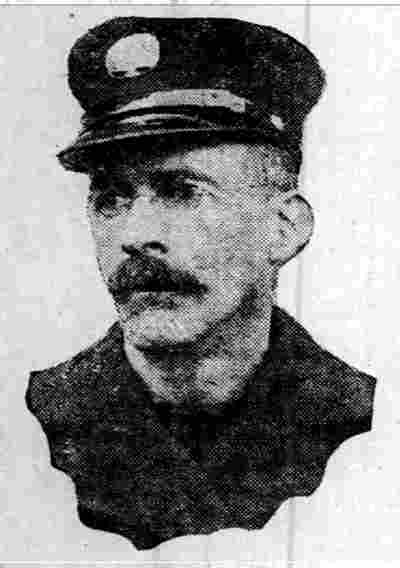
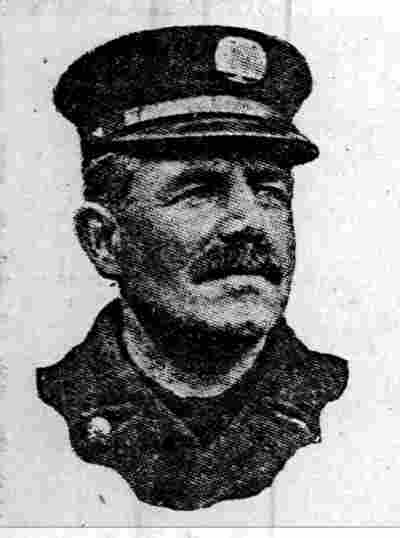
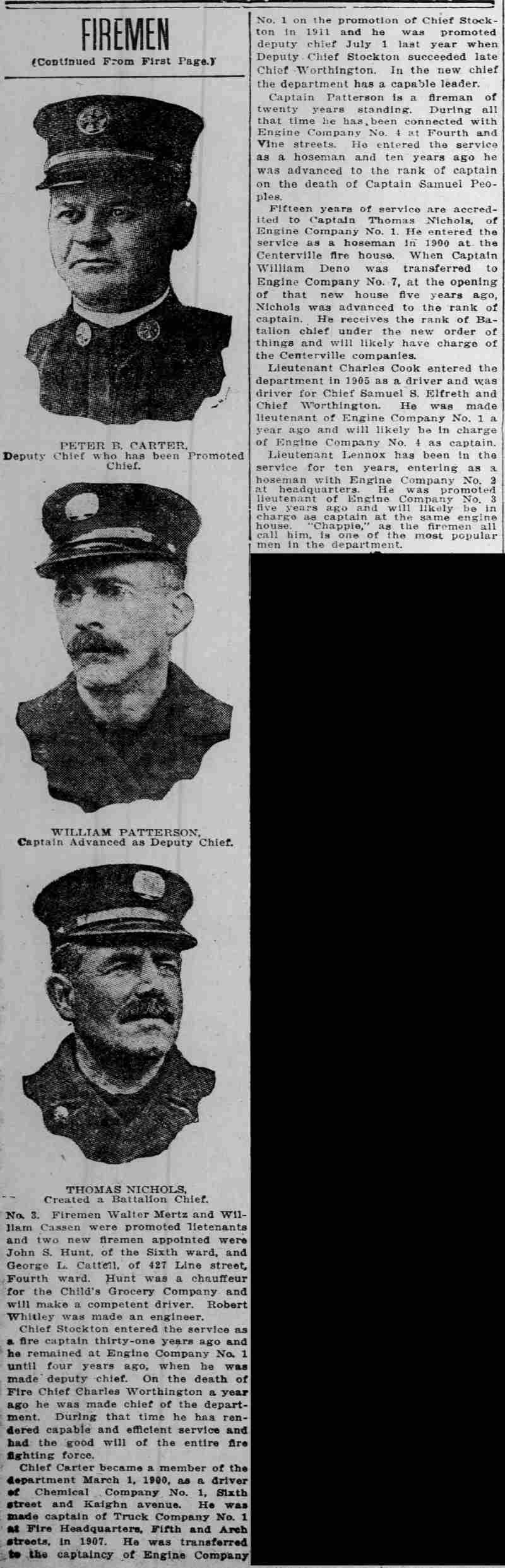
Fire Chief John Stockton; Peter B. Carter, Deputy Chief who has been Promoted Chief; William Patterson, Captain Advanced as Deputy Chief; Thomas Nichols, Created a Battalion Chief.
Carter Chief as Stockton Retires
Camden Post-Telegram —
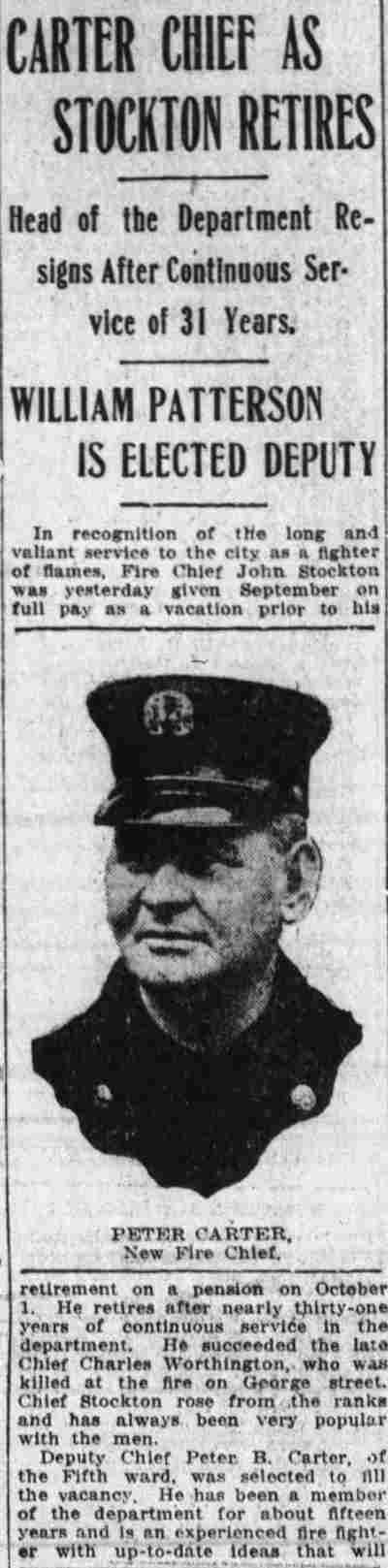
Head of the Department Resigns After Continuous Service of 31 Years.
WILLIAM PATTERSON IS ELECTED DEPUTY
In recognition of the long and valiant service to the city as a fighter of flames, Fire Chief John Stockton was yesterday given September on full pay as a vacation prior to his retirement on a pension on October 1. He retires after nearly thirty-one years of continuous service in the department. He succeeded the late Chief Charles Worthington, who was killed at the fire on George street. Chief Stockton rose from the ranks and has always been very popular with the men.
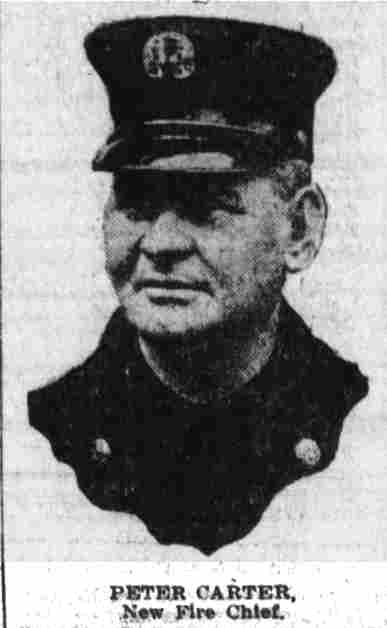
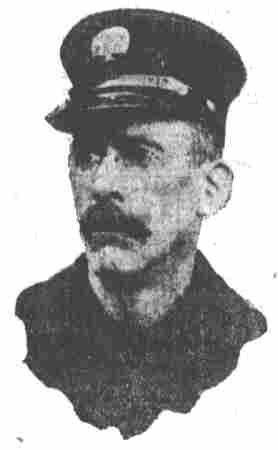
Deputy Chief Peter B. Carter, of the Fifth ward, was selected to fill the vacancy. He has been a member of the department for about fifteen years and is an experienced fire fighter with up-to-date ideas. PETER CARTER, New Fire Chief. WILLIAM PATTERSON, new Deputy Chief.
Fire Chief Retired
Philadelphia Inquirer —
Head of Department Placed on Pension, Deputy Elected
After thirty-one years of continuous service as a member of Camden’s Fire Department, during which he rose from the bottom to the top, Fire Chief John Stockton was yesterday retired at his request by City Council. Deputy Chief Peter B. Carter was elected to fill the vacancy, while William Patterson, who has been captain of No. 4 Engine Company, is made deputy chief. Captain Thomas Nichols, of No. 3 Engine Company, is made a battalion chief. Other appointments made were: Captains, William Cook and John Lennox, lieutenants, Walter Mertz and William Casson, engineer, Robert Whitley, machinist, T. G. Middleton, firemen, John Hunt and George Cattell. Council also appointed Walter W. Johnson chief clerk of the Highway Department to succeed the late B. H. Shivers.
Many at Williams’ Funeral
Philadelphia Inquirer —
Many persons of prominence yesterday attended the funeral of former City Assessor Caleb B. Williams, which took place from his home at 443 Royden street, Camden. The services were in charge of Rev. Dr. John Handley, pastor of the Broadway M. E. Church; Rev. J. H. Townsend, of St. John’s P. E. Church, and Rev. D. B. Green, an assistant at the Broadway Church. The pall-bearers included Fire Chief John Stockton, Police Captain James E. Tatem, Under Sheriff James E. Hewitt, Deputy Register of Deeds Ralston Sickler, former Exciseman John Baker, and Harry Dease, secretary to the Park Commission. Interment was made at Evergreen Cemetery.
Camden Fire Chief Retires
Philadelphia Inquirer —
After thirty-three years of service in the department, John A. Stockton yesterday retired as Camden’s Fire Chief, being succeeded by Peter B. Carter, whose place as Deputy Chief is taken by William Patterson. Battalion Chiefs Cox and Browning will be aides to Chief Carter at headquarters and Battalion Chief Nicholas assumed charge of the South Camden district, with headquarters at No. 3 Engine Company.
Mrs. Stockton Dies, Widow of Fire Chief
Camden Courier-Post —
Mrs. Ruth A. Stockton, 73, of 538 South Fifth Street, widow of the late Fire Chief John A. Stockton, died on Saturday.
Mrs. Stockton had lived at the Fifth Street address more than 40 years. Her husband died in 1927. Mrs. Stockton is survived by a brother, Edward Jordan, Camden, and a niece, Mrs. Ruth Pettit, Camden. She was a member of the Fourth Ward Women’s Republican Club.
The funeral will be held at 2 p. m., Wednesday, at 453 South Sixth Street. Burial will be in Evergreen Cemetery.