Introduction
DAVID RUSSELL ELLIS was the son of Bertha and David Ellis. His father was a Camden Police officer from 1900 to 1913. David Russell Ellis was born in Camden on May 9, 1893. When the Census was taken in 1900 the Ellis family, which included an older brother, Howard Ellis, was living at 724 Division Street. By 1906 they had moved to 709 Walnut Street and were still there when the Census was taken in 1910. David R. Ellis was then working as a steamfitter. By 1914 he had married. The City Directory for that year lists him and his wife Frieda at 760 Cherry Street. When he registered for the draft in June of 1917, David Ellis had gone to work at the Keystone Leather Works factory. He was then living at 820 Fern Street in North Camden.
David R. Ellis and his wife separated not long after June 5, 1917, when he registered for the draft. By the fall of 1918 he was boarding at the home of a young widow, Evelyn Prucella Magann, at 1024 Penn Street. The 1920 Census shows him living there and working at a shipyard. She was the sister of Camden Fire Department member John B. “Shorty” Prucella. Possibly at his urging, David Ellis applied for an appointment to the Camden Fire Department in 1920, which he received near the end of the year.
David Ellis reported for service with the Fire Department on January 1, 1921 with Ladder Company 3. By 1917 he and Evelyn Magann had married. They were then living, along with stepson Walden Magann, at 913 Cedar Street, remaining at that address into 1931. The Ellis family moved to 1614 Fillmore Street shortly afterwards. By April 18, 1930 he had been promoted to Captain, serving with Engine Company 2.
Tragedy struck on June 15, 1934 when Captain Ellis died of acute indigestion at Leslie’s Cove, which was a small island with summer cottages in Mantua Creek near Mt. Royal, New Jersey. He was only 42 years old at the time. David Russell Ellis rests at Harleigh Cemetery.
Coincidentally, not long after Captain Ellis died, a flood brought on by a severe storm washed away the island and the cottages. Leslie’s Cove, which had been a popular summer resort for about 50 years, was gone forever.
World War I Draft Registration Card
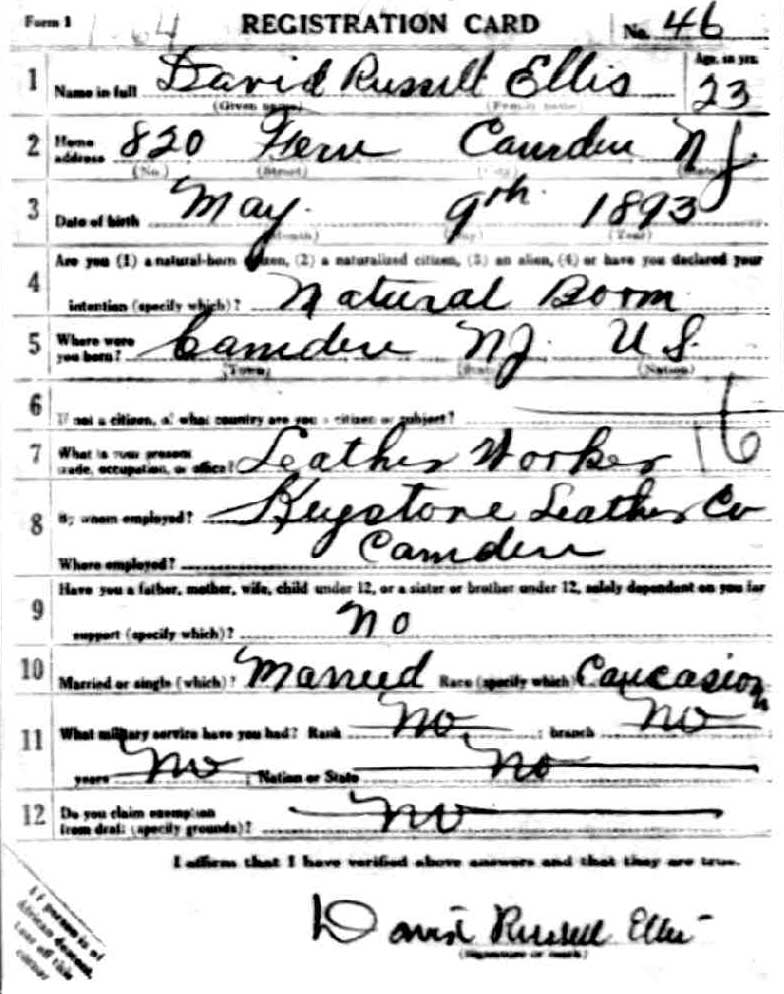
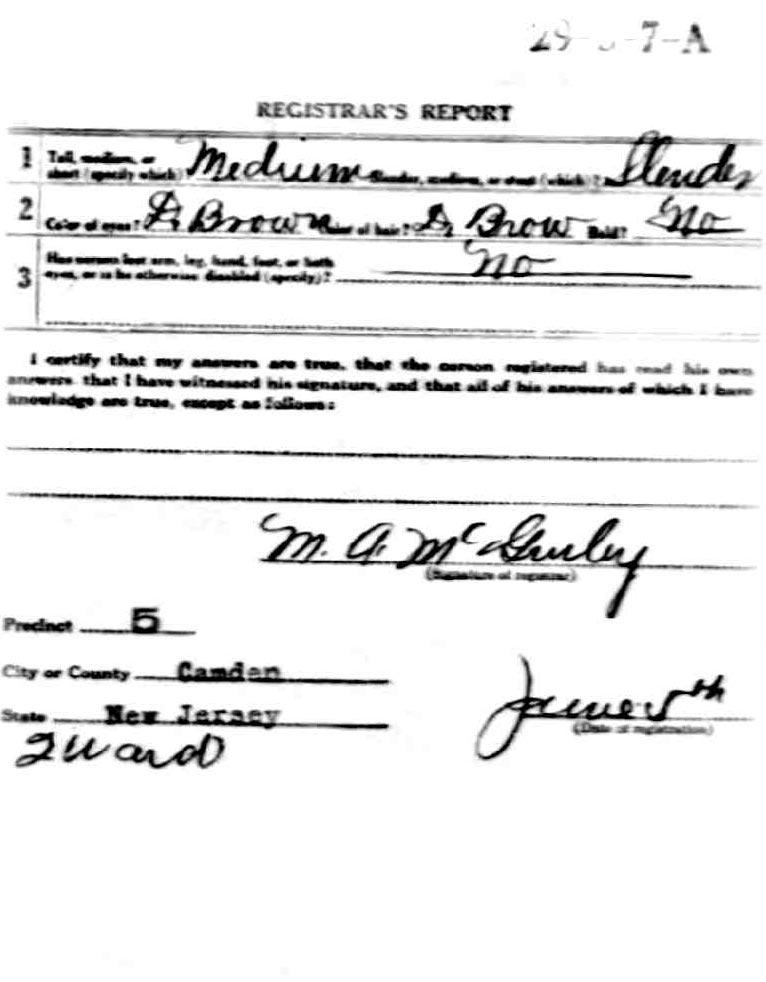
David Russell Ellis – World War I Draft Registration Card, June 1917
New Firemen Assigned for Two Platoons
Camden Post-Telegram —
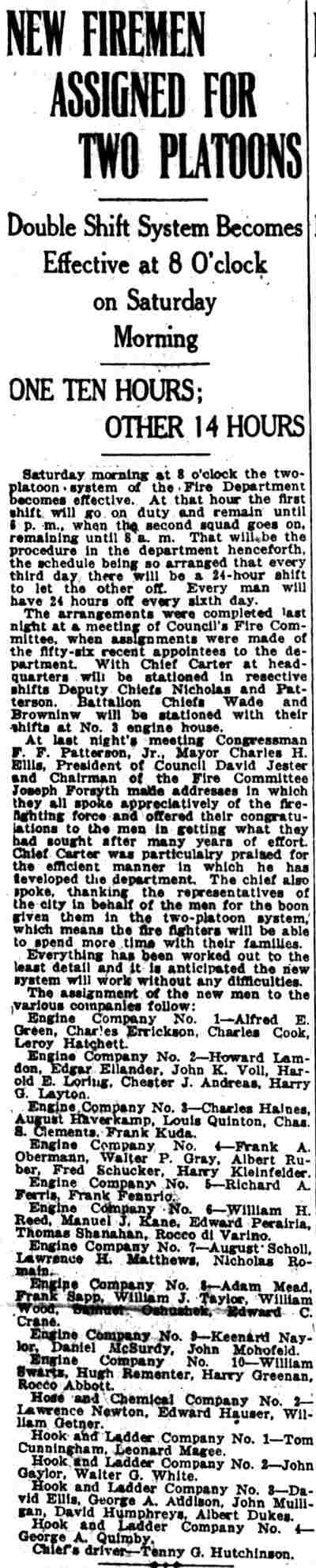
Double Shift System Becomes Effective at 8 O’clock on Saturday Morning
ONE TEN HOURS; OTHER 14 HOURS
Saturday morning at 8 o’clock the two-platoon system of the Fire Department becomes effective. At that hour the first shift will go on duty and remain until 8 p. m., when the second squad goes on, remaining until 8 a. m. That will be the procedure in the department henceforth, the schedule being so arranged that every third day there will be a 24-hour shift to let the other off. Every man will have 24 hours off every sixth day.
The arrangements were completed last night at a meeting of Council’s Fire Committee, when assignments were made of the fifty-six recent appointees to the department. With Chief Carter at headquarters will be stationed in resective [sic] shifts Deputy Chiefs Nicholas and Patterson. Battalion Chiefs Wade and Browninw [sic] will be stationed with their shifts at No. 3 engine house.
At last night’s meeting Congressman F. F. Patterson, Jr., Mayor Charles H. Ellis, President of Council David Jester and Chairman of the Fire Committee Joseph Forsyth made addresses in which they all spoke appreciatively of the fire-fighting force and offered their congratulations to the men in getting what they had sought after many years of effort. Chief Carter was particularly praised for the efficient manner in which he has developed the department. The chief also spoke, thanking the representatives of the city in behalf of the men for the boon given them in the two-platoon system, which means the fire fighters will be able to spend more time with their families.
Everything has been worked out to the least detail and it is anticipated the new system will work without any difficulties.
The assignment of the new men to the various companies follow:
Engine Company No. 1—Alfred E. Green, Charles Errickson, Charles Cook, Leroy Hatchett.
Engine Company No. 2—Howard Lamdon, Edgar Ellander, John K. Voll, Harold E. Loring, Chester J. Andreas, Harry G. Layton.
Engine Company No. 3—Charles Haines, August Haverkamp, Louis Quinton, Chas. S. Clements, Frank Kuda.
Engine Company No. 4—Frank A. Obermann, Walter P. Gray, Albert Ruber, Fred Schucker, Harry Kleinfelder.
Engine Company No. 5—Richard A. Ferris, Frank Fennrio.
Engine Company No. 6—William H. Reed, Manuel J. Kane, Edward Perairia, Thomas Shanahan, Rocco di Varino.
Engine Company No. 7—August Scholl, Lawrence H. Matthews, Nicholas Romain.
Engine Company No. 8—Adam Mead, Frank Sapp, William J. Taylor, William Wood, Samuel Oshushek, Edward C. Crane.
Engine Company No. 9—Keenard Naylor, Daniel McSurdy, John Mohofeld.
Engine Company No. 10—William Swarts, Hugh Rementer, Harry Greenan, Rocco Abbott.
Hose and Chemical Company No. 2—Lawrence Newton, Edward Hauser, William Getner.
Hook and Ladder Company No. 1—Tom Cunningham, Leonard Magee.
Hook and Ladder Company No. 2—John Gaylor, Walter G. White.
Hook and Ladder Company No. 3—David Ellis, George A. Addison, John Mulligan, David Humphreys, Albert Dukes.
Hook and Ladder Company No. 4—George A. Quimby.
Chief’s driver—Tenny G. Hutchinson.
4 Firemen Hurt Fighting Blaze in Apartments
Camden Courier —
Four Families Forced to Flee Down Fire Escape in Cooper St. Blaze
INVALID WOMAN CARRIED TO SAFETY BY RESCUERS
Flames Scorch Rubber-Coated ‘Smoke-Eaters’ on Narrow Stairs
RUSH-HOUR CROWD GAZES
Four firemen were burned, an aged invalid woman was carried to safety and four families were driven down a fire escape to the street when fire swept an apartment house at 620 Cooper street late yesterday.
The blaze started at 5.30 o’clock from unknown origin in a wardrobe in the hall on the third floor, burst through the roof, ate its way into the second floor, and spread to several apartments on the third floor. Hundreds of spectators gathered in the street to watch, and rush-hour traffic on Cooper street was blocked.
The firemen were scorched on the faces and hands by a blast of flame from the burning wardrobe, as they fought their way up the narrow, enclosed staircase to the third floor with chemical lines and hand-extinguishers, while a water line was being run up a ladder to third floor windows in the front of the building.
Driven Down Stairs
Despite the protection afforded by rubber coats and helmets, the men were driven down the well-like stairs time and again, their faces, hair and eyebrows scorched from the intense heat.
While they were fighting to get at the source of the blaze, five women, six children and two men, living in second and third floor apartments, made their way to a fire escape in the rear of the building and escaped safely to the ground.
In the meantime, smoke was pouring into open windows of the adjoining house at 622 Cooper street, used as a residence by Dr. Thomas B. Lee and as offices by four other physicians. Dr. Lee, a former member of the State Board of Health, sailed from New York this morning for a two months clinical course in Europe. He and Mrs. Lee had left their home before the fire.
Dr. Lee’s aged aunt, Mrs. Thomas Wescott, convalescing from illness, was in a third-floor room as smoke filled the building. She had to be assisted to the street by other members of the household.
Deputy Fire Chief Hurt
The injured firemen are Deputy Fire Chief Thomas Nicholas, his chauffeur, David Ellis, and Hoseman William Chambers and Leonard Magee, of Engine 2, which company, with Truck No. 1, responded to the one alarm sent in by occupants of one of the third floor apartments. All were treated for burns by Dr. David F. Bentley, Jr., at the physician’s offices next door at 622 Cooper street.
The occupants who fled down the fire escape are Mrs. Benjamin Kennedy and her two children, Mrs. Jenny Cramer and four children, Mr. and Mrs. A. Sutton, Miss Elva Lloyd, Miss Agnes Anderson and James Andrews. Many others had not returned from business, and firemen had to chop down the doors to their rooms to make certain the flames were all extinguished. That required three-quarters of an hour. Firemen estimated the damage at well over $1,000.
“If the fire had occurred in the middle of the night,” said Chief Nicholas, “there would surely have been loss of life. The narrow stairways make that type of house a very difficult one in which to fight a fire.”
$225,000 Fire Ruins 5 Uptown Plants
Camden Courier-Post —

How Flames Gutted Big Industrial Building
Residents Flee as Flames Rage in Big Building
Factory of Evans Leather Co. Saved by Valiant Work of Firemen
Apparatus Is Disabled; Debris Buried Fire Plug
Metal Stamping Firm, Textile Concern Heavy Losers; Pattern Shop Saved
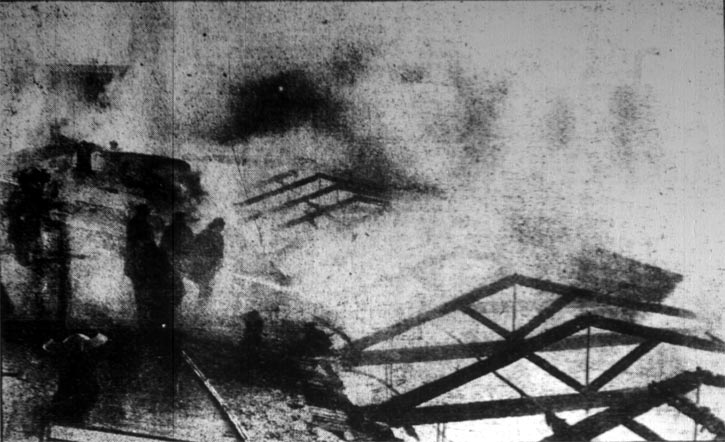
Taken shortly after daylight today, this photograph shows firemen still pouring water on the ruins of the Varoma building on Erie street from the roof of the Evans Leather Company building adjoining. Five industries were wiped out in the blaze which caused damage estimated at $225,000.
Sweeping through the Varoma Building on Erie street and driving 80 persons from their homes, a spectacular fire early today wrecked the quarters of five industrial concerns and caused damage estimated at $225,000.
Responding to three alarms, every piece of fire apparatus in the city, with the exception of the “cover-up” companies, fought the blaze for hours.
Handicapped by the location of fire-plugs and the breakdown of several pieces of apparatus, the firemen prevented the flames from spreading to the huge building of the Evans Leather Company, which forms an “L” on two sides of the burned structure.
Twenty dwellings on the east side of Segal street, separated from the Varoma building only by a narrow alley, were also saved after their occupants had fled to the street.
Fire Chief Thomas Nicholas announced later today, after the flames had been brought under control, that he would begin a rigid investigation into the blocking of Segal street by a high board fence and the piling of refuse around a fireplug at the head of the street.
The wrecked building is owned by the Varoma Corporation of which Thomas Van Osten, of Palmyra, is president; William MacIntosh, 3[?]7 Vine street, vice president; Alfred Van Osten, of Palmyra, secretary, and David B. Robinson, of West Collingswood.
Building Loss $50,000
MacIntosh today estimated the damage to the building alone at $50,000. He is also president of the MacIntosh Printing and Lithographing Company, of which James J. Stinson, of Merchantville is secretary. Damage estimated at $10,000 resulted from the fire in the quarters of that concern.
The other industries, all located in the big brick building, which suffered in the blaze, with official estimate of the damage to each, are as follows:
Blue and Gray Textile Company, of which T. A. Carr, of 302 Porter road, Fairview, is president, $30,000.
Allied Metal Stamping Company, of which Joseph A. Skublicki, of 115 State street, is president, and William Daugherty, vice president, $75,000.
James A. MacMillan & Co., manufacturing chemists, headed by James MacMillan, of 809 North Third street, $10,000.
Philadelphia Metal Stamping Company, of which firm Clement A. and Mrs. Florence Perrin, of Collingswood, and Edwin L. Seabrook, of 566 Benson street, are members, $50,000.
Other Concerns Escape
The fire was discovered at 5.35 o’clock by a watchman who sounded the first alarm. The flames had started, from causes as yet undetermined, in that portion of the building occupied by the Blue & Gray Textile Company. The building, which housed nine separate industries, covered an area 100 by 300 feet. Part of it was one story in height and another part two stories. Four of the industries in the two-story section of the building escaped serious damage. They are Kruse & Slattery, tool-makers; the Camden Hardware Manufacturing Company, the Wolf Company, manufacturers of advertising novelties; the Thomas C. Van Osten pattern-makers, headed b[illegible]dent of the concern w[illegible] building.
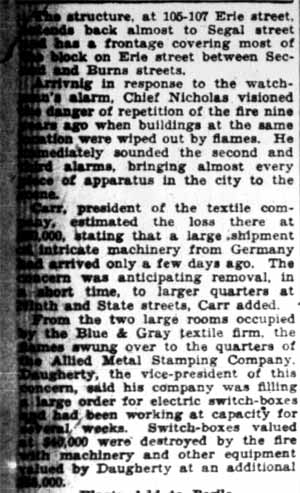
The structure, at 105-107 Erie street, extends back almost to Segal street and has a frontage covering most of the block on Erie street between Second and Burns streets.
Arrivnig [sic] in response to the watchman’s alarm, Chief Nicholas visioned the danger of repetition of the fire nine years ago when buildings at the same location were wiped out by flames. He immediately sounded the second and third alarms, bringing almost every piece of apparatus in the city to the scene.
Carr, president of the textile company, estimated the loss there at $30,000, stating that a large shipment of intricate machinery from Germany had arrived only a few days ago. The concern was anticipating removal, in a short time, to larger quarters at Ninth and State streets, Carr added.
From the two large rooms occupied by the Blue & Gray textile firm, the flames swung over to the quarters of the Allied Metal Stamping Company. Daugherty, the vice-president of this concern, said his company was filling a large order for electric switch-boxes and had been working at capacity for several weeks. Switch-boxes valued at $40,000 were destroyed by the fire, with machinery and other equipment valued by Daugherty at an additional $35,000.
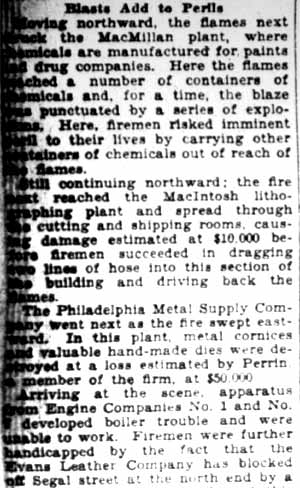
Blasts Add to Perils
Moving northward, the flames next struck the MacMillan plant, where chemicals are manufactured for paints and drug companies. Here the flames reached a number of containers of chemicals and, for a time, the blaze was punctuated by a series of explosions. Here, firemen risked imminent peril to their lives by carrying other containers of chemicals out of reach of the flames.
Still continuing northward; the fire next reached the MacIntosh lithographing plant and spread through the cutting and shipping rooms, causing damage estimated at $10,000 before firemen succeeded in dragging two lines of hose into this section of the building and driving back the flames.
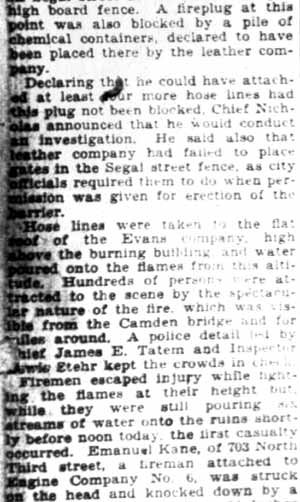
The Philadelphia Metal Supply Company went next as the fire swept eastward. In this plant, metal cornices and valuable hand-made dies were destroyed at a loss estimated by Perrin, a member of the firm, at $50,000. Arriving at the scene, apparatus from Engine Companies No. 1 and No. 7 developed boiler trouble and were unable to work. Firemen were further handicapped by the fact that the Evans Leather Company has blocked off Segal street at the north end by a high board fence. A fireplug at this point was also blocked by a pile of chemical containers, declared to have been placed there by the leather company.
Declaring that he could have attached at least four more hose lines had this plug not been blocked, Chief Nicholas announced that he would conduct an investigation. He said also that the leather company had failed to place gates in the Segal street fence, as city officials required them to do when permission was given for erection of the barrier.
Hose lines were taken to the flat roof of the Evans company, high above the burning building, and water poured onto the flames from this altitude. Hundreds of persons were attracted to the scene by the spectacular nature of the fire, which was visible from the Camden bridge and for miles around. A police detail led by Chief James E. Tatem and Inspector Lewis Etehr [sic] kept the crowds in check.
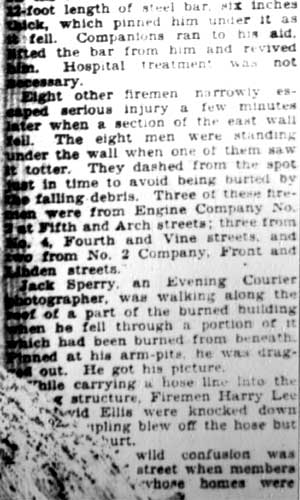
Firemen escaped injury while fighting the flames at their height, but while they were still pouring streams of water onto the ruins shortly before noon today, the first casualty occurred. Emanuel Kane, of 703 North Third street, a fireman attached to Engine Company No. 6, was struck on the head and knocked down by a 12-foot length of steel bar, six inches thick, which pinned him under it as he fell. Companions ran to his aid, lifted the bar from him and revived him. Hospital treatment was not necessary.
Eight other firemen narrowly escaped serious injury a few minutes later when a section of the east wall fell. The eight men were standing under the wall when one of them saw it totter. They dashed from the spot just in time to avoid being buried by the falling debris. Three of these firemen were from Engine Company No. 1 at Fifth and Arch streets; three from No. 4, Fourth and Vine streets, and two from No. 2 Company, Front and Linden streets.
Jack Sperry, an Evening Courier photographer, was walking along the roof of a part of the burned building when he fell through a portion of it which had been burned from beneath. Pinned at his arm-pits, he was dragged out. He got his picture.
While carrying a hose line into the [illegible] structure, Firemen Harry Lee [illegible] David Ellis were knocked down when a [illegible]pling blew off the hose but [illegible] hurt.
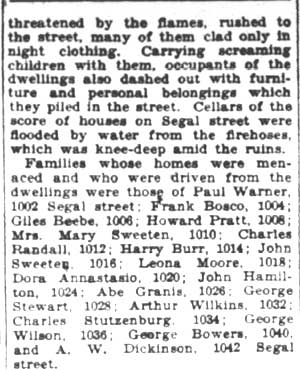
[illegible] wild confusion was [illegible] street when members [illegible] whose homes were threatened by the flames, rushed to the street, many of them clad only in night clothing. Carrying screaming children with them, occupants of the dwellings also dashed out with furniture and personal belongings which they piled in the street. Cellars of the score of houses on Segal street were flooded by water from the firehoses, which was knee-deep amid the ruins.
Families whose homes were menaced and who were driven from the dwellings were those of Paul Warner, 1002 Segal street; Frank Bosco, 1004; Giles Beebe, 1006; Howard Pratt, 1008; Mrs. Mary Sweeten, 1010; Charles Randall, 1012; Harry Burr, 1014; John Sweeten, 1016; Leona Moore, 1018; Dora Annastasio, 1020; John Hamilton, 1024; Abe Granis, 1026; George Stewart, 1028; Arthur Wilkins, 1032; Charles Stutzenburg, 1034; George Wilson, 1036; George Bowers, 1040, and A. W. Dickinson, 1042 Segal street.
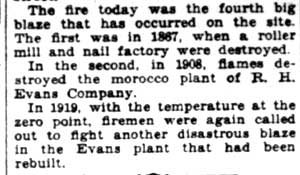
The fire today was the fourth big blaze that has occurred on the site. The first was in 1867, when a roller mill and nail factory were destroyed.
In the second, in 1908, flames destroyed the morocco plant of R. H. Evans Company.
In 1919, with the temperature at the zero point, firemen were again called out to fight another disastrous blaze in the Evans plant that had been rebuilt.
Promoted Firemen Take Posts Today
Camden Courier-Post —
Lennox Deputy Chief; Eight Others Elevated as Captains Here
A new deputy chief, a battalion chief and eight new senior and junior captains will assume their posts today in the fire department. The men were promoted yesterday afternoon, along with the announcement of eleven new appointments of firemen, who will go into service April 15.
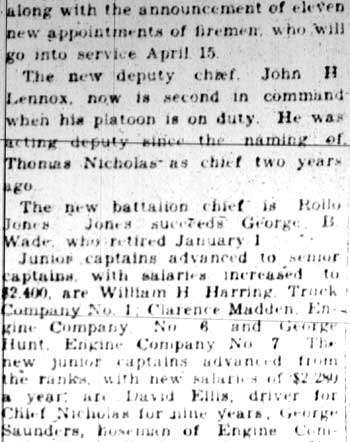
The new deputy chief, John H. Lennox, now is second in command when his platoon is on duty. He was acting deputy since the naming of Thomas Nicholas as chief two years ago.
The new battalion chief is Rollo Jones. Jones succeeds George B. Wade, who retired January 1.
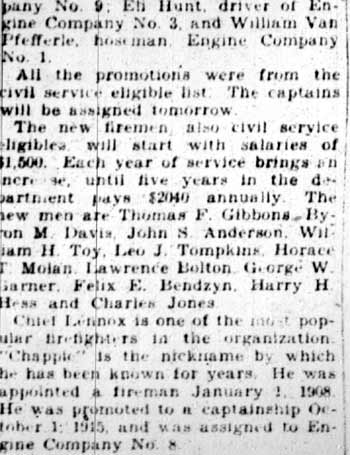
Junior captains advanced to senior captains, with salaries increased to $2,400, are William H. Harring, Truck Company No. 1, Clarence Madden, Engine Company No. 6, and George Hunt, Engine Company No. 7. The new junior captains advanced from the ranks, with new salaries of $2,280 a year, are David Ellis, driver for Chief Nicholas for nine years, George Saunders, hoseman of Engine Company No. 9; Eli Hunt, driver of Engine Company No. 3, and William Van Pfefferle, hoseman, Engine Company No. 1.
All the promotions were from the civil service eligible list. The captains will be assigned tomorrow.
The new firemen, also civil service eligibles, will start with salaries of $1,500. Each year of service brings an increase, until five years in the department pays $2040 annually. The new men are Thomas F. Gibbons, Byron M. Davis, John S. Anderson, William H. Toy, Leo J. Tompkins, Horace T. Molan, Lawrence Bolton, George W. Garner, Felix E. Bendzyn, Harry H. Hess and Charles Jones.
Chief Lennox is one of the most popular firefighters in the organization. “Chappie” is the nickname by which he has been known for years. He was appointed a fireman January 1, 1908. He was promoted to a captainship October 1, 1915, and was assigned to Engine Company No. 8.
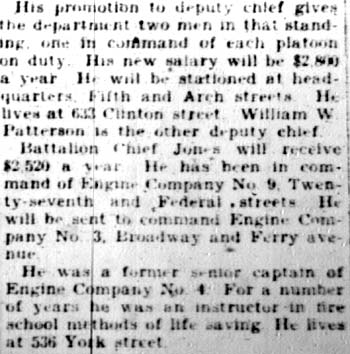
His promotion to deputy chief gives the department two men in that standing, one in command of each platoon on duty. His new salary will be $2,8[8]0 a year. He will be stationed at headquarters, Fifth and Arch streets. He lives at 633 Clinton street. William W. Patterson is the other deputy chief.
Battalion Chief Jones will receive $2,520 a year. He has been in command of Engine Company No. 9, Twenty-seventh and Federal streets. He will be sent to command Engine Company No. 3, Broadway and Ferry avenue.
He was a former senior captain of Engine Company No. 4. For a number of years he was an instructor in fire school methods of life saving. He lives at 536 York street.
22 Firemen Assigned to New Stations
Camden Courier-Post —
12 Rookies and 10 Promoted Men Go to Posts
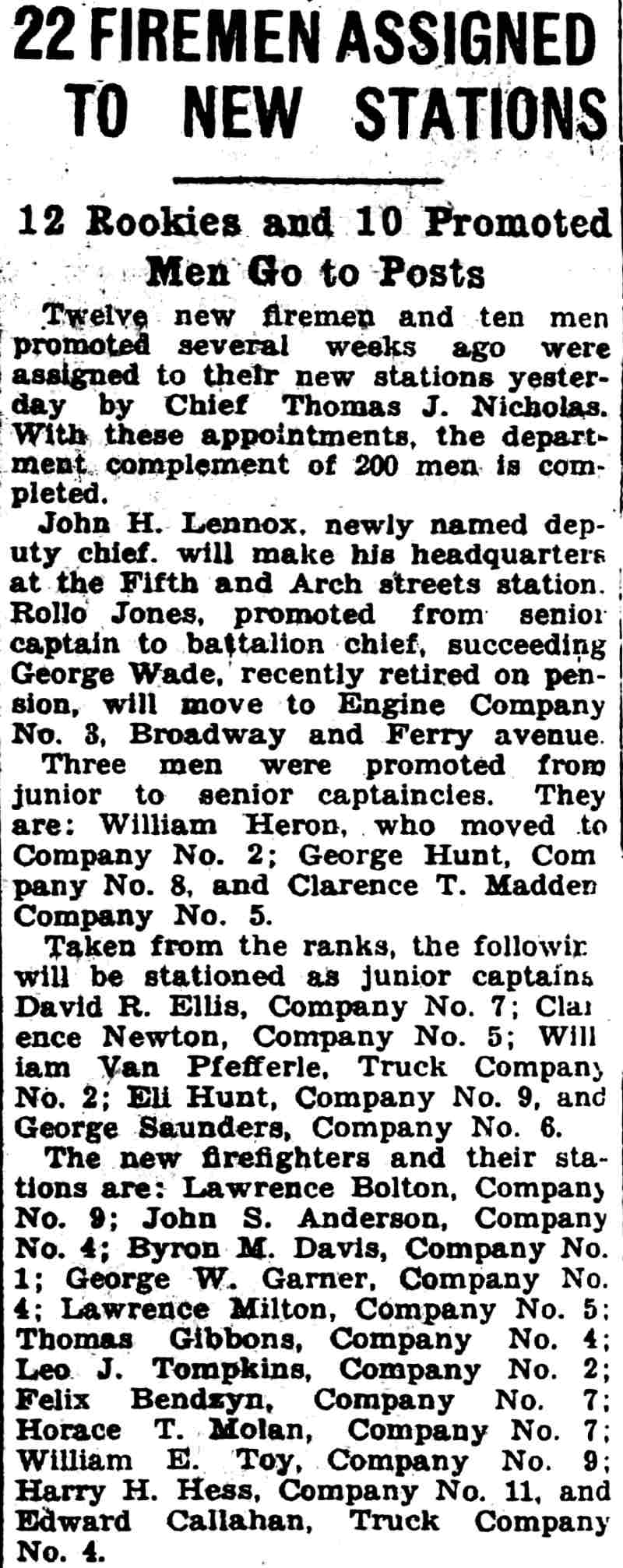
Twelve new firemen and ten men promoted several weeks ago were assigned to their new stations yesterday by Chief Thomas J. Nicholas. With these appointments, the department complement of 200 men is completed.
John H. Lennox, newly named deputy chief, will make his headquarters at the Fifth and Arch streets station. Rollo Jones, promoted from senior captain to battalion chief, succeeding George Wade, recently retired on pension, will move to Engine Company No. 3, Broadway and Ferry avenue.
Three men were promoted from junior to senior captaincies. They are: William Heron [sic], who moved to Company No. 2; George Hunt, Company No. 8, and Clarence T. Madden, Company No. 5.
Taken from the ranks, the following will be stationed as junior captains: David R. Ellis, Company No. 7; Clarence Newton, Company No. 5; William Van Pfefferle, Truck Company No. 2; Eli Hunt, Company No. 9, and George Saunders, Company No. 6.
The new firefighters and their stations are: Lawrence Bolton [sic], Company No. 9; John S. Anderson, Company No. 4; Byron M. Davis, Company No. 1; George W. Garner, Company No. 4; Lawrence Milton, Company No. 5; Thomas Gibbons, Company No. 4; Leo J. Tompkins, Company No. 2; Felix Bendzyn, Company No. 7; Horace T. Molan, Company No. 7; William E. Toy, Company No. 9; Harry H. Hess, Company No. 11, and Edward Callahan, Truck Company No. 4.
3 Youths Held as Blaze Razes Grain Plant of Sitley and Son
Camden Courier-Post —
Damage in Fire at Sixth and Bulson Streets Estimated at $45,000
FOUR MEN RISK LIVES TO SAVE TWO HORSES
Boys Believed by Police Probers to Have Been Smoking, in Building
Three boys are being held and two others are sought in the investigation of the $45,000 fire which today destroyed the warehouse of Sitley & Son, wholesale hardware, roofing material and grain dealers at Sixth and Bulson Streets.
The three boys were ordered held by Police Judge Pancoast after authorities expressed belief that the three alarm fire was caused either by thieves or boys smoking cigarettes on the premises.
Two of the youths admitted they stole coal from the plant’s siding last night, while the third confessed that he, and two other boys were in the plant last evening. He said his two companions, who are expected to be arrested this afternoon, were smoking.
One fireman was slightly hurt when he ran a nail into his foot, while other firefighters narrowly escaped injury when the roof of the blazing building collapsed.
A dense fog, rain, great clouds of thick smoke and intense heat all hampered the firemen, and rendered them practically helpless for more than three hours. When the blaze was finally under control at 8:00 a.m., only the blackened and buckled walls remained standing.
Practically the entire stock was lost, but through the courage of four men including two policemen, a team of terrified horses and three trucks were saved from the blazing stable.
Twenty employees were temporarily deprived of work.
Discovery of three rolls of wire fencing on nearby railroad tracks and the presence of two men near the premises when the blaze was discovered led Fire Chief Thomas Nicholas to believe thieves had thrown a cigarette near some flammable material.
The arrested boy is John Brodzik, 1927 Fillmore Street.
Two other youths, John Hadyniak, 16, of 685 Ferry Avenue, and Anthony Parraine [Piraino—PMC], 11, of 2026 South Seventh Street, arrested on a charge of stealing coal from the Sitley siding last night are also being held. They declare they were not in the plant.
In addition to the smoke and heat firemen were further hampered by the fact that two railroads pass the building. Many of the hose lines had to be stretched over the tracks, so that in order to prevent passing trains, from which thousands of commuters saw the fire, from cutting the lines, holes were dug under the tracks and the lines run through the excavations.
Captain David Ellis, of No. 7 fire company at Mt. Ephraim and Kaighn Avenues, ran a nail in his foot, and after being given first aid treatment at the scene was taken to the West Jersey Homeopathic Hospital.
The first alarm was sounded at 4:18 a.m. from a box at Fillmore Street and Chelton Avenue. The fire was discovered by Paul N. Naurath, 1727 Master Street, an engineer at the Camden brewery, which is in the immediate vicinity of the Sitley plant.
Naurath ran to a gasoline filling station at Broadway and Chelton Street from where he telephoned to fire headquarters. He later told Police Lieutenant George Frost that when he noticed the smoke and flames he saw two men running around the Sitley stable, which is attached to the main plant. However, he paid no attention to them, being intent upon turning in an alarm.
While fire apparatus sped to the scene, Naurath, Frederick Baum, 431 Winslow Street; Patrolman Frank Del Rossi and Police Sergeant Edward Carroll, heard the shrill screams of horses in the stable, which had quickly become an inferno.
Horses Rescued
The four rushed into the stable, broke down the door, and led out the two horses, which several times attempted to run back into the flames. The men also drove three trucks out of the place before they were driven away by the dense smoke.
The building occupies a plot about 300 feet square and comprises several one and two-story sections. There was formerly a grain elevator on the site belonging to the Sitleys, but it was destroyed by fire more than a decade ago and never rebuilt. On the south side of the plant are the Atlantic City Railroad tracks, and on the east side the West Jersey and Seashore Railroad lines.
Flames Spread Rapidly
Believed to have started either in the stable or at the extreme northern end of the plant, the fire quickly swept through the entire building. Rolls of tarred paper and bins of grain were quickly consumed, throwing out huge clouds of smoke.
Two more alarms were sounded for additional apparatus, but it was not until 7:30 a.m. that firemen could enter the building. Meanwhile, about 50 hose lines were stretched to the building and water continually played on the fire. Commissioner Frank B. Hanna arrived and increased the water pressure five points at the pumping stations to keep a water supply to feed the hose lines. Chief of Police Lewis H. Stehr also sped to the fire.
A touch of tragedy was added when Thomas Mills, 70, of 431 Viola Street, employed by the Sitleys for 40 years as a packer, arrived. The elderly workman burst into tears when he saw the flames, and sobbed that he was now out of work and had a family to support.
Finally, about 8 a. m., firemen had the blaze under control, after the roof had caved in. Only the walls stood, but several times they threatened to collapse.
The owners, Frank B. Sitley, Sr., of Woodbury, and his son, Frank B. Sitley, Jr., arrived, but declined to estimate their loss. However, police and firemen fixed an approximate damage of $25,000 to the building and $20,000 to the stock.
Lieutenant Frost found three rolls of wire fencing which had been taken from the building. They were lying on the Reading Railroad tracks, apparently dropped by thieves when police arrived.
Young Brodzik was arrested at 8:00 p.m. yesterday by Special Officer John Stevenson, who turned him over to Patrolmen Smith and Rieh. The youth was charged with suspicion of having broken into the place, and is alleged to have first denied being in the building, but later admitted that he and two other boys crawled through a basement window.
The boy declared that he neither smoked nor stole anything, but said that other boys had smoked. He refused to divulge their names.
Hadyniak and Perraine were arrested last night and charged with theft of coal from the siding. Brodzik declared those two were not the boys who were with him last night.
All three were arraigned before Judge Pancoast in police court this morning and held without bail pending investigation.
Blast Causes Fire, Seven Persons Flee
Trenton Times —
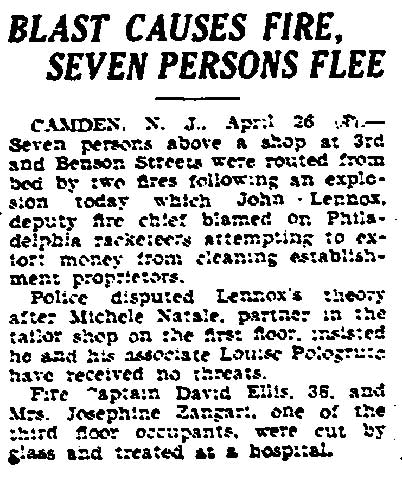
CAMDEN, N. J., April 26 (A.P.) — Seven persons above a shop at 3rd and Benson Streets were routed from bed by two fires following an explosion today which John Lennox, deputy fire chief blamed on Philadelphia racketeers attempting to extort money from cleaning establishment proprietors.
Police disputed Lennox's theory after Michele Natale, partner in the tailor shop on the first floor, insisted he and his associate Louise Pologrute have received no threats.
Fire Captain David Ellis, 35, and Mrs. Josephine Zangari, one of the third floor occupants, were cut by glass and treated at a hospital.
Leslie's Cove
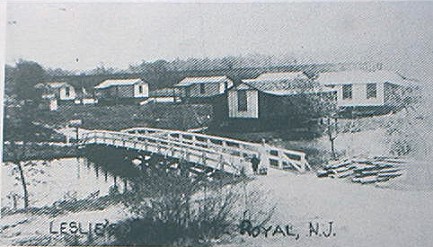
Leslie’s Cove, a small island with summer cottages in Mantua Creek near Mt. Royal, New Jersey, where Captain David Russell Ellis died on June 15, 1934.