J. Oscar Till Jr.
JOSEPH OSCAR TILL JR. was born in Pennsylvania on January 12, 1876 to Joseph Oscar and Catherine “Kate” Till. His father had served in the Union Army during the Civil War, then returned to his home in Philadelphia. Joseph Till married in the early 1870s, and by 1880 there were two sons, William and Joseph Oscar Till Jr., who was better known simply as “Oscar Till.” Joseph Till and his family were living at 872 Moyer Street in Philadelphia when the 1880 Census was enumerated. He was then working as a huckster. The 1881 Philadelphia City Directory shows him at the same address, running a cigar store. Four more sons were born to the Tills during the 1880s, Morris, Albert, Clarence, and finally on January 12, 1889 Nelson W. Till. Joseph Till was also active during his Philadelphia years as a volunteer fireman.
The Till family moved to New Jersey in the 1890s, and had located in the town of Stockton in the early 1890s. By 1896 the family was living at 912 Lois Avenue in the town of Stockton, in what is now the Cramer Hill section of Camden. The Tills would occupy this home through at least 1947.
Joseph Till involved himself in local affairs and soon had been appointed constable in Stockton. When Stockton was united with the City of Camden in 1899, Joseph Till secured an appointment to the Camden Fire Department. Politics being a full-contact sport in those times, Joseph Till got into a fight with two other men on Saturday night, November 1, 1903. The following day he suffered a fall, and was taken to Cooper Hospital where he died on November 13. An inquest was held and his death was ruled accidental, from injuries sustained in the fall. Joseph Till was buried at Arlington Cemetery in Pennsauken, New Jersey on November 17, 1903. He was survived by his wife and sons. Kate Till joined her husband on July 11, 1941.
J. Oscar Till Jr. first appears in Camden’s city directories in 1896, living with his parents and working as a day laborer. The Till family was not recorded in the 1897 edition. The 1898 and 1899 directories both show him still at the Lois Avenue address, working as a laborer. The 1900 Census shows that he married Albina Slater in 1899. She was the daughter of Cornelius and Ellen Slater, who kept a grocery at 1000 North 25th Street, the corner of North 25th Street and River Avenue in Cramer Hill. He and his wife lived with her parents and sister Hattie Slater when the Census was taken on July 29, 1900. Not long afterwards, most likely through the influence of his father, J. Oscar Till got a job as a bridgetender at the Federal Street drawbridge over the Cooper River.
On December 3, 1904 J. Oscar Till Jr. was appointed to the Camden Fire Department. On January 1, 1908 he was appointed to the Camden Police Department.
The 1910 Census shows J. Oscar Till Jr., his wife Albina, and sons Joseph W., Charles H., and Oscar H. Till living at 1002 North 25th Street. Three other children had been born but sadly, as was all too common in those times, had passed away. J. Oscar Till Jr.’s in-laws, the Slaters, still lived at and were in business at 1000 North 25th Street. Two more children came in the 1910s, David and Verna Till. When the Census was taken in April of 1930, only Charles, Oscar H, David, and Verna were still living at home. J. Oscar Till Jr. was still working for the Camden Police Department at the time of the census enumeration. He retired on January 1, 1933.
J. Oscar Till Jr. was still living at 1002 North 25th Street with his wife Albina and son Oscar H. Till when the 1940 Camden City Directory was compiled. Oldest son Joseph W. Till lived at 1000 North 25th Street, where he operated a confectionary. The youngest son, David, lived with his wife Anna at 1004 North 25th Street. J. Oscar Till Jr. passed away prior to the compilation of the 1943 Camden City Directory.
J. Oscar Till Jr.’s younger brother, Nelson W. Till was appointed to the Camden Fire Department in the early 1920s and served into the early 1940s.
Stolen Trolley Wire Recovered
Philadelphia Inquirer —
The Camden police yesterday recovered $325 worth of copper wire cut from the State street line of the Camden and Suburban trolley system in Camden several nights ago. The wire was found concealed in William Till’s boat house, on Cooper’s Creek, not far from the scene of the robbery. Till, who is a son of former Constable Joseph Till, was arrested, and held for a hearing. He declined to make any statement.
The police have learned that the wire was taken to the boat house by four men in a covered wagon. Other arrests are likely to be made soon.
More stolen goods were recovered by the police yesterday, when a number of tools were found in a boat house along the Delaware at Centreville. The tools were stolen from the Camden Manufacturing Company, at the foot of Jefferson street. Charles Stevenson, who had a key to the boat house, was taken into custody by Detective Hart.
Armed Desperadoes Swoop Down on East Camden
Philadelphia Inquirer —

ARMED DESPERADOES SWOOP DOWN ON EAST CAMDEN
First Hold Up Bridge Watchman, Compelling Him to Place Mask on Face of One of the Bandits
Battle With Policeman After Blowing Up Safe in Pavonia Station—Shoot at Tower Operator Who Telegraphs for Help
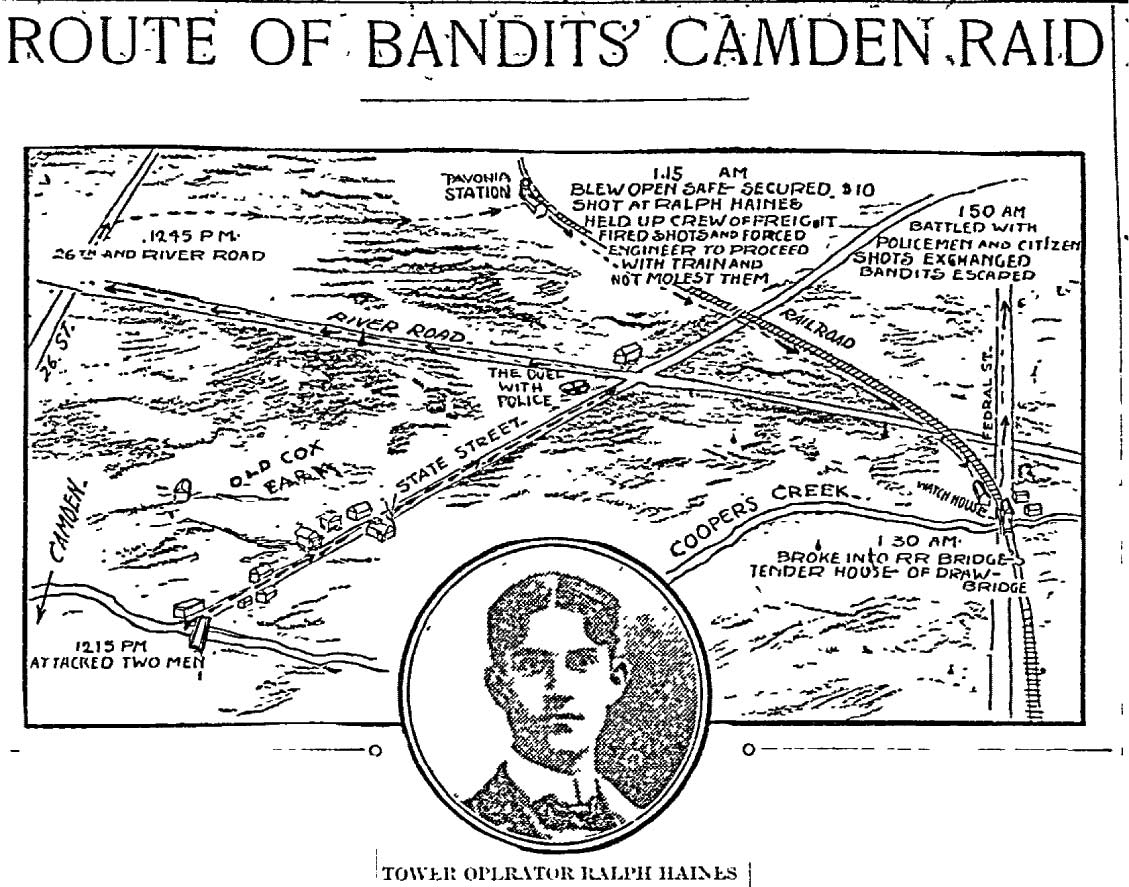
In true Wild West fashion five heavily armed desperadoes swooped down upon East Camden yesterday morning, and within two hours they had emptied their revolvers several times over, held up a bridge tender, cut telephone wires, blew up a safe, ordered a train crew to move on, perforated a tower house with bullets and finally made their escape. It was all done between 12.15 o’clock, when the bandits began operations at the State street bridge over Cooper Creek, and 1.50, when they gave final battle to policemen and citizens out Federal street, and disappeared in the darkness.
Never in Camden county’s history was there such a bold intrusion. The bandits are supposed to be a part of the gang which murdered Operator Clendenen, near Jersey Shore, Pa., and which has been terrorizing railroad operators and tower men in all parts of Pennsylvania and New Jersey recently.
First Appearance
It was shortly after 12 o’clock when the bandits appeared at the State street bridge at Cooper’s Creek. David Loughead and Oscar Till, bridge tenders, had just prepared to retire for the night. Loughead left Till to go to a boat house nearby. He had been gone but a short time when Till heard voices in the rear of the bridge house.
Bridgeman Till observed several men standing at the end of the bridge, and believing that they anticipated attacking him he locked the doors and laid his revolver on the bunk. Suddenly the door was forced open and in tumbled five men. Four of the bandits were masked. Instantly the frightened bridge tender was looking into the barrels of five revolvers.
“I surrender,” said Till.
“That’s all right, old pal,” replied one of the robbers, “but we want your money. You see we are a little short of funds, and it’s getting along about Christmas time.”
Masked by Their Victim
The men were about to go through Till’s pockets when the unmasked bandit said: “Hold up, I want my face covered and I want Mr. Bridgetender to do it.” Till complied. While a revolver was held at each temple Till took out his handkerchief and attempted to tie it about the robber’s face. He got the handkerchief over the fellow’s eyes. When ordered to try again he adjusted it to the satisfaction of the bandit, who expressed regret that the visit was causing the bridgetender so much trouble. The man Till masked went through his pockets. He failed to find any money, as Till had hidden what bills he had early in the night.
Ordered to Bed
Till was ordered to bed, and after he lay down on his back the bandits covered him over completely and cautioned him not to move under penalty of death. The desperadoes then disappeared. Fearing that one of the gang had remained behind to keep him from sounding an alarm, Till remained in bed until he heard a car approaching. Then he ventured out and summoned his partner, David Loughead, from the boat house.
When an effort was made to use the telephone the bridgetenders found that the bandits had cut the wires.
The men hurried on State street, passed around the old Cox farm, struck into the river road, then headed for Pavonia.
Blew Up Safe
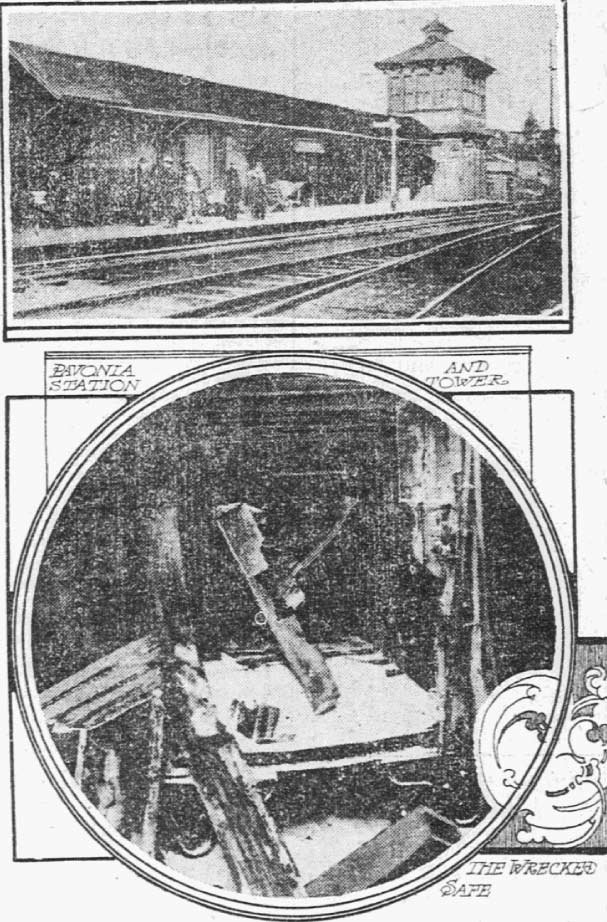
After passing guardedly through the freight yards of the Pennsylvania Railroad the bandits came up to the Pavonia Station. The thieves entered the little office by removing a heavy wire screen from a window in the rear of the ticket compartment, which is a room 8x10 feet in size. Three men had just about entered the station when two, who were left on guard, saw a train approaching. When Engineer Truax stopped the drill engine near the tower house the two men who were watching on the outside approached Engineer Truax and his fireman, Allen Stewart, with drawn revolvers and commanded them to uncouple the engine and proceed on up the road.
Truax lost no time in obeying. He opened the throttle of his locomotive and did not stop until he reached Fish House.
In the meantime the trio in the station had inserted a charge of nitro-glycerine in the safe, attached a fuse and climbed out the window to await the explosion. It came in a few minutes.
Shot at Operator
Operator Ralph Haines, of Eighth and Line streets, Camden, heard the noise and raised the window of the tower house. He had hardly placed his head out when, with an oath, he was ordered to put his head in. The operator hesitated, until several shots were fired, followed by a general bombardment on the tower. One bullet whizzed by Haines’ head and buried itself in the window frame. Another lodged in the overhanging roof of the station waiting room.
This was too much for Haines and he fell back on the floor. Evidently believing they had murdered the tower man, the robbers discontinued bombarding the tower house with bullets and walked to the wrecked office. Operator Haines crawled on his knees to the ticker and sent word to the main office that he was being attacked by a gang of desperadoes, who were bombarding the tower in an effort to kill him. The two bandits who were on guard were noticed to run to the station office and the five suddenly left together.
Duel With Bandits
In the meantime all was activity at police headquarters. The railroad officials had communicated Operator Haines’ message to the City Hall and Sergeant Schregler and Officer Tatem sent word to a dozen officers, who started for the scene under the direction of Sergeant Reeder.
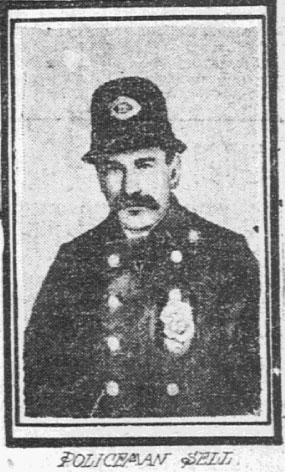
The detail was divided up to cover the various roads. Policemen Thomas Reed and Errickson were assigned to State street and at the bridge met Policemen Sell and Schmidt and Bridgeman Till. After a wait with no developments Sell and Schmidt decided to go to River road. They had only been gone a few minutes when they came upon the bandits hurrying in State street, near Cox’s farm.
When fifty yards away Sell ordered the robbers to throw up their hands. They did so, but each man flashed a pistol in his hand and opened fire on the officers. The latter returned the fire, but were compelled to retreat, as the odds were largely against them.
Bullet Through Officer’s Coat
Reed, Errickson and Till could see the flash of the pistols and hurried up the road, guns in hand. Then the shooting ceased and a minute later Sell and Schmidt came up. Neither man was hurt, but one of the bullets fired by the robbers had passed through the shoulder of Sell’s coat. An effort was made to catch up with the men again. They ran out State street to the railroad, back towards Cooper’s Creek, where they broke open the bridge tender’s house, then struck into Federal street and headed for the open country. Out Federal street they met more policemen and several armed citizens. The bandits were some distance away, but there was another lively exchange of shots. No one was injured. The bandits kept on the run and were soon lost in the darkness.
About $10 at the Pavonia station was secured by the robbers. They left more than a dollar in change in a drawer in the ticket office.
Desperate Cracksmen Run Things With a High Hand in a Suburb of Camden, N.J.
Cleveland Daily Leader —
They Hold Up and Rob Several Persons and Escape After a Fight With Police.
CAMDEN, N. J., December 12.—A gang of desperate cracksmen appeared in Pavonia, a suburb, last midnight, and after nearly wrecking the Pennsylvania Railroad station with dynamite used in blowing open the safe, made good their escape, securing little booty for their trouble. Before robbing the station the burglars, five in number, held up Oscar Till and Jacob Eppler, tenders of the State street drawbridge over Cooper’s Creek, and shot at Ralph Haines, a telegraph operator in the signal tower a short DISTANCE FROM THE STATION.
After the robbery the bandits held up the crew of a drill engine, who were making up a freight train, and at the points of their revolvers compelled Edward Appleton and Henry Smith, the engineer and fireman, to leave the vicinity.
The robbers first broke into the hut occupied by Till, the bridgetender, and, after ransacking the place and ripping up most of Till’s clothes, left with a small sum of money, warning Till that any outcry on his part would be fatal to him. They next held up Eppler on the bridge and relieved him of his watch and money.
Proceeding to Pavonia station, the burglars blew it up with dynamite. The explosion attracted the attention of Ralph Haines, the tower operator, who thrust his head out of a window and inquired as to the cause of the noise. The ANSWER WAS A BULLET which sped by Haines, imbedding itself in the window sill. Fearful of being murdered, Haines crawled to the floor. While lying on the floor he sent a telegraph message for help to the headquarters of the Pennsylvania Railroad. At the same time the drill engine, with Appleton and Smith aboard, arrived at the station. The thieves opened fire upon the two men, who dashed away to Fish House, a small station five miles distant. A squadron there wired to Camden for aid. A squad of policemen were hurried to the scene, and when they came up with the robbers a lively exchange of shots occurred, but the desperadoes eluded the officers.
To-day almost the entire police force of Camden has been placed on the trail of the robbers. Several arrests of suspicious characters have been made.
Bandits in Camden
New York Daily People —
Hold Up Towerman While They Blow Open Safe.
Five Men in Gang—Also Attacked Bridgetender and Towerman of Pennsylvania Railroad—Got Little Loot—Escape After Threatening Victims.
Camden, N. J., Dec. 12.—While the operator in a signal tower a few rods away was covered by the revolver of a confederate and watched, powerless, the crime, professional cracksmen blew open the safe in the office of the Pennsylvania Railroad station at Pavonia, a small town near this city, and rifled it of a sum of money. The robbers then decamped after firing a few shots at the towerman to deter him from following them. Before the operator could summon the police the men were far away.
There are said to have been five men in the gang, and it is supposed that they are the same who blew open the safe in the Clarksboro postoffice last week. They first appeared at the shanty occupied by Oscar Till, tender of the bridge over Cooper’s Creek. While two of the men guarded Till with drawn revolvers, the remaining three ransacked his hut, but got nothing. After telling Till they would come back and kill him if he gave an alarm, the gang went on up the line. A short distance away they met Frank Eppler, the bridge watchman. They held him up and took from him his revolver and $2. Then they departed in the direction of the Pavonia station, about a mile and a half away.
At about 2.30 o’clock this morning Ralph Haines, the night operator in the signal tower directly opposite the Pavonia station, saw a man standing on the platform. The man’s face was covered with a handkerchief, and the signalman’s suspicions were aroused. He called to the man and asked him what he was doing there, as there was no train expected. The man made no reply.
“What have you got your face covered for?” shouted the towerman.
“I’ve got a toothache,” replied the man, sullenly.
At that moment there was a deafening explosion in the station, and one of the windows was blown out. At the sound the man on the platform whipped out a revolver and fired at the signalman, missing him. Haines was unarmed, so he crouched in a corner of the tower. He peeped out of a window and saw a number of men hurrying away in the darkness after the man who had shot at him had called out that if he followed or raised an alarm it would mean his death.
Nevertheless, Haines immediately telephoned to Camden, and Policemen Schmidt and Fell went to the station. They found the safe door blown open and the contents gone. The country was scoured, but no trace was found of the thieves. The booty secured was so small that the work was hardly worth the trouble. A considerable sum of money is usually kept in the safe, but Station Agent Stackhouse said that last night there was only $12 in the money drawer.
No Clue to Bandits, But Suspects Spotted
Philadelphia Inquirer —
The Camden police have not the slightest clue as to the identity of the five men who early Saturday morning created a furor on the outskirts of the city by holding up a bridge tender, blowing up a safe and doing other acts that marked them as being desperadoes. The entire police force was at work yesterday, but the description given by Till and the officers who had the encounter with the emulators of the wild and woolly West was so meagre that there was practically nothing to work on.
Chief of Police John Foster said last night to an Inquirer reporter: “We have not learned anything that might lead to the arrest of the desperadoes. In the event of suspects being arrested it would be a difficult matter to connect them with the case, because no one seems to be in position to give a description. I am of the opinion that they are professionals from the manner in which they did their work.
Acquainted With Locality
“Another thing seems evident, and that is the robbers were acquainted with the locality in which they operated. They either were personally acquainted with East Camden or made it a point to get acquainted.
“This William Thallman, who is wanted in Burlington county, where the police believe him to be the head of a gang of thieves, may possibly know something about the Pavonia affair. From what I have learned he appears to be a desperate character, just one who would have the nerve to lead a gang of men to do the work of Saturday morning. Of course this is mere supposition, and it is impossible to say he is one of the men we are looking for. Another thing that might possibly connect him with the case would be his knowledge of East Camden, which is an important factor.”
Early yesterday morning a dispatch was received from Elizabeth in which it was stated that three suspicious characters had been arrested. According to the dispatch the trio were found in a box car that came from Camden. City Detectives John Painter and William Hart were at once sent to Elizabeth to take a look at the suspects. When they arrived they found the prisoners were boys and a brief line of questioning soon disposed of the theory that they had anything to do with the Camden affair. The detectives, who returned last night, said the boys were Philadelphians and had jumped a freight for a ride.
Special Officer Hare, of the Pennsylvania Railroad, noticed a group of men loitering about the Pavonia Station. Their actions were suspicious, and he took one into custody. The police were of the opinion that the prisoner might know something about the bandits, but he convinced them that he was in total ignorance of the thieves. He gave the name of D. Donovan, no home. He is still held by the police, but with no expectation of throwing any light on the identity of the men wanted so badly.
Perhaps no one had a better opportunity of giving a description of the men than Oscar Till, the bridgetender at the State street bridge, who, at the points of pistols held by two men, tied a mask over the face of a third. But even he cannot recall his midnight visitors sufficiently to furnish the police with anything to work on.
“I was too badly scared to know what they looked like,” he said. “When a couple of men are pressing cold steel to your temples, with a command to do a certain thing or die, you generally do the thing asked. I had no time to think about descriptions or anything else. The business I had to attend to was to tie the mask on the bandit, and I attended strictly to that business.”
Ralph Haines, the night operator at the tower, who was shot at repeatedly as he poked his head out of the window inquiring as to the cause of the explosion at the Pavonia station, was commended yesterday for his cool-headedness. After dodging bullets repeatedly, one of which came within an inch of his head, he dropped to the floor, crawled over to the “ticker” and asked the main office for help. Haines could see the men in silhouette but was too distant to recognize any characteristics that might lead to identifying them.
Last night numerous reports were received at Camden police headquarters of suspicious characters being seen in various parts of the city. A trolley car conductor reported at 10 o’clock that several men with dark lanterns were observed loitering about Haddon and Kaighn avenues. Sergeant Hyde, with a squad of officers, was sent to the locality, but the men had disappeared. Another report came from Fairview street near the ship yard at the lower end of the Eighth ward that suspicious-looking persons were hanging about the neighborhood, but no one could be found there when the officers arrived.
Say Bandit Hunt Points to Marine
Philadelphia Inquirer —
Camden Police Grow More Positive, Connecting Thallman With Hold-Up
Hat Found at Scene May Prove a Clue—State Sleuths Very Busy on the Case
The Camden police are growing more positive in their belief that William Thallman, who escaped from League Island Navy Yard and whose house at Riverside was found to be stocked with plunder, could throw some light on the recent hold-up at Pavonia.
According to the police, Thallman lived in Camden for several years under an assumed name. His home is said to have been luxuriously furnished and he seemed to be well supplied with money about the time several robberies were committed in North Philadelphia. He was caught looting a bulk window of a store and was convicted and sentenced to the Eastern Penitentiary inside of forty-eight hours.
City Detectives Hart and Painter were at work all day yesterday on clues that might lead to the detection of Thallman’s whereabouts, but little or nothing had resulted up to a late hour last night.
Hat May Give Clue
Amos Fowler, a bridge tender at the State street bridge, East Side, early last evening found a derby hat in a ditch on the north side of State street near River avenue, that the authorities believe was dropped by the bandits in their hasty departure. The hat is an expensive derby and contains the letter “A.” Bridgetender Till says he has a slight recollection that one of the bandits who held a revolver at his head while he was being robbed wore a derby hat just about the style of the one found by Fowler.
Since the exploit of the bandits Camden residents have been going armed on the streets at night. Revolvers, blackjacks and other weapons are concealed in many a pocket. Everyone who walks about without apparent aim is looked upon with suspicion, and the police are at once notified. The telephone wires at night are kept hot with such messages.
The Hungarian taken to the Camden City Hall from Cloverdale by William F. Miller, Sunday, is believed to have been the victim of a holdup Saturday night. The man cannot speak English, but from what the police could learn from him he was attacked on Mt. Ephraim avenue by three men and relieved of $450, a lifetime’s savings.
New Fire Department Appointments
Camden Evening Courier —
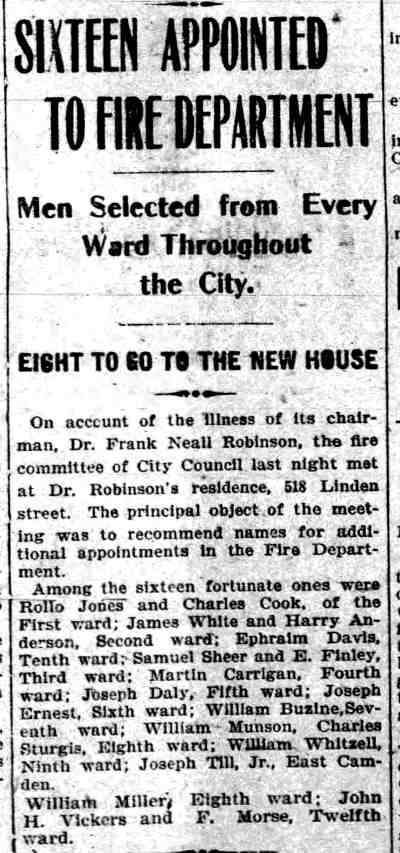
Men Selected from Every Ward Throughout the City.
EIGHT TO GO TO THE NEW HOUSE
On account of the illness of its chairman, Dr. Frank Neall Robinson, the fire committee of City Council last night met at Dr. Robinson’s residence, 518 Linden street. The principal object of the meeting was to recommend names for additional appointments in the Fire Department.
Among the sixteen fortunate ones were Rollo Jones and Charles Cook, of the First ward; James White and Harry Anderson, Second ward; Ephraim Davis, Tenth ward; Samuel Sheer and E. Finley, Third ward; Martin Carrigan, Fourth ward; Joseph Daly, Fifth ward; Joseph Ernest, Sixth ward; William Buzine, Seventh ward; William Munson, Charles Sturgis, Eighth ward; William Whitzell, Ninth ward; Joseph Till, Jr., East Camden.
William Miller, Eighth ward; John H. Vickers and F. Morse, Twelfth ward.
New Fire Department Appointments
Camden Post-Telegram —
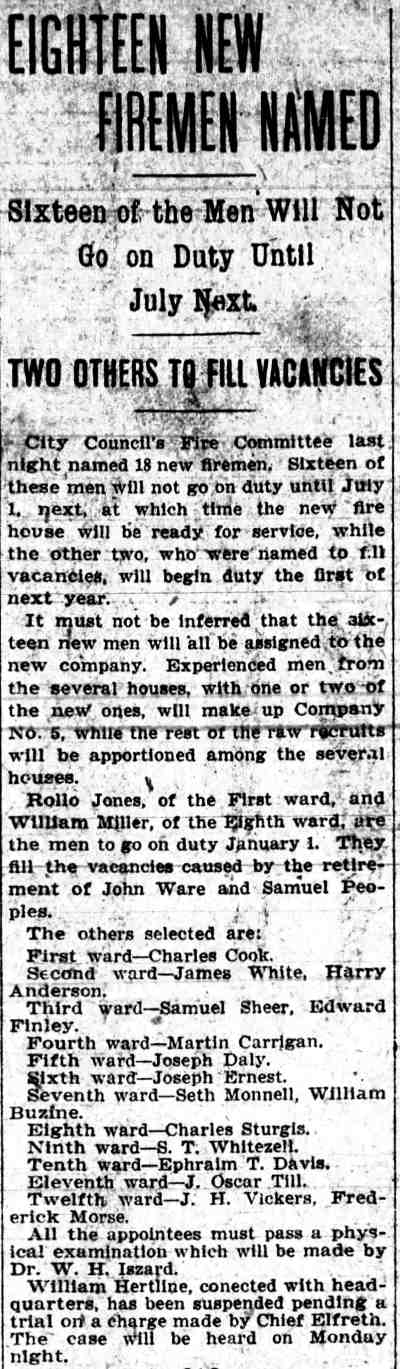
Sixteen of the Men Will Not Go on Duty Until July Next.
TWO OTHERS TO FILL VACANCIES
City Council’s Fire Committee last night named 18 new firemen. Sixteen of these men will not go on duty until July 1, next, at which time the new fire house will be ready for service, while the other two, who were named to fill vacancies, will begin duty the first of next year.
It must not be inferred that the sixteen new men will all be assigned to the new company. Experienced men from the several houses, with one or two of the new ones, will make up Company No. 5, while the rest of the raw recruits will be apportioned among the several houses.
Rollo Jones, of the First ward, and William Miller, of the Eighth ward, are the men to go on duty January 1. They fill the vacancies caused by the retirement of John Ware and Samuel Peoples.
The others selected are: First ward—Charles Cook. Second ward—James White, Harry Anderson. Third ward—Samuel Sheer, Edward Finley. Fourth ward—Martin Carrigan. Fifth ward—Joseph Daly. Sixth ward—Joseph Ernest. Seventh ward—Seth Monnell, William Buzine. Eighth ward—Charles Sturgis. Ninth ward—S. T. Whitezell. Tenth ward—Ephraim T. Davis. Eleventh ward—J. Oscar Till. Twelfth ward—J. H. Vickers, Frederick Morse.
All the appointees must pass a physical examination which will be made by Dr. W. H. Iszard.
William Hertline, connected with headquarters, has been suspended pending a trial on a charge made by Chief Elfreth. The case will be heard on Monday night.
More Firemen for Camden
Philadelphia Inquirer —
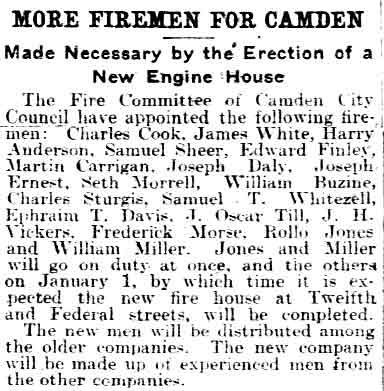
Made Necessary by the Erection of a New Engine House
The Fire Committee of Camden City Council have appointed the following firemen: Charles Cook, James White, Harry Anderson, Samuel Sheer, Edward Finley, Martin Carrigan, Joseph Daly, Joseph Ernest, Seth Morrell, William Buzine, Charles Sturgis, Samuel T. Whitezell, Ephraim T. Davis, J. Oscar Till, J. H. Vickers, Frederick Morse, Rollo Jones and William Miller. Jones and Miller will go on duty at once, and the others on January 1, by which time it is expected the new fire house at Twelfth and Federal streets, will be completed.
The new men will be distributed among the older companies. The new company will be made up of experienced men from the other companies.
Attacked by Strange Bird
Philadelphia Inquirer —
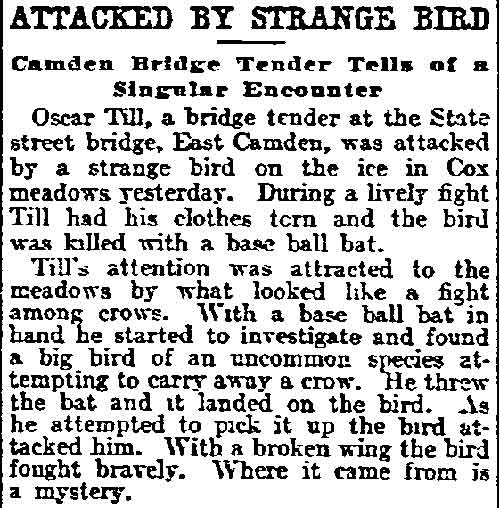
Camden Bridge Tender Tells of a Singular Encounter
Oscar Till, a bridge tender at the State street bridge, East Camden, was attacked by a strange bird on the ice in Cox meadows yesterday. During a lively fight Till had his clothes torn and the bird was killed with a base ball bat.
Till’s attention was attracted to the meadows by what looked like a fight among crows. With a base ball bat in hand he started to investigate and found a big bird of an uncommon species attempting to carry away a crow. He threw the bat and it landed on the bird. As he attempted to pick it up the bird attacked him. With a broken wing the bird fought bravely. Where it came from is a mystery.
New Firemen Added to Camden's Force
Philadelphia Inquirer —
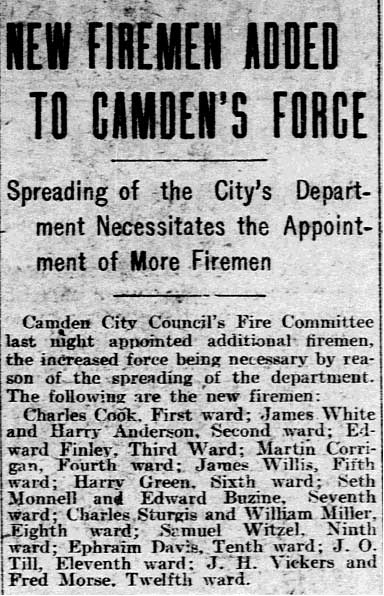
Spreading of the City’s Department Necessitates the Appointment of More Firemen
Camden City Council’s Fire Committee last night appointed additional firemen, the increased force being necessary by reason of the spreading of the department. The following are the new firemen: Charles Cook, First ward; James White and Harry Anderson, Second ward; Edward Finley, Third Ward; Martin Corrigan, Fourth ward; James Willis, Fifth ward; Harry Green, Sixth ward; Seth Monnell and Edward Buzine, Seventh ward; Charles Sturgis and William Miller, Eighth ward; Samuel Witzel, Ninth ward; Ephraim Davis, Tenth ward; J. O. Till, Eleventh ward; J. H. Vickers and Fred Morse, Twelfth ward.
New Police Department Appointments
Philadelphia Inquirer —
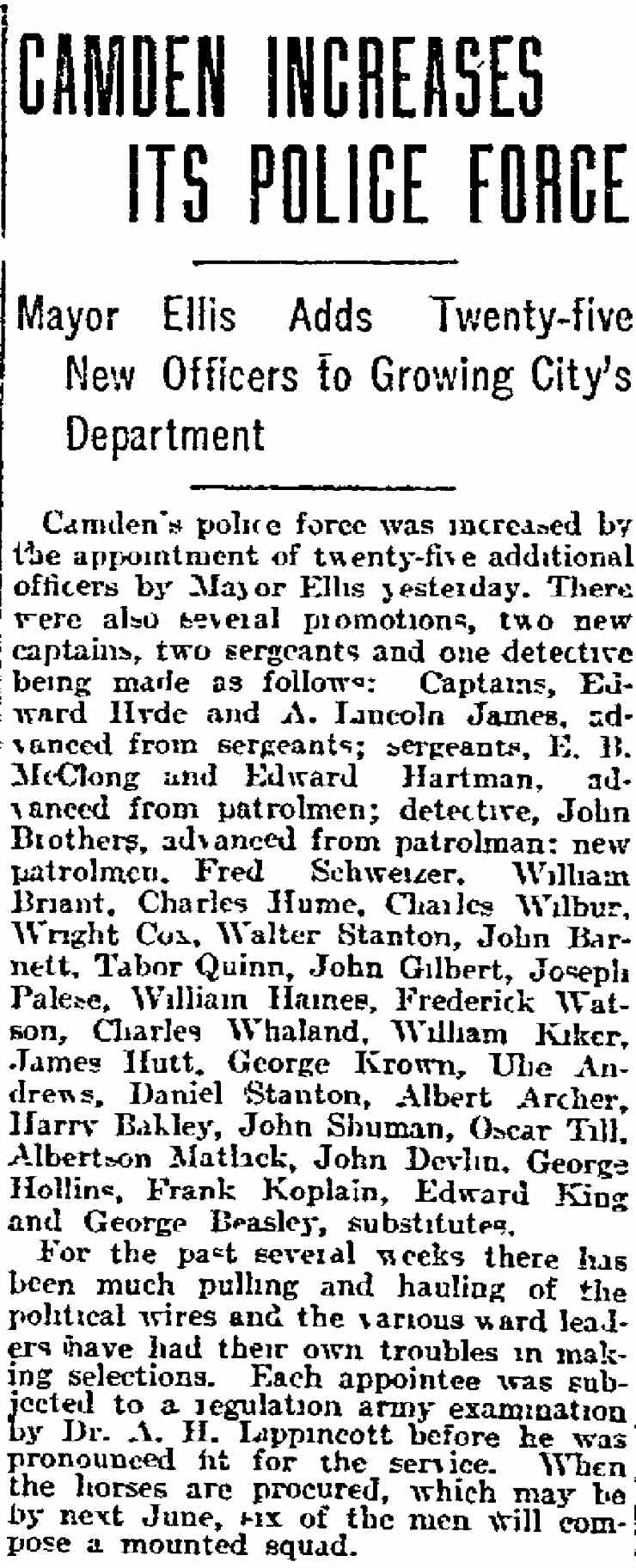
CAMDEN INCREASES ITS POLICE FORCE
Mayor Ellis Adds Twenty-five New Officers to Growing City’s Department
Camden’s police force was increased by the appointment of twenty-five additional officers by Mayor Ellis yesterday. There were also several promotions, two new captains, two sergeants and one detective being made as follows: Captains, Edward Hyde and A. Lincoln James, advanced from sergeants; sergeants, E. B. McClong and Edward Hartman, advanced from patrolmen; detective, John Brothers, advanced from patrolman; new patrolmen. Fred Schwetzer, William Briant, Charles Hume, Charles Wilbur, Wright Cox, Walter Stanton, John Barnett, Tabor Quinn, John Gilbert, Joseph Palese, William Haines, Frederick Watson, Charles Whaland, William Kiker, James Hutt, George Krown, Ule Andrews, Daniel Stanton, Albert Archer, Harry Bakley, John Shuman, Oscar Till, Albertson Matlack, John Devlin, George Hollins, Frank Koplain, Edward King and George Beasley, substitutes.
For the past several weeks there has been much pulling and hauling of the political wires and the various ward leaders have had their own troubles in making selections. Each appointee was subjected to a regulation army examination by Dr. A. H. Lippincott before he was pronounced fit for the service. When the horses are procured, which may be by next June, six of the men will compose a mounted squad.
Soon Conquer Fire
Camden Daily Courier —
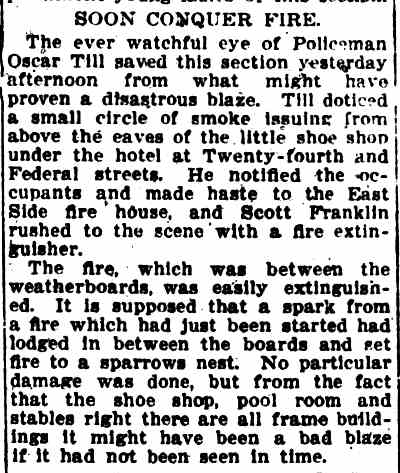
The ever watchful eye of Policeman Oscar Till saved this section yesterday afternoon from what might have proven a disastrous blaze. Till noticed a small circle of smoke issuing from above the eaves of the little shoe shop under the hotel at Twenty-fourth and Federal streets. He notified the occupants and made haste to the East Side fire house, and Scott Franklin rushed to the scene with a fire extinguisher.
The fire, which was between the weatherboards, was easily extinguished. It is supposed that a spark from a fire which had just been started had lodged in between the boards and set fire to a sparrows nest. No particular damage was done, but from the fact that the shoe shop, pool room and stables right there are all frame buildings it might have been a bad blaze if it had not been seen in time.
World War I Draft Card
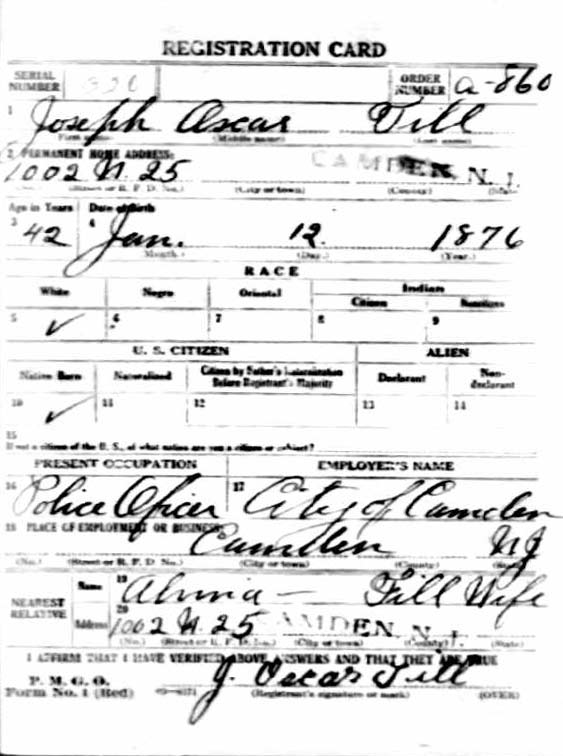
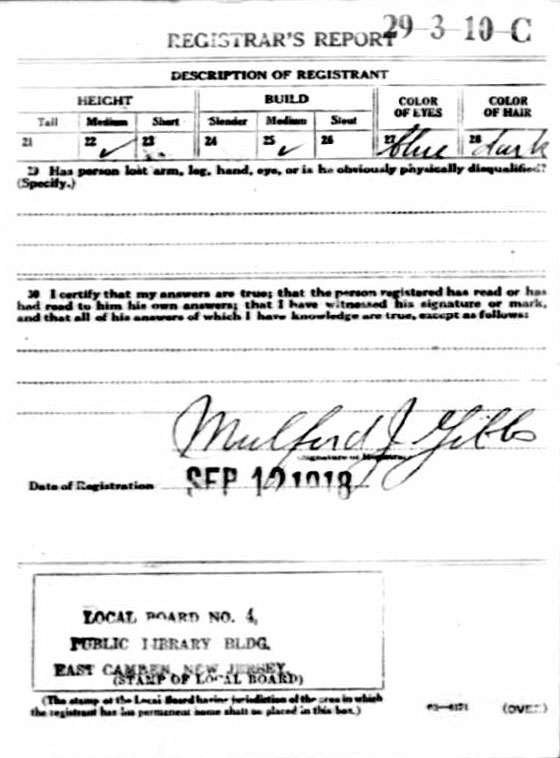
Named: World War I Draft Registration Card, Joseph Oscar Till, registered September 12, 1918, and Local Board No. 4, Public Library Building, East Camden, New Jersey.
Camden at a Glance
Philadelphia Inquirer —
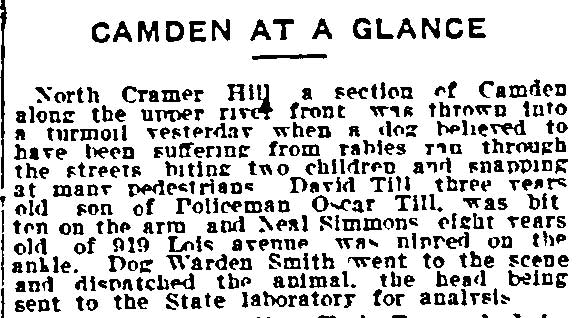
North Cramer Hill, a section of Camden along the upper river front, was thrown into a turmoil yesterday when a dog believed to have been suffering from rabies ran through the streets, biting two children and snapping at many pedestrians. David Till, three years old, son of Policeman Oscar Till, was bitten on the arm, and Neal Simmons, eight years old, of 919 Lois avenue, was nipped on the ankle. Dog Warden Smith went to the scene and dispatched the animal, the head being sent to the State laboratory for analysis.
Police Retirements and Promotions
Camden Courier-Post —
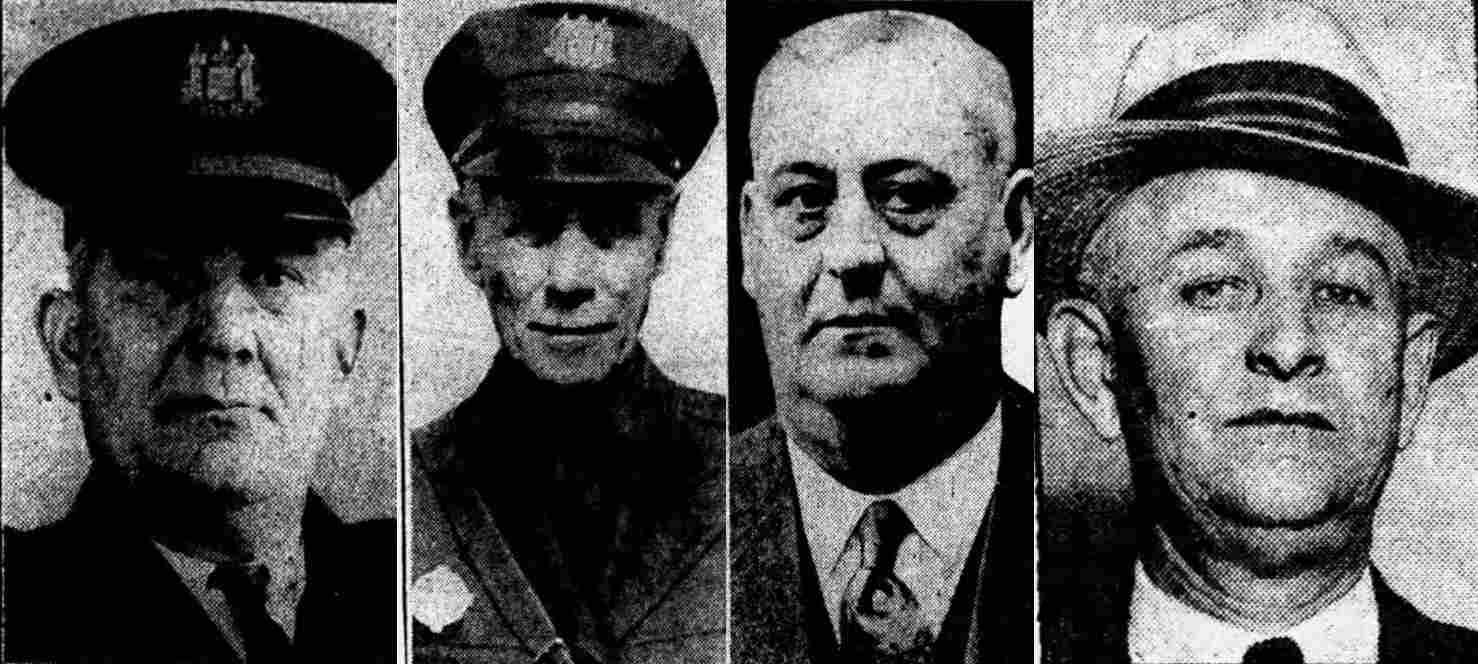

Named: Charles Laib, Charles J. “Jeff” Kay, Theodore Guthrie, Howard Smith, J. Oscar Till, Louise F. Walsh, John W. Golden, Charles H. Ellis, Charles Humes, South 24th Street, North 25th Street, North 4th Street, Penn Street, Fiore Troncone, Chestnut Street, Sheltering Arms Home, Newton Ash, William Michalak, John J. Robinson, and Roy R. Stewart.