Introduction
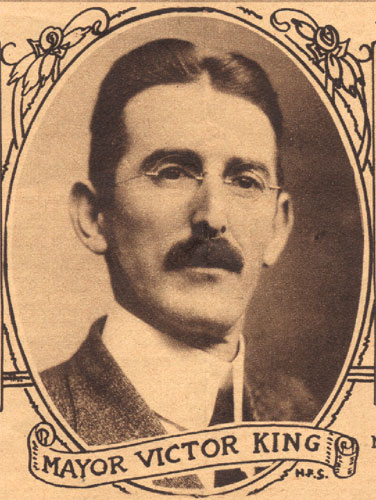
Victor King, Mayor of Camden, circa 1926
VICTOR KING was born in Pennsylvania in 1874. He settled in Camden after 1911, where he bought a home at 3197 Federal Street, and went into business. With his wife Sarah, he had six children—daughters Ethel, Grace, and Marietta, and sons Edward, Earl, and Victor S. King. He also during these years acquired the Thomas L. Dudley estate, known as Dudley Grange, which was adjacent to his home. He sold it to the city of Camden in the early 1920s, and it was converted into a library.
Victor King was elected Mayor of Camden in 1922, defeating Frank S. Van Hart by 800 votes. He served until 1927. During his term the Delaware River Bridge was completed, and Sears-Roebuck built their department store on the Admiral Wilson Boulevard at Mt. Ephraim Avenue, an innovative building that would change the face of retailing in South Jersey. Mayor King was instrumental in the design of the building.
Victor King served until 1927, when he was succeeded by Winfield Scott Price. He later went into the real estate business. During the 1930s he managed the Camden district office of the Federal Home Owners’ Loan Corporation.
Victor S. King’s daughter Grace taught in the Camden Public School system at the James A. Garfield School at South 29th and Cramer Streets in the 1920s.
Camden County Transfers
Philadelphia Inquirer —
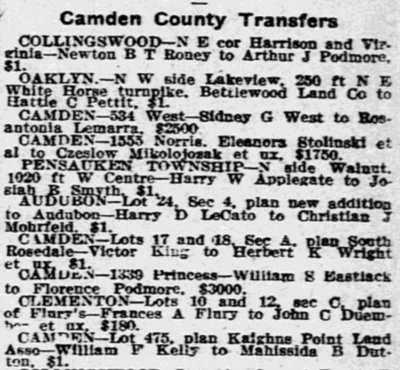
Camden County Transfers
COLLINGSWOOD—N E cor Harrison and Virginia—Newton B T Roney to Arthur J Podmore, $1.
OAKLYN—N W side Lakeview, 250 ft N E White Horse turnpike. Bettlewood Land Co to Hattie C Pettit, $1.
CAMDEN—534 West—Sidney G West to Rosantonia Lemarra, $2500.
CAMDEN—1553 Norris. Eleanora Stolinski et al to Czeslaw Mikolojosak et ux, $1750.
PENNSAUKEN TOWNSHIP—N side Walnut, 1920 ft W Centre—Harry W Applegate to Josiah E Smyth, $1.
AUDUBON—Lot 24, Sec 4, plan new addition to Audubon—Harry D LeCato to Christian J Mohrfield, $1.
CAMDEN—Lots 17 and 18, Sec A, plan South Rosedale—Victor King to Herbert K Wright et al, $1.
CAMDEN—1339 Princess—William S Eastlack to Florence Podmore, $3000.
CLEMENTON—Lots 10 and 12, sec C, plan of Flury’s—Frances A Flury to John C Duemler et ux, $180.
CAMDEN—Lot 475, plan Kaighns Point Land Asso—William F Kelly to Mahissida B Dutton, $1.
King Endorsed for Democratic Mayor Nomination
Philadelphia Inquirer —
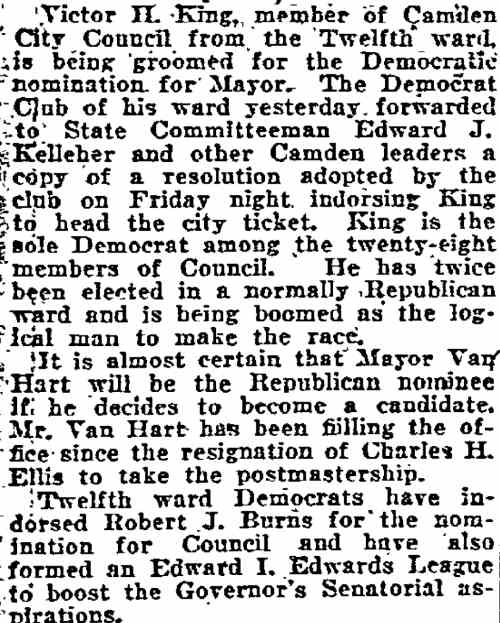
Victor H. King, member of Camden City Council from the Twelfth ward is being groomed for the Democratic nomination for Mayor. The Democrat Club of his ward yesterday forwarded to State Committeeman Edward J. Kelleher and other Camden leaders a copy of a resolution adopted by the club on Friday night indorsing King to head the city ticket. King is the sole Democrat among the twenty-eight members of Council. He has twice been elected in a normally Republican ward and is being boomed as the logical man to make the race.
It is almost certain that Mayor Van Hart will be the Republican nominee if he decides to become a candidate. Mr. Van Hart has been filling the office since the resignation of Charles H. Ellis to take the postmastership.
Twelfth ward Democrats have indorsed Robert J. Burns for the nomination for Council and have also formed an Edward I. Edwards League to boost the Governor’s Senatorial aspirations.
Democrats to Fight Over Mayor Nomination
Philadelphia Inquirer —
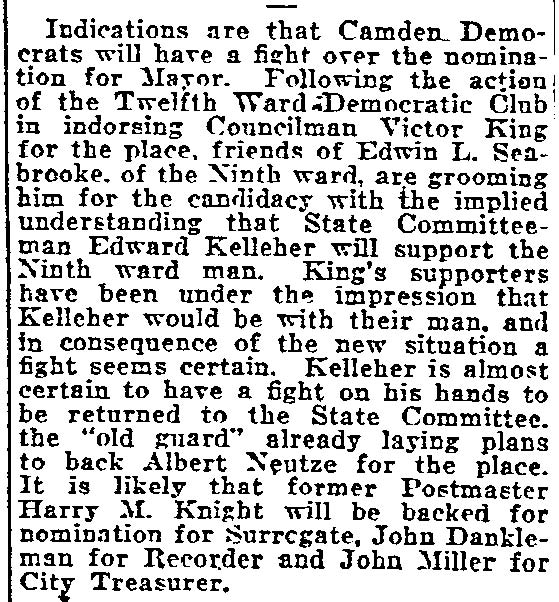
Indications are that Camden Democrats will have a fight over the nomination for Mayor. Following the action of the Twelfth Ward Democratic Club in indorsing Councilman Victor King for the place, friends of Edwin L. Seabrooke, of the Ninth ward, are grooming him for the candidacy with the implied understanding that State Committeeman Edward Kelleher will support the Ninth ward man. King’s supporters have been under the impression that Kelleher would be with their man, and in consequence of the new situation a fight seems certain.
Kelleher is almost certain to have a fight on his hands to be returned to the State Committee, the “old guard” already laying plans to back Albert Neutze for the place.
It is likely that former Postmaster Harry M. Knight will be backed for nomination for Surrogate, John Dankleman for Recorder and John Miller for City Treasurer.
Frelinghuysen Majority Seen in Camden County
Philadelphia Inquirer —
Aside from the United States Senatorial contest interest in the primary election in Camden today centres on one fight on the county ticket, two on the city ticket and several ward contests. Camden county is expected to give a big majority for Senator Frelinghuysen, who is opposed for renomination by George L. Record.
Justice of the Peace Simon Wilkinsky, of the Sixth ward, is contesting with Congressman F. F. Patterson for the nomination for Congress in the First New Jersey District, which comprises Camden, Gloucester and Salem counties. Wilkinsky is little known and the renomination of the Congressman by a large majority is predicted.
The contest for the Republican nomination for Surrogate is the only ripple on the county ticket. Harry Reeves, the incumbent, is opposed by Irving Buckle, former Freeholder and for a score of years active in the Republican organization. He resigned as county committeeman from the Fourth ward to make the fight against Reeves, who has the backing of the regulars. An odd twist to the campaign was taken yesterday when Leon Buckle, son of the candidate, filed a petition as an independent candidate for Surrogate at the general election. The law requires that such petitions be filed previous to the primary. Should the elder Buckle happen to win the nomination the son would, of course, withdraw his petition as an independent.
The contest on the city ticket is for the office of Recorder, which is the title held by the police magistrate. O. S. Stackhouse, the incumbent, is opposed by David Rankins, former Freeholder and former Overseer of the Poor. Mayor Frank S. Van Hart, City Treasurer George A. Frey and Receiver of Taxes A. B. Sparks are without opposition for nomination on the Republican ticket.
On the Democrat side Robert A. Irving is not opposed for the nomination for Surrogate. Nor is there any fight on the city ticket, the lone candidates being: For Mayor, Victor King; for Recorder, George W. Tash; for Receiver of Taxes, Benjamin S. Moloney; for City Treasurer, Isaac Albertson.
Assemblymen T. Harry Rowland, J. Heulings Coles and Willard T. Gibbs will be renominated by the Republicans without opposition. Their Democratic opponents, also unopposed, will be C. Lawrence Gregorio, John J. Tischner and Frank B. Hambleton. Frank J. Leonard and Dr. William H. Pratt are unopposed for the Republican nomination for Coroner. The Democrats have no candidates on their ballot for these places. Two nominees will be chosen by the voters writing their names on the ballots.
Much interest is being manifest in the contest for the two places on the Democratic State Committee. One man and one woman are to be named. Mrs. Katherine M. Donges, now a member of the committee, is opposed by Mrs. Mae Hawkins. Mrs. Donges was in the limelight some weeks ago when she is alleged to have said at a Democratic gathering that Senator Runyon, who is to be the Republican candidate for Governor, was drunk at a meeting in Camden. Senator Runyon is a pronounced dry and Mrs. Donges was severely criticized by members of both parties for her alleged remarks. Although Senator Runyon demanded an apology Mrs. Donges has neither affirmed or denied making such remarks. She is paired with State Committeeman Edward Kelleher, whose opponent is Albert Neutze.
The Republicans have Councilmanic contests in four of the fourteen wards. In the Fifth Ward Councilman Louis Bantivoglio is opposed by J. H. Williams, negro. The latter’s name appears on the primary ballot, but yesterday he announced he had withdrawn from the race. This leaves the field free to the present Councilman. John H. Carroll and John P. Shaw are rival candidates for the County Committee.
There is a lively contest in the Seventh ward for the nomination to succeed Mayor Van Hart in Council. The aspirants are Joseph B. Davis and William Frost. The latter has the backing of Patrick Carr, who seeks to wrest the county committeemanship from Street Commissioner Alfred L. Sayers. Carr has also filed a petition as an independent candidate for Council at the general election. The petition is defective and was sent back to Carr by County Clerk William D. Brown with instructions to amend it to comply with the law. Carr will withdraw as an independent candidate in the event of Frost winning at the primary today.
Councilman John Rogers and Charles E. Hill are rival contestants in the Tenth ward. In the same bailiwick Charles S. Wolverton and Samuel Edwards are fighting for the County Committee place, which is now held by Wolverton. There is also a contest for the female place on the County Committee.
In the Twelfth ward Councilman John Dobbins is being opposed for renomination by Mrs. Lizzie P. Abbott.
The Democrats have three Councilmanic contests. In the Thirteenth ward the opposing candidates are Edwin L. Aument and Frederick Stanton. Walter J. Farrell and John B. Dean are rivals in the Third ward, and S. Raymond Dobbs and Harry McCloskey are contests in the Fourteenth ward.
Camden county Socialists yesterday named a city and county ticket by petition as follows: Surrogate, Herman Neissner; Coroners, Francis Stratton, Clara K. Stamm; Assembly, Morris Steppa, Thomas Heil, Albert Bardsley; Mayor, Albert H. Starr, Stratton; Recorder, George A. Harkins; City Treasurer, John McAlack; Receiver of Taxes, Richard Davies. A petition as a Socialist candidate for Council in the Eleventh ward was filed by Leo M. Harkins. Independent petitions for Council were filed by William Smith, Eighth ward, and Joseph Wood, Fifth ward.
Chief of Camden Police Is Retired
Trenton Evening Times —
CAMDEN, June 27.—The authorities shook up the Police Department yesterday by retiring Chief Edward S. Hyde and Eldridge Benjamin McClong, chief clerk of the department, on pensions. Announcement of the proposed changes came following a conference at City Hall attended by Mayor King, Commissioners Middleton and Sherwood, City Counsel Miller, and Assistant City Counsel Neutze. Commissioner Hitchner was unable to attend on account of the death of his father, but it is said he has acquiesced in the action of the other commissioners.
Captain James E. Tatem, who has been stationed at City Hall headquarters, was asked to become acting chief. Chief Hyde was eligible to a pension both from the standpoint of years of service and age.
Speaking for the commissioners, Mr. Miller said: “Chief Hyde and Captain McClong have signed applications for pensions and have been relieved from further duty. It was regarded as a move for the best interests of the police department and the city government that these two men retire at this time.”
Mayor's 9-Year Son Has Scarlet Fever
Camden Courier —
MAYOR CANCELS SPEAKING ENGAGEMENT BUT IS PERMITTED TO GO TO CITY HALL
Scarlet fever in his home has obliged Mayor King to cancel all public speaking engagements.
The Mayor’s youngest child, Victor Stanley King, 9 years old, was found to be suffering from the disease on Sunday, and a yellow warning placard was placed on the chief executive’s house at 3197 Federal street. The attack is mild, according to the family physician. He has been isolated in an upper room with Mrs. King in constant attendance, and no one is allowed to enter or leave the room.
The Mayor’s daughter, Miss Grace King, a Third grade teacher at the Garfield School, Twenty-ninth and Cramer streets, has been living away from the home since last week. Physicians told the Mayor he need not give up city affairs, so long as he remained away from the sick room.
11 Take Civil Service Exams at City Hall
Camden Courier —
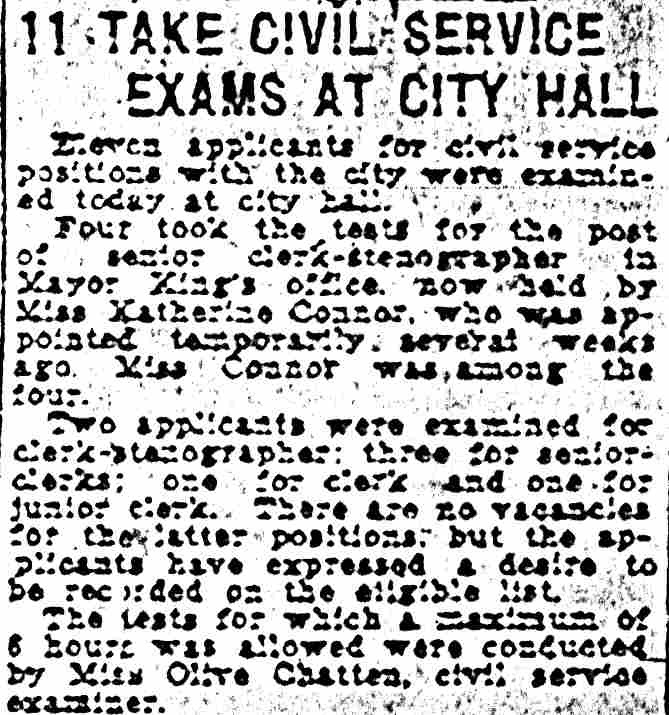
Eleven applicants for civil service positions with the city were examined today at city hall.
Four took the tests for the post of senior clerk-stenographer in Mayor King’s office, now held by Miss Katherine Connor, who was appointed temporarily several weeks ago. Miss Connor was among the four.
Two applicants were examined for clerk-stenographer; three for senior clerks; one for clerk and one for junior clerk. There are no vacancies for the latter positions, but the applicants have expressed a desire to be recorded on the eligible list.
The tests for which a maximum of 6 hours was allowed were conducted by Miss Olive Chatten, civil service examiner.
Mayor King's Letter on the Opening of Camden Bridge
Camden Courier, Bridge Edition —
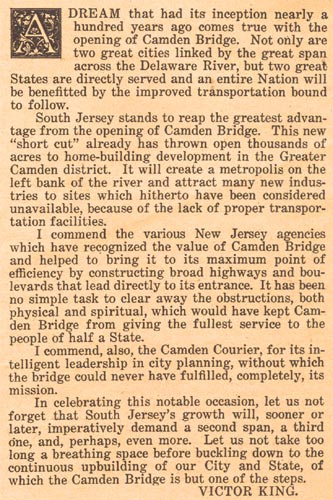
A DREAM that had its inception nearly a hundred years ago comes true with the opening of Camden Bridge. Not only are two great cities linked by the great span across the Delaware River, but two great States are directly served and an entire Nation will be benefitted by the improved transportation bound to follow.
South Jersey stands to reap the greatest advantage from the opening of Camden Bridge. This new “short cut” already has thrown open thousands of acres to home-building development in the Greater Camden district. It will create a metropolis on the left bank of the river and attract many new industries to sites which hitherto have been considered unavailable, because of the lack of proper transportation facilities.
I commend the various New Jersey agencies which have recognized the value of Camden Bridge and helped to bring it to its maximum point of efficiency by constructing broad highways and boulevards that lead directly to its entrance. It has been no simple task to clear away the obstructions, both physical and spiritual, which would have kept Camden Bridge from giving the fullest service to the people of half a State.
I commend, also, the Camden Courier, for its intelligent leadership in city planning, without which the bridge could never have fulfilled, completely, its mission.
In celebrating this notable occasion, let us not forget that South Jersey’s growth will, sooner or later, imperatively demand a second span, a third one, and, perhaps, even more. Let us not take too long a breathing space before buckling down to the continuous upbuilding of our City and State, of which the Camden Bridge is but one of the steps.
VICTOR KING.
King's Friends Urge Court Job for Him
Camden Courier-Post —
Little Likelihood Seen in Former Mayor Ousting Kelleher
Members of a newly organized “Victor King League” composed of supporters of the former Camden Mayor will journey to Trenton tonight to present King’s candidacy for the position of clerk of the New Jersey Supreme Court.
The post is now held by Edward J. Kelleher, Democratic leader of Camden County. Followers of Kelleher to-day predicted that he would be reappointed and that the bid on behalf of King was scheduled for rapid and complete disappointment.
According to those same observers, the report that Kelleher would not be reappointed came from the desire of Governor A. Harry Moore to provide a position for his present secretary, Fred Bloodgood. It has been customary for a number of years for a New Jersey Governor who is soon to retire to “take care” of his secretary in this way. The position of Supreme Court clerk was said at one time to be favored for Bloodgood but Kelleher supporters now say that the Governor’s secretary will be provided for otherwise and Kelleher reappointed.
The “Victor King League” will place a petition before Governor Moore asking for appointment of King. Whether or not this request is granted members of the League declared the organization will remain in existence. J. Elwood Dukes is president of the League; Edward L. Canning, secretary, and James Peterson, treasurer. The majority of members are Democrats but the temporary by-laws adopted by the league designate it as non-partisan.
King Slated for Post of High Court Clerk
Camden Courier-Post —
Trenton, Jan. 24.—Governor A. Harry Moore today had a petition before him, asking that he appoint former Mayor Victor King of Camden to the post of clerk of the New Jersey Supreme Court.
The governor has “an open mind” on the appointment according to those who presented the petition. Headed by J. Elwood Dukes, president of the newly organized Victor King League, a delegation of Camden men called on the governor last night and presented the petition.
The post of Supreme Court clerk is now held by Edward J. Kelleher, Democratic leader of Camden County, who is said to be scheduled for reappointment.
Mayor Asked to Speak at Dinner for King
Camden Courier-Post —
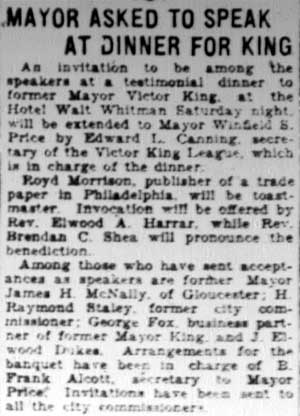
An invitation to be among the speakers at a testimonial dinner to former Mayor Victor King, at the Hotel Walt Whitman Saturday night, will be extended to Mayor Winfield S. Price by Edward L. Canning, secretary of the Victor King League, which is in charge of the dinner.
Royd Morrison, publisher of a trade paper in Philadelphia, will be toastmaster. Invocation will be offered by Rev. Elwood A. Harrar, while Rev. Brendan C. Shea will pronounce the benediction.
Among those who have sent acceptances as speakers are former Mayor James H. McNally, of Gloucester; H. Raymond Staley, former city commissioner; George Fox, business partner of former Mayor King, and J. Elwood Dukes. Arrangements for the banquet have been in charge of B. Frank Alcott, secretary to Mayor Price. Invitations have been sent to all the city commissioners.
Patrons, Patronesses Announced Today for First Military Ball
Camden Courier-Post —
Patrons and patronesses for the first military ball of the Camden Post No. 960, Veterans of Foreign Wars, to be held on Friday evening February 3 in the Elks auditorium, Seventh and Cooper Streets, are announced today.
The following prominent men and women are listed: Mrs. J.W. Connor, Miss C.M. Day, Mrs. J.H. Forsyth, Mrs. H.J. Goodyear, Miss B. Graham, Mrs. R.E. Green, Mrs. E.F. Haines, Mrs. J. Hood Jr., Mrs. W. Hurley, Mrs. J. Jarrell, Mrs. T. Keefe, Mrs. J.F. Kobus, Mrs. L. Liberman, Mrs. F.L. Lloyd, Mrs. M.A. Logan, Mrs. T.P. McConaghy, Mrs. F.F. Neutze, Mrs. L.K. Marr, Mrs. J.A. Pennington, Mrs. M.E. Ramsey, Mrs. E. Truax, Mrs. S.M. Shay, Mrs. W.J. Staats, Mrs. B.G. Tarburton, Mrs. R.W. Waddell, Mrs. E. Watson, Mrs. E.P. Wescott, Mrs. C.A. Wolverton.
David Baird Jr., William T. Boyle, Isaac Ferris, William Hurley, John Hood Jr., John Jarrell, Victor King, William J. Kraft, Thomas Keefe, Joseph F. Kobus, Hon. Edmund B. Leaming, Dr. A. Haines Lippincott, James H. Long, L.K. Marr, Dr. Thomas P. McConaghy, Hon. Frank F. Neutze, Samuel P. Orlando, Albert E. Simmons, Edwin Watson, Ethan P. Wescott.
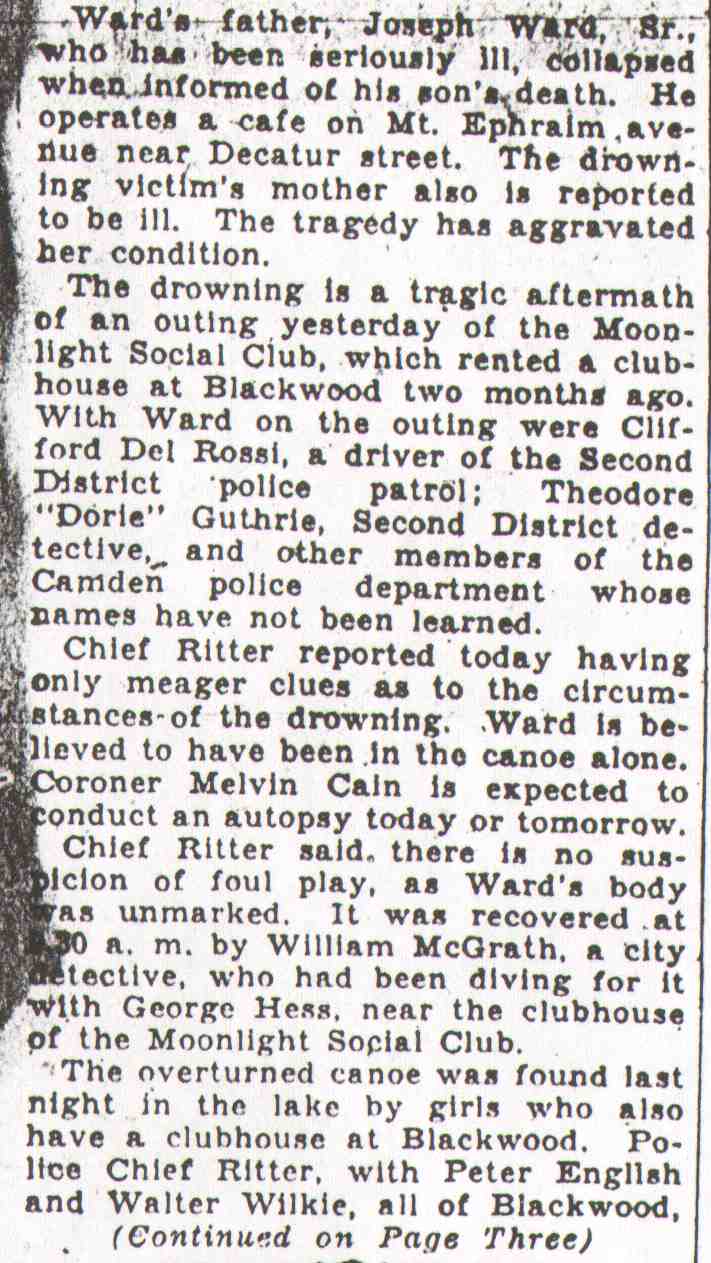
City Policeman Drowns in Lake at Blackwood
Camden Courier-Post —
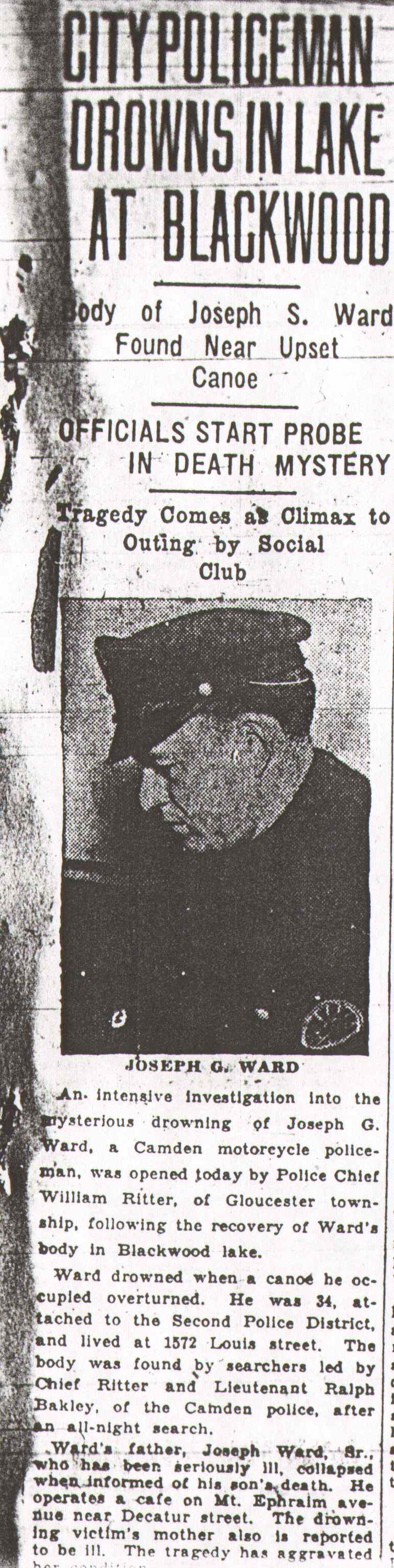
Body of Joseph S. [sic] Ward Found Near Upset Canoe
OFFICIALS START PROBE IN DEATH MYSTERY
Tragedy Comes as Climax to Outing by Social Club
JOSEPH G. WARD
An intensive investigation into the mysterious drowning of Joseph G. Ward, a Camden motorcycle policeman, was opened today by Police Chief William Ritter, of Gloucester township, following the recovery of Ward’s body in Blackwood lake.
Ward drowned when a canoe he occupied overturned. He was 34, attached to the Second Police District, and lived at 1572 Louis street. The body was found by searchers led by Chief Ritter and Lieutenant Ralph Bakley, of the Camden police, after an all-night search.
Ward’s father, Joseph Ward, Sr., who has been seriously ill, collapsed when informed of his son’s death. He operates a cafe on Mt. Ephraim avenue near Decatur street. The drowning victim’s mother also is reported to be ill. The tragedy has aggravated her condition.
The drowning is a tragic aftermath of an outing yesterday of the Moonlight Social Club, which rented a clubhouse at Blackwood two months ago. With Ward on the outing were Clifford Del Rossi, a driver of the Second District police patrol; Theodore “Dorie” Guthrie, Second District detective, and other members of the Camden police department whose names have not been learned.
Chief Ritter reported today having only meager clues as to the circumstances of the drowning. Ward is believed to have been in the canoe alone. Coroner Melvin Cain is expected to conduct an autopsy today or tomorrow.
Chief Ritter said there is no suspicion of foul play, as Ward’s body was unmarked. It was recovered at [?]:30 a. m. by William [sic] McGrath, a city detective, who had been diving for it with George Hess, near the clubhouse of the Moonlight Social Club.
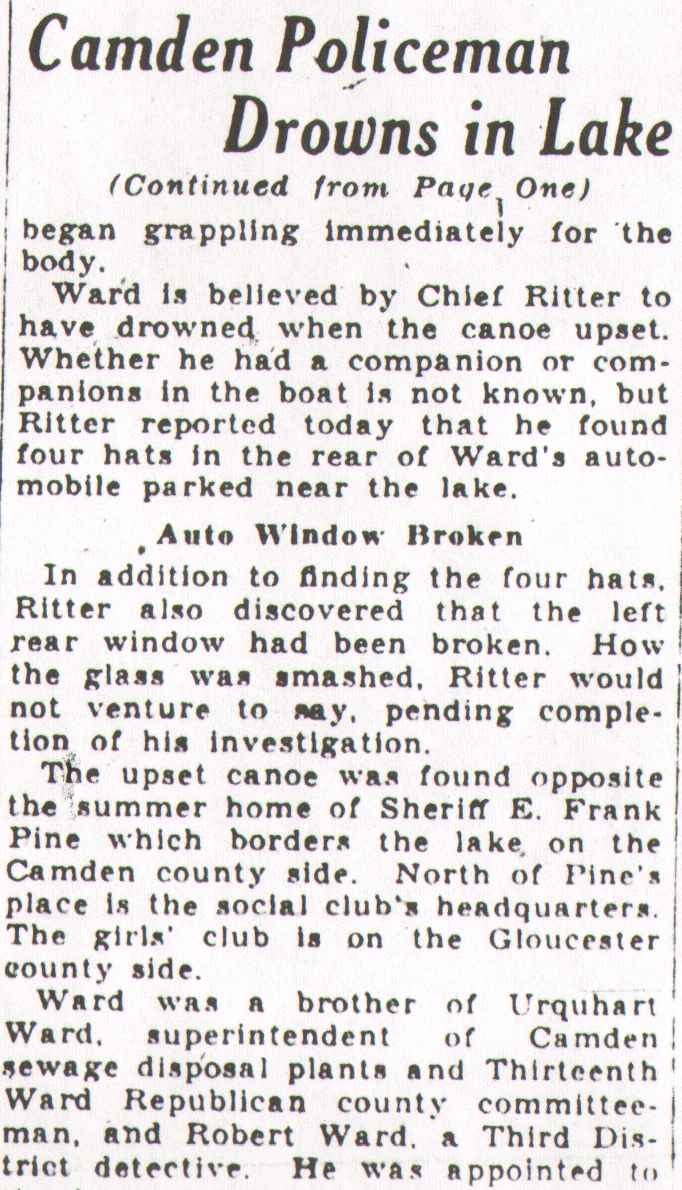
The overturned canoe was found last night in the lake by girls who also have a clubhouse at Blackwood. Police Chief Ritter, with Peter English and Walter Wilkie, all of Blackwood, began grappling immediately for the body.
Ward is believed by Chief Ritter to have drowned when the canoe upset. Whether he had a companion or companions in the boat is not known, but Ritter reported today that he found four hats in the rear of Ward’s automobile parked near the lake.
Auto Window Broken
In addition to finding the four hats, Ritter also discovered that the left rear window had been broken. How the glass was smashed, Ritter would not venture to say, pending completion of his investigation.
The upset canoe was found opposite the summer home of Sheriff E. Frank Pine which borders the lake on the Camden county side. North of Pine’s place is the social club’s headquarters. The girls’ club is on the Gloucester county side.
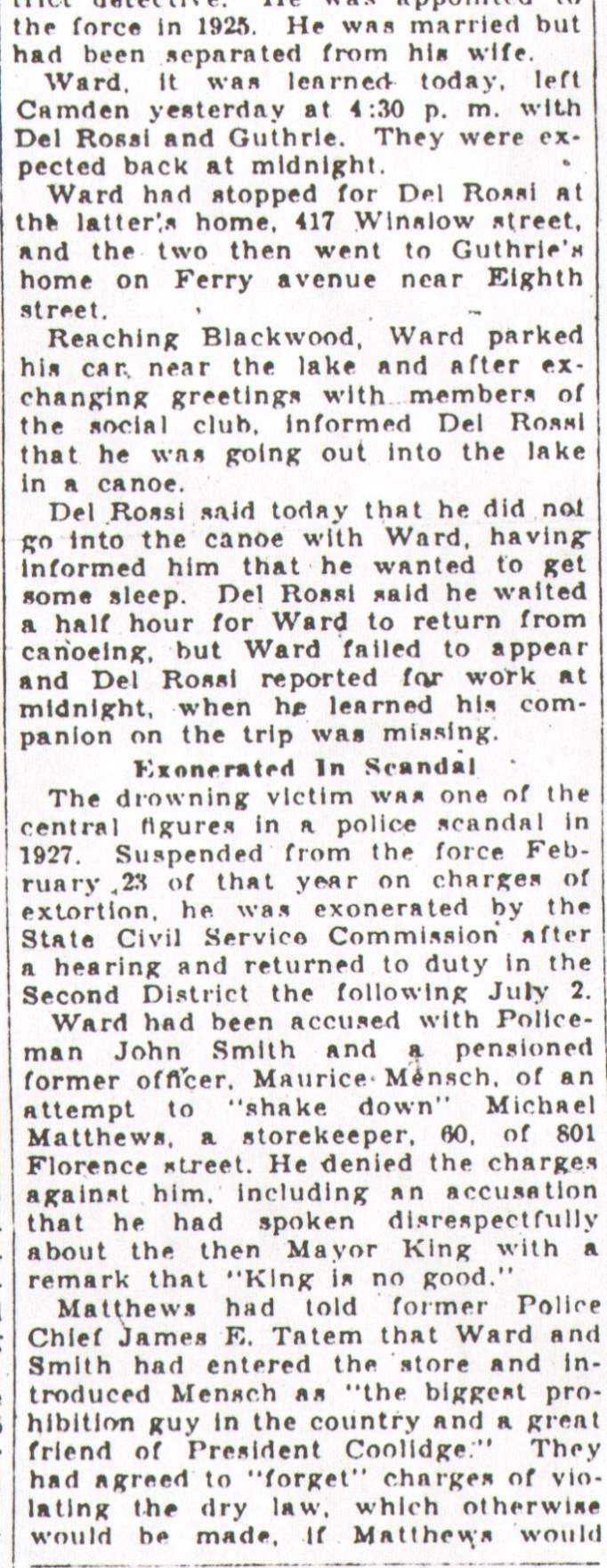
Ward was a brother of Urquhart Ward, superintendent of Camden sewage disposal plants and Thirteenth Ward Republican county committeeman, and Robert Ward, a Third District detective. He was appointed to the force in 1925. He was married but had been separated from his wife.
Ward, it was learned today, left Camden yesterday at 4:30 p. m. with Del Rossi and Guthrie. They were expected back at midnight.
Ward had stopped for Del Rossi at the latter’s home, 417 Winslow street, and the two then went to Guthrie’s home on Ferry avenue near Eighth street.
Reaching Blackwood, Ward parked his car near the lake and after exchanging greetings with members of the social club, informed Del Rossi that he was going out into the lake in a canoe.
Del Rossi said today that he did not go into the canoe with Ward, having informed him that he wanted to get some sleep. Del Rossi said he waited a half hour for Ward to return from canoeing, but Ward failed to appear and Del Rossi reported for work at midnight, when he learned his companion on the trip was missing.
Exonerated In Scandal
The drowning victim was one of the central figures in a police scandal in 1927. Suspended from the force February 23 of that year on charges of extortion, he was exonerated by the State Civil Service Commission after a hearing and returned to duty in the Second District the following July 2.
Ward had been accused with Policeman John Smith and a pensioned former officer, Maurice Mensch, of an attempt to “shake down” Michael Matthews, a storekeeper, 60, of 801 Florence street. He denied the charges against him, including an accusation that he had spoken disrespectfully about the then Mayor King with a remark that “King is no good.”
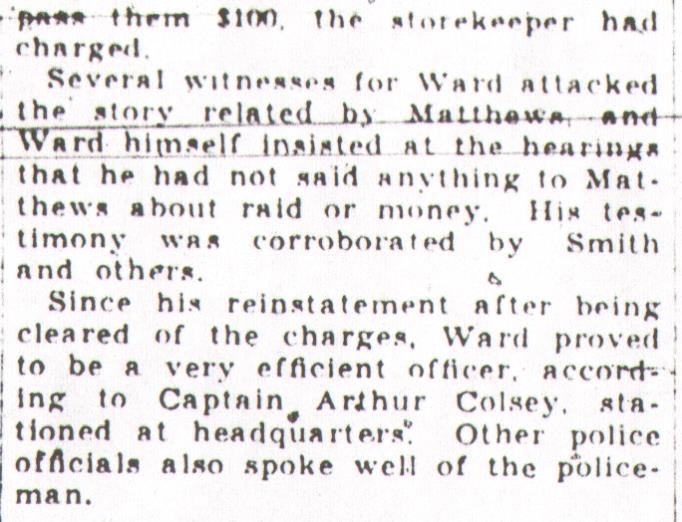
Matthews had told former Police Chief James E. Tatem that Ward and Smith had entered the store and introduced Mensch as “the biggest prohibition guy in the country and a great friend of President Coolidge.” They had agreed to “forget” charges of violating the dry law, which otherwise would be made, if Matthews would pass them $100, the storekeeper had charged.
Several witnesses for Ward attacked the story related by Matthews, and Ward himself insisted at the hearings that he had not said anything to Matthews about raid or money. His testimony was corroborated by Smith and others.
Since his reinstatement after being cleared of the charges, Ward proved to be a very efficient officer, according to Captain Arthur Colsey, stationed at headquarters. Other police officials also spoke well of the policeman.
Democrats to Hold Meetings Tonight
Camden Courier-Post —
Candidacy of Moore to Be Expounded at Meetings in City and Suburbs
The campaign for A. Harry Moore, gubernatorial candidate, and local Democratic candidates, will be carried into six wards of the city and in seven communities of the county tonight.
All meetings and speakers are as follows:
Second Ward Democratic Club, 841 Market Street; Eugene Aumetre, John Crean, Vincent Gallagher, Leon H. Rose and Charles Woods.
Fourth Ward A. Harry Moore Club, 455 Berkley Street; Samuel T. French, Victor King, Thomas Madden, Leon H. Rose, Gene Mariano, Samuel P. Orlando and Rev. Robert H. Jackson.
Sixth Ward Democratic Club, Fourth and Walnut Street; Frank Connor, Albert Melnik and Thomas Madden.
Tenth Ward Democratic Club, Fifth and Vine Streets; Boyd Morrison, Joseph E. Nowrey, Charles Degnan and David L. Visor.
Seventh Ward A. Harry Moore Club, Seventh Street and Kaighn Avenue; Dr. Leroy Baxter, of Jersey City; Isaac Eason, Dr. Clement Branch, Rev. Robert H. Jackson, Mrs. Bertha Shippen Irving and Frank Suttill.
Eleventh Ward Democratic Club, 927 North Twenty-seventh street; Boyd Morrison, Firmin Michel, Victor King, Mrs. Bertha Shippen Irving.
Gloucester City Democratic Club, 308 Monmouth street; Boyd Morrison, Gene Mariano, Joseph Varbalow.
Magnolia A. Harry Moore Club, Evesham and Gloucester avenues; Firmin Michel, Edward L. Canning, John Delaney, Marie V. Kelley and Francis Homan.
Lindenwold Colored Voters’ Club, Blackstone Hall, Lindenwold, Eugene Aumetre, William Williams and Oliver Bond.
Somerdale Club, Whelen home, Somerdale road and Oggs Avenue; Marie V. Kelly, David L. Visor and Mrs. Emma E. Hyland.
Somerdale Democratic Club, Leone Hall, Warwick Road and Helena Avenue; Samuel P. Orlando, Aaron Heine, Lawrence Gregorio and E. George Aaron.
East Haddonfield Democrat Club, Crescent and Berlin Road; Edward L. Canning, Albert Melnik and Judge Frank F. Neutze.
East Haddonfield Improvement Association, Batesville, Delaware Township; Ralph Wescott, Judge Frank F. Neutze and Mrs. Florence Melnik.
More than five speakers from North Jersey will appear at as many meetings as possible.
400 Friends Pay Homage To ‘Good Gray Poet’
Camden Courier-Post —
Men and Women From Many Sections Visit Walt Whitman’s Tomb and Old Mickle Street Home on His 114th Anniversary
“It’s just a little street where old friends meet”
That’s Mickle Street where Walt Whitman, the “Good Gray Poet,” once lived, and old friends came back here from near and far yesterday to mingle under the portals of the house in which he wrote his famous works, on the 114th anniversary of his birth.
Among them was Mrs. Augusta K. Dole, 71, of Metuchen, whose husband has been a sports writer on New York newspapers for 45 years.
“They call it a dingy street and some are ashamed to return and say they lived there,” Mrs. Dole said. And with a gesture of the hand she pointed out the homes of some of neighbors, who became famous.
Among them was Button; famous artist [architect]. Another was the grandmother of J. B. Van Sciver.
“I lived at 319 Mickle Street when I was a young lady,” she said. “I was one year old when we moved into the house right across the street from Whitman. I remember when he lived on Stevens Street before he moved to Mickle Street.
Knew Whitman Well
“We lived at the Mickle Street address about 15 or 16 or 20 years; I knew Whitman well. He always stopped and exchanged greetings with me. I frequently saw him on the ferryboats crossing the rivers.
“I want to take issue right here with those who have questioned his chastity. He was more like Christ than anyone else. I saw him admiring me as a young woman one day on a ferryboat.”
“Years later I read a description of myself in one of his works. I did not begin to read his work until 30 years ago. He wrote of the true things in life. He wrote of life as it is and as we see it. I am glad to come here today at the invitation of the committee,”
Mrs. Dole sat in the last chair in which the poet rested before his last illness. She was introduced to Dr. Alexander MacAlister, who was his personal physician in his last illness and who is a member of the Walt Whitman foundation.
Then she posed with an etching by Lewis Daniel, New York artist, at the Walt Whitman art gallery, 641 Market Street. It is one of 14 the young artist drew on “The Song of the Open Road.” Two lines taken from the book are sketched under the etching as follows:
“The earth is crude and incomprehensible at first— Nature is rude and incomprehensible at first.”
400 Visit Home
More than 400 guests visited the home of the poet during the day to be welcomed by members of the foundation. Mrs. Charles A. Wolverton, wife of Congressman Wolverton, was chairman of the reception committee.
Many of the guests visited the tomb of the poet in Harleigh Cemetery where the door is ajar at his request “that his spirit may come and go as I choose.’” But no flowers were placed there as he requested none.
Born on May 31, 1819, near Huntingdon, Long Island, he had a varied career as a writer, war correspondent and poet. During the Civil War he ministered the wounded of both the North and South at Washington. He spent the last 19 years of his life in Camden, where he died in 1892.
Under the bed in his second story front bed room today is a huge metal bathtub, which he designed for use in his invalid days. His library, horsehair furniture, his favorite rocking chair and a cane with which he knocked on the floor to call his housekeeper.
Some of his writings, manuscripts and other works are the property of Miss Ann Harned and Madge Barton Feurer. They are now at the New Jerseyanna Exhibition at the State House at Trenton.
New Painting Viewed
A new painting of Walt Whitman has been completed by Byron T. Connor, of 4320 Manor Avenue, Merchantville, and is now on display at the Hotel Walt Whitman. The painting was completed in three weeks, so as to be ready for the birthday ceremonies.
Later it will be moved from the hotel and placed either in the Whitman home or hung in the lobby of the Walt Whitman Theatre.
Miss Harned, daughter of the late Thomas B. Harned, one of Whitman’s literary executors; Joseph Praissman and Mrs. Martha Davis curator of the Whitman home, were members of the anniversary committee headed by Mrs. Wolverton.
With few exceptions, members of the Walt Whitman Foundation attended yesterday’s program, including Dr. Macalister, chairman; Dr. Cornelius Weygandt, vice chairman; Mrs. Juliet Lit Stern, Joseph M. Conover, Mrs. Helen Taft Manning, Mrs. Allen Drew Cook, Mrs. Nicholas Douty, Dr. Herbert Spencer Harned, J. Frederick Harned, Roy Helton, William T. Innes, Eldridge R. Johnson, William H. Ketler, Dr. Rufus M. Jones, former Mayor Victor King, Oscar Wolf, John Frederick Lewis, Jr., Dr. Bliss Perry, Harrison S. Morris, Agnes Repplier, former Mayor Winfield S. Price, Vernon Whitman Rich, Dr. J. Duncan Spaeth, Dr. Felix E. Schelling, Dr. Robert E. Spiller, Mrs. David Abeel Storer, Frederick Von Nieda and Ralph W. Wescott.
Among the visitors was former Assemblyman William H. Iszard, who is secretary of the committee, which acquired the home as a national shrine. Iszard sponsored legislation in the Assembly for its upkeep.
Democratic Trustees Plan Summer Program
Camden Courier-Post —
Trustees of the Democratic Club of Camden County discussed summer plans last night at Democratic Headquarters, 538 Stevens Street.
Edward J. Borden, a trustee, was congratulated on his election as president of the New Jersey Real Estate Commission. Other members present were Samuel P. Orlando, president; Victor King, Patrick H. Harding, Harry L. Maloney and Sidney Kaplan.
Democrats Arrange for ‘Maloney Day’
Camden Courier-Post —
July 9 Set for Reception and Picnic to New Revenue Collector
“Harry L. Maloney Day” will be celebrated by South Jersey Democrats, Sunday, July 9, when the newly-appointed collector of internal revenue will be guest of honor at a picnic at Silver Lake Park. State leaders of the party will attend. Maloney, Democratic state committeeman from Camden County and Mayor of Bellmawr, was named by President Roosevelt to succeed Edward L. Sturgess and is expected to take office by July 1.
Plans for the outing were made last night at a meeting in Democratic headquarters, 538 Stevens Street, at which Albert S. Marvel, Jr., was named chairman of the general committee. Vincent de P. Costello was elected secretary and former Mayor Victor King treasurer.
The committees follow:
Ways and means—Sidney Kaplan, chairman; Judge Samuel M. Shay, Judge Frank F. Neutze, Victor King, Vincent Gallaher, Samuel P. Orlando and Thomas N. Madden.
Entertainment—Joseph A. Varbalow, chairman; Patrick H. Harding, Joseph E. Nowrey, Calogero Salvagio, Thomas Cavanaugh and Joseph A. Gorman.
Refreshments—Ralph W. Wescott, chairman; Raymond Hadley, Walter Bateman, Joseph Ackroyd, James Hainesworth, Joseph Harczynski.
Athletics—Frank Abbott, chairman; John Lyons, Joseph McVey and Daniel T. Hagans.
Music—John P. Bissinger, chairman; Ventorino Francesconi, William Bell, Bernard Tracy and Matthew P. Johnson.
District organization—Michael J. Powell, chairman; Dominick Josephs, Ralph Comilli, Herbert McAdams, William Noonan, Edward Huston, Harry Daly and William Kistner.
Transportation—Mayor Emerson Jackson, of Gloucester, chairman; Lewis C. Parker, George Cohen, John Bennett, Horace L. Brewer and Sabba Verdiglione.
Printing—Charles J. Clark, chairman; Raymond Saltzman, Jack Goldstein, Walter Kelly and William M. Williams.
Publicity—Edward C. Bowe, Herbert Beattie, Patrick Whalen, Alfred R. White and Luke Bates.
Mrs. Emma E. Hyland, state committeewoman, and Miss Marie V. Kelley, vice-chairman of the county committee, will head a women’s reception committee to be chosen later.
The committees will meet again Monday night to complete arrangements.
Home Loan Chief Names N. J. Aides
Camden Courier-Post —
Shanley Expects to Appoint Manager of Camden Office Today
Trenton, Aug. 11—Managers for three North Jersey district offices of the Federal Home Owners’ Loan Corporation were appointed this afternoon by G. Frank Shanley, New Jersey manager.
They are Charles P. Gillen, former Newark city commissioner, for the third (Newark) district; Richard J. Tarrant, of Jersey City, second (Jersey City) district, and George V. McDonough, West Orange city commissioner, for the fourth (Essex county) district.
McDonough was reported tonight to have declined the appointment.
Shanley said he expected to name the manager for the Camden office tomorrow. The Camden district will comprise eight South Jersey counties. Plans for additional offices in Atlantic City and Hackensack have been abandoned, it was said. Charles I. Lafferty, Atlantic county Democratic chairman was reported considered for the Atlantic City office if one were established there, but it was said he did not want the job.
It is reported that the names of former Mayor Victor King, of Camden, and former Freeholder S. Raymond Dobbs are being considered for the Camden managership. Other reports say a “dark horse” will be chosen.
Denof Denies He Ran in ’31 for Kelleher
Camden Courier-Post —
DENOF DENIES HE RAN IN ‘31 FOR KELLEHER
Was First to File, He Says, and Stayed on Ticket by Own Chosing [sic]
William Denof, last night denied the statements attributed to Prosecutor Samuel P. Orlando and Attilio C. Marino, that Edward J. Kelleher was responsible for having Denof file a petition as a candidate for city commissioner in 1931. Denof’s statement follows:
“In 1931 I was the first person to file my petition as a candidate for city commissioner. My petition was filed after a number of influential Italians in Camden county had held conferences to discuss the fact that the Hyland-Maloney leadership of the part [sic] was not giving any recognition to those of Italian extraction. Those attending the conferences finally selected me as their representative and asked me to announce my candidacy for city commissioner.
“I had hopes of obtaining the support of the Democrats and Non-Partisans and used the designation ‘Non-Partisan’ on the ballot.
“Edward J. Kelleher was in Florida at the time. I had never had any conversations with him about the matter until he returned. After the Hyland-Maloney leadership had defiitely [sic] determined to support five candidates other than myself, both Mr. Kelleher and Judge Shay asked me to retire as a candidate, in the interest of harmony in the Democratic party.
“I had intended to retire and was percetly [sic] willing to do so, but in the face of my candidacy, Mrs. Hyland and Mr. Maloney had removed my brother and two of our friends from the election board and placed inexperienced persons in their stead.
“I informed Mr. Kelleher and Judge Shay that I would be perfectly willing to retire from the race, if these three Democrats, who had served the party from the time they became of age, were restored to their positions on the election boards.
“Mrs. Hyland and Mr. Maloney refused to reinstate them. Believing that they were not interested in winning the city election but were more inteersted [sic] in winning the primary election for themselves which was to occur one week later, I decided to let my name remain on the ballot as a candidate.
“Former Mayor Victor King and Fred Stanton had bolted the Non-Partisan ticket in 1927 and ran as independent candidates. They are now holding lucrative positions under the Hyland-Maloney leadership.
“My purpose in making this statement is to give the exact truth and to give credit to Mr. Kelleher and Judge Shay for endeavoring to have me retire as a candidate. Mr. Kelleher was not responsible for my being a candidate and made every effort to have me retire in favor of the candidates named by Mrs. Emma E. Hyland and Harry Maloney.
“Prosecutor Orlando’s statement is certainly out of line with the true facts in the situation.”
Mrs. Hyland Raps Answer by Denof
Camden Courier-Post —
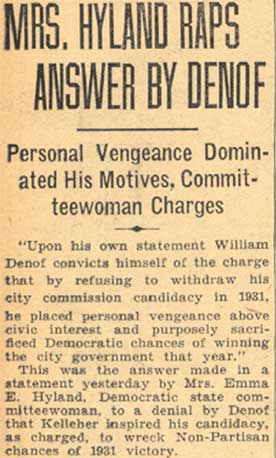
MRS. HYLAND RAPS ANSWER BY DENOF
Personal Vengeance Dominated His Motives, Committeewoman Charges
“Upon his own statement William Denof convicts himself of the charge that by refusing to withdraw his city commission candidacy in 1931, he placed personal vengeance above civic interest and purposely sacrificed Democratic chances of winning the city government that year.”
This was the answer made in a statement yesterday by Mrs. Emma E. Hyland, Democratic state committeewoman, to a denial by Denof that Kelleher inspired his candidacy, as charged, to wreck Non-Partisan chances of 1931 victory.
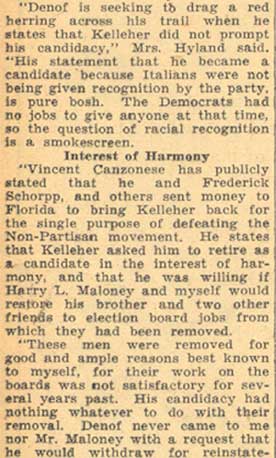
“Denof is seeking to drag a red herring across his trail when he states that Kelleher did not prompt his candidacy,” Mrs. Hyland said. “His statement that he became a candidate because Italians were not being given recognition by the party, is pure bosh. The Democrats had no jobs to give anyone at that time, so the question of racial recognition is a smokescreen.
Interest of Harmony
“Vincent Canzonese has publicly stated that he and Frederick Schorpp, and others sent money to Florida to bring Kelleher back for the single purpose of defeating the Non-Partisan movement. He states that Kelleher asked him to retire as a candidate in the interest of harmony, and that he was willing if Harry L. Maloney and myself would restore his brother and two other friends to election board jobs from which they had been removed.
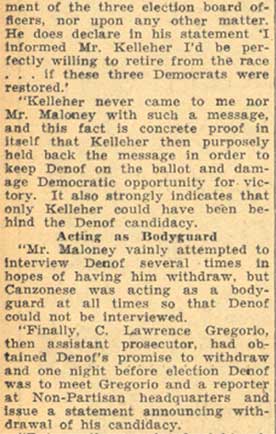
“These men were removed for good and ample reasons best known to myself, for their work on the boards was not satisfactory for several years past. His candidacy had nothing whatever to do with their removal. Denof never came to me nor Mr. Maloney with a request that he would withdraw for reinstatement of the three election board officers, nor upon any other matter. He does declare in his statement ‘I informed Mr. Kelleher I’d be perfectly willing to retire from the race...if these three Democrats were restored.'
“Kelleher never came to me nor Mr. Maloney with such a message, and this fact is concrete proof in itself that Kelleher then purposely held back the message in order to keep Denof on the ballot and damage Democratic opportunity for victory. It also strongly indicates that only Kelleher could have been behind the Denof candidacy.
Acting as Bodyguard
“Mr. Maloney vainly attempted to interview Denof several times in hopes of having him withdraw, but Canzonese was acting as a bodyguard at all times so that Denof could not be interviewed.
“Finally, C. Lawrence Gregorio, then assistant prosecutor, had obtained Denof’s promise to withdraw and one night before election Denof was to meet Gregorio and a reporter at Non-Partisan headquarters and issue a statement announcing withdrawal of his candidacy.
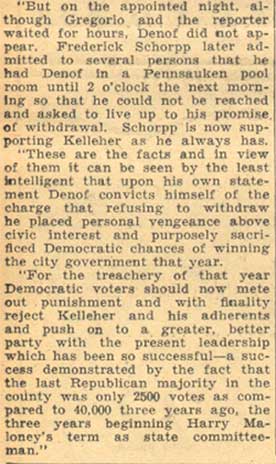
“But on the appointed night, although Gregorio and the reporter waited for hours, Denof did not appear. Frederick Schorpp later admitted to several persons that he had Denof in a Pennsauken pool room until 2 o’clock the next morning so that he could not be reached and asked to live up to his promise of withdrawal. Schorpp is now supporting Kelleher as he always has.
“These are the facts and in view of them it can be seen by the least intelligent that upon his own statement Denof convicts himself of the charge that refusing to withdraw he placed personal vengeance above civic interest and purposely sacrificed Democratic chances of winning the city government that year.
“For the treachery of that year Democratic voters should now mete out punishment and with finality reject Kelleher and his adherents and push on to a greater, better party with the present leadership which has been so successful—a success demonstrated by the fact that the last Republican majority in the county was only 2500 votes as compared to 40,000 three years ago, the three years beginning Harry Maloney’s term as state committeeman.”
“Bob” Ashenfelter, Shot in Duel With Burglars, Asks Pension
Camden Courier-Post —

John Sheeran Claims Disability
Gladney and Roy Smith Ask to Leave Fire Service
Applications of four policemen and two veteran firemen for pensions will be considered today at a special meeting of the Police and Firemen’s Pension Commission in the offices of Mayor Roy R. Stewart.
Included in the list are Detective Robert Ashenfelter and Accident Investigator John Sheeran, both seeking retirement because of disability suffered while members of the department.
Others whose pension request will receive consideration at today’s session include Patrolmen Robert Ward and Jesse Smith and Charles M. Gladney and Roy M. Smith, members of the fire department.
Ashenfelter, who is 40, and lives at 352 Berwood street, was one of the first members of the police force to receive the Gold Star when that award for bravery was established by Mayor Stewart in 1931. He was appointed to the force by Mayor Victor King on July 1, 1926, and served as a motorcycle policeman until April 17, 1929, when he was appointed acting detective.
His physician stated that Ashenfelter was suffering from an infected right lung as a result of wounds he received in a sensational pistol battle with a burglar whom he killed in the robbery of the American Store, Thirty-second street and Pierce avenue, on August 24, 1931.
Receiving the report of the robbery, Ashenfelter went to the store with Detective Benjamin Simon. Ashenfelter walked to the rear of the store. As he reaced [sic] the door of a shed in the rear, he met a volley of seven shots fired from inside. One bullet knocked the gun from his right hand, another pierced his arm and a third entered his chest over his heart.
Despite his wounds, Ashenfelter was able to pick up his pistol with his uninjured hand. He emptied it through the door.
A moment later other officers arrived. When they opened the door they found Charles Rettberg, 21, of 1189 North Thirty-sixth street, lying dead on the floor.
Arrested on the scene were the dead man’s brother, Theodore, who later was acquitted, and Melbourne James and Gordon McCrea, who were sentenced to five years each in prison.
Ashenfelter was in the hospital for several weeks after the shooting.
During the World War he served as a lieutenant in the ordnance department attached to the 118th Field Artillery.
“Johnny” Sheeran, 57, was appointed to the police department July 15, 1913. He still lacks several months of the required years service but is seeking the pension on the disability clause because of a wound received several years ago.
Sheeran, attached to the Second Police District at the time, was helping to move some large steel cases in the old city hall when one of them fell on his left hand. Physicians at Cooper Hospital managed to patch the hand up, but Sheeran has never had the use of it since that time.
Lately he has been working in the Accident Bureau. He lives at 777 Wright avenue.
Checked and Double Checked by Jiminy
Camden Courier-Post —
IT takes no crystal gazer to know that former U. S. Senator W. Warren Barbour hopes to get the Republican senatorial nomination without opposition… So far no opposition has bloomed, but efforts are being made to get Robert Johnson, New Brunswick manufacturer who backed Glee, into the primary battle … Unless the feeling against John Milton subsides, the Democrats will be hard put to find a suitable candidate for the job, unless they figure anybody can beat Barbour…
Put down a little bet that both new members of the county election board will be suburbanites … In fact, from adjoining municipalities … You might also safely say that when the Democrats name the new county solicitor (Vincent Gallaher), the coalition Republicans will name Cooper Brown, of Collingswood, as assistant solicitor… In spite of his visits to Jersey City, Prosecutor Samuel P. Orlando stands an excellent chance of not being reappointed. His successor, at this time, appears to be E. George Aaron, also a Democrat, but a Brunner Democrat … The Pennsauken Republican Women’s Club will on next Tuesday have a speaker whose topic will be, “How to Be Happy and Contented Though a Republican” … A lot of the boys in these here parts ought to go there and listen… Former Mayor Victor King probably will be a candidate for City Commission in 1939… Likewise for Morris Clyman, member of the Board of Assessors… Matt Van Istendal is being boomed as the new Republican leader of Collingswood as well as candidate for Assembly… So is Ed Marker of Haddon township (for Assembly)… Both are good candidates …
Henry Aitken, No. 1 coal wagon chaser, tried to get Commissioner von Nieda on the bridge commission until Hoffman slipped Baird in… Has the Baird boom gone boom?… That suburban handbill publisher printed that the next time Surrogate Hanna runs for public office it’ll be city commissioner instead of a county post because he is weak in the suburbs… The last time Frank Hanna ran, it was for State committee, and he ran ahead of his running mate in every county municipality.
Checked and Double Checked by Jiminy
Camden Courier-Post —
Feed Bag: Former Judge Joseph Varbalow will soon announce he has purchased the Towers and Broadway Theatres from the Ellis family … Circuit Court Judge V. Claude Palmer will probably file his decision today in the fraud charges made by the Republican League against the election of Freeholders Ciechanowski and Francesconi … Since Judge Palmer told the Democratic attorney, Alex Feinberg, that Feinberg must complete his entire case in a half a day “because, frankly, I don’t see what answer you can make to this testimony,” you can draw your own conclusions about what the decision will be … Incidentally, Judge Palmer will take a plane July 12 for a vacation at Calgary in the Canadian Rockies … The name of Walter Uliase, Seventh ward Democrat, has been withdrawn from powwows on appointments to the county tax board … Senator Al Driscoll was willing to okay Joe Ackroyd, Democrat, as successor on the board to Fred Schorpp, whose term expired a few weeks ago … The Republicans are said to have figured that in that way, they could hold Victor King on the board awhile longer, even though his term expired more than a year ago … Lee Smith, former WPA director, is still a possibility for the tax board job … The Democrats are holding frequent conferences on who the assistant prosecutor shall be … Police Judge Gene R. Mariano, a strong contender, has reportedly been dropped with Ben Dzick, Tony Mitchell, Charlie Rudd and the Kraft boys still in the running … Police court habitues believe that Gene himself announced indirectly that he had been eliminated when he said from the bench, while hearing a case, “Lady, you’ll find that even your best friends sometimes stab you in the back. I found that out myself only 1 o’clock yesterday afternoon” … That was on Thursday … Mayor George Brunner told the dept that our guess was still as good as his, so that leaves Ben Dzick still with the fence position in the race … Mariano may be considered for the $5000 State job as sealer of weights and measures …
***
Miscellany: Neil F. Deighan, the saloonman who led the opposition to a legislative bill which proposed that liquor manufacturers and wholesalers be prevented from selling goods to any retailer who owed them money and that all purchases be made with cash or quick payment credit plan (the bill will die in committee), is having his troubles with some wholesalers … Suits have been filed against Deighan and the Old Mill Inn, Inc., by Galsworthy, Inc., for $1713.51 plus interest; Joseph A. Reinfeld, Inc., for $1366.43 plus interest, and Majestic Wines and Spirits, Inc., for $1579.80 plus interest … The suits are in the New Jersey Supreme Court and allegedly represent unpaid balances of liquor bills … Tom Dickinson, courthouse custodian, is wearing a bright red face these days because the missus sent him to the store the other night for some sandwich meat for their guest… Because of a similarity of trade names, Tom returned home with a package … Of razor blades … The new office of Bishop Eustace may be established at the old Rodger homestead at 721 Cooper street … Vice Chancellor Al Woodruff has left for Chile and some deep sea fishing.
Life Hereabouts
Camden Courier-Post —
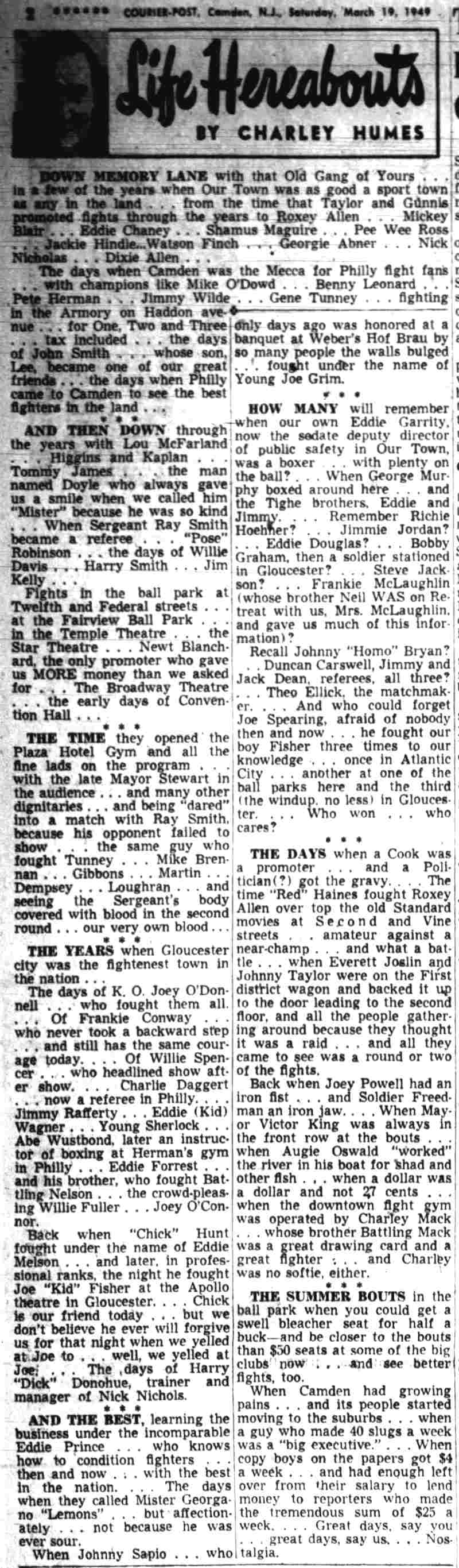
DOWN MEMORY LANE with that Old Gang of Yours . . . in a few of the years when Our Town was as good a sport town as any in the land . . . from the time that Taylor and Gunnis promoted fights through the years to Roxey Allen . . . Mickey Blair . . . Eddie Chaney . . . Shamus Maguire . . . Pee Wee Ross . . . Jackie Hindle . . . Watson Finch . . . Georgie Abner . . . Nick Nicholas . . . Dixie Allen . . .
The days when Camden was the Mecca for Philly fight fans . . . with champions like Mike O’Dowd . . . Benny Leonard . . . Pete Herman . . . Jimmy Wilde . . . Gene Tunney . . . fighting in the Armory on Haddon avenue . . . for One, Two and Three . . . tax included . . . the days of John Smith . . . whose son, Lee, became one of our great friends . . . the days when Philly came to Camden to see the best fighters in the land . . .
AND THEN DOWN through the years with Lou McFarland . . . Higgins and Kaplan . . . Tommy James . . . the man named Doyle who always gave us a smile when we called him “Mister” because he was so kind . . . When Sergeant Ray Smith became a referee . . . “Pose” Robinson . . . the days of Willie Davis . . . Harry Smith . . . Jim Kelly . . .
Fights in the ball park at Twelfth and Federal streets . . . at the Fairview Ball Park . . . in the Temple Theatre . . . the Star Theatre . . . Newt Blanchard, the only promoter who gave us MORE money than we asked for . . . The Broadway Theatre . . . the early days of Convention Hall . . .
THE TIME they opened the Plaza Hotel Gym and all the fine lads on the program . . . with the late Mayor Stewart in the audience . . . and many other dignitaries . . . and being “dared” into a match with Ray Smith, because his opponent failed to show . . . the same guy who fought Tunney . . . Mike Brennan . . . Gibbons . . . Martin . . . Dempsey . . . Loughran . . . and seeing the Sergeant’s body covered with blood in the second round . . . our very own blood . . .
THE YEARS when Gloucester city was the fightenest town in the nation . . .
The days of K. O. Joey O’Donnell . . . who fought them all. . . Of Frankie Conway . . . who never took a backward step . . . and still has the same courage today. . . . Of Willie Spencer . . . who headlined show after show. . . . Charlie Daggert . . . now a referee in Philly. . . . Jimmy Rafferty . . . Eddie (Kid) Wagner . . . Young Sherlock . . . Abe Wustbond, later an instructor of boxing at Herman’s gym in Philly . . . Eddie Forrest . . . and his brother, who fought Battling Nelson . . . the crowd-pleasing Willie Fuller . . . Joey O’Connor.
Back when “Chick” Hunt fought under the name of Eddie Melson . . . and later, in professional ranks, the night he fought Joe “Kid” Fisher at the Apollo theatre in Gloucester. . . . Chick is our friend today . . . but we don’t believe he ever will forgive us for that night when we yelled at Joe to . . . well, we yelled at Joe . . . The days of Harry “Dick” Donohue, trainer and manager of Nick Nichols.
AND THE BEST, learning the business under the incomparable Eddie Prince . . . who knows how to condition fighters . . . then and now . . . with the best in the nation. . . . The days when they called Mister Georgano “Lemons” . . . but affectionately . . . not because he was ever sour.
When Johnny Sapio . . . who only days ago was honored at a banquet at Weber’s Hof Brau by so many people the walls bulged . . . fought under the name of Young Joe Grim.
HOW MANY will remember when our own Eddie Garrity, now the sedate deputy director of public safety in Our Town, was a boxer . . . with plenty on the ball? . . . When George Murphy boxed around here . . . and the Tighe brothers, Eddie and Jimmy . . . Remember Richie Hoehner? . . . Jimmie Jordan? . . . Eddie Douglas? . . . Bobby Graham, then a soldier stationed in Gloucester? . . . Steve Jackson? . . . Frankie McLaughlin (whose brother Neil WAS on Retreat with us, Mrs. McLaughlin, and gave us much of this information)?
Recall Johnny “Homo” Bryan? . . . Duncan Carswell, Jimmy and Jack Dean, referees, all three? . . . Theo Ellick, the matchmaker. . . . And who could forget Joe Spearing, afraid of nobody then and now . . . he fought our boy Fisher three times to our knowledge . . . once in Atlantic City . . . another at one of the ball parks here and the third (the windup, no less) in Gloucester. . . . Who won . . . who cares?
THE DAYS when a Cook was a promoter . . . and a Politician(?) got the gravy. . . . The time “Red” Haines fought Roxey Allen over top the old Standard movies at Second and Vine streets . . . amateur against a near-champ . . . and what a battle . . . when Everett Joslin and Johnny Taylor were on the First district wagon and backed it up to the door leading to the second floor, and all the people gathering around because they thought it was a raid . . . and all they came to see was a round or two of the fights.
Back when Joey Powell had an iron fist . . . and Soldier Freedman an iron jaw. . . . When Mayor Victor King was always in the front row at the bouts . . . when Augie Oswald “worked” the river in his boat for shad and other fish . . . when a dollar was a dollar and not 27 cents . . . when the downtown fight gym was operated by Charley Mack . . . whose brother Battling Mack was a great drawing card and a great fighter . . . and Charley was no softie, either.
THE SUMMER BOUTS in the ball park when you could get a swell bleacher seat for half a buck—and be closer to the bouts than $50 seats at some of the big clubs now . . . and see better fights, too.
When Camden had growing pains . . . and its people started moving to the suburbs . . . when a guy who made 40 slugs a week was a “big executive.” . . . When copy boys on the papers got $4 a week . . . and had enough left over from their salary to lend money to reporters who made the tremendous sum of $25 a week. . . . Great days, say you . . . great days, say us. . . . Nostalgia.
The Victor King Home, 3197 Federal Street
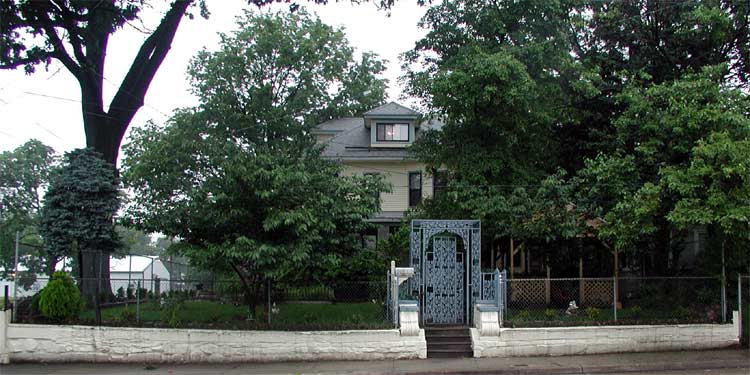
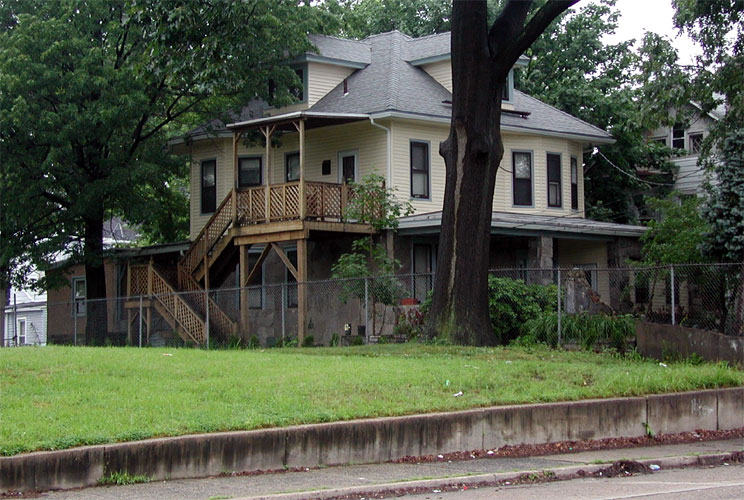
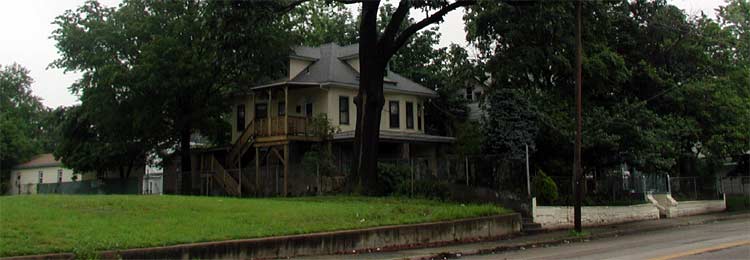
The Victor King House is adjacent to the Dudley Grange Park, and opposite Woodrow Wilson High School. Photograph taken June 21, 2003.
Stern the maverick publisher cuts in
Camden Courier-Post —
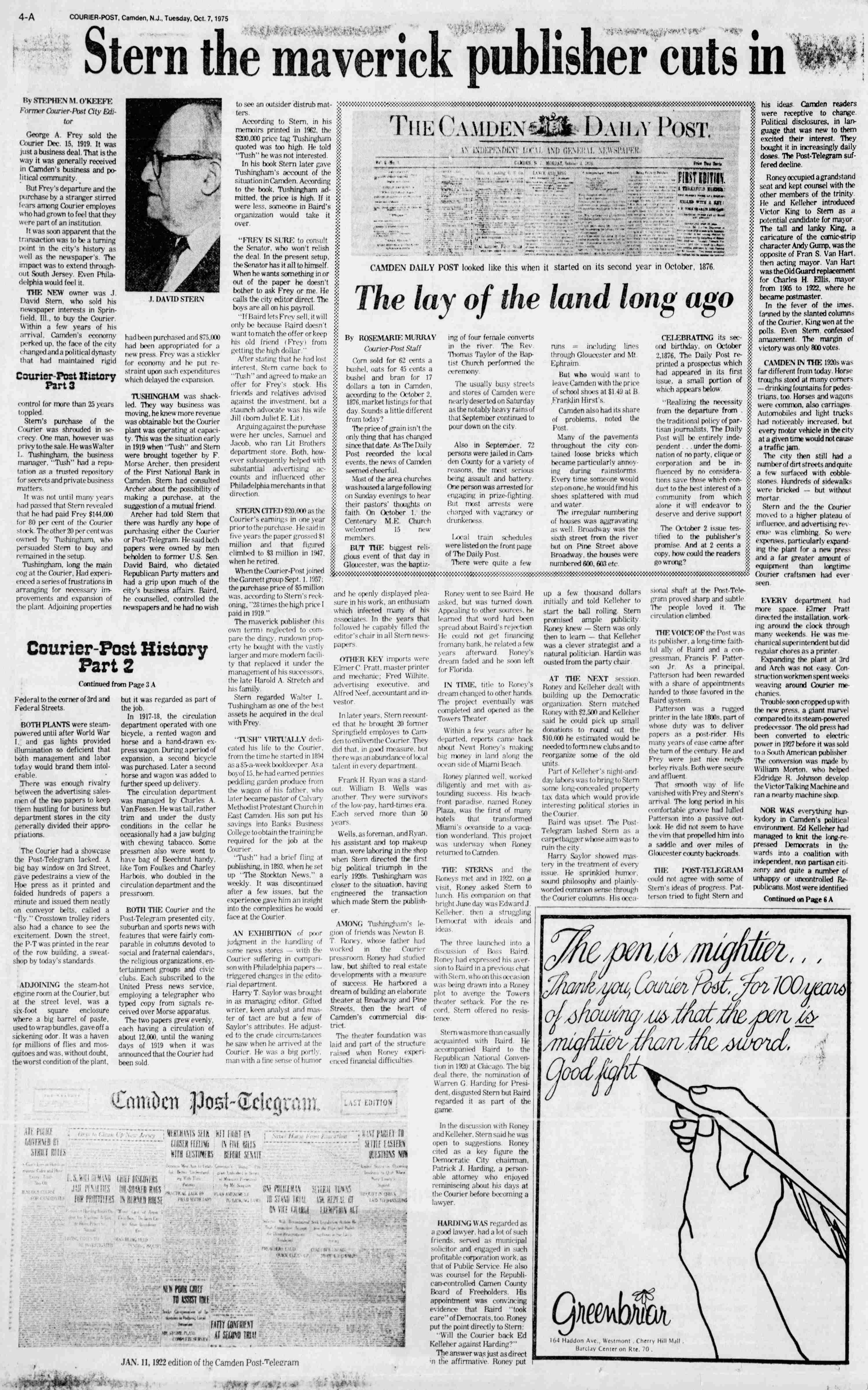

By STEPHEN M. O’KEEFE
Former Courier-Post City Editor
George A. Frey sold the Courier Dec. 15, 1919. It was just a business deal. That is the way it was generally received in Camden’s business and political community.
But Frey’s departure and the purchase by a stranger stirred fears among Courier employes who had grown to feel that they were part of an institution.
It was soon apparent that the transaction was to be a turning point in the city’s history as well as the newspaper’s. The impact was to extend throughout South Jersey. Even Philadelphia would feel it.
THE NEW owner was J. David Stern, who sold his newspaper interests in Springfield, Ill., to buy the Courier. Within a few years of his arrival, Camden’s economy perked up, the face of the city changed and a political dynasty that had maintained rigid control for more than 25 years toppled.
Stern’s purchase of the Courier was shrouded in secrecy. One man, however was privy to the sale. He was Walter L. Tushingham, the business manager. “Tush” had a reputation as a trusted repository for secrets and private business matters.
It was not until many years had passed that Stern revealed that he had paid Frey $144,000 for 80 per cent of the Courier stock. The other 20 per cent was owned by Tushingham, who persuaded Stern to buy and remained in the setup.
Tushingham, long the main cog at the Courier, had experienced a series of frustrations in arranging for necessary improvements and expansion of the plant. Adjoining properties had been purchased and $75,000 had been appropriated for a new press. Frey was a stickler for economy and he put restraint upon such expenditures which delayed the expansion.
TUSHINGHAM was shackled. They [sic] way business was moving, he knew more revenue was obtainable but the Courier plant was operating at capacity. This was the situation early in 1919 when “Tush” and Stern were brought together by F. Morse Archer, then president of the First National Bank in Camden. Stern had consulted Archer about the possibility of making a purchase, at the suggestion of a mutual friend.
Archer had told Stern that there was hardly any hope of purchasing either the Courier or Post-Telegram. He said both papers were owned by men beholden to former U.S. Sen. David Baird, who dictated Republican Party matters and had a grip upon much of the city’s business affairs. Baird, he counselled, controlled the newspapers and he had no wish to see an outsider distrub [sic] matters.
According to Stern, in his memoirs printed in 1962, the $200,000 price tag Tushingham quoted was too high. He told “Tush” he was not interested.
In his book Stern later gave Tushingham’s account of the situation in Camden. According to the book, Tushingham admitted, the price is high. If it were less, someone in Baird’s organization would take it over.
“FREY IS SURE to consult the Senator, who won’t relish the deal. In the present setup, the Senator has it all to himself. When he wants something in or out of the paper he doesn’t bother to ask Frey or me. He calls the city editor direct. The boys are all on his payroll.
“If Baird lets Frey sell, it will only be because Baird doesn’t want to match the offer or keep his old friend (Frey) from getting the high dollar.”
After stating that he had lost interest, Stern came back to “Tush” and agreed to make an offer for Frey’s stock. His friends and relatives advised against the investment, but a staunch advocate was his wife Jill (born Juliet E. Lit).
Arguing against the purchase were her uncles, Samuel and Jacob, who ran Lit Brothers department store. Both, however subsequently helped with substantial advertising accounts and influenced other Philadelphia merchants in that direction.
STERN CITED $20,000 as the Courier’s earnings in one year prior to the purchase. He said in five years the paper grossed $1 million and that figured climbed to $3 million in 1947, when he retired.
When the Courier-Post joined the Gannett group Sept. 1, 1957; the purchase price of $5 million was, according to Stern’s reckoning, “28 times the high price I paid in 1919.”
The maverick publisher (his own term) neglected to compare the dingy, rundown property he bought with the vastly larger and more modern facility that replaced it under the management of his successors, the late Harold A. Stretch and his family.
Stern regarded Walter L. Tushingham as one of the best assets he acquired in the deal with Frey.
“TUSH” VIRTUALLY dedicated his life to the Courier, from the time he started in 1894 as a $5-a-week bookkeeper. As a boy of 15, he had earned pennies peddling garden produce from the wagon of his father, who later became pastor of Calvary Methodist Protestant Church in East Camden. His son put his savings into Banks Business College to obtain the training he required for the job at the Courier.
“Tush” had a brief fling at publishing, in 1893, when he set up “The Stockton News,” a weekly. It was discontinued after a few issues, but the experience gave him an insight into the complexities he would face at the Courier.
AN EXHIBITION of poor judgment in the handling of some news stories — with the Courier suffering in comparison with Philadelphia papers — triggered changes in the editorial department.
Harry T. Saylor was brought in as managing editor. Gifted writer, keen analyst and master of tact are but a few of Saylor’s attributes. He adjusted to the crude circumstances he saw when he arrived at the Courier. He was a big portly man with a fine sense of humor and he openly displayed pleasure in his work, an enthusiam [sic] which infected many of his associates. In the years that followed he capably filled the editor’s chair in all Stern newspapers.
OTHER KEY imports were Elmer C. Pratt, master printer and mechanic; Fred Wilhite, advertising executive, and Alfred Neef, accountant and investor.
In later years, Stern recounted that he brought 20 former Springfield employes to Camden to enliven the Courier. They did that, in good measure, but there was an abundance of local talent in every department.
Frank H. Ryan was a standout. William B. Wells was another. They were survivors of the low-pay, hard-times era. Each served more than 50 years.
Wells, as foreman, and Ryan, his assistant and top makeup man, were laboring in the shop when Stern directed the first big political triumph in the early 1920s. Tushingham was closer to the situation, having engineered the transaction which made Stern the publisher.
AMONG Tushingham’s legion of friends was Newton B. T. Roney, whose father had worked in the Courier pressroom. Roney had studied law, but shifted to real estate developments with a measure of success. He harbored a dream of building an elaborate theater at Broadway and Pine Streets, then the heart of Camden’s commercial district.
The theater foundation was laid and part of the structure raised when Roney experienced financial difficulties.
Roney went to see Baird. He asked, but was turned down. Appealing to other sources, he learned that word had been spread about Baird’s rejection. He could not get financing from any bank, he related a few years afterward. Roney’s dream faded and he soon left for Florida.
IN TIME, title to Roney’s dream changed to other hands. The project eventually was completed and opened as the Towers Theater.
Within a few years after he departed, reports came back about Newt Roney’s making big money in land along the ocean side of Miami Beach.
Roney planned well, worked diligently and met with astounding success. His beachfront paradise, named Roney Plaza, was the first of many hotels that transformed Miami’s oceanside to a vacation wonderland. This project was underway when Roney returned to Camden.
THE STERNS and the Roneys met and in 1922, on a visit, Roney asked Stern to lunch. His companion on that bright June day was Edward J. Kelleher, then a struggling Democrat with ideals and ideas.
The three launched into a discussion of Boss Baird. Roney had expressed his aversion to Baird in a previous chat with Stern, who on this occasion was being drawn into a Roney plot to avenge the Towers theater setback. For the record, Stern offered no resistence [sic].
Stern was more than casually acquainted with Baird. He accompanied Baird to the Republican National Convention in 1920 at Chicago. The big deal there, the nomination of Warren G. Harding for President, disgusted Stern but Baird regarded it as part of the game.
In the discussion with Roney and Kelleher, Stern said he was open to suggestions. Roney cited as a key figure the Democratic City chairman, Patrick J. Harding, a personable attorney who enjoyed reminiscing about his days at the Courier before becoming a lawyer.
HARDING WAS regarded as a good lawyer, had a lot of such friends, served as municipal solicitor and engaged in such profitable corporation work, as that of Public Service. He also was counsel for the Republican-controlled Camen [sic] County Board of Freeholders. His appointment was convincing evidence that Baird “took care” of Democrats, too. Roney put the point directly to Stern:
“Will the Courier back Ed Kelleher against Harding?”
The answer was just as direct in the affirmative. Roney put up a few thousand dollars initially and told Kelleher to start the ball rolling. Stern promised ample publicity. Roney knew — Stern was only then to learn — that Kelleher was a clever strategist and a natural politician. Hardin [sic] was ousted from the party chair.
AT THE NEXT session, Roney and Kelleher dealt with building up the Democratic organization. Stern matched Roney with $2,500 and Kelleher said he could pick up small donations to round out the $10,000 he estimated would be needed to form new clubs and to reorganize some of the old units.
Part of Kelleher’s night-and-day labors was to bring to Stern some long-concealed property tax data which would provide interesting political stories in the Courier.
Baird was upset. The Post-Telegram lashed Stern as a carpetbagger whose aim was to ruin the city.
Harry Saylor showed mastery in the treatment of every issue. He sprinkled humor, sound philosophy and plainly-worded common sense through the Courier columns. His occasional shaft at the Post-Telegram proved sharp and subtle. The people loved it. The circulation climbed.
THE VOICE OF the Post was its publisher, a long-time faithful ally of Baird and a congressman, Francis F. Patterson Jr. As a principal, Patterson had been rewarded with a share of appointments handed to those favored in the Baird system.
Patterson was a rugged printer in the late 1800s, part of whose duty was to deliver papers as a post-rider. His many years of ease came after the turn of the century. He and Frey were just nice neighborley [sic] rivals. Both were secure and affluent.
That smooth way of life vanished with Frey and Stern’s arrival. The long period in his comfortable groove had lulled Patterson into a passive outlook. He did not seem to have the vim that propelled him into a saddle and over miles of Gloucester county backroads.
THE POST-TELEGRAM could not agree with some of Stern’s ideas of progress. Patterson tried to fight Stern and his ideas. Camden readers were receptive to change. Political disclosures, in language that was new to them excited their interest. They bought it in increasingly daily doses. The Post-Telegram suffered decline.
Roney occupied a grandstand seat and kept counsel with the other members of the trinity. He and Kelleher introduced Victor King to Stern as a potential candidate for mayor. The tall and lanky King, a caricature of the comic-strip character Andy Gump, was the opposite of Fran [sic] S. Van Hart, then acting mayor. Van Hart was the Old Guard replacement for Charles H. Ellis, mayor from 1905 to 1922, where he became postmaster.
In the fever of the imes [sic], fanned by the slanted columns of the Courier, King won at the polls. Even Stern confessed amazement. The margin of victory was only 800 votes.
CAMDEN IN THE 1920s was far different from today. Horse troughs stood at many corners — drinking fountains for pedestrians, too. Horses and wagons were common, also carriages. Automobiles and light trucks had noticeably increased, but every motor vehicle in the city at a given time would not cause a traffic jam.
The city then still had a number of dirt streets and quite a few surfaced with cobblestones. Hundreds of sidewalks were bricked — but without mortar.
Stern and the the [sic] Courier moved to a higher plateau of influence, and advertising revenue was climbing. So were expenses, particularly expanding the plant for a new press and a far greater amount of equipment than longtime Courier craftsmen had ever seen.
EVERY department had more space. Elmer Pratt directed the installation, working around the clock through many weekends. He was mechanical superintendent but did regular chores as a printer.
Expanding the plant at 3rd and Arch was not easy. Construction workmen spent weeks weaving around Courier mechanics.
Trouble soon cropped up with the new press, a giant marvel compared to its steam-powered predecessor. The old press had been converted to electric power in 1927 before it was sold to a South American publisher. The conversion was made by William Morton, who helped Eldridge R. Johnson develop the Victor Talking Machine and ran a nearby machine shop.
NOR WAS everything hunkydory in Camden’s political environment. Ed Kelleher had managed to knit the long-repressed Democrats in the wards into a coalition with independent, non partisan citizenry and quite a number of unhappy or uncontrolled Republicans. Most were identified with the Non-Partisan League and they were feeling their oats. The practical Roney and Kelleher, however, knew they had merely reached first base.
The two men huddled with Stern and came up with an idea — campaign for a new form of government for the city. The plan was worked out expertly, emphasizing the advantages of a compact, five-man governing group, each member accountable to voters all over the city.
The new plan was kept secret for a while. It was embodied in an exhaustive survey for the council by Mayor King. The new mayor startled the Old Guard and the city at large by calling for a referendum on a City Commission form of government. The speech prompted an abundance of favorable copy in the Courier; not so favorable comment in the Post-Telegram.
IN MARCH, 1923, the change was approved. In May, the voters elected the entire Non-Partisan League ticket. This put Baird and his organization out of business for the first time in 25 years.
Stern and the Courier were the chief beneficiaries of the change. The publisher — and now politician — was to know the stress of carrying water on both shoulders.
Patterson and the Post-Telegram were to feel the worst effect. With the downward turn of fortune, a frustrating decline in advertising and circulation revenues, the P-T was a loser each day.
STERN CALCULATED the advantages in buy [sic] the Post-Telegram, but Patterson wouldn’t consider a deal with Stern. He approached Baird and asked for a loan needed to fight Stern. Baird said he wanted Patterson to keep the competition and suggested a smaller loan. The Post publisher wouldn’t agree.
“The full amount or nothing,” Patterson declared.
Baird matched his stubbornness. Back in the office Patterson shared his misery with Upton S. Jefferys, the editor, and Frank S. Albright, city editor. Upton owned five shares of P-T stock. He and Albright had given their best efforts for many years, but the outlook was bleak.
THIS WAS the situation when Patterson saw Ed Kelleher enter the office. The two were not strangers, but Patterson had little reason to regard him warmly.
Kelleher came right out with an offer to buy the Post-Telegram. Patterson replied with equal candor:
“You know that I know, Ed, that you don’t have anough [sic] money to buy this paper.”
Kelleher put a hand in a coat pocket and was about to inform Patterson that he had come prepared to negotiate.
“I’m sure I know who you represent,” Patterson stated. “My answer is no.”
KELLEHER DREW a check from his pocket and placed it before Patterson. The publisher took a quick glance at the amount. It was $75,000. He then summoned his son, Frank F. Patterson 3d.
“Here, Frank, you’re the treasurer here; this is your department.”
Kelleher thought he was hearing a change of attitude by Patterson. The younger Patterson stared at both men. He glanced at both sides of the check as would an accountant, then turned to his parent.
“What am I supposed to do with this, Father?” he asked.
THE REPLY was intended for Kelleher:
“You are supposed to tear it up and throw the pieces in the waste basket, Son.”
Young Patterson obeyed.
Keleher [sic] accepted the gestured [sic] as finale. One minute later he was walking along Federal Street to the Courier building to report to Stern.
J. DAVID STERN
JAN. 11, 1922 edition of the Camden Post-Telegram
The lay of the land long ago
By ROSEMARIE MURRAY
Courier-Post Staff
Corn sold for 62 cents a bushel, oats for 45 cents a bushel and bran for 17 dollars a ton in Camden, according to the October 2, 1876, market listings for that day. Sounds a little different from today?
The price of grain isn’t the only thing that has changed since that date. As The Daily Post recorded the local events, the news of Camden seemed cheerful.
Most of the area churches was [sic] housed a large following on Sunday evenings to hear their pastors’ thoughts on faith. On October 1, the Centenary M.E. Church welcomed 15 new members.
BUT THE biggest religious event of that day in Gloucester, was the baptizing of four female converts in the river. The Rev. Thomas Taylor of the Baptist Church performed the ceremony.
The usually busy streets and stores of Camden were nearly deserted on Saturday as the notably heavy rains of that September continued to pour down on the city.
Also in September, 72 persons were jailed in Camden County for a variety of reasons, the most serious being assault and battery. One person was arrested for engaging in prize-fighting. But most arrests were charged with vagrancy or drunkeness [sic].
Local train schedules were listed on the front page of The Daily Post.
There were quite a few runs — including lines through Gloucester and Mt. Ephraim.
But who would want to leave Camden with the price of school shoes at $1.49 at B. Franklin Hirst’s.
Camden also had its share of problems, noted the Post.
Many of the pavements throughout the city contained loose bricks which became particularly annoying during rainstorms. Every time someone would step on one, he would find his shoes splattered with mud and water.
The irregular numbering of houses was aggravating as well. Broadway was the sixth street from the river but on Pine Street above Broadway, the houses were numbered 600, 603 etc.
CELEBRATING its second birthday, on October 2, 1876, The Daily Post reprinted a prospectus which had appeared in its first issue, a small portion of which appears below:
“Realizing the necessity from the departure from the traditional policy of partisan journalists, The Daily Post will be entirely independent . . . under the domination of no party, clique or corporation and be influenced by no considerations save those which conduct to the best interest of a community from which alone it will endeavor to deserve and derive support.”
The October 2 issue testified to the publisher’s promise. And at 2 cents a copy, how could the readers go wrong?
CAMDEN DAILY POST looked like this when it started on its second year in October, 1876.
Courier-Post History Part 2
Federal to the corner of 3rd and Federal Streets.
BOTH PLANTS were steam-powered until after World War I, and gas lights provided illumination so deficient that both management and labor today would brand them intolerable.
There was enough rivalry between the advertising salesmen of the two papers to keep them hustling for business but department stores in the city generally divided their appropriations.
The Courier had a showcase the Post-Telegram lacked. A big bay window on 3rd Street, gave pedestrains [sic] a view of the Hoe press as it printed and folded hundreds of papers a minute and issued them neatly on conveyor belts, called a “fly.” Crosstown trolley riders also had a chance to see the excitement. Down the street, the P-T was printed in the rear of the row building, a sweatshop by today’s standards.
ADJOINING the steam-hot engine room at the Courier, but at the street level, was a six-foot square enclosure where a big barrel of paste, used to wrap bundles, gave off a sickening odor. It was a haven for millions of flies and mosquitoes and was, without doubt, the worst condition of the plant, but it was regarded as part of the job.
In 1917-18, the circulation department operated with one bicycle, a rented wagon and horse and a hand-drawn express wagon. During a period of expansion, a second bicycle was purchased. Later a second horse and wagon was added to further speed up delivery.
The circulation department was managed by Charles A. Van Fossen. He was tall, rather trim and under the dusty conditions in the cellar he occasionally had a jaw bulging with chewing tabacco [sic]. Some pressmen also were wont to have bag of Beechnut handy, like Tom Foulkes and Charley Harbois, who doubled in the circulation department and the pressroom.
BOTH THE Courier and the Post-Telegram presented city, suburban and sports news with features that were fairly comparable in columns devoted to social and fraternal calendars, the religious organizations, entertainment groups and civic clubs. Each subscribed to the United Press news service, employing a telegrapher who typed copy from signals received over Morse apparatus.
The two papers grew evenly, each having a circulation of about 12,000, until the waning days of 1919 when it was announced that the Courier had been sold.
Is Zat So!
Camden Courier-Post —
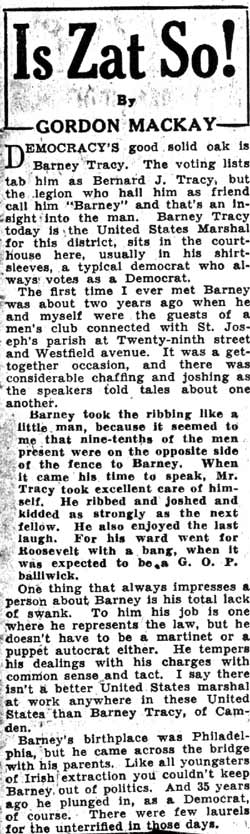
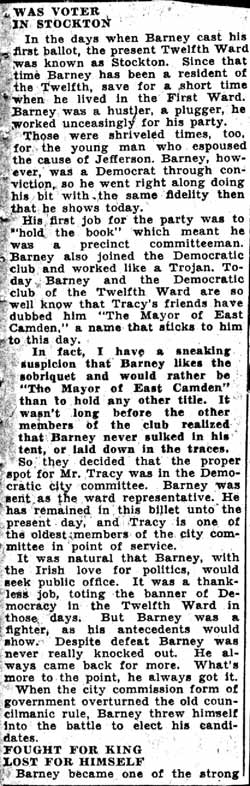
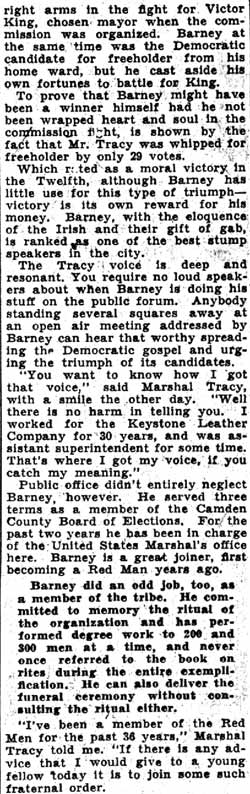
By GORDON MACKAY
DEMOCRACY’S good solid oak is Barney Tracy. The voting lists tab him as Bernard J. Tracy, but the legion who hail him as friend call him “Barney” and that’s an insight into the man. Barney Tracy today is the United States Marshal for this district, sits in the courthouse here, usually in his shirtsleeves, a typical democrat who always votes as a Democrat.
The first time I ever met Barney was about two years ago when he and myself were the guests of a men’s club connected with St. Joseph’s parish at Twenty-ninth street and Westfield avenue. It was a get-together occasion, and there was considerable chaffing and joshing as the speakers told tales about one another.
Barney took the ribbing like a little man, because it seemed to me that nine-tenths of the men present were on the opposite side of the fence to Barney. When it came his time to speak, Mr. Tracy took excellent care of himself. He ribbed and joshed and kidded as strongly as the next fellow. He also enjoyed the last laugh. For his ward went for Roosevelt with a bang, when it was expected to be a G. O. P. balliwick [sic].
One thing that always impresses a person about Barney is his total lack of swank. To him his job is one where he represents the law, but he doesn’t have to be a martinet or a puppet autocrat either. He tempers his dealings with his charges with common sense and tact. I say there isn’t a better United States marshal at work anywhere in these United States than Barney Tracy, of Camden.
Barney’s birthplace was Philadelphia, but he came across the bridge with his parents. Like all youngsters of Irish extraction you couldn’t keep Barney out of politics. And 35 years ago he plunged in, as a Democrat, of course. There were few laurels for the unterrified in those days.
WAS VOTER IN STOCKTON
In the days when Barney cast his first ballot, the present Twelfth Ward was known as Stockton. Since that time Barney has been a resident of the Twelfth, save for a short time when he lived in the First Ward. Barney was a hustler, a plugger, he worked unceasingly for his party.
Those were shriveled times, too, for the young man who espoused the cause of Jefferson. Barney, however, was a Democrat through conviction, so he went right along doing his bit with the same fidelity then that he shows today.
His first job for the party was to “hold the book” which meant he was a precinct committeeman. Barney also joined the Democratic club and worked like a Trojan. Today Barney and the Democratic club of the Twelfth Ward are so well know [sic] that Tracy’s friends have dubbed him “The Mayor of East Camden,” a name that sticks to him to this day.
In fact, I have a sneaking suspicion that Barney likes the sobriquet and would rather be “The Mayor of East Camden” than to hold any other title. It wasn’t long before the other members of the club realized that Barney never sulked in his tent, or laid down in the traces.
So they decided that the proper spot for Mr. Tracy was in the Democratic city committee. Barney was sent as the ward representative. He has remained in this billet unto the present day, and Tracy is one of the oldest members of the city committee in point of service.
It was natural that Barney, with the Irish love for politics, would seek public office. It was a thankless job, toting the banner of Democracy in the Twelfth Ward in those days. But Barney was a fighter, as his antecedents would show. Despite defeat Barney was never really knocked out. He always came back for more. What’s more to the point, he always got it. When the city commission form of government overturned the old councilmanic rule, Barney threw himself into the battle to elect his candidates.
FOUGHT FOR KING LOST FOR HIMSELF
Barney became one of the strong right arms in the fight for Victor King, chosen mayor when the commission was organized. Barney at the same time was the Democratic candidate for freeholder from his home ward, but he cast aside his own fortunes to battle for King.
To prove that Barney might have been a winner himself had he not been wrapped heart and soul in the commission fight, is shown by the fact that Mr. Tracy was whipped for freeholder by only 29 votes.
Which rated as a moral victory in the Twelfth, although Barney has little use for this type of triumph—victory is its own reward for his money. Barney, with the eloquence of the Irish and their gift of gab, is ranked as one of the best stump speakers in the city.
The Tracy voice is deep and resonant. You require no loud speakers about when Barney is doing his stuff on the public forum. Anybody standing several squares away at an open air meeting addressed by Barney can hear that worthy spreading the Democratic gospel and urging the triumph of its candidates.
“You want to know how I got that voice,” said Marshal Tracy, with a smile the other day. “Well there is no harm in telling you. I worked for the Keystone Leather Company for 30 years, and was assistant superintendent for some time. That’s where I got my voice, if you catch my meaning.”
Public office didn’t entirely neglect Barney, however. He served three terms as a member of the Camden County Board of Elections. For the past two years he has been in charge of the United States Marshal’s office here. Barney is a great joiner, first becoming a Red Man years ago.
Barney did an odd job, too, as a member of the tribe. He committed to memory the ritual of the organization and has performed degree work to 200 and 300 men at a time, and never once referred to the book on rites during the entire exemplification. He can also deliver the funeral ceremony without consulting the ritual either.
“I’ve been a member of the Red Men for the past 36 years,” Marshal Tracy told me. “If there is any advice that I would give to a young fellow today it is to join some such fraternal order.
“Once he is inside the organization let him become active. He’ll find that through this means he’ll receive the best education that he could enjoy.”
Barney has one other joy, delight and idol, outside of politics. That is the Tracy family. Sire of three children, he has every right to be proud of his sons, Tom and Harry. Corking good athletes in baseball and basketball, the boys have no louder or more loyal rooter than “the old man.”
Just to show the pride Barney really feels in his young hopefuls, he admits with that smile of his that “he keeps a lot of scrapbooks filled with the stuff that the boys do.”
So Barney, stout old oak of Democracy, finally has reaped a reward for his political battling. Anybody who knows Barney will admit that the best is none too good for Bernard J. Tracy.