Introduction
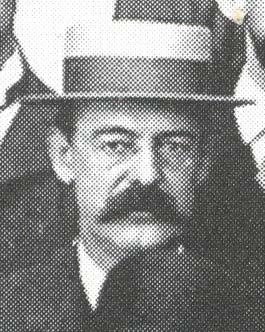
J. Willard Morgan, c. 1894
JOSEPH WILLARD MORGAN, known professionally as J. Willard Morgan, was born in Blackwood NJ on July 6, 1854 to Randal and Mary Morgan. His father was in real estate and construction, and was reputed to be one the wealthiest men in the city in the 1880s and 1890s, and had served as the Sheriff of Camden County. Randal Morgan lived through the 1890s at 432 Linden Street. Randal Morgan’s place of business in the late 1880s and early 1890s was 207 Market Street in Camden. Another Morgan son, Ely, served as deputy sheriff in 1880.
J. Willard Morgan was educated in the Camden public schools and at a classical school in Philadelphia. He studied law, was admitted to the bar in 1877 and qualified as a counselor in February of 1881. Establishing his own law office at 207 Market Street, he acquired a large practice. By the time of the 1880 census he had married, and with wife Lizzie resided at 934 Cooper Street, the corner of North 10th and Cooper Streets. By 1887 J. Willard and Lizzie Morgan had moved to 432 Linden Street, as Mary Morgan had passed away in August of 1881. They resided there through at least 1891.
J. Willard Morgan was elected to City Counsel as a Republican in 1877, and served until 1881. While he was serving on City Counsel in 1879, the first two telephones in service in Camden were installed on January 14, 1879 by John A. Frankes, a Western Union employee, under the direction of Heber C. Robinson. One was placed in a rear room on the south side of the corridor in the City Hall, Haddon Avenue and Benson Street, then occupied by the Chief of Police, but later the office of the Mayor. The second was placed the same day, January 14, 1879, in Simeon T. Ringel’s drug store, at the southwest corner of 2nd and Market Streets. A single iron wire grounded at each end formed this private line. No central office had as yet been established and the cost of the line, nearly a mile long, and run primarily on city poles, was $40.00. Its use was for the city, and particularly for any of the twenty-four policemen then reporting to Chief Daubman in command of the local police.
At the January 30th, 1879 meeting of Council, J. Willard Morgan, on the special committee on telephone, reported the construction of this line and recommended extensions to other points, including the fire stations.
J. Willard Morgan did not serve on City Counsel in 1882. He was elected again in 1883, and served one year. In 1884 he was elected City Counselor, a position identical to what today is called city solicitor, and served in that capacity through at least the fall of 1897.
On March 18, 1893, J. Willard Morgan was appointed Receiver of the Camden Woolen Mill in North Camden, which had been operating since the Civil War. He fulfilled this position until the property was acquired by the Highland Worsted Mills in 1896.
On January 28, 1897 J. Willard Morgan was one of several dignitaries who were in attendance at the opening of the Catholic Lyceum, attached to the Church of the Immaculate Conception on Broadway at Market Street. Other attendees included New Jersey Governor John W. Griggs, late Attorney-General Samuel H. Grey, Mayor John L. Westcott, Senator H. W. Johnson, Sheriff David Baird Sr., then-Assemblymen Louis Derousse and Scovel, Postmaster Harry B. Paul, ex-Judge Armstrong, Architect Henry S. Dagit, J. J. Burleigh, George A. Frey, and H. L. Bonsall. The Lyceum would evolve into Camden Catholic High School.
By June of 1903 J. Willard Morgan was serving in the post of State Comptroller for the State of New Jersey. He had taken on Harrison H. Voorhees as a law partner; Voorhees was then also serving as a judge. His circle of friends included Camden Postmaster Louis T. Derousse, Congressman Harry Loudenslager, future Congressman William S. Browning, former Judge D. J. Pancoast and former Receiver of Taxes Frank H. Burdsall.
J. Willard Morgan was involved in resolving Louis T. Derousse’s affairs when he abandoned his post in June of 1903. Morgan also appointed Isaac Doughten of Camden to serve as his deputy in 1903.
J. Willard Morgan was an active member of Camden Lodge No. 293 of the Elks. In April of 1906 he, along with Dr. Henry H. Davis, nominated Dr. Francis Bicker for membership in the lodge.
One of J. Willard Morgan’s law students, William T. Read, would have a long and distinguished career in public service, culminating in service as a delegate to the 1947 New Jersey State Constitutional Convention.
J. Willard Morgan passed away sometime prior to the 1920 Census.
Over the River.
Philadelphia Inquirer —
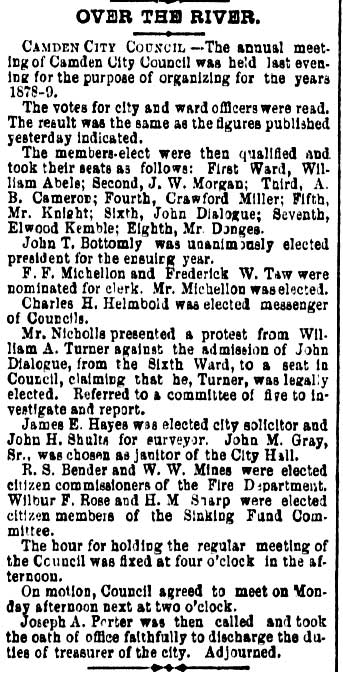
CAMDEN CITY COUNCIL — The annual meeting of Camden City Council was held last evening for the purpose of organizing for the years 1878-9.
The votes for city and ward officers were read. The result was the same as the figures published yesterday indicated.
The members-elect were then qualified and took their seats as follows: First Ward, William Abels; Second, J. W. Morgan; Third, A. B. Cameron; Fourth, Crawford Miller; Fifth, Mr. Knight; Sixth, John Dialogue; Seventh, Elwood Kemble; Eighth, Mr. Donges.
John T. Bottomly was unanimously elected president for the ensuing year.
F. F. Michellon and Frederick W. Taw were nominated for clerk. Mr. Michellon was elected.
Charles H. Helmbold was elected messenger of Councils.
Mr. Nicholls presented a protest from William A. Turner against the admission of John Dialogue, from the Sixth Ward, to a seat in Council, claiming that he, Turner, was legally elected. Referred to a committee of five to investigate and report.
James E. Hayes was elected city solicitor and John H. Shults [sic] for surveyor. John M. Gray, Sr., was chosen as janitor of the City Hall.
R. S. Bender and W. W. Mines were elected citizen commissioners of the Fire Department. Wilbur F. Rose and H. M. Sharp were elected citizen members of the Sinking Fund Committee.
The hour for holding the regular meeting of the Council was fixed at four o’clock in the afternoon.
On motion, Council agreed to meet on Monday afternoon next at two o’clock.
Joseph A. Porter was then called and took the oath of office faithfully to discharge the duties of treasurer of the city. Adjourned.
Executive Committee
Philadelphia Inquirer —
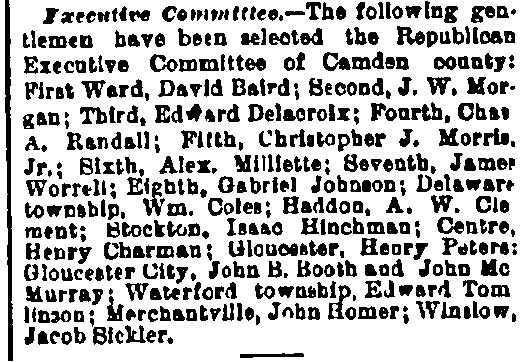
The following gentlemen have been selected the Republican Executive Committee of Camden county: First Ward, David Baird; Second, J. W. Morgan; Third, Edward Delacroix; Fourth, Chas. A. Randall; Fifth, Christopher J. Morris, Jr.; Sixth, Alex. Millette; Seventh, James Worrell; Eighth, Gabriel Johnson; Delaware township, Wm. Coles; Haddon, A. W. Clement; Stockton, Isaac Hinchman; Centre, Henry Charman; Gloucester, Henry Peters; Gloucester City, John B. Booth and John McMurray; Waterford township, Edward Tomlinson; Merchantville, John Homer; Winslow, Jacob Bickler.
The Primaries
Camden Daily Courier —
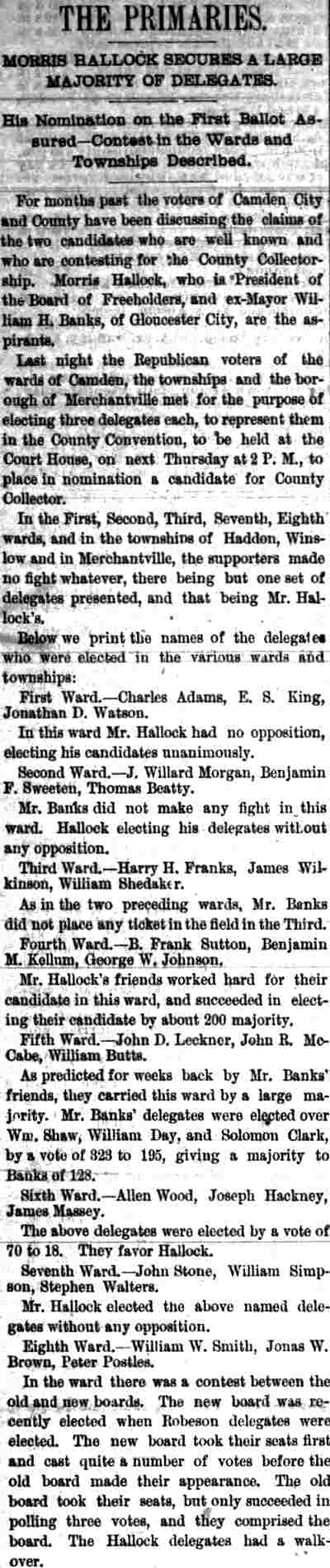
MORRIS HALLOCK SECURES A LARGE MAJORITY OF DELEGATES.
His Nomination on the First Ballot Assured—Contest in the Wards and Townships Described.
For months past the voters of Camden City and County have been discussing the claims of the two candidates who are well known and who are contesting for the County Collectorship. Morris Hallock, who is President of the Board of Freeholders, and ex-Mayor William H. Banks, of Gloucester City, are the aspirants.
Last night the Republican voters of the wards of Camden, the townships and the borough of Merchantville met for the purpose of electing three delegates each, to represent them in the County Convention, to be held at the Court House, on next Thursday at 2 P. M., to place in nomination a candidate for County Collector.
In the First, Second, Third, Seventh, Eighth wards, and in the townships of Haddon, Winslow and in Merchantville, the supporters made no fight whatever, there being but one set of delegates presented, and that being Mr. Hallock’s.
Below we print the names of the delegates who were elected in the various wards and townships:
First Ward.—Charles Adams, E. S. King, Jonathan D. Watson.
In this ward Mr. Hallock had no opposition, electing his candidates unanimously.
Second Ward.—J. Willard Morgan, Benjamin F. Sweeten, Thomas Beatty.
Mr. Banks did not make any fight in this ward. Hallock electing his delegates without any opposition.
Third Ward.—Harry H. Franks, James Wilkinson, William Shedaker.
As in the two preceding wards, Mr. Banks did not place any ticket in the field in the Third.
Fourth Ward.—B. Frank Sutton, Benjamin M. Kellum, George W. Johnson.
Mr. Hallock’s friends worked hard for their candidate in this ward, and succeeded in electing their candidate by about 200 majority.
Fifth Ward.—John D. Leckner, John R. McCabe, William Butts.
As predicted for weeks back by Mr. Banks’ friends, they carried this ward by a large majority. Mr. Banks’ delegates were elected over Wm. Shaw, William Day, and Solomon Clark, by a vote of 323 to 195, giving a majority to Banks of 128.
Sixth Ward.—Allen Wood, Joseph Hackney, James Massey.
The above delegates were elected by a vote of 70 to 18. They favor Hallock.
Seventh Ward.—John Stone, William Simpson, Stephen Walters.
Mr. Hallock elected the above named delegates without any opposition.
Eighth Ward.—William W. Smith, Jonas W. Brown, Peter Postles.
In the ward there was a contest between the old and new boards. The new board was recently elected when Robeson delegates were elected. The new board took their seats first and cast quite a number of votes before the old board made their appearance. The old board took their seats, but only succeeded in polling three votes, and they comprised the board. The Hallock delegates had a walk-over.
Across the Delaware.
Philadelphia Inquirer —
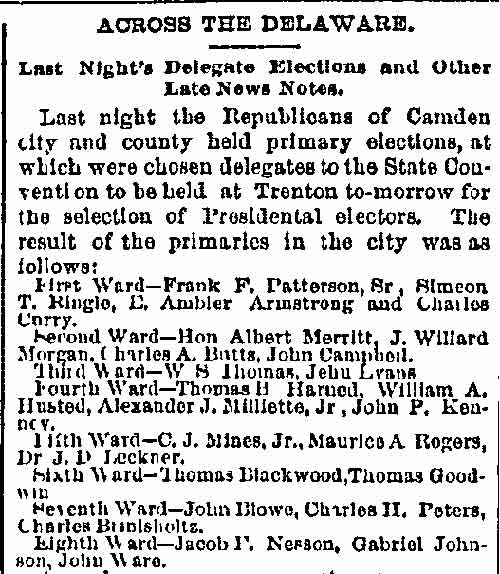
Last Night’s Delegate Elections and Other Late News Notes.
Last night the Republicans of Camden city and county held primary elections, at which were chosen delegates to the State Convention to be held at Trenton to-morrow for the selection of Presidental [sic] electors. The result of the primaries in the city was as follows:
First Ward—Frank F. Patterson, Sr., Simeon T. Ringle, E. Ambler Armstrong and Charles Curry.
Second Ward—Hon. Albert Merritt, J. Willard Morgan, Charles A. Butts, John Campbell.
Third Ward—W. S. Thomas, Jehu Lvans [sic].
Fourth Ward—Thomas H. Harned, William A. Husted, Alexander J. Milliette, Jr., John P. Kenney.
Fifth Ward—C. J. Mines, Jr., Maurice A. Rogers, Dr. J. D. Leckner.
Sixth Ward—Thomas Blackwood, Thomas Goodwin.
Seventh Ward—John Blowe, Charles H. Peters, Charles Bunisholtz.
Eighth Ward—Jacob P. Nesson, Gabriel Johnson, John Ware.
The First New Jersey District.
Philadelphia Inquirer —
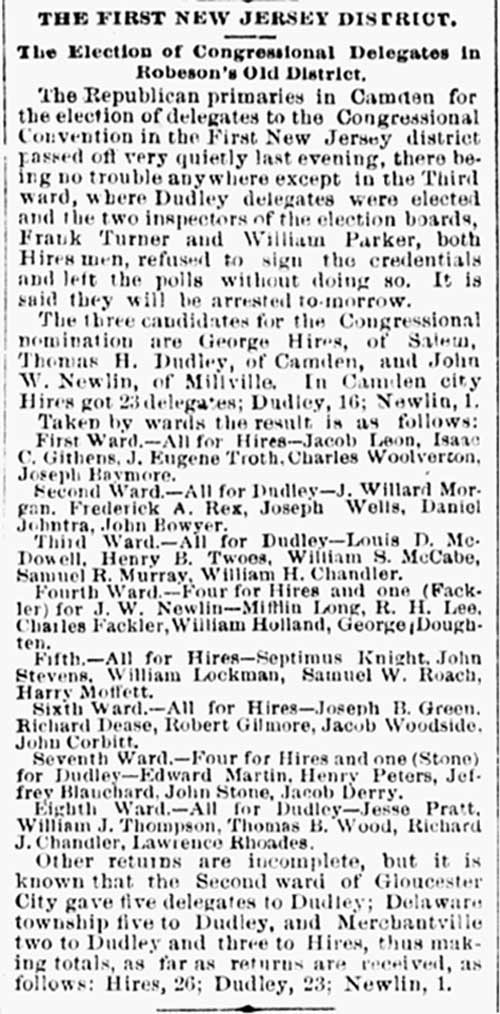
The Election of Congressional Delegates in Robeson’s Old District.
The Republican primaries in Camden for the election of delegates to the Congressional Convention in the First New Jersey district passed off very quietly last evening, there being no trouble anywhere except in the Third ward, where Dudley delegates were elected and the two inspectors of the election boards, Frank Turner and William Parker, both Hires men, refused to sign the credentials and left the polls without doing so. It is said they will be arrested to-morrow.
The three candidates for the Congressional nomination are George Hires, of Salem, Thomas H. Dudley, of Camden, and John W. Newlin, of Millville. In Camden city Hires got 23 delegates; Dudley, 16; Newlin, 1.
Taken by wards the result is as follows:
First Ward.—All for Hires—Jacob Leon, Isaac C. Githens, J. Eugene Troth, Charles Woolverton, Joseph Baymore.
Second Ward.—All for Dudley—J. Willard Morgan, Frederick A. Rex, Joseph Wells, Daniel Johntra, John Bowyer.
Third Ward.—All for Dudley—Louis D. McDowell, Henry B. Twoes, William S. McCabe, Samuel R. Murray, William H. Chandler.
Fourth Ward.—Four for Hires and one (Fackler) for J. W. Newlin—Mifflin Long, R. H. Lee, Charles Fackler, William Holland, George Doughten.
Fifth.—All for Hires—Septimus Knight, John Stevens, William Lockman, Samuel W. Roach, Harry Moffett.
Sixth Ward.—All for Hires—Joseph B. Green, Richard Dease, Robert Gilmore, Jacob Woodside, John Corbitt.
Seventh Ward.—Four for Hires and one (Stone) for Dudley—Edward Martin, Henry Peters, Jeffrey Blanchard, John Stone, Jacob Derry.
Eighth Ward.—All for Dudley—Jesse Pratt, William J. Thompson, Thomas B. Wood, Richard J. Chandler, Lawrence Rhoades.
Other returns are incomplete, but it is known that the Second ward of Gloucester City gave five delegates to Dudley; Delaware township five to Dudley, and Merchantville two to Dudley and three to Hires, thus making totals, as far as returns are received, as follows: Hires, 26; Dudley, 23; Newlin, 1.
Democrats Ask for Supervisors
Philadelphia Inquirer —
Several members of the Democratic Campaign Committee met at Hellemann’s Hall yesterday and decided to make application to Deputy Supervisor J. Willard Morgan for one Democratic supervisor in each precinct for Camden county for the coming Presidential election.
New Jersey
Philadelphia Inquirer —
A Budget of Events Happening Across the Delaware.
A large number of applications for the position of supervisors at the coming election have been received by Deputy Supervisor for Camden County J. Willard Morgan. He will announce the appointments to-day.
Solicitor Morgan Reports Collections
Philadelphia Inquirer —
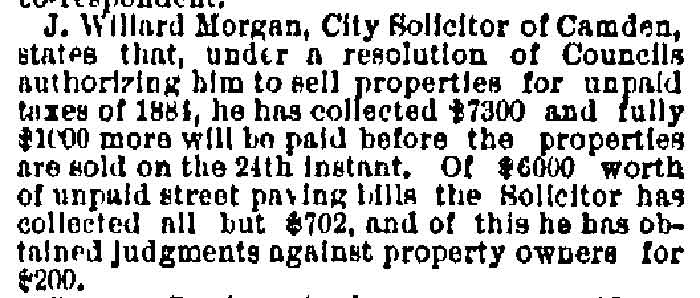
J. Willard Morgan, City Solicitor of Camden, states that, under a resolution of Councils authorizing him to sell properties for unpaid taxes of 188[?], he has collected $7300 and fully $1000 more will be paid before the properties are sold on the 24th instant. Of $6000 worth of unpaid street paving bills the Solicitor has collected all but $702, and of this he has obtained judgments against property owners for $200.
First Ward Republican Club
Philadelphia Inquirer —
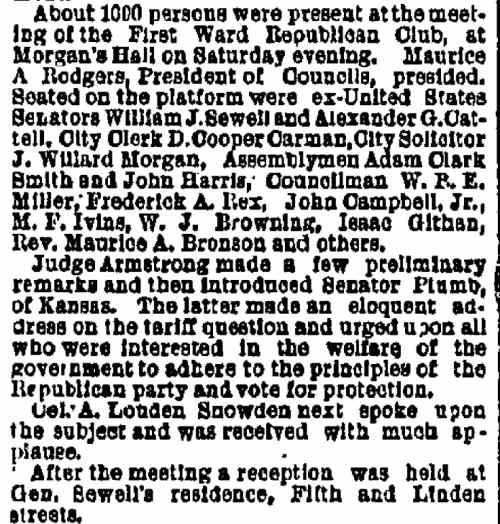
About 1000 persons were present at the meeting of the First Ward Republican Club, at Morgan’s Hall on Saturday evening. Maurice A. Rodgers, President of Councils, presided. Seated on the platform were ex-United States Senators William J. Sewell and Alexander G. Cattell, City Clerk D. Cooper Carman, City Solicitor J. Willard Morgan, Assemblymen Adam Clark Smith and John Harris; Councilman W. P. E. Miller, Frederick A. Rex, John Campbell, Jr., M. F. Ivins, W. J. Browning, Isaac Githean, Rev. Maurice A. Bronson and others.
Judge Armstrong made a few preliminary remarks and then introduced Senator Plumb, of Kansas. The latter made an eloquent address on the tariff question and urged upon all who were interested in the welfare of the government to adhere to the principles of the Republican party and vote for protection.
Col. A. Louden Snowden next spoke upon the subject and was received with much applause.
After the meeting a reception was held at Gen. Sewell’s residence, Fifth and Linden streets.
Camden Politics
Philadelphia Inquirer —
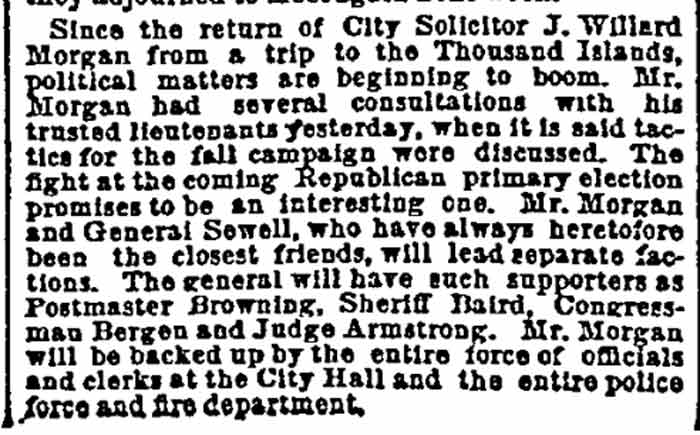
Since the return of City Solicitor J. Willard Morgan from a trip to the Thousand Islands, political matters are beginning to boom. Mr. Morgan had several consultations with his trusted lieutenants yesterday, when it is said tactics for the fall campaign were discussed. The fight at the coming Republican primary election promises to be an interesting one. Mr. Morgan and General Sewell, who have always heretofore been the closest friends, will lead separate factions. The general will have such supporters as Postmaster Browning, Sheriff Baird, Congressman Bergen and Judge Armstrong. Mr. Morgan will be backed up by the entire force of officials and clerks at the City Hall and the entire police force and fire department.
Camden Notes.
Philadelphia Inquirer —
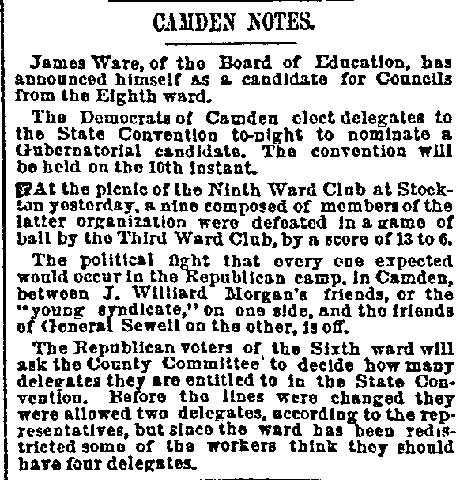
James Ware, of the Board of Education, has announced himself as a candidate for Councils from the Eighth ward.
The Democrats of Camden elect delegates to the State Convention to-night to nominate a Gubernatorial candidate. The convention will be held on the 10th instant.
At the picnic of the Ninth Ward Club at Stockton yesterday, a nine composed of members of the latter organization were defeated in a game of ball by the Third Ward Club, by a score of 13 to 6.
The political fight that every one expected would occur in the Republican camp, in Camden, between J. Willard Morgan’s friends, or the “young syndicate,” on one side, and the friends of General Sewell on the other, is off.
The Republican voters of the Sixth ward will ask the County Committee to decide how many delegates they are entitled to in the State Convention. Before the lines were changed they were allowed two delegates, according to the representatives, but since the ward has been redistricted some of the workers think they should have four delegates.
Corporation Elections
Philadelphia Inquirer —
CORPORATION ELECTIONS.
The Kaighn’s Point Ferry Company yesterday elected these officers and directors: President, Austin Corbin; vice president, A. A. McLeod; W. R. Taylor, secretary; W. A. Church, treasurer; directors, Austin Corbin, A. A. McLeod, George DeB. Keim, S. A. Caldwell, A. J. Antelo. W. R. Taylor, Herbert C. Felton. Herbert C. Felton was elected superintendent.
The West Jersey Title and Guarantee Company elected these officers and directors: President, Samuel H. Grey; secretary, William S. Cassleman; treasurer, D. Somers Risley; directors, Samuel H. Grey, Hon. William J. Sewell, Peter L. Vorhees, William S. Scull, E. N. Cohn, Franklin C. Woolman, D. Somers Risley, Peter V. Vorhees, Thomas E. French, William S. Cassleman and Alexander C. Wood.
The stockholders of the Camden Heating and Lighting Company elected these directors: E. A. Armstrong, J. E. Roberts, George Barrett, J. W. Morgan, William S. Scull, William J. Sewell, William T. Bailey, J. J. Burleigh, David Baird, Howard M. Cooper and Rene Gillon.
Camden’s Water Scheme
Philadelphia Inquirer —
City Solicitor Morgan at a meeting of Camden Council last night presented an opinion on the question of raising more money on bonds to improve the water supply. He decided that the city had reached its limit of bonded indebtedness on the water works. Mr. Barber, chairman of the Water Committee, read an analysis of the Camden water made by Dr. A. P. Brown and other chemists, which showed that the water was not as bad as some people thought it to be. Mr. Barber then made a speech against the sale of the water works. He denied the statement made by the syndicate who wanted to buy the water works that the Water Department had been run at a loss. He produced figures which showed the Water Department was one of the best paying institutions under the city government. He presented a report of the Water Committee, signed by every member, recommending that Council should not entertain any proposition for the sale of the water works. The report was unanimously adopted.
Politicians’ Day at Mt. Holly
Philadelphia Inquirer —
POLITICIANS’ DAY AT MT. HOLLY
CANDIDATE GRIGGS SHOOK HUNDREDS OF HORNY HANDS AT THE BURLINGTON COUNTY FAIR.
CAMDEN WELL REPRESENTED
It Was a Fine Day, But the “Big Thursday” Crowd Was Smaller Than Last Year—A Canine Parachutist Killed—The Races—Other Jersey Matters.
Special to The Inquirer.
MOUNT HOLLY, N. J., Oct. 10.—The Mount Holly Fair, like all the other Jersey fairs, has its “Big Thursday.” That is the day the politicians get together to shake hands, swop stories and look after the political machine generally. The candidates make it a point to be present and try to win votes with cordial greetings and honeyed words. The Mount Holly Fair was favored with exceptionally fine weather for its “Big Thursday,” but the attendance was not as large as last year’s crowd.
The politicians congregated around a tent at the left of the grand stand. John W. Griggs, the Republican candidate for Governor, arrived on the grounds shortly after noon and was tendered a reception at the entrance. All the afternoon he was kept busy shaking hands with the grangers and telling them how glad he was to meet them. Mr. Griggs got lots of promises of votes. He made many friends among the farmers, who had their first chance of talking with him. Nearly every one addressed him as “Governor.”
Camden county was well represented by its leading political lights, among whom were: Senator William J. Sewell, ex-Sheriff David Baird, City Counsel J. Willard Morgan, City Clerk T. P. Varney, County Clerk Robert Barber, Mayor J. Leighton Westcott, Deputy Sheriff J. Wesley Sell, Frank Lloyd, William J. Thompson, Thomas P. Curley, Receiver of Taxes William A. Husted, Secretary of the Commission of Public Instruction W. D. Brown, Freeholder George Martin, ex-President of the City Council Arthur Bedell, Senator Maurice A. Rogers, ex-Senator George Pfeiffer, ex-Sheriff Henry J. West, William Bettle, Assemblyman Louis T. Derousse, Colonel George G. Felton, Coroner Jacob Justice, Councilman Richard Dease, ex-Sheriff Theodore B. Gibbs and Assemblyman William Barnard.
Gloucester county was represented by William Moore, Senator Daniel Packer, Congressman Henry C. Loudenslager, Dr. S. F. Stanger, County Clerk F. B. Ridgway and Lewis Starr.
Other prominent persons present were: Ex-Judge J. Frank Fort, State Comptroller W. S. Hancock, County Clerk Barker Gummere, of Mercer county; Prosecutor Charles E. Hendrickson, of Mount Holly; Frank B. Lee, son of Supreme Court Clerk Lee; Judge Clifford Stanley Simms, ex-Congressman James Buchanan, Lieutenant-Colonel Franklin Gaunt, of Burlington; Richard Miller, Robert Diamond and M. V. D. Dickinson, of Salem county; Judge Joseph H. Gaskill, Robert Hutchinson and ex-Sheriff Nathan Hays, of Burlington county.
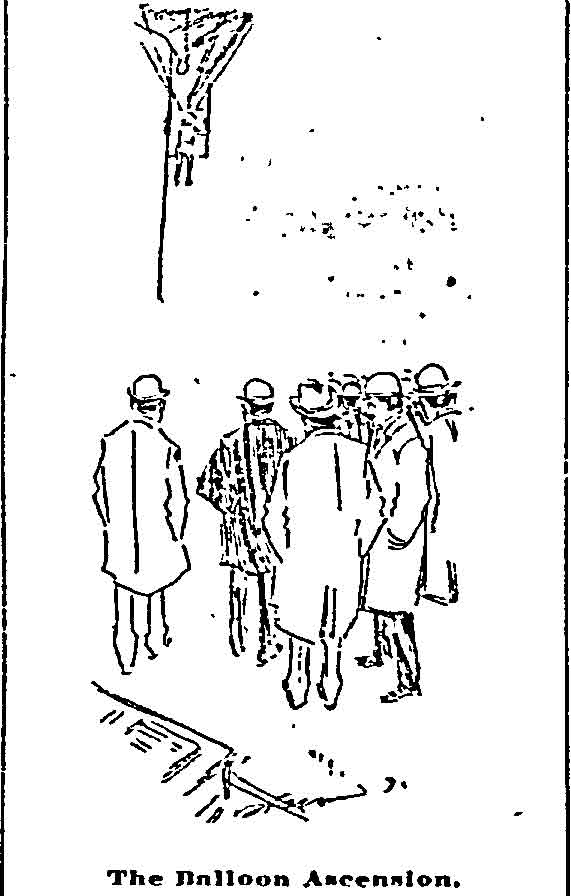
One of the features of the fair has been the daily ascension of a large balloon, from which a man and dog drop with parachutes. This afternoon the ropes which held the dog became loose. He dropped upon one of the booths and was killed.
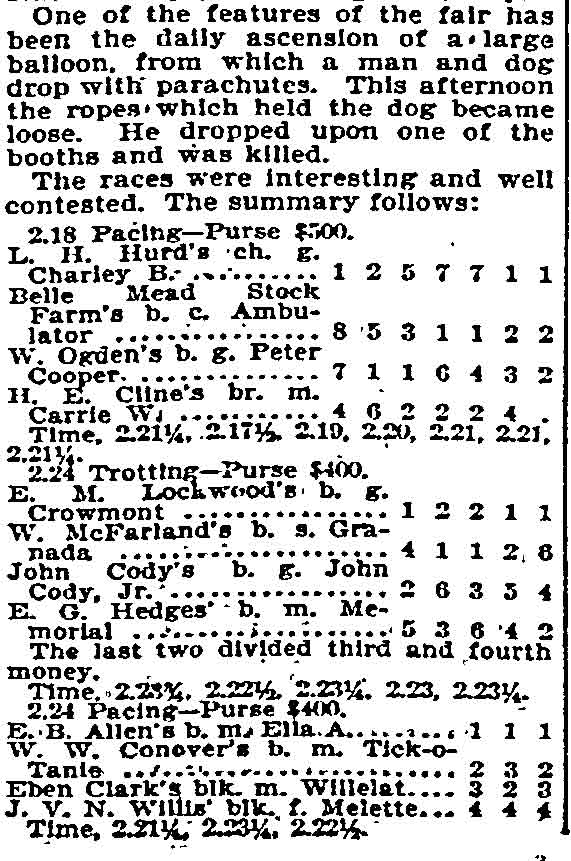
The races were interesting and well contested. The summary follows:
2.18 Pacing—Purse $500.
L. H. Hurd’s ch. g. Charley B....1 2 5 7 7 1 1
Belle Mead Stock Farm’s b. c. Ambulator....8 5 3 1 1 2 2
W. Ogden’s b. g. Peter Cooper....7 1 1 6 4 3 2
H. E. Cline’s br. m. Carrie W....4 6 2 2 2 4
Time. 2.21¼, 2.17½, 2.19, 2.20, 2.21, 2.21, 2.21¼.
2.24 Trotting—Purse $400.
E. M. Lockwood’s b. g. Crowmont....1 2 2 1 1
W. McFarland’s b. s. Granada....4 1 1 2 8
John Cody’s b. g. John Cody, Jr....2 6 3 5 4
E. G. Hedges’ b. m. Memorial....5 3 6 4 2
The last two divided third and fourth money.
Time. 2.23¾, 2.22½, 2.23¼, 2.23, 2.23¼.
2.24 Pacing—Purse $400.
E. B. Allen’s b. m. Ella A....1 1 1
W. W. Conover’s b. m. Tick-o-Tanie....2 3 2
Eben Clark’s blk. m. Willelat....3 2 3
J. V. N. Willis’ f. Melette....4 4 4
Time, 2.21¼, 2.23¼, 2.22½.
Camden Men at Street Railway Convention
Philadelphia Inquirer —
City Counsel J. Willard Morgan, ex-Sheriff Henry J. West, Thomas P. Curley, ex-Asemblyman [sic] William J. Thompson and Superintendent H. M. Royal, of the Camden, Gloucester and Woodbury Railroad Company, had a very pleasant week in Montreal at the convention of the American Street Railway Asociation [sic].
Biographical Review — 1897
Biographical Review of Camden County, 1897 — J. Willard Morgan
Camden County Bar Association — c. 1894
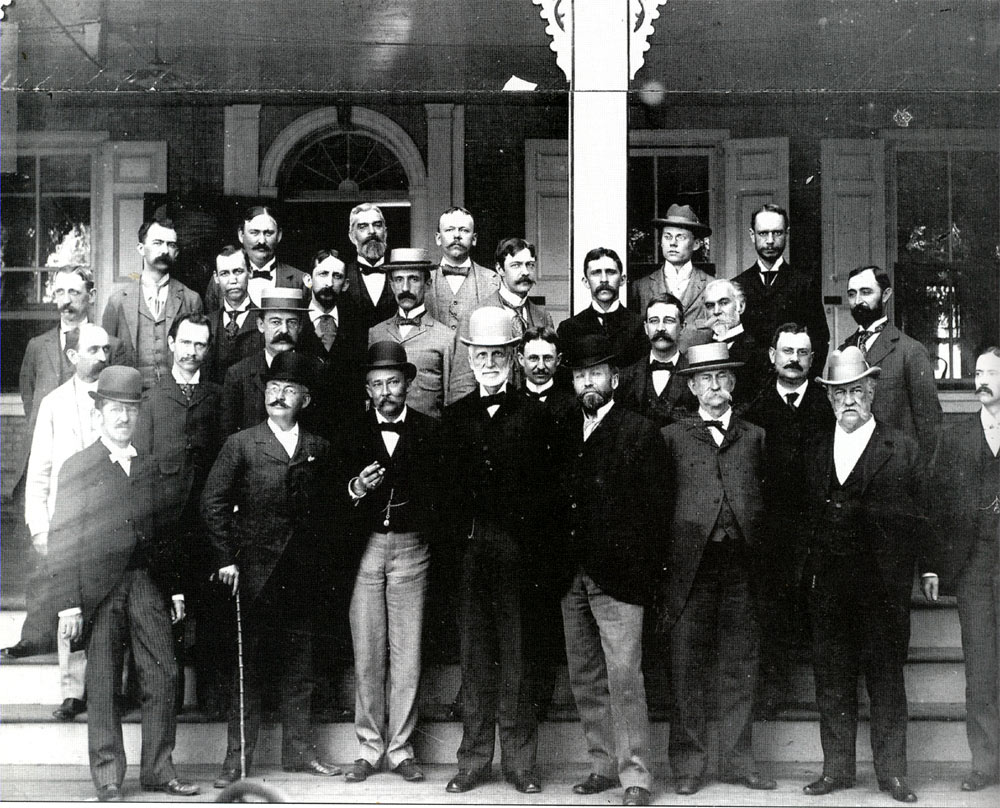
Members of the Camden County Bar Association pose for a photograph during their annual shad dinner, around 1894. From left (first row) Judge Charles Joline, Supreme Court Justice Charles Garrison, Judge Richard R. Miller, vice chancellor Henry C. Pitney, Supreme Court Justice Alfred Reed, Benjamin Shreeve, Caleb Shreeve, George H. Pierce; (second row) William Casselman, Edwin Bleakly, J. Willard Morgan, Peter Voorhees, Samuel Beldon, Frank Shreeve, Scuyler Woodhull, Lewis Starr, H. S. Scovel, George Vroom, Charles Wooster, and Howard Carrow; (third row) Samuel Robbins, E. A. Armstrong, Thomas Curley, unknown Philadelphia lawyer, Charles Stevenson, H. F. Nixon, Henry I. Budd, Israel Roberts.
Knell of Doom for Cobbles in Camden
Philadelphia Inquirer —
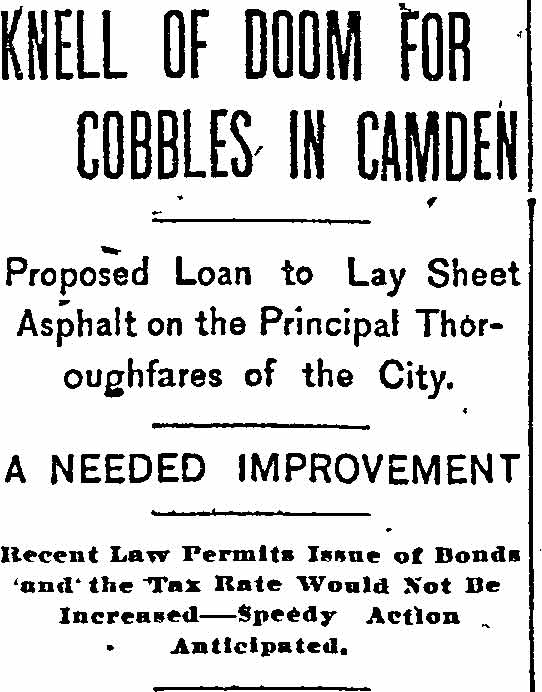
Proposed Loan to Lay Sheet Asphalt on the Principal Thoroughfares of the City.
A NEEDED IMPROVEMENT
Recent Law Permits Issue of Bonds and the Tax Rate Would Not Be Increased—Speedy Action Anticipated.
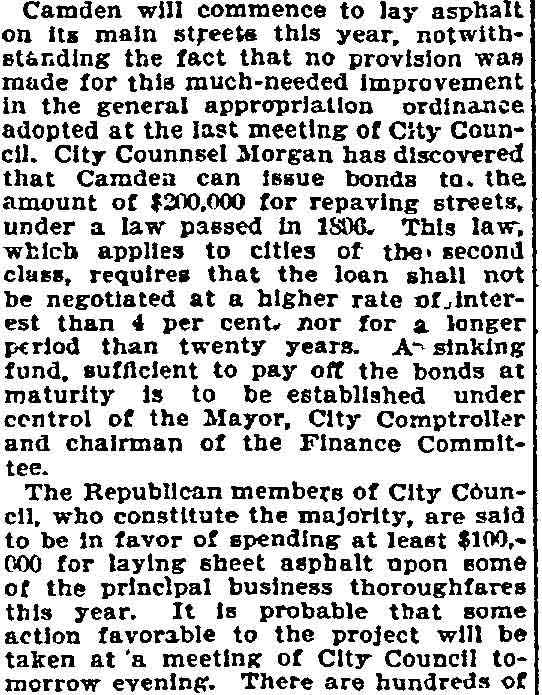
Camden will commence to lay asphalt on its main streets this year, notwithstanding the fact that no provision was made for this much-needed improvement in the general appropriation ordinance adopted at the last meeting of City Council. City Counnsel [sic] Morgan has discovered that Camden can issue bonds to the amount of $200,000 for repaving streets, under a law passed in 1806 [sic]. This law, which applies to cities of the second class, requires that the loan shall not be negotiated at a higher rate of interest than 4 per cent. nor for a longer period than twenty years. A sinking fund, sufficient to pay off the bonds at maturity is to be established under control of the Mayor, City Comptroller and chairman of the Finance Committee.
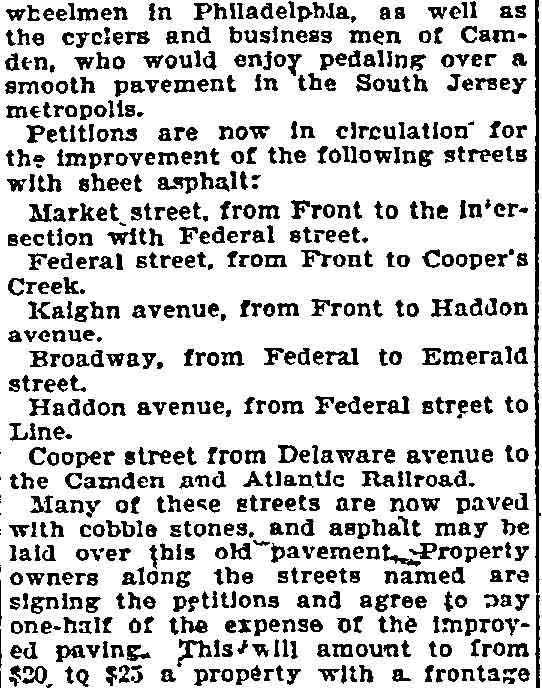
The Republican members of City Council, who constitute the majority, are said to be in favor of spending at least $100,000 for laying sheet asphalt upon some of the principal business thoroughfares this year. It is probable that some action favorable to the project will be taken at a meeting of City Council tomorrow evening. There are hundreds of wheelmen in Philadelphia, as well as the cyclers and business men of Camden, who would enjoy pedaling over a smooth pavement in the South Jersey metropolis.
Petitions are now in circulation for the improvement of the following streets with sheet asphalt:
Market street, from Front to the intersection with Federal street. Federal street, from Front to Cooper’s Creek. Kaighn avenue, from Front to Haddon avenue. Broadway, from Federal to Emerald street. Haddon avenue, from Federal street to Line. Cooper street from Delaware avenue to the Camden and Atlantic Railroad.
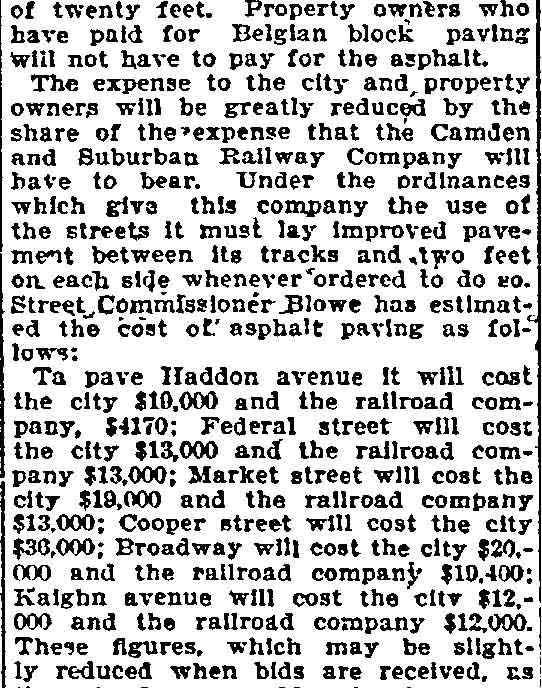
Many of these streets are now paved with cobble stones, and asphalt may be laid over this old pavement. Property owners along the streets named are signing the petitions and agree to pay one-half of the expense of the improved paving. This will amount to from $20 to $25 a property with a frontage of twenty feet. Property owners who have paid for Belgian block paving will not have to pay for the asphalt.
The expense to the city and property owners will be greatly reduced by the share of the expense that the Camden and Suburban Railway Company will have to bear. Under the ordinances which give this company the use of the streets it must lay improved pavement between its tracks and two feet on each side whenever ordered to do so. Street Commissioner Blowe has estimated the cost of asphalt paving as follows:
Ta [sic] pave Haddon avenue it will cost the city $10,000 and the railroad company, $4170; Federal street will cost the city $13,000 and the railroad company $13,000; Market street will cost the city $19,000 and the railroad company $13,000; Cooper street will cost the city $36,000; Broadway will cost the city $20,000 and the railroad company $10,400; Kaighn avenue will cost the city $12,000 and the railroad company $12,000. These figures, which may be slightly reduced when bids are received, as they stand now would make the cost to the city $110,000 and the Camden and Suburban Railway $61,170.
The improved streets and the new $600,000 artesian water plant, soon to be completed, will, it is expected, help to boom property in Camden.
Talked About in Camden
Philadelphia Inquirer —

Among the progressive and successful business men of Camden is Hiram G. Hallinger, who is truly a self-made man. He was born in Bridgeton nearly thirty-seven years ago. At the age of 18 years he entered the steamboat brokerage business with his father in Philadelphia. Seven years ago he gave up this to go into the real estate business in Camden. He is one of the largest dealers in South Jersey and is an acknowledged authority on realty values. He is president of the Real Estate Title Company, of Camden, and a director in two other local institutions. He takes considerable interest in religious matters and is treasurer of one M. E. church and trustee in another. Mr. Hallinger is an extensive traveler and has visited every part of the United States during his annual vacations. His success is largely due to his integrity, perseverance and energy.
H. G. Hallinger.
Rev. F. F. Brace, D. D., ex-Superintendent of Public Education of Camden county, who has been seriously ill for several months past, is convalescent.
Miss Clara Shinn is visiting friends in Germantown.
Martin Bergen has returned from Iowa, where he has been coaching the Grinnell University football team.
William J. Thompson and wife, Richard J. Thompson, Mrs. Sweeney and Mrs. Flynn left on Thursday for a trip to Atlanta, Ga., to attend the Cotton Exposition.
County Clerk Robert L. Barber and Lawyer Fred A. Rex are at the Atlanta Exposition.
Alfred B. Sweeten and Miss Mary H. B. Middleton were married on Wednesday evening by Rev. E. C. Hancock.
James Hunt and George Beckett have been gunning in Cape May county the past two days.
Volney Bennett, Jr., has just completed a 10,900-mile trip throughout the United States that consumed ten months and three days.
Mrs. W. D. Brown is visiting at Auburn, Pa.
Miss R. Bourke has returned from the Atlanta Exposition.
Philip Nieukirk and wife, of Maryland, are spending a month visiting friends in Camden.
Charles Preisendanz and wife have returned from a trip through the South, stopping at Washington and the Atlanta Exposition.
Walter Wallace is at Norfolk, Va., on a two weeks’ visit.
Miss Alice Hastings is visiting relatives in Pottstown, Pa.
Miss Theresa Anthony, of Wilmington, Del., is visiting friends in Camden.
Dr. George Nicholson and wife are at the Atlanta Exposition.
Postmaster H. B. Paul and wife, Charles R. Bacon and wife, F. F. Patterson, Jr., Miss Bertie Patterson, Miss Belle Humphrey, Miss Kiegel, Upton S. Jeffreys and James M. Fitzgerald will return to-day from the Atlanta Exposition, where they have been spending the past week.
Josiah Bowden, of Montana, is visiting his father, Rev. Charles Bowden.
Editor Louis W. Albright has been spending the past two days gunning in Winslow township.
Register of Deeds Jacob Sickler took the oath of office for the second term of five years on Wednesday.
Ex-Sheriff David Baird, City Counsel J. Willard Morgan and City Clerk T. P. Varney left Tuesday night for Mobile, Ala. They will stop at the Atlanta Exposition.
John Truax and wife have returned from a trip to the Atlanta Exposition.
Grand Master Edwin Robinson, of the Shield of Honor, of New Jersey, is ill with typhoid fever.
Justice Charles M. Baldwin has been selected as chief marshal of the Volunteer Firemen’s Association for the parade at Haddonfield on Thanksgiving Day.
W. H. Etna is spending two weeks in the mountains of Pennsylvania.
Miss Fannie Hiers has been visiting friends at Merchantville.
Miss Leula Thomas, of Norristown, Pa., is visiting friends in Camden.
Miss Alice Jordan is on a visit at Pottsville, Pa.
Dr. A. B. Lippincott was sworn in as Coroner on Thursday.
Mayoralty Talk Over In Camden
Philadelphia Inquirer —

MAYORALTY TALK OVER IN CAMDEN
Election Not Far Off, But Leaders Cannot Agree on a Candidate
UP TOWN VS. DOWN
Committee of One Hundred Confident of Winning This Time—Democrats Divided
Camden’s municipal election, which will be held five weeks hence, promises to be one of the most hotly contested campaigns ever held in that city. The Committee of One Hundred, inspired by steady gains in the past, will make strenuous effort to wrest the control of municipal affairs from the Republicans. The prospects for their success seem brighter than in any previous campaign. A Mayor, Recorder and ten Councilmen are to be elected. The ordinances cutting off the fees of city officials will probably be passed in time to affect the officials elected this spring.
Although the election is not far distant the Republican leaders cannot agree upon a candidate for Mayor.
John Campbell, Jr., a wealthy real estate dealer, was urged to accept the nomination, and petitions were being circulated amongt he [sic] business men in his favor, but he announced yesterday that he would not stand.
City Clerk Varney and Street Supervisor John Blowe want a candidate from the lower section of the city, where the big Republican majorities are returned. Ex-Potmaster [sic] Henry B. Wilson, a coal dealer of Kaighn’s avenue, is the leading down-town candidate. City Counsel J. Willard Morgan is said to favor his candidacy. Harry Wolfe, Director of the Board of Freeholders, is looming up as a down-town candidate. He is backed by City Assessor Chris J. Mines, who aspires to be something more than a ward leader.
Mayor Westcott, who has had two terms, will not be a candidate for renomination. Isaac Doughten, the fearless foreman of the present grand jury, declines to stand as a candidate.
An effort is also being made to bring out R. H. Reeve, of the Second ward, for the Republican nomination for Mayor. He was a candidate for City Treasurer on the Committee of One Hundred ticket two years ago. It is claimed that he can divert some of the reform vote to the Republican ticket.
As the Committee of One Hundred name their candidates in secret conclave, but little is known of their plans. Either Cooper B. Hatch or Lewis H. Mohrman may head their ticket. Hatch came near defeating Mayor Westcott three years ago. Mohrman is the Reform leader in Council. Both are from the Second ward. Ex-Senator Maurice Rogers, of the Fifth ward, would like to head the Reform ticket.
The Democrats are split into two factions, the Regular and the County Democracy, and these are again divided on the question of making a hopeless fight with a straight ticket or indorsing the Committee of One Hundred nominees with the prospect of winning.
There will be a warm contest for the Republican nomination for City Recorder, which is to become a salaried position. The Councilmanic contests are still far from being settled.
Camden Political Chat
The Committee of One Hundred has certiorarled the ordinance creating two new precincts in the Fourth ward. The writ is returnable on February 19. Copies were served on City Clerk Varney and the County Board of Elections yesterday.
The County Board of Elections made several changes yesterday in precinct election boards. Secretary Fitzgerald called attention to precinct boards filling vacancies without notifying the County Board. The matter will be investigated.
Committee of One Hundred challengers started in yesterday to canvass for the spring election.
The Registry Boards will sit on next Tuesday, and again on the 18th instant.
The Sixth Ward Republican Club has indorsed Justice Charles M. Baldwin for the Republican nomination for Recorder.
Friends of Councilman Jesse C. Bond, of the First ward, want him to accept renomination on the Committee of One Hundred ticket.
The First Ward Republican Club has indorsed the candidacy of Joseph Potter for City Council. He also has the support of the Camden Republican Club. He was defeated for re-election as a Councilman last spring.
New Republican Executive Committee
Philadelphia Inquirer —
The new Republican County Executive Committee, which will control the party machinery in Camden county for the coming year, was named yesterday by William J. Browning, I. W. Nicholson and John Cherry, chairmen of the county conventions held on Wednesday. There are few changes in the committee, which is made up as follows: Camden—First ward, Joseph Burt; Second, J. Willard Morgan; Third, Harry C. Sharp; Fourth, Caleb Williams; Fifth, C. J. Mines, Jr.; Sixth, T. P. Varney; Seventh, Fred W. George; Eighth, James O. Smith; Ninth, Edwin Hillman. Stockton—First ward, Charles Hope; Second, George W. Miles; Third, Samuel Jaquillard. Gloucester City—First ward, D. M. Anderson; Second, Harry Reeves. Merchantville, M. B. Rudderow; Delaware township, William Graff; Gloucester township, Willard P. Gibbs; Centre township, Samuel Bettle; Haddon township, A. W. Clements; Pensauken, I. W. Hatch; Winslow, Josiah Norcross; Waterford, Joseph Layer. The committee will meet for organization next Saturday.
Over in Camden.
Philadelphia Inquirer —
Articles of incorporation were filed yesterday by the American Metal Edge Box Company.
The police were notified yesterday that William Ilgenfritz, 14 years old, of 1121 Mickle street, was missing.
Jacob N. Wise, 65 years old, fell from a step at Delaware and Market streets yesterday and broke his hip. He was taken to the Cooper Hospital.
A number of church people have filed a remonstrance with the excise Commission against granting a liquor license to Charles Gorden, of Ninth street and Ferry avenue.
Mrs. Victor Kline, of 526 Vine street, discovered a burglar in the house early Tuesday morning, but the thief fled at her approach, leaving a lot of clothing and silverware which he had bundled up, ready to take away.
Charles E. Wilson was committed by Recorder Mowrey [sic] last night, charged with stealing two overcoats from the Camden Turning Mill, at Front and Arch streets. He was captured at the Federal Street Ferry by Policemen [sic] Hartman.
Bessie Hughes was held by Justice Schmitz yesterday for a further hearing on a charge of stealing household goods from the boarding house of Mrs. Marshall, at 121 Market street. Some of the missing goods were found at the defendant’s home.
Among the latest victims of the grip in Camden are Mayor Hatch, Chief of Police Foster, City Clerk Harry Kramer, former City Counsel J. Willard Morgan, Charles R. Baron, New Jersey editor of the Philadelphia Record, and Policemen George Cooper, Harry Miller, James Ware and George Anderson.
Testimonial Dinner to J. Willard Morgan
Philadelphia Inquirer —

Members of the Camden Republican Club last evening gave a testimonial dinner to former City Solicitor J. Willard Morgan. Covers were laid for nearly 150 persons.
Camden Lighting and Heating Company Annual Meeting
Philadelphia Inquirer —
At the annual meeting of the Camden Lighting and Heating Company, directors were elected as follows: William J. Sewell, David Baird, J. Willard Morgan, J. J. Burleigh, Colonel A. Louden Snowden, A. Seche, Joseph P. McCall, L. B. Byers and James E. Hays.
Baird, Morgan and Varney Off to the Atlanta Exposition
Philadelphia Inquirer —
Ex-Sheriff David Baird, City Councel [sic] J. Willard Morgan and City Clerk T. P. Varney left Tuesday night for Mobile, Ala. They will stop at the Atlanta Exposition.
John Truax and wife have returned from a trip to the Atlanta Exposition.
Morgan Named for State Comptroller
Philadelphia Inquirer —
TRENTON.—Because of the annual banquet of the Legislative Association of 1901, at the Trenton House last night, the sessions of the Legislature were very brief. The storm delayed traffic generally, and it was long past the prescribed hour when a quorum was mustered in the House. After the adjournment a caucus of the Republican members was held, at which J. Willard Morgan, of Camden, was agreed upon for State Comptroller. He will be formally elected at a joint meeting at noon to-morrow.
Camden News Notes
Philadelphia Inquirer —
Judge Joline yesterday allowed the final accounting of the estate of the late Rev. Dr. J. B. Graw.
The F. S. McPherson Company, to manufacture drugs, filed articles of incorporation at the County Clerk’s office. The corporators are Frank S. McPherson, Sigmund Sceonagle [sic] and H. F. Stockwell, all Camden people.
Joseph Leonard was arrested last night by Policeman Pooley on a charge of writing policy. Leonard lives at Ninth and Ferry avenue, Camden, where Police Captain Stanley captured a policy outfit some days ago.
The Waterford Township Committee yesterday deposited with County Clerk Patterson $3, which had been awarded to Mrs. Emma Menard for damages. She refused to take the sum.
County Collector M. F. Ivins yesterday received from J. Willard Morgan, State Comptroller, a communication in which he was informed that Camden county’s quota for State school purposes will be $75,226.32. The quota would be $115,732.80, but the State made an appropriation of $40,506.48, leaving the balance for the county to raise.
Royal Welcome for Ex-Sheriff Baird
Philadelphia Inquirer —
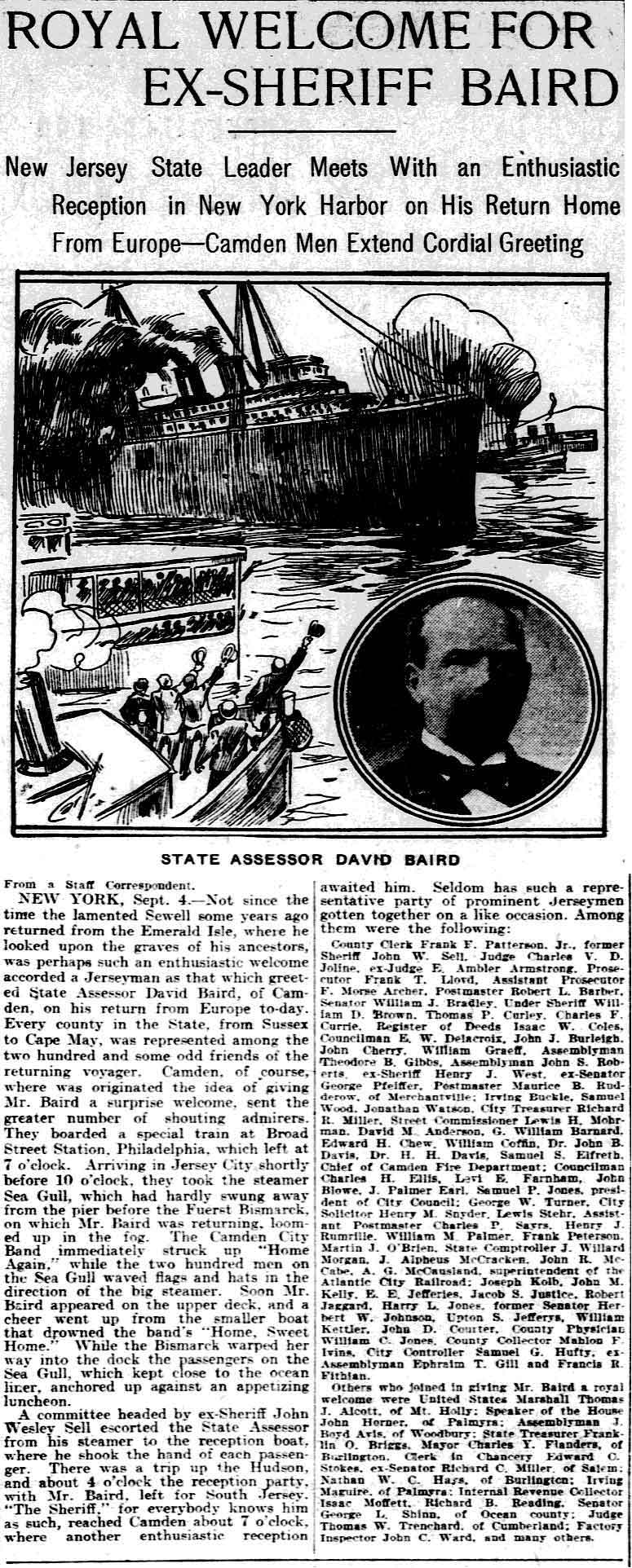
New Jersey State Leader Meets With an Enthusiastic Reception in New York Harbor on His Return Home From Europe—Camden Men Extend Cordial Greeting
STATE ASSESSOR DAVID BAIRD
From a Staff Correspondent.
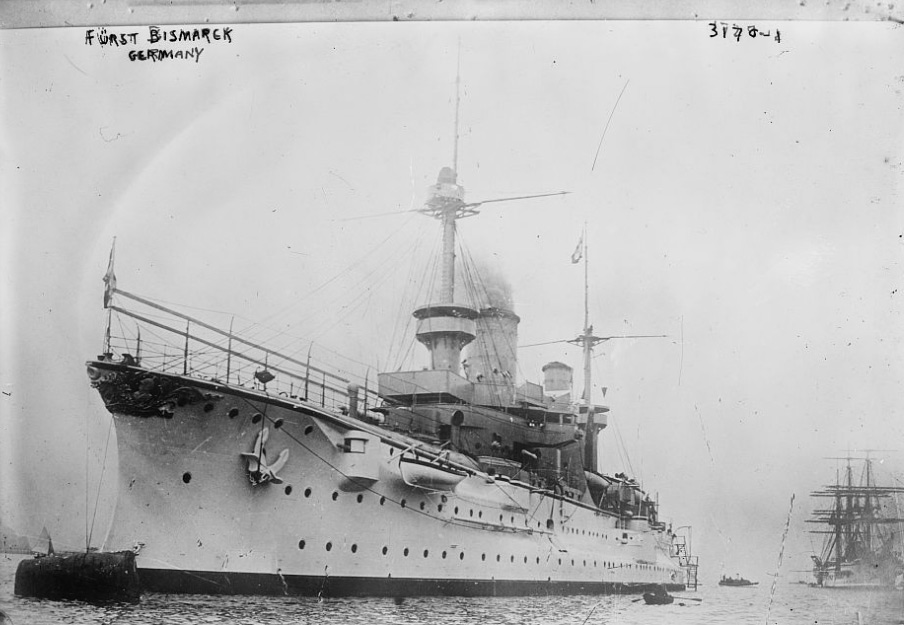
NEW YORK, Sept. 4.—Not since the time the lamented Sewell some years ago returned from the Emerald Isle, where he looked upon the graves of his ancestors, was perhaps such an enthusiastic welcome accorded a Jerseyman as that which greeted State Assessor David Baird, of Camden, on his return from Europe to-day. Every county in the State, from Sussex to Cape May, was represented among the two hundred and some odd friends of the returning voyager. Camden, of course, where was originated the idea of giving Mr. Baird a surprise welcome, sent the greater number of shouting admirers. They boarded a special train at Broad Street Station, Philadelphia, which left at 7 o’clock. Arriving in Jersey City shortly before 10 o’clock, they took the steamer Sea Gull, which had hardly swung away from the pier before the Fuerst Bismarck, on which Mr. Baird was returning, loomed up in the fog. The Camden City Band immediately struck up “Home Again,” while the two hundred men on the Sea Gull waved flags and hats in the direction of the big steamer. Soon Mr. Baird appeared on the upper deck, and a cheer went up from the smaller boat that drowned the band’s “Home, Sweet Home.” While the Bismarck warped her way into the dock the passengers on the Sea Gull, which kept close to the ocean liner, anchored up against an appetizing luncheon.
A committee headed by ex-Sheriff John Wesley Sell escorted the State Assessor from his steamer to the reception boat, where he shook the hand of each passenger. There was a trip up the Hudson, and about 4 o’clock the reception party, with Mr. Baird, left for South Jersey. “The Sheriff,” for everybody knows him as such, reached Camden about 7 o’clock, where another enthusiastic reception awaited him. Seldom has such a representative party of prominent Jerseymen gotten together on a like occasion. Among them were the following:
County Clerk Frank F. Patterson, Jr., former Sheriff John W. Sell, Judge Charles V. D. Joline, ex-Judge E. Ambler Armstrong, Prosecutor Frank T. Lloyd, Assistant Prosecutor F. Morse Archer, Postmaster Robert L. Barber, Senator William J. Bradley, Under Sheriff William D. Brown, Thomas P. Curley, Charles F. Currie, Register of Deeds Isaac W. Coles, Councilman E. W. Delacroix, John J. Burleigh, John Cherry, William Graeff, Assemblyman Theodore B. Gibbs, Assemblyman John S. Roberts, ex-Sheriff Henry J. West, ex-Senator George Pfeiffer, Postmaster Maurice B. Rudderow, of Merchantville; Irving Buckle, Samuel Wood, Jonathan Watson, City Treasurer Richard R. Miller, Street Commissioner Lewis H. Mohrman, David M. Anderson, G. William Barnard, Edward H. Chew, William Coffin, Dr. John B. Davis, Dr. H. H. Davis, Samuel S. Elfreth, Chief of Camden Fire Department; Councilman Charles H. Ellis, Levi E. Farnham, John Blowe, J. Palmer Earl, Samuel P. Jones, president of City Council; George W. Turner, City Solicitor Henry M. Snyder, Lewis Stehr, Assistant Postmaster Charles P. Sayrs, Henry J. Rumrille, William M. Palmer, Frank Peterson, Martin J. O’Brien, State Comptroller J. Willard Morgan, J. Alpheus McCracken, John R. McCabe, A. G. McCausland, superintendent of the Atlantic City Railroad; Joseph Kolb, John M. Kelly, E. E. Jefferies, Jacob S. Justice, Robert Jaggard, Harry L. Jones, former Senator Herbert W. Johnson, Upton S. Jefferys, William Kettler, John D. Courter, County Physician William C. Jones, County Collector Mahlon F. Ivins, City Controller Samuel G. Hufty, ex-Assemblyman Ephraim T. Gill and Francis R. Fithian.
Others who joined in giving Mr. Baird a royal welcome were United States Marshall Thomas J. Alcott, of Mt. Holly; Speaker of the House John Herner, of Palmyra; Assemblyman J. Boyd Avis, of Woodbury; State Treasurer Franklin O. Briggs, Mayor Charles Y. Flanders, of Burlington, Clerk in Chancery Edward C. Stokes, ex-Senator Richard C. Miller, of Salem; Nathan W. C. Hays, of Burlington; Irving Maguire, of Palmyra; Internal Revenue Collector Isaac Moffett, Richard B. Reading, Senator George L. Shinn, of Ocean county; Judge Thomas W. Trenchard, of Cumberland; Factory Inspector John C. Ward, and many others.
Fürst Bismarck
1903
Clerk Patterson on Second Term
Philadelphia Inquirer —
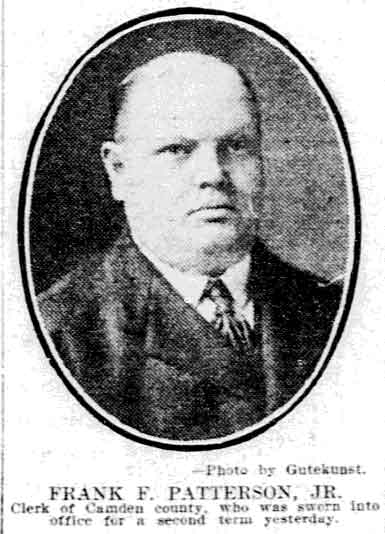
Popular Camden County Official Takes Oath of Office and Entertains Bondsmen and Others
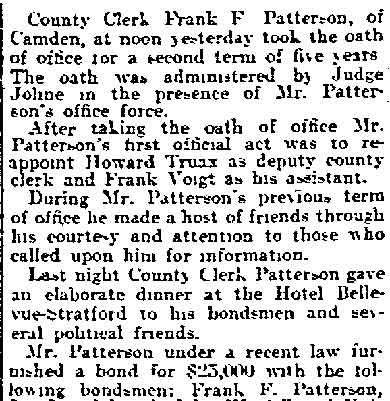
County Clerk Frank F. Patterson, of Camden, at noon yesterday took the oath of office for a second term of five years. The oath was administered by Judge Joline in the presence of Mr. Patterson’s office force.
After taking the oath of office Mr. Patterson’s first official act was to reappoint Howard Truax as deputy county clerk and Frank Voigt as his assistant.
During Mr. Patterson’s previous term of office he made a host of friends through his courtesy and attention to those who called upon him for information.
Last night County Clerk Patterson gave an elaborate dinner at the Hotel Bellevue-Stratford to his bondsmen and several political friends.
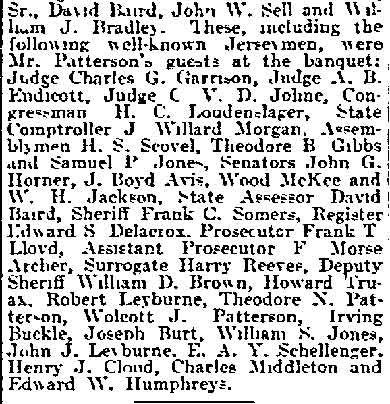
Mr. Patterson under a recent law furnished a bond for $25,000 with the following bondsmen: Frank F. Patterson, Sr., David Baird, John W. Sell and William J. Bradley. These, including the following well-known Jerseymen, were Mr. Patterson’s guests at the banquet: Judge Charles G. Garrison, Judge A. B. Endicott, Judge C. V. D. Joline, Congressman H. C. Loudenslager, State Comptroller J. Willard Morgan, Assemblymen H. S. Scovel, Theodore B. Gibbs and Samuel P. Jones, Senators John G. Horner, J. Boyd Avis, Wood McKee and W. H. Jackson, State Assessor David Baird, Sheriff Frank C. Somers, Register Edward S. Delacroix, Prosecutor Frank T. Lloyd, Assistant Prosecutor F. Morse Archer, Surrogate Harry Reeves, Deputy Sheriff William D. Brown, Howard Truax, Robert Leyburne, Theodore N. Patterson, Wolcott J. Patterson, Irving Buckle, Joseph Burt, William S. Jones, John J. Leyburne, E. A. Y. Schellenger, Henry J. Cloud, Charles Middleton and Edward W. Humphreys.
—Photo by Gutekunst
FRANK F. PATTERSON, JR.
Clerk of Camden county, who was sworn into office for a second term yesterday.
Camden Lodge No. 293, B.P.O.E. — Membership Ballot Notice
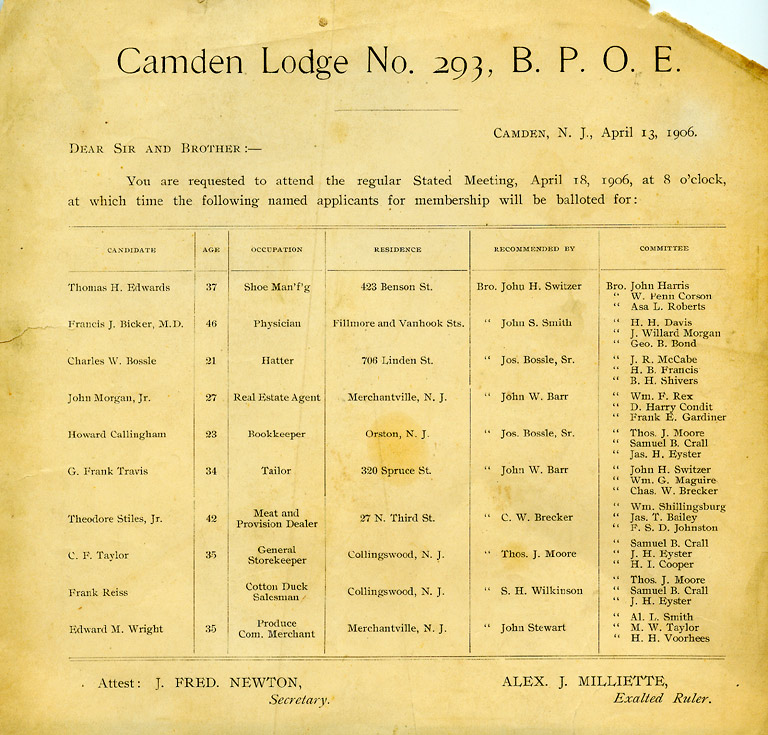
Camden Lodge No. 293, B. P. O. E.
CAMDEN, N. J., April 13, 1906.
DEAR SIR AND BROTHER:—
You are requested to attend the regular Stated Meeting, April 18, 1906, at 8 o’clock, at which time the following named applicants for membership will be balloted for:
| CANDIDATE | AGE | OCCUPATION | RESIDENCE | RECOMMENDED BY | COMMITTEE |
|---|---|---|---|---|---|
| Thomas H. Edwards | 37 | Shoe Man’f’g | 423 Benson St. | Bro. John H. Switzer | Bro. John Harris “ W. Penn Corson “ Asa L. Roberts |
| Francis J. Bicker, M.D. | 46 | Physician | Fillmore and Vanhook Sts. | “ John S. Smith | “ H. H. Davis “ J. Willard Morgan “ Geo. B. Bond |
| Charles W. Bossle | 21 | Hatter | 706 Linden St. | “ Jos. Bossle, Sr. | “ J. R. McCabe “ H. B. Francis “ B. H. Shivers |
| John Morgan, Jr. | 27 | Real Estate Agent | Merchantville, N. J. | “ John W. Barr | “ Wm. F. Rex “ D. Harry Condit “ Frank E. Gardiner |
| Howard Callingham | 23 | Bookkeeper | Orston, N. J. | “ Jos. Bossle, Sr. | “ Thos. J. Moore “ Samuel B. Crall “ Jas. H. Eyster |
| G. Frank Travis | 34 | Tailor | 320 Spruce St. | “ John W. Barr | “ John H. Switzer “ Wm. G. Maguire “ Chas. W. Brecker |
| Theodore Stiles, Jr. | 42 | Meat and Provision Dealer | 27 N. Third St. | “ C. W. Brecker | “ Wm. Shillingsburg “ Jas. T. Bailey “ F. S. D. Johnston |
| C. F. Taylor | 35 | General Storekeeper | Collingswood, N. J. | “ Thos. J. Moore | “ Samuel B. Crall “ J. H. Eyster “ H. I. Cooper |
| Frank Reiss | Cotton Duck Salesman | Collingswood, N. J. | “ S. H. Wilkinson | “ Thos. J. Moore “ Samuel B. Crall “ J. H. Eyster | |
| Edward M. Wright | 35 | Produce Com. Merchant | Merchantville, N. J. | “ John Stewart | “ Al. L. Smith “ M. W. Taylor “ H. H. Voorhees |
Attest: J. FRED. NEWTON, Secretary
ALEX. J. MILLIETTE, Exalted Ruler
Attorney General Aiding Prosecutor
Bridgeton Evening News —
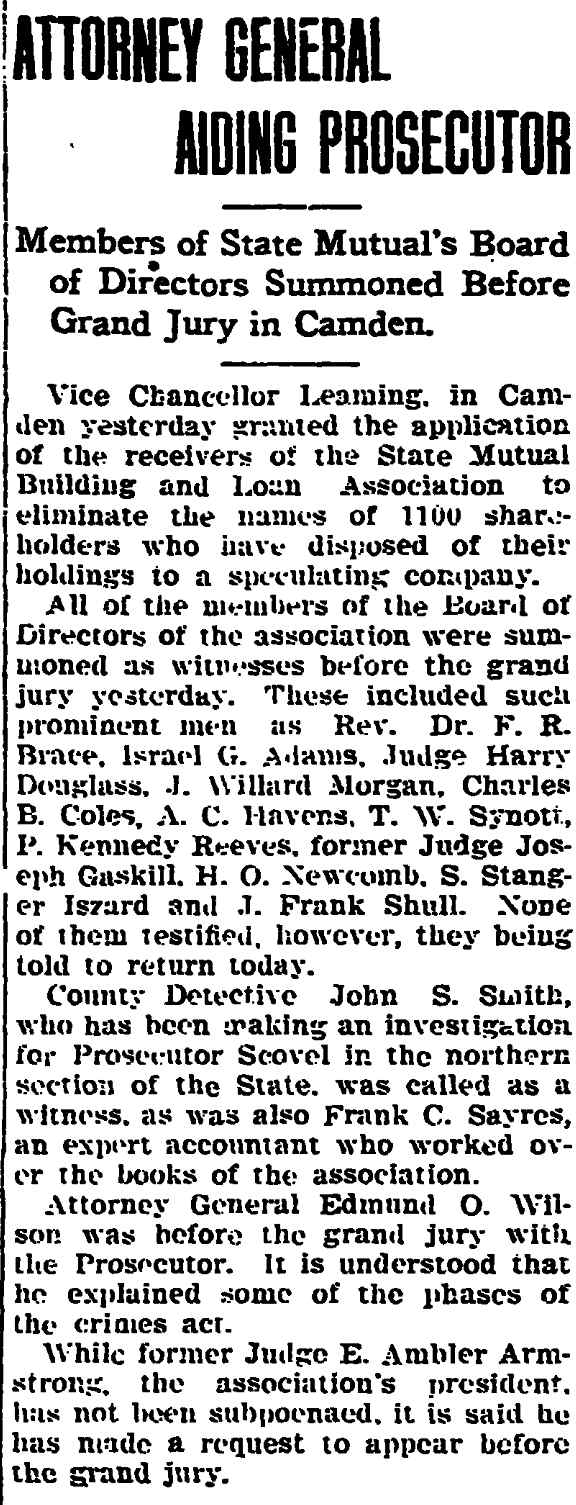
Members of State Mutual’s Board of Directors Summoned Before Grand Jury in Camden.
Vice Chancellor Leaming, in Camden yesterday granted the application of the receivers of the State Mutual Building and Loan Association to eliminate the names of 1100 shareholders who have disposed of their holdings to a speculating company.
All of the members of the Board of Directors of the association were summoned as witnesses before the grand jury yesterday. These included such prominent men as Rev. Dr. F. R. Brace, Israel G. Adams, Judge Harry Douglass, J. Willard Morgan, Charles B. Coles, A. C. Havens, T. W. Synott, P. Kennedy Reeves, former Judge Joseph Gaskill, H. O. Newcomb, S. Stanger Iszard and J. Frank Shull. None of them testified, however, they being told to return today.
County Detective John S. Smith, who has been making an investigation for Prosecutor Scovel in the northern section of the State, was called as a witness, as was also Frank C. Sayres, an expert accountant who worked over the books of the association.
Attorney General Edmund O. Wilson was before the grand jury with the Prosecutor. It is understood that he explained some of the phases of the crimes act.
While former Judge E. Ambler Armstrong, the association’s president, has not been subpoenaed, it is said he has made a request to appear before the grand jury.
Baird Holds a Christmas Party
Philadelphia Inquirer —
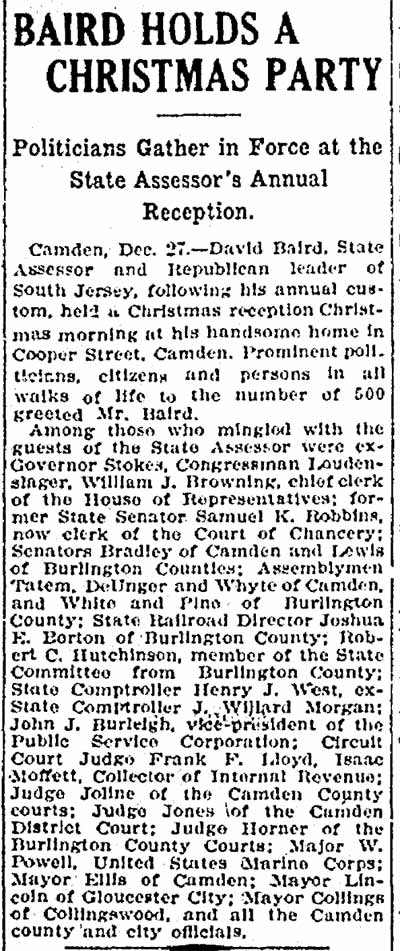
Politicians Gather in Force at the State Assessor’s Annual Reception.
Camden, Dec. 27.—David Baird, State Assessor and Republican leader of South Jersey, following his annual custom, held a Christmas reception Christmas morning at his handsome home in Cooper Street, Camden. Prominent politicians, citizens and persons in all walks of life to the number of 500 greeted Mr. Baird.
Among those who mingled with the guests of the State Assessor were ex-Governor Stokes, Congressman Loudenslager, William J. Browning, chief clerk of the House of Representatives; former State Senator Samuel K. Robbins, now clerk of the Court of Chancery; Senators Bradley of Camden and Lewis of Burlington Counties; Assemblymen Tatem, DeUnger and Whyte of Camden, and White and Pino of Burlington County; State Railroad Director Joshua E. Borton of Burlington County; Robert C. Hutchinson, member of the State Committee from Burlington County; State Comptroller Henry J. West, ex-State Comptroller J. Willard Morgan; John J. Burleigh, vice-president of the Public Service Corporation; Circuit Court Judge Frank F. [sic] Lloyd, Isaac Moffett, Collector of Internal Revenue; Judge Joline of the Camden County courts; Judge Jones of the Camden District Court; Judge Horner of the Burlington County Courts; Major W. Powell, United States Marine Corps; Mayor Ellis of Camden; Mayor Lincoln of Gloucester City; Mayor Collings of Collingswood, and all the Camden county and city officials.
J. Willard Morgan Seriously Ill
Philadelphia Inquirer —
Suffering a general breakdown last Saturday, former State Comptroller, J. Willard Morgan was last night reported to be in a serious condition at his home, Fifth and Linden streets, Camden.
Flower Clock in Camden
Philadelphia Inquirer —
Made of white carnations, a gigantic clock with the hands indicating the eleventh hour, was the feature of the decorations at the annual memorial service held by Camden Lodge, B. P. O. Elks, in the Camden Theatre yesterday. On the hands were thirteen incandescent globes, which were illumined as the names of that number of departed “brothers,” who have died the past year, were read by Secretary E. Wilmer Collins. And at the close a great circle of purple light flashed out, this with the white being emblematic of the order’s colors.
There was a large attendance of the members, their friends and the families of departed Elks. The invocation was given by Rev. Edmund Burk, assistant rector of Holy Trinity P. E. Church, Philadelphia, who also delivered the eulogy, while the oration was delivered by Morris Scheck, of Philadelphia Lodge of Elks. Music was given by the Third Regiment Orchestra.
Those who have died during the past year were Timothy P. Mealy, Thomas Bodell, J Willard Morgan, Carl W. Zennick, Joseph Baumgartner, George Morris Martin, Adam T. Davis, B. Frank Rawlings, William F. Jann, Benjamin A. Watkins, Maurice A. Rogers, Charles P. Lawrence and Edward E. Jefferis.
The Young Syndicate
Camden Courier-Post —
FROM AN OLD DIRECTORY
‘Coop’ Carman and Willard Morgan Led Movement for New Blood in G.O.P. Culminating in Bitter Battles of Race Track Days
Second in a new series of articles on Camden affairs and personalities of yesteryear inspired by a 50-year-old directory.
By BEN COURTER
Allusion to officials of Camden half a century ago has brought a flood of memories to older residents and particularly those interested in the political game—the great American game. While the directory of 1882 speaks of Richard C. Thompson holding the office of city clerk, mention of whom was made last week, it also was stated that D. Cooper Carman had held the office from 1884 until his death in 1889, at the early age of 35 years. It is Carman’s name which has revived in the minds of veteran political workers his activity and that of the “young syndicate,” which had concluded, as is the case in all organizations, it was time for old stagers to step aside for those of more youthful years.
BEN COURTER
Carman had been elected to city council in the Spring election of 1882 from the Fourth Ward, his home then being at Broadway and Federal street, where the Munger & Long building now stands. But his election was contested by Frederick M. Bourquin and Carman did not serve. Two years later he was again elected, at the same time appointed city clerk, and this resulted in another contest in which the court laid down the dictum that a member of council could not vote for himself for public office. “Coop,” as he was known to his familiars, promptly resigned from Council and was promptly elected city clerk.
The ‘Young Syndicate’
With Carman, as former City Clerk William D. Brown recalls, was associated J. Willard Morgan and Henry M. Snyder, something of a balance between the two.
That combination carried things along pretty much as they pleased for a time and as one of the developments Maurice A. Rogers, down in the Fifth Ward and a councilman, was taken up as a Senatorial candidate against Colonel George Pfeiffer, Jr., a decade later to be the builder of Camden’s artesian water plant. The colonel, long one of Camden’s most popular men, had defeated the Republicans as a result of the factional fight between Henry L. Bonsall, editor of the Post, and Thomas Dudley, famed consul to Liverpool during Civil War days. But with the “young syndicate” back of him, Rogers won the Senate seat in 1890, taking his office January 1, 1891.
But in the meanwhile Carman suddenly died at his mother’s home, at 11.10 on the night of September 11, 1889. At the time apoplexy was given as the cause. His sudden demise caused a profound shock and at his funeral four days later leaders in business and politics paid homage, with such men as Gen. William J. Sewell, Sinnickson Chew, Howard Carrow, Wilson Jenkins, E. A. Armstrong, B. M. Braker and many others attending. The bell in the old City Hall tower tolled as the cortege passed on the way to old Camden cemetery. And even yet, after these more than four decades, “Coop” Carman is quite vividly recalled by those who were then active on the political stage.
Carman’s Death Big Loss
Carman’s death was a big loss to the “young syndicate,” but it did not halt its activity. Since Rogers had won so easily in the 1890 election it was concluded there would be nothing to it when he was renominated for another two-year term. Rogers was by no means friendly to “Billy” Thompson’s race track, then in the heyday of its popularity with the sports of Gloucester City, a period when that community had all the earmarks of a wild and wooly western city, attractive to thousands of lovers of horseflesh, touts, gamblers and the usual hangers-on.
Thompson concluded it would be far better to have someone in the Senate from Camden county who would regard his interests with more favor than Rogers.
Thus he decided on Frederick A. Rex, his personal counsel, a very able young attorney, and a Republican. Since at that time the Democratic police commission was in control of the cops it was considered easy to get possession of the polls. As Brown recalls it, the rivals of Rogers planned a “zero hour” at which cops, at the crack of a pistol, were to descend on polls considered close at the primaries, frighten off the regular voters and corral enough to elect Rex.
Particular effort was to be made to sweep the Sixth Ward, where Thad Varney, elected city clerk to succeed Carman, was “boss,” and thus give him a political black eye. In Varney’s precinct in particular when the rumpus started “Brockie” Deno and “Al” Haydon, both widely known firemen now dead, grabbed the ballot box, lowered it down a chimney, fished it out when the racket was passed, went to Avis’ livery stable, and later to Varney’s home, where the votes were counted. In these sophisticated days such counting would unquestionably not be considered “according to Hoyle,” but then anything went just so the particular faction had its bag of tricks in effective operation. Anyhow, Rogers won the primaries, but there still was the general election to hurdle and Thompson was by no means beaten. He had plenty of money and many followers, some sincere, many just sycophants.
Repeaters Foiled
It was charged a scheme was on foot to bring repeaters from Philadelphia, not an unusual procedure in the political game of Camden years ago in either party. One of the “young syndicate’s” lieutenants learned the plot, told General Sewell, who sent the informant to Dave Martin, then Philadelphia’s political boss, who heard the story. The upshot was General Sewell himself saw Martin later, who was quite willing to aid Jersey’s G.O.P. leader, flooded Camden with sleuths from over the river and such close tabs were kept on the repeating army its efforts were halted from the very dawn of that very stirring election day. Rogers was elected, was made president of the Senate and for a time loomed so large on Jersey’s political horizon he had gubernatorial aspirations, but they never were realized.
Thus out of the old yellowed book Frank Albright, city clerk of the present epoch, dug from the archives memories are revived of a very gallant young politician, “Coop” Carman, and some of the stirring incidents that make up Camden’s political history. The “young syndicate” was just one of the episodes, as the first “reform” outbreak in 1882, or the Committee of 100 scrap of 1897, or the Non-Partisan upheaval of ‘23, but such never lose interest to those who have joined those movements with enthusiasm, even though they were often not altogether satisfied with what had been accomplished.
When G.O.P. Battled G.O.P.
Camden Courier-Post —
Typical Convention Rumpus Stirred ‘Regular’ and ‘True’ Republicans as Gibbs and Morgan Were Nominated for Sheriff in ‘81
(Another in a series of articles on Camden affairs and personalities of yesteryear)
By Ben Courter
Rival factions in the political conventions of long ago were more bitter toward one another than toward the common foe. So-called “rump” conventions were by no means exceptions. By “rump” was meant merely those who refused to play with the regulars and who set up the nominations, as did the Bull Moose on the national scale in the historic scrap of 1912 which resulted in the three-cornered battle of Wilson, Roosevelt and Taft, giving the Princeton professor the start that was to make him a world figure. Factions we still have, of course, and it is quite proper, since too much regularity often breeds party decay. But present-day political methods are certainly lacking in the spectacular rumpuses that stirred the rank and file in the period when delegates met and made their nominations.
In a recent article allusion was made to the Democratic convention of September 20, 1878, when Nathan T. Stratton, of Millville, was nominated for Congress by the Democrats in the midst of downright fisticuffs, when “liar” and “hypocrite” and worse was hurled about the hall.
Lest it may be assumed the party of Jefferson and Jackson only was given to such methods, it is fitting to give a picture on the other side of the political house. Dr. William H. Iszard’s inexhaustible scrap book, loaned me by his son, former Assemblyman Iszard comes across with a copy of a tabloid political sheet, “The True Republican,” which gives a recital of a battle royal in the G.O.P. ranks which will be of interest to some old-timers I know are still about.
Rival Conventions
That was the convention to nominate a sheriff called at Gloucester City Hall on Saturday, October 8, 1881, where we find the redoubtable Colonel James Matlack Scovel once more a moving factor, but this time in the ranks of the “regular Republicans” or at least so they called themselves as opposed to the “rump” set up by a rival group. Christopher J. Mines, long Fifth ward leader and later sheriff, apparently had been selected as temporary chairman with William A. Husted, who died last year well in his 70’s, as secretary. But when that part of the delegation marched up to city hall, like the famed king’s horses—they marched down again.
As a matter of fact, not much marching was done in the hall—for it was asserted by the “true Republicans” that when they essayed to enter the portals they found Colonel Scovel and Henry M. Jewett, father of Harry Jewett, a Camden newspaperman of the long ago and for years later Jersey editor of the Inquirer, in command. More, it was charged “People representing the worst elements of society” were on guard and presented a phalanx which even the huskies of the opposing force could not break. Mines was strong-armed by the minions of Scovel and Jewett and there was so much hooting and yelling and cussin’ that the “true” part of the outfit walked out, all 29 of them, over to Moss’ hall where they proceeded to carry on their convention to their own taste.
And all 29 of these valiant Republicans voted for Eli B. Morgan as their candidate for sheriff. You old timers will be interested in recalling these delegates who refused to kowtow to ‘Colonel Jim.’ In the Third ward there was James M. Lane, Charles S. Cotting and George Martin, in the Fourth, Husted, the Sixth, C. C. Smith, Thad Varney, Charles A. Sawyer; in the Seventh, Stephen Walters, Charles Lederman, William Simpson; in Gloucester, John W. Wright, David Anderson, Frank Mills, Robert Lafferty, Richard Allen, Jesse Daisey, Samuel Wood; in Haddon, Charles M. Macready, Elwood J. Haines; in Delaware, William Brick, William Graff, Isaac Coles; in Merchantville, Matthias Homer, William Naylor, and in Center, James Davis, Garrett Patton and Gilbert Shaw.
Hot Statement
These “true Republicans” in a statement to the party rank and file, under the Algeresque title of “Now or Never,” scathingly said: “It becomes the duty of every Republican voter of Camden county, who has the future interest of the party at heart, to administer a severe and lasting rebuke to all candidates who employ the element and encourage the means that were used in controlling the Sheriff’s convention at City Hall, Gloucester City. It discounted anything within the memory of the oldest Democrat inhabitant. What with Col. Joseph Nichols urging the crowd to go elsewhere and nominate Gibbs, and the immaculate Billy Warner of the Fifth ward ordering them to burst the door in, coupled with the commanding voice of that great patriot and life-long Republican, James M. Scovel, alias Mountain Partridge, together with the curses and threats from John Furey, Jack Quigley, Pud Young, Bill Derr, “Tar Heel” Jim Hayes, the able city solicitor, and a gang of Philadelphia roughs, a beautiful spectacle was presented.”
The “Gibbs” mentioned was Theodore B. Gibbs who long lived in the white mansion on the banks of Clementon lake and whose ancient grist mills ground the grain for farmers from miles around. None in the county was held in higher esteem and in later years most of the valiant 29 were among his closest friends, unnecessary proof the political animosities are, as a rule, not very enduring. Gibbs was nominated by the “regular” Convention which ousted the 29 and a mighty hot shrievalty campaign ended on November 10 with his ejection, in spite of the “now or never” demand of his opponents headed by Eli Morgan.
The latter was a real estate man, son of Randall Morgan, elected sheriff by a whisker over “Ham” Bitten in 1869, and brother of J. Willard Morgan, long a Republican chieftain. It was the elder Morgan who defeated Bitten, a rough and ready character nominated as a joke, by a narrow squeak.
In the shrievalty scrap of 1881. Gibbs received 5381 and Morgan, 1189. Angus Camerson, the Democratic candidate was given 4450 votes. Nor did the “true” nominees for coroner fare any better. Sam Bennett, William Thompson and Alexander Powell being defeated by ‘Doc’ John D. Leckner, Jacob Justice and William Duble.
But the “true” Republicans licked their wounds and most of them were ready to “yen their heads off” when Colonel Scovel in later campaigns made the welkin ring with his call from the rostrum to wallop the enemy. If you now come across any of the few actors of that period still in the flesh an allusion to that “spectacle” of half century ago will sure bring one big chuckle with the declaration “them was the days.”
A False Alarm of Long Ago
Camden Courier-Post —
Spectacular Run of Firemen and Steeds in ‘79 When First Alarm System Was Given Try-out
By Ben Courter
There were two alarms of fire Saturday evening, one at Fourth and Hamilton streets at 8:29 o’clock, and another at the West Jersey Ferry, an hour later. People in the vicinity of the first-named place turned out to look at the machines propelled at lightning speed by snorting equines, and wondered what it was all about; and some of them thought the wide-awake fire boys were beside themselves, as they asked, for the particular house, in the neighborhood of box 24 upon which, with steam up, their apparatus was able to put on, the water. The firemen and people were quietly informed by a party that drove away in a barouche that it was a designed deception.
Under date of October 6, 1879, that was the introduction to a two-column story under a display headline. But, it was, a single line—“False Alarms.” Readers of the period must have been as much mystified as were the firemen and citizens mentioned in the article, for it was not until more than half a column had been devoted to that incident that the public was let into the great secret. It was a test of the first fire alarm system introduced into Camden.
Interest in that incident is revived by the city commissioners last week entering into a contract with that same concern to install in the new City Hall a system for somewhat more than $51,000. That first “system” cost the city $2000 but it was a big sum then and just about 10 times more space was devoted to it in the old Post than in the Courier-Post last Thursday week.
Paid Department 10 Years Old
Camden’s paid fire department in 1879 was just 10 years old. It already was winning approval of even the recalcitrants, who had asserted back in 1869, that the old volunteer companies would certainly be missed; that the “professionals” would not have as much interest in putting out a fire as the boys who ran with the Perseverance, the Weccacoe and other organizations, usually bitter rivals. Not infrequently the volunteers battled over hooking up their hose while the fire burned, a event by no means outgrown since that occasionally happens even now, as files of the newspapers prove.
But on that Saturday night 54 years ago, it developed that those who drove away in the mysterious barouche were J. W. Morgan, Crawford Miller and F. P. Pfeiffer; fire commissioners of city council, along with R. S. Bender and Thomas Beatty. They were but carrying out orders to see that the system worked and it was John T. Bottomley who issued those orders. He was Camden’s big mill owner but more to the purpose in that particular incident, president of city Council. He had approved the fire alarm system but did not intend putting his O. K. on that $2000 bill until he had seen it in practical operation.
So unknown to the firemen, and the citizens as well, it was determined to test that system by way of turning in the alarms. So an alarm was pulled at 8.29 and “Bart” Bonsall, son of Henry L. Bonsall, publisher of the Post, narrates, in just 15 seconds flat the bell was sounded at No.1 Engine House at Fourth and Pine Streets. In two minutes hose cart No. 1 went bounding out with Driver George Hunt at the reins, followed by Ben Cavanaugh and his faithful nag “Jim” with cart No. 2. Then came Jake Kellum and William Davies with the engine No. 2 drawn by “Dolly” in 2.45. After that was engine No.1 driven by Edmund Shaw and the horse “Alec,” coming along in 3 minutes and 5 seconds. It was explained Shaw was held up by the sandy roadway at Fourth and Line.
Spectacular Sight
Anyhow, it must have been a great sight for the old-time families who then resided along the Middle Ward Streets as the racing steeds bounded over Fourth Street, then into Third over a mighty bumpy roadway.
But they arrived and vainly sought the blaze. It was while they were hunting that the barouche came along and the commissioners let them into the great secret. “Bart” doesn’t relate what the firemen said about the false alarm, but, like as not the heat of their expressions was a good substitution for the fire they failed to find.
The system was one of those nine-day wonders that had the town on its toes. Everybody listened for the alarms in those days, for when they were sent in the bells in the fire houses pealed the number of the box. The strokes could be heard surprisingly far. Since there were but 11 boxes it was not long before many knew just where the fire was located and made a bee line for the scene. Old volunteers, particularly, never quite lost their interest in fires and, whenever they heard the alarm, hot footed it to the scene of excitement.
That was all right when Camden was little more than a village, but as the community grew it became a serious proposition, since the racing citizens often interfered with the firemen. Thus about 30 years ago the fire bells were silenced. Now none know of an alarm coming in save the various houses and the Courier-Post which has a wire attached from headquarters bringing in the alarms so that reporters and cameramen may get on the scene quickly as possible.
Ordinarily, little thought is given to the need for instant and accurate sounding of an alarm made possible through the expert work of City Electrician Jim Howell and his aides. If it were not for that perfection and the speed with which friend reach the scene the losses would be large. And the insurance companies would be around with a “pink slip” as they were some 20 years ago. That meant a 25 percent addition to fire rates. Camden’s motorized department plus the work of City Electrician John W. Kelly soon rid the city of that “slip.”
That system of long ago didn’t include the cops. Now it takes in both departments, as it has done since the days of Chief Samuel Dodd, back in the early 90’s.