Carl F. Kellman
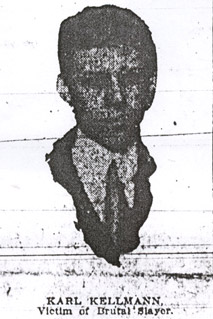
Carl F. Kellman
CARL F. KELLMAN was born in 1894 to Louise D. “Lulu” and Carl L. Kellman. He was the oldest of four children, coming before Helen, Frederick, and Alma. His father was born in 1868 in Germany; he came to America in 1891. His mother was born in Pennsylvania in 1870. They met and married soon after he arrived in America.
The Kellmans moved to East Camden in late 1899 or early 1900. They are not listed in the 1899 Camden City Directory, however, when the census was taken on June 7, 1900 the family was living at 2919 High Street in East Camden. Carl L. Kellman worked making surgical instruments; his younger son Fred would also work as a toolmaker as an adult.
Carl Kellman attended Camden public schools, the nearest of course being the James A. Garfield School, just around the corner from his house at North 29th Street and Cramer Street. The family attended Grace Presbyterian Church, located on North 27th Street and Garfield Avenue, just across the railroad tracks in Cramer Hill. Carl Kellman attended Sunday School and later the Young Men’s Bible class there. It was most likely through church where he met and became friends with the Skillen sisters, Bessie and Bertha. Bessie Skillen taught Sunday School at Grace Presbyterian in the early 1910s. The girl’s mother and Lulu Kellman remained friends for decades.
Artistically talented, as evidenced by the drawing below, Carl Kellman found work in the Art Department of the Ketterlinus Lithographing Company in Philadelphia. The company published posters and art prints. Examples of Ketterlinus’ prints and posters can be seen at The Philadelphia Print Shop, Ltd. website.
Carl Kellman was shot and mortally wounded a few blocks from his home when robbed while coming home from a church carnival on October 13, 1912. He died the following morning. Three men were arrested, two were tried and convicted of the murder and sent to prison.
The Kellman family remained on High Street for quite some time thereafter, Mrs. Lulu Kellman staying until the early 1940s, her husband, Carl L. Kellman, having died in 1936. Sister Helen married Captain Howard Meyer, who had served with distinction as an aviator with the United States Army in France during World War I. Younger brother Frederick married and lived for many years in Pennsauken, not far from the home where he had grown up.
About This Page
During the summer of 2006, Carl Kellman’s nephew, Bob Kellman, told me about this case, where his Uncle, Carl Kellman, of 2919 High Street was shot down during a robbery at the railroad tracks at North 27th Street and Sherman Avenue in October of 1912. Harry Duffield, Fred “Cowboy Pete” Coursey, and Linaws Staley were arrested. Staley was cleared of any involvement in the crime in short order. Duffield and Coursey were convicted and sent to prison. A web-page about the event containing local newspaper articles was set up on September 28, 2006.
Since that time, Bob and I have kept in touch, and on a visit, the two of us and a cousin of his retraced the route Carl walked on his last night. Recently Bob sent some photos from an album that Carl had, and I thought it would be appropriate to put a page together about the life of Carl Kellman, his family and friends.
The original page concerning the murder of Carl F. Kellman is at /stories/kellman-murder-1912/ on this link for more about Carl Kellman and his life and times.
August 8, 2009
North 30th Street
Postcard, circa 1904
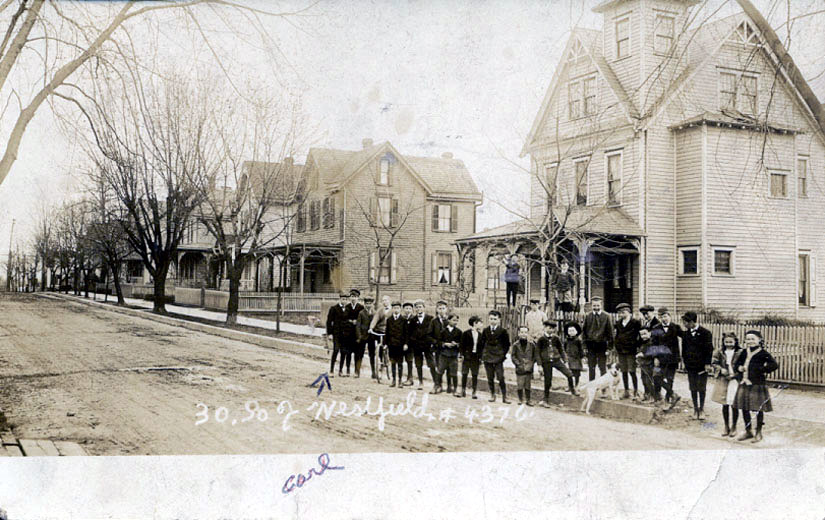
Postcard from approximately 1904 – Carl Kellman on far left. Photo appears to be of North 30th Street, looking towards Westfield Avenue. The large house on the far right no longer stands, but the houses further down the block and the slope of the street conform with that hypothesis.
The James A. Garfield School
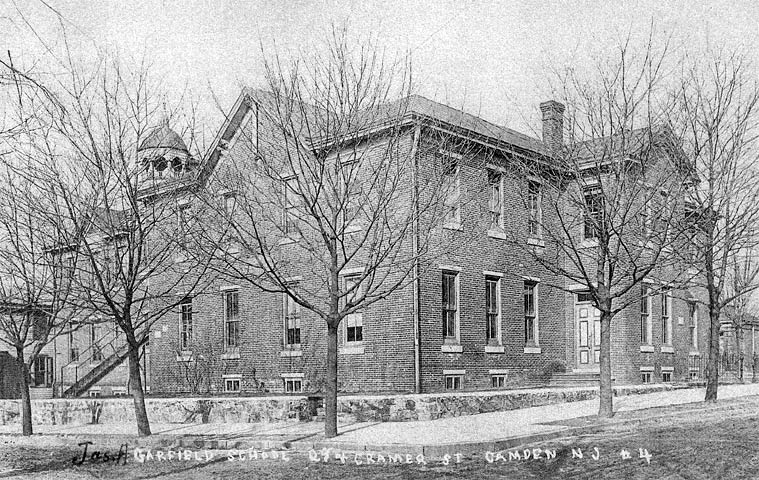
The James A. Garfield School, where Carl Kellman and his brother and sisters attended grade school. The image is from a postcard, apparently from the same series as the photo of “30, S of Westfield” above.
Carl Kellman’s Drawing
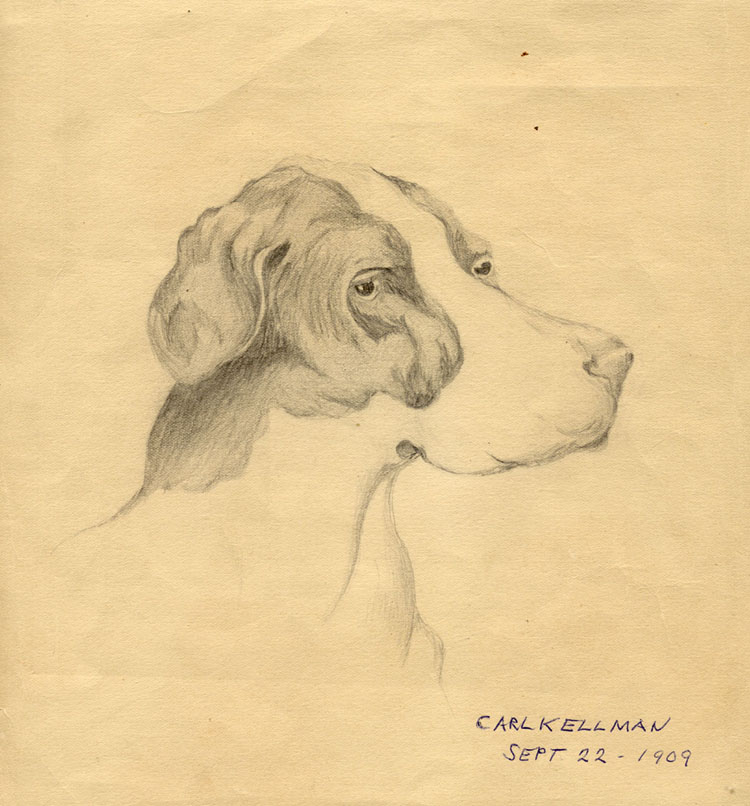
Carl Kellman drew this picture, dated September 22, 1909.
The Kellman Children
circa 1912
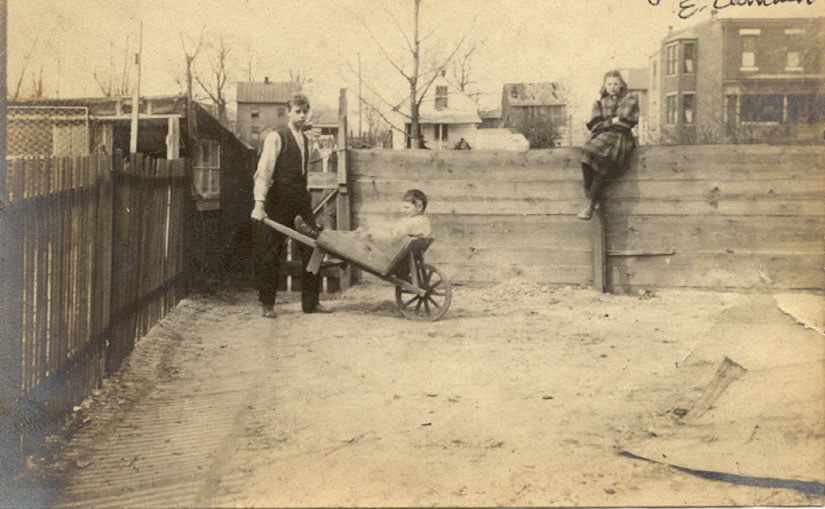
The Kellman children in the backyard of 2919 High Street, approximately 1912. Carl Kellman is at left, young Fred is in the wheelbarrow, sister Helen is on the fence. The house to the right of Helen is 2917 Saunders Street.
Bertha Skillen
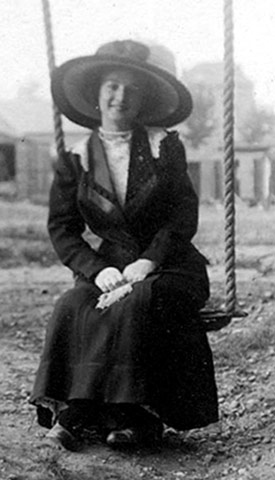
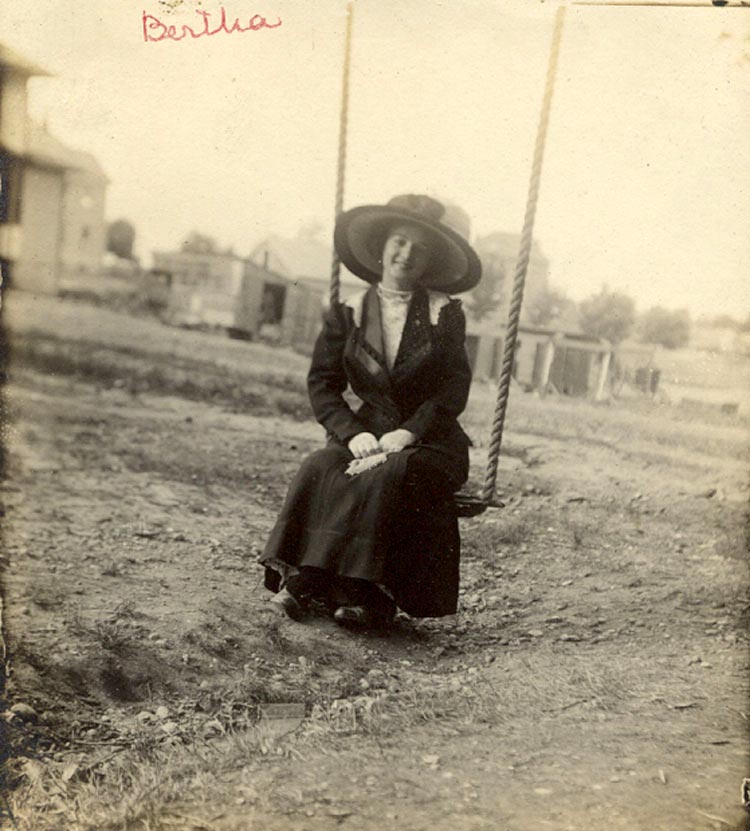
This photo of Bertha Skillen is from Carl Kellman’s album. The nature of the relationship is not known at this time. Their mothers were friends and corresponded decades after Carl Kellman’s murder. Carl Kellman was returning home after walking Bertha and her sister Bessie home from a church carnival when he was murdered.
2919 High Street
The Kellman Family Home
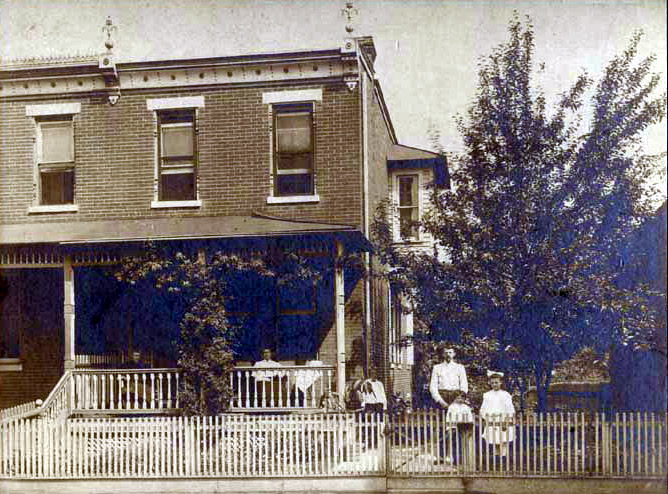
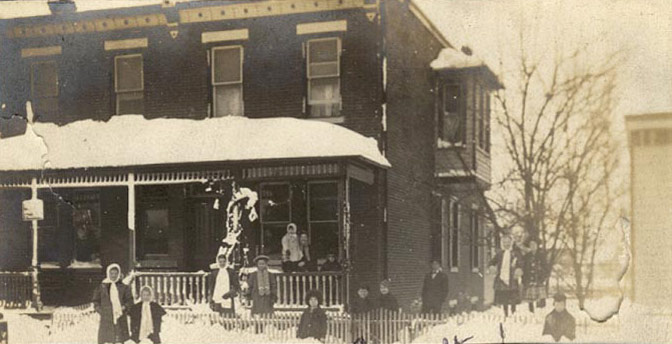
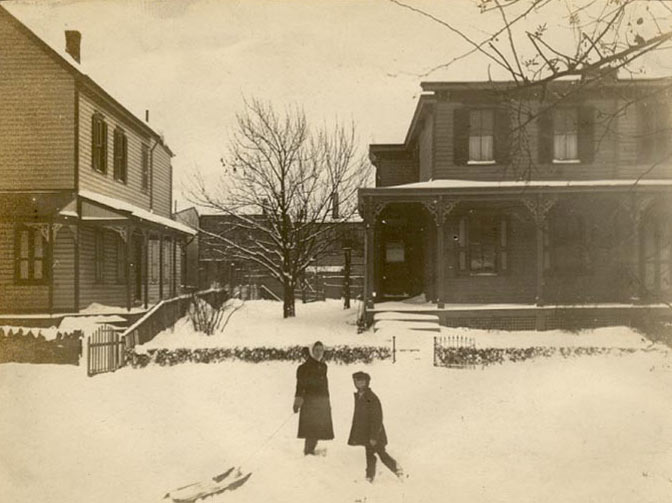
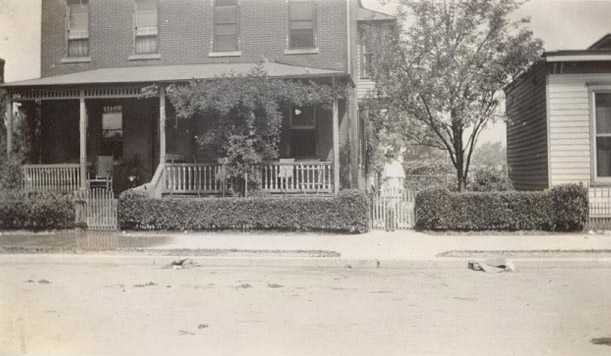
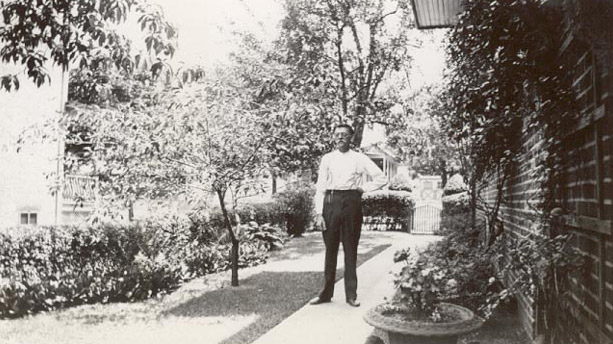
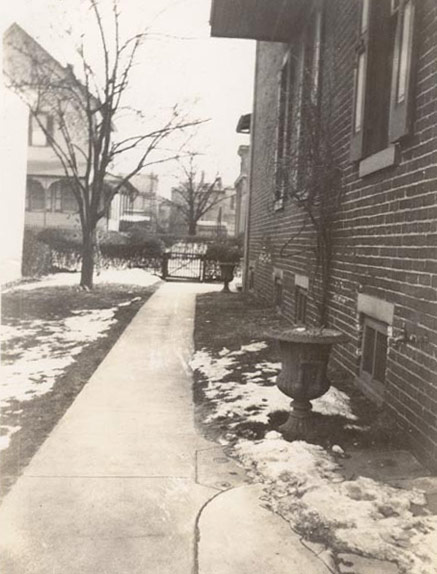
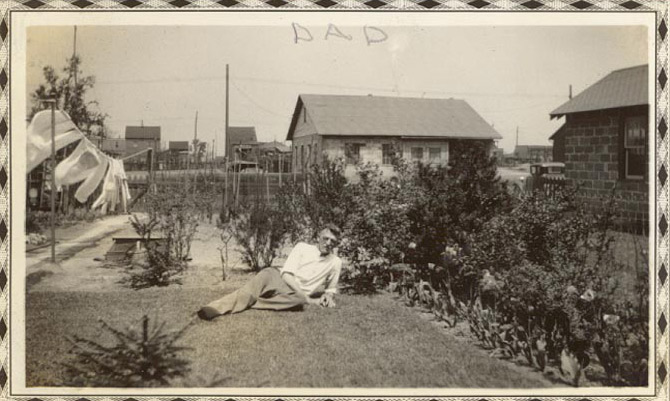
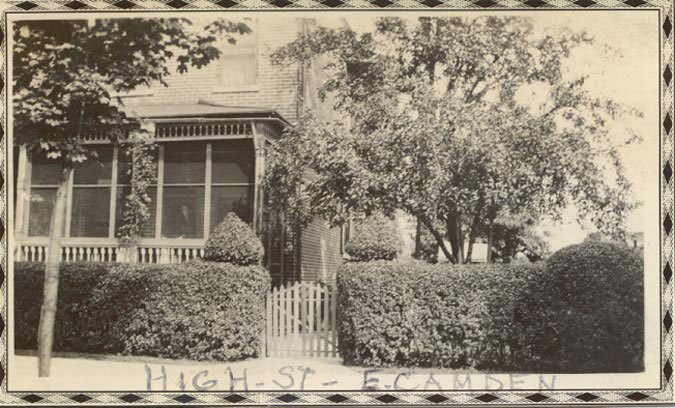
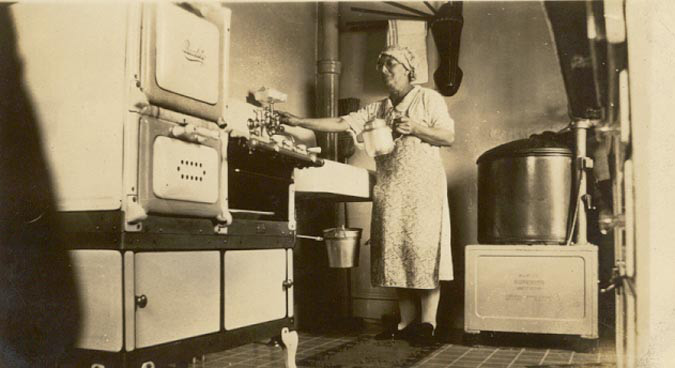
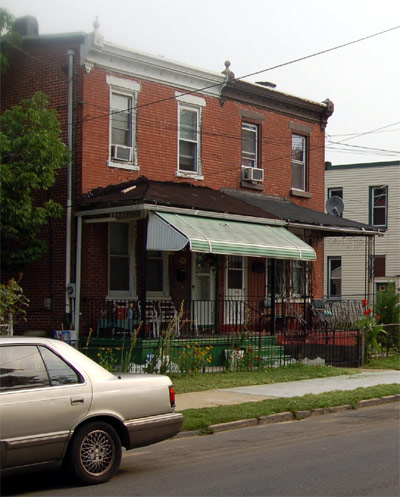
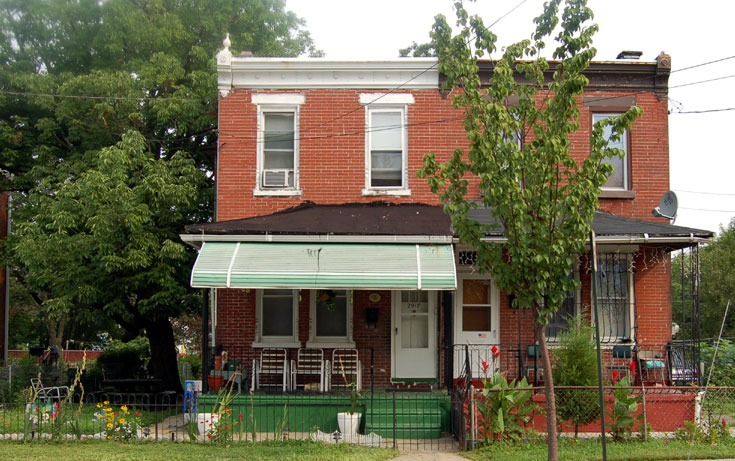
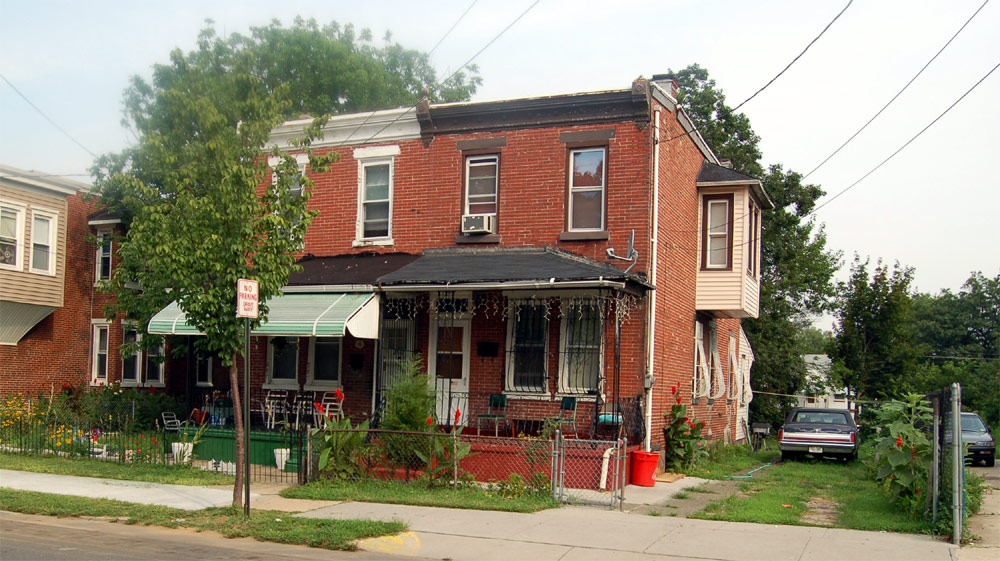
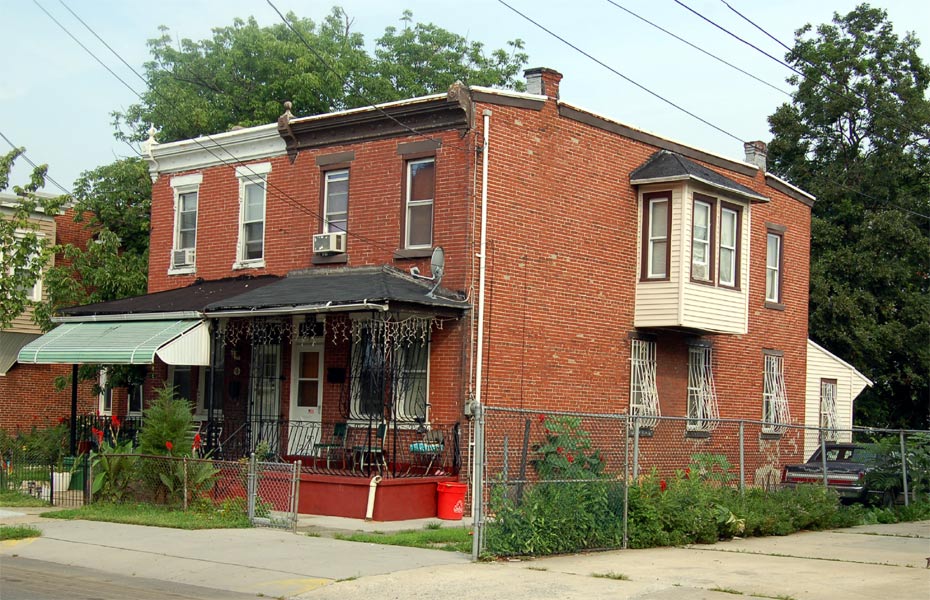
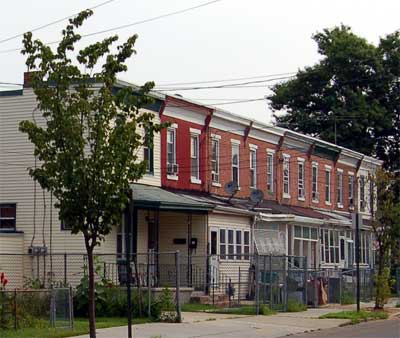
2919 High Street, the home of the Carl L. & Lulu Kellman family, 1890s–1940s. First photo circa 1905: Lulu Kellman sitting on the porch, Carl L. Kellman standing with Fred and Helen. Also shown: views of the property from approximately 1906–1940s, and present-day photos taken July 25, 2006.
815 North 34th Street
The Skillen Family Home
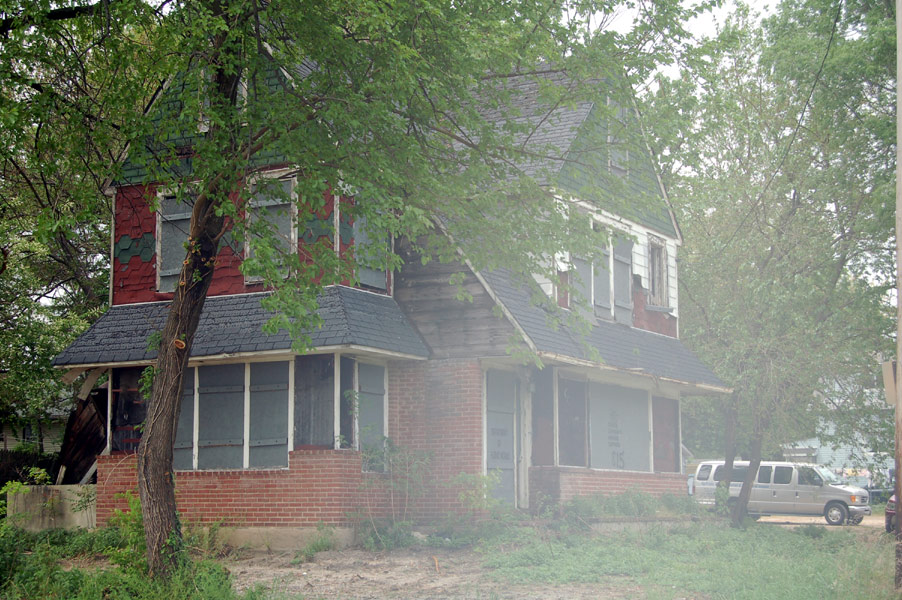
815 North 34th Street – the home of the Skillen family. Photo from July 25, 2006. Carl Kellman escorted the Skillen sisters here the night he was murdered.
Pavonia Railroad Station at North 27th Street
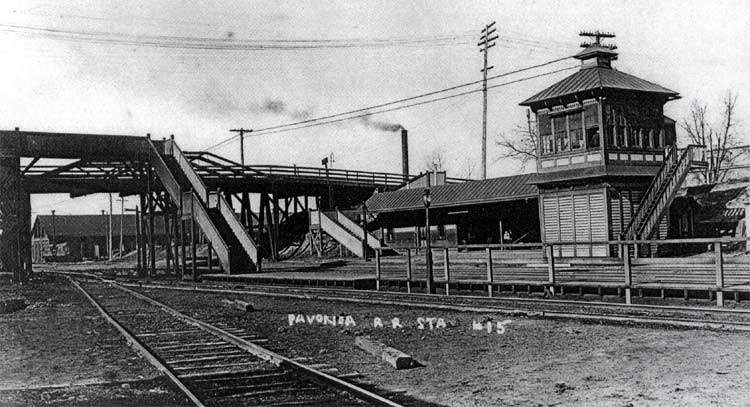
The Pavonia Railroad Station at North 27th Street. Another postcard photo, possibly from the same series as those above, taken in the early 1900s. It would have looked pretty much the same in 1912 as when this photo was taken.
Boy’s Brutal Murderer Collapses at Hearing
Camden Post-Telegram —
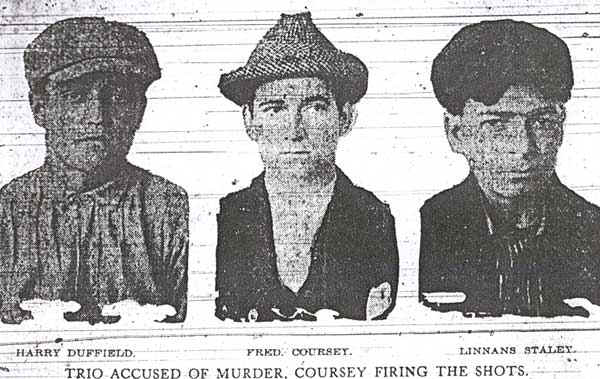
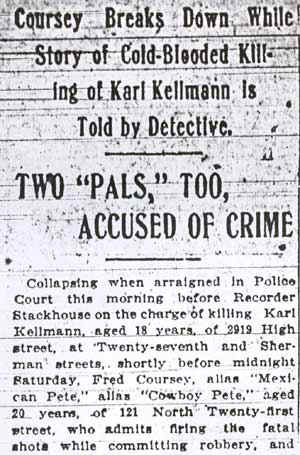
Coursey Breaks Down While Story of Cold-Blooded Killing of Karl Kellmann Is Told by Detective.
TWO “PALS,” TOO, ACCUSED OF CRIME
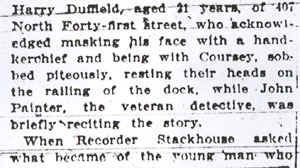
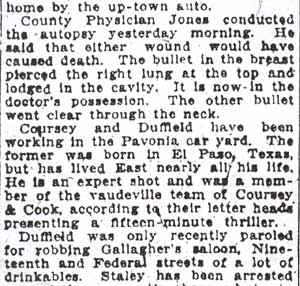
Collapsing when arraigned in Police Court this morning before Recorder Stackhouse on the charge of killing Karl Kellmann, aged 18 years, of 2919 High street, at Twenty-seventh and Sherman streets, shortly before midnight Saturday, Fred Coursey, alias “Mexican Pete,” alias “Cowboy Pete,” aged 20 years, of 121 North Twenty-first street, who admits firing the fatal shots while committing robbery, and Harry Duffield, aged 21 years, of 407 North Forty-first street, who acknowledged masking his face with a handkerchief and being with Coursey, sobbed piteously, resting their heads on the railing of the dock, while John Painter, the veteran detective, was briefly reciting the story.
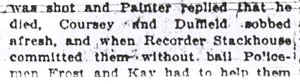
When Recorder Stackhouse asked what became of the young man who was shot and Painter replied that he died, Coursey and Duffield sobbed afresh, and when Recorder Stackhouse committed them without bail Policemen Frost and Kay had to help them.
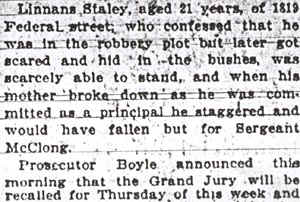
Linnans Staley, aged 21 years, of 1819 Federal street, who confessed that he was in the robbery plot but later got scared and hid in the bushes, was scarcely able to stand, and when his mother broke down as he was committed as a principal he staggered and would have fallen but for Sergeant McClong.
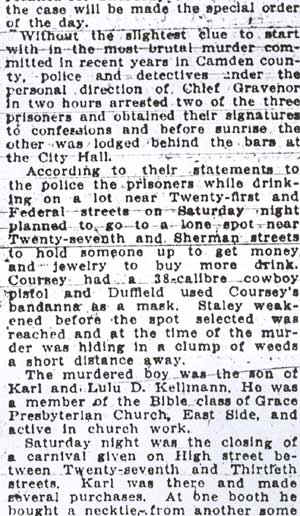
Prosecutor Boyle announced this morning that the Grand Jury will be recalled for Thursday of this week and the case will be made the special order of the day.
Without the slightest clue to start with in the most brutal murder committed in recent years in Camden county, police and detectives under the personal direction of Chief Gravenor in two hours arrested two of the three prisoners and obtained their signatures to confessions and before sunrise the other was lodged behind the bars at the City Hall.
According to their statements to the police the prisoners while drinking on a lot near Twenty-first and Federal streets on Saturday night planned to go to a lone spot near Twenty-seventh and Sherman streets to hold someone up to get money and jewelry to buy more drink. Coursey had a 38-calibre cowboy pistol and Duffield used Coursey’s bandanna as a mask. Staley weakened before the spot selected was reached and at the time of the murder was hiding in a clump of weeds a short distance away.
The murdered boy was the son of Karl and Lulu D. Kellmann. He was a member of the Bible class of Grace Presbyterian Church, East Side, and active in church work.
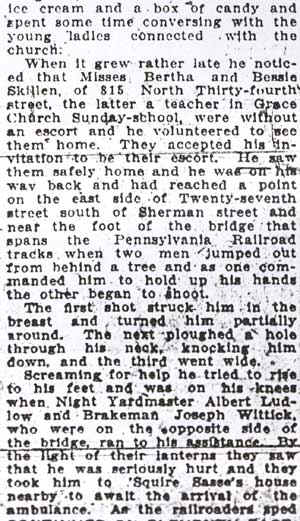
Saturday night was the closing of a carnival given on High street between Twenty-seventh and Thirtieth streets. Karl was there and made several purchases. At one booth he bought a necktie, from another some ice cream and a box of candy and spent some time conversing with the young ladies connected with the church.
When it grew rather late he noticed that Misses Bertha and Bessie Skillen, of 815 North Thirty-fourth street, the latter a teacher in Grace Church Sunday-school, were without an escort and he volunteered to see them home. They accepted his invitation to be their escort. He saw them safely home and he was on his way back and had reached a point on the east side of Twenty-seventh street south of Sherman street and near the foot of the bridge that spans the Pennsylvania Railroad tracks when two men jumped out from behind a tree and as one commanded him to hold up his hands the other began to shoot.
The first shot struck him in the breast and turned him partially around. The next ploughed a hole through his neck, knocking him down, and the third went wide.
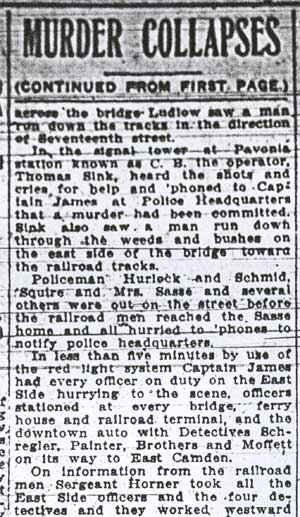
Screaming for help he tried to rise to his feet and was on his knees when Night Yardmaster Albert Ludlow and Brakeman Joseph Wittick, who were on the opposite side of the bridge, ran to his assistance. By the light of their lanterns they saw that he was seriously hurt and they took him to ‘Squire Sasse’s house nearby to await the arrival of the ambulance. As the railroaders sped across the bridge Ludlow saw a man run down the tracks in the direction of Seventeenth street.
In the signal tower at Pavonia station known as C. B. the operator, Thomas Sink, heard the shots and cries for help and ‘phoned to Captain James at Police Headquarters that a murder had been committed. Sink also saw a man run down through the weeds and bushes on the east side of the bridge toward the railroad tracks.
Policeman Hurlock and Schmid, ‘Squire and Mrs. Sasse and several others were out on the street before the railroad men reached the Sasse home and all hurried to ‘phones to notify police headquarters.
In less than five minutes by use of the red light system Captain James had every officer on duty on the East Side hurrying to the scene, officers stationed at every bridge, ferry house and railroad terminal, and the downtown auto with Detectives Schregler, Painter, Brothers and Moffett on its way to East Camden.
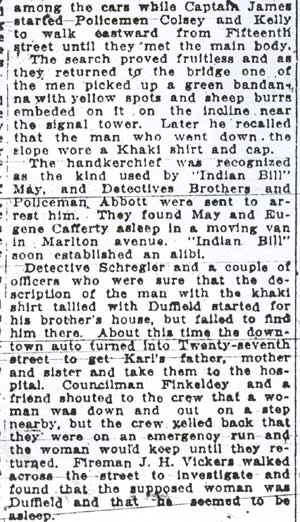
On information from the railroad men Sergeant Horner took all the East Side officers and the four detectives and they worked westward among the cars while Captain James started Policemen Colsey and Kelly to walk eastward from Fifteenth street until they met the main body.
The search proved fruitless and as they returned to the bridge one of the men picked up a green bandanna with yellow spots and sheep burrs embedded on it on the incline near the signal tower. Later he recalled that the man who went down the slope wore a Khaki shirt and cap.
The handkerchief was recognized as the kind used by “Indian Bill” May, and Detectives Brothers and Policeman Abbott were sent to arrest him. They found May and Eugene Cafferty asleep in a moving van in Marlton avenue. “Indian Bill” soon established an alibi.
Detective Schregler and a couple of officers who were sure that the description of the man with the khaki shirt tallied with Duffield started for his brother’s house, but failed to find him there. About this time the downtown auto turned into Twenty-seventh street to get Karl’s father, mother and sister and take them to the hospital. Councilman Finkeldey and a friend shouted to the crew that a woman was down and out on a step nearby, but the crew yelled back that they were on an emergency run and the woman would keep until they returned. Fireman J. H. Vickers walked across the street to investigate and found that the supposed woman was Duffield and that he seemed to be asleep.
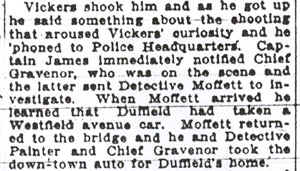
Vickers shook him and as he got up he said something about the shooting that aroused Vickers’ curiosity and he ‘phoned to Police Headquarters. Captain James immediately notified Chief Gravenor, who was on the scene and the latter sent Detective Moffett to investigate. When Moffett arrived he learned that Duffield had taken a Westfield avenue car. Moffett returned to the bridge and he and Detective Painter and Chief Gravenor took the down-town auto for Duffield’s home.
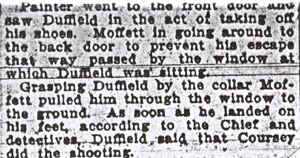
Painter went to the front door and saw Duffield in the act of taking off his shoes. Moffett in going around to the back door to prevent his escape that way passed by the window at which Duffield was sitting.
Grasping Duffield by the collar Moffett pulled him through the window to the ground. As soon as he landed on his feet, according to the Chief and detectives, Duffield said that Coursey did the shooting.
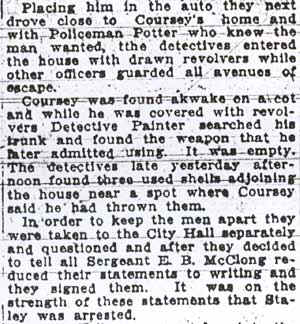
Placing him in the auto they next drove close to Coursey’s home and with Policeman Potter who knew the man wanted, the detectives entered the house with drawn revolvers while other officers guarded all avenues of escape.
Coursey was found awake on a cot and while he was covered with revolvers Detective Painter searched his trunk and found the weapon that he later admitted using. It was empty. The detectives late yesterday afternoon found three used shells adjoining the house near a spot where Coursey said he had thrown them.
In order to keep the men apart they were taken to the City Hall separately and questioned and after they decided to tell all Sergeant E. B. McClong reduced their statements to writing and they signed them. It was on the strength of these statements that Staley was arrested.
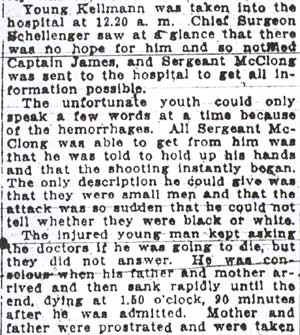
Young Kellmann was taken into the hospital at 12.20 a. m. Chief Surgeon Schellenger saw at a glance that there was no hope for him and so notified Captain James, and Sergeant McClong was sent to the hospital to get all information possible.
The unfortunate youth could only speak a few words at a time because of the hemorrhages. All Sergeant McClong was able to get from him was that he was told to hold up his hands and that the shooting instantly began. The only description he could give was that they were small men and that the attack was so sudden that he could not tell whether they were black or white.
The injured young man kept asking the doctors if he was going to die, but they did not answer. He was conscious when his father and mother arrived and then sank rapidly until the end, dying at 1.50 o’clock, 90 minutes after he was admitted. Mother and father were prostrated and were taken home by the up-town auto.
County Physician Jones conducted the autopsy yesterday morning. He said that either wound would have caused death. The bullet in the breast pierced the right lung at the top and lodged in the cavity. It is now in the doctor’s possession. The other bullet went clear through the neck.
Coursey and Duffield have been working in the Pavonia car yard. The former was born in El Paso, Texas, but has lived East nearly all his life. He is an expert shot and was a member of the vaudeville team of Coursey & Cook, according to their letter heads presenting a fifteen-minute thriller.
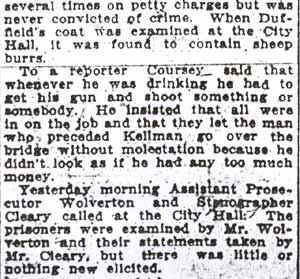
Duffield was only recently paroled for robbing Gallagher’s saloon, Nineteenth and Federal streets of a lot of drinkables. Staley has been arrested several times on petty charges but was never convicted of crime. When Duffield’s coat was examined at the City Hall, it was found to contain sheep burrs.
To a reporter Coursey said that whenever he was drinking he had to get his gun and shoot something or somebody. He insisted that all were in on the job and that they let the man who preceded Kellman go over the bridge without molestation because he didn’t look as if he had any too much money.
Yesterday morning Assistant Prosecutor Wolverton and Stenographer Cleary called at the City Hall. The prisoners were examined by Mr. Wolverton and their statements taken by Mr. Cleary, but there was little or nothing new elicited.
Camden Youth Is Killed in Holdup, Three Are Jailed
Philadelphia Inquirer —
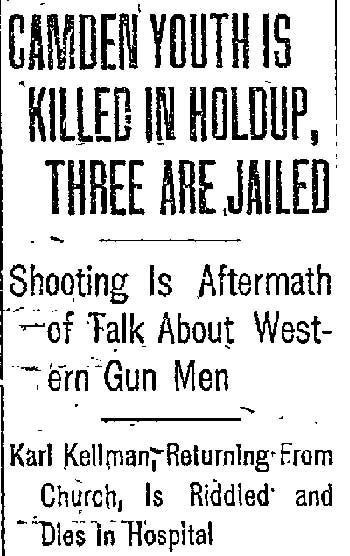
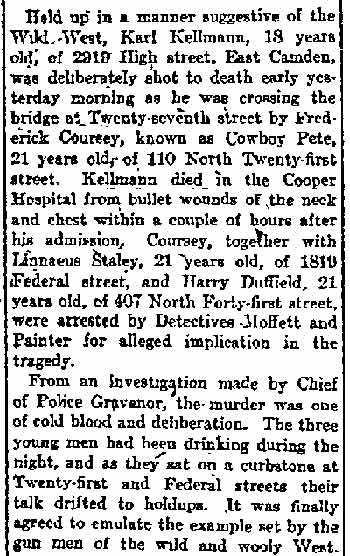
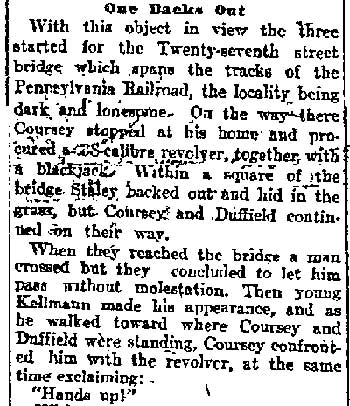
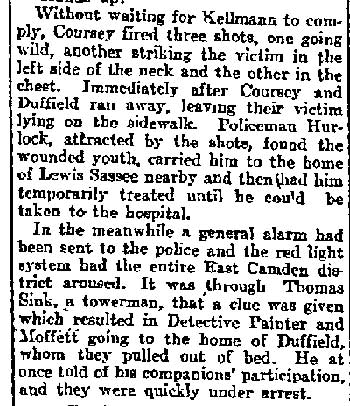
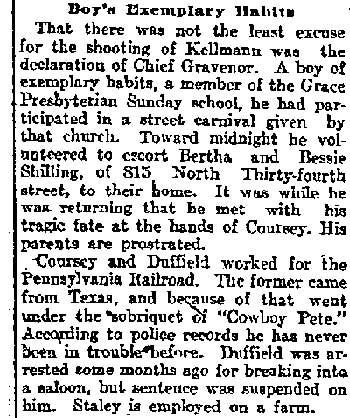
Click images for PDF of complete article. Sub-headlines: “Shooting Is Aftermath of Talk About Western Gun Men” – “Karl Kellman, Returning From Church, Is Riddled and Dies in Hospital”
Haggerty Missed Kellmann’s Fate
Camden Post-Telegram —
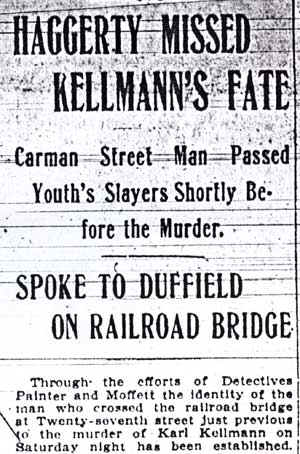
Carman Street Man Passed Youth’s Slayers Shortly Before the Murder.
SPOKE TO DUFFIELD ON RAILROAD BRIDGE
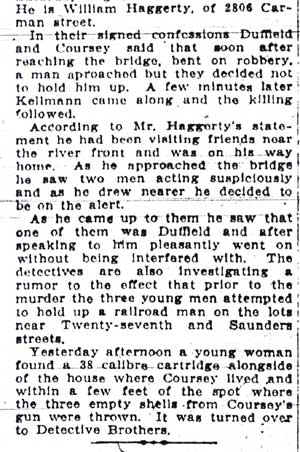
Through the efforts of Detectives Painter and Moffett the identity of the man who crossed the railroad bridge at Twenty-seventh street just previous to the murder of Karl Kellmann on Saturday night has been established.
He is William Haggerty, of 2806 Carman street.
In their signed confessions Duffield and Coursey said that soon after reaching the bridge, bent on robbery, a man approached but they decided not to hold him up. A few minutes later Kellmann came along and the killing followed.
According to Mr. Haggerty’s statement he had been visiting friends near the river front and was on his way home. As he approached the bridge he saw two men acting suspiciously and as he drew nearer he decided to be on the alert.
As he came up to them he saw that one of them was Duffield and after speaking to him pleasantly went on without being interfered with. The detectives are also investigating a rumor to the effect that prior to the murder the three young men attempted to hold up a railroad man on the lots near Twenty-seventh and Saunders streets.
Yesterday afternoon a young woman found a 38 calibre cartridge alongside of the house where Coursey lived and within a few feet of the spot where the three empty shells from Coursey’s gun were thrown. It was turned over to Detective Brothers.
Services To-Night for Slain Youth
Camden Post-Telegram —
All East Side Mourns for Popular Lad Who Was Foully Murdered on Saturday.
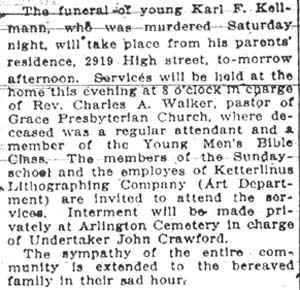
The funeral of young Karl F. Kellmann, who was murdered Saturday night, will take place from his parents’ residence, 2919 High street, to-morrow afternoon. Services will be held at the home this evening at 8 o’clock in charge of Rev. Charles A. Walker, pastor of Grace Presbyterian Church, where deceased was a regular attendant and a member of the Young Men’s Bible Class. The members of the Sunday-school and the employes of Ketterlinus Lithographing Company (Art Department) are invited to attend the services. Interment will be made privately at Arlington Cemetery in charge of Undertaker John Crawford.
The sympathy of the entire community is extended to the bereaved family in their sad hour.
More Witnesses in Kellmann Murder
Camden Post-Telegram —
Police Find Two Other Men Who Met Slayers at the Bridge.
ONE CONVERSED WITH DUFFIELD
Two more important witnesses in the Karl Kellmann murder case, according to Chief of Police Gravenor, were located yesterday by Detectives Painter and Moffett and Policeman Abbott.
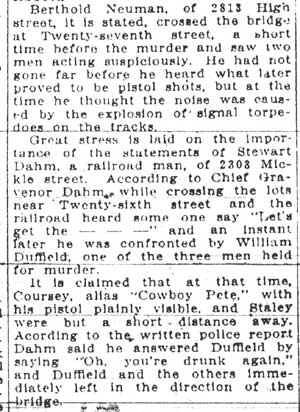
Berthold Neuman, of 2813 High street, it is stated, crossed the bridge at Twenty-seventh street, a short time before the murder and saw two men acting suspiciously. He had not gone far before he heard what later proved to be pistol shots, but at the time he thought the noise was caused by the explosion of signal torpedoes on the tracks.
Great stress is laid on the importance of the statements of Stewart Dahm, a railroad man, of 2303 Mickle street. According to Chief Gravenor, Dahm, while crossing the lots near Twenty-sixth street and the railroad heard some one say “Let’s get the — — —” and an instant later he was confronted by William Duffield, one of the three men held for murder.
It is claimed that at that time, Coursey, alias “Cowboy Pete,” with his pistol plainly visible, and Staley were but a short distance away. According to the written police report Dahm said he answered Duffield by saying “Oh, you’re drunk again,” and Duffield and the others immediately left in the direction of the bridge.
Quickly Indict in Kellmann Murder
Camden Post-Telegram —
Grand Jury To-day Finds True Bill Against Young Prisoners.
ALSO CONSIDERED TOSCANO’S SLAYING
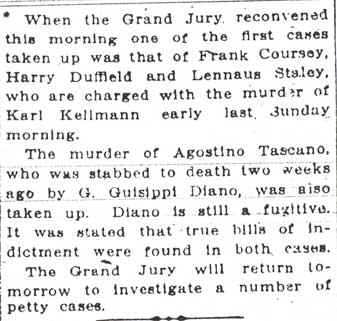
When the Grand Jury reconvened this morning one of the first cases taken up was that of Frank Coursey, Harry Duffield and Lennaus Staley, who are charged with the murder of Karl Kellmann early last Sunday morning.
The murder of Agostino Tascano, who was stabbed to death two weeks ago by G. Guisippi Diano, was also taken up. Diano is still a fugitive. It was stated that true bills of indictment were found in both cases.
The Grand Jury will return tomorrow to investigate a number of petty cases.
No Indictment Against Staley
Camden Post-Telegram —
Duffield and Coursey Named in the True Bill Found in Kellmann Murder.
FUGITIVE RIANO IS ALSO INDICTED
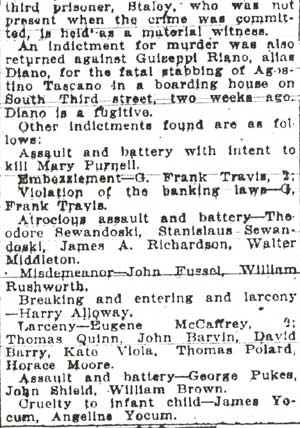
Two of the three prisoners—Coursey and Duffield—are named in the true bills for the murder of Karl Kellmann filed by the Grand Jury to-day. The third prisoner, Staley, who was not present when the crime was committed, is held as a material witness.
An indictment for murder was also returned against Guiseppi Riano, alias Diano, for the fatal stabbing of Agostino Toscano in a boarding house on South Third street, two weeks ago. Diano is a fugitive.
Other indictments found are as follows:
Assault and battery with intent to kill Mary Purnell.
Embezzlement—G. Frank Travis, 2; Violation of the banking laws—G. Frank Travis.
Atrocious assault and battery—Theodore Sewandoski, Stanislaus Sewandoski, James A. Richardson, Walter Middleton.
Misdemeanor—John Fussel, William Rushworth.
Breaking and entering and larceny—Harry Alloway.
Larceny—Eugene McCaffrey, 2; Thomas Quinn, John Baryin, David Barry, Kate Viola, Thomas Polard, Horace Moore.
Assault and battery—George Pukes, John Shield, William Brown.
Cruelty to infant child—James Yocum, Angelina Yocum.
No Indictment Against Staley
Philadelphia Inquirer —
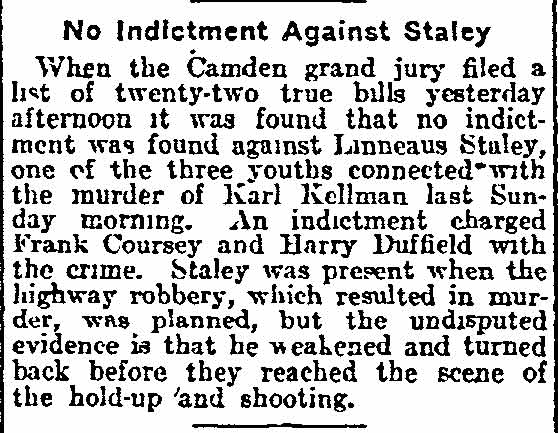
When the Camden grand jury filed a list of twenty-two true bills yesterday afternoon it was found that no indictment was found against Linneaus Staley, one of the three youths connected with the murder of Karl Kellman last Sunday morning. An indictment charged Frank Coursey and Harry Duffield with the crime. Staley was present when the highway robbery, which resulted in murder, was planned, but the undisputed evidence is that he weakened and turned back before they reached the scene of the hold-up and shooting.
Coursey in Dread of Electric Chair
Camden Post-Telegram —
Brutal Murderer of Carl Kellmann on Verge of Complete Collapse.
HARRY DUFFIELD, TOO, IS NEAR BREAK DOWN
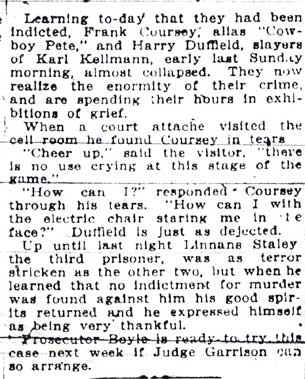
Learning to-day that they had been indicted, Frank Coursey, alias “Cowboy Pete,” and Harry Duffield, slayers of Karl Kellmann, early last Sunday morning, almost collapsed. They now realize the enormity of their crime, and are spending their hours in exhibitions of grief.
When a court attaché visited the cell room he found Coursey in tears. “Cheer up,” said the visitor, “there is no use crying at this stage of the game.”
“How can I?” responded Coursey through his tears. “How can I with the electric chair staring me in the face?” Duffield is just as dejected.
Up until last night Linnans Staley the third prisoner, was as terror stricken as the other two, but when he learned that no indictment for murder was found against him his good spirits returned and he expressed himself as being very thankful.
Prosecutor Boyle is ready to try this case next week if Judge Garrison can so arrange.
Arlington Cemetery
Pennsauken, New Jersey
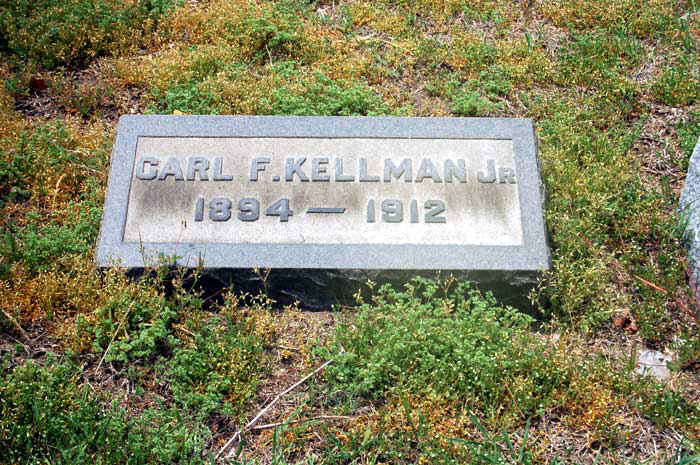
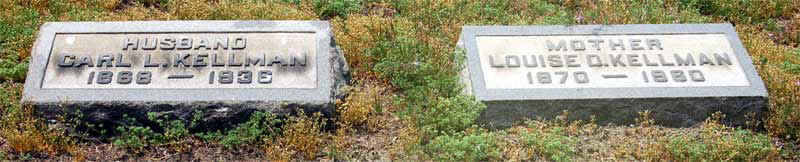
The grave of Carl Kellman and those of his parents. Arlington Cemetery, Pennsauken, New Jersey.