Introduction
FRANK STRINGER ALBRIGHT was born on August 18, 1878 in New Jersey to Lewis and Margaret Albright. His early years were spent in Gloucester City where his father appears to have been the proprietor of a newspaper in 1880. Lewis Albright relocated to Camden in late 1889 or early 1890, first settling at 603 Clinton Street. The family lived at 448 Broadway at the time of the 1900 Census. There were two younger siblings, Lewis and Lillian, then at home, an older brother, William, having passed away. By 1900 Frank S. Albright had already gone into journalism, and was working as a reporter. Shortly after the census was taken, he married Anna Scheperkotter.
On November 22, 1903 Judge Charles G. Garrison appointed Frank S. Albright to the eleven person court jury charged with witnessing the execution of murderer Paul Woodward, on January 7, 1903. The execution was carried out as scheduled.
Frank and Anna Albright were living at 637 Pine Street when the 1906 City Directory was compiled. A journalist by trade, he was living at 569 Berkley Street with his wife Anna and a daughter, also named Anna, at the time of the 1910 Census. He had stepped away from newspapers for a time; in the mid-1910s he became secretary to then Mayor Charles H. Ellis. When the 1914 Camden City Directory was compiled the Albrights lived at 1455 Baird Avenue in Camden’s then-new Parkside neighborhood. They remained at that address through at least 1929.
Frank Albright was an editor with the Camden Post-Telegram when he registered for the draft in 1917. When the Post-Telegram was sold to the Camden Courier, and became the Courier-Post, Frank Albright, a staunch Republican and an ally of Camden Republican leader David Baird Jr., returned to Camden city government. Frank S. Albright was serving as City Publicity Agent in Camden in January of 1928. He later served as Deputy City Clerk under William D. Brown in the 1920s and early 1930s, whom he succeeded.
In November of 1927 Mayor Winfield S. Price appointed a committee to arrange for the observance in February 1928 of the One Hundredth Anniversary of the City of Camden. The committee was composed of Charles S. Boyer, Chairman; t. yorke smith, E.G.C. Bleakly, Mahlon F. Ivins Jr., Fred S. Caperoon and Frank S. Albright.
By May of 1933 he had been promoted to City Clerk. Frank S. Albright died in April of 1935 while still in office, and was succeeded by his deputy, Otto E. Braun.
The Crescent Wheelmen
Philadelphia Inquirer —
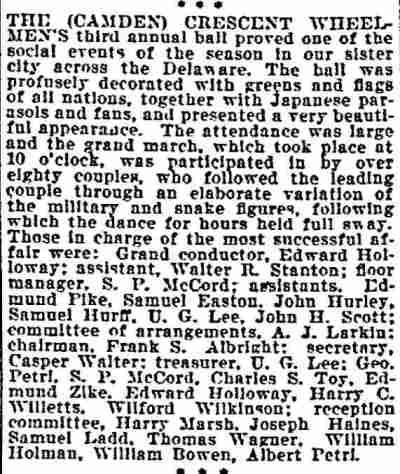
THE (CAMDEN) CRESCENT WHEELMEN’S third annual ball proved one of the social events of the season in our sister city across the Delaware. The ball was profusely decorated with greens and flags of all nations, together with Japanese parasols and fans, and presented a very beautiful appearance. The attendance was large and the grand march, which took place at 10 o’clock, was participated in by over eighty couples, who followed the leading couple through an elaborate variation of the military and snake figures, following which the dance for hours held full sway. Those in charge of the most successful affair were: Grand conductor, Edward Holloway; assistant, Walter R. Stanton; floor manager, S. P. McCord; assistants, Edmund Pike, Samuel Easton, John Hurley, Samuel Hurff, U. G. Lee, John H. Scott; committee of arrangements, A. J. Larkin; chairman, Frank S. Albright; secretary, Casper Walter; treasurer, U. G. Lee; Geo. Petri, S. P. McCord, Charles S. Toy, Edmund Zike, Edward Holloway, Harry C. Willetts, Wilford Wilkinson; reception committee, Harry Marsh, Joseph Haines, Samuel Ladd, Thomas Wagner, William Holman, William Bowen, Albert Petri.
Woodward to Go to Gallows on January 7
Philadelphia Inquirer —
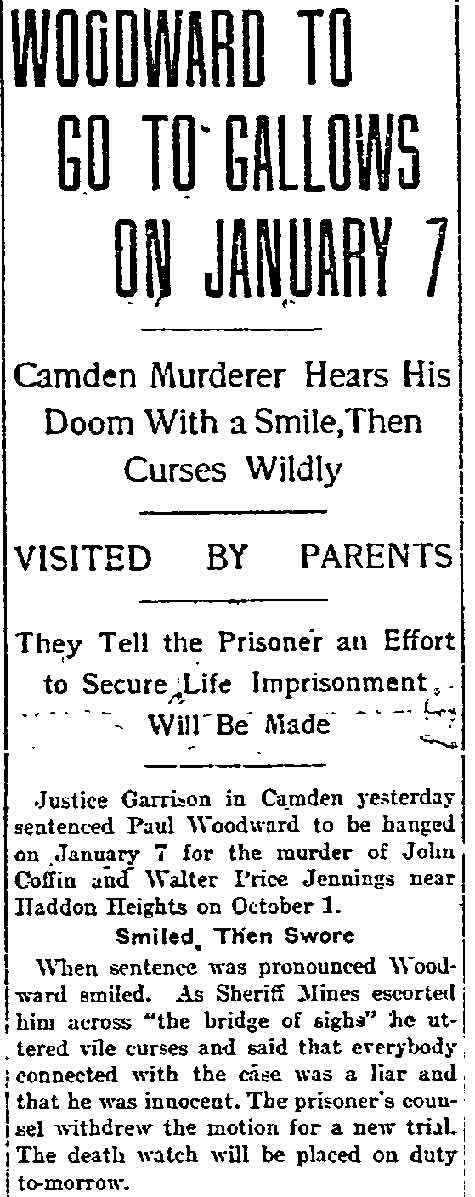
Camden Murderer Hears His Doom With a Smile, Then Curses Wildly
VISITED BY PARENTS
They Tell the Prisoner an Effort to Secure Life Imprisonment Will Be Made
Justice Garrison in Camden yesterday sentenced Paul Woodward to be hanged on January 7 for the murder of John Coffin and Walter Price Jennings near Haddon Heights on October 1.
Smiled, Then Swore
When sentence was pronounced Woodward smiled. As Sheriff Mines escorted him across “the bridge of sighs” he uttered vile curses and said that everybody connected with the case was a liar and that he was innocent. The prisoner’s counsel withdrew the motion for a new trial. The death watch will be placed on duty to-morrow.
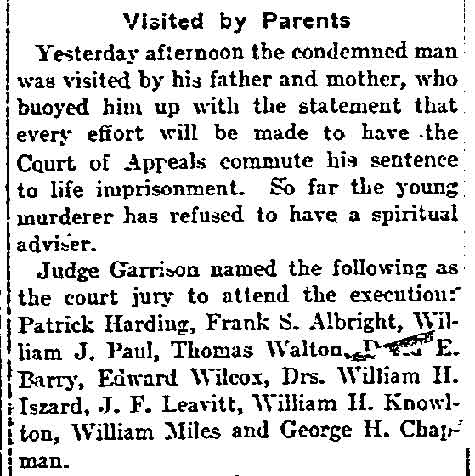
Visited by Parents
Yesterday afternoon the condemned man was visited by his father and mother, who buoyed him up with the statement that every effort will be made to have the Court of Appeals commute his sentence to life imprisonment. So far the young murderer has refused to have a spiritual adviser.
Judge Garrison named the following as the court jury to attend the execution: Patrick Harding, Frank S. Albright, William J. Paul, Thomas Walton, D[avid] E. Barry, Edward Wilcox, Drs. William H. Iszard, J. F. Leavitt, William H. Knowlton, William Miles and George H. Chapman.
Ill Luck Defied by Maze of Thirteens
Philadelphia Inquirer —
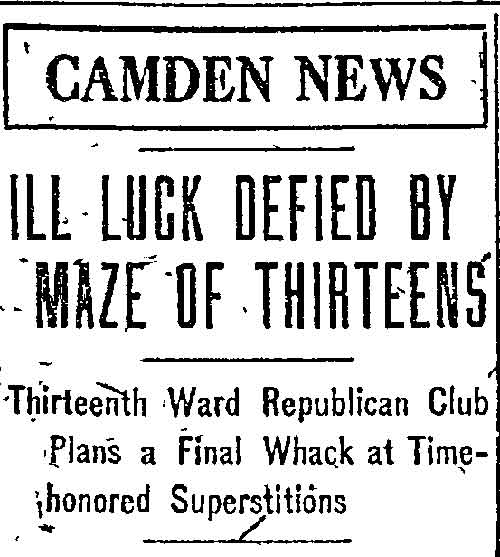
CAMDEN NEWS
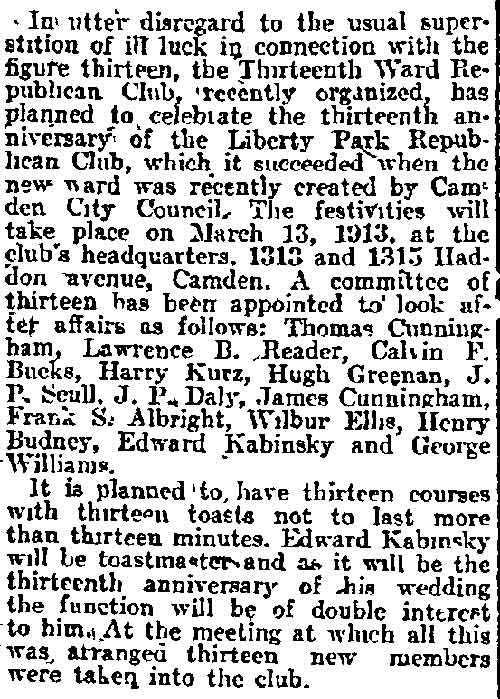
ILL LUCK DEFIED BY MAZE OF THIRTEENS
Thirteenth Ward Republican Club Plans a Final Whack at Time-honored Superstitions
In utter disregard to the usual superstition of ill luck in connection with the figure thirteen, the Thirteenth Ward Republican Club, recently organized, has planned to celebrate the thirteenth anniversary of the Liberty Park Republican Club, which it succeeded when the new ward was recently created by Camden City Council. The festivities will take place on March 13, 1913, at the club’s headquarters, 1313 and 1315 Haddon avenue, Camden. A committee of thirteen has been appointed to look after affairs as follows: Thomas Cunningham, Lawrence B. Reader, Calvin F. Bucks, Harry Kurz, Hugh Greenan, J. P. Scull, J. P. Daly, James Cunningham, Frank S. Albright, Wilbur Ellis, Henry Budney, Edward Kabinsky and George Williams. It is planned to have thirteen courses with thirteen toasts not to last more than thirteen minutes. Edward Kabinsky will be toastmaster and as it will be the thirteenth anniversary of his wedding the function will be of double interest to him. At the meeting at which all this was arranged thirteen new members were taken into the club.
Camden Elks Honor Dead Members
Philadelphia Inquirer —
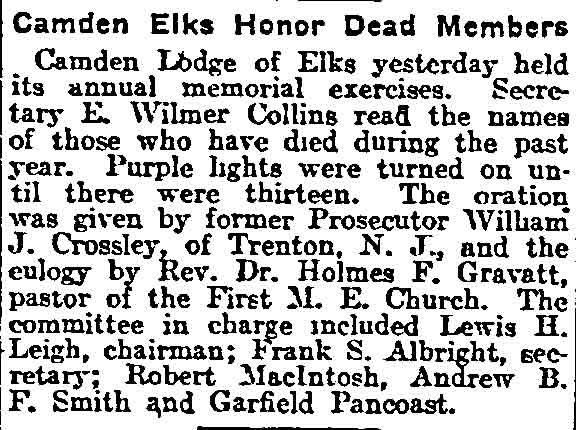
Camden Lodge of Elks yesterday held its annual memorial exercises. Secretary E. Wilmer Collins read the names of those who have died during the past year. Purple lights were turned on until there were thirteen. The oration was given by former Prosecutor William J. Crossley, of Trenton, N. J., and the eulogy by Rev. Dr. Holmes F. Gravatt, pastor of the First M. E. Church. The committee in charge included Lewis H. Leigh, chairman; Frank S. Albright, secretary; Robert MacIntosh, Andrew B. F. Smith and Garfield Pancoast.
World War I Draft Card
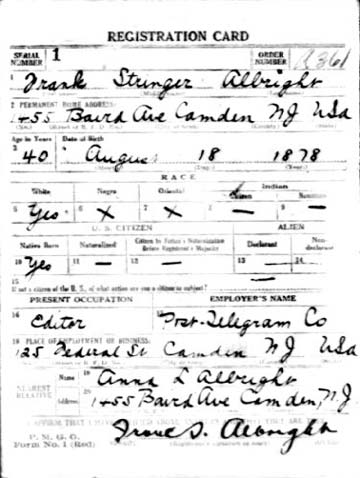
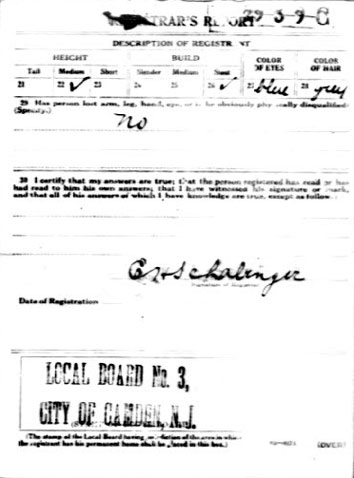
World War I Draft Registration Card for Frank Stringer Albright, 455 Baird Avenue, Camden; Editor, Post-Telegram Co.; Local Board No. 3, City of Camden, N.J.
Camden Elks Honor Dead Members
Philadelphia Inquirer —
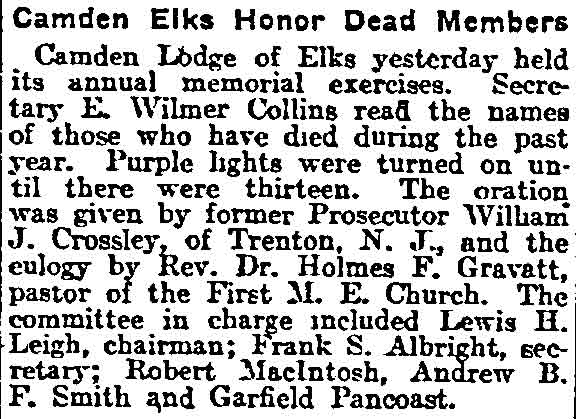
Camden Lodge of Elks yesterday held its annual memorial exercises. Secretary E. Wilmer Collins read the names of those who have died during the past year. Purple lights were turned on until there were thirteen. The oration was given by former Prosecutor William J. Crossley, of Trenton, N. J., and the eulogy by Rev. Dr. Holmes F. Gravatt, pastor of the First M. E. Church. The committee in charge included Lewis H. Leigh, chairman; Frank S. Albright, secretary; Robert MacIntosh, Andrew B. F. Smith and Garfield Pancoast.
Sayrs in Hospital, Diphtheria Victim
Camden Courier-Post —
Commissioner Stricken After Attending Opening of Legislature
Commissioner William D. Sayrs, Jr., director of public works, has been stricken with diphtheria and is a patient at the Municipal Hospital, it was learned today.
Hospital authorities this morning said Commissioner Sayrs was admitted to the institution yesterday. He is suffering from a “mild case of diphtheria,” they said, and is under the care of Dr. Joseph C. Lovett.
Unless complications should arise, the public works director will leave the hospital in two weeks physicians report. His condition today was termed “good.”
Sayrs entered the hospital after he had consulted with his physician, Dr. Levi Hint, according to Frank S. Albright, city publicity agent. The commissioner began feeling ill Tuesday, Albright said, when he attended the opening session of the legislature at Trenton.
Albright said Sayrs is directing the work of his department from his bedside at the institution. A phone has been installed at the bedside and the commissioner, Albright explained, is able to keep in touch with the various members of his department throughout the day.
Fellow commissioners remarked on the absence of Commissioner Sayrs from the city commission meeting yesterday, but could give no reason for it, they said.
At the office of Commissioner Sayrs this morning, it was reported that the director was “merely suffering from a slight cold.”
G.O.P. Is Charged With ‘Crookedness’
Camden Courier-Post —
Baird Supporters Resorting to Contemptible Tactics, Miss Kelly Says
“Realizing the utter futility of their efforts to elect David Baird to the governorship, the Republican party in Camden County is resorting to every contemptible means at its command to intimidate the voters.”
This declaration was made last night by Miss Marie V. Kelly, former jury commissioner, at a meeting of 200 voters in the Fourth Ward Democratic Club, 455 Berkley Street.
“At a meeting of election officers,” Miss Kelly said, “William E. A. King, a member of the county board of elections sworn to preserve the sanctity of the ballot box, told these officers that the Republican party has promised Baird a 50,000 majority in Camden County and that they were to get the votes no matter how they got them and that they would be protected. He told them if the Democrats interfered that the Republican police would take care of the Democrats.
“Today Major Dickinson, deputy director of public safety, raised a false howl of gunmen to come here to make a rough house of the city. We know that this is weak propaganda to cover what the Republicans intend to do.”
Points to Murder
“Mr. Dickinson has evidently forgotten the murder committed at Third and Benson Streets on the eve of the city election in May by gunmen imported by the Republican workers to intimidate the voters of that ward—gunmen who remain uncaught and unpunished to this day.
“The most flagrant act on the part of the Republican Party is the removal of the polling place yesterday from the fourth district of the fourth ward from the E. A. Stevens School on Fourth Street to a private residence on Berkley Street. The polling place has been in the school for a number of years and no complaints had been made by Democratic members of the elections board. This change has been made without a meeting of the county elections board.”
“Frank Albright, city clerk, took it upon himself to make the change, basing his action on the statement the school was totally unfit for the board to sit in for a day to conduct the business of election.”
‘Refreshment’ Cited
“However, school children are forced to use this building every day of the school year. The residence to which the polling place has been transferred was reconditioned so that it could be used. The real reason for this change was that it will be much easier to dispense liquid refreshment in a private home than in a public school.
“It is a fine state of affairs when the people are called on to build a $10,000,000 city hall within six blocks of a school where children are forced to occupy a school which the city clerk says is in a horrible condition and totally unfit for use.
“I urge the people in the third and fourth wards of Camden to rise in revolt against the Republican organization that is trying by every means to prevent an honest exercise of the franchise at the polls on Tuesday. The protest must be registered by marking every blank on the ballot under the Democratic column.”
The Young Syndicate
Camden Courier-Post —
FROM AN OLD DIRECTORY
‘Coop’ Carman and Willard Morgan Led Movement for New Blood in G.O.P. Culminating in Bitter Battles of Race Track Days
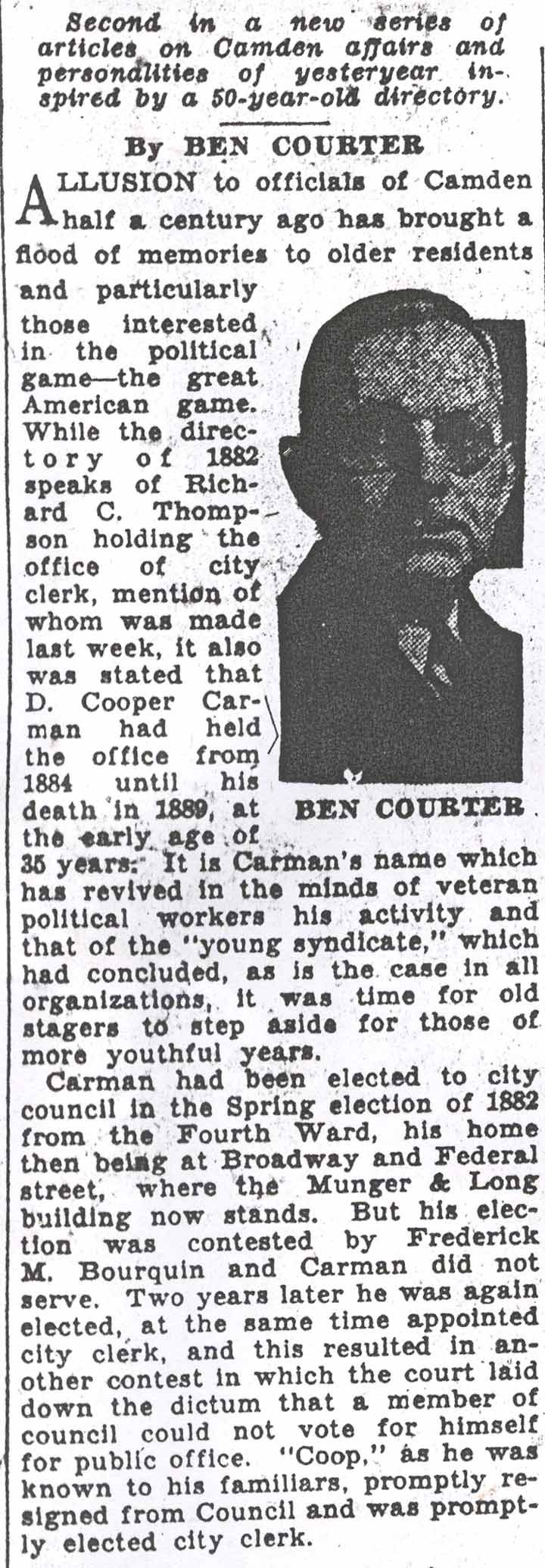
Second in a new series of articles on Camden affairs and personalities of yesteryear inspired by a 50-year-old directory.
By BEN COURTER
Allusion to officials of Camden half a century ago has brought a flood of memories to older residents and particularly those interested in the political game—the great American game. While the directory of 1882 speaks of Richard C. Thompson holding the office of city clerk, mention of whom was made last week, it also was stated that D. Cooper Carman had held the office from 1884 until his death in 1889, at the early age of 35 years. It is Carman’s name which has revived in the minds of veteran political workers his activity and that of the “young syndicate,” which had concluded, as is the case in all organizations, it was time for old stagers to step aside for those of more youthful years.
BEN COURTER
Carman had been elected to city council in the Spring election of 1882 from the Fourth Ward, his home then being at Broadway and Federal street, where the Munger & Long building now stands. But his election was contested by Frederick M. Bourquin and Carman did not serve. Two years later he was again elected, at the same time appointed city clerk, and this resulted in another contest in which the court laid down the dictum that a member of council could not vote for himself for public office. “Coop,” as he was known to his familiars, promptly resigned from Council and was promptly elected city clerk.
The ‘Young Syndicate’
With Carman, as former City Clerk William D. Brown recalls, was associated J. Willard Morgan and Henry M. Snyder, something of a balance between the two.
That combination carried things along pretty much as they pleased for a time and as one of the developments Maurice A. Rogers, down in the Fifth Ward and a councilman, was taken up as a Senatorial candidate against Colonel George Pfeiffer, Jr., a decade later to be the builder of Camden’s artesian water plant. The colonel, long one of Camden’s most popular men, had defeated the Republicans as a result of the factional fight between Henry L. Bonsall, editor of the Post, and Thomas Dudley, famed consul to Liverpool during Civil War days. But with the “young syndicate” back of him, Rogers won the Senate seat in 1890, taking his office January 1, 1891.
But in the meanwhile Carman suddenly died at his mother’s home, at 11.10 on the night of September 11, 1889. At the time apoplexy was given as the cause. His sudden demise caused a profound shock and at his funeral four days later leaders in business and politics paid homage, with such men as Gen. William J. Sewell, Sinnickson Chew, Howard Carrow, Wilson Jenkins, E. A. Armstrong, B. M. Braker and many others attending. The bell in the old City Hall tower tolled as the cortege passed on the way to old Camden cemetery. And even yet, after these more than four decades, “Coop” Carman is quite vividly recalled by those who were then active on the political stage.
Carman’s Death Big Loss
Carman’s death was a big loss to the “young syndicate,” but it did not halt its activity. Since Rogers had won so easily in the 1890 election it was concluded there would be nothing to it when he was renominated for another two-year term. Rogers was by no means friendly to “Billy” Thompson’s race track, then in the heyday of its popularity with the sports of Gloucester City, a period when that community had all the earmarks of a wild and wooly western city, attractive to thousands of lovers of horseflesh, touts, gamblers and the usual hangers-on.
Thompson concluded it would be far better to have someone in the Senate from Camden county who would regard his interests with more favor than Rogers.
Thus he decided on Frederick A. Rex, his personal counsel, a very able young attorney, and a Republican. Since at that time the Democratic police commission was in control of the cops it was considered easy to get possession of the polls. As Brown recalls it, the rivals of Rogers planned a “zero hour” at which cops, at the crack of a pistol, were to descend on polls considered close at the primaries, frighten off the regular voters and corral enough to elect Rex.
Particular effort was to be made to sweep the Sixth Ward, where Thad Varney, elected city clerk to succeed Carman, was “boss,” and thus give him a political black eye. In Varney’s precinct in particular when the rumpus started “Brockie” Deno and “Al” Haydon, both widely known firemen now dead, grabbed the ballot box, lowered it down a chimney, fished it out when the racket was passed, went to Avis’ livery stable, and later to Varney’s home, where the votes were counted. In these sophisticated days such counting would unquestionably not be considered “according to Hoyle,” but then anything went just so the particular faction had its bag of tricks in effective operation. Anyhow, Rogers won the primaries, but there still was the general election to hurdle and Thompson was by no means beaten. He had plenty of money and many followers, some sincere, many just sycophants.
Repeaters Foiled
It was charged a scheme was on foot to bring repeaters from Philadelphia, not an unusual procedure in the political game of Camden years ago in either party. One of the “young syndicate’s” lieutenants learned the plot, told General Sewell, who sent the informant to Dave Martin, then Philadelphia’s political boss, who heard the story. The upshot was General Sewell himself saw Martin later, who was quite willing to aid Jersey’s G.O.P. leader, flooded Camden with sleuths from over the river and such close tabs were kept on the repeating army its efforts were halted from the very dawn of that very stirring election day. Rogers was elected, was made president of the Senate and for a time loomed so large on Jersey’s political horizon he had gubernatorial aspirations, but they never were realized.
Thus out of the old yellowed book Frank Albright, city clerk of the present epoch, dug from the archives memories are revived of a very gallant young politician, “Coop” Carman, and some of the stirring incidents that make up Camden’s political history. The “young syndicate” was just one of the episodes, as the first “reform” outbreak in 1882, or the Committee of 100 scrap of 1897, or the Non-Partisan upheaval of ‘23, but such never lose interest to those who have joined those movements with enthusiasm, even though they were often not altogether satisfied with what had been accomplished.
Frequent Battles for City Clerk
Camden Courier-Post —
FROM AN OLD CITY DIRECTORY
Yellowed Volume of Half Century Ago Revives Memory of Bradshaw Regime, Persistency of Squire Fred Tarr to Land Clerkship and Treasurer Michellon
(Another in a series of articles on Camden affairs and personalities of yesteryear.)
By BEN COURTER
AN OLD city directory is seemingly lacking in inspiration, at least to one who may casually turn the yellowing pages. There is but the interminable list of names, addresses and occupations, of “ads” of business and industrial enterprises, most of which have been forgotten long since, some few surviving, fewer still going strong, having developed into concerns known nationally.
BEN COURTER
Sometime since City Clerk Frank S. Albright dug up from the archives such a directory, not too old to be interesting to many who have resided here through many years. It was published just half a century ago and contains approximately 15,000 names, the great majority of whom must necessarily have passed the Great Divide. Evidently it did not list Camden’s entire population of that period for the census of 1880 gives a total of 41,659, but in that comparatively far off day, far off at least to the present younger generation, heads of households were given without the names of wives, if they happened to be married. It is likewise evident that those who gathered the data skipped many a house so that the whole population of Camden is by no means represented.
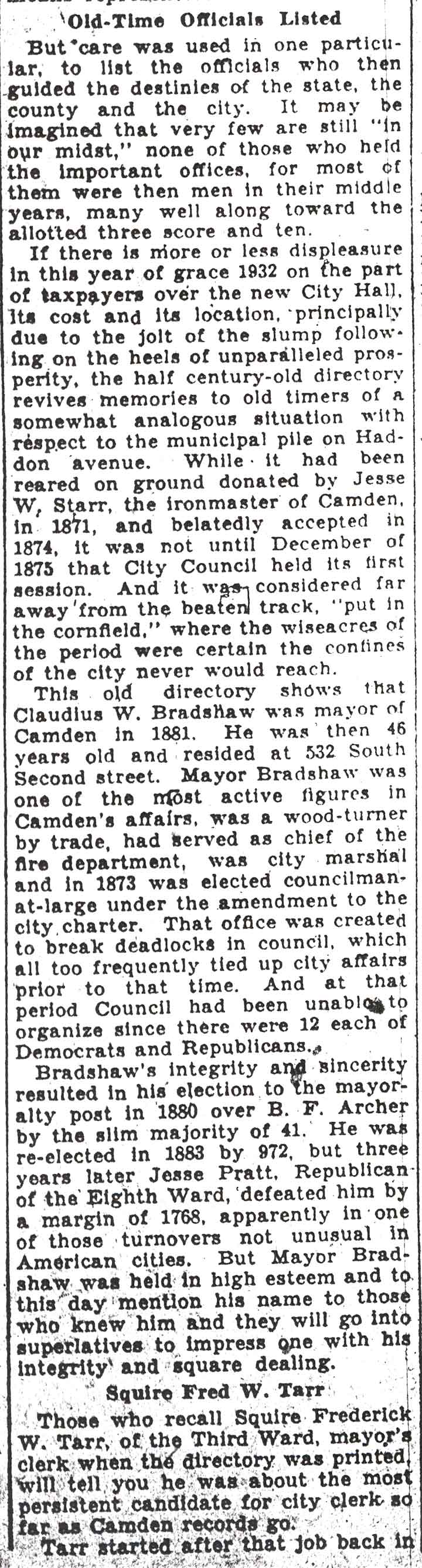
Old-Time Officials Listed
But care was used in one particular, to list the officials who then guided the destinies of the state, the county and the city. It may be imagined that very few are still “in our midst,” none of those who held the important offices, for most of them were then men in their middle years, many well along toward the allotted three score and ten.
If there is more or less displeasure in this year of grace 1932 on the part of taxpayers over the new City Hall, its cost and its location, principally due to the jolt of the slump following on the heels of unparalleled prosperity, the half century-old directory revives memories to old timers of a somewhat analogous situation with respect to the municipal pile on Haddon avenue. While it had been reared on ground donated by Jesse W. Starr, the ironmaster of Camden, in 1871, and belatedly accepted in 1874, it was not until December of 1875 that City Council held its first session. And it was considered far away from the beaten track, “put in the cornfield,” where the wiseacres of the period were certain the confines of the city never would reach.
This old directory shows that Claudius W. Bradshaw was mayor of Camden in 1881. He was then 46 years old and resided at 532 South Second street. Mayor Bradshaw was one of the most active figures in Camden’s affairs, was a wood-turner by trade, had served as chief of the fire department, was city marshal and in 1873 was elected councilman-at-large under the amendment to the city charter. That office was created to break deadlocks in council, which all too frequently tied up city affairs prior to that time. And at that period Council had been unable to organize since there were 12 each of Democrats and Republicans.
Bradshaw’s integrity and sincerity resulted in his election to the mayoralty post in 1880 over B. F. Archer by the slim majority of 41. He was re-elected in 1883 by 972, but three years later Jesse Pratt, Republican of the Eighth Ward, defeated him by a margin of 1768, apparently in one of those turnovers not unusual in American cities. But Mayor Bradshaw was held in high esteem and to this day mention his name to those who knew him and they will go into superlatives to impress one with his integrity and square dealing.
Squire Fred W. Tarr
Those who recall Squire Frederick W. Tarr, of the Third Ward, mayor’s clerk when the directory was printed, will tell you he was about the most persistent candidate for city clerk so far as Camden records go.
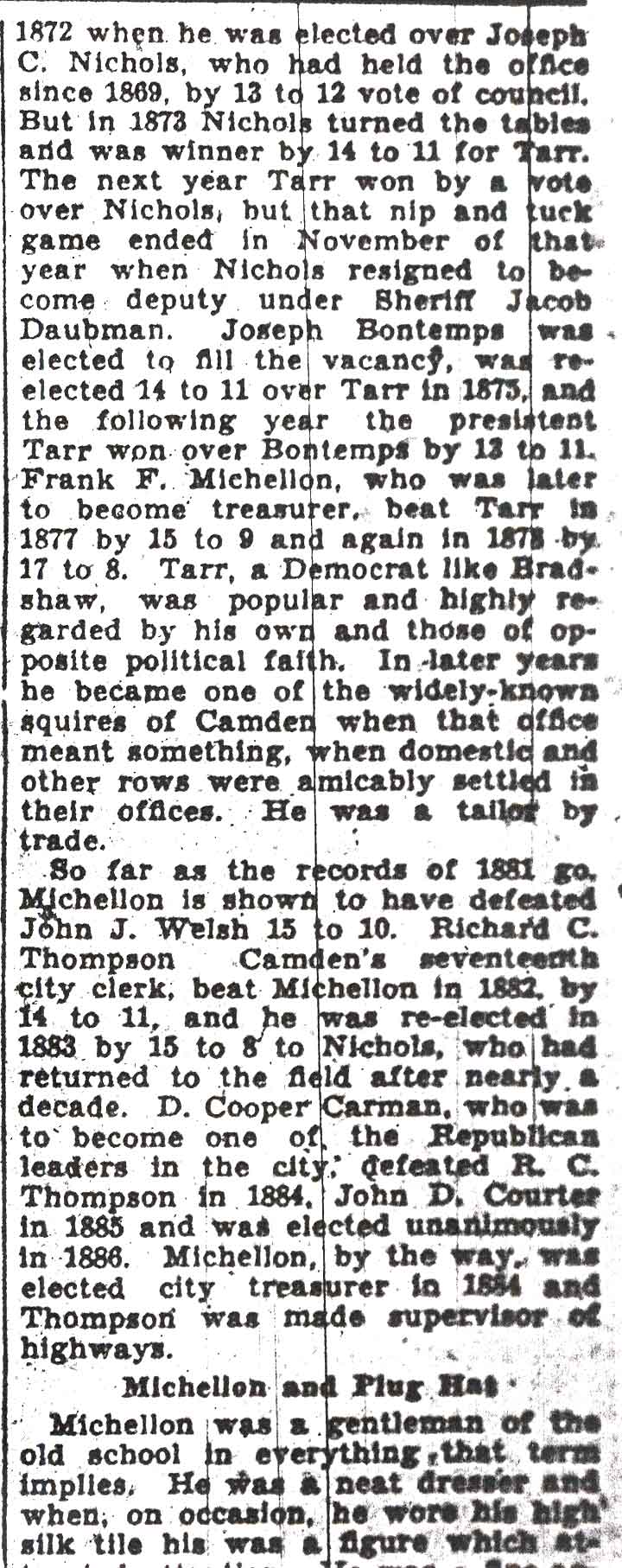
Tarr started after that job back in 1872 when he was elected over Joseph C. Nichols, who had held the office since 1869, by 13 to 12 vote of council. But in 1873 Nichols turned the tables and was winner by 14 to 11 for Tarr. The next year Tarr won by a vote over Nichols, but that nip and tuck game ended in November of that year when Nichols resigned to become deputy under Sheriff Jacob Daubman. Joseph Bontemps was elected to fill the vacancy, was re-elected 14 to 11 over Tarr in 1873, and the following year the presistent Tarr won over Bontemps by 13 to 11. Frank F. Michellon, who was later to become treasurer, beat Tarr in 1877 by 15 to 9 and again in 1878 by 17 to 8. Tarr, a Democrat like Bradshaw, was popular and highly regarded by his own and those of opposite political faith. In later years he became one of the widely-known squires of Camden when that office meant something, when domestic and other rows were amicably settled in their offices. He was a tailor by trade.
So far as the records of 1881 go, Michellon is shown to have defeated John J. Welsh 15 to 10. Richard C. Thompson, Camden’s seventeenth city clerk, beat Michellon in 1882, by 14 to 11, and he was re-elected in 1883 by 15 to 8 to Nichols, who had returned to the field after nearly a decade. D. Cooper Carman, who was to become one of the Republican leaders in the city, defeated R. C. Thompson in 1884, John D. Courter in 1885 and was elected unanimously in 1886. Michellon, by the way, was elected city treasurer in 1884 and Thompson was made supervisor of highways.
Michellon and Plug Hat
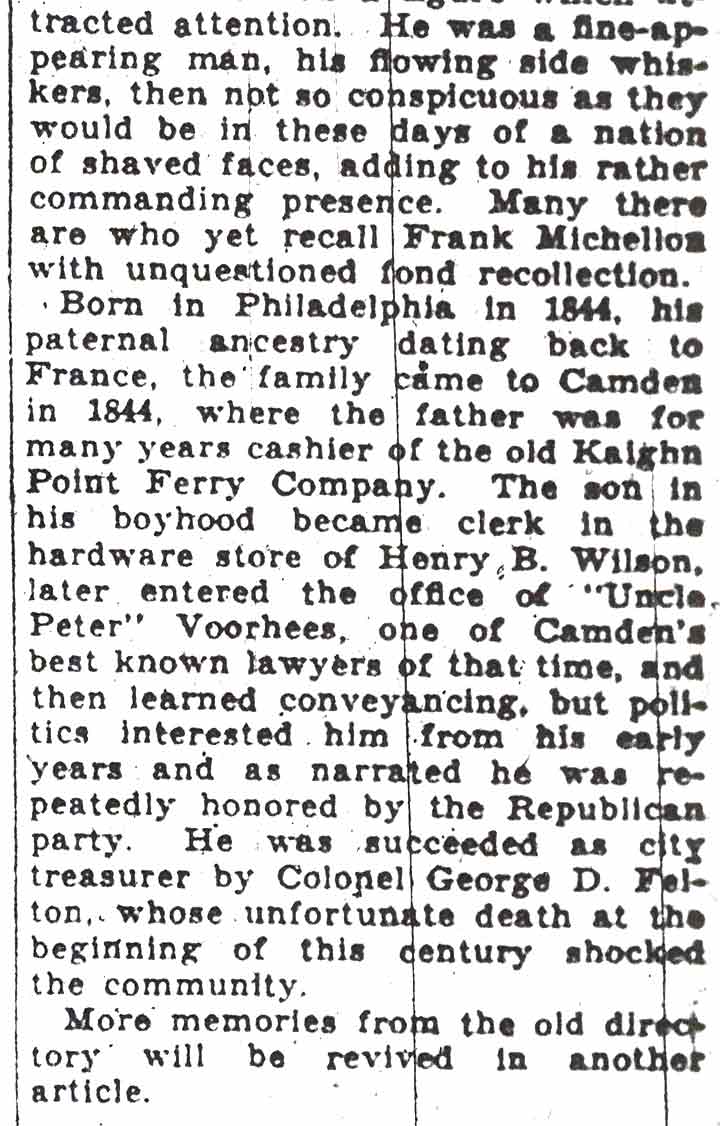
Michellon was a gentleman of the old school in everything that term implies. He was a neat dresser and when, on occasion, he wore his high silk tile his was a figure which attracted attention. He was a fine-appearing man, his flowing side whiskers, then not so conspicuous as they would be in these days of a nation of shaved faces, adding to his rather commanding presence. Many there are who yet recall Frank Michellon with unquestioned fond recollection.
Born in Philadelphia in 1844, his paternal ancestry dating back to France, the family came to Camden in 1844, where the father was for many years cashier of the old Kaighn Point Ferry Company. The son in his boyhood became clerk in the hardware store of Henry B. Wilson, later entered the office of “Uncle Peter” Voorhees, one of Camden’s best known lawyers of that time, and then learned conveyancing, but politics interested him from his early years and as narrated he was repeatedly honored by the Republican party. He was succeeded as city treasurer by Colonel George D. Felton, whose unfortunate death at the beginning of this century shocked the community.
More memories from the old directory will be revived in another article.
City Clerks of Long Ago
Camden Courier-Post —
FROM AN OLD DIRECTORY
Old Records at Hall Show Men Prominent in Camden Affairs Eager to Hold Job—Publisher First Elected by Council in 1828
(This is the third of a new series on Camden personalities and affairs of yesteryear as inspired by a city directory of half century ago.)
By BEN COURTER
IF Camden’s early city clerks returned in the flesh they would be altogether flabbergasted should they visit that office as it is now operated in the tall white building which overshadows the more beautiful, more classic court house. The indexing, cross-indexing and thoroughly modern methods necessary for any large corporation, public or private, would surely be a revelation, but like as not, as all ghosts of the past would say, “the old times were better,” even though it were not necessary to compile shelves and shelves of records.
BEN COURTER
The early clerks, even though they may have regarded themselves “some punkins” in the community, by reason of holding a sort of a municipal secretarial job, were not given to bothering much about filing and compiling and congesting whatever small space they must have had in the city hall, which once graced the spot where Public Service now has its office, with records.
Since something has been said of the city clerks just before and after the period of the old directory of 1882, there has been a request that municipal archives be delved into further before this subject is passed. There is in City Clerk Frank Albright’s office the first minute book of Council, somewhat yellowed but still in good shape and the handwritings of the men who “clerked” the municipal body legible as the day the minutes were written.
Ellis First City Clerk
Samuel Ellis, printer and publisher of the American Star, was evidently the first to hold that position, since his name is attached to some of the minutes while others do not bear any signature. Ellis was a former schoolmaster and his paper was a Whig organ first issued April 17, 1821.
He changed the name to “American Star and Rural Record” on December 29, 1824, and was still owner with his brother, Charles H. Ellis, in 1830, for whom former Mayor and now Postmaster Ellis was named. Ellis acted as clerk from March 13, 1828, until the Autumn following when William H. Butler, a cabinet maker, was elected in March, 1829, and he served until November, 1830, when he was succeeded by Thomas Green, and he by Samuel Miller, who continued in office until August, 1831.
One of Camden’s leading Whigs was elected by Council as Miller’s successor on March 15, 1832, and he served until June 29, 1843. He was another early Camden journalist, being associated with John Wollohan in publishing a Whig newspaper while roundly lambasted their political foes. Thomas H. Dudley, of whom frequent mention has been made in these annals as consul to Liverpool and one of the city’s leading men for many a year, succeeded Harrison and served as clerk until March, 1844. It was Dudley who prepared the city charter of 1851 and later served as city solicitor and treasurer. When he was elected clerk he was a young lawyer and an active Whig and, when the Republican party was formed in 1856, became one of the leaders.
Thomas Mulford, who succeeded Dudley in 1844, also was a lawyer, but an active Democrat. He was elected to the State Senate in 1851 and was a Democratic candidate for Congress in 1854 against Clawson, Whig and Native American, and Hazelton, Independent. Whigs were still strong here then and Clawson won. He was county prosecutor from that year until 1859 and old records show he filled that job ably enough to win even the favor of his political opponents.
Judge Alfred Hugg
In 1850, when Mulford’s term as clerk expired, his brother, Philip, likewise a lawyer, sought the job, but was defeated by Alfred Hugg, who was later to hold twice the position as city solicitor and also a Common Pleas Court judgeship. Judge Hugg still is recalled as a mighty peppy gentleman of many years, with long flowing white beard, as boon companion about the festive board, and possessed of marvelous vitality for one of his age. Nor did disease or decay spell the end, for it was escaping gas in his apartment which caused his death.
Hugg was a Democrat and he was defeated for re-election as clerk by Joseph Myers, an American, in March, 1851, by a vote of 9 to 6 in Council. Myers was quite popular so much so that he was his party’s candidate for mayor in 1854 but was defeated. He was elected county clerk in 1857, dying before the expiration of his term. He served as city clerk until 1856, when Hugg again was elected by a 10 to 8 vote, but lost the next year to William J. Miller by 11 to 6. In 1858 Alexander H. Hammell got the job by 10 to 8. Samuel W. Thoman, a Republican-American, was victor over Hammell the next year. He was one of the most popular of city clerks and in 1860 was re-elected without opposition and in 1861, but in 1862 John M. Barber put up an unsuccessful fight against him. Thoman served without opposition until 1866, when veterans of the Civil War first made themselves felt as a factor to be reckoned with in political circles.
Civil War Vets to Fore
Joseph C. Nichols had won distinction on the field of battle in the great struggle of North and South. In that year of 1866 the Republican caucus had decided unanimously to return Thoman to the clerkship, but the leaders had failed to reckon with the change of times. When Council held its annual meeting with everything cut and dried for Clerk Thoman, recognized for his ability and with his popularity unmarred, a petition was presented signed by veterans and many Republican leaders and chieftains demanding Nichols fill the post as just compensation for a very gallant soldier. That was when the “blue line” was strong and thriving, not the very “thin line” of survivors we have today and it was a force to be reckoned with, for expediency’s sake as well as sentiment. So Nichols broke the caucus and he was elected over Thoman by 10 to 7.
Democrats trotted out one of their veterans of the war in 1868 in Capt. William H. Stickney, but only seven votes were mustered for him and Nichols was re-elected. There was no opposition to him in 1869-70, but in 1871 Squire Frederick Tarr entered the field, but Nichols still was too strong.
He beat the Squire 13 to 7. And of other clerks, including Tarr’s activities, the record was given in the first of this series of articles down to the term of D. Cooper Carman from 1884 to 1889.
In another article something will be said of clerks in the past forty years.
Baldwin Asks for Conviction of Ward Boss Despite Denial
Camden Courier-Post —

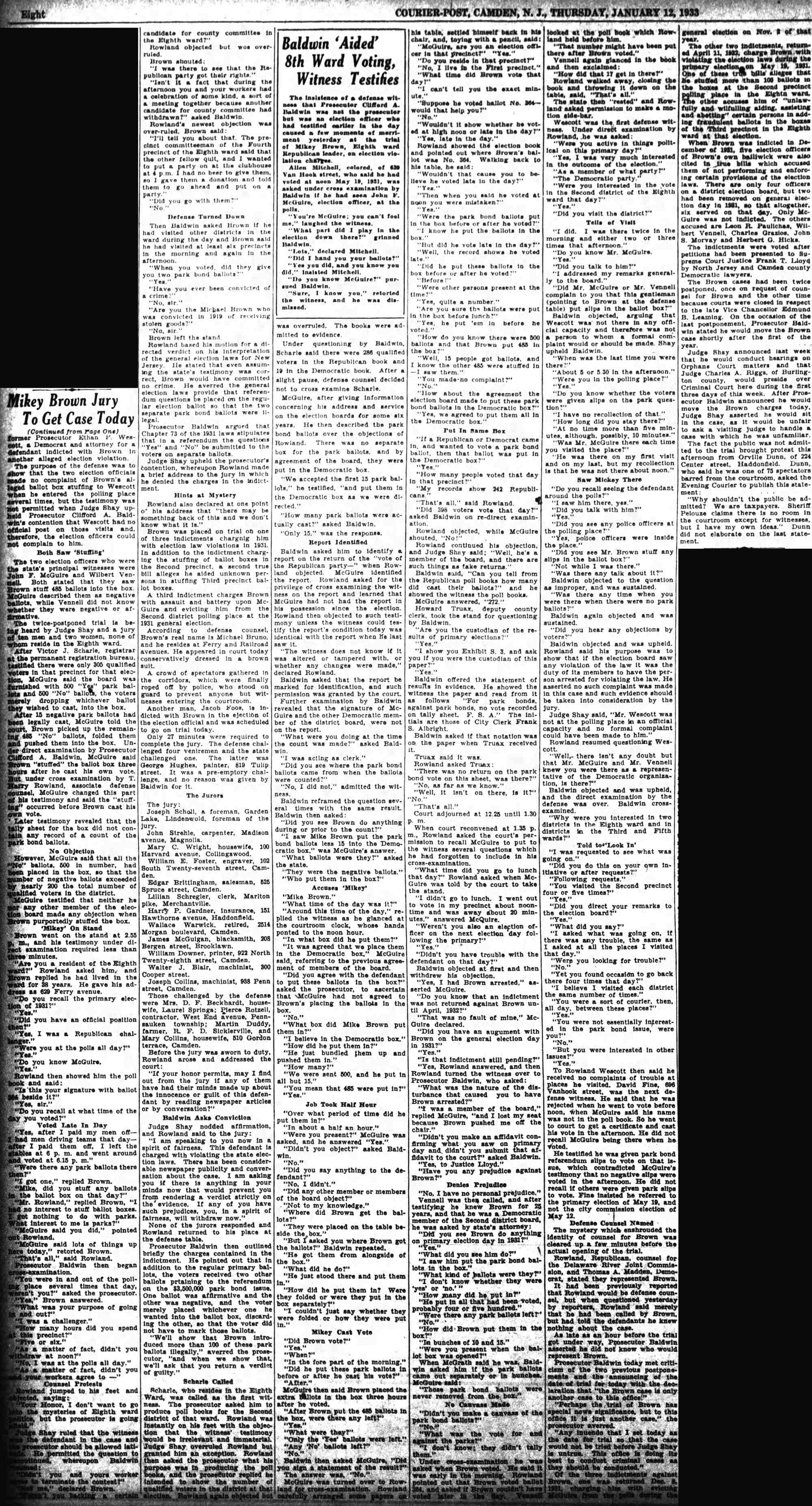
BALDWIN ASKS FOR CONVICTION OF WARD BOSS DESPITE DENIAL
Downtown Leader Says He Had No Interest in Parks Vote
2 WITNESSES TESTIFY TO 485 WRONGLY CAST
Case Before Judge Shay Draws Large Crowds to Court House
A jury in Camden Criminal Court this morning will be given the case of Mikey Brown, Eighth Ward Republican leader, to decide whether he stuffed 485 ballots into a second precinct box at the primary election of May 19, 1931.
On the stand for 13 minutes late yesterday before Judge Samuel M. Shay and the jury, Mikey denied the charge, testified to by two Democratic election board officers and sagely informed the court that he had “no interest in ballot boxes.”
“I got nothing to do with parks. Of what interest to me is parks,” he answered when asked if he stuffed any ballots on the $3,500,000 parks bond issue in the second precinct box of the Eighth Ward.
The referendum on parks was in conjunction with the regular primary election, and was carried.
His denial of ballot-stuffing was corroborated by several witnesses, one of them being Cornelius Rose, 861 Van Hook street, who, with Brown, was a Republican challenger at the election.
When the defense’s final witness, Herbert Hicks, could not be located, the trial was adjourned until 10 a.m. today.
The state “rested” its case at 1:52 p.m. and defense counsel made an unsuccessful bid for a directed verdict of acquittal.
When Judge Samuel M. Shay ordered the trial to continue, the defense then called as its first witness (Continued on Page Eight)
Mikey Brown Jury To Get Case Today (Continued from Page One)
former Prosecutor Ethan P. Wescott, a Democrat and attorney for a defendant indicted with Brown in another alleged election violation.
The purpose of the defense was to show that the two election officials made no complaint of Brown’s alleged ballot box stuffing to Wescott when he entered the polling place several times, but the testimony was not permitted when Judge Shay upheld Prosecutor Clifford A. Baldwin’s contention that Wescott had no official post on those visits and, therefore, the election officers could not complain to him.
Both Saw ‘Stuffing’
The two election officers who were the state’s principal witnesses were John F. McGuire and Wilbert Vennell. Both stated that they saw Brown stuff 485 ballots into the box. McGuire described them as negative ballots, while Vennell did not know whether they were negative or affirmative.
The twice-postponed trial is being heard by Judge Shay and a jury of ten men and two women, none of whom reside in the Eighth ward.
After Victor J. Scharle, registrar at the permanent registration bureau, testified there were only 305 qualified voters in that precinct for that election, McGuire said the board was furnished with 500 “Yes” park ballots and 500 “No” ballots, the voters merely dropping whichever ballot they wished to cast, into the box.
After 15 negative park ballots had been legally cast, McGuire told the court, Brown picked up the remaining 485 “No” ballots, folded them and pushed them into the box. Under direct examination by Prosecutor Clifford A. Baldwin, McGuire said Brown “stuffed” the ballot box three hours after he cast his own vote. But under cross examination by T. Harry Rowland, associate defense counsel, McGuire changed this part of his testimony and said the “stuffing” occurred before Brown cast his own vote.
Later testimony revealed that the tally sheet for the box did not contain any record of a count of the park bond ballots.
No Objection
However, McGuire said that all the “No” ballots, 500 in number, had been placed in the box, so that the number of negative ballots exceeded by nearly 200 the total number of qualified voters in the district.
McGuire testified that neither he nor any other member of the election board made any objection when Brown purportedly stuffed the box.
‘Mikey’ On Stand
Brown went on the stand at 2.55 p. m., and his testimony under direct examination required less than three minutes.
“Are you a resident of the Eighth ward?” Rowland asked him, and Brown replied he had lived in the ward for 38 years. He gave his address as 629 Ferry avenue.
“Do you recall the primary election of 1931?”
“Yes.”
“Did you have an official position then?”
“Yes, I was a Republican challenger.”
“Were you at the polls all day?”
“Yes.”
“Do you know McGuire.”
“Yes.”
Rowland then showed him the poll book and said:
“Is this your signature with ballot No. 364 beside it?”
“Yes, sir.”
“Do you recall at what time of the day you voted?”
Voted Late In Day
“Yes, after I paid my men off—I had men driving teams that day—after I paid them off, I left the stables at 6 p. m. and went around and voted at 6.15 p. m.”
“Were there any park ballots there then?”
“I got one,” replied Brown.
“Mike, did you stuff any ballots in the ballot box on that day?”
“Mr. Rowland,” replied Brown, “I had no interest to stuff ballot boxes. I got nothing to do with parks. What interest to me is parks?”
“McGuire said you did,” pointed out Rowland.
“McGuire said lots of things up here today,” retorted Brown.
“That’s all,” said Rowland.
Prosecutor Baldwin then began cross-examination.
“You were in and out of the polling place several times that day, weren’t you?” asked the prosecutor.
“Yes,” Brown answered.
“What was your purpose of going in and out?”
“I was a challenger.”
“How many hours did you spend at this precinct?”
“Five or six.”
“As a matter of fact, didn’t you withdraw at noon?”
“No, I was at the polls all day.”
“As a matter of fact, didn’t you and your workers agree to —“
Counsel Protests
Rowland jumped to his feet and objected, saying:
“Your Honor, I don’t want to go into the mysteries of Eighth ward politics, but the prosecutor is going unfold.”
Judge Shay ruled that the witness was the defendant in the case and the prosecutor should be allowed latitude. He permitted the question to be continued, whereupon Baldwin resumed:
“Didn’t you and yours workers agree to terminate the contest?”
“Not me,” declared Brown.
“Weren’t you backing a certain candidate for county committee in the Eighth ward?”
Rowland objected but was overruled.
Brown shouted:
“I was there to see that the Republican party got their rights.”
“Isn’t it a fact that during the afternoon you and your workers had a celebration of some kind, a sort of a meeting together because another candidate for county committee had withdrawn?” asked Baldwin.
Rowland’s newest objection was over-ruled. Brown said:
“I’ll tell you about that. The precinct committeeman of the Fourth precinct of the Eighth ward said that the other fellow quit, and I wanted to put a party on at the clubhouse at 4 p.m. I had no beer to give them, so I gave them a donation and told them to go ahead and put on a party.”
“Did you go with them?”
“No.”
Defense Turned Down
Then Baldwin asked Brown if he had visited other districts in the ward during the day and Brown said he had visited at least six precincts in the morning and again in the afternoon.
“When you voted, did they give you two park bond ballots?”
“Yes.”
“Have you ever been convicted of a crime?”
“No, sir.”
“Are you the Michael Brown who was convicted in 1919 of receiving stolen goods?”
“No, sir.”
Brown left the stand.
Rowland based his motion for a directed verdict on his interpretation of the general election laws for New Jersey. He stated that even assuming the state’s testimony was correct, Brown would have committed no crime. He averred the general election laws provide that referendum questions be placed on the regular election ballot so that the two separate park bond ballots were illegal.
Prosecutor Baldwin argued that Chapter 73 of the 1931 laws stipulates that in a referendum the questions “Yes” and “No” be submitted to the voters on separate ballots.
Judge Shay upheld the prosecutor’s contention, whereupon Rowland made a brief address to the jury in which he denied the charges in the indictment.
Hints at Mystery
Rowland also declared at one point of his address that “there may be something back of this and we don’t know what it is.”
Brown was placed on trial on one of three indictments chargnig [sic] him with election law violations in 1931. In addition to the indictment charging the stuffing of ballot boxes in the Second precinct, a second true bill alleges he aided unknown persons in stuffing Third precinct ballot boxes.
A third indictment charges Brown with assault and battery upon McGuire and evicting him from the Second district polling place at the 1931 general election.
According to defense counsel, Brown’s real name is Michael Bruno, and he resides at Ferry and Railroad avenues. He appeared in court today conservatively dressed in a brown suit.
A crowd of spectators gathered in the corridors, which were finally roped off by police, who stood on guard to prevent anyone but witnesses entering the courtroom.
Another man, Jacob Foos, is indicted with Brown in the ejection of the election official and was scheduled to go on trial today.
Only 27 minutes were required to complete the jury. The defense challenged four veniremen and the state challenged one. The latter was George Hughes, painter, 819 Tulip street. It was a pre-emptory challenge, and no reason was given by Baldwin for it.
The Jurors
The jury:
Joseph Scholl, a foreman, Garden Lake, Lindenwold, foreman of the jury.
John Strehle, carpenter, Madison avenue, Magnolia.
Mary C. Wright, housewife, 100 Harvard avenue, Collingswood.
William E. Foster, engraver, 102 South Twenty-seventh street, Camden.
Edgar Brittingham, salesman, 525 Spruce street, Camden.
Lillian Schregler, clerk, Marlton pike, Merchantville.
Harry P. Gardner, insurance, 151 Hawthorne avenue, Haddonfield.
Wallace Warwick, retired, 2514 Morgan boulevard, Camden.
James McGuigan, blacksmith, 208 Bergen street, Brooklawn.
William Downer, printer, 922 North Twenty-eighth street, Camden.
Walter J. Blair, machinist, 300 Cooper street.
Joseph Collins, machinist, 988 Penn street, Camden.
Those challenged by the defense were Mrs. D. F. Beckhardt, housewife, Laurel Springs; Pierce Rotzell, contractor, West End avenue, Pennsauken township; Martin Duddy, farmer, R. F. D. Sicklerville, and Mary Collins, housewife, 510 Gordon terrace, Camden.
Before the jury was sworn to duty, Rowland arose and addressed the court:
“If your honor permits, may I find out from the jury if any of them have had their minds made up about the innocence or guilt of this defendant by reading newspaper articles or by conversation?”
Baldwin Asks Conviction
Judge Shay nodded affirmation, and Rowland said to the jury:
“I am speaking to you now in a spirit of fairness. This defendant is charged with violating the state election laws. There has been considerable newspaper publicity and conversation about the case. I am asking you if there is anything in your minds now that would prevent you from rendering a verdict strictly on the evidence. If any of you have such prejudices, you, in a spirit of fairness, will withdraw now.”
None of the jurors responded and Rowland returned to his place at the defense table.
Prosecutor Baldwin then outlined briefly the charges contained in the indictment. He pointed out that in addition to the regular primary ballots, the voters received two other ballots prtaining [sic] to the referendum on the $3,500,000 park bond issue. One ballot was affirmative and the other was negative, and the voter merely placed whichever one he wanted into the ballot box, discarding the other, so that the voter did not have to mark those ballots.
“We’ll show that Brown introduced more than 100 of these park ballots illegally,” averred the prosecutor, “and when we show that, we’ll ask that you return a verdict of guilty.”
Scharle Called
Scharle, who resides in the Eighth Ward, was called as the first witness. The prosecutor asked him to produce poll books for the Second district of that ward. Rowland was instantly on his feet with the objection that the witness’ testimony would be irrelevant and immaterial. Judge Shay overruled Rowland but granted him an exception. Rowland then asked the prosecutor what his purpose was in producing the poll books, and the prosecutor replied he intended to show the number of qualified voters in the district at that election. Rowland again objected but was overruled. The books were admitted to evidence.
Under questioning by Baldwin, Scharle said there were 286 qualified voters in the Republican book and 19 in the Democratic book. After a slight pause, defense counsel decided not to cross examine Scharle.
McGuire, after giving information concerning his address and service on the election boards for some six years. He then described the park bond ballots over the objections of Rowland. There was no separate box for the park ballots, and by agreement of the board, they were put in the Democratic box.
“We accepted the first 15 park ballots,” he testified, “and put them in the Democratic box as we were directed.”
“How many park ballots were actually cast?” asked Baldwin.
“Only 15,” was the response.
Report Identified
Baldwin asked him to identify a report on the return of the “vote of the Republican party—“ when Rowland objected. McGuire identified the report. Rowland asked for the privilege of cross examining the witness on the report and learned that McGuire had not had the report in his possession since the election. Rowland then objected to such testimony unless the witness could testify the report’s condition today was identical with the report when he last saw it.
“The witness does not know if it was altered or tampered with, or whether any changes were made,” declared Rowland.
Baldwin asked that the report be marked for identification, and such permission was granted by the court.
Further examination by Baldwin revealed that the signature of McGuire and the other Democratic member of the district board, were not on the report.
“What were you doing at the time the count was made?” asked Baldwin.
“I was acting as clerk.”
“Did you see where the park bond ballots came from when the ballots were counted?”
“No, I did not,” admitted the witness.
Baldwin reframed the question several times with the same result. Baldwin then asked:
“Did you see Brown do anything during or prior to the count?”
“I saw Mike Brown put the park bond ballots less 15 into the Democratic box,” was McGuire’s answer.
“What ballots were they?” asked the state.
“They were the negative ballots.”
“Who put them in the box?”
Accuses ‘Mikey’
“Mike Brown.”
“What time of the day was it?”
“Around this time of the day,” replied the witness as he glanced at the courtroom clock, whose hands pointed to the noon hour.
“In what box did he put them?”
“It was agreed that we place them in the Democratic box,” McGuire said, referring to the previous agreement of members of the board.
“Did you agree with the defendant to put these ballots in the box?” asked the prosecutor, to ascertain that McGuire had not agreed to Brown’s placing the ballots in the box.
“No.”
“What box did Mike Brown put them in?”
“I believe in the Democratic box.”
“How did he put them in?”
“He just bundled them up and pushed them in.”
“How many?”
“We were sent 500, and he put in all but 15.”
“You mean that 485 were put in?”
“Yes.”
Job Took Half Hour
“Over what period of time did he put them in?”
“In about a half an hour.”
“Were you present?” McGuire was asked, and he answered “Yes.”
“Didn’t you object?” asked Baldwin.
“No.”
“Did you say anything to the defendant?”
“No, I didn’t.”
“Did any other member or members of the board object?”
“Not to my knowledge.”
“Where did Brown get the ballots?”
“They were placed on the table beside the box.”
“But I asked you where Brown got the ballots?” Baldwin repeated.
“He got them from alongside of the box.”
“What did he do?”
“He just stood there and put them in.”
“How did he put them in? Were they folded or were they put in the box separately?”
“I couldn’t just say whether they were folded or how they were put in.”
Mikey Cast Vote
“Did Brown vote?”
“Yes.”
“When?”
“In the fore part of the morning.”
“Did he put these park ballots in before or after he cast his vote?”
“After.”
McGuire then said Brown placed the extra ballots in the box three hours after he voted.
“After Brown put the 485 ballots in the box, were there any left?”
“Yes.”
“What were they?”
“Only the ‘Yes’ ballots were left.”
“Any ‘No’ ballots left?”
“No.”
Baldwin then asked McGuire, “Did you sign a statement of the result?” The answer was, “No.” McGuire was turned over to Rowland for cross-examination. Rowland carefully arranged some papers on his table, settled himself back in his chair, and, toying with a pencil, said:
“McGuire, are you an election officer in that precinct?” “Yes.”
“Do you reside in that precinct?”
“No, I live in the First precinct.”
“What time did Brown vote that day?”
“I can’t tell you the exact minute.”
“Suppose he voted ballot No. 364—would that help you?”
“No.”
“Wouldn’t it show whether he voted at high noon or late in the day?”
“Yes, late in the day.”
Rowland showed the election book and pointed out where Brown’s ballot was No. 364. Walking back to his table, he said:
“Wouldn’t that cause you to believe he voted late in the day?”
“Yes.”
“Then when you said he voted at noon you were mistaken?”
“Yes.”
“Were the park bond ballots put in the box before or after he voted?”
“I know he put the ballots in the box.”
“But did he vote late in the day?”
“Well, the record shows he voted late.”
“Did he put these ballots in the box before or after he voted?”
“Before!”
“Were other persons present at the time?”
“Yes, quite a number.”
“Are you sure the ballots were put in the box before lunch?”
“Yes, he put ’em in before he voted.”
“How do you know there were 500 ballots and that Brown put 485 in the box?”
“Well, 15 people got ballots, and I know the other 485 were stuffed in—I saw them.”
“You made no complaint?”
“No.”
“How about the agreement the election board made to put these park bond ballots in the Democratic box?”
“Yes, we agreed to put them all in the Democratic box.”
Put In Same Box
“If a Republican or Democrat came in, and wanted to vote a park bond ballot, then that ballot was put in the Democratic box?”
“Yes.”
“How many people voted that day in that precinct?”
“My records show 242 Republicans.”
“That’s all,” said Rowland.
“Did 398 voters vote that day?” asked Baldwin on re-direct examination.
Rowland objected, while McGuire shouted, “No!”
Rowland continued his objection, and Judge Shay said; “Well, he’s a member of the board, and there are such things as fake returns.”
Baldwin said, “Can you tell from the Republican poll books how many did cast their ballots?” and he showed the witness the poll books.
McGuire answered, “272.”
Howard Truax, deputy county clerk, took the stand for questioning by Baldwin.
“Are you the custodian of the results of primary elections?”
“Yes.”
“I show you Exhibit S. 3. and ask you if you were the custodian of this paper?”
“Yes.”
Baldwin offered the statement of results in evidence. He showed the witness the paper and read from it as follows “For park bonds, against park bonds, no vote recorded on tally sheet. F. S. A.” The initials are those of City Clerk Frank S. Albright.
Baldwin asked if that notation was on the paper when Truax received it.
Truax said it was.
Rowland asked Truax:
“There was no return on the park bond vote on this sheet, was there?”
“No, as far as we know.”
“Well, it isn’t on there, is it?”
“No.”
“That’s all.”
Court adjourned at 12.25 until 1.30 p. m.
When court reconvened at 1.35 p. m., Rowland asked the court’s permission to recall McGuire to put to the witness several questions which he had forgotten to include in his cross-examination.
“What time did you go to lunch that day?” Rowland asked when McGuire was told by the court to take the stand.
“I didn’t go to lunch. I went out to vote in my precinct about noontime and was away about 20 minutes,” answered McGuire.
“Weren’t you also an election officer on the next election day following the primary?”
“Yes.”
“Didn’t you have trouble with the defendant on that day?”
Baldwin objected at first and then withdrew his objection.
“Yes, I had Brown arrested,” asserted McGuire.
“Do you know that an indictment was not returned against Brown until April, 1932?”
“That was no fault of mine,” McGuire declared.
“Did you have an augument [sic] with Brown on the general election day in 1931?”
“Yes.”
“Is that indictment still pending?”
“Yes, Rowland answered, and then Rowland turned the witness over to Prosecutor Baldwin, who asked:
“What was the nature of the disturbance that caused you to have Brown arrested?”
“I was a member of the board,” replied McGuire, “and I lost my seat because Brown pushed me off the chair.”
“Didn’t you make an affidavit confirming what you saw on primary day and didn’t you submit that affidavit to the court?” asked Baldwin.
“Yes, to Justice Lloyd.”
“Have you any prejudice against Brown?”
Denies Prejudice
“No, I have no personal prejudice.”
Vennell was then called, and after testifying he knew Brown for 25 years, and that he was a Democratic member of the Second district board, he was asked by state’s attorney:
“Did you see Brown do anything on primary election day in 1931?”
“Yes.”
“What did you see him do?”
“I saw him put the park bond ballots in the box.”
“What kind of ballots were they?”
“I don’t know whether they were ‘yes’ or ‘no.’”
“How many did he put in?”
“He put in all that had been voted, probably four or five hundred.”
“Were there any park ballots left?”
“No.”
“How did Brown put them in the box?”
“In bunches of 10 and 15.”
“Were you present when the ballot box was opened?”
When McGrath [sic] said he was, Baldwin asked him if the park ballots came out separately or in bunches. McGuire said:
“Those park bond ballots were never removed from the box.”
No Canvass Made
“Didn’t you make a canvass of the park bond ballots?”
“No.”
“What was the vote for and against the parks?”
“I don’t know; they didn’t tally them.”
Under cross-examination he was asked when Brown voted. He said it was early in the morning. Rowland pointed out that Brown voted ballot 364, and asked if Brown couldn’t have voted later in the day. Vennell looked at the poll book which Rowland held before him.
“That number might have been put there after Brown voted.”
Vennell again glanced in the book and then exclaimed:
“How did that 17 get in there?”
Rowland walked away, closing the book and throwing it down on the table, said, “That’s all.”
The state then “rested” and Rowland asked permission to make a motion side-bar.
Wescott was the first defense witness. Under direct examination by Rowland, he was asked:
“Were you active in things political on this primary day?”
“Yes, I was very much interested in the outcome of the election.”
“As a member of what party?”
“The Democratic party.”
“Were you interested in the vote in the Second district of the Eighth ward that day?”
“Yes.”
“Did you visit the district?”
Tells of Visit
“I did. I was there twice in the morning and either two or three times that afternoon.”
“Do you know Mr. McGuire.”
“Yes.”
“Did you talk to him?”
“I addressed my remarks generally to the board.”
“Did Mr. McGuire or Mr. Vennell complain to you that this gentleman (pointing to Brown at the defense table) put slips in the ballot box?”
Baldwin objected, arguing that Wescott was not there in any official capacity and therefore was not a person to whom a formal complaint would or should be made. Shay upheld Baldwin.
“When was the last time you were there?”
“About 5 or 5.30 in the afternoon.”
“Were you in the polling place?”
“Yes.”
“Do you know whether the voters were given slips on the park question?”
“I have no recollection of that.”
“How long did you stay there?”
“At no time more than five minutes, although, possibly, 10 minutes.”
“Was Mr. McGuire there each time you visited the place?”
“He was there on my first visit and on my last, but my recollection is that he was not there about noon.”
Saw Mickey There
“Do you recall seeing the defendant around the polls?”
“I saw him there, yes.”
“Did you talk with him?”
“Yes.”
“Did you see any police officers at the polling place?”
“Yes, police officers were inside the place.”
“Did you see Mr. Brown stuff any slips in the ballot box?”
“Not while I was there.”
“Was there any talk about it?”
Baldwin objected to the question as improper, and was sustained.
“Was there any time when you were there when there were no park ballots?”
Baldwin again objected and was sustained.
“Did you hear any objections by voters?”
Baldwin objected and was upheld. Rowland said his purpose was to show that if the election board saw any violation of the law it was the duty of its members to have the person arrested for violating the law. He asserted no such complaint was made in this case and such evidence should be taken into consideration by the jury.
Judge Shay said, “Mr. Wescott was not at the polling place in an official capacity and no formal complaint could have been made to him.”
Rowland resumed questioning Wescott.
“Well, there isn’t any doubt but that Mr. McGuire and Mr. Vennell knew you were there as a representative of the Democratic organization, is there?”
Baldwin objected and was upheld, and the direct examination by the defense was over. Baldwin cross-examined.
“Why were you interested in two districts in the Eighth ward and in districts in the Third and Fifth wards?”
Told to ‘Look In’
“I was requested to see what was going on.”
“Did you do this on your own initiative or after requests?”
“Following requests.”
“You visited the Second precinct four or five times?”
“Yes.”
“Did you direct your remarks to the election board?”
“Yes.”
“What did you say?”
“I asked what was going on, if there was any trouble, the same as I asked at all the places I visited that day.”
“Were you looking for trouble?”
“No.”
“Yet you found occasion to go back there four times that day?”
“I believe I visited each district the same number of times.”
“You were a sort of courier, then, all day, between these places?”
“Yes.”
“You were not essentially interested in the park bond issue, were you?”
“No.”
“But you were interested in other issues?”
“Yes.”
To Rowland Wescott then said he received no complaints of trouble at places he visited. David Fine, 696 Vanhook street, was the next defense witness. He said that he was rejected when he went to vote before noon, when McGuire said his name was not in the poll book. So he went to court to get a certificate and cast his vote in the afternoon. He did not recall McGuire being there when he voted.
He testified he was given park bond referendum slips to vote on that issue, which contradicted McGuire’s testimony that no negative slips were voted in the afternoon. He did not recall if others were given park slips to vote. Fine insisted he referred to the primary election of May 19, and not the city commission election of May 12.
Defense Counsel Named
The mystery which enshrouded the identity of counsel for Brown was cleared up a few minutes before the actual opening of the trial.
Rowland, Republican, counsel for the Delaware River Joint Commission, and Thomas A. Madden, Democrat, stated they represented Brown. It had been previously reported that Rowland would be defense counsel, but when questioned yesterday by reporters, Rowland said merely that he had been called by Brown, but had told the defendants he knew nothing about the case.
As late as an hour before the trial got under way, Prosecutor Baldwin asserted he did not know who would represent Brown.
Prosecutor Baldwin today met criticism of the two previous postponements and the announcing of the date of trial for today with the declaration that “the Brown case is only another case to this office.”
“Perhaps the trial of Brown has special news significance, but to this office it is just another case,” the prosecutor averred.
“Any inuendo that I set today as the date for trial so that the case would not be tried before Judge Shay is untrue. This office is doing its best to conduct criminal cases as they should be conducted.”
Of the three indictments against Brown, one was returned Dec. 8, 1931, charging him with evicting McGuire from the polls during the general election on Nov. 3 of that year.
The other two indictments, returned April 11, 1932, charge Brown with violating the election laws during the primary election on May 19, 1931. One of these true bills alleges that he stuffed more than 100 ballots in the boxes at the Second precinct polling place in the Eighth ward. The other accuses him of “unlawfully and wilfulling [sic] aiding, assisting and abetting” certain persons in adding fraudulent ballots in the boxes of the Third precinct in the Eighth ward at that election.
When Brown was indicted in December of 1931, five election officers of Brown’s own bailiwick were also cited in true bills which accused them of not performing and enforcing certain provisions of the election laws. There are only four officers on a district election board, but two had been removed on general election day in 1931, so that altogether, six served on that day. Only McGuire was not indicted. The others accused are Leon R. Paulichas, Wilbert Vennell, Charles Grazios, John S. Morvay and Herbert G. Hicks.
The indictments were voted after petitions had been presented to Supreme Court Justice Frank T. Lloyd by North Jersey and Camden county Democratic lawyers.
The Brown cases had been twice postponed, once on request of counsel for Brown and the other time because courts were closed in respect to the late Vice Chancellor Edmund B. Leaming. On the occasion of the last postponement, Prosecutor Baldwin stated he would move the Brown case shortly after the first of the year.
Judge Shay announced last week that he would conduct hearings on Orphans Court matters and that Judge Charles A. Riggs, of Burlington county, would preside over Criminal Court here during the first three days of this week. After Prosecutor Baldwin announced he would move the Brown charges today, Judge Shay asserted he would sit in the case, as it would be unfair to ask a visiting judge to handle a case with which he was unfamiliar.
The fact the public was not admitted to the trial brought protest this afternoon from Orville Dunn, of 224 Center street, Haddonfield. Dunn, who said he was one of 75 spectators barred from the courtroom, asked the Evening Courier to publish this statement:
“Why shouldn’t the public be admitted? We are taxpayers. Sheriff Pelouze claims there is no room in the courtroom except for witnesses, but I have my own ideas.” Dunn did not elaborate on the last statement.
Baldwin ‘Aided’ 8th Ward Voting, Witness Testifies
The insistence of a defense witness that Prosecutor Clifford A. Baldwin was not the prosecutor but was an election officer who had testified earlier in the day caused a few moments of merriment yesterday at the trial of Mikey Brown, Eighth ward Republican leader, on election violation charges.
Allen Mitchell, colored, of 630 Van Hook street, who said he had voted at noon May 19, 1931, was asked under cross examination by Baldwin if he had seen John F. McGuire, election officer, at the polls.
“You’re McGuire; you can’t fool me,” laughed the witness.
“What part did I play in the election down there?” grinned Baldwin.
“Lots,” declared Mitchell.
“Did I hand you your ballots?”
“Yes you did, and you know you did,” insisted Mitchell.
“Do you know McGuire?” pursued Baldwin.
“Sure, I know you,” retorted the witness, and he was dismissed.
Grand Jury Probes 8th Ward Stuffing
Camden Evening Courier —
Fifth District Box Had Too Many Ballots, Prosecutor Told
Another investigation into the mysteries of Eighth Ward elections was begun yesterday when the April grand jury probed ballot-box stuffing in the Fifth District at the May 16 primary.
Prosecutor Clifford A. Baldwin requested the investigation after he “couldn’t make head nor tail” of the fact that 25 ballots remained in the box even after 232 Republican ballots the number of persons of that party recorded as voting had been counted.
Although unconfirmed, it was declared that all of the ballots were marked for Edmund A. Walsh, incumbent, who defeated mikey brown for election to the G. O. P. Committee.
It is understood the prosecutor pointed out that the ballots were in bundles of five or six, and apparently had not been cast singly.
Baldwin learned that the extra ballots were not counted by the election board, each member of which was called to the grand jury room yesterday afternoon. All expressed ignorance of how the ballots could have been placed in the box, it is understood.
When Baldwin was informed of the mystery he personally inspected the box, which has been impounded in the office of City Clerk Frank S. Albright.
“I couldn’t make head nor tail of it, so I presented the case to the grand jury,” Baldwin said. He refused to comment further.
Mikey Brown Says Jury Has Plenty To Probe In Eighth Ward Voting
Camden Evening Courier —
Principal Figure in Many Battles Welcomes Quiz
‘Stuffing’ of Ballots Reported in Fifth and First Precincts
Rumors Are Checked
“The prosecutor and the grand jury have plenty to investigate in this ward concerning the last primary election.”
mikey brown, central figure in many Eighth Ward election squabbles and thrice accused in election irregularities, had that to say yesterday when informed that Prosecutor Clifford A. Baldwin and the April grand jury is investigating alleged ballot box stuffing in the ward at the last primary, May 16.
Disclosure of ballot box stuffing in the Fifth precinct of the ward, which the prosecutor said he asked the grand jury investigate was followed by reports yesterday that similar irregularities prevailed in the First precinct at the primary, and possibly in other districts.
Reports Checked
In extending his probe of ward political conditions, Baldwin said he is checking reports that a Brown challenger at the May election had refused to let the First precinct election board count what he declared were “stuffed ballots.”
The challenger is reported at close of the polling place to have said as he lifted a ballot box for the election board and spectators to see:
“There are ballots in this box that don’t belong there. They cannot be counted. I won’t permit it. And remember, mikey brown didn’t stuff this box today, as he had been accused falsely of doing at previous elections. Mikey wasn’t in this polling place, so you can’t blame him,”
Brown had been three times in Camden County Criminal Court for ballot box stuffing and other alleged election irregularities. He was exonerated twice, and there was a disagreement in the jury in the third case. At the May primary, he opposed Edmund A. Walsh in a contest for Republican county committeeman from the Eighth ward, but was defeated. Walsh was re-elected.
Asked what he knew about the latest Eighth ward situation, Brown said:
“All I can say is that the prosecutor and the grand jury will have plenty to investigate pertaining to the May 16 primary in the ward.”
Box Not Impounded
The first precinct ballot box has not been impounded by City Clerk Frank S. Albright, as was the case of the box of the fifth precinct. Baldwin said he was checking rumors one of the first precinct boxes contained about 50 or 60 stuffed ballots. Baldwin said that if the situation be found by him to be as reported, he will request the grand jury to summon witnesses.
Baldwin said he also is checking reports that the names of dead persons were “voted” at the ward primary.
Sunday Beer Here Is Up to Reesman As Four Rulers Split
Camden Courier-Post —
Commissioner Says, However, He Awaits Public Sentiment
Moore Signs Act, New Fees Fixed
Stewart and Bennett Against, Hanna and Rhone For
With four members of the city commission deadlocked on the issue, Commissioner Clay W. Reesman last night appeared to hold in his hands the final decision as to whether Sunday beer sales will be permitted in Camden.
This was revealed when he announced that his deciding vote on the issue would be guided by a “sounding of public sentiment.”
On April 26 Mayor Roy R. Stewart and Commissioner Harold W. Bennett declared they would vote against any resolution permitting Sunday sales, while Commissioners Frank B. Hanna and Dr. David S. Rhone declared they would favor such a resolution. Reesman asserted at that time that “it would be foolish for him to comment until the measure before the legislature becomes a law.”
Measure Now Law
The state measure, which permits Sunday beer sales upon resolution of municipal bodies, became law yesterday when Governor A. Harry Moore signed it. The bill, primarily, extends the state temporary beer act until August 31.
When asked last night how he stood on the Sunday beer sale question in Camden, Reesman said: “I can’t state any opinion at this time, for I really have none. I want to sound public sentiment first. What ever the people want, that is the way I’ll be guided,” He added that he would be unable to say how much time would be required for him to arrive at an opinion.
As soon as the city commission learned that the governor had approved the measure yesterday, it met in special session and adopted a resolution calling for an additional fee from Camden beer retailers for the extended period of two months.
At the same time, the Beverage Tax Division of the State Tax Department announced that all retailers of beer and wines must make tax payments by July 7 on all purchases and sales of beer by them between April 7 and July 1.
Tax Experts Coming
To assist retailers in determining their tax liability representatives of the Beverage Tax Division will sit for one week, from July 1 to July 7, in seven South Jersey towns, as follows: Camden, Room 212, court house annex; Burlington, city hall; Bridgeton, court house, July 1 and 3 only; Atlantic City, Room 729, Guaranty Trust building; Gloucester City, clerk’s office, city hall; Cape May Court House, court house, July 6 and 7 only; Salem, city hall, July 5 only;
Retailers who have purchased beverages from any source outside New Jersey will be subject to a tax of three cents a gallon if the tax has not already been paid by the manufacturer or distributor.
Mayor Stewart, in expressing his opinion on Sunday beer sales, declared it would have a bad effect on the community and its people, and that employees of restaurants and inns were entitled to a day of rest as other workers.
Commissioner Bennett declared sale of the beverage would not help observance of the Sabbath. Commissioners Hanna and Rhone took the view that Congress had legislated 3.2 percent beer as non-intoxicating, and that it was therefore as equally non-intoxicating on Sunday as any other day, and that its sale would make little difference.
New Fees Cited
The Beverage Tax Division also pointed out yesterday that the extension beverage act require manufacturers to pay an additional license fee of $400, and distributors an additional fee of $100 if their licenses are to be automatically extended. Security for the extended term must also be furnished and acceptable to the State Tax Commissioner.
Licenses for the extended period will be issued in South Jersey at the offices of Deputy Beverage Commissioners Frank B. Middleton, Jr., in Camden, at 130 North Broadway, and Frederick Stahle, 4105 Sunset Avenue, Atlantic City.
Various South Jersey communities, following the lead of Camden, are expected to announce new additional fees for municipal licenses before a week has passed.
The city resolution provides that the additional fee must be paid to Frank S. Albright, city clerk, before tomorrow night, and that all the beer regulations adopted by the city April 6 remain in “full force and effect.”
Under the measure, according to Albright, distributors in the city that do not pay a state beer license must also pay an additional $50 fee.
Retail beer servers began paying their new fees shortly after the city commission passed the resolution.
City Won’t Rule on Sunday Beer Sales Unless People Demand
Camden Courier-Post —
Reesman to Decide If Commissioners Offer Resolution
Beverage Dispensers Will Discuss Question at Next Meeting
19 Licenses Issued
“The Camden City Commission will take no action on the Sunday beer sale question unless the people express a strong desire for Sunday beer.”
This is the declaration made yesterday by Mayor Roy R. Stewart.
And not only are members of the city commission divided on the Sunday beer issue but saloonkeepers are themselves.
Fred J. Stuebing, president of the Camden County Beverage Dispensers’ Association, revealed that some members of the association are against Sunday sales and some are in favor of it.
“We have not gone on record for or against Sunday sales.” Stuebing said. “Some of our members are against it. The question will be brought up at our own meeting a week from today.
Wants His Day Off
“Personally, I would not want to keep my place open on Sunday afternoons. I want a day off after working all week. I might open up for a while Sunday evenings, though, if it were permitted.”
In the event of a resolution being introduced in the city commission to permit Sunday sales after 1 p.m., the final decision would rest in the hands of Commissioner Clay W. Reesman since he has refused to commit himself on the issue, while Mayor Stewart and Commissioner Harold W. Bennett have announced against it, and Commissioners Frank B. Hanna and Dr. David S. Rhone have pronounced themselves in favor of it.
“I don’t think there is any insistent demand for Sunday beer,” said the mayor. “If there is, I haven’t heard about it.
“Furthermore, I see no real reason for Sunday beer. In the so-called good old days before prohibition, saloons were closed on Sundays. Why should they be opened now?
“And as I said in a statement some time ago, the men and women employed in the retail beer business deserve a day off a week for recreation and worship just as any other workers.
“The City Commission will take no action unless the people express a strong desire for Sunday beer.”
Owners Interviewed
There was a rumor in circulation yesterday that quite a number of Camden saloonkeepers had been “interviewed” by certain politicians on the Sunday sale situation.
“You don’t want to sell beer on Sunday, do you?” is the question that is said to have been put to them. And it was put in such a way that a negative answer was expected, the rumor has it.
This report apparently is borne out by the attitude of Mayor Stewart. The mayor’s statement came as a surprise particularly in view of the fact that Camden saloonkeepers recently contributed to a fund for the purpose of having the ban on bars removed and also to bring about Sunday sales.
Camden saloon and restaurant keepers have been complaining because the roadhouses in the suburban districts were permitted to sell beer on Sunday and that they also were allowed to remain open later than the closing time specified for similar places operated in the city limits.
These same Camden saloonkeepers also have complained about the political clubs within the city being permitted to remain open after the regular closing hours and also that they have been allowed to remain open on Sundays.
New Licenses Granted
Meanwhile, City Clerk Frank S. Albright yesterday announced approval of 19 new applications for retail beer licenses, bringing the total in the city to 239. Three new wholesale licenses also were sanctioned.
Following are the retail permits: John Pennington, 818 Broadway; Salvatore Spitalore, 201 Royden Street; Samuel Friedenberg, 575 Van Hook Street; Fred Steubing, 318 Market Street; Frank Markiewicz, 673 Ferry Avenue; Matthew Orland, 3, 5, 7 and 9 Ferry Walk; Anthony Laskowski, 1200 Everett Street; Albert Ross, 1425 Mt. Ephraim Avenue; Samuel Hurwitz, 703 Chestnut Street; Clito Viviano, 522–524 Walnut Street; Harry Adams, 406 North Seventh Street; Daniel Cirucci, 305 Benson Street; Charles A. Bieri, 318 Kaighn Avenue; Max Kleinfeld, 101 Chestnut Street; John MacDougall, 839 Market Street; Alexander Wrightson, Southwest corner Ninth and Chestnut Streets; David Plasky, 2362 Broadway; Luigi Corda, 702 South Second Street, and Irving Cartin, 201 Mechanic Street.
Wholesalers: Camden County Beer Distributors, 1203 Chestnut Street; William Grams, 2101 Federal Street, and Justin Peterson, 511 Chelton Avenue.
3 G.O.P. Rulers in Secret Session
Camden Courier-Post —
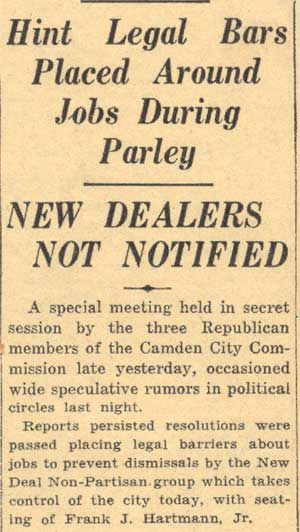
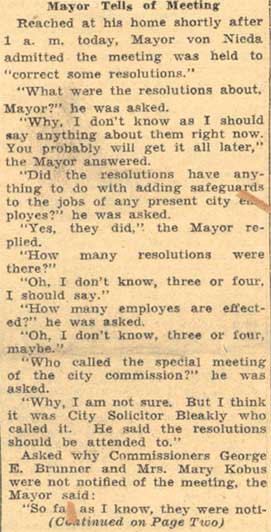
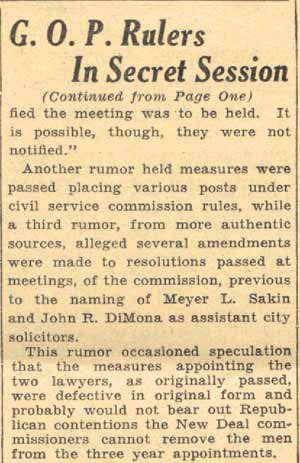
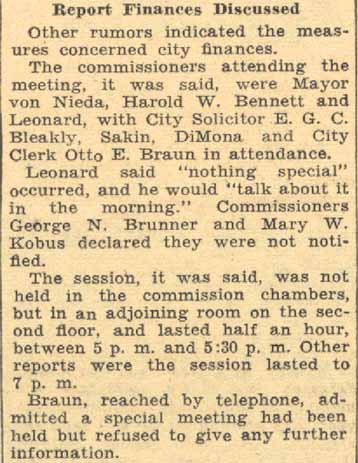
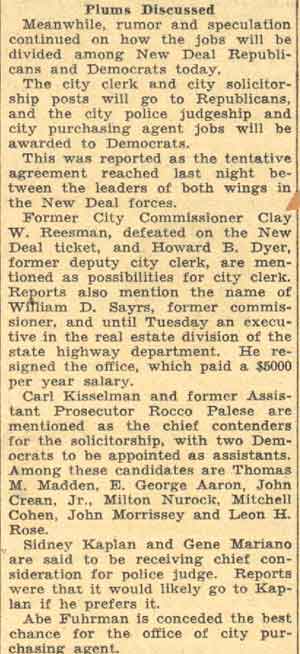
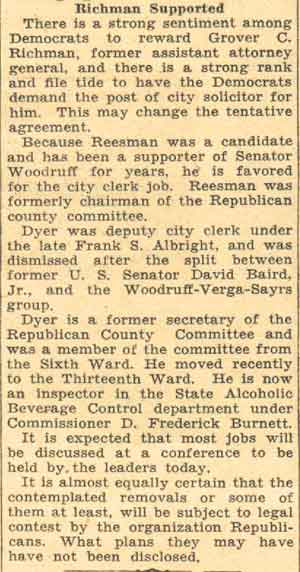
Hint Legal Bars Placed Around Jobs During Parley
NEW DEALERS NOT NOTIFIED
A special meeting held in secret session by the three Republican members of the Camden City Commission late yesterday, occasioned wide speculative rumors in political circles last night.
Reports persisted resolutions were passed placing legal barriers about jobs to prevent dismissals by the New Deal Non-Partisan group which takes control of the city today, with seating of Frank J. Hartmann, Jr.
Mayor Tells of Meeting
Reached at his home shortly after 1 a. m. today, Mayor von Nieda admitted the meeting was held to “correct some resolutions.”
“What were the resolutions about, Mayor?” he was asked.
“Why, I don’t know as I should say anything about them right now. You probably will get it all later,” the Mayor answered.
“Did the resolutions have anything to do with adding safeguards to the jobs of any present city employees?” he was asked.
“Yes, they did,” the Mayor replied.
“How many resolutions were there?”
“Oh, I don’t know, three or four, I should say.”
“How many employes are effected [sic]?” he was asked.
“Oh, I don’t know, three or four, maybe.”
“Who called the special meeting of the city commission?” he was asked.
“Why, I am not sure. But I think it was City Solicitor Bleakly who called it. He said the resolutions should be attended to.”
Asked why Commissioners George E. Brunner and Mrs. Mary Kobus were not notified of the meeting, the Mayor said: “So far as I know, they were not notified the meeting was to be held. It is possible, though, they were not notified.”
Another rumor held measures were passed placing various posts under civil service commission rules, while a third rumor, from more authentic sources, alleged several amendments were made to resolutions passed at meetings, of the commission, previous to the naming of Meyer L. Sakin and John R. DiMona as assistant city solicitors.
This rumor occasioned speculation that the measures appointing the two lawyers, as originally passed, were defective in original form and probably would not bear out Republican contentions the New Deal commissioners cannot remove the men from the three year appointments.
Report Finances Discussed
Other rumors indicated the measures concerned city finances.
The commissioners attending the meeting, it was said, were Mayor von Nieda, Harold W. Bennett and Leonard, with City Solicitor E. G. C. Bleakly, Sakin, DiMona and City Clerk Otto E. Braun in attendance.
Leonard said “nothing special” occurred, and he would “talk about it in the morning.” Commissioners George N. Brunner and Mary W. Kobus declared they were not notified.
The session, it was said, was not held in the commission chambers, but in an adjoining room on the second floor, and lasted half an hour, between 5 p. m. and 5:30 p. m. Other reports were the session lasted to 7 p. m.
Braun, reached by telephone, admitted a special meeting had been held but refused to give any further information.
Plums Discussed
Meanwhile, rumor and speculation continued on how the jobs will be divided among New Deal Republicans and Democrats today. The city clerk and city solicitorship posts will go to Republicans, and the city police judgeship and city purchasing agent jobs will be awarded to Democrats.
This was reported as the tentative agreement reached last night between the leaders of both wings in the New Deal forces.
Former City Commissioner Clay W. Reesman, defeated on the New Deal ticket, and Howard B. Dyer, former deputy city clerk, are mentioned as possibilities for city clerk. Reports also mention the name of William D. Sayrs, former commissioner, and until Tuesday an executive in the real estate division of the state highway department. He resigned the office, which paid a $5000 per year salary.
Carl Kisselman and former Assistant Prosecutor Rocco Palese are mentioned as the chief contenders for the solicitorship, with two Democrats to be appointed as assistants. Among these candidates are Thomas M. Madden, E. George Aaron, John Crean, Jr., Milton Nurock, Mitchell Cohen, John Morrissey and Leon H. Rose.
Sidney Kaplan and Gene Mariano are said to be receiving chief consideration for police judge. Reports were that it would likely go to Kaplan if he prefers it.
Abe Fuhrman is conceded the best chance for the office of city purchasing agent.
Richman Supported
There is a strong sentiment among Democrats to reward Grover C. Richman, former assistant attorney general, and there is a strong rank and file tide to have the Democrats demand the post of city solicitor for him. This may change the tentative agreement.
Because Reesman was a candidate and has been a supporter of Senator Woodruff for years, he is favored for the city clerk job. Reesman was formerly chairman of the Republican county committee.
Dyer was deputy city clerk under the late Frank S. Albright, and was dismissed after the split between former U. S. Senator David Baird, Jr., and the Woodruff-Verga-Sayrs group.
Dyer is a former secretary of the Republican County Committee and was a member of the committee from the Sixth Ward. He moved recently to the Thirteenth Ward. He is now an inspector in the State Alcoholic Beverage Control department under Commissioner D. Frederick Burnett.
It is expected that most jobs will be discussed at a conference to be held by the leaders today.
It is almost equally certain that the contemplated removals or some of them at least, will be subject to legal contest by the organization Republicans. What plans they may have have not been disclosed.
Dan McConnell’s Scrapbook
Camden Courier-Post —
PERHAPS many disciples of Thespis will recall a play which enjoyed popularity more than a score years ago. It was entitled, “Jim, The Penman” and the opus was a prime favorite with those who enjoyed the performances of the town stock companies.
I recall seeing the old Orpheum Stock Company at the now non-existent Chestnut Street Theatre, across the Delaware, give yearly performances of the play.
In years of police reporting this narrator ran across many cagey connivers who made the mistake of forging signatures of others.
One suave signature manipulator was a chap named Thompson. An impeccable dresser, with the characteristics of a prosperous business man or banker, he found little difficulty crashing the ornate offices of others having sizeable bank accounts.
He would glance at correspondence and look for his victim’s signature, or employ some trick to have the person sign his name. Another artifice he would use would be to ask for a blank check with an apologetic remark about leaving his checkbook in another suit.
When the check was presented the unsuspecting bank teller would unhesitatingly cash it. The late Police Captain Wm. J. Schregler finally nabbed Thompson. The big-hearted sleuth told Thompson he would profit more by getting honest work. “There’s no excitement in honest work,” he told the sleuth.
This slick forger with the aid of a condemned slayer staged a sensational escape from the local county jail. The murderer was executed, but Thompson enjoyed his liberty for three years. He was caught by the late Dr. A. A. Gribben, a county detective in a Boston rooming house.
* * *
CHIROGRAPHY
Anent the legend of “Jim the Penman” and animated signature forgers, those of that ilk would doubtless find it rather difficult to imitate the signature appendages of two prominent gentlemen of the local legal fraternity.
One member of the bar and a former jurist has the most intricate signature of local renown. Former Judge Frank F. Neutze has a chirographic flair that is only nearly matched by that of City Solicitor Firmin Michel. Both signatures are rather florid and deceptive.
This writer as a youth toiled ceaselessly to acquire a signature obviously intended to be legible. Our years of practice were for naught.
Charlie Dooin, then manager of the Phillies, caused our chirographic reformation. Our letter sent to “Reds” was to recommend a young ball player, who later was signed and farmed out. He developed tuberculosis and had to quit baseball.
In his letter Dooin referred to this writer as “Yonnell.” The letter our friend “Reds” took for a “Y” was ultimately created into a long swinging “C.”
Former Mayor Charles H. Ellis, who also served Camden many years as postmaster, had the ideal signature. Every letter was precise and plain. The revered Frank S. Albright, one of the greatest of local newspapermen and a former city clerk, was the Mayor’s secretary for more than 12 years.
Many times as a prankish whim he would sign the name of Ellis. The duplication was perfect. The Mayor could not tell the difference. We have known many lawyers whose stenographers could endorse the boss’ name to letters, checks or other articles and the imitation would bear the closest scrutiny without detection.
* * *
EXPERIENCE.
One of the Noo Yawk columnists, whose typewriter mouthings is syndicated in oodles of newspapers throughout the land, has a recent leaning to recite personal experiences that came dangerously close to having his Chesterfieldian wardrobe mussed.
Some years ago when a young scrivener, this writer was waiting for one of those Toonerville type Crosstown cars. A burly individual gruffly asked if I was “Mac of the Courier.” Politely we replied the gentleman was right.
A fish [sic] swished through the calm Summer breeze and landed flush on what fighters call the button. Tender hands stroked our pulsating wrists. Out of the coma came this “Mac,” who took a wallop on the chin for another “Mac.” I was the stand-in that night for a grand old newspaperman, Charles Leo McKeone, who wrote that swell pillar, “Peppery Pot.” The wallop was intended for him. The puncher got his “Macs” mixed.
An experience that always will be remembered is one that happened backstage at the old Temple Theatre. A certain temperamental leading man of a stock company didn’t like our review of his show.
He told the manager he wanted to meet this scrivener. The actor was a huge chap and was built like a prizefighter. Yes I wrote the review.
Visions of the clutching hand flashed in our mind as his grip around the Adam’s apple tightened. Frightened stage hands and an excited house manager pried loose those sinewy hands.
That same actor, Chester De Vonde, and this young drama critic later became firm friends.
Just a newspaper guy.
* * *
JUST THINKIN’
Just Politics: Mrs. Louis Dreyfuss, the “Mother of Long Island,” has given $1,500,000 of her personal fortune… For the sick and needy children of that section… Yeah, just politics… We need more politicians… The type who help children… To find safe places to play
Eddie Roecker: Just learning that your CBS singing job brought you a new contract… And a nize raise. Remembering you and your dad… For donating your services… For real charity… But look out for the phonies…
Mrs. Rocco Palese: Nice to know you are up and around… After a spell of overwork… You should remember a stitch in time, etc… The schoolgirls need you for the Dressmaking Contest… Aside to Rocco… The spaghetti dinner was tops…
New Tune: One of the latest… “Breakin’ In a Pair of Shoes”… Very catchy when the squeak sound effects are used… The Escorts do the number up right smart… Even if they are “Mindin’ Our Own Business.”… on the radio.
The Show Must Go On: Listenin’ to our favorite radio playlet… “Arnold Grimm’s Daughter” last Friday… The recalcitrant husband, Dallas, was killed by a fire engine when he saved a little girl… In real life… Constance Grimm, the young wife, being stricken with acute appendicitis last Wednesday… And broadcasting the return from her husband’s funeral… From her bed in a Chicago hospital room yesterday.
Stern the maverick publisher cuts in
Camden Courier-Post —
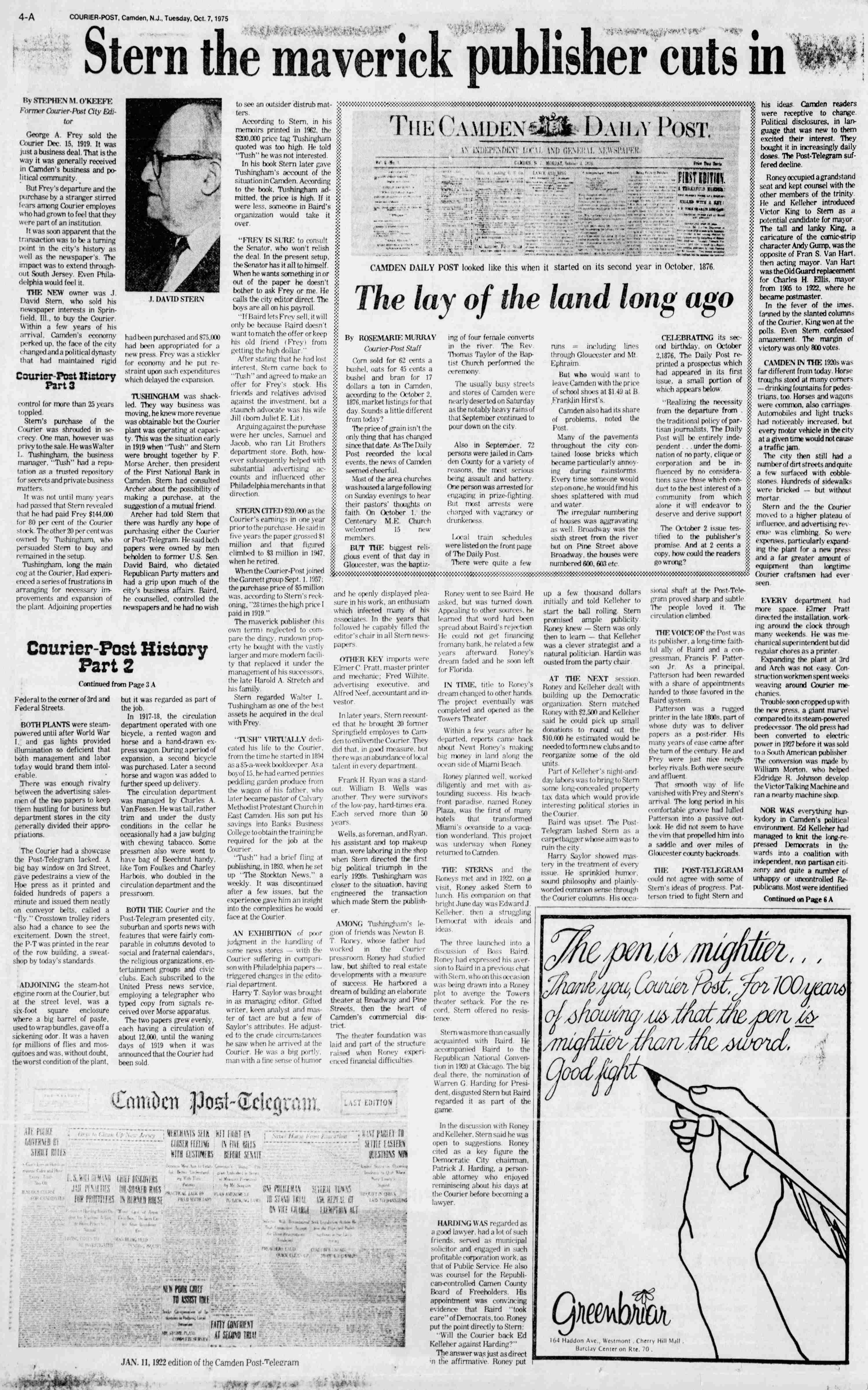

By STEPHEN M. O’KEEFE
Former Courier-Post City Editor
George A. Frey sold the Courier Dec. 15, 1919. It was just a business deal. That is the way it was generally received in Camden’s business and political community.
But Frey’s departure and the purchase by a stranger stirred fears among Courier employes who had grown to feel that they were part of an institution.
It was soon apparent that the transaction was to be a turning point in the city’s history as well as the newspaper’s. The impact was to extend throughout South Jersey. Even Philadelphia would feel it.
THE NEW owner was J. David Stern, who sold his newspaper interests in Springfield, Ill., to buy the Courier. Within a few years of his arrival, Camden’s economy perked up, the face of the city changed and a political dynasty that had maintained rigid control for more than 25 years toppled.
Stern’s purchase of the Courier was shrouded in secrecy. One man, however was privy to the sale. He was Walter L. Tushingham, the business manager. “Tush” had a reputation as a trusted repository for secrets and private business matters.
It was not until many years had passed that Stern revealed that he had paid Frey $144,000 for 80 per cent of the Courier stock. The other 20 per cent was owned by Tushingham, who persuaded Stern to buy and remained in the setup.
Tushingham, long the main cog at the Courier, had experienced a series of frustrations in arranging for necessary improvements and expansion of the plant. Adjoining properties had been purchased and $75,000 had been appropriated for a new press. Frey was a stickler for economy and he put restraint upon such expenditures which delayed the expansion.
TUSHINGHAM was shackled. They [sic] way business was moving, he knew more revenue was obtainable but the Courier plant was operating at capacity. This was the situation early in 1919 when “Tush” and Stern were brought together by F. Morse Archer, then president of the First National Bank in Camden. Stern had consulted Archer about the possibility of making a purchase, at the suggestion of a mutual friend.
Archer had told Stern that there was hardly any hope of purchasing either the Courier or Post-Telegram. He said both papers were owned by men beholden to former U.S. Sen. David Baird, who dictated Republican Party matters and had a grip upon much of the city’s business affairs. Baird, he counselled, controlled the newspapers and he had no wish to see an outsider distrub [sic] matters.
According to Stern, in his memoirs printed in 1962, the $200,000 price tag Tushingham quoted was too high. He told “Tush” he was not interested.
In his book Stern later gave Tushingham’s account of the situation in Camden. According to the book, Tushingham admitted, the price is high. If it were less, someone in Baird’s organization would take it over.
“FREY IS SURE to consult the Senator, who won’t relish the deal. In the present setup, the Senator has it all to himself. When he wants something in or out of the paper he doesn’t bother to ask Frey or me. He calls the city editor direct. The boys are all on his payroll.
“If Baird lets Frey sell, it will only be because Baird doesn’t want to match the offer or keep his old friend (Frey) from getting the high dollar.”
After stating that he had lost interest, Stern came back to “Tush” and agreed to make an offer for Frey’s stock. His friends and relatives advised against the investment, but a staunch advocate was his wife Jill (born Juliet E. Lit).
Arguing against the purchase were her uncles, Samuel and Jacob, who ran Lit Brothers department store. Both, however subsequently helped with substantial advertising accounts and influenced other Philadelphia merchants in that direction.
STERN CITED $20,000 as the Courier’s earnings in one year prior to the purchase. He said in five years the paper grossed $1 million and that figured climbed to $3 million in 1947, when he retired.
When the Courier-Post joined the Gannett group Sept. 1, 1957; the purchase price of $5 million was, according to Stern’s reckoning, “28 times the high price I paid in 1919.”
The maverick publisher (his own term) neglected to compare the dingy, rundown property he bought with the vastly larger and more modern facility that replaced it under the management of his successors, the late Harold A. Stretch and his family.
Stern regarded Walter L. Tushingham as one of the best assets he acquired in the deal with Frey.
“TUSH” VIRTUALLY dedicated his life to the Courier, from the time he started in 1894 as a $5-a-week bookkeeper. As a boy of 15, he had earned pennies peddling garden produce from the wagon of his father, who later became pastor of Calvary Methodist Protestant Church in East Camden. His son put his savings into Banks Business College to obtain the training he required for the job at the Courier.
“Tush” had a brief fling at publishing, in 1893, when he set up “The Stockton News,” a weekly. It was discontinued after a few issues, but the experience gave him an insight into the complexities he would face at the Courier.
AN EXHIBITION of poor judgment in the handling of some news stories — with the Courier suffering in comparison with Philadelphia papers — triggered changes in the editorial department.
Harry T. Saylor was brought in as managing editor. Gifted writer, keen analyst and master of tact are but a few of Saylor’s attributes. He adjusted to the crude circumstances he saw when he arrived at the Courier. He was a big portly man with a fine sense of humor and he openly displayed pleasure in his work, an enthusiam [sic] which infected many of his associates. In the years that followed he capably filled the editor’s chair in all Stern newspapers.
OTHER KEY imports were Elmer C. Pratt, master printer and mechanic; Fred Wilhite, advertising executive, and Alfred Neef, accountant and investor.
In later years, Stern recounted that he brought 20 former Springfield employes to Camden to enliven the Courier. They did that, in good measure, but there was an abundance of local talent in every department.
Frank H. Ryan was a standout. William B. Wells was another. They were survivors of the low-pay, hard-times era. Each served more than 50 years.
Wells, as foreman, and Ryan, his assistant and top makeup man, were laboring in the shop when Stern directed the first big political triumph in the early 1920s. Tushingham was closer to the situation, having engineered the transaction which made Stern the publisher.
AMONG Tushingham’s legion of friends was Newton B. T. Roney, whose father had worked in the Courier pressroom. Roney had studied law, but shifted to real estate developments with a measure of success. He harbored a dream of building an elaborate theater at Broadway and Pine Streets, then the heart of Camden’s commercial district.
The theater foundation was laid and part of the structure raised when Roney experienced financial difficulties.
Roney went to see Baird. He asked, but was turned down. Appealing to other sources, he learned that word had been spread about Baird’s rejection. He could not get financing from any bank, he related a few years afterward. Roney’s dream faded and he soon left for Florida.
IN TIME, title to Roney’s dream changed to other hands. The project eventually was completed and opened as the Towers Theater.
Within a few years after he departed, reports came back about Newt Roney’s making big money in land along the ocean side of Miami Beach.
Roney planned well, worked diligently and met with astounding success. His beachfront paradise, named Roney Plaza, was the first of many hotels that transformed Miami’s oceanside to a vacation wonderland. This project was underway when Roney returned to Camden.
THE STERNS and the Roneys met and in 1922, on a visit, Roney asked Stern to lunch. His companion on that bright June day was Edward J. Kelleher, then a struggling Democrat with ideals and ideas.
The three launched into a discussion of Boss Baird. Roney had expressed his aversion to Baird in a previous chat with Stern, who on this occasion was being drawn into a Roney plot to avenge the Towers theater setback. For the record, Stern offered no resistence [sic].
Stern was more than casually acquainted with Baird. He accompanied Baird to the Republican National Convention in 1920 at Chicago. The big deal there, the nomination of Warren G. Harding for President, disgusted Stern but Baird regarded it as part of the game.
In the discussion with Roney and Kelleher, Stern said he was open to suggestions. Roney cited as a key figure the Democratic City chairman, Patrick J. Harding, a personable attorney who enjoyed reminiscing about his days at the Courier before becoming a lawyer.
HARDING WAS regarded as a good lawyer, had a lot of such friends, served as municipal solicitor and engaged in such profitable corporation work, as that of Public Service. He also was counsel for the Republican-controlled Camen [sic] County Board of Freeholders. His appointment was convincing evidence that Baird “took care” of Democrats, too. Roney put the point directly to Stern:
“Will the Courier back Ed Kelleher against Harding?”
The answer was just as direct in the affirmative. Roney put up a few thousand dollars initially and told Kelleher to start the ball rolling. Stern promised ample publicity. Roney knew — Stern was only then to learn — that Kelleher was a clever strategist and a natural politician. Hardin [sic] was ousted from the party chair.
AT THE NEXT session, Roney and Kelleher dealt with building up the Democratic organization. Stern matched Roney with $2,500 and Kelleher said he could pick up small donations to round out the $10,000 he estimated would be needed to form new clubs and to reorganize some of the old units.
Part of Kelleher’s night-and-day labors was to bring to Stern some long-concealed property tax data which would provide interesting political stories in the Courier.
Baird was upset. The Post-Telegram lashed Stern as a carpetbagger whose aim was to ruin the city.
Harry Saylor showed mastery in the treatment of every issue. He sprinkled humor, sound philosophy and plainly-worded common sense through the Courier columns. His occasional shaft at the Post-Telegram proved sharp and subtle. The people loved it. The circulation climbed.
THE VOICE OF the Post was its publisher, a long-time faithful ally of Baird and a congressman, Francis F. Patterson Jr. As a principal, Patterson had been rewarded with a share of appointments handed to those favored in the Baird system.
Patterson was a rugged printer in the late 1800s, part of whose duty was to deliver papers as a post-rider. His many years of ease came after the turn of the century. He and Frey were just nice neighborley [sic] rivals. Both were secure and affluent.
That smooth way of life vanished with Frey and Stern’s arrival. The long period in his comfortable groove had lulled Patterson into a passive outlook. He did not seem to have the vim that propelled him into a saddle and over miles of Gloucester county backroads.
THE POST-TELEGRAM could not agree with some of Stern’s ideas of progress. Patterson tried to fight Stern and his ideas. Camden readers were receptive to change. Political disclosures, in language that was new to them excited their interest. They bought it in increasingly daily doses. The Post-Telegram suffered decline.
Roney occupied a grandstand seat and kept counsel with the other members of the trinity. He and Kelleher introduced Victor King to Stern as a potential candidate for mayor. The tall and lanky King, a caricature of the comic-strip character Andy Gump, was the opposite of Fran [sic] S. Van Hart, then acting mayor. Van Hart was the Old Guard replacement for Charles H. Ellis, mayor from 1905 to 1922, where he became postmaster.
In the fever of the imes [sic], fanned by the slanted columns of the Courier, King won at the polls. Even Stern confessed amazement. The margin of victory was only 800 votes.
CAMDEN IN THE 1920s was far different from today. Horse troughs stood at many corners — drinking fountains for pedestrians, too. Horses and wagons were common, also carriages. Automobiles and light trucks had noticeably increased, but every motor vehicle in the city at a given time would not cause a traffic jam.
The city then still had a number of dirt streets and quite a few surfaced with cobblestones. Hundreds of sidewalks were bricked — but without mortar.
Stern and the the [sic] Courier moved to a higher plateau of influence, and advertising revenue was climbing. So were expenses, particularly expanding the plant for a new press and a far greater amount of equipment than longtime Courier craftsmen had ever seen.
EVERY department had more space. Elmer Pratt directed the installation, working around the clock through many weekends. He was mechanical superintendent but did regular chores as a printer.
Expanding the plant at 3rd and Arch was not easy. Construction workmen spent weeks weaving around Courier mechanics.
Trouble soon cropped up with the new press, a giant marvel compared to its steam-powered predecessor. The old press had been converted to electric power in 1927 before it was sold to a South American publisher. The conversion was made by William Morton, who helped Eldridge R. Johnson develop the Victor Talking Machine and ran a nearby machine shop.
NOR WAS everything hunkydory in Camden’s political environment. Ed Kelleher had managed to knit the long-repressed Democrats in the wards into a coalition with independent, non partisan citizenry and quite a number of unhappy or uncontrolled Republicans. Most were identified with the Non-Partisan League and they were feeling their oats. The practical Roney and Kelleher, however, knew they had merely reached first base.
The two men huddled with Stern and came up with an idea — campaign for a new form of government for the city. The plan was worked out expertly, emphasizing the advantages of a compact, five-man governing group, each member accountable to voters all over the city.
The new plan was kept secret for a while. It was embodied in an exhaustive survey for the council by Mayor King. The new mayor startled the Old Guard and the city at large by calling for a referendum on a City Commission form of government. The speech prompted an abundance of favorable copy in the Courier; not so favorable comment in the Post-Telegram.
IN MARCH, 1923, the change was approved. In May, the voters elected the entire Non-Partisan League ticket. This put Baird and his organization out of business for the first time in 25 years.
Stern and the Courier were the chief beneficiaries of the change. The publisher — and now politician — was to know the stress of carrying water on both shoulders.
Patterson and the Post-Telegram were to feel the worst effect. With the downward turn of fortune, a frustrating decline in advertising and circulation revenues, the P-T was a loser each day.
STERN CALCULATED the advantages in buy [sic] the Post-Telegram, but Patterson wouldn’t consider a deal with Stern. He approached Baird and asked for a loan needed to fight Stern. Baird said he wanted Patterson to keep the competition and suggested a smaller loan. The Post publisher wouldn’t agree.
“The full amount or nothing,” Patterson declared.
Baird matched his stubbornness. Back in the office Patterson shared his misery with Upton S. Jefferys, the editor, and Frank S. Albright, city editor. Upton owned five shares of P-T stock. He and Albright had given their best efforts for many years, but the outlook was bleak.
THIS WAS the situation when Patterson saw Ed Kelleher enter the office. The two were not strangers, but Patterson had little reason to regard him warmly.
Kelleher came right out with an offer to buy the Post-Telegram. Patterson replied with equal candor:
“You know that I know, Ed, that you don’t have anough [sic] money to buy this paper.”
Kelleher put a hand in a coat pocket and was about to inform Patterson that he had come prepared to negotiate.
“I’m sure I know who you represent,” Patterson stated. “My answer is no.”
KELLEHER DREW a check from his pocket and placed it before Patterson. The publisher took a quick glance at the amount. It was $75,000. He then summoned his son, Frank F. Patterson 3d.
“Here, Frank, you’re the treasurer here; this is your department.”
Kelleher thought he was hearing a change of attitude by Patterson. The younger Patterson stared at both men. He glanced at both sides of the check as would an accountant, then turned to his parent.
“What am I supposed to do with this, Father?” he asked.
THE REPLY was intended for Kelleher:
“You are supposed to tear it up and throw the pieces in the waste basket, Son.”
Young Patterson obeyed.
Keleher [sic] accepted the gestured [sic] as finale. One minute later he was walking along Federal Street to the Courier building to report to Stern.
J. DAVID STERN
JAN. 11, 1922 edition of the Camden Post-Telegram
The lay of the land long ago
By ROSEMARIE MURRAY
Courier-Post Staff
Corn sold for 62 cents a bushel, oats for 45 cents a bushel and bran for 17 dollars a ton in Camden, according to the October 2, 1876, market listings for that day. Sounds a little different from today?
The price of grain isn’t the only thing that has changed since that date. As The Daily Post recorded the local events, the news of Camden seemed cheerful.
Most of the area churches was [sic] housed a large following on Sunday evenings to hear their pastors’ thoughts on faith. On October 1, the Centenary M.E. Church welcomed 15 new members.
BUT THE biggest religious event of that day in Gloucester, was the baptizing of four female converts in the river. The Rev. Thomas Taylor of the Baptist Church performed the ceremony.
The usually busy streets and stores of Camden were nearly deserted on Saturday as the notably heavy rains of that September continued to pour down on the city.
Also in September, 72 persons were jailed in Camden County for a variety of reasons, the most serious being assault and battery. One person was arrested for engaging in prize-fighting. But most arrests were charged with vagrancy or drunkeness [sic].
Local train schedules were listed on the front page of The Daily Post.
There were quite a few runs — including lines through Gloucester and Mt. Ephraim.
But who would want to leave Camden with the price of school shoes at $1.49 at B. Franklin Hirst’s.
Camden also had its share of problems, noted the Post.
Many of the pavements throughout the city contained loose bricks which became particularly annoying during rainstorms. Every time someone would step on one, he would find his shoes splattered with mud and water.
The irregular numbering of houses was aggravating as well. Broadway was the sixth street from the river but on Pine Street above Broadway, the houses were numbered 600, 603 etc.
CELEBRATING its second birthday, on October 2, 1876, The Daily Post reprinted a prospectus which had appeared in its first issue, a small portion of which appears below:
“Realizing the necessity from the departure from the traditional policy of partisan journalists, The Daily Post will be entirely independent . . . under the domination of no party, clique or corporation and be influenced by no considerations save those which conduct to the best interest of a community from which alone it will endeavor to deserve and derive support.”
The October 2 issue testified to the publisher’s promise. And at 2 cents a copy, how could the readers go wrong?
CAMDEN DAILY POST looked like this when it started on its second year in October, 1876.
Courier-Post History Part 2
Federal to the corner of 3rd and Federal Streets.
BOTH PLANTS were steam-powered until after World War I, and gas lights provided illumination so deficient that both management and labor today would brand them intolerable.
There was enough rivalry between the advertising salesmen of the two papers to keep them hustling for business but department stores in the city generally divided their appropriations.
The Courier had a showcase the Post-Telegram lacked. A big bay window on 3rd Street, gave pedestrains [sic] a view of the Hoe press as it printed and folded hundreds of papers a minute and issued them neatly on conveyor belts, called a “fly.” Crosstown trolley riders also had a chance to see the excitement. Down the street, the P-T was printed in the rear of the row building, a sweatshop by today’s standards.
ADJOINING the steam-hot engine room at the Courier, but at the street level, was a six-foot square enclosure where a big barrel of paste, used to wrap bundles, gave off a sickening odor. It was a haven for millions of flies and mosquitoes and was, without doubt, the worst condition of the plant, but it was regarded as part of the job.
In 1917-18, the circulation department operated with one bicycle, a rented wagon and horse and a hand-drawn express wagon. During a period of expansion, a second bicycle was purchased. Later a second horse and wagon was added to further speed up delivery.
The circulation department was managed by Charles A. Van Fossen. He was tall, rather trim and under the dusty conditions in the cellar he occasionally had a jaw bulging with chewing tabacco [sic]. Some pressmen also were wont to have bag of Beechnut handy, like Tom Foulkes and Charley Harbois, who doubled in the circulation department and the pressroom.
BOTH THE Courier and the Post-Telegram presented city, suburban and sports news with features that were fairly comparable in columns devoted to social and fraternal calendars, the religious organizations, entertainment groups and civic clubs. Each subscribed to the United Press news service, employing a telegrapher who typed copy from signals received over Morse apparatus.
The two papers grew evenly, each having a circulation of about 12,000, until the waning days of 1919 when it was announced that the Courier had been sold.
News monopolist: into politics and out again
Camden Courier-Post —
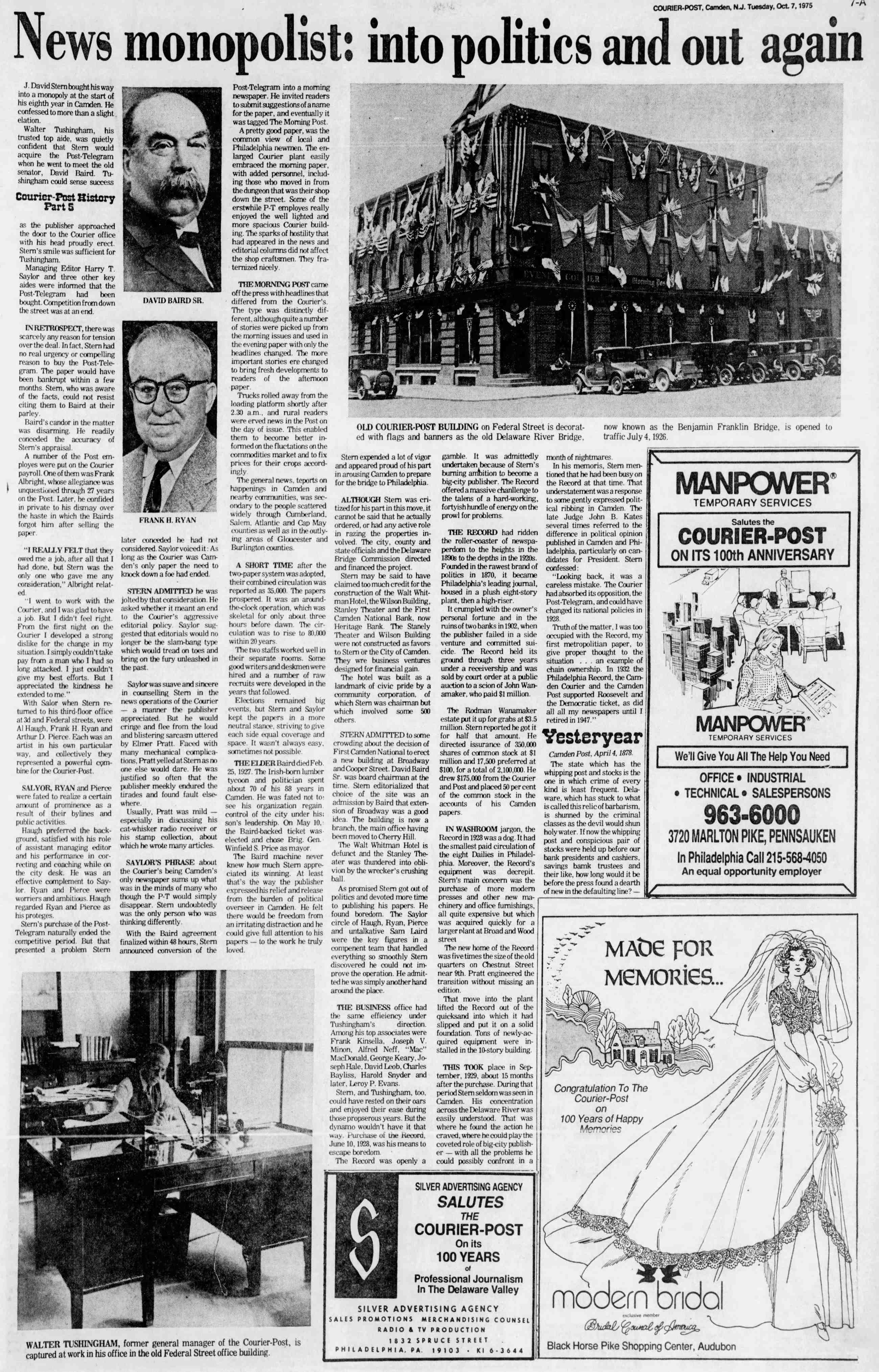
J. David Stern bought his way into a monopoly at the start of his eighth year in Camden. He confessed to more than a slight elation.
Walter Tushingham, his trusted top aide, was quietly confident that Stern would acquire the Post-Telegram when he went to meet the old senator, David Baird. Tushingham could sense success as the publisher approached the door to the Courier office with his head proudly erect. Stern’s smile was sufficient for Tushingham.
Managing Editor Harry T. Saylor and three other key aides were informed that the Post-Telegram had been bought. Competition from down the street was at an end.
IN RETROSPECT, there was scarcely any reason for tension over the deal. In fact, Stern had no real urgency or compelling reason to buy the Post-Telegram. The paper would have been bankrupt within a few months. Stern, who was aware of the facts, could not resist citing them to Baird at their parley.
Baird’s candor in the matter was disarming. He readily conceded the accuracy of Stern’s appraisal.
A number of the Post employes were put on the Courier payroll. One of them was Frank Albright, whose allegiance was unquestioned through 27 years on the Post. Later, he confided in private to his dismay over the haste in which the Bairds forgot him after selling the paper.
“I REALLY FELT that they owed me a job, after all that I had done, but Stern was the only one who gave me any consideration,” Albright related.
“I went to work with the Courier, and I was glad to have a job. But I didn’t feel right. From the first night on the Courier I developed a strong dislike for the change in my situation. I simply couldn’t take pay from a man who I had so long attacked. I just couldn’t give my best efforts. But I appreciated the kindness he extended to me.”
With Salor [sic] when Stern returned to his third-floor office at 3d and Federal streets, were Al Haugh, Frank H. Ryan and Arthur D. Pierce. Each was an artist in his own particular way, and collectively they represented a powerful combine for the Courier-Post.
SALYOR, RYAN and Pierce were fated to realize a certain amount of prominence as a result of their bylines and public activities.
Haugh preferred the background, satisfied with his role of assistant managing editor and his performance in correcting and coaching while on the city desk. He was an effective complement to Saylor. Ryan and Pierce were worriers and ambitious. Haugh regarded Ryan and Pierce as his proteges.
Stern’s purchase of the Post-Telegram naturally ended the competitive period. But that presented a problem Stern later conceded he had not considered. Saylor voiced it: As long as the Courier was Camden’s only paper the need to knock down a foe had ended.
STERN ADMITTED he was jolted by that consideration. He asked whether it meant an end to the Courier’s aggressive editorial policy. Saylor suggested that editorials would no longer be the slam-bang type which would tread on toes and bring on the fury unleashed in the past.
Saylor was suave and sincere in counselling Stern in the news operations of the Courier — a manner the publisher appreciated. But he would cringe and flee from the loud and blistering sarcasm uttered by Elmer Pratt. Faced with many mechanical complications, Pratt yelled at Stern as no one else would dare. He was justified so often that the publisher meekly endured the tirades and found fault elsewhere.
Usually, Pratt was mild — especially in discussing his cat-whisker radio receiver or his stamp collection, about which he wrote many articles.
SAYLOR’S PHRASE about the Courier’s being Camden’s only newspaper sums up what was in the minds of many who though [sic] the P-T would simply disappear. Stern undoubtedly was the only person who was thinking differently.
With the Baird agreement finalized within 48 hours, Stern announced conversion of the Post-Telegram into a morning newspaper. He invited readers to submit suggestions of a name for the paper, and eventually it was tagged The Morning Post.
A pretty good paper, was the common view of local and Philadelphia newmen. The enlarged Courier plant easily embraced the morning paper, with added personnel, including those who moved in from the dungeon that was their shop down the street. Some of the erstwhile P-T employes really enjoyed the well lighted and more spacious Courier building. The sparks of hostility that had appeared in the news and editorial columns did not affect the shop craftsmen. They fraternized nicely.
THE MORNING POST came off the press with headlines that differed from the Courier’s. The type was distinctly different, although quite a number of stories were picked up from the morning issues and used in the evening paper with only the headlines changed. The more important stories ere [sic] changed to bring fresh developments to readers of the afternoon paper.
Trucks rolled away from the loading platform shortly after 2.30 a.m., and rural readers were erved [sic] news in the Post on the day of issue. This enabled them to become better informed on the fluctations [sic] on the commodities market and to fix prices for their crops accordingly.
The general news, teports [sic] on happenings in Camden and nearby communities, was secondary to the people scattered widely through Cumberland, Salem, Atlantic and Cap May [sic] counties as well as in the outlying areas of Gloucester and Burlington counties.
A SHORT TIME after the two-paper system was adopted, their combined circulation was reported as 35,000. The papers prospered. It was an around-the-clock operation, which was skeletal for only about three hours before dawn. The circulation was to rise to 80,000 within 20 years.
The two staffs worked well in their separate rooms. Some good writers and deskmen were hired and a number of raw recruits were developed in the years that followed.
Elections remained big events, but Stern and Saylor kept the papers in a more neutral stance, striving to give each side equal coverage and space. It wasn’t always easy, sometimes not possible.
THE ELDER Baird died Feb. 25, 1927. The Irish-born lumber tycoon and politician spent about 70 of his 88 years in Camden. He was fated not to see his organization regain control of the city under his son’s leadership. On May 10, the Baird-backed ticket was elected and chose Brig. Gen. Winfield S. Price as mayor.
The Baird machine never knew how much Stern appreciated its winning. At least that’s the way the publisher expressed his relief and release from the burden of political overseer in Camden. He felt there would be freedom from an irritating distraction and he could give full attention to his papers — to the work he truly loved.
Stern expended a lot of vigor and appeared proud of his part in arousing Camden to prepare for the bridge to Philadelphia.
ALTHOUGH Stern was critized [sic] for his part in this move, it cannot be said that he actually ordered, or had any active role in razing the properties involved. The city, county and state officials and the Delaware Bridge Commission directed and financed the project.
Stern may be said to have claimed too much credit for the construction of the Walt Whitman Hotel, the Wilson Building, Stanley Theater and the First Camden National Bank, now Heritage Bank. The Stanely [sic] Theater and Wilson Building were not constructed as favors to Stern or the City of Camden. They wre [sic] business ventures designed for financial gain.
The hotel was built as a landmark of civic pride by a community corporation, of which Stern was chairman but which involved some 500 others.
STERN ADMITTED to some crowding about the decision of First Camden National to erect a new building at Broadway and Cooper Street. David Baird Sr. was board chairman at the time. Stern editorialized that choice of the site was an admission by Baird that extension of Broadway was a good idea. The building is now a branch, the main office having been moved to Cherry Hill.
The Walt Whitman Hotel is defunct and the Stanley Theater was thundered into oblivion by the wrecker’s crushing ball.
As promised Stern got out of politics and devoted more time to publishing his papers. He found boredom. The Saylor circle of Haugh, Ryan, Pierce and untalkative Sam Laird were the key figures in a compenent [sic] team that handled everything so smoothly Stern discovered he could not improve the operation. He admitted he was simply another hand around the place.
THE BUSINESS office had the same effieiency [sic] under Tushingham’s direction. Among his top associates were Frank Kinsella, Joseph V. Minon, Alfred Neff, “Mac” MacDonald, George Keary, Joseph Hale, David Leob, Charles Bayliss, Harold Snyder and later, Leroy P. Evans.
Stern, and Tushingham, too, could have rested on their oars and enjoyed their ease during those propserous [sic] years. But the dynamo wouldn’t have it that way. Purchase of the Record, June 10, 1928, was his means to escape boredom.
The Record was openly a gamble. It was admittedly undertaken because of Stern’s burning ambition to become a big-city publisher. The Record offered a massive chanllenge [sic] to the talens [sic] of a hard-working, fortyish hundle [sic] of energy on the prowl for problems.
THE RECORD had ridden the roller-coaster of newspaperdom to the heights in the 1890s to the depths in the 1920s. Founded in the rawest brand of politics in 1870, it became Philadelphia’s leading journal, housed in a plush eight-story plant, then a high-riser.
It crumpled with the owner’s personal fortune and in the ruins of two banks in 1902, when the publisher failed in a side venture and committed suicide. The Record held its ground through three years under a receivership and was sold by court order at a public auction to a scion of John Wanamaker, who paid $1 million.
The Rodman Wanamaker estate put it up for grabs at $3.5 million. Stern reported he got it for half that amount. He directed issurance [sic] of 350,000 shares of common stock at $1 million and 17,500 preferred at $100, for a total of 2,100,000. He drew $175,000 from the Courier and Post and placed 50 per cent of the common stock in the accounts of his Camden papers.
IN WASHROOM jargon, the Record in 1928 was a dog. It had the smallest paid circulation of the eight Dailies in Philadelphia. Moreover, the Record’s equipment was decrepit. Stern’s main concern was the purchase of more modern presses and other new machinery and office furnishings, all quite expensive but which was acquired quickly for a larger plant at Broad and Wood street.
The new home of the Record was five times the size of the old quarters on Chestnut Street near 9th. Pratt engineered the transition without missing an edition.
That move into the plant lifted the Record out of the quicksand into which it had slipped and put it on a solid foundation. Tons of newly-acquired equipment were installed in the 10-story building.
THIS TOOK place in September, 1929, about 15 months after the purchase. During that period Stern seldom was seen in Camden. His concentration across the Delaware River was easily understood. That was where he found the action he craved, where he could play the coveted role of big-city publisher — with all the problems he could possibly confront in a month of nightmares.
In his memoris [sic], Stern mentioned that he had been busy on the Record at that time. That understatement was a response to some gently expressed political ribbing in Camden. The late Judge John B. Kates several times referred to the difference in political opinion published in Camden and Philadelphia, particularly on candidates for President. Stern confessed:
“Looking back, it was a careless mistake. The Courier had absorbed its opposition, the Post-Telegram, and could have changed its national policies in 1928.
Truth of the matter, I was too occupied with the Record, my first metropolitan paper, to give proper thought to the situation . . . an example of chain ownership. In 1932 the Philadelphia Record, the Camden Courier and the Camden Post supported Roosevelt and the Democratic ticket, as did all all [sic] my newspapers until I retired in 1947.”
DAVID BAIRD SR.
FRANK H. RYAN
OLD COURIER-POST BUILDING on Federal Street is decorated with flags and banners as the old Delaware River Bridge, now known as the Benjamin Franklin Bridge, is opened to traffic July 4, 1926.
WALTER TUSHINGHAM, former general manager of the Courier-Post, is captured at work in his office in the old Federal Street office building.
Yesteryear
Camden Post, April 4, 1878.
The state which has the whipping post and stocks is the one in which crime of every kind is least frequent. Delaware, which has stuck to what is called this relic of barbarism, is shunned by the criminal classes as the devil would shun holy water. If now the whipping post and conspicuous pair of stocks were held up before our bank presidents and cashiers, savings bamk [sic] trustees and their like, how long would it be before the press found a dearth of new [sic] in the defaulting line? —
Night rider takes on carpetbagger
Camden Courier-Post —
By STEPHEN M. O’KEEFE
Former Courier-Post City Editor
Labor Day signaled the end of summer and all the ad boys of the Courier resumed hustling to make 1923 a banner year. In the not distant past, the paper regarded 16 pages as big day. At this point 32, 36 and 40 pages were common.
No bright days were being reported down the street. Rumors bobbed up that Patterson was tired of it all, but he was determined not to sell out to Stern. He kept that vow.
It wasn’t easy, according to some contempoary [sic] accounts. Part of the difficulty appeared to Patterson’s associates to be David Baird Jr., then assuming the leadership position held by his father.
THE YOUNGER Baird was a brash heir apparent toward some of the more knowledgeable of the elder Baird’s lieutenants. Men like Frank Patterson, who in certain situations had been mentor to the old man, just couldn’t cotton the unseasoned apprentice. Young Davie was excitable and impatient.
Patterson witnessed such outbursts as often as a Courier editorial critized [sic] Baird or his organization.
But young Baird was too hotheaded to master his emotions — a characteristic of his father. When a Courier story or edtiorial [sic] found even a slight flaw in GOP policy or practice, Baird’s son reacted like a bull to a red flag.
Acting in such a fever, young Baird decied [sic] to acquire control of the Post-Telegram. The idea excited him
“I’M GOING to run that carpetbagger out of Camden,” he vowed.
Before he could get started the Patterson family leased the paper to William A. Searle, then secretary of the Camden Board of Trade. Searle had an affinity for the newspaper business and his heart was devoted to the advancement of Camden. In response to his inquiry, Searle was told by Patterson that he could buy the Post-Telegram if he could raise the money.
Searle’s father lived in New York state, had the means and Bill though he might persuade him to finance purchase of the paper. The eleder [sic] Searle made a trip to Camden and looked over the property but felt it prudent to request a one-year lease, with an option to buy, to determine first wheatehr [sic] his son could “make a go of it.”
The lease was signed, and Searle took over management Oct. 1, 1923. Before the end of the year, it was obvious that the operation was far from profitable and that Searle’s father would not underwrite the purchase. Patterson retained title and resumed direction. Searle afterward became publisher of a small advertising periodical in Haddonfield.
On Nov. 17, 1924 the formation of a new company was announced. The Camden-Post-Telegram Publishing Company, which had purchased all stock from Patterson and a few miner [sic] shareholders.
THE PRINCIPAL figure among the new owners was David Baird Jr., listed as vice-persident [sic]. Killam E. Bennett was president on the record. Another investor was Albert S. Woodruff, a prominent attorney who later represented Camden county in the state Senate and in 1941 was appointed vice chancellor in the New Jersey court system.
The deal for the Post-Telegram was based on the assumption that Camden needed two newspapers and that competition had manifold advantages. Local advertisers saw bright prospects of lower lineage rates.
That concept was accepted in general, but not by Baird or Stern.
Baird was motivated by hate. He bragged about it, Stern tried to buy the paper and set up a monopoly, acting greedily, comfortably garbed as good business.
STERN HAD Harry T. Saylor, born diplomat, as managing editor. Stern drew heavily on Saylor’s talents and counsel.
Baird and Frank S. Albright, managing editor and Patterson’s trusted aide for more than 25 years. Baird bypassed Albright and brought in a stranger, Pierrepont Isham Prentice, and gave him the title of publisher.
Before formal announcement of that move, Baird confided to friends:
“The man we have as publisher is so much smarter than Stern that the Courier will fold within a year.”
Prentice was credited with some skills as a newspaperman, but he was no match for Stern and Saylor.
ADDING TO his difficulties, Prentice had standing ordess [sic] for biter [sic] attacks almost daily on the Courier and Stern.
The Post-Telegram picled [sic] up a few readers, but circulation had fallen so far that income could not match the cost of operation. Advertisers refused to pay for space at the sme [sic] rate charged by the Courier, whose readership had soared from 11,234 to 26,066 in the four years since September, 1919.
Then Stern goofed. He wrote an editoral [sic] in which he put the Courier in favor of consolidation of all the suburbs under a county administration. The plan would reduce duplication of services and would cut taxes substantially. In his memoirs, Stern did not mention any consulatation [sic] with Saylor on the editorial. Saylor’s method in such matters would be to discuss the proposal with people closely related to it. In that manner he would have learned — before publication — what Stern was to discover within a few days.
BAIRD JUMPED on the plan and, for once, Prentice was in accord with him.
With the help of Albright and the newsroom staff, they asked longtime residents how they felt about the doom of their home town under the scheme of the carpetbagger in Camden. They didn’t cotton to it. The old reliable Post-Telegram could be depended upon as their sounding-board and would stand by them, they were assured.
Two centers of resentment were Haddonfield and Merchantville. The aversion in each case was steadfast. No amount of argument about the practically of the plan advanced in the Courier columns could shake the home-rule sentiment in both boroughs.
Similar reaction also cropped up in smaller down-county municipalities, where the citizenry did not want to see their demi-rural communities gobbled up by the more populous centers.
The Post-Telegram experienced a surge inciruclation [sic]. The issue proved a tonic to the news staff.
STERN CONFESSED the blunder by dropping the proposal. Baird gloated. (In 1932, under stress of the Depression, Baird urged consolidating municipalities to reduce expenses and taxes).
Stern later wrote that he regretted abandoning the merger proposal. He regraded [sic] the multiplicity of local governments to be great weakness of the American system.
When Stern ceased to advocate consolidation, the brass knuckles slipped from Baird’s hands. The fight had ended, and the glow of the Post-Telegram’s triumph soon faded. Its decline resumed. Baird made several futile editorial stabs.
IT WAS common knowledge that Baird was the boss of the Post-Telegram, just as he was becoming successor to his father as chieftain of the Republican organization. It also was obvious that he was not a newspaperman. He never had the training or experience. He was not a writer and did not fill the position he had gained through family wealth and political influence.
But Baird was stubborn. That burning desire to drive Stern out of Camden gripped him like a steel trap.
Only one man, his father, could convince him that newspapering was not his cup of tea.
The old man had a sheet of figures showing financial loss in the P-T — with not even a faint hope of recovery. The practical parent turned to his secretary, Mrs. Elizabeth Verga, and asked her to arrange a meeting with Stern.
TO THE ELDER Baird, 1925 was not the season to lose money in any business. Actually, it was a prosperous period. The Walt Whitman Hotel opened. Broadway had been cut through at Market and Cooper Streets as a channel for traffic generated by the new bridge being built. J. Robley Tucker, the “boy wonder” had made millions in real estate.
A new office building was being erected by R. M. Hollingshead Corp. at 9th and Cooper Streets, and a cornerstone was laid for Parkside Trust Company at Haddon and Kaighn Avenues. The aircraft carrier USS Saratoga, the largest vessel ever built in the United States, was launched from the shipyard of the New York Shipbuilding Corp.
According to Stern’s later accounting, 1925 was the second million-dollar year of the Courier profit chart.
AS THE YEAR wore on, and the realty boom faded, the elder Baird could no longer stand by and see Young Dave throwing away money on the P-T. When Stern responded to the elder Baird’s invitation, a cordial exchange developed that would have been impossible with the younger Baird present.
Stern’s memoirs describe the meeting as brief and decisive. Baird admitted his son lost a lot of money and said it was time he stopped trying to run a newspaper. He said he would like to have Stern buy the property at a fair price, then stated his son paid Patterson $250,000. Stern’s rapid retort was an offer of $300,000.
“It’s a deal,” Sen. Baird declared. They shook hands and sent for their attorneys to draw up an agreement. Effective date of the transaction was set as Jan. 27, 1926, one year and 10 weeks after Patterson sold to Baird and associates.
DAVID BAIRD JR.