Introduction
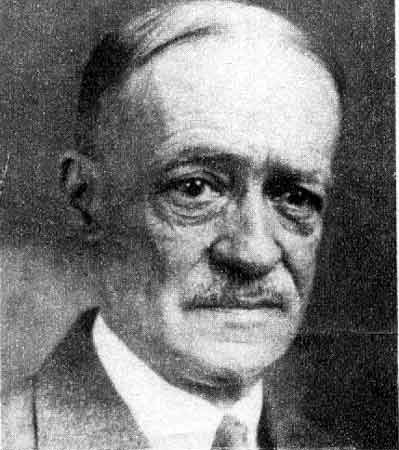
William D. Brown, circa 1931.
WILLIAM D. BROWN was born in New Jersey in 1867, the son of John J. Brown and one of the daughters of David and Mary Hart. He was living at 409 Walnut Street with his father and another family when the Census was taken in 1870. Sadly, his mother seems to have passed prior to the enumeration of the 1870 Census. William D. Brown and his father were then living with the widowed Mary Hart and the rest of her children, including sons Charles H. Hart and George B. Hart.
His father was a veteran of the Civil War, who had seen duty with three different regiments. In 1880 the Browns lived at 1018 South 5th Street in Camden, where the elder Brown was a tavern keeper. John J. Brown had remarried, his second wife was Emma Harvey, the sister of long-time Camden policeman William “Bill” Harvey. Besides William D. Brown there was a younger sister, Lizzie. Emma Brown’s sister Elizabeth Harvey also lived with the family. By 1887 John J. Brown had moved his business and his family to 1102 South 4th Street. This building still operates as a bar in 2004. It was known in the 1940s and 1950s as Pete’s Cafe, in 1966 as Joe’s Cafe, in 1977 Baron’s Lounge, in the 1980s as Phase 2, and since 1994 as the Cotton Club.
William D. Brown married his wife Margaret around 1888. A son, John, was born around 1890. His father, John J. Brown, passed away on March 16, 1898 at the age of 54. William D. Brown appears in the 1888–1889 Camden City Directory as a reporter, living at 1102 South 4th Street. The 1890–1891 Directory shows that William D. Brown, still a reporter, and his wife Margaret had moved to 937 South 5th Street. When the 1893–1894 Camden City Directory was published, William D. Brown was working as a reporter of the Camden Courier. He now lived at 1013 South 5th Street. Also of interest is that his father had left the bar business, and now resided across the street, at 1014 South 5th Street.
William D. Brown was elected to Camden’s school board in 1890, and on the fifth ballot, was named Board secretary. The following year he was named Board Auditor. When the Commission of Public was instituted, he served on that body as Secretary and Auditor. He resigned from that body after the November 1902 election. A staunch Republican, by 1901 he was a member of the Camden Republican party executive committee.
By the end of the 1910s William D. Brown was serving as the City Clerk of Camden. His deputy through most of the 1900s and 1910s was Morris Odell. The Census taken in January of 1920 shows that he lived with his wife, son, daughter-in-law Sylvia, and granddaughter Helen at 920 South 5th Street in South Camden. Neighbors included Fire Chief George B. Wade, stationary store owner Charles Devaull, and Mayor Charles H. Ellis, who lived at 913 South 5th Street.
The 1930 Census shows the Brown family had purchased a newly constructed row home at 3190 Westfield Avenue in East Camden during the 1920s. These homes had been built by local real estate developer Leon Todd. The Brown family at this time included Mr. and Mrs. Brown, son John J. “Jerry” Brown, then a commercial artist, daughter-in-law Sylvia, and grandchildren Helen and William D. Brown II.
William D. Brown served as City Clerk during the administrations of Mayors Charles H. Ellis, Victor S. King, and Winfield S. Price. He was appointed Camden County Clerk in December of 1920 when Francis Ford Patterson Jr. resigned to serve in Congress, and was succeeded at the City level by Morris Odell. William D. Brown returned to the City Clerk’s office and in 1931 he was succeeded as City Clerk by Frank S. Albright.
William D. Brown passed away on January 8, 1933 and was buried at Lakeview Cemetery in Cinnaminson NJ. His son, Jerry Brown, is listed at the 3190 Westfield Avenue address. By 1947 the Browns had sold the house, which was then the residence of prominent Camden attorney Carlton W. Rowand.
William D. Brown’s uncle, Charles H. Hart, served with the Camden Fire Department and Camden Police Department in the 1870s.
Camden Election Boards
Philadelphia Inquirer —
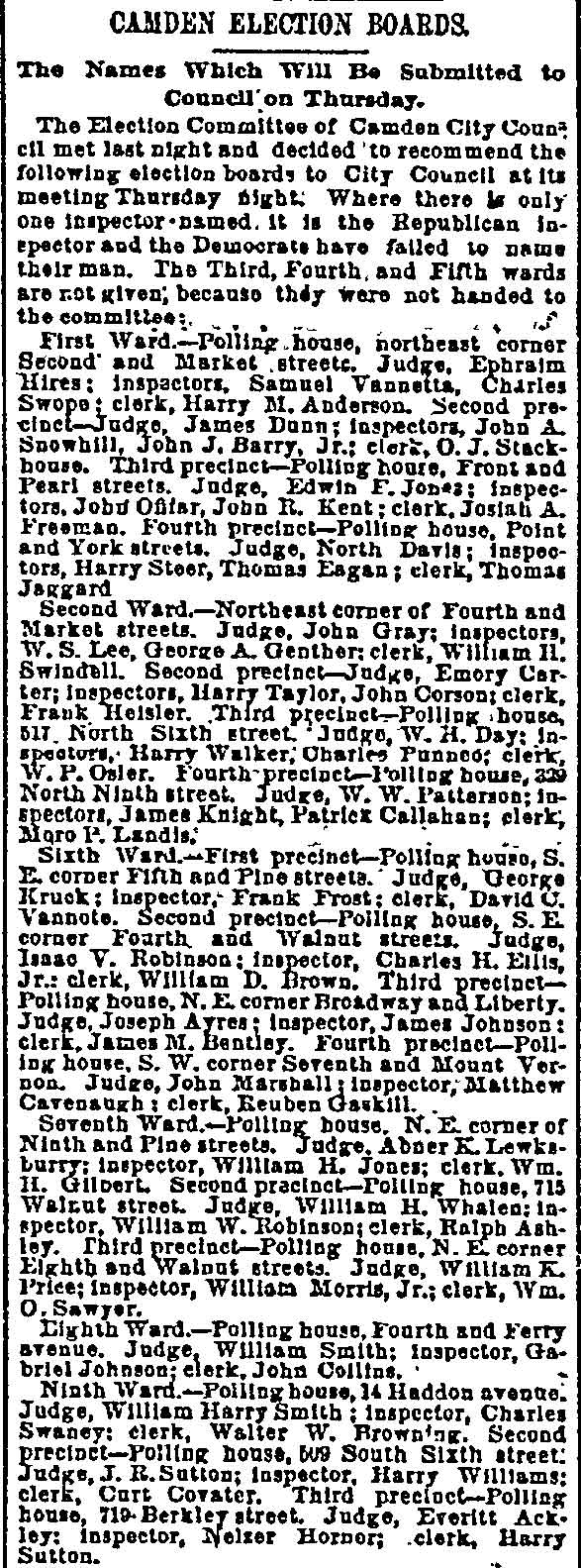
CAMDEN ELECTION BOARDS.
The Names Which Will Be Submitted to Council on Thursday.
The Election Committee of Camden City Council met last night and decided to recommend the following election boards to City Council at its meeting Thursday night. Where there is only one inspector named, it is the Republican inspector and the Democrats have failed to name their man. The Third, Fourth, and Fifth wards are not given, because they were not handed to the committee:
First Ward—Polling house, northeast corner Second and Market streets. Judge, Ephraim Hires; inspectors, Samuel Vannetta, Charles Swope; clerk, Harry M. Anderson. Second precinct—Judge, James Dunn; inspectors, John A. Snowhill, John J. Barry, Jr.; clerk, O. J. Stackhouse. Third precinct—Polling house, Front and Pearl streets. Judge, Edwin F. Jones; inspectors, John Oilsar, John R. Kent; clerk, Josiah A. Freeman. Fourth precinct—Polling house, Point and York streets. Judge, North Davis; inspectors, Harry Steer, Thomas Eagan; clerk, Thomas Jaggard.
Second Ward—Northeast corner of Fourth and Market streets. Judge, John Gray; inspectors, W. S. Lee, George A. Genther; clerk, William H. Swindell. Second precinct—Judge, Emory Carter; inspectors, Harry Taylor, John Corson; clerk, Frank Heisler. Third precinct—Polling house, 517 North Sixth street. Judge, W. H. Day; inspectors, Harry Walker, Charles Punneo; clerk, W. P. Osler. Fourth precinct—Polling house, 329 North Ninth street. Judge, W. W. Patterson; inspectors, James Knight, Patrick Callahan; clerk, Moro P. Landis.
Sixth Ward—First precinct—Polling house, S. E. corner Fifth and Pine streets. Judge, George Kruck; inspector, Frank Frost; clerk, David C. Yannotte. Second precinct—Polling house, S. E. corner Fourth and Walnut streets. Judge, Isaac V. Robinson; inspector, Charles H. Ellis, Jr.; clerk, William D. Brown. Third precinct—Polling house, N. E. corner Broadway and Liberty. Judge, Joseph Ayres; inspector, James Johnson; clerk, James M. Bentley. Fourth precinct—Polling house, S. W. corner Seventh and Mount Vernon. Judge, John Marshall; inspector, Matthew Cavenaugh; clerk, Reuben Gaskill.
Seventh Ward—Polling house, N. E. corner of Ninth and Pine streets. Judge, Abner K. Lewksburry; inspector, William H. Jones; clerk, Wm. H. Gilbert. Second precinct—Polling house, 715 Walnut street. Judge, William H. Whalen; inspector, William W. Robinson; clerk, Ralph Ashley. Third precinct—Polling house, N. E. corner of Eighth and Walnut streets. Judge, William K. Price; inspector, William Morris, Jr.; clerk, Wm. O. Sawyer.
Eighth Ward—Polling house, Fourth and Ferry avenue. Judge, William Smith; inspector, Gabriel Johnson; clerk, John Collins. Ninth Ward—First precinct—Polling house, 14 Haddon Avenue. Judge, William Harry Smith; inspectors, Charles Swaney; clerk, Walter W. Browning. Second precinct—Polling house, 909 South Sixth street. Judge, J. K. Sutton; inspector, Harry Williams; clerk, Curt Covater. Third precinct—Polling house, 719 Berkeley street. Judge, Everitt Ackley; inspector, Nelzer Hornor; clerk, Harry Sutton.
Sixth Ward Republican Club Elects Delegates
Philadelphia Inquirer —

The Sixth Ward Republican Club has elected City Clerk Varney, Deputy Sheriff Sell, William D. Brown, E. E. Jefferis and John Brothers as delegates to the State League of Republican Clubs.
The Mayor’s Appointments
Camden Daily Telegram —

He Announced Several This Noon.
COMMISSIONERS OF INSTRUCTION.
The Old Members Re-named With the Exception of the Member From the Seventh Ward—Police Appointments and Resignations.
Mayor Westcott this noon made the following appointments as Commissioners of Public instruction:
Messrs. George D. Borton, of the First ward; Samuel Iszard, of the Second ward; Charles H. Ellis, Jr., of the Sixth ward, and James Hanson, to succeed Charles Hewston, of the Seventh ward.
The officers of the Commission hold over another year.
The following appointments were made on the police force:
First Ward—James Elberson, Charles Wilbur, Samuel H. Sheer.
Second Ward—No appointments.
Third Ward—John Sinclair, E. D. Stein.
Fourth Ward—No appointments.
Fifth Ward—Albert Shaw, Charles Fitzsimmons.
Sixth Ward—Abraham Jackson.
Seventh Ward—Alfred Sayres, Edward Hyde.
Eighth Ward—Thomas Buchanan, Jacob A. Hicks (colored).
Ninth Ward—No appointments.
Mayor Westcott has requested the resignation of all the members of the police force who served under the Police Commission, to take effect May 1. They are Policemen Peall, Horner, Painter, Mullane, Miller and Reed.
POLITICAL POINTERS.
Who will be the postmaster?
Who will be the next prosecutor?
Many of the ward workers are suffering from election colds.
The name of Harry Moffitt was left out of the columns of honorable mention with the other hustlers of election day.
Senator Rogers and Messrs. Stafford and Watson, of the House are fully coming up to the expectations of their constituents.
If the Mayor could arrange it to hold his hearings a trifle earlier it would be a great source of satisfaction to the Camden afternoon papers.
There is still great anxiety on the part of the public as to the outcome of the present session of the legislature. Thus far their public acts have been highly commendable.
The abolishment of the Police Justice act restores to office the City Recorder, Benjamin M. Braker, who would be qualified to act in place of the Mayor should the Chief Executive be taken sick.
Jos. Potter, the new member of Council from the First ward is a man of wide business experience and will prove much advantage to the many large financial interests that will come under his care.
Owing to the satisfactory working of the present school commission in the two second-class counties up the State, the legislature made no change in the mode of placing the members as was anticipated.
Jos. B. Fox, of the Fourth ward, is what might be termed an old reliable, having had a long and varied experience in public affairs. He is always conservative in the expenditure of city money. He is always safe to trust.
Charles Sayrs, of the Seventh ward, who had a short experience in the present Council, but enough to make him feel at home among public affairs, is neck and ears in work between his real estate business and Councilmanic duties.
The colored people of the lower section of the city are anxious to see Squire Drake, the ex-Republican and ex-member of the School Board, come out of the Court House, where he holds a position under the Thompson Freeholders.
“Father” Figner is a proud sire. He was a member and president of Council in his days, and now sees his son treading in his footsteps. Mr. Figner, Jr., having been sent to Council from the Sixth ward on Tuesday by a large majority.
A special election will not be necessary for the new Board of Freeholders, as the City Council and Township Committees will appoint Freeholders who will serve until the Spring of 1895. The appointments will be made about the middle of May.
Arthur Bedell is spoken of as a candidate for the presidency of the new City Council. He is a stalwart and is never afraid to define his position on all public questions. He is one of those men who makes strong, warm friends and also creates an opposition of like force.
William D. Brown, the Secretary of the Board of Education, and Fred A. Rex, Treasurer, are quite pleased over the report of the committee on accounts and Expert O’Shaughnessy, they having examined the books of Messrs. Rex and Brown and found them correctly kept.
The library of the Camden public schools is one to be highly appreciated and much is due to the care with Miss Blowe the librarian has attended to her duties. She will hold over another year and should be allowed to retain the office as long as she merits it, and she surely does now.
J. R. Carson, the retiring member of Council from the First ward, is highly spoken of by his associates on committees and by Clerk Varney for the mature judgment displayed in the management of city affairs. It is with a general expression of regret that the city is to lose his service.
The reform in the Board of Freeholders can’t come too soon. If the public is to judge of the care of property given by the Democrats in the county, by the “hog combine” in this city, an inventory of the public property when turned over will make interesting reading. Ex-officials guarantee to save enough in the Board, if returned to their offices, to pay the expense of a special election, if one was necessary.
W. J. Bradley has been asked if he was a candidate for president of the new City Council. His reply was that he had not sought it in the first place, and would not seek it now, but whether he became president or remained merely a member on the floor, he would endeavor to discharge his duties in the interests of the city. He is commended by all who came in contact with him during the past year as one who had a new Camden at heart.
Camden Political Jottings
Philadelphia Inquirer —
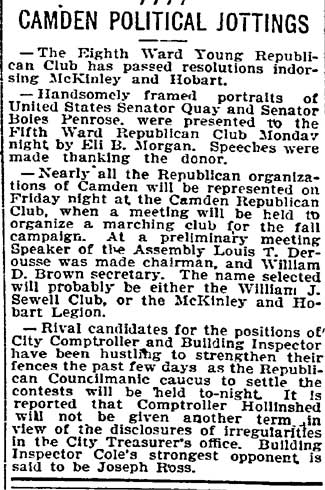
The Eighth Ward Young Republican Club has passed resolutions indorsing McKinley and Hobart.
Handsomely framed portraits of United States Senator Quay and Senator Boles Penrose were presented to the Fifth Ward Republican Club Monday night by Eli B. Morgan. Speeches were made thanking the donor.
Nearly all the Republican organizations of Camden will be represented on Friday night at the Camden Republican Club, when a meeting will be held to organize a marching club for the fall campaign. At a preliminary meeting Speaker of the Assembly Louis T. Derousse was made chairman, and William D. Brown secretary. The name selected will probably be either the William J. Sewell Club, or the McKinley and Hobart Legion.
Rival candidates for the positions of City Comptroller and Building Inspector have been hustling to strengthen their fences the past few days as the Republican Councilmanic caucus to settle the contests will be held to-night. It is reported that Comptroller Hollinshed will not be given another term, in view of the disclosures of irregularities in the City Treasurer’s office. Building Inspector Cole’s strongest opponent is said to be Joseph Ross.
Accidentally Asphyxiated
Philadelphia Inquirer —
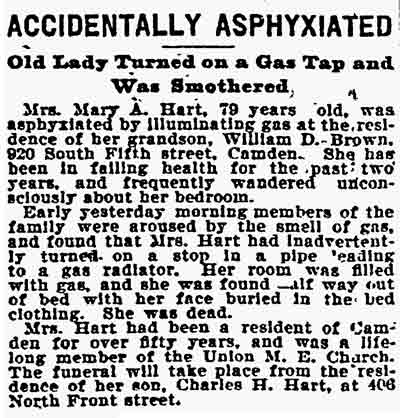
Old Lady Turned on a Gas Tap and Was Smothered.
Mrs. Mary A. Hart, 79 years old, was asphyxiated by illuminating gas at the residence of her grandson, William D. Brown, 920 South Fifth street, Camden. She has been in failing health for the past two years, and frequently wandered unconsciously about her bedroom.
Early yesterday morning members of the family were aroused by the smell of gas, and found that Mrs. Hart had inadvertently turned on a stop in a pipe leading to a gas radiator. Her room was filled with gas, and she was found half way out of bed with her face buried in the bed clothing. She was dead.
Mrs. Hart had been a resident of Camden for over fifty years, and was a lifelong member of the Union M. E. Church. The funeral will take place from the residence of her son, Charles H. Hart, at 406 North Front street.
William D. Brown Resumes Position
Philadelphia Inquirer —
William D. Brown yesterday resumed his position as Secretary of the Commission of Public Instruction, from which he was ousted by the reformers. George Cline, who was elected to succeed Mr. Brown, turned over the office without opposition. Secretary Brown resumes control under a decision of the Supreme Court, which declares that he is entitled to the position until the expiration of his full term, in May, 1900.
Republicans Looking About for a Sheriff
Philadelphia Inquirer —
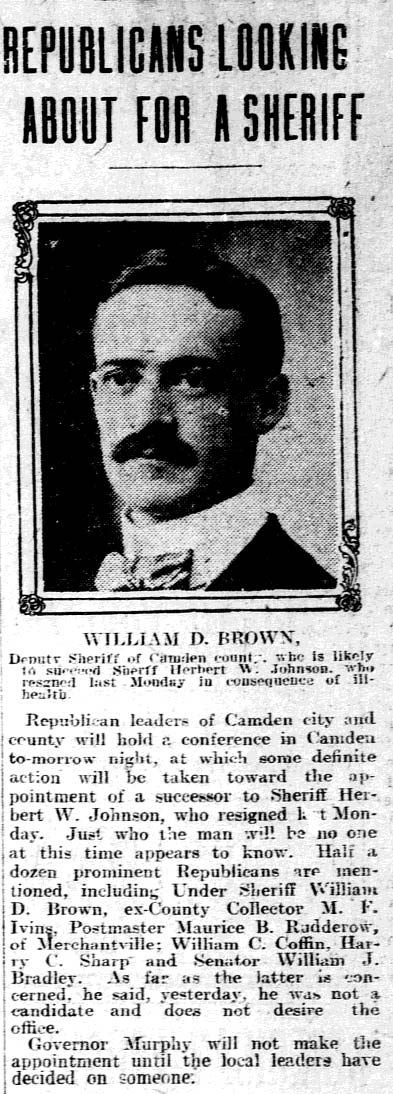
WILLIAM D. BROWN, Deputy Sheriff of Camden county, who is likely to succeed Sheriff Herbert W. Johnson, who resigned last Monday in consequence of ill-health.
Republican leaders of Camden city and county will hold a conference in Camden to-morrow night, at which some definite action will be taken toward the appointment of a successor to Sheriff Herbert W. Johnson, who resigned last Monday. Just who the man will be no one at this time appears to know. Half a dozen prominent Republicans are mentioned, including Under Sheriff William D. Brown, ex-County Collector M. F. Ivins, Postmaster Maurice B. Rudderow, of Merchantville; William C. Coffin, Harry C. Sharp and Senator William J. Bradley. As far as the latter is concerned, he said, yesterday, he was not a candidate and does not desire the office.
Governor Murphy will not make the appointment until the local leaders have decided on someone.
Clerk Patterson on Second Term
Philadelphia Inquirer —
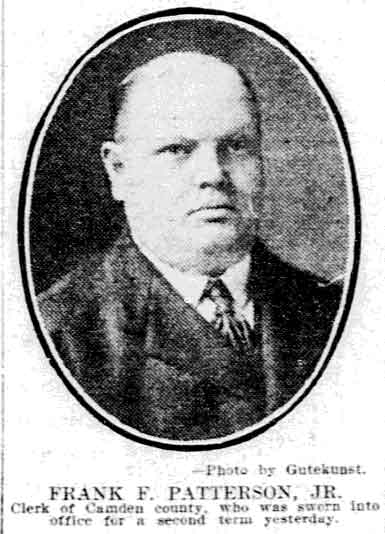
Popular Camden County Official Takes Oath of Office and Entertains Bondsmen and Others
County Clerk Frank F. Patterson, of Camden, at noon yesterday took the oath of office for a second term of five years. The oath was administered by Judge Joline in the presence of Mr. Patterson’s office force.
After taking the oath of office Mr. Patterson’s first official act was to reappoint Howard Truax as deputy county clerk and Frank Voigt as his assistant.
During Mr. Patterson’s previous term of office he made a host of friends through his courtesy and attention to those who called upon him for information.
Last night County Clerk Patterson gave an elaborate dinner at the Hotel Bellevue-Stratford to his bondsmen and several political friends.
Mr. Patterson under a recent law furnished a bond for $25,000 with the following bondsmen: Frank F. Patterson, Sr., David Baird, John W. Sell and William J. Bradley. These, including the following well-known Jerseymen, were Mr. Patterson’s guests at the banquet: Judge Charles G. Garrison, Judge A. B. Endicott, Judge C. V. D. Joline, Congressman H. C. Loudenslager, State Comptroller J. Willard Morgan, Assemblymen H. S. Scovel, Theodore B. Gibbs and Samuel P. Jones, Senators John G. Horner, J. Boyd Avis, Wood McKee and W. H. Jackson, State Assessor David Baird, Sheriff Frank C. Somers, Register Edward S. Delacroix, Prosecutor Frank T. Lloyd, Assistant Prosecutor F. Morse Archer, Surrogate Harry Reeves, Deputy Sheriff William D. Brown, Howard Truax, Robert Leyburne, Theodore N. Patterson, Wolcott J. Patterson, Irving Buckle, Joseph Burt, William S. Jones, John J. Leyburne, E. A. Y. Schellenger, Henry J. Cloud, Charles Middleton and Edward W. Humphreys.
—Photo by Gutekunst
FRANK F. PATTERSON, JR.
Clerk of Camden county, who was sworn into office for a second term yesterday.
William D. Brown, Supervisor of the Census
Philadelphia Inquirer —

William D. Brown, Supervisor of the Census, expects to be ready for business the latter part of October, although the taking of the census does not begin until next April.
City Clerk Brown and Liquor Licenses
Philadelphia Inquirer —

Local liquor dealers are very slow in taking out their licenses this year. Only thirty-one retail and five wholesale licenses had been taken out up to the closing of City Clerk Brown’s office yesterday.
Camden News Notes
Philadelphia Inquirer —
This morning 168 enumerators will begin taking the census for Uncle Sam in the First Congressional district of New Jersey, Camden, Gloucester and Salem counties. Supervisor William D. Brown in Camden yesterday gave final instructions to the corps of workers and he appointed Sidney P. McCord and Morris Odell to oversee the work in Camden City proper.
With the view of gathering information for future use, Mayor Charles H. Ellis, City Solicitor Bleakley, Senator William J. Bradley and members of City Council accompanied by the State Riparian Commission went along Camden’s river front yesterday. Camden intends developing its river front as rapidly as possible.
In a new market basket, with several changes of clothing and a bottle filled with milk by his side, a baby boy, apparently about six weeks old, was found early yesterday morning on a step on South Sixth street. Pinned to the youngster was this unsigned note: “To whoever finds this little dear: Will you kindly see that this baby is taken to the Homeopathic Hospital, where I know it will be properly cared for.”
Mayor Ellis yesterday received a letter from Louis Kennedy, of New Orleans, inquiring about Mrs. Ida S. Kennedy, whose whereabouts he desires to know.
A struck panel of forty-eight jurors was drawn yesterday by Sheriff Hatch to be used in the trial of former City Treasurer Ira S. Champion, of Ocean City, who is under indictment for forging a $7000 promissory note. The trial will take place next Wednesday.
City Clerk Brown and West Jersey Guaranty Company
Philadelphia Inquirer —

City Clerk Brown yesterday issued a permit to Irwin & Layton for the erection of a three-story addition, 60x63 feet, for the West Jersey Guaranty Company, Third and Market streets.
Idle, Wants License Returned
Philadelphia Inquirer —
“Kindly refund fee for license, as I am out of work and marriage is cancelled,” was the message received yesterday at City Clerk Brown’s office in Camden from John Trammel, of 3615 Helen street, Philadelphia. He took out the license to wed Miss Elizabeth Unger on January 9. Unfortunately, the law prohibits the refunding of the license fee, so that Trammel may keep his right to wed as a souvenir of what might have been.
Jitneurs Given Ten Days’ Grace
Philadelphia Inquirer —
Ten days of grace were given the Camden jitneurs by City Clerk Brown yesterday in which to take out their licenses under the provisions of the ordinance adopted by City Council last week. This measure makes it necessary to have a license by July 1, but there are several matters of detail to be looked after before the ordinance can become legally effective. It is now believed that no action will be taken toward having the ordinance reviewed by the court as was contemplated by some of the jitney men.
Grand Jury Drawn
Philadelphia Inquirer —
Sheriff Corson, of Camden, yesterday drew his grand jury, acting in conjunction with Jury Commissioner Lennox. From the list of thirty-five names drawn Supreme Court Justice Garrison will eliminate twelve, the balance to constitute the jury. The list follows: William H. Fish, George H. Garland, Alonzo Wood, H. B. Hanford, Thomas W. Leeson, Conrad G. Hoell, Albert Austermuhl, John Allen, R. A. Rockhill, Hugo Koehler, F. Ketterer, Smith S. Fogg, Reuben H. Gaskill, W. B. M. Burrell, Charles S. Boyer, Ralph Williams, Chas. H. Laird, Jr., Raymond L. Warren, Charles Brower, Thomas J. McLaren, B. H. Brace, Samuel Bakley, Irvine Deakyne, Lemuel D. Horner, F. W. Ayer, Walter S. Wolf, George S. Dallas, John T. Blandy, Samuel Withers, Franklin Hawksworth, John K. Bennett, Frederick Lange, Ben Lawton, William A. Stewart and William D. Brown.
Reciprocation
Trenton Times —
Reciprocation.
Governor Edwards surprised the politicians by appointing William D. Brown, a Republican, to fill the vacancy caused by the resignation of Congressman Francis F. Patterson as County Clerk of Camden. It is a $6,000 job, and the appointment is for three months. Governor Cox of Ohio has offered to appoint as successor of United States Senator Warren G. Harding the man favored by the President-elect.
Practical demonstrations, these, that politics are growing less bitter. Since “one good turn deserves another,” it will be up to the Republican Legislature of New Jersey to reciprocate the favor shown by the Democratic Governor to the Republican leader of South Jersey. It is no secret that, while orders are issued in the name of David Baird, they originate with Frank Patterson.
Frelinghuysen Majority Seen in Camden County
Philadelphia Inquirer —
Aside from the United States Senatorial contest interest in the primary election in Camden today centres on one fight on the county ticket, two on the city ticket and several ward contests. Camden county is expected to give a big majority for Senator Frelinghuysen, who is opposed for renomination by George L. Record.
Justice of the Peace Simon Wilkinsky, of the Sixth ward, is contesting with Congressman F. F. Patterson for the nomination for Congress in the First New Jersey District, which comprises Camden, Gloucester and Salem counties. Wilkinsky is little known and the renomination of the Congressman by a large majority is predicted.
The contest for the Republican nomination for Surrogate is the only ripple on the county ticket. Harry Reeves, the incumbent, is opposed by Irving Buckle, former Freeholder and for a score of years active in the Republican organization. He resigned as county committeeman from the Fourth ward to make the fight against Reeves, who has the backing of the regulars. An odd twist to the campaign was taken yesterday when Leon Buckle, son of the candidate, filed a petition as an independent candidate for Surrogate at the general election. The law requires that such petitions be filed previous to the primary. Should the elder Buckle happen to win the nomination the son would, of course, withdraw his petition as an independent.
The contest on the city ticket is for the office of Recorder, which is the title held by the police magistrate. O. S. Stackhouse, the incumbent, is opposed by David Rankins, former Freeholder and former Overseer of the Poor. Mayor Frank S. Van Hart, City Treasurer George A. Frey and Receiver of Taxes A. B. Sparks are without opposition for nomination on the Republican ticket.
On the Democrat side Robert A. Irving is not opposed for the nomination for Surrogate. Nor is there any fight on the city ticket, the lone candidates being: For Mayor, Victor King; for Recorder, George W. Tash; for Receiver of Taxes, Benjamin S. Moloney; for City Treasurer, Isaac Albertson.
Assemblymen T. Harry Rowland, J. Heulings Coles and Willard T. Gibbs will be renominated by the Republicans without opposition. Their Democratic opponents, also unopposed, will be C. Lawrence Gregorio, John J. Tischner and Frank B. Hambleton. Frank J. Leonard and Dr. William H. Pratt are unopposed for the Republican nomination for Coroner. The Democrats have no candidates on their ballot for these places. Two nominees will be chosen by the voters writing their names on the ballots.
Much interest is being manifest in the contest for the two places on the Democratic State Committee. One man and one woman are to be named. Mrs. Katherine M. Donges, now a member of the committee, is opposed by Mrs. Mae Hawkins. Mrs. Donges was in the limelight some weeks ago when she is alleged to have said at a Democratic gathering that Senator Runyon, who is to be the Republican candidate for Governor, was drunk at a meeting in Camden. Senator Runyon is a pronounced dry and Mrs. Donges was severely criticized by members of both parties for her alleged remarks. Although Senator Runyon demanded an apology Mrs. Donges has neither affirmed or denied making such remarks. She is paired with State Committeeman Edward Kelleher, whose opponent is Albert Neutze.
The Republicans have Councilmanic contests in four of the fourteen wards. In the Fifth Ward Councilman Louis Bantivoglio is opposed by J. H. Williams, negro. The latter’s name appears on the primary ballot, but yesterday he announced he had withdrawn from the race. This leaves the field free to the present Councilman. John H. Carroll and John P. Shaw are rival candidates for the County Committee.
There is a lively contest in the Seventh ward for the nomination to succeed Mayor Van Hart in Council. The aspirants are Joseph B. Davis and William Frost. The latter has the backing of Patrick Carr, who seeks to wrest the county committeemanship from Street Commissioner Alfred L. Sayers. Carr has also filed a petition as an independent candidate for Council at the general election. The petition is defective and was sent back to Carr by County Clerk William D. Brown with instructions to amend it to comply with the law. Carr will withdraw as an independent candidate in the event of Frost winning at the primary today.
Councilman John Rogers and Charles E. Hill are rival contestants in the Tenth ward. In the same bailiwick Charles S. Wolverton and Samuel Edwards are fighting for the County Committee place, which is now held by Wolverton. There is also a contest for the female place on the County Committee.
In the Twelfth ward Councilman John Dobbins is being opposed for renomination by Mrs. Lizzie P. Abbott.
The Democrats have three Councilmanic contests. In the Thirteenth ward the opposing candidates are Edwin L. Aument and Frederick Stanton. Walter J. Farrell and John B. Dean are rivals in the Third ward, and S. Raymond Dobbs and Harry McCloskey are contests in the Fourteenth ward.
Camden county Socialists yesterday named a city and county ticket by petition as follows: Surrogate, Herman Neissner; Coroners, Francis Stratton, Clara K. Stamm; Assembly, Morris Steppa, Thomas Heil, Albert Bardsley; Mayor, Albert H. Starr, Stratton; Recorder, George A. Harkins; City Treasurer, John McAlack; Receiver of Taxes, Richard Davies. A petition as a Socialist candidate for Council in the Eleventh ward was filed by Leo M. Harkins. Independent petitions for Council were filed by William Smith, Eighth ward, and Joseph Wood, Fifth ward.
Parties Name Chiefs in Camden County
Trenton Times —
CAMDEN, Oct. 3.—The Republican and Democratic Executive Committees of Camden County held their annual reorganization meeting last night. William D. Brown was chosen chairman of the Republican committee, while William T. Cramer, Mayor of Woodlynne, was chosen chairman by the Democrats.
Other officers chosen by the Republicans were: Vice chairman, Mrs. Mary D. Price, Haddon Township; secretary, W. Penn Corson; assistant secretary, William D. Sayres; treasurer, Harry C. Sharp; Assistant Prosecutor Charles S. Straw was elected solicitor for the committee.
The other officers chosen by the Democrats follow: Vice chairman, Mrs. Bertha Shippen Irving, Haddonfield; treasurer, John J. Welsh; assistant treasurer, Mrs. Anna Hyland; secretary, Mortimer L. Richmond; assistant secretary, Mrs. Elmire Reaston, Gloucester City.
Life Size Portrait of Lord Camden Is Presented to City
Camden Courier-Post —

Gift of Robert Stecker Received by Mayor in Laudatory Address
Ceremonies at Store
A life size oil painting of Lord Camden was presented to the City of Camden today by Robert D. Stecker, head of the local department store bearing his name. The painting was officially accepted by Mayor Winfield S. Price, and will be hung in City Hall.
The presentation took place before a crowd of several hundred persons, including representatives of the city and county. The presentation address was made by Samuel Hammer, secretary of the Stecker organization, who spoke for Mr. Stecker, who was unable to attend.
The spectators gathered at the foot of the stairway on the first floor. The veiled painting hung under a canopy of draperies on the first landing. On each side of the painting stood a pretty girl, Miss Celesta Powers and Miss Dorothy Phillips. Directly in front of the painting stood little Miss Dorothy Jean O’Brien, 5-year-old daughter of Thomas O’Brien, superintendent of the store and advertising manager.
A choir of 50 trained voices, led by Mrs. Marion Powers, opened the exercises with the singing of “America.”
Loyal D. Odhner, secretary of the Camden Chamber of Commerce, paid tribute to the civic pride of the members of the Stecker organization and told of the progress that would be made in Camden during 1928.
Predicts Great Year.
“This year will mean a great deal to Camden,” Mr. Odhner said. “It will be the greatest year in the history of our city. Just look at the actual and contemplated activities for Camden which have been announced or started during the past few months.
“A cold storage plant, which will be a $3,000,000 project; announcement by the Victor Company that 1928 is to be the biggest year in its history; $13,000,000 power plant at Pennsgrove; our shipbuilding program which, if it goes through, means a $100,000,000 project for this city; commencement of Campbell’s Soup Company additions, meaning the spending of millions; announcement for the plans of a new $15,000,000 highway from Camden to Atlantic City; commencement of activities on the $2,000,000 marine terminal project; continuation of the $2,000,000 county park program; announcement that the proposed Galen building is financed and work will be started this year; the Tacony-Palmyra bridge; vocational school.
“Then there are the two new bank buildings, the Camden Safe Deposit and Trust Company, and the First Camden National Bank and Trust Company; the apartment hotel, Fifth and Cooper streets; a proposed new theatre, high speed lines across the bridge, the $400,000 post office appropriation for a new building, a new proposed 13-story apartment house, a $2,000,000 sewage disposal plant in Camden, the dredging of the Delaware river on the Camden side, and the new court house annex.
“I could stand here and enumerate other big projects but I merely want to point out to you some of the big things in store for Camden.”
Mayor Accepts Gift
Mr. Odhner then introduced Mr. Hammer, who in turn introduced Mayor Price and officially presented him with the painting. In a short address Mayor Price accepted the gift and lauded the civic spirit of Mr. Stecker.
“There is nothing impossible for Camden,” Mayor Price said. “We could tear down all our buildings here and then pitch right in and build a bigger and better city. We, the residents of Camden, have that unconquerable spirit to do things. This beautiful painting will be placed in the old city hall. I hope we will soon have the money for a new city hall where his painting may hang.”
Then little Dorothy O’Brien pulled a silken cord and the covering on the big painting, revealing the work of Raphael Senseman, 719 Stokes avenue, Collingswood, illustrator and painter.
The chorus then sang the “Star Spangled Banner,” and the presentation exercises had been concluded. Among the guests were the following: Surrogate George Whyte, Register of Deeds Joshua Haines, and County Clerk Charles Wise, who represented Camden county; Mayor Price, City Commissioner T. Yorke Smith and City Clerk William Brown, who represented the city; Rev. Father Thomas J. Whelan, of the Church of the Holy Name; James V. Moran, of the Hurley Store, and Clarence Munger, who formerly operated the Stecker store when it was known as Munger and Long.
City Clerk Faces Problem in Squires
Camden Courier-Post —
Advancing of Primaries Brings Tangle Over Filling Vacancies.
A problem to determine the number of vacancies among justices of the peace in Camden is faced by William D. Brown, city clerk, and similar officials in other municipalities, due to the fact that this is a presidential year and the primaries have been advanced from June to May.
Brown explained this problem today by pointing out that the Secretary of State, under the law, is to notify municipal clerks on May 10 as to what vacancies exist for justice of the peace in their respective municipalities. Candidates for the justice of the peace, he said, should have their petitions filed by April 19, or this year almost a month before the Secretary of State certifies the existing vacancies.
The problem is further entangled by the fact that justices of the peace elected last November do not receive their commissions from the county clerk until May 1 to qualify for their positions. With this situation, the secretary of state has no information as to who has qualified for justice of the peace until May 1, or 11 days after the candidates are to have their petitions on file in the city clerk’s office.
Thus the secretary of state cannot certify and the municipal clerks cannot tell how many are elected in each municipality, and the problem is one that is causing them considerable thought.
The Young Syndicate
Camden Courier-Post —
FROM AN OLD DIRECTORY
‘Coop’ Carman and Willard Morgan Led Movement for New Blood in G.O.P. Culminating in Bitter Battles of Race Track Days
Second in a new series of articles on Camden affairs and personalities of yesteryear inspired by a 50-year-old directory.
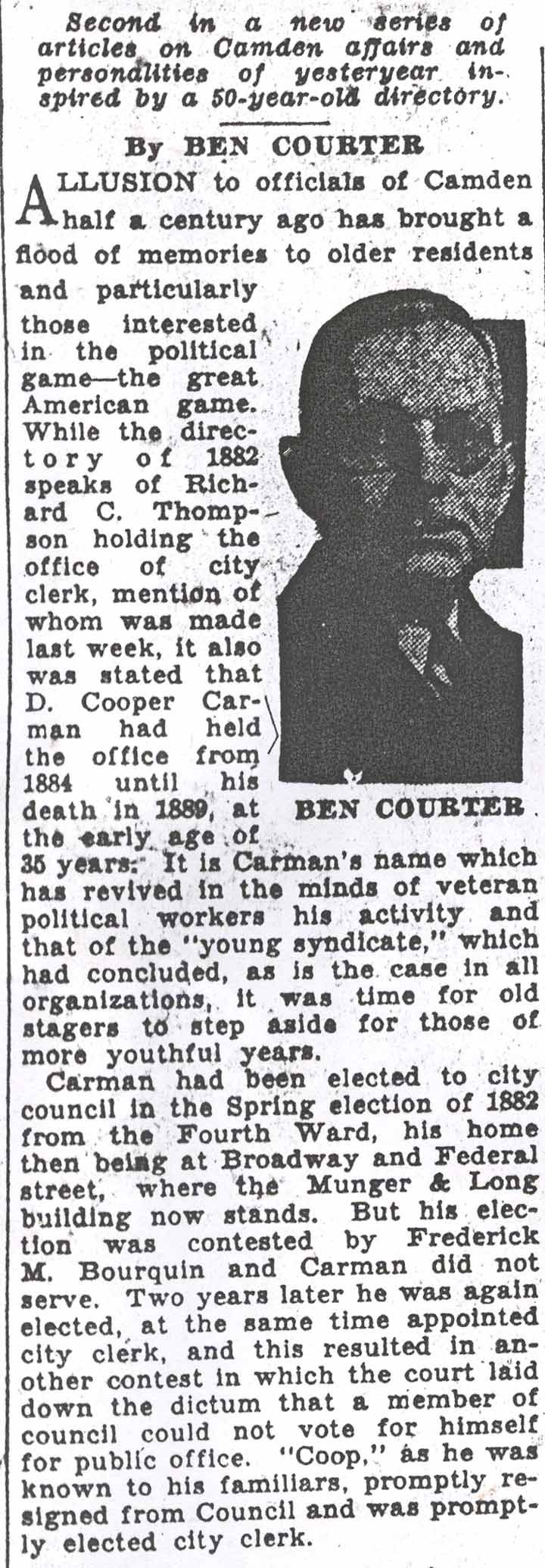
By BEN COURTER
Allusion to officials of Camden half a century ago has brought a flood of memories to older residents and particularly those interested in the political game—the great American game. While the directory of 1882 speaks of Richard C. Thompson holding the office of city clerk, mention of whom was made last week, it also was stated that D. Cooper Carman had held the office from 1884 until his death in 1889, at the early age of 35 years. It is Carman’s name which has revived in the minds of veteran political workers his activity and that of the “young syndicate,” which had concluded, as is the case in all organizations, it was time for old stagers to step aside for those of more youthful years.
BEN COURTER
Carman had been elected to city council in the Spring election of 1882 from the Fourth Ward, his home then being at Broadway and Federal street, where the Munger & Long building now stands. But his election was contested by Frederick M. Bourquin and Carman did not serve. Two years later he was again elected, at the same time appointed city clerk, and this resulted in another contest in which the court laid down the dictum that a member of council could not vote for himself for public office. “Coop,” as he was known to his familiars, promptly resigned from Council and was promptly elected city clerk.
The ‘Young Syndicate’
With Carman, as former City Clerk William D. Brown recalls, was associated J. Willard Morgan and Henry M. Snyder, something of a balance between the two.
That combination carried things along pretty much as they pleased for a time and as one of the developments Maurice A. Rogers, down in the Fifth Ward and a councilman, was taken up as a Senatorial candidate against Colonel George Pfeiffer, Jr., a decade later to be the builder of Camden’s artesian water plant. The colonel, long one of Camden’s most popular men, had defeated the Republicans as a result of the factional fight between Henry L. Bonsall, editor of the Post, and Thomas Dudley, famed consul to Liverpool during Civil War days. But with the “young syndicate” back of him, Rogers won the Senate seat in 1890, taking his office January 1, 1891.
But in the meanwhile Carman suddenly died at his mother’s home, at 11.10 on the night of September 11, 1889. At the time apoplexy was given as the cause. His sudden demise caused a profound shock and at his funeral four days later leaders in business and politics paid homage, with such men as Gen. William J. Sewell, Sinnickson Chew, Howard Carrow, Wilson Jenkins, E. A. Armstrong, B. M. Braker and many others attending. The bell in the old City Hall tower tolled as the cortege passed on the way to old Camden cemetery. And even yet, after these more than four decades, “Coop” Carman is quite vividly recalled by those who were then active on the political stage.
Carman’s Death Big Loss
Carman’s death was a big loss to the “young syndicate,” but it did not halt its activity. Since Rogers had won so easily in the 1890 election it was concluded there would be nothing to it when he was renominated for another two-year term. Rogers was by no means friendly to “Billy” Thompson’s race track, then in the heyday of its popularity with the sports of Gloucester City, a period when that community had all the earmarks of a wild and wooly western city, attractive to thousands of lovers of horseflesh, touts, gamblers and the usual hangers-on.
Thompson concluded it would be far better to have someone in the Senate from Camden county who would regard his interests with more favor than Rogers.
Thus he decided on Frederick A. Rex, his personal counsel, a very able young attorney, and a Republican. Since at that time the Democratic police commission was in control of the cops it was considered easy to get possession of the polls. As Brown recalls it, the rivals of Rogers planned a “zero hour” at which cops, at the crack of a pistol, were to descend on polls considered close at the primaries, frighten off the regular voters and corral enough to elect Rex.
Particular effort was to be made to sweep the Sixth Ward, where Thad Varney, elected city clerk to succeed Carman, was “boss,” and thus give him a political black eye. In Varney’s precinct in particular when the rumpus started “Brockie” Deno and “Al” Haydon, both widely known firemen now dead, grabbed the ballot box, lowered it down a chimney, fished it out when the racket was passed, went to Avis’ livery stable, and later to Varney’s home, where the votes were counted. In these sophisticated days such counting would unquestionably not be considered “according to Hoyle,” but then anything went just so the particular faction had its bag of tricks in effective operation. Anyhow, Rogers won the primaries, but there still was the general election to hurdle and Thompson was by no means beaten. He had plenty of money and many followers, some sincere, many just sycophants.
Repeaters Foiled
It was charged a scheme was on foot to bring repeaters from Philadelphia, not an unusual procedure in the political game of Camden years ago in either party. One of the “young syndicate’s” lieutenants learned the plot, told General Sewell, who sent the informant to Dave Martin, then Philadelphia’s political boss, who heard the story. The upshot was General Sewell himself saw Martin later, who was quite willing to aid Jersey’s G.O.P. leader, flooded Camden with sleuths from over the river and such close tabs were kept on the repeating army its efforts were halted from the very dawn of that very stirring election day. Rogers was elected, was made president of the Senate and for a time loomed so large on Jersey’s political horizon he had gubernatorial aspirations, but they never were realized.
Thus out of the old yellowed book Frank Albright, city clerk of the present epoch, dug from the archives memories are revived of a very gallant young politician, “Coop” Carman, and some of the stirring incidents that make up Camden’s political history. The “young syndicate” was just one of the episodes, as the first “reform” outbreak in 1882, or the Committee of 100 scrap of 1897, or the Non-Partisan upheaval of ‘23, but such never lose interest to those who have joined those movements with enthusiasm, even though they were often not altogether satisfied with what had been accomplished.
Some Old Hall Familiars
Camden Courier-Post —
Some Old Hall Familiars
Crumbling City Building Brings to Mind Many Who Once Took Active Part in Affairs of Camden and Spirited Political Scraps
By BEN COURTER
Walk along Haddon avenue these days of old City Hall destruction with veterans in politics like Fred W. George or Charlie Elfreth or Frank Fithian and they will tell you they can see in memory’s eye a veritable host who once trod the corridor, rapidly crumbling away. One doesn’t need to be a sentimentalist to stop for a space in the midst of hat [sic] is left of the once proud municipal pile to bring to mind for the moment some who once took an active part in the city’s affairs, who had their partisan fights and who were as a rule, “good fellows.”
Of course, those who composed Camden’s official family back in ‘74 when the corner stone was laid have passed on. Boys like Joe Kobus or Dr. D. Louis Ireton who saw the corner stone laying are now men well along life’s journey and they too have memories of the Hall through the many years. Mayor John H. Jones, as related in a previous article, died the year the Hall was started. He was succeeded by John Morgan who served a year. Then came James W. Ayres, Claudius W. Bradshaw, Jesse W. Pratt, J. Leighton Wescott and Cooper B. Hatch, all of whom have died. The surviving mayors who once held forth in the office at the southwest corner are Joseph E. Nowrey, Charles H. Ellis, Frank H. Vanhart, Victor King, General Winfield S. Price. With the advent of Mayor Roy Stewart quarters were taken in the great stone pile at Sixth and Market.
The City Clerks
Joseph C. Nicholls was city clerk when the Hall was started, succeeded by Joseph Bontemps, Fred W. Tarr, Frank F. Michellon, Richard C. Thompson, D. Cooper Carman, Thad P. Varney, Morris Odell and William D. Brown, all of whom have died. The survivors are Colonel Harry C. Kramer, now at Washington, Isaac V. Bradley, “Al” White and Frank S. Albright, the last of the clerks in the old building and now happily with us in the new structure.
But there were scores more who were familiar figures in the nearly two generations that have passed. One expects to see, for instance, Levi Farnham, city engineer for nearly two score years, come tramping out of the wrecked corridor to make his way to see how Farnham Park is progressing. There is sure to be memories of the hearty laugh of “Pete” Young, who was Varney’s assistant, and like as not there will be heard the gruff note from “old” Colonel Sam Hufty, “watchdog of the treasury for many a year and a job his father held before him. One can see, too, George A. Frey, long city treasurer who was quite rightfully proud when the experts, who made the survey in 1923, reported that of the more than $18,000,000 he handled every penny was accounted for.
And surely passing what is left of what used to be the police department one can hear the hearty laughs of “Bill” Schregler or Jules Bosch or the pestering gasps of poor old Cale Williams who had the asthma and whose difficulties in getting calls under the new fangled signal system were rather tragic. Captain Hugh Boyle had a better time of it in getting those calls and so did Jimmie Tatem, later chief and now retired. Looking in the old police room one can see the domino game of 35 years ago going on with Schreg and Billy Husted, Dan Hassett or John Courter, Jimmie Polk, Frank Albright or Billy Paul interested as if it was a huge staked poker game. Peculiarly enough the uplifters of the time never fussed about that domino game, which, after all, was played to while away the late hours of night until something turned up.
The Old Health Board
Across the way were Gene Roberts, the perennial secretary of the old Board of Health; Henry B. Francis, the “admiral” who fought with Farragut, or Joe Starr, who did his part in rounding up the property owners to get the Line Ditch swamp filled in and graded. Of all that board only Reuben Gaskill survives. Dr. John F. Leavitt, many years health physician, is living in retirement.
Up in the Council Chamber, now virtually gone, old-timers will tell you they can yet hear Fred Finkelday in a brush with Joe Potter, the later of the councilman-at-large, or the booming voice of John Broome bringing order out of chaos. John’s brother, Howard, by the way, was for a time an efficient water engineer who died at the early age of 35 of pneumonia. His son is now secretary to Mayor Stewart.
Theer [sic] was the ill-fated George Felton, treasurer, who ended his life; Billy Doyle and J. Fred Newton, William Osler, Water Chief Hollingsworth, John McCabe, Constantine Scout and Larry King, all quite kindly recalled by many who pass the crumbling old Hall. One wonders what City Gardeners “Uncle Jake” Fish or John Schilke would say with their lawn all awry these days of destruction, a lawn they worked early and late to keep green throughout the Summer. Most of these have passed as the Hall is passing and even after the wreckers have finished their job who doubts but that the plot changed into a breathing spot along the Seventh street boulevard will not continue to have these memories to the older residents of Camden?
Photos
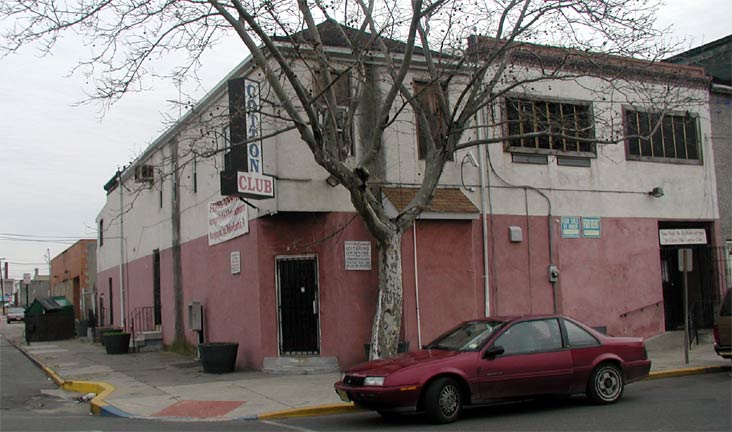
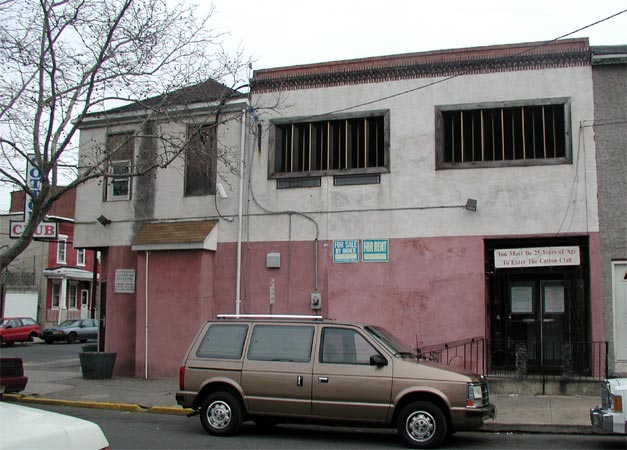
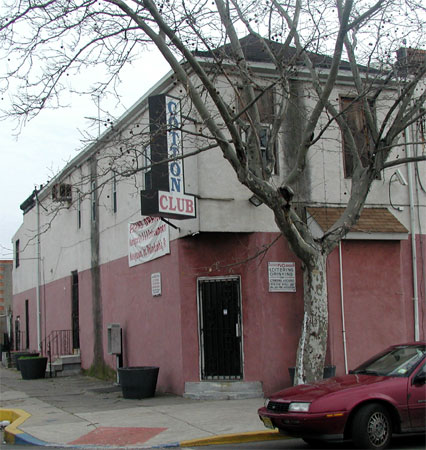
William D. Brown lived at 1102 South 4th Street, where his father owned and operated a saloon, in the 1880s. These photos show the building as the Cotton Club in 2002.