Harry Miller
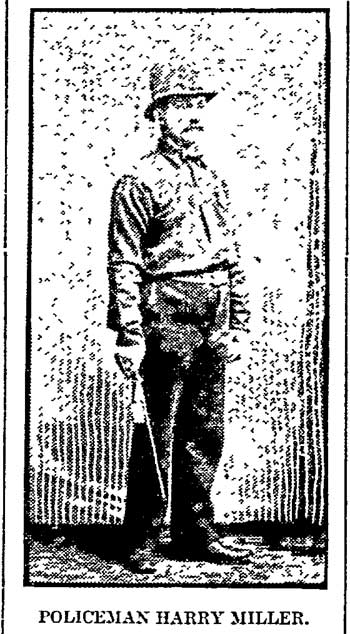
Harry Miller, Camden police officer
JOHN H. “HARRY” MILLER was born in New Jersey in 1858. His early years are something of a mystery. The 1870 Census shows a Harry Miller, aged 10, living with his mother Josephine and younger brother Samuel in Camden’s South Ward. Harry Miller first turns up in Camden’s City Directories in 1878, working as an oilcloth printer and living at 217 Royden Street. The 1880 Census shows him boarding at 232 Washington Street, the home of Edward Rodman. He next turns up in City Directories in 1884, still working as an oilcloth printer, living at 630 South 2nd Street. By this time he had been married for about 3 years. His wife Mary C. Harrison would bear eight children before 1900, of which five were then still living.
Harry Miller became interested in local politics in the 1880s, when politics was a rough and tumble affair, especially in Camden’s Third Ward. He also played professional baseball in Wilkes Barre, Scranton, and Harrisburg, Pennsylvania in the early 1880s. He was known as Iron Arm Miller until overwork caused him to leave the professional ranks. Harry Miller also played for a team called the Cubs in the Philadelphia League. He is not the Harry Miller who played for Ottumwa in 1890. He did not play for the Cubs in the National League. He does not appear to have played for the Merritt Base Ball Club of the early 1880s, sponsored by Camden businessman Albert Merritt, who was State Senator from Camden from 1882 to 1884.
Harry Miller was originally appointed to the Camden Police Department on July 1, 1886. He lived at 214 Beckett Street in 1887 and 1888, then moved to 601 South 3rd Street where he lived until 1896. Harry Miller served as a Camden policeman until 1894 when he and most of the rest of the Police Department, at the request of Mayor John L. Westcott, tendered their resignations. He served briefly as Chief of Police in Pitman Grove in July and August of 1894, and as the Chief of Police in National Park in 1897.
Harry Miller was re-appointed to the Camden Police Department on August 31, 1898. The Miller family lived at 232 Royden Street in 1897 and 1898, then moved to 234 Royden Street where they lived into 1901, before relocating to 321 Beckett Street, which was their home into 1906. Son Edwin F. Miller married Lucinda Inskip on June 22, 1904 at Wiley Methodist Episcopal Church. Sadly, Edwin F. Miller died on September 4, 1904.
The 1907 City Directory shows that Harry Miller had moved to 218 Arch Street, where he lived out his days. Daughter Elizabeth married Harry A. Jewett at Tabernacle Methodist Episcopal Church on February 16, 1907.
He died at home on May 24, 1919 at the age of 61. He was buried at Harleigh Cemetery. His wife passed away in 1933. Sons Charles H. Miller and George O. Miller both served in World War I and World War II, and both retired as Majors in the United States Army Reserve.
An Attempted Outrage
Camden Daily Courier —
AN ATTEMPTED OUTRAGE.
In the second precinct of the Third ward, a disgraceful scene took place which will “blast” the democratic party in that precinct for a long time. A job was put up by the great “unterrified” to steal the ballot box, and it was “winked” at by officers who ought to protect the law-abiding citizens. A “rough” was engaged, and just before the polls closed it leaked out that the box was to be stolen and thrown into the street. Richard Shannon, William Shearman, William Thomas, James M. Lane, ex-Sheriff Daubman, David Baird, Harry Miller and others prevented the outrage, and the man was thrown ignominiously into the street, and to the credit of the republican party, it must be said they positively refused to have a row or altercation with their opponents.
Camden Daily Courier — May 14, 1887
The “Cops” to Play Ball.
“Our Finest” police force prides itself on having some good base ball players, and lately an announcement was made that it could provide a nine which would meet any other set of club swingers from Dan to Beersheba. This bold offer has brought forth a challenge from the Third Police District base ball club, of Philadelphia.
The challenge has been accepted and the game will be arranged for an early date. It will probably be played at Cooper Park.
Officer Harry Miller, of the Third ward, who distinguished himself during the halcyon days of the old Merritt Club as a pitcher, is coaching the Camden nine.
Camden Police Baseball Challenge
Camden Post —
Chief Dodd yesterday received a challenge from the Third District police, of Philadelphia, which he promptly accepted and instructed Harry Miller to organize a strong club. Harry has gotten together the following stiff team: Ben Middleton, 1st base; Sam Bakley, left field; Harry Miller, pitcher; Sam Lee, second base; John Painter, centre field; Si Sage, right field; Weaver, shortstop; John Anderson, third base.
The game will come off to-morrow morning on the Camden Club’s grounds opposite the City Hall, at half past ten o’clock. Harry Miller is an old and well known ball player having pitched winning ball for Wilkesbarre, Scranton, Harrisburg and the Philadelphia League Club. Harry, however, was overworked, being known as “iron arm” Miller and straining the muscles of his arm, had to retire temporarily from the ball field. We bet three dollars and sixty-seven cents that our bluecoats will win.
Camden Post — April 9, 1894
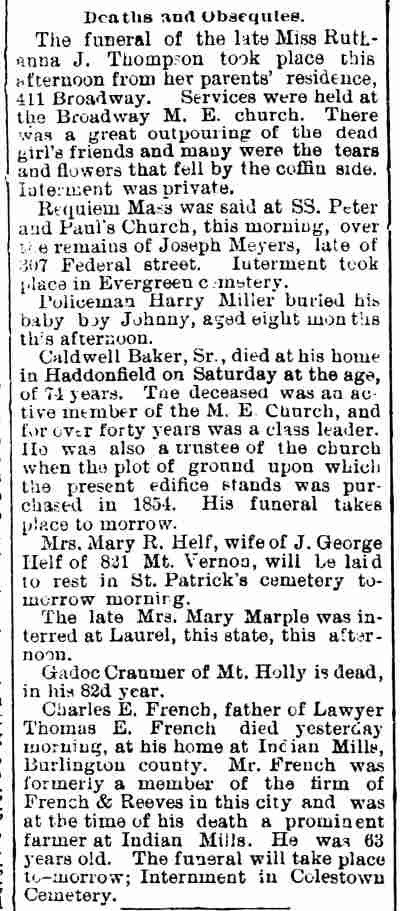
Deaths and Obsequies.
The funeral of the late Miss Ruth-anna J. Thompson took place this afternoon from her parents’ residence, 411 Broadway. Services were held at the Broadway M. E. church. Interment was private.
Requiem Mass was said at SS. Peter and Paul’s Church, this morning, over the remains of Joseph Nevers, late of 307 Federal street. Interment took place in Evergreen Cemetery.
Policeman Harry Miller buried his baby son, aged eight months, this afternoon.
Caldwell Baker, Sr., died at his home in Haddonfield on Saturday at the age of 74 years. The deceased was an active member of the M. E. Church, and for over forty years was a class leader. He was also a trustee of the church when the plot of ground upon which the present edifice stands was purchased in 1854. His funeral takes place to-morrow.
Mrs. Mary R. Helf, wife of J. George Helf of 831 Mt. Vernon, will be laid to rest in St. Patrick’s cemetery tomorrow morning.
The late Mrs. Mary Marples was interred at Laurel, this state, this afternoon.
Charles E. French, father of Lawyer Thomas E. French, died yesterday morning at his home at Indian Mills, Burlington county. Mr. French was formerly a member of the firm of French & Beecroft in this city and was at the time of his death a prominent farmer at Indian Mills. He was 63 years old. The funeral will take place to-morrow; Interment in Colestown Cemetery.
The Mayor Names
Camden Post —
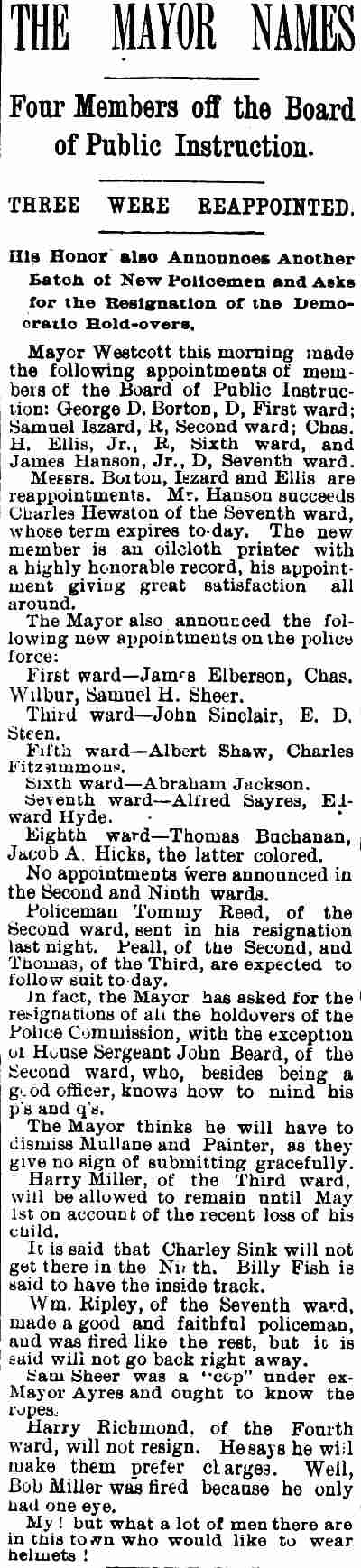
THE MAYOR NAMES
Four Members off the Board of Public Instruction.
THREE WERE REAPPOINTED.
His Honor also Announces Another Batch of New Policemen and Asks for the Resignation of the Democratic Hold-overs.
Mayor Westcott this morning made the following appointments of members of the Board of Public Instruction: George D. Borton, D, First ward; Samuel Iszard, R, Second ward; Chas. H. Ellis, Jr., R, Sixth ward, and James Hanson, Jr., D, Seventh ward. Messrs. Borton, Iezard and Ellis are reappointments. Mr. Hanson succeeds Charles Hewston of the Seventh ward, whose term expires to-day. The new member is an oilcloth printer with a highly honorable record, his appointment giving great satisfaction all around.
The Mayor also announced the following new appointments on the police force:
First ward—James Elberson, Chas. Wilbur, Samuel H. Sheer.
Third ward—John Sinclair, E. D. Steen.
Fifth ward—Albert Shaw, Charles Fitzsimmons.
Sixth ward—Abraham Jackson.
Seventh ward—Alfred Sayres, Edward Hyde.
Eighth ward—Thomas Buchanan, Jacob A. Hicks, the latter colored.
No appointments were announced in the Second and Ninth wards.
Policeman Tommy Reed, of the Second ward, sent in his resignation last night. Peall, of the Second, and Thomas, of the Third, are expected to follow suit to-day.
In fact, the Mayor has asked for the resignations of all the holdovers of the Police Commission, with the exception of House Sergeant John Beard, of the Second ward, who, besides being a good officer, knows how to mind his p’s and q’s.
The Mayor thinks he will have to dismiss Mullane and Painter, as they give no sign of submitting gracefully.
Harry Miller, of the Third ward, will be allowed to remain until May 1st on account of the recent loss of his child.
It is said that Charley Sink will not get there in the Ninth. Billy Fish is said to have the inside track.
Wm. Ripley, of the Seventh ward, made a good and faithful policeman, and was fired like the rest, but it is said will not go back right away.
Sam Sheer was a “cop” under ex-Mayor Ayres and ought to know the ropes.
Harry Richmond, of the Fourth ward, will not resign. He says he will make them prefer charges. Well, Bob Miller was fired because he only had one eye.
My! but what a lot of men there are in this town who would like to wear helmets!
The Mayor's Appointments
Camden Daily Telegram —

THE MAYOR’S APPOINTMENTS
He Announced Several This Week.
COMMISSIONERS OF INSTRUCTION.
The Old Members Re-Instated With the Exception of the Member From the Seventh Ward—Police Appointments and Resignations.
Mayor Wood made the following appointments as Commissioners of Instruction:
The following appointments were made: First Ward—George D. Borton, of the First Ward; Charles H. Ellis, Jr., of the Sixth ward, and John L. Westcott, of the Third ward.
The following appointments were made on the police force:
First Ward—James Elberson, Charles Wilbur, Samuel H. Sheer.
Second Ward—No appointments.
Third Ward—John Sinclair, E. D. Stein.
Fourth Ward—No appointments.
Fifth Ward—Albert Shaw, Charles Fitzsimmons.
Sixth Ward—Abraham Jackson.
Seventh Ward—Alfred Sayres, Edward Hyde.
Eighth Ward—Thomas Buchanan, Jacob A. Hicks (colored).
Ninth Ward—No appointments.
Mayor Westcott has requested the resignation of all the members of the police force who served under the Police Commission, to take effect May 1. They are Policemen Peall, Horner, Painter, Mullane, Miller and Reed.
POLITICAL POINTERS.
Who will be the postmaster?
Who will be the next prosecutor?
Many of the ward workers are suffering from election colds.
The name of Harry Moffitt was left out of the columns of honorable mention with the other hustlers of election day.
Senator Rogers and Messrs. Stafford and Watson, of the House are fully coming up to the expectations of their constituents.
If the Mayor could arrange it to hold his hearings a trifle earlier it would be a great source of satisfaction to the Camden afternoon papers.
There is still great anxiety on the part of the public as to the outcome of the present session of the legislature. Thus far their public acts have been highly commendable.
The abolishment of the Police Justice act restores to office the City Recorder, Benjamin M. Braker, who would be qualified to act in place of the Mayor should the Chief Executive be taken sick.
Jos. Potter, the new member of Council from the First ward is a man of wide business experience and will prove much advantage to the many large financial interests that will come under his care.
Owing to the satisfactory working of the present school commission in the two second-class counties up the State, the legislature made no change in the mode of placing the members as was anticipated.
Jos. B. Fox, of the Fourth ward, is what might be termed an old reliable, having had a long and varied experience in public affairs. He is always conservative in the expenditure of city money. He is always safe to trust.
Charles Sayrs, of the Seventh ward, who had a short experience in the present Council, but enough to make him feel at home among public affairs, is neck and ears in work between his real estate business and Councilmanic duties.
The colored people of the lower section of the city are anxious to see Squire Drake, the ex-Republican and ex-member of the School Board, come out of the Court House, where he holds a position under the Thompson Freeholders.
“Father” Figner is a proud sire. He was a member and president of Council in his days, and now sees his son treading in his footsteps. Mr. Figner, Jr., having been sent to Council from the Sixth ward on Tuesday by a large majority.
A special election will not be necessary for the new Board of Freeholders, as the City Council and Township Committees will appoint Freeholders who will serve until the Spring of 1895. The appointments will be made about the middle of May.
Arthur Bedell is spoken of as a candidate for the presidency of the new City Council. He is a stalwart and is never afraid to define his position on all public questions. He is one of those men who makes strong, warm friends and also creates an opposition of like force.
William D. Brown, the Secretary of the Board of Education, and Fred A. Rex, Treasurer, are quite pleased over the report of the committee on accounts and Expert O’Shaughnessy, they having examined the books of Messrs. Rex and Brown and found them correctly kept.
The library of the Camden public schools is one to be highly appreciated and much is due to the care with Miss Blowe the librarian has attended to her duties. She will hold over another year and should be allowed to retain the office as long as she merits it, and she surely does now.
J. R. Carson, the retiring member of Council from the First ward, is highly spoken of by his associates on committees and by Clerk Varney for the mature judgment displayed in the management of city affairs. It is with a general expression of regret that the city is to lose his service.
The reform in the Board of Freeholders can’t come too soon. If the public is to judge of the care of property given by the Democrats in the county, by the “hog combine” in this city, an inventory of the public property when turned over will make interesting reading. Ex-officials guarantee to save enough in the Board, if returned to their offices, to pay the expense of a special election, if one was necessary.
W. J. Bradley has been asked if he was a candidate for president of the new City Council. His reply was that he had not sought it in the first place, and would not seek it now, but whether he became president or remained merely a member on the floor, he would endeavor to discharge his duties in the interests of the city. He is commended by all who came in contact with him during the past year as one who had a new Camden at heart.
Camden Daily Courier — May 5, 1894
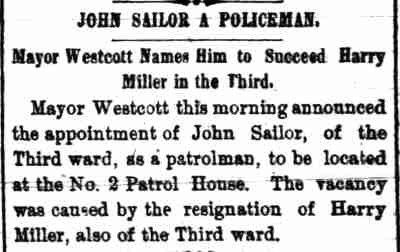
John Sailor a Policeman.
Mayor Westcott Names Him to Succeed Harry Miller in the Third.
Mayor Westcott this morning announced the appointment of John Sailor, of the Third ward, as a patrolman, to be located at the No. 2 Patrol House. The vacancy was caused by the resignation of Harry Miller, also of the Third ward.
Camden Daily Telegram — July 24, 1894
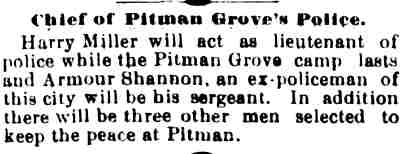
Chief of Pitman Grove’s Police.
Harry Miller will act as lieutenant of police while the Pitman Grove camp lasts and Armour Shannon, an ex-policeman of this city, will be his sergeant. In addition there will be three other men selected to keep the peace at Pitman.
Camden Daily Telegram — August 2, 1894
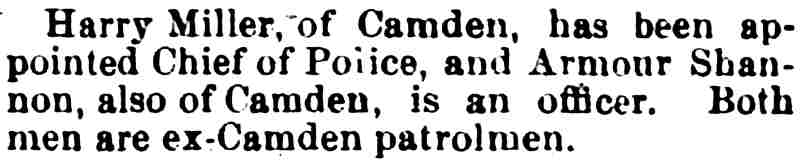
Harry Miller, of Camden, has been appointed Chief of Police, and Armour Shannon, also of Camden, is an officer. Both men are ex-Camden patrolmen.
Camden Daily Telegram — January 9, 1896
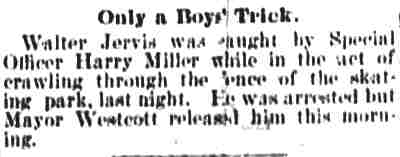
Only a Boys’ Trick.
Walter Jarvis was caught by Special Officer Harry Miller while in the act of crawling through the fence of a lot one dark night. He was arrested but Mayor Westcott released him this morning.
Camden Daily Telegram — April 21, 1896
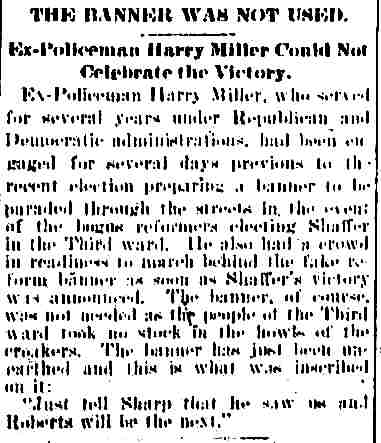
The Banner Was Not Used.
Ex-Policeman Harry Miller Could Not Celebrate the Victory.
Ex-Policeman Harry Miller, who had been engaged for several days previous to the election, had prepared a banner in the event of a reform victory, which he hoped to march behind. If the reform ticket won, it said, a number was not needed, as the people of the Third ward took to the side of the Freeholders. The banner had been carried and this is what was inscribed on it: “Just tell Sharp that he saw us and Roberts will be next.”
Camden Daily Courier — December 8, 1896

Harry Miller, the ex-policeman of the Third ward, has been appointed janitor of the Temple building.
Camden Post — August 13, 1897
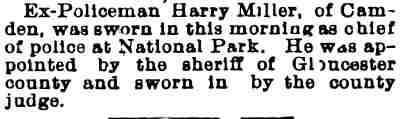
Ex-Policeman Harry Miller, of Camden, was sworn in this morning as chief of police at National Park. He was appointed by the sheriff of Gloucester county and sworn in by the county judge.
Camden Post — August 16, 1897
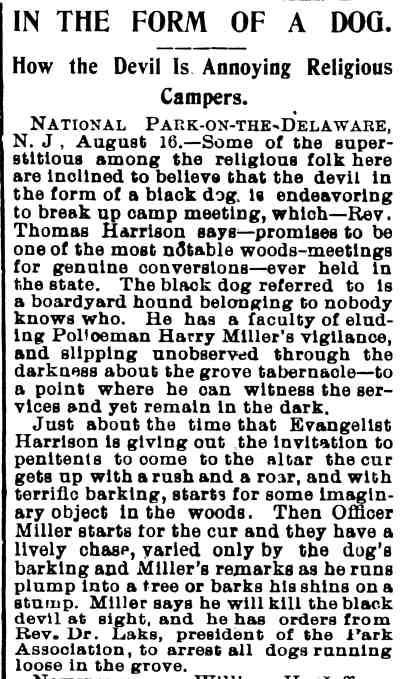
Camden Post, August 16, 1897
Reformers Lop Off Chief Dodd's Head
Philadelphia Inquirer —
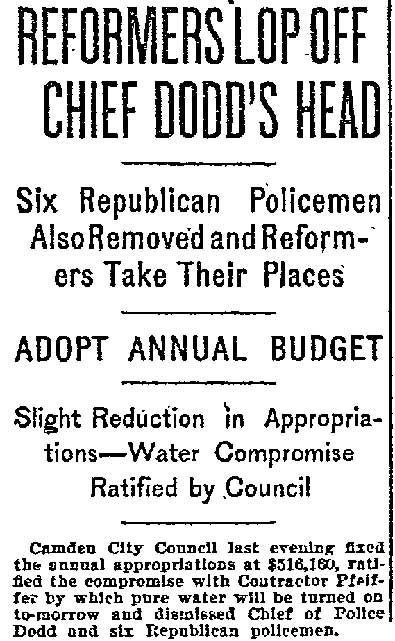
REFORMERS LOP OFF CHIEF DODD’S HEAD
Six Republican Policemen Also Removed and Reformers Take Their Places
ADOPT ANNUAL BUDGET
Slight Reduction in Appropriations—Water Compromise Ratified by Council
Camden City Council last evening fixed the annual appropriations at $516,160, ratified the compromise with Contractor Pfeiffer by which pure water will be turned on to-morrow and dismissed Chief of Police Dodd and six Republican policemen.
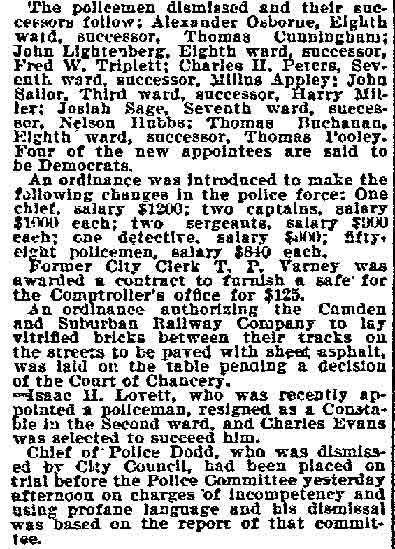
The policemen dismissed and their successors follow: Alexander Osborne, Eighth ward, successor, Thomas Cunningham; John Lightenberg, Eighth ward, successor, Fred W. Triplett; Charles H. Peters, Seventh ward, successor, Milins Appley; John Sailor, Third ward, successor, Harry Miller; Josiah Sage, Seventh ward, successor, Nelson Hubbs; Thomas Buchanan, Thomas Pooley, Thaddeus P. Varney, Isaac H. Lovett, who was recently appointed a policeman, resigned as a Constable in the Second ward, and Charles Evans was selected to succeed him.
Chief of Police Dodd, who was dismissed by City Council, had been placed on trial before the Police Committee yesterday afternoon on charges of incompetency and using profane language and his dismissal was based on the report of that committee.
Four of the new appointees are said to be Democrats.
An ordinance was introduced to make the following changes in the police force: One chief, salary $1200; two captains, salary $1000 each; two sergeants, salary $900 each; one detective, salary $800; fifty-eight policemen, salary $840 each.
Former City Clerk T. P. Varney was awarded a contract to furnish a safe for the Comptroller’s office for $125.
An ordinance authorizing the Camden and Suburban Railway Company to lay vitrified bricks between their tracks on the streets to be paved with sheet asphalt, was laid on the table pending a decision of the Court of Chancery.
Isaac H. Lovett, who was recently appointed a policeman, resigned as a Constable in the Second ward, and Charles Evans was selected to succeed him.
Chief of Police Dodd, who was dismissed by City Council, had been placed on trial before the Police Committee yesterday afternoon on charges of incompetency and using profane language and his dismissal was based on the report of that committee.
Mayor Will Be Chief
Camden Post —
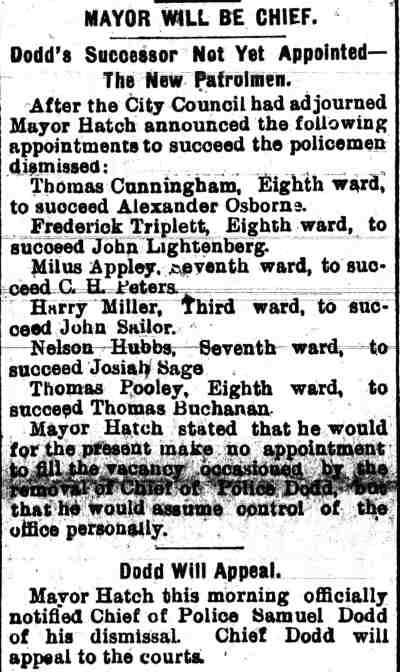
MAYOR WILL BE CHIEF.
Dodd’s Successor Not Yet Appointed—The New Patrolmen.
After the City Council had adjourned Mayor Hatch announced the following appointments to succeed the policemen dismissed:
Thomas Cunningham, Eighth ward, to succeed Alexander Osborne.
Frederick Triplett, Eighth ward, to succeed John Lightenberg.
Milus Appley, Seventh ward, to succeed C. H. Peters.
Harry Miller, Third ward, to succeed John Sailor.
Nelson Hubbs, Seventh ward, to succeed Josiah Sage.
Thomas Pooley, Eighth ward, to succeed Thomas Buchanan.
Mayor Hatch stated that he would for the present make no appointment to fill the vacancy occasioned by the removal of Chief of Police Dodd, but that he would assume control of the office personally.
Dodd Will Appeal.
Mayor Hatch this morning officially notified Chief of Police Samuel Dodd of his dismissal. Chief Dodd will appeal to the courts.
Over in Camden
Philadelphia Inquirer —
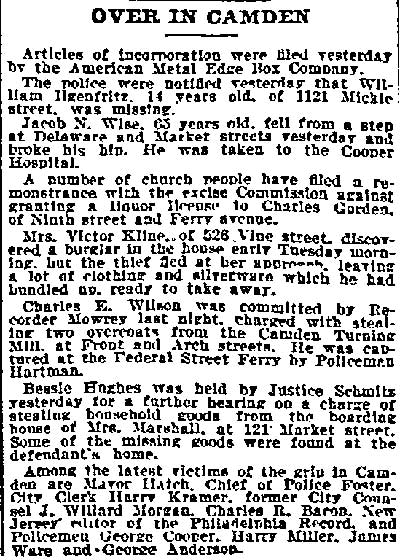
Articles of incorporation were filed yesterday by the American Metal Edge Box Company.
The police were notified yesterday that William Ilgenfritz, 14 years old, of 1121 Mickle street, was missing.
Jacob N. Wise, 65 years old, fell from a step at Delaware and Market streets yesterday and broke his hip. He was taken to the Cooper Hospital.
A number of church people have filed a remonstrance with the excise Commission against granting a liquor license to Charles Gorden, of Ninth street and Ferry avenue.
Mrs. Victor Kline, of 526 Vine street, discovered a burglar in the house early Tuesday morning, but the thief fled at her approach, leaving a lot of clothing and silverware which he had bundled up, ready to take away.
Charles E. Wilson was committed by Recorder Mowrey [sic] last night, charged with stealing two overcoats from the Camden Turning Mill, at Front and Arch streets. He was captured at the Federal Street Ferry by Policemen [sic] Hartman.
Bessie Hughes was held by Justice Schmitz yesterday for a further hearing on a charge of stealing household goods from the boarding house of Mrs. Marshall, at 121 Market street. Some of the missing goods were found at the defendant’s home.
Among the latest victims of the grip in Camden are Mayor Hatch, Chief of Police Foster, City Clerk Harry Kramer, former City Counsel J. Willard Morgan, Charles R. Baron, New Jersey editor of the Philadelphia Record, and Policemen George Cooper, Harry Miller, James Ware and George Anderson.
In Police Dragnet
Philadelphia Inquirer —
IN POLICE DRAGNET
Successful Raid on an Alleged Pool Room in Camden
SEVEN MEN CAPTURED
Keefer, Who Says He Spent His Employers’ Money in the Place, Identifies the Prisoners
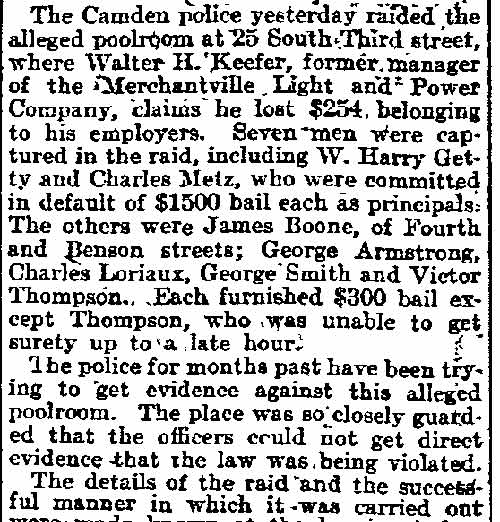
The Camden police yesterday raided the alleged poolroom at 25 South Third street, where Walter H. Keefer, former manager of the Merchantville Light and Power Company, claims he lost $254 belonging to his employers. Seven men were captured in the raid, including W. Harry Getty and Charles Metz, who were committed in default of $1500 bail each as principals. The others were James Boone, of Fourth and Benson streets; George Armstrong, Charles Loriaux, George Smith and Victor Thompson. Each furnished $300 bail except Thompson, who was unable to get surety up to a late hour.
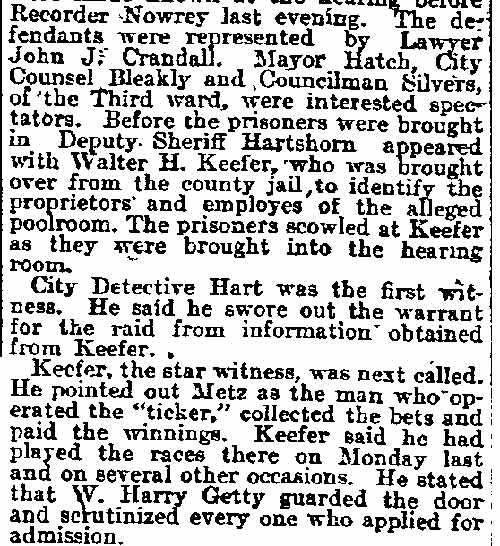
The police for months past have been trying to get evidence against this alleged poolroom. The place was so closely guarded that the officers could not get direct evidence that the law was being violated. The details of the raid and the successful manner in which it was carried out were made known at the hearing before Recorder Nowrey last evening. The defendants were represented by Lawyer John J. Crandall. Mayor Hatch, City Counsel Bleakly and Councilman Silvers, of the Third ward, were interested spectators. Before the prisoners were brought in Deputy Sheriff Hartshorn appeared with Walter H. Keefer, who was brought over from the county jail to identify the proprietors and employes of the alleged poolroom. The prisoners scowled at Keefer as they were brought into the hearing room.
City Detective Hart was the first witness. He said he swore out the warrant for the raid from information obtained from Keefer.
Keefer, the star witness, was next called. He pointed out Metz as the man who operated the “ticker,” collected the bets and paid the winnings. Keefer said he had played the races there on Monday last and on several other occasions. He stated that W. Harry Getty guarded the door and scrutinized every one who applied for admission.
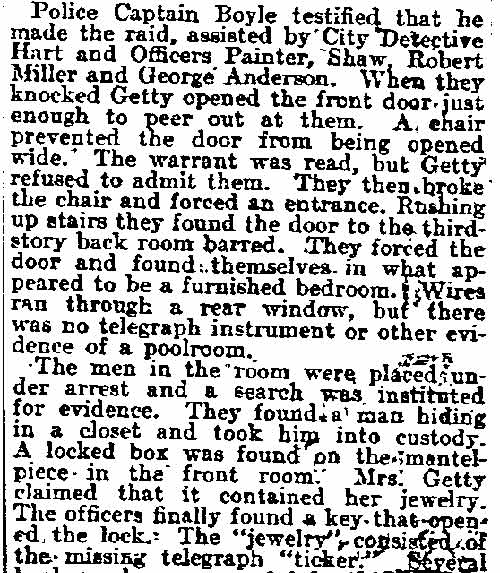
Police Captain Boyle testified that he made the raid, assisted by City Detective Hart and Officers Painter, Shaw, Robert Miller and George Anderson. When they knocked Getty opened the front door just enough to peer out at them. A chair prevented the door from being opened wide. The warrant was read, but Getty refused to admit them. They then broke the chair and forced an entrance. Rushing up stairs they found the door to the third-story back room barred. They forced the door and found themselves in what appeared to be a furnished bedroom. Wires ran through a rear window, but there was no telegraph instrument or other evidence of a poolroom.
The men in the room were placed under arrest and a search was instituted for evidence. They found a man hiding in a closet and took him into custody. A locked box was found on the mantelpiece in the front room. Mrs. Getty claimed that it contained her jewelry. The officers finally found a key that opened the lock. The “jewelry” consisted of the missing telegraph “ticker.” Several about the New Orleans races and betting were seized.
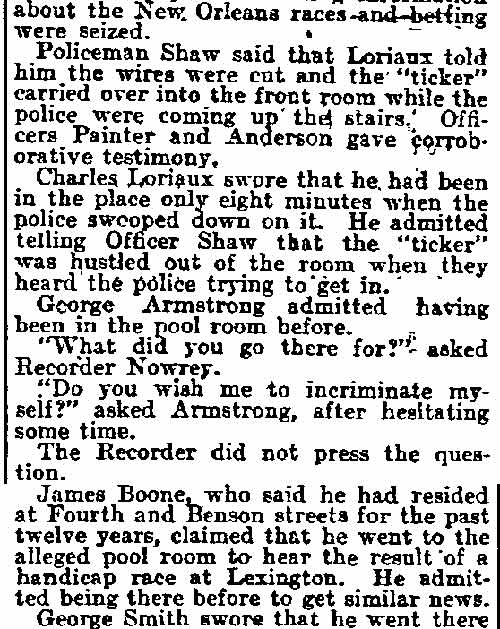
Policeman Shaw said that Loriaux told him the wires were cut and the “ticker” carried over into the front room while the police were coming up the stairs. Officers Painter and Anderson gave corroborative testimony.
Charles Loriaux swore that he had been in the place only eight minutes when the police swooped down on it. He admitted telling Officer Shaw that the “ticker” was hustled out of the room when they heard the police trying to get in.
George Armstrong admitted having been in the pool room before.
“What did you go there for?” asked Recorder Nowrey.
“Do you wish me to incriminate myself?” asked Armstrong, after hesitating some time.
The Recorder did not press the question.
James Boone, who said he had resided at Fourth and Benson streets for the past twelve years, claimed that he went to the alleged pool room to hear the result of a handicap race at Lexington. He admitted ted being there before to get similar news.
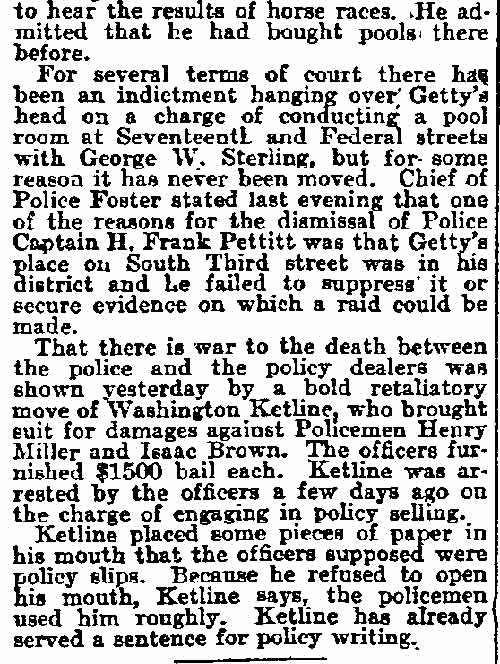
George Smith swore that he went there to hear the results of horse races. He admitted that he had bought pools there before.
For several terms of court there has been an indictment hanging over Getty’s head on a charge of conducting a pool room at Seventeenth and Federal streets with George W. Sterling, but for some reason it has never been moved. Chief of Police Foster stated last evening that one of the reasons for the dismissal of Police Captain H. Frank Pettitt was that Getty’s place on South Third street was in his district and he failed to suppress it or secure evidence on which a raid could be made.
That there is war to the death between the police and the policy dealers was shown yesterday by a bold retaliatory move of Washington Ketline, who brought suit for damages against Policemen Henry Miller and Isaac Brown. The officers furnished $1500 bail each. Ketline was arrested by the officers a few days ago on the charge of engaging in policy selling.
Ketline placed some pieces of paper in his mouth that the officers supposed were policy slips. Because he refused to open his mouth, Ketline says, the policemen used him roughly. Ketline has already served a sentence for policy writing.
Gilbert Now in Jail
Philadelphia Inquirer —
GILBERT NOW IN JAIL
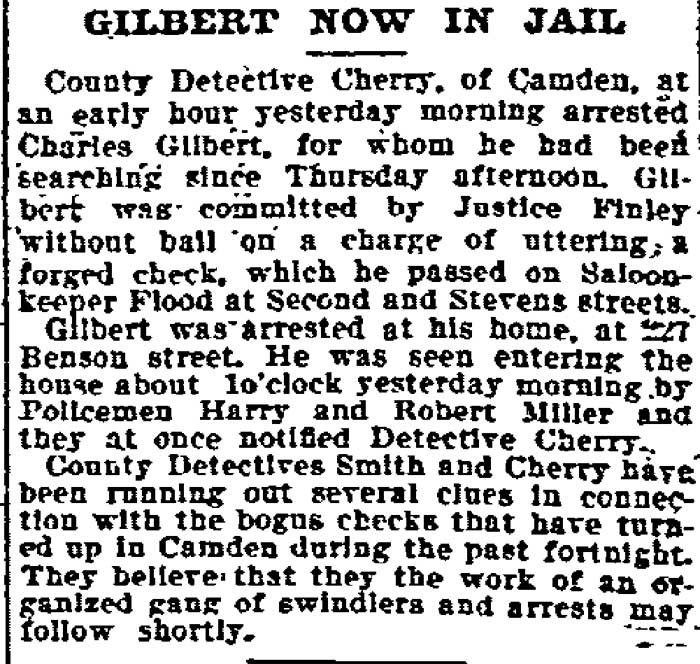
County Detective Cherry, of Camden, at an early hour yesterday morning arrested Charles Gilbert, for whom he had been searching since Thursday afternoon. Gilbert was committed by Justice Finley without bail on a charge of uttering a forged check, which he passed on Saloonkeeper Flood at Second and Stevens streets.
Gilbert was arrested at his home, at 227 Benson street. He was seen entering the house about 1 o’clock yesterday morning by Policemen Harry and Robert Miller and they at once notified Detective Cherry.
County Detectives Smith and Cherry have been running out several clues in connection with the bogus checks that have turned up in Camden during the past fortnight. They believe that they the work of an organized gang of swindlers and arrests may follow shortly.
Col. Felton Committed Suicide in His Office
Camden Daily Courier —
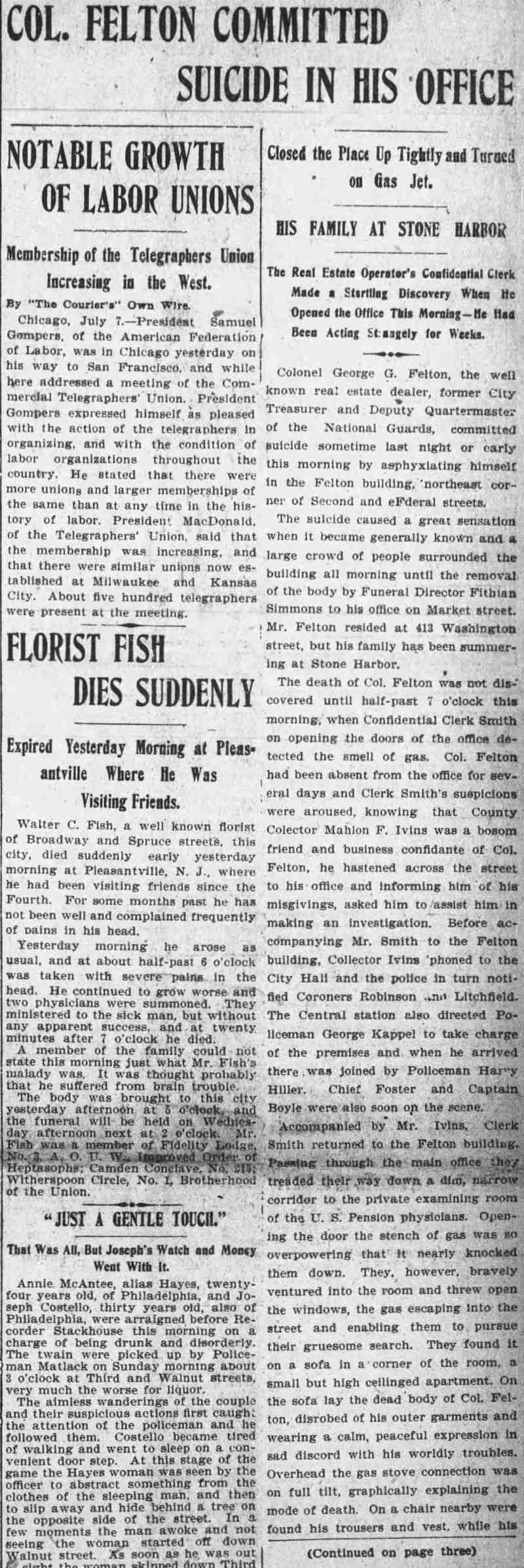

COL. FELTON COMMITTED SUICIDE IN HIS OFFICE
While mystery apparently as absolute as ever still obscures the motive and the criminal in the case of John Houseman Coffin and W. Price Jennings, the unfortunate Camden lads whose trip to the country at Haddon Heights last Wednesday resulted so tragically, it is surmised from hints dropped now and again the matter may soon be cleared. However, those who are working so assiduously to bring the guilty person to justice are as close-mouthed as the proverbial clam, and but meagre information reaches the public.
Last night a woman, about 45 years old, was committed to the county jail by Recorder Stackhouse. On the commitment her name is given as Mrs. Barber. She was committed on complaint of County Detective John Cherry “as a material witness to prove certain allegations pending against one Paul Woodward, who is committed to the county jail charged with the murder of one John Coffin.”
The woman was placed under arrest after a long conference in the Prosecutor’s office. Prosecutor Lloyd said last night that the woman lives on a farm at Marlton, and that she is a very important witness in the case, so important, in fact, that she cannot regain her freedom without a good round sum being put up for her security.
Woodward Again Examined
The investigation into the case was somewhat retarded yesterday owing to an attack of rheumatism that made Prosecutor Frank T. Lloyd remain at home. The day’s responsibility rested on F. Morse Archer, the assistant prosecutor. The latter yesterday morning had Woodward brought into his office, where he underwent for the sixth time a thorough cross-examination. Mr. Archer said Woodward had made no confession, as had been rumored. On the contrary, he still maintained his innocence.
In answer to a question Mr. Archer said: “We are doing our best and while we are in possession of information which we consider important and vital to the case, it is impossible at this time to make it public.”
On the other hand, County Physician Jones was very emphatic in this particular, saying the boys were murdered beyond a doubt.
Boys’ Funerals
Yesterday afternoon the funeral of the boys took place at the same hour and within a square of one another’s homes. Although the hour set for the obsequies, 2 o’clock in the afternoon, had been kept secret scores of persons stood about in knots discussing the tragedy and eager to get a glimpse of the caskets containing the remains of the boys.
Police Captain Boyle and Policemen Kappel, Toy and Ridgeley guarded the houses, and no one except relatives and intimate friends were permitted to enter. But when the caskets were carried from the houses the crowd could not be kept back. Many persons crowded about, and the mourners entered the carriages between two solid phalanxes of curiosity seekers.
The services over Jennings were conducted at his home, 219 North Third street, by Rev. C. A. Adams and Rev. John Lyell. At the Coffin home, 305 North Third street, Rev. William H. Fishburn had charge of the obsequies. Companions of the boys acted as pallbearers. Jennings was buried at Evergreen and Coffin at Harleigh Cemetery.
George M. Beringer, a Camden chemist, who has the important duty of discovering, if possible, traces of poison in the stomachs of the boys, said yesterday he is making a thorough chemical analysis and is of necessity proceeding slowly. He said he will not be able to report the result for some days to come.
A pathetic little incident occurred at the Cooper School during recess yesterday morning when the children, school mates of the lads, gathered about and listened to the muffled beats of a drum. The school flag was at half mast and in every room there was a flag draped with black crepe. The youngsters were visibly affected.
hat, coat and watch were found in his own main office.
Coroners Litchfield and Robinson gave a certificate of death of heart failure, superinduced by inhaling gas. From the pink discoloration about the wrists where the blood was leaving the veins, Dr. Litchfield said that the body had been dead at least six hours, though he may have been dead ten or twelve.
Col. Felton was seen to enter his building at exactly 12.10 o’clock this morning. A citizen, whose name is withheld at his own request, had been talking with Night Watchman Clarence Hires on Federal street. He bade Hires good night and when he reached Second street saw the Colonel come around the corner. He came as though to enter his office by the front door, but turned and going back up Second street entered the side-door. Mr. Hires says the light was burning in the Colonel’s front office from 7 o’clock last night to 5 o’clock this morning, when he went off duty and Mr. Smith found it still burning when he arrived.
Colonel Felton has been acting strangely for several weeks and had not been at his office for two or three days.
When asked by anxious friends what the trouble was, he would put his hands to the side of his head and complain that it was in bad shape. He was seen in the hotel at Haddon avenue station on Saturday afternoon. He carried a grip and appeared very cheerful. Asked if he had been to the shore he replied no, he had been down the country, Bridgeton.
Grocer Charles F. Eastlack, by whom Col. Felton was at one time employed, went to Stone Harbor this morning to notify the family of his death. Col. Felton leaves a widow and adopted daughter, Miss Leona Felton.
Col. George G. Felton was born at Westville, Mass., and was fifty-six years of age. He had been a resident of this city for about quarter of a century. Previous to that he was engaged in the grocery business at Burlington. On coming to Camden, he entered the employ of Grocer Charles F. Eastlack, at Third and Washington streets, but later entered the employ of his brother, Charles H. Felton, who had an extensive real estate business. On the death of the latter the Colonel went into the same business for himself, his brother’s widow continuing the old business under the name of Charles H. Felton & Co. It is not known, however, whether business troubles impelled him to end his life.
Col. Felton was prominent in political, military and society circles. In 1893 he was appointed by Mayor Westcott a member of the Board of Public Works.
In 1896 he was appointed City Treasurer to fill the vacancy caused by the resignation of Frank C. Michellon. In 1897 he was elected to the office. He served two years, his election being contested by his Democratic rival, Freedom C. Lippincott, but was confirmed by the County Board of Elections.
He was Deputy Quartermaster on the Governor’s staff and a member of the Masonic order and A. O. U. W.
Colonel Felton was active in building and loan association circles. He was treasurer of the Mechanics’ and Workingmen’s Building and Loan Association and was formerly a director of the Security Trust Company. He had also been a director in the Central Trust.
Mrs. Felton will arrive from Stone Harbor this evening, when arrangements for the funeral will be made. The flag at Post 5 Hall is flying at half-mast in Col. Felton’s memory, for he was a Grand Army veteran, having gone to the front when a mere boy.
Col. George G. Felton Ends His Life by Inhaling Illuminating Gas
Camden Post-Telegram —
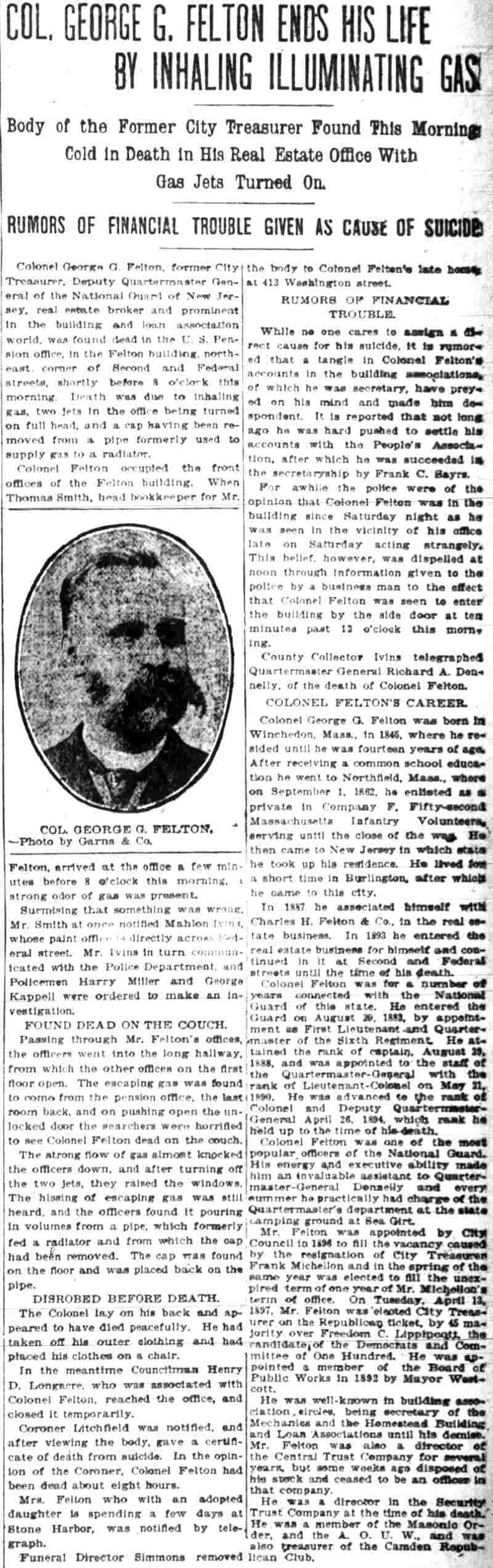
COL. GEORGE G. FELTON ENDS HIS LIFE BY INHALING ILLUMINATING GAS
Body of the Former City Treasurer Found This Morning Cold in Death in His Real Estate Office With Gas Jets Turned On.
RUMORS OF FINANCIAL TROUBLE GIVEN AS CAUSE OF SUICIDE
Colonel George G. Felton, former City Treasurer, Deputy Quartermaster General of the National Guard of New Jersey, real estate broker and prominent in the building and loan association world, was found dead in the U. S. Pension office, in the Felton building, northeast corner of Second and Federal streets, shortly before 8 o’clock this morning. Death was due to inhaling gas, two jets in the office being turned on full head, and a cap having been removed from a pipe formerly used to supply gas to a radiator.
Colonel Felton occupied the front offices of the Felton building. When Thomas Smith, head bookkeeper for Mr. Felton, arrived at the office a few minutes before 8 o’clock this morning, a strong odor of gas was present.
Surmising that something was wrong, Mr. Smith at once notified Mahlon Ivins, whose paint office is directly across Federal street. Mr. Ivins in turn communicated with the Police Department, and Policemen Harry Miller and George Kappell were ordered to make an investigation.
FOUND DEAD ON THE COUCH.
Passing through Mr. Felton’s offices, the officers went into the long hallway, from which the other offices on the first floor open. The escaping gas was found to come from the pension office, the last room back, and on pushing open the unlocked door the searchers were horrified to see Colonel Felton dead on the couch.
The strong flow of gas almost knocked the officers down, and after turning off the two jets, they raised the windows. The hissing of escaping gas was still heard, and the officers found it pouring in volumes from a pipe, which formerly fed a radiator and from which the cap had been removed. The cap was found on the floor and was placed back on the pipe.
DISROBED BEFORE DEATH.
The Colonel lay on his back and appeared to have died peacefully. He had taken off his outer clothing and had placed his clothes on a chair.
In the meantime Councilman Henry D. Longacre, who was associated with Colonel Felton, reached the office, and closed it temporarily.
Coroner Litchfield was notified, and after viewing the body, gave a certificate of death from suicide. In the opinion of the Coroner, Colonel Felton had been dead about eight hours.
Mrs. Felton who with an adopted daughter is spending a few days at Stone Harbor, was notified by telegraph. Funeral Director Simmons removed the body to Colonel Felton’s late home at 413 Washington street.
RUMORS OF FINANCIAL TROUBLE.
While no one cares to assign a direct cause for his suicide, it is rumored that a tangle in Colonel Felton’s accounts in the building associations, of which he was secretary, have preyed on his mind and made him despondent. It is reported that not long ago he was hard pushed to settle his accounts with the People’s Association, after which he was succeeded in the secretaryship by Frank C. Sayrs.
For awhile the police were of the opinion that Colonel Felton was in the building since Saturday night as he was seen in the vicinity of his office late on Saturday acting strangely. This belief, however, was dispelled at noon through information given to the police by a business man to the effect that Colonel Felton was seen to enter the building by the side door at ten minutes past 12 o’clock this morning.
County Collector Ivins telegraphed Quartermaster General Richard A. Donnelly, of the death of Colonel Felton.
COLONEL FELTON’S CAREER.
Colonel George G. Felton was born in Winchedon [sic], Mass., in 1845, where he resided until he was fourteen years of age. After receiving a common school education he went to Northfield, Mass., where on September 1, 1862, he enlisted as a private in Company F, Fifty-second Massachusetts Infantry Volunteers, serving until the close of the war. He then came to New Jersey in which state he took up his residence. He lived for a short time in Burlington, after which he came to this city.
In 1887 he associated himself with Charles H. Felton & Co., in the real estate business. In 1893 he entered the real estate business for himself and continued in it at Second and Federal streets until the time of his death.
Colonel Felton was for a number of years connected with the National Guard of this state. He entered the Guard on August 29, 1883, by appointment as First Lieutenant and Quartermaster of the Sixth Regiment. He attained the rank of captain, August 19, 1888, and was appointed to the staff of the Quartermaster-General with the rank of Lieutenant-Colonel on May 21, 1890. He was advanced to the rank of Colonel and Deputy Quartermaster-General April 26, 1894, which rank he held up to the time of his death.
Colonel Felton was one of the most popular officers of the National Guard. His energy and executive ability made him an invaluable assistant to Quartermaster-General Donnelly and every summer he practically had charge of the Quartermaster’s department at the state camping ground at Sea Girt.
Mr. Felton was appointed by City Council in 1896 to fill the vacancy caused by the resignation of City Treasurer Frank Michelon and in the spring of the same year was elected to fill the unexpired term of one year of Mr. Michelon’s term of office. On Tuesday, April 13, 1897, Mr. Felton was elected City Treasurer on the Republican ticket, by 45 majority over Freedom C. Lippincott, the candidate of the Democrats and Committee of One Hundred. He was appointed a member of the Board of Public Works in 1892 by Mayor Westcott.
He was well-known in building association circles, being secretary of the Mechanics and the Homestead Building and Loan Associations until his demise. Mr. Felton was also a director of the Central Trust Company for several years, but some weeks ago disposed of his stock and ceased to be an officer of that company.
He was a director in the Security Trust Company at the time of his death. He was a member of the Masonic Order, and the A. O. U. W., and was also treasurer of the Camden Republican Club.
Philadelphia Inquirer — July 8, 1902
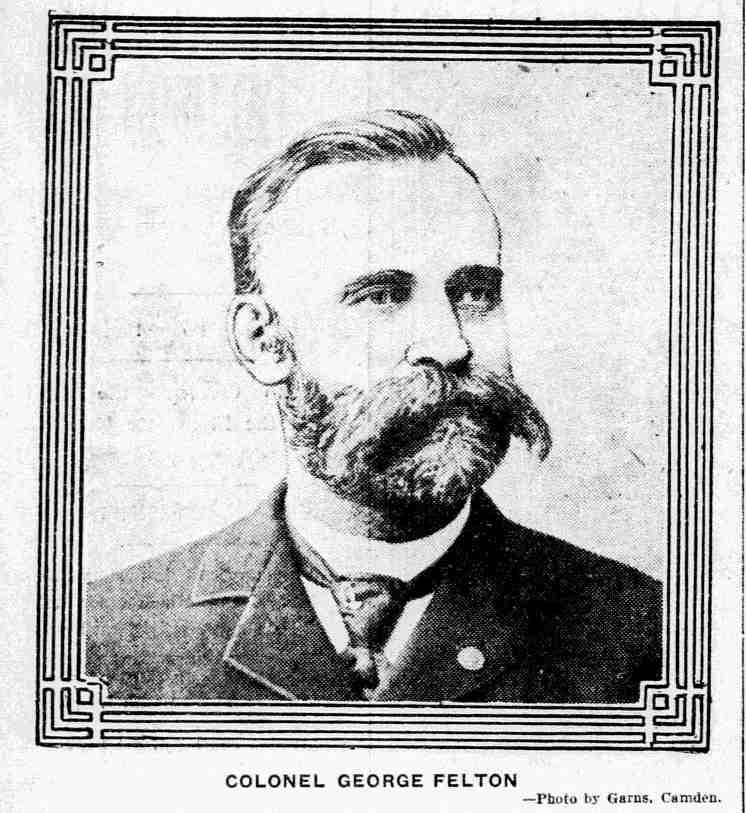
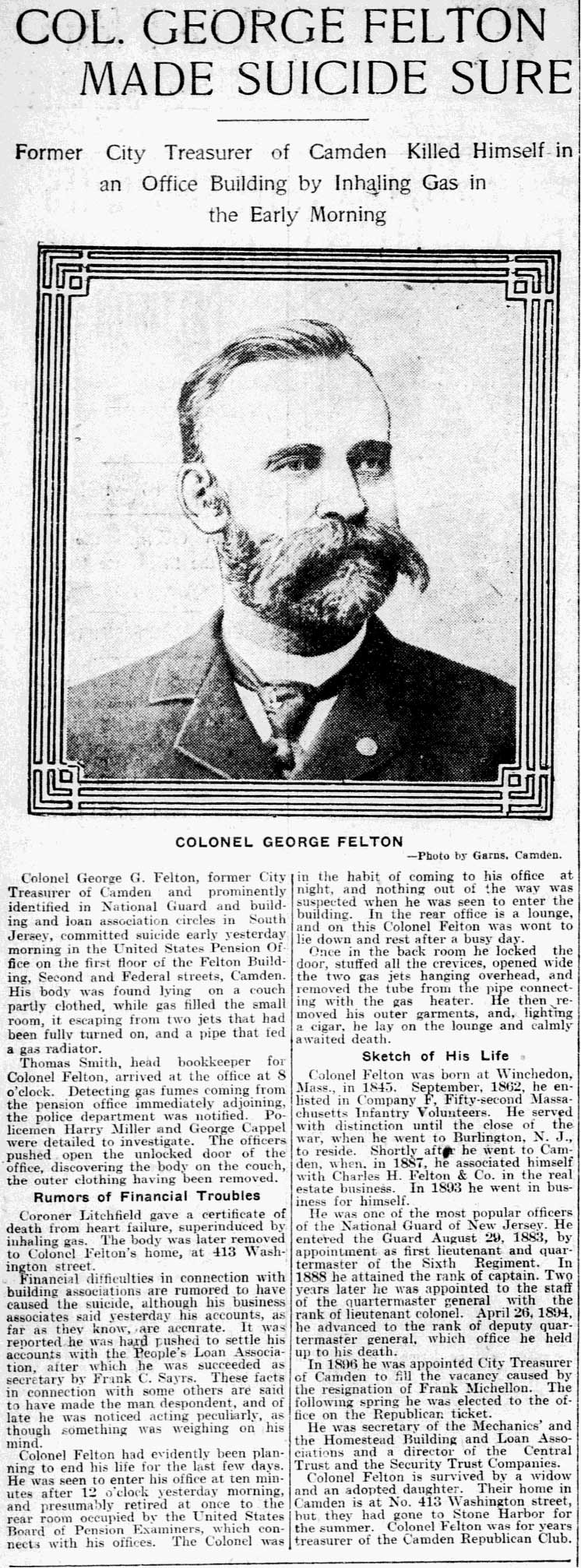
Col. George Felton Made Suicide Sure
COL. GEORGE FELTON MADE SUICIDE SURE
Former City Treasurer of Camden Killed Himself in an Office Building by Inhaling Gas in the Early Morning
Colonel George G. Felton, former City Treasurer of Camden and prominently identified in National Guard and building and loan association circles in South Jersey, committed suicide yesterday morning in the United States Pension Office in the first floor of the Felton Building, South Second and Federal streets, Camden. His body was found lying on a couch partly clothed, while gas filled the small room, it escaping from two jets that had been fully turned on, and a pipe that tied a gas radiator.
Thomas Smith, head bookkeeper for Colonel Felton, arrived at the office at 8 o'clock. Detecting gas fumes coming from the Pension office immediately adjoining, the police department was notified. Policemen Harry Miller and George Cappel were detailed to investigate. The officers pushed open the unlocked door of the office, discovering the body on the couch, the other clothing having been removed.
Rumors of Financial Difficulties
Coroner Litchfield gave a certificate of death from heart failure, superinduced by inhaling gas. The body was later removed to Colonel Felton's home, at 413 Washington street.
Financial difficulties in connection with building associations are rumored to have caused the suicide, although his business associates said yesterday his accounts, as far as they know, are square. Some reported he was hard rushed to settle his accounts with the People's Loan Association, after which he was succeeded as secretary by Frank C. Says. These facts in connection with some others are said to have made the man despondent, and of late it was noticed more especially that though something was weighing on his mind.
Colonel Felton had evidently been planning to end his life for the last few days. He was seen to enter his office ten minutes after 12 o'clock yesterday morning, and presumably returned to his office to the room occupied by the United States Board of Pension Examiners, which connects with his office. The Colonel was in the habit of coming to his office at night, and nothing out of the way was suspected when he was seen to enter the building. One inner office is a lounge, and on this Colonel Felton was wont to lie down and rest after a busy day.
Once in the back room he locked the door, stuffed all the crevices, opened wide the two gas jets hanging overhead, and removed the tube from the pipe connecting with the gas radiator. He then removed his outer garments, and, lighting a cigar, he lay on the lounge and calmly awaited death.
Sketch of His Life
Colonel Felton was born at Winchendon, Mass., September 1, 1842. He enlisted in Company F, Fifty-second Massachusetts Infantry Regiment. He served with distinction until the close of the war, when he went to Burlington, N. J., to reside. Shortly after he moved to Camden, when, in 1887, he associated himself with Charles H. Felton & Co. in the real estate business. In 1893 he went in business for himself.
He was one of the most popular officers of the National Guard of New Jersey. He entered the Guard August 29, 1883, to appointment as first lieutenant and quartermaster of the Sixth Regiment. In 1888 he attained the rank of captain. Two years later he was appointed to the staff of the quartermaster general, with the rank of lieutenant colonel. April 29, 1894, he advanced to the rank of deputy quartermaster general, which office he held up to the time of the death.
In 1896 he was appointed City Treasurer of Camden to fill the vacancy caused by the resignation of Frank Michellon. The following spring he was elected to the office on the Republican ticket.
He was secretary of the Mechanics' and the Homestead Building and Loan Associations and a director of the Central Trust and the Security Trust Companies.
Colonel Felton is survived by a wife and an adopted daughter. Their home is at No. 413 Washington street, but they had gone to Stone Harbor for the summer.
Murder and Bloodshed in Camden Primary Elections
Philadelphia Inquirer —

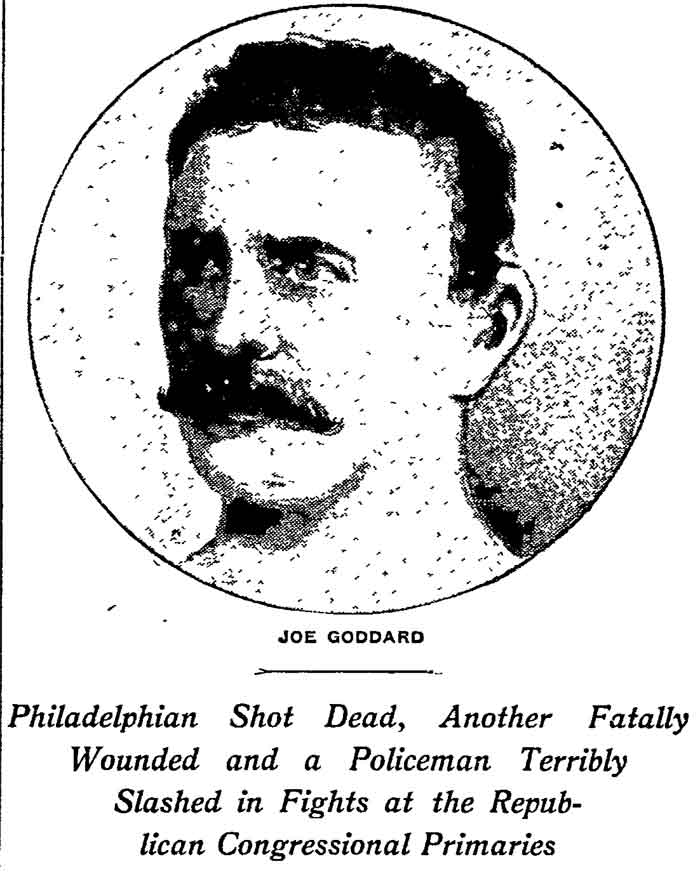
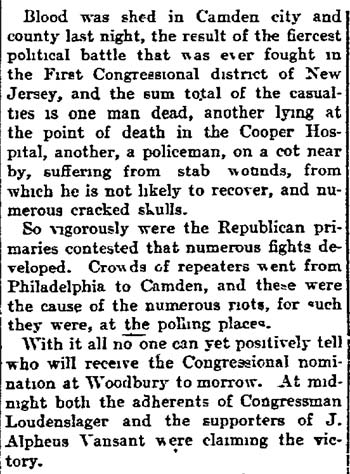
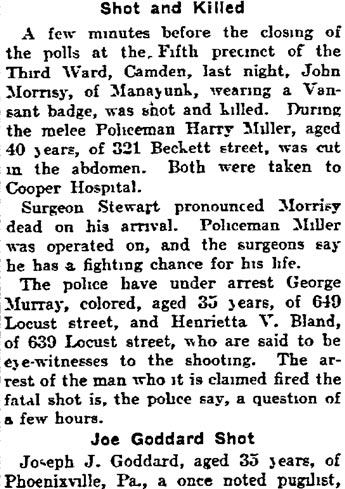
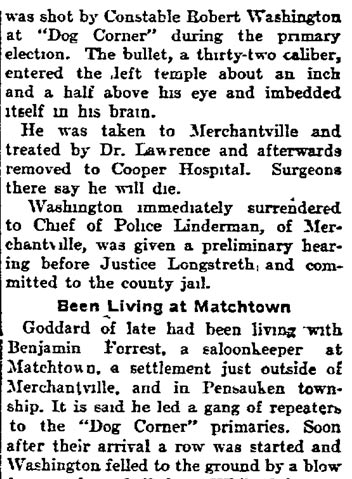
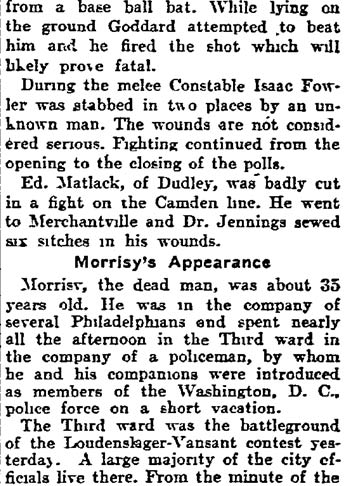
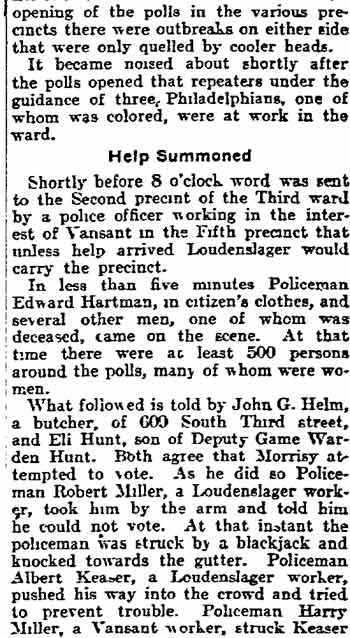
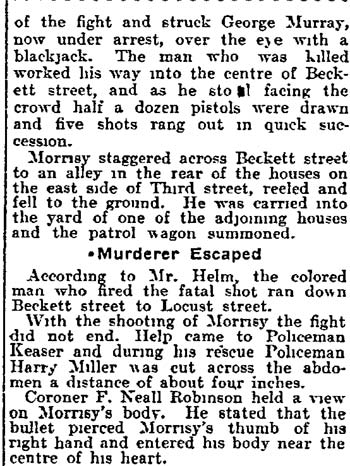
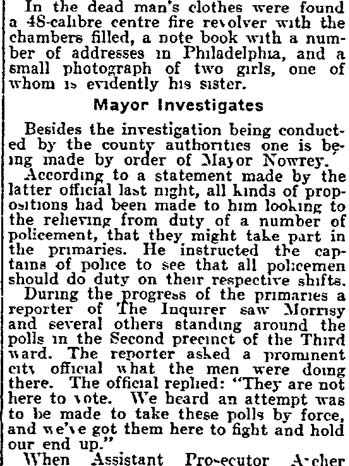
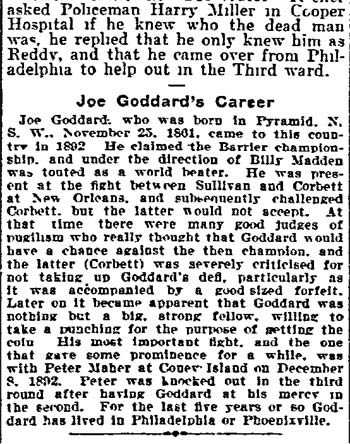
Philadelphia Inquirer, July 29, 1902 — Related: John Foster, F. Morse Archer, Joseph Nowrey, Eli Hunt, Robert F. Miller, Edward Hartman, South 3rd Street, Beckett Street, Liberty Street, Locust Street
Murder and Riot in Camden Primary
Trenton Evening Times —
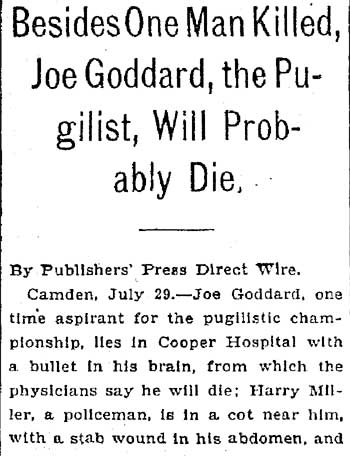
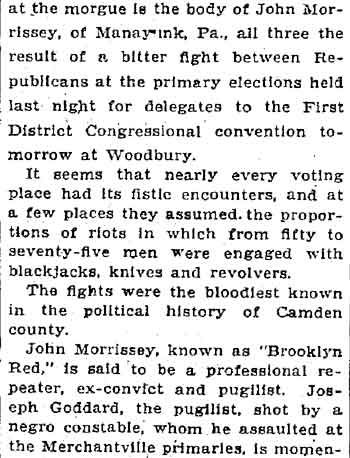
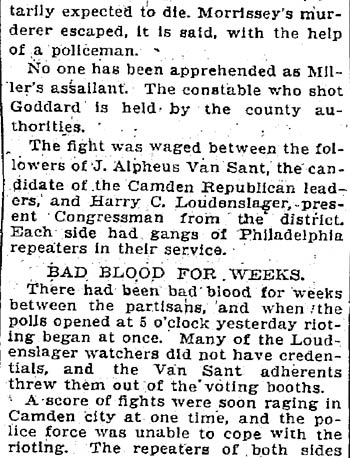
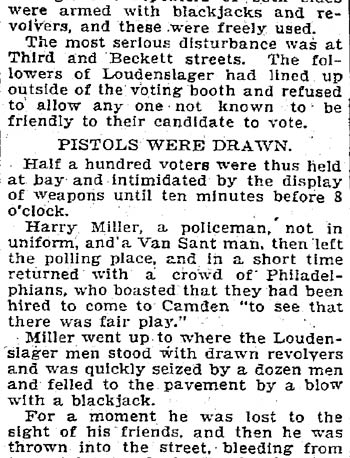
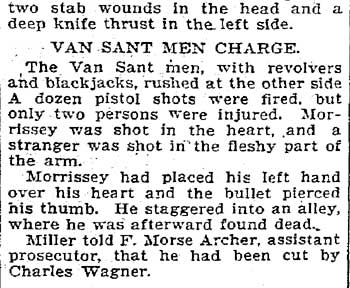
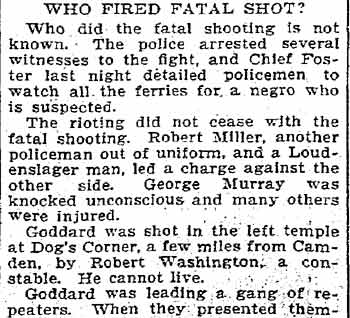
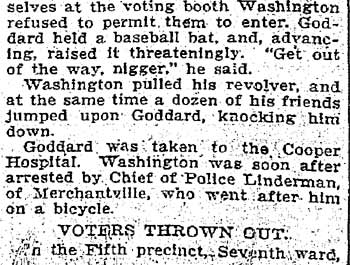
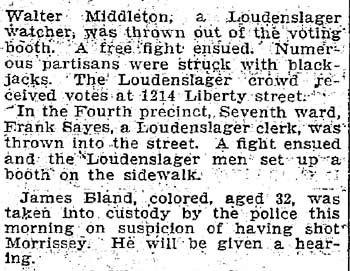
Trenton Evening Times, July 29, 1902 — Related: John Foster, F. Morse Archer, South 3rd Street, Beckett Street, Liberty Street
Camden Post-Telegram — October 11, 1902
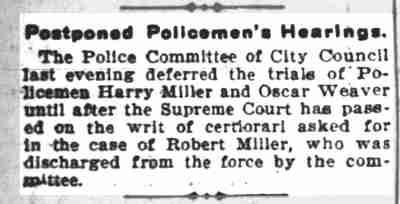
Camden Post-Telegram, October 11, 1902 — Harry Miller, J. Oscar Weaver
Wagner's Trial for Stabbing Miller
Camden Daily Courier —


WAGNER’S TRIAL FOR STABBING MILLER
Witnesses Say Policeman Keaser Held Fellow Officer When He Was Knifed.
CUT DURING THIRD WARD RIOT
The main court room was crowded with interested Third warders this morning, when the first of the criminal complaints growing out of the riots at Third and Beckett streets, on the night of July 28, last, during the Congressional primary, was taken up. It charged Charles Wagner with assault and battery on Policeman Harry Miller. Judge Joline was on the bench. Prosecutor Lloyd appeared for the State and the defendant was represented by Lawyers Fred A. and William F. Rex. Some little trouble was experienced in getting a jury.
After Prosecutor Lloyd outlined the case, Policeman Miller was called to the stand. He said that on the night in question just before the close of the polls, a fight ensued between ex-Policeman “Bob” Miller and John Morrisey, the man who was killed. A general racket followed and “Bob” Miller, Policeman Keaser and others were brutally assaulting George Murray with a blackjack, when witness went to Murray’s aid. Keaser, he said, turned on him and grappled.
MILLER STABBED.
“He had a hold of me and I of him,” said Miller, “and while we were standing in that position, this man Wagner came up in front of me, jabbed his knife in my stomach, turned it like that (giving his hand a twist) and pulled it out. Keaser still had a hold of me and I could not help myself. Wagner ran away after stabbing me.”
Miller said he was taken to Cooper Hospital and was there four weeks.
On cross-examination by Mr. Rex, Miller said he was positive that Wagner was his assailant and denied saying in the hospital the morning after the stabbing, that he did not know who cut him. He also denied hitting Keaser with his blackjack.
When questioned concerning Morrisey, the man who was killed, Miller said he only met him that day and did not know whether he was a voter or not.
DIDN’T WANT DETAILS.
Mr. Rex tried to get the witness to detail a talk he had with Morrisey, but Mr. Lloyd objected. Mr. Rex seemed so anxious to carry the point that Mr. Lloyd said he was willing to withdraw the objection, provided Mr. Rex would not object to detailed conversation responses to his questions. Mr. Rex promptly vetoed the proposition and withdrew his questions.
Harry Selby, son of former Policeman Selby, followed on the stand. He said he did not see the stabbing, but that a few moments before the polls closed he saw Wagner try to stab Miller at the window of the polling place. The two, it appears, had had some words.
Dr. Grimes, of the Cooper Hospital staff, said that he helped dress Miller’s wound and that it was a dangerous one.
SAW WAGNER KNIFE MILLER.
William Laws, colored, corroborated Miller’s testimony. He said he saw Policeman Keaser hold Policeman Miller while Wagner stabbed him. This happened he said about four minutes of 8 o’clock.
Policeman Edward Hartman told of seeing Wagner having an open knife in his hand, of seeing him jab at several people and that he grabbed at him.
“You saw all of that did you?” asked Mr. Rex.
“I certainly did,” replied the officer.
“Then why didn’t you as a policeman arrest him?”
“I tried to, but his brother interfered.”
Mr. Rex had no more questions to ask.
George Murray, also told of seeing defendant have a knife in his hand.
Detectives Smith and Cherry told of making an unsuccessful search in this city for Wagner and finally locating him at Hammonton. He was wounded.
Detective Cherry said that Wagner told him that he had been at Hammonton.
“Hammonton is in Camden county, isn’t it?” asked Mr. Rex.
“No, sir, Atlantic county.”
“My geography is twisted somewhat,” commented Mr. Rex.” With these witnesses the State rested.
WAGNER DENIES CHARGE.
Addressing the jury Mr. Rex said the defense would be an alibi. Wagner then took the stand. He said he lived at 668 South Second street and that on the night of July 28 he was at the polling place about quarter of eight o’clock.
“Did you have a penknife in your hands at all?”
“No, sir.”
“Did you cut Harry Miller?”
“No, sir.”
In answer to questions by Mr. Rex, Wagner said he was with Constable Bates and nearly everybody knew him at Waterford.
When questioned by Mr. Lloyd Wagner said he went to Waterford on July 30—two days after the stabbing. He went to see his sick wife at Mr. Archer’s. His visit lasted until the middle of September, the time of his arrest. Previous to his wife’s illness he was away over a week. He said he had no knowledge that he was wanted for any crime until his later arrest. It was news to him in papers that he was charged with stabbing Miller. He said he had no knife.
He further said that no trouble had occurred at all while he was at the polls.
Charles Cahill, a clerk at the Reading terminal, said he was at the polls and about a quarter past seven o’clock he went up Beckett street in company with Wagner and another man. About fifty feet away, he said he went into an alley and Wagner proceeded up the street. When Cahill returned to the polling place just as the trouble began. He did not see Wagner.
Questioned by the Prosecutor Cahill said he was present as a challenger.
“For which party?” “For the party that was holding the election?”
“We wanted the best man,” snapped Cahill in reply.
DIDN’T HAVE ANY POLITICS.
The Prosecutor repeated the question several times only to receive evasive answers, such as “I was a Republican for that night,” and “I’m for the best man,” until Judge Joline was compelled to sharply reprimand the witness to answer the question. Even then the spectators laughed. Cahill said he had no politics, as he said he guessed he didn’t have any politics.
John McDonald testified to seeing Wagner and two other men pass up the street and despite the general excitement Mr. McDonald said he did not see Wagner until he got to Fourth street.
With the testimony of Butcher John Morrisey, who declared he did not see Wagner at all around the polls until after the trouble, was over court took a recess.
Policeman Albert Keaser was the first witness called after recess. He said he was present when the row started, that he took a blackjack from George Murray and also that he took a club from Policeman Harry Miller. The latter, he said, had hit him with the weapon. Witness said he was at the window of the polling place and at that time Miller was not cut.
“Did Mr. Archer, the Assistant Prosecutor, tell you that he had a talk with Miller and that Miller said he didn’t know who cut him?”
Mr. Lloyd objected to the question because it showed a willingness to allow it. Mr. Rex would let him call witness and then attack him.
Mr. Rex would not do so and the Prosecutor pressed his objection. It was sustained.
On cross examination Keaser denied agreeing to a man named Ogden that Wagner was the fellow who did Miller.
BEAT FELLOW POLICEMAN.
Policeman John Wagner, another of the defendants, said his brother went away before the fight started. In detailing the fracas Wagner voluntarily said he hit Hartman (the policeman) with his jack and that he also hit Policeman Hartman.
Policeman Pruitt also said he saw Wagner leave the polling place just before the disturbance. When Mr. Lloyd was cross examining the witness Mr. Rex objected to the form of a question and remarked that he had objected to that several times and “I suppose I’ll get the same ruling.”
Judge Joline rebuked Mr. Rex for making such a statement. Mr. Rex then made his objection but put it as an objection in regular form and it was sustained.
Anna Hutner, a sister of the defendant, said she saw him go away about quarter of 8 o’clock and that he did not have anything to do with the trouble. She explained her presence there by saying she had gone there to keep George Murray from shooting her brother.
William Ridgway said he was present during the trouble but did not see Wagner.
Constable “Bo” Bates said that Wagner was in his company nearly every day while he was visiting Waterford and that he made no attempt to escape.
SHIELDED WAGNER.
Prosecutor Lloyd’s only question was:
“You as an officer of this court knew that this man was charged with cutting Harry Miller and you did not report it to the authorities, is that right?”
“I forgot it sir.”
When asked why, by Mr. Rex, the witness said the authorities could find out him at any time.
The defense rested and Mr. Lloyd replied with a brief but vigorous rebuttal. He testified that Keaser told him that Wagner did cut Miller and related the incident. Mr. Lloyd again rebuked Mr. Rex for his manner.
Argument commenced at 2.45 o’clock.
Another Case in Third Ward Riot
Camden Daily Courier —

ANOTHER CASE IN THIRD WARD RIOT
Policeman Keaser and Ex-Policeman “Bob” Miller on Trial for Assault.
WAGNER JURY COULD NOT AGREE
In the Criminal Court this morning George V. Tucker, who was convicted of a charge of assault and battery, was sentenced by Judge Joline to pay a fine of $50 and costs and stand committed until the money is paid.
Henry J. Shuster pleaded guilty to a charge of embezzling $260.16 from King David Lodge, No. 155, of which he was treasurer. Shuster served three months in the County Jail last spring on a similar charge. At that time he said he used the money to care for his wife, who was ill. It appears that he did use part of the money for this purpose, but that he squandered a large sum in poker playing.
Rev. Q. C. Davis, pastor of the Emmanuel Baptist church, testified that since Shuster has been out of jail he has led a correct life, and at the present time has a good position.
Prosecutor Lloyd made an appeal for clemency.
Judge Joline announced that he was not ready to decide the case and it went over.
POLICEMEN ON TRIAL.
The indictment against Policeman Albert Keaser and ex-Policeman Robert Miller, on charges of assault and battery on George Murray, was then called. This is the second case to be tried as the outcome of the election riot at the Third Ward polling during the primary election last July. Considerable time was occupied in securing a jury.
At the afternoon session Assistant Prosecutor Archer outlined the case, in which he said the two defendants “lined with a polling system” and the alleged assault took place at the polling place at Third and Beckett streets, and during the row, Robert Miller, struck George Murray several times with a blackjack, and Keaser, it is alleged, assisted Miller in the assault.
The first witness called was George Murray, the alleged victim, who testified that while standing near the polling place with several other “Bob” Miller, without any provocation, beat him with a blackjack. He said that Policeman Keaser was present and came to Miller’s assistance. During the row, Policemen Hartman and Harry Miller came to his aid.
BEATEN WITH A BLACKJACK.
On cross-examination witness said he had no pistol or blackjack, but that three days before the election Miller had struck witness with a blackjack. He further said that he had been told at the Third Ward Republican Club, in the presence of John Rodan, that if a certain man would come along, he would kill him.
William Laws, who testified next, gave further and corroborative testimony as to the blackjacking. He said that Murray did nothing to provoke the assault.
Spencer Moore, also gave corroborating testimony.
Policeman Harry Miller testified to seeing “Bob” Miller beating Murray while Policeman Keaser stood at the side of Beckett street. The witness said that he was not allowed to see Policeman Keaser at the same time explaining.
What are you trying to do, kill this man.
The witness said he was thrown down, and was pushed over by Keaser, and Miller grappled with him. He heard three or four pistol shots.
The witness identified the blackjack, in the possession of Lawyer Rex, which he used on the night of the primaries.
Edward Roberts, formerly Assembly man Roberts, also gave corroborative testimony.
DEFENSE OPENS.
At the afternoon session of the court the defense opened. Counsel said that the defendants were officers of the law, force to put the riot into subjection.
Policeman Toy testified that he saw two opponents quarreling, that Robert Miller, was acting as a peacemaker. He saw Murray shoot off a revolver.
Policeman Cunningham was also at the riot and heard Murray say that he would get some one before the night was over. He found the gunshot off a revolver under a tree.
On cross-examination Miller admitted that he struck Murray while attempting to arrest him. He also testified that he had a conversation with Murray; that some person had attempted to stab him. He exhibited his clothing which was cut with a knife.
Policeman Shaw testified that on July 23, visited George Murray’s residence and found George Murray in his home, where he was under arrest by Detective Burke, who also found a revolver from the wife of Murray.
Mrs. Widener, who was a witness in the trial yesterday, is not the same piece of evidence in this case.
CHEESEMAN SENTENCED.
At the noon recess Judge Joline imposed sentence on O. U. Cheeseman, the former secretary of Thomas Jefferson Council, No. 155, Jr. O. U. A. M., who was convicted of a charge of false pretenses on Thursday last. Rev. Samuel Ellesworth, Rev. R. A. M. Mason, pastor of the Kaighn Avenue M. E. church, and Rev. Robert Wesley Johnson, pastor of the Second Presbyterian church, made appeals to the court for clemency in his case. Judge Joline sentenced Cheeseman to four months in the County Jail and a fine of $50 and costs.
After being out for seven hours without being able to agree on a verdict the jury in the case of Policeman Harry Miller tried yesterday on a charge of stabbing Policeman Harry Miller, at the time of the election riot last, were discharged at 10 o’clock last night.
Edwin F. Miller Wed to Lucy Inskip
Camden Daily Courier —
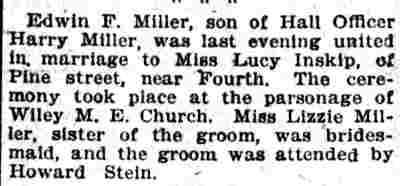
Edwin F. Miller, son of Policeman Harry Miller, was last evening united in marriage to Miss Lucy Inskip, of this city. The ceremony took place at the parsonage of Wiley M.E. Church. Miss Lizzie Miller, sister of the groom, was bridesmaid, and the groom was attended by Howard Stein.
Son of Policeman Miller Is Dead
Camden Daily Courier —
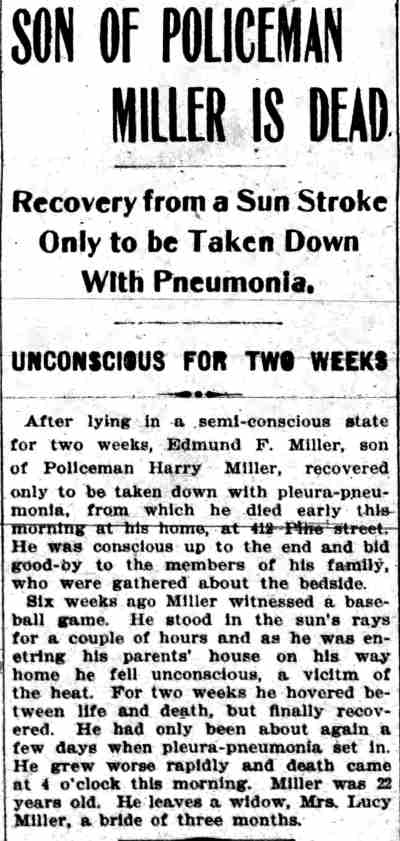
SON OF POLICEMAN MILLER IS DEAD
Recovery from a Sun Stroke Only to be Taken Down With Pneumonia.
UNCONSCIOUS FOR TWO WEEKS
After lying in a semi-conscious state for two weeks, Edmund F. Miller, son of Policeman Harry Miller, recovered only to be taken down with pleura-pneumonia, from which he died early this morning at his home, at 412 Pine street. He was conscious to the end and bid good-by to the members of his family, who were gathered about the bedside.
Six weeks ago Miller witnessed a baseball game. He stood in the sun’s rays for a couple of hours and as he was entering his parents’ house on his way home he fell unconscious, a victim of the heat. For two weeks he hovered between life and death, but finally recovered. He had only been about again a few days when pleura-pneumonia set in. He grew worse rapidly and death came at 4 o’clock this morning. Miller was 22 years old. He leaves a widow, Mrs. Lucy Miller, a bride of three months.
Mr. Miller was conscious to the end and just a few minutes before his spirit took flight he called his wife and parents to the bedside and bid them good-by.
The bereaved widow, who is also suffering from a heavy cold, is overcome with grief and the attending physician has fears for her recovery.
The deceased was employed at the Pennsylvania Railroad freight station and had a large number of friends.
The funeral takes place on Tuesday afternoon at 2 o’clock, from 412 Pine street.
Death Has Taken Edmund F. Miller
Camden Post-Telegram —
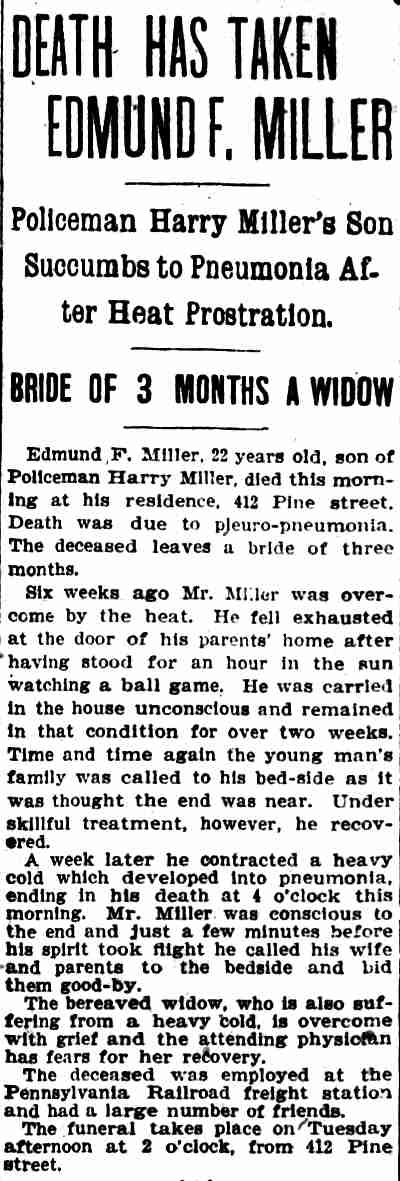
DEATH HAS TAKEN EDMUND F. MILLER
Policeman Harry Miller’s Son Succumbs to Pneumonia After Heat Prostration.
BRIDE OF 3 MONTHS A WIDOW
Edmund F. Miller, 22 years old, son of Policeman Harry Miller, died this morning at his residence, 412 Pine street. Death was due to pleuro-pneumonia. The deceased leaves a bride of three months.
Six weeks ago Mr. Miller was overcome by the heat. He fell exhausted at the door of his parents’ home after having stood for an hour in the sun watching a ball game. He was carried in the house unconscious and remained in that condition for over two weeks. Time and time again the young man’s family was called to his bed-side as it was thought the end was near. Under skillful treatment, however, he recovered.
A week later he contracted a heavy cold which developed into pneumonia, ending in his death at 4 o’clock this morning. Mr. Miller was conscious to the end and just a few minutes before his spirit took flight he called his wife and parents to the bedside and bid them good-by.
The bereaved widow, who is also suffering from a heavy cold, is overcome with grief and the attending physician has fears for her recovery.
The deceased was employed at the Pennsylvania Railroad freight station and had a large number of friends.
The funeral takes place on Tuesday afternoon at 2 o’clock, from 412 Pine street.
Funeral of Edwin Miller
Camden Daily Courier —
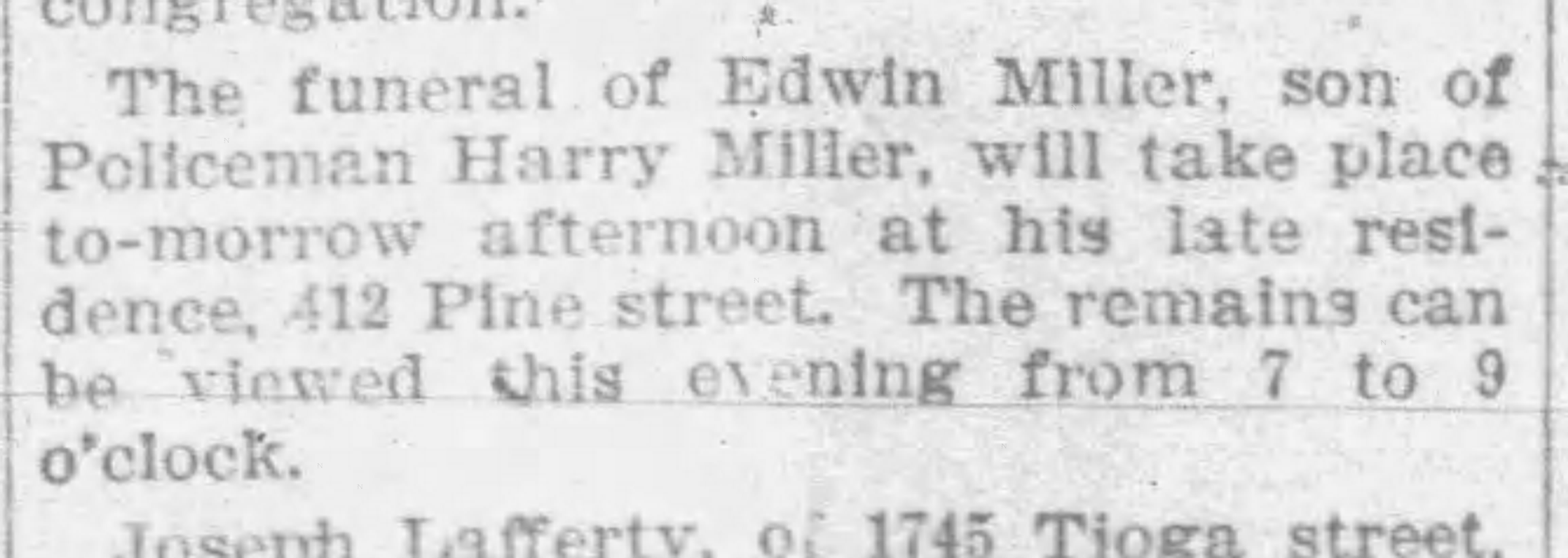
The funeral of Edwin Miller, son of Policeman Harry Miller, will take place tomorrow afternoon at his late residence, 412 Pine street. The remains can be viewed this evening from 7 to 9 o’clock.
Police Carnival Was a Gigantic Success
Philadelphia Inquirer —
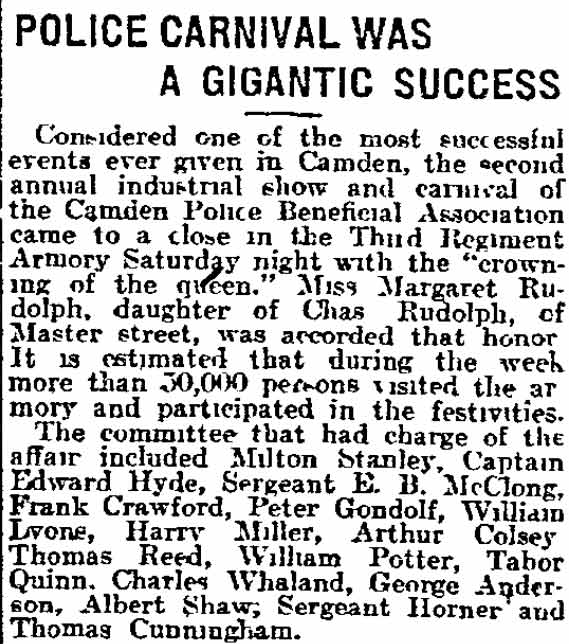
POLICE CARNIVAL WAS A GIGANTIC SUCCESS
Considered one of the most successful events ever given in Camden, the second annual industrial show and carnival of the Camden Police Beneficial Association came to a close in the Third Regiment Armory Saturday night with the “crowning of the queen.” Miss Margaret Rudolph, daughter of Chas. Rudolph, of Master street, was accorded that honor. It is estimated that during the week more than 50,000 persons visited the armory and participated in the festivities.
The committee that had charge of the affair included Milton Stanley, Captain Edward Hyde, Sergeant E. B. McClong, Frank Crawford, Peter Gondolf, William Lvone, Harry Miller, Arthur Colsey, Thomas Reed, William Potter, Tabor Quinn, Charles Whaland, George Anderson, Albert Shaw, Sergeant Horner and Thomas Cunningham.
Third Ward Club Holds Fine Ball
Camden Post-Telegram —
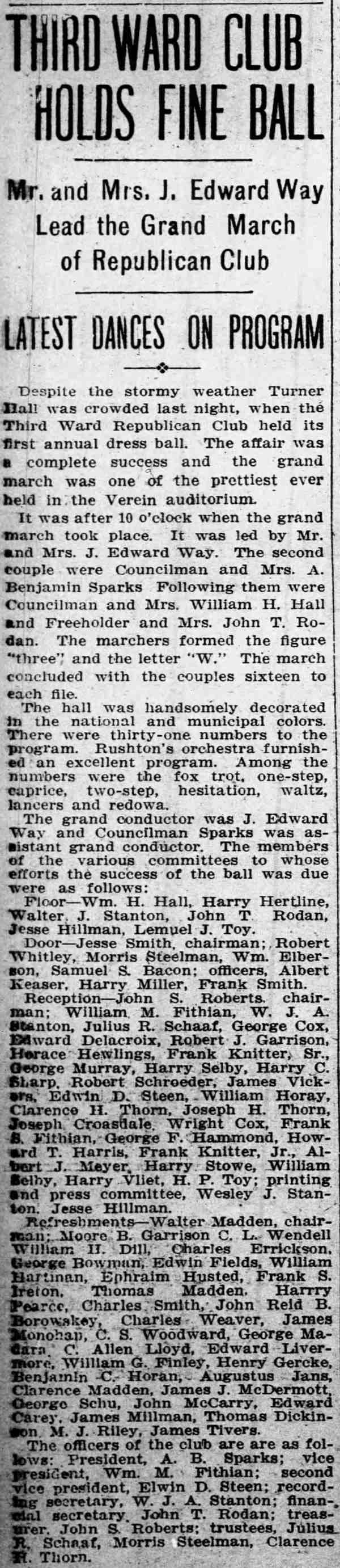
Third Ward Club Holds Fine Ball
Mr. and Mrs. J. Edward Way Lead the Grand March of Republican Club
Latest Dances on Program
Despite the stormy weather Turner Hall was crowded last night, when the Third Ward Republican Club held its first annual dress ball. The affair was a complete success and the grand march was one of the prettiest ever held in the Verein auditorium.
It was after 10 o’clock when the grand march took place. It was led by Mr. and Mrs. J. Edward Way. The second couple were Councilman and Mrs. A. Benjamin Sparks. Following them were Councilman and Mrs. William H. Hall and Freeholder and Mrs. John T. Rodan. The marchers formed the figure “three” and the letter “W.” The march concluded with the couples sixteen to each file.
The hall was handsomely decorated in the national and municipal colors. There were thirty-one numbers to the program. Rushton’s orchestra furnished an excellent program. Among the numbers were the fox trot, one-step, caprice, two-step, hesitation, waltz, lancers and redowa.
The grand conductor was J. Edward Way and Councilman Sparks was assistant grand conductor. The members of the various committees to whose efforts the success of the ball was due were as follows:
Floor—Wm. H. Hall, Harry Hertline, Walter J. Stanton, John T. Rodan, Jesse Hillman, Lemuel J. Toy.
Door—Jesse Smith, chairman; Robert Whitley, Morris Steelman, Wm. Elberson, Samuel S. Bacon; officers, Albert Keaser, Harry Miller, Frank Smith.
Reception—John S. Roberts, chairman; William M. Fithian, W. J. A. Stanton, Julius R. Schaaf, George Cox, Edward Delacroix, Robert J. Garrison, Horace Hewlings, Frank Knitter, Sr., George Murray, Harry Selby, Harry C. Sharp, Robert Schroeder, James Vickers, Edwin D. Steen, William Horay, Clarence H. Thorn, Joseph H. Thorn, Joseph Croasdale, Wright Cox, Frank S. Fithian, George F. Hammond, Howard T. Harris, Frank Knitter, Jr., Albert J. Meyer, Harry Stowe, William Selby, Harry Vliet, H. P. Toy; printing and press committee, Wesley J. Stanton, Jesse Hillman.
Refreshments—Walter Madden, chairman; Moore B. Garrison, C. L. Wendell, William H. Dill, Charles Errickson, George Bowman, Edwin Fields, William Hartman, Ephraim Husted, Frank S. Ireton, Thomas Madden, Harry Pearce, Charles Smith, John Reid B. Borowakey, Charles Weaver, James Monohan, C. S. Woodward, George Madura, C. Allen Lloyd, Edward Livermore, William G. Finley, Henry Gercke, Benjamin C. Horan, Augustus Jans, Clarence Madden, James J. McDermott, George Schu, John McCarry, Edward Carey, James Millman, Thomas Dickinson, M. J. Riley, James Tivers.
The officers of the club are are [sic] as follows: President, A. B. Sparks; vice president, Wm. M. Fithian; second vice president, Elwin D. Steen; recording secretary, W. J. A. Stanton; financial secretary, John T. Rodan; treasurer, John S. Roberts; trustees, Julius R. Schaaf, Morris Steelman, Clarence R. Thorn.
Policeman Miller Claimed by Death
Camden Post-Telegram —
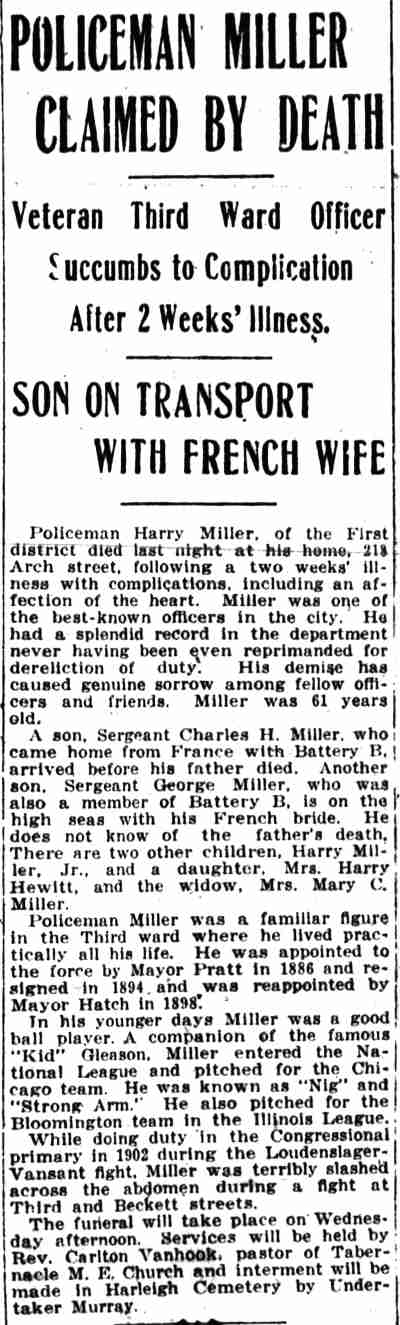
POLICEMAN MILLER CLAIMED BY DEATH
Veteran Third Ward Officer Succumbs to Complication After 2 Weeks’ Illness.
SON ON TRANSPORT WITH FRENCH WIFE
Policeman Harry Miller, of the First district, died last night at his home, 218 Arch street, following a two weeks’ illness with complications, including an affection of the heart. Miller was one of the best-known officers in the city. He had a splendid record in the department, never having been even reprimanded for dereliction of duty. Miller was 61 years old.
A son, Sergeant Charles H. Miller, who came home from France, arrived before his father died. Another son, Sergeant George Miller, who was a member of Battery B, is on the high seas with his French bride. He does not know of the father’s death. There are two other children, Harry Miller, Jr., and a daughter, Mrs. Harry Hewitt, and the widow, Mrs. Mary C. Miller.
Policeman Miller was a familiar figure in the Third ward where he lived practically all his life. He was appointed to the force by Mayor Jesse Pratt in 1886 and resigned in 1894, when he was re-appointed by Mayor Cooper B. Hatch in 1898.
In his younger days Miller was a good ball player. A companion of the famous Kid Gleason, Miller played in the Philadelphia League. He was known as “Iron Arm” Miller. While doing duty in the congressional primary fight on July 28, 1892, at Third and Beckett streets, in which John, alias “Reddy” Morrissey was killed, Miller was badly slashed.
The funeral will take place on Wednesday afternoon at Tabernacle M.E. Church and interment will be made in Harleigh Cemetery.
Harry Miller played professional baseball in Wilkes Barre, Scranton, and Harrisburg, Pennsylvania in the early 1880s, and also for a team called the Cubs in the Philadelphia League. I have not found records or any other reference regarding him playing in the Illinois League, he is not the Harry Miller who played for Ottumwa in 1890. He did not play for the Cubs in the National League.
Navy Harry Miller
Camden Courier-Post —
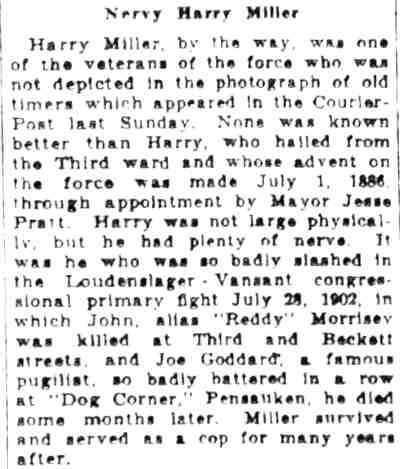
Harry Miller, by the way, was one of the veterans of the force who was not depicted in the photograph of old timers which appeared in the Courier-Post last Sunday. None was known better than Harry, who hailed from the Third ward and whose first service on the force was made July 1, 1886 through appointment by Mayor Jesse Pratt. Harry was not large physically, but he had plenty of nerve.
It was he who was so badly slashed in the Loudenslager-Vacant congressional primary fight on July 28, 1892, in which John, alias “Reddy” Morrissey was killed at Third and Beckett streets. Miller survived and served as cop for many years after.
Mrs. Mary C. Miller
Camden Courier-Post —
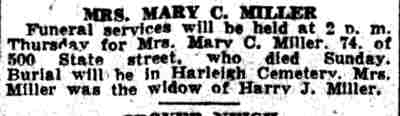
MRS. MARY C. MILLER
Funeral services will be held at 2 p.m. Tuesday for Mrs. Mary Miller, 74, of 600 State street, who died Sunday. Burial will be in Harleigh Cemetery. Mrs. Miller was the widow of Harry Miller.
Grave of Harry Miller, Harleigh Cemetery
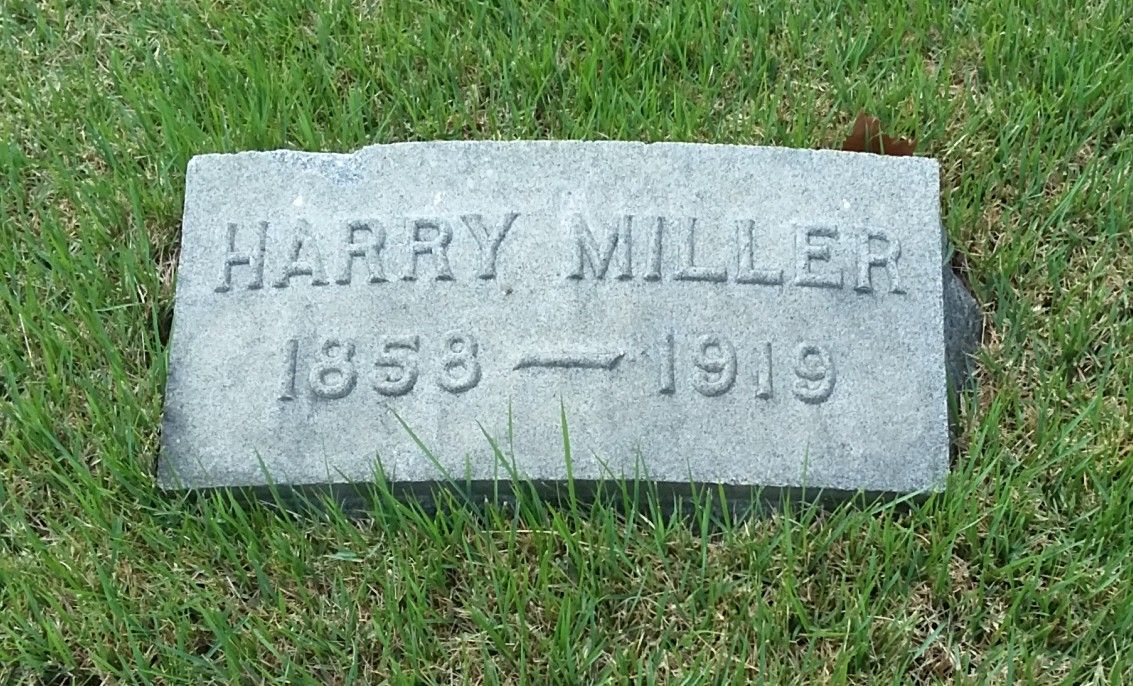
Grave of John H. “Harry” Miller, Harleigh Cemetery, Camden