John J. Welsh
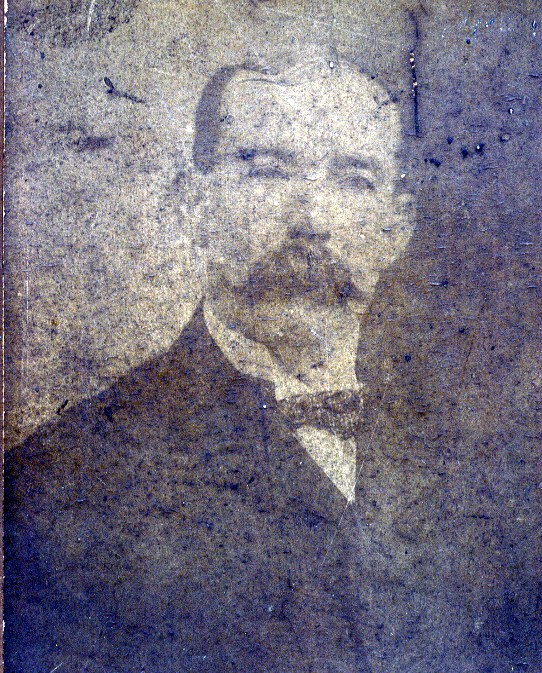
John J. Welsh
JOHN J. WELSH, the builder known in Camden as “The Man Who Built Broadway,” was born in Philadelphia around 1857 to Anthony and Ellen Welsh. The 1880 census shows the family living in the 4000 block of Mason Street in Philadelphia. John J. Welsh was then working as a laborer. He married in the early 1880s.
John J. Welsh came to Camden with his wife Martha and son Edward in 1889. He is shown in the 1890–1891 city directory as living at 1064 Francis Street, a small street that lay between Front and South 2nd Streets and between Chestnut and Mount Vernon Streets. Another son, Frank Welsh, was born around 1892. There was a third son, John M. Welsh.
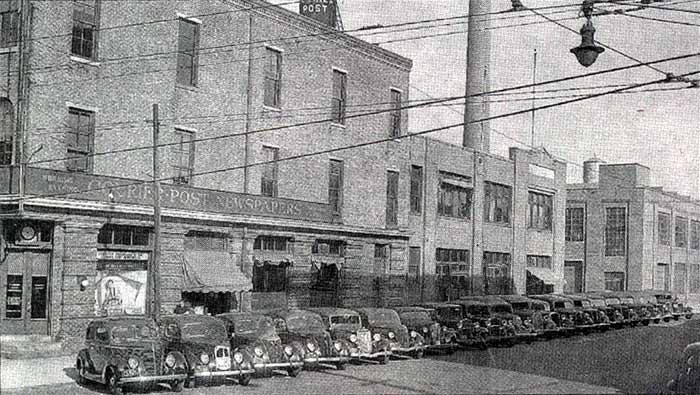
John J. Welsh soon established himself as a builder in Camden, and his firm erected many of the stores and commercial buildings on Broadway. He also erected the Union Methodist Episcopal Church at Fifth and Mount Vernon Streets in 1899. Other projects included the State Street Bridge over the Cooper River east of 10th Street, the Grand Theater at 207 Broadway, and an addition to the old Courier Post Building at 3rd and Arch Streets. Early in his career as an independent contractor, John Welsh employed James H. Reeve as a foreman. Reeve would eventually strike out on his own and also played a major role in construction on Broadway and elsewhere in Camden.
A member of the Church of the Immaculate Conception at Broadway and Market Streets, John J. Welsh was also active in the political and civil life of Camden in the first three decades of the 20th century. For twenty years he was the treasurer of the Camden County Democrat Party committee, was a candidate at one time for County Treasurer, and served as Camden’s police and fire commissioner in the mid-1920s under Mayor Victor King. He also was a charter member of the Camden Lodge of the Loyal Order of Moose.
By 1920 John J. Welsh was a widower. He was then living at 583 Line Street with his sons Edward, 38, and Frank, 26; Frank’s wife Bessie, and grandchildren John and Robert. His sons both were working as carpenters in his construction business. He and Edward later moved to 433 Chambers Avenue, the home of his younger brother Michael Welsh, where the two resided at the time of the 1930 Census. This address had previously been the residence of Alfred White, Camden City Clerk from 1923 to 1927. He had established his business by then at 529 Washington Street.
John Welsh stayed active in his business into the 1930s, when illness finally confined him to his bed. He passed away on August 29, 1936 and was buried at Calvary Cemetery. His son, Frank J. Welsh, remained in business at 529 Washington Street as late as 1947, and lived in Audubon NJ for many years, before passing in 1978.
John Welsh and Crew — Union Methodist Episcopal Church, 1899
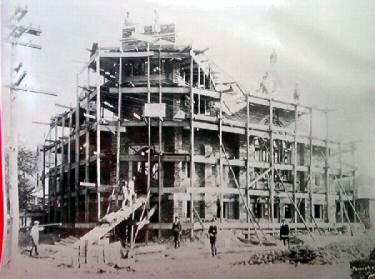
Named: John Welsh and Crew, Construction Photo, and Union Methodist Episcopal Church, 1899.
Frequent Battles for City Clerk
Camden Courier-Post —
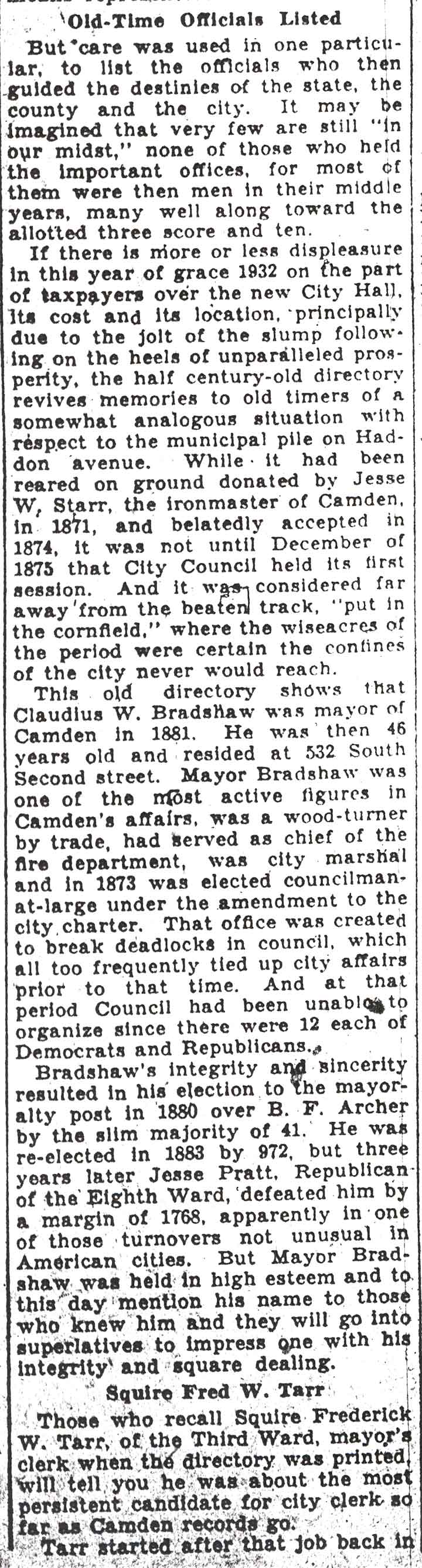
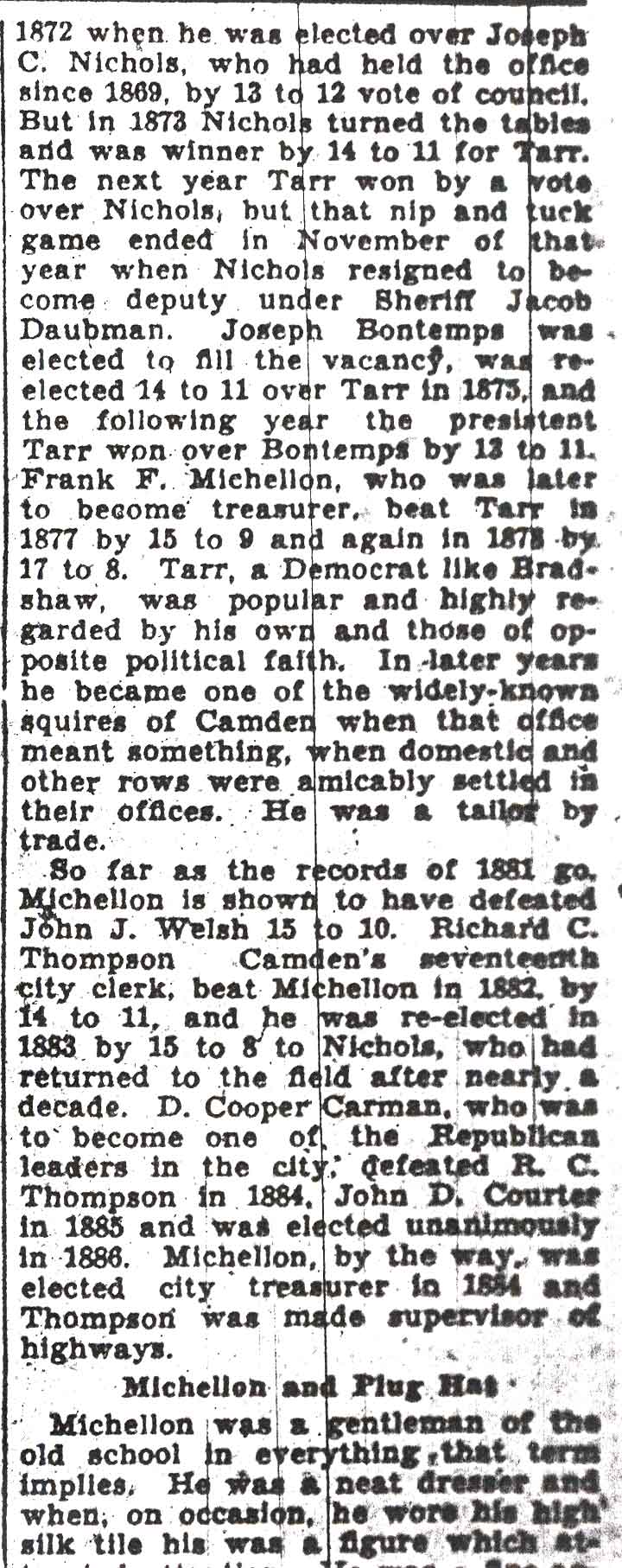
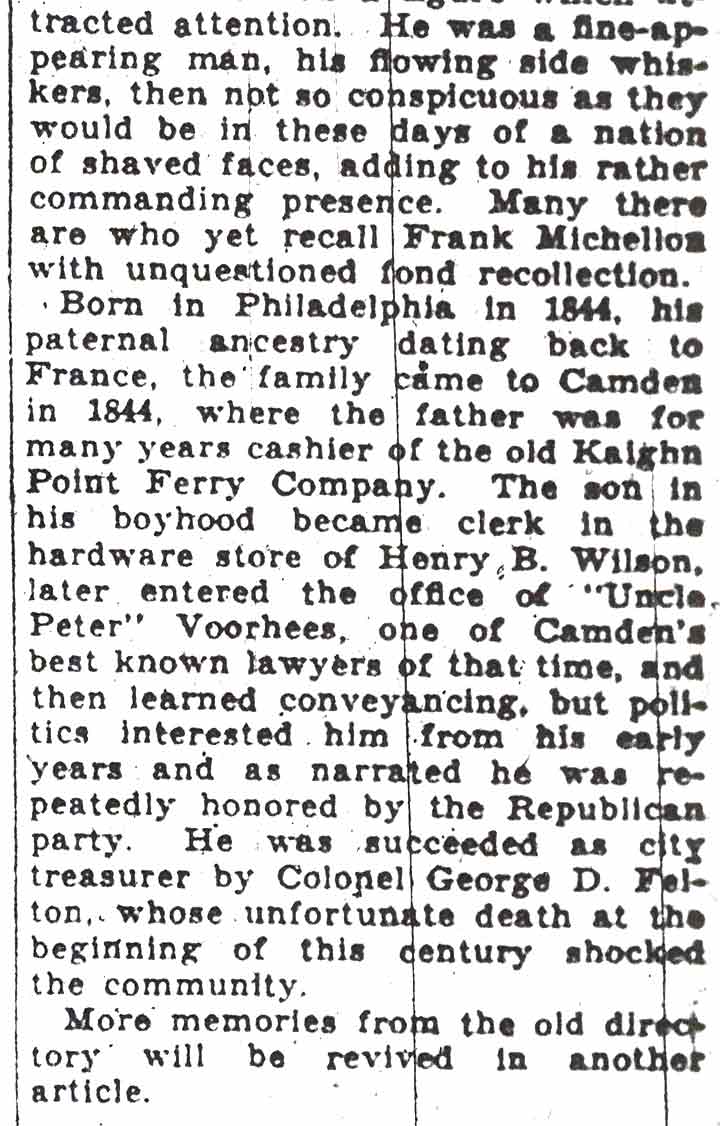
FROM AN OLD CITY DIRECTORY
Yellowed Volume of Half Century Ago Revives Memory of Bradshaw Regime, Persistency of Squire Fred Tarr to Land Clerkship and Treasurer Michellon
(Another in a series of articles on Camden affairs and personalities of yesteryear.)
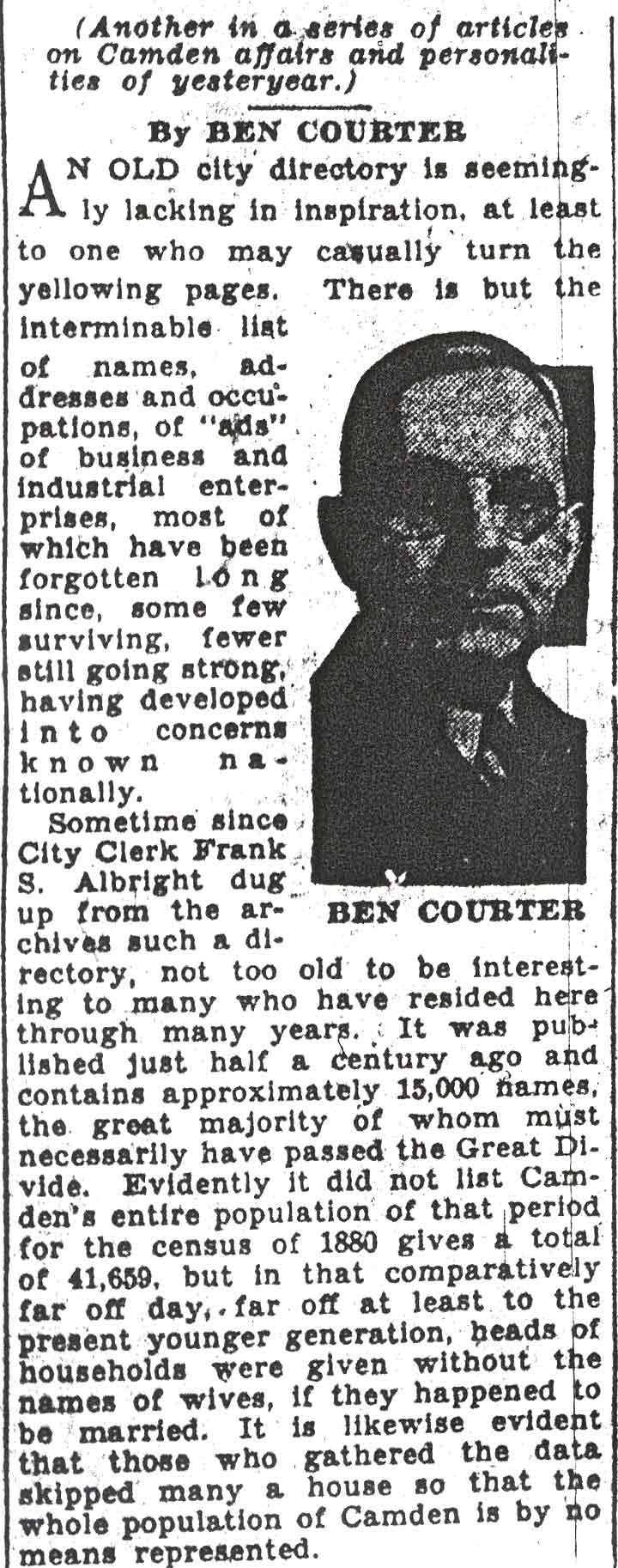
By BEN COURTER
AN OLD city directory is seemingly lacking in inspiration, at least to one who may casually turn the yellowing pages. There is but the interminable list of names, addresses and occupations, of “ads” of business and industrial enterprises, most of which have been forgotten long since, some few surviving, fewer still going strong, having developed into concerns known nationally.
BEN COURTER
Sometime since City Clerk Frank S. Albright dug up from the archives such a directory, not too old to be interesting to many who have resided here through many years. It was published just half a century ago and contains approximately 15,000 names, the great majority of whom must necessarily have passed the Great Divide. Evidently it did not list Camden’s entire population of that period for the census of 1880 gives a total of 41,659, but in that comparatively far off day, far off at least to the present younger generation, heads of households were given without the names of wives, if they happened to be married. It is likewise evident that those who gathered the data skipped many a house so that the whole population of Camden is by no means represented.
Old-Time Officials Listed
But care was used in one particular, to list the officials who then guided the destinies of the state, the county and the city. It may be imagined that very few are still “in our midst,” none of those who held the important offices, for most of them were then men in their middle years, many well along toward the allotted three score and ten.
If there is more or less displeasure in this year of grace 1932 on the part of taxpayers over the new City Hall, its cost and its location, principally due to the jolt of the slump following on the heels of unparalleled prosperity, the half century-old directory revives memories to old timers of a somewhat analogous situation with respect to the municipal pile on Haddon avenue. While it had been reared on ground donated by Jesse W. Starr, the ironmaster of Camden, in 1871, and belatedly accepted in 1874, it was not until December of 1875 that City Council held its first session. And it was considered far away from the beaten track, “put in the cornfield,” where the wiseacres of the period were certain the confines of the city never would reach.
This old directory shows that Claudius W. Bradshaw was mayor of Camden in 1881. He was then 46 years old and resided at 532 South Second street. Mayor Bradshaw was one of the most active figures in Camden’s affairs, was a wood-turner by trade, had served as chief of the fire department, was city marshal and in 1873 was elected councilman-at-large under the amendment to the city charter. That office was created to break deadlocks in council, which all too frequently tied up city affairs prior to that time. And at that period Council had been unable to organize since there were 12 each of Democrats and Republicans.
Bradshaw’s integrity and sincerity resulted in his election to the mayoralty post in 1880 over B. F. Archer by the slim majority of 41. He was re-elected in 1883 by 972, but three years later Jesse Pratt, Republican of the Eighth Ward, defeated him by a margin of 1768, apparently in one of those turnovers not unusual in American cities. But Mayor Bradshaw was held in high esteem and to this day mention his name to those who knew him and they will go into superlatives to impress one with his integrity and square dealing.
Squire Fred W. Tarr
Those who recall Squire Frederick W. Tarr, of the Third Ward, mayor’s clerk when the directory was printed, will tell you he was about the most persistent candidate for city clerk so far as Camden records go.
Tarr started after that job back in 1872 when he was elected over Joseph C. Nichols, who had held the office since 1869, by 13 to 12 vote of council. But in 1873 Nichols turned the tables and was winner by 14 to 11 for Tarr. The next year Tarr won by a vote over Nichols, but that nip and tuck game ended in November of that year when Nichols resigned to become deputy under Sheriff Jacob Daubman. Joseph Bontemps was elected to fill the vacancy, was re-elected 14 to 11 over Tarr in 1873, and the following year the presistent Tarr won over Bontemps by 13 to 11. Frank F. Michellon, who was later to become treasurer, beat Tarr in 1877 by 15 to 9 and again in 1878 by 17 to 8. Tarr, a Democrat like Bradshaw, was popular and highly regarded by his own and those of opposite political faith. In later years he became one of the widely-known squires of Camden when that office meant something, when domestic and other rows were amicably settled in their offices. He was a tailor by trade.
So far as the records of 1881 go, Michellon is shown to have defeated John J. Welsh 15 to 10. Richard C. Thompson, Camden’s seventeenth city clerk, beat Michellon in 1882, by 14 to 11, and he was re-elected in 1883 by 15 to 8 to Nichols, who had returned to the field after nearly a decade. D. Cooper Carman, who was to become one of the Republican leaders in the city, defeated R. C. Thompson in 1884, John D. Courter in 1885 and was elected unanimously in 1886. Michellon, by the way, was elected city treasurer in 1884 and Thompson was made supervisor of highways.
Michellon and Plug Hat
Michellon was a gentleman of the old school in everything that term implies. He was a neat dresser and when, on occasion, he wore his high silk tile his was a figure which attracted attention. He was a fine-appearing man, his flowing side whiskers, then not so conspicuous as they would be in these days of a nation of shaved faces, adding to his rather commanding presence. Many there are who yet recall Frank Michellon with unquestioned fond recollection.
Born in Philadelphia in 1844, his paternal ancestry dating back to France, the family came to Camden in 1844, where the father was for many years cashier of the old Kaighn Point Ferry Company. The son in his boyhood became clerk in the hardware store of Henry B. Wilson, later entered the office of “Uncle Peter” Voorhees, one of Camden’s best known lawyers of that time, and then learned conveyancing, but politics interested him from his early years and as narrated he was repeatedly honored by the Republican party. He was succeeded as city treasurer by Colonel George D. Felton, whose unfortunate death at the beginning of this century shocked the community.
More memories from the old directory will be revived in another article.
Union Methodist Episcopal Church — September 3, 2003
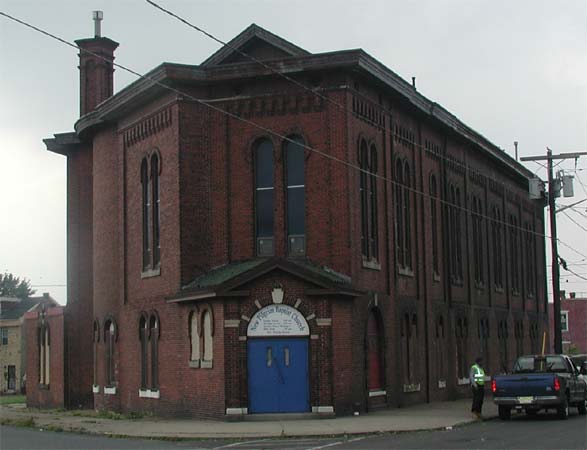
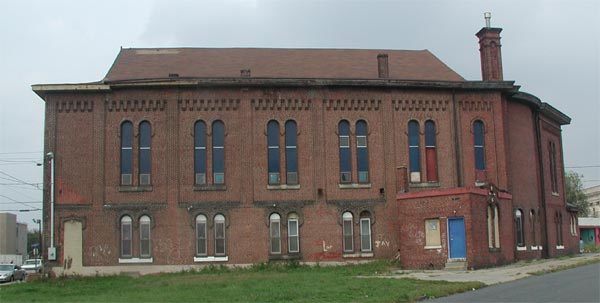
Union Methodist Episcopal Church — September 3, 2003
Camden Political Banner Raisings and Parades
Philadelphia Inquirer —
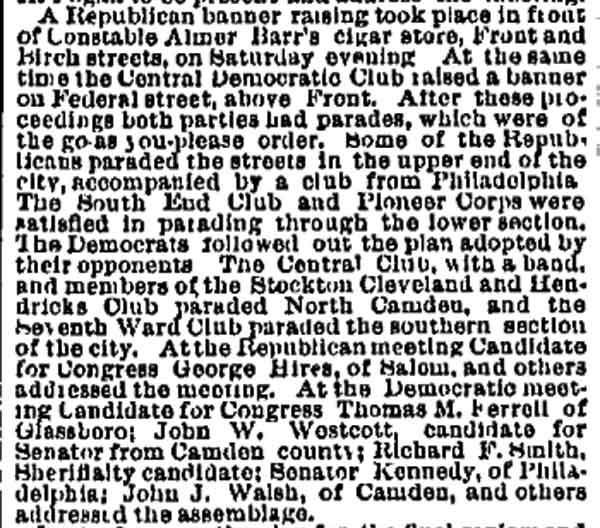
A Republican banner raising took place in front of Constable Almor Barr’s cigar store, Front and Birch streets, on Saturday evening. At the same time the Central Democratic Club raised a banner on Federal street, above Front. After these proceedings both parties had parades, which were of the go-as you-please order. Some of the Republicans paraded the streets in the upper end of the city, accompanied by a club from Philadelphia. The South End Club and Pioneer Corps were satisfied in parading through the lower section. The Democrats followed out the plan adopted by their opponents. The Central Club, with a band, and members of the Stockton Cleveland and Hendricks Club paraded North Camden, and the Seventh Ward Club paraded the southern section of the city. At the Republican meeting Candidate for Congress George Hires, of Salem, and others addressed the meeting. At the Democratic meeting Candidate for Congress Thomas M. Ferrell of Glassboro; John W. Westcott, candidate for Senator from Camden county; Richard F. Smith, Sheriffalty candidate; Senator Kennedy, of Philadelphia; John J. Walsh, of Camden, and others addressed the assemblage.
The German Mass Meeting.
Camden Daily Courier —
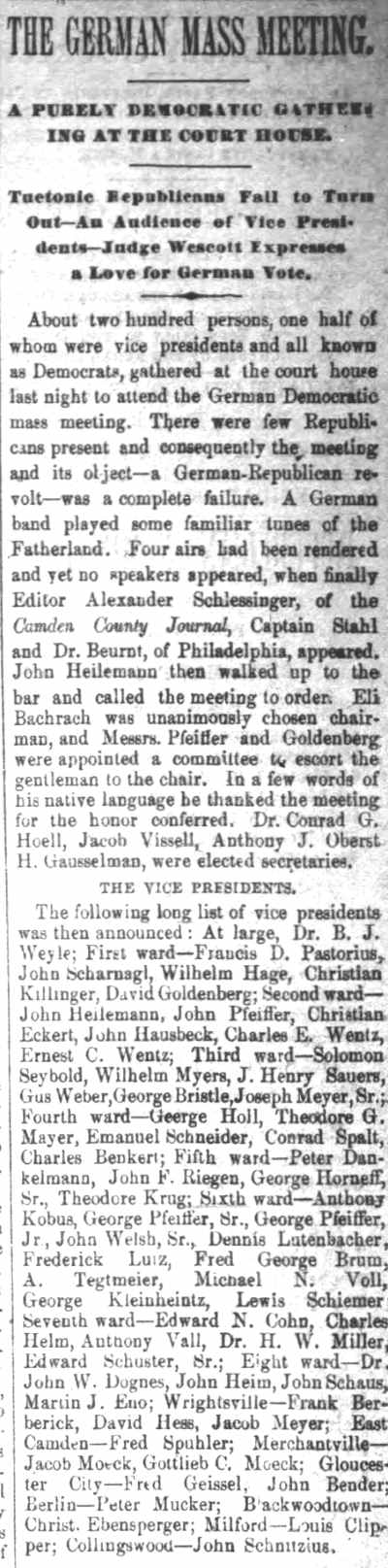
A PURELY DEMOCRATIC GATHERING AT THE COURT HOUSE.
Tuetonic [sic] Republicans Fail to Turn Out—An Audience of Vice Presidents—Judge Wescott Expresses a Love for German Vote.
About two hundred persons, one half of whom were vice presidents and all known as Democrats, gathered at the court house last night to attend the German Democratic mass meeting. There were few Republicans present and consequently the meeting and its object—a German-Republican revolt—was a complete failure. A German band played some familiar tunes of the Fatherland. Four airs had been rendered and yet no speakers appeared, when finally Editor Alexander Schlessinger, of the Camden County Journal, Captain Stahl and Dr. Beurnt, of Philadelphia, appeared. John Heilemann then walked up to the bar and called the meeting to order. Eli Bachrach was unanimously chosen chairman, and Messrs. Pfeiffer and Goldenberg were appointed a committee to escort the gentleman to the chair. In a few words of his native language he thanked the meeting for the honor conferred. Dr. Conrad G. Hoell, Jacob Vissell, Anthony J. Oberst, H. Gausselman, were elected secretaries.
THE VICE PRESIDENTS.
The following long list of vice presidents was then announced: At large, Dr. B. J. Weyle; First ward—Francis D. Pastorius, John Scharnagl, Wilhelm Hage, Christian Killinger, David Goldenberg; Second ward—John Heilemann, John Pfeiffer, Christian Eckert, John Hausbeck, Charles E. Wentz, Ernest C. Wentz; Third ward—Solomon Seybold, Wilhelm Myers, J. Henry Sauers, Gus Weber, George Bristle, Joseph Meyer, Sr.; Fourth ward—George Holl, Theodore G. Mayer, Emanuel Schneider, Conrad Spalt, Charles Benkert; Fifth ward—Peter Dankelmann, John F. Riegen, George Horneff, Sr., Theodore Krug; Sixth ward—Anthony Kobus, George Pfeiffer, Sr., George Pfeiffer, Jr., John Welsh, Sr., Dennis Lutenbacher, Frederick Lutz, Fred George Brum, A. Tegtmeier, Michael N. Voll, George Kleinheintz, Lewis Schiemer; Seventh ward—Edward N. Cohn, Charles Helm, Anthony Vall, Dr. H. W. Miller, Edward Schuster, Sr.; Eight [sic] ward—Dr. John W. Dognes, John Heim, John Schaus, Martin J. Eno; Wrightsville—Frank Berberick, David Hess, Jacob Meyer; East Camden—Fred Spuhler; Merchantville—Jacob Moeck, Gottlieb C. Moeck; Gloucester City—Fred Geissel, John Bender; Berlin—Peter Mucker; Blackwoodtown—Christ. Ebensperger; Milford—Louis Clipper; Collingswood—John Schnutzius.
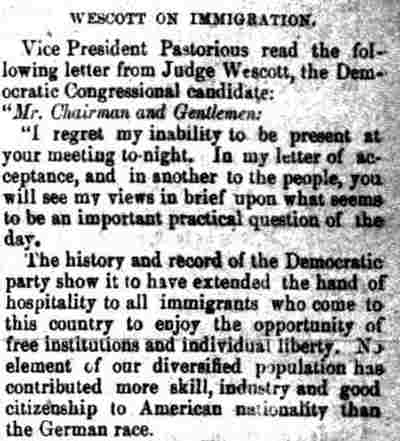
WESCOTT ON IMMIGRATION.
Vice President Pastorious read the following letter from Judge Wescott, the Democratic Congressional candidate:
“Mr. Chairman and Gentlemen:
“I regret my inability to be present at your meeting to-night. In my letter of acceptance, and in another to the people, you will see my views in brief upon what seems to be an important practical question of the day.
The history and record of the Democratic party show it to have extended the hand of hospitality to all immigrants who come to this country to enjoy the opportunity of free institutions and individual liberty. No element of our diversified population has contributed more skill, industry and good citizenship to American nationality than the German race.
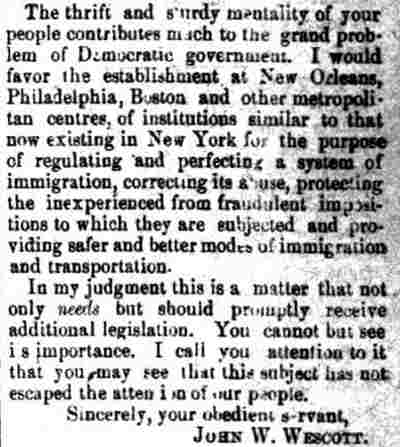
The thrift and sturdy mentality of your people contributes much to the grand problem of Democratic government. I would favor the establishment at New Orleans, Philadelphia, Boston and other metropolitan centres, of institutions similar to that now existing in New York for the purpose of regulating and perfecting a system of immigration, correcting its abuse, protecting the inexperienced from fraudulent impositions to which they are subjected and providing safer and better modes of immigration and transportation.
In my judgment this is a matter that not only needs but should promptly receive additional legislation. You cannot but see its importance. I call your attention to it that you may see that this subject has not escaped the attention of our people.
Sincerely, your obedient servant,
JOHN W. WESCOTT.
THE SPEAKERS.
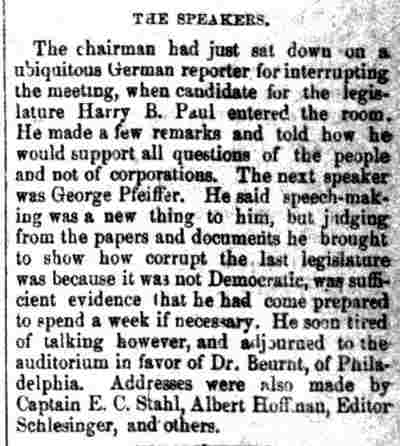
The chairman had just sat down on a ubiquitous German reporter for interrupting the meeting, when candidate for the legislature Harry B. Paul entered the room. He made a few remarks and told how he would support all questions of the people and not of corporations. The next speaker was George Pfeiffer. He said speech-making was a new thing to him, but judging from the papers and documents he brought to show how corrupt the last legislature was because it was not Democratic, was sufficient evidence that he had come prepared to spend a week if necessary. He soon tired of talking however, and adjourned to the auditorium in favor of Dr. Beurnt, of Philadelphia. Addresses were also made by Captain E. C. Stahl, Albert Hoffman, Editor Schlesinger, and others.
She Dared Men to Touch the “Pants”
Philadelphia Inquirer —
Camden Woman Planted a Pole, Decorated It With Pair Trousers and Flourished a Revolver
Flourishing a revolver and exclaiming, “I’ll kill the first man who touches those pants; this is fair warning to everybody, for I mean what I say!” Mrs. Louisa Traubel, of 807 Broadway, Camden, yesterday held up work on the addition being erected to the Gately and Hurley Company’s department store at Broadway and Spruce streets.
Mrs. Traubel claimed one of the walls was being constructed three inches over the line of the property belonging to her father, George Fields. She consulted City Engineer Farnham, who decided the wall was a fraction of an inch over the line. Then Contractor John Welsh was notified to stop work, but without the desired result.
Mrs. Traubel procured a post, planted it on the line, tacked a pair of trousers on it and, with the above words, threatened the person audacious enough to tear down her improvised banner. Work was at once stopped.
Gentle persuasion was of no avail and then Mayor Nowrey was consulted. He referred the contractor to the Recorder and Police Captain Stanley was detailed to protect the workmen and procure a warrant for the arrest of the woman unless she took down the post and trousers. But the police found they could do nothing unless there was a breach of the peace.
After sitting in the hot July sun for several hours Mrs. Traubel evacuated her position and the post was cut down, together with the “pants.” Work on the wall was then resumed.
She Dared Men to Touch the “Pants”
Philadelphia Inquirer —
Camden Woman Planted a Pole, Decorated It With Pair [sic] Trousers and Flourished a Revolver
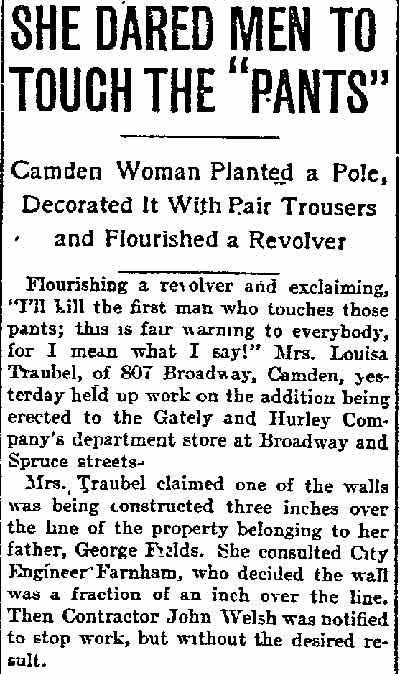
Flourishing a revolver and exclaiming, “I’ll kill the first man who touches those pants; this is fair warning to everybody, for I mean what I say!” Mrs. Louisa Traubel, of 807 Broadway, Camden, yesterday held up work on the addition being erected to the Gately and Hurley Company’s department store at Broadway and Spruce streets.
Mrs. Traubel claimed one of the walls was being constructed three inches over the line of the property belonging to her father, George Fields. She consulted City Engineer Farnham, who decided the wall was a fraction of an inch over the line. Then Contractor John Welsh was notified to stop work, but without the desired result.
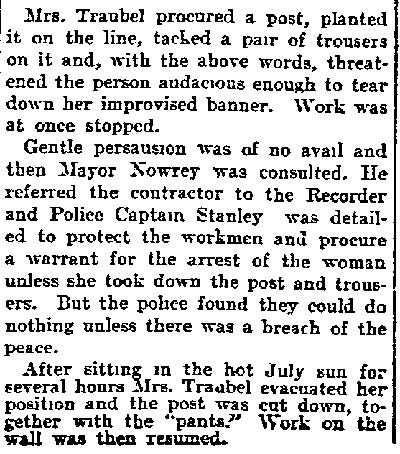
Mrs. Traubel procured a post, planted it on the line, tacked a pair of trousers on it and, with the above words, threatened the person audacious enough to tear down her improvised banner. Work was at once stopped.
Gentle persuasion was of no avail and then Mayor Nowrey was consulted. He referred the contractor to the Recorder and Police Captain Stanley was detailed to protect the workmen and procure a warrant for the arrest of the woman unless she took down the post and trousers. But the police found they could do nothing unless there was a breach of the peace.
After sitting in the hot July sun for several hours Mrs. Traubel evacuated her position and the post was cut down, together with the “pants.” Work on the wall was then resumed.
Voters’ League Puts Up a City Ticket
Philadelphia Inquirer —
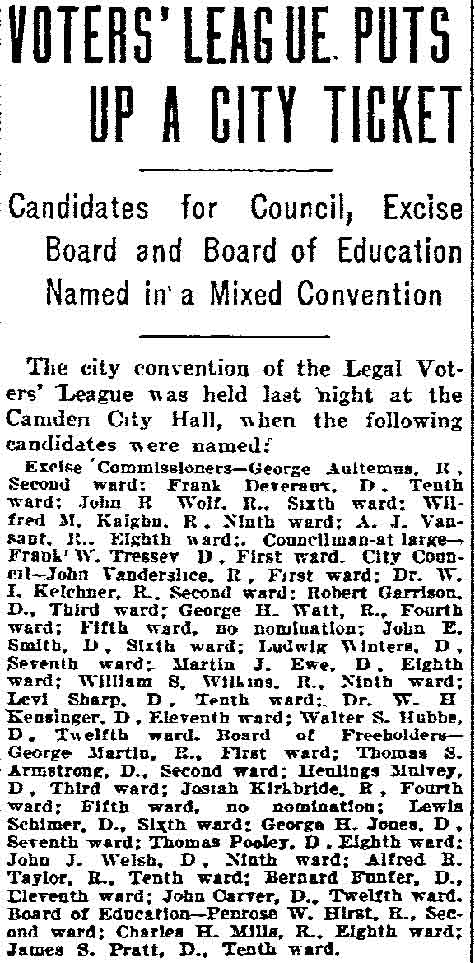
Candidates for Council, Excise Board and Board of Education Named in a Mixed Convention
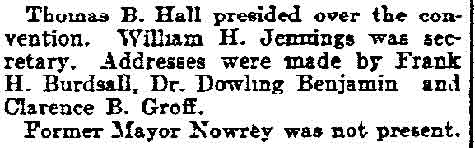
The city convention of the Legal Voters’ League was held last night at the Camden City Hall, when the following candidates were named:
Excise Commissioners—George Aultemus, R., Second ward; Frank Deveraux, D., Tenth ward; John R Wolf, R., Sixth ward; Wilfred M. Kaighn, R., Ninth ward; A. J. Vansant, R., Eighth ward; Councilman-at-large—Frank W. Tressey, D., First ward. City Council—John Vanderslice, R., First ward; Dr. W. I. Kelchner, R., Second ward; Robert Garrison, D., Third ward; George H. Watt, R., Fourth ward; Fifth ward, no nomination; John E. Smith, D., Sixth ward; Ludwig Winters, D., Seventh ward; Martin J. Ewe, D., Eighth ward; William S. Wilkins, R., Ninth ward; Levi Sharp, D., Tenth ward; Dr. W. H. Kensinger, D., Eleventh ward; Walter S. Hubbe [sic], D., Twelfth ward. Board of Freeholders—George Martin, R., First ward; Thomas S. Armstrong, D., Second ward; Heulings Mulvey, D., Third ward; Josiah Kirkbride, R., Fourth ward; Fifth ward, no nomination; Lewis Schimer, D., Sixth ward; George H. Jones, D., Seventh ward; Thomas Pooley, D., Eighth ward; John J. Welsh, D., Ninth ward; Alfred R. Taylor, R., Tenth ward; Bernard Funfer, D., Eleventh ward; John Carver, D., Twelfth ward. Board of Education—Penrose W. Hirst, R., Second ward; Charles H. Mills, R., Eighth ward; James S. Pratt, D., Tenth ward.
Thomas B. Hall presided over the convention. William H. Jennings was secretary. Addresses were made by Frank H. Burdsall, Dr. Dowling Benjamin and Clarence B. Groff.
Former Mayor Nowrey was not present.
Camden’s Mayor Has Field to Himself
Philadelphia Inquirer —
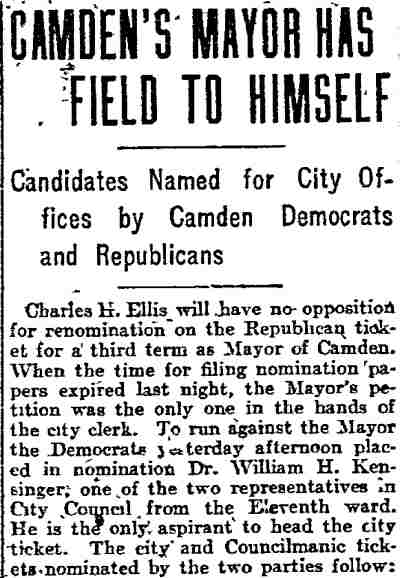
Candidates Named for City Offices by Camden Democrats and Republicans
Charles H. Ellis will have no opposition for renomination on the Republican ticket for a third term as Mayor of Camden. When the time for filing nomination papers expired last night, the Mayor’s petition was the only one in the hands of the city clerk. To run against the Mayor the Democrats yesterday afternoon placed in nomination Dr. William H. Kensinger; one of the two representatives in City Council from the Eleventh ward. He is the only aspirant to head the city ticket. The city and Councilmanic tickets nominated by the two parties follow:
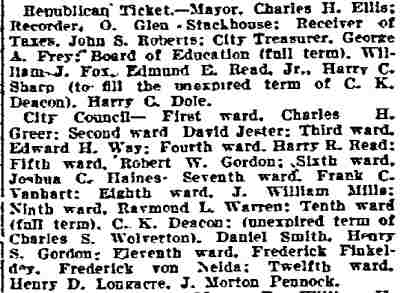
Republican Ticket.—Mayor, Charles H. Ellis; Recorder, O. Glen Stackhouse; Receiver of Taxes, John S. Roberts; City Treasurer, George A. Frey; Board of Education (full term), William J. Fox, Edmund E. Read, Jr., Harry C. Sharp (to fill the unexpired term of C. K. Deacon), Harry C. Dole.
City Council—First ward, Charles H. Greer; Second ward David Jester; Third ward, Edward H. Way; Fourth ward, Harry R. Read; Fifth ward, Robert W. Gordon; Sixth ward, Joshua C. Haines; Seventh ward, Frank C. Vanhart; Eighth ward, J. William Mills; Ninth ward, Raymond L. Warren; Tenth ward (full term), C. K. Deacon; (unexpired term of Charles S. Wolverton), Daniel Smith, Henry S. Gordon; Eleventh ward, Frederick Finkeldey; Frederick von Neida; Twelfth ward, Henry D. Longacre, J. Morton Pennock.
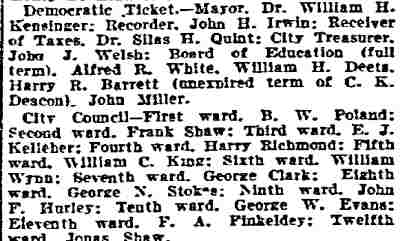
Democratic Ticket.—Mayor, Dr. William H. Kensinger; Recorder, John H. Irwin; Receiver of Taxes, Dr. Silas H. Quint; City Treasurer, John J. Welsh; Board of Education (full term), Alfred R. White, William H. Deets, Harry R. Barrett (unexpired term of C. K. Deacon), John Miller.
City Council—First ward, B. W. Poland; Second ward, Frank Shaw; Third ward, E. J. Kelleher; Fourth ward, Harry Richmond; Fifth ward, William C. King; Sixth ward, William Wynn; Seventh ward, George Clark; Eighth ward, George N. Stokes; Ninth ward, John F. Hurley; Tenth ward, George W. Evans; Eleventh ward, F. A. Finkeldey; Twelfth ward, Jonas Shaw.
The Republicans have Councilmanic contests in Tenth, Eleventh and Twelfth wards. In the Eleventh, Mr. Finkeldey is after the nomination on both tickets. He is the lone candidate of the Democrats, but has opposition on the Republican ticket.
Flames Wrecked Big Davis Bakery
Camden Post-Telegram —
Loss of $75,000 Was Sustained in Early Sunday Morning Blaze.
Praise Is Heaped on Local Firemen
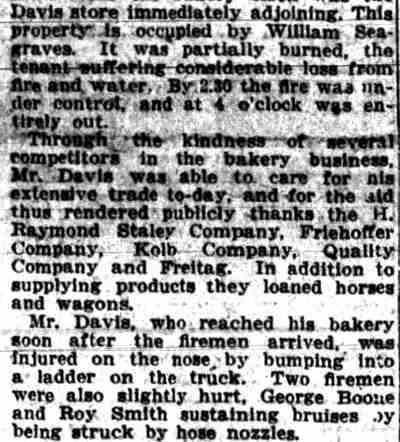
Giving unstinted praise to the firemen for the great work they performed yesterday morning in fighting the flames which partially destroyed his extensive bakery at William and Berkley streets, William C. Davis to-day placed his loss at $75,000. It is almost fully covered by insurance. In additional [sic] to the damage to his building, which was partially gutted, Mr. Davis loses 33 wagons, 10 car loads of flour and a great quantity of canned goods. All his horses were saved, being quartered at a distance from the bakery. With Contractor Welsh Mr. Davis today started work on rebuilding plans. A great part of the loss was sustained through the destruction of the new and modern oven system which Mr. Davis recently installed.
The burned building is L-shaped, fronting on both Berkley and Fifth street, and when it is considered that it is flanked close on either side by dwellings, the splendid work done by the firemen in preventing a spread of the flames can be appreciated.
Mr. Davis attributes the fire to spontaneous combustion in the building on the William street corner, which was formerly a Lutheran church. Adam Urbin, the watchman, had just made his rounds and was in the cellar fixing his fires, when he heard the crackling of flames overhead. When the [sic] reached the upper floors the fire had gotten a good start, and by the time the firemen arrived the blaze had assumed mammoth proportions. A second and a third alarms were sent in immediately and in a remarkable short time the department was down to business in earnest.
Every resident for a radius of a block was sure it was utterly impossible to confine the flames to the bakery. Equally sure were they that their homes were doomed and all got busy packing their valuables and whatever articles of furniture could be handily moved. This precaution happily proved unnecessary, for the only building damaged aside from the bakery itself was the Davis store immediately adjoining. This property is occupied by William Seagraves. It was partially burned, the tenant suffering considerable loss from fire and water. By 2.30 the fire was under control, and at 4 o’clock was entirely out.
Through the kindness of several competitors in the bakery business, Mr. Davis was able to care for his extensive trade to-day, and for the aid thus rendered publicly thanks the H. Raymond Staley Company, Friehoffer Company, Kolb Company, Quality Company and Freitag. In addition to supplying products they loaned horses and wagons.
Mr. Davis, who reached his bakery soon after the firemen arrived, was injured on the nose by bumping into a ladder on the truck. Two firemen were also slightly hurt, George Boone and Roy Smith sustaining bruises by being struck by hose nozzles.
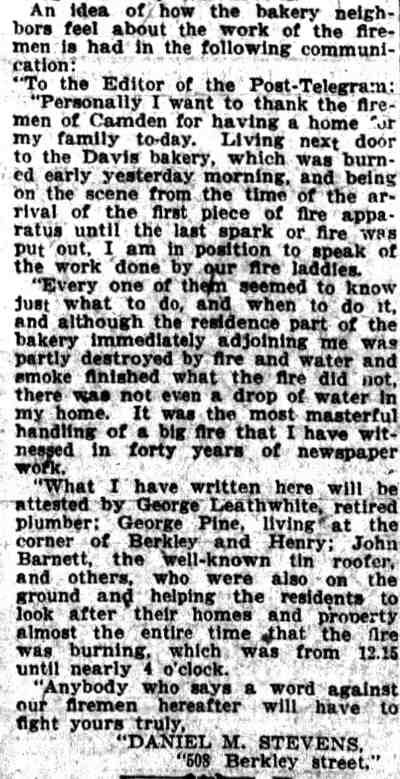
An idea of how the bakery neighbors feel about the work of the firemen is had in the following communication:
“To the Editor of the Post-Telegram: ‘Personally I want to thank the firemen of Camden for having a home for my family to-day. Living next door to the Davis bakery, which was burned early yesterday morning, and being on the scene from the time of the arrival of the first piece of fire apparatus until the last spark or fire was put out, I am in position to speak of the work done by our fire laddies.
‘Every one of them seemed to know just what to do, and when to do it, and although the residence part of the bakery immediately adjoining me was partly destroyed by fire and water and smoke finished what the fire did not, there was not even a drop of water in my home. It was the most masterful handling of a big fire that I have witnessed in forty years of newspaper work.
‘What I have written here will be attested by George Leathwhite, retired plumber; George Pine, living at the corner of Berkley and Henry; John Barnett, the well-known tin roofer, and others, who were also on the ground and helping the residents to look after their homes and property almost the entire time that the fire was burning, which was from 12.15 until nearly 4 o’clock.
‘Anybody who says a word against our firemen hereafter will have to fight yours truly, “Daniel M. Stevens, ‘508 Berkley street.’”
John J. Welsh — Camden City Directory Advertisement, 1917
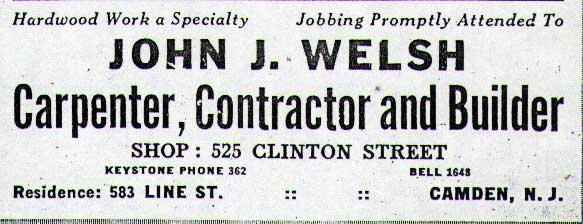
John J. Welsh — Carpenter, Contractor and Builder — Shop: 525 Clinton Street — Residence: 583 Line Street — Camden, N.J. — 1917
Parties Name Chiefs in Camden County
Trenton Times —
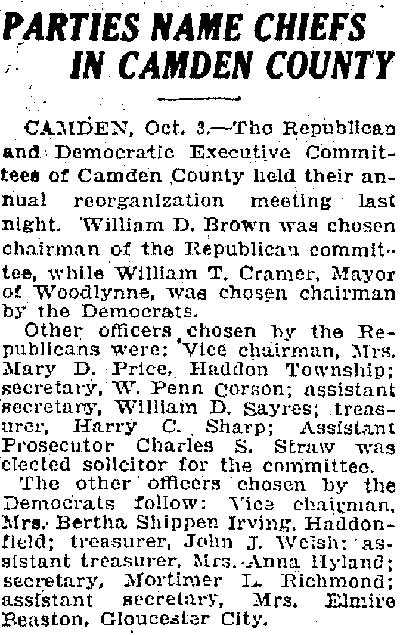
CAMDEN, Oct. 3.—The Republican and Democratic Executive Committees of Camden County held their annual reorganization meeting last night. William D. Brown was chosen chairman of the Republican committee, while William T. Cramer, Mayor of Woodlynne, was chosen chairman by the Democrats.
Other officers chosen by the Republicans were: Vice chairman, Mrs. Mary D. Price, Haddon Township; secretary, W. Penn Corson; assistant secretary, William D. Sayres; treasurer, Harry C. Sharp; Assistant Prosecutor Charles S. Straw was elected solicitor for the committee.
The other officers chosen by the Democrats follow: Vice chairman, Mrs. Bertha Shippen Irving, Haddonfield; treasurer, John J. Welsh; assistant treasurer, Mrs. Anna Hyland; secretary, Mortimer L. Richmond; assistant secretary, Mrs. Elmire Reaston, Gloucester City.
The Grand Theater
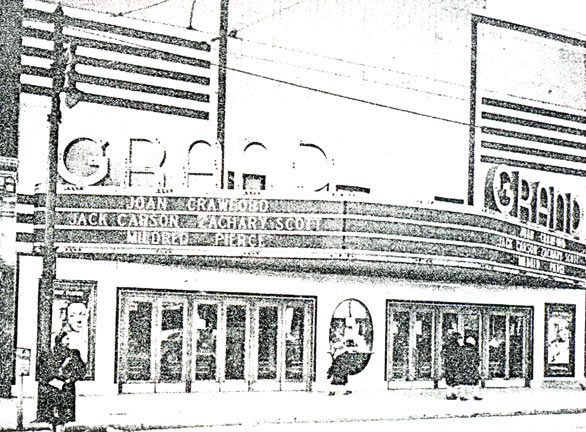
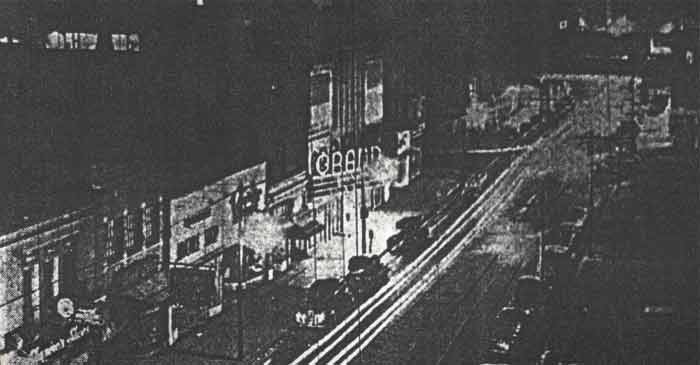
Grand Theater — 1942 and 1945
The Courier-Post Building on 3rd Street, 1939
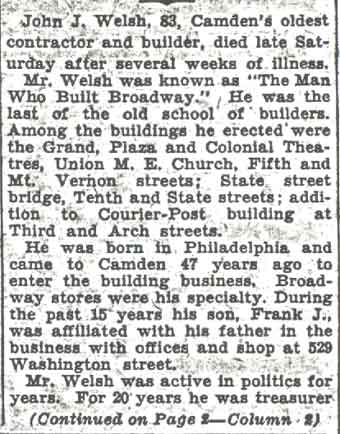
John J. Welsh Dies After Long Illness
Camden Courier-Post —
Camden’s Oldest Builder Succumbs at 83; Long Active in Politics
John J. Welsh, 83, Camden’s oldest contractor and builder, died late Saturday after several weeks of illness.
Mr. Welsh was known as “The Man Who Built Broadway.” He was the last of the old school of builders. Among the buildings he erected were the Grand, Plaza and Colonial Theatres, Union M. E. Church, Fifth and Mt. Vernon streets; State street bridge, Tenth and State streets; addition to Courier-Post building at Third and Arch streets.
He was born in Philadelphia and came to Camden 47 years ago to enter the building business. Broadway stores were his specialty. During the past 15 years his son, Frank J., was affiliated with his father in the business with offices and shop at 529 Washington street.
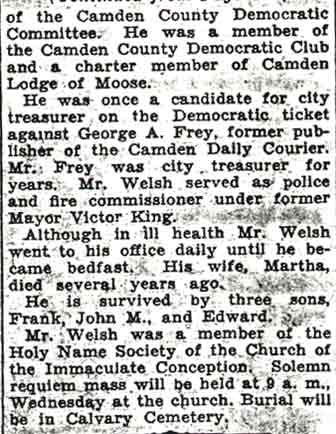
Mr. Welsh was active in politics for years. For 20 years he was treasurer of the Camden County Democratic Committee. He was a member of the Camden County Democratic Club and a charter member of Camden Lodge of Moose.
He was once a candidate for city treasurer on the Democratic ticket against George A. Frey, former publisher of the Camden Daily Courier. Mr. Frey was city treasurer for years. Mr. Welsh served as police and fire commissioner under former Mayor Victor King.
Although in ill health Mr. Welsh went to his office daily until he became bedfast. His wife, Martha, died several years ago.
He is survived by three sons, Frank, John M., and Edward.
Mr. Welsh was a member of the Holy Name Society of the Church of the Immaculate Conception. Solemn requiem mass will be held at 9 a. m., Wednesday at the church. Burial will be in Calvary Cemetery.
Garage Supplants Antiquated Houses
Camden Courier-Post —

Site of Washington Street Structure Formerly Occupied by Nine Dwellings
The new Brody Esso Service Garage opened for business at 540 Washington street, corner of Williams, yesterday. The business was formerly located at 527 Washington street.
Issie Brody began business in 1935, operating an auto laundry, lubricating service and storing facilities. According to Brody, the demand for a service of that type in the heart of Camden’s shopping district soon exceeded his facilities and equipment. He purchased nine antiquated dwellings across the street, razed them and erected his new fireproof garage. The building is in marked contrast to the former frame houses, and has improved the appearance of the vicinity.
With the opening of the new garage the business has been expanded to include high pressure car washing and lubricating, simonizing, repair work; storing facilities and automobile accessories. A call and delivery service will be inaugurated.
A number of Camden firms figured in the construction of the building. Louis H. Goettleman was the architect. John J. Welsh and Son were general contractors. The fabricated steel work and trusses were supplied by the Camden Iron Service, and the cinder blocks by the DiMedio Lime Co. Roofing was by Victor Biasi, plumbing by Joseph Mignona and electrical work by Joseph Radano.
Lumber and millwork was by the Colonial Lumber Co., Philadelphia.
A feature of the building is the latest type of Carrier gas unit heaters installed by the Comfort-Aire Co., 401 Broadway. This type of gas fire heater has recently been developed for garages. The heaters blow hot air toward the floor and maintain a nearly even temperature from floor to ceiling. They are thermostatically controlled to supply heat automatically.
The building is also equipped with Truskin bowstring steel trusses, concrete floor, steel window sash, overhead doors and asphalt roof.