Introduction
Frank Frost was born in Camden, New Jersey on March 17, 1879 to George Frost and the former Margaret Smith. His family had come to Camden in the mid-1850s and were quite active in civic and business affairs in the young city of Camden.
George Frost was the son of Andrew and Christiana Frost, both of whom were born in what is now Germany. The family name was originally Fraust, and his parents and siblings went by that name into the 1870s. Not long after the birth of George Frost’s older brother Henry in 1839 his parents came to the United States with him and his older brother William. They first settled in Pennsylvania, where a third son, Charles Frost, was born around 1843. Two more sons came to the Frost family, Frederick in 1848 and Lewis in 1852, before the family came to New Jersey, where, in May of 1853, George Frost was born. When the 1860 Census was taken, the Frost family lived in Camden’s South Ward, and another son, Franklin, had recently been born, and Edward would come in May of 1863. Andrew Frost worked as a tailor to support his family. The three oldest sons were working at the time of the 1860 Census. Henry Frost, then 21, was working as a blacksmith, brother William sold cigars, and brother Charles, then 17, was an apprentice at a coach works.
George Frost was living with his parents and brothers Lewis, Frank, and Edward when the census was taken in 1870. He and Lewis were working as iron moulders.
Older brother Henry Frost was appointed to the Camden Fire Department as a replacement for J. Kelly Brown, who had resigned from service as an extra man with Engine Company 2, on October 9, 1872. Henry Frost was a blacksmith by trade. He was living at 112 Taylor Avenue during his time in service with the Camden Fire Department. Henry Frost was dismissed from his position on July 15, 1873 along with Bernard Dennis and Thomas Grapevine. This ended his involvement with the Camden Fire Department.
On April 8, 1877 George Frost was appointed to the Camden Fire Department to serve as an extra man with Engine Company 2, replacing Robert Todd. He had been working as a laborer and was making his home at 509 Division Street when initially appointed. Shortly after being reappointed in April of 1879, George Frost moved to 517 Division Street.
The 1880 Census lists George and Margaret “Maggie” Schmitt Frost at 517 Division Street with their two sons, Lewis, 2, and Frank Frost, 1. The family was back at 509 Division Street in 1881, then moved to 1026 Broadway, where they remained through at least 1885. A daughter, Elizabeth, would be born in 1884. As he was an extra man with the Fire Department, George Frost listed his occupation as oilcloth printer. George Frost served with the Fire Department until April of 1882, when he was not re-appointed. He spent most of his remaining working days working in the oil cloth industry, for the Farr & Bailey Manufacturing Company.
By the spring of 1885 George Frost and family had moved to 1026 Broadway. The 1900 Census states that the Frost family lived at 1020 Broadway, and that George Frost was working as a color mixer at an oil cloth factory. Son Lewis would follow him into this trade. George Frost was still at 1020 Broadway when the 1906 Camden City Directory was compiled. Shortly afterwards, he moved to Westmont, New Jersey.
Frank Frost married Catherine Walsh in January of 1904. The young couple moved into a fully furnished home at 1023 Spruce Street, next door to his brother, Lewis, who lived at 1025 Spruce Street.
George Frost died suddenly on June 15, 1909 and was buried at Harleigh Cemetery. His older brother Charles had also died unexpectedly in 1904. He and his family had been members of Ss. Peter & Paul Catholic Church on Spruce Street in Camden. Younger sister Elizabeth married Lloyd D. Kay shortly after the 1910 Census was enumerated.
Frank and Catherine Frost were childless when the 1910 Census was taken. They were living at 1023 Spruce Street in South Camden. Brother Lewis Frost, his wife Bertha and daughter Hazel lived next door at 1025 Spruce Street. Lewis Frost and his family moved to New Brunswick, New Jersey during the 1910s.
Frank Frost is listed in the 1916 City Directory at 1023 Spruce Street, with his wife Catherine and working for the police department. His widowed mother, sister Elizabeth and brother-in-law Lloyd Kay were living at 956 Newton Avenue.
By the time the 1917 Directory was compiled, Catherine Frost may have passed away, or the couple may have separated. Frank Frost was still working as a motorcycle policeman in Camden as late as March of 1917. He was treated for an abscess on his neck in July of that year, and moved in with his mother and sister at 956 Newton Avenue.
Frank Frost resigned from the police department to take a job at one of Camden’s shipyards in January of 1918. Frank Frost was living at 956 Newton Avenue and working as a machinist at the New York Shipbuilding Company shipyard when he registered for the draft in September of 1918. The 1918–1919 Camden City Directory shows him working as a clerk and living at the same address. Frank Frost does not appear in the 1920 Census or the 1920 City Directory, or any Camden directories thereafter.
Frank Frost apparently left Camden and New Jersey altogether. By February of 1920 he had moved to Los Angeles, California, where his sister Elizabeth and her husband, Lloyd Kay, had also gone in the late 1910s. Frank Frost passed away in Los Angeles, California on January 18, 1940. He was survived by his sister, her husband and a nephew.
As stated above, Frank Frost’s father and his uncle, Henry Frost, had both served as members of the Camden Fire Department in the early 1870s. An uncle through marriage, William Turner, was also a Camden Fire Department member for two years in the early 1880s.
Frank Frost’s older brother, Lewis Frost, was well known in Camden at the turn of the century as a member of the Century Wheelmen athletic club. He worked as a color mixer and moved out of Camden during the 1910s.
Frank Frost’s cousin, George W. Frost, the son of his uncle Frederick Frost, had a long career with the Camden Police Department, retiring as Chief of Police in the late 1940s. Another uncle, Charles A. Frost, was a successful businessman and a co-founder of what was generally known as Jenning’s Sixth Regiment Band, which became something of a Camden institution for many years.
Bans Announced in Catholic Church
Philadelphia Inquirer —
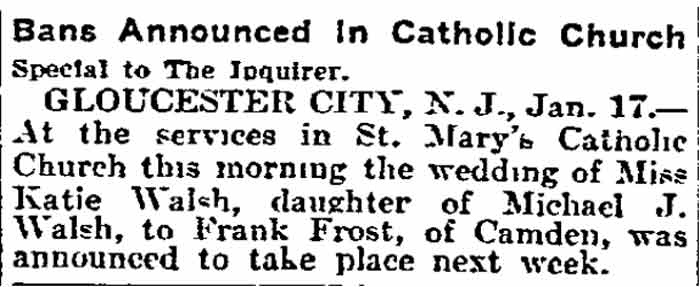
Special to The Inquirer.
GLOUCESTER CITY, N. J., Jan. 17.–At the services in St. Mary’s Catholic Church this morning the wedding of Miss Katie Walsh, daughter of Michael J. Walsh, to Frank Frost, of Camden, was announced to take place next week.
Camden Man Takes Gloucester Bride
Philadelphia Inquirer —
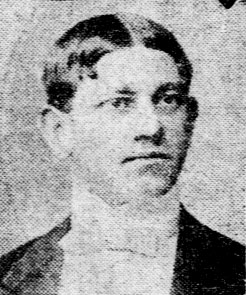
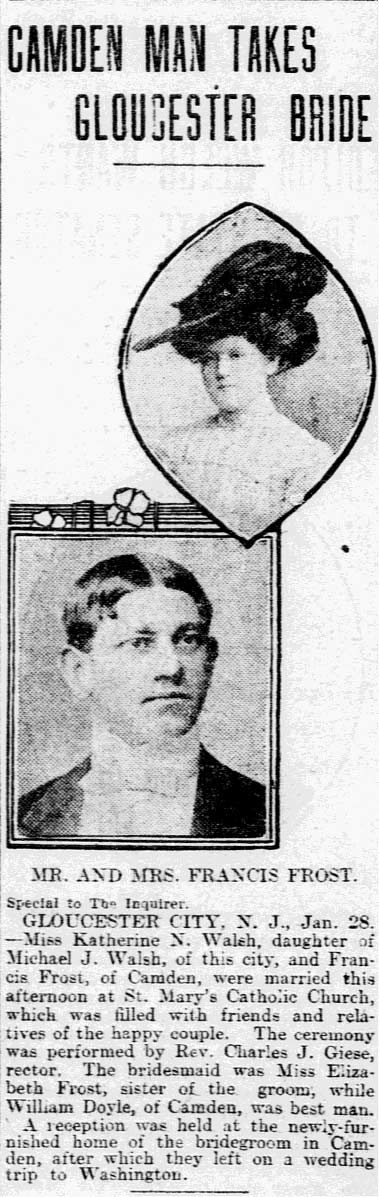
MR. AND MRS. FRANCIS FROST.
Special to The Inquirer.
GLOUCESTER CITY, N. J., Jan. 28.—Miss Katherine N. Walsh, daughter of Michael J. Walsh, of this city, and Francis Frost, of Camden, were married this afternoon at St. Mary’s Catholic Church, which was filled with friends and relatives of the happy couple. The ceremony was performed by Rev. Charles J. Giese, rector. The bridesmaid was Miss Elizabeth Frost, sister of the groom, while William Doyle, of Camden, was best man. A reception was held at the newly-furnished home of the bridegroom in Camden, after which they left on a wedding trip to Washington.
Frost — Death Notice
Philadelphia Inquirer —
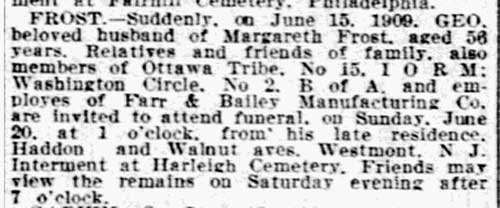
FROST. — Suddenly, on June 15, 1909. GEO., beloved husband of Margareth Frost, aged 56 years. Relatives and friends of family, also members of Ottawa Tribe, No 15, I O R M; Washington Circle, No 2, B of A; and employes of Farr & Bailey Manufacturing Co. are invited to attend funeral, on Sunday, June 20, at 1 o’clock, from his late residence, Haddon and Walnut aves., Westmont, N. J. Interment at Harleigh Cemetery. Friends may view the remains on Saturday evening after 7 o’clock.
Mines and Frost Join Motorcycle Squad
Philadelphia Inquirer —

Policemen Maurice Mines and Frank Frost were yesterday added to the motorcycle squad. They will begin duty on Monday.
Boy’s Brutal Murderer Collapses at Hearing
Camden Post-Telegram —
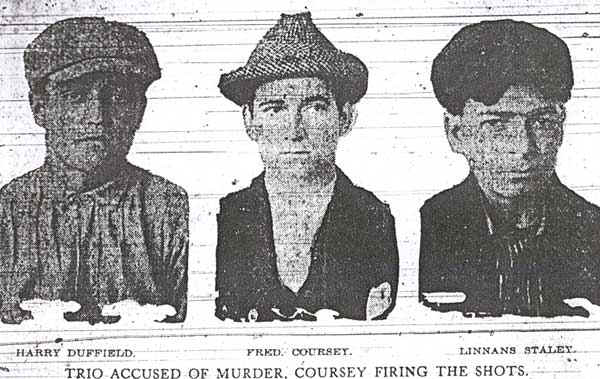
Trio Accused of Murder. Coursey Firing the Shots.
Coursey Breaks Down While Story of Cold-Blooded Killing of Karl Kellmann Is Told by Detective.
Two “Pals,” Too, Accused of Crime
Collapsing when arraigned in Police Court this morning before Recorder Stackhouse on the charge of killing Karl Kellmann, aged 18 years, of 2919 High street, at Twenty-seventh and Sherman streets, shortly before midnight Saturday, Fred Coursey, alias “Mexican Pete,” alias “Cowboy Pete,” aged 20 years, of 121 North Twenty-first street, who admits firing the fatal shots while committing robbery, and Harry Duffield, aged 21 years, of 407 North Forty-first street, who acknowledged masking his face with a handkerchief and being with Coursey, sobbed piteously, resting their heads on the railing of the dock, while John Painter, the veteran detective, was briefly reciting the story.
When Recorder Stackhouse asked what became of the young man who was shot and Painter replied that he died, Coursey and Duffield sobbed afresh, and when Recorder Stackhouse committed them without bail Policemen Frost and Kay had to help them.
Linnans Staley, aged 21 years, of 1819 Federal street, who confessed that he was in the robbery plot but later got scared and hid in the bushes, was scarcely able to stand, and when his mother broke down as he was committed as a principal he staggered and would have fallen but for Sergeant McClong.
Prosecutor Boyle announced this morning that the Grand Jury will be recalled for Thursday of this week and the case will be made the special order of the day.
Without the slightest clue to start with in the most brutal murder committed in recent years in Camden county, police and detectives under the personal direction of Chief Gravenor in two hours arrested two of the three prisoners and obtained their signatures to confessions and before sunrise the other was lodged behind the bars at the City Hall.
According to their statements to the police the prisoners while drinking on a lot near Twenty-first and Federal streets on Saturday night planned to go to a lone spot near Twenty-seventh and Sherman streets to hold someone up to get money and jewelry to buy more drink. Coursey had a 38-calibre cowboy pistol and Duffield used Coursey’s bandanna as a mask. Staley weakened before the spot selected was reached and at the time of the murder was hiding in a clump of weeds a short distance away.
The murdered boy was the son of Karl and Lulu D. Kellmann. He was a member of the Bible class of Grace Presbyterian Church, East Side, and active in church work.
Saturday night was the closing of a carnival given on High street between Twenty-seventh and Thirtieth streets. Karl was there and made several purchases. At one booth he bought a necktie, from another some ice cream and a box of candy and spent some time conversing with the young ladies connected with the church.
When it grew rather late he noticed that Misses Bertha and Bessie Skillen, of 815 North Thirty-fourth street, the latter a teacher in Grace Church Sunday-school, were without an escort and he volunteered to see them home. They accepted his invitation to be their escort. He saw them safely home and he was on his way back and had reached a point on the east side of Twenty-seventh street south of Sherman street and near the foot of the bridge that spans the Pennsylvania Railroad tracks when two men jumped out from behind a tree and as one commanded him to hold up his hands the other began to shoot.
The first shot struck him in the breast and turned him partially around. The next ploughed a hole through his neck, knocking him down, and the third went wide.
Screaming for help he tried to rise to his feet and was on his knees when Night Yardmaster Albert Ludlow and Brakeman Joseph Wittick, who were on the opposite side of the bridge, ran to his assistance. By the light of their lanterns they saw that he was seriously hurt and they took him to ‘Squire Sasse’s house nearby to await the arrival of the ambulance. As the railroaders sped across the bridge Ludlow saw a man run down the tracks in the direction of Seventeenth street.
In the signal tower at Pavonia station known as C. B. the operator, Thomas Sink, heard the shots and cries for help and ‘phoned to Captain James at Police Headquarters that a murder had been committed. Sink also saw a man run down through the weeds and bushes on the east side of the bridge toward the railroad tracks.
Policeman Hurlock and Schmid, ‘Squire and Mrs. Sasse and several others were out on the street before the railroad men reached the Sasse home and all hurried to ‘phones to notify police headquarters.
In less than five minutes by use of the red light system Captain James had every officer on duty on the East Side hurrying to the scene, officers stationed at every bridge, ferry house and railroad terminal, and the downtown auto with Detectives Schregler, Painter, Brothers and Moffett on its way to East Camden.
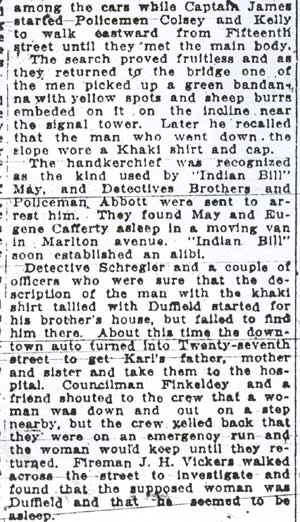
On information from the railroad men Sergeant Horner took all the East Side officers and the four detectives and they worked westward among the cars while Captain James started Policemen Colsey and Kelly to walk eastward from Fifteenth street until they met the main body.
The search proved fruitless and as they returned to the bridge one of the men picked up a green bandanna with yellow spots and sheep burrs embedded on it on the incline near the signal tower. Later he recalled that the man who went down the slope wore a Khaki shirt and cap.
The handkerchief was recognized as the kind used by “Indian Bill” May, and Detectives Brothers and Policeman Abbott were sent to arrest him. They found May and Eugene Cafferty asleep in a moving van in Marlton avenue. “Indian Bill” soon established an alibi.
Detective Schregler and a couple of officers who were sure that the description of the man with the khaki shirt tallied with Duffield started for his brother’s house, but failed to find him there. About this time the downtown auto turned into Twenty-seventh street to get Karl’s father, mother and sister and take them to the hospital. Councilman Finkeldey and a friend shouted to the crew that a woman was down and out on a step nearby, but the crew yelled back that they were on an emergency run and the woman would keep until they returned. Fireman J. H. Vickers walked across the street to investigate and found that the supposed woman was Duffield and that he seemed to be asleep.
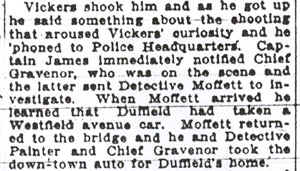
Vickers shook him and as he got up he said something about the shooting that aroused Vickers’ curiosity and he ‘phoned to Police Headquarters. Captain James immediately notified Chief Gravenor, who was on the scene and the latter sent Detective Moffett to investigate. When Moffett arrived he learned that Duffield had taken a Westfield avenue car. Moffett returned to the bridge and he and Detective Painter and Chief Gravenor took the down-town auto for Duffield’s home.
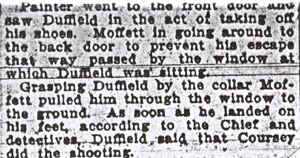
Painter went to the front door and saw Duffield in the act of taking off his shoes. Moffett in going around to the back door to prevent his escape that way passed by the window at which Duffield was sitting.
Grasping Duffield by the collar Moffett pulled him through the window to the ground. As soon as he landed on his feet, according to the Chief and detectives, Duffield said that Coursey did the shooting.
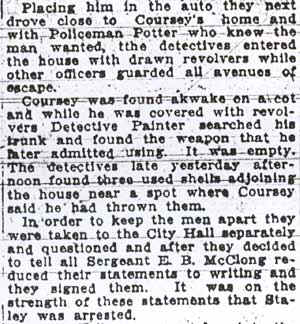
Placing him in the auto they next drove close to Coursey’s home and with Policeman Potter who knew the man wanted, the detectives entered the house with drawn revolvers while other officers guarded all avenues of escape.
Coursey was found awake on a cot and while he was covered with revolvers Detective Painter searched his trunk and found the weapon that he later admitted using. It was empty. The detectives late yesterday afternoon found three used shells adjoining the house near a spot where Coursey said he had thrown them.
In order to keep the men apart they were taken to the City Hall separately and questioned and after they decided to tell all Sergeant E. B. McClong reduced their statements to writing and they signed them. It was on the strength of these statements that Staley was arrested.
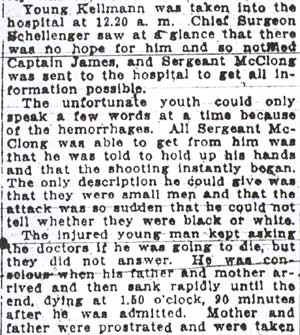
Young Kellmann was taken into the hospital at 12.20 a. m. Chief Surgeon Schellenger saw at a glance that there was no hope for him and so notified Captain James, and Sergeant McClong was sent to the hospital to get all information possible.
The unfortunate youth could only speak a few words at a time because of the hemorrhages. All Sergeant McClong was able to get from him was that he was told to hold up his hands and that the shooting instantly began. The only description he could give was that they were small men and that the attack was so sudden that he could not tell whether they were black or white.
The injured young man kept asking the doctors if he was going to die, but they did not answer. He was conscious when his father and mother arrived and then sank rapidly until the end, dying at 1.50 o’clock, 90 minutes after he was admitted. Mother and father were prostrated and were taken home by the up-town auto.
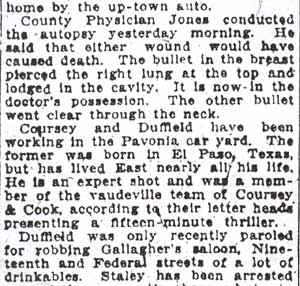
County Physician Jones conducted the autopsy yesterday morning. He said that either wound would have caused death. The bullet in the breast pierced the right lung at the top and lodged in the cavity. It is now in the doctor’s possession. The other bullet went clear through the neck.
Coursey and Duffield have been working in the Pavonia car yard. The former was born in El Paso, Texas, but has lived East nearly all his life. He is an expert shot and was a member of the vaudeville team of Coursey & Cook, according to their letter heads presenting a fifteen-minute thriller.
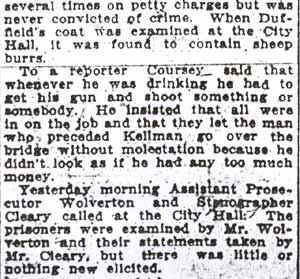
Duffield was only recently paroled for robbing Gallagher’s saloon, Nineteenth and Federal streets of a lot of drinkables. Staley has been arrested several times on petty charges but was never convicted of crime. When Duffield’s coat was examined at the City Hall, it was found to contain sheep burrs.
To a reporter Coursey said that whenever he was drinking he had to get his gun and shoot something or somebody. He insisted that all were in on the job and that they let the man who preceded Kellman go over the bridge without molestation because he didn’t look as if he had any too much money.
Yesterday morning Assistant Prosecutor Wolverton and Stenographer Cleary called at the City Hall. The prisoners were examined by Mr. Wolverton and their statements taken by Mr. Cleary, but there was little or nothing new elicited.
Speed Law Violators Arrested
Philadelphia Inquirer —
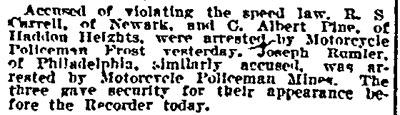
Accused of violating the speed law, R. S. Currell, of Newark, and C. Albert Fine, of Haddon Heights, were arrested by Motorcycle Policeman Frost yesterday. Joseph Rumler, of Philadelphia, similarly accused, was arrested by Motorcycle Policeman Mines. The three gave security for their appearance before the Recorder today.
Camden Motorcycle Police
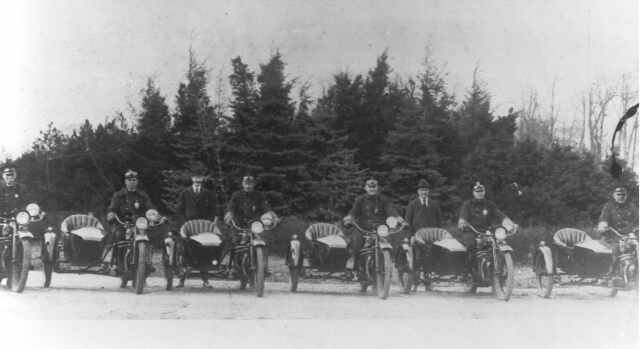
Named: Camden Motorcycle Police, location unknown, around 1920, and at far left, Officer Jeff Kay.
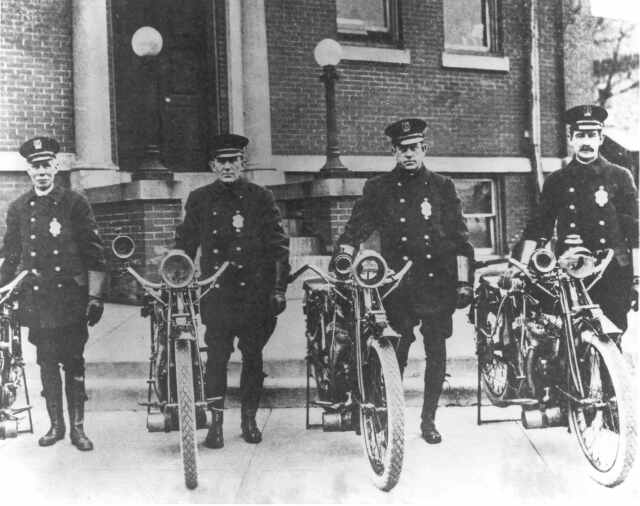
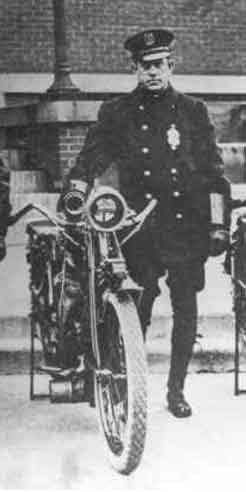
Named: Early photo of Camden Motorcycle Police, 1910s, Charles “Jeff” Kay, Charles Laib, Frank Frost, and Josiah Pedigree.
Thinks $1 a Year Enough for Wife
Philadelphia Inquirer —
According to testimony presented before Recorder Stackhouse, in Camden yesterday, George Vannatta, aged 20 years, of 2046 Hancock street, Philadelphia, thinks a dollar a year sufficient to keep a wife and two children. At least that was all he is alleged to have given his family the past seven years, a total of $7. As a result he was held in $100 bail as a guarantee that he will change his mind and ‘pony up’ $5 a week toward his family’s support. Vannatta has been a fugitive for several years. Although the police have sought him repeatedly he has eluded them, but yesterday he overstepped his usual precaution and was caught napping on Haddon avenue by Policeman Frost.
Two Arrested for Auto Speeding
Philadelphia Inquirer —
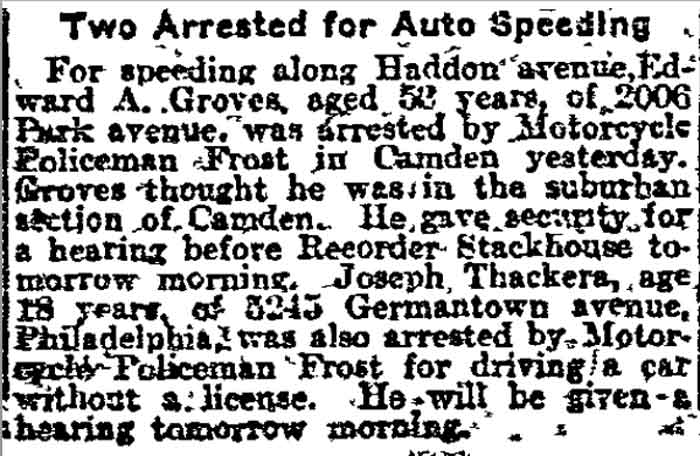
For speeding along Haddon avenue, Edward A. Groves, aged 52 years, of 2006 Park avenue, was arrested by Motorcycle Policeman Frost in Camden yesterday. Groves thought he was in the suburban action of Camden. He gave security for a hearing before Recorder Stackhouse tomorrow morning. Joseph Thackerus, age 18 years, of 8245 Germantown avenue, Philadelphia, was also arrested by Motorcycle Policeman Frost for driving a car without a license. He will be given a hearing tomorrow morning.
Frost Withdraws Speeding Complaint
Philadelphia Inquirer —

Because he acted in a gentlemanly manner when arrested for speeding, F. S. Groves, of 2006 Park avenue Philadelphia, escaped without punishment yesterday. Motorcycle Policeman Frost withdrawing the complaint.
“Movie” Stars Land in Police Station
Philadelphia Inquirer —
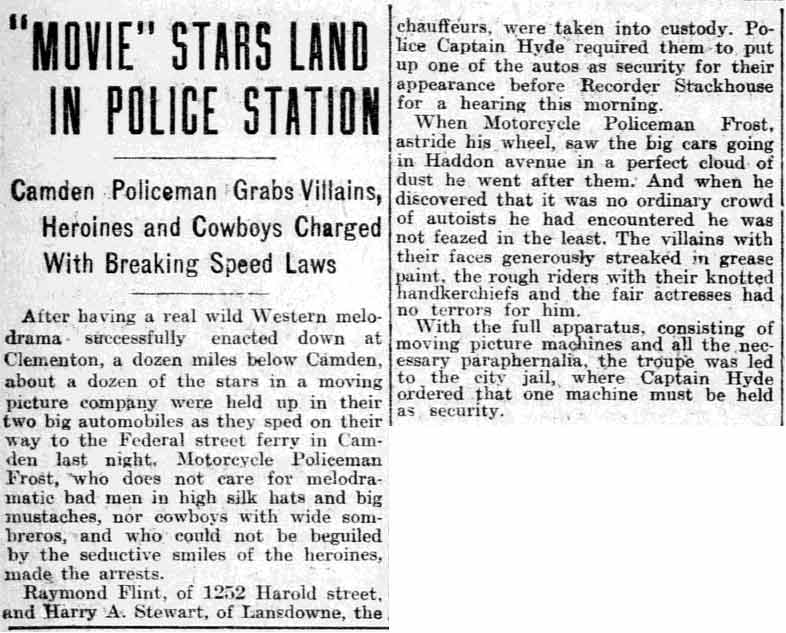
Camden Policeman Grabs Villains, Heroines and Cowboys Charged With Breaking Speed Laws
After having a real wild Western melodrama successfully enacted down at Clementon, a dozen miles below Camden, about a dozen of the stars in a moving picture company were held up in their two big automobiles as they sped on their way to the Federal street ferry in Camden last night. Motorcycle Policeman Frost, who does not care for melodramatic bad men in high silk hats and big mustaches, nor cowboys with wide sombreros, and who could not be beguiled by the seductive smiles of the heroines, made the arrests.
Raymond Flint, of 1252 Harold street, and Harry A. Stewart, of Lansdowne, the chauffeurs, were taken into custody. Police Captain Hyde required them to put up one of the autos as security for their appearance before Recorder Stackhouse for a hearing this morning.
When Motorcycle Policeman Frost, astride his wheel, saw the big cars going in Haddon avenue in a perfect cloud of dust he went after them. And when he discovered that it was no ordinary crowd of autoists he had encountered he was not feazed in the least. The villains with their faces generously streaked in grease paint, the rough riders with their knotted handkerchiefs and the fair actresses had no terrors for him.
With the full apparatus, consisting of moving picture machines and all the necessary paraphernalia, the troupe was led to the city jail, where Captain Hyde ordered that one machine must be held as security.
Threaten Jail for Auto Speed Defiance
Philadelphia Inquirer —
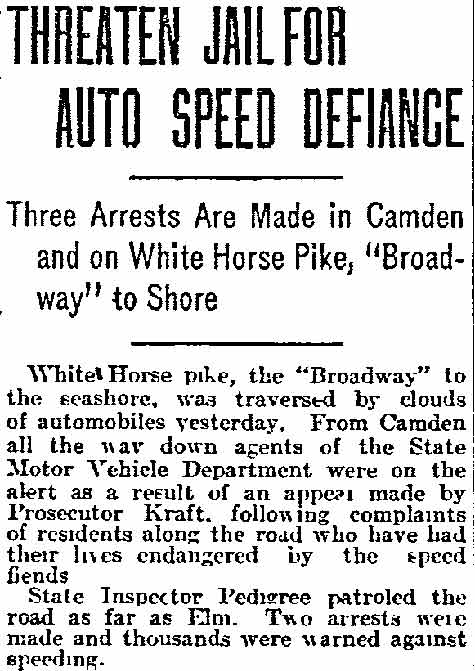
Three Arrests Are Made in Camden and on White Horse Pike, “Broadway” to Shore
White Horse pike, the “Broadway” to the seashore, was traversed by clouds of automobiles yesterday. From Camden all the way down agents of the State Motor Vehicle Department were on the alert as a result of an appeal made by Prosecutor Kraft, following complaints of residents along the road who have had their lives endangered by the speed fiends.
State Inspector Pedgree patroled the road as far as Elm. Two arrests were made and thousands were warned against speeding.
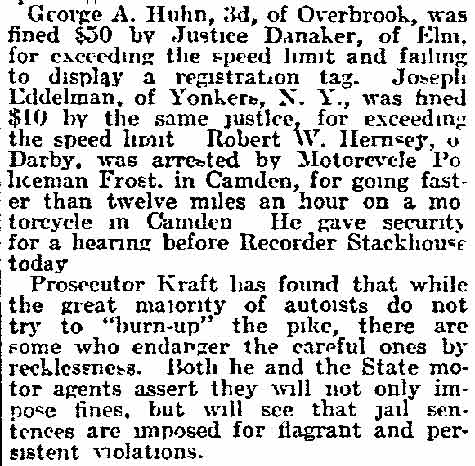
George A. Huhn, 3d, of Overbrook, was fined $50 by Justice Danaker, of Elm, for exceeding the speed limit and failing to display a registration tag. Joseph Eddelman, of Yonkers, N. Y., was fined $10 by the same justice, for exceeding the speed limit. Robert W. Hernsey, o [sic] Darby, was arrested by Motorcycle Policeman Frost, in Camden, for going faster than twelve miles an hour on a motorcycle in Camden. He gave security for a hearing before Recorder Stackhouse today.
Prosecutor Kraft has found that while the great majority of autoists do not try to “burn-up” the pike, there are some who endanger the careful ones by recklessness. Both he and the State motor agents assert they will not only impose fines, but will see that jail sentences are imposed for flagrant and persistent violations.
Motorcycle Speeders Fined $10 Each
Philadelphia Inquirer —
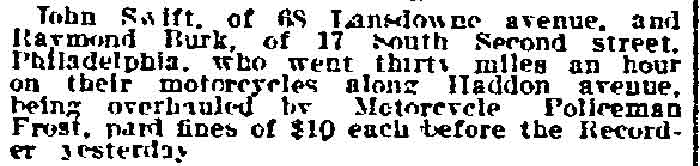
Two motorcycle speeders were fined $10 each by Recorder Stackhouse today for violating the city’s speed ordinance. They are Frank Frost and John Swift. Both were detected on Haddon Avenue doing from fifteen to twenty-five miles an hour.
To Appeal Fine for Speeding
Philadelphia Inquirer —
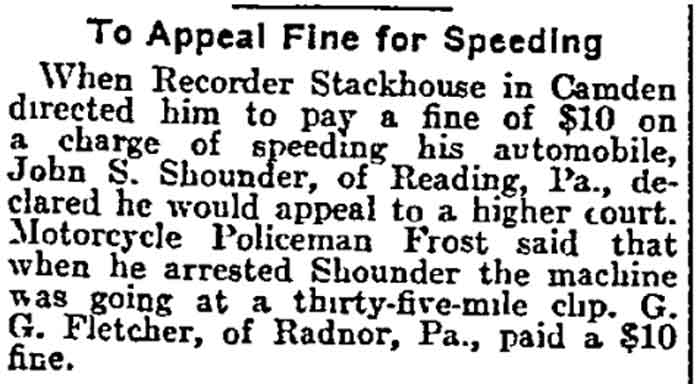
When Recorder Stackhouse in Camden directed him to pay a fine of $10 on a charge of speeding his automobile, John S. Shounder, of Reading, Pa., declared he would appeal to a higher court. Motorcycle Policeman Frost said that when he arrested Shounder the machine was going at a thirty-five-mile clip. G. G. Fletcher, of Radnor, Pa., paid a $10 fine.
Two Speeders Fined After Frost Arrests
Philadelphia Inquirer —
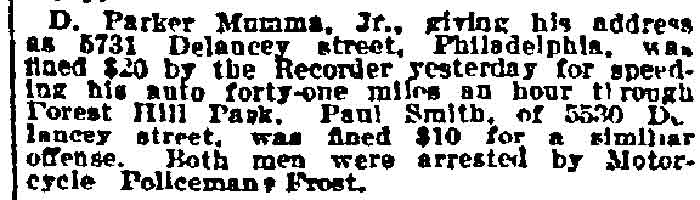
D. Parker Mumma, Jr., giving his address as 5731 Delancey street, Philadelphia, was fined $20 by the Recorder yesterday for speeding his auto forty-one miles an hour through Forest Hill Park. Paul Smith, of 5530 Delancey street, was fined $10 for a similar offense. Both men were arrested by Motorcycle Policeman Frost.
Motorist Posts Security for Speeding Hearing
Philadelphia Inquirer —

Arrested for speeding in an auto William Taglier, of 120 Warner street, Philadelphia, yesterday posted $55 security for a hearing before Recorder Stackhouse. He was overhauled by Motorcycle Policeman Frost.
‘Cycle Officer Hurt in Saving Others
Philadelphia Inquirer —
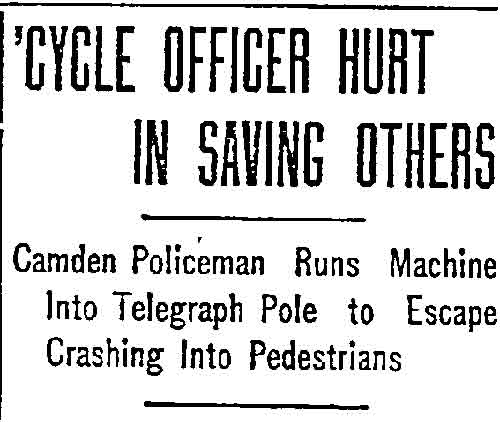
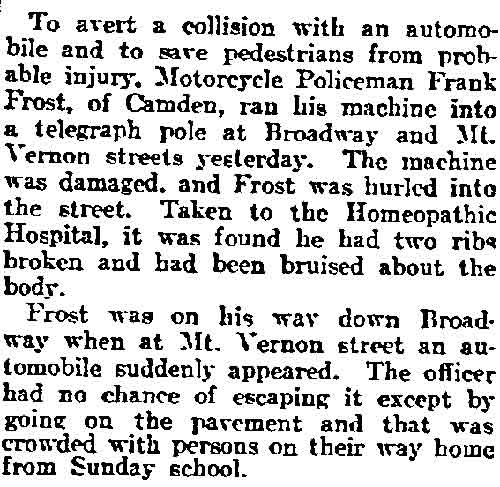
Camden Policeman Runs Machine Into Telegraph Pole to Escape Crashing Into Pedestrians
To avert a collision with an automobile and to save pedestrians from probable injury, Motorcycle Policeman Frank Frost, of Camden, ran his machine into a telegraph pole at Broadway and Mt. Vernon streets yesterday. The machine was damaged, and Frost was hurled into the street. Taken to the Homeopathic Hospital, it was found he had two ribs broken and had been bruised about the body.
Frost was on his way down Broadway when at Mt. Vernon street an automobile suddenly appeared. The officer had no chance of escaping it except by going on the pavement and that was crowded with persons on their way home from Sunday school.
Auto Regulations Not Obeyed
Philadelphia Inquirer —
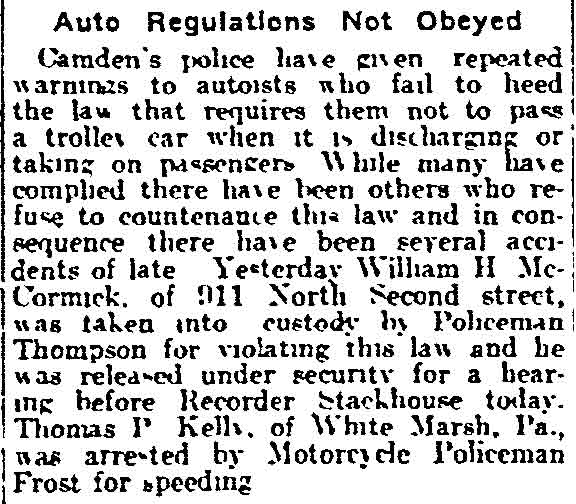
Auto Regulations Not Obeyed
Camden’s police have given repeated warnings to autoists who fail to heed the law that requires them not to pass a trolley car when it is discharging or taking on passengers. While many have complied there have been others who refuse to countenance this law and in consequence there have been several accidents of late. Yesterday William H. McCormick, of 911 North Second street, was taken into custody by Policeman Thompson for violating this law and he was released under security for a hearing before Recorder Stackhouse today. Thomas P. Kelly, of White Marsh, Pa., was arrested by Motorcycle Policeman Frost for speeding.
Autoist Flees After Injuring Aged Man
Philadelphia Inquirer —
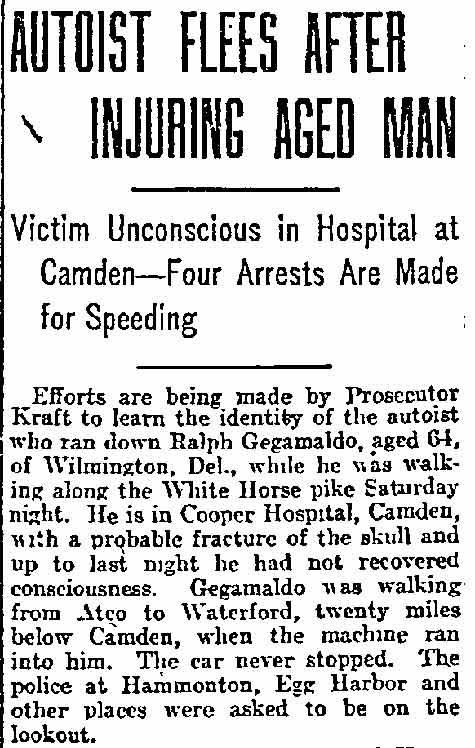
Victim Unconscious in Hospital at Camden–Four Arrests Are Made for Speeding
Efforts are being made by Prosecutor Kraft to learn the identity of the autoist who struck Samuel Kipp, an aged resident of Wilmington, Del., while he was walking along the White Horse Pike Saturday night. He is in Cooper Hospital, Camden, with a sympathetic fracture of the skull and injuries to last night he had not recovered consciousness. Gradually was walking along the White Horse Pike, below Camden, when the machine ran into him. The car was stopped. The police at Hammonton, Egg Harbor and other places were asked to be on the lookout.
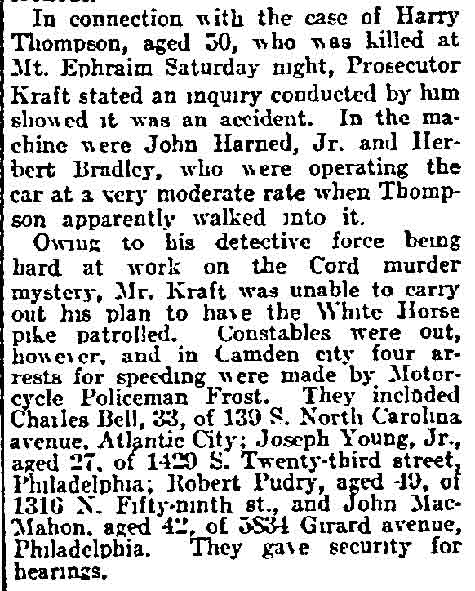
In connection with the case of Harry Thompson, aged 20, who was killed at Mt. Ephraim Saturday night, Prosecutor Kraft stated an inquiry conducted by him showed it was an accident. In the machine, there were John Harrell, and Herbert Bradley, who were operating the car at a moderate rate near White Horse Owing to his detective force being hard at work on the Cord mystery, Mr. Kraft was unable to carry out his plan to have White House, and the latter were made by Motorcycle Policeman Frost, who included Charles Blakely, of 433 North Carolina avenue, aged 25, of 1429 S. Twenty-third street, Philadelphia, Robert Fay, and W. D. Malcolm, of Germantown, and 3834 Girard avenue, Philadelphia, for speeding. A hearing awaits.
In Fear of Asylum, Sets Herself Afire
Philadelphia Inquirer —
Camden Woman Dies From Burns. Found in Her Home With Clothing Smouldering
Burns proving fatal were received yesterday by Mrs. May Dougherty, aged 27, of 939 Newton avenue, when she set fire to her clothing after she had worried over a possibility of her being taken to an institution to cure a form of dementia. The woman was burned from head to foot, and died at Cooper Hospital.
It was when Motorcycle Policeman Frost was passing the Dougherty house that he heard piercing screams. He entered to investigate and found the woman sitting in a chair with nothing on her but smouldering clothing. Her flesh was burned and blistered until it hung in strips. It was learned by physicians that she had applied a match to her clothing shortly after her husband, Clement Dougherty, had left for work.
Phila. Woman Accused of Speeding
Philadelphia Inquirer —
When Motorcycle Policeman Frost saw an auto speeding down Haddon avenue, Camden, yesterday, he gave chase and found a woman at the wheel. She and the auto were taken to police headquarters where she posted $35 security for a hearing before Recorder Stackhouse. She gave the name of Mrs. Margaret Champion, of 3312 Race street, this city.
Camden at a Glance
Philadelphia Inquirer —
After Motorcycle Policeman Frost had chased a Frederick Hahn, of Dimmer, from Federal street to Broadway and Walnut, the latter was overtaken and required to post security for a hearing tomorrow on a charge of exceeding the speed limit in his auto. And affording the unnecessary caused the death of Andrew Cummiskey, a former well known hotel keeper, at his home at Twenty-seventh and Howell streets. He was 50 years old.
Two Arrested for Speeding
Philadelphia Inquirer —
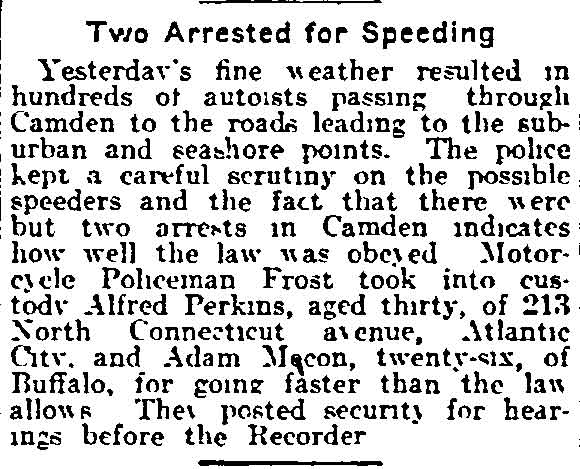
Yesterday’s fine weather resulted in hundreds of autoists passing through Camden to the roads leading to the suburban and seashore points. The police kept a careful scrutiny on the possible speeders and the fact that there were but two arrests in Camden indicates how well the law was obeyed. Motorcycle Policeman Frost took into custody Alfred Perkins, aged thirty, of 215 North Connecticut avenue, Atlantic City, and Adam Mason, twenty-in, of Buffalo, one corner Hester than the lows. They posted security for hearings before the Recorder.
World War I Draft Card
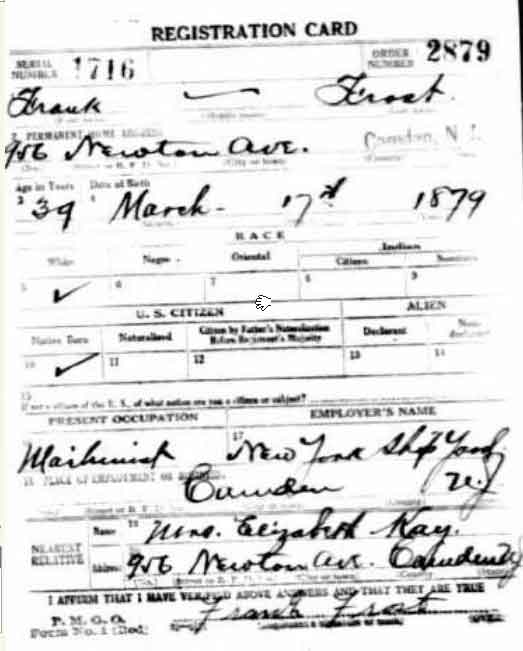
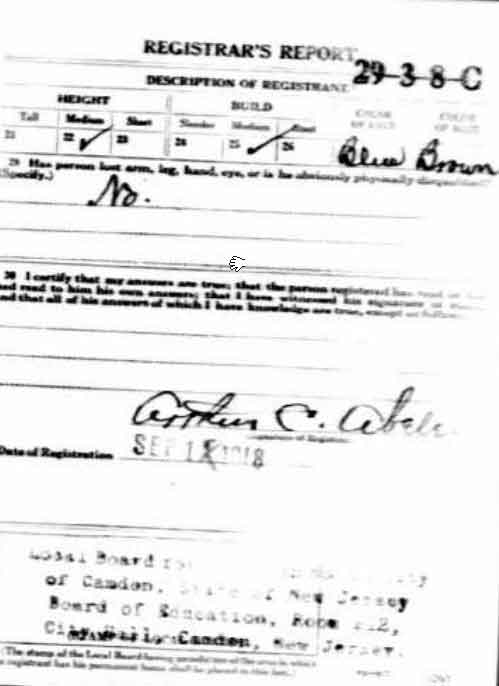
World War I Draft Card for Frank Frost