Introduction
CHRISTOPHER J. MINES JR. was born in 1844 in New Jersey. He grew up in Camden.
Christopher J. Mines Jr. went to war in 1864. He enlisted as a Private on January 21, 1864 in Company H, 4th New Jersey Infantry Regiment. He served alongside John Cavanaugh. Christopher J. Mines Jr. married John Cavanaugh’s sister Mary after the war.
The Fourth New Jersey had gone into service in the summer of 1861 and had seen considerable service prior to John Cavanaugh’s enlistment. When spring came, the regiment left winter quarters to confront the enemy once again. At the Battle of the Wilderness the First, Fourth and Tenth New Jersey regiments, lying on the left, were several times attacked with great ferocity by the Confederates, but at nightfall still held substantially the ground occupied by them in the morning—a heavy assault by the Confederate General Gordon just at dusk being repulsed with heroic gallantry. Among the wounded in that engagement was Lieutenant Colonel Van Syckel of the 4th. At the battle of Spottsylvania the regiment participated in the charge upon the “bloody angle,” winning its share of the glory and sustaining its share of casualties. During the first eleven days of Grant’s campaign against Richmond the regiment lost 26 killed, 126 wounded and 42 missing. The 4th fought at the North Anna river, Hanover Court House, Totopotomoy Creek, Cold Harbor, Weldon Railroad, Snicker’s Gap, Strasburg, Winchester and Charlestown. At the battle of the Opequan the Fourth was with the troops that pressed forward, swept up the opposite hill and forced back the Confederate line, obtaining permanent possession of the hill and holding it, though constantly exposed to a fire which inflicted severe loss, the 4th having 2 killed, 18 wounded and 1 missing. At Fisher’s Hill a private of the Fourth named Beach compelled a Confederate lieutenant colonel to surrender his sword, and there were other instances of daring no less noteworthy.
The regiment fought at Petersburg on January 9, 1865. John Cavanaugh and Christopher Mines Jr. were both promoted to Full Corporal on March 6, 1865. They took part in one last engagement at Petersburg on April 2. After Lee’s surrender the regiment was assigned to what was known as the provisional corps, Army of the Potomac, until mustered out on July 9, 1865. The total strength of the regiment was 2,036, and it lost during service 29 by resignation, 319 by discharge, 83 by promotion, 81 by transfer, 257 by death, 372 by desertion, 3 by dismissal, 109 not accounted for, mustered out 783.
Corporal Mines was not among those who mustered out of Company H, 4th New Jersey Infantry on July 9, 1865 at Hall’s Hill. He received a disability discharge from Company H, 4th New Jersey Infantry Regiment New Jersey on August 3, 1865 at Newark, New Jersey.
Christopher Mines Jr. was politically active and served as Camden County Sheriff as well as holding other government posts.
Christopher J. Mines Jr. was a member of the William B. Hatch Post No. 37 of the Grand Army of the Republic, also known as the G.A.R.
Christopher J. Mines Sr. died at his home, 254 Line Street, on the morning of October 7, 1895 at the age of 73. Among his survivors were at least one daughter, Rachel Mines Milliette, and sons Christopher Jr. and William.
Christopher J. Mines Jr. passed away on December 3, 1903. He was buried at Harleigh Cemetery.
Brother William W. Mines also had a long and distinguished careers in Camden civic affairs. Son Dr. Marcus K. Mines, son of Christopher Mines Jr., practiced medicine in Camden for many years.
William B. Hatch Post No. 37, G.A.R.
George Reeser Prowell, History of Camden County, N.J., 1886
WILLIAM B. HATCH POST No. 37, of Camden, was instituted and chartered November 25, 1879, with eighty-one members and the following named Post officers:
Post Commander, John E. Grubb; Senior Vice-Commander, Richard J. Robinson; Junior Vice-Commander, Daniel J. Fullen; Surgeon, Thomas G. Rowand, M.D.; Chaplain, John Quick; Officer of the Day, John A. Dall; Officer of the Guard, Edmund G. Jackson, Jr.; Quartermaster, Christopher J. Mines, Jr.; Adjutant, Benjamin J. Pierce; Sergeant-Major, William A. Tatem; Quartermaster-Sergeant, William B. E. Miller.
At the first meeting of the Post it was decided by a unanimous vote to name it in honor of the late Colonel William B. Hatch, of the Fourth Regiment. When Mrs. C. Hatch, the mother of the colonel was informed that the post had honored the memory of her son by naming it after him, she sent to the Post the following response:
Camden N. J.,
November 26th, 1879John E. Grubb, Post Commander
Dear Sir,
It will afford me much pleasure to be identified with Post 37, G. A. E., named in honor of my son, William B. Hatch, by allowing me to present to the same its colors. The memory of my son is ever dear to me, and, while at the same moment I may have thought the sacrifice too great an affliction, yet I was consoled by the fact that I gave him up that this Union might be preserved. It was duty and patriotism that called him, and while I mourn him as a mother for a well-beloved son, yet I would not have stayed him, for the love of country and the upholding of this glorious Republic is what every mother should instill into her sons, as the purest and holiest spirit.Yours truly,
C. Hatch
The following is a complete roster of this post for 1886:
Post Commander, Benjamin H. Connelly; Senior Vice-Commander, Adam C. Smith; Junior Vice-Commander, William Haegele; Surgeon, George Pfau; Chaplain, Samuel Gaul; Officer of the Day, Robert Crawford; Officer of the Guard, John D. Cooper; Quartermaster, Samuel J. Fenner; Adjutant, William B. Summers; Sergeant-Major, Stacy H. Bassett; Quartermaster-Sergeant, Otto K. Lockhart.
Comrades: Philip Achenbach, George L. Allchin, Isaac Albertson, Joseph Applegate, John W. Barclay, Martin M. Barney, Joseph Baxter, William W. Bennett, Charles L. Bennett, Henry Bickering, Abel Biddle, George K. Biddle, John Bieri, Robert M. Bingham, Socrates T. Bittle, George W. Bittle, Benjamin F. Blizzard, Joseph Borton, Frederick Bowers, Benjamin M. Braker, John Breyer, William H. Brians, Wm. J. Broadwater, William Broadwater, John Brown, Harris Brooks, William H. Brooks, Joseph F. Bryan, Joseph Buddew, J. Q. Burniston, George Burton, Frederick Buser, Thomas L. Bush, William Butcher, Isaac B. Buzby, Edward C. Cattell, Joseph Cameron, James H. Carey, William Carey, James Chadwick, James Chafey, George M. Chester, James D. Chester, Lewis L. Chew, Henry S. Chew, John W. Churn, Andrew B. Cline, Charles Clarke, Samuel J. Cook, Levi E. Cole, John J. Collins, John C. Cooper, John W. Cotner, Thomas L. Conly, Harvey M. Cox, Jason S. Cox, Harris Crane, Charles Cress, Joel G. Cross, O. C. Cunningham, John A. Dall, John Dalby, John H. Damon, Westley Dare, John E. Dawson, Adam T. Dawson, James L. Davis, William Davis, Amos R. Dease, Henry Deford, Lewis T. Derousse, Michael Devinney, Glendora Devo, John Digney, Joseph Dilks, William A. Dobbins, George W. Dunlap, Aaron B. Eacritt, John J. Early, Christopher Ebele, Godfrey Eisenhart, John Elberson, Charles Elwell, Charles Eminecker, John Esler, John H. Evans, Charles S. Fackler, James Fanington, James A. Farraday, John H. Farry, John Faughey, Wm. H. Fenlin, George G. Felton, George W. Ferguson, Charles W. Fish, Israel L. Fish, James Finnan, Samuel B. Fisher, Edward L. Fisher, Ephraim B. Fithian, Jacob T. Fisher, Edward Fitzer, Samuel Flock, Leonard Flor, John Fox, John S. Fox, H. H. Franks, Chas. B. Frazer, Thomas J. Francis, Samuel W. Gahan, Chas. H. Gale, James Galbraith, Thomas Garman, Harry Garren, John W. Garwood, Josiah Garrison, John B. Gaskill, Richard Gaunt, Wm. German, Christopher Getsinger, Christopher Gifney, Jacob Giffens, Albert Gilbert, James Gillen, Wm. Giffins, C. C. Greany, Charles Green, W. H. Griffin, Louis Grosskops, William Grindrod, John B. Grubb, Mark H. Guest, John Guice, Alfred Haines, Charles G. Haines, Japhet Haines, George F. Hammond, Charles Hall, Solon B. Hankinson, Samuel P. Hankinson, James Hanson, Charles Hannans, H. A. Hartranft, Mahlon E. Harden, William F. Harper, George W. Hayter, Samuel B. Harbeson, J. T. Hazleton, H. Heinman, James Henderson, William H. Heward, Franklin Hewitt, James T. Hemmingway, Charles Hewitt, Edward K. Hess, Samuel B. Hickman, George Higgens, Ephraim Hillman, C. M. Hoagland, Guadaloupe Holl, William A. Holland, Isaac K. Horner, Count D. G. Hogan, William H. Howard, Baxter Howe, Alien Hubbs, Charles G. Hunsinger, Presmel D. Hughes, I. N. Hugg, Sebastian Hummell, Edward Hutchinson, C. Innes, Alfred Ivins, Benjamin Ivins, E. G. Jackson Sr., E. G. Jackson Jr., Thomas Jameson, George Jauss, William P. Jenkins, James L. Johnson, Alfred Jones, B. F. Jones, William Joline, Charles Joseph, Charles Justice, C. H. Kain, E. E. Kates, Benjamin Kebler, Frank Kebler, Peter Keen, Henry N. Killian, J. W. Kinsey, C. H. Knowlton, Thomas W. Krips, Joseph H. Large, John E. Leake, John Lecroy, Charles Leonhart, George W. Locke, E. J. Long, Charles L. Lukens, J. H. Lupton, Valentine Machemer, Edward Macloskey, Edward A. Martin, William P. Marsh, John Mapes, William Mead, William Metcalf, E. A. Meyer, C. Meyers, George Meilor, C. A. Michener, William B. E. Miller, Jacob Miller, W. D. Miller, Samuel Mills, William W. Mines, Christopher J. Mines, George Molesbury, William. Moran, Edward More, Richard Morgan, John F. Moore, S. H. Moyer, Jacob L. Morton, John Muir, John J. Murphy, Isaac Murray, Charles Myers, W. H. McAllister, James McCracken, Edward C. McDowell, Hugh McGrogan, H. M. Mcllvaine, W. F. McKillip, W. J. McNeir, Lewis McPherson, E. McPherson, Jacob Naglee, William Naphas, Antonio Nosardi, Robert O’Keefe, John S. Owens, Robert Owens, Edward H. Pancoast, James Pancoast, Robert B. Patterson, William Patterson, E. W. Pease, John B. Pepper, Joel Perrine, John Peterson, D. E. Peugh, Frederick Phile, Samuel B. Pine, William M. Pine, Adon Powell, John Powell, John Portz, J. B. Prucelle, John Quick, S. E. Radcliffe, I. C. Randolph, James A. Regens, Philip Reilly, Charles P. Reynolds, Alexander Rhodes, Benjamin F. Richard, Andrew Ridgway, Benjamin Robbins, Edward C. Roberts, James Roberts, Richard J. Robinson, William B. Robertson, Isaac Rogers, John Rogers, William H. Rogers, Thomas G. Rowand, Sebastian Schaub, Maurice Schmidt, Christian K. Schallers, James Schofield, George W. Scott, John E. Scott, John M. Shemelia, Edward M. Siemers, John Simmons, Benjamin F. Shinn, Thomas Sheeran, James Shield, Charles Smith, George H. Smith, William W. Smith, Charles S. Small, Adolph Snow, W. Souder, Francis Senders, Robert Sparks, David C. Sprowl, Alfred L. Sparks, Abraham Springer, George W. Stewart, William L. Stevenson, Thomas G. Stephenson, Samuel R. Stockton, Thomas Stockton, Thomas H. Stone, Henry Strick, E. J. Strickland, Charles String, George F. Stull, George W. Swaney, Crosby Sweeten, William F. Tarr, William A. Tatem, Thomas S. Tanier, George Rudolph Tenner, Charles L. Test, Leonard Thomas, Benjamin Thomas, Henry C. Thomas, George F. Thorne, Wesley Thorn, Thomas W. Thornley, Alexander W. Titus, Joseph Tompkins, J. E. Troth, Isaac C. Toone, Samuel Tyier, Jacob M. Van Nest, Albert Vansciver, Joseph Wakeman, Theodore F. Walker, Charles Walton, George Walton, Joseph Welsh, David Watson, George W. Wentling, Edward West, Elmer M. West, George Weyman, Wilmer Whillden, James Whittaker, Samuel Wickward, Calvin T. Williams, George W. Williams, William H. Williams, John Williams, Samuel Winner, Amos P. Wilson, D. H. Wilson, G. A. Wilson, Richard Wilson, George Wispert, John W. Wood, Joseph Woodfield, Walter Wolfkill, E. W. Wolverton, Elijah Worthington, C. M. Wright, George B. Wright, Henry S. Wright, Wesley T. Wright, William Zane.
As of 1886, the Hatch Post met every Thursday evening in their own G. A. R. Hall, on Stevens Street, below Fifth Street. This same building had been used in the late 1870s as the original home of the congregation that formed the Tabernacle Baptist Church. The Hatch Post was affiliated with Hatch League No. 2, of the Loyal Ladies League, their auxiliary, which met at the Post Hall.
Political Organization.
Philadelphia Public Ledger —
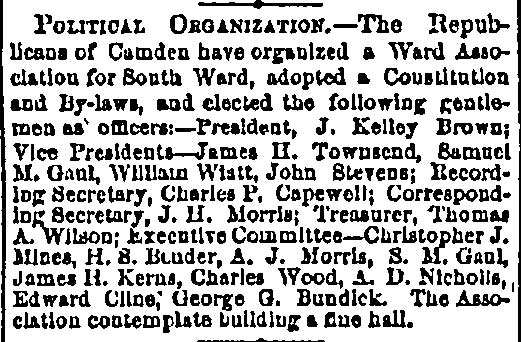
Political Organization.—The Republicans of Camden have organized a Ward Association for South Ward, adopted a Constitution and By-laws, and elected the following gentlemen as officers:—President, J. Kelley Brown; Vice Presidents—James H. Townsend, Samuel M. Gaul, William Wiatt, John Stevens; Recording Secretary, Charles P. Capewell; Corresponding Secretary, J. H. Morris; Treasurer, Thomas A. Wilson; Executive Committee—Christopher J. Mines, H. S. Bender, A. J. Morris, S. M. Gaul, James H. Kerns, Charles Wood, A. D. Nicholls, Edward Cline; George G. Bundick. The Association contemplate building a fine hall.
Republican Association of South Ward.
The New Republic, Camden —
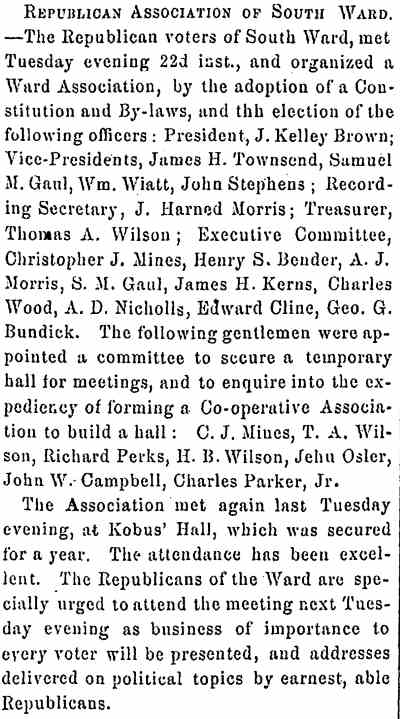
Republican Association of South Ward.—The Republican voters of South Ward, met Tuesday evening 22d inst., and organized a Ward Association, by the adoption of a Constitution and By-laws, and the election of the following officers: President, J. Kelley Brown; Vice-Presidents, James H. Townsend, Samuel M. Gaul, Wm. Wiatt, John Stephens; Recording Secretary, J. Harned Morris; Treasurer, Thomas A. Wilson; Executive Committee, Christopher J. Mines, Henry S. Bender, A. J. Morris, S. M. Gaul, James H. Kerns, Charles Wood, A. D. Nicholls, Edward Cline, Geo. G. Bundick. The following gentlemen were appointed a committee to secure a temporary hall for meetings, and to enquire into the expediency of forming a Co-operative Association to build a hall: C. J. Mines, T. A. Wilson, Richard Perks, H. B. Wilson, Jehu Osler, John W. Campbell, Charles Parker, Jr.
The Association met again last Tuesday evening, at Kobus’ Hall, which was secured for a year. The attendance has been excellent. The Republicans of the Ward are specially urged to attend the meeting next Tuesday evening as business of importance to every voter will be presented, and addresses delivered on political topics by earnest, able Republicans.
The City and Suburbs — The Armstrong Murder
Philadelphia Inquirer —
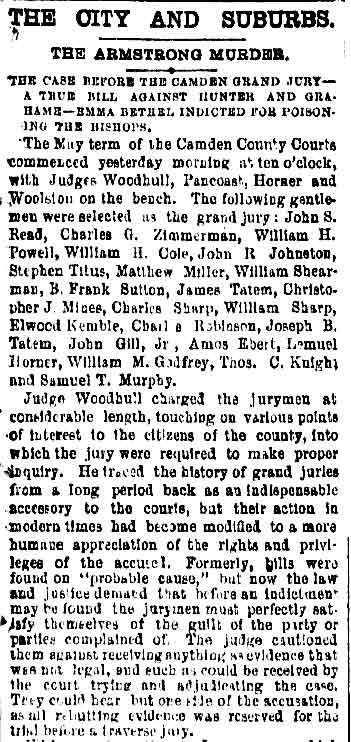
THE CITY AND SUBURBS.
THE ARMSTRONG MURDER.
THE CASE BEFORE THE CAMDEN GRAND JURY—A TRUE BILL AGAINST HUNTER AND GRAHAME—EMMA BETHEL INDICTED FOR POISONING THE BISHOPS.
The May term of the Camden County Courts commenced yesterday morning at ten o’clock, with Judges Woodhull, Pancoast, Horner and Woolston on the bench. The following gentlemen were selected as the grand jury: John S. Read, Charles G. Zimmerman, William H. Powell, William H. Cole, John R. Johnston, Stephen Titus, Matthew Miller, William Shearman, B. Frank Sutton, James Tatem, Christopher J. Mines, Charles Sharp, William Sharp, Elwood Kemble, Charles Robinson, Joseph B. Tatem, John Gill, Jr., Amos Ebert, Lemuel Horner, William M. Godfrey, Thos. C. Knight and Samuel T. Murphy.
Judge Woodhull charged the jurymen at considerable length, touching on various points of interest to the citizens of the county, into which the jury were required to make proper inquiry. He traced the history of grand juries from a long period back as an indispensable accessory to the courts, but their action in modern times had become modified to a more humane appreciation of the rights and privileges of the accused. Formerly, bills were found on “probable cause,” but now the law and justice demand that before an indictment may be found the jurymen must perfectly satisfy themselves of the guilt of the party or parties complained of. The judge cautioned them against receiving anything as evidence that was not legal, and such as could be received by the court trying and adjudicating the case. They could hear but one side of the accusation, as all rebutting evidence was reserved for the trial before a traverse jury.
With respect to the murder cases on which they were to act, they were strongly enjoined that, before finding a bill of indictment, the jury must, in the first place, be fully satisfied that deceased came to his or her death by violence at the hands of the person or persons charged, and that, when so satisfied, it was their duty to return an indictment as murder, without fixing the grade. Selling liquors without license was alluded to, and the judge reminded the jury that if the evidence satisfied them that a person has sold without license they must return a true bill, not against the lowly and uninfluential only, but also those in high stations and positions commanding influence. They should observe no impartiality between the rich and the poor; violators of the law must all be punished alike.
At the close of the charge the grand jury retired to their room, and the first case sent before them was that of Benjamin Hunter, charged with the murder of John M. Armstrong. It was reported last evening that a true bill had been found against him; also against Grahame and Emma Bethel, the latter being charged with poisoning the Bishops, near Berlin. It is decided to begin Hunter’s trial on next Monday week. The balance of yesterday was passed by the court in hearing motions and transacting other preliminary business.
Executive Committee
Philadelphia Inquirer —
The following gentlemen have been selected the Republican Executive Committee of Camden county: First Ward, David Baird; Second, J. W. Morgan; Third, Edward Delacroix; Fourth, Chas. A. Randall; Fifth, Christopher J. Morris, Jr.; Sixth, Alex. Millette; Seventh, James Worrell; Eighth, Gabriel Johnson; Delaware township, Wm. Coles; Haddon, A. W. Clement; Stockton, Isaac Hinchman; Centre, Henry Charman; Gloucester, Henry Peters; Gloucester City, John B. Booth and John McMurray; Waterford township, Edward Tomlinson; Merchantville, John Homer; Winslow, Jacob Bickler.
Over the River.
Philadelphia Inquirer —
Military.
Post No. 37, G. A. R., held an annual election on Thursday evening, and selected the following officers for the ensuing year: Post Commander—W. B. E. Miller. Senior Vice Commander—Samuel S. Venner. Junior Vice Commander—Robert Crawford. Chaplain—P. B. Hughes. Quartermaster—Christopher J. Mines, Jr. Surgeon—Dr. J. N. Hugg. Officer of the Day—J. L. Markey. Officer of the Guard—Richard J. Robertson. Past Commander for the Year—John Dall.
To Be Rebuilt.
Proposals have been advertised for by the Bridge Committee of the Camden County Board of Chosen Freeholders for the construction of a bridge across Cooper’s creek, on State street. The present bridge has been condemned, and a new one is necessary for the safety of travel.
The Military Prize.
Major Joseph C. Lee, with a guard of honor, received on Thursday afternoon the trophy awarded to the New Jersey Battalion at the Yorktown Centennial anniversary, and it will be in custody at the headquarters of Company C, Sixth Regiment, N. G., Camden, on the 7th instant.
Paving Material.
The work of paving Federal street with Belgian blocks has been delayed for several days, because the contractor, Thomas A. Wilson, has been unable to procure material. Only half a square remains to be finished, but the stone has now arrived, and work will be resumed at once.
Died.
William Bassett, a small lad, who was severely burned on Saturday last from his clothing taking fire, died from the effects of the injuries on Thursday night, at Third street and Kaign’s avenue.
Robberies
During the past week a number of robberies have taken place near Marlton. Among the places robbed were the Baptist Church, Kaighn’s wagon shop, Brown’s shop, Allen M. Evans’ tailor shop and Felix McCarthy’s store.
Larceny of Poultry.
William Morris was yesterday committed to the Camden county jail for the larceny of poultry by Justice Atkinson, of Blackwoodtown.
Pinkeye.
The disease known as “pinkeye” has broken out among the horses in Moorestown, and is quite prevalent.
New Ferry Boat.
On Monday next the West Jersey Ferry Company intend bringing to Camden their new ferry boat Baltic, which is said to be of superior build.
Over the River
Philadelphia Inquirer —
OVER THE RIVER
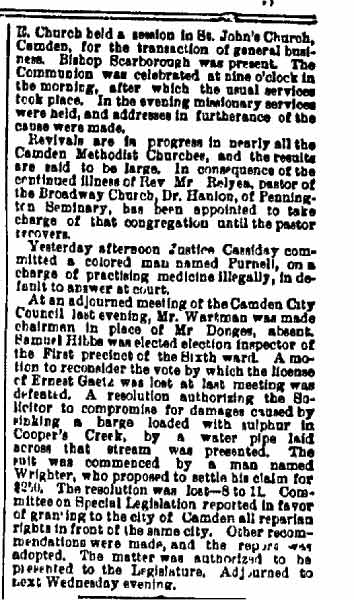
Last evening the justices of the peace of Camden, and the constables, held a meeting in the court house to take preliminary measures towards forming a permanent organization for the protection of their interests
Yesterday Josiah Ewings had a hearing in the Camden District Court, on the charge of refusing to support his wife. She testified that he had not provided for her the past nine months. It was shown, however, that she was not a resident of Camden, and the case was dismissed
Joseph Fury and James Ayres, two young men who, several days ago, committed an assault and battery on James Dudley, had a hearing before Mayor Bradshaw yesterday morning, and were held in $100 each to answer at court.
It is stated that there are ten cases of small-pox in Marlton, and fears are entertained that it may become epidemic. That place contains about one thousand inhabitants.
At the annual meeting of the stockholders of the Camden Fire Insurance Association yesterday afternoon the following directors were elected for the ensuing year: Josiah D. Rogers, Henry B. Wilson, Jonathan Burr, Edmund E. Reed, Christopher J. Mines, William P. Tatem, Jesse E. Hueston, E. E. Reed, Jr., George W. Gilbert, William S. Scull, William W. Bozorth, John Burr, Charles Wilson. Subsequently the directors organized by electing Henry B. Wilson, president; Jonathan Burr, secretary; R. W. Birdsell, assistant secretary; Edmund R. Read, treasurer, and Christopher J. Mines, surveyor.
Mayor Williams, of Gloucester City, is lying dangerously sick at his home in that city.
Yesterday the convocation of Burlington P. E. Church held a session in St. John’s Church, Camden, for the transaction of general business. Bishop Scarborough was present. The Communion was celebrated at nine o’clock in the morning, after which the usual services took place. In the evening missionary services were held, and addresses in furtherance of the cause were made.
Revivals are in progress in nearly all the Camden Methodist Churches, and the results are said to be large. In consequence of the continued illness of Rev. Mr. Relyes, pastor of the Broadway Church, Dr. Hanlon, of Pennington Seminary, has been appointed to take charge of that congregation until the pastor recovers.
Yesterday afternoon Justice Cassiday committed a colored man named Purnell, on a charge of practising medicine illegally, in default to answer at court.
At an adjourned meeting of the Camden City Council last evening, Mr. Wartman was made chairman in place of Mr. Donges, absent. Samuel Hibbs was elected election inspector of the First precinct of the Sixth ward. A motion to reconsider the vote by which the license of Ernest Gaetz was lost at last meeting was defeated. A resolution authorizing the Solicitor to compromise for damages caused by sinking a barge loaded with sulphur in Cooper’s Creek, by a water pipe laid across that stream was presented. The suit was commenced by a man named Wrighter, who proposed to settle his claim for $250. The resolution was lost—8 to 11. Committee on Special Legislation reported in favor of granting to the city of Camden all riparian rights in front of the same city. Other recommendations were made, and the report was adopted. The matter was authorized to be presented to the Legislature. Adjourned to next Wednesday evening.
Across the Delaware.
Philadelphia Inquirer —
Last Night’s Delegate Elections and Other Late News Notes.
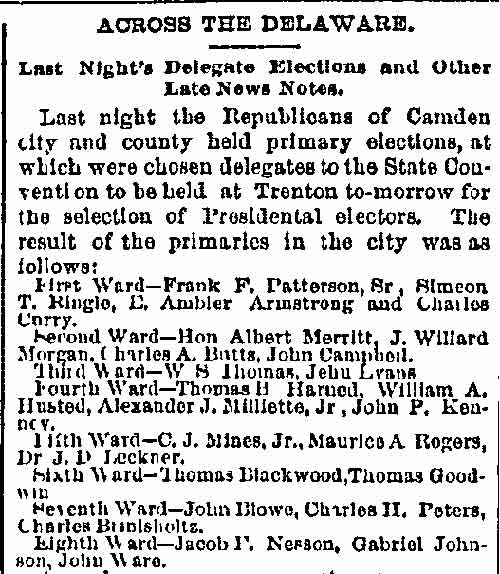
Last night the Republicans of Camden city and county held primary elections, at which were chosen delegates to the State Convention to be held at Trenton to-morrow for the selection of Presidental [sic] electors. The result of the primaries in the city was as follows:
First Ward—Frank F. Patterson, Sr., Simeon T. Ringle, E. Ambler Armstrong and Charles Curry.
Second Ward—Hon. Albert Merritt, J. Willard Morgan, Charles A. Butts, John Campbell.
Third Ward—W. S. Thomas, Jehu Lvans [sic].
Fourth Ward—Thomas H. Harned, William A. Husted, Alexander J. Milliette, Jr., John P. Kenney.
Fifth Ward—C. J. Mines, Jr., Maurice A. Rogers, Dr. J. D. Leckner.
Sixth Ward—Thomas Blackwood, Thomas Goodwin.
Seventh Ward—John Blowe, Charles H. Peters, Charles Bunisholtz.
Eighth Ward—Jacob P. Nesson, Gabriel Johnson, John Ware.
In the Political Whirl
Philadelphia Inquirer —
Camden in a Lively Congressional Contest.
ANTI-GRATZ WORKERS ENCOURAGED
Campaign Jottings of Interest Gathered at the City and State Committee Headquarters of Both Parties.
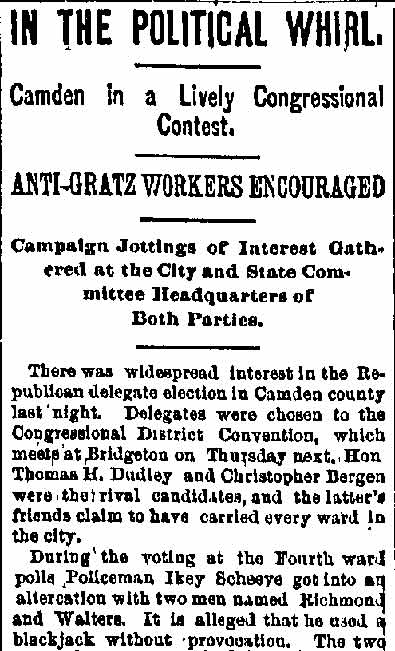
There was widespread interest in the Republican delegate election in Camden county last night. Delegates were chosen to the Congressional District Convention, which meets at Bridgeton on Thursday next. Hon. Thomas H. Dudley and Christopher Bergen were the rival candidates, and the latter’s friends claim to have carried every ward in the city.
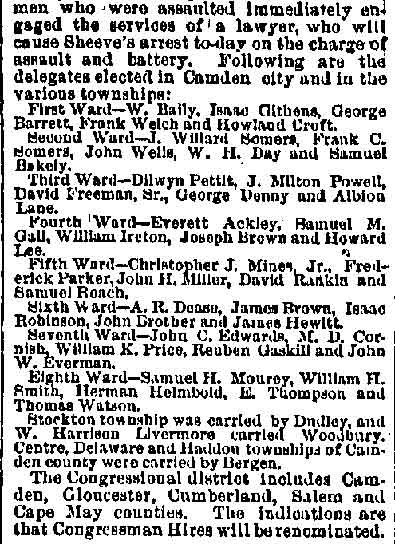
During the voting at the Fourth ward polls Policeman Ikey Scheeve got into an altercation with two men named Richmond and Walters. It is alleged that he used a blackjack without provocation. The two men who were assaulted immediately engaged the services of a lawyer, who will cause Sheeve’s arrest to-day on the charge of assault and battery. Following are the delegates elected in Camden city and in the various townships:
First Ward—W. Baily, Isaac Githens, George Barrett, Frank Welch and Howland Croft.
Second Ward—J. Willard Somers, Frank C. Somers, John Wells, W. H. Day and Samuel Bakely.
Third Ward—Dilwyn Pettit, J. Milton Powell, David Freeman, Sr., George Denny and Albion Lane.
Fourth Ward—Everett Ackley, Samuel M. Gall, William Ireton, Joseph Brown and Howard Lee.
Fifth Ward—Christopher J. Mines, Jr., Frederick Parker, John H. Miller, David Rankin and Samuel Roach.
Sixth Ward—A. R. Dease, James Brown, Isaac Robinson, John Brother and James Hewitt.
Seventh Ward—John C. Edwards, M. D. Cornish, William K. Price, Reuben Gaskill and John W. Everman.
Eighth Ward—Samuel H. Mourey, William H. Smith, Herman Helmbold, E. Thompson and Thomas Watson.
Stockton township was carried by Dudley, and W. Harrison Livermore carried Woodbury. Centre, Delaware and Haddon townships of Camden county were carried by Bergen.
The Congressional district includes Camden, Gloucester, Cumberland, Salem and Cape May counties. The indications are that Congressman Hires will be renominated.
Sewellites Coming to Trenton
Philadelphia Inquirer —
Eight Special Cars to Bring Up the Camden Cohorts To-Morrow.
CAMDEN, N. J., Jan. 12—Should the weather prove favorable Camden county will pay deserved honor to General William J. Sewell on Monday night at Trenton, after the caucus has decided upon him as the next United States Senator from New Jersey to succeed John R. McPherson. Camden is proud to have the mantle of high position placed upon the shoulders of one of her sons and will recognize it in a fitting manner by sending an organization that will reflect great credit upon the city and upon the gentleman whose name they bear. Eight special cars will leave Federal street depot Monday afternoon loaded down with members of the Sewell Association. They will be accompanied by Winkler’s celebrated Seventh Regiment and the City Bands. Upon both sides of each car long streamers bearing the name of the “W. J. Sewell Association, Camden, N. J.,” will be placed.
It is confidently expected to take at least 400 men, and this number may be increased before the start is made from the City Hall. Following are the members of the Executive Committee: W. J. Browning, George S. West, Harry C. Sharp, Walter Phillips, C. J. Mines, Jr., T. P. Varney, Charles Sayrs, J. O. Smith and Jesse Carey.
The special train will leave Camden at 3:20 P. M., and will return the same night, probably, leaving Trenton about 11:30, after the session is over.
The handsome banner presented to the association will be carried by Chief Standard-bearer Joseph Bromley, while William White, of the Fifth ward, will carry the handsome silk flag.
Funeral of Mrs. Moffett
Camden Daily Telegram —
City Officials Act as Pall Bearers for a Noble Woman.
The funeral of Mrs. Susan Moffett, wife of Janitor Charles C. Moffett, of the City Hall, was held this afternoon from the residence of her son, Henry Moffett, No. 602 Broadway. The services were conducted by Rev. J. R. Mace, pastor of the Broadway M. E. church, and interment was made in Harleigh Cemetery. A large number of Mrs. Moffett’s friends attended the funeral and followed her remains to the cemetery.
The pall bearers were ex-Mayor Jesse Pratt, City Clerk T. P. Varney, Supervisor of Highways John Blowe, Tax Receiver William A. Husted, City Engineer Levi Farnham and Assessor C. J. Mines. The body was laid out in a brown silk dress and reposed in a black cloth covered casket with silver trimmings. The floral tributes were numerous and consisted of twelve rosebuds representing twelve grandchildren, a “Gates Ajar,” from her son Henry; a pillow, from her three daughters; a bouquet, from the Broadway M. E. church; a setting sun, from her son Walter, and a sheaf of wheat, from the officials of the city.
Mayoralty Talk Over In Camden
Philadelphia Inquirer —

MAYORALTY TALK OVER IN CAMDEN
Election Not Far Off, But Leaders Cannot Agree on a Candidate
UP TOWN VS. DOWN
Committee of One Hundred Confident of Winning This Time—Democrats Divided
Camden’s municipal election, which will be held five weeks hence, promises to be one of the most hotly contested campaigns ever held in that city. The Committee of One Hundred, inspired by steady gains in the past, will make strenuous effort to wrest the control of municipal affairs from the Republicans. The prospects for their success seem brighter than in any previous campaign. A Mayor, Recorder and ten Councilmen are to be elected. The ordinances cutting off the fees of city officials will probably be passed in time to affect the officials elected this spring.
Although the election is not far distant the Republican leaders cannot agree upon a candidate for Mayor.
John Campbell, Jr., a wealthy real estate dealer, was urged to accept the nomination, and petitions were being circulated amongt he [sic] business men in his favor, but he announced yesterday that he would not stand.
City Clerk Varney and Street Supervisor John Blowe want a candidate from the lower section of the city, where the big Republican majorities are returned. Ex-Potmaster [sic] Henry B. Wilson, a coal dealer of Kaighn’s avenue, is the leading down-town candidate. City Counsel J. Willard Morgan is said to favor his candidacy. Harry Wolfe, Director of the Board of Freeholders, is looming up as a down-town candidate. He is backed by City Assessor Chris J. Mines, who aspires to be something more than a ward leader.
Mayor Westcott, who has had two terms, will not be a candidate for renomination. Isaac Doughten, the fearless foreman of the present grand jury, declines to stand as a candidate.
An effort is also being made to bring out R. H. Reeve, of the Second ward, for the Republican nomination for Mayor. He was a candidate for City Treasurer on the Committee of One Hundred ticket two years ago. It is claimed that he can divert some of the reform vote to the Republican ticket.
As the Committee of One Hundred name their candidates in secret conclave, but little is known of their plans. Either Cooper B. Hatch or Lewis H. Mohrman may head their ticket. Hatch came near defeating Mayor Westcott three years ago. Mohrman is the Reform leader in Council. Both are from the Second ward. Ex-Senator Maurice Rogers, of the Fifth ward, would like to head the Reform ticket.
The Democrats are split into two factions, the Regular and the County Democracy, and these are again divided on the question of making a hopeless fight with a straight ticket or indorsing the Committee of One Hundred nominees with the prospect of winning.
There will be a warm contest for the Republican nomination for City Recorder, which is to become a salaried position. The Councilmanic contests are still far from being settled.
Camden Political Chat
The Committee of One Hundred has certiorarled the ordinance creating two new precincts in the Fourth ward. The writ is returnable on February 19. Copies were served on City Clerk Varney and the County Board of Elections yesterday.
The County Board of Elections made several changes yesterday in precinct election boards. Secretary Fitzgerald called attention to precinct boards filling vacancies without notifying the County Board. The matter will be investigated.
Committee of One Hundred challengers started in yesterday to canvass for the spring election.
The Registry Boards will sit on next Tuesday, and again on the 18th instant.
The Sixth Ward Republican Club has indorsed Justice Charles M. Baldwin for the Republican nomination for Recorder.
Friends of Councilman Jesse C. Bond, of the First ward, want him to accept renomination on the Committee of One Hundred ticket.
The First Ward Republican Club has indorsed the candidacy of Joseph Potter for City Council. He also has the support of the Camden Republican Club. He was defeated for re-election as a Councilman last spring.
New Republican Executive Committee
Philadelphia Inquirer —
The new Republican County Executive Committee, which will control the party machinery in Camden county for the coming year, was named yesterday by William J. Browning, I. W. Nicholson and John Cherry, chairmen of the county conventions held on Wednesday. There are few changes in the committee, which is made up as follows: Camden—First ward, Joseph Burt; Second, J. Willard Morgan; Third, Harry C. Sharp; Fourth, Caleb Williams; Fifth, C. J. Mines, Jr.; Sixth, T. P. Varney; Seventh, Fred W. George; Eighth, James O. Smith; Ninth, Edwin Hillman. Stockton—First ward, Charles Hope; Second, George W. Miles; Third, Samuel Jaquillard. Gloucester City—First ward, D. M. Anderson; Second, Harry Reeves. Merchantville, M. B. Rudderow; Delaware township, William Graff; Gloucester township, Willard P. Gibbs; Centre township, Samuel Bettle; Haddon township, A. W. Clements; Pensauken, I. W. Hatch; Winslow, Josiah Norcross; Waterford, Joseph Layer. The committee will meet for organization next Saturday.
The Paul Woodward Murder Case
to
On October 1, 1902 Paul Woodward murdered two young boys by giving them poison. Frank T. Lloyd, then Camden County prosecutor, was responsible for leading the investigation and prosecuting the case. Woodward was arrested on October 4, 1902, and was quickly indicted on murder charges. J. Wesley Sell was Camden County’s sheriff in October of 1902, nearing the end of his term. Sheriff Sell was succeeded as Sheriff on November 12, 1902 by Christopher J. Mines Jr., which coincidentally was the first day of Paul Woodward’s trial, before Judge Charles G. Garrison. Paul Woodward was found guilty of murder in the first degree, and Judge Garrison sentenced him to death by hanging. Woodward was executed on January 7, 1903 at the Camden County Jail, with Sheriff Mines supervising.
People mentioned in the coverage below: joseph jennings — jennings’ third regiment band — frank t. lloyd — Dr. William S. Jones — william d. hart — dr. paul n. litchfield — F. Morse Archer — john foster — john painter — john cherry — isaac toone — Paul Woodward — george m. beringer — Charles G. Garrison — J. Wesley Sell — Christopher J. Mines Jr. — frederick a. rex — J. Frederick Voigt — george f. kappel — Isaac Toy — harry s. scovel — John S. Smith — O. Glen Stackhouse — Hugh Boyle — George H. Stineford Sr. — Frank S. Albright — Thomas Walton — Dr. William H. Iszard
Other people involved in this case: John Coffin — W. Price Jennings — Mrs. Edith Barber — Rev. C. A. Adams — Rev. John Lyell — Rev. William H. Fishburn — Rev. Gilbert Underhill — Rev. John Warnock — Harry Bowen — Joseph Simpkins — Ann Somers — William May — Lillian Martin — James Sheiding — Harry H. Robinson — Edwin Hillman — William Robinson — George Asay — William Powell — William Anderson — Charles Eiley — Thomas J. Atkinson — Wilson English — Harry Avis — George H. Stineford Sr. — John M. Hyde — William Heggan — John St. Clair — Charles S. Hess — William Rex — Daniel J. Horgan — Isaac Siebert — W. Wilmer Collins, Druggist — Major Edward Coffin — William Coffin — William Coffin Jr. — Kingston Coffin — Fayetta Jennings — Charles May — Mary Eiler — William F. Smith — Lee Hubert — Maurice Daniels — Thomas Woodward — Bella Woodward — James Bland — James Morrisey — Samuel Paul — Fred George
Woodward to Go to Gallows on January 7
Philadelphia Inquirer —
Camden Murderer Hears His Doom With a Smile, Then Curses Wildly
VISITED BY PARENTS
They Tell the Prisoner an Effort to Secure Life Imprisonment Will Be Made
Justice Garrison in Camden yesterday sentenced Paul Woodward to be hanged on January 7 for the murder of John Coffin and Walter Price Jennings near Haddon Heights on October 1.
Smiled, Then Swore
When sentence was pronounced Woodward smiled. As Sheriff Mines escorted him across “the bridge of sighs” he uttered vile curses and said that everybody connected with the case was a liar and that he was innocent. The prisoner’s counsel withdrew the motion for a new trial. The death watch will be placed on duty to-morrow.
Visited by Parents
Yesterday afternoon the condemned man was visited by his father and mother, who buoyed him up with the statement that every effort will be made to have the Court of Appeals commute his sentence to life imprisonment. So far the young murderer has refused to have a spiritual adviser.
Judge Garrison named the following as the court jury to attend the execution: Patrick Harding, Frank S. Albright, William J. Paul, Thomas Walton, D[avid] E. Barry, Edward Wilcox, Drs. William H. Iszard, J. F. Leavitt, William H. Knowlton, William Miles and George H. Chapman.
Murderer Given Talking Machine
Philadelphia Inquirer —
Woodward, Condemned Boy Slayer, Operates Phonograph in the County Jail
IS HAVING LOTS OF FUN
Familiar Strains Ring Through the Cells to Youthful Prisoner’s Great Delight
Paul Woodward, sentenced to be hanged on January 7 in the Camden jail, asked permission of Sheriff Mines to have a talking machine in “Hangman’s Row” so that his fellow-prisoners might not be annoyed by his attempts to perform on a whistle and harmonica.
The request was granted. Last night the strains of “Lead, Kindly Light,” and “Abide With Me,” followed by a number of Sousa’s marches rang through the jail. The prisoners joined in the chorus of the songs. The condemned man got a whole lot of delight out of the phonograph, which he manipulated until a late hour.
Murderer Woodward Unconcerned
Philadelphia Inquirer —
Paul Woodward, who next week will be hanged for murdering little John Coffin and W. Price Jennings, spent the greater part of yesterday in his cell at the Camden county jail reading his Bible. While apparently unconcerned, he is being closely watched to prevent him from committing suicide. Sheriff Mines yesterday sent out invitations to the execution, January 7.
Unconcerned at Death’s Approach
Philadelphia Inquirer —
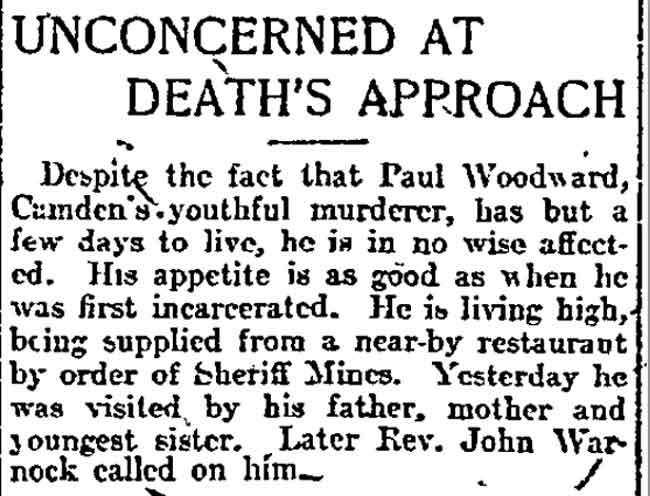
Despite the fact that Paul Woodward, Camden’s youthful murderer, has but a few days to live, he is in no wise affected. His appetite is as good as when he was first incarcerated. He is living high, being supplied from a near-by restaurant by order of Sheriff Mines. Yesterday he was visited by his father, mother and youngest sister. Later Rev. John Warnock called on him.
“I’ll Be a Dead One”—Woodward
Philadelphia Inquirer —
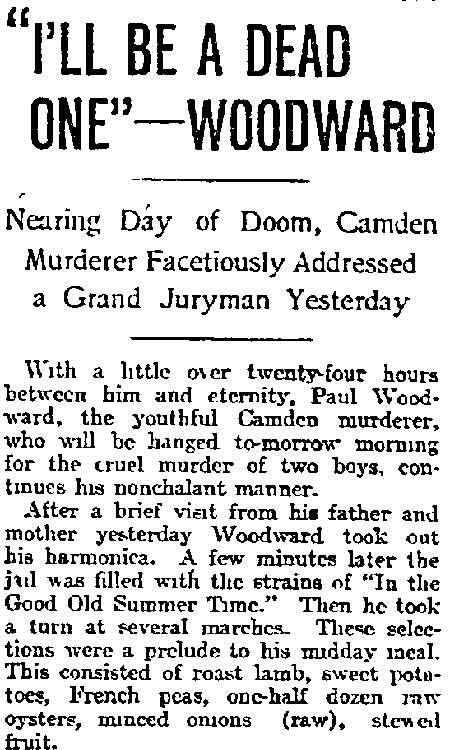
Nearing Day of Doom, Camden Murderer Facetiously Addressed a Grand Juryman Yesterday
With a little over twenty-four hours between him and eternity, Paul Woodward, the youthful Camden murderer, who will be hanged to-morrow morning for the cruel murder of two boys, continues his nonchalant manner.
After a brief visit from his father and mother yesterday Woodward took out his harmonica. A few minutes later the jail was filled with the strains of “In the Good Old Summer Time.” Then he took a turn at several marches. These selections were a prelude to his midday meal. This consisted of roast lamb, sweet potatoes, French peas, one-half dozen raw oysters, minced onions (raw), stewed fruit.
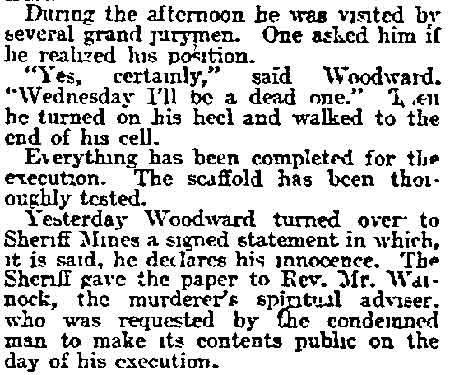
During the afternoon he was visited by several grand jurymen. One asked him if he realized his position.
“Yes, certainly,” said Woodward. “Wednesday I’ll be a dead one.” Then he turned on his heel and walked to the end of his cell.
Everything has been completed for the execution. The scaffold has been thoroughly tested.
Yesterday Woodward turned over to Sheriff Mines a signed statement in which, it is said, he declares his innocence. The Sheriff gave the paper to Rev. Mr. Warnock, the murderer’s spiritual adviser, who was requested by the condemned man to make its contents public on the day of his execution.
Woodward’s Nerve Fast Leaving Him
Philadelphia Inquirer —
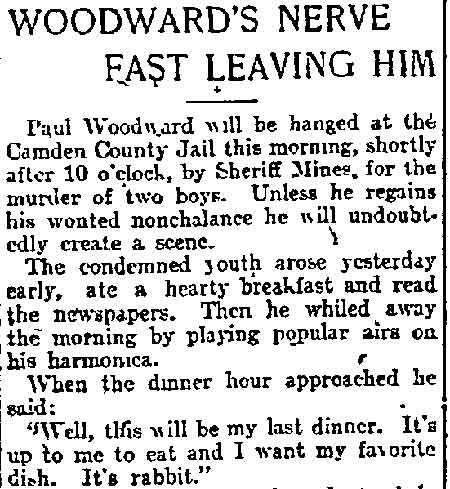
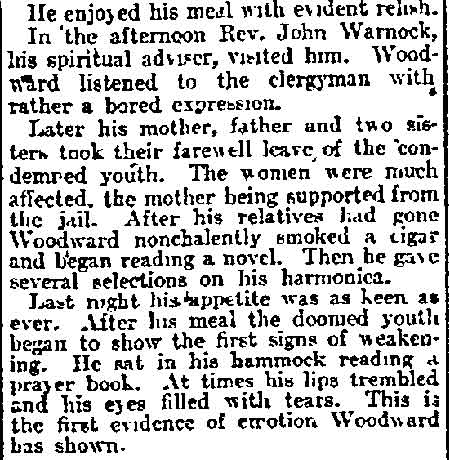
Paul Woodward will be hanged at the Camden County Jail this morning, shortly after 10 o’clock, by Sheriff Mines, for the murder of two boys. Unless he regains his wonted nonchalance he will undoubtedly create a scene.
The condemned youth arose yesterday early, ate a hearty breakfast and read the newspapers. Then he whiled away the morning by playing popular airs on his harmonica.
When the dinner hour approached he said:
“Well, this will be my last dinner. It’s up to me to eat and I want my favorite dish. It’s rabbit.”
He enjoyed his meal with evident relish.
In the afternoon Rev. John Warnock, his spiritual adviser, visited him. Woodward listened to the clergyman with rather a bored expression.
Later his mother, father and two sisters took their farewell leave of the condemned youth. The women were much affected, the mother being supported from the jail. After his relatives had gone Woodward nonchalantly smoked a cigar and began reading a novel. Then he gave several selections on his harmonica.
Last night his appetite was as keen as ever. After his meal the doomed youth began to show the first signs of weakening. He sat in his hammock reading a prayer book. At times his lips trembled and his eyes filled with tears. This is the first evidence of emotion Woodward has shown.
Woodward Hanged To-Day
Wilkes-Barre Times —
CAMDEN, N. J., Jan. 7.—Paul Woodward, the youthful murderer of the boys, John Coffin and W. Price Jennings, was hanged at 10:01 this morning.
Sheriff Christopher J. Mines conducted the execution, which was his first, with decency and dispatch.
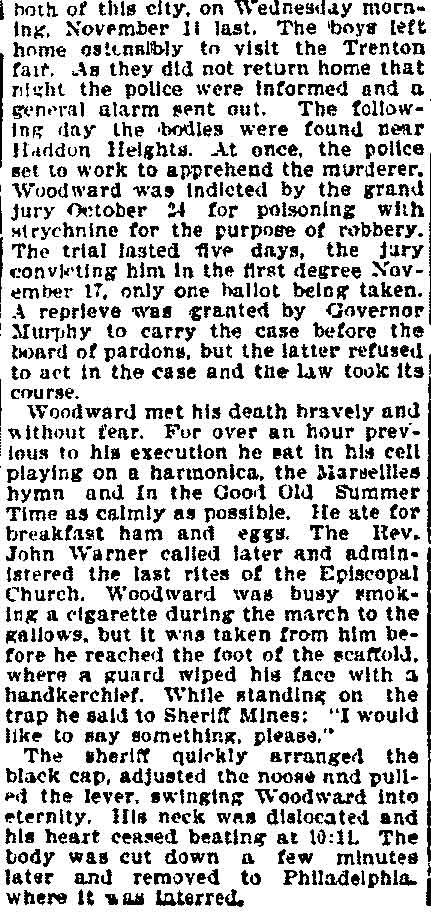
The crime for which Paul Woodward forfeited his life was the murder of two boys, John H. Coffin, and W. Price Jennings, aged 11 and 14 years, respectively. The former was the son of Wm. Coffin, division freight agent of the Pennsylvania railroad company and the latter of Joseph Jenkins, the well known leader of the Third Regiment band. [The line or lines joining crop 1 to crop 2 are not in the crops.] both of this city, on Wednesday morning, November 11 last. The boys left home ostensibly to visit the Trenton fair. As they did not return home that night the police were informed and a general alarm sent out. The following day the bodies were found near Haddon Heights. At once, the police set to work to apprehend the murderer. Woodward was indicted by the grand jury October 24 for poisoning with strychnine for the purpose of robbery. The trial lasted five days, the jury convicting him in the first degree November 17, only one ballot being taken. A reprieve was granted by Governor Murphy to carry the case before the board of pardons, but the latter refused to act in the case and the law took its course.
Woodward met his death bravely and without fear. For over an hour previous to his execution he sat in his cell playing on a harmonica, the Marseilles hymn and In the Good Old Summer Time as calmly as possible. He ate for breakfast ham and eggs. The Rev. John Warner called later and administered the last rites of the Episcopal Church. Woodward was busy smoking a cigarette during the march to the gallows, but it was taken from him before he reached the foot of the scaffold, where a guard wiped his face with a handkerchief. While standing on the trap he said to Sheriff Mines: “I would like to say something, please.”
The sheriff quickly arranged the black cap, adjusted the noose and pulled the lever, swinging Woodward into eternity. His neck was dislocated and his heart ceased beating at 10:11. The body was cut down a few minutes later and removed to Philadelphia, where it was interred.
Paul Woodward Goes to Gallows
Philadelphia Inquirer —
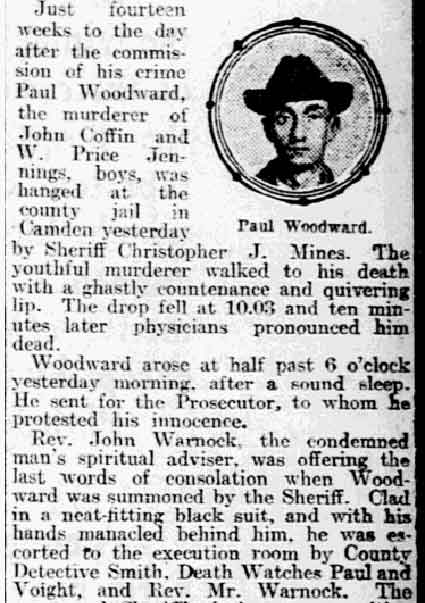
Murderer of Two Camden Boys Was Executed Without Creating a Scene
DECLARED HIS INNOCENCE
Floral Offerings From the Family, Body Was Interred in a Philadelphia Cemetery
Paul Woodward.
Just fourteen weeks to the day after the commission of his crime Paul Woodward, the murderer of John Coffin and W. Price Jennings, boys, was hanged at the county jail in Camden yesterday by Sheriff Christopher J. Mines. The youthful murderer walked to his death with a ghastly countenance and quivering lip. The drop fell at 10.03 and ten minutes later physicians pronounced him dead.
Woodward arose at half past 6 o’clock yesterday morning, after a sound sleep. He sent for the Prosecutor, to whom he protested his innocence.
Rev. John Warnock, the condemned man’s spiritual adviser, was offering the last words of consolation when Woodward was summoned by the Sheriff. Clad in a neat-fitting black suit, and with his hands manacled behind him, he was escorted to the execution room by County Detective Smith, Death Watches Paul and Voight, and Rev. Mr. Warnock. The court and Sheriff’s juries were awaiting with bared heads. Sheriff Mines stood near the foot of the gallows as the prisoner entered the door leading to the jail corridor.
Woodward, pale as death, had just a moment’s time before Sheriff Mines took him by the arm, led him up the thirteen steps to the platform, adjusted the black cap, knotted the rope, and a moment later the trap opened. Woodward shot down until his feet nearly touched the floor. The rope twisted and the body swung around for a few minutes. The physicians present said death had been painless. The body was taken down at 10.42, placed in charge of undertakers and deposited in a handsome casket, on the lid of which was
PAUL A. WOODWARD, Died January 7th, 1903, In his 25th year.
In a cab the family followed the hearse to a Philadelphia cemetery, where interment was made.
Just before the execution took place two floral pieces were taken into the jail to be placed on the casket. It was reported that they were sent by Woodward’s family.
One was a pillow of carnations and roses having in the centre in immortelles the word “Innocent.”
The other was a palm-shaped arrangement of greens and white carnations, tied with a satin ribbon on which were the words “Too Soon.”
Those who witnessed the hanging were surprised at the cool manner in which the murderer conducted himself just before the execution. He had been fully expected to make a scene.
The statement sworn to by Woodward before J. Fred George, notary public, was given out after the execution. It was a lengthy document. The youth admitted meeting young Coffin and Jennings, but said his original intention was not robbery. The two boys and he, he said, had agreed to rob several houses in the country.
The boys weakened and refused to be a party to the robberies. Then, according to the statement, he decided to kill the boys for self-protection. He said he had provided himself with pies in advance and the poison was placed in them.
Two other statements were given out by Woodward. Both were rambling stories and contradictory.
Camden Elks Moving on City of Baltimore
Philadelphia Inquirer —
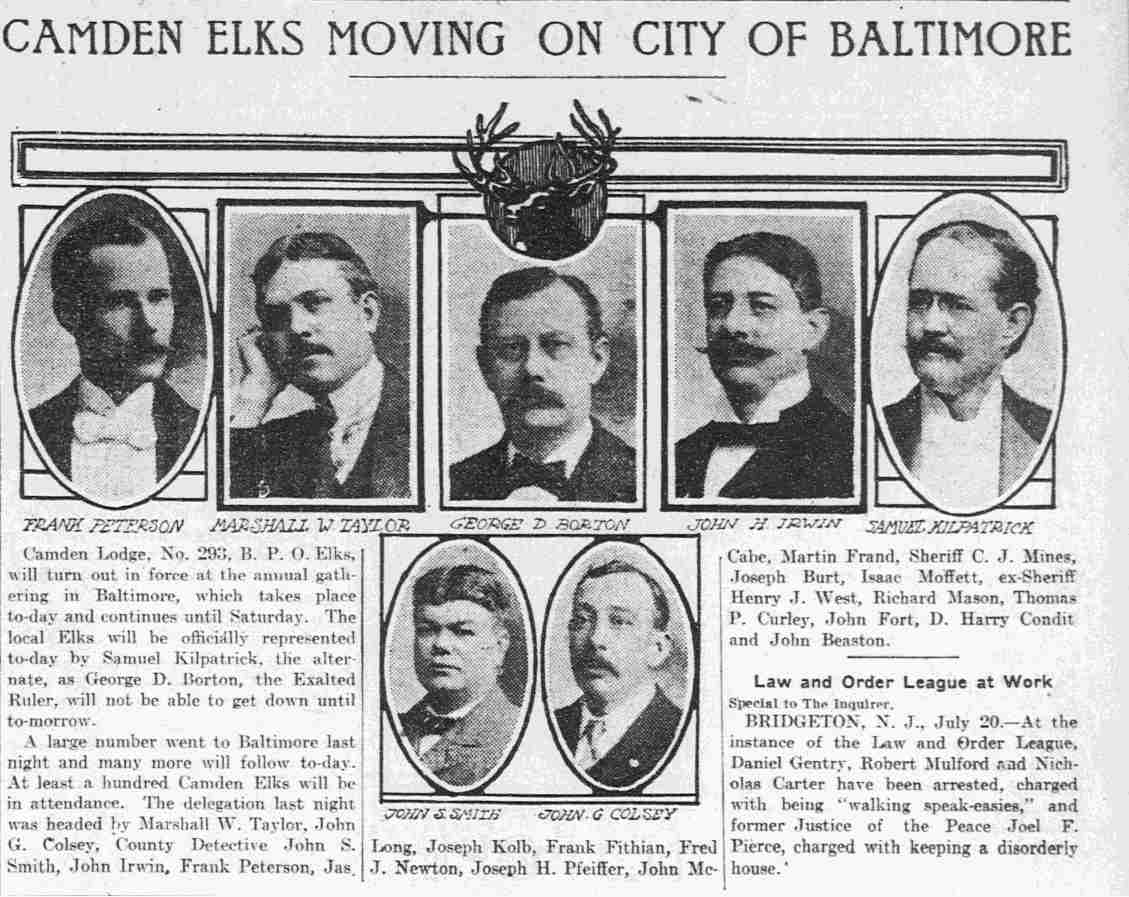
Camden Lodge, No. 293, B. P. O. Elks, will turn out in force at the annual gathering in Baltimore, which takes place to-day and continues until Saturday. The local Elks will be officially represented to-day by Samuel Kilpatrick, the alternate, as George D. Borton, the Exalted Ruler, will not be able to get down until to-morrow.
A large number went to Baltimore last night and many more will follow to-day. At least a hundred Camden Elks will be in attendance. The delegation last night was headed by Marshall W. Taylor, John G. Colsey, County Detective John S. Smith, John Irwin, Frank Peterson, Jas. Long, Joseph Kolb, Frank Fithian, Fred J. Newton, Joseph H. Pfeiffer, John McCabe, Martin Frand, Sheriff C. J. Mines, Joseph Burt, Isaac Moffett, ex-Sheriff Henry J. West, Richard Mason, Thomas P. Curley, John Fort, D. Harry Condit and John Beaston.
Portrait captions: FRANK PETERSON — MARSHALL W. TAYLOR — GEORGE D. BORTON — JOHN H. IRWIN — SAMUEL KILPATRICK — JOHN S. SMITH — JOHN G. COLSEY.
Law and Order League at Work
Special to The Inquirer.
BRIDGETON, N. J., July 20.—At the instance of the Law and Order League, Daniel Gentry, Robert Mulford and Nicholas Carter have been arrested, charged with being “walking speak-easies,” and former Justice of the Peace Joel F. Pierce, charged with keeping a disorderly house.
Camden Elks Hold a Lodge of Sorrow
Philadelphia Inquirer —
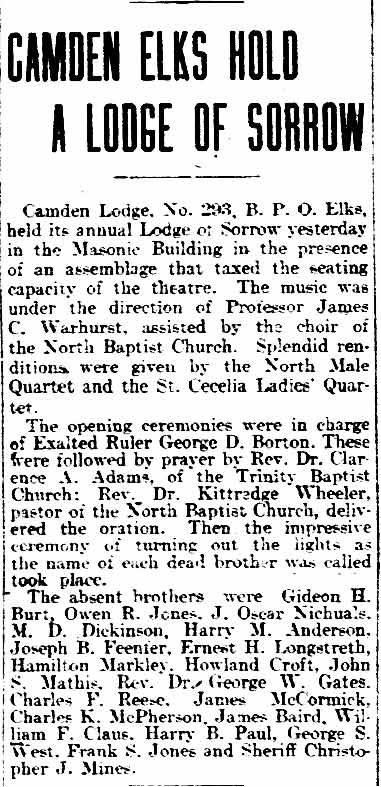
Camden Lodge, No. 293, B. P. O. Elks, held its annual Lodge of Sorrow yesterday in the Masonic Building in the presence of an assemblage that taxed the seating capacity of the theatre. The music was under the direction of Professor James C. Warhurst, assisted by the choir of the North Baptist Church. Splendid renditions were given by the North Male Quartet and the St. Cecelia Ladies’ Quartet.
The opening ceremonies were in charge of Exalted Ruler George D. Borton. These were followed by prayer by Rev. Dr. Clarence A. Adams, of the Trinity Baptist Church; Rev. Dr. Kittredge Wheeler, pastor of the North Baptist Church, delivered the oration. Then the impressive ceremony of turning out the lights as the name of each dead brother was called took place.
The absent brothers were Gideon H. Burt, Owen R. Jones, J. Oscar Nicholas, M. D. Dickinson, Harry M. Anderson, Joseph B. Feenier, Ernest H. Longstreth, Hamilton Markley, Howland Croft, John S. Mathis, Rev. Dr. George W. Gates, Charles F. Reese, James McCormick, Charles K. McPherson, James Baird, William F. Claus, Harry B. Paul, George S. West, Frank S. Jones and Sheriff Christopher J. Mines.
Camden News Notes
Philadelphia Inquirer —
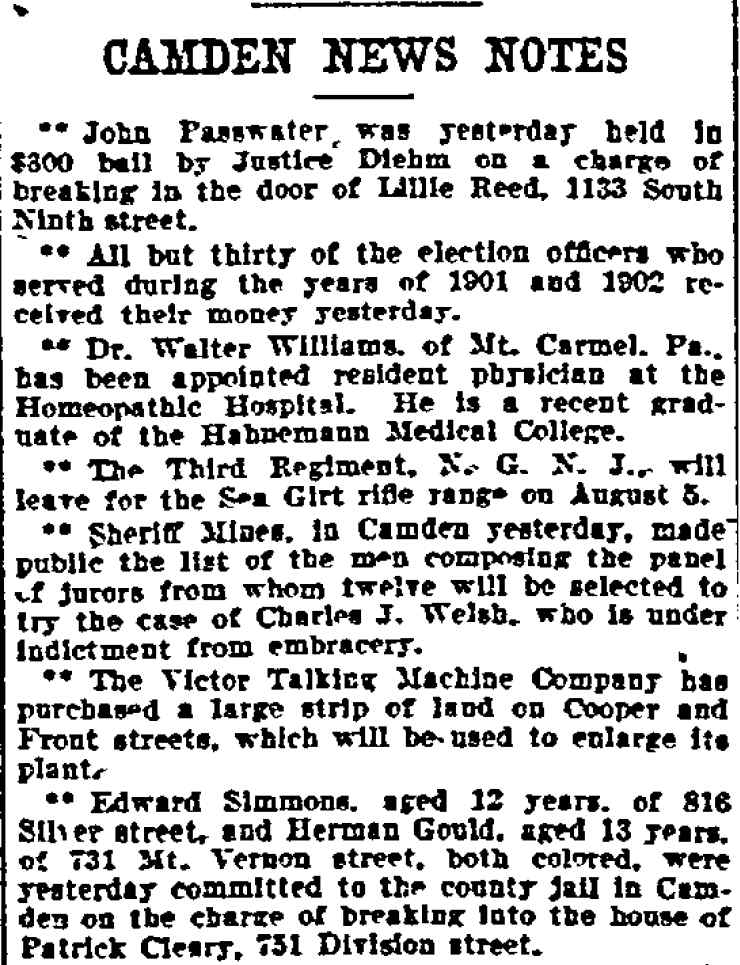
* John Passwater was yesterday held in $300 bail by Justice Diehm on a charge of breaking in the door of Lillie Reed, 1133 South Ninth street.
* All but thirty of the election officers who served during the years of 1901 and 1902 received their money yesterday.
* Dr. Walter Williams, of Mt. Carmel, Pa., has been appointed resident physician at the Homeopathic Hospital. He is a recent graduate of the Hahnemann Medical College.
* The Third Regiment, N. G. N. J., will leave for the Sea Girt rifle range on August 5.
* Sheriff Mines, in Camden yesterday, made public the list of the men composing the panel of jurors from whom twelve will be selected to try the case of Charles J. Welsh, who is under indictment from embracery.
* The Victor Talking Machine Company has purchased a large strip of land on Cooper and Front streets, which will be used to enlarge its plant.
* Edward Simmons, aged 12 years, of 816 Silver street, and Herman Gould, aged 13 years, of 731 Mt. Vernon street, both colored, were yesterday committed to the county jail in Camden on the charge of breaking into the house of Patrick Cleary, 731 Division street.
When G.O.P. Battled G.O.P.
Camden Courier-Post —
Typical Convention Rumpus Stirred ‘Regular’ and ‘True’ Republicans as Gibbs and Morgan Were Nominated for Sheriff in ‘81
(Another in a series of articles on Camden affairs and personalities of yesteryear)
By BEN COURTER
Rival factions in the political conventions of long ago were more bitter toward one another than toward the common foe. So-called “rump” conventions were by no means exceptions. By “rump” was meant merely those who refused to play with the regulars and who set up the nominations, as did the Bull Moose on the national scale in the historic scrap of 1912 which resulted in the three-cornered battle of Wilson, Roosevelt and Taft, giving the Princeton professor the start that was to make him a world figure. Factions we still have, of course, and it is quite proper, since too much regularity often breeds party decay. But present-day political methods are certainly lacking in the spectacular rumpuses that stirred the rank and file in the period when delegates met and made their nominations.
In a recent article allusion was made to the Democratic convention of September 20, 1878, when Nathan T. Stratton, of Millville, was nominated for Congress by the Democrats in the midst of downright fisticuffs, when “liar” and “hypocrite” and worse was hurled about the hall.
Lest it may be assumed the party of Jefferson and Jackson only was given to such methods, it is fitting to give a picture on the other side of the political house. Dr. William H. Iszard’s inexhaustible scrap book, loaned me by his son, former Assemblyman Iszard comes across with a copy of a tabloid political sheet, “The True Republican,” which gives a recital of a battle royal in the G.O.P. ranks which will be of interest to some old-timers I know are still about.
Rival Conventions
That was the convention to nominate a sheriff called at Gloucester City Hall on Saturday, October 8, 1881, where we find the redoubtable Colonel James Matlack Scovel once more a moving factor, but this time in the ranks of the “regular Republicans” or at least so they called themselves as opposed to the “rump” set up by a rival group. Christopher J. Mines, long Fifth ward leader and later sheriff, apparently had been selected as temporary chairman with William A. Husted, who died last year well in his 70’s, as secretary. But when that part of the delegation marched up to city hall, like the famed king’s horses—they marched down again.
As a matter of fact, not much marching was done in the hall—for it was asserted by the “true Republicans” that when they essayed to enter the portals they found Colonel Scovel and Henry M. Jewett, father of Harry Jewett, a Camden newspaperman of the long ago and for years later Jersey editor of the Inquirer, in command. More, it was charged “people representing the worst elements of society” were on guard and presented a phalanx which even the huskies of the opposing force could not break. Mines was strong-armed by the minions of Scovel and Jewett and there was so much hooting and yelling and cussin’ that the “true” part of the outfit walked out, all 29 of them, over to Moss’ hall where they proceeded to carry on their convention to their own taste.
And all 29 of these valiant Republicans voted for Eli B. Morgan as their candidate for sheriff. You old timers will be interested in recalling these delegates who refused to kowtow to ‘Colonel Jim.’ In the Third ward there was James M. Lane, Charles S. Cotting and George Martin, in the Fourth, Husted, the Sixth, C. C. Smith, Thad Varney, Charles A. Sawyer; in the Seventh, Stephen Walters, Charles Lederman, William Simpson; in Gloucester, John W. Wright, David Anderson, Frank Mills, Robert Lafferty, Richard Allen, Jesse Daisey, Samuel Wood; in Haddon, Charles M. Macready, Elwood J. Haines: in Delaware, William Brick, William Graff, Isaac Coles; in Merchantville, Matthias Homer, William Naylor, and in Center, James Davis, Garrett Patton and Gilbert Shaw.
Hot Statement
These “true Republicans” in a statement to the party rank and file, under the Algeresque title of “Now or Never,” scathingly said: “It becomes the duty of every Republican voter of Camden county, who has the future interest of the party at heart, to administer a severe and lasting rebuke to all candidates who employ the element and encourage the means that were used in controlling the Sheriff’s convention at City Hall, Gloucester City. It discounted anything within the memory of the oldest Democrat inhabitant. What with Col. Joseph Nichols urging the crowd to go elsewhere and nominate Gibbs, and the immaculate Billy Warner of the Fifth ward ordering them to burst the door in, coupled with the commanding voice of that great patriot and life-long Republican, James M. Scovel, alias Mountain Partridge, together with the curses and threats from John Furey, Jack Quigley, Pud Young, Bill Derr, ‘Tar Heel’ Jim Hayes, the able city solicitor, and a gang of Philadelphia roughs, a beautiful spectacle was presented.”
The “Gibbs” mentioned was Theodore B. Gibbs who long lived in the white mansion on the banks of Clementon lake and whose ancient grist mills ground the grain for farmers from miles around. None in the county was held in higher esteem and in later years most of the valiant 29 were among his closest friends, unnecessary proof the political animosities are, as a rule, not very enduring. Gibbs was nominated by the “regular” Convention which ousted the 29 and a mighty hot shrievalty campaign ended on November 10 with his ejection, in spite of the “now or never” demand of his opponents headed by Eli Morgan.
The latter was a real estate man, son of Randall Morgan, elected sheriff by a whisker over “Ham” Bitten in 1869, and brother of J. Willard Morgan, long a Republican chieftain. It was the elder Morgan who defeated Bitten, a rough and ready character nominated as a joke, by a narrow squeak.
In the shrievalty scrap of 1881. Gibbs received 5381 and Morgan, 1189. Angus Camerson, the Democratic candidate was given 4450 votes. Nor did the “true” nominees for coroner fare any better. Sam Bennett, William Thompson and Alexander Powell being defeated by ‘Doc’ John D. Leckner, Jacob Justice and William Duble.
But the “true” Republicans licked their wounds and most of them were ready to “yen their heads off” when Colonel Scovel in later campaigns made the welkin ring with his call from the rostrum to wallop the enemy. If you now come across any of the few actors of that period still in the flesh an allusion to that “spectacle” of half century ago will sure bring one big chuckle with the declaration “them was the days.”