Introduction
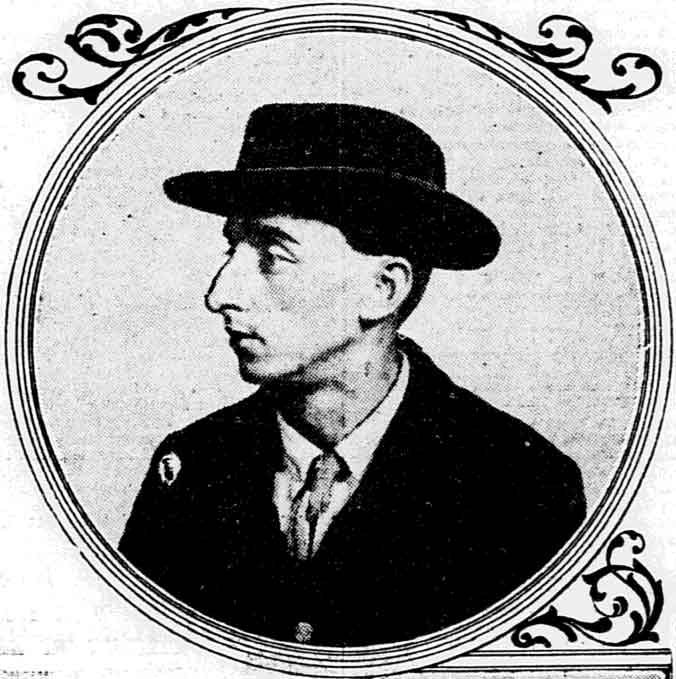
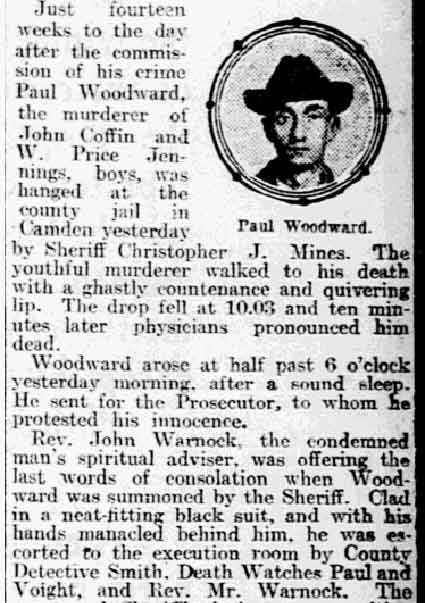
Portrait of Paul A. Woodward
[Portrait of Paul Woodward — drawn from life. No article text; portrait image only.]
PAUL A. WOODWARD, of 221 Benson Street, murdered two young boys by giving them poison on October 1, 1902. The son of Thomas and Bella Woodward, he was arrested, tried, convicted of the first degree murder of one of his victims, and was executed for his crime at the Camden County Jail on January 7, 1903. He was buried in Philadelphia.
The complete coverage of this incident from the Philadelphia Inquirer and other newspapers is presented below. Many leading figures in Camden’s legal, medical, law-enforcement, political and police circles were involved in this case to one extent or another.
Then as now, the media also sought to exploit the story beyond the mere reporting of the events of the day, and three articles from the Inquirer, one published just before the trial, and two published in February and March of 1903 are presented below as well. Perhaps, as one article speculated, Paul Woodward was a “degenerate.” Then again, maybe it was the cigarettes.
People Mentioned in the Coverage
- Joseph Jennings
- Jennings' Third Regiment Band
- Frank T. Lloyd
- Dr. William S. Jones
- William D. Hart
- Dr. Paul N. Litchfield
- F. Morse Archer Sr.
- John Foster
- John Painter
- John Cherry
- Isaac Toone
- George M. Beringer Sr.
- Charles G. Garrison
- J. Wesley Sell
- Christopher J. Mines Jr.
- Frederick A. Rex
- J. Frederick Voigt
- George Frederick Kappel
- Isaac Toy
- Harry S. Scovel
- Francis Ford Patterson Jr.
- John S. Smith
- Hugh Boyle
- Frank S. Albright
- Thomas Walton
- Dr. William H. Iszard
- George Henry Stineford
Philadelphia Inquirer — October 3, 1902
John Coffin, 11 years old, son of William Coffin, division freight agent of the Pennsylvania Railroad, and Price Jennings, 14 years old, son of Leader Joseph Jennings, of the Third Regiment Band, are missing from their homes and the Camden police have been asked to locate them.
They started for the Trenton fair Wednesday and failed to return. All intermediate points have been communicated with, but the lads have not been heard from.
Philadelphia Inquirer - October 4, 1902
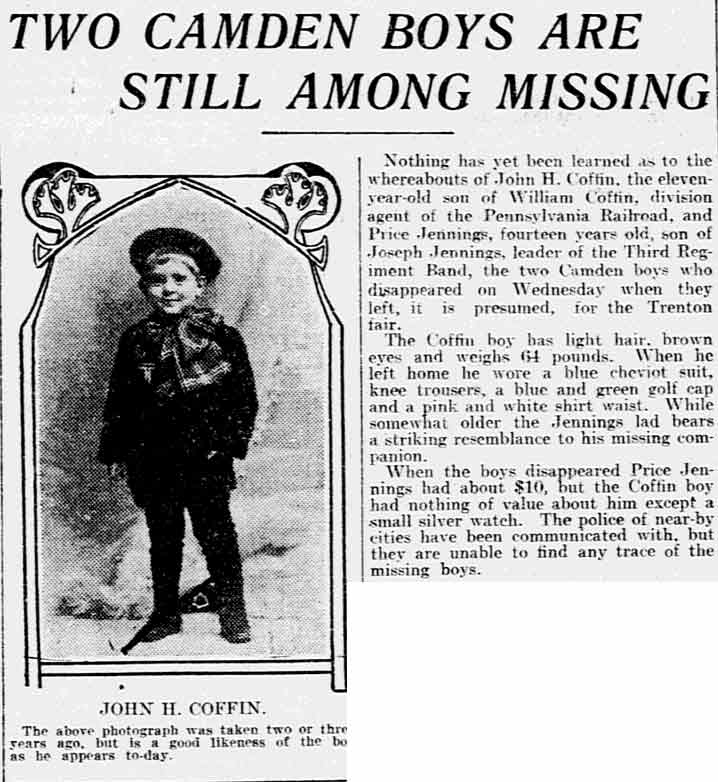
Nothing has yet been learned as to the whereabouts of John H. Coffin, the eleven-year-old son of William Coffin, division agent of the Pennsylvania Railroad, and Price Jennings, fourteen years old, son of Joseph Jennings, leader of the Third Regiment Band, the two Camden boys who disappeared on Wednesday when they left, it is presumed, for the Trenton fair.
The Coffin boy has light hair, brown eyes and weighs 64 pounds. When he left home he wore a blue cheviot suit, knee trousers, a blue and green golf cap and a pink and white shirt waist. While somewhat older the Jennings lad bears a striking resemblance to his missing companion.
When the boys disappeared Price Jennings had about $10, but the Coffin boy had nothing of value about him except a small silver watch. The police of near-by cities have been communicated with, but they are unable to find any trace of the missing boys.
Philadelphia Inquirer - October 5, 1902
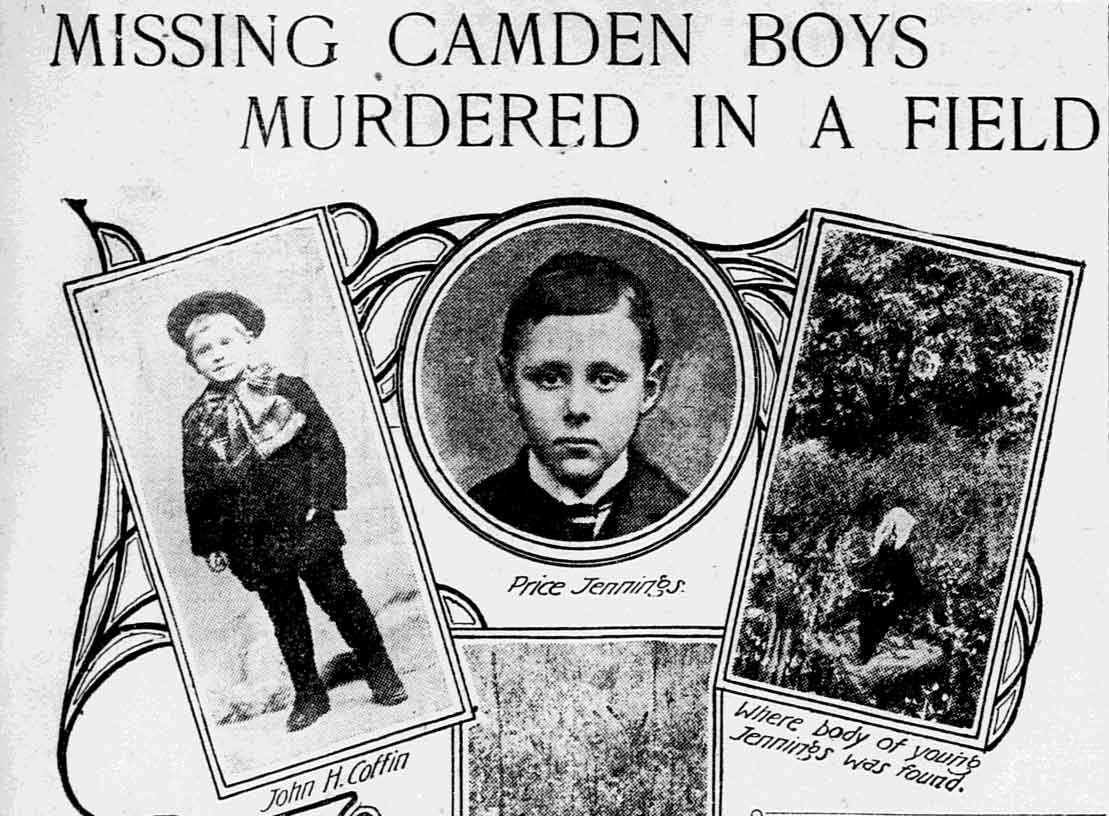
Young John Coffin and Price Jennings Believed to Have Been Poisoned—Companion Arrested and Committed to Jail
The discovery of their bodies cold in death, the victims of an atrocious double murder, yesterday solved the mystery surrounding the disappearance from their homes in Camden on Wednesday of John H. Coffin, the 11-year-old son of William Coffin, division freight agent of the Pennsylvania Railroad, and Price Jennings, his chum and playmate, the 13-year old son of Josephus Jennings, leader of Jennings' Third Regiment Band, of Camden.
Paul Woodward, 18 years old, a companion of both the boys, is charged with their murder and is locked up in the county jail awaiting the further action of the authorities. There are no evidences of external injuries and the only theory to which the police can attribute the cause of death is that the assassin of the boys administered poison to them, and it is along this line that County Physician Jones and Prosecutor Lloyd are conducting an investigation.
The details surrounding the atrocious crime makes it one the like of which has never been known in the criminal history of this section of the country. The youth of the boys, their heretofore relations of good companionship, and many other circumstances make of it an almost unparalleled crime, and while there is said to be every evidence of a motive for the murder, in the opinion of those who are in close touch with the case, it is an instance in which the work is that of a degenerate boy in whom all sense of right and wrong have long since been dead. Certain it is that the crime has stirred the people of Camden and vicinity to a feverish heat to which it has not been stirred since the days following the murder of Annie Leconey.
Found in a Field
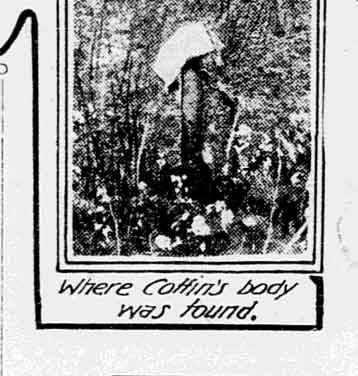
The bodies of both the lads were found yesterday morning in a field near the Haddon Heights Station of the Reading Railroad on what is known as the Lippincott farm, about a quarter mile from Station Avenue. The body of young Jennings was found lying in a clump of bushes and less than forty yards away lay the remains of Coffin. Both bodies were stiff and in a state of decomposition. Coffin's body was the first discovered, and it was not long after when that of his companion was found.
No sooner did the news of the discovery become known than the greatest excitement prevailed through the city of Camden and its suburbs. All sorts of rumors began to circulate, some of them hinting that the bodies were in a horribly mutilated condition and that the work was that of a negro. In a short time, however, whatever element of mystery there was about the case, so far as present indications go, was dissipated when the identification of the bodies was made and the arrest of young Woodward was accomplished soon afterwards.
Then the mystery began to clear somewhat. Both boys disappeared from their homes on Wednesday afternoon. When they failed to return that night the police were notified and a description of them was sent around the country adjacent to Camden and also to Philadelphia. Some persons said they had gone to Trenton to the fair, while others told of having seen them in the vicinity of Haddon Heights Station. Nothing came of these statements at the time, and meanwhile the boys failed to return home. Coffin's father was of the opinion that the boys had been kidnapped, but this theory was not held by the police.
First Body Discovered
Late Friday night, Clarence Kreuson, whose home is at Haddon Heights, and a friend of his, Frank Johnson, who lives in this city, were returning from an afternoon of blackbird shooting. While crossing the field they came across the body of a boy. It was lying in the bushes, half concealed, and when they made a closer examination they discovered that life was extinct. In alarm Kreuson and his companion ran to the home of A. H. Wood, near-by, and communicated their intelligence. Wood immediately sent a telephone message to Coroner Litchfield in Camden, apprising him of the discovery. That official, through some misunderstanding, thought it was a man named Brown who had been talking to him. He hitched up his horse and drove to Haddon Heights, but was unable to locate the body. He was also unable to locate anyone named Brown. Further investigation was, therefore, postponed until yesterday morning, when the Coroner again visited the scene and found the body in the bushes.
From the clothing worn it was thought at first it might be Coffin's, and after it had been brought to the Morgue, William Coffin, the lad's father, was sent for. He was accompanied by Kingston Jennings, elder brother of the other missing boy. Mr. Coffin when nerved to look at the remains, exclaimed, "My God, it's Price. Where is my boy. He must be found." The identification was then made complete by the dead boy's brother.
Meanwhile a number of persons had been going over the field where the body had been found in the search for clues that might lead to a discovery of the murderer of the boy, when one of them chanced across the remains of the other lad lying under a dead tree. This body was identified on the spot by Detective Curtis, of the Pennsylvania Railroad. The lad's body was also taken to the Morgue and laid on a slab alongside of his chum.
Police at Work
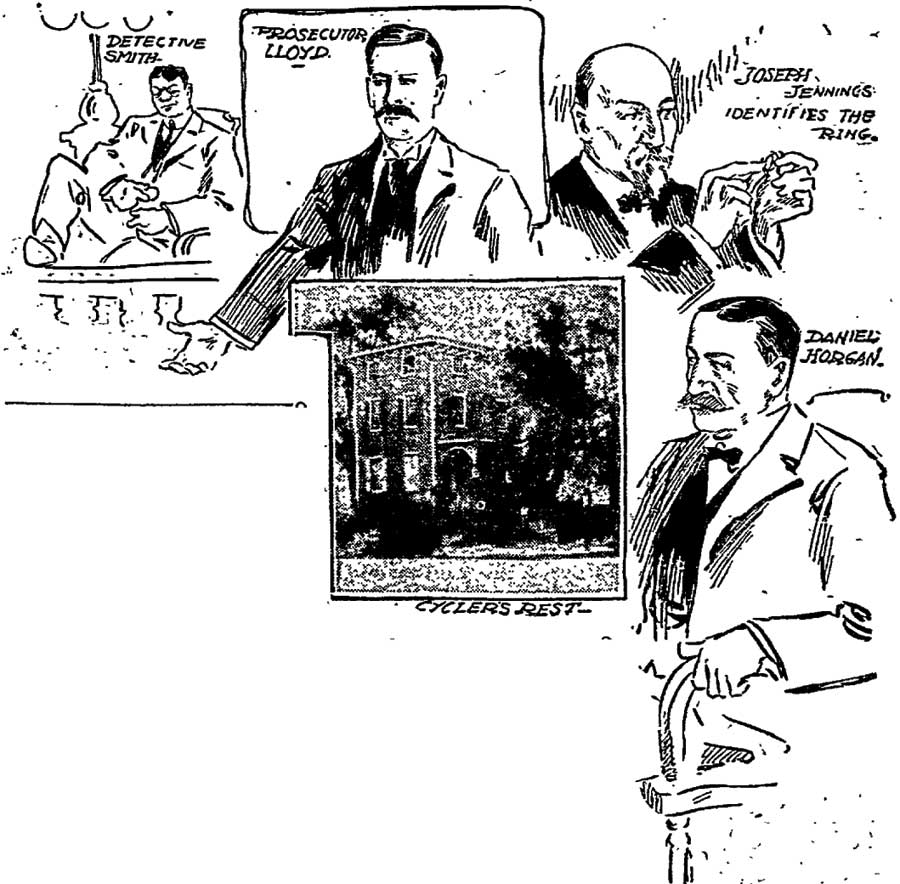
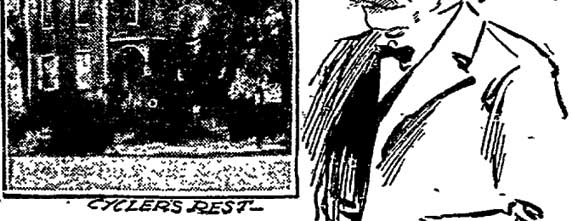
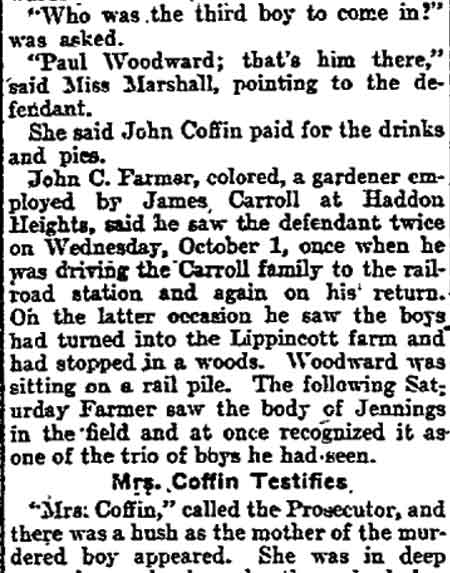
The police in the interim had not been idle, and after scouring the vicinity of the place where the bodies had been found, came across Lillian Martin, the 15-year-old daughter of J. Wilson Martin, who conducts a "Cyclers' Rest" at Collings avenue and the White Horse pike. She remembered having seen two boys answering the description of the dead lads in their place on Wednesday. They were accompanied by an older and a taller boy. Jennings seemed to have considerable money and purchased three pies and three bottles of soda water. After that they left the place and she never saw them again until she looked upon their bodies.
Prosecutor Frank Lloyd at once set to work, and Detective Hart was sent in search of young Woodward. Inquiry at his home, at 221 Benson street, brought the response that he was not at home. His mother learned what he was wanted for, and about 2 o'clock sent for Detective Hart and turned the boy over to him. She accompanied him to the Prosecutor's office and, talking to the newspaper reporters, said that beyond being addicted to the use of cigarettes Paul was a good boy. She persisted that he could not have committed the crime as he was home all of Wednesday, Thursday and yesterday until the afternoon, when he went to Philadelphia to visit relatives. What the police are reported to view with importance is a statement that the mother is also alleged to have made to the effect that on Wednesday he had bothered her a great deal about money for a hat and shoes. While the authorities will make no admission, it is intimated that the motive they ascribe for the crime is robbery, and that the fact that Jennings had $10 when he disappeared was what led to his murder, and the murder of the other little fellow followed as a necessity for hiding the crime, as well as to get possession of a silver watch he is said to have had.
Identified Woodward
After young Woodward was taken into the Prosecutor's office, besides the Prosecutor there were present Assistant Prosecutor F. Morse Archer, Court Stenographer Berry, Chief of Police Foster, of Camden; Chief of Police Linderman, of Merchantville, and Detectives Painter and Hart. In a few minutes Detective Cherry arrived with Lillian Martin. The latter had been cautioned not to say anything to anybody, either in or out of the room. She was inside for less than thirty seconds, and when she came out she is reported to have said that Woodward was the young man whom she had seen with the boys on Wednesday in her father's place. She was taken back a second and a third time, and after the latter, it is said, she told the detectives that she was certain he was the person. She then left for her home, where she resisted all attempts to interview her.
In the meantime Recorder Stackhouse issued a commitment for Woodward on the oath of Detective Cherry, charging the young man with the murder of Coffin. Jennings' name was not mentioned, as Coffin's answered the same purpose.
While this was going on County Physician Jones was holding an autopsy in the basement of the jail, where the morgue is located. A personal examination showed that there were no external marks of violence, and in order to clinch the result of the autopsy he summoned from Philadelphia Professors Copeland and Rosenberger, of the Jefferson Hospital. Dr. Copeland performed the autopsy, and was at work until nearly 6 o'clock, when it was announced that no results other than that death was not due to external injuries, had been accomplished.
Prosecutor Lloyd said: "There was a double murder. Of that much we are certain. Death was not due to external injuries. What we suspect you will have to conjecture. The organs of both the boys have been sent to a chemist for examination. More than that I cannot say, except that we have arrested Paul Woodward on suspicion and that he is charged with the murder. The same man that killed one of the boys no doubt killed the other. All I ask now is that judgment be suspended for a few days, when I believe all will be cleared up."
Woodward Visited Mr. Coffin
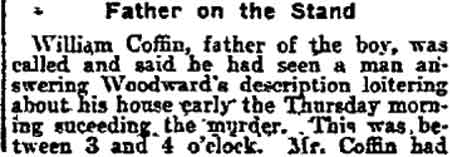
Mr. Coffin, whose home is at 305 North Third street, yesterday said: "It's an awful blow that has come to me and I hardly know what to say. It does seem to me that Paul Woodward exerted an evil influence over my boy. I remember now that on Thursday he came to the house and wanted me to hire him to look for John. He then said that he thought he could find him."
At the Woodward home it was stated that the mother and father of the boy had gone to Philadelphia. Charles May, a boarder, said there would be no trouble in proving that Paul was home all day of Wednesday, as well as the day following. He said that on each of those nights the boy had been in bed by 8 o'clock. This testimony, he said, would be corroborated by the boy's mother, father, sister and himself. The only time Paul was out of the house, he said, was when he went several errands for his mother.
Late yesterday afternoon Coroner Litchfield empaneled the following jury: David Kaighn, George Leathwhite, Isaac Toone, George J. Pechin, Elmer E. Cox and T. L. Bear. At 5 o'clock they viewed the remains, after which the bodies were sent to their respective homes. No date for the inquest has been fixed.
The stomach and other organs of both the youthful victims are in the possession of George M. Beringer, a druggist and chemist, at Fifth and Federal streets. Last night he said he had begun his examination, but it would take him probably a day or two more to complete his analysis.
Philadelphia Inquirer - October 6, 1902
Detectives Receive Description of Paul Woodward, Who Has Disappeared
TRACE OF WOODWARD LOST
Detectives Have Found Plenty of Evidence, However, That a Crime Was Committed
The search for Paul Woodward, the Camden youth suspected of the murder of John Coffin and Price Jennings, whose bodies were found near Haddon Heights last Thursday, has so far proved fruitless. The detectives are confident, however, that it is only a matter of a short time before Woodward is captured.
Information has been forwarded to the authorities of many States and to the police departments of all large cities giving Woodward's description, and it is expected that he will soon be apprehended.
More evidence of the guilt of the missing man was found yesterday. During the afternoon Detectives Smith and Stiles, of Camden, went to the Lippincott farm near Haddon Heights, where the boys were found, and there discovered indications that a struggle had taken place at the spot where the body of Jennings was found. The weeds and grass were trampled down in every direction.
Woodward Watched Coffin Home
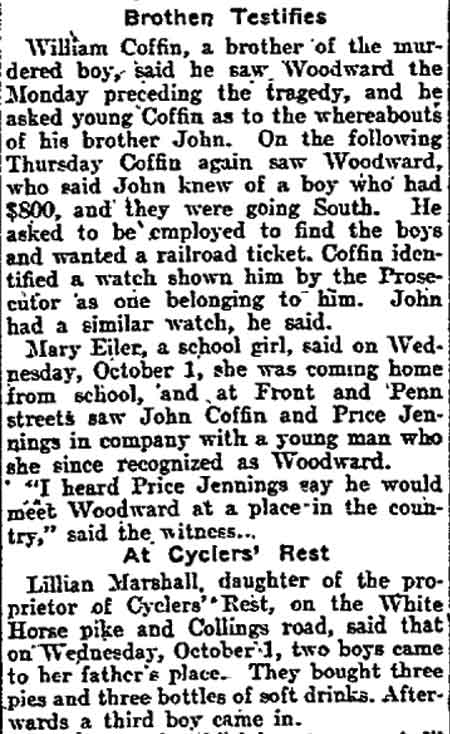
William Coffin, the elder brother of the murdered boy John Coffin, told the police that for some time before the tragedy Woodward had been lurking about in the vicinity of the Coffin home. He had seen Woodward standing on the opposite side of the street gazing intently at the house on several different occasions.
Yesterday morning Coroner Lloyd, accompanied by County Detectives Smith and Stiles, started for Woodbury to confer with the Gloucester County authorities regarding the burial of the Jennings boy's body. The body of young Coffin was turned over to his relatives for burial.
The coroner's jury that has been inquiring into the deaths of the two boys was adjourned until some definite conclusion had been reached regarding the crime.
Coffin's Effects Found
Important discoveries were made yesterday bearing on the crime. In a store kept by a man named Sheiding, in Camden, there was found a ring supposed to belong to Price Jennings. Woodward had been seen in company with Jennings, and had also been seen with the ring. The ring was taken possession of by the police.
The gold watch owned by John Coffin was also found in a pawnbroker's shop. The watch had been pledged for $3. The pawnbroker said the article was pawned by a young fellow answering to Woodward's description.
John Coffin, a younger brother of the murdered boy, said he last saw his brother at 3 o'clock on Wednesday afternoon, October 1. He also saw Woodward at the same time. He said John told him that Woodward was going to take him and Price Jennings to see a place in the country. After the boys had gone young Coffin thought no more about it until his brother did not return that evening.
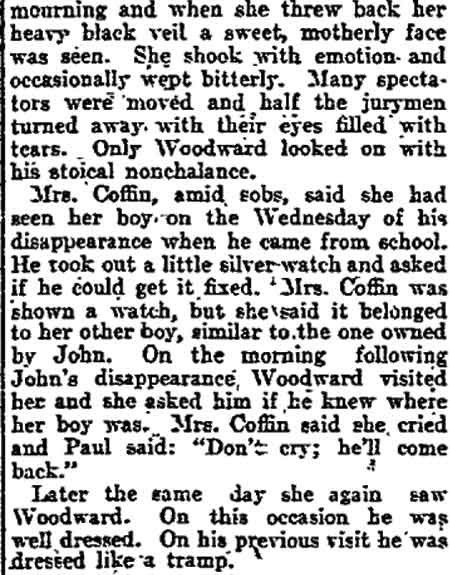
Mr. and Mrs. Coffin, parents of the murdered boy, are prostrate with grief. Many friends have called to sympathize with them in their loss.
The funeral of John Coffin will take place to-morrow morning. The body will be taken to St. Mary's Church, where a requiem mass will be said, and then to Harleigh Cemetery for interment.
Philadelphia Inquirer - October 7, 1902
After Being Questioned by the Prosecutor She Is Committed to the County Jail—Believed to Be an Important Arrest
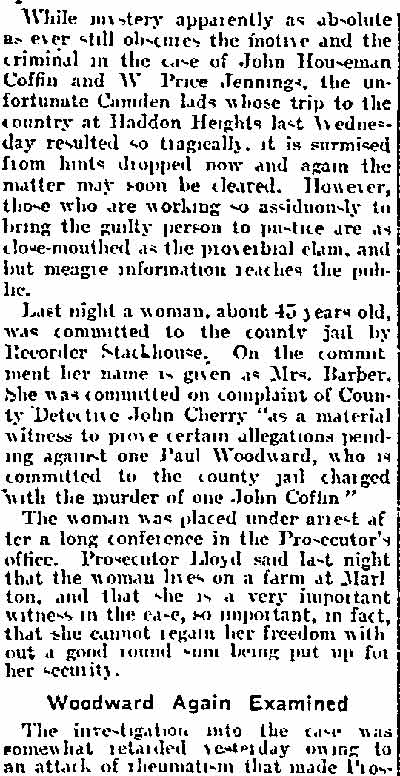
While mystery apparently as absolute as ever still obscures the motive and the criminal in the case of John Houseman Coffin and W. Price Jennings, the unfortunate Camden lads whose trip to the country at Haddon Heights last Wednesday resulted so tragically, it is surmised from hints dropped now and again the matter may soon be cleared. However, those who are working so assiduously to bring the guilty person to justice are as close-mouthed as the proverbial clam, and but meagre information reaches the public.
Last night a woman, about 45 years old, was committed to the county jail by Recorder Stackhouse. On the commitment her name is given as Mrs. Barber. She was committed on complaint of County Detective John Cherry "as a material witness to prove certain allegations pending against one Paul Woodward, who is committed to the county jail charged with the murder of one John Coffin."
The woman was placed under arrest after a long conference in the Prosecutor's office. Prosecutor Lloyd said last night that the woman lives on a farm at Marlton, and that she is a very important witness in the case, so important, in fact, that she cannot regain her freedom without a good round sum being put up for her security.
Woodward Again Examined
The investigation into the case was somewhat retarded yesterday owing to an attack of rheumatism that made Prosecutor Frank T. Lloyd remain at home. The day's responsibility rested on F. Morse Archer, the assistant pro-secutor. The latter yesterday morning had Woodward brought into his office, where he underwent for the sixth time a thorough cross-examination. Mr. Archer said Woodward had made no confession, as had been rumored. On the contrary, he still maintained his innocence.
In answer to a question Mr. Archer said: "We are doing our best and while we are in possession of information which we consider important and vital to the case, it is impossible at this time to make it public."
On the other hand, County Physician Jones was very emphatic in this particular, saying the boys were murdered beyond a doubt.
Boys' Funerals
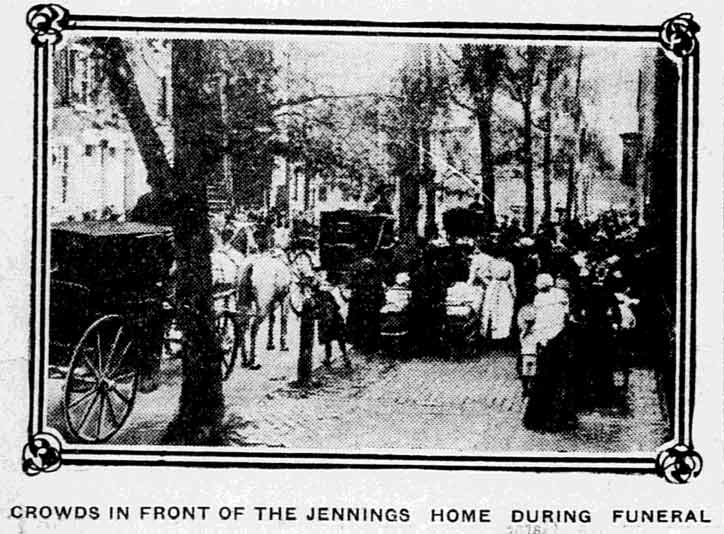
Yesterday afternoon the funeral of the boys took place at the same hour and within a square of one another's homes. Although the hour set for the obsequies, 2 o'clock in the afternoon, had been kept secret scores of persons stood about in knots discussing the tragedy and eager to get a glimpse of the caskets containing the remains of the boys.
Police Captain Boyle and Policemen Kappel, Toy and Ridgeley guarded the houses, and no one except relatives and intimate friends were permitted to enter. But when the caskets were carried from the houses the crowd could not be kept back. Many persons crowded about, and the mourners entered the carriages between two solid phalanxes of curiosity seekers.
The services over Jennings were conducted at his home, 219 North Third street, by Rev. C. A. Adams and Rev. John Lyell. At the Coffin home, 305 North Third street, Rev. William H. Fishburn had charge of the obsequies. Companions of the boys acted as pallbearers. Jennings was buried at Evergreen and Coffin at Harleigh Cemetery.
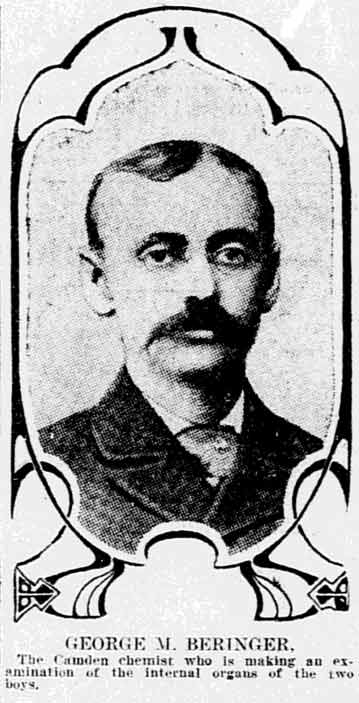
George M. Beringer, a Camden chemist, who has the important duty of discovering, if possible, traces of poison in the stomachs of the boys, said yesterday he is making a thorough chemical analysis and is of necessity proceeding slowly. He said he will not be able to report the result for some days to come.
A pathetic little incident occurred at the Cooper School during recess yesterday morning when the children, school mates of the lads, gathered about and listened to the muffled beats of a drum. The school flag was at half mast and in every room there was a flag draped with black crepe. The youngsters were visibly affected.
Philadelphia Inquirer - October 8, 1902
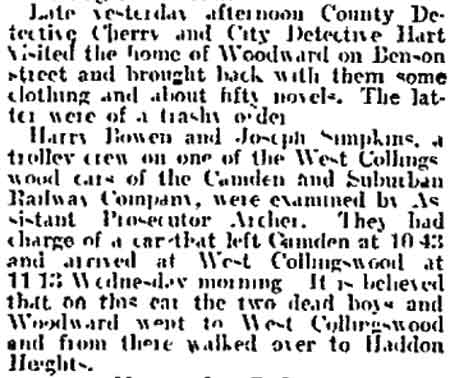
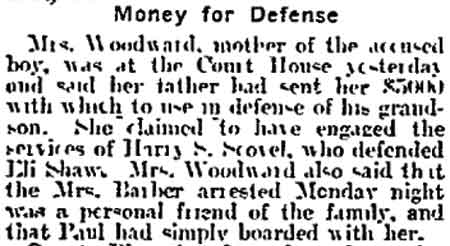
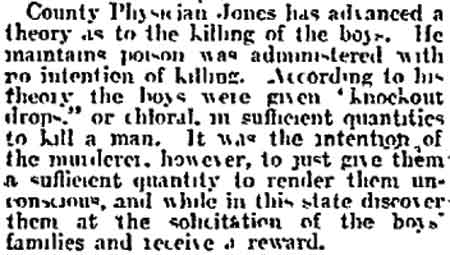
Suspect in Camden Murder Case Captured After a Long Chase
TWO DETECTIVES CAPTURE PAUL
Confessed to Crime in His Statement to the Police -- Held Without Bail
Paul Woodward, the Camden youth wanted for the murder of John Coffin and Price Jennings, was arrested yesterday morning in Philadelphia, after a long chase, by Detectives Smith and Stiles, of Camden. He was brought to Camden and placed in jail without bail.
After his arrest Woodward made a statement to the police in which he practically confessed his guilt. He denied, however, that he was alone responsible for the crime. He said that another person was with him at the time the deed was committed, but he refused to give this person's name.
Found on South Street
The detectives traced Woodward to a lodging house on South Street, Philadelphia, where he had been hiding for several days. When the officers arrived at the house they were told that Woodward was in his room on the second floor. The detectives went upstairs and knocked at the door. There was no response, and after waiting for a short time the officers burst open the door. Woodward was found hiding under the bed.
He was handcuffed and taken to Camden, where he was arraigned before Justice of the Peace McCann. He was committed without bail to await the action of the grand jury.
After his committal Woodward was placed in a cell in the county jail. He seemed perfectly cool and collected and showed no signs of emotion.
Statement to Police
In his statement to the police Woodward said he had met the two boys, Coffin and Jennings, on the afternoon of October 1, and had taken them for a walk in the country. He said they had eaten something out in the fields, but he denied that he had given them poison. He said they had parted, and he knew nothing further about them.
This statement is directly contradicted by the evidence already in the hands of the police, and the detectives believe that Woodward has confessed to far more than he has told them.
The Camden authorities are confident that they have a strong case against the prisoner. The evidence of his guilt is said to be conclusive.
Philadelphia Inquirer - October 9, 1902
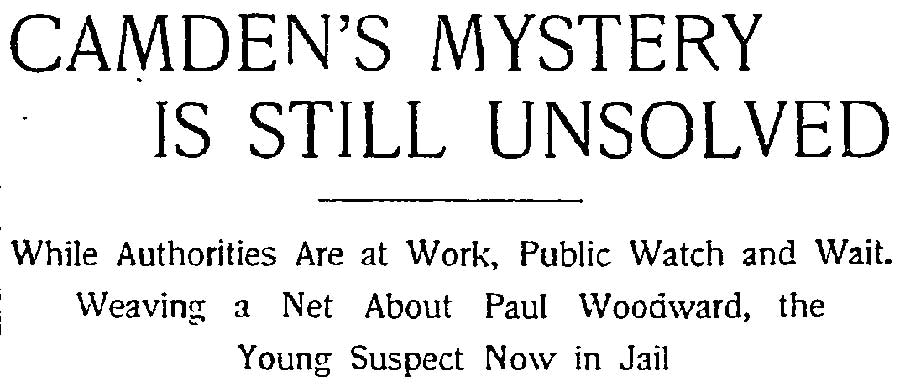
While Authorities Are at Work, Public Watch and Wait. Weaving a Net About Paul Woodward, the Young Suspect Now in Jail
It is now generally believed that the Camden county authorities have succeeded in establishing a clear case against young Paul Woodward, who is in the county jail, charged with the crime of taking away the lives of little John Coffin and Price Jennings. It was just a week ago yesterday when the boys went on their trip to Haddon Heights from which they were destined never to return alive.
Since the discovery of the bodies last Saturday partially hidden in rain soaked weeds, the Prosecutor's office, assisted by County Detectives Smith and Cherry and City Detectives Painter and Hart, have left no stone unturned.
No Confession
Prosecutor Lloyd yesterday reiterated his statement that Woodward had made no confession, but it is generally conceded as true that the accused youth did tell a story in which he makes some one else the principal criminal in the case.
Several incidents transpired yesterday that threw off the monotony of waiting for developments. Joseph Jennings, brother of one of the murdered boys, was taken to the cell in which Woodward is confined. He had no difficulty in recognizing the prisoner before. But as to whether he ever saw him in company with the dead lads he was not permitted to say.
Wild Rumor
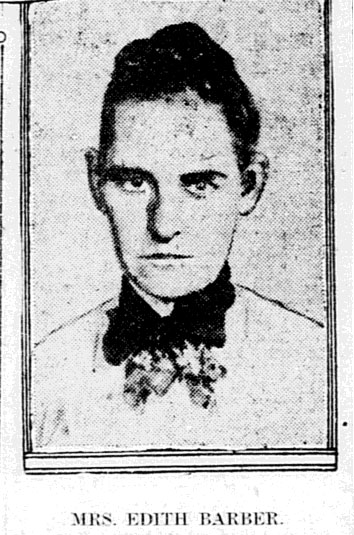
There was much excitement about the Court House when it became rumored that Mrs. Edith Barber, the woman detained as a material witness against Woodward, had the small pox. To allay the alarm County Physician Jones called in representatives of the Board of Health, who concluded she had no sign of the disease.
After matters quieted somewhat the woman was taken into the Prosecutor's office and questioned. When taken back to her cell she was crying and appeared to be almost unable to walk.
Woodward spent the day in his cell, smoking cigarettes as usual. He was visited in the morning by Lawyer Harry Scovel, who has not yet been engaged as counsel, as reported. Again in the afternoon Lawyer Scovel visited the youth in company with Woodward's mother. At first Mrs. Woodward was denied admittance, but after waiting on the jail steps for nearly an hour she was permitted to go in and see her son. Lawyer Scovel and Mrs. Woodward were with the young man for a couple of hours.
Talked a Whole Lot
To all questions Lawyer Scovel said: "Woodward talked a whole lot, but I have nothing to say."
He said he had not confessed to him. On the other hand Woodward had maintained his innocence.
When asked if Woodward could have a hearing if he demanded it Mr. Archer said he could. Asked if enough evidence was in hand to hold him, Mr. Archer said there was.
"On a simple assault charge?"
"No, sir, for the crime he is charged with—committing the murder of John Coffin," replied Mr. Archer.
Coroner Litchfield said last night he would not set a date for the inquest before some time next week. Despite all reports to the contrary, Coroner Litchfield says Chemist George M. Beringer, who is analyzing the internal organs of the boys, will not complete the work before the end of the week.
Prosecutor Lloyd, who is still confined to his home with rheumatism, would make no statement last night, although admitting that the day's work had not resulted in anything of material importance.
Philadelphia Inquirer - October 10, 1902
Prosecutor Lloyd Declares That Woodward Is the Guilty Man
NO MORE ARRESTS LIKELY
Weaving Web Around Alleged Slayer of the Murdered Boys
“Beyond all question the murderer of these little boys is now in jail and the public’s anxiety can now be allayed,” said Prosecutor Frank T. Lloyd last night in making the first important statement concerning the tragedy of last week, when John Coffin and W. Price Jennings, two Camden lads, were murdered in an uncultivated field near Haddon Heights. The mystery which has enshrouded the case since the discovery of the bodies last Friday has almost been cleared up with the exception of the report of Chemist George M. Beringer, who is making an analysis of the internal organs of the boys.
Prosecutor Lloyd gave out the following statement shortly before 8 o’clock at his home on the East Side:
“Because of a suspicion that more than one person was engaged in the murder of these little boys the State has been obliged to work with much secrecy and to withhold from the press the result of our work. That suspicion is now removed. Beyond all question the murderer is now in jail and the public’s anxiety can be allayed. Woodward was alone the perpetrator of this crime.
Case Nearly Complete
“It is my duty to say this much in view of the deep public concern and the apprehension of other parents having little ones, but it would be improper for me to state the character or the quantity of evidence upon which our conclusions are based. I will only say that with the exception of the report of the chemist, which has not yet been received, the State’s case is almost complete.
“Woodward himself has made a number of statements, which, while not confessions, will be materially helpful toward securing his conviction.”
This statement precludes the possibility of another arrest being made in connection with the case, as has been currently reported during the week.
There were several conferences held yesterday between Assistant Prosecutor Archer and Detectives Smith, Cherry, Painter and Hart and Chief of Police Linderman, of Merchantsville. During one of the conferences John Farmer, the colored man who recognized Woodward as having been seen with the boys last Wednesday afternoon, was called in and closely questioned. Following the detectives departed apparently on several different clues.
Detectives Hard at Work
Detective Hart subsequently returned with a Mrs. Somers, said to reside on Royden street. She was interviewed by the Assistant Prosecutor, but what connection she has with the case the authorities refused to divulge. The woman refused to talk.
Louis Ross, a German, who resides near Haddon Heights, was also called into the Prosecutor’s office late in the afternoon. At first he was thought to be an important witness, but it was afterwards learned that he knew little about the case.
Detective Robert J. McKentry, of Philadelphia, and Detective Smith took over the river Mrs. William H. Hubbert and another young woman. It is at the home of Mrs. Hubbert, at West Philadelphia, that Woodward said he was present last Friday night.
Woodward became rather obdurate yesterday, refusing the usual prison fare. He waited until his mother sent him coffee and other victuals. The accused youth was at first placed in the cell formerly occupied by Lafayette Gruff, the wife murderer, who was hanged September 19. He has now been placed in another cell.
Philadelphia Inquirer - October 11, 1902
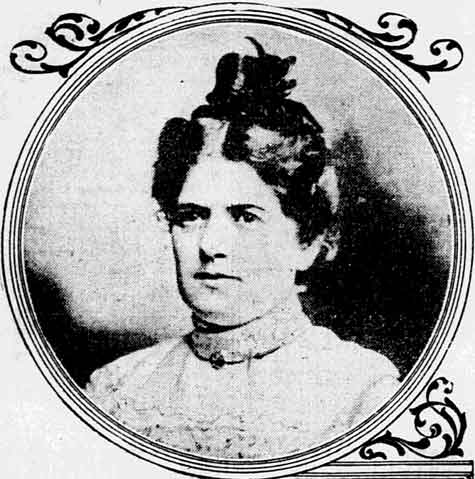
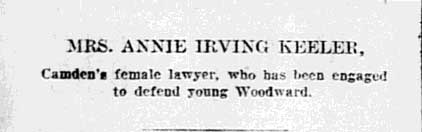
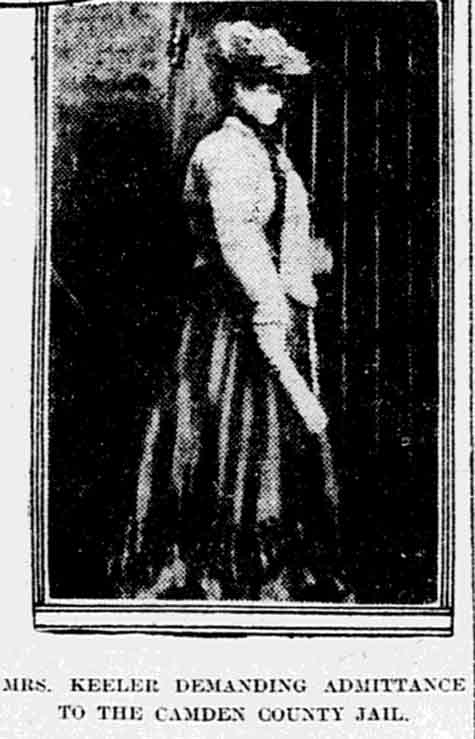
Lie Detector Operator Makes Experiments on the Camden Suspect
WOODWARD SHOWS NERVOUSNESS
Keeler's System Brings Out Interesting Results in the Woodward Case
The Keeler lie detecting system was applied to Paul Woodward, the Camden youth accused of the murder of John Coffin and Price Jennings, in the county jail at Camden yesterday, with interesting results. The experiments were conducted by Jacob Keeler, who operates the apparatus, in the presence of County Prosecutor Lloyd and other officials.
The apparatus used by Keeler consists of a series of instruments for measuring the physiological changes that take place in a person when he is not telling the truth. These changes include variations in blood pressure, pulse, and breathing.
Results of Tests
When Woodward was asked direct questions bearing on the murder he showed unmistakable signs of nervousness. His blood pressure rose and his breathing became irregular. When questions on indifferent topics were put to him he remained comparatively calm.
The experiments lasted for several hours. At the close of the session Prosecutor Lloyd expressed himself as highly satisfied with the results.
Woodward himself seemed unaware of the significance of the tests. He answered the questions put to him with apparent composure, but the instruments recorded the inner disturbance which his outward manner concealed.
The Camden authorities are convinced that the evidence against Woodward is overwhelming, and that the experiments conducted by Keeler have added still further to the proof of his guilt. The case will be presented to the grand jury at an early date.
Philadelphia Inquirer - October 12, 1902
Philadelphia Inquirer — October 13, 1902
West Philadelphian and a Supposed Companion of Young Paul Woodward Taken in Custody
There is but little remaining in the way of a mystery for the Camden county authorities to clear up in the murder case of little John Coffin and W. Price Jennings, of Camden. After working practically day and night during the past week Prosecutor Lloyd and his able assistants have brought to light such strong evidence against Paul Woodward, the young man in the county jail charged with the crime, that it will be next to impossible to refute it.
The sixth arrest in the case was made yesterday, when James Sheiding was taken into custody by County Detective Smith and committed to the county jail by Recorder Stackhouse as "a material witness." Sheiding, who lives in West Philadelphia, was lured across the river to Camden, when Detective Smith at once took him in custody.
The prisoner is believed to be the companion of Woodward who, on the Friday night preceding the discovery of the murdered boys, was in the company of the accused murderer. On that occasion it is said Woodward had considerable money and that Sheiding assisted him in spending it.
Woodward did not give any evidence yesterday of being insane. On the other hand he was very quiet and evidently saw the futility of trying to make the Prosecutor believe him to be of unsound mind. He utterly refused to take part in the regular Sunday jail services. His whole concern seemed to be as to whether or not his mother would visit him to-day. He was of the opinion yesterday that his mother had gone to West Chester, where she is said to have relatives of means. Woodward thinks such a visit would result in him having sufficient funds with which to engage counsel.
Mrs. Edith Barker, the woman witness against Woodward, is very ill. Two of her children are ill with typhoid fever and the worry over this in connection with her important part in the case has made her one of the most wretched prisoners ever incarcerated at the county prison. Prosecutor Lloyd tried to have her admitted to a hospital, but his efforts were unavailing.
In all probability the case will come up before the present grand jury and be tried this month. Prosecutor Lloyd said last night that as soon as Chemist Beringer has made his report on his analysis of the viscera of the boys the Coroner's inquest will be held. Immediately the court will be asked to take up the case.
Philadelphia Inquirer - October 14, 1902
But little developed in the murder case in Camden, for which Paul Woodward is incarcerated in the county jail. Prosecutor Lloyd has everything well in hand and his sole object is to have a speedy trial of the accused youth. He said yesterday his office would give out nothing further before the trial.
It is said Woodward has declared he gave John Coffin and W. Price Jennings, the murdered boys, bichloride of gold and not chloral. He is also reported to have said he did not intend giving such a large dose as would terminate fatally.
While as yet Woodward has no counsel it is probable he will be defended by Lawyer Edwin Hillman, who will be named by the court.
Philadelphia Inquirer - October 15, 1902
Paul Woodward, the youth accused of the murder of John Coffin and W. Price Jennings, the Camden boys whose bodies were found near Haddon Heights last Saturday week, may possibly be indicted for the crime to-day or to-morrow. Prosecutor Lloyd has the case so well in hand that he will present the facts before the grand jury this morning.
The State has practically concluded its investigation with the exception of making the necessary preparations for the trial. It is believed the grand jury will speedily find a bill of indictment against Woodward, and he may know his fate before the end of the present month.
Harry H. Robinson, a Philadelphia lawyer, was yesterday engaged to defend Woodward.
Philadelphia Inquirer - October 16, 1902
The case of Paul Woodward, who is charged with the murder of John Coffin and W. Price Jennings, was considered by the Camden County Grand Jury yesterday. Among the witnesses were the father and aunt of the Jennings boy. The prisoner was promptly indicted.
There will be no inquest. Coroner Litchfield says the facts of the killing and that the boys met their death by violence being manifest to the authorities.
Philadelphia Inquirer - October 19, 1902
Chemist Beringer Makes His Report to Prosecutor Lloyd—Another Witness in Murder Case
George M. Beringer, the chemist who made an analysis of the organs of John Houseman Coffin and Walter Price Jennings, who were found dead near Haddon Heights two weeks ago, has made a report of his findings to Prosecutor Lloyd.
Philadelphia Inquirer - October 22, 1902
Counsel for Paul Woodward, the young man accused of the murder of John Coffin and Price Jennings, two Camden boys, yesterday applied to Judge Garrison, at Mount Holly, for a writ of habeas corpus for their client. The application was granted and made returnable Friday next at Camden.
It is said the object of Woodward's counsel is to make the State show its hand as to the evidence it has against the alleged youthful murderer. In all probability the indictments will be presented and the writ dismissed.
Philadelphia Inquirer - October 24, 1902
The rule granted by Judge Garrison last Tuesday to show cause why Paul Woodward, the youthful Camden murderer, should not be released on habeas corpus proceedings will be argued in Camden to-day. The indictment against Woodward may be presented and the case hurried toward the trial which will take place this term.
Prosecutor Frank T. Lloyd was able to be at his desk again yesterday after an attack of rheumatism.
Philadelphia Inquirer - October 25, 1902

He Is Charged With Robbery and Murder in the Bill Presented to Judge Garrison
Two indictments against Paul Woodward, charging him with the murder of John Coffin and W. Price Jennings, the two boys whose bodies were found in a field near Haddon Heights, have been presented to Judge Garrison.
Philadelphia Inquirer - October 26, 1902
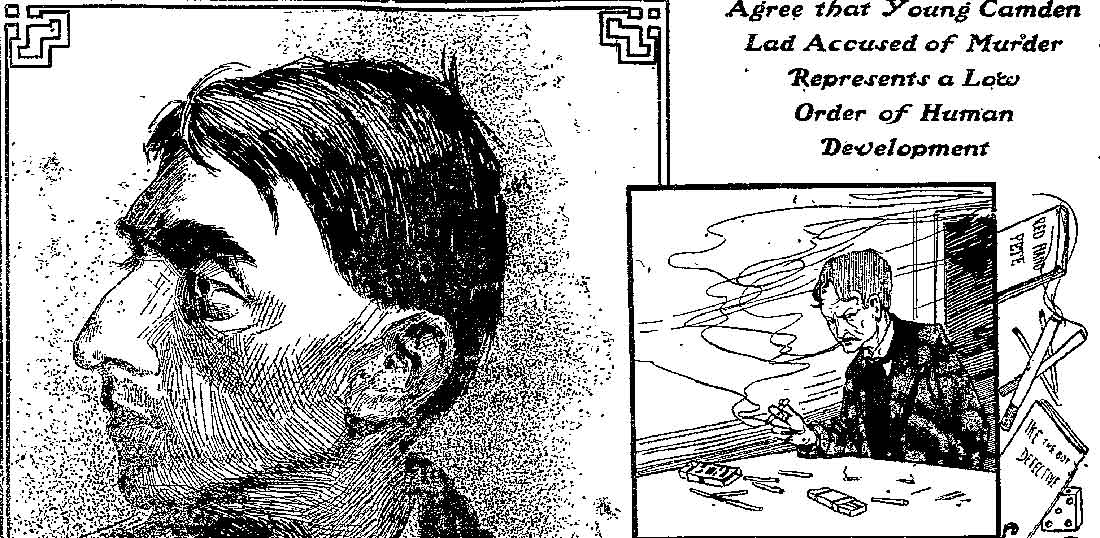
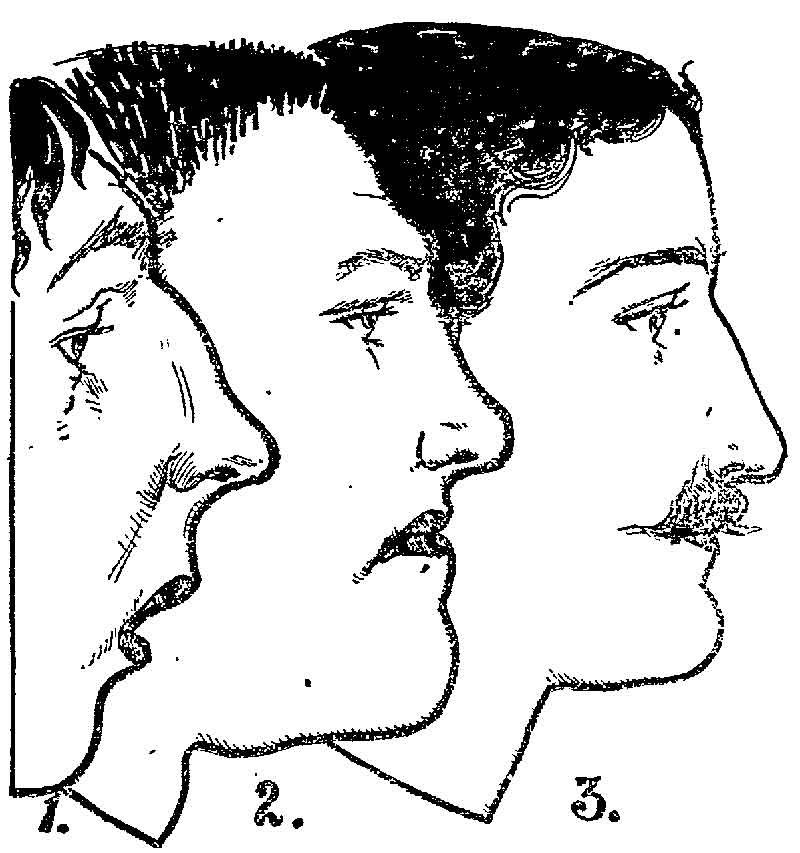
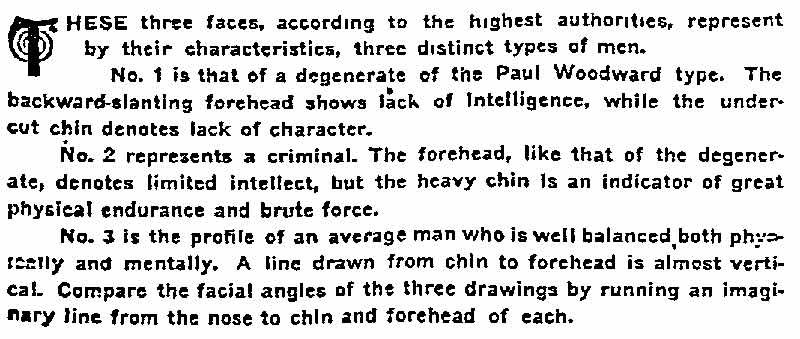
Is Paul Woodward a degenerate?
He is a young man of superb physique, but a perusal of the story of his crime and the study of his appearance arouse in many persons a feeling that is one of combined aversion and commiseration. Paul Woodward's face is a face that haunts one like a nightmare; no photograph can describe its weak lines.
His chin is retreating, his nose thin and prominent. His narrow forehead, or that pitiable excuse for one, slants back at a sharp angle like an ape's and forms a ridge that runs into a dwarfed cranium. His eyelids are half closed except for occasional intervals when he looks at you. There is a constant tendency toward a dropping of the lower lip, and his hair, which is straight and very thin, is brushed down until it hangs over his eyebrows.
Woodward's Past Life
Paul Woodward's past life has been practically purposeless and poorly employed. He has attended school, but little. He has always been loitering about saloons and engaged in shady notions of young blood and morally corrupt ideas of criminality.
Three experts -- an alienist and two detectives -- each of whom has made a separate study of degeneracy -- assert that Paul Woodward is a degenerate. Dr. Stearlin G. Wood, one of Philadelphia's foremost physicians and a man of wide study, from an examination of the prisoners' appearance, says he is a degenerate of the second order, so far as moral capacity. He stated that the fact that a youth of good physical condition should under the circumstances commit a crime of this character is indicative of low nervous function and of one who simply goes along in the line of least resistance, a man incapable of feeling moral distinctions.
Opinion of Expert Detective
County Detective Smith said: "My opinion of Woodward is that he is mentally deficient, though not insane. He is a man who profited from crime only in proportion to his depraved nature, not because he has strong anti-social instincts, but because he is deficient, incapable of work, and incapable of thought. He may have no remorse, and he may have, for he is not of a defiant type of character."
In his judgment Paul Woodward's crimes are of the lowest type. "I have seen boys that were worse degenerates, deficient, but good in a measure. Woodward appeared to be a boy of mean, petty type of character, but of an instinct to that of a sneak. I have been brought in contact with him since his first arrest. I am of the opinion that he has already been in a reform school. Shortly after his liberation from this institution he murdered the Miller lad in the same barbarous manner as he had tortured the others. The murder of the two boys committed on October 1 resulted in his being convicted and it was there established that he was responsible for the death of several other Camden children."
Degeneracy Explained
Authorities on criminal anthropology say that there are two causes for degeneracy. In one, as stated in his work on "Crime and its Causes," by Lombroso: "Degeneracy in criminals is sometimes inherited and sometimes acquired. It is inherited when the criminal is descended from insane, drunken, epileptic parents; it is often acquired: the criminal adopts and deliberately persists in a life of crime."
It may be said Paul Woodward is a degenerate through inheritance or habit -- a question which the court and not short of moral reform. It is reasonably certain that he is a representative of that abnormal type which stands for a very low grade of development in the scale of humanity. Every line of his countenance spells a corrupt moral and physical organism, while his career confirms his degeneracy.
Philadelphia Inquirer - October 31, 1902
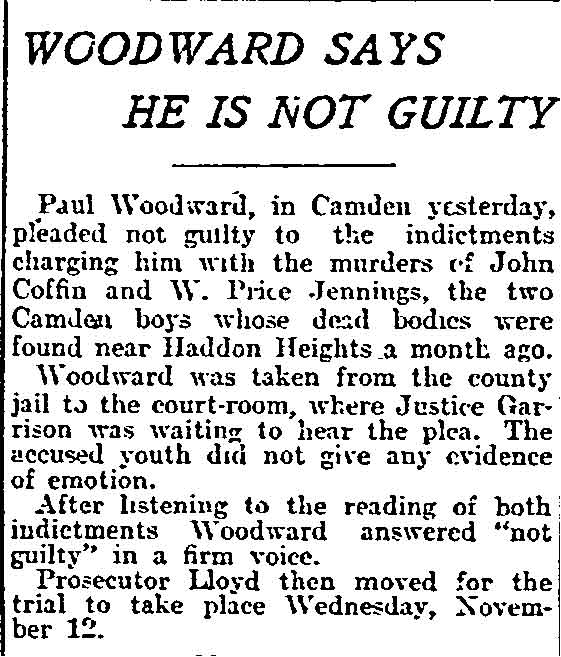
Paul Woodward, in Camden yesterday, pleaded not guilty to the indictments charging him with the murders of John Coffin and W. Price Jennings, the two Camden boys whose dead bodies were found near Haddon Heights a month ago.
Woodward was taken from the county jail to the court-room, where Justice Garrison was waiting to hear the plea. The accused youth did not give any evidence of emotion.
After listening to the reading of both indictments Woodward answered "not guilty" in a firm voice.
Prosecutor Lloyd then moved for the trial to take place Wednesday, November 12.
Philadelphia Inquirer - November 12, 1902
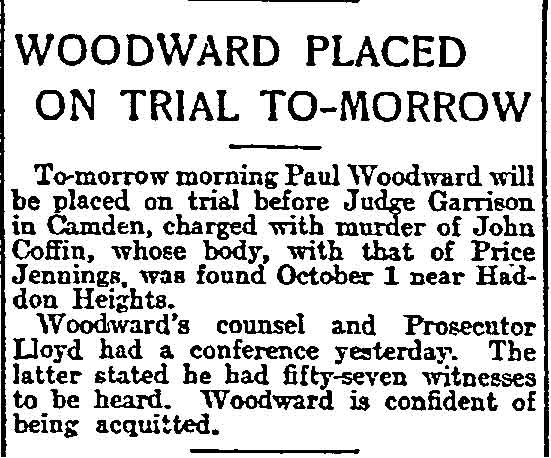
To-morrow morning Paul Woodward will be placed on trial before Judge Garrison in Camden, charged with murder of John Coffin, whose body, with that of Price Jennings, was found October 1 near Haddon Heights.
Woodward's counsel and Prosecutor Lloyd had a conference yesterday. The latter stated he had fifty-seven witnesses to be heard. Woodward is confident of being acquitted.
Trenton — Evening Times
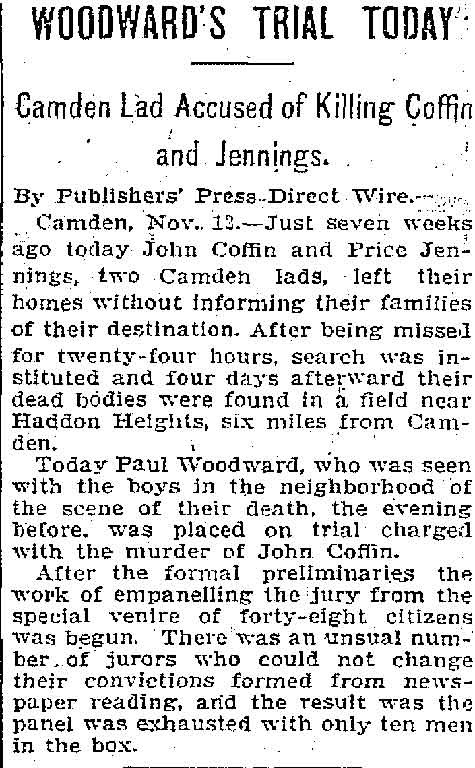
Woodward’s Trial Today
Camden Lad Accused of Killing Coffin and Jennings.
By Publishers’ Press Direct Wire.
Camden, Nov. 12.—Just seven weeks ago today John Coffin and Price Jennings, two Camden lads, left their homes without informing their families of their destination. After being missed for twenty-four hours, search was instituted and four days afterward their dead bodies were found in a field near Haddon Heights, six miles from Camden.
Today Paul Woodward, who was seen with the boys in the neighborhood of the scene of their death, the evening before, was placed on trial charged with the murder of John Coffin.
After the formal preliminaries the work of empanelling the jury from the special venire of forty-eight citizens was begun. There was an unusual number of jurors who could not change their convictions formed from newspaper reading, and the result was the panel was exhausted with only ten men in the box.
Philadelphia Inquirer — November 13, 1902
Less Than Six Weeks After Alleged Crime Case Is Called in Camden Court — The Prisoner's Appearance — What State Will Try to Prove
Six weeks ago yesterday John Coffin and W. Price Jennings, two rosy-cheeked Camden lads, left their comfortable homes for a boyish romp in the country. Three days later their bodies were found lying half concealed among a wild growth of bushes in an uncultivated field near Haddon Heights.
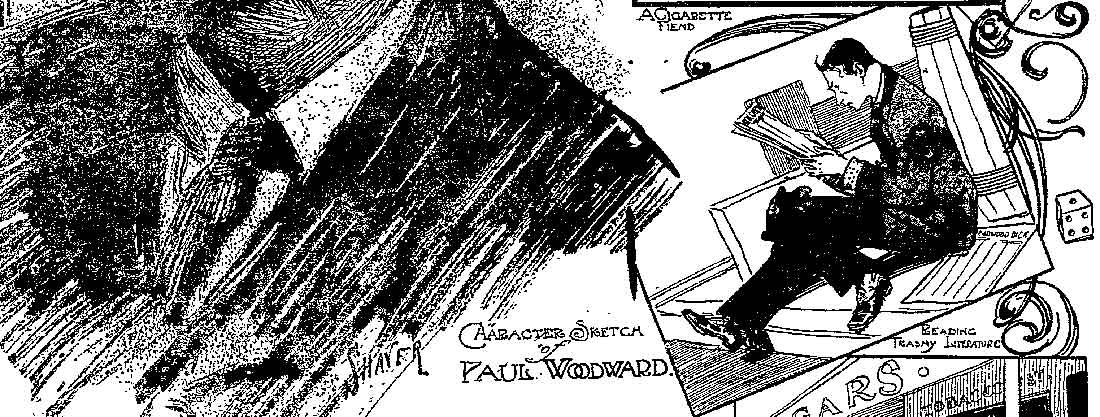
Yesterday Paul Woodward, termed a cigarette fiend and a reader of trashy novels, was placed on trial in Camden before Judge Garrison, on indictments charging him with the murder of John Coffin.
Directly the doors of the court room were opened a crowd of men and women made a mad rush for seats, and the constables with difficulty restrained them. In a few minutes every seat had been taken and the throng awaited expectantly for a glimpse of the accused youth. The gallery reserved for members of the bar was filled, too, with many lawyers interested in the outcome of what doubtless will prove one of the most famous murder trials in Camden county.
Court Opened
A few minutes after 10 o’clock Judge Garrison arrived, court was formally opened and Prosecutor Frank T. Lloyd read the list of the State’s witnesses, nearly fifty in all, and then the list of men had been dispatched for Woodward, and before the Prosecutor had completed reading the list of witnesses the accused youth entered the court room.
He Couldn’t Kick
“All right, I can’t kick,” he replied, nonchalantly, and he settled himself down in the prisoner’s dock with only the top of his peculiarly shaped head was visible. He had been arrested but a few months old, and not ill, as has been stated.
His hair, jet black, was plastered down on his head with scrupulous care. In fact, he very evidently took more pains in arranging his hair than his clothing, which was ill-fitting. His low-cut vest had fairly gilded buttons as large as a quarter, while his trousers, the same as were when apprehended for the crime, were of a coarse material, navy blue, and several sizes too large for him.
Prisoner’s Parents There
Shortly after court convened, Woodward’s parents appeared, accompanied by a little girl, said to be Woodward’s sister. The family occupied seats among the spectators, taking keen interest in the proceedings.
Prosecutor Lloyd moved the indictment against Woodward for the murder of John Coffin. The other indictment, charging him with the murder of Price Jennings, will not be pressed unless he is acquitted in the Coffin case. After Lawyer Rex had introduced his Philadelphia colleagues, the task of securing a jury began. The entire panel of forty-eight was exhausted when only ten jurors had been selected. A special panel was called before the other two were secured.
As finally selected, the jury comprises the following: George Agar, Woodlestown township, foreman; William Powell, Gloucester township; William Anderson, Pennsauken; Charles Fraley, Waterford; Thomas J. Atkinson, Fourth ward; Wilson English, Tenth ward; Harry Ames, Second ward; George J. Simford, Fifth ward; John M. Hyde, Twelfth ward; William Hogan, Tenth ward; John St. Clair, Third ward; Charles S. Hill, Fifth ward.
Case Presented
It was two o’clock in the afternoon before the testimony began. Rev. D. Home Arbuckle opened for the State. He said the State would show that Coffin and his companion on the bodies were the remains of John Coffin and Price Jennings, and show how Woodward was loitering about the Lippincott schoolhouse, when he met them the following Wednesday at Front and Penn streets at the White Horse pike and was seen entering the lane off Collings landing road to the spot where the bodies were found. The counsel also said the State would prove that Woodward’s hat offered attire services to locate them. He said it would be shown that Woodward was a cigarette fiend and noted that items taken from the bodies before the boys were known to be dead. The State offered statements made by the defendant and the strength of the evidence of first-degree was asked.
First Witnesses
William Coffin, father of the boy, of Haddon Heights, were the first witnesses called. They told how their sons were returning from a hunt in the woods, and there was a general noise of the body and these were witnesses to the postmortem examination. He suffered the death of the boy and there were no external marks or bruises to his body. The State had a postmortem examination. He suffered no evidence of death from strangulation. There were no evidence of death from strangulation. There were no external marks of death from strangulation. The coroner adjudged court until morning and coroner’s testimony.
Philadelphia Inquirer - November 14, 1902
Queer Experiment in Trial of Youth for Murder of Two Boys
By Associated Press to The Patriot.
CAMDEN, N. J., Nov. 13.—A frog was poisoned in court to-day to show a jury the agonies of a human being dying as a result of being poisoned with strychnine.
Paul Woodward, who is alleged to have lured two boys, Brice Jennings and Paul Coffin, from this city, into the woods, and having caused their death with strychnine, was on trial, and Professor Marshall, of the University of Pennsylvania, was testifying. He took some of the poison extracted from the liver of Paul Coffin and forced it into a live frog.
The jury and all others in court became intensely interested. In a few minutes the frog went into convulsions. The professor explained the action of the drug as the frog, writhing, exhibited all the agonies the boy had suffered as he died. The experiment caused a sensation in the court room.
Philadelphia Inquirer - November 15, 1902

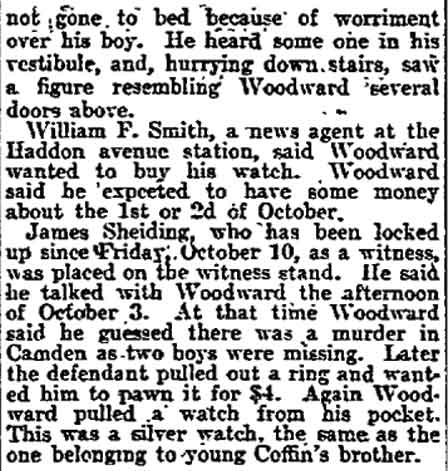
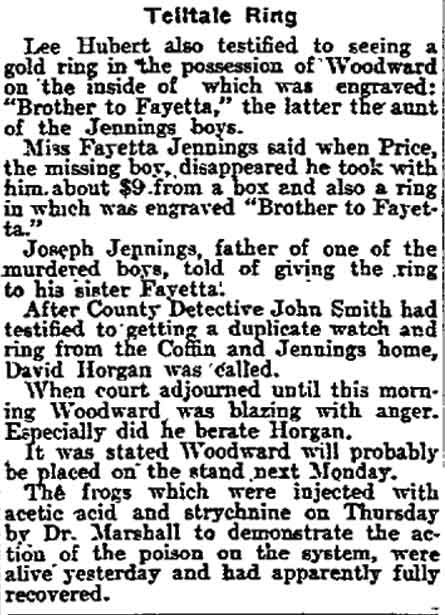
State Begins Its Case Against the Camden Murderer; Poison Expert on Stand
POISON IN THE PIE
How Paul Woodward Administered the Death Dose That Killed Two Camden Boys
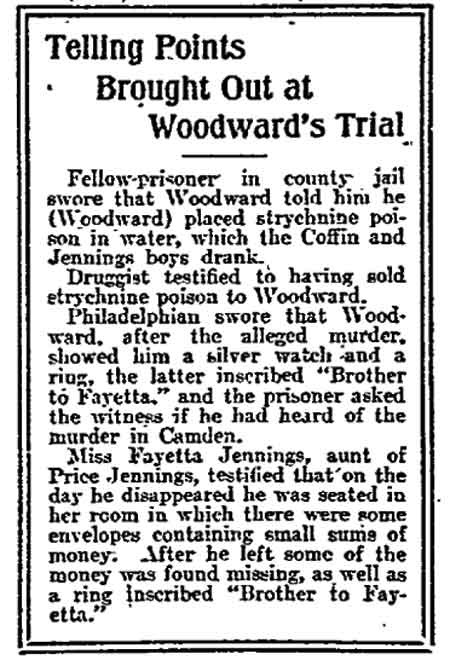
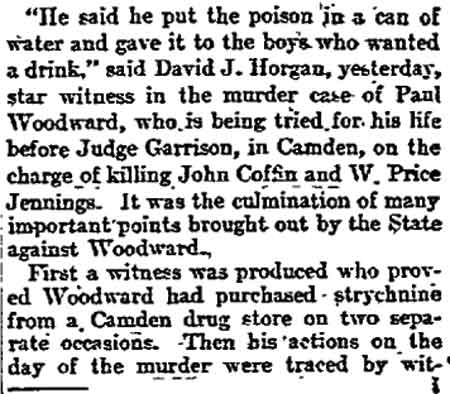
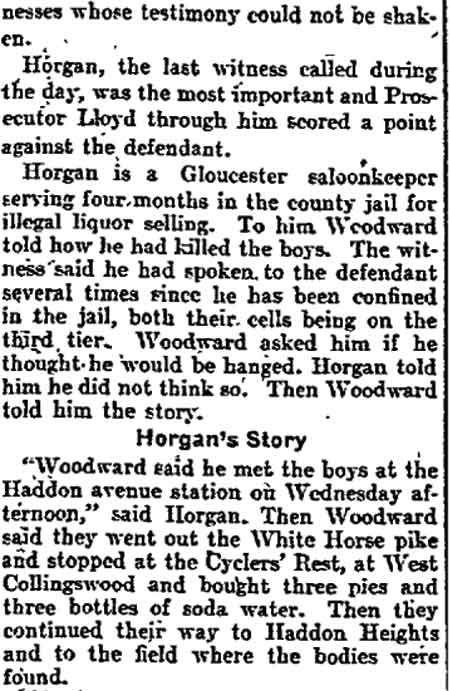
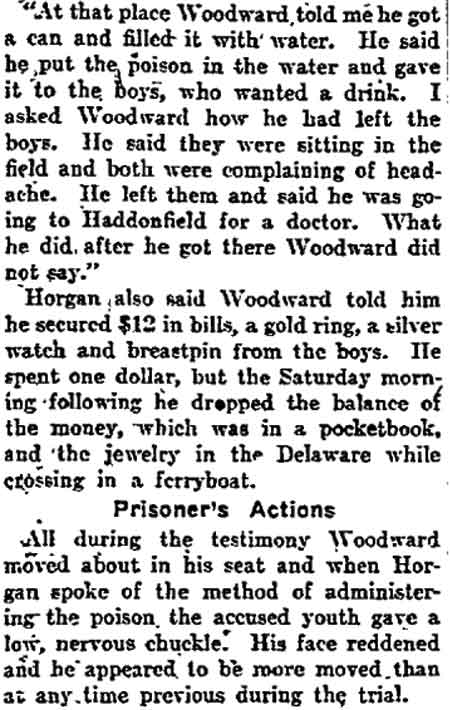
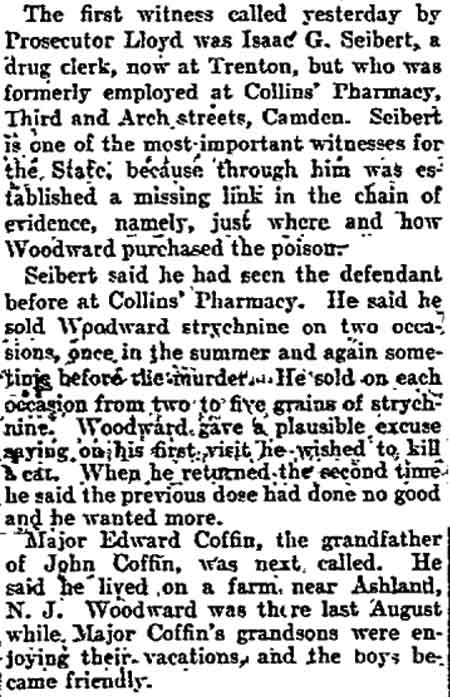
The State began the presentation of its evidence against Paul Woodward, the Camden youth on trial for the murder of John Coffin, yesterday. The first witness called was Dr. Paul N. Litchfield, of Philadelphia, a toxicologist, who testified to the presence of strychnine and morphine in the bodies of the two murdered boys.
Dr. Litchfield said he had made a careful analysis of the contents of the stomach and other organs of the two boys, and had found in each case unmistakable evidence of death from poison. The poison was strychnine combined with morphine.
How the Poison Was Given
The doctor said that the poison must have been administered in food, as there were traces of it in the partially digested food found in the stomachs of the boys. He said the dose was large enough to cause death within a few hours.
The prosecution then called witnesses to prove that Woodward had purchased strychnine at a Camden drug store shortly before the murder. Isaac G. Seibert, a drug clerk, testified that he had sold Woodward strychnine on two occasions, the last time being shortly before October 1.
Seibert said that on the first occasion Woodward said he wanted to kill a cat. On the second visit he said the first dose had not been sufficient.
The testimony created a deep impression on the jury and the crowded courtroom. Woodward listened to the evidence with apparent unconcern.
Philadelphia Inquirer - November 16, 1902

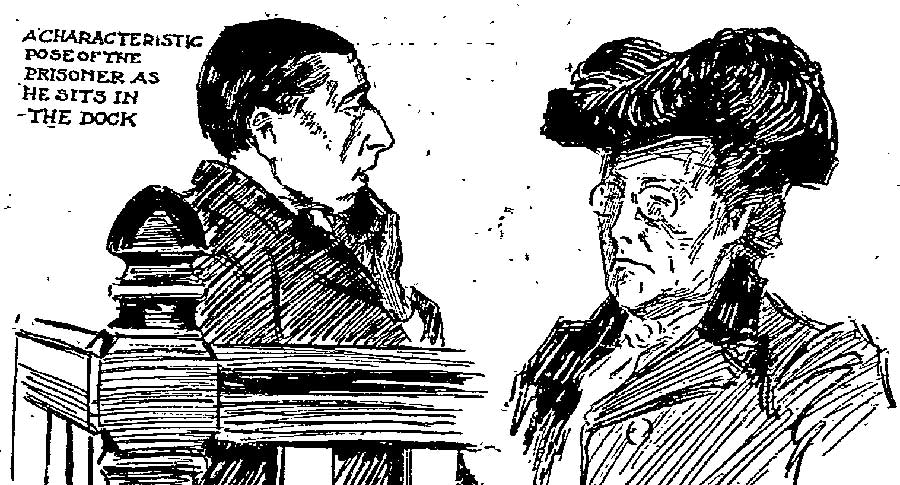
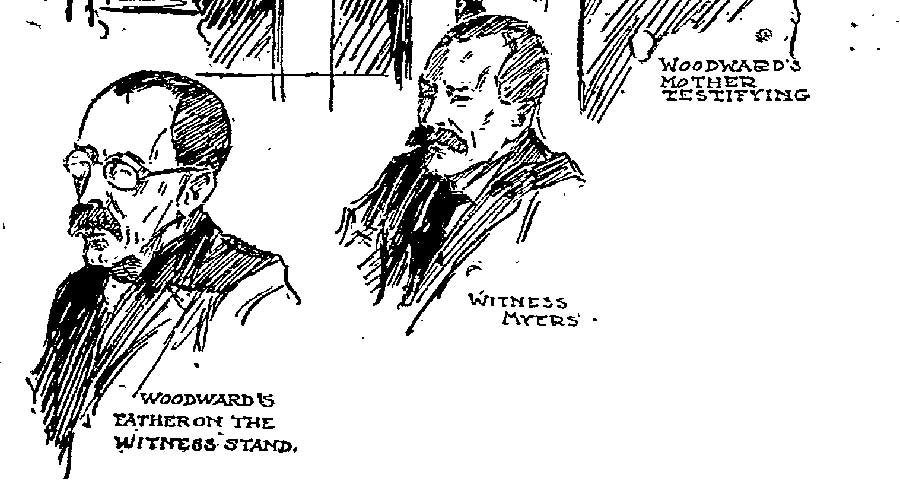
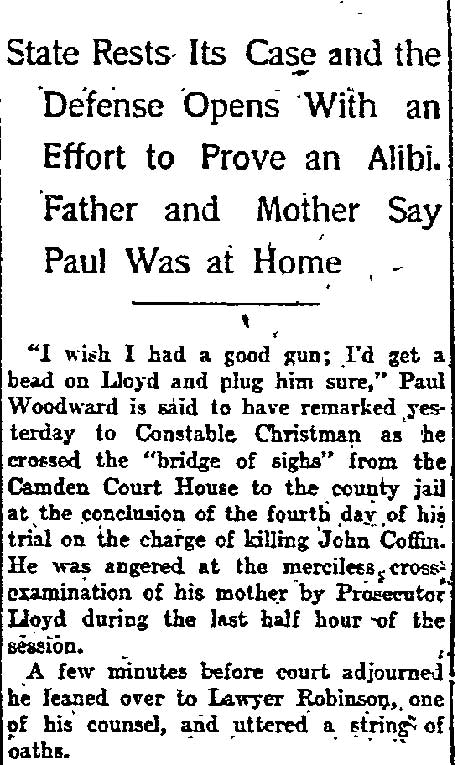
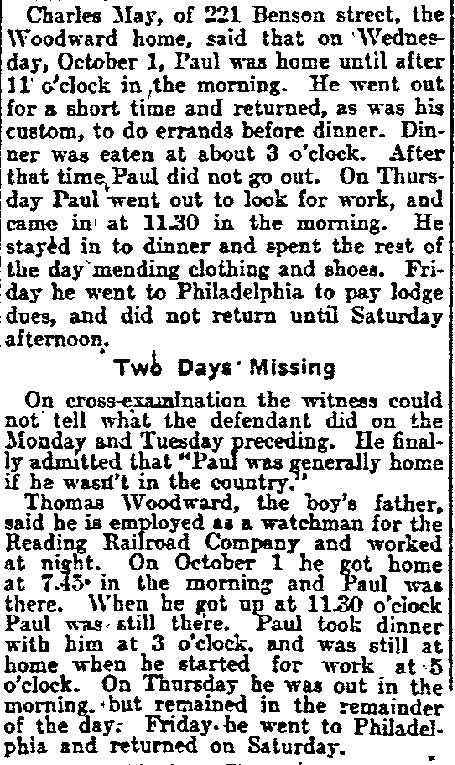

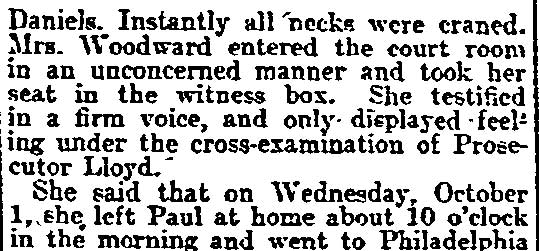
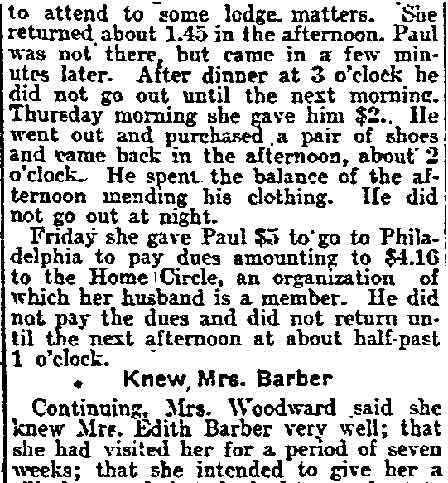
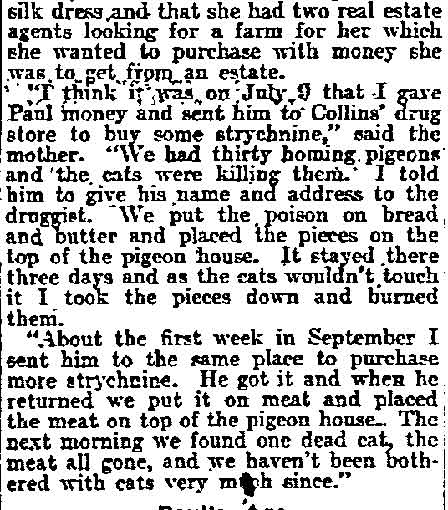
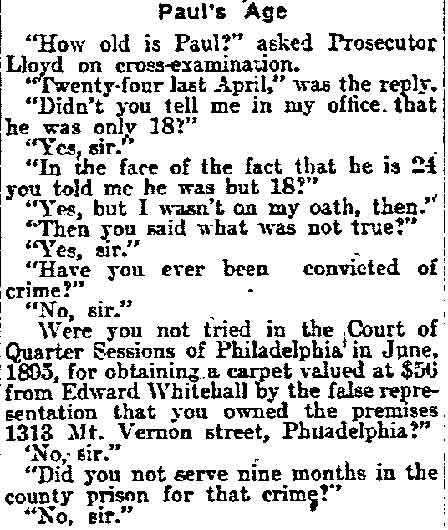
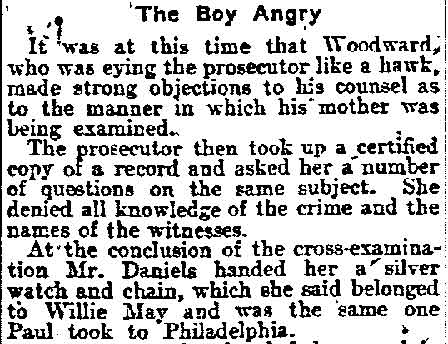
State Rests Its Case and the Defense Opens With an Effort to Prove an Alibi. Father and Mother Say Paul Was at Home.
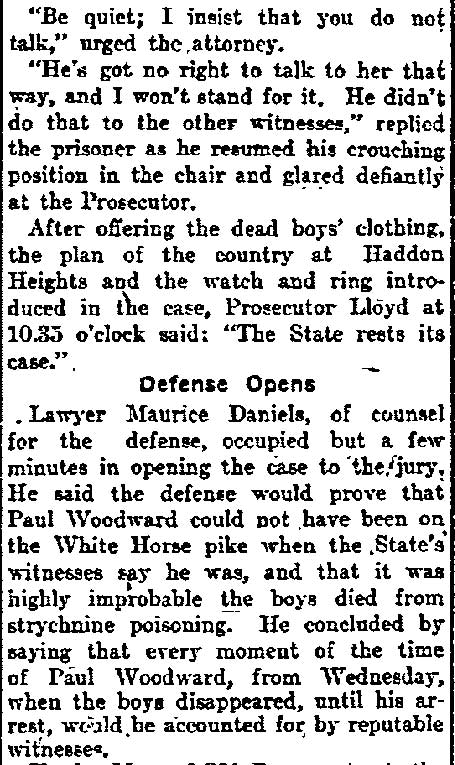
"I wish I had a good gun; I'd get a bead on Lloyd and plug him sure," Paul Woodward is said to have remarked yesterday to Constable Christman as he crossed the "bridge of sighs" from the Camden Court House to the county jail at the conclusion of the fourth day of his trial on the charge of killing John Coffin. He was angered at the merciless cross-examination of his mother by Prosecutor Lloyd during the last half hour of the session.
A few minutes before court adjourned he leaned over to Lawyer Robinson, one of his counsel, and uttered a string of oaths.
Philadelphia Inquirer — November 17, 1902
Apparently Buoyed Up by the Efforts of His Counsel, Who Now Have Their Inning
Paul Woodward, the young man on trial for his life before Judge Garrison, charged with the murder of little John Coffin, spent a quiet Sunday in his cell in the Camden county jail. He ate his meals as usual and gave no evidence whatever of being affected by the ordeal through which he has passed since last Wednesday. Since the defense has opened its case he appears to be more cheerful, presumably expectant of something occurring before the end of the trial that will strengthen his chances of acquittal.
"The trial has caused more comment in Camden than anything since the time Eli Shaw was accused of the murder of his mother and grandmother some years ago."
There was great surprise manifested when Lawyer Daniels, in outlining the defense, said it would be proven Woodward could not have been present when the crime was committed, and the subsequent attempt to prove an alibi. Woodward may be placed on the stand to-day and it remains to be seen how his story will stand the keen cross-examination of Prosecutor Lloyd. One of the features of the trial has been the manner in which the jury has noticed every move and characteristic of the defendant as he sits in the prisoners' dock.
The jurymen were yesterday taken out for exercise. They were accompanied by constables and walked about the streets for some time.
Several letters have been received at the county jail, where Woodward is incarcerated, from persons who are desirous of securing the young man's brain in the event of him being convicted and hanged.
Philadelphia Inquirer - November 18, 1902


WOODWARD SMILED WHEN HE HEARD DEATH VERDICT
Camden Trial Came to a Sudden End With the Jury Returning a Conviction of Murder in the First Degree, After Deliberating Less Than an Hour
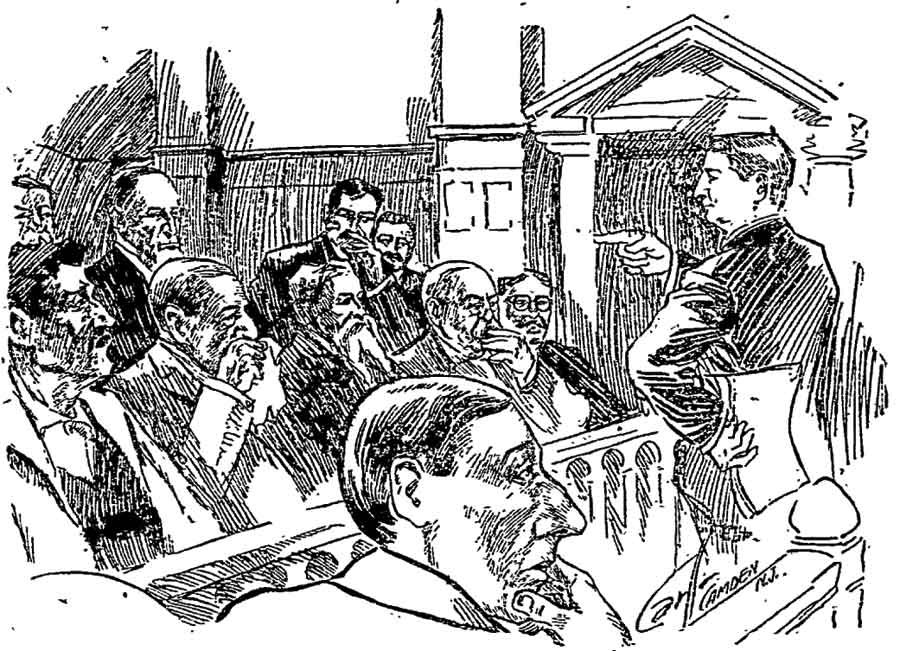
[Illustration caption: Attorney Robinson Making His Address to the Jury. Paul Woodward in Foreground.]
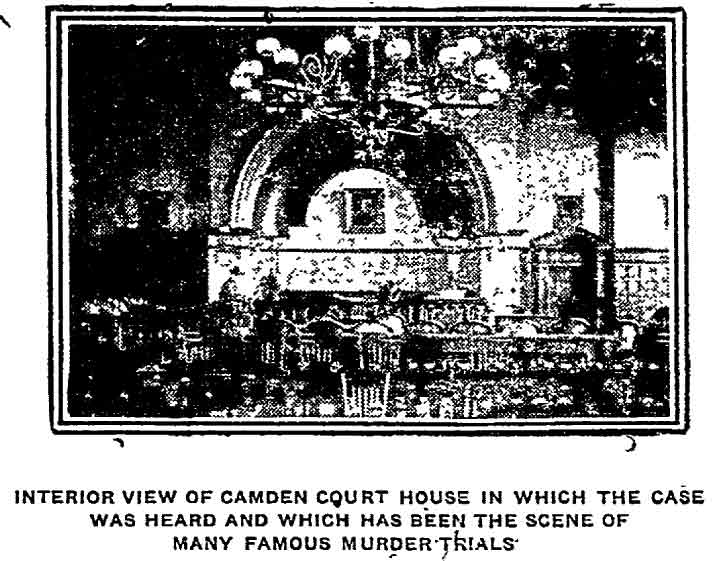
[Photo caption: Interior View of Camden Court House in Which the Case Was Heard and Which Has Been the Scene of Many Famous Murder Trials.]
Paul Woodward was last evening found guilty of murdering little John Coffin, whose body, with that of W. Price Jennings, was found in a field near Haddon Heights on October 4. Woodward’s trial began last Wednesday before Judge Garrison in Camden.
The jury retired at 3.45 o’clock, after a brief charge by Judge Garrison. At twenty minutes to 5 o’clock an agreement had been reached, but it was two minutes to 6 o’clock before Judge Garrison arrived, he having gone to his home at Merchantville.
In the meantime Woodward had been brought into the court room, and after the jury had filed in he was told to stand up. He arose without a tremor, looked at the ceiling, at the Judge and then turned to the twelve men who had his fate in their hands. His peculiar features lit up with a broad grin when the County Clerk said:
“Jury look upon the prisoner; prisoner look upon the jury.”
Guilty of Murder
Then when the jury was finally asked for its verdict and the foreman had solemnly announced “Guilty of murder in the first degree,” Woodward, apparently unmindful of the import of the words, turned to his counsel and laughed with a low chuckle. Each juror was polled and each man repeated “guilty of murder in the first degree.”
“The prisoner may retire,” said Judge Garrison, and with a sidelong glance at his counsel Woodward was led across the “bridge of sighs” to his cell in the county jail. He laughed loudly and slapped his custodian on the back in a playful mood, as if the whole proceedings had been a joke, but when he reached the jail he let go a tirade of profanity against the Prosecutor and those who appeared against him. He remarked that he did not care what became of him, all he cared for, he said, was his mother.
Motion for New Trial
Lawyer Rex immediately made a motion for a new trial, Judge Garrison stating he would hear argument on a date to be set. The jury was then discharged.
One of the features of the last day was the reappearance of Woodward’s mother, haggard, careworn and her eyes swollen with weeping. She was recalled to testify she had sworn falsely on Saturday when she denied even having been convicted of crime.
The climax in the defense’s case occurred in the morning, when Woodward, the defendant, was placed on the stand to testify. When he took his seat his eyes roamed about the room. He looked everywhere except in the direction of the jury. He admitted he was with the murdered boys, but denied absolutely having killed them. The alibi the defense tried to build about him during the period of the boys’ disappearance, was practically destroyed by contradictions made by Woodward concerning his movements. All the statements he made to Prosecutor Lloyd immediately following his arrest, he said, were false. He said he told the different stories because he was “scared.” The defense also tried to prove both boys were alive on Friday, October 3.
The defense called Dr. J. A. Leuf as an expert. He described the effects of strychnine on the human system. He said there were several other poisons that might have similar effects.
No Rebuttal Testimony
To the surprise of the assemblage no rebuttal testimony was given, Prosecutor Lloyd at once beginning his argument. He spoke for over an hour and at times was eloquent. He said the State asked for nothing but a first degree verdict, as the facts developed could have no other result consistent with the oath of the jury. It was a case of premeditation because there was first, an attempt at robbery, and second, because there was an attempt to do great bodily harm. The State, he said, had proved the crime against Woodward and followed him almost to the death bed of the boys.
Lawyer Robinson opened for the defense. He spoke for over an hour. “Paul is not guilty and if you follow the evidence you must acquit him,” concluded the defense.
Judge Garrison’s charge lasted just four minutes. He explained the law covering the case. He said anyone administering poison for robbery was guilty of murder in the first degree. If, however, it was not proven to the jury beyond a reasonable doubt that the defendant administered the poison, then he should be acquitted.
The jury then retired at 3.45.
Another postal card was received yesterday, asking for Woodward’s brain, but these seekers after the convicted man’s gray matter will be disappointed.
Philadelphia Inquirer - November 19, 1902
That Paul Woodward, the Camden murderer of John Coffin and W. Price Jennings, is mentally deficient is likely to be made the basis of a plea by his counsel for commutation of the death penalty in his case before the Board of Pardons. That his conduct since conviction has been such as to furnish some ground for the appeal is believed by some of those with whom he has come in contact.
Far from being impressed by his terrible position Woodward laughs and jokes with his jailers.
He does not want ordinary prison fare. He asked a turnkey if a convicted murderer was not entitled to have his meals, including wine, brought from a restaurant. When he was jocularly told that he was, he exclaimed:
"Maybe I won't live high! Then, I don't care for myself; all I care for is my mother."
During the day he saw James Bland, who is accused of the murder of James Morrisey. To Bland he said:
"Oh! don't you get gay; you won't eat your Christmas dinner either."
Philadelphia Inquirer - November 21, 1902
Counsel for Paul Woodward, convicted for murdering John Coffin, have little hopes of getting a new trial for their client. The Board of Pardons may be asked to commute his sentence.
When asked whether he wanted a spiritual adviser yesterday Woodward replied: "No. I guess they could do me no good."
Philadelphia Inquirer - November 22, 1902
Counsel for Paul Woodward, convicted of murdering John Coffin, will not ask Judge Garrison for a new trial to-day, as they had announced.
The Board of Pardons will be appealed to, when counsel will try to prove the irresponsibility of the convicted man, who may be sentenced to-day.
Philadelphia Inquirer — November 23, 1902
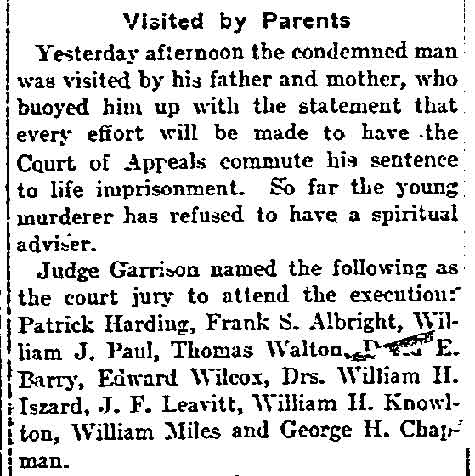
Camden Murderer Hears His Doom With a Smile, Then Curses Wildly
VISITED BY PARENTS
They Tell the Prisoner an Effort to Secure Life Imprisonment Will Be Made
Justice Garrison in Camden yesterday sentenced Paul Woodward to be hanged on January 7 for the murder of John Coffin and Walter Price Jennings near Haddon Heights on October 1.
Smiled, Then Swore
When sentence was pronounced Woodward smiled. As Sheriff Mines escorted him across "the bridge of sighs" he uttered vile curses and said that everybody connected with the case was a liar and that he was innocent. The prisoner's counsel withdrew the motion for a new trial. The death watch will be placed on duty to-morrow.
Philadelphia Inquirer - November 26, 1902
The death watch was yesterday placed on Paul Woodward, the young man in the Camden County Jail under sentence of death for murdering John Coffin and W. Price Jennings. He is under surveillance day and night. Yesterday he acted queerly, as though making an effort to have his jailors believe him insane.
Philadelphia Inquirer - November 29, 1902
Some Things That Prosecutor Lloyd Held Back
From the Prosecutor's office in Camden it is learned that much more evidence was in hand than that which was presented against Paul Woodward, convicted of murdering John Coffin and W. Price Jennings and who is under sentence to be hanged. The Prosecutor had knowledge that Woodward blackmailed a South Camden woman and her husband, almost resulting in a separation. Then he is said to have proposed to a young man a scheme of operating a "knock-out" resort.
One of his plans for getting money, it is said, was to play detective by going to certain women, telling them of misconduct on the part of their husbands and demanding a fee for watching the latter. Then he would turn around and work the same scheme on the men.
Kalamazoo Gazette - November 29, 1902
Cigarettes Make Him a Demon and a Murderer.
Camden, N. J., Nov. 28.—“Cigarettes have been my ruin. I will never smoke another,” said Paul Woodward, the condemned murderer of John Coffin and Price Jennings, who has been sentenced to death.
“Since I was a small boy I have smoked those things,” Woodward continued, “and they have driven me crazy. Yes, I am dangerously crazy. I do things against my own will.
Salt Lake Telegram - December 2, 1902
So Says Paul Woodward, the Condemned Murderer of Two Boys.
PHILADELPHIA, Dec. 1.—“Cigarettes have been my ruin. I will never smoke another,” said Paul Woodward, the condemned murderer of Paul Coffin and Price Jennings, in the Camden jail.
“Since I was a small boy I have smoked those things,” Woodward continued, “and they have driven me crazy. Yes, I am dangerously crazy. I do things against my own will. Sometimes I feel some demon within me that impels me to do injury to my dearest friends.”
Philadelphia Inquirer - December 4, 1902
Camden county will have to pay $3100 for the expert testimony which figured in the State's case in the murder trial of Paul Woodward, who was convicted of murder. The bill was presented to Auditor George, of the Board of Freeholders, yesterday. The bill is divided as follows:
Dr. Marshall, toxicologist, $1200; Geo. M. Beringer, chemist, $1200; Dr. Cophn and assistants who performed the autopsy on the bodies, $350; Professor Hobart Hare, medical expert, $300, and $50 for sundries.
Philadelphia Inquirer - December 7, 1902
Rev. Gilbert R. Underhill, rector of St. John's P. E. Church, Camden, visited Paul Woodward, the condemned murderer, in the Camden county jail yesterday and had a long talk with him. After the interview Woodward expressed himself as well pleased with the clergyman's visit and said he liked the minister better than any of the others who had called.
To one of the jailors he said he realized that he must die and when the time came he would walk unflinchingly to the gallows.
Woodward's mother and sister, the latter a pretty girl not yet out of her teens, and a student in a Philadelphia college, called on the doomed man yesterday and spent several hours with him.
Philadelphia Inquirer - December 9, 1902
An effort will be made to-day by counsel for Paul Woodward, the Camden youth, under sentence to be hanged January 7, for the murder of John Coffin and W. Price Jennings, to have a special meeting of the Board of Pardons held to present Woodward's case. The board will be asked to commute Woodward's sentence to life imprisonment on the ground he is mentally unsound.
Philadelphia Inquirer - December 12, 1902
Annoys Prisoners With "Music"
Paul Woodward, the Camden youth under sentence to be hanged January 7, is the bane of the inmates of the county jail. Some days ago visitors gave him a few pennies. With the money he had Death Watch Voigt purchase a tin whistle and a mouth organ. With these instruments, which he cannot play half well, he annoys the inmates of the jail all night long.
Philadelphia Inquirer — December 14, 1902
Woodward, Condemned Boy Slayer, Operates Phonograph in the County Jail
IS HAVING LOTS OF FUN
Familiar Strains Ring Through the Cells to Youthful Prisoner's Great Delight
Paul Woodward, sentenced to be hanged on January 7 in the Camden jail, asked permission of Sheriff Mines to have a talking machine in "Hangman's Row" so that his fellow-prisoners might not be annoyed by his attempts to perform on a whistle and harmonica.
The request was granted. Last night the strains of "Lead, Kindly Light," and "Abide With Me," followed by a number of Sousa's marches rang through the jail. The prisoners joined in the chorus of the songs. The condemned man got a whole lot of delight out of the phonograph, which he manipulated until a late hour.
Philadelphia Inquirer - December 15, 1902
Between his tin whistle, mouthorgan and gramaphone and book of "Arabian Nights," Paul Woodward, the youthful Camden murderer who will be hanged January 7 for murdering John Coffin and W. Price Jennings, spent a busy Sunday. His new diversion, the gramaphone, was of course his main attraction. He has about eighty records of songs, speeches and orchestral music. These selections broke the monotony to many scores of prisoners, the squeaky voices and musical notes being heard all over the jail.
Woodward has given his whole thought to his amusements. If he dreads January 7 he gives no evidence of the fact.
Philadelphia Inquirer - December 17, 1902
Governor Will Reprieve Prisoner If Action Is Not Taken by December 24
Special to The Inquirer.
TRENTON, N. J., Dec. 16 -- The case of Paul Woodward, the condemned Camden murderer, is to be considered by the Court of Pardons. This was promised to-day by Governor Murphy to Lawyer Fred A. Rex. Governor Murphy says if the case has not been reached when the court adjourns, December 24, he will grant Woodward a reprieve until some action is taken.
Mr. Rex's ground for appeal is that there was some intermarrying of relatives in Woodward's family which might justify a degree of insanity that would warrant the commutation of the condemned man's sentence.
In the jail at Camden Woodward continues to amuse himself with his gramophone. He is sanguine of getting his death sentence commuted. He eats and sleeps regularly and apparently does not worry in the least.
Philadelphia Inquirer — December 21, 1902
Its Discovery Apparently Explains the Murderer's Declaration That He Would Never Be Hanged
The seeming confidence with which Paul Woodward, sentenced to be hanged January 7 in the Camden county jail for the murder of the Jennings and Coffin boys, expressed himself that he would not be executed was easily accounted for when in a search of his cell the other day a pocket knife with an edge as keen as a razor was found.
Several times had the officials searched the cell thoroughly as they supposed. Each time Wodward met their efforts with a mocking laugh. Convinced that there was something hidden one of the "watch" placed his fingers in a pipe in the cell and pulled forth the knife. Woodward has not done very much talking since—except to his favorite keeper.
Philadelphia Inquirer - December 25, 1902
The New Jersey Court of Pardons, in secret session, yesterday, gave a hearing to counsel for Paul Woodward, the Camden murderer, who is under sentence to be hanged on January 7. Counsel asked for a commutation of sentence on the ground of insanity.
The court postponed decision in the matter until next Tuesday, in order to give counsel an opportunity to present testimony.
Philadelphia Inquirer - December 26, 1902
Paul Woodward, the youthful murderer in the Camden County Jail under sentence of death for killing John Coffin and W. Price Jennings, spent a happy Christmas.
It was a happy one because he had plenty to eat—stewed chicken, mince pie, candy, etc.—and also because he has an idea he will not be hanged, at least on January 7.
Philadelphia Inquirer - December 30, 1902
Lawyer Frederick A. Rex, counsel for Paul Woodward, the youth under sentence to be hanged January 7 for the murder of John Coffin and W. Price Jennings, will go to Trenton to-day to ask that Woodward's sentence be commuted to life imprisonment.
Woodward's counsel has little prospect of getting anything favorable from the Board of Pardons, however.
Philadelphia Inquirer - December 31, 1902
Court of Pardons Refuses to Interfere in Case of Camden's Condemned Murderer
Special to The Inquirer.
TRENTON, N. J., Dec. 30—The Court of Pardons in special session this afternoon refused to interfere in the case of—
Philadelphia Inquirer - January 1, 1903
Paul Woodward, who next week will be hanged for murdering little John Coffin and W. Price Jennings, spent the greater part of yesterday in his cell at the Camden county jail reading his Bible. While apparently unconcerned, he is being closely watched to prevent him from committing suicide. Sheriff Mines yesterday sent out invitations to the execution, January 7.
Philadelphia Inquirer - January 3, 1903
Despite the fact that Paul Woodward, Camden's youthful murderer, has but a few days to live, he is in no wise affected. His appetite is as good as when he was first incarcerated. He is living high, being supplied from a near-by restaurant by order of Sheriff Mines. Yesterday he was visited by his father, mother and youngest sister. Later Rev. John Warnock called on him.
Philadelphia Inquirer — January 5, 1903
Listens to Religious Services in Jail and Threatens to "Call Down" Ministers
Paul Woodward, who has but two days more before he will be hanged for the murder of John Coffin and W. Price Jennings, spent his last Sunday in his cell at the county jail in Camden reading and smoking. He listened to the devotional services held in another part of the jail with apparent interest, but remarked: "If those preachers say anything about me I'll call them down." Woodward ate an enormous dinner ordered from a near-by restaurant, consisting of stewed chicken, fried oysters, rolls, coffee and other things.
Philadelphia Inquirer — January 6, 1903
Nearing Day of Doom, Camden Murderer Facetiously Addressed a Grand Juryman Yesterday
With a little over twenty-four hours between him and eternity, Paul Woodward, the youthful Camden murderer, who will be hanged to-morrow morning for the cruel murder of two boys, continues his nonchalant manner.
After a brief visit from his father and mother yesterday Woodward took out his harmonica. A few minutes later the jail was filled with the strains of "In the Good Old Summer Time." Then he took a turn at several marches. These selections were a prelude to his midday meal. This consisted of roast lamb, sweet potatoes, French peas, one-half dozen raw oysters, minced onions (raw), stewed fruit.
During the afternoon he was visited by several grand jurymen. One asked him if he realized his position.
"Yes, certainly," said Woodward. "Wednesday I'll be a dead one." Then he turned on his heel and walked to the end of his cell.
Everything has been completed for the execution. The scaffold has been thoroughly tested.
Yesterday Woodward turned over to Sheriff Mines a signed statement in which, it is said, he declares his innocence. The Sheriff gave the paper to Rev. Mr. Warnock, the murderer's spiritual adviser, who was requested by the condemned man to make its contents public on the day of his execution.
Philadelphia Inquirer - January 7, 1903
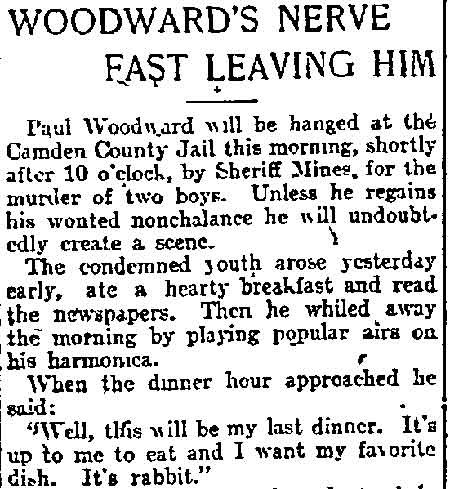
Paul Woodward will be hanged at the Camden County Jail this morning, shortly after 10 o'clock, by Sheriff Mines, for the murder of two boys. Unless he regains his wonted nonchalance he will undoubtedly create a scene.
The condemned youth arose yesterday early, ate a hearty breakfast and read the newspapers. Then he whiled away the morning by playing popular airs on his harmonica.
When the dinner hour approached he said:
"Well, this will be my last dinner. It's up to me to eat and I want my favorite dish. It's rabbit."
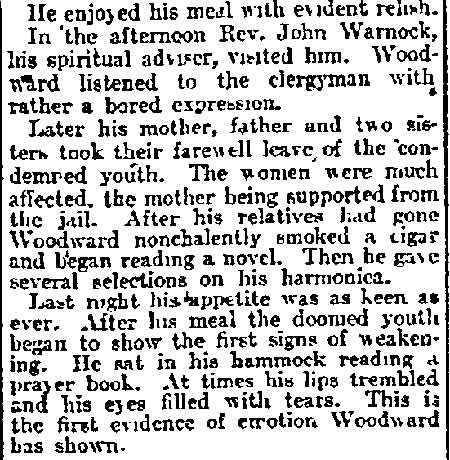
He enjoyed his meal with evident relish.
In the afternoon Rev. John Warnock, his spiritual adviser, visited him. Woodward listened to the clergyman with rather a bored expression.
Later his mother, father and two sisters took their farewell leave of the condemned youth. The women were much affected, the mother being supported from the jail. After his relatives had gone Woodward nonchalantly smoked a cigar and began reading a novel. Then he gave several selections on his harmonica.
Last night his appetite was as keen as ever. After his meal the doomed youth began to show the first signs of weakening. He sat in his hammock reading a prayer book. At times his lips trembled and his eyes filled with tears. This is the first evidence of emotion Woodward has shown.
Wilkes Barre Times — January 7, 1903
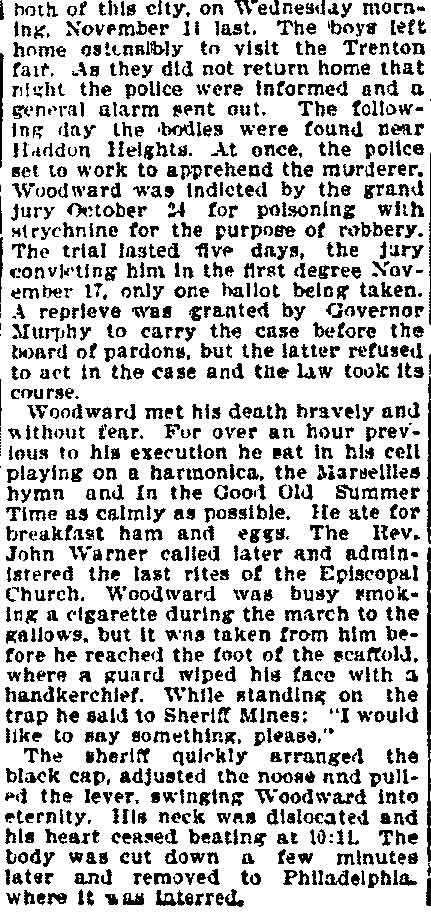
WOODWARD HANGED TO-DAY
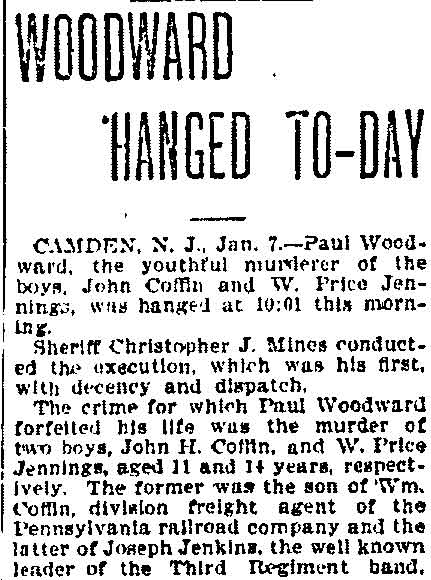
CAMDEN, N. J., Jan. 7.—Paul Woodward, the youthful murderer of the boys, John Coffin and W. Price Jennings, was hanged at 10:01 this morning.
Sheriff Christopher J. Mines conducted the execution, which was his first, with decency and dispatch.
The crime for which Paul Woodward forfeited his life was the murder of two boys, John H. Coffin and W. Price Jennings, aged 11 and 14 years, respectively. The former was the son of Wm. Coffin, division freight agent of the Pennsylvania railroad company and the latter of Joseph Jenkins, the well known leader of the Third Regiment band.
Philadelphia Inquirer - January 8, 1903
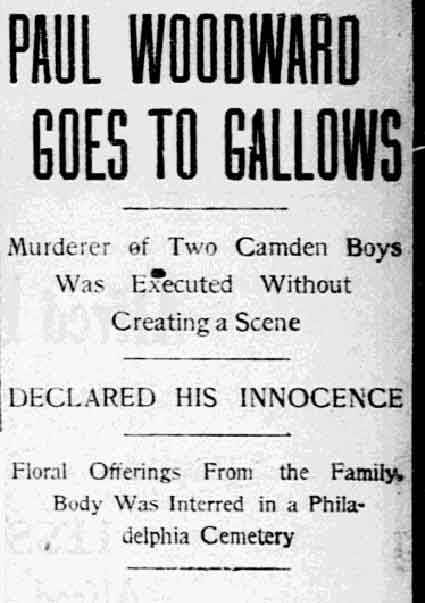
Murderer of Two Camden Boys Was Executed Without Creating a Scene
DECLARED HIS INNOCENCE
Floral Offerings From the Family, Body Was Interred in a Philadelphia Cemetery
Just fourteen weeks to the day after the commission of his crime Paul Woodward, the murderer of John Coffin and W. Price Jennings, boys, was hanged at the county jail in Camden yesterday by Sheriff Christopher J. Mines. The youthful murderer walked to his death with a ghastly countenance and quivering lip. The drop fell at 10:03 and ten minutes later physicians pronounced him dead.
Woodward arose at half past 6 o'clock yesterday morning, after a sound sleep. He sent for the Prosecutor, to whom he protested his innocence.
Rev. John Warnock, the condemned man's spiritual adviser, was offering the last words of consolation when Woodward was summoned by the Sheriff. Clad in a neat-fitting black suit, and with his hands manacled behind him, he was escorted to the execution room by County Detective Smith, Death Watches Paul and Voight, and Rev. Mr. Warnock.
Court and Sheriff's juries were awaiting with bared heads. Sheriff Mines stood near the foot of the gallows as the prisoner entered the door leading to the jail corridor.
Woodward, pale as death, had just a moment's time before Sheriff Mines took him by the arm, led him up the thirteen steps to the platform, adjusted the black cap, knotted the rope, and a moment later the trap opened. Woodward shot down until his feet nearly touched the floor. The rope twisted and the body swung around for a few minutes. The physicians present said death had been painless. The body was taken down at 10:42, placed in charge of undertakers and deposited in a handsome casket, on the lid of which was:
PAUL A. WOODWARD, Died January 7th, 1903, In his 25th year.
In a cab the family followed the hearse to a Philadelphia cemetery, where interment was made.
Just before the execution took place two floral pieces were taken into the jail to be placed on the casket. It was reported that they were sent by Woodward's family.
One was a pillow of carnations and roses having in the centre in immortelles the word "Innocent."
The other was a palm-shaped arrangement of greens and white carnations, tied with a satin ribbon on which were the words "Too Soon."
Those who witnessed the hanging were surprised at the cool manner in which the murderer conducted himself just before the execution. He had been fully expected to make a scene.
The statement sworn to by Woodward before J. Fred George, notary public, was given out after the execution. It was a lengthy document. The youth admitted meeting young Coffin and Jennings, but said his original intention was not robbery. The two boys and he, he said, had agreed to rob several houses in the country.
The boys weakened and refused to be a party to the robberies. Then, according to the statement, he decided to kill the boys for self-protection. He said he had provided himself with pies in advance and the poison was placed in them.
Two other statements were given out by Woodward. Both were rambling stories and contradictory.
Philadelphia Inquirer — January 17, 1903
The last chapter in the murder of John Coffin and W. Price Jennings, for which Paul Woodward was recently hanged, was enacted yesterday when Prosecutor Lloyd directed County Clerk Patterson to cancel the indictment charging Woodward with the murder of young Jennings. It was done simply to make the records in the case complete.
Philadelphia Inquirer — February 22, 1903

Strangest Scientific Experiments Ever Conducted for the Purpose of Treating Crime as a Disease and Eventually Eliminating the Entire Criminal Class
THE United States Government may within a short time establish a laboratory for the study of criminals which will be the most remarkable of its kind in the world. If the bill just favorably reported on by the Senate Judiciary Committee is acted upon by Congress and goes into effect as a law, this country will be in possession of an institution where criminals of all classes will come under the keen eye of scientific experts.
They will be diagnosed, measured and classified by celebrated criminologists and the data secured will be used in giving the malefactor himself an accurate criminal rating, precisely as the hospital patient who submits to an examination by specialists is pronounced either curable or incurable.
The new criminal laboratory is to be established at Washington in connection with the Department of Justice and its existence is the expression of the most advanced twentieth century ideas on the subject of criminology. Amazing as the statement may sound, the aim of the laboratory will be the suppression of habitual criminals, social evils and the defective and pauper classes, with the ultimate view of eliminating the criminal altogether.
The project, pruned of its technical details, is in substance as follows: A lawbreaker convicted of some grave offense will be hastened to the Laboratory of Criminology. Here he will be photographed, measured and thumb-printed by the most modern devices. Apparatus even in advance of those employed in the famous French Bertillion system will be applied, but more than this — the data secured will be utilized not only for purposes of future identification, but for reference and comparison.
The criminal's antecedents will be thoroughly investigated. It will be ascertained whether or not his criminal traits are hereditary. Was his father a criminal? What is his family history? Were any of his ancestors drunkards, insane or epileptics? These are only a few of the questions which will be asked.
Diagnosing a Criminal
Then the man's cranium and physiognomy will be analyzed. They may be normal or decidedly the contrary. If the latter, it must be determined whether he belongs to a degenerate type. The outlines of his cranium will be carefully compared with those of great criminals, men of genius and with those of the ape. Every dip and curvature of the features will be noted, taking into account the low forehead, receding chin and abnormal ear, but these measurements instead of being jotted down at haphazard will be scientifically recorded and afterward averaged up to denote the intellectual capacity of the subject.
An X-ray photograph will determine the relative size and configuration of his brain. His length of limb, breadth of hand, total height and muscular ability are all to be set down and when every measurement has been made and every important fact concerning his past life secured, the laboratory will file away a valuable report which can be used to advantage in comparison with other criminals.
As there are degrees of crime, so the law has decreed certain gradations of punishment. The mission of the Laboratory of Criminology is to determine to a fine point precisely in what degree a malefactor is responsible for his offense, and to compile statistics for use in the future adjustment of the penal codes of prisons and reform institutions.
Responsibility in crime is a subject which has lately engrossed public attention. The law courts may decide that a man is guilty of a certain crime, but it remains for men of science to say just how far a man is guilty from a medical standpoint and to prescribe methods of reform in addition to the legal penalty inflicted.
Dr. Arthur MacDonald, specialist in criminology for the Bureau of Education, and probably the most noted criminologist in this country, is the inventor of a number of instruments used for purposes of experiment upon criminals. These instruments are divided into four classes as follows: For measuring the bony structures of the body and the muscular development. For measuring the nerves in connection with the mental state. For measuring the degree of emotions indicated through movements of the chest in breathing and the flow of blood through the arm. For measuring the degree of suggestibility during the hypnotic state.
Shortly before the execution of the murderer, H. H. Holmes, a few years ago in this city, Dr. MacDonald interviewed and experimented upon this celebrated criminal in his cell, using eight separate apparatus, four of which are shown on this page. Dr. MacDonald had previously experimented upon school children and in this connection he says, in a recent report: "As education concerns the moral, mental and physical development of individuals and society, it may be said to ameliorate the elements that tend to social degeneration. Therefore the instruments used in the study of the socially diseased man will apply as well to the normal man."
The experiments upon school children were made with a view to ascertaining the exact conditions constituting a "normal" child, and from this to set a standard for determining degenerate and criminal types.
The two most interesting instruments applied to Holmes were the plethysmograph and the kymographion. In describing the latter, which is shown in operation in the lower left-hand illustration, Dr. MacDonald says: "This instrument is for the purpose of measuring the mental and emotional states upon the movements of the chest. Actors locate the seat of the emotions they simulate in the chest. A silk band is drawn closely around the chest; a little air-tight cylinder with a delicate film over both ends — a hook being inserted in each film — is attached by loops to the end of the silk band; from the cylinder extend a couple of yards of thin tubing, which is inserted into an air-tight tambour. Upon the head of this tambour, or drum, is hinged a delicate bamboo splinter, which rises and falls with every breath, and which, when pressed against a revolving cylinder bearing a sheet of smoked paper, scratches a series of wavy lines."
The diagram shows the result of the experiments upon Holmes. Dr. MacDonald continues: "It will be noticed that the waves in all the lines are smaller than those in regular breathing, the first line. In other words, the emotional states lessened the breathing. Reading philosophy, multiplication and hating affected the nervous breathing most. This is what generally happens, with the exception of the feeling of hatred, which in most people is a wavy line, but with Holmes it was the most intense line, that is, it absorbed his interest most. The feeling of love had but little more effect than reading the Bible, which had the least effect of any upon his physical states when we compare the line with the regular breathing line."
Another most interesting apparatus is the plethysmograph. It is similar to the kymographion, but instead of showing the fluctuations of breathing during various emotions it records the flow of blood. With the plethysmograph the arm of the person being experimented upon is encased in a large glass tube filled with water, the open end being sealed with gutta percha. Any variations in the normal flow of blood is shown by the fluctuation of water in a slender glass tube, this movement being in turn transmitted to a small weight, which rises and falls with every pulsation.
Experiments with this instrument have demonstrated, among other things, that the sight of a pistol had little or no effect upon a brutal murderer, whereas in a normal man the weight rose and fell violently, giving involuntary testimony of strong emotional disturbance. Applied to pupils in schools the plethysmograph can be made to indicate what studies cause the most mental exertion, those which are the most pleasing and those for which the pupil has the greatest aversion.
The plethysmograph is the invention of a criminologist named Mosso, but it has been much improved by the Bureau of Education, as, indeed, have all the delicate apparatus used in the study of criminals in this country.
The little instrument at the top of the page, called the aesthesiometer, is used to determine the delicacy of touch or physical sensitiveness. Anyone can try this experiment with two pins upon the palm of the hand. If, with your eyes closed, you can detect the touch of two pin points when placed together, then you are physically sensitive. Ordinarily the two points when close give you the impression of being stuck with but one; if they have to be spaced far apart before you feel two separate impressions of pain, then you may be said to be physically obtuse. Refined criminals are sensitive to the touch; in coarse, brutal natures the reverse is true.
With the palate meter the height of the palate is determined. A high palate is a sign of criminal instincts. In Holmes the palate was unusually high.
The thermaesthesiometer, the large instrument to the right-hand of this page, records sensitiveness to heat and cold — whether a person is affected by a sudden draught, a blast of hot air and in how far the emotions affect the bodily temperature. There are numerous other instruments beside these, all of which, when applied to a criminal, will afford a whole volume of valuable facts concerning his moral, mental and physical being.
The new Laboratory of Criminology will be conducted as a bureau of the Department of Justice; it has no connection with the laboratory now being run under the Department of the Interior, but Dr. MacDonald, the head of the latter, will doubtless be chosen as the exponent of the new institution.
Responsibility of Criminals
It is not the intention of the Laboratory of Criminology to palliate the offenses of hardened criminals. First of all, like the Bertillion system, it will measure criminals from head to foot and these records, put against them for future identification, will have a deterring influence against the commission of further crime when they have been released from the penitentiary.
Murderers of the degenerate type — like Paul Woodward, recently hanged in Camden, and Hooper Young, sentenced two weeks ago to life imprisonment — who are adjudged medically insane, but legally rational and responsible for their deeds of violence, will not be excused under the new system on the plea of mental irresponsibility for the atrocities they commit. Criminals of depraved types, in whom reform is acknowledged to be impossible, will be sized up by all the delicate instruments of the laboratory. Their heads will be X-rayed; their intellectual powers accurately measured and their emotional capabilities for good and evil gauged with scientific precision. The facts gathered in this manner will serve to determine the relative proportion of criminal instinct in each.
Young boys in reformatories and men committed to prison on minor offenses will be subjected to the experiments. These statistics, compiled by studious hands, will be of inestimable benefit to future generations. By their use the refractory youth who commits his first trivial misdemeanor, but in whom there are discerned good signs, will not be condemned to the contaminating influence of a reformatory career. Men undergoing penal servitude for small theft will not have to work side by side at the prison bench with murderers. Punishment will be graded, not only according to the nature of the crime, but according to the inherent capacity for good shown by experiments.
If the scientific instruments denote that a man is mentally and morally capable of amendment, his surroundings in confinement will, as far as possible, be kept in conformity with this idea. Of course such a state of affairs may be a long way off yet, but in these times the prison reform idea is in its infancy and another century may have to roll over us before the penitentiary comes to be looked upon as a sanitarium of criminology as well as a place of incarceration.
The new Laboratory of Criminology, when realized as an actual fact, will represent the first practical step taken in this direction.
Is The Cigarette Responsible For Crime? — Philadelphia Inquirer, March 8, 1903
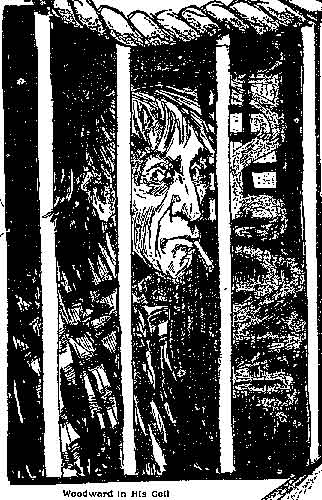
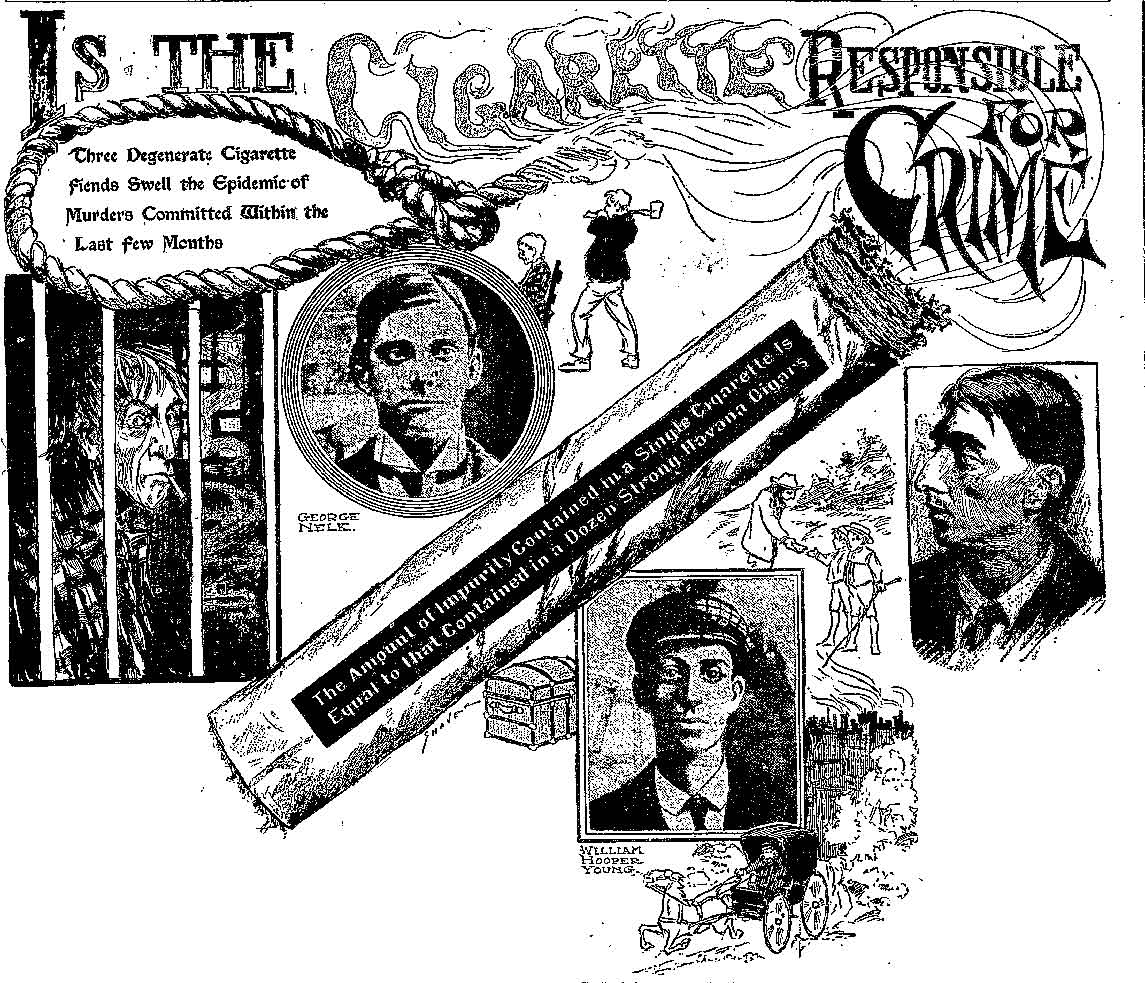
IS THE CIGARETTE RESPONSIBLE FOR CRIME?
Three Degenerate Cigarette Fiends Swell the Epidemic of Murders Committed Within the Last Few Months
IT WOULD seem to be a significant and striking fact that three murders of a shocking and brutal character, each taking place within a surprisingly short space of time, should have been committed by three cigarette fiends, all of whom were young men all of whom were victims to the cigarette habit.
PAUL WOODWARD LURED THE TWO LITTLE CAMDEN BOYS INTO THE COUNTRY LAST SUMMER AND ADMINISTERED POISONED PIE TO THEM.
WILLIAM HOOPER YOUNG MURDERED MRS. PULITZER IN NEW YORK LAST SEPTEMBER.
GEORGE NELK ACCUSED BY HIS SISTER OF HAVING KILLED HIS MOTHER ON THE 12TH OF LAST FEBRUARY, BY CLEAVING HER HEAD OPEN WITH A HATCHET, IN THEIR HOME IN GERMANTOWN, AND AT THE SAME TIME GUILTY OF A MURDEROUS ASSAULT UPON HERSELF WITH THE SAME WEAPON.
These three men all represent a single type of degeneracy and each is the other's counterpart. Young has just started to serve a life sentence in the New York State Penitentiary. Cigarettes slew the other two. The man who paid the penalty of his crime upon the gallows a short time ago. The halter that hanged him was the fiendish, leering vapor of the nicotine, which had long before strangled out his intellect and now came in the guise of the hangman's noose to strangle out his physical life. Nelk awaits a like fate, but whatever his punishment is to be, there will hang over him, too, at the end of the legal dispensation, the same poisonous vapor which robbed him and the others of the God-given power of thought.
Trio of Cigarette Crimes
That these three young men should have committed parallel crimes within such a short compass of time is merely a coincidence. All dissipated, all shiftless, all rendered mentally and morally corrupt by the deadening influence of impure and poisoned tobacco, it was chance that, in reality, brought them almost simultaneously into the notoriety of crime. But because of this it cannot be said that they alone are guilty of the cigarette habit in its worst form.
Young, Woodward and Nelk simply stand as the symbols of human wreck for which the deadly cigarette is too often responsible. It is true that every day men with nerve enough to commit murder — but many hundreds of them — idle, ne'er-do-well young fellows like this degraded trio — are daily crowding the reformatories, jails and houses of correction throughout the whole United States. Other hundreds, who have not as yet reached the reformatory stage of their careers, are to be seen nightly prowling aimlessly about the tenderloin of great cities or loafing on street corners, inhaling the poisonous fumes of cheap cigarettes.
Nicotine Debases
Nelk, Woodward and Young were cigarette fiends from early youth. Their ages averaged only a little over twenty-three years. The practice of smoking cigarettes, formed long before they had matured, clung to them in early manhood, and the debasing effects of the nicotine which kept their nervous systems continually saturated at last accomplished the full overthrow of their intellects.
However, according to the medical experts who testified at his trial, Young will eventually become insane, and through no other cause than the cigarette habit. Nelk, apparently, is of sound mind, and there could be no excuse for the ghastly butchery he had perpetrated. As for Woodward, it was proven incontestably that the entire foundation of his brain had been undermined by nicotine. When he came to trial the jury found him in full possession of rational powers and he is now paying the penalty of second degree murder with a life sentence. Setting aside the question of his immediate responsibility, the truth remains that had Young not been a cigarette fiend to the core of him he would never have dipped his hands in blood.
The facts that apply to Young are applicable to Woodward as was shown in the pages of The Sunday Inquirer some months ago. Woodward was a degenerate of the lowest type. Six months in jail had not changed him. He vanished with his rapacious appetite for the weed, and he smoked almost to the gallows' edge.
Nelk, the matricide, is a cigarette fiend of the same stamp as the two before him. A package of cigarettes was in his coat pocket when he was arrested. It helped to establish his identification as the man. While in prison awaiting trial he is reported to have become a victim to the positive source of pleasure, when cigars and cigarettes are taken away from him. In the jail in Flemington, on the train for Philadelphia to attend the preliminary hearing, and in the county prison throughout all the long days of his imprisonment he made the life of his keepers miserable by whining, imploring, howling and uttering imprecations in the name of his cherished dope.
Poisoned Tobacco
From numerous sources of authority, representing the most scientific and reliable views, The Inquirer has gathered together all the information available on the subject of cigarettes and just why and how they are injurious to the human system.
In the first place, cigarettes are not made of pure tobacco. There may be exceptions to this rule, but these are only in the expensive brands, smoked almost exclusively by men who can afford to spend the money. Among this class of men the true cigarette fiend is seldom seen, for the fumes of the fine Oriental cigarette are most appreciated by them in moderate quantities as a soothing climax to a good dinner.
It is the cheap cigarettes which contain harmful tobacco and still more injurious dope in imitation of the genuine Turkish article. Real Turkish cigarettes, such as we seldom or never see in this country, contain a very small percentage of opium, which is not really a menace to health at the rate of a cigarette or two a day at a sitting. The greatest evil in the cigarette is in the dope with which the cheap varieties are adulterated.
The greatest evil of the cigarette is not in the tobacco, which, if pure, would produce no especially harmful effects, but it is in the paper wrapper which encompasses the tobacco. The paper wrappers of cheap cigarettes are impregnated with poisonous chemical compounds which, when burned and inhaled, produce a series of malignant effects on the nervous system.
More Dangerous Than Arsenic
If anyone is skeptical of the information given to the world he would be wise to consult his nearest physician on the subject. They are, in fact, more dangerous than arsenic to those to whom they are habitually dispensed, followed by paralysis, slow derangement of the nervous system and of the judgment, leading to idiocy in some cases, to the criminal mania exhibited by Woodward, Young and Nelk in others, and the total annihilation of intelligence in still others.
In short, the man who is going to the bad, type Woodward, Nelk and Young, goes by this route: First excessive use of cheap cigarettes, then a gradual debasing of all higher moral instincts, next the lower forms of crime, lastly murder.
The Inquirer is not alone in this assertion; every large newspaper in the land has from time to time raised its voice against the cigarette and detailed its injurious effects. In every state of the Union there are laws restricting or forbidding the sale of cigarettes to minors, and among those who have made a long study of these conditions and who have exhibited moral degeneration and moral recklessness among youth, there is not one who doubts that the cigarette is one of the most tremendous and far-reaching evil influences which has ever vitiated the moral and physical well-being of those among whose ranks will one day be recruited the leading men of affairs of this Republic.
If anyone still questions the evil effects of the cigarette habit on the higher functions of mind, on intelligence and moral sensibility, let him study the careers of such men as Woodward, Young and Nelk, and the cigarette habit that dominated and finally destroyed them, and he will find in their degenerate careers the fullest possible confirmation of the position taken above.