Introduction
DR. PAUL NATHAN LITCHFIELD was born in Jersey City, New Jersey in 1873. After attending the University of Pennsylvania he graduated from Jefferson Medical College in 1895. He was a general practitioner and was affiliated with Cooper Hospital and the Lakeland Tuberculosis Hospital run by Camden County. Dr. Litchfield was a member of the Camden County Medical Society, the Camden City Medical Society; the American Medical Association, and the Philadelphia Medical Club. He also at one time served as Camden County's coroner.
The 1900 Census shows Dr. Litchfield and his wife Rena at 1123 Kaighn Avenue. By 1906 he had moved to 1100 Kaighn Avenue, the corner of Mount Ephraim and Kaighn Avenues, where he had his medical practice and operated a pharmacy. He remarried in 1907, and was living with his wife Kirstine at the Kaighn Avenue address when the Census was taken in 1910, and when the 1914 City Directory was compiled.
Dr. Litchfield died May of 1918. When the 1920 Census was enumerated his widow had moved to Philadelphia. By the mid-1920s Dr. Samuel S. Butler had acquired the property at 1100 Kaighn Avenue. Dr. Butler would practice medicine and pharmacy at that address for many years thereafter.
Dr. Litchfield was a member of Camden Lodge No. 293, Benevolent Protective Order of Elks.
1100 Kaighn Avenue
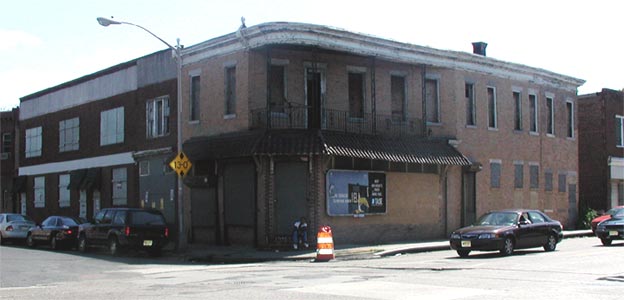
1100 Kaighn Avenue — site of Dr. Litchfield's medical practice and pharmacy
Philadelphia Inquirer
Philadelphia Inquirer —
Father Shoots His Son Then Suicides
CAMDEN, N. J., Jan 8—Joseph Caskey, a teamster, aged 63 years, of 820 Mount Vernon street, Camden, shot and instantly killed his son, Joseph, a weaver, aged 30 years, of 923 Chestnut street, Camden, in a stable yard in the rear of William Sultzbach’s saloon, at the southeast corner of Ninth and Walnut street, about half-past seven o’clock last night. The father afterwards put the pistol in his mouth, pulled the trigger and fell a corpse at his son’s feet.
Joseph Caskey, Sr., was one of the settlement, and his son was equally well known. Sunday they both attended a Polish christening and were apparently on good terms.
Last night the father was observed to drive into the stable yard shortly after seven o’clock with a team partially loaded. He was seen and heard by several neighbors in and about the barn.
About half-past seven the housekeeper at Sultzbach’s, on whose premises the stable is located, came to him in a state of fright and declared there was a man on the roof. To satisfy her he lighted a lantern and went out on the roof, but found no one. As he flashed the lantern he discovered the street gate and barn door open.
He came down and fastened the gate and started for the barn door and found the bodies of both men.
The son was lying in the stable door with a bullet wound in his temple. The father, a few feet away, was found with a wound in the roof of his mouth. The revolver, a 32-calibre, was clutched tightly in his right hand.
Mr. Sultzbach immediately notified the authorities, and Captain Stanley and Sergeant Reeder [sic] took charge of the bodies until the arrival of Coroner Litchfield.
Both men were married. The father leaves a wife and three grown children and the son a wife and two little girls.
Col. Felton Committed Suicide in His Office
Camden Daily Courier —

Closed the Place Up Tightly and Turned on Gas Jet.
His Family at Stone Harbor
The Real Estate Operator’s Confidential Clerk Made a Startling Discovery When He Opened the Office This Morning—He Had Been Acting Strangely for Weeks.
Colonel George G. Felton, the well known real estate dealer, former City Treasurer and Deputy Quartermaster of the National Guards, committed suicide sometime last night or early this morning by asphyxiating himself in the Felton building, northeast corner of Second and eFderal [sic] streets.
The suicide caused a great sensation when it became generally known and a large crowd of people surrounded the building all morning until the removal of the body by Funeral Director Fithian Simmons to his office on Market street. Mr. Felton resided at 413 Washington street, but his family has been summering at Stone Harbor.
The death of Col. Felton was not discovered until half-past 7 o’clock this morning, when Confidential Clerk Smith on opening the doors of the office detected the smell of gas. Col. Felton had been absent from the office for several days and Clerk Smith’s suspicions were aroused, knowing that County Colector [sic] Mahlon F. Ivins was a bosom friend and business confidante of Col. Felton, he hastened across the street to his office and informing him of his misgivings, asked him to assist him in making an investigation. Before accompanying Mr. Smith to the Felton building, Collector Ivins ‘phoned to the City Hall and the police in turn notified Coroners Robinson and Litchfield. The Central station also directed Policeman George Kappel to take charge of the premises and when he arrived there was joined by Policeman Harry Hiller. Chief Foster and Captain Boyle were also soon on the scene.
Accompanied by Mr. Ivins, Clerk Smith returned to the Felton building. Passing through the main office they treaded their way down a dim, narrow corridor to the private examining room of the U. S. Pension physicians. Opening the door the stench of gas was so overpowering that it nearly knocked them down. They, however, bravely ventured into the room and threw open the windows, the gas escaping into the street and enabling them to pursue their gruesome search. They found it on a sofa in a corner of the room, a small but high ceilinged apartment. On the sofa lay the dead body of Col. Felton, disrobed of his outer garments and wearing a calm, peaceful expression in sad discord with his worldly troubles. Overhead the gas stove connection was on full tilt, graphically explaining the mode of death. On a chair nearby were found his trousers and vest, while his hat, coat and watch were found in his own main office.
Coroners Litchfield and Robinson gave a certificate of death of heart failure, superinduced by inhaling gas. From the pink discoloration about the wrists where the blood was leaving the veins, Dr. Litchfield said that the body had been dead at least six hours, though he may have been dead ten or twelve.
Col. Felton was seen to enter his building at exactly 12.10 o’clock this morning. A citizen, whose name is withheld at his own request, had been talking with Night Watchman Clarence Hires on Federal street. He bade Hires good night and when he reached Second street saw the Colonel come around the corner. He came as though to enter his office by the front door, but turned and going back up Second street entered the side-door. Mr. Hires says the light was burning in the Colonel’s front office from 7 o’clock last night to 5 o’clock this morning, when he went off duty and Mr. Smith found it still burning when he arrived.
Colonel Felton has been acting strangely for several weeks and had not been at his office for two or three days.
When asked by anxious friends what the trouble was, he would put his hands to the side of his head and complain that it was in bad shape. He was seen in the hotel at Haddon avenue station on Saturday afternoon. He carried a grip and appeared very cheerful. Asked if he had been to the shore he replied no, he had been down the country, Bridgeton.
Grocer Charles F. Eastlack, by whom Col. Felton was at one time employed, went to Stone Harbor this morning to notify the family of his death. Col. Felton leaves a widow and adopted daughter, Miss Leona Felton.
Col. George G. Felton was born at Westville, Mass., and was fifty-six years of age. He had been a resident of this city for about quarter of a century. Previous to that he was engaged in the grocery business at Burlington. On coming to Camden, he entered the employ of Grocer Charles F. Eastlack, at Third and Washington streets, but later entered the employ of his brother, Charles H. Felton, who had an extensive real estate business. On the death of the latter the Colonel went into the same business for himself, his brother’s widow continuing the old business under the name of Charles H. Felton & Co. It is not known, however, whether business troubles impelled him to end his life.
Col. Felton was prominent in political, military and society circles. In 1892 he was appointed by Mayor Wescott a member of the Board of Public Works.
In 1896 he was appointed City Treasurer to fill the unexpired term of the late F. F. Michellon. In 1897 he was elected City Treasurer for two years, his election being contested by his Democratic rival, Freedom C. Lippincott, but was confirmed by the County Board of Elections.
He was Deputy Quartermaster on the Governor’s staff and a member of the Masonic order and A. O. U. W.
Colonel Felton was active in building and loan association circles. He was treasurer of the Mechanics’ and Workingmen’s Building and Loan Association and was former secretary of the People’s. He was also a director of the Security Trust Company. He had also been a director in the Central Trust.
Mrs. Felton will arrive from Stone Harbor this evening, when arrangements for the funeral will be made. The flag at Post 5 Hall is flying at half-mast in Col. Felton’s memory, for he was a Grand Army veteran, having gone to the front when a mere boy.
Notable Growth of Labor Unions
Membership of the Telegraphers Union Increasing in the West.
By “The Courier’s” Own Wire.
Chicago, July 7.—President Samuel Gompers, of the American Federation of Labor, was in Chicago yesterday on his way to San Francisco, and while here addressed a meeting of the Commercial Telegraphers’ Union. President Gompers expressed himself as pleased with the action of the telegraphers in organizing, and with the condition of labor organizations throughout the country. He stated that there were more unions and larger memberships of the same than at any time in the history of labor. President MacDonald, of the Telegraphers’ Union, said that the membership was increasing, and that there were similar unions now established at Milwaukee and Kansas City. About five hundred telegraphers were present at the meeting.
Florist Fish Dies Suddenly
Expired Yesterday Morning at Pleasantville Where He Was Visiting Friends.
Walter C. Fish, a well known florist of Broadway and Spruce streets, this city, died suddenly early yesterday morning at Pleasantville, N. J., where he had been visiting friends since the Fourth. For some months past he has not been well and complained frequently of pains in his head.
Yesterday morning he arose as usual, and at about half-past 6 o’clock was taken with severe pains in the head. He continued to grow worse and two physicians were summoned. They ministered to the sick man, but without any apparent success, and at twenty minutes after 7 o’clock he died.
A member of the family could not state this morning just what Mr. Fish’s malady was. It was thought probably that he suffered from brain trouble.
The body was brought to this city yesterday afternoon at 5 o’clock, and the funeral will be held on Wednesday afternoon next at 2 o’clock. Mr. Fish was a member of Fidelity Lodge, No. 3, A. O. U. W., Improved Order of Heptasophs; Camden Conclave, No. 215; Witherspoon Circle, No. 1, Brotherhood of the Union.
“Just a Gentle Touch.”
That Was All, But Joseph’s Watch and Money Went With It.
Annie McAntee, alias Hayes, twenty-four years old, of Philadelphia, and Joseph Costello, thirty years old, also of Philadelphia, were arraigned before Recorder Stackhouse this morning on a charge of being drunk and disorderly. The twain were picked up by Policeman Matlack on Sunday morning about 3 o’clock at Third and Walnut streets, very much the worse for liquor.
The aimless wanderings of the couple and their suspicious actions first caught the attention of the policeman and he followed them. Costello became tired of walking and went to sleep on a convenient door step. At this stage of the game the Hayes woman was seen by the officer to abstract something from the clothes of the sleeping man, and then to slip away and hide behind a tree on the opposite side of the street. In a few moments the man awoke and not seeing the woman started off down Walnut street. As soon as he was out of sight the woman skipped down Third
Col. George G. Felton Ends His Life by Inhaling Illuminating Gas
Camden Post-Telegram —
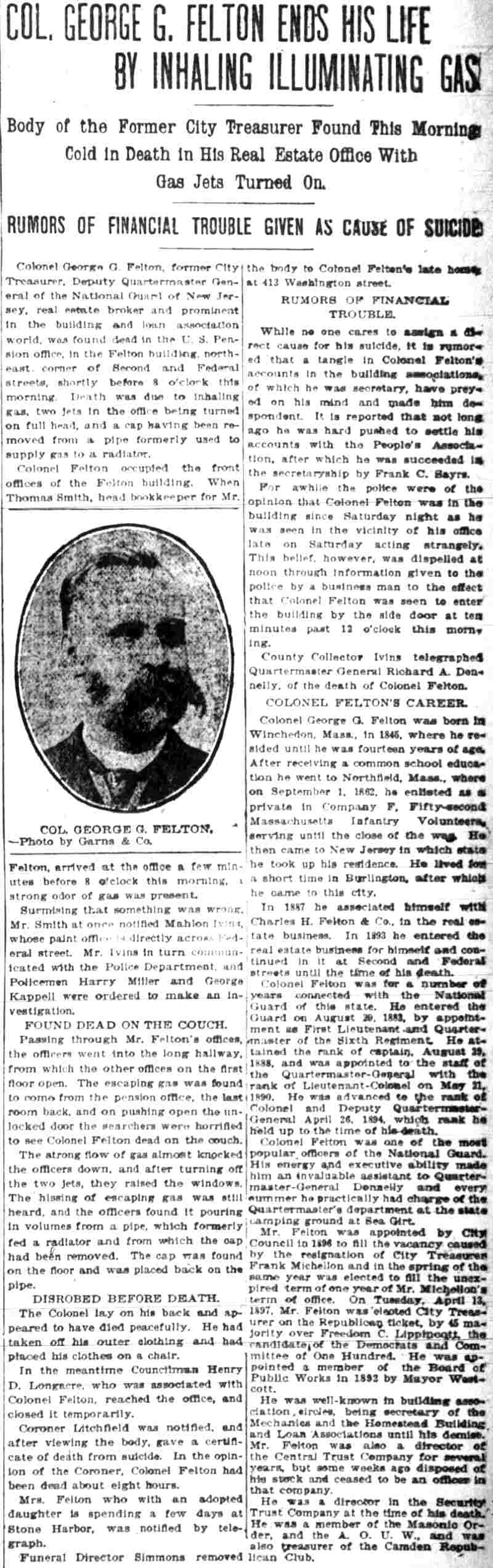
COL. GEORGE G. FELTON ENDS HIS LIFE BY INHALING ILLUMINATING GAS
Body of the Former City Treasurer Found This Morning Cold in Death in His Real Estate Office With Gas Jets Turned On.
RUMORS OF FINANCIAL TROUBLE GIVEN AS CAUSE OF SUICIDE
Colonel George G. Felton, former City Treasurer, Deputy Quartermaster General of the National Guard of New Jersey, real estate broker and prominent in the building and loan association world, was found dead in the U. S. Pension office, in the Felton building, northeast corner of Second and Federal streets, shortly before 8 o’clock this morning. Death was due to inhaling gas, two jets in the office being turned on full head, and a cap having been removed from a pipe formerly used to supply gas to a radiator.
[Photo caption:] COL. GEORGE G. FELTON. —Photo by Garns & Co.
Colonel Felton occupied the front offices of the Felton building. When Thomas Smith, head bookkeeper for Mr. Felton, arrived at the office a few minutes before 8 o’clock this morning, a strong odor of gas was present.
Surmising that something was wrong, Mr. Smith at once notified Mahlon Ivins, whose paint office is directly across Federal street. Mr. Ivins in turn communicated with the Police Department, and Policemen Harry Miller and George Kappell were ordered to make an investigation.
FOUND DEAD ON THE COUCH.
Passing through Mr. Felton’s offices, the officers went into the long hallway, from which the other offices on the first floor open. The escaping gas was found to come from the pension office, the last room back, and on pushing open the unlocked door the searchers were horrified to see Colonel Felton dead on the couch.
The strong flow of gas almost knocked the officers down, and after turning off the two jets, they raised the windows. The hissing of escaping gas was still heard, and the officers found it pouring in volumes from a pipe, which formerly fed a radiator and from which the cap had been removed. The cap was found on the floor and was placed back on the pipe.
DISROBED BEFORE DEATH.
The Colonel lay on his back and appeared to have died peacefully. He had taken off his outer clothing and had placed his clothes on a chair.
In the meantime Councilman Henry D. Longacre, who was associated with Colonel Felton, reached the office, and closed it temporarily.
Coroner Litchfield was notified, and after viewing the body, gave a certificate of death from suicide. In the opinion of the Coroner, Colonel Felton had been dead about eight hours.
Mrs. Felton who with an adopted daughter is spending a few days at Stone Harbor, was notified by telegraph. Funeral Director Simmons removed the body to Colonel Felton’s late home at 413 Washington street.
RUMORS OF FINANCIAL TROUBLE.
While no one cares to assign a direct cause for his suicide, it is rumored that a tangle in Colonel Felton’s accounts in the building associations, of which he was secretary, have preyed on his mind and made him despondent. It is reported that not long ago he was hard pushed to settle his accounts with the People’s Association, after which he was succeeded in the secretaryship by Frank C. Sayrs.
For awhile the police were of the opinion that Colonel Felton was in the building since Saturday night as he was seen in the vicinity of his office late on Saturday acting strangely. This belief, however, was dispelled at noon through information given to the police by a business man to the effect that Colonel Felton was seen to enter the building by the side door at ten minutes past 12 o’clock this morning.
County Collector Ivins telegraphed Quartermaster General Richard A. Donnelly, of the death of Colonel Felton.
COLONEL FELTON’S CAREER.
Colonel George G. Felton was born in Winchedon [sic], Mass., in 1845, where he resided until he was fourteen years of age. After receiving a common school education he went to Northfield, Mass., where on September 1, 1862, he enlisted as a private in Company F, Fifty-second Massachusetts Infantry Volunteers, serving until the close of the war. He then came to New Jersey in which state he took up his residence. He lived for a short time in Burlington, after which he came to this city.
In 1887 he associated himself with Charles H. Felton & Co., in the real estate business. In 1893 he entered the real estate business for himself and continued in it at Second and Federal streets until the time of his death.
Colonel Felton was for a number of years connected with the National Guard of this state. He entered the Guard on August 29, 1883, by appointment as First Lieutenant and Quartermaster of the Sixth Regiment. He attained the rank of captain, August 19, 1888, and was appointed to the staff of the Quartermaster-General with the rank of Lieutenant-Colonel on May 21, 1890. He was advanced to the rank of Colonel and Deputy Quartermaster-General April 26, 1894, which rank he held up to the time of his death.
Colonel Felton was one of the most popular officers of the National Guard. His energy and executive ability made him an invaluable assistant to Quartermaster-General Donnelly and every summer he practically had charge of the Quartermaster’s department at the state camping ground at Sea Girt.
Mr. Felton was appointed by City Council in 1896 to fill the vacancy caused by the resignation of City Treasurer Frank Michelon and in the spring of the same year was elected to fill the unexpired term of one year of Mr. Michelon’s term of office. On Tuesday, April 13, 1897, Mr. Felton was elected City Treasurer on the Republican ticket, by 45 majority over Freedom C. Lippincott, the candidate of the Democrats and Committee of One Hundred. He was appointed a member of the Board of Public Works in 1892 by Mayor Westcott.
He was well-known in building association circles, being secretary of the Mechanics and the Homestead Building and Loan Associations until his demise. Mr. Felton was also a director of the Central Trust Company for several years, but some weeks ago disposed of his stock and ceased to be an officer of that company.
He was a director in the Security Trust Company at the time of his death. He was a member of the Masonic Order, and the A. O. U. W., and was also treasurer of the Camden Republican Club.
Col. George Felton Made Suicide Sure
Philadelphia Inquirer —
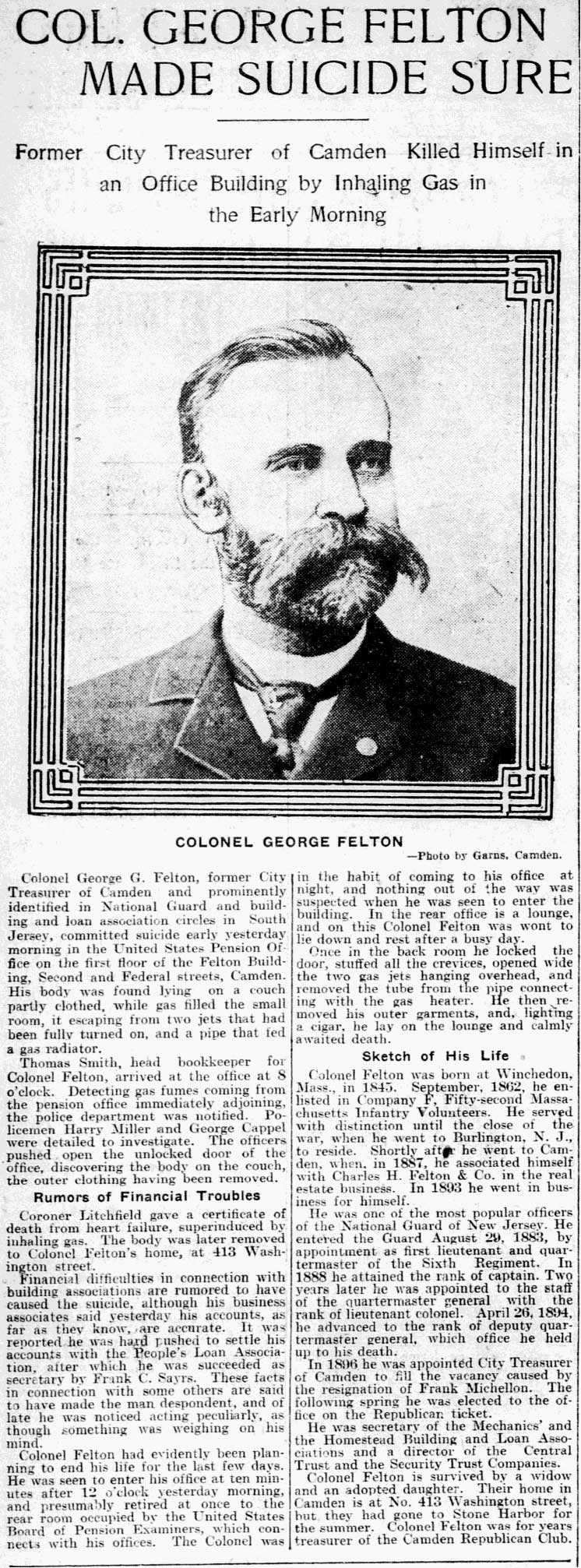
COL. GEORGE FELTON MADE SUICIDE SURE
Former City Treasurer of Camden Killed Himself in an Office Building by Inhaling Gas in the Early Morning
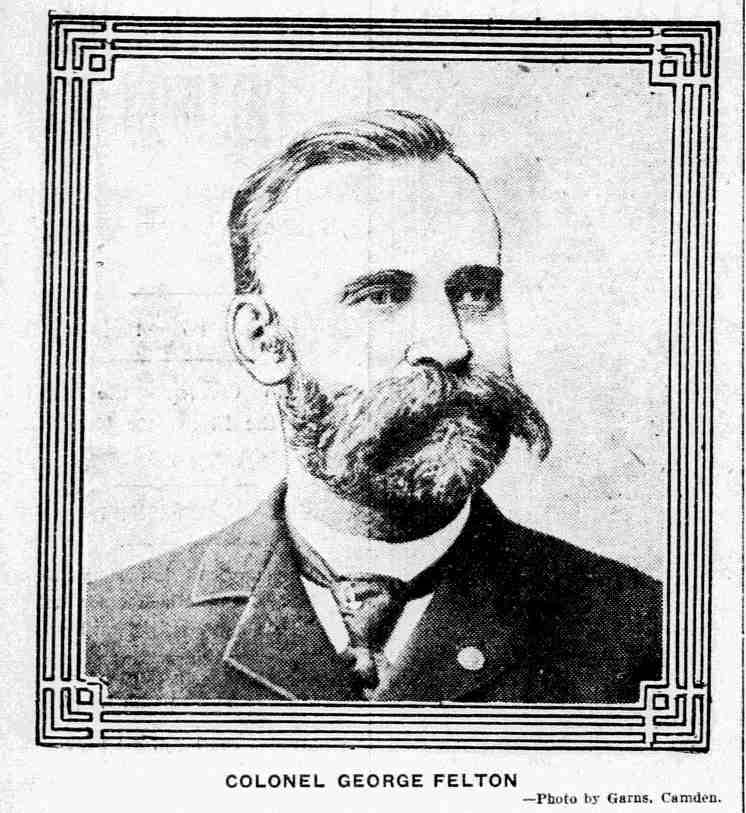
COLONEL GEORGE FELTON
—Photo by Garns, Camden.
Colonel George G. Felton, former City Treasurer of Camden and prominently identified in National Guard and building and loan association circles in South Jersey, committed suicide early yesterday morning in the United States Pension Office on the first floor of the Felton Building, Second and Federal streets, Camden. His body was found lying on a couch partly clothed, while gas filled the small room, it escaping from two jets that had been fully turned on, and a pipe that fed a gas radiator.
Thomas Smith, head bookkeeper for Colonel Felton, arrived at the office at 8 o’clock. Detecting gas fumes coming from the pension office immediately adjoining, the police department was notified. Policemen Harry Miller and George Cappel were detailed to investigate. The officers pushed open the unlocked door of the office, discovering the body on the couch, the outer clothing having been removed.
Rumors of Financial Troubles
Coroner Litchfield gave a certificate of death from heart failure, superinduced by inhaling gas. The body was later removed to Colonel Felton’s home, at 413 Washington street.
Financial difficulties in connection with building associations are rumored to have caused the suicide, although his business associates said yesterday his accounts, as far as they know, are accurate. It was reported he was hard pushed to settle his accounts with the People’s Loan Association, after which he was succeeded as secretary by Frank C. Sayrs. These facts in connection with some others are said to have made the man despondent, and of late he was noticed acting peculiarly, as though something was weighing on his mind.
Colonel Felton had evidently been planning to end his life for the last few days. He was seen to enter his office at ten minutes after 12 o’clock yesterday morning, and presumably retired at once to the rear room occupied by the United States Board of Pension Examiners, which connects with his offices. The Colonel was in the habit of coming to his office at night, and nothing out of the way was suspected when he was seen to enter the building. In the rear office is a lounge, and on this Colonel Felton was wont to lie down and rest after a busy day.
Once in the back room he locked the door, stuffed all the crevices, opened wide the two gas jets hanging overhead, and removed the tube from the pipe connecting with the gas heater. He then removed his outer garments, and, lighting a cigar, he lay on the lounge and calmly awaited death.
Sketch of His Life
Colonel Felton was born at Winchedon [sic], Mass., in 1845. September, 1862, he enlisted in Company F, Fifty-second Massachusetts Infantry Volunteers. He served with distinction until the close of the war, when he went to Burlington, N. J., to reside. Shortly after he went to Camden, when, in 1887, he associated himself with Charles H. Felton & Co. in the real estate business. In 1893 he went in business for himself.
He was one of the most popular officers of the National Guard of New Jersey. He entered the Guard August 29, 1883, by appointment as first lieutenant and quartermaster of the Sixth Regiment. In 1888 he attained the rank of captain. Two years later he was appointed to the staff of the quartermaster general with the rank of lieutenant colonel. April 26, 1894, he advanced to the rank of deputy quartermaster general, which office he held up to his death.
In 1896 he was appointed City Treasurer of Camden to fill the vacancy caused by the resignation of Frank Michellon. The following spring he was elected to the office on the Republican ticket.
He was secretary of the Mechanics’ and the Homestead Building and Loan Associations and a director of the Central Trust and the Security Trust Companies.
Colonel Felton is survived by a widow and an adopted daughter. Their home in Camden is at No. 413 Washington street, but they had gone to Stone Harbor for the summer. Colonel Felton was for years treasurer of the Camden Republican Club.
The Paul Woodward Murder Case
–
On October 1, 1902 Paul Woodward murdered two young boys by giving them poison. Frank T. Lloyd, then Camden County prosecutor, was responsible for leading the investigation and prosecuting the case. Dr. Paul N. Litchfield was serving as County Coroner at the time, was involved in the investigation and at the trial. Woodward was arrested on October 4, 1902. He was indicted, tried, convicted of murder in the first degree, and on January 7, 1903 executed at the Camden County Jail.
People mentioned in coverage of this case: Joseph Jennings – Jennings' Third Regiment Band – Frank T. Lloyd – Dr. William S. Jones – William D. Hart – Dr. Paul N. Litchfield – F. Morse Archer – John Foster – John Painter – John Cherry – Isaac Toone – Paul Woodward – George M. Beringer – Charles G. Garrison – J. Wesley Sell – Christopher J. Mines Jr. – Frederick A. Rex – J. Frederick Voigt – George F. Kappel – Isaac Toy – Harry S. Scovel – Francis Ford Patterson Jr. – Hugh Boyle – George H. Stineford Sr. – Frank S. Albright – Thomas Walton – Dr. William H. Iszard
Missing Camden Boys Murdered in a Field
Philadelphia Inquirer —
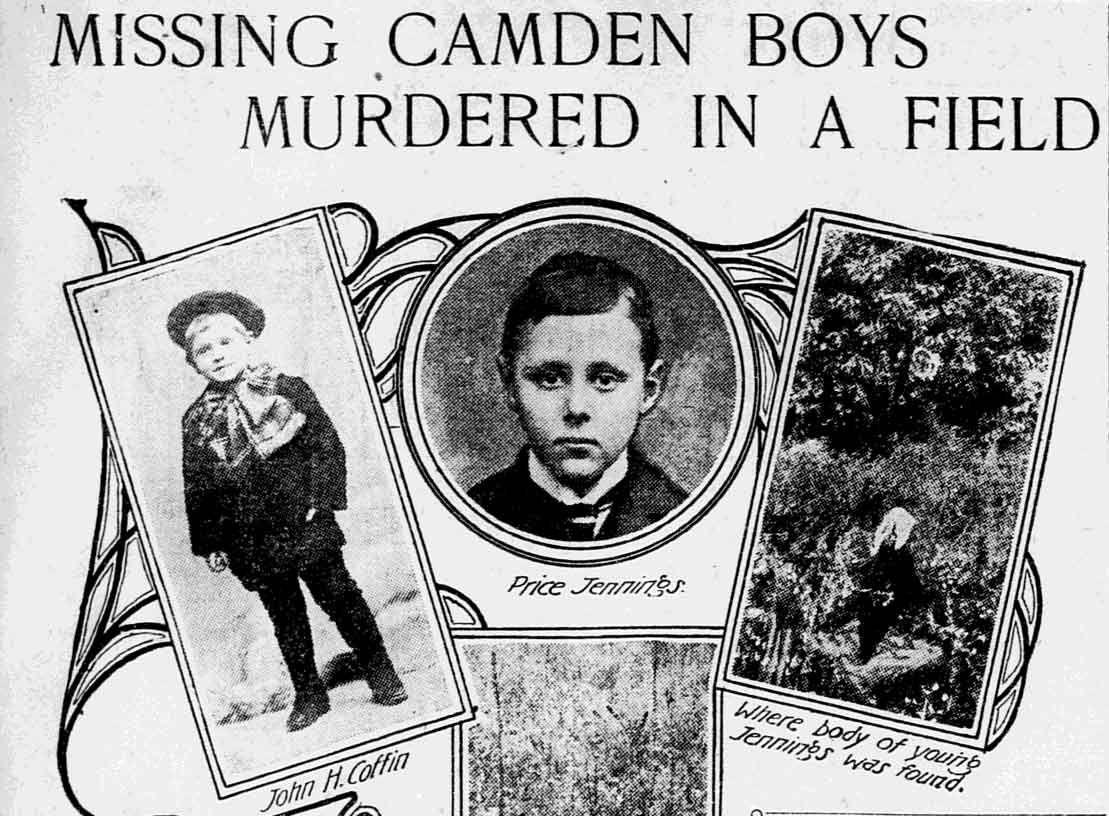
Young John Coffin and Price Jennings Believed to Have Been Poisoned—Companion Arrested and Committed to Jail
John H. Coffin
Price Jennings.
Where body of young Jennings was found.
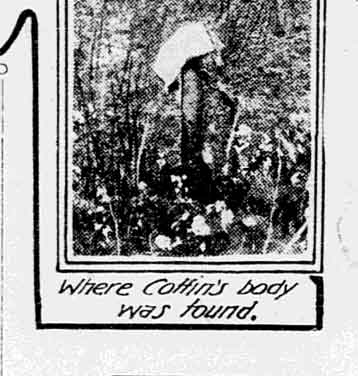
Where Coffin’s body was found.
The discovery of their bodies cold in death, the victims of an atrocious double murder, yesterday solved the mystery surrounding the disappearance from their homes in Camden on Wednesday of John H. Coffin, the 11-year-old son of William Coffin, division freight agent of the Pennsylvania Railroad, and Price Jennings, his chum and playmate, the 13-year old son of Josephus Jennings, leader of Jennings’ Third Regiment Band, of Camden.
Paul Woodward, 18 years old, a companion of both the boys, is charged with their murder and is locked up in the county jail awaiting the further action of the authorities. There are no evidences of external injuries and the only theory to which the police can attribute the cause of death is that the assassin of the boys administered poison to them, and it is along this line that County Physician Jones and Prosecutor Lloyd are conducting an investigation.
The details surrounding the atrocious crime makes it one the like of which has never been known in the criminal history of this section of the country. The youth of the boys, their heretofore relations of good companionship, and many other circumstances make of it an almost unparalleled crime, and while there is said to be every evidence of a motive for the murder, in the opinion of those who are in close touch with the case, it is an instance in which the work is that of a degenerate boy in whom all sense of right and wrong have long since been dead. Certain it is that the crime has stirred the people of Camden and vicinity to a feverish heat to which it has not been stirred since the days following the murder of Annie Leconey.
Found in a Field
The bodies of both the lads were found yesterday morning in a field near the Haddon Heights Station of the Reading Railroad on what is known as the Lippincott farm, about a quarter mile from Station Avenue. The body of young Jennings was found lying in a clump of bushes and less than forty yards away lay the remains of Coffin. Both bodies were stiff and in a state of decomposition. Coffin’s body was the first discovered, and it was not long after when that of his companion was found.
No sooner did the news of the discovery become known than the greatest excitement prevailed through the city of Camden and its suburbs. All sorts of rumors began to circulate, some of them hinting that the bodies were in a horribly mutilated condition and that the work was that of a negro. In a short time, however, whatever element of mystery there was about the case, so far as present indications go, was dissipated when the identification of the bodies was made and the arrest of young Woodward was accomplished soon afterwards.
Then the mystery began to clear somewhat. Both boys disappeared from their homes on Wednesday afternoon. When they failed to return that night the police were notified and a description of them was sent around the country adjacent to Camden and also to Philadelphia. Some persons said they had gone to Trenton to the fair, while others told of having seen them in the vicinity of Haddon Heights Station. Nothing came of these statements at the time, and meanwhile the boys failed to return home. Coffin’s father was of the opinion that the boys had been kidnapped, but this theory was not held by the police.
First Body Discovered
Late Friday night, Clarence Kreuson, whose home is at Haddon Heights, and a friend of his, Frank Johnson, who lives in this city, were returning from an afternoon of blackbird shooting. While crossing the field they came across the body of a boy. It was lying in the bushes, half concealed, and when they made a closer examination they discovered that life was extinct. In alarm Kreuson and his companion ran to the home of A. H. Wood, near-by, and communicated their intelligence. Wood immediately sent a telephone message to Coroner Litchfield in Camden, apprising him of the discovery. That official, through some misunderstanding, thought it was a man named Brown who had been talking to him. He hitched up his horse and drove to Haddon Heights, but was unable to locate the body. He was also unable to locate anyone named Brown. Further investigation was, therefore, postponed until yesterday morning, when the Coroner again visited the scene and found the body in the bushes.
From the clothing worn it was thought at first it might be Coffin’s, and after it had been brought to the Morgue, William Coffin, the lad’s father, was sent for. He was accompanied by Kingston Jennings, elder brother of the other missing boy. Mr. Coffin when nerved to look at the remains, exclaimed, “My God, it’s Price. Where is my boy. He must be found.” The identification was then made complete by the dead boy’s brother.
Meanwhile a number of persons had been going over the field where the body had been found in the search for clues that might lead to a discovery of the murderer of the boy, when one of them chanced across the remains of the other lad lying under a dead tree. This body was identified on the spot by Detective Curtis, of the Pennsylvania Railroad. The lad’s body was also taken to the Morgue and laid on a slab alongside of his chum.
Police at Work
The police in the interim had not been idle, and after scouring the vicinity of the place where the bodies had been found, came across Lillian Martin, the 15-year-old daughter of J. Wilson Martin, who conducts a “Cyclers’ Rest” at Collings avenue and the White Horse pike. She remembered having seen two boys answering the description of the dead lads in their place on Wednesday. They were accompanied by an older and a taller boy. Jennings seemed to have considerable money and purchased three pies and three bottles of soda water. After that they left the place and she never saw them again until she looked upon their bodies.
Prosecutor Frank Lloyd at once set to work, and Detective Hart was sent in search of young Woodward. Inquiry at his home, at 221 Benson street, brought the response that he was not at home. His mother learned what he was wanted for, and about 2 o’clock sent for Detective Hart and turned the boy over to him. She accompanied him to the Prosecutor’s office and, talking to the newspaper reporters, said that beyond being addicted to the use of cigarettes Paul was a good boy. She persisted that he could not have committed the crime as he was home all of Wednesday, Thursday and yesterday until the afternoon, when he went to Philadelphia to visit relatives. What the police are reported to view with importance is a statement that the mother is also alleged to have made to the effect that on Wednesday he had bothered her a great deal about money for a hat and shoes. While the authorities will make no admission, it is intimated that the motive they ascribe for the crime is robbery, and that the fact that Jennings had $10 when he disappeared was what led to his murder, and the murder of the other little fellow followed as a necessity for hiding the crime, as well as to get possession of a silver watch he is said to have had.
Identified Woodward
After young Woodward was taken into the Prosecutor’s office, besides the Prosecutor there were present Assistant Prosecutor F. Morse Archer, Court Stenographer Berry, Chief of Police Foster, of Camden; Chief of Police Linderman, of Merchantville, and Detectives Painter and Hart. In a few minutes Detective Cherry arrived with Lillian Martin. The latter had been cautioned not to say anything to anybody, either in or out of the room. She was inside for less than thirty seconds, and when she came out she is reported to have said that Woodward was the young man whom she had seen with the boys on Wednesday in her father’s place. She was taken back a second and a third time, and after the latter, it is said, she told the detectives that she was certain he was the person. She then left for her home, where she resisted all attempts to interview her.
In the meantime Recorder Stackhouse issued a commitment for Woodward on the oath of Detective Cherry, charging the young man with the murder of Coffin. Jennings’ name was not mentioned, as Coffin’s answered the same purpose.
While this was going on County Physician Jones was holding an autopsy in the basement of the jail, where the morgue is located. A personal examination showed that there were no external marks of violence, and in order to clinch the result of the autopsy he summoned from Philadelphia Professors Copeland and Rosenberger, of the Jefferson Hospital. Dr. Copeland performed the autopsy, and was at work until nearly 6 o’clock, when it was announced that no results other than that death was not due to external injuries, had been accomplished.
Prosecutor Lloyd said: “There was a double murder. Of that much we are certain. Death was not due to external injuries. What we suspect you will have to conjecture. The organs of both the boys have been sent to a chemist for examination. More than that I cannot say, except that we have arrested Paul Woodward on suspicion and that he is charged with the murder. The same man that killed one of the boys no doubt killed the other. All I ask now is that judgment be suspended for a few days, when I believe all will be cleared up.”
Woodward Visited Mr. Coffin
Mr. Coffin, whose home is at 305 North Third street, yesterday said: “It’s an awful blow that has come to me and I hardly know what to say. It does seem to me that Paul Woodward exerted an evil influence over my boy. I remember now that on Thursday he came to the house and wanted me to hire him to look for John. He then said that he thought he could find him.”
At the Woodward home it was stated that the mother and father of the boy had gone to Philadelphia. Charles May, a boarder, said there would be no trouble in proving that Paul was home all day of Wednesday, as well as the day following. He said that on each of those nights the boy had been in bed by 8 o’clock. This testimony, he said, would be corroborated by the boy’s mother, father, sister and himself. The only time Paul was out of the house, he said, was when he went several errands for his mother.
Late yesterday afternoon Coroner Litchfield empaneled the following jury: David Kaighn, George Leathwite, Isaac Toone, George J. Pechin, Elmer E. Cox and T. L. Bear. At 5 o’clock they viewed the remains, after which the bodies were sent to their respective homes. No date for the inquest has been fixed.
The stomach and other organs of both the youthful victims are in the possession of George M. Beringer, a druggist and chemist, at Fifth and Federal streets. Last night he said he had begun his examination, but it would take him probably a day or two more to complete his analysis.
Deep Mystery Still Envelops Camden Tragedy
Philadelphia Inquirer —
Authorities Apparently at Sea Regarding Theory for Lads’ Taking Off
THEY WERE MURDERED
Such Is the Belief of Prosecutor Lloyd and Others in the Case
WOODWARD UNDER FIRE
Declares Not Guilty of the Awful Crime—Two Boys to Be Buried To-day
Not since the Shaw murder of a few years ago has the Camden public been so much aroused as it is over the mysterious deaths of Price Jennings and John Houseman Coffin, the two lads of prominent families whose bodies were found Saturday morning lying in an uncultivated field at Haddon Heights.
City and county officials yesterday strove with all their abilities to throw some light on the mystery, but nothing of a startling character was evolved and the motive for the crime seems to be obscure.
As was to be expected, crowds of the morbidly curious tramped through the rain, over muddy roads and through a wild growth of brambles and weeds to get a view of the two spots where the bodies were found. Pieces of the chestnut tree, bark, limbs and leaves were carried off as mementoes. The spot where Coffin was found was marked by a pole stuck in the ground and from the top of which fluttered a piece of an umbrella covering.
The Motive Debated
During the day Prosecutor Lloyd, who is conducting the investigation, would say little. When pressed as to the motive of the crime he said he was of the opinion that it was either a case of malicious killing resulting from degeneracy, or the result of a desire for robbery.
A local physician, prominently identified with the case, said he is firmly convinced it is a clear case of murder. Whether the boys met their death by means of poison or strangulation he would not say, but inferred it was one of these methods that had ended their lives.
George M. Berringer, the Camden chemist, to whom were given the internal organs of the boys for analysis, began his work yesterday. He said it would take until to-morrow and probably longer to complete his analysis. He also said he would not stop if he found no traces of chloral, but would make a thorough examination in an endeavor to find any poison that might have been administered. In consequence of the length of time it will take to make the analysis Coroner Latchfield said he would not hold an inquest in the case for a week at least.
Detectives on the Scene
County Detectives Smith and Cherry and City Detective John Painter spent a portion of yesterday going over the scene of the tragedy. They reported they had found no new developments.
The work of weaving a web of guilt about Paul Woodward, the youth who was arrested charged by William Coffin, father of one of the boys, on information received from Detective Cherry, with “unlawfully, feloniously and of his malice aforethought, killing and murdering one John H. Coffin,” is proceeding rather slowly. The detectives yesterday started to run out the stories as given out by Woodward concerning his whereabouts on the days covering the disappearance of the dead boys.
Woodward was taken before Prosecutor Lloyd yesterday morning. The boy’s mother was also present. He was the centre of a crossfire of questions, but stolidly stood by his previous statements. He could not be shaken in a single instance, it was stated. The Prosecutor said it is a mistaken idea that Woodward is dull and listless. On the contrary he says his answers to questions give evidence of a fairly bright mind.
Prosecutor’s Statement
Prosecutor Lloyd late last night gave out this statement: “I have had Woodward under examination two or three times during the day. He reported his movements for the last week and adhered tenaciously to his original story that he had nothing to do with the doing away of the two children. I am awaiting the result of the chemical analysis of the organs of the two boys. There were no signs of strangulation, no bruises, scratches or scars excepting a slight cut on the left hand of one of the boys.”
Woodward spent Saturday night and yesterday in the manner of prisoners who are charged with petty offenses. Once, Saturday night, he is said to have cried. Aside from this evidence of feeling he slept and ate his food as though nothing out of the ordinary had occurred.
All the necessary arrangements for the funeral of the two boys have been completed and they will be buried this afternoon, young Coffin from his home, 305 North Third street, and Jennings from his home, 213 North Third street. Both funerals will be strictly private and no one except the respective families will be permitted to see the bodies.
Say Boys Were Seen
Several stories came from Haddon Heights to the effect that the boys were seen Wednesday afternoon near the spot where their bodies were found.
John Mann, colored, says he saw the two boys about 11 o’clock Wednesday morning on the Haddonfield road. Later he saw them under the chestnut tree in company with a man about 35 years old.
Edward Lippincott, who has a farm just below the scene of the murder, said a man who serves him with ice saw the boys about 5 o’clock in the afternoon. While he was not positive they were the boys, they tallied with the description.
The theory has been advanced the ill-fated lads met their deaths through eating some poisonous berry, but residents say there is nothing about there that would cause their death.
From what several persons say who saw the bodies before they were moved, they must have been laid down carefully, especially that of young Coffin, under whose head had been placed his hat neatly folded.
The small bottle of pellets taken from Woodward, which it was expected would figure in the case, were given back to him yesterday. They were simply homeopathic remedies given him at the Hahnemann Hospital.
The Trinity Baptist Sunday school yesterday adopted resolutions of regret and condolence on the death of young Jennings.
Camden’s Mystery Is Still Unsolved
Philadelphia Inquirer —
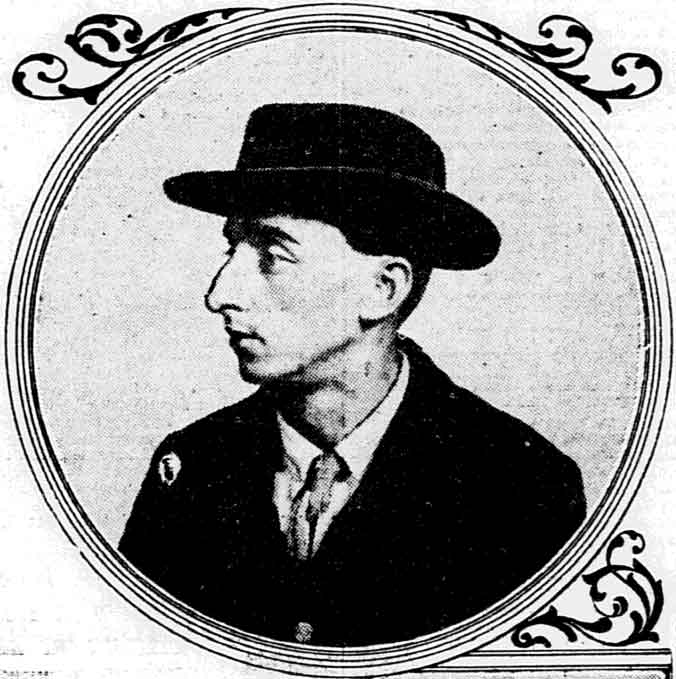
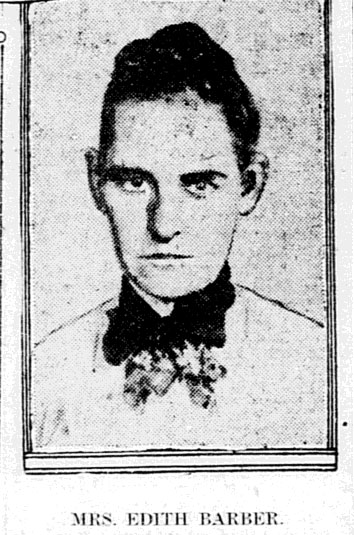
While Authorities Are at Work, Public Watch and Wait. Weaving a Net About Paul Woodward, the Young Suspect Now in Jail
Paul Woodward.
Mrs. Edith Barber.
It is now generally believed that the Camden county authorities have succeeded in establishing a clear case against young Paul Woodward, who is in the county jail, charged with the crime of taking away the lives of little John Coffin and Price Jennings. It was just a week ago yesterday when the boys went on their trip to Haddon Heights from which they were destined never to return alive.
Since the discovery of the bodies last Saturday partially hidden in rain-soaked weeds, the Prosecutor’s office, assisted by County Detectives Smith and Cherry and City Detectives Painter and Hart, have left no stone unturned.
No Confession
Prosecutor Lloyd yesterday reiterated his statement that Woodward had made no confession, but it is generally conceded as true that the accused youth did tell a story in which he makes some one else the principal criminal in the case.
Several incidents transpired yesterday that threw off the monotony of waiting for developments. Joseph Jennings, brother of one of the murdered boys, was taken to the cell in which Woodward is confined. He had no difficulty in recognizing the prisoner before. But as to whether he ever saw him in company with the dead lads he was not permitted to say.
Wild Rumor
There was much excitement about the Court House when it became rumored that Mrs. Edith Barber, the woman detained as a material witness against Woodward, had the small pox. To allay the alarm County Physician Jones called in representatives of the Board of Health, who concluded she had no sign of the disease.
After matters quieted somewhat the woman was taken into the Prosecutor’s office and questioned. When taken back to her cell she was crying and appeared to be almost unable to walk.
Woodward spent the day in his cell, smoking cigarettes as usual. He was visited in the morning by Lawyer Harry Scovel, who has not yet been engaged as counsel, as reported. Again in the afternoon Lawyer Scovel visited the youth in company with Woodward’s mother. At first Mrs. Woodward was denied admittance, but after waiting on the jail steps for nearly an hour she was permitted to go in and see her son. Lawyer Scovel and Mrs. Woodward were with the young man for a couple of hours.
Talked a Whole Lot
To all questions Lawyer Scovel said: “Woodward talked a whole lot, but I have nothing to say.”
He said he had not confessed to him. On the other hand Woodward had maintained his innocence.
When asked if Woodward could have a hearing if he demanded it Mr. Archer said he could. Asked if enough evidence was in hand to hold him, Mr. Archer said there was.
“On a simple assault charge?”
“No, sir, for the crime he is charged with—committing the murder of John Coffin,” replied Mr. Archer.
Coroner Litchfield said last night he would not set a date for the inquest before some time next week. Despite all reports to the contrary, Coroner Litchfield says Chemist George M. Beringer, who is analyzing the internal organs of the boys, will not complete the work before the end of the week.
Prosecutor Lloyd, who is still confined to his home with rheumatism, would make no statement last night, although admitting that the day’s work had not resulted in anything of material importance.
Officers Traced Woodward’s Steps
Philadelphia Inquirer —
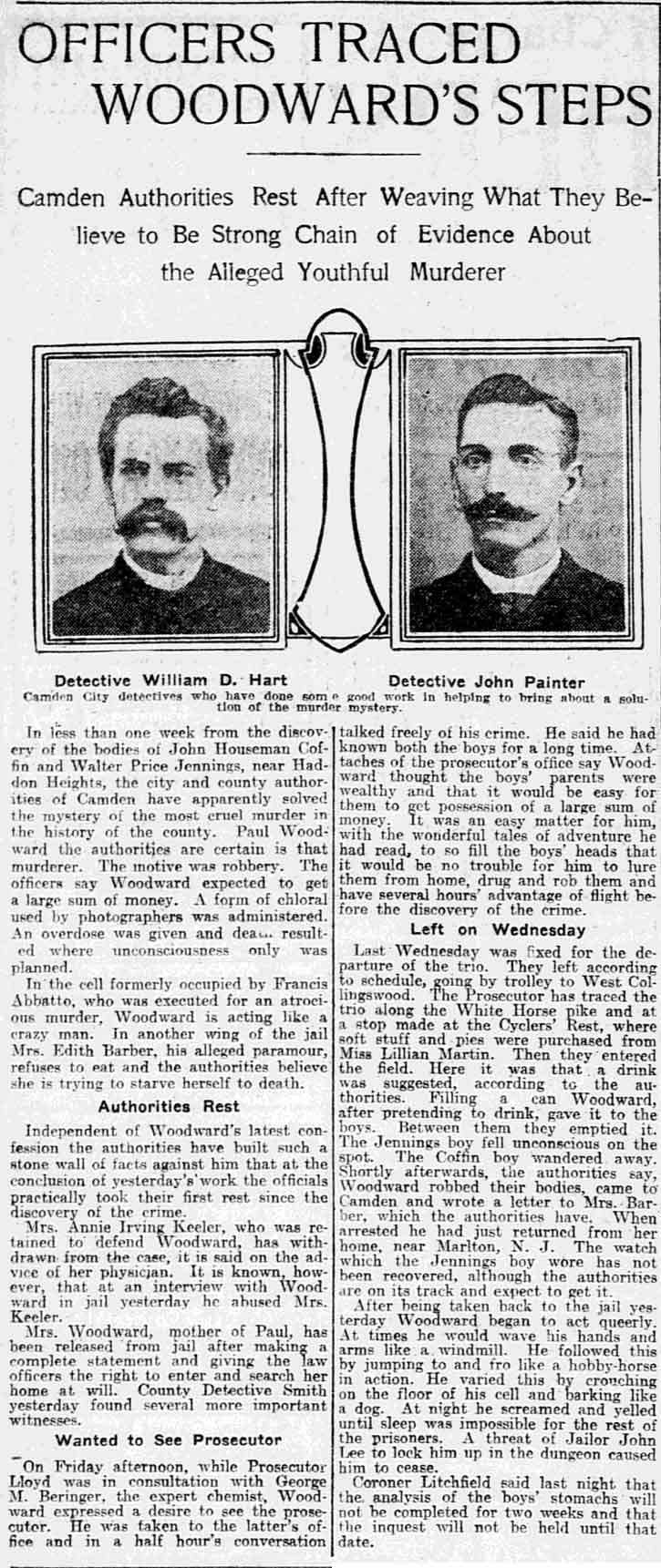
Camden Authorities Rest After Weaving What They Believe to Be Strong Chain of Evidence About the Alleged Youthful Murderer
Detective William D. Hart
Detective John Painter
Camden City detectives who have done some good work in helping to bring about a solution of the murder mystery.
In less than one week from the discovery of the bodies of John Houseman Coffin and Walter Price Jennings, near Haddon Heights, the city and county authorities of Camden have apparently solved the mystery of the most cruel murder in the history of the county. Paul Woodward the authorities are certain is that murderer. The motive was robbery. The officers say Woodward expected to get a large sum of money. A form of chloral used by photographers was administered. An overdose was given and death resulted where unconsciousness only was planned.
In the cell formerly occupied by Francis Abbatto, who was executed for an atrocious murder, Woodward is acting like a crazy man. In another wing of the jail Mrs. Edith Barber, his alleged paramour, refuses to eat and the authorities believe she is trying to starve herself to death.
Authorities Rest
Independent of Woodward’s latest confession the authorities have built such a stone wall of facts against him that at the conclusion of yesterday’s work the officials practically took their first rest since the discovery of the crime.
Mrs. Annie Irving Keeler, who was retained to defend Woodward, has withdrawn from the case, it is said on the advice of her physician. It is known, however, that at an interview with Woodward in jail yesterday he abused Mrs. Keeler.
Mrs. Woodward, mother of Paul, has been released from jail after making a complete statement and giving the law officers the right to enter and search her home at will. County Detective Smith yesterday found several more important witnesses.
Wanted to See Prosecutor
On Friday afternoon, while Prosecutor Lloyd was in consultation with George M. Beringer, the expert chemist, Woodward expressed a desire to see the prosecutor. He was taken to the latter’s office and in a half hour’s conversation talked freely of his crime. He said he had known both the boys for a long time. Attaches of the prosecutor’s office say Woodward thought the boys’ parents were wealthy and that it would be easy for them to get possession of a large sum of money. It was an easy matter for him, with the wonderful tales of adventure he had read, to so fill the boys’ heads that it would be no trouble for him to lure them from home, drug and rob them and have several hours’ advantage of flight before the discovery of the crime.
Left on Wednesday
Last Wednesday was fixed for the departure of the trio. They left according to schedule, going by trolley to West Collingswood. The Prosecutor has traced the trio along the White Horse pike and at a stop made at the Cyclers’ Rest, where soft stuff and pies were purchased from Miss Lillian Martin. Then they entered the field. Here it was that a drink was suggested, according to the authorities. Filling a can Woodward, after pretending to drink, gave it to the boys. Between them they emptied it. The Jennings boy fell unconscious on the spot. The Coffin boy wandered away. Shortly afterwards, the authorities say, Woodward robbed their bodies, came to Camden and wrote a letter to Mrs. Barber, which the authorities have. When arrested he had just returned from her home, near Marlton, N. J. The watch which the Jennings boy wore has not been recovered, although the authorities are on its track and expect to get it.
After being taken back to the jail yesterday Woodward began to act queerly. At times he would wave his hands and arms like a windmill. He followed this by jumping to and fro like a hobby-horse in action. He varied this by crouching on the floor of his cell and barking like a dog. At night he screamed and yelled until sleep was impossible for the rest of the prisoners. A threat of Jailor John Lee to lock him up in the dungeon caused him to cease.
Coroner Litchfield said last night that the analysis of the boys’ stomachs will not be completed for two weeks and that the inquest will not be held until that date.
Woodward Indicted for Cruel Murder
Philadelphia Inquirer —
The case of Paul Woodward, who is charged with the murder of John Coffin and W. Price Jennings, was considered by the Camden County Grand Jury yesterday. Among the witnesses were the father and aunt of the Jennings boy. The prisoner was promptly indicted.
There will be no inquest. Coroner Litchfield says the facts of the killing and that the boys met their death by violence being manifest to the authorities.
Found Body at Foot of Stairs
Philadelphia Inquirer —
FOUND BODY AT FOOT OF STAIRS
Mystery in the Death of Pole in Camden—Five Men Placed Under Arrest
Coroner Litchfield is investigating the death of Frank Taianoski, a Pole, 35 years old, of Olyphant, Pa., whose body was found early yesterday morning at the foot of a stairway at 1049 Diamond street, Camden. Jacob Chopper, Peter Oplushi, John Schwenze, John Vannank and Stanlaus Weruski, Hungarians, who cannot speak English, were arrested by County Detectives Smith and Cherry on suspicion of knowing something about Taianoski’s death.
Shortly after 3 o’clock yesterday morning Coroner Litchfield was awakened by two men, who told him to go to 1049 Diamond street, where a man was being killed. Thinking it was a ruse to get him out of the house to do him bodily injury the Coroner refused to go. Some time after Edward Wolfe, an English speaking Pole, told the Coroner that there was a dead man at the Diamond street house. Coroner Litchfield at once went to the house and found Taianoski’s body at the foot of the stairway. Surrounding it were the five Hungarians, two of whom were recognized as the early morning visitors.
Nothing could be gleaned from the men, who told conflicting stories. One, who said he was a room-mate of the dead man, stated he had arrived home late and had fallen over the body. On examining the body the Coroner found Taianoski had received a bad fracture of the skull, which had caused his death.
Taianoski was a miner and went to Camden three weeks ago. His wife has been sent for in the hope that she can aid the officials in untangling the mystery. The body is now at the Morgue.
Four Killed When Fireworks Blew Up
Philadelphia Inquirer —
Factory on the Outskirts of Camden Wrecked by an Explosion of Mysterious Origin---Ten Received Injuries---Officers of the Company Placed Under Arrest
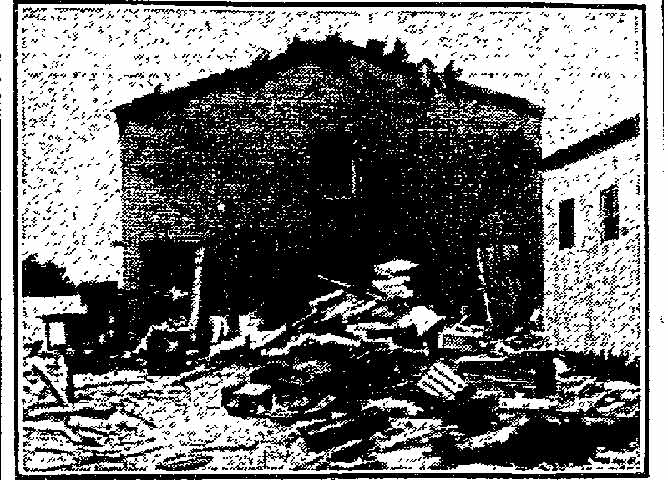
[Photograph, captioned:] MAIN BUILDING WRECKED BY THE EXPLOSION
With a roar and concussion that shook buildings and shattered windows for miles around an explosion occurred at the Independent Fireworks Company, Ferry and Cooper avenues, Camden, yesterday morning about half-past 6 o’clock. Three Italians were blown to fragments, another died in the Cooper Hospital late last night and nine persons were more or less seriously injured.
The Dead Are
SINEONE TIERANTOZODI, aged 17 years, of 248 Division street, Camden. LEONARDO PINTO, aged 45 years, Tenth and Ferry avenue; expert workman. UNKNOWN ITALIAN, probably Joseph Logalla, of Philadelphia. UNKNOWN ITALIAN.
Ten Were Injured
The injured are:
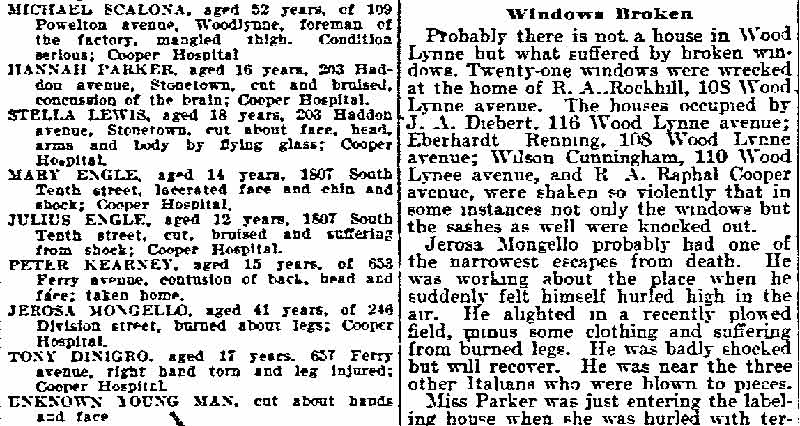
MICHAEL SCALONA, aged 52 years, of 109 Powelton avenue, Woodlynne, foreman of the factory, mangled thigh. Condition serious; Cooper Hospital. HANNAH PARKER, aged 16 years, 203 Haddon avenue, Stonetown, cut and bruised, concussion of the brain; Cooper Hospital. STELLA LEWIS, aged 18 years, 203 Haddon avenue, Stonetown, cut about face, head, arms and body by flying glass; Cooper Hospital. MARY ENGLE, aged 14 years, 1807 South Tenth street, lacerated face and chin and shock; Cooper Hospital. JULIUS ENGLE, aged 12 years, 1807 South Tenth street, cut, bruised and suffering from shock; Cooper Hospital. PETER KEARNEY, aged 15 years, of 653 Ferry avenue, contusion of back, head and face; taken home. JEROSA MONGELLO, aged 41 years, of 246 Division street, burned about legs; Cooper Hospital. TONY DINIGRO, aged 17 years, 657 Ferry avenue, right hand torn and leg injured; Cooper Hospital. UNKNOWN YOUNG MAN, cut about hands and face.
The sight was appalling. The body of one of the victims was found a hundred yards from the scene of the explosion. Every thread of clothing had been torn from the body. Morgue Keeper O’Brien removed the remains to the morgue.
A few minutes after the explosion the police were notified by Charles Dubell. A squad of officers under Captain Stanley and Sergeant Hyde were at once sent to the scene to keep the crowd away.
The force of the explosion was terrific. The brick building occupied by the company, 30 by 40 feet, was twisted so badly that it will have to be torn down. A frame structure, known as the labeling building, was shattered as though splintered with an ax.
Many of the packing boxes were broken by the concussion and the splintered wood was hurled hundreds of feet.
Windows Broken
Probably there is not a house in Wood Lynne but what suffered by broken windows. Twenty-one windows were wrecked at the home of R. A. Rockhill, 108 Wood Lynne avenue. The houses occupied by J. A. Diebert, 116 Wood Lynne avenue; Eberhardt Renning, 108 Wood Lynne avenue; Wilson Cunningham, 110 Wood Lynee avenue, and R. A. Raphal Cooper avenue, were shaken so violently that in some instances not only the windows but the sashes as well were knocked out.
Jerosa Mongello probably had one of the narrowest escapes from death. He was working about the place when he suddenly felt himself hurled high in the air. He alighted in a recently plowed field, minus some clothing and suffering from burned legs. He was badly shocked but will recover. He was near the three other Italians who were blown to pieces.
Miss Parker was just entering the labeling house when she was hurled with terrific force a dozen feet away. When found, she was sitting on the ground with a large wooden box resting on her head. She was delirious from fright and severe injuries when discovered.
Hurled Through Doorway
Tony Dinigro said he was working and all he knew there was a big noise. “Then I was hurled through a doorway,” said he. “I don’t know how I got home, I was so scared.”
Peter Kearney said he had just gone into the powder house to get ready for work when the explosion occurred. He was thrown into the street.
According to these men both dynamite and powder were used by the concern, Kearney declaring he was employed to carry the explosive to the mixing plant.
Had the explosion occured a few minutes later the loss of life would have been much greater. Just as the catastrophe occurred a trolley car loaded with female employes was within a block of the place. Inside of five minutes they would have been working in the labeling and storage rooms, which were shattered by the concussion.
Placed Under Arrest
Prosecutor Lloyd took charge of the case and County Detectives Smith and Cherry are at work in an effort to learn just what caused the explosion. While the management of the concern declares there was no powder, dynamite or nitro-glycerine in the buildings, neither Prosecutor Lloyd nor Coroner Litchfield is satisfied, and a most rigid investigation will be made.
Coroner Litchfield will announce his jury to-day and a date on which an inquest will be held.
Chief of Police Foster, on information received, made complaint against Herbert Weser, president; W. P. Teller, secretary; A. Walter Geller, treasurer, and Joseph Scanola, superintendent of the company, charging them with manslaughter. Weser and Scanola were arrested and held in $1500 bail each. The Gellers had not been arrested up to a late hour last night.
Jerosa Mongella and Jean Viola, workmen, were also arrested by order of Coroner Litchfield. They were held in their own recognizance as witnesses.
Cause of Explosion a Mystery
There is considerable mystery as to the cause of the explosion. According to Joseph Scanola, superintendent, neither dynamite, nitro glycerine nor powder were used by them in the manufacture of fireworks. He said his father, Michael Scanola, was taking chloride of potash from a keg in a tin scoop when the explosion occurred. According to Scanola some unknown substance, probably sulphur, must have been on the scoop which, coming in contact with the potash, resulted in the explosion.
The fireworks plant is located in the extreme southeast of Camden just across Ferry avenue from Wood Lynne. The residents of the latter place were about sitting down to breakfast when they were suddenly almost stunned by a deafening report. About the same time car No. 159, of the Camden and Suburban Railway Company, was passing, in charge of Motorman William Martin and Conductor Walter Ferguson. These, with the passengers, were badly shaken. Martin and Ferguson, with Wood Lynne residents, at once went to the scene of destruction.
Applied for Work
The Engle children had applied for work a few minutes before the explosion. Julius, who had secured a position, was about to start in when he was blinded by a flash and hurled in the air many feet away. His sister was knocked down by the concussion. Both were later picked up dazed.
In a statement made by Joseph Scanola he said:
“Father (Michael Scanola) told me that he was trying to scoop out a tin full of chloride of potash from a keg when the explosion occurred. If that is so the potash could not have been pure as it would have been impossible for such a thing to have happened. That is all I know about it and all I can tell.”
The office of the company is at 530 Walnut street, this city. The plant has been located at the present site about eighteen months. Prior to that time it was at Vineland. Owing to the approaching Fourth of July the place was working overtime, from 6 o’clock in the morning to 7 o’clock at night. There were thirty-five employes, mostly girls.
Camden Woman Fell Dead
Philadelphia Inquirer —
Went Up Stairs to Dress and Succumbed to Apoplexy
After completing her household work yesterday afternoon Mrs. Emma Dease, aged 27 years, of 419 South Fifth street, Camden, told a member of her family she was going upstairs to dress. When she reached the front room she was heard to fall and was later found lying on the floor dead.
Coroner Litchfield gave a certificate of death from apoplexy.
Woman Struck Fatal Blow!
Philadelphia Inquirer —
Some Mystery in the Death of a Camden Negro
County Physician James and Coroner Litchfield, in Camden yesterday, held a post-mortem view of the body of James Brown, colored, who died at the Cooper Hospital Tuesday night as the result of being struck on the head with some blunt instrument. Death was due to hemorrhage of the brain. An inquest will be held to-morrow morning.
Brown, who was 41 years old and who lived at 337 Summit street, is believed to have received the fatal blow during an altercation with a woman. She has not yet been located by the police.
Say Woman Killed Negro
Philadelphia Inquirer —
An inquest in the case of James Brown, colored, who died at the Cooper Hospital, Camden, Tuesday night, as the result of being struck on the had [sic], was held by Coroner Litchfield yesterday. The jury brought in a verdict to the effect that Brown’s death resulted from a stab wound inflicted by a woman who has not yet been located. A warrant has been issued by Justice Schmitz charging her with killing Brown.
Dr. Litchfield a Candidate for Council
Philadelphia Inquirer —
Considerable surprise was occasioned in political circles in Camden yesterday when Dr. Paul N. Litchfield announced his candidacy for City Councilman from the Seventh ward on the Republican ticket. It was thought John Carmany, the present incumbent, had a clear field for renomination. Isaac V. Bradley, also a Councilman from the ward, is said to be backing Dr. Litchfield. A bitter contest is anticipated.
Sad Plight of Starved Woman
Camden Daily Courier —
Pronounced Insane and Will be Taken to State Asylum
SON TO BE PROPERLY CARED FOR
Mrs. Frank S. Schaffer, aged 58 years, and her nine year old son Frank, who were found in their home on Tuesday evening at 814 Carpenter street, almost dead from lack of proper nourishment, will be taken in charge by the authorities to-day. Mrs. Schaffer was examined yesterday afternoon by Drs. Haines and Litchfield and pronounced insane. She will be taken to the State Asylum at Trenton this afternoon.
Her little son is now being cared for by the City Matron. In the meantime Overseer of the Poor Jeffries will complete arrangements for his removal to the county poor house.
The mother and son came to this city from Elmira, N. Y., about six months ago. They have cousins residing there and the police authorities have notified them of the plight of Mrs. Schaffer.
For two days the boy has amused himself romping around the City Hall. He is bright and cheerful and has the sympathy of every one in the hall. Frank found almost instant favor in the eyes of Chief Gravenor. For hours he would sit by Sergeant McClung and watch him as he operated the switch board as the patrolmen reported.
Daniel Weldon Taken to Asylum
Philadelphia Inquirer —
Daniel Weldon, of 122[?] South Third street, who shot his wife Mary and tried to kill himself some months ago, while brooding over the murder of his daughter, has been taken to the county insane asylum. After shooting his wife he hovered between life and death for two months. County Physician Jones and Dr. Litchfield adjudged him insane.
Hurt in Trolley Crash
Philadelphia Inquirer —
Woman and City Detective Injured in Camden
Two persons were injured, one seriously, in a rear-end collision between two trolley cars at Ann street and Kaighn avenue, Camden, last night. City Detective Harry C. Moffett, of Third street and Kaighn avenue, and Mrs. Sarah Kindy, of 721 Kaighn avenue, were the victims. Mrs. Kindy, who is 55 years of age, was in the act of alighting from a barn-bound Gloucester car at Ann street when a Kaighn avenue car collided with it with great force, throwing the woman violently to the ground. She was carried to her home nearby and Dr. Paul N. Litchfield was summoned. She is hurt internally and the physician states that her condition is serious.
Detective Moffett, also a passenger on the Gloucester car, was thrown to the floor of the car and was rendered unconscious. He quickly revived and was able to go to his home. He is badly bruised.
Mrs. Rosa M. Ross Dies Suddenly
Philadelphia Inquirer —

Stricken suddenly ill early yesterday, Mrs. Rosa M. Ross, widow of former Councilman Joseph Ross, died at her home, 707 Walnut street. Coroner Litchfield said death was due to heart disease.
Funeral of Dr. P. N. Litchfield
Philadelphia Inquirer —
With scores of persons prominent in all walks of life in attendance the funeral of Dr. Paul N. Litchfield, Assemblyman from Camden county, was held yesterday afternoon from his late home at 1100 Kaighn avenue. Over four thousand persons viewed the remains Friday night and yesterday and among those in attendance at the burial were a large number of members of the Legislature, headed by Speaker Charles A. Wolverton. The services at the house were conducted by Rev. J. Hardenbrook Townsend, rector of St. John’s P. E. Church, and interment was made at Harleigh. The pallbearers were Speaker Wolverton, State Treasurer William T. Read, County Clerk F. F. Patterson, State Senator Joshua C. Haines, Assemblyman Ralph N. Keilam, City Assessor Wilbur B. Ellis and John R. Mick.