Introduction
DR. WILLIAM S. JONES was born in Salem County, New Jersey on January 16, 1859. He graduated from Jefferson Medical College in 1878 and after practicing in Millville for four years, came to Camden. He soon made a name for himself, despite his young age, in medical and political circles, establishing a lucrative practice at 201 Broadway.
Dr. Jones was elected to City Council as a Republican from Camden’s Fourth Ward in 1889, but refused to stand for re-election. In 1894 he was named County Physician for Camden County.
Dr. Jones passed away on June 8, 1920, survived by his wife, the former Ida Ford.
The Nominations Settled.
Camden Daily Telegram —
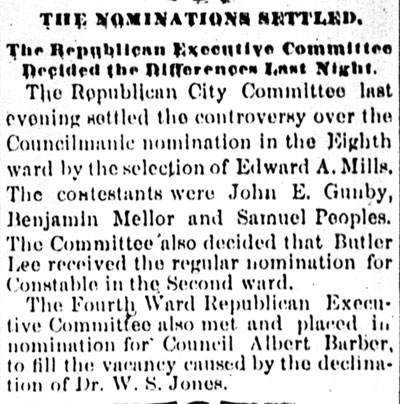
The Republican Executive Committee Decided the Differences Last Night.
The Republican City Committee last evening settled the controversy over the Councilmanic nomination in the Eighth ward by the selection of Edward A. Mills. The contestants were John E. Gunby, Benjamin Mellor and Samuel Peoples. The Committee also decided that Butler Lee received the regular nomination for Constable in the Second ward.
The Fourth Ward Republican Executive Committee also met and placed in nomination for Council Albert Barber, to fill the vacancy caused by the declination of Dr. W. S. Jones.
Over in Camden -- Enos P. Reeves Dies
Philadelphia Inquirer —
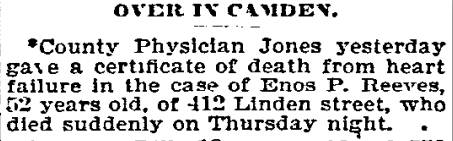
Over in Camden
County Physician Jones yesterday gave a certificate of death from heart failure in the case of Enos P. Reeves, 52 years old, of 412 Linden street, who died suddenly on Thursday night.
Philadelphia Inquirer, December 29, 1894 — Dr. William S. Jones listed alongside Linden Street and Enos P. Reeves.
Death Certificates Granted by County Physician
Philadelphia Inquirer —
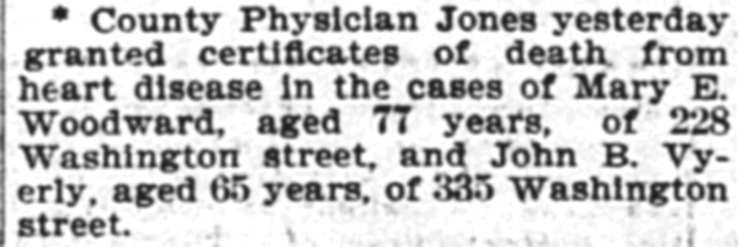
County Physician Jones yesterday granted certificates of death from heart disease in the cases of Mary E. Woodward, aged 77 years, of 228 Washington street, and John B. Vyerly, aged 65 years, of 335 Washington street.
William Bond Seeks Father’s Body
Philadelphia Inquirer —
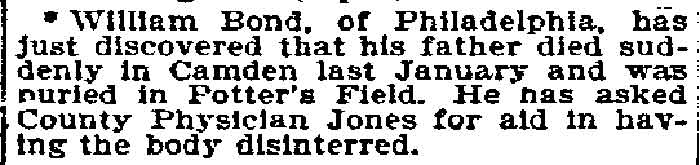
William Bond, of Philadelphia, has just discovered that his father died suddenly in Camden last January and was buried in Potter’s Field. He has asked County Physician Jones for aid in having the body disinterred.
Tramp Drowning Report Investigated
Philadelphia Inquirer —
County Physician Jones yesterday investigated a report that a tramp had been drowned by some of his companions at Pea Shore, but could find nothing to substantiate it.
Biographical Review – 1897
WILLIAM S. JONES, M.D., County Physician and a leading medical practitioner of Camden, N. J., was born in Salem County, this State, January 16, 1859, son of Hiram and Sarah P. (Seran) Jones. His great-grandfather was for many years a resident of Salem County. Joseph Jones, Dr. Jones’s grandfather, was in his earlier years a farmer; but later he engaged in the wheelwright business, also carrying on a shoemaker’s shop. He was a very prominent man in the town of Elmer in his day.
Hiram Jones, Dr. Jones’s father, was born and brought up in Salem County. When a young man he learned the trade of a butcher; and, establishing himself in that business in Melville, he carried it on with energy and success until his retirement. He is now residing in that town. He served one term as a member of the Town Council. His wife, Sarah P. Seran, who was a daughter of Samuel Seran, of Gloucester County, reared four children, as follows: Joseph; William S., the subject of this sketch; Albert; and Leonora. Mrs. Jones died at the age of fifty-two years. She was a member of the Methodist Episcopal church.
William S. Jones acquired his early education in the public schools of Melville, and after graduating from the high school he began the study of medicine with Dr. J. S. Whitaker. Two years later he entered Jefferson Medical College, Philadelphia, where he completed his preparatory studies, and was graduated with the class of 1878. After practising in Melville four years, he removed to Camden, where he has since resided. As a specialist in diseases of the throat he has gained a wide reputation, having successfully performed many difficult operations both in this city and at the college clinics in Philadelphia. He is one of the very few physicians in the State that have made the throat and voice a special study. Although one of the youngest students to enter Jefferson Medical College, he made such a favorable impression upon the faculty of that institution as to secure their confidence in his ability. Receiving the appointment of Clinical Assistant and Lecturer, he served nine years in that capacity, and has now risen to be chief of the throat department, having been appointed on June 29, 1896, Clinical Professor for an indefinite period. His progress has been rapid, and while still a young man he enjoys the distinction of being the first medical practitioner of this State to be honored with a professorship.
In politics he is a Republican, and in 1889 was elected a member of the City Council of Camden, serving three years, but positively refusing to serve longer, although he was renominated. On September 1, 1894, he was elected County Physician for three years, and is still in office.
In 1884 Dr. Jones was united in marriage with Ida Ford, who was born in Cape May County, and is the eldest of the three daughters of Charles Ford, an oyster dealer.
Dr. Jones is connected with the lodge of Ancient Order of United Workmen in Camden, of which he is Medical Examiner; is a member of the State, county, and city medical societies, being president of the last-named body; has served as a delegate to the State Society from the other associations, and also as chairman of various committees. He is a member of the Alumni Association of Jefferson Medical College and of other societies. His private practice is very large and exceedingly lucrative. He occupies a centrally located office at 209 Broadway.
Dr. Jones having the happy faculty of being able to place facts and ideas upon paper in a clear and intelligible manner, his clinical lectures and frequent contributions to the medical journals are read with great interest and highly prized by the profession throughout the country.
Daniel Weldon Taken to Asylum
Philadelphia Inquirer —
Daniel Weldon, of 122[?] South Third street, who shot his wife Mary and tried to kill himself some months ago, while brooding over the murder of his daughter, has been taken to the county insane asylum. After shooting his wife he hovered between life and death for two months. County Physician Jones and Dr. Litchfield adjudged him insane.
“Persons Unknown” Held Responsible
Philadelphia Inquirer —
Coroner’s Jury Does Not Connect Eli Shaw With the Camden Murders.
DEARTH OF NEW FACTS
At the Inquest the Prosecution Fails to Bring Out Any Evidence, That Is Particularly New.
There was positively nothing in the testimony adduced at the inquest on the death of Mrs. Zane, in Camden, yesterday, to add any weight to the theory of the prosecution, backed up by circumstantial evidence, that Eli Shaw murdered his mother and grandmother.
The verdict was rendered in accordance with the evidence. In other words, the responsibility for the killing of the two women, as stated in the verdict in the case of Mrs. Zane, was not placed upon Eli Shaw, but upon “a person or persons unknown” to the jury.
If Prosecutor Jenkins has any strong evidence aside from the facts already brought out at his disposal he did not see fit to show his hand. There was a general belief that such was the case. If it is not, then, in the opinion of many a Camden wiseacre, Eli Shaw has more than a good chance of having his forehead remain clear of the brand of Cain.
That it is the intention of the prosecution to lay considerable stress upon the contradictory nature of young Shaw’s statements subsequent to the double tragedy seemed apparent from the nature of the testimony at the inquest. That Prosecutor Jenkins, who conducted the inquest and examined the witnesses, made this phase of the investigation so prominent leads to the belief that he intends to emphasize it later on.
SHAW’S STATUS UNALTERED.
In the meantime Eli Shaw remains in jail on the original commitment, based upon the charge of the Chief of Police. Lawyer Scovel, however, proposes to apply for a writ of habeas corpus, to secure, if possible, his client’s release. Scovel was quietly elated at the verdict of the Coroner’s jury, although he did not have much to say.
“We are not complaining,” he remarked, with a smile of satisfaction, when questioned concerning the verdict. “The result of the inquest certainly does not weaken Eli Shaw’s defense.”
Shaw himself offered to make a statement for use in the Coroner’s investigation, but his counsel did not desire it. He was not at all nervous, according to Mr. Scovel, over the inquest, but bore himself with a calm air, which caused Mr. Scovel to exclaim more emphatically than before: “I tell you, Shaw is an innocent man.”
And now the attorney will try to secure a ruling that there is not sufficient evidence to hold Shaw. He is confident that his client will be released from prison, or at least admitted to bail.
COURT ROOM CROWDED.
An immense crowd surged about the doors of the Camden Court House at the time set for the opening of the inquest. Men and women fought to get in when the doors were finally opened, and the scene resembled an incipient riot. One woman was carried in fainting. Others screamed as they were swept off their feet and almost thrown into the room by the struggling men, and then laughed as they found seats and breathlessly rearranged their clothing. In a few moments the room was filled and hundreds were turned away.
Coroner Lippincott read the names of the witnesses, an [sic] they retired into the ante-room—all but one. This one was Eli Shaw, whose name headed the list, but who was not brought to the inquest.
The jurymen took their places. They were Tax Receiver William A. Husted, foreman; Morgue Keeper Martin J. O’Brien, Freeholder William Anderson, Charles S. Folwell, John Irwin and Thomas Benkert.
NO STATEMENT FROM SHAW.
Before calling any witnesses, twenty-seven of whom had been subpenaed, Prosecutor Jenkins turned to Shaw’s counsel, Lawyer Henry S. Scovel, and said: “I see here the representative of the defendant. If he wishes to make a statement he can have that permission.” Mr. Scovel replied that the defendant had no desire to make any statement. The first witness called was Edward Zane, a son of the murdered Mrs. Zane. He was sworn by the Coroner. After telling how he had heard of the murder while in Philadelphia, where he resides, he was asked concerning his conversation with Eli Shaw at Foster Zane’s house a few hours after the murder. He said: “I asked him (Shaw) how it occurred. He said that he had heard a noise in the house while up stairs. His mother had also heard it, and he followed her down stairs. He stepped into the room where his grandmother slept and told her to lie still. His mother then lit a match, which was quickly followed by a pistol shot, and she fell. He then gave the alarm. That is all he had to say to me.”
The witness had last seen his mother and sister alive four weeks ago.
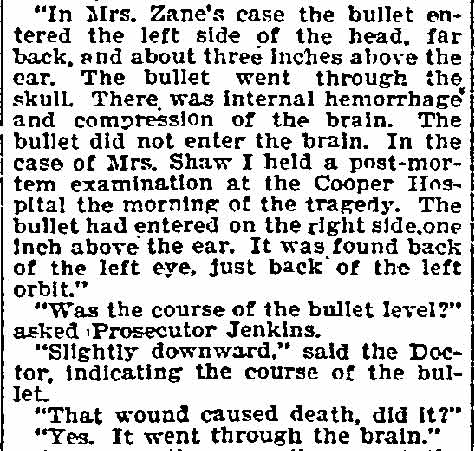
County Physician W. S. Jones was the next witness. He described the wounds on the bodies of the murdered women.
“In Mrs. Zane’s case the bullet entered the left side of the head, far back, and about three inches above the ear. The bullet went through the skull. There was internal hemorrhage and compression of the brain. The bullet did not enter the brain. In the case of Mrs. Shaw I held a post-mortem examination at the Cooper Hospital the morning of the tragedy. The bullet had entered on the right side, one inch above the ear. It was found back of the left eye, just back of the left orbit.”
“Was the course of the bullet level?” asked Prosecutor Jenkins.
“Slightly downward,” said the Doctor, indicating the course of the bullet.
“That wound caused death, did it?”
“Yes. It went through the brain.”
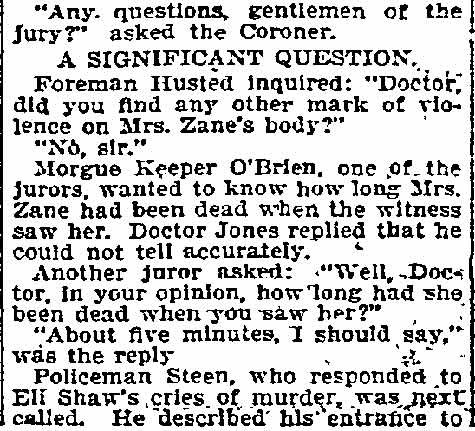
“Any questions, gentlemen of the jury?” asked the Coroner.
A SIGNIFICANT QUESTION.
Foreman Husted inquired: “Doctor, did you find any other mark of violence on Mrs. Zane’s body?”
“No, sir.”
Morgue Keeper O’Brien, one of the jurors, wanted to know how long Mrs. Zane had been dead when the witness saw her. Doctor Jones replied that he could not tell accurately.
Another juror asked: “Well, Doctor, in your opinion, how long had she been dead when you saw her?”
“About five minutes, I should say,” was the reply
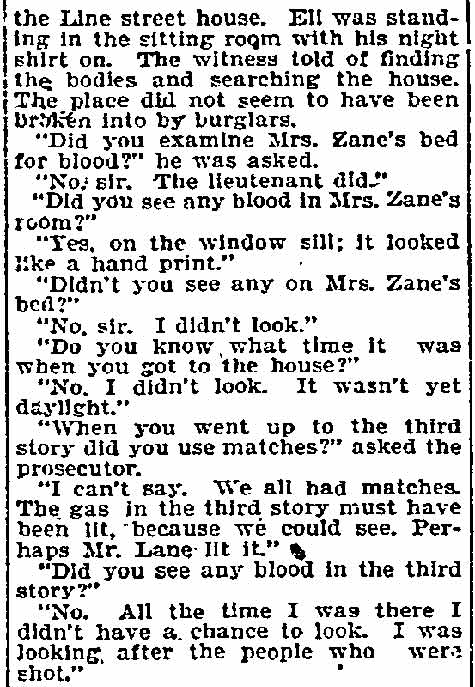
Policeman Steen, who responded to Eli Shaw’s cries of murder, was next called. He described his entrance to the Line street house. Eli was standing in the sitting room with his night shirt on. The witness told of finding the bodies and searching the house. The place did not seem to have been broken into by burglars.
“Did you examine Mrs. Zane’s bed for blood?” he was asked.
“No, sir. The lieutenant did.”
“Did you see any blood in Mrs. Zane’s room?”
“Yes, on the window sill; it looked like a hand print.”
“Didn’t you see any on Mrs. Zane’s bed?”
“No, sir. I didn’t look.”
“Do you know what time it was when you got to the house?”
“No. I didn’t look. It wasn’t yet daylight.”
“When you went up to the third story did you use matches?” asked the prosecutor.
“I can’t say. We all had matches. The gas in the third story must have been lit, because we could see. Perhaps Mr. Lane lit it.”
“Did you see any blood in the third story?”
“No. All the time I was there I didn’t have a chance to look. I was looking after the people who were shot.”
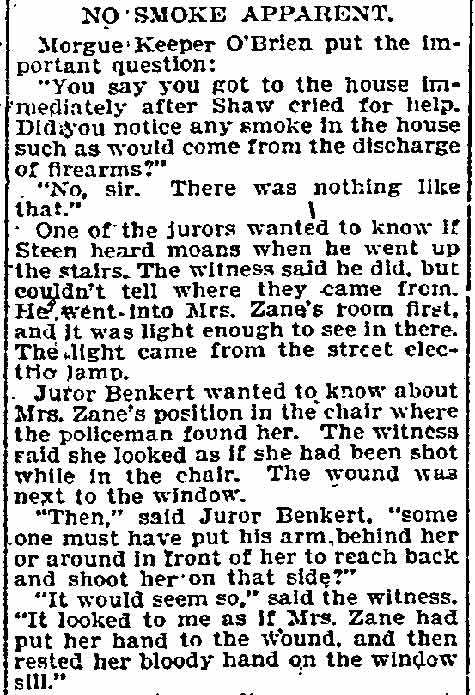
NO SMOKE APPARENT.
Morgue Keeper O’Brien put the important question:
“You say you got to the house immediately after Shaw cried for help. Did you notice any smoke in the house such as would come from the discharge of firearms?”
“No, sir. There was nothing like that.”
One of the jurors wanted to know if Steen heard moans when he went up the stairs. The witness said he did, but couldn’t tell where they came from. He went into Mrs. Zane’s room first, and it was light enough to see in there. The light came from the street electric lamp.
Juror Benkert wanted to know about Mrs. Zane’s position in the chair where the policeman found her. The witness said she looked as if she had been shot while in the chair. The wound was next to the window.
“Then,” said Juror Benkert, “some one must have put his arm behind her or around in front of her to reach back and shoot her on that side?”
“It would seem so,” said the witness. “It looked to me as if Mrs. Zane had put her hand to the wound, and then rested her bloody hand on the window sill.”
An important witness came next. This was Harry Delamater, of No. 30[?] Line street, a personal friend of Eli Shaw, who was held in $1000 bail by ‘Squire Stackhouse some time ago because he refused to make any statement to Prosecutor Jenkins at the time of the preliminary examination of witnesses. His statement follows:
“Eli told me about the shooting, as nearly as I can remember, as follows, in the presence of several other people: He said that he was up, and hearing a noise, he hurriedly put on his pants. His mother was also up at the time, and they went down stairs together. Eli was first and his mother was right behind him. His mother pushed open the door of the back room, which was slightly ajar; they went in, and Mrs. Shaw pointed to some clothing on the floor, just as she struck a light. The match had no sooner been ignited before a shot was fired. He ran down stairs and gave the alarm.
GRANDMOTHER’S REPLY.
“He made practically the same statements to Lieutenants Foster and Pettit while I was there. He also said that he looked into the front room, saw his grandmother in bed, and asked his mother not to disturb her, as she was asleep. He ran up stairs, got a pistol, and rushed down and tried to fire it to attract attention, but it would not go off. He also said that when he heard the shot fired he ran into his grandmother’s room and said, ‘My God, some one is in the house and is shooting.’ He got a sort of sleepy groan, as some one awakening, for a reply.”
As Mrs. Zane was dead or dying by the time Eli said he called her and received a reply, this statement was received with particular interest.
James E. Tatem, of 619 South Fifth street; Frank B. Haines, of 561 Washington street, and Albert Fogg, of 615 South Fifth street, who were also in Foster Zane’s house on the evening after the tragedy when Eli Shaw told his story of the tragedy, were next called in rapid succession. Their testimony was for the most part a repetition of Delamater’s statement.
Albert Fogg testified that Shaw said he rushed into his grandmother’s room immediately after his mother was shot and cried:
“Get up, grandma; for God’s sake, get up; ther’s [sic] some one in the house.”
“Did he say his grandmother made any response?” asked the Prosecutor.
“No, sir.”
Albert Hollingshead was called, but had nothing to testify to.
Policeman John Painter, who found the revolver in the chimney, gave his testimony concerning his find. The revolver was brought in and, after wrestling with it for a few minutes, to the consternation of everyone else in the court room, Hall Officer Beard succeeded in unloading it. Painter identified the weapon. He also said:
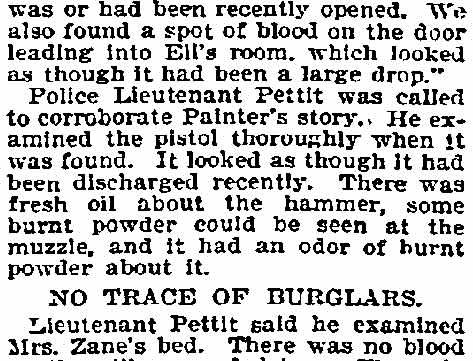
“We made an examination of the chimneys. We found that there was a stove hole in Mrs. Zane’s room, but it was not opened. We found one in Eli’s room on the third floor, which was or had been recently opened. We also found a spot of blood on the door leading into Eli’s room, which looked as though it had been a large drop.”
Police Lieutenant Pettit was called to corroborate Painter’s story. He examined the pistol thoroughly when it was found. It looked as though it had been discharged recently. There was fresh oil about the hammer, some burnt powder could be seen at the muzzle, and it had an odor of burnt powder about it.
NO TRACE OF BURGLARS.
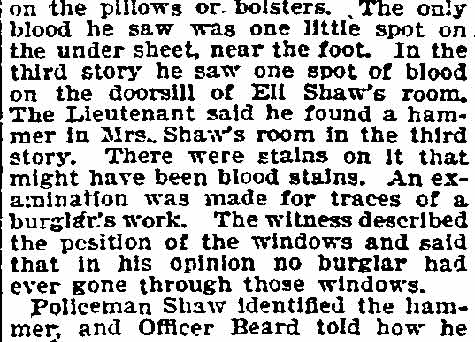
Lieutenant Pettit said he examined Mrs. Zane’s bed. There was no blood on the pillows or bolsters. The only blood he saw was one little spot on the under sheet, near the foot. In the third story he saw one spot of blood on the doorsill of Eli Shaw’s room. The Lieutenant said he found a hammer in Mrs. Shaw’s room in the third story. There were stains on it that might have been blood stains. An examination was made for traces of a burglar’s work. The witness described the position of the windows and said that in his opinion no burglar had ever gone through those windows.
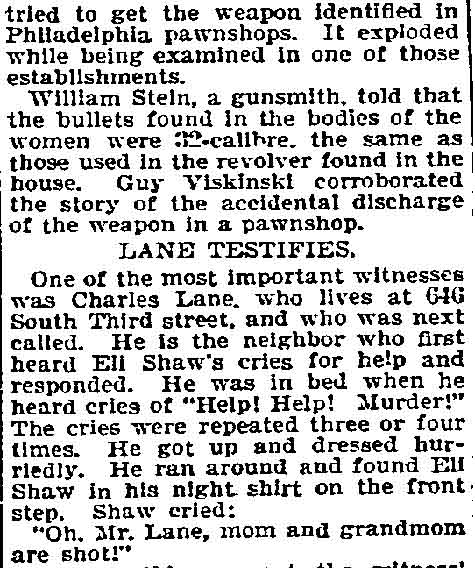
Policeman Shaw identified the hammer, and Officer Beard told how he tried to get the weapon identified in Philadelphia pawnshops. It exploded while being examined in one of those establishments.
William Stein, a gunsmith, told that the bullets found in the bodies of the women were 32-calibre, the same as those used in the revolver found in the house. Guy Viskinski corroborated the story of the accidental discharge of the weapon in a pawnshop.
LANE TESTIFIES.
One of the most important witnesses was Charles Lane, who lives at 646 South Third street, and who was next called. He is the neighbor who first heard Eli Shaw’s cries for help and responded. He was in bed when he heard cries of “Help! Help! Murder!” The cries were repeated three or four times. He got up and dressed hurriedly. He ran around and found Eli Shaw in his night shirt on the front step. Shaw cried:
“Oh, Mr. Lane, mom and grandmom are shot!”
Just at this moment the witness’ son came running up, and they went in the hallway.
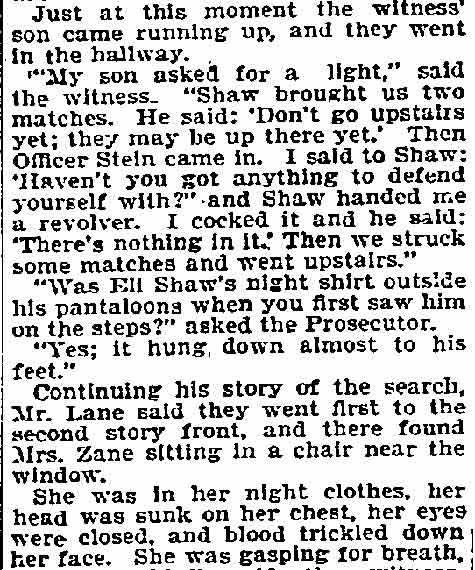
“My son asked for a light,” said the witness. “Shaw brought us two matches. He said: ‘Don’t go upstairs yet; they may be up there yet.’ Then Officer Stein came in. I said to Shaw: ‘Haven’t you got anything to defend yourself with?’ and Shaw handed me a revolver. I cocked it and he said: ‘There’s nothing in it.’ Then we struck some matches and went upstairs.”
“Was Eli Shaw’s night shirt outside his pantaloons when you first saw him on the steps?” asked the Prosecutor.
“Yes; it hung down almost to his feet.”
Continuing his story of the search, Mr. Lane said they went first to the second story front, and there found Mrs. Zane sitting in a chair near the window.
She was in her night clothes, her head was sunk on her chest, her eyes were closed, and blood trickled down her face. She was gasping for breath, “just like this,” said the witness, drawing in his cheeks like a person almost suffocated. He was describing Mrs. Zane’s dying agonies.
Mr. Lane said he called to Mrs. Zane. “Em! Em!” but she made no response. “I had known her for forty years,” said the witness to the jury in explanation of his familiar manner of addressing the woman. Then he said they went into the next room and found Mrs. Shaw on the floor moaning and weltering in her own gore. He spoke to her, but she could not answer. He described the position in which Mrs. Shaw lay. Then, he said, the searchers went up to the third floor. The Prosecutor asked if they found any lights. The witness said no; they had to light the gas in the third story front room. They found the gas lit in the dining room on the first floor when they first entered the house.
NIGHT SHIRT EXHIBITED.
Coroner Lippincott took the stand next and showed the jury Shaw’s night shirt, on which there were many spots of blood. Some were very small, others approached the size of a pea. When he had finished making this gruesome exhibit, he returned to the stand and detailed what he had heard of the conversation between Eli Shaw and Prosecutor Jenkins.
“He said that he did not see any one when his mother was shot, did not see her fall, and did not see the flash of the pistol. He also said that he had tucked his night shirt into his trousers before he went downstairs.”
Officer Sinclair was called but stated that he knew nothing of the case on the morning it occurred.
Mrs. Knight, who lives next door to where the tragedy occurred, said that she had made an examination of the bureau drawers, and as far as she had any knowledge, nothing was taken or removed. This closed the taking of testimony, and at ten minutes of 1 o’clock, the jury retired to deliberate.
After a few moments they returned and the foreman read the verdict, finding “That Mrs. Emma Zane came to her death from a pistol shot wound at the hands of a person or persons unknown to this jury.”
Some one attempted to applaud, but no one seconded the attempt and it was given up. Shaw was shortly after notified of the verdict and received the news with satisfaction.
Shot Her Husband.
Camden Post —
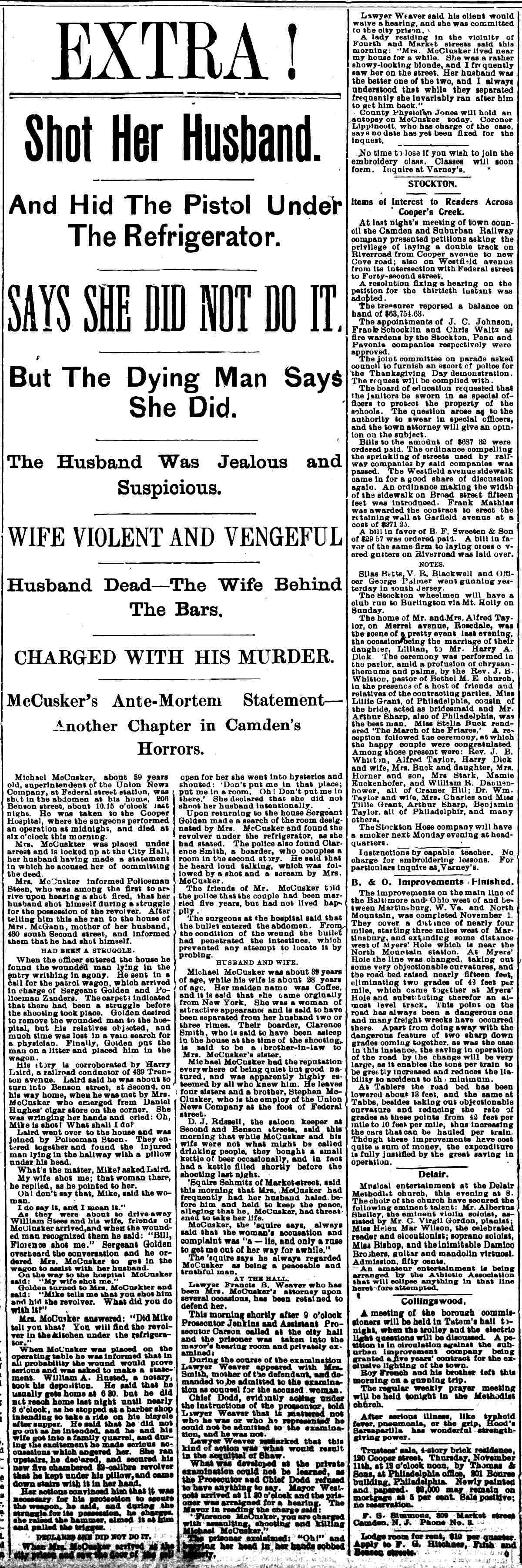
EXTRA!
And Hid The Pistol Under The Refrigerator.
SAYS SHE DID NOT DO IT.
But The Dying Man Says She Did.
The Husband Was Jealous and Suspicious.
WIFE VIOLENT AND VENGEFUL
Husband Dead—The Wife Behind The Bars.
CHARGED WITH HIS MURDER.
McCusker’s Ante-Mortem Statement—Another Chapter in Camden’s Horrors.
Michael McCusker, about 3[?] years old, superintendent of the Union News Company, at Federal street station, was shot in the abdomen at his home, 206 Benson street, about 10.15 o’clock last night. He was taken to the Cooper Hospital, where the surgeons performed an operation at midnight, and died at six o’clock this morning.
Mrs. McCuskter [sic] was placed under arrest and is locked up at the City Hall, her husband having made a statement in which he accused her of committing the deed.
Mrs. McCusker informed Policeman Steen, who was among the first to arrive upon hearing a shot fired, that her husband shot himself during a struggle for the possession of the revolver. After telling him this she ran to the house of Mrs. McGann, mother of her husband, 430 south Second street, and informed them that he had shot himself.
HAD BEEN A STRUGGLE.
When the officer entered the house he found the wounded man lying in the entry writhing in agony. He sent in a call for the patrol wagon, which arrived in charge of Sergeant Golden and Policeman Zanders. The carpets indicated that there had been a struggle before the shooting took place. Golden desired to remove the wounded man to the hospital, but his relatives objected, and much time was lost in a vain search for a physician. Finally, Golden put the man on a litter and placed him in the wagon.
His story is corroborated by Harry Laird, a railroad conductor of 439 Trenton avenue. Laird said he was about to turn into Benson street, at Second, on his way home, when he was met by Mrs. McCusker who emerged from Daniel Hughes’ cigar store on the corner. She was wringing her hands and cried: Oh, Mike is shot! What shall I do?
Laird went over to the house and was joined by Policeman Steen. They entered together and found the injured man lying in the hallway with a pillow under his head.
What’s the matter, Mike? asked Laird.
My wife shot me; that woman there, he replied, as he pointed to her.
Oh! don’t say that, Mike, said the woman.
I do say it, and I mean it.”
As they were about to drive away William Stees and his wife, friends of McCusker arrived, and when the wounded man recognized them he said: “Bill, Florence shot me.” Sergeant Golden overheard the conversation and he ordered Mrs. McCusker to get in the wagon to assist with her husband.
On the way to the hospital McCusker said: “My wife shot me.”
Golden turned to Mrs. McCuskter [sic] and said: “Mike tells me that you shot him and hid the revolver. What did you do with it?”
Mrs. McCusker answered: “Did Mike tell you that? You will find the revolver in the kitchen under the refrigerator.”
When McCusker was placed on the operating table he was informed that in all probability the wound would prove serious and was asked to make a statement. William A. Husted, a notary, took his deposition. He said that he usually gets home at 6.30 but he did not reach home last night until nearly 8 o’clock, as he stopped at a barber shop intending to take a ride on his bicycle after supper. He said that he did not go out as he intended, and he and his wife got into a family quarrel, and during the excitement he made serious accusations which angered her. She ran upstairs, he declared, and secured his new five chambered [?]2-calibre revolver that he kept under his pillow, and came down stairs with it in her hand.
Her actions convinced him that it was necessary for his protection to secure the weapon, he said, and during the struggle for its possession, he charges, she raised the hammer, aimed it at him and pulled the trigger.
DECLARES SHE DID NOT DO IT.
When Mrs. McCusker arrived at the city prison and saw the door of the cell open for her she went into hysterics and shouted: ‘Don’t put me in that place; put me in a room. Oh! Don’t put me in there.’ She declared that she did not shoot her husband intentionally.
Upon returning to the house Sergeant Golden made a search of the room designated by Mrs. McCusker and found the revolver under the refrigerator, as she had stated. The police also found Clarence Smith, a boarder, who occupies a room in the second story. He said that he heard loud talking, which was followed by a shot and a scream by Mrs. McCusker.
The friends of Mr. McCusker told the police that the couple had been married five years, but had not lived happily.
The surgeons at the hospital said that the bullet entered the abdomen. From the condition of the wound the bullet had penetrated the intestines, which prevented any attempt to locate it by probing.
HUSBAND AND WIFE.
Michael McCusker was about 3[?] years of age, while his wife is about 28 years of age. Her maiden name was Coffee, and it is said that she came orginally [sic] from New York. She was a woman of attractive appearance and is said to have been separated from her husband two or three times. Their boarder, Clarence Smith, who is said to have been asleep in the house at the time of the shooting, is said to be a brother-in-law to Mrs. McCusker’s sister.
Michael McCusker had the reputation everywhere of being quiet but good natured, and was apparently highly esteemed by all who knew him. He leaves four sisters and a brother, Stephen McCusker, who is the employ of the Union News Company at the foot of Federal street.
D. J. Russell, the saloon keeper at Second and Benson streets, said this morning that while McCusker and his wife were not what might be called drinking people, they bought a small kettle of beer occasionally, and in fact had a kettle filled shortly before the shooting last night.
‘Squire Schmitz of Market-street, said this morning that Mrs. McCusker had frequently had her husband haled before him and held to keep the peace, alleging that he, McCusker, had threatened to take her life.
McCusker, the ‘squire says, always said that the woman’s accusation and complaint was “a — lie, and only a ruse to get me out of her way for awhile.”
The ‘squire says he always regarded McCusker as being a peaceable and truthful man.
AT THE HALL.
Lawyer Francis B. Weaver who has been Mrs. McCusker’s attorney upon several occasions, has been retained to defend her.
This morning shortly after 9 o’clock Prosecutor Jenkins and Assistant Prosecutor Carson called at the city hall and the prisoner was taken into the mayor’s hearing room and privately examined.
During the course of the examination Lawyer Weaver appeared with Mrs. Smith, mother of the defendant, and demanded to be admitted to the examination as counsel for the accused woman.
Chief Dodd, evidently acting under the instructions of the prosecutor, told Lawyer Weaver that it mattered not who he was or who he represented he could not be admitted to the examination, and he was not.
Lawyer Weaver remarked that this kind of action was what would result in the acquittal of Shaw.
What was developed at the private examination could not be learned, as the Prosecutor and Chief Dodd refused to have anything to say. Mayor Westcott arrived at 11.30 o’clock and the prisoner was arraigned for a hearing. The Mayor in reading the charge said:
‘Florence McCusker, you are charged with assaulting, shooting and killing Michael McCusker.’
The prisoner exclaimed: “Oh!” and burying her head in her hands sobbed bitterly.
Lawyer Weaver said his client would waive a hearing, and she was committed to the city prison.
A lady residing in the vicinity of Fourth and Market streets said this morning: “Mrs. McClusker lived near my house for a while. She was a rather showy-looking blonde, and I frequently saw her on the street. Her husband was the better one of the two, and I always understood that while they separated frequently she invariably ran after him to get him back.”
County Physician Jones will hold an autopsy on McCusker today. Coroner Lippincott, who has charge of the case, says no date has yet been fixed for the inquest.
No time to lose if you wish to join the embroidery class. Classes will soon form. Inquire at Varney’s.
STOCKTON.
Items of Interest to Readers Across Cooper’s Creek.
At last night’s meeting of town council the Camden and Suburban Railway company presented petitions asking the privilege of laying a double track on Riverroad from Cooper avenue to new Cove road; also on Westfield avenue from its intersection with Federal street to Forty-second street.
A resolution fixing a hearing on the petition for the thirtieth instant was adopted.
The treasurer reported a balance on hand of $63,754.63.
The appointments of J. C. Johnson, Frank Schocklin and Chris Waltz as fire wardens by the Stockton, Penn and Pavonia companies respectively were approved.
The joint committee on parade asked council to furnish an escort of police for the Thanksgiving Day demonstration. The request will be complied with.
The board of education requested that the janitors be sworn in as special officers to protect the property of the schools. The question arose as to the authority to swear in special officers, and the town attorney will give an opinion on the subject.
Bills to the amount of $687.32 were ordered paid. The ordinance compelling the sprinkling of streets used by railway companies by said companies was passed. The Westfield avenue sidewalk came in for a good share of discussion again. An ordinance making the width of the sidewalk on Broad street fifteen feet was introduced. Frank Mathias was awarded the contract to erect the retaining wall at Garfield avenue at a cost of $271.25.
A bill in favor of B. F. Sweeten & Son of $29.57 was ordered paid. A bill in favor of the same firm to laying cross covered gutters on Riverroad was laid over.
NOTES.
Silas Betts, V. R. Blackwell and Officer George Palmer went gunning yesterday in south Jersey.
The Stockton wheelmen will have a club run to Burlington via Mt. Holly on Sunday.
The home of Mr. and Mrs. Alfred Taylor, on Merrel avenue, Rosedale, was the scene of a pretty event last evening, the occasion being the marriage of their daughter, Lillian, to Mr. Harry A. Dick. The ceremony was performed in the parlor, amid a profusion of chrysanthemums and palms, by the Rev. J. B. Whitton, pastor of Bethel M. E church, in the presence of a host of friends and relatives of the contracting parties. Miss Lillie Grant, of Philadelphia, cousin of the bride, acted as bridesmaid and Mr. Arthur Sharp, also of Philadelphia, was the best man. Miss Stella Buck rendered ‘The March of the Friares,’ A reception followed the ceremony, at which the happy couple were congratulated Among those present were: Rev. J. B. Whitton, Alfred Taylor, Harry Dick and wife, Mrs. Buck and daughter, Mrs. Horner and son, Mrs Stark, Mamie Euckenhofer, and William R. Dauuenhower, all of Cramer Hill; Dr. Wm. Taylor and wife, Mrs. Charles and Miss Tillie Grant, Arthur Sharp, Benjamin Taylor. all of Philadelphir, and many others.
The Stockton Hose company will have a smoker next Monday evening at headquarters.
Instructions by capable teacher. No charge for embroidering lessons. For particulars inquire at Varney’s.
B. & O. Improvements Finished.
The improvements on the main line of the Baltimore and Ohio west of and between Martinsburg, W. Va. and North Mountain, was completed November 1. They cover a distance of nearly four miles, starting three miles west of Martinsburg, and extending some distance west of Myers’ Hole which is near the North Mountain station. At Myers’ Hole the line was changed, taking out some very objectionable curvatures, and the road bed raised nearly fifteen feet, eliminating two grades of 43 feet per mile, which came together at Myers’ Hole and substituting therefor an almost level track. This point on the road has always been a dangerous one and many freight wrecks have occurred there. Apart from doing away with the dangerous feature of two sharp down grades coming together, as was the case in this instance, the saving in operation of the road by the change will be very large, as it enables the tons per train to be greatly increased and reduces the liability to accident to the minimum.
At Tablers the road bed has been lowered about 13 feet, and the same at Tabbs, besides taking out objectionable curvature and reducing the rate of grades at these points from 42 feet per mile to 10 feet per mile, thus increasing the cars that can be hauled per train. Though these improvements have cost quite a sum of money, the expenditure is fully justified by the great saving in operation.
Delair.
Musical entertainment at the Delair Methodist church, this evening at 8. The choir of the church have secured the following eminent talent: Mr. Albertus Shelley, the eminent violin soloist, assisted by Mr. C. Virgil Gordon, pianist; Miss Helen Mar Wilson, the celebrated reader and elocutionist; soprano soloist, Miss Bishop, and the inimitable Damico Brothers, guitar and mandolin virtuosi. Admission, fifty cents.
An amateur entertainment is being arranged by the Athletic Association that will eclipse anything in that line heretofore attempted.
Collingswood.
A meeting of the borough commissioners will be held in Tatem’s hall tonight, when the trolley and the electric light questions will be discussed. A petition is in circulation against the suburban improvement company being granted a five years’ contract for the exclusive lighting of the town.
Roy French and his brother left this morning on a gunning trip.
The regular weekly prayer meeting will be held tonight in the Methodist church.
After serious illness, like typhoid fever, pneumonia, or the grip, Hood’s Sarsaparilla has wonderful strength-giving power.
Trustees’ sale, 4-story brick residence, 190 Cooper street, Thursday, November 11th, at 12 o’clock noon, by Thomas & Sons, at Philadelphia office, 201 Bourse building, Philadelphia. Newly painted and papered. $2,000 may remain on mortgage at 5 per cent. Sale positive; no reservation.
F. S. Simmons, 309 Market street Camden, N. J. Phone No. 9.
Lodge room for rent, $10 per quarter. Apply to F. G. Hitchner, Fifth and Benson streets.
Drunks Were Scarce
Camden Daily Telegram —
Drunks were scarce in this city Saturday and yesterday and as a result the police had little to do. Richard Fowler, a respectable looking old gentleman who claimed Philadelphia as his home, was one of the unfortunates. He was picked up by Officer Hovis on Saturday, being too drunk to care for himself. He was unable to account for his presence in this city and as he appeared sorry for his actions, the Recorder allowed him to go this morning.
John Burdsall, of Gloucester, met some friends on Saturday night and got loaded, so much so in fact, that he was unable to stand and fell in the street, doing considerable damage to his face. Sergeant Albert sent him to the City Hall and this morning the Recorder suspended sentence, Burdsall having a family to support.
Annie Joyce, who says that Hall Officer Boyle is just the right thing, paid a flying visit to this city on Saturday and flew until she alighted in a City Hall coop. Her heart disease story was listened to again this morning by the Recorder and for the next ten days she will be under the care of County Physician Jones.
Nelson Hart, without a home, arrested for drunkenness, will have all the comforts of home life with the Sheriff for the next ten days.
John Myer Adjudged Insane
Philadelphia Inquirer —

John Myer, who made two attempts at suicide on Sunday last, was adjudged insane yesterday by County Physician Jones and was taken to the State Asylum, at Trenton, by Overseer of the Poor Jefferis.
Mrs. Thomas Finney Found Dead
Philadelphia Inquirer —

Mrs. Thomas Finney, wife of Watchman Finney, of the National State Bank, was found dead in bed yesterday morning. Heart failure was certified as the cause by County Physician Jones.
Abbatto Hanged in Camden Jail
Philadelphia Inquirer —
Quick Work by Sheriff Sell in Executing the Murderer of Genaro De Feo
Condemned Man Died Without a Struggle, and Was Buried in Potters’ Field
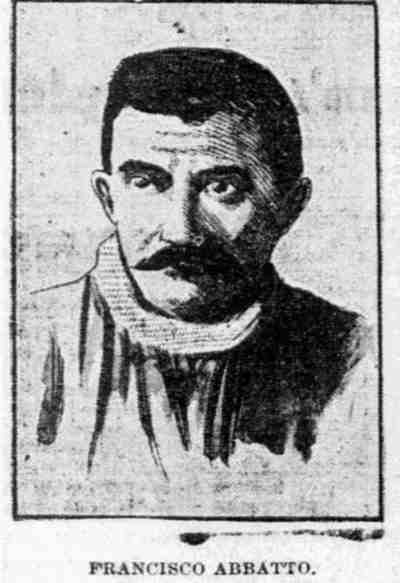
FRANCISCO ABBATTO.
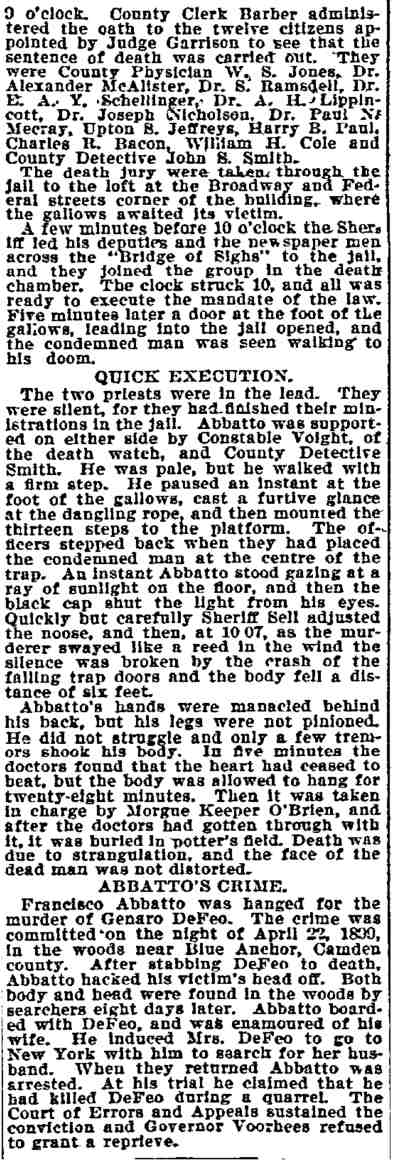
John Wesley Sell, Sheriff of Camden county, had his first hanging yesterday, and he made a record for celerity in launching Francisco Abbatto into eternity. The earliest moment that the hanging could take place, under the order of the court, was 10 o’clock. Within 6 minutes after the hour struck Abbatto was standing on the gallows. A minute later the trap was sprung, and five minutes later the man was dead.
Abbatto slept soundly during his last night on earth. He was up betimes yesterday morning, and dressed himself in the black suit of clothes which he knew would be his death garments. He declined to eat any breakfast, but drank a cup of coffee. At 8 o’clock the priests came to prepare the condemned man for the end. They were Father Pozzi, of East Vineland, and Father Caruso, of the Church of Our Lady of Good Counsel, of Philadelphia.
FINAL PREPARATIONS.
The persons authorized by law to witness the execution, about forty in number, gathered in the Sheriff’s office by half past 9 o’clock. County Clerk Barber administered the oath to the twelve citizens appointed by Judge Garrison to see that the sentence of death was carried out. They were County Physician W. S. Jones, Dr. Alexander McAlister, Dr. S. Ramsdell, Dr. E. A. Y. Schellinger, Dr. A. H. Lippincott, Dr. Joseph Nicholson, Dr. Paul N. Mecray, Upton S. Jeffreys, Harry B. Paul, Charles R. Bacon, William H. Cole and County Detective John S. Smith.
The death jury were taken through the jail to the loft at the Broadway and Federal streets corner of the building, where the gallows awaited its victim.
A few minutes before 10 o’clock the Sheriff led his deputies and the newspaper men across the “Bridge of Sighs” to the jail, and they joined the group in the death chamber. The clock struck 10, and all was ready to execute the mandate of the law. Five minutes later a door at the foot of the gallows, leading into the jail opened, and the condemned man was seen walking to his doom.
QUICK EXECUTION.
The two priests were in the lead. They were silent, for they had finished their ministrations in the jail. Abbatto was supported on either side by Constable Voight, of the death watch, and County Detective Smith. He was pale, but he walked with a firm step. He paused an instant at the foot of the gallows, cast a furtive glance at the dangling rope, and then mounted the thirteen steps to the platform. The officers stepped back when they had placed the condemned man at the centre of the trap. An instant Abbatto stood gazing at a ray of sunlight on the floor, and then the black cap shut the light from his eyes. Quickly but carefully Sheriff Sell adjusted the noose, and then, at 10 07, as the murderer swayed like a reed in the wind the silence was broken by the crash of the falling trap doors and the body fell a distance of six feet.
Abbatto’s hands were manacled behind his back, but his legs were not pinioned. He did not struggle and only a few tremors shook his body. In five minutes the doctors found that the heart had ceased to beat, but the body was allowed to hang for twenty-eight minutes. Then it was taken in charge by Morgue Keeper O’Brien, and after the doctors had gotten through with it, it was buried in potter’s field. Death was due to strangulation, and the face of the dead man was not distorted.
ABBATTO’S CRIME.
Francisco Abbatto was hanged for the murder of Genaro DeFeo. The crime was committed on the night of April 22, 1899, in the woods near Blue Anchor, Camden county. After stabbing DeFeo to death, Abbatto hacked his victim’s head off. Both body and head were found in the woods by searchers eight days later. Abbatto boarded with DeFeo, and was enamoured of his wife. He induced Mrs. DeFeo to go to New York with him to search for her husband. When they returned Abbatto was arrested. At his trial he claimed that he had killed DeFeo during a quarrel. The Court of Errors and Appeals sustained the conviction and Governor Voorhees refused to grant a reprieve.
Man Dies of Tuberculosis at Cooper Hospital
Philadelphia Inquirer —
A man giving the name of J. F. Raux and Mt. Ephraim as his residence died shortly after his admission to Cooper Hospital on Sunday from tuberculosis. County Physician Jones held a view. The body was removed to the morgue. Raux is supposed to have relatives in Ohio.
Woodward on Trial for Coffin Murder
Philadelphia Inquirer —
Less Than Six Weeks After Alleged Crime Case Is Called in Camden Court — The Prisoner’s Appearance — What State Will Try to Prove
Six weeks ago yesterday John Coffin and W. Price Jennings, two rosy-cheeked Camden lads, left their comfortable homes for a boyish romp in the country. Three days later their bodies were found lying half concealed among a wild growth of bushes in an uncultivated field near Haddon Heights.
Yesterday Paul Woodward, termed a cigarette fiend and a reader of trashy novels, was placed on trial in Camden before Judge Garrison, on indictments charging him with the murder of John Coffin.
Directly the doors of the court room were opened a crowd of men and women made a mad rush for seats, and the constables with difficulty restrained them. In a few minutes every seat had been taken and the throng awaited expectantly for a glimpse of the accused youth. The space reserved for members of the bar was filled, too, with many lawyers interested in the outcome of what doubtless will prove one of the most famous murder trials in Camden county.
Court Opened
A few minutes after 10 o’clock Judge Garrison arrived, court was formally opened and Prosecutor of the Pleas Frank T. Lloyd read the list of the State’s witnesses, nearly sixty in number. In the meantime Constable Christman had been dispatched for Woodward, and before the Prosecutor had completed reading the list of witnesses the accused youth appeared by way of the “Bridge of Sighs,” which connects the county jail with the Court House.
Immediately he was the cynosure of all eyes, but he did not appear to heed the gaze of the spectators. Pulling up his trousers with a sailor-like motion he walked buoyantly to his seat in the prisoner’s dock. His counsel, Lawyers Robinson and Daniels, of Philadelphia, and William Rex, of Camden, greeted him with, “How do you feel, Paul?”
He Couldn’t Kick
“All right; I can’t kick,” he replied, nonchalantly, and he settled himself down in the chair until only the top of his peculiarly shaped head was visible. He was less excited than many spectators. He had the appearance more of an undersized boy than a man—he is 25[?] years old, and not 19[?], as has been stated.
His hair, jet black, was plastered down on his head with scrupulous care. In fact, he very evidently took more pains in arranging his hair than his clothing, which was ill-fitting. His low-cut vest had fancy gilded buttons as large as a quarter, while his trousers, the same he wore when apprehended for the crime, were of a coarse material, navy blue, and several sizes too large for him.
Prisoner’s Parents There
Shortly after court convened, Woodward’s parents appeared, accompanied by a little girl, said to be Woodward’s sister. The family occupied seats among the spectators, taking keen interest in the proceedings.
Prosecutor Lloyd moved the indictment against Woodward for the murder of John Coffin. The other indictment, charging him with the murder of Price Jennings, will not be pressed unless in the event of an acquittal in the Coffin case. After Lawyer Rex had introduced his Philadelphia colleagues, the task of securing a jury was begun. The entire panel of forty-eight was exhausted when only ten jurors had been selected. A special panel was called before the other two were secured.
As finally selected, the jury composes the following: George Asay, Voorhees township, foreman; William Powell, Gloucester township; William Anderson, Pensauken; Charles Eisley, Waterford; Thomas J. Atkinson, Fourth ward; Wilson English, Tenth ward; Harry Avis, Second ward; George H. Stinford, Sr., Fifth ward; John M. Hyde, Twelfth ward; William Heggan, Tenth ward; John St. Clair, Third ward; Charles S. Hess, Fifth ward.
Case Presented
It was two o’clock in the afternoon before Assistant Prosecutor F. Morse Archer opened for the State. He said the State would show the cause of death to be the result of strychnine poisoning; that on the Monday and Tuesday preceding the disappearance of the boys Woodward was seen loitering about the Linden public school inquiring for Coffin and Jennings; that he met them the following Wednesday at Front and Penn streets and was heard to make an appointment to meet them in the country; that he did meet them on the White Horse pike and was seen entering the lane off Chew’s Landing road to the spot where the bodies were found. Mr. Archer also said the State would prove the defendant appeared at the Coffin house the day following the disappearance of the boys and offered his services to locate them. He said it would be proven Woodward showed a friend valuables and money taken from the bodies before the boys were known to be dead. The State would offer statements made by the defendant and on the strength of the above a verdict of first degree was asked.
First Witnesses
Clarence Krewson and Harry Patton, of Haddon Heights, were the first witnesses called. They told how they came across the body of Jennings lying under a chestnut tree while they were returning from a blackbird hunt. They described the general appearance of the body and said there were no evidences of a struggle.
Mary Ward, colored, told how she had found the body of Coffin while piloting a newspaper man to the spot where young Jennings lay.
County Physician William S. Jones described the postmortem examination. He said he did not ascertain the cause of death. There were no external marks or bruises and nothing to indicate as to how the boys had met death. He testified to removing the viscera of both boys and turning them over to Chemist George M. Beringer in hermetically sealed glass jars.
Professor William C. Copeland, of Jefferson Medical College, told how he had made an autopsy on the bodies. He said they were carefully examined for evidences of external bruises, but none were found. He said there were some marks of discoloration, which probably resulted from postmortem changes. There were no evidences of death from unnatural causes.
Judge Garrison adjourned court until this morning, when Professor Copeland will resume his testimony.
Woman’s Suspicious Death
Philadelphia Inquirer —
Expired in Hospital While Her Husband Is in Jail
Mrs. Leon Sanoski, of 1146 Sycamore street, Camden, died in Cooper Hospital yesterday, under suspicious circumstances. Her husband is in the county jail. According to a statement made by County Physician Jones after he conducted, the post-mortem the woman died from cirrhosis of the liver. He said he saw no marks or bruises on the body.
The woman was found by Captain Stanley and Overseer of the Poor Jefferis unconscious on the floor of her home last Wednesday. She was examined by City Physician Jackson and ordered sent to the hospital. At the hearing the next day the doctor, police captain and overseer testified that the woman’s body was covered with bruises.
On Thursday Sanoski was taken to his wife’s bedside. Her ante-mortem statement was taken by Assistant Prosecutor Wolverton. Mrs. Sanoski said that her husband beat her into insensibility on Monday night and that he beat her once a week for eight years.
Brained With Ax, Women Lie Dead
Philadelphia Inquirer —
Fiend Fires Barn and While Owner Fights Flames Brutally Murders Aged Wife and Domestic—Suspects Arrested
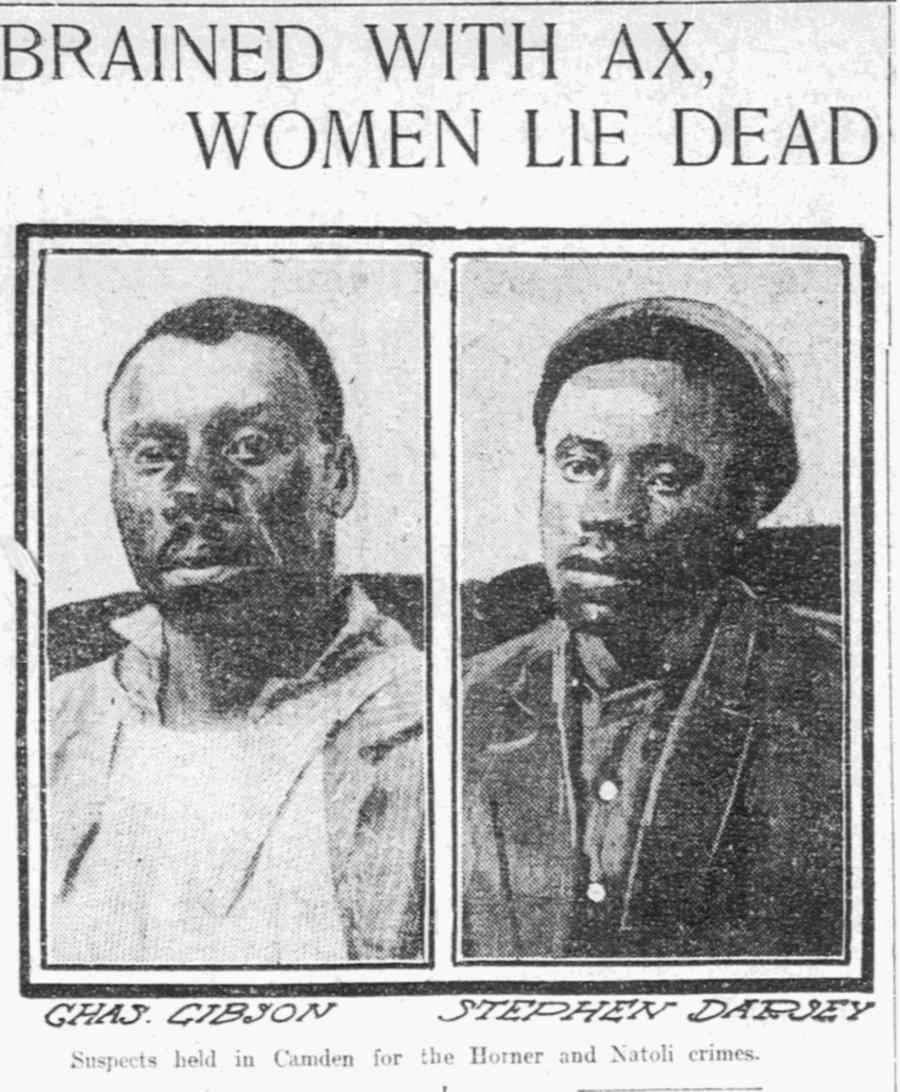
CHAS. GIBSON STEPHEN DORSEY
Suspects held in Camden for the Horner and Natoli crimes.
Brained with an ax in the hands of a thief detected in the act of robbing, two women were foully murdered shortly after 4 o’clock yesterday morning in the farm house of Edward Horner, located along the banks of the Cooper Creek, about half a mile below the Browning road and a short distance from Camden. Mrs. Frances Horner, 63 years old, wife of the farmer, was instantly killed, while Victoria Natoli, 22 years old, of 82[?] Catharine street, Philadelphia, employed as a domestic, died two hours after her admission to the Cooper Hospital in Camden.
Less than four hours after he had worked on the apparent mystery, County Detective John S. Smith had taken into custody Charles Gibson and Stephen Dorsey, negroes, both of 2029 Mulford street, Camden. The evidence against the prisoners is such that Prosecutor Harry Scovel declared there is little doubt that they are the murderers. To attract the attention of the men folks about the house, the thieves set fire to a large frame barn about three hundred feet from the house, and it was while the farmer and his help were endeavoring to check the flames that the crime was committed.
Found Barn Ablaze
It was not until about 10 o’clock Monday night that Horner, who had been to market in Philadelphia with a load of hay, returned to his home. When he and his wife retired they planned to arise early this morning. They were unable to sleep well because of the incessant barking of a small fox terrier that was chained just outside of the kitchen. When the dog had been quieted at 2 o’clock in the morning the farmer and his wife fell into a deep sleep. They were again awakened at 4 o’clock by the terrier’s barking, when the farmer arose to go down to the creature he was startled to see the reflection of a fire on the window pane of his sleeping room. In an instant he had learned that the large barn, containing three horses and farming implements, was burning fiercely.
Without waiting to put on his clothes he ran down stairs, with his aged wife at his heels. Into the summer garden and down a pathway he hurried, calling for his farm hands, three Italians and a negro, who had sleeping quarters in a small frame structure to the south of the barn. These rushed out in their night clothes, among them being the Italian domestic.
“You go and help Mrs. Horner,” said he to the woman as he hurried past her, and Mrs. Natoli ran to the house in compliance.
Work of Incendiary
With the Italians and the negro the farmer turned his attention to the fire, which he found had consumed the lower part of the structure with the exception of the stalls where the three horses were confined. These were hastily taken out, but there was no time to save any of the implements. It seemed as though the blaze came from the central part of the structure where nothing of an inflammable character had been placed, and which proved that the barn had been deliberately fired. When Horner realized that the building could not be saved he concluded to return to the house and don his clothing.
Not more than twenty minutes had elapsed when he went to the side door leading to the kitchen. On trying to open the door he was surprised to find it securely fastened. He thought it had stuck at the bottom, and on looking down he saw two pools of blood, one of which had overrun, and crimson drops were falling to the ground a foot below. With superhuman force he smashed in the door, when he nearly fainted from the terrible scene that met his gaze.
Near the end of a long kitchen table lay his wife, her head resting in an ever-widening pool of blood. He stooped and placed his hand over her heart, but it had been stilled in death. Her face was almost unrecognizable because of the great gush of blood that had flowed from two horrible wounds on her head. He was about to go out and call for help when in the dim light he saw the form of the Italian woman. He found she was still alive and then he gave the alarm.
In an inconceivably short space of time farmers from miles around had flocked to the stricken house. One of these, John Thomas, who has a place across from the Horner farm, about half a mile distant, hastily procured a horse and team and drove at a mad pace into Camden with the dying Italian domestic. He arrived at the Cooper Hospital at 7 o’clock and two hours later, almost to the minute, Mrs. Natoli breathed her last without regaining consciousness. She was about to become a mother.
In the meantime the various county officials arrived. County Physician W. S. Jones. Coroner J. W. Fithian. County Detectives Smith and Cherry. Chief of Police Gravenor and others.
An autopsy was held on the body of Mrs. Horner by Drs. Jones and Fithian.
They found that her skull had been crushed in two places. The wound on the front of the head was shaped like a spearhead and was about three and one-half inches long. An examination showed that the blow that had inflicted this injury had been of such force as to split the skull in twain. The other wound, of a similar character, was at the base of the skull, the bones being crushed like an egg-shell. A subsequent examination made of the body of Mrs. Natoli at the hospital showed that the left side of her skull had been crushed with one terrible blow.
When a search was instituted for the weapon with which the crime had been committed it could not at first be located. It was subsequently found at the rear of the house. It was an old axe that had been used to cut wire from bales of hay, and the butt end was covered with blood and hair, showing that it was in that wise the victims had been struck by the murderer.
Horner, the stricken husband, a man 65 years old, threw the first light on the mystery and he gave a clue that finally resulted in the arrest of the negro Gibson and later of Dorsey. He said he had been having considerable trouble with his help this year. One of the men, who proved to be Gibson, was discharged about three weeks ago after a violent quarrel. At that time the negro left with the remark:
The Threat
“All right. I’ll get even. I’ll burn your barn.”
No more was seen of the man until just before Horner left for his trip to Philadelphia on Monday night. Then the farmer was surprised to see the man enter the farm yard and he appeared to be in a repentant mood. He pleaded with Horner to give him work, but as the farmer had little time to spare he told him to return in the morning. Then Gibson asked for permission to sleep in the barn and this was given him. The last seen of the negro, until his subsequent arrest, was when he left the house to go to the barn. That was about 11 o’clock Monday night, after Horner had returned from Philadelphia.
Armed with this information, County Detective Smith, who had been on the scene since 6 o’clock in the morning, began a search for Gibson. His quest led him into the southern section of Camden, known as Centreville.
In company with Policeman Valentine the detective found Gibson at 1831 South Eighth street. He was immediately placed under arrest and taken to the office of Prosecutor Scovel. He wore a defiant mien and sought to throw off any suspicion connecting him with the crime by declaring his entire ignorance of it.
Stripped of his clothing, he was carefully examined, but no blood marks were found on his body. When his pockets were searched, however, a pawn ticket, on which the ink was hardly dry, was found. It was issued by a Philadelphia pawnbroker at 125 Market street, and was given in exchange for a watch. A handkerchief literally soaked with blood, was also found in one of his pockets, together with a revolver. As to the handkerchief, he said the blood came from his nose.
Meanwhile a “flyer” had been sent out to all of the pawnbrokers at 9 o’clock, and just after Gibson had been taken into custody, Reader, the Market street broker, entered the office of Prosecutor Scovel and excitedly said that a negro had been in his place just twenty minutes before he was apprised of the crime and had pawned two watches. Reader had the watches with him. One bore the name of “Edward Horner.” The other was a woman’s watch, with long pendant chain. The pawnbroker was given a view of Gibson, and he exclaimed:
“That is the man that pawned these watches this morning, just exactly at ten minutes past nine o’clock. There is not the least question but what it is he.”
Gibson never moved, but looked at the officials and the pawnbroker with a defiant glare. He was then placed in a cell in the county jail, to await trial, which Prosecutor Scovel promises will be a speedy one.
Shortly after Gibson’s arrest Detective Smith received information which resulted in him seeking Dorsey. The negro was found at his home, on Mulford street. When taken to the office of Prosecutor Scovel, he at first denied having any knowledge of the matter. In fact, he endeavored to create the impression he was not acquainted with Gibson, but seeing the absurdity of this, he finally acknowledged being out with Gibson Monday night. Then he admitted he was with Gibson when the watches were pawned.
Horner was taken to the jail, and after positively identifying Gibson as the negro who had made the threats, and who Monday night asked to be taken back as a farmhand, the farmer also identified the watches as belonging to him and his wife. The revolver found on the negro was one of two which were stolen.
With tears coursing down his cheeks the stricken husband, who is 65 years old, spoke of the tragedy in a tear-choked voice.
“It is all too terrible to talk about,” said he. “I can’t realize it all. Why, only Sunday we had a family reunion here, when I celebrated my sixty-fifth birthday. My wife then plagued me, saying I wasn’t that old by far, and with our children and grandchildren we spent one of the most pleasant of days.
“How I ever got into that room,” continued he, speaking of when he broke in the door only to find his wife and the domestic stretched on the floor and weltering in their own blood. “I cannot tell. My poor wife lay between the end of the kitchen table and the door that leads into the shed. I saw that her eyes were closed, and when I saw those terrible pools of blood I at once realized a crime had been committed. I felt of her heart to see if she was still alive, but it had stopped beating, and then I knew she was past all earthly aid. Then I found that other poor woman and knew that she was still alive. I gave the alarm, but just how I cannot tell. I cannot realize it all,” concluded he, with a choked voice.
The house in which the murder occurred is an old structure built along Colonial lines. It is part of what is known as the Michelson estate, the farm being 70 acres in extent. The Horners have been farmers all their lives, and are known throughout South Jersey. The barn that was destroyed lay about three hundred feet to the south of the dwelling, and beside it were a number of smaller frame structures. It was in one of these that the Italian woman, her husband and the other farm help lived.
The news of the tragedy spread to surrounding communities with great rapidity and a large crowd was soon gathered about the place. Had the murderers been found at the time they would undoubtedly have been given short shrift. Three daughters survive the murdered Mrs. Horner: Mrs. Anna Marter, Mrs. Edward Megargee and Mrs. Isaac Beideman.
Elliott Chew Declared Sane
Philadelphia Inquirer —
Drs. William S. Jones and Paul Markley yesterday examined Elliott Chew, the man who attacked Lawyer Samuel W. Sparks and Joseph Holloday. They concluded that Chew is not insane and he will probably be sent to jail by Judge Joline.
Baby Suffocated, Mother Held
Philadelphia Inquirer —
Prosecutor Boyle, in Camden last night, stated he had decided to hold Mrs. Eva Zark, of 717 Ringgold street, whose infant daughter was found dead beside her, until she can be examined as to her sanity. Both County Physician Jones and Coroner Saunders, who viewed the body of the infant, concluded the body had been suffocated while lying in bed.
Coursey Breaks Down While Story of Cold-Blooded Killing of Karl Kellmann Is Told by Detective
Camden Post-Telegram —
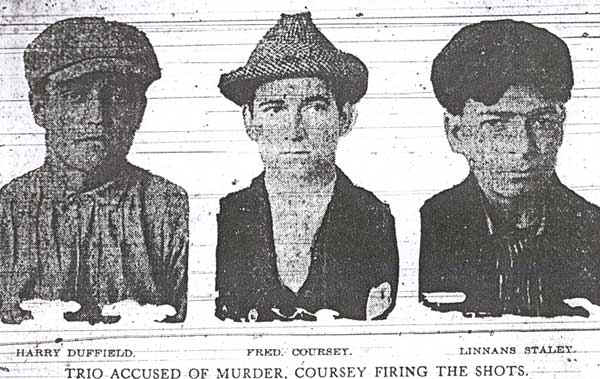
Two “Pals,” Too, Accused of Crime
Harry Duffield. Fred. Coursey. Linnans Staley.
Trio Accused of Murder, Coursey Firing the Shots.
Collapsing when arraigned in Police Court this morning before Recorder Stackhouse on the charge of killing Karl Kellmann, aged 18 years, of 2919 High street, at Twenty-seventh and Sherman streets, shortly before midnight Saturday, Fred Coursey, alias “Mexican Pete,” alias “Cowboy Pete,” aged 20 years, of 121 North Twenty-first street, who admits firing the fatal shots while committing robbery, and Harry Duffield, aged 21 years, of 407 North Forty-first street, who acknowledged masking his face with a handkerchief and being with Coursey, sobbed piteously, resting their heads on the railing of the dock, while John Painter, the veteran detective, was briefly reciting the story.
When Recorder Stackhouse asked what became of the young man who was shot and Painter replied that he died, Coursey and Duffield sobbed afresh, and when Recorder Stackhouse committed them without bail Policemen Frost and Kay had to help them.
Linnans Staley, aged 21 years, of 1819 Federal street, who confessed that he was in the robbery plot but later got scared and hid in the bushes, was scarcely able to stand, and when his mother broke down as he was committed as a principal he staggered and would have fallen but for Sergeant McClong.
Prosecutor Boyle announced this morning that the Grand Jury will be recalled for Thursday of this week and the case will be made the special order of the day.
Without the slightest clue to start with in the most brutal murder committed in recent years in Camden county, police and detectives under the personal direction of Chief Gravenor in two hours arrested two of the three prisoners and obtained their signatures to confessions and before sunrise the other was lodged behind the bars at the City Hall.
According to their statements to the police the prisoners while drinking on a lot near Twenty-first and Federal streets on Saturday night planned to go to a lone spot near Twenty-seventh and Sherman streets to hold someone up to get money and jewelry to buy more drink. Coursey had a 38-calibre cowboy pistol and Duffield used Coursey’s bandanna as a mask. Staley weakened before the spot selected was reached and at the time of the murder was hiding in a clump of weeds a short distance away.
The murdered boy was the son of Karl and Lulu D. Kellmann. He was a member of the Bible class of Grace Presbyterian Church, East Side, and active in church work.
Saturday night was the closing of a carnival given on High street between Twenty-seventh and Thirtieth streets. Karl was there and made several purchases. At one booth he bought a necktie, from another some ice cream and a box of candy and spent some time conversing with the young ladies connected with the church.
When it grew rather late he noticed that Misses Bertha and Bessie Skillen, of 815 North Thirty-fourth street, the latter a teacher in Grace Church Sunday-school, were without an escort and he volunteered to see them home. They accepted his invitation to be their escort. He saw them safely home and he was on his way back and had reached a point on the east side of Twenty-seventh street south of Sherman street and near the foot of the bridge that spans the Pennsylvania Railroad tracks when two men jumped out from behind a tree and as one commanded him to hold up his hands the other began to shoot.
The first shot struck him in the breast and turned him partially around. The next ploughed a hole through his neck, knocking him down, and the third went wide.
Screaming for help he tried to rise to his feet and was on his knees when Night Yardmaster Albert Ludlow and Brakeman Joseph Wittick, who were on the opposite side of the bridge, ran to his assistance. By the light of their lanterns they saw that he was seriously hurt and they took him to ’Squire Sasse’s house nearby to await the arrival of the ambulance. As the railroaders sped across the bridge Ludlow saw a man run down the tracks in the direction of Seventeenth street.
In the signal tower at Pavonia station known as C. B. the operator, Thomas Sink, heard the shots and cries for help and ’phoned to Captain James at Police Headquarters that a murder had been committed. Sink also saw a man run down through the weeds and bushes on the east side of the bridge toward the railroad tracks.
Policeman Hurlock and Schmid, ’Squire and Mrs. Sasse and several others were out on the street before the railroad men reached the Sasse home and all hurried to ’phones to notify police headquarters.
In less than five minutes by use of the red light system Captain James had every officer on duty on the East Side hurrying to the scene, officers stationed at every bridge, ferry house and railroad terminal, and the downtown auto with Detectives Schregler, Painter, Brothers and Moffett on its way to East Camden.
On information from the railroad men Sergeant Horner took all the East Side officers and the four detectives and they worked westward among the cars while Captain James started Policemen Colsey and Kelly to walk eastward from Fifteenth street until they met the main body.
The search proved fruitless and as they returned to the bridge one of the men picked up a green bandanna with yellow spots and sheep burrs embeded [sic] on it on the incline near the signal tower. Later he recalled that the man who went down the slope wore a Khaki shirt and cap.
The handkerchief was recognized as the kind used by “Indian Bill” May, and Detectives Brothers and Policeman Abbott were sent to arrest him. They found May and Eugene Cafferty asleep in a moving van in Marlton avenue. “Indian Bill” soon established an alibi.
Detective Schregler and a couple of officers who were sure that the description of the man with the khaki shirt tallied with Duffield started for his brother’s house, but failed to find him there. About this time the downtown auto turned into Twenty-seventh street to get Karl’s father, mother and sister and take them to the hospital. Councilman Finkeldey and a friend shouted to the crew that a woman was down and out on a step nearby, but the crew yelled back that they were on an emergency run and the woman would keep until they returned. Fireman J. H. Vickers walked across the street to investigate and found that the supposed woman was Duffield and that he seemed to be asleep.
Vickers shook him and as he got up he said something about the shooting that aroused Vickers’ curiosity and he ’phoned to Police Headquarters. Captain James immediately notified Chief Gravenor, who was on the scene and the latter sent Detective Moffett to investigate. When Moffett arrived he learned that Duffield had taken a Westfield avenue car. Moffett returned to the bridge and he and Detective Painter and Chief Gravenor took the down-town auto for Duffield’s home.
Painter went to the front door and saw Duffield in the act of taking off his shoes. Moffett in going around to the back door to prevent his escape that way passed by the window at which Duffield was sitting.
Grasping Duffield by the collar Moffett pulled him through the window to the ground. As soon as he landed on his feet, according to the Chief and detectives, Duffield said that Coursey did the shooting.
Placing him in the auto they next drove close to Coursey’s home and with Policeman Potter who knew the man wanted, the detectives entered the house with drawn revolvers while other officers guarded all avenues of escape.
Coursey was found akwake [sic] on a cot and while he was covered with revolvers Detective Painter searched his trunk and found the weapon that he later admitted using. It was empty. The detectives late yesterday afternoon found three used shells adjoining the house near a spot where Coursey said he had thrown them.
In order to keep the men apart they were taken to the City Hall separately and questioned and after they decided to tell all Sergeant E. B. McClong reduced their statements to writing and they signed them. It was on the strength of these statements that Staley was arrested.
Young Kellmann was taken into the hospital at 12.20 a. m. Chief Surgeon Schellenger saw at a glance that there was no hope for him and so notified Captain James, and Sergeant McClong was sent to the hospital to get all information possible.
The unfortunate youth could only speak a few words at a time because of the hemorrhages. All Sergeant McClong was able to get from him was that he was told to hold up his hands and that the shooting instantly began. The only description he could give was that they were small men and that the attack was so sudden that he could not tell whether they were black or white.
The injured young man kept asking the doctors if he was going to die, but they did not answer. He was conscious when his father and mother arrived and then sank rapidly until the end, dying at 1.50 o’clock, 90 minutes after he was admitted. Mother and father were prostrated and were taken home by the up-town auto.
County Physician Jones conducted the autopsy yesterday morning. He said that either wound would have caused death. The bullet in the breast pierced the right lung at the top and lodged in the cavity. It is now in the doctor’s possession. The other bullet went clear through the neck.
Coursey and Duffield have been working in the Pavonia car yard. The former was born in El Paso, Texas, but has lived East nearly all his life. He is an expert shot and was a member of the vaudeville team of Coursey & Cook, according to their letter heads presenting a fifteen-minute thriller.
Duffield was only recently paroled for robbing Gallagher’s saloon, Nineteenth and Federal streets of a lot of drinkables. Staley has been arrested several times on petty charges but was never convicted of crime. When Duffield’s coat was examined at the City Hall, it was found to contain sheep burrs.
To a reporter Coursey said that whenever he was drinking he had to get his gun and shoot something or somebody. He insisted that all were in on the job and that they let the man who preceded Kellman go over the bridge without molestation because he didn’t look as if he had any too much money.
Yesterday morning Assistant Prosecutor Wolverton and Stenographer Cleary called at the City Hall. The prisoners were examined by Mr. Wolverton and their statements taken by Mr. Cleary, but there was little or nothing new elicited.