Introduction
WILLIAM ANDERSON was born in Ireland around 1831. He came to America in 1853, according to the 1910 Census report. William Anderson and wife Elizabeth were living in Newton Township, probably near where would be found ten years thereafter. The 1870 Census shows him living in what was then Newton Township, near the Starr Iron Works. It appears that he worked there for many years, as would his son John. The family at that time included wife Eliza, 35 and also Ireland-born; sons John and Abram, 8 and 5 respectively, and a daughter, also named Eliza, aged 2. This part of Newton Township later was annexed by Camden and comprises much of the old Seventh Ward.
The Anderson family stayed in the same area through at least nine decades. When new homes were built in the 1000 block of Line Street in the 1880s, William Anderson acquired 1032 Line Street. This would be the family home as late as 1947 into the 1920s.
William Anderson generally worked as a factory laborer, but was active in politics, and served as County freeholder from Camden’s Seventh Ward in the 1890s and 1900s. His wife Eliza had passed by June of 1900. During the time William Anderson was freeholder, his John Anderson served on Camden’s police force. By the time the 1910 Census was taken William Anderson had retired. He passed away on January 1, 1912. Son John did not survive until the 1920 census, and oldest grandson Thomas B. Anderson was killed in a freight car accident in Philadelphia in March of 1932. Daughter-in-law Delia Anderson lived at 1032 Line Street well into the 1930s, and the house was passed down to granddaughter Elizabeth, who with her husband Harry Strauss was living there when the 1947 City Directory was compiled.
“Persons Unknown” Held Responsible
Philadelphia Inquirer —
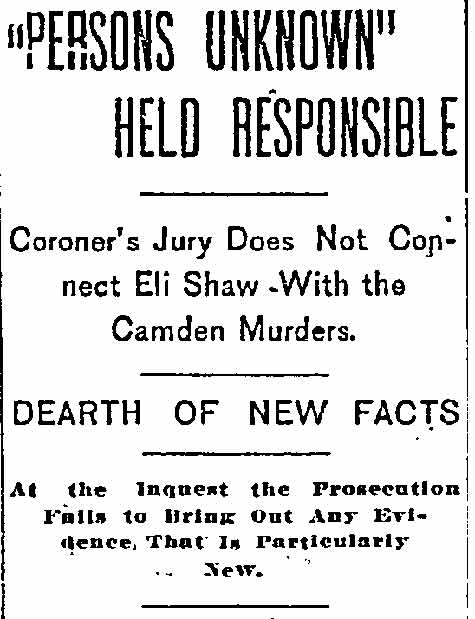
Coroner’s Jury Does Not Connect Eli Shaw With the Camden Murders.
DEARTH OF NEW FACTS
At the Inquest the Prosecution Fails to Bring Out Any Evidence, That Is Particularly New.
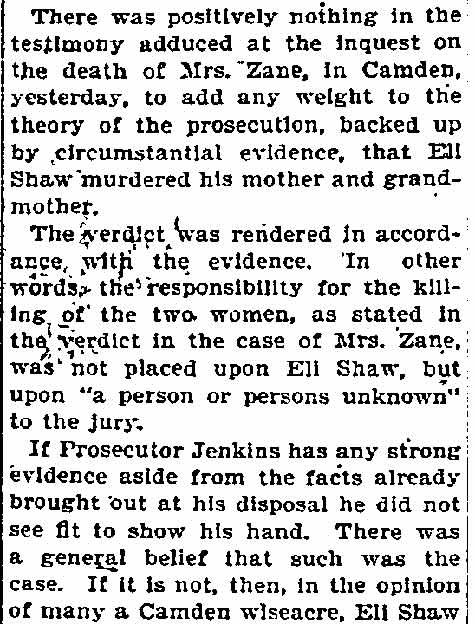
There was positively nothing in the testimony adduced at the inquest on the death of Mrs. Zane, in Camden, yesterday, to add any weight to the theory of the prosecution, backed up by circumstantial evidence, that Eli Shaw murdered his mother and grandmother.
The verdict was rendered in accordance with the evidence. In other words, the responsibility for the killing of the two women, as stated in the verdict in the case of Mrs. Zane, was not placed upon Eli Shaw, but upon “a person or persons unknown” to the jury.
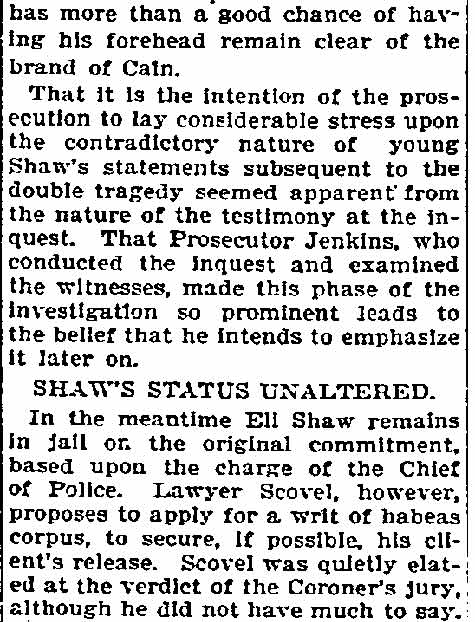
If Prosecutor Jenkins has any strong evidence aside from the facts already brought out at his disposal he did not see fit to show his hand. There was a general belief that such was the case. If it is not, then, in the opinion of many a Camden wiseacre, Eli Shaw has more than a good chance of having his forehead remain clear of the brand of Cain.
That it is the intention of the prosecution to lay considerable stress upon the contradictory nature of young Shaw’s statements subsequent to the double tragedy seemed apparent from the nature of the testimony at the inquest. That Prosecutor Jenkins, who conducted the inquest and examined the witnesses, made this phase of the investigation so prominent leads to the belief that he intends to emphasize it later on.
SHAW’S STATUS UNALTERED.
In the meantime Eli Shaw remains in jail on the original commitment, based upon the charge of the Chief of Police. Lawyer Scovel, however, proposes to apply for a writ of habeas corpus, to secure, if possible, his client’s release. Scovel was quietly elated at the verdict of the Coroner’s jury, although he did not have much to say.
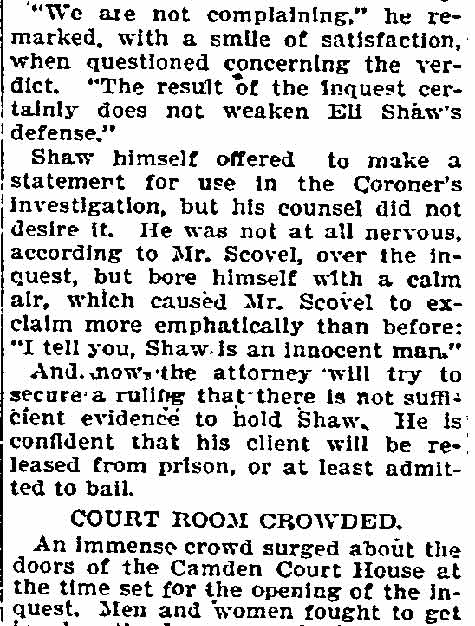
“We are not complaining,” he remarked, with a smile of satisfaction, when questioned concerning the verdict. “The result of the inquest certainly does not weaken Eli Shaw’s defense.”
Shaw himself offered to make a statement for use in the Coroner’s investigation, but his counsel did not desire it. He was not at all nervous, according to Mr. Scovel, over the inquest, but bore himself with a calm air, which caused Mr. Scovel to exclaim more emphatically than before: “I tell you, Shaw is an innocent man.”
And now the attorney will try to secure a ruling that there is not sufficient evidence to hold Shaw. He is confident that his client will be released from prison, or at least admitted to bail.
COURT ROOM CROWDED.
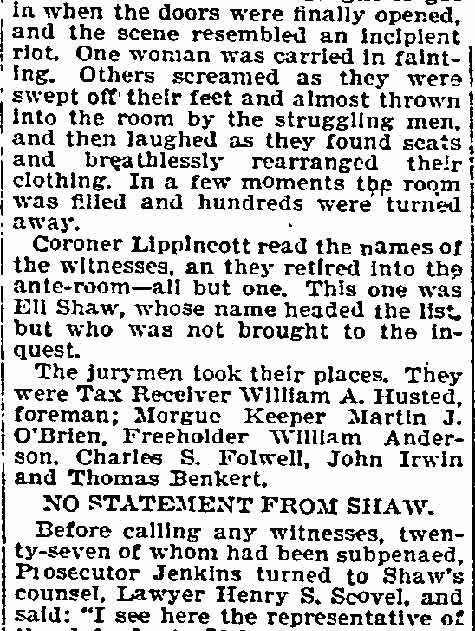
An immense crowd surged about the doors of the Camden Court House at the time set for the opening of the inquest. Men and women fought to get in when the doors were finally opened, and the scene resembled an incipient riot. One woman was carried in fainting. Others screamed as they were swept off their feet and almost thrown into the room by the struggling men, and then laughed as they found seats and breathlessly rearranged their clothing. In a few moments the room was filled and hundreds were turned away.
Coroner Lippincott read the names of the witnesses, an [sic] they retired into the ante-room—all but one. This one was Eli Shaw, whose name headed the list, but who was not brought to the inquest.
The jurymen took their places. They were Tax Receiver William A. Husted, foreman; Morgue Keeper Martin J. O’Brien, Freeholder William Anderson, Charles S. Folwell, John Irwin and Thomas Benkert.
NO STATEMENT FROM SHAW.
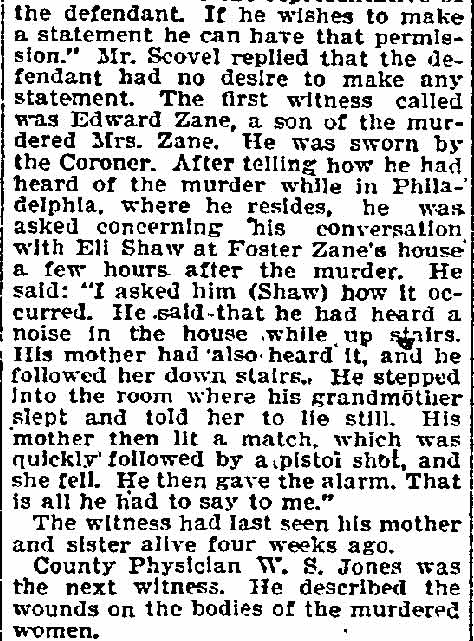
Before calling any witnesses, twenty-seven of whom had been subpenaed, Prosecutor Jenkins turned to Shaw’s counsel, Lawyer Henry S. Scovel, and said: “I see here the representative of the defendant. If he wishes to make a statement he can have that permission.” Mr. Scovel replied that the defendant had no desire to make any statement. The first witness called was Edward Zane, a son of the murdered Mrs. Zane. He was sworn by the Coroner. After telling how he had heard of the murder while in Philadelphia, where he resides, he was asked concerning his conversation with Eli Shaw at Foster Zane’s house a few hours after the murder. He said: “I asked him (Shaw) how it occurred. He said that he had heard a noise in the house while up stairs. His mother had also heard it, and he followed her down stairs. He stepped into the room where his grandmother slept and told her to lie still. His mother then lit a match, which was quickly followed by a pistol shot, and she fell. He then gave the alarm. That is all he had to say to me.”
The witness had last seen his mother and sister alive four weeks ago.
County Physician W. S. Jones was the next witness. He described the wounds on the bodies of the murdered women.
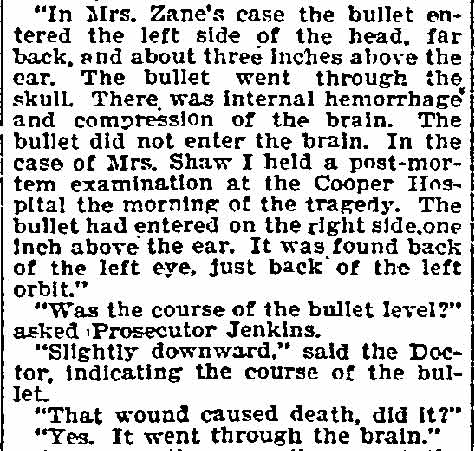
“In Mrs. Zane’s case the bullet entered the left side of the head, far back, and about three inches above the ear. The bullet went through the skull. There was internal hemorrhage and compression of the brain. The bullet did not enter the brain. In the case of Mrs. Shaw I held a post-mortem examination at the Cooper Hospital the morning of the tragedy. The bullet had entered on the right side, one inch above the ear. It was found back of the left eye, just back of the left orbit.”
“Was the course of the bullet level?” asked Prosecutor Jenkins.
“Slightly downward,” said the Doctor, indicating the course of the bullet.
“That wound caused death, did it?”
“Yes. It went through the brain.”
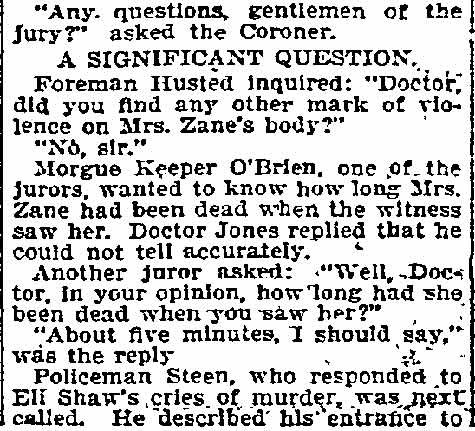
“Any questions, gentlemen of the jury?” asked the Coroner.
A SIGNIFICANT QUESTION.
Foreman Husted inquired: “Doctor, did you find any other mark of violence on Mrs. Zane’s body?”
“No, sir.”
Morgue Keeper O’Brien, one of the jurors, wanted to know how long Mrs. Zane had been dead when the witness saw her. Doctor Jones replied that he could not tell accurately.
Another juror asked: “Well, Doctor, in your opinion, how long had she been dead when you saw her?”
“About five minutes, I should say,” was the reply
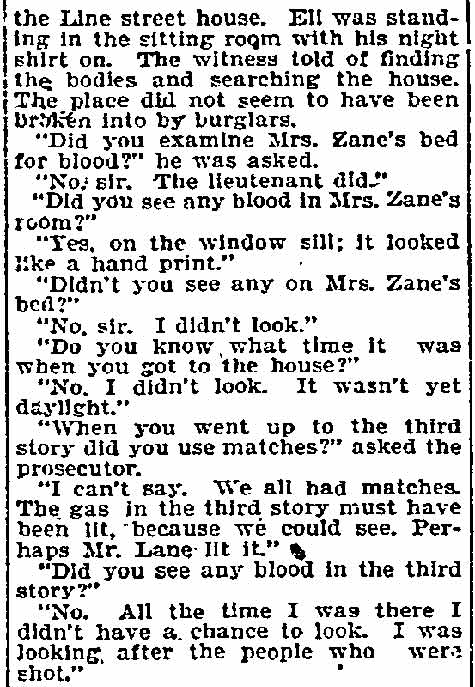
Policeman Steen, who responded to Eli Shaw’s cries of murder, was next called. He described his entrance to the Line street house. Eli was standing in the sitting room with his night shirt on. The witness told of finding the bodies and searching the house. The place did not seem to have been broken into by burglars.
“Did you examine Mrs. Zane’s bed for blood?” he was asked.
“No, sir. The lieutenant did.”
“Did you see any blood in Mrs. Zane’s room?”
“Yes, on the window sill; it looked like a hand print.”
“Didn’t you see any on Mrs. Zane’s bed?”
“No, sir. I didn’t look.”
“Do you know what time it was when you got to the house?”
“No. I didn’t look. It wasn’t yet daylight.”
“When you went up to the third story did you use matches?” asked the prosecutor.
“I can’t say. We all had matches. The gas in the third story must have been lit, because we could see. Perhaps Mr. Lane lit it.”
“Did you see any blood in the third story?”
“No. All the time I was there I didn’t have a chance to look. I was looking after the people who were shot.”
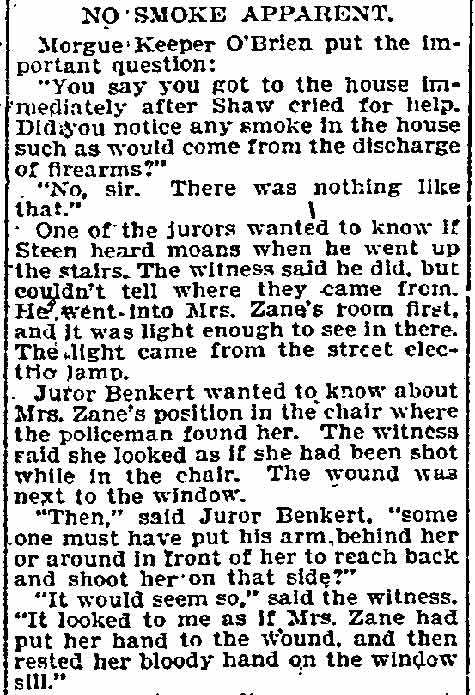
NO SMOKE APPARENT.
Morgue Keeper O’Brien put the important question:
“You say you got to the house immediately after Shaw cried for help. Did you notice any smoke in the house such as would come from the discharge of firearms?”
“No, sir. There was nothing like that.”
One of the jurors wanted to know if Steen heard moans when he went up the stairs. The witness said he did, but couldn’t tell where they came from. He went into Mrs. Zane’s room first, and it was light enough to see in there. The light came from the street electric lamp.
Juror Benkert wanted to know about Mrs. Zane’s position in the chair where the policeman found her. The witness said she looked as if she had been shot while in the chair. The wound was next to the window.
“Then,” said Juror Benkert, “some one must have put his arm behind her or around in front of her to reach back and shoot her on that side?”
“It would seem so,” said the witness. “It looked to me as if Mrs. Zane had put her hand to the wound, and then rested her bloody hand on the window sill.”
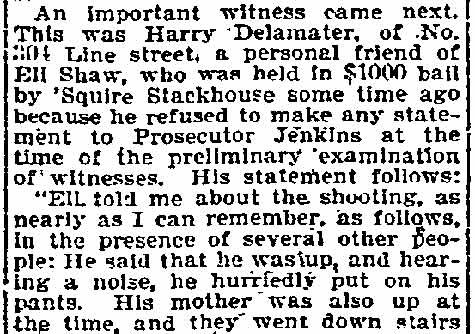
An important witness came next. This was Harry Delamater, of No. 30[?] Line street, a personal friend of Eli Shaw, who was held in $1000 bail by ‘Squire Stackhouse some time ago because he refused to make any statement to Prosecutor Jenkins at the time of the preliminary examination of witnesses. His statement follows:
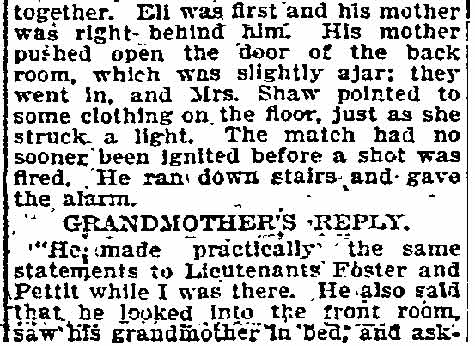
“Eli told me about the shooting, as nearly as I can remember, as follows, in the presence of several other people: He said that he was up, and hearing a noise, he hurriedly put on his pants. His mother was also up at the time, and they went down stairs together. Eli was first and his mother was right behind him. His mother pushed open the door of the back room, which was slightly ajar; they went in, and Mrs. Shaw pointed to some clothing on the floor, just as she struck a light. The match had no sooner been ignited before a shot was fired. He ran down stairs and gave the alarm.
GRANDMOTHER’S REPLY.
“He made practically the same statements to Lieutenants Foster and Pettit while I was there. He also said that he looked into the front room, saw his grandmother in bed, and asked his mother not to disturb her, as she was asleep. He ran up stairs, got a pistol, and rushed down and tried to fire it to attract attention, but it would not go off. He also said that when he heard the shot fired he ran into his grandmother’s room and said, ‘My God, some one is in the house and is shooting.’ He got a sort of sleepy groan, as some one awakening, for a reply.”
As Mrs. Zane was dead or dying by the time Eli said he called her and received a reply, this statement was received with particular interest.
James E. Tatem, of 619 South Fifth street; Frank B. Haines, of 561 Washington street, and Albert Fogg, of 615 South Fifth street, who were also in Foster Zane’s house on the evening after the tragedy when Eli Shaw told his story of the tragedy, were next called in rapid succession. Their testimony was for the most part a repetition of Delamater’s statement.
Albert Fogg testified that Shaw said he rushed into his grandmother’s room immediately after his mother was shot and cried:
“Get up, grandma; for God’s sake, get up; ther’s [sic] some one in the house.”
“Did he say his grandmother made any response?” asked the Prosecutor.
“No, sir.”
Albert Hollingshead was called, but had nothing to testify to.
Policeman John Painter, who found the revolver in the chimney, gave his testimony concerning his find. The revolver was brought in and, after wrestling with it for a few minutes, to the consternation of everyone else in the court room, Hall Officer Beard succeeded in unloading it. Painter identified the weapon. He also said:
“We made an examination of the chimneys. We found that there was a stove hole in Mrs. Zane’s room, but it was not opened. We found one in Eli’s room on the third floor, which was or had been recently opened. We also found a spot of blood on the door leading into Eli’s room, which looked as though it had been a large drop.”
Police Lieutenant Pettit was called to corroborate Painter’s story. He examined the pistol thoroughly when it was found. It looked as though it had been discharged recently. There was fresh oil about the hammer, some burnt powder could be seen at the muzzle, and it had an odor of burnt powder about it.
NO TRACE OF BURGLARS.
Lieutenant Pettit said he examined Mrs. Zane’s bed. There was no blood on the pillows or bolsters. The only blood he saw was one little spot on the under sheet, near the foot. In the third story he saw one spot of blood on the doorsill of Eli Shaw’s room. The Lieutenant said he found a hammer in Mrs. Shaw’s room in the third story. There were stains on it that might have been blood stains. An examination was made for traces of a burglar’s work. The witness described the position of the windows and said that in his opinion no burglar had ever gone through those windows.
Policeman Shaw identified the hammer, and Officer Beard told how he tried to get the weapon identified in Philadelphia pawnshops. It exploded while being examined in one of those establishments.
William Stein, a gunsmith, told that the bullets found in the bodies of the women were 32-calibre, the same as those used in the revolver found in the house. Guy Viskinski corroborated the story of the accidental discharge of the weapon in a pawnshop.
LANE TESTIFIES.
One of the most important witnesses was Charles Lane, who lives at 646 South Third street, and who was next called. He is the neighbor who first heard Eli Shaw’s cries for help and responded. He was in bed when he heard cries of “Help! Help! Murder!” The cries were repeated three or four times. He got up and dressed hurriedly. He ran around and found Eli Shaw in his night shirt on the front step. Shaw cried:
“Oh, Mr. Lane, mom and grandmom are shot!”
Just at this moment the witness’ son came running up, and they went in the hallway.
“My son asked for a light,” said the witness. “Shaw brought us two matches. He said: ‘Don’t go upstairs yet; they may be up there yet.’ Then Officer Stein came in. I said to Shaw: ‘Haven’t you got anything to defend yourself with?’ and Shaw handed me a revolver. I cocked it and he said: ‘There’s nothing in it.’ Then we struck some matches and went upstairs.”
“Was Eli Shaw’s night shirt outside his pantaloons when you first saw him on the steps?” asked the Prosecutor.
“Yes; it hung down almost to his feet.”
Continuing his story of the search, Mr. Lane said they went first to the second story front, and there found Mrs. Zane sitting in a chair near the window.
She was in her night clothes, her head was sunk on her chest, her eyes were closed, and blood trickled down her face. She was gasping for breath, “just like this,” said the witness, drawing in his cheeks like a person almost suffocated. He was describing Mrs. Zane’s dying agonies.
Mr. Lane said he called to Mrs. Zane. “Em! Em!” but she made no response. “I had known her for forty years,” said the witness to the jury in explanation of his familiar manner of addressing the woman. Then he said they went into the next room and found Mrs. Shaw on the floor moaning and weltering in her own gore. He spoke to her, but she could not answer. He described the position in which Mrs. Shaw lay. Then, he said, the searchers went up to the third floor. The Prosecutor asked if they found any lights. The witness said no; they had to light the gas in the third story front room. They found the gas lit in the dining room on the first floor when they first entered the house.
NIGHT SHIRT EXHIBITED.
Coroner Lippincott took the stand next and showed the jury Shaw’s night shirt, on which there were many spots of blood. Some were very small, others approached the size of a pea. When he had finished making this gruesome exhibit, he returned to the stand and detailed what he had heard of the conversation between Eli Shaw and Prosecutor Jenkins.
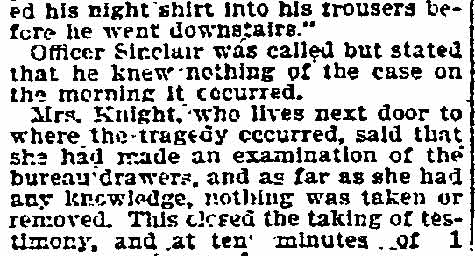
“He said that he did not see any one when his mother was shot, did not see her fall, and did not see the flash of the pistol. He also said that he had tucked his night shirt into his trousers before he went downstairs.”
Officer Sinclair was called but stated that he knew nothing of the case on the morning it occurred.
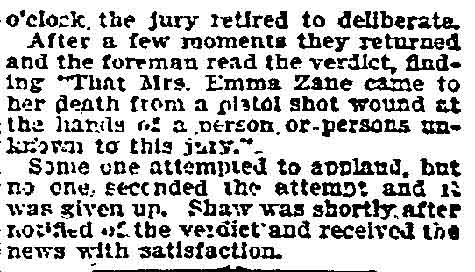
Mrs. Knight, who lives next door to where the tragedy occurred, said that she had made an examination of the bureau drawers, and as far as she had any knowledge, nothing was taken or removed. This closed the taking of testimony, and at ten minutes of 1 o’clock, the jury retired to deliberate.
After a few moments they returned and the foreman read the verdict, finding “That Mrs. Emma Zane came to her death from a pistol shot wound at the hands of a person or persons unknown to this jury.”
Some one attempted to applaud, but no one seconded the attempt and it was given up. Shaw was shortly after notified of the verdict and received the news with satisfaction.
Camden’s Tall Man Dies
Philadelphia Inquirer —
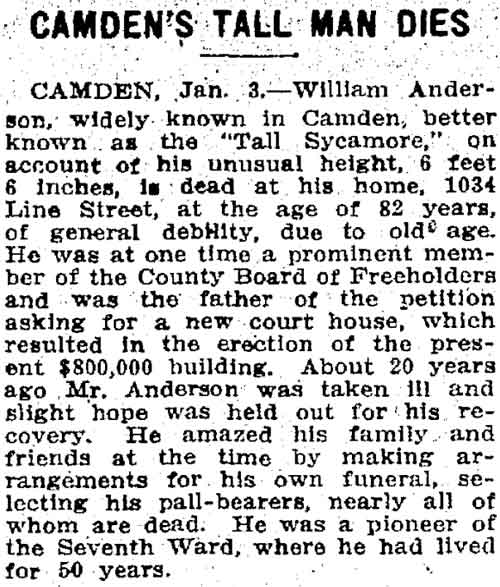
CAMDEN, Jan. 3.—William Anderson, widely known in Camden, better known as the "Tall Sycamore," on account of his unusual height, 6 feet 6 inches, is dead at his home, 1034 Line Street, at the age of 82 years, of general debility, due to old age. He was at one time a prominent member of the County Board of Freeholders and was the father of the petition asking for a new court house, which resulted in the erection of the present $800,000 building. About 20 years ago Mr. Anderson was taken ill and slight hope was held out for his recovery. He amazed his family and friends at the time by making arrangements for his own funeral, selecting his pall-bearers, nearly all of whom are dead. He was a pioneer of the Seventh Ward, where he had lived for 50 years.
William Anderson Obituary Notice
Philadelphia Inquirer —
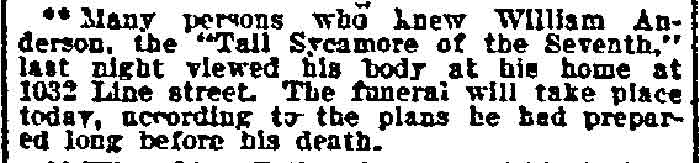
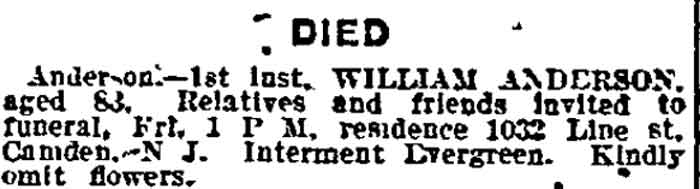
Many persons who knew William Anderson, the “Tall Sycamore of the Seventh,” last night viewed his body at his home at 1032 Line street. The funeral will take place today, according to the plans he had prepared long before his death.