Introduction
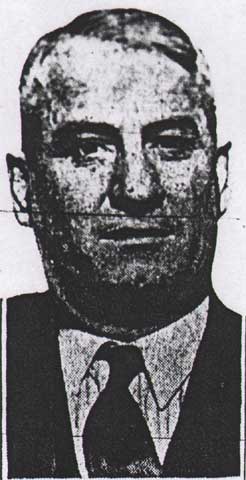
Lawrence T. “Larry” Doran
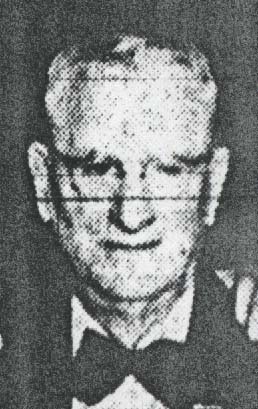
Camden County detective bureau
LAWRENCE T. “LARRY” DORAN was born in 1879 in New Jersey. He married his wife Catherine shortly after the turn of the century. After working as a Camden police officer and as a game warden, in August of 1910 he was hired as a detective by then Camden county prosecutor Henry S. Scovel. He then served under Charles A. Wolverton, who went on to become a 16 term Congressman from Camden. At the time of the 1920 census he lived at 1115 Mechanic Street in Camden NJ. In 1925 he was named chief of detectives in the Camden county prosecutor’s office by prosecutor Ethan Wescott. He also served alongside noted prosecutors as Samuel P. Orlando, Gene R. Mariano, and Mitchell Cohen, later a federal judge.
During his years with the prosecutor’s office, Larry Doran helped crack several famous cases, helping send killers Walter Dworecki and William John Stephan to New Jersey’s electric chair. He was involved with most every major investigation in Camden County for a quarter of a century.
Larry Doran retired in April of 1950 after serving four decades as a county detective, 25 of which as the chief of detectives. He was succeeded by Wilfred L. Dube.
Philadelphia Inquirer — August 23, 1910
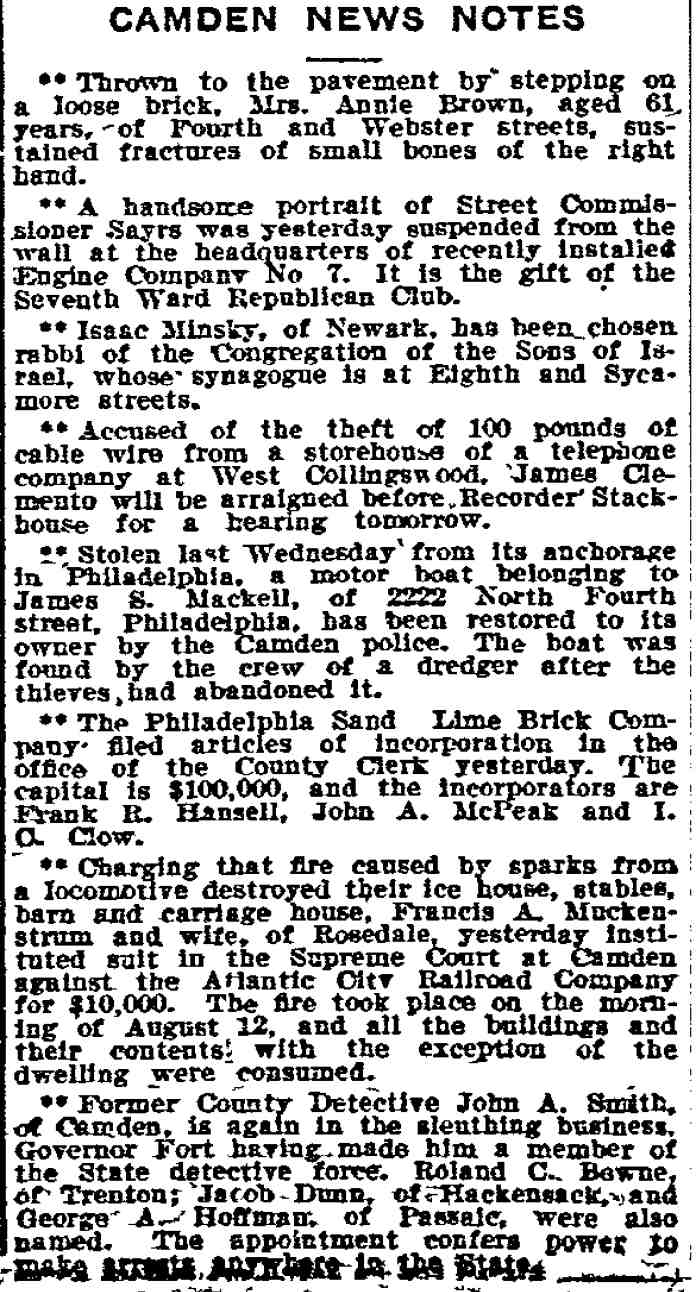
CAMDEN NEWS NOTES
** Thrown to the pavement by stepping on a loose brick, Mrs. Annie Brown, aged 61 years, of Fourth and Webster streets, sustained fractures of small bones of the right hand.
** A handsome portrait of Street Commissioner Sayrs was yesterday suspended from the wall at the headquarters of recently Engine Company No. 7. It is the gift of the Seventh Ward Republican Club.
** Isaac Minsky, of Newark, has been chosen rabbi of the Congregation of the Sons of Israel, whose synagogue is at Eighth and Sycamore streets.
** Accused of the theft of 100 pounds of cable wire from a storehouse of a telephone company at West Collingswood, the case will be arranged before Recorder Stackhouse for a hearing tomorrow.
** Stolen last Wednesday from its anchorage in Philadelphia, a motor boat belonging to James S. Mackell, of 2222 North Fourth street, Philadelphia, has been restored to its owner by the Camden police. The boat was found by the police near a dredger after the thieves had abandoned it.
** The Philadelphia Sand Lime Brick Company filed articles of incorporation in the office of the County Clerk yesterday. The capital is $100,000, and the incorporators are Frank R. Hansell, John A. McPeak and I. G. Clow.
** Charging that fire caused by sparks from a locomotive destroyed their ice house, stables, barn and carriage house, Francis A. Muckenstrum and wife, of Rosedale, yesterday instituted suit in the Supreme Court at Camden against the Atlantic City Railroad Company for $10,000. The fire took place on the morning of August 12, and all the buildings and their contents, with the exception of the dwelling were consumed.
** Former County Detective John A. Smith, of Camden, is again in the sleuthing business. Governor Fort having made him a member of the State Detective Board. Roland C. Bayne, of Trenton; Jacob Dunn, of Hackensack, and George A. Hoffman, of Passaic, were also named. The appointment confers power to make arrests anywhere in the State.
Philadelphia Inquirer — January 24, 1911
MANY ACCUSED OF ELECTION FRAUDS
Camden County Grand Jury Returns Fifty-five True Bills of Indictment
Most of Them Are Impounded by Order of Court, While Constables Get Busy
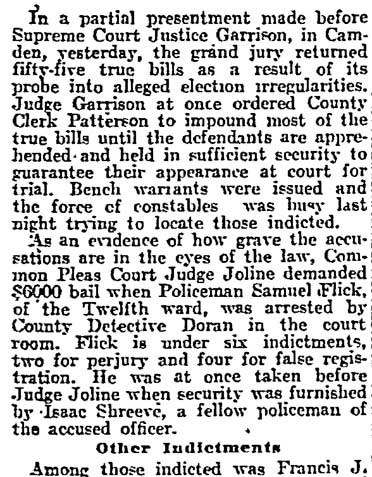
In a partial presentment made before Supreme Court Justice Garrison, in Camden, yesterday, the grand jury returned fifty-five true bills as a result of its probe into alleged election irregularities. Judge Garrison at once ordered County Clerk Patterson to impound most of the true bills until the defendants are apprehended and held in sufficient security to guarantee their appearance at court for trial. Bench warrants were issued and the force of constables was busy last night trying to locate those indicted.
As an evidence of how grave the accusations are in the eyes of the law, Common Pleas Court Judge Joline demanded $6000 bail when Policeman Samuel Flick, of the Twelfth ward, was arrested by County Detective Doran in the court room. Flick is under six indictments, two for perjury and four for false registration. He was at once taken before Judge Joline when security was furnished by Isaac Shreeve, a fellow policeman of the accused officer.
Other Indictments
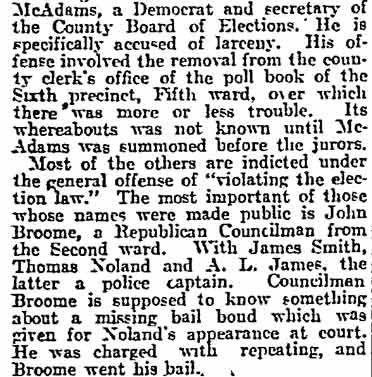
Among those indicted was Francis J. McAdams, a Democrat and secretary of the County Board of Elections. He is specifically accused of larceny. His offense involved the removal from the county clerk’s office of the poll book of the Sixth precinct, Fifth ward, over which there was more or less trouble. Its whereabouts was not known until McAdams was summoned before the jurors.
Most of the others are indicted under the general offense of “violating the election law.” The most important of those whose names were made public is John Broome, a Republican Councilman from the Second ward. With James Smith, Thomas Noland and A. L. James, the latter a police captain. Councilman Broome is supposed to know something about a missing bail bond which was given for Noland’s appearance at court. He was charged with repeating, and Broome went his bail.
Indicted on Five Counts
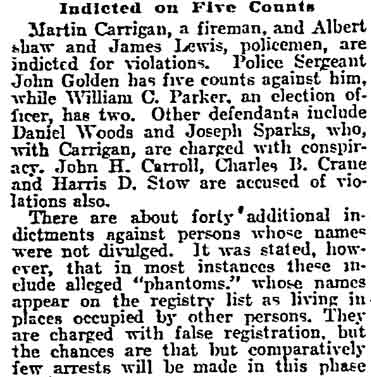
Martin Carrigan, a fireman, and Albert Shaw and James Lewis, policemen, are indicted for violations. Police Sergeant John Golden has five counts against him, while William C. Parker, an election officer, has two. Other defendants include Daniel Woods and Joseph Sparks, who, with Carrigan, are charged with conspiracy. John H. Carroll, Charles B. Crane and Harris D. Stow are accused of violations also.
There are about forty additional indictments against persons whose names were not divulged. It was stated, however, that in most instances these include alleged “phantoms,” whose names appear on the registry list as living in places occupied by other persons. They are charged with false registration, but the chances are that but comparatively few arrests will be made in this phase of the matter.
Probe Still Deeper
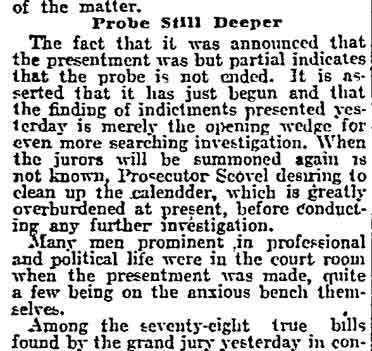
The fact that it was announced that the presentment was but partial indicates that the probe is not ended. It is asserted that it has just begun and that the finding of indictments presented yesterday is merely the opening wedge for even more searching investigation. When the jurors will be summoned again is not known, Prosecutor Scovel desiring to clean up the calendar, which is greatly overburdened at present, before conducting any further investigation.
Many men prominent in professional and political life were in the court room when the presentment was made, quite a few being on the anxious bench themselves.
Among the seventy-eight true bills found by the grand jury yesterday in connection with the ordinary Criminal Court business and aside from the election cases were indictments against the officers of the Young Republican Club of the Second ward and the Camden Aerie, No. 65, Fraternal Order of Eagles. They are specifically charged with giving indecent exhibitions, and in addition the organizations are accused of keeping disorderly houses.
These cases resulted from reports made by the Law and Order League, whose agents attended “innocent amusements” given by the organizations. The class of entertainment is declared to have had the Seeley dinner and other such events beaten a mile. Not only the officers are indicated, but also Lottie Fayette, of Philadelphia, and a male companion, who assisted materially in the festivities.
[Continuation — see martincarrigan-012411-inq-1.md]
In a partial presentment made before Supreme Court Justice Garrison, in Camden, yesterday, the grand jury returned fifty-five true bills as a result of its probe into alleged election irregularities. Judge Garrison at once ordered County Clerk Patterson to impound most of the true bills until the defendants are apprehended and held in sufficient security to guarantee their appearance at court for trial. Bench warrants were issued and the force of constables was busy last night trying to locate those indicted.
As an evidence of how grave the accusations are in the eyes of the law, Common Pleas Court Judge Joline demanded $6000 bail when Policeman Samuel Flick, of the Twelfth ward, was arrested by County Detective Doran in the court room. Flick is under six indictments, two for perjury and four for false registration. He was at once taken before Judge Joline when security was furnished by Isaac Shreeve, a fellow policeman of the accused officer.
Other Indictments
Among those indicted was Francis J. McAdams, a Democrat and secretary of the County Board of Elections. He is specifically accused of larceny. His offense involved the removal from the county clerk’s office of the poll book of the Sixth precinct, Fifth ward, over which there was more or less trouble. Its whereabouts was not known until McAdams was summoned before the jurors.
Most of the others are indicted under the general offense of “violating the election law.” The most important of those whose names were made public is John Broome, a Republican Councilman from the Second ward. With James Smith, Thomas Noland and A. L. James, the latter a police captain. Councilman Broome is supposed to know something about a missing bail bond which was given for Noland’s appearance at court. He was charged with repeating, and Broome went his bail.
Indicted on Five Counts
Martin Carrigan, a fireman, and Albert Shaw and James Lewis, policemen, are indicted for violations. Police Sergeant John Golden has five counts against him, while William C. Parker, an election officer, has two. Other defendants include Daniel Woods and Joseph Sparks, who, with Carrigan, are charged with conspiracy. John H. Carroll, Charles B. Crane and Harris D. Stow are accused of violations also.
There are about forty additional indictments against persons whose names were not divulged. It was stated, however, that in most instances these include alleged “phantoms,” whose names appear on the registry list as living in places occupied by other persons. They are charged with false registration, but the chances are that but comparatively few arrests will be made in this phase of the matter.
Probe Still Deeper
The fact that it was announced that the presentment was but partial indicates that the probe is not ended. It is asserted that it has just begun and that the finding of indictments presented yesterday is merely the opening wedge for even more searching investigation. When the jurors will be summoned again is not known, Prosecutor Scovel desiring to clean up the calendar, which is greatly overburdened at present, before conducting any further investigation.
Many men prominent in professional and political life were in the court room when the presentment was made, quite a few being on the anxious bench themselves.
Among the seventy-eight true bills found by the grand jury yesterday in connection with the ordinary Criminal Court business and aside from the election cases were indictments against the officers of the Young Republican Club of the Second ward and the Camden Aerie, No. 65, Fraternal Order of Eagles. They are specifically charged with giving indecent exhibitions, and in addition the organizations are accused of keeping disorderly houses.
These cases resulted from reports made by the Law and Order League, whose agents attended “innocent amusements” given by the organizations. The class of entertainment is declared to have had the Seeley dinner and other such events beaten a mile. Not only the officers are indicated, but also Lottie Fayette, of Philadelphia, and a male companion, who assisted materially in the festivities.
McAdams, a Democrat and secretary of the County Board of Elections. He is specifically accused of larceny. His offense involved the removal from the county clerk’s office of the poll book of the Sixth precinct, Fifth ward, over which there was more or less trouble. Its whereabouts was not known until McAdams was summoned before the jurors.
Most of the others are indicted under the general offense of “violating the election law.” The most important of those whose names were made public is John Broome, a Republican Councilman from the Second ward. With James Smith, Thomas Noland and A. L. James, the latter a police captain. Councilman Broome is supposed to know something about a missing bail bond which was given for Noland’s appearance at court. He was charged with repeating, and Broome went his bail.
Indicted on Five Counts
Martin Carrigan, a fireman, and Albert Shaw and James Lewis, policemen, are indicted for violations. Police Sergeant John Golden has five counts against him, while William C. Parker, an election officer, has two. Other defendants include Daniel Woods and Joseph Sparks, who, with Carrigan, are charged with conspiracy. John H. Carroll, Charles B. Crane and Harris D. Stow are accused of violations also.
There are about forty additional indictments against persons whose names were not divulged. It was stated, however, that in most instances these include alleged “phantoms,” whose names appear on the registry list as living in places occupied by other persons. They are charged with false registration, but the chances are that but comparatively few arrests will be made in this phase
of the matter.
Probe Still Deeper
The fact that it was announced that the presentment was but partial indicates that the probe is not ended. It is asserted that it has just begun and that the finding of indictments presented yesterday is merely the opening wedge for even more searching investigation. When the jurors will be summoned again is not known, Prosecutor Scovel desiring to clean up the calender, which is greatly overburdened at present, before conducting any further investigation.
Many men prominent in professional and political life were in the court room when the presentment was made, quite a few being on the anxious bench themselves.
Among the seventy-eight true bills found by the grand jury yesterday in con-
nection with the ordinary Criminal Court business and aside from the election cases were indictments against the officers of the Young Republican Club of the Second ward and the Camden Aerie, No. 65, Fraternal Order of Eagles. They are specifically charged with giving indecent exhibitions, and in addition the organizations are accused of keeping disorderly houses.
These cases resulted from reports made by the Law and Order League, whose agents attended “innocent amusements” given by the organizations. The class of entertainment is declared to have had the Seeley dinner and other such events beaten a mile. Not only the officers are indicated, but also Lottie Fayette, of Philadelphia, and a male companion, who assisted materially in the festivities.
Philadelphia Inquirer — November 22, 1911
Named: Lawrence T. Doran, Charles G. Garrison, John Cherry, and William C. Drew.
Philadelphia Inquirer — April 28, 1912
Prosecutor and His Assistant Will Be Kept Busy at This Term of Court
Beginning with tomorrow, Prosecutor Boyle and his assistant, Charles A. Wolverton, will be kept busy in the Camden Criminal Court disposing of many cases, including four defendants charged with murder. This is the first term of court in which there have been so many such cases for many years.
Yesterday Supreme Court Justice Garrison fixed Monday, April 22, as the date when he will preside at the trial of Roland Evans, who shot to death David Green in a house on Sycamore street on December 26 last. The State will press for a first degree. Lawyers Herbert Drake and William Harris have been assigned to defend Evans.
The next case to be tried will be that of William Graedwell, who brained his boarding mistress, Mrs. Georgeanna Gilliand, with an ax in her home in East Camden. After that will come to trial Stefano Torcesso, who stabbed to death Nunzioto Imperato in a duel over a girl. The last of the quartet of murder cases will be that of Charles Ford, who shot to death Mrs. May Effie Wagner, his erstwhile housekeeper.
About two hundred persons against whom indictments have been returned by the grand jury will be called upon to enter pleas tomorrow. Prosecutor Boyle will then begin to dispose of the cases on Tuesday before Judge Carrow, it being his intention to so systematize matters that everything will be cleaned up by the beginning of summer.
Philadelphia Inquirer — December 2, 1913
Accused of abusing twelve-year-old Mary Fitzpatrick, of Tenth Street and Federal Street, S. Cleveland Davis was committed to jail by Justice Huyett yesterday. Detective Doran made the complaint on information received.
Philadelphia Inquirer — March 23, 1914
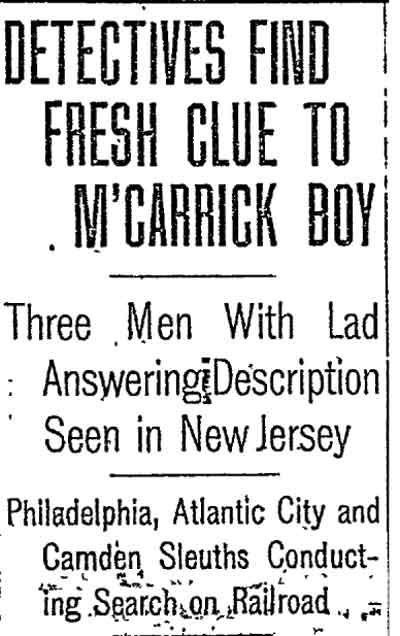
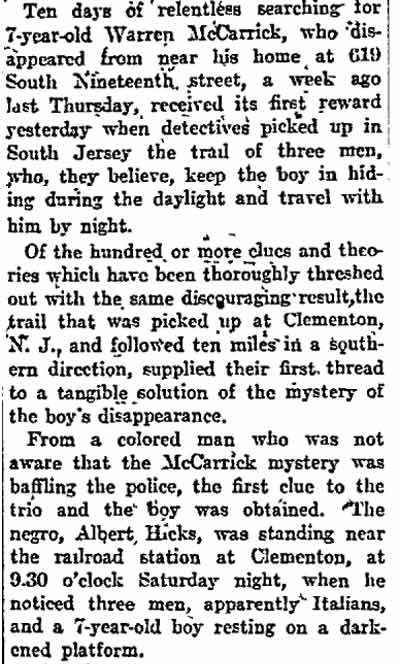
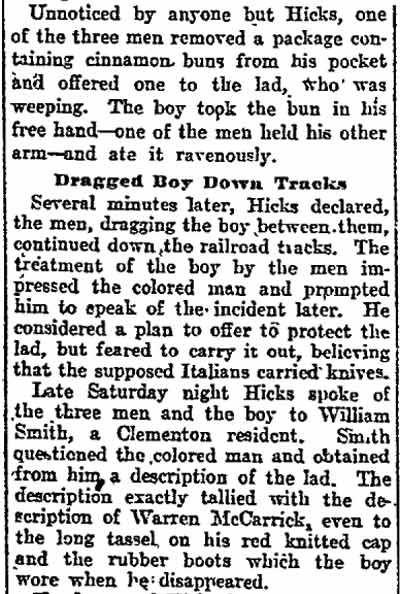
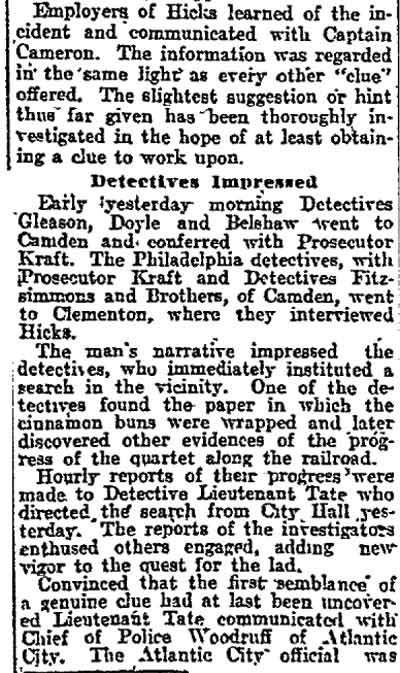
Named: Lawrence Doran, William J. Kraft, Charles H. Fitzsimmons, and John Brothers.
Philadelphia Inquirer — April 1, 1914

MURDERER AND FORGER ESCAPE JAIL AFTER SHOOTING KEEPERS, KILLING ONE
Camden Post-Telegram —
Wilson Ashbridge, Who Shot and Killed Mrs. Elizabeth Dunbar and George E. Thompson, Check Swindler, Trap Jailor Hibbs by a Ruse and After Slaying Him Shoot Joe Ellis Who Intercepted Them in Flight.
Used Revolver Smuggled Into Prison by Confederates and Leave Jail Wide Open in Their Flight, a General Delivery Being Averted by Police Who Were Summoned by the Wounded Men.
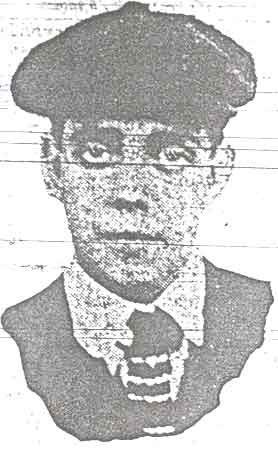
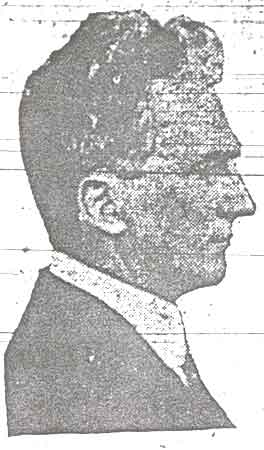
Murdering one jailor and wounding another with a revolver that had been smuggled into them by outside confederates, Wilson T. Ashbridge, slayer of Mrs. Elizabeth Dunbar, and Francis Murphy, alias George E. Thompson, a check forger, made their escape from the county jail a few minutes before seven o’clock last night.
Ashbridge with his wife was caught at noon in the Keystone Hotel in Chester PA where they registered at one o’clock this morning.
Thompson is still at liberty but from the confident manner of Prosecutor Kraft his early arrest seems assured.
The murdered jailor was Isaac Hibbs, aged 65 years of 913 South 8th Street. The wounded keeper is Joseph Ellis, aged 45 years, of 416 Carteret Street. Shot twice, he is in Cooper Hospital. His condition today is very satisfactory.
Thompson, who is 41 years old, forged a check for $650 which he gave to V.M. Fulton as part of the purchase price of an automobile. The forgery was discovered before the deal was completed and his arrest followed on June 8. He also passed a forged check for $15 on State Motor Vehicle Agent Kraft. He, too, was awaiting trial. In spite of the positive evidence against him Thompson had spurned all efforts to have him plead guilty and it is now believed that he was sparring for time while hatching a plan to escape. He is no doubt the master mind.
R.L. Hunter, a farmer of Bensalem Township, Bucks County PA, about four miles above Torres dale, reported to the Philadelphia police the morning that he had seen a man answering Ashbridge’s description on the Bucks Road at daylight. The man asked the way to Riegelsville.
According to Hunter, the man was dressed in a dark suit, and had no hat. His clothing was wet. Hunter did not see anything suspicious in his actions, and after giving him directions, they parted.
Upon seeing the paper with a picture of Ashbridge, the farmer was struck by its resemblance to the man with whom he had talked. He hurried to Tacony and notified the police.
The State police, who patrol that section of the county, and who have an office at Langhorne, were immediately notified as were the surrounding towns.
The shootings took place in different parts of the jail. Hibbs was murdered in the exercise room just outside the cell room on the Sixth and Arch corner of the building. Ellis was shot down in the corridor just outside the Market Street end of the building when he heroically grappled with Ashbridge after the latter had pointed a gun at his head. In spite of his wounds Ellis dragged himself to a telephone and after notifying Police Headquarters of what had happened he collapsed.
Only one of the two bullets is still in Ellis. It entered the groin on the right side and is buried in the muscles of the leg, having taken a downward course for seven or eight inches. The other bullet struck Ellis in the right breast and came out in the left breast, traversing the upper fleshy parts of the body.
Hibbs was almost instantaneously killed by a bullet that went within an inch of his heart, producing a hemorrhage. The bullet was extracted this morning from the body early this morning in an autopsy performed at the morgue by County Physician Stem. In spite of the fact that it is pretty well established that three shots were fired in the attack on Hibbs, only one of the bullets took effect.
“But it makes little difference which of the two men handled the gun” said Prosecutor Kraft this morning. “Both are equally guilty of this murder and what we are concerned about now is the recapture of the gunmen.” Mr. Kraft added that it his purpose to examine all of the prisoners in that part of the jail where Hibbs was murdered to determine fully who fired the fatal shot.
The escape had been carefully planned and timed to the minute. Of course the desperate prisoners were aided by confederates on the outside and it is the general belief that a high powered motor car was in waiting for them not far from the jail. They are known to have been in possession of money and openly boasted yesterday that it was their intention to leave the prison last night. These boasts were made to two young ladies connected with a religious organization who called on the two men yesterday to offer spiritual reconciliation. The girls are frequent visitors to the jail and naturally their efforts at evangelization were directed in the main toward Ashbridge, because of the fact that he was accused of murder. These girls, whose identity officials will not disclose, were closeted with Prosecutor Kraft until one o’clock this morning. Both declared that on their visit yesterday they were told by Ashbridge and Thompson that it was the last day they expected to spend in jail.
“We are going to get away from here tonight and we’ve got money to help us after we are out” said Ashbridge, who further told the girls he had considerable cash sewed up in the waistband of his trousers. The girls begged the prisoners not to do anything that would cause them more trouble and they told the Prosecutor that Ashbridge and Thompson promised them that they would not make any effort to escape. In their talks with the girls neither of the prisoners said a word that would indicate that they would kill if necessary to escape. The full force of their boast did not dawn on the religious workers and for this reason it never occurred to them to inform the Sheriff of what the prisoners had said.
A general jail delivery of at least all the men confined in what is known as the untried department, where the two were held, was only averted by the prompt arrival of the police on their beat, which was made easy by means of the keys taken from the prostrate body of Hibbs. Ashbridge and Thompson left all of the doors open and the vanguard of the inrushing police found the prisoners swarming all over the corridors on the east side of the prison. In the wild excitement following the double shooting and escape none else thought of freedom and a checking up of the inmates after they had been herded in the exercise room of the untried department accounted for all but the fugitive slayers.
The department, in which the two men were confined is the same one which William Brown and Charles Berger made their sensational escape several years ago by sawing away the bars on the Federal Street front of the jail. Thrilling as it was, the former escape was insignificant in comparison with last night’s tragic event.
With the full force of the keepers out of the way — one dead and the other suffering from gunshot wounds at first supposed to have been fatal — Ashbridge and Thompson had nothing between them and freedom but the door entering from the spiral stairway leading to the narrow entrance of the Sixth and Market Streets end of the Court House. With the keys taken from Hibbs they opened the door and in a few seconds were breathing the free air. It was still daylight when the daring murderers walked from the building and although they were no doubt seen by some of the scores of persons passing it is certain that they managed to control themselves to such an extent as not to arouse any undue suspicion. The exit they used to escape is that used by the general public and therefore persons passing calmly in and out of the door would not in any manner be thought to have been connected with a jail delivery. However the shots which had laid low the keepers had been plainly heard on all four sides of the building and it is strange that no one has yet been found who can give positive information as to what course the fleeing men took and whether they were aided in their flight by an automobile.
While the police and detectives of Camden and all other cities in the East are watching railroad terminals, steamship lines, and all other avenues of travel in response to the general alarm sent out last night, Prosecutor Kraft is bending all his energies to learn who smuggled in the revolver which the fugitives used. Thus far this feature of the case is as complete a mystery as it was last night. Mr. Kraft and Sheriff Haines are satisfied, however, that only one gun was used for both shootings. It was at first thought that each man had a pistol when they left the jail; that one of them armed himself with the gun that Hibbs was supposed to have carried, but it was determined that Hibbs was not armed when he went into the jail last night. There was no occasion for him to come in contact with any of the prisoners and for that reason he left his revolver in his desk in the office. Even had he carried it he would have little chance to use it, so cold-bloodedly was he slain as he unsuspectingly fell into the trap laid for him by the desperate gunmen. There is also some conflict as to how at least one of the fugitives was dressed. Alfred Williams, who witnessed the murder of Hibbs, said that Ashbridge was without coat or hat when he dashed out of the cell-room, and that Thompson carried his coat and hat under his arm. However in a description of the two men given at the Prosecutor’s office it was set forth that Ashbridge wore a blue serge suit and a checkered cap. The coat that he is supposed to have taken bore the mark of “Tull — the Tailor,” of Jacksonville, Florida, and had been borrowed by him from another prisoner. He wore tan shoes. Ashbridge is 27 years old, 5 feet 7-1/2 inches in height and weighs 137 pounds. He has brown hair, smooth face and is of light complexion.
Thompson wore a brown suit and a Panama hat. He is 41 years old, 5 feet seven inches in height, and weighs 175 pounds. He has brown bushy hair, is minus one of the fingers on his left hand, and is light complexioned.
The tan shoes worn by Ashbridge were also borrowed from one of the prisoners. He got them on Saturday and remarked that he wanted to look neat.
Keepers Ellis and Hibbs were reading in the prison office last evening when Hibbs glanced up at the clock and noticed that it was a few minutes of seven. “Joe, I’m going back and put the boys in their cells,” he said to Ellis and with his keys in his hand he started for the cell room in the untried department. A thirty foot long corridor runs from the office to the barred and grated door opening into the department in which the cells are situated. This department is about the size of three ordinary school rooms and in the southeastern corner of the jail are the cells, in two tiers.
Around the cells is a three foot corridor into which all the cells doors open and in which all the prisoners are permitted to walk when they are not allowed out in the main room. When the inmates are ordered into their cells and their doors closed the doors are locked from the outside of the steel cage by means of a lever worked by the jailor. Thus every cell door can be made secure without the keepers coming into actual contact with the prisoners. In addition to the bars around the corridor fronting on the double tier of cells there is a fine mesh heavy wire screening.
As Hibbs approached the lever which is operated to shut the cell doors after the prisoners have retired from the corridors, Ashbridge was leaning against the grating of his cell, Number 18. Thompson was lounging a few feet away.
“Daddy, open the door, I want you to see this note,” said Ashbridge to the keeper, at the same time displaying a piece of paper which he had in his hand. Never giving a thought that he was about to perform an act that was absolutely necessary for the carrying-out of the well laid plot, or that he was going to his doom, or was even in danger, “Daddy,” as the aged keeper was known to all the prisoners, opened the door without hesitation.
As he swung wide the big steel frame, Ashbridge quickly stepped out and the next instant was pressing a gun against the abdomen of the jailor.
“Throw up your hands, you ___ ___ ___” he commanded.
“What are you up to, what’s this mean?” asked the keeper, apparently not realizing he had been trapped.
For reply Thompson jumped out the door, wrenched the gun from Ashbridge’s grasp and with an oath began firing at Hibbs, who sank to the floor at the first shot. Only a few feet away and the only other person in the exercise room, although the shooting could have been seen by any other prisoners who had not retired to their cells, Alfred Williams, trusty, is emphatic in his assertion that Thompson fired the shot that killed Hibbs and that he fired three times.
“It’s a wonder they did not get me,” said Williams. “Ashbridge and I could not hit it and in his desperate mood I am surprised he didn’t kill me, too.” Williams, who has just completed a six months’ sentence for obtaining money from Italian grocers by falsely representing himself as an agent for a wholesale house in Chicago and who is wanted in the Windy City for the same offense, says the whole transaction took less than a minute and that the moves came so fast he and the other prisoners were powerless to aid.
“It was like a flash of lightning,” said Williams, “and before I could fully understand what had happened Ashbridge had grabbed Daddy’s keys, which had fallen to the floor, and was off like a deer for the barred door. Ashbridge had taken the smoking gun from Thompson, who had his hat and coat under his arm and who was right behind the other one.
“As they hurried through the door after Ashbridge had opened it with Daddy’s keys Daddy called to me to raise him. I put my arm under his head and lifted him slightly from the floor. ‘Hold my hands’ he said to me. I took hold of his hands and the next minute he died in my arms. Then I heard two more shots and I knew they got Joe Ellis.”
Startled by the shots, and he is emphatic there were three in rapid succession, Ellis leaped to his feet and without taking the time to arm himself ran from the office and turned into the corridor just as Ashbridge, wild-eyed and gun in his hand, came running toward him. Halting three yards away Ashbridge pointed the revolver at Ellis’ head and ordered him to throw up his hands.
For reply and without fear of himself the keeper dashed at the murderer and the next instant they were locked in each other’s embrace. Working loose the hand which held the gun, Ashbridge pulled the trigger. The bullet struck Ellis in the breast, but the wound was not sufficient to render him helpless. However, before he could grip the pistol arm, Ashbridge fired again and the keeper fell back with a bullet in his groin.
“The second shot got me,” said Ellis to Prosecutor Kraft and Assistant Prosecutor Butler at the hospital. “The first one wasn’t bad but my strength left me when the second bullet struck. Ashbridge was the only one I saw. I did not see Thompson.”
Dragging himself to the office Ellis managed to reach a telephone and called up the police.
“This is Ellis at the county jail; come quick. Ashbridge has shot me,” he weakly said over the phone to Captain Hyde. Then the receiver fell from his hand and he dropped to the floor, but after a minute or two managed to climb into a chair.
While patrol loads of policemen were being hurried to the Court House from the First and Second District station houses, Reserve Officer Charles Hose, on duty at Broadway and Federal Street, who had heard the shots, ran to the Court House and from the office of Assistant Custodian John Lack phoned up to the jail. Ellis managed to answer and in a few words told what had happened. They ran up to the jail and were admitted by Ellis, who was rapidly growing weaker from loss of blood, the trail of which plainly showed just where the injured keeper had moved.
“I guess Ashbridge got away and the jail is all open, you had better take care of the rest of the prisoners,” said Ellis to Hose and Lack. The fugitive-murderers had left all doors open and the other occupants of the untried department were swarming through the corridors. Their curses and yells and the shrieks and cries of the female prisoners had turned the place into a perfect bedlam. With the aid of other policemen who swarmed into the Court House like bees, the prisoners were soon herded into the exercise room, where Trusty Williams checked them up and accounted for all but Ashbridge and Thompson.
With the faint hope that the missing pair had not risked leaving the building but had secreted themselves in the structure, the courthouse was searched from pit to dome, but no trace of the men were found.
Detective Doran was the first of the Prosecutor’s staff to reach the scene. Mr. Kraft and the balance of the staff soon followed. In the lower end of the county, on official business, Sheriff Haines was reached by phone and Under Sheriff Hewitt was summoned from Pitman and until an early hour this morning the officials were in conference and examining numerous prisoners.
State Detective Walter Le Torneau furnished Prosecutor Kraft with a promising “tip” this morning when he learned that Thompson gave a letter to Freeholder Howard Marshall, of the Eighth Ward, to mail on Sunday. Mr. Marshall states that the letter was addressed to a woman by the name of Mrs. Shelton, in Baltimore MD.
Marshall was attending religious service in the jail when Thompson approached him.
“Put this in your pocket and mail it for me when you go out,” said Thompson to Mr. Marshall, who agreed to carry out the request. Dropping the letter in the mail box Marshall allowed the incident to pass without further notice.
Detective Le Torneau learned this morning that Marshall had spoken to the incident to a friend and the sleuth notified the Prosecutor. The tip will be run down the Prosecutor stated.
Funeral services for Hibbs will be held on Thursday from his late residence. The body will be taken to Langhorne PA where interment will be made in the Friends’ Cemetery under the direction of the Schroeder-Kephart Company. Services will be conducted Wednesday evening by Reverend Henry Bradway, pastor of the Eighth Street Methodist Episcopal Church.
POLICE QUICKLY AT WORK
Although the murderous prisoners made their escape, it was no fault of the local police department, which threw out a “dragnet system” that covered practically every outlet from the city. As soon as the call reached headquarters the red lights were flashing and every officer and detective who could be reached was sent out on the “man hunt” which was pursued with vigor.
Passing automobiles were pressed into service by the detectives and officers and all haste was made for the ferries, railroad yards, terminals, and trolley points. Citizens cooperated with the police in their efforts to run down the escaping prisoners.
Assistant Chief Hyde received the call from Jailor Ellis, who though wounded himself summoned strength enough to reach the phone.
“This is Jailor Ellis. Hibbs and me have been shot by that man Ashbridge and help quick!” was the startling message which came over the phone to Chief Hyde about one minute past seven.
It was just at the time the shifts were going on and off at the local station houses. Chief Hyde lost no time. He called to machine operator “Eddie” King to send the message to the station houses and flash the red lights. This was done and as fast as the men could run they covered the various points.
The auto patrols were dispatched with all hands to the Court House and the wounded men hurried to the hospital. Coroner Robert G. Schroeder reached the hospital as Hibbs and Ellis were being admitted and he took charge of the situation and got in touch with Prosecutor Kraft and County Physician Stem.
Detective Captain Schregler was hurriedly summoned, and his men were sent in all directions. Detective Brothers boarded a waiting automobile and a record run was made for the Federal Street ferry. Sergeant Humes was picked up and in four minutes after the call was received from Ellis Detective Brothers had the ferry covered.
Detectives Troncone, Painter and Murray and Captain Schregler covered the Kaighn Avenue, Vine Street, and Cramer Hill ferry lines.
Detective Brothers got in touch with the Pennsylvania Railroad officials who put their detective force to work searching freight and passenger cars. The orders were sent out from the railroad office to stop and search every freight train. Dispatches were also sent to Trenton, Mount Holly, and Burlington and it was not long before the news of the atrocious deed had spread throughout the country and many distant places.
Trolley cars were stopped and searched by the police, but not the slightest trace could be found of the escaped prisoners. The police left nothing undone in the “man-hunt.”
When news of the affair spread through the city phone calls began to come in to headquarters. Over fifty persons called up to tell the police that they had seen the two men at various places. The “tips” were all run down but none materialized.
Officers Arthur Colsey and Theodore Guthrie, who were on their vacations, lent their aid to Chief Hyde. Policeman Colsey pressed his automobile into service and carried the police to various parts of the city.
Co-operating closely with Prosecutor Kraft’s detectives the city officials formed a combination which in nine times out of ten would have been successful, but the escaped men cleverly eluded their pursuers.
Assisted by Coroner Schroeder, County Physician Stem held a post mortem examination on Hibbs’ body. The bullet which caused the death was located in the region of the heart. It passed through the victim’s lung, causing a hemorrhage, which resulted in death. Following the examination the body was taken by the Schroeder-Kephart Company at the family’s orders to be prepared for burial.
ASHBRIDGE’S FIRST CRIME
The brutal crime for which Ashbridge stood indicted but untried was committed on the night of January 22 at Ninth and Market Streets. It developed that the murderer had followed his intended victim from the morning hours. He trailed her to the home of her sister, a Mrs. Meredith, of 911 Market Street, and laid in wait in the darkness of a building that fatal Saturday night.
Mrs. Dunbar came out of the house and stood on the northeast corner while waiting for a ferry-bound trolley car. She intended going to Sicklerville that night to visit her relatives. With her at the time was her 7-year-old daughter, Eleanor, and her father, Charles Dunbar. Ashbridge advanced toward the woman, who was startled when she saw him. She called to her father that she “didn’t want anything to do with Ashbridge.”
Before the father could interfere the young murderer whipped out a revolver and covered the father and the woman. He then struck the woman violently in the face with his fist and as she was reeling under the force of the brutal blow Ashbridge fired, the first bullet taking effect in the woman’s chest. The brutal murderer then stood over his prostrate victim and holding the revolver less than five inches from his victim’s body he pumped four more shots into her.
Policeman Howard Smith and Policeman Taylor were a square distant. Smith saw the entire proceedings and screamed at Ashbridge to stop shooting. A crowd quickly gathered and Dr. Maldeis, who lives nearby, came running to the scene to aid the stricken woman.
Officer Taylor espied Ashbridge in the crowd. The murderer made no effort to run, but stood his ground. Detecting the murderer trying to slip something up his sleeve, Taylor pounced upon him and bore him to the ground, at the same time taking the gun away from him and slipping the handcuffs over the murderer’s wrists. Policeman Taylor had to draw his revolver to keep back the large crowd that was threatening. Showing no concern whatever, Ashbridge calmly waited until the police auto arrived. In the meantime the murdered woman’s still warm body was placed in a “jitney” and with Officer Smith and Dr. Maldeis a hurry run was made for Cooper Hospital but when the institution was reached, Mrs. Dunbar was pronounced dead.
Ashbridge was taken to the hospital by Policeman Taylor in the police auto. He asked “how she is.” Informed that he had accomplished his purpose, the young murderer asked to see the woman. When the white sheet covering the still form of the murdered woman was drawn from the face Ashbridge leaned over and kissed the forehead of the woman. He was then taken to the County jail and locked up. Before Recorder Stackhouse on the following Monday Ashbridge pleaded guilty.
Ashbridge was infatuated with the woman, who was a member of the Temple Theater chorus. Because of Ashbridge’s persistent attentions she was compelled to give up her position. Mrs. Dunbar had previously accepted Ashbridge’s attentions, thinking that he was unmarried, but upon learning that he had a wife and child she informed him that it would be best for them not to see each other, but the young man refused to discontinue his attentions.
On the day of the shooting Ashbridge was seen in various places. He is said to have followed the woman to the Federal Street ferry, but lost track of her. Around noon he was seen at Front and Pearl Streets by Policeman Boyd, who ordered him to move on. Boyd was about to arrest him as a suspicious character, but Ashbridge pleaded that he was looking for a friend. All that day Ashbridge followed the woman until night, when he cruelly murdered her.
The murderer came from a respectable family. Dissipation is thought to have caused the young man to lose his sense of reasoning. Rather good-looking, Ashbridge had tender baby-like eyes and his case excited sympathy among the more tender-hearted people.
Sweetmeats, tasty sandwiches, and other small luxuries were said to have been given the young murderer while he languished in his cell. He had many visitors. Recently Ashbridge was taken violently ill after eating some crabs which were given him by a friend. He and Jailor Hibbs were very friendly.
THOMPSON A CLEVER FORGER
Thompson, or Murphy, was a self-styled lawyer and was committed by Recorder Stackhouse in June for forging checks to the amount of $1,055. The worthless checks were “worked” on the McClelland-Fulton Auto Company and Motor Vehicle Agent A.C. Kraft.
When a check for $150 presented to the automobile company by Thompson and drawn to the order of “G.E. Thompson” on the Harrisonburg, Virginia National Bank came back from the home office of the Studebaker Company as worthless, Mr. Fulton called in the police.
Thompson had previously presented a check for $890 as payment on an automobile. This check was drawn on Thompson’s favor on the Coatesville National Bank and was purported to have been signed by Louis L. Gibney, a hotel man of Downington PA. This check was still in the possession of Mr. Fulton when Thompson was arrested after the first check was returned marked “no funds.”
The clever swindler also presented a bad check to Agent Kraft for $15 for which he received the license to operate the automobile which he proposed buying.
Detective Troncone arrested Thompson at Fifth and Market Streets on June 2. The defendant had been living in a room at 220 North Fifth Street.
Giving his home address as Daytona, Florida, Thompson represented himself as a lawyer. Well dressed and wearing nose glasses, Thompson was an intelligent appearing man, he had a bushy pompadour which was streaked with gray and talked in a persuasive manner. His forgeries on Mr. Gibney’s signature were so clever that Gibney himself could not tell the difference.
After Thompson’s arrest Detective Captain Schregler sent out notices to several southern cities. He received responses from Harrisonburg, Norfolk, and Petersburg Virginia and that Thompson was wanted in all three cities for check forgeries.
Bert Hibbs, a city foreman and a son of the slain jailor, was murdered early Sunday morning, December 25, 1910 when his throat was cut by Charles Ridgway, a negro, aged 22 years, of Seventh and Sycamore Streets. It was about 12:20 on Christmas morning that Hibbs while crossing the lots at Seventh and Sycamore was accosted by Ridgeway, who wanted to shake hands with Hibbs. The latter refused, a quarrel ensued and Ridgeway whipped out a razor and slashed Hibbs across the throat with such violence that his head was nearly severed. Hibbs died while on the way to the hospital. Ridgway was arrested after a battle by Detectives Schregler, Painter and Brothers and several officers at his home, 1207 Lilly Row.
Indicted for murder Ridgway pleaded non vult. On April 24, 1911, to a charge of murder in the second degree, he was sentenced to 25 years in state Prison at hard labor.
SECOND MURDER IN JAIL
This is the second murder and second escape from the present jail. The first murder took place in November, 1907, when George Stewart, a young negro, stabbed to death John Snell, who was awaiting trial for carrying in the business of fortune telling. Stewart was in jail on a charge of dealing in opium and cocaine. He had a complete opium layout in his cell. He and Snell had a quarrel and he stabbed Snell to death in his cell. He was tried and convicted and sentenced to be electrocuted during the week of February 8, 1908. He was electrocuted on February 4, being the first man to suffer the death penalty by electrocution.
On July 13, 1910 William T. Brown, alias Gillespie, who had been sentenced to seven years on a charge of forgery, and Charles Berger, who was under sentence for picking pockets, made their escape from jail after sawing the bars on the Federal Street front. They climbed over the balustrade to the roof, descended through a trapdoor, climbed down stairs and walked leisurely through the Court House building and out into the street unnoticed. They entered an automobile and were driven away. They crossed to Philadelphia on a North Cramer Hill Ferry boat.
Several weeks later Brown was arrested in New York City and was sentenced to Auburn Prison on an old charge. His term will expire shortly and he has also applied to the Court of Pardons of this State for a parole. A detainer has been lodged against him at the State prison where he is located and he will be brought back and resentenced. Berger was captured in Chicago and was brought back and served a term at Trenton.
REVOLVER, SMUGGLING IT IN COVERED BY FRUIT / MURDERER’S WIFE SUPPLIED IT
Camden Post-Telegram —
Confessing Supplying Pistol, in Spite of Husband’s Denial That She Was Guiltless, Mrs. Ashbridge Is Held Without Bail on Charge of Conspiracy in Aiding and Abetting Escape From Jail
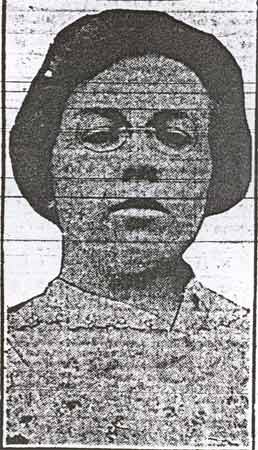
With Wilson T. Ashbridge under guard in a cell in what was formerly known as Murderer’s Row, the police and county detectives today redoubled their energies towards the capture of George E. Thompson, the forger who escaped with Ashbridge from the County Jail on Monday night after murdering one keeper and wounding another. Stirring the police of all cities in the East to renewed activity, another circular was sent out today by the authorities giving notice of the reward of $500 offered for Thompson’s capture. Attention was strongly directed in the circular due to the fact that one of the fingers of Thompson’s left hand is missing.
The gun with which Ashbridge murdered jailor Isaac Hibbs and wounded Jailor Ellis was smuggled into the jail by Mrs. Ashbridge on Saturday morning. With it went a box of cartridges. The weapon and bullets were passed to Ashbridge in a basket of fruit, being at the bottom of the basket. The jailors were busy at the time she called and as she frequently had brought her husband fruit they did not take precaution to search the basket. Mrs. Ashbridge bought the gun and cartridges on the written request of her husband.
Her confession as to the very grave part she played in the escape and murder was made to the Prosecutor late yesterday afternoon after she had first insisted she had no knowledge of how the gun got into the jail and after her husband had repeatedly declared that the revolver was supplied by Thompson. The revolver, fully loaded, was still carried by Ashbridge when he was captured in the Keystone Hotel…
… by Recorder Stackhouse without bail for conspiracy in aiding and abetting the escape of her husband and George E. Thompson from the County Jail on Monday night.
The court room was packed to suffocation by a morbidly curious crowd, composed primarily of women. A strange silence spread through the court room when the little woman was led into the court room by Captain Schregler. The regular formality of placing prisoners in the dock was dispensed with the woman’s case.
Prosecutor De Unger pointed to the high witness chair and Mrs. Ashbridge sat in it. She evaded the gaze of the crowd, looking intently at the floor and through a window on the Washington Street side. She wore a blue skirt and a white waist. She was without her hat. Her hair was carefully arranged and she wore nose glasses.
Resting her chin on her right hand her arm and hand were seen to tremble slightly. So quiet was the room that a pin dropping could have been heard.
“Mrs. Marian Ashbridge,” called the Recorder.
“Yes, Sir,” was the faint reply of the woman, who did not even look up at the call of her name.
“This complaint charges you with delivering to Wilson Ashbridge and George E. Thompson a pistol and aiding and abetting them in escaping from the County Jail, where they had been lawfully committed. Do you plead guilty or not guilty?” said the Recorder as he read the complaint.
The woman said nothing. Detective Schregler was then called as the complainant. He told of the confession made by the woman and produced the revolver which the woman purchased and which Ashbridge used in his daring escape. The gun, Captain Schregler said, was purchased in a pawnshop at Eleventh and Arch Streets, Philadelphia, on Friday of last week and was delivered to Ashbridge on Saturday morning along with a box of cartridges. “Marian, I will hold you without bail,” said the Recorder.
As the woman was being led from the court room by Captain Schregler and Sergeant Reed the crowd made a rush for the door leading from the court room, whereupon orders were given by the police to the crowd and many were prevented from rushing out. Everybody seemed anxious to secure a closer look at the unfortunate woman.
Visitors were denied Mrs. Ashbridge. Not even her children were permitted to be brought before her, although the broken-hearted mother asked for them.
“Oh, God, I don’t know why I did this; why I left the little ones to go with Wilson,” tearfully expostulated Mrs. Ashbridge to the kind-hearted matron, who spent the best part of last night with the distraught woman.
“If I could only see little Marian,” sobbed the woman in the arms of Mrs. Kirkpatrick, who informed her that perhaps she could see them today.
Last evening the only support Mrs. Ashbridge had was a cup of tea. The morning she sipped a portion of a cup of coffee. She told Matron Kirkpatrick that she was not hungry.
“Everybody hounded me, I had no friends, and that’s why I went with my husband, because he was the only friend I had left,” said Mrs. Ashbridge. “He was a good boy, but was easily led.” The wife said even before her marriage that Ashbridge would run around with other girls, but he always returned to her and she forgave him. She said he seemed to have a spell over her and she couldn’t leave him.
“I love my husband, still and will stand by him to the end,” sobbed the little woman to Mrs. Kirkpatrick. She told how her relatives disowned her and how after her father’s death she went to live with strangers. When her husband fostered the plan to escape she willingly consented to aid him. She drew $100 out of the bank and purchased clothes and the gun and bullets. She never faltered in her plan.
“My heart aches for that woman,” said Matron Kirkpatrick this morning to a Post-Telegram reporter. “She’s a good girl, but was easily led into her present predicament. It only goes to show what a woman will do for the man she loves, no matter how base a wretch he may be. Mrs. Ashbridge is more to be pitied than scorned.”
Recorder Stackhouse this morning produced a copy of the marriage of the couple, performed by him on July 28, 1914. The marriage was performed at the instance of Assistant Prosecutor Butler after Ashbridge wronged the girl. Constable William E. Headley and William C. Ashbridge, the latter father of the murderer, were witnesses.
As told in yesterday’s Post-Telegram, Ashbridge and his wife and their captors arrived at the City Hall from Chester shortly after 2:00 o’clock. After a brief stay they were taken to the Court House and turned over to Prosecutor Kraft, Ashbridge being taken into the Prosecutor’s private office and Mrs. Ashbridge being placed under guard in the ante room.
Taking full blame for the murder of Hibbs and the wounding of Ellis, Ashbridge declared that none of the shots were fired by Thompson.
“I shot both men,” he declared, “but Thompson gave me the gun. He had it since Saturday.” He repeated this assertion several times in the course of his examination, adding each time that his wife had no part in supplying the firearm. His voluntary insistence in…
… exercise corridor of their cells in response to his request that he wanted to show him a note that had been left for him, he asked the aged keeper to step inside the corridor. Evidently suspecting something was wrong Hibbs refused to enter the corridor. When Ashbridge repeated his request that Hibbs step inside, Thompson, who was immediately behind Ashbridge, said something to the murderer. Ashbridge could not exactly recall what the expression was. At any rate it was then that he fired and Hibbs fell to the floor with his death wound. To take Hibbs keys and open the door leading from the exercise room to the corridor was the work of but an instant. It was then that Ellis confronted Ashbridge at the other end of the corridor. He refused to throw up his hands when the murderer so ordered. Instead, the plucky jailor grappled with the slayer, who again brought the gun into play, twice wounding the remaining jailor.
Ashbridge did not say why he wanted Hibbs to step inside the corridor. One surmise is that the pair had planned to get the old man into the corridor, overpower him, take his keys and after gagging him place him in a cell, depending on the gun to awe any prisoners who might make an outcry. But whatever their plan was in this respect it miscarried. Hibbs would not enter the corridor and was shot down where he stood.
Thompson carried both his own and Ashbridge’s coats when they fled. As Ashbridge had decided to do the talking with Hibbs when the jailor came to lock them in their cells it was agreed that it would not be wise for the murderer to be wearing a coat. This might look suspicious to Hibbs and in all likelihood he would refuse to open the door. Hence it was decided that Thompson should take both coats. He also carried Ashbridge’s cap and his own Panama.
The coats and hats were adjusted as they ran down the spiral stairway leading to the street. They walked slowly into Sixth Street; increasing their pace up Sixth Street after crossing Market and after turning into Cooper walked very rapidly. They turned north on Third Street to Main and thence to the Vine Street ferry, where they caught the boat leaving at 7:15 for Philadelphia. Landing on the other side the fugitives exchanged hats. They walked rapidly to Broad Street Station, where Mrs. Ashbridge was in waiting, this arrangement having been made when she smuggled the gun in to her husband on Saturday morning.
Accompanied by Thompson the Ashbridges walked out Market Street to Thirty-second Street. Here Thompson left them and after walking the street for a brief while longer the slayer and his wife boarded a trolley car for Chester, where a few hours later the murderer’s short-lived liberty was so dramatically terminated.
Although jailor Ellis still insists that three shots were fired before he was attacked and in spite of the positive declaration of Alfred Williams, the trusty, that three shots were fired at Hibbs, Ashbridge claims that Hibbs was shot only once and that two bullets were used on Ellis. He said that the three empty shells which the detectives found in his pocket contained the only bullets fired in the jail. The post mortem examination made yesterday by County Physician Stem bears out his contention as to the number of shots fired. Only one bullet was found and that had penetrated the jailor’s heart.
“That’s the truth about the shooting,” declared Ashbridge. “I fired the shots — three of them in all — and the gun was given me by Thompson. My wife had nothing to do with it. Don’t blame her.”
Enroute back to the prison from which he had made his tragic getaway on Monday night, Ashbridge passed through the ante room where his wife was under guard. He stopped, kissed her, gently caressed her cheek, told her not to worry and passed on to the jail, from whence his next exit will be to the electric chair.
Haggard and very weak Mrs. Ashbridge was at once taken before the Prosecutor. With due regard for her condition Mrs. Ashbridge was handled very gently. At first she insisted that she had no part in getting the gun, but under skillful handling she finally broke down and confessed that she had supplied the revolver.
She stated that on Friday night she received a letter from her husband telling her that he planned to escape from the jail on Monday night and that he needed a revolver to make certain that his scheme would not fail. He requested that she procure the pistol and cartridges and personally deliver them on Saturday. Being anxious to aid her husband in every way possible she readily decided to do as he requested.
Accordingly she purchased the needed articles in a Philadelphia pawnshop on Friday afternoon, paying $3.00 for the pistol and 67 cents for the cartridges. She kept them over night and on Saturday safely delivered the weapon and bullets to her husband in the bottom of a basket of fruit. At the same time Ashbridge asked her to go with him and when she agreed to share his fate he told her to meet him in Broad Street Station, Philadelphia, shortly after seven o’clock on Monday night. He further told her that he had carefully studied the situation and did not see how it was possible for his plan to miscarry. On Monday morning she sent her children to the home of Mrs. Anna Dick and later in the day sent the letter to Mrs. Dick telling of her “rash deed” and enclosing $10 for the children.
As Mrs. Ashbridge told her story she spoke in a very low tone. Most of the time her eyes were cast down and as she concluded her brief narrative she sobbed convulsively and was in a state of utter collapse. Reviving somewhat when given cold water Mrs. Ashbridge was turned over to the police and taken back to City Hall to await her hearing this morning.
The prison key stolen by Ashbridge from Hibbs’ murdered body was recovered this morning by Detective Doran in the yard of Dr. Frank, 2025 Chestnut Street, Philadelphia. The recovery of the key was due to information given by Ashbridge, after he had been locked up in jail yesterday afternoon. Ashbridge, when questioned as to the whereabouts of the key, said that Thompson had it and that he had seen him toss it over a wall of a residence near Twenty-third and Chestnut Streets on Monday night while he and his wife and Thompson were walking to Thirty-second Street.
Detective Doran and Constable Voight went to Philadelphia late yesterday afternoon and searched in vain for the key in the vicinity of Twenty-third and Chestnut Streets until darkness came on. Detective Doran renewed the search early this morning. There is a high wall fronting the yard at the home of Dr. Frank, and a search of the grounds resulted in the finding of the key, which was returned to Sheriff Haines.
Ashbridge is confined in a large cell in what is known as Section E. As cellmates he has two persons who are being held as witnesses to the crime. Sheriff Haines has assigned three constables, Gardner, Ford, and Addison. They will work on eight-hour shifts and will see that Ashbridge does not attempt any further escape or try to end his life.
Sergeant Detective Kane of the Chicago Police Department today took to Chicago Alfred Williams, who was an eyewitness to the murder of Hibbs. Williams, an Italian, served six months here on a charge of false pretence in obtaining money from a number of Italian grocers under the pretence that he represented the Roma Grocery Company. After his arrest and sentence here the police of Chicago lodged a detainer against Williams who is wanted in the West for a like crime.
The body of Jailor Hibbs will be exposed to view tonight at his home, 913 South 8th Street. Services will be conducted by Reverend Harry Bradway, pastor of Eighth Street Methodist Episcopal Church. Members of the Seventh Ward Republican Club, Mutual Aid and the Liberty Beneficial Society will attend in a body.
Tomorrow morning the body will be taken to Langhorne, where services will be held in the Friends Meeting House, after which interment will be made in the burial ground by the Schroeder-Kephart Company. Friends may call this evening to pay their respects.
Ashbridge will not be tried until December. On the day he was listed for trial of murdering Mrs. Dunbar his lawyer, Assemblyman Wolverton, was ill. In the interim the entire panel of jurors for the April term of court was discharged following a case of alleged tampering. This makes it necessary that he be held until September for trial unless the Court should otherwise decree, which is hardly likely.
Ashbridge is 22 years old and not 27, as previously stated. His real age was disclosed by the certificate of his marriage. He was 20 when he wedded two years ago.
The Howard Marshall who mailed a letter to a woman in Baltimore is not Freeholder Howard Marshall of the Eighth Ward, as was reported to the Prosecutor yesterday. Mr. Kraft’s investigation disclosed that Freeholder Marshall does not know either Ashbridge or Thompson and that as a matter of fact the Marshall in question is an East Sider and no relative to the freeholder, who was naturally much upset at being mistakenly dragged into the case.
E.S. Fry, proprietor of the Keystone Hotel, Chester, where the couple were caught, told the story of the capture both to the city police and Prosecutor Kraft.
“Late on Monday night I received a call from another hotel, requesting that I take care of a man and his wife for the evening,” said Mr. Fry. “I waited until a little before midnight when the couple arrived. He seemed nervous and registered in a shaky hand, and I was suspicious that there was something wrong.”
“I did not pay much attention to the way he registered until the next morning when I examined the register and saw that he had neglected to register his wife. He signed ‘Mr. Smythe, Washington, D.C.’ I communicated my suspicions to my wife and told her to go observe the couple, too. Then I went out on the porch and picked up a morning newspaper. On the front page were the pictures of the two men who escaped.”
“I instantly recognized Ashbridge, but was not just sure of my identity of the man, so I decided to get a better look at him. At the breakfast table I observed him more closely and feeling sure of my ground I called Captain Schregler, afterward securing the service of two negro policemen, whom I placed on guard outside the hotel, giving them orders not to allow the couple to leave. The officers, William Padgett and William Robinson, took their positions outside the hotel, ready for the signal to enter when I gave it.”
“Ashbridge arose.”
“What’s the matter?” he exclaimed. “You know what’s the matter,” replied Mr. Fry, who brought in Captain Schregler and Detective Hunt. Schregler and Hunt instantly recognized the fugitive.
Before Ashbridge had a chance to move his arms were pinioned by his sides and Policeman Hunt had extracted the murder gun from his right hip pocket. It was fully loaded. In the same pocket were seventeen additional cartridges and in a suitcase in his room, Number 9, was a fresh box of cartridges.
“The little wife was crying bitterly,” said Mr. Fry. “She leaned her head upon his shoulder and the husband tried to console her.”
Captain Schregler sent a telegram to Chiefs Gravenor and Hyde with the startling news that Ashbridge had been caught.
On the way back to Camden Mrs. Ashbridge began to cry. She was sitting beside Captain Schregler, and he tried to console her. Her sobs increased, and Ashbridge called to her to “take it easy.”
This seemed to quiet her a bit, and Schregler spoke to her kindly, saying that she would not be blamed very much for her part in the escape. “That’s not worrying me,” she answered. “I am worried about ‘Wil.’”
“Well you women beat me,” was Schregler’s comment. “What did you want to help him escape for, anyhow? He had beaten you, deserted you for another woman and when she turned him down, he killed her. Yet you make up with him, leave your kids and risk everything to help him escape. Seems to me the worse men treat you women, the more you will do for them.”
“Lots of truth in what you say,” remarked Mrs. Ashbridge, with a sigh.
Mr. Fry was the center of attention. Everybody seemed anxious to hear his story.
“I’m not going back until I collect that $500 either,” he was heard to say. The capturer was formerly coroner of Delaware County.
Scenes of excitement were prevalent when the automobile of Chief Gravenor with Detective-chauffer David Hunt at the wheel, Captain Schregler and the prisoners in the rear and Chief Dodd, of the Pennsylvania Railroad police force in the front seat came from the Federal Street Ferry. E.S. Fry, the hotel proprietor who caught the Ashbridges, was also in the car.
Ashbridge and his wife were instantly recognized. The news spread like wildfire and was passed along the route of the machine to police headquarters.
Thinking that the prisoners would be brought to the Prosecutors office, a battery of newspapermen and photographers were camped on the Court House plaza. When someone cried in bellowed tones “There they go,” the scribes and photographers started in hot pursuit behind the automobile.
The officers upon reaching the City Hall had to fight their way through the dense crowd which had gathered outside Police Headquarters. Many stood tiptoed to get a good glance at the prisoners who were abashed at their predicament.
Pulling her black straw hat over her face, Mrs. Ashbridge leaned on her husband’s arm. To hide his face the murderer pulled the Panama hat, which he had secured from Thompson, over his countenance.
Preliminary questioning was done by Captain A.L. James, after which the officers and prisoners were escorted upstairs to the office of Chief Gravenor.
Still clenching the stump of a cheap cigarette in the corner of his mouth, Ashbridge had a pitiful look on his face. He was much thinner than he was when he was arrested for the murder of the Dunbar girl. On his upper lip was a small mustache, which he raised during the last week.
His beautiful and baby-like eyes still retained their piercing stare. The murderer looked wild-eyed at persons in the room. He seemed to take delight in singling out persons in the room and “staring them out.” None seemed courageous enough to return Ashbridge’s strange stare. He looked distressed but the only betraying sign of nervousness was his incessant twitching of his fingers. Seated on the couch in the chief’s room, Ashbridge talked freely.
His wife dried away the tears as they trickled down her reddened face but after regaining her composure she seemed quite calm. She intently watched Captain Schregler and Detective Hunt as they searched through her husband’s clothes.
When the trip for the Court House was being arranged the two prisoners, still handcuffed together, walked in the outer room of the chief’s office. It was then that the wife broke down slightly. She choked back a sob and leaned her head on her husband’s shoulder. Ashbridge did likewise and patted her on the back, at the same time saying something in a suppressed tone of voice. The only persons in the room at the time were Assistant Chief Hyde and a Post-Telegram reporter. Neither was able to catch the words uttered. Captain Schregler, Chief Gravenor, and Detective Hunt later entered the room and the start for the Court House was made.
The crowd below which was camped about the entrance to the building awaited with patient expectancy, when the news was spread that the prisoners were leaving the building.
Camera men took their positions, ready to snap the couple, but the Ashbridges fooled them. Before the door leading to the street was opened Ashbridge drew his wife to him and with their free hands pulled their hats over their faces, thus eluding the photographers, who resorted to every means to secure a photograph.
Once inside the automobile the prisoners seemed content until the Court House was reached when another large crowd was on hand to greet them. Both repeated the trick of hiding their faces.
After Ashbridge was taken to his cell his wife was ordered taken to the detention department in the City Hall. Captain Schregler and Detective Hunt half-carrying the sobbing and broken-hearted woman, who has aroused some sympathy for her courageousness in taking such a desperate chance for the man she loved, the father of her children and a cruel murderer.
“What other woman would do as much as she has for her husband?” was the query advanced by one of the spectators in the Court House corridor as Mrs. Ashbridge passed through on her way to the waiting automobile.
Gettysburg Times — July 27, 1916
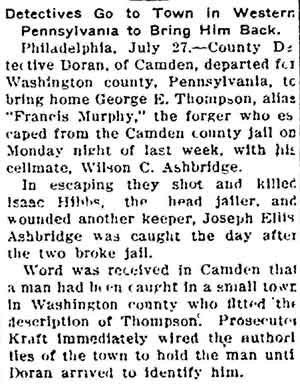
Gettysburg Times, Gettysburg, Pennsylvania — July 27, 1916
Hacked Remains of David Paul, Missing Bank Messenger, Discovered by Gunners
(Mt. Holly) New Jersey Mirror —
The Authorities of Burlington county have another baffling murder mystery to solve.
On Saturday four duck hunters, William and James Cutts, and C.B. Inston, of Tabernacle, and George W. Duncan, of Audubon were passing through the pine forest at Irick’s Crossing, near Tabernacle, when their attention was attracted by an automobile track following an old and rarely used trail leading to a stream toward which the gunners were making.
As the car was miles off the nearest traveled road the tracks aroused the curiosity of the men and they followed them. In a short time they came upon a freshly made mound over which dead leaves had been thrown. Leading to the mound from the shallow stream nearby were tracks of men and also marks as though some heavy object has been dragged by the men making the tracks. Thinking perhaps that a deer had been shot and secreted there, one or two of the men scratched around the end of the mound with sticks and within six inches of the surface a human foot was unearthed.
This put an unexpected phase upon the situation and the gunners decided to let Sheriff Haines continue the investigation.
Word was hastily phoned to the jail at Mount Holly and the Sheriff and Detective Parker lost no time in reaching the scene of the tragic discovery. The new-made and crude grave was then opened under the Sheriff’s direction. The body proved to be that of a man, fully dressed except for his coat which was lying buried deeper and under the body. The feet were tied with a heavy rope such as is used in towing automobiles and they were resting upward and back over the dead man’s head. As soon as the features were uncovered Sheriff Haines recognized the dead man as David S. Paul, of Camden, a bank runner, who had been reported missing by the Broadway Trust Company of Camden ten days before, with $65,000 in cash and liberty bonds and $12,500 in checks besides a number of cancelled checks. The body was badly mutilated and it was evident that a brutal murder had been committed.
Apparently Paul had been dead but a few hours and the remains were in a good state of preservation when discovered by the merest chance by the gunning party. There was a deep gash on the head as though made by a axe or hatchet, and the forehead was crushed in. Another ghastly wound just above one ear, alone was sufficient to have caused almost instant death.
Every indication pointed to the man having been killed and buried within twenty-four hours of the discovery of the crime. The rigor of death had not yet set in and the victim’s face appeared to have been freshly shaven. The marks on the ground accompanying the feet tracks leading from the stream about a hundred feet away, were quickly explained when the body was unearthed. Evidently those who brought the body to the unfrequented spot had attempted to secret it in the stream, but finding the water too shallow to conceal the corpse, they had dragged it out again by the rope which bound the feet and pulled it to the spot where the grave was quickly made and the body of the unfortunate man shoved into it.
The clothes which Paul wore bore every evidence of being new. The shoes also had evidently just been purchased and the soles bore no evidence of wear. A search of the body failed to reveal any of the cash which the bank messenger is alleged to have taken when he so suddenly dropped out of sight while on his way across the ferry to go to a bank in Philadelphia to take the money, securities and checks for his employers. Only one cent was found in the pockets of the dead man. In the coat was a bundle of checks, said to have been cancelled.
There had been no attempt to conceal the identity of the dead man. His watch which had stopped at 9:37, was found in his pocket and a stickpin in his tie and a pair of sleeve buttons remained in the cuffs.
How the dead man came to his untimely end and how his body happened to be buried in the far away spot in the pines miles from any human habitation, was a mystery when the body was first discovered and it seems to be as much so today, although the authorities here, as well as those of Camden and Philadelphia, are exerting every effort to run down the criminals.
It will be recalled that Paul, who was 59 years of age, enjoyed the confidence of the bank officials by whom he had been employed for many years. He was a recent visitor in Mount Holly where he had a son, Harry Paul, and other relatives.
On the morning of October 5, Paul started across the river to Philadelphia in company with another bank employee with a satchel said immediately afterward to contain $10,000 in cash and $12,500 in checks. This statement has since been revised and the amount of cash and Liberty Bonds that Paul carried is now variously stated to have been from $45,000 to $65,000. Upon reaching the other bank the other employee became separated from Paul whether by accident or through Paul’s design is not yet known and after an attempt to find him at the ferry house, he went at once to the bank and reported his companion’s disappearance.
The Central Trust Company was immediately notified and after all efforts to get in touch with the missing messenger had failed the Camden and Philadelphia police were asked to locate Paul. Nothing more was seen or heard of him until his hacked body was discovered in the pines near Tabernacle ten days after his disappearance. What the missing bank runner did during the interim, where he spent his time or with whom he associated while the police of the county were searching for him has not yet been learned but it is expected that the mystery will be solved before long.
One clue which seemed to put under suspicion the occupants of a yellow car turned out to be valueless when the owner, hearing of the authorities suspicions, came forward, gave his address as Haddonfield and proved that he drove a party in his yellow car inspecting some real estate in the pines shortly before the discovery of the body of the murdered man.
Detective Parker yesterday said that he had just picked up what he considered the first piece of valuable evidence in the case since he stated to work on it on Saturday. He declined to state what this evidence was for the present.
There are endless theories being advanced as to how the dead man met his fate and in explanation of his disappearance with the large sum of money entrusted to his custody. Some officials incline to the view that Paul was killed either in Philadelphia or Camden and his body taken to the lonely spot at Irick’s Crossing in the confident belief that it never would be discovered or at least not until time had obliterated identifying marks.
Another theory is that the murdered man was taken alive in the automobile and killed near the spot where his body and rifled clothes were found. There is no means of telling which theory is correct at this time, quite as possibly both theories are at fault.
The body was taken in charge by Coroner Isaac Clover who ordered it removed to the undertaking establishment of Cline & Sons, at Vincentown. There Dr. Longsdorf, of Mount Holly and Dr. Stein, of Camden, performed an autopsy, the result of which showed that Paul came to his death by wounds to the head, probably inflicted by a dull axe or hatchet.
There was a conference in Mount Holly on Sunday in which officers of Camden and Burlington counties participated. Those taking part were reticent after coming out of the room in which that meeting was held. In the discussion of the crime and the preparation of plans for running down the murderers, if there were more than one, were Sheriff Haines, Clifford R. Powell and County Detective Parker, of this county, and Prosecutor Wolverton, and Detectives Schregler and Doran, of Camden county.
A reward of $1,000 offered by the Broadway Trust Company for the apprehension of Paul shortly after his disappearance is to be increased now for information leading to the capture of his murderers. It is easily the most mystifying case that had come to the attention of the Burlington county officials for many years but they express confidence that it will be solved and the criminals run down.
Magnolia Garage Robbery
Philadelphia Inquirer —
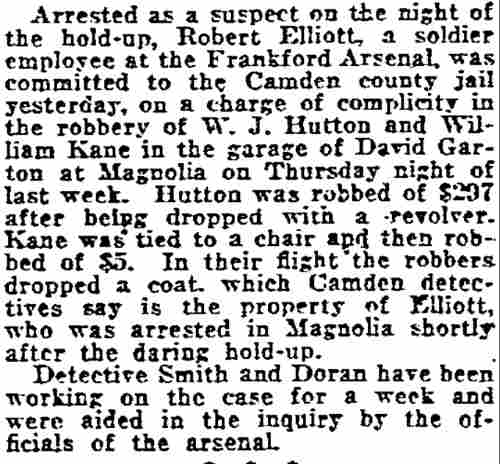
Arrested as a suspect on the night of the hold-up, Robert Elliott, a soldier employee at the Frankford Arsenal, was committed to the Camden county jail yesterday on a charge of complicity in the robbery of W. J. Hutton and William Kane in the garage of David Garton at Magnolia on Thursday night of last week. Hutton was robbed of $207 after being stopped with a revolver. Kane was tied to a chair and then robbed of $5.
In their flight the robbers dropped a coat, which Camden detectives say is the property of Elliott, who was arrested in Magnolia shortly after the daring hold-up. Detective Smith and Doran have been working on the case for a week and were aided in the inquiry by the officials of the arsenal.
Camden Daily Courier — November 9, 1925
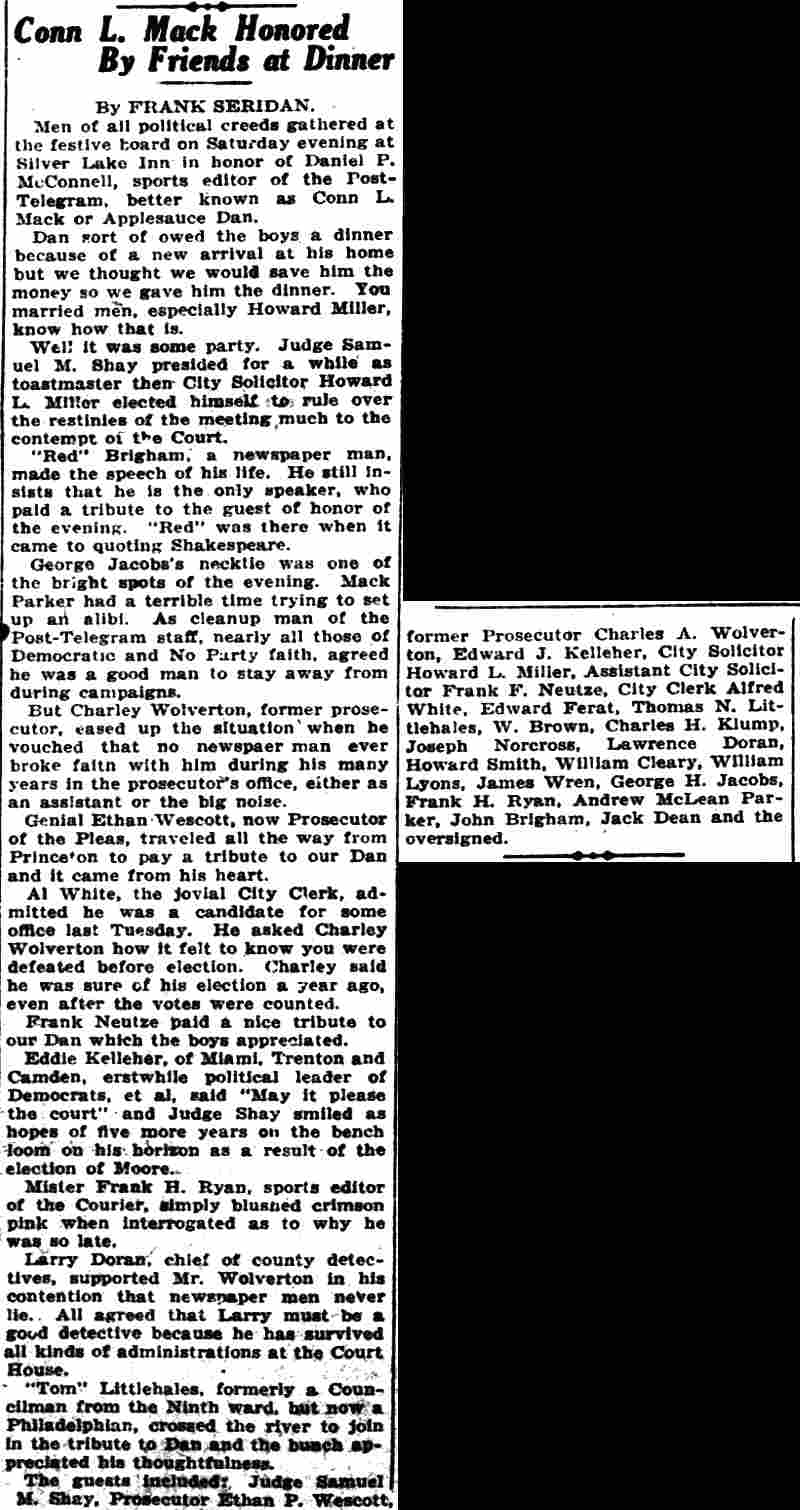
By FRANK SERIDAN.
Men of all political creeds gathered at the festive board on Saturday evening at Silver Lake Inn in honor of Daniel P. McConnell, sports editor of the Post-Telegram, better known as Conn L. Mack or Applesauce Dan.
Dan sort of owed the boys a dinner because of a new arrival at his home but we thought we would save him the money so we gave him the dinner. You married men, especially Howard Miller, know how that is.
Well it was some party. Judge Samuel M. Shay presided for a while as toastmaster then City Solicitor Howard L. Miller elected himself to rule over the destinies of the meeting much to the contempt of the Court.
“Red” Brigham, a newspaper man, made the speech of his life. He still insists that he is the only speaker, who paid a tribute to the guest of honor of the evening. “Red” was there when it came to quoting Shakespeare.
George Jacobs’s necktie was one of the bright spots of the evening. Mack Parker had a terrible time trying to set up an alibi. As cleanup man of the Post-Telegram staff, nearly all those of Democratic and No Party faith, agreed he was a good man to stay away from during campaigns.
But Charley Wolverton, former prosecutor, eased up the situation when he vouched that no newspaper man ever broke faith with him during his many years in the prosecutor’s office, either as an assistant or the big noise.
Genial Ethan Wescott, now Prosecutor of the Pleas, traveled all the way from Princeton to pay a tribute to our Dan and it came from his heart.
Al White, the jovial City Clerk, admitted he was a candidate for some office last Tuesday. He asked Charley Wolverton how it felt to know you were defeated before election. Charley said he was sure of his election a year ago, even after the votes were counted.
Frank Neutze paid a nice tribute to our Dan which the boys appreciated.
Eddie Kelleher, of Miami, Trenton and Camden, erstwhile political leader of Democrats, et al, said “May it please the court” and Judge Shay smiled as hopes of five more years on the bench loom on his horizon as a result of the election of Moore.
Mister Frank H. Ryan, sports editor of the Courier, simply blushed crimson pink when interrogated as to why he was so late.
Larry Doran, chief of county detectives, supported Mr. Wolverton in his contention that newspaper men never lie. All agreed that Larry must be a good detective because he has survived all kinds of administrations at the Court House.
“Tom” Littlehales, formerly a Councilman from the Ninth ward, but now a Philadelphian, crossed the river to join in the tribute to Dan and the bunch appreciated his thoughtfulness.
The guests included: Judge Samuel M. Shay, Prosecutor Ethan P. Wescott, former Prosecutor Charles A. Wolverton, Edward J. Kelleher, City Solicitor Howard L. Miller, Assistant City Solicitor Frank F. Neutze, City Clerk Alfred White, Edward Ferat, Thomas N. Littlehales, W. Brown, Charles H. Klump, Joseph Norcross, Lawrence Doran, Howard Smith, William Cleary, William Lyons, James Wren, George H. Jacobs, Frank H. Ryan, Andrew McLean Parker, John Brigham, Jack Dean and the oversigned.
Trenton Evening Times — March 7, 1927

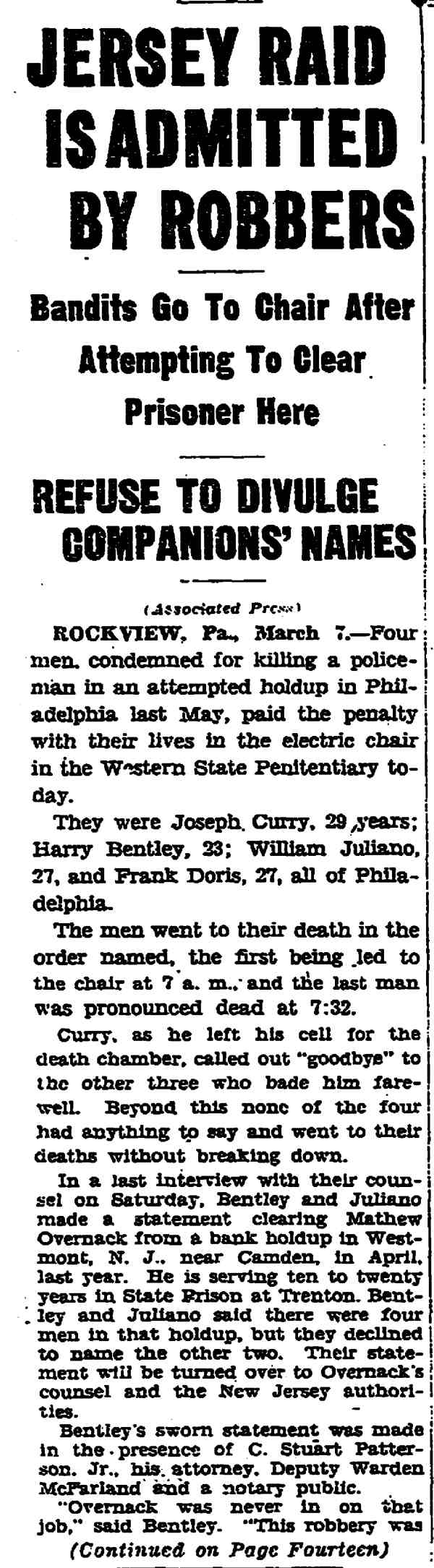

Named: Harry Bentley, Joseph Curry, William Juliano, Frank Doris, Harry M. Cooper, Olney Bank & Trust, William O. Miller, Lawrence T. Doran, Ethan Wescott, Matthew Overnack, and C. Stuart Patterson.
BABE PARADISE ADMITS HE IS NARCOTIC KING
Camden Courier-Post —
3 Others Held by Camden Police as Leaders in Dope Peddling Gang
OPERATIONS COVERED ALL OF SOUTH JERSEY / Tell of Making Buys With Auto Used as ‘Silent Salesman’
Captured after a lengthy investigation, Anthony ‘Babe’ Paradise, of Camden has confessed to being the head of a narcotic ring operating throughout South Jersey, it was declared yesterday by Captain John Golden, head of the city detective bureau.
Paradise also admitted that he is a drug addict, Golden said, making the fact known when he became ill in his cell at the city jail and calling for Dr. W.G. Bailey, who has been treating him for the drug habit.
With three other men, who are accused as accomplices, Paradise is being held for a preliminary hearing in Police Court tomorrow morning. The four men, Golden said, will probably be held without bail pending grand jury action and be committed to the Camden County Jail. At the jail, detainers will be lodged against the quartette by Federal narcotics agents, who co-operated with city and county authorities in the investigation, which resulted in the arrests.
Golden declared that city detectives had purchased more than $500 worth of drugs from Paradise and his agents, in obtaining evidence against the ring, which authorities said reaches into Atlantic City and other South Jersey communities as well as Camden.
The three men arrested with Paradise are James Mucci, 18 years old, of 324 Stevens Street, Rocco DeCord, 21 years old, of 221 Spruce Street, and Andrew Hill, of Locust Street, near Kaighn Avenue. According to the detectives, the base of operations of the “ring” was in the Third Ward. Mucci and DeCord were arrested in a barbershop at Third and Locust streets, three blocks from the Wiley M.E. Church where the pastor, Rev. John S. Hackett, recently exposed vice conditions existing in the Third ward and assailed the Department Public Safety for laxity. The arrest of Paradise and the others is believed to be a result of the clergyman’s scathing sermons.
Paradise and Hill were arrested several hours before the other two men. Fearing that they get word to other members of the “ring” police took the two men to Merchantville police headquarters, where Assistant Prosecutor Joseph Varbalow and Chief County Detective Lawrence T. Doran were waiting. Statements were obtained from the two, and meanwhile Mucci and DeCord were taken into custody. Paradise, who is 34 years old, served a year in State Prison five years ago for selling narcotics.
Detectives George Ward, Louis Shaw, and Thomas Cheeseman, of the city, and M.H. Shapiro and J.H. McFadden, of the federal office in Philadelphia, arranged the purchase of a ‘deck’ of heroin from Paradise, and ‘caught him with the goods’ when he met them at Nineteenth Street and River Road, near his home at 927 North Nineteenth Street.
Paradise was in his expensive automobile when arrested. It was the machine he had used to distribute narcotics to his agents and addicts during the past few years, the detectives said.
Decks of dope which sold for $1.50 each, police said, were placed in the automobile which was driven to a certain point as prearranged, and then Paradise would leave it parked, the detectives said.
Peddling Scheme Bared
At a stated hour an agent or addict would approach the machine, take the “dope” inside, and leave money as payment. Paradise would return and collect the money received, it was said.
That the ring extended to Philadelphia, New York, and other large Eastern cities was indicated by the many times the automobile was parked at Camden bridge plaza for hours, when exchanges would be made, the detectives said.
SHEIK SWINDLES HER, WOMAN CLAIMS HERE
Camden Courier-Post —
Camden Victim Says Jailed Lothario, 60, Took $4200, Vanished
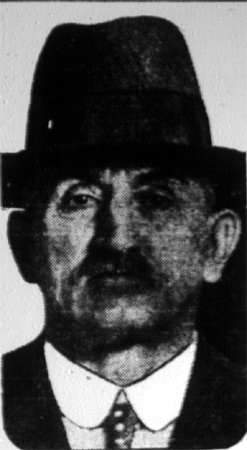
“He got my money, I got the air.”
That was the grim cry of a Camden woman who accused a suitor of mulcting her of $4200.
The gay Lothario, some 60-odd years, is John H. Lesser, of 712 South 29th Street, Harrisburg PA, who today starts a three-year term in the Moyamensing Prison, Philadelphia. He is also known as Victor Reichel, Charles H. Lesser, and Alfred May.
Lesser was sentenced to three years and fined $500 and the cost of prosecution by Judge Walter Davidson, of Franklin County, who substituted in Philadelphia Quarter Sessions Court, on the charges of two Philadelphia women.
The ‘sheik’ has also been identified by Mrs. Anna Wenghofler, 48 years old of 1281 Mechanic Street, as the man who secured her savings from her on a promise of marriage, and then disappeared.
Mrs. Wengholfer, the mother of three grown children, swore out a warrant four years ago for the arrest of Lesser, or Reichel, as he was known in Camden, on a charge of larceny as bailee. He was later indicted by the Camden county grand jury, but was never found until yesterday.
Today, Camden County authorities are arranging for the extradition of Reichel to this state upon the completion of his sentence to face trial on the Camden widow’s charges.
Lesser, or Reichel, was arrested in Pittsburg when he was recognized in a hotel lobby by Mrs. Helen Meier, an actress and married daughter of Mrs. Marie Gottschild, a widow of 2320 Bouvier Street, Philadelphia. Mrs. Gottschild had previously sworn out a warrant charging Lesser with obtaining money under false pretences.
He was placed on trial yesterday before Judge Davidson on complaint of both Mrs. Gottschild and another Philadelphia woman, Mrs. Ida Hoelke, 3001 North 5th Street. Both women allege that he interested them in a restaurant business after courting them during June of 1926.
He obtained $1500 from Mrs. Gottschild and $600 from Mrs. Hoelke, it was alleged. He was found guilty and sentence was imposed.
While he was being led back to the sheriff’s cellroom, Lesser came face to face with Mrs. Wenghofler, who had been taken to Philadelphia by Camden County Detective Howard Smith.
“I know him,” grimly asserted the Camden widow. “I would know him anywhere. I recognized him in the courtroom when he was with a number of other prisoners.”
Lesser turned to a guard, and exclaimed.
Denies Knowing Her
“I don’t know this woman. I never saw her before.”
“Well, I know you,” replied Mrs. Wenghofler.
The alleged love-making swindler was then arraigned before Magistrate Pennock and held without bail for extradition to New Jersey.
Police declare that Lesser has mulcted numerous women throughout the East by promises of marriage. Another Philadelphia woman, Mrs. Anna Graffe, of Park Avenue near Master Street, claims she gave him $3,000 for their “future home.” She told police she accepted him as husband-to-be, and he afterward took her to Baltimore and showed her a house which he said he wanted to buy for them. He finally prevailed upon her to “advance” him the money for its purchase, she said.
About five years ago an advertisement appeared in local newspapers. It was worded as follows:
“Bachelor, in business; good character, considerable savings, 48, wants to marry maiden or widow fond of home, should likewise have something saved. Reply with full particulars.”
Mrs. Wenghofler told police that she replied out of curiosity, and Lesser went to her home. He represented himself to be Victor Reichel, and said he was a Philadelphia real estate broker.
He ardently wooed her, finally proposed, and she finally agreed to marry him. He then went with her to the City Hall, procured a marriage license, and they made plans for the wedding.
Finds Ideal Home
Then, according to the widow, he told her he found a house which would make an ideal home, but that he was unable finance its purchase at that moment. He finally wheedled $4,200 from her, she said. He then disappeared.
Chief of Detectives Lawrence T. Doran recognized the description of Lesser when he was captured in Pittsburgh PA, and sent Detectives Cleary and Smith to identify the man. Fingerprints were taken and found to conform with those taken from articles belonging to Reichel and held by the Camden woman.
Detectives also declare that three Baltimore women have made complaints in that city of Lesser’s activities, declaring that he swindled them on promises of marriage. The ‘sheik’ also worked in Boston MA and other cities, it is alleged.
GANGSTER SHOT DURING MELEE IN SIXTH WARD
Camden Courier-Post —
Joseph Devon Held On Murder Charge After Death of Boxer’s Brother; ‘Mose’ Flannery and 4 Others Held as Witnesses; Was Craps Game Says County Police
HOLDUP ATTEMPTED CITY COPS DECLARE
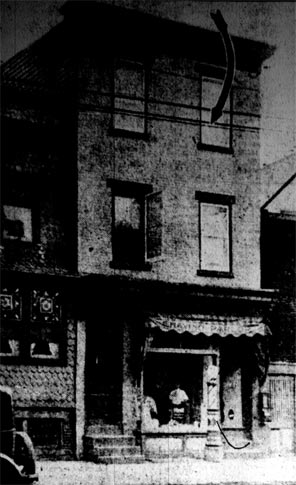
Victim of a shot fired in a melee, the exact cause of which remain undetermined, Joseph Cimini, 31 years old, was killed in the Sixth Ward Republican Club, 908 Broadway.
Cimini, declared by police to be a Philadelphia gangster, was killed before the eyes of two district detectives, Clarence Arthur and Clarence Bunker, who had been summoned to the club by warning that a fight was in progress.
Joseph Devon, 28 years old, known to his associates as “Polack Joe” and a colorful figure in Third Ward politics, fired the shot that killed Cimini.
Declaring that he had fired in self-defense, after Cimini struck him with the butt of a revolver, Devon was locked up without bail on a charge of murder.
Joseph ‘Mose’ Flannery, 26 years old, picturesque Eighth ward political worker, was held as a material witness. Detectives had seized Flannery who was to have precipitated the battle by brandishing a revolver just before Cimini was shot. The officers say that Flannery fled after the shooting and was captured afterward at Broadway and Federal Street.
The name of the dead man was given as Joseph Gannon, but shortly before one o’clock this afternoon, he was identified as Joseph Cimini, 1301 Ellsworth Street, Philadelphia. The identification was made by a brother, William Cimini, a pugilist who has boxed in this city several times under the name of “Billy” Gannon.
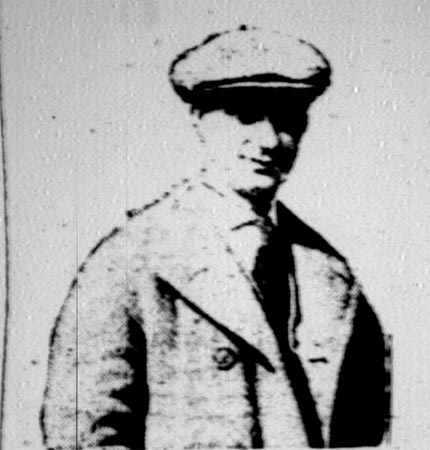
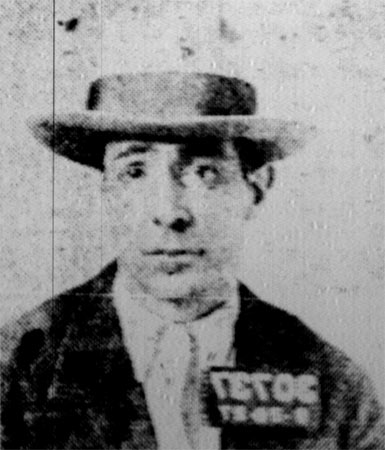
Six Others Quizzed
Six other men who were present at the time of the shooting, or when the argument began, were questioned by city and county detectives.
They are Newton Blanchard, 30, 923 St. John Street, former Camden boxing referee and declared by some of the witnesses as the man who conducted the crap game at the club; Michael Dandrea, 26, 1067 Norris Street; Russell Sage, 26 years old, of 1102 Marion Street a taxicab driver who is said to have driven Gannon and Flannery to the club in his car; Maurice O’Brien, 27 years old, of 1429 Bradley Avenue, a former New Jersey State Trooper; Harry Waterhouse, 28 years old, whose address was given as the same as Sage’s; and Charles “Chick” Hunt, 27 years old, of 1218 Broadway, a former Camden boxer. Blanchard and Dandrea were released after questioning and after each had made a statement to Chief of County Detective Lawrence T. Doran. The others were held with Flannery as material witness.
Differences of opinion between county and city detectives investigating the shooting were heightened during the afternoon. The county sleuths insisted upon the theory that the shooting had resulted from a feud between Flannery and Hunt, with Cimini taking the former’s side and Devon the latter and said that the heat of the argument had possibly been heightened by disagreement over a crap game.
The city police, on the other hand, declared that the entire affair was the result of an attempt by Flannery to hold up the other men. Devon’s statement to Chief Doran made no mention of a hold-up.
Building up a case against Flannery, the officers this afternoon lodged charges of attempted hold-up, carrying concealed deadly weapons, atrocious assault and battery and assault to kill against him. The two latter charges were made as the result of identification of Flannery as a participant in two recent robbery attempts. J.E. Feinstein, café proprietor of 508 Kaighn Avenue, declared that Flannery, Cimini, and Sage were three of four men who held him up on New Year’s Day. He defied them and they left when he said, “Go ahead and shoot,” he asserted. Flannery was also identified, according to police, as the man who had beaten and attempted to rob Henry Mehrer, an Audubon policeman, and his two companions outside the Ringside Inn, on the Black Horse Pike, a fortnight ago. Mehrer and Feinstein were taken to police headquarters by County Detective Howard Smith, who is authority for the statement that they identified Flannery.
Cimini was shot shortly after 3:00 this morning and died almost instantly. Doctors at Cooper Hospital pronounced him dead on arrival. He had been shot just above the heart by a bullet from Devon’s gun.
Events preceding the shooting remain, to some extent clouded today. Chief Doran said he learned of an enmity existing between Flannery and Hunt. Devon appeared to have attempted to quiet “Mose,” the county detectives said. Cimini struck Devon and Devon fired.
Chief John Golden of the Camden city detective bureau stated, on the other hand, that the shooting had apparently followed an attempt to hold up the other men in the room. Golden based his view on the statements of Clarence Arthur, a city sleuth. According to Arthur, when he and Bunker appeared at the door of the room, Flannery and Cimini held revolvers and the other men in the room were standing with their hands upraised.
According to the story pieced together by county detectives from the statements of witnesses, a group of men had apparently gathered at the club for a crap game. Blanchard, it was stated, acts as the “stick man,” the term used in gambling parlance to designate the man who conducts a crap game.
City and County agree that Flannery and Cimini arrived together in Sage’s taxicab. Whether there was an argument, the result of an enmity between Flannery and Hunt, or whether the attempted hold-up theory is correct, remains to be learned by additional official investigation.
Chief Doran stated the witnesses had told him that words passed between Flannery and Hunt and that the former had gone downstairs. Returning he brandished a revolver.
Two Flee Place
It was at this point that Blanchard and Dandrea left the room and fled down the stairs. On the street, they encountered Detectives Arthur and Bunker, who were patrolling Broadway in a police automobile.
In describing the subsequent events today, Arthur declared that Blanchard had informed him that “two Philadelphia gunmen are up in the Sixth Ward Club holding up a bunch of fellows.”
The detectives did not immediately go to the club, but found Patrolman Frank Del Rossi and followed him up the stairs of the building.
“There were about fifteen men in the room,” Arthur asserted. “When we got to the door Flannery and Cimini had their guns out and apparently were about to search the others. The other men had their hands in the air.
“When they saw us Flannery and Cimini threw their guns down and the others lowered their hands. I went up to Flannery and started to frisk him. Bunker went to another man, whom I don’t know, and started to frisk him.”
It was then he said that he heard the shot. Believing that it was Bunker who was shot, he released his hold on Flannery and swung around. As he did Flannery turned and fled downstairs, Arthur declared.
Bunker said he believed that it was Arthur who had been shot and he too released his grasp on the man he had been searching. The detectives turned in time to see Cimini fall.
“I did it! I shot him!” Devon is declared to have shouted, throwing his revolver on the table.
According to the story told by witnesses to the county detectives, however, Devon had stepped up to Flannery just before the shot was fired and had said: “Mose, you can’t get away with this here.”
Flannery is said to have had a gun in his hand at the time.
As Devon spoke, the witnesses say, Cimini stepped behind him and struck him with the butt of a revolver. Just then detectives entered. Devon whirled and, drawing his gun, fired.
Cimini was placed in a police ambulance and taken to the hospital. After he had been pronounced dead his body was taken to the morgue, where it was awaiting identification today. Neatly dressed, Cimini is of Italian extraction. He has coal-black hair, brown eyes and a dark complexion. Coroner Charles T. Murray will perform a post-mortem examination, he said.
Flannery Captured
When he fled from the club, according to Arthur, Flannery jumped on a Public Service bus driven by David Smith, of 423 Haddon Avenue, which was passing at the time.
“Faster! Faster!” he is declared to have urged Smith as the latter drove along Broadway in the direction of Federal Street.
At Federal Street and Broadway, Arthur and Bunker caught up to the bus and arrested Flannery as he descended from the vehicle.
“Why don’t you give me a chance to get to Philadelphia?” Arthur declares Flannery asked him. “I can get bail over there.”
Seek Written Statement
Chief Doran stated this afternoon that he was attempting to obtain a written statement from Flannery and would also seek to have Devon sign a statement regarding the shooting. During the morning, Flannery refused to talk while Devon, although admitting that he fired the shot, declared that he shot in self-defense. He made no reference to the hold-up attempt, according to the county detectives.
Cimini has a Philadelphia police record but, according to his pugilist brother, “was not bad but just wild.” He was recently arrested in Philadelphia after a fight with policemen.
“But he never held up or robbed anybody,” his brother declared this afternoon after identifying the body. “He got into a jam now and then. Yes, I know that he knew ‘Mose’ Flannery, but I never mixed with that crowd.”
It was reported at City Hall this afternoon that Samuel Orlando had been retained as attorney for Flannery and that Walter Keown, Camden county solicitor, would represent all the other men.
Flannery for years has figured in police cases and in political warfare in the Eighth Ward, where he was sometimes a lieutenant and sometimes an opponent of “Mikey” Brown, the Republican leader of the ward. Last March he was arrested and indicted on charges of atrocious assault and battery on his wife and her mother. At one time he was held as a suspect in a Philadelphia shooting but later was released.
The accused man, Devon, is a short, slim little man with an air of meek complaisance. He has been a taxicab driver and was last arrested on a charge of drunken driving. In May of 1926 he attempted suicide by shooting himself after he had failed to effect a reconciliation with his estranged wife. At that time, he shot himself but the bullet only grazed his chest.
Joe Devon, long a political power in the Third Ward, first flashed into citywide prominence in 1925, when he was employed by federal authorities as a deputy U.S. Marshal to guard the padlocked Poth brewery at Bulson Street, just off Broadway. At the time Devon was thus maintaining the sanctity of the Eighteenth Amendment, he was also operating a bootlegging establishment downtown and had been arrested once or twice for violating the Volstead Act.
The Courier at that time exposed this paradoxical situation, with the result that the U.S. Marshal summarily dismissed Devon. He keenly resented the political chicanery that had been used to put Devon in office. In explaining how Devon was appointed, the Marshal said that he had been recommended by “prominent Republican leaders” in Camden, chief among whom was William D. Sayrs, now a city commissioner but then a field agent in the office of the Internal Revenue Department.
Sought City Job
Not long after Devon’s dismissal as brewery guard, Sayrs and other Republican leaders made strenuous efforts to secure a city job for him under the Non-Partisan administration. They sought to exact a promise from The Courier that this newspaper would remain silent in the event Devon was appointed to a city position. No such promise was made and Devon remained jobless, politically at least.
Then came a humorous twist to the situation. Sayrs disagreed with some of the Organization leaders and, for a time, walked his own political footpath. Some of the leaders, fearful of what Sayrs might attempt politically, killed two birds with one stone by hiring Joe Devon to shadow Sayrs and to report to them the number of times he conferred with Non-Partisans. Thus, Joe had a job and Billy was watched.
Sayrs knew he was being shadowed by his old friend, and apparently he knew who had hired Devon to do the work, but he refused to take the situation seriously and chortled, frequently, when he would see his “Shadow” trailing about town.
In the last year, however, Devon has again been the particular political protégé of Commissioner Sayrs and also has won the friendship of many other political leaders. Nevertheless, he has not been, so far as can be determined, the recipient of any particular political patronage, though his political influence in the Third and Fifth Wards is said to have expanded rapidly under the new administration.
BANK EMBEZZLER JOKES WHEN TAKEN TO COUNTY PRISON
Camden Courier-Post —
Garrett Waives Reading of Indictment for $19000 Systematic Thefts; His Wife Remains Loyal, Discrediting His Confession
Laughing at photographers who tried to snap a picture as he covered his face with his hat and joking with the officers who accompanied him, Burd S. Garrett, for seven years a teller employed by the East End Trust Company was taken from the West Jersey Hospital this morning at 11:15 to the County Courthouse.
When arraigned before Justice of the Peace Peter J. Wallace in the office of Lawrence T. Doran, chief of county detectives he waived reading and hearing of the complaint charging him with embezzlement of $19,000 of the bank’s funds.
Less than ten minutes after he had entered Chief Doran’s office, the confessed embezzler, accompanied by Detective William Cleary, reappeared and walked to the county jail where he was committed.
Prosecutor Ethan P. Wescott did not attend the arraignment and it was expected that he would set Garrett’s bail sometime this afternoon, when he would announce his intentions as to presentment of the case to the grand jury.
Garrett, who according to Assistant Prosecutor Joseph A. Varbalow admitted manipulation of the bank funds, which he lavished on his wife and the six children he had instructed from birth in the principles of honesty, appeared unmoved this morning by the proceedings.
His face has regained the color it had lost when detectives first began questioning him, as he lay in a coma on a cot at the hospital last Saturday. Since Sunday afternoon, when he broke down and admitted the charges against him, he has chatted with his constable guard.
Garrett’s appearance today was that of a businessman in comfortable circumstances. He was well dressed, in a gray suit, dark overcoat, and wore a light gray soft felt hat. His eyes, behind tortoise shell glasses, were bright, and minus the stare of three days ago.
His wife, despite his reported confession reiterated her belief today that “it can’t be true.” Firmly declaring that she used economic measures in her housekeeping…
TWO MEN, GIRL KILLED, 40 HURT IN CAR CRASHES
Camden Courier-Post —
Williamstown Farmer Hurled Into Swamp, Dies Shortly After Being Rescued
CHILD RUN DOWN BY AUTO HURRYING TO HOSPITAL / Four Hit-Run Drivers Sought; Train Demolishes Sedan At Crossing
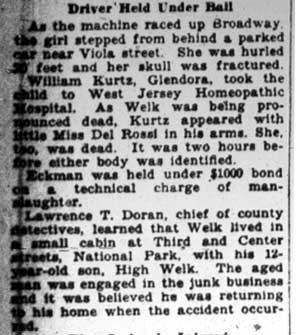
Louisa Del Rossi belonged to the family of Camden policeman Clifford Del Rossi
Camden Evening Courier — September 18, 1928
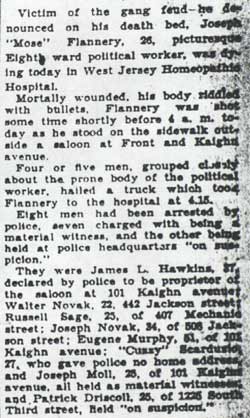
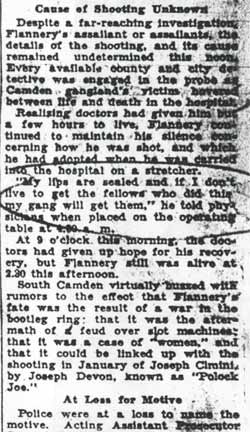
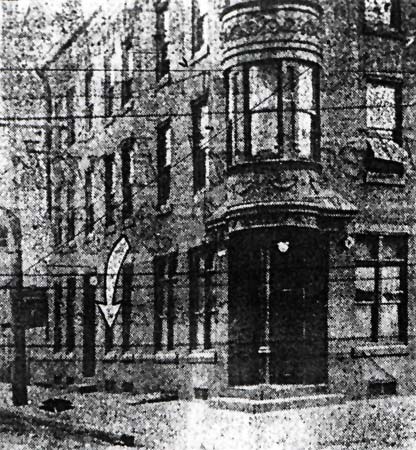
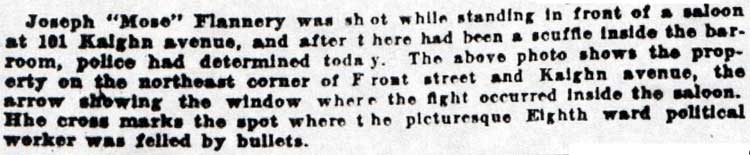
Seals Lips as Police Seek to Learn Identity of Assailant
EIGHT UNDER ARREST IN SUSPECT ROUNDUP
Surgeons at Hospital Find Four Jagged Bullet Holes in Body
Victim of the gang feud—he denounced on his death bed, Joseph “Mose” Flannery, 26, picturesque Eighth ward political worker, was dying today in West Jersey Homeopathic Hospital.
Mortally wounded, his body riddled with bullets, Flannery was shot some time shortly before 4 a. m. today as he stood on the sidewalk outside a saloon at Front and Kaighn avenue.
Four or five men, grouped closely about the prone body of the political worker, hailed a truck which took Flannery to the hospital at 4.15.
Eight men had been arrested by police, seven charged with being a material witness, and the other being held at police headquarters “on suspicion.”
They were James L. Hawkins, 37, declared by police to be proprietor of the saloon at 101 Kaighn avenue; Walter Novak, 22, 442 Jackson street; Russell Sage, 25, of 407 Mechanic street; Joseph Novak, 34, of 508 Jackson street; Eugene Murphy, 51, of 101 Kaighn avenue; “Cuzzy” Scarduzio, 27, who gave police no home address, and Joseph Moll, 25, of 101 Kaighn avenue, all held as material witnesses; and Patrick Driscoll, 25, of 1225 South Third street, held “on suspicion.”
Cause of Shooting Unknown
Despite a far-reaching investigation, Flannery’s assailant or assailants, the details of the shooting, and its cause remained undetermined this noon. Every available county and city detective was engaged in the probe as Camden gangland’s victim hovered between life and death in the hospital.
Realising doctors had given him but a few hours to live, Flannery continued to maintain his silence concerning how he was shot, and which he had adopted when he was carried into the hospital on a stretcher.
“My lips are sealed and if I don’t live to get the fellows who did this my gang will get them,” he told physicians when placed on the operating table at 4:30 a. m.
At 9 o’clock this morning, the doctors had given up hope for his recovery, but Flannery still was alive at 2.30 this afternoon.
South Camden virtually buzzed with rumors to the effect that Flannery’s fate was the result of a war in the bootleg ring; that it was the aftermath of a feud over slot machines; that it was a case of “women,” and that it could be linked up with the shooting in January of Joseph Cimini, by Joseph Devon, known as “Polack Joe.”
At Loss for Motive
Police were at a loss to name the motive. Acting Assistant Prosecutor Samuel P. Orlando, in charge of the investigation, said the probe had not reached the point where anyone person could be accused of shooting Flannery, or where the gun fire could be traced to anything but a “gang feud.”
“Mose” Flannery had been shot. He probably would die. That much was known. The rumors naturally followed for Flannery was well-known, not only in the close-mouthed circle in which he moved, but throughout the city as well.
“Mose” Flannery is one of the most picturesque figures in Camden’s political “gangland.” For several years he has been a slot machine distributor in Camden and Philadelphia.
When “Polack Joe” Devon shot and killed Joseph Cimini, Philadelphia gambler in the Sixth Ward Republican Club early in the morning of January 14, last, Flannery was arrested as a material witness. It was disclosed by police that Flannery and Cimini had gone into the club together a few minutes before Devon’s gun pumped death into Cimini’s body after the Philadelphian had quarrelled with Devon.
Flannery was considered the most important of the material witnesses connected with the Cimini murder. Sage, arrested on suspicion this morning in connection with the felling of Flannery, was another “important” witness in the Sixth Ward Club shooting affair.
James Bonner, who was mysteriously shot several months ago, was questioned today by detectives but was not held. Walter Selby, a taxicab driver, also was taken before Chief of Detectives Golden and County Detective Chief Doran, but he too was released after being closeted with the officials for more than an hour.
Sage Ordered Held
After questioning Sage, Acting Assistant Prosecutor Orlando ordered that the man be held.
In the meantime, Flannery lay on a hospital cot, propped up on his side, his pain deadened by opiates. He mumbled incoherently to members of his family grouped about him. At times he lapsed into a state of unconsciousness.
The doomed political worker early today had asked for a priest. Rev. Father John J. Henry went to the hospital. “Joe,” he said, “you’re dying. You’d better give police a statement.”
Flannery was said by doctors to have replied he would tell nothing, that if he lived, “he’d settle,” and that if he died, “my gang will take care of that.”
After a session in which more than a dozen men were questioned, Captain Golden and Detective Chief Doran shortly before noon went to the scene of the shooting. They found evidence that a scuffle in the saloon at Front and Kaighn avenue had preceded the shooting.
Tables had been overturned. Glasses had been broken. Forty cents in change was found on a table beside a picture of a small baby. There was an empty glass on one table, another glass half-filled with beer on the bar.
Bullets Meant for Novak?
It was reported that police had been informed by one of those they questioned that the bullets which ripped their way through Flannery’s body had been meant for Walter Novak who they said had been standing at “Mose’s” side at the time of the shooting. The police officials refused to confirm that rumor. Novak had told them, Capt. Golden said, he was not with Flannery at the time. Later Novak admitted to being on the corner near the saloon, police said.
Police recalled that Novak was arrested several months ago in the alleged theft of a slot machine from the store of Louis Schectman, in Broadway near Line street. Novak was apprehended after a wild chase through South Camden streets.
Schectman at first told police Novak was one of two men who entered his store, and at the point of a gun, robbed him of a nickel slot machine. Testifying in a hearing in police court several days later, Schectman said he hadn’t kept a slot machine in his store, and that two men unknown to him stole a box of cigars and escaped in an automobile.
As far as could be learned by an Evening Courier representative, the case against Novak never was settled.
The bullets were fired from a “pump” gun and were of .32 calibre. According to Detective Thomas Cheeseman, they could have been fired only from a gun of the type common to gangsters who “shoot to kill.” Cheeseman said a “pump” gun was designed to hold nine shells or “wads,” as they are commonly known. The leaden bullet is surrounded by a coating of asbestos, which breaks from the lead upon the firing of the gun and allows the lead to enter its target.
Police were following every clue which developed, no matter how scanty. Detectives combed the Front street and Kaighn avenue neighborhood, it was learned, in an effort to discover the haunts of the gang known by police to center in that part of the city.
Chief of Police Lewis W. Stehr was asked if police would act against the owners of the habitats of the “Front and Kaighn avenue” gang or if a routine investigation into the shooting of Flannery would be conducted. Chief Stehr said the usual investigation was being made and would continue.
While members of the political worker’s family talked with Flannery, and while investigation of the shooting by county detectives and police was under way, doctors said the man who lives at 346 Jackson street, couldn’t “live out the day.”
Flannery had a bullet wound two inches in diameter in his back. Another bullet had pierced his abdomen, and he had been shot in both elbows, physicians said. Doctors said the bullets were two inches long and three-quarters of an inch in diameter.
It was shortly after 4 a. m. when Charles Foulk, of 219 Point street, driver of The Courier-Post delivery truck, was hailed by a group of men standing on a corner at Front street and Kaighn avenue.
“Have you got time to take a man to the hospital?” one of the group asked Foulk, according to the story he told Captain John Golden, chief of city detectives.
Flannery was lifted into the rear of the truck, two men jumped on the running board and the run for West Jersey Hospital began.
Walter Wartman, of 315 North Second street, another Courier-Post employe, who had assisted in the delivery of Morning Posts at the Reading Ferries, was with Foulk.
Foulk said one of the men jumped from the truck when it reached Mt. Ephraim and Atlantic avenues. The other went into the hospital, whispered a few words to Flannery, and then raced out the main entrance.
Mose’s Companion Escapes
Mrs. Edward McGrath, supervisor of nurses, called Policeman Frank Malec who for several days has been guarding a man known as “Two-Gun” Kelly, and Malec gave chase to the unknown companion of Flannery. Malec saw the man disappear on Mt. Ephraim avenue, but couldn’t find him in a search of the neighborhood.
In the meantime, City Detective William Boettcher, who had been working the morning shift, had notified Assistant Prosecutor Samuel P. Orlando; Lawrence T. Doran, chief of Camden county detectives; Capt. Golden, and had called City Detectives George Ward, Louis Shaw, Thomas Cheeseman and Howard Pike to investigate the shooting.
Boettcher said Flannery refused to “talk.” “You are a policeman and I’m no friend of the police. I’ll never tell,” Flannery told the officer, Boettcher declared.
Later Flannery told physicians, “I have learned my lesson and hope this will be an example to other young men.”
Witness in Cimini Shooting
Flannery was held as a material witness in the fatal shooting of Joseph Cimini, 31, in the Sixth Ward Republican Club, early in the morning of January 14. Joseph Devon, known as “Polack Joe” fired the shot that killed Cimini. Devon was arrested but the case never came to trial.
Devon now is at liberty on bail and is under indictment for manslaughter in connection with Cimini’s death. Flannery also was released under bail.
While police continued their investigation, Flannery, still determined to refuse information to detectives and doctors, was surrounded by his wife, his 4-year-old son, his mother and father, and his 19-year-old brother James. Calling “Jim” to his side, Flannery, according to physicians, said, “I want you to promise me you’ll never get mixed up in these gang wars.” “Jim” promised, Detective Boettcher said.
Novak Under Suspicion
In their search for the “mysterious” companion of Flannery on the ride to the hospital, police pointed a suspicioning finger at Walter Novak who they had held “on suspicion.”
According to information given them by Foulk, the truck driver, Flannery, during the ride from Front and Kaighn avenue to the hospital, whispered, “Where are you taking me, Walt?” He was told the hospital was the truck’s destination, Foulk told police.
Detectives said Novak might have been the “Walt” to whom Flannery spoke. Novak said he was 22, was a “salesman” and lived at 442 Jackson street.
Taken by Strategy
Scarduzio’s arrest resulted from a piece of strategy on the part of Chief of County Detectives Doran. Doran with several members of his staff and city detectives were in the bar-room of the saloon at 101 Kaighn avenue when the telephone rang before noon.
Doran picked up the receiver and the party on the other end asked if Joseph Moll, son of former Policeman Frank Moll, was there.
Figuring that the persons might be some one who could help the authorities unravel the mystery, Doran answered:
“Yes, this is Joe Moll.”
“Well, I want to see you right away,” continued the other party.
“Will you come right down to 674 Fairview street. I want to see you,” finished the unidentified speaker who then hung up.
Doran with Captain of Detectives Golden hurried down to the address given and there found Scarduzio in the home of Garfield Del Duca.
Scarduzio, it is said, was more surprised to see the authorities than they were to find him as Chief Doran had been searching for “Cuzzie” for several hours.
He said he had nothing to do with the shooting of Flannery. Limping when the detectives escorted him from the house, Scarduzio was first taken to West Jersey Homeopathic Hospital to discover whether or not he was suffering from any bullet wounds in the legs.
Scarduzio Not Shot
Doctors later said Scarduzio had not been shot and the man who had been surprised at the Del Duca home was taken to police headquarters.
He “knew nothing about the shooting,” Scarduzio told Captain Golden and County Detective Chief Doran. There were stains, possibly bloodstains, on Scarduzio’s trousers, the police said. “Cuzzy,” as he is known in police circles, wore a clean white shirt, and that fact sent detectives from headquarters on another tangent in their investigation.
Scarduzio was asked where he had left a “bloody shirt” he was reported to have been wearing early today. According to police, he denied his shirt was bloody, and refused to give them any information.
City Detectives David Hunt, Samuel Johnson, and Walter Smith were dispatched on the “side” investigation.
Detective Thomas Cheesman, of the city hall staff, also holds two warrants for the arrest of Scarduzio in connection with the holdup of a saloon in Gloucester several weeks ago and the theft of an automobile.
Moll was arrested while sleeping in a room over the saloon near Front and Kaighn avenue. He was arrested by Chief Doran, Captain Golden and Detective Ray Sapanore. Moll has been in police tolls several times recently, the last time in connection with the mysterious shooting of Bonner near the spot where Flannery fell.
Woman Describes Auto
The movements of an automobile bearing Pennsylvania license and containing several men whom she said ran out of the saloon near Front and Kaighn avenue an hour after Flannery was shot, were described to police officials late this morning by Mrs. Mary Brown, who lives near the saloon.
She was questioned at detective headquarters after she had reported seeing the car drive onto the Spruce street pier, four men alight and board a motorboat which set off across the Delaware river in the direction of Philadelphia.
According to Mrs. Brown, the driver of the “mysterious” automobile turned the car about and raced north on Front street.
A city-wide man-hunt had been made for Joseph “Cuzzie” Scarduzio, detectives said after the “surprise arrest” on Fairview street. Police had heard rumors Scarduzio, known by them to be a “pal” of Flannery, had been standing by “Mose” when he was “given the works” by the yet unknown gunman or gunmen. They had heard, detectives announced, that Scarduzio, coatless and hatless, had been seen leaving the scene of the shooting, his clothes spattered with blood from the wounds of his friend.
Camden detectives said they doubted if Philadelphia gangsters were responsible, believing, they announced, that the shooting was local to the Camden gang center they knew existed.
City Detective Walter Smith shortly after noon brought a South Camden bartender into police headquarters for questioning.
The man said he was Frank Smith, and tended bar in a saloon in the 1800 block on Broadway, near Ferry avenue, and said he had overheard three men telephone for a taxicab to take them to Front street and Kaighn avenue. Smith placed the time after midnight, according to police, and detectives doubted if the three men were connected with the Flannery “case.” Smith was not held by police.
Camden Evening Courier — September 19, 1928
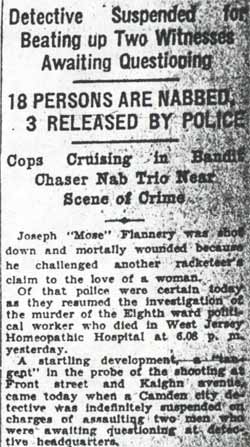
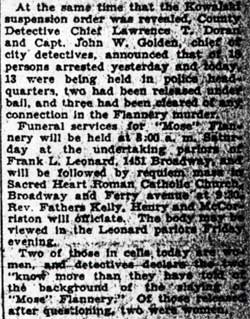



18 Persons Are Nabbed, 3 Released by Police
Detective Suspended for Beating up Two Witnesses Awaiting Questioning
18 PERSONS ARE NABBED, 3 RELEASED BY POLICE
Cops Cruising in Bandit Chaser Nab Trio Near Scene of Crime
Joseph "Mose" Flannery was shot down and mortally wounded because he challenged another racketeer's claim to the love of a woman.
Of that police were certain today as they resumed the investigation of the murder of the Eighth ward political worker who died in West Jersey Homeopathic Hospital at 6:06 p.m. yesterday.
A startling development — "negligent" in the probe of the shooting at Front street and Kaighn avenue came today when a Camden city detective was indefinitely suspended on charges of assaulting two men who were awaiting questioning at detective headquarters.
[Article continues on additional pages — 19 pages total of coverage]
Orlando Raids 38 Gambling Haunts in Slot Machine Drive
Camden Evening Courier —
A surprise raid, carried out in cooperation with Prosecutor Ethan P. Wescott, with evidence secured by county detectives and police raiding 38 alleged gambling haunts in Camden County. Assistant Prosecutor Samuel P. Orlando engineered the raids. At the afternoon session, when the grand jury convened, both Wescott and Orlando appeared before the jury in closed session.
Orlando made it clear, in a statement, that he is not after small fry but intends to get the “higher-ups” in the slot machine “game” in Camden city. “I am not going to give the proprietors of the slot machines time to exert political pressure on me. I am going to see with a grand co-operation of the members of the jury where they got their machines, on what percentage and who is protecting them.”
Orlando estimated approximately 300 slot machines in the county, averaging $30 a week per machine. “That money, however it goes, is coming from the people. They need it to pay their butchers and grocers.”
Several places had been tipped off before the raids. At one place where the noise of machines had been heard for weeks by nearby residents, the machine had been taken away before the county raiders arrived. The raiders were led by Lawrence T. Doran, chief of county detectives. The party included County Detectives John Smith, Cleary, Lyons and others, and Constable Max Beals. Five p.m. was set as the zero hour, with teams departing from the courthouse at 4:45 in automobiles.
For the first time, the raiders carried subpoenas. Where machines were seized, the proprietors were ordered to appear before the grand jury. Places where machines were found included 450 South Third street, 200 Clinton street, Third and Michigan streets, Stevens street, 106 South Second street, Eighth and Spruce streets, 506 South Third street, 530 South Third street, 432 South Third street, and 215 Line street. In some places two machines were found.
Camden Courier-Post — April 29, 1929
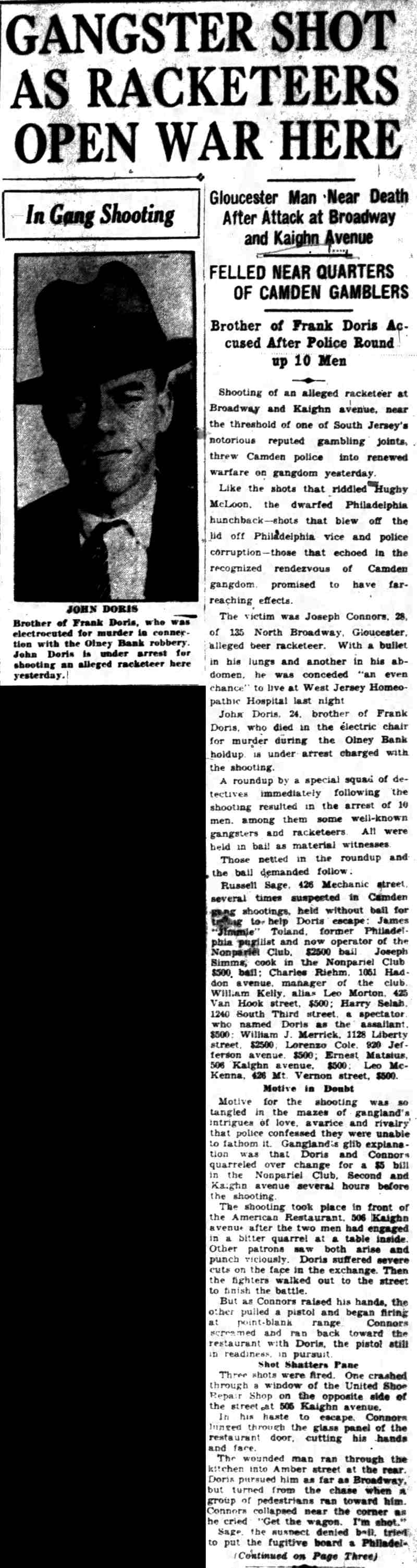

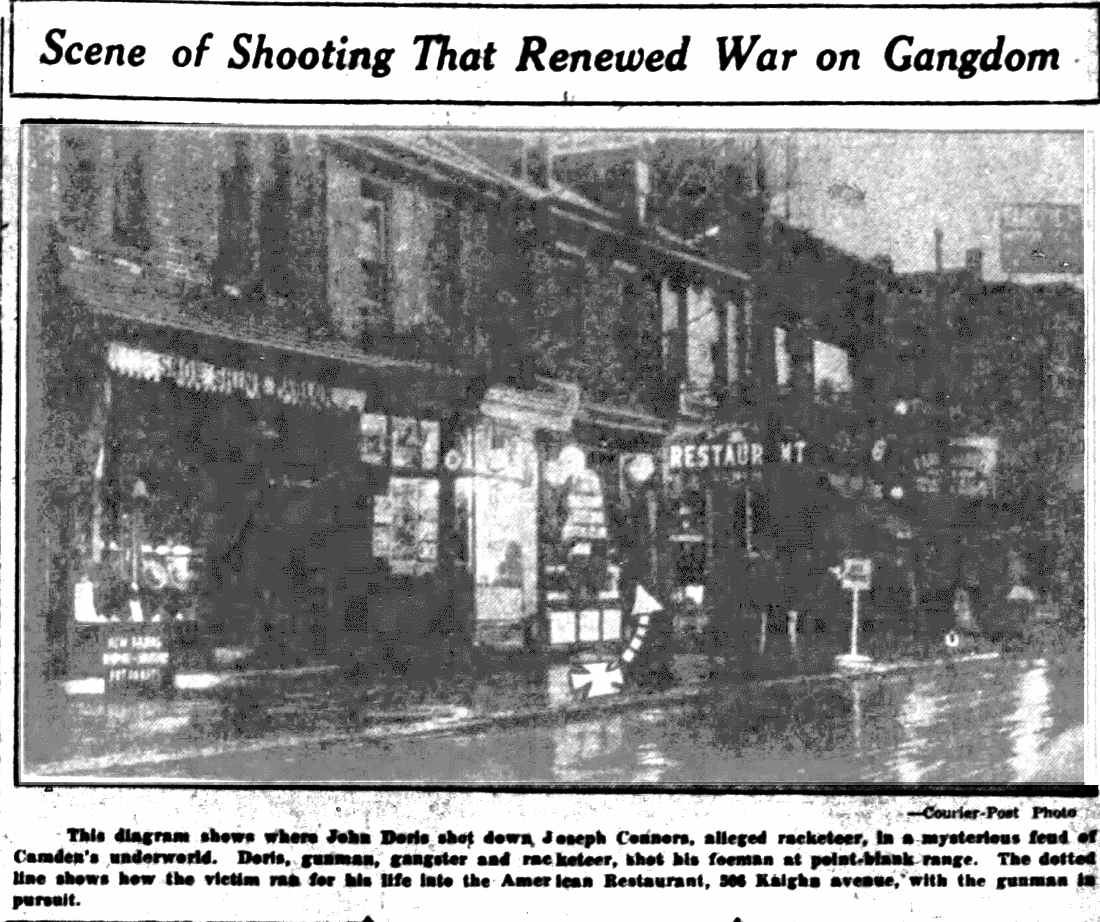
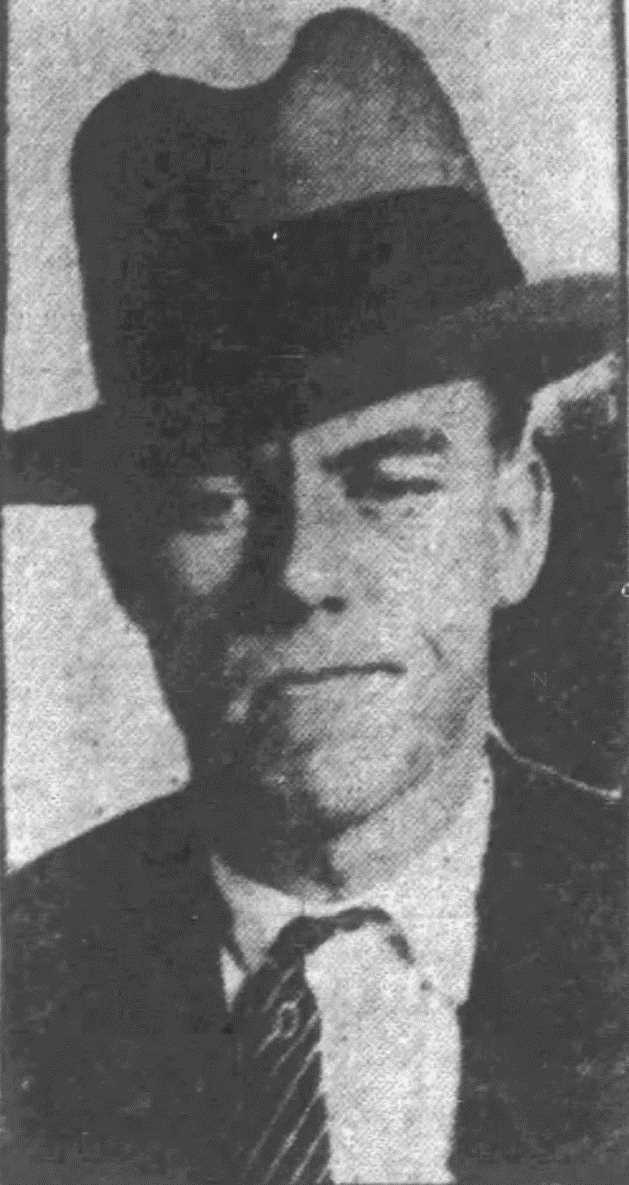
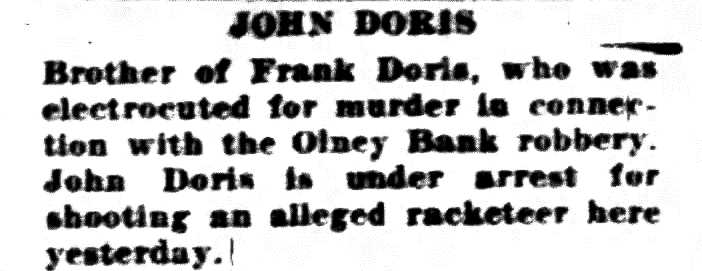
Gangster Shot as Racketeers Open War Here
GANGSTER SHOT AS RACKETEERS OPEN WAR HERE
Gloucester Man Near Death After Attack at Broadway and Kaighn Avenue
FELLED NEAR QUARTERS OF CAMDEN GAMBLERS
Brother of Frank Doris Accused After Police Round Up 10 Men
Shooting of an alleged racketeer at Broadway and Kaighn avenue, near the threshold of one of South Jersey's notorious reputed gambling joints, threw Camden police into renewed warfare on gangdom yesterday.
Like the shots that riddled Hughy McLoon, the dwarfed Philadelphia hunchback—shots that blew off the lid off Philadelphia vice and police corruption—those that echoed in the recognized rendezvous of Camden gangdom promised to have far-reaching effects.
The victim was Joseph Connors, 28, of 135 North Broadway, Gloucester, alleged beer racketeer. With a bullet in his lungs and another in his abdomen, he was conceded "an even chance" to live at West Jersey Homeopathic Hospital last night.
John Doris, 24, brother of Frank Doris, who died in the electric chair for murder during the Olney Bank holdup is under arrest charged with the shooting.
A roundup by a special squad of detectives immediately following the shooting resulted in the arrest of 10 men, among them some well-known gangsters and racketeers. All were held in bail as material witnesses.
Those netted in the roundup and the bail demanded follow:
Russell Sage, 426 Mechanic street, several times suspected in Camden gang shootings, held without bail for trying to help Doris escape; James "Jimmie" Toland, former Philadelphia paplist and now operator of the Nonpareil Club, $2500 bail; Joseph Simms, cook in the Nonpareil Club, $500 bail; Charles Riehm, 1051 Haddon avenue, manager of the club; William Kelly, alias Leo Morton, 425 Van Hook street, $500; Harry Selah, 1240 South Third street, a spectator who named Doris as the assailant; William J. Merrick, 1128 Liberty street, $2500; Lorenzo Cole, 920 Jefferson avenue, $500; Ernest Matsios, 506 Kaighn avenue, $500; Leo McKenna, 426 Mt. Vernon street, $500.
Motive in Doubt
Motive for the shooting was so tangled in the mazes of gangland's intrigues of love, avarice and rivalry that police confessed they were unable to fathom it. Gangland's glib explanation was that Doris and Connors quarreled over change for a $5 bill in the Nonpareil Club at Broadway and Kaighn avenue several hours before the shooting.
The shooting took place in front of the American Restaurant, 506 Kaighn avenue after the two men had engaged in a bitter quarrel at a table inside. Other patrons saw both arise and punch viciously. Doris suffered several cuts on the face in the exchange. Then the fighters walked out to the street to finish the battle.
But as Connors raised his hands, the other pulled a pistol and began firing at point-blank range. Connors screamed and ran back toward the restaurant, the pistol still in readiness in pursuit.
Shot Shatters Pane
Three shots were fired. One crashed through a window of the United Shoe Repair Shop on the opposite side of the street at 505 Kaighn avenue.
In his haste to escape, Connors collapsed near the glass pane of the restaurant door, cutting his hands and face.
The wounded man ran through the kitchen into Amber street at the rear. Doris pursued him as far as Broadway but turned from the chase when a group of pedestrians ran toward him.
A few seconds later, Connors staggered into the restaurant, holding onto his stomach, ran through the kitchen into a back room, looking for a way out. And Doris, the gun still in his hand, followed, but tripped and fell, and then got up and continued the chase.
Almost identical testimony was given by James Sims, also a cook.
Doris was the only witness for the defense. He "remembered nothing" of how he happened at being "punched in the nose, some place in South Camden." Doris was on the stand only a few minutes. As he left, Keown rested his case.
Doris first was tried in the Connors' shooting last June. Arraigned on charges of atrocious assault and battery and carrying concealed deadly weapons, he was returned to the county jail pending a second trial when the jury, although believing him guilty, disagreed as to his charge. The first trial was comprised of eleven women and three men.
Doris, in addition to being involved in the Broadway and Kaighn avenue shooting, is believed by police to hold the key to solution of the mysterious murder of Joseph "Mose" Flannery, for which he is under indictment.
Camden Courier-Post — April 30, 1929

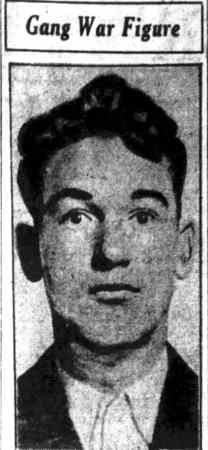
Action Delayed in Gang Shooting
ACTION DELAYED IN GANG SHOOTING
Indictment of Doris in Flannery Murder Revealed After Arrest
Assistant Prosecutor Rocco Palese was prepared last night to go to the bottom of all charges against John Doris, brother of an executed Philadelphia bandit murderer, in an effort to determine whether to press for his immediate trial on indictments accusing him of the killing of Joseph (Mose) Flannery, or to seek other indictments first on charges of shooting Joseph Connors, at 6 a. m. Sunday.
The condition of Connors, a reputed Gloucester racketeer, remained the same last night in West Jersey Homeopathic Hospital, where doctors said the crisis was not yet passed. He has bullet wounds in the lung, abdomen and the hand, physicians saying it was too soon to predict whether he had a chance for recovery.
Doris Arraigned
Doris was arraigned before Police Judge Pancoast yesterday charged with shooting Connors near Broadway and Kaighn avenue, after a brawl which took them into two resorts and finally ended on the street outside. The judge held him for grand jury action on that charge, and was about to close the case when City Detective J. Wesley McGrath took the stand and revealed that Doris was wanted in the mysterious murder of "Mose" Flannery, Camden racketeer, seven months ago at Front street and Kaighn avenue. Pancoast promptly denied him bail.
Palese Studies Case
The Flannery case was placed before the grand jury by former Assistant Prosecutor Samuel P. Orlando, who left his notes with the indictment in the office when he relinquished his post to Palese.
"I will study the case tomorrow," Palese said last night. "Until I do, and can learn the strength of the old case against Doris in the Flannery murder, I can't say which charge I might take before a jury, provided, of course, that we can get an indictment in the Connors case against the youth."
Connors, who is 28, lives at 135 North Broadway, Gloucester. He has been arrested twice, once in Gloucester for disorderly conduct in 1924, and later on a grand larceny charge, on which he was acquitted.
Doris is a brother of the late Frankie Doris, who with three other youths went to the electric chair for the murder of a policeman in the Olney Bank robbery. (Continued on Page Twenty-one)
Doran in Auto Crash
Camden Courier-Post —
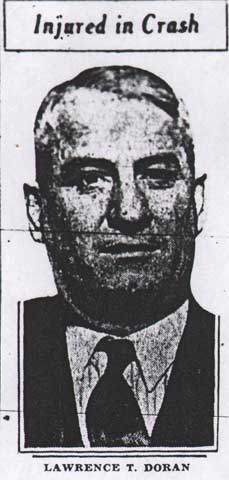
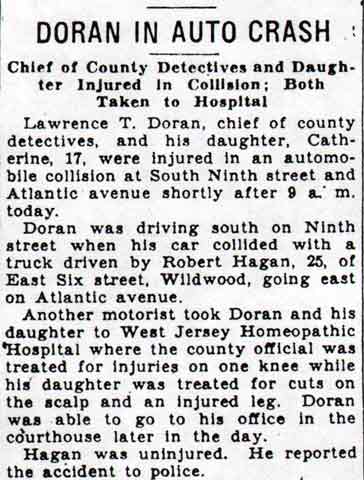
Chief of County Detectives and Daughter Injured in Collision; Both Taken to Hospital
Lawrence T. Doran, chief of county detectives, and his daughter, Catherine, 17, were injured in an automobile collision at South Ninth street and Atlantic avenue shortly after 9 a.m. today.
Doran was driving south on Ninth street when his car collided with a truck driven by Robert Hagan, 25, of East Sixth street, Wildwood, going east on Atlantic avenue.
Another motorist took Doran and his daughter to West Jersey Hospital where the county official was treated for injuries on one knee while his daughter was treated for cuts on the scalp and an injured leg. Doran was able to go to his office in the courthouse later in the day.
Hagan was uninjured. He reported the accident to police.
Camden Courier-Post — June 30, 1930

[...] Lunges Knife in Heart of Husband as He Strikes Her
[...] NGES KNIFE IN HEART [OF] HUSBAND AS HE STRIKES HER
Man Dies and Woman Confesses to Police She Killed Him During Quarrel
INSISTS SHE LOVED HIM, AFTER NEWS OF DEATH
Says Spouse Had Been in Habit of Punching Her Over 11-Year Period
Stabbed through the heart with a [broad?] knife wielded by his wife last night after a quarrel over the way she was preparing a meal, John W. Edwards, manager of a gasoline station of 904 Newton avenue, died 20 minutes [later] in Cooper Hospital.
A formal charge of murder will be [lodged] against the woman, Mrs. Helen Edwards, 36, today.
[Arrested] within 20 minutes after the [death] of her husband she confessed at [police] headquarters.
Two men who witnessed the stab[bing] are being held as material wit[nesses]. They are Fred Crozier, of 19 Union avenue, Mt. Holly, and Eugene Moreslander, 25, of 905 Newton avenue. The fatal feud came as the result of objections raised over the manner in which Mrs. Edwards was preparing a meal.
Says He Struck Her
Mrs. Edwards told police her hus[band] struck with his fist. Enraged, [she] picked up a carving knife in an effort to protect herself, and as Ed[wards] rushed to hit her again, she [stabbed] him through the heart. Crozier ran to the street and hailed [an] automobile, which took the victim [to] the hospital.
[First] information of the stabbing [reached] police headquarters after De[tective] Anson Kelly entered the hos[pital] to investigate an automobile ac[cident] case. [Of]ficials notified him a man had [been] stabbed and was in a critical [con]dition. As Kelly entered the operat[ing] room, Edwards had died. Crozier who was still at the hospit[al] was arrested. Mrs. Edwards and Moreslander also were arrested shortly after by Detectives William Boettcher and Kelly.
Confession by Mrs. Edwards was made before William McDonald, court stenographer; Lawrence Doran, chief of county detectives and Captain John Golden of the detective bureau.
She Loved Him
Through it all Mrs. Edwards, who weighs 110 pounds, was calm. She told a story of how her husband, who weighed 225 pounds, had made a habit of striking her at frequent intervals over a period of 11 years. She could not stand it any longer, she said, so she reached for a knife to spare him off. Then notified that her husband was [dea]d, she was led away to her cell [cry]ing. "Don't tell me that he is dead. I loved that man." The Edwards lived over the gasoline station the victim operated for William D. Crozier of Mt. Holly, father of one of the witnesses. The junior Crozier was released in [cus]tody of his father after questioning at police headquarters and will be [req]uired to appear at the arraignment later. Moreslander was held overnight [without] bail.
7 Inns Are Raided By County Police
Camden Courier-Post —
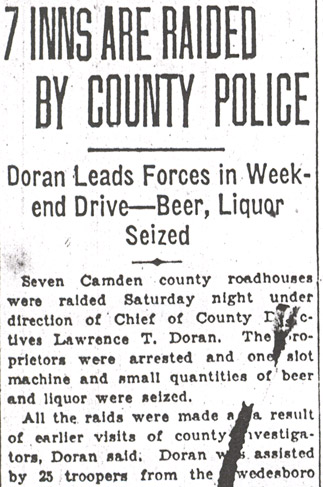
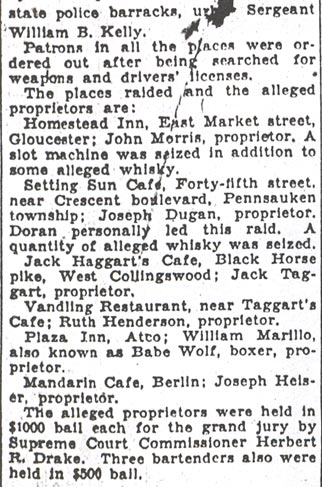
Doran Leads Forces in Weekend Drive—Beer, Liquor Seized
Seven Camden county roadhouses were raided Saturday night under the direction of Chief of County Detectives Lawrence T. Doran. The proprietors report one slot machine and small quantities of beer and liquor were seized.
All the raids were made as a result of earlier visits of county investigators, Doran said. Doran was assisted by 25 troopers from the Swedesboro state police barracks, under Sergeant William B. Reilly.
Patrons in all the places were ordered out after being searched for weapons and drivers’ licenses. The places raided: Homestead Inn, East Market street, Gloucester, John Murphy, proprietor, where a slot machine was seized in addition to some whiskey; Ray’s Inn, near Crescent boulevard, Pennsauken township, Joseph H. Doran, proprietor, where Doran personally led the raid and a quantity of alleged whiskey was seized; Jack Pike, West Collingswood, Jack Engel, proprietor; Candling Restaurant, near Taggart’s corners, Haddonfield; The Inn, Atco, William Marillo, proprietor; Michian Cafe, Berlin, Joseph Holststein, proprietor.
Bail of $1,000 each for the grand jury was set by Magistrate Charles W. Neff. Three bartenders also posted bail of $500 each.
Camden Courier-Post — December 13, 1930
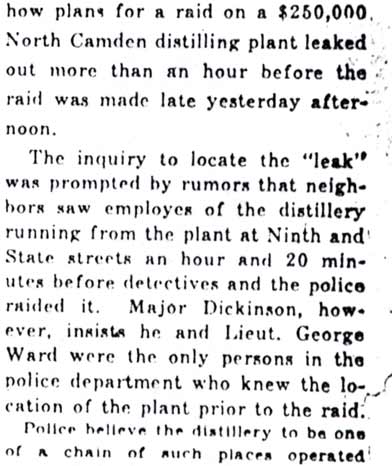
PROBE STARTED BY DICKINSON IN RAID 'LEAK
PROBE STARTED BY DICKINSON IN RAID 'LEAK'
Camden Courier-Post — August 24, 1931

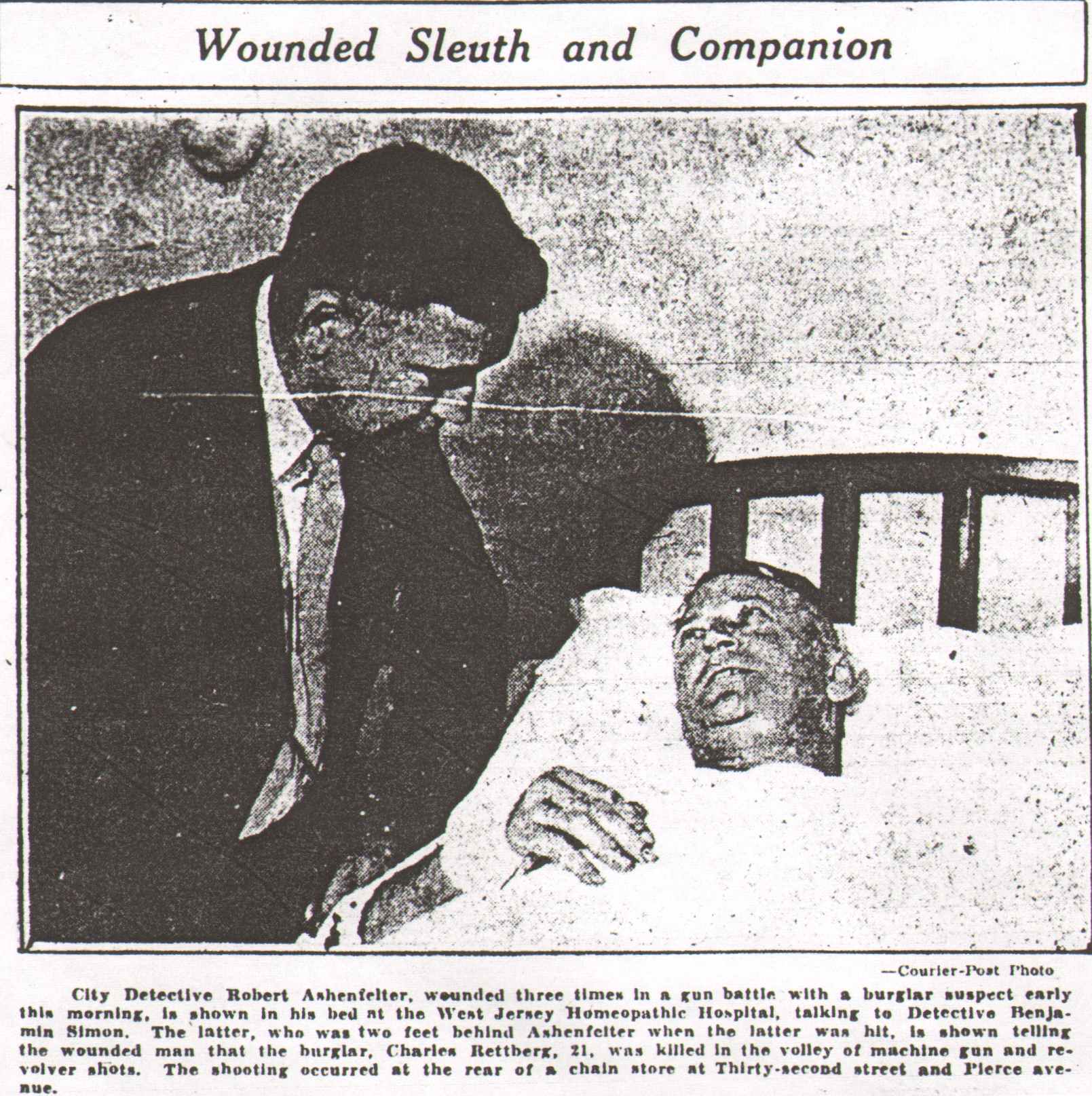
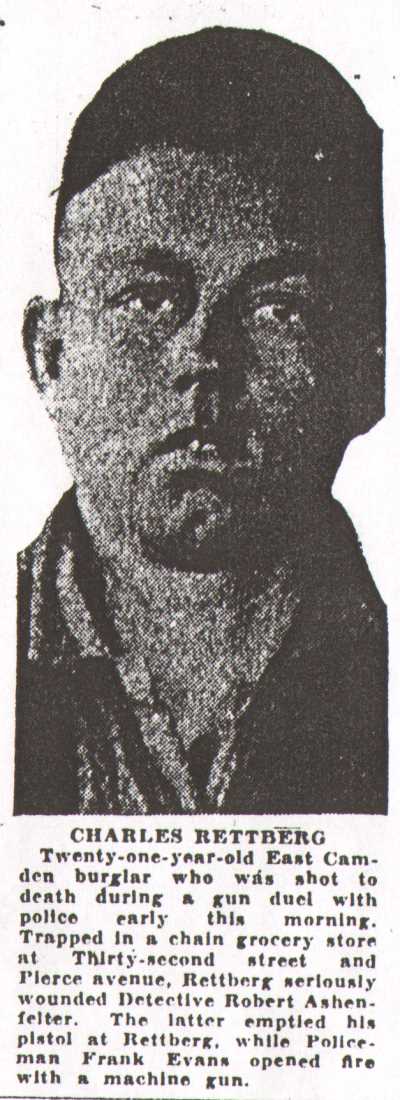
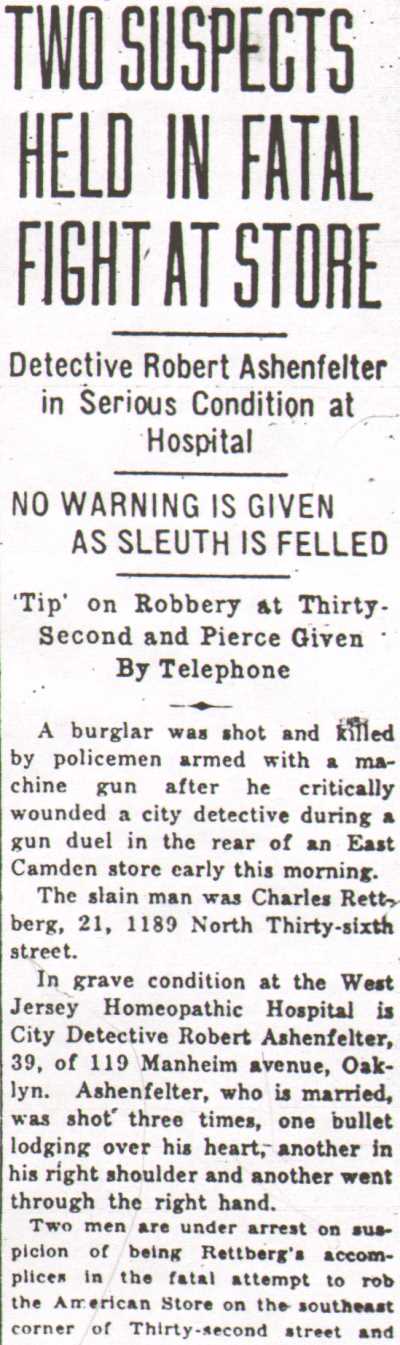
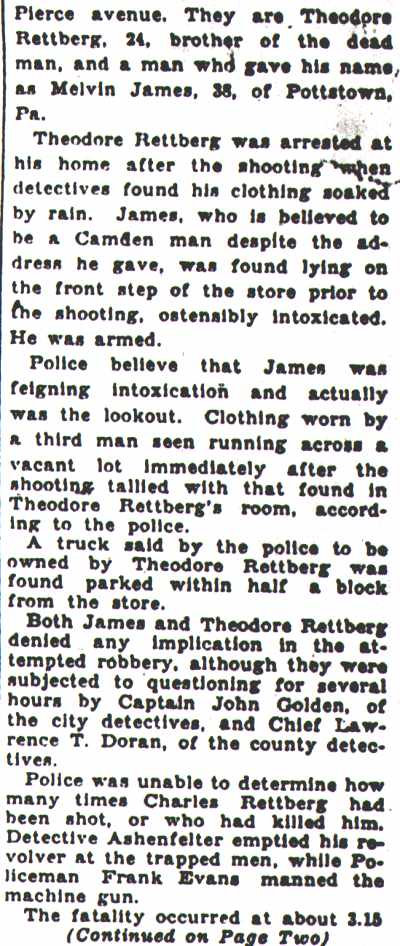
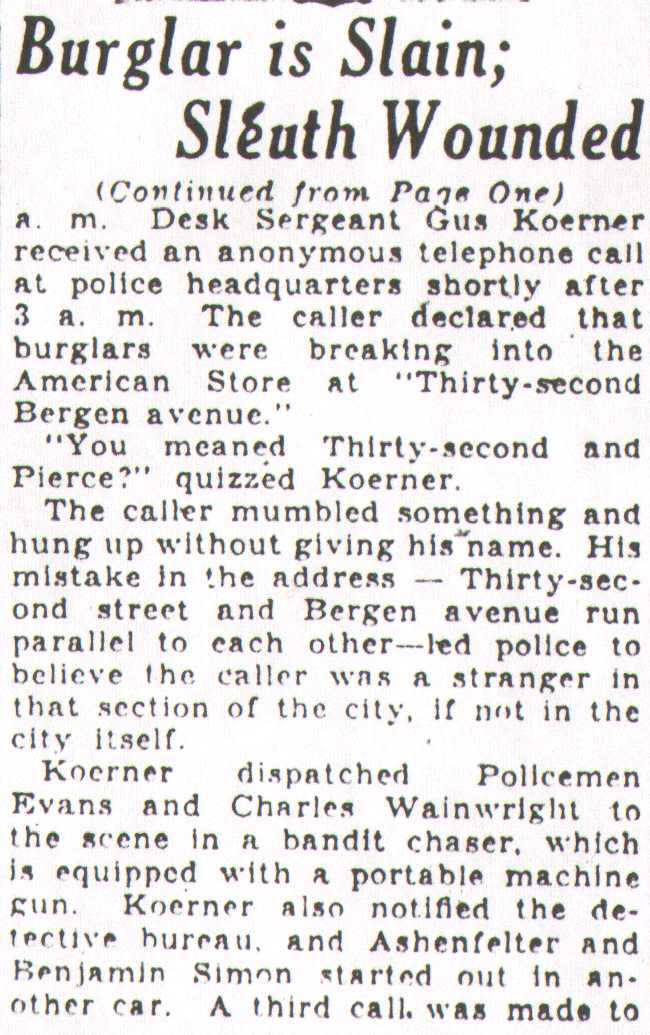
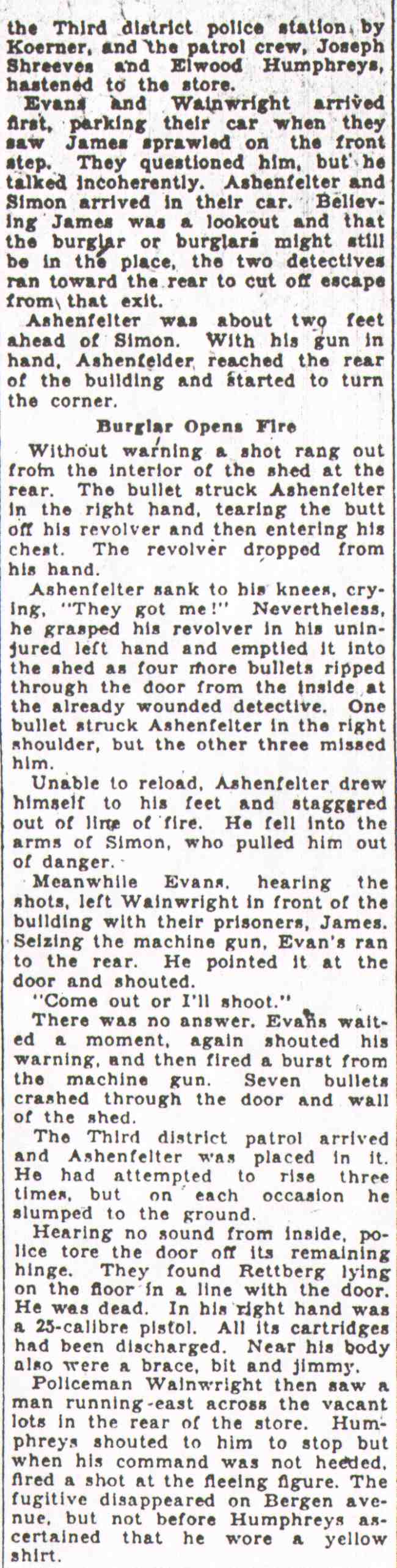

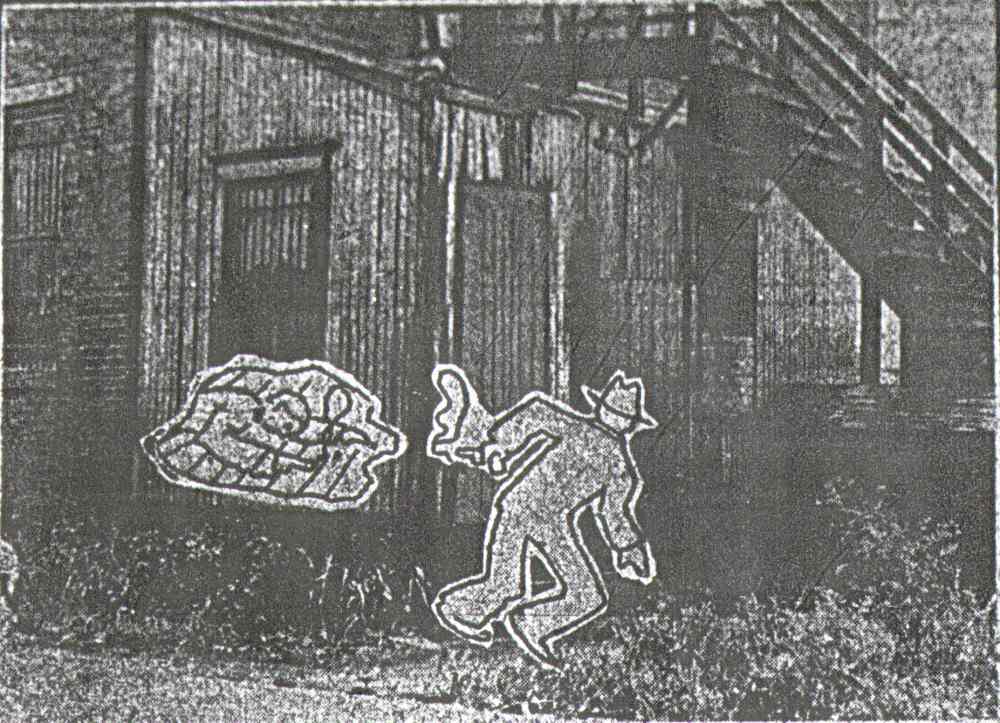

Camden Burglar Slain; Cop Wounded in Gun Duel
CAMDEN BURGLAR SLAIN; COP WOUNDED IN GUN DUEL
Cleveland Plain Dealer — August 25, 1931
Cleveland Plain Dealer — August 25, 1931
Camden Courier-Post — August 25, 1931

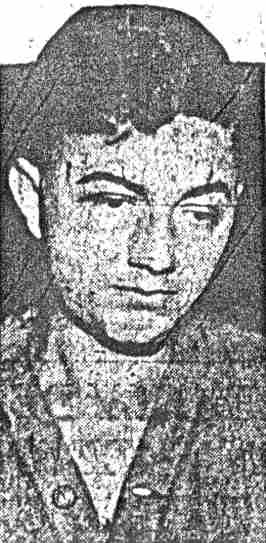
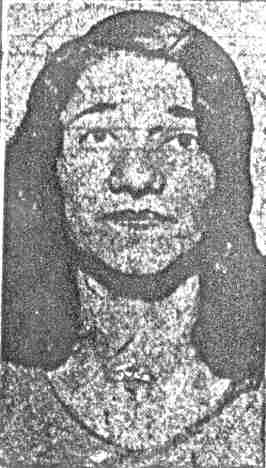
3 Men Quizzed in Gun Fight of Cops and Thief
3 Men Quizzed in Gun Fight of Cops and Thief
Camden Courier-Post — August 26, 1931
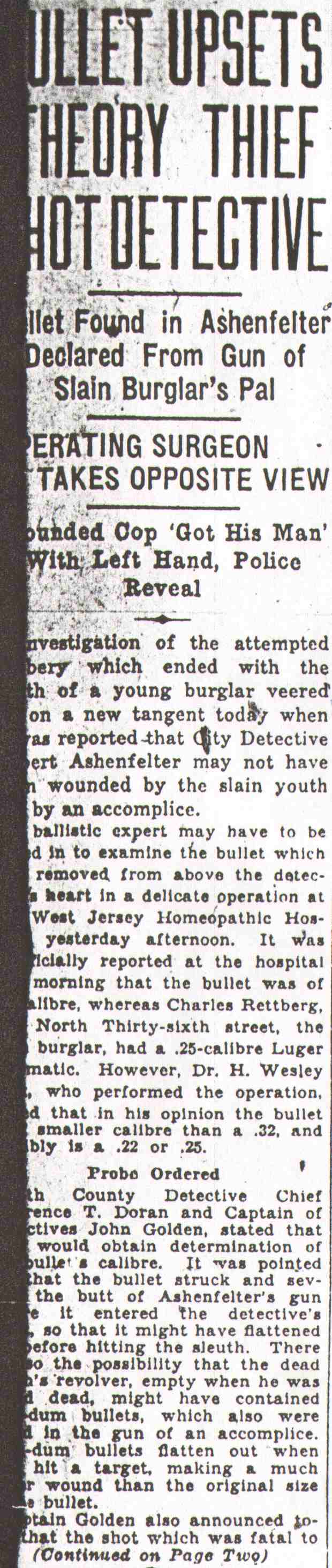
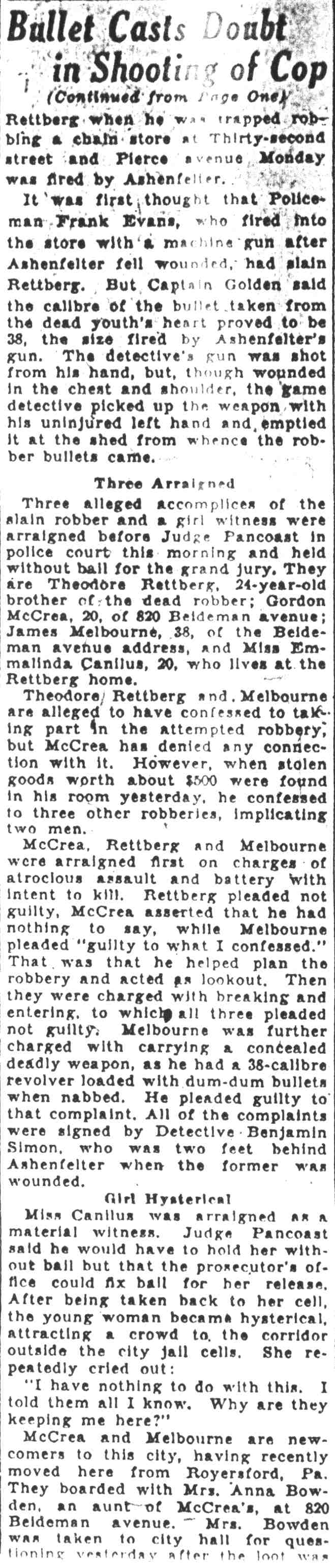
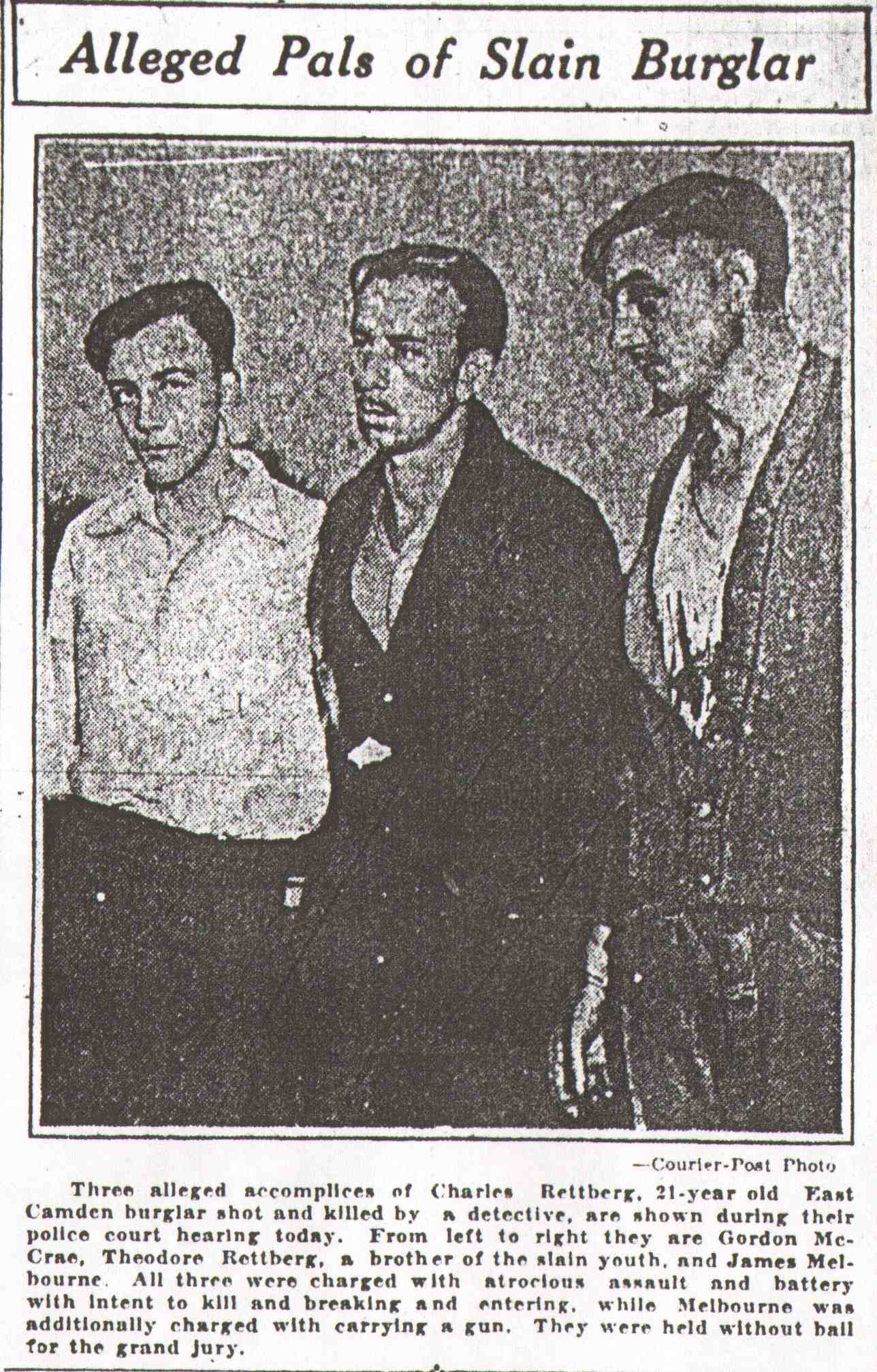
Bullet Upsets Theory Thief Shot Detective
Bullet Upsets Theory Thief Shot Detective
[Left edge of image cropped; partial text visible]
Jersey Gangster Names Slayers Before He Dies
Bridgewater Courier-News —
Camden—(U.P.)—Gangsters were successful in their second attempt to kill Edward A. Kenney, 31.
But before Kenney died in West Jersey Homeopathic Hospital yesterday, it was reported he violated the underworld code and named his slayers.
Kenney was shot as he sat in his parked car yesterday morning, a .45 calibre slug striking his knee and glancing upward into his abdomen.
Detective-Lieut. Louis Shaw said the police knew Kenney as a small-time trafficker in women and a racketeer preying on disorderly houses. He was shot at on June 12, last, but the lone gunman missed that time.
William Pernier and William Bonner, who were picked up shortly after the shooting and held on suspicion, and George Leventhal, held as a material witness, were taken to the hospital to confront Kenney, but when they arrived, Kenney was dead.
According to the police, the windows of Bonner’s car are missing and there is a bullet hole in the rear mudguard. Police said he told them the hole was made during the summer when shots were fired at him and Pernier. Patrolman William Hall fired six shots at the car from which Kenney was wounded. Chief Lawrence T. Doran of county detectives, said “Kenney told us we had the right men.”
Washington Post — August 17, 1931 (published October 21, 1931)
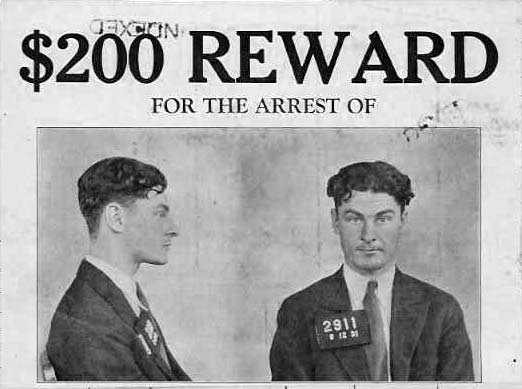
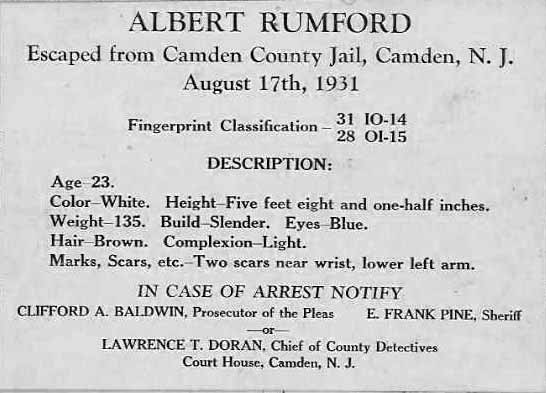
$200 Reward — Albert Rumford Wanted Poster
$200 REWARD FOR THE ARREST OF ALBERT RUMFORD. Escaped from Camden County Jail, Camden, N.J., August 17th, 1931.
DESCRIPTION: Age–23. Color–White. Height–Five feet eight and one-half inches. Weight–135. Build–Slender. Eyes–Blue. Hair–Brown. Complexion–Light. Marks, Scars, etc.–Two scars near wrist, lower left arm.
IN CASE OF ARREST NOTIFY: Clifford A. Baldwin, Prosecutor of the Pleas; E. Frank Pine, Sheriff; or Lawrence T. Doran, Chief of County Detectives; Court House, Camden, N.J.
Camden Courier-Post — March 21, 1932
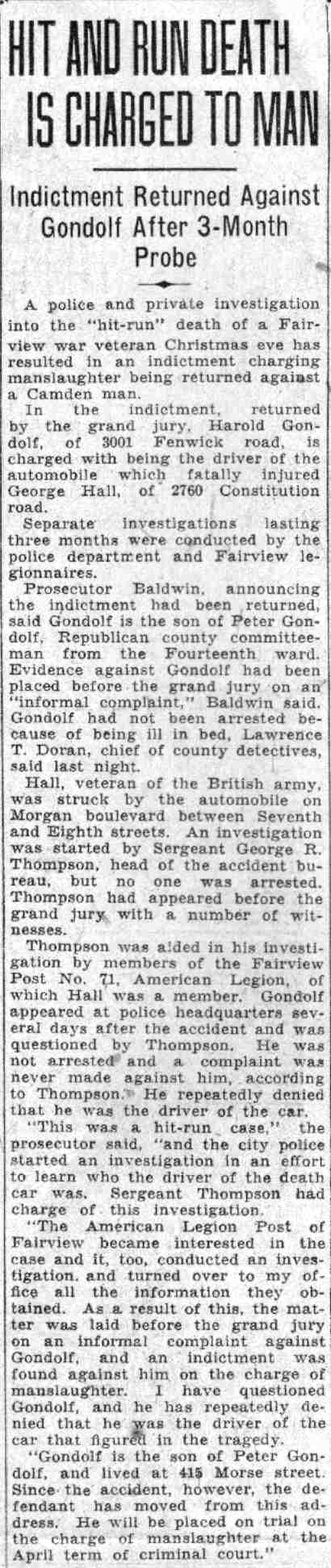
Indictment Returned Against Gondolf After 3-Month Probe
A police and private investigation into the “hit-run” death of a Fairview war veteran Christmas eve has resulted in an indictment charging manslaughter being returned against a Camden man.
In the indictment, returned by the grand jury, Harold Gondolf, of 3001 Fenwick road, is charged with being the driver of the automobile which fatally injured George Hall, of 2760 Constitution road.
Separate investigations lasting three months were conducted by the police department and Fairview legionnaires.
Prosecutor Baldwin, announcing the indictment had been returned, said Gondolf is the son of Peter Gondolf, Republican county committeeman from the Fourteenth ward. Evidence against Gondolf had been placed before the grand jury on an “informal complaint,” Baldwin said. Gondolf had not been arrested because of being ill in bed, Lawrence T. Doran, chief of county detectives, said last night.
Hall, veteran of the British army, was struck by the automobile on Morgan boulevard between Seventh and Eighth streets. An investigation was started by Sergeant George R. Thompson, head of the accident bureau, but no one was arrested. Thompson had appeared before the grand jury with a number of witnesses.
Thompson was aided in his investigation by members of the Fairview Post No. 71, American Legion, of which Hall was a member. Gondolf appeared at police headquarters several days after the accident and was questioned by Thompson. He was not arrested and a complaint was never made against him, according to Thompson. He repeatedly denied that he was the driver of the car.
“This was a hit-run case,” the prosecutor said, “and the city police started an investigation in an effort to learn who the driver of the death car was. Sergeant Thompson had charge of this investigation.
“The American Legion Post of Fairview became interested in the case and it, too, conducted an investigation, and turned over to my office all the information they obtained. As a result of this, the matter was laid before the grand jury on an informal complaint against Gondolf, and an indictment was found against him on the charge of manslaughter. I have questioned Gondolf, and he has repeatedly denied that he was the driver of the car that figured in the tragedy.
“Gondolf is the son of Peter Gondolf, and lived at 415 Morse street. Since the accident, however, the defendant has moved from this address. He will be placed on trial on the charge of manslaughter at the April term of criminal court.”
Mobster Slain by Enemies of Phila. Gang on Camden ‘Ride’
Camden Courier-Post —
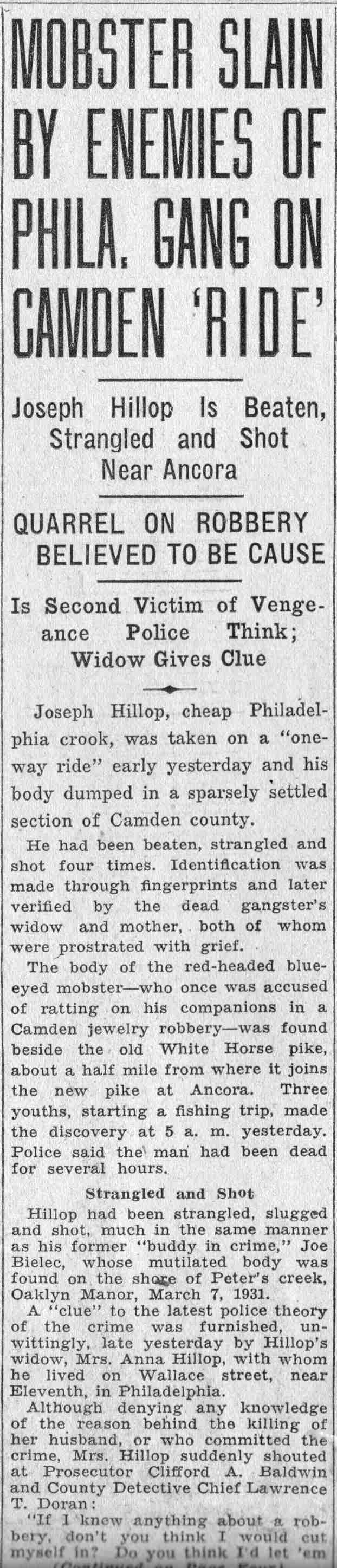
Joseph Hillop Is Beaten, Strangled and Shot Near Ancora
Quarrel on Robbery Believed to Be Cause
Joseph Hillop, cheap Philadelphia crook, was taken on a “one-way ride” early yesterday and his body dumped in a sparsely settled section of Camden county.
He had been beaten, strangled and shot four times. Identification was made through fingerprints and later verified by the dead gangster’s widow and mother, both of whom were prostrated with grief.
The body of the red-headed blue-eyed mobster—who once was accused of ratting on his companions in a Camden jewelry robbery—was found beside the old White Horse pike, about a half mile from where it joins the new pike at Ancora. Three youths, starting a fishing trip, made the discovery at 5 a.m. yesterday. Police said the man had been dead for several hours.
A “clue” to the latest police theory of the crime was furnished, unwittingly, late yesterday by Hillop’s widow, Mrs. Anna Hillop, with whom he lived on Wallace street, near Eleventh, in Philadelphia. Although denying any knowledge of the reason behind the killing of her husband, or who committed the crime, Mrs. Hillop suddenly shouted at Prosecutor Clifford A. Baldwin and County Detective Chief Lawrence T. Doran: “If I knew anything about a robbery, don’t you think I would cut myself in? Do you think I’d let ‘em get away with it without giving me a piece?”
Her remarks, police believe, were made because her husband had been engaged recently in forcing other crooks to divide loot with him on robberies he knew they had committed, with which he had no connection.
Prosecutor Baldwin first believed Hillop’s death had been the result of a mob war following a jewelry store robbery more than two years ago. At that time three bandits held up and robbed the jewelry store of Abe Fuhrman & Son, 444 Broadway, escaping with $3,000 in jewelry.
A short time later Hillop, Bielec, Frank Rock, Tommy Riely, Alfred Ripka, John Reilly were arrested in connection with the holdup. Rock, Bielec and Reilly each were sentenced to serve 10 to 30 years in the Eastern Penitentiary, following a conviction for the Camden job, while Hillop got 18 months for their part in the crime. Ripka and Frank “beat the rap” and were freed.
Three county detectives looked for a day or more following the discovery of the body a few feet off the road. They notified state police at Hammonton and the body was removed to the Winslow Township Homeopathic Hospital morgue after being examined by Coroner Arthur H. Holl. Fingerprints were taken by state police and copies taken to Philadelphia by State Trooper Osborne. Detective Chief Doran began his investigation as soon as the body was identified.
His cream-colored fedora was found 200 feet from the body. Joe’s nose was broken, his ear bashed in, head cut and swollen from blows of a blunt instrument. His pockets had been stripped except for a 5-cent piece, half a pack of cigarettes and two handkerchiefs. But the fingerprints can’t be counterfeited, so it was only eight hours or so after the police were called in that the body was identified by means of them.
Gangster’s Widow Gets Hillop’s Body
Camden Courier-Post —
Two Undertakers Seek Possession of Remains, But Doran Decides
The remains of Joseph Hillop, 25, slain gangster whose mutilated body was found on a little-used road near Ancora early Wednesday, was turned over to his widow yesterday for burial.
When two undertakers sought possession of the body yesterday hospital authorities called Chief of County Detectives Lawrence T. Doran.
He learned that one undertaker was sent for the body by the widow, Mrs. Anna Hillop, while the second one was claiming the body for the dead gangster’s mother, Mrs. Lena Hillop. Both live in Philadelphia. Doran ordered the widow’s undertaker be given possession.
Mrs. Hillop, the widow, was questioned further Thursday night by Prosecutor Baldwin, it was revealed by the latter yesterday. She continues to express the belief her husband was the victim of “mistaken identity,” the prosecutor said.
Since her marriage to Hillop last April, the widow told the prosecutor, she and her husband were stopped on two occasions on the street by men who asked him when he was released from jail.
“Clyde, when did you get out of jail?” the strangers asked Hillop, according to his widow.
“Buddy, you got me wrong, my name’s not Clyde,” Mrs. Hillop said her husband told the men.
Seek Duffy Aide After Finding of Gangster’s Body
Camden Courier-Post —
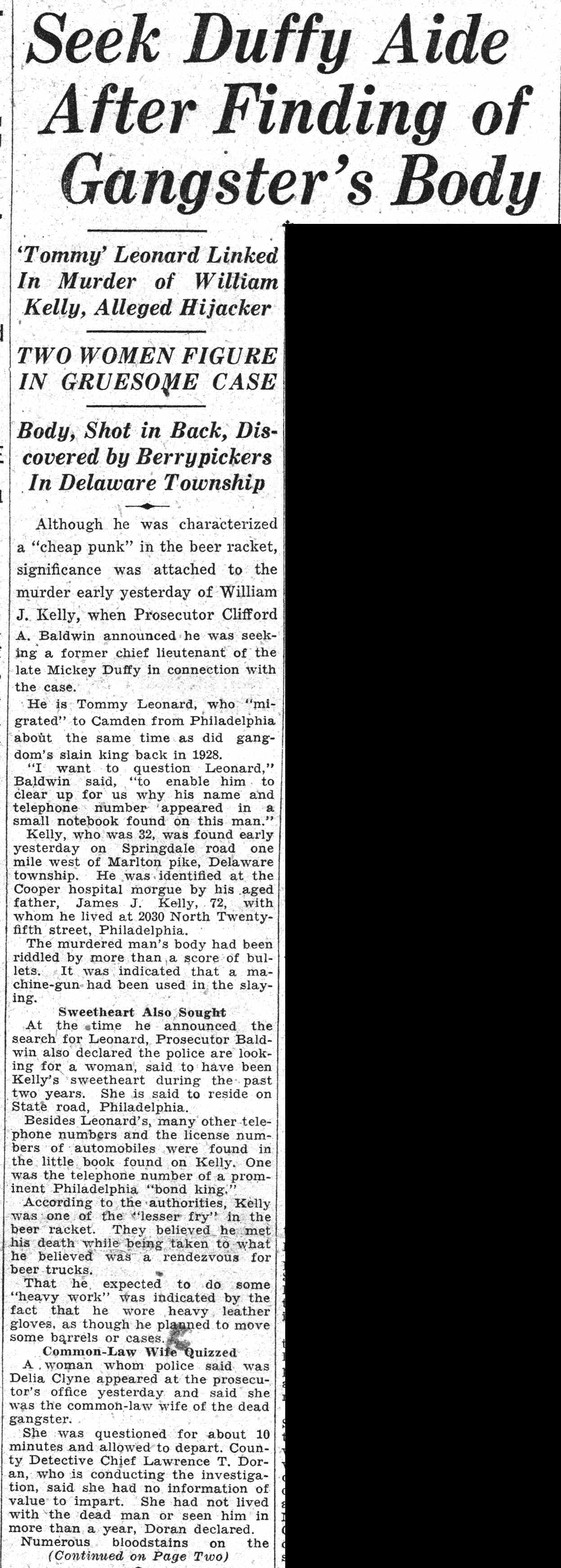
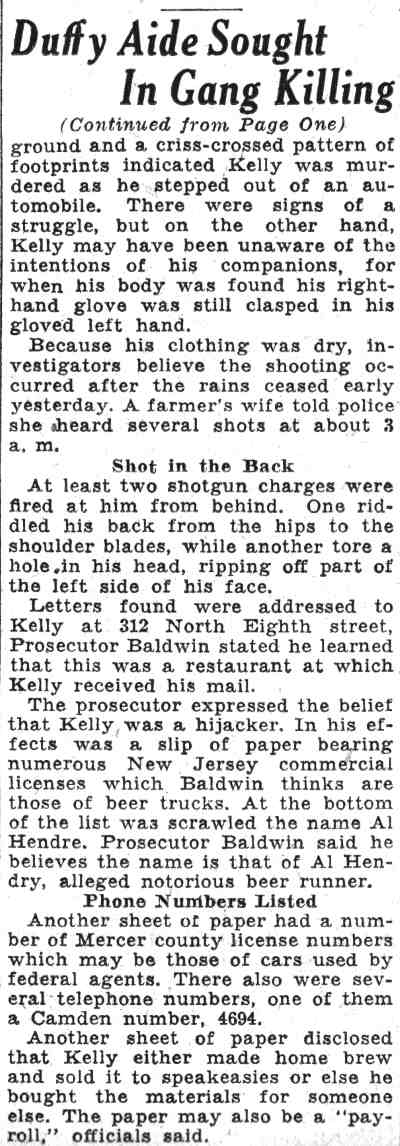
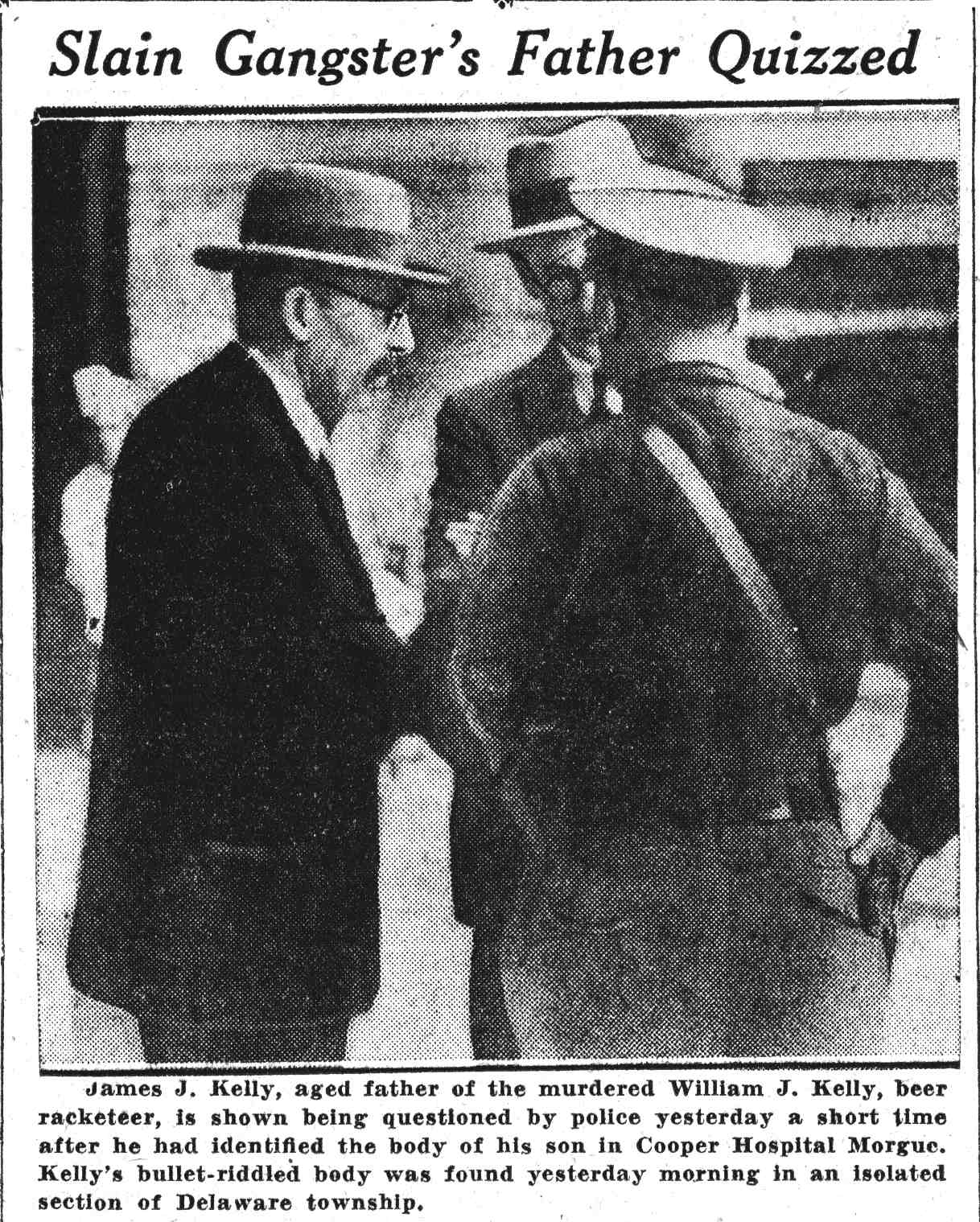

Two Slaying Theories Weighed in Gruesome Case; Hunt for Woman Linked to Murdered Man in Delaware Township
Qualifications are attached to the identity of the man whose badly battered and bullet-riddled body was found yesterday in an isolated section of Delaware township. Every indication, however, points to William J. Kelly, 45, racketeering chief from this city, who has been missing for two weeks. He was killed in what authorities believe was a beer racket murder.
The body, which was decomposed and bore marks indicating death had occurred some days ago, lay in the earth and sparse vegetation beside a road in an isolated farm section.
The murdered man’s body had been riddled by more than a score of bullets. It was indicated that a machine-gun had been used in the slaying.
Sweetheart Also Sought
Prosecutor Baldwin declared the police are looking for a woman, said to have been Kelly’s sweetheart during the past two years. She is said to reside on State road, Philadelphia.
Besides Leonard’s name, many other telephone numbers and the license numbers of automobiles were found in a little book found on Kelly’s person. One was the telephone number of a prominent Philadelphia “bond king.”
According to the authorities, Kelly was one of the “lesser fry” in the beer racket. They believed he met his death while being taken to what he believed was a rendezvous for beer trucks.
Common-Law Wife Quizzed
A woman, whom police said was Delia Olivia, appeared at the prosecutor’s office and said she was the common-law wife of the dead gangster. She was questioned for about 10 minutes and allowed to depart. County Detective Chief Lawrence T. Doran, who is conducting the investigation, said she had no information of value to impart.
Shot in the Back
At least forty bullet wounds were found in the body. The victim died from shots in the back from the hips to the shoulders. Most of them entered a hole in his head, ripping off part of the left side of his face.
At the office of Kelly at 312 North Eighth street, Prosecutor Baldwin learned that this was a restaurant at which Kelly received his mail. In his effects was a slip of paper bearing numerous New Jersey commercial license numbers which Baldwin believes may be those of beer trucks. At the bottom of the list was scrawled the name Al Hendee, Prosecutor Baldwin said he believes the name is that of Al Hendee, alleged notorious beer runner.
Another sheet of paper had a number of Mercer county license numbers which may be those of cars used by federal agents. There also were several telephone numbers, one of them a Camden number, 4694.
The pickers who found the body had first applied at the farm of Frank Ames but found no work to be done. They were on their way to De Cou’s farm when John Giannini, 2310 South Sixteenth street, Philadelphia, saw the body and called to his mother.
Chief John Branin, Lieutenant George Patterson and Patrolman Lynch found the effects in Kelly’s clothing. They then questioned farmers and found Stanley Michaelski, 14, who lives on a farm a quarter mile away. The youth told them that he and his mother, Agnes, heard shots at about 8 a.m.
Camden Courier-Post — September 18, 1933
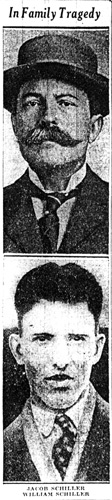
In Family Tragedy
In Family Tragedy
[Photo caption: Jacob Schiller — William Schiller]
Camden Courier-Post — October 12, 1934
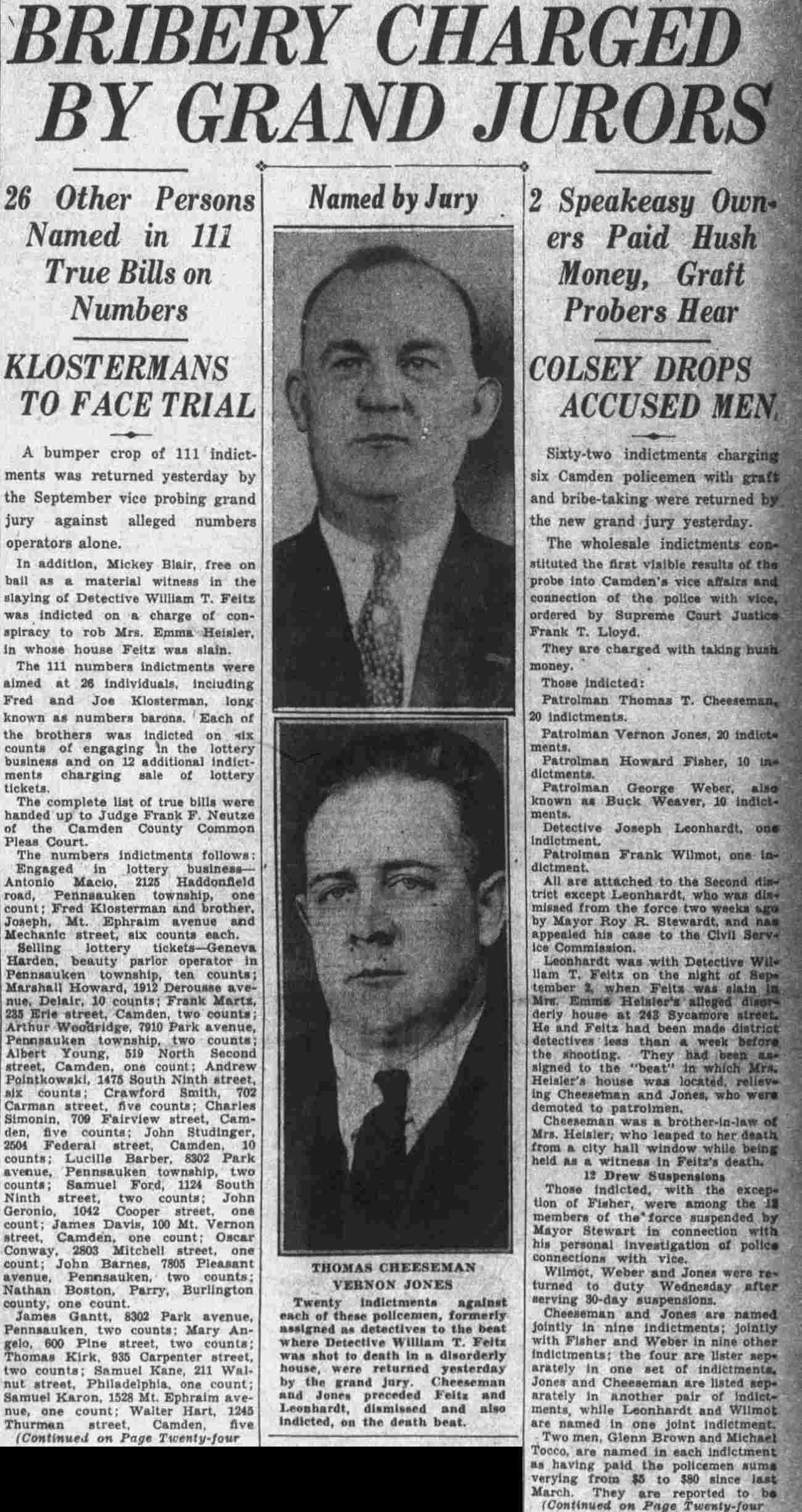
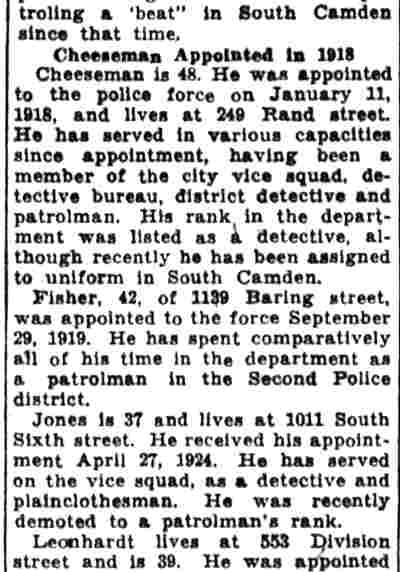
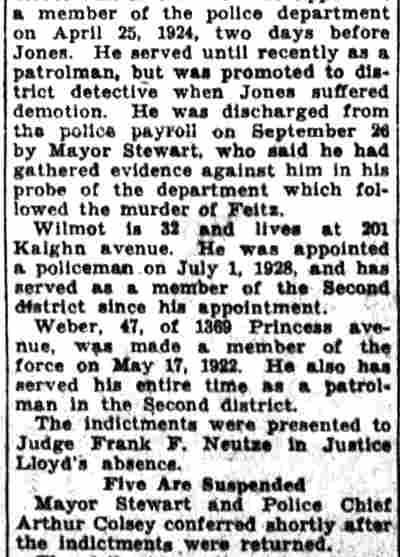
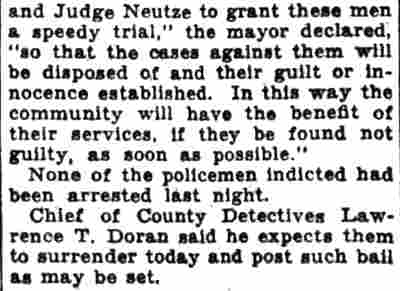
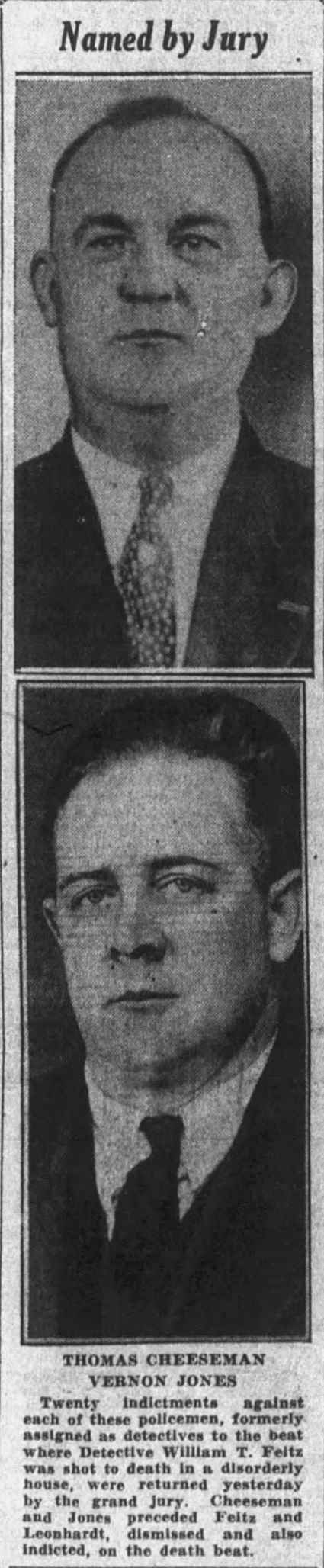
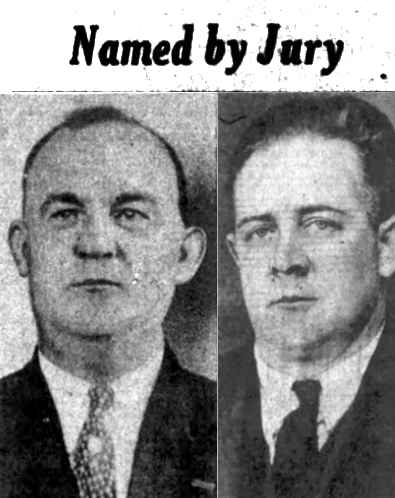
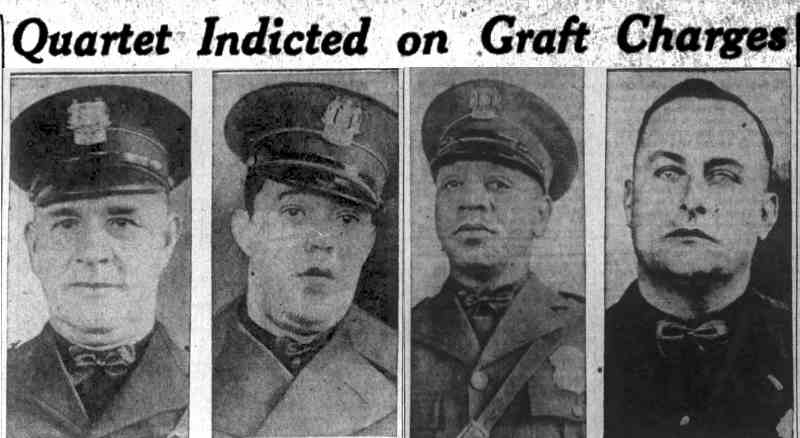

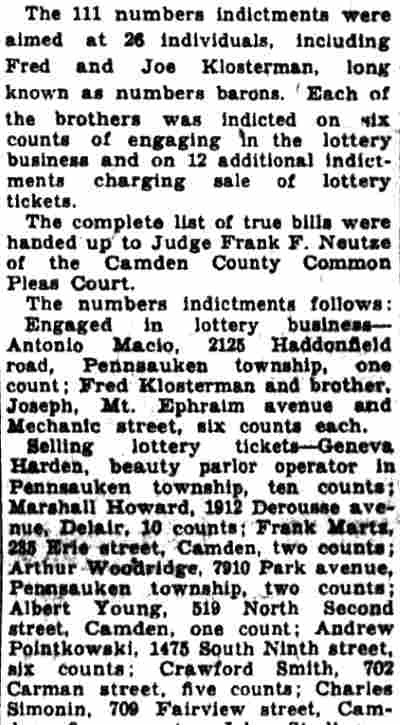
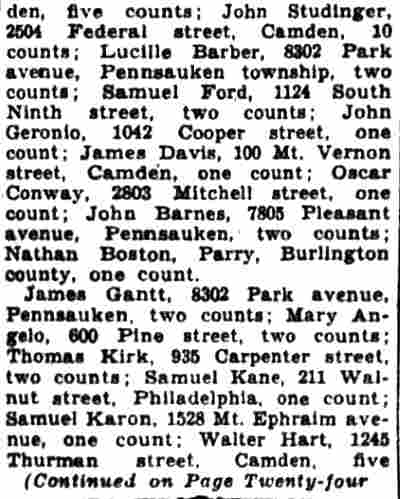
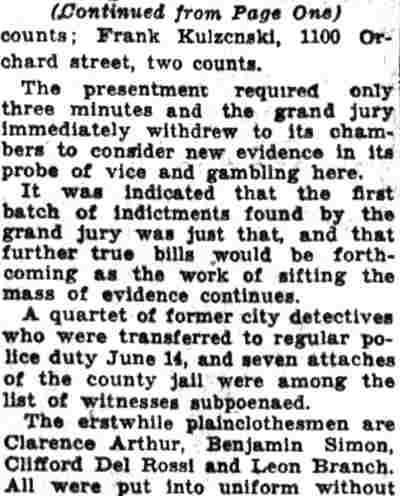
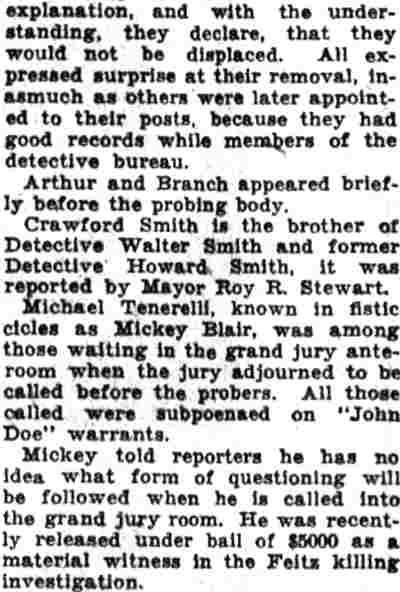
Bribery Charged by Grand Jurors
BRIBERY CHARGED BY GRAND JURORS
26 Other Persons Named in 111 True Bills on Numbers
KLOSTERMANS TO FACE TRIAL
2 Speakeasy Owners Paid Hush Money, Graft Probers Hear
COLSEY DROPS ACCUSED MEN
A bumper crop of 111 indictments was returned yesterday by the September grand jury probing gambling against alleged numbers operators alone.
In addition, Mickey Blair, free on bail as a material witness in the murder of Detective William T. Feitz, was indicted at 26 individuals with craft and bribe-taking, and 111 wholesale indictments constituted the first visible results of the grand jury probe of vice in Camden in connection with the police vice graft probe conducted by Supreme Court Justice Frank T. Lloyd.
Those indicted: Patrolman Thomas C. Cheeseman, 30 indictments; Patrolman Vernon Jones, 30 indictments; Patrolman George Weber, also known as "Bucky Weaver," 20 indictments; Patrolman Frank Wilmot, one indictment.
All are attached to the Second district and were among those suspended from the force two weeks ago in connection with the Feitz inquiry by the Commission.
Looking on in court with Detective Frank T. Feitz on the night of September 2, were detectives George Ward and Samuel Mardino.
Cheeseman was a brother-in-law of Mrs. Emma Heisler and was shot through a city hall window while being used as a target to identify others.
Those indicted, with the exception of the six policemen, were among the 12 members of the force suspended by order of Police Chief Arthur Colsey two weeks ago in connection with vice connections with vice.
Patrolman George Weber is named in 20 indictments; jointly indicted with other detectives in numbers policy indictments; as having paid the policemen along with Patrolman Vernon Jones, in March. They are reported to have also been indicted on 29 separate counts of accepting policy payments.
Four of the six policemen indicted yesterday on charges of bribery. They are George Weber, (upper left) also known as "Bucky Weaver"; Frank Wilmot (upper right), Howard Fisher, (lower left), and Joseph Leonhardt, (lower right), who had been dismissed from the police department.
Camden Courier-Post — January 22, 1935
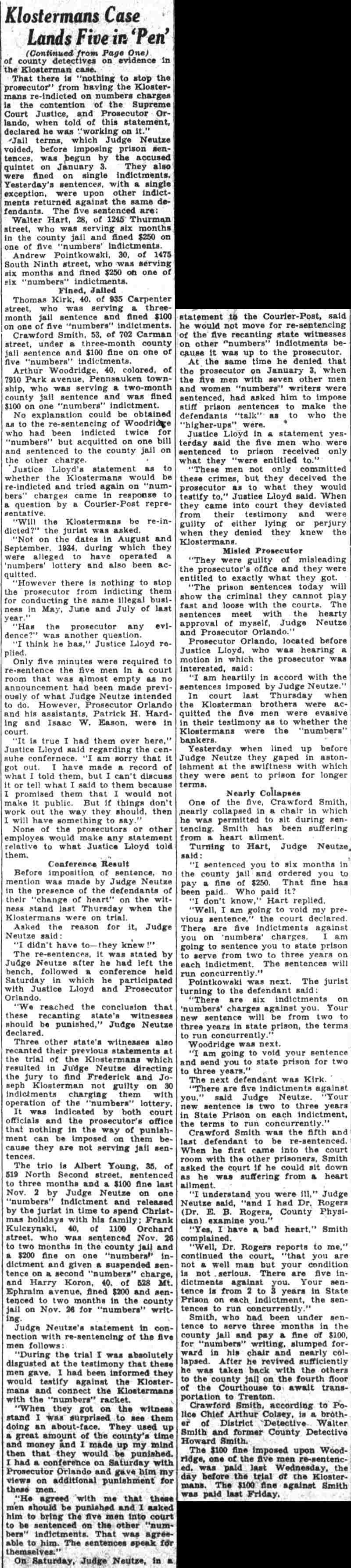
Lloyd Again Prods Orlando and Cops In Numbers Cases
Lloyd Again Prods Orlando and Cops In Numbers Cases
Detectives Told to Produce or Quit by Jurist
FIVE GET ‘PEN’ IN ABOUT-FACE
Five state witnesses, who thought they got off “easy” in numbers cases, yesterday underwent reversal of county jail terms and found themselves sentenced to the penitentiary.
Judge Frank F. Neutze sentenced them in Criminal Court.
Terms ranged from two to three years, and they followed the witnesses’ sudden “about-face” in the Klosterman brothers’ case. The five all convicted numbers writers, recanted testimony last week at the brothers’ trial.
Censure of the prosecutor’s office by Supreme Court Justice Frank T. Lloyd followed. Justice Lloyd called Prosecutor Samuel P. Orlando and his staff to his chambers on the fourth floor of the new courthouse. Attending the conference in addition to Orlando were:
Assistant Prosecutors Harding and Eason, Chief County Detective Lawrence T. Doran, County Detectives James J. Mulligan, James Wren, Joseph Bennie, Casimir Wojtkowiak and Elmer Mathis, and Mrs. Daisy Rourke and Mrs. Ethel Michener, stenographers.
“Go out and do some work, or else be replaced,” is the ultimatum said to have been hurled at the detectives by Justice Lloyd. He is said to be aroused over apparent inactivity of county detectives and inaction in the numbers cases.
(Continued on Page Two)
Police Seeking Hidden Motive in Bar Slaying
Camden Courier-Post —
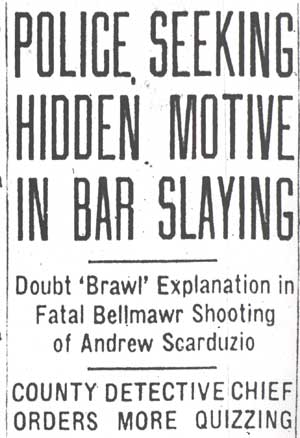
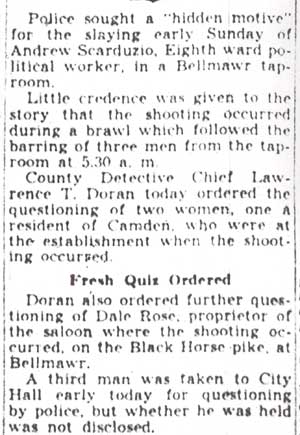
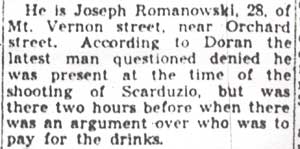
Doubt ‘Brawl’ Explanation in Fatal Bellmawr Shooting of Andrew Scarduzio
County Detective Chief Orders More Quizzing
Police sought a “hidden motive” for the slaying early Sunday of Andrew Scarduzio, Eighth ward political worker, in a Bellmawr taproom. Little credence was given to the story that the shooting occurred during a brawl which followed the barring of three men from the taproom at 5:30 a.m.
County Detective Chief Lawrence T. Doran today ordered the questioning of two women, one a resident of Camden, who were at the establishment when the shooting occurred. Doran also ordered further questioning of Dale Rose, proprietor of the saloon where the shooting occurred, on the Black Horse pike, at Bellmawr.
He is Joseph Romanowski, 28, of Mt. Vernon street, near Orchard street. According to Doran, the latest man questioned denied he was present at the time of the shooting of Scarduzio, but was there two hours before when there was an argument over who was to pay for the drinks. Romanowski was taken into custody in a tavern near his home by Detective Sergeant Thomas Murphy.
The second man questioned and held in connection with the investigation is Joseph Lenkowski, 29. Stephan Jaskiewicz, 22, a criminal registrant who came here from Pittsburgh in 1937, was held for investigation Sunday night. Two other men are being sought, believed to have been members of the trio which forced its way into the Black Horse pike tavern, engaged in a free-for-all battle, fired seven shots from three guns and ran out.
Scarduzio, Eighth ward political worker, was shot in the groin and the ankle and died several hours later in West Jersey Hospital. The dead man was a brother of Nicholas Scarduzio, recently employed by City Commissioner Mary W. Kobus, director of public safety, to check parking law violations. Nicholas was a witness to the shooting.
When arrested by Chief Doran and City Detective Harry Kyler, Lenkowski gave his address as 535 South Eighth street. He was booked after being taken to Bellmawr for identification.
Three agents for the Alcohol Beverage Control Commission entered the case yesterday to determine why Rose’s place was open at 5:30 Sunday morning. The agents are William Brooks, Bayard Sullivan and Roscoe Lockwood. The A.B.C. entered the case after the borough council at a special meeting Sunday afternoon suspended Rose’s license pending investigation.
Numbers King Felled as Cap Cuts Into His
Camden Courier-Post —
Near Death in Hospital After Shooting Outside House Adjoining Cafe
‘Welching’ on Payoff Among Rumors Probed
Four blasts from a pump gun last night felled Fred Klosterman, convicted South Camden numbers baron and cafe operator, outside his Club Cadix, Mt. Ephraim avenue and Mechanic street.
Klosterman, 39, was believed dying today in West Jersey Hospital. He was shot by one or more assailants in an automobile which blocked his parked car in which he was seated.
Before lapsing into semi-consciousness, Klosterman told police he could not understand why he was shot. He said he knew of no enemies. He could give no description of his assailant or of the car in which they escaped.
Klosterman had been arrested many times for numbers activities during the past decade and was on parole from a three-to-five year State prison sentence, served with his brother, Joseph. Two months ago, police said someone fired a shot through the window of Klosterman’s saloon and broke the mirror behind the bar.
The mystery shooting occurred at 10:05 p.m. when Klosterman, who lives at 1048 Mechanic street, next door to the saloon, went to the street in front of his home to put his automobile in a garage for the night. Alfred Giffins, of 1111 Mechanic street, said he heard the firing of shots and ran outside to see what was the matter. He found Klosterman lying on the pavement.
As he took his seat behind the wheel, Klosterman told police, another car approached from the west. It halted in front of his car. There was a blast from a shotgun. He was struck with the first blast, he said, and ducked down below the dashboard. Three more blasts followed in quick succession.
A statement by Chief Lawrence T. Doran, of Camden county detectives, that the shooting was witnessed by a man walking along the intersection, failed to smoke out the man for questioning. Doran also said Klosterman jumped from his car and ran, bleeding, into his home and cried to his wife, Victoria, that someone was trying to kill him.
The Bullpen
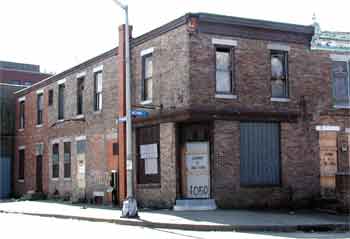


The Bullpen — Camden, NJ
Burns Is Guilty in Slugging and Faces Life Term
Camden Courier-Post —
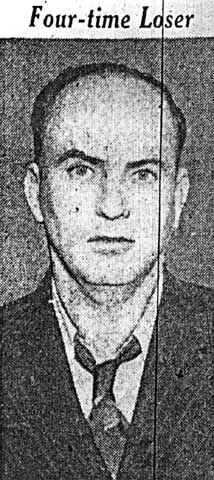
All-Women Jury Convicts Quickly In Assault Case
Felon Named by Bartender
An all-woman jury last night took less than an hour to convict Stephen Burns, 36, ex-convict, of assault with intent to rob. The conviction is his fourth and makes him subject to a life prison sentence.
Indicted on Two Counts
Burns had been indicted on two counts, assault and assault with intent to rob. Had this been Burns’ first, second or third conviction, it was pointed out, the maximum penalty would be 12 years imprisonment and $3000 fine.
Burns was found guilty of assaulting and attempting to rob Fred DeMarco, owner of the Rustic Tavern, Route 40, Delaware township, on the morning of Dec. 31, as he left his place at 4:30 a.m.
Anthony Schiavo, bartender for DeMarco, testified in the trial he saw Burns on the parking lot near the inn where the attack occurred when he ran out of the place as DeMarco cried out for help.
Offers Alibi
Burns took the stand and denied the charge. He said he was at home in bed when the alleged attack occurred. He said he left a restaurant on Kaighn avenue where he was working between 5 p.m. and 6 p.m. and went to bed between 11 p.m. and midnight. He did not get up until 6 a.m., he said.
Burns’ wife and daughter corroborated his testimony. Under cross examination, they failed to remember most of the statements they made to Mariano and County Detective Doran.
Over objections of defense counsel, Judge Sheehan allowed William B. Macdonald, court stenographer, to read the daughter’s alleged statement into the record.
Prosecutor Mariano questioned Burns about his criminal record, citing four convictions in Buffalo and Pennsylvania. Burns refused to answer, claiming he would incriminate himself, but he admitted he was sentenced to 12 to 14 years in 1934 for holding up a Gloucester bank.
Mariano introduced records of trials and convictions after a side-bar conference and Judge Sheehan allowed them to be admitted over an objection by Walter S. Keown, defense counsel.
Mariano Hits Alibi
Mariano said he was convinced the state had established conclusive evidence that Burns was the man who struck and attempted to rob DeMarco. He also said it was only natural for the defendant’s wife and daughter to seek to protect Burns because “blood is thicker than water.”
Keown stressed the element of doubt in Schiavo’s identification of Burns. He also attacked the indictment, claiming the state had failed to produce any evidence to show the inn proprietor was assaulted with the butt of a revolver. He said it could have been a club or a blackjack.
“I am not saying there was not a holdup,” Keown added. “Steve Burns did not participate in it because he was not there. He was home in bed.”
Burns is under arrest as a suspect in the Casablanca case. He also is under indictment on a charge of highway robbery involving the holdup of a gas station operator.
The jury was made up of: Mrs. Margaret Ensay, 519 Lincoln avenue, Collingswood; Gertrude Bailey, 332 North Forty-first street; Sarah Currie, 36 Lane avenue, Gloucester; Sylvia M. Goodwill, Cedar and Maple avenue, Berlin; Elizabeth Heinemann, 73 Manor avenue, Oaklyn; Helen Lynch, 209 Park avenue, Collingswood; Hanna Mollihan, 903 Merrick avenue, Westmont; Mary Peacock, Lincoln avenue, Magnolia; Alberta Platt, Barrington; Elsie Stokes, 40 Chestnut street, Haddonfield; Mary Thumm, Woodburn avenue, Pine Hill; and Anna Stehr, 621 Chestnut street.
Burns Paled as Verdict Was Announced
Burns paled as the foreleady of the jury announced the verdict and his wife, Mrs. Eleanor Burns, collapsed into the arms of their 18-year-old daughter, Janie.
Judge Sheehan received the verdict. He announced sentence would be deferred.
“It was an eminently justified and certainly a courageous verdict,” he said in thanking the jury.
Court attendants and county detectives immediately led Burns from the courtroom. The jury received the case at 8:15 p. m., after an 18-minute charge by Judge Sheehan. At 9:05 p. m. they announced a verdict had been reached. Judge Sheehan arrived at 9:40 o’clock. The trial began yesterday morning.
Camden Courier-Post — October 11, 1949
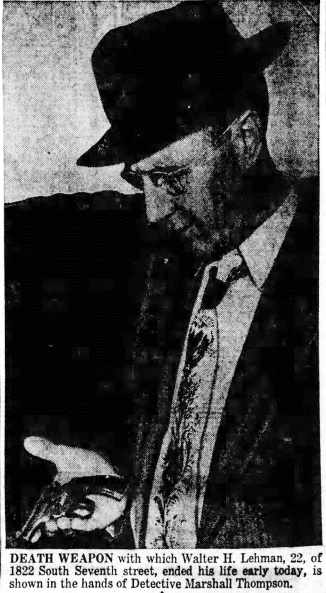
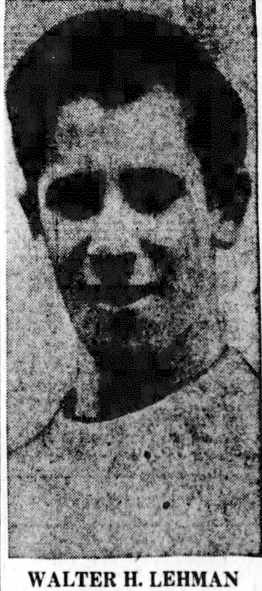
GI Ends Life With Gun in Parked Car
GI Ends Life With Gun in Parked Car
Walter H. Lehman Due to Return to Fort Dix Today
By WALTER N. CARLEY
Minutes after two patrolmen questioned him about parking, a 22-year-old South Camden man, who entered the army two months ago, ended his life early today by firing a bullet through his head.
Walter H. Lehman, 1822 South Seventh street, was discovered about 6 a. m. seated behind the wheel of his coupe parked along the west side of the Black Horse pike, about south, between Burma and Olympia roads.
A .32 calibre bullet had entered his head from the right temple and came out through the left temple. The death weapon was found in his lap partly covered by his right hand. County Physician ruled death simultaneous and self-inflicted.
He Said He Was Sleepy
About 5:30 a. m. Patrolmen Edward Watson and Joel White passed the Lehman car. According to Watson, he said he advised Lehman that the best thing to do was to return to the car rather than drive. He said he thanked Watson and the patrolmen drove away. They said they stopped at the newsstand on the pike and returned north on the pike, noticing the car with Lehman apparently lying in the seat.
Was on Vacation
A short time later Acting Sergeant Frank Cavallo drove past the car and saw Lehman seated. Later Patrolman Frank Senatore drove past…
(Continued on Page 3 — Column 7)
Retirement — April 14, 1950
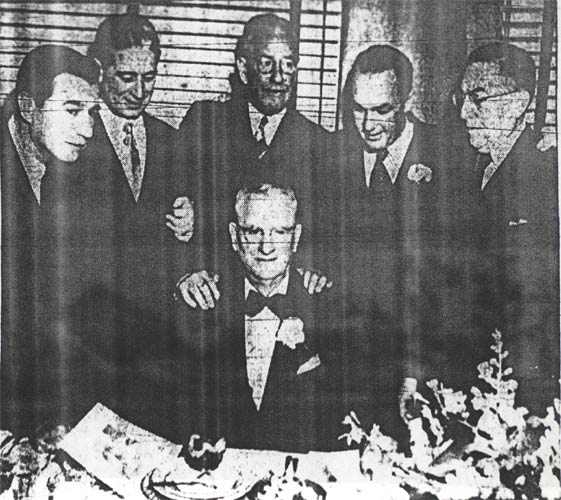
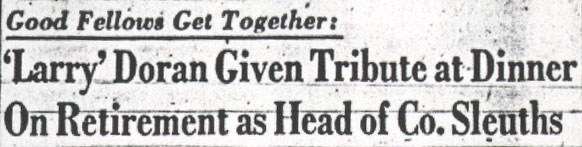
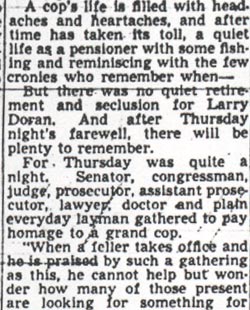
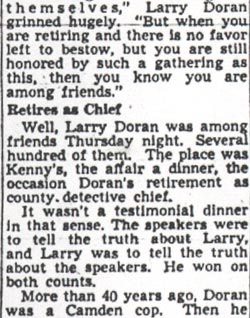
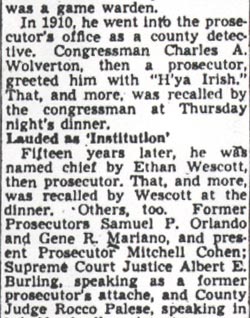
Larry Doran retired in April 1950 after four decades as a county detective, 25 years as Chief of Detectives. He was succeeded by Wilfred L. Dube.