Jesse W. Pratt
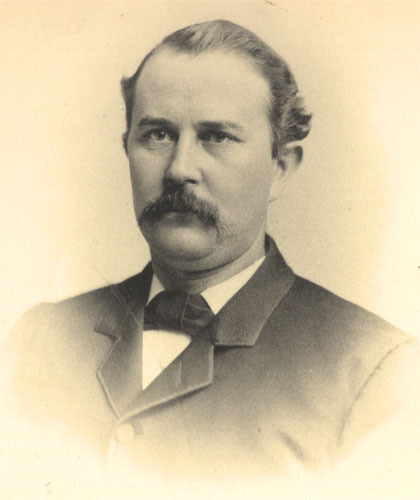
Jesse W. Pratt, Mayor of Camden (1886–1892)
JESSE W. PRATT served as the Mayor of Camden from 1886 to 1892, succeeding Claudius Bradshaw. He made his residence in the 1880s and 1890s at 114 North 6th Street in Camden, a short walk from his provisions business at 122 North 3rd Street.
During the administration of Mayor Pratt, the first Manual Training and High School in Camden was established, on the upper floors of 125 Federal Street in 1891. Professor Horatio Draper was the principal.
Jesse Pratt left office in 1892. John Leighton Westcott succeeded him as mayor. Jesse Pratt returned to his business activities. By 1900 he was involved in the coal business, from his property at 23 Market Street.
History of Camden County New Jersey
George Reeser Prowell – 1886
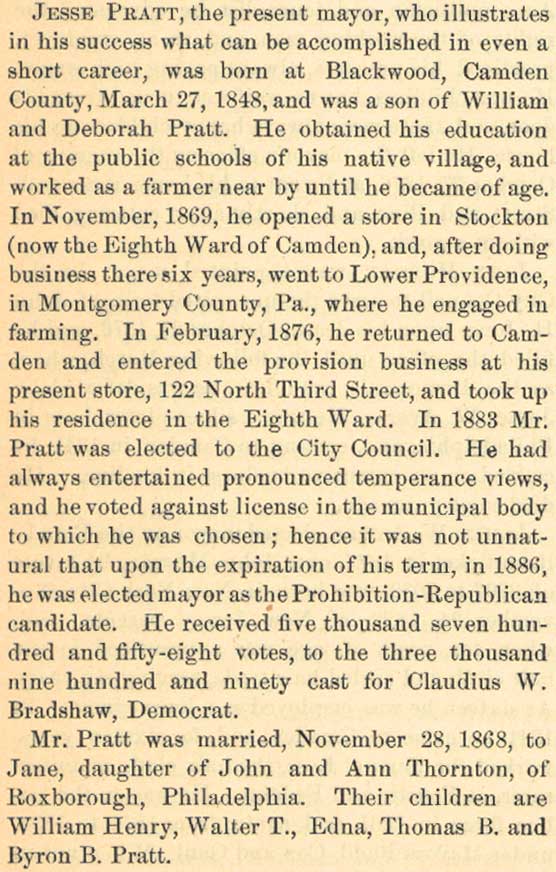
Jesse Pratt, the present mayor, who illustrates in his success what can be accomplished in even a short career, was born at Blackwood, Camden County, March 27, 1848, and was a son of William and Deborah Pratt. He obtained his education at the public schools of his native village, and worked as a farmer near by until he became of age. In November, 1869, he opened a store in Stockton (now the Eighth Ward of Camden), and, after doing business there six years, went to Lower Providence, in Montgomery County, Pa., where he engaged in farming. In February, 1876, he returned to Camden and entered the provision business at his present store, 122 North Third Street, and took up his residence in the Eighth Ward. In 1883 Mr. Pratt was elected to the City Council. He had always entertained pronounced temperance views, and he voted against license in the municipal body to which he was chosen; hence it was not unnatural that upon the expiration of his term, in 1886, he was elected mayor as the Prohibition-Republican candidate. He received five thousand seven hundred and fifty-eight votes, to the three thousand nine hundred and ninety cast for Claudius W. Bradshaw, Democrat.
Mr. Pratt was married, November 28, 1868, to Jane, daughter of John and Ann Thornton, of Roxborough, Philadelphia. Their children are William Henry, Walter T., Edna, Thomas B. and Byron B. Pratt.
The Header Image
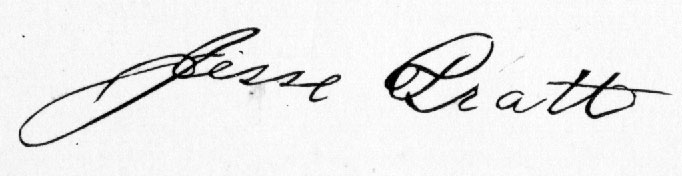
Jesse W. Pratt
1861 — The First War Meeting in Camden
On the 16th of April, 1861, three days after the Confederates fired upon Fort Sumter, at the entrance of Charleston Harbor, a large number of loyal and patriotic citizens of Camden City and County issued the following vigorous and spirited response to the President’s proclamation:
To the President Of the United States:
“The unparalleled events of the last week have revealed to the citizens of the United States, beyond question or the possibility of a doubt, that peaceful reconciliation upon the form of our Constitution is repelled and scorned, and secession means, in the hearts of its supporters, both Treason and war against our Country and Nation.
“We, therefore, the undersigned Loyal Citizens of the United States, and inhabitants of the city of Camden, in the State of New Jersey, responding to the proclamation of the President of the United States, hereby declare our unalterable determination to sustain the government in its efforts to maintain the honor, the integrity and the existence of our National Union and the perpetuity of the popular Government, and to redress the wrongs already long enough endured; no differences of political opinion; no badge of diversity upon points of party distinction, shall restrain or withhold us in the devotion of all we have or can command to the vindication of the Constitution, the maintenance of the laws and the defense of the Flag Of our Country.
Signatories included I. S. Mulford, E. R. Johnson, Louis L. Scovel, B. M. Braker, Joseph C. Nichols, Elwood C. Fortiner, Joseph Vautier, Edmund Brewer, Uriah Norcross, Isaac L. Lowe, Henry B. Goodwin, Richard W. Test, James M. Cassady, John Duprey, Jesse Pratt, Hamilton Johnston, Charles P. Dickinson, Richard H. Lee, C. G. Zimmerman, Thomas M. K. Lee, Jr., Charles J. Sanders, Samuel S. E. Cowperthwait, James M. Scovel, S. C. Harbert, John S. Read, D. H. Erdman, Adam Angel, George W. Vanhorn, Charles S. Garrett, Thomas M. Barracliff, W. H. Saunders, Jacob Harman, Jr., Charles K. Horsfall, Timothy Middleton, William W. Sloan, Charles Cloud, A. W. Test, C. A. S. Driesback, Henry Schock, Walter Patton, Azael Roberts, Thomas Jeffries, O. Gilbert Hannah, J. C. De Lacour, Edward T. Andrews, Conclin Mayhey, William Reynolds, Simon Rammell, H. H. Goldsmith, John Horsfall, Thomas H. Dudley, Robert Folwell, Edw. H. Saunders, James O. Morgan, David H. Sheppard, Richard Fetters, Charles C. Reeves, S. H. Grey, N. B. Stokes, S. O. Wright, Joseph Dlinston, David Creary, John R. Barber, James H. Denny, William R. Maxwell, Robert Wible, Hamilton William, George W. Jackson, Joseph Maurer, Joseph D. Brown, William S. Scull, Daniel Witham, Isaac Shreeve, Adam Hare, George Wardell, Joseph Coffman, George W. Conrow, Joshua Howell, Martin Grey, S. L. Wayne, Abner Sparks, Van T. Shivers, Westcott Campbell, William J. Taylor, Isaiah Norcross, Alden O. Scovel, Philip J. Gray, George W. Gilbert, Charles D. Hineline, Thomas H. Davis, Charles De Haven, Thomas Ackley, John Gill, James B. Dayton, James M. Stevens, Joseph French, George Campbell, A. A. Merry, E. Wells, William D. Clark, William B. Hatch, E. O. Jackson, A. B. Martin, Richard O. Robertson, Timothy O. Moore, George W. Stanley, Robert Schall, Reynell Coates, Aaron Hewit, Henry Shuster, William Hartsgrove, William B. French, W. A. Winchester, and John M. Natty.
In response to a call, on the 18th of April an enthusiastic meeting was held in the county court-house, which was formed of a large collection of prominent citizens. The court-room was decorated with flags and mottoes. John W. Mickle was chosen president and Samuel C. Harbert and Thomas G. Rowand secretaries. The president addressed the meeting first and Rev. Mr. Monroe offered a prayer. Hon. Thomas P. Carpenter, Thomas B. Atkinson (mayor) and Joseph Painter were appointed a committee on resolutions. Judge Philip J. Grey addressed the meeting, after which the committee adopted a long series of patriotic resolutions. The Washington Grays, Stockton Cadets and the Zouaves marched into the room and were received with cheers, Samuel Hufty read a resolution which was signed by many persons, who immediately formed the Home Brigade. David M. Chambers, Captain Stafford, Benjamin M. Braker, John H. Jones and E. A. Acton each addressed the meeting. James M. Scovel was then called upon and responded in eloquent terms and with patriotic energy. S. H. Grey offered a resolution, which was adopted, that the City Council and the Freeholders of the county be requested to appropriate money for the equipment of persons who may volunteer in defense of the country, and S. H. Grey, James M. Cassady and Joseph Painter were appointed a committee to look after the interests of the resolution. The meeting continued in session until eleven p.m.
The First New Jersey District.
Philadelphia Inquirer —
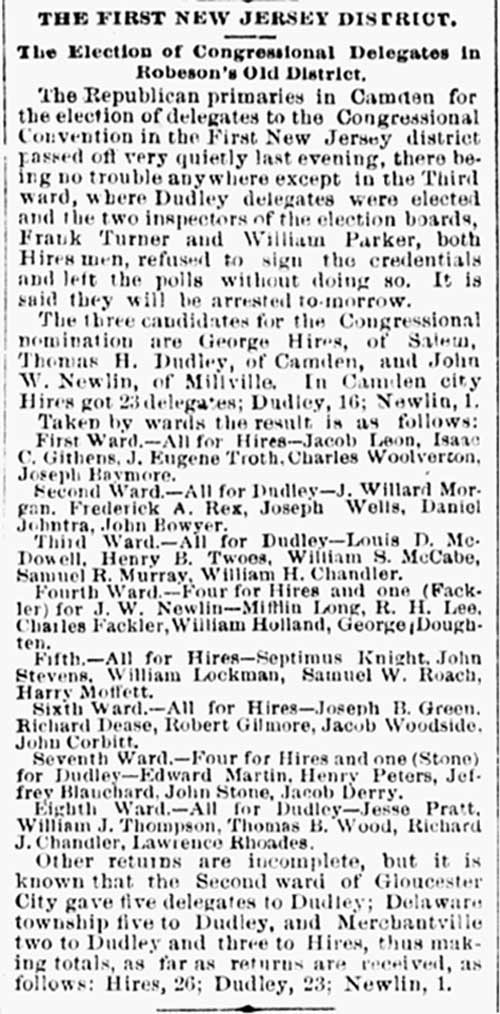
The Election of Congressional Delegates in Robeson’s Old District.
The Republican primaries in Camden for the election of delegates to the Congressional Convention in the First New Jersey district passed off very quietly last evening, there being no trouble anywhere except in the Third ward, where Dudley delegates were elected and the two inspectors of the election boards, Frank Turner and William Parker, both Hires men, refused to sign the credentials and left the polls without doing so. It is said they will be arrested to-morrow.
The three candidates for the Congressional nomination are George Hires, of Salem, Thomas H. Dudley, of Camden, and John W. Newlin, of Millville. In Camden city Hires got 23 delegates; Dudley, 16; Newlin, 1.
Taken by wards the result is as follows:
First Ward.—All for Hires—Jacob Leon, Isaac C. Githens, J. Eugene Troth, Charles Woolverton, Joseph Baymore.
Second Ward.—All for Dudley—J. Willard Morgan, Frederick A. Rex, Joseph Wells, Daniel Johntra, John Bowyer.
Third Ward.—All for Dudley—Louis D. McDowell, Henry B. Twoes, William S. McCabe, Samuel R. Murray, William H. Chandler.
Fourth Ward.—Four for Hires and one (Fackler) for J. W. Newlin—Mifflin Long, R. H. Lee, Charles Fackler, William Holland, George Doughten.
Fifth.—All for Hires—Septimus Knight, John Stevens, William Lockman, Samuel W. Roach, Harry Moffett.
Sixth Ward.—All for Hires—Joseph B. Green, Richard Dease, Robert Gilmore, Jacob Woodside, John Corbitt.
Seventh Ward.—Four for Hires and one (Stone) for Dudley—Edward Martin, Henry Peters, Jeffrey Blanchard, John Stone, Jacob Derry.
Eighth Ward.—All for Dudley—Jesse Pratt, William J. Thompson, Thomas B. Wood, Richard J. Chandler, Lawrence Rhoades.
Other returns are incomplete, but it is known that the Second ward of Gloucester City gave five delegates to Dudley; Delaware township five to Dudley, and Merchantville two to Dudley and three to Hires, thus making totals, as far as returns are received, as follows: Hires, 26; Dudley, 23; Newlin, 1.
Franks Sworn in as Chief.
Camden Daily Courier —

THE NEW OFFICIAL AND SIX MEN TAKE THE OATH.
Ex-Chief Matlack Commends the Forty Patrolmen, Thanks Mayor Pratt for His Gentlemanly Conduct and Retires.
It is Chief Franks now. Mr. Matlack, the retiring chief turned over the police department to his successor shortly after noon. All the officers gathered at the hall, as this is the semi-monthly pay day. The six new men who were to take the places of the patrolmen who resigned, came in one at a time and were taken into the mayor’s private office, where behind the closed door they were sworn in by his honor. Chief-elect Franks was also sworn in privately.
All the Democratic officers then assembled in the mayor’s hearing room, at the request of retiring Chief Matlack and it was with evident feeling that he bade them farewell in an eloquent address. He said:
THE CHIEF’S ADDRESS.
“Gentlemen of the police department—The time has arrived for me to turn over the police department to my successor. During my term as chief I have formed acquaintanceships and friendships among you which have been a great pleasure to me, and which I hope to retain. Among us doring [sic] all that time there has been peace and harmony in the main. I am glad to say that no strifes or bickerings have occurred to mar our peace and good will. At times our actions have been criticised, and aspersions cast against us, but these were only the contingencies of our positions; we must learn to take the bitter with the sweet. No serious accidents or deaths have occurred among us, and for this we should be thankful to the Giver of all good things. We have made some mistakes no doubt—none of us are infallible—but let bygones be bygones, and endeavor to fulfill your duty always.
“There is one thing in particular that I wish to commend you for, and that is your gentlemanly and courteous conduct while I have been connected with the department, and your cheerfulness in obeying orders. For this you have my sincere thanks, and also my best wishes for your futures.”
THE DEPARTMENT TURNED OVER.
The chief closed his remarks to the men with a moral admonition. To Mayor Pratt he returned his thanks for the gentlemanly demeanor of his honor during their brief official association, and expressed the hope that his administration would be one of good government. Chief Matlack then formally delivered the department to his successor and said he trusted it would be more efficient than ever before.
The chief’s remarks were very brief and pointed. He said: “Gentlemen and members of the police department. I hope you will continue in the discharge of your duties as before. I expect obedience to the rules of the department, and the orders of his honor the mayor. Any disapproval or disobedience of orders will be deemed sufficient cause for removal.”
NEW PATROLMEN.
The following is the list of retiring officers and their successors, with their numbers: First ward—John Jacobs; successor, Alfred Summers, No. 5. Fourth ward—Simpson Long, successor, Samuel Lee, No. 17; Charles Peterson, successor, Charles O. Pedrick, No. 20. Sixth ward, Bowman Matlack, successor, Christopher Tenner, No. 29; John Fox, successor, John Dall, No. 30. Seventh ward, Harry Griffin, successor, C. H. Peters, No. 33.
The retiring officers delivered up their equipments. C. H. Peters, who was the first of the new men to be sworn in, had a bran new suit of blue and went on duty at once. John Dall was not present to be sworn in with the others.
Mayor Pratt’s Court and New Patrolmen
Philadelphia Inquirer —
William White, who keeps a tavern at the corner of Mount Ephraim pike and Kaighn avenue, was placed on trial before Mayor Pratt yesterday afternoon for selling liquor without a license. He pleaded guilty and was ordered to pay a fine and costs, which amounted to $59.45, in default of which he was committed to the city jail for ten days.
Mayor Pratt yesterday afternoon appointed ex-Councilman William Smith and James Gibson, a machinist, as patrolmen on the police force in the places of Cooley Smith and John Kelly, of the Lighth [sic] ward, who were discharged on Saturday afternoon for neglect of duty.
Raid on a Policy Shop.
Camden Post —
Mayor Pratt, through Chief of Police Franks, instructed his officers on Saturday to report every place in the city where it was thought that policy dealing was carried on, and the result was that during the afternoon Officers Kelly and Pedrick made a raid on a policy shop run by William Smith, alias “Policy Bill,” at 14 south Eighth street, and captured Smith, Francis Geist, John James and David Hopewell, besides all the paraphernalia necessary to run a first-class policy shop. They were escorted to the City Hall where Mayor Pratt held Smith in $500 bail, he waiving a hearing, and Geist, James and Hopewell were held in their own recognizance as witnesses. Smith, it is claimed, was doing business for Philadelphia backers and was already under indictment for policy dealing.
The complainant against Smith was a Mrs. Bechel, who made a hit of $15 which she says Smith refused to pay.
Chips from Camden
Philadelphia Inquirer —
Little Notes of News from Across the Matrimonial Ferry.
Mayor Pratt on Saturday imposed a fine and costs amounting to $53 upon Charles Woodward for selling liquor without a license at No. 2 South Second street, Camden. He removed to the place from Philadelphia only a few days since, having kept a sporting house on Ninth street near Vine. No defense was made, Woodward pleading guilty to the charge, which was made by J. V. Middleton, who had an undertaking establishment next door to the saloon.
Officers Scudder and Peterson Suspended
Philadelphia Inquirer —
Officers Scudder and Peterson were tried before Mayor Pratt yesterday afternoon, the former for leaving his beat and the latter for refusing to make an arrest when requested to by a citizen. They were both found guilty and suspended from the force.
Thomas Casper Hart Sworn In
Philadelphia Inquirer —

Thomas Casper Hart was sworn in by Mayor Pratt yesterday as an officer to take the place of Officer Peterson, suspended.
From Jersey’s Soil
Philadelphia Inquirer —
Trouble Over the Death of a Spiritualist—A Young Man’s Sad Ending.
Policeman John A. Dall, of the Sixth ward, was tried before Mayor Pratt yesterday on the charge of leaving his beat and entering a saloon while on duty. His Honor considered the evidence sufficiently strong to dismiss the officer from the force.
A Girl’s Sad Death
Philadelphia Inquirer —
The body of a young girl was discovered on Saturday at Undertaker Ramsey’s, No. 531 Diamond street, and by order of the authorities was taken back to Camden whence it had been brought, to No. 335 Pine street, the house of Mrs. Engle, who was arrested and given a hearing before Mayor Pratt the same evening, when Dr. J. G. Stanton testified that he had been called to attend the deceased, whose name was Kate Gutenkunst, and who died of peritonitis. Dr. Formad’s testimony and that of County Physician Gross showed that the case was one of malpractice. The accused was held on that charge. The body was sent back to the undertaker’s.
Mayor Pratt Holds James Bergen
Philadelphia Inquirer —

Mayor Pratt yesterday held James Bergen, a young Philadelphian, in $200 bail on the charge of assault and battery on Lewis Benner, a Camden street car driver.
Kessler’s Stabbing Victim Out of Danger
Philadelphia Inquirer —

Dr. Smiley has pronounced Theodore Johnson, who was cut by Samuel Kessler last Saturday night, out of danger. Mayor Pratt has fixed Kessler’s bail at $1000.
Philadelphia Inquirer – January 15, 1888

Howard Woolston and Lewis Rothkogle, two lads, have been held in ball [sic] by the Mayor for larceny of pigeons from L. W. Frome, a fruit dealer.
Philadelphia Inquirer – August 10, 1888
LODGED IN CAMDEN'S JAIL.
The New Jersey Police Capture Several Prisoners for a Hot Day.
Mayor Pratt yesterday committed Thomas Johnson alias Ogleton, colored, to the County Jail in default of bail on the charge of burglary. On Wednesday the house of Frank C. Reeves, at No. 524 Royden street, was entered and clothing and jewelry to the amount of $200 taken. Yesterday morning Officer Cooper arrested Johnson on suspicion of being the guilty party. Chief Dodd searched his house, at No. 727 Cherry street, and found a pair of pants that belonged to Mr. Reeves.
A dog owned by James Farrell, of No. 522 Washington street, which was bitten by a mad dog on Sunday, was shot yesterday by Spencer Sharp.
Sing Lee, an almond-eyed Celestial, who earns his daily bread by running a laundry at Locust and Chestnut streets, was consigned to Camden's filthy jail yesterday. Joseph Russell, a 13-year-old lad, told Recorder Braker that Sing hit him in the jaw and kicked him on the back. He was unable to furnish $200 ball [sic] and was consequently locked up.
A Hebrew peddler stole a gold watch from William Ruoff, of Palmyra, on Wednesday. A man supposed to be the thief was arrested on the charge, but, as he could not be fully identified, he was released.
Christian Kline, the kindling wood dealer, who was arrested on Wednesday on a capias, was released yesterday upon paying $212, the amount which Mrs. Shimpp claimed was due her. He will, however, be tried before Recorder Braker on the charge of desertion.
A number of the new electric lights of Camden were lighted last evening for the first time.
The residence of S. Chew, editor and proprietor of the West Jersey Press, at No. 532 Cooper street, was burglarized the other night, in the absence of the family at Atlantic City. Mr. Chew, upon reaching home last evening, discovered that the house had been ransacked from top to bottom. The thieves carried away a lot of clothing. An entrance was effected through a rear window.
Camden’s Liquor Sellers
Philadelphia Inquirer —
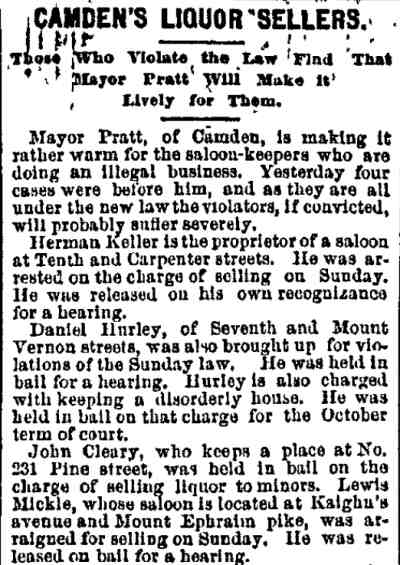
Those Who Violate the Law Find That Mayor Pratt Will Make it Lively for Them.
Mayor Pratt, of Camden, is making it rather warm for the saloon-keepers who are doing an illegal business. Yesterday four cases were before him, and as they are all under the new law the violators, if convicted, will probably suffer severely.
Herman Keller is the proprietor of a saloon at Tenth and Carpenter streets. He was arrested on the charge of selling on Sunday. He was released on his own recognizance for a hearing.
Daniel Hurley, of Seventh and Mount Vernon streets, was also brought up for violations of the Sunday law. He was held in bail for a hearing. Hurley is also charged with keeping a disorderly house. He was held in bail on that charge for the October term of court.
John Cleary, who keeps a place at No. 231 Pine street, was held in bail on the charge of selling liquor to minors. Lewis Mickle, whose saloon is located at Kaighn’s avenue and Mount Ephraim pike, was arraigned for selling on Sunday. He was released on bail for a hearing.
Mayor Pratt Arrests Johanna Connell
Philadelphia Inquirer —
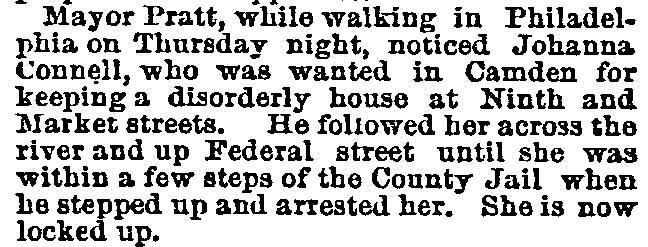
Mayor Pratt, while walking in Philadelphia on Thursday night, noticed Johanna Connell, who was wanted in Camden for keeping a disorderly house at Ninth and Market streets. He followed her across the river and up Federal Street until she was within a few steps of the County Jail when he stepped up and arrested her. She is now locked up.
The Camden Mystery
Philadelphia Inquirer —
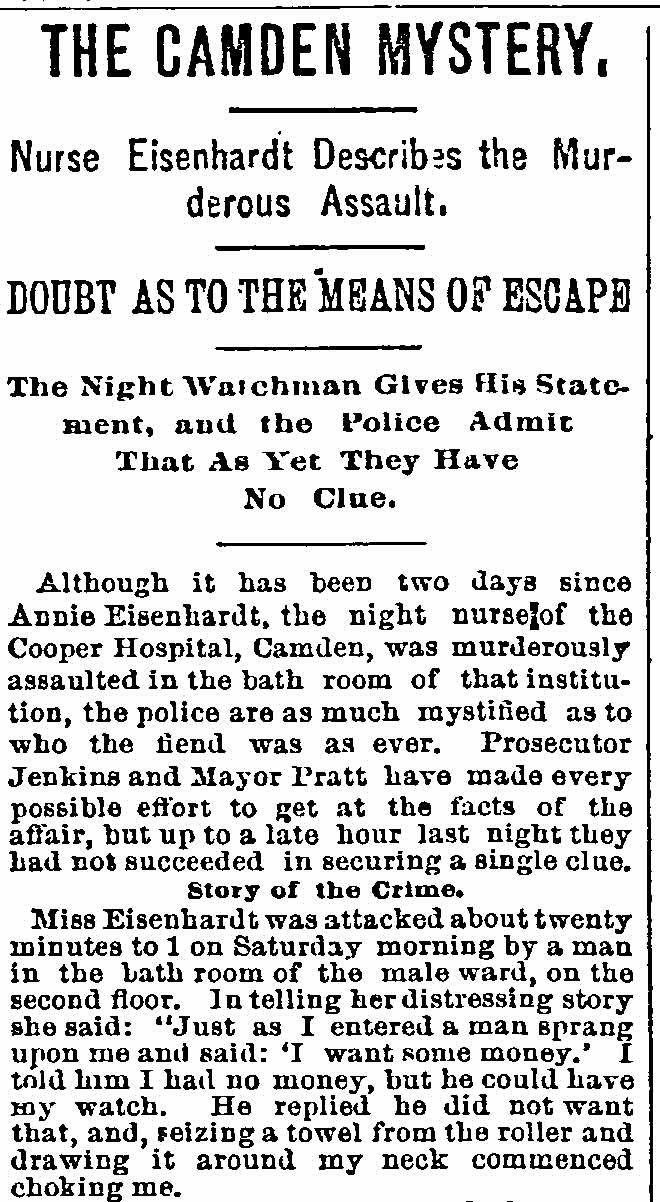
Nurse Eisenhardt Describes the Murderous Assault.
Doubt as to the Means of Escape
The Night Watchman Gives His Statement, and the Police Admit That As Yet They Have No Clue.
Although it has been two days since Annie Eisenhardt, the night nurse of the Cooper Hospital, Camden, was murderously assaulted in the bath room of that institution, the police are as much mystified as to who the fiend was as ever. Prosecutor Jenkins and Mayor Pratt have made every possible effort to get at the facts of the affair, but up to a late hour last night they had not succeeded in securing a single clue.
Story of the Crime.
Miss Eisenhardt was attacked about twenty minutes to 1 on Saturday morning by a man in the bath room of the male ward, on the second floor. In telling her distressing story she said: “Just as I entered a man sprang upon me and said: ‘I want some money.’ I told him I had no money, but he could have my watch. He replied he did not want that, and, seizing a towel from the roller and drawing it around my neck commenced choking me.
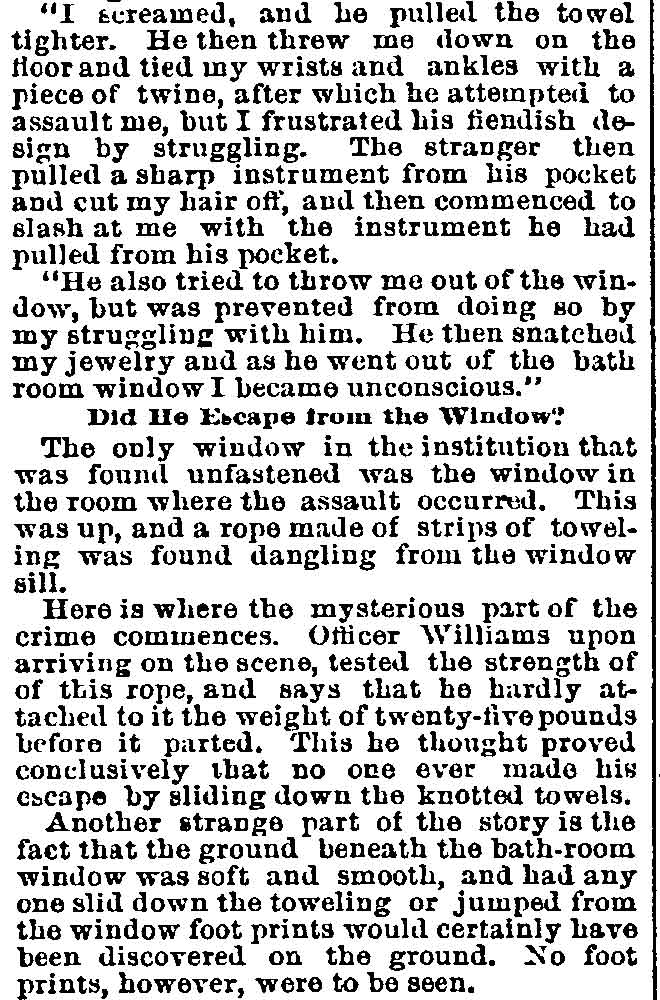
“I screamed, and he pulled the towel tighter. He then threw me down on the floor and tied my wrists and ankles with a piece of twine, after which he attempted to assault me, but I frustrated his fiendish design by struggling. The stranger then pulled a sharp instrument from his pocket and cut my hair off, and then commenced to slash at me with the instrument he had pulled from his pocket.
“He also tried to throw me out of the window, but was prevented from doing so by my struggling with him. He then snatched my jewelry and as he went out of the bath room window I became unconscious.”
Did He Escape from the Window?
The only window in the institution that was found unfastened was the window in the room where the assault occurred. This was up, and a rope made of strips of toweling was found dangling from the window sill.
Here is where the mysterious part of the crime commences. Officer Williams upon arriving on the scene, tested the strength of this rope, and says that he hardly attached to it the weight of twenty-five pounds before it parted. This he thought proved conclusively that no one ever made his escape by sliding down the knotted towels.
Another strange part of the story is the fact that the ground beneath the bath-room window was soft and smooth, and had any one slid down the toweling or jumped from the window foot prints would certainly have been discovered on the ground. No foot prints, however, were to be seen.
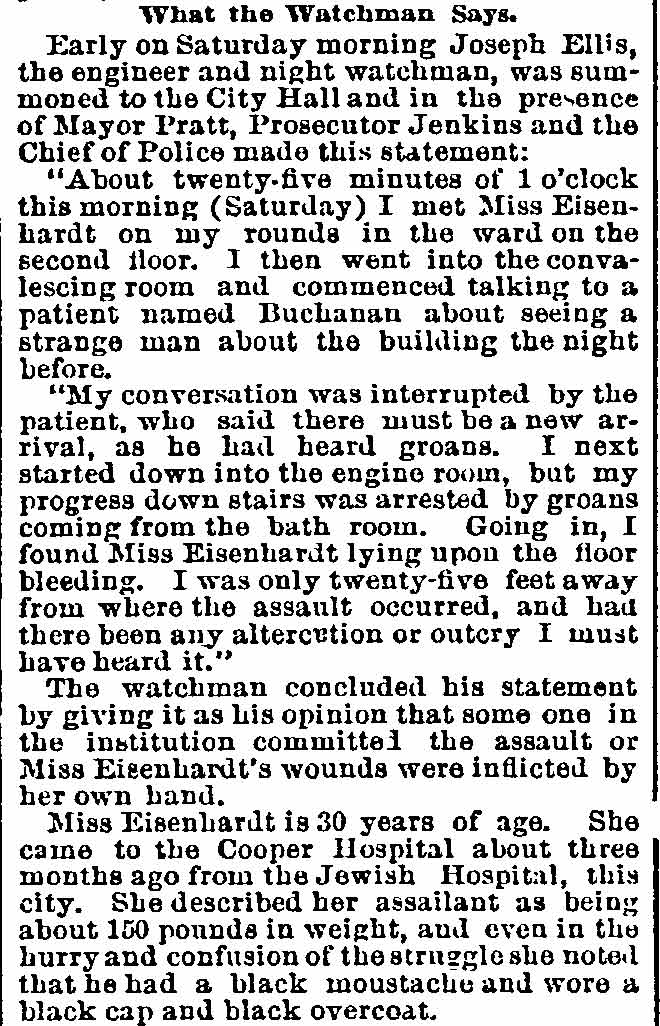
What the Watchman Says.
Early on Saturday morning Joseph Ellis, the engineer and night watchman, was summoned to the City Hall and in the presence of Mayor Pratt, Prosecutor Jenkins and the Chief of Police made this statement:
“About twenty-five minutes of 1 o’clock this morning (Saturday) I met Miss Eisenhardt on my rounds in the ward on the second floor. I then went into the convalescing room and commenced talking to a patient named Buchanan about seeing a strange man about the building the night before.
“My conversation was interrupted by the patient, who said there must be a new arrival, as he had heard groans. I next started down into the engine room, but my progress down stairs was arrested by groans coming from the bath room. Going in, I found Miss Eisenhardt lying upon the floor bleeding. I was only twenty-five feet away from where the assault occurred, and had there been any altercation or outcry I must have heard it.”
The watchman concluded his statement by giving it as his opinion that some one in the institution committed the assault or Miss Eisenhardt’s wounds were inflicted by her own hand.
Miss Eisenhardt is 30 years of age. She came to the Cooper Hospital about three months ago from the Jewish Hospital, this city. She described her assailant as being about 150 pounds in weight, and even in the hurry and confusion of the struggle she noted that he had a black moustache and wore a black cap and black overcoat.
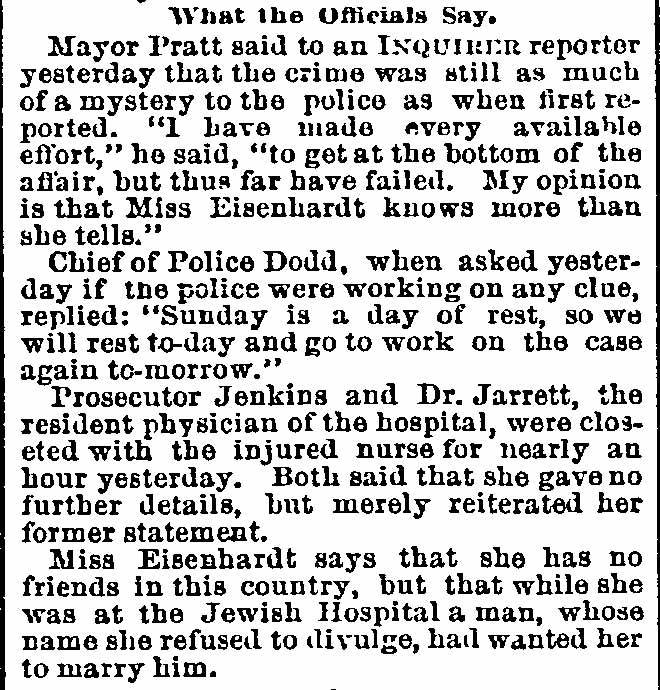
What the Officials Say.
Mayor Pratt said to an INQUIRER reporter yesterday that the crime was still as much of a mystery to the police as when first reported. “I have made every available effort,” he said, “to get at the bottom of the affair, but thus far have failed. My opinion is that Miss Eisenhardt knows more than she tells.”
Chief of Police Dodd, when asked yesterday if the police were working on any clue, replied: “Sunday is a day of rest, so we will rest to-day and go to work on the case again to-morrow.”
Prosecutor Jenkins and Dr. Jarrett, the resident physician of the hospital, were closeted with the injured nurse for nearly an hour yesterday. Both said that she gave no further details, but merely reiterated her former statement.
Miss Eisenhardt says that she has no friends in this country, but that while she was at the Jewish Hospital a man, whose name she refused to divulge, had wanted her to marry him.
War Over Acting Magistrate During Mayor's Illness
Philadelphia Inquirer —
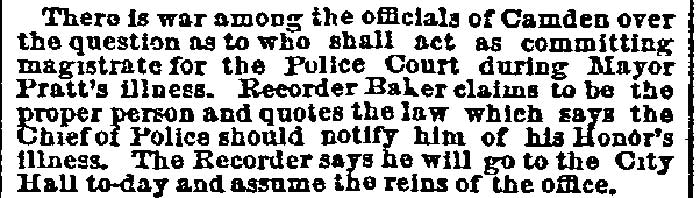
There is war among the officials of Camden over the question as to who shall act as committing magistrate for the Police Court during Mayor Pratt's illness. Recorder Baker [sic] claims to be the proper person and quotes the law which says the Chief of Police should notify him of his Honor's illness. The Recorder says he will go to the City Hall to-day and assume the reins of the office.
Charles P. Herfurth Held in Bail
Philadelphia Inquirer —
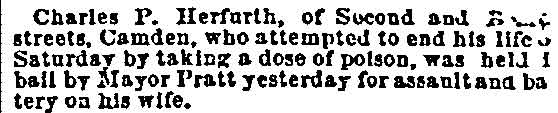
Charles P. Herfurth, of Second and Spruce streets, Camden, who attempted to end his life Saturday by taking a dose of poison, was held in bail by Mayor Pratt yesterday for assault and battery on his wife.
Camden News
Philadelphia Inquirer —
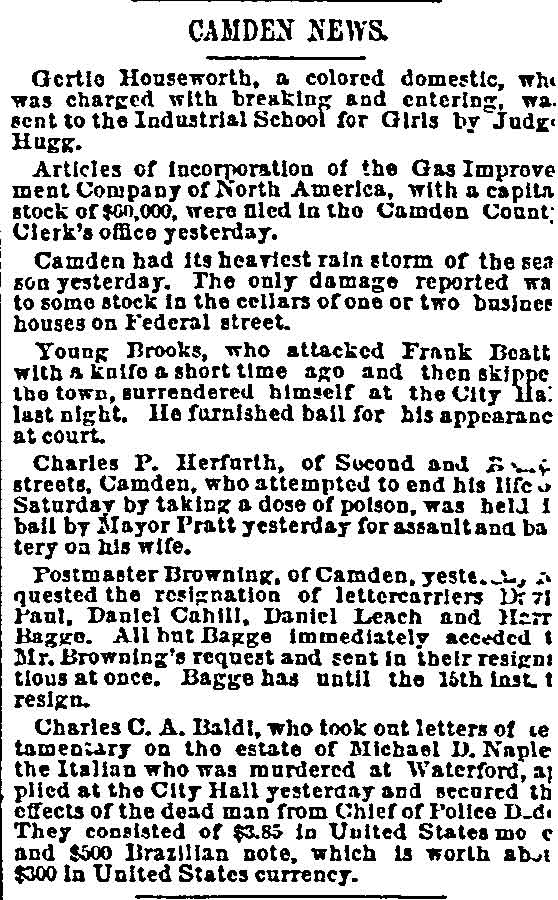
Gertie Houseworth, a colored domestic, who was charged with breaking and entering, was sent to the Industrial School for Girls by Judge Hugg.
Articles of incorporation of the Gas Improvement Company of North America, with a capital stock of $60,000, were filed in the Camden County Clerk’s office yesterday.
Camden had its heaviest rain storm of the season yesterday. The only damage reported was to some stock in the cellars of one or two business houses on Federal street.
Young Brooks, who attacked Frank Beatt with a knife a short time ago and then skipped the town, surrendered himself at the City Hall last night. He furnished bail for his appearance at court.
Charles P. Herfurth, of Second and [?] streets, Camden, who attempted to end his life on Saturday by taking a dose of poison, was held to bail by Mayor Pratt yesterday for assault and battery on his wife.
Postmaster Browning, of Camden, yesterday requested the resignation of lettercarriers David Paul, Daniel Cahill, Daniel Leach and Harry Bagge. All but Bagge immediately acceded to Mr. Browning’s request and sent in their resignations at once. Bagge has until the 15th inst. to resign.
Charles C. A. Baldi, who took out letters of testamentary on the estate of Michael D. Naple[?] the Italian who was murdered at Waterford, applied at the City Hall yesterday and secured the effects of the dead man from Chief of Police Dodd. They consisted of $3.85 in United States money and $500 Brazilian note, which is worth about $300 in United States currency.
Camden’s News Budget
Philadelphia Inquirer —
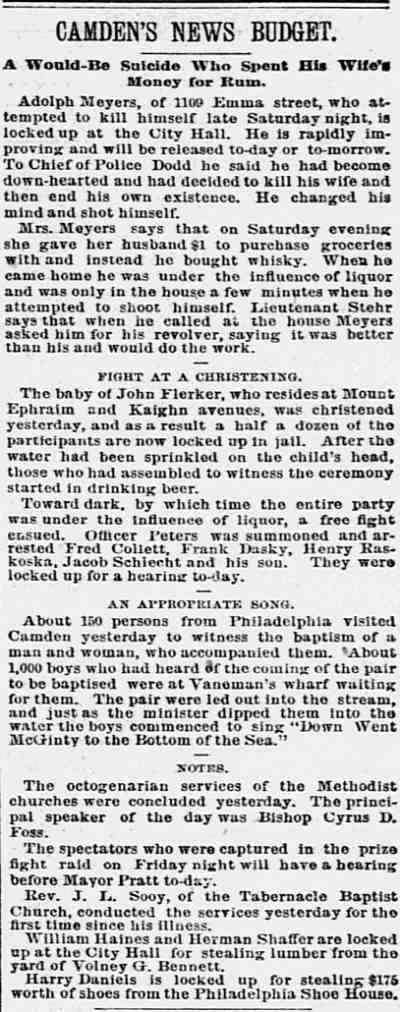
A Would-Be Suicide Who Spent His Wife’s Money for Rum.
Adolph Meyers, of 1109 Emma street, who attempted to kill himself late Saturday night, is locked up at the City Hall. He is rapidly improving and will be released to-day or to-morrow. To Chief of Police Dodd he said he had become down-hearted and had decided to kill his wife and then end his own existence. He changed his mind and shot himself.
Mrs. Meyers says that on Saturday evening she gave her husband $1 to purchase groceries with and instead he bought whisky. When he came home he was under the influence of liquor and was only in the house a few minutes when he attempted to shoot himself. Lieutenant Stehr says that when he called at the house Meyers asked him for his revolver, saying it was better than his and would do the work.
Fight at a Christening.
The baby of John Flerker, who resides at Mount Ephraim and Kaighn avenues, was christened yesterday, and as a result a half a dozen of the participants are now locked up in jail. After the water had been sprinkled on the child’s head, those who had assembled to witness the ceremony started in drinking beer.
Toward dark, by which time the entire party was under the influence of liquor, a free fight ensued. Officer Peters was summoned and arrested Fred Collett, Frank Dasky, Henry Raskoska, Jacob Schiecht and his son. They were locked up for a hearing to-day.
An Appropriate Song.
About 150 persons from Philadelphia visited Camden yesterday to witness the baptism of a man and woman, who accompanied them. About 1,000 boys who had heard of the coming of the pair to be baptised were at Vaneman’s wharf waiting for them. The pair were led out into the stream, and just as the minister dipped them into the water the boys commenced to sing “Down Went McGinty to the Bottom of the Sea.”
Notes.
The octogenarian services of the Methodist churches were concluded yesterday. The principal speaker of the day was Bishop Cyrus D. Foss.
The spectators who were captured in the prize fight raid on Friday night will have a hearing before Mayor Pratt to-day.
Rev. J. L. Sooy, of the Tabernacle Baptist Church, conducted the services yesterday for the first time since his illness.
William Haines and Herman Shaffer are locked up at the City Hall for stealing lumber from the yard of Volney G. Bennett.
Harry Daniels is locked up for stealing $175 worth of shoes from the Philadelphia Shoe House.
Died in Jail
Philadelphia Inquirer —
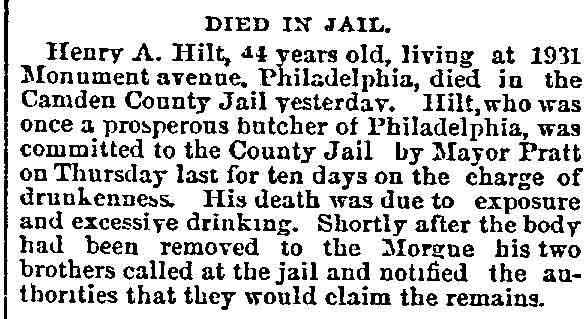
Henry A. Hilt, 44 years old, living at 1931 Monument avenue, Philadelphia, died in the Camden County Jail yesterday. Hilt, who was once a prosperous butcher of Philadelphia, was committed to the County Jail by Mayor Pratt on Thursday last for ten days on the charge of drunkenness.
His death was due to exposure and excessive drinking. Shortly after the body had been removed to the Morgue his two brothers called at the jail and notified the authorities that they would claim the remains.
Mayhew Press Discharged by Mayor Pratt
Philadelphia Inquirer —
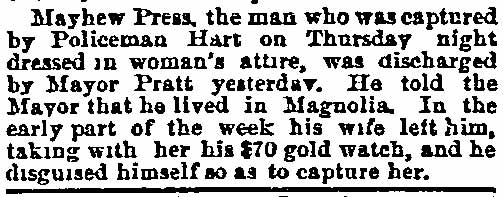
Mayhew Press, the man who was captured by Policeman Hart on Thursday night dressed in woman’s attire, was discharged by Mayor Pratt yesterday. He told the Mayor that he lived in Magnolia. In the early part of the week his wife left him, taking with her his $70 gold watch, and he disguised himself so as to capture her.
Mayor Pratt Commits Patrick McNally
Philadelphia Inquirer —

Mayor Pratt yesterday committed Patrick McNally to jail on the charge of stealing a horse valued at $100 from George Groll, a South Camden baker.
Camden’s Fire Laddies Parade
Philadelphia Inquirer —
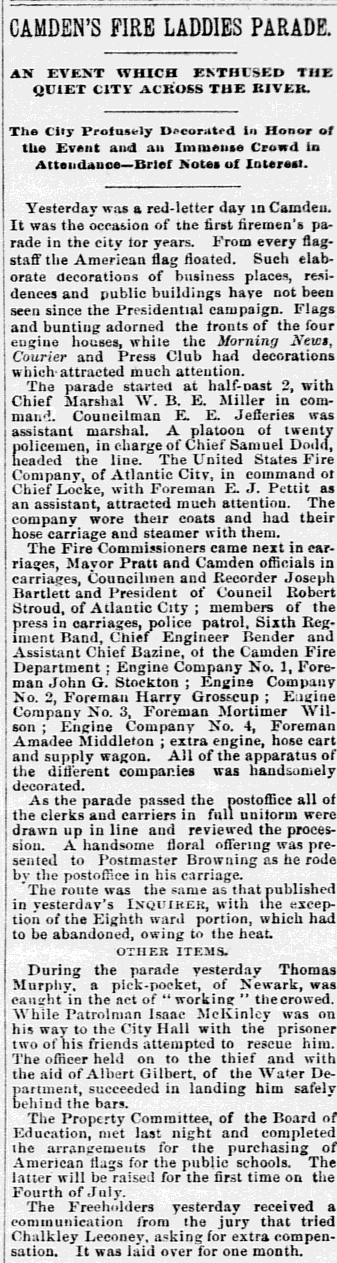
AN EVENT WHICH ENTHUSED THE QUIET CITY ACROSS THE RIVER.
The City Profusely Decorated in Honor of the Event and an Immense Crowd in Attendance—Brief Notes of Interest.
Yesterday was a red-letter day in Camden. It was the occasion of the first firemen’s parade in the city for years. From every flagstaff the American flag floated. Such elaborate decorations of business places, residences and public buildings have not been seen since the Presidential campaign. Flags and bunting adorned the fronts of the four engine houses, while the Morning News, Courier and Press Club had decorations which attracted much attention.
The parade started at half-past 2, with Chief Marshal W. B. E. Miller in command. Councilman E. E. Jefferies was assistant marshal. A platoon of twenty policemen, in charge of Chief Samuel Dodd, headed the line. The United States Fire Company, of Atlantic City, in command of Chief Locke, with Foreman E. J. Pettit as an assistant, attracted much attention. The company wore their coats and had their hose carriage and steamer with them.
The Fire Commissioners came next in carriages, Mayor Pratt and Camden officials in carriages, Councilmen and Recorder Joseph Bartlett and President of Council Robert Stroud, of Atlantic City; members of the press in carriages, police patrol, Sixth Regiment Band, Chief Engineer Bender and Assistant Chief Bazine, of the Camden Fire Department; Engine Company No. 1, Foreman John G. Stockton; Engine Company No. 2, Foreman Harry Grosscup; Engine Company No. 3, Foreman Mortimer Wilson; Engine Company No. 4, Foreman Amadee Middleton; extra engine, hose cart and supply wagon. All of the apparatus of the different companies was handsomely decorated.
As the parade passed the postoffice all of the clerks and carriers in full uniform were drawn up in line and reviewed the procession. A handsome floral offering was presented to Postmaster Browning as he rode by the postoffice in his carriage.
The route was the same as that published in yesterday’s Inquirer, with the exception of the Eighth ward portion, which had to be abandoned, owing to the heat.
OTHER ITEMS.
During the parade yesterday Thomas Murphy, a pick-pocket, of Newark, was caught in the act of “working” the crowd. While Patrolman Isaac McKinley was on his way to the City Hall with the prisoner two of his friends attempted to rescue him. The officer held on to the thief and with the aid of Albert Gilbert, of the Water Department, succeeded in landing him safely behind the bars.
The Property Committee, of the Board of Education, met last night and completed the arrangements for the purchasing of American flags for the public schools. The latter will be raised for the first time on the Fourth of July.
The Freeholders yesterday received a communication from the jury that tried Chalkley Leconey, asking for extra compensation. It was laid over for one month.
Brief ‘Cross River Notes.
Philadelphia Inquirer —
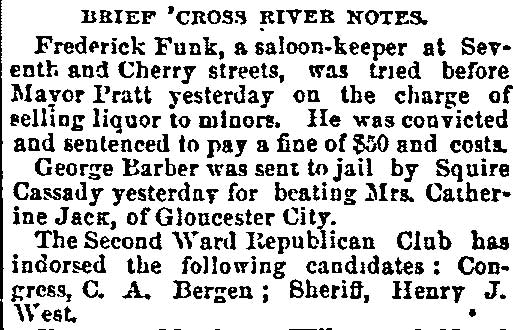
Frederick Funk, a saloon-keeper at Seventh and Cherry streets, was tried before Mayor Pratt yesterday on the charge of selling liquor to minors. He was convicted and sentenced to pay a fine of $50 and costs.
George Barber was sent to jail by Squire Cassady yesterday for beating Mrs. Catherine Jack, of Gloucester City.
The Second Ward Republican Club has indorsed the following candidates: Congress, C. A. Bergen; Sheriff, Henry J. West.
Darlings Doused.
Camden Daily Telegram —
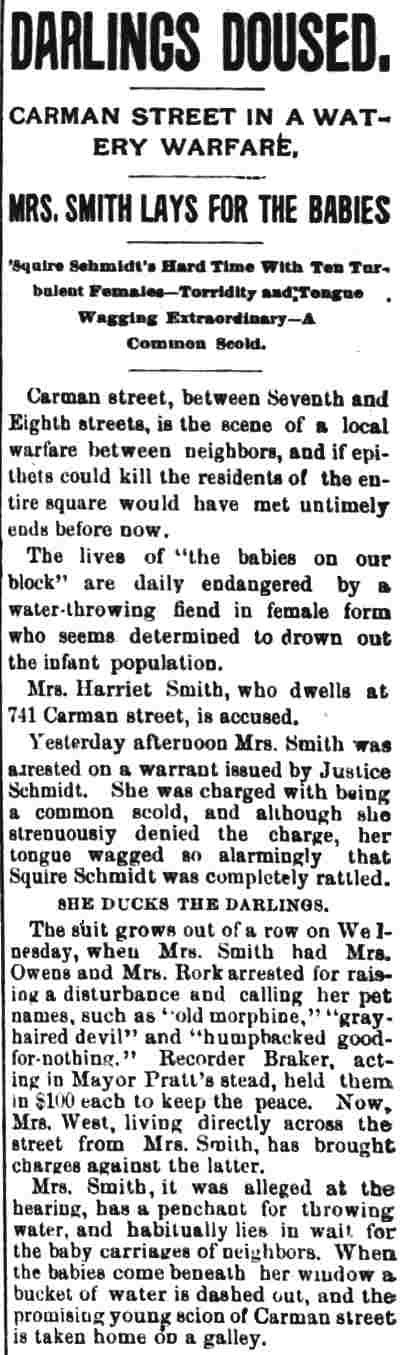
CARMAN STREET IN A WATERY WARFARE.
MRS. SMITH LAYS FOR THE BABIES
‘Squire Schmidt’s Hard Time With Ten Turbulent Females—Torridity and Tongue Wagging Extraordinary—A Common Scold.
Carman street, between Seventh and Eighth streets, is the scene of a local warfare between neighbors, and if epithets could kill the residents of the entire square would have met untimely ends before now.
The lives of “the babies on our block” are daily endangered by a water-throwing fiend in female form who seems determined to drown out the infant population.
Mrs. Harriet Smith, who dwells at 741 Carman street, is accused.
Yesterday afternoon Mrs. Smith was arrested on a warrant issued by Justice Schmidt. She was charged with being a common scold, and although she strenuously denied the charge, her tongue wagged so alarmingly that Squire Schmidt was completely rattled.
SHE DUCKS THE DARLINGS.
The suit grows out of a row on Wednesday, when Mrs. Smith had Mrs. Owens and Mrs. Rork arrested for raising a disturbance and calling her pet names, such as “old morphine,” “gray-haired devil” and “humpbacked good-for-nothing.” Recorder Braker, acting in Mayor Pratt’s stead, held them in $100 each to keep the peace. Now, Mrs. West, living directly across the street from Mrs. Smith, has brought charges against the latter.
Mrs. Smith, it was alleged at the hearing, has a penchant for throwing water, and habitually lies in wait for the baby carriages of neighbors. When the babies come beneath her window a bucket of water is dashed out, and the promising young scion of Carman street is taken home on a galley.
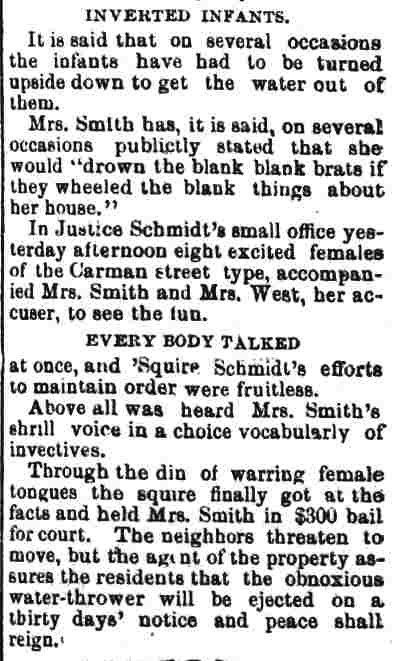
INVERTED INFANTS.
It is said that on several occasions the infants have had to be turned upside down to get the water out of them.
Mrs. Smith has, it is said, on several occasions publicly stated that she would “drown the blank blank brats if they wheeled the blank things about her house.”
In Justice Schmidt’s small office yesterday afternoon eight excited females of the Carman street type, accompanied Mrs. Smith and Mrs. West, her accuser, to see the fun.
EVERY BODY TALKED
at once, and ‘Squire Schmidt’s efforts to maintain order were fruitless.
Above all was heard Mrs. Smith’s shrill voice in a choice vocabulary of invectives.
Through the din of warring female tongues the squire finally got at the facts and held Mrs. Smith in $300 bail for court. The neighbors threaten to move, but the agent of the property assures the residents that the obnoxious water-thrower will be ejected on a thirty days’ notice and peace shall reign.
Eloped from Camden
Philadelphia Inquirer —

A Famous Base Ball Man Leaves With a Pretty Little Lass.
Pitcher Elder Deserts His Wife for Mamie Kelly—Incidents of the Day in Jersey’s Pretty Town.
Quite a sensation was caused in Camden yesterday by the announcement that Walter Elder, the star twirler of the Independent Base Ball Club, had eloped with Miss Mamie Kelly, a bright-eyed lass of 18, who lived at 317 Division Street.
Elder, who is better known to the ball-tossers as “Shinny,” left home on Saturday in company with Mamie and his -8-year-old son.
Mrs. Elder, according to the story she told Mayor Pratt yesterday, was under the impression that the two had gone to the base ball grounds, but when darkness came said they failed to return she became suspicious. Then she realized why her “shinny” had been paying such marked attention to Miss Kelly of late.
Brief Across the River Notes
Philadelphia Inquirer —
Llewellen B. Jackson, the installment man, at 94 Federal street, whose place was robbed on Saturday morning, thinks he has a clue. He says among the things stolen were two affidavits which he had secured to use in obtaining a divorce from his wife.
While unloading coal from a scow yesterday George Burton, of 629 Mechanic street, was struck by the hoisting bucket and received a compound fracture of the hip.
Minnie Aaron, of 1183 Linden street, was sent to jail by Mayor Pratt last night for a hearing to-day. “Jimmy” Bundles accused her of stealing a $20 gold piece from him.
A Policeman’s Battle
Philadelphia Inquirer —
Beating Administered a Camden Blue Coat. Burglars at Work.
Policeman William Harvey had a hard fight early yesterday morning when he attempted to arrest Thomas, alias “Curley,” Barnes for drunkenness. The prisoner turned upon him and was joined by his brother, John, and another man. Unitedly they fiercely attacked the policeman, knocking him down and severely beating him. Harvey, despite the odds against him, managed to take Barnes to a patrol box, thence to the City Hall. Mayor Pratt held him in $300 bail.
A Camden Free Fight
Philadelphia Inquirer —
Too Many Original Packages at a Party. Other Cross River News.
A party at Joseph Flanigan’s house on Mickle street, above Second, on Thursday night, had a bad ending. It was a package party, and some brought “original packages” with them. As soon as the bad whisky in the latter commenced to work free fist fights followed.
It was while Policeman Harvey and Robert Miller were patrolling their beats that they heard the cry of murder. They traced the cries to the Flanigan house, where they found at least a dozen men in the back yard engaged in a free fist fight. At the sight of the officers the men all scampered, with the exception of Edward Bates, who lay on the ground with blood running freely from a wound in his head. The police went in the house and arrested Charles Bates and William Harris.
After Edward Bates had his wounds dressed at the Cooper Hospital, he and the others were locked up for a hearing, and yesterday Mayor Pratt compelled the two Bateses and James Lafferty to pay fines and costs, while Harris was dismissed.
Dennis Corbitt tried to “do up” Policeman Mullane on Kaighn avenue, near Fourth street, yesterday afternoon. He succeeded in throwing Mullane down, and was about to escape when Policeman Harvey appeared. Corbitt tried to escape from both, but was subdued by blackjacks. His wounds were dressed at the Cooper Hospital. He is locked up at the City Hall for a hearing to-day.
Camden’s News Budget
Philadelphia Inquirer —
CAMDEN’S NEWS BUDGET.
Wrong-Doers Who Will Face Jersey Justice—Politicians Active.
William Cooper, a colored man, living in South Camden, yesterday beat his wife and was arrested by Policeman Harvey. He will have a hearing to-day before Mayor Pratt.
For running an alleged “speak-easy” at Sixth and Royden streets Lawrence Smith was arrested on Saturday by Specials Baker and Smith. He furnished bail for trial before the Mayor to-morrow.
Special Officers Baker and Smith late on Saturday night arrested Thomas Kripps, of Tenth and Central avenue on the charge of selling liquor without a license. He will have a hearing before the Mayor to-day.
Philadelphia Inquirer – December 28, 1890
BURGLARS IN CAMDEN.
POLICE CAPTURE TWO, WHO ARE COMMITTED TO AWAIT TRIAL.
Forecast of the Municipal Contest for Councilmen—A Crack 'r Baker in the Sheriff's Hands—Odds and Ends.
Edward, alias "Rye," Biddle, Walter Davis and Daniel Powell were committed to jail in default of $600 bail each by Mayor Pratt yesterday for robbing the house of Peter, Wolverton [sic], 1103 Cresson street, on Tuesday last. Biddle confessed and told where the goods were pawned. He said that Powell broke into the house and then left Davis in by the front door while he kept guard outside. They pawned the goods in this city.
Camden’s News Jottings
Philadelphia Inquirer —
Charged With Forgery—Lingo’s Chances for a New Trial—Notes.
Charged with forging the name of Harry Garren to a check for $16, William Gladney was sent to jail by Mayor Pratt, of Camden, yesterday. Scudder & Son cashed the check.
Cocco Safely Jailed
Philadelphia Inquirer —
The Italian Murderer Captured on His Return to Camden.
HIDING ALL NIGHT IN THE WOODS
After Thrusting the Stiletto Into the Heart of His Sister-in-Law He Coolly Changes His Clothes to Escape Identification
After spending a night in the woods between Camden and Atlantic counties, Dominico Fellippo Cocco, who murdered his sister-in-law at Cedar Brook, about eighteen miles from Camden, on Saturday night, as told in yesterday’s Inquirer, was arrested yesterday morning.
Cocco is 29 years of age and lived in Italy until last December, when he came here with his young bride and a babe. With his scanty earnings as a street sweep the young couple lived happily in the Italian quarter on Carpenter Street, until the last January, when the couple had a quarrel, which ended in their separation.
Mrs. Cocco, with her babe, then took refuge with her parents and sister, who live at Cedar Brook, which is near the Winslow Junction, on the Camden and Atlantic Railroad. Here she remained until Saturday night, when she was removed to the Camden City Hall as a witness to the tragedy in which her sister Giovanna Torra was the victim and her husband the murderer.
MURDER EVIDENTLY PREMEDITATED
Saturday evening Cocco, with a bundle on his arm, went to Cedar Brook. Leaving the bundle in the station he proceeded to the home of his mother-in-law, Rosalia Torra. Words with his wife precipitated a family row, during which he threatened to kill his father-in-law. The latter went for an officer in company with Carlos Santarlio, who had met Cocco at the railroad station.
Cocco then turned to his wife and in his native language shouted, “I am going to cut your head off and send it to the King of Italy.” He was about to strike her, when Giovanna stepped in to protect her sister. By this time the trio had got on the outside of the house. When about forty yards away Cocco made another grab for his wife. Giovanna again came to the rescue of her sister. She grappled with him and was struggling with him about the little garden patch, when suddenly Cocco placed the hand around the girl’s shoulders and with his right hand drew a keen-edged stiletto from his pocket. With all the force he sent the instrument into the girl’s side.
This blow failed to do its work and Cocco then plunged the stiletto again into her body, this time through her heart. With a shriek and a groan the girl dropped dead at his feet. The murderer then fled to the railroad station, where he secured the bundle which he had secreted. Out of this he took a pair of overalls, a jumper, and a slouch hat. The overalls and jumper he placed over his other clothing. The cap which he wore when he committed the murder he discarded. After disguising himself he ran to the next station below Cedar Brook, where he took a train for Ellwood.
HIDING IN THE WOODS
The balance of the night he spent hiding in the woods at that place. Yesterday morning he took a train at Ellwood and came to the Camden station of the Philadelphia and Atlantic City Railroad, where he was captured by Policeman Casper Hart. Cocco offered no resistance. He was taken to the City Hall, where he was brought before his wife in the private apartments of Superintendent Moffet.
“Do you know that man?” asked Mr. Moffett of the woman. She threw up both her hands and commenced to weep. Between her sobs she would mutter the name of Dominico. She almost went frantic with fear that he would injure her.
The murderer, cool and collected, was taken before Mayor Pratt, to whom he admitted the murder, but claimed it was committed in self defense, at the same time displaying a cut on the head, which he claimed was inflicted by the girl with an axe. He was then about to demonstrate the manner in which he stabbed Giovanna when his wife became hysterical and rushed into the Mayor’s private office, where on her knees she appealed for protection from the man who had taken her sister’s life. All of the witnesses discounted the claim of Cocco that he committed the deed in self-defense.
The remains of the murdered girl were placed in an ice box in the Camden Morgue yesterday. She was 17 years of age and strikingly handsome. There are no marks of violence on her face or body. The fatal stab wound on the surface of the skin looked to be only about an inch and a quarter long. County Physician Iszard says the stiletto must have plunged into the breast at least six or eight inches. All of the witnesses have been held in $1,000 bail to appear at court. Coroner Jefferis has charge of the case and will hold an inquest the latter part of the week.
Middleton’s Bail Fixed
Philadelphia Inquirer —
Mayor Pratt yesterday fixed the bail of William Middleton, who shot Emma Stewart in the Dime Museum, at $1,000. Miss Stewart’s physician has pronounced her out of danger.
Odds and Ends
Philadelphia Inquirer —
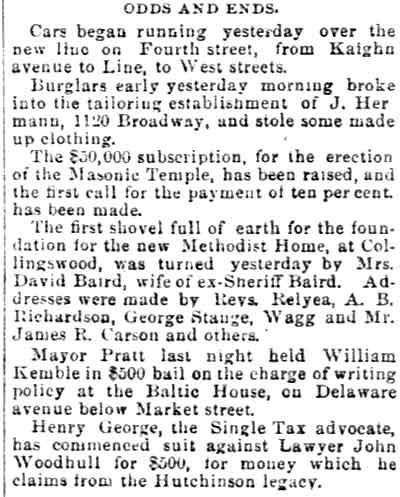
Cars began running yesterday over the new line on Fourth street, from Kaighn avenue to Line, to West streets.
Burglars early yesterday morning broke into the tailoring establishment of J. Hermann, 1120 Broadway, and stole some made up clothing.
The $50,000 subscription, for the erection of the Masonic Temple, has been raised, and the first call for the payment of ten per cent. has been made.
The first shovel full of earth for the foundation for the new Methodist Home, at Collingswood, was turned yesterday by Mrs. David Baird, wife of ex-Sheriff Baird. Addresses were made by Revs. Relyea, A. B. Richardson, George Stange, Wagg and Mr. James R. Carson and others.
Mayor Pratt last night held William Kemble in $500 bail on the charge of writing policy at the Baltic House, on Delaware avenue below Market street.
Henry George, the Single Tax advocate, has commenced suit against Lawyer John Woodhull for $500, for money which he claims from the Hutchinson legacy.
Saloonkeepers Arrested
Philadelphia Inquirer —
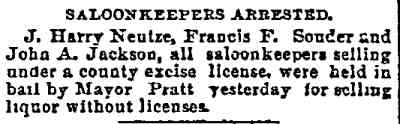
J. Harry Neutze, Francis F. Souder and John A. Jackson, all saloonkeepers selling under a county excise license, were held in bail by Mayor Pratt yesterday for selling liquor without licenses.
Frank Yeager Discharged
Philadelphia Inquirer —
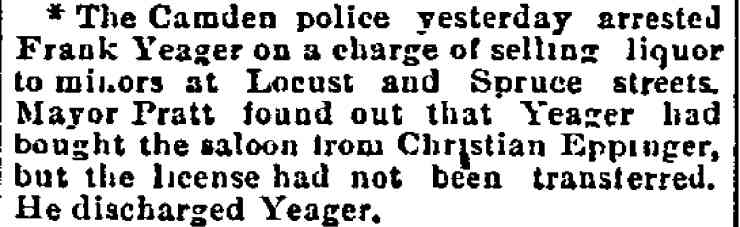
* The Camden police yesterday arrested Frank Yeager on a charge of selling liquor to minors at Locust and Spruce Streets. Mayor Pratt found out that Yeager had bought the saloon from Christian Eppinger, but the license had not been transferred. He discharged Yeager.
Philadelphia Inquirer – January 9, 1892
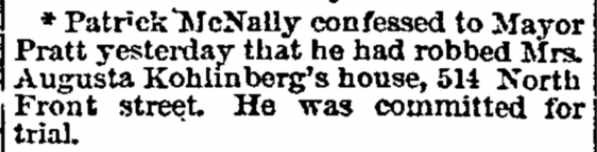
* Patrick McNally confessed to Mayor Pratt yesterday that he had robbed Mrs. Augusta Kohlinberg’s house, 514 North Front Street. He was committed for trial.
Eugene Lippincott Held in Bail
Philadelphia Inquirer —
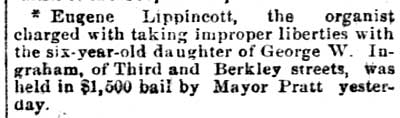
Eugene Lippincott, the organist charged with taking improper liberties with the six-year-old daughter of George W. Ingraham, of Third and Berkley Streets, was held in $1,500 bail by Mayor Pratt yesterday.
1900 Camden City Directory
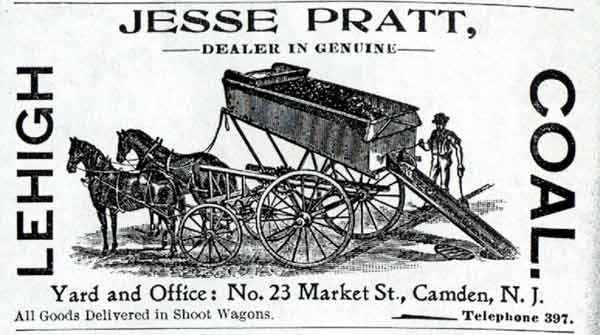
Jesse Pratt in the 1900 Camden City Directory
Funeral of Mrs. Moffett
Camden Daily Telegram —
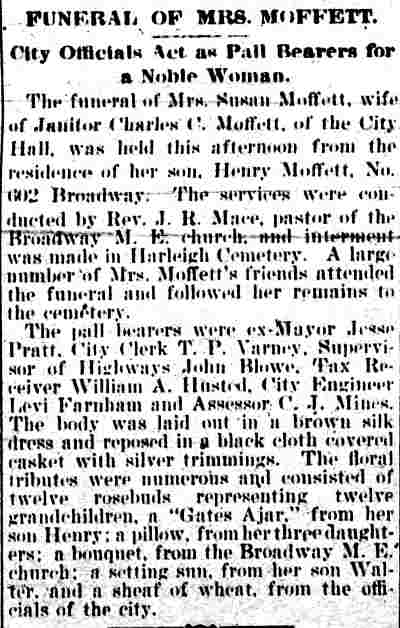
City Officials Act as Pall Bearers for a Noble Woman.
The funeral of Mrs. Susan Moffett, wife of Janitor Charles C. Moffett, of the City Hall, was held this afternoon from the residence of her son, Henry Moffett, No. 602 Broadway. The services were conducted by Rev. J. R. Mace, pastor of the Broadway M. E. church, and interment was made in Harleigh Cemetery. A large number of Mrs. Moffett’s friends attended the funeral and followed her remains to the cemetery.
The pall bearers were ex-Mayor Jesse Pratt, City Clerk T. P. Varney, Supervisor of Highways John Blowe, Tax Receiver William A. Husted, City Engineer Levi Farnham and Assessor C. J. Mines. The body was laid out in a brown silk dress and reposed in a black cloth covered casket with silver trimmings. The floral tributes were numerous and consisted of twelve rosebuds representing twelve grandchildren, a “Gates Ajar,” from her son Henry; a pillow, from her three daughters; a bouquet, from the Broadway M. E. church; a setting sun, from her son Walter, and a sheaf of wheat, from the officials of the city.
Along Memory Lane
Camden Courier-Post —
By Ben Courter
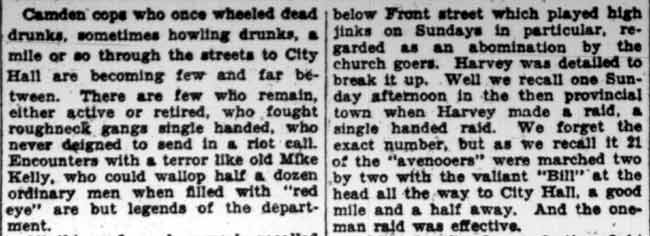
Camden cops who once wheeled dead drunks, sometimes howling drunks, a mile or so through the streets to City Hall are becoming few and far between. There are few who remain, either active or retired, who fought roughneck gangs single handed, who never deigned to send in a riot call. Encounters with a terror like old Mike Kelly, who could wallop half a dozen ordinary men when filled with “red eye” are but legends of the department.
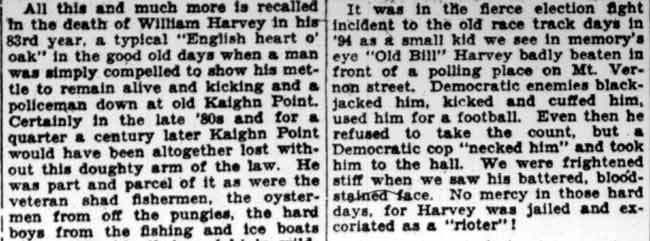
All this and much more is recalled in the death of William Harvey in his 83rd year, a typical “English heart o’ oak” in the good old days when a man was simply compelled to show his mettle to remain alive and kicking and a policeman down at old Kaighn Point. Certainly in the late ‘80s and for a quarter a century later Kaighn Point would have been altogether lost without this doughty arm of the law. He was part and parcel of it as were the veteran shad fishermen, the oystermen from off the pungies, the hard boys from the fishing and ice boats who could whip their weight in wildcats and yell for more, such as “Big Bill” Zaiser, “Tar Heel” Henry, the Bearn boys and others, most of whom have gone the way of all flesh.
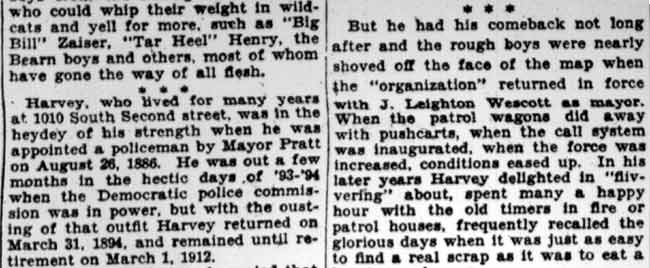
Harvey, who lived for many years at 1010 South Second street, was in the heydey [sic] of his strength when he was appointed a policeman by Mayor Pratt on August 26, 1886. He was out a few months in the hectic days of ‘93–’94 when the Democratic police commission was in power, but with the ousting of that outfit Harvey returned on March 31, 1894, and remained until retirement on March 1, 1912.
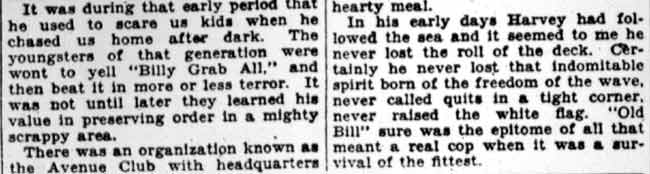
It was during that early period that he used to scare us kids when he chased us home after dark. The youngsters of that generation were wont to yell “Billy Grab All,” and then beat it in more or less terror. It was not until later they learned his value in preserving order in a mighty scrappy area.
There was an organization known as the Avenue Club with headquarters below Front street which played high jinks on Sundays in particular, regarded as an abomination by the church goers. Harvey was detailed to break it up. Well we recall one Sunday afternoon in the then provincial town when Harvey made a raid, a single handed raid. We forget the exact number, but as we recall it 21 of the “avenooers” were marched two by two with the valiant “Bill” at the head all the way to City Hall, a good mile and a half away. And the one-man raid was effective.
It was in the fierce election fight incident to the old race track days in ‘94 as a small kid we see in memory’s eye “Old Bill” Harvey badly beaten in front of a polling place on Mt. Vernon street. Democratic enemies blackjacked him, kicked and cuffed him, used him for a football. Even then he refused to take the count, but a Democratic cop “necked him” and took him to the hall. We were frightened stiff when we saw his battered, blood-stained face. No mercy in those hard days, for Harvey was jailed and excoriated as a “rioter”!
But he had his comeback not long after and the rough boys were nearly shoved off the face of the map when the “organization” returned in force with J. Leighton Wescott as mayor. When the patrol wagons did away with pushcarts, when the call system was inaugurated, when the force was increased, conditions eased up. In his later years Harvey delighted in “flivvering” about, spent many a happy hour with the old timers in fire or patrol houses, frequently recalled the glorious days when it was just as easy to find a real scrap as it was to eat a hearty meal.
In his early days Harvey had followed the sea and it seemed to me he never lost the roll of the deck. Certainly he never lost that indomitable spirit born of the freedom of the wave, never called quits in a tight corner, never raised the white flag. “Old Bill” sure was the epitome of all that meant a real cop when it was a survival of the fittest.
Police Shakeups of Today Mild Compared to Years Ago
Camden Courier-Post —
Force Changed Every Time Political Regime of City Shifted; Larry Doran Fired for Crossing Street to Get Cinnamon Bun; Old Patrol Recalled
By BEN COURTER
(Another in a series of articles on municipal affairs and personalities of yesteryear.)
Ben Courter
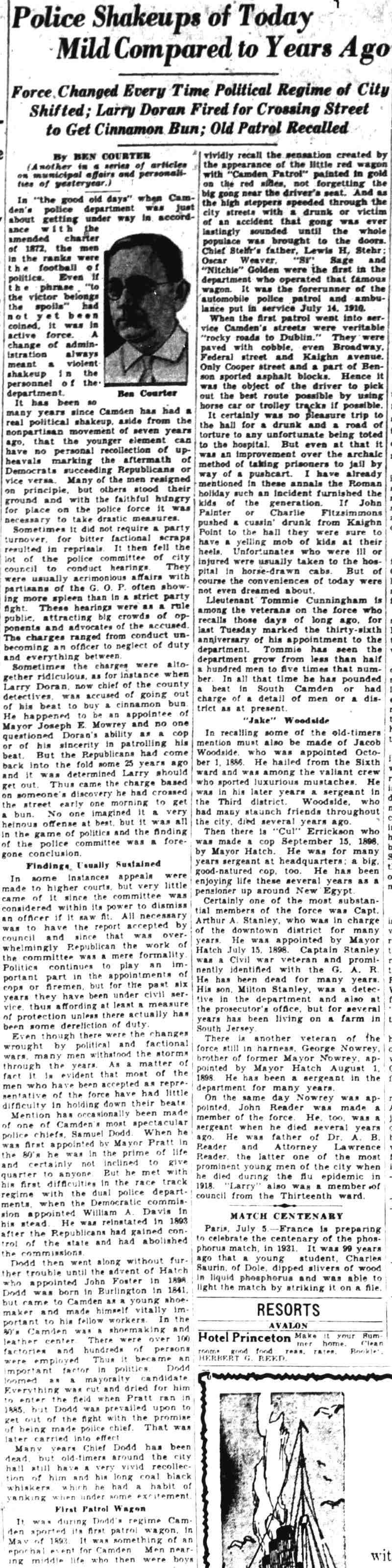
In “the good old days” when Camden’s police department was just about getting under way in accordance with the amended charter of 1872, the men in the ranks were the football of politics. Even if the phrase “to the victor belongs the spoils” had not yet been coined, it was in active force. A change of administration always meant a violent shakeup in the personnel of the department.
It has been so many years since Camden has had a real political shakeup, aside from the nonpartisan movement of seven years ago, that the younger element can have no personal recollection of upheavals marking the aftermath of Democrats succeeding Republicans or vice versa. Many of the men resigned on principle, but others stood their ground and with the faithful hungry for place on the police force it was necessary to take drastic measures.
Sometimes it did not require a party turnover, for bitter factional scraps resulted in reprisals. It then fell the lot of the police committee of city council to conduct hearings. They were usually acrimonious affairs with partisans of the G. O. P. often showing more spleen than in a strict party fight. These hearings were as a rule public, attracting big crowds of opponents and advocates of the accused. The charges ranged from conduct unbecoming an officer to neglect of duty and everything between.
Sometimes the charges were altogether ridiculous, as for instance when Larry Doran, now chief of the county detectives, was accused of going out of his beat to buy a cinnamon bun. He happened to be an appointee of Mayor Joseph E. Mowrey and no one questioned Doran’s ability as a cop or of his sincerity in patrolling his beat. But the Republicans had come back into the fold some 25 years ago and it was determined Larry should get out. Thus came the charge based on someone’s discovery he had crossed the street early one morning to get a bun. No one imagined it a very heinous offense at best, but it was all in the game of politics and the finding of the police committee was a foregone conclusion.
Findings, Usually Sustained
In some instances appeals were made to higher courts, but very little came of it since the committee was considered within its power to dismiss an officer if it saw fit. All necessary was to have the report accepted by council and since that was overwhelmingly Republican the work of the committee was a mere formality. Politics continues to play an important part in the appointments of cops or firemen, but for the past six years they have been under civil service, thus affording at least a measure of protection unless there actually has been some dereliction of duty.
Even though there were the changes wrought by political and factional wars, many men withstood the storms through the years. As a matter of fact it is evident that most of the men who have been accepted as representative of the force have had little difficulty in holding down their beats.
Mention has occasionally been made of one of Camden’s most spectacular police chiefs, Samuel Dodd. When he was first appointed by Mayor Pratt in the 80’s he was in the prime of life and certainly not inclined to give quarter to anyone. But he met with his first difficulties in the race track regime with the dual police departments, when the Democratic commission appointed William A. Davis in his stead. He was reinstated in 1893 after the Republicans had gained control of the state and had abolished the commissions.
Dodd then went along without further trouble until the advent of Hatch who appointed John Foster in 1898. Dodd was born in Burlington in 1841, but came to Camden as a young shoemaker and made himself vitally important to his fellow workers. In the 80’s Camden was a shoemaking and leather center. There were over 100 factories and hundreds of persons were employed. Thus it became an important factor in politics. Dodd loomed as a mayoralty candidate. Everything was cut and dried for him to enter the field when Pratt ran in 1885, but Dodd was prevailed upon to get out of the fight with the promise of being made police chief. That was later carried into effect.
Many years Chief Dodd has been dead, but old-timers around the city hall still have a very vivid recollection of him and his long coal black whiskers, which he had a habit of yanking when under some excitement.
First Patrol Wagon
It was during Dodd’s regime Camden sported its first patrol wagon, in May of 1893. It was something of an epochal event for Camden. Men nearing middle life who then were boys vividly recall the sensation created by the appearance of the little red wagon with “Camden Patrol” painted in gold on the red sides, not forgetting the big gong near the driver’s seat. And as the high steppers speeded through the city streets with a drunk or victim of an accident that gong was everlastingly sounded until the whole populace was brought to the doors. Chief Stehr’s father, Lewis H. Stehr; Oscar Weaver, “Si” Sage and “Nitchie” Golden were the first in the department who operated that famous wagon. It was the forerunner of the automobile police patrol and ambulance put in service July 14, 19[?].
When the first patrol went into service Camden’s streets were veritable “rocky roads to Dublin.” They were paved with cobble, even Broadway, Federal street and Kaighn avenue. Only Cooper street and a part of Benson sported asphalt blocks. Hence it was the object of the driver to pick out the best route possible by using horse car or trolley tracks if possible.
It certainly was no pleasure trip to the hall for a drunk and a road of torture to any unfortunate being toted to the hospital. But even at that it was an improvement over the archaic method of taking prisoners to jail by way of a pushcart. I have already mentioned in these annals the Roman holiday such an incident furnished the kids of the generation. If John Painter or Charlie Fitzsimmons pushed a cussin’ drunk from Kaighn Point to the hall they were sure to have a yelling mob of kids at their heels. Unfortunates who were ill or injured were usually taken to the hospital in horse-drawn cabs. But of course the conveniences of today were not even dreamed about.
Lieutenant Tommie Cunningham is among the veterans on the force who recalls those days of long ago, for last Tuesday marked the thirty-sixth anniversary of his appointment to the department. Tommie has seen the department grow from less than half a hundred men to five times that number. In all that time he has pounded a beat in South Camden or had charge of a detail of men or a district as at present.
“Jake” Woodside
In recalling some of the old-timers mention must also be made of Jacob Woodside, who was appointed October 1, 1898. He hailed from the Sixth ward and was among the valiant crew who sported luxurious mustaches. He was in his later years a sergeant in the Third district. Woodside, who had many staunch friends throughout the city, died several years ago.
Then there is “Cul” Errickson who was made a cop September 15, 1898, by Mayor Hatch. He was for many years sergeant at headquarters; a big, good-natured cop, too. He has been enjoying life these several years as a pensioner up around New Egypt.
Certainly one of the most substantial members of the force was Capt. Arthur A. Stanley, who was in charge of the downtown district for many years. He was appointed by Mayor Hatch July 15, 1898. Captain Stanley was a Civil war veteran and prominently identified with the G. A. R. He has been dead for many years. His son, Milton Stanley, was a detective in the department and also at the prosecutor’s office, but for several years has been living on a farm in South Jersey.
There is another veteran of the force still in harness, George Nowrey, brother of former Mayor Nowrey, appointed by Mayor Hatch August 1, 1898. He has been a sergeant in the department for many years.
On the same day Nowrey was appointed, John Reader was made a member of the force. He, too, was a sergeant when he died several years ago. He was father of Dr. A. B. Reader and Attorney Lawrence Reader, the latter one of the most prominent young men of the city when he died during the flu epidemic in 1918. “Larry” also was a member of council from the Thirteenth ward.
By His Victim’s Bedside.
Philadelphia Inquirer —
A Dying Man Identifies Andrew Eckert as His Murderer.
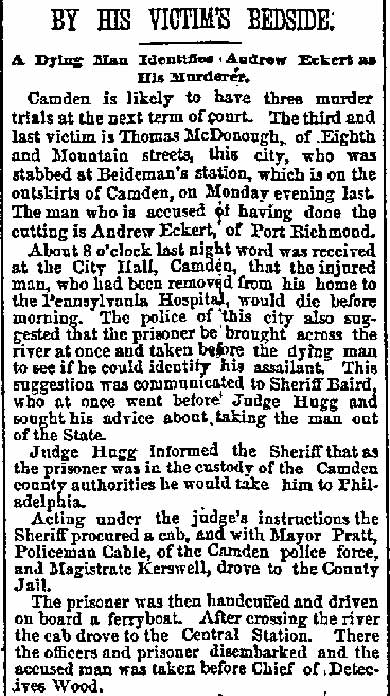
Camden is likely to have three murder trials at the next term of court. The third and last victim is Thomas McDonough, of Eighth and Mountain streets, this city, who was stabbed at Beideman’s station, which is on the outskirts of Camden, on Monday evening last. The man who is accused of having done the cutting is Andrew Eckert, of Port Richmond.
About 8 o’clock last night word was received at the City Hall, Camden, that the injured man, who had been removed from his home to the Pennsylvania Hospital, would die before morning. The police of this city also suggested that the prisoner be brought across the river at once and taken before the dying man to see if he could identify his assailant. This suggestion was communicated to Sheriff Baird, who at once went before Judge Hugg and sought his advice about taking the man out of the State.
Judge Hugg informed the Sheriff that as the prisoner was in the custody of the Camden county authorities he would take him to Philadelphia.
Acting under the judge’s instructions the Sheriff procured a cab, and with Mayor Pratt, Policeman Cable, of the Camden police force, and Magistrate Kerswell, drove to the County Jail.
The prisoner was then handcuffed and driven on board a ferryboat. After crossing the river the cab drove to the Central Station. There the officers and prisoner disembarked and the accused man was taken before Chief of Detectives Wood.
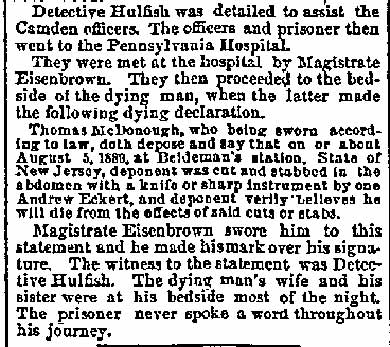
Detective Hulfish was detailed to assist the Camden officers. The officers and prisoner then went to the Pennsylvania Hospital.
They were met at the hospital by Magistrate Eisenbrown. They then proceeded to the bedside of the dying man, when the latter made the following dying declaration:
Thomas McDonough, who being sworn according to law, doth depose and say that on or about August 5, 1889, at Beideman’s station, State of New Jersey, deponent was cut and stabbed in the abdomen with a knife or sharp instrument by one Andrew Eckert, and deponent verily believes he will die from the effects of said cuts or stabs.
Magistrate Eisenbrown swore him to this statement and he made his mark over his signature. The witness to the statement was Detective Hulfish. The dying man’s wife and his sister were at his bedside most of the night. The prisoner never spoke a word throughout his journey.