Milton K. Stanley
MILTON K. STANLEY was the son of Arthur Stanley, who retired as a captain on the Camden Police Department in 1916. Arthur Stanley was a veteran of the Civil War who was appointed to the Camden Police Department in 1898, and was made Captain of the Second District.
Milton K. Stanley was born in Camden, New Jersey around 1872 to Arthur Stanley and his wife, the former Frances Irene Kirby. It appears that Frances Stanley passed away by the time of the 1880 Census. Arthur Stanley is listed at 929 Newton Avenue in Camden City Directories from 1874 through 1881, along with Milton, his sister Mrs. Louisa Vennell and her daughter Clara. Arthur Stanley and family moved in with James Stanley, Milton’s grandfather, at 428 Line Street by 1883, and stayed at that address through at least January of 1910.
Milton K. Stanley left home at the age of fourteen to join a circus, and was successful. He toured Europe and the United States, had a long career in vaudeville, ran a theater in Louisville, Kentucky and a theatrical booking agency in Newark, New Jersey. In 1909 he was offered a job with the Camden Police Department. In 1914 he joined the Camden County Prosecutor’s office as a detective. In 1926 he went to work as a detective for the U.S. Government as a Prohibition agent and as a narcotics investigator. He also organized the Police Carnival shows at the old armory at Haddon Avenue and Mickle Street, known in years after his death as Convention Hall.
Milton K. Stanley died on October 21, 1945. He had been ill for several months. He was survived by his wife Alice, sons Charles M. and Arthur, and a daughter, Frances. Milton K. Stanley’s last address was 45 North 35th Street.
Police Carnival Was a Gigantic Success
Philadelphia Inquirer —
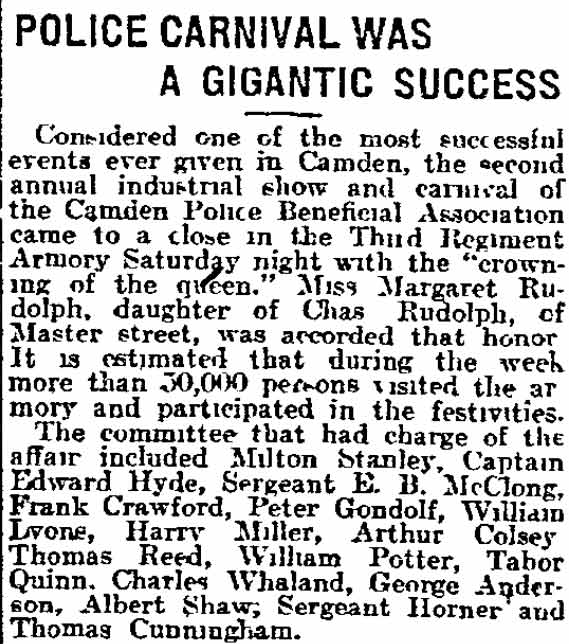
Considered one of the most successful events ever given in Camden, the second annual industrial show and carnival of the Camden Police Beneficial Association came to a close in the Third Regiment Armory Saturday night with the “crowning of the queen.” Miss Margaret Rudolph, daughter of Chas. Rudolph, of Master street, was accorded that honor. It is estimated that during the week more than 30,000 persons visited the armory and participated in the festivities.
The committee that had charge of the affair included Milton Stanley, Captain Edward Hyde, Sergeant E. B. McClong, Frank Crawford, Peter Gondolf, William Lvone [sic], Harry Miller, Arthur Colsey, Thomas Reed, William Potter, Tabor Quinn, Charles Whaland, George Anderson, Albert Shaw, Sergeant Horner and Thomas Cunningham.
Jail Entry Succeeds
Philadelphia Public Ledger —
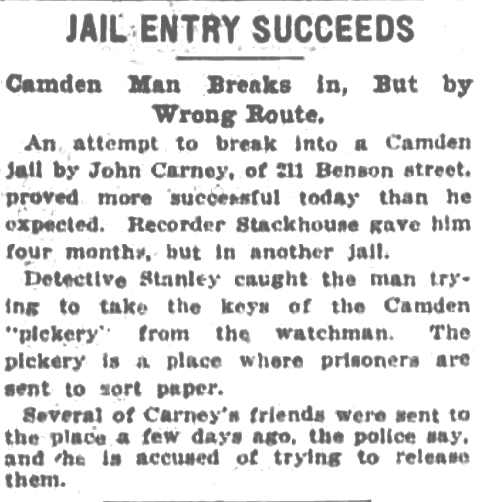
Camden Man Breaks in, But by Wrong Route.
An attempt to break into a Camden jail by John Carney, of 211 Benson street, proved more successful today than he expected. Recorder Stackhouse gave him four months, but in another jail.
Detective Stanley caught the man trying to take the keys of the Camden “pickery” from the watchman. The pickery is a place where prisoners are sent to sort paper.
Several of Carney’s friends were sent to the place a few days ago, the police say, and he is accused of trying to release them.
50 Taken in Vice Raids
Philadelphia Inquirer —
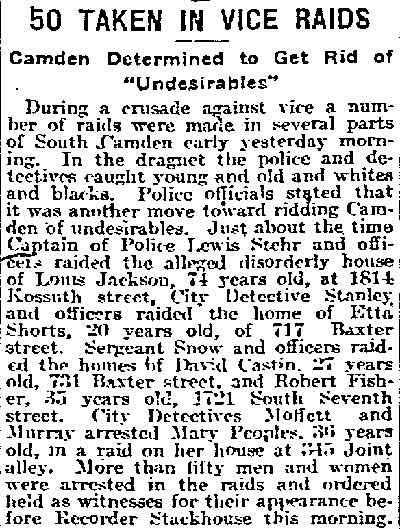
Camden Determined to Get Rid of “Undesirables”
During a crusade against vice a number of raids were made in several parts of South Camden early yesterday morning. In the dragnet the police and detectives caught young and old and whites and blacks. Police officials stated that it was another move toward ridding Camden of undesirables. Just about the time Captain of Police Lewis Stehr and officers raided the alleged disorderly house of Louis Jackson, 74 years old, at 1814 Kossuth street, City Detective Stanley and officers raided the home of Etta Shorts, 20 years old, of 717 Baxter street. Sergeant Snow and officers raided the homes of David Castin, 27 years old, 731 Baxter street, and Robert Fisher, 3[?] years old, 1721 South Seventh street. City Detectives Moffett and Murray arrested Mary Peoples, 3[?] years old, in a raid on her house at [?] Joint alley. More than fifty men and women were arrested in the raids and ordered held as witnesses for their appearance before Recorder Stackhouse this morning.
Changes Ordered in Camden Police
Philadelphia Inquirer —
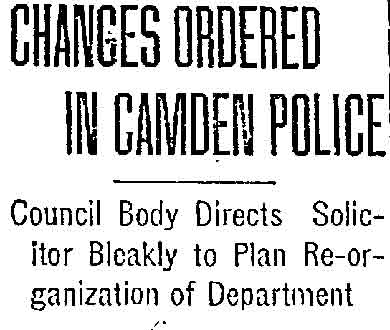
Council Body Directs Solicitor Bleakly to Plan Re-organization of Department
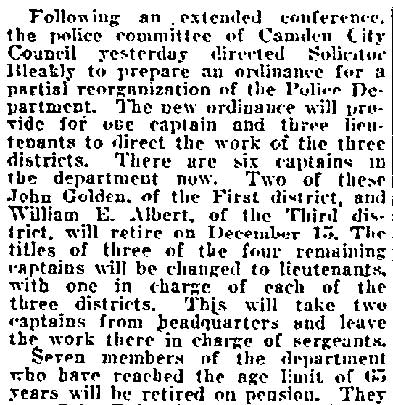
Following an extended conference, the police committee of Camden City Council yesterday directed Solicitor Bleakly to prepare an ordinance for a partial reorganization of the Police Department. The new ordinance will provide for one captain and three lieutenants to direct the work of the three districts. There are six captains in the department now. Two of these John Golden, of the First district, and William E. Albert, of the Third district, will retire on December 15. The titles of three of the four remaining captains will be changed to lieutenants, with one in charge of each of the three districts. This will take two captains from headquarters and leave the work there in charge of sergeants.
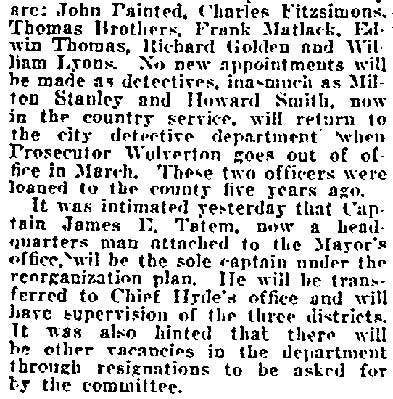
Seven members of the department who have reached the age limit of 65 years will be retired on pension. They are: John Painted [sic], Charles Fitzsimons, Thomas Brothers, Frank Matlack, Edwin Thomas, Richard Golden and William Lyons. No new appointments will be made as detectives, inasmuch as Milton Stanley and Howard Smith, now in the country [sic] service, will return to the city detective department when Prosecutor Wolverton goes out of office in March. These two officers were loaned to the county five years ago.
It was intimated yesterday that Captain James E. Tatem, now a headquarters man attached to the Mayor’s office, will be the sole captain under the reorganization plan. He will be transferred to Chief Hyde’s office and will have supervision of the three districts. It was also hinted that there will be other vacancies in the department through resignations to be asked for by the committee.
Revue Planned to Aid St. Wilfrid’s
Camden Courier-Post —
Rehearsals are being held for the 1938 Revue to be presented for the benefit of St. Wilfrid’s Episcopal Church, Westfield Avenue and Dudley Street, on February 24 and 25.
Milton K. Stanley, former county detective, is directing the play. Electrical effects and scenery are under the direction of Ellsworth Marcoe. The women of the church are preparing new wardrobes for the cast. Jimmy Lang and his band will provide music for the show.
300 at Guild Hall See ‘Review of 1938’
Camden Courier-Post —
Parishioners of St. Wilfrid’s Church Present Varied Features in Show
Three hundred greeted the initial production of the “Revue of 1938” last night in the Guild Hall of St. Wilfrid’s Church, Dudley Street and Westfield Avenue.
The program, which will be repeated tonight, opens with a minstrel show. The show includes vaudeville acts and a comedy presentation of an amateur hour radio broadcast, entitled “Major Shows His Amateur Hour.”
Robert Burgy is interlocutor of the minstrel show. The end men are Jimmie Jones, Bud Ashton, Joe Hamilton, old time minstrel man, and Milton K. Stanley, former county detective, who directed the show.
Frances Allen, Maurice Atger, Mrs. Irma Weller, Mrs. Alice Stanley, George Braunwarth, Jr., Jones, Frances Stanley and Doris Gray are soloists in the minstrel troupe. Miss Weller does a novelty dance and Miss Kray a monologue. Jimmy Lang and his orchestra provide music. Florence Geragussi’s Sophisticated High Steppers and Dorothy and Charles Ganter give song and dance specialties.
Marcus Matthias takes the role of Major Show. In the “broadcast,” Harry Riley, Charles Pelouze and Robert Shoemaker appear as Tennessee Hill Billies. Florence Donahue, Elizabeth Martin, June Daryman and Freda Nuss are sunshine girls. Other characters are George Wysocki, “Signor Tomato;” Atger, “Rollo Winesap;” Mary Riley, “Mrs. Winesap;” Braunwarth, “Epsom Salts;” Ellsworth Marcoe Jr., “Ferdinand Squidge;” Lillian Petit, “Mlle. Fefi Flitters;” Miss Weller, “Madame Coco;” Pelouze and Edward Mortimer, “Pluto, the Trained Mule,” and Babe Shoemaker, “life of the party.”
The above also appear in the general ensemble together with Doris Dodd, Dorothy Schmidt, Eleanor Dryer, Vern Burgy, Marie Dodd, Florence Feick, Robert Burgy, Theodore Tessier, Jerry Nicholson, David Lacy and Bud Ashton.
M. K. Stanley Dies; Ex-City Detective
Camden Courier-Post —

Served also on Force of County; Started as Circus Acrobat
Milton K. Stanley, former city and county detective, circus acrobat and showman, died yesterday in Cooper hospital after several months illness.
Mr. Stanley, who was 73, had been in ill health since July 1. He was taken to the hospital Thursday. An autopsy will be performed today to ascertain cause of death. Surviving are his widow, Alice; two sons, Arthur, and Charles M., the latter with the Army, and a daughter, Frances. Arrangements for the funeral have not been completed. He lived at 45 North Thirty-fifth street.
Mr. Stanley was the son of the late Capt. Arthur Stanley, who was in command of the Second Police district for years. He started his career as a showman, first as a circus acrobat and winding up as a theatre owner and promoter of medicine shows. Amng [sic] his outstanding achievements after he left the road to become a Camden policeman were the carnivals staged in the Third Regiment armory for the Camden Police Beneficial Association.
Made Important Arrests
Retiring as a county detective in 1926, after making several important arrests in both the city and county service, he spent the remainder of his life as an investigator. Before taking up this work he served for a time as a U. S. narcotic investigator and as a prohibition agent.
Mr. Stanley ran away from home at the age of 14 to join a circus. He said he got the urge to go into show business from attending Ma Drew’s theatre on Arch street, Philadelphia. She was the grandmother of John, Lionel and Ethel Barrymore. He said he and his boyhood pals would watch the acrobatic stunts at the theatre and then go to a Camden stable and practice them in a hay mound.
His first venture in show business was to join the Pawnee Bill Wild West show, which sailed in a few days for Europe. George W. Childs, who owned the old Public Ledger, backed the show. He met Harry Wieble two and one-half days out to sea. He was a schoolmate of Mr. Stanley’s and was doing a “Rube” act with the show. They teamed up.
Shifted to Vaudeville
After a 21 week tour of England and continental Europe, Mr. Stanley jumped into vaudeville. He took as his partner Jim West, brother of Billy West, famous minstrel man. They returned to this country the following Christmas.
During his colorful career, in which he became a personal friend of Buffalo Bill, he leased the old Buckingham theatre in Louisville. He operated it for three years, made money and sold it at a profit, he said. Once he was injured in a Erie Railroad train wreck at Meadville, Pa., and was in a hospital 19 weeks.
While he conducted a theatrical booking agency at Newark his father wired him after 23 years of wanderlust to come home, which he did. But it was not long before he got the itch again for show business, as he put it, and formed a team with another Camden trouper, Milton Scott, who was a contortionist.
Offered Police Job
They were on the road at Altoona, Pa., when he got a telegram from Caleb Williams, then Fourth ward Republican leader, that he had a job open for him on the police force. The next Saturday night he became a patrolman. A short time later a policeman was killed and the Police Beneficial Association wanted to give the widow some money. Mr. Stanley suggested a show at the armory and then began the first carnival staged each Fall for several years, with the old showman as director.
He became a patrolman in 1909 and served until 1914 when he was appointed a county detective. He was a county detective 12 years.
Police Shakeups of Today Mild Compared to Years Ago
Camden Courier-Post —
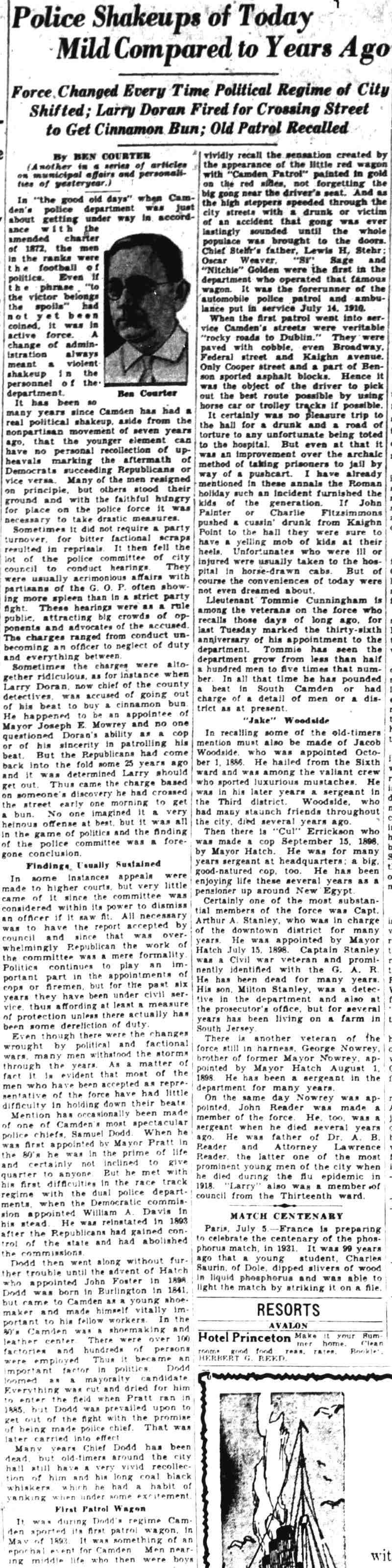
Force Changed Every Time Political Regime of City Shifted; Larry Doran Fired for Crossing Street to Get Cinnamon Bun; Old Patrol Recalled
By BEN COURTER
(Another in a series of articles on municipal affairs and personalities of yesteryear.)
Ben Courter
In “the good old days” when Camden’s police department was just about getting under way in accordance with the amended charter of 1872, the men in the ranks were the football of politics. Even if the phrase “to the victor belongs the spoils” had not yet been coined, it was in active force. A change of administration always meant a violent shakeup in the personnel of the department.
It has been so many years since Camden has had a real political shakeup, aside from the nonpartisan movement of seven years ago, that the younger element can have no personal recollection of upheavals marking the aftermath of Democrats succeeding Republicans or vice versa. Many of the men resigned on principle, but others stood their ground and with the faithful hungry for place on the police force it was necessary to take drastic measures.
Sometimes it did not require a party turnover, for bitter factional scraps resulted in reprisals. It then fell the lot of the police committee of city council to conduct hearings. They were usually acrimonious affairs with partisans of the G. O. P. often showing more spleen than in a strict party fight. These hearings were as a rule public, attracting big crowds of opponents and advocates of the accused. The charges ranged from conduct unbecoming an officer to neglect of duty and everything between.
Sometimes the charges were altogether ridiculous, as for instance when Larry Doran, now chief of the county detectives, was accused of going out of his beat to buy a cinnamon bun. He happened to be an appointee of Mayor Joseph E. Mowrey and no one questioned Doran’s ability as a cop or of his sincerity in patrolling his beat. But the Republicans had come back into the fold some 25 years ago and it was determined Larry should get out. Thus came the charge based on someone’s discovery he had crossed the street early one morning to get a bun. No one imagined it a very heinous offense at best, but it was all in the game of politics and the finding of the police committee was a foregone conclusion.
Findings, Usually Sustained
In some instances appeals were made to higher courts, but very little came of it since the committee was considered within its power to dismiss an officer if it saw fit. All necessary was to have the report accepted by council and since that was overwhelmingly Republican the work of the committee was a mere formality. Politics continues to play an important part in the appointments of cops or firemen, but for the past six years they have been under civil service, thus affording at least a measure of protection unless there actually has been some dereliction of duty.
Even though there were the changes wrought by political and factional wars, many men withstood the storms through the years. As a matter of fact it is evident that most of the men who have been accepted as representative of the force have had little difficulty in holding down their beats.
Mention has occasionally been made of one of Camden’s most spectacular police chiefs, Samuel Dodd. When he was first appointed by Mayor Pratt in the 80’s he was in the prime of life and certainly not inclined to give quarter to anyone. But he met with his first difficulties in the race track regime with the dual police departments, when the Democratic commission appointed William A. Davis in his stead. He was reinstated in 1893 after the Republicans had gained control of the state and had abolished the commissions.
Dodd then went along without further trouble until the advent of Hatch who appointed John Foster in 1898. Dodd was born in Burlington in 1841, but came to Camden as a young shoemaker and made himself vitally important to his fellow workers. In the 80’s Camden was a shoemaking and leather center. There were over 100 factories and hundreds of persons were employed. Thus it became an important factor in politics. Dodd loomed as a mayoralty candidate. Everything was cut and dried for him to enter the field when Pratt ran in 1885, but Dodd was prevailed upon to get out of the fight with the promise of being made police chief. That was later carried into effect.
Many years Chief Dodd has been dead, but old-timers around the city hall still have a very vivid recollection of him and his long coal black whiskers, which he had a habit of yanking when under some excitement.
First Patrol Wagon
It was during Dodd’s regime Camden sported its first patrol wagon, in May of 1893. It was something of an epochal event for Camden. Men nearing middle life who then were boys vividly recall the sensation created by the appearance of the little red wagon with “Camden Patrol” painted in gold on the red sides, not forgetting the big gong near the driver’s seat. And as the high steppers speeded through the city streets with a drunk or victim of an accident that gong was everlastingly sounded until the whole populace was brought to the doors. Chief Stehr’s father, Lewis H. Stehr; Oscar Weaver, “Si” Sage and “Nitchie” Golden were the first in the department who operated that famous wagon. It was the forerunner of the automobile police patrol and ambulance put in service July 14, 19[?].
When the first patrol went into service Camden’s streets were veritable “rocky roads to Dublin.” They were paved with cobble, even Broadway, Federal street and Kaighn avenue. Only Cooper street and a part of Benson sported asphalt blocks. Hence it was the object of the driver to pick out the best route possible by using horse car or trolley tracks if possible.
It certainly was no pleasure trip to the hall for a drunk and a road of torture to any unfortunate being toted to the hospital. But even at that it was an improvement over the archaic method of taking prisoners to jail by way of a pushcart. I have already mentioned in these annals the Roman holiday such an incident furnished the kids of the generation. If John Painter or Charlie Fitzsimmons pushed a cussin’ drunk from Kaighn Point to the hall they were sure to have a yelling mob of kids at their heels. Unfortunates who were ill or injured were usually taken to the hospital in horse-drawn cabs. But of course the conveniences of today were not even dreamed about.
Lieutenant Tommie Cunningham is among the veterans on the force who recalls those days of long ago, for last Tuesday marked the thirty-sixth anniversary of his appointment to the department. Tommie has seen the department grow from less than half a hundred men to five times that number. In all that time he has pounded a beat in South Camden or had charge of a detail of men or a district as at present.
“Jake” Woodside
In recalling some of the old-timers mention must also be made of Jacob Woodside, who was appointed October 1, 1898. He hailed from the Sixth ward and was among the valiant crew who sported luxurious mustaches. He was in his later years a sergeant in the Third district. Woodside, who had many staunch friends throughout the city, died several years ago.
Then there is “Cul” Errickson who was made a cop September 15, 1898, by Mayor Hatch. He was for many years sergeant at headquarters; a big, good-natured cop, too. He has been enjoying life these several years as a pensioner up around New Egypt.
Certainly one of the most substantial members of the force was Capt. Arthur A. Stanley, who was in charge of the downtown district for many years. He was appointed by Mayor Hatch July 15, 1898. Captain Stanley was a Civil war veteran and prominently identified with the G. A. R. He has been dead for many years. His son, Milton Stanley, was a detective in the department and also at the prosecutor’s office, but for several years has been living on a farm in South Jersey.
There is another veteran of the force still in harness, George Nowrey, brother of former Mayor Nowrey, appointed by Mayor Hatch August 1, 1898. He has been a sergeant in the department for many years.
On the same day Nowrey was appointed, John Reader was made a member of the force. He, too, was a sergeant when he died several years ago. He was father of Dr. A. B. Reader and Attorney Lawrence Reader, the latter one of the most prominent young men of the city when he died during the flu epidemic in 1918. “Larry” also was a member of council from the Thirteenth ward.