Introduction
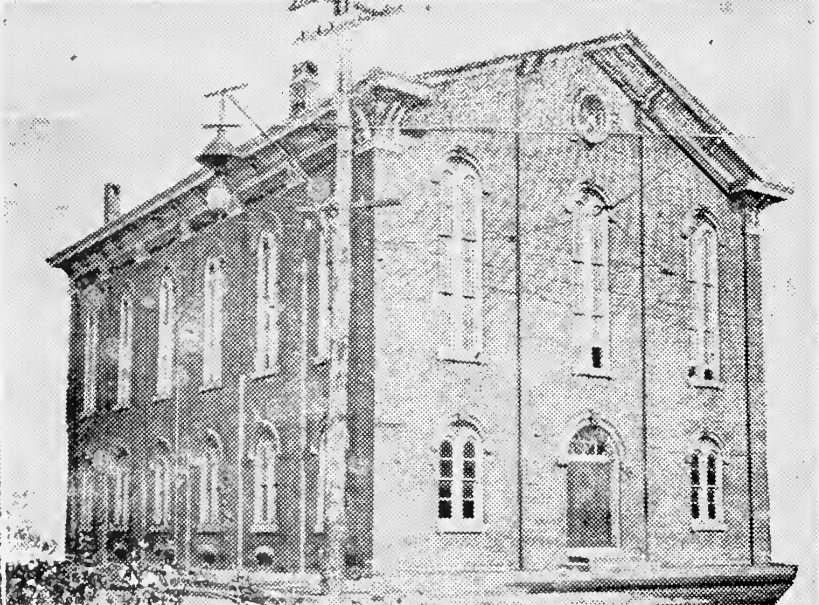
Eighth Street M. E. Church — 1878.
The history of the Eighth Street Church begins with a Mission Sunday school under the care of the Broadway Church. This school, under the name of Paradise Mission, was organized in 1859 in a building on Mount Vernon Street, used as a meat-shop and owned by John Paschal. At the time of the organization of the school John Collins was elected superintendent; John S. Long, assistant and secretary; Mr. Holmes, librarian; Mifflin K. Long, treasurer, and Joseph Hoffinger, John Paschal and Benjamin F. Long, teachers. Fifty children were immediately gathered into this school. The building had no chimney and was not plastered. The cold weather compelled the school to seek a more comfortable place, and the public school-house on Spruce Street was generously granted and the school held in it for several months. In 1860 a room or hall on Walnut Street, to the rear of the present church, was rented, and there the school convened until 1862, when a frame chapel was built where the church now stands. Under the charge of the presiding elder, A. K. Street, this chapel was dedicated by Rev. H. M. Brown, and the Sunday school, then numbering one hundred members, moved into it. During 1862 Rev. R. S. Harris, pastor of the Broadway Methodist Episcopal Church, formed a class with John S. Long as leader, and thus originated the Eighth Street Methodist Episcopal Church.
Regular services were conducted every Sunday, and during that winter extra meetings were held, which resulted in bringing many persons within the fold of the church. Encouraged by this success, in 1863 the Eighth Street Chapel, as it was then called, formed a mission in connection with Stockton and Newton, and the Conference appointed Rev. Garner H. Tullis to take charge of this mission. The first year of his ministry was a successful one and brought eighty-three members, forty probationers and two hundred and twenty Sunday school children within the mission. The Eighth Street Chapel then filed a certificate of incorporation, under the name of the Tullis Methodist Episcopal Church, by which name it has ever since been known, though called in Conference minutes as the Eighth Street Methodist Episcopal Church of Camden. In 1865 Rev. David McCurdy was appointed pastor and in 1866 Rev. N. Walton succeeded him. In 1869 this church, which had from the first been associated with Broadway Church, separated from it and became a station. In 1873 W. C. Stockton became pastor and the chapel was enlarged and greatly improved, at a cost of one thousand dollars, through his exertions, and during the second year of his pastorate the foundation of the present large brick church building was built up to the second story and a temporary roof placed over it. It was not completed until 1880, at which time the church and grounds were valued at fifteen thousand dollars. Since this congregation separated from the Broadway Methodist Episcopal congregation the pastors who have served it were Revs. J. H. Nichols, J. I. Merrill, J. White, Jacob T. Price, W.C. Stockton, John E. Westwood, Willis Reeves, Garner H. Tullis, James H. Payson and William Walton, the present pastor. The history of this church has been promising from its first inception, and its future prospects are brighter than ever. With an increasing population about it and a large membership of more uniform piety, it cannot fail to accomplish its great mission. The membership at this time (1886) is three hundred and fifty-one, and the Sunday school is in a flourishing condition, having four hundred and fifty-one teachers and pupils, with E. S. Matlack as superintendent.
Source: Prowell’s History of Camden County, New Jersey, 1886.
The Eighth Street Methodist Church was still active when the 1947 Camden City Directory was compiled.
History of the Eighth Street Methodist Episcopal Church
The Centennial History of Camden Methodism, 1909
In 1861, when the men of this city were hearing and heeding the call of the Immortal Lincoln to a service meaning life or death, a small but heroic company heard the voice of another and mightier leader, above the din and tumult of strife and war; and this company organized a Sunday School Society that culminated in the organization of Eighth Street M. E. Church.
The Sunday School of this little Society was held in a butcher shop in the building now used for a dwelling. The present number being 748 Mt. Vernon street. This was owned by John Paschal, then transferred by sale to Joseph Hoflinger, whose daughter, Mrs. Eliza Robinson, is still with us, and one of the oldest members of the present church society. Mr. John Long was elected superintendent of the school. In his hands it prospered. A sufficient number of children were gathered to warrant the organizing of a school and the scattering families supplied chairs, Bibles, singing books, etc., for the regular sessions. This school outgrew its first meeting-place, and was then transferred to a frame house facing Walnut street and adjoining the present church.
In 1862 Rev. Robert S. Harris, pastor of Broadway M.E. Church, organized a Class of the following persons: John Long, Benjamin Long, Noah Sheldon, Philip B. Patterson, and “Mother” Carson. Mr. John Long was appointed Class Leader.
The Sunday School continued its work and the Sunday School Association, composed of several denominations, built a frame structure, 20x30 feet, located at the corner of Eighth and Walnut streets, on the site now occupied by the present brick building.
In 1863, Rev. G. H. Tullis was appointed as pastor of Fillmore Street (now Trinity M. E. Church), Newton (now Collingswood) and Eighth Street. The Sunday School Association ceased to exist, and the frame building, previously mentioned, fell into the hands of the Methodists for use. Then Sunday School, Class Meeting and preaching services were regularly held. Brother Tullis organized the church. A number were received by certificate from other churches, conversions took place continuously until the church became known as “Little Heaven.”
Pastor Tullis announced, one Sunday, that on a given date there would be an election of Trustees. “Mother” Carson questioned the wisdom of such action, giving as her reason, “they had no property, why a Board of Trustees”? Brother Tullis replied by saying they did have property: a Bible and a hymn book, which needed caring for.” The wisdom of electing a board of Trustees was soon demonstrated. A few of the members of the church were members of the defunct Sunday School Association.
The Trustees advised that the church purchase the building they were using and due notice thereof was given for a stated period.
Then Rev. G. H. Tullis bought the building and plot of ground for the sum of $1.00, and transferred it to the Board of Trustees, whose names appear on the deed as follows: Noah Sheldon, President; John Long, Benjamin Long, Philip Patterson, Isaac Bowman. The church was duly incorporated and named Tullis Methodist Episcopal Church. Brother Tullis served the church 1863–4, and was succeeded by Rev. David McCurdy.
The period intervening between 1865 and 1868 the church was in Camden City Mission Society.
November 16, 1868, Jefferson Lewis, Presiding Elder, Tullis M. E. Church was made a distinct pastoral charge. James Fetters and Philip Patterson were chosen Class Leaders. Philip Patterson was made Sunday School Superintendent. William Wiatt, John Jefferies, John Pettit acted as stewards until Annual Conference. Then Rev. Jacob H. Nichols was appointed as pastor with a membership of thirty-three and two probationers. The Trustees were elected to the number of nine. The debt on the chapel for improvements was $400; the Sunday school numbered 112 scholars, with 26 officers and teachers. Thus was the Tullis M. E. Church started on its career of usefulness. The pastorate of the Rev. Jacob H. Nichols continued to 1869. He in turn was succeeded by Rev. John I. Morrell, 1869–1870; Rev. James White, 1870–71; Rev. Jacob T. Price, 1871–73. Rev. William Stockton was appointed pastor in 1873.
The need of a new church was apparent, and September 6th, 1873, Brother Stockton placed a tent on vacant lots near by and opened a city camp meeting. Services were very successful — and keeping ever in mind the needs of the people he spoke of the new enterprise and reported $305.84 received in cash and subscriptions. The work of pulling down the structure was commenced. The basement portion of the new church was built up to the joists of second floor.
March, 1875, Rev. J. R. Westwood was appointed by the Conference in session at New Brunswick, N. J. He found the congregation worshipping in a portion of the old structure. The new building was open and exposed to the weather and encumbered with $1,500 debt. It was decided to roof and finish the basement, using the material of the old frame building as far as practical. Work was begun on the finishing of the basement, and October 19th, the first prayer meeting was held in the finished Class room, fourteen persons being present.
On Sunday, October 31, 1875, the basement was dedicated to the service of Almighty God by Rev. Jacob T. Price. Rev. C. R. Hartranft preached in the morning. Rev. A. Atwood, Philadelphia Conference, 1:30 P. M., and Rev. J. W. Hickman, 7 P. M., there being large congregations throughout the day. The total indebtedness was $2,419.98. The amount raised at the dedication was $747.70. The remaining indebtedness was $1,672.28.
Not only was the church blessed financially but also spiritually, under the ministry of Bro. Westwood. Hence at the closing of the third year, he reported 350 converted to God and received on probation, 153 received in full connection.
Rev. Willis Reeves was appointed pastor in 1878, to succeed Bro. J. R. Westwood. He was abundant in labors. It was during his pastorate that the upper part of the church was finished. He enlisted the people to work for this enterprise by taking the plan of selling the bricks needed to complete the work of church construction at ten cents per brick. The congregations were large and enthusiastic and were jubilant over the much needed place of worship. His pastorate continued until 1881.
Rev. G. H. Tullis was again appointed pastor, Eighth Street becoming an independent charge and Brother Tullis gave experience and personality which added greatly to the charge. Rev. J. H. Payran succeeded Brother Tullis, and served the church until March, 1886. Then followed the pastorates of Rev. William Walton, Jesse Stiles, H. R. Cheeseman, Harry White, J. E. Sawn, W. S. Mitchell, James Burns, Steadman Applegate, Daniel E. Clair, the present pastor.
Under each of these pastors added improvements have been made to church property, indebtedness paid — revivals occurred, until to-day the church property is conservatively estimated at $20,000, with a very convenient and well-located parsonage, on Walnut street with but $3,000 against church and parsonage clear of debt.
Three young men have gone out from this church to preach the Gospel: Rev. Hibbard Howell, to Philadelphia Conference; Rev. George R. Middleton, a very promising young man taking some of the best appointments in New Jersey Conference, and died at Atlantic Highlands, May 2, 1908; Rev. Joseph Simpson, also a member of the New Jersey Conference, and now stationed at Manahawkin.
Notable among the men who have wrought so faithfully and well in the Sunday School are Philip Patterson, John Carwell, Thornton Sayers, Elijah C. Smith, William Kaighn, John Marshall and William D. Delemater, the present superintendent.
The Official Board of the Tullis M. E. Church (now known as Eighth Street) have been composed of earnest sacrificing men through all the passing years and the Elishas have caught the spirit of the Elijahs and at the present the men in the control of the church interests are worthy sons of these noble sires.
The Ladies’ Aid of the church comes in for no small glory. But for their untiring, heroic efforts the comfortable, up-to-date parsonage would not have been free of debt, and in such excellent state of repair. These elect ladies with the spirit of a “Deborah” placed the parsonage in the building loan and patiently and perseveringly financed the matter until the debt and mortgage was wiped out. Another right arm of strength is the Ushers’ Union, numbering fifty men, strong and ready to assume any burden, financial, social or spiritual. This society has been a great help to the church.
Today the church numbers 300 members. The church building, equipped for present day needs, and with the growing neighborhood, has a bright outlook for the future.
Photos
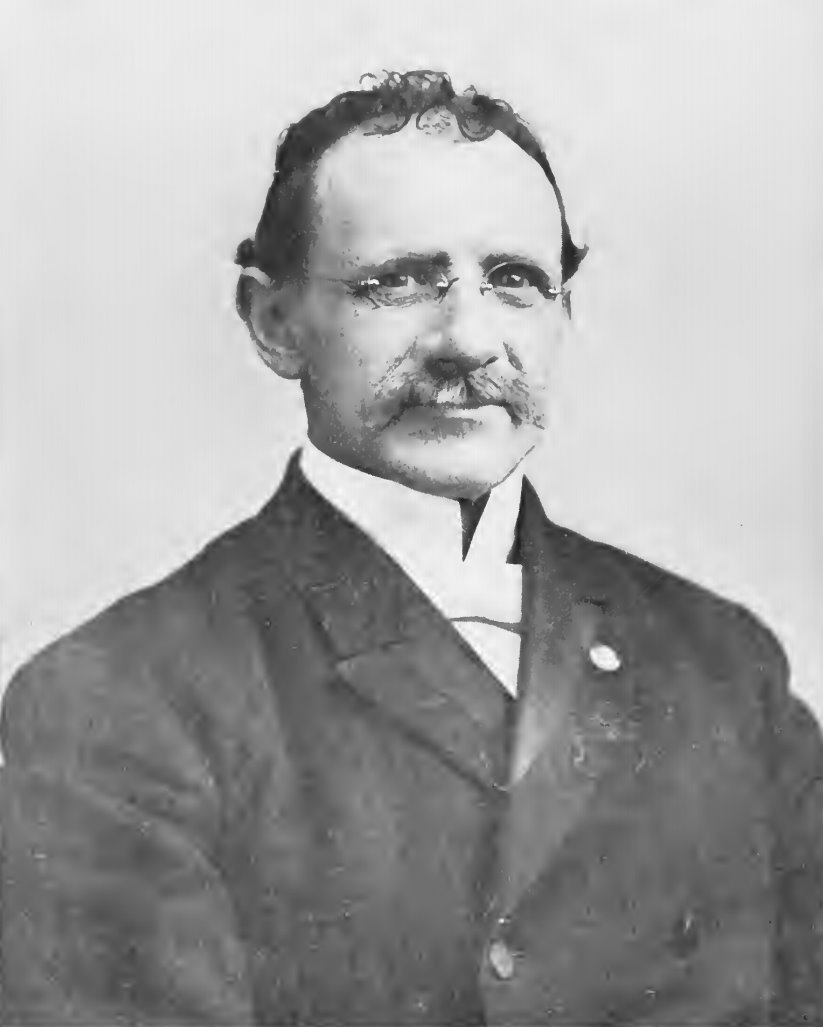
Rev. Daniel E. Clare, pastor.
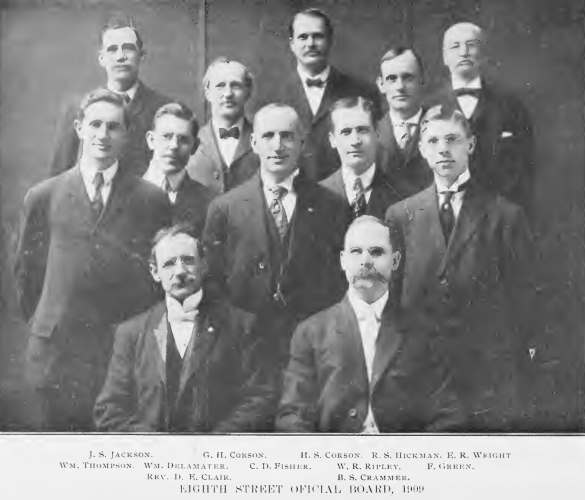
Eighth Street M. E. Church Official Board — 1909.
Eighth Street Methodist Church Fund-Raising
Philadelphia Inquirer —
By means of sociables which they are holding the members of the Eighth Street Methodist Church, of Camden, have raised a considerable sum of money for the payment of their church debt.
Pastor Sawn Takes Action
Camden Daily Telegram —
Causes the Arrest of Davis Durand On a Serious Charge
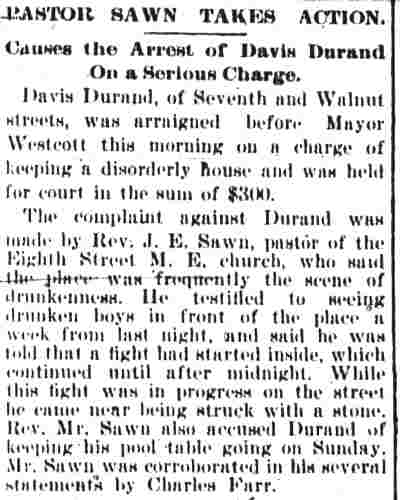
Davis Durand, of Seventh and Walnut streets, was arraigned before Mayor Westcott this morning on a charge of keeping a disorderly house and was held for court in the sum of $300.
The complaint against Durand was made by Rev. J. E. Sawn, pastor of the Eighth Street M. E. church, who said the place was frequently the scene of drunkenness. He testified to seeing drunken boys in front of the place a week from last night, and said he was told that a fight had started inside, which continued until after midnight. While this fight was in progress on the street he came near being struck with a stone. Rev. Mr. Sawn also accused Durand of keeping his pool table going on Sunday.
Mr. Sawn was corroborated in his several statements by Charles Farr.
Police in a Church
Philadelphia Inquirer —
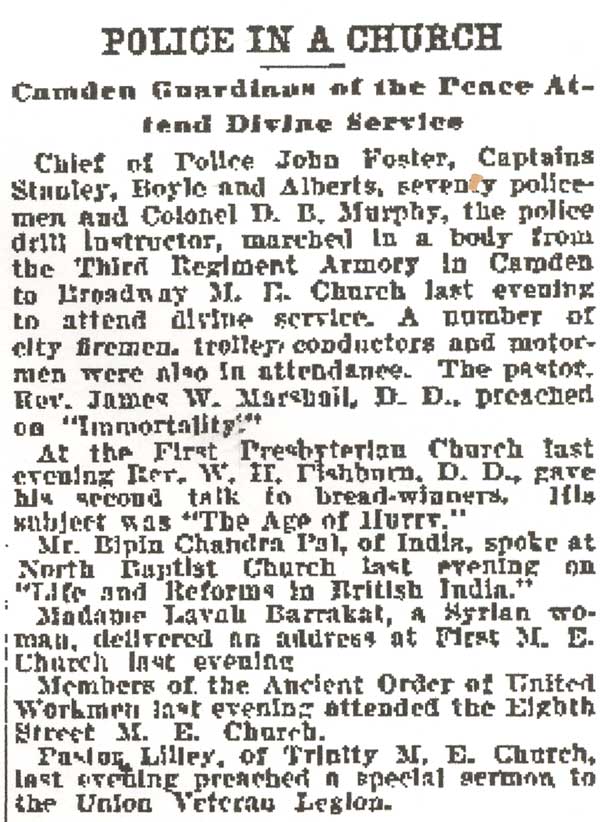
Chief of Police John Foster, Captains Stanley, Boyle and Alberts, seventy policemen and Colonel D. B. Murphy, the police drill instructor, marched in a body from the Third Regiment Armory in Camden to Broadway M. E. Church last evening to attend divine service. A number of city firemen, trolley conductors and motormen were also in attendance. The pastor, Rev. James W. Marshall, D. D., preached on “Immortality.”
At the First Presbyterian Church last evening Rev. W. H. Fishburn, D. D., gave his second talk to bread-winners. His subject was “The Age of Hurry.”
Mr. Bipin Chandra Pal, of India, spoke at North Baptist Church last evening on “Life and Reforms in British India.”
Madame Lavah Barrakat, a Syrian woman, delivered an address at First M. E. Church last evening.
Members of the Ancient Order of United Workmen last evening attended the Eighth Street M. E. Church.
Pastor Lilley, of Trinity M. E. Church, last evening preached a special sermon to the Union Veteran Legion.
Rally Day at Eighth Street M. E. Church
Philadelphia Inquirer —

Rally day was observed in the Eighth Street M. E. Church yesterday with addresses, singing and recitations.
New Methodist Sunday School in Parkside
Philadelphia Inquirer —
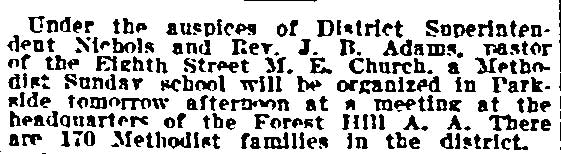
Under the auspices of District Superintendent Nichols and Rev. J. B. Adams, pastor of the Eighth Street M. E. Church, a Methodist Sunday school will be organized in Parkside tomorrow afternoon at a meeting at the headquarters of the Forest Hill A. A. There are 170 Methodist families in the district.