Dr. William H. Iszard
DR. WILLIAM HOWARD ISZARD was born in Clayton, New Jersey on April 27, 1842 to Samuel Iszard and his wife, the former Bathsheba Fleming. He served as a Medical Cadet at a Union Army Hospital in Philadelphia in 1862, and began his medical studies the following year. Although interrupted at times due to ill health, he completed his medical education at Jefferson Medical College, graduating in 1870. Dr. Iszard married Harriet Ireland on April 27, 1865. A son, William Hopkins Iszard, was born in October of 1878.
Dr. Iszard, after moving to Camden, became active in Republican politics. He was an early president of the Camden Republican Club. His affiliation with political leaders William Joyce Sewell and David Baird Sr. led to a series of positions with Camden County and the city of Camden.
A general practitioner, Dr. Iszard worked at different times as the County Physician and as Coroner for Camden County. He also served as the Camden City Food and Drug Inspector in the 1900s. He sat on the Board of Managers of the Camden City Dispensary, on the New Jersey State Board of Health. He was a member and sat as president of the Camden County, Camden City, and Gloucester County Medical Societies. Dr. Iszard also was a member and served at different times as vice president and secretary of the Camden City Medical and Surgical Society. He also was a member of the New Jersey Sanitary Commission.
At the One Hundred and Thirty-first Annual Meeting of the Medical Society of New Jersey, held at Atlantic City, New Jersey on June 22 and 23, 1897, Dr. Iszard, in the last part of a paper reviewing the subject of expert testimony, pointed out the desirability of a change in New Jersey law, which seemed likely to occur in New York and some other states, making the medico-legal expert an officer of the court rather than an ex-parte witness for the side of the prosecution or defendant.
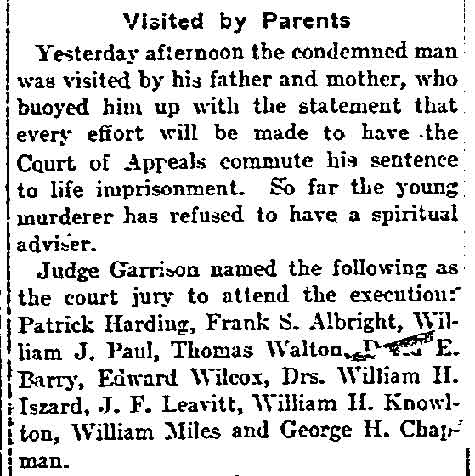
On November 22, 1903 Judge Charles G. Garrison appointed Frank S. Albright to the eleven person court jury charged with witnessing the execution of murderer Paul Woodward, on January 7, 1903. The execution was carried out as scheduled.
Dr. Iszard made his home and office at the northwest corner of North 6th and Penn Streets in the 1880s and early 1890s. By June of 1900 he had moved to 411 North 4th Street in Camden. He died on June 19, 1928 in Camden.
Dr. Iszard’s son, William Hopkins Iszard, was a successful realtor in Camden, and active with the Camden Elks Lodge 293. He was elected to the New Jersey State Assembly. He later moved to San Diego, California where he died in 1951.
County Physician Nomination
Philadelphia Inquirer —
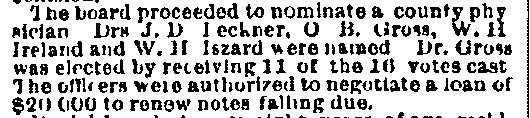
The board proceeded to nominate a county physician. Drs J. D. Leckner, O. B. Gross, W. H. Ireland and W. H. Iszard were named. Dr. Gross was elected by receiving 11 of the 16 votes cast. The officers were authorized to negotiate a loan of $20,000 to renew notes falling due.
County Physician’s Cost Reduction
Philadelphia Inquirer —

County Physician Iszard shows a reduction in cost to the taxpayers of several thousands in Coroner’s expenses.
Killed by a Cobble Stone
Philadelphia Inquirer —
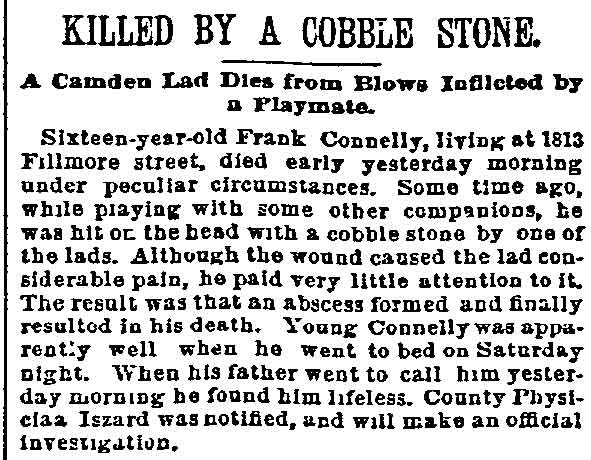
A Camden Lad Dies from Blows Inflicted by a Playmate.
Sixteen-year-old Frank Connelly, living at 1813 Fillmore street, died early yesterday morning under peculiar circumstances. Some time ago, while playing with some other companions, he was hit on the head with a cobble stone by one of the lads. Although the wound caused the lad considerable pain, he paid very little attention to it. The result was that an abscess formed and finally resulted in his death. Young Connelly was apparently well when he went to bed on Saturday night. When his father went to call him yesterday morning he found him lifeless. County Physician Iszard was notified, and will make an official investigation.
Death of Mrs. Keefer
Philadelphia Inquirer —

County Physician Iszard yesterday received word of the sudden death of Mrs. William Keefer, of Waterford. The woman died on the roadside while on her way to the woods to meet her husband, who is a wood-chopper.
Post-Mortem on Louisa Bassett
Philadelphia Inquirer —
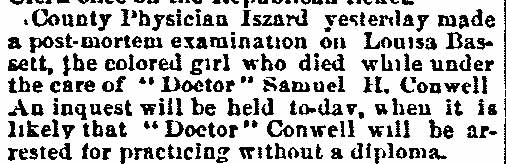
County Physician Iszard yesterday made a post-mortem examination on Louisa Bassett, the colored girl who died while under the care of “Doctor” Samuel H. Conwell. An inquest will be held to-day, when it is likely that “Doctor” Conwell will be arrested for practicing without a diploma.
Cocco Safely Jailed
Philadelphia Inquirer —
The Italian Murderer Captured on His Return to Camden.
HIDING ALL NIGHT IN THE WOODS
After Thrusting the Stiletto Into the Heart of His Sister-in-Law He Coolly Changes His Clothes to Escape Identification
After spending a night in the woods between Camden and Atlantic counties, Dominico Fellippo Cocco, who murdered his sister-in-law at Cedar Brook, about eighteen miles from Camden, on Saturday night, as told in yesterday’s Inquirer, was arrested yesterday morning.
Cocco is 29 years of age and lived in Italy until last December, when he came here with his young bride and a babe. With his scanty earnings as a street sweep the young couple lived happily in the Italian quarter on Carpenter Street, until the last January, when the couple had a quarrel, which ended in their separation.
Mrs. Cocco, with her babe, then took refuge with her parents and sister, who live at Cedar Brook, which is near the Winslow Junction, on the Camden and Atlantic Railroad. Here she remained until Saturday night, when she was removed to the Camden City Hall as a witness to the tragedy in which her sister Giovanna Torra was the victim and her husband the murderer.
MURDER EVIDENTLY PREMEDITATED
Saturday evening Cocco, with a bundle on his arm, went to Cedar Brook. Leaving the bundle in the station he proceeded to the home of his mother-in-law, Rosalia Torra. Words with his wife precipitated a family row, during which he threatened to kill his father-in-law. The latter went for an officer in company with Carlos Santarlio, who had met Cocco at the railroad station.
Cocco then turned to his wife and in his native language shouted, “I am going to cut your head off and send it to the King of Italy.” He was about to strike her, when Giovanna stepped in to protect her sister. By this time the trio had got on the outside of the house. When about forty yards away Cocco made another grab for his wife. Giovanna again came to the rescue of her sister. She grappled with him and was struggling with him about the little garden patch, when suddenly Cocco placed the hand around the girl’s shoulders and with his right hand drew a keen-edged stiletto from his pocket. With all the force he sent the instrument into the girl’s side.
This blow failed to do its work and Cocco then plunged the stiletto again into her body, this time through her heart. With a shriek and a groan the girl dropped dead at his feet. The murderer then fled to the railroad station, where he secured the bundle which he had secreted. Out of this he took a pair of overalls, a jumper, and a slouch hat. The overalls and jumper he placed over his other clothing. The cap which he wore when he committed the murder he discarded. After disguising himself he ran to the next station below Cedar Brook, where he took a train for Ellwood.
HIDING IN THE WOODS
The balance of the night he spent hiding in the woods at that place. Yesterday morning he took a train at Ellwood and came to the Camden station of the Philadelphia and Atlantic City Railroad, where he was captured by Policeman Casper Hart. Cocco offered no resistance. He was taken to the City Hall, where he was brought before his wife in the private apartments of Superintendent Moffet.
“Do you know that man?” asked Mr. Moffett of the woman. She threw up both her hands and commenced to weep. Between her sobs she would mutter the name of Dominico. She almost went frantic with fear that he would injure her.
The murderer, cool and collected, was taken before Mayor Pratt, to whom he admitted the murder, but claimed it was committed in self defense, at the same time displaying a cut on the head, which he claimed was inflicted by the girl with an axe. He was then about to demonstrate the manner in which he stabbed Giovanna when his wife became hysterical and rushed into the Mayor’s private office, where on her knees she appealed for protection from the man who had taken her sister’s life. All of the witnesses discounted the claim of Cocco that he committed the deed in self-defense.
The remains of the murdered girl were placed in an ice box in the Camden Morgue yesterday. She was 17 years of age and strikingly handsome. There are no marks of violence on her face or body. The fatal stab wound on the surface of the skin looked to be only about an inch and a quarter long. County Physician Iszard says the stiletto must have plunged into the breast at least six or eight inches. All of the witnesses have been held in $1,000 bail to appear at court. Coroner Jefferis has charge of the case and will hold an inquest the latter part of the week.
Inquest for John Kirk
Camden Daily Telegram —
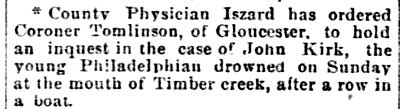
County Physician Iszard has ordered Coroner Tomlinson, of Gloucester, to hold an inquest in the case of John Kirk, the young Philadelphian drowned on Sunday at the mouth of Timber creek, after a row in a boat.
War Between Camden’s Coroners
Philadelphia Inquirer —
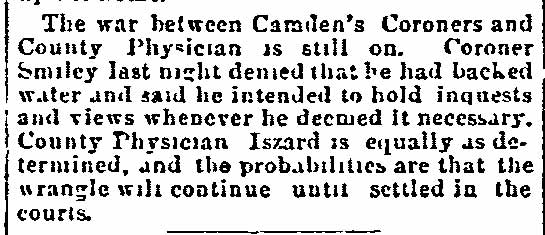
The war between Camden’s Coroners and County Physician is still on. Coroner Smiley last night denied that he had backed water and said he intended to hold inquests and views whenever he deemed it necessary. County Physician Iszard is equally as determined, and the probabilities are that the wrangle will continue until settled in the courts.
Murdered and Her Body Buried
Philadelphia Inquirer —
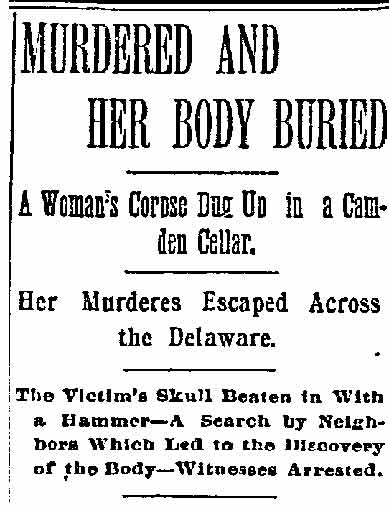
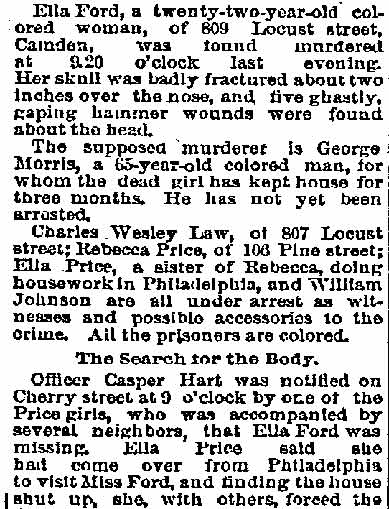
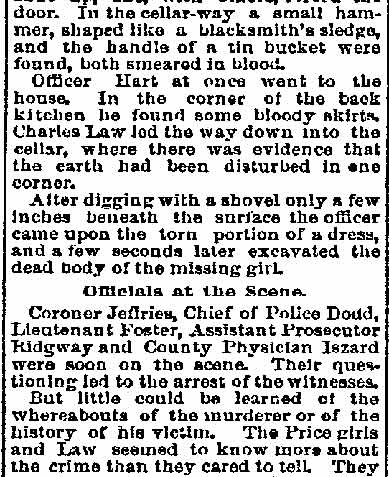
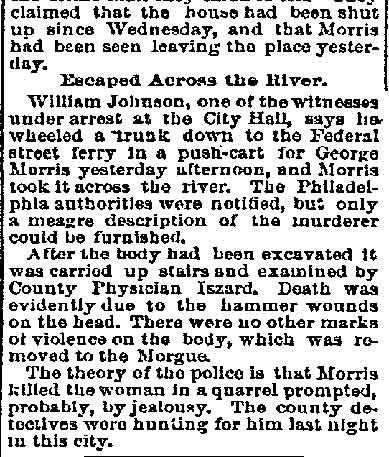
A Woman’s Corpse Dug Up in a Camden Cellar.
Her Murderer Escaped Across the Delaware.
The Victim’s Skull Beaten in With a Hammer—A Search by Neighbors Which Led to the Discovery of the Body—Witnesses Arrested.
Hill Hired to Murder Dodson
Philadelphia Inquirer —

A Youthful Slayer’s Story of a Cold-Blooded Crime.
Plied With Liquor and Urged on by Reed and Derrickson.
Remarkable Defense In a Camden Murder Trial—The Prisoner Unconcerned—His Counsel Endeavoring to Secure a Second Degree Verdict.
Struck and Instantly Killed
Camden Daily Telegram —
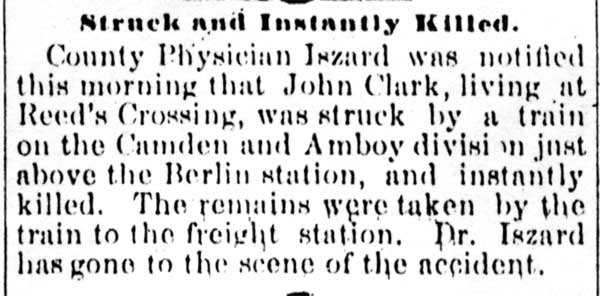
County Physician Iszard was notified this morning that John Clark, living at Reed’s Crossing, was struck by a train on the Camden and Amboy division just above the Berlin station, and instantly killed. The remains were taken by the train to the freight station. Dr. Iszard has gone to the scene of the accident.
The Cause of Her Death Unknown
Philadelphia Inquirer —
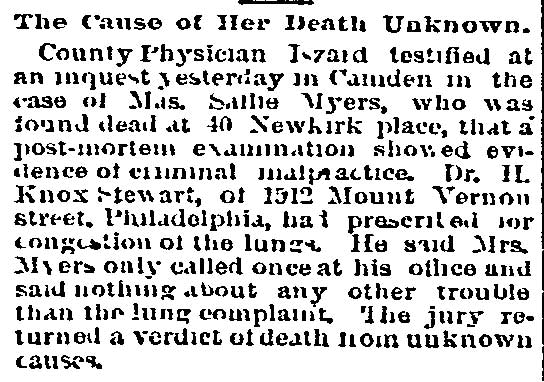
County Physician Iszard testified at an inquest yesterday in Camden in the case of Mrs. Sallie Myers, who was found dead at 40 Newkirk place, that a post-mortem examination showed evidence of criminal malpractice. Dr. H. Knox Stewart, of 1512 Mount Vernon street, Philadelphia, had prescribed for congestion of the lungs. He said Mrs. Myers only called once at his office and said nothing about any other trouble than the lung complaint. The jury returned a verdict of death from unknown causes.
Hill Faced Death with Firmness
Philadelphia Inquirer —

The Youthful Colored Murderer Hanged in the Camden Jail.
Religion Braced His Nerves and He Felt No Fear.
A Quiet, Speedy Execution, and Death Was Quick and Apparently Painless—The Murder of Joseph Dodson Avenged Without the Usual Delay in Such Cases.
Kairer’s Slayer Still at Large
Philadelphia Inquirer —
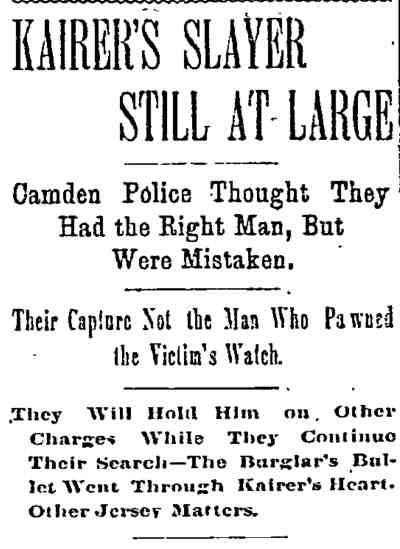
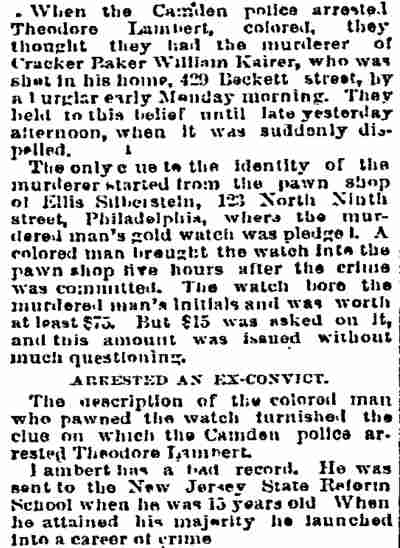
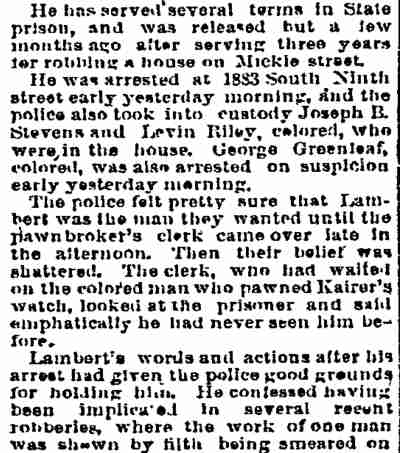
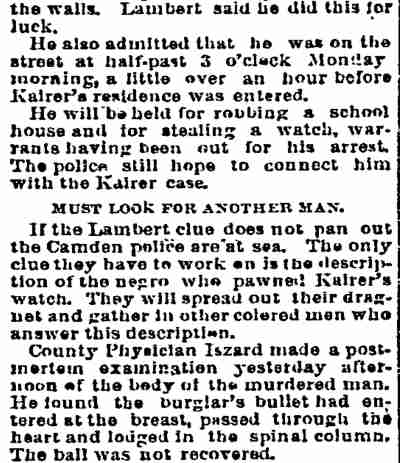
Camden Police Thought They Had the Right Man, But Were Mistaken.
Their Capture Not the Man Who Pawned the Victim’s Watch.
They Will Hold Him on Other Charges While They Continue Their Search—The Burglar’s Bullet Went Through Kairer’s Heart—Other Jersey Matters.
Stockton Town Topics
Philadelphia Inquirer —
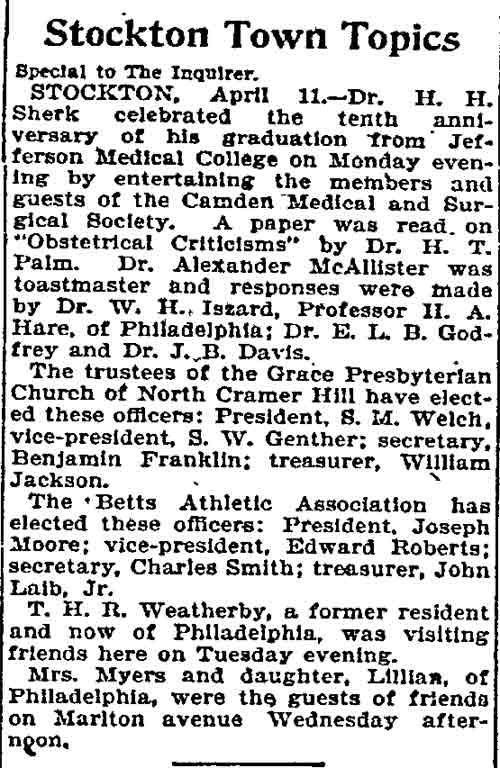
STOCKTON, April 11.—Dr. H. H. Sherk celebrated the tenth anniversary of his graduation from Jefferson Medical College on Monday evening by entertaining the members and guests of the Camden Medical and Surgical Society. A paper was read on “Obstetrical Criticisms” by Dr. H. T. Palm. Dr. Alexander McAllister was toastmaster and responses were made by Dr. W. H. Iszard, Professor H. A. Hare, of Philadelphia; Dr. E. L. B. Godfrey and Dr. J. B. Davis.
The trustees of the Grace Presbyterian Church of North Cramer Hill have elected these officers: President, S. M. Welch, vice-president, S. W. Genther; secretary, Benjamin Franklin; treasurer, William Jackson.
The Betts Athletic Association has elected these officers: President, Joseph Moore; vice-president, Edward Roberts; secretary, Charles Smith; treasurer, John Laib, Jr.
T. H. R. Weatherby, a former resident and now of Philadelphia, was visiting friends here on Tuesday evening.
Mrs. Myers and daughter, Lillian, of Philadelphia, were the guests of friends on Mariton avenue Wednesday afternoon.
Sleighing in Camden
Philadelphia Inquirer —
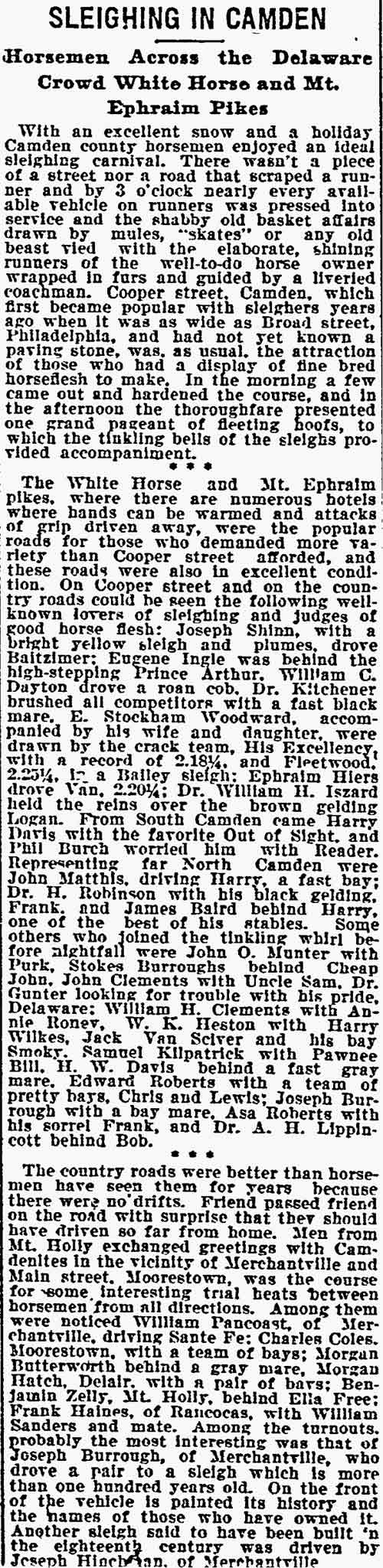
Horsemen Across the Delaware Crowd White Horse and Mt. Ephraim Pikes
With an excellent snow and a holiday Camden county horsemen enjoyed the ideal sleighing carnival. There wasn’t a piece of a street nor a road that scraped a runner that was not busy; nearly every available vehicle on runners was pressed into service and the shabby old basket affairs drawn by a broken-down beast vied with the elaborate, shining runners of the well-to-do horse owner arranged with a tidy-figured uniformed coachman. Cooper street, Camden, which first became popular with sleighers years ago, was as usual, the attraction for those who had a display of fine bred horsemen in Camden county. In the afternoon the thoroughfare presented the following interesting panorama: in which the tinkling bells of the sleighs provided accompaniment.
The White Horse and Mt. Ephraim pikes, where there are numerous hotels which afford excellent stabled and attacks of grip driven away, were the principal roads for those who demanded more variety in the sport. These roads were also in excellent condition. On Cooper street and on the county road could be seen the following well-known Camden county owners of good horse flesh: Joseph Shinn, with a bright yellow sleigh and plume, drove blazingly; Dr. Kitchener drove Prince Arthur; William Dalton drove a roan cob. E. Stockham Woodward, accompanied by his wife and daughter, were out. All these mentioned drove as well as the young John Hill, who was employed. Dr. Kitchener drove Prince Arthur, William D. Dalton drove a roan cob.
The country roads were better than horsemen have seen them for years because there were no drifts. Friend passed friend on the roads with hearty greetings. Many have driven so far from home. Men from Mt. Holly exchanged greetings with Camden county friends. One interesting meeting was that on Main street, Moorestown, was the contest for some interesting trial heats between some county trotters. Among them were noticed William Chancy, driving Sante Fe; Charles Cole, Moorestown, with a team of bays; Harry Hatch, Delair, with a pair of bars; Benjamin Zelly, Mt. Holly, behind Ella Free; Frank Iszard, Delair, with a pair of bars; Dr. William H. Sanders and mate. Among the turnouts, probably the most interesting was that of H. H. Sanders, who drove a pair to a sleigh which is more than one hundred years old. Another sleigh said to have been built in the eighteenth century was driven by another gentleman of the party.
Camden
Philadelphia Inquirer —
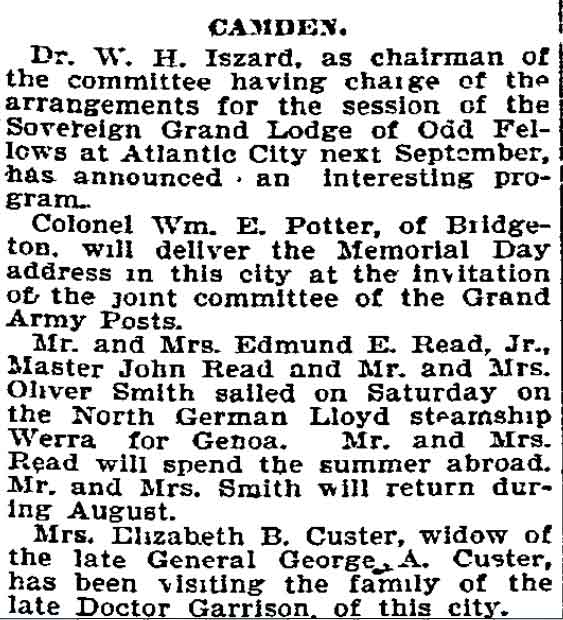
Dr. W. H. Iszard, as chairman of the committee having charge of the arrangements for the session of the Sovereign Grand Lodge of Odd Fellows at Atlantic City next September, has announced an interesting program.
Colonel Wm. E. Potter, of Bridgeton, will deliver the Memorial Day address in this city at the invitation of the joint committee of the Grand Army Posts.
Mr. and Mrs. Edmund E. Read, Jr., Master John Read and Mr. and Mrs. Oliver Smith sailed on Saturday on the North German Lloyd steamship Werra for Genoa. Mr. and Mrs. Read will spend the summer abroad. Mr. and Mrs. Smith will return during August.
Mrs. Elizabeth B. Custer, widow of the late General George A. Custer, has been visiting the family of the late Doctor Garrison, of this city.
Iszard’s Carriage Demolished
Philadelphia Inquirer —

The carriage of Dr. Wm. H. Iszard was demolished yesterday while standing in front of his residence by being run into by an ice wagon belonging to the Knickerbocker Ice Company.
Woodward to Go to Gallows on January 7
Philadelphia Inquirer —
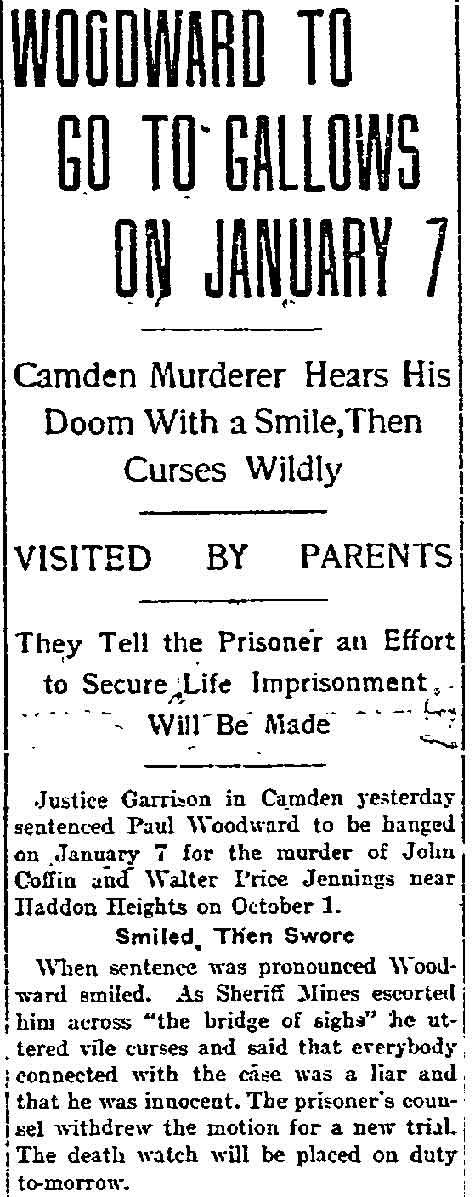
Camden Murderer Hears His Doom With a Smile, Then Curses Wildly
VISITED BY PARENTS
They Tell the Prisoner an Effort to Secure Life Imprisonment Will Be Made
Justice Garrison in Camden yesterday sentenced Paul Woodward to be hanged on January 7 for the murder of John Coffin and Walter Price Jennings near Haddon Heights on October 1.
Smiled, Then Swore
When sentence was pronounced Woodward smiled. As Sheriff Mines escorted him across “the bridge of sighs” he uttered vile curses and said that everybody connected with the case was a liar and that he was innocent. The prisoner’s counsel withdrew the motion for a new trial. The death watch will be placed on duty to-morrow.
Bondsmen Pay Shortage of $2,178 For Derousse
Camden Post-Telegram —
Check Given as Soon as Inspectors Made Their Official Report and Notified the Bondsmen
Postmaster Brought Home And Is Much Improved
The postal inspectors having made an official report of a shortage of $2,718.71 in Postmaster Derousse’s accounts, his bondsmen met this morning and arranged for immediate payment of that amount. The bondsmen are Wilson H. Fitzgerald, Frank H. Burdsall, David J. Pancoast, J. Willard Morgan and Harrison H. Voorhees.
It is understood that the bondsmen divided the amount of the shortage in fifths, each assuming one share, and that Mr. Morgan made the settlement with the government inspectors at the post office.
When State Comptroller Morgan was seen, just before noon, he said: “Settlement has been made in full for the reported deficiency in Postmaster Derousse’s accounts. Payment was made by me as attorney for the bondsmen. I now have the receipt in my pocket. That’s all there is to say about it.”
At the post office one of the government inspectors who was tying up some papers preparatory to leaving, referred the Post-Telegram man to the bondsmen for information as to the settlement. He said that this did not relieve the bondsmen altogether, as they had consented to Assistant Postmaster Sayrs taking charge of the office and were responsible for the finances of the office until a new postmaster should qualify with new bondsmen. He would not say that Postmaster Derousse would be compelled to resign.
Derousse At Home
Postmaster Derousse arrived at his home, 326 North Sixth street, about quarter past 9 o’clock last night. A small crowd gathered in front of the house as his cab drove up. Former County Physician William H. Iszard, who had been commissioned to go to Baltimore for the missing man, was the first to step out of the vehicle. Dr. Iszard placed his hand in that of Derousse and the postmaster stepped out of the cab. He looked around for a second, and appeared entirely dazed at the sudden end of his peculiar flight.
Derousse walked up the steps of his home with the gait of an invalid. Dr. Iszard had to hold him by the arm and assist him into the house. There his wife, daughter and Assistant Postmaster Sayrs, who had entered the house a few minutes before, were waiting to greet him.
The scene that took place when the postmaster and Mrs. Derousse met for the first time since he went away is reported to have been a most affecting one. Dr. Iszard, who was present, said afterwards that it was all that one could expect from the most loving couple.
Assistant Postmaster Sayrs spent some time with Mr. Derousse after his return last night and when he left the Postmaster had fallen asleep. It was reported this morning that Mr. Derousse was improved physically and seemed to be more contented, now that he was at home. He was kept secluded from all but members of the family and Dr. Iszard, who called to see him shortly before noon. Rest and medical treatment will, it is believed, soon restore him to his normal mental and physical health.
Dr. Iszard’s Trip.
As told in yesterday’s Post-Telegram, Dr. Iszard went to Baltimore yesterday morning on the 10 a. m. train. He arrived at noon and drove at once to the residence of William A. Swindell, former custodian of the county buildings in Camden, at 422 North Carey street, where Derousse made his unexpected appearance after his flight from Camden.
The visit of his Camden friends had a tendency to cheer Mr. Derousse up in a measure. After a talk with him Dr. Iszard decided that the postmaster was in a condition to be removed to his home.
The doctor brought with him to Baltimore a sealed letter from Mrs. Derousse to her husband, which had been placed in the former’s hands by Dr. Frank Neall Robinson, the family physician. The letter was a pathetic plea from the wife for her husband to return home and that everything would be forgiven and forgotten.
It was after reading the letter that Mr. Derousse declared he would not return home. The letter he gave to Dr. Iszard. On the train he asked for it, and pondered over its contents, while tears trickled down his cheeks. Putting the letter in his pocket, he said, “Well, I may go home, after all.”
Cheerful Greeting
It was a cheerful greeting which Mr. Derousse extended to Dr. Iszard at Mr. Swindell’s hospitable home. He appeared the same “Lew” Derousse that everybody knew in Camden. But almost the next instant he was reverting to his troubles.
“I want to say that I owe my life to Will Swindell,” he exclaimed. “Had he not received me as he did I would have killed myself.”
“Did you know what I did this very morning,” said he. “I stole out of the house at 4 o’clock, went down to the steamship docks and picked out a place where I was about to jump overboard. But I thought of Swindell, my best friend—he my keeper, you might say. Leaving his home where I have been so well taken care of to commit suicide. I hurried back, and after wandering about the city for a couple of hours I returned to the house about 6 o’clock.”
That Derousse had really contemplated suicide is indicated by the fact that when he returned Mr. Swindell found a card in the postmaster’s hat on which was written: “Please notify Camden Lodge of Elks, No. 293.”
“How did you get to Baltimore?” he was asked. “Do you know I cannot tell,” he replied. “When I came over the river from Camden on Wednesday I went to a dry goods store in the neighborhood of Sixteenth and Market streets, Philadelphia, where I wrote a letter to Charles Sayrs, assistant postmaster, telling him I had gone away and hoping that he would be appointed postmaster.
“Then I found myself out in Fairmount Park. Do you know that more than once I was about to leap into the Schuylkill?”
“Where did you next find yourself?” was asked.
“Oh, yes,” was the postmaster’s reply, “Now, where was that? Darby, Darby, that was the place. I boarded a trolley car and went to Chester. Arriving there I walked down to the river. There I again thought of ending it all, but there was a Providence that kept me back. How I got to Baltimore I cannot tell. I remember I had $5 with me at Chester. When I arrived in this city I had just fifty cents.”
With a knowledge that efforts were being made in Camden by his friends to straighten out the postmaster’s tangled financial affairs it suggested that everything would come out all right.
Back To Meet His Friends.
“Yes,” he exclaimed, “but I am going back and face my friends in a city where I have striven for thirty years to establish an honorable reputation. How am I going to meet my friends who have placed me in high positions? Oh, if those postal inspectors had not appeared just when they did. Why, I could have gone out and gotten thousands of dollars to make up any deficiency. Yes, they say there is a shortage of $2,000. I could have gotten ten times the amount in a very short time.
“They say I have led a dual life,” Derousse continued. “My home life has not been pleasant. If my wife had not written that letter to her attorney there would have been no such stories circulated as you hear to-day. If I did not give an account of my every action there was trouble.”
Here the poor man broke down and sobbed.
“I have had plenty of chances to make money. When I was Speaker of the House I could have made a fortune, simply by holding up bills. In the three years that I served in the Legislature at Trenton I could have made thousands of dollars. But my hands were clean. Why, do you know, I have had chances to make money in Philadelphia and elsewhere in some big transactions. I had a big deal on only a short time ago with a Philadelphian who is now dead. When he died the enterprise failed and the money was lost.
“I defy any one to show me a post office better conducted than that in Camden. I have more than once been complimented by the postal authorities at Washington on the standard maintained by the Camden post office. I had loyal support in the office, but I was a strict disciplinarian, possibly too strict. I don’t know.”
Says He Will Not Resign.
“Will you resign the postmastership?” a friend asked Mr. Derousse.
“I will not,” was the emphatic reply, which is somewhat at variance with his letter to Assistant Postmaster Sayrs, to whom he had written saying he hoped Mr. Sayrs would be appointed postmaster.
When Mr. Derousse was about to take the train for Philadelphia he was very much agitated. “Do you not feel better now that you are going home?” asked a newspaper correspondent.
“No; I cannot say that I do. Give me my library and I will seek a boarding house.”
Then again the suicidal mania manifested itself. “These rivers down here!” he exclaimed. “How I wish I had gone to the bottom of one of them. Do you know that coming down here Wednesday I was going to leap off the train into a stream. But, believing the conductor was watching me, I hesitated. A man who commits suicide is not a coward.”
Talk With Physician.
Derousse’s benefactor, Mr. Swindell, and his physician, Dr. Wegefarth, were at the depot when the postmaster left for Philadelphia. Dr. Wegefarth and Dr. Iszard held a consultation at the Swindell home regarding Mr. Derousse’s condition. Just before the departure of the train Dr. Wegefarth said:
“Mr. Derousse was in a serious condition yesterday, but to-day he is much improved. His mind still wanders, but his mental condition does not seem to be as bad as it was. He has slept fairly well since he has been in Baltimore. In fact, he told me that Wednesday night he had the best night’s sleep in weeks. I believe that if he is able to keep quiet and get plenty of sleep he will be all right in a few days.”
Mr. Derousse Returns And Is Reconciled To His Family
Camden Daily Courier —
The Postmaster Rapidly Regaining His Mental Faculties and is Being Cared for at His Home
The Bondsmen Made Good His Shortage This Morning
All seems to be happiness again at the Derousse homestead. Mr. Derousse is home and is apparently showing signs of returning reason. Mrs. Derousse met him affectionately at the door last evening as he returned. Everything had apparently been forgotten for the time being and husband and wife were most cordial in again meeting each other. In a great measure the man to whom is due the credit for Mr. Derousse’s return home as well as the loving reception by Mrs. Derousse of her unfortunate husband, is Dr. W. H. Iszard. Dr. Iszard brought the Postmaster from the home of William Swindell, 422 North Carey street, Baltimore. He bore to him a tender note from his wife pleading for his return.
Hesitated About Coming Home.
Mr. Derousse felt at first the heavy weight of troubles resting on him and refused to even consider returning home. He talked of meeting, of facing his friends again. What would they say? And his family, what would they think? Dr. Iszard told Mr. Derousse that friends were ready and eager to come to his assistance. He informed him that he would be welcome at his home and that he need not fear anything but a cordial reception there. Dr. Iszard handed him the note which he bore from Mrs. Derousse. Mr. Derousse read it, then said he would not return. He read it over and over again, and then he said he guessed he would. While in this frame of mind he was hurried to the Pennsylvania station and with Dr. Iszard took the 5.07 train for Philadelphia. They reached Broad Street Station, Philadelphia, at 7.07.
Met Friends At Station.
They met several friends, among them Congressman Loudenslager, ex-Sheriff Sell, William J. Browning, J. Willard Morgan and Frank H. Burdsall. They went to Kugler’s and had lunch, then took a car to the ferry. On their arrival here Dr. Iszard and Mr. Derousse got into a cab and were driven to the latter’s home, 326 North Sixth street.
A group of people, attracted by the rumbling of the carriage, gathered around the door of the Derousse home. They just got a glimpse of Mr. Derousse as he was hurried up the steps and ushered into the house.
In talking this morning over Mr. Derousse’s condition, Dr. Iszard said that if the unfortunate man is notified that his position as Postmaster is to be taken from him he will take a serious turn for the worse. Mr. Derousse has not yet been notified that he will have to relinquish the Postmastership. In order to save him from further humiliation it is said his bondsmen will make good his deficit and to save him from suspension will have him send in his resignation.
Again Started To Commit Suicide.
Mr. Derousse’s last day at the home of his friend, William Swindell, in Baltimore, was not without incident. At four o’clock in the morning, unbeknown to anyone in the house, Mr. Derousse got up, dressed and walked down to the Chesapeake Bay with the intention of committing suicide. When he reached the wharf he changed his mind and returned home.
Mr. Swindell was awakened by the slamming of a door. One glance at the bed sufficed, and the next moment he was bounding down the steps, thinking his friend was leaving the house. However, to his surprise, he found the Postmaster in the hallway in the act of hanging his hat upon the rack.
“Why, where are you going, Derousse?” he asked.
“Not going, William,” replied Mr. Derousse. “I am returning.”
This naturally caused a series of questions to follow, and the Postmaster admitted that he had left the house at 4 o’clock, and had gone down town for the purpose of finding the docks, and to there end his life.
“I got there all right, William,” he said. “I even rewrote the note and put it in my hat, but still I hesitated. It was not from any fear, though, but merely the fact that I determined I could not bring your name into so much trouble.
Thought For Friend
“You have taken care of me, and I appreciate it from the bottom of my heart; so I thought it would look base ingratitude if I killed myself after having sneaked from your house while you slept. Some people might censure you and say you did not do a friend’s duty by not watching me; so I decided to come back and wait.”
Mr. Swindell said nothing, but walked over to the rack and picked up the hat. Inside was the note addressed:
“To Mr. William H. Swindell, 422 North Carey street.”
That was too much. Mr. Swindell tore the note into pieces without opening it, and with tears in his eyes begged his friend to give up his rash idea. Then followed a good long talk, during which Mr. Derousse connected his lines of thought better than he had ever done since his arrival, and told much of his trouble to his friend. This seemed to cheer him considerably and after breakfast he was much brighter.
Blame It On Domestic Affairs.
In an interview in Baltimore Dr. Iszard is quoted as having said: “I have known Derousse for many years, having been a close friend both politically and socially and his medical advisor as well. His condition, I know perfectly well, has been brought on through domestic affairs, and not the $2,000 shortage that has been discovered during his absence. I will say frankly that anyone could notice the change in the man this morning almost immediately after I arrived here and gave him a letter from his wife. He has braced up wonderfully since, but his condition even now is serious.
“No, indeed; his trouble has been caused mainly by his wife and their domestic relations, but all of this has been remedied. Mrs. Derousse sent by me a letter which was so pathetic, so loving and so good in its purpose that it has assured the postmaster that the breach which existed between the two is healed forever. Of course, I cannot tell you the exact contents of the letter because it is of a personal nature, but I will say that all the way through it the wife pleads with her husband to come back to her and his children; that she loves him more dearly than her own life and that the past is forgotten.
“Such a letter could not help but have its effect and the man gave vent to his feelings, which was more important at that time than one hundred doses of medicine. However, I think all will end well and matters will be arranged in Philadelphia to-night or to-morrow morning.”
Asked if Mr. Derousse had shown any signs of mental trouble or worry recently, Dr. Iszard answered that he had done one very peculiar thing just a few days before leaving. It seems that the postmaster owned a very fine collection of photographs of actors and actresses, and on last Monday evening he gathered them together and requested the physician to donate them to Lodge No. 293, of the Elks, of which he was a member. On the evening the presentation was to have been made the postmaster was missing. The fact that he was going to part with the collection seemed peculiar to the doctor, for he knew that Mr. Derousse valued them most highly. The postmaster, besides being an Elk, is a Mason of high standing, and a member of the Order of Odd Fellows.
Shortage Said To Have Been Paid.
The post office inspectors who have been going over Mr. Derousse’s accounts as postmaster, since Wednesday, completed their investigation to-day. When Inspector Buck was seen in reference to making a statement he said that he had reported to the bondsmen of Mr. Derousse, who could give out any desired information. J. Willard Morgan, one of the bondsmen, was seen and gave out $2,178.71 as the accurate deficit in the Postmaster Derousse’s accounts.
“Will Mr. Derousse be asked to resign?” was asked Mr. Morgan.
“It is understood,” said he, “that Mr. Derousse is out.”
Inspector Buck said that all of the money Postmaster Derousse took from the post office accounts was taken from the bank with the exception of the moneys taken from Clerks Auble and Simpson, for which the postmaster gave them his personal check. The money placed in bank to the credit of the office Mr. Derousse had access to at all times.
Mr. Buck also stated that he could say that the shortage all happened during the last year, or since the books were audited before. The last time the books were audited was just a little over a year ago.
It was stated shortly before noon that some of the bondsmen have already paid their proportion of the deficit.
Derousse Meets Wife in the Camden Home
Philadelphia Inquirer —
Apparently almost a physical and mental wreck, Louis T. Derousse, the postmaster of Camden, who disappeared under peculiar and for a time mysterious circumstances Wednesday, returned to his Camden home at 326 North Sixth street last evening. A small crowd gathered in front of the house as his cab drove up, about a quarter of an hour after nine o’clock.
Former County Physician William H. Iszard, who had been commissioned to go to Baltimore for the missing man, was the first to step out of the vehicle. Dr. Iszard placed his hand in that of Derousse and the postmaster stepped out of the cab. He looked around for a second, and appeared entirely dazed at the sudden end of his peculiar flight. Derousse walked up the steps of his home with the gait of an invalid. Dr. Iszard had to hold him by the arm and assist him into the house. There his wife, daughter and Assistant Postmaster Sayrs, who had entered the house a few minutes before, were waiting to greet him. The scene that took place when the postmaster and Mrs. Derousse met for the first time since he went away is reported to have been a most affecting one. Dr. Iszard, who was present, said afterwards that it was all that one could expect from the most loving couple.
The return of Derousse to his home in Camden was only determined upon after many lengthy discussions among his bondsmen. It was at first intended to have him taken to the residence of his brother, on North Franklin street, this city, or to the home of one of his friends on this side of the river. Finally, all agreed that as long as he would have to come to Camden…
First Ward Club Had a Jolly Time
Camden Daily Courier —
Annual Election and Feast of Fun Held Last Night.
PATTERSON ELECTED PRESIDENT
Hospitality was rampant at the First Ward Young Republican Club last night. The occasion was the annual meeting. Following the election of officers there was a delightful entertainment and a splendid feast, the honors being done by Captain William E. Alberts, simply resplendent facially in his new bunch of whiskers; Recorder O. Glen Stackhouse, who salivated more buttered ham sandwiches than George Kappel did fried oysters; Eph Hires, the school janitor, who saw to it especially that no one was unattended to; Exciseman Joseph Kolb, who insisted on everybody taking something every other minute; John Beard, who was happy over being elected a ward committeeman, and a number of others who looked after the comfort of the many guests in fine style.
The officers elected were: President, County Clerk Frank F. Patterson, Jr.; Vice President, Freeholder George P. Pechin; Treasurer, Thomas Walton; Board of Directors, Court House Superintendent Joseph Burt, Captain William E. Alberts, Walter Banks, E. T. Hires, William Lyons, Charles Cook, William Weaver and Robert Finley. Joseph Baumeister was re-elected secretary and none better could have been selected as he had everything down pat.
An Italian orchestra with an Irishman playing the flute furnished the music, and there was great fun when Walter Banks got under a rubber plant and roared out “Under the Bamboo Tree.” The cosy club rooms were prettily and patriotically decorated and pretty nearly everybody in the town was there, from Cooper’s Point to Centreville. Among them were Senator William J. Bradley, ex-Mayor J. Leighton Westcott, Fire Chief Samuel S. Elfreth, who warmed up on ginger ale; President of City Council Samuel P. Jones, Councilman Joseph Potter, County Clerk Frank F. Patterson, Jr., whose re-election as president of the club was hearty and unanimous; Dr. John F. Leavitt, whose heroism and devotion to duty where disease stalks, has made Camden the healthiest city in the world; ex-County Physician William Iszard, Freeholder George Pechin, Fireman Joseph Logue, the owner of the great and only “Dewey;” Tony Mecca, president of the popular Italian Republican Club, and many others of equal note. The cigars were elegant, the menu grand, the orchestra in full harmony with the happy occasion, outside of playing “In the Good Old Summer Time,” and the guests will ever remember the event as one of the pleasantest of incidents.
Plumber Burned by Exploding Enamel
Philadelphia Inquirer —
Thomas Walton, a Camden plumber, was badly burned about the face, hands and back last evening as the result of exploding enamel. Walton was in the act of painting with enamel a bath tub at the home of Dr. William H. Iszard, 411 North Fourth street, when a lighted candle he was handling came in contact with the substance. Instantly there was a blinding flash and the plumber was enveloped in flames. The bath room was ignited and it required the services of the fire department to extinguish the blaze. Walton’s injuries were attended to by Dr. Iszard, and he was then taken home, at 1110 South Fourth street.
Eighteen New Firemen Named
Camden Post-Telegram —
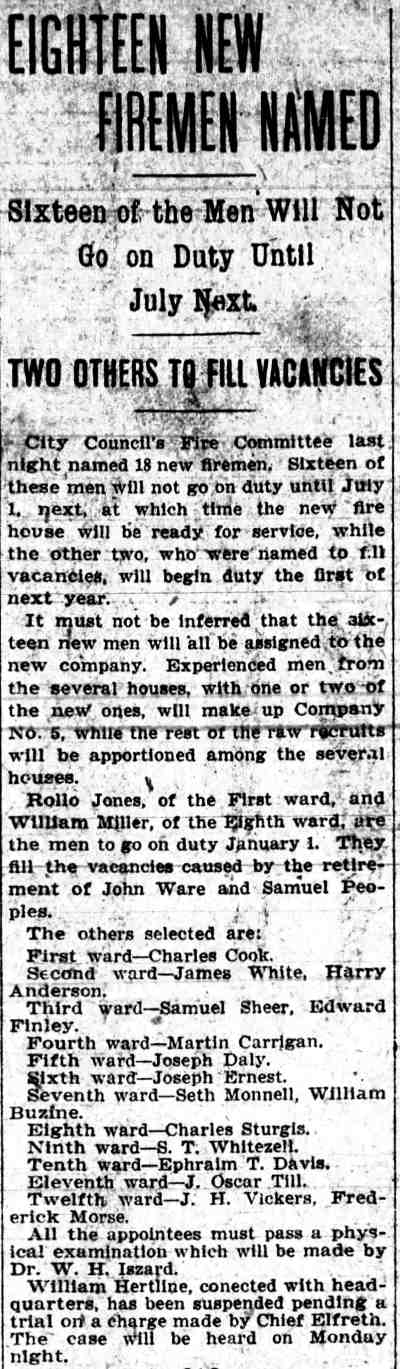
Sixteen of the Men Will Not Go on Duty Until July Next.
TWO OTHERS TO FILL VACANCIES
City Council’s Fire Committee last night named 18 new firemen. Sixteen of these men will not go on duty until July 1, next, at which time the new fire house will be ready for service, while the other two, who were named to fill vacancies, will begin duty the first of next year.
It must not be inferred that the sixteen new men will all be assigned to the new company. Experienced men from the several houses, with one or two of the new ones, will make up Company No. 5, while the rest of the raw recruits will be apportioned among the several houses.
Rollo Jones, of the First ward, and William Miller, of the Eighth ward, are the men to go on duty January 1. They fill the vacancies caused by the retirement of John Ware and Samuel Peoples.
The others selected are:
First ward—Charles Cook.
Second ward—James White, Harry Anderson.
Third ward—Samuel Sheer, Edward Finley.
Fourth ward—Martin Carrigan.
Fifth ward—Joseph Daly.
Sixth ward—Joseph Ernest.
Seventh ward—Seth Monnell, William Buzine.
Eighth ward—Charles Sturgis.
Ninth ward—S. T. Whitezell.
Tenth ward—Ephraim T. Davis.
Eleventh ward—J. Oscar Till.
Twelfth ward—J. H. Vickers, Frederick Morse.
All the appointees must pass a physical examination which will be made by Dr. W. H. Iszard.
William Hertline, connected with headquarters, has been suspended pending a trial on a charge made by Chief Elfreth. The case will be heard on Monday night.
Mrs. Emma S. Mead
Camden Courier —
MRS. EMMA S. MEAD, daughter of Dr. and Mrs. William H. Iszard; G. Lewis Mead, her husband, and son, Parker Mead, of Cleveland, O., are the welcome guests of Mrs. Mead’s parents, at their home, 411 North Fourth street. Mr. and Mrs. Mead spent a week on the palatial steam yacht, Marguerite, at Long Island Sound, and yesterday divided their time most enjoyably with folks at Wildwood and Cape May Court House.
Celebrate Golden Wedding
Philadelphia Inquirer —
Five hundred invited guests participated in the golden wedding reception given last night by Dr. and Mrs. William H. Iszard at their home at 411 North Fourth street, Camden. There were guests from all parts of New Jersey, Pennsylvania, Ohio, Delaware and some from California. Mrs. G. L. Mead, a daughter, and William Hopkins Iszard, a son, living in Cleveland, O., received the guests. Dr. Iszard is one of Camden’s best known physicians and is at present connected with the Board of Health.
Photos
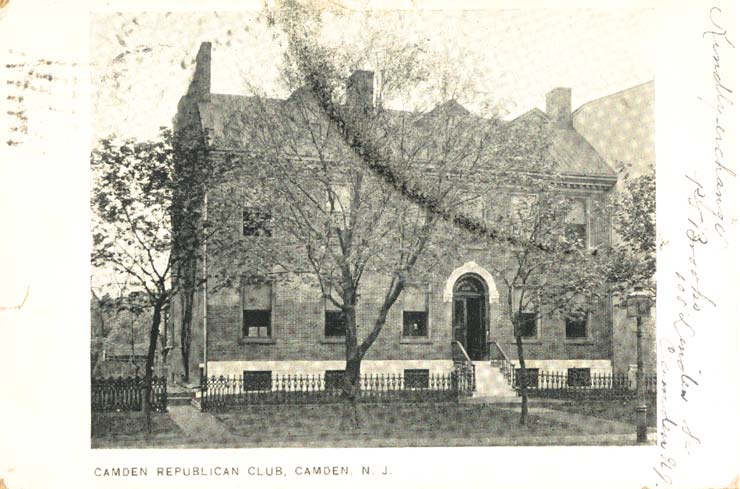
The Camden Republican Club at 312 Cooper Street — 1914 — for many years this building was the home of the Camden County Red Cross
Four Prominent Physicians
Camden Courier-Post —
Reminiscences of Drs. Godfrey, Iszard, Davis and Gross, All Leaders of Their Profession in South Jersey
(Another in a series of articles on Camden affairs and personalities of yesteryear)
By BEN COURTER
SINCE these annals of medical men in Camden county have appeared, other residents have occasionally asserted this or that physician, their family doctor half a century ago, has been forgotten,
“What’s the matter with Doc So-and-So?” they have asked, and they have usually added, “He was the best doctor in typhoid” or whatever ailment was probably cured in their own particular household. The particular physician’s victory over a malady which prolonged the life of some kin has evidently been handed down through the years as such an outstanding accomplishment that if monuments were in order it is unquestioned Camden would be liberally sprinkled with them. It likewise is certain that when family physicians were more the order of the day in lieu of the present tendency to develop specialists, the medical man’s clientele stuck to him through two or three generations and usually placed him on a figurative pedestal at least.
Doctor of 50 Years Ago
Fifty years ago one of the city’s leading physicians was Dr. E. L. B. Godfrey, whose office then was at 621 North Second Street. He was born in Cape May, February 2, 1850. After graduating at the Hightstown Institute, he took up the study of medicine with Dr. E. L. B. Wales, at Cape May.
Later he entered Jefferson College, graduating in 1875, serving his term as intern at the Rhode Island Hospital, Providence. He reached here the next year and immediately became one of the most active men of his profession, being on the surgical staff when Cooper Hospital was opened in 1887. He also was lecturer on fractures at the Medico-Chi Hospital in Philadelphia was major and surgeon of the Sixth Regiment, National Guard served as president of both the city and county societies and contributed authoritative papers to medical journals.
One of the early county physicians of Camden was Dr. William H. Iszard, a native of Gloucester County, where he was born in 1842. In 1862 he entered the service of the government as a medical cadet, being stationed at the hospital on Broad Street, Philadelphia, entering Jefferson College the following year. He was considerably hampered through ill health, but after much interruption graduated in 1870. He first located at Elmer, but soon afterward came here and opened an office at 411 North Fourth Street, where he practiced for many years. He was active in political work, being one of the first presidents of the Camden Republican Club, which long had its headquarters on Cooper Street above Third, and where many of the national figures in the party were occasional guests. He not only was welcome to any sick room but popular about town because of his affability and general all-around good fellowship. William H. Iszard, the realty man and prominent Elk, is a surviving son. Dr. Iszard died a couple of years ago in his eighties, mourned by many an old-timer.
Dr. H. H. Davis
Contemporary with him was Dr. Henry H. Davis, whose name is still identified with all that means health protection for Camden’s school children. For a generation he was either identified with the Board of Health as its president or the schools as chief medical officer. It was he who was largely responsible for rules guarding young pupils in public schools.
Prior to his activities not much attention was paid to ailing youngsters. If they had poor eyesight they were just as liable to be seated far from the blackboard, if their record put them in that position. Not much attention was paid to the cause of their backwardness and if they couldn’t see the figures the teacher placed on the board failure was laid to natural dumbness. Not much attention was paid to chronic sore throats, bad teeth or other imperfections, but when Dr. Davis was placed in full charge of the schools he changed all that and children who have passed through the classes in the past quarter of a century owe much to this veteran medical man whom fate ordained should be killed by an auto in his eightieth year. It was through his efforts clinics were established where poor eyesight might be corrected and other deficiencies looked after by the hospitals or dental men.
Dr. Davis was born at Crosswicks, August 16, 1848, and became a student of pharmacy in the office of Dr. Alexander Mecray in 1867, entering Jefferson College in the fall of that year. He graduated two years later, courses then being half of the present requirements, and began practice here. For many years he had his office at Third Street and Kaighn Avenue. Two young men whose preceptor he was, Dr. Harry Jarrett and Dr. Rowland I. Haines, afterwards ranked among Camden’s leading physicians. Dr. Davis was active in the county society, was a former coroner and for many years identified with many of the city’s activities.
Dr. Onan B. Gross
Arch Street at one time was among Camden’s leading residential thoroughfares, although in these days, with most of the old dwellings either gone or in a state of dilapidation that perhaps would be difficult to believe. Half a century ago some of the city’s best known professional men resided there, among them Dr. Onan B. Gross, who had his office at 407 Arch Street. In later years he was located at Seventh and Federal Streets.
Dr. Gross was a native of Ephrata, Pa., where he was born February 19, 1851. He entered Ephrata Academy but when he was 17 he was thrown on his own resources and apprenticed as a carpenter. He served his time and worked as a journeyman, but he sought a medical career. Through hard work and rigid economy he saved enough to enter the University of Pennsylvania in 1875, graduating three years later. His ability was recognized even then for he was assistant demonstrator in anatomy in the last two years of his course, the first time such an honor had been given one not yet a graduate. In the year of his graduation he received a prize for skill in dissection work.
Dr. Gross was county physician three years, president of the county society, a surgeon at Cooper Hospital, member of the board of managers of the City Dispensary and identified with the various medical groups of the period.