John S. Smith
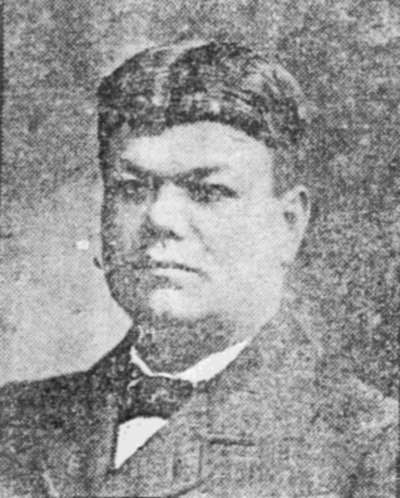
John S. Smith
JOHN S. SMITH had a long and varied career as a bar owner in Camden and Atlantic City, as a party official in Camden County’s Democrat organization, as a detective in the Camden County Prosecutor’s office, and as New Jersey’s first boxing commission chairman.
John S. Smith was born in Portsmouth, Virginia in June of 1866. He was the son of Samuel Smith, a ship carpenter, and his wife Annie. The 1880 Census shows the family living in Alexandria, Virginia, where John Smith worked as a laborer. Besides John, the family included daughters Elizabeth and Martha, and a granddaughter, May Smith.
John S. Smith first turns up in Camden City Directories in 1885, working as a ship carpenter and boarding at 809 North 3rd Street. On November 28, 1886 John S. Smith married Rebecca A. Price at Union Methodist Episcopal Church at South 5th and Mount Vernon Streets in South Camden. He was then working as a ship carpenter.
In March of 1889 a son, Fitzhugh Lee Smith, was born. Another child had been born to the couple, but had passed by the time of the 1900 Census. The Smiths and father Samuel were then living at 815 North 3rd Street, the corner of North 3rd Street and York Street, in North Camden.
By 1888 John S. Smith had opened up a saloon at 34 Erie Street in North Camden which he operated as late as 1893. He also became very active in politics as a Democrat, and rose to prominence in Democrat city and county circles. Although John Smith appears to have had no prior police experience, he was, in April of 1893 appointed to the Camden Police Department as the Lieutenant for the First District, which covered Center City and North Camden. He apparently only served for a year or so in this position before a shift in political power in Camden restored the Republican party to control.
John Smith left the saloon at 34 Erie Street, and was listed at 931 North 3rd Street in the 1893 Directory, and at 929 North 3rd Street in the 1894 and 1895 Directories, working as a laborer. In 1896 he is listed as a polisher, living at 905 Point Street. Directories from 1897 through 1899 reveal that John S. Smith lived and operated a saloon at 643 North Front Street, the southwest corner of Front and Vine Streets.
Just prior to the compilation of the 1900 Camden City Directory John S. Smith took a position as a county detective, working for the Camden County prosecutor. He lived at 815 North 3rd Street from the time he was appointed detective through 1906, then moved to West Collingswood, where he was listed in Directories through 1909.
John S. Smith left the County Prosecutor’s office in April of 1910. Directories from 1910 through 1913 show John Smith operating a saloon at 342 Federal Street. He served briefly as a detective, then relocated to Atlantic City, where he operated the Hotel Malatesta from at least 1915 through 1920. The hotel was located at 1134 Atlantic Avenue, at the corner of Atlantic and South North Carolina Avenues. John S. Smith also served for a time as a detective with the Atlantic County prosecutor’s office.
In April of 1918 New Jersey Governor Walter Edge appointed John S. Smith to be the chairman of the newly formed State Boxing Commission.
Last a resident of Atlantic City, John S. Smith passed away on April 21, 1921.
Warrants for Special Officers
Philadelphia Inquirer —
Justice Schmitz, of Camden, last evening issued warrants for the arrest of Samuel Collins and Jacob Schiller, Jr., special officers at Stockton Park. They are charged by John S. Smith and Charles J. Welsh, of Camden, with assault and battery with a blackjack, at the picnic of the Volksfest Verein at Stockton Park yesterday afternoon.
[Camden Police Board Trial Results]
Trenton Evening Times —
The police board of Camden has concluded the trial of Lieutenants Lee and Foster and Policemen Ralph Bond, William Repley and George Anderson, and found them guilty of insubordination. Their successors were immediately elected. They are John A. Smith, Lieutenant First district; J. Harry Neutze, Lieutenant Second district. On motion by Justice Paul Chief Davis was instructed to transfer Caleb Williams from the City Hall to the street.
An Exciting Roll Call
Philadelphia Inquirer —
A Camden Policeman Tried to Murder His Lieutenant In the Station.
CAMDEN, N. J., July 4.—Patrick Clark, a Third ward policeman, made two attempts at roll call to murder Lieutenant John S. Smith.
Clark entered the station house under the influence of drink and proceeded to where the lieutenant stood. He pulled his revolver from his pocket and fired two shots, when Smith fell to the floor. As Clark raised his arm to shoot the third time Chief of Police Davis grabbed his arm. The bullet from the revolver was embedded in the door.
The room was crowded with policemen at the time. The lieutenant had part of his ear shot away by the first bullet, and the second one grazed the skull above the ear. Clark was arrested and placed in a cell. He declared that he intended to kill Smith and was willing to hang if his aim had been successful.
Clark had a grievance against Smith, who had ordered him to appear before the chief for dereliction of duty.
Crime Runs Riot Over in Camden
Philadelphia Inquirer —

CRIME RUNS RIOT OVER IN CAMDEN
A Murder, an Attempted Murder and Two Bold Robberies Within a Few Hours.
Mrs. Copelain’s Assassin Confesses, But Says the Fatal Shot Was Accidental.
A Girl Struck on the Head By a Hatchet in the Hands of Some Person Unknown—Burglars Use Chloroform and Ransack a House.
Crime is rampant in Camden and the residents are in fear of their lives. Within a radius of two squares a murder, an attempted murder and two robberies were committed in ten hours. The murder was the shooting of Mrs. Lizzie Copelain, of 626 Kaighn avenue, and account of which was printed in THE INQUIRER yesterday.
Stanley Murray, a colored bootblack, went to the City Hall yesterday and told the authorities a man answering the description of the supposed murderer was hiding in a hayloft in Walter Campbell’s stable, Gloucester City.
Chief of Police Davis, Lieutenant Smith and Policeman Guthridge went to Gloucester, where they arrested Charles A. Jordan, 29 years old, of 1119 Sycamore street, Camden.
Says It Was Accidental.
Jordan made a confession in which he said he had stolen a revolver from James Kelly, a bartender in Foltz’s saloon at Seventh and Sycamore streets, and went into Mrs. Copelain’s store to sell it. He did not know the revolver was loaded and kept pulling the trigger when suddenly the weapon went off. He saw Mrs. Copelain stagger, and, becoming frightened, ran down the street.
An inquest will be held next Tuesday morning. Mrs. Copelain will be buried to-morrow.
An Attempted Murder.
About half-past 2 o’clock yesterday morning, within a stone’s throw of the Copelain crime, pretty 19-year-old Mary Morrison was nearly murdered by supposed burglars. There is considerable mystery attached to this case.
James Morrison keeps a grocery store at Kaighn avenue and Baring street, and the rest of the house is occupied as a residence by his family. The front room on the second floor is occupied by Mr. Morrison and his wife. Adjoining this is the room occupied by his daughters, Mary, Celia and Maggie, and in the back room his two sons and Walter Weeks, a boarder, sleep.
Hit With a Hatchet.
Miss Morrison was awakened by a noise about half-past 2, and attempted to get out of bed, when she was struck a terrible blow over the left eye with a hatchet. She fell back unconscious and the intruder escaped. The noise awoke her sister Celia, who called to her father. He immediately sent for a physician, who dressed her wound, which is quite serious.
The assault was at first supposed to have been committed by a burglar. He was told that the burglar had effected an entrance through the cellar window, but on investigation he found the dust on the window sill had not been disturbed.
The chief says he told Mr. and Mrs. Morrison he could lay his hands on the person who had committed the deed and asked if they wanted him arrested. They answered they did not think anyone in the house had done it and the chief left.
They Were Chloroformed.
Burglars entered the residence of Francis Crossley, 729 Chestnut street, Camden, and after chloroforming the inmates proceeded to ransack the house. They secured about $10 and several valuables.
The firm of Toone & Hollinshed, of Broadway and Kaighn avenue, was also robbed of $500 worth of goods.
They Say That Jordan Did It
Camden Daily Telegram —
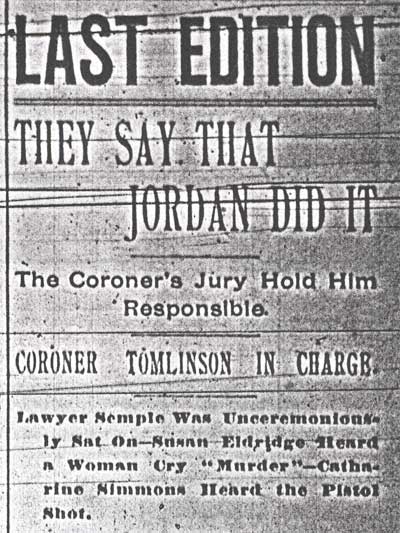
LAST EDITION
The Coroner’s Jury Hold Him Responsible.
CORONER TOMLINSON IN CHARGE.
Lawyer Semple Was Unceremoniously Sat On—Susan Eldridge Heard a Woman Cry “Murder”—Catharine Simmons Heard the Pistol Shot.
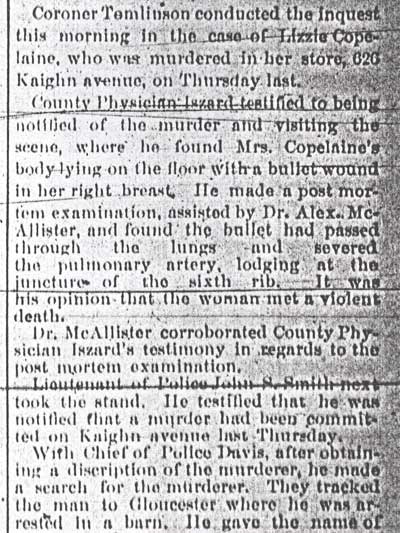
Coroner Tomlinson conducted the inquest this morning in the case of Lizzie Copelaine, who was murdered in her store, 620 Kaighn avenue, on Thursday last.
County Physician Iszard testified to being notified of the murder and visiting the scene, where he found Mrs. Copelaine’s body lying on the floor with a bullet wound in her right breast. He made a post mortem examination, assisted by Dr. Alex. McAllister, and found the bullet had passed through the lungs and severed the pulmonary artery, lodging at the juncture of the sixth rib. It was his opinion that the woman met a violent death.
Dr. McAllister corroborated County Physician Iszard’s testimony in regards to the post mortem examination.
Lieutenant of Police John S. Smith next took the stand. He testified that he was notified that a murder had been committed on Kaighn avenue last Thursday. With Chief of Police Davis, after obtaining a description of the murderer, he made a search for the murderer. They tracked the man to Gloucester where he was arrested in a barn. He gave the name of Charles Jordan.
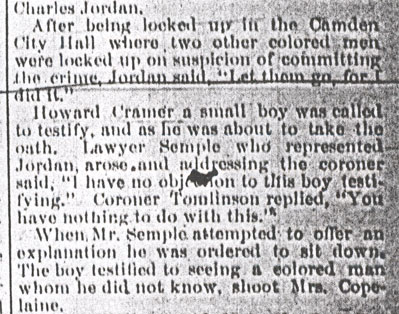
After being locked up in the Camden City Hall where two other colored men were locked up on suspicion of committing the crime, Jordan said, “Let them go, for I did it.”
Howard Cramer, a small boy, was called to testify, and as he was about to take the oath, Lawyer Semple who represented Jordan, arose, and addressing the coroner said, “I have no objection to this boy testifying.” Coroner Tomlinson replied, “You have nothing to do with this.”
When Mr. Semple attempted to offer an explanation he was ordered to sit down. The boy testified to seeing a colored man whom he did not know, shoot Mrs. Copelaine.
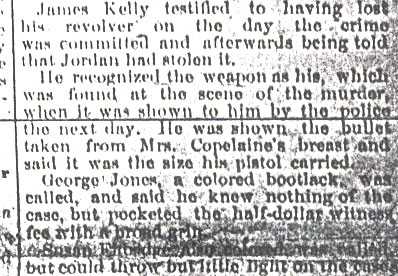
James Kelly testified to having lost his revolver on the day the crime was committed and afterwards being told that Jordan had stolen it. He recognized the weapon as his, which was found at the scene of the murder, when it was shown to him by the police the next day. He was shown the bullet taken from Mrs. Copelaine’s breast and said it was the size his pistol carried.
George Jones, a colored bootblack, was called, and said he know [sic] nothing of the case, but pocketed the half-dollar witness fee with a broad grin.
Susan Eldridge, also colored, was called but could throw but little light on the case [cut off at the crop edge]
Shot Dead in His Home by a Burglar
Philadelphia Inquirer —
SHOT DEAD IN HIS HOME BY A BURGLAR
Thrilling Encounter of a Camden Baker and His Son With a Robber, Who Killed the Father.
Three Shots Through a Window and William G. Kairer Moaned and Died
The Murderer Believed to Be a Colored Man Who Pawned His Victim’s Watch—Police Working on a Clue in Philadelphia—The Son’s Story.
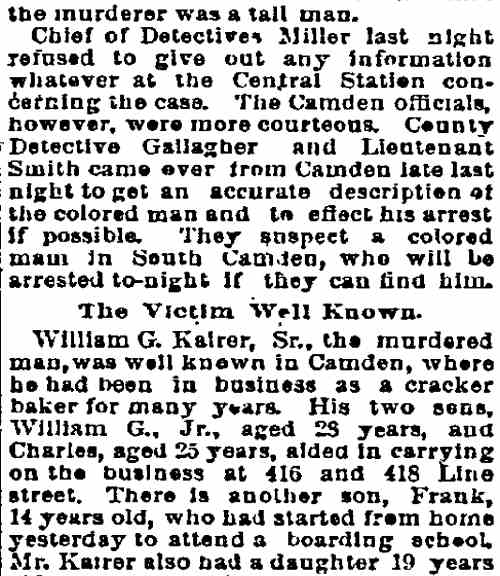
William G. Kairer, Sr., a well-to-do Camden baker, was aroused from slumber yesterday morning by the visit of a burglar. A few minutes later he fell dead, with a bullet from the robber’s revolver lodged in his body. The murderer escaped, but the police are at work on a clue which promises to lead to his identification and arrest.
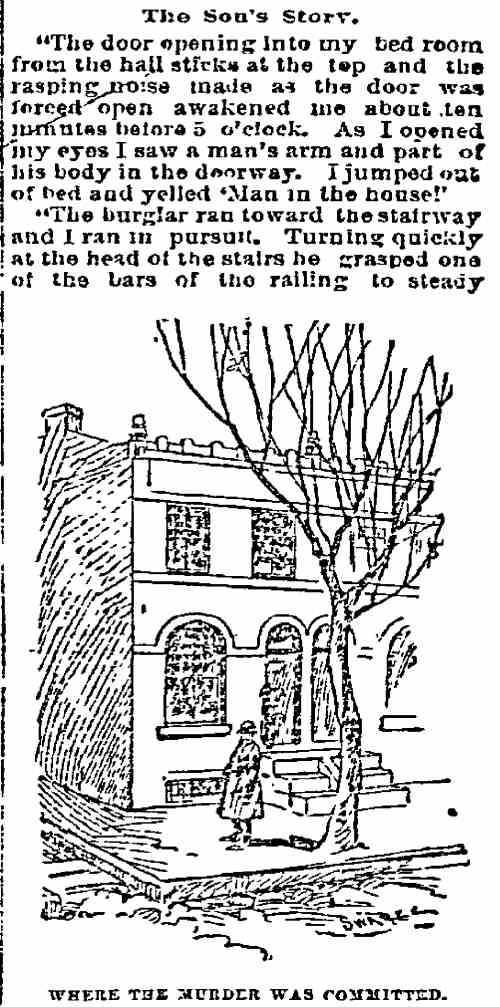
The scene of the murder is a two-story brick house, 429 Beckett street, where the victim resided with his married son, William G. Kairer, Jr. The other occupants of the house were the son’s wife and child, and a servant, Annie McCuen. The house is on the north side of Beckett street, at the corner of Avon street, a narrow thoroughfare which runs along its west side.
The only witness of the shooting is young Mr. Kairer, who stood by his father’s side and held him in his arms until he died. The young man tells a thrilling story of the encounter with the burglar.
He occupied the front bedroom in the second story and his father the rear room. This is his story:
The Son’s Story.
“The door opening into my bed room from the hall sticks at the top and the rasping noise made as the door was forced open awakened me about ten minutes before 5 o’clock. As I opened my eyes I saw a man’s arm and part of his body in the doorway. I jumped out of bed and yelled ‘Man in the house!'
“The burglar ran toward the stairway and I ran in pursuit. Turning quickly at the head of the stairs he grasped one of the bars of the railing to steady himself. I reached over the railing and struck at him with my fist. The man swayed and escaped the blow, and in doing so wrenched out the bar. He dashed down stairs. It was so dark that I could not tell whether the man was white or black.
“My father was awakened by the noise. He lit a match and, without stopping to dress, we hurried down stairs. The door leading into the kitchen, the door of the inclosed shed and the gate opening on Aven street were all open. The burglar had evidently escaped. Spread out in the shed we found a shawl ready to wrap plunder in.
“Returning to the dining room we lit the gas and looked around to see what had been taken. The silverware on the table had apparently not been disturbed. We noticed that the gas was burning low in the parlor and the lower sash of the one big parlor window was raised, although the inside blinds were closed and the catch turned to hold them together.
Three Shots Quickly Fired.
“There is a wide doorway between the parlor and dining room, hung with a portiere. My father was standing in this doorway facing the parlor window, and I was at his left side and slightly in his rear, when the inside blinds of the parlor window were suddenly dashed open and I saw three flashes in quick succession.
“My father gave a groan, staggered and was about to fall when I caught him in my arms. I laid him gently on the floor, pillowed his head on my arm and implored him to speak to me. He moaned feebly for a few minutes, gave a gasp and died.
“The shots and my cries had alarmed the women and the servant screamed for help. Neighbors soon came and then the police arrived. I cannot describe my father’s murderer, for I merely caught a glimpse of him in the darkness.”
The family of William H. Upton, next door to Mr. Kairer, were aroused by the shots. Mrs. Upton and her daughter ran to the front window and saw a man skip across Beckett street and then walk leisurely down White street, a narrow thoroughfare opposite Avon. Mr. Upton slipped on his pantaloons and ran into Kairer’s house. He found the parlor filled with smoke and young Mr. Kairer supporting his dying father.
Continued on Second Page.
KILLED BY A BURGLAR
CONTINUED FROM FIRST PAGE.
L. R. Weldy, a milkman, who was serving a customer on Line street, above West, heard the shots and ran around into Beckett street, but he saw nothing of the murderer.
Work of the Police.
The scene of the murder is not far from No. 1 Patrol House, and the police were soon at the house. They found one of the burglar’s bullets imbedded in the ceiling immediately above the spot where the murdered man stood. Another had broken the globe on the chandelier in the dining room and imbedded itself in the rear wall. The third had entered Mr. Kairer’s body near the centre of the breast.
The county physician found very little blood outside the wound and death was apparently due to internal hemorrhage, resulting from the cutting of a main artery by the bullet. The county physician will make a post-mortem examination to-day and an inquest will be held later in the week by the authorities.
Chief of Police Davis was at first inclined to doubt young Mr. Kairer’s story, and placed all the occupants of the house under surveillance, refusing to allow the son to go out. His suspicions were groundless and were dispelled by a close examination, which corroborated the son’s story.
At first it was thought the murderer had secured no plunder except fifty cents taken from a child’s savings bank. About three hours after the tragedy young Mr. Kairer notified the police that his father’s gold watch was missing. It had been taken from a vest lying on a washstand in his father’s bedroom. Under a blanket near-by was $600 which the burglar missed.
The Camden police at once sent a description of the watch to the Philadelphia Central Station detectives and patrolmen were instructed to notify the various pawnbrokers.
At a pawnshop the location of which detectives refuse to divulge, the watch was recovered about noon. It had been pledged ten minutes before the policeman notified the pawnbroker by a colored man, who is supposed to be the murderer.
This description of the man is given: About 35 years old; very dark; five feet eight inches in height; heavily built, weighing probably 175 pounds; very thick neck; big nose and heavy lips.
The height of the window through which the shots were fired shows that the murderer was a tall man.
Chief of Detectives Miller last night refused to give out any information whatever at the Central Station concerning the case. The Camden officials, however, were more courteous. County Detective Gallagher and Lieutenant Smith came over from Camden late last night to get an accurate description of the colored man and to effect his arrest if possible. They suspect a colored man in South Camden, who will be arrested to-night if they can find him.
The Victim Well Known.
William G. Kairer, Sr., the murdered man, was well known in Camden, where he had been in business as a cracker baker for many years. His two sons, William G., Jr., aged 28 years, and Charles, aged 25 years, aided in carrying on the business at 416 and 418 Line street. There is another son, Frank, 14 years old, who had started from home yesterday to attend a boarding school. Mr. Kairer also had a daughter 19 years old, who recently married Thomas White, of West Philadelphia.
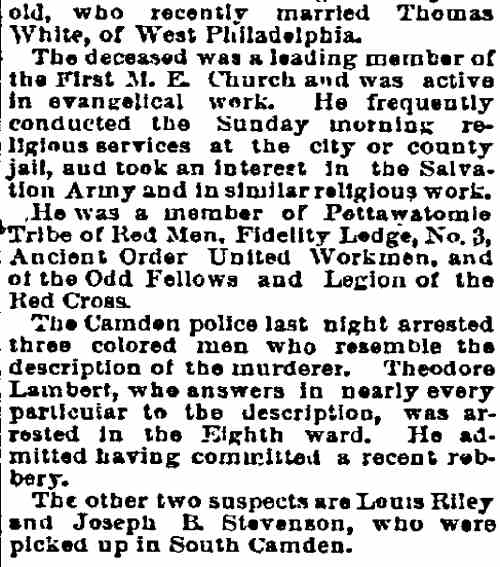
The deceased was a leading member of the First M. E. Church and was active in evangelical work. He frequently conducted the Sunday morning religious services at the city or county jail, and took an interest in the Salvation Army and in similar religious work.
He was a member of Pottawatomie Tribe of Red Men, Fidelity Lodge, No. 3, Ancient Order United Workmen, and of the Odd Fellows and Legion of the Red Cross.
The Camden police last night arrested three colored men who resemble the description of the murderer. Theodore Lambert, who answers in nearly every particular to the description, was arrested in the Eighth ward. He admitted having committed a recent robbery.
The other two suspects are Louis Riley and Joseph B. Stevenson, who were picked up in South Camden.
Three Suspects Arrested
Philadelphia Inquirer —
Third District Police Think They Have the Murderer of Baker William Kairer.
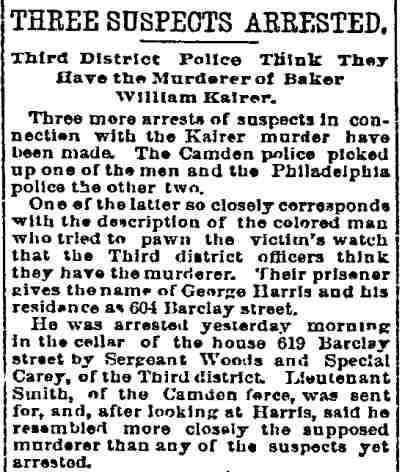
Three more arrests of suspects in connection with the Kairer murder have been made. The Camden police picked up one of the men and the Philadelphia police the other two.
One of the latter so closely corresponds with the description of the colored man who tried to pawn the victim’s watch that the Third district officers think they have the murderer. Their prisoner gives the name of George Harris and his residence as 604 Barclay street.
He was arrested yesterday morning in the cellar of the house 619 Barclay street by Sergeant Woods and Special Carey, of the Third district. Lieutenant Smith, of the Camden force, was sent for, and, after looking at Harris, said he resembled more closely the supposed murderer than any of the suspects yet arrested.
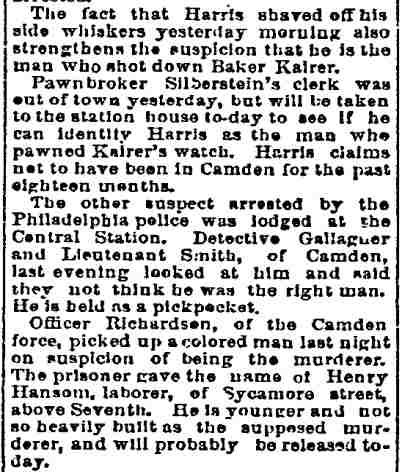
The fact that Harris shaved off his side whiskers yesterday morning also strengthens the suspicion that he is the man who shot down Baker Kairer.
Pawnbroker Silberstein’s clerk was out of town yesterday, but will be taken to the station house to-day to see if he can identity [sic] Harris as the man who pawned Kairer’s watch. Harris claims not to have been in Camden for the past eighteen months.
The other suspect arrested by the Philadelphia police was lodged at the Central Station. Detective Gallagher and Lieutenant Smith, of Camden, last evening looked at him and said they not [sic] think he was the right man. He is held as a pickpocket.
Officer Richardson, of the Camden force, picked up a colored man last night on suspicion of being the murderer. The prisoner gave the name of Henry Hansom, laborer, of Sycamore street, above Seventh. He is younger and not so heavily built as the supposed murderer, and will probably be released to-day.
Lieutenant Smith Acquitted
Philadelphia Inquirer —
Charged With Illegally Placing Two Names on a Poll List.
Lieutenant of Police John S. Smith was tried and acquitted in the Camden Criminal Court yesterday on charges of fraudulent registration in connection with the recent election. He had the names of Thomas Gray and Edward McGraw placed on the registry list of the First precinct of the First ward, and took an affidavit that they lived on a canal boat at the foot of Third street.
City Assessor J. Oscar Nichuals, a Republican, testified for the State that he was unable to find Gray and McGraw at the place given as their residence. Benjamin Reed, who is engaged in the canal boat business, testified that Gray and McGraw lived in Philadelphia.
Lieutenant Smith, in his own behalf, said two men came to him and asked him to place their names on the registry list.
Judge Vroom charged the jury in favor of the defendant, who was found not guilty.
Kairer’s Murderer in the Camden Jail
Philadelphia Inquirer —
Arrest of Two Men Who Heard Theodore Lambert Say He Had Killed the Baker.
Stolen Goods Found in the House Where the Confession Was Made.
The Revolver With Which the Crime Was Committed Identified—Evidence That Will Clear Up the Mystery and Win a Reward for the Detectives.
Theodore Lambert was arrested on suspicion of being the burglar who shot Baker William Kairer at his home on the morning of December 4 last. Lavinia Moore, housekeeper for Lambert, was arrested in Philadelphia. She swore that Lambert had confessed to her that he murdered Kairer. George Greenleaf, Josiah Stevens, Daniel “Dick” Sampson and Joseph Leonard were also taken into custody.
The county officials announced they now had positive evidence that Lambert shot and killed Kairer. The revolver with which the crime was committed was identified, and the evidence was submitted to the grand jury.
Clearing the Mystery
Philadelphia Inquirer —
Rumored Confession About the Murder of Baker Kairer.
The mystery surrounding the murder of Baker William Kairer has been solved. At least the Camden police authorities announced that such was the case yesterday afternoon, when they stated that Lavinia Moore, the woman with whom the burglar, Theodore Lambert, was living, had made a confession, in which she swore that Lambert had confessed to her that he murdered Kairer;
Mrs. Moore resides at 1881 South Ninth street, and before his arrest Lambert resided with her. The woman says that on the morning of December 4 he came to her home greatly excited. Mrs. Moore says she looked at Lambert, who said he had just done a “job.” He showed her a revolver and a gold watch. Mrs. Moore also says that a man named Joseph Stevens, of 1011 Locust street, was in the house and heard Lambert’s story. The woman described the watch in detail, and the description tallies exactly with that of the timepiece stolen from the murdered man’s house.
She also described the revolver and how Lambert hid it when about to be arrested. The woman also gave the names of two other persons who heard Lambert’s statement.
He Was a Busy Burglar
Philadelphia Inquirer —
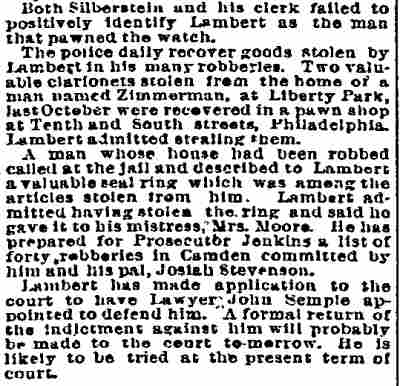
Lambert Has Prepared a List of Forty Robberies He Committed—He Talks Again to the Prosecutor.
Theodore Lambert, indicted by the Camden county grand jury for the murder of William G. Kairer, was again taken before Prosecutor Jenkins yesterday in order that Pawnbroker Silberstein and his clerk, of Philadelphia, might have a chance to indentify [sic] him.
In his confession Lambert says he pawned the watch stolen from the murdered man and received $40 for it from Silberstein. Silberstein denies loaning Lambert $40 on the timepiece. He says he only gave him $15, as the watch was only worth $32 at wholesale. Silberstein says he can prove this by his account books.
Lieutenant Smith, who recovered the watch on the morning of the murder, says he paid the pawnbroker $15 for it.
Both Silberstein and his clerk failed to positively identify Lambert as the man that pawned the watch.
The police daily recover goods stolen by Lambert in his many robberies. Two valuable clarionets stolen from the home of a man named Zimmerman, at Liberty Park, last October were recovered in a pawn shop at Tenth and South streets, Philadelphia. Lambert admitted stealing them.
A man whose house had been robbed called at the jail and described to Lambert a valuable seal ring which was among the articles stolen from him. Lambert admitted having stolen the ring and said he gave it to his mistress, Mrs. Moore. He has prepared for Prosecutor Jenkins a list of forty robberies in Camden committed by him and his pal, Josiah Stevenson.
Lambert has made application to the court to have Lawyer John Semple appointed to defend him. A formal return of the indictment against him will probably be made to the court to-morrow. He is likely to be tried at the present term of court.
Camden Democrats
Philadelphia Inquirer —
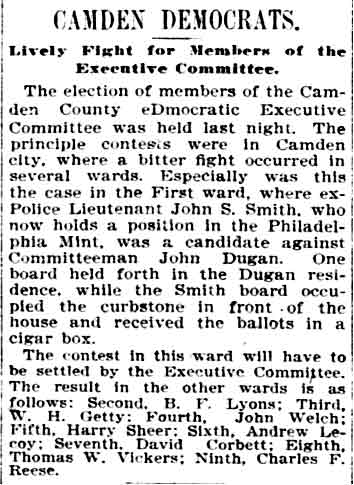
Lively Fight for Members of the Executive Committee.
The election of members of the Camden County eDmocratic [sic] Executive Committee was held last night. The principle contests were in Camden city, where a bitter fight occurred in several wards. Especially was this the case in the First ward, where ex-Police Lieutenant John S. Smith, who now holds a position in the Philadelphia Mint, was a candidate against Committeeman John Dugan. One board held forth in the Dugan residence, while the Smith board occupied the curbstone in front of the house and received the ballots in a cigar box.
The contest in this ward will have to be settled by the Executive Committee. The result in the other wards is as follows: Second, B. F. Lyons; Third, W. H. Getty; Fourth, John Welch; Fifth, Harry Sheer; Sixth, Andrew Lecoy; Seventh, David Corbett; Eighth, Thomas W. Vickers; Ninth, Charles F. Reese.
Camden News Condensed
Philadelphia Inquirer —
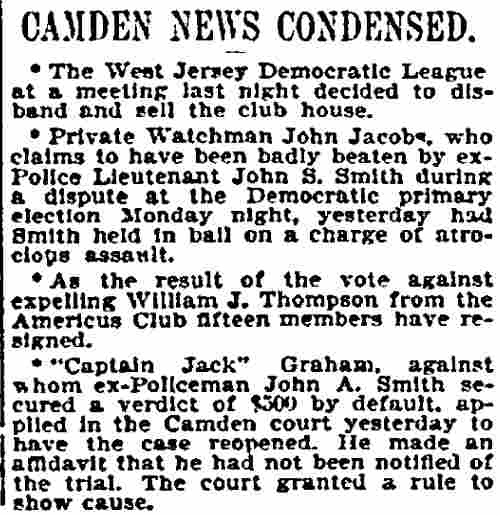
• The West Jersey Democratic League at a meeting last night decided to disband and sell the club house.
• Private Watchman John Jacobs, who claims to have been badly beaten by ex-Police Lieutenant John S. Smith during a dispute at the Democratic primary election Monday night, yesterday had Smith held in bail on a charge of atrocious assault.
• As the result of the vote against expelling William J. Thompson from the Americus Club fifteen members have resigned.
• “Captain Jack” Graham, against whom ex-Policeman John A. Smith secured a verdict of $500 by default, applied in the Camden court yesterday to have the case reopened. He made an affidavit that he had not been notified of the trial. The court granted a rule to show cause.
Over in Camden
Philadelphia Inquirer —
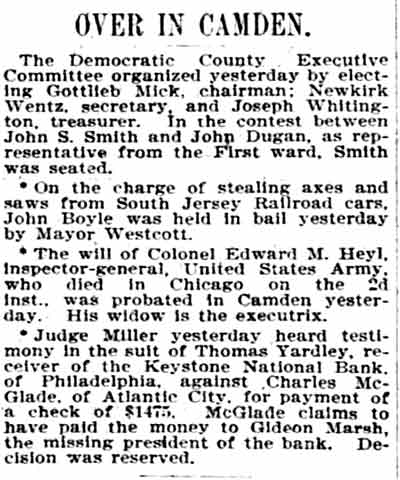
The Democratic County Executive Committee organized yesterday by electing Gottlieb Mick, chairman; Newkirk Wentz, secretary, and Joseph Whitington [sic], treasurer. In the contest between John S. Smith and John Dugan, as representative from the First ward, Smith was seated.
On the charge of stealing axes and saws from South Jersey Railroad cars, John Boyle was held in bail yesterday by Mayor Westcott.
The will of Colonel Edward M. Heyl, Inspector-general, United States Army, who died in Chicago on the 2d inst., was probated in Camden yesterday. His widow is the executrix.
Judge Miller yesterday heard testimony in the suit of Thomas Yardley, receiver of the Keystone National Bank, of Philadelphia, against Charles McGlade, of Atlantic City, for payment of a check of $1475. McGlade claims to have paid the money to Gideon Marsh, the missing president of the bank. Decision was reserved.
John S. Smith, Saloon
Camden City Directory — 1897
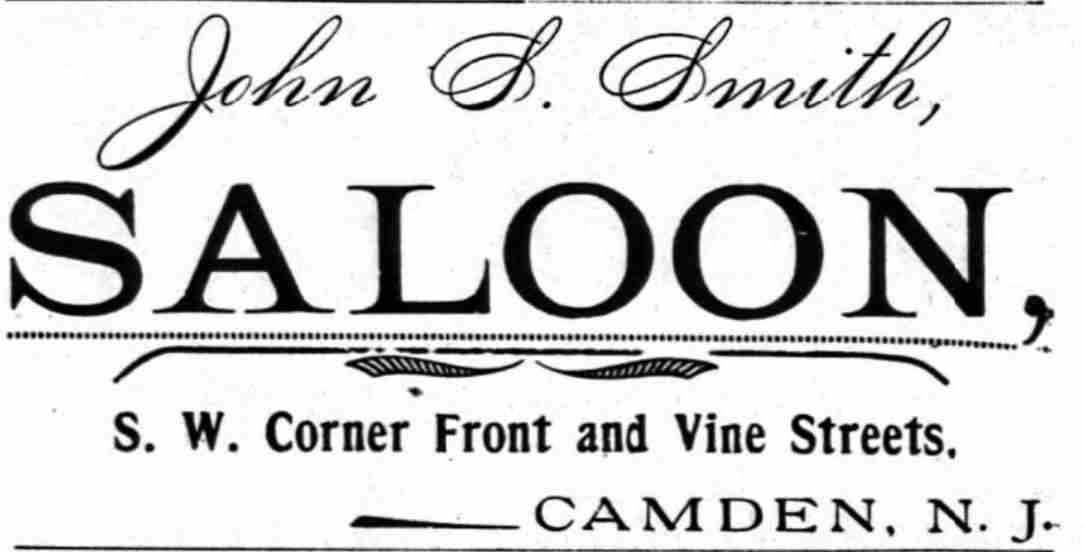
John S. Smith,
SALOON,
S. W. Corner Front and Vine Streets,
CAMDEN, N. J.
John S. Smith, Wet Goods
Camden City Directory — 1898
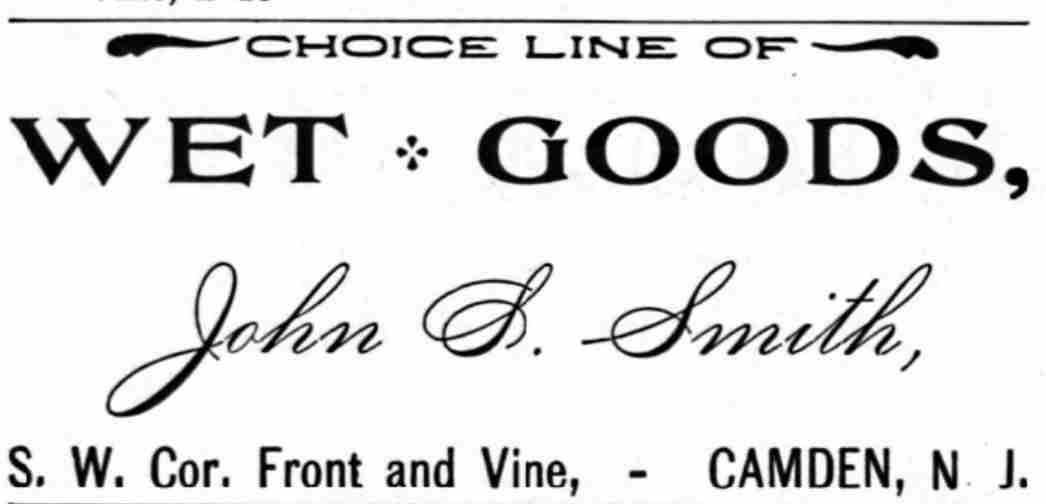
CHOICE LINE OF
WET GOODS,
John S. Smith,
S. W. Cor. Front and Vine, - CAMDEN, N. J.
Licenses Transferred
Philadelphia Inquirer —
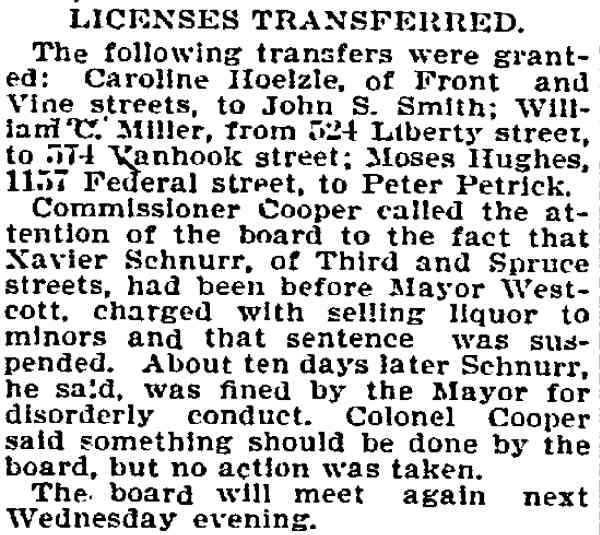
The following transfers were granted: Caroline Hoelzle, of Front and Vine streets, to John S. Smith; William C. Miller, from 524 Liberty street, to [?]74 Vanhook street; Moses Hughes, 1157 Federal street, to Peter Petrick.
Commissioner Cooper called the attention of the board to the fact that Xavier Schnurr, of Third and Spruce streets, had been before Mayor Westcott, charged with selling liquor to minors and that sentence was suspended. About ten days later Schnurr, he said, was fined by the Mayor for disorderly conduct. Colonel Cooper said something should be done by the board, but no action was taken.
The board will meet again next Wednesday evening.
Camden Family Ill From Poison
Philadelphia Inquirer —

Doctor Who Attended Them Believes There Was Arsenic in Their Food
ALL SUDDENLY STRICKEN
After Eating Breakfast They Were Prostrated and a Physician Was Summoned
DETECTIVES AT WORK
Authorities Searching for a Motive for Crime, But Must Wait for Result of Chemical Analysis
A mysterious poisoning case has put the Camden police authorities on their mettle. All the members of a household at 439 William street, with the exception of a child, were suddenly stricken on Friday last with violent pains in the abdomen after eating breakfast. A doctor, who was called in, prescribed antidotes for arsenical poisoning. He says his patients received an overdose, and to this they owe their lives. They are all weak, but are now out of danger. The police tried to keep the case quiet, and it was not until yesterday, when the patients were pronounced out of danger, that the facts became known to the public.
The victims are: Harry R. Morgan, a railroad baggage porter, employed at the Federal Street Depot; Mrs. Hannah Morgan, his wife; Mrs. Rebecca J. Morgan, widow, mother of Harry Morgan; Mrs. Clara Carter, widow, a cousin of Harry Morgan, who boarded with the family, and Charles Apleback, a motorman employed on the Camden and Suburban Railway, who was also a boarder.
The only member of the household not stricken was Lillie Morgan, the 12-year-old daughter of Harry Morgan. The others were taken ill shortly after eating breakfast on Friday morning. The breakfast consisted of fried ham, fried mashed potatoes and turnips, prunes, bread and butter, tea and coffee. Mrs. Rebecca Morgan drank tea, while all the others had coffee.
Apleback, the motorman, had his breakfast about 4 o'clock, as he had to leave early to go to work. The meal was prepared by Mrs. Hannah Morgan, who called the other members of the family some two hours later and ate breakfast with them. All ate heartily of the food except the girl Lillie. Her meal was confined to a few sips of coffee, a roll and a pickle.
As Harry Morgan arose from the table to fill his pipe and go to work he felt a burning, griping sensation in his stomach. He felt ill, but proceeded to his place of employment. He kept at work until noon, but then had to give up and return home. Shortly after Morgan left the house his wife, mother and cousin were all taken ill with similar symptoms. As his daughter Lillie was the only one not afflicted she was sent to summon Dr. Wallace McGeorge at 521 Broadway. The doctor was out of the city and it was fully an hour before he returned and answered the call. When he reached the house he found the three women in a serious condition. He detected symptoms of arsenical poisoning and administered antidotes. Dr. McGeorge was called in again to treat Harry Morgan when the latter reached home.
Later in the afternoon Charles Apleback returned from work. He declared that he had suffered the same as other members of the household and went to Dr. McGeorge’s office for treatment.
On Saturday morning Mrs. Rebecca Morgan seemed somewhat better, and thinking that a cup of tea might do her good she made some from the same tea that had been used the morning before. She drank the tea and ate the soda cracker. Shortly afterwards she was again taken violently ill with symptoms the same as she displayed on Friday. She was again given medicine.
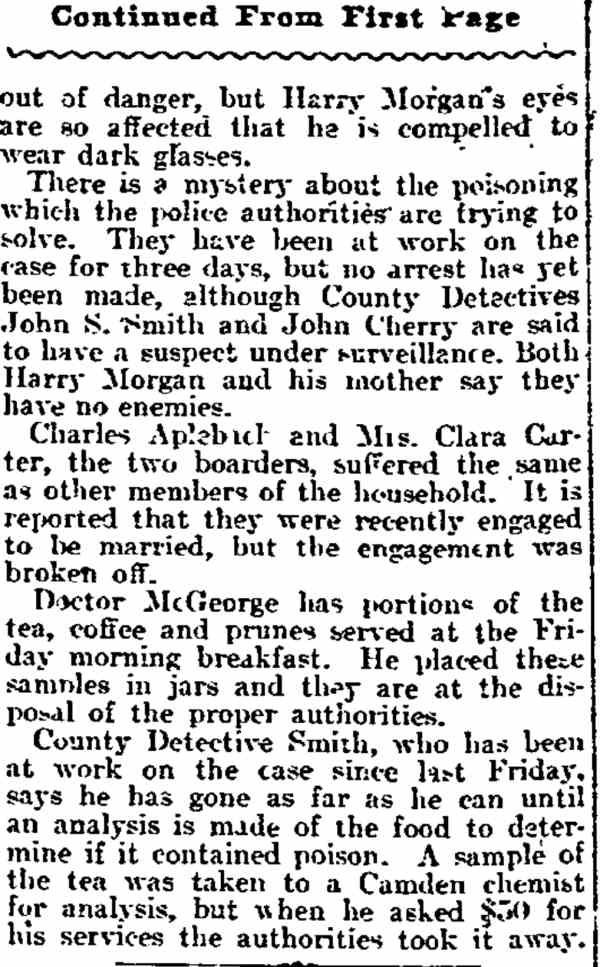
All the patients are now believed to be out of danger, but Harry Morgan's eyes are so affected that he is compelled to wear dark glasses.
There is a mystery about the poisoning which the police authorities are trying to solve. They have been at work on the case for three days, but no arrest has yet been made, although County Detectives John S. Smith and John Cherry are said to have a suspect under surveillance. Both Harry Morgan and his mother say they have no enemies.
Charles Apleback and Mrs. Clara Carter, the two boarders, suffered the same as other members of the household. It is reported that they were recently engaged to be married, but the engagement was broken off.
Doctor McGeorge has portions of the tea, coffee and prunes served at the Friday morning breakfast. He placed these samples in jars and they are at the disposal of the proper authorities.
County Detective Smith, who has been at work on the case since last Friday, says he has gone as far as he can until an analysis is made of the food to determine if it contained poison. A sample of the tea was taken to a Camden chemist for analysis, but when he asked $50 for his services the authorities took it away.
Democrats Confer
Philadelphia Inquirer —

Tame Meeting of the State Committee Held at Asbury Park
TALK OF REORGANIZATION
Rabid Free Silverites Get No Chance to Whoop Things Up—County Committees to Be Elected
From a Staff Correspondent.
ASBURY PARK, N. J., Aug. 7.—The New Jersey Democratic leaders held their much-talked-of conference at a beach-front hotel here to-day under the auspices of the State Committee. So far as shaping State issues or defining the attitude of the party in New Jersey as regards Bryan and national issues, the conference amounted to nothing. It proved to be a cut-and-dried State Committee meeting at which special precautions were taken to prevent any outbreak of personal and factional strife. In consequence there was a surface semblance of harmony, but a woeful lack of enthusiasm.
It was the largest gathering of members of the State Committee since the disastrous campaign of last fall. The member from each of the counties except Salem, Passaic and Hudson was present, and “Bob” Davis, the doughty Hudson leader, was on hand to represent that stronghold. Davis, by the way, disclaimed any ambition to assume the reins as State leader. He said he was content to manage the Hudson organization and show the rest of the State how big Democratic majorities could be rolled up.
Nearly all the county organizations were represented either by the county chairman or his proxy. Congressman “Bill” Daly was on deck with just the shadow of a frown on his usually unruffled brow. He denied that he had come to the conference to make trouble for State Chairman Gourley, but that did not prevent him from making some peppery remarks about the Passaic county “harmonizer.” Daly and Gourley do not speak as they pass by and Daly would like to see the State chairman step down and out and “Bob” Davis take his place. The trouble between the two men dates from the last Gubernatorial convention. Daly says Gourley went back on his promises, once in refusing to recognize the chairman of the Passaic county delegation, who wanted to swing his votes over to Daly, and again in failing to appoint him (Daly) a member of the State Committee.
South Jersey Represented
South Jersey was represented by Committeemen Harry B. Paul, of Camden; John T. French, of Atlantic; David W. Rodan, of Cape May; William C. Hendee, of Cumberland, and Bowman S. Cox, of Gloucester. Other South Jersey Democrats attracted to the conference were County Detective John S. Smith and former Senator George Pfeiffer, Edward Grosscup, former Congressional Candidate Iredell and Editor Carpenter, of Woodbury. Lawyer John J. Crandall came up with a carefully prepared dissertation on Democracy and its mission in correcting the distempers of the body politic, but unfortunately he did not have a chance to launch it, for the committee adopted a resolution that there should be no speeches or discussion of anything but the business in hand. Crandall, John Wright and some more of the ultra-free silver men were much disappointed in not having a chance to whoop things up for Bryan.
There was an outcropping of this rabid silver sentiment in a contest from Burlington county, which the State Committee quickly squelched. Prosecutor Eckard P. Budd appeared with the indorsement of 35 of the 39 members of the Burlington County Committee as the county’s representative in the State Committee in place of Dr. A. E. Conrow, deceased. Some Burlington county free silverites, who knew that Budd was not a firm believer in the 16 to 1 shibboleth, although he voted for Bryan, presented the name of William F. Morgan, of Palmyra, as Dr. Conrow’s successor. Morgan had the indorsement of the Burlington County Central Committee. The State Committee unanimously elected Budd and would not give the Morgan supporters a hearing, whereat they kicked vigorously.
Paul Walked Out
Committeeman Harry Paul tried to inject ginger into the proceedings when the State Committee first met by proposing that the county chairman be invited into the room. Chairman Gourley said that would never do.
“I don’t see what you asked them to come here for,” remarked Paul, “it’s not a nice way to treat them, shutting them out.”
Chairman Gourley remarked that the Camden committeeman was free to leave if he did not like the way things were being run.
“I can do that easily; I didn’t have to come here,” retorted Paul and he walked out and took the first train for Camden.
Clarence Atkinson, chairman of the Camden County Committee, showed his displeasure with Gourley by taking no part in the subsequent conference. This conference, which was held in the afternoon, included members of the State Committee and the county chairmen. It brought out the real purpose of the gathering, which was to put into effect a plan for a better organization throughout the State. The county chairmen were asked to explain how their County Committee was formed. It was found that some committees were elected and some appointed. Chairman Gourley proposed a uniform system of electing County Committees. It will be drawn up by a committee of five, of which he is chairman, and will be prepared in time for presentation to the various county conventions this fall. The object is to get representative county committees that will be in touch with the Democratic voters and be able to infuse vigor into the organization.
Among the prominent Democrats on the ground were Former Congressman Johnston Cornish, who will be a Senatorial candidate in Warren county, and former Speaker of the Assembly James J. Bergen, who is seeking Senatorial honors in Somerset county. General Richard A. Donnelly was the only State Committeeman-at-Large present except Chairman Gourley. As treasurer of the committee he dropped a few hints about the necessity of raising funds.
Gilbert Now in Jail
Philadelphia Inquirer —
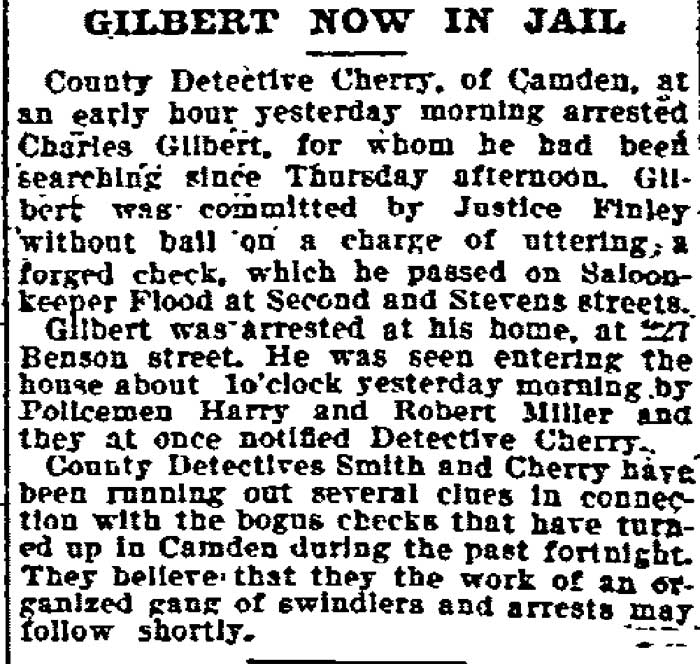
County Detective Cherry, of Camden, at an early hour yesterday morning arrested Charles Gilbert, for whom he had been searching since Thursday afternoon. Gilbert was committed by Justice Finley without bail on a charge of uttering a forged check, which he passed on Saloonkeeper Flood at Second and Stevens streets.
Gilbert was arrested at his home, at 227 Benson street. He was seen entering the house about 1o'clock yesterday morning by Policemen Harry and Robert Miller and they at once notified Detective Cherry.
County Detectives Smith and Cherry have been running out several clues in connection with the bogus checks that have turned up in Camden during the past fortnight. They believe that they[sic] the work of an organized gang of swindlers and arrests may follow shortly.
Camden Democrats Split
New York Tribune —
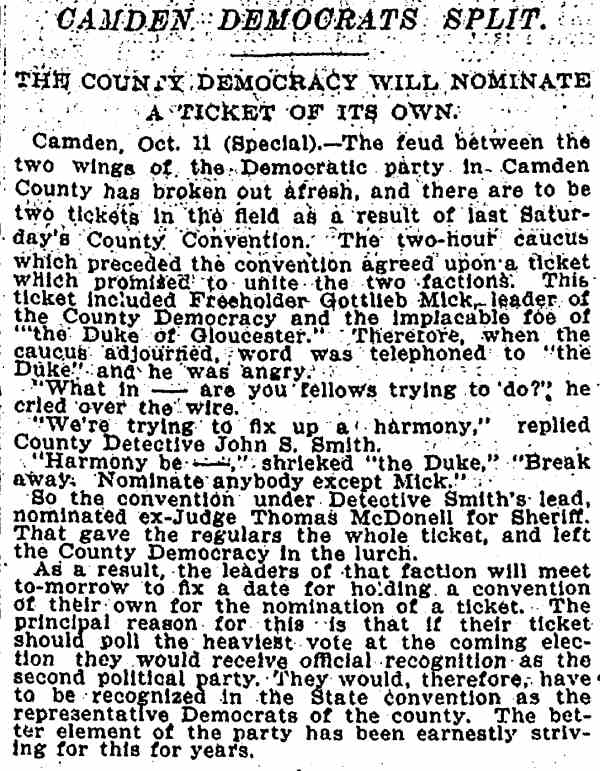
THE COUNTY DEMOCRACY WILL NOMINATE A TICKET OF ITS OWN.
Camden, Oct. 11 (Special).—The feud between the two wings of the Democratic party in Camden County has broken out afresh, and there are to be two tickets in the field as a result of last Saturday's County Convention. The two-hour caucus which preceded the convention agreed upon a ticket which promised to unite the two factions. This ticket included Freeholder Gottlieb Mick, leader of the County Democracy and the implacable foe of “the Duke of Gloucester.” Therefore, when the caucus adjourned, word was telephoned to “the Duke” and he was angry.
“What in — are you fellows trying to do?,” he cried over the wire.
“We're trying to fix up a harmony,” replied County Detective John S. Smith.
“Harmony be —,” shrieked “the Duke,” “Break away: Nominate anybody except Mick.”
So the convention under Detective Smith's lead, nominated ex-Judge Thomas McDonell for Sheriff. That gave the regulars the whole ticket, and left the County Democracy in the lurch.
As a result, the leaders of that faction will meet to-morrow to fix a date for holding a convention of their own for the nomination of a ticket. The principal reason for this is that if their ticket should poll the heaviest vote at the coming election they would receive official recognition as the second political party. They would, therefore, have to be recognized in the State convention as the representative Democrats of the county. The better element of the party has been earnestly striving for this for years.
One Week More of Campaigning
Philadelphia Inquirer —
Republican Ticket Will Sweep Camden County With a Big Majority
Democrats, Hopeless of Success, Are Having a Factional Fight on the Side
With the end of this week the campaign in Camden county will practically end. During the week the Republican spellbinders will visit the Ninth and Twelfth wards, Camden, and Waterford and Winslow townships. Everything points to an overwhelming Republican majority.
While the Democrats have been taking but little interest in the campaign, the nomination of an independent Democratic ticket by the county Democracy will result in bringing out many Democrats to vote who otherwise would remain at home. Gottlieb Mick, chairman of the Executive Committee of the County Democracy, yesterday announced the appointment of the following Campaign Committee:
Dr. Donges, Captain Christopher S. Magrath, Isaac Ferris, Jr., Charles Davall, John Hood, George D. Borton, James F. Davis, Joseph Devinney, George Holl, Joseph Nowrey, William E. Anthony, David T Campbell, John Pugh, John K. Esler, Harry Stetser, Cornelius Shepperkotter, Dr. F. J. Bickers, Jonas S. Miller, Allyn Brewer, Joseph Peacock, David A. Shreeve, Charles D. Heath, Frederick Krueger, F. S. Niepling, Aaron Bryant, Jacob C Lippincott, Thomas Wentz, Sr.
The committee will endeavor to get out a larger vote for the County Democracy ticket than the “regular” faction of the party will poll. The regulars have William J. Thompson as their leader, with County Detective John S. Smith as his chief lieutenant, and they expect to down the “silk stockings.”
A change was made in the County Democracy ticket yesterday, caused by the withdrawal of George Williams, of the Twelfth ward, as a candidate for the Assembly. The vacancy was filled by selecting Charles C. Old, of Pensauken township, who filed his acceptance with the County Clerk. Mr. Old is a shoe merchant in business in Philadelphia.
Jacob C Daubman, who recently filed a certificate of nomination as an “Independent Republican” candidate for Sheriff yesterday, announced his withdrawal. He had made a strong play for the County Democracy endorsement, but failed to land it, and this left him no ground to stand on.
Political Straws
Major William H. Tice, of the First ward, who has been in City Council, would like to occupy his old seat again, and will be a candidate for the Republican nomination in the First ward next spring.
The Republican County Executive Committee yesterday arranged for the appointment of two challengers in each election district.
The Democratic County Executive Committee of the “regulars” organized yesterday afternoon by the election of Clarence T. Atkinson as chairman; James Burke, secretary, and Thomas Bodell. Committees were appointed to carry on campaign work.
There is no more popular candidate on the Republican ticket than Editor F. F. Patterson, Jr., who is receiving many voluntary pledges of support from Democrats.
Fire Department Investigation
Philadelphia Inquirer —
At the request of Presiding Elder Dobbins, Rev. J. W. Marshall, D. D., and Rev. John Handley. D. D., Prosecutor Lloyd yesterday sent County Detectives Cherry and Smith to investigate the recent destruction of the Hedding M. E. Church by fire to ascertain if fire was of incendiary origin.
Camden Democrats on the Watch
Philadelphia Inquirer —
They Hope to Make a Hit at the Spring Election Two Weeks Hence
Camden Democrats will make an active campaign during the next two weeks in the hope of carrying some of their Councilmanic candidates through at the municipal election on March 13 A campaign committee of five will be in charge of affairs, both factions in the party being represented in the committee, which is composed of County Detective John S. Smith, chairman of the City Committee; former State Senator George Pfeiffer, Jr., chairman of the County Committee; State Committeeman Harry B. Paul, former Judge Howard Carrow and City Recorder Joseph E. Nowrey.
The Democrats could not secure control of City Council if they elected their candidates in every ward, but if they carry three or four wards it would do much to strengthen the party for next fall’s contest. The fight will be made in wards where dissension exists in the Republican ranks.
The saloonkeepers of Camden are still smarting under the turndown they received in their efforts to have the license fee cut down from $500 to $300 and the subsequent indictment of many of their number for Sunday liquor selling. The liquor dealers are now organized as they have never been before. The Camden Liquor Dealers’ Association is a close corporation and keeps its secrets well. It has leaked out that they propose to cut the Republican candidates, as they blame the Republican leaders for most of their troubles. The association has been raising a “pot” to aid the election of the Democratic candidates for City Council. The saloonkeepers are very reticent about discussing this subject, as they depend upon the Republican Excise Commissioners for their licenses.
The Democrats held their primary election last evening and named the following candidates for City Council: First ward, John H. Irwin; Second ward, former State Senator and County Chairman George Pfeiffer; Third ward, James Noone; Fourth ward, Lewis Holl; Fifth ward, George Horneff; Sixth ward, Ben Meloney; Seventh ward, William Hollman; Eighth ward, William Jennings; Ninth ward, Frank H. Powell; Tenth ward, Abel Lewis; Eleventh ward, William Petzell; Twelfth ward, Thomas H. Cook.
Abbatto Hanged in Camden Jail
Philadelphia Inquirer —
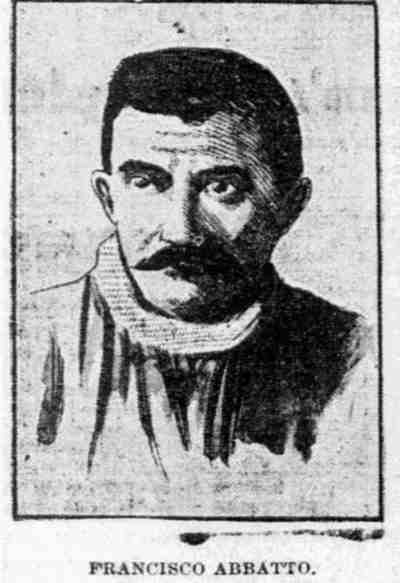
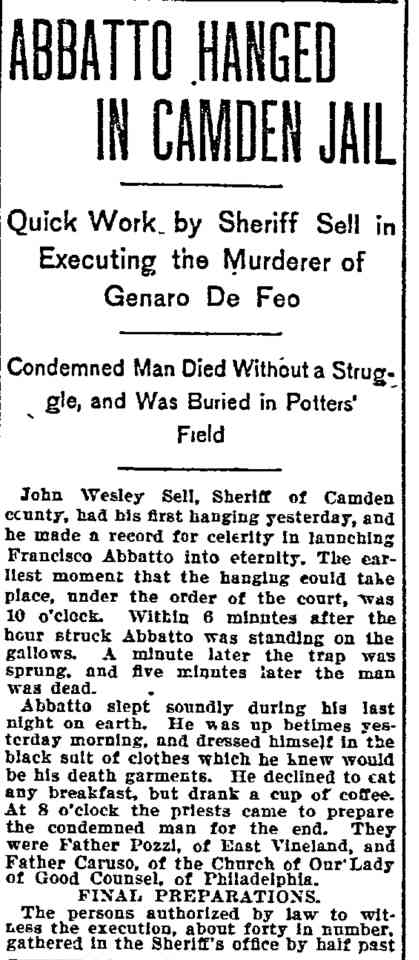
Quick Work by Sheriff Sell in Executing the Murderer of Genaro De Feo
Condemned Man Died Without a Struggle, and Was Buried in Potters’ Field
FRANCISCO ABBATTO.
John Wesley Sell, Sheriff of Camden county, had his first hanging yesterday, and he made a record for celerity in launching Francisco Abbatto into eternity. The earliest moment that the hanging could take place, under the order of the court, was 10 o’clock. Within 6 minutes after the hour struck Abbatto was standing on the gallows. A minute later the trap was sprung, and five minutes later the man was dead.
Abbatto slept soundly during his last night on earth. He was up betimes yesterday morning, and dressed himself in the black suit of clothes which he knew would be his death garments. He declined to eat any breakfast, but drank a cup of coffee. At 8 o’clock the priests came to prepare the condemned man for the end. They were Father Pozzi, of East Vineland, and Father Caruso, of the Church of Our Lady of Good Counsel, of Philadelphia.
FINAL PREPARATIONS.
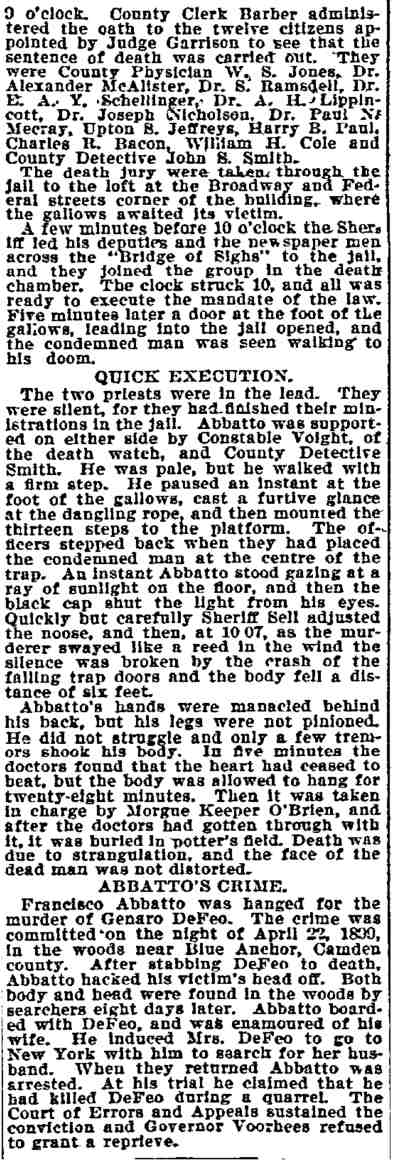
The persons authorized by law to witness the execution, about forty in number, gathered in the Sheriff’s office by half past 9 o’clock. County Clerk Barber administered the oath to the twelve citizens appointed by Judge Garrison to see that the sentence of death was carried out. They were County Physician W. S. Jones, Dr. Alexander McAlister, Dr. S. Ramsdell, Dr. E. A. Y. Schellinger, Dr. A. H. Lippincott, Dr. Joseph Nicholson, Dr. Paul N. Mecray, Upton S. Jeffreys, Harry B. Paul, Charles R. Bacon, William H. Cole and County Detective John S. Smith.
The death jury were taken through the jail to the loft at the Broadway and Federal streets corner of the building, where the gallows awaited its victim.
A few minutes before 10 o’clock the Sheriff led his deputies and the newspaper men across the “Bridge of Sighs” to the jail, and they joined the group in the death chamber. The clock struck 10, and all was ready to execute the mandate of the law. Five minutes later a door at the foot of the gallows, leading into the jail opened, and the condemned man was seen walking to his doom.
QUICK EXECUTION.
The two priests were in the lead. They were silent, for they had finished their ministrations in the jail. Abbatto was supported on either side by Constable Voight, of the death watch, and County Detective Smith. He was pale, but he walked with a firm step. He paused an instant at the foot of the gallows, cast a furtive glance at the dangling rope, and then mounted the thirteen steps to the platform. The officers stepped back when they had placed the condemned man at the centre of the trap. An instant Abbatto stood gazing at a ray of sunlight on the floor, and then the black cap shut the light from his eyes. Quickly but carefully Sheriff Sell adjusted the noose, and then, at 10 07, as the murderer swayed like a reed in the wind the silence was broken by the crash of the falling trap doors and the body fell a distance of six feet.
Abbatto’s hands were manacled behind his back, but his legs were not pinioned. He did not struggle and only a few tremors shook his body. In five minutes the doctors found that the heart had ceased to beat, but the body was allowed to hang for twenty-eight minutes. Then it was taken in charge by Morgue Keeper O’Brien, and after the doctors had gotten through with it, it was buried in potter’s field. Death was due to strangulation, and the face of the dead man was not distorted.
ABBATTO’S CRIME.
Francisco Abbatto was hanged for the murder of Genaro DeFeo. The crime was committed on the night of April 22, 1899, in the woods near Blue Anchor, Camden county. After stabbing DeFeo to death, Abbatto hacked his victim’s head off. Both body and head were found in the woods by searchers eight days later. Abbatto boarded with DeFeo, and was enamoured of his wife. He induced Mrs. DeFeo to go to New York with him to search for her husband. When they returned Abbatto was arrested. At his trial he claimed that he had killed DeFeo during a quarrel. The Court of Errors and Appeals sustained the conviction and Governor Voorhees refused to grant a reprieve.
New Jersey Delegates Ready to Start for Kansas City
Philadelphia Inquirer —
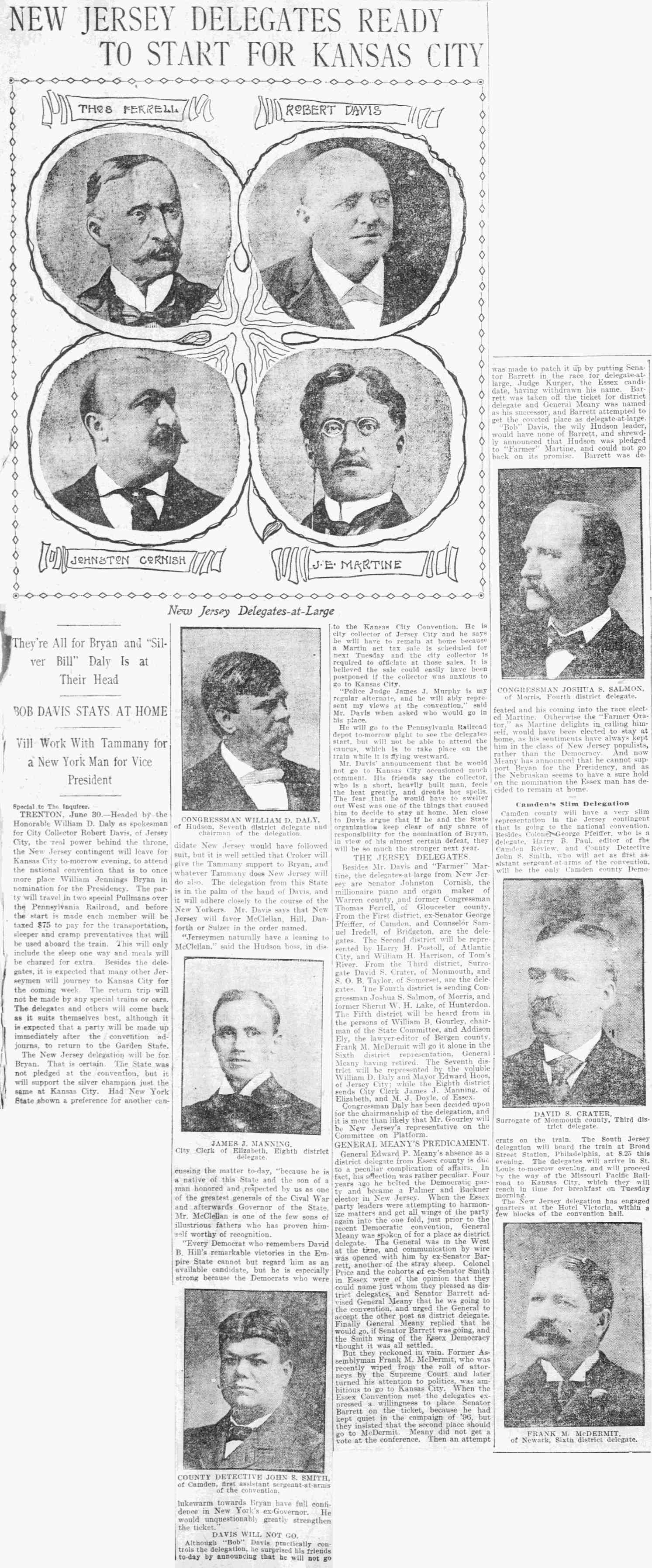
They’re All for Bryan and “Silver Bill” Daly Is at Their Head
BOB DAVIS STAYS AT HOME
Will Work With Tammany for a New York Man for Vice President
Special to The Inquirer.
TRENTON, June 30.—Headed by the Honorable William D. Daly as spokesman for City Collector Robert Davis, of Jersey City, the real power behind the throne, the New Jersey contingent will leave for Kansas City to-morrow evening, to attend the national convention that is to once more place William Jennings Bryan in nomination for the Presidency. The party will travel in two special Pullmans over the Pennsylvania Railroad, and before the start is made each member will be taxed $75 to pay for the transportation, sleeper and cramp preventatives that will be used aboard the train. This will only include the sleep one way and meals will be charged for extra. Besides the delegates, it is expected that many other Jerseymen will journey to Kansas City for the coming week. The return trip will not be made by any special trains or cars. The delegates and others will come back as it suits themselves best, although it is expected that a party will be made up immediately after the convention adjourns, to return to the Garden State.
The New Jersey delegation will be for Bryan. That is certain. The State was not pledged at the convention, but it will support the silver champion just the same at Kansas City. Had New York State shown a preference for another candidate New Jersey would have followed suit, but it is well settled that Croker will give the Tammany support to Bryan, and whatever Tammany does New Jersey will do also. The delegation from this State is in the palm of the hand of Davis, and it will adhere closely to the course of the New Yorkers. Mr. Davis says that New Jersey will favor McClellan, Hill, Danforth or Sulzer in the order named.
“Jerseymen naturally have a leaning to McClellan,” said the Hudson boss, in discussing the matter to-day, “because he is a native of this State and the son of a man honored and respected by us as one of the greatest generals of the Cival [sic] War and afterwards Governor of the State. Mr. McClellan is one of the few sons of illustrious fathers who has proven himself worthy of recognition.
“Every Democrat who remembers David B. Hill’s remarkable victories in the Empire State cannot but regard him as an available candidate, but he is especially strong because the Democrats who were lukewarm towards Bryan have full confidence in New York’s ex-Governor. He would unquestionably greatly strengthen the ticket.”
DAVIS WILL NOT GO.
Although “Bob” Davis practically controls the delegation, he surprised his friends to-day by announcing that he will not go to the Kansas City Convention. He is city collector of Jersey City and he says he will have to remain at home because a Martin act tax sale is scheduled for next Tuesday and the city collector is required to officiate at those sales. It is believed the sale could easily have been postponed if the collector was anxious to go to Kansas City.
“Police Judge James J. Murphy is my regular alternate, and he will ably represent my views at the convention,” said Mr. Davis when asked who would go in his place.
He will go to the Pennsylvania Railroad depot to-morrow night to see the delegates start, but will not be able to attend the caucus, which is to take place on the train while it is flying westward.
Mr. Davis’ announcement that he would not go to Kansas City occasioned much comment. His friends say the collector, who is a short, heavily built man, feels the heat greatly, and dreads hot spells. The fear that he would have to swelter out West was one of the things that caused him to decide to stay at home. Men close to Davis argue that if he and the State organization keep clear of any share of responsibility for the nomination of Bryan, in view of his almost certain defeat, they will be so much the stronger next year.
THE JERSEY DELEGATES.
Besides Mr. Davis and “Farmer” Martine, the delegates-at-large from New Jersey are Senator Johnston Cornish, the millionaire piano and organ maker of Warren county, and former Congressman Thomas Ferrell, of Gloucester county. From the First district, ex-Senator George Pfeiffer, of Camden, and Counselor Samuel Iredell, of Bridgeton, are the delegates. The Second district will be represented by Harry H. Postoll, of Atlantic City, and William H. Harrison, of Tom’s River. From the Third district, Surrogate David S. Crater, of Monmouth, and S. O. B. Taylor, of Somerset, are the delegates. The Fourth district is sending Congressman Joshua S. Salmon, of Morris, and former Sheriff W. H. Lake, of Hunterdon. The Fifth district will be heard from in the persons of William B. Gourley, chairman of the State Committee, and Addison Ely, the lawyer-editor of Bergen county. Frank M. McDermit will go it alone in the Sixth district representation, General Meany having retired. The Seventh district will be represented by the voluble William D. Daly and Mayor Edward Hoos, of Jersey City; while the Eighth district sends City Clerk James J. Manning, of Elizabeth, and M. J. Doyle, of Essex.
Congressman Daly has been decided upon for the chairmanship of the delegation, and it is more than likely that Mr. Gourley will be New Jersey’s representative on the Committee on Platform.
GENERAL MEANY’S PREDICAMENT.
General Edward P. Meany’s absence as a district delegate from Essex county is due to a peculiar complication of affairs. In fact, his selection was rather peculiar. Four years ago he belted the Democratic party and became a Palmer and Buckner elector in New Jersey. When the Essex party leaders were attempting to harmonize matters and get all wings of the party again into the one fold, just prior to the recent Democratic convention, General Meany was spoken of for a place as district delegate. The General was in the West at the time, and communication by wire was opened with him by ex-Senator Barrett, another of the stray sheep. Colonel Price and the cohorts of ex-Senator Smith in Essex were of the opinion that they could name just whom they pleased as district delegates, and Senator Barrett advised General Meany that he ws [sic] going to the convention, and urged the General to accept the other post as district delegate. Finally General Meany replied that he would go, if Senator Barrett was going, and the Smith wing of the Essex Democracy thought it was all settled.
But they reckoned in vain. Former Assemblyman Frank M. McDermit, who was recently wiped from the roll of attorneys by the Supreme Court and later turned his attention to politics, was ambitious to go to Kansas City. When the Essex Convention met the delegates expressed a willingness to place Senator Barrett on the ticket, because he had kept quiet in the campaign of ‘96, but they insisted that the second place should go to McDermit. Meany did not get a vote at the conference. Then an attempt was made to patch it up by putting Senator Barrett in the race for delegate-at-large, Judge Kurger [sic], the Essex candidate, having withdrawn his name. Barrett was taken off the ticket for district delegate and General Meany was named as his successor, and Barrett attempted to get the coveted place as delegate-at-large. “Bob” Davis, the wily Hudson leader, would have none of Barrett, and shrewdly announced that Hudson was pledged to “Farmer” Martine, and could not go back on its promise. Barrett was defeated and his coming into the race elected Martine. Otherwise the “Farmer Orator,” as Martine delights in calling himself, would have been elected to stay at home, as his sentiments have always kept him in the class of New Jersey populists, rather than the Democracy. And now Meany has announced that he cannot support Bryan for the Presidency, and as the Nebraskan seems to have a sure hold on the nomination the Essex man has decided to remain at home.
Camden’s Slim Delegation
Camden county will have a very slim representation in the Jersey contingent that is going to the national convention. Besides Colonel George Pfeiffer, who is a delegate, Harry B. Paul, editor of the Camden Review, and County Detective John S. Smith, who will act as first assistant sergeant-at-arms of the convention, will be the only Camden county Democrats on the train. The South Jersey delegation will board the train at Broad Street Station, Philadelphia, at 8.25 this evening. The delegates will arrive in St. Louis to-morrow evening, and will proceed by the way of the Missouri Pacific Railroad to Kansas City, which they will reach in time for breakfast on Tuesday morning.
The New Jersey delegation has engaged quarters at the Hotel Victoria, within a few blocks of the convention hall.
[Portrait captions]
Thos Ferrell. Robert Davis. Johnston Cornish. J. E. Martine. New Jersey Delegates-at-Large.
CONGRESSMAN WILLIAM D. DALY, of Hudson, Seventh district delegate and chairman of the delegation.
JAMES J. MANNING, City Clerk of Elizabeth, Eighth district delegate.
COUNTY DETECTIVE JOHN S. SMITH, of Camden, first assistant sergeant-at-arms of the convention.
CONGRESSMAN JOSHUA S. SALMON, of Morris, Fourth district delegate.
DAVID S. CRATER, Surrogate of Monmouth county, Third district delegate.
FRANK M. McDERMIT, of Newark, Sixth district delegate.
Sunday Liquor Selling
Philadelphia Inquirer —

Joseph Potlaski, a saloonkeeper, of 1017 Chestnut Street, was arrested, by County Detectives Smith and Cherry, yesterday, on a bench warrant. He was fined $200 last spring for Sunday liquor selling, but has not yet paid up.
Murder Witness on the Rack
Philadelphia Inquirer —
Murder Witness on the Rack
County Detectives Smith and Cherry and City Detective Painter, of Camden, are investigating the death of Cornelius Preston, whose body was found in Big Timber Creek, near Westville, on March 5, 1899. Yesterday they had William Smith, of Camden, who furnished the clue to Preston's alleged murder, taken before Prosecutor Lloyd for examination. The Prosecutor will not divulge the information given him by Smith until the detectives have had an opportunity to verify it.
Glad Welcome for Mr. Bryan
Trenton Evening Times —
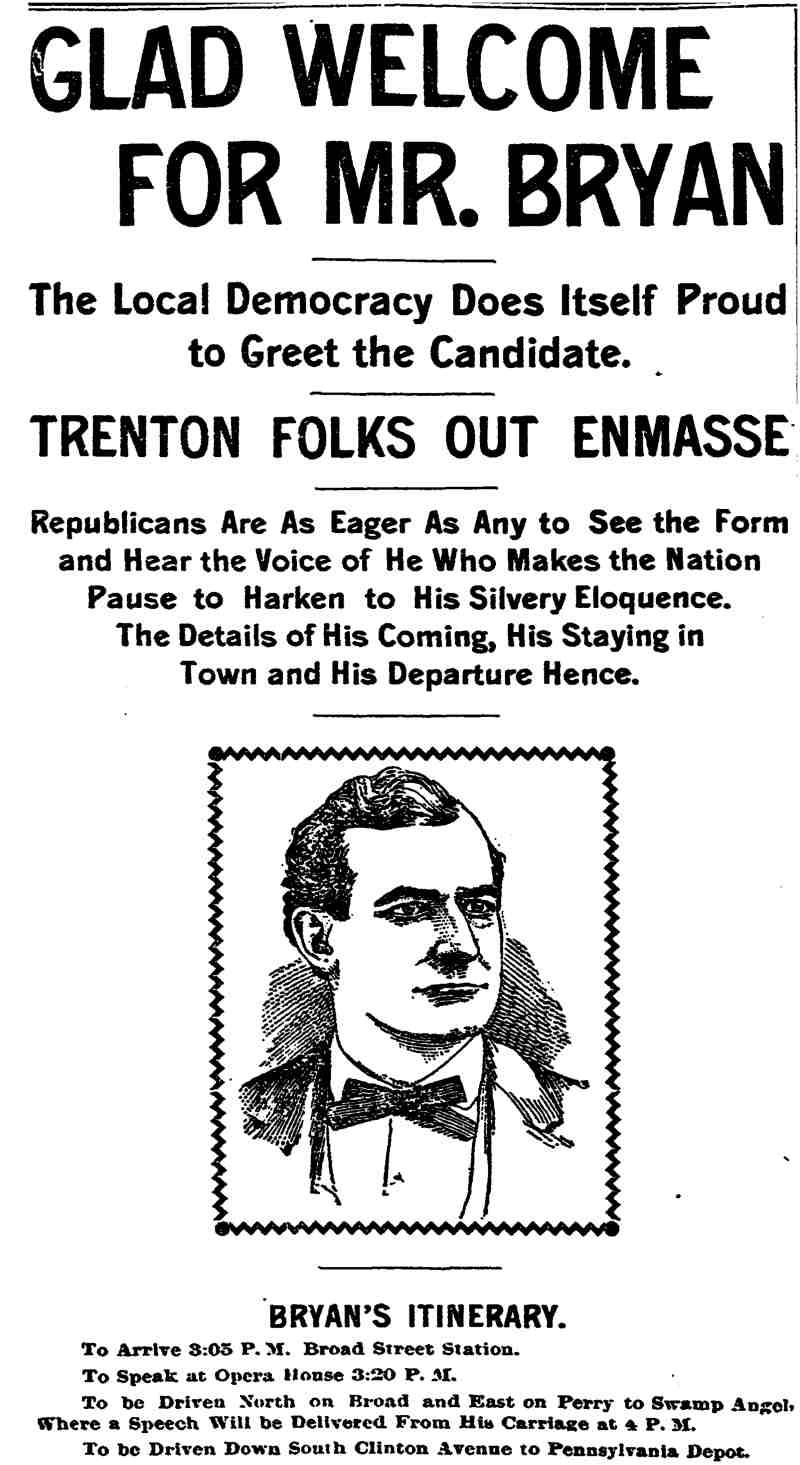
The Local Democracy Does Itself Proud to Greet the Candidate.
TRENTON FOLKS OUT ENMASSE
Republicans Are As Eager As Any to See the Form and Hear the Voice of He Who Makes the Nation Pause to Harken to His Silvery Eloquence. The Details of His Coming, His Staying in Town and His Departure Hence.
BRYAN’S ITINERARY.
To Arrive 3:05 P. M. Broad Street Station.
To Speak at Opera House 3:20 P. M.
To be Driven North on Broad and East on Perry to Swamp Angel, Where a Speech Will be Delivered From His Carriage at 4 P. M.
To be Driven Down South Clinton Avenue to Pennsylvania Depot.
The Democrats of New Jersey today have Col. William Jennings Bryan, Presidential candidate of the National Democratic party, as their guest, and in order to do him honor have gathered in Trenton’s famous Opera House—the scene of many political triumphs—to listen to the teaching of his doctrines from his own lips.
Mr. Bryan is scheduled to arrive here at 3:05 P. M., coming in his special car on the Camden and Amboy Division and alighting at the Broad street depot, within the shadow of Roeblings’ enormous mills. He will be escorted through New Jersey by a special delegation from the State Committee and will be greeted at Broad street depot by a committee of prominent local Democrats, consisting of Col. Lewis Perrine, ex-Judge Robert S. Woodruff, Joseph L. Naar, ex-Senator Jonathan Blackwell, G. D. W. Vroom, John H. Scudder, Gen. Richard A. Donnelly, ex-Mayor Daniel J. Bechtel, William F. Gordon, William J. Convery and ex-Assemblyman James W. Lanning.
Together the State delegation and Trenton committee will escort Mr. Bryan to the Opera House, where he will again be greeted by a second reception committee of Trentonians composed as follows: William F. Gordon, chairman; Harry S. Provost, secretary; William S. D’Arcy, H. M. Slack, William H. Hatfield, John R. Chattin, Alfred Wilson, William McGill, Jr., Jules A. Charles, Jr., E. Furman Hooper, Frank S. Katzenbach, Jr., Daniel J. Bechtel, T. J. Hurley, William J. Backes, G. Taylor Lee, Charles H. Gallagher, George W. Stout, George Wenzel, Howard Heath, Charles M. Heath, Harry K. Naar, A. C. D. Wilson, N. J. Loos, H. C. Hartpence, John J. Strasser, George B. La Barre, Charles Staiber, C. M. Hattersley, Daniel J. Haggerty, Jesse Thorn, Howell Brades, Lafayette Hooper, James West.
These combined reception committees will then escort Mr. Bryan to the stage of the Opera House, from which he will address the convention of State League of Clubs for upwards of three quarters of an hour.
Upon his entrance in the hall Ruhlman’s band will play “The Star-Spangled Banner” and the delegates and spectators will wave small American flags.
From the Opera House, at the conclusion of his speech, Mr. Bryan will be driven up North Broad street and through Perry to the Swamp Angel, near the State Schools. He will there make an open-air speech from his carriage. It is expected that he will reach the Swamp Angel at 4 o’clock.
From the Swamp Angel he will be driven to Clinton street depot, where he will board his special car “Rambler” and proceed to Princeton Junction, his next stopping place.
Col. Bryan began his tour through New Jersey this morning at Camden. He stopped at the Hotel Lafayette, in Philadelphia, last night and was received at 9 o’clock this morning at the hotel by the following party of Jerseymen, who will act as his escort while in the State today and tomorrow: Senator Johnston Cornish, who will be pilot-in-chief; State Committeeman H. B. Paul and Judge Howard Carrow, of Camden; W. J. Keyes, of Sussex; John T. French, of Atlantic; James W. Lanning, of Mercer; Judge W. W. Cutler, of Morris. Beside these were William K. Devereux, Secretary of the State Committee; Elector-at-Large Thomas H. Birch and former Judge Glasgow, of Burlington; former Postmaster H. H. Postoll and Charles J. Collins, of Atlantic; former Assemblyman William J. Thompson and County Detective John S. Smith, of Camden.
After a reception the committee escorted him to Washington Park, where a meeting was held and Mr. Bryan made a speech. After the meeting the tour of the State was started and Trenton will be reached somewhere between 3 and 4 o’clock.
After leaving Washington Park Mr. Bryan proceeded northerly, speaking at Westville, Riverside and Burlington.
After leaving Trenton he will speak at Princeton Junction to students and thence go to New Brunswick. Leaving the latter place at 6:40 P. M., he will proceed to Elizabeth and from thence to Jersey City, where he will address five meetings tonight.
Tomorrow will be passed in the upper counties of the State.
On the Conductors and the Motormen
Philadelphia Inquirer —
TROLLEY GIFTS ARE INDORSED IN NEW JERSEY
Coin Is Already Falling Into the Hands of the Men Who Handle Rope and Brake
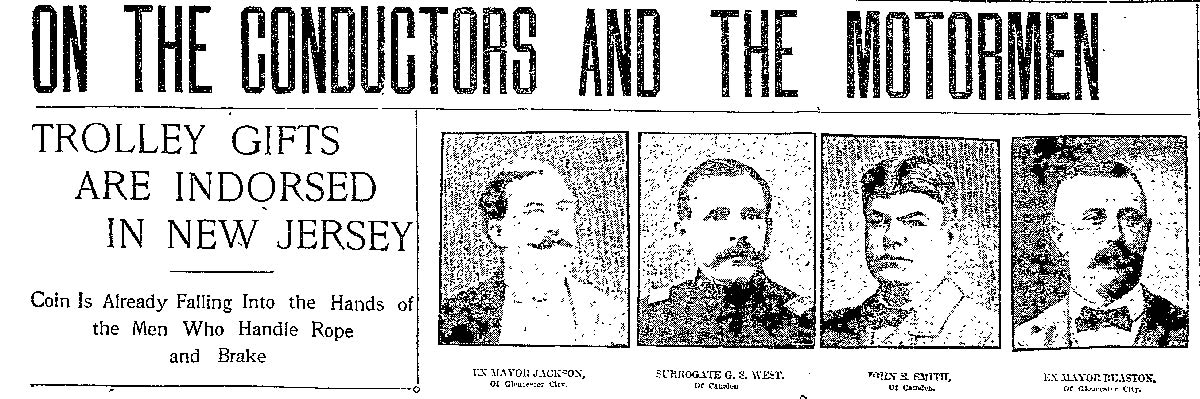
EX MAYOR JACKSON, Of Gloucester City
SURROGATE G. S. WEST, Of Camden
JOHN S. SMITH, Of Camden
EX MAYOR BEASTON, Of Gloucester City
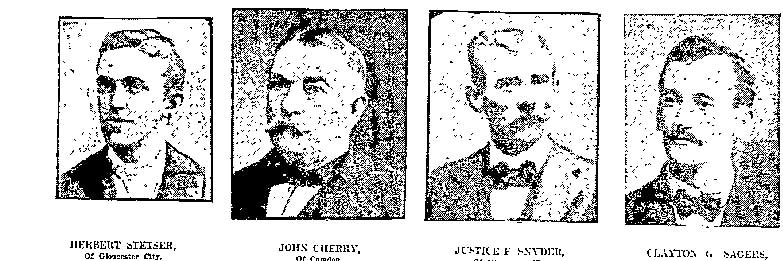
HERBERT STETSER, Of Gloucester City
JOHN CHERRY, Of Camden
JUSTICE F SNYDER, Of Gloucester City
CLAYTON G. SAGERS, Of Gloucester City
TALK WITH MEN WHO RUN THE CARS
Loud in Their Praise of The Inquirer’s Suggestion to Give to Worthy and Deserving Workmen
There is a determined effort in Camden to keep pace with other cities that have indorsed The Inquirer’s plan to give cheer to trolley conductors and motormen.
George S. West, Surrogate of Camden county, has been identified with all sorts of public movements, and is therefore qualified to speak with some authority about The Inquirer’s suggestion. “It is a good one,” he said yesterday. “I hope the people of Camden will act on it on Monday, and act liberally. These car men deserve a generous contribution.”
John Cherry and John S. Smith, Camden county detectives, use the trolley cars freely, and with characteristic readiness they had something to say about The Inquirer’s idea. “Tell the riders that hold free passes to remember the trolley men,” said Smith, while Cherry nodded assent. Cherry added: “We will contribute our share to the crew of every car we use on Monday.”
Prosecutor Frank T. Lloyd, of Camden county, said: “I approve of The Inquirer’s effort for the car men heartily, and I am glad to see The Inquirer push it so earnestly.”
John Wesley Sell, Sheriff of Camden county, said: “Yes, sir; put me down as one who indorses The Inquirer’s suggestion, and will act on it on Monday. The car men have always had my sympathy in their perpetually trying situations, and I would like to see everybody combine in a response to The Inquirer’s suggestion.”
Chief of Police John Foster, of Camden, is an earnest advocate of better treatment of men who spend their lives on the street in all sorts of weather. “The Inquirer’s idea of Christmas contributions to trolley men,” said he, “is one of the most practical suggestions I have ever heard of. I vote for it with both hands, and I hope the people of Camden will do their duty on Monday. I will do my part.”
“How would you like to be the conductor?”
Thus spoke Conductor George Gannett when he alighted from his car at the corner of Market and King streets, Gloucester City, yesterday afternoon after his day’s work, and holding up his change bag said to his fellow conductors waiting for their cars:
“This is what The Inquirer has done for me.”
There was just $6.35 in the bag, and that amount was given him in nickels and pennies through the suggestion of The Inquirer on his eight trips. Such was the case among other conductors on the Camden, Gloucester and Woodbury trolley cars, and together with the motormen they returned home to their families wreathed in smiles, as they were sure of having a Christmas turkey.
On all the cars of the Woodbury trolley road the passengers would either drop an extra nickel or say “keep the change.”
Conductor Gannett said to an Inquirer reporter after leaving the trolley office that he did not think he would get so much, but when the nickels came pouring in on every trip he opened his eyes and said to his motorman: “The Inquirer is a great paper and maybe we will not have turkey galore.”
Camden Trolley Men Wreathed in Smiles
Camden trolley men are looking with eagerness to a Christmas offering from their passengers on Monday, and some of the conductors are already wreathed in smiles over tips already given them by riders who do not expect to be in town on Monday. It is refreshing to see a meek-looking and mild-mannered conductor look closely at the change tendered him for a fare, and then smile expansively when he sees an extra coin for himself and the motorman.
“Thank you,” is uttered in tones that makes the riders smile at one another in pleasure. The conductor returns to the rear platform and beams on the passengers within the car, and when he reaches up and pulls the signal to the motorman to stop the car, the sound of the bell seems to be really musical.
Vice Chief of Glassblowers Speaks To the Editor of The Inquirer.
The Philadelphia Inquirer deserves great credit for the interest it has taken in the conductors and motormen of three States. There is none more worthy to be helped. These men suffer more through exposure for the comforts of the people than any other class of workmen. Wishing all street railway workmen shorter hours and more home comforts, I am, very sincerely, W. M. DOUGHERTY, Vice President Glass Bottle Blowers’ Association of United States and Canada.
From the Hammonton South Jersey Republican.
The Philadelphia Inquirer has originated a novel and praiseworthy scheme, viz.: That patrons of trolley cars everywhere in paying their fare give the conductor an extra cent or more on Monday next. At night all this surplus money will be divided between the conductor who hands it in and his motorman, and will go far toward making for their families a merry Christmas. A great scheme—worthy of a great paper.
From the Camden Democrat.
Camden will doubtless respond most cheerfully to the thoughtful and timely suggestion of The Philadelphia Inquirer to remember the trolley conductors and motormen on Monday next, the day before Christmas. This the local travelling public are requested to do by handing to the conductor in conjunction with their regular fare an extra cent, nickel or dime, according to their individual inclination and means. These extra pennies are to be divided between the regular car men and designed, of course, to help in adding to the material accessories of their Christmas dinner. The plan is a most praiseworthy one, and commends itself to the practical consideration of every patron of our street car lines.
Hill Meets Death Without a Shudder
Philadelphia Inquirer —
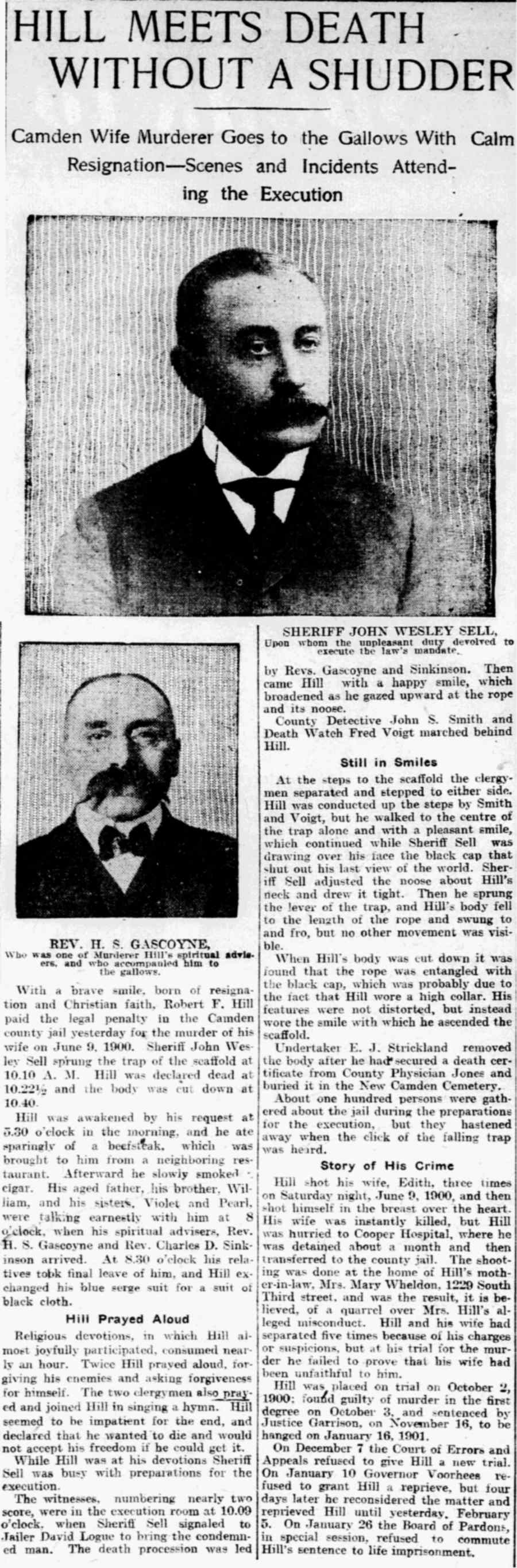
Camden Wife Murderer Goes to the Gallows With Calm Resignation—Scenes and Incidents Attending the Execution
Sheriff John Wesley Sell, Upon whom the unpleasant duty devolved to execute the law’s mandate.
Rev. H. S. Gascoyne, Who was one of Murderer Hill’s spiritual advisers, and who accompanied him to the gallows.
With a brave smile, born of resignation and Christian faith, Robert F. Hill paid the legal penalty in the Camden county jail yesterday for the murder of his wife on June 9, 1900. Sheriff John Wesley Sell sprung the trap of the scaffold at 10.10 A. M. Hill was declared dead at 10.22½ and the body was cut down at 10.40.
Hill was awakened by his request at 5.30 o’clock in the morning, and he ate sparingly of a beefsteak, which was brought to him from a neighboring restaurant. Afterward he slowly smoked a cigar. His aged father, his brother, William, and his sisters, Violet and Pearl, were talking earnestly with him at 8 o’clock, when his spiritual advisers, Rev. H. S. Gascoyne and Rev. Charles D. Sinkinson arrived. At 8.30 o’clock his relatives took final leave of him, and Hill exchanged his blue serge suit for a suit of black cloth.
Hill Prayed Aloud
Religious devotions, in which Hill almost joyfully participated, consumed nearly an hour. Twice Hill prayed aloud, forgiving his enemies and asking forgiveness for himself. The two clergymen also prayed and joined Hill in singing a hymn. Hill seemed to be impatient for the end, and declared that he wanted to die and would not accept his freedom if he could get it.
While Hill was at his devotions Sheriff Sell was busy with preparations for the execution.
The witnesses, numbering nearly two score, were in the execution room at 10.09 o’clock, when Sheriff Sell signaled to Jailer David Logue to bring the condemned man. The death procession was led by Revs. Gascoyne and Sinkinson. Then came Hill with a happy smile, which broadened as he gazed upward at the rope and its noose.
County Detective John S. Smith and Death Watch Fred Voigt marched behind Hill.
Still in Smiles
At the steps to the scaffold the clergymen separated and stepped to either side. Hill was conducted up the steps by Smith and Voigt, but he walked to the centre of the trap alone and with a pleasant smile, which continued while Sheriff Sell was drawing over his face the black cap that shut out his last view of the world. Sheriff Sell adjusted the noose about Hill’s neck and drew it tight. Then he sprung the lever of the trap, and Hill’s body fell to the length of the rope and swung to and fro, but no other movement was visible.
When Hill’s body was cut down it was found that the rope was entangled with the black cap, which was probably due to the fact that Hill wore a high collar. His features were not distorted, but instead wore the smile with which he ascended the scaffold.
Undertaker E. J. Strickland removed the body after he had secured a death certificate from County Physician Jones and buried it in the New Camden Cemetery.
About one hundred persons were gathered about the jail during the preparations for the execution, but they hastened away when the click of the falling trap was heard.
Story of His Crime
Hill shot his wife, Edith, three times on Saturday night, June 9, 1900, and then shot himself in the breast over the heart. His wife was instantly killed, but Hill was hurried to Cooper Hospital, where he was detained about a month and then transferred to the county jail. The shooting was done at the home of Hill’s mother-in-law, Mrs. Mary Wheldon, 1229 South Third street, and was the result, it is believed, of a quarrel over Mrs. Hill’s alleged misconduct. Hill and his wife had separated five times because of his charges or suspicions, but at his trial for the murder he failed to prove that his wife had been unfaithful to him.
Hill was placed on trial on October 2, 1900; found guilty of murder in the first degree on October 3, and sentenced by Justice Garrison, on November 16, to be hanged on January 16, 1901.
On December 7 the Court of Errors and Appeals refused to give Hill a new trial. On January 10 Governor Voorhees refused to grant Hill a reprieve, but four days later he reconsidered the matter and reprieved Hill until yesterday, February 5. On January 26 the Board of Pardons, in special session, refused to commute Hill’s sentence to life imprisonment.
Tracing Alleged Firebugs
Philadelphia Inquirer —
For ten days County Detective John Smith has been investigating several fires that have recently occurred in the southern part of Camden county. He has secured evidence against a certain party of prominence, who is now under surveillance. Detective Smith says an arrest will be made shortly.
Prisoner Fought in State Capitol
Philadelphia Inquirer —

Samuel Warwick Taken Into Custody in the Assembly Chamber After Struggle
HE THREATENED OFFICIALS
Sheriff Sell and Prosecutor Lloyd Caused the Arrest of the Man, Who Is Somewhat Eccentric
Special to The Inquirer.
TRENTON, N. J., March 19.—A sensation was created in the Assembly Chamber this afternoon when County Detective John F. Smith, of Camden, placed Samuel G. Warwick, of Glassboro, under arrest on a warrant charging him with threatening to take the lives of Sheriff J. Wesley Sell and Prosecutor Frank T. Lloyd. Warwick, who is somewhat eccentric, was standing at the rail of the house when Detective Smith placed him under arrest.
Warwick, who is of rather spare build, protested loudly, and Sergeant-at-Arms Frank Tantum went to the assistance of Smith, but the two big officials were unable to quiet the prisoner, and two additional men were pressed into service. Warwick was finally handcuffed and taken to Camden by Smith.
Imaginary Wrongs
For many weeks Warwick has been hanging about the legislative halls endeavoring to induce some one to introduce a bill to reimburse him for imaginary wrongs he claims to have suffered while serving a term in State prison. He was sent to prison for forgery, and upon being released sought to bring an action against the State on the ground that he had been rendered speechless because of the ill treatment he received in the prison.
In an unguarded moment one day at the State House he broke forth into good, strong speech. Nothing daunted, however, he has kept up his endeavor to get legislation reimbursing him for his alleged injury.
Held Up Nomination
It was stated by one of the Senators to night that Warwick was the means of holding up the nomination of Judge Jessup, of Gloucester county, by the Senate for upwards of a week. The cause of the delay was sought for in vain by some of Judge Jessup’s friends. It then leaked out that Warwick had entered a protest with several of the Senators against Judge Jessup. It was Judge Jessup who sentenced Warwick to prison.
The threats that Warwick has been making against Sheriff Sell and Prosecutor Lloyd have been so virulent and repeated that it was deemed necessary to take him into custody. He was taken to Camden this afternoon.
Pending an examination as to his sanity, Warwick was committed to jail in default of $1000 bail by Justice Schmitz, of Camden, last night, on the charge of threatening to kill Prosecutor Frank T. Lloyd and Sheriff John W. Sell. Some time ago Warwick was sentenced to pay a fine for robbing his boarding mistress, and in default was committed to the county jail. Under a custom prisoners are allowed to serve a day for each dollar of the fine imposed, but it was not allowed in this case. After serving several days over the usual allotted time he paid his fine and then demanded a rebate of $1 for each day. Because the Prosecutor and Sheriff refused his demand he made threats against their lives.
Elks Held the Stage
Philadelphia Inquirer —
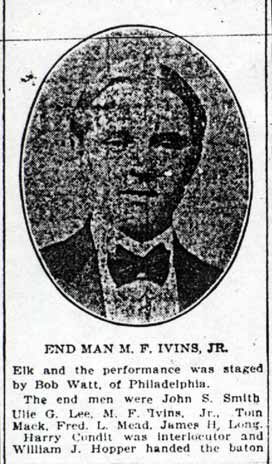
Appeared Last Night in Blackface at the Camden Theatre.
Their Fourth Annual Performance
Crowded House Applauded Their Efforts—Those Who Participated and the Songs—Will Repeat the Show To-night at Bridgeton
To a house that was crowded to the doors in spite of the warm weather, Camden Lodge of Elks last night presented their fourth annual minstrel performance at the Camden Theatre and scored their usual success. The first part, consisting of the usual songs and end men’s gags, was the best part of the program and the soloists were greeted with appreciative applause. Every man who participated was an Elk and the performance was staged by Bob Watt, of Philadelphia.
The end men were John S. Smith, Ulie G. Lee, M. F. Ivins, Jr., Tom Mack, Fred. L. Mead, James H. Long. Harry Condit was interlocutor and William J. Hopper handed the baton [cut off at the crop edge]
End Man M. F. Ivins, Jr.
Camden Notes
Philadelphia Inquirer —
•• The Automobile Company was incorporated yesterday, with a capital of $100,000.
•• The funeral of Mrs. E. E. Read, widow of the late Edmund E. Read, took place yesterday from her residence, 606 Cooper street.
•• Michael Kelly, 32 years old, of 604 South Sixth street, had his right foot crushed while working on the railroad at Williamstown yesterday.
•• The Camden Board of Health yesterday instructed the solicitor to collect $175 from Haddon township for care by physicians of small pox patients in the Camden Municipal Hospital.
•• William Martin, 29 years old, of 636 Chestnut street, had the fleshly part of both legs badly lacerated yesterday by a pair of ice tongs falling from a shelf while he was stooping over. He was taken to Cooper Hospital.
•• Grant Lord, brought from St. Louis, by County Detective John S. Smith, on a charge of forging the name of William Althouse, of Philadelphia, to a check for $150, was yesterday committed to jail by Recorder Stackhouse. The complaint against Lord was made by Edward Carminy, who indorsed the check.
•• A broken switch at Second and Bridge avenue caused the wreck of a freight car of the Pennsylvania Railroad yesterday. While assisting the wrecking crew to clear the track Howard Buckeleer, 22 years old, of Bordentown, was struck on the head with a piece of iron and badly injured. He was removed to the Cooper Hospital.
Found Body at Foot of Stairs
Philadelphia Inquirer —
FOUND BODY AT FOOT OF STAIRS
Mystery in the Death of Pole in Camden—Five Men Placed Under Arrest
Coroner Litchfield is investigating the death of Frank Taianoski, a Pole, 35 years old, of Olyphant, Pa., whose body was found early yesterday morning at the foot of a stairway at 1049 Diamond street, Camden. Jacob Chopper, Peter Oplushi, John Schwenze, John Vannank and Stanlaus Weruski, Hungarians, who cannot speak English, were arrested by County Detectives Smith and Cherry on suspicion of knowing something about Taianoski’s death.
Shortly after 3 o’clock yesterday morning Coroner Litchfield was awakened by two men, who told him to go to 1049 Diamond street, where a man was being killed. Thinking it was a ruse to get him out of the house to do him bodily injury the Coroner refused to go. Some time after Edward Wolfe, an English speaking Pole, told the Coroner that there was a dead man at the Diamond street house. Coroner Litchfield at once went to the house and found Taianoski’s body at the foot of the stairway. Surrounding it were the five Hungarians, two of whom were recognized as the early morning visitors.
Nothing could be gleaned from the men, who told conflicting stories. One, who said he was a room-mate of the dead man, stated he had arrived home late and had fallen over the body. On examining the body the Coroner found Taianoski had received a bad fracture of the skull, which had caused his death.
Taianoski was a miner and went to Camden three weeks ago. His wife has been sent for in the hope that she can aid the officials in untangling the mystery. The body is now at the Morgue.
Officers Traced Woodward’s Steps
Philadelphia Inquirer —
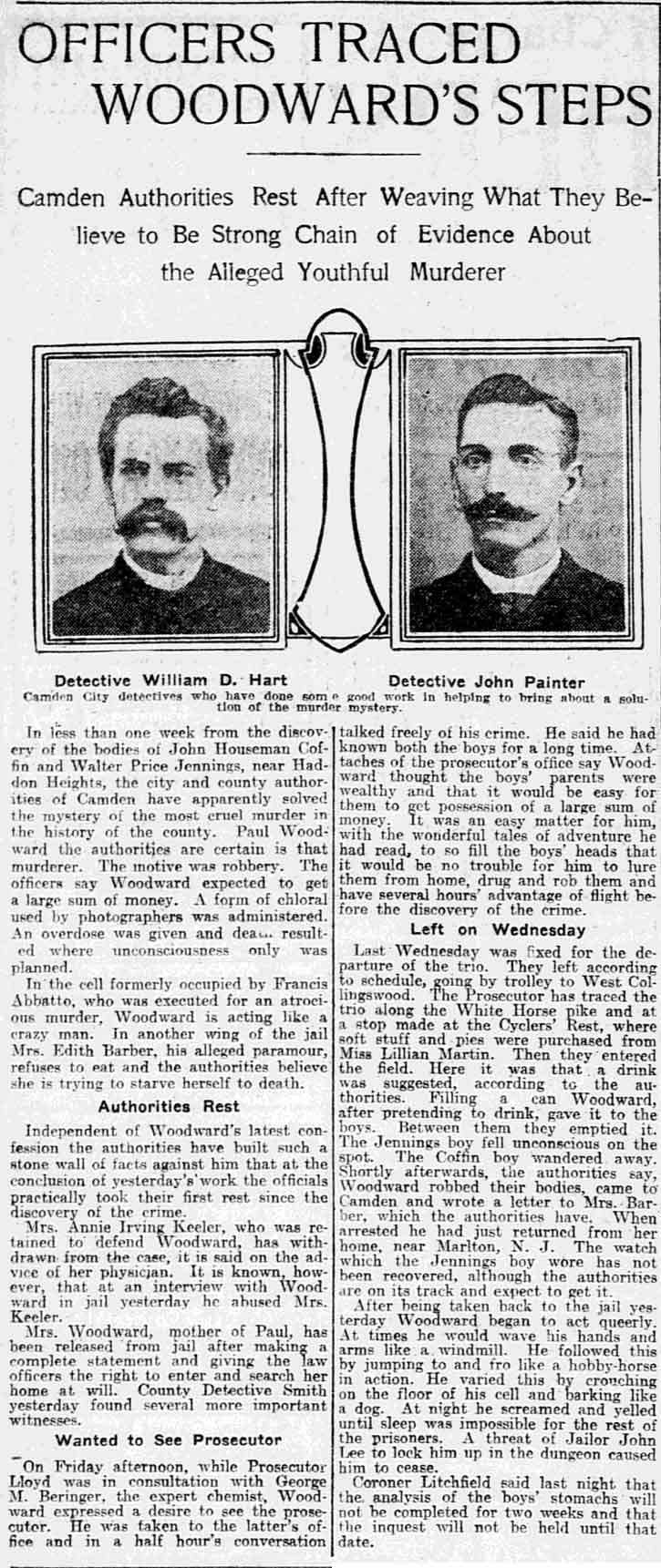
Camden Authorities Rest After Weaving What They Believe to Be Strong Chain of Evidence About the Alleged Youthful Murderer
Detective William D. Hart
Detective John Painter
Camden City detectives who have done some good work in helping to bring about a solution of the murder mystery.
In less than one week from the discovery of the bodies of John Houseman Coffin and Walter Price Jennings, near Haddon Heights, the city and county authorities of Camden have apparently solved the mystery of the most cruel murder in the history of the county. Paul Woodward the authorities are certain is that murderer. The motive was robbery. The officers say Woodward expected to get a large sum of money. A form of chloral used by photographers was administered. An overdose was given and death resulted where unconsciousness only was planned.
In the cell formerly occupied by Francis Abbatto, who was executed for an atrocious murder, Woodward is acting like a crazy man. In another wing of the jail Mrs. Edith Barber, his alleged paramour, refuses to eat and the authorities believe she is trying to starve herself to death.
Authorities Rest
Independent of Woodward’s latest confession the authorities have built such a stone wall of facts against him that at the conclusion of yesterday’s work the officials practically took their first rest since the discovery of the crime.
Mrs. Annie Irving Keeler, who was retained to defend Woodward, has withdrawn from the case, it is said on the advice of her physician. It is known, however, that at an interview with Woodward in jail yesterday he abused Mrs. Keeler.
Mrs. Woodward, mother of Paul, has been released from jail after making a complete statement and giving the law officers the right to enter and search her home at will. County Detective Smith yesterday found several more important witnesses.
Wanted to See Prosecutor
On Friday afternoon, while Prosecutor Lloyd was in consultation with George M. Beringer, the expert chemist, Woodward expressed a desire to see the prosecutor. He was taken to the latter’s office and in a half hour’s conversation talked freely of his crime. He said he had known both the boys for a long time. Attaches of the prosecutor’s office say Woodward thought the boys’ parents were wealthy and that it would be easy for them to get possession of a large sum of money. It was an easy matter for him, with the wonderful tales of adventure he had read, to so fill the boys’ heads that it would be no trouble for him to lure them from home, drug and rob them and have several hours’ advantage of flight before the discovery of the crime.
Left on Wednesday
Last Wednesday was fixed for the departure of the trio. They left according to schedule, going by trolley to West Collingswood. The Prosecutor has traced the trio along the White Horse pike and at a stop made at the Cyclers’ Rest, where soft stuff and pies were purchased from Miss Lillian Martin. Then they entered the field. Here it was that a drink was suggested, according to the authorities. Filling a can Woodward, after pretending to drink, gave it to the boys. Between them they emptied it. The Jennings boy fell unconscious on the spot. The Coffin boy wandered away. Shortly afterwards, the authorities say, Woodward robbed their bodies, came to Camden and wrote a letter to Mrs. Barber, which the authorities have. When arrested he had just returned from her home, near Marlton, N. J. The watch which the Jennings boy wore has not been recovered, although the authorities are on its track and expect to get it.
After being taken back to the jail yesterday Woodward began to act queerly. At times he would wave his hands and arms like a windmill. He followed this by jumping to and fro like a hobby-horse in action. He varied this by crouching on the floor of his cell and barking like a dog. At night he screamed and yelled until sleep was impossible for the rest of the prisoners. A threat of Jailor John Lee to lock him up in the dungeon caused him to cease.
Coroner Litchfield said last night that the analysis of the boys’ stomachs will not be completed for two weeks and that the inquest will not be held until that date.
The Paul Woodward Murder Case, October 1902 – January 1903
John S. Smith was one of the Camden County detectives who investigated the Paul Woodward murder case of 1902–1903. The complete coverage of this case from the Philadelphia Inquirer and other newspapers is presented below. See also the dedicated page on Paul A. Woodward.
Missing Camden Boys Murdered in a Field
Philadelphia Inquirer —
Deep Mystery Still Envelops Camden Tragedy
Philadelphia Inquirer —
Authorities Apparently at Sea Regarding Theory for Lads’ Taking Off
THEY WERE MURDERED
Such Is the Belief of Prosecutor Lloyd and Others in the Case
WOODWARD UNDER FIRE
Declares Not Guilty of the Awful Crime—Two Boys to Be Buried To-day
Not since the Shaw murder of a few years ago has the Camden public been so much aroused as it is over the mysterious deaths of Price Jennings and John Houseman Coffin, the two lads of prominent families whose bodies were found Saturday morning lying in an uncultivated field at Haddon Heights.
City and county officials yesterday strove with all their abilities to throw some light on the mystery, but nothing of a startling character was evolved and the motive for the crime seems to be obscure.
As was to be expected, crowds of the morbidly curious tramped through the rain, over muddy roads and through a wild growth of brambles and weeds to get a view of the two spots where the bodies were found. Pieces of the chestnut tree, bark, limbs and leaves were carried off as mementoes. The spot where Coffin was found was marked by a pole stuck in the ground and from the top of which fluttered a piece of an umbrella covering.
The Motive Debated
During the day Prosecutor Lloyd, who is conducting the investigation, would say little. When pressed as to the motive of the crime he said he was of the opinion that it was either a case of malicious killing resulting from degeneracy, or the result of a desire for robbery.
A local physician, prominently identified with the case, said he is firmly convinced it is a clear case of murder. Whether the boys met their death by means of poison or strangulation he would not say, but inferred it was one of these methods that had ended their lives.
George M. Berringer, the Camden chemist, to whom were given the internal organs of the boys for analysis, began his work yesterday. He said it would take until to-morrow and probably longer to complete his analysis. He also said he would not stop if he found no traces of chloral, but would make a thorough examination in an endeavor to find any poison that might have been administered. In consequence of the length of time it will take to make the analysis Coroner Latchfield said he would not hold an inquest in the case for a week at least.
Detectives on the Scene
County Detectives Smith and Cherry and City Detective John Painter spent a portion of yesterday going over the scene of the tragedy. They reported they had found no new developments.
The work of weaving a web of guilt about Paul Woodward, the youth who was arrested charged by William Coffin, father of one of the boys, on information received from Detective Cherry, with “unlawfully, feloniously and of his malice aforethought, killing and murdering one John H. Coffin,” is proceeding rather slowly. The detectives yesterday started to run out the stories as given out by Woodward concerning his whereabouts on the days covering the disappearance of the dead boys.
Woodward was taken before Prosecutor Lloyd yesterday morning. The boy’s mother was also present. He was the centre of a crossfire of questions, but stolidly stood by his previous statements. He could not be shaken in a single instance, it was stated. The Prosecutor said it is a mistaken idea that Woodward is dull and listless. On the contrary he says his answers to questions give evidence of a fairly bright mind.
Prosecutor’s Statement
Prosecutor Lloyd late last night gave out this statement: “I have had Woodward under examination two or three times during the day. He reported his movements for the last week and adhered tenaciously to his original story that he had nothing to do with the doing away of the two children. I am awaiting the result of the chemical analysis of the organs of the two boys. There were no signs of strangulation, no bruises, scratches or scars excepting a slight cut on the left hand of one of the boys.”
Woodward spent Saturday night and yesterday in the manner of prisoners who are charged with petty offenses. Once, Saturday night, he is said to have cried. Aside from this evidence of feeling he slept and ate his food as though nothing out of the ordinary had occurred.
All the necessary arrangements for the funeral of the two boys have been completed and they will be buried this afternoon, young Coffin from his home, 305 North Third street, and Jennings from his home, 213 North Third street. Both funerals will be strictly private and no one except the respective families will be permitted to see the bodies.
Say Boys Were Seen
Several stories came from Haddon Heights to the effect that the boys were seen Wednesday afternoon near the spot where their bodies were found.
John Mann, colored, says he saw the two boys about 11 o’clock Wednesday morning on the Haddonfield road. Later he saw them under the chestnut tree in company with a man about 35 years old.
Edward Lippincott, who has a farm just below the scene of the murder, said a man who serves him with ice saw the boys about 5 o’clock in the afternoon. While he was not positive they were the boys, they tallied with the description.
The theory has been advanced the ill-fated lads met their deaths through eating some poisonous berry, but residents say there is nothing about there that would cause their death.
From what several persons say who saw the bodies before they were moved, they must have been laid down carefully, especially that of young Coffin, under whose head had been placed his hat neatly folded.
The small bottle of pellets taken from Woodward, which it was expected would figure in the case, were given back to him yesterday. They were simply homeopathic remedies given him at the Hahnemann Hospital.
The Trinity Baptist Sunday school yesterday adopted resolutions of regret and condolence on the death of young Jennings.
Woman Involved in Camden Mystery
Philadelphia Inquirer —
Woodward Has Knowledge of Camden Murder
Philadelphia Inquirer —
WOODWARD HAS KNOWLEDGE OF CAMDEN MURDER So Confessed to Officers, Who Searched New York at Prisoner's Instance NO HAND IN THE CRIME But Said He Knew Name of the Man Who Committed Awful Deed YOUTH'S STRENUOUS DAY Taken to the Scene of the Tragedy and Closeted With the Prosecutor Download complete article as PDF
Woodward Has Knowledge of Camden Murder
Philadelphia Inquirer —
So Confessed to Officers, Who Searched New York at Prisoner’s Instance
NO HAND IN THE CRIME
But Said He Knew Name of the Man Who Committed Awful Deed
YOUTH’S STRENUOUS DAY
Taken to the Scene of the Tragedy and Closeted With the Prosecutor
It is believed the authorities of Camden have cleared up the mystery surrounding the deaths of John Coffin and Walter Price Jennings, the boys who mysteriously disappeared from their homes on October 1 and were found dead in a field. That the boys were murdered and that the law officers believe a strong case has already been made out against Paul Woodward, the suspect, there seems to be no doubt.
Last night, after a conference of the detectives at Prosecutor Lloyd’s home, the latter official gave out the following statement: “There is absolutely no truth in the story of Woodward’s confession. However, the State has enough to make a clear case against Woodward.”
Ever since the discovery of the bodies the city and county detectives have worked unceasingly on the case. On Sunday afternoon, while Woodward was being examined in the Prosecutor’s office in the county buildings, he admitted, it is said, that while he had no hand in the commission of the crime he knew the name of the man who did.
Gave a Name
He gave, it is said, the name of a white man who committed the murder, and said he was then in hiding in New York. He furnished the detectives with his whereabouts in that city.
Acting on this information Detectives Painter and Smith went to New York and made a thorough search, following closely the prisoner’s suggestions. The search proved fruitless.
On Monday Detective Painter learned that John Farmer, a colored man, employed by John H. Carroll, of Haddon Heights, had seen Price, Coffin and Woodward together in the field in which the bodies of the boys were afterwards discovered. Yesterday Farmer was brought to the Prosecutor’s office, where he stated that he had seen the boys alive in the field at 5 o’clock on the afternoon of the day they disappeared.
Last to See Them Alive
He was confronted with Woodward, and in his presence told the story. At its conclusion Woodward exclaimed, “You’re a liar!”
The authorities lay great stress on Farmers’ story, for he was the last man to see the boys alive and to their minds almost fixes the hour of the murder.
A prominent jail official said last night that Woodward said yesterday to a fellow prisoner: “I’ll never give the man away who done the job.”
In his cell last night Woodward was a picture of abject misery. He was trembling like an aspen leaf. He has barely touched his food for the last two days. His only consolation seems to be in cigarettes, of which he daily consumes several packs.
Taken to the Scene
The feature of yesterday was the taking of Woodward to Haddon Heights. He was driven to the scene of the murder in a double team and was accompanied by Assistant Prosecutor F. Morse Archer, County Detective John S. Smith and City Detective John Painter. Woodward was carefully manacled and guarded during the trip.
The party went over the field where the bodies were found in an endeavor to arouse some emotion in the youth that might lead to a confession. Instead he simply smoked cigarettes and picked up a few chestnuts lying about, and was apparently unmoved.
After going over the field he was taken to several places in the vicinity where persons saw the ill-fated lads last Wednesday afternoon. It was stated that in one instance at least Woodward was positively identified as the young man last seen with the boys late in that afternoon. From 1 o’clock until after 6 he was kept on the move.
When Assistant Prosecutor Archer arrived at the court house he was besieged with questions, but after a talk with his chief over the telephone he said: “The administration of justice would be seriously hampered if at this time the facts in the case were given to the public. The case is now in a critical stage.”
At Prosecutor’s Home
After coming in from the country the prisoner was taken to Prosecutor Lloyd’s home on the East side. Here Woodward was kept until after 6 o’clock, all the time being under a cross fire of questions. At half-past 6 he was admitted to the county jail, still manacled and still smoking cigarettes. He was visibly affected, trembling like a leaf.
Late yesterday afternoon County Detective Cherry and City Detective Hart visited the home of Woodward on Benson street and brought back with them some clothing and about fifty novels. The latter were of a trashy order.
Harry Bowen and Joseph Simpkins, a trolley crew on one of the West Collingswood cars of the Camden and Suburban Railway Company, were examined by Assistant Prosecutor Archer. They had charge of a car that left Camden at 10 43 and arrived at West Collingswood at 11 13 Wednesday morning. It is believed that on this car the two dead boys and Woodward went to West Collingswood and from there walked over to Haddon Heights.
Money for Defense
Mrs. Woodward, mother of the accused boy, was at the Court House yesterday and said her father had sent her $5000 with which to use in defense of his grandson. She claimed to have engaged the services of Harry S. Scovel, who defended Eli Shaw. Mrs. Woodward also said that the Mrs. Barber arrested Monday night was a personal friend of the family, and that Paul had simply boarded with her.
County Physician Jones has advanced a theory as to the killing of the boys. He maintains poison was administered with no intention of killing. According to his theory, the boys were given “knockout drops,” or chloral, in sufficient quantities to kill a man. It was the intention of the murderer, however, to just give them a sufficient quantity to render them unconscious, and while in this state discover them at the solicitation of the boys’ families and receive a reward.
Camden's Mystery Is Still Unsolved
Philadelphia Inquirer —
Camden’s Mystery Is Still Unsolved
Philadelphia Inquirer —
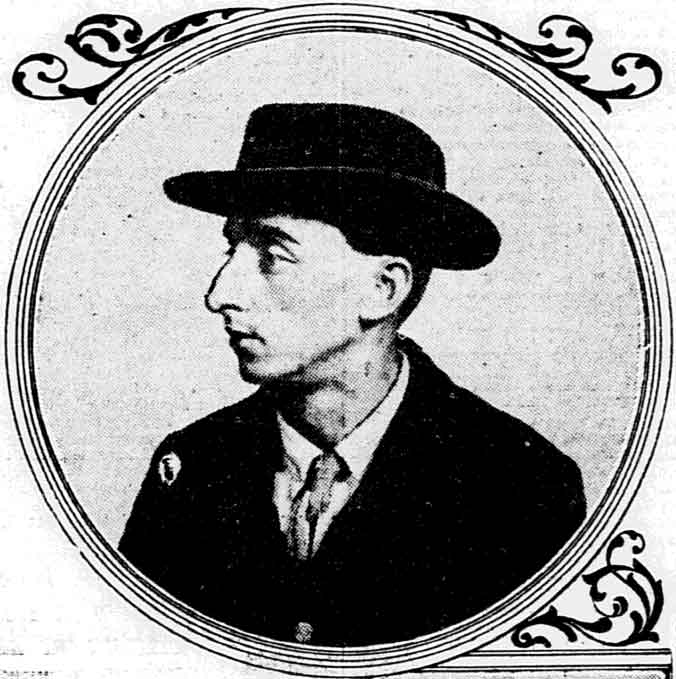
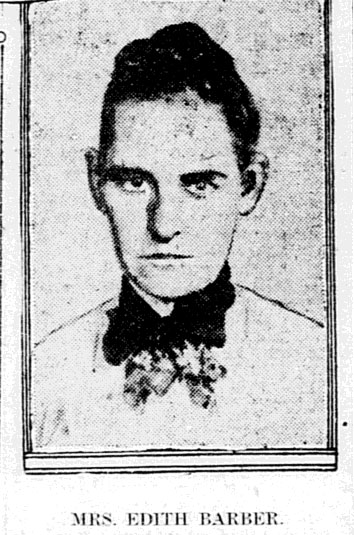
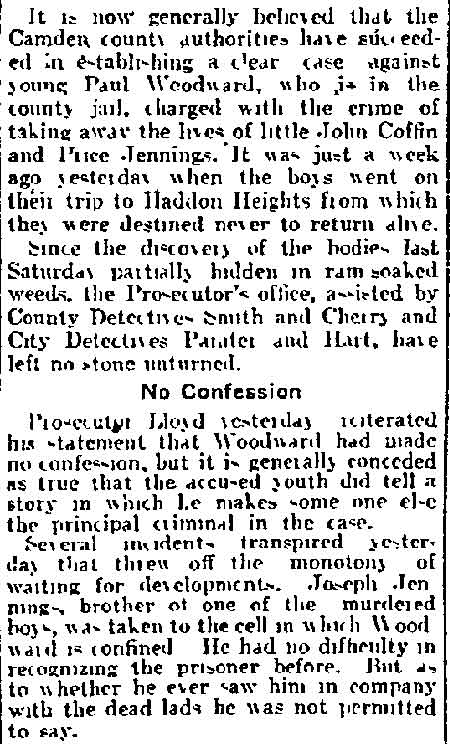
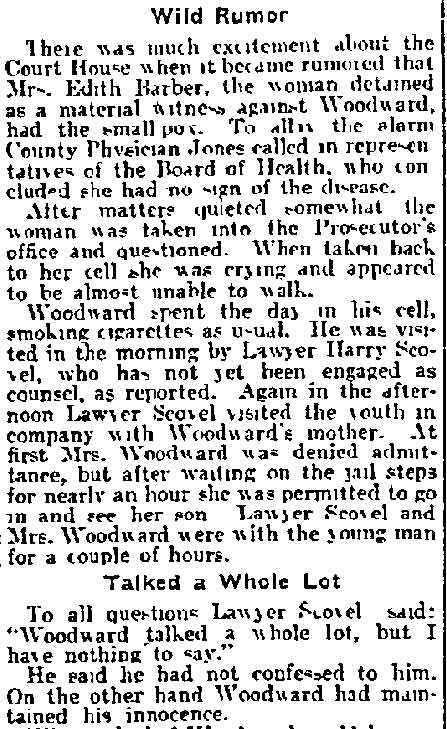
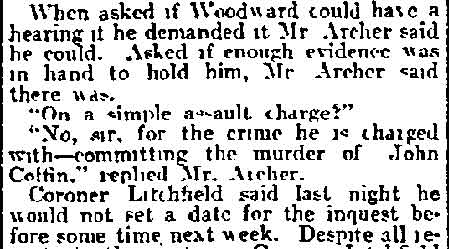
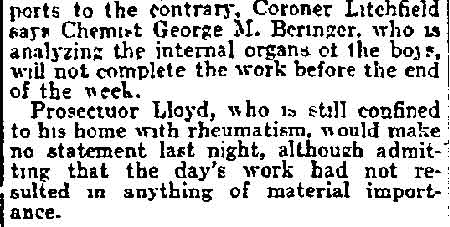
While Authorities Are at Work, Public Watch and Wait. Weaving a Net About Paul Woodward, the Young Suspect Now in Jail
Paul Woodward.
Mrs. Edith Barber.
It is now generally believed that the Camden county authorities have succeeded in establishing a clear case against young Paul Woodward, who is in the county jail, charged with the crime of taking away the lives of little John Coffin and Price Jennings. It was just a week ago yesterday when the boys went on their trip to Haddon Heights from which they were destined never to return alive.
Since the discovery of the bodies last Saturday partially hidden in rain-soaked weeds, the Prosecutor’s office, assisted by County Detectives Smith and Cherry and City Detectives Painter and Hart, have left no stone unturned.
No Confession
Prosecutor Lloyd yesterday reiterated his statement that Woodward had made no confession, but it is generally conceded as true that the accused youth did tell a story in which he makes some one else the principal criminal in the case.
Several incidents transpired yesterday that threw off the monotony of waiting for developments. Joseph Jennings, brother of one of the murdered boys, was taken to the cell in which Woodward is confined. He had no difficulty in recognizing the prisoner before. But as to whether he ever saw him in company with the dead lads he was not permitted to say.
Wild Rumor
There was much excitement about the Court House when it became rumored that Mrs. Edith Barber, the woman detained as a material witness against Woodward, had the small pox. To allay the alarm County Physician Jones called in representatives of the Board of Health, who concluded she had no sign of the disease.
After matters quieted somewhat the woman was taken into the Prosecutor’s office and questioned. When taken back to her cell she was crying and appeared to be almost unable to walk.
Woodward spent the day in his cell, smoking cigarettes as usual. He was visited in the morning by Lawyer Harry Scovel, who has not yet been engaged as counsel, as reported. Again in the afternoon Lawyer Scovel visited the youth in company with Woodward’s mother. At first Mrs. Woodward was denied admittance, but after waiting on the jail steps for nearly an hour she was permitted to go in and see her son. Lawyer Scovel and Mrs. Woodward were with the young man for a couple of hours.
Talked a Whole Lot
To all questions Lawyer Scovel said: “Woodward talked a whole lot, but I have nothing to say.”
He said he had not confessed to him. On the other hand Woodward had maintained his innocence.
When asked if Woodward could have a hearing if he demanded it Mr. Archer said he could. Asked if enough evidence was in hand to hold him, Mr. Archer said there was.
“On a simple assault charge?”
“No, sir, for the crime he is charged with—committing the murder of John Coffin,” replied Mr. Archer.
Coroner Litchfield said last night he would not set a date for the inquest before some time next week. Despite all reports to the contrary, Coroner Litchfield says Chemist George M. Beringer, who is analyzing the internal organs of the boys, will not complete the work before the end of the week.
Prosecutor Lloyd, who is still confined to his home with rheumatism, would make no statement last night, although admitting that the day’s work had not resulted in anything of material importance.
Unraveling the Camden Mystery
Philadelphia Inquirer —
Prosecutor Lloyd Declares That Woodward Is the Guilty Man
NO MORE ARRESTS LIKELY
Weaving Web Around Alleged Slayer of the Murdered Boys
“Beyond all question the murderer of these little boys is now in jail and the public’s anxiety can now be allayed,” said Prosecutor Frank T. Lloyd last night in making the first important statement concerning the tragedy of last week, when John Coffin and W. Price Jennings, two Camden lads, were murdered in an uncultivated field near Haddon Heights. The mystery which has enshrouded the case since the discovery of the bodies last Friday has almost been cleared up with the exception of the report of Chemist George M. Beringer, who is making an analysis of the internal organs of the boys.
Prosecutor Lloyd gave out the following statement shortly before 8 o’clock at his home on the East Side:
“Because of a suspicion that more than one person was engaged in the murder of these little boys the State has been obliged to work with much secrecy and to withhold from the press the result of our work. That suspicion is now removed. Beyond all question the murderer is now in jail and the public’s anxiety can be allayed. Woodward was alone the perpetrator of this crime.
Case Nearly Complete
“It is my duty to say this much in view of the deep public concern and the apprehension of other parents having little ones, but it would be improper for me to state the character or the quantity of evidence upon which our conclusions are based. I will only say that with the exception of the report of the chemist, which has not yet been received, the State’s case is almost complete.
“Woodward himself has made a number of statements, which, while not confessions, will be materially helpful toward securing his conviction.”
This statement precludes the possibility of another arrest being made in connection with the case, as has been currently reported during the week.
There were several conferences held yesterday between Assistant Prosecutor Archer and Detectives Smith, Cherry, Painter and Hart and Chief of Police Linderman, of Merchantville. During one of the conferences John Farmer, the colored man who recognized Woodward as having been seen with the boys last Wednesday afternoon, was called in and closely questioned. Following the detectives departed apparently on several different clues.
Detectives Hard at Work
Detective Hart subsequently returned with a Mrs. Somers, said to reside on Royden street. She was interviewed by the Assistant Prosecutor, but what connection she has with the case the authorities refused to divulge. The woman refused to talk.
Louis Ross, a German, who resides near Haddon Heights, was also called into the Prosecutor’s office late in the afternoon. At first he was thought to be an important witness, but it was afterwards learned that he knew little about the case.
Detective Robert J. McKentry, of Philadelphia, and Detective Smith took over the river Mrs. William H. Hubbert and another young woman. It is at the home of Mrs. Hubbert, at West Philadelphia, that Woodward said he was present last Friday night.
Woodward became rather obdurate yesterday, refusing the usual prison fare. He waited until his mother sent him coffee and other victuals. The accused youth was at first placed in the cell formerly occupied by Lafayette Gruff, the wife murderer, who was hanged September 19. He has now been placed in another cell.
More Arrests in Camden Mystery
Philadelphia Inquirer —
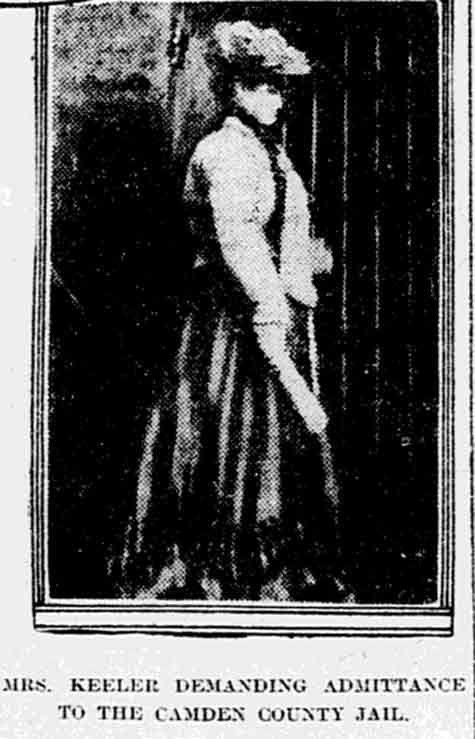
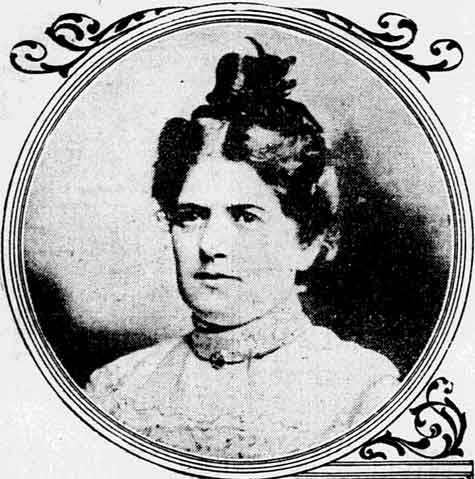
Paul Woodward’s Mother and Two Men Locked Up in the County Jail—Woman Lawyer to Defend the Prisoner
Mrs. Keeler Demanding Admittance to the Camden County Jail.
Mrs. Annie Irving Keeler,
Camden’s female lawyer, who has been engaged to defend young Woodward.
Following the statement given out Thursday night by Prosecutor Frank T. Lloyd that the authorities have the right man in jail for the murder of John Coffin and W. Price Jennings, whose bodies were found near Haddon Heights just a week ago to-day, the story of a confession by Paul Woodward, the accused youth, as exclusively told in The Inquirer last Wednesday, yesterday became public property. In this confession by Woodward he denies having killed the boys. He has told half a dozen stories already, all of which are different with the exception that he maintains he did not commit the crime. He says the motive was robbery and that he put a New York thug on the track of the boys last Wednesday week when the murdered lads were supposed to have a considerable sum of money on them. Woodward was to receive a reward, $50 for turning the youngsters over to the New Yorker.
The accused youth says he escorted young Coffin and Jennings out the White Horse pike to Haddon Heights, where they fell in with the mysterious person from New York whom the detectives made a fruitless effort to locate. Other stories told by Woodward were found to have in them no truth whatever.
Woodward Alone Guilty
In the mind of the Prosecutor, according to his statement of Thursday night, Woodward is alone guilty of taking the lives of the boys. Prosecutor Lloyd, who has been confined at his home on the East Side with rheumatism, was at his office yesterday for the first time in several days. When asked whether Woodward had made a complete confession he declined to discuss the subject.
More Arrests Made
Contrary to the inference to be gathered from the prosecutor’s statement, three additional arrests were made yesterday. There was much surprise when it was learned that Mrs. Woodward, mother of the prisoner, had been arrested by County Detectives Smith and Cherry. With her were also taken in custody Charles May, 60 years old, and William May, an East Indian, both of whom boarded at the Woodward home on Benson street. When asked the significance of the three arrests Prosecutor Lloyd said:
“It was deemed advisable to lock them up as witnesses and possible accessories after the fact.”
Annie Irving Keeler, Camden’s woman lawyer, announced yesterday afternoon she had been retained by Mrs. Woodward to defend the latter’s son. Mrs. Keeler at once endeavored to see the client, but she was denied admittance to the jail by the prosecutor, who said she had no right to see Woodward unless he himself had sent for her.
Admitted to Jail
Mrs. Keeler then went to the jail door and demanded admittance of Jailer Entriken. She was permitted to enter and visited Woodward’s cell, where she conferred with the prisoner for nearly an hour.
Prosecutor Lloyd went to Haddon Heights yesterday afternoon in company with County Physician Jones and County Detective Smith. The Prosecutor for the first time went over the field where the boys were slain.
Woodward was again questioned by the Prosecutor yesterday. He was taken to the Prosecutor’s office, where at the same time was Chemist George Beringer, who is analyzing the boys’ internal organs. Woodward and Chemist Beringer were alone in the office for ten minutes. Mr. Beringer held a conference with the Prosecutor that lasted one hour and twenty minutes. It was stated he had not presented his report of the chemical analysis.
Another Arrest in Murder Case
Philadelphia Inquirer —
West Philadelphian and a Supposed Companion of Young Paul Woodward Taken in Custody
There is but little remaining in the way of a mystery for the Camden county authorities to clear up in the murder case of little John Coffin and W. Price Jennings, of Camden. After working practically day and night during the past week Prosecutor Lloyd and his able assistants have brought to light such strong evidence against Paul Woodward, the young man in the county jail charged with the crime, that it will be next to impossible to refute it.
The sixth arrest in the case was made yesterday, when James Sheiding was taken into custody by County Detective Smith and committed to the county jail by Recorder Stackhouse as “a material witness.” Sheiding, who lives in West Philadelphia, was lured across the river to Camden, when Detective Smith at once took him in custody.
The prisoner is believed to be the companion of Woodward who, on the Friday night preceding the discovery of the murdered boys, was in the company of the accused murderer. On that occasion it is said Woodward had considerable money and that Sheiding assisted him in spending it.
Woodward did not give any evidence yesterday of being insane. On the other hand he was very quiet and evidently saw the futility of trying to make the Prosecutor believe him to be of unsound mind. He utterly refused to take part in the regular Sunday jail services. His whole concern seemed to be as to whether or not his mother would visit him to-day. He was of the opinion yesterday that his mother had gone to West Chester, where she is said to have relatives of means. Woodward thinks such a visit would result in him having sufficient funds with which to engage counsel.
Mrs. Edith Barker, the woman witness against Woodward, is very ill. Two of her children are ill with typhoid fever and the worry over this in connection with her important part in the case has made her one of the most wretched prisoners ever incarcerated at the county prison. Prosecutor Lloyd tried to have her admitted to a hospital, but his efforts were unavailing.
In all probability the case will come up before the present grand jury and be tried this month. Prosecutor Lloyd said last night that as soon as Chemist Beringer has made his report on his analysis of the viscera of the boys the Coroner’s inquest will be held. Immediately the court will be asked to take up the case.
Woodward Bought Poison, Says Druggist
Philadelphia Inquirer —

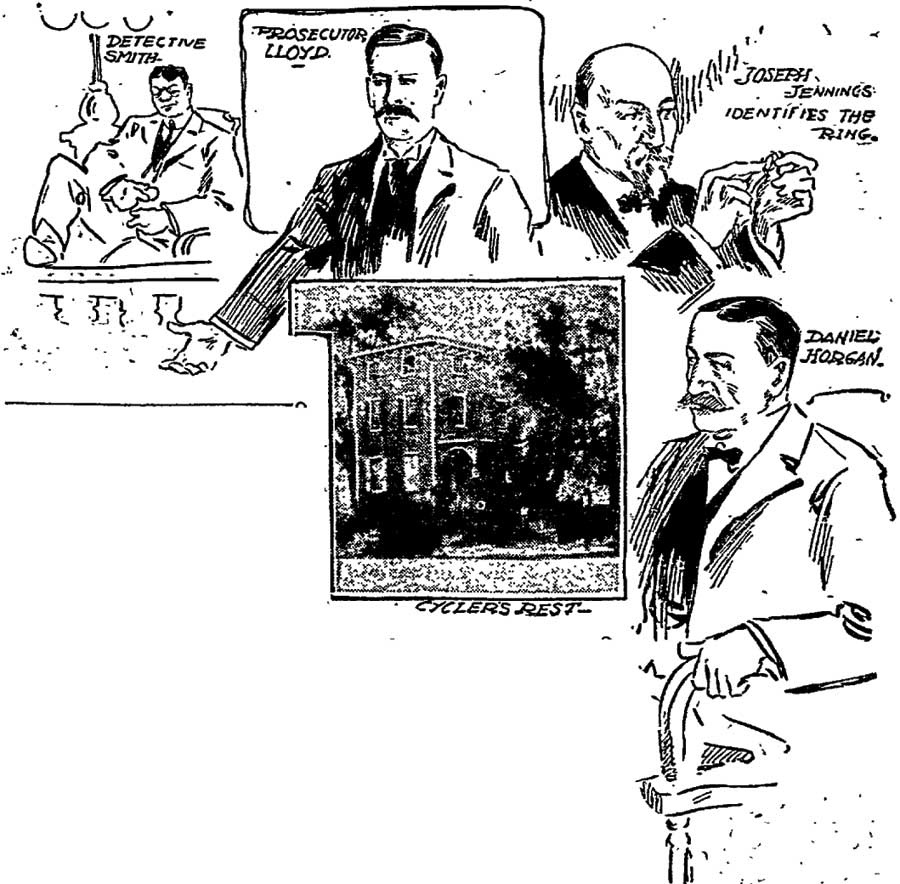
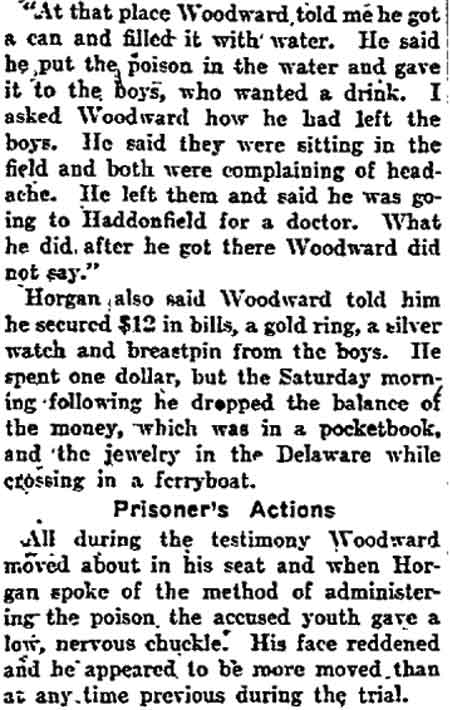
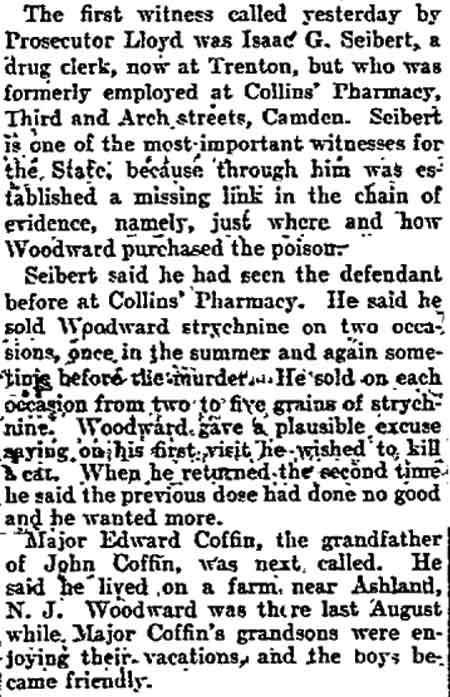
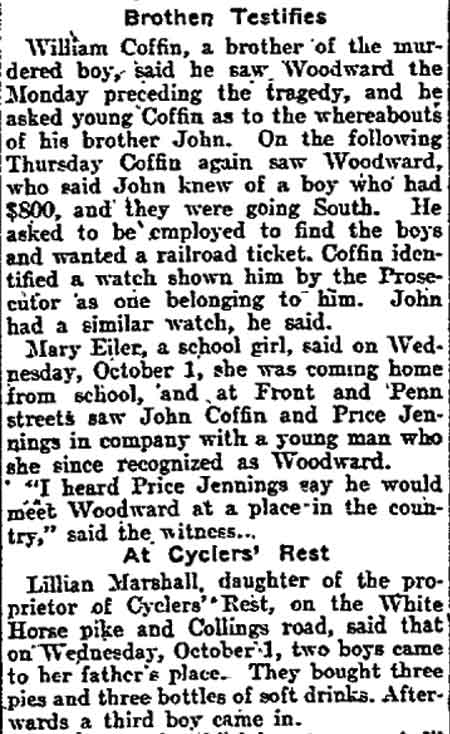
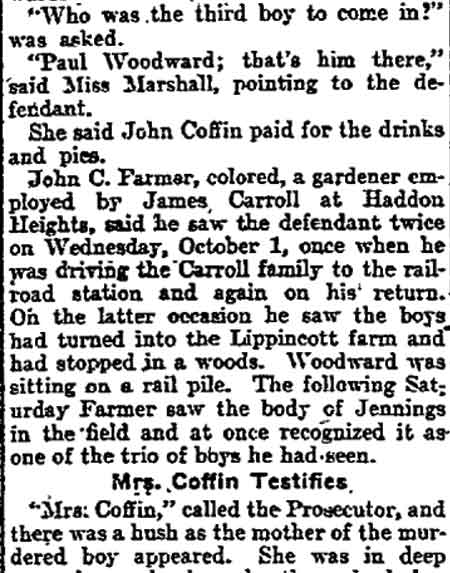
Telling Points Brought Out at Woodward’s Trial
Fellow-prisoner in county jail swore that Woodward told him he (Woodward) placed strychnine poison in water, which the Coffin and Jennings boys drank.
Druggist testified to having sold strychnine poison to Woodward.
Philadelphian swore that Woodward, after the alleged murder, showed him a silver watch and a ring, the latter inscribed “Brother to Fayetta,” and the prisoner asked the witness if he had heard of the murder in Camden.
Miss Fayetta Jennings, aunt of Price Jennings, testified that on the day he disappeared he was seated in her room in which there were some envelopes containing small sums of money. After he left some of the money was found missing, as well as a ring inscribed “Brother to Fayetta.”
Fellow Prisoner Tells of a Confession Made by the Alleged Murderer — Relatives of Dead Boys Give Damaging Testimony
“He said he put the poison in a can of water and gave it to the boys who wanted a drink,” said David J. Horgan, yesterday, star witness in the murder case of Paul Woodward, who is being tried for his life before Judge Garrison, in Camden, on the charge of killing John Coffin and W. Price Jennings. It was the culmination of many important points brought out by the State against Woodward.
First a witness was produced who proved Woodward had purchased strychnine from a Camden drug store on two separate occasions. Then his actions on the day of the murder were traced by witnesses whose testimony could not be shaken.
Horgan, the last witness called during the day, was the most important and Prosecutor Lloyd through him scored a point against the defendant.
Horgan is a Gloucester saloonkeeper serving four months in the county jail for illegal liquor selling. To him Woodward told how he had killed the boys. The witness said he had spoken to the defendant several times since he has been confined in the jail, both their cells being on the third tier. Woodward asked him if he thought he would be hanged. Horgan told him he did not think so. Then Woodward told him the story.
Horgan’s Story
“Woodward said he met the boys at the Haddon avenue station on Wednesday afternoon,” said Horgan. Then Woodward said they went out the White Horse pike and stopped at the Cyclers’ Rest, at West Collingswood and bought three pies and three bottles of soda water. Then they continued their way to Haddon Heights and to the field where the bodies were found.
“At that place Woodward told me he got a can and filled it with water. He said he put the poison in the water and gave it to the boys, who wanted a drink. I asked Woodward how he had left the boys. He said they were sitting in the field and both were complaining of headache. He left them and said he was going to Haddonfield for a doctor. What he did after he got there Woodward did not say.”
Horgan also said Woodward told him he secured $12 in bills, a gold ring, a silver watch and breastpin from the boys. He spent one dollar, but the Saturday morning following he dropped the balance of the money, which was in a pocketbook, and the jewelry in the Delaware while crossing in a ferryboat.
Prisoner’s Actions
All during the testimony Woodward moved about in his seat and when Horgan spoke of the method of administering the poison, the accused youth gave a low, nervous chuckle. His face reddened and he appeared to be more moved than at any time previous during the trial.
The first witness called yesterday by Prosecutor Lloyd was Isaac G. Seibert, a drug clerk, now at Trenton, but who was formerly employed at Collins’ Pharmacy, Third and Arch streets, Camden. Seibert is one of the most important witnesses for the State, because through him was established a missing link in the chain of evidence, namely, just where and how Woodward purchased the poison.
Seibert said he had seen the defendant before at Collins’ Pharmacy. He said he sold Woodward strychnine on two occasions, once in the summer and again sometime before the murder. He sold on each occasion from two to five grains of strychnine. Woodward gave a plausible excuse saying, on his first visit he wished to kill a cat. When he returned the second time he said the previous dose had done no good and he wanted more.
Major Edward Coffin, the grandfather of John Coffin, was next called. He said he lived on a farm near Ashland, N. J. Woodward was there last August while Major Coffin’s grandsons were enjoying their vacations, and the boys became friendly.
Brother Testifies
William Coffin, a brother of the murdered boy, said he saw Woodward the Monday preceding the tragedy, and he asked young Coffin as to the whereabouts of his brother John. On the following Thursday Coffin again saw Woodward, who said John knew of a boy who had $800, and they were going South. He asked to be employed to find the boys and wanted a railroad ticket. Coffin identified a watch shown him by the Prosecutor as one belonging to him. John had a similar watch, he said.
Mary Eiler, a school girl, said on Wednesday, October 1, she was coming home from school, and at Front and Penn streets saw John Coffin and Price Jennings in company with a young man who she since recognized as Woodward.
“I heard Price Jennings say he would meet Woodward at a place in the country,” said the witness.
At Cyclers’ Rest
Lillian Marshall, daughter of the proprietor of Cyclers’ Rest, on the White Horse pike and Collings road, said that on Wednesday, October 1, two boys came to her father’s place. They bought three pies and three bottles of soft drinks. Afterwards a third boy came in.
“Who was the third boy to come in?” was asked.
“Paul Woodward; that’s him there,” said Miss Marshall, pointing to the defendant.
She said John Coffin paid for the drinks and pies.
John C. Farmer, colored, a gardener employed by James Carroll at Haddon Heights, said he saw the defendant twice on Wednesday, October 1, once when he was driving the Carroll family to the railroad station and again on his return. On the latter occasion he saw the boys had turned into the Lippincott farm and had stopped in a woods. Woodward was sitting on a rail pile. The following Saturday Farmer saw the body of Jennings in the field and at once recognized it as one of the trio of boys he had seen.
Mrs. Coffin Testifies
“Mrs. Coffin,” called the Prosecutor, and there was a hush as the mother of the murdered boy appeared. She was in deep mourning and when she threw back her heavy black veil a sweet, motherly face was seen. She shook with emotion and occasionally wept bitterly. Many spectators were moved and half the jurymen turned away with their eyes filled with tears. Only Woodward looked on with his stoical nonchalance.
Mrs. Coffin, amid sobs, said she had seen her boy on the Wednesday of his disappearance when he came from school. He took out a little silver watch and asked if he could get it fixed. Mrs. Coffin was shown a watch, but she said it belonged to her other boy, similar to the one owned by John. On the morning following John’s disappearance, Woodward visited her and she asked him if he knew where her boy was. Mrs. Coffin said she cried and Paul said: “Don’t cry; he’ll come back.”
Later the same day she again saw Woodward. On this occasion he was well dressed. On his previous visit he was dressed like a tramp.
Father on the Stand
William Coffin, father of the boy, was called and said he had seen a man answering Woodward’s description loitering about his house early the Thursday morning suceeding [sic] the murder. This was between 3 and 4 o’clock. Mr. Coffin had not gone to bed because of worriment over his boy. He heard some one in his vestibule, and, hurrying down stairs, saw a figure resembling Woodward several doors above.
William F. Smith, a news agent at the Haddon avenue station, said Woodward wanted to buy his watch. Woodward said he expected to have some money about the 1st or 2d of October.
James Sheiding, who has been locked up since Friday, October 10, as a witness, was placed on the witness stand. He said he talked with Woodward the afternoon of October 3. At that time Woodward said he guessed there was a murder in Camden as two boys were missing. Later the defendant pulled out a ring and wanted him to pawn it for $4. Again Woodward pulled a watch from his pocket. This was a silver watch, the same as the one belonging to young Coffin’s brother.
Telltale Ring
Lee Hubert also testified to seeing a gold ring in the possession of Woodward on the inside of which was engraved: “Brother to Fayetta,” the latter the aunt of the Jennings boys.
Miss Fayetta Jennings said when Price, the missing boy, disappeared he took with him about $9 from a box and also a ring in which was engraved “Brother to Fayetta.”
Joseph Jennings, father of one of the murdered boys, told of giving the ring to his sister Fayetta.
After County Detective John Smith had testified to getting a duplicate watch and ring from the Coffin and Jennings home, David Horgan was called.
When court adjourned until this morning Woodward was blazing with anger. Especially did he berate Horgan.
It was stated Woodward will probably be placed on the stand next Monday.
The frogs which were injected with acetic acid and strychnine on Thursday by Dr. Marshall to demonstrate the action of the poison on the system, were alive yesterday and had apparently fully recovered.
Detective Smith.
Prosecutor Lloyd.
Joseph Jennings Identifies the Ring.
Daniel Horgan.
Cycler’s Rest.
Paul Woodward Goes to Gallows
Philadelphia Inquirer —
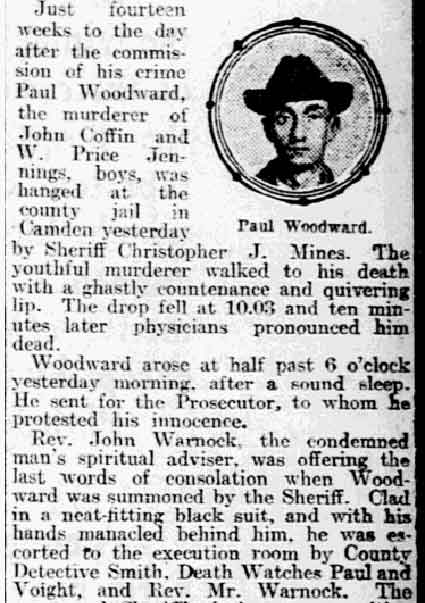
Murderer of Two Camden Boys Was Executed Without Creating a Scene
DECLARED HIS INNOCENCE
Floral Offerings From the Family, Body Was Interred in a Philadelphia Cemetery
Paul Woodward.
Just fourteen weeks to the day after the commission of his crime Paul Woodward, the murderer of John Coffin and W. Price Jennings, boys, was hanged at the county jail in Camden yesterday by Sheriff Christopher J. Mines. The youthful murderer walked to his death with a ghastly countenance and quivering lip. The drop fell at 10.03 and ten minutes later physicians pronounced him dead.
Woodward arose at half past 6 o’clock yesterday morning, after a sound sleep. He sent for the Prosecutor, to whom he protested his innocence.
Rev. John Warnock, the condemned man’s spiritual adviser, was offering the last words of consolation when Woodward was summoned by the Sheriff. Clad in a neat-fitting black suit, and with his hands manacled behind him, he was escorted to the execution room by County Detective Smith, Death Watches Paul and Voight, and Rev. Mr. Warnock. The court and Sheriff’s juries were awaiting with bared heads. Sheriff Mines stood near the foot of the gallows as the prisoner entered the door leading to the jail corridor.
Woodward, pale as death, had just a moment’s time before Sheriff Mines took him by the arm, led him up the thirteen steps to the platform, adjusted the black cap, knotted the rope, and a moment later the trap opened. Woodward shot down until his feet nearly touched the floor. The rope twisted and the body swung around for a few minutes. The physicians present said death had been painless. The body was taken down at 10.42, placed in charge of undertakers and deposited in a handsome casket, on the lid of which was
PAUL A. WOODWARD, Died January 7th, 1903, In his 25th year.
In a cab the family followed the hearse to a Philadelphia cemetery, where interment was made.
Just before the execution took place two floral pieces were taken into the jail to be placed on the casket. It was reported that they were sent by Woodward’s family.
One was a pillow of carnations and roses having in the centre in immortelles the word “Innocent.”
The other was a palm-shaped arrangement of greens and white carnations, tied with a satin ribbon on which were the words “Too Soon.”
Those who witnessed the hanging were surprised at the cool manner in which the murderer conducted himself just before the execution. He had been fully expected to make a scene.
The statement sworn to by Woodward before J. Fred George, notary public, was given out after the execution. It was a lengthy document. The youth admitted meeting young Coffin and Jennings, but said his original intention was not robbery. The two boys and he, he said, had agreed to rob several houses in the country.
The boys weakened and refused to be a party to the robberies. Then, according to the statement, he decided to kill the boys for self-protection. He said he had provided himself with pies in advance and the poison was placed in them.
Two other statements were given out by Woodward. Both were rambling stories and contradictory.
Lawyer's Assailant Caught
Bevington (NJ) newspaper —
Walter B. Humphreys Arrested in Philadelphia on Old Charge.
Walter B. Humphreys, a former real estate dealer of Camden, and a fugitive from justice since November last, was arrested at Nineteenth street and Fairmount avenue, Philadelphia, yesterday, by County Detective John S. Smith and Chief of Police Linderman, of Merchantville. He was taken to the Central Station, and was remanded for a hearing to-day before Magistrate Kochersperger.
Humphreys is wanted by the Camden authorities to answer a charge of assault and battery on Lawyer William P. Early. The assault took place in the office of Humphreys, at Second and Market streets, where the lawyer was effecting a settlement with Humphreys and his wife. At the time Humphreys had just paid a fine of $300 for an assault and battery on his wife, and did not feel that the settlement was satisfactory, and it is alleged that he knocked the lawyer down and then threw him out in the street.
Wagner’s Trial for Stabbing Miller
Camden Daily Courier —


Witnesses Say Policeman Keaser Held Fellow Officer When He Was Knifed.
CUT DURING THIRD WARD RIOT
The main court room was crowded with interested Third warders this morning, when the first of the criminal complaints growing out of the riots at Third and Beckett streets, on the night of July 28, last, during the Congressional primary, was taken up. It charged Charles Wagner with assault and battery on Policeman Harry Miller. Judge Joline was on the bench. Prosecutor Lloyd appeared for the State and the defendant was represented by Lawyers Fred A. and William F. Rex. Some little trouble was experienced in getting a jury.
After Prosecutor Lloyd outlined the case, Policeman Miller was called to the stand. He said that on the night in question just before the close of the polls, a fight ensued between ex-Policeman “Bob” Miller and John Morrisey, the man who was killed. A general racket followed and “Bob” Miller, Policeman Keaser and others were brutally assaulting George Murray with a blackjack, when witness went to Murray’s aid. Keaser, he said, turned on him and grappled.
MILLER STABBED.
“He had a hold of me and I of him,” said Miller, “and while we were standing in that position, this man Wagner came up in front of me, jabbed his knife in my stomach, turned it like that (giving his hand a twist) and pulled it out. Keaser still had a hold of me and I could not help myself. Wagner ran away after stabbing me.”
Miller said he was taken to Cooper Hospital and was there four weeks.
On cross-examination by Mr. Rex, Miller said he was positive that Wagner was his assailant and denied saying in the hospital the morning after the stabbing, that he did not know who cut him. He also denied hitting Keaser with his blackjack.
When questioned concerning Morrisey, the man who was killed, Miller said he only met him that day and did not know whether he was a voter or not.
DIDN’T WANT DETAILS.
Mr. Rex tried to get the witness to detail a talk he had with Morrisey, but Mr. Lloyd objected. Mr. Rex seemed so anxious to carry the point that Mr. Lloyd said he was willing to withdraw the objection, provided Mr. Rex would not object to detailed conversation responses to his questions. Mr. Rex promptly vetoed the proposition and withdrew his questions.
Harry Selby, son of former Policeman Selby, followed on the stand. He said he did not see the stabbing, but that a few moments before the polls closed he saw Wagner try to stab Miller at the window of the polling place. The two, it appears, had had some words.
Dr. Grimes, of the Cooper Hospital staff, said that he helped dress Miller’s wound and that it was a dangerous one.
SAW WAGNER KNIFE MILLER.
William Laws, colored, corroborated Miller’s testimony. He said he saw Policeman Keaser hold Policeman Miller while Wagner stabbed him. This hapepned [sic] he said about four minutes of 8 o’clock.
Policeman Edward Hartman told of seeing Wagner having an open knife in his hand, of seeing him jab at several people and that he grabbed at him.
“You saw all of that did you?” asked Mr. Rex.
“I certainly did,” replied the officer.
“Then why didn’t you as a policeman arrest him?”
“I tried to, but his brother interfered.”
Mr. Rex had no more questions to ask.
George Murray, also told of seeing defendant have a knife in his hand.
Detectives Smith and Cherry told of making an unsuccessful search in this city for Wagner and finally locating him at Waterford living with a woman.
Detective Cherry said that Wagner told him that he had been at Hammonton.
“Hammonton is in Camden county, isn’t it?” asked Mr. Rex.
“No, sir, Atlantic county.”
“My geography is twisted somewhat commented Mr. Rex.” With these witnesses the State rested.
WAGNER DENIES CHARGE.
Addressing the jury Mr. Rex said the defense would be an alibi. Wagner then took the stand. He said he lived at 666 South Second street and that on the night of July 28, left the polling place about quarter of eight o’clock.
“Did you have a penknife in your hands at all?”
“No, sir.”
“Did you cut Harry Miller?”
“No, sir.”
In answer to questions by Mr. Rex, Wagner said he was with Constable “Bo” Bates nearly every day while in Waterford.
Cross-questioned by Mr. Lloyd Wagner said he went to Waterford on July 30—two days after the stabbing. He went down, he said, to visit a Mrs. Fox. His visit lasted until the middle of September, the time of his arrest. Previous visits he said never extended over a week. He said he had no knowledge that he was wanted for any crime until two weeks later when he read in the papers that he was charged with stabbing Miller. He told Mr. Bates about it. He further said that no trouble had occurred at all while he was at the polls.
Charles Cahill, a clerk at the Reading terminal, said he was at the polls and that at about quarter of eight o’clock he went up Beckett street in company with Wagner and another man. About fifty feet away, he said he went into an alley and Wagner proceeded up the street. Witness said he returned to the polling place just as the trouble began. He did not see Wagner.
Questioned by the Prosecutor Cahill said he was present as a challenger.
“Are you of the same political party that was holding the election?”
“I vote for the best man,” snapped Cahill in reply.
DIDN’T HAVE ANY POLITICS.
The Prosecutor repeated the question several times only to receive evasive answers such as “I was a Republican for that night,” and “I’m for the best man,” until Judge Joline was compelled to sharply admonish the witness to answer the question. Even then the spectators were in doubt as to Cahill’s politics, as he said he guessed he didn’t have any politics.
Owen McDonald testified to seeing Wagner and two other men pass up the street and despite the general excitement, Mr. McDonald said he watched Wagner until he got to Fourth street.
With the testimony of Butcher John Heim to the effect that he did not see Wagner at all around the polls until after the trouble was over court took a recess.
Policeman Albert Keaser was the first witness called this afternoon. He said he was present when the row started, that he took a blackjack from George Murray and also took a similar weapon from Policeman Harry Miller. The latter, he said, had hit him with the weapon. Witness said he saw Wagner leave the polling place and at that time Miller was not cut.
“Did Mr. Archer, the Assistant Prosecutor, tell you that he had a talk with Miller and that Miller said he didn’t know who cut him?”
Mr. Lloyd objected to the question, but expressed a willingness to allow it, provided Mr. Rex would let him call Mr. Archer to the stand.
Mr. Rex would not do so and the Prosecutor pressed his objection. It was sustained.
On cross examination Keaser denied saying to a man named Ogden that Wagner was “the fellow who did Miller.”
BEAT FELLOW POLICEMAN.
Policeman John Wagner, another of the defendants, said his brother went away before the fight started. In detailing the fracas Wagner voluntarily said he hit Harry Miller in the head with his jack and that he also hit Policeman Hartman.
Policeman Truitt also said he saw Wagner leave the polling place just before the fight started. While Mr. Lloyd was cross examining the witness Mr. Rex objected to the form of a question and remarked the “Court has ruled on that several times and I suppose I’ll get the same ruling.”
Judge Joline rebuked Mr. Rex for making such a statement. Mr. Rex begged the Court’s pardon, made the objection in regular form and it was sustained.
Mrs. Anna Hutner, a sister of the defendant, said she saw him go away about quarter of 8 o’clock and that he did not come back during the trouble. She explained her presence there by saying she had gone to prevent George Murray from shooting her brother.
William Ridgway said he was present during the trouble but did not see Wagner.
Constable “Bo” Bates said that Wagner was in his company nearly every day while he was visiting Waterford and that he made no attempt to escape.
SHIELDED WAGNER.
Prosecutor Lloyd’s only question was:
“You as an officer of this court knew that this man was accused of stabbing Harry Miller and you did not report it to the authorities, is that right?”
“Yes, sir; it is.”
When asked why, by Mr. Rex, the witness said the authorities could have got him at any time.
The defense rested and Mr. Lloyd called Mr. Ogden to the stand in rebuttal. He testified that Keaser told him that Wagner did Miller. Before the question was answered Judge Joline again rebuked Mr. Rex for his manner.
Argument commenced at 2.45 o’clock.
Elks Are Ready for the Burnt Cork
Trenton Evening Times —
ELKS ARE READY FOR THE BURNT CORK
Great Preparations for Their Show Next Wednesday Night.
The minstrel performance to be given at Taylor Opera House next Wednesday evening under the auspices of Trenton Lodge of Elks promises to be fully up to the high standard of other entertainments given by this popular organization. The membership of the lodge includes many of the city's best-known business and professional men, and they and their friends will fill the theatre with an audience of which the most famous actor might be proud. The profits of the evening will be devoted to charity—one of the rocks upon which the order of Elks was founded.
The performance will open with the first part usual with minstrel shows and the stage setting is to be a revelation, originated by that past master of the art, Charles P. Stevenson, whose artistic work has made him popular with managers whose attractions play at Taylor Opera House. The gentlemen in the semi-circle will be attired in their very best clothes, and altogether the picture will be captivating.
The end men will be laden with new jokes and local hits will be many. The vocal solos will include “My Old United States,” “The Queen of Charcoal Alley,” “Down in Indiana,” “Home Ain't Nothing Like This,” “Dreaming as She Sleeps,” “The Gambling Man,” “Leonore,” “Forever More,” and “No Sweeter Words Were Ever Said.”
The finale of the first part will be a very funny skit, entitled “The Trust Busters,” in which the entire company will take part.
The olio will include Craig and Ardell, funny musicians, whose sketch is entitled “I've Got Another Job Now;” William D. Hall, famous for his songs and monologues; Herbert Lloyd, a comedy juggler, and the Meeker-Baker trio, comedy acrobats. The specialties of all these performers are of a high-class and are sure to meet with great favor.
The evening will close with the sketch entitled “The Faith Cure,” a rollicking farce in which all hands will participate.
The performance will be under the direction of Marshall Taylor, manager of theatres in Wilmington, Camden and other cities, and most of the performers will be members of the Camden Lodge of Elks. One of the stars is John S. Smith, a Camden county detective, who is noted for his wit and other entertaining qualities. The committee of Elks who will receive the patrons of the show consists of C. P. Field, W. Taylor Ivins, Edwin F. Fitzgeorge, Frank A. Warner, Harry B. Salter, James M. Atwood and Charles P. Stevenson.
Camden Man Charged With Embracery
Philadelphia Inquirer —
Charles J. Welsh was held in $1000 bail by Justice Schmitz in Camden yesterday on a charge of embracery preferred by County Detective John S. Smith. It is charged that Walsh [sic], who was at one time a prominent Democrat, gave $5 to Cassimer P. Burton, a petit juror, for “his influence” should he be drawn on a case to come up next week and in which Welsh is the plaintiff.
Philip Szymakarhse, a boy in the employ of the defendant, was held in $100 bail as a witness.
Camden Elks Moving on City of Baltimore
Philadelphia Inquirer —
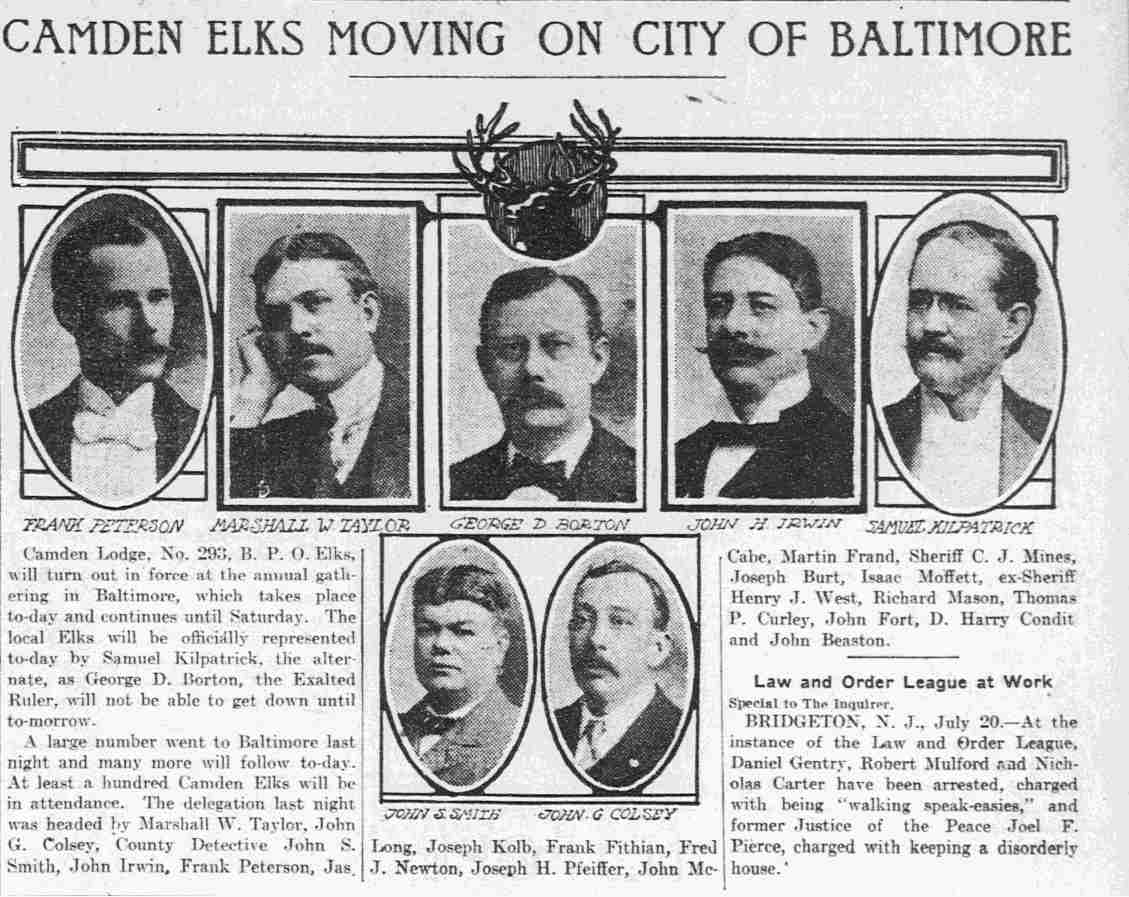
Camden Lodge, No. 293, B. P. O. Elks, will turn out in force at the annual gathering in Baltimore, which takes place to-day and continues until Saturday. The local Elks will be officially represented to-day by Samuel Kilpatrick, the alternate, as George D. Borton, the Exalted Ruler, will not be able to get down until to-morrow.
A large number went to Baltimore last night and many more will follow to-day. At least a hundred Camden Elks will be in attendance. The delegation last night was headed by Marshall W. Taylor, John G. Colsey, County Detective John S. Smith, John Irwin, Frank Peterson, Jas. Long, Joseph Kolb, Frank Fithian, Fred J. Newton, Joseph H. Pfeiffer, John McCabe, Martin Frand, Sheriff C. J. Mines, Joseph Burt, Isaac Moffett, ex-Sheriff Henry J. West, Richard Mason, Thomas P. Curley, John Fort, D. Harry Condit and John Beaston.
Portrait captions: FRANK PETERSON — MARSHALL W. TAYLOR — GEORGE D. BORTON — JOHN H. IRWIN — SAMUEL KILPATRICK — JOHN S. SMITH — JOHN G. COLSEY.
Law and Order League at Work
Special to The Inquirer.
BRIDGETON, N. J., July 20.—At the instance of the Law and Order League, Daniel Gentry, Robert Mulford and Nicholas Carter have been arrested, charged with being “walking speak-easies,” and former Justice of the Peace Joel F. Pierce, charged with keeping a disorderly house.
Young Bridge Builder Who Took Kate McCormick From Atco, Tells “Inquirer” of Conquests
Philadelphia Inquirer —
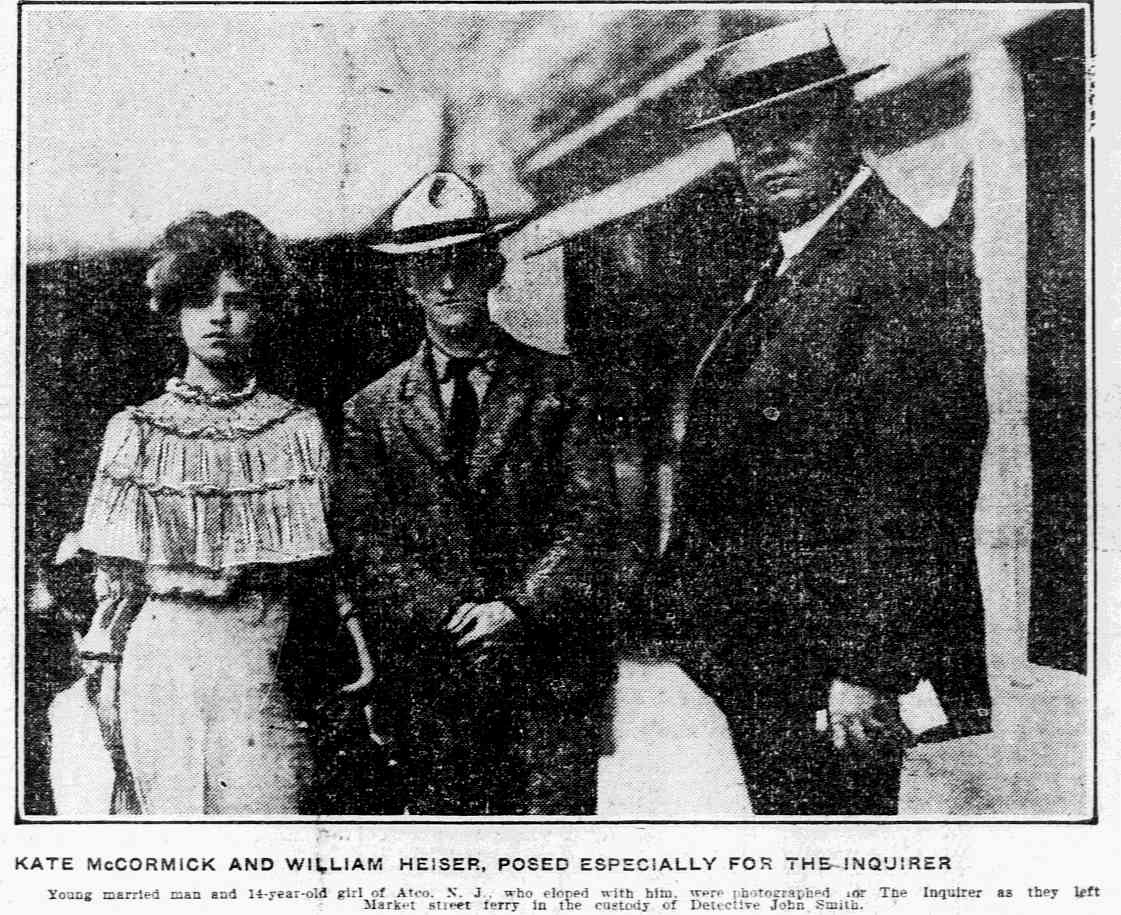
[Portrait: KATE McCORMICK AND WILLIAM HEISER, POSED ESPECIALLY FOR THE INQUIRER. Young married man and 14-year-old girl of Atco, N. J., who eloped with him, were photographed for The Inquirer as they left Market street ferry in the custody of Detective John Smith.]
YOUNG BRIDGE BUILDER WHO TOOK KATE McCORMICK FROM ATCO, TELLS “INQUIRER” OF CONQUESTS
GIRL WHO ACCOMPANIED HIM RETURNS CONTRITELY TO HER PARENTS, AND SAYS SHE THINKS SHE WAS HYPNOTIZED
As a breaker of women's hearts William Heiser confesses that there are few twenty-year-old youths in the world who can compare with him.
The years of imprisonment which he now knows are confronting him for deserting his wife and eloping with fourteen-year-old Katie McCormick, of Atco, N. J., may check his powers of allurement, which, the police say, amount to hypnotism. Heiser was brought here last evening together with Miss McCormick by County Detective John Smith, of Camden, who had captured the runaways near Newport, Pa.
Both looked fagged out as a result of their week's flight about the country. The bright yellow dress of the girl that had been her pride on many spring Sundays was faded and torn. The faces of both were dirty, and the girl had left home hatless. But when Heiser was questioned upon the subject of his conquests he brightened up wonderfully.
“How many girls have told me they loved me?” he said in response to a question. “Oh, I couldn't begin to tell. Two hundred at least. Why, in Atco alone during the three months I was there I had—”
“Are you going to tell, Will?” interposed Katie.
A String of Conquests
“Yes, I'm in for it now, so I don't care. Let me see. First there was — — that I kept company with. Then there was you” (pointing to Miss McCormick). “Then I went next with — —. Then I kept company with — —. Next I was in love with — —, and then you followed again. Let's see, that makes six, counting you twice. You were my second and sixth,” said the youthful Lothario, patting Katie's arm as he spoke.
“Is it true that you are married?”
“Yes, I was married when I was only seventeen. That's three years ago. My wife is in Pottsville. She knows that I go with other girls. She can't help knowing. The girls all follow me. I don't know how I do it. They get mad sometimes when they see how many I have following me around, but the only way I can lose them is to move.”
Fears She Is Hypnotized
The above brief extracts from a talk with Heiser after his arrival here last evening seem to make it plain why he was ordered to leave Atco just before his elopement with Miss McCormick. The little girl since Heiser's arrest weeps and laughs by turns. She says at times that she loves Heiser, and at other times she says that she fears him and believes he has hypnotized her.
“He looks at you so that you just feel you must do as he says. I knew it was wrong to go with him, but I couldn't resist when he looked at me. I am sorry for his wife,” and then Katie burst into tears. A few minutes later Heiser agreed to allow his picture to be taken for The Inquirer. Turning to Katie, he said sharply: “Stop crying.” The girl instantly dried her eyes and stood calmly while the photograph was taken.
Heiser is said to have records in Philadelphia, Pottsville, Scranton, Newport, Harrisburg and other places fully equaling his Atco exploits, and officers stated last evening that numerous charges would probably be brought against him. He was taken through Philadelphia and locked up.
ELOPER HEISER BLITHELY SAYS HE IS HEART-BREAKER
Continued From First Page
in the Camden jail, he having waived requisition.
Miss McCormick was met at the Market street ferry by Constable Bow Bates, of Atco, who had a note from the girl’s father. Bates left Camden with the girl last evening, and at a station near Atco he was met by Mr. McCormick, who drove his daughter home in a carriage, having planned to arrive at a late hour, so as to avoid curious crowds.
Camped Out in Rain
The last two nights before their capture Heiser and the girl camped out. The second night they were cared for in a gypsy encampment, near Port Royal. The entire story of their adventures, as told by themselves and by Detective Smith, is extremely interesting.
Heiser went to Atco the latter part of April. He is a bridge builder by trade, and was part of the crew of a big dredging machine, stationed at a point where a railroad bridge is being erected over the main road of the town. The first night after his arrival in Atco Heiser struck up an acquaintance with a girl, and from that time on he passed all his evenings in company with different girls of the town.
He says he is only twenty years old. He is slightly below medium height, and has a rather attractive face, with clear-cut features and light hair. Among the friends he made was Miss McCormick, but townspeople say that he was more often seen in company with other girls. His actions became so pronounced that several parents complained to his employer and ordered him not to visit their daughters again. Finally one man consulted Lawyer Sloan, of Camden.
How Elopement Was Planned
The lawyer wrote Heiser a letter telling him to leave the town at once or he would be prosecuted. The lawyer also wrote to Heiser’s employer, and the young man was at once discharged. This was one week ago to-day. Heiser received the money and loitered about Atco during the remainder of the day. In the evening he saw Miss McCormick and a girl named Miss Ella Smith, walking to the residence of George Brown, where a church entertainment was to be held. Heiser joined the girls, and induced Miss McCormick to leave her friend and walk with him. Then, according to the girl, the following conversation took place:
“Katie, would you feel badly if I left town?” began Heiser.
“You know I would,” replied the girl.
“Well, I’ve got to go. I’m going to-night, and I want you to go with me.”
Miss McCormick says Heiser kept looking at her until she replied: “If you are going, then I’m going, too.”
With this brief preliminary the elopement began. Miss McCormick was dressed for the evening’s entertainment. She had no wrap and no hat. Her hair is a golden yellow and exceedingly heavy. She wears it puffed up about her head and seldom wore a hat when going short distances.
Walked Three Miles To Train
In order to avoid the townspeople, the two struck off through a field, walking three miles to Berlin, a neighboring town. From there they took a train for Camden and came to Philadelphia for the night. Early the next morning they took a train for Newport, Pa., where Heiser’s mother has a furnished house that happened to be without a tenant. Friday afternoon the two did a great amount of shopping and laid in a month’s supply of eatables as they planned to stay in-doors for a few weeks and so avoid notice until the sensation caused by their disappearance had died away.
But, while the youngsters were thus planning, the town of Atco was in a ferment. When Kate did not return home late Thursday night her father made a few inquiries, but came to the conclusion that she had stopped over night with some friend. Her mother argued that she could not have gone any distance without taking her hat and coat. On Friday morning, however, when her father learned that she had last been seen with Heiser, he quickly secured photographs of the two and went to Camden, where he asked the aid of the police in searching for his daughter. He swore out a warrant charging Heiser with abducting a minor child.
Wanted to Horsewhip Heiser
Other fathers and mothers in Atco were deeply concerned in the search as stories of Heiser’s actions there kept multiplying. It was owing to the strong feeling among the farmers that Heiser was not taken to Atco last night, as it was known that the citizens had banded together to horsewhip him and give him a coat of tar and feathers.
The fancied security of Heiser was roughly shaken Monday when he saw the Philadelphia newspapers and learned that the detectives were on his trail. A grocer of whom he had purchased goods telegraphed to the Camden police, telling of Heiser’s presence in the town, but a friend of Heiser’s gave him the tip that the alarm had gone out and that he had better make his escape.
The two had spent all their money, so were forced to take to the fields and woods. They tramped about ten miles, Heiser thinks, when the girl became exhausted, and they were obliged to pass the night in the woods. It was raining, but the two were too tired to mind and went to sleep under a big tree. The next day they begged their meals. Heiser told the girl that he had friends in a town near-by, and that from them they could get money to get to Virginia, where he has relatives.
Sheltered by Gypsies
Toward evening they came upon a gypsy camp. By this time Heiser and Kate looked something like gypsies themselves. At any rate they were taken in by the wanderers and passed a comfortable night. The next day they were overtaken at Tuscacora by a Newport constable and taken to Port Royal, where they awaited the arrival of Detective Smith, who started from Camden when the first report came of their presence in Newport.
Heiser and the girl were so wearied from their flight that they hailed the arrival of their captor as if he was a deliverer. The girl at first was inclined to cling to Heiser, but when she learned that her parents were ready to forgive her she declared that she had not wanted to leave home and would not have done so if Heiser “had not looked at me so.”
Detective Smith induced Heiser to waive requisition, but then a long dispute arose with the local authorities over the question of the expenses incurred by the prisoners, and it required nearly a day to straighten this out. A lawyer meanwhile had met Heiser and had urged him to demand formal requisition, and this caused further delay so that it was nearly 7 o’clock last night before the two were finally brought to Philadelphia. Heiser showed no fear of trial, but was anxious that he be tried in Camden.
“I don’t want those Atco fellows to get hold of me,” he said.
He was not formally placed under arrest until he reached the Camden side of the ferry. Quite a crowd gathered about him as he was being taken to the jail, but the presence of the tired-out looking girl beside Heiser prevented any demonstration. Miss McCormick is tall for her age. She says that she knows Heiser is married, but he told her that he is unhappy with his wife, and she felt sorry for him.
After Heiser was locked up Detective Smith left Camden for Pottsville to find Mrs. Heiser, and if possible induce her to appear at the hearing to be given the prisoner.
Jail Breaker Captured
Philadelphia Inquirer —
Camden Detectives Find One Missing Man in Philadelphia
County Detective John S. Smith, of Camden, and Special Officer Sullivan yesterday captured Daniel O'Rourke, one of the sextet of prisoners who escaped from the county jail in Camden early Friday morning. O'Rourke was picked up at Fifth and Kater streets, Philadelphia, and taken to the Second district station house.
He told Detective Smith he was the one responsible for the jail breaking. He said he cut his way out by means of a pocket knife, which he used as a file. O'Rourke will be held pending requisition papers.
Requisition for Burton Woman
Philadelphia Inquirer —
County Detective Smith went to Trenton yesterday, where he procured requisition papers for Ida Burton, colored, who is wanted in Camden to answer a charge of causing the death of James Brown, also colored, who died election night from a wound in the head. The woman will be removed from Media, Pa., to Camden to-day.
Detectives Find Stolen Articles
Philadelphia Inquirer —
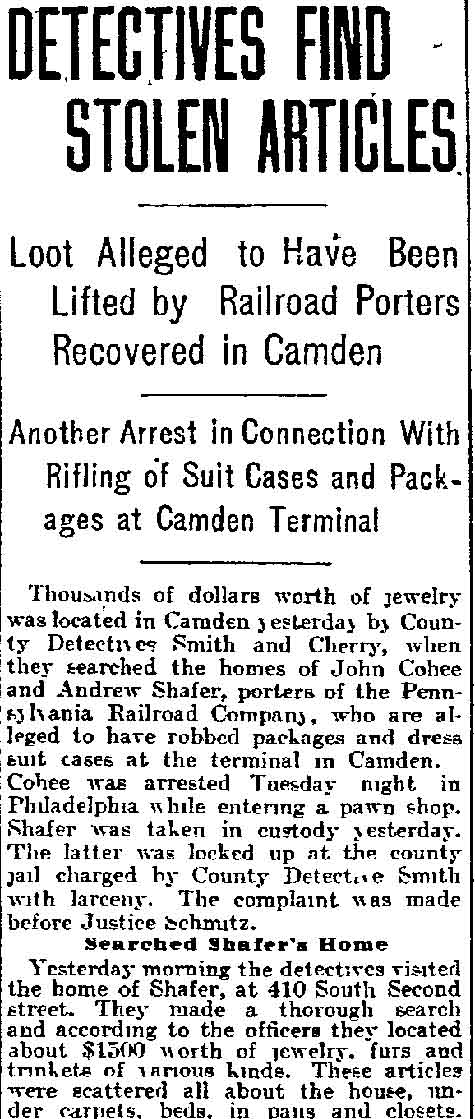
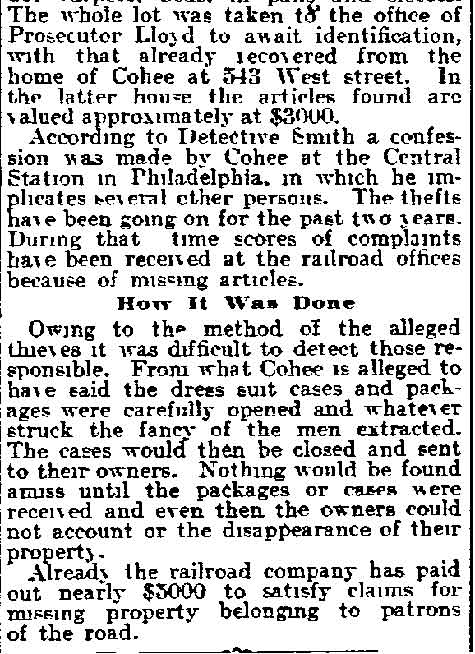
Loot Alleged to Have Been Lifted by Railroad Porters Recovered in Camden
Another Arrest in Connection With Rifling of Suit Cases and Packages at Camden Terminal
Thousands of dollars worth of jewelry was located in Camden yesterday by County Detectives Smith and Cherry, when they searched the homes of John Cohee and Andrew Shafer, porters of the Pennsylvania Railroad Company, who are alleged to have robbed packages and dress suit cases at the terminal in Camden. Cohee was arrested Tuesday night in Philadelphia while entering a pawn shop. Shafer was taken in custody yesterday. The latter was locked up at the county jail charged by County Detective Smith with larceny. The complaint was made before Justice Schmitz.
Searched Shafer’s Home
Yesterday morning the detectives visited the home of Shafer, at 410 South Second street. They made a thorough search and according to the officers they located about $1500 worth of jewelry, furs and trinkets of various kinds. These articles were scattered all about the house, under carpets, beds, in pans and closets. The whole lot was taken to the office of Prosecutor Lloyd to await identification, with that already recovered from the home of Cohee at 543 West street. In the latter house the articles found are valued approximately at $3000.
According to Detective Smith a confession was made by Cohee at the Central Station in Philadelphia, in which he implicates several other persons. The thefts have been going on for the past two years. During that time scores of complaints have been received at the railroad offices because of missing articles.
How It Was Done
Owing to the method of the alleged thieves it was difficult to detect those responsible. From what Cohee is alleged to have said the dress suit cases and packages were carefully opened and whatever struck the fancy of the men extracted. The cases would then be closed and sent to their owners. Nothing would be found amiss until the packages or cases were received and even then the owners could not account for the disappearance of their property.
Already the railroad company has paid out nearly $5000 to satisfy claims for missing property belonging to patrons of the road.
Accused of Killing a Camden Chinaman
Philadelphia Inquirer —
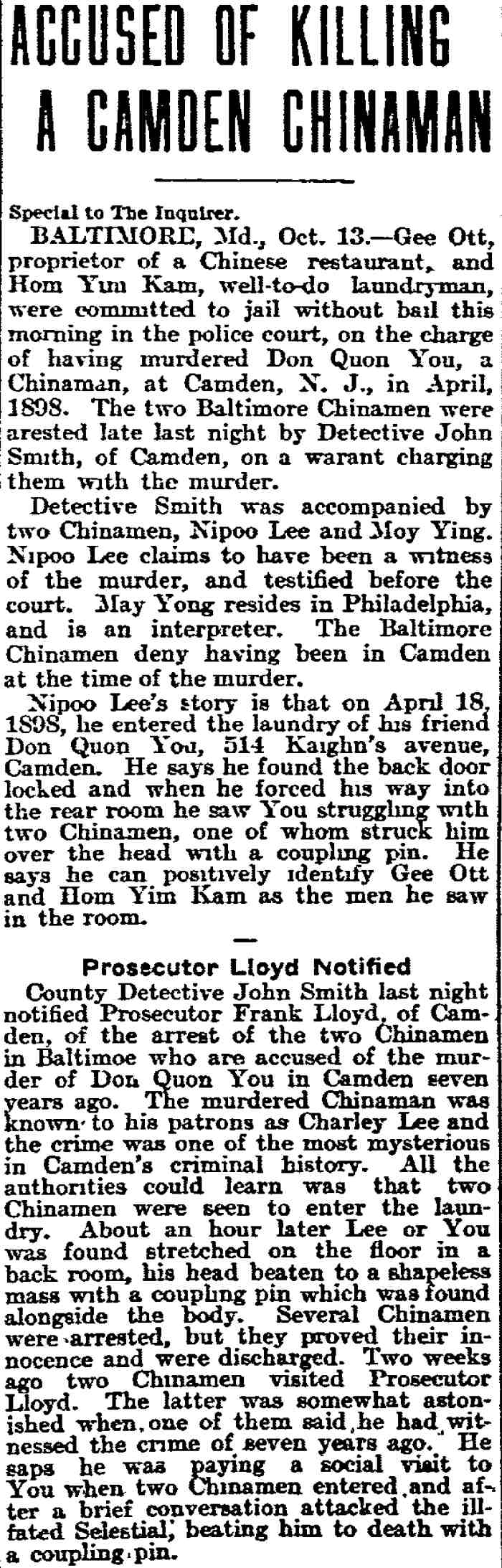
Special to The Inquirer.
BALTIMORE, Md., Oct. 13.—Gee Ott, proprietor of a Chinese restaurant, and Hom Yun Kam, well-to-do laundryman, were committed to jail without bail this morning in the police court, on the charge of having murdered Don Quon You, a Chinaman, at Camden, N. J., in April, 1898. The two Baltimore Chinamen were arrested late last night by Detective John Smith, of Camden, on a warrant charging them with the murder.
Detective Smith was accompanied by two Chinamen, Nipoo Lee and Moy Ying. Nipoo Lee claims to have been a witness of the murder, and testified before the court. May Yong resides in Philadelphia, and is an interpreter. The Baltimore Chinamen deny having been in Camden at the time of the murder.
Nipoo Lee's story is that on April 18, 1898, he entered the laundry of his friend Don Quon You, 514 Kaighn's avenue, Camden. He says he found the back door locked and when he forced his way into the rear room he saw You struggling with two Chinamen, one of whom struck him over the head with a coupling pin. He says he can positively identify Gee Ott and Hom Yim Kam as the men he saw in the room.
Prosecutor Lloyd Notified
County Detective John Smith last night notified Prosecutor Frank Lloyd, of Camden, of the arrest of the two Chinamen in Baltimore who are accused of the murder of Don Quon You in Camden seven years ago. The murdered Chinaman was known to his patrons as Charley Lee and the crime was one of the most mysterious in Camden's criminal history. All the authorities could learn was that two Chinamen were seen to enter the laundry. About an hour later Lee or You was found stretched on the floor in a back room, his head beaten to a shapeless mass with a coupling pin which was found alongside the body. Several Chinamen were arrested, but they proved their innocence and were discharged. Two weeks ago two Chinamen visited Prosecutor Lloyd. The latter was somewhat astonished when one of them said he had witnessed the crime of seven years ago. He says he was paying a social visit to You when two Chinamen entered and after a brief conversation attacked the ill-fated Celestial, beating him to death with a coupling pin.
Camden Lodge No. 293, B.P.O.E. — Membership Ballot Notice
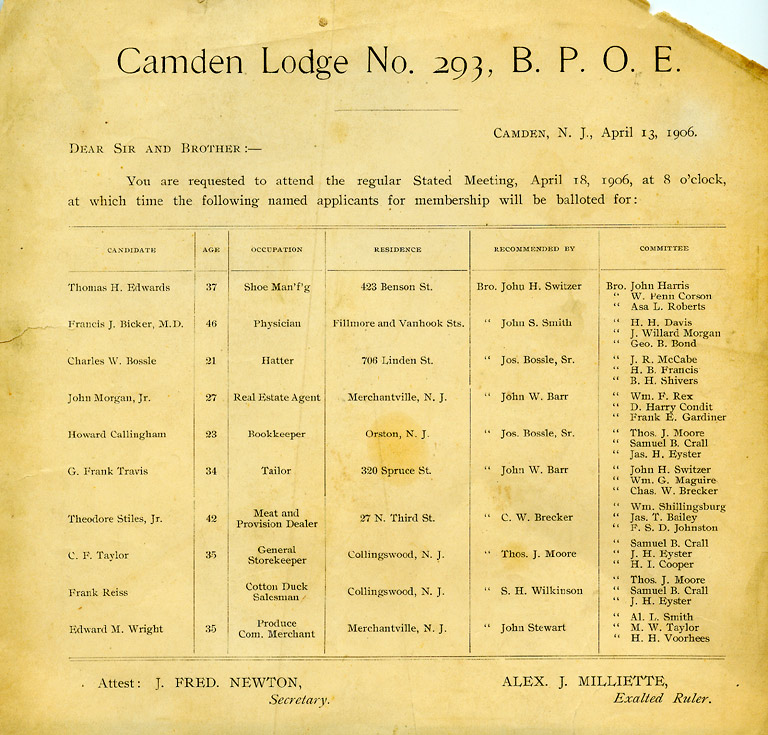
Camden Lodge No. 293, B. P. O. E.
CAMDEN, N. J., April 13, 1906.
DEAR SIR AND BROTHER:—
You are requested to attend the regular Stated Meeting, April 18, 1906, at 8 o’clock, at which time the following named applicants for membership will be balloted for:
| CANDIDATE | AGE | OCCUPATION | RESIDENCE | RECOMMENDED BY | COMMITTEE |
|---|---|---|---|---|---|
| Thomas H. Edwards | 37 | Shoe Man’f’g | 423 Benson St. | Bro. John H. Switzer | Bro. John Harris “ W. Penn Corson “ Asa L. Roberts |
| Francis J. Bicker, M.D. | 46 | Physician | Fillmore and Vanhook Sts. | “ John S. Smith | “ H. H. Davis “ J. Willard Morgan “ Geo. B. Bond |
| Charles W. Bossle | 21 | Hatter | 706 Linden St. | “ Jos. Bossle, Sr. | “ J. R. McCabe “ H. B. Francis “ B. H. Shivers |
| John Morgan, Jr. | 27 | Real Estate Agent | Merchantville, N. J. | “ John W. Barr | “ Wm. F. Rex “ D. Harry Condit “ Frank E. Gardiner |
| Howard Callingham | 23 | Bookkeeper | Orston, N. J. | “ Jos. Bossle, Sr. | “ Thos. J. Moore “ Samuel B. Crall “ Jas. H. Eyster |
| G. Frank Travis | 34 | Tailor | 320 Spruce St. | “ John W. Barr | “ John H. Switzer “ Wm. G. Maguire “ Chas. W. Brecker |
| Theodore Stiles, Jr. | 42 | Meat and Provision Dealer | 27 N. Third St. | “ C. W. Brecker | “ Wm. Shillingsburg “ Jas. T. Bailey “ F. S. D. Johnston |
| C. F. Taylor | 35 | General Storekeeper | Collingswood, N. J. | “ Thos. J. Moore | “ Samuel B. Crall “ J. H. Eyster “ H. I. Cooper |
| Frank Reiss | Cotton Duck Salesman | Collingswood, N. J. | “ S. H. Wilkinson | “ Thos. J. Moore “ Samuel B. Crall “ J. H. Eyster | |
| Edward M. Wright | 35 | Produce Com. Merchant | Merchantville, N. J. | “ John Stewart | “ Al. L. Smith “ M. W. Taylor “ H. H. Voorhees |
Attest: J. FRED. NEWTON, Secretary
ALEX. J. MILLIETTE, Exalted Ruler
Detectives Dig Up Stolen Silverware
Philadelphia Inquirer —
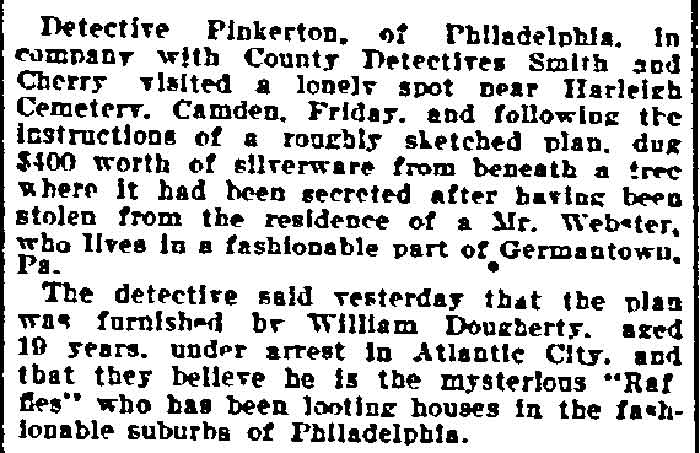
Detective Pinkerton, of Philadelphia, in company with County Detectives Smith and Cherry visited a lonely spot near Harleigh Cemetery, Camden, Friday, and following the instructions of a roughly sketched plan, dug $400 worth of silverware from beneath a tree where it had been secreted after having been stolen from the residence of a Mr. Webster, who lives in a fashionable part of Germantown, Pa.
The detective said yesterday that the plan was furnished by William Dougherty, aged 19 years, under arrest in Atlantic City, and that they believe he is the mysterious “Raffles” who has been looting houses in the fashionable suburbs of Philadelphia.
Stranger at Detective’s Desk Was Escaped Patient
Philadelphia Inquirer —
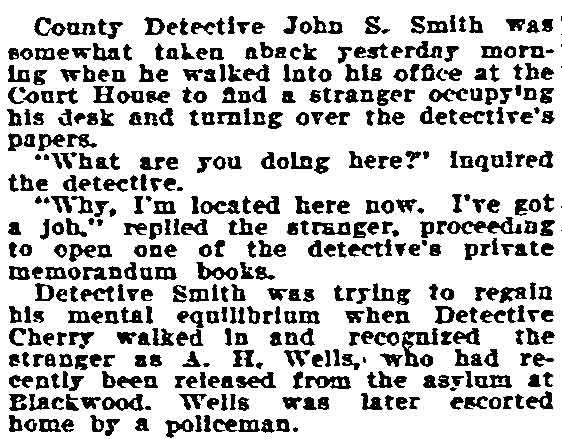
County Detective John S. Smith was somewhat taken aback yesterday morning when he walked into his office at the Court House to find a stranger occupying his desk and turning over the detective’s papers.
“What are you doing here?” inquired the detective.
“Why, I’m located here now. I’ve got a job,” replied the stranger, proceeding to open one of the detective’s private memorandum books.
Detective Smith was trying to regain his mental equilibrium when Detective Cherry walked in and recognized the stranger as A. H. Wells, who had recently been released from the asylum at Blackwood. Wells was later escorted home by a policeman.
County Detective Smith Yesterday Lodged George Miller
Philadelphia Inquirer —

•• County Detective Smith yesterday lodged George Miller in the county jail to answer an indictment for wife desertion. Miller was arrested in Philadelphia and detained in Moyamensing Prison pending a requisition.
A DIME NOVEL CHASE
Washington Times —
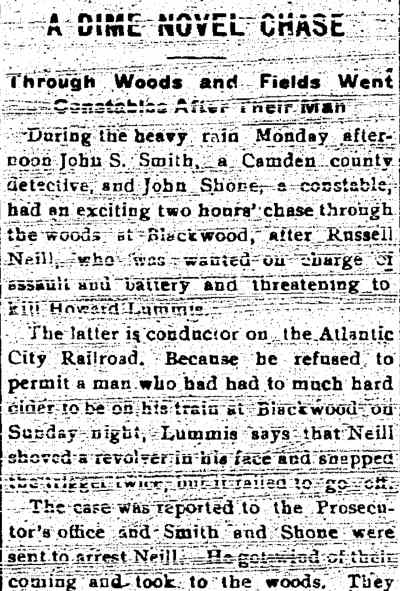
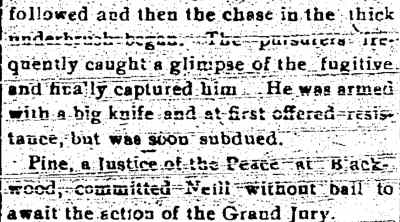
Through Woods and Fields Went Constables After Their Man
During the heavy rain Monday afternoon John S. Smith, a Camden county detective, and John Shore, a constable, had an exciting two hours’ chase through the woods at Blackwood, after Russell Neill, who was wanted on charge of assault and battery and threatening to kill Howard Lummis.
The latter is conductor on the Atlantic City Railroad. Because he refused to permit a man who had had to much hard cider to be on his train at Blackwood on Sunday night, Lummis says that Neill shoved a revolver in his face and snapped the trigger twice, but it failed to go off.
The case was reported to the Prosecutor’s office and Smith and Shone were sent to arrest Neill. He got wind of their coming and took to the woods. They followed and then the chase in the thick underbrush began. The pursuers frequently caught a glimpse of the fugitive and finally captured him. He was armed with a big knife and at first offered resistance, but was soon subdued.
Pine, a Justice of the Peace at Blackwood, committed Neill without bail to await the action of the Grand Jury.
Prisoner Back From Tampa
Philadelphia Inquirer —
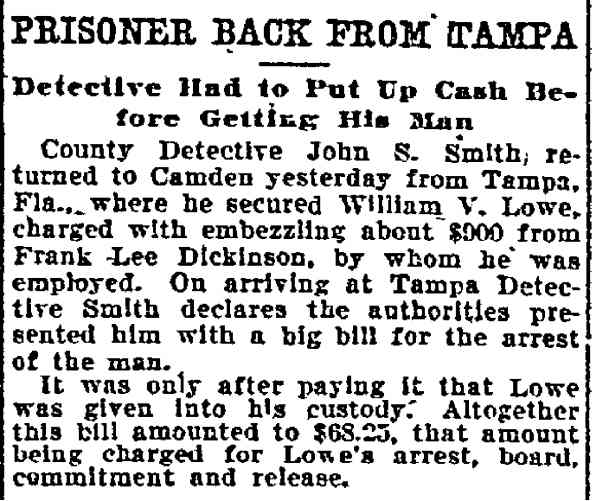
Detective Had to Put Up Cash Before Getting His Man
County Detective John S. Smith; returned to Camden yesterday from Tampa, Fla., where he secured William V. Lowe, charged with embezzling about $900 from Frank Lee Dickinson, by whom he was employed. On arriving at Tampa Detective Smith declares the authorities presented him with a big bill for the arrest of the man.
It was only after paying it that Lowe was given into his custody. Altogether this bill amounted to $68.25, that amount being charged for Lowe's arrest, board, commitment and release.
Detective Smith Had Bad Fall
Philadelphia Inquirer —
Running to catch a car, yesterday, County Detective John Smith, of Camden, fell, and broke his right arm.
Brained With Ax, Women Lie Dead
Philadelphia Inquirer —
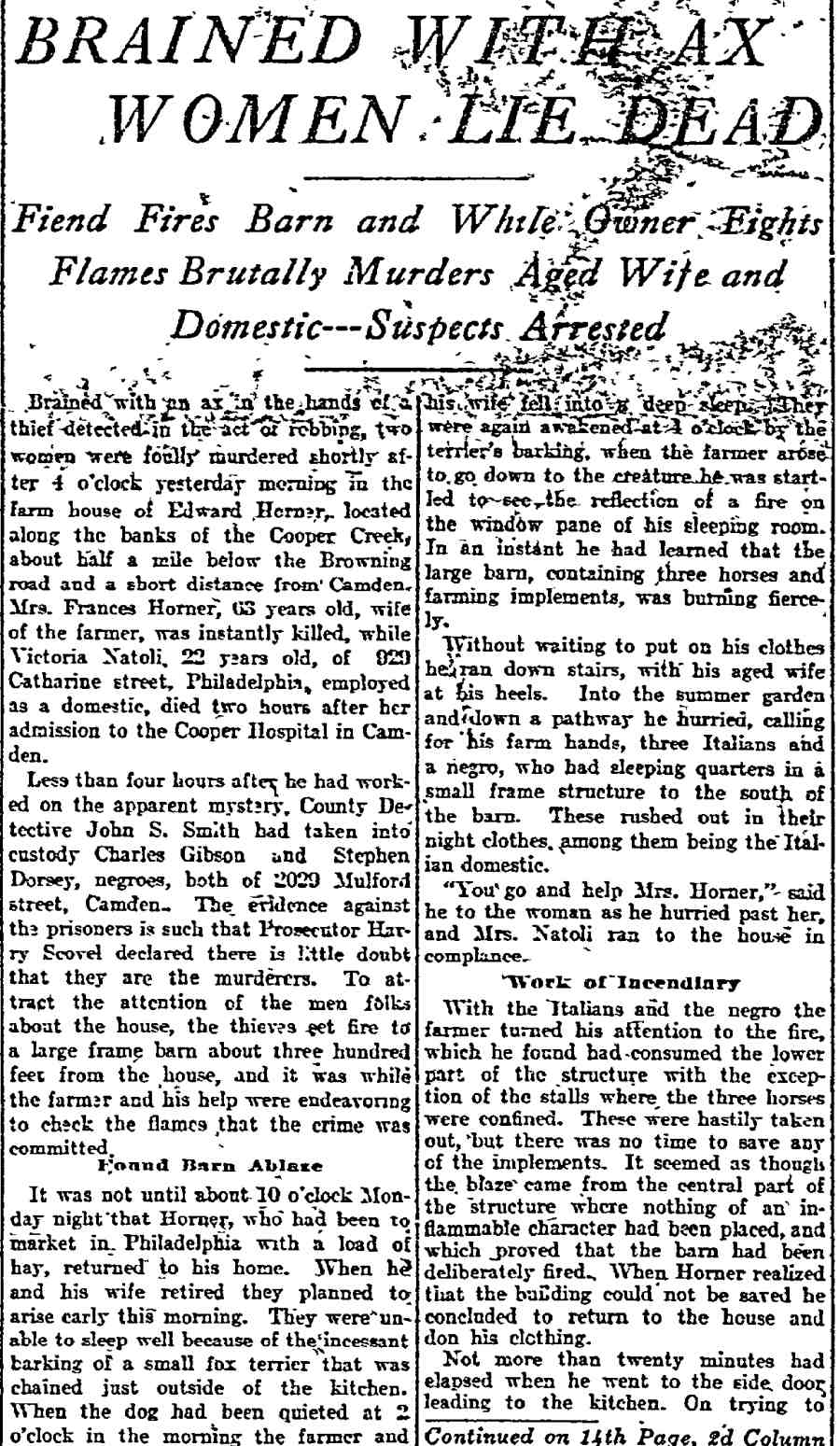
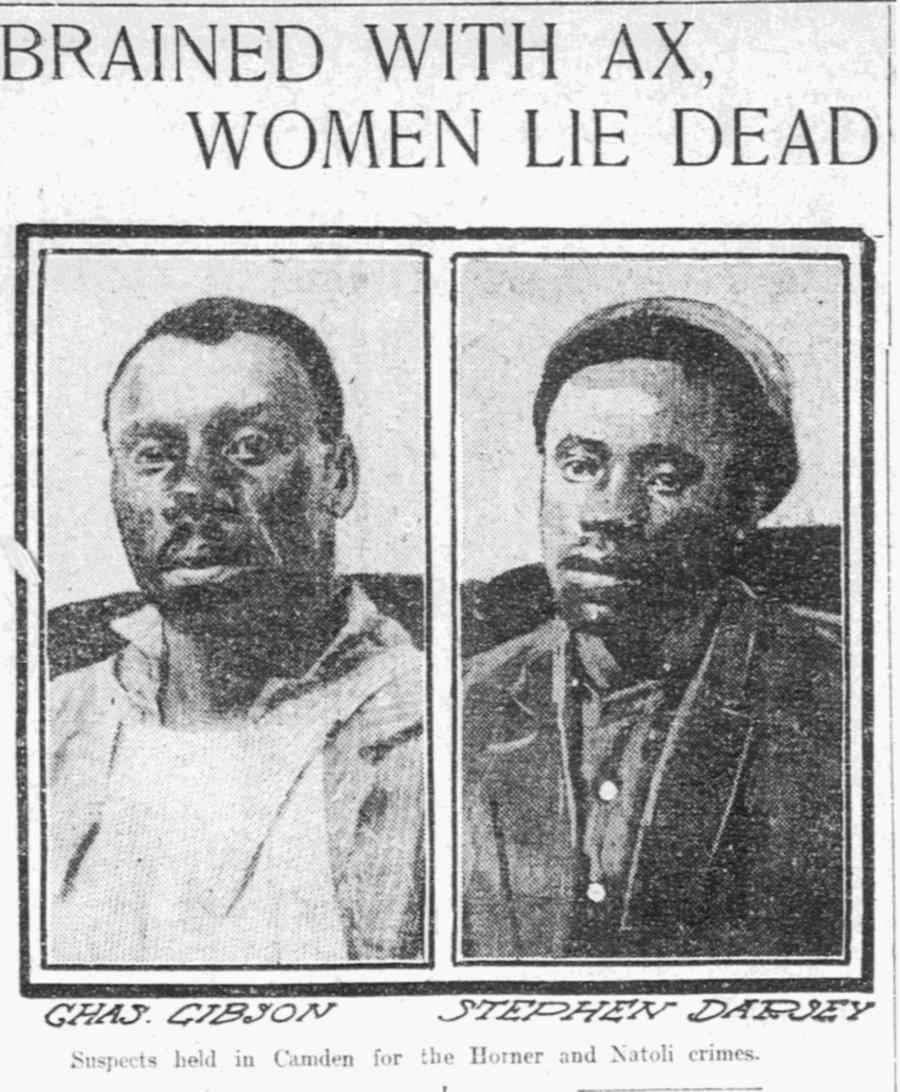
Fiend Fires Barn and While Owner Fights Flames Brutally Murders Aged Wife and Domestic—Suspects Arrested
CHAS. GIBSON STEPHEN DORSEY
Suspects held in Camden for the Horner and Natoli crimes.
Brained with an ax in the hands of a thief detected in the act of robbing, two women were foully murdered shortly after 4 o’clock yesterday morning in the farm house of Edward Horner, located along the banks of the Cooper Creek, about half a mile below the Browning road and a short distance from Camden. Mrs. Frances Horner, 63 years old, wife of the farmer, was instantly killed, while Victoria Natoli, 22 years old, of 82[?] Catharine street, Philadelphia, employed as a domestic, died two hours after her admission to the Cooper Hospital in Camden.
Less than four hours after he had worked on the apparent mystery, County Detective John S. Smith had taken into custody Charles Gibson and Stephen Dorsey, negroes, both of 2029 Mulford street, Camden. The evidence against the prisoners is such that Prosecutor Harry Scovel declared there is little doubt that they are the murderers. To attract the attention of the men folks about the house, the thieves set fire to a large frame barn about three hundred feet from the house, and it was while the farmer and his help were endeavoring to check the flames that the crime was committed.
Found Barn Ablaze
It was not until about 10 o’clock Monday night that Horner, who had been to market in Philadelphia with a load of hay, returned to his home. When he and his wife retired they planned to arise early this morning. They were unable to sleep well because of the incessant barking of a small fox terrier that was chained just outside of the kitchen. When the dog had been quieted at 2 o’clock in the morning the farmer and his wife fell into a deep sleep. They were again awakened at 4 o’clock by the terrier’s barking, when the farmer arose to go down to the creature he was startled to see the reflection of a fire on the window pane of his sleeping room. In an instant he had learned that the large barn, containing three horses and farming implements, was burning fiercely.
Without waiting to put on his clothes he ran down stairs, with his aged wife at his heels. Into the summer garden and down a pathway he hurried, calling for his farm hands, three Italians and a negro, who had sleeping quarters in a small frame structure to the south of the barn. These rushed out in their night clothes, among them being the Italian domestic.
“You go and help Mrs. Horner,” said he to the woman as he hurried past her, and Mrs. Natoli ran to the house in compliance.
Work of Incendiary
With the Italians and the negro the farmer turned his attention to the fire, which he found had consumed the lower part of the structure with the exception of the stalls where the three horses were confined. These were hastily taken out, but there was no time to save any of the implements. It seemed as though the blaze came from the central part of the structure where nothing of an inflammable character had been placed, and which proved that the barn had been deliberately fired. When Horner realized that the building could not be saved he concluded to return to the house and don his clothing.
Not more than twenty minutes had elapsed when he went to the side door leading to the kitchen. On trying to open the door he was surprised to find it securely fastened. He thought it had stuck at the bottom, and on looking down he saw two pools of blood, one of which had overrun, and crimson drops were falling to the ground a foot below. With superhuman force he smashed in the door, when he nearly fainted from the terrible scene that met his gaze.
Near the end of a long kitchen table lay his wife, her head resting in an ever-widening pool of blood. He stooped and placed his hand over her heart, but it had been stilled in death. Her face was almost unrecognizable because of the great gush of blood that had flowed from two horrible wounds on her head. He was about to go out and call for help when in the dim light he saw the form of the Italian woman. He found she was still alive and then he gave the alarm.
In an inconceivably short space of time farmers from miles around had flocked to the stricken house. One of these, John Thomas, who has a place across from the Horner farm, about half a mile distant, hastily procured a horse and team and drove at a mad pace into Camden with the dying Italian domestic. He arrived at the Cooper Hospital at 7 o’clock and two hours later, almost to the minute, Mrs. Natoli breathed her last without regaining consciousness. She was about to become a mother.
In the meantime the various county officials arrived. County Physician W. S. Jones. Coroner J. W. Fithian. County Detectives Smith and Cherry. Chief of Police Gravenor and others.
An autopsy was held on the body of Mrs. Horner by Drs. Jones and Fithian.
They found that her skull had been crushed in two places. The wound on the front of the head was shaped like a spearhead and was about three and one-half inches long. An examination showed that the blow that had inflicted this injury had been of such force as to split the skull in twain. The other wound, of a similar character, was at the base of the skull, the bones being crushed like an egg-shell. A subsequent examination made of the body of Mrs. Natoli at the hospital showed that the left side of her skull had been crushed with one terrible blow.
When a search was instituted for the weapon with which the crime had been committed it could not at first be located. It was subsequently found at the rear of the house. It was an old axe that had been used to cut wire from bales of hay, and the butt end was covered with blood and hair, showing that it was in that wise the victims had been struck by the murderer.
Horner, the stricken husband, a man 65 years old, threw the first light on the mystery and he gave a clue that finally resulted in the arrest of the negro Gibson and later of Dorsey. He said he had been having considerable trouble with his help this year. One of the men, who proved to be Gibson, was discharged about three weeks ago after a violent quarrel. At that time the negro left with the remark:
The Threat
“All right. I’ll get even. I’ll burn your barn.”
No more was seen of the man until just before Horner left for his trip to Philadelphia on Monday night. Then the farmer was surprised to see the man enter the farm yard and he appeared to be in a repentant mood. He pleaded with Horner to give him work, but as the farmer had little time to spare he told him to return in the morning. Then Gibson asked for permission to sleep in the barn and this was given him. The last seen of the negro, until his subsequent arrest, was when he left the house to go to the barn. That was about 11 o’clock Monday night, after Horner had returned from Philadelphia.
Armed with this information, County Detective Smith, who had been on the scene since 6 o’clock in the morning, began a search for Gibson. His quest led him into the southern section of Camden, known as Centreville.
In company with Policeman Valentine the detective found Gibson at 1831 South Eighth street. He was immediately placed under arrest and taken to the office of Prosecutor Scovel. He wore a defiant mien and sought to throw off any suspicion connecting him with the crime by declaring his entire ignorance of it.
Stripped of his clothing, he was carefully examined, but no blood marks were found on his body. When his pockets were searched, however, a pawn ticket, on which the ink was hardly dry, was found. It was issued by a Philadelphia pawnbroker at 125 Market street, and was given in exchange for a watch. A handkerchief literally soaked with blood, was also found in one of his pockets, together with a revolver. As to the handkerchief, he said the blood came from his nose.
Meanwhile a “flyer” had been sent out to all of the pawnbrokers at 9 o’clock, and just after Gibson had been taken into custody, Reader, the Market street broker, entered the office of Prosecutor Scovel and excitedly said that a negro had been in his place just twenty minutes before he was apprised of the crime and had pawned two watches. Reader had the watches with him. One bore the name of “Edward Horner.” The other was a woman’s watch, with long pendant chain. The pawnbroker was given a view of Gibson, and he exclaimed:
“That is the man that pawned these watches this morning, just exactly at ten minutes past nine o’clock. There is not the least question but what it is he.”
Gibson never moved, but looked at the officials and the pawnbroker with a defiant glare. He was then placed in a cell in the county jail, to await trial, which Prosecutor Scovel promises will be a speedy one.
Shortly after Gibson’s arrest Detective Smith received information which resulted in him seeking Dorsey. The negro was found at his home, on Mulford street. When taken to the office of Prosecutor Scovel, he at first denied having any knowledge of the matter. In fact, he endeavored to create the impression he was not acquainted with Gibson, but seeing the absurdity of this, he finally acknowledged being out with Gibson Monday night. Then he admitted he was with Gibson when the watches were pawned.
Horner was taken to the jail, and after positively identifying Gibson as the negro who had made the threats, and who Monday night asked to be taken back as a farmhand, the farmer also identified the watches as belonging to him and his wife. The revolver found on the negro was one of two which were stolen.
With tears coursing down his cheeks the stricken husband, who is 65 years old, spoke of the tragedy in a tear-choked voice.
“It is all too terrible to talk about,” said he. “I can’t realize it all. Why, only Sunday we had a family reunion here, when I celebrated my sixty-fifth birthday. My wife then plagued me, saying I wasn’t that old by far, and with our children and grandchildren we spent one of the most pleasant of days.
“How I ever got into that room,” continued he, speaking of when he broke in the door only to find his wife and the domestic stretched on the floor and weltering in their own blood. “I cannot tell. My poor wife lay between the end of the kitchen table and the door that leads into the shed. I saw that her eyes were closed, and when I saw those terrible pools of blood I at once realized a crime had been committed. I felt of her heart to see if she was still alive, but it had stopped beating, and then I knew she was past all earthly aid. Then I found that other poor woman and knew that she was still alive. I gave the alarm, but just how I cannot tell. I cannot realize it all,” concluded he, with a choked voice.
The house in which the murder occurred is an old structure built along Colonial lines. It is part of what is known as the Michelson estate, the farm being 70 acres in extent. The Horners have been farmers all their lives, and are known throughout South Jersey. The barn that was destroyed lay about three hundred feet to the south of the dwelling, and beside it were a number of smaller frame structures. It was in one of these that the Italian woman, her husband and the other farm help lived.
The news of the tragedy spread to surrounding communities with great rapidity and a large crowd was soon gathered about the place. Had the murderers been found at the time they would undoubtedly have been given short shrift. Three daughters survive the murdered Mrs. Horner: Mrs. Anna Marter, Mrs. Edward Megargee and Mrs. Isaac Beideman.
Camden Police Sure They Have the Right Men
Philadelphia Inquirer —

CAMDEN POLICE SURE THEY HAVE THE RIGHT MEN
Detectives Find Plenty of Evidence Connecting Two Negroes
Camden officials are convinced that there is now no question but what Charles Gibson and Stephen Dorsey, the negroes arrested in connection with the double murder on the Horner farm, located on the Browning road, about a mile south of Camden, are the right men. They have been formally charged with killing Mrs. Frances Horner, 63 years old, wife of Edward Horner, the farmer, and Victoria Natoli, 22 years old, the Italian domestic, on Tuesday morning, shortly after 4 o’clock. As an evidence that Prosecutor Scovel is sure of his case against them, he issued the following statement late yesterday afternoon from his office in Camden:
“The Prosecutor’s office has finished its investigation in the case of the Horner murder. Any further investigation will simply be as to minor details. Charles Gibson and Stephen Dorsey have been formally charged with the murder and committed to the county jail, together with several witnesses. No mistakes have been made. Justice will be done, and the public can rest assured that the guilty parties will be punished.”
Getting the Evidence
County Detective John S. Smith, who arrested the men a few hours after the horrible deed was committed, made the complaint against them before Justice Schmitz on information received. He has worked on the case in connection with County Detective John Cherry since the discovery of the slain victims, and in consequence a skein of circumstantial evidence has been woven so completely that it is believed the defendants cannot escape. They have traced the men from a few hours prior to the murder until a short time before they were arrested.
Since Tuesday night the police and the detectives have taken into custody over a score of negroes, who have been locked up in the county jail. Most of these are said to be very important witnesses, who will be used at the trial in order to demolish the effort of the accused negroes to establish an alibi. In fact, it is stated with good authority that Prosecutor Scovel has already torn their conflicting stories to shreds. They have given fairly connected statements as to their whereabouts on the morning of the murder when questioned separately, but these are said to have been found untrue by the production of a number of the witnesses. Speaking of the witnesses, Prosecutor Scovel said:
“By these witnesses we have not only succeeded in breaking down the entire foundation of the alibis, but have traced Gibson and Dorsey until 2 o’clock yesterday morning. They were together at that hour in the lower section of the city. The next we hear of them is in the Philadelphia pawnshop. They were still in one another’s company, and they had the watches that were stolen from the Horner farmhouse. This was within a few hours after the murder had been committed.”
There was a persistent rumor that one of the negroes had broken down under the “third degree,” which was applied yesterday morning. While Prosecutor Scovel refused to either affirm or deny that such a confession had been made, the statement he issued later indicates that he has some conclusive evidence against them at least. In short, it was stated that when the time for the trial comes the evidence presented will not all be of a circumstantial character. While Gibson retains his stolid indifference, protesting his innocence with vehemence, Dorsey is of quite a different type and it is believed that he has broken under the strain.
Little credence is placed in the report that another negro is being sought after. His name is said to be Walter Scott and that he was discharged as was Gibson by Farmer Horner several weeks ago because of his shiftless manner. He is reported to have threatened the farmer, and Gibson told Prosecutor Scovel that it was Scott who gave him the watches to pawn. It is believed, however, that this is simply an attempt on the part of Gibson to throw the officials off the track. It is thought likely that he heard of Scott’s threat, and used that in an effort to throw suspicion from himself. Aside from this, one of the farm hands employed by Horner declares he distinctly heard Gibson’s voice a short time before the barn was discovered ablaze.
For a Speedy Trial
It was announced by Prosecutor Scovel that no time will be lost in bringing the prisoners to trial. Supreme Court Justice Garrison, before whom the case will be tried, is now away on his vacation. He was apprised of the crime by telegraph yesterday. It will remain with him as to when the case will go to court. Prosecutor Scovel can call the grand jury together in a short time, and an indictment can be speedily found against both the negroes. The trial may take place early in September.
County Physician Jones said yesterday that in view of the fact that there is little question but what the right men have been apprehended, he did not see the necessity for holding an inquest. This he characterized as a mere waste of time, and in consequence there will be no formal inquiry.
Mrs. Horner will be buried tomorrow from the old home where she lived for nearly two score years. The funeral will be strictly of a private nature, but it is anticipated that many farmers from the surrounding places who knew the Horners well will be in attendance.
Chair Not Ready for Negro Murderers
Philadelphia Inquirer —
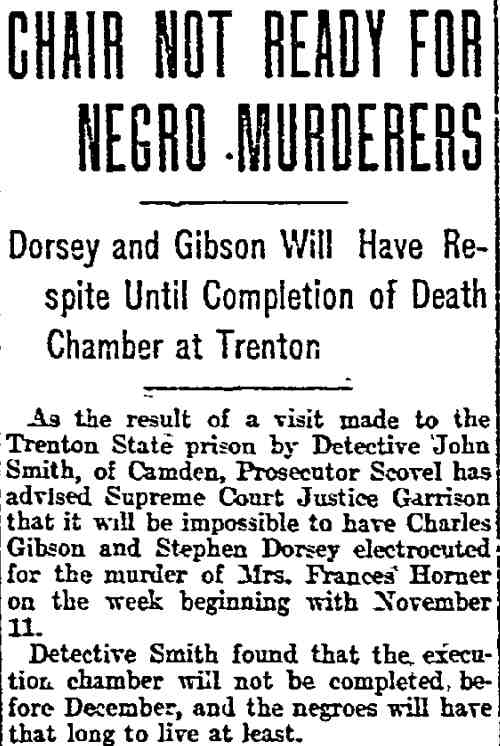
Dorsey and Gibson Will Have Respite Until Completion of Death Chamber at Trenton
As the result of a visit made to the Trenton State prison by Detective John Smith, of Camden, Prosecutor Scovel has advised Supreme Court Justice Garrison that it will be impossible to have Charles Gibson and Stephen Dorsey electrocuted for the murder of Mrs. Frances Horner on the week beginning with November 11.
Detective Smith found that the execution chamber will not be completed before December, and the negroes will have that long to live at least.
Thieves Follow Circus
Philadelphia Inquirer —
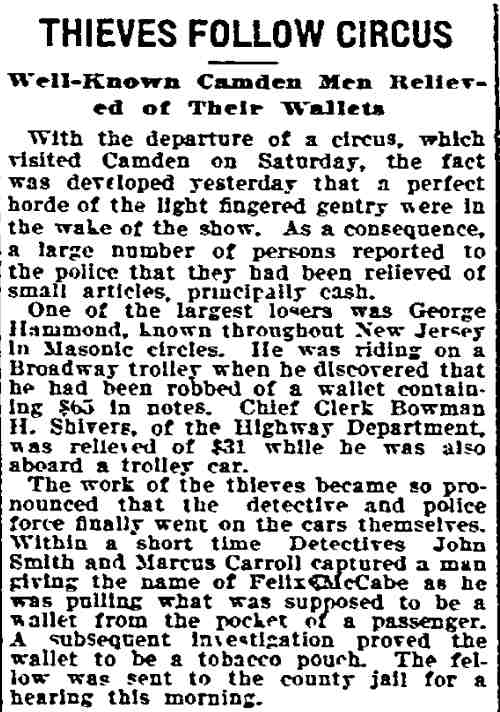
Well-Known Camden Men Relieved of Their Wallets
With the departure of a circus, which visited Camden on Saturday, the fact was developed yesterday that a perfect horde of the light fingered gentry were in the wake of the show. As a consequence, a large number of persons reported to the police that they had been relieved of small articles, principally cash.
One of the largest losers was George Hammond, known throughout New Jersey in Masonic circles. He was riding on a Broadway trolley when he discovered that he had been robbed of a wallet containing $65 in notes. Chief Clerk Bowman H. Shivers, of the Highway Department, was relieved of $31 while he was also aboard a trolley car.
The work of the thieves became so pronounced that the detective and police force finally went on the cars themselves. Within a short time Detectives John Smith and Marcus Carroll captured a man giving the name of Felix McCabe as he was pulling what was supposed to be a wallet from the pocket of a passenger. A subsequent investigation proved the wallet to be a tobacco pouch. The fellow was sent to the county jail for a hearing this morning.
Probing Camden’s Saloons
Jersey Journal —
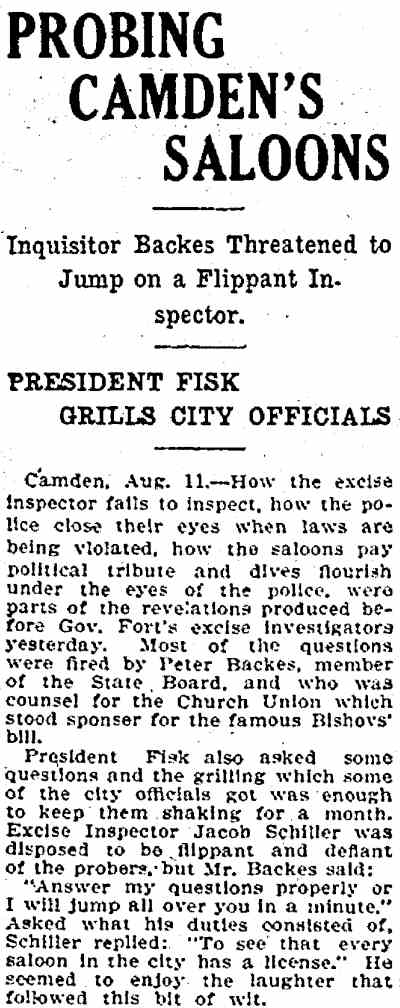
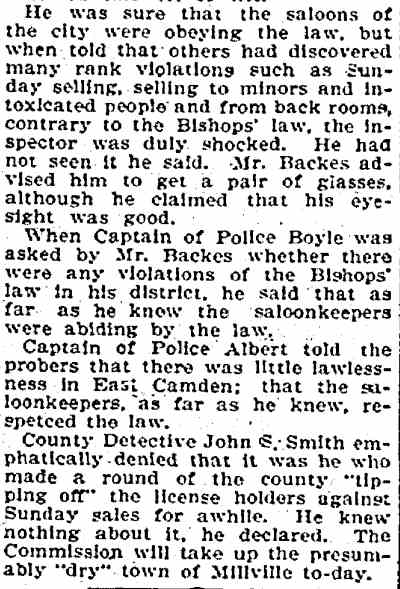
Inquisitor Backes Threatened to Jump on a Flippant Inspector.
PRESIDENT FISK GRILLS CITY OFFICIALS
Camden, Aug. 11.—How the excise inspector fails to inspect, how the police close their eyes when laws are being violated, how the saloons pay political tribute and dives flourish under the eyes of the police, were parts of the revelations produced before Gov. Fort’s excise investigators yesterday. Most of the questions were fired by Peter Backes, member of the State Board, and who was counsel for the Church Union which stood sponsor for the famous Bishops’ bill.
President Fisk also asked some questions and the grilling which some of the city officials got was enough to keep them shaking for a month. Excise Inspector Jacob Schiller was disposed to be flippant and defiant of the probers, but Mr. Backes said: “Answer my questions properly or I will jump all over you in a minute.” Asked what his duties consisted of, Schiller replied: “To see that every saloon in the city has a license.” He seemed to enjoy the laughter that followed this bit of wit.
He was sure that the saloons of the city were obeying the law, but when told that others had discovered many rank violations such as Sunday selling, selling to minors and intoxicated people and from back rooms, contrary to the Bishops’ law, the inspector was duly shocked. He had not seen it he said. Mr. Backes advised him to get a pair of glasses, although he claimed that his eyesight was good. Mr. Backes advised him to get a pair of glasses, although he claimed that his eyesight was good.
When Captain of Police Boyle was asked by Mr. Backes whether there were any violations of the Bishops’ law in his district, he said that as far as he knew the saloonkeepers were abiding by the law.
Captain of Police Albert told the probers that there was little lawlessness in East Camden; that the saloonkeepers, as far as he knew, respetced [sic] the law.
County Detective John S. Smith emphatically denied that it was he who made a round of the county “tipping off” the license holders against Sunday sales for awhile. He knew nothing about it, he declared. The Commission will take up the presumably “dry” town of Millville to-day.
Trunk Murder Mystery
Washington DC Evening Star —
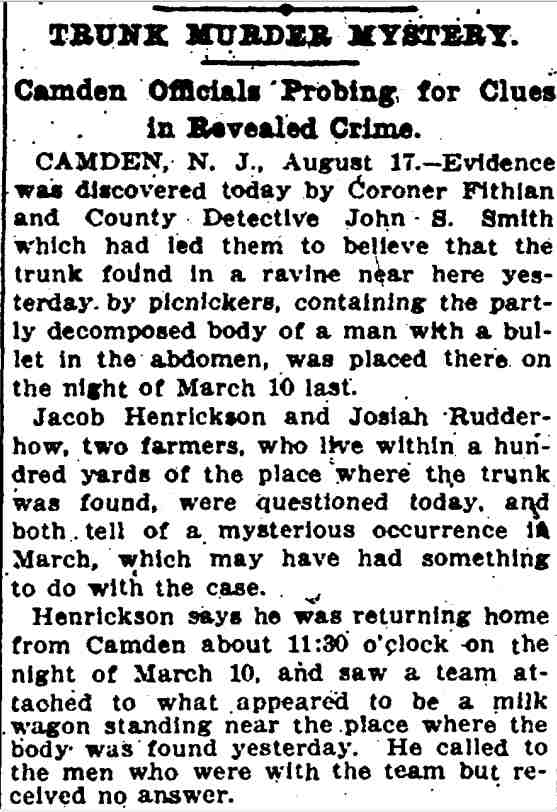
Camden Officials ‘Probing, for Clues in Revealed Crime.
CAMDEN, N. J., August 17.—Evidence was discovered today by Coroner Fithian and County Detective John S. Smith which had led them to believe that the trunk found in a ravine near here yesterday by picnickers, containing the partly decomposed body of a man with a bullet in the abdomen, was placed there on the night of March 10 last.
Jacob Henrickson and Josiah Rudderhow, two farmers, who live within a hundred yards of the place where the trunk was found, were questioned today, and both tell of a mysterious occurrence in March, which may have had something to do with the case.
Henrickson says he was returning home from Camden about 11:30 o'clock on the night of March 10, and saw a team attached to what appeared to be a milk wagon standing near the place where the body was found yesterday. He called to the men who were with the team but received no answer.
Clue to Trunk Mystery
Philadelphia Inquirer —
CAMDEN, Aug. 20.—Statements indicating that he looks for an early solution of the trunk murder mystery were made by Assistant Prosecutor of the Pleas Wolverton after he had conferred for three hours with County Detective John S. Smith. Exactly what this new clue is the officers refuse to say.
TRUNK VICTIM KNOWN
Evening Star —
Body Identified as S. J. Rosenbloom of Windber, Pa.
MISSING SON IS SOUGHT
Disappeared Mysteriously From Home at Same Time.
CLUE IS GIVEN BY BROTHER
Clothes of Dead Man Recognized by Relatives—Police Keen on Trail of Suspect.
NEW YORK. August 22.—A great stride toward the solution of Camden’s trunk mystery was made yesterday when the victim was identified beyond reasonable doubt as Solomon Jacob Rosenbloom of Windber, Pa., and the facts brought out by the investigations of County Detectives Smith and Carrol pointed to the dead man’s son Alexander and other members of his family.
It was said by relatives and by Henry Friedman, clerk in Rosenbloom’s general store, that there had been frequent squabbles and threats in the Rosenbloom family and that the father had been antagonized by all, because of the strict watch he kept on his exchequer. He in turn accused his wife and son Alexander of taking goods from the store and selling them without returning the money to him.
Alexander a Rover.
The relatives also said that Alexander was of a roving nature and always demanding large sums of money from his father. Refusals led to frequent bitter brawls, especially when the father was under the influence of liquor.
The facts brought out by the detectives showed that the day the father disappeared the son, for whom the police of two states are now searching, started out on a long trip which included New York, Philadelphia and Baltimore, at which place he ordered goods in the father’s name to the amount of ,000. At the same time he advertised a closing out sale of all the merchandise in the store, which was to include the new shipments.
The detectives have traced his movements till the day he mysteriously disappeared after being told by a relative that the police were about to make him explain the absence of his father. They have found the liveryman who hauled a heavy trunk from the general store to the Windber railroad station, and then traced the trunk from Chestnut street ferry to Mount Ephraim, near where the body was found. The only fact they are puzzled over is the presence of a Philadelphia newspaper of the date of November 17, while the trunk was shipped on November 15 and did not arrive till November 20.
Tracing Missing Son.
The detectives and Assistant District Attorney Wolverton were reluctant to tell just how they learned of the Windber clue, saying they wished to protect another person who first hinted the possibility to them. It was learned later that the man from whom the first information came was the eldest son of the dead man, William Rosenbloom, who lives at Piedmont, W. Va.
It is said he wrote to the prosecutor suggesting the man might be his father, who was missing. Eager to grasp at anything that would help them solve one of the greatest mysteries mysterious New Jersey has ever seen, they worked the clue.
John Smith then went up to Windber, while Carrol worked the local end. Smith returned with Friedman, who volunteered to come, and also brought the addresses of Philadelphia relatives of Rosenbloom, whose identity he refuses to reveal. These, with the clerk, identified the body.
Attorney General Aiding Prosecutor
Bridgeton Evening News —
Members of State Mutual’s Board of Directors Summoned Before Grand Jury in Camden.
Vice Chancellor Leaming, in Camden yesterday granted the application of the receivers of the State Mutual Building and Loan Association to eliminate the names of 1100 shareholders who have disposed of their holdings to a speculating company.
All of the members of the Board of Directors of the association were summoned as witnesses before the grand jury yesterday. These included such prominent men as Rev. Dr. F. R. Brace, Israel G. Adams, Judge Harry Douglass, J. Willard Morgan, Charles B. Coles, A. C. Havens, T. W. Synott, P. Kennedy Reeves, former Judge Joseph Gaskill, H. O. Newcomb, S. Stanger Iszard and J. Frank Shull. None of them testified, however, they being told to return today.
County Detective John S. Smith, who has been making an investigation for Prosecutor Scovel in the northern section of the State, was called as a witness, as was also Frank C. Sayres, an expert accountant who worked over the books of the association.
Attorney General Edmund O. Wilson was before the grand jury with the Prosecutor. It is understood that he explained some of the phases of the crimes act.
While former Judge E. Ambler Armstrong, the association’s president, has not been subpoenaed, it is said he has made a request to appear before the grand jury.
Searching for Murderer
Philadelphia Inquirer —
Believed to Have Written Note to Throw Detectives Off Trail
Returning from a search after Charles Neibel, the man who murdered his wife at Winslow three weeks ago, County Detective John Smith, in Camden, yesterday stated that there may be important developments within a day or so. Neibel is reported to have been seen near Vineland, since a letter was found in which it was intimated that he was about to commit suicide.
It is now believed by the authorities that the murderer wrote the note merely to throw pursuers off his trail. Last night Detective Smith again went to Cumberland county in an effort to locate the man, who is thought to be in hiding.
Run Down at Last After Long Chase
Philadelphia Inquirer —
Young Man Accused of Robbing South Carolina Bank Is Captured in South Jersey
After eluding the police of the country since last January, Daniel E. Motley, 22 years old, wanted in Kingstree, S. C., where he is alleged to have stolen $10,000 from the Lake City National Bank, was located yesterday a few miles below Woodstown, Salem county, by County Detective John S. Smith, of Camden. Motley was formally committed to the Camden county jail to await requisition papers.
According to Detective Smith, the prisoner was the assistant cashier of the bank. When he took the $10,000, as alleged by the authorities, it nearly resulted in the institution going to the wall, because it only had a surplus of $20,000.
Every important city in the country was asked to look out for Motley. Detective Smith, in an employment agency in Philadelphia, overheard the proprietor say he had sent a young Southerner to Salem county because the latter was anxious to get out of the city. It was only after a search through several farms that Detective Smith located Motley. Motley said he had been all over this country, South America, parts of Europe and in Nova Scotia since he had left Kingstree.
Aged Man Jailed on a Serious Charge
Philadelphia Inquirer —
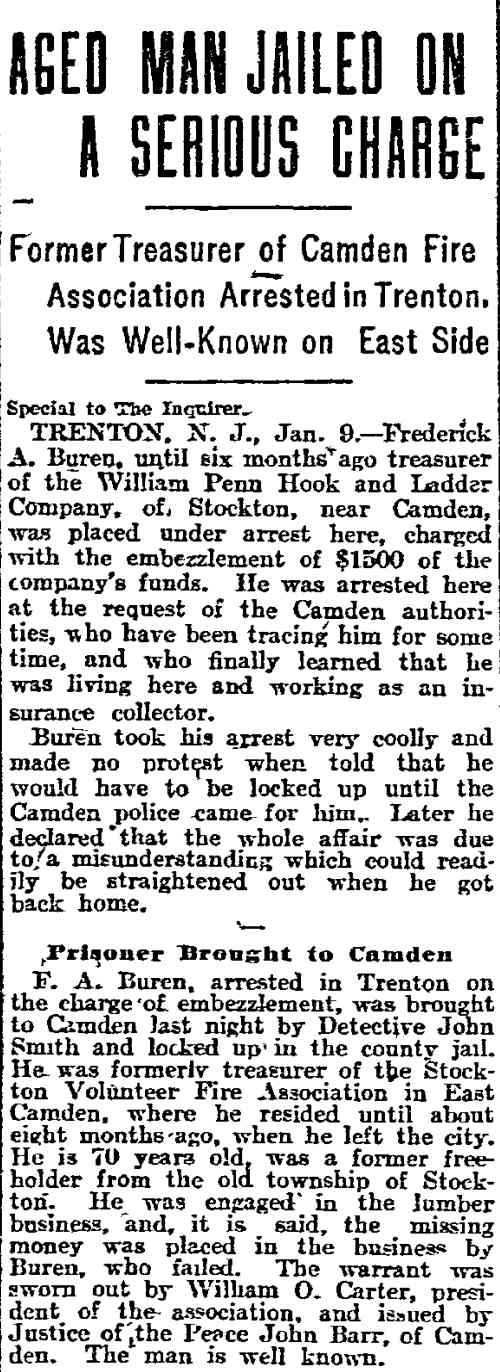
Former Treasurer of Camden Fire Association Arrested in Trenton, Was Well-Known on East Side
Special to The Inquirer.
TRENTON, N. J., Jan. 9.—Frederick A. Buren, until six months ago treasurer of the William Penn Hook and Ladder Company, of Stockton, near Camden, was placed under arrest here, charged with the embezzlement of $1500 of the company’s funds. He was arrested here at the request of the Camden authorities, who have been tracing him for some time, and who finally learned that he was living here and working as an insurance collector.
Buren took his arrest very coolly and made no protest when told that he would have to be locked up until the Camden police came for him. Later he declared that the whole affair was due to a misunderstanding which could readily be straightened out when he got back home.
Prisoner Brought to Camden
F. A. Buren, arrested in Trenton on the charge of embezzlement, was brought to Camden last night by Detective John Smith and locked up in the county jail. He was formerly treasurer of the Stockton Volunteer Fire Association in East Camden, where he resided until about eight months ago, when he left the city. He is 70 years old, was a former freeholder from the old township of Stockton. He was engaged in the lumber business, and, it is said, the missing money was placed in the business by Buren, who failed. The warrant was sworn out by William O. Carter, president of the association, and issued by Justice of the Peace John Barr, of Camden. The man is well known.
Detective Smith Turns in Badge
Philadelphia Inquirer —
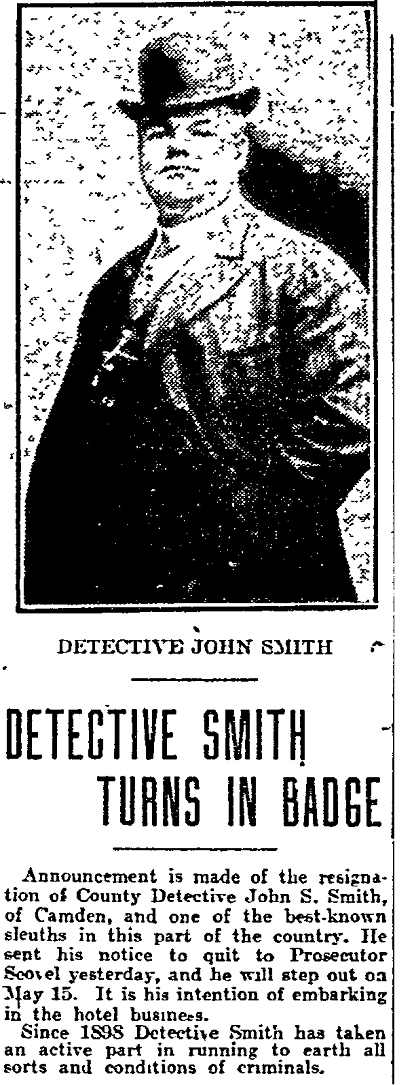
DETECTIVE JOHN SMITH
Announcement is made of the resignation of County Detective John S. Smith, of Camden, and one of the best-known sleuths in this part of the country. He sent his notice to quit to Prosecutor Scovel yesterday, and he will step out on May 15. It is his intention of embarking in the hotel business.
Since 1898 Detective Smith has taken an active part in running to earth all sorts and conditions of criminals.
Camden News Notes
Philadelphia Inquirer —
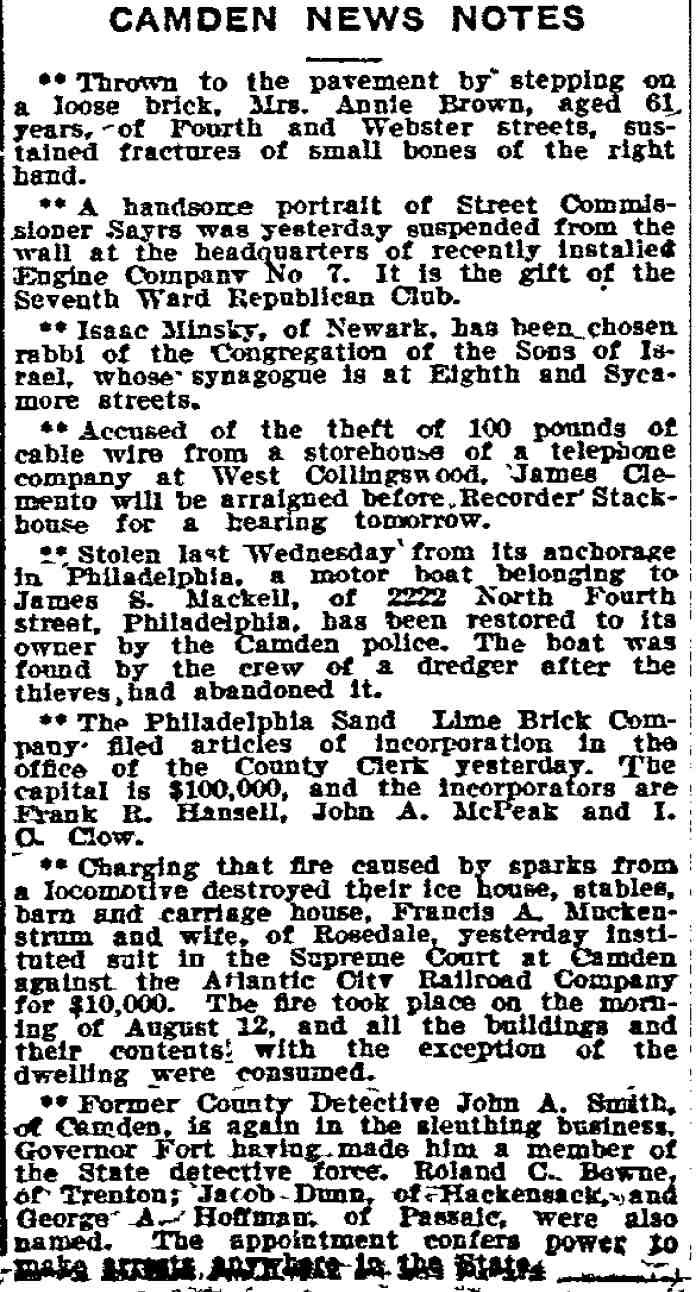
** Thrown to the pavement by stepping on a loose brick, Mrs. Annie Brown, aged 61 years, of Fourth and Webster streets, sustained fractures of small bones of the right hand.
** A handsome portrait of Street Commissioner Sayrs was yesterday suspended from the wall at the headquarters of recently installed Engine Company No. 7. It is the gift of the Seventh Ward Republican Club.
** Isaac Minsky, of Newark, has been chosen rabbi of the Congregation of the Sons of Israel, whose synagogue is at Eighth and Sycamore streets.
** Accused of the theft of 100 pounds of cable wire from a storehouse of a telephone company at West Collingswood, James Clemento will be arraigned before Recorder Stackhouse for a hearing tomorrow.
** Stolen last Wednesday from its anchorage in Philadelphia, a motor boat belonging to James S. Mackell, of 2222 North Fourth street, Philadelphia, has been restored to its owner by the Camden police. The boat was found by the crew of a dredger after the thieves had abandoned it.
** The Philadelphia Sand Lime Brick Company filed articles of incorporation in the office of the County Clerk yesterday. The capital is $100,000, and the incorporators are Frank R. Hansell, John A. McPeak and I. G. Clow.
** Charging that fire caused by sparks from a locomotive destroyed their ice house, stables, barn and carriage house, Francis A. Muckenstrum and wife, of Rosedale, yesterday instituted suit in the Supreme Court at Camden against the Atlantic City Railroad Company for $10,000. The fire took place on the morning of August 12, and all the buildings and their contents, with the exception of the dwelling were consumed.
** Former County Detective John A. Smith, of Camden, is again in the sleuthing business, Governor Fort having made him a member of the State detective force. Roland C. Bowne [?], of Trenton; Jacob Dunn, of Hackensack, and George A. Hoffman, of Passaic, were also named. The appointment confers power to make arrests anywhere in the State.
Doran Made County Detective
Philadelphia Inquirer —
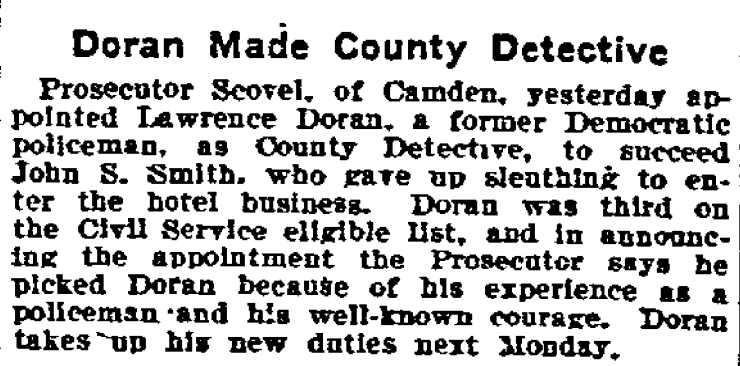
Prosecutor Scovel, of Camden, yesterday appointed Lawrence Doran, a former Democratic policeman, as County Detective, to succeed John S. Smith, who gave up sleuthing to enter the hotel business. Doran was third on the Civil Service eligible list, and in announcing the appointment the Prosecutor says he picked Doran because of his experience as a policeman and his well-known courage. Doran takes up his new duties next Monday.
“DAVID BAIRD TO FACE GRAND JURY”
Philadelphia Inquirer —
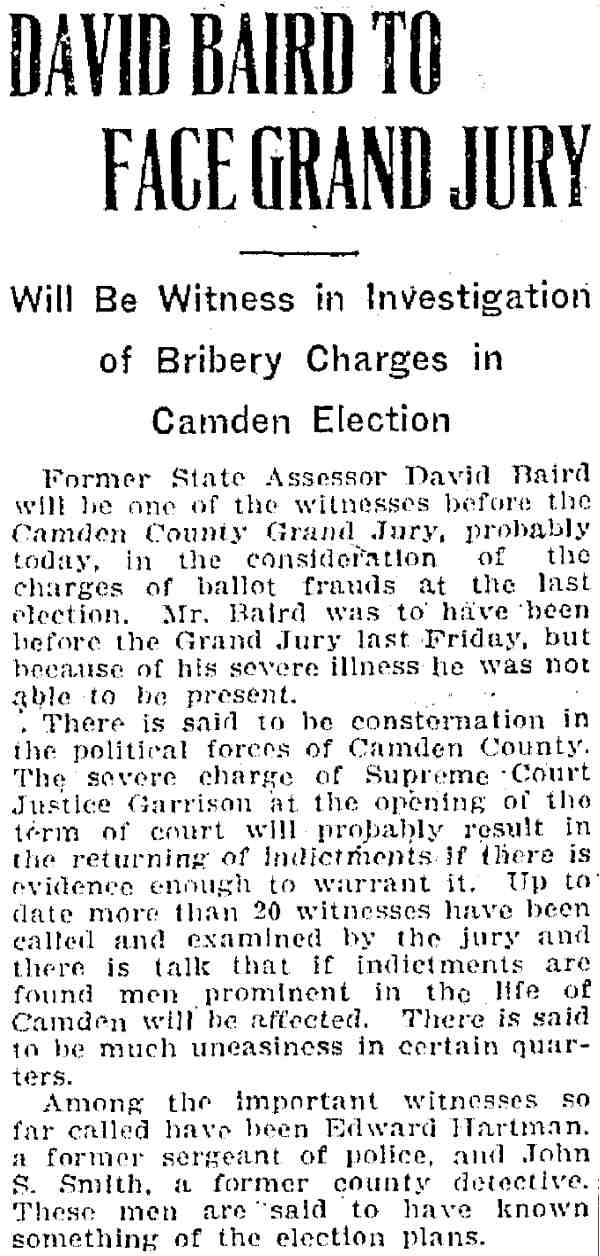
Will Be Witness in Investigation of Bribery Charges in Camden Election
Former State Assessor David Baird will be one of the witnesses before the Camden County Grand Jury, probably today, in the consideration of the charges of ballot frauds at the last election. Mr. Baird was to have been before the Grand Jury last Friday, but because of his severe illness he was not able to be present.
There is said to be consternation in the political forces of Camden County. The severe charge of Supreme Court Justice Garrison at the opening of the term of court will probably result in the returning of indictments if there is evidence enough to warrant it. Up to date more than 20 witnesses have been called and examined by the jury and there is talk that if indictments are found men prominent in the life of Camden will be affected. There is said to be much uneasiness in certain quarters.
Among the important witnesses so far called have been Edward Hartman, a former sergeant of police, and John S. Smith, a former county detective. These men are said to have known something of the election plans.
Camden News Notes
Philadelphia Inquirer —
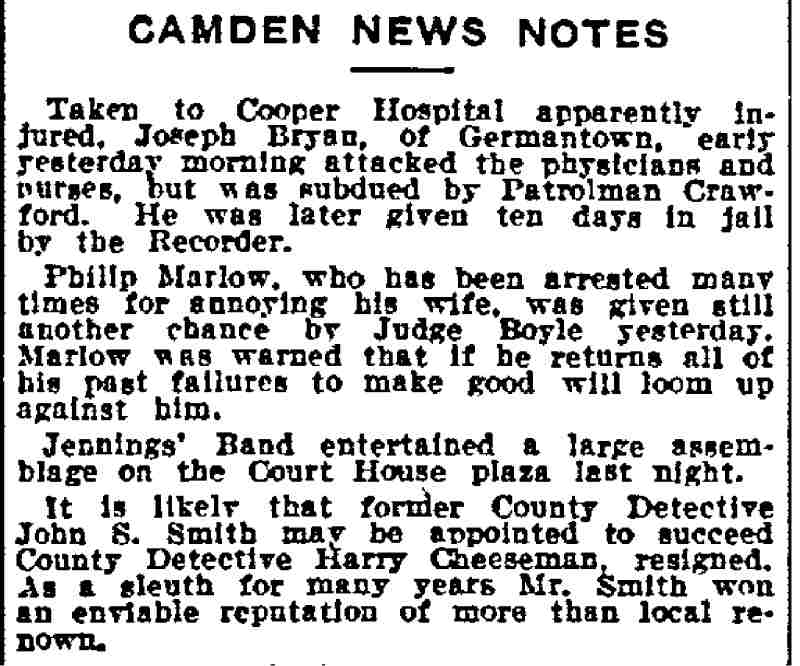
CAMDEN NEWS NOTES
Taken to Cooper Hospital apparently injured, Joseph Bryan, of Germantown, early yesterday morning attacked the physicians and nurses, but was subdued by Patrolman Crawford. He was later given ten days in jail by the Recorder.
Philip Marlow, who has been arrested many times for annoying his wife, was given still another chance by Judge Boyle yesterday. Marlow was warned that if he returns all of his past failures to make good will loom up against him.
Jennings’ Band entertained a large assemblage on the Court House plaza last night.
It is likely that former County Detective John S. Smith may be appointed to succeed County Detective Harry Cheeseman, resigned. As a sleuth for many years Mr. Smith won an enviable reputation of more than local renown.
Boy Thought Slain Concealed in Cave
Philadelphia Inquirer —
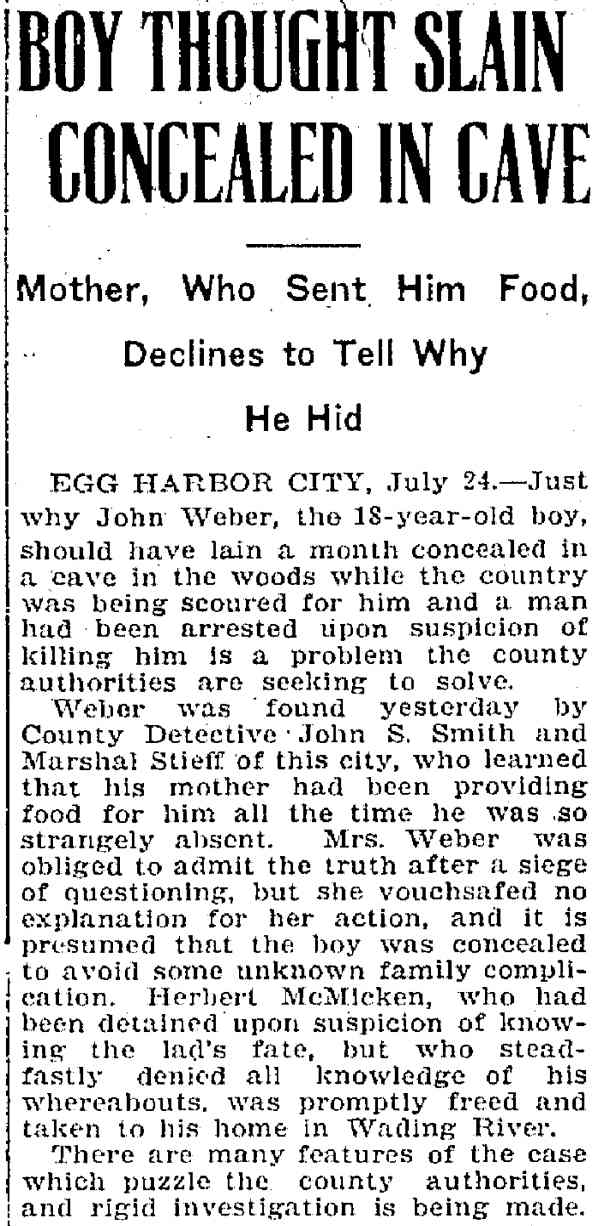
Mother, Who Sent Him Food, Declines to Tell Why He Hid
EGG HARBOR CITY, July 24.—Just why John Weber, the 18-year-old boy, should have lain a month concealed in a cave in the woods while the country was being scoured for him and a man had been arrested upon suspicion of killing him is a problem the county authorities are seeking to solve.
Weber was found yesterday by County Detective John S. Smith and Marshal Stieff of this city, who learned that his mother had been providing food for him all the time he was so strangely absent. Mrs. Weber was obliged to admit the truth after a siege of questioning, but she vouchsafed no explanation for her action, and it is presumed that the boy was concealed to avoid some unknown family complication. Herbert McMicken, who had been detained upon suspicion of knowing the lad’s fate, but who steadfastly denied all knowledge of his whereabouts, was promptly freed and taken to his home in Wading River.
There are many features of the case which puzzle the county authorities, and rigid investigation is being made.
Camden Police Officials Honored
Philadelphia Inquirer —
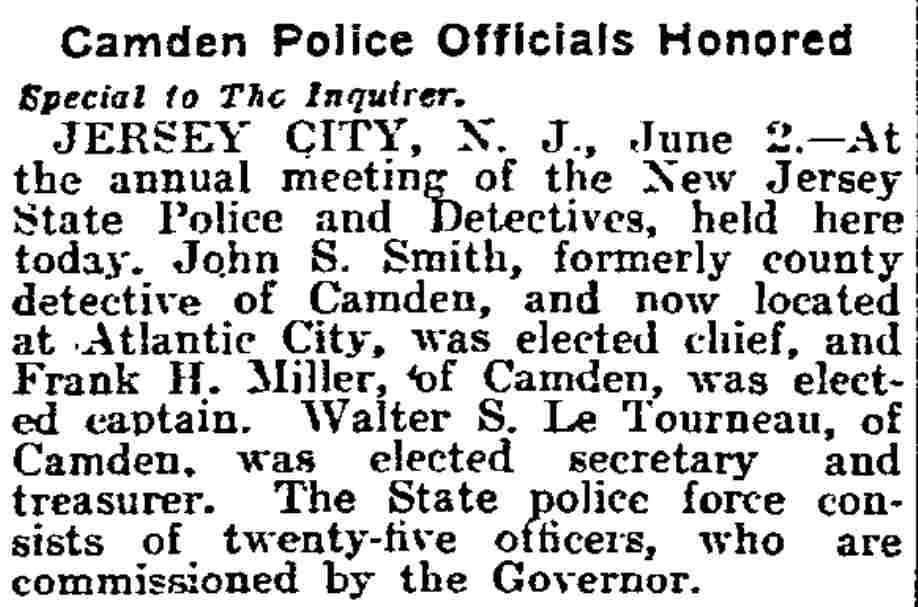
Special to The Inquirer.
JERSEY CITY, N. J., June 2.—At the annual meeting of the New Jersey State Police and Detectives, held here today. John S. Smith, formerly county detective of Camden, and now located at Atlantic City, was elected chief, and Frank H. Miller, of Camden, was elected captain. Walter S. Le Tourneau, of Camden, was elected secretary and treasurer. The State police force consists of twenty-five officers, who are commissioned by the Governor.
Mention May for New Commission
Trenton Evening Times —
Believe Governor Would Name Trenton Man, If Appointment Would Be Acceptable
Governor Edge stated today that he has not yet decided upon the men who are to make up the State Boxing Commission. He plans to have one member who has closely followed the sport and two others, who, while interested, would not be swayed by professionalism. Two of them he would desire to be of mature years and men of competence.
It is taken for granted that John S. Smith, hotel keeper in Atlantic City, and former county detective in Camden, will be selected. The Governor would also like to have Dr. J. E. Raycroft of Princeton University on the board. Dr. Raycroft resigned his place on the Board of Managers of the State Hospital here last month to take up war camp activities with the Fosdick Commission and may not be able to devote his time to the boxing commission. The Governor also has in mind the selection of a Y. M. C. A. athletic director for one of the places.
The highest compliments are also being paid Charles A. May, of this city, by friends who would like to see him on the board. There is a strong possibility thgat [sic] Mr. May might be named if he would be willing to serve.
Boxing Commissioners
Philadelphia Inquirer —
Governor Edge Appoints W. E. Cann, George Crain and John Smith
TRENTON, N. J., April 2.—W. E. Cann, of Elizabeth; George S. Grain, of Orange, and John S. Smith, of Atlantic City, were today appointed by Governor Edge as the commission under which eight-round boxing bouts recently legalized by the State Legislature are to be conducted.
Bouts supervised by the commission must be conducted in such a way as to avert any justifiable criticism, a statement from the Governor’s office today said.
Smith, who is known among his friends as “Big John,” was county detective in Camden for many years. Accompanying this announcement the executive said:
“I have called a meeting of the Commission in my office for 10.30 o’clock Saturday morning next, in order that I may outline to it my views as to the general policy to be pursued. I have individually interviewed the members of the Commission in order to impress upon them that the utmost care must be exercised in order that boxing in New Jersey, as conducted under the provision of this act, should be such as to avert any possible justifiable criticism.”
BOXING CHAIRMAN SMITH, 58, DIES
Jersey Journal —
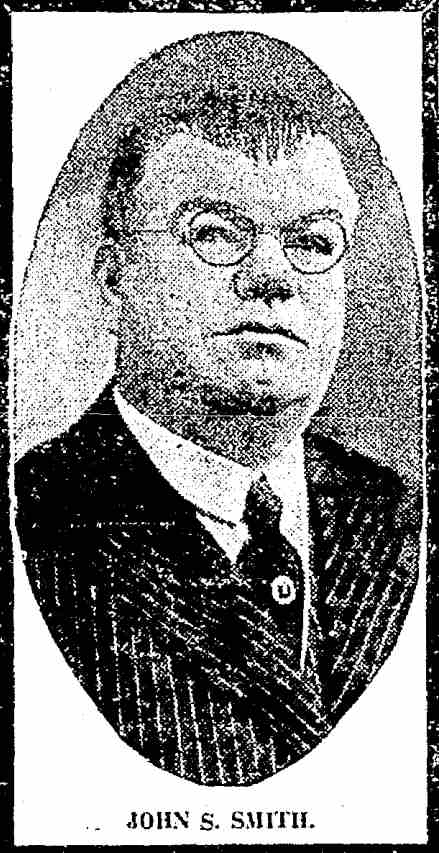
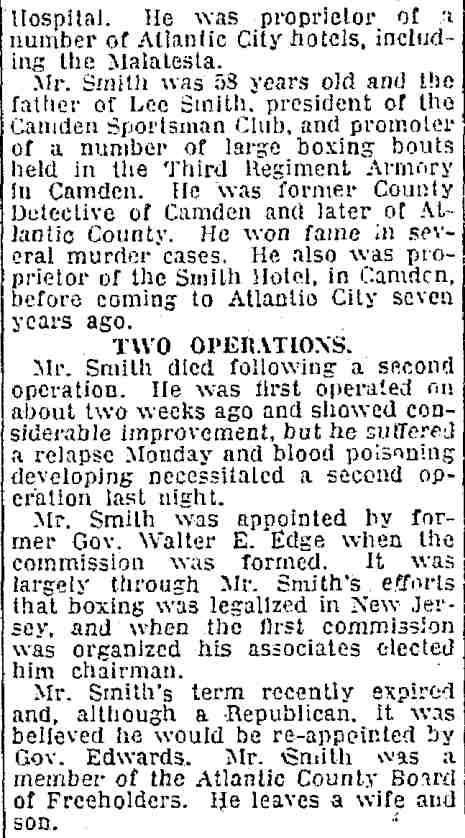
JOHN S. SMITH.
Atlantic City, April 22.—John S. Smith, president of the State Boxing Commission, died in the Hotel Whittle yesterday afternoon of internal hemorrhages following an operation for appendicitis. Mr. Smith was operated on ten days ago in the Atlantic City Hospital. He was proprietor of a number of Atlantic City hotels, including the Malatesta.
Mr. Smith was 58 years old and the father of Lee Smith, president of the Camden Sportsman Club, and promoter of a number of large boxing bouts held in the Third Regiment Armory in Camden. He was former County Detective of Camden and later of Atlantic County. He won fame in several murder cases. He also was proprietor of the Smith Hotel, in Camden, before coming to Atlantic City seven years ago.
TWO OPERATIONS.
Mr. Smith died following a second operation. He was first operated on about two weeks ago and showed considerable improvement, but he suffered a relapse Monday and blood poisoning developing necessitated a second operation last night.
Mr. Smith was appointed by former Gov. Walter E. Edge when the commission was formed. It was largely through Mr. Smith’s efforts that boxing was legalized in New Jersey, and when the first commission was organized his associates elected him chairman.
Mr. Smith’s term recently expired and, although a Republican, it was believed he would be re-appointed by Gov. Edwards. Mr. Smith was a member of the Atlantic County Board of Freeholders. He leaves a wife and son.
JOHN S. SMITH
Philadelphia Inquirer —
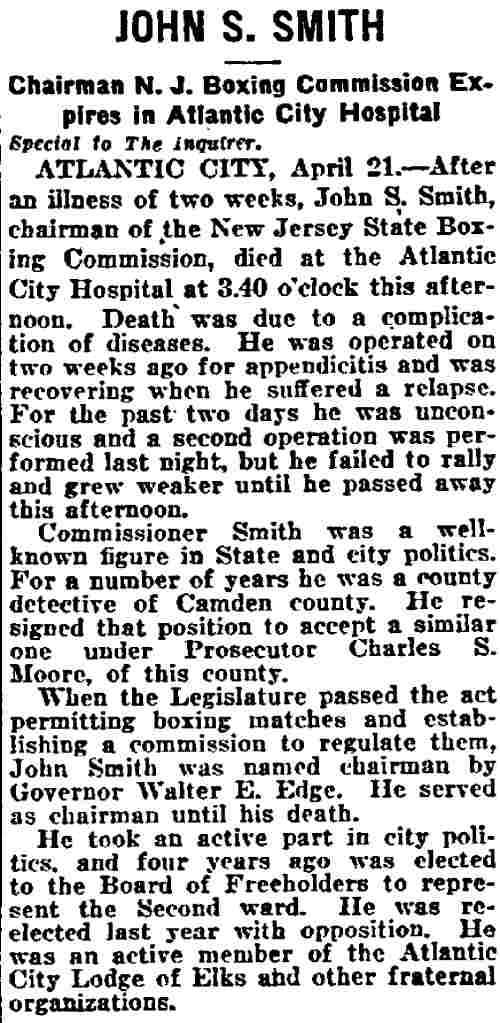
Chairman N. J. Boxing Commission Expires in Atlantic City Hospital
Special to The Inquirer.
ATLANTIC CITY, April 21.—After an illness of two weeks, John S. Smith, chairman of the New Jersey State Boxing Commission, died at the Atlantic City Hospital at 3.40 o’clock this afternoon. Death was due to a complication of diseases. He was operated on two weeks ago for appendicitis and was recovering when he suffered a relapse. For the past two days he was unconscious and a second operation was performed last night, but he failed to rally and grew weaker until he passed away this afternoon.
Commissioner Smith was a well-known figure in State and city politics. For a number of years he was a county detective of Camden county. He resigned that position to accept a similar one under Prosecutor Charles S. Moore, of this county.
When the Legislature passed the act permitting boxing matches and establishing a commission to regulate them, John Smith was named chairman by Governor Walter E. Edge. He served as chairman until his death.
He took an active part in city politics, and four years ago was elected to the Board of Freeholders to represent the Second ward. He was re-elected last year with opposition. He was an active member of the Atlantic City Lodge of Elks and other fraternal organizations.
BOXING BOARD CHAIRMAN DIES AT ATLANTIC CITY
Trenton Evening Times —
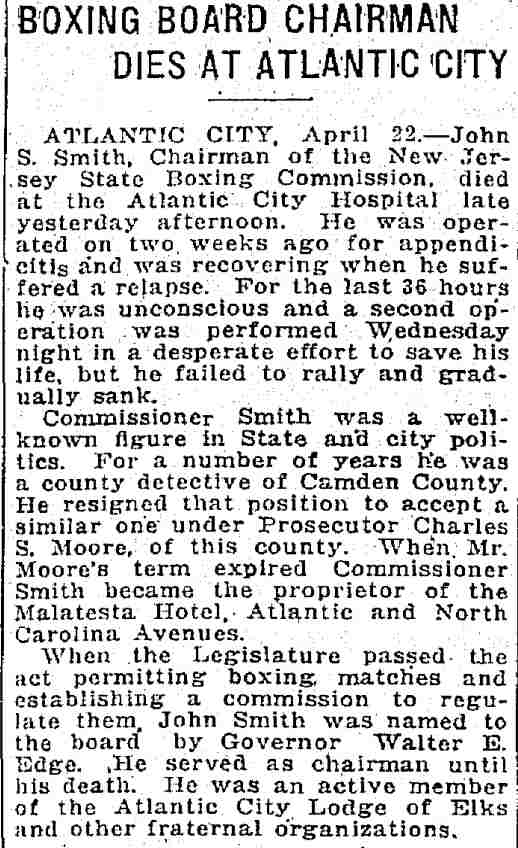
ATLANTIC CITY, April 22.—John S. Smith, Chairman of the New Jersey State Boxing Commission, died at the Atlantic City Hospital late yesterday afternoon. He was operated on two weeks ago for appendicitis and was recovering when he suffered a relapse. For the last 36 hours he was unconscious and a second operation was performed Wednesday night in a desperate effort to save his life, but he failed to rally and gradually sank.
Commissioner Smith was a well-known figure in State and city politics. For a number of years he was a county detective of Camden County. He resigned that position to accept a similar one under Prosecutor Charles S. Moore, of this county. When Mr. Moore’s term expired Commissioner Smith became the proprietor of the Malatesta Hotel, Atlantic and North Carolina Avenues.
When the Legislature passed the act permitting boxing matches and establishing a commission to regulate them, John Smith was named to the board by Governor Walter E. Edge. He served as chairman until his death. He was an active member of the Atlantic City Lodge of Elks and other fraternal organizations.
A Chip Off the Old Block
Camden Courier-Post —
Excerpt from Dan McConnell’s Scrapbook column:
The axiom of like father, like son is particularly apt in the life of F. Lee Smith, new Democratic leader of Delaware Township.
His is a political heritage handed down by his late father the beloved John S. Smith, former Camden County detective and first boxing inspector, who later was a freeholder in Atlantic County when he operated the once-famous Malatesta Hotel.
Until his death the elder Smith was affectionately known as “Rye Beach” Smith.
For many years, when this writer was the skipper of a 16-foot sailing skiff that skimmed over the then non-polluted waters of the placid Delaware River, the elder Smith operated a tavern in a section nicknamed “Rye Beach.”
The beverage bistro was the meeting place of all North Camden fight and baseball fans and the walls were adorned with greats of the prize ring and baseball diamonds of those pristine days. The place afterwards was a gospel mission.
Later John Smith opened a more ornate drinkery at Fourth and Federal Streets. The sports celebrities and the faithful gathered there. It was a meeting place for veteran newspapermen, who quaffed amber brew from long stems.
In those days officials in positions to enforce the law had no qualms about petty gambling. A popular game at Smith’s tavern was played with an electric fan, the blades of which were numbered. The older newspaper boys passed the time away playing for the cost of the drinks.
Carry on, F. Lee Smith.
Life Hereabouts
Camden Courier-Post —
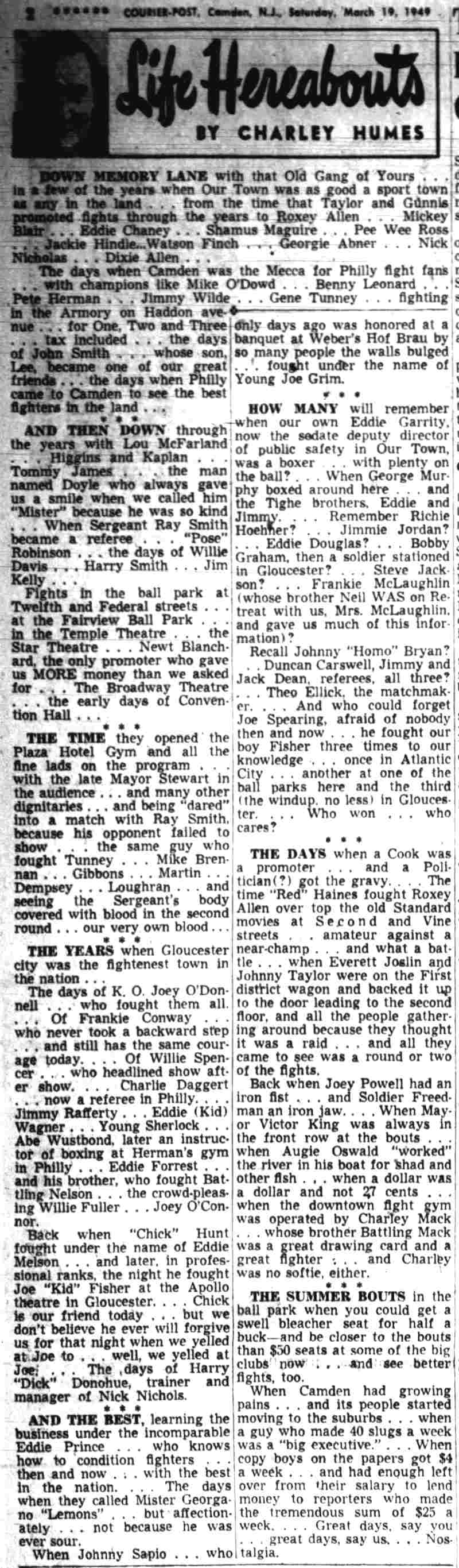
DOWN MEMORY LANE with that Old Gang of Yours . . . in a few of the years when Our Town was as good a sport town as any in the land . . . from the time that Taylor and Gunnis promoted fights through the years to Roxey Allen . . . Mickey Blair . . . Eddie Chaney . . . Shamus Maguire . . . Pee Wee Ross . . . Jackie Hindle . . . Watson Finch . . . Georgie Abner . . . Nick Nicholas . . . Dixie Allen . . .
The days when Camden was the Mecca for Philly fight fans . . . with champions like Mike O’Dowd . . . Benny Leonard . . . Pete Herman . . . Jimmy Wilde . . . Gene Tunney . . . fighting in the Armory on Haddon avenue . . . for One, Two and Three . . . tax included . . . the days of John Smith . . . whose son, Lee, became one of our great friends . . . the days when Philly came to Camden to see the best fighters in the land . . .
AND THEN DOWN through the years with Lou McFarland . . . Higgins and Kaplan . . . Tommy James . . . the man named Doyle who always gave us a smile when we called him “Mister” because he was so kind . . . When Sergeant Ray Smith became a referee . . . “Pose” Robinson . . . the days of Willie Davis . . . Harry Smith . . . Jim Kelly . . .
Fights in the ball park at Twelfth and Federal streets . . . at the Fairview Ball Park . . . in the Temple Theatre . . . the Star Theatre . . . Newt Blanchard, the only promoter who gave us MORE money than we asked for . . . The Broadway Theatre . . . the early days of Convention Hall . . .
THE TIME they opened the Plaza Hotel Gym and all the fine lads on the program . . . with the late Mayor Stewart in the audience . . . and many other dignitaries . . . and being “dared” into a match with Ray Smith, because his opponent failed to show . . . the same guy who fought Tunney . . . Mike Brennan . . . Gibbons . . . Martin . . . Dempsey . . . Loughran . . . and seeing the Sergeant’s body covered with blood in the second round . . . our very own blood . . .
THE YEARS when Gloucester city was the fightenest town in the nation . . .
The days of K. O. Joey O’Donnell . . . who fought them all. . . Of Frankie Conway . . . who never took a backward step . . . and still has the same courage today. . . . Of Willie Spencer . . . who headlined show after show. . . . Charlie Daggert . . . now a referee in Philly. . . . Jimmy Rafferty . . . Eddie (Kid) Wagner . . . Young Sherlock . . . Abe Wustbond, later an instructor of boxing at Herman’s gym in Philly . . . Eddie Forrest . . . and his brother, who fought Battling Nelson . . . the crowd-pleasing Willie Fuller . . . Joey O’Connor.
Back when “Chick” Hunt fought under the name of Eddie Melson . . . and later, in professional ranks, the night he fought Joe “Kid” Fisher at the Apollo theatre in Gloucester. . . . Chick is our friend today . . . but we don’t believe he ever will forgive us for that night when we yelled at Joe to . . . well, we yelled at Joe . . . The days of Harry “Dick” Donohue, trainer and manager of Nick Nichols.
AND THE BEST, learning the business under the incomparable Eddie Prince . . . who knows how to condition fighters . . . then and now . . . with the best in the nation. . . . The days when they called Mister Georgano “Lemons” . . . but affectionately . . . not because he was ever sour.
When Johnny Sapio . . . who only days ago was honored at a banquet at Weber’s Hof Brau by so many people the walls bulged . . . fought under the name of Young Joe Grim.
HOW MANY will remember when our own Eddie Garrity, now the sedate deputy director of public safety in Our Town, was a boxer . . . with plenty on the ball? . . . When George Murphy boxed around here . . . and the Tighe brothers, Eddie and Jimmy . . . Remember Richie Hoehner? . . . Jimmie Jordan? . . . Eddie Douglas? . . . Bobby Graham, then a soldier stationed in Gloucester? . . . Steve Jackson? . . . Frankie McLaughlin (whose brother Neil WAS on Retreat with us, Mrs. McLaughlin, and gave us much of this information)?
Recall Johnny “Homo” Bryan? . . . Duncan Carswell, Jimmy and Jack Dean, referees, all three? . . . Theo Ellick, the matchmaker. . . . And who could forget Joe Spearing, afraid of nobody then and now . . . he fought our boy Fisher three times to our knowledge . . . once in Atlantic City . . . another at one of the ball parks here and the third (the windup, no less) in Gloucester. . . . Who won . . . who cares?
THE DAYS when a Cook was a promoter . . . and a Politician(?) got the gravy. . . . The time “Red” Haines fought Roxey Allen over top the old Standard movies at Second and Vine streets . . . amateur against a near-champ . . . and what a battle . . . when Everett Joslin and Johnny Taylor were on the First district wagon and backed it up to the door leading to the second floor, and all the people gathering around because they thought it was a raid . . . and all they came to see was a round or two of the fights.
Back when Joey Powell had an iron fist . . . and Soldier Freedman an iron jaw. . . . When Mayor Victor King was always in the front row at the bouts . . . when Augie Oswald “worked” the river in his boat for shad and other fish . . . when a dollar was a dollar and not 27 cents . . . when the downtown fight gym was operated by Charley Mack . . . whose brother Battling Mack was a great drawing card and a great fighter . . . and Charley was no softie, either.
THE SUMMER BOUTS in the ball park when you could get a swell bleacher seat for half a buck—and be closer to the bouts than $50 seats at some of the big clubs now . . . and see better fights, too.
When Camden had growing pains . . . and its people started moving to the suburbs . . . when a guy who made 40 slugs a week was a “big executive.” . . . When copy boys on the papers got $4 a week . . . and had enough left over from their salary to lend money to reporters who made the tremendous sum of $25 a week. . . . Great days, say you . . . great days, say us. . . . Nostalgia.