Introduction
JACOB FREDERICK VOIGT was born in New Jersey in July of 1856. His parents were born in Germany. Little else is known of his early life, save that he was fluent in his parents’ language to the point that he was employed as a court interpreter later in life. He married early in 1881 and was living in Moorestown, New Jersey when his wife Annie gave birth to their son, Frank Voigt, on October 3, 1881.
J. Fred Voigt first appears in Camden’s City Directories in 1885. He was living at 332 Berkley Street and had a small business at Fourth and Federal Streets. The 1887–1888 and 1888–1889 City Directories show him living at 20 South 4th Street, where he had a cigar store. A staunch Republican, J. Fred Voigt was rewarded with an appointment to the Camden Fire Department in January of 1889. He was then living at 443 Mickle Street.
J. Fred Voigt resigned from the Fire Department in July of 1891. He worked as a special officer, either for the city of Camden or as an officer of the court in 1892. By the summer of 1893 J. Fred Voigt had moved to 204 South 5th Street and opened up a cigar store at this location. The Voigts remained at this address into 1899. J. Fred Voigt served as a Constable in 1897 and again in 1900. He was employed at the Camden County jail in 1902 and 1903 during the time Paul Woodward was incarcerated there, and assisted Sheriff Christopher Mines Jr. with Woodward’s execution for murder on January 7, 1903.
The 1900 Census shows J. Fred Voigt, wife Anna and son Frank at 527 Mickle Street. By 1906 they had moved to 326 Warren Avenue. J. Fred Voigt was then working as a court interpreter, according to the City Directory. Son Frank Voigt passed the New Jersey bar examination in March of 1910. When the Census was taken in April of 1910 J. Fred Voigt was sergeant-at-arms of the Camden District Court. He held that position until March of 1912. The 1914 Camden City Directory indicates that he was working for the Camden Police Department and living at 636 Penn Street, around the corner from his son Frank, who lived at 635 Linden Street. Both J. Fred Voigt and Frank Voigt had moved out of Camden by the summer of 1918.
When the census was taken in January of 1920, J. Fred Voigt was working at the Camden County Jail. He was living with a cousin, Elizabeth Martin, at 231 East Kings Highway in Haddonfield, New Jersey. J. Fred Voigt was still living with his cousin at the East Kings Highway address when the census was taken in April of 1930. He then owned a sandwich shop, according to the Census. J. Frederick Voigt passed away during the 1930s.
Four Firemen Hurt
Philadelphia Inquirer –
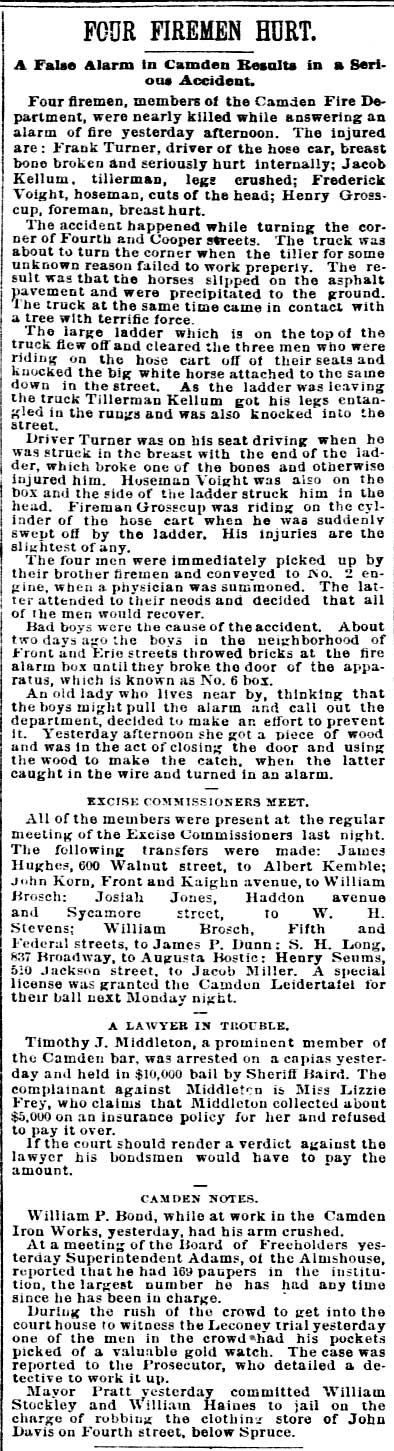
FOUR FIREMEN HURT.
A False Alarm in Camden Results in a Serious Accident.
Four firemen, members of the Camden Fire Department, were nearly killed while answering an alarm of fire yesterday afternoon. The injured are: Frank Turner, driver of the hose car, breast bone broken; Horseman Voight, Jacob Kellum, tillerman, legs crushed; Frederick Voight, horseman, cut on head; Henry Grosscup, foreman, breast hurt.
The accident happened while turning the corner of Front and Camden Streets, with the truck, when the tiller for some unknown reason failed to work properly. The large truck which is on the top of the ladder knocked the big white horse attached to the same into the street. Three of the men who were riding the truck Tillerman Kellum got his legs entangled in the ladder and was dragged along the street.
Driver Turner was on his seat driving when he was struck in the breast with the end of the ladder and was knocked from his seat. Horseman Voight was also on the seat and when his horse fell over the pavement and were precipitated to the ground. Foreman Grosscup was riding on the cylinder of the hose carriage. His injuries are the least of any.
All of the members were present at the regular meeting of the Excise Commissioners Meet.
See also: Frank Turner — Jacob Kellum — Henry Grosscup — Ladder Company 1 — Engine Company 2 — North 4th Street — Cooper Street — Front Street — Erie Street
Philadelphia Inquirer – July 11, 1891

Fireman Fred Voight, against whom charges were made at the last meeting of the Fire Commissioners, has resigned, to take effect immediately.
Philadelphia Inquirer – July 26, 1891
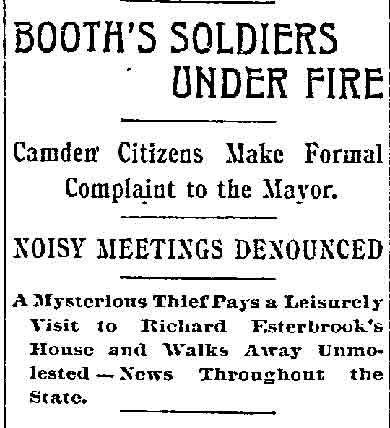
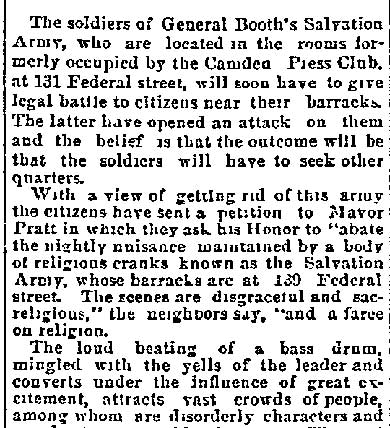
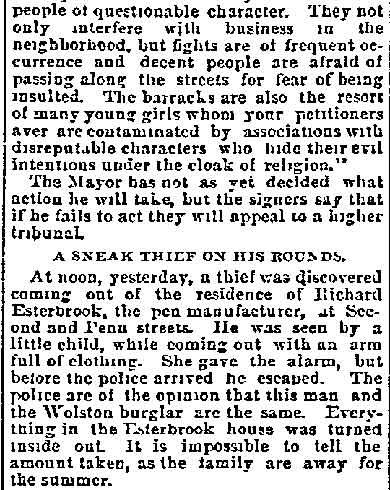
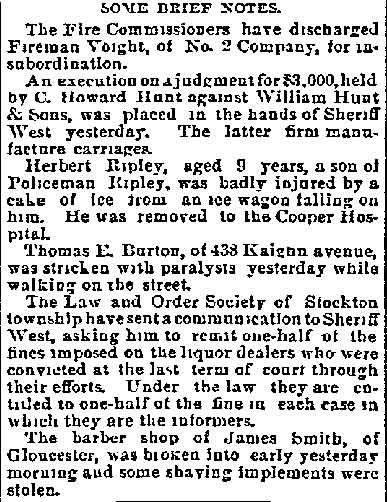
Named: Philadelphia Inquirer, July 26, 1891. See also: PDF version. Related: Jesse Pratt, Engine Company 2, C. Howard Hunt, Federal Street, North 2nd Street, Penn Street, and Kaighn Avenue.
Camden Daily Courier – May 12, 1898
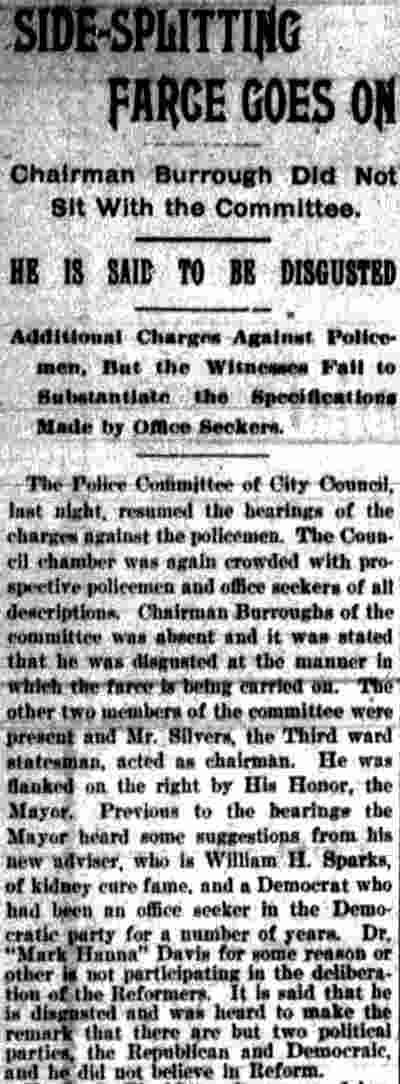
SIDE-SPLITTING FARCE GOES ON
Chairman Burrough Did Not Sit With the Committee.
HE IS SAID TO BE DISGUSTED
Additional Charges Against Policemen, But the Witnesses Fail to Substantiate the Specifications Made by Office Seekers.
The Police Committee of City Council, last night, resumed the hearings of the charges against the policemen. The Council chamber was again crowded with prospective policemen and office seekers of all descriptions. Chairman Burroughs of the committee was absent and it was stated that he was disgusted at the manner in which the farce is being carried on. The other two members of the committee were present and Mr. Silvers, the Third ward statesman, acted as chairman. He was flanked on the right by His Honor, the Mayor. Previous to the hearings the Mayor heard some suggestions from his new adviser, who is William H. Sparks, of kidney cure fame, and a Democrat who had been an office seeker in the Democratic party for a number of years. Dr. “Mark Hanna” Davis for some reason or other is not participating in the deliberation of the Reformers. It is said that he is disgusted and was heard to make the remark that there are but two political parties, the Republican and Democratic, and he did not believe in Reform.
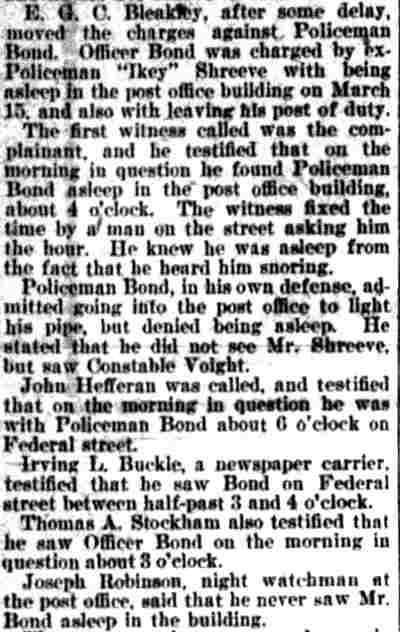
E. G. C. Bleakley, after some delay, moved the charges against Policeman Bond. Officer Bond was charged by ex-Policeman “Ikey” Shreeve with being asleep in the post office building on March 15, and also with leaving his post of duty.
The first witness called was the complainant, and he testified that on the morning in question he found Policeman Bond asleep in the post office building, about 4 o’clock. The witness fixed the time by a man on the street asking him the hour. He knew he was asleep from the fact that he heard him snoring.
Policeman Bond, in his own defense, admitted going into the post office to light his pipe, but denied being asleep. He stated that he did not see Mr. Shreeve, but saw Constable Voight.
John Hefferan was called, and testified that on the morning in question he was with Policeman Bond about 6 o’clock on Federal street.
Irving L. Buckle, a newspaper carrier, testified that he saw Bond on Federal street between half-past 3 and 4 o’clock.
Thomas A. Stockham also testified that he saw Officer Bond on the morning in question about 3 o’clock.
Joseph Robinson, night watchman at the post office, said that he never saw Mr. Bond asleep in the building.
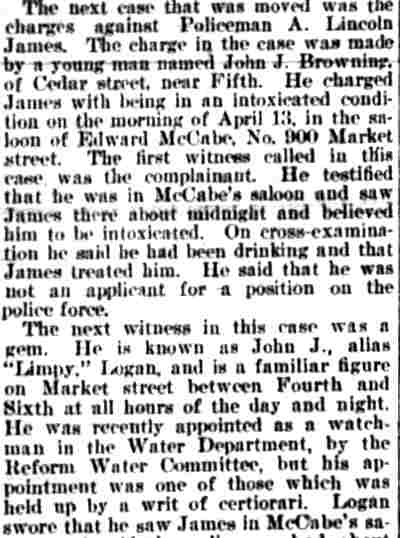
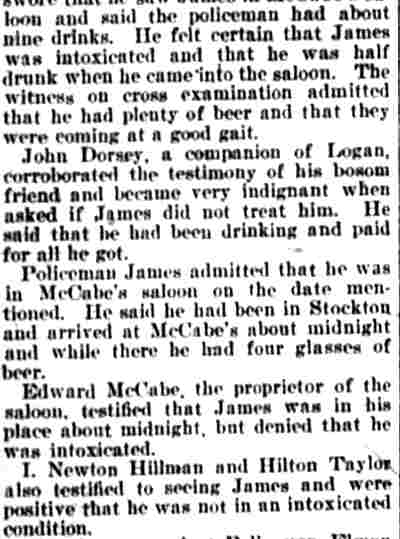
The next case that was moved was the charges against Policeman A. Lincoln James. The charge in the case was made by a young man named John J. Browning, of Cedar street, near Fifth. He charged James with being in an intoxicated condition on the morning of April 13, in the saloon of Edward McCabe, No. 900 Market street. The first witness called in this case was the complainant. He testified that he was in McCabe’s saloon and saw James there about midnight and believed him to be intoxicated. On cross-examination he said he had been drinking and that James treated him. He said that he was not an applicant for a position on the police force.
The next witness in this case was a gem. He is known as John J., alias “Limpy,” Logan, and is a familiar figure on Market street between Fourth and Sixth at all hours of the day and night. He was recently appointed as a watchman in the Water Department, by the Reform Water Committee, but his appointment was one of those which was held up by a writ of certiorari. Logan swore that he saw James in McCabe’s sa-
loon and said the policeman had about nine drinks. He felt certain that James was intoxicated and that he was half drunk when he came into the saloon. The witness on cross examination admitted that he had plenty of beer and that they were coming at a good gait.
John Dorsey, a companion of Logan, corroborated the testimony of his bosom friend and became very indignant when asked if James did not treat him. He said that he had been drinking and paid for all he got.
Policeman James admitted that he was in McCabe’s saloon on the date mentioned. He said he had been in Stockton and arrived at McCabe’s about midnight and while there he had four glasses of beer.
Edward McCabe, the proprietor of the saloon, testified that James was in his place about midnight, but denied that he was intoxicated.
I. Newton Hillman and Hilton Taylor also testified to seeing James and were positive that he was not in an intoxicated condition.
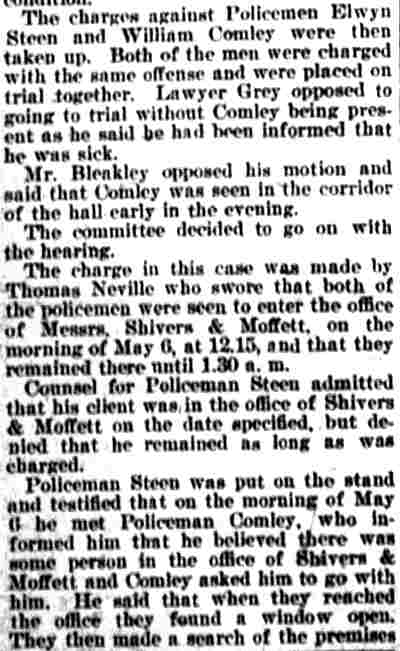
The charges against Policemen Elwyn Steen and William Comley were then taken up. Both of the men were charged with the same offense and were placed on trial together. Lawyer Grey opposed to going to trial without Comley being present as he said he had been informed that he was sick.
Mr. Bleakley opposed his motion and said that Comley was seen in the corridor of the hall early in the evening.
The committee decided to go on with the hearing.
The charge in this case was made by Thomas Neville who swore that both of the policemen were seen to enter the office of Messrs. Shivers & Moffett, on the morning of May 6, at 12.15, and that they remained there until 1.30 a. m.
Counsel for Policeman Steen admitted that his client was in the office of Shivers & Moffett on the date specified, but denied that he remained as long as was charged.
Policeman Steen was put on the stand and testified that on the morning of May 6 he met Policeman Comley, who informed him that he believed there was some person in the office of Shivers & Moffett and Comley asked him to go with him. He said that when they reached the office they found a window open. They then made a search of the premises
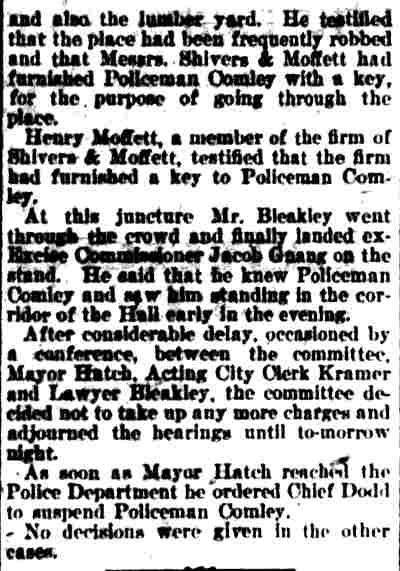
and also the lumber yard. He testified that the place had been frequently robbed and that Messrs. Shivers & Moffett had furnished Policeman Comley with a key, for the purpose of going through the place.
Henry Moffett, a member of the firm of Shivers & Moffett, testified that the firm had furnished a key to Policeman Comley.
At this juncture Mr. Bleakley went through the crowd and finally landed ex-Excise Commissioner Jacob Gnang on the stand. He said that he knew Policeman Comley and saw him standing in the corridor of the Hall early in the evening.
After considerable delay, occasioned by a conference, between the committee, Mayor Hatch, Acting City Clerk Kramer and Lawyer Bleakley, the committee decided not to take up any more charges and adjourned the hearings until to-morrow night.
As soon as Mayor Hatch reached the Police Department he ordered Chief Dodd to suspend Policeman Comley.
No decisions were given in the other cases.
Camden Post-Telegram – February 10, 1900
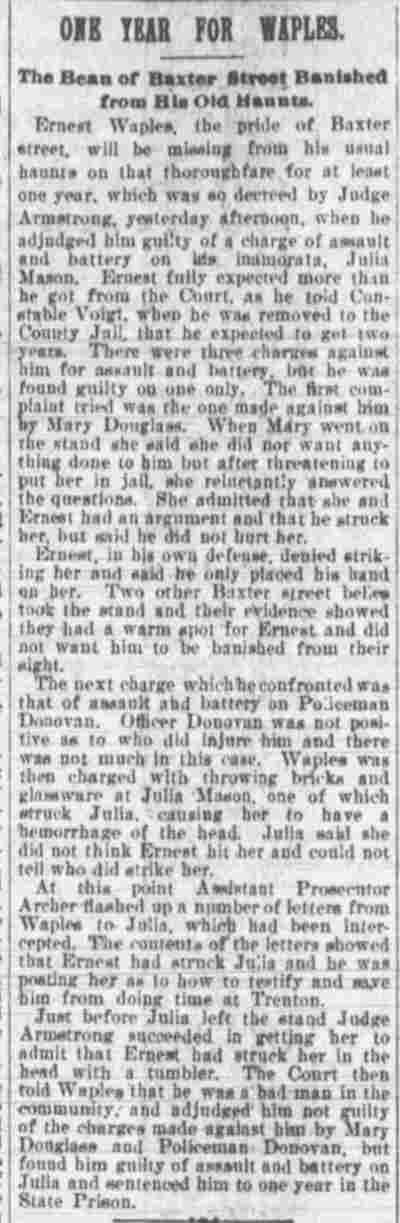
ONE YEAR FOR WAPLES.
The Bean of Baxter Street Banished from His Old Haunts.
Ernest Waples, the pride of Baxter street, will be missing from his usual haunts on that thoroughfare for at least one year, which was so decreed by Judge Armstrong, yesterday afternoon, when he adjudged him guilty of a charge of assault and battery on his inamorata, Julia Mason. Ernest fully expected more than he got from the Court, as he told Constable Voigt, when he was removed to the County Jail, that he expected to get two years. There were three charges against him for assault and battery, but he was found guilty on one only. The first complaint tried was the one made against him by Mary Douglass. When Mary went on the stand she said she did not want anything done to him but after threatening to put her in jail, she reluctantly answered the questions. She admitted that she and Ernest had an argument and that he struck her, but said he did not hurt her.
Ernest, in his own defense, denied striking her and said he only placed his hand on her. Two other Baxter street belles took the stand and their evidence showed they had a warm spot for Ernest and did not want him to be banished from their sight.
The next charge which he confronted was that of assault and battery on Policeman Donovan. Officer Donovan was not positive as to who did injure him and there was not much in this case. Waples was then charged with throwing bricks and glassware at Julia Mason, one of which struck Julia, causing her to have a hemorrhage of the head. Julia said she did not think Ernest hit her and could not tell who did strike her.
At this point Assistant Prosecutor Archer flashed up a number of letters from Waples to Julia, which had been intercepted. The contents of the letters showed that Ernest had struck Julia and he was posting her as to how to testify and save him from doing time at Trenton.
Just before Julia left the stand Judge Armstrong succeeded in getting her to admit that Ernest had struck her in the head with a tumbler. The Court then told Waples that he was a bad man in the community, and adjudged him not guilty of the charges made against him by Mary Douglass and Policeman Donovan, but found him guilty of assault and battery on Julia and sentenced him to one year in the State Prison.
Philadelphia Inquirer – May 11, 1900
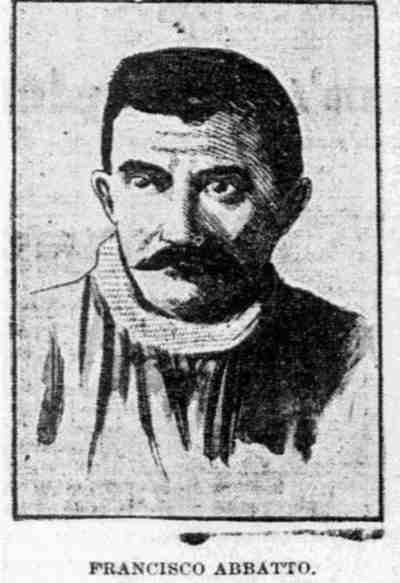
FRANCISCO ABBATTO.
Philadelphia Inquirer – July 4, 1900
STILL PROBING SUNDAY LIQUOR SELLING CASES
Rumors That Grand Jury May Ignore Complaints Turned Down by Previous Grand Jury
The grand jury of Camden county heard additional witnesses of the Law and Order League yesterday on complaints against Sunday liquor sellers. The witnesses in the case of Rev. C. B. Fisher, who claims he was assaulted at Gloucester City on Sunday, were also heard.
It was rumored about the court house that the cases of the forty-eight saloon-keepers which were ignored by the former grand jury would also be ignored by the present body, because the members do not want to cast a slight on the previous grand jury. The rumor, however, is believed to be without foundation, owing to Justice Garrison's charge on the point.
Constable Frederick Voight went to Gloucester City last evening with warrants for James Annenbach and John Eck.
Philadelphia Inquirer – August 19, 1900
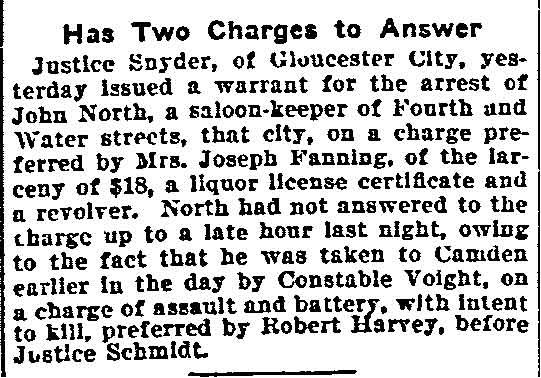
Has Two Charges to Answer
Justice Snyder, of Gloucester City, yesterday issued a warrant for the arrest of John North, a saloon-keeper of Fourth and Water streets, that city, on a charge preferred by Mrs. Joseph Fanning, of the larceny of $18, a liquor license certificate and a revolver. North had not answered to the charge up to a late hour last night, owing to the fact that he was taken to Camden earlier in the day by Constable Voight, on a charge of assault and battery, with intent to kill, preferred by Robert Harvey, before Justice Schmidt.
Philadelphia Inquirer – February 6, 1901
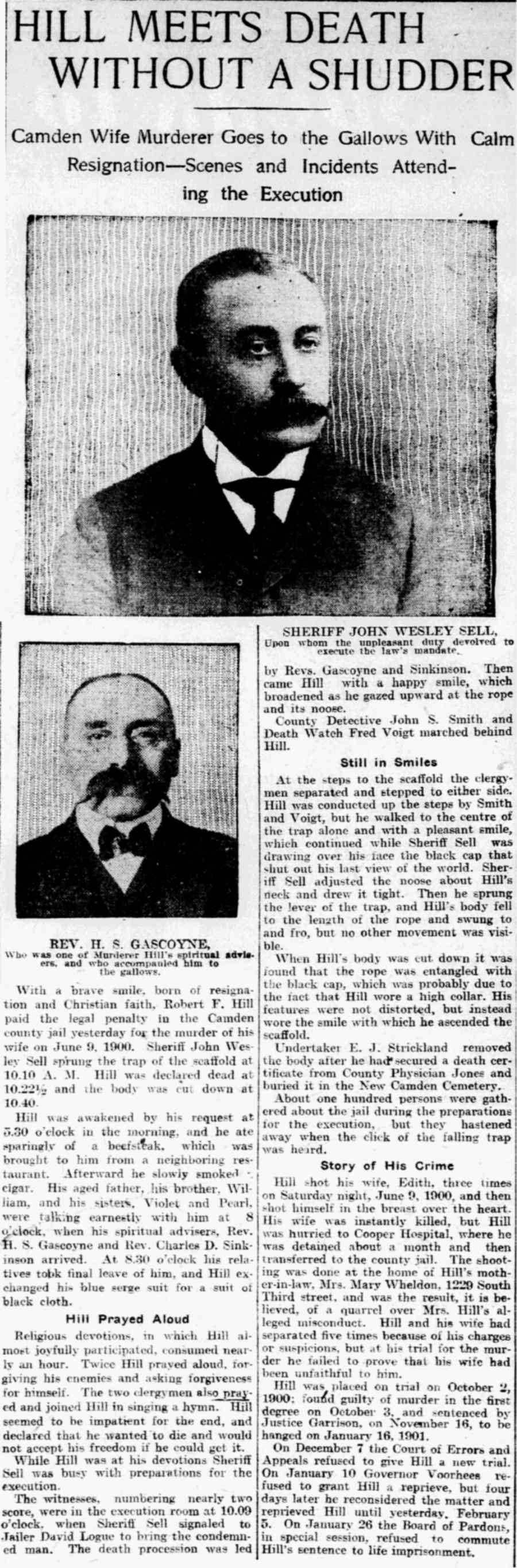
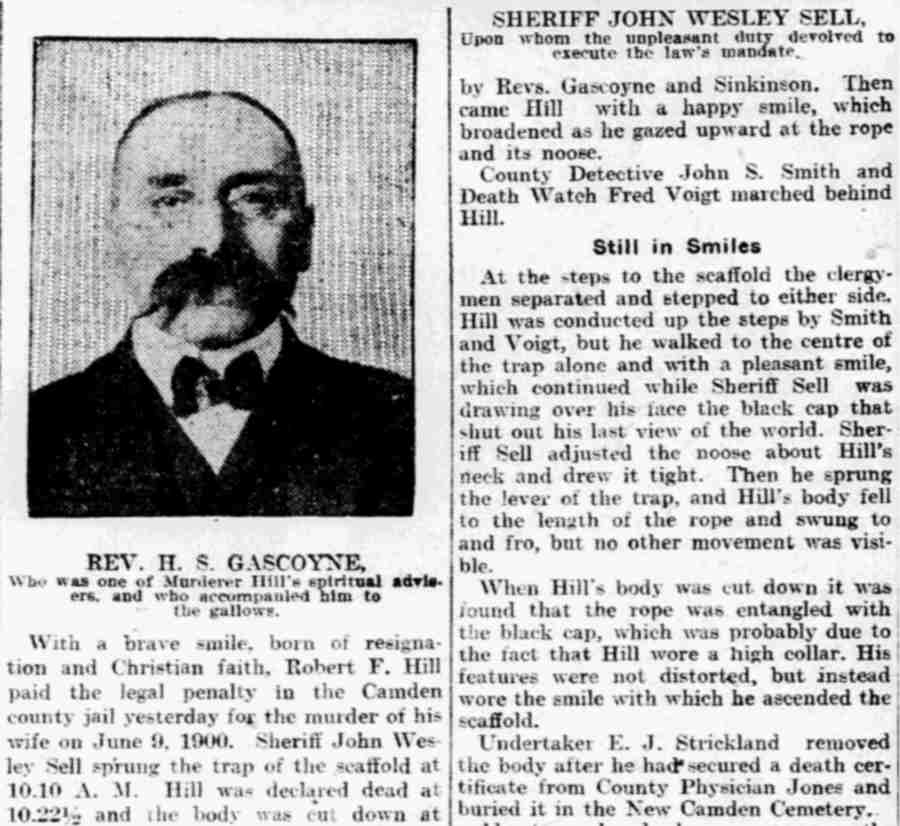
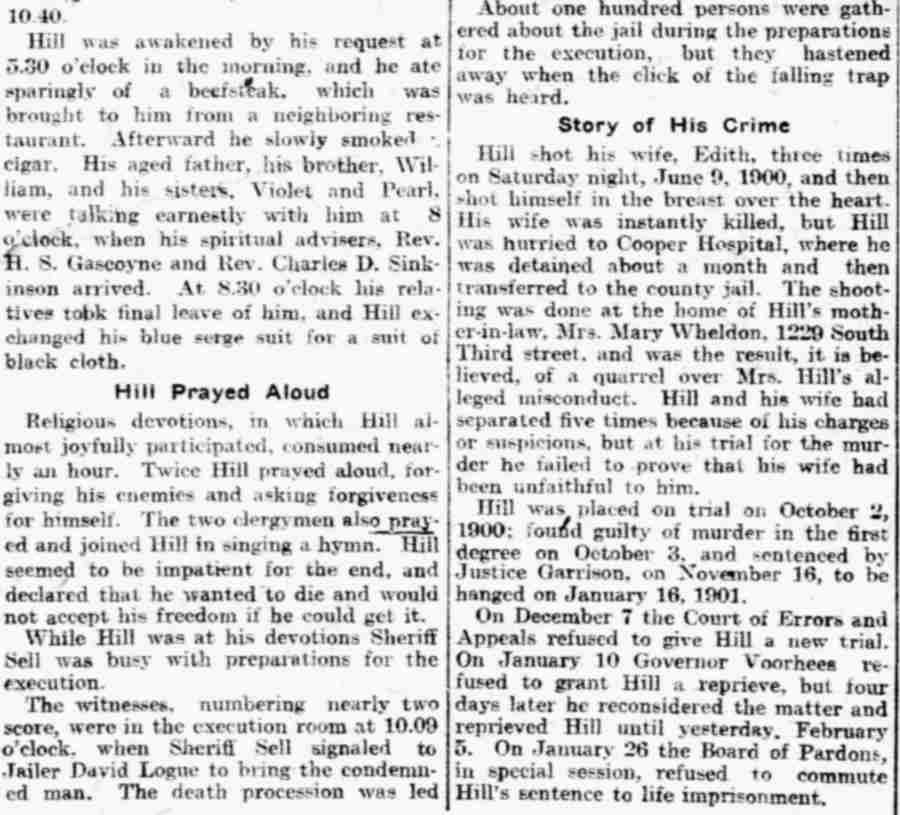
Named: Philadelphia Inquirer, February 6, 1901. See also: J. Wesley Sell, David Logue, John S. Smith, Charles G. Garrison, Dr. William S. Jones, South 3rd Street, and New Camden Cemetery.
Philadelphia Inquirer – August 6, 1901
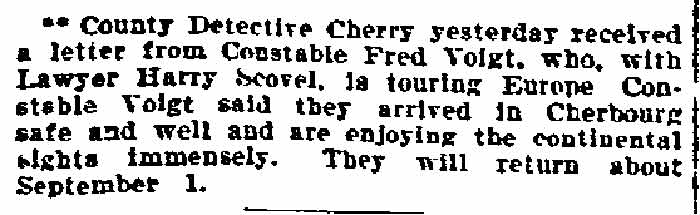
County Detective Cherry yesterday received a letter from Constable Fred Voigt, who, with Lawyer Harry Scovel, is touring Europe. Constable Voigt said they arrived in Cherbourg safe and well and are enjoying the continental sights immensely. They will return about September 1.
The Paul Woodward Murder Case
October 1, 1902 to January 14, 1903
On October 1, 1902 Paul Woodward murdered two young boys by giving them poison. Frank T. Lloyd, then Camden County prosecutor, was responsible for leading the investigation and prosecuting the case. Woodward was arrested on October 4, 1902, and was quickly indicted on murder charges. Woodward was tried and found guilty in November of 1902. J. Fred Voigt was then working at the Camden County jail, and one of his duties was to monitor Paul Woodward, who had been sentenced to death, with sentence to be carried out on January 7, 1903. J. Fred Voigt was present and assisted Sheriff Christopher J. Mines Jr. with the execution.
Related people and organizations: Joseph Jennings — Jennings’ Third Regiment Band — Frank T. Lloyd — Dr. William S. Jones — William D. Hart — Dr. Paul N. Litchfield — F. Morse Archer — John Foster — John Painter — John Cherry — Isaac Toone — George M. Beringer — Charles G. Garrison — J. Wesley Sell — Christopher J. Mines Jr. — Frederick A. Rex — George F. Kappel — Isaac Toy — Harry S. Scovel — Francis Ford Patterson Jr. — John S. Smith — Hugh Boyle — Frank S. Albright — Thomas Walton — Dr. William H. Iszard — George H. Stineford Sr. — Samuel M. Jaquillard
Philadelphia Inquirer – October 3, 1902
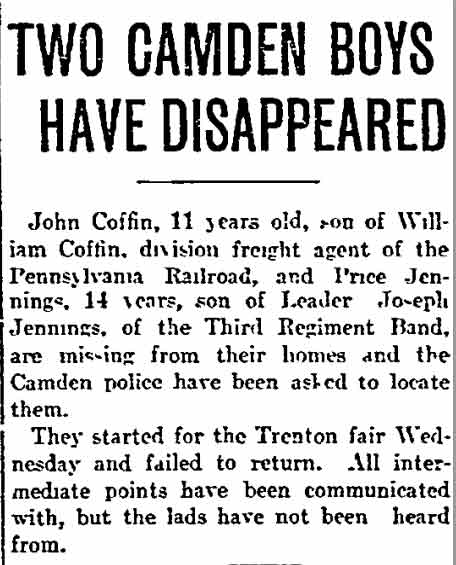
TWO CAMDEN BOYS HAVE DISAPPEARED
John Coffin, 11 years old, son of William Coffin, division freight agent of the Pennsylvania Railroad, and Price Jennings, 14 years old, son of Leader Joseph Jennings, of the Third Regiment Band, are missing from their homes and the Camden police have been asked to locate them.
They started for the Trenton fair Wednesday and failed to return. All intermediate points have been communicated with, but the lads have not been heard from.
Philadelphia Inquirer – October 4, 1902
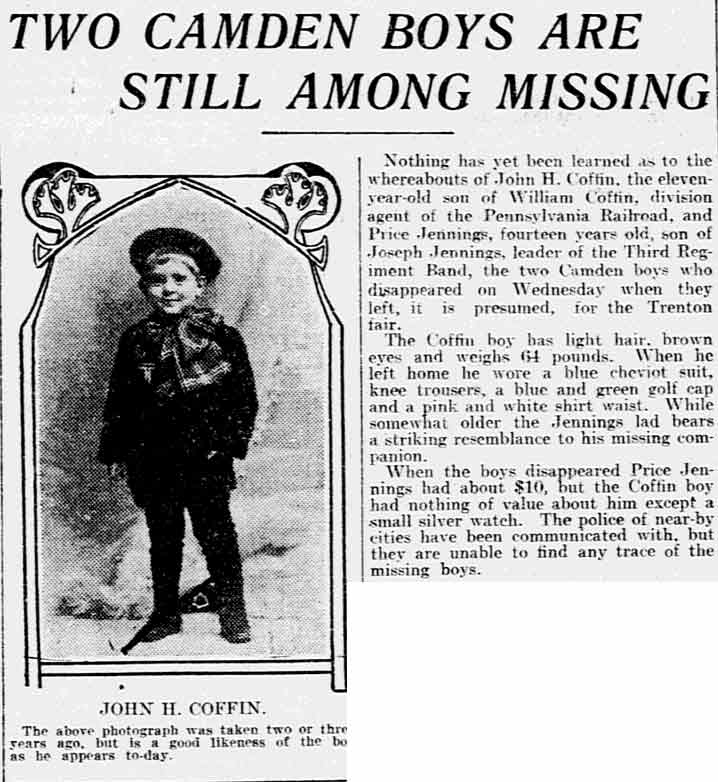
TWO CAMDEN BOYS ARE STILL AMONG MISSING
Nothing has yet been learned as to the whereabouts of John H. Coffin, the eleven-year-old son of William Coffin, division agent of the Pennsylvania Railroad, and Price Jennings, fourteen years old, son of Joseph Jennings, leader of the Third Regiment Band, the two Camden boys who disappeared on Wednesday when they left, it is presumed, for the Trenton fair.
The Coffin boy has light hair, brown eyes and weighs 64 pounds. When he left home he wore a blue cheviot suit, knee trousers, a blue and green golf cap and a pink and white shirt waist. While somewhat older the Jennings lad bears a striking resemblance to his missing companion.
When the boys disappeared Price Jennings had about $10, but the Coffin boy had nothing of value about him except a small silver watch. The police of near-by cities have been communicated with, but they are unable to find any trace of the missing boys.
[Photo caption: JOHN H. COFFIN. The above photograph was taken two or three years ago, but is a good likeness of the boy as he appears to-day.]
Philadelphia Inquirer – October 5, 1902
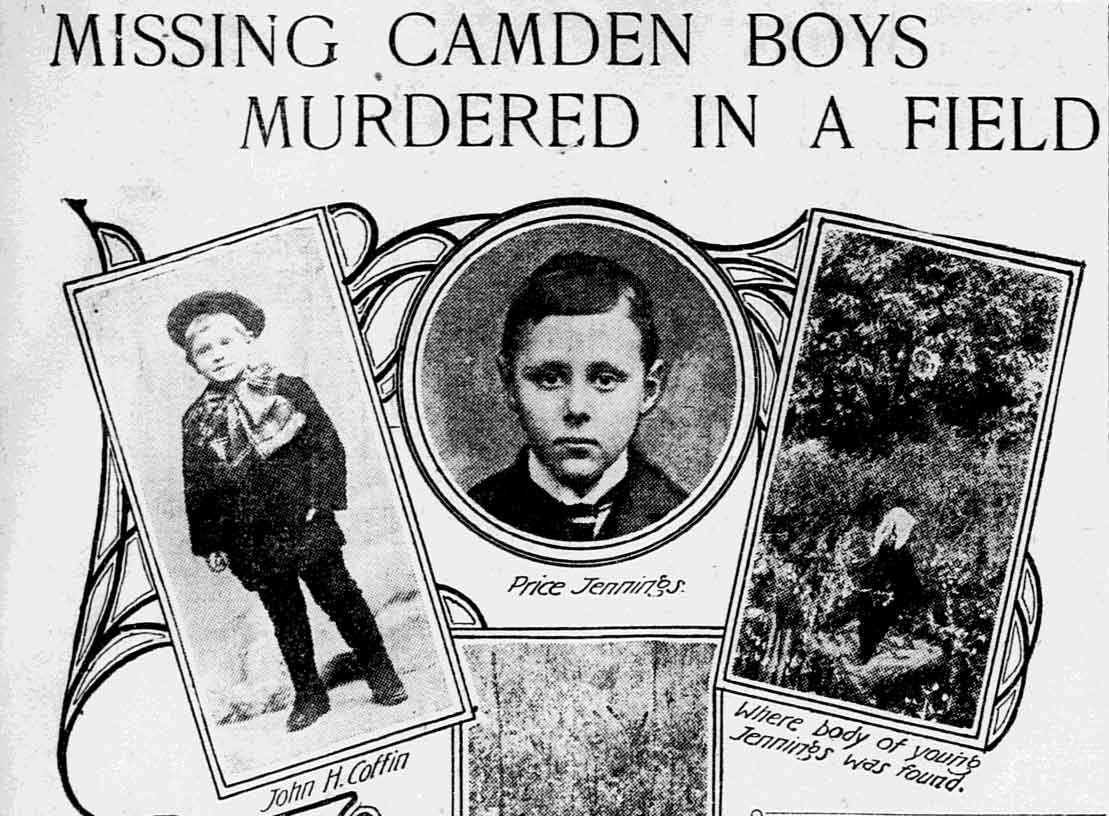
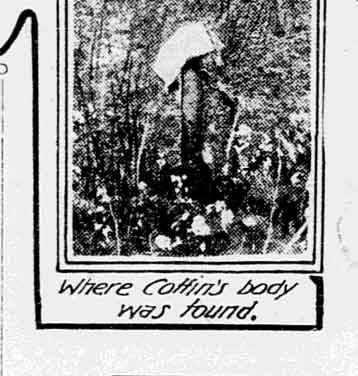
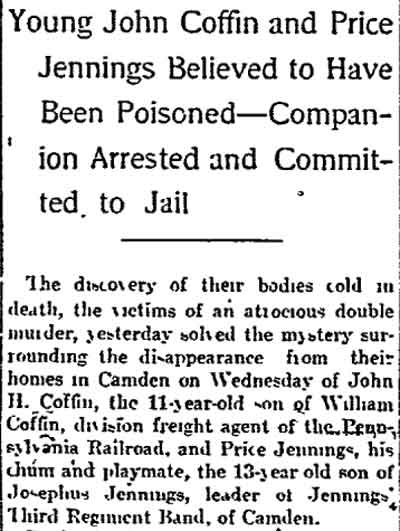
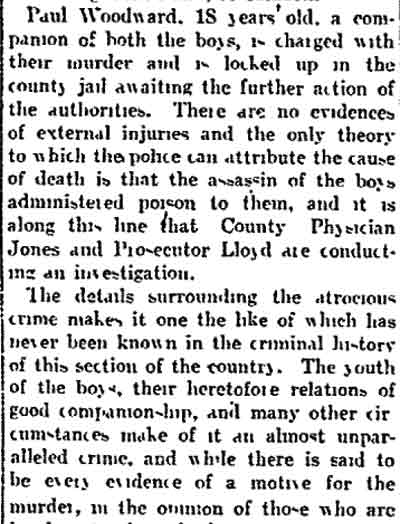
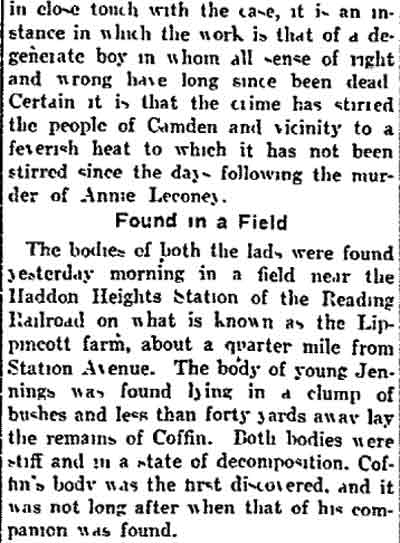
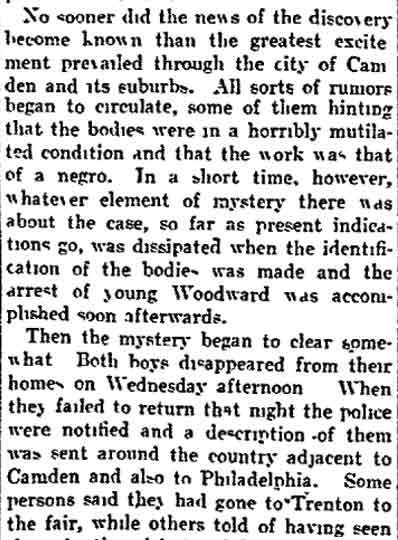
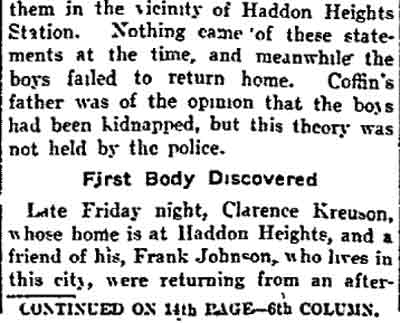
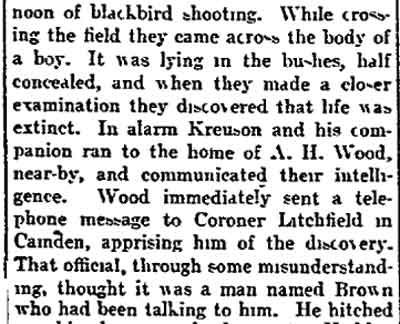
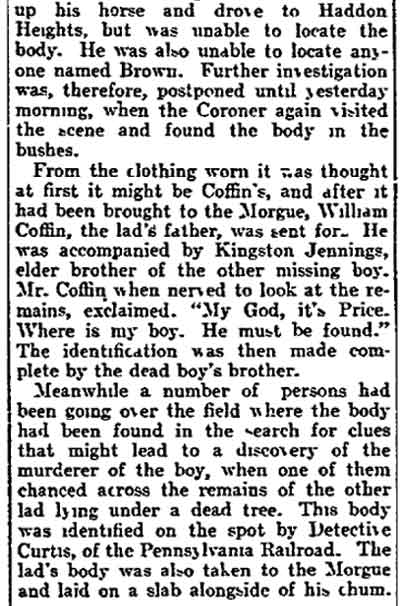
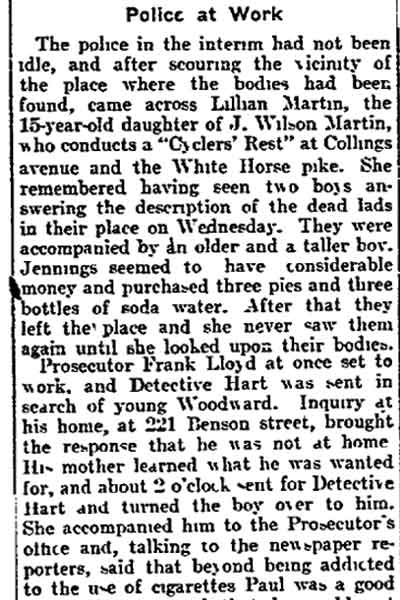
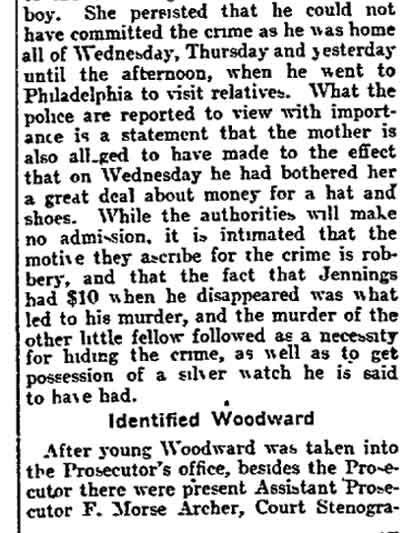
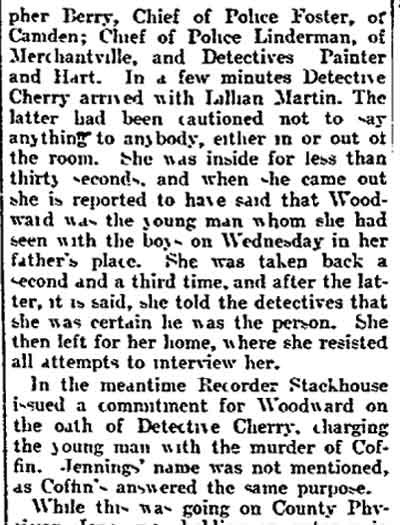
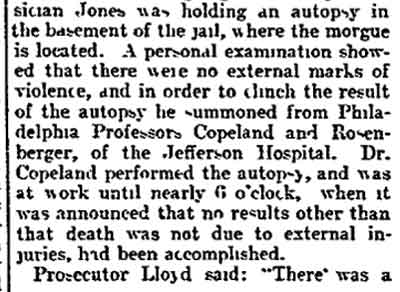
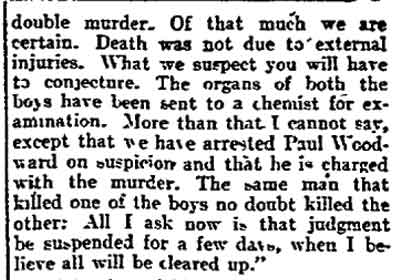
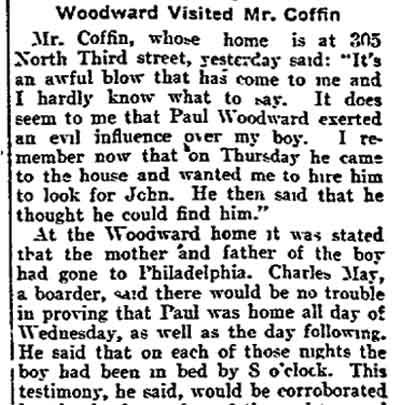
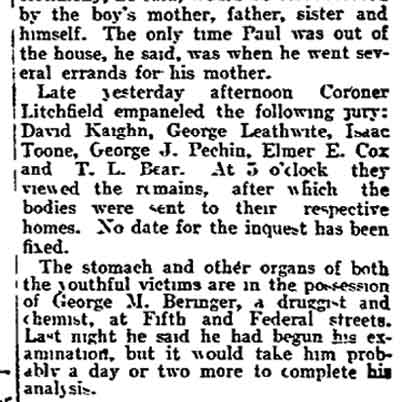
Named: Philadelphia Inquirer, October 5, 1902. See also: PDF version. Related: Frank T. Lloyd, Dr. William S. Jones, William D. Hart, Dr. Paul N. Litchfield, F. Morse Archer, John Foster, John Painter, John Cherry, Paul Woodward, Benson Street, and North 3rd Street.
Philadelphia Inquirer – October 6, 1902
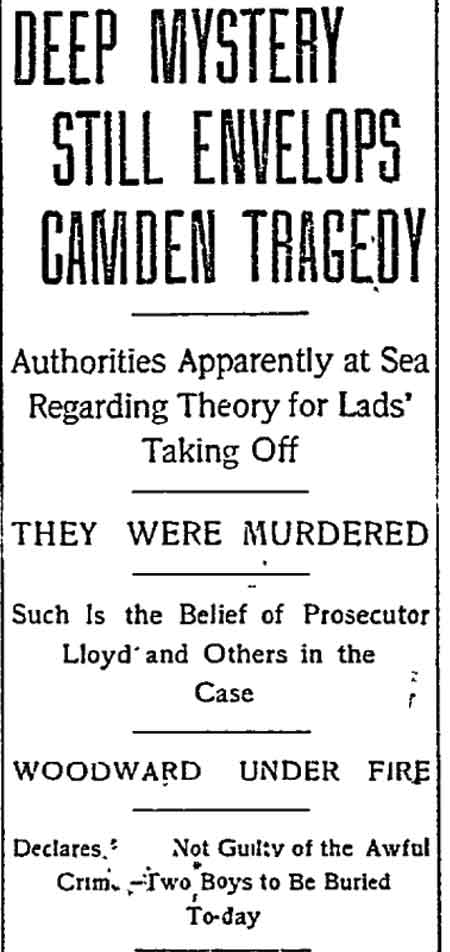
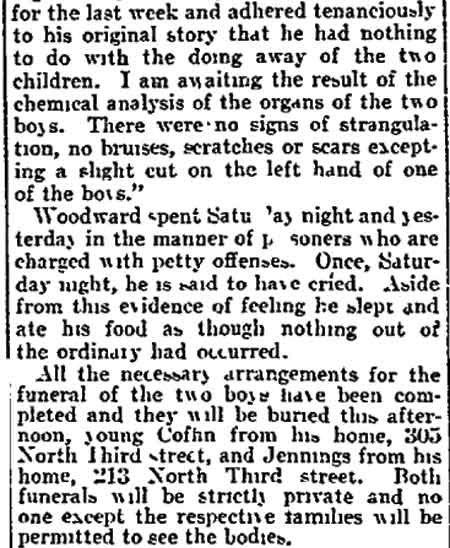
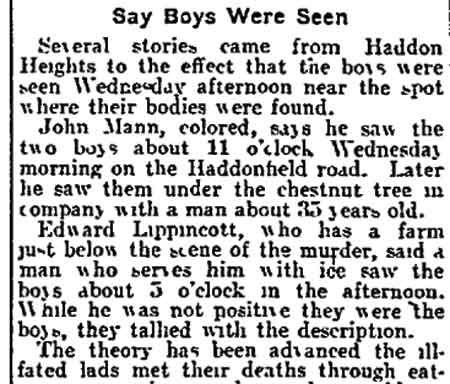
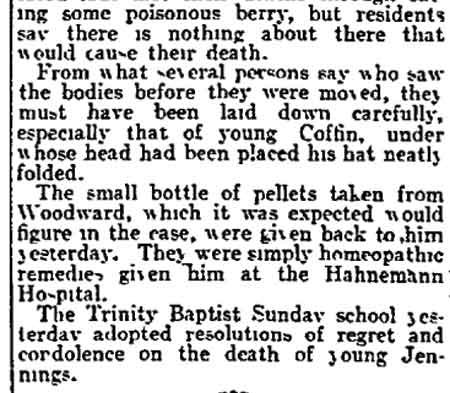
DEEP MYSTERY STILL ENVELOPS CAMDEN TRAGEDY
Authorities Apparently at Sea Regarding Theory for Lads' Taking Off
THEY WERE MURDERED
Such Is the Belief of Prosecutor Lloyd and Others in the Case
WOODWARD UNDER FIRE
Declares Not Guilty of the Awful Crime — Two Boys to Be Buried To-day
[Note: Image pwood-100602-inq-1.jpg contains only the headline block. Full article text begins in pwood-100602-inq-2.jpg through inq-8.jpg. See full transcription of Oct 6 article in context of this image set.]
Philadelphia Inquirer – October 7, 1902
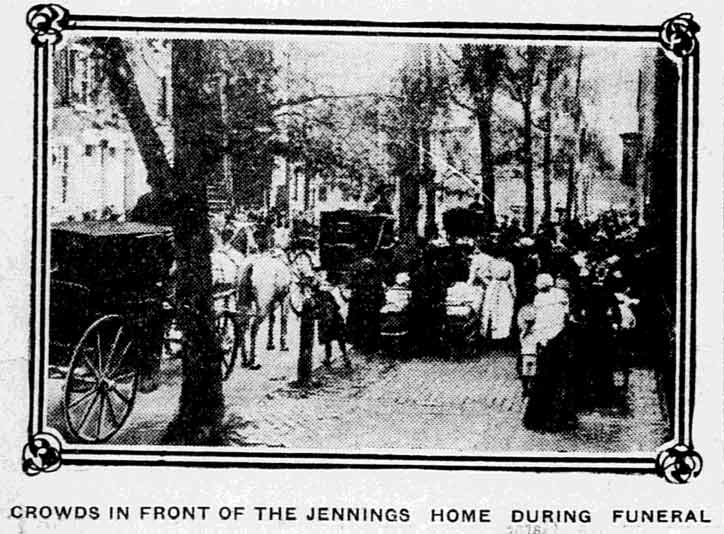
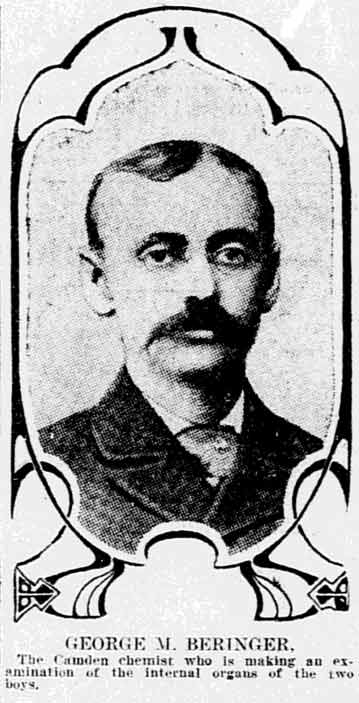
WOMAN INVOLVED IN CAMDEN MYSTERY
After Being Questioned by the Prosecutor She Is Committed to the County Jail—Believed to Be an Important Arrest
[Photo caption: Crowds in Front of the Jennings Home During Funeral]
[Portrait caption: George M. Beringer — The Camden chemist who is making an examination of the internal organs of the two boys.]
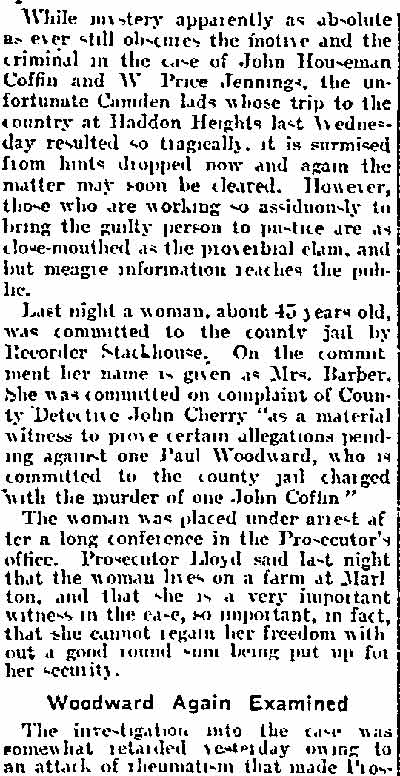
While mystery apparently as absolute as ever still obscures the motive and the criminal in the case of John Houseman Coffin and W. Price Jennings, the unfortunate Camden lads whose trip to the country at Haddon Heights last Wednesday resulted so tragically, it is surmised from hints dropped now and again the matter may soon be cleared. However, those who are working so assiduously to bring the guilty person to justice are as close-mouthed as the proverbial clam, and but meagre information reaches the public.
Last night a woman, about 45 years old, was committed to the county jail by Recorder Stackhouse. On the commitment her name is given as Mrs. Barber. She was committed on complaint of County Detective John Cherry "as a material witness to prove certain allegations pending against one Paul Woodward, who is committed to the county jail charged with the murder of one John Coffin."
The woman was placed under arrest after a long conference in the Prosecutor's office. Prosecutor Lloyd said last night that the woman lives on a farm at Marlton, and that she is a very important witness in the case, so important, in fact, that she cannot regain her freedom without a good round sum being put up for her security.
Woodward Again Examined
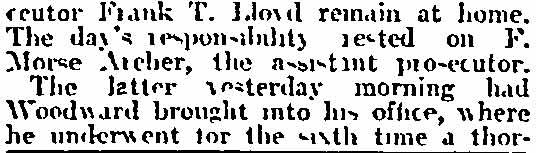
The investigation into the case was somewhat retarded yesterday owing to an attack of rheumatism that made Prosecutor Frank T. Lloyd remain at home. The day's responsibility rested on F. Morse Archer, the assistant pro-secutor. The latter yesterday morning had Woodward brought into his office, where he underwent for the sixth time a thorough cross-examination. Mr. Archer said Woodward had made no confession, as had been rumored. On the contrary, he still maintained his innocence.
In answer to a question Mr. Archer said: "We are doing our best and while we are in possession of information which we consider important and vital to the case, it is impossible at this time to make it public."
On the other hand, County Physician Jones was very emphatic in this particular, saying the boys were murdered beyond a doubt.
Boys' Funerals
Yesterday afternoon the funeral of the boys took place at the same hour and within a square of one another's homes. Although the hour set for the obsequies, 2 o'clock in the afternoon, had been kept secret scores of persons stood about in knots discussing the tragedy and eager to get a glimpse of the caskets containing the remains of the boys.
Police Captain Boyle and Policemen Kappel, Toy and Ridgeley guarded the houses, and no one except relatives and intimate friends were permitted to enter. But when the caskets were carried from the houses the crowd could not be kept back. Many persons crowded about, and the mourners entered the carriages between two solid phalanxes of curiosity seekers.
The services over Jennings were conducted at his home, 219 North Third street, by Rev. C. A. Adams and Rev. John Lyell. At the Coffin home, 305 North Third street, Rev. William H. Fishburn had charge of the obsequies. Companions of the boys acted as pallbearers. Jennings was buried at Evergreen and Coffin at Harleigh Cemetery.
George M. Beringer, a Camden chemist, who has the important duty of discovering, if possible, traces of poison in the stomachs of the boys, said yesterday he is making a thorough chemical analysis and is of necessity proceeding slowly. He said he will not be able to report the result for some days to come.
A pathetic little incident occurred at the Cooper School during recess yesterday morning when the children, school mates of the lads, gathered about and listened to the muffled beats of a drum. The school flag was at half mast and in every room there was a flag draped with black crepe. The youngsters were visibly affected.
Philadelphia Inquirer – October 8, 1902
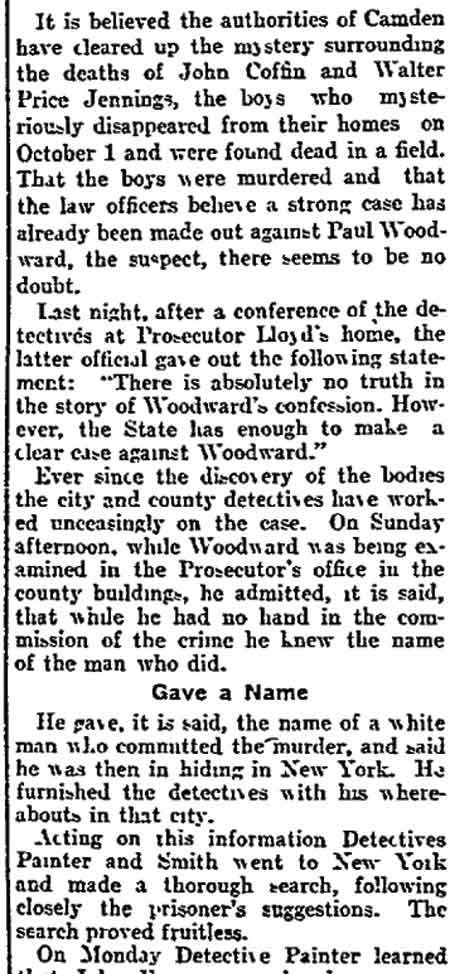
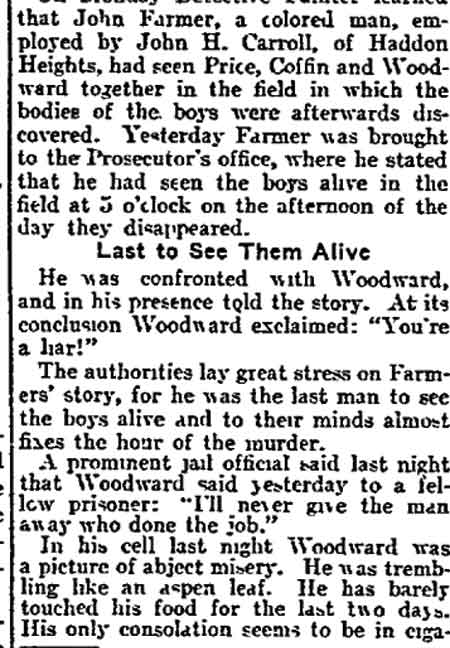
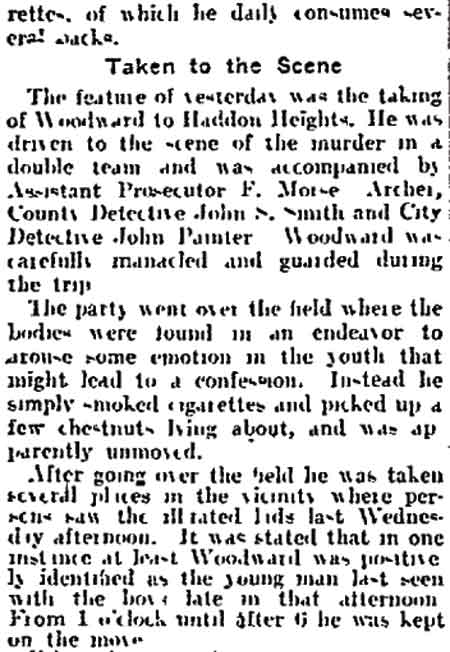
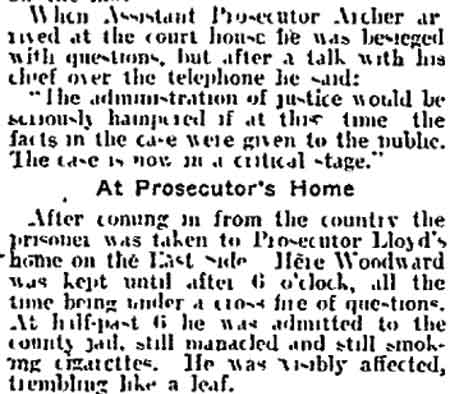
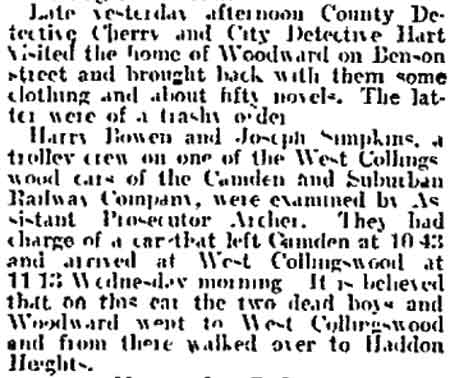
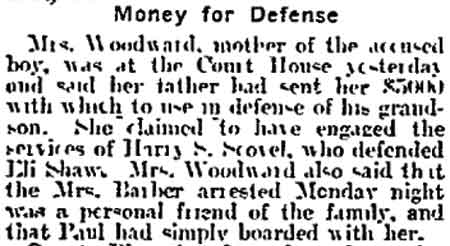
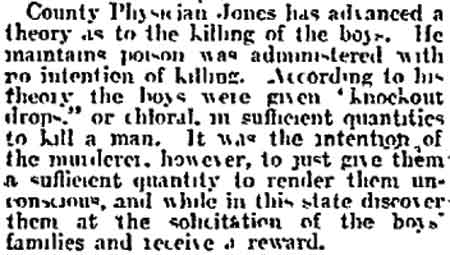
WOODWARD HAS KNOWLEDGE OF CAMDEN MURDER
So Confessed to Officers, Who Searched New York at Prisoner's Instance
NO HAND IN THE CRIME
But Said He Knew Name of the Man Who Committed Awful Deed
YOUTH'S STRENUOUS DAY
Taken to the Scene of the Tragedy and Closeted With the Prosecutor
Philadelphia Inquirer – October 9, 1902
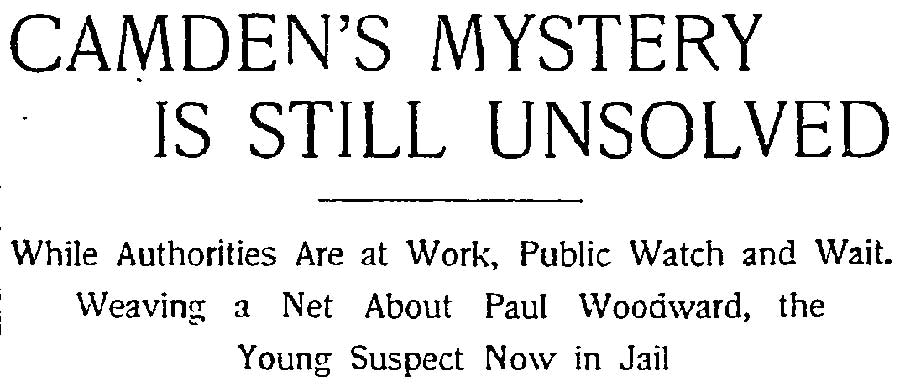
CAMDEN'S MYSTERY IS STILL UNSOLVED
While Authorities Are at Work, Public Watch and Wait. Weaving a Net About Paul Woodward, the Young Suspect Now in Jail
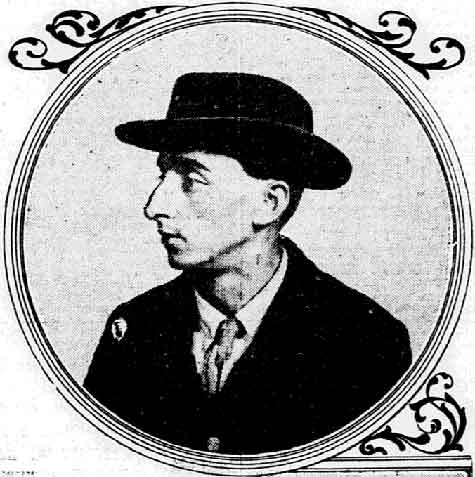
[Portrait caption: Paul Woodward — Portrait drawn from life.]
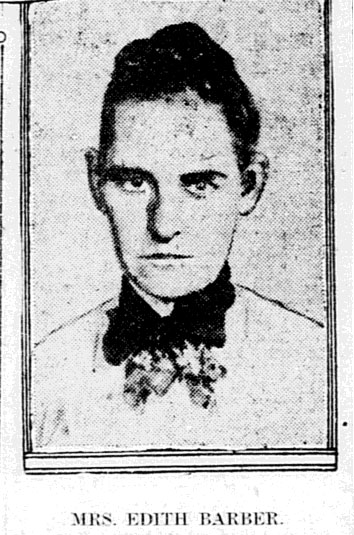
[Portrait caption: Mrs. Edith Barber.]
It is now generally believed that the Camden county authorities have succeeded in establishing a clear case against young Paul Woodward, who is in the county jail, charged with the crime of taking away the lives of little John Coffin and Price Jennings. It was just a week ago yesterday when the boys went on their trip to Haddon Heights from which they were destined never to return alive.
Since the discovery of the bodies last Saturday partially hidden in rain soaked weeds, the Prosecutor's office, assisted by County Detectives Smith and Cherry and City Detectives Painter and Hart, have left no stone unturned.
No Confession
Prosecutor Lloyd yesterday reiterated his statement that Woodward had made no confession, but it is generally conceded as true that the accused youth did tell a story in which he makes some one else the principal criminal in the case.
Several incidents transpired yesterday that threw off the monotony of waiting for developments. Joseph Jennings, brother of one of the murdered boys, was taken to the cell in which Woodward is confined. He had no difficulty in recognizing the prisoner before. But as to whether he ever saw him in company with the dead lads he was not permitted to say.
Wild Rumor
There was much excitement about the Court House when it became rumored that Mrs. Edith Barber, the woman detained as a material witness against Woodward, had the small pox. To allay the alarm County Physician Jones called in representatives of the Board of Health, who concluded she had no sign of the disease.
After matters quieted somewhat the woman was taken into the Prosecutor's office and questioned. When taken back to her cell she was crying and appeared to be almost unable to walk.
Woodward spent the day in his cell, smoking cigarettes as usual. He was visited in the morning by Lawyer Harry Scovel, who has not yet been engaged as counsel, as reported. Again in the afternoon Lawyer Scovel visited the youth in company with Woodward's mother. At first Mrs. Woodward was denied admittance, but after waiting on the jail steps for nearly an hour she was permitted to go in and see her son. Lawyer Scovel and Mrs. Woodward were with the young man for a couple of hours.
Talked a Whole Lot
To all questions Lawyer Scovel said: "Woodward talked a whole lot, but I have nothing to say."
He said he had not confessed to him. On the other hand Woodward had maintained his innocence.
When asked if Woodward could have a hearing if he demanded it Mr. Archer said he could. Asked if enough evidence was in hand to hold him, Mr. Archer said there was.
"On a simple assault charge?"
"No, sir, for the crime he is charged with—committing the murder of John Coffin," replied Mr. Archer.
Coroner Litchfield said last night he would not set a date for the inquest before some time next week. Despite all reports to the contrary, Coroner Litchfield says Chemist George M. Beringer, who is analyzing the internal organs of the boys, will not complete the work before the end of the week.
Prosecutor Lloyd, who is still confined to his home with rheumatism, would make no statement last night, although admitting that the day's work had not resulted in anything of material importance.
Philadelphia Inquirer – October 10, 1902
Prosecutor Lloyd Declares That Woodward Is the Guilty Man
NO MORE ARRESTS LIKELY
Weaving Web Around Alleged Slayer of the Murdered Boys
“Beyond all question the murderer of these little boys is now in jail and the public’s anxiety can now be allayed,” said Prosecutor Frank T. Lloyd last night in making the first important statement concerning the tragedy of last week, when John Coffin and W. Price Jennings, two Camden lads, were murdered in an uncultivated field near Haddon Heights. The mystery which has enshrouded the case since the discovery of the bodies last Friday has almost been cleared up with the exception of the report of Chemist George M. Beringer, who is making an analysis of the internal organs of the boys.
Prosecutor Lloyd gave out the following statement shortly before 8 o’clock at his home on the East Side:
“Because of a suspicion that more than one person was engaged in the murder of these little boys the State has been obliged to work with much secrecy and to withhold from the press the result of our work. That suspicion is now removed. Beyond all question the murderer is now in jail and the public’s anxiety can be allayed. Woodward was alone the perpetrator of this crime.
Case Nearly Complete
“It is my duty to say this much in view of the deep public concern and the apprehension of other parents having little ones, but it would be improper for me to state the character or the quantity of evidence upon which our conclusions are based. I will only say that with the exception of the report of the chemist, which has not yet been received, the State’s case is almost complete.
“Woodward himself has made a number of statements, which, while not confessions, will be materially helpful toward securing his conviction.”
This statement precludes the possibility of another arrest being made in connection with the case, as has been currently reported during the week.
There were several conferences held yesterday between Assistant Prosecutor Archer and Detectives Smith, Cherry, Painter and Hart and Chief of Police Linderman, of Merchantsville. During one of the conferences John Farmer, the colored man who recognized Woodward as having been seen with the boys last Wednesday afternoon, was called in and closely questioned. Following the detectives departed apparently on several different clues.
Detectives Hard at Work
Detective Hart subsequently returned with a Mrs. Somers, said to reside on Royden street. She was interviewed by the Assistant Prosecutor, but what connection she has with the case the authorities refused to divulge. The woman refused to talk.
Louis Ross, a German, who resides near Haddon Heights, was also called into the Prosecutor’s office late in the afternoon. At first he was thought to be an important witness, but it was afterwards learned that he knew little about the case.
Detective Robert J. McKentry, of Philadelphia, and Detective Smith took over the river Mrs. William H. Hubbert and another young woman. It is at the home of Mrs. Hubbert, at West Philadelphia, that Woodward said he was present last Friday night.
Woodward became rather obdurate yesterday, refusing the usual prison fare. He waited until his mother sent him coffee and other victuals. The accused youth was at first placed in the cell formerly occupied by Lafayette Gruff, the wife murderer, who was hanged September 19. He has now been placed in another cell.
Philadelphia Inquirer – October 11, 1902
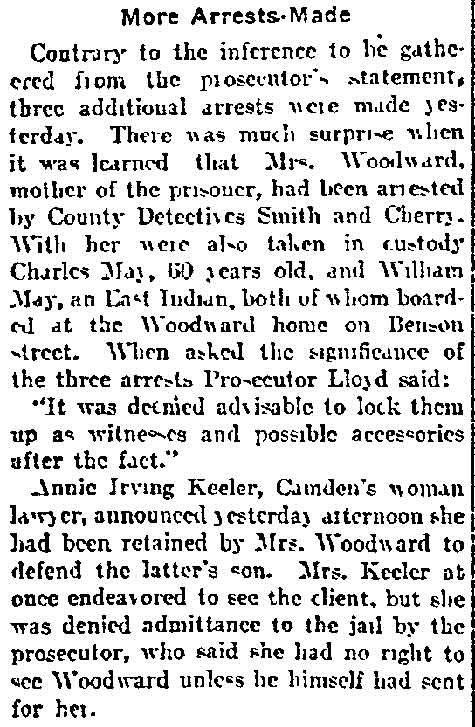
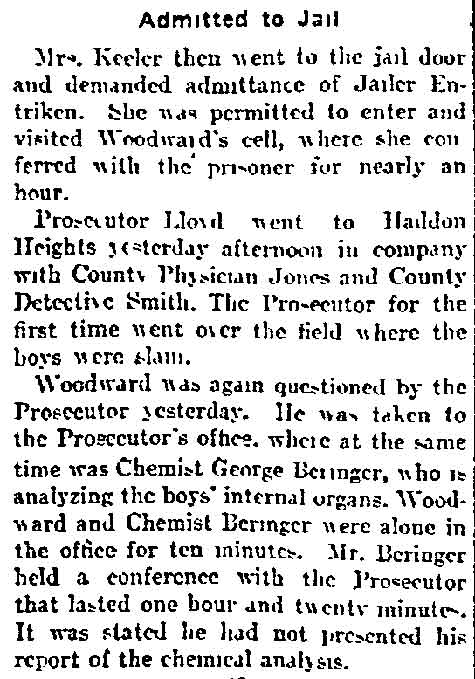
MORE ARRESTS IN CAMDEN MYSTERY
Philadelphia Inquirer – October 12, 1902
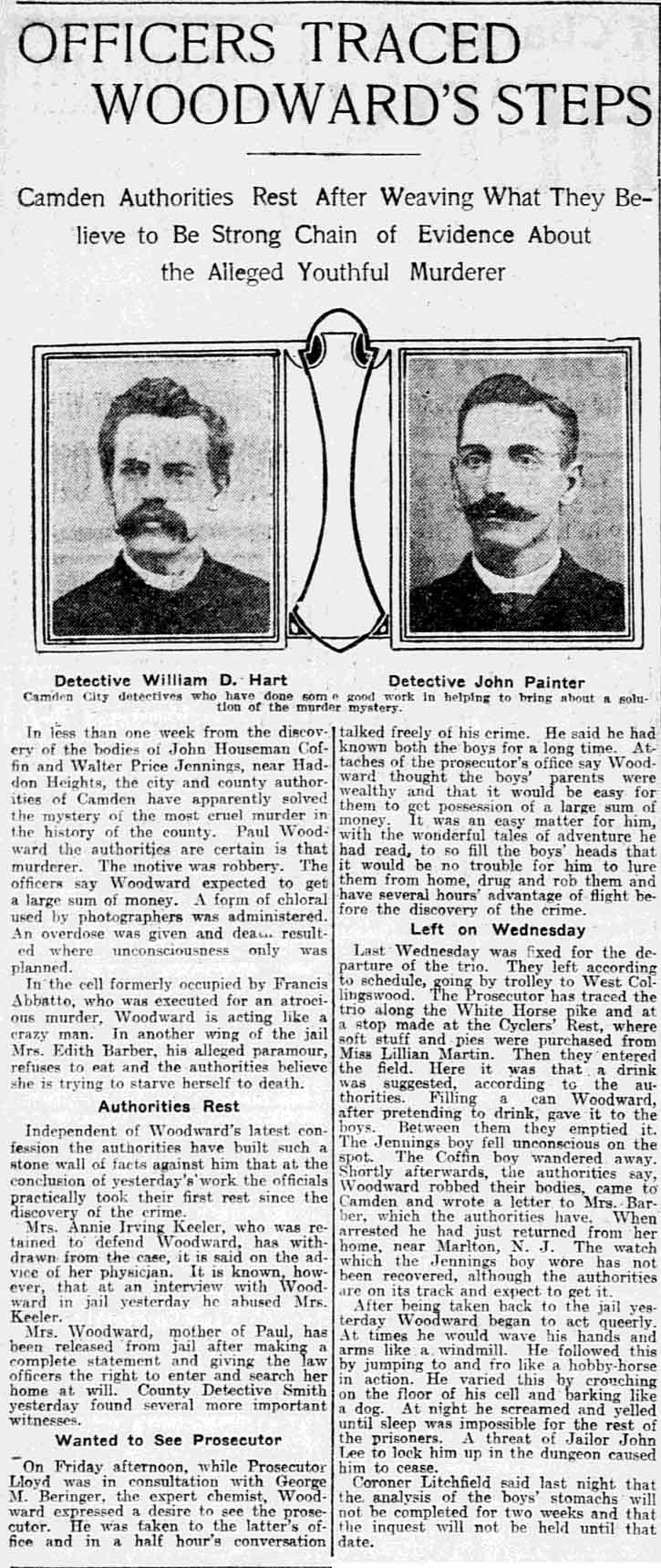
OFFICERS TRACED WOODWARD'S STEPS
Camden Authorities Rest After Weaving What They Believe to Be Strong Chain of Evidence About the Alleged Youthful Murderer
[Portraits: Detective William D. Hart | Detective John Painter — Camden City detectives who have done some good work in helping to bring about a solution of the murder mystery.]
In less than one week from the discovery of the bodies of John Houseman Coffin and Walter Price Jennings, near Haddon Heights, the city and county authorities of Camden have apparently solved the mystery of the most cruel murder in the history of the county. Paul Woodward the authorities are certain is that murderer. The motive was robbery. The officers say Woodward expected to get a large sum of money. A form of chloral used by photographers was administered. An overdose was given and death resulted where unconsciousness only was planned.
In the cell formerly occupied by Francis Abbatto, who was executed for an atrocious murder, Woodward is acting like a crazy man. In another wing of the jail Mrs. Edith Barber, his alleged paramour, refuses to eat and the authorities believe she is trying to starve herself to death.
Authorities Rest
Independent of Woodward's latest confession the authorities have built such a stone wall of facts against him that at the conclusion of yesterday's work the officials practically took their first rest since the discovery of the crime.
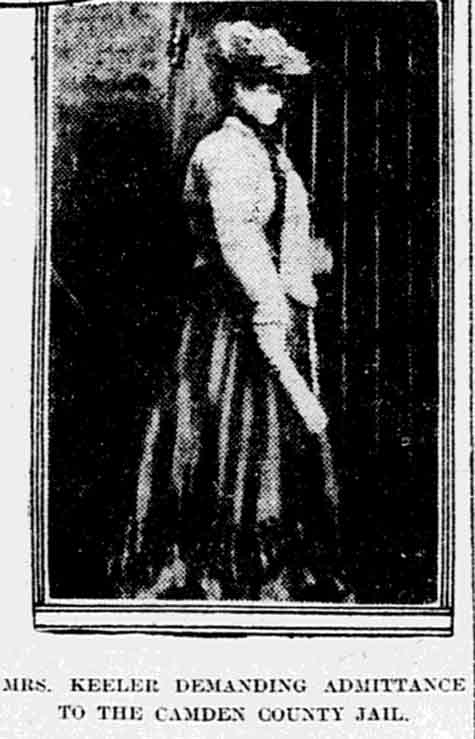
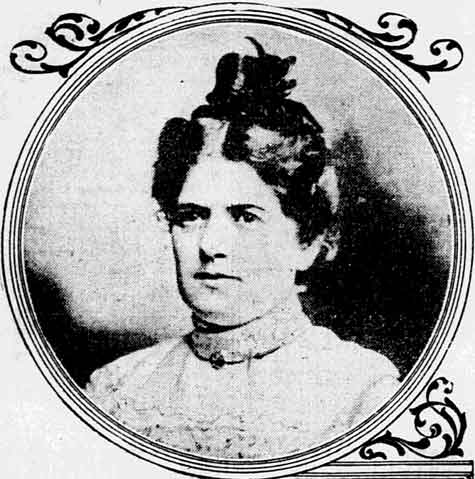
Mrs. Annie Irving Keeler, who was retained to defend Woodward, has withdrawn from the case, it is said on the advice of her physician. It is known, however, that at an interview with Woodward in jail yesterday he abused Mrs. Keeler.
Mrs. Woodward, mother of Paul, has been released from jail after making a complete statement and giving the law officers the right to enter and search her home at will. County Detective Smith yesterday found several more important witnesses.
Wanted to See Prosecutor
On Friday afternoon, while Prosecutor Lloyd was in consultation with George M. Beringer, the expert chemist, Woodward expressed a desire to see the prosecutor. He was taken to the latter's office and in a half hour's conversation talked freely of his crime. He said he had known both the boys for a long time. Attaches of the prosecutor's office say Woodward thought the boys' parents were wealthy and that it would be easy for them to get possession of a large sum of money. It was an easy matter for him, with the wonderful tales of adventure he had read, to so fill the boys' heads that it would be no trouble for him to lure them from home, drug and rob them and have several hours' advantage of flight before the discovery of the crime.
Left on Wednesday
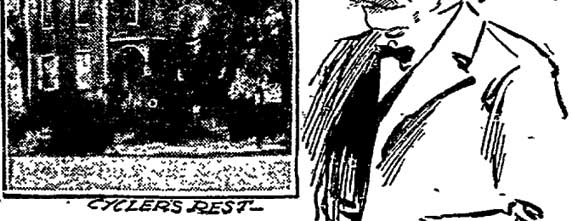
Last Wednesday was fixed for the departure of the trio. They left according to schedule, going by trolley to West Collingswood. The Prosecutor has traced the trio along the White Horse pike and at a stop made at the Cyclers' Rest, where soft stuff and pies were purchased from Miss Lillian Martin. Then they entered the field. Here it was that a drink was suggested, according to the authorities. Filling a can Woodward, after pretending to drink, gave it to the boys. Between them they emptied it. The Jennings boy fell unconscious on the spot. The Coffin boy wandered away. Shortly afterwards, the authorities say, Woodward robbed their bodies, came to Camden and wrote a letter to Mrs. Barber, which the authorities have. When arrested he had just returned from her home, near Marlton, N. J. The watch which the Jennings boy wore has not been recovered, although the authorities are on its track and expect to get it.
After being taken back to the jail yesterday Woodward began to act queerly. At times he would wave his hands and arms like a windmill. He followed this by jumping to and fro like a hobby-horse in action. He varied this by crouching on the floor of his cell and barking like a dog. At night he screamed and yelled until sleep was impossible for the rest of the prisoners. A threat of Jailor John Lee to lock him up in the dungeon caused him to cease.
Coroner Litchfield said last night that the analysis of the boys' stomachs will not be completed for two weeks and that the inquest will not be held until that date.
Philadelphia Inquirer – October 13, 1902
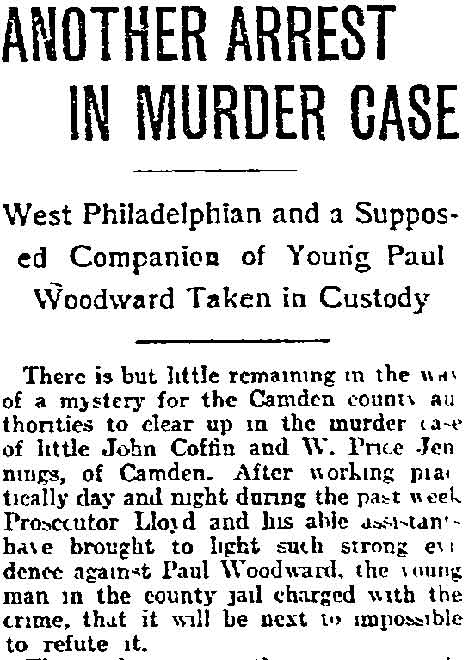
ANOTHER ARREST IN MURDER CASE
West Philadelphian and a Supposed Companion of Young Paul Woodward Taken in Custody
There is but little remaining in the way of a mystery for the Camden county authorities to clear up in the murder case of little John Coffin and W. Price Jennings, of Camden. After working practically day and night during the past week Prosecutor Lloyd and his able assistants have brought to light such strong evidence against Paul Woodward, the young man in the county jail charged with the crime, that it will be next to impossible to refute it.
The sixth arrest in the case was made yesterday, when James Sheiding was taken into custody by County Detective Smith and committed to the county jail by Recorder Stackhouse as "a material witness." Sheiding, who lives in West Philadelphia, was lured across the river to Camden, when Detective Smith at once took him in custody.
The prisoner is believed to be the companion of Woodward who, on the Friday night preceding the discovery of the murdered boys, was in the company of the accused murderer. On that occasion it is said Woodward had considerable money and that Sheiding assisted him in spending it.
Woodward did not give any evidence yesterday of being insane. On the other hand he was very quiet and evidently saw the futility of trying to make the Prosecutor believe him to be of unsound mind. He utterly refused to take part in the regular Sunday jail services. His whole concern seemed to be as to whether or not his mother would visit him to-day. He was of the opinion yesterday that his mother had gone to West Chester, where she is said to have relatives of means. Woodward thinks such a visit would result in him having sufficient funds with which to engage counsel.
Mrs. Edith Barker, the woman witness against Woodward, is very ill. Two of her children are ill with typhoid fever and the worry over this in connection with her important part in the case has made her one of the most wretched prisoners ever incarcerated at the county prison. Prosecutor Lloyd tried to have her admitted to a hospital, but his efforts were unavailing.
In all probability the case will come up before the present grand jury and be tried this month. Prosecutor Lloyd said last night that as soon as Chemist Beringer has made his report on his analysis of the viscera of the boys the Coroner's inquest will be held. Immediately the court will be asked to take up the case.
Philadelphia Inquirer – October 14, 1902
SPEEDY TRIAL FOR YOUNG WOODWARD
But little developed in the murder case in Camden, for which Paul Woodward is incarcerated in the county jail. Prosecutor Lloyd has everything well in hand and his sole object is to have a speedy trial of the accused youth. He said yesterday his office would give out nothing further before the trial.
It is said Woodward has declared he gave John Coffin and W. Price Jennings, the murdered boys, bichloride of gold and not chloral. He is also reported to have said he did not intend giving such a large dose as would terminate fatally.
While as yet Woodward has no counsel it is probable he will be defended by Lawyer Edwin Hillman, who will be named by the court.
Philadelphia Inquirer – October 15, 1902
TO HURRY ALONG WOODWARD TRIAL
Paul Woodward, the youth accused of the murder of John Coffin and W. Price Jennings, the Camden boys whose bodies were found near Haddon Heights last Saturday week, may possibly be indicted for the crime to-day or to-morrow. Prosecutor Lloyd has the case so well in hand that he will present the facts before the grand jury this morning.
The State has practically concluded its investigation with the exception of making the necessary preparations for the trial. It is believed the grand jury will speedily find a bill of indictment against Woodward, and he may know his fate before the end of the present month.
Harry H. Robinson, a Philadelphia lawyer, was yesterday engaged to defend Woodward.
Philadelphia Inquirer – October 16, 1902
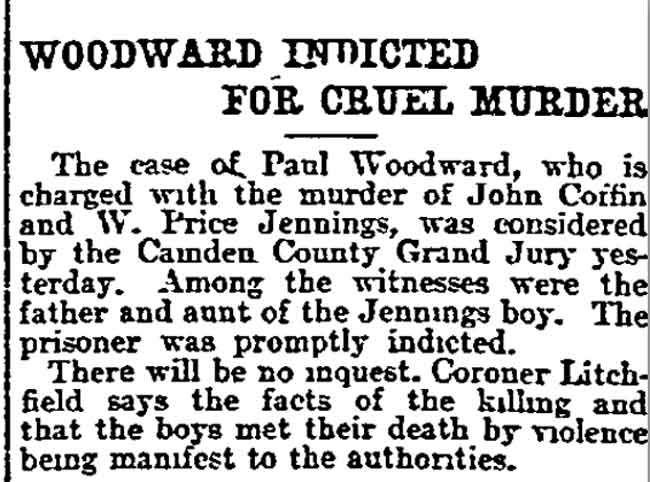
WOODWARD INDICTED FOR CRUEL MURDER
The case of Paul Woodward, who is charged with the murder of John Coffin and W. Price Jennings, was considered by the Camden County Grand Jury yesterday. Among the witnesses were the father and aunt of the Jennings boy. The prisoner was promptly indicted.
There will be no inquest. Coroner Litchfield says the facts of the killing and that the boys met their death by violence being manifest to the authorities.
Philadelphia Inquirer – October 19, 1902
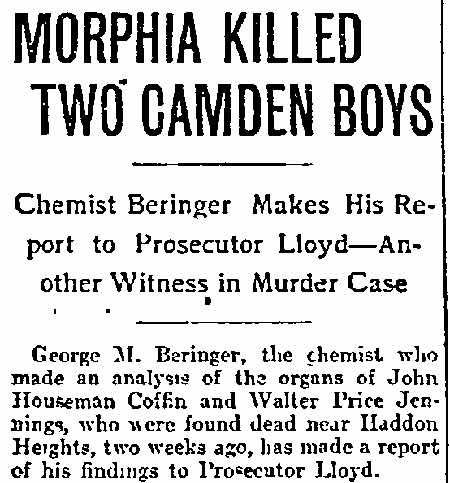
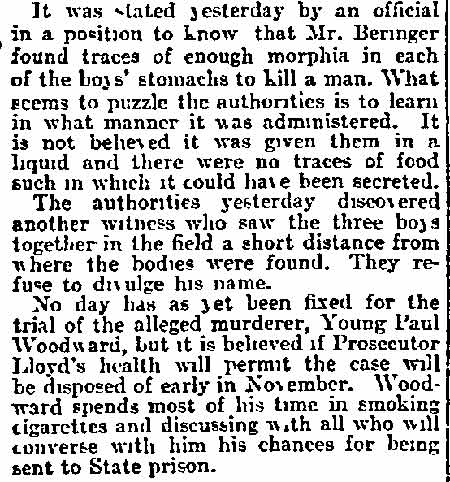
MORPHIA KILLED TWO CAMDEN BOYS
Chemist Beringer Makes His Report to Prosecutor Lloyd—Another Witness in Murder Case
George M. Beringer, the chemist who made an analysis of the organs of John Houseman Coffin and Walter Price Jennings, who were found dead near Haddon Heights two weeks ago, has made a report of his findings to Prosecutor Lloyd.
Philadelphia Inquirer – October 22, 1902
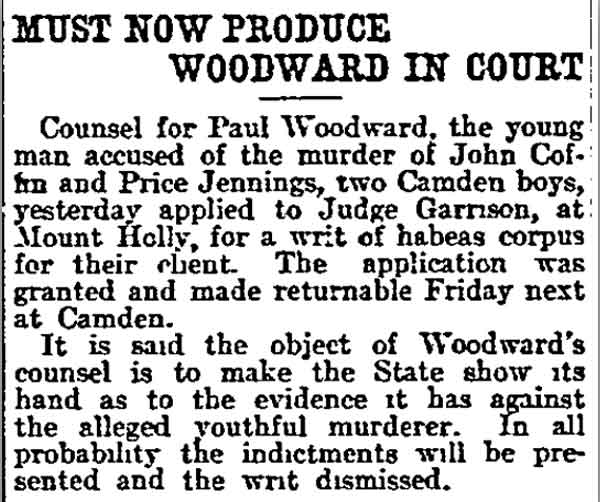
MUST NOW PRODUCE WOODWARD IN COURT
Counsel for Paul Woodward, the young man accused of the murder of John Coffin and Price Jennings, two Camden boys, yesterday applied to Judge Garrison, at Mount Holly, for a writ of habeas corpus for their client. The application was granted and made returnable Friday next at Camden.
It is said the object of Woodward's counsel is to make the State show its hand as to the evidence it has against the alleged youthful murderer. In all probability the indictments will be presented and the writ dismissed.
Philadelphia Inquirer – October 24, 1902
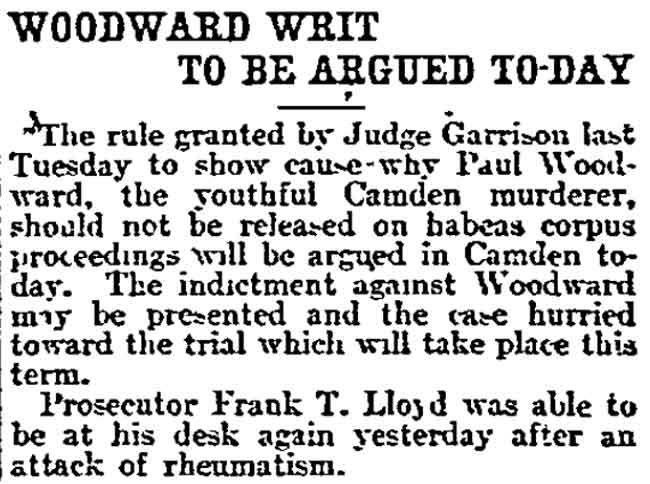
WOODWARD WRIT TO BE ARGUED TO-DAY
The rule granted by Judge Garrison last Tuesday to show cause why Paul Woodward, the youthful Camden murderer, should not be released on habeas corpus proceedings will be argued in Camden to-day. The indictment against Woodward may be presented and the case hurried toward the trial which will take place this term.
Prosecutor Frank T. Lloyd was able to be at his desk again yesterday after an attack of rheumatism.
Philadelphia Inquirer – October 25, 1902
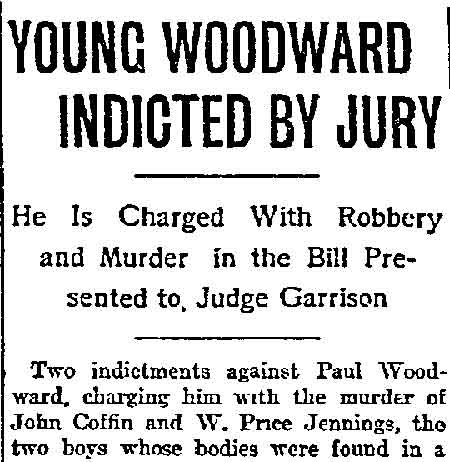
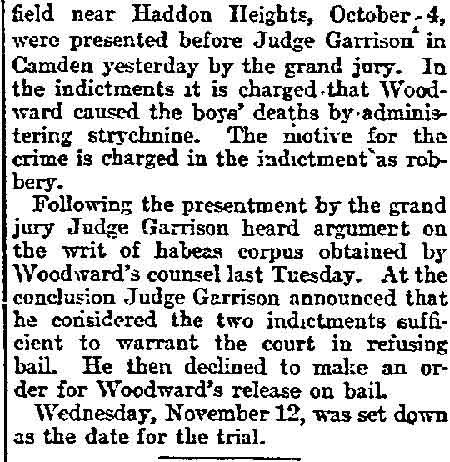
YOUNG WOODWARD INDICTED BY JURY
He Is Charged With Robbery and Murder in the Bill Presented to Judge Garrison
Two indictments against Paul Woodward, charging him with the murder of John Coffin and W. Price Jennings, the two boys whose bodies were found in a field near Haddon Heights, have been presented to Judge Garrison.
Philadelphia Inquirer – October 31, 1902
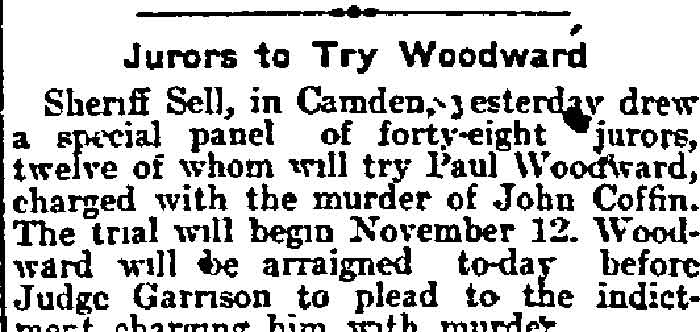
Jurors to Try Woodward
Sheriff Sell, in Camden, yesterday drew a special panel of forty-eight jurors, twelve of whom will try Paul Woodward, charged with the murder of John Coffin. The trial will begin November 12. Woodward will be arraigned to-day before Judge Garrison to plead to the indictment charging him with murder.
Philadelphia Inquirer – November 1, 1902
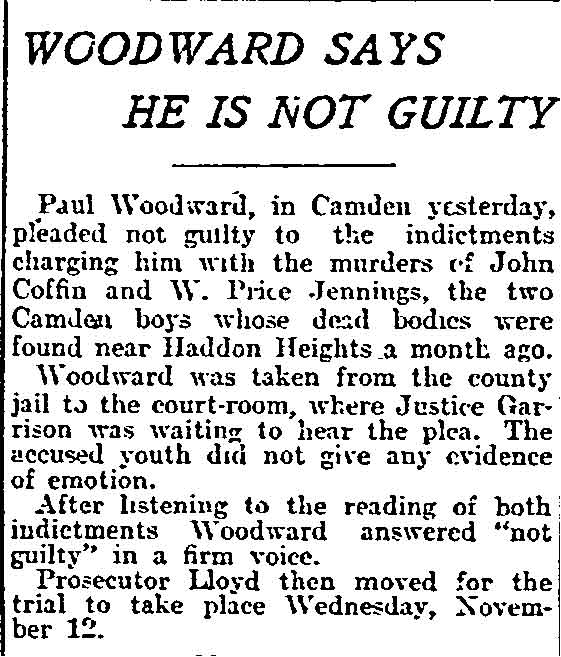
WOODWARD SAYS HE IS NOT GUILTY
Paul Woodward, in Camden yesterday, pleaded not guilty to the indictments charging him with the murders of John Coffin and W. Price Jennings, the two Camden boys whose dead bodies were found near Haddon Heights a month ago.
Woodward was taken from the county jail to the court-room, where Justice Garrison was waiting to hear the plea. The accused youth did not give any evidence of emotion.
After listening to the reading of both indictments Woodward answered "not guilty" in a firm voice.
Prosecutor Lloyd then moved for the trial to take place Wednesday, November 12.
Philadelphia Inquirer – November 11, 1902
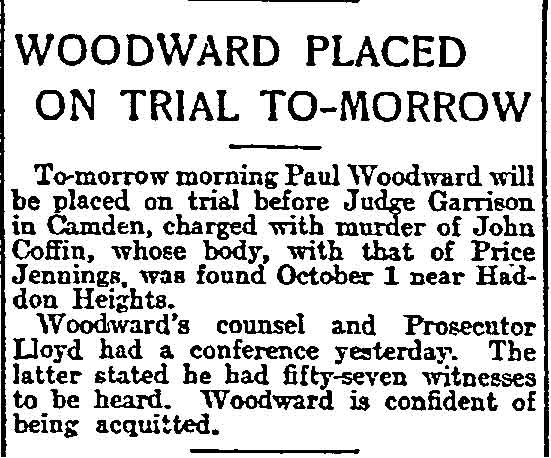
WOODWARD PLACED ON TRIAL TO-MORROW
To-morrow morning Paul Woodward will be placed on trial before Judge Garrison in Camden, charged with murder of John Coffin, whose body, with that of Price Jennings, was found October 1 near Haddon Heights.
Woodward's counsel and Prosecutor Lloyd had a conference yesterday. The latter stated he had fifty-seven witnesses to be heard. Woodward is confident of being acquitted.
Trenton Evening Times – November 12, 1902
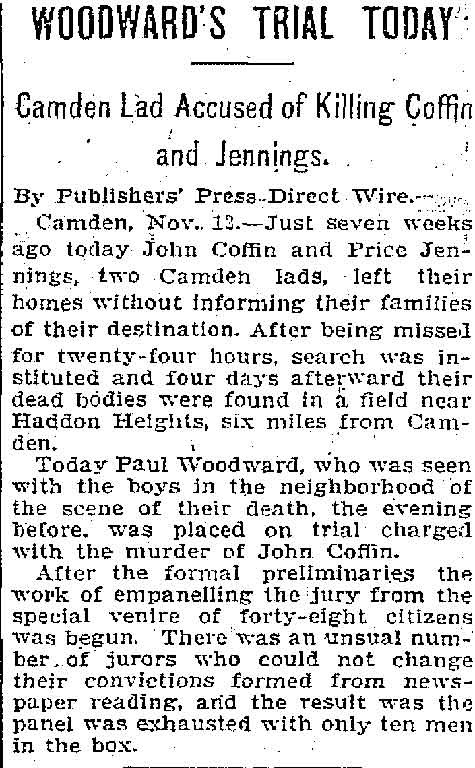
WOODWARD'S TRIAL TODAY
Camden Lad Accused of Killing Coffin and Jennings.
By Publishers' Press Direct Wire.
Camden, Nov. 12.—Just seven weeks ago today John Coffin and Price Jennings, two Camden lads, left their homes without informing their families of their destination. After being missed for twenty-four hours, search was instituted and four days afterward their dead bodies were found in a field near Haddon Heights, six miles from Camden.
Today Paul Woodward, who was seen with the boys in the neighborhood of the scene of their death, the evening before, was placed on trial charged with the murder of John Coffin.
After the formal preliminaries the work of empanelling the jury from the special venire of forty-eight citizens was begun. There was an unusual number of jurors who could not change their convictions formed from newspaper reading, and the result was the panel was exhausted with only ten men in the box.
Philadelphia Inquirer – November 13, 1902
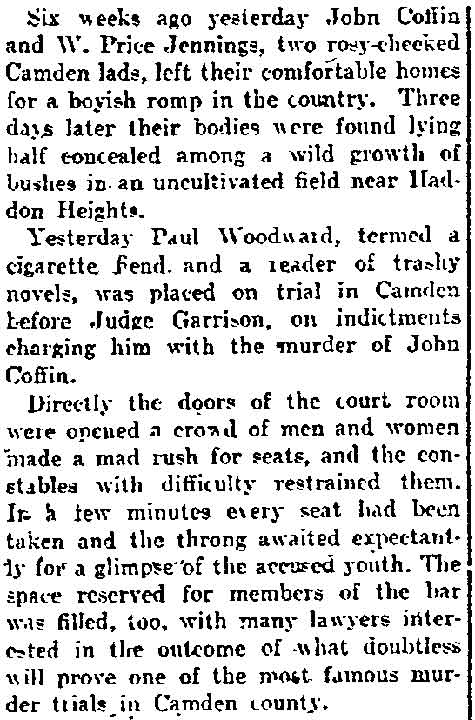
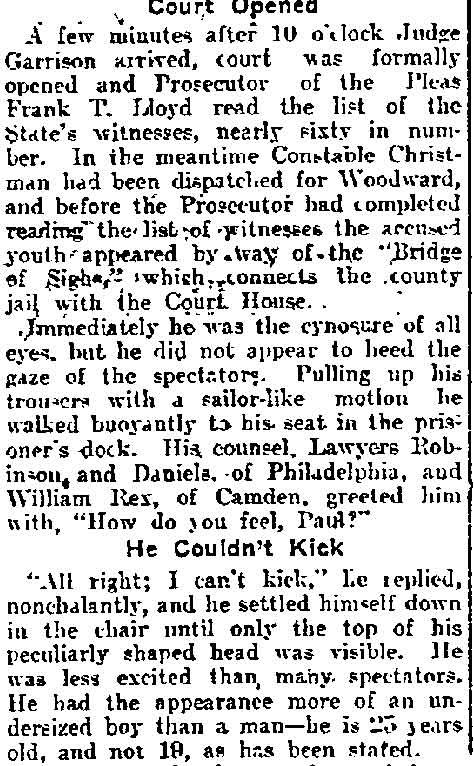
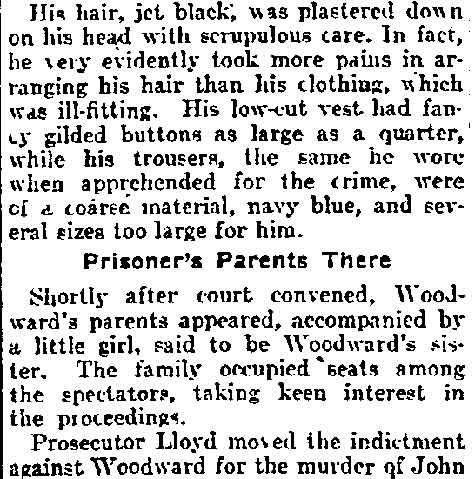
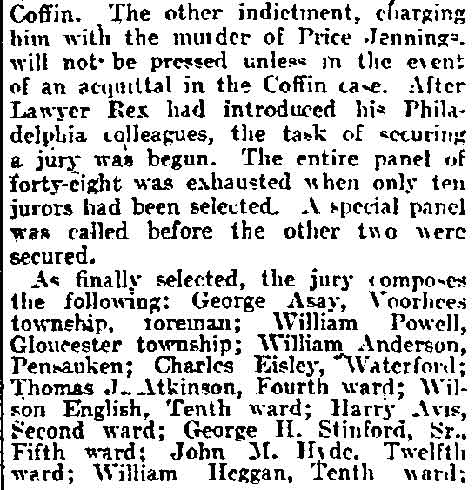
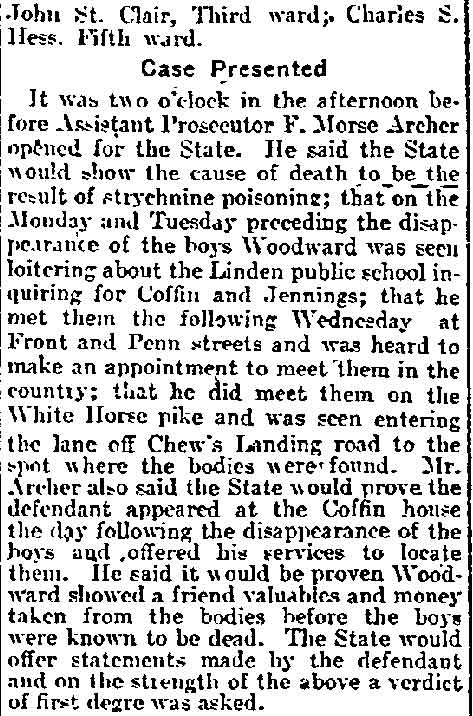
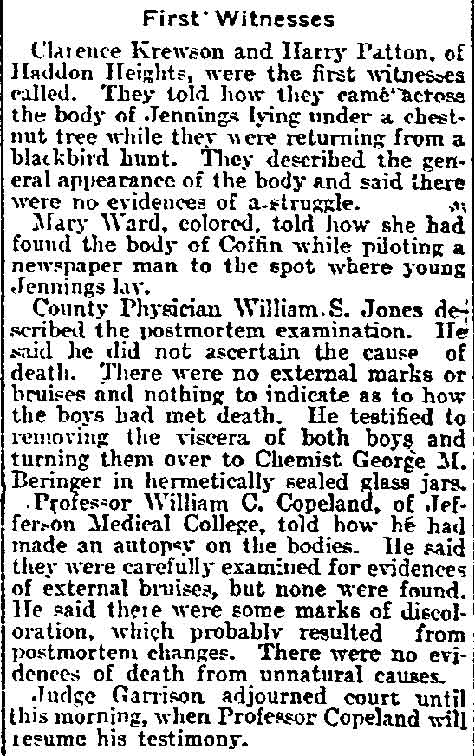
Named: Less Than Six Weeks After Alleged Crime Case Is Called in Camden Court, The Prisoner's Appearance, and What State Will Try to Prove.
Philadelphia Inquirer – November 14, 1902
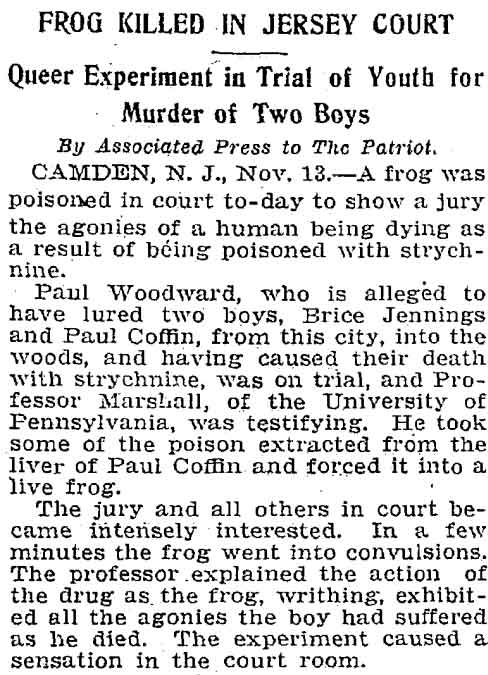
FROG KILLED IN JERSEY COURT
Queer Experiment in Trial of Youth for Murder of Two Boys
By Associated Press to The Patriot.
CAMDEN, N. J., Nov. 13.—A frog was poisoned in court to-day to show a jury the agonies of a human being dying as a result of being poisoned with strychnine.
Paul Woodward, who is alleged to have lured two boys, Brice Jennings and Paul Coffin, from this city, into the woods, and having caused their death with strychnine, was on trial, and Professor Marshall, of the University of Pennsylvania, was testifying. He took some of the poison extracted from the liver of Paul Coffin and forced it into a live frog.
The jury and all others in court became intensely interested. In a few minutes the frog went into convulsions. The professor explained the action of the drug as the frog, writhing, exhibited all the agonies the boy had suffered as he died. The experiment caused a sensation in the court room.
Philadelphia Inquirer – November 15, 1902

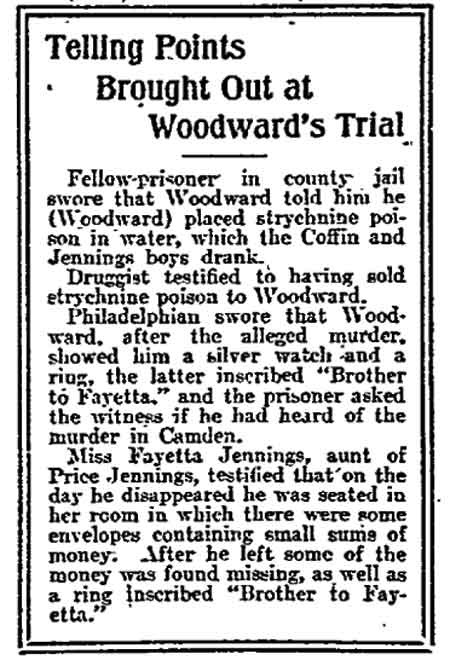
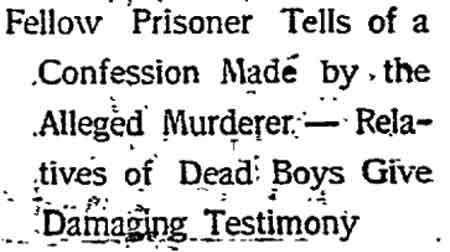
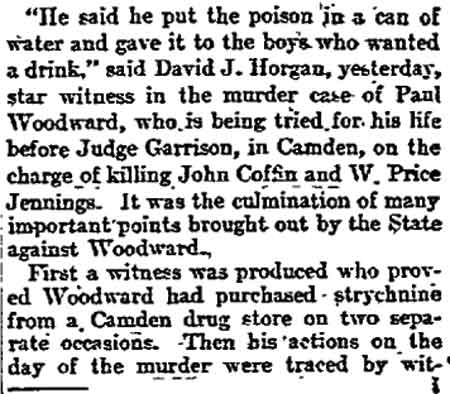
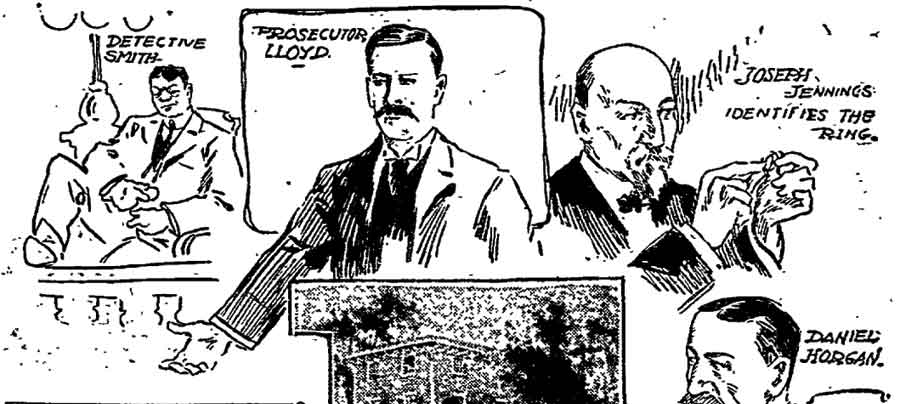
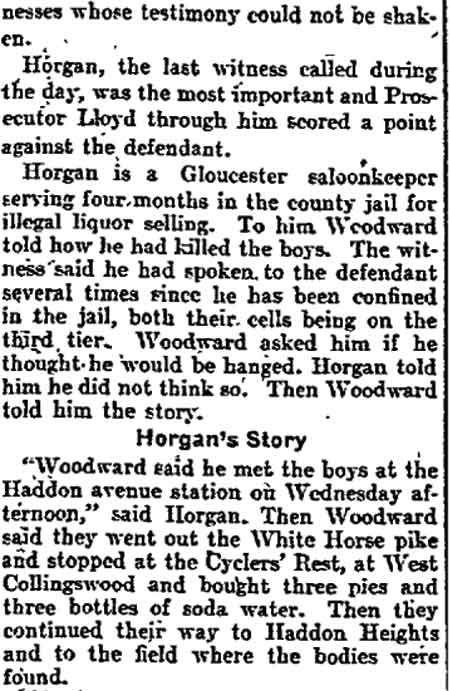
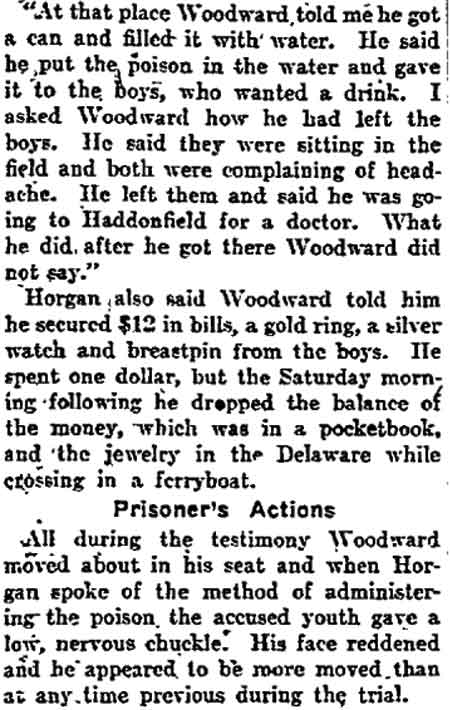
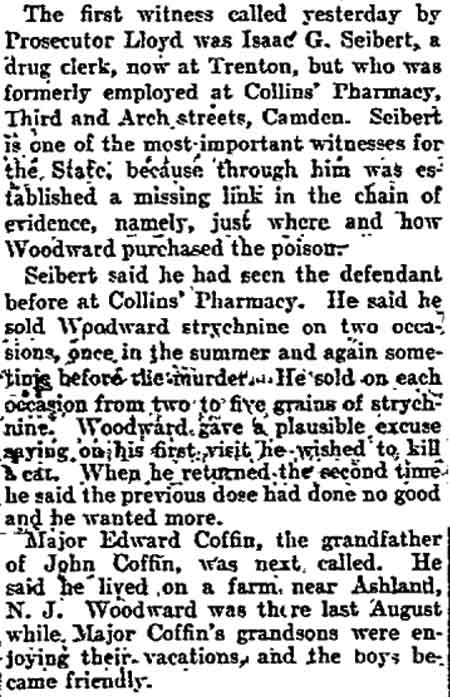
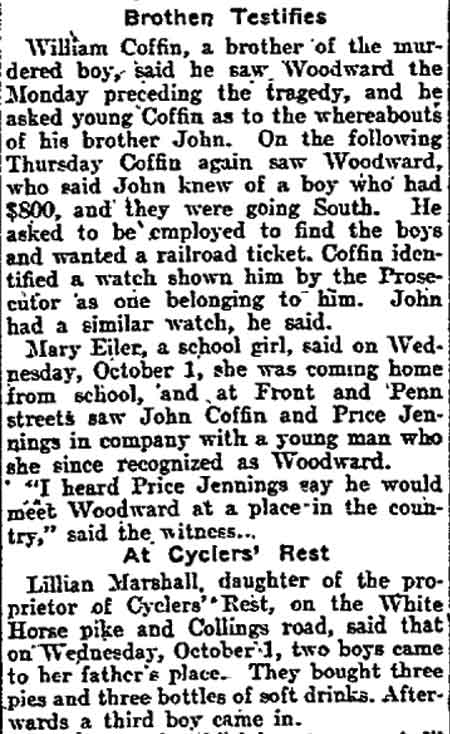
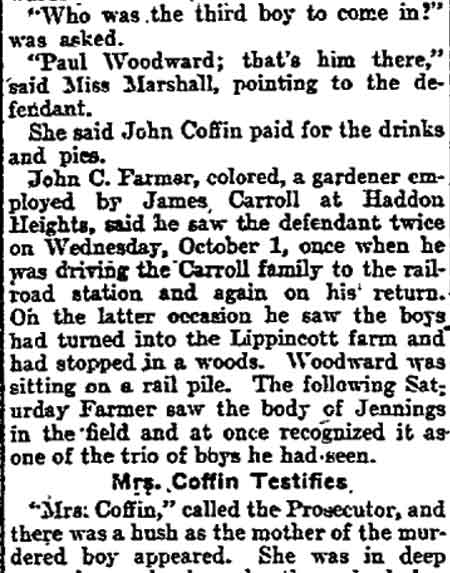
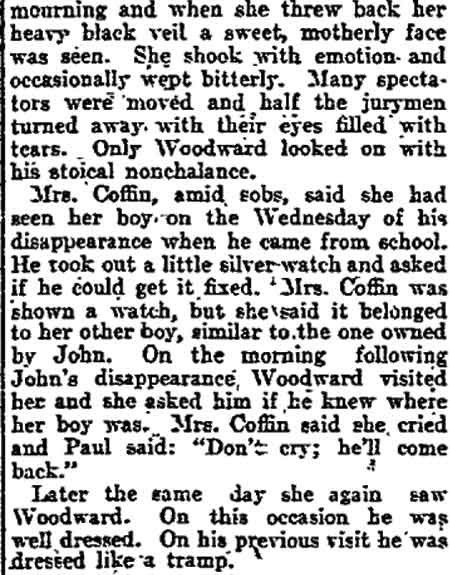
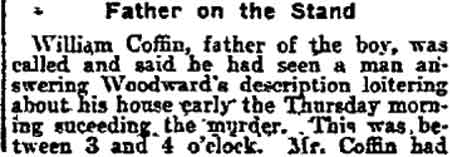
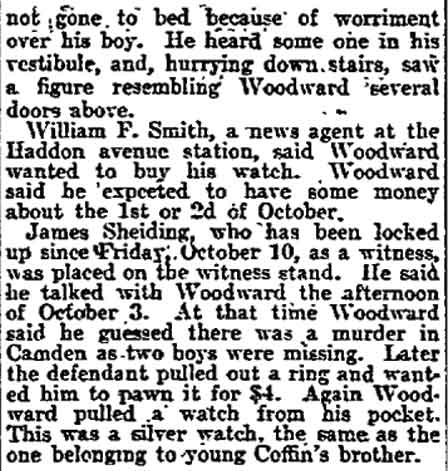
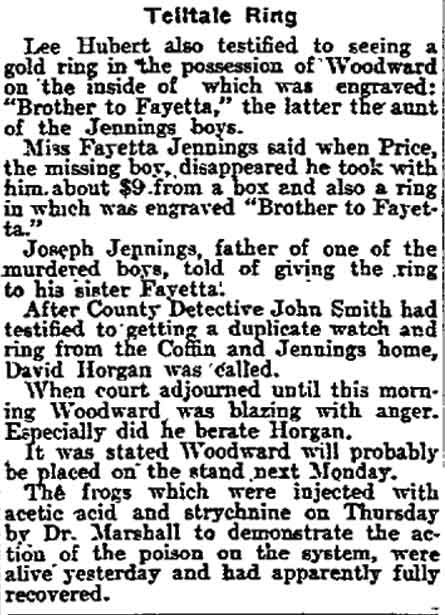
WOODWARD BOUGHT POISON, SAYS DRUGGIST
Philadelphia Inquirer – November 16, 1902

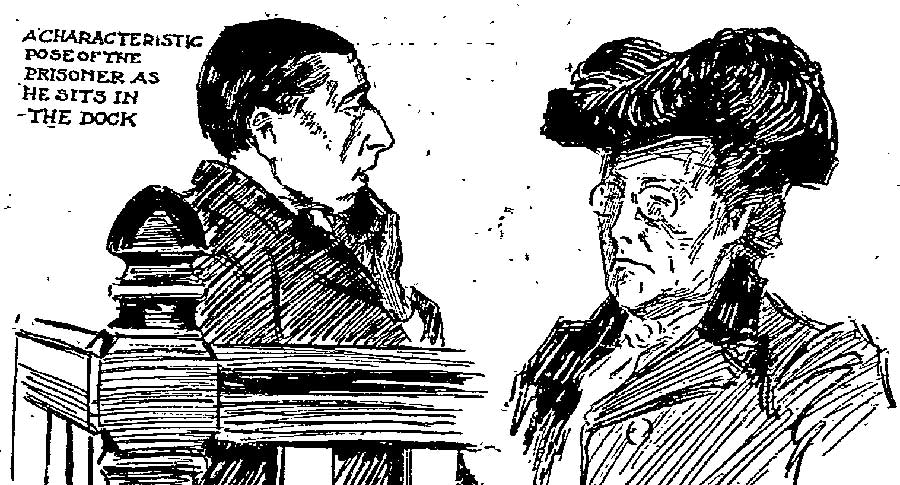
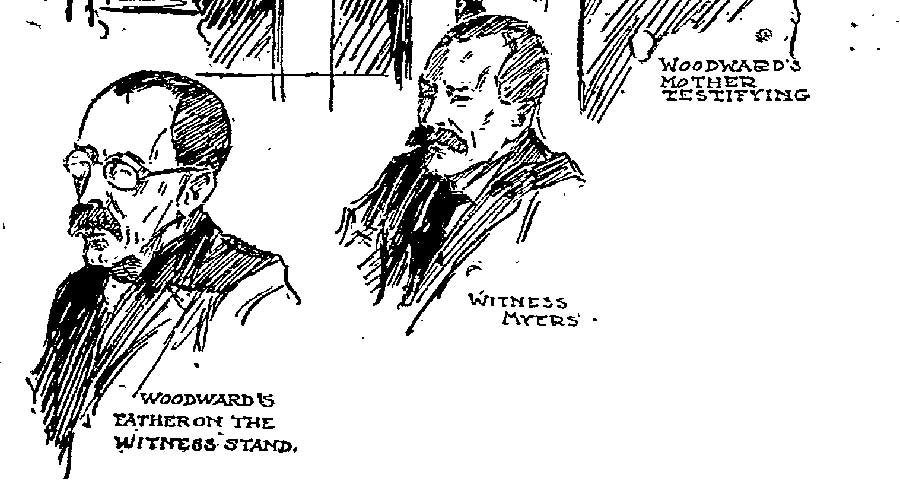
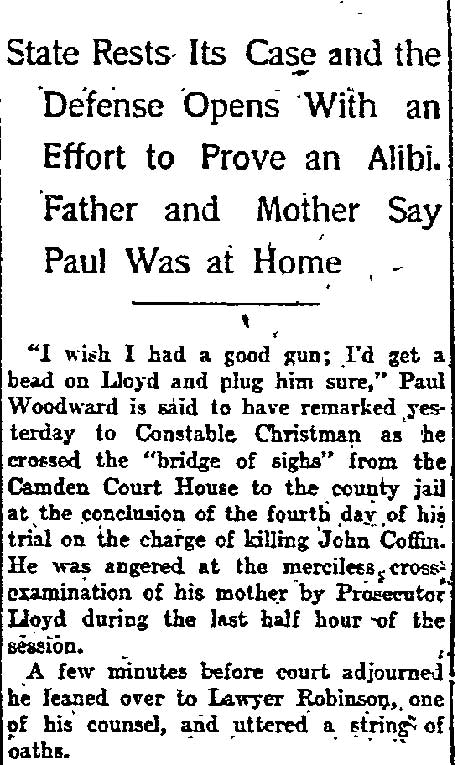
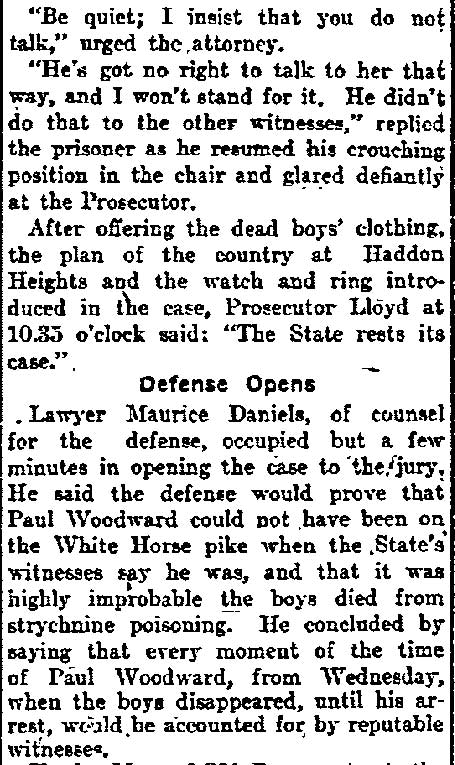
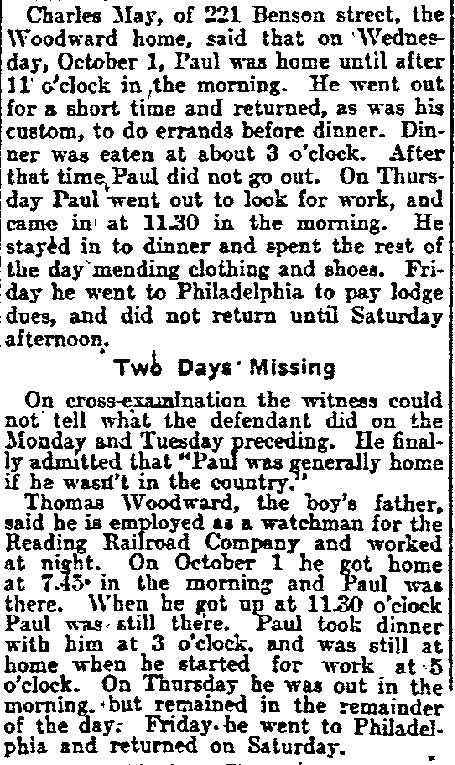

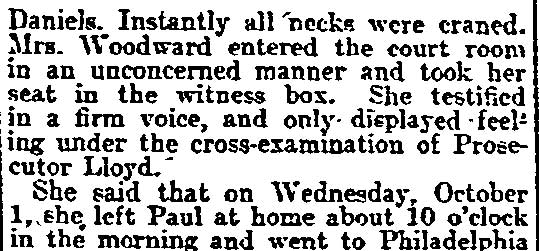
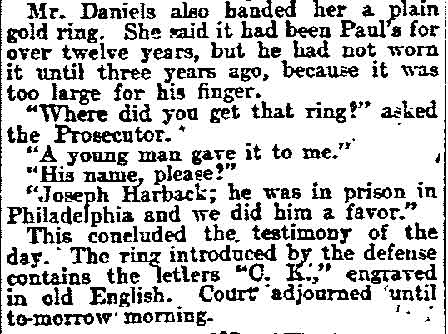
WOODWARD'S PARENTS ON STAND; BOY IN A RAGE
State Rests Its Case and the Defense Opens With an Effort to Prove an Alibi. Father and Mother Say Paul Was at Home.
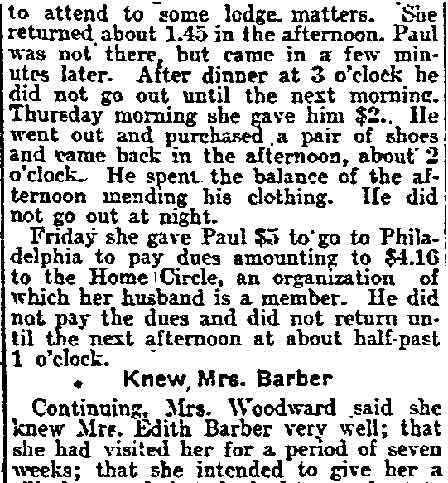
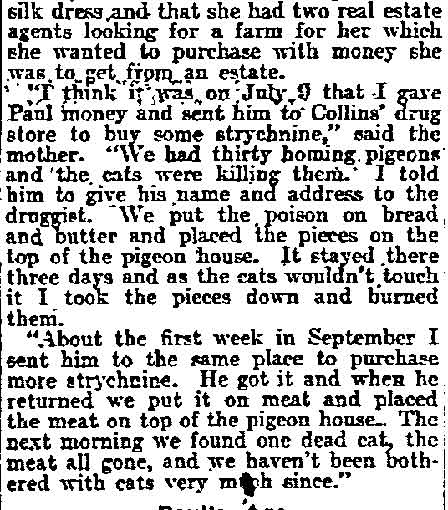
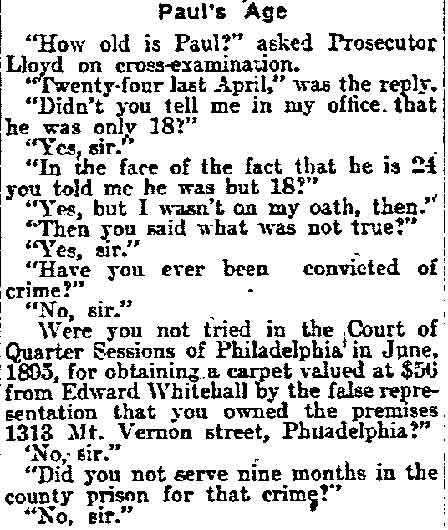
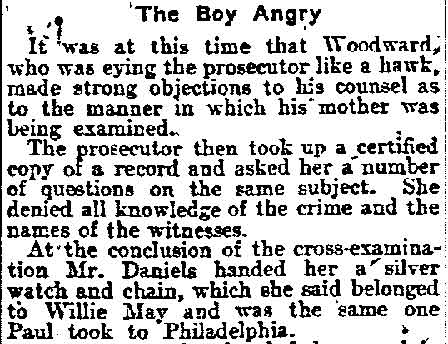
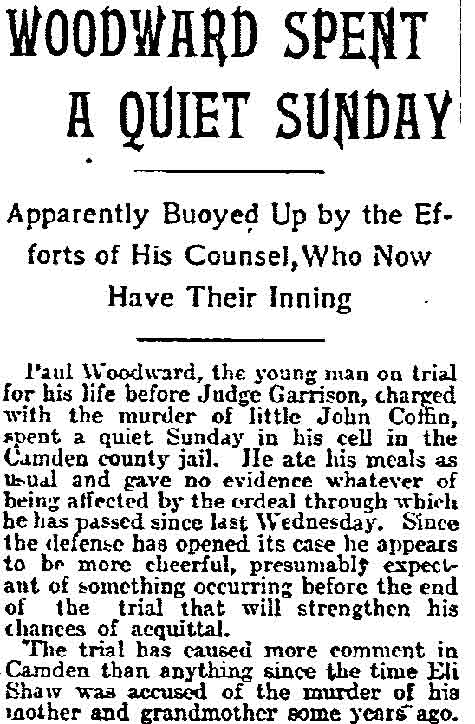
"I wish I had a good gun; I'd get a bead on Lloyd and plug him sure," Paul Woodward is said to have remarked yesterday to Constable Christman as he crossed the "bridge of sighs" from the Camden Court House to the county jail at the conclusion of the fourth day of his trial on the charge of killing John Coffin. He was angered at the merciless cross-examination of his mother by Prosecutor Lloyd during the last half hour of the session.
A few minutes before court adjourned he leaned over to Lawyer Robinson, one of his counsel, and uttered a string of oaths.
Philadelphia Inquirer – November 17, 1902
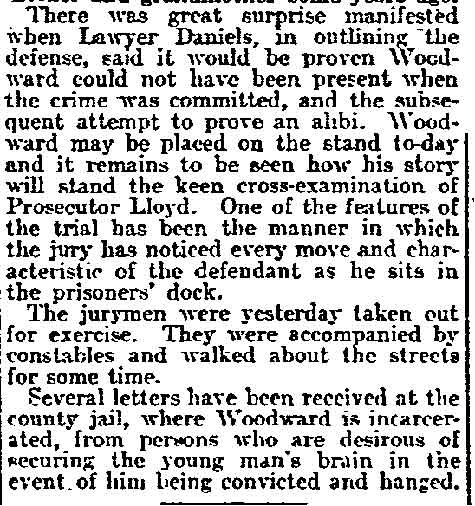
There was great surprise manifested when Lawyer Daniels, in outlining the defense, said it would be proven Woodward could not have been present when the crime was committed, and the subsequent attempt to prove an alibi. Woodward may be placed on the stand to-day and it remains to be seen how his story will stand the keen cross-examination of Prosecutor Lloyd. One of the features of the trial has been the manner in which the jury has noticed every move and characteristic of the defendant as he sits in the prisoners' dock.
The jurymen were yesterday taken out for exercise. They were accompanied by constables and walked about the streets for some time.
Several letters have been received at the county jail, where Woodward is incarcerated, from persons who are desirous of securing the young man's brain in the event of him being convicted and hanged.
Philadelphia Inquirer – November 18, 1902

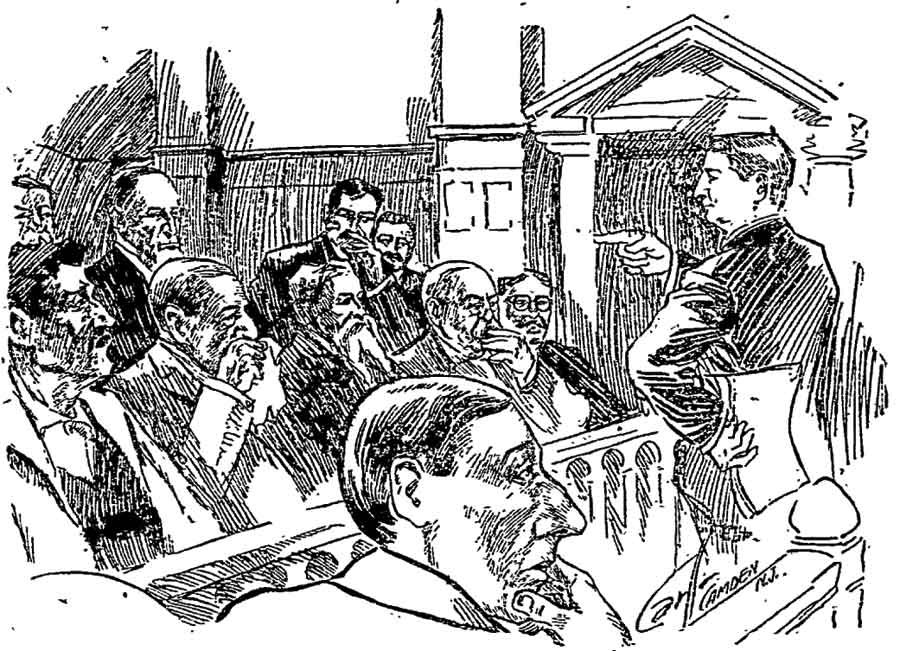

WOODWARD SMILED WHEN HE HEARD DEATH VERDICT
Camden Trial Came to a Sudden End With the Jury Returning a Conviction of Murder in the First Degree, After Deliberating Less Than an Hour
[Illustration caption: Attorney Robinson Making His Address to the Jury. Paul Woodward in Foreground.]
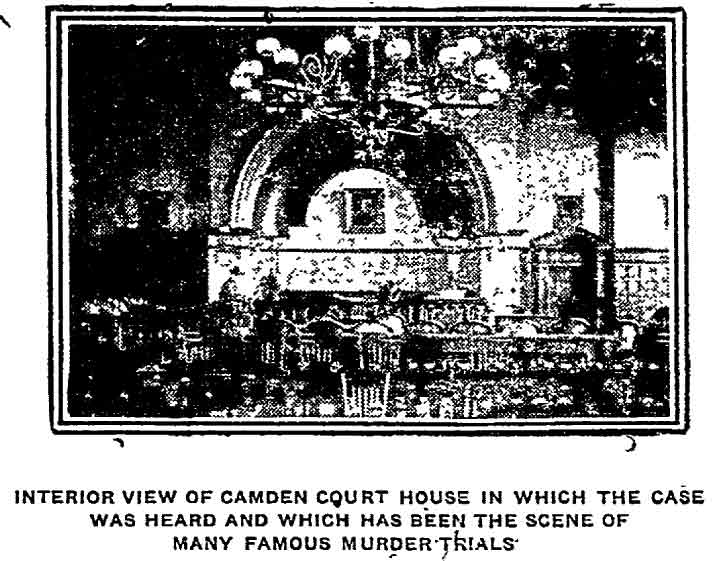
[Photo caption: Interior View of Camden Court House in Which the Case Was Heard and Which Has Been the Scene of Many Famous Murder Trials.]
Paul Woodward was last evening found guilty of murdering little John Coffin, whose body, with that of W. Price Jennings, was found in a field near Haddon Heights on October 4. Woodward’s trial began last Wednesday before Judge Garrison in Camden.
The jury retired at 3.45 o’clock, after a brief charge by Judge Garrison. At twenty minutes to 5 o’clock an agreement had been reached, but it was two minutes to 6 o’clock before Judge Garrison arrived, he having gone to his home at Merchantville.
In the meantime Woodward had been brought into the court room, and after the jury had filed in he was told to stand up. He arose without a tremor, looked at the ceiling, at the Judge and then turned to the twelve men who had his fate in their hands. His peculiar features lit up with a broad grin when the County Clerk said:
“Jury look upon the prisoner; prisoner look upon the jury.”
Guilty of Murder
Then when the jury was finally asked for its verdict and the foreman had solemnly announced “Guilty of murder in the first degree,” Woodward, apparently unmindful of the import of the words, turned to his counsel and laughed with a low chuckle. Each juror was polled and each man repeated “guilty of murder in the first degree.”
“The prisoner may retire,” said Judge Garrison, and with a sidelong glance at his counsel Woodward was led across the “bridge of sighs” to his cell in the county jail. He laughed loudly and slapped his custodian on the back in a playful mood, as if the whole proceedings had been a joke, but when he reached the jail he let go a tirade of profanity against the Prosecutor and those who appeared against him. He remarked that he did not care what became of him, all he cared for, he said, was his mother.
Motion for New Trial
Lawyer Rex immediately made a motion for a new trial, Judge Garrison stating he would hear argument on a date to be set. The jury was then discharged.
One of the features of the last day was the reappearance of Woodward’s mother, haggard, careworn and her eyes swollen with weeping. She was recalled to testify she had sworn falsely on Saturday when she denied even having been convicted of crime.
The climax in the defense’s case occurred in the morning, when Woodward, the defendant, was placed on the stand to testify. When he took his seat his eyes roamed about the room. He looked everywhere except in the direction of the jury. He admitted he was with the murdered boys, but denied absolutely having killed them. The alibi the defense tried to build about him during the period of the boys’ disappearance, was practically destroyed by contradictions made by Woodward concerning his movements. All the statements he made to Prosecutor Lloyd immediately following his arrest, he said, were false. He said he told the different stories because he was “scared.” The defense also tried to prove both boys were alive on Friday, October 3.
The defense called Dr. J. A. Leuf as an expert. He described the effects of strychnine on the human system. He said there were several other poisons that might have similar effects.
No Rebuttal Testimony
To the surprise of the assemblage no rebuttal testimony was given, Prosecutor Lloyd at once beginning his argument. He spoke for over an hour and at times was eloquent. He said the State asked for nothing but a first degree verdict, as the facts developed could have no other result consistent with the oath of the jury. It was a case of premeditation because there was first, an attempt at robbery, and second, because there was an attempt to do great bodily harm. The State, he said, had proved the crime against Woodward and followed him almost to the death bed of the boys.
Lawyer Robinson opened for the defense. He spoke for over an hour. “Paul is not guilty and if you follow the evidence you must acquit him,” concluded the defense.
Judge Garrison’s charge lasted just four minutes. He explained the law covering the case. He said anyone administering poison for robbery was guilty of murder in the first degree. If, however, it was not proven to the jury beyond a reasonable doubt that the defendant administered the poison, then he should be acquitted.
The jury then retired at 3.45.
Another postal card was received yesterday, asking for Woodward’s brain, but these seekers after the convicted man’s gray matter will be disappointed.
Philadelphia Inquirer – November 19, 1902
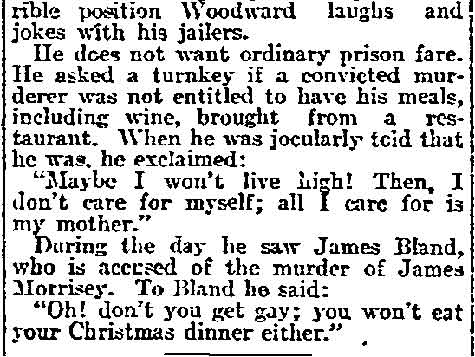
THINKS WOODWARD IS DEFICIENT
That Paul Woodward, the Camden murderer of John Coffin and W. Price Jennings, is mentally deficient is likely to be made the basis of a plea by his counsel for commutation of the death penalty in his case before the Board of Pardons. That his conduct since conviction has been such as to furnish some ground for the appeal is believed by some of those with whom he has come in contact.
Far from being impressed by his terrible position Woodward laughs and jokes with his jailers.
He does not want ordinary prison fare. He asked a turnkey if a convicted murderer was not entitled to have his meals, including wine, brought from a restaurant. When he was jocularly told that he was, he exclaimed:
“Maybe I won’t live high! Then, I don’t care for myself; all I care for is my mother.”
During the day he saw James Bland, who is accused of the murder of James Morrisey. To Bland he said:
“Oh! don’t you get gay; you won’t eat your Christmas dinner either.”
Philadelphia Inquirer – November 21, 1902
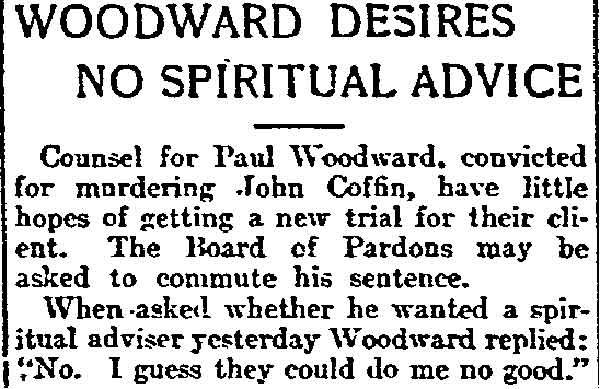
WOODWARD DESIRES NO SPIRITUAL ADVICE
Counsel for Paul Woodward, convicted for murdering John Coffin, have little hopes of getting a new trial for their client. The Board of Pardons may be asked to commute his sentence.
When asked whether he wanted a spiritual adviser yesterday Woodward replied: "No. I guess they could do me no good."
Philadelphia Inquirer – November 22, 1902
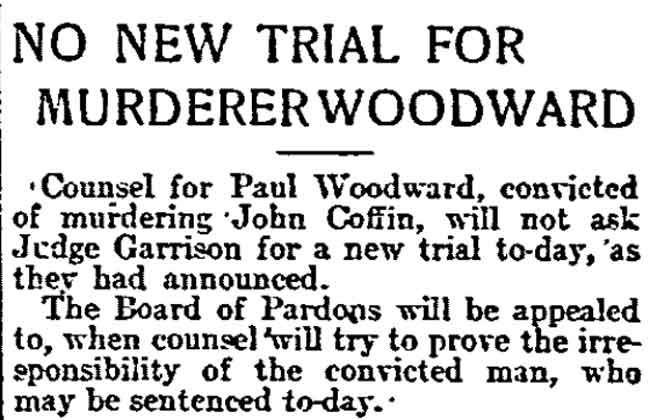
NO NEW TRIAL FOR MURDERER WOODWARD
Counsel for Paul Woodward, convicted of murdering John Coffin, will not ask Judge Garrison for a new trial to-day, as they had announced.
The Board of Pardons will be appealed to, when counsel will try to prove the irresponsibility of the convicted man, who may be sentenced to-day.
Philadelphia Inquirer – November 23, 1902
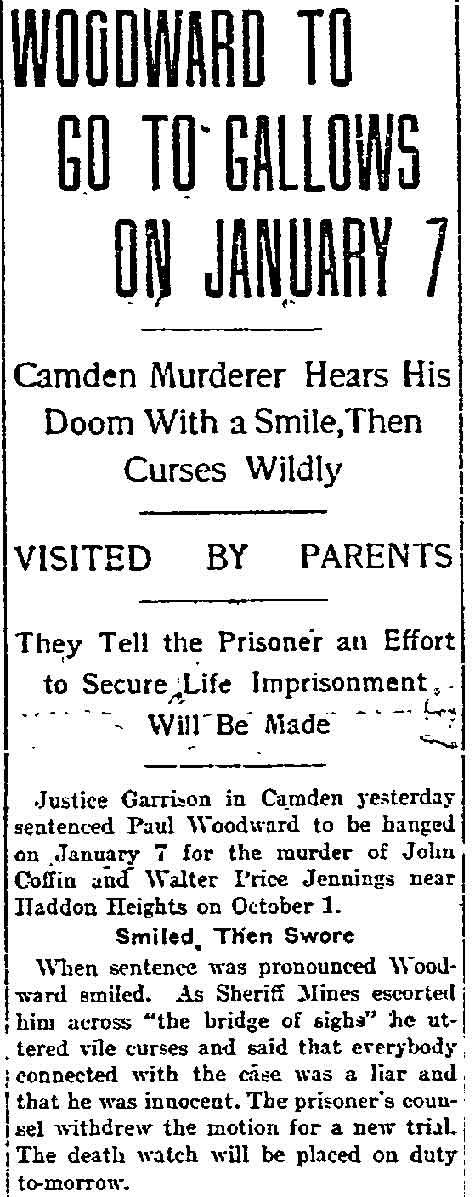
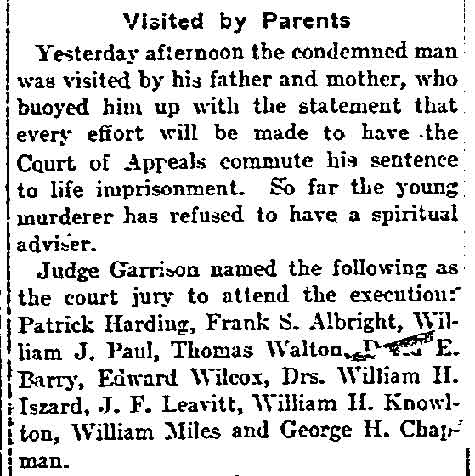
WOODWARD TO GO TO GALLOWS ON JANUARY 7
Camden Murderer Hears His Doom With a Smile, Then Curses Wildly
VISITED BY PARENTS
They Tell the Prisoner an Effort to Secure Life Imprisonment Will Be Made
Justice Garrison in Camden yesterday sentenced Paul Woodward to be hanged on January 7 for the murder of John Coffin and Walter Price Jennings near Haddon Heights on October 1.
Smiled, Then Swore
When sentence was pronounced Woodward smiled. As Sheriff Mines escorted him across "the bridge of sighs" he uttered vile curses and said that everybody connected with the case was a liar and that he was innocent. The prisoner's counsel withdrew the motion for a new trial. The death watch will be placed on duty to-morrow.
Philadelphia Inquirer – November 26, 1902
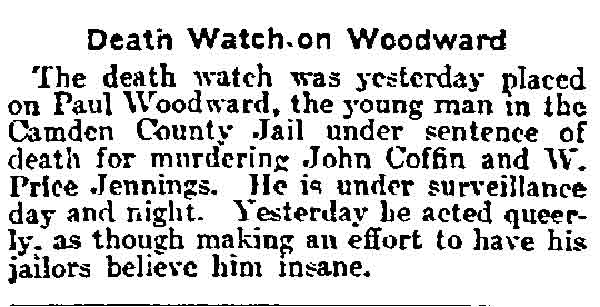
Death Watch on Woodward
The death watch was yesterday placed on Paul Woodward, the young man in the Camden County Jail under sentence of death for murdering John Coffin and W. Price Jennings. He is under surveillance day and night. Yesterday he acted queerly, as though making an effort to have his jailors believe him insane.
Philadelphia Inquirer – November 29, 1902
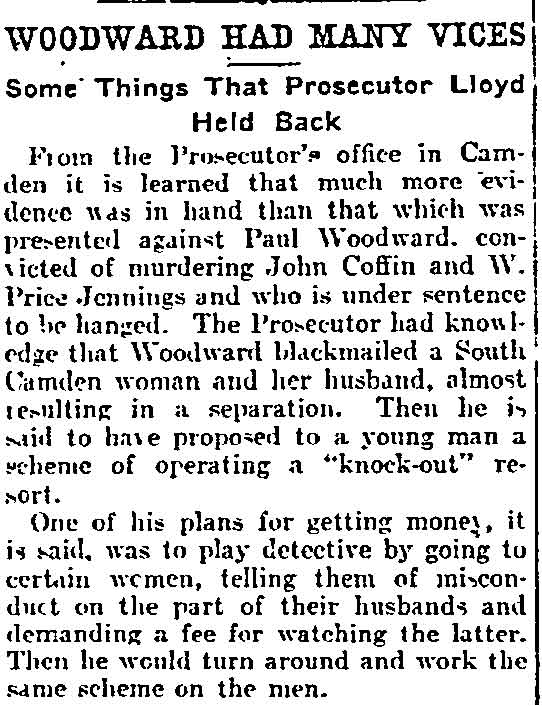
WOODWARD HAD MANY VICES
Some Things That Prosecutor Lloyd Held Back
From the Prosecutor's office in Camden it is learned that much more evidence was in hand than that which was presented against Paul Woodward, convicted of murdering John Coffin and W. Price Jennings and who is under sentence to be hanged. The Prosecutor had knowledge that Woodward blackmailed a South Camden woman and her husband, almost resulting in a separation. Then he is said to have proposed to a young man a scheme of operating a "knock-out" resort.
One of his plans for getting money, it is said, was to play detective by going to certain women, telling them of misconduct on the part of their husbands and demanding a fee for watching the latter. Then he would turn around and work the same scheme on the men.
Kalamazoo Gazette – November 29, 1902
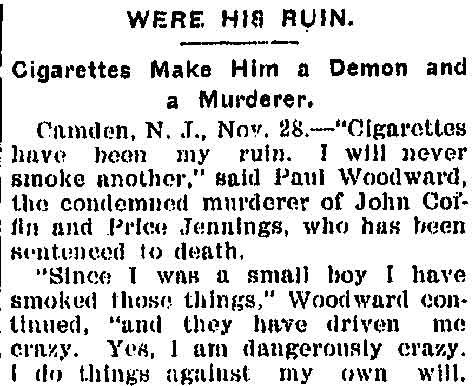
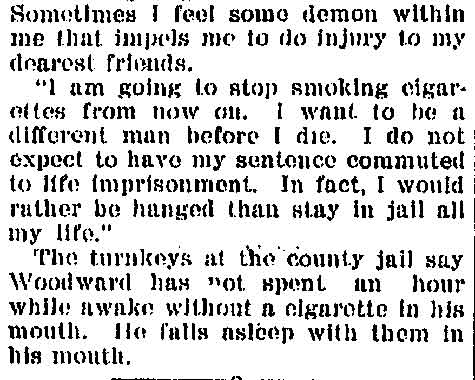
Cigarettes Make Him a Demon and a Murderer.
Camden, N. J., Nov. 28.—“Cigarettes have been my ruin. I will never smoke another,” said Paul Woodward, the condemned murderer of John Coffin and Price Jennings, who has been sentenced to death.
“Since I was a small boy I have smoked those things,” Woodward continued, “and they have driven me crazy. Yes, I am dangerously crazy. I do things against my own will.
Salt Lake Telegram – December 2, 1902
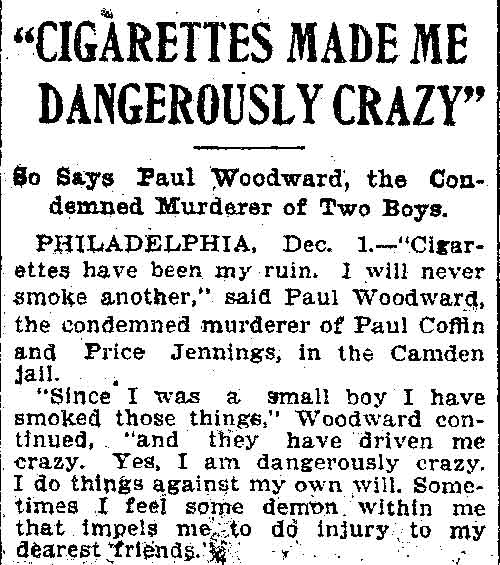
So Says Paul Woodward, the Condemned Murderer of Two Boys.
PHILADELPHIA, Dec. 1.—“Cigarettes have been my ruin. I will never smoke another,” said Paul Woodward, the condemned murderer of Paul Coffin and Price Jennings, in the Camden jail.
“Since I was a small boy I have smoked those things,” Woodward continued, “and they have driven me crazy. Yes, I am dangerously crazy. I do things against my own will. Sometimes I feel some demon within me that impels me to do injury to my dearest friends.”
Philadelphia Inquirer – December 4, 1902
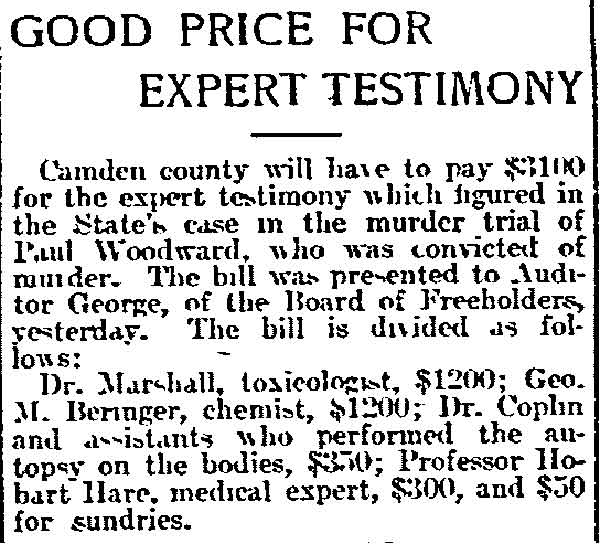
GOOD PRICE FOR EXPERT TESTIMONY
Camden county will have to pay $3100 for the expert testimony which figured in the State's case in the murder trial of Paul Woodward, who was convicted of murder. The bill was presented to Auditor George, of the Board of Freeholders, yesterday. The bill is divided as follows:
Dr. Marshall, toxicologist, $1200; Geo. M. Beringer, chemist, $1200; Dr. Cophn and assistants who performed the autopsy on the bodies, $350; Professor Hobart Hare, medical expert, $300, and $50 for sundries.
Philadelphia Inquirer – December 7, 1902
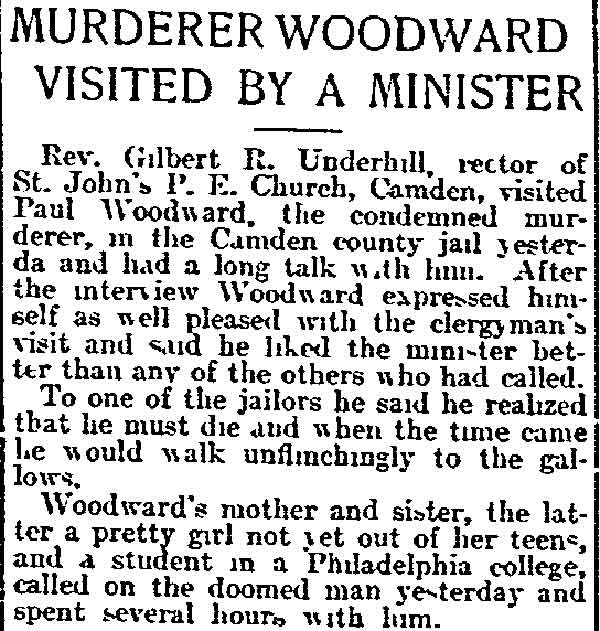
MURDERER WOODWARD VISITED BY A MINISTER
Rev. Gilbert R. Underhill, rector of St. John's P. E. Church, Camden, visited Paul Woodward, the condemned murderer, in the Camden county jail yesterday and had a long talk with him. After the interview Woodward expressed himself as well pleased with the clergyman's visit and said he liked the minister better than any of the others who had called.
To one of the jailors he said he realized that he must die and when the time came he would walk unflinchingly to the gallows.
Woodward's mother and sister, the latter a pretty girl not yet out of her teens, and a student in a Philadelphia college, called on the doomed man yesterday and spent several hours with him.
Philadelphia Inquirer – December 9, 1902
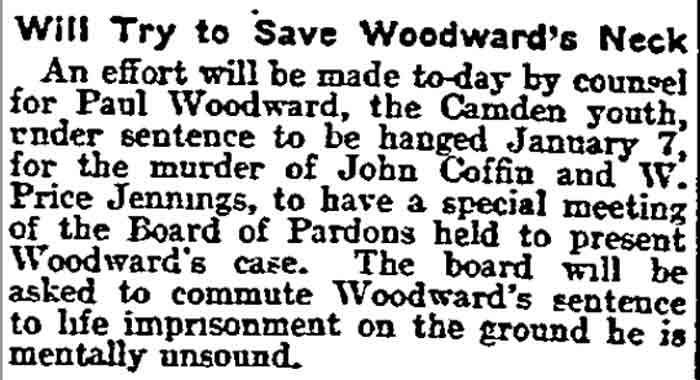
Will Try to Save Woodward's Neck
An effort will be made to-day by counsel for Paul Woodward, the Camden youth, under sentence to be hanged January 7, for the murder of John Coffin and W. Price Jennings, to have a special meeting of the Board of Pardons held to present Woodward's case. The board will be asked to commute Woodward's sentence to life imprisonment on the ground he is mentally unsound.
Philadelphia Inquirer – December 12, 1902
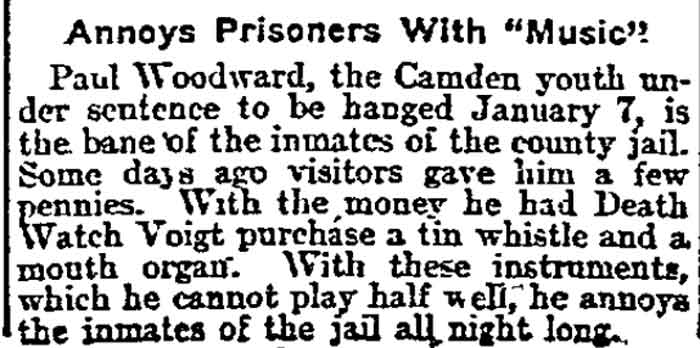
Annoys Prisoners With "Music"
Paul Woodward, the Camden youth under sentence to be hanged January 7, is the bane of the inmates of the county jail. Some days ago visitors gave him a few pennies. With the money he had Death Watch Voigt purchase a tin whistle and a mouth organ. With these instruments, which he cannot play half well, he annoys the inmates of the jail all night long.
Philadelphia Inquirer – December 14, 1902
MURDERER GIVEN TALKING MACHINE
Woodward, Condemned Boy Slayer, Operates Phonograph in the County Jail
IS HAVING LOTS OF FUN
Familiar Strains Ring Through the Cells to Youthful Prisoner's Great Delight
Philadelphia Inquirer – December 15, 1902
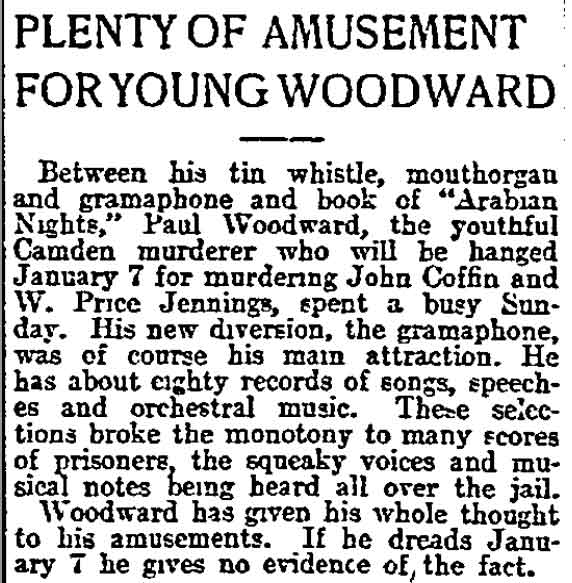
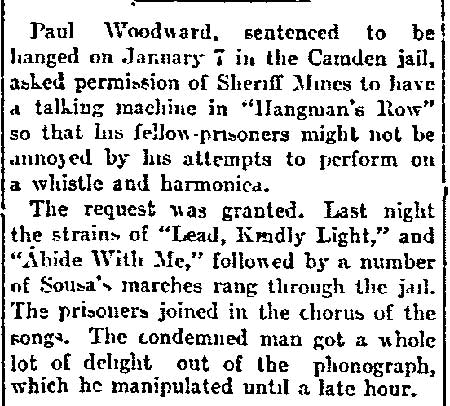
PLENTY OF AMUSEMENT FOR YOUNG WOODWARD
Between his tin whistle, mouthorgan and gramaphone and book of "Arabian Nights," Paul Woodward, the youthful Camden murderer who will be hanged January 7 for murdering John Coffin and W. Price Jennings, spent a busy Sunday. His new diversion, the gramaphone, was of course his main attraction. He has about eighty records of songs, speeches and orchestral music. These selections broke the monotony to many scores of prisoners, the squeaky voices and musical notes being heard all over the jail.
Woodward has given his whole thought to his amusements. If he dreads January 7 he gives no evidence of the fact.
Philadelphia Inquirer – December 17, 1902
PARDON BOARD ON WOODWARD'S CASE
Governor Will Reprieve Prisoner If Action Is Not Taken by December 24
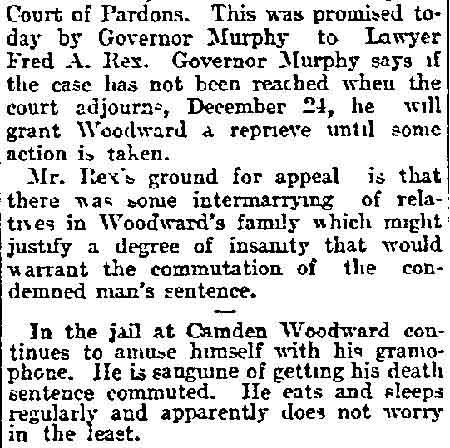
Special to The Inquirer.
TRENTON, N. J., Dec. 16—The case of Paul Woodward, the condemned Camden murderer, is to be considered by the Court of Pardons. This was promised to-day by Governor Murphy to Lawyer Fred A. Rex. Governor Murphy says if the case has not been reached when the court adjourns, December 24, he will grant Woodward a reprieve until some action is taken.
Mr. Rex’s ground for appeal is that there was some intermarrying of relatives in Woodward’s family which might justify a degree of insanity that would warrant the commutation of the condemned man’s sentence.
In the jail at Camden Woodward continues to amuse himself with his gramophone. He is sanguine of getting his death sentence commuted. He eats and sleeps regularly and apparently does not worry in the least.
Philadelphia Inquirer – December 21, 1902
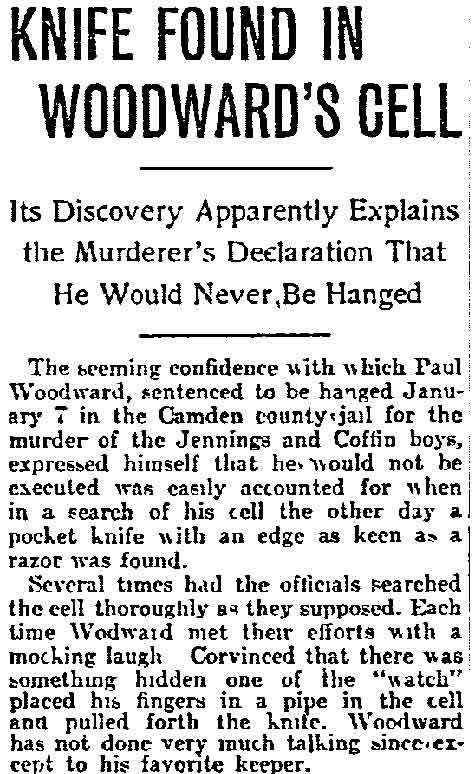
KNIFE FOUND IN WOODWARD'S CELL
Its Discovery Apparently Explains the Murderer's Declaration That He Would Never Be Hanged
The seeming confidence with which Paul Woodward, sentenced to be hanged January 7 in the Camden county jail for the murder of the Jennings and Coffin boys, expressed himself that he would not be executed was easily accounted for when in a search of his cell the other day a pocket knife with an edge as keen as a razor was found.
Several times had the officials searched the cell thoroughly as they supposed. Each time Wodward met their efforts with a mocking laugh. Convinced that there was something hidden one of the "watch" placed his fingers in a pipe in the cell and pulled forth the knife. Woodward has not done very much talking since—except to his favorite keeper.
Philadelphia Inquirer – December 25, 1902
TRYING TO SAVE WOODWARD'S NECK
The New Jersey Court of Pardons, in secret session, yesterday, gave a hearing to counsel for Paul Woodward, the Camden murderer, who is under sentence to be hanged on January 7. Counsel asked for a commutation of sentence on the ground of insanity.
The court postponed decision in the matter until next Tuesday, in order to give counsel an opportunity to present testimony.
Philadelphia Inquirer – December 26, 1902
MURDERER WOODWARD HAD MERRY CHRISTMAS
Paul Woodward, the youthful murderer in the Camden County Jail under sentence of death for killing John Coffin and W. Price Jennings, spent a happy Christmas.
It was a happy one because he had plenty to eat—stewed chicken, mince pie, candy, etc.—and also because he has an idea he will not be hanged, at least on January 7.
Philadelphia Inquirer – December 30, 1902
LAST EFFORT TO SAVE WOODWARD
Lawyer Frederick A. Rex, counsel for Paul Woodward, the youth under sentence to be hanged January 7 for the murder of John Coffin and W. Price Jennings, will go to Trenton to-day to ask that Woodward's sentence be commuted to life imprisonment.
Woodward's counsel has little prospect of getting anything favorable from the Board of Pardons, however.
Philadelphia Inquirer – December 31, 1902
WOODWARD'S LAST HOPE VANISHED
Court of Pardons Refuses to Interfere in Case of Camden's Condemned Murderer
Special to The Inquirer.
TRENTON, N. J., Dec. 30—The Court of Pardons in special session this afternoon refused to interfere in the case of—
Philadelphia Inquirer – January 1, 1903
Murderer Woodward Unconcerned
Paul Woodward, who next week will be hanged for murdering little John Coffin and W. Price Jennings, spent the greater part of yesterday in his cell at the Camden county jail reading his Bible. While apparently unconcerned, he is being closely watched to prevent him from committing suicide. Sheriff Mines yesterday sent out invitations to the execution, January 7.
Philadelphia Inquirer – January 3, 1903
UNCONCERNED AT DEATH'S APPROACH
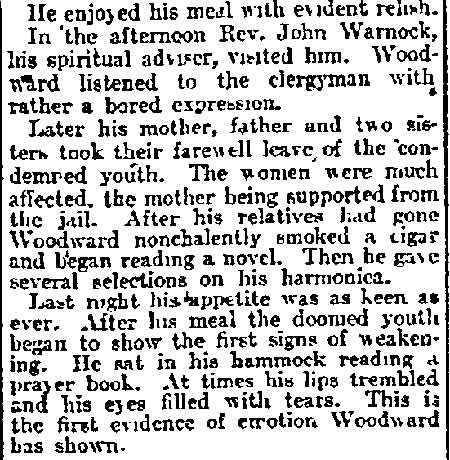
Despite the fact that Paul Woodward, Camden's youthful murderer, has but a few days to live, he is in no wise affected. His appetite is as good as when he was first incarcerated. He is living high, being supplied from a near-by restaurant by order of Sheriff Mines. Yesterday he was visited by his father, mother and youngest sister. Later Rev. John Warnock called on him.
Philadelphia Inquirer – January 5, 1903
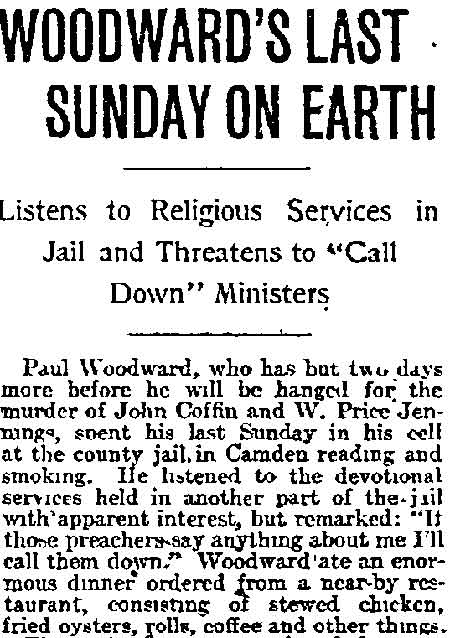
WOODWARD'S LAST SUNDAY ON EARTH
Listens to Religious Services in Jail and Threatens to "Call Down" Ministers
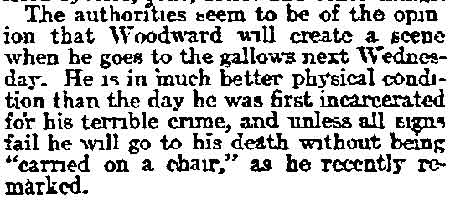
Paul Woodward, who has but two days more before he will be hanged for the murder of John Coffin and W. Price Jennings, spent his last Sunday in his cell at the county jail in Camden reading and smoking. He listened to the devotional services held in another part of the jail with apparent interest, but remarked: "If those preachers say anything about me I'll call them down." Woodward ate an enormous dinner ordered from a near-by restaurant, consisting of stewed chicken, fried oysters, rolls, coffee and other things.
Philadelphia Inquirer – January 6, 1903
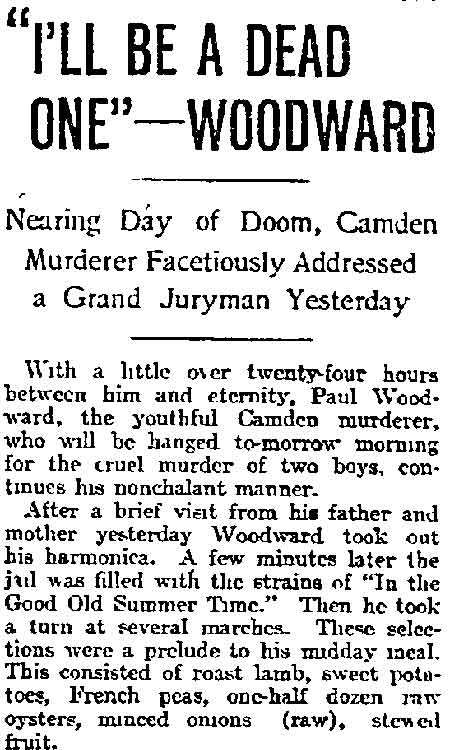
"I'LL BE A DEAD ONE"—WOODWARD
Nearing Day of Doom, Camden Murderer Facetiously Addressed a Grand Juryman Yesterday
With a little over twenty-four hours between him and eternity, Paul Woodward, the youthful Camden murderer, who will be hanged to-morrow morning for the cruel murder of two boys, continues his nonchalant manner.
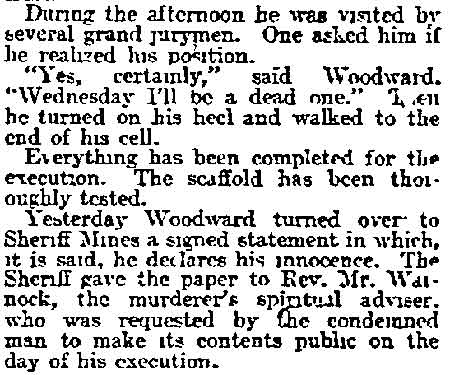
After a brief visit from his father and mother yesterday Woodward took out his harmonica. A few minutes later the jail was filled with the strains of "In the Good Old Summer Time." Then he took a turn at several marches. These selections were a prelude to his midday meal. This consisted of roast lamb, sweet potatoes, French peas, one-half dozen raw oysters, minced onions (raw), stewed fruit.
Philadelphia Inquirer – January 7, 1903
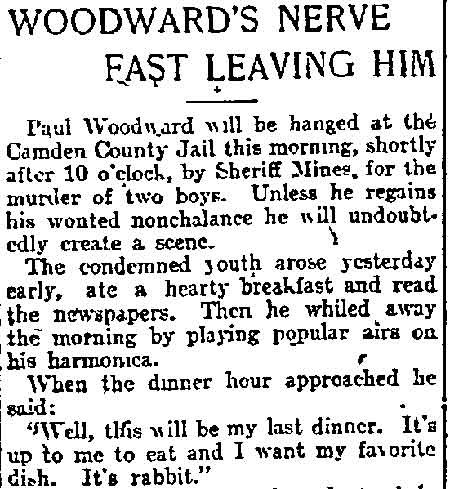
WOODWARD'S NERVE FAST LEAVING HIM
Paul Woodward will be hanged at the Camden County Jail this morning, shortly after 10 o'clock, by Sheriff Mines, for the murder of two boys. Unless he regains his wonted nonchalance he will undoubtedly create a scene.
The condemned youth arose yesterday early, ate a hearty breakfast and read the newspapers. Then he whiled away the morning by playing popular airs on his harmonica.
When the dinner hour approached he said:
"Well, this will be my last dinner. It's up to me to eat and I want my favorite dish. It's rabbit."
Wilkes-Barre Times – January 7, 1903
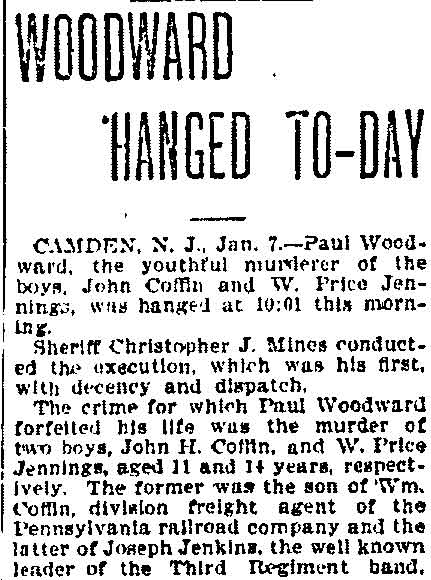
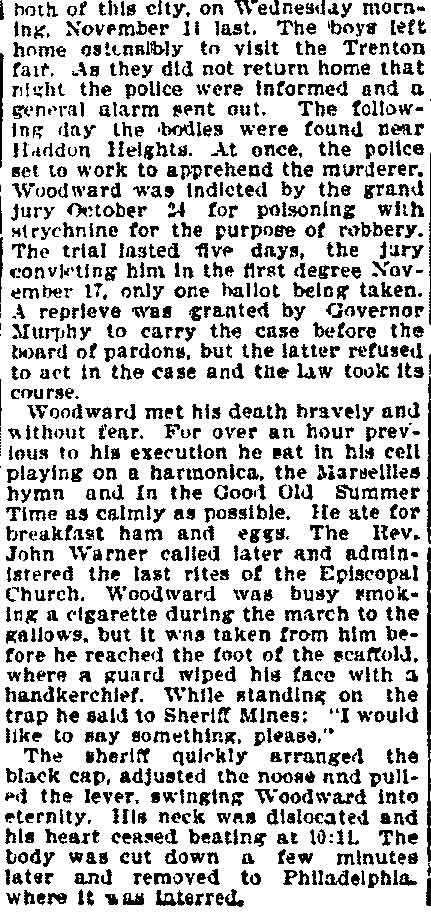
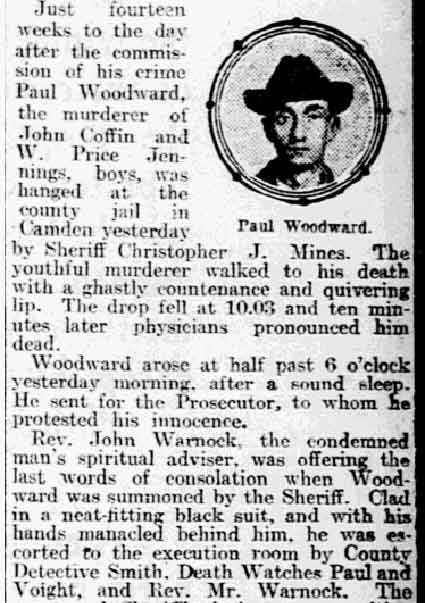
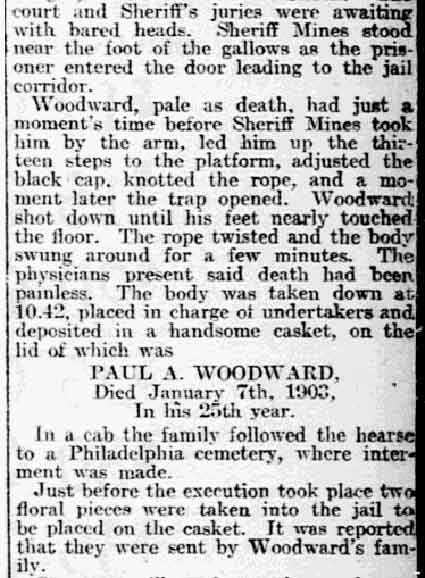
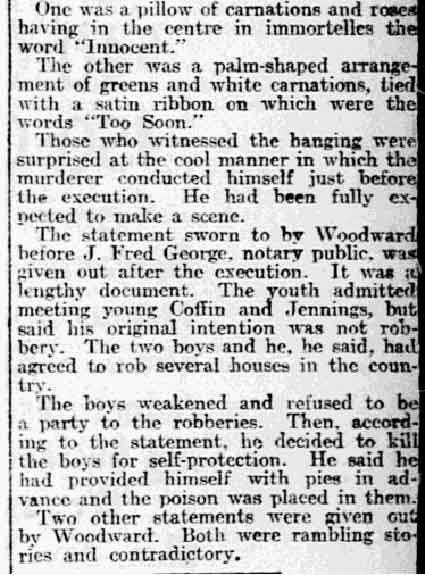
CAMDEN, N. J., Jan. 7.—Paul Woodward, the youthful murderer of the boys, John Coffin and W. Price Jennings, was hanged at 10:01 this morning.
Sheriff Christopher J. Mines conducted the execution, which was his first, with decency and dispatch.
The crime for which Paul Woodward forfeited his life was the murder of two boys, John H. Coffin and W. Price Jennings, aged 11 and 14 years, respectively. The former was the son of Wm. Coffin, division freight agent of the Pennsylvania railroad company and the latter of Joseph Jenkins, the well known leader of the Third Regiment band.
Philadelphia Inquirer – January 8, 1903
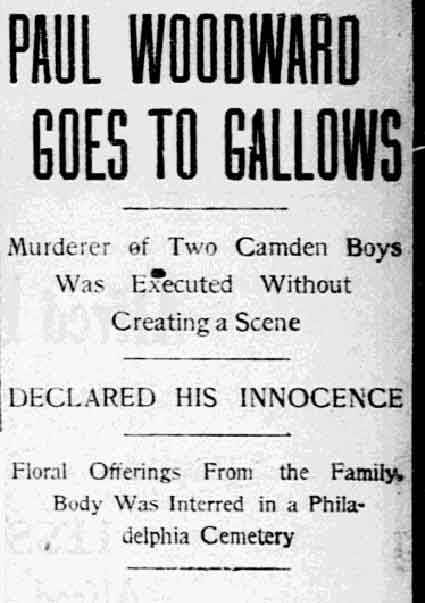
PAUL WOODWARD GOES TO GALLOWS
Murderer of Two Camden Boys Was Executed Without Creating a Scene
DECLARED HIS INNOCENCE
Floral Offerings From the Family, Body Was Interred in a Philadelphia Cemetery
Philadelphia Inquirer – January 17, 1903
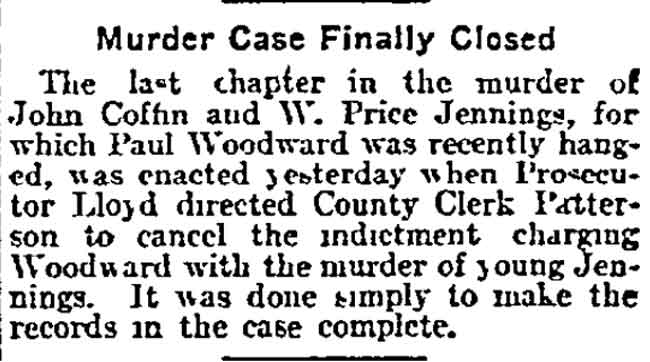
Murder Case Finally Closed
The last chapter in the murder of John Coffin and W. Price Jennings, for which Paul Woodward was recently hanged, was enacted yesterday when Prosecutor Lloyd directed County Clerk Patterson to cancel the indictment charging Woodward with the murder of young Jennings. It was done simply to make the records in the case complete.
Philadelphia Inquirer – November 22, 1906
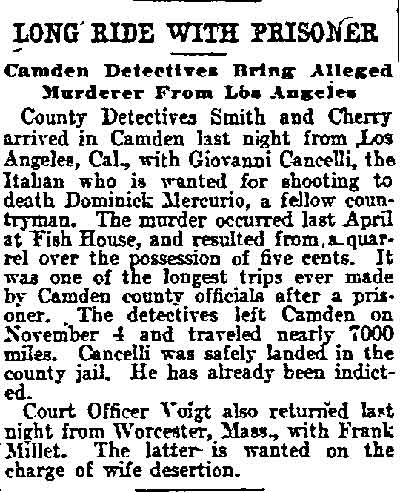
LONG RIDE WITH PRISONER
Camden Detectives Bring Alleged Murderer From Los Angeles
County Detectives Smith and Cherry arrived in Camden last night from Los Angeles, Cal., with Giovanni Cancelli, the Italian who is wanted for shooting to death Dominick Mercurio, a fellow countryman. The murder occurred last April at Fish House, and resulted from a quarrel over the possession of five cents. It was one of the longest trips ever made by Camden county officials after a prisoner. The detectives left Camden on November 4 and traveled nearly 7000 miles. Cancelli was safely landed in the county jail. He has already been indicted.
Court Officer Voigt also returned last night from Worcester, Mass., with Frank Millet. The latter is wanted on the charge of wife desertion.
Some Shifts in Camden
Philadelphia Inquirer –
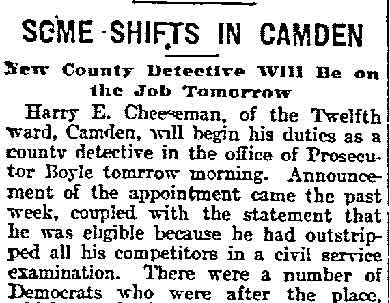
SOME SHIFTS IN CAMDEN
New County Detective Will Be on the Job Tomorrow
Harry E. Cheeseman, of the Twelfth ward, Camden, will begin his duties as a county detective in the office of Prosecutor Boyle tomorrow morning. Announcement of the appointment came the past week, coupled with the statement that he was eligible because he had outstripped all his competitors in a civil service examination. There were a number of Democrats who were after the place, which was held by Marcus N. Carroll, who resigned shortly after the appointment of Prosecutor Boyle.
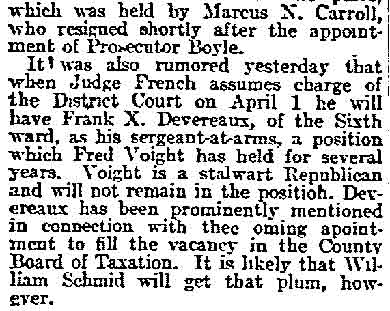
It was also rumored yesterday that when Judge French assumes charge of the District Court on April 1 he will have Frank X. Devereaux, of the Sixth ward, as his sergeant-at-arms, a position which Fred Voight has held for several years. Voight is a stalwart Republican and will not remain in the position. Devereaux has been prominently mentioned in connection with the coming appointment to fill the vacancy in the County Board of Taxation. It is likely that William Schmid will get that plum, however.
Philadelphia Inquirer – March 15, 1910
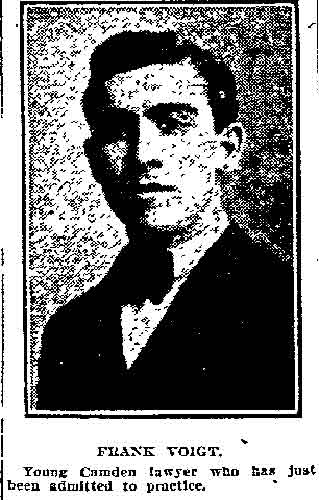
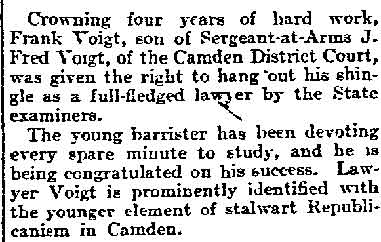
FRANK VOIGT.
Young Camden lawyer who has just been admitted to practice.
Philadelphia Inquirer – July 25, 1910
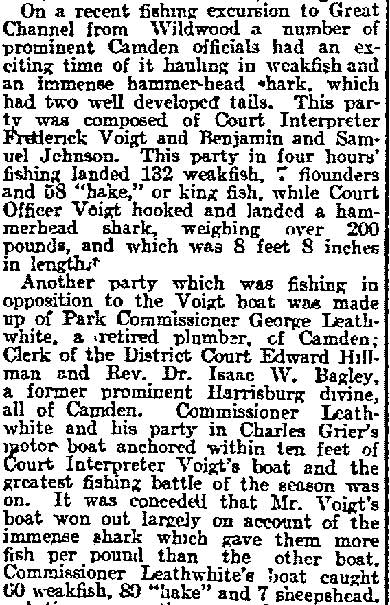
LANDED BIG SHARK AT STONE HARBOR
Well-Known Camden Men Had an Exciting Time of It at Fishing Contest
Some Great Catches Were Made in the Space of About Four Hours
Special to The Inquirer.
STONE HARBOR, N. J., July 24. — At the present time nearly all the inside fishing from Wildwood to Sea Isle City is being done in Great Channel, adjacent to this resort. For the past ten days there has been an immense quantity of weakfish caught in those waters, and very few caught anywhere else. Even the outside fishermen have had very poor luck with weakfish, while all other sea fish have been running strong.
Philadelphia Inquirer – April 3, 1912
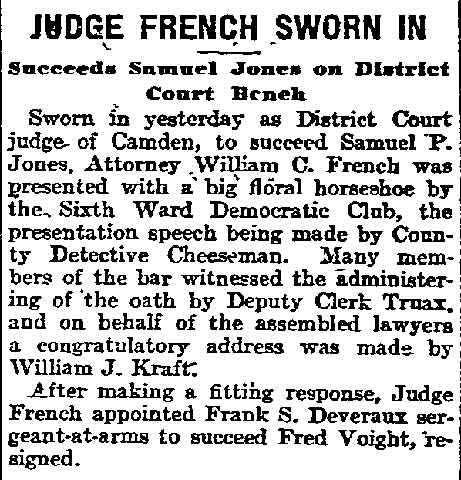
JUDGE FRENCH SWORN IN
Succeeds Samuel Jones on District Court Bench
Sworn in yesterday as District Court judge of Camden, to succeed Samuel P. Jones, Attorney William C. French was presented with a big floral horseshoe by the Sixth Ward Democratic Club, the presentation speech being made by County Detective Cheeseman. Many members of the bar witnessed the administering of the oath by Deputy Clerk Truax, and on behalf of the assembled lawyers a congratulatory address was made by William J. Kraft.
After making a fitting response, Judge French appointed Frank S. Deveraux sergeant-at-arms to succeed Fred Voight, resigned.
Philadelphia Inquirer – October 8, 1914
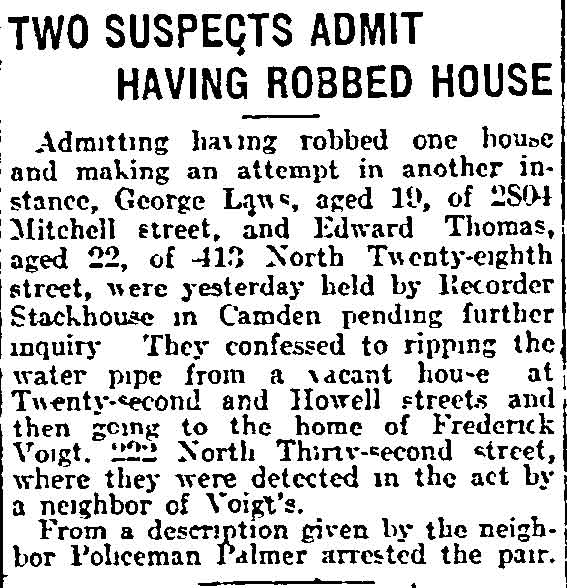
TWO SUSPECTS ADMIT HAVING ROBBED HOUSE
Admitting having robbed one house and making an attempt in another instance, George Laws, aged 19, of 2804 Mitchell street, and Edward Thomas, aged 22, of 413 North Twenty-eighth street, were yesterday held by Recorder Stackhouse in Camden pending further inquiry. They confessed to ripping the water pipe from a vacant house at Twenty-second and Howell streets and then going to the home of Frederick Voigt, 222 North Thirty-second street, where they were detected in the act by a neighbor of Voigt's.
From a description given by the neighbor Policeman Palmer arrested the pair.
Philadelphia Inquirer – January 26, 1915

M. Cohen, aged 15 years, was yesterday taken to the State Home for Boys by Constable Voigt. The boy has been arrested on numerous occasions.
Philadelphia Inquirer – February 27, 1915
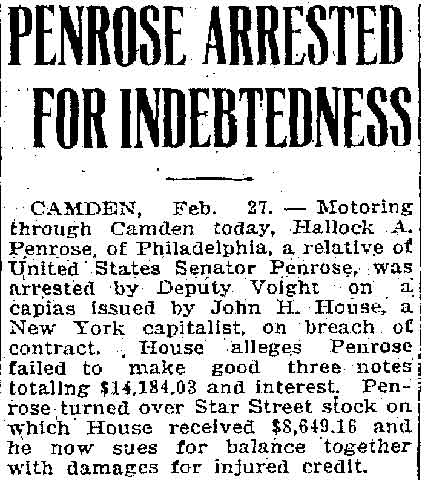
PENROSE ARRESTED FOR INDEBTEDNESS
CAMDEN, Feb. 27. — Motoring through Camden today, Hallock A. Penrose, of Philadelphia, a relative of United States Senator Penrose, was arrested by Deputy Voight on a capias issued by John H. House, a New York capitalist, on breach of contract. House alleges Penrose failed to make good three notes totaling $14,184.03 and interest. Penrose turned over Star Street stock on which House received $8,649.16 and he now sues for balance together with damages for injured credit.
Stockton Annexed Against Protest Of Democrats.
Camden Courier-Post –
Fifty years ago, the old town of Stockton was annexed to the City of Camden over the protests of Democratic members of the town council.
But a Republican Legislature approved a bill introduced by former Justice Frank T. Lloyd on March 24, 1899. He was a member of the Assembly at the time. He resided then in the structure now occupied by the Sheltering Arms Home at Eighteenth street and River avenue.
The town of Stockton had been in existence five years when the annexation took place. Merchantville and Pennsauken township were part of the original Stockton Township with the present East Camden area. Merchantville received its charter as a borough 75 years ago this month. In 1892. Pennsauken township withdrew, from the. township to become a separate municipality.
For two years East Camden remained in the township. In 1894 Alfred Cramer, founder of Cramer Hill, launched a movement to create the town of Stockton and the first governing body was elected. Edward Dudley, then a leading lawyer, was elected councilman-at-large, which entitled him to preside as mayor. William S. Abbott, a lifelong resident, became clerk.
The town was divided into three wards. Fred Voigt and Justice Lloyd also served with Cramer and Dudley in the town council. The town hall was on the triangle, at Twenty-seventh and Federal Streets.
Albert Plum and William C. Reeves were justices of the peace. Samuel M. Jaquillard served on the Board of Freeholders as did W.O. Buck and Joseph Funfer. Charles E. Allen was a member of the Board of Education.
After the annexation Abbott was elected to Camden City Council. Others elected were Dr. William H. Kensinger, now a resident of Florida; Frederick S. von Nieda, Frederick H. Finkeldey, president of the first Playground Commission; Arthur R. Gemberling, now of Woodstown.
Other active citizens were Lemuel D. Horner, undertaker; Dr. H. F. Hadley, Jacob Bendinger, proprietor of the Rosedale Inn, and Walter L. Tushingham, former vice-president and general manager of the Courier-Post Newspapers.